Performances Magazine | LA Phil, February 2026

Page 1


FEBRUARY 3–MARCH 8, 2026

6

Curating Tomorrow’s Moments Today: Margaret Morgan and Wesley Phoa 21

BOOK I • FEBRUARY 3–11

FEB 3

GREEN UMBRELLA

Adams, Cheung & Lanao

FEB 6–8

Los Angeles Philharmonic

Thomas Adès and Yuja Wang featuring Prokofiev and Tchaikovsky

FEB 8

ORGAN

Thomas Ospital

FEB 10

CHAMBER MUSIC

Lunar New Year

FEB 11

COLBURN CELEBRITY RECITAL

Yefim Bronfman

BOOK II • FEBRUARY 12–22

FEB 12–15

Los Angeles Philharmonic Dudamel Conducts Beethoven and Lorenz featuring Yunchan Lim and Cate Blanchett

FEB 17

SONGBOOK

Seth MacFarlane

FEB 20–22

Los Angeles Philharmonic Gustavo Conducts Beethoven: Missa Solemnis

BOOK III • FEBRUARY 26–MARCH 8

FEB 26–MAR 1

Los Angeles Philharmonic Beethoven and Ortiz with Dudamel

MAR 5–6 & 8

Los Angeles Philharmonic Dudamel, Dante, and Beethoven 6

MAR 7

GREEN UMBRELLA

The Great Wall of Los Angeles

A culinary

for your theatre outing encore

A PERFECT DINING EXPERIENCE TO PAIR WITH YOUR PERFORMANCE

Indulge in a seasonal three-course prix fixe menu at Noé Restaurant & Bar, just a short walk from the theatre. Enjoy a stress-free meal with valet parking for $25 and receive 15% off your bill at Noé when you present your theatre program. Scan the QR code & reserve your table now for an unforgettable evening.

Los Angeles Philharmonic Publications 2026

Editor

Amanda Angel

Editorial Specialist

Tess Carges

Editorial Coordinator

Robert Alexander

Art Director

Natalie Suarez

Design

Studio Fuse

Explore more at: laphil.com

Publisher Jeff Levy

Art Director

Carol Wakano

Production Manager

Glenda Mendez

Production Artist

Diana Gonzalez

Digital Manager

Lorenzo Dela Rama

Advertising Director

Walter Lewis

Advertising Manager Liz Moore

Account Directors

Kerry Baggett, Jan Bussman, Jean Greene

Circulation Manager Christine Noriega-Roessler

Business Manager

Leanne Killian Riggar

Marketing/

Production Manager

Dawn Kiko Cheng

Contact Us

Advertising Walter.Lewis@ CaliforniaMediaGroup.com

Website Lorenzo.DelaRama@ CaliforniaMediaGroup.com

Circulation Christine.Roessler@ CaliforniaMediaGroup.com

Honorary President Ted Levy

For information about advertising and rates contact California Media Group

3679 Motor Ave., Suite 300 Los Angeles, CA 90034

Phone: 310.280.2880 Fax: 310.280.2890

Visit Performances Magazine online at socalpulse.com

Performances Magazine is published by California Media Group to serve performing arts venues throughout the West. © 2026 California Media Group. All Rights Reserved.

WELCOME

Art has the magical ability to transport us across time. Through this unique quality, great thinkers from the 1700s can connect and influence contemporary voices, Hollywood’s Golden Age figures still tug at our heartstrings, and Los Angeles’ founding figures can inspire future generations.

Beethoven thought that music could change our communities and ourselves for the better, and two centuries later this belief also drives Music & Artistic Director Gustavo Dudamel. Over four weeks, Gustavo leads an exploration of Beethoven’s work, from the revolutionary spirit of Egmont to the profound statement of faith in Missa Solemnis, which he is conducting for the first time! He’ll be joined by some of today’s greatest artists, including Jeremy O. Harris, Cate Blanchett, Ricardo Lorenz, Gabriela Ortiz, and Thomas Adès.

We see cross-generational exchanges in Seth MacFarlane’s evening devoted to Frank Sinatra (Feb. 17), Yuja Wang’s interpretation of Prokofiev’s Piano Concerto No. 2 (Feb. 6–8), and the John Adams–curated Green Umbrella program, featuring pieces by rising composers such as his son, Samuel Adams (Feb. 3).

And history will come alive on March 7, as Gustavo conducts the world premiere of The Great Wall of Los Angeles. This symphonic tribute, as well as Judy Baca’s powerful mural on which it’s based, gives voice to the Angelenos who created this city with an eye toward better days ahead. It is an impressively ambitious project, and I hope to see you there.

Warmly,

Kim Noltemy

President & Chief Executive Officer

David C. Bohnett Presidential Chair

Los Angeles Philharmonic Association

BOARD OF DIRECTORS

CHAIR

Jason Subotky*

PRESIDENT & CEO

David C. Bohnett Presidential Chair

Kim Noltemy

VICE CHAIRS

Thomas L. Beckmen*

Reveta Bowers*

Jane B. Eisner*

David Meline*

Diane Paul*

Jay Rasulo*

DIRECTORS

Nancy L. Abell

Gregory A. Adams

Julie Andrews

Camilo Esteban

Becdach

Linda Brittan

Jennifer Broder

Kawanna Brown

Andrea Chao-Kharma*

R. Martin Chavez

Christian D. Chivaroli

Jonathan L. Congdon

Donald P. de Brier*

Louise D. Edgerton

Dotty Ewing

Lisa Field

David A. Ford

Alfred Fraijo Jr.

Hilary Garland

Jennifer Miller Goff*

Tamara Golihew

Lori Greene Gordon

David Greenbaum

Carol Colburn Grigor

Marian L. Hall

Antonia Hernández*

Jonathan Kagan*

† In Memoriam

Darioush Khaledi

Winnie Kho

Joey Lee

Daniel R. Lewis

Francois Mobasser

Margaret Morgan

Leith O’Leary

Andy S. Park

Sandy Pressman

Geoff Rich*

Laura Rosenwald

Michael Saei

Richard Schirtzer

John Sinnema

G. Gabrielle Starr

Jay Stein*

Christian Stracke*

Ronald D. Sugar*

Vikki Sung

Jack Suzar

Sue Tsao

Megan Watanabe

Regina Weingarten

Jenny Williams

Alyce de Roulet

Williamson

Irwin Winkler

Debra Wong Yang

HONORARY LIFE DIRECTORS

David C. Bohnett

Frank Gehry †

Lenore S. Greenberg

Bowen H. “Buzz” McCoy

PAST CHAIRS**

Thomas L. Beckmen

Jay Rasulo

Diane B. Paul

David C. Bohnett

Jerrold L. Eberhardt

John F. Hotchkis †

Executive Committee Member as of September 26, 2025

From the opening of Walt Disney Concert Hall on October 24, 2003, to present

usbank.com/privatewealth

GUSTAVO DUDAMEL

Music & Artistic Director, Walt and Lilly Disney Chair

Gustavo Dudamel is committed to creating a better world through music. Guided by an unwavering belief in the power of art to inspire and transform lives, he has worked tirelessly to expand education and access for underserved communities around the world and to broaden the impact of classical music on new and ever-larger audiences. His rise, from humble beginnings as a child in Venezuela to an unparalleled career of artistic and social achievements, offers living proof that culture can bring meaning to the life of an individual and greater harmony to the world at large. He currently serves as the Music & Artistic Director of the Los Angeles Philharmonic and the Simón Bolívar Symphony Orchestra of Venezuela, and in 2026, he becomes the Music and Artistic Director of the New York Philharmonic, continuing a legacy that includes Gustav Mahler, Arturo Toscanini, and Leonard Bernstein. Throughout 2025, Dudamel celebrated the 50th Anniversary of El Sistema, honoring the global impact of José Antonio Abreu’s visionary education program across five generations and acknowledging the vital importance of arts education.

Dudamel’s advocacy for the power of music to unite, heal, and inspire is global in scope. In appearances from the United Nations to the White House to the Nobel Peace Prize Concert, Dudamel has served as a passionate advocate for music education and social integration through art, sharing his own transformative experience in Venezuela’s El Sistema program as an example of how music can give a sense of purpose and meaning to young people and help them rise above challenging circumstances. In 2007, Dudamel, the LA Phil, and its community

partners founded YOLA (Youth Orchestra Los Angeles), which now provides more than 1,700 young people with free instruments, intensive music instruction, academic support, and leadership training. In 2012, Dudamel launched the Dudamel Foundation, which he co-chairs with his wife, actress and director María Valverde, with the goal of expanding access to music and the arts for young people by providing tools and opportunities to shape their creative futures.

As a conductor, Dudamel is one of the few classical musicians to become a bona fide pop-culture phenomenon and has worked tirelessly to ensure that music reaches an ever-greater audience. He was the first classical artist to participate in the Super Bowl halftime show and the youngest conductor ever to lead the Vienna Philharmonic’s New Year’s Concert. He has performed at global mainstream events from the Academy Awards to Coachella, and has worked with musical icons like Billie Eilish, Christina Aguilera, LL Cool J, Ca7riel & Paco Amoroso, Laufey, Coldplay, and Nas. Dudamel conducted the score to Steven Spielberg’s new adaptation of West Side Story, and at John Williams’ personal request, he guest conducted the opening and closing credits of Star Wars: The Force Awakens. His film and television appearances include Sesame Street, The Simpsons, Mozart in the Jungle, Trolls World Tour, and The Nutcracker and the Four Realms, and in 2019 Dudamel was honored with a star on the Hollywood Walk of Fame.

For more information about Gustavo Dudamel, visit his official website at gustavodudamel.com and the Dudamel Foundation at dudamelfoundation.org.

LOS ANGELES PHILHARMONIC

The Los Angeles Philharmonic, under the vibrant leadership of Music & Artistic Director Gustavo Dudamel, presents an inspiring array of music through a commitment to foundational works and adventurous explorations. Both at home and abroad, the LA Phil—recognized as one of the world’s outstanding orchestras—is leading the way in groundbreaking and diverse programming, onstage and in the community, that reflects the orchestra’s artistry and demonstrates its vision. The 2025/26 season is the orchestra’s 107th.

Nearly 300 concerts are either performed or presented by the LA Phil at its three iconic venues: the Frank Gehry-designed Walt Disney Concert Hall, the Hollywood Bowl, and The Ford. During its winter season at Walt Disney Concert Hall, with approximately 165 performances, the LA Phil creates festivals, artist residencies, and other thematic programs designed to enhance the audience’s experience of orchestral music. Since 1922, its summer home has been the world-famous Hollywood Bowl, host to the finest artists from all genres of music. The Ford,

situated in a 32-acre park and under the stewardship of the LA Phil since December 2019, presents an eclectic summer season of music, dance, film, and family events that are reflective of the communities that comprise Los Angeles.

The orchestra’s involvement with Los Angeles extends far beyond its venues. Among its influential and multifaceted learning initiatives is YOLA (Youth Orchestra Los Angeles). Through YOLA, inspired by Gustavo Dudamel’s own training as a young musician, the LA Phil and its community partners provide free instruments, intensive music training, and academic support to over 1,700 young musicians, empowering them to become vital citizens, leaders, and agents of change. In the fall of 2021, YOLA opened its own permanent, purpose-built facility: the Judith and Thomas L. Beckmen YOLA Center at Inglewood, designed by Frank Gehry.

The orchestra also undertakes tours, both domestically and internationally, including regular visits to New York, London (where the orchestra is the Barbican Centre’s International Orchestral Partner), Paris, and Tokyo. As part of its global

Centennial activities, the orchestra visited Seoul, Tokyo, Mexico City, London, Boston, and New York. The LA Phil’s first tour was in 1921, and the orchestra has made annual tours since the 1969/70 season.

The LA Phil has released an array of critically acclaimed recordings, including world premieres of the music of John Adams and Louis Andriessen, along with Grammy-winning recordings featuring the music of Brahms, Ives, Andrew Norman, Thomas Adès, and Gabriela Ortiz— whose Revolución diamantina received three Grammys in 2025.

The Los Angeles Philharmonic was founded in 1919 by William Andrews Clark, Jr., a wealthy amateur musician. Walter Henry Rothwell became its first Music Director, serving until 1927; since then, 10 renowned conductors have served in that capacity: Georg Schnéevoigt (1927-1929), Artur Rodziński (1929-1933), O tto Klemperer (1933-1939), Alfred Wallenstein (1943-1956), Eduard van Beinum (1956-1959), Zubin Mehta (1962-1978), Carlo Maria Giulini (1978-1984), André Previn (1985-1989), Esa-Pekka Salonen (1992-2009), and Gustavo Dudamel (2009-present).

LOS ANGELES PHILHARMONIC

Gustavo Dudamel

Music & Artistic

Director

Walt and Lilly Disney Chair

Zubin Mehta

Conductor Emeritus

Esa-Pekka Salonen

Conductor Laureate

Rodolfo Barráez

Assistant

Conductor

Ann Ronus Chair

John Adams

John and Samantha Williams

Creative Chair

Herbie Hancock Creative Chair for Jazz

FIRST VIOLINS

[Position vacant]

Concertmaster

Marjorie Connell Wilson Chair

Bing Wang

Acting Concertmaster

Barbara and Jay Rasulo Chair

[Position vacant]

First Associate

Concertmaster

Ernest Fleischmann Chair

[Position vacant]

Assistant Concertmaster

Philharmonic

Affiliates Chair

Rebecca Reale Deanie and Jay Stein Chair

Justin Woo

Minyoung Chang

I.H. Albert Sutnick Chair

Tianyun Jia

Jordan Koransky

Ashley Park

Katherine Woo

Weilu Zhang

SECOND VIOLINS

Melody Ye Yuan

Principal

Mark Kashper

Associate Principal

Isabella Brown

Assistant Principal

Kristine Whitson

Johnny Lee Ingrid Chun

Jin-Shan Dai

Miika Gregg

Chao-Hua Jin

Jung Eun Kang

Vivian Kukiel

Nickolai Kurganov

Varty Manouelian

Emily Shehi

Michelle Tseng

Gabriel Esperon*

VIOLAS

[Position vacant]

Principal

John Connell Chair

Ben Ullery

Associate Principal

Jenni Seo

Assistant Principal

Dana Lawson

Richard Elegino

Ingrid Hutman

Michael Larco

Hui Liu

Meredith Snow

Leticia Oaks Strong+

Minor L. Wetzel

Bradley Parrimore* Pasadena Showcase House for the Arts

LA Phil Resident Fellow Chair

CELLOS

Robert deMaine

Principal

Bram and Elaine Goldsmith Chair

Ben Hong◊

Associate Principal

Sadie and Norman Lee Chair

Dahae Kim

Assistant Principal

Jonathan Karoly+

David Garrett

Barry Gold

Jason Lippmann

Gloria Lum

Linda and Maynard

Brittan Chair

Zachary Mowitz

Serge Oskotsky

Brent Samuel Keeon Guzman*

BASSES

Christopher Hanulik

Principal

Diane Disney Miller and Ron Miller Chair

Kaelan Decman

Associate Principal

Oscar M. Meza

Assistant Principal

David Allen Moore

Ted Botsford

Jory Herman

Brian Johnson

Peter Rofé

Matthew Peralta*

FLUTES

Denis Bouriakov

Principal

Virginia and Henry Mancini Chair

Catherine Ransom

Karoly

Associate Principal

Mr. and Mrs. H. Russell Smith Chair

Elise Shope Henry

Mari L. Danihel Chair

Sarah Jackson

Piccolo

Sarah Jackson

OBOES

Ryan Roberts

Principal

Carol Colburn Grigor Chair

Marion Arthur Kuszyk

Associate Principal

Anne Marie Gabriele

English Horn

[Position vacant]

CLARINETS

Boris Allakhverdyan

Principal

Michele and Dudley Rauch Chair

[Position vacant]

Associate Principal

Andrew Lowy

Taylor Eiffert

E-Flat Clarinet

Andrew Lowy

Bass Clarinet

Taylor Eiffert

BASSOONS

Whitney Crockett

Principal [Position vacant]

Associate Principal Ann Ronus Chair

Evan Kuhlmann

Contrabassoon

Evan Kuhlmann

Mark Houston Dalzell and James DaoDalzell Chair for Artistic Service to the Community

HORNS

Andrew Bain

Principal

John Cecil Bessell Chair

David Cooper

Associate Principal

Gregory Roosa

Alan Scott Klee Chair

Amy Jo Rhine

Loring Charitable Trust Chair

Elyse Lauzon

Ethan Bearman

Elizabeth Linares Montero*

Nancy and Leslie

Abell LA Phil Resident Fellow Chair

TRUMPETS

Thomas Hooten

Principal

M. David and Diane

Paul Chair

James Wilt

Associate Principal

Nancy and Donald de Brier Chair

Christopher Still

Ronald and Valerie Sugar Chair

Jeffrey Strong

TROMBONES

David Rejano Cantero

Principal Koni and Geoff Rich Chair

James Miller

Associate Principal

Judith and Thomas L. Beckmen Chair

Paul Radke

Bass Trombone

John Lofton

Miller and Goff Family Chair

TUBA

Mason Soria

Principal

TIMPANI

Joseph Pereira

Principal

Cecilia and Dudley Rauch Chair

David Riccobono

Assistant Principal

PERCUSSION

Matthew Howard Principal

Wesley Sumpter

Assistant Principal

David Riccobono

Jeremy Davis*

KEYBOARDS

Joanne Pearce

Martin Katharine Bixby Hotchkis Chair

HARP

Emmanuel Ceysson Principal Ann Ronus Chair

LIBRARIANS

Stephen Biagini

Benjamin Picard KT Somero

CONDUCTING FELLOWS

Kinga Głowacka

Ana María

Patiño-Osorio

José Salazar

Miguel Sepúlveda

* Judith and Thomas L. Beckmen

L A Phil Resident Fellow

+ On Sabbatical ◊ On Leave

The Los Angeles Philharmonic string section utilizes revolving seating on a systematic basis. Players listed alphabetically change seats periodically.

The musicians of the Los Angeles Philharmonic are represented by Professional Musicians Local 47, AFM.

A FORCE FOR UNITY

Beethoven’s belief in music’s ability to bridge cultural divides and foster connection runs through the legacy of Music & Artistic Director Gustavo Dudamel. By Liliana Morales

Music has long been one of humanity’s greatest tools for unity. Across cultures and political divides, music has overcome language barriers and served as a source of inspiration, resistance, and connection. It has the ability to express what words cannot and to remind people that their existence serves something larger than themselves. At the turn of the 19th century amid profound political and social upheaval throughout Europe, Ludwig van Beethoven used music not only as entertainment, but also as a vehicle to advance ideals of shared humanity and communal strength in works such as his Ninth Symphony, which features Friedrich Schiller’s poem “Ode to Joy.” The symphony asks the audience to listen and picture themselves not as followers of a specific creed, but solely as human beings. It expresses the universality of struggle and the possibility of triumph that emerges only through unity.

Beethoven’s Ninth also

provides the most vivid example I have of music acting as a uniting force while playing alongside my peers. On October 3, 2009, to celebrate the appointment of Gustavo Dudamel as Music Director of the Los Angeles Philharmonic, I was onstage at the Hollywood Bowl as part of YOLA (Youth Orchestra Los Angeles) performing “Ode to Joy” at the ¡Bienvenido Gustavo! concert. At the age of 8, I did not recognize the significance of the moment, but I did understand the feeling of playing with my friends, performing a piece we had worked tirelessly to prepare. In that moment, it was not the size of the audience that mattered, but the pride we felt in sharing this meaningful experience with one another.

In the centuries between Beethoven’s time and my debut at the Bowl, music has been a driving force in promoting connection during divisive times. There is perhaps no better exemplar of music’s ability to express the shared experiences we all have than Dudamel. Having emerged

from El Sistema, a Venezuelan program that provides children access to classical music, he has always viewed music and social responsibility as inherently intertwined. El Sistema’s founder, José Antonio Abreu, viewed music as a basic human right and orchestras not as elite institutions but places to build community, discipline, and hope. Dudamel’s career has been a living testament to this philosophy, with influence that extends far beyond the stage.

In 2007 he and the LA Phil founded YOLA, an El Sistema-based program through which thousands of young musicians across Los Angeles have been provided free instruments, professional instruction, and opportunities to perform on world-renowned stages. He demonstrates that unity is not to be viewed in the abstract, but as something that must be intentionally built through inclusion and opportunity, when people are given the tools to participate.

Dudamel envisions music as a shared language capable of bridging cultural divides beyond

GUSTAVO DUDAMEL LEADS MUSICIANS OF YOLA DURING ITS 2019 TOUR TO MEXICO CITY. PHOTO BY GERARDO NAVA.

the limits of language through rooted collective intention. His dedication to arts education reflects the belief that unity begins with providing people the tools to engage meaningfully with one another. Just as music joins the distinct sounds of each musician into a cohesive whole, it has the capacity to connect people through a shared purpose built on harmony. In a world grappling with polarization and inequality, the legacy of Beethoven and Dudamel remains profoundly relevant. Music’s greatest power lies not only in individual technical mastery, but also in the beauty that comes from bringing a symphony together.

Gustavo Dudamel made his debut with the LA Phil in 2005 at the age of 24, and now at 24 myself, I look back on my experience with new appreciation. The 2009 concert and the following 16 years I have known Dudamel continue to shape the way I view the world. Our parallel timelines now feel especially significant. At 8 years old I saw Dudamel as someone far removed from me. During the rehearsals leading up to the ¡Bienvenido Gustavo! concert, there was

undeniable energy in the room— news cameras, journalists, and an atmosphere almost bordering on frenzy. Yet the moment Dudamel raised his baton, everything stilled. There was silence. He spoke to us in a way that made us feel capable, treating us as professional musicians, not children. His unwavering belief in our abilities became the foundation of our newfound confidence. Looking back, I recognize how young Dudamel was when he stood before us leading YOLA with clarity and conviction. This realization has reframed how I think about my own life. Dudamel did not wait for permission or certainty before becoming an agent of change; he stepped into the role with assurance, and taught me that impact is determined not by age or status, but by conviction in one’s beliefs and abilities.

Dudamel’s vision of music as a force for unity did not just shape the sound that evening in 2009; it shaped how I saw myself in relation to others. Touring with YOLA and meeting young musicians from around the world, sharing music even when we did not share a language, taught me to see

myself as a member of a global community. One of my fondest memories of YOLA was returning as an alumna to join its 2019 tour to Mexico, celebrating the 50th anniversary of Los Angeles and Mexico City as sister cities. Witnessing the younger students’ excitement as we explored a new city and performed on the national stage at the Palacio de Bellas Artes reminded me of the joy I felt as a student myself. The friendships I formed through YOLA remain some of my strongest and most cherished. Coming together each week over the course of a decade, building, creating, and growing alongside my friends, left a lasting imprint. Through YOLA, I learned what it meant to be a part of something greater than myself and came to understand that it is necessary to be engaged in our communities to cultivate spaces of shared belonging that inspire us to push our limits. When I think back to being on that stage at 8 years old, I no longer picture a child performing. I see the beginning of a perspective and transformation that has continued to resonate long after the final notes were played.

Liliana Morales, a YOLA alumna and YOLA National Institute fellow, has performed at

and the Hollywood Bowl and toured internationally with the Los Angeles

A UCSD

an

inspired organization in her hometown of La Habra that blends her passions for music, science, and community

Walt Disney Concert Hall
Philharmonic.
graduate, she founded
El Sistema-
service.

A BRIDGE BETWEEN MURAL AND MUSIC

Through SPARC—the Social and Public Art Resource Center— Judy Baca has helped shape Los Angeles’ cultural landscape for nearly five decades. Her gallery production space at Bergamot Station in Santa Monica serves as the creative headquarters for the expansion of The Great Wall of Los Angeles, one of the most ambitious and influential public art projects nationwide.

Standing in that space— surrounded by preparatory drawings, historical research, and the scale models that bring The Great Wall to life— we spoke with Baca about her upcoming collaboration with the LA Phil and the LA Phil’s own untold history: The orchestra’s founders included a gay man living as openly as the era allowed, Jewish artists fleeing Europe, and socialists who believed deeply in the democratization of great music.

“Those sound like our kind of people!” Baca said with a grin.

That shared ethos comes to life in The Great Wall of Los Angeles a new symphony commissioned

by the LA Phil and presented in collaboration with SPARC, premiering March 7 under the baton of Music & Artistic Director Gustavo Dudamel.

Launched in 1974 with the participation to date of more than 400 young people from neighborhoods across Los Angeles, The Great Wall of Los Angeles is not simply a mural—it is a public monument, a civic history lesson, and a reclamation of stories erased by time and concrete. Painted directly along the channel walls of the Los Angeles River, the work currently chronicles the region’s history from prehistoric times through the 1950s “as seen through the eyes of women and minorities.”

Baca calls the artwork “a tattoo on the scar where the river once ran,” a direct reference to the US Army Corps of Engineers’ concreting of the river in the 1930s. But the metaphor extends further: If a river can be disappeared, so can the stories of the people who lived along its banks.

Like Baca’s landmark halfmile mural running through the Tujunga Wash, the symphonic project—led by Dudamel and composer-curator Gabriela Ortiz—seeks to tell a fuller history of Los Angeles and the people who built it, especially those omitted from official narratives. In paint or in sound, the work is ultimately about who gets remembered.

The next phase of the mural— spanning an additional 2,740 feet and depicting up to the 21st century—is underway, with plans to complete it in time for the 2028 Olympic Games. Young artists are being trained as the next generation of muralists, continuing the intergenerational, community-built ethos that defined the original work.

Dudamel, whose tenure as Music & Artistic Director of the LA Phil concludes after this season, has described Los Angeles as “the city that raised me as an artist.” In that spirit, The Great Wall of Los Angeles event is both an homage and a tribute to Dudamel’s legacy. The concert features six works

Muralist Judy Baca has spent her career creating public art that tells the stories of communities too often left out of the historical record. By Derek Traub
“OLYMPIC CHAMPIONS BREAKING BARRIERS 1964-1984,” JUDITH F. BACA © 1983

JUDITH F. BACA, IMAGE COURTESY OF ISA MORENO/SPARC.

inspired by the mural and penned by composers with a connection to Southern California’s richly diverse history: Juhi Bansal, Nicolás Lell Benavides, Viet Cuong, Xavier Muzik, Estevan Olmos, and Nina Shekhar. The evening also presents an accompanying film by Oscar-winning director Alejandro G. Iñárritu.

Each composer focuses on a different section of the mural or the historical narrative behind it, drawing from stories that span centuries of life in California and Los Angeles.

These include the Lone Woman of San Nicolas Island, whose solitary survival speaks

to the erasure of Indigenous communities; the Mexican Repatriation of the 1930s, when hundreds of thousands—possibly as many as 2 million—people of Mexican descent were forcibly removed from the US; and moments of queer activism, including the founding in Los Angeles of the Mattachine Society, one of the nation’s earliest gay rights organizations.

The result is not a retelling of history but a refracting of it: a collection of personal, cultural, and sonic responses that merge into a shared civic memory.

Dudamel likens the symphonic project to Baca’s

IMAGES: JUDITH F. BACA © 1983, DETAILS FROM THE GREAT WALL OF LOS ANGELES MURAL. COURTESY OF THE SPARC ARCHIVES, SPARCINLA.ORG.

IN LOVING MEMORY

Rochelle Abramson 1953–2025

collaborative method: many small strokes, different hands, one collective story.

Though their tools differ— brushes and scaffolding versus bows and brass—SPARC and the LA Phil share core values: empowering young people, uplifting community histories, and affirming that art and music belong to the public.

While the symphonic work, The Great Wall of Los Angeles, premieres in March at Walt Disney Concert Hall, the mural continues to expand just miles away. Both works remind us that Los Angeles is a city still being written—and that its history is strongest when many hands hold the pen.

Scan to learn more about The Great Wall of Los Angeles and how to support the project or visit sparcinla.org for more information.

As a member of the Los Angeles Philharmonic’s first violin section for 48 years, Rochelle Abramson demonstrated an unwavering dedication and passion for both the LA Phil and the violin. A graduate of The Juilliard School, she made her Carnegie Hall recital debut in April 1977 as winner of the Artists International Auditions. The New York Times remarked in its review that she showed “flashes of brilliance.” Abramson joined the LA Phil the following year, in 1978, but she continued to share her joy of music widely, playing at events and with ensembles including the Long Beach Bach Festival, the Peninsula Symphony’s annual Summer Concerts, the Carson Symphony, the San Juan Capistrano Symphony, and L.A. Valley College Symphony. She also performed frequently in chamber concerts throughout Los Angeles.

“DIVISION OF THE BARRIOS & CHAVEZ RAVINE,” JUDITH F. BACA © 1983

A visual artist born in Sydney, Australia, Margaret Morgan moved to Southern California more than 30 years ago. She now lives in Los Angeles with her husband, Wesley Phoa, who holds a Ph.D. in pure mathematics from Trinity College, Cambridge. He currently works in financial services.

Throughout their lives, the couple has held a deep appreciation for the arts, with music being a shared passion. They remember seeing Mirga Gražinytė-Tyla—a former Dudamel Fellow (in the 2012/13 season) who went on to become an Assistant Conductor (2014–16) and Associate Conductor (2016–17) at the LA Phil—take the stage at the Hollywood Bowl more than a decade ago.

“We were enjoying the summer evening and the company,” Margaret recalls, “but then, this young woman got up to the podium—she knocked our socks off. Mirga was electrifying! We were certainly paying attention after that.”

Those summers inspired Margaret and Wesley to become more involved with the LA Phil. In May 2015, Margaret became a director on the LA Phil’s Board, and today, she also serves as

CURATING TOMORROW’S MOMENTS TODAY

Margaret Morgan and Wesley Phoa

At their cores, Margaret Morgan and Wesley Phoa believe music is a basic human right.

Vice Chair of the Learning and Community Committee. She cites Gustavo Dudamel’s enduring legacy with the LA Phil and commitment to music education as drivers for the couple’s partnership and philanthropy. “In many ways, the LA Phil and Gustavo evolved together,” Margaret says. “He leaves behind this belief that music is for everyone, and that really resonates with us.” For Wesley, “Gustavo brought classical music down from the mountaintop and helped weave it into the fabric of Los Angeles. It means something to the city’s people.”

Today, the couple has given back in significant ways, including through a recent gift to host Dudamel’s culminating Music Director’s dinner this spring. At this juncture, paying tribute to the conductor’s extraordinary impact while recognizing some of the LA Phil’s most generous supporters felt especially timely. And there’s another critical force driving their philanthropy: the opportunity to bolster the next generation of musicians by supporting YOLA (Youth Orchestra Los Angeles).

For almost two decades, the LA Phil’s YOLA program has

helped ensure that young people have access to resources— including free instruments and music instruction—that help them develop invaluable life skills and find their passions through meaningful creative engagement.

As Wesley sees it, “Arts and culture have a significant impact on the community and can change lives. Classical music education offers young people a sense of accomplishment and discipline. Practicing an instrument is challenging, but the experience of doing something difficult day after day, week after week teaches students hope and resilience.”

Margaret and Wesley see their philanthropic support as “an obligation” to the LA Phil and Los Angeles communities, a sentiment that comes from their own experiences with the organization, and cultural institutions like it, which they see as enriching not just society but individual lives—including their own. The couple hopes their own philanthropy might inspire others to support the places and programs that matter, helping students of today become tomorrow’s leading musicians, and moving us all through the transformative power of music.

Learn more about YOLA and how to join Margaret and Wesley in supporting this life-changing program by visiting laphil.com/learn/yola

MARGARET MORGAN AND WESLEY PHOA

Be a Patron of Scientific Discovery

The California Institute of Technology (Caltech) recently made history by wirelessly transmitting power from space to our campus in Pasadena. By capturing sunlight in space—where energy is unaffected by Earth’s rotation or atmosphere—Caltech is pioneering a new way to power our future.

Will uninterrupted sunlight supply Earth’s growing energy needs?

As one of the world’s leading science and engineering universities, we’re applying the same bold thinking to improve lives in ways that range from precisely targeting cancer cells using ultrasound-activated drug technology to leveraging fiber optic cable to transform our ability to understand, and prepare for, earthquakes.

An artist’s rendering of Caltech’s Space Solar Power Demonstrator in Earth’s orbit.

By including the Institute in your estate plans, you can join the Caltech community and establish a legacy of discovery and innovation.

Make Discovery Part of Your Next Act

Caltech’s Office of Gift Planning (626) 395-2927

giftplanning@caltech.edu

to your

Add Portugal Europe trip

Discover 2 destinations for the price of 1— nonstop from LAX to Lisbon with connections to 60 other cities across Europe and Africa.

Adams, Cheung & Lanao

LA Phil New Music Group

Elim Chan, conductor

John Adams, curator

Christopher Hanulik, bass

David Rejano Cantero, trombone

Emmanuel Ceysson, harp

Gloria Cheng, piano

Samuel ADAMS Heartwood, LA Phil Etudes: Book 3, Part 1 (c. 10 minutes) (world premiere, LA Phil commission with generous support from the Lenore S. and Bernard A. Greenberg Fund)

Christopher Hanulik

Francisco COLL Partita I, LA Phil Etudes: Book 3, Part 1 (c. 3 minutes) (world premiere, LA Phil commission with generous support from the Lenore S. and Bernard A. Greenberg Fund)

David Rejano Cantero

Sílvia LANAO Desert Bloom (c. 15 minutes) (world premiere, LA Phil commission with generous support from the Deborah Borda Women in the Arts Initiative)

INTERMISSION

Nico MUHLY Unison Spans, LA Phil Etudes: Book 3, Part 2 (c. 5 minutes) (world premiere, LA Phil commission with generous support from the Lenore S. and Bernard A. Greenberg Fund)

Emmanuel Ceysson

Anthony CHEUNG Respire: Piano Concerto No. 2 (c. 25 minutes) (world premiere, LA Phil commission with principal support from Eve Steele Gelles & Peter Gelles, and Bernard Friedman, with generous additional support from Valerie Dillon & Daniel R. Lewis) arboreal waves time-weathered third wind

Gloria Cheng

TUESDAY FEBRUARY 3, 2026 8PM

Programs and artists subject to change.

AT A GLANCE

Tonight’s performance is a quintessential Green Umbrella program—five world premieres, all commissioned by the LA Phil, and curated by Creative Chair John Adams. Book 3 of the LA Phil Etudes features three solo pieces—one each for bassist Christopher Hanulik, trombonist David Rejano Cantero, and harpist Emmanuel Ceysson—composed by boundary-pushing composers flexing their technical skills.

Sílvia Lanao’s Desert Bloom is a scenic painting of Southern California’s mountains in bloom after a rainstorm. Inspired by the region’s topography and arid landscape, Lanao renders the colors and textures of a flowering LA skyline with 12 instruments. Anthony Cheung’s Respire: Piano Concerto No. 2 ends the program with a deep breath. Composed for LA-based pianist Gloria Cheng, Respire plays with the concerto form, mixing the soloist with the orchestra in unexpected ways. —Tess Carges

LA PHIL ETUDES:

BOOK 3, PARTS 1 & 2

Études, French for “studies,” are short pieces composed for the purpose of practice and technical refinement. Some, as in the case of Chopin and Ligeti, evolve into performance pieces. The LA Phil Etudes project was launched in 2021 to highlight individual members of the Los Angeles Philharmonic. Since then, 16 études have been commissioned by Creative Chair John Adams, including the three on today’s program. Each étude pairs a contemporary composer with a musician. The requirements for the composers were open-ended, but the form encouraged musical rigor. The resulting pieces remind us of the practice, dedication, and care needed to master an instrument. The LA Phil has premiered nine études thus far, including Gabriela Ortiz’s Tin-Tan-Fanfarria y Mambo for

trumpet; Anthony Cheung’s pulsate, fixate for flute; David Robertson’s Whorls and Eddies for horn; and Gabriella Smith’s Quantum Ptarmigan for viola. Tonight, we hear Book 3 premiered by three Los Angeles Philharmonic musicians.

Samuel Adams’ Heartwood, composed for bassist Christopher Hanulik, opens the program. It’s rare to see an étude for bass performed, but if anyone could write a compelling one, it’s Samuel Adams (b. 1985)—a jazz bassist himself. In an interview with San Francisco Classical Voice, Adams declared his affection for and knowledge of the instrument: “I love playing bass. I think it’s a wonderful instrument. You have control over the pacing of the music. But it’s literally cumbersome. It’s a big piece of wood you have to schlep around. It’s a low-frequency

instrument. Even if you’re amplified, it’s not suited for a certain kind of expression. So the instrument inspires a desire to express one’s creativity in other ways.”

Composed for trombonist

David Rejano Cantero, Francisco Coll’s Partita I combines the brevity and discipline of an étude with the bravura of a partita. In his note on the piece, Coll (b. 1985) says that Partita I is “a reflection of the fast-moving, compressed, and energized character of the social-media age (TikTok, Instagram Reels, and YouTube Shorts), seizing the opportunity to engage with the audience in a visceral and immediate way.”

For his contribution, Nico Muhly (b. 1981) wrote: “Unison Spans asks the harpist [Emmanuel Ceysson] to maintain an independent voice of one note repeated—a jagged drone. On top of this,

varied spiky interjections, chorales, and fragments of melodies begin to tease apart the drone, but the fundamental motor of the piece remains the same.”

Like Samuel Adams and Coll, Muhly pushes the boundaries of the instrument, eliciting sounds and moods not often associated with the harp. —T.C.

DESERT BLOOM

Sílvia Lanao (b. 1995)

Composed: 2025

Spanish composer Sílvia Lanao wrote Desert Bloom as an ode to Los Angeles. Having never visited LA, Lanao relied on images and stories to craft her composition for 12 musicians. A friend had told her about the desert-bloom phenomenon in Southern California, when, after a dry period, a rainstorm produces a widespread blossoming of wildflowers. Lanao says: “There’s something very sharp and tough about these mountains, and yet these delicate flowers make their way. This contrast is great inspiration for a musical narrative.” She began to assign sounds to imagery. “I asked myself, ‘How would flowers sound?’ Well, they wouldn’t sound the same as flowers in the Amazon—these seem

more fragile, unique.” The piece opens with a close-up on the flowers, played by clarinet and flute. “I imagine they bloom, small and fragile in the landscape,” says Lanao as she describes the “agile and light” instruments. Piano and harp chime in with harmonies, illustrating a lush image. Once the flowers are established, the piece pans out to the full landscape.

Lanao, whose work is often influenced by textures and colors, decided that the piano and trombone would provide the mountainous edginess. As sharp angles attempt to disrupt the peace, “we go back and focus on the flowers, but they sound different this time,” she says. The harmonies are sustained for longer than before as the vibrancy of the flowers starts to fade.

For Desert Bloom—her first US commission—Lanao studied American minimalist music and tried to emulate its propulsion, “how it pulls you forward constantly.”

She also turned to other desert odes like John Luther Adams’ Become Desert, a slower, drier vision of the landscape. Describing the joy and uplift of her piece, Lanao says: “Maybe it’s just in my mind, but I felt very free to get a commission from the US. It allowed me to write in a different way than a European commission would have.” —T.C.

RESPIRE: PIANO CONCERTO NO. 2

Anthony Cheung (b. 1982)

Composed: 2025

Respire: Piano Concerto

No. 2 is structured as a typical three-movement concerto, a form I can’t seem to shake; my earlier concerto A line can go anywhere follows the same trajectory. And like that piece, while certain conventional expectations are met, there are many departures from the well-known roles that define the interplay of soloist and ensemble. The piano is more often than not complementary and supportive, gathering and depositing layers of sediment in the orchestra through dynamic motion and resonance, and also eroding them away. The wave- and breath-like gestures, especially in the first two movements, extend across many limbs and networks of branches, which together form an organism with multiple simultaneous layers that ultimately breathe as one.

The piece is also a study of breath in multiple forms. In the opening “arboreal waves,” gestures and timings of breath on a human scale are conflated with the image of trees and respiration at both the cellular and macro level,

from the components of an individual tree to its largescale surroundings. Waves build up from gently lulling ripples to stormy cascades. An interlude features the solo piano in conversation with other shadow instruments, most notably a keyboard that gives the illusion of an expanded meta-instrument through special micro-tunings.

A sighing motive becomes the main point of departure in the second movement (“time-weathered”) as it drifts from resignation toward outright lament. Later, the mysterious opening strains of Chopin’s otherworldly Prelude in A Minor emerge, as in Alfred Cortot’s earliest recording from exactly a century ago (1926). Ever the magician, Cortot performs several sleights of hand: Singing right-hand melodies actually sustain (he delivers on the promise of “vibrato” that

his edition of the score calls for), and he creates a single, unbroken continuous thread, even with primitive recording technology. Hovering atop and between the notes of the recording are my microtonal embellishments and echoes of the opening horn call.

As early as 1852, Johanna Kinkel, the politically and musically radical pianist, composer, and theorist, made calls to “emancipate the quarter tone” in Chopin’s music, hearing in its ultra-chromatic, wandering harmonies a desire to push beyond the confines of standard tuning. I take that spirit to heart. A sudden gust blows unannounced into the finale (“third wind”), and its proverbial second wind is one of constant breathlessness. The same wavelike gestures from the opening movement, once breezy and elegant,

are transformed into quick surges and bursts of energy, and phrases become irregular, choppy, and turbulent, pausing only for relief in the middle before being blown off course once again. Respire is also a celebration of an extraordinary artist and human being who has greatly enriched the contemporary music landscape through her adventurous advocacy. Indeed, contemporary pianism in Los Angeles is synonymous with Gloria Cheng and her indefatigable spirit. I’m so grateful to her for asking me to write this work—commissioned in her honor by Eve Steele, Peter Gelles, and Bernard Friedman, and with the generosity of my friends Valerie Dillon and Daniel Lewis—and I dedicate it to her with affection and admiration. —Anthony Cheung

One of the most sought-after artists of her generation, conductor Elim Chan embodies the spirit of contemporary orchestral leadership with her crystalline precision and expressive zeal. She served as Principal Conductor of the Antwerp Symphony Orchestra between 2019 and 2024 and Principal Guest Conductor of the Royal Scottish National Orchestra between 2018 and 2023. Highlights in the 2025/26 season include return engagements with the Royal Concertgebouw Orchestra, New York Philharmonic, Los Angeles Philharmonic, The Cleveland Orchestra, London Symphony Orchestra, Toronto Symphony Orchestra, ORF Radio-Symphonieorchester, Staatskapelle Dresden, Luxembourg Philharmonic, and Orchestre de Paris. She also makes her subscription debut with The Philadelphia Orchestra and debuts with the Münchner Philharmoniker, Orchester der Oper Zürich, Bamberger

Symphoniker, and Orchestre symphonique de Montréal. Born in Hong Kong, Elim Chan studied at Smith College in Massachusetts and at the University of Michigan. In 2014, she became the first female winner of the Donatella Flick Conducting Competition and went on to spend her 2015/16 season as Assistant Conductor at the London Symphony Orchestra, where she worked closely with Valery Gergiev. In the following season, Chan joined the Dudamel Fellowship program of the LA Phil. She also owes much to the support and encouragement of Bernard Haitink, whose master classes she attended in Lucerne in 2015.

Composer, conductor, and creative thinker—John Adams occupies a unique position in the world of American music. His works stand out among contemporary classical compositions for their depth of expression,

brilliance of sound, and the profoundly humanist nature of their themes. Among Adams’ works are several of the most performed contemporary classical pieces today: Harmonielehre, Shaker Loops, Chamber Symphony, Absolute Jest, Short Ride in a Fast Machine, and his Violin Concerto. His stage works, most created in collaboration with his longtime creative partner Peter Sellars, have transformed the genre of contemporary music theater, including Nixon in China, The Death of Klinghoffer, El Niño, Doctor Atomic, A Flowering Tree, the Passion oratorio The Gospel According to the Other Mary, Girls of the Golden West, and Antony and Cleopatra. This season, The Rock You Stand On—Adams’ new orchestral work for Marin Alsop—premieres with The Philadelphia Orchestra, then tours to Katowice (Poland), Manchester (England), New York, Vienna, and Chicago. Described by The New York Times as “our greatest living composer,” Adams is the 2019 recipient of the Erasmus Prize “for notable contributions to European culture, society, and social science”—the only American composer to be so honored in the prize’s 67-year history. As an advocate of his composer colleagues, Adams has premiered over 100 new works. Since 2009 he has held the position of Creative Chair with the Los Angeles Philharmonic.

ELIM CHAN
JOHN ADAMS

CHRISTOPHER HANULIK

Christopher Hanulik joined the LA Phil in 1984 and was appointed Principal Bass in 1987. He also served as Principal Bass of The Cleveland Orchestra. During his tenure in Cleveland, he made numerous recordings, including Histoire du Soldat, conducted by Pierre Boulez for Deutsche Grammophon. Hanulik appears regularly on the LA Phil’s Chamber Music and Green Umbrella series. He has performed with the Miami String Quartet, the Jacques Thibaud String Trio, the Chicago String Quartet, and the Calder Quartet and appeared at the St. Barth Music Festival, Chamber Music Sedona, and La Jolla SummerFest.

DAVID REJANO CANTERO

David Rejano Cantero has been Principal Trombone of the Los Angeles Philharmonic since 2016. Before that, he served as Principal Trombone with

the Orquesta Sinfónica de Navarra from 2002 to 2007, Principal Trombone with the Orquesta Sinfónica del Gran Teatre del Liceu Barcelona (Barcelona Opera House) from 2007 to 2010, and Principal Trombone with the Münchner Philharmoniker from 2010 to 2016.

He works frequently with Gustavo Dudamel, Valery Gergiev, and Zubin Mehta. His solo album Everything but Trombone was released in 2018.

EMMANUEL CEYSSON

Emmanuel Ceysson joined the Los Angeles Philharmonic in September 2020. His position in a symphony orchestra came after almost 15 years of playing principal harp in opera orchestras, first with the Paris Opera, a job he won at the age of 22, and then with the Metropolitan Opera in New York for five full seasons.

Born and raised in France, Ceysson was admitted unanimously to the Paris

Conservatoire when he was 16, and he went on to an acclaimed solo career, as a recitalist and soloist.

GLORIA CHENG

Acclaimed for performances of “commanding technique, color, and imagination” (The New York Times), Grammy- and Emmy-winning pianist Gloria Cheng is a leading proponent of the music of our time. She has collaborated with renowned composers across the stylistic spectrum, premiering works by John Adams, Thomas Adès, Pierre Boulez, Anthony Davis, Esa-Pekka Salonen, Steven Stucky, John Williams, and many others. Winner of the Best Instrumental Soloist Performance (Without Orchestra) Grammy for her 2008 recording, Piano Music of Salonen, Stucky, and Lutosławski, she received a second nomination for her 2013 disc, The Edge of Light: Messiaen / Saariaho

For more information about tonight’s artists and pieces, please visit:

Thomas Adès and Yuja Wang featuring Prokofiev and Tchaikovsky

Los Angeles Philharmonic

Thomas Adès, conductor

Yuja Wang, piano

William MARSEY Man with Limp Wrist (c. 19 minutes) (US premiere, LA Phil commission with generous support from the MaddocksBrown Fund for New Music)

Ghost Story

Bar Boy

The Texter

The After-Party

Family Photo

The Reader

Three Friends

Man with Limp Wrist

PROKOFIEV Piano Concerto No. 2 in G minor, Op. 16 (c. 30 minutes)

Andantino—Allegretto

Scherzo: Vivace

Intermezzo: Allegro moderato

Finale: Allegro tempestoso

Yuja Wang

INTERMISSION

TCHAIKOVSKY Francesca da Rimini, Op. 32 (c. 25 minutes)

Thomas ADÈS Aquifer (c. 17 minutes)

Programs and artists subject to change.

FRIDAY

FEBRUARY 6, 2026 8PM

SATURDAY

FEBRUARY 7 2PM

SUNDAY

FEBRUARY 8 2PM

AT A GLANCE

The painter Salman Toor says he looks “at the world through an art historical lens, always finding it everywhere.” His ability to fuse Renaissance and Baroque techniques with contemporary subjects in intimately personal paintings caught the eye of composer William Marsey, who translated these images for the ear in a suite based on eight of Toor’s canvases, deconstructing centuries-old melodies i n what he calls “a tangled web of m usical inheritance.”

Like Toor and Marsey, Tchaikovsky also looked to the Renaissance, specifically Dante’s Divine Comedy, while writing

MAN WITH LIMP WRIST

William Marsey (b. 1989)

Composed: 2023; rev. 2024

Orchestration: 2 flutes (2nd=piccolo), 2 oboes (2nd=English horn), 2 clarinets (2nd=bass clarinet), 2 bassoons (2nd=contrabassoon), 2 horns, 2 trumpets, 2 trombones, tuba, timpani, and strings

First LA Phil performance.

The title for this piece comes from a 2019 oil painting by Salman Toor. It’s a tall, thin canvas, a whole-body portrait of a naked man in introspection. The painting has always struck me as unusual. Toor’s work of that time usually features characters in the midst of dynamic, domestic scenes, his distinctive protagonists

Francesca di Rimini, a symphonic poem about two unfortunate lovers doomed to swirl in winds of hell. However, Prokofiev’s Piano Concerto No. 2, performed by the exquisite soloist Yuja Wang, is the work of a 21-year-old firebrand aspiring to shape a new sound for a quickly modernizing world. The program concludes with conductor Thomas Adès’ own Aquifer, a dense 17-minute virtuosic suite for orchestra that harnesses water’s kinetic energy. Says Adès: “In Aquifer, I wanted the pressure of it to be so great that…the whole orchestra is like a big instrument, quivering, on the verge of exploding in saturation.” —Amanda Angel

(ciphers for the painter himself) finding themselves in quiet moments at crowded bars, at parties with friends, enjoying quiet reveries in the glow of a smartphone. The central character of Man with Limp Wrist, however, is a single, posed figure, standing alone against a gray wall, one arm raised with a dangling hand, his gaze averted.

Toor’s style inspires the whole set as well as the eponymous final movement. The preceding seven parts of this piece concentrate on other paintings by the artist, each describing single fleeting moods or scenes, domestic settings. And as Toor references the old masters in his composition and subject matter, so does my music navigate historical foundations,

drawing upon melodies and harmonies from centuriesold hymns, breaking down and reassembling them into fragments that repeat, meditate, and unravel. As I whittle away at these old songs to make something new, their remnants spread throughout my work in a tangled web of musical inheritance. Their rigid stanza structures collide and interfere with their new forms. In “Ghost Story,” unmoored elements of a Bach Passion hymn drift forwards calmly before taking abrupt, startled leaps. The tune in “Bar Boy” loops and drunkenly scrambles over its accompaniment, while “Family Photo” weaves its disparately sourced melodies and bass lines into a new, harmonious whole. —William Marsey

PIANO CONCERTO NO. 2 IN G MINOR, OP. 16

Sergei Prokofiev (1891–1953)

Composed: 1912–13; rev. 1923

Orchestration: 2 flutes, 2 oboes, 2 clarinets, 2 bassoons, 4 horns, 2 trumpets, 3 trombones, tuba, timpani, percussion (bass drum, cymbals, snare drum, tambourine), strings, and solo piano

First LA Phil performance: August 11, 1953, Erich Leinsdorf conducting, with Jorge Bolet, soloist

On a summer evening in 1912, Sergei Prokofiev, a gangling 21-year-old, stepped onto a Moscow stage to jolt the world with his First Piano Concerto. It was greeted with hisses, boos, and catcalls by the majority, against wild cheering from a vocal minority. A year later, the composer-pianist introduced his Second Piano Concerto in the resort town of Pavlovsk, near Saint Petersburg.

The critic of the Saint Petersburg Journal wrote of the event: “Prokofiev, a youth with the face of a high school student, takes his seat at the piano and appears to be either dusting the keys or trying out the notes to see which are high and which low.... The audience does not know what to make of it. Indignant murmurs are heard. One couple rises and moves toward the exit. Others leave their seats.... The young man concludes his concerto with a mercilessly dissonant combination of sounds from

the brass. The scandal in the audience is full-blown. The majority of them are hissing. Another, smaller group, the progressives, are in ecstasy: ‘A work of genius! How innovative! What spirit and originality.’”

If the First Concerto was an assault, a tightly controlled, continual shower of sparks, the Second is at once more discursive, darker, on a grander scale—and even more virtuosic. The “football touch,” as Prokofiev’s Soviet-era biographer Israel Nestyev aptly put it, has been tempered by a richer piano sonority, and there is a good deal more for the orchestra to do, although that is hardly apparent at the outset with the spotlighting of the solo piano featuring an expansive, lushly melancholy principal theme and a vast, knuckle-busting cadenza. “But the concerto is also bursting with music for the machine age,” in the words of Harlow Robinson, a respected chronicler of Soviet-era music, “particularly in the second movement... an infectiously optimistic episode of perpetual motion that moves with the relentless force and fluidity of a speeding locomotive.”

The third movement’s grotesque, crunching tread—like the lumbering of some immense prehistoric beast—is a harbinger of Prokofiev’s juggernaut Scythian Suite, while the finale, a mixture of crush and

dash, projects an updated version of Lisztian bravura, with a misty contrasting episode sounding rather like Ravel, making an accidental incursion into this brutal world. It should be noted that the Second Concerto known to us may not be precisely what the audience heard in 1913 but rather a reconstruction Prokofiev made in 1923. Presumably, he used most of the same material as in the original, unpublished orchestral score, which was destroyed in a fire; he reintroduced the Second Concerto in 1924 at one of Koussevitzky’s legendary concerts in Paris. —Herbert Glass

FRANCESCA DA RIMINI, OP. 32

Pyotr Ilyich Tchaikovsky (1840–93)

Composed: 1876

Orchestration: 3 flutes (3rd=piccolo), 2 oboes, English horn, 2 clarinets, 2 bassoons, 4 horns, 2 cornets, 2 trumpets, 3 trombones, tuba, timpani, percussion (bass drum, cymbals, tamtam), harp, and strings

First LA Phil performance: March 25, 1928, Georg Schnéevoigt conducting

Tales of doomed love attracted Tchaikovsky in all musical forms—for example, the Manfred Symphony, the

ballet Swan Lake, the opera Eugene Onegin, the fantasy overture Romeo and Juliet. In 1876 he listened with interest to proposals for an opera on the story of the adulterous lovers Francesca and Paolo as recounted in the “Inferno” section of Dante’s Divine Comedy. Nothing came of the opera, but Tchaikovsky’s brother Modest persuaded him to depict the tragedy in a symphonic poem. (Modest himself later wrote an opera libretto on the subject, set by Sergei Rachmaninoff.)

The story, based on a historical incident, concerns the fraudulent courtship and marriage of young Francesca of the north Italian town of Rimini. For political reasons, her marriage to Giovanni Malatesta is arranged when she is tricked into believing that Giovanni’s handsome younger brother Paolo is her intended husband. Tragedy is consummated almost as swiftly as the marriage: the unhappy Francesca and Paolo become lovers, Giovanni catches them in the act and kills them. Dante found their souls left twisting in the winds of the second circle of hell as moral lessons.

Tchaikovsky’s virtuosic orchestral collage opens with the poet’s lugubrious trudge in search of hellish edification. He soon encounters gale-force wind, gusting fiercely to the tune of a truly devilish tarantella. The music is more gestural than melodic, but then Francesca

begins her narration with one of Tchaikovsky’s most gorgeous tunes, deeply felt and richly characterized. “A melody never stands alone, but invariably with the harmonies which belong to it,” the composer wrote. “These two elements, together with the rhythm, must never be separated; every melodic idea brings its own inevitable harmony and its suitable rhythm.” Tchaikovsky certainly delivered the full package here. The first half of the melody is infinitely sorrowing in downward sighs, first heard in a plaintive clarinet solo. The second half of this thematic yin and yang turns minor mode to major and the descending droops to upward yearning in the strings. These elements are developed at length into passionate outpourings, cut off with the abrupt blows of the murder. The howling winds return, and 10 hammered chords end the work with the finality of damnation. —John Henken

AQUIFER

Thomas Adès (b. 1971)

Composed: 2024

Orchestration: 3 flutes (3rd=piccolo), 3 oboes (3rd=English horn), 2 clarinets, bass clarinet, 3 bassoons (3rd=contraforte), 4 horns,

3 trumpets (1st=piccolo trumpet), 3 trombones, tuba, timpani, percussion (crotales, glockenspiel, vibraphone, chimes, damaged bell plates, tam-tam, sizzle cymbal, clash cymbals, suspended cymbal, hi-hat, metal scaffolding bars, snare drum, bass drum, rattles, whip), piano, harp, and strings

First LA Phil performance.

This work is a musical structure in one movement, requiring seven sections. In the first section, beginning with an introduction in which the material wells up from the deepest notes, the theme is presented first by the flutes and then builds to three statements in all using more and more of the orchestra. After a breakdown, the slower second section presents the theme again but with more unstable rhythm and harmony. There follows a slow section with a crawling chromatic bass line. This culminates in an acceleration into the fast-flowing fourth section, which in turns slows to a mysterious stillness. From there the fifth section builds with all elements gradually combining towards a return to the opening material, which again breaks down to a darker slow section with dragging movement, from which the music escapes into a reprise of the fast-flowing fourth section, culminating in an ecstatic coda. —Thomas Adès

THOMAS ADÈS

Thomas Adès was born in London in 1971. His compositions include three operas; he conducted the premiere of the most recent, The Exterminating Angel, at the 2016 Salzburg Festival and subsequently at the Metropolitan Opera, New York; and the Royal Opera House, London. He conducted the premiere and revival of The Tempest at the Royal Opera House and a new production at the Metropolitan Opera, Wiener Staatsoper, and in November 2022 at La Scala, Milan. Adès led the world premiere of his full-evening ballet The Dante Project at Covent Garden and conducted it in May 2023 at the Opéra Garnier, Paris. He conducted a new production of The Exterminating Angel, featuring a critically acclaimed staging by Calixto Bieito, in spring 2024 at the Opéra Bastille in Paris.

He frequently leads performances of his orchestral works Asyla (1997); Tevot (2007); Polaris (2010); Violin Concerto Concentric Paths (2005); In Seven Days for piano and orchestra (2008); Totentanz for mezzo-soprano, baritone, and orchestra (2013); and the Concerto for Piano and Orchestra (2019). Other recent works include Shanty – Over the Sea for strings (2020); Märchentänze for solo violin and piano and a separate version with orchestra (2021); Air – Homage to Sibelius for violin and orchestra, a Roche commission for Anne-Sophie Mutter (2022); and Aquifer, an orchestral work commissioned by the Symphoniorchester des Bayerischen Rundfunks with support from Carnegie Hall and the Gesellschaft der Musikfreunde in Vienna.

The 2025/26 season sees Adès debut with the Swedish Radio Symphony and Gürzenich-Orchester Köln. Return engagements include the BBC Symphony (Proms), London Symphony, the Hallé, Czech Philharmonic, Concertgebouworkest, New York Philharmonic, Los Angeles Philharmonic, Boston Symphony Orchestra, Orchestre Philharmonique de Radio France, and Vienna Radio Symphony. Adès also serves as the Creative Chair of the Tonhalle-Orchester

Zürich for the 2025/26 season and celebrates the 100th birthday of György Kurtág at the Budapest Music Center. The world-premiere recording of Thomas Adès’ Dante by Gustavo Dudamel and the Los Angeles Philharmonic won the Grammy Award for Best Orchestral Performance in February 2024. Recorded live at Walt Disney Concert Hall and released through Nonesuch, Dante is a 90-minute ballet score in three parts inspired by Dante Alighieri’s Divine Comedy It debuted as part of The Dante Project ballet at the Royal Opera House in 2021, choreographed by Wayne McGregor and designed by Tacita Dean.

Adès’ recording of The Tempest from the Royal Opera House (EMI) won the Contemporary category of the 2010 Gramophone Awards; his DVD of the production from the Metropolitan Opera was awarded the Diapason d’Or de l’année (2013), Best Opera Recording (2014 Grammy Awards), and Music DVD Recording of the Year (2014 Echo Klassik Awards). Recent piano releases include an album of solo piano music by Janáček and a live album of Winterreise with Ian Bostridge. Adès’ solo disc of Janáček’s piano music won the 2018 Janáček medal. In 2023, Adès was awarded the BBVA Foundation Frontiers of Knowledge Award.

YUJA WANG

Pianist Yuja Wang is celebrated for her charismatic artistry, emotional honesty, and captivating stage presence. She has performed with the world’s most venerated conductors, musicians, and ensembles and is renowned not only for her virtuosity but also for her spontaneous and lively performances, famously telling The New York Times, “I firmly believe every program should have its own life, and be a representation of how I feel at the moment.”

Wang was born into a musical family and began studying the piano at the age of 6. She received advanced training in Canada and at

the Curtis Institute of Music under Gary Graffman. Her international breakthrough came in 2007, when she replaced Martha Argerich as soloist with the Boston Symphony Orchestra. Two years later, she signed an exclusive contract with Deutsche Grammophon and has since established her place among the world’s leading artists with a succession of critically acclaimed performances and albums. Her recordings have garnered multiple awards, including six Grammy nominations and her first Grammy win for Best Classical Instrumental Solo for her 2023 release of The American Project. For this she also won an Opus Klassik award in the concerto category.

Recent ventures include a collaborative project with David Hockney at London’s Lightroom, play-direct tours with the Mahler Chamber Orchestra to Europe and South America, an international duo recital tour with pianist Víkingur Ólafsson, and a residency with the New York Philharmonic.

Yuja Wang opened the 2025/26 seasons of many major US orchestras, including the San Francisco Symphony and The Philadelphia Orchestra. At Carnegie Hall’s opening gala, she play-directed the Tchaikovsky Piano Concerto No. 1. Among her orchestral performances, she embarks on a major European tour with the Swedish Radio Symphony Orchestra. Other orchestral appearances this season include performances with the Royal Concertgebouw Orchestra, New York Philharmonic, Cleveland Orchestra, and Rotterdam Philharmonic. Her playdirecting continues on tours with the Mahler Chamber Orchestra to Spain and the US, and she gives a recital tour throughout Asia. In November 2025, Playing with Fire: An Immersive Odyssey with Yuja Wang opened at the Paris Philharmonie. This groundbreaking multisensory installation takes visitors behind the scenes and offers a rare perspective on the emotion and artistry behind Wang’s performances.

Thomas Ospital

Thomas Ospital, organ

VIERNE

Organ Symphony No. 3 in F-sharp minor, Op. 28 (c. 35 minutes)

Allegro maestoso

Cantilène: Andantino moderato

Intermezzo: Allegretto non vivo

Adagio: Quasi largo

Final: Allegro

INTERMISSION

SAINT-SAËNS Danse macabre, Op. 40 (c. 9 minutes) transribed by Louis ROBILLIARD

RAVEL Le tombeau de Couperin (orchestral suite) transcribed by (c. 20 minutes)

Thomas OSPITAL Prélude Forlane Menuet Rigaudon

Thomas OSPITAL Improvisation

Programs and artists subject to change.

SUNDAY FEBRUARY 8, 2026 7:30PM

This performance is generously supported by Mari L. Danihel

Michael Wilson is Walt Disney Concert Hall Organ Conservator.

Manuel Rosales and Morgan Byrd are principal technicians for the Walt Disney Concert Hall organ.

laphil.com/organstoplist

AT A GLANCE

As the Baroque period ebbed in the second half of the 18th century, so did the popularity of organ music. It took nearly 100 years for a revival to renew interest in the instrument, thanks largely to the efforts of the Paris-based César Franck (1822–90) and Camille Saint-Saëns (1835–1921). As organists and composers, both expanded the instrument’s repertoire and showed its versatility. French organist Thomas Ospital traces this legacy in tonight’s program, starting with

Organ Symphony No. 3 by Franck’s pupil Louis Vierne. Though not originally intended for organ, Saint-Saëns’ Danse macabre, Op. 40, here in an arrangement by Lyon-based organist Louis Robilliard, takes full advantage of the instrument’s palette. Maurice Ravel inherited the teachings of Saint-Saëns (through Gabriel Fauré) while he was a student at the Paris Conservatory, where Ospital is currently a professor. He closes the evening in the present with an improvisation of his own.

ORGAN SYMPHONY NO.

3 IN F-SHARP MINOR, OP. 28

Louis Vierne (1870–1937)

Composed: 1911

The organ symphonies of French composers are more often represented in abridged forms in modern recitals, which makes a complete performance of Louis Vierne’s Organ Symphony No. 3 worth relishing. Written in 1911, it was dedicated to and premiered by his longtime friend and protégé Marcel Dupré (1886–1971), before they had a famous falling-out. Commencing with a loud, highly chromatic Allegro maestoso, the main theme is stated fortississimo and then repeats itself in a roughly inverted form—emphasizing with tenuto the ultimate three quarter notes. From there, the first movement proceeds in a sonata-allegro form. After a transition of highly chromatic, stridently dissonant large chords developing the opening theme, a second theme is introduced with the indication “sostenuto e legato.” The running eighth notes of the second theme transform into even faster 16th notes,

eventually leading to the closing of the exposition with variations of the opening theme. A development section follows, as does the recapitulation in an even louder, more strident chromatic presentation emphasizing large chords. If this first movement pushes the limits of how loud the instrument can play, the second movement, Cantilène, explores its softer limits. A playful Intermezzo movement in triple meter follows, borrowing much from the character of a scherzo. These two movements also adhere to sonata-allegro form. The fourth-movement Adagio (so titled even though the tempo indication is “quasi largo”) returns to the soft, homophonic idiom of the Cantilène, but with a much more Wagnerian use of chromaticism. It begins with the slowly unfolding canonic layering of an opening theme in a diffuse B minor. A middle section develops with a declamatory melody before a flute solo heralds a return of the opening theme, which is developed further in the closing section.

The Final offers everything of the typical French toccata—rapid ostinato passages on the keyboards with a slow melody in the pedals—that often closes such organ symphonies, but develops in a more contrapuntal and multifarious way. A recognizable second theme repeats and then recurs between the sections that repeat the opening theme. The ostinato built on fifths resonates into a continuous harmony, while carefully notated dynamics test the organist’s skill on the swell pedal. Above all, Vierne uses established forms to his advantage, allowing him to edit and perfect his musical ideas based on an abstract ideal. —From the LA Phil archive

DANSE MACABRE, OP. 40

Camille Saint-Saëns (1835–1921)

Transcribed by Louis Robilliard (b. 1939)

Composed: 1874

Camille Saint-Saëns was many things. A scholar and writer of wide-ranging interests and an equally wide-ranging traveler, he was also a multifaceted musician who excelled as a keyboardist,

composer, conductor, teacher, and editor. He lived to scorn the work of Debussy and Stravinsky (among others) and is often regarded as a conservative—if not reactionary—composer. But in the early and middle years of his career, Saint-Saëns championed the most progressive wing of contemporary music, and his own music was often highly original in form and orchestration.

Danse macabre is a case in point. It is one of four tone poems Saint-Saëns composed in the 1870s, all inspired to some degree by Franz Liszt (whose own Totentanz, or “dance of death,” dates from 1849) and exploring both his concept of thematic transformation and novel instrumentation. Saint-Saëns set a number of poems by Henri Cazalis (1840–1909) and wrote a sung version of Danse macabre in 1872 based on the poet’s “Égalité, fraternité….” The text merges the legend of Death fiddling on Halloween as skeletons dance on their graves with the late-Medieval Dance of Death, in which all, king to peasant, are led dancing to the grave.

Saint-Saëns expanded the song into a tone poem in 1874, giving much of the vocal part to a solo violin and using xylophone (then almost exclusively a folk instrument) to depict the rattling skeleton bones. The obbligato violin makes much use of the tritone, the diminished-fifth interval known to earlier musicians as the diabolus in musica, even tuning the instrument’s E string to E-flat to eerie effect. Saint-Saëns also introduces,

about midway through, the Dies irae, a Gregorian-chant theme from the Requiem Mass much employed by composers to summon scenes of death and judgment.

The piece caused some predictable consternation at its premiere, particularly the waltzing Dies irae and the (deliberately) abrasive scordatura (mistuning). But it also quickly became a popular hit. Liszt himself arranged it for piano not long after the premiere, and it soon found other keyboard transcriptions, including piano four hands and organ. —John Henken

LE TOMBEAU DE COUPERIN

Maurice Ravel (1875–1937)

Transcribed by Thomas Ospital (b. 1990)

Composed: 1914–17, orch. 1919

For Ravel, craftsmanship did not imply sameness: “I have never limited myself to a ‘Ravel’ style,” he once quipped. His music abounds with idiosyncratic effects and divergent impulses, its overflowing inventiveness shaped by a natural expressive economy and its meticulously crafted phrases awash in sensuous instrumental color. He was open to the myriad sounds of the early-20thcentury environment; as he expressed to an American journalist, “The world is changing and contradicting itself as never before. I am happy to be living through all this and to have the good fortune of being a composer.”

This ability to retain a sense of balance while surrounded by the artistic and social chaos of early Modernism allowed Ravel to find stimulation in an eclectic mix of sources without boxing himself into any particular “ism.” As a result, his music retains a freshness that sounds more forwardlooking the older it gets.

In Le tombeau de Couperin, originally composed for piano in 1917, Ravel expressed his modern sensibility in the accents of the 1700s. He described it as an homage “directed less in fact to Couperin himself than to French music of the 18th century.” Disregarding the philosopher (and would-be composer) JeanJacques Rousseau’s 1753 pronouncement that “there is neither rhythm nor melody in French music,” Ravel fused rhythmic and melodic forms and cadences of Couperin’s time with those of his own. The work conveys a sense of the present as a perennially open dialogue with the past.

Tonight’s soloist, Thomas Ospital, provides his own transcription of the piece, following the structure of the four-movement orchestral suite rather than the sixmovement original for piano. The Prélude delicately ripples with Baroque ornamentation cast through a Modernist lens. Ravel’s wide-ranging melody and subtle rhythmic inflections impart a lithe grace to the Italian Forlane. The graceful Menuet sparkles, while the bustling Rigaudon captures the peculiar vivacity of French society in any century. —Susan Key

THOMAS OSPITAL

Titulaire of the grand organ at Saint-Eustache Church in Paris and Professor of Organ Interpretation and Harmony at the Conservatoire National Supérieur de Musique et de Danse de Paris (CNSMDP), Thomas Ospital is a young artist who has quickly earned a place among the world’s finest concert organists. He is a laureate of numerous competitions, receiving First Prize at the 2009 International Competition of Organ in Zaragoza, Spain; the Duruflé Prize and the Audience Prize at the 2012 International Organ Competition “Grand Prix de Chartres”; and

Second Prize at the 2013 Toulouse International Organ Competition. In May 2014 he took the Grand Prize Jean-Louis Florentz and the Audience Prize at the International Organ Competition of Angers under the direction of the Académie des Beaux-Arts, and in November 2014 he was awarded Second Prize, Audience Prize, and the Florentz Prize at the International Organ Competition in Chartres.

Ospital is equally at home performing as a solo recitalist or with choir or orchestra. He is also eager to perpetuate the art of improvisation in all of its forms, including the accompaniment of silent films. His performances have taken him throughout Europe, including the United Kingdom, Spain, Italy, Greece, Germany, Switzerland, and the Netherlands. He has also performed in Russia, Australia, and North America, where in 2012 he served for six months as Young Artist in Residence at the CathedralBasilica of St. Louis King of France in New Orleans.

Born in 1990, Thomas Ospital began his musical studies at the Conservatoire Maurice Ravel in Bayonne, France, completing his studies with Esteban Landart in 2008. From 2008 to 2015 he was a student at the Paris Conservatory, where he earned First Place prizes in organ, improvisation, harmony, counterpoint, and fugue. His teachers at the Paris Conservatory included Olivier Latry, Michel Bouvard, Thierry Escaich, Philippe Lefebvre, László Fassang, Isabelle Duha, Pierre Pincemaille, and Jean-François Zygel. Ospital currently serves as Titular Organist of the largest pipe organ in France: the Grand Organ at Saint-Eustache in Paris. He took up the post in 2015, succeeding Jean Guillou. From 2016 to 2019 he served as the first Organist in Residence at Radio France. He is also Professor of Organ Interpretation alongside Olivier Latry (appointed 2021) and Professor of Harmony (appointed 2017) at CNSMDP.

Lunar New Year

Members of the Los Angeles Philharmonic

HUANG

Horse Racing (c. 4 minutes)

arr. Cheng2 Duo Dahae Kim, cello

Joanne Pearce Martin, piano

Dai WEI

Three Pieces for String Quartet (c. 12 minutes)

Playful

Hushed

Agitated

Ashley Park, violin

Emily Shehi, violin

Dana Lawson, viola

Zachary Mowitz, cello

TRADITIONAL Selections from ChinaSong (c. 25 minutes)

arr. Yi-Wen JIANG

5 Yunnan Folk Songs: No. 1, Dali Girl

5 Yunnan Folk Songs: No. 2, Following the Brother

5 Yunnan Folk Songs: No. 5, Dragon Lantern Song

Reflection of the Moon in the Er-Quan Spring

Red Flowers in Bloom

Bing Wang, violin

Melody Ye Yuan, violin

Jenni Seo, viola

Dahae Kim, cello

INTERMISSION

MOZART

String Quartet No. 21 in D major, K. 575 (c. 24 minutes)

Allegretto

Andante

Menuetto: Allegretto

Allegretto

Tianyun Jia, violin

Weilu Zhang, violin

Minor L. Wetzel, viola

David Garrett, cello

Programs and artists subject to change.

TUESDAY FEBRUARY 10, 2026 8PM

Tonight, musicians of the Los Angeles Philharmonic mark the most important holiday for most Asian cultures: Lunar New Year. This February 17, people across the globe will celebrate the start of the Year of the Fire Horse, according to the Chinese zodiac. For many, the festivities will run for 15 days to greet a fresh new year and ensure prosperous months ahead.

Our program begins with Haihuai Huang’s Horse Racing, which nods to the Fire Horse—whose coming promises passion, intensity, and transformation for 2026. Huang (1935–67) captures the furious energy and drive of the competing steeds in his phrasing. Originally written in 1959 for erhu, a Chinese two-stringed instrument, the work is presented tonight in an arrangement for cello and piano. With its concise length, galloping tempo, and whinnying melisma at the close, the piece captures the grace and power of two exquisite equines and remains a popular staple of the Chinese musical repertoire.

Born in China and now based in the US, where she is a doctoral student at Princeton University, Dai Wei (b. 1989) writes music that combines elements of Eastern and Western traditions. Last season she was the Sound Investment Composer for Los Angeles Chamber Orchestra, and she has been commissioned by eminent ensembles including the American Composers Orchestra, Kronos Quartet with pipa player Wu Man, and many others. Her Three Pieces for String Quartet (2016) comprise a trio of miniatures: “Playful,” “Hushed,” and “Agitated.”

Yi-Wen Jiang (b. 1963) began the project that would culminate in ChinaSong during

his 26-year tenure as a violinist with the Shanghai Quartet. “To expand the repertoire of the Shanghai Quartet, the idea of arranging Chinese tunes into string quartet pieces was born. The finished works have proven to be showpieces and well-received encores at our concerts,” he wrote in the introduction to an anthology of the pieces, published in 2018. A collection of 24 miniatures was recorded by the Shanghai Quartet in 2002. Jiang compares his arrangements of favorite Chinese melodies— ones that he played “during the dark days of the Chinese Cultural Revolution”—to the folk-inflected music of Bartók, Dvořák, Brahms, and many other Western composers. Jiang’s purpose was twofold: to introduce Chinese music to American audiences and to help popularize chamber music in China. The first three selections come from 5 Yunnan Folk Songs, inspired by the China’s southern province: the melancholy tinged “Dali Girl,” the enigmatic “Following the Brothers,” and the playful “Dragon Lantern Song.” Reflections of the Moon in the Er-Quan Spring is an arrangement of a classic erhu tune written by the blind musician Ah Bing that, like the season, unfolds in a gentle, sinuous melody. The final selection, Red Flowers in Bloom, builds on the previous one, transitioning from a serene opening to a swift dance before coming full circle to a grand statement of the beginning theme.

The evening closes with the sole European work on the program, Mozart’s String Quartet No. 21 in D major, K. 575. This cheerful crowd pleaser was written at one of Mozart’s more desperate

moments, when in dire financial straits and poor health he sold three of his “Prussian” quartets to a publisher. The composer (1756–91) had intended the works for Friedrich Wilhelm II, King of Prussia (hence their nickname) before peddling them “simply in order to have cash in hand merely to meet my present difficulties,” he admitted to a friend.

The lighthearted Allegretto provides an enchanting opening, followed by an elegantly restrained Andante. The cello—the chosen instrument of Friedrich Wilhelm II— comes to the fore in the third-movement minuet with a lovely countermelody, and it continues its lead into the finale by introducing the main theme, which is expanded, developed, inverted, and recapitulated with the effortless grace that is Mozart’s trademark.

Amanda Angel

TONIGHT’S ARTISTS

Tianyuan Jia, violin

Ashley Park, violin

Emily Shehi, violin

Bing Wang, violin

Melody Ye Yuan, violin

Weilu Zhang, violin

Dana Lawson, viola

Jenni Seo, viola Minor L. Wetzel, viola David Garrett, cello Dahae Kim, cello Zachary Mowitz, cello Joanne Pearce Martin, piano

To read about the artists on tonight’s program, please scan:

Yefim Bronfman

Yefim Bronfman, piano

R. SCHUMANN Arabeske in C major, Op. 18 (c. 6 minutes)

BRAHMS

DEBUSSY

BEETHOVEN

Piano Sonata No. 3 in F minor, Op. 5 (c. 35 minutes)

Allegro maestoso

Andante: Andante espressivo—Andante molto

Scherzo: Allegro energico

Intermezzo (Rückblick): Andante molto

Finale: Allegro moderato ma rubato

INTERMISSION

Images, Book 2 (c. 13 minutes)

Cloches à travers les feuilles

Et la lune descend sur le temple qui fut Poissons d’or

Piano Sonata No. 23 in F minor, Op. 57, “Appassionata” (c. 25 minutes)

Allegro assai

Andante con moto

Allegro ma non troppo—Presto

Programs and artists subject to change.

WEDNESDAY FEBRUARY 11, 2026 8PM

This series is generously supported by the Colburn Foundation

AT A GLANCE

Graceful arabesques, moonlit trysts, watery reflections, stormy seas—Robert Schumann, Johannes Brahms, Claude Debussy, and Ludwig van Beethoven attempted to capture these visions and their ineffable qualities on the keyboard. Schumann’s Arabeske and Debussy’s Images announce their inspiration in their titles; Brahms cited his literary sources for his Third Piano Sonata with lines of poetry buried in

the margins of his music; and Beethoven’s pupil and amanuensis Carl Czerny called the “Appassionata” Sonata a “great tonal painting.” But unlike a painting or a book, music’s ephemeral nature requires an interpreter to render these images in the moment. Tonight’s extraordinary recitalist, Yefim Bronfman, realizes the task, painting with notes and allowing us to envision the composers’ intended scenes.

ARABESKE IN C

MAJOR, OP. 18

Robert Schumann (1810–56)

Composed: 1839

The Arabeske, Op. 18, was written in early 1839, perhaps as an act of appeasement in a troubled time. Schumann’s marriage to his beloved Clara would not take place for more than a year, and the couple was busy petitioning the courts for permission to marry over Clara’s father’s objection to the union.

During this time of courtship, Schumann’s compositions had become more experimental and complex; their overt emotionalism and unconventional structures

were baffling to average audiences and even controversial to experts.

The C-major Fantasy, the Third Sonata (known as the “Concerto without Orchestra”), and Kreisleriana were all products of this fertile period. Clara, herself not yet 21 and already a famous virtuoso pianist, with a keen sense for what the future might hold for them should they become a couple, began suggesting simplifications and reconsiderations in his music to make them more salable.

As a result, Schumann published the Arabeske and Blumenstück (Flower Piece), as Opp. 18 and 19. Schumann was somewhat dismissive of the Arabeske and thought it “feeble,” but this sounds

like the grousing of an artist obliged to work under the dictates of finances rather than imagination. There is magic in this short work.

The title is informative: An Arabeske or arabesque is an ornament of figural, floral, or animal outlines inspired by Arab architecture and used to create intricate patterns. It is also a ballet position. In the work, a simple ambling tune makes three appearances, interrupted by two minor-key passages. The tune itself is unchanged in each occurrence, but notice how Schumann obliges us to reassess the figure, as though our view changes when seen through the differing shadows cast by the intervening passages. —Grant Hiroshima

PIANO SONATA NO. 3 IN F MINOR, OP. 5

Johannes Brahms (1833–97)

Composed: 1853

Brahms composed his Third Piano Sonata in mid-to-late 1853, the months that saw him transformed from a gifted but unknown 19-year-old pianist to a 20-year-old star. While touring with the flamboyant Hungarian violinist Eduard Reményi that spring, Brahms met Joseph Joachim, an entirely different sort of violinist whose sober musical ideals were akin to Brahms’ own. In June Brahms and Reményi arrived in Weimar, where they met Liszt and his considerable band of followers. In a split that anticipated the battle lines forming in German music, Reményi joined Liszt’s circle and stayed in Weimar, while Brahms left to spend July and August in Göttingen visiting Joachim, who would remain a lifelong friend and colleague. With an introduction from Joachim in hand, Brahms visited Robert Schumann in Düsseldorf at the end of September and made an immediate impression. On October 28, an article by Schumann in Neue Zeitschrift für Musik appeared with the following proclamation: “...sooner or later…someone would and must appear, fated to give us the ideal expression of times, one who would not gain his mastery by gradual stages, but rather spring fully

armed like Minerva from the head of Jove. And he has come, a young blood at whose cradle graces and heroes mounted guard. His name is Johannes Brahms.…” Schumann was the most important musical journalist in Germany, and his effusive testimonial flashed as bright a spotlight as could be shown on the grateful, if embarrassed, young composer. Overnight, the German musical establishment knew of “Schumann’s young Messiah.” In November Brahms went to Leipzig, where he had several works published by a major publishing house, and met Hector Berlioz, who was impressed with Brahms and his music. Berlioz wrote to Joachim: “I am grateful to you for having let me make the acquaintance of this diffident, audacious young man who has taken it into his head to make a new music. He will suffer greatly.”

The sonata justifies Schumann’s Olympian fanfare. It is a work of symphonic proportions and scope, bursting at the seams with ideas to the point that it needs an extra movement to explore different directions with material from earlier movements. It is Brahms’ biggest solo piano work and his last piano sonata.

The first movement, with its tumultuous principal theme and serene secondary material, is typical of the sharp contrasts that would

always mark Brahms’ music, as would the complex, constantly shifting rhythms.

The Andante, containing moments of great melodic tenderness and climactic passion, is headed by a verse from a Bentzel-Sternau poem:

The evening dims

The moonlight shines

There are two hearts

That join in love

And embrace in rapture

While the second movement is a great flowering of melodies that are allowed time to run their course, the boisterous, bounding Scherzo is built around short phrases that are broken into even smaller fragments, with a striking sequence of kaleidoscopically shifting arpeggios and a middle section that moves in stately block chords.

The extra movement is the fourth, “Rückblick” (looking back). It looks back mainly on the slow movement, though there are elements from the other two, recast as a brooding meditation, remarkable in some places for its inexorable momentum and in others for a static use of sound and harmony that could be mistaken for Debussy.

The Finale is a rondo that has nearly everything in it, including a jaunty main theme, swelling lyrical melody, stately marches, and even a few moments of pianistic bravura. —Howard Posner

IMAGES, BOOK 2

Claude Debussy (1862–1918)

Composed: 1907

In 1911, Claude Debussy wrote in a letter to composer Edgard Varèse (1883–1965): “I love pictures almost as much as music.” This linking of his aural art to the graphic one calls to mind a similar connection made by Robert Schumann between music and a different creative discipline. In the mid-19th century, Schumann wrote: “The painter can learn from a symphony by Beethoven, just as the musician can learn from a work by [the great German writer] Goethe.”

Debussy sought to paint pictures with tones, to create visions as yet unrecorded in music; and to the extent that his music evolved in a manner consonant with such a painter as Monet, it was inevitable that he become associated with the painterly movement called Impressionism. But Debussy rejected that term just as he recoiled at being dubbed a Symbolist. It was not so much that he disdained the terms Impressionism and Symbolism as it was his intense desire not to be categorized.

Debussy’s contemporaries clearly recognized the

musician’s desire to be allied to the visual arts. His close friend René Peter said, “To judge by his works, and by their titles, he is a painter and that is what he wants to be. He calls his compositions pictures, sketches, prints, arabesques, masques, studies in black and white. Plainly it is his delight to paint in music.” The painter Maurice Denis expressed it this way: “His music kindled strange resonances within us, awakened a need at the deepest level for a lyricism that only he could satisfy. What the Symbolist generation was searching for with such passion and anxiety—light, sonority, and color, the expression of the soul, and the frisson of mystery—was realized by him unerringly; almost, it seemed to us then, without effort. We perceived that here was something new.”

Like an inspired chef, Debussy created a ravishing new pianistic menu by reshaping, reordering, and adding distinctly new flavorings to the ingredients at hand, namely a heritage passed down by Chopin and Liszt. In the area of harmony, he conjured East Asia by exploiting the whole-tone and pentatonic (five-note) scales, and he broke down the traditional system of

key relationships. Further in his quest for originality, he abandoned classical forms almost completely and freed rhythm from confining strictures. With all of these methods, he created music that served as a sensuous suggestion of poetry, nature, and a myriad variety of moods and atmospheres. And he accomplished all of this with such originality that the 20th century’s great innovator Igor Stravinsky said simply, “The musicians of my generation and myself owe the most to Debussy.”

In 1905 Debussy began three sets of compositions depicting or conveying a variety of pictures—Images—one set of three pieces for orchestra and two sets with three pieces each for piano.

Cloches à travers les feuilles (Bells through the leaves) Debussy first heard Javanese musicians at the Paris Universal Exposition, and the sounds of the gamelan stayed with him, surfacing in the allusions in this piece. The bells of the title are initiated in the first two measures by way of a whole-tone scale, from which the entire piece is constructed. The simplicity of this opening belies a complexity of intertwining parts that requires the music to be written

on three staves. A middle episode of pianistic brilliance contrasts strongly with the otherworldly sonorities of the first and last sections.

Et la lune descend sur le temple qui fut (And the moon sets over the temple that was) Debussy dedicated this piece to his good friend and biographer Louis Laloy, an authority on Eastern and ancient Greek music. The poetic wording of the title, the fragmentary melodic structure, the pungent dissonances, and the almost floating nature of the sonorities confirm what Debussy referred to as the search by the Symbolists for “the inexpressible, which is the ideal of all art.”

Poissons d’or (Goldfish)

This piece, along with “Reflections in the water” from Book 1, is probably the most frequently performed of the Images. And no wonder, since it is both brilliant and evocative. It is said that a painting of two gold-colored fish on a small Japanese lacquer panel that Debussy owned inspired this work. To suggest the darting movements of the tiny creatures, a pianist must at once master grace, elegance, and freedom of expression. —Orrin Howard

PIANO SONATA NO. 23 IN F MINOR, OP. 57, “APPASSIONATA” Ludwig

van Beethoven

(1770–1827)

Composed: c. 1804–06

Both the opening movement of the “Appassionata”

Sonata in F minor, Op. 57, composed 1804–05, and its finale are in sonata form, and that tonal opposition is the principal dualism of the work. But Beethoven also plays powerfully with severe contrasts of dynamics, range, and articulation, and he is a master of expressive silences. All of this is immediately apparent in the opening bars of the “Appassionata.” (The nickname is not the composer’s, but it accurately suggests the defining character of the piece.) It begins in ominous mystery, with a hushed traversal of the notes of the F-minor triad, full of latent energy and developmental potential while defining the tonic key as starkly as possible. There are suggestive silences, unexpected harmonic bumps, great sonic holes between the widely spread right and left hands, and a kinetic explosion at the end. You will recognize the recapitulation when all of this returns, but

now it’s presented over a throbbing bass line that fills in the expectant silences with audible urgency.

The central movement is a contemplative theme in D-flat major—a key much alluded to in the first movement—and increasingly agitated variations. It ends with an enriched reprise of the theme, leading directly into the whirlwind finale, a physically grueling dramatic challenge that raises the violence ante to bank-breaking levels in a furiously accelerated coda.

“If Beethoven, who was so fond of portraying scenes from nature, was perhaps thinking of ocean waves on a stormy night when from the distance a cry for help is heard, then such a picture will give the pianist a guide to the correct playing of this great tonal painting,” wrote Beethoven’s virtuoso pupil Carl Czerny about the finale of Op. 57. “There is no doubt that in many of his most beautiful works Beethoven was inspired by similar visions or pictures from his reading or from his own lively imagination. It is equally certain that if it were always possible to know the idea behind the composition, we would have the key to the music and its performance.” —John Henken

YEFIM BRONFMAN

Internationally recognized as one of today’s most acclaimed and admired pianists, Yefim Bronfman stands among a handful of artists regularly sought by festivals, orchestras, conductors, and recital series. His commanding technique, power, and exceptional lyrical gifts are consistently acknowledged by the press and audiences alike.

Following summer festival appearances in Vail, Tanglewood, and Aspen, the 2025/26 season began with an extensive recital and orchestral tour in Asia. In Europe, Bronfman performed with orchestras in London, Kristiansand, Paris, Berlin, Amsterdam, and Dresden and on tour with the Israel Philharmonic. He then performed in a special trio project with Anne-Sophie Mutter and Pablo Ferrández in

Switzerland, Spain, Germany, and France. With orchestras in North America he returns to New York, Rochester, Cleveland (in Miami), Pittsburgh, Kansas City, and Montreal. In recital, Bronfman can be heard in Prague, Milan, Los Angeles, San Francisco, San Diego, Orange County, Charlottesville, and Toronto. Bronfman works regularly with an illustrious group of conductors, including Daniel Barenboim, Herbert Blomstedt, Semyon Bychkov, Riccardo Chailly, Christoph von Dohnányi, Gustavo Dudamel, Charles Dutoit, Daniele Gatti, Valery Gergiev, Alan Gilbert, Vladimir Jurowski, Zubin Mehta, Riccardo Muti, Andris Nelsons, Yannick Nézet-Séguin, Simon Rattle, Esa-Pekka Salonen, Jaap van Zweden, Franz Welser-Möst, and David Zinman. Summer engagements have regularly taken him to the major festivals of Europe and the US. Always keen to explore chamber music repertoire, he has performed with Pinchas Zukerman, Martha Argerich, Magdalena Kožená, Anne-Sophie Mutter, Emmanuel Pahud, and many others. In 1991 he gave a series of joint recitals with Isaac Stern in Russia, marking Bronfman’s first public performances there since his emigration to Israel at age 15. Widely praised for his solo, chamber, and orchestral

recordings, Bronfman has received seven Grammy nominations, winning in 1997 with Esa-Pekka Salonen and the Los Angeles Philharmonic for their recording of the three Bartók Piano Concertos. His prolific catalog of recordings includes works for two pianos by Rachmaninoff and Brahms with Emanuel Ax, the complete Prokofiev concertos with the Israel Philharmonic and Zubin Mehta, a Schubert/Mozart disc with the Zukerman Chamber Players, and the soundtrack to Disney’s Fantasia 2000

Born in Tashkent in the Soviet Union, Yefim Bronfman immigrated to Israel with his family in 1973, studying with pianist Arie Vardi, head of the Rubin Academy of Music at Tel Aviv University. In the United States, he studied at The Juilliard School, Marlboro School of Music, and the Curtis Institute of Music under Rudolf Firkušný, Leon Fleisher, and Rudolf Serkin. The 1991 recipient of the prestigious Avery Fisher Prize, one of the highest honors given to American instrumentalists, Bronfman was further honored in 2010 as the recipient of the Jean Gimbel Lane prize in piano performance from Northwestern University and in 2015 with an honorary doctorate from the Manhattan School of Music.

CORPORATE PARTNERS

The Los Angeles Philharmonic Association is honored to recognize our corporate partners, whose generosity supports the LA Phil’s mission of bringing music in its varied forms to audiences at Walt Disney Concert Hall, the Hollywood Bowl, and The Ford. To learn more about becoming a partner, email corporatepartnerships@laphil.org.

ANNUAL GIVING

From the concerts that take place onstage at Walt Disney Concert Hall, the Hollywood Bowl, and The Ford to the learning programs that fill our community with music, it is the consistent support of Annual Donors that sustains and propels our work. We hope you, too, will consider making a gift today. Your contribution will enable the LA Phil to build on a long history of artistic excellence and civic engagement. Through your patronage, you become a part of the music—sharing in its power to uplift, unite, and transform the lives of its listeners. Your participation, at any level, is critical to our success.

FRIENDS OF THE LA PHIL

Friends and Patrons of the LA Phil share a deep love of music and are committed to ensuring that great musical performance thrives in Los Angeles. As a Friend or Patron, you will be supporting the LA Phil’s critically acclaimed artistic programs at Walt Disney Concert Hall, the Hollywood Bowl, and The Ford, as well as groundbreaking learning initiatives such as YOLA (Youth Orchestra Los Angeles), which provides free after-school music instruction to children in culturally vibrant and ethnically diverse communities across LA County. Let your passion be your guide, and join us as a member of the Friends and Patrons of the LA Phil. For more information, or to learn about membership benefits, please call 213 972 7557 or email friends@laphil.org.

PHILHARMONIC COUNCIL

Winnie Kho and Chris Testa, Co-Chairs

Christian and Tiffany Chivaroli, Co-Chairs

The Philharmonic Council is a vital leadership group whose members provide critical resources in support of the LA Phil’s general operations. Their vision and generosity enable the LA Phil to recruit the best musicians, invest in groundbreaking learning initiatives, and stage innovative artistic programs, heralded worldwide for the quality of their artistry and imagination. We invite you to consider joining the Philharmonic Council as a major donor. For more information, please call 213 972 7209 or email patrons@laphil.org.

ENDOWMENT DONORS

We are honored to recognize our endowment donors, whose generosity ensures the long-term health of our organization. The following list represents cumulative contributions to the Los Angeles Philharmonic Endowment Fund as of October 31, 2025.

$25,000,000 AND ABOVE

Walt and Lilly

Disney Foundation

Cecilia and Dudley Rauch

$20,000,000 TO $24,999,999

David Bohnett Foundation

$10,000,000 TO $19,999,999

The Annenberg Foundation

Colburn Foundation

Lenore S. and Bernard A. Greenberg Fund

$5,000,000 TO $9,999,999

Anonymous Dunard Fund USA

Carol Colburn Grigor

Terri and Jerry M. Kohl

Los Angeles

Philharmonic

Affiliates

Diane and Ron Miller

Charitable Fund

M. David and Diane Paul

Ann and Robert Ronus

Ronus Foundation

John and Samantha Williams

$2,500,000 TO $4,999,999

Peggy Bergmann YOLA Endowment Fund in Memory of Lenore Bergmann and John Elmer Bergmann

Lynn Booth/The Otis Booth Foundation

Elaine and Bram Goldsmith

Norman and Sadie Lee Foundation

Karl H. Loring

Alfred E. Mann

Elise Mudd

Marvin Trust

Barbara and Jay Rasulo

Flora L. Thornton

$1,000,000 TO $2,499,999

Linda and Robert Attiyeh

Judith and Thomas Beckmen

Gordon Binder and Adele Haggarty

Helen and Peter Bing

William H. Brady, III

Linda and Maynard Brittan

Richard and Norma Camp

Mr. and Mrs.

Michael J. Connell

Mark Houston

Dalzell and James

Dao-Dalzell

Mari L. Danihel

Nancy and Donald de Brier

The Rafael & Luisa de Marchena-Huyke Foundation

The Walt Disney Company

Fairchild-Martindale Foundation

Eris and Larry Field

Max H. Gluck Foundation

Reese and Doris Gothie

Joan and John Hotchkis

Janeway Foundation

Bernice and Wendell Jeffrey

Carrie and Stuart Ketchum

Kenneth N. and Doreen R. Klee

B. Allen and Dorothy Lay

Los Angeles Philharmonic Committee

Estate of Judith Lynne

Maddocks-Brown Foundation

Ginny Mancini

Raulee Marcus

Barbara and Buzz McCoy

Merle and Peter Mullin

William Powers and Carolyn Powers

Koni and Geoff Rich

H. Russell Smith Foundation

Jay and Deanie Stein Foundation Trust

Ronald and Valerie Sugar

I.H. Sutnick

$500,000 TO $999,999

Ann and Martin Albert

Abbott Brown

Mr. George L. Cassat

Kathleen and Jerrold L. Eberhardt

Valerie Franklin

Yvonne and Gordon Hessler

Barbara Leidenfrost

Ernest Mauk and Doyce Nunis

Mr. and Mrs. David Meline

Sandy and Barry D. Pressman

Earl and Victoria Pushee

William and Sally Rutter

Nancy and Barry Sanders

Kenneth D. Sanson

Richard and Bradley Seeley

Christian Stracke

Donna Swayze

Judy Ungar and Adrienne Fritz

Lee and Hope Landis Warner

YOLA Student Fund

Edna Weiss

$250,000 TO $499,999

Nancy and Leslie Abell

Mr. Gregory A. Adams

Baker Family Trust

Kawanna and Jay Brown

Leah Danberg

Veronica and Robert Egelston

Gordon Family Foundation

Ms. Kay Harland

Joan Green Harris Trust

Bud and Barbara Hellman

Gerald L. Katell

Norma Kayser

Joyce and Kent Kresa

Raymond Lieberman

Mr. Kevin MacCarthy and Ms. Lauren Lexton

Alfred E. Mann Charities

Glenn Miya and Steven Llanusa

Jane and Marc B. Nathanson

Miguel A. Navarro

Y & S Nazarian

Family Foundation

Nancy and Sidney Petersen

Rice Family Foundation

Robert Robinson

Katharine and Thomas Stoever

Sue Tsao

Alyce and Warren Williamson

$100,000 TO $249,999

Mr. Robert J. Abernethy

William A. Allison

Rachel and Lee Ault

W. Lee Bailey, M.D.

Angela Bardowell

Deborah Borda

The Eli and Edythe

Broad Foundation

Jane Carruthers

Pei-yuan Chia and Katherine Shen

James and Paula Coburn Foundation

The Geraldine P. Coombs Trust in memory of Gerie P. Coombs

Mr. and Mrs. Terry Cox

Silvia and Kevin Dretzka

Allan and Diane Eisenman

Christine and Daniel Ewell

Diane Futterman

Arnold Gilberg, M.D., Ph.D.

David and Paige Glickman

Nicholas T. Goldsborough

Gonda Family Foundation

Margaret Grauman

Kathryn Kert Green and Mark Green

Freya and Mark Ivener

Ruth Jacobson

Estate of Mary Calfas Janos

Stephen A. Kanter, M.D.

Jo Ann and Charles Kaplan

Yates Keir

Susanne and Paul Kester

Vicki King

Sylvia Kunin

Ann and Edward Leibon

Ellen and Mark Lipson

Ms. Gloria Lothrop

Vicki and Kerry McCluggage

Heidi and Steve McLean in memory of Katharine Lamb

David and Margaret Mgrublian

Diane and Leon Morton

Mary Pickford Foundation

Sally and Frank Raab

Mr. David Sanders

Malcolm Schneer and Cathy Liu

David and Linda Shaheen Foundation

William E.B. and Laura K. Siart

Tom and Janet Unterman

Terence Van Vliet and Jan Keller

Magda and Frederick R. Waingrow

Wasserman Foundation

Robert Wood

Syham Yohanna and James W. Manns

$25,000 TO $99,999

Mr. and Mrs.

Karl J. Abert

Marie Baier Foundation

Dr. Richard Bardowell, M.D.

Jacqueline Briskin

Dona Burrell

Ying Cai & Wann S.

Lee Foundation

Ann and Tony Cannon

Dee and Robert E. Cody

The Colburn Fund

Margaret Sheehy Collins

Mr. Allen Don Cornelsen

Ginny and John Cushman

Marilyn J. Dale

Mrs. Barbara A. Davis

Dr. and Mrs. Roger DeBard

Jennifer and Royce Diener

Jane B. and

Michael D. Eisner

The Englekirk Family

Claudia and Mark Foster

Lillian and Stephen Frank

Margaret E. Gascoigne

Dr. Suzanne Gemmell

Paul and Florence Glaser

Good Works Foundation

Anne Heineman

Ann and Jean Horton

Drs. Judith and Herbert Hyman

Albert E. and

Nancy C. Jenkins

Robert Jesberg and Michael J. Carmody

William Johnson and Daniel Meeks

Ms. Ann L. Kligman

Sandra Krause and William Fitzgerald

Michael and Emily Laskin

B. and Lonis Liverman

Sarah and Ira R. Manson

Carole McCormac

Meitus Marital Trust

Sharyl and Rafael Mendez, M.D.

John Millard

National Endowment for the Arts

Alfred and Arlene Noreen

Occidental Petroleum Corporation

Dr. M. Lee Pearce

Lois Rosen

Anne and James Rothenberg

Donald Tracy Rumford Family Trust

The SahanDaywi Foundation

Mrs. Nancie Schneider

William and Luiginia Sheridan

Virginia Skinner

Living Trust

Nancy and Richard Spelke

Mary H. Statham

Ms. Fran H. Tuchman

Rhio H. Weir

Mrs. Joseph F. Westheimer

Jean Willingham

Winnick Family Foundation

Cheryl and Peter Ziegler

Lynn and Roger Zino

LA PHIL MUSICIANS

Anonymous Kenneth Bonebrake

Nancy and Martin Chalifour

Brian Drake

Perry Dreiman

Barry Gold

Christopher Hanulik

John Hayhurst

Jory and Selina Herman

Ingrid Hutman

Andrew Lowy

Gloria Lum

Joanne Pearce Martin

Kazue Asawa McGregor

Oscar and Diane Meza

Mitchell Newman

Peter Rofé

Meredith Snow and Mark Zimoski

Barry Socher

Paul Stein

Leticia Oaks Strong

Lyndon and Beth

Johnston Taylor

Dennis Trembly

Allison and Jim Wilt

Suli Xue

We extend our heartfelt appreciation to the many donors who have contributed to the LA Phil Endowment with contributions below $25,000, whose names are too numerous to list due to space considerations. If your name has been misspelled or omitted from this list in error, please contact the Philanthropy Department at contributions@laphil.org. Thank you.

ANNUAL DONORS

The LA Phil is pleased to recognize and thank our generous donors. The following list includes donors who have contributed $3,500 or more to the LA Phil, including special event fundraisers (LA Phil Gala and Opening Night at the Hollywood Bowl) between November 1, 2024 and October 31, 2025.

$1,000,000 AND ABOVE

Anonymous (2)Dunard Fund USATerri and Jerry M. Kohl

$500,000 TO $999,999

Anonymous (2) Ballmer Group

Jennifer Miller GoffMusic Center Foundation

$200,000 TO $499,999

Mr. Gregory A. Adams

Judith and Thomas L. Beckmen

The Blue Ribbon

Canon Insurance Service

Colburn Foundation

Valerie Dillon and Daniel Lewis

Lisa Field/Robyn Field and Anthony O’Carroll

Gordon P. Getty

$100,000 TO $199,999

Anonymous (5)

Nancy and Leslie Abell

Kawanna and Jay Brown

Michael J. Connell

Foundation

R. Martin Chavez

De Marchena-Huyke Foundation

Jane B. and Michael D. Eisner

The Eisner Foundation

Mary Fisher and David Kessler

Estate of Joseph Garcia

Lori Greene Gordon

Lenore S. and Bernard A. Greenberg Fund

$50,000 TO $99,999

Anonymous (2)

Amazon Studios

Ms. Kate Angelo and Mr. Francois Mobasser

Linda and Phil Becker Jr.

Mr. Joe Berchtold

Linda and Maynard Brittan

California Community Foundation

Dan Clivner

Becca and Jonathan Congdon

Nancy and Donald de Brier

The Rafael & Luisa de Marchena-Huyke Foundation

The Walt Disney Company

Joseph Drown Foundation

Kathleen and Jerry L. Eberhardt

Louise and Brad Edgerton/Edgerton Foundation

Dr. Paul and Patti Eisenberg

Mr. James Gleason

Goldman Sachs Co. LLC

Yvonne Hessler

$25,000 TO $49,999

Anonymous (8)

Mr. Robert J. Abernethy

The Herb Alpert Foundation

Dr. William Benbassat

Susan and Adam Berger

Samuel and Erin Biggs

Mr. and Mrs.

Norris J. Bishton, Jr.

Jill Black Zalben

Tracey BoldemannTatkin and Stan Tatkin

The Otis Booth Foundation

Philippe Browning

Michele Brustin

Gail Buchalter and Warren Breslow

Steven and Lori Bush

Business and Professional Committee

California Arts Council

Andrea Chao-Kharma and Kenneth Kharma

Chevron Products Company

Chivaroli and Associates, Tiffany and Christian Chivaroli

Esther S.M. Chui Chao & Andrea Chao-Kharma

Ms. Erika J. Glazer

Max H. Gluck

Foundation

GRoW @ Annenberg

The Hearthland Foundation

Faye Greenberg and David Lawrence

The José Iturbi Foundation

Kaiser Permanente

Winnie Kho and Chris Testa

Alfred E. Mann Charities

Ms. Irene Mecchi

Mr. Philip Hettema

David Z. & Young

O. Hong Family Foundation

Barbara and Amos Hostetter

Frank Hu and Vikki Sung

Monique and Jonathan Kagan

Linda and Donald Kaplan

Terri and Michael Kaplan

W.M. Keck Foundation

Darioush and Shahpar Khaledi

Dr. Ralph A. Korpman

Mr. Richard W. Colburn

Mr. and Mrs.

Robert Cook

Mr. Lawrence Doyle and Dr. LuAnn Wilkerson

Malsi and Johnny Doyle

Mike Dreyer and Hannah An

James and Andrea Drollinger

Dr. and Mrs.

William M. Duxler

East West Bank

Edison International

Emil Ellis Farrar and Bill Ramackers

Anne Akiko Meyers and Jason Subotky

Pasadena Showcase House for the Arts

The Hillenburg Family

Tylie Jones

Los Angeles County

Metropolitan

Transit Authority

County of Los Angeles

Michael and Lori Milken

Family Foundation

John Mohme Foundation

Maureen and Stanley Moore

James D. Rigler/Lloyd

E. Rigler - Lawrence E. Deutsch Foundation

Mr. and Mrs.

Keith Landenberger

The Norman and Sadie Lee Foundation

Live Nation-Hewitt

Silva Concerts, LLC

Roger Lustberg and Cheryl Petersen

The Seth MacFarlane Foundation

Linda May and Jack Suzar

Barbara and Buzz McCoy

Mr. and Mrs.

David Meline

Peninsula Committee

Marianna J. Fisher and David Fisher

Austin and Lauren Fite Foundation

Alfred Fraijo Jr. and Arturo Becerra

Debra Frank

Drs. Jessie and Steven Galson

The Rosalinde and Arthur Gilbert Foundation

Alexandra S. Glickman and Gayle Whittemore

Francis Goelet Charitable Lead Trusts

Jay and Deanie Stein

M. David and Diane Paul

Barbara and Jay Rasulo

The Rauch Family Foundation

Koni and Geoff Rich

Rolex Watch USA, Inc.

Michael Ritz

The Rose Hills Foundation

Rosenthal Family Foundation

James and Laura Rosenwald/Orinoco Foundation

Snap Foundation

Ms. Linda L. Pierce

Sandy and Barry D. Pressman

Katy and Michael S. Saei

Richard and Diane Schirtzer

John Sinnema and Laura Sinnema

Audre Slater Foundation

Smidt Family Foundation Trust

Sony Pictures Entertainment, Inc.

Marilyn and Eugene Stein

Mr. Gregg Goldman and Mr. Anthony DeFrancesco

Ms. Susanne H. Goldstein

Kate Good

Liz and Peter Goulds

The Green Foundation

David Greenbaum

Marnie and Dan Gruen

Renée and Paul Haas

Vicken and Susan J. Haleblian

Harman Family Foundation

Sam Harris

Maria Seferian

Linda and David Shaheen

Mrs. Jessica Valentine

Christian Stracke

Alyce de Roulet

Williamson

Margo and Irwin Winkler

Ellen and Arnold Zetcher

Ronald and Valerie Sugar

Cecilia Terasaki

Sue Tsao

David William Upham Foundation

Bob and Michelle Valentine

Ellen Goldsmith-Vein and Jon Vein

Mr. Alex Weingarten

John and Marilyn Wells Family Foundation

Jenny Williams

Debra Wong Yang and John W. Spiegel

Ms. Marilyn Ziering

Lynette Maria Carlucci Hayde

Donna and Walter Helm

Stephen D. Henry and Rudy M. Oclaray

Marion and Tod Hindin

Mr. Tyler Holcomb

Thomas Dubois

Hormel Foundation

David and Michelle Horowitz

Ms. Teena Hostovich and Mr. Doug Martinet

Jim and Joanne Hunter

Rif and Bridget Hutton

Mr. Gregory Jackson and Mrs.

Lenora Jackson

Robin and Gary Jacobs

Stephen E. Jones

Julia Kalmus and Abe Lillard

Jo Ann and Charles Kaplan

Mr. and Mrs.

Joshua R. Kaplan

Tobe and Greg Karns

Paul Kester

Margaret Klinkow Hartmann and Thomas Hartmann

Elizabeth Kolawa

Delores M. Komar and Susan M. Wolford

Mrs. Grace E. Latt

David Lee

Ms. Agnes Lew

Simon and June Li

Charlene and Vinny Lingham

Ms. Judith W. Locke

City of Los Angeles, Department of Cultural Affairs

Los Angeles

Philharmonic Affiliates

Renee and Meyer Luskin

The Mailman Foundation

Mrs. Beverly C. Marksbury

Matt Construction Corporation

$15,000 TO $24,999

Anonymous (6)

Drew and Susan Adams

Honorable and Mrs. Richard Adler

Tichina Arnold

Ms. Michelle Ashford and Mr. Greg Walker

Ms. Elizabeth Barbatelli

Karen Barragan

Mr. Joseph A. Bartush

Camilo Esteban Becdach

Joni and Miles Benickes

Josh and Jeanie Bertman

Robert and Joan Blackman Family Foundation

Mr. Ronald H. Bloom

David Bohnett

Foundation

Mr. and Mrs.

Wade Bourne

Ms. Janet Braun

Jennifer Broder and Soham Patel

Thy Bui

Campagna Family Trust

Mara and Joseph Carieri

Dominic Chan

Marlene Schall Chavez, Ph.D

Ms. Jessica Chen

Sarah and Roger Chrisman

Larison Clark

Mr. and Mrs. V.

Shannon Clyne

Dr. Lawrence J. Cohen and Mrs.

Jane Z. Cohen

Mr. Garrett Collins and

Mr. Matthew McIntyre

Faith and Jonathan Cookler

Cary Davidson and Andrew Ogilvie

Victoria Seaver Dean, Patrick Seaver, Carlton Seaver

Jennifer Diener and Eric Small

Van and Francine Durrer

Michael Edelstein

Ms. Robin Eisenman and Mr. Maurice LaMarche

Geoff Emery

Bonnie and Ronald Fein

Evelyn and Norman Feintech Family Foundation

E. Mark Fishman and Carrie N. Feldman

Ella Fitzgerald Charitable Foundation

Foothill Philharmonic Committee

Tony and Elisabeth Freinberg

Joan Friedman, Ph.D., and Robert N. Braun, M.D.

Mr. and Mrs. Josh Friedman

Gary and Cindy Frischling

Lisa Fung

Roberta and Conrad Furlong

Beth Gertmenian

Mr. and Mrs. Ronald Gertz

Leslie and Cliff Gilbert-Lurie

$10,000 TO $14,999

Anonymous (5)

Debra and Benjamin Ansell

Van Cleef and Arpels

Ms. Lisette Arsuaga

and Mr. Gilbert Davila

Audrey & Sydney Irmas

Charitable Foundation

Aversa Foundation

Stephanie Barron

Ms. Kim McCarthy and Mr. Ben Cheng

Dwayne and Eileen McKenzie

Heidi and Steve McLean

Marcy Miller

Ms. Christine Muller and Mr. John Swanson

Molly Munger and Stephen English

Deena and Edward Nahmias

Anthony and Olivia Neece

Mr. and Mrs.

Randy Newman

Estate of

Robert W. Olsen

Tye Ouzounian

Mr. Ralph Page and Patty Lesh

Ellen Pansky

Bruce and Aulana Peters

Madeline and Bruce Ramer

Mr. Bennett Rosenthal

Ross Endowment Fund

Bill and Amy Roth

Linda and Tony Rubin

The Ruby Family

The SahanDaywi Foundation

Mr. Lee C. Samson

San Marino-Pasadena

Philharmonic Committee

Carrie and Rob Glicksteen

Greg and Etty Goetzman

Goodman Family Foundation

Robert and Lori Goodman

The Gorfaine/ Schwartz Agency

Rob and Jan Graner

Mr. Bill Grubman

Laurie and Chris Harbert and Family

The Harding-Huth Family

Paul Hastings LLP

Erin W. Hearst

Madeleine Heil and Sean Petersen

Diane Henderson, M.D.

Jackson N. Henry

Antonia Hernandez and Michael L. Stern

Ms. Julia Huang

Deedie and Tom Hudnut

International Committee of the LA Philharmonic Association

Harry and Judy Isaacs

Meredith Jackson and Jan Voboril

Meg and Bahram Jalali

Sharon and Alan Jones

Robin and Craig Justice

Mr. Eugene Kapaloski

Rizwan and Hollee Kassim

Marty and Cari Kavinoky

Sandi and Kevin Kayse

Diann Kim

Vicki King

Mr. and Mrs. Elmar and Katrina Klotz

Susan Baumgarten

Sondra Behrens

Mr. and Mrs.

Philip Bellomy

Mr. and Mrs.

Bill Benenson

Mark and Pat Benjamin

Suzette and Monroe Berkman

Ms. Gail K. Bernstein

Helen and Peter S. Bing

Kenneth Blakeley and Quentin O’Brien

Mitchell Bloom

Thomas J. Blumenthal

Mr. and Mrs.

Hal Borthwick

Mr. and Mrs.

Steven Bristing

Ron and Melissa Sanders

Ellen and Richard Sandler

Elizabeth and Justus Schlichting

Howard and Stephanie Sherwood

Ms. Pilar Simmons

Melanie and Harold Snedcof

Randy and Susan Snyder

Terry and Karey Spidell

Jeremy and Luanne Stark

Eva and Marc Stern

Dr. James Thompson and Dr. Diane Birnbaumer

Larry and Lisa Kohorn

Naomi and Fred Kurata

Joey Lee

Arthur E. Levine and Lauren B. Leichtman

Allyn and Jeffrey L. Levine

Saul Levine

Dr. Stuart Levine and Dr. Donna Richey

Karen and Clark Linstone

Mr. Steven Llanusa and Dr. Glenn Miya

Anita Lorber

Bethany Lukitsch and Bart Nelson

Raulee Marcus

Mr. and Mrs. Andrew W. Marlowe

Leslie and Ray Mathiasen

Jonathan and Delia Matz

David and Margaret Mgrublian

Mrs. Judith S. Mishkin

Mr. John Monahan

The Morad Family

Mr. Brian R. Morrow

John Nagler

Ms. Kari Nakama

Mr. and Mrs. Dan Napier

Mr. Jose Luis Nazar

NBC Universal

Shelby Notkin and Teresita Tinajero

Laura Owens

Melissa Papp-Green and Jeff Green

Andy S. Park

Gregory Pickert and Beth Price

Nancy and Glenn Pittson

Drs. Maryam and Iman Brivanlou

Oleg and Tatiana Butenko

Garrett Camp

The Capital Group

Companies Charitable Foundation

Ms. Nancy Carson and Mr. Chris Tobin

Michael Frazier

Thompson

Michael Tyler

Vhernier USA LLC

Jennifer and Dr. Ken Waltzer

Walter and Shirley Wang

Debra and John Warfel

Stasia and Michael Washington

Mindy and David Weiner

Shannon and Kirk Wickstrom & Erin Hearst

Alana L. Wray and Chase Thomas

Lynn and Roger Zino

Zolla Family Foundation

Mark Proksch and Amelie Gillette

Eduardo Repetto and Carla Figueroa

Cathleen and Scott Richland

John Peter Robinson and Denise Hudson

Mimi Rotter

Ann M. Ryder

Thomas Safran

Alexander and Mariette Sawchuk

Dena and Irv Schechter/The Hyman Levine Family Foundation: L’DOR V’DOR

Evy and Fred Scholder Family

Howard and Linda Schwimmer

Samantha and Marc Sedaka

Mr. Murat Sehidoglu

In Memory of Joan and Arnold Seidel

Neil Selman and Cynthia Chapman

Marc Seltzer and Christina Snyder

Mr. James J. Sepe

Ava Shamban

Julie and Bradley Shames

Ruth and Mitchell Shapiro

Mr. Steven Shapiro

Nina Shaw and Wallace Little

Jill and Neil Sheffield

Lauren Shuler Donner

Grady and Shelley Smith

Mr. and Mrs.

Richard Sondheimer

Chien Family

Jay and Nadege Conger

Hillary and Weston Cookler

Alison Moore Cotter

Jessica and James Dabney

Dr. and Mrs. Nazareth

E. Darakjian

Joseph and Suzanne Sposato

Stein Family FundJudie Stein

Zenia Stept and Lee Hutcherson

James C. Stewart Charitable Foundation

Katharine and Thomas Stoever

Tom Strickler

Akio Tagawa

Priscilla and Curtis S. Tamkin

Megan Watanabe and Hideya Terashima

Warren B. and Nancy L. Tucker

Elinor and Rubin Turner

Charles Edward Uhlmann

Mr. and Mrs. Leonard Unger

Tom and Janet Unterman

Arnold Urquidez and Martha Shen-Urquidez

Nancy Valentine

Noralisa Villarreal and John Matthew Trott

Frank Wagner and Lynn O’Hearn Wagner

Warner Bros. Discovery

Steven and Angela White

Renae and Greg Niles

Libby Wilson, M.D.

Karen and Rick Wolfen

Mahvash and Farrok Yazdi

Karl and Dian Zeile

Kevork and Elizabeth Zoryan

Lynette and Michael C. Davis

Rosette Delug

Nancy and Patrick Dennis

The Randee and Ken Devlin Foundation

Michael Dreyer

Mr. Tommy Finkelstein and Mr. Dan Chang

SCAN FOR TICKETS

Sacredness

Gerald Clayton Honors

Duke Ellington’s Concert of Sacred Music Featuring Michael Mayo, Christie Dashiell, Tonality, and Josette Wiggan

Arturo O’Farrill Trio

ONSTAGE JAZZ CLUB

Cécile McLorin Salvant

ONSTAGE JAZZ CLUB

Anat Cohen Quartetinho

Featuring Vitor Gonçalves, Tal Mashiach, and James Shipp

ONSTAGE JAZZ CLUB

Love Inside Out

Valentine’s Day With Veronica Swift Featuring Pacific Jazz Orchestra Chris Walden, conductor

Preservation Hall Jazz Band

Mardi Gras Celebration

Alonzo King LINES Ballet

Ode to Alice Coltrane

Veronica Swift

MEDIA SPONSOR ENJOY THE BEST OF JAZZ ONSTAGE AND AT HOME

Arturo O’Farrill

Mr. Michael Fox

Ms. Kimberly Friedman

Dr. and Mrs. David Fung

Dr. and Mrs.

Bruce Gainsley

Kiki Ramos Gindler and David Gindler

Tina Warsaw Gittelson

Sharon and Herb z”l Glaser

Harriett and Richard E. Gold

Mr. and Mrs.

Louis L. Gonda

Manuela Cerri Goren

Mr. and Mrs.

Daniel M. Gottlieb

Mr. and Mrs. Ken Gouw

Diane and Peter H. Gray

Tricia and Richard Grey

Cindi Griffith

Beverly and Felix Grossman

Beth Fishbein Hansen

Mr. and Mrs.

John R. Harbison

Mr. and Mrs. Irwin

Helford and Family

Betsydiane and Larry Hendrickson

Carol Henry

Mr. and Mrs. Enrique

Hernandez, Jr.

Liz Levitt Hirsch

Elizabeth Hirsh

Jessica and Elliot Hirsch

Elizabeth HofertDailey Trust

Mr. Raymond W. Holdsworth

Joyce and Fredric Horowitz

Terry Huang

Mr. Frank J. Intiso

James Jackoway

Kristi Jackson and William Newby

Elizabeth Bixby

Janeway Foundation

Mr. and Mrs.

Steaven K. Jones, Jr.

Dr. William B. Jones

Marilee and Fred Karlsen

Estate of Yates Keir

$5,500 TO $9,999

Anonymous (11)

Mr. Robert A. Ahdoot

Bobken and Hasmik Amirian

Art and Pat Antin

Dr. Mehrdad Ariani

Sandra Aronberg, M.D.

Ms. Judith A. Avery

Mr. Mustapha Baha

Terence Balagia

Dr. Richard Bardowell, M.D.

Mrs. Linda E. Barnes

Catherine and Joseph Battaglia

Reed Baumgarten

Mr. and Mrs.

Stephen Keller

Sharon Kerson

Remembering

Lynn Wheeler Kinikin

Jay T. Kinn and Jules B. Vogel

Mr. and Mrs.

Kenneth N. Klee

Hon. Ruth A. Kwan

Craig Kwiatkowski and Oren Rosenthal

Ellie and Mark Lainer

Joan and Chris Larkin

The Laufey Foundation

Mr. and Mrs.

Norman A. Levin

Randi Levine

Maria and Matthew Lichtenberg

Loeb and Wilson Family

Los Angeles County Department of Arts and Culture

Milli Martinez and Donald Wilson

Vilma S. Martinez, Esq.

Forrest McCartney

Ms. Nettie Becker

Logan Beitler

Maria and Bill Bell

Carlo Bernardino

Richard Birnholz

Michael Blake

Ms. Marjorie Blatt

Joan N. Borinstein

Janis B. McEldowney

Cathy McMullen

Lisa and Willem Mesdag

Ms. Marlane Meyer

Cynthia Miscikowski

Marc and

Jessica Mitchell

Wendy Stark Morrissey

Carrie Nery

Dick and Chris Newman

/ C & R Newman

Family Foundation

Kenneth T. & Eileen L.

Norris Foundation

Amelia and Joe Norris

Steve and Gail Orens

Ana Paludi and Michael Lebovitz

Loren Pannier

Ms. Debra Pelton and Mr. Jon Johannessen

Debbie and Rick Powell

Risk Placement Services

Robert Robinson

Ernesto Rocco

Murphy and Ed Romano and Family

Mr. Steven F. Roth

Greg Borrud

The Hon. Bob Bowers and Mrs. Reveta Bowers

Dr. and Mrs. Hans Bozler

Faith Branvold

Ms. Marie Brazil

Ms. Rita Rothman

Bill Rowland

Jesse Russo and Alicia Hirsch

Dr. and Mrs.

Heinrich Schelbert

The Sikand Foundation

Smart & Final

Charitable Foundation

Angelina and Mark Speare

Lael Stabler and Jerone English

Mr. and Mrs. Mark Stern

Tammy E. Strome

Rose and Mark Sturza

Mark G. and Kathryn Sullivan

Marcie Polier Swartz and David Swartz

Tamara L. Harris Foundation, Inc.

Christine Upton

Kathy Valentino

Jack VanAken and

Kathy Marsailes

Valerie Vanaman

Anita Brenner and Len Torres

Lynne Brickner and Gerald Gallard

The Eli and Edythe

Broad Foundation

Ryan and Michelle Brown

Kathleen and Louis Victorino

Christopher V. Walker

Lisa and Tim Wallender

Bob and Dorothy Webb

Sheila and Wally Weisman

Abby and Ray Weiss

Bryan D. Weissman and Jennifer Resnik

Doris Weitz and Alexander Williams

Estate of Ronald Wilkniss

Susan Winfield and Stephen Grynberg

Shelley and Richard Wynne

Edward and Terrilyn Zaelke

Mr. and Mrs. Howard Zelikow

David Zuckerman and Ellie Kanner

Lupe Burson

Lisa Calderon

CBS Entertainment

Mr. Jon C. Chambers

Mr. Louis Chertkow

Arthur and Katheryn Chinski

Los Angeles Jewish Health...Energizing Senior

Dr. Stephanie Cho and Jacob Green

Mr. and Mrs.

Ronald Clements

Committee of Professional Women

Mr. and Mrs.

Richard W. Cook

Mr. Michael Corben and Ms. Linda Covette

Mr. and Mrs.

Bruce Corwin

Lloyd Eric Cotsen

Mrs. Nancy A. Cypert

Felicia Davis and Eric Gutshall

Orna and David Delrahim

Elizabeth and Kenneth M. Doran

Dody Dorn and Kevin Hughes

Julie and Stan Dorobek

Bob Ducsay and Marina

Pires de Souza

Steven Duffy

Sean Dugan and Joe Custer

Mr. and Mrs.

Brack W. Duker

Victoria Dummer and Brion Allen

Anna Sanders Eigler

John B. Emerson and Kimberly Marteau

Emerson

Janice Feldman, JANUS et cie

The Franke Family Trust

Lynn Franklin

Linda and James Freund

Mrs. Diane Futterman

Ruchika Garga

Mr. and Mrs.

Alan M. Gasmer

Gibson, Dunn & Crutcher

Dr. and Mrs.

Steven Goldberg

Jory Goldman

Carol Goldsmith

Mr. and Mrs.

Russell Goldsmith

Edith Gould

Lee Graff Foundation

Mr. and Mrs.

Paul E. Griffin III

Mr. and Mrs. Paul Guerin

Mr. William Hair

Ms. Marian L. Hall

Dwight Hare and Stephanie Bergsma

Jeff Hasler

Mr. Rex Heinke and Judge Margaret Nagle

Myrna and Uri Herscher

Family Foundation

Tina and Ivan Hindshaw

Matthew Hinks

Arlene Hirschkowitz

David and Martha Ho

Linda Joyce Hodge

Janice and Laurence Hoffmann

Glenn Hogan

Dr. Louise Horvitz and Carrie Fishman

Dr. and Mrs.

Mel Hoshiko

Ms. Christine Houser

Jonathan Howard

Brian J Burka and Jerry W Hussong

Mrs. Carole Innes

Michael Insalago

Libby and Arthur Jacobson

Mrs. Leonard Jaffe

Gordon M. Johnson and Barbara A. Schnell

Randi and Richard B. Jones

Mr. William Jordan

Meredith Jury

Hun and Jee Kang

Judith and Russell Kantor

Leigha Kemmett and Jacob Goldstein

Nona Khodai

Daisietta Kim

Mr. Mark Kim and Ms. Jeehyun Lee

Brian and Molly Kirk

Phyllis H. Klein, M.D.

Lee Kolodny

Mr. and Mrs. Scott Krivis

Nickie and Marc Kubasak

Dr. Kihong and Mrs. Wonmi Kwon

Lena and Mark Labowe

Mr. Richard W. Labowe

Katherine Lance

Mechelle LawrenceAdams and Joe Adams

Craig Lawson and Terry Peters

Mr. George Lee

Mr. Randall Lee and Ms. Stella M. Jeong

Mr. Benjamin Lench

Lennox Foundation

Mr. and Mrs.

Russ Lesser

Mr. Donald S. Levin

Mr. and Mrs.

Edward B. Levine

Marie and Edward Lewis

Ms. Diana Longarzo

Kyle Lott

Crystal and Elwood Lui

Mr. Joseph Lund and Mr. James Kelley

Theresa Macellaro / The Macellaro Law Firm

Ronald Manzani

Samantha Grant Marsh

Pam and Ron Mass

Mr. and Mrs.

William F. McDonald

Jeffrey and Tracy McEvoy

Courtney McKeown

Lawry Meister

Carlos Melich

Mr. Robert Merz

Mr. and Mrs.

Dana Messina

Linda and Kenneth Millman

Mr. Alexander Moradi

Mrs. Lillian Mueller

Malika

Mukhamedkulova

Sheila Muller

Craig and Lisa Murray

Ms. Yvonne Nam and Mr. David Sands

Mrs. Cynthia Nelson

Ms. Mary D. Nichols

Mr. Michael B. Nissman

Mr. and Mrs.

Charles R. Norman

Irene and Edward Ojdana

Mr. Dale Okuno

Cynthia Patton

Alyssa Phaneuf

Peggy Phillips

Lorena and R. Joseph Plascencia

Julie and Marc Platt

Lyle and Lisi Poncher

James S. Pratty, M.D.

Mr. Albert Praw

William “Mito” Rafert

Marcia and Roger Rashman

Susan Erburu Reardon and George D. Reardon

Maria Rodriguez and Victoria Bullock

Mr. and Mrs.

Andrew E. Rubin, and Roberta and Stanley Bogen

Mr. and Mrs.

Paul Rutter

Thomas C. Sadler and Dr. Eila C. Skinner

Dr. and Mrs. Bernard Salick

Mr. Brian Sandquist and Mr. James R. Kisel

Schlatter Sang Family

Santa Monica-Westside

Philharmonic Committee

Miguel Santana

Mr. and Mrs.

Conrad Schweitzer

Michael Sedrak

Dr. and Mrs.

Hervey Segall

Mr. Chris Sheridan

Mr. and Mrs.

Michael S. Shore

Mr. Adam Sidy

Scott Silver

Loraine Sinskey

Peter and Kay Skinner

Mr. Douglas H. Smith

Pamela J. Smith

Mr. and Mrs.

Michael G. Smooke

Adam Snyder

Ms. Katherine Sohigian

Michael and Millie Sondermann

Dr. Michael Sopher and Dr. Debra Vilinsky

TURNING POINTS: FAUST + SOUSA + MENDELSSOHN

THU, MAR 12 | 7:30 PM | THE WALLIS SAT, MAR 14 | 7:30 PM | ZIPPER HALL

Dinis Sousa, Conductor

Isabelle Faust, Violin

Huang Ruo, Tipping Point CO-COMMISSION

R. Schumann, Violin Concerto in D minor

F. Mendelssohn, Symphony No. 4 in A major, “Italian”

Andrew Tapper and Mary Ann Weyman

Mr. Stephen S. Taylor

Mrs. Elayne Techentin

Ms. Evangeline M. Thomson

Mrs. Bonnie K. Trapp

Carol and Andrew Valdivia

$3,500 TO $5,499

Anonymous (12)

Ty Ahmad-Taylor

Cary Albertsone

Edgar Aleman

Adrienne S. Alpert

Lynne Alschuler

Juliette Ambatzidis

Mr. Peter Anderson and Ms. Valerie Goo

Dr. Philip Anthony

Victor and Iris Antola

Javi Arango

Linda and Robert Attiyeh

Myla Azer

Carlo and Amy Baghoomian

Pamela and Jeffrey Balton

Howard Banchik

Clare Baren and David Dwiggins

Ken and Lisa Baronsky

Kay and Joe Baumbach

Newton and Rochelle Becker Charitable Trust

Ellis N. Beesley, Jr., M.D.

Ms. Barbara Beezy

Garrett Bell and Catherine Simms

Ms. Karen S. Bell and Mr. Robert Cox

Patricia Bellinger

Benjamin Family Foundation

Dr. and Mrs.

Gerald Berke

Mr. and Mrs.

Elliot S. Berkowitz

Mr. and Mrs. Gregg and Dara Bernstein

Mr. Alan N. Berro

Timothy Bigelow

Mr. and Mrs. Dan Biles

Dr. Andrew C. Blaine and Dr. Leigh Lindsey

Ms. Leslie Botnick

Anita and Joel Boxer

Mrs. William Brand and

Ms. Carla B. Breitner

Mr. Donald M.

Briggs and Mrs.

Deborah J. Briggs

Carrie Brillstein

Kevin Brockman and Dan Berendsen

Ronald and Linda Brot

Dwight Buchanan

Diana Buckhantz

Ken Bunt

Mary Lou Byrne and Gary W. Kearney

Cardinal Industrial

Susan Chait

Charities Aid Foundation of America

Adam Chase

Dr. Hai S. Chen

Mr. and Mrs.

Joel T. Chitea

Ms. Barbara Cohn

Mr. and Mrs.

Michael Colby

Susan and David Cole

Ms. Ina Coleman

Cox Family—Pernell, Keila, and Harper Q.

Dr. Carey Cullinane

Ms. Laurie Dahlerbruch

Katherine d’Arbeloff

Mr. and Mrs. Leo David

Jim Davidson and Michael Nunez

Howard and Francee Davine

Gloria De Olarte

Jeremy Dee

Ms. Mary Denove

Wanda Denson-Low and Ronald Low

Tim and Neda Disney

R. Stephen Doan and Donna E. Doan

Mr. Gregory C. Drapac

Ray Duncan and Lauren Crosby

Miguel Duran

Robert and Betsy Eaton

Dr. David Eisenberg

Susan Entin

Bob Estrin

Joshua Feffer and Jessica Nadel

Jen and Ted Fentin

Lyn and Bruce Ferber

Robyn Field and Anthony O’Carroll

Dr. Walter Fierson and Dr. Carolyn Fierson

A.B. Fischer

Mr. and Mrs.

Robert T. Flesh

Mrs. Diane Forester

Bruce Fortune and Elodie Keene

Mr. and Mrs.

Michael Freeland

Dr. and Mrs.

Robert Freilich

Ms. Alisa J. Freundlich

Friars Charitable Foundation

Mr. Jerry Friedman

Steven Friednam

Susan and David Gersh

Susan and Jaime Gesundheit

Mr. and Mrs.

Harlan Gibbs

Jon M. Gibson

Jason Gilbert

Mr. and Mrs.

David A. Gill

William and

Phyllis Glantz

Rockland Glenn

Madelyn and Bruce S. Glickfeld

Sheila Golden

Dr. Patricia Goldring

Elliot Gordon and Carol Schwartz

Olga Vidueira

Terry and Ann Marie Volk

Mr. Nate Walker

Darryl Wash and Heidi Durrow

Jeffrey Westheimer

Ms. Jill Wickert

Mr. Robert E. Willett

Mr. James Granger

Dr. Stuart and Adrienne Green

Mr. and Mrs.

Carl C. Gregory

Rita and William Griffin

Barrie Grobstein

Mr. Frank Gruber and Ms. Janet Levin

Mr. Gary M. Gugelchuk

Roberta L. Haft and Howard L. Rosoff

Judith and Robert D. Hall

Fred Hameetman

Mr. Robert T. Harkins

Trish Harrison and John Runnette

Mr. and Mrs.

Brian L. Harvey

Mr. and Mrs.

Lewis K. Hashimoto

Kaitlin and Jonathan Hawk

Byron and DeAnne Hayes

Mr. Donald V. Hayes

Peter and Nicolette Hebert

Gail and Murray E. Heltzer

Ms. Gail Herring

Jim Herzfeld

Mr. Bruce Heymont

The Hill Family

Dr. and Mrs. Hank Hilty

Fritz Hoelscher

Eugene and Katinka Holt

In Hong

Dr. Timothy Howard and Jerry Beale

Hung Foundation

Jackie and Warren Jackson

Mr. and Mrs.

Richard Jacobs

Mr. Channing Johnson

Mr. Sean Johnson

Doug and Minda Johnstone

Ratna Jones

Mr. Ken Kahan

Lawrence Kalantari

Catherine and Harry Kane

Karen and Don Karl

Mr. and Mrs.

David S. Karton

Jonathan and Christine Kaunitz

Dr. and Mrs.

David Kawanishi

Kayne, Anderson and Rudnick

Mary and Stephen Kayne

Mr. and Mrs.

Michael C. Kelley

Richard Kelton

Mr. and Mrs.

Jon Kirchner

Michael and Patricia Klowden

Mr. and Mrs.

Bruce Konheim

Mr. and Mrs.

Lyn Konheim

Carla and Archy Kotoyantz

Sandra Krause and William Fitzgerald

Sharon and Joel Krischer

Brett Kroha and Ryan Bean

Mr. and Mrs.

Howard A. Kroll

Carole and Norm La Caze

Gary Lachman

Tom Lallas and Sandy Milo

Thomas and Gloria Lang

James Laur and Peter Kongkasem

Rick Lax

Mr. Les Lazar

Ms. Leerae Leaver

Mr. Robert Leevan

Dr. Bob Leibowitz

Mr. Stephen Leidner

Alan J. Levi and Sondra Currie-Levi

Lydia and Charles Levy

Mr. and Mrs. Bertram Lewitt

David and Meghan Licata

David and Rebecca Lindberg

Ms. Elisabeth Lipsman

Mr. Greg Lipstone

Mr. and Mrs.

Lewis Lipstone

Robert and Susan Long

Los Angeles

Philharmonic Committee

Kristine and David Losito

Mr. and Mrs. Boutie Lucas

Jane and Bob Lurie

Dr. Jamshid Maddahi

Malibu Music

Mona and Frank Mapel

Dorrie and Paul Markovits

Allan Marks and Dr. Mara Cohen

Barbara Marshall

Phillip and Stephanie Martineau

Stephen Martinez

Mr. Gary J. Matus

David McGowan

Ms. Paula Meichtry

Professors Anne and Ronald Mellor

Dr. Yolanda Mendoza

Marcia Bonner Meudell and Mike Merrigan

MA Mielke

Dr. Gary Milan

Coco Miller

David and Michele Wilson

Mr. Steve Winfield

Bill Wishner

Ms. Eileen Wong

Mr. and Mrs.

Simon Mills

Janet Minami

Mr. and Mrs.

William Mingst

Mr. Lawrence A. Mirisch

Maria and Marzi Mistry

Robert and Claudia Modlin

Katherine Molloy

Linda and John Moore

Kathy and Michael Moray

William Morton

Gretl and Arnold Mulder

Munger, Tolles & Olson

Mr. James A. Nadal and Amelia Nadal

Rachel Nass

Bruce Needleman

Robert and Sally Neely

Mr. Liron Nelik

Lorraine Nelson

Mr. Jerold B. Neuman

John W. Newbold

Sabraj Nijjar

Steven A. Nissen

Ms. Jeri L. Nowlen

Mr. and Mrs. Oberfeld

Mr. and Mrs.

Arthur J. Ochoa

Ms. Margo Leonetti

O’Connell

Mr. Frank O’Dea

Mr. John O’Keefe

David Olson and Ruth Stevens

Michael Olson

Susan Oppenheimer

Mr. and Mrs.

Richard Orkand

Adriana Ortiz

Kim and P.F. James Overton

Alicyn Packard and Jason Friedman

January Parkos-Arnall

Mrs. Ethel Phipps

Ms. Virginia Pollack

Ms. Eleanor Pott

Joseph Powe

Joyce and David Primes

John R. Privitelli

Ms. Marci Proietto

Q-Mark Manufacturing, Inc.

Ms. Miriam Rain

Bradley Ramberg

Mr. and Mrs.

Wayne Ratkovich

Mr. and Mrs. Harold Ray

Gay and Ronald Redcay

David and Mary Beth Redding

Diana Reid and Marc Chazaud

Kirk and Cathy Reynolds

Susan F and

Donald B Rice

Mrs. Barrie Richter and

Mr. Charles Richter

Emiko Wong Mr. Nabih Youssef

Mr. Ronald Ridgeway

Mr. and Mrs.

Kenneth Riley

Anne Rimer

Amy Ritz

Mr. and Mrs.

Norman L. Roberts

Mr. Jed Robinson

Ernest M. Robles

Rock River

Ms. Kristina Rodgers

In memory of RJ and JK Roe

Mr. Lee N. Rosenbaum and Mrs.

Corinna Cotsen

Michelle and Mark Rosenblatt

Mr. Richard Rosenthal and Ms. Katherine Spillar

Mr. Bradley Ross and Ms. Linda McDonough

Joshua Roth and Amy Klimek

Mr. and Mrs.

Matthew Rowland

Ms. Karen Roxborough

Mrs. Ferrel Salen

Valerie Salkin

Ms. Allison Sampson

Curtis Sanchez

Mr. and Mrs.

Charles M. Sarff

Ms. Maryanne Sawoski

Claudia and John Schauerman

Dr. and Mrs.

Ronald Schwartz

Mr. Alan Scolamieri

John L. Segal

Cyrus Semnani

Dr. and Mrs. Hooshang Semnani

Ms. Amy J. Shadur-Stein

Shamban Family

Emmanuel Sharef

Hope and Richard N. Shaw

Dr. Alexis M. Sheehy

Muriel and Neil Sherman

Dr. Stephen and Mrs. Janet Sherman

Pamela and Russ Shimizu

Mr. and Mrs.

Elliot Shoenman

Mr. Murray Siegel

Andrew Silver

Nancy and Bruce Silverman

June Simmons

Leah R. Sklar

Donna and Charles Slavik

Professor Judy and Dr. William Sloan

Cynthia and John Smet

Steven and Oreet Smith

Virginia Sogomonian and Rich Weiss

AN OPERATIC REAWAKENING OF THE WORLD’S FIRST HERO

ASSYRIAN ARTS INSTITUTE PRESENTS

COMMISSIONER

MARCH 28 & 29, 2026

CERRITOS CENTER FOR THE PERFORMING ARTS

SCAN FOR TICKETS

GILGAMESH: THE OPERA is made possible with support from Assyrian Arts Institute, Cerritos Center for the Performing Arts, Lyric Opera of Orange County, and Bridge to Everywhere.

CITY OF LOS ANGELES

Karen Bass Mayor

Hydee Feldstein Soto

City Attorney

Kenneth Mejia Controller

CITY COUNCIL

Bob Blumenfield

Marqueece Harris-Dawson

President

Eunisses Hernandez

Heather Hutt

Ysabel J. Jurado

John Lee

Tim McOsker

Adrin Nazarian

Imelda Padilla

Traci Park

Curren D. Price, Jr.

Nithya Raman

Monica Rodriguez

Hugo Soto-Martínez

Katy Yaroslavsky

DEPARTMENT OF CULTURAL AFFAIRS

Daniel Tarica

General Manager

CULTURAL AFFAIRS COMMISSION

Robert Vinson President

Tria Blu Wakpa Vice President

Natasha Case

Thien Ho

Ray Jimenez

Asantewa Olatunji

Christina Tung

WALT DISNEY

CONCERT HALL

HOUSE STAFF

Marcus Conroy

Master Electrician, Steward

Charles Miledi

Master Props

Sergio Quintanar

Master Carpenter

Kevin F. Wapner

Master Audio/Video

The stage crew is represented by the International Alliance of Theatrical Stage Employees and Moving Picture Machine Operators of the United States and Canada, Local No. 33.

Michael Soloman and Steven Good

Mr. Hamid Soroudi

SouthWest Heights

Philharmonic Committee

Shondell and Ed Spiegel

David and Michelle Spiegel

Lev L. Spiro and Melissa Rosenberg

Ian and Pamela Spiszman

Ms. Angelika Stauffer

Mr. and Mrs. Joseph Stein

Jeff and Peg Stephens

Hilde Stephens-Levonian

Ms. Margaret Stevens and Mr. Robin Meadow

Sugimoto Family

Deborah May and Ted Suzuki

Mr. and Mrs. Larry W. Swanson

Fran Sweeney

Mr. and Mrs. Randall Tamura

Judith Taylor

Mr. Nick Teeter

Mr. Todd H. Temanson

Mr. Michael Thaxton

Suzanne Thomas

Mr. and Mrs. Harlan H. Thompson

Tichenor & Thorp Architects, Inc.

Mr. and Mrs. Harris Toibb

Richard Turkanis and Wendy Kirshner

Ingrid Urich-Sass

Mr. and Mrs. Peter J. Van Haften

Vargo Physical Therapy

Dorrit Vered and Jerome Vered

Jenny Vogel

Elliott and Felise Wachtel

Rachel Wagman

Mr. and Mrs. Carl R. Waldman

James R. and Robin J. Walther

Mr. Martin Washton

Mr. Robert Waters and Ms. Catherine Waters

J. Leslie Waxman

Robert Weingarten

Mr. and Mrs. Doug M. Weitman

Robert and Penny White

Mr. Kirk Wickstrom and Mrs. Shannon Hearst Wickstrom

Mr. and Mrs. Kenneth Williams

Mr. and Mrs. Irwin Wong

Scott Lee and Karen Wong

Linda and John Woodall

Dan Woods

Paul and Betty Woolls

Robert Wyman

Ms. Stacie Yee

Kevin Yoder and Jeffrey Hall

Susan Young

Yust Family Trust

Mrs. Lillian Zacky

Mr. William Zak

Zamora & Hoffmeier,

A Professional Corporation

Rudolf H. Ziesenhenne

Mr. Sanford Zisman and

Ms. Janis Frame

Rachel and Michael Zugsmith

Please visit laphil.com

If your name has been misspelled or omitted from the list in error, please contact the Philanthropy Department at contributions@laphil.org

Thank you.

Hilda

Holly

Lindsey

Janice Hahn

Kathryn Barger

DEPARTMENT

Kristin Sakoda

Randi Tahara

President

Rogerio V. Carvalheiro Vice President

Sandra P. Hahn

Secretary

Jennifer Price-Letscher Executive Committee

Member

Leticia Buckley Immediate

Pamela

Diana

Eric R. Eisenberg

Brad Gluckstein

Helen Hernandez

Constance Jolcuvar

Alis Clausen Odenthal

Anita Ortiz

Tara L.

Liane Weintraub

Blüthner Pianos (since 1853)

Neupert Harpsichords (since 1868)

Schiedmayer Celesta (since 1890)

Welcome to The Music Center!

L.A.’s performing arts center is your place to experience the magic of live performances and special events—where you can experience the joy that moves you, the stories that unite us and the moments that remind us why the arts matter. Across our theatres, on Jerry Moss Plaza and in Gloria Molina Grand Park, there is always something to inspire and connect us all.

We are dedicated to ensuring you have the best possible experience here. Help us keep The Music Center safe, inclusive and welcoming for everyone by visiting musiccenter.org/guestagreement.

Find out what’s happening next at musiccenter.org—your guide to performances, celebrations and events across our campus.

@musiccenterla

General Information (213) 972-7211 | musiccenter.org

Support The Music Center (213) 972-3333 | musiccenter.org/support

TAKE A FREE TOUR!

Step behind-the-scenes of one of the world’s leading performing arts centers. Our free, 90-minute docent-led tours invite you to discover the stories, architecture and art that bring the Dorothy Chandler Pavilion, Ahmanson Theatre, Mark Taper Forum, Walt Disney Concert Hall and Jerry Moss Plaza to life.

Tours run daily—visit musiccenter.org to check the schedule and make a day of it in Downtown L.A.!

OFFICERS

Robert J. Abernethy

Chair

Cary J. Lefton

Darrell D. Miller

Vice Chairs

Rachel S. Moore

President & CEO

Michael J. Pagano

Secretary

Susan M. Wegleitner

Treasurer

William Taylor

Assistant Treasurer and Chief Financial Officer

MEMBERS AT LARGE

Charlene Achki Repko

Charles F. Adams

William H. Ahmanson

Romesh Anketell

Jill C. Baldauf

Phoebe Beasley

Kristin Burr

Dannielle Campos

Alberto M. Carvalho

Elizabeth Khuri Chandler

Terri B. Childs

William E. Dolan

Amy R. Forbes

Greg T. Geyer

Joan E. Herman

Jeffrey M. Hill

Jonathan B. Hodge

Mary Ann Hunt-Jacobsen

Maria Rosario Jackson

Ronald D. Kaplan

Richard B. Kendall

Lily Lee

Keith R. Leonard, Jr.

Kelsey N. Martin

Elizabeth Michelson

Cindy Miscikowski

Teresita Notkin

Karen Kay Platt

Susan Erburu Reardon

Joseph J. Rice

Beverly P. Ryder

Thomas L. Safran

Maria S. Salinas

Corinne Jessie Sanchez

Mimi Song

Johnese Spisso

Michael Stockton

Jason Subotky

Timothy S. Wahl

Jennifer M. Walske

GENERAL COUNSEL

Rollin A. Ransom

DIRECTORS

EMERITI

Peter K. Barker

Judith Beckmen

Darrell R. Brown

Ronald W. Burkle

John B. Emerson **

Richard M. Ferry

Bernard A. Greenberg

Kent Kresa

Mattie McFaddenLawson

Fredric M. Roberts

Richard K. Roeder

Claire L. Rothman

Joni J. Smith

Lisa Specht **

Cynthia A. Telles

James A. Thomas

Andrea L. Van de Kamp **

Thomas R. Weinberger

Alyce de Roulet

Williamson

** Chair Emeritus

Current as of 1/7/26

John McCoy for The Music Center.
Alvin Ailey American Dance Theater's James Gilmer and Samantha Figgins. Photo by Andrew Eccles.

BOARD OF SUPERVISORS

COUNTY OF LOS ANGELES

Support from the Los Angeles County Board of Supervisors plays an invaluable role in the successful operation of The Music Center.

Kathryn Barger Supervisor, Fifth District

Janice Hahn Supervisor, Fourth District

Hilda L. Solis Chair, First District

Lindsey P. Horvath Supervisor, Third District

Holly J. Mitchell Chair Pro Tem, Second District

(From left to right)

LAND ACKNOWLEDGMENT

As a steward of The Music Center of Los Angeles County, we recognize that we occupy land originally and still inhabited and cared for by the Tongva, Tataviam, Serrano, Kizh and Chumash Peoples. We honor and pay respect to their elders and descendants — past, present and emerging — as they continue their stewardship of these lands and waters. We acknowledge that settler colonization resulted in land seizure, disease, subjugation, slavery, relocation, broken promises, genocide and multigenerational trauma. This acknowledgment demonstrates our responsibility and commitment to truth, healing and reconciliation and to elevating the stories, culture and community of the original inhabitants of Los Angeles County.

We are grateful to have the opportunity to live and work on these ancestral lands. We are dedicated to growing and sustaining relationships with Native peoples and local tribal governments, including (in no particular order) the:

• Fernandeño Tataviam Band of Mission Indians

• Gabrielino Tongva Indians of California Tribal Council

• Gabrieleno/Tongva San Gabriel Band of Mission Indians

• Gabrieleño Band of Mission Indians-Kizh Nation

• San Manuel Band of Mission Indians

• San Fernando Band of Mission Indians

To learn more about the First Peoples of Los Angeles County, please visit the Los Angeles City/County Native American Indian Commission website at lanaic.lacounty.go

Photo Credit: David Franco, Los Angeles County Board of Supervisors Photographer.

Happening at The Music Center

SUN 1 FEB / 2:00 p.m.

Mahler, Bartók & Ravel

LA PHIL

@ Walt Disney Concert Hall

SUN 1 FEB / 7:00 p.m.

Common Ground: The Music of Górecki and Jeff Beal

LOS ANGELES

MASTER CHORALE

@ Walt Disney Concert Hall

TUE 3 FEB / 8:00 p.m.

Adams, Cheung & Lanao

LA PHIL

@ Walt Disney Concert Hall

FRI 6 FEB / 8:00 p.m.

Thomas Adès and Yuja Wang

Featuring Prokofiev and Tchaikovsky

LA PHIL

@ Walt Disney Concert Hall

Thru 2/8/2026

SUN 8 FEB / 7:30 p.m.

Thomas Ospital

LA PHIL

@ Walt Disney Concert Hall

TUE 10 FEB / 7:30 p.m.

Juan Diego Flórez in Recital

LA OPERA

@ Dorothy Chandler Pavilion

TUE 10 FEB / 8:00 p.m.

Lunar New Year—Chamber Music

LA PHIL

@ Walt Disney Concert Hall

FEBRUARY 2026

Visit musiccenter.org for additional information on all upcoming events. @musiccenterla

WED 11 FEB / 7:30 p.m.

Here Lies Love

CENTER THEATRE GROUP

@ Mark Taper Forum Thru 3/22/2026

WED 11 FEB / 8:00 p.m.

Yefim Bronfman—Colburn Celebrity Recital LA PHIL

@ Walt Disney Concert Hall

THU 12 FEB / 8:00 p.m.

Dudamel Conducts Beethoven and Lorenz featuring Yunchan Lim and Cate Blanchett

LA PHIL

@ Walt Disney Concert Hall Thru 2/15/2026

SAT 14 FEB / 3:00 p.m.

Gloria Molina Grand Park's Love Notes

GLORIA MOLINA GRAND PARK

@ Gloria Molina Grand Park

TUE 17 FEB / 8:00 p.m.

Seth MacFarlane

LA PHIL

@ Walt Disney Concert Hall

FRI 20 FEB / 8:00 p.m.

Gustavo Conducts Beethoven: Missa Solemnis

LA PHIL

@ Walt Disney Concert Hall Thru 2/22/2026

SAT 21 FEB / 7:30 p.m.

Patti LuPone in Concert LA OPERA

@ Dorothy Chandler Pavilion

THU 26 FEB / 8:00 p.m.

Beethoven and Ortiz with Dudamel LA PHIL

@ Walt Disney Concert Hall Thru 3/1/2026

SAT 28 FEB / 7:30 p.m.

Akhnaten LA OPERA

@ Dorothy Chandler Pavilion Thru 3/22/2026

SCAN TO VIEW FULL CALENDAR

Photo by Will Yang for The Music Center.

March 25–29, 2026

The Music Center’s Dorothy Chandler Pavilion musiccenter.org/ailey | (213) 972-0711 BRING A GROUP AND SAVE! Contact marketing@musiccenter.org for more information.

This groundbreaking company embodies African American strength and resilience through mixed repertory programs featuring beloved classics and new works, including Alvin Ailey’s soul-stirring Revelations. 2025/2026 Season Dedicated to the Memory of Glorya Kaufman

Alvin Ailey American Dance Theater's Xavier Mack. Photo by Andrew Eccles.

June 24–28, 2026

A once-in-lifetime experience! Don’t miss New York City Ballet in its return to The Music Center after a 20-year absence. Experience two electrifying programs and the company’s extraordinary dancers with works by George Balanchine, Jerome Robbins, Justin Peck, Tiler Peck, Christopher Wheeldon and more, accompanied by the New York City Ballet Orchestra.

The Music Center’s Dorothy Chandler Pavilion musiccenter.org/NYCB | (213) 972-0711

BRING A GROUP AND SAVE! Contact marketing@musiccenter.org for more information.

2025/2026 Season Dedicated to the Memory of Glorya Kaufman

Photo by Erin Baiano.

Turn static files into dynamic content formats.
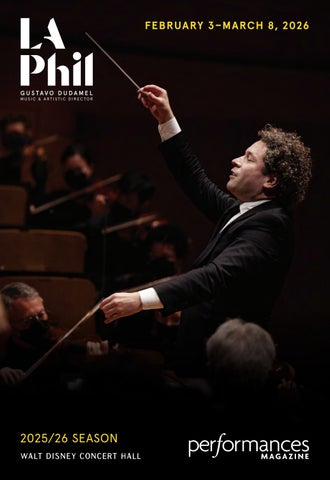
Create a flipbook
Issuu converts static files into: digital portfolios, online yearbooks, online catalogs, digital photo albums and more. Sign up and create your flipbook.