
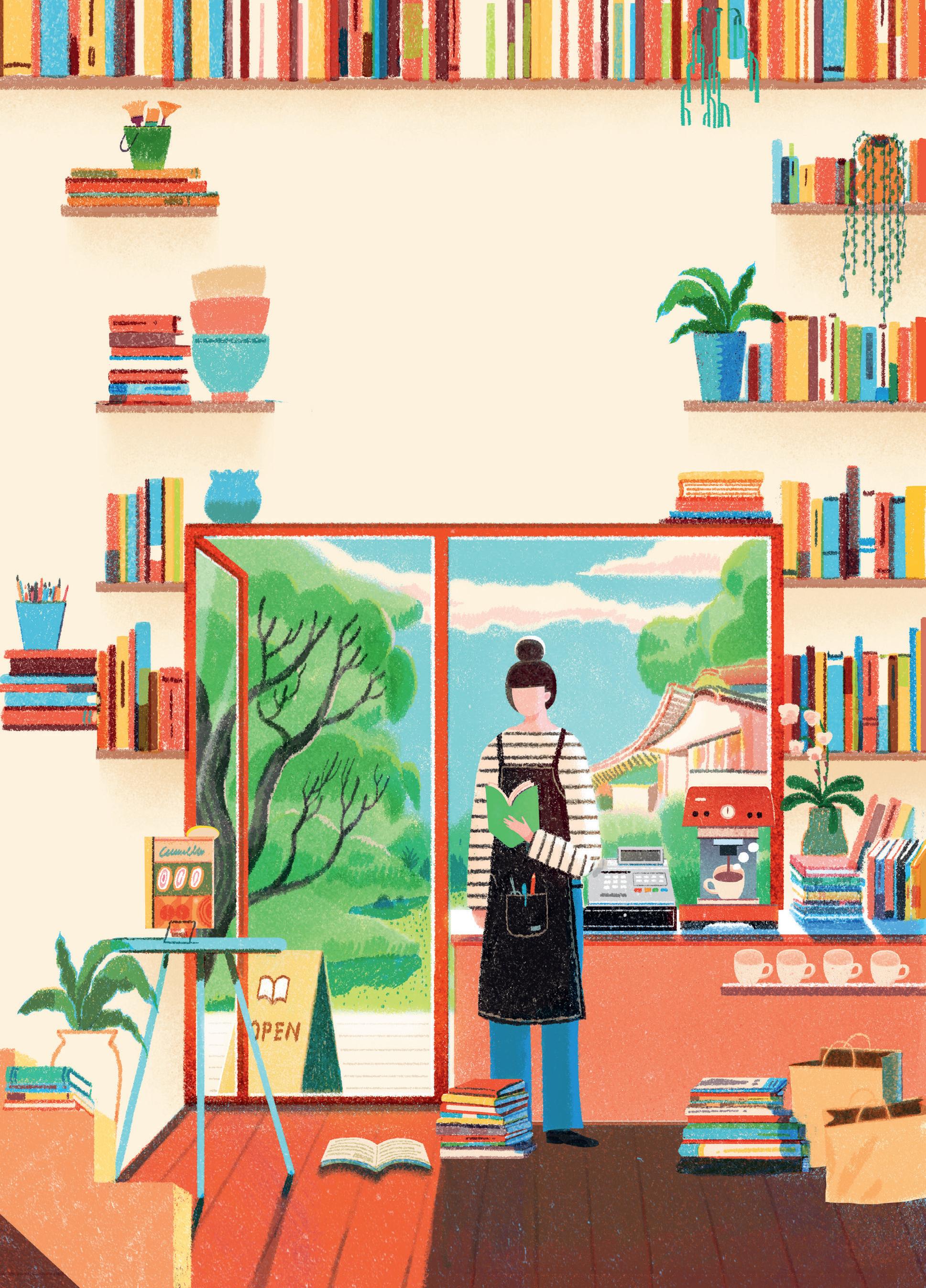
Soyangri Book Kitchen
KIM JEE HYE
Soyangri Book Kitchen
Soyangri Book Kitchen
Soyangri Book Kitchen
KIM JEE HYE
KIM JEE HYE
TRANSLATED FROM THE KOREAN BY SHANNA
TRANSLATED FROM THE KOREAN BY SHANNA
TRANSLATED FROM THE KOREAN BY
TAN
TAN
Harvill, an imprint of Vintage, is part of the Penguin Random House group of companies
Vintage, Penguin Random House UK, One Embassy Gardens, 8 Viaduct Gardens, London sw11 7bw
penguin.co.uk/vintage global.penguinrandomhouse.com
First published in Great Britain by Harvill in 2025 First published in South Korea with the title 책들의 부엌 in 2022 by Sam & Parkers Co., Ltd, Seoul
Copyright © Kim Jee Hye 2022 English translation copyright © Shanna Tan 2025
The moral right of the author has been asserted This book is published with the support of the Literature Translation Institute of Korea (LTI Korea) and the Toji Cultural Foundation
Extracts from Maeve Binchy’s A Week in Winter, Ito Ogawa’s Tsubaki Stationery Store (translated here by Shanna Tan), L. Frank Baum’s The Wonderful Wizard of Oz, Delia Owens’s Where the Crawdads Sing, L. M. Montgomery’s Anne of Green Gables and Kaori Ekuni’s Butterfly (translated here by Shanna Tan)
No part of this book may be used or reproduced in any manner for the purpose of training artificial intelligence technologies or systems. In accordance with Article 4(3) of the DSM Directive 2019/790, Penguin Random House expressly reserves this work from the text and data mining exception.
Typeset in 11.1/15.2pt Calluna by Six Red Marbles UK, Thetford, Norfolk Printed and bound in Great Britain by Clays Ltd, Elcograf S.p.A.
The authorised representative in the EEA is Penguin Random House Ireland, Morrison Chambers, 32 Nassau Street, Dublin d02 yh68
A CIP catalogue record for this book is available from the British Library
isbn 9781787304628
Penguin Random House is committed to a sustainable future for our business, our readers and our planet. This book is made from Forest Stewardship Council® certified paper.
Soyangri Book Kitchen
Prologue
As the sun rose, the early morning sleet on the bare branches of the plum blossom trees melted into a glistening sheen. Under the pale sunlight, the surroundings seemed to brighten. While winter still held a tight grip, fresh spring air was beginning to seep through its cracks, heralding a new season. It was two in the afternoon. Yoojin, who was inspecting the tiling work, suddenly looked up. A sweet, somewhat distant fragrance was drifting in from the windows which she’d opened as wide as possible to air out the smell of cement and paint from the new building. Outside, the trees, which stood firm, rustled their pale green leaves in greeting. Clusters of tight blossom buds hung from the shaded branches, while the ones that basked in the sunshine were plump with water, their droopy heads rising like children stirring from a nap.
Yoojin walked over to the windows. With a gentle push, the brand-new insect screen glided open with ease. The wind from the mountains rushed in, filling the room with its subtle scent. Her gaze landed on the snowflake-like petals, and she realised with a start that it was her first time seeing plum blossom flowers up close. The petals were the same shade of white as the tiles in Soyangri Book Kitchen, her shop which was almost ready to open. Behind the trees, the white bedsheets she’d washed and hung outside for their ‘bookstay’
guests flapped in the breeze. Was the scent from the flowers or the fabric softener? She inhaled deeply and relaxed.
Turning away from the windows, her gaze swept over the book café. Being surrounded by bookshelves that took up the entire wall made her feel like she was inside a doll’s house of sorts. The LED lights cast a warm glow on the bare shelves, illuminating them like an empty stage.
May the smell of books fill this space.
She glanced at the A3-sized paper taped to the wall. The floorplan for the book café was filled with markings and tiny notes scribbled on the side, reflecting the countless rounds of revision and the careful thought that had gone into it. The crumpled edges gave it a worn look, making it seem out of place when everything else was brand new. Yoojin stretched out a finger and rubbed gently on a pencilled scrawl. What had once been just a floor plan and a 3D simulation model on the computer was now the building she was standing in.
In addition to the bookshop, which doubled up as a café and event space, Soyangri Book Kitchen would also be running a ‘bookstay’: accommodation for those looking for a getaway from the hustle and bustle of life. Of the four twostorey buildings it occupied, three were guesthouses. And the building in which she stood now housed the book café, as well as all the staff on the upper floors. From a bird’s-eye view, with a garden and a botanical glasshouse in the centre, the compound looked like a cross.
The book café’s floor-to- ceiling glass windows offered a panoramic view of the picturesque Soyangri village. Behind the plum blossom trees, one could make out the meandering mountain ridges in the distance. Gazing at their majestic yet gentle curves, Yoojin sometimes wondered if she was living in a dream. As a Seoulite born and raised in the city, Yoojin
was more used to tall, sharp-edged skyscrapers, 24-hour convenience stores, chain cafés, a sprawling subway network and high-rise apartment buildings.
‘Yoojin nuna, come check if we’ve got this on properly.’
From outside, Siwoo called out to her.
‘Okay, one second!’
Yoojin closed the insect screen with one hand and stuffed the tape measure into the front pocket of her apron before hurrying outside. Siwoo and Hyungjun were holding a twometre-long banner across the façade of the coffee kiosk next to the building.
OPENING SOON
SOYANGRI BOOK KITCHEN
Taking reservations from 1 April!
Below the bold letters was a phone number and their Instagram handle.
‘Looks good. Wait, let me take a photo,’ Yoojin said as she fished out her phone from her apron.
Her shot turned out blurry, but since she was only checking if the banner was straight, she didn’t bother taking another one. What she couldn’t predict, in that moment, was the regret she’d come to feel several seasons later, when she happened to look back at that hazy shot of Siwoo, his bangs windswept and a wide grin plastered across his face, while Hyungjun wore his usual poker face.
Siwoo, her cousin, and Hyungjun, who was born and raised in Soyangri, were her full-time employees. Like two ends of a seesaw, they were polar opposites. Siwoo was an extrovert with a short temper, while Hyungjun was quiet and preferred to keep to himself. It’d be nice if they could find balance in each other, she thought wryly, as she watched Siwoo run towards her eagerly to check out the photo while Hyungjun ambled behind.
‘Siwoo, don’t you think it’s a little high on the left side?’
Siwoo tilted his head a fraction.
‘Hmm. The stone foundations of the storage shed that originally stood there weren’t level in the first place. Maybe that’s why.’
‘Hyungjun, what do you think?’
‘Looks fine.’
‘Right?’ The two men high-fived, grinning. Despite their differences, in moments like this, they were like twins with a shared soul.
Yoojin chuckled to herself and turned to survey the place.
Soyangri Book Kitchen sat at the foot of the mountain. The four modern buildings stood out in the rustic landscape, like items that suddenly pop up in a video game. For a moment, she lost her bearings. Where was she? What year were they in? Which day of the week was it? It had been a tenmonth journey to build everything from scratch, but it was as if she was going to wake up any moment and not remember a single sliver of the dream.
If someone were to ask her why she had decided to open a bookshop in the countryside, Yoojin didn’t have a prepared answer. True, she had often quipped about wanting to retire in a quiet place with greenery and spend her days reading, but never had she quite imagined that at only thirty- two
she’d be running a book café, as well as a guesthouse in the countryside.
But from the moment she had decided to buy the piece of land, it was as if she’d been swept up in a whirlwind. She had rushed to complete the paperwork required to register the business, and to pay the deposit she’d sold her ‘officetel’ studio apartment. Then she had been on tenterhooks waiting for the bank to approve her mortgage loan, before selling off almost all the shares in her portfolio to pay for the necessary permits and begin construction on the site. To obtain the operation licence for a café, she had to undertake the requisite training, and thinking that she should at least know the basics of coffee-brewing, she signed up for barista classes also. Often, she stayed up till the small hours of the morning to look over the floorplan with the architect firm recommended by Siwoo. Much time and effort had also gone into curating the books for the book café, as well as designing and producing their in-house merchandise, like mugs, notebooks and tote bags. To select the furniture, lights and appliances, she had thumbed through countless interior- design magazines and surfed the internet for inspiration.
Even landing on the name ‘Soyangri Book Kitchen’ had taken Yoojin two whole weeks. She wanted a name befitting of a place filled with books. Drawing inspiration from the idea that every book has a unique flavour that would appeal differently to its readers, she hoped that by naming the shop a book kitchen, it would become a space where people could enjoy some reading time and rest their weary hearts. Like how food comforts the soul, she hoped, too, that the delicious smell of paper and books would make her guests feel comfortable enough to shed the burden of bottled-up feelings, and to embrace some moments of solace and warmth.
When the flurry of activities had finally begun to settle, it felt as though she’d emerged into a strange, new world.
Suddenly she felt a gnawing hunger. She had barely eaten breakfast, just half an apple and a day-old donut. The books she had ordered were supposed to arrive that morning, so she had planned to wait for the delivery before getting lunch, but it was already past two and there was no sign of them. She had been too busy to register the compound on the navigation maps, so delivery trucks had arrived late on several occasions because they’d missed a turn. Yoojin called out to Siwoo and Hyungjun, who were huddling over a computer tablet, deep in discussion.
‘Guys. I’m not sure when the books are coming. Shall we go grab lunch at the city centre and drop by the supermarket? Hyungjun, you can save yourself a trip back and get off work there.’
Grandma and the Night Sky
Da-in spent the three years of middle school attending auditions every weekend. It was about the only thing she remembered doing. While they told her that she had decent vocals, behind her back, she caught whispers that she didn’t have the looks to be a celebrity, and it loomed over her like a dark shadow. Da-in knew. Whenever she looked into the mirror and saw the baby fat in her full cheeks, her bare face with only a smear of sunscreen, she couldn’t help but think of the gorgeous idol trainees she’d met at the auditions. They hadn’t gone under the knife, but their features were exquisite, almost doll-like. Their mere presence turned heads, including hers, as if they were already veteran artists. She wondered wryly if they were from some gifted education programme for starsin-the-making she hadn’t known about.
Da-in was eventually signed to a small record label, but her debut under the stage name Diane had largely gone unnoticed. The entertainment industry was churning out tens of idol groups every year, but the harsh reality was that only two or three would make it while the rest would, like cherry blossoms, be forgotten in a few months. It didn’t help that Da-in’s agency was also new; she was their first artiste. Despite having a couple of employees who’d worked in bigname agencies, it was obvious, from the marketing concept
to her stage outfits, that they lacked the resources big labels had. Sometimes it felt like they were in a school club, not a business meeting, when the staff discussions were comprised of questions like ‘Maybe we can try this?’ or ‘I heard other companies do this.’ With the air of a casual chat more so than a serious meeting, somehow, they’d concluded that Da- in didn’t fit the idol concept anyway. That, everyone agreed.
At that time, the girl group Delicious were all the rage. They were the walking definition of idols. Every member boasted perfect proportions like a Barbie doll, a charming wink, lots of aegyo, and a sweet smile that melted hearts. No way I could be like them. Da-in sighed. But if she couldn’t be an idol, then what? She could call herself a teen musician, but there was no lack of even younger artistes making their debut. Perhaps cute fitted her better than pretty; she could be the cute soloist boasting vocals that would put Mariah Carey to shame. No, that sounded ridiculous even to her ears. And because she didn’t write her own songs or lyrics, she couldn’t be a singer-songwriter either.
But three years on from her debut, Da-in – as Diane – catapulted overnight to the coveted status of the ‘Nation’s Little Sister’. She had discovered her greatest skill. She was a good listener but an even better storyteller. The 10 p.m. radio programme, where Da-in was a last-minute substitute for a regular guest, hit an all-time high listenership that night and the radio producer was eager to make Da-in a regular guest too. Within six months, she had added five radio shows to her schedule.
Listeners adored her warm voice, slightly husky but smooth on the ears, and the way she brought stories to life. There was something lovable about her earnest attitude, like a chocolate muffin that, despite best efforts, turned out slightly lopsided
but still delicious. She had a knack for putting the guests at ease, her sincerity touching the deepest corner of their hearts. Her live covers went viral on YouTube. There was her perfect rendition of Mariah Carey’s ‘Hero’, a song that demanded explosive vocal power, and her strumming an acoustic guitar while belting out a sweet rendition of Jason Mraz’s ‘Lucky’.
Her first original track to make it to the music charts was ‘Spring Day’, an acoustic jazz track about a young woman working part- time at a convenience store who dreamt of travelling to Morocco whenever spring came around. It was the perfect song for her unique vocals – a departure from the formulaic K-pop beat yet maintaining strong mainstream appeal. The song barely received any attention when it was first released, but everything changed after a male idol sang a couple of lines in a variety show. A video of a group of highschool students dancing to the song went viral soon after and when it became the featured track on the latest mobilephone ad, the song was propelled belatedly to the music charts. Not only did it make the charts, the three- monthold song further defied expectations by climbing the ranks. Riding the wave, her next digital single ‘That’s Good Enough’ claimed the number one spot upon its release and held the crown for a whole month as the music video hit with recordbreaking views on YouTube. Endorsements and commercial deals came rolling in for Da-in. Brands started to take notice of her, and suddenly, she was touted as a rising star with a fresh face and flawless vocals. Now, everyone had heard of Diane. People were recognising her on the street. She became the number one soughtafter celebrity, with fellow artists clamouring to collaborate with her. Her fame extended overseas as well; the album ranked high on iTunes Asia. And her fans, which had grown
exponentially in number, worshipped her like a god who could do no wrong.
That made her afraid. She was still the same old Da-in, yet the world was treating her so differently. Everyone was lavishing her with praise, calling her talents unrivalled. Carefully, she trod through her newfound popularity. At the same time, she worried that it might burst at any moment like a bubble.
Time flew by. It was now the eighth year that she held the title as a top celebrity – the Nation’s Little Sister, Diane. Her fans nicknamed her the human pastel macaron. In her music videos, she twirled around in elaborate floral dresses, capturing everyone’s heart with her dazzling smile. Male fans bingewatched her videos to soothe the loneliness of Valentine’s Day, and she was the teenage girls’ number one role model.
But off screen, Da-in was more comfortable wearing plain hoodies. In the recording studio, she usually kept to herself, a far cry from the bubbly persona in her vitamin drink ads. Even when she was younger, she’d never been an extrovert. She much preferred to retreat into her own world and thoughts. With her parents, she was close, but not overly affectionate. She didn’t wear her heart on her sleeve, but in her own way, she was quietly observant and took good care of her loved ones.
Looking at herself on screen, Da-in sometimes wondered if she was being ‘fake’. She was deeply afraid that any moment, the public’s love and attention would quickly spiral down into criticisms and finger-pointing.
Today was the first time in a long while that she had a whole weekday to herself. She had planned to sleep in, but after a restless night, she woke up lethargic. Until three in
the morning, she had tossed and turned in bed, weaving in between anxious dreams.
In one of them, Da-in was late for her radio show. The loud clicks of her heels echoed down the long, narrow corridor. As she ran, the landscape melted away, and the next moment, she was hosting a talk show in a TV studio. She was speaking animatedly, but suddenly, the guests’ expressions hardened. Flustered, she tried to keep the show going only to see close-ups of her own face staring at her from every single monitor on set.
Da- in jerked awake in shock. The scene loomed in her mind, yet to fully dissipate. She dragged herself, messy bedhead and bleary-eyed, to the living room and turned on the TV. Her face in flawless make-up popped up. She watched herself smile and chat animatedly on the talk show. When the credits rolled, her MV came on. Was this charismatic woman really her?
Panic gripped her. I looked like an empty shell. Being a singer was her childhood dream, but it wasn’t like she craved the spotlight. She wanted to express herself through her music, and thought the public had accepted her for who she was. But now, she realised how wrong she’d been. What the public loved was only their idealised image of Diane.
Back in bed, Da-in heard her heart pounding loudly. Kung kung . As if a rumbling train was approaching, louder and louder, thundering past her ears. She gasped for breath, as though a dark shadow had its fingers wrapped around her neck.
The next thing she knew, she fell into another dream. She was pressing her nose against the glass enclosure like a beast on display. One moment, she was a monkey, entertaining children with her antics. Then she was a waddling king penguin. Office workers in their twenties squealed at the sight
of her. In the next scene, she had morphed into the most popular animal in the zoo – the panda – a perpetual smile plastered on her face. A 360-degree view of her every action was live-streamed on the internet. Like in a video game, the audience had full control selecting her outfit, the colour of her fur, the accessories. Da-in was completely at their mercy. There was no room for her feelings. The shock, sadness or anger. The loneliness.
Da-in missed her grandmother. Unlike her, Grandma lived life with a healthy dose of optimism. Even on a rough day, all she’d need to do is take a walk outside, soak in the sunshine and she’d be able to brush off the unhappiness. Da-in had never seen huge waves of emotions roll off her; she was always like a little boat cruising down a calm river.
Da-in missed the warmth of Grandma’s hands. Whenever Da- in found herself plagued by insomnia for more than a week, she’d turn up at the doorstep of her grandmother’s traditional hanok house, and she’d be there to receive her with a kind smile and an affectionate tummy rub. No questions asked.
Grandma never listened to her songs. Even before Da-in became famous, her grandmother’s tinnitus had worsened, so she stopped listening to the radio or the TV. Da-in didn’t mind. She had more than her share of judgement from other people, be it praise for her amazing new songs or criticism that her voice had weakened since her previous album. Grandma never did that. In her quiet way, she’d lend Da-in a lap to lie on. Grandma’s hands were sinewed, but her touch warm.
Next to her, sleep came easily to Da-in. The breeze that caressed the eaves of the hanok, the delicious smell of stew
in the house, the dog barking in the distance and the warm orange glow of the sunset gently lulled her into a deep slumber. Whenever she stayed over, she could enjoy ten hours of uninterrupted sleep. And when she woke up, they’d go on long walks in the neighbourhood. From the street sellers, they bought fruits by the crate. When the five-day market was running, they’d shop for loose-fitting floral ajumma pants, and at the neighbourhood restaurant, they’d order steaming bowls of gukbap rice soup – for takeout. Back home, they’d pick some fresh lettuce and green peppers, and from the jangdokdae platform, where earthenware jars of sauces and condiments were kept, they’d scoop out a ladle of red pepper and soybean paste, and mix them with a dash of sesame oil and powdered perilla seeds for a delicious dipping sauce for the peppers.
Coming down to Soyangri was a spur- of- the- moment decision. Grandma was no longer around. Three years ago, she’d moved to the nursing home and last year, she had passed away. Even before then, the hundred-and-fifty-year-old hanok had been sold to pay for her medical expenses. In any case, it was getting too expensive to maintain the traditional house. The hanok structure was subsequently moved to a site with breathtaking views, where it became a boutique hotel two years ago. Over the phone, Da-in’s mother had told her that the only thing left on the land was the storage shed where little Da-in had loved playing hide-and-seek. With only a tiny shaft right below the roof, the shed was relatively dark even at midday. Da-in used to climb into the mother-of-pearl closet behind the messy stacks of old books and bags of rice, and most of the time she would be the last person standing in the game. Even if the seeker popped in to check, all they’d see were the shovels leaning against the
wall, the nose rings and millstone from the times her family had kept cattle on the farm. Their eyes would sweep past the piles of paper, the large frames and dusty exercise equipment before quickly nipping out for fear of meeting an enormous spider dangling midair.
OPENING SOON
SOYANGRI BOOK KITCHEN
Taking reservations from 1 April!
Da-in stared at the banner. Below, in a smaller font: Visit our bookshop café or book a stay with us. May you find encouragement and comfort in our kitchen of books.
The banner flapped loudly, but Da-in was deep in thought and didn’t notice the wind.
She let out a small sigh. If only she’d known earlier, she’d have bought the land, whether it was to build a holiday home, an office, anything. But her dad didn’t want her to be trapped in grief.
So, only after everything was settled did she learn that last May, her eldest uncle, who had migrated to the States with his family, and her third uncle, who ran a bed and breakfast in Spain, had flown back to Korea for a short visit. The eight siblings, including her dad, who were usually busy with their own lives, had gathered for the first time in several years to discuss the sale of the hanok and to settle the division of the proceeds. After all, those living had to keep going. Her dad