‘With wit, logic and his characteristic flair for expressing complex ideas with uncanny clarity, Richard Dawkins separates myth from reality in Outgrowing God. His book is more than a beginners’ guide to atheism: it is a primer that liberates us to see and explore the beauty of the Universe free of fables and fantasies.’
Neil Shubin, author of Your Inner Fish
‘Vividly demonstrates the spirit of scientific discovery that has made life meaningful for Dawkins himself.’
Oliver Burkeman, Guardian
‘When someone is considering theism I tell them to read the Bible first and then Dawkins. Outgrowing God – second only to the Bible!’
Penn Jillette, author of God, No!
‘The author of The God Delusion, the man at the forefront of the New Atheism movement, returns with passion to his theme.’
Radio Times
ww w penguin .co.uk
‘When people ask me, “If you could have dinner with three people…”, Richard Dawkins often springs to mind. Reading Outgrowing God felt like having that dinner. Dawkins spends the first half of the dinner blowing my mind by explaining what we know about the origins of the Bible, and the second half changing the way I think about evolution. I came out feeling smarter.’
Tim Urban, author of Wait But Why?
‘Fine content and a genial tone.’
The Skeptic
‘Richard Dawkins is one of the great scientists and science communicators of our time, and Outgrowing God: A Beginner’s Guide shows that he does not mean to relinquish those titles any time soon. It is a paean to truth and reason, written in the hope that more people will rally to the defence of those values at a time when they are being hastily abandoned. Dawkins writes so well that his hope of helping society grow up might just be fulfilled.’
Areo Magazine
‘Dawkins’ new book is perhaps his most likeable.’
Irish Times
TRANSWORLD PUBLISHERS
61–63 Uxbridge Road, London W5 5SA www.penguin.co.uk
Transworld is part of the Penguin Random House group of companies whose addresses can be found at global.penguinrandomhouse.com
First published in Great Britain in 2019 by Bantam Press an imprint of Transworld Publishers Black Swan edition published 2020
Copyright © Richard Dawkins Limited 2019
Richard Dawkins has asserted his right under the Copyright, Designs and Patents Act 1988 to be identified as the author of this work.
Chapter illustrations by Jana Lenzova Line illustrations by Global Blended Learning Ltd
Every effort has been made to obtain the necessary permissions with reference to copyright material, both illustrative and quoted. We apologize for any omissions in this respect and will be pleased to make the appropriate acknowledgements in any future edition.
A CIP catalogue record for this book is available from the British Library
ISBN 9781784164201
Typeset in 11.5/15pt Bulmer MT Std by Integra Software Services Pvt. Ltd, Pondicherry.
Printed and bound in Great Britain by Clays Ltd, Elcograf S.p.A.
Penguin Random House is committed to a sustainable future for our business, our readers and our planet. This book is made from Forest Stewardship Council® certified paper.
For William
And all young people when they’re old enough to decide for themselves
part one
So many gods!
So many gods!
Do you believe in God?
Which god?
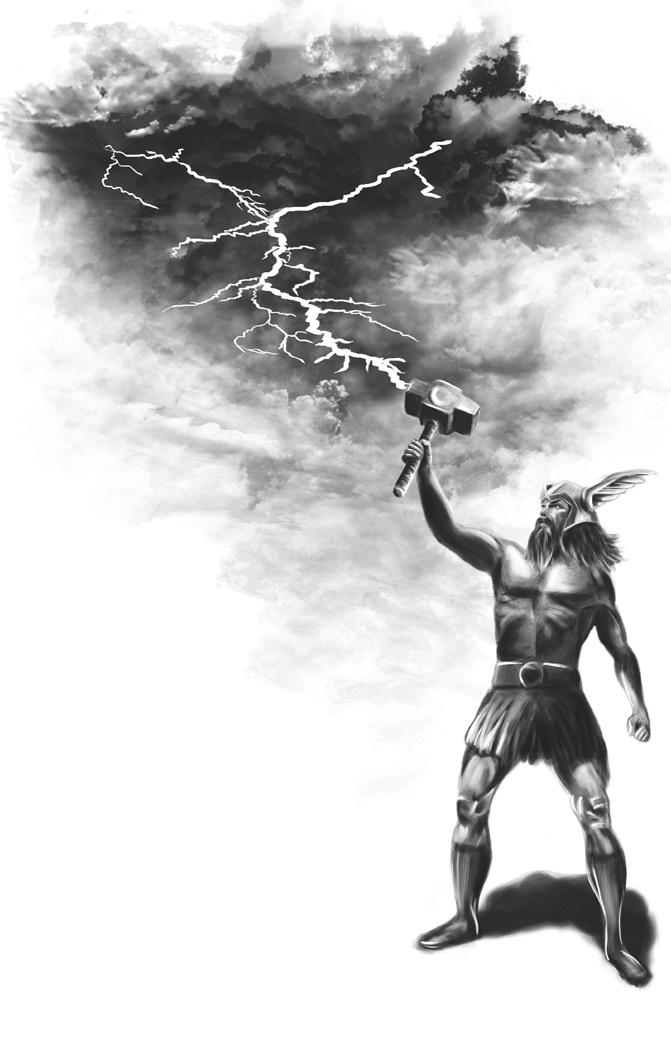
Thousands of gods have been worshipped throughout the world, throughout history. Polytheists believe in lots of gods all at the same time (theos is Greek for ‘god’ and poly is Greek for ‘many’). Wotan (or Odin) was the chief god of the Vikings. Other Viking gods were Baldr (god of beauty), Thor (the thunder god with his mighty hammer) and his daughter Throd. There were goddesses like Snotra (goddess of wisdom), Frigg (goddess of motherhood) and Ran (goddess of the sea).
The ancient Greeks and Romans were also polytheistic. Their gods, like the Viking ones, were very humanlike, with powerful human lusts and emotions. The twelve Greek gods and goddesses are often paired with Roman equivalents who were thought to do the same jobs, such as Zeus (Roman Jupiter), king of the gods, with his thunderbolts; Hera, his wife (Juno); Poseidon (Neptune), god of the sea; Aphrodite (Venus), goddess of love; Hermes (Mercury), messenger of the gods, who flew on winged sandals; Dionysos (Bacchus), god of wine. Of the major religions that survive today, Hinduism is also polytheistic, with thousands of gods.
Countless Greeks and Romans thought their gods were real – prayed to them, sacrificed animals to them, thanked them for good fortune and blamed them when things went wrong. How do we know those ancient people weren’t right? Why does nobody believe in Zeus any more? We can’t know for sure, but most of us are confident enough to say we are ‘atheists’ with respect to those old gods (a ‘theist’ is somebody who believes in god(s) and an ‘atheist’ – a-theist, the ‘a’ meaning ‘not’ –is someone who doesn’t). Romans at one time said the early Christians were atheists because they didn’t believe in Jupiter or Neptune or any of that crowd. Nowadays we use the word for people who don’t believe in any gods at all.
Like you I expect, I don’t believe in Jupiter or Poseidon or Thor or Venus or Cupid or Snotra or Mars or Odin or Apollo. I don’t believe in ancient Egyptian gods like Osiris, Thoth, Nut, Anubis or Horus his brother who, like Jesus and many other gods from around the world, was said to have been born to a virgin. I don’t believe in Hadad or Enlil or Anu or Dagon or Marduk or any of the ancient Babylonian gods.
I don’t believe in Anyanwu, Mawu, Ngai or any of the sun gods of Africa. Nor do I believe in Bila, Gnowee, Wala, Wuriupranili or Karraur or any of the sun goddesses of Australian aboriginal tribes. I don’t believe in any of the many Celtic gods and goddesses, such as Edain the Irish sun goddess or Elatha the moon god. I don’t believe in
Mazu the Chinese water goddess or Dakuwaqa the Fijian shark god, or Illuyanka the Hittite dragon of the ocean. I don’t believe in any of the hundreds and hundreds of sky gods, river gods, sea gods, sun gods, star gods, moon gods, weather gods, fire gods, forest gods . . . so many gods to not believe in.
And I don’t believe in Yahweh, the god of the Jews. But it’s quite likely you do, if you were brought up a Jew, a Christian or a Muslim. The Jewish god was adopted by the Christians and (under the Arabic name, Allah) the Muslims. Christianity and Islam are offshoots of the ancient Jewish religion. The first part of the Christian Bible is purely Jewish, and the Muslim holy book, the Quran, is partly derived from Jewish scriptures. Those three religions, Judaism, Christianity and Islam, are often grouped together as the ‘Abrahamic’ religions, because all three trace back to the mythical patriarch Abraham, who is also revered as the founder of the Jewish people. We’ll meet Abraham again in a later chapter.
All those three religions are called monotheistic because their members claim to believe in only one god. I say ‘claim to’ for various reasons. Yahweh, today’s dominant god (whom I’ll therefore spell with a capital G, God) started out in a small way as the tribal god of the ancient Israelites who, they believed, looked after them as his ‘chosen people’. (It’s a historical accident – the recognition of Christianity within the Roman Empire after the conversion of the Emperor Constantine in ad 312 – that
led to Yahweh’s being worshipped around the world today.) Neighbouring tribes had their own gods who, they believed, gave them special protection. And although the Israelites worshipped their own tribal god Yahweh, they didn’t necessarily disbelieve in the gods of rival tribes, such as Baal, the fertility god of the Canaanites; they just thought Yahweh was more powerful – and also extremely jealous (as we shall see later on): woe betide you if he caught you flirting with any of the other gods.
The monotheism of modern Christians and Muslims is also rather dubious. For example, they believe in an evil ‘devil’ called Satan (Christianity) or Shaytan (Islam). He goes under a variety of other names too, such as Beelzebub, Old Nick, the Evil One, the Adversary, Belial, Lucifer. They wouldn’t call him a god, but they regard him as having god-like powers and he is seen, with his forces of evil, as waging a titanic war against the good forces of God. Religions often inherit ideas from older religions. The notion of a cosmic war of good versus evil probably comes from Zoroastrianism, an early religion founded by the Persian prophet Zoroaster, which influenced the Abrahamic religions. Zoroastrianism was a two-gods religion, the good god (Ahura Mazda) battling it out with the evil god (Angra Mainyu). There are still a few Zoroastrians about, especially in India. That’s yet another religion I don’t believe in and probably you don’t either.
One of the weirder accusations levelled at atheists, especially in America and Islamic countries, is that they
worship Satan. Of course, atheists don’t believe in evil gods any more than they believe in good ones. They don’t believe in anything supernatural. Only religious people believe in Satan.
Christianity verges on polytheism in other ways, too. ‘Father, Son and Holy Spirit’ are described as ‘three in one and one in three’. Exactly what this means has been disputed, often violently, down the centuries. It sounds like a formula for squeezing polytheism into monotheism. You could be forgiven for calling it tri-theism. The early split in Christian history between the Eastern (Orthodox) and Western (Roman) Catholic Church was largely caused by a dispute over the following question: Does the Holy Ghost ‘proceed from’ (whatever that might mean) the Father and the Son, or just from the Father? That really is the kind of thing theologians spend their time thinking about.
And then there’s Jesus’s mother, Mary. For Roman Catholics, Mary is a goddess in all but name. They deny that she is a goddess, but they still pray to her. They believe she was ‘immaculately conceived’. What does that mean? Well, Catholics believe we are all ‘born in sin’. Even tiny babies who, you might think, are a bit young to sin. Anyway, Catholics think Mary (like Jesus) was an exception. All the rest of us inherit the sin of Adam, the first man. In fact, Adam never actually existed, so he couldn’t sin. But Catholic theologians aren’t put off by little details like that. Catholics also believe that Mary,
instead of dying like the rest of us, was sucked bodily ‘up’ into heaven. They portray her as the ‘Queen of Heaven’ (sometimes even ‘Queen of the Universe’!) with a little crown balanced on top of her head. All those things would seem to make her at least as much of a goddess as any of the thousands and thousands of Hindu deities (which Hindus themselves say are just different versions of one single god). If the Greeks, Romans and Vikings were polytheistic, then Roman Catholics are too.
Roman Catholics also pray to individual saints: dead people who are regarded as especially holy, and have been ‘canonized’ by a Pope. Pope John Paul II canonized 483 new saints, and Francis, the current pope, canonized no fewer than 813 on one day alone. Many of the saints are thought to have special skills, which make them worth praying to for particular purposes or particular groups of people. Saint Andrew is the patron saint of fishmongers, Saint Bernward the patron saint of architects, Saint Drogo the patron saint of coffee-house owners, Saint Gummarus the patron saint of lumberjacks, Saint Lidwina the patron saint of ice-skaters. If you need to pray for patience, a Catholic might advise you to pray to Saint Rita Cascia. If your faith is shaky, try Saint John of the Cross. If in distress or mental anguish, Saint Dymphna might be your best bet. Cancer sufferers tend to try Saint Peregrine. If you’ve lost your keys, Saint Anthony is your man. Then there are the angels, who come in various ranks, from seraphs at the top, down through archangels to your
personal guardian angel. Again, Roman Catholics will deny that angels are gods or demigods, and they will protest that they don’t really pray to saints but just ask them to put in a good word with God. Muslims, too, believe in angels. Also in demons, which they call djinns.
I don’t think it matters much whether Mary and the saints and archangels and angels are gods or demigods or neither. Arguing over whether angels are demigods is rather like arguing whether fairies are the same as pixies.
Although you presumably don’t believe in fairies and pixies, it is quite likely you have been brought up in one of the three Abrahamic faiths as Jewish, Christian or Muslim. As it happens I was brought up Christian. I went to Christian schools and was confirmed in the Church of England aged 13. I finally gave up Christianity when I was 15. One of the reasons I gave it up was this. I had already worked out when I was about nine that if I’d been born to Viking parents I’d firmly believe in Odin and Thor. If I’d been born in ancient Greece I’d worship Zeus and Aphrodite. In modern times, if I’d been born in Pakistan or Egypt I’d believe that Jesus was only a prophet, not the Son of God as the Christian priests teach. If I’d been born to Jewish parents I’d still be waiting for the Messiah, the long-promised saviour, instead of believing that Jesus was the Messiah as my Christian schools taught. People growing up in different countries copy their parents and believe in the god or gods of their own country. These beliefs contradict each other, so they can’t all be right.
If one of them is right, why should it be the belief that you happen to have inherited in the country where you were born? You don’t have to be very sarcastic to think something like this: ‘Isn’t it remarkable that almost every child follows the same religion as their parents, and it always just happens to be the right religion!’ One of my pet peeves is the habit of labelling young children with the religion of their parents: ‘Catholic child’, ‘Protestant child’, ‘Muslim child’. Such phrases can be heard used of children too young to talk, let alone to hold religious opinions. It seems to me as absurd as talking about a ‘Socialist child’ or ‘Conservative child’, and nobody would ever use a phrase like that. I don’t think we should talk about ‘atheist children’ either.
Now, a few more names for people who don’t believe. There are many who prefer to avoid the word ‘atheist’, even though they don’t believe in any named gods. Some simply say ‘I don’t know, we can’t know.’ These people often call themselves ‘agnostics’. The word (based on a Greek word meaning ‘unknowing’) was coined by Thomas Henry Huxley, a friend of Charles Darwin known as ‘Darwin’s Bulldog’ because he fought for Darwin in public when Darwin was too shy, too busy or too ill to do so. Some people who call themselves agnostic think it’s equally likely that gods do, or do not, exist. I think that’s rather feeble, and Huxley would have agreed. We can’t prove there are no fairies but that doesn’t mean we think there’s a 50:50 chance fairies exist. More sensible agnostics
say they don’t know for sure, but think it’s pretty unlikely any sort of god exists. Other agnostics might say it’s not unlikely but we just don’t know.
There are people who don’t believe in named gods but still hanker after ‘some sort of higher power’, a ‘pure spirit’, a creative intelligence about which we know nothing except that it designed the universe. They might say something like: ‘Well, I don’t believe in God’ – probably meaning the Abrahamic God – ‘but I can’t believe this is all there is. There must be something more, something beyond.’
Some of these people call themselves ‘pantheists’. Pantheists are a little vague about what they believe. They say things like ‘My god is everything’ or ‘My god is nature’ or ‘My god is the universe’. Or ‘My god is the deep mystery of everything we don’t understand’. The great Albert Einstein used the word ‘God’ in pretty much this last sense. That’s very different from a god who listens to your prayers, reads your innermost thoughts and forgives (or punishes) your sins – all of which the Abrahamic God is supposed to do. Einstein was adamant that he didn’t believe in a personal god who does any of those things.
Others call themselves ‘deists’. Deists don’t believe in any of the thousands of named gods of history. But they believe in something a little more definite than pantheists do. They believe in a creative intelligence who invented the laws of the universe, set everything in motion at the beginning of time and space, and then sat back and did
nothing more: just let everything happen according to the laws that he (it?) had laid down. Several of the founding fathers of the United States, men like Thomas Jefferson and James Madison, were deists. My suspicion is that, if they’d lived after Charles Darwin instead of in the eighteenth century, they’d have been atheists, but I can’t prove it.
When people say they are atheists they don’t mean they can prove that there are no gods. Strictly speaking, it’s impossible to prove that something does not exist. We don’t positively know there are no gods, just as we can’t prove there are no fairies or pixies or elves or hobgoblins or leprechauns or pink unicorns; just as we can’t prove that Santa Claus or the Easter Bunny or the Tooth Fairy don’t exist. There’s a billion things you can imagine and nobody can disprove. The philosopher Bertrand Russell made the point with a vivid word picture. If I were to tell you, he said, that there is a china teapot in orbit around the sun, you could not disprove my claim. But failure to disprove something is not a good reason to believe it. In some strict sense we should all be ‘teapot agnostics’. In practice we are a-teapotists. You can be an atheist in the same (technically agnostic) way you’re an a-teapotist, an a-fairyist, an a-pixieist, an a-unicornist, an a-anything-you-might-dream-up-ist.
Strictly speaking, we should all be agnostic about all those billions of things we can imagine and nobody can disprove. But we don’t believe in them. And until
somebody offers a reason to believe, we are wasting our time bothering to do so. That is the approach we all take to Thor and Apollo and Ra and Marduk and Mithras and the Great Juju up the Mountain. Couldn’t we go a little further and think the same way about Yahweh or Allah?
‘Until somebody offers a reason,’ I said. Well, plenty of people have offered what they thought were reasons for believing in one god or another. Or for believing in some kind of un-named ‘higher power’ or ‘creative intelligence’. So we need to look at those reasons and see whether they really are good reasons. We’ll see some of them in the course of this book. Especially in Part Two, which discusses evolution.
On that huge subject, all I need say at present is that evolution is a definite fact: we are cousins of chimpanzees, slightly more distant cousins of monkeys, very much more distant cousins of fish and so on.
Many people believe in their god or gods because of scripture: the Bible, the Quran or some other holy book. This chapter might already have prepared you to doubt that reason for belief. There are so many different faiths. How do you know the holy book you have been brought up with is the true one? And if all the others are wrong, what makes you think your holy book isn’t wrong too? Many of you reading this may have been brought up on one particular holy book, the Bible of the Christians. The next chapter will be about the Bible. Who wrote it, and what reason has anyone to believe that what it says is true?
How much of what we read in the Bible is true?
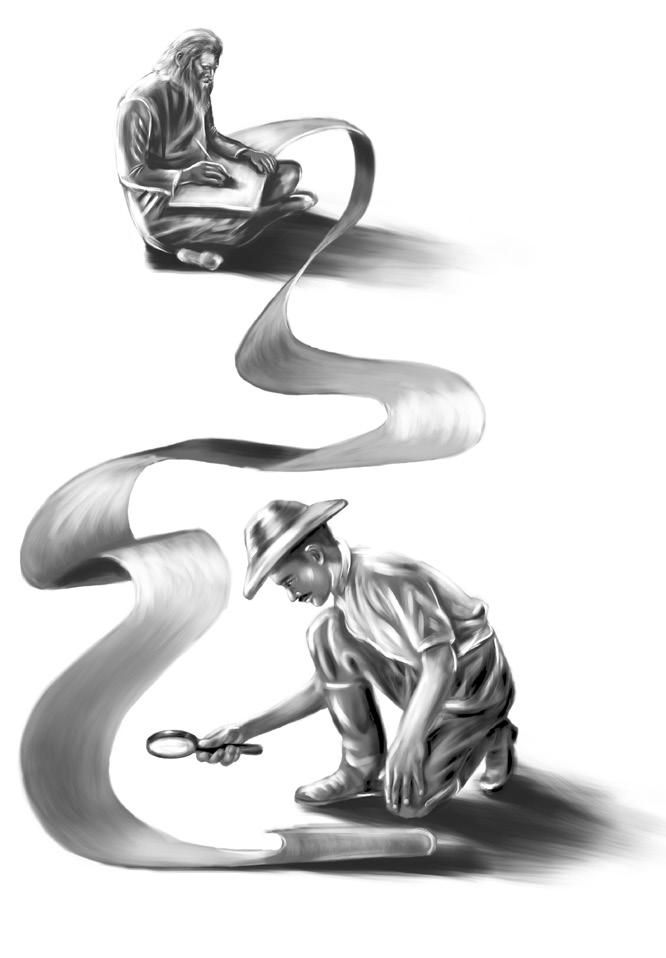
How do we know anything in history really happened? How do we know Julius Caesar existed? Or William the Conqueror? No eye-witnesses survive; and even eyewitnesses can be surprisingly unreliable, as any police officer collecting statements will tell you. We know that Caesar and William existed, because archaeologists have found tell-tale relics and because there’s lots of confirmation from documents written when they were alive. But when the only evidence for an event or person wasn’t written down until decades or centuries after the death of any witnesses, historians get suspicious. The evidence is weak because it was passed on by word of mouth and could easily become distorted. Especially if the writer was biased. Winston Churchill said: ‘History will be kind to me. I intend to write it!’ We’ll see in this chapter that there are problems with most of the stories about Jesus in the New Testament. The Old Testament must wait till Chapter 3.
Jesus would have spoken Aramaic, a Semitic language related to Hebrew. The books of the New Testament were originally written in Greek; those of the Old Testament in Hebrew. Many English translations exist.
The most famous is the King James version of 1611, so called because it was commissioned by King James I of England (James VI of Scotland). The King James version is the translation I prefer because the language is beautiful – not surprisingly, since its English is the English of Shakespeare’s time. However, because that language is not always so clear to modern readers, in this book I have reluctantly decided to use a modern translation, the New International version; quotations are from the latter unless otherwise stated.
There’s a party game called Chinese Whispers (in Britain) or Telephone (in America). You line up, say, ten people in a row. The first person whispers something – it might be a story – to the second. The second whispers the story to the third, the third person to the fourth, and so on. Finally, when the story reaches the tenth person she repeats what she has heard to the whole party. Unless the original story was exceptionally simple and brief, it will have become greatly changed, often in a funny way. It’s not just the words that change down the line, but important details of the story itself.
Before writing was invented and before scientific archaeology started, word-of-mouth storytelling, with all its Chinese Whispery distortions, was the only way people learned about history. And it’s terribly unreliable. As each generation of storytellers gives way to the next, the story becomes more and more garbled. Eventually, history – what actually happened – becomes lost in myth
and legend. It’s difficult to know whether there ever was a real person behind the legendary Greek hero Achilles, or the fabled beauty Helen whose face ‘launched a thousand ships’. When the poet Homer finally wrote the stories down (and we don’t know when that was, even to the nearest century) they’d been distorted through generations of word-of-mouth retelling. Any reliable truth had dissolved away. We don’t know who ‘Homer’ was or when he lived; whether he was blind, as legend has it; whether he was one person or many. And we don’t know how his stories originally began, before they passed through the distorting filter of word-of-mouth retelling. Did they start as factual accounts and then become garbled? Or did they start as made-up fiction and get changed in the retelling?
The same applies to the stories in the Old Testament. We have no more reason to believe them than we do Homer’s stories about Achilles or Helen. The stories of Abraham and Joseph are Hebrew legends, just as Homer’s are Greek legends. How about the New Testament? It offers a better hope of finding true history because it refers to a more recent period than the Old: a mere two thousand years ago. But how much do we really know about Jesus? Can we be sure he even existed? Most, though not all, modern scholars think he probably did. What evidence do we have?
The gospels? They’re printed at the beginning of the New Testament, so you might think they were written first. Actually, the oldest books in the New Testament
come near the end: the letters of St Paul. Unfortunately, Paul says hardly anything about Jesus’s life. There’s lots about the religious meaning of Jesus, especially his death and resurrection. But almost nothing that even claims to be history. Maybe Paul thought his readers already knew the story of Jesus’s life. But it’s possible Paul didn’t know it himself: remember, the gospels were not yet written. Or maybe he didn’t think it was even important. This lack of facts about Jesus in Paul’s letters makes historians wonder. Isn’t it a little odd that Paul, who wanted people to worship Jesus, says almost nothing about what Jesus actually said or did?
Another thing that worries historians is that there are hardly any mentions of Jesus in histories outside the gospels. The Jewish historian Josephus (ad 37–c.100), writing in Greek, had only this to say:
About this time there lived Jesus, a wise man, if indeed one ought to call him a man. For he was one who performed surprising deeds and was a teacher of such people as accept the truth gladly. He won over many Jews and many of the Greeks. He was the Messiah. And when, upon the accusation of the principal men among us, Pilate had condemned him to a cross, those who had first come to love him did not cease. He appeared to them spending a third day restored to life, for the prophets of God had foretold these things and a thousand other marvels about him. And the tribe of the Christians, so called after him, has still to this day not disappeared.
Many historians suspect this passage is a forgery, stuck in later by a Christian writer. The most suspicious phrase is ‘He was the Messiah.’ In the Jewish tradition, ‘Messiah’ was the name given to the long-promised Jewish king or military leader who would be born to triumph over the enemies of the Jews. Christians taught that Jesus was the Messiah (‘Christ’ is simply the Greek translation of this word). But to a devout Jew, Jesus didn’t look at all like a military leader. In fact, that’s putting it mildly. His message of peace – even turning the other cheek when somebody hits you – is not what we expect of a soldier. And far from leading the Jews against the Roman oppressors of his time, Jesus went meekly to his execution at their hands. The idea that Jesus was the Messiah would have seemed pretty bonkers to a devout Jew like Josephus. If Josephus had somehow gone against his whole upbringing and convinced himself that so unlikely a character as Jesus was the Messiah, he would have made a big song and dance of it. He wouldn’t have just dropped in a casual ‘He was the Messiah’. It does sound very like a later Christian forgery. That’s certainly what most scholars now believe.
The only other early historian who mentions Jesus is the Roman Tacitus (ad 54–120). Writing attributed to him offers more convincing evidence for Jesus’s existence, for the backhanded reason that Tacitus has nothing good to say about Christians. Writing in Latin about an
event during the persecution of the early Christians by the Emperor Nero (ad 37–87), Tacitus said:
Nero fastened the guilt and inflicted the most exquisite tortures on a class hated for their abominations, called Christians by the populace. Christus, from whom the name had its origin, suffered the extreme penalty during the reign of Tiberius at the hands of one of our procurators, Pontius Pilatus, and a most mischievous superstition, thus checked for the moment, again broke out not only in Judæa, the first source of the evil, but even in Rome, where all things hideous and shameful from every part of the world find their centre and become popular.
In any case, this passage too is suspected of being a forgery. The balance of probability, according to most but not all scholars, suggests that Jesus did exist. Of course we’d know for sure, if we could be certain the four gospels of the New Testament were historically true. Until recently, nobody doubted them. There’s even a proverbial phrase in English, ‘gospel truth’, meaning as true as true can be. But that phrase rings rather hollow today, after studies in the nineteenth and twentieth centuries by (especially German) scholars.
Who wrote the gospels? And when? Many people wrongly believe that the gospel of ‘Matthew’ was written by Matthew the tax-collector, one of Jesus’s twelve close companions. And that the gospel of ‘John’ was written by another of that small group, the John who came to be