‘A must-read for young women struggling with the inner conflict between mothering and career-making’
GAIL SHEEHY, author of PASSAGES and DARING: MY PASSAGES
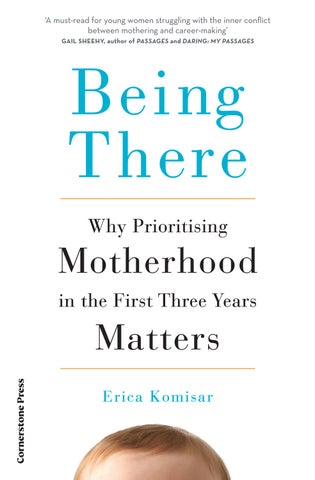
‘A must-read for young women struggling with the inner conflict between mothering and career-making’
GAIL SHEEHY, author of PASSAGES and DARING: MY PASSAGES
Erica Komisar

‘A must-read for young women struggling with the inner conflict between mothering and career-making. Komisar brilliantly distils the potency of present mothering from her experience as a psychoanalyst and parenting coach.’
Gail Sheehy, author of Passages
‘A terrific and very timely book . . . Well-written and researched with excellent documentation from respected experts in this field, it should be read not only by current and prospective mothers and fathers, but also by those who care for young children in a variety of settings.’
Thomas McInerny MD, FAAP, past president of the American Academy of Pediatrics
‘Provides hardheaded and practical advice for families and policy makers. It is a rare and valuable contribution to the field.’
Leslie H. Gelb, president emeritus of the Council on Foreign Relations
‘It should not take a psychoanalyst to explain the importance of maternal love and support in the formation of a child, but Erica Komisar in her book Being There does just that . . . Her challenging assessment that absent and distracted mothers leave their children forever less happy will upset apple carts and give many overtaxed young parents pause, but she accompanies her tough medicine with realistic tools and strategies to help caregivers meet their challenging task . . . Difficult but necessary reading for any parent-to-be.’
Eric L. Motley, Ph.D., executive vice president of the Aspen Institute
‘The key to the puzzle of how to achieve two things at once: a kid set to become a happy, emotionally secure person, and a mother who is effective and fulfilled. It happens, simply, by “being there” most of the time throughout the first three years of a baby’s life. If you think this isn’t for you, just read this book and think again. Nobody said it would be easy.’
Marilyn Berger Hewitt, broadcast journalist, contributing writer to the Washington Post and New York Times, and author of This Is a Soul
‘A courageous, bold, and invaluable book that challenges us to consider our roles as mothers.’
Dr Carly Snyder, host of the weekly radio show MD for Moms
‘Gives specific suggestions on how women can be more emotionally present for their child regardless of their career, financial constraints and the amount of time they can spend with their children. A must-read for parents, mental health professionals, and childcare policy makers.’
Dr. Ellen Jacobs, child and adolescent psychotherapist, adjunct professor at the Columbia University School of Social Work
‘Timely and highly informative . . . This rich amalgam of science, clinical wisdom and common sense represents a Dr. Spock for the twenty-first century, and is quite simply the best book I’ve ever seen on this absolutely essential topic.’
Allan N. Schore, Ph.D., Department of Psychiatry and Biobehavioral Sciences, University of California, Los Angeles, David Geffen School of Medicine
Also by Erica Komisar
Chicken Little the Sky Isn’t Falling
With Sydny Miner
Cornerstone Press
UK | USA | Canada | Ireland | Australia India | New Zealand | South Africa
Cornerstone Press is part of the Penguin Random House group of companies whose addresses can be found at global.penguinrandomhouse.com
Penguin Random House UK, One Embassy Gardens, 8 Viaduct Gardens, London SW11 7BW penguin.co.uk
First published in the US by Tarcher Perigee in 2017 First published in the UK in 2026 001
Copyright © Erica Komisar, 2017
The moral right of the author has been asserted
“This Be the Verse” from The Complete Poems of Philip Larkin by Philip Larkin, edited by Archie Burnett. Copyright © 2012 by The Estate of Philip Larkin. Reprinted by permission of Farrar, Straus and Giroux, LLC.
Penguin Random House values and supports copyright. Copyright fuels creativity, encourages diverse voices, promotes freedom of expression and supports a vibrant culture. Thank you for purchasing an authorised edition of this book and for respecting intellectual property laws by not reproducing, scanning or distributing any part of it by any means without permission. You are supporting authors and enabling Penguin Random House to continue to publish books for everyone. No part of this book may be used or reproduced in any manner for the purpose of training artificial intelligence technologies or systems. In accordance with Article 4(3) of the DSM Directive 2019/790, Penguin Random House expressly reserves this work from the text and data mining exception.
Book design by Elke Sigal
Printed and bound in Great Britain by Clays Ltd, Elcograf S.p.A.
The authorised representative in the EEA is Penguin Random House Ireland, Morrison Chambers, 32 Nassau Street, Dublin D02 YH68
A CIP catalogue record for this book is available from the British Library
ISBN: 978–1–529–97986–2
Penguin Random House is committed to a sustainable future for our business, our readers and our planet. This book is made from Forest Stewardship Council® certified paper.
To my incredible husband, Jordan, my best friend and my inspiration, whose love and support made this book possible, and to my beautiful children, Bryce, Jonas, and Sofia, who have taught me more than I have taught them. I am grateful to be their mother each and every day. And to my mother, Edith, who valued mothering over everything else; your warmth, affection, and nurturing have been my example.
Children are not a distraction from more important work. They are the most important work.
— C. S. Lewis
Your children need your presence more than your presents.
—Jesse Jackson
There is no way to be a perfect mother and a million ways to be a good one.
—Jill
Churchill
Ten years ago I began writing a book about what happens to children when their mothers devalue, deprioritize, and neglect mothering. Then I realized that I would have to postpone the project because it would mean my book would be my primary focus instead of my being fully present for my children.
Now my children are preteens and teenagers and are out of the house for much of the day during the week, attending school, participating in other activities, and seeing friends. I am still present for my children when they are home, but as my teenage son walks in the door and gives me a hug, I realize that it’s my presence, not my focused attention that he needs, as he did when he was younger. My children have lives apart from our family, and although they still need me, I don’t have to attend to their physical and emotional needs with the same intensity. I have more time during the day and more mental space. And that, I realized, is the point of this book.
The truth is, we can do everything in life, but not at the same time. We cannot raise healthy children if we are not there for them emotionally and physically. We cannot be present for them while being intensely involved with work or other interests that make us less mindful of and attentive to the emotional needs of our children.
I am deeply saddened by the mommy wars still raging across this country between working and nonworking mothers, because rather than supporting all mothers, we have created a divisive environment. Like every mother, whether she works outside the home or not, I am
INTRODUCTION xii
faced with the challenge of regulating and balancing my own needs with those of my children, and as a working mother, I made decisions about when to return to work and how many hours to work when my children were very young. And while this is a book about the wellbeing of our children, it is also about the happiness and well-being of their mothers. We can have all the career success we have ever dreamed of, but every mother knows that when our children suffer, we suffer too. If we have all the career success in the world but our children resent us or, worse, are disabled by our insensitivity or lack of empathy toward their needs when they are young and become depressed, anxious, or cannot form and sustain deep emotional connections with others, are we truly satisfied as mothers? So many parents constantly feel guilty because they are stretched too thin, torn between conflicting obligations, and not able to give the time and energy they want to all of them. I think there is a solution, but it requires mothers and fathers to examine their core values and make their family a priority and that we, as a society, become more child-centric. We need to understand and respect the unique and essential place a mother has in her child’s life, especially in the first three years.
I am a psychoanalyst in private practice in New York City, and for the past twenty-four years, I have been focused on mother–child relationships, first as a social worker, then a parent guidance expert and psychoanalyst, treating children and adults for problems related to early relationship loss and trauma; behavioral and developmental issues in young children; and depression, anxiety, and addictions of all kinds in older children and young adults. From my firsthand professional observations, I have come to understand the connections between these symptoms and disorders and the emotional and physical absence of young children’s mothers in their day-to-day lives. An increasing number of parents come to see me because their child is suffering from a variety of social, behavioral, or developmental disorders.
It’s clear to me that these symptoms are often related to the premature separation of children from their mothers. These are women who, despite their best intentions, and whether they stay at home or work outside the home, may not know how to be present for their child or how to recognize the signs that their child is in distress.
As a therapist, I am in the business of making people feel uncomfortable so they can change and ultimately live happier and more satisfying lives. You may not like what I am going to say in this book. If you’re already a mother or you’re contemplating having children, it may make you feel guilty or uncomfortable. If you are contemplating having a child, I hope it will inspire greater self-awareness about the choices you face.
There is enough research, statistical evidence, and case material from my own work and that of my colleagues to make a strong argument that as a society we are failing our children: There has been a dramatic increase in emotional, social, and behavioral difficulties like ADHD, anxiety, depression, and increased aggression in children from toddlerhood through adolescence.
The statistics are frightening. According to the Centers for Disease Control and Prevention (CDC), 11 percent of children between the ages of four and seventeen years in the United States have been diagnosed with ADHD. This is a dramatic 16 percent increase since 2007. In addition, two-thirds of those children were treated with stimulant medications, like Ritalin and Adderall, both of which have significant side effects.1
In a 2011 data brief describing key findings from the 2005–2008 National Health and Nutrition Examination Surveys, the CDC reported there has been a 400 percent increase of prescriptions for antidepressant medications to children over the age of twelve years since 1988. In fact, 11 percent of Americans over the age of twelve now take antidepressants. From 2011 to 2012 the number of teenagers prescribed
generic drugs for psychiatric disorders jumped to 19.4 percent. In younger children, the number diagnosed with psychiatric disorders rose to a staggering 19 percent.2
Eating disorders are also on the rise. A study from the Agency for Healthcare Research and Quality stated that more than 25 million people in the United States suffer from an eating disorder,3 and hospitalizations of children twelve years and under for eating disorders has increased 119 percent in the last decade.4
Another disturbing trend is the increase in violence, aggression, and bullying in children of all ages, as demonstrated in a 2011 survey reported by the CDC:
● More than 700,000 young people aged ten to twenty-four years were treated in emergency departments for nonfatal injuries sustained from assaults.
● About 33 percent of high school students reported being in a physical fight in the twelve months before the survey.
● Approximately 20 percent of high school students reported being bullied on school property, and 16 percent reported being bullied electronically.5
Why is this happening to our children? One key factor, I believe, is that because so many of us are ambitiously pursuing our own individual needs, we forget how we evolved as social creatures. Too often, mothers are putting their work and their own needs ahead of their children’s. I know this issue is a very controversial one— so controversial, in fact, that few dare to address it. Colleagues and researchers write about children and their primary caregivers and won’t use the
INTRODUCTION xv
word mother. Clinicians are reluctant to make direct correlations publicly between an emotionally disengaged or physically absent mother and a child’s personality, social functioning, and even mental illness, but it is what we discuss as clinicians among ourselves. A growing body of evidence from neuroscience and hormonal, attachment, and epigenetic research supports the link that we have seen in our clinical practices. It is also an issue about which I have always felt strongly. For years, I’ve been motivated to create change— social change, not just psychological change in a few; it’s why I was a social worker before I went into private practice as a psychoanalyst.
We see extensive discussion in the media about the needs of working parents, but the subject of children’s needs is noticeably missing from the conversation. For example, in a recent article in the New York Times, “Wall Street Mothers, Stay-Home Fathers,” 6 we learn about parents reshuffling their roles as provider and caregiver, but we don’t hear how these power couples’ children feel when their mothers are not present. Nor do we hear much about how these parents deal with their conflicted feelings over leaving their very young children in the care of others. It seems that few of us want to talk about what is best for our children— or the fact that what is best for our children is also best for their mothers and fathers in the long run. In this book I will talk about what is good for our children and what is good for women’s success and satisfaction in one conversation.
Emotional and physical neglect, and the suffering that results from it, may be the most common reason people enter psychotherapy. Freud said, “Repeating is remembering,” which is a nice way of saying that although we may forget the painful experiences in our own childhood, we often re-create the patterns of our upbringing with our own children. In his poem “This Be the Verse,” Philip Larkin said it well:
They fuck you up, your mum and dad. They may not mean to, but they do. They fill you with the faults they had And add some extra, just for you.
But they were fucked up in their turn By fools in old-style hats and coats, Who half the time were soppy-stern And half at one another’s throats.
Man hands on misery to man. It deepens like a coastal shelf. Get out as early as you can, And don’t have any kids yourself.
If we took Larkin’s words to heart, very few of us would have children at all. But what I think he is really trying to tell us is that mothers who were hurt by the way their mother nurtured them will often create the same pattern with their own children and pass their parenting styles, and the pain they felt, to the next generation. But we can change this pattern, and I will show you how to make the changes that will make all the difference to your children, and bring greater joy to you too.
This book explores what I see as a major social issue of our time: the effects of maternal absence on our children. I want to encourage mothers to be more present and self-aware and to seek the support and help they need. I write this book for all of the voiceless children who are suffering from their mother’s absence, both emotionally and physically, and for all the mothers who feel pain and conflict when leaving their children. There is another way.
Raising children is not an adventure in minimalism. We’re not just talking about stuff—toys, baby gear, stuffed animals; during the first three years of your child’s life the more time, attention, and focus you can give her, the better. Dr. Thomas K. McInerny, past president of the American Academy of Pediatrics, said, “Frequent positive interaction between a mother and her baby in the first three years of life is critically important for the child’s social and cognitive development.” Your nurturing presence in your child’s early years affects the development of her brain.1 A new study released by the Stanford University School of Medicine showed that a child’s brain responds more strongly to her mother’s voice than the voices of strangers; the brain regions engaged are involved not just with auditory processing but also with emotion and social function, among others.2 Spending more time with your child during this critical period of development means she will have a greater chance of being emotionally secure and resilient to stress as well as being better able to regulate her emotions throughout life, read others’ social cues, achieve a higher emotional intelligence, and connect with others intimately.
But a mother’s physical presence in itself is not enough. What is vital for both the short-term and long-term well-being of your child is your emotional presence. And I want to stress that without physical presence—if you are not with your child—you cannot be emotionally present. And just as time spent with your child has long-term benefits, the lack of that essential connection can have lifelong repercussions. Am I saying that expectant and new mothers should quit their jobs and discard their career goals? That mothers who work outside the home or spend time at the gym, volunteering, or with friends are condemning their children to a life of emotional and social distress? That mothers should devote 100 percent of their waking hours to their children? I’m not. It is more complicated than that.
However, it is indisputable that the first three years present a crucial, formative window. There’s substantial research that confirms the more time a woman can devote to the joy and job of mothering during that period, the better the chance her child will be emotionally secure and healthy throughout his life. If it’s possible to put a career on hold, if it’s possible to work part-time, or if it’s possible to work from home some or all of the time, I believe that is an exchange worth making. Of course many women, including single mothers and women whose partners cannot support their families alone, may have few choices about whether to work or to stay home. No matter what choices you make, in this book you’ll find concrete ways to maximize the time you do have with your child and to be as present as possible; I also provide advice for selecting and guiding a caregiver.
I understand these decisions are not simple. There are a number of issues women consider when they’re deciding how to prioritize family and work: the burden of financial concerns, the importance of independence from their partner, the negative effects on their career, the fear of being bored with their baby, and the worry of being a “bad” mother. Our society values financial security and material success over the
more important values of emotional security and connection to those closest to us. Are we making the right choice when we choose a more comfortable material life over the mental health and well-being of our children and ourselves? Your baby does not care if she has a bigger room or a Florida vacation; what she wants is you and the safety and security of being in your presence. What I hope this book will do is inspire you to question whether you need or want more financial resources and whether this critical time in your baby’s life is when you should be focusing on professional and material success.
Yes, there are often career costs associated with taking time off or scaling back your work hours while your child (or children) are young. This is reality. When we make the commitment to have children, we also need to make the commitment to care for them, and that involves making sacrifices. Some of these sacrifices may include accepting that we may have less money and more expenses, a changing relationship with our spouse or partner, less time with friends, and less time for ourselves. If we can let go of the fear of losing out on our careers and realize that the time we spend with our children is, as Jacalyn S. Burke said, cash in their emotional trust fund3 and an investment in their future, we can look differently at how we spend our valuable resources.
Having a baby can be a transformative experience; nothing in a woman’s life will ever be the same again. When we have a child, we have to learn to let go of preconceptions and unrealistic expectations about what we can and cannot do. In my practice, I hear many women talk about their fears of “losing themselves” when they become mothers. They’re afraid of losing their identity and independence and of needing to depend, emotionally and financially, on their partner or spouse. They mourn the loss of their former lives, which is a natural and appropriate response to the seismic shift that has taken place. The problem arises when a mother is in denial about the changes she must adapt to and what her child needs to thrive. This is reflected in a need
to have her children be independent and separate before they are developmentally ready.
Many women say they are bored taking care of their children and use this as their argument against being more present: How can they be a good mother if they don’t enjoy being with their children? Every relationship and every job has boring moments. However, when a woman’s overwhelming feeling when she is with her child is disinterest or boredom, it is a sign of difficulty in the mother–child relationship. If your own mother took no joy in mothering and was distracted, disinterested, and/or depressed, then you too may struggle with mothering. But the good news is that you can heal yourself and your relationship with your baby if you make the effort to become more selfaware, and to spend more time with and pay attention to your baby. There is little support or encouragement for women who may be considering taking time off or scaling back their work when they have children. In fact, quite the opposite. Instead of universal paid leave for new parents, we have a patchwork system that varies from state to state, and sometimes company to company. Most corporate cultures pressure new parents to return to work as soon as possible and resist offering flextime and other creative options for women and men who want to make their children a priority, even for a limited amount of time. Companies and the government can do more by creating extended maternity leave policies, supported by legislation, and offering flexible and part-time work. The Mommy Track has become a dirty word, when it could— and should—be a way for employers to retain valuable workers and offer them a way back to additional responsibility when they are ready to focus more of their time and energy on work. I look at this book as the start of a conversation that will raise awareness of what’s at stake when we ignore the consequences of our choices. We all need more—more connection, more reflection, more self-awareness— so we can give our children all they need—more time
with the people they love and need, more nurturing, more attention. I hope that women and men, as well as policymakers and employers, will participate in this conversation, recognizing the essential role of mothers in the lives of their children and making it easier for women to be there when it matters most.
Is there any role for a woman that generates more opinions, discussion, and controversy than motherhood? We’re bombarded with conflicting messages, advice, expectations, and dictates from experts, family, friends, and the media. Some of what we’re told is true, but much of what we believe— or are told to believe—is not. When we buy into these pervasive myths, we may make decisions about our life priorities that have a negative effect on our families and ourselves.
The one universal truth about motherhood is that it is the hardest yet most rewarding job anyone can take on. Motherhood is not a requirement or an obligation but a privilege that comes with great responsibility and great joy. The biological ability to have a child and the ability to be a good mother are not the same thing. Many women have
children without understanding the intensity of the commitment needed to care for those children in a way that fosters healthy emotional development, security, and resilience. Our children’s well-being (and our own happiness as mothers) depends on our understanding of what children really need and how we can best provide for them.
Let’s look at some of the most pervasive beliefs about mothering and motherhood and what the truth really is.
There is no perfect mother. There is no perfect child. Sometimes the match of a mother’s and a child’s personalities is a good one, and sometimes it is not. Think of the mother–baby relationship as a dance; if your and your partner’s styles complement each other, you’ll work more smoothly as a team. For instance, a calm and patient mother and a tranquil baby, an anxious mother who has a calm infant, or a calm and patient mother with a more fractious baby makes the process of mothering an easier one. However, often mothers’ and babies’ personalities are not a good fit. If a very anxious mother has a more sensitive and fractious baby or a mother who needs a great deal of contact with her baby has an infant who is more withdrawn, the woman may feel rejected, incompetent, and depressed. We have an image of what our child will be like when she is born and what we will be like as mothers, but it is not possible to predict what kind of personality your baby will have or if you and your baby will immediately find a comfortable rhythm to your relationship; what matters is how you understand, accept, and meet your child’s needs, even when the match is imperfect.
It’s often the case that women have very high or unrealistic expectations of what their experience of pregnancy and childbirth will be like. Many women expect that they will have no physical discomfort, uneasiness, or negative feelings about carrying and nurturing a child
and that the entire time will be joyful and pleasurable. In fact, mothering has many joyful and pleasurable parts but, like all adventures in life, it also has uncomfortable bits. We may love being pregnant and feeling our baby kick but hate the feeling of being swollen or may have trouble walking. We may feel overwhelming love for our baby when we see him for the first time but hate the process of giving birth, particularly if there were complications or if we needed a C-section when we had planned for a natural birth. We may love the idea of breastfeeding, but the reality is that it can be at first frustrating, physically painful, and overwhelming until we (and the baby) get the hang of it.
Mothering is not a perfectible art; that is an artificial and unachievable goal, yet it is important for the well-being of our children that we strive to be better by doing everything we can to ensure, given our circumstances, that we give our children the best chance for emotional and physical health. We can be what pediatrician Donald Winnicott called a “good enough mother,”1 one who focuses on her child’s needs but is also a fallible human being. In an article in Psychology Today, Dr. Jennifer Kunst described such a woman as “a mother under pressure and strain . . . she is both selfless and self-interested. She is capable of great dedication yet she is also prone to resentment. . . . She is not boundless. She is real.” Kunst went on to say, “Real mothers are the best kind of mothers (and the only kind!). It takes an imperfect mother to raise a child well.”2
Striving to be better is at the core of being human, but striving for perfection is another thing entirely. When we strive for perfection, we are trying to meet our own parents’ unmet expectations of us. Perfect is a word I associate with low self-esteem because it is so often used by individuals who are struggling to feel good about themselves, and in so doing, they place unrealistic standards on everything they do and are. When my clients or friends ask me how to raise healthy children, I tell them to learn as much as they can about themselves and their
feelings about their mothers before they have children and to be as empathetic and responsive to their child’s needs as possible without constantly hovering. I tell them to create a community of women who can support and nurture them so they can nurture their babies. Some amount of worry is normal and necessary; too much can create feelings of anxiety in your baby.
Does this mean you won’t make mistakes, do the wrong thing, or say the wrong thing? Of course not! The mother who accepts herself as imperfect uses these mistakes as a way of learning to be better; she is self-aware and looks at her past to understand her present. As I say to my own children, mistakes are a problem only if we don’t learn from them. If we hurt a loved one or friend, the burden is on us to think about our actions and interactions and to make amends. It is the same with our children.
Striving to be better means being courageous, daring to do things differently from those around you because it is the right thing to do for you and your family, and knowing the goal is not to be a perfect mother or raise perfect children: It is to be the mother that your children need so they can be emotionally healthy and secure.
Does being a mother involve sacrifice? Yes, without question. Work, family, friends, and taking care of our homes and social lives all demand our time and attention; busyness has become a badge of pride. It would be lovely if we could all have a time-turner, like Hermione Granger in Harry Potter and the Prisoner of Azkaban. This magical timepiece allowed her to do much more in a day than real time would allow; she could literally be in two places at once. But alas, the timeturner is a fantasy, and finding the time to do everything that our over-
stuffed lives require (or we think they require) seems to be an impossible task for the most organized of us.
Your time and energy are not unlimited resources.
Women are told that we can do it all— at the same time— and that’s the standard to which we hold ourselves. To which I say: Baloney. Superwoman is a comic strip character, and as far as I know she didn’t have children while she was saving the world. Your time and energy are not unlimited resources. Taking care of yourself requires that you reconsider and reset your priorities. You can’t be a good mother if you are exhausted and depleted emotionally, mentally, and physically. For example, if you don’t take some time for yourself during the course of a day and if your child struggles to fall asleep, you may be anxious and resentful. As the flight attendant tells us: Put on your own oxygen mask before you help your child put on hers.
We say in my field that everything is about intensity and degree; if you prioritize your and your baby’s well-being, then it is very difficult to work at a job that demands all of your physical, mental, and emotional energy and most of your time. If work or other commitments consume all your physical and emotional resources, what is left for you or your child?
As the mother of a baby or toddler, you may need to reconsider the amount of time and energy you commit to your job or other activities. You may need to have your partner take on additional responsibilities at home. Your house may not be ready for a white glove inspection, and on occasion dinner may be scrambled eggs or frozen pizza. So what? Babies need their mothers, and mothers need to take care of themselves so they can care for their babies; everything else is up for negotiation.