

Kim Hana and Hwang Sunwoo
two women living together
two women living together
Kim Hana and Hwang Sunwoo
translated by gene png
UK | USA | Canada | Ireland | Australia
India | New Zealand | South Africa
Transworld is part of the Penguin Random House group of companies whose addresses can be found at global.penguinrandomhouse.com.
Penguin Random House UK, One Embassy Gardens, 8 Viaduct Gardens, London SW11 7BW penguin.co.uk
First published in Great Britain in 2026 by Doubleday an imprint of Transworld Publishers 001
Copyright © Kim Hana and Hwang Sunwoo 2026
Translation copyright © Gene Png 2026
This edition is published by arrangement with Storyseller Co., Ltd. through International Creative Agency (ICA) Ltd., on behalf of BC Agency, Seoul
This book is published with the support of the Literature Translation Institute of Korea (LTI Korea)
The moral right of the authors has been asserted Illustrations by Alexis Seabrook
Every effort has been made to obtain the necessary permissions with reference to copyright material, both illustrative and quoted. We apologize for any omissions in this respect and will be pleased to make the appropriate acknowledgements in any future edition.
Penguin Random House values and supports copyright. Copyright fuels creativity, encourages diverse voices, promotes freedom of expression and supports a vibrant culture. Thank you for purchasing an authorized edition of this book and for respecting intellectual property laws by not reproducing, scanning or distributing any part of it by any means without permission. You are supporting authors and enabling Penguin Random House to continue to publish books for everyone. No part of this book may be used or reproduced in any manner for the purpose of training artificial intelligence technologies or systems. In accordance with Article 4(3) of the DSM Directive 2019/790, Penguin Random House expressly reserves this work from the text and data mining exception.
Typeset in 11.25/17pt Mercury Text G1 by Six Red Marbles UK, Thetford, Norfolk Printed and bound in Great Britain by Clays Ltd, Elcograf S.p.A.
The authorized representative in the EEA is Penguin Random House Ireland, Morrison Chambers, 32 Nassau Street, Dublin D02 YH68.
A CIP catalogue record for this book is available from the British Library
ISBN: 9781529959567
Penguin Random House is committed to a sustainable future for our business, our readers and our planet. This book is made from Forest Stewardship Council® certified paper.
To all the molecular families of the world.
Hana
‘Living alone suits me’ – I think that’s something only people who’ve lived alone for ten years straight can say. At first, I really, really loved living alone. I’ve lived with friends before, but dealing with conflicting personalities and habits can be quite stressful, especially when you’re sharing a tight space. Having my own place where I had the last – and say on where to put the bathmat, how to do the laundry or arrange the books was the perfect living arrangement for me (or so I thought). A decade on, however, I was faced with a new type of stress, one that had been lying dormant. One morning in my parents’ home in Busan, a four-hour drive from where I live in Seoul, I was awoken by the clinking of bowls and the soft gurgling of something my parents had got up early to concoct for breakfast. As I lay in bed taking in the sounds and aroma of rice and stew, warmth
percolated in me. Perhaps that heightened sensitivity was the natural result of years of waking up to cold silence. After that morning, I suddenly became aware of the demands and efforts of living alone. Without realizing, I’d been expending energy on late-night thoughts and needless worrying. I wondered: Was my weariness a sign that I’d grown out of the perks of living alone?
Marriage wasn’t a solution. In fact, it felt like the most foolish thing to do – running straight into another draining world, one ruled by the institution of marriage, in-laws and patriarchy. Besides, it didn’t seem like any man was going to sweep me off my feet and turn me into a fool anytime soon – and that wasn’t something I wanted anyway. I naturally began to seek out a different way of life. I looked into everything from living with friends to house-shares and eventually ended up meeting a woman who was very similar to me. We were both from Busan, had lived alone for a very long time, were seeking a new form of companionship that didn’t involve getting a husband and we each had two cats. With some help from the bank, we bought a spacious apartment to live in together. Rather than having two separate homes where each kitchen, bathroom and hall would be jampacked into little more than 33m², sharing one home
that was twice the size and furnished with the same amenities made so much more sense. Talk about extra space! Our cats finally had the freedom to run around. Most importantly, we got a bathtub. It wasn’t something I’d desperately wanted in the past – given the lack of space – but it’s certainly nice to have.
It’s been over two years since I started living with my cohabitant and I couldn’t be happier with our arrangement. We’ve got our chore distribution down to a T: Sunwoo takes care of the cooking and tidying, and puts the laundry in the washing machine, while I do the dishes and cleaning, and put away the laundry. When I’m in bed, sensing another person’s presence in the house instantly relaxes me. Every morning, we’re woken gently by signs of this shared life, while our little greetings (Did you sleep well? You’re home! I’ll be right back!) add a splash of colour to our daily lives. When I lived alone, I had to make a conscious effort to keep up my ‘emotional temperature’. But with Sunwoo around, that comes naturally. And if I ever need to raise my actual body temperature, I’ve got a tub to soak in.
But the best part is, we’re both single. During the holidays, we’ll visit our parents or ask after them. Our parents are quite pleased with our living arrangement; they find it reassuring. Sunwoo’s mum always
sends a box of all my favourite side dishes, and that’s without me having to travel to visit them out of a sense of filial piety, as would be the case with in-laws. All I have to do is say, ‘Yum!’ The lightness of being single and the benefits of living with a cohabitant go hand in hand. Of course, we’re lucky that we complement each other in so many ways. If either one of us had been convinced that living alone or getting married was the only answer, we would’ve missed out on this felicitous arrangement. Now, wouldn’t that be sad?
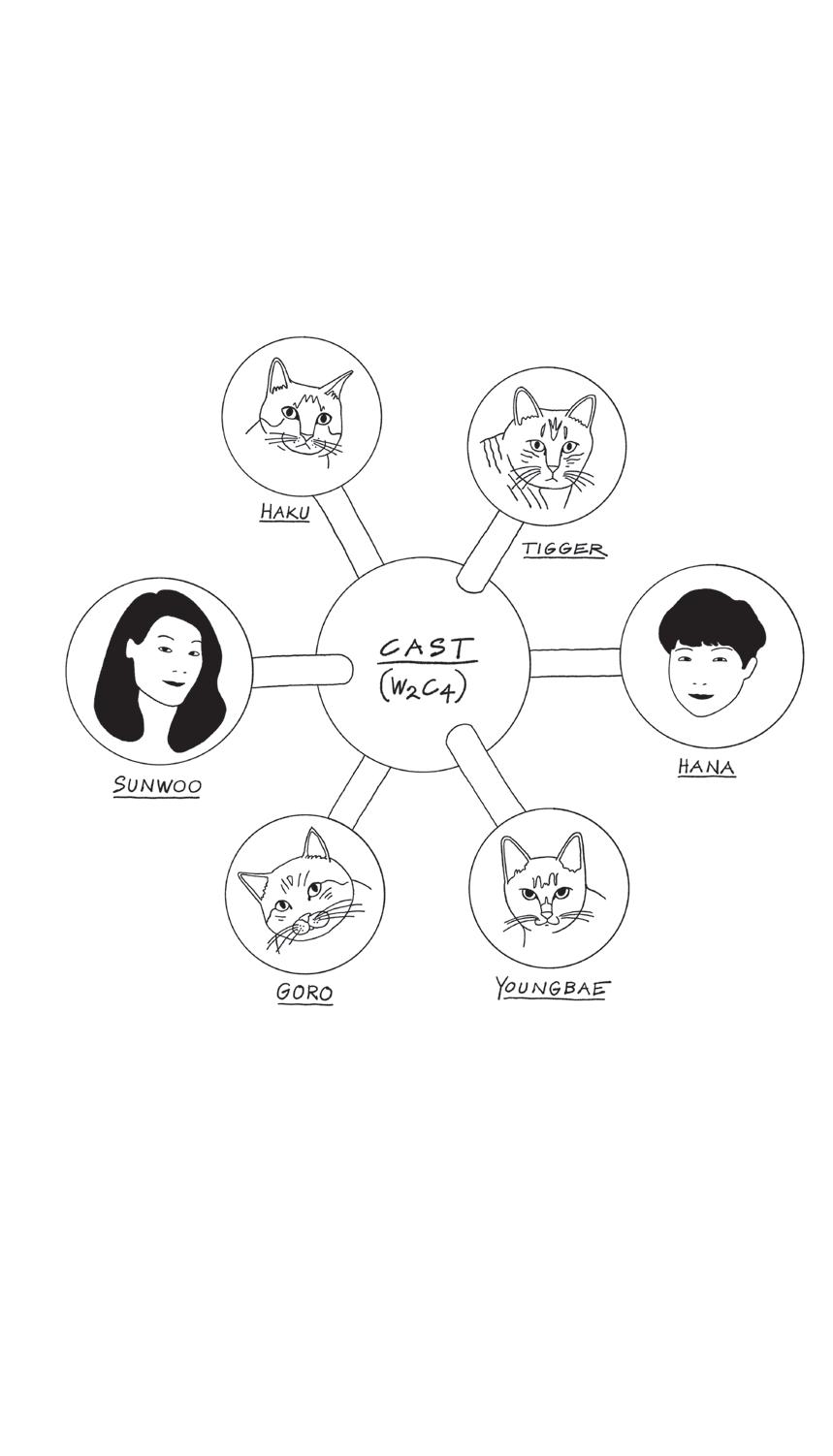
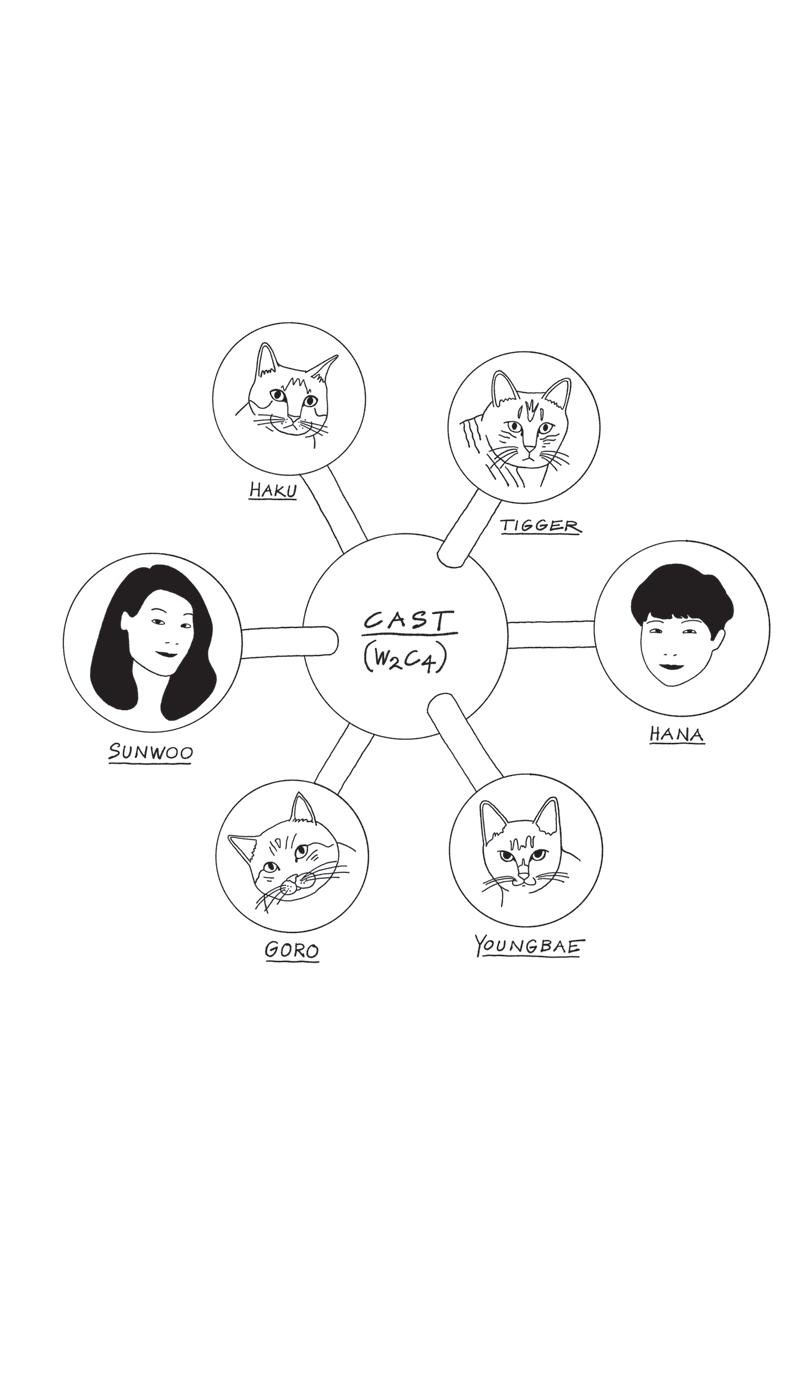
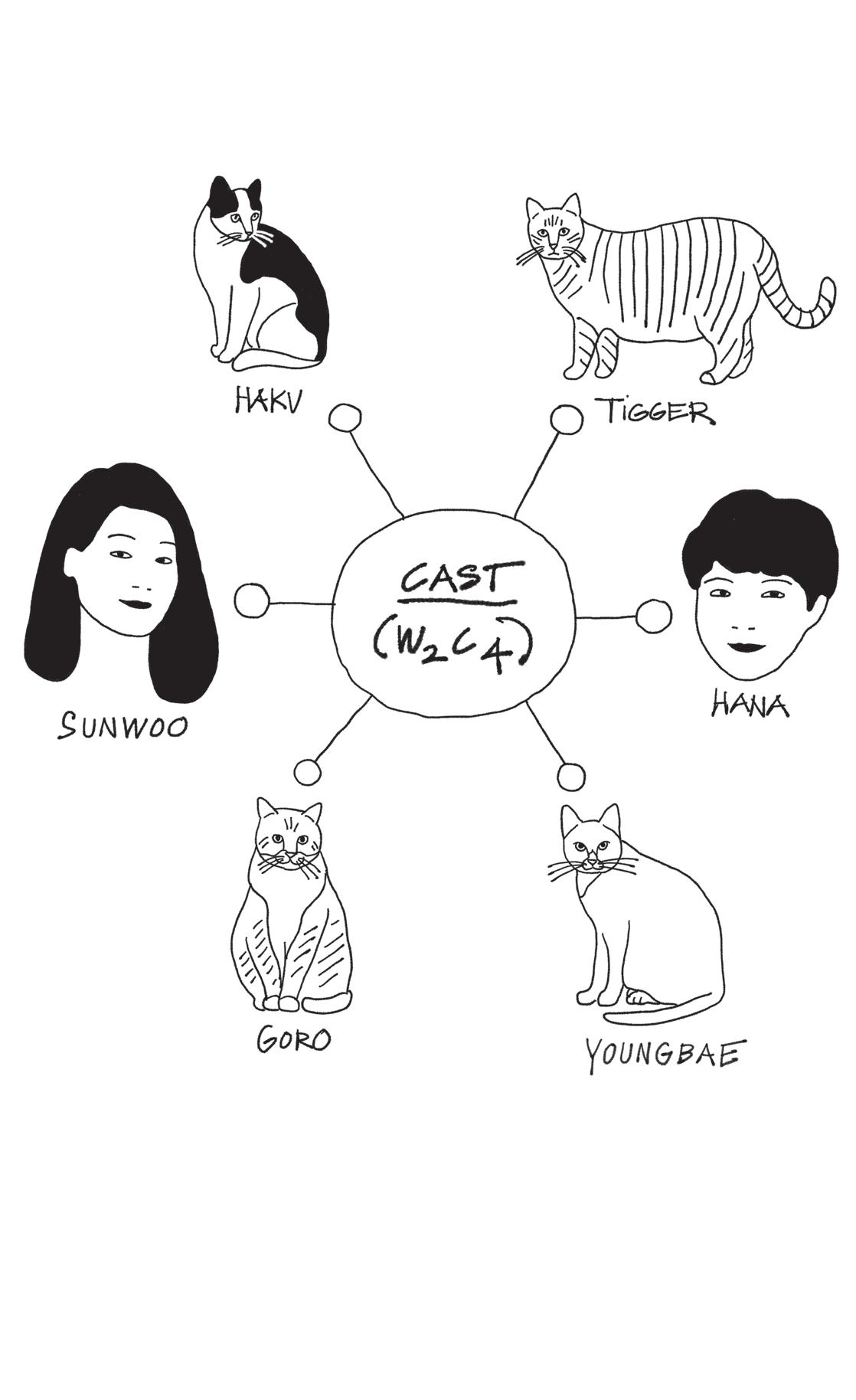
They say that single-person households make up 27 per cent of households in South Korea. I think of single-person households as atoms. It’s fully possible to lead a happy life alone. But once we reach a certain threshold, what’s stopping the individual atoms from joining forces to form a molecule? A molecule can be made up of two, three, four, or perhaps even twelve atoms. Its bond could be strong or weak. We live in a generation where the most common molecule consists of a firmly bonded woman and man. But in the future, we might see a more diverse range of configurations. For instance, in this house, we’re W2C4 – two women and four cats. And as of now, I’d venture we’re a very stable configuration.
I once came across a viral article about the many levels of ‘honbab’, a portmanteau of the words ‘honja’ (‘alone’) and ‘bab’ (‘meal’), meaning to eat alone. For instance, having a cup of instant ramen in a convenience store and eating a full meal at a family restaurant are two different levels of honbab. As someone who’d always eaten alone, I was fascinated. Any foodie who’d spent over twenty years living alone would become adept at enjoying their meals, with or without a meal buddy. It’s like how kids whose tantrums are ignored are forced to grow up quicker. Whether it’s getting off your arse to cook or going out to eat, once hunger and greed win out, and once you tune out the nosy stares, you’ll find that eating alone is surprisingly easy. I can trace my first significant honbab memory
back to autumn of my senior year in university. I’d just returned to campus after interviewing at a conglomerate and, while I was hungry, what I needed more was something good to lift my spirits.
I was caught between ruminating on the answers I should’ve given at the interview and agonizing over my failure to better hide my nervousness. I knew I wouldn’t be getting a callback. My legs turned to jelly at the mere thought of my hazy future, which was sure to be full of many more such hurdles and defeats. I was drained, as if I’d been given a concentrated taste of the physical and mental exhaustion awaiting me once I stepped into the workforce. That day, clutching the envelope containing the money I’d received for taking part in the interview, I took myself to a pork rib restaurant.
Single diner or not, ordering two portions of meat is basic courtesy to the grill. People who live alone seldom have fresh veggies in their diet, so I diligently wrapped each piece of meat in a slice of lettuce and had doenjang stew and rice on the side. Instead of beef, which would’ve had me scrambling to keep the meat from overcooking, I ordered pork, so I could enjoy my dinner at a leisurely pace. I gobbled everything up, not only because it was delicious, but because my deflated ego was in serious need of collagen. Just as
I’d expected, I didn’t get the job. I did, however, gain a few other things – the realization that I should eat well whenever my body and soul needed a pick-meup; the confidence that allowed me to walk into any restaurant and demolish two servings of meat on my own; and the ability to swallow and digest tiny failures. I must’ve done a good job at refuelling my soul, because not long after, I landed a job that suited me far better than the conglomerate. Once I started work, there were company dinners to attend and times when those of us who’d worked overtime would go for a late dinner. Honbab then became more sacred to me, a time when I could enjoy my meals in peace and quiet.
Travelling alone is a few notches above even the highest level of honbab. In addition to eating alone, you have to plan your own route, get around, make decisions and deal with said decisions with no one else to consult. Whenever my friends were too busy, I’d go on trips by myself. Slowly, I became a pro at being alone. I quite enjoyed the rush of making decisions on the move – Which museum should I see? Which tourist spots to skip? Should I take the straight road to get there quicker, or the seaside road for the view? At some point I started to believe that aloneness resembled order – efficient, comfortable, beautiful.
Four years ago, I signed up for surfing lessons. Since
I had two vacation days, I decided to visit the highly recommended Jukdo Beach in Yangyang, a coastal town two hours from Seoul. I booked a short stay and lessons at a surf shop that doubled as a guesthouse and hopped in my car. The new season that had yet to reach Seoul had already arrived in Hangyeryeong Pass, and the roads glowed with the lustre of late summer and early autumn. Along the way, I pulled over whenever and wherever I wanted to take in the vistas. But there was no one to share them with. No one there to hear me talk about how much fun my new hobby was, how I had to try all sorts of funny poses to get in and out of my rubbery swimsuit, how being surrounded by tanned surfers made me feel like I was in a foreign country, how exciting all these new adventures were. My surfboard towered over me, and constantly going out into the water to wait for a wave with my ankle chained to the heavy board wore me out. Whenever a wave approached, I’d start paddling towards it, quickly rise to my feet and find my balance. Inevitably, there were many times when I fell face-first into the water. But in the instances where I took off successfully and was smoothly delivered to shore, oh, what a thrill! I’d tried snowboarding and water skiing, but surfing was a different type of fun that played on the gravity of waves and the water’s texture. That rush of
delight explained why I reached for my giant board again and again, running out into the sea, waiting for the next wave.
After every lesson, I had to have raw fish. I was on the east coast, after all. Most places didn’t have courses for single diners, and so it always took a few calls before I could get a reservation. I would drive to a restaurant, indulge in seafood and return to the guesthouse. Since there was no one else to take the wheel, I couldn’t pair my meal with alcohol. Everything went perfectly according to plan, and before I knew it, I was returning to Seoul with three days’ worth of new, fulfilling experiences. Every moment of wonder was solely mine to savour. I even found satisfaction in overcoming despair alone, but at the end of the trip, I thought . . . Enough. Though I’d done everything on my own – especially those things that supposedly cannot be done alone – and had become an expert at being alone, it was only a matter of time until I accepted the fact that some things were best enjoyed with other people around.
In the movie Paris Can Wait, Diane Lane’s character is unexpectedly partnered up with a French man who has a penchant for dilly- dallying and impromptu activities. He insists on spreading out a picnic mat wherever there’s a view and pairing food with good
wine even if it means they can’t drive later. While she is irked by her companion’s dawdling, without him, she wouldn’t have discovered new roads leading to the most beautiful sights. If the characters had taken the quickest route and stuck with it, the movie would’ve ended as soon as it started. Instead, it is thanks to her spontaneous companion that her trip becomes sprinkled with detours, relaxing breaks and unexpected events that make for a full and satisfying plot.
After reaching the apex of solitude during my solo surfing trip, I began my slow descent down the mountain I’d scaled alone and started spending more time with friends. That year, I went on a ten- day trip to Japan with two friends, and in the winter of the following year, I moved in with Hana. I still enjoy my meals alone, and I love the simplicity and ease of travelling alone. But here’s what I’ve come to believe: the things I do alone, I remember, but the things I do with others become memories. For too long I’ve swallowed every exclamation, grumbled complaint and monologue. Now I think I’d like to let them out.
Hana
what if it’s her?
The first time I heard Hwang Sunwoo’s name was in 2010. I’d just returned from a holiday in South America and had got addicted to Twitter, now known as X. On my quest for finding interesting people to follow, a few mutuals recommended I check out Hwang Sunwoo, editor of fashion magazine W Korea. Her handle was @bestrongnow (which many people read as ‘best rong now’). I liked that she wrote a lot about what it meant to be a strong woman, so I followed her. Turns out she was clued up on a wide range of topics. But what I loved most was the witty, hilarious way that she conveyed her opinions. Her pieces for W Korea were always a treat. If in the middle of reading an article I thought, Damn, this is good! I was sure to find ‘Editor Hwang Sunwoo’ printed at the bottom of the page. It was so cool that she travelled the world interviewing stars like Tilda
Swinton, Alain de Botton, Jeff Koons, Annie Ernaux, Jean-Jacques Sempé, Lee Ufan and Paul Auster.
The first time I met Sunwoo in person was at a flea market. She was with graphic designer Lee Ari. Back then, I would’ve never imagined we’d all end up living in the same building, with Sunwoo and me sharing a nice apartment that we bought together. Sunwoo and I had similar tastes and would often bump into each other at pubs, concerts or music festivals. For six years, we hung out only on occasion, and though we barely saw each other’s faces, we were always chatting online about our cats. Whenever sleep evaded me, I’d go on Twitter to post my random thoughts, and sure enough, I’d always get a reply from Sunwoo, who was also wide awake. Hwang Sunwoo was once the queen of insomnia. And for a long time, I, too, wrestled with sleep.
For years, Sunwoo and I maintained an online friendship, and the more we spoke, the more I realized how much we had in common: Sunwoo was born in May 1977 and I was born in December 1976, but our births were both registered as a month later than our real birthdates. We both have older brothers born in 1975 and who were the better-looking sibling when we were kids. Our brothers also have similarsounding feminine names – Hayoung and Sunyoung.