

P ROLOGUE
Father and Son
One
The 83rd Masters
Augusta National Golf Club
Augusta, Georgia
April 14, 2019
The dream begins in a fourth-grade classroom.
At the Benjamin School, in North Palm Beach, Florida, ten-yearold Charlie Woods sits at his desk wearing a blue-and- orange school uniform and staring down at a blank notebook.
What is your wish?
The answer is easy. He wants to stand on a golf green and — for the first time in his life — witness his father, the world-famous Tiger Woods, win a tournament.
Charlie’s made this wish before.
On Sunday, July 22, 2018, Charlie and his older sister, Sam, were among the 175,000 spectators at Carnoustie Golf Links, in Angus, Scotland. The siblings looked nervously at the British Open scoreboard as their father’s lead evaporated on the back nine.
But in April of 2019, Tiger, determined that he’s not “going to let that happen to them twice,” tries again to persuade Charlie and Sam.
You want to come up to watch the Masters?
“No way, unless my sister comes,” Charlie says, deferring to elevenyear- old Sam. But after her soccer team is eliminated from the Florida state tournament, Sam and Charlie join their grandmother, Kultida Woods, on a last-minute trip to Georgia.
Tiger was twenty-nine years old in 2005, the last time he won at Augusta National Golf Club. That was fourteen years — 5,117 days — ago. His forty-three-year- old body has undergone eight surgeries, four on his back and four more on his knee.
He’s told ESPN, “I want to be healthy for my kids.”
Today is for them.
And for history.
In front of the clubhouse stands the Big Oak Tree, planted in the 1850s and now more than 150 years old.
Back in 1997, when twenty- one-year- old Tiger became the first minority golfer to win the Masters, the tree was surrounded by an unexpected line of fans in white jackets — the waiters and busboys of Augusta National. Today, those fans emerge once again as Tiger competes for his fi fth Masters, and fi fteenth major, win.
Sam and Charlie stand just off the green with their grandmother Tida. Like his father, Charlie’s dressed in a red Nike top and black ball cap.
The fi nal-round lead shifts among six players, including Tiger.
His putt on the 18th is for bogey, but it’s good enough.
He’s the winner — by a single stroke.
“Ti-ger! Ti-ger!” the crowd chants for the now five-time Masters champion.
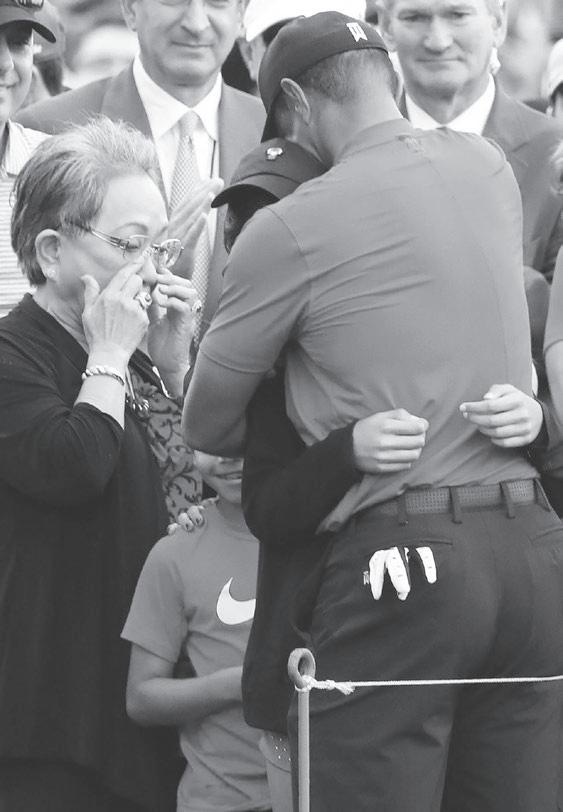
Charlie runs to his father and jumps into his arms, squeezing him “tighter and tighter.”
Tiger reaches for his mom, and the two of them sandwich Charlie in another hug.
Sam cheers enthusiastically but hangs back a little as the cameras follow. “Sam, she doesn’t like the spotlight, can’t stand it,” Tiger says of his daughter. He understands. “She doesn’t have to say anything.” He pulls Sam close as they embrace, and she buries her face in his chest.
“I’m so proud of you, boy. So proud of you,” Tida tells Tiger. “You counseled with Dad last night, didn’t you?”
She knows how incredibly proud Earl Woods, Tiger’s dad, would’ve been if he were here.
In the interview room afterward, Tida sits smiling in a green club chair, listening to her son reminisce about his 1997 Masters win.
“It’s been twenty-two years,” she hears him say nostalgically. “Life goes on. But there’s been one continuity through it all — my mom was there.”
That evening, the tradition continues. Patrick Reed, the 2018 Masters champion, helps Tiger into the fabled Green Jacket, the same rye-green wool coat he’s donned four times before.
“It fits,” he says.
Two
The 61st Masters
Augusta National Golf Club
Augusta, Georgia
April 13, 1997
The dream begins in a Southern California living room.
In April of 1986, Earl Woods has the television tuned to CBS Sports coverage of the Masters. His son, ten-year- old Tiger, roots for his golf idol, Jack Nicklaus.
The forty-six-year- old “Golden Bear” faces long odds. Nicklaus’s goal for his fi nal round: 65. He posts 35 on the front nine, leaving him thirty strokes after the turn.
On 17, Nicklaus sinks a long birdie putt. He shoots 65 for the round and edges out Greg Norman and Tom Kite by a single stroke for his sixth Masters title.
Tiger’s already got the itch. I want to be where he is, doing what he is doing.
Ten years later, he’s at Augusta National, playing a practice round with Jack Nicklaus and Arnold Palmer, but twenty-year- old Tiger misses the cut.
The next year, Tiger qualifies.
His father is there, too — against the advice of the doctors who’ve been monitoring Earl’s complicated recovery from recent heart surgery.
Nick Faldo, defending 1996 champion and Tiger’s first-round playing partner, senses the significance of the moment. “It’s the beginning of Tigermania, right?”
Tiger bogeys four of the first nine holes, then rallies and builds a nine-stroke lead after three rounds.
In the wee hours of Sunday morning, Earl and Tiger share a bowl of ice cream.
“It’s going to be the most important round of your life, but you can handle it,” Earl tells his son. “Just go out there and do what you do.”
The CBS Sports broadcast draws forty-four million viewers.
“Tiger’s the man, period. He’s your man; he’s my man,” says Augusta National headwaiter, Henry Ashley, who joins twenty or so of his Black colleagues under the Big Oak to watch Tiger play.
Nearby, Earl is also watching and waiting.
Tiger sinks his fi nal putt, besting the second-place fi nisher, Tom Kite — who’d also fi nished second to Nicklaus in 1986.
At age twenty- one, Tiger becomes the tournament’s youngest- ever champion. His seventy-two-hole score of 270, 18 under par, is the lowest ever at the Masters, and his twelve-shot margin is the largest ever.
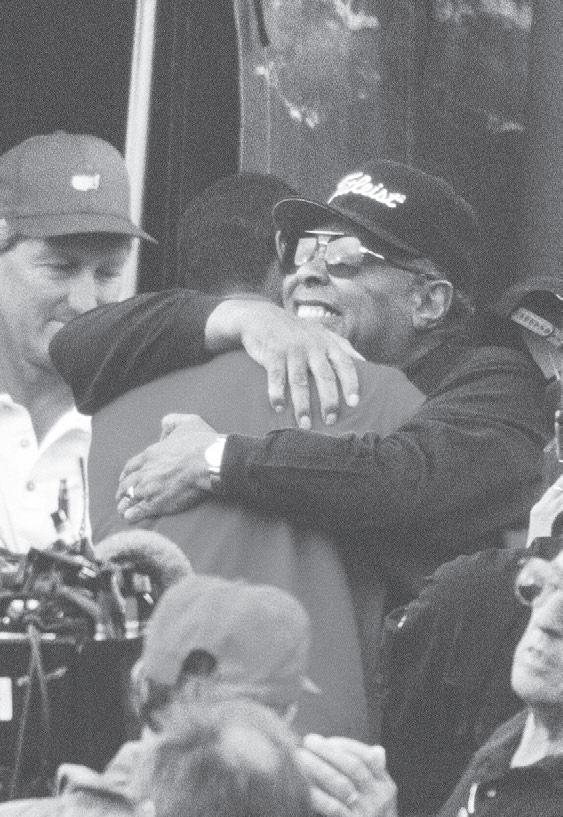
“We made it,” Earl says, face streaming with tears. “We made it. We made it.” Tiger holds on tight as Earl whispers into his ear, “I love you, son, and I’m so proud of you.”
Inside Butler Cabin that evening, Nick Faldo passes the mantle — and the Green Jacket — over to Tiger.
Later, Tiger vanishes from his own victory celebration. “I ended up falling asleep, holding the jacket, cuddling it like it was a little bear,” he says. “I woke up in the morning, still holding it, and said, ‘Huh, I did win it.’ ”
PART 1 Prodigy
Chapter 1
Navy Golf Course
Cypress, California
Summer 1978
Acall comes in to the sports desk at CBS Los Angeles.
Jim Hill picks up. Hill, a six-foot-two Black man who played eight NFL seasons at defensive back, has only been on the sports desk at Channel 2 for a couple of years.
“My name is Earl Woods,” the caller announces. “And my son Tiger is getting ready to revolutionize the sport of golf.”
It’s not the first time Hill has heard a dad brag about a son’s athletic ability. “Well, what else is interesting about this story?” he asks.
“You’ve got to see him to believe him,” Earl says, then adds, “I’m a former Green Beret. Get your butt down here.”
“Here” is Cypress, California. The Orange County city of forty thousand is twenty-five miles southeast of Los Angeles. Hill is intrigued enough to assemble a camera crew to fi lm the demonstration Earl sets up at Cypress’s Navy Golf Course.
“How much do you practice?” Hill asks the toddler.
“A whole lot,” Tiger answers.
Using three custom clubs that his father has had cut down to child size, Tiger hits balls and sinks putts, one after the other. Hill is suitably impressed.
“This young man is going to be to golf what Jimmy Connors and Chris Evert are to tennis,” Hill declares.
Soon after Tiger’s appearance on Channel 2, a national TV show seeks him out. The Mike Douglas Show, a talk show newly relocated to Los Angeles from Philadelphia, is looking for local talent. The host sees Hill’s piece on Tiger, and soon the producers book him for the season’s premiere week in their new Hollywood location.
On Friday, October 6, 1978, Tiger and Earl — dressed in coordinating red-and-white outfits — arrive on the soundstage at CBS Television City’s Studio 43 and greet Mike Douglas as well as beloved comedian Bob Hope and legendary actor Jimmy Stewart, who is cohosting with Douglas for the week.
In front of the live studio audience, Stewart oversees a putting contest between Hope — a serious golfer with a single- digit handicap and the longtime host of the Bob Hope Desert Classic celebrity golf tournament — and Tiger, toting his tiny clubs in the canvas golf bag he brings everywhere.
“You got any money?” Hope jokes. “You wanna bet a nickel?”
Stewart asks Tiger to putt first. When Tiger misses the hole, Hope gives him a mulligan, while the It’s a Wonderful Life star encourages him to take a second shot. “Tap it right in there.”
Earl sets up the ball. Tiger moves it closer, focusing his gaze under the brim of his red cap. After three tries, he picks up the ball in frustration and throws it into the cup.
The young golfer charms the audience, but he also has a complaint. The putting green is uneven.
“Mike Douglas knew it, too,” Earl Woods says once the cameras are off. “All he could do was laugh. He couldn’t believe that Tiger could see the break, also.”
Earl survived two tours in Vietnam, channeling a combination of innate athletic talent and a calm, focused demeanor. During his second tour as a Green Beret lieutenant colonel, he daringly planted explosives behind enemy lines.
Once he retired from active duty in 1974, Earl and his second wife, Kultida Punsawad — a native of Thailand who met Earl in 1968, when she was in her twenties and working on a US Army base in Bangkok — moved to Cypress, California, where they purchased a home on a corner lot at 6704 Teakwood Street.
Earl spends his days working at the aerospace company McDonnell Douglas, his evenings hitting 5-irons in his garage, and his weekends playing at the nearby Navy Golf Course, open to active- duty and retired military personnel.
On December 30, 1975, Tida and Earl — already father to two adult sons and a daughter with his first wife, Barbara — welcome a baby boy: Eldrick Tont Woods. Tont is a traditional Thai name, but Eldrick is Kultida’s creation, a combination of her and Earl’s initials. Earl nicknames the boy Tiger in honor of his friend and comrade Vuong Dang “Tiger” Phong, a brave South Vietnamese army colonel who went missing during the war.
Based on his belief that “the next generation of great golfers are going to be those who were introduced to the game between six months and a year,” Earl set out to instill greatness in his infant son by power of example. He’d place Tiger’s high chair in the garage so his son could observe as Earl practiced hitting balls into a net while narrating “exactly what I was trying to accomplish.” His tactics worked, Earl says. “I’d monitor him out of the corner of my eye, and he’d be staring at the club, his eyes like marbles, waiting for my next swing.”
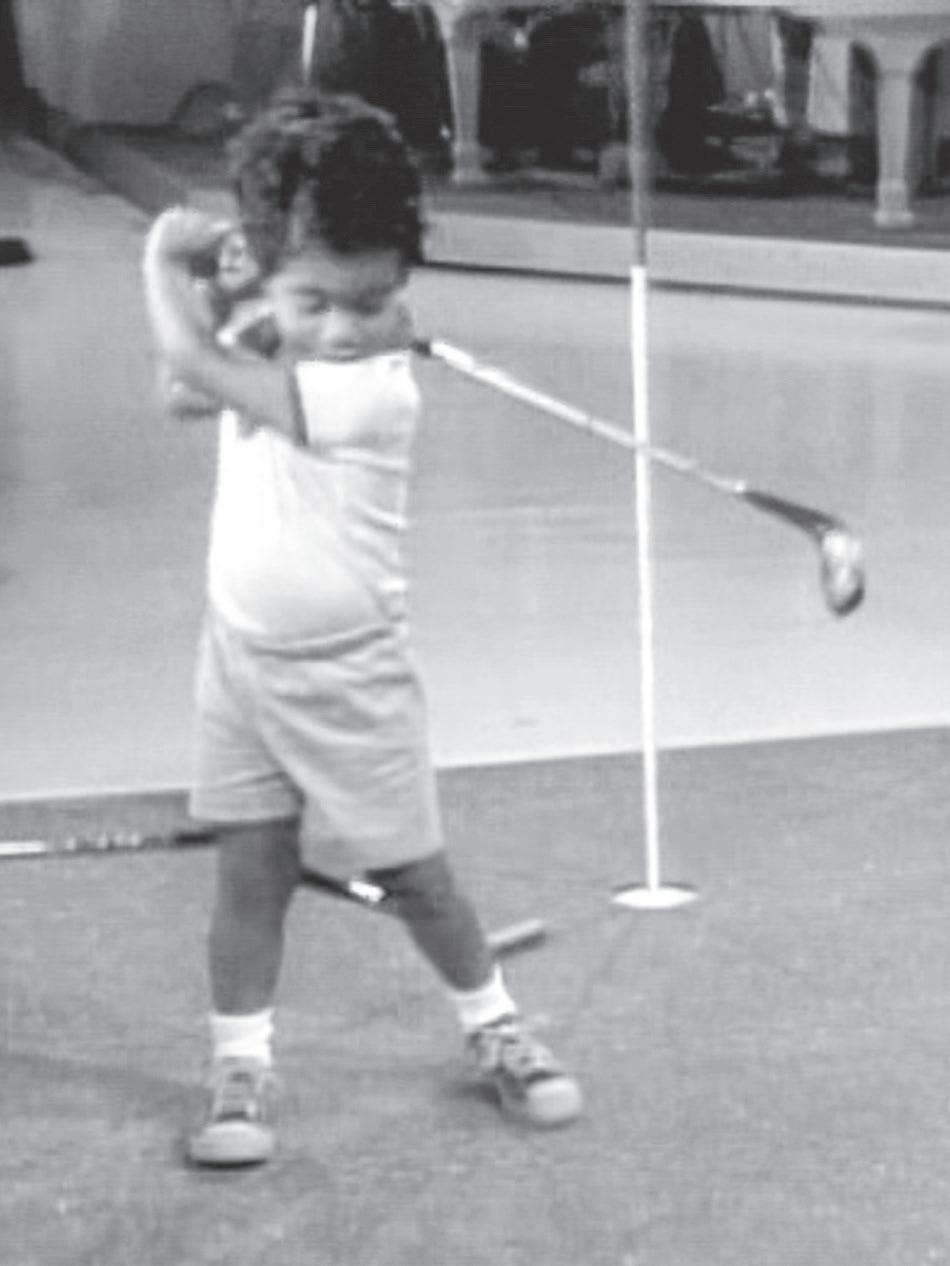
When Tiger reached ten months old, Earl changed it up. “I just unstrapped him out of his highchair. He picked up a putter, put a ball down, waggled and hit a ball into the net. First time.”
Earl immediately noticed that Tiger’s “first swing was a perfect imitation of mine,” like “looking at myself in a miniature mirror.”
“Honey, get out here!” Earl shouted to Tida. “We have a genius on our hands.”
In 1980, around a year and a half after Tiger’s appearance on The Mike Douglas Show, Tida takes the four-year- old over to Heartwell Golf Course, in Long Beach, a small eighteen-hole, 2,143-yard par-3 course that specializes in classes and camps for beginning and junior golfers.
Although Tida herself recently took up golf so she could spend more time with Tiger, both parents recognize that it’s time for him to get professional instruction.
Tida walks into the Heartwell pro shop with Tiger and his bag of mini clubs.
“My son is very talented,” Tida tells assistant pro Rudy Duran. “My husband and I are interested if you could give him some private lessons.”
Like Earl Woods, Duran first fell in love with golf when he was in the military, in his case the air force. After spending time as a pro golfer, Duran now teaches around a hundred kids between the ages of eight and eighteen. But he’s a little taken aback at Tida’s request that he coach a four-yearold. The little dude can barely see over the pro shop counter, he thinks.
Still, he’s willing to see what the boy can do. At the practice range, Tiger gets out his cut- down 2.5-wood.
They really did a nice job getting the club to fit him, Duran thinks as he tees up four balls for Tiger.
Then: four perfect shots in a row. Each around sixty yards, with a bit of a draw.
Next, they venture to the chipping green to hit some pitch shots. Tiger pulls out another sized- down club, a wedge this time, and asks Duran, “Do you want me to pop them up?”
Duran is stunned at the skills he’s witnessing. “What would Jack Nicklaus shoot if he was 3-foot-7? That’s what Tiger shot.”
The two of them start playing together daily. Duran sets a distanceadjusted “Tiger par” of 67; within a year, Tiger’s shot a 59 at Heartwell,
where on Saturdays his opponents are teenage junior golfers. On Sundays, he, his father, and Duran play nearby regulation courses, where, Earl notes, “at the end of the day he was always under par. This is important: He never developed a complacency or a fear of going low.”
Duran develops an easygoing relationship with Tiger’s parents, whom he calls “lighthearted” and “really easy to be around,” not at all pushy or demanding. “To me, the family was raising a child, not a golfer,” he says. “The golf was just something he had an aptitude for.”
But this is a kid who “popped out of the womb a Magic Johnson or a Wolfgang Amadeus Mozart. He had talent oozing out of his fi ngertips,” Duran says. “Mozart composed fi nished music in his head. I saw that in Tiger. He was composing shots in his head.”
“What he’s accomplishing at his age is phenomenal,” he tells Golf Digest magazine, which runs a small piece on Tiger in 1981.
“The kid’s not exceptional,” Duran says. “He’s way beyond that.”
Chapter 2
Universal Studios Lot
Universal City, California
October 12, 1981
On the Universal Studios Lot, five-year- old Tiger is unimpressed by making his second national television appearance.
“After all,” he remarks, “golfers get on television lots of times.”
Taking the stage in a red-and-white striped polo and a Spider-Man cap, Tiger perches on the lap of NFL great Fran Tarkenton, who quarterbacked the Minnesota Vikings to three Super Bowl appearances and now cohosts ABC’s talent showcase, That’s Incredible!, alongside singer John Davidson and actress Cathy Lee Crosby.
Over footage of Tiger driving, chipping, putting — both on Earl’s homemade driving range and on the Navy Golf Course — and dancing next to his father when he sinks the ball in the hole, Tarkenton says, “On a golf course, Tiger has the kind of poise and confidence that would be the envy of most golfers ten times his age. His knowledge of the game is truly amazing.”
So are his sporting goals, especially for a kid just starting kindergarten.
“When I’m going to be twenty, I’m gonna beat Jack Nicklaus and Tom Watson,” Tiger says as the words INCREDIBLE KID! fl ash across the screen.
After the fi lming of That’s Incredible!, Earl watches a seventeen-year- old fan approach Tiger for an autograph.
“He didn’t know how to write, so he printed,” Earl says.
Not everyone is as confident in Tiger’s future. After the taping, cohost Davidson puts the question to Tarkenton: “You think this kid will ever make it?”
“He has no chance,” Tarkenton replies. “Because he’s got one of these doting fathers who’s going to drive him, and he’s gonna end up hating golf and hating sports and you’ll never hear from him again.”
The headline of a small piece in Golf Digest ’s People in Golf segment reads: 5-YEAR- OLD TIGER — HE’S INCREDIBLE
The article makes it into J. Hughes Norton III’s clip fi le. As an agent with Cleveland-based International Management Group (IMG), Norton makes it his business to identify potential rising stars in sports.
Norton, an 8-handicap golfer who played hockey at Yale, has been with IMG for around eight years, since 1972. He first learned about sports marketing as a student at Harvard Business School. The IMG founder and president, Mark McCormack — who started the company in 1960 based on a handshake deal with golf superstar Arnold Palmer and eventually went on to represent Jack Nicklaus and Gary Player — spoke to an entrepreneurship class Norton was taking. When McCormack returned to campus a few months later, Norton asked for, then landed, a job at IMG.
Norton travels to Los Angeles to meet the kid from the Golf Digest clip. In Cypress, he fi nds young Tiger riding his tricycle in front of the house on Teakwood Street.
Earl does the talking. “I believe that the first Black man who’s a really good golfer is going to make a hell of a lot of money.”
“Yes, sir, Mr. Woods,” Norton says in agreement. “That’s why I’m here.”
The Today show is broadcasting “on location in Southern California” at Calabasas Country Club.
“Eldrick Tiger Woods,” says anchor Bryant Gumbel, introducing his guest. “The most amazing five-year- old golfer you have ever seen.”
Though Tiger, whose ball cap reads SUPER KID, is making his third national TV appearance while still in kindergarten, Tida insists, “He’s just a regular kid that loves to go out and play golf.”
Play to win, she means. “One thing he love most,” says Tida, whose native language is Thai, “is competition. He love to have somebody to play with him. He love to compete with even his pro or his dad when, uh, they’re playing putting.”
The camera cuts back to Tiger.
“Would you like to be a pro golfer?” Gumbel asks.
Tiger looks off to one side, considering the question.
“Yes,” he fi nally says.
Duran fits Tiger for more clubs, but the young golfer’s set is not yet complete.
“You know what, Rudy?” Tiger says. “We didn’t get a one-iron — I want a one-iron.”
“A one-iron?” Duran says. “You’re not gonna generate enough clubhead to get a one-iron airborne. You’ll just hit it into the ground.”
Duran watches as Tiger takes Earl’s full-length 1-iron to the range and rips the ball.
On his sixth birthday, December 30, 1981, Tiger tries out his new irons.
Before today’s small exhibition match at Redlands Country Club, he draws an admiring crowd on the practice range. “Does he ever get upset?” a woman asks.
“Sometimes, yeah,” Duran tells her, adding, “He gets a two-shot penalty when he throws a club, so he doesn’t do that too often.”
The birthday boy is completely focused on hitting the balls until his coach asks, “What do you do when you want to hit it low, Tiger?”
“Stay off the right foot.”
“What kind of club would you use?”
Pause. “Five-iron or 4-iron.”
“You know what’s going on.” Duran nods approvingly.
Tiger, Earl, and Rudy Duran pile into Duran’s white Porsche for a trip out to San Jacinto, around eighty-three miles east of Los Angeles, where Soboba Springs Golf Course has extended an exciting invitation.
Six-year- old Tiger doesn’t really grasp the significance of “playing the great Sam Snead.” The seventy-year- old Virginia golfer known as Slammin’ Sam, whose swing is “so sweet, you could pour it out of a syrup bottle,” is the winningest player on the PGA Tour, notching eighty-two wins in a twenty-nine-year career.
They’re playing the 17th and 18th holes of the desert course. On 17, Tiger’s tee shot fades short. He wades into a creek to play his ball.
“What are you doing?” Snead yells.
Tiger looks up, confused. “I’m going to hit the shot,” he says.
“Take it out and hit it again,” Snead tells him. “Just pick it up and drop it. Let’s go on.”
It’s a generous offer, but it doesn’t sit right with Tiger.
“My dad always taught me you play it as it is, there’s no such thing as winter rules,” Tiger insists. Earl and Duran don’t intervene as Tiger pulls out his iron, miraculously “playing it out of the water and making bogey.”
The move impresses Snead, who shakes his head in admiration even after Tiger bogeys again on 18, giving the duo a fi nal score of par-par and 2 over.
The champion, in his trademark Stetson Madrigal coconut-straw pork pie hat, offers to sign Tiger’s scorecard.
In return, the boy in the cap reading SUPER KID signs his own autograph for Snead.
Snead recognizes the talent.
“I’ve worked for years to get the hitch out of this swing of mine,” Snead says, “and along comes this kid. I think I’ll toss my clubs in a lake someplace.”
Chapter 3
Heartwell Golf Course
Long Beach, California
May 29, 1982
Six-and-a-half-year- old Tiger is playing in his weekly Saturday juniors tournament at Heartwell Golf Course.
Tiger, a rising first grader, enjoys school, but it’s a separate part of his life. “When I’m around other kids, I don’t like to talk about golf,” he says. “I just like to keep it to myself.”
He’s a good student — so good that he qualifies for an advanced class, but Tiger refuses. “He does not want to,” Tida says, “because all of his golfi ng partners are so much older than he is and the kids in the advanced class would be older too. He is really excited about being with his own age group.”
But not on the golf course.
Competing against teenagers is the “peak of his week,” as Earl puts it, though sixteen-year- old Kelley Manos is quick with the reality check. “Do you realize this little s — is tied with us?” There’s zero animosity in the observation, only amazement, “like, ‘Wow, cool, the little guy did it.’ ”
On this Saturday, Tiger’s teeing up on the 12th, connecting “a nice little two-and-a-half-wood” with his Top Flite 7 golf ball. The ball carries
the bunker, it rolls into the hole. Everybody in my group celebrates but me. I can’t see that high. So, one of the guys picks me up, shows me there’s no ball on the green. I’m excited — I run to the green, pick the ball out of the hole and I’m celebrating.
“You idiot,” shout the other kids. “Your golf bag’s up on the tee!” He’s completely forgotten about his clubs.
Tida saves the golf ball and displays it in a commemorative HOLE IN ONE plaque. Jet magazine’s November 15, 1982, issue pictures Tiger holding a fairway wood and wearing a visor and sunglasses to shield his eyes from the California sun.
Ebony magazine declares,
A GOLFING CHAMPION AT SIX: TINY TIGER
WOODS HAS DONE IT ALL, INCLUDING A HOLE-IN- ONE. Though Earl envisions a grander award — an entry in the Guinness Book of World Records — he tells Ebony that golf “is still a game and he is still a child.”
Tida and Tiger have a Saturday routine. Driving her Plymouth Duster to Heartwell, she usually drops him off with his clubs and seventy-five cents — enough for him to buy a hot dog and place a pay-phone call for a ride home.
On other Saturdays, they travel to tournaments around Southern California. Tida uses the time to coach Tiger: “When you are ahead, don’t take it easy,” she tells her son. “After the fi nish, then be a sportsman.”
Her ruthless philosophy doesn’t end there. “In sport,” she says, “you have to go for the throat. Because if all friendly, they come back and beat your ass. So you kill them. Take their heart.”
Tiger names the family dog Boom-Boom after Fred “Boom Boom” Couples, a golfer famous for his ability to drive the ball with distance and accuracy.
Boom-Boom goes everywhere with Tiger. When the boy plays makeshift greens at a local park near Heartwell Golf Course, the dog acts as a canine marker, fi nding every golf ball Tiger hits and lying down next to it.
Boom-Boom is also a good listener. Tiger struggles with stuttering — he’s taking a class to help — and he practices by talking to the dog for hours and hours. “He would sit there and listen before falling asleep,” Tiger says of his faithful friend.
When he’s not practicing with Boom-Boom, Tiger sneaks onto the Navy Golf Course, which he’s technically not allowed to play until age ten. As he’s gotten older — and better — some members start to complain and demand that the rule be enforced.
Hence the subterfuge.
I hop in the creek, this ditch, and walk on the south side of the ditch, because the clubhouse is up above, so no one can see me. My dad gets a golf cart, and I walk down past one, past two, and I lie under the bridge on three, and try and be in total disguise, so I can blend into the environment. I put rocks and stuff around me. I hide my golf bag underneath the rocks, totally trying to blend into the environment.
“You there?” Earl asks.
Tiger is always in place.
“Yup. Coming up.”
On December 30, 1985, there is a special event: “My father took me to Navy Course for my 10th birthday,” Tiger says, excited to be “fi nally old enough.” There would be no more hiding in the bushes to play the course in secret.
Chapter 4
Junior World Golf Championship
Torrey Pines Golf Course
La Jolla, California
July 15, 1986
Adrenaline is coursing through Tiger’s four-foot-nine, eighty- onepound frame. The ten-year- old is sweating so profusely that his thick glasses start to slip. He’s so nearsighted that he could be considered legally blind without them, but he’s still too young for contact lenses.
“They call him Tiger?” asked ten-year- old golfer Chris Riley in 1984, when the players were both Junior World Golf Championship first-timers. Since 1968, the San Diego County Junior Golf Association has hosted an international field of players from more than eighty countries. Then eight-year- old Tiger won the three-round tournament over Riley, who said, “He had the Coke-bottle thick glasses, but he could fl at- out play.”
It’s now Tiger’s third summer in the boys-ten-and-under category. He won again in 1985, and by 1986, he’s collected dozens upon dozens of trophies. But after the first round of the Junior World tournament, Tiger throws his clubs to the ground in frustration. It’s an unusual outburst, though “lately,” his mom says, “he has shown a bit of temper when he didn’t make par.”
Since he was very young, Tida has stressed to Tiger that he is not to throw tantrums on the golf course, as tennis players John McEnroe and Jimmy Connors do on TV. “I don’t want you to ruin my reputation as a parent,” Tida tells him, adding, “I will spank you in a minute if you act like that.”
“We’re working on it,” Earl says of his son’s impatience. “He’s just like any other golfer. He doesn’t like to do badly.” Still, Tiger tends to bang his clubs around when he hits a bad shot. “I don’t want to, Daddy, it just happens,” he insists. “I’m trying very hard.”
“I know you’re trying, just keep trying,” Earl says in encouragement, though he’s convinced that learning to “play angry” actually helps Tiger, allowing him the space to “take responsibility for his actions.”
At the clubhouse — the landmark 1817 adobe home called Casa de Carrillo — father and son have a coaching session.
“It didn’t go well today,” Tiger says. “I couldn’t get anything to go right.”
“Well, it’s no big deal,” Earl replies. “You’ll go out and get them tomorrow.”
Tiger also grouses about using only his sand wedge and putter. “I have to putt a lot better,” he says. “I couldn’t putt. I couldn’t hit the greens.”
He asks his dad if they can go play another course later that day. “I need to use my woods,” the ten-year- old says.
Tiger doesn’t win the 1986 Junior World title. It’s time to fi nd a new coach, especially with Rudy Duran leaving Heartwell to run his own golf course.
John Anselmo, the head pro at Meadowlark Golf Course in nearby Huntington Beach, is Earl’s top choice. “I have this new kid named Tiger Woods,” Anselmo tells his son, Dan, a fellow pro and coach. “He’s a tour player in a little boy’s body. He just needs to grow into it.”
In and around the Woods family home, Tiger designs a practice course.
“Too long,” Earl says of Tiger’s backyard setup, “and hit the neighbor’s house. Too short and . . . hit the roof.”
Indoors, Tiger decides that the living room coffee table is the perfect height for clearing lob wedges. The ball must stop rolling before it hits the fireplace.
“I chip over that big chair and make the ball stop before it hits the bricks,” Tiger explains. The stakes are high — “If I miss, my mother will get after me” — but “it’s good training for fi nesse and getting the right feel for delicate shots.”
In 1987, Golf Digest launches its first- ever Armchair Architect contest in golf course design. Eleven-year- old Tiger is too young to enter, but he’s determined to participate.
Working at the same bedroom desk where he plays Nintendo and does his homework, Tiger decides that an “outlandish and creative” design “would end up winning.” Using colored pencils, he draws a 610-yard, par-5 hole featuring a sand trap in the center of the green.
It’s an all- or-nothing hole, dependent on a huge element of luck. The U-shaped fairway has two doglegs that reward either three precise shots or one high shot over the top. A player lacking accuracy or distance will land a ball in the bog.
Earl enters the contest on Tiger’s behalf.
He doesn’t win. When the results come out, Tiger studies the top entry: “a blank hole, tee markers, a green in the distance, and that’s it.”
I wish I had known that, he thinks. I would have done that.
On the course, he’s becoming used to the rush of winning. The year of the Armchair Architect contest, Tiger enters — and wins — thirty-three junior golf tournaments. Thirty-three.
“There’s no feeling I’ve found that matches the feeling that I’ve beaten everybody,” says the eleven-year- old. “Second place is first loser.”
Chapter 5
Cypress, California
March 28, 1989
Aletter arrives, addressed to thirteen-year- old Eldrick “Tiger” Woods.
“Dear ‘Tiger’!” Stanford University golf coach Wally Goodwin writes. “Here at Stanford I am fi nding that it is never too early to get word out to you exceptional young men concerning what it will take a few years down the road in terms of application to Stanford.”
Goodwin is looking for “Winners!” and goes on to advise the seventh grader that while “athletes get a bit of a break,” gaining entrance to Stanford “takes SAT scores of 1200 or so” and a 3.6 GPA.
Nothing could have pleased Tiger’s parents more. The rules of the Woods house are:
1. Education before golf.
2. Homework before practice.
3. No back talk.
4. Respect your parents.
5. Respect your elders.
As Tiger later tells the Los Angeles Times, “School comes first, golf second. How much practice I do in golf is determined by how soon I fi nish my homework. You can’t accomplish anything without an education. I defi nitely plan to fi nish college before thinking of turning professional.”
Tiger’s strongly self-motivated. The two questions Earl boasts of never having to ask are:
Did you practice? And Did you do your homework?
The junior high student and three-time Junior World winner (1984, 1985, 1988) replies with what Wally Goodwin calls “a perfect letter,” assuring the coach that his current GPA is 3.86, “and I plan to keep it there or higher when I enter high school.”
Furthermore, he says, “My goal is to win the Junior World in July for the fourth time and to become the first player to win each age bracket. Ultimately I would like to be a PGA professional. Next February I plan to go to Thailand to play in the Thai Open as an amateur.”
Carl Vanderbosch, Tiger’s history teacher at Orangeview Junior High, can vouch for the academics. When preparing his lesson plans for the incoming seventh graders and seeing “the name Tiger on the class roster,” he “expects a rambunctious kid.” Instead, he fi nds that the new student has “an amazing attention span” and a well- developed “sense of self.”
During a lesson on Asian history and religion, Tiger “raises his hand to volunteer that he comes from a Buddhist background. Just the way he carries himself,” Vanderbosch says, gives the impression that his student “takes life as I imagine a Buddhist might.”
Buddhism has always been part of Tiger’s upbringing: Tida is a devout Buddhist who’s raised her son in the faith. She grew up north of Bangkok, not far from the famous bridge over the River Kwai, and made Earl accompany her to the Temple of the Reclining Buddha on their first date, which happened to fall on a holy day.
Not exactly Earl’s idea of a fun time, but he was no match for his future wife’s determination. “What could I do?” he says in faux exasperation. “I took her to the damn church.”
Tida also ensures that her son is connected to his Thai heritage and
family — her mother, Chardcharvee, lived with them for a while when Tiger was young, and Tida brought him to visit Thailand in 1984, at age eight, where he met his grandfather, Vit. Tida’s father, whom she describes as “built like my son, tall and slim,” gave Tiger a mother- ofpearl Buddha statue that the boy still treasures.
“Tiger, you pray to Buddha yet?” Tida will ask in the same breath as inquiring after his schoolwork. Every good or bad result requires a visit to the monks at the nearby Buddhist temple, and on special occasions such as his birthday, Tiger presents the monks with gifts of rice, sugar, and salt.
“I like Buddhism because it’s a whole way of being and living,” Tiger says. “It’s based on discipline and respect and personal responsibility.
“I believe in Buddhism. Not every aspect, but most of it. So I take bits and pieces.”
He has a small but tight group of friends, including neighbor Mike Gout and junior high pal Bryon Bell. While maintaining a nearly straight-A average, he’s also a student of golf. In his bedroom, decorated with books, motivational sayings, and Jack Nicklaus posters, Tiger reads about the great golf courses. The St Andrews Opens, by Bobby Burnet, is one well-worn text.
When he’s fourteen, Golf Digest ranks him “America’s third-best junior amateur.”
The pressure is on.
But his competitive spirit is strong — so strong that his dad works to keep it in check. “It’s a constant fight for me to get him to go out and just have fun playing a round of golf,” Earl says.
The thrill of the win, Tiger says, is “hard to describe. It feels like a lion is tearing at my heart.”
Chapter 6
Southern California
Summer 1988
Tiger, Earl boasted to Ebony in 1982, “is one of the first Black golfers with natural skills whose parents have the means to get pro instructions that even exceed those afforded Jack Nicklaus in his formative years. We are willing to pay the price.”
That was when Tiger was six — when Tida stayed home with him and Earl worked as a contract administrator and materials manager at McDonnell Douglas. In 1988, Tida goes back to work and Earl retires, replacing his wife as Tiger’s companion at national junior tournaments.
Year-round tournament play is expensive. Costs associated with Tiger’s junior tour schedule, including travel, tournament fees, and equipment, run to almost $70,000 annually (nearly $155,000 today). The schedule — fly in on the morning of a tournament, stumble out sleepless for the opening round, then check into a Motel 6 — is wearying.
“Pop, do you think we could get to the site early enough so I could get in a practice round?” Tiger asks.
“From this day forward, you will have just as good of a chance as any of these country club kids, and if I have to go broke, that’s what we’re
going to do,” Earl vows. And from then on, “we went a day in advance, he stayed with his peers at the Marriott and the Hiltons, and he kicked butt and took names.”
Earl and Tida provide unconditional support. “We didn’t want Tiger to grow up with an inferiority complex,” Tida says. “So even if we have to take out second mortgage or home equity loan, we let him have it.”
“Oh, I get everything paid for by sponsors,” Earl jokes. “There are three companies: Earl, D., and Woods,” the D referencing his middle name, Dennison. “I have about five very floating credit cards and two mortgages on the house.”
Tiger’s health and development have also been placed in the care of professionals, including Captain Jay Brunza, PhD, a navy doctor who has doubled as Tiger’s sports psychologist and occasionally, at major tournaments, as his caddie.
“Would you help me give Tiger the kind of advantage that a lot of country- club kids get?” Earl asks Brunza. “Would you work with him?”
They settle on a plan. Brunza will drive up from San Diego to Cypress on weekends, and Tiger will do his golf homework on the weekdays in between.
Using breathing, hypnosis, and visualization exercises he developed for the seriously ill children he treated at Bethesda Naval Hospital, Brunza teaches Tiger how to visualize shots by accessing “a level of real focus technique.” Imagining a picture around the hole, he putts to that image rather than to the cup.
Coach John Anselmo, who honed his teaching eye while watching fellow navy man Sam Snead play near the end of World War II, and who has seen a lot of players over the course of his nearly seven decades, marvels that “with Tiger, anything is possible. I kid his dad that Tiger is not his, but that he comes from another world. I just hope I live long enough to see what’s going to happen. It’s going to be amazing.” * * *
Wally Goodwin at Stanford University isn’t the only coach with an eye on Tiger.
Don Crosby, the golf coach at Western High School, in Anaheim, California, keeps noticing a junior high kid — a “little guy, maybe five feet tall in golf spikes” — hitting balls on the driving range where he takes the team to practice. That’s Tiger Woods.
The entire team is impressed — Look how good he is. Look how much he practices — and Crosby can barely believe his luck when one of his high school golfers reports, “Coach, Tiger Woods lives in my neighborhood. He lives right around the corner from me.”
“He might just as well have told me that Johnny Unitas, Mickey Mantle, and Michael Jordan were going to play for Western High,” says Crosby. This is a coach’s dream
Except that Western High School is continually redistricting. Crosby rushes into the principal’s office and points at Teakwood Street on the map.
“This little square over here, that’s in Cypress, and that’s where the future best golfer in the world lives,” he tells the baffled principal. “So, if they start messing with our boundaries, you can give away anything but hold onto that little square.”
They do, and in the fall of 1990, Tiger enrolls as a freshman at Western High School.
On the first day of practice, a hardworking senior approaches Crosby. “I guess I’m not No. 1 anymore,” the senior says.
“You’re right. But you’ll be a heck of a No. 2,” the coach assures him.
Crosby’s had experience with other young sports stars — and their overbearing parents — so he cautiously contacts Earl Woods to ask how involved he and Tida intend to be in Tiger’s high school golf career.
“Once the high school season starts,” Earl tells him, “you won’t see me.”
The press keeps calling.
“I’d like to do something on Tiger,” Golf Digest reporter Jaime Diaz tells Earl.
“Find a place where we can play,” Earl says, “and we’ll do it.”
Earl and Tiger meet Diaz at Coto de Caza Golf & Racquet Club, the first private thirty-six-hole country club in Orange County. But fourteen-yearold Tiger seems rattled, missing short putts on the first two holes.
“Hey, Tiger,” Earl says. “It’s just a normal day.”
With that reassurance, Tiger recovers, and Diaz starts “to see the joy the two of them took in golf and each other. Tremendous joy.”
“Earl is the coolest guy I know,” Tiger tells Diaz. “He doesn’t live through me, which is what some parents do. He might watch me play, but I don’t think about him on the golf course. I just think about me. It’s all me.”
Father and son tease each other. Earl intentionally jingles the change in his pocket just as Tiger lines up a shot. “You can’t get to me, Pop,” warns Tiger with a grin.
It hasn’t always been this easy between them. Last year, Earl decided that it was time to draw on his own military training as a Green Beret, including prisoner- of-war interrogation techniques, for instruction in golf psychology.
“This isn’t a very nice world sometimes,” explains Earl. “It’s to prepare him, not to use as an offensive tactic. I’m not trying to create a little monster.”
If Tiger broke stance or reacted, Earl would taunt, “Are you posing or are you going to play? Why don’t you play the game and stop being the little pretty boy.”
“We had two rules,” explains Earl. “He couldn’t say anything, and the second rule was the first rule is the only rule we had.”
Earl spent a month or so shouting, cursing, standing in Tiger’s way, being intentionally disruptive and demeaning. “I pulled every dirty trick under the sun,” he says.
He pressured Tiger to get mad, lose his temper. “I know you want to slam down that club, but don’t you dare do it. Don’t you dare!” Earl warned. Tiger “got so mad he would be grinding his teeth.” Earl would ease up just long enough to allow his son to regain some composure, then start again.
“He would push me to the breaking point, then back off, push me, then back off. It was wild,” Tiger says. He understands where it comes from. “My dad was a Green Beret and a tough dog. He had to endure a lot. He taught me the mental tactics. He passed on his toughness to me.”
Earl is pleased with the results of his psychological warfare. “You could just see the boy toughen up,” he says. “By the end of the month, he was pulling that stuff on me.”
By then, Tiger’s response is just a smile. That’s it; he has it now, Earl thinks.
“Son, the training’s over,” he tells him. “You’ll never play anyone who’s mentally stronger than you are.”
Earl holds on to one tradition. When he wants to get his son’s attention on the golf course, he doesn’t call him Tiger or even Eldrick but a different name entirely.
Sam.
“That was one of our codes, too,” Earl says. “Sam, so he’d know it was me talking.”
“Why aren’t you calling me Tiger today?” Tiger sometimes asks.
Earl answers, “You just look more like a Sam today.”
To the press, Tiger is looking more and more like a rising star.
In November of 1990, a television crew from Trans World Sport arrives at the Woods home to profi le the promising young athlete.
On camera, Earl shares his vision of Tiger’s future. “The world is ready. It is absolutely ready for a nonwhite golfer to be successful. The next booming area in the world for golf is Asia. Tiger is already Asian. He is Thai. Uh, in the United States, Tiger is Black . . . So he can’t lose unless he doesn’t win, and I don’t anticipate him not winning.”
The world might be ready, but fourteen-year- old Tiger describes the entrenched attitudes of those whom Earl calls “country- club kids.”
“Not every day, but, uh, every time I go to a major country club, I always feel it. I can always sense it. Um, people always staring at you,” Tiger says. “I call it The Look. It makes you uncomfortable, like someone is saying something without saying it.” It’s especially noticeable “when I go to Texas or Florida, you always feel it, ’cause, uh, they’re saying, ‘Why are you here? You’re not supposed to be here.’ And, uh, that’s probably because that’s where all the slavery was. So, uh, oh well.”
It’s an uncomfortable position for a kid who identifies as more Asian than Black. His father is half Black, a quarter Native American, and a quarter Chinese. His mother is half Thai, a quarter white, and a quarter Chinese. When he’s fi lling out forms that only allow for one ethnicity, “I always fi ll in ‘Asian,’ ” Tiger says.
“All the media try to put black in him,” Tida says. “In United States, one little part black is all black. Nobody want to listen to me. I been trying to explain to people, but they don’t understand. To say he is 100 percent black is to deny his heritage. To deny his grandmother and grandfather. To deny me!”
Earl and Tida were subjected to hostility as the first nonwhites in their neighborhood in Cypress in 1973. Their house was pelted with limes; a rock once shattered their kitchen window. It was a hard adjustment for Tida. “There’s no color in Thailand,” Tida says of her home country, “not like U.S.”
But she also sees the positives of her son’s mixed heritage. “Tiger has Thai, African, Chinese, American Indian and European blood,” she says. “He can hold everyone together. He is the Universal Child.”
Earl’s view is more jaded.
“The boy has about two drops of black blood in him,” he says. “But like I told him, in this country there are only two colors. White and nonwhite. And he ain’t white.”
Chapter 7
Grandpa Charlie
Earl Woods is more familiar than most with the realities of being a Black athlete in America, particularly in a traditionally white sport.
Twenty-year- old Earl played catcher on the Kansas State College baseball team, earning varsity letters in 1952 and 1953, making him not only K-State’s first Black baseball player but also the first- ever Black player in the entirety of what was then the Big Seven conference.
“My teammates treated me all right, it wasn’t their fault,” Earl recalls, “but I wasn’t afforded the same privileges as they were. For instance, I would not stay in the same hotels. We would go to the University of Oklahoma and the team stayed in Norman, where the University is, and I had to stay in Oklahoma City, an entirely different town. I had to get in a car in my uniform after the game and drive to Oklahoma City. There were no hotels that would take Blacks in Norman, Oklahoma.”
He was offered a contract with the Kansas City Monarchs to play in the Negro Leagues, but in 1953 the new college graduate instead joined the military, desegregated five years before by President Harry Truman’s Executive Order 9981. “The theory was that the army was integrated . . . Just like our society was integrated,” Earl says drily.
Of his first posting — as an officer at Fort Benning, in Columbus,