

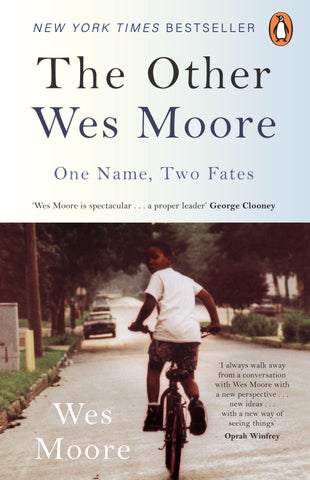
‘Wes
Moore is spectacular . . . a proper leader’ George Clooney
‘I always walk away from a conversation with Wes Moore with a new perspective . . . new ideas . . . with a new way of seeing things’
“With its unique spin on the memoir genre, this engaging and insightful book ultimately asks the reader to consider the ways in which we as a nation alternately support and fail American children.”
—Library Journal
“Two hauntingly similar boys take starkly different paths in this searing tale of the ghetto....Moore writes with subtlety and insight about the plight of ghetto youth, viewing it from inside and out; he probes beneath the pathologies to reveal the pressures—poverty, a lack of prospects, the need to respond to violence with greater violence—that propelled the other Wes to his doom. The result is a moving exploration of roads not taken.”
—Publishers Weekly (starred review)
“Riveting.”
—The Christian Science Monitor
“‘It takes a village to raise a child,’ goes the African proverb. This book is a cautionary tale of what happens when the village is ill equipped to do so.”
—Time
“Moore etches a broader picture of the pure gamble of inner-city life.”
—Entertainment Weekly
“Powerful, unique ...timely and timeless.”
—The Miami Herald
“Moore’s book reaffirms the impact that even one tough parent can have on a child’s ultimate success or failure.”
—BookPage
“[An] imperceptibly interwoven double biography ...brilliant”
—Insight News
“[A] deeply moving and very fine work.”
—Hudson Valley News
“Striking ...powerful.”
—The Plain Dealer
Wes Moore
W ES M OORE is the sixty-third governor of the state of Maryland. He is the first Black governor in the state’s 246-year history and the third African American elected governor in the history of the United States. He was previously a Rhodes Scholar and a White House Fellow, advising on issues of national security and international relations, and as a captain with the 82nd Airborne Division, he led soldiers in combat in Afghanistan. Moore also built and launched BridgeEdU, a Baltimore-based business that reinvented freshman year of college for underserved students to increase their likelihood of long-term success, and was the CEO of the Robin Hood Foundation, one of the largest poverty-fighting organizations in the country. His other books include Five Days: The Fiery Reckoning of an American City; The Work: Searching for a Life That Matters; This Way Home, a novel for young adults; and Discovering Wes Moore. He and his wife, Dawn Flythe Moore, have two children, Mia and James.
UK | USA | Canada | Ireland | Australia
India | New Zealand | South Africa
Penguin Books is part of the Penguin Random House group of companies whose addresses can be found at global.penguinrandomhouse.com
Penguin Random House UK , One Embassy Gardens, 8 Viaduct Gardens, London SW11 7BW penguin.co.uk
Copyright © Wes Moore, 2010
Reading group guide copyright © 2011 by Random House, Inc.
First published in the United States of America by Spiegel & Grau, an imprint of Random House, a division of Penguin Random House LLC 2010
Published in the United States by One World, an imprint of Random House, a division of Penguin Random House LLC , New York
First published in Great Britain by Penguin Books 2026 001
Grateful acknowledgment is made to the online storytelling magazine SMITH for permission to reprint the interview with Wes Moore by Farai Chideya, which was published on 6/22/2010 in SMITH . Reprinted by permission of SMITH magazine, smithmag.net
The moral right of the author has been asserted
Photos reproduced courtesy of Wes Moore and family. The author and publisher gratefully acknowledge the permission granted to re-produce the copyright material in this book. Every effort has been made to trace copyright holders and to obtain their permission. The publisher apologises for any errors or omissions and, if notified of any corrections, will make suitable acknowledgment in future reprints or editions of this book.
No part of this book may be used or reproduced in any manner for the purpose of training artificial intelligence technologies or systems. In accordance with Article 4(3) of the DSM Directive 2019/790, Penguin Random House expressly reserves this work from the text and data mining exception
Typeset by Six Red Marbles UK , Thetford, Norfolk
Printed and bound in Great Britain by Clays Ltd, Elcograf S.p.A.
The authorized representative in the EEA is Penguin Random House Ireland, Morrison Chambers, 32 Nassau Street, Dublin D02 YH 68
A CIP catalogue record for this book is available from the British Library
ISBN : 978–1–405–98825–4
Penguin Random House is committed to a sustainable future for our business, our readers and our planet. This book is made from Forest Stewardship Council® certified paper.
For Mama Win, Mommy, Nikki, Shani, and my wife, Dawn
—the women who helped shape my journey to manhood
This is the story of two boys living in Baltimore with similar histories and an identical name: Wes Moore. One of us is free and has experienced things that he never even knew to dream about as a kid. The other will spend every day until his death behind bars for an armed robbery that left a police officer and father of five dead. The chilling truth is that his story could have been mine. The tragedy is that my story could have been his. Our stories are obviously specific to our two lives, but I hope they will illuminate the crucial inflection points in every life, the sudden moments of decision where our paths diverge and our fates are sealed. It’s unsettling to know how little separates each of us from another life altogether.
In late 2000, the Baltimore Sun published a short article with the headline “Local Graduate Named Rhodes Scholar.” It was about me. As a senior at Johns Hopkins University, I received one of the most prestigious academic awards for students in the world. That fall I was moving to England to attend Oxford University on a full scholarship. But that story had less of an impact on me than another series of articles in the Sun, about an incident that happened just months before, a precisely planned jewelry store robbery gone terribly wrong. The store’s security guard—an off-duty police officer named Bruce Prothero—was shot and killed after he pursued the armed men into
the store’s parking lot. A massive and highly publicized manhunt for the perpetrators ensued. Twelve days later it ended when the last two suspects were apprehended in a house in Philadelphia by a daunting phalanx of police and federal agents. The articles indicated that the shooter, Richard Antonio Moore, would likely receive the death penalty. The sentence would be similarly severe for his younger brother, who was also arrested and charged. In an eerie coincidence, the younger brother’s name was the same as mine.
Two years after I returned from Oxford, I was still thinking about the story. I couldn’t let it go. If you’d asked me why, I couldn’t have told you exactly. I was struck by the superficial similarities between us, of course: we’d grown up at the same time, on the same streets, with the same name. But so what? I didn’t think of myself as a superstitious or conspiratorial person, the kind who’d obsess over a coincidence until it yielded meaning. But there were nights when I’d wake up in the small hours and find myself thinking of the other Wes Moore, conjuring his image as best I could, a man my age lying on a cot in a prison cell, burdened by regret, trying to sleep through another night surrounded by the walls he’d escape only at death. Sometimes in my imaginings, his face was mine.
There’s a line at the opening of John Edgar Wideman’s brilliant Brothers and Keepers about the day he found out his own brother was on the run from the police for an armed robbery: “The distance I’d put between my brother’s world and mine suddenly collapse d... Wherever he was, running for his life, he carried part of me with him.” But I didn’t even know the other Wes Moore. Why did I feel this connection with him, why did I feel like he “carried part of me with him” in that prison cell? I worried that I was just being melodramatic or narcissistic. But still, I couldn’t shake it. Finally, one day, I wrote him a simple letter introducing myself and explaining how I’d come to learn about his story. I struggled to explain the purpose of my letter and posed a series of naïve questions that had been running through my mind: Who are you? Do you see your brother? How do you feel about him? How did this happen? As soon as I mailed the letter, the crazy randomness of it all came flooding in on me. I was sure
that I’d made a mistake, that I’d been self-indulgent and presumptuous and insulting, and that I’d never hear back from him.
A month later, I was surprised to find an envelope in my mailbox stamped with a postmark from the Jessup Correctional Institution in Maryland. He had written back.
“Greetings, Good Brother,” the letter started out:
I send salutations of peace and prayers and blessings and guidance to you for posing these questions, which I’m going to answer, Inshallah. With that, I will begin with the first question posed ...
Thiswasthestartofourcorrespondence,whichhasnowgoneonfor years.Atthebeginningofourexchangeofletters—whichwaslaterexpandedby face-to-facevisitsattheprison—Iwassurprisedtofindjust howmuchwedidhaveincommon,asidefromournames,andhow muchournarrativesintersectedbeforetheyfatefullydiverged.Learningthedetailsofhisstoryhelpedmeunderstandmyownlifeand choices,andIliketothinkthatmystoryhelpedhimunderstandhis ownalittlemore.Buttherealdiscoverywasthatourtwostoriestogetherhelpedmetountanglesomeofthelargerstoryofourgenerationofyoungmen,boyswhocameofageduringahistoricallychaotic andviolenttimeandemergedtosucceedandfailinunprecedented ways.Afterafewvisits,withoutrealizingit,Istartedworkingonthis projectinmymind,tryingtofigureoutwhatlessonsourstoriescould offertothenextwaveofyoungmenwhofoundthemselvesatthesame crossroadswe’dencounteredandunsurewhichpathtofollow.
Perhaps the most surprising thing I discovered was that through the stories we volleyed back and forth in letters and over the metal divider of the prison’s visiting room, Wes and I had indeed, as Wideman wrote, “collapsed the distance” between our worlds. We definitely have our disagreements—and Wes, it should never be forgotten, is in prison for his participation in a heinous crime. But even the worst decisions we make don’t necessarily remove us from the circle of humanity. Wes’s desire to participate in this book as a way to help others learn from his story and choose a different way is proof of that.
Towritethisbook,Iconductedhundredsofhoursofinterviews withWesandhisfriendsandfamily,aswellasmyfriendsandfamily. Thestoriesyouwillreadarerenderedfrommyownmemoryandthe bestmemoriesofthosewegrewupwith,livedwith,andlearnedfrom. Iengagedinextensivehistoricalresearchandinterviewedteachers anddrugdealers,policeofficersandlawyers,tomakesureIgotthe facts—andthefeel—right.Somenameshavebeenchangedtoprotect people’sidentitiesandthequietlivestheynowchoosetolead.Afew charactersarecomposites.Butallofthestoriesarepainstakinglyreal.
The book is broken up into eight chapters, corresponding to eight years that had a decisive impact on our respective lives. The three parts represent the three major phases in our coming of age. Opening each of these parts is a short snippet of conversation between Wes and me in the prison’s visitors’ room. It was very important to me that we return again and again to that visitors’ room, the in-between space where the inside and the outside meet. I don’t want readers to ever forget the high stakes of these stories—and of all of our stories: that life and death, freedom and bondage, hang in the balance of every action we take.
The book also features a resource guide listing more than two hundred “Elevate Organizations” that young readers, their caregivers, and anyone who wants to help can use as a tool for creating positive change. One of the true joys of this project has been learning about and creating bonds with some of the organizations that are on the front lines of serving our nation’s youth.
It is my sincere hope that this book does not come across as selfcongratulatory or self-exculpatory. Most important, it is not meant in any way to provide excuses for the events of the fateful day February 7, 2000. Let me be clear. The only victims that day were Sergeant Bruce Prothero and his family. Rather, this book will use our two lives as a way of thinking about choices and accountability, not just for each of us as individuals but for all of us as a society. This book is meant to show how, for those of us who live in the most precarious places in this country, our destinies can be determined by a single stumble down the wrong path, or a tentative step down the right one.
This is our story.
Wes stared back at me after I’d asked my question, letting a moment pass and a smirk flicker across his face before responding.
“I really haven’t thought too deeply about his impact on my life because, really, he didn’t have one.”
Wes leaned back in his seat and threw an even stare at me.
“Come on, man,” I pressed on. “You don’t think about how things would have been different if he’d been there? If he cared enough to be there?”
“No, I don’t.” The lower half of his face was shrouded by the long beard that he’d grown, an outward sign of the Islamic faith he’d adopted in prison. His eyes danced with bemusement. He was not moved by my emotional questioning. “Listen,” he went on. “Your father wasn’t there because he couldn’t be, my father wasn’t there because he chose not to be. We’re going to mourn their absence in different ways.”
This was one of our first visits. I had driven a half hour from my Baltimore home into the woody hills of central Maryland to Jessup Correctional Institution to see Wes. Immediately upon entering the building, I was sternly questioned by an armed guard and searched to ensure I wasn’t bringing in anything that could be passed on to
Wes. Once I was cleared, another guard escorted me to a large room that reminded me of a public school cafeteria. This was the secured area where prisoners and their visitors came together. Armed guards systematically paced around the room. Long tables with low metal dividers separating the visitors from the visited were the only furnishings. The prisoners were marched in, dressed in orange or blue jumpsuits, or gray sweat suits with “DOC” emblazoned across the chests. The uniforms reinforced the myriad other signals around us: the prisoners were owned by the state. Lucky inmates were allowed to sit across regular tables from loved ones. They could exchange an initial hug and then talk face-to-face. The rest had to talk to their families and friends through bulletproof glass using a telephone, visitor and prisoner connected by receivers they held tight to their ears.
Just as I was about to ask another question, Wes interrupted me.
“Let me ask you a question. You come here and ask me all these questions, but you haven’t shared any of yourself up with me. So tell me, what impact did your father not being there have on your childhood?”
“I don’t know—” I was about to say more when I realized that I didn’t really have more to say.
“Do you miss him?” he asked me.
“Every day. All the time,” I replied softly. I was having trouble finding my voice. It always amazed me how I could love so deeply, so intensely, someone I barely knew.
I was taught to remember, but never question. Wes was taught to forget, and never ask why. We learned our lessons well and were showing them off to a tee. We sat there, just a few feet from each other, both silent, pondering an absence.
Nikki and I would play this game: I would sit on the living room chair while Nikki deeply inhaled and then blew directly in my face, eliciting hysterical laughs on both sides. This was our ritual. It always ended with me jabbing playfully at her face. She’d run away and bait me to give chase. Most times before today I never came close to catching her. But today, I caught her and realized, like a dog chasing a car, I had no idea what to do. So, in the spirit of three-year-old boys everywhere who’ve run out of better ideas, I decided to punch her. Of course my mother walked into the room right as I swung and connected.
The yell startled me, but her eyes are what I remember.
“Get up to your damn room” came my mother’s command from the doorway. “I told you, don’t you ever put your hands on a woman!”
I looked up, confused, as she quickly closed the distance between us. My mother had what we called “Thomas hands,” a tag derived from her maiden name: hands that hit so hard you had to be hit only
once to know you never wanted to be hit again. The nickname began generations ago, but each generation took on the mantle of justifying it. Those hands were now reaching for me. Her eyes told me it was time to get moving.
I darted up the stairs, still unsure about what I’d done so terribly wrong. I headed to the bedroom I shared with my baby sister, Shani. Our room was tiny, barely big enough for my small bed and her crib. There was no place to hide. I was running in circles, frantic to find a way to conceal myself. And still trying to comprehend why I was in so much trouble. I couldn’t even figure out the meaning of half the words my mother was using.
In a panic, I kicked the door shut behind me just as her voice reached the second floor. “And don’t let me hear you slam that—” Boom! I stared for a moment at the closed door, knowing it would soon be flying open again. I sat in the middle of the room, next to my sister’s empty crib, awaiting my fate.
Then, deliverance.
“Joy, you can’t get on him like that.” My father’s baritone voice drifted up through the thin floor. “He’s only three. He doesn’t even understand what he did wrong. Do you really think he knows what a woman beater is?”
My father was in the living room, ten feet from where the incident began. He was a very slender six foot two with a bushy mustache and a neatly shaped afro. It wasn’t his style to yell. When he heard my mother’s outburst, he rose from his chair, his eyes widening in confusion. My mother slowly reeled herself in. But she wasn’t completely mollified.
“Wes, he needs to learn what is acceptable and what is not!” My father agreed, but with a gentle laugh, reminded her that cursing at a young boy wasn’t the most effective way of making a point. I was saved, for the moment.
My first name, Westley, is my father’s. I have two middle names, a compromise between my parents. My father loved the sound and meaning of Watende, a Shona word that means “revenge will not be
sought,” a concept that aligned with his gentle spirit. My mother objected. Watende sounded too big, too complicated for such a tiny baby. It wasn’t until later in life that she understood why it was so important to my father that Watende be a part of me. Instead, she lobbied for Omari, which means “the highest.” I’m not sure what was easier or less lofty about that name, but I was well into elementary school before I became comfortable spelling either.
My parents’ debate continued downstairs, but their words faded. I went to the room’s only window and looked out on the world. My older sister, Nikki, and I loved to look through the window as families arrived at the swap market across the street. Our home was on a busy street that sat right on the border of Maryland and Washington, D.C., stuck confusingly between two different municipal jurisdictions, a fact that would become very significant in the near future. I pulled back the thin diaphanous curtain that covered the windows and spotted my friend Ayana outside with her mother. She was half Iranian and half Italian, with long, dark hair and warm eyes that always fascinated me. They were light green, unlike the eyes of anyone else I knew, and they twinkled as if they held stars. I wanted to tap on the window to say hello as she walked past our house to the tenement building next door. But I was afraid of making more trouble for myself, so I just smiled.
On the dresser by the window sat a framed picture of me with Nikki. I sat on her lap with my arm wrapped around her neck, a goofy smile on my face. Nikki is seven years older, so in the picture she was nine and I was barely two. Colorful beads capped the braided tips of her hair, a style she shared with my mother, and large, blackframed eyeglasses covered half of her face.
Nikki’s real name was Joy, like my mom’s, but everyone called her Nikki. My mother was obsessed with the poet Nikki Giovanni, in love with her unabashed feminine strength and her reconciliation of love and revolution. I spent nearly every waking moment around Nikki, and I loved her dearly. But sibling relationships are often fraught with petty tortures. I hadn’t wanted to hurt her. But I had.
At the time, I couldn’t understand my mother’s anger. I mean this