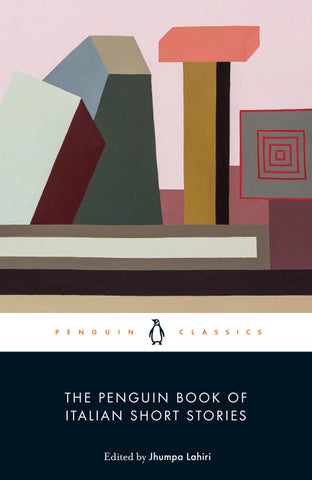
THE PENGUIN BOOK OF ITALIAN SHORT STORIES
Edited by Jhumpa Lahiri
THE PENGUIN BOOK OF ITALIAN SHORT STORIES
jhumpa lahiri is an award-winning author and translator. She received the Pulitzer Prize in 2000 for Interpreter of Maladies, her debut story collection and was awarded a National Humanities Medal in 2015. Her other works of fiction in English include The Lowland, which was a finalist for the Man Booker prize.
Lahiri has also written three books directly in Italian, including In altre parole (translated in English as In Other Words) and the novel Dove mi trovo. Her translation of Domenico Starnone’s Trick was a Finalist for the National Book Award. She divides her time between Rome and Princeton University, where she is a professor of Creative Writing and Literary Translation.
The Penguin Book of Italian Short Stories
Introduced, Edited and with Selected Translations by
jhumpa lahiri
penguin
classics
PENGUIN CLASSICS
UK | USA | Canada | Ireland | Australia
India | New Zealand | South Africa
Penguin Classics is part of the Penguin Random House group of companies whose addresses can be found at global.penguinrandomhouse.com
Penguin Random House UK , One Embassy Gardens, 8 Viaduct Gardens, London sw11 7bw
penguin.co.uk
First published in hardback in Penguin Classics 2019
First published in paperback in Penguin Classics 2020 001
Introduction, selection and editorial material copyright © Jhumpa Lahiri, 2019
The copyright information on pages 487–492 constitutes an extension to this page
The moral right of the editor, authors and translators has been asserted Penguin Random House values and supports copyright. Copyright fuels creativity, encourages diverse voices, promotes freedom of expression and supports a vibrant culture. Thank you for purchasing an authorized edition of this book and for respecting intellectual property laws by not reproducing, scanning or distributing any part of it by any means without permission. You are supporting authors and enabling Penguin Random House to continue to publish books for everyone. No part of this book may be used or reproduced in any manner for the purpose of training artificial intelligence technologies or systems. In accordance with Article 4(3) of the DSM Directive 2019/790, Penguin Random House expressly reserves this work from the text and data mining exception.
Set in 9.79/12.67pt Adobe Casion Pro Typeset by Jouve (UK ), Milton Keynes
Printed and bound in Great Britain by Clays Ltd, Elcograf S.p.A.
The authorised representative in the EEA is Penguin Random House Ireland, Morrison Chambers, 32 Nassau Street, Dublin d02 yh68
A CIP catalogue record for this book is available from the British Library isbn : 978–0–241–29985–2
Penguin Random House is committed to a sustainable future for our business, our readers and our planet. This book is made from Forest Stewardship Council® certified paper.
Introduction by Jhumpa Lahiri ix
A Note on the Citation of Titles and eir Translations xxiii
lalla romano e Lady 101
fabrizia ramondino e Tower 113
luigi pirandello e Trap 125
cesare pavese Wedding Trip 135
goffredo parise Melancholy 151
aldo palazzeschi
anna maria ortese A Pair of Eyeglasses 173
alberto moravia e Other Side of the Moon 191
elsa morante e Ambitious Ones 199
giorgio manganelli
Sixteen, Twenty-one, Twenty-eight and irty-seven from Centuria 209
primo levi Quaestio de Centauris 217
tommaso landolfi Gogol’s Wife 231
natalia ginzburg My Husband 245
carlo emilio gadda e Mother 261
ennio flaiano A Martian in Rome 275
beppe fenoglio e Smell of Death 289
luce d’eramo Life as a Couple 299
antonio delfini e Milliner 309
grazia deledda e Hind 317
alba de céspedes Invitation to Dinner 327
silvio d’arzo Elegy for Signora Nodier 337
fausta cialente Malpasso 347
carlo cassola At the Station 355
Introduction
Poiché dispongo di input ibridi, ho accettato volentieri e con curiosità la proposta di comporre anch’io un’ ‘antologia personale’, non nel senso borgesiano di autoantologia, ma in quello di una raccolta, retrospettiva e in buona fede . . .
Always inclined to a hybrid input, I accepted willingly and with curiosity the proposal to compile a ‘personal anthology’, not in the Borgesian sense of an auto-anthology but in that of a harvesting, retrospectively and in good faith . . .
Primo Levi, La ricerca delle radici 1
One evening in Rome, in the kitchen of the Italian writer Caterina Bonvicini, I expressed a desire to assemble a collection of Italian short stories translated into English. It was March of 2016, during a brief trip back to Italy. Six months before, my family and I had returned to the United States after living for three years in Rome. My life as a reader had, by that time, taken an unexpected turn; since 2012, shortly before moving to Rome, I had chosen to read only Italian literature, mostly from the twentieth century, and to read those works exclusively in Italian, a language I had diligently studied for many years but had yet to master. I was forty- ve years old, and I believed, even before this new phase began, that I was already fully formed as a reader and writer. And yet I surrendered to an inexplicable urge to distance myself, to immerse myself and to acquire a second literary formation. It was one thing to read only Italian when living in Italy, where the winds were favourable, where my state of voluntary literary exile made sense. I read with an adolescent’s zeal, transported to another dimension, standing before a new group of gods. I had an Italian teacher who came to my home twice a week and, at the start, brought me chapters and excerpts equipped with footnotes for elementary readers. I befriended Italians who mentioned authors I had never heard of before. I began
Introduction
frequenting bookstores, especially those that sold secondhand volumes, combing the shelves for their works. I purchased them and read them, and copied down sentences by hand, taping them over my desk for inspiration. I realized that, for the rst time in decades, I was reading to satisfy only myself. I was no longer in uenced by the expectations and broader cultural consensus that dictate what one should be reading – such frames of references had fallen away. e more people remarked on my new inclination – But don’t you miss English? – the more I clung to my newfound freedom, not wanting it to end.
But it did end; while in Italy, I was o ered a job at Princeton University to teach Creative Writing, and so my family and I returned to the United States. Crossing the Atlantic, I read Primo Levi’s Se questo è un uomo (If is Is a Man ), a rst book which recounts the eleven months that Levi, a young chemist from Turin who became one of the twentieth century’s greatest writers, spent imprisoned in a German concentration camp before it was liberated in 1945. It was my rst time reading that work in Italian, and the pure truth and beauty of those pages that transform one man’s experience of hell into a masterpiece of literature transformed not only the hours on the plane but also me personally, instilling in me an abiding awe – there is no other word for it – that even today governs my own newfound liberty as both a reader and a writer.
Teaching at Princeton, I wanted to transmit this awe, to share my admiration for Levi and the other Italian authors who had spoken to me deeply, who had taught me so much and who were now a part of me. And given that my classes were held in English, the only way to do so was to teach them in translated form. And so I searched for English versions of the works I wanted to talk about. I was struck by how many translations were either out of print or outdated, di cult to track down, and I was even more struck by the many great Italian authors who had scarcely been translated at all.
After dinner that evening at Caterina’s, she and I wandered from the kitchen into her study and began pulling books o her shelves. I already had a dozen authors in mind, and Caterina suggested a dozen others. I took out my diary and wrote all the names down, twenty-four in total. Of that group, twenty-three are represented in the current volume. e authors jotted down that evening comprised a wish list. Back in Princeton,
x
Introduction
I made do with photocopies of translations that I hoped my students would enjoy. en, not long after my second semester had come to an end, Penguin Classics asked me to assemble this anthology.
I was impressed by the passion with which my Italian friends and acquaintances reacted to the project. is passion was by no means exclusive to writers. I was struck by the degree to which Italians from di erent walks of life knew and cared about speci c short stories. People would email me the names of authors and titles of works they felt were worthy of anthologizing, or thrust books from their personal libraries into my hands. My list began to grow, as did my reading, and back in Princeton that fall, I had accumulated well over fty names.
At a certain point, I realized I had to set down some basic parameters. e rst was to eliminate all living authors from my list. e second was to arrive at a number. Fifty felt celebratory and auspicious, but I worried that it would amount to an unwieldy physical object, and so, with some anguish, I whittled the list down to the forty featured here. e fruit of my research was the discovery of a potent, robust tradition of the short form in Italy, a harvest far more vast and varied than I’d anticipated. What were my criteria? To gather together as many of the authors who have inspired and nourished my love for Italian literature, and for the Italian short story in particular. I wanted a volume I and others would be excited to teach from, and that students, ideally, would be eager to read. I wanted to include a wealth of styles, and a range of voices. e resulting collection, by no means comprehensive, re ects my judgement and sensibility, and also encapsulates a speci c moment of my reading trajectory. I cast a wide net and, as is inevitably the case, a somewhat arbitrary one. Some authors – including several particularly dear to me – were consciously excluded due to one rationale or the other; others simply escaped unseen.
Once the list was nal, it struck me that these forty Italian authors would not necessarily be familiar to any one Italian reader. Many of them have fallen out of favour, or have been sporadically published, and are therefore hard to come across in Italian bookstores. Ironically, I could only get my hands on them thanks to Firestone Library in Princeton or, if I was lucky, at the Porta Portese ea market, which brings hundreds of secondhand books, every Sunday, to Rome. Even after I had made my
Introduction
choices, people kept mentioning other writers I ought to have included, and suggestions will surely only proliferate now that the book exists. I have focused predominantly on the twentieth century, though a few of the authors were born and began writing in the nineteenth, and others remained active into the twenty- rst. It was my priority to feature women authors, lesser-known and neglected authors, and authors who practised the short form with particular vehemence and virtuosity. My aim is to present a portrait of Italy that re ects its reality. I prefer to work against a reassuring but ridiculous perception encapsulated by an American who once said to me, ‘Nothing bad can possibly happen in Italy.’ Of course, it is one thing to experience Italy as a tourist, another thing to live there. en again, one has only to read the literature of any given place to recognize that bad things happen to everyone, everywhere.
Several members of this group knew one another during their lifetimes. ey sustained, in uenced, promoted, edited, reviewed and were at odds with one another. ey formed part of a community, a network, bound together by vital personal and professional friendships and, in one case, even by marriage. And as I stood back to absorb the details of their lives and the nature of their creativity, I realized that they were all, by and large, hybrid individuals, with multiple proclivities, identities, signatures and shadows. ey were writers of ction and at the same time they were almost always other things: poets, journalists, visual artists, musicians. Many had demanding editorial responsibilities, were critics, were school teachers. Some were professional scientists and politicians. ey served in the military, held bureaucratic positions, had diplomatic careers. And the vast majority were translators, living, reading and writing astride two languages or more.
e act of translation, central to their artistic formation, was a linguistic representation of their innate hybridity. e majority of these writers shuttled between dialect and standard Italian; though they all wrote in Italian, it was not necessarily the language they grew up speaking, or the rst they learned to read and write in or were originally published in. Four were born outside of present-day Italy, and most of them spent signi cant amounts of time either studying, travelling or residing abroad. A few turned to other languages, writing novels in French or Portuguese,
Introduction
experimenting with German and English, teaching themselves di erent dialects, complicating their texts and their identities further still. Whether linguistic or stylistic, their creative paths were marked by experimentation, by wilful mutation. ey were artists who questioned and rede ned themselves over time, some de antly distancing themselves from earlier phases of their work.
A central underpinning of their hybridity is manifested in the striking number of invented or altered names. Elena Ferrante is a pseudonym that has taken the literary world by storm, but long before her, Italian writers created alter-egos for political or personal reasons, either to protect themselves from the law or to disassociate themselves from their origins. Eight of the authors on this list were born with di erent names, and others published speci c works under pseudonyms. To rename oneself is to edit one’s destiny, to insist upon an autonomous identity, and for a writer it is a means, quite literally, of rewriting the self. Not surprisingly, many of these stories address the theme of identity, of uctuating selfhood, and accentuate the issue of naming in particular. Characters have complicated relationships to their names, and a few lack names altogether – perhaps a nod to one of the most intriguing characters in Alessandro Manzoni’s novel e Betrothed (I promessi sposi ), who is called is ‘l’innominato ’, literally, ‘the unnamed’.
Always pertinent to the discussion of identity is the question of women in Italy: how they were de ned, how they were seen. Many of these stories are portraits of women, some confronting and challenging patriarchal ideology, others revealing attitudes in which women are objecti ed, belittled, maligned. One option, on my part, would have been to exclude such stories in order to protest against these objectionable depictions. But this would misrepresent a society and its history as re ected in its literature. As a woman, and a woman writer, these stories help me to better understand the cultural context of Italian feminism, and to admire the great strides that Italian women have made. e fact of the matter is that many of the most moving depictions of women in this collection were written by men. Marriage is a recurrent theme – to be precise, how a woman’s identity can be altered, compromised and negated by a man, and also by maternity. But the whole of the twentieth century, which witnessed the collapse of a series of powerful social institutions, including marriage,
Introduction
was a laboratory in which individual identities were being lost and found, regained and shed.
Hybridity is also manifested in the number of animal characters that abound in these pages, a recurrent metaphor that calls into question the porous barrier between the animal and human worlds. In this sense, some of these works can trace their lineage to the fables of Aesop, to the Metamorphoses of Ovid and to folkloric tradition, in which the animal kingdom has always played a delightful and prominent role. e signi cance of animals in literary satire was appreciated by the poet Giacomo Leopardi (1798–1837), whose Paralipomeni della Batracomiomachia (translated into English as e War of the Mice and the Crabs) is a mock epic, inspired by an ancient Greek poem, adapted by Leopardi to criticize imperial politics and false patriotism in Italy. 2 A great number of these stories feature animals that talk, behave, think and feel just as people do. ey substitute as friends, lovers, philosophical interlocutors, a spouse. ey serve as mirrors and lters that re ect and reveal myriad emotional and psychological states. e reader will note various characters who feel more animal than human, or are themselves both animal and human. e paradoxical valence of animals merits close attention in that they represent both a state of freedom as well as subservience, both innocence and savagery. As these stories make clear, they are creatures both cherished and consumed, both worshipped and sacri ced, beings that both de ne and question what ‘human’ even means.
In the course of pondering the diverse and intriguing encounters between man and beast in this anthology, I was struck by the following words by Benito Mussolini: ‘Fascism denies the validity of the equation, well-being-happiness, which would reduce men to the level of animals, caring for one thing only – to be fat and well-fed – and would thus degrade humanity to a purely physical existence’. 3 is observation, antithetical to the in-between, transversal, protean essence of so many of these writers and their work, also allows us to make room for another, more troubling organizing principle: the reality of Fascism. Giovanni Verga was the rst of the authors gathered in these pages to die, in 1922, the year Mussolini marched to power in Rome. All the rest lived under Fascism at some point or another, and were a ected directly by its legacy. e ugliest manifestation of Fascism was to dehumanize, to treat people
Introduction
as animals, or worse. e irony of course was that in order to achieve their aims, it was those in power who behaved like beasts.
Fascism, in Italy, was declined linguistically, to the extent of enforcing a ‘pure Italian’ free from foreign words and expressions. Under Fascism a croissant became a cornetto, a bar became a quisibeve (‘here one drinks’) and football, invented by the English, became calcio. Even the pronoun lei (as opposed to voi ) was prohibited as a second-person pronoun because it was claimed to be a Spanish grammatical import, and also because it sounded ‘feminine’. In any overview of Italian literature in the twentieth century, the history of the language must come into consideration. e regime sought to standardize and atten the language, to weed out dialect and other anomalies, above all, to turn it inward. And it was in that very moment that Italy’s writers, at least a considerable number of them, turned de antly outward. e entire twentieth century can be read as a battle of wills between the wall Fascism sought to erect around Italy and Italian culture, and those – many of the writers represented here very much among them – determined, despite running grave risks, to break it down. e forty authors on my list hailed from all parts of Italy, though I acknowledge that my base in Rome and my love for southern Italy contributes a slant. ey came from rich families and poor ones. ey had all sorts of political leanings and varying degrees of political commitment. Stylistically, they covered the spectrum: Realist, neoRealist, avant-garde, fantastic, Modernist, postmodernist. Some cultivated literary fame; others actively shunned it. Many were celebrated, powerful, in uential gures. A few never saw their work published in their lifetime.
If there is a dominant point of reference, it is the Second World War. e writer Cristina Campo called it ‘the abyss that had split apart the century’;4 indeed, this cataclysmic caesura is what links the vast majority of these authors. Two were in Nazi concentration camps, and another escaped en route to one. At least a dozen were forced to live, for a time, in hiding, either because they were members of the anti-Fascist Resistance, or because they were Jews. e Second World War and its aftermath drastically and irrevocably altered Italian society, penetrating the collective consciousness, traumatizing it, but eventually reinvigorating it culturally and economically. e proliferation of literary magazines after the war, the redoubled and innovative publishing initiatives and the spirit of
Introduction
community and collaboration among writers, means that this time is now regarded as something of a golden age in Italian literary culture. Having said this, and in spite of the myriad personal connections among many of these authors, the anthology contains powerful meditations on alienation, estrangement, states of solitude. e only true common ground for each of these authors is the Italian language, an invention in and of itself, described by Leopardi as ‘piuttosto un complesso di lingue che una sola ’ (‘a complex of languages as opposed to a single one’). 5 It was imposed upon a linguistically and culturally diverse population, late in the nineteenth century, when the separate regions of Italy were uni ed in the name of national identity.
e roots of the modern Italian short story are themselves hybrid: at once deep and shallow, at once foreign and domestic. In assembling this anthology, one indispensible font of information was the anthology dedicated to the Italian short story in the twentieth century edited by Enzo Siciliano (1934–2006), for Mondadori’s i Meridiani series. Siciliano was a writer, critic and journalist from Rome, and he became the editor of the in uential literary journal Nuovi Argomenti after the death of its founder, Alberto Moravia. ere are in fact two versions of Siciliano’s anthology: a single volume running to nearly fteen hundred pages without notes (featuring seventy-one authors, published in 1983) and then across three volumes (with a revised introduction and a grand total of two hundred and ninety-eight authors, including himself, published in 2001).
In his introduction, Siciliano traces the Italian short story back to the Middle Ages, to the anonymously written, thirteenth-century Novellino, containing episodes and characters drawn from the Bible and classical and medieval mythology, to Giovanni Boccaccio’s Decameron (likely composed between 1349 and 1351) and to Matteo Bandello, whose sixteenth-century Novelle (he wrote over two hundred of them) may have inspired the plots of Shakespeare’s Twelfth Night and Much Ado about Nothing via French translation. Between Bandello and Boccaccio one must also acknowledge Masuccio Salernitano, whose own Novellino, a collection of fty posthumously published tales, included one noted for being among the sources for Romeo and Juliet.
What, the reader may ask, is a novellino ? It is a book that gathers
xvi
Introduction
together various novelle (the plural of novella ), which, in Italian, is not a slim novel, but rather, a word used to describe a short story or a tale. ough Boccaccio titled his great work e Decameron, he explicitly refers to the tales themselves as novelle. Siciliano investigates the di erence between the term novella and racconto in Italian, seemingly interchangeable terms, both to be di erentiated from romanzo, the word for novel. e word racconto, with its Latin root, is etymologically connected to the English ‘recount’: a telling again. A racconto aims to communicate a story, personally and purposefully, to a listener. us raconteur, a French word that has also become English, refers speci cally to a human gure, a storyteller, especially a captivating one. e spirit of the racconto implies a dynamic relation, with at least two people involved; though distinct from dialogue, it indicates a form, immediate and typically brief, of exchange. In modern Italian, the verb raccontare is commonly used, in conversation, when people want to narrate something casually but colourfully, imbuing this literary term with ongoing quotidian currency. at Siciliano’s anthology promotes the word racconti in the title (Racconti Italiani del Novecento ) is in and of itself making a statement, positing the form along a decidedly modern axis where Guy de Maupassant, Gustave Flaubert and Anton Chekhov serve as coordinates, thereby distinguishing the racconto from the more classically rooted novella. Fleeting by nature, short stories, in spite of their concision and concentration, are in nitely elastic, expansive, probing, elusive – suggesting that the genre itself is essentially unstable, hybrid, even subversive in nature. In discussing Moravia’s Roman Tales, called Racconti romani, and a cornerstone of the twentieth-century Italian short-story tradition, Siciliano cites Moravia’s illuminating observation that a racconto is something born from intuizione, intuition. I agree. In some sense it is the novel, in Italy, which is the interloper, the imported genre. Alessandro Manzoni and Giovanni Verga looked to France and to England for models, Grazia Deledda to the Russians, Italo Svevo to the central European tradition. e novel, according to Moravia, derives from reason, and is imbued with structure, elements that short stories routinely undermine and resist. Indigenous to Italy, racconti have thrived for centuries, and they constitute a continuum, cross-pollinating with the world’s literature in ways that the longer Italian form has not.
xvii
Introduction
Siciliano’s volumes were indispensable to me, travelling back and forth across the Atlantic, those navy-blue bricks with their sewn-in ribbons to mark one’s place lined up on my desk, and I recommend them to those who read Italian and wish to broaden their perception of the short form in Italy. Even for those who don’t read Italian, the index alone, listing all the authors’ names, is the rst place I would direct those in search of suggested further reading. To leaf through them is to glimpse the thrilling sweep of the ocean from above, as opposed to navigating the more manageable but partially uncharted bay I have demarcated.
Every language is a walled entity. English is a particularly forti ed one. To step outside the Anglophone world is to grow aware of the near-total domination of the English language when it comes to what is being read and celebrated as literature today. It is a domination that few, at least on the English-speaking side of the border, stop to question. I am aware that my orientation at the moment – to look outside English, and to put forth for consideration what is now overlooked even in Italy – separates me from the literary mainstream both in the Italian- and English-language context. In Italy, I note the overwhelming number of English-language authors prominently displayed in bookshops, and reviewed, each week, in newspapers and magazines; the number of prizes and residencies and festivals designed to host and honour English-language authors in Italy. I myself have been the grateful recipient of such invitations, prizes and residencies. And yet the discrepancy is clear. e fact remains that Italian writers, for good and for ill, for well over a century now, have looked outside their own literature for inspiration, and the tradition of translation out of English, at least on behalf of Italian publishers, is critical, not peripheral, to the literary landscape.
Of these forty stories, sixteen have not been translated into English until now, and nine have been retranslated intentionally for this anthology. e vast majority, I imagine, will be fresh discoveries for English readers. And of these forty authors, a great many have been ignored and thus practically forgotten in Italy as well. Most of the magazines in which they originally appeared no longer exist. ere was a period, particularly after the Second World War, when small literary journals, many of them founded by the authors in this anthology, ourished in Italy. Some were
xviii
Introduction
short-lived but editorially clamorous. Each represented a hope, a di erent direction, a new cultural climate or point of view. ey put short stories at the forefront. eir presence corresponded to a period of extraordinary literary ferment, and their editors prided themselves on promoting new, innovative, heterodox voices. ey were proof of how individually published short stories, free from the economic machinery of book publishing, are by de nition autonomous texts: a source of resistance, a means for creative risk and experimentation. Fortunately, there are still talented young writers in Italy who embrace the short form, and once in a while, in Italy as in other places, a short-story collection creeps on to the shortlist for a major literary prize. Another promising sign is Racconti Edizioni, a Roman publishing house founded in 2016, dedicated exclusively to publishing short-story collections.
Until recently, schools of creative writing were unheard of in Italy. ey are beginning to grow in numbers, though they remain independent from academic institutions. e term scrittura creativa (creative writing) and the borrowed term ‘storytelling’ have entered the vocabulary, but their meanings are still largely shrouded in mystery, regarded, rightly, as foreign phenomena. What has happened in the United States and, to a lesser degree, also in Great Britain – the reign of the Master of Fine Arts and the calculated marriage between art and academy – has not yet been sanctioned in Italy, and as a result, most Italian writers still have, by and large, a di erent centre of gravity, either as journalists or scholars or editors, or, in some cases, all of the above. e separation between writers and publishers is less rigid in Italy, and the editorial milieu, more intimate, less corporate than its American counterpart, is an engrossing story in and of itself. Tracing its evolution and dynamics is fundamental to understanding how and why so many short stories were written in Italy in the course of the previous century, and in such a rich array of styles. e Chronology at the end of this volume operates on two tracks: providing background on the historical and political events that accompanied these authors’ lives, while paying attention to the country’s publishing history as well.
As I was nearing the completion of this project, Italy was in the process of electing a new government, with xenophobic parties gaining electoral sway. NeoFascist violence towards immigrants has been on the rise, and the government still denies birthright citizenship to Italians with
xix
Introduction
foreign-born parents. In spite of this distressing reality, Italy has become a second home to me, and Italians have, on the whole, welcomed my e orts to explore their literature and experiment with their language with an outsider’s sensibility. In spite of those who aim to control borders, deny passage and to restrict Italy to ‘Italians rst’ (‘Prima gli italiani ’), Italy’s identity – including the very de nition of ‘Italian’ as it applies to the current population – is radically changing, and its literature, always an open system, further enriched by these changes, continues to diversify.
Language is the substance of literature, but language also locks it up again, con ning it to silence and obscurity. Translation, in the end, is the key. is volume, which honours so many writer-translators, is as much a tribute to the Italian short story as it is validation of the need – aesthetic, political, ethical – for translation itself. I am enormously grateful to the team that has worked to bring the works of these writers into English for the rst time, or to retranslate stories with greater accuracy and intuition. In the process of editing their contributions I have deepened my own awareness and respect for what it means to transport literature from one language to another, and I have redoubled my commitment to doing so. Only works in translation can broaden the literary horizon, open doors, break down the wall.
I have ordered these stories in reverse alphabetical order, by author’s last name. It is an arbitrary sequence, but it is also serendipitous that Elio Vittorini appears rst. In 1942, Vittorini published Americana, an anthology of thirty-three largely unknown American authors – among them, Nathaniel Hawthorne, Henry James and Willa Cather. But this was no mere gathering of authors; it was a massive, collective translation enterprise, featuring contributions by some of the most important Italian writers of the time, including Alberto Moravia, Cesare Pavese and the Nobel Laureate poet Eugenio Montale. e objective of Americana was to introduce iconic American voices to Italian readers. For America, too, was a fabulous projection in the minds of many Italians of that generation: a legendary place that stood for youth, rebellion, freedom and the future. But this projection, at least Vittorini’s version of it, was no escapist disconnect from reality, but rather, a form of both creative and political dissidence, a heroic, courageous connection, by means of literature, to a new world.
Introduction
e rst edition of Americana , to be published by Bompiani, was banned by Mussolini’s regime. It passed the censors only after Vittorini removed his critical commentaries on the individual authors, and Emilio Cecchi, a critic in good graces with the Fascist government, wrote an introduction. To leaf through the book today – it runs to over one thousand pages long – is to traverse a bridge that feels nothing short of revolutionary. Vittorini was my guiding light as I assembled this book. I followed his example in writing the brief author biographies – intended as partial sketches and not de nitive renderings – that preface each story, and it is in homage to him and to that landmark work – to the spirit of saluting distant literary comrades, of looking beyond borders and of transforming the unknown into the familiar – that I o er the present contribution.
Rome, 2018
NOTES
1. From the preface to La ricerca delle radici, in Primo Levi, Opere complete, vol. I, ed. Marco Belpoliti (Torino: Einaudi, 2017). Published in English as e Search For Roots: A Personal Anthology, ed. and trans. Peter Forbes (Chicago: Ivan R. Dee, 2002). Originally commissioned and published by Einaudi in 1981, the anthology – a miscellany of formative readings particularly dear to Levi – consisted of thirty texts chosen, excerpted, introduced and, in ve cases, translated by the author. Among the selections were works by Charles Darwin, Marco Polo and Paul Celan. ( e reference within the citation itself is to Jorge Luis Borges’ A Personal Anthology, a compilation of Borges’ works edited by himself, rst published in Spanish in 1961 and translated and published in Italian in 1962.)
2. Leopardi’s poem is based on the Batrachomyomachia , a parody of Homer’s Iliad which has been translated from Ancient Greek into English as e Battle of Frogs and Mice. Leopardi translated the Batrachomyomachia and conceived of the Paralipomeni as a continuation of that work. Leopardi’s title for the latter work literally means ‘omissions’ (to the Batrachomyomachia).
xxi
3. e Political and Social Doctrine of Fascism , trans. Jane Soamers (London: e Hogarth Press, 1933), p. 14.
4. e citation comes from ‘La noce d’oro ’ (‘ e Golden Nut’), the story by Cristina Campo which is included in this anthology. In Italian it reads, ‘ l’abisso che avrebbe spezzato un secolo ’.
5. Giacomo Leopardi, Zibaldone: e Notebooks of Leopardi, ed. Michael Caesar and Franco D’Intino, trans. Kathleen Baldwin et al. (London: Penguin, 2013), p. 202 [321], 13 Nov. 1820.
A Note on the Citation of Titles and eir Translations
Careful e ort has been made to ascertain whether or not there are published English translations of Italian works included or cited in this volume. When an Italian work has been published in English, its title appears in italics, as is common practice. When such a work has not been published in English, a literal translation of the title is given, and appears without italicization. When an Italian novel published in English has a very di erently worded title to that of the original, a literal translation has also been provided. Titles of individual short stories are placed within quotation marks and unitalicized.
ELIO VITTORINI
1908– 66
e tiny Sicilian island of Ortigia, where Vittorini was born, is connected by an isthmus to Siracusa, home of an Ancient Greek theatre. A railway worker’s son, Vittorini left Sicily when he was nineteen years old to work on a construction site in the region of Venezia-Giulia. He was a proofreader for a newspaper in Florence, and it was there, thanks to a co-worker, that he learned English during his breaks, by translating, word for word, Daniel Defoe’s Robinson Crusoe. At the foreign books division of Mondadori, he was commissioned to translate a book by D. H. Lawrence, and he also translated Edgar Allan Poe, William Faulkner, William Saroyan and John Steinbeck. His passion for translation would culminate in assembling the epic anthology Americana (see Introduction). But as one of the prime movers at Einaudi, Vittorini was also part of the ingenious editorial collective that galvanized Italian literature after the Second World War. His rst book, Piccola borghesia (Petty Bourgeoisie), published in 1931, contained stories that had appeared in the journal Solaria, known for its Modernist, international bent, and thus criticized for its opposition to Fascist values and aesthetics. His rst major novel, Conversazione in Sicilia (Conversations in Sicily ), re ects the cadences of the English language which he’d read, translated, absorbed and reconstituted into Italian. e American edition contains a glowing preface by Ernest Hemingway. is story, elusive, unadorned and understated, is a parable combining quotidian and supernatural elements. It showcases Vittorini’s penchant for dialogue, and places the acts of writing and naming at its very centre.
Name and Tears
Translated by Erica Segre and Simon Carnell
I was writing in the gravel in the garden and it was dark already; lit for a while now by the lights from all the windows. e guard passed by.
‘What are you writing?’ he asked.
‘A word,’ I replied.
He bent down to have a look, but couldn’t make it out.
‘What word is it?’ he asked again.
‘Well,’ I said. ‘It’s a name.’
He jangled his keys.
‘With no ‘Long live . . .’? No ‘Down with . . .’?’
‘Oh no!’ I exclaimed.
And I laughed as well.
‘It’s the name of a person,’ I said.
‘A person you’re waiting for?’ he asked.
‘Yes,’ I replied. ‘I’m waiting for her.’ en the guard walked away, and I resumed my writing. I wrote and reached the earth beneath the gravel: I dug and wrote, and the night turned blacker still.
e guard returned.
‘Still writing?’ he asked.
‘Yes,’ I said. ‘I’ve written a bit more.’
‘What else have you written?’ he asked.
‘Nothing else,’ I replied. ‘Nothing except that word.’
‘What?’ the guard shouted. ‘Nothing except that name?’
And he rattled his keys again, and lit his lantern to have a look.
‘So I see,’ he said. ‘ ere’s nothing there but that name.’
He raised the lantern and looked into my face.
‘I’ve written it deeper,’ I explained.
‘Is that right?’ he replied. ‘If you want to continue, I’ll give you a hoe.’
‘Give it to me,’ I said.
e guard gave me the hoe, then went o again, and with the hoe I dug and wrote the name deep into the ground. In truth I would have inscribed it as far down as seams of coal or iron are found, down to the most secret metals, which bear ancient names. But the guard came back again and said: ‘You have to leave now. It’s closing time.’
I climbed out of the name ditch.
‘All right,’ I replied.
I put down the hoe, wiped my brow and looked at the city around me, through the dark trees.
‘All right,’ I said. ‘All right.’
e guard grinned.
‘She hasn’t come, right?’
‘She hasn’t come,’ I said.
But immediately afterwards I asked: ‘Who hasn’t come?’ e guard lifted his lantern and looked into my face like before.
‘ e person you were waiting for.’
‘Yes,’ I said, ‘she hasn’t come.’
But then once again, straight away I asked: ‘What person?’
‘Damn it!’ the guard said. ‘ e person with the name.’
He shook his lantern, rattled his keys and added: ‘If you’d like to wait a little longer, don’t mind me.’
‘ at isn’t what matters,’ I said. ‘But thanks.’
But I didn’t leave, I stayed and the guard stayed with me, as if to keep me company.
‘Lovely night!’ he said.
‘Lovely,’ I said.
en, carrying his lantern, he took a few steps towards the trees.
‘I wonder,’ he said. ‘Are you sure she’s not there?’
I knew that she could not have come, yet I was startled.
Name and Tears
‘Where?’ I whispered.
‘Over there,’ said the guard. ‘Sitting on the bench.’
e leaves rustled as he said these words; a woman stood up in the dark and started to walk on the gravel. On hearing her footsteps, I closed my eyes.
‘So she had come after all, had she?’ said the guard.
Without answering, I followed after the woman.
‘We’re closing!’ the guard shouted. ‘We’re closing!’
Shouting ‘We’re closing’, he disappeared amongst the trees.
I followed the woman out of the garden and through the streets of the city. I followed after what had been the sound of her steps on gravel. Or you might say, rather, that I was guided by the memory of her footsteps. And it turned out to be a long walk, a long pursuit, now amidst the crowd, now along deserted pavements until, raising my eyes, I saw her for the rst time, a passer-by, by the light of the last shop.
What I saw, actually, was her hair. Nothing else. And fearing that I would lose her, I started to run.
e city in these parts alternated between meadows and tall houses, dimly lit parks and lit-up funfairs, with the red eye of the gasworks in the background. Many times I asked: ‘Did she come this way?’
Everyone told me that they didn’t know.
But a mocking child came up, quickly, on roller-skates, and laughed.
‘Haah!’ she laughed. ‘I bet you’re looking for my sister.’
‘Your sister?’ I exclaimed. ‘What’s her name?’
‘I’m not telling you,’ the girl replied.
And again she laughed, doing a dance of death around me on her roller-skates.
‘Haah!’ she laughed.
‘ en tell me where she is,’ I said.
‘Haah!’ laughed the girl. ‘She’s in a doorway.’
She skated her dance of death around me again for a moment, then sped o up the endless avenue, laughing.
‘She’s in a doorway,’ she called back from afar, still laughing. e doorways were all occupied by abject couples, but I arrived at one that was abandoned and empty. e door opened when I pushed it. I went up the stairs and began to hear someone crying.
‘Is it her crying?’ I asked the concierge. is old woman was sitting asleep, halfway up the stairs with her rags in her hand – and she woke up and looked at me.
‘I don’t know,’ she replied. ‘Do you want the lift?’ I did not want it, I wanted to go to where the crying was, and I continued to climb the stairs between the black, wide-open windows. I nally came to where the crying was, behind a white door. I went in, felt her close to me and turned on the light.
But I saw no one in the room, and heard nothing more. And yet there, on the sofa, was the handkerchief, damp with her tears.
‘Nome e lagrime ’
First published in the magazine Corrente (31 October 1939). It then became the title of Vittorini’s rst novel, published by Parenti in 1941, and then, the same year, by Bompiani as Conversazione in Sicilia.
GIOVANNI VERGA
1840–1922
Catania, on the eastern coast of Sicily, was destroyed more than once by earthquakes and eruptions of Mount Aetna. e e ect of its late baroque reconstruction begun in 1693, from lava stone, is at once grim and spectacular. Still charged with the weight of disaster, the city personi es drama, destruction and rebirth. Verga, astride the nineteenth and twentieth centuries and the eldest author of this collection, was raised there, but to produce his art he had to get away, rst to Florence, immersing himself in its literary culture, and then to Milan, where he lived for twenty years (although he made frequent journeys back to Sicily). He was born three months after omas Hardy, an author with whom he bears comparison. Both wrote about hardship, family and fatal passions with lyricism and pessimism. Both had complex relationships with their places of origin, which both inspired and alienated them. Verga’s realistic approach – called the school of Verismo in Italian – was a reaction to a movement in the same period called Scapigliatura (devoted, broadly speaking, to interiority, individualism and ideals). Realism, in Verga’s time, was considered an anti-conformist approach to literature: alert to social tensions, refusing to elevate or evade. In reproducing elements of dialect, he allowed characters to sound as they actually would have in real life, and described the poor without sentimentality. In doing so, he broke de nitively with the literary aesthetic in Italy that had come before him. Verga wrote seven collections of short stories in his lifetime. ‘Fantasticheria ’ (‘Picturesque Lives’), a description of a shing village, is considered an antecedent to his later masterpiece, a novel called I Malavoglia ( e Malavoglia, translated as e House by the Medlar Tree). It was adapted, in 1948, into
Giovanni Verga
the neoRealist cinematic classic La terra trema ( e Earth Trembles) by Luchino Visconti. But it is more than preparatory work, striking for its epistolary structure, its imagery, its precise yet panoramic vision.
Picturesque Lives
Translated by G. H. McWilliam
Once, when the train was passing by Aci Trezza, you looked out of the carriage window and exclaimed, ‘I’d like to spend a month down there!’ We went back there and spent, not a month, but forty-eight hours. e villagers who stared in disbelief at your enormous trunks must have thought you would be staying for a couple of years. On the morning of the third day, tired of seeing nothing but green elds and blue sea, and of counting the carts as they trundled up and down the street, you were at the station, ddling impatiently with the chain of your scent bottle, and craning your neck to catch sight of a train that couldn’t arrive too soon. In those forty-eight hours we did all it was possible to do in Aci Trezza. We walked down the dusty street and we scrambled over the rocks. Under the pretext of learning to row you got blisters beneath your gloves that had to be kissed better. We spent a marvellously romantic night at sea, casting nets so as to do something to convince the boatmen it was worth their while to be catching rheumatism. Dawn came upon us at the top of the beacon rock. I can still see that dawn – pale and unassuming, with broad, mauve-coloured shafts of light playing across a dark-green sea, caressing the tiny group of cottages that lay huddled up asleep on the shore, while above the rock, silhouetted against the dark and cloudless sky, your tiny gure stood out clearly in the expert lines designed for it by your dressmaker, and the ne, elegant pro le of your own making. You were wearing a grey dress that seemed to have been specially made to blend with the colours of the dawn. A truly pretty picture! And you certainly knew it, to judge from the way you modelled yourself in your shawl and smiled with those enormous, tired, wide-open eyes at that strange spectacle, and at the strangeness, too, of being there
Giovanni Verga
yourself to witness it. What was going on at that moment in your little head, as you faced the rising sun? Were you asking it to tell you where in the world you would be, a month into the future? All you said, in that ingenuous way of yours, was, ‘I don’t understand how people can spend the whole of their lives in a place like this.’
But you see, the answer is easier than it looks. For a start, all you need is not to have an income of a hundred thousand lire, and to take comfort in su ering a few of the many hardships that go with those giant rocks, set in the deep blue sea, that caused you to clap your hands in wonder.
ose poor devils, who were nodding o in the boat as they waited for us, need no more than that to nd, in among their ramshackle, picturesque cottages, that seemed to you from a distance to be trembling as if they too were seasick, everything you search for, high and low, in Paris, Nice and Naples.
It’s a curious business, but perhaps it’s better that way for you, and for all the others like you. at cluster of cottages is inhabited by shermen, who call themselves ‘men of the sea’ as opposed to your ‘men about town’, people whose skins are harder than the bread that they eat, when they eat any bread at all, for the sea is not always as calm as it was when it was planting kisses on your gloves. On its black days, when it roars and it thunders, you have to rest content with standing and gazing out at it from the shore, or lying in your bed, which is the best place to be on an empty stomach. On days like that, a crowd gathers outside the tavern, but you don’t hear many coins rattling on the tin counter, and the kids, who throng the village as if poverty was a good way to multiply their numbers, go shrieking and tearing around as though possessed by the devil. Every so often typhus, or cholera, or a bad harvest, or a storm at sea come along and make a good clean sweep through that swarm of people. You would imagine they could wish for nothing better than to be swept away and disappear altogether, but they always come swarming back again to the very same place. I can’t tell you how or why they do it.
Did you ever, after an autumn shower, nd yourself scattering an army of ants as you carelessly traced the name of your latest boyfriend in the sand along the boulevard? Some of those poor little creatures would have remained stuck on the ferrule of your umbrella, writhing in agony, but all the others, after ve minutes of rushing about in panic, would have
Picturesque Lives
returned to cling on desperately to their dark little ant-heap. You wouldn’t go back there, certainly, and neither would I. But in order to understand that kind of stubbornness, which in some respects is heroic, we have to reduce ourselves to the same level, restrict our whole horizon to what lies between a couple of mounds of earth, and place their tiny hearts under a microscope to discover what makes them beat. Would you, too, like to take a look through this lens here, you who contemplate life through the other end of a telescope? You’ll think it a curious spectacle, and it might amuse you, perhaps.
We were very close friends (do you remember?), and you asked me to dedicate a few pages to you. Why? à quoi bon, as you would put it. What value does anything I write possess for anyone who knows you? And to those who don’t, what are you anyway? But never mind all that, I remembered your little whim, on the day I set eyes once again on that beggarwoman you gave alms to, with the pretext of buying the oranges she’d laid out in a row on the bench outside the front door. e bench is no longer there, they’ve cut down the medlar tree in the yard and the house has a new window. It was only the woman that hadn’t changed. She was a little further on, holding out her hand to the cart-drivers, crouching there on the pile of stones blocking the entrance to the old outpost of the National Guard. As I was doing the rounds, pu ng away at a cigar, it struck me that she too, poor as she is, had seen you passing by, fair of skin and proud of bearing.
Don’t be angry if I’ve remembered you in such a way, and in such a context. Apart from the happy memories you left me, I have a hundred others, indistinct, confused, all di erent, gathered here, there and everywhere – some of them mere daydreams, perhaps – and in my confused state of mind, as I walked along that street that has witnessed so many happy and painful events, the frail-looking woman crouching there in her mantilla made me somehow feel very sad, and made me think of you, glutted with everything, even with the adulation heaped at your feet by the fashion magazines, that often splash your name in the headlines of their elegant feature articles – glutted to such a degree as to think up the notion of seeing your name in the pages of a book. Perhaps, when I have written the book, you won’t give it a second thought. But meanwhile, the memories I send you now, so far away from you in every sense, inebriated as you are with feasting and owers, will
Giovanni Verga
bring a refreshing breeze to play upon the feverish round of your endless revelry. On the day you go back there, if you ever do go back, and we sit together again, kicking up stones with our feet and visions in our thoughts, perhaps we shall talk about those other breezes that life elsewhere has to o er. Imagine, if you like, that my mind is xed on that unknown little corner of the world because you once stepped into it, or in order to avert my gaze from the dazzling glare of precious stones and fevered expectation that accompanies your every movement, or because I have sought you out in vain in all the places smiled upon by fashion. So you see, you always take the lead in my thoughts, as you do in the theatre!
Do you also recall that old man at the tiller of our boat? You owe it to him to remember, because he saved you a dozen times from soaking your ne blue stockings. He died down there, poor devil, in the town hospital, in a huge white ward, between white sheets, chewing white bread, assisted by the white hands of the Sisters of Charity, whose only weakness was their failure to comprehend the string of woes that the wretched fellow mumbled forth in his semi-barbaric dialect.
But if there was one thing he would have wanted above all else, it was to die in that shaded little corner beside his own hearth, where he had slept for so many years ‘below his own roof’, which is why, when they carried him away, he was in tears, whining as only the old are able to.
He had spent his whole life between those four walls, looking out on that lovely but treacherous sea with which he had had to wrestle every day of his life to extract what he needed to survive without coming to a watery end. And yet for that brief moment in time when he was silently relishing his place in the sun, huddled on the thwart of the boat with his arms round his knees, he wouldn’t have turned his head to admire you, and you would have looked in vain into those spellbound eyes for the proud re ection of your beauty, as when so many of the high and mighty bow their heads as they make way for you in the fashionable salons, and you see your re ection in the envious eyes of your best women friends.
Life is rich, as you see, in its inexhaustible variety, and you can enjoy that part of its richness that has come your way just as you please.
Take that young woman, for instance, who peeped out from behind the pots of basilico when the rustling of your dress set o a clamour in the street. When she espied your famous face in the window opposite she
Picturesque Lives
beamed as though she too were dressed in silk. Who knows what simple joys lled her thoughts as she stood at that window behind the fragrant basilico, her eyes xed intently on the house opposite, bedecked with branches of vine. And the laughter in her eyes would not have turned later into bitter tears in the big city, far away from the four walls that had witnessed her birth and watched her grow up, if her grandfather hadn’t died in the hospital, and her father hadn’t drowned, and her family hadn’t been scattered by a pu of wind that had blown right through it – a pu of ruinous wind, which had carried one of her brothers o to prison on the island of Pantelleria, or ‘into trouble’, as they say in those parts.
A kinder fate lay in store for those who died, one in the naval battle of Lissa. He was the eldest son, the one you thought resembled a David sculpted in bronze, as he stood there clutching his harpoon with the light from the ame of the lanterns playing about his features. Big and tall as he was, he too glowed with pleasure whenever you darted your brazen eyes in his direction. But he died a good sailor, standing rm at the rigging of the yardarm, raising his cap in the air and saluting the ag for the last time with the primitive shout of the islander bred and born. e other man, the one who was too timid to touch your foot on the island to free it from the rabbit trap where you got it caught in that heedless way of yours, was lost on a dark winter’s night, alone at sea amid the raging foam, when between his boat and the shore – where his loved ones awaited his return, rushing here and there as though possessed – there lay sixty miles of storm and darkness. You would never have guessed the amount of sheer dauntless courage that man was capable of, who allowed himself to be overawed by the handiwork of your shoemaker. e ones who are dead are better o . ey are not eating ‘the king’s bread’, like the poor devil locked up on Pantelleria, or the kind of bread his sister is eating, nor do they go around like the woman with the oranges, living on the charity of God, which doesn’t ow too freely in Aci Trezza. At least the dead need nothing any more! at’s what the son of the woman who keeps the tavern said, the last time he went to the hospital to enquire about the old man and smuggle in some of those stu ed snails that are so good to suck for anyone who has no teeth, and he found the bed empty, with the blankets neatly folded upon it. He crept out into the hospital yard and planted himself at a door with a lot of wastepaper piled
Giovanni Verga
up against it, and through the keyhole he spied a large empty room, hollow-sounding and icy even in summer, and the end of a long marble table, with a thick, starched sheet draped over it. And thinking to himself that the ones inside no longer needed anything, and the snails were of no use to them any more, he began to suck them one after the other to pass away the time. It will comfort you to think, as you hug your blue fox mu to your bosom, that you gave a hundred lire to the poor old fellow. ose village kids who followed you like stray dogs and raided the oranges are still there. ey are still buzzing round the beggarwoman, pawing at her clothes as though she’s hiding a crust of bread, picking up cabbage stalks, orange peel and cigar stubs, all the things thrown away in the street but obviously still having some value because the poor live on them. ey live so well on them, in fact, that those starving, blown-out ragamu ns will grow up in the mud and the dust of the street, and turn out big and strong like their fathers and grandfathers. en they in turn will populate Aci Trezza with more ragamu ns, who will cling on to life as long as they can by the skin of their teeth, like that old grandfather, wanting nothing else but simply praying to God they will close their eyes in the place where they opened them, attended by the village doctor who goes round every day on his donkey, like Jesus, to succour the departing ones.
‘ e ambition of the oyster!’ you may say. Exactly, and the only reason we nd it absurd is that we were not born oysters ourselves.
But in any case, the tenacious clinging of those poor souls to the rock on to which fortune decreed they should fall, as it scattered princes here and duchesses there, their brave resignation to a life full of hardships, their religion of the family, re ected in their work, their homes and the walls that surround them, seem to me, for the time being at any rate, deeply serious and worthy of respect. It seems to me that the anxieties of our wandering thoughts would nd sweet solace in the tranquil calm of those simple, uncomplicated feelings that are handed down, serene and unchanging, from one generation to the next. It seems to me that I could watch you passing by, to the sound of your horses’ trotting hooves and the merry jingling of their brasses, and greet you without a care in the world.
Perhaps because I have tried too hard to penetrate the whirlwind that surrounds and pursues you, I have now learned to understand the inevitable need for that solid, mutual a ection among the weak, for the instinct of
Picturesque Lives
the underprivileged to cling to one another to survive the storms of their existence, and I have tried to unravel the humble, undiscovered drama that has dispersed to the four winds its plebeian actors whom we once got to know together. e drama of which I speak, which perhaps one day I shall unfold to you in its entirety, would seem to me to depend essentially on this: that whenever one of the underprivileged, being either weaker, or less cautious, or more sel sh than the others, decided to break with his family out of a desire for the unknown, or an urge for a better life, or curiosity to know the world, then the world, like the voracious sh that it is, swallowed him up along with his nearest and dearest. From this point of view you will see that the drama is not without interest. e main concern of oysters must be to protect themselves from the snares of the lobster, or the knife of the diver that prises them from the rock.
‘Fantasticheria ’
First published in the weekly magazine Il fanfulla della Domenica (14 March 1880), and, in the same year, in the collection Vita dei campi (Treves).
GIUSEPPE TOMASI DI LAMPEDUSA
1896–1957
Tomasi di Lampedusa, born in Palermo, was a learned prince, and his literary legacy remains a cause-célèbre. His most celebrated published work was composed within the two years leading up to his death, including the novel, Il gattopardo ( e Leopard ), feverishly written between 1955 and 1956, only to be rejected by various publishers, including Vittorini, who didn’t think it was the right t for his Gettoni series. It was another writer, Giorgio Bassani – having received a partial manuscript from the writer Elena Croce, daughter of the famous philosopher – who travelled to Palermo the year after Tomasi di Lampedusa’s death, obtained his papers from his Latvian widow and quickly published Il gattopardo. An engrossing historical and psychological novel about the decline of the Sicilian aristocracy as Italy moved towards uni cation, it sold over three million copies, was translated into twenty-seven languages, and was turned, in 1963, into a lm by Luchino Visconti. In addition to Il gattopardo, Tomasi di Lampedusa had also left behind critical essays and a few short stories, including this one, unquestionably his most powerful. A story within a story, everything about it is doubled: it contains two narrative planes, two central protagonists, two settings, two tonal registers, two points of view. ere are even two titles; though published as ‘La Sirena ’ (‘ e Siren’), it was originally called ‘Lighea ’, (the title provided by the author’s wife), which refers to the name of the siren at the heart of this mysterious tale. Fusing elements at once carnal and intellectual, both pagan and modern, it is a story about the revitalizing and transformative things that can happen while learning another language – in this case, Ancient Greek. Tomasi di Lampedusa wrote it in the nal months of his life, with certain knowledge of his imminent death from lung cancer.
e Siren
Translated by Stephen Twilley
Late in the autumn of 1938 I came down with a severe case of misanthropy. I was living in Turin at the time, and my local girl no. 1, ri ing my pockets in search of a spare fty-lire note as I slept, had also discovered a short letter from girl no. 2. Spelling mistakes notwithstanding, it left no room for doubt concerning the nature of our relations.
My waking was both immediate and violent. Outbursts of angry dialect echoed through my modest lodgings on Via Peyron, and an attempt to scratch my eyes out was averted only by the slight twist I administered to the dear girl’s left wrist. is entirely justi ed act of self-defence put an end to the row, but also to the romance. e girl dressed hurriedly, stuing powder pu , lipstick, and a little handkerchief into her bag along with the fty-lire note, ‘cause of so great a calamity,’ thrice ung a colourful local alternative to ‘Swine!’ in my face, and left. Never had she been so adorable as in those fteen minutes of fury. I watched from the window as she emerged and moved away into the morning mist: tall, slender, adorned with regained elegance.
I never saw her again, just as I never saw a black cashmere sweater that had cost me a small fortune and possessed the woeful merit of being cut to suit a woman just as well as a man. All she left were two of those socalled invisible hairpins on the bed. at same afternoon I had an appointment with no. 2 in a patisserie in Piazza Carlo Felice. At the little round table in the western corner of the second room – ‘our’ table – I saw not the chestnut tresses of the girl whom I now desired more than ever but the sly face of Tonino, her twelveyear-old brother. He’d just gulped down some hot chocolate with a double
portion of whipped cream. With typical Turinese urbanity, he stood as I approached.
‘Sir,’ he said, ‘Pinotta will not be coming; she asked me to give you this note. Good day, sir.’
He went out, taking with him the two brioches left on his plate. e ivory-coloured card announced that I was summarily dismissed on account of my infamy and ‘southern dishonesty.’ Clearly, no. 1 had tracked down and provoked no. 2, and I had fallen between two stools.
In twelve hours I had lost two usefully complementary girls plus a sweater to which I was rather attached; I also had to pick up the bill for that infernal Tonino. I’d been made a fool of, humiliated in my very Sicilian self-regard; and I decided to abandon for a time the world and its pomps.
ere was no better place for this period of retreat than the café on Via Po where, lonely as a dog, I now went at every free moment, and always in the evening after my work at the newspaper. It was a sort of Hades lled with the wan shades of lieutenant colonels, magistrates and retired professors. ese vain apparitions played draughts or dominoes, submerged in a light that was dimmed during the day by the clouds and the arcade outside, during the evenings by the enormous green shades on the chandeliers. ey never raised their voices, afraid that any immoderate sound might upset the fragile fabric of their presence. It was, in short, a most satisfactory Limbo.
Being a creature of habit, I always sat at the same little corner table, one carefully designed to provide maximum discomfort to the customer. On my left two spectral senior o cers played trictrac with two phantoms from the appeals court; their military and judicial dice slipped tonelessly from a leather cup. On my right sat an elderly man wrapped in an old overcoat with a worn astrakhan collar. He read foreign magazines one after another, smoked Tuscan cigars, and frequently spat. Every so often he would close his magazine and appear to be pursuing some memory in the spirals of smoke; then he would go back to reading and spitting. His hands were as ugly as could be, gnarled and ruddy, with ngernails that were cut straight across and not always clean. Once, however, when he came across a photograph in a magazine of an archaic Greek statue, the
The Siren kind with widespread eyes and an ambiguous smile, I was surprised to see his dis gured ngertips caress the image with positively regal delicacy. When he realized that I’d seen him, he grunted with displeasure and ordered a second espresso.
Our relations would have remained on this plane of latent hostility if not for a happy accident. Usually I left the o ce with ve or six daily papers, including, on one occasion, the Giornale di Sicilia. ose were the years when the Fascist Ministry of Popular Culture, or MinCulPop, was at its most virulent, and every newspaper was just like all the others; that edition of the Palermo daily was as banal as ever, indistinguishable from a paper published in Milan or Rome, if not by its greater share of typographical errors. My reading of it was accordingly brief, and I soon set it aside on the table. I had already begun to contemplate another product of MinCulPop’s vigilance when my neighbour addressed me: ‘Pardon me, sir, would you mind if I glanced at this Giornale di Sicilia of yours? I’m Sicilian, and it’s been twenty years since I came across a newspaper from my part of the world.’ His voice was as cultivated as any I’d ever heard, the accent impeccable; his grey eyes regarded me with profound indi erence.
‘Be my guest. I’m Sicilian myself, you know. If you like, I can easily bring the paper every evening.’
‘ ank you, but that won’t be necessary; my curiosity is a purely physical one. If Sicily remains as it was in my time, I imagine nothing good ever happens there. Nothing has for the past three thousand years.’
He glanced through the paper, folded it, and gave it back to me, then plunged into reading a pamphlet. When he stood to go, it was clear that he hoped to slip out unnoticed, but I rose to introduce myself; he quietly muttered his name, which I failed to catch, yet neglected to extend his hand. At the threshold of the café, however, he turned, do ed his hat, and loudly shouted, ‘Farewell, fellow countryman.’ He disappeared down the arcade, leaving me speechless while the shades at their games grumbled disapprovingly.
I performed the magical rites necessary to conjure a waiter; pointing at the empty table, I asked him, ‘Who was that gentleman?’
‘ at,’ he replied, ‘is Senator Rosario La Ciura.’ e name said a great deal even to an ignorant journalist. It belonged
to one of the ve or six Italians with an indisputable international reputation – to the most illustrious Hellenist of our time, in fact. I understood the thick magazines and the caressing of the illustration, the unsociability and hidden re nement, too.
In the newspaper o ces the following day I searched through that peculiar drawer of the obituary le containing the ‘advancers.’ e ‘La Ciura’ card was there, for once tolerably well drafted. I read how the great man had been born into an impoverished petit bourgeois family in Aci Castello (Catania), and that thanks to an astonishing aptitude for Ancient Greek, and by dint of scholarships and scholarly publications, he had at the age of twenty-seven attained the chair of Greek literature at the University of Pavia. Subsequently he had moved to the University of Turin, where he remained until retirement. He had taught at Oxford and Tübingen and travelled extensively, for not only had he been a senator since before the Fascists came to power and a member of the Lincean Academy; he had also received honorary degrees from Yale, Harvard, New Delhi and Tokyo, as well as, of course, from the most prestigious European universities from Uppsala to Salamanca. His lengthy list of publications included many that were considered fundamental, especially those on Ionic dialects; su ce to say that he had been commissioned to edit the Hesiod volume in the Bibliotheca Teubneriana, the rst foreigner so honoured, to which he had added an introduction in Latin of unsurpassed scienti c rigour and profundity. Finally, the greatest honour of all, he was not a member of the Fascist Royal Academy of Italy. What had always set him apart from other exceedingly erudite colleagues was a vital, almost carnal sense of classical antiquity, a quality on display in a collection of essays written in Italian, Men and Gods, which had been recognized as a work not only of great erudition but of authentic poetry. He was, in short, ‘an honour to a nation and a beacon to the world,’ as the card concluded. He was seventy- ve years old and lived decorously but far from lavishly on his pension and senator’s bene ts. He was a bachelor.
ere’s no use denying that we Italians – original sons (or fathers) of the Renaissance – look on the Great Humanist as superior to all other human beings. e possibility of nding myself in daily proximity to the highest representative of such subtle, almost magical, and poorly remunerated wisdom was both attering and disturbing. I experienced the same
The Siren sensations that a young American would on meeting Mr Gillette: fear, respect, a certain not ignoble envy.
at evening I descended into Limbo in quite a di erent spirit than that of the previous days. e senator was already at his spot and responded to my reverential greeting with a faint grumble. When, however, he’d nished reading an article and jotted down a few things in a small notebook, he turned toward me and, in a strangely musical voice, said, ‘Fellow countryman, from the manner in which you greeted me I gather that one of these phantoms has told you who I am. Forget it, and, if you haven’t already done so, forget the aorist tense you studied in secondary school. Instead tell me your name, because your introduction yesterday evening was the usual mumbled mess and I, unlike you, do not have the option of learning who you are from others. Because it’s clear that no one here knows you.’
He spoke with insolent detachment. To him I was apparently something less than a cockroach, more like a dust mote whirling aimlessly in a sunbeam. And yet the calm voice, precise speech and use of the familiar tu radiated the serenity of a Platonic dialogue.
‘My name is Paolo Corbera. I was born in Palermo, where I also took my law degree. Now I work here for La Stampa. To reassure you, Senator, let me add that on my exit exams I earned a “5 plus” out of 10 in Greek, and I suspect that the “plus” was only added to make sure I received my diploma.’
He gave a half smile. ‘ ank you for telling me this. So much the better. I detest speaking with people who think they know what they in fact do not, like my colleagues at the university. In the end they are familiar only with the external forms of Greek, its eccentricities and deformities. e living spirit of this language, foolishly called “dead,” has not been revealed to them. Nothing has been revealed to them, for that matter. ey are poor wretches, after all: How could they perceive this spirit without ever having had the opportunity to hear Greek?’
Pride is ne, sure, it’s better than false modesty, but it seemed to me the senator was going too far. I even wondered whether the years might have succeeded in softening somewhat his exceptional mind. ose poor things, his colleagues, had had just as much opportunity to hear Ancient Greek as he had – that is, none.
He went on: ‘Paolo, you’re lucky to bear the name of the one apostle who had a bit of culture and a smattering of reading under his belt. ough Jerome would have been better. e other names you Christians carry around are truly contemptible. e names of slaves.’
I was disappointed again. He really seemed like nothing more than a typical anticlerical academic with a pinch of Fascist Nietzscheism thrown in. Could it be?
He voice rose and fell appealingly as he continued to speak, with the ardour, perhaps, of someone who had passed a great deal of time in silence. ‘Corbera . . . Is that not one of the great names of Sicily, or am I mistaken? I remember that my father paid the annual rent for our house in Aci Castello to the administrator of a House of Corbera di Palina, or Salina, I can’t recall which. He’d always joke and say that if there was one thing that was certain in this world, it was that those few lire weren’t going to end up in the pockets of the “demesne,” as he called it. But are you one of those Corberas, or just a descendant of some peasant who took his master’s name?’
I confessed that I really was a Corbera di Salina, the sole surviving specimen, in fact. All the opulence, all the sins, all the uncollected rents, all the unpaid debts, all the political opportunism of the Leopard were concentrated in me alone. Paradoxically, the senator seemed pleased.
‘ at’s ne, just ne. I have a great deal of respect for the old families. eir memory is . . . miniscule, of course, but still it’s greater than the others’. It’s as much of physical immortality as your sort can hope for. ink about getting married soon, Corbera, seeing as how your sort haven’t found any better way to survive than scattering your seed in the strangest places.’
He was de nitely trying my patience. ‘Your sort.’ Who was that? e whole contemptible herd that was not fortunate enough to be Senator La Ciura? Who’d attained physical immortality? You’d never know it from looking at his wrinkled face, his sagging esh . . .
‘Corbera di Salina,’ he continued, undeterred, ‘You don’t mind if I call you tu , as I do with my students in their eeting youth?’
I professed to be not only honoured but delighted, and I was. Moving beyond questions of names and protocol, we now spoke of Sicily. It had been twenty years since he’d set foot on the island, and the last time he’d
The Siren been ‘down there,’ as he called it in the Piedmontese manner, he’d stayed a mere ve days, in Syracuse, to talk to Paolo Orsi about the alternating choruses in classical theatre.
‘I remember they wanted to take me in a car from Catania to Syracuse; I accepted only when I learned that at Augusta the road passes far from the sea, whereas the train follows the coastline. Tell me about our island. It’s a beautiful places, even if it is inhabited by donkeys. e gods once sojourned there – and perhaps in some endless Augusts they return. But don’t on any account speak to me about those four modern temples of yours, not that that’s anything you’d understand, I’m sure.’
So we spoke about eternal Sicily, the Sicily of the natural world; about the scent of rosemary on the Nebrodi Mountains and the taste of Melilli honey; about the swaying corn elds seen from Etna on a windy day in May, some secluded spots near Syracuse, and the fragrant gusts from the citrus plantations known to sweep down on Palermo during sunset in June. We spoke of those magic summer nights, looking out over the gulf of Castellammare, when the stars are mirrored in the sleeping sea, and how, lying on your back among the mastic trees, your spirit is lost in the whirling heavens, while the body braces itself, fearing the approach of demons.
e senator had scarcely visited the island for fty years, and yet his memory of certain minute details was remarkably precise. ‘Sicily’s sea is the most vividly coloured, the most romantic of any I have ever seen; it’s the only thing you won’t manage to ruin, at least away from the cities. Do the trattorias by the sea still serve spiny urchins, split in half?’
I assured him that they did, though adding that few people ate them now, for fear of typhus.
‘And yet they are the most beautiful thing you have down there, bloody and cartilaginous, the very image of the female sex, fragrant with salt and seaweed. Typhus, typhus! ey’re dangerous as all gifts from the sea are; the sea o ers death as well as immortality. In Syracuse I demanded that Orsi order them immediately. What avour! How divine in appearance! My most beautiful memory of the last fty years!’
I was confused and fascinated: a man of such stature indulging in almost obscene metaphors, displaying an infantile appetite for the altogether mediocre pleasure of eating sea urchins!
Our conversation stretched out, and on leaving he insisted on paying for my espresso, not without a display of his peculiar coarseness (‘Everyone knows kids from good families are always broke’). We parted friends, if you disregard the fty-year di erence between our ages and the thousands of light years separating our cultures.
We proceeded to see each other every evening; even as my rage against humanity began to wane, I made it my duty never to fail to meet the senator in the underworld of Via Po. Not that we chatted much; he continued to read and take notes and only addressed me occasionally, but when he spoke it was always a melodious ow of pride and insolence, sprinkled with disparate allusions and strands of impenetrable poetry. He continued to spit as well, and eventually I observed that he did so only while he read. I believe that he also developed a certain a ection for me, but I didn’t delude myself. If there was a ection it wasn’t anything like what one of ‘our sort’ (to adopt the senator’s term) might feel for a human being; instead it was similar to what an elderly spinster might feel for her pet gold nch, whose vacuousness and lack of understanding she is well aware of, but whose existence allows her to express aloud regrets in which the creature plays no part; and yet, if the pet were not there, she would su er a distinct malaise. In fact, I began to notice that when I arrived late the old man’s eyes, haughty as ever, were xed on the entrance. It took roughly a month for us to pass from topical observations – always highly original but impersonal on his part – to more indelicate subjects, which are after all the only ones that distinguish conversations between friends from those between mere acquaintances. I was the one who took the initiative. His spitting bothered me – it had also bothered the guardians of Hades, who nally brought a very shiny brass spittoon to his spot – such that one evening I dared to inquire why he didn’t seek a cure for his chronic catarrh. I asked the question without thinking and immediately regretted risking it, expecting the senatorial ire to bring the stucco work on the ceiling raining down on my head. Instead his richly toned voice replied calmly, ‘But my dear Corbera, I have no catarrh. You who observe so carefully should have noticed that I never cough before spitting. My spitting is not a sign of sickness but of mental health: I spit out of disgust for the rubbish I happen to be reading. If you took the trouble to examine that contrivance’ – (and he gestured at the
The Siren spittoon) – ‘you would realize that it contains hardly any saliva and no trace of mucus. My spitting is symbolic and highly cultural; if you don’t like it, go back to your native drawing rooms, where people don’t spit only because they can’t be bothered to be nauseated by anything.’
His extraordinary insolence was mitigated solely by his distant gaze; I nevertheless felt the desire to stand up and walk out on him then and there. Fortunately I had the time to re ect that the fault lay in my rashness. I stayed, and the impassive senator immediately passed to counterattack. ‘And you then, why patronize this Erebus full of shades and, as you say, catarrh su erers, this locus of failed lives? In Turin there’s no shortage of those creatures your sort nds so desirable. A trip to the Castello hotel in Rivoli, or to the baths in Moncalieri and your squalid aspiration would soon be ful lled.’
I began to laugh at hearing such a cultured mouth o er such precise information about the Turinese demimonde. ‘But how do you come to know about such places, Senator?’
‘I know them, Corbera, I know them. Anyone spending time with politicians or members of the Academic Senate learns this, and nothing more. You will, however, do me the favour of being convinced that the sordid pleasures of your sort have never been stu for Rosario La Ciura.’ One could sense that it was true: In the senator’s bearing and in his words there was the unmistakable sign of a sexual reserve (as one said in 1938) that had nothing to do with age.
‘ e truth is, Senator, it was precisely my search for some temporary refuge from the world that rst brought me here. I’d had trouble with two of just the sort of women you’ve so rightfully condemned.’
His response was immediate and pitiless. ‘Betrayed, eh, Corbera? Or was it disease?’
‘No, nothing like that. Worse: desertion.’ And I told him about the ridiculous events of two months earlier. I spoke of them in a light, facetious manner; the ulcer on my self-regard had closed, and anyone but that damned Hellenist would have teased me or possibly even sympathized. But the fearful old man did neither; instead he was indignant.
‘ is is what happens, Corbera, when wretched and diseased beings couple. What’s more, I’d say the same to those two little trollops with respect to you, if I had the revolting misfortune to meet them.’
‘Diseased, Senator? Both of them were in wonderful shape; you should have seen how they ate when we dined at Gli Specchi. And as for wretched, no, not at all: Each was a magni cent gure of a young woman, and elegant as well.’
e senator hissingly spat his scorn. ‘Diseased, I said, and made no mistake. In fty, sixty years, perhaps much sooner, they will die; so they are already now diseased. And wretched as well. Some elegance they’ve got, composed of trinkets, stolen sweaters and sweet talk picked up at the movies. Some generosity too, shing for greasy banknotes in their lover’s pockets rather than presenting him, as others do, with pink pearls and branches of coral. is is what happens when one goes in for those little monstrosities with painted faces. And were you all not disgusted – they as much as you, you as much as they – to kiss and cuddle your future carcasses between evil-smelling sheets?’
I replied stupidly, ‘But Senator, the sheets were always perfectly clean!’
He fumed. ‘What do the sheets have to do with it? e inevitable cadaver stink came from you. I repeat, how can you consent to carouse with people of their kind, of your kind?’
I, who already had my eyes on an enchanting sometime seamstress, took o ense. ‘It’s not as if one can sleep with nothing but Most Serene Highnesses!’
‘Who said anything about Most Serene Highnessess? ey’re bound for the charnel house like the rest. But this isn’t something you’d understand, young man, and I was wrong to mention it. It is fated that you and your girlfriends will wade ever further into the noxious swamps of your foul pleasures. ere are very few who know better.’ Gazing up at the ceiling, he began to smile; a ravished expression spread over his face; then he shook my hand and left.
We didn’t see each other for three days; on the fourth I received a telephone call in the editorial o ce. ‘Is this Signor Corbera? My name is Bettina Carmagnola, I’m Senator La Ciura’s housekeeper. He asks me to tell you that he has had a bad cold, and that now he is better and wishes to see you tonight after dinner. Come to 18 Via Bertola at nine, second oor.’ e call, abruptly interrupted, became unappealable. e building at 18 Via Bertola was a dilapidated old structure, but the