
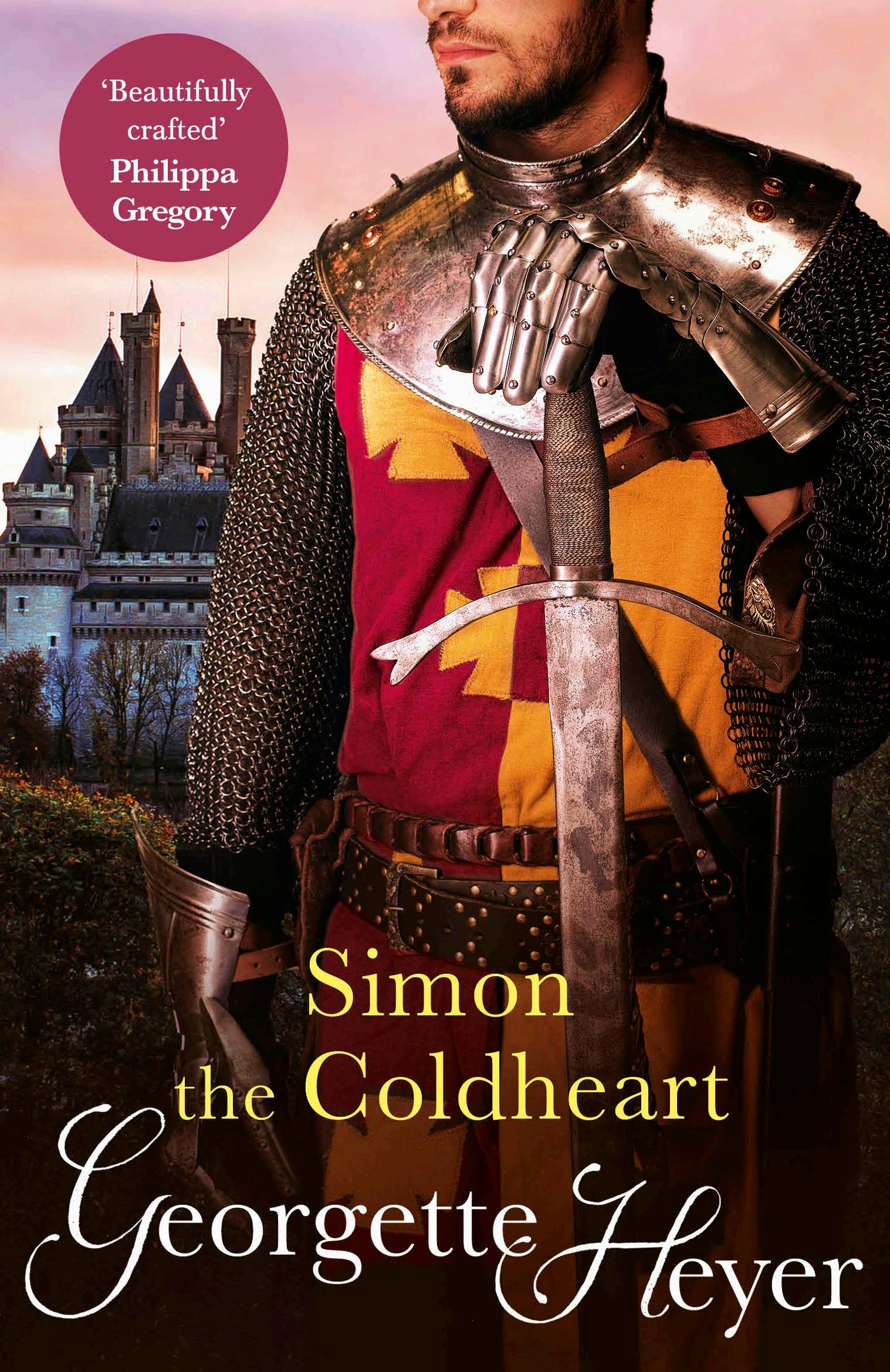
Simon the Coldheart
Author of over fifty books, Georgette Heyer is one of the bestknown and best-loved of all historical novelists, making the Regency period her own. Her first novel, The Black Moth, published in 1921, was written at the age of seventeen to amuse her convalescent brother; her last was My Lord John. Although most famous for her historical novels, she also wrote twelve detective stories. Georgette Heyer died in 1974 at the age of seventy-one.
Also available by Georgette Heyer
Classic Novels
The Black Moth
These Old Shades
Devil’s Cub
Georgian Classics
Masqueraders
The Convenient Marriage
Faro’s Daughter
Powder and Patch
Classic Heroines
Arabella
Venetia
Frederica
Classic Heroes
Sylvester
The Unknown Ajax
False Colours
The Nonesuch
Classic Adventures
Beauvallet
Royal Escape
An Infamous Army
The Spanish Bride
Mystery and Murder Novels
The Talisman Ring
The Reluctant Widow
The Quiet Gentleman
The Toll-Gate
Cousin Kate
London Novels
Regency Buck
The Grand Sophy
Cotillion
April Lady
Bath Novels
Friday’s Child
Bath Tangle
Black Sheep
Lady of Quality
Regency Travels
The Corinthian
The Foundling
Sprig Muslin
Charity Girl
Medieval Classics
Simon the Coldheart
The Conqueror
My Lord John
Classic Crime Novels
Footsteps in the Dark
Why Shoot a Butler?
The Unfinished Clue
Death in the Stocks
Behold, Here’s Poison
They Found Him Dead
A Blunt Instrument
No Wind of Blame
Envious Casca /
A Christmas Party
Penhallow
Duplicate Death
Detection Unlimited
ARROW BOOKS
UK | USA | Canada | Ireland | Australia India | New Zealand | South Africa
Arrow Books is part of the Penguin Random House group of companies whose addresses can be found at global.penguinrandomhouse.com
Penguin Random House UK, One Embassy Gardens, 8 Viaduct Gardens, London SW11 7BW
penguin.co.uk
First published in the UK by William Heinemann Ltd 1925
Published by Arrow Books 2005
This edition reissued by Arrow Books 2022 001
Copyright © Georgette Heyer, 1925
Initial lettering copyright © Stephen Raw, 2004
GEORGETTE HEYER® is a registered trade mark
The moral right of the author has been asserted
‘Every work of art is a child of its age’ Wassily Kandinsky
This book is a child of its time and contains language or depictions that some readers may find offensive today. Our general approach is to leave the book as the author wrote it. We are not endorsing its language or depictions; we are recognising that the book has literary or historical value. We encourage readers to consider the work critically and in its historical and social context.
No part of this book may be used or reproduced in any manner for the purpose of training artificial intelligence technologies or systems. In accordance with Article 4(3) of the DSM Directive 2019/790, Penguin Random House expressly reserves this work from the text and data mining exception.
Typeset by SX Composing DTP, Rayleigh, Essex
Printed and bound in Great Britain by Clays Ltd, Elcograf S.p.A.
The authorised representative in the EEA is Penguin Random House Ireland, Morrison Chambers, 32 Nassau Street, Dublin D02 YH68
A CIP catalogue record for this book is available from the British Library
ISBN: 978–0–099–49094–4
Penguin Random House is committed to a sustainable future for our business, our readers and our planet. This book is made from Forest Stewardship Council® certified paper.
To the memory of my Father –this, his favourite
I
TenHow the Lady Margaret came to
Lady
into
ThirteenHow he found the Lady Margaret
FourteenHow he received the Lady Margaret’s submission
FifteenHow he came upon the Lady Margaret in the gallery
SixteenHow he walked alone in the garden
SeventeenHow he left Belrémy, and how the Lady Margaret dealt with her cousin
EighteenHow he came to Bayeux, to the King
NineteenHow
Fore word
This is not ‘a new Georgette Heyer’, alas. A glance at the fly leaf will show that it was first published in 1925 when my mother was in her early twenties. Nevertheless, many of her readers will not have seen it before. With the exception of a female living in California who, for reasons which were somewhat obscurely expressed, considered that all her works should be publicly burned by the hangman, my mother was her own sternest critic, and many years ago had stated that there were some five or six titles which she never wished to see reprinted. This is one of them. After her death in 1974 I was persuaded to read the book once more, and soon came to the conclusion that, in this instance at all events, her judgment had been too harsh. The style of the book may not be that of a mature writer nor the scholarship profound, but it is easy to detect in it a quick eye for historical detail and an ability to paint a scene from another age which were to become the hallmarks of her later works. It is to be hoped that these qualities, added to the scores of requests for the book that she, her family, and her publisher have received over the years, will excuse such filial disobedience.
at all events, her judgement had been too harsh. The style of the
December 1977
R./G.R.
PART I
One How he came to Fulk ofMontlice
e came walking from Bedford into Cambridge one May morning when the sun was still young and the dew scarce gone from the grass. His worldly possessions he carried on his back in an old knapsack; his short jerkin was stained and torn, and there were holes in his long hose. On his square head and drawn over his brow he wore a frayed cap set jauntily, with a heron’s feather pointing skywards. He carried a quarter-staff, and stepped out right manfully, scanning the flat fen-land from beneath his thick brows, his young mouth dogged, his sombre eyes coldly calculating. Of years he numbered fourteen, but his shoulders had a breadth beyond his age, and his thighs a thickness of muscle that gave him the appearance of a grown man dwarfed. Nor was the face below the clubbed fair hair that of a child, for in the low brow lay strength, and about the straight mouth purpose. There was little boyishness in the eyes, but a frowning look, and at the back, lurking in the green-blue depths, a watchful gleam that was never absent.
One spoke to him on the road, a pedlar tramping south, and gave him good-day. He answered in a crisp, deep voice, and smiled, showing a row of strong white teeth.
‘Whither goest thou, younker?’ the pedlar asked him idly.
‘To my goal, fellow,’ Simon retorted, and passed on. The
pedlar called after him for his haughtiness, but he paid no heed. He was never one to waste words.
So at length he came to Montlice, which was his goal, and stood for a moment before the drawbridge, surveying the rugged castle. A man-at-arms, lounging on the bridge, hailed him goodnaturedly.
‘What want ye, boy? This is the lion’s den.’
The glimmer of a smile came to light the darkness of Simon’s eyes.
‘I seek the lion,’ he said, and walked forward across the bridge.
The man laughed at him, barring his passage.
‘Ho-ho! Ye seek the lion, eh? He would make but one mouthful of you, my fine sprig.’
Simon looked up into his face, jutting brows lowering, eyes agleam.
‘I seek my Lord the Earl,’ he said. ‘Out of the way, sirrah!’
At that the man clapped his hands to his sides, shaken with herculean laughter. Having recovered somewhat he achieved a clumsy bow.
‘My lord is from home,’ he said, mocking Simon.
‘You lie!’ Simon answered quickly. ‘My lord will know how to punish a lying servant. Let me pass!’ He awaited no permission, but slipped by, eel-like, and was gone across the bridge in a flash. Out of sight he paused, not hesitating, but seeming to debate within himself. He looked thoughtfully at the great gateway, standing wide with soldiers lounging there, and his lips tightened. He went swiftly through, light-footed and sure, and attracted but little notice. One of the men stopped his task to shout a surprised question after him, and Simon answered briefly over his shoulder: ‘On my lord’s business!’ The man laughed, thinking him some scullion’s child, and turned back to his companion. Simon went on up the winding slope to the castle door and was there met by a group of men-at-arms who denied him ingress.
‘To the scullions’ entrance, babe!’ one told him, and the muscles about his mouth stood out in anger. He kept his ground, not a whit afraid.
‘I must see my lord,’ he answered, and only that.
‘Wherefore, pup?’ the man asked him, and when he would not answer, sought to hustle him roughly away.
But Simon wriggled from under his hands, and springing to one side, brought his heavy quarter-staff down athwart the man’s shoulders with so much force that, great man though he was, the soldier staggered.
Matters then would have gone ill with Simon but for the appearance of a boy, a little younger than himself, who came strolling towards them, followed by two liver-coloured hounds. He was dark, and magnificently clad, and he carried himself with an air of languid arrogance.
‘Holà there!’ he called, and the soldiers fell away from Simon, leaving him to stand alone, arms folded and head turned to survey the newcomer.
The boy came up gracefully, looking at Simon with a questioning lift to his brows.
‘What is this?’ he asked. ‘Who are you who strike our men?’
Simon stepped forward.
‘So please you, sir, I seek my Lord the Earl.’
One of the men, he whom Simon had dealt that lusty blow, started to speak, but was hushed by an imperious gesture from the boy. He smiled at Simon with a mixture of friendliness and hauteur.
‘I am Alan of Montlice,’ he said. ‘What want you of my father?’
Simon doffed his cap, showing his thick, straight hair clubbed across his brow and at the nape of his brown neck. He bowed awkwardly.
‘I want employment, sir,’ he replied. ‘These men deny me entrance.’
Alan of Montlice hesitated.
‘My father stands in no need –’ he began, then paused, fingering his dark curls. ‘There is that in you that I like,’ he said frankly. ‘Come within.’
Simon bowed again, but he gave no thanks, only standing
aside for the young Montlice to pass through the doorway. And as Alan went by, he shot him an awkward look, keen as steel, appraising him as it were. That was a trick which in after years had the effect of disconcerting his foes most mightily. Alan did not see the glance, but swept into the castle whistling through his teeth. Across the great stone hall he led Simon to an archway over which hung a leathern curtain, nail-studded. Before he pulled it back he spoke again to Simon, in a whisper.
‘Ye will speak my lord fair,’ he cautioned. ‘He is not so douce.’
A flickering smile touched Simon’s lips.
‘Fulk the Lion,’ he said. ‘I know.’
‘He is to be feared,’ Alan said, breathless.
Simon looked scorn.
‘I fear no man.’
At that Alan opened wide his brown eyes and giggled a little.
‘Ye do not know my lord,’ he said, and pulled the curtain aside.
They entered a fair room carpeted with rushes and hung with all manner of paintings, biblical and historical. A table stood in the middle, and although it was now past eight o’clock in the forenoon, the remains of my lord’s breakfast still stood upon it: a chine of salt-beef, a broken manchett, and a tankard of ale. In a great chair beside the table, leaning back at his ease, sat Fulk of Montlice, a giant of a man, deep-chested and magnificently proportioned, as fair as his son was dark, with a crisp, golden beard, whose point came forward belligerently. One of his hands was tucked in the belt of his long gown, the other lay on the table, massive and hairy. Alan ran forward and fell to his knees.
‘Sir, here is a boy who would speak with thee.’
My lord’s heavy, light-lashed eyelids lifted and his small blue eyes travelled slowly from his son to Simon.
‘Shouldst know that I do not speak with every vagrant whelp who is presumptuous,’ he said, a rumbling note of annoyance in his voice. ‘Away with you, sirrah!’
Simon stepped to the table, cap in hand.
‘I am no vagrant, good my lord. Nor will I be so miscalled.’
Alan stayed on his knees, affrighted at such temerity, but my Lord of Montlice laughed.
‘Good lack, what then are you, springald?’
‘I hope one day to be a man, my lord, even as you,’ Simon answered. ‘That is my ambition, sir, and so I come to seek employment with you.’
Montlice flung back his head and laughed again.
‘For that you beard the lion in his den, eh? I will eat you for my dinner, cockerel.’
‘So said they at the gate, my lord, but you will find me of more use alive than eaten.’
‘Shall I so? And what canst do? Wind silks for womenfolk?’
‘That and other things, my lord,’ Simon answered coolly.
‘Soso! What then? Tend my hounds, or are they too strong for your management?’
At that Simon curled his lip in disdain.
‘There does not live the beast I will not tame, my lord.’
My lord’s eyes were now a-twinkle. He clapped the table jovially.
‘By the Rood, I like thy spirit, my young spring-chicken! Canst take a buffet?’
‘Ay, and give one.’
My lord cast him a quizzical look.
‘As thou didst to my man without?’
If he expected Simon to show discomfiture he was disappointed, for Simon only nodded. My lord laughed.
‘Impudence! Why camest thou to the great door? Know ye not the scullions’ entrance at the back?’
‘I have never approached my goal through the back door, my lord, nor ever will. I march straight.’
‘It seems so indeed,’ said my lord. ‘Well, what dost thou want of me?’
‘I would carry your lance and squire you, sir.’
Montlice snapped his fingers, jeering.
‘Thou sit a horse! A flea on a camel!’
The thick brows drew closer together and a little colour stole into Simon’s cheeks.
‘I shall grow, my lord.’
‘Nay, nay. Art too small. What are thy years?’
‘Fourteen, sir.’
‘A babe, forsooth! Get thee gone, babe; I’ve no need of squires.’
Simon stood still.
‘Your page, then, till I am grown to your liking.’
‘God’s my life, methinks thou art over-bold, babe, I do not take peasants for my pages.’
‘I am no peasant.’
‘Ho-ho! What then?’
‘As gentle as yourself, my lord.’
‘By Our Lady! What art called?’
‘Simon, my lord.’
‘Well, it’s a name. What else?’
Simon lifted his shoulders, half-impatiently.
‘I call myself Beauvallet, sir.’
My lord pursed his full lips.
‘It hath a ring,’ he nodded. ‘What is thy real name, sirrah?’
‘I have none.’
‘Tush! Your father’s name!’
Simon did not answer for a moment, but at last he shrugged again, and looked up.
‘Geoffrey of Malvallet,’ he answered.
‘Holy Virgin! I should have known that face! Art Malvallet’s bastard then?’
‘So my mother told me, my lord.’
‘Who is she? Does she live?’
‘She is dead these four years, sir. She was one Jehanne, of Malvallet’s household. That is nothing.’
Montlice sank back again.
‘Ay, ay. But what proof have you?’
‘A ring, my lord. Little enough.’
‘Show me.’
Simon put his hands up to his neck and drew a riband from his breast from which hung a golden ring. Montlice looked at it long and curiously.
‘How came she by this?’
‘I never asked, my lord. It matters not to me whether I am Malvallet’s son or another’s. I am what I choose to be.’
‘Here’s a philosophy!’ Montlice became aware of his son, still kneeling, and waved him to his feet. ‘What thinkest thou, Alan? Here is one of the Malvallet brood.’
Alan leaned carelessly against the table.
‘Malvallet is no friend of ours, sir, but I like this boy.’
‘He hath courage. Tell me, babe, where hast been since thy mother died?’
‘I had a home with her brother, sir, a wood-cutter.’
‘Well, and then?’
‘I wearied of it, my lord, and I came here.’
‘Why not to thy father, bantam?’
Simon jerked his shoulder again.
‘Him I have seen, my lord.’
Montlice rumbled forth a laugh.
‘And liked not his looks?’
‘Well enough, sir, but you also had I seen, and of both have I heard.’
‘God’s Body, do I so take thy fancy?’
‘Men call you the Lion, my lord, and think it harder to enter your service than that of Malvallet.’
My lord puffed out his cheeks.
‘Ay, so is it. Ye like the harder task, babe?’
Simon considered.
‘It is more worth the doing, my lord,’ he replied.
My lord looked him over.
‘Art a strange lad. Having forced thy way into my stronghold, thou’lt not leave it?’
‘I will not.’
‘I am no easy master,’ Montlice warned him.
‘I would not serve any such.’
‘Ye think to earn knighthood with me?’
Simon glanced up.
‘What I become will be of mine own making, sir. I ask no favours.’
‘Then I like thee the better for it. Shalt be page to my son till I find thee fitter occupation. And that to spite Malvallet, look you. Art satisfied?’
Simon knelt.
‘Ay, my lord. And I will serve you faithfully and well, that there shall be no gratitude to weigh me down.’
Montlice smote him on the shoulder, delighted.
‘Spoken like a sage, my little fish! Well, get thee gone. Alan, take him, and see to it that he is clothed and fed.’
And thus it was that Simon came to Fulk of Montlice.
Two How he grew to manhood
rompage to Alan, he became page to my lord himself, and was decked out in Montlice red and gold. Very brave he looked in the short red tunic worked with gold and caught in at the waist by a leathern belt. His hose were gold, his shoon red, and red was the cap that sat a thought rakishly on his fair head. His duties were many and arduous, nor did my lord spare him any fatigue or exertion. He slept on a hard pallet across Fulk’s threshold, rose early and went late to bed. It was part of his duty to wait upon my lord and his lady at dinner, and every morning at ten Simon took his stand on the dais beside my lord’s chair, attending to his wants or standing immobile the while my lord and his guests ate and drank their fill. He was at three people’s beck and call: my lord, his lady, and young Alan, and he spent his time running from one to the other.
He grew apace in height and breadth and strength until there were few who could throw him in a wrestling match; few who could shoot an arrow farther or more precisely, be it at butt, prick or rover; and few who could stand beneath his mighty buffet. Yet for the most part he was gentle enough, if stern, and it was only when his cold anger was aroused that the caged lion within him sprang to life and swept all before it. And when that happened there came that light to his eyes which could make the
hardiest evil-doer cringe and the most arrogant squire cry mercy, even before Simon’s iron hands had touched him.
Blows he received a-many, whenever my lord chanced to be in an ill-humour, which was often, but they never disturbed his cold composure, nor awakened any feeling of resentment in his breast. From Fulk he bore blows in an acquiescent mood that yet held no meekness nor humility, but woebetide the squire or serf who crossed his path belligerently inclined! When he still was page, my lord’s squire, Lancelot of the Black Isle, commanded him loftily, and when Simon paid no heed to his orders, dealt him a buffet that should have felled him to the ground. Simon staggered under it, but recovered, and gave back blow for blow with so much force behind his steel wrist that Lancelot, full five years his senior, went tumbling head over heels and was sore and bruised for days after. When Fulk heard the tale he made Simon squire in Lancelot’s place, and swore that there was more of himself in Simon than in his own son.
But it was seldom that Simon fell foul of his peers. His very calmness of temper compelled respect, and for that he was every inch a man, men liked him and were eager to call him friend. Friendship he never courted, caring nothing for man’s opinion of himself, nor seemed he to have an ounce of affection in him, save it were for Fulk of Montlice, or Alan, whom he regarded with a mixture of contempt and liking. His father he saw a-many times, but it is doubtful whether Geoffrey of Malvallet noticed him. Once indeed at Bedford in the court of law, whither Simon had gone in Fulk’s wake to settle a dispute over some land between Montlice and Malvallet, Geoffrey, glancing idly around, surprised an intent stare from his enemy’s page, who sat with his chin in his hand, calmly and keenly scrutinising him. Geoffrey looked him over haughtily, but when his eyes met Simon’s and encountered that strangely disconcerting gleam he turned his head away quickly, a tinge of colour in his cheeks. Simon continued to survey him, not from any wish to annoy, but simply because he was interested, and wished to see what manner of man was his sire. He was not ill-pleased with what he saw, but neither
was he enthusiastic. Geoffrey was a tall man, and slim, fastidious in his dress and appointments, soft-spoken, and proud – so said Montlice – as Lucifer himself. His close-cropped hair was grizzled now, but his eyes were like Simon’s in colour, and as deep set. His eyebrows were too thick and straight, but his mouth was gentle and full-lipped, which Simon’s was not, and his brow was not so rugged. He had one son, Geoffrey, who was just two years older than Simon, and whom Simon had never seen.
Between Alan and Simon positions were very soon reversed. It was Alan who gave devoted love and obedience; Simon received, and could return naught but a tolerant protection. They played together often, but in every sport Simon was an easy victor save when the game was of a gentle kind. At bowls and closh Alan could beat him, but when they played at balloon ball, Alan ruefully declared that he was no match for Simon, who played with his naked hand and struck the great leather ball with such deadly accuracy and strength that Alan was fain to dodge it instead of returning it. At archery he was even less skilled, and Simon watched his efforts to bend the bow with a contemptuous, rather amused air, which incensed young Alan so that he shot his arrow still more wide of the mark than ever. Simon tried to teach him the sport of the quarter-staff, and wielded his own staff moderately enough, in deference to Alan’s tender years. But Alan, although he was not lacking in courage, disliked such rude and rough play, and would not engage with Simon. He liked to go out chasing or hawking, and he showed an aptitude for pretty and quick sword-play. Tourneys were not so much to his taste, and rather than enter into any of these pastimes would he sit at home, strumming upon his harp and weaving fanciful songs to his many lady-loves. He would paint, too, and make poesies, for all the world like some troubadour of a century ago. With the ladies he was ever a favourite, and by the time he was fifteen he was for ever paying court to some dame or another, greatly to Simon’s disgust.
‘Hast thou never loved?’ he asked Simon once, plaintively. They were sitting together in a room high up in one of the
turrets, Alan playing his harp, and Simon fashioning a new string to his great bow.
Simon did not raise his eyes from his task, but his lips curled disdainfully.
‘Oh, love, love! Art for ever prating of this love. What is it?’
Alan played a soft chord or two, bending his handsome head a little to one side. His dark eyes glowed, and he smiled.
‘Dost thou not know? Is there no maid who stirs thy heart?’
‘I know of none,’ Simon answered shortly.
Alan put his harp away and crossed his shapely legs. He was wearing a tunic of peacock-blue velvet with long sleeves, lined with gold, that touched the ground. There was a jewel in his left ear, and a ring on his finger, while the belt that drew in his tunic at the waist was of wrought gold, studded with gems. He formed a striking contrast to Simon, who was clad in a long robe of crimson, with high boots on his feet and no ornament on all his dress. He still wore his hair clubbed at neck and brow, although it was now customary to display a close-cropped head. He was sixteen at the time, and already stood six foot in height, with mighty thews and sinews, a broad back down which the muscles rolled and rippled, and a pair of arms that were bear-like in their strength. Beside Alan’s slim figure he seemed a very giant.
Alan watched him for a moment, still smiling.
‘My sisters are not so ill-looking,’ he remarked, a laugh in his eyes. ‘Elaine is perhaps more comely than Joan.’
‘Is she?’ Simon said, still intent on his task.
‘Which dost thou like the best, Simon?’ Alan asked softly.
‘I know not. I have never thought.’ He glanced up, a sudden smile flashing across his face. ‘Dost suggest that one of them should stir my heart?’
‘They do not? Ye feel not the smallest pulse-leap in their presence?’
Simon stretched his new string experimentally.
‘A pulse-leap,’ he said slowly. ‘What folly! My pulse leaps when I have sent an arrow home, or when I have thrown my
man, or when a hawk has swooped upon its prey.’
Alan sighed.
‘Simon, Simon, is there no softness in thee at all? Dost love no one?’
‘I tell thee I know not what it is, this Love. It stirs me not! I think it is nothing save the sick-fancy of a maudlin youth.’
Alan laughed at that.
‘Thy tongue stings, Simon.’
‘If it might sting thee to more manly pastimes than this moaning of love, ’twere to some purpose.’
‘But it will not. Love is all. One day thou’lt find that I speak sooth.’
‘I wonder!’ Simon retorted.
Again Alan sighed.
‘Simon, what hast thou in place of a heart? Is it a block of granite that ye carry in your breast? Is no one anything to you? Am I nothing? Is my lord nothing? There is no love in you for either of us?’
Simon laid his bow down, and began to polish an arrow.
‘Art like a whining babe, Alan,’ he rebuked his friend. ‘What shouldst thou be but my lords, thou and Montlice?’
Alan stretched out his hands.
‘That is not what I would be to thee!’ he cried. ‘I give you Love, and what doest thou give me in return? Hast a single spark of affection for me, Simon?’
Simon selected another arrow, and passed his hand over its broad feather almost lovingly. He looked thoughtfully at Alan, so that the boy sprang up, flushing.
‘Thou carest more for that arrow than for me!’
‘That is folly,’ Simon answered coolly. ‘How can I tell thee what my feelings are when I do not know myself?’
‘Couldst thou leave Montlice today without one pang of regret?’ demanded Alan.
‘Nay,’ Simon said. ‘But one day I shall. For the present I bide, for I want some years to full manhood. And I am happy here, if that is what thou wouldst know. Between thee and me is
friendship, and between my Lord Fulk and me is understanding. A truce to this silly woman’s talk.’
Alan sat down again, twanging his harp discordantly.
‘Thou art so strange, Simon, and so cold. I wonder why I do so love thee?’
‘Because thou art weak,’ Simon replied curtly, ‘and because thou takest delight in such fondlings.’
‘Maybe,’ Alan shrugged. ‘Thou at least art not weak.’
‘Nay,’ Simon said placidly. ‘I am not weak, neither am I strange. See if thou canst bend that bow, Alan.’
Alan glanced at it casually.
‘I know I cannot.’
‘Shouldst practise then. Thou wouldst please my lord.’
‘Certes, I do not want to please him. I was not fashioned for these irksome sports. ’Tis thou who shouldst try to please him, for ’tis thou whom he loves.’
Simon balanced a broad feathered arrow on his forefinger.
‘Good lack, what has my lord to do with love? There is little enough of that in his heart.’
‘So ye think!’ retorted Alan. ‘I know that he watches thee fondly. Perchance he will knight thee soon.’
‘I have done naught to deserve it,’ replied Simon shortly.
‘Natheless, he will do it, I think. He might even give thee one of my sisters in marriage if thou didst wish it, Simon.’
‘I am not like to. There is no place for women in my life, and no liking for women in my breast.’
‘Why, what will be thy life?’ asked Alan.
Then at last a gleam shone in Simon’s eyes, cold yet eager.
‘My life will be’ – he paused – ‘what I choose to make it.’
‘And what is that?’
‘I will tell thee one day,’ Simon said, with a rare touch of humour. Then he gathered up his arrows and went away, treading heavily yet noiselessly, like some great animal.
True it was that Fulk cared for him more than for his own son. The lion-spirit was not in Alan, and between him and his father was less and less understanding as the years passed by. Fulk’s
jovial roughness, his energetic ways, his frequent lawsuits, wearied and disgusted Alan, and in the same way Alan’s fastidious temper and more cultured tastes became the subject for Fulk’s jeers and sighs. In place of his son Fulk turned to Simon and took him wherever he went, sparing him no exertion nor hardship, but watching his squire’s iron equanimity with an appreciative, almost admiring eye. Thus, bit by bit, grew up between the two an odd understanding and affection, never spoken of, but there at the root of their attitude towards each other. Fulk wanted not servility nor maudlin love, and from Simon he got neither. Strength was the straight road to his heart, and fearlessness: Simon had both. They were not always at one, and sometimes a quarrel would crop up when neither would give way an inch, when Fulk stormed and raged like a wounded buffalo, and when Simon stood rock-like, unshaken by anything Fulk might do to him, icy anger in his strange eyes, inflexible obstinacy about his mouth, and his brows forming a straight line across his hawk-nose.
‘What I have I hold!’ Fulk roared at him once, pointing to the device on his shield.
‘I have not, but still I hold,’ Simon retorted.
Fulk’s eyes showed red a moment, and a fleck of foam was on his pointing beard.
‘God’s Wounds!’ he barked. ‘Am I to be braved by you, mongrel-whelp? It will be the whip for you, or a dungeon-cell!’
‘And still I shall hold,’ Simon answered him, folding his arms across his great chest.
‘By Death, I will tame you, wild-cat!’ Fulk cried, and drew back his fist to strike. But even as he would have done so, he checked himself, and the red went out of his eyes. A grin came, and a rumbling laugh.
‘“I have not, but still I hold,”’ he repeated. ‘Ho-ho! “I have not, but –” Ho-ho!’ Chuckling, he smote Simon on the shoulder, a friendly blow which would have crumpled an ordinary stripling to the ground. He became indulgent, even coaxing. ‘Come lad! Thou’lt do as I bid thee!’
Coaxing left Simon as unmoved as the late storm. He shook his fair head stubbornly.
‘Nay, I go mine own road in this.’
The red light showed again.
‘Dare ye defy me?’ roared Fulk, and closed his huge hand on Simon’s shoulder. ‘I can snap thy puny body as a reed!’
Simon shot him that upward, rapier-glance.
‘I dare all,’ he said.
The grip on his shoulder tightened until little rivulets of pain ran down from it across his chest. He did not so much as wince, but held Fulk’s look steadily. Slowly the grip relaxed.
‘Ay, ye dare,’ Fulk said. ‘I am of a mind to break thee over my knee.’
‘That is as may be,’ Simon answered. ‘But still I shall hold.’
At that Fulk broke into a great laugh, and released him.
‘Oh, go thine own road, cub, so ye do not take it into thy hot head to hold me!’
Simon looked him over, frowning.
‘That I think I cannot do,’ he said. ‘I am not sure.’
Whereat Fulk laughed the more and liked him the better.
When his seventeenth birthday came Simon was already a man in build and cool sagacity. In face he had changed hardly at all, save that his forehead was more rugged, the thick brows jutting further over the deep-set eyes of green-blue, and that his mouth had lost its youthful curve together with any softness that it might once have had. He smiled but rarely, nor ever laughed out as did my Lord of Montlice. If he laughed it was a short, dry sound, somewhat sardonic in tone, and quickly gone, but when he smiled there were two ways he had of doing it; one when he was crossed, that one more terrible than his frown, the other when he was in smiling humour, a singularly sweet smile, this, with a hint of boyishness at the back of it.
Fulk knew him for a soldier born, and a leader of men. If a disturbance arose in the Earl’s vast household it was Simon who quenched it when the fussy, incompetent Marshal had failed, and the Steward threatened in vain. The guards, inactive and
ceased to come to blows. If it was a question of judgement
fractious, would quarrel among themselves, and, heated by too much sack, come to blows and noisy, perilous fights. It needed but for Simon to come upon them with his soft tread and his cold composure to cause the brawlers to fall apart, great men though they were, and stand sheepishly before him, answering his crisp, stern questions with a meekness they did not show to John the Marshal. Boy as he was, Simon could reduce the most drunken roysterer to a state of penitent humility. He had but to use that upward glance of his and all insubordination was at an end. This he very soon discovered, and came to use the disconcerting look more than ever. There was something compelling in his appearance, an elusive air of rulership and haughtiness, and a suggestion of a hidden force that was invincible. Montlice recognised this as the Malvallet in him, and chuckled to himself, watching. He set Simon to rule his guards, and observed his ruthless methods with amusement. He would not throw the garment of his protection about his squire, wondering how he would maintain his position alone. Simon wanted no protection and found no difficulty in maintaining his position. At first, when he interfered in some quarrel, he met with insolence and threatened blows. That lasted for a very little time. Men found that insolence moved him to an icy anger that was to be dreaded, and if it came to blows there would be broken ribs, or dislocated jaws for those whom Simon’s fist struck. Therefore it swiftly ceased to come to blows. If it was a question of judgment or arbitration men found Simon relentlessly, mercilessly just, and because of this justice, no complaints of him were carried to my Lord Fulk.
With all his harshness and cold demeanour Simon was liked and trusted. The grumblers dwindled in number, for Simon had short shrift for any such. His code was a queer one, and men found his advice puzzling. But when they had slowly unravelled his line of thought they found it good, and this because it was his own code.
A guard met him once on the battlements and unfolded a tale of woe. One of his companions had a spite against him and
plagued away his life. On this day the man had slyly tripped him up with his spear, so that he was burning to be avenged. What would Simon do for him?
‘Naught,’ Simon answered curtly. ‘Fight thine own battle.’
‘Yet, sir, if I strike this man as he deserves, you will come upon us and have us shut up for brawling, or maybe whipped.’
‘But ye will have struck him,’ Simon said, and walked on, leaving his man to think it over.
Presently the man came to him again.
‘Sir, if I punish mine enemy and there be something of a brawl, we shall both be punished by you.’
Simon nodded indifferently.
‘But if I strike him hard enough, methinks he will not again plague me.’
‘That is so,’ Simon said.
‘I think I will strike him,’ decided the man, and straightway went to do so.
There was indeed something of a brawl, and as a consequence Simon had them both under lock and key for twenty-four hours. But neither bore him any ill-will, nor was there another complaint lodged on the matter. Simon knew his men, and his method of ruling was his own, rude as were those men, and as rough. He was master, and not one of them thought to dispute the fact.
Fulk, watching from afar, smote his thigh and laughed triumphantly.
‘The boy is a man,’ he said, hugely delighted. ‘And was there ever such another?’
Three
How he went with Fulk to Shrewsbury
t the time of Simon’s seventeenth birthday, affairs in Wales and the North of England had reached something approaching a crisis. It was in the year 1403, when Bolingbroke had sat upon the throne for four years, and his son, Henry of Monmouth, had held the reins of government in Wales, unassisted, for some months only. Although he was but sixteen years of age, the Prince had already led a punitive expedition into North Wales, and considerably harried the rebel, Owen Glyndourdy. But now Percy, the redoubtable Hotspur, had, with his father, the Earl of Northumberland, and his uncle, the Earl of Worcester, raised his standard in the North against the King, and was on the point of marching to join Glyndourdy in Wales.
It was in July that these state affairs first affected Montlice, although for some time past Fulk, ever-ready for war, had chafed and fretted in his fair land, debating whether he should take his men to join the Prince on the Marches or no. His uncertainty rendered him irritable to all who crossed his path; only Simon understood the reason of this irritability, and he gave no sign that he understood. But although he said little, he too was watching affairs, and under his habitual placidity was a glowing desire to be gone from quiet Montlice to Shrewsbury where lay the Prince of Wales with his insufficient army and his insufficient supplies.