Haf_Bräunig_Stab wound care

Page 1


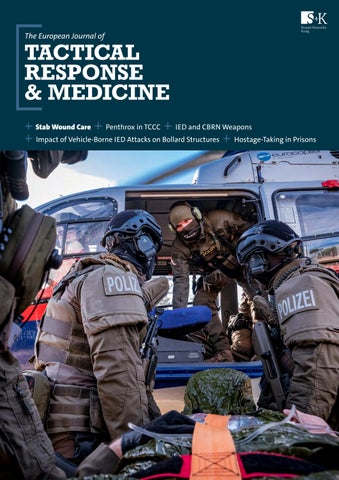
The European Journal of

TACTICAL RESPONSE & MEDICINE

Stab Wound Care   Penthrox in TCCC   IED and CBRN Weapons

Impact of Vehicle-Borne IED Attacks on Bollard Structures   Hostage-Taking in Prisons
Authors:

Dr David Haf

Senior Medical Officer

Assistant Physician

German Armed Forces Hospital Hamburg, Clinic for Anaesthesiology, Intensive Care and Emergency Medicine, Pain Therapy

Lesserstr. 180 22049 Hamburg davidhaf@ bundeswehr.org

Dr Jan Bräunig

Fleet physician

Specialist in anesthesiology, emergency medicine

German Armed Forces Hospital Hamburg, Clinic for Anaesthesiology, Intensive Care and Emergency Medicine, Pain Therapy

Lesserstr. 180 22049 Hamburg janbraeunig@ bundeswehr.org

Stab Wound Care:

Always Assume the Worst

Penetrating injuries are reported to have a worldwide prevalence of 15%. However, there are variations between regions. For example, studies indicate that the incidence rate ranges from 25% to 45% in the USA and 60% in South Africa. Fortunately, the incidence rate in Germany is only 4 – 5%. Therefore, German healthcare professionals rarely have to treat such injuries. However, such wounds often present life-threatening acute injury patterns. Therefore, they must master how to treat such injuries. This article focuses on treating stab wounds, particularly in the context of tactical decisions.

Always Assume the Worst

Due to the increasing number of offences involving knives and other sharp instruments, German Police Crime Statistics (PCS) have uniformly recorded incidents of knife crime since 1 January 2020. Watson’s 1993 study states that the 5% of penetrative injuries in Germany include gunshot wounds (0.6%), stab wounds (1.8%) and other penetrating injuries such as those caused by impalement.

The German TraumaRegister DGU® states that stab wounds in Germany result in a 6.2% mortality rate, which increases significantly when the injury is to the torso or its transitional circulatory zones. Furthermore, the morphology and configuration of the wound, as well as the patient’s history, are

decisive factors. First responders and other medical professionals can assess the depth of a wound and its resulting potential injuries to vital organs and internal body structures by the length of the blade that caused the injury (if that information is available). However, wounds may be more extensive than the length of the knife due to the compression of fatty tissue. Likewise, first responders and other medical professionals have no way of knowing the internal angle of a stab wound. Therefore, they must assume the worst-case scenario, such as a two-cavity wound and internal bleeding. If the knife (or other sharp instrument) is still in the puncture canal, first responders should leave it where it is because removing it may increase bleeding and make the puncture canal more challenging to trace. Exsangui-

Fig. 1: Abdominal stab wound: retention and fixation of the assault weapon.

nation is the primary cause of death in those who have sustained penetrating injuries. Therefore, first responders and other medical professionals must focus on treating bleeding immediately.

Effective treatment begins with rapid bleeding control using proven trauma algorithms.

Treating Stab Wounds:

<x>ABCDE and MARCH

The primary goal of first responders and other medical professionals when treating stab wounds is to identify potentially life-threatening injuries and treat them immediately. To do so effectively, they must prioritise treatment by following the classic <C>ABCDE (for treating a catastrophic haemorrhage), <x>ABCDE (for preventing exsanguination), or MARCH (for treating a massive haemorrhage) algorithms and the Tactical Rescue and Emergency Medical Association (TREMA) guidelines. The first step in all three action algorithms (C, x, and M) is to recognise external bleeding.

The second step is to control the bleeding via manual compression, a compression bandage or a tourniquet. First responders may supplement these measures with haemostyptics. However, while first responders should apply the tourniquet a hand’s width from the injury under controlled conditions, in a threatening situation, they should place it as close to the wound as possible. Haemostasis indicates that the tourniquet is in the correct position. If the tourniquet is too loose, it may cause venous congestion or increase bleeding. First responders must urgently reapply such tourniquets. A limb ischaemia of up to two hours is typically unproblematic. However, first responders should always document when they apply the tourniquet and reevaluate and adjust its position regularly. Afterwards, the tourniquet may be converted to pressure bandages in the ambulance or hospital. For stab wounds close to the trunk (neck, axilla, groin), first responders should use wound tamponades because circular compression bandages and tourniquets frequently fail to control bleeding. They should also use haemostyptics when available. The key is to ensure that the wound bed is as dry as possible, dress it correctly and then apply pressure. After removing the tamponade, medical professionals should manually compress the area for at least five minutes.

The third step (A for Airway) involves evaluating the patient’s airway. If the patient has suffered

a thoracic stab wound, first responders should use an airtight dressing, such as a chest seal, to prevent inappropriate intrathoracic valve mechanisms. If the first responder or medical professional detects or suspects that the patient is suffering from tension pneumothorax, they must relieve it immediately and ventilate or remove the dressing to allow the intrathoracic air to escape or create a relief puncture in the Bülau (4th/5th intercostal space anterior to mid axillary line) or Monaldi position (2nd/3rd intercostal space midclavicular line) which doctors can later extend with a minithoracotomy.

The fourth step (C for Circulation) involves first responders assessing the patient’s circulation to determine whether they are bleeding internally and establishing IV or IO access. If the patient is suffering from an uncontrollable intrathoracic or intra-abdominal haemorrhage, first responders should take them to a suitable hospital as quickly as possible because medical staff can only achieve haemostasis surgically. In such cases, first responders should not delay transport due to postponable preclinical measures. Instead, they should aim to achieve controlled hypotension (systolic blood pressure of 80 – 90 mmHg) through moderate volume therapy. First responders can supplement crystalloid infusion solutions with circulatory-stabilising drugs such as colloidal infusion solutions (e.g., HAES®) in individual cases. However, European guidelines state that first responders should not induce hypotension in patients with cardiac diseases, traumatic brain or spinal traumas or those who may be pregnant. First responders should use tranexamic acid (TXA) and maintain adequate perfusion pressure for patients with massive haemorrhages. TXA counteracts hyperfibrinolysis and, therefore, stabilises physiological thrombi. The German Polytrauma/Severe Injury Treatment S3 guideline recommends administering 1 g of TXA over 10 min as soon as possible,

Fig. 2: Applying an emergency dressing to a severe neck wound and using a reservoir mask for preoxygenation help maintain adequate respiration.

followed by an infusion of 1 g over 8 h if necessary. However, first responders (and other medical professionals) should only administer TXA preclinically if the patient is suffering from haemorrhagic shock and/or uncontrollable bleeding.

The fourth step (D for Disability) involves assessing the patient’s neurological status and administering analgesics if possible.

The fifth step (E for Exposure and Environment) involves examining the patient for hidden wounds and maintaining the patient’s body temperature to prevent the lethal triad of acidosis, hypothermia and coagulation disorder. Primary haemostasis and plasmatic coagulation slow when the body temperature drops below 35°C. Coagulation decreases by 10% with every 1°C decrease in body temperature.

Stop the Bleeding: Treat and Run

The most common cause of death in stab wound patients is a haemorrhage. Therefore, first responders must reduce or stop bleeding (haemostasis) from extremities as soon as possible, by using manual compression, pressure dressings, and tourniquets. However, that is challenging when dealing with wounds in transition zones such as the neck, axilla, or groin. In such cases, first responders should consider haemostyptics and tamponading the wound (wound packing). However, transition site bleeding can be so complex that first responders must use the “treat and run” principle by doing whatever they can to stop the bleeding and immediately transfer the patient to a suitable clinic for surgical haemostasis. First responders should treat patients with severe bleeding using TXA or other methods to induce hypotension unless the patient displays contraindications. They should also be mindful that hypothermia reduces the rate of blood

coagulation; therefore, they should take all possible steps to maintain the patient’s body temperature above 35°C.

Outlook

Ambulances are increasingly equipped with portable ultrasound devices so that their crews can detect thoracic and abdominal bleeding. However, first responders should not delay transport to use sonography.

References:

1. Bieler D, Franke AF, Hentsch S et al. (2014) Schuss- und Stichverletzungen in Deutschland – Epidemiologie und Outcome: Eine Analyse aus dem Traumaregister DGU® Unfallchirurg 117 (11): 995. DOI: 10.1007/s00113-014-2647-7.

2. Bundeskriminalamt (Ed.) (2019) Polizeiliche Kriminalstatistik 2019. www.bka.de/DE/AktuelleInformationen/StatistikenLagebilder/ PolizeilicheKriminalstatistik/PKS2019/PKSJahrbuch/pksJahrbuch_ node.html (accessed 12 January 2021).

3. Butler FK Jr, Holcomb JB, Shackelford S et al. (2018) Management of Suspected Tension Pneumothorax in Tactical Combat Casualty Care: Tccc Guidelines Change 17-02. J Spec Oper Med 18 (2): 19. DOI: 10.55460/XB1Z-3BJU.

4. CRASH-2 trial collaborators, Shakur H, Roberts I et al. (2010) Effects of Tranexamic Acid on Death, Vascular Occlusive Events, and Blood Transfusion in Trauma Patients with Significant Haemorrhage (Crash2): A Randomised, Placebo-Controlled Trial. Lancet 376 (9734): 23. DOI: 10.1016/S0140-6736(10)60835-5.

5. Deutsche Gesellschaft für Anästhesiologie und Intensivmedizin (Ed.) (2016) Handlungsanwendung zur prähospitalen Anwendung von Tourniquets. www.dgai.de/aktuelles-2/433-dgainfo-tourniquet/file. html (accessed 12 January 2021).

6. Deutsche Gesellschaft für Unfallchirurgie (Ed.) (2016) S3 – Leitlinie Polytrauma/Schwerverletzten-Behandlung. AWMF-Register-Nr.: 012/019. www.awmf.org/leitlinien/detail/ll/012-019.html (accessed 12 January 2021).

7. Deutsche Gesellschaft für Unfallchirurgie (Ed.) (2020) Jahresbericht 2020 – TraumaRegister DGU® für den Zeitraum bis Ende September 2019. www.traumaregister-dgu.de/fileadmin/user_upload/ traumaregister-dgu.de/docs/Downloads/Jahresbericht_2020.pdf (accessed 12 January 2021).

8. Doll D, Lenz S, Lieber A et al. (2006) Was tun bei nicht komprimierbaren Stichkanalblutungen in Rettungsdienst und Notfallraum? Temporäre Versorgung mittels Blasenkatheter. Unfallchirurg 109 (10): 898. DOI: 10.1007/s00113-006-1096-3.

9. Eastridge BJ, Mabry RL, Seguin P et al. (2013) Death on the Battlefield (2001-2011): Implications for the Future of Combat Casualty Care. J Trauma Acute Care Surg 73 (6): 431 DOI: 10.1097/TA.0b013e3182755dcc.

10. Kragh JF Jr, Walters TJ, Baer DG et al. (2009) Survival with Emergency Tourniquet Use to Stop Bleeding in Major Limb Trauma. Ann Surg 249 (1): 1. DOI: 10.1097/SLA.0b013e31818842ba.

11. Kotwal RS, Butler FK, Gross KR et al. (2013) Management of Junctional Hemorrhage in Tactical Combat Casualty Care: TCCC Guidelines? Proposed Change 13-03. J Spec Oper Med 13 (4): 85. DOI: 10.55460/MS8T-ZUPX.

12. Lechner R, Helm M, Mueller M et al. (2016) Efficacy of Hemostatic Agents in Humans with Rotational Thromboelastometry: An In-Vitro Study. Mil Med 181 (8): 907. DOI: 10.7205/MILMED-D-15-00417.

13. Maegele M (2016) Unkritischer Gebrauch von Tranexamsäure bei Traumapatienten: Do No Further Harm!. Unfallchirurg 119 (11): 967. DOI: 10.1007/s00113-016-0236-7.

14. Mitra B, Tullio F, Cameron PA et al. (2012) Trauma Patients with the ‘Triad of Death’. Emerg Med J 29 (8): 622. DOI: 10.1136/ emj.2011.113167.

15. Moore HB, Moore EE, Liras IN et al. (2016) Acute Fibrinolysis Shutdown after Injury Occurs Frequently and Increases Mortality: A Multicenter Evaluation of 2,540 Severely Injured Patients. J Am Coll Surg 222 (4): 347. DOI: 10.1016/j.jamcollsurg.2016.01.006.

16. Søreide K (2009) Epidemiology Of Major Trauma. Br J Surg 96 (7): 697. DOI: 10.1002/bjs.6643.

17. Spahn DR, Bouillon B, Cerny V et al. (2019) The European Guideline on Management of Major Bleeding and Coagulopathy Following Trauma: Fifth Edition. Crit Care 23 (1): 98. DOI: 10.1186/s13054-019-2347-3.

18. Thorsen K, Ringdal KG, Strand K et al. (2011) Clinical and Cellular Effects of Hypothermia, Acidosis and Coagulopathy in Major Injury. Br J Surg 98 (7): 894. DOI: 10.1002/bjs.7497.

19. Tran A, Yates J, Lau A et al. (2018) Permissive Hypotension versusConventional Resuscitation Strategies in Adult Trauma Patients with Hemorrhagic Shock: A Systematic Review and Meta-Analysis of Randomized Controlled Trials. J Trauma Acute Care Surg 84 (5): 802. DOI: 10.1097/TA.0000000000001816.

20. Watson AA (1993) Stabbing and Other Incisional Wounds. In: JK Mason (Ed.) The Pathology of Trauma, p. 87.

Fig. 3: Cervical cut after removal of the dressing for airway protection.

Turn static files into dynamic content formats.

Create a flipbook
Issuu converts static files into: digital portfolios, online yearbooks, online catalogs, digital photo albums and more. Sign up and create your flipbook.