
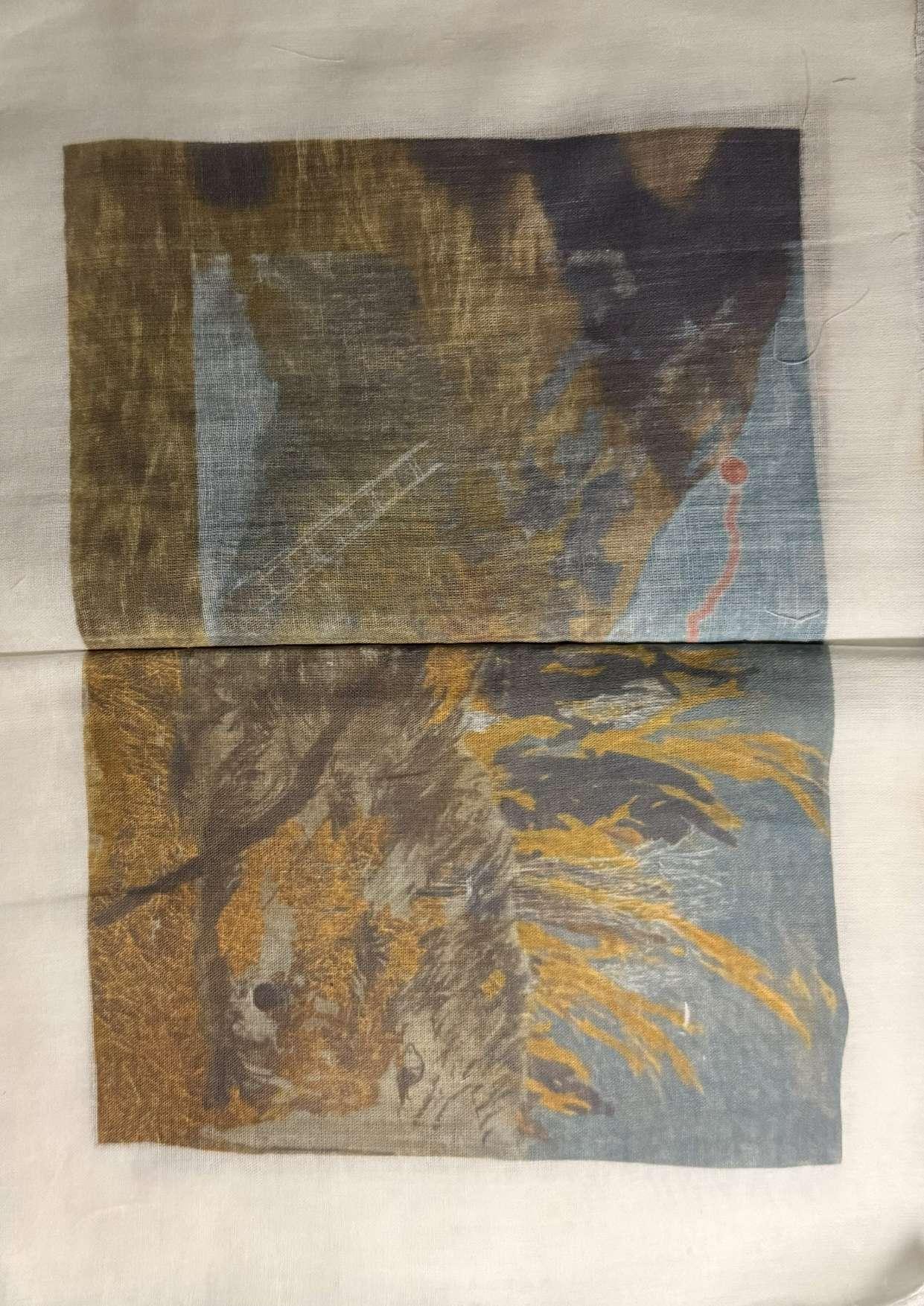
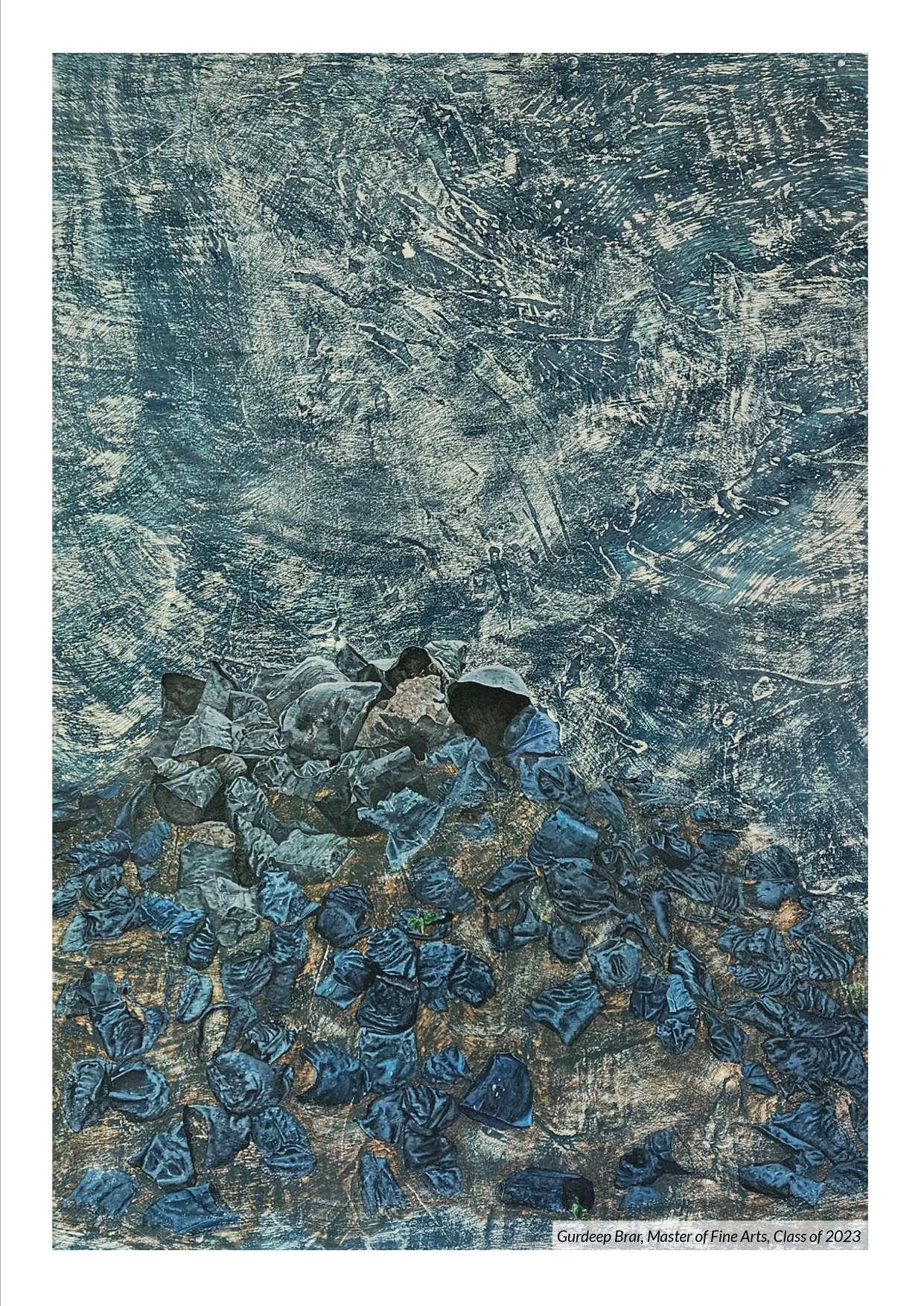
Namrtha N, Master of Fine Arts, Class of 2026
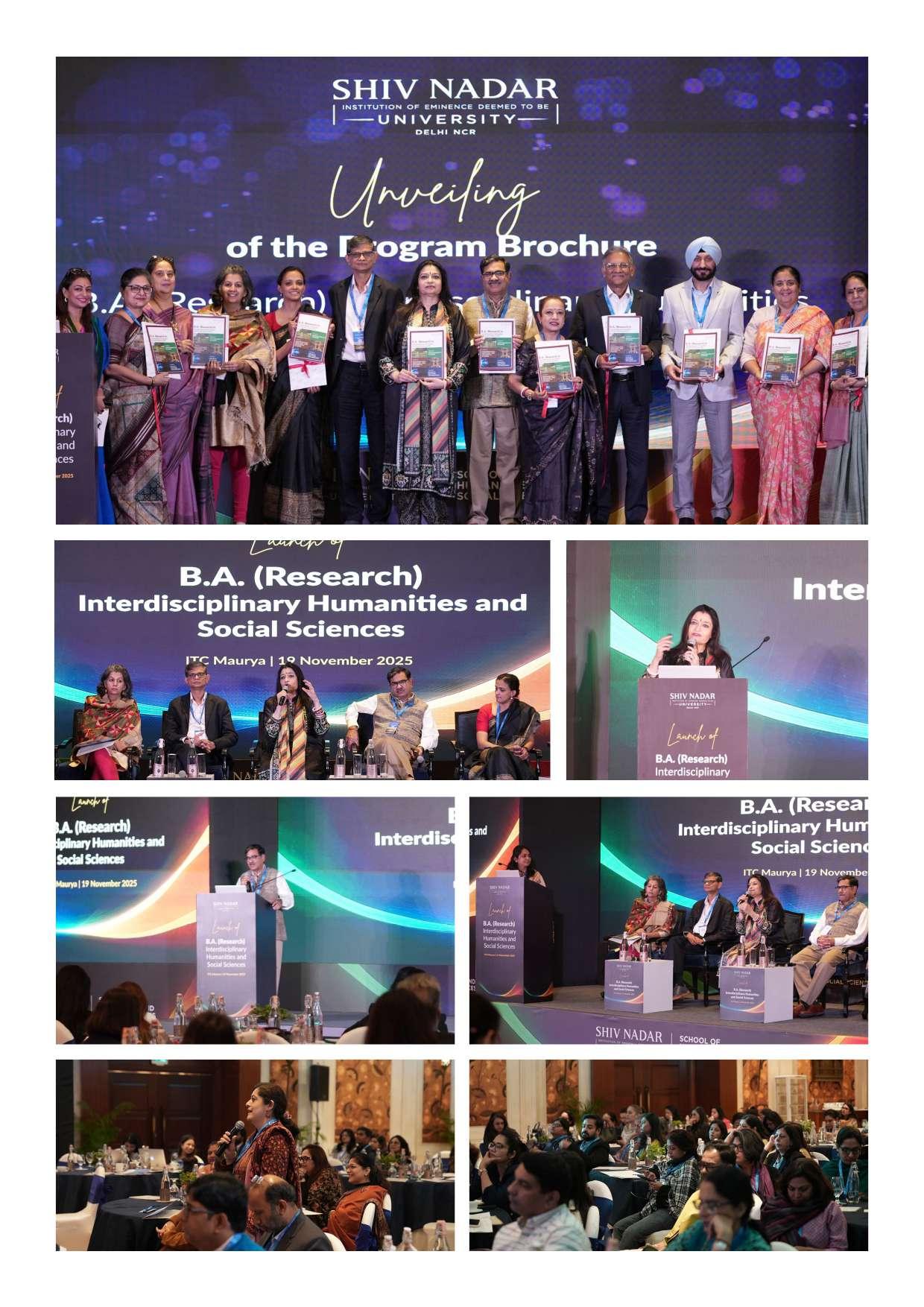
During this quarter, SHSS established new collaborations aimed at enhancing research opportunities and the broader educational landscape. These initiatives reflect our commitment to fostering a rich, interdisciplinary environment that prepares students for an interconnected world.
Key highlights of these established partnerships include:
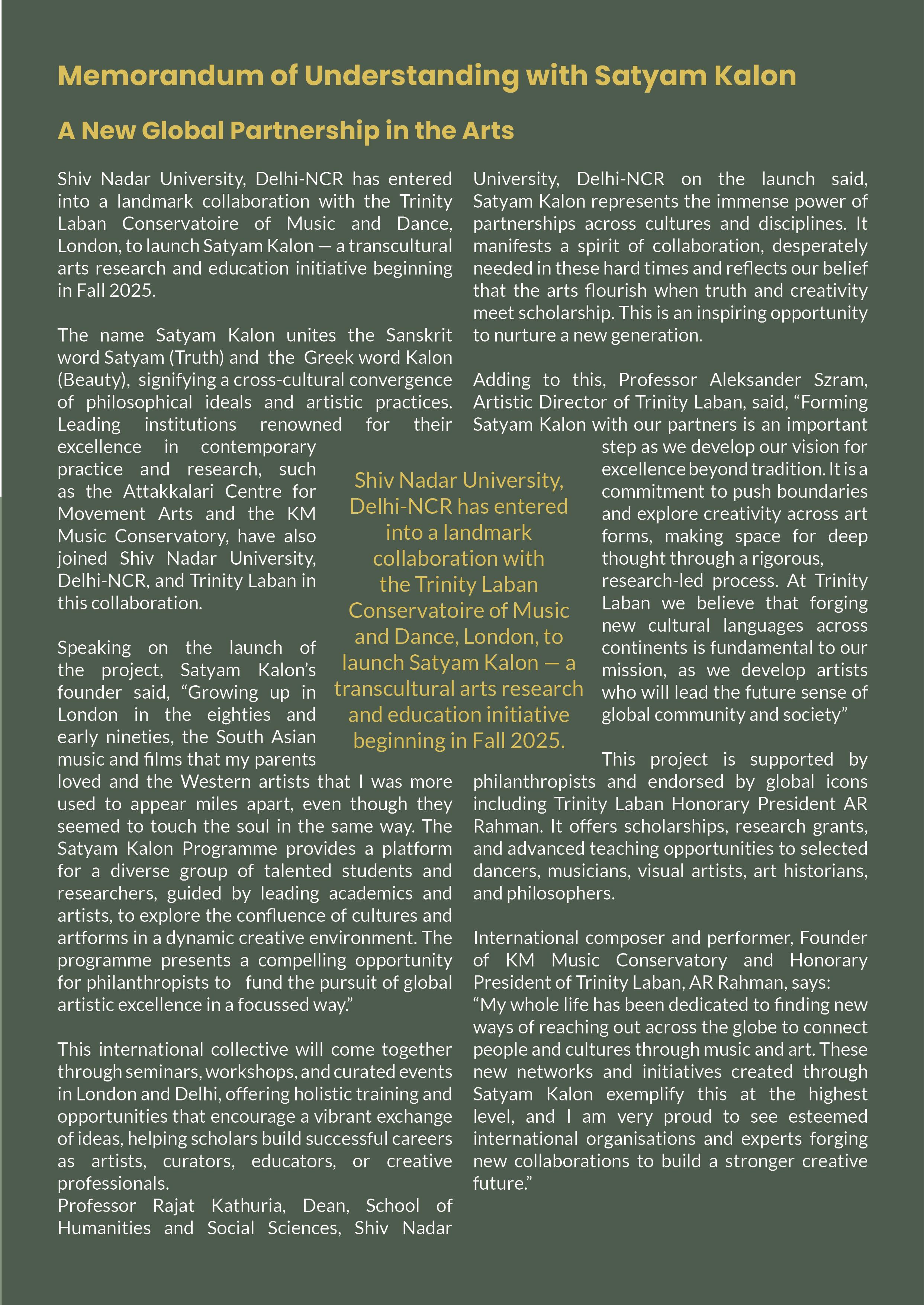
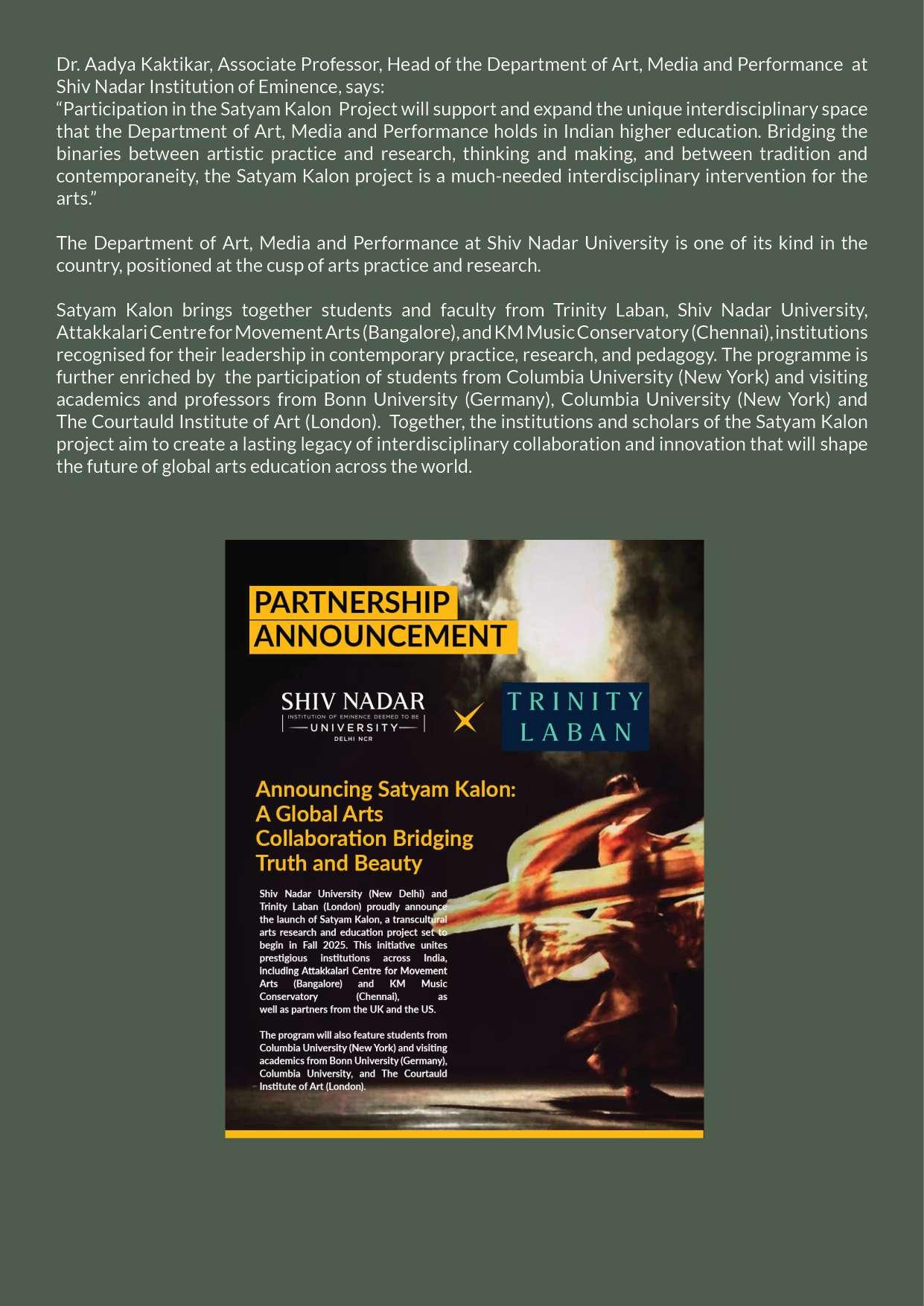
Satyam Kalon: An initiative in partnership with Trinity Laban that exemplifies our commitment to transcultural arts and education.
Queen Mary’s University of London: A collaboration that expands our horizons in Economics and Economics and Finance. This partnership provides students with the opportunity to gain invaluable experience at a premier global university, while offering a unique multicultural immersion.
These partnerships are designed to cultivate a diverse academic setting, ensuring our students are well-equipped to excel in a global context.
Here are a few highlights of the collaborations that were established.
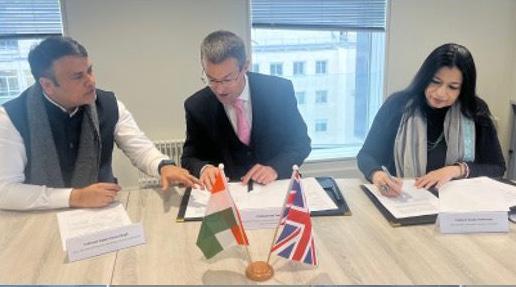
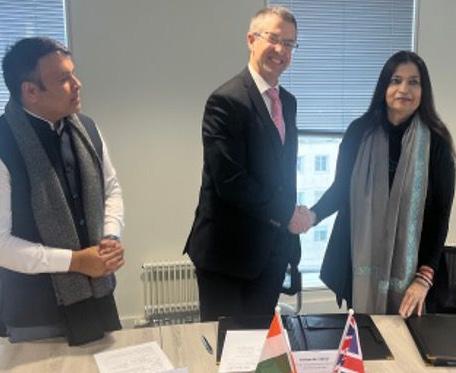
Shiv Nadar University has recently signed an agreement with Queen Mary University of London (QMUL), further strengthening India-UK educational ties. The formal ceremony took place at the QMUL campus.
This partnership will provide exciting prospects for students pursuing Economics and Economics & Finance. Participants in the integrated program will spend three years at Shiv Nadar University and one year at Queen Mary, earning an undergraduate degree from Shiv Nadar University and a Master’s degree from Queen Mary. The latter’s initiatives in Society and Environment will significantly enhance our interdisciplinary programs focused on sustainability.
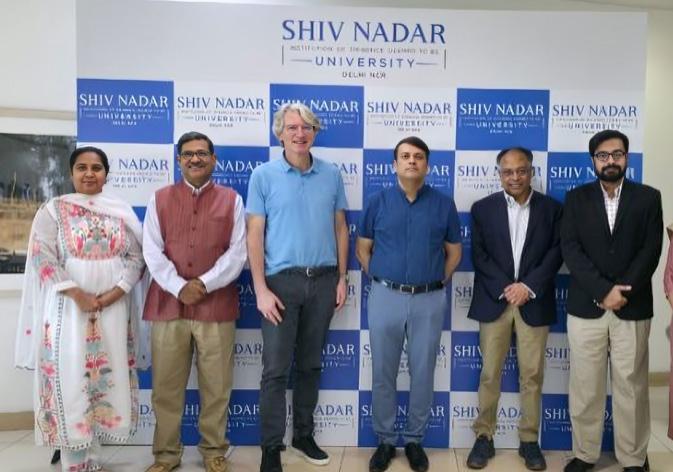
Earlier in the year, the Queen Mary team visited Shiv Nadar University to initiate conversations about collaboration. The Queen Mary delegation was led by Dr. Sujoy Mukerji, Director of Postgraduate Studies, alongside Jaspreet Kaur, Principal Adviser (South Asia), and Alp E. Atakan, Head of the School of Economics and Finance. The Shiv Nadar University team included Professor Rajat Kathuria, Dr. Rajeev Kumar Singh, Dean of International Programs, and Dr. Punarjit Roychowdhury, Associate Professor and Head of the Department of Economics and Finance.

HYDERABAD | October 24, 2025
Addressed around 200 All India Services and Central Civil Services Officers at the Dr. MCR HRD Institute, Government of Telangana, Hyderabad. The sessions covered topics on international trade and market failure & market intervention.
NEW YORK | OCTOBER 30, 2025
Served as a speaker for a session on “Sustainable Growth Models and Industrial Policy in the Global North and South” at the FES–IPD Workshop on “Progressive Trade Policy in a Changing Global Order,” hosted by Friedrich Ebert Stiftung (FES), New York.
THIRUVANANTHAPURAM | NOVEMBER 16, 2025

Invited to deliver the valedictory address, titled “Law and Economics of Regulation, Trade, and Climate: An Integrated Narrative.” at the 11th International Conference on Law and Economics at Centre for Development Studies, Thiruvananthapuram on the 16th of November.
• Presented a Workshop paper titled “Archaeological Fakery”, in the Conference ‘Fake, Fraud and Counterfeit: fraud as a way of knowing in Modernity’. Organized jointly by the Max Weber Forum for South Asia (MWF, India) and the Department of History, Ashoka University, Sonipat (Sept. 15-16 2025)
• Presented a paper titled “Negotiating Authority in the Deccan: Early Chalukyas of Vatapi (c.550-750 CE)” in the Conference titled Delving into the Deccan: conversations across disciplines’. Organized by the Department of History and the Centre for Interdisciplinary Archaeological Research, Ashoka University, Sonipat. (Nov. 7-8, 2025)
Ravi Nandan
Participated in and presented at the Death Care and Work in Asia Conference. The event was hosted by The Chinese University of Hong Kong and took place from October 31 to November 2. His presentation contributed to discussions surrounding the work of cremation.
Dr. Sreejata Paul (Assistant Professor, Department of English)
Her translation of Bengali poetry by Ramchandra Pramanik as The Opposite Bank and Other Poems was published by The Antonym Collections. To mark the publication, she organised an event on 4th September that included the launch of the book as well as a panel on speculative writing featuring SHSS faculty and representatives from the esteemed publisher.
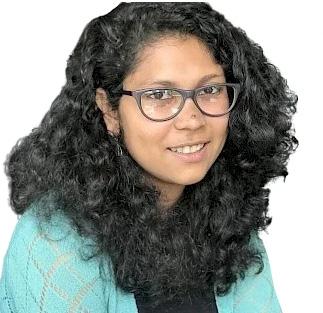
Dr. Shraman Banerjee (Assistant Professor, Department of Economics)
Published an article titled ‘India’s Tryst With Strategic Experimentation’ on India’s policy with R&D and innovation, based on one of his recent research. It has been published in the international news magazine, The Diplomat.
Link: India’s Tryst With Strategic Experimentation – The Diplomat
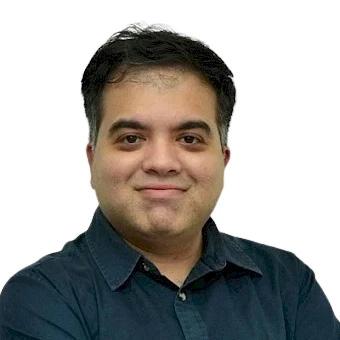
Mohmmaed Asaf (PhD
scholar, Department of Sociology)
Has received a grant of $24,960, July 2025 to July 2026, for his project titled ‘Swear to Allah: Towards an Ethnography of Complaints, Swearing, and Settlement Practices at Kodinhi Juma Masjid in Kerala, India.”
Aryaa Singh (M.A. Student, Department of English)
Has published two works in PostScript, the online literary journal of The English Literary Society, St. Stephen’s College, University of Delhi.
1st Publication:
Issue XIII – Margins of Existence: The Textuality of Identity and Meaning
Link: “What’s the use of stories that aren’t even true?”: Mapping Intertextuality and Hybridity in Rushdie’s Haroun and the Sea of Stories
2nd Publication:
Issue XIV — I See Dead People: Supernatural Othering in Visual Media
Link: Genuine and the New “Phallic” Woman in Germany
Megha Mazumdar (PhD Student, Department of English)
Has been selected as a reviewer at British Association for Victorian Studies (BAVS) (September 2025-to date).
Economics Students Kavyaa Kannan and Nishant Mishra Reach Final Rounds of Rhodes Scholarship
Two fourth-year students from the Department of Economics, Kavyaa Kannan and Nishant Mishra, came impressively close to securing the prestigious Rhodes Scholarship. Both students advanced to the interview stage, showcasing their exceptional academic achievements, leadership skills, and commitment to impactful work.
Their journey to the final rounds highlights not only their individual talents but also the strong foundation provided by their education at Shiv Nadar University. Although they narrowly missed out on the scholarship, their experience and dedication demonstrate the caliber of students within the department and serve as an inspiration for their peers. Their accomplishments reflect the university’s ethos of fostering excellence and ambition, reinforcing the idea that such recognition is a stepping stone toward future success.
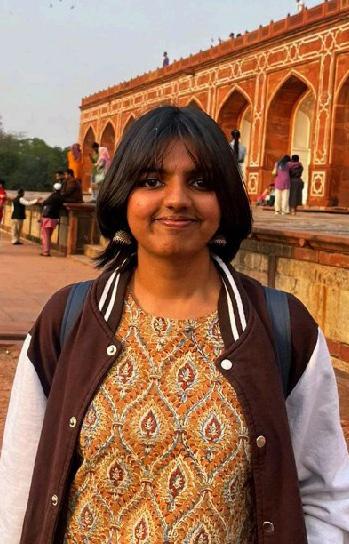
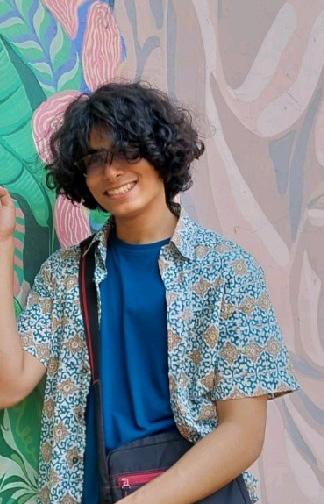
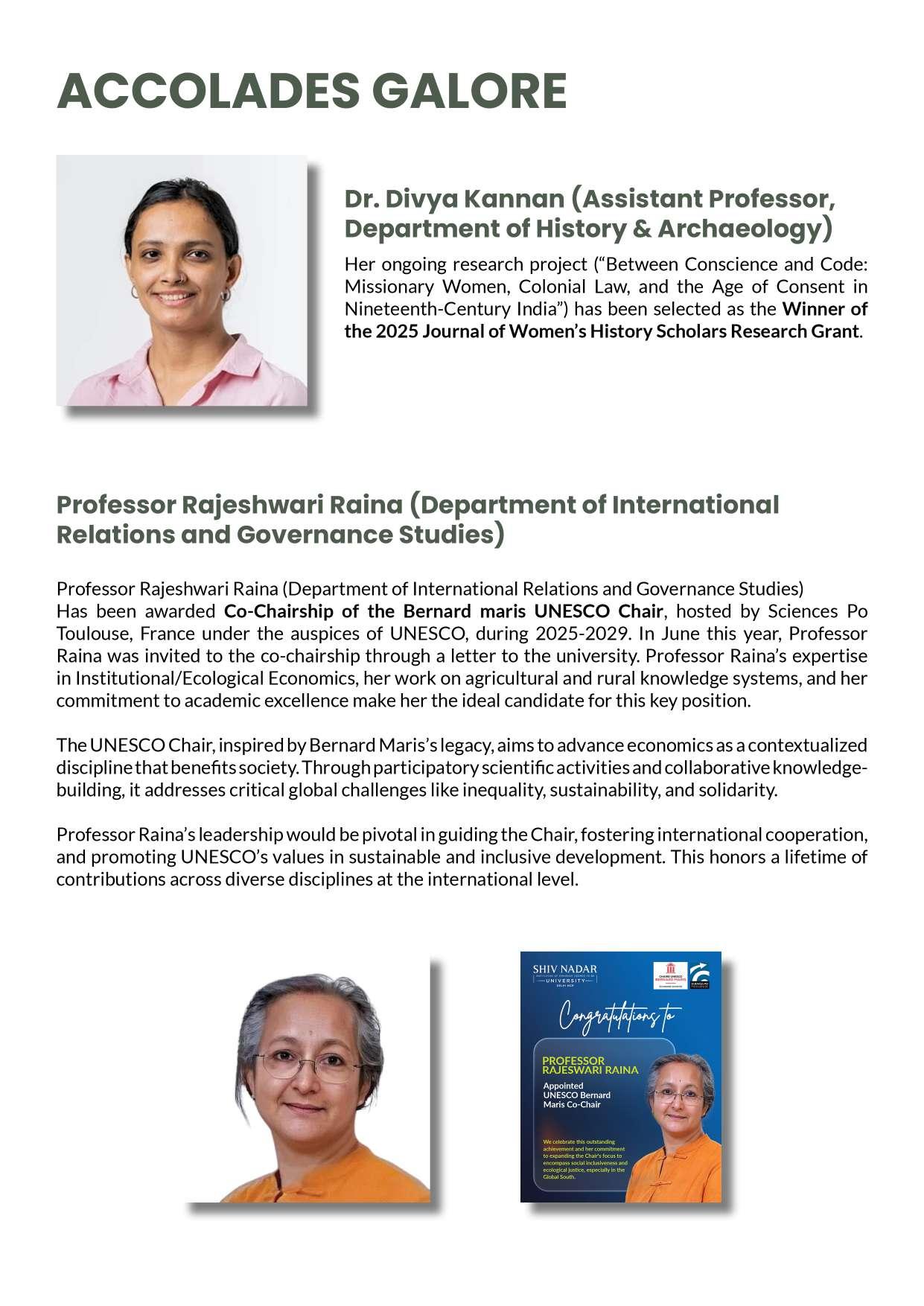
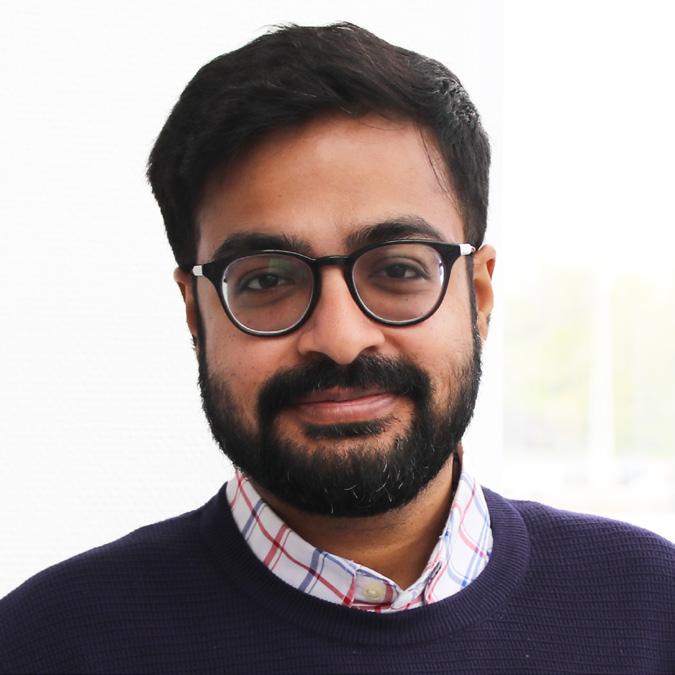
Has been appointed as a Research Affiliate of The Households in Conflict Network (HiCN), Germany.
The Households in Conflict Network is a global research network that brings together scholars studying the micro-level consequences of violent conflict and strategies for recovery and resilience. HiCN promotes interdisciplinary research on how conflict affects individuals, households, and communities, and provides a platform for collaboration among researchers, policymakers, and practitioners.
As a Research Affiliate, Dr. Roychowdhury joins an international community of leading economists and social scientists working on conflict, development, and political economy. This affiliation recognizes his ongoing research on conflict and economic mobility in India and further strengthens the department’s engagement with global research networks.
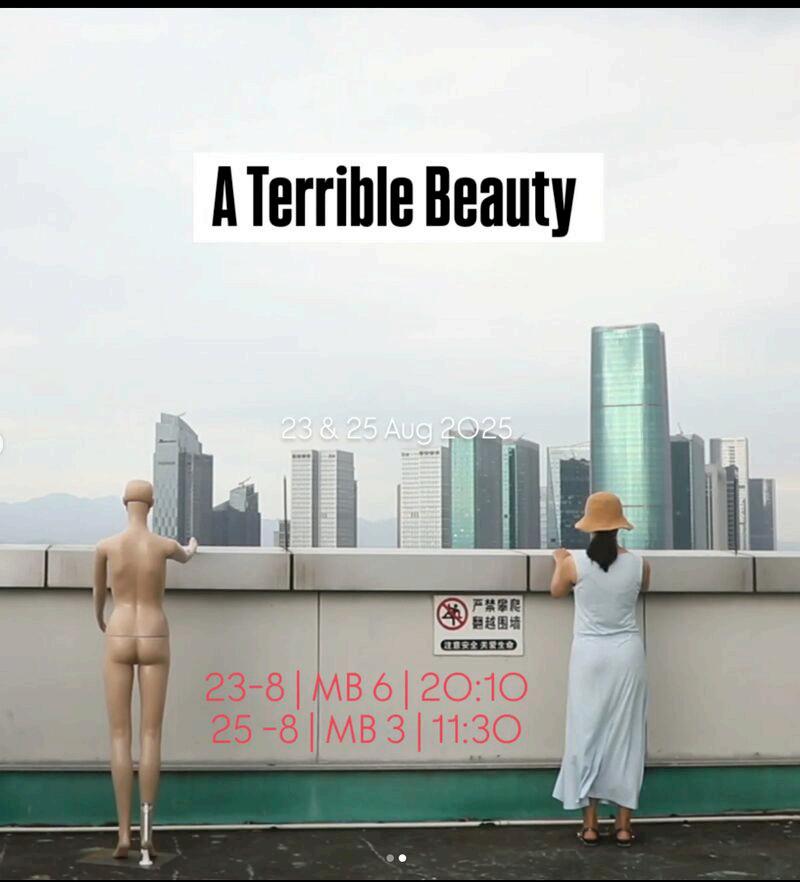
Her work, ‘A Terrible Beauty’, was an Official Selection and has been screened in the International Medium Length & Short Film Competition at Visions du Réel International Film Festival, Nyon (Switzerland); FilmMyDesign Festival, Cairo (Egypt); Around The World Again, Pirate Cinema, CAMP Rooftop, Mumbai; and the Asian Women’s Film Festival by IAWRT.
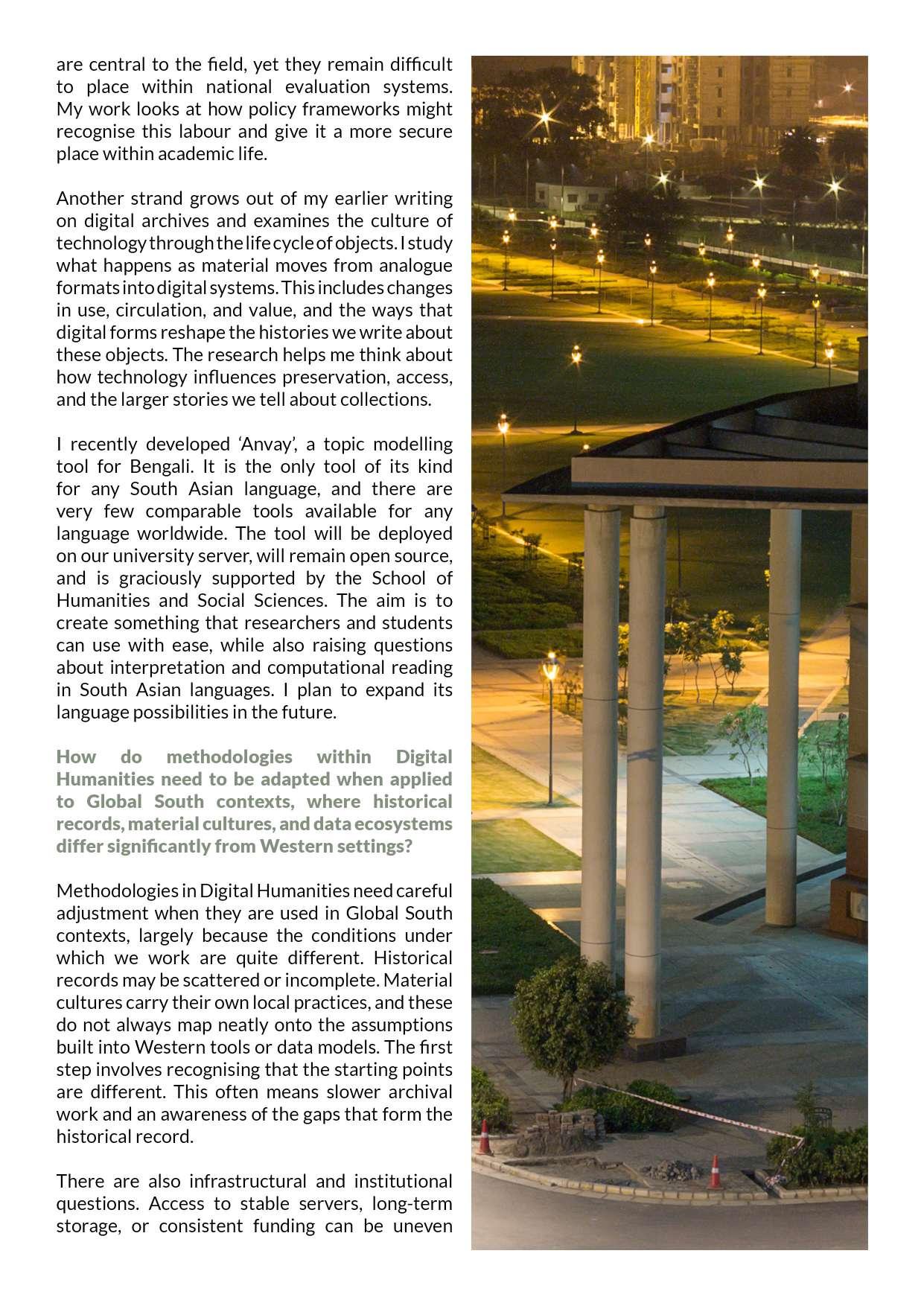
across the Global South. These conditions call for methods that can accommodate limited resources while still supporting research aims. It helps to design projects that are incremental and sensitive to the kinds of data that are actually available.
Language plays a major role as well. Scripts, orthographies, and multilingual environments shape how we process and interpret material. Tools built with Western languages in mind often need adaptation, whether through new tokenisation methods, adjusted metadata schemas, or workflows that reflect regional priorities. In many cases, scholars have to create their own pipelines or interfaces because existing solutions do not support their needs.
All of this points to the value of grounded, flexible methodologies. Digital Humanities in the Global South often grows from local knowledge and local problems. It requires approaches that respect these conditions and take them as a starting point for digital work.
How did you get into the field of Digital Humanities?
My entry into Digital Humanities was, in some sense, a matter of proximity and curiosity. As an undergraduate, I witnessed the formation of the School of Cultural Texts and Records at Jadavpur University in the mid-2000s. It is one of the earliest and most influential centres for Digital Humanities in India. I didn’t yet have the vocabulary for what I was seeing, but the work being done there--digitising rare texts and developing archival infrastructure—made a deep impression. It revealed that scholarship could be simultaneously technical and interpretative.
Over the years, I grew more fascinated with the possibilities. I joined the Bichitra project, the digital variorum of Rabindranath Tagore’s works, as a project fellow, and that experience shaped much of my thinking about what DH could mean in the Indian context. In 2011, I began my PhD in the field, focusing on questions of digital curation and the evidentiary life of photographs from colonial India. So while my path into DH was gradual, it was always anchored in a fascination with how technology reframes acts of preservation and reading.
In what ways do you foresee job roles within the humanities evolving with the growing integration of digital humanities?
The integration of Digital Humanities is already transforming how we define work in the humanities. Today, scholars in my field are also designers, data curators, project managers, and collaborators in interdisciplinary teams. New roles are emerging at the intersection of scholarship and infrastructure: digital archivists, data librarians, research software engineers, metadata specialists, and digital heritage curators. These positions demand both critical literacy and technical fluency, but also a sensitivity to cultural and ethical questions that remain central to the humanities.
At the same time, traditional roles are being redefined. Historians, literary scholars, and art historians, for instance, are increasingly engaging with data visualisation, computational analysis, and digital preservation as part of their interpretative practice. The future of humanities work will likely be hybrid: part interpretative, part technical, but wholly humanistic in its curiosity.
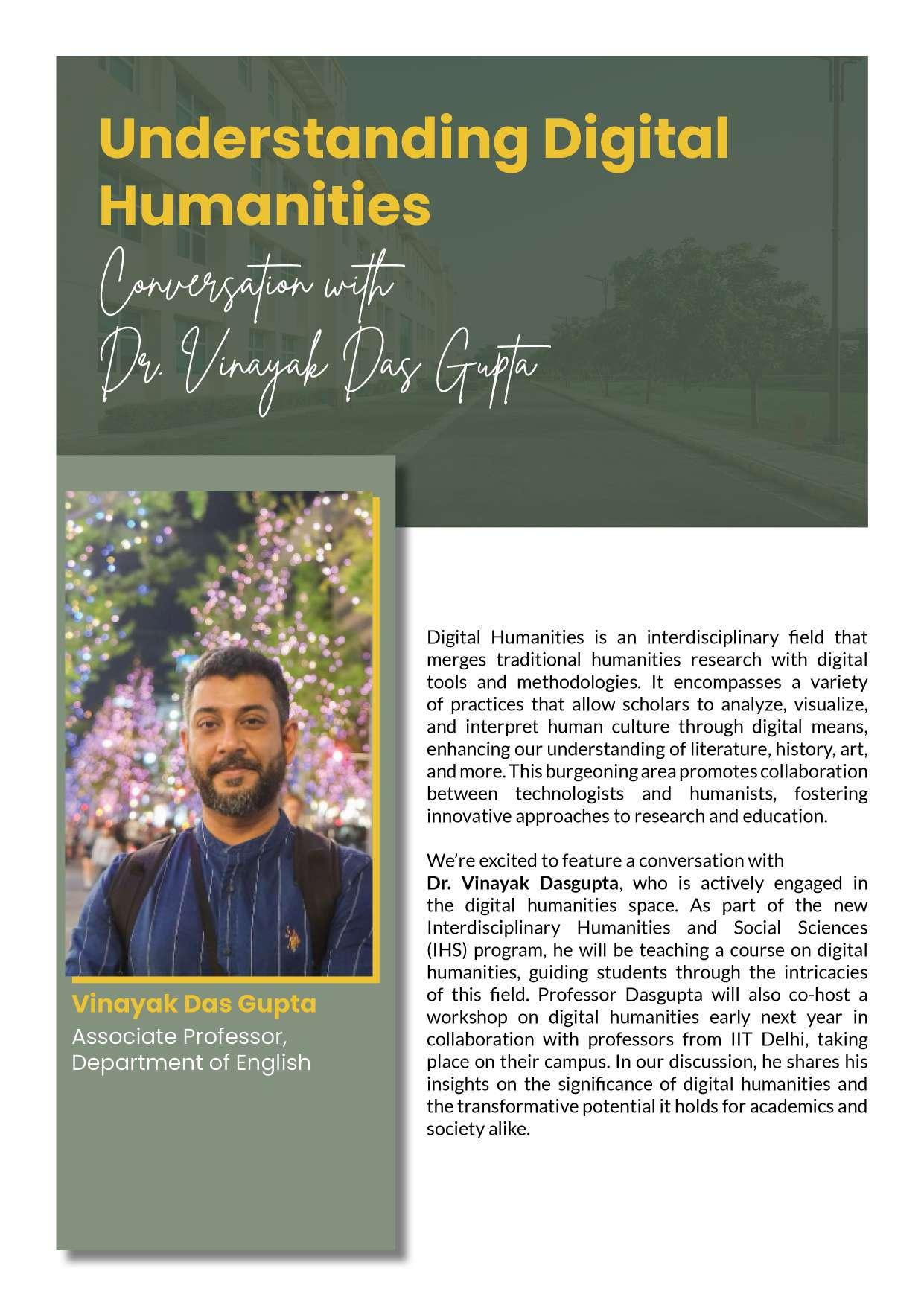
The views expressed are personal to the interviewee. The interview was conducted by Swarna Avyacta V, Research Assistant
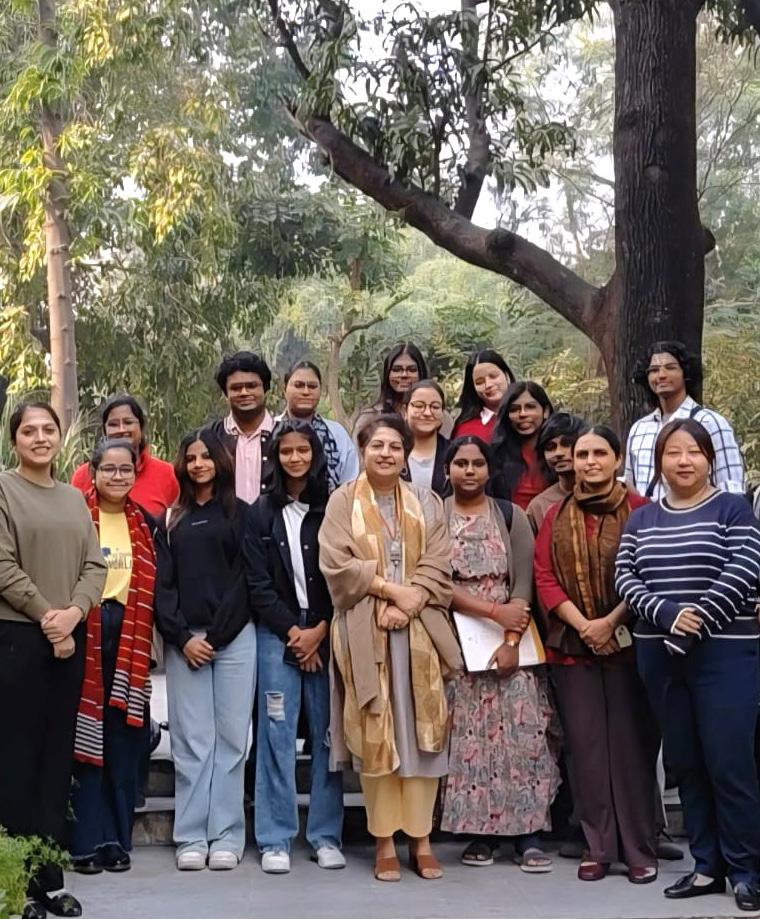
Students with the INTACH Principal Director-
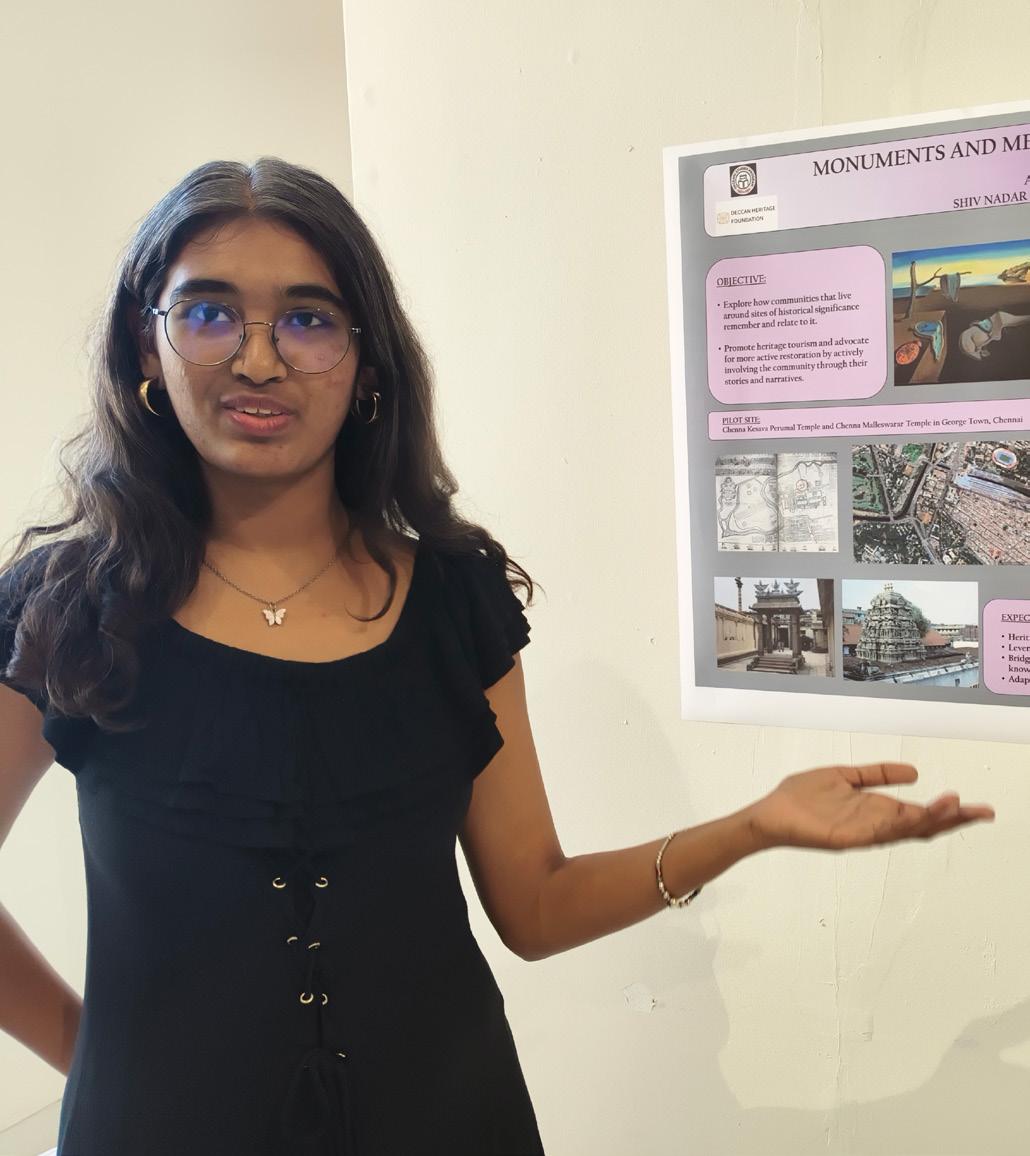
A Niveditha, 3rd year undergraduate student, Department of History and Archaeology, presented her paper on “Monuments and Memories – A Methodology,” at the “Delving into the Deccan” conference by Ashoka University.
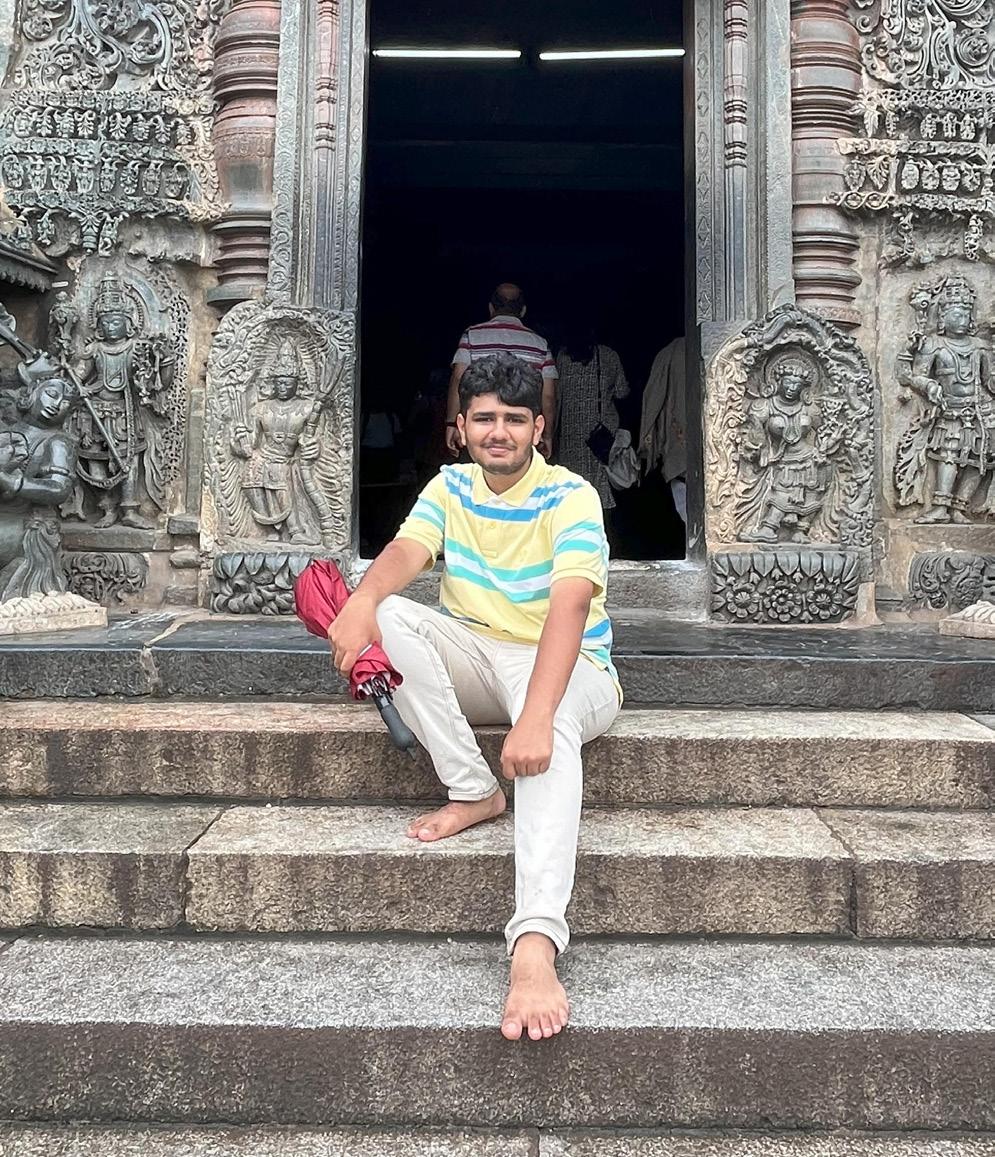
Sudhanva, 3rd year undergraduate student, Department of History and Archaeology, was part of an internship program ‘Deccani Studies Program’ hosted by the Deccan Heritage Foundation, Ashoka University.
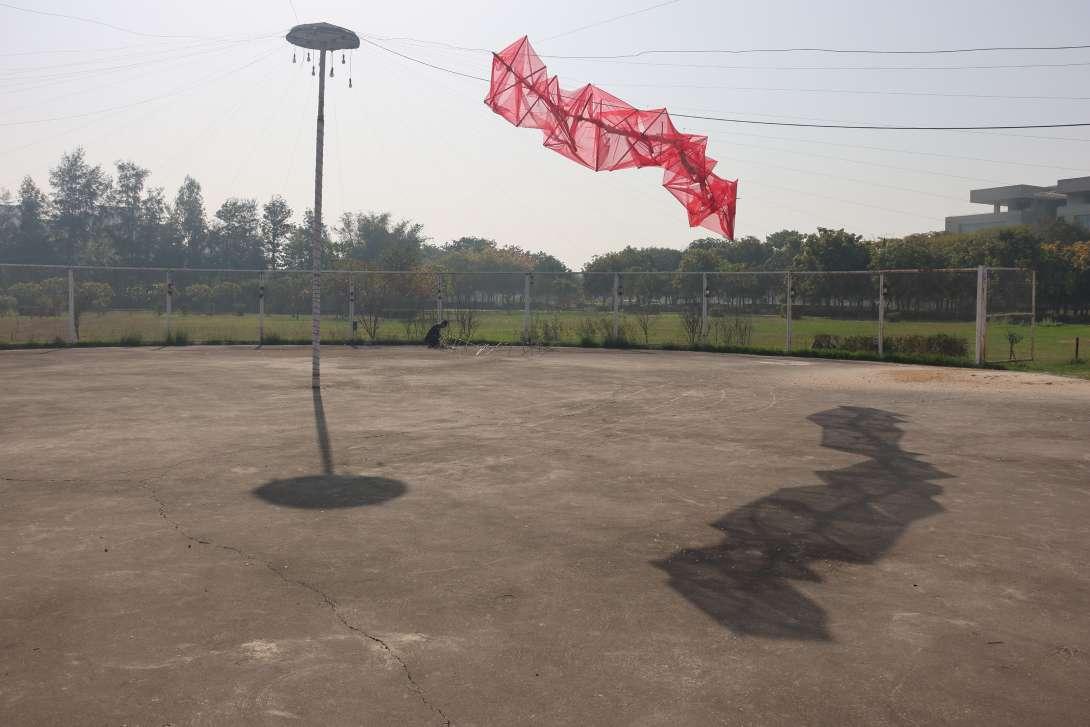
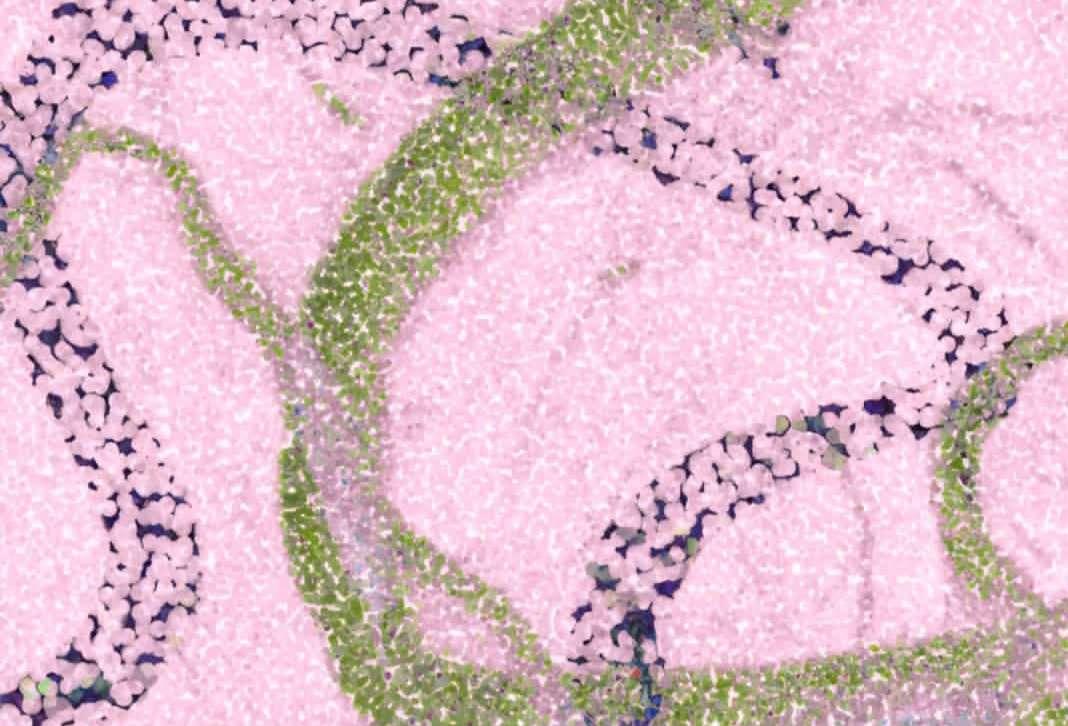
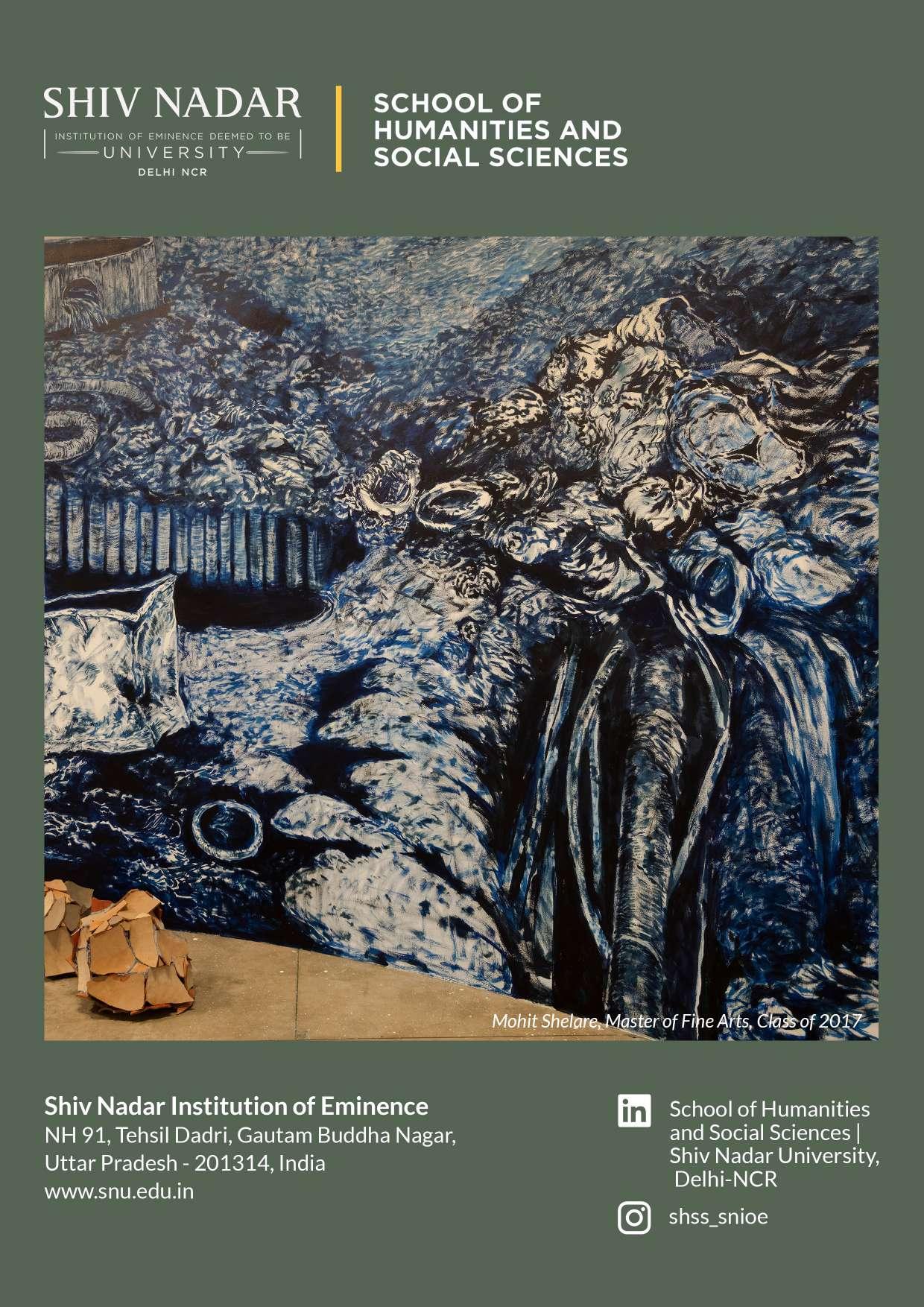
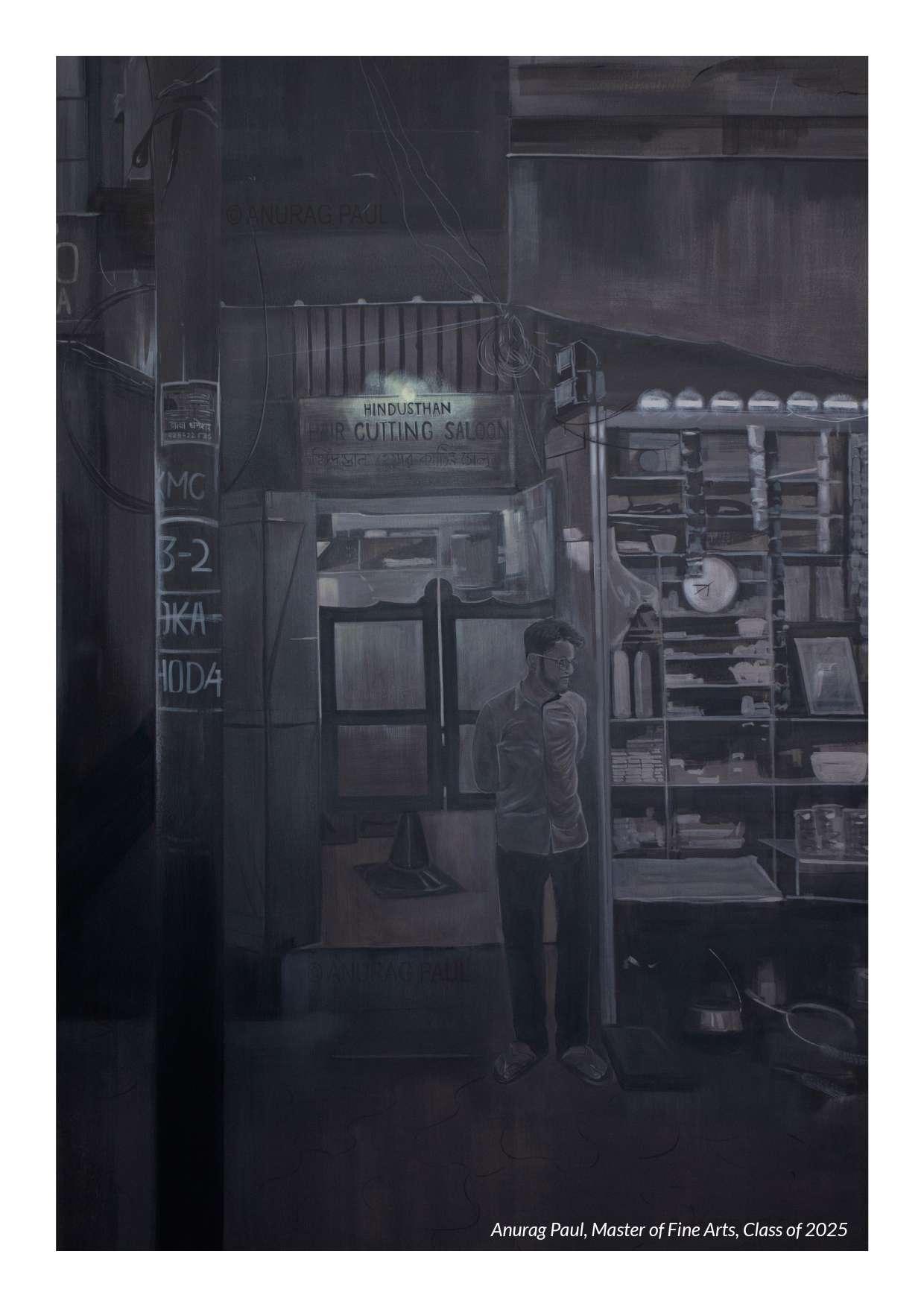
Thank you, Aadya Kaktikar and Iram Gufram, for sharing the artwork of MFA students.