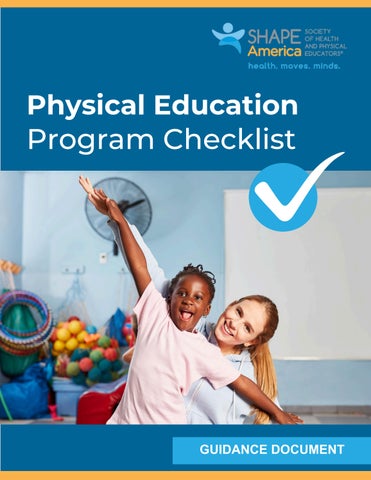
Physical Education Program Checklist

Physical Education Program Checklist
Acknowledgements
SHAPE America extends its appreciation to the many professionals whose work continues to advance the health and physical education profession.
Copyright © 2026 by SHAPE America | All rights reserved.
PO Box 225
Annapolis Junction, MD 20701
800-213-9527
SHAPE America – Society of Health and Physical Educators serves as the voice for 200,000+ health and physical education professionals across the United States The organization’s extensive community includes a diverse membership of health and physical educators, as well as advocates, supporters, and 50+ state affiliate organizations
Since its founding in 1885, the organization has defined excellence in school-based health education and physical education For decades, SHAPE America’s National Physical Education Standards have served as the foundation for well-designed physical education programs across the country, just as the SHAPE America National Health Education Standards serve as the foundation for effective skills-based health education Together, these national standards provide a comprehensive framework for educators to deliver high-quality instruction and make a positive difference in the health and well-being of every preK-12 student
Find additional resources at shapeamerica org
INTRODUCTION
This guidance document is designed to help school administrators, principals, teachers and parents review their schools’ physical education programs to ensure they are addressing what SHAPE America has identified as the “essential components” of physical education.
In Essential Components of Physical Education, SHAPE America outlines the policies and practices that should be in place in school-based physical education programs. The guidance document defines the four essential components of physical education and provides an in-depth explanation of each: policy and environment; curriculum; appropriate instruction; and student assessment.
Use the checklist that begins on page 8 to identify which policies and practices from the Essential Components document are in place in your school district or school Your responses will identify areas of strength and inform you of areas that need adjustment. Once you have documented the program elements that are in place, prioritize the elements that need to be adjusted and use the results from this process to improve your PE program.
For a comprehensive review of the overall school health environment, the Centers for Disease Control and Prevention provides the School Health Index (SHI): Self-Assessment & Planning Guide, an online self-assessment and planning tool that schools can use to improve their health and safety policies and programs. Module 3 of the SHI addresses physical education and other school-based physical activity programs, and contains some items that are also included in this Physical Education Program Checklist. The checklist enables school leaders to look closely at physical education program elements. Items included in both tools are identified with an asterisk (*) in the first column of the checklist.
Before examining your physical education program using the Physical Education Program Checklist, we suggest that you gather and read the documents below to prepare for conducting your analysis:
• SHAPE America National Physical Education Standards
• Essential Components of Physical Education
• State physical education standards
• State physical education policy
• School district or school physical education policy
• School district or school wellness policy
• School district or school physical education curriculum
• School master schedule
• School district or school employee handbook
After reading the documents listed above, review the checklist that begins on the following page and indicate whether each program element is in place (Yes), not in place (No) or in progress. For components that are in progress, indicate their degree of completion in the comments field.
Information to address in the comments field could include: timeline for curriculum development or revision; school improvement plan goals and objectives for physical education; target completion dates for local school wellness policy or other policy development; individualized teacher professional-development plans; or a copy of school district or school student assessment and grading protocols. When referencing policies, indicate in the comments field where the policies are located in the school district or school policy manual.
Every student is required to take daily physical education, with instruction periods totaling 150 minutes/week in elementary and 225 minutes/week in middle and high school.*
School district or school policy requires all students to take physical education daily.
School district policy specifies weekly instruction time requirements for physical education by grade.
Elementary school schedule shows instruction periods totaling 150 minutes/ week for all grades.
Middle school schedule shows instruction periods totaling 225 minutes/week for all grades.
High school schedule shows instruction periods totaling 225 minutes/week for all grades.
School district or school report card shows annual reporting of physical education minutes of instruction for all grades, preK-12.
School districts and schools are aligned with Federal law and other legal policies: Americans with Disabilities Act (ADA); Section 504 of the Rehabilitation Act; and Individuals with Disabilities Education Act (IDEA).
School district or school policy reflects that of IDEA which requires that students with disabilities participate in physical education with children without disabilities to the maximum extent possible.
School districts and schools do not allow waivers from physical education class time or credit requirements.*
School districts and schools do not allow student exemptions from physical education class time or credit requirements.
School districts and schools prohibit students from substituting other activities for physical education class time or credit requirements.*
Physical education class size is consistent with that of other subject areas and aligns with school district and school teacher/student ratio policy.*
School district or school policy must align with Federal policy and IDEA, noting that physical education may be a part of the special education services prescribed in a students’ individualized education program (IEP). Once a student has an IEP with language noting supports in physical education, appropriate services must be provided.
School district or school policy requires that any state-mandated access of physical education be provided to all students in grades preK-12.
School district or school policy prohibits any student from being exempt from physical education class time or credit requirements for any reason.
School district or school policy prohibits students from substituting other activities (e.g., JROTC, interscholastic sports, marching band, AP courses) for physical education class time or credit requirements.
School district or school policy requires that physical education class size is consistent with that of other subject areas and aligns with school district and school teacher/ student ratio policy.
Physical activity is not assigned or withheld as punishment.
Physical education is taught by a state-licensed or state-certified teacher who is endorsed to teach physical education.*
School district or school policy prohibits all school employees from assigning physical activity to students as punishment.
School district or school policy prohibits all school employees from withholding physical education, recess or any physical activity from students as punishment.
School district or school policy requires that physical education is always taught by a state-licensed or state-certified teacher who is endorsed to teach physical education.
School districts and schools should have a written physical education curriculum for grades preK-12 that is sequential and comprehensive.* Published school district or school physical education curriculum includes grades preK12 and is sequential and comprehensive. Essential elements include:
• Alignment in written curriculum and lesson plans to national and/or state physical education standards.
• Comprehensive learning objectives for grades preK-12.
• Instructional units and corresponding lessons are student-centered, with standards-aligned assessments for each lesson.
• Expected instructional strategies and practices that engage students in moderate-to-vigorous physical activity for at least 50 percent of class time.
• A listing of books, materials, technology, websites and equipment necessary for learning activities that connect to your student population.
• Standards-based formative and summative assessments, as well as tests and/or quizzes for grading.
• Scope and sequence document for grades preK-12.
• Pacing guide or curriculum map.
The physical education curriculum is based on national and/or state standards and grade-span learning indicators for physical education.*
The school district or school physical education curriculum is published and cites the related national and/or state standards and grade-span learning indicators in each lesson.
The standards-based curriculum aligns with the current emphasis on physical literacy journeys, skill development and connections to meaningful movement for a lifetime.
The physical education curriculum mirrors other school district and school subject areas in its schedule for periodic review, updates or adoption cycles.
The school district or school physical education curriculum is consistent with the design of the curricula for other subject areas.
School district or school policy establishes a schedule for periodic physical education curriculum review that is consistent with the review schedule for other subject areas.
The physical education teacher uses instructional practices and consistent practice tasks that support the goals and objectives defined in the school district’s/school’s physical education curriculum (e.g., differentiated instruction, active engagement, continuous feedback, modified activities, self-assessment).
The physical education teacher assesses and evaluates learning continually to document student progress as well as teacher effectiveness.
The school district’s or school’s physical education lesson plan template requires documentation of instructional practices and deliberate practice tasks.
The physical education teacher employs instructional practices that engage students in moderate to vigorous physical activity (MVPA) for at least 50 percent of class time.
Physical education lesson plans document formative and summative assessments that align with student learningobjectives for each lesson.
The physical education teacher examines and documents evidence of student learning to continuously adjust instruction.
The physical education teacher selfmonitors student engagement in MVPA for at least 50 percent of class time on a regular basis.
Principal/supervisor observation of physical education classes includes analysis of student engagement in MVPA for at least 50 percent of class time, along with instructional best practices.
The physical education teacher uses inclusive practices to ensure that students with disabilities can meaningfully access the curriculum, like their peers.
The physical education teacher includes strategies for differentiation, adaptations and/or modifications in each lesson within the curriculum, addressing each student’s IEP. The lesson plan should include differentiation in; teaching strategies, equipment, physical environment and assessment.
The physical education teacher encourages students with disabilities to have the same roles and experiences as their peers during physical education and other physical activities.
Student assessment is aligned with national and/or state physical education standards and grade-span learning indicators. Assessment is included in the written physical education curriculum along with administration protocols.
Student assessments in physical education align with standards-based grade-span learning indicators and are included in the written physical education curriculum.
Formative assessments are frequently in use and accompanied by growth-oriented feedback and reflection. Summative assessments allow for a comprehensive view of student learning and inform future instructional change.
Protocols for administering student assessments are defined clearly in lesson plans and are included in the written physical education curriculum.
Teachers engage students in their own learning and assessment process throughout the lesson, focusing on assessment for learning, not assessment of learning.
Student assessment includes evidencebased practices that measure student progress in all areas of instruction.
Student progress is measured using student assessments that address national and/or state physical education standards and established grade-span learning indicators.
Fitness measurement practice is utilized for personal student reflection, cognitive connections in fitness education and goal setting.
Grading is related directly to the standards-based student learning objectives identified in the written physical education curriculum.*
Fitness measurement or other measures of physical outcomes are not used for grading student progress or teacher evaluation in physical education.
Student assessment in fitness education is related directly to the established gradespan learning indicators from the national and/or state physical education standards.
The school or school district’s written physical education curriculum provides standards-based grading rubrics that are aligned with student learning objectives identified in the written physical education curriculum.
The school district or school requires physical education grades to be included on report cards for all grades.
The physical education teacher follows school district and school protocols for reporting and communicating student progress to students and parents.
The school district or school has established protocols for reporting and communicating student progress in physical education to students and parents.
REFERENCES
Centers for Disease Control and Prevention. (2014). School health index (SHI): Self-assessment & planning guide. SHAPE America.
SHAPE America – Society of Health and Physical Educators. (2024). National physical education standards (4th ed.). Human Kinetics.
SHAPE America – Society of Health and Physical Educators. (2025). The essential components of physical education [Guidance document].
SHAPE America – Society of Health and Physical Educators. (2009). Appropriate instructional practice guidelines, K–12: A side-byside comparison [PDF]. Reston, VA: SHAPE America. Retrieved from https://www.shapeamerica.org/standards/guidelines/appropriatepractices.aspx
SHAPE America – Society of Health and Physical Educators. (2017, March 6). Appropriate and inappropriate practices related to fitness testing [Position statement]. Reston, VA: SHAPE America. Retrieved from https://www.shapeamerica.org/standards/guidelines/appropriate-practices.aspx
Suggested Citation:
SHAPE America – Society of Health and Physical Educators (2026). Physical Education Program Checklist [Guidance Document]. Annapolis Junction, MD: Author.