Essential Components of Physical Education
Essential Components of Physical Education
Acknowledgements
SHAPE America extends its appreciation to the many professionals whose work continues to advance the health and physical education profession.
Copyright © 2026 by SHAPE America | All rights reserved.
PO Box 225
Annapolis Junction, MD 20701
800-213-9527
SHAPE America – Society of Health and Physical Educators serves as the voice for 200,000+ health and physical education professionals across the United States. The organization’s extensive community includes a diverse membership of health and physical educators, as well as advocates, supporters, and 50+ state affiliate organizations.
Since its founding in 1885, the organization has defined excellence in school-based health education and physical education. For decades, SHAPE America’s National Physical Education Standards have served as the foundation for well-designed physical education programs across the country, just as the SHAPE America National Health Education Standards serve as the foundation for effective skills-based health education. Together, these national standards provide a comprehensive framework for educators to deliver high-quality instruction and make a positive difference in the health and well-being of every preK-12 student.
Find additional resources at shapeamerica.org.
INTRODUCTION
Physical education is recognized as essential to a young person’s comprehensive education experience and the foundation for an active and healthy lifestyle into adulthood. Over the past decade, physical education has undergone a transformation. That transformation includes providing meaningful connections to personalized movement opportunities, focusing on all learning domains for students and incorporating a more student-centered practice.
SHAPE America helped spearhead that transformation and provided a framework for modern physical education in its book National Physical Education Standards, Fourth Edition (2025).
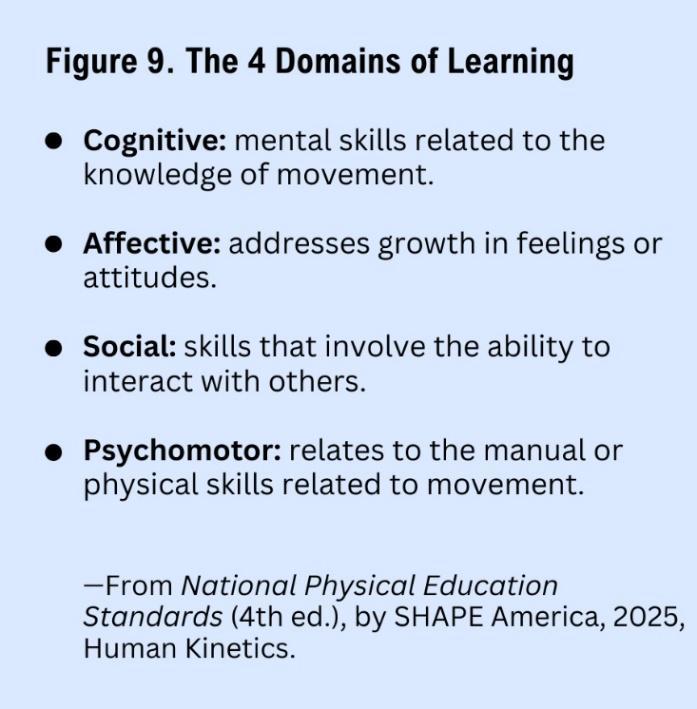
The SHAPE America National Physical Education standards consider the psychomotor, cognitive, social and affective learning domains essential to facilitating the physical literacy journey of preK-12 learners.
As stated in Figure 1, the physical literacy journey involves the ongoing acquisition and application of knowledge, skills and dispositions necessary for engagement in a lifetime of healthful and meaningful physical activity.
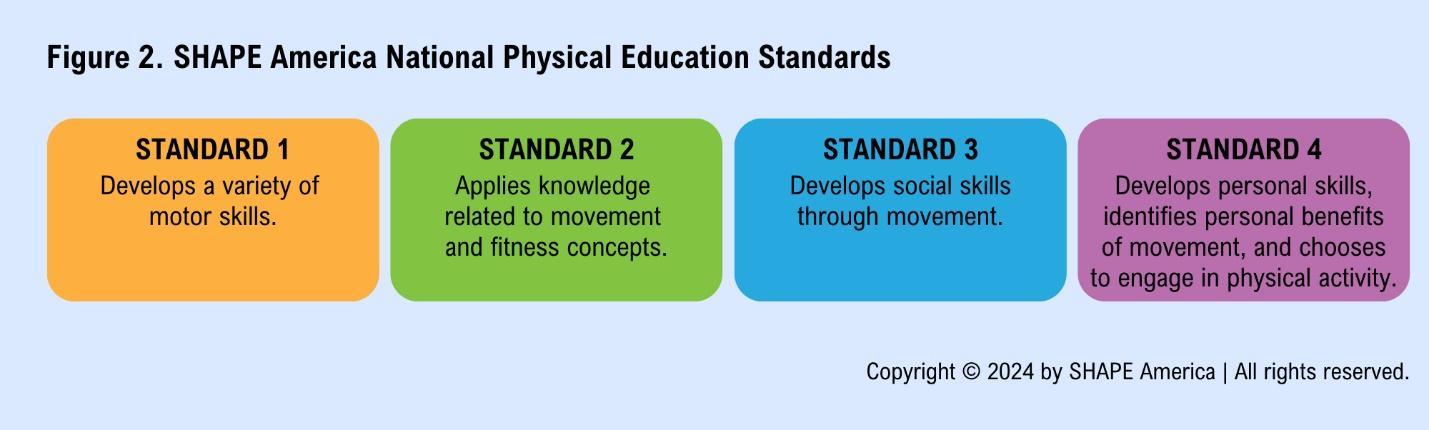
The National PE Standards (Figure 2) and their accompanying grade-span learning indicators lay out a framework for teaching and learning and provide what skills and knowledge students are expected to acquire
Figure 1. Physical Literacy Journey
The physical literacy journey is inclusive and is based on the premise that everyone can acquire the knowledge and skills to move more confidently in physical activities that are motivating and enjoyable to the individual.
The physical literacy journey of our preK12 learners is dependent on effective instruction.
The new National Physical Education Standards are designed so that teachers can build learning experiences that engage all learners in their own meaningful physical literacy journey.
From National Physical Education Standards (4th ed., p. 3), by SHAPE America, 2025, Human Kinetics
The purpose of this guidance document is to delineate the essential components that provide the structure for a physical education program, while also identifying physical education as a key element of a well-rounded education for all students.
NATIONAL RECOMMENDATION FOR PHYSICAL ACTIVITY
In 2018, the U.S. Department of Health and Human Services issued Physical Activity Guidelines for Americans, 2nd Edition. The guidelines state that children ages 6 through 17 should engage in 60 minutes or more of moderate-to-vigorous physical activity daily (USDHHS, 2018, p. 48). Physical activity is important to the overall health and well-being of all people, including schoolaged children.
The benefits associated with physical activity are well researched and documented and include mitigation of many health risks (CDC, 2022) Physical activity contributes to the building and maintenance of bones and muscles, and improves health-related fitness as well as social and mental health (CDC 2022b, USDHHS, 2018).
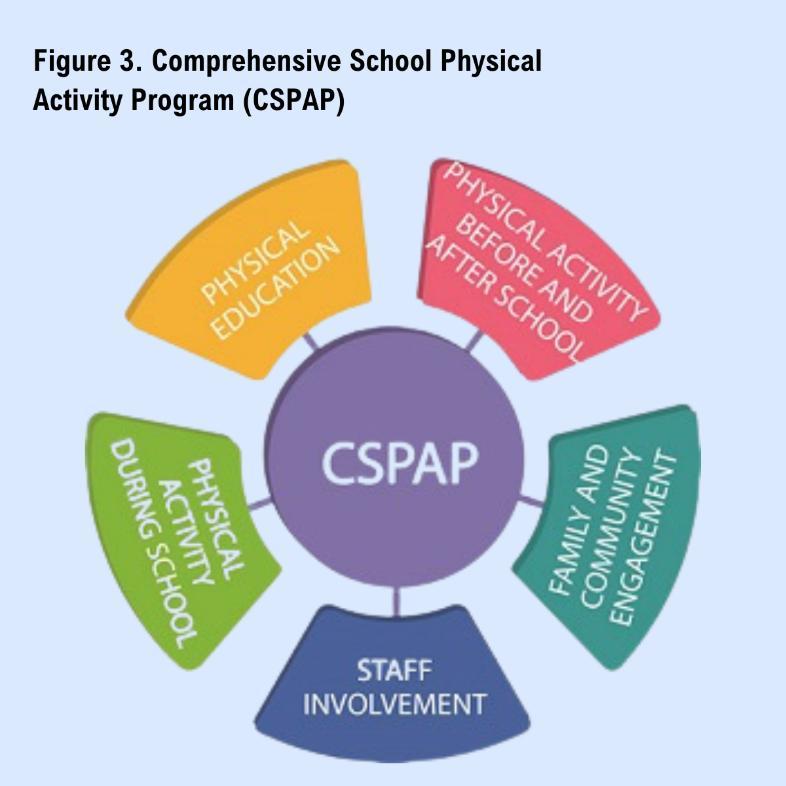
The Comprehensive School Physical Activity Program (CSPAP) has been recognized as the national framework for physical education and physical activity for young people (CDC, 2014, p. 2) This framework (Figure 3) supports comprehensive physical activity participation among young people.
A CSPAP not only educates youth in the knowledge and application of skills learned but also mobilizes them to apply what they have learned and to adopt a healthy lifestyle.
A CSPAP is a multi-component approach by which school districts and schools use all opportunities for students to be physically active throughout the school day in order to meet the national physical activity recommendation (CDC, 2013, p. 12)
The five components of a CSPAP are:
1. Physical education;
2. Physical activity during school;
3. Physical activity before and after school;
4. Staff involvement; and
5. Family and community engagement
To learn more about CSPAP, read the SHAPE America position statement Comprehensive School Physical Activity Programs: Opportunities and Access for All.
PHYSICAL EDUCATION: THE FOUNDATION OF CSPAP
Physical education is an academic subject and serves as the foundation of a CSPAP and, as such, demands the same educational access and instructional rigor as other core subjects. Physical education provides students with a planned, sequential, preK-12 standards-based program of curricula and instruction designed to develop motor skills, knowledge and behaviors for active living.
During physical education, students practice the knowledge and skills they learn through meaningful movement experiences Physical education is not synonymous with physical activity or exercise. Moreover, the type of movement that is essential to student health is moderate-tovigorous physical activity (MVPA). Physical educators should provide students with at least 50% of daily instruction time dedicated to engagement in MVPA. This provides the basis for healthenhancing movement and directly impacts the CDC recommended daily amount of 60 minutes of MVPA for students.
It is important to clarify the common technical language used in physical education The terms physical activity, exercise, and physical education are often used interchangeably; however, as shown in Figure 4, they clearly define three very different things.
PHYSICAL ACTIVITY: Physical activity is any bodily movement that results in energy expenditure.
EXERCISE: Exercise is any physical activity that is planned, structured and repetitive for the purpose of improving or maintaining one or more components of fitness.
PHYSICAL EDUCATION: Physical education is an academic subject that provides a planned, sequential, preK-12 standards-based program of curricula and instruction designed to develop motor skills, knowledge and behaviors for healthy, active living, physical fitness, sportsmanship, self-efficacy, and emotional intelligence.
SHAPE America posits that effective physical education programs facilitate the physical literacy journey of preK-12 learners by providing developmentally appropriate learning experiences across the psychomotor, cognitive, social and affective learning domains (SHAPE America, 2025, p. 3).
Figure 4. Defining Physical Activity, Exercise, and Physical Education
These four learning domains provide: psychomotor skills, which enhance physical movement and the use of motor skills; cognitive or mental skills related to the knowledge and application of movement; social skills that involve the ability to interact with others; and affective skills, which address growth in feelings or attitudes (Dettmer, 2005).
A physical education program is comprehensive and multifaceted and is an essential part of a student’s well-rounded education.
A well-designed physical education program:
• Uses physical education academic standards to create quality instructional experiences for students;
• Meets the instructional needs of all students, with varying levels of abilities, learning styles and skills;
• Keeps students physically active and engaged for the duration of class time;
• Includes a variety of movement experiences that are catered to differing interests and abilities;
• Contains a focus on personal and social skills such as effective communication, problem-solving and leadership;
• Addresses affective skills such as reflection, self-management, responsible decisionmaking and goal setting;
• Emphasizes knowledge and skills for a lifetime of physical activity; and
• Is an enjoyable and inclusive experience that is personally relevant and appropriately challenging, with meaningful impact for students.
THE ESSENTIAL COMPONENTS OF PHYSICAL EDUCATION
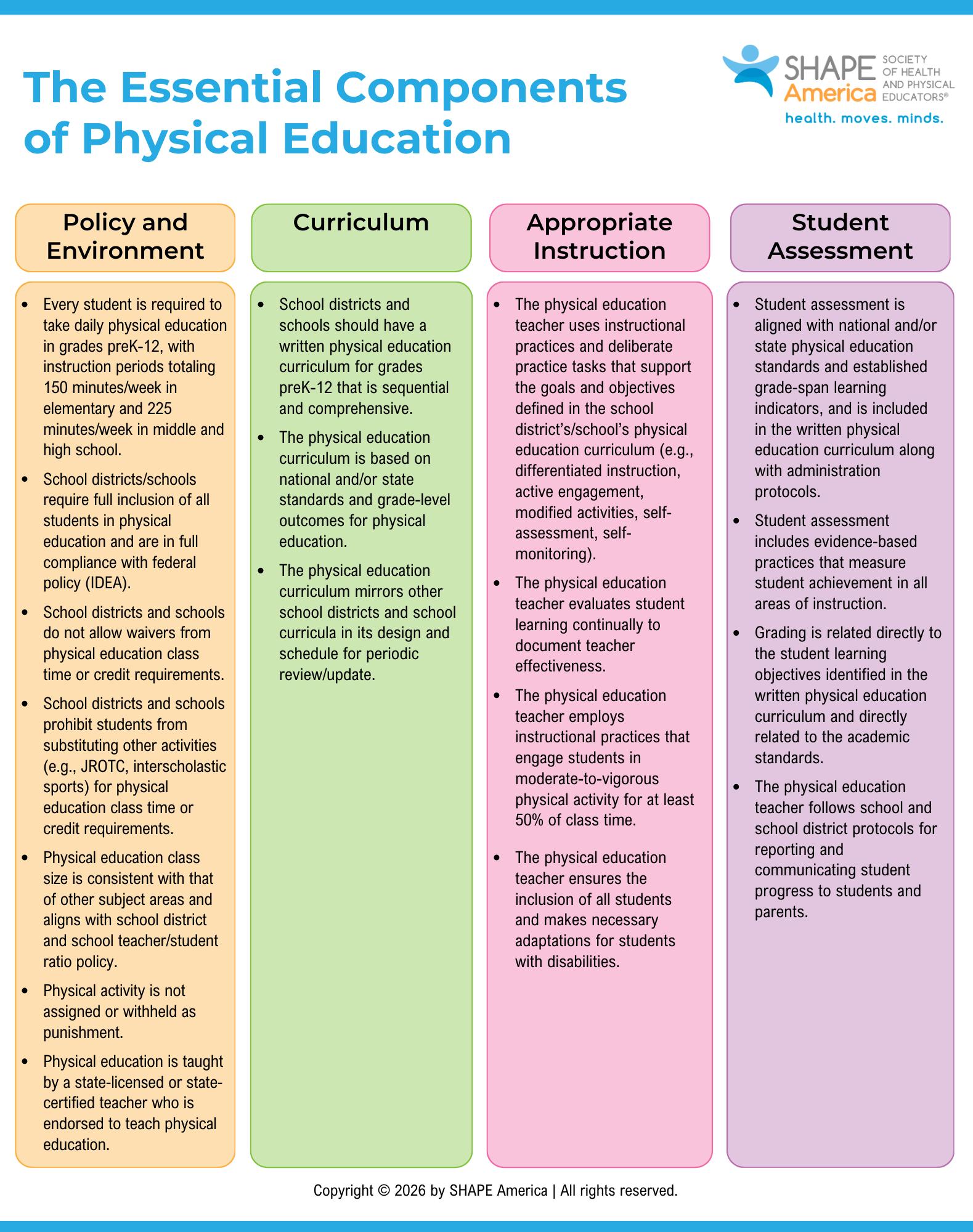
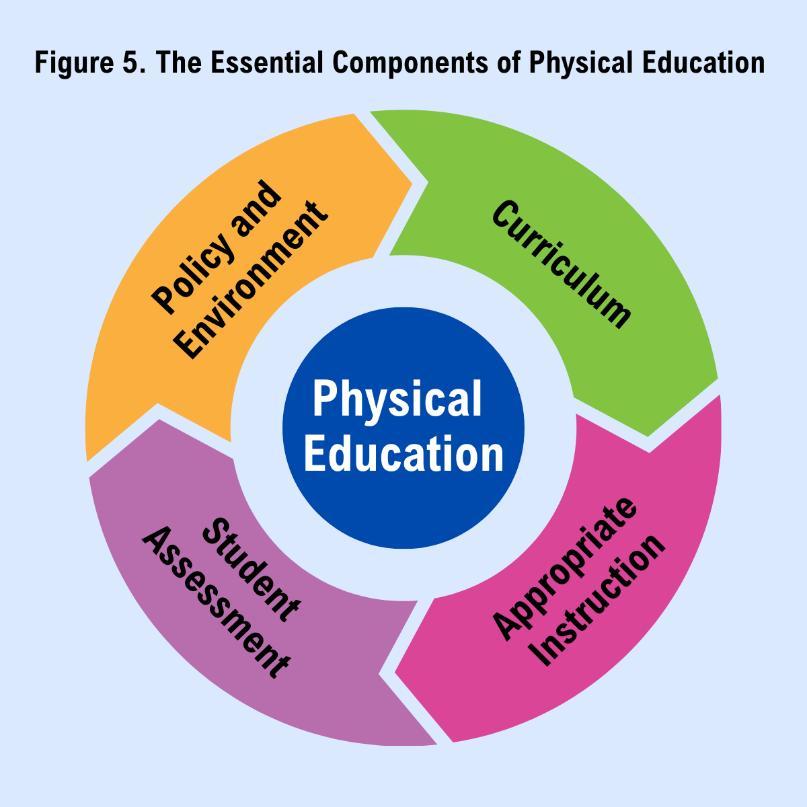
Physical education (Figure 5) includes four essential components that provide the structure for this fundamental subject area:
1. Policy and environment;
2. Curriculum;
3. Appropriate instruction; and
4. Student assessment
Defining the essential components of physical education raises awareness for the critical policies and practices that guide school districts and schools in addressing students’ educational needs. School districts and schools also must establish a written curriculum that defines what is to be taught, guides rigorous instruction that supports the curriculum, and identifies student assessment that will provide evidence of student learning.
Policy and Environment
School districts and schools define physical education expectations through specific physical education policy and policy guidance. Clear policy helps create an environment that ensures that all students receive physical education that effectively defines student learning and engagement. It also increases consistency in the delivery of education to all students
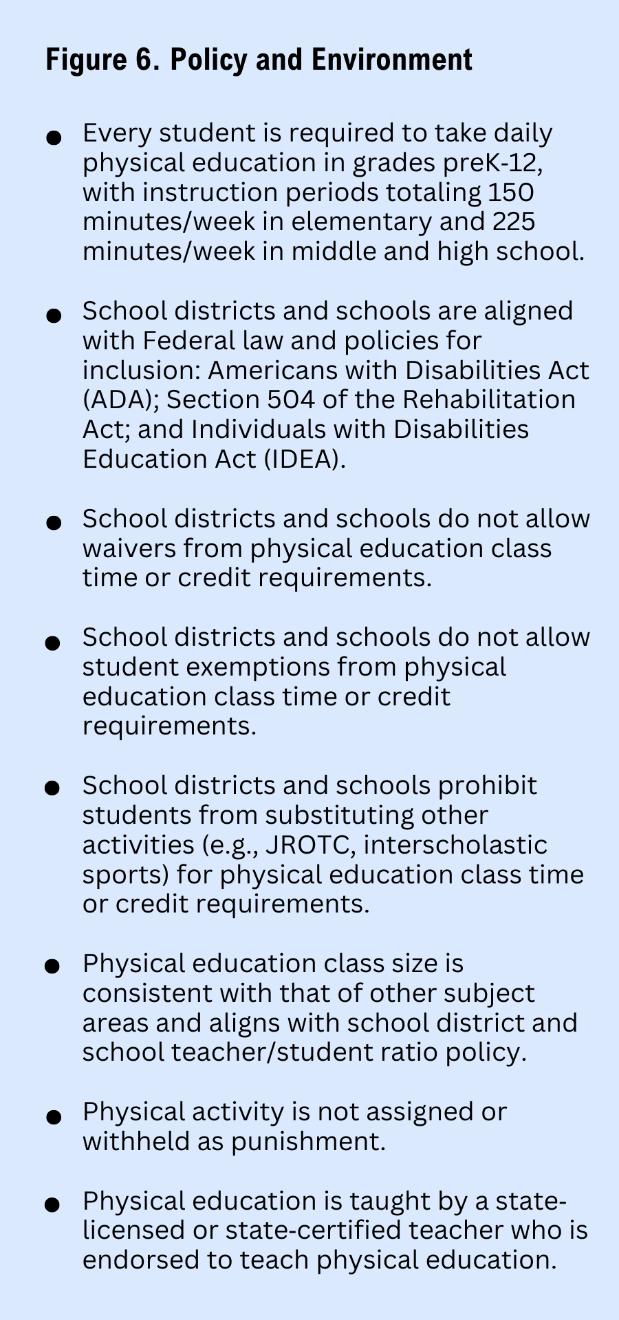
To enhance the quality and impact of physical education for all students, it is essential that the policies outlined in Figure 6 are integrated into district- and school-level policy frameworks. These policies should clearly define key program components, benchmarks and performance standards applicable to every student. Developing and implementing strong, comprehensive policy at the national, state and district levels is critical to creating consistent, meaning physical education experiences that support student well-being and development across all grade levels.
The U.S. Department of Health and Human Services and the Centers for Disease Control and Prevention (CDC) have made recommendations on adequate instructional time for students (150 minutes per week for elementary students and 225 minutes weekly for secondary students), not withholding physical activity from students as punishment, and requesting that
classes be “taught by a qualified teacher with a degree in physical education and a current state license to teach physical education (CDC, 2011, pp 647–650).”
SHAPE America recommends that “the size of physical education class be consistent with those of other subject areas (e.g. maximum 1:25 for elementary school; 1:30 for middle school; 1:35 for high school) for safe and effective instruction (NASPE, 2006). These policy guidelines are important for district administrators to consider in order to fully support effective instruction and access in physical education.
Policy language such as the terms waivers, exemptions and substitutions can be confusing and often needs clarification. While some states or districts may allow waivers, exemptions or substitutions for physical education, this practice is not recommended as it can limit equitable access to physical education for all students. Ensuring that every student can participate in physical education supports their physical, mental and social well-being.
Examples of these three policy areas follow.
• Waivers. In many states, school districts or schools may apply for a waiver from statemandated physical education policy, requirement or law. When a waiver is granted, the school district or school are no longer required to provide students with statemandated physical education class time or credit. State, school district and school policy should not allow waivers for physical education class time or credit requirements
• Exemptions. School districts and schools sometimes allow students to be exempted from physical education class time or credit, even if physical education credit is required for graduation. Instead of completing physical education courses and required credits, exempted students may have been allowed to participate in other academic courses or activities such as advanced placement courses, non-related online courses, or student leader roles, etc. School districts may have allowed exemptions from physical education class time or credit, in the past, due to medical illness. State, school district and school policy should not allow exemptions from physical education class time or credit requirements.
• Substitutions. Some school districts and schools allow students to substitute other activities (e.g., JROTC, interscholastic sports, community sports, cheerleading, marching band) for physical education class time or credit. These activities are not substitutions for a standards-based physical education course or program. School district and school policy should prohibit students from substituting other activities for required physical education class time or credit
All three waivers, exemptions and substitutions are policies that eliminate the opportunity for all students to experience physical education. Scrutiny of policy in states, school districts and schools is critical so that all students are provided with an education experience that includes physical education.
Students With Disabilities and Federal Policy
Federal law requires states, districts and schools to provide children and adolescents with and without disabilities equal opportunity to participate in physical education and physical activity.
• The Americans with Disabilities Act (ADA) bans discrimination on the basis of disability. Therefore, schools are required to comply with the accessibility requirements of the ADA and provide appropriate physical education and physical activity opportunities for students with disabilities.
• Section 504 of the Rehabilitation Act and Title II of the ADA are federal civil rights laws that prohibit disability discrimination, including in schools.
• The Individuals with Disabilities Education Act (IDEA) provides for a “free appropriate public education” in the “least restrictive environment” to all children with a disability. IDEA also states that students with disabilities are to participate in physical education with children without disabilities to the maximum extent appropriate. IDEA includes language for instruction in physical education that may be a part of the special education services prescribed in students’ individualized education program (IEP), a legally binding document that has been tailored specifically to a child’s educational needs
• Schools are required to have adequate policies and practices that align with these federal policies for inclusion.
Curriculum
National standards provide school districts and schools with guidance and direction for clarifying the common general outcomes expected in physical education programs. SHAPE America’s National Physical Education Standards define the skills that students should learn and provide teachers with flexibility in developing lessons as well as choosing their own instructional practices
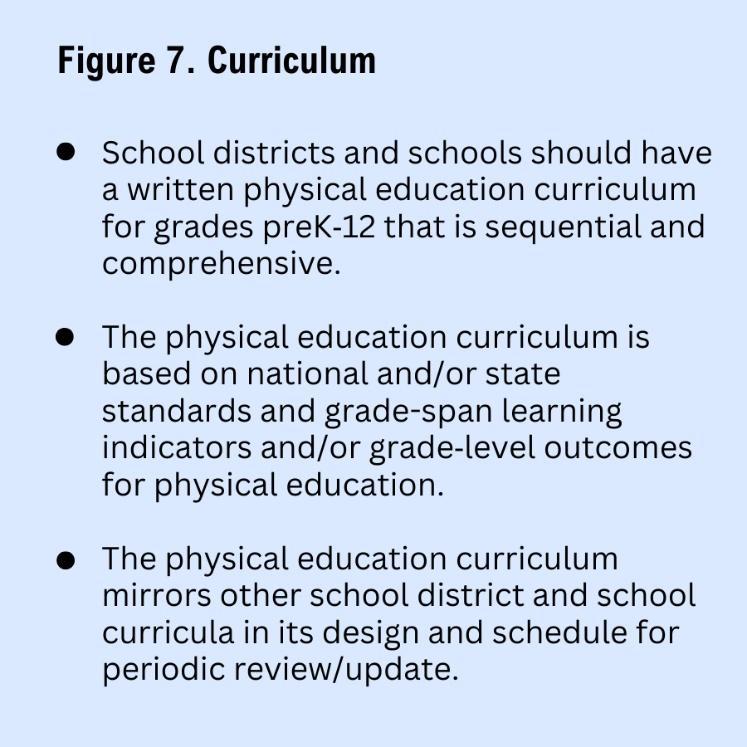
The physical education curriculum (Figure 7) is the written, clearly articulated plan for how standards and education outcomes will be attained in a school district or school. A welldesigned, standards-based physical education curriculum has many parts and provides the framework for the identified knowledge milestones aligned with the learning activities in the curriculum, and protocols for how learning will be measured.
The written physical education curriculum identifies the content to be taught at all grade levels from preK through grade 12. It includes the national and/or state physical education standards, learning objectives for students to meet, and units and lessons that teachers are to implement.
The curriculum is designed to support effective teaching by providing materials to enhance student learning, assignments, projects and a list of essential books, technology, websites and equipment tailored to the needs of the student population. Aligned assessments both formative and summative are integrated to evaluate student progress and inform differentiated instruction.
A scope and sequence document is another resource included within curriculum. The scope outlines a clearly defined set of learning objectives across preK-12, while the sequence specifies the order in which these objectives are taught. Together, they provide a structured framework for spiraling skill development building on prior knowledge and progressing toward increasingly complex skills (Graham, Holt/Hale, & Parker, 2019, pp. 112–113).
Differentiation strategies and instructional modifications are embedded throughout the curriculum to address the diverse abilities present in every physical education class, ensuring all students have equitable opportunities to succeed.
The physical education curriculum standardizes instruction across the district, promoting equitable education for all students while enhancing teacher quality and instructional consistency.
Appropriate Instruction
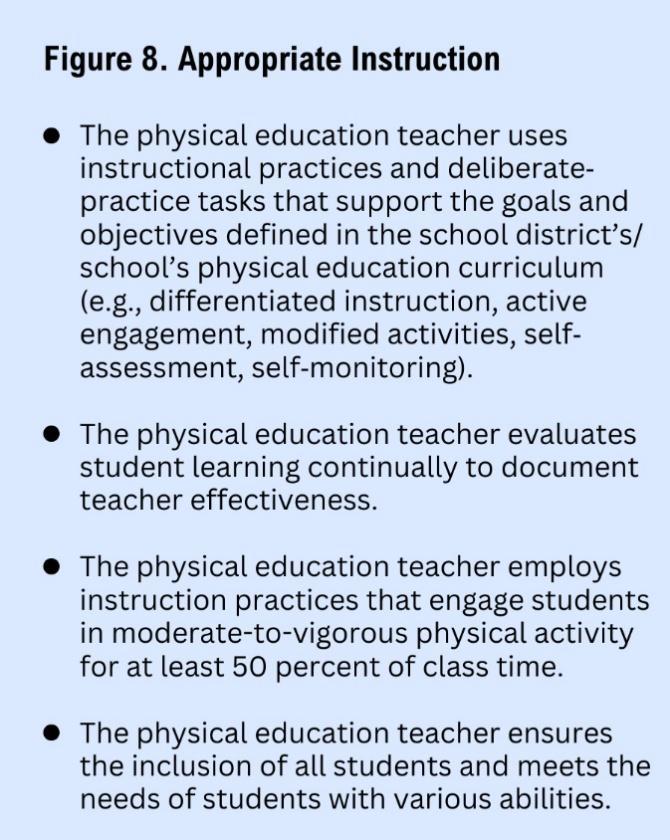
Appropriate instruction (Figure 8) in physical education considers the range of developmental levels that exists for all students. A physical education classroom contains as many unique needs as there are students, and the physical educator is responsible for providing a positive educational experience that meets the needs of all students A student-centered approach to
physical education typically involves using a diverse range of instructional methods that enable teachers to organize and present content to students as effectively as possible.
Meaningful physical education is described as a student-centered approach that prioritizes personal relevance, enjoyment and lifelong engagement in physical activity. Key features include providing students with choice and voice, fostering social interaction, promoting challenge and movement competence as well as encouraging personal meaning through reflective experiences.
These elements work together to ensure that physical education is not only effective in developing physical skills but also impactful in nurturing positive attitudes toward students being active for life.(SHAPE America, 2025, pp.13-17).
Best practice in instruction connects activities with clearly defined learning objectives aligned with the National Physical Education Standards. The National PE Standards address content across the four domains of learning (see Figure 9) Teachers should incorporate continuous assessment practices within the organization of student learning experiences.
Effective physical education is rooted in intentional design that provides students with frequent and meaningful opportunities to practice skills in varied and developmentally appropriate contexts. Teachers model the critical elements of motor skills through accurate demonstrations that align with the intended learning objective. Appropriate instruction also includes timely, specific and actionable feedback to guide student improvement and reinforce proper technique. (SHAPE America, 2025, pp.17-20).
The physical education teacher should use instructional practices that engage students in moderate-to-vigorous physical activity for at least 50 percent of class time, promoting maximum physical activity during class (CDC, 2011, p. 30) Teachers should adapt both instruction and equipment to accommodate the diverse needs of all students, including those with disabilities (CDC, 2011, pp. 30–33).
The Individuals with Disabilities Education Act (IDEA) provides for a “free appropriate public education” in the “least restrictive environment” to all children with a disability.
Physical education teachers can make sure to be inclusive and in compliance with federal law by:
● Including students with disabilities in regular physical education classes and, more specifically, adapting teaching strategies, equipment, environments and assessments to meet the needs of each student’s specified IEP
● Supporting students with disabilities who want to participate in other physical activities before, during and after school
● Encouraging students with disabilities to have the same roles and experiences as their peers who do not have a disability during physical education and other physical activities.
● Participating in discussions with the special education department and engaging in meetings with parents and other service providers to provide appropriate educational experiences for students with disabilities, based on the IEP.
Careful creation of learning experiences ensures that preK-12 students can demonstrate their content skills and knowledge relating to their own physical literacy journey. The following section on student assessment highlights its critical role not only in supporting effective instruction and learning facilitation but also in documenting teacher effectiveness.
Student Assessment
Assessment is critical in providing evidence of student learning related to the skills, knowledge and behaviors aligned to the academic standards (SHAPE America, 2025, p. 12) Assessment practices (Figure 10) should monitor student progress, inform instructional changes, and involve student ownership to enhance engagement.
Formative assessments occur during instruction and provide ongoing insight into student learning. These tools guide real-time instructional decisions and support personalized feedback that promotes growth. In physical education, formative strategies may include observational tools, skill rubrics, learning progressions, self-assessments, and reflective prompts
According to National Physical Education Standards, Fourth Edition (2025), frequent formative assessments accompanied by growth-oriented feedback enhance student engagement and help learners perceive their physical education experience as more meaningful and personally relevant. When educators frame assessment as a tool for improvement, students are more likely to take ownership of their learning.
Chappuis and Stiggins (2021) further emphasize the value of student-involved assessment strategies such as selfmonitoring and goal-setting which help students become more autonomous, reflective learners. These methods align with national standards that prioritize learner empowerment and self-directed progress.
Summative assessments provide a comprehensive evaluation of student learning at the end of a unit or instructional period. These assessments such as skill demonstrations, written reflections or performance-based tasks offer clear benchmarks for student achievement.
Summative assessment data serves multiple purposes: it informs grading, reflects instructional effectiveness, and helps students set new, individualized goals Teachers use this data to evaluate progress toward meeting standards, to make curriculum adjustments, and to plan next steps in instruction.
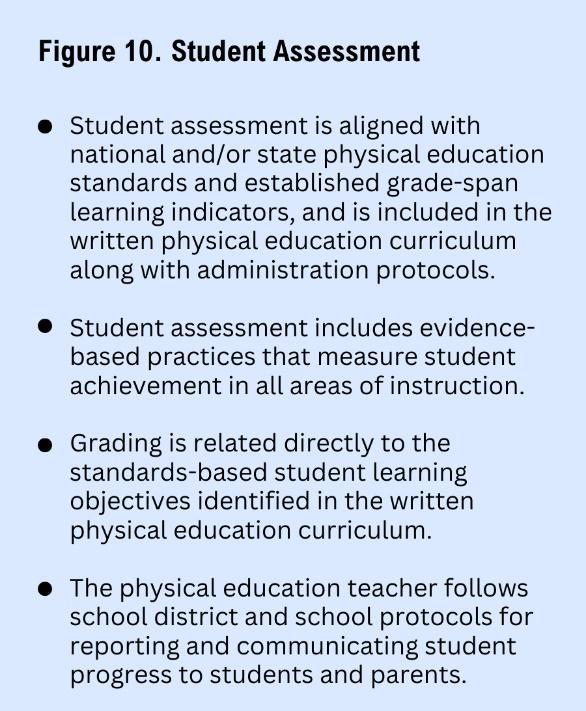
Assessment in physical education involves a balanced combination of formative and summative strategies, tailored to individual learners and aligned with national or state standards. By incorporating student involvement, using a variety of evidence sources, and providing meaningful feedback, physical educators can support lifelong physical literacy and promote more equitable, personalized learning experiences.
STRENGTHENING PHYSICAL EDUCATION PROGRAMS
SHAPE America is committed to supporting strong physical education programs for all students in grades preK-12 as well as rigorous physical education policies and practices across the United States. SHAPE America’s detailed definition of the essential components of physical education programs provides school leaders and other education stakeholders with a clear blueprint of the critical policies and practices that guide school districts and schools in addressing students’ education needs
SHAPE America urges school administrators, principals, teachers and parents to conduct an assessment of their school’s physical education program to evaluate its strengths and weaknesses and then develop and implement a plan for improvement where needed
For just that purpose, SHAPE America has developed a Physical Education Program Checklist, which school leaders can use to identify the critical components that should be in place within their physical education programs Use this Essential Components of Physical Education guidance document side by side with the Physical Education Program Checklist to analyze what is currently in place and plan for improvement where needed
REFERENCES
Bailey, R., Armour, K., Kirk, D., Jess, M., Pickup, I., Sandford, R., & Education, B. P. (2009). The educational benefits claimed for physical education and school sport: An academic review. Research Papers in Education, 24(1), 1–27. https://doi.org/10.1080/02671520701809817
Bittner, M., Foster, E., & Lavay, B. (2021). Assessment practices in adapted physical education. Palaestra, 35(2).
Centers for Disease Control and Prevention. (2011). School health guidelines to promote healthy eating and physical activity (MMWR 2011; 60[RR-5]). U.S. Department of Health and Human Services. http://www.cdc.gov/mmwr/pdf/rr/rr6005.pdf
Centers for Disease Control and Prevention. (2013). Comprehensive school physical activity programs: A guide for schools. U.S. Department of Health and Human Services.
Centers for Disease Control and Prevention. (2014). National framework for physical activity and physical education. U.S. Department of Health and Human Services.
Centers for Disease Control and Prevention. (n.d.-a). Children and adolescents 6 to 17 years old: Physical activity recommendations. U.S. Department of Health and Human Services. https://www.cdc.gov/physical-activity-basics/guidelines/children.html
Centers for Disease Control and Prevention. (n.d.-b). Inclusion in physical education and physical activity. U.S. Department of Health and Human Services. https://www.cdc.gov/healthyschools/physicalactivity/inclusion_pepa.htm
Centers for Disease Control and Prevention. (n.d.-c). Strategies for inclusive physical education and physical activity [Policy brief].
https://www.cdc.gov/healthyschools/physicalactivity/pdf/20_313305-BMichael_PolicyBrief_508Final.pdf
Chappuis, J., & Stiggins, R. J. (2021). Introduction to student-involved assessment for learning (7th ed.). Pearson.
Dettmer, P. (2005). New blooms in established fields: Four domains of learning and doing. Roeper Review, 28(2), 70–78. https://doi.org/10.1080/02783190509554345
Graham, G., Holt/Hale, S. A., & Parker, M. (2019). Children moving: A reflective approach to teaching physical education (10th ed.). McGraw-Hill.
Haegele, J. A., & Sutherland, S. (2015). Perspectives of students with disabilities toward physical education: A qualitative inquiry review. Quest, 67(3), 255–273. https://doi.org/10.1080/00336297.2015.1051238
Haegele, J. A., Wilson, W. J., Zhu, X., Bueche, J. J., Brady, E., & Li, C. (2021). Barriers and facilitators to inclusion in integrated physical education: Adapted physical educators’ perspectives. European Physical Education Review, 27(2), 297–311. https://doi.org/10.1177/1356336X20960176
National Association of Sport and Physical Education. Moving into the Future: National Standards for Physical Education. 2nd ed. Reston, VA: National Association for Sport and Physical Education; 2004.
National Association for Sport and Physical Education. (2006).Teaching large class sizes in physical education: guidelines and strategies [Guidance document]. Reston, VA: Author.
Physical Activity Alliance. (2016). National Physical Activity Plan https://paamovewithus.org/fortransfer/quickfacts/
SHAPE America – Society of Health and Physical Educators. (2025). National Physical Education Standards, Fourth Edition. Champaign, IL: Human Kinetics.
SHAPE America – Society of Health and Physical Educators. (2014). National Standards & Grade-Level Outcomes for K-12 Physical Education Champaign, IL: Human Kinetics.
US Department of Health and Human Services. Healthy people 2020. Washington, DC: US Department of Health and Human Services; 2010. Available at http://www.healthypeople.gov/2020. Accessed August 18, 2011.
U.S. Department of Health and Human Services. (2018). Physical activity guidelines for Americans (2nd ed.). https://health.gov/sites/default/files/201909/Physical_Activity_Guidelines_2nd_edition.pdf
Yell, M. L., McNamara, S., & Prince, A. M. (2021). Adapted physical education: Meeting the requirements of the Individuals with Disabilities Education Act. TEACHING Exceptional Children, 54(1), 70–78. https://doi.org/10.1177/00400599211038380
Suggested Citation:
SHAPE America – Society of Health and Physical Educators (2026). Essential Components of Physical Education [Guidance Document]. Annapolis Junction, MD: Author.