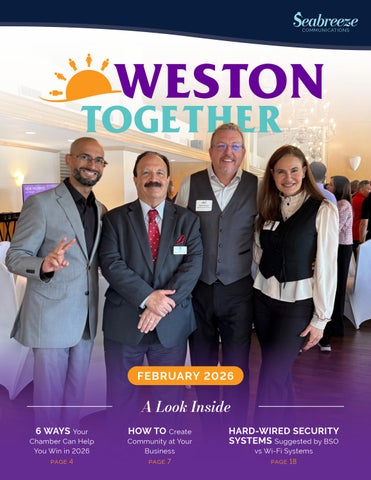
Weston Together FEB 2026

Page 1


Greetings from Your Chamber CEO!

February is a time to reconnect with what makes our community unique. While national headlines often focus on uncertainty, here at home we continue to see something powerful. Local businesses are showing up, adapting, and creating experiences that bring people together. These are the places where birthdays are celebrated, deals are discussed over lunch, and traditions are built year after year. For residents, supporting local businesses is about preserving the character of our community. When we choose local restaurants, caterers, and service providers, we’re investing in the people who employ our neighbors, sponsor school programs, and contribute to community events. That support matters now more than ever.

One of the best ways to experience and celebrate our local business community is through shared experiences, and few do it better than A Sip of Wine, A Taste of Heaven. This annual food and wine event brings together the diverse flavors of Southwest Broward in one place, giving residents a chance to sample, discover, and support the incredible culinary talent that exists right here.

Mark your calendar for Saturday, March 14 at the Miramar Amphitheater, where the 20th Annual A Sip of Wine, A Taste of Heaven will feature tastings from top local restaurants, caterers, and bakeries, along with live entertainment and a lively atmosphere. Sponsored by Memorial Hospital Miramar and the City of Miramar,

the event has become a favorite tradition for our community.

As the Chamber of Commerce, we’re proud to create opportunities that connect residents with the businesses that shape our local identity. Join us in celebrating the flavors, people, and partnerships that make Southwest Broward a great place to call home. Learn more and get tickets at sipandtaste2026.com.

By making your business our business we remain engaged in the priorities of our businesses, community, and future generations of professionals (and foodies!) and their evolving needs. For more information and our event calendar, visit www.westonflchamber.com.

Yours in Service,

Serving South Florida

Are you interested in advertising?

6 Ways Your Chamber Can Help You Win in 2026

The start of a new year begs for reflection and plans. We make promises and resolutions and say things like, “This year will be THE year.”

(239) 278-4222

Check out our website:

Please contact our Sales Department at: or email sales@seabreezecommunications.com www.seabreezecommunications.com

Seabreeze Communications, Inc. does not endorse any advertising as it relates to the communities. Advertising is not screened by Seabreeze Communications, Inc.

All rights reserved. Reproduction or utilization of these contents in any form by any electronic, mechanical, or other means, including xerography and photocopying is forbidden without the written permission of the Publisher.

The Publisher is not responsible or liable for misinformation or misprints herein contained and reserves the right to accept or reject all copy deemed unsuitable for publication.

But unless you win the lottery, making this year radically different requires work and change. Those two things aren’t always easy or sustainable, especially when you’re looking at revenue goals, marketing plans, staffing realities, and that lingering question in the back of your mind: How do I grow without burning myself out?

We have an easy answer to that question.

If you’re a chamber member, there’s a good chance you aren’t making the most of your benefits. We get it. Life gets in the way. You’re busy. Maybe you attend an event here and there. You skim the emails. You tell yourself you’ll “use it more this year.”

This is that year.

Because chambers in 2026 aren’t just about ribbon cuttings and business cards. Chambers are quietly helping businesses solve real problems. Here are six ways to tap into that value in a strategic way that makes the most of your limited time.

1. Turn Visibility Into Credibility

Marketing is noisy. Consumers are skeptical. Trust is currency.

One of the most underrated benefits of your chamber is third-party credibility. When your business is featured in a chamber newsletter, social post, directory, or event spotlight, you’re borrowing trust that’s already been earned.

You’re being seen in the right places and the “company you keep” has a great reputation.

Make it a habit this year to say yes when your chamber

asks for member features, testimonials, or spotlights. And if they don’t ask, raise your hand. Visibility compounds when it’s consistent.

2. Use Education to Stay Relevant (Without Going Back to School)

You don’t need another generic webinar. You need insight that applies to your

market, your customers, and your challenges.

Chambers bring in experts on topics like AI, workforce trends, marketing shifts, local regulations, and leadership. The advantage is context. These sessions aren’t abstract. They’re grounded in what’s happening right outside your door. It’s difficult to get that anywhere else.

Instead of chasing every online trend in 2026, choose one or two chamber programs that sharpen your skills where it matters most. Think of it as professional development without the fluff.

3. Leverage the Chamber as a Connector, Not a Crowd continued on page 6

Networking doesn’t have to mean working the room like it’s speed dating. (Although feel free to do that if you enjoy it.) One of the smartest ways to use your chamber is behind the scenes. Staff and board members know who’s growing, who’s hiring, who’s struggling, and who’s looking for partnerships.

If you need an introduction to a lender, vendor, collaborator, or even a future client, ask. Chambers exist to connect dots. You don’t have to draw the map alone. Intentional introductions outperform random handshakes every time.

4. Get a Seat at the Table Before Decisions Are Made Regulations, policies, zoning changes, and local initiatives don’t appear overnight. They’re discussed long before they’re decided. Your chamber tracks those conversations so you don’t have to. More importantly, they advocate for business voices to be included. Even if you never attend

a council meeting, your membership helps ensure someone is asking, “How does this impact local employers?” That kind of representation is hard to quantify until you need it. Then it matters a lot.

5. Build Community, Not Just Contacts

Business ownership can be isolating. If your social circle doesn’t include business owners, you can feel misunderstood.

Chambers create space for peer-to-peer learning, shared challenges, and honest conversations. Sometimes the most valuable takeaway from an event isn’t a lead. It’s realizing you’re not the only one navigating a tough season or a big decision.

Resilience comes from relationships as much as strategy. Use your chamber to build a community that supports you when things get complicated.

The biggest return on chamber membership rarely shows up in one month. People often expect instantaneous results, but there is action required.

When your business becomes known from those actions (showing up, being a part of the conversations, etc.), people refer you without being asked. Opportunities come your way because you’re visible, involved, and trusted.

Treat your chamber like a long-term growth partner, not a vending machine. Engage consistently. Show up where it makes sense. Use the resources already built for you.

6.

Think Long-Term, Not Transactional

The New Year doesn’t have to be about doing more. Instead, you can use what you already have, better. Think of chamber membership like the wind. It’s blowing whether you harness it or not. But if you shift your sails slightly to leverage its power, you can go where you want to a lot faster.

How to Create Community at Your Business

If you have repeat customers, you already have the foundation of something powerful: a community. You just need to ensure they understand that.

Not a punch-card club. Not just “regulars.” A real group of people who feel connected to you, your team, and each other.

Community is what keeps people choosing you even when a cheaper, closer, or flashier option pops up. It is also a lot more fun than

chasing new customers all the time.

Here is how to turn those repeat visits into a community that loves coming back.

SHIFT FROM TRANSACTIONS TO RELATIONSHIPS

Most businesses stop at “Thank you, have a great day.”

Community starts when you get curious.

continued on page 8

Ask yourself:

• Do I know anything about the people who come back again and again?

• Would I recognize them outside the business?

• Do they feel like guests, or like familiar faces?

You do not have to become everyone’s best friend. But a small shift in how you see them changes everything. When you view repeat customers as “our people,” you naturally look for ways to take care of them, remember them, and connect them.

That is the beginning of community.

LEARN NAMES, THEN LEARN STORIES

One of the simplest, highest-ROI moves you and your staff can make is learning names and using them.

“Hey, good to see you again” is nice. “Hey, Maria, how did your event go last weekend?” is loyalty.

You can make a quick note after a conversation in your POS system or a notebook behind the counter. Capture just a few details: kids’ names, pets, big projects, favorite order. Train your team to glance at those notes before serving someone.

You are not being intrusive. You are being attentive. In a world where most people feel invisible, that level of care is rare.

Over time, you will know who just started a business, who is new in town, who is training for a race, who is caring for a parent. That is how your space stops feeling generic and starts feeling like “their place.”

CREATE SIMPLE RITUALS PEOPLE CAN JOIN

Community loves a shared ritual.

This does not have to be complicated or expensive. Think about small traditions, such as a “regulars’ hour” once a week where you test new items, a wall of fame for long-time customers or milestone purchases, or a daily question on a chalkboard that everyone can answer.

Rituals give people a reason to come back and something to talk about.

When someone says, “On Fridays they always…” that is community behavior. You have given them a story to tell.

START A CLUB THAT GIVES PEOPLE A REASON TO RETURN

One of the strongest ways to turn repeat customers into a true community is to create a recurring club that meets at your business.

The club should fit your brand and your customers’ interests. For example:

• A bookstore or café could host a monthly book club or writers’ group.

• A yarn, craft, or gift shop might host a weekly knitting circle or “maker morning.”

• A fitness studio could run a “goals group” that meets once a month for coffee and conversation.

• A wine bar could host a

“Wednesday Tasting Club” where members try a new flight together.

Keep it simple:

1. Choose a consistent day and time.

2. Give the club a name so it feels special.

3. Offer a small perk for participants, such as a discount, early access to products, or a reserved table.

Over time, the club becomes a steady heartbeat in your business. People come not only for what you sell, but for the friends they know they will see there.

TURN REPEAT CUSTOMERS INTO INSIDERS

People do not just want to buy from you. They want to feel in on it.

continued on page 10

Treat your regulars as insiders, not just transactions. You might give them early access to new products or menus, “first to know” messages about special items or events, or a quick behind-the-scenes look at what you are working on next.

Ask for their input:

“We are thinking about adding X. What do you think?”

“We have two logo options for this new product. Which one would you pick?”

When customers feel like insiders, three things happen: they show up more often, they bring people with them, and they defend you when someone criticizes you online.

MAKE YOUR SPACE A PLACE TO CONNECT

Community is not just between you and your customers. It is also between your customers and each other.

Look for small ways to help that along. Arrange seating so people can sit, not just stand in a line staring at their phones. Host tiny, low-pressure events: coffee tastings, lunchtime learning sessions, local maker pop ups, or “meet the owner” Q&As.

When it feels natural, introduce people: “You two are both new business owners on this street, you should meet.”

“You both come in after the school run. Have

you met?”

You are not planning a conference. You are creating moments where conversation is possible. Those moments are what people remember.

SHARE THEIR STORIES, NOT JUST YOUR PROMOTIONS

If every post or email is “Here is what we are selling,” your marketing will always feel like noise.

Community-building content looks different. You highlight customer stories and shared moments. You might feature short spotlights of regulars, with a photo and a quote about why they come in. You can show customers enjoying your space (with permission, of course), or share stories of how your customers support one another, like referrals or collaborations that started at your business.

This makes featured customers feel seen and signals to everyone else, “People like you belong here.”

Suddenly your brand is about more than what is on the shelves or the menu. It’s about who gathers around them.

BUILD LIGHT SYSTEMS SO IT SURVIVES BUSY SEASON

Community sounds warm and fuzzy, but it works best with a little structure behind it.

To keep it going even when you get swamped, create a simple “regulars” tag in your POS or email system. Add a short team habit, such as “two genuine conversations per shift” or “ask one follow-up question of a regular each day.” Once a month, review who you are seeing a lot and who you have not seen in a while.

You do not need a complicated points program. You need a repeatable way to notice, remember, and appreciate the people who show up.

THE QUIET ADVANTAGE OF BEING “THEIR PLACE”

When customers feel like they are part of a community at your business, a few things shift quietly in your favor. They are more patient when something goes wrong. They choose you even when a big chain runs a sale. They tell people about you without being asked.

In a world where so many experiences feel rushed and anonymous, being the business that remembers their name, knows their story, invites them into clubs and rituals, and connects them to others is not just nice. It is a serious competitive advantage.

You are not just building foot traffic and revenue. You are building a small, loyal neighborhood around your business, one repeat customer at a time, and that feels really good for everyone involved.

Chamber Highlights

Kind Of A Big Deal - Episode 2

WHY YOU SHOULD NEVER LET DOUBTERS STOP YOU! | BUILDING TRUST | FELIX HERRERA INTERVIEW

In this episode of Kind of a Big Deal, we sit down with Felix Herrera, a licensed public adjuster and founder of Claims & Appraisers Public Adjusting. Felix shares his journey from working for insurance companies to becoming a trusted advocate for homeowners — and the secrets behind building a business that runs on referrals, trust, and integrity.

From the power of networking to the importance of protecting your time as a business owner, Felix drops insights that every entrepreneur should hear. He also breaks down how a public adjuster can fight for homeowners when insurance companies try to pay as little as possible.

If you’re building a business based on relationships, integrity, and community, this episode is for you.

WHAT YOU’LL LEARN

• How a public adjuster helps you versus an insurance adjuster

• Why genuine networking fuels business growth

• How to earn trust and referrals by doing the right thing

• Why delegating tasks protects your time and income

• Felix’s real-life stories and practical advice for new business owners

Felix shares his journey from working for insurance companies to becoming a trusted advocate for homeowners — and the secrets behind building a business that runs on referrals, trust, and integrity.

WATCH?V=N8C7Q69EAKQ&LIST=PLZLFUFGN2RQACZIC9SBVCSSVB7NZBPX6G&INDEX=5

HB 729: Protective Injunctions and Protective Orders

On February 16, 2025, I remember an Amber Alert was issued for four-year-old Seraphina Gingles. While the alert was later canceled, the truth that emerged that evening was devastating. Seraphina was found alive, but her mother, Mary Gingles, her grandfather, David Ponzer, and their neighbor, Andrew Ferrin were murdered. The killings were allegedly carried out by Mary’s estranged husband, despite the fact that a judge had already determined he was dangerous and had ordered him to surrender his firearms under a domestic violence injunction. That order was never enforced. Mary had done everything the system asked of her: she sought protection, she went to court, and she trusted the law to keep her family safe. The system failed her, with irreversible consequences.

In the wake of this tragedy, I filed HB 729 which is designed to ensure that this kind of failure does not happen again. While Florida law currently allows judges to order abusers to surrender firearms, there is no clear, mandatory process requiring law enforcement to collect those weapons or document what was collected. As a result, these injunctions often rely on abusers to voluntarily surrender their firearms, leaving survivors vulnerable.

The bill ensures when a final domestic violence injunction is issued and a judge determines that a person is too dangerous to have weapons, law enforcement will collect all firearms, ammunition, and concealed carry licenses, issue a detailed receipt, and file proof with the court within 72 hours. If there is reason to believe weapons are being hidden, officers may seek a search warrant to seize them.

HB 729 also strengthens consequences for repeat offenders. Currently, perpetrators have three chances, before violating a court protection order is elevated from a misdemeanor to a felony. Under this bill, a second violation would become a felony, reflecting the serious risk posed by abusers who ignore court orders.

According to the Department of Children and Families, 217 Floridians lost their lives from domestic violence homicide in 2020, representing 20% of all homicides in our state. HB 729 closes a dangerous loophole and affirms that court-ordered protection must be real, enforced, and lifesaving.

If you or someone you know is a victim of domestic violence, please reach out to the resources on the next page; in an emergency, always dial 911.

• Women in Distress - widbroward.org or 24/7 Crisis Line 954-761-1133

○ Women in Distress provides free counseling, support services, and emergency shelter assistance for survivors, available in English, Spanish, Creole, and Portuguese.

• National Domestic Violence Hotline – 1-800-799-7233 or text “Start” to 88788

○ Provides a hotline that offers confidential support, crisis intervention, essential tools, education, and referral services.

• Florida Department of Children and Families Domestic Violence Hotline 1-800-500-1119 or myflfamilies.com/services/abuse/domestic-violence/get-help

○ Provides support, safety planning, information, and referrals to local certified domestic violence centers for immediate access to services.

Hard-Wired Security Systems Suggested by BSO vs Wi-Fi Systems

COMMUNITY SAFETY ALERT: ILLEGAL WI-FI AND CELL SIGNAL JAMMERS

Criminals nationwide are increasingly using illegal Wi-Fi and signal jammers to disable wireless security systems. These devices interfere with Wi-Fi and cellular signals, preventing alarms from communicating with monitoring services and issuing warnings, rendering them useless.

Although signal jammers are prohibited under federal law, even for law enforcement, they are still available for purchase online. A jammer was recently recovered from a suspect arrested in a

residential burglary in Weston, underscoring the importance of community awareness.

The Broward Sheriff’s Office (BSO) recommends reviewing your residential and

business security systems and considering hard-wired components that are immune to signal jamming. Using layered security measures such as fencing, lighting, cameras, motion sensors, and alarms can further reduce risk. BSO reminds everyone to always report any suspicious activity to law enforcement.

WHAT IS A WI-FI OR CELLULAR SIGNAL JAMMER?

A Wi-Fi or cellular signal jammer is an illegal device that intentionally disrupts wireless communications. It works by overwhelming Wi-Fi or cellular frequencies, preventing devices, such as security systems, from connecting or sending alerts.

WHY ARE SIGNAL JAMMERS A CONCERN?

Many modern security systems rely on Wi-Fi or cellular signals; their popularity has surged because they are less costly to purchase and eliminate the need for extensive installation, further driving down costs and improving efficiency. They have become the go-to choice for homeowners and renters. When those signals are blocked, alarms may not communicate with monitoring centers or prevent the device from sending an alert, creating an opportunity for criminals to enter undetected.

City of Weston

INSERT VIDEO:

YOUTUBE.COM/WATCH?V=N8C7Q69EAKQ&LIST= PLZLFUFGN2RQACZIC9SBVCSSVB7NZBPX6G&INDEX=5

Turn static files into dynamic content formats.

Create a flipbook
Issuu converts static files into: digital portfolios, online yearbooks, online catalogs, digital photo albums and more. Sign up and create your flipbook.