Blackpool Aspire Academy Report generated on January 29th 2026 at 20:35
Compass Evaluation Results
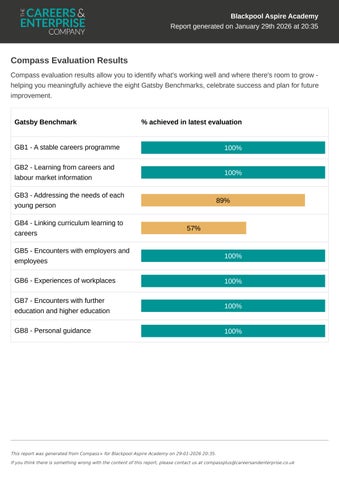
Compass evaluation results allow you to identify what's working well and where there's room to growhelping you meaningfully achieve the eight Gatsby Benchmarks, celebrate success and plan for future improvement.
Gatsby Benchmark % achieved in latest evaluation
GB1 - A stable careers programme
GB2 - Learning from careers and labour market information
GB3 - Addressing the needs of each young person
GB4 - Linking curriculum learning to careers
GB5 - Encounters with employers and employees
GB6 - Experiences of workplaces
GB7 - Encounters with further education and higher education
GB8 - Personal guidance
Breakdown of results
Here is a breakdown of your results by Gatsby Benchmark.
ACHIEVED IN PROGRESS NOT ACHIEVED UNSCORED
Gatsby Benchmark 1
A stable careers programme 100%
Your institution or organisation has met 100% of the 8 assessment areas in Gatsby Benchmark 1
These questions are about Gatsby Benchmark 1: A stable careers programme.
Institutions and organisations should have an embedded programme of careers education and guidance that is known and understood by learners, parents and carers, staff, governors, employers and other agencies.
Question:
1.1 Does your school have a trained Careers Leader?
1.2 Does your school have a careers programme that aligns with the following guidelines?
Is tailored to the needs of all pupils, including disadvantaged young people?
Has the explicit backing of the board of governors?
Is underpinned by learning outcomes and sequenced appropriately for your cohort of young people?
Is linked to the whole school development plan?
Sets out how parents and carers will be engaged with careers education?
Has the explicit backing of the headteacher?
1.3 Does your school publish your careers programme on your website?
Achieved?
1.3.1 Is the information about your careers programme on your website communicated in ways that enable different groups to engage with it?
1.4 Is your careers programme communicated in different formats (beyond text on the website) so that it’s accessible to users with different needs?
1.5 Does your school regularly evaluate your careers programme?
1.5.1 In the last 12 months, have you made any changes to your careers programme as a result of past evaluations?
1.6 Does evaluation of your careers programme take into account feedback from the following groups?
Gatsby Benchmark 2
Learning from careers and labour market information
Your institution or organisation has met 100% of the 7 assessment areas in Gatsby Benchmark 2
These questions are about Gatsby Benchmark 2: Learning from career and labour market information.
All learners, parents and carers, teachers and staff who support learners should have access to good quality, up-to-date information about future pathways, study options and labour market opportunities. Young people with special educational needs and disabilities (SEND) and their parents and carers may require different or additional information. All learners will need the support of an informed adviser to make the best use of available information.
Question: Achieved?
2.1 Approximately what proportion of pupils have access to information about careers, pathways and the labour market to help inform their decisions on study options and/or next steps during the Key Stages offered at your school?
Key Stage 3
Key Stage 4
2.2 To what extent are you confident that your pupils use this information to inform decisions on their study options and/or next steps?
2.3 Which of the following statements are true of the careers, pathways and labour market information available at your school?
2.4 Does your school provide parents and carers with access to information about careers, pathways, and the labour market?
2.5 Does your school actively encourage and support parents and carers to have careers conversations with the young people in their care?
2.6 Does your school, where appropriate, send tailored information about careers, pathways and the labour market to parents or carers of pupils with SEND?
2.7 What proportion of staff (including teachers and other staff who support pupils) have access to up-to-date information about future pathways, study options, and labour market opportunities?
Gatsby Benchmark 3
Addressing the needs of each young person
Your institution or organisation has met 89% of the 11 assessment areas in Gatsby Benchmark 3
These questions are about Gatsby Benchmark 3: Addressing the needs of each young person.
Learners have different careers guidance needs at different stages. Careers programmes should help learners navigate their concerns about any barriers to career progression or progression pathways. In addition, opportunities should be tailored to the needs of each learner, including any additional needs of vulnerable and disadvantaged learners, young people with SEND and those who are persistently absent.
Question: Achieved?
3.1 How strongly do you agree or disagree with the following statements about your school’s careers programme?
Our careers programme actively seeks to raise the aspirations of all pupils
Our careers programme challenges misconceptions and stereotypical thinking (e.g., related to gender, socioeconomic status)
Our careers programme showcases a diverse range of role models
3.2 Does your school use alumni to support your careers programme?
3.3 Does your school systematically keep accurate records of each pupil’s participation in all aspects of your careers programme?
3.4 Does your school systematically track the individual advice given to each pupil, including agreed actions?
3.4.1 Does your school share pupil records with new education providers if pupils change providers during their time at your school?
3.4.2 Does your school provide pupils with access to records of their participation in careers activities?
3.4.3 Are pupils supported in using these records to make education and career choices, for example at key transition points?
3.5 Does your school collect and maintain accurate data for each pupil on each of the following categories?
Aspirations
Intended destinations upon leaving school
Immediate destinations upon leaving school
3.6 Do you use the following destination data to evaluate your careers programme?
Sustained destinations of pupils
Longer-term destinations of pupils
3.6.1 Do you use the data you collect on pupils’ aspirations or intended destinations to personalise the support given to each pupil?
3.7 Do you provide personalised support to all pupils, including disadvantaged pupils and those with SEND?
Gatsby Benchmark 4
Linking curriculum learning to careers
57%
Your institution or organisation has met 57% of the 5 assessment areas in Gatsby Benchmark 4
These questions are about Gatsby Benchmark 4: Linking curriculum learning to careers.
As part of the providers programme of careers education, all subject staff should link curriculum learning with careers, even on courses which are not specifically occupation led. Subject staff should highlight the progression routes for their subject and the relevance of knowledge and skills developed in their subjects for a wide range of future career paths.
Question: Achieved?
4.1 Approximately what proportion of subjects taught in your school include learning on progression routes and how the subject applies to careers and future pathways?
4.2 In which of the following courses at your school is careers information included in the taught curriculum?
English
Maths
Science (e.g., physics, chemistry, biology)
Social sciences (e.g., psychology, sociology)
Humanities (e.g., geography, history)
Modern foreign language
Computer science/IT/Business
Creative arts (e.g., art, music, drama)
4.3 In which of the following sector subject areas is careers information included within the programme of study?
Agriculture, Horticulture and Animal Care
Arts, Media and Publishing
Business, Administration and Law
Construction, Planning and the Built Environment
Education and Training
Engineering and Manufacturing Technologies
Health, Public Services and Care
History, Philosophy and Theology
Information and Communication Technology
Languages, Literature and Culture
Leisure Travel and Tourism
Preparation for Work and Life
Retail and Commercial Enterprises
Science and Mathematics
Social Sciences
4.4 Approximately what proportion of pupils have engaged in career-related learning in all curriculum subjects?
Year 7
Year 8
Year 9
Year 10
Year 11
4.5 What proportion of staff who support pupils have careers embedded into their continuous professional development programmes?
Gatsby Benchmark 5
Encounters with employers and employees
Your institution or organisation has met 100% of the 3 assessment areas in Gatsby Benchmark 5
These questions are about Gatsby Benchmark 5: Encounters with employers and employees.
Every learner should have multiple opportunities to learn from employers about work, employment and skills that are valued in the workplace. This can be through a range of enrichment opportunities, including visiting speakers, mentoring and enterprise schemes, and could include learners’ own part-time employment where it exists.
Question: Achieved?
5.1 What proportion of your pupils experience at least one meaningful encounter with an employer each year they are at school?
5.2 Which of the following statements are true of the employer encounters organised by your school?
5.3 On average, how many encounters with an employer will your pupils have experienced in each of the following years?
Gatsby Benchmark 6
Experiences
Your institution or organisation has met 100% of the 8 assessment areas in Gatsby Benchmark 6.
These questions are about Gatsby Benchmark 6: Experiences of workplaces.
Every learner should have first-hand experiences of workplaces to help their exploration of career opportunities and expand their networks.
Question: Achieved?
6.1 Approximately what proportion of your pupils have at least one meaningful experience of a workplace during Key Stage 3?
6.2 Approximately what proportion of your pupils have at least one meaningful experience of a workplace during Key Stage 4?
6.3.1 Which of the following statements are true of the workplace experiences organised by your school?
6.4 In alignment with the Government's vision for all pupils to complete two weeks' worth of work experience by the end of Key Stage 4, approximately what proportion of pupils have accessed a variety of meaningful work experience activities (totalling the following number of days) by the end of Key Stage 3?
6.5 In alignment with the Government's vision for all pupils to complete two week' worth of work experience by the end of Key Stage 4, approximately what proportion of pupils eligible for free school meals have accessed a variety of meaningful work experience activities (totalling the following number of days) by the end of Key Stage 3?
6.6 In alignment with the Government's vision for all pupils to complete two weeks' worth of work experience by the end of Key Stage 4, approximately what proportion of pupils have accessed meaningful work experience placements (totalling the following number of days) by the end of Key Stage 4?
6.7 In alignment with the Government's vision for all pupils to complete two weeks' worth of work experience by the end of Key Stage 4, approximately what proportion of pupils eligible for free school meals have accessed meaningful work experience placements (totalling the following number of days) by the end of Key Stage 4?