D51 financial update paints dire picture of future
Brandon Leuallen The Business Times
esa County Valley School District 51 warned of increasing financial instability during the Jan. 20 Board of Education meeting, citing state and federal funding uncertainty, declining enrollment and what board members described as misleading assurances from the State of Colorado regarding school finance protections.
District officials said those assurances centered on the state’s “hold harmless” provision, which the district was repeatedly told would protect it from funding losses. That understanding has now been contradicted by a revised state interpretation, while the district is also facing an unexpected $600,000 reduction midyear due to what the state is calling a glitch and rising concerns about larger losses ahead.
Federal funding uncertainty
District 51’s contracted state lobbyist Amy Attwood began her report with an update on federal education funding, describing it as unstable amid ongoing efforts by the Trump administration to reduce the role of the U.S. Department of Education.
Attwood said the administration’s proposed fiscal year 2026 budget includes a 15 percent reduction to overall Department of Education funding, roughly $67 billion. See story Page 6
Cross Orchard construction
After buying 8 acres of land from Museums of Western Colorado, Cross Orchard Development LLC had to wait more than four years to start work on a 28-home subdivision. — See Page 2
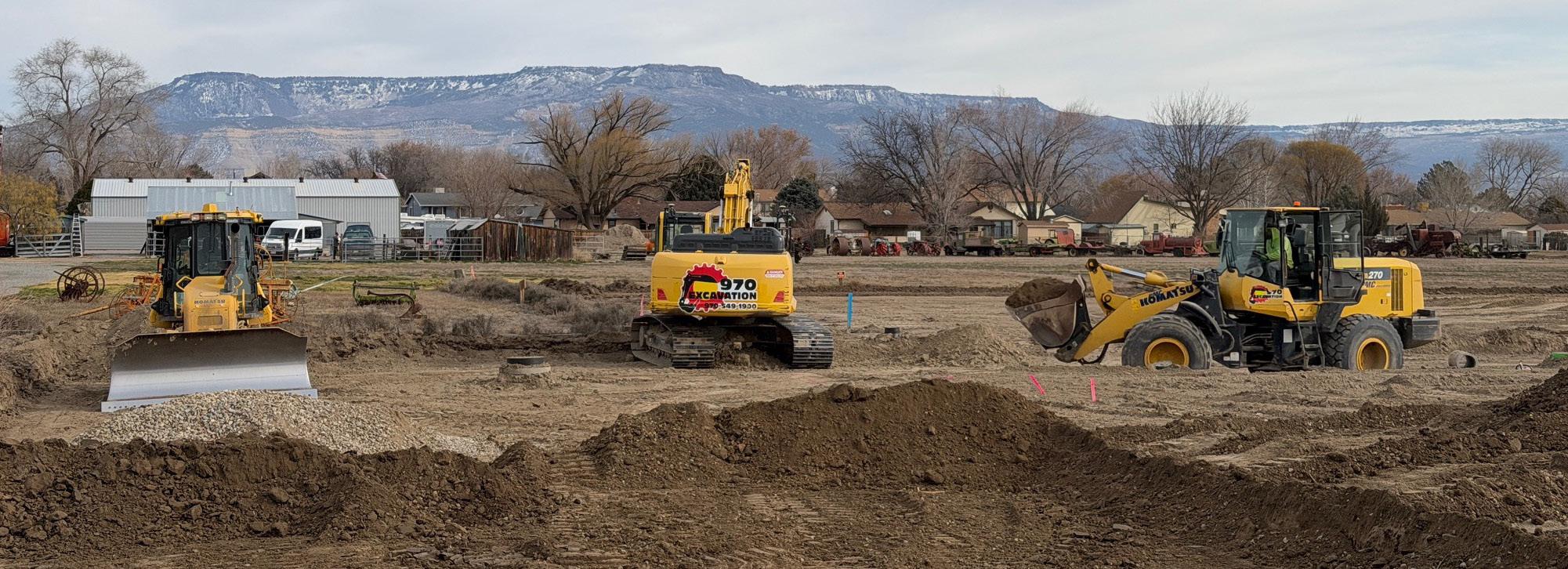
Erik Olson, co-owner of Cross Orchard Development LLC and owner of Belle Rose Builders, stands in front of a Komatsu dozer at the eight-acre site where 28 single-family homes will be built. Excavation and dirt work began in November to install infrastructure and ready the streets for paving in the spring. Olson said once the streets are paved, construction will commence. The land formerly was part of Cross Orchards Historic Site. Photo by Tim
Harty.
Wait is finally over for developer
Cross Orchard Development LLC started groundwork and looks to begin building homes in the spring
Tim Harty The Business Times
The sound of heavy machinery moving dirt in November on an 8-acre, L-shaped parcel that used to be the south end of Cross Orchards Historic Site must have been akin to a sigh of relief for Erik Olson.
Olson and his stepdad, Ted Martin, were business partners in Cross Orchard Development LLC, which took possession of the property via quit claim deed six weeks after his mother, Juliann Martin, with Evergreen Mesa LLC bought the property from the Museums of Western Colorado for $360,000 on June 16, 2021.
Then, the property sat there with no activity for nearly four-and-a-half years. Four-and-a-half frustrating years for Olson, as the project was delayed first by a heartbreaking loss – Ted Martin got sick and eventually passed away – then ran into the obstacle course that local building contractors know better as the City of Grand Junction planning and permitting process.
Olson diplomatically described the latter by saying, “It was kind of a tricky little infill to get designed.”
So, when asked about work finally starting on the property that will result in 28 single-family homes, Olson’s answer was short and sweet: “It was a long time coming.”
In addition to being a co-owner of Cross Orchard Development, Olson owns another business that had to wait patiently: his construction company, Belle Rose Builders.
The work that commenced in November is the excavation and dirt moving to install infrastructure for each lot and the L-shaped street that will connect Hoisington Avenue on the east end to Wellington Avenue on the west end. Those will be the two points of entry into the Cross Orchards Valley subdivision.
And there will be a small, new street, Elin Belle Street, named after Olson’s oldest daughter, who is in the ninth grade.
As for the homes that will populate the subdivision, that’s a much more fun story for Olson to tell, evidenced in the enthusiasm that permeated his voice when discussing the subject.
“Yeah, it’s going to be pretty cool,” he said. “They’re actually good-sized lots. I think it averages out to 10,500
square feet per lot, so they’re good, really good-sized lots.
“And I’ll be building – I mean, the term entry-level isn’t quite, that’s a pretty broad stroke these days – but they’ll kind of be between 1,450 and 1,800 square feet. … And the price range will probably start around 450 (thousand dollars), something like that. That’s why it’s funny, you say entry level, and these days it’s still crazy to wrap my head around 400 (thousand dollars).”
The majority of the homes will have three bedrooms and two bathrooms, and Olson anticipates almost all, if not all, of the homes being single-story, ranch-style homes. None of that sounds all that different from a lot of single-family housing developments in Grand Junction, and Cross Orchards Valley is in the city, thanks to an annexation in November 2021.
See CONSTRUCTION on page 12
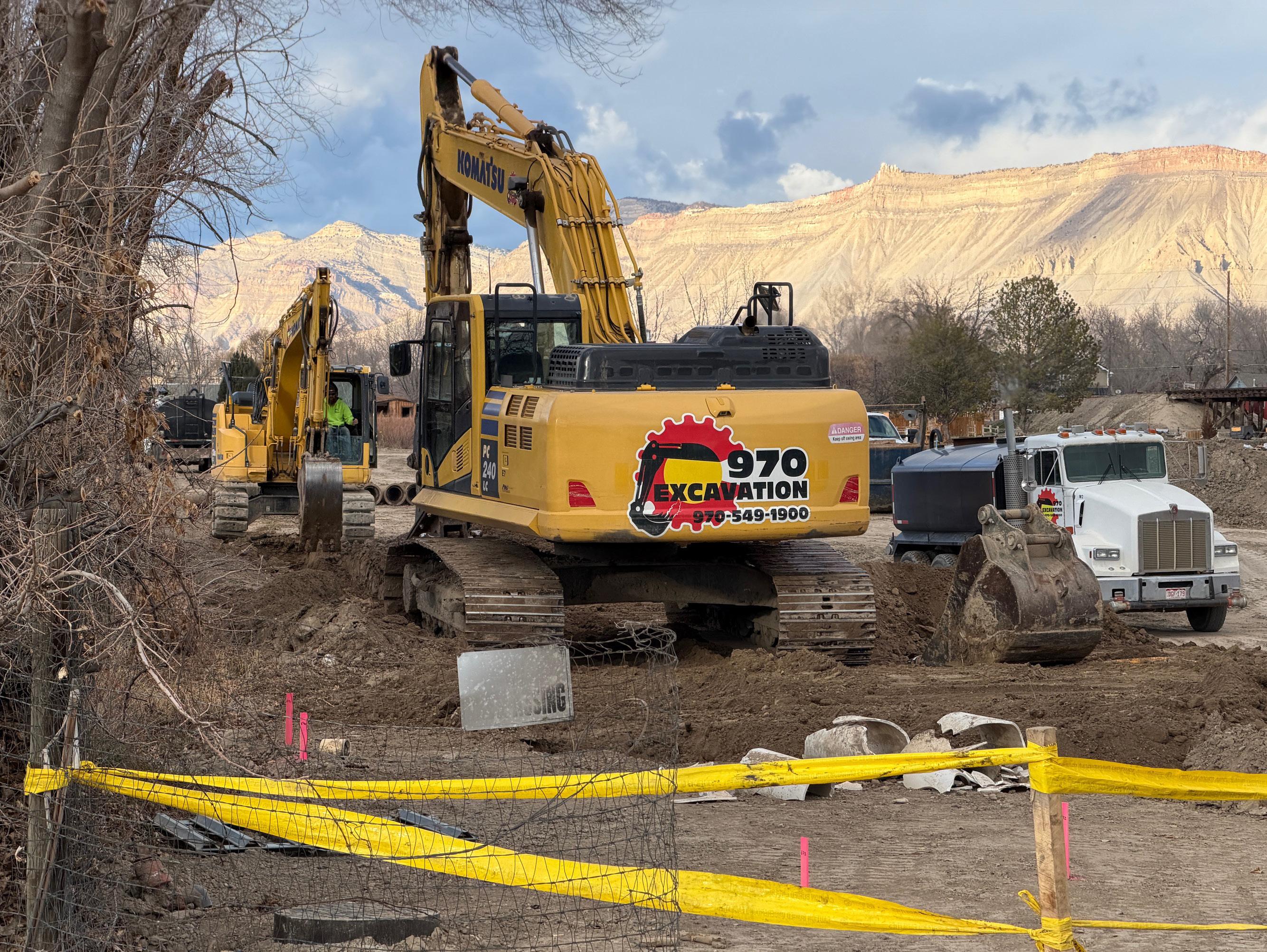
Top and bottom-right photos: Heavy machinery for excavation and dirt moving have been busy since mid-November on the eight acres south of Cross Orchards Historic site, 3073 F Road. The Cross Orchards Valley subdivision does not have its own address yet. Photos by Tim Harty.
Now you can see them
Hormone
Health & Wellness is now easy to find, offers more services
Tim Harty The Business Times
A good-sized waiting room? Didn’t have that.
Good visibility of its business in a corner building, where it’s the only tenant, on a busy street? Didn’t have that.
The ability to expand if needed? Didn’t have that.
But Hormone Health & Wellness has all of those things now. That’s why the business moved to 2241 N. Seventh St. in Grand Junction and opened for business there on Jan. 5.
Most of the moving had to be done during the week between Christmas and New Year’s Day, so Hormone Health & Wellness definitely had something to celebrate to start 2026.
Client Relations Manager/Consultant Ashlie Zimmerman said the move was necessary, because Hormone Health & Wellness had outgrown its space at 1190 Bookcliff Ave., Suite 202, and its lease was up at the end of December.
“We’ve grown business-wise,” she said. “We’ve had to hire more nurses and more clinical staff, and we needed more space, because we’ve taken on other opportunities in the business.
“We’re offering peptides now. We’re also doing biogenical hormone therapy. We also have additional stuff that we offer: Emsculpt Neo, which is our body contouring package, and then we have a chair for urinary incontinence issues.”
Offering those expanded opportunities required more space, and they are important for growing the client base. Hormone Health & Wellness wants the community to know it focuses on more than just hormones.
GRAND RE-OPENING FOR HORMONE HEALTH & WELLNESS
Hormone Health & Wellness has been in its new location, 2241 N. Seventh St., about a month now, and it’s ready to celebrate with a grand re-opening there on Feb. 17, 4:30 to 6:30 p.m.
The event is open to the public, and the Grand Junction Area Chamber of Commerce will be on hand for a ribbon cutting.
To learn more about Hormone Health & Wellness, go online to hhwoc.com.
Now that people can readily find Hormone Health & Wellness, they can get to know more about what happens inside.
“We do other things that people are looking for,” Zimmerman said.
The larger location provides more storage than Hormone Health & Wellness currently needs, because of the 3,800-square-foot basement under the 4,000-square-foot ground floor. And the large waiting room was a nice bonus.
The one thing 2241 N. Seventh St. didn’t have when Hormone Health & Wellness signed the lease was office space. But having an owner with a background in construction led to converting two large rooms into four offices.
“It was more space, but it didn’t come with office space, so we had to create it,” Zimmerman said.
The visibility at 2241 N. Seventh St. was important, too, because being one of several businesses at 1190 Bookcliff Ave. made Hormone Health & Wellness practically invisible to passersby.
Now, people can see the corner building at Seventh Street and Bookcliff Avenue with its large, colorful signage, and it’s obvious: “We’re that corner unit right there,” Zimmerman said. “We have actual visual presence. People will see us with our business logo and everything.
“With the other location, our name was with six other businesses on this little tiny marquee on the corner of the street. Nobody knew we were in that building. So, by being on our own on a busy street with two different, large, business marquees, hopefully that drives business.”
Dr. Kathy Howe said Hormone Health & Wellness has done hormone pellets since the business began in March 2020.
“We do specifically hormone replacement for female and male patients,” Howe said, “and we have a wide range of ages that we take care of.
“Our focus, we tend to get a lot of women that are kind of peri-menopausal, which is kind of right before menopause and going into menopause And then males in their kind of 40s to 50s that are what we call andropos, kind of where we see men with lower testosterone levels. We have patients that go all the way into their 80s.
“So, it’s mid 20s to 80 years old, both men and women that we
Peptides are a recent addition for the business, and Howe said they have “very wide ranges of treating various disease.” She said peptides are not FDA-approved, “so we’re utilizing some things that are up and coming. A lot of physicians are using them across the country.”
Howe added Hormone Health & Wellness addresses various muscular-skeletal disorders with the Emscuplt Neo functional-wellness machine that helps muscle strains, sprains, arthritis and various joints.
“I personally have used it on my shoulders and my hip and have had great results,” she said.
Howe also emphasized that as hormone replacement therapy becomes more popular, the businesses that provide it and other services are not all created equal.
“I think what sets us apart is that we’re excellent at managing pellets,” she said. “I’m a physician, and I’m the medical director, and I look at every single chart and do the dosing on every single chart, and we do labs every single time.
“And I’m physically here, versus some of these clinics that are kind of overseen by physicians that don’t step foot in the office.”
Ultimately, Howe said, the physical presence matters.
“We have something to offer that people need to know about, that’s here locally in the community instead of reaching out to things online,” she said. “Because if you’re gonna go somewhere locally, you’re gonna get actually monitored and managed and cared for properly.”
Zimmerman echoed that sentiment and mentioned Hormone Health and Wellness opened two weeks before COVID hit in 2020, and that didn’t kill the business.
“We are still open,” she said, “because we have something that people need.”
For Colorado from county reports producers development
A regional brings those a consolidated, agriculture business According Center, the resource census data, economic shared reference conservation development The in Western commissioned Center and in partnership University presented professor University, Delta, Montrose, and was during a public producers, and community Agriculture’s According contribution an estimated county region induced report attributes million in to agricultural output at The economic farms and transportation, suppliers, supporting share of agriculture’s In fiscal agriculture million annually local tax with an additional tax revenue.
Producer AgriWest
• 71.8 reported drought within • Rising reported, labor, fertilizer, • Higher to reinvest production
Left to right, Hormone Health & Wellness employees Shardai Salaz, Dr. Kathy Howe, Ashlie Zimmerman, Sherissa Katzenberger and Lori LeFebre stand next to a sign for Emsella, a chair that treats incontinence and is available at Hormone Health & Wellness. Photo by Tim Harty.
Study illuminates pressures, economic stakes of Western Colorado agriculture
Brandon Leaullen The Business Times
For years, agriculture in Western Colorado has been discussed in fragments, from county statistics and commodity reports to anecdotal accounts from producers facing drought, rising costs and development pressure.
A regional study released this month brings those elements together, offering a consolidated, data-driven look at agriculture as an economic engine and a business sector under growing strain.
According to the Business Incubator Center, the study was developed as a baseline resource for future planning. By combining census data, producer survey results and economic modeling, the report provides a shared reference for policymakers, lenders, conservation organizations and economicdevelopment agencies.
The Economic Impact of Agriculture in Western Colorado study was commissioned by the Business Incubator Center and released through AgriWest in partnership with the Colorado Mesa University School of Business. It was presented by Dr. Nathan Perry, assistant professor of economics at Colorado Mesa University, spans five counties (Mesa, Delta, Montrose, Garfield and Rio Blanco) and was formally introduced Jan. 19 during a public presentation attended by ag producers, economic development leaders and community stakeholders.
Agriculture’s economic footprint
According to the study’s economic contribution analysis, agriculture supports an estimated 9,123 jobs across the fivecounty region when direct, indirect and induced employment are included. The report attributes approximately $281.7 million in regional gross domestic product to agricultural activity and estimates total output at $719.1 million.
The study identifies agriculture’s economic reach as extending well beyond farms and ranches themselves. Processing, transportation, equipment sales, feed suppliers, veterinary services and other supporting industries account for a significant share of agriculture’s total contribution.
In fiscal terms, the study estimates agriculture generates approximately $20.3 million annually in combined state and local tax revenue across the region, along with an additional $33.9 million in federal tax revenue.
What producers reported
Producer survey highlights from the AgriWest study include:
• 71.8 percent of responding producers reported being directly impacted by drought within the past three years.
• Rising input costs were widely reported, with increases noted in feed, fuel, labor, fertilizer, equipment and maintenance.
• Higher costs limit producers’ ability to reinvest in infrastructure or absorb production losses.
• Workforce availability emerged as a challenge as producers reported: difficulty recruiting and retaining seasonal and specialized labor; increasing reliance on family labor; and reducing operational flexibility.
• 35-44 percent of producers are over 65 years old and less than 8 percent are under 35, raising long-term agricultural succession concerns.
Census data in the study show the market value of agricultural products sold has fluctuated during the past two decades, rising from about $98.1 million in 2002 to a peak of roughly $114.2 million in 2017 before declining to approximately $90.8 million in 2022, in inflation-adjusted dollars.
While total agricultural sales have fluctuated since 2002, per-farm finances have steadily weakened. Average farm size declined from 241 acres in 2002 to 114 acres in 2022, and median farm size fell from 24 acres to 10 acres.
Over the same period, average sales per farm dropped from about $61,000 to $38,600, while net cash income per farm fell from roughly $4,900 to under $1,900. Although government payments increased sharply in 2022 due to pandemic and Farm Bill programs, the data show that long-term farm profitability has continued to erode.
Ag census data in Mesa County
According to the study’s review of U.S. Agricultural Census data in Mesa County, the number of farms has increased over time, even as total farmland and average farm size have declined, indicating a shift toward smaller operations.
Smaller livestock are becoming a larger percentage of livestock produced with cattle and calves inventory dropping from 45,071 in 2002 to 27,155 in 2022, while sheep and lambs inventory rose from 3,111 to 17,251.
At the same time, the study identifies Mesa County as continuing to be a strong agricultural producer, particularly in fruit tree, nut and berry production. The report places Mesa County among the region’s key contributors to specialty crop production, even as broader land-use and farm-structure trends continue to evolve.
Ongoing presentations
Additional public presentations of the Economic Impact of Agriculture in Western Colorado study are scheduled later this month.
A presentation for Garfield and Rio Blanco counties will take place Jan. 29, 5:30 to 7 p.m,. at the Garfield Fairgrounds and Event Center, 001 Railroad Ave. in Rifle.
A presentation covering Delta and Montrose counties is scheduled for Jan. 30, 5:30 to 7 p.m., at the Montrose County Event Center, 1036 N. Seventh St. in Montrose.
Meals will be provided at both events, sponsored by the Garfield County Farm Bureau and Montrose County, respectively.
The full Economic Impact of Agriculture in Western Colorado study is available through the Business Incubator Center’s AgriWest program.
D51 financial update paints dire picture of future
Continued from Page 1
Attwood said reductions of that magnitude would significantly affect K-12 education if enacted by Congress.
Proposed federal cuts also include $77 million to teacher quality partnerships and the elimination of $315 million in preschool development grants. Attwood noted a previously announced $300 million freeze on preschool, childcare and Temporary Assistance for Needy Families funding has not gone into effect because of litigation filed by state attorneys general.
Although none of the proposed cuts have been implemented, Attwood cautioned that school districts should prepare for significant impacts if federal reductions move forward.
Colorado budget shortfall, legislative climate
Attwood told the board that Colorado is facing an estimated $850 million budget shortfall even after accounting for projected revenues. The primary cost drivers are Medicaid, higher education and K-12 education, which together account for roughly two-thirds of the state budget.
Because those categories dominate state spending, Attwood said education funding is actively being discussed as lawmakers work to close the gap.
She also reported that the 2026 legislative session opened with nearly 100 bills introduced on the first day. While Democrats retain control of the legislature, they remain one vote short of a supermajority, requiring bipartisan support for veto overrides and ballot measures. Attwood said internal divisions within the Democratic caucus could complicate negotiations as the session progresses.
Hold harmless protections fail to materialize
District 51 Superintendent Brian Hill asked Attwood to explain to the board how the financial protections they believed were in place were specifically tied to the state’s hold-harmless provision within the school finance formula.
Attwood said they were repeatedly assured by state officials that hold-harmless language would prevent District 51 from losing funding as the state transitioned to a revised school-finance framework. Based on those assurances, the district adopted its budget and supported the state’s framework with the understanding its funding floor was protected.
However, Attwood said the state later reinterpreted how the hold-harmless provision applies, concluding it does not protect districts from all negative funding
adjustments, including those tied to certain recalculations within the formula.
District 51Board Member Andrea Haitz said the issue was not a misunderstanding by the district, but a shift in the state’s interpretation after budgets were already built.
“This was presented to us as a protection,” Haitz said. “Now we are being told it never actually protected us the way we were told it did.”
$600,000 funding loss discovered midyear
Also, as a result of what the state is calling a glitch, District 51 now faces a potential $600,000 funding reduction in the current budget year.
Attwood said the district was informed of the issue midway through the fiscal year, long after staffing and operational budgets had been finalized.
Attwood said she has met with officials from the Colorado Department of Education, legislative staff, members of the Joint Budget Committee and the state commissioner of education to push for a fix, but no outcome is guaranteed.
State actions described as underhanded
Haitz criticized broader state messaging around education funding, saying lawmakers continue to claim K-12 funding is being protected while advancing policies that reduce actual district revenue.
One proposal would pull specific ownership tax revenue generated through local vehicle registrations into the state school-finance formula. Trujillo said that change would reduce District 51’s funding by approximately $5.8 million per year.
“They say they are not cutting education, but they are absolutely cutting K-12,” Haitz said. “That is underhanded.”
Administrative cuts and cost controls
Chief Financial Officer Melanie Trujillo presented the district’s midyear budget readoption and said the general fund is balanced only because of administrative reductions and one-time funding sources.
Trujillo said the district has prioritized administrative cuts before instructional reductions, including leaving central office vacancies unfilled, consolidating roles and delaying nonessential spending.
“We are making administrative reductions,” Trujillo said. “We are not automatically backfilling positions as people leave, and we are scrutinizing every noninstructional cost.”
Trujillo said those actions have allowed the district
to preserve classroom staffing while managing revenue uncertainty.
District planning for recession risk
Trujillo told the board that district financial modeling incorporates state economic forecasts showing a 50 percent probability of a recession in Colorado.
She said the possibility of a downturn reinforces the need to preserve reserves and avoid long-term commitments that cannot be sustained if revenues decline.
Enrollment decline continues
District enrollment declined by 622 students compared to last year, a decrease of roughly 3 percent. Since the 2019-20 school year, enrollment has fallen by 2,766 students, a cumulative decline of more than 12 percent.
The district currently benefits from the student count using 4-year averaging, which provides approximately $8.8 million more in funding than current enrollment alone would generate. Trujillo said the state is discussing additional reductions to student-count averaging, including a move to three-year and potentially two-year averaging, which would significantly reduce future revenue.
Additional funding losses possible by 2026-27
Trujillo warned the board that School District 51 could face an additional funding loss of approximately $6 million as soon as the 2026-27 school year, depending on how the state proceeds with changes to student-count averaging and other school-finance policies.
Trujillo said that when combined with the $600,000 midyear loss tied to the glitch and the potential $5.8 million annual reduction associated with the specific ownership tax proposal, the district could face overlapping losses within a short period.
Trujillo said the impacts could begin as early as the 2026-27 school year.
Trujillo also highlighted cost pressures in several district programs. The risk-management fund required a $500,000 transfer due to rising insurance premiums and claims. Universal preschool is being subsidized with approximately $400,000 in general fund dollars, and nutrition services continue to face rising food and labor costs that outpace reimbursement rates.
Trujillo warned that while District 51 currently maintains reserves slightly above the board’s 20-percent-minimum policy threshold, she said those balances could be pushed below board policy levels if corrective action is not taken.
Dinosaur Journey features new animatronic dinosaurs
The Museums of Western Colorado installed new animatronic dinosaurs at Dinosaur Journey Museum in Fruita as part of the museum’s Return of the Roar campaign.
The project marked a major milestone for Dinosaur Journey, restoring movement and immersive storytelling to one of Western Colorado’s most popular family attractions, the museum said in a news release.
“Visitors from around the world consistently share with us how impressed they are by the fossils, science and educational depth at Dinosaur Journey,” said Mollie Shepardson, director of development and communications with the Museums of Western Colorado. “At the same time, we heard clearly from our local community that the animatronic dinosaurs were a beloved part of the experience they missed.
“Return of the Roar aims to bridge that gap, preserving the museum’s strong educational foundation while bringing back the movement and excitement that makes these stories memorable.”
Funded entirely through community donations, the Return of the Roar campaign invited supporters to help revive Dinosaur Journey’s animatronic exhibits. Contributions
ranged from grassroots gifts to leadership-level support, demonstrating broad enthusiasm for the museum’s future, the news release said.
The museum invited the western Colorado community to celebrate the Return of the Roar on Jan. 23 at Dinosaur Journey Museum, which features the interactive dinosaur exhibits, real fossils and a working paleontology laboratory.
Dinosaur Journey is part of the Museums of Western Colorado, which also operates the Museum of the West in downtown Grand Junction and Cross Orchards Historic Site. Admission to all three sites is available through the museum’s Experience Pass.
The Return of the Roar campaign is one of several ongoing initiatives as the Museums of Western Colorado prepares to celebrate their 60th anniversary, reaffirming their commitment to education, preservation and community connection.
For more information about Dinosaur Journey Museum, visit www.mowc.co.
A triceratops is one of the new animatronic dinosaurs installed at Dinosaur Journey. Photo courtesy of Museums of the West.
revenue modeling showing a 50 reinforces long-term revenues decline. compared Since the by 2,766 percent. student count approximately enrollment discussing including averaging, 2026-27 District 51 approximately depending student-count
$600,000
$5.8 million ownership overlapping losses early as the in several required a premiums and subsidized with dollars, and and labor maintains 20-percent-minimum be pushed taken.
enthusiasm Return of the dinosaur operates downtown Grand Historic Site. available through campaign is one Museums celebrate reaffirming their preservation and Dinosaur www.mowc.co. animatronJourney. the West.
Sauvage, McDonald honored at VinCO Conference
Two of the three Awards of Excellence handed out by the Colorado Association for Viticulture & Enology during its annual VinCO Conference and Trade Show went to Grand Valley winemakers.
Kaibab Sauvage of Colorado Vineyard Specialists and Sauvage Spectrum was named 2025 Grape Grower of the Year, and Richard McDonald of Cliff Dweller Wine Co. and Grand Valley Enology was named 2025 Friend of the Colorado Wine Industry.
Meanwhile, Aspen Peak Cellars in Bailey, Colo., was bestowed Winery of the Year at the three-day event, which concluded Jan. 22 at the Grand Junction Convention Center.
Sauvage was recognized for his “lasting contributions to the state’s wine industry,” according to a CAVE news release. CAVE detailed his background, writing:
“Beginning in the early 2000s as a grower for BookCliff Vineyards, Kaibab quickly earned a reputation for listening to growers and working collaboratively alongside winemakers. He soon founded Colorado Vineyard Specialists and has consistently produced high-quality grapes that have helped define Colorado wine.
“Over the past decade, marked by significant challenges for grape growers statewide, Kaibab has demonstrated exceptional leadership by pioneering new varietals in both vinifera and hybrid plantings. His grapes have been the foundation of numerous award-winning wines, solidifying his role as a cornerstone of Colorado viticulture.”
For McDonald, CAVE wrote:
“One of Colorado’s few Australian
the
were announced on Jan. 21 are, from
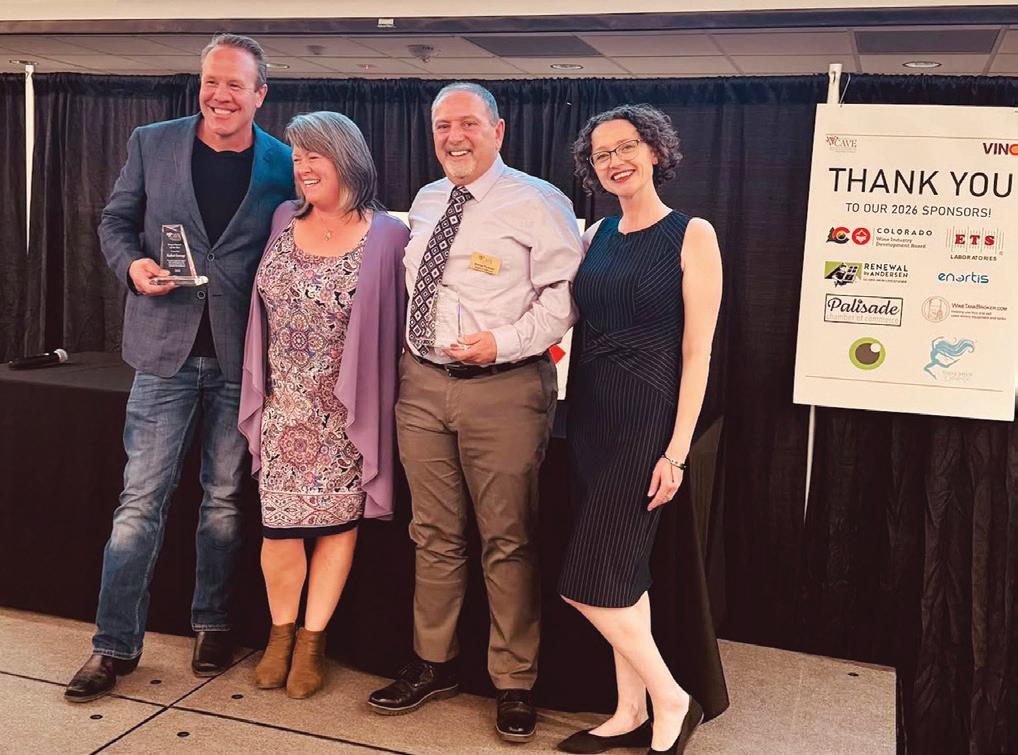
Grape Grower of the Year Kaibab Sauvage, Julie Flukiger and Marcel Flukiger, owners of Winery of the Year winner Aspen Peak Cellars; and Colorado Association for Viticulture & Enology Executive Director Cassidee Shull.
courtesy of Colorado Association for Viticulture & Enology.
winemakers, Richard brings a global perspective shaped by early experience with the Dave Phinney winemaking family in California, best known for The Prisoner. In 2018, he relocated to Colorado to serve as head winemaker at BookCliff Vineyards for two years, followed by extensive work with Rio Grande Winery in Las Cruces, New Mexico.
“Just prior to the pandemic, he and his wife, Aly, founded Colorado Vintners Collective, creating a collaborative hub for winemaking, education and community on the Western Slope. In 2023, he further expanded his impact by receiving a USDA grant to launch Grand Valley Enology, improving access to winery analysis in the region, while also debuting his personal label, Cliff Dweller Wines. His dedication to collaboration, innovation and regional growth makes him so deserving of this award.”
Survey, open house to help assess city, county housing needs
Beginning in February, the City of Grand Junction and Mesa County will engage residents, stakeholders and community partners to develop a Housing Needs Assessment.
The assessment will provide a shared understanding of housing conditions and needs across the community, while informing two separate Housing Action Plans, one for the City of Grand Junction and one for Mesa County, each tailored to the priorities and housing challenges of its respective jurisdictions.
Public engagement opportunities will include a community open house, a countywide housing survey, targeted resident focus groups and key stakeholder engagement with service providers, employers, developers and housing partners.
Ongoing information, updates and opportunities for participation will be shared through the City of Grand Junction’s Engage GJ platform online at engagegj.org/housing-needs-assessment.
The community open house will take place Feb. 12 from 5 to 7 p.m. at the Grand Junction Central Library, 443 N. Sixth St. The event will begin with an overview of the Housing Needs Assessment and
the process moving forward, followed by opportunities for attendees to share input on the community’s greatest housing needs and the types of housing that would be supported.
The open house and housing survey are open to all Grand Junction and Mesa County residents. The survey will be available in English and Spanish and will remain open through March 31.
This effort is supported by grants awarded to the City of Grand Junction and Mesa County from the Colorado Department of Local Affairs (DOLA) and aligns with recent state legislation that requires housing-needs assessments to be created and updated regularly. It also requires coordinated local housing planning, strong community engagement and the adoption of data-driven Housing Action Plans.
More information about the Housing Needs Assessment and engagement opportunities can be found at Engage GJ or on the City of Grand Junction website, www.gjcity.org/353/Housing.
For questions, please contact the Housing Division at 970-256-4081 or email housing@gjcity.org.
Shown after
VinCO Awards of Excellence
left,
Photo
Excellence from left, Sauvage, owners of Peak CelViticulture Cassidee Shull. Association for followed by input on needs and supported. housing survey and Mesa will be and will by grants Junction and Department and aligns requires be created requires planning, strong adoption of Housing engagement Engage GJ website, contact the 970-256-4081 or
GJ Parole Office honors case manager Black
The Colorado Department of Corrections’ Grand Junction Parole Office recognized Mesa County Community Corrections Case Manager Jason Black for outstanding service and professionalism.
Mesa County Community Corrections Case Manager Jason Black was recently recognized for outstanding service and professionalism by the Colorado Department of Corrections’ Grand Junction Parole Office.
Black received a Certificate of Excellence and a commemorative coin in recognition of his strong communication skills, commitment to public safety and collaborative work supporting high-risk, high-needs individuals under community supervision.
The award was presented Jan. 14 by Jacob Reigel of the Grand Junction Parole Office, who cited Black’s consistent professionalism, positive attitude and ability to work effectively with parole officers and partner agencies across the region.
“Jason does an outstanding job managing complex cases while maintaining clear, respectful communication with parole officers and staff,” Reigel wrote. “His work helps keep the community safe, holds individuals accountable and supports successful progress through parole and related programs.”
Black serves as a case manager with Mesa County Community Corrections, part of the Criminal Justice Services Department. His role includes coordinating
services, monitoring compliance, and supporting individuals as they work toward stability and successful reentry.
Mesa County Justice Services Director Michelle Cooley, said the recognition reflects the high standards staff bring to their work every day.
“Jason’s professionalism, integrity and commitment to collaboration are exactly what we strive for across Justice Services,” Cooley said. “His work supports accountability, strengthens partnerships with our state colleagues and helps create safer outcomes for the community.”
In accepting the recognition, Black emphasized the importance of teamwork and shared responsibility.
“There are many people on our team who bring the same level of dedication and professionalism every day,” Black said. “This work is always a team effort.”
Reigel also acknowledged several other community corrections staff members for their contributions, including Angela Coca, Tyler Findlay, Andrea Keech, Donald Webb, Jacob Temple and Samantha Henderson.
Mesa County Community Corrections works closely with state and local partners to promote accountability, reduce recidivism and support safer communities. F
compliance, and work toward Director recognition bring to integrity collaboration are across Justice supports partnerships helps create community.” recognition, Black teamwork our team dedication and Black said. effort.” several corrections staff including Andrea Temple and Corrections and local accountability, reduce communities.
Construction
Continued from Page 2
Where his development will distinguish itself, Olson said, is in what the lots will include in addition to the homes.
“Almost all the lots will have threecar garages and RV parking, which is kind of unheard of for that size lot in that price range,” he said, adding there still will be room for fenced-in back yards. “I think that’s the main thing that sets it apart is it’s pretty unique in that regard. … They’ll be really nice houses starting in that $450,000 range.”
Olson said Cross Orchard Development will market the homes as “kind of Colorado-living-ready-type houses that you can actually afford to get into for either first-time home buyers or someone wanting to downsize or retire into it.
“As far as our marketing, that’s kind of what we’re shooting for is to really market that three-car garage and RV parking and, you know, still kind of have a fenced-in yard without houses right on top of you.”
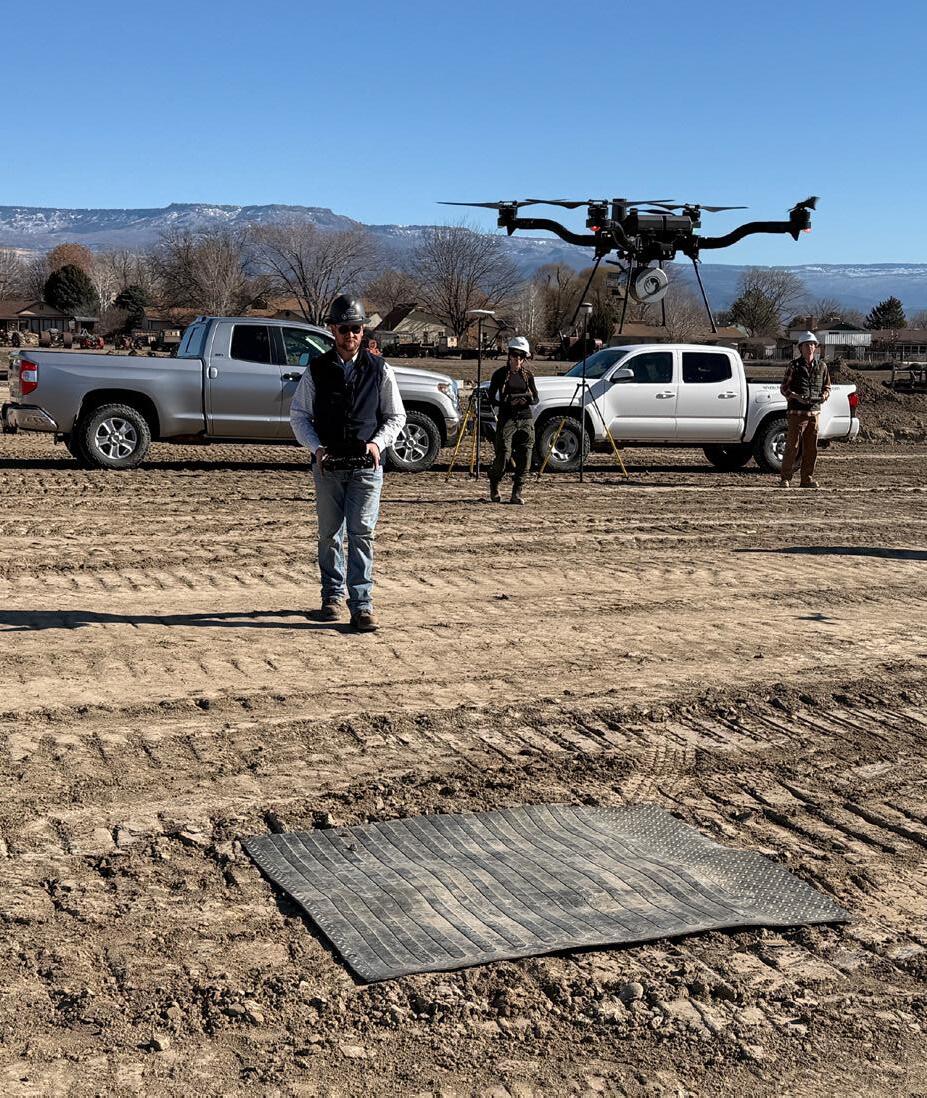
B.J. Russell, the Western Slope operations manager for Summit Services Group, operates a drone with a LiDAR unit attached to it while at the Cross Orchards Valley subdivision site on Jan. 19. Belle Rose Builders will start construction there this spring. Photo by Tim Harty.
Olson said the setbacks on the lots are bigger than usual, and limiting the number of homes to 28 is intentional in a development where others might target 40-plus homes and leave no one with a back yard or privacy.
“Our back yards are all 25-foot setbacks,” he said. “You’re not crammed up on your neighbors.”
Olson is targeting springtime for actual home construction.
First, he needs warm weather and paved roads.
“We’ll be paving and putting in roads and everything as soon as the weather breaks in the spring,” he said. “Late March if we’re really lucky, or April, just whenever the asphalt plants open up.”
MANAGING PROJECTS WITH DRONES AND LIDAR
It looked like Summit Services Group Western Slope Operations Manager B.J. Russell and his crew were at the Cross Orchard Development site on Jan. 19 to have some fun flying drones.
No such luck. They were there to work at the request of Belle Rose Builders owner Erik Olson. But it still looked like fun.
Russell operated the largest of three drones that Summit Services Group was using that day, and his drone had to be big, because its cargo is the LiDAR unit, which is heavy.
LiDAR, by the way, stands for Light Detection and Ranging, and Cross Orchard Development needed Summit Services Group’s help for things like stormwater compliance and measuring the volume of large dirt piles.
Russell gave an example of Olson having a big stockpile that he needs to get rid of, but he doesn’t know how much is there, so he has no idea what the removal might cost. Summit Service Group’s drone with the LiDAR unit will use laser light to get measurements, cre-
ate a three-dimensional ground model and calculate the volume of the pile.
“It’s much more accurate than having a guy in a loader,” Russell said, adding, “The LIDAR stuff is really cool, because we can go out and do a survey where it’s really tough or even impossible for ground crews to get to. We can go set up ground-control points and fly these heavily treed or wooded areas, and get that ground model from that stuff.”
Russell said Summit Services Group got started with aerial surveying about two years ago when it started seeing the need for it in the oil fields.
“We got started out there, but we’re doing more and more of the residential stuff,” he said. “You know, owners, GCs (general contractors) are using it. … It works a lot for project management for these guys.”
Russell added, “We’re pretty new to this, but really wanting to get more involved in the day-to-day stuff for guys like Erik that can maybe benefit from this stuff.”
Roth or traditional contributions: What belongs in your retirement bucket?
A key concept in wealth building and retirement planning is the Three-Bucket System.
The overarching concept is to fill one bucket with pre-tax dollars (taxes not paid now but deferred until a later date), fill the second bucket with no-tax dollars (taxes paid now and no taxes paid at a later date), and fill a third bucket with after-tax dollars where taxes are paid now but future taxes will vary based a mix of tax aspects such as capital-gains rates and tax basis (the third bucket is represented by your typical brokerage investment account).
One of the most common and most consequential questions in retirement and tax planning is whether to make Roth (Bucket 2) or traditional (Bucket 1) contributions to retirement accounts such as IRAs and 401(k) plans. While the mechanics of each option are straightforward, the strategic implications can be complex and highly dependent on an individual’s tax profile, career trajectory and long-term financial goals.
This article focuses on the first two buckets and explores the key differences between Roth and traditional contributions and outlines practical strategies for determining which approach, or combination of approaches, may be most appropriate.
Traditional IRAs and traditional 401(k) contributions can be powerful tools, particularly for taxpayers in current higher tax brackets. Key advantages include immediate tax deduction (subject to income and plan participation limits for IRAs), lower current taxable income (which may also reduce phaseouts or surtaxes), and tax-deferred compounding over long periods.
However, there are important considerations as follows: Withdrawals in retirement are fully taxable at ordinary income rates; Required Minimum Distributions (RMDs) apply starting at age 73 (under current law); and large traditional balances can increase future marginal tax rates, Medicare premiums (IRMAA) and taxation of
The Business Times 609 North Ave., Suite 5 Grand Junction, CO 81501 (970) 424-5133 www.thebusinesstimes.com
Reach advertising at: publisher@thebusinesstimes.com Letters to the editor at: publisher@thebusinesstimes.com Submit stories or story ideas to: stories@thebusinesstimes.com
Social Security benefits.
In summary, traditional contributions are often most attractive when a taxpayer reasonably expects to be in a lower tax bracket in retirement than during their working years.
Roth IRAs and Roth 401(k)s reverse the tax equation by requiring tax payment upfront. Key advantages include: tax-free qualified withdrawals in retirement; no RMDs during the owner’s lifetime for Roth IRAs; greater flexibility for tax planning, estate planning and legacy goals; and protection against future tax-rate increases.
Potential drawbacks to Roth IRAs include: no currentyear tax deduction; income limits for direct contributions; and paying tax today may be costly for high-income taxpayers in peak-earning years.
Roth contributions are especially appealing for individuals who expect equal or higher tax rates in retirement, or who value tax diversification and certainty.
There is no universally “correct” choice between Roth and traditional contributions. Instead, the decision should be strategically informed by five key variables as follows:
1. Current vs. Future Marginal Tax Rates: This is the most cited, and often oversimplified, factor. While many assume retirement equals lower taxes, that is not always the case, particularly for high-net-worth individuals with pensions, rental income or large required distributions.
2. Career Trajectory and Income Growth: Younger professionals early in their careers may benefit from Roth contributions when income and tax rates are relatively low. As earnings increase, shifting toward traditional contributions may become more advantageous.
3. Legislative Risk: Tax laws change. Roth accounts hedge against future increases in income-tax rates by locking in today’s known rates.
4. Required Minimum Distributions and Medicare Costs: Large traditional balances can push retirees into higher brackets and increase Medicare Part B and D premiums. Roth assets can be used strategically to manage
taxable income in retirement.
5. Estate and Legacy Planning: Roth accounts are particularly attractive for heirs. Beneficiaries receive distributions tax-free (though still subject to distribution timing rules), making Roth assets a powerful legacy tool.
For many taxpayers, the optimal approach is not an “either/or” decision, but a blend of Roth and traditional contributions over time.
A diversified tax strategy allows retirees to control taxable income year by year, fill lower tax brackets with traditional distributions, use Roth withdrawals to avoid pushing income into higher brackets, and better manage taxation of Social Security and Medicare premiums.
This flexibility is often undervalued but can significantly improve after-tax retirement outcomes.
Beyond annual contributions, Roth conversions play a central role in advanced retirement planning. Converting traditional assets to Roth during lower-income years, such as early retirement before Social Security and RMDs begin, can reduce lifetime tax liability.
Conversions require careful modeling, as the upfront tax cost must be weighed against long-term benefits. However, for many clients, strategic conversions are one of the most effective tools available.
The decision between Roth and traditional retirement contributions is ultimately a tax planning decision, not merely an investment choice. It requires a forward-looking analysis of income, tax rates, legislative risk and personal goals.
As with most sophisticated financial strategies, the most effective solutions are customized, revisited regularly and coordinated with broader tax and retirement planning.
Working with a qualified CPA or tax advisor can help ensure that retirement contributions align not only with today’s tax return, but with long-term financial security.
Chris West joined DWC CPAs and Advisors in 1996, became a principal in 2009 and was appointed CEO of the firm in 2019. Chris is a licensed certified public accountant, Personal Financial Specialist, and a Series 65 investment advisor representative with Global Retirement Partners LLC.
Chris West
Business brokers guide buyers through complex transactions
Buying a business is one of the most consequential financial decisions an individual can make. For first-time owners and owner-operators, the process can appear straightforward. Identify a business, review the financials, secure financing and close.
In practice, a business acquisition is not a single transaction. It is a layered financial, legal, operational and tax event. This complexity is where an experienced business broker adds measurable value.
Unlike residential or commercial real estate, purchasing a business involves far more than transferring assets or assigning a lease. A business broker’s role is to help buyers understand what they are truly acquiring, how the transaction should be structured and where risk exists before and after closing. For buyers navigating this process for the first time, that guidance often determines whether an acquisition becomes a durable investment or an expensive lesson.
Understanding What Is Being Purchased
A common misconception among first-time buyers is that the purchase price alone reflects the value of the deal. In reality, a business acquisition includes multiple components, each with its own implications. These may include equipment and inventory, customer relationships, contracts, intellectual property, goodwill and in some cases licenses or regulatory approvals.
A business broker helps buyers understand how these components are valued and how they should be treated within the transaction. Equipment, for example, can introduce significant complexity. Depreciation schedules, remaining useful life and replacement costs all affect projected cash flow and long-term performance. Without proper evaluation, buyers may overpay for assets nearing obsolescence or
misunderstand how value is allocated in the deal.
An experienced broker evaluates these elements together and ensures the buyer understands what drives value and what introduces risk.
Due Diligence Beyond Financial Statements
Financial statements are a starting point, not a conclusion. Income statements and balance sheets show historical performance, but they rarely capture operational realities, compliance obligations or future liabilities.
A professional business broker guides buyers through a broader due-diligence process. This includes identifying issues related to regulatory compliance, customer concentration, employee structure, vendor dependencies and contractual obligations. These factors often determine whether performance is sustainable under new ownership.
This level of diligence is especially important for businesses operating in regulated industries or across multiple jurisdictions. Compliance requirements vary widely and can materially affect valuation, transition planning and growth potential. Brokers with industry experience understand how these issues influence risk and opportunity.
Transaction Structure and Tax Considerations
Deal structure can be as important as price. Asset purchases and equity purchases carry different tax consequences, liability exposure and long-term financial outcomes. Allocation of value affects depreciation, amortization and post-closing cash flow.
A business broker works in coordination with a buyer’s CPA and legal counsel to ensure the structure aligns with the buyer’s objectives. This includes identifying depreciation opportunities, understanding capital-gains implications and addressing tax treatment early in the process.
For first time buyers, these considerations are often overlooked until late in the transaction. A broker’s role is not to replace professional advisors, but to surface these issues before they become constraints.
Financing Readiness and Lender Expectations
Most acquisitions involve third-party financing. Many
buyers underestimate how lenders evaluate business purchases. Cash-flow durability, management capability, industry risk and transaction structure all influence credit decisions.
Business brokers help buyers present lender-ready narratives that explain not just the numbers, but the operational logic behind them. This includes outlining transition plans, identifying risks and demonstrating continuity under new ownership.
By anticipating lender concerns, brokers help buyers avoid delays, restructuring or failed closings caused by misaligned expectations.
Transition Planning and Post Closing Performance
The transaction does not end at closing. For owner operators, the transition period is often the most critical phase of the acquisition.
Employee retention, customer continuity and operational handoff directly affect performance. A business broker helps buyers assess transition timelines, seller involvement and management continuity before finalizing the deal. These decisions protect enterprise value and reduce disruption during the handover.
Why Professional Business Brokerage Matters
Business brokers operate at the intersection of finance, operations and strategy. Their role is to ensure buyers see the full picture, not just the opportunity presented on paper.
For first-time owners in regional and middle-market transactions, this expertise provides clarity, reduces risk and supports informed decision making. Buying a business is not simply a transaction. It is a commitment to financial stewardship, operational leadership and longterm accountability.
A professional business broker helps buyers move forward with confidence, grounded in understanding rather than assumption. F
Dominic Jones is a business advisor with Bray Business Advisors Group and a licensed commercial real estate broker with Bray Commercial Real Estate.
Dominic Jones
purchases. industry risk and lender-ready but the outlining demonstrating help buyers caused by Performance For owner most critical continuity and performance. A timelines, continuity before enterprise Matters of finance, buyers see on paper. middle-market reduces Buying a commitment and longbuyers move understanding Business real estate Estate.
Just when you think you’ve had enough, the world gives you more
And believe me when I say it, that’s not a good thing. One of the hardest things I do isn’t writing this column on a Friday morning for deadline.
Craig Hall
After 25 years of writing with no formal training, I’ve found I can handle 900 words in about an hour or so pretty handily –although many tend to disagree, and many of those even when they agree. I truly am a riddle wrapped in an enigma who overexpounds in Randian fashion, apparently. No, the hardest thing about this column isn’t to write it, it’s what to write about. To make a single point and fixate on my take on that point from my perspective, which I hope is God’s (sub in the ol’ “creator of the universe’s” perspective here if that’s your take) perspective; at least how I see it. The rest of any interpretation or comment is up to the reader. As it should be.
I guess that makes the point of this column all about the point of this column. Also, that’s over 180 words down after the intro, so I’m one-fifth of the way home! I’m also past deadline, as I knew I would be when my head hit the pillow last night. Funny how we know what’s gonna happen from experience in our human condition, yet we allow it to happen – again – as our human condition has a way of doing.
But I digress. Again. As my very human columnist condition has on repeat in this space. So here’s what makes writing opinion pieces so darned difficult in our world today. And it sits in the palm of our hands, or at our fingertips. Now, you might think that’s the fault of your cell phone or computer. Well, partly it is. More important is all the stuff that’s accessible in those devices that really should (and if you look closely, literally has) have nothing to do with your life. Worse, 99 percent of that stuff are all the problems of the human condition.
But just because you are a member of the team via birth, it doesn’t mean you have to enter the game. And yes, I realize that is a fact I am all too guilty of. At least on the surface of my own sanity I’m a proponent of cancelling the game as opposed to being an all-star or G.O.A.T. Truth said, I want nothing to do with the game. But just like Michael Corleone, “Just when I thought I was out, they pull me back in.”
Alas, that’s why I’m here. While you may not care for my perspective, suck it up, buttercup, because I’m gonna write it out and put my name on it for all to see. After all, I know a guy who publishes a paper every week. I also believe those original amendments (ever with the mistake of putting them in ink on paper, which democrats have sworn to do a “work around” on them before said ink dried) were
divinely inspired. So, while you might think I’m not a serious person when I write (fair enough, you’re entitled to that) you can (un) rest assured, I take this freedom of the press and speech thing very seriously.
So, to my over-interested lawyer/pastor friend who likes to tell me I could have done my opinion piece in a few paragraphs, I say this: I’m getting to the point. To my other pastor friend who inspired this meandering of thought from me, here it is.
You see, this second pastor and I had a friendly back and forth on Facebook. I mean, where else would we have it? As I recall, his post was about love and prayer for the state of the world, and yet he took pains to state he wasn’t trying to make it a political point. Now, I’m never going to have a debate with a pastor about love – as I’m unarmed in many ways in that shootout – especially with a pastor I admire so much, one who’s even sought me out after some of my rather unloving posts about my human condition, taking time from his busy flock to counsel and pray for me.
But I did post this, “Well Pastor … whether we like it or not, it’s all politics.”
And while my pastor friend had a wonderful, loving response in saying love overcomes all, and politics doesn’t matter when it comes to loving your neighbor –even better, complimenting me in saying he knows I already know that – my brain, as always, just had to take it one step further. So, here it is:
It’s all politics, because that’s how politicians want it. And that’s 99 percent of what’s on your favorite device that gives you access to our cold, cold world. After all, how else are they going to amass power and get rich unless they are fixing all your problems? Fact is, that last thing 99 percent of politicians (I left room for a couple of good ones) want is you or me going to God and loving our neighbor to help us navigate the world. Because then it would be obvious to all they are basically useless.
So, my pastor friend was right about loving and praying for others, and I’m right about how it’s become all about politics. And I’m sure you know those things are as opposite as heaven and hell. But more important, what’s someone to do about it?
First and foremost, listen to my pastor friend. Love God and love your neighbor. And then let’s all work and speak up and vote to make sure 99 percent of our politicians do the same on an individual level while serving the people, not just as a campaign slogan. I know we just don’t see much of it as the world turns today.
But it doesn’t mean we don’t try. We must. Then maybe all that screen time will bring us some peace. And grace. And hope.
In Truth and freedom.
Craig Hall is owner and publisher of The Business Times. Reach him at 424-5133 or publisher@thebusinesstimes.com
NFIB to Colorado lawmakers: Treat Main Street as partner
As Colorado lawmakers return to the statehouse, small business owners are asking one question: Will Main Street be treated as a partner, or a target?
Nationally, small business optimism is improving. In fact, a recent NFIB survey found that as optimism is rising, uncertainty has declined to its lowest level since June 2024.
That’s thanks in large part to the tax reform bill passed by Congress last year, which made the 20 percent Small Business Deduction permanent, giving Main Street employers the certainty they need to invest in their businesses and plan for the future.
Colorado’s small business owners are hoping for that same stability at the state level. But with a projected $1 billion budget shortfall, uncertainty looms. Many of our members are concerned they will face new fees, employer mandates and regulatory hurdles.
Their concerns are well-founded. During the special session last year, lawmakers targeted and eliminated the sales tax vendor allowance. A small line item within the state’s overall budget, the allowance provided retailers with up to $1,000 per filing period as a meager way of helping offset the cost of collecting and remitting sales tax to the state. Proponents dismissed the allowance as insignificant. But for our mom-and-pop shops, which operate on infamously thin margins, they counted on that allowance to help manage day-to-day expenses.
This session, on behalf of our members, NFIB is pushing to restore the sales tax vendor allowance, protect the Labor Peace Act, ease regulatory burdens and eliminate swipe fees on taxes and tips.
Main Street, along with the vast majority of Coloradans, supports the Labor Peace Act in its current form. Despite this support, Big Labor Union Bosses are attempting to weaken the act by eliminating the second election required to approve a union agreement. Preserving the Labor Peace Act and its
current two-step process is essential to protecting small businesses, their hardworking employees and the future of our state’s economy.
Colorado’s regulatory environment has become a serious challenge for small business owners to navigate. Last year, the legislature advanced several bills that complicate owning a small business in our state, including two bills that attempt to insert the government into how small businesses price their goods and services. Additionally, the legislature increased fines on employers who misclassify their employees as contractors. Big businesses can absorb these costs, but that’s a much more difficult task for small businesses.
Despite even the best intentions, in practice, many of these employer regulations go beyond federal guidelines, are overly broad, include hefty fines, or expose small businesses to frivolous lawsuits. The vast majority of business owners want to take care of their employees and follow the law. But unlike big businesses, small-business owners do not have an army of attorneys and compliance officers at their disposal. Lawmakers should resist any more regulatory hurdles for Main Street.
Finally, Main Street needs relief from credit-card-swipe fees (also known as interchange fees). Last year, NFIB was proud to support HB 1282, a bipartisan bill exempting sales tax and tips from swipe fees charged by credit-card networks. The reason is simple: Credit card companies should not be profiting off merchants who collect Colorado’s taxes or workers’ hard-earned tips. This session, we look forward to championing similar legislation on behalf of our members.
Small businesses represent 99.5 percent of Colorado businesses and employ roughly 1.2 million people, almost half of all Colorado employees. This session, small-business owners are counting on lawmakers to see Main Street, not as a source of revenue or a problem to micromanage, but as a partner in Colorado’s future economic prosperity.
F Michael Smith is Colorado’s state director of the National Federation of Independent Business.
Michael Smith
n DWC CPAs and Advisors announces 6 promotions
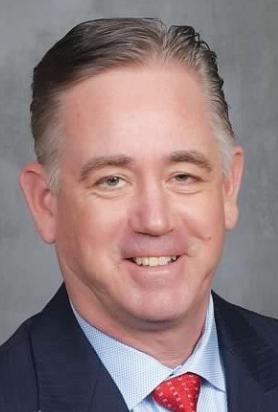
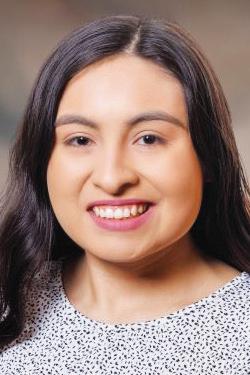
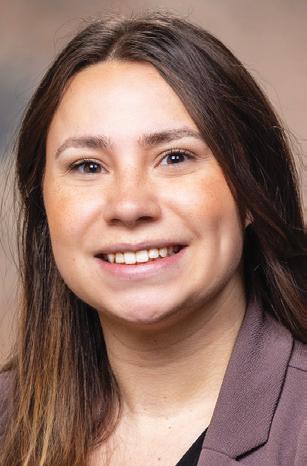
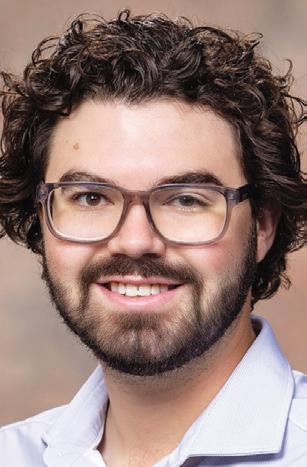
DWC CPAs and Advisors recently promoted six of its employees: Matt Leach; Erin McLaughlin; Megan Lawson; Brent Metzler; Emma Mackain Quandt; and Trevor Smith
DWC said in a news release, “They represent our core values of integrity, quality and community investment and core purpose to help our clients, people and communities to be better.”
• Leach, who was promoted to chief operating officer, grew up in Grand Junction, got a bachelor’s degree in accounting from Adams State University and joined DWC in 2020. He brings more than a decade of experience in the accounting industry. His administrative background includes human resources, IT and business management.
• McLaughlin, who was promoted to audit manager, is originally from south Louisiana and got her bachelor’s degree in business administration from Western Colorado University. Since joining the DWC audit team in 2021. She gained expertise in providing attest and accounting services such as financialstatement audits, reviews, compilations, agreedupon procedures and client accounting services.
• Lawson, who was promoted to tax supervisor, was raised in Grand Junction and got a bachelor’s degree in public accounting and a master’s degree in business administration from Colorado Mesa University. She started with DWC as an intern and joined the tax team fulltime in 2021. She has experience with multiple industries and primarily serves nonprofit and farming clients.
• Metzler, who was promoted to audit supervisor, graduated from Palisade High School. He got a bachelor’s degree in public accounting from Colorado Mesa University and transitioned from intern to a full-time audit position at DWC in June 2022. Metzler has expertise in providing attest and accounting services such as financial-statement audits, reviews, compilations, agreed-upon procedures and client accounting services.
• Mackain Quandt, who was promoted to tax supervisor, hails from Capulin, Colo., a small town in the San Luis Valley. She got a bachelor’s degree in general accounting from Colorado Mesa University and started with DWC in June 2022. Her experience includes a focus on agricultural operations, trusts, wineries and multi-state returns.
• Smith, who was promoted to audit senior, is from Sterling, Colo., and got a bachelor’s degree in public accounting from Colorado Mesa University. He has experience providing assurance and accounting services, including financial-statement audits, reviews, compilations and client accounting services.
n Valentine’s Day dessert night benefits CASA
Sugar & Sweethearts: A Dessert Night for CASA, will take place Feb. 14, 7-10 p.m., at the Redlands Community Center, 2463 Broadway in Grand Junction. The event’s proceeds will benefit Court Appointed Special Advocates of Mesa County.
In addition to a dessert bar, the evening will feature music and dancing, and there will be a photo booth.
Get tickets or become a sponsor by going online to casamc.networkforgood.com. A single ticket costs $50, and a couples ticket costs $75.
CASA thanked the following sponsors: Altitude Pediatrics; Merritt and Associates G.C. Inc.; and RoseCap Financial Advisors.
n Soiree marks year at location for Green Valley Herbal
Green Valley Herbal is hosting a soiree on Jan. 29, 4-6 p.m., to celebrate its one-year anniversary since moving to 1006 N. Fifth St. in Grand Junction, next door to Copeka Coffee. Green Valley Herbal owner Patricia Nizalowski said everyone’s invited.
“It has been a great move,” Nizalowski said. “We’re helping many more customers with their wellness while supporting local businesses. We offer Copeka Coffee customers a discount on their purchases with us. We have wonderful neighbors.”
Green Valley Herbal sells products that Nizalowski makes, such as aromatherapy mists, after-shower oils, emollient body lotions, herbal teas and more. It also partnered with some local makers who handcraft items such as: Mandala Art; Pure Beeswax Candles; Suncatchers; Gemstone Jewelry; and Rough Cut Bar Soaps
To learn more about Green Valley Herbal, go online to www.gvherbal.com.
n Materials, equipment, expertise needed for school garden
Caprock Academy is seeking community support to help build a new school garden that will serve as a hands-on, outdoor classroom for its K-12 students.
The project is designed to give students real-world learning opportunities while building environmental awareness and a connection to the outdoors. As a charter school with limited funding, Caprock Academy is relying on donations of materials, equipment and expertise to bring the garden to life.
The school is seeking items such as lumber or wood scraps, building materials for raised beds, benches and shade structures, irrigation parts and tools or machinery to help prepare the garden site. Skilled volunteers with relevant experience are also encouraged to help.
Those interested in contributing can contact Jennifer Heil at j.heil@caprockacademy. org or call 970-985-2277.
Business Bites:
626 on Rood closing; Junct’n Square on Rood stepping in
n The owners of 626 on Rood announced on Facebook on Jan. 20 they will be closing the fine-dining restaurant on March 28, ending a run of nearly two decades. The restaurant opened in December 2006.
The Facebook post said: “For 20 years, you’ve filled our dining room with laughter, conversations, and unforgettable moments. We want to share that 626 on Rood will conclude its long run on Saturday, March 28. Until then, we’re open as usual and welcoming guests with the same care and hospitality – come dine with us one more time (or a few).”
To view its menus or make reservations, go to www.626onrood.com.
n The building at 626 Rood Ave. won’t be empty long, as 626 on Rood’s post said Junct’n Square Pizza plans to open a full-service Italian restaurant, Junct’n Square on Rood, there in April.
Junct’n Square Pizza’s verified that with a Facebook post that said: “We want to take a moment to sincerely thank the incredible team at 626 on Rood for the care, heart and hospitality they’ve poured into this space for the past 20 years. So many memories have been made within these walls, and we’re truly honored to carry that legacy forward.
“As we step into this next chapter, we’re filled with gratitude and excitement. Sometimes in business – and in life – you have to adjust your plans as timelines and realities evolve. Our Las Colonias riverfront vision is absolutely still on the horizon, and we remain deeply committed to seeing that project through the right way. We’ve learned that developments of that scale simply take the time they deserve.
“In the meantime, for this phase, 626 on Rood is fully ready, beautifully built, and an incredible turn-key opportunity – allowing us to jump in, get to work, and start serving the community much sooner. A couple of months instead of years just makes sense for everyone involved.”
SHARE YOUR NEWS
Matt Leach Erin McLaughlin
Megan Lawson Brent Metzler
Emma Mackain Quandt Trevor Smith
one-year to Copeka invited. customers customers
aromatherapy partnered Beeswax www.gvherbal.com. garden school garden opportunities while charter school equipment for raised prepare the help. j.heil@caprockacademy. stepping in they will be decades. The laughter, conclude welcoming guests
few).” post said Square on want to take heart and memories have forward. excitement. timelines and horizon, and We’ve learned built, and an start serving sense for