


































































Welcome to our February issue, wherein we spotlight the thoughtprovoking films of the 2026 Atlanta Jewish Film Festival, taking place in theaters across metro Atlanta Feb. 18 to March 3, with selected films available for streaming from March 6-15.
The press release describing this year’s films calls the selections “rich and thoughtprovoking,” finding humanity, humor, and joy and “inviting viewers to open their hearts, challenge assumptions, and engage in stimulating conversations.”

Looking over the synopsis of this year’s lineup, I’m struck by the number of films that find sparks of humor in tragedy and tranquility in chaotic times. It reminded me of my late father, whose birthday was last week and the 10year anniversary of his death a few months ago.
My dad, a dry-witted professor and a man of few words, was at the end of a 19-year journey after being diagnosed with Parkinson’s Disease. He and my mother, a nurse, threw everything at the wall to help extend his life – experimental treatments, drug trials, physical therapies – which slowed, but could not stop the inevitable deterioration of his body.
When pneumonia set in, we had hoped he could spring back just one more time. The doctors intubated him and placed him in a medically induced coma for many days, but it was futile, and the time came to take away all the machines and let him go.
We gathered to witness the removal of
his breathing tube, hoping to hear some profound words when he was finally able to speak. He directed his only remark to his nurse, Pat, who had taken a special interest in him and came in for the procedure even though it was her day off.
“You know, Pat, I’m married,” he told her. And with that, he let us know that it was okay to laugh just one more time. Those were the last words I ever heard him say, and while neither profound nor inspiring, it was exactly true to him.
My memories of this interaction remind me of the film “Mazel Tov,” which is featured on the cover of this month’s issue. It’s described as a tale of weddings and funerals, “with equal parts hilarity and heartbreak.”
In fact, many of the AJFF films have bittersweet themes similar to that of ‘Mazel Tov,” including “Kissing Jessica Stein,” “All I Had was Nothingness,” and “Parting the Waters.”
I am also excited to see many of the films that our arts and entertainment critic Sammie Purcell has highlighted in her preview story on page 7. She also writes a thought-provoking essay on “Kissing Jessica Stein,” and how the film’s perception has evolved in the 20 years since its release.
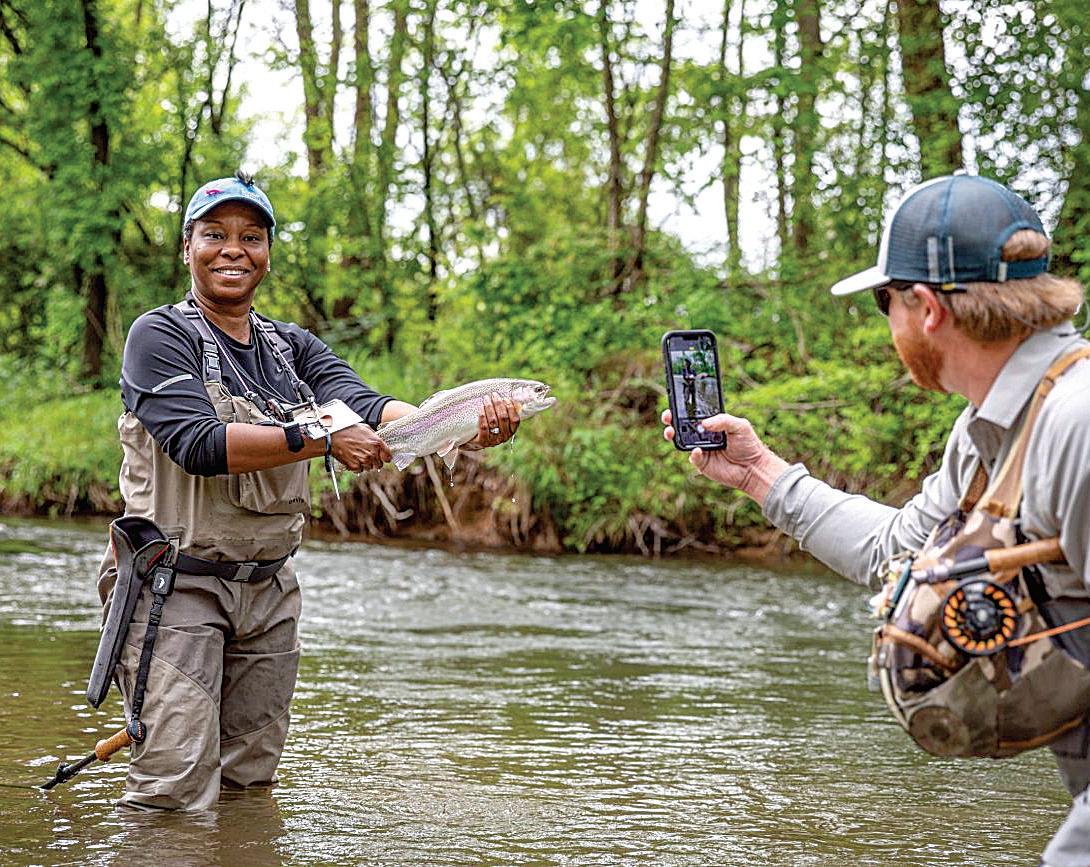
The rest of the issue has an excellent roundup of the month’s news, both in our coverage areas and beyond. Beth McKibben’s story on restaurant trends for 2026 is a must-read, along with Logan C. Ritchie’s story on Casting for Recovery, a nonprofit that takes breast cancer survivors on fly-fishing weekend getaways.
Thank you, as always, for reading and supporting Reporter Newspapers, Georgia Voice, Atlanta Intown, and our digital newsletters. See you next month.

By Sammie Purcell
The Atlanta Jewish Film Festival has announced the lineup for its 26th annual event, which will run in person at multiple theaters across Atlanta from Feb. 18 to March 3.
The opening night film is the French dramedy “Once Upon My Mother,” which will play at the Sandy Springs Performing Arts Center on Feb. 18. This year’s festival lineup includes 49 feature films and 16 shorts.
This year’s festival will also include a sneak peek of the film “The Day After,” which is the recipient of the inaugural ATL Jewish Film Filmmaker Fund. “The Day After,” from filmmakers Yuval Orr and Aziz Abu Sarah, follows a group of Israelis and Palestinians who travel to Northern Ireland to learn about the region’s peace process.
While the festival is still known as the Atlanta Jewish Film Festival, the organization recently rebranded to ATL Jewish Film, an umbrella term that covers both the yearly festival and the organization’s push for year-long programming.
“The 26th annual festival marks
a monumental moment as we both launch a full season of ATL Jewish Film programming, and begin our second quarter-century,” said Kenny Blank, executive and artistic director, in a press release. “Our films invite reflection, conversation, and connection long after the credits roll, and we’re proud to share them with audiences across Atlanta and throughout Georgia.”
According to the release, the films “Nuremberg 45” and “My Friend Sam” will have their world premieres at the festival. The documentary “Proud Jewish Boy” will have its U.S. premiere, and the films “Kichka: Telling Myself,” “Raoul Wallenberg: Missing Inaction,” “The Soundman,” and “They Fight With Cameras” will have their regional premieres.
This year’s guests include actress and writer Jennifer Westfeldt of “Kissing Jessica Stein,” writer/director Matthew Shear of “Fantasy Life,” and musician Regina Spektor, who produced the documentary “My Friend Sam.”
Member presales began on Jan. 21 and tickets go on sale to the public on Feb. 4. The full film schedule and ticket information can be found at ajff.org.


By Sammie Purcell
“Kissing Jessica Stein” is playing at the Atlanta Jewish Film Festival on Feb. 21 at the Plaza Theatre. Co-writer and lead actress Jennifer Westfeldt will be in attendance for a Q&A.
I’ve always heard that when “Kissing Jessica Stein” came out in 2001, it was praised for its portrayal of a lesbian relationship. Reading old reviews, however, paints a different picture.
For the New York Times, Elvis Mitchell pointed out the film’s similarities to “Annie Hall” and continuously called it “selfcongragulatory” (but I wish he went a little deeper on what he meant by that). In the Guardian, Gaby Wood also made the Woody Allen comparison and astutely pointed out that the film is less about lesbianism than it is a throwback to the Hawksian screwball comedies of yore - the protagonists just happen to both be women. In his review, Roger Ebert says the movie avoids serious questions surrounding the same-sex relationship altogether.

“If [sex] really meant anything to either one of them … the comedy would be more difficult, or in a different key,” he wrote. “We can laugh because nothing really counts for anything.”
“Kissing Jessica Stein” stars Jennifer Westfeldt (co-writer of the film with Heather Juergensen) in the titular role. Jessica is 28, neurotic, and a bit of a perfectionist — as a copy editor at the New York Tribune, better at finding flaws in other people’s work than exploring her own creativity. She’s had terrible luck in the dating scene, both with the men she finds for herself (in a montage, one suitor unironically uses the phrase “selfdefacating” instead of “self-depricating”), and with the men her Jewish mother (Tovah Feldshuh) pushes on her day after day.
On the other side of town, we have Helen (Juergensen). She’s cool, casual, adventurous — Jessica’s opposite in every way. But, the one thing she’s never done is have sex with a woman. She puts a personal ad in the paper, and Jessica answers the call.
Interestingly, many of the contemporary “Kissing Jessica Stein” reviews that I read
have a similar bent: whether positive or negative, a lot of critics seem to agree that they never really believed that Jessica and Helen would end up together (spoiler alert: they don’t). While many of them recognize Westfeldt and Juergensen’s comedic chemistry, there isn’t much praise for their romance.
A new perspective
But, looking at reactions from queer women in particular (both contemporary and retrospective), a different picture comes to light. Scrolling through Letterboxd, frustration over the film’s last 10 minuteswhere Helen breaks up with Jessica because they never have sex anymore, and Jessica reconnects with her toxic male ex and boss, Josh (Scott Cohen) – is palpable. Watching the film recently, I felt that same frustration. Unlike those critics, I felt like Jessica and Helen might be able to make it work. Even knowing the end, I believed in the evolution of their romantic and sexual relationship, and the fact that it doesn’t work out is devastating.
But, even given the film’s ending, I don’t think that “Kissing Jessica Stein” is a failure of a queer film. It’s just less about same sex relationships than it is the fluidity of sexual attraction. Jessica comes at that fluidity from a question that’s become a cliche for straight women everywhere – wouldn’t things be so much easier if I were attracted to women? –but Helen’s journey is a little more complex.
Early on in the film, one of Helen’s gay male friends chides her for “deciding” to be attracted to women, and that’s a critique you could see gaining traction back in 2001. But watching the movie now, Juergensen’s performance never allows the audience to question Helen’s attraction to women. So much attention is paid to the fact that Jessica ends up with a man (and really, the larger problem is not so much that Josh is a man, but that he is also the worst man), but Helen ends up in a committed, loving relationship with another woman. This experience has opened up a whole new world for her. And that open-mindedness is the true triumph of “Kissing Jessica Stein” — it may not always land the plane, but it’s always willing to let its protagonists explore.
By Sammie Purcell
Deciding how to spend your time at a film festival is one of life’s great challenges. When narrowing down a list of movies, even those of us with unlimited free time (if that’s you, shoot me an email - I’d love to chat about what that’s like and live vicariously through you) will certainly have to kill some of our darlings.
Lucky for you, you have me! Over the past few days, I’ve been reading through plot descriptions, watching trailers, and spending countless hours reading the Wikipedia page about Franz Kafka. All of that has led me here (and, honestly, to a little self-reflection about how I spend my time). Out of the 49 feature films playing at this year’s festival, which runs from Feb. 18 to March 3, I’ve come up with a list of five that I’m looking forward to the most. Here they are.
‘The Sea’ (Shai Carmeli-Pollak)
“The Sea” follows a young Palestinian boy (Mohammed Ghazaoui) living in the occupied West Bank who, after being turned away at an Israeli checkpoint on a class trip, sneaks over the border anyway, intent on seeing the Mediterranean Sea. Directed by Shai Carmeli-Pollak, the film is a rare Israeli-Palestinian collaborative
effort. I think that films that take place from the points of view of children often have a very singular ability to locate the simple truth hiding beneath the rationalizations that adults tend to engage in. I’m excited to see how this movie falls into that lineage.
‘Franz’ (Agnieszka Holland)

Noam Shuster Eliassi is a former United Nations diplomat turned stand-up comedian - the type of person ripe for the documentary treatment, you might say. The Israeli comedian was raised in a place known as “Oasis of Peach” just north of Jerusalem where Palestinians and Jews live together by choice. “Coexistence, My Ass!”– directed by filmmaker Amber Fares – follows Eliassi’s career and her unflinching support of equal rights and freedom for Palestinians.
‘The Soundman’ (Frank Van Passel)
I haven’t read much of Franz Kafka (man turns into a huge cockroach? That’s about all I got). But the trailer for this movie from Polish filmmaker Agnieszka Holland grabbed my attention about as well as any giant insect could. I might not know a lot about Kafka, but I know enough to know that his particular bent of surrealism has inspired a large swatch of filmmakers that I adore, and I’m excited to see how Holland maps that bizarre, surrealist nature over Kafka’s own life.


It took Claude Lanzmann 11 years to make “Shoah,” his documentary epic about the Holocaust. “All I Had Was Nothingness,” directed by French filmmaker Guillaume Ribot, takes audiences behind the scenes. It’s hard to imagine that there could be footage from the making of “Shoah” that never saw the light of day (the film is over nine hours long), but Ribot has scrounged up neverbefore-seen interviews, 16 mm footage, and more. If you have even a passing interest in cinema history, this won’t be one to miss.
I won’t name names (don’t want to get anyone in trouble for bias), but some of the higher-ups at the Atlanta Jewish Film Festival have said that Frank Van Passel’s “The Soundman” is one of their favorite movies playing this year’s festival. A love story that unfolds on the eve of the German invasion in 1940, “The Soundman” is described as “sumptuous,” “lyrical,” and “breathtaking” in equal measure on its festival information page. Having watched the trailer, I can confirm that Van Passel’s visual style is something to behold. I’m excited to see how it carries through an entire feature.

By Cathy Cobbs
Police Chief Brandon Gurley told the Brookhaven City Council at its Jan. 13 meeting that crime in the city is down significantly in every major category.
“The takeaway is that crime is down in all categories about 30 percent,” Gurley said.
Year-over-year statistics shared by Gurley show that homicides are down 50 percent, with rape cases reduced by 29 percent, robbery lessened by 30 percent, and reported aggravated assaults down almost 12 percent.
Burglary incidents are down more than 44 percent, from 157 in 2024 to 87 in
2025, statistics gathered by the department show.
The council commended the department for its quick action in handling incidents within the city, as well as proactive moves to thwart crime before it happens.
The council presentation is a high-level snapshot, and a comprehensive report will be presented at the end of the first quarter, including a neighborhood-byneighborhood analysis, the report said.
• the parks and recreation department reported 18,000 people visited Rudolph’s Rink, a free ice-skating installation at
Feb 4
7 p.m. (5:30 p.m.
Tuesday, Feb 10
Council 6:30 p.m.
Wednesday, Feb 11
p.m.
Wednesday, Feb 18 Board of Appeals
7 p.m. (5:30 p.m. work session) Tuesday, Feb 24
Council
p.m.
p.m. work session)







Brookhaven Park that ran from Dec. 20 through Jan. 4;
• Gurley announced that members of the department would be participating in the 21st Annual Polar Plunge at Lake Acworth on February 21;
• the council passed on consent agenda a resolution authorizing the retirement of police service dog Bane and allowing him to be permanently released into the care of his handler, David Fikes;
• authorized Brookhaven’s Director of Strategic Partnerships Patty Hansen to apply for a variety of grants for sidewalk, greenway, and road improvements within the city, totaling about $27 million. The grants, if awarded, would require a $6 million match from other sources.
The council then adjourned to executive session, after which no action was taken.
By Cathy Cobbs
One long-running lawsuit against Brookhaven has come to a close.
According to a release from Brookhaven, the Georgia Supreme Court has chosen not to review an appeal filed by the Ardent Companies, LLC, and residents Jon and Courtney Wheeler, regarding a controversial land deal.
Ardent accused the city of obstructing the rezoning and putting a $3 million price tag on the land despite never having it appraised. The real estate company claimed Brookhaven tried to get three acres out of the deal for its public safety building. The city later chose a different parcel for the public safety building.
Ardent failed to build a mixed-use development in 2018, claiming the city of Brookhaven tried to make them “pay to play” for land.
On March 7, 2022, a jury found the city purposefully obstructed the progress of the redevelopment project, ordering Brookhaven to pay an estimated $6.7 million to Ardent and the Wheelers.
Former Brookhaven Mayor John Ernst and City Manager Christian Sigman were also ordered to pay $200,000 each in punitive damages.

petition for certiorari, allowing the Georgia Court of Appeals’ decision to stand.
“That ruling affirmed that the City of Brookhaven, former Mayor John Ernst Jr., and City Manager Christian Sigman were legally protected under Georgia law and committed no actionable wrongdoing,” the city’s release said. “With the Supreme Court declining further review, all remaining claims are now conclusively resolved.”
Former Brookhaven Mayor John Ernst, who was named individually in the lawsuit, welcomed the court’s decision.

However, in 2023, the Georgia Court of Appeals decided the Ardent Companies and the Wheelers failed to prove essential elements of their claims against the city.
Finally, on Jan. 5 of this year, the Georgia Supreme Court denied Ardent’s
“The Supreme Court of Georgia validated what I, and the rest of the city council, knew all along,” Ernst said, according to the release. “We acted solely in the best interests of the citizens of Brookhaven, followed the law, and committed no wrongdoing. I am grateful this matter is finally and definitively closed,” Ernst said.
By Rough Draft
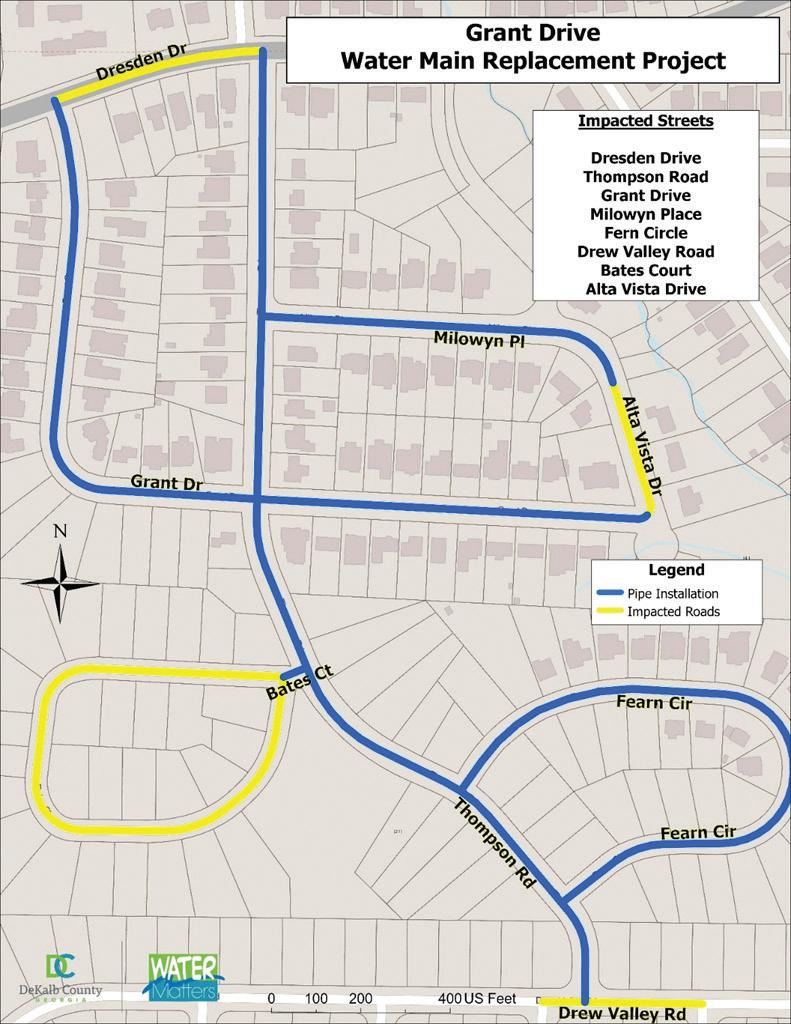
DeKalb Watershed Management is continuing its efforts to improve the system with its next project in Brookhaven, the Grant Drive Water Main Replacement Project.
According to a release from the agency, crews are replacing 6,600 linear feet of aging pipelines.
The line repair project is expected to last approximately seven months (February to August 2026), barring any weather delays.
This project is part of DeKalb County’s $4.27 billion capital improvement program to improve capacity and service of the watershed systems serving the community.
Normal construction hours run from 7 a.m. to 7 p.m., Monday through Friday, excluding major holidays. An increase in construction-related noise and traffic during work hours should be expected, the release said.

m a r k e d a h i s t o r i c m i l e s t o n e w i t h t h e e s t a b l i
C o u n t y ’ s f i r s t - e v e r W o m e n ’ s C o m m i s s i o n



L o o k i n g a h e a

Information also can be obtained by calling the DWM Project Information Line at 1-800-986-1108 or emailing projectinfo@ dekalbcountyga.gov with questions.




By Katie Burkholder
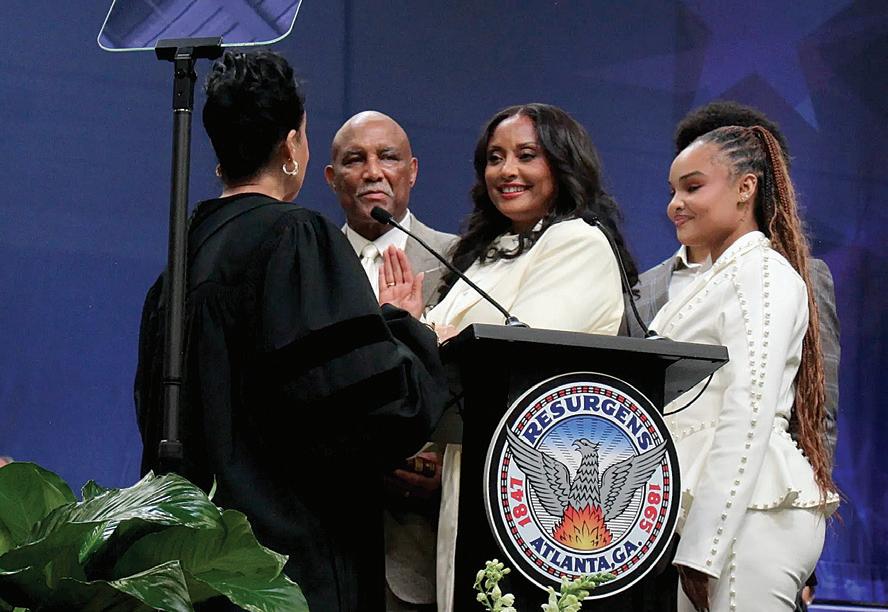
On Jan. 5, Atlanta’s leaders gathered at Georgia State University’s Convocation Center to celebrate the inauguration of the city’s new and returning leadership.
The event, led by Masters of Ceremonies Lori Geary, host of The Georgia Gang, and Jorge Estevez, anchor for WSB-TV, drew attendance from Congress members Sen. Raphael Warnock, Rep. Lucy McBath, and Rep. Nikema Williams; former Atlanta mayors Ambassador Andrew Young, Shirley Franklin, and Kasim Reed; and Valerie Jackson and Sandra Massell, representing their late husbands and former mayors Maynard Jackson and Sam Massell.
The highlights of the ceremony were the swearing in of city council President Marci Collier Overstreet, who was elected in November after former President Doug Shipman did not run for reelection, and Mayor Andre Dickens for his second term after being reelected with 85 percent of the vote. In their acceptance speeches, both Dickens and Overstreet highlighted the successes of their past terms – Overstreet as a member of City Council – and their goals to move Atlanta forward.
Dickens said the “defining work” of his second term would be the Neighborhood Reinvestment Initiative, an ongoing project focused on uplifting and interconnecting
Atlanta’s neighborhoods through the development of affordable housing, youth opportunities, public spaces, and accessible transit. The project is focused on seven neighborhoods: Thomasville Heights, English Avenue/Vine City, Grove Park/Bankhead, West Hollowell, East Campbellton, West Campbellton, and Downtown.
“At a moment when the federal government has pulled back from that group project, Atlanta chooses not to retreat,” Dickens said. “…We are all choosing to lean in. We are choosing to remain indivisible. The Pledge of Allegiance we recited earlier today says, ‘Indivisible, with liberty and justice for all.’ Atlanta, we are indivisible, committed to one city, to one future, and most importantly, to one another.”
Overstreet said she is planning to institute presidential town halls across the city throughout the year so people who work 9-5 and are unable to attend weekday City Council meetings can still interact with city government.
“Everything I do is rooted in love, love for my community, love for my city, love for a future in which every voice is honored and every life is cherished,” Overstreet said. “I promise to leave this city with compassion, courage and an unwavering belief in Atlanta’s greatness. Thank you for
trusting me Atlanta to serve as your council president. Let’s keep building Atlanta together.”
Other Atlanta officials who were sworn in included the city council, who took the oath of office administered by Fulton County Superior Court Judge Robert C. I. McBurney, and the Atlanta Municipal Court Judges, whose oath was administered by Chief Judge of Fulton Superior Court Ural Glanville.
Newly inaugurated city council members included Kelsea Bond, Thomas Worthy, and Wayne Martin. Reelected members included Michael Julian Bond, Matt Westmoreland, Eshé Collins, Jason Winston, Byron Amos, Jason Dozier, Liliana Bakhtiari, Alex Wan, Mary Norwood, Dustin Hillis, Andrea Boone, and Antonio Lewis.

Chief Judge Christopher E. Ward, Judge Gary E. Jackson, Judge Terrinee L. Gundy, Judge JaDawnya C. Baker, Judge Christopher T. Portis, Judge Ardra L. Bey, Judge Theresa A. Mann, Judge Pierce Hand Seitz, and Judge Allyson R. Pitts were all inaugurated as the Atlanta Municipal Court.
By Katie Burkholder

When Kandis Knight was working in the music industry, she took notice of the young people around her. When interns were given access to education, technology, and support, they had great ideas and insights about the industry.
“I realized that the kids, they have a great idea, a great concept, of how to make things work, especially in marketing,” Knight told Rough Draft.
It was this realization that led Knight to form Ignite ATL, a nonprofit empowering Atlanta youth through technology and creativity. The organization harnesses the power of youth to give them the tools they need to thrive in the industries they’re passionate about.
Older youth have their choice of programs that teach skills ranging from marketing, filmmaking, game design, music production, podcasting, and more. People ages 16 to 25 can join the seasonal Executive Intern Academy to learn professional skills in marketing, management, publishing, event planning, and audio and visual arts by producing and marketing four different podcasts covering music, news, and community service.
From February to August this year, the organization will be running three other specialty programs: the Atlanta Soundlab Academy for music production, the Atlanta
STEM and Stream Labs for video game design, and the Atlanta Youth Film Project for filmmaking.
To help support this programming, Ignite ATL has a residency program for creatives to receive discounted studio time, networking opportunities, and marketing development to teach Ignite ATL youth about utilizing technology in the resident’s field.
For high schoolers in Atlanta Public Schools ages 14 to 18, Ignite ATL also offers a free weekly mentorship program. The students gather every Thursday 4 to 9 p.m. to share a meal and talk about their lives. Kids in the program who need more support can schedule a one-on-one meeting with a mentor.
While the offerings at Ignite ATL are vast, the idea is simple: listen to the kids and give them what they need.
“Let’s just empower the kids and see what happens,” Knight said. “Let me just figure out how to give them the tools and the resources and the software that they want and see what happens.”
Moving into the future, Ignite ATL will be launching the first annual Blandtown Youth Art Exhibit and introducing a culinary program. Paid programs range from $150 to $250, but scholarships are available. To learn more and register for an Ignite ATL program, visit igniteatlanta.org.



By Hayden Sumlin
About two dozen residents attended the Jan. 18 Dunwoody Homeowners Association meeting to learn about the newest plans to redevelop the LifeSouth Community Blood Center.
After the community killed a highdensity, subsidized housing proposal at 4891 Ashford Dunwoody Road last summer, a major American homebuilder is looking to give the city and its residents what they want – townhomes.
The Dunwoody City Council denied a rezoning application from Dominium Apartments with a unanimous vote in September. Dominium’s proposal for
age-restricted affordable housing received overwhelming opposition from Dunwoody residents and several DHA members who objected to its density, height, and location.
Dunwoody Homeowner Association President Tim Brown said he expects more support for Lennar’s owner-occupied housing from DHA members after the community’s pushback on Dominium’s proposal.
“I would think that what you guys are proposing and how you’re proposing to do it might be a breath of fresh air for people in the room tonight,” Brown said.
Dominium had attempted to rezone the property from Office-Institution (O-I)





to a Planned Development (PD) district that would allow it to construct more than 200 income- and age-restricted apartments on the site.
Lennar’s team said they’re pursuing a PC-3 rezoning, which adheres to the city’s existing code and zoning map.
Lennar’s site plan, in its early conceptual stages, has 41 units on the 3.42-acre site, split between two distinct townhome products that vary in width and square footage. Each of the six townhome clusters is three stories tall, and their density aligns with surrounding residential developments at less than 12 units per acre.
During the citywide nonprofit’s first meeting since October, several DHA members expressed their support and asked whether elevator shafts would be included. Lennar built townhomes along Dunwoody Village Parkway, and they included some empty shafts to allow residents to install elevators.
One attendee said her friend purchased one of the townhomes near the Village. After developing a health issue, she had an elevator installed, allowing her to stay in her home. While most of the conversation from DHA members centered on the elevator situation, younger attendees inquired about access to green spaces and a dog park.
The proposed HOA-managed


community also includes landscaped buffers, connecting sidewalks, and an internal street network with emergency vehicle access.
Lennar’s plans
Nat Ackerman, land acquisitions manager for Lennar’s Atlanta Division, said the two townhome products are 20by-44 and 14-by-40 feet, each with three bedrooms and a rear-load two-car garage.
The larger, 2,100-square-foot unit has an estimated cost of $650,000. The smaller townhomes are about 1,500 square feet with an estimated $500,000 asking price. Land values and lingering inflation limit the feasibility of affordability, Ackerman said.
“This layout is conceptual but continues to show the overall organization, rather than the final engineering,” Ackerman said. “We definitely place strong emphasis on long-term quality and appearances. That variation in durable materials obviously helps ensure that the community remains attractive over time.”
After the presentation to the DHA, Ackerman said Lennar has not yet submitted a rezoning application to the Dunwoody Planning Commission. City code requires a six-month wait after an application’s denial until a waiver can be submitted, which is the first step in the process.
“Tonight’s meeting is the first step in our effort to engage early,” Ackerman said.


By Cathy Cobbs
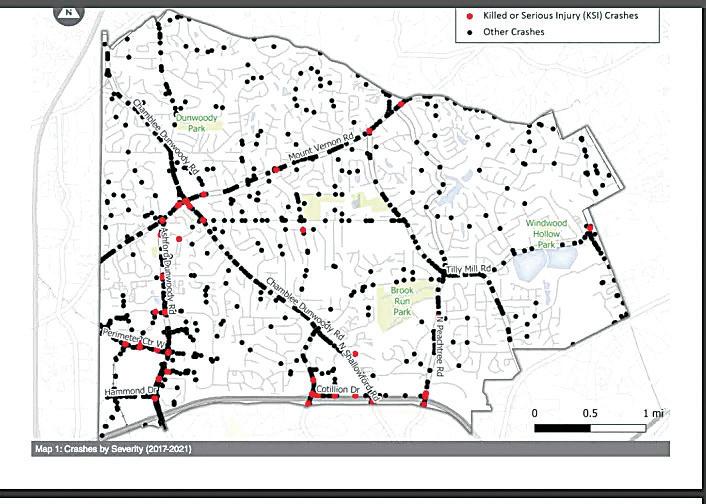
The U.S. Department of Transportation has awarded the City of Dunwoody $200,000 in federal funding through the Safe Streets and Roads for All program.
“This award will enable Dunwoody to conduct data-driven road safety audits across the city’s high-injury corridors and pilot high-impact safety improvements,” the Jan. 15 release said.
“This grant will help Dunwoody continue progress towards its goal of zero roadway fatalities,” Dunwoody Public Works Director Michael Smith said. “The funding will be used to evaluate conditions on the roadways experiencing the most severe crashes and identify specific action items to improve safety on those corridors.”
Previous initiatives
Last June, the council received an annual update from Jonathan DiGioia on the city’s Safe Streets Program. This program focuses on initiatives aimed at reducing fatalities and ensuring the safety of pedestrians and drivers on roadways.
The report, using data from 20172021, said crash types are most prevalent in Dunwoody include collisions with people walking, bicycling, using scooters, wheelchairs, or motorcycles, headon collisions, leftangle collisions, and rear-end collisions.
Collisions with vulnerable road users and left turns together account for 53 percent of people who are killed or suffer significant injuries.
In the last few years, the group has conducted school safety walks
at all of the city’s elementary schools, identifying quick fixes to make school drop-offs and pick-ups safer.
The Safe Streets program is also evaluating possible speed limit changes on several well-traveled corridors. Also, the group is exploring bike lane opportunities, including the installation of rubber markers on lane lines.
Grant money allocation
The grant will include:
• roadway audits on priority corridors within Dunwoody’s high-injury network, as identified in the Dunwoody Road Safety Action Plan;
• traffic counts and near-miss video analytics to assess risks;
• community outreach to gather local input;
• audit reports with crash analysis and cost-benefit-ranked recommendations.
A final report on design, funding, and implementation of future safety projects will be generated. The total project budget is $250,000. This includes a $50,000 local match, which will be funded using ARPA II dollars designated for safety implementation.



By Hayden Sumlin
Alfie Meek, Ph.D., director of the
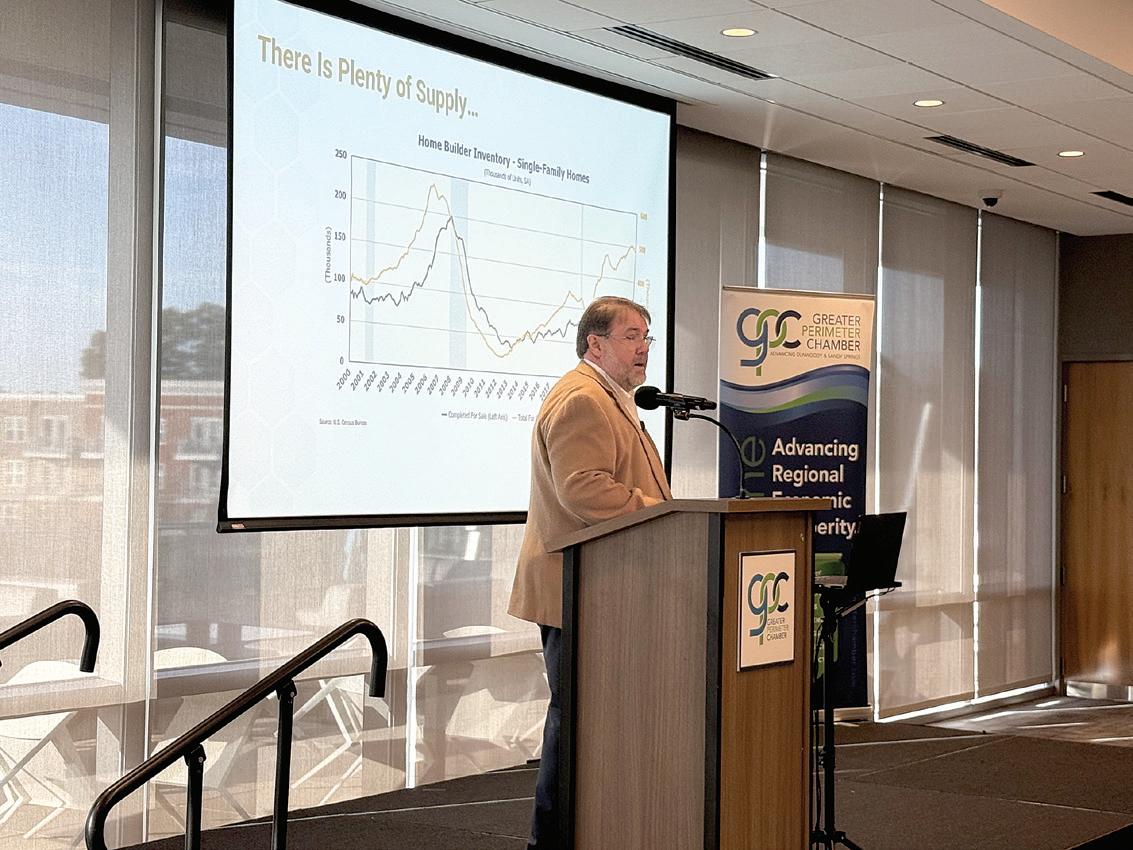
Georgia Tech Enterprise Innovation Institute’s Center for Economic Development Research, told the Greater Perimeter Chamber that 2026 will look a lot like 2025.
City officials and business leaders from Sandy Springs and Dunwoody listened to Meek’s 2026 economic outlook the morning of Jan. 21 at the GPC’s Signature Breakfast at the Sandy Springs Performing Arts Center.
Meek said his views are his own and do
not reflect the views of his employer or the state.
Opportunities and obstacles
Economic opportunities revolve around the artificial intelligence boom, onshore manufacturing, and fiscal stimulus, he said. Obstacles to growth include inflation, supply chain and geopolitical disruptions, a weak labor market, and housing costs.
After a strong first quarter, Meek said he thinks gross domestic product will average around 2.25 percent this year.
“We’ve got these opportunities that are trying to push [the economy] up, and then
we have these obstacles that are trying to push it down,” Meek said. “I think there’s going to be a strong first quarter in GDP, but then I think it’s going to taper a little bit ... which is exactly almost what I forecast for 2025.”
Meek said Americans can expect inflation to be higher at the end of 2026, driven by higher out-of-pocket healthcare costs, fiscal stimuli like tax cuts and spending, and the easing of monetary policy.
about three-quarters of the way there.” Meek said inflation is created when the government prints more money. He said he thinks rate cuts in the past 12 months were a mistake, as are future cuts.







Americans should not expect rate cuts until Federal Reserve Chair Jerome Powell’s term ends in May, Meek said. He projects the Fed to cut its benchmark rate by 100 basis points in the second half of the year, creating an elevated, inflationary balance sheet and slightly higher inflation by December.
Domestic manufacturing is poised for a recovery this year, Meek said, assuming lower energy prices, higher tariff revenue, and onshoring. He said he’s skeptical U.S. manufacturing will break out of its threeyear recession.
By the end of the year, Meek said he projects 325,000 new jobs nationwide, an average federal fund rate of 3.125 percent, the 10-year Treasury yield around 4.2 percent, mortgage rates around six percent, and a roughly 4.8 percent unemployment rate.
American debt concerns
The federal debt is expected to reach $39 trillion this March. Meek argues that spending and fiscal stimulus are keeping the United States out of a recession.
“Yeah, if you’re going to pump $2 trillion extra dollars into the economy every year, you will not go into recession,” he said. “We’re going to continue to do that ... there’s going to be some other repercussions for that.”
Meek said he thinks the American economy will start the year strong, with short-term stimuli like the “One Big Beautiful Bill Act” and the federal government’s nearly $2 trillion spending deficit supporting growth.
“The budget deficit is going to continue to be pretty large ... we spend $7 billion per day more than we take in, now that’s a problem,” Meek said. “If you spent $1 million a day since the day Jesus Christ was born, you would not have come close to spending $1 trillion. You’d be only
“When you print money, which is really what cutting the rate is doing, you create inflation,” Meek said. “And if you take a look at the money supply and how it’s growing, you see it exploded during COVID. Why? Because we sent everybody a bunch of checks. We grew the money supply of the United States by 40 percent in 2020. Understand what that means. Two out of every five dollars ever created in the history of the United States were created in 2020. That was inflationary.”
Two different economies
While recent consumer spending headlines look strong, Meek said the economy is bifurcated, or divided into two. There are the top 10 percent of income earners making more than $190,000 a year, and everyone else.
“The wealth effect is driving consumption,”he said. “The bottom 90 percent ... are spending exactly what they spent in 2020, once you adjust for inflation. They’ve not gotten ahead at all. All of the spending is in the top 10 percent, and they’ve adjusted as a share of total spending from about 43 percent preCOVID to about 50 percent now.”
Meek said the seven percent jump is “huge” and the top 10 percent are making consumer spending totals look good.
Economic red flags, like credit card and auto loan delinquencies, are at an all-time high. Meek said he expects consumer spending to decline after the first quarter.
After his address, Meek said that despite recent improvements, the incomes of the bottom 90 percent are not keeping up with long-term inflation.
“They’re struggling,” he said. “They tried to keep up by putting it on credit cards, going into debt, thinking it was a short-term thing, and it’s not a short-term thing.”
By Hayden Sumlin
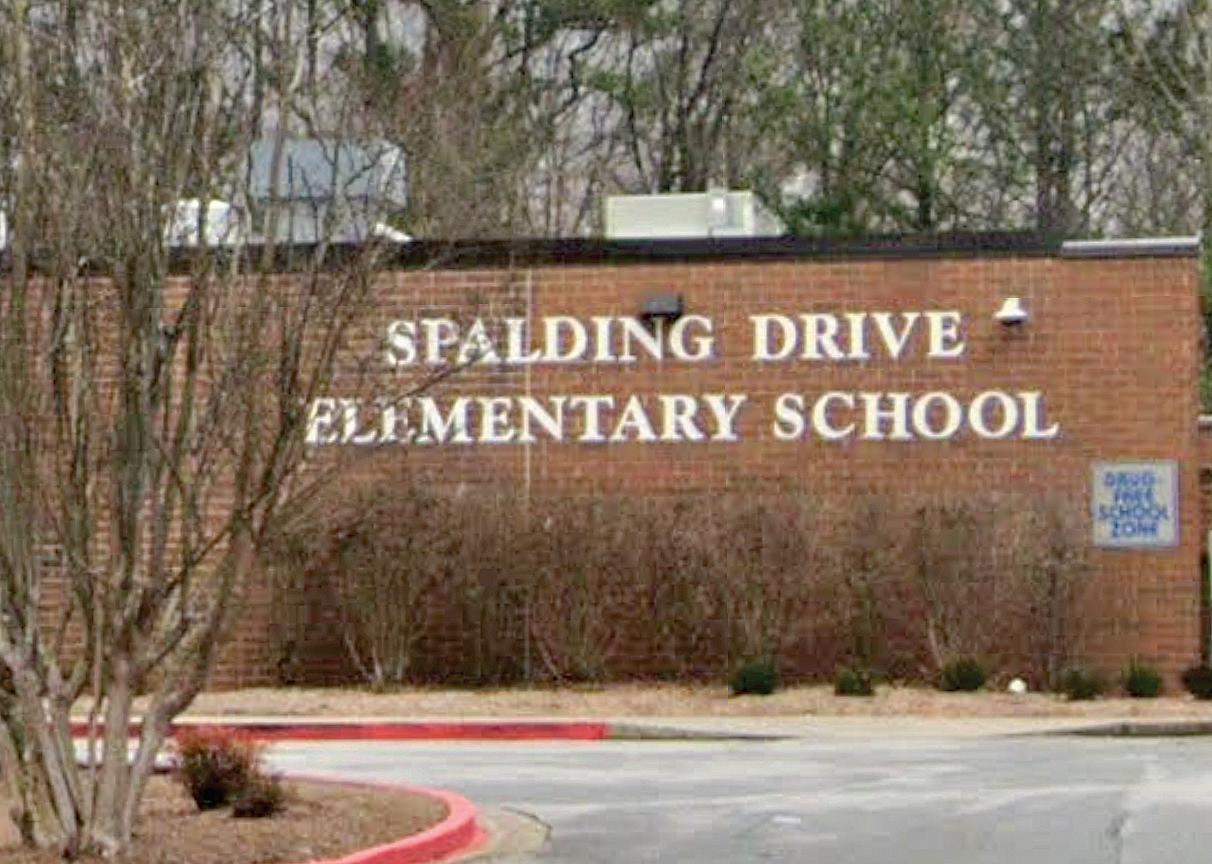
The Save Spalding Committee, a parent-led nonprofit seeking to create a new charter school in Sandy Springs, filed a petition Jan. 16 with Fulton County.
The nonprofit was formed last February, around the time the School Board voted to close Spalding Drive Elementary. Last May, Fulton County Schools rejected the nonprofit’s $10 million offer for the site, instead proposing to turn it into a teaching museum with administrative functions.
The Save Spalding Committee is working with a charter operator, National Heritage Academies, to open the Spalding Academy for Innovation and Learning, or SAIL, by the start of the 2027-28 school year.
The nonprofit laid out its mission in an email to Allen Mueller, senior director of the state’s Office of Charter School Compliance.
“SAIL’s mission is to provide a highquality, student-centered public education that prepares all students for academic success while remaining firmly rooted in strong local governance and meaningful family and community partnerships,” the email says. “The SAIL Board of Directors is composed of community members with deep ties to the Sandy Springs and
North Fulton area, bringing experience across education, nonprofit governance, finance, law, business, and community engagement.”
Charter schools are public schools that operate independently of local school districts, while following state and federal guidelines.
Since the building offer was rejected, the committee has held regular board meetings to adopt bylaws, elect officers, and work on real estate efforts and petition development.
While the Save Spalding Drive Committee is a nonprofit, its selected operator is a private for-profit management company with more than 100 charter schools in nine states.
National Heritage Academies operates two charter schools in Georgia: Atlanta Heights on the west side and Four Points Preparatory Academy in Braselton. All NHA schools are tuition-free, according to its website.
Save Spalding Committee Board
Chair Raymond Grote said the nonprofit submitted required letters of intent to Fulton and DeKalb counties, as well as to the State Charter School Commission, late last year. The petitions are the next step.
Fulton approval unlikely
The school district and its elected board have 90 days after submission to review and vote on the petition. If the charter application is approved by the local board


of education or state commission, then the nonprofit would become an official school board.
“While Fulton County Schools has expressed public support for charter schools, approvals remain rare,” Grote said. “While we do not expect approval, we are fully engaged in the process and working constructively within the system.”
Other charter schools in Fulton
Fulton County Schools has several charter schools, which it evaluates annually. The Movement School South Fulton Elementary opened last year near Hartsfield-Jackson Atlanta International Airport.
Grote said the board will petition the state commission before its March 13 deadline if Fulton County Schools denies its application or does not take any action. He also said a petition will be submitted in DeKalb County because there may be land available in Dunwoody.
“The district’s decision not to sell the Spalding Drive building, instead





pursuing a teaching museum the public has not embraced, reinforces our belief that approval is unlikely,” Grote said. “We respect the process, but believe the community deserves better options.”
FCS Chief Communications Officer Brian Noyes confirmed the school district received the application.
“There is a defined review and public input process outlined in state law and our policies and procedures, and we will follow that process accordingly,” Noyes said in a Jan. 20 email. “At this early stage, it would be premature to comment on the potential impact or outcome of the application.”


























Unless otherwise noted, all meetings are held at Tucker City Hall, 1975 Lakeside Pkwy, Ste 350B, Tucker, GA 30084
FEBRUARY 2
4:30 P.M.
Downtown Development Authority Meeting
FEBRUARY 2, 7 P.M. City Council Work Session
FEBRUARY 3, 7 P.M. Zoning Board of Appeals
FEBRUARY 6, 7 P.M.
Winter Concert Series
Bourbon Brothers Band
Tucker Recreation Center
FEBRUARY 7, 7 P.M.
Special Called Council
Strategic Planning Session
Clarkston City Hall
736 Park North Boulevard
Clarkston, GA 30021
FEBRUARY 9, 7 P.M. City Council Meeting
FEBRUARY 19, 7 P.M. Planning Commission
FEBRUARY 16
All City Buildings will be closed in observance of Presidents Day
FEBRUARY 20, 7 P.M.
Winter Concert Series
Atomic Lush Tucker Recreation Center
FEBRUARY 23, 7 P.M. City Council Work Session

By Stephanie Toone
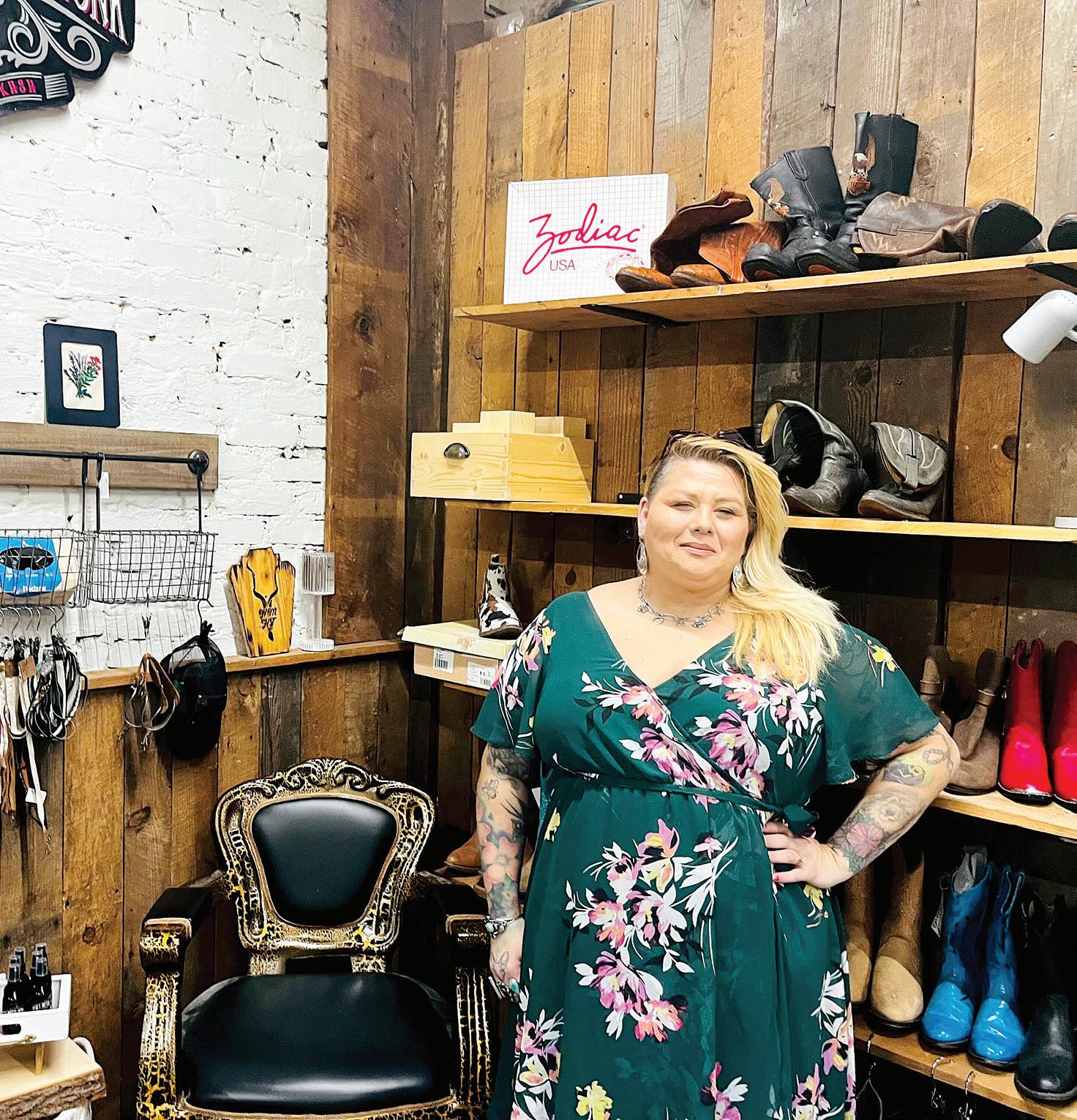
With art inked on her face and forearms, Angelica Bakhsh embodies self-expression and artistic freedom wherever she goes.
When the doors to her labor of love, Mama Debbie’s Art Emporium, opens later this month, she hopes that each customer and artist can feel the freedom and inclusivity she intends to bring with her new art hub, which is named after her late mother.
“My mom was an activist, and a victim’s advocate, and she was the mom that all my friends would go to – all the weird kids, and all the queer kids, and all the kids whose families didn’t accept (them),” Bakhsh said in an interview with Rough Draft Atlanta. “I grew up in south Georgia, in Albany, and all of those people could always find refuge at my house with my mom, so that’s where we landed. We want to offer that refuge to the othered.”
The Tucker resident and her best friend Clayton Morey, whom she met in high school, took over the lease at
the former Treasures on the Railroad in October. Bakhsh, 49, spent almost two years as a Treasures’ vendor with her business Heavy Metal Honky Tonk, which sells reclaimed and vintage boots and apparel to keep them from landfills.
Morey majored in printmaking and painting at Savannah College of Art and Design, but ultimately took the path of restaurant retail before starting Mama Debbie’s. They both have spent the last several months rehabbing the 7,500-square-foot historic mill into their artist emporium dream.
“We want everything as local as possible. We really want to be a community hub. There’s not a town seat,” Bakhsh said. “There’s not a place to go have these kinds of talks and things like we used to have. There’s a guy running for Georgia government who used to be a Republican, and now he’s running as a Democrat. There’s nowhere for him to go talk to people in Tucker. I want him to come here and tell us why.”
The front area will feature a free coffee nook, two gallery spaces, and a retail floor that will highlight the
work of up to 30 local artists, Bakhsh said. There will also be a separate space for “co-arting,” where artists can pay a membership fee to work in the industrial, open space or rent designated booths for their shops and offices.
In November, the duo launched a Kickstarter campaign that would help them build out a classroom space at Mama Debbie’s. Their goal was to raise $10,000 in 60 days. Through the help of artists and some local residents, they raised more than $11,000. The abundant support from the community brought
Bakhsh to tears as they both thanked donors in a Facebook video.
“Art is activism,” Morey said. “It’s great to have a place where people can come and hang out. Obviously, we want people to spend money and buy, but we also want people to come and spend some time, and that’s what the classroom space is for.”
The classroom and makers area will offer everything from woodworking to sewing, with tools and machines available. Jonelle Dawkins, executive director of Scraplanta, said she is eager for Mama Debbie’s to offer more art

By Stephanie Toone
In the midst of icy conditions, Nuttopia owner Shantell Reid has faced the cold, harsh reality of a break-in for the second time in a matter of months, but the kindness of strangers has restored her faith
On Jan. 26, Reid tearfully shared on the candy store’s social media platforms that she was awakened by the news that her store on Hugh Howell Road had been broken into and vandalized around 5 a.m.
The store, which offers gourmet candies and a variety of nuts, was last burglarized almost four months to the date on Sept. 27.
According to the DeKalb County Police Department, officers responded to a burglary alarm at the store around 5:13 a.m. Officers found two windows and a glass front door shattered upon their arrival.
There does not appear to be any other businesses that were burglarized over the weekend, and there isn’t “any kind of uptick in break-ins during these types of weather events,” said Blaine Clark, DeKalb County Police public information officer.
Crime in downtown Tucker has been a continued concern for residents and officials.
Even with new safety measures in place, Reid said the damage and devastation made it hard to want to continue running her store in Tucker.
“It’s so sad, at 5 o’clock in the morning, we had to be in clean-up mode, cleaning up the devastation,” Reid said. “[They] got nothing to the point that you go into the fridge just for juice, because you’re like, ‘I’m not leaving without something.’”As of the afternoon after the break-in, things were turning around.
Reid returned to social media after the challenging morning and the outpouring of support at her store the evening of Jan. 26 to share an update.
She said as she went to pay a repairman for the $2,077.36 glass replacement, a stranger serendipitously arrived, pulled out his card, and told the embattled business owner, “I got it.”
“Nothing this good has ever happened to me,” she wrote in the post. “I told myself I was done, but when this angel showed up today and paid this bill in full, I started crying. Thank you to this angel.”
spaces in Tucker. Scraplanta offers preloved art supplies, classes, and events in Tucker.
“We want to collaborate with Mama Debbie’s for workshops, because our customers expressed a high demand for craft classes, and we’re not able to host large amounts of people in our current retail space,” Dawkins said. “It’s also an opportunity for us to craft in the heart of Tucker, so we can have more familycentric programming.”
The space represents Mama Debbie from the welcoming energy to the flamboyant decor, which includes peacocks, her favorite animal, and tiger wallpaper and carpeting. The colorful display is representative of the spectrum of folks Bakhsh wants to feel welcomed at the emporium, no matter their
background or income.
Vendors under 21 will not have to pay a rental booth. Rental fees start as low as $50 per month, depending on the product and space. She also will not invite any vendors who don’t agree with her stance of “pro-fat, pro black, pro-sex work, and no human is illegal.”
“For me it’s a big deal to help women make money for themselves,” Bakhsh said. “I’m done with people, cavalier and entitled, and gatekeeping art. That’s not what it’s about. That’s not how you build.”
Mama Debbie’s Art Emporium, located at 4290 Railroad Ave., Tucker, does not yet have a definitive opening date, but all are welcomed to stop by, take a look, or even pet a paper tiger in the meantime.

By Sarra Sedghi
On Jan. 16, 150 days from the 2026 FIFA World Cup, the Atlanta Host Committee held a virtual press conference to provide journalists with updates on the city's preparations ahead of the global soccer event taking place this summer in the United States, Canada, and Mexico.
Speakers included Dietmar Exler, chief operating officer of Mercedes-Benz Stadium; Dan Corso, president of the Atlanta World Cup Host Committee and Atlanta Sports Council; and Adam Fullerton, vice president of Stadium Operations for Mercedes-Benz Stadium.
Exler remarked on Atlanta’s rise as a major soccer city over the last 15 years. Atlanta announced it was getting a professional soccer team in 2014, with Atlanta United debuting at Mercedes-Benz Stadium in 2017. The team won the MLS Cup Championship a year later.
In 2022, FIFA named Atlanta as a
2026 World Cup host city — one of two U.S. cities to host both the World Cup and the Olympics. This summer, teams from future World Cup host countries, Spain and Morocco (2030) and Saudi Arabia (2034), will compete in Atlanta.
“Atlanta is truly the center of soccer in the United States,” Exler said. “We are all set to have tremendous events in Atlanta. The stadium is ready, and the city is ready.”
Corso highlighted the importance of cooperation across Atlanta’s communities, which makes the city's host committee stand out from other 2026 host cities.
“We get the civic and the business communities together and we bring the operational expertise from those organizations and their staff, and we pool them together into our host committee,” he said. “So, whether it's the Atlanta Sports Council staff, the Mercedes-Benz Stadium staff or others, all of us work very
From art and food, to our weekly Saturday morning news quiz, Rough Draft's free, daily email newsletters deliver the news you need in a format that's easy to digest.

Corso highlighted the "consistency" of the local organizations involved in Atlanta's World Cup planning, calling it "effective" because the committee doesn't rely on short-term, outside contractors who come in just for a particular event.
He noted that the committee is collaborating with various consulates around Atlanta to address cultural needs, fan behavior, and travel patterns. He also provided updates on FIFA Fanfest days, which will take place at Centennial Olympic Park, and MARTA preparations.
MARTA is expecting high-volume usage during the World Cup and is in the process of introducing a tap-to-pay fare option. Each station will include 100 volunteers to help guide passengers and address problems on match days.
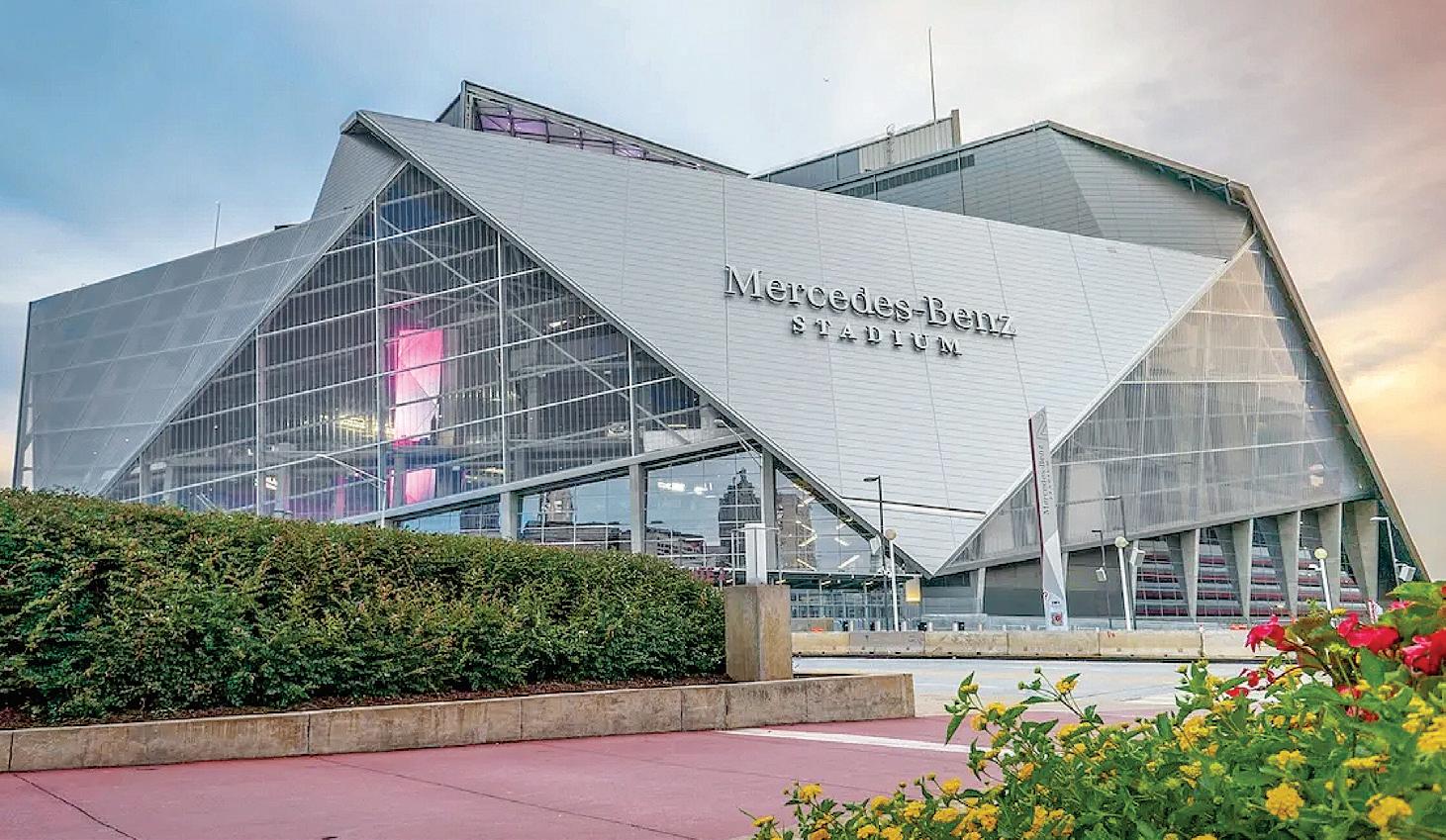
Fullerton provided updates on changes Mercedes-Benz Stadium will undergo in advance of the 2026 FIFA World Cup. On Jan. 31, the stadium will replace its synthetic turf with natural sod. Improvements to the stadium's audio systems, field lighting, and wireless capabilities will also be made. Per FIFA's "clean site" regulations, staff will cover up more than 2,000 brand names on display at the stadium, including the MercedesBenz emblem on the retractable roof.
“This stadium was designed to host these types of events,” Fullerton said. “We pride ourselves on being a world-class stadium. The tournament has been a bit of a driver for us to speed some of those upgrades up."
With remarks finished, local, national, and international journalists were allowed to question the panel. Questions ranged from asking their thoughts on hosting two games featuring the world's top soccer
team, Spain, to making international fans and teams feel welcome in Atlanta, given the Trump Administration's suspension of processing immigrant visas from 75 countries. Teams from at least three of those 75 countries – Haiti, Cape Verde, and Uzbekistan – will play matches in Atlanta this summer during the World Cup.
Calls to boycott or forgo attending the 2026 World Cup in the U.S. have risen in response to the Trump Administration's recent foreign policy plays and the shooting of civilians by U.S. Immigration and Customs Enforcement (ICE). Corso stressed that Atlanta’s host committee is focused on providing all fans with a "memorable experience."
On the local level, Rough Draft asked the panel if local restaurant stalls at Mercedes-Benz Stadium would be affected by FIFA’s clean site regulations, including whether any businesses would be replaced during the World Cup.
“We are doing our best to make sure that [our venue’s] local brands have an opportunity to sell and operate here in the venue during the tournament,” Corso said. He stated that a few of FIFA’s restaurant partnerships may change some of the stadium’s concepts and/or menus. The committee is currently working through stadium menus to determine next steps.
The Atlanta Host Committee will continue holding monthly meetings ahead of the 2026 FIFA World Cup, which runs from June 11 through July 19. Atlanta will host eight matches, including a semifinal on July 15, and host teams from Cape Verde, Haiti, Morocco, Saudi Arabia, Spain, and Uzbekistan. The remaining teams have not yet been determined.
By Maya Holman | Georgia Recorder
Georgia Gov. Brian Kemp called for an expedited income tax rate cut and another tax rebate, new spending for law enforcement retirement savings and funding for a needsbased scholarship program in his annual State of the State address on Jan. 15 before the Georgia General Assembly.
The speech — Kemp’s eighth and final address as governor — highlighted many of the policies that have shaped his legacy, including his efforts to raise wages for teachers and other state employees, issue tax rebates during years the state had a revenue surplus and shore up the state’s multibilliondollar reserves.
According to Kemp’s projections, Georgia’s state reserves and rainy day fund combined will have more than $10 billion by the time he leaves office. The state’s current reserves sit at $14.6 billion.
“There’s no question the state of our state is stronger, more prosperous and safer today than it was in January of 2019,” he told lawmakers.
employees and fund a needs-based scholarship for Georgia students that had previously been funded through private donations.
The University System of Georgia Foundation’s DREAMS Scholarship would complement the state’s existing HOPE Scholarship, which is awarded to students based on merit. Under Kemp’s proposed budget, the DREAMS Scholarship would receive a one-time contribution of $325 million from the state to create more opportunities for Georgia residents to graduate without student debt.
“I believe we owe it to every child to ensure they start out on a level playing field, no matter their zip code,” Kemp said.

But Kemp’s speech also highlighted the rising costs of living across the state, and cautioned lawmakers against taking the state’s economic stability for granted.
“The reality is that too many of our citizens are still struggling to make ends meet and everyday costs are still too high,” he said. “Groceries, rent, insurance, clothes for the kids, it all adds up to more than it used to.”
In his speech, Kemp also previewed his priorities for his last legislative session as governor, which includes a proposal to accelerate a plan lowering the state income tax rate below 5%.
“This will fulfill a promise to the people of the state that I made during my re-election campaign to lower our state income tax rate to under 5% and with the General Assembly’s passage and my signature, it will come a full three years ahead of schedule,” he said.
But there is a push in the Senate to move aggressively toward eliminating Georgia’s income tax. A special Senate panel recently released a plan that would waive the tax on up to $50,000 a year for individuals and $100,000 for married couples starting in 2027 – and eliminate the income tax entirely by 2032. Republican House leaders say they are also readying a bill that would nix the property tax on primary residences.
Notably absent from Kemp’s speech were discussions of hot-button social issues like banning diversity, equity, and inclusion efforts or restricting access to gender-affirming care. Instead, Kemp centered his speech on cost-of-living issues, including a proposal to distribute a one-time $2,000 bonus to state
By Logan C. Ritchie
As a stage IV breast cancer survivor, Stephanie Atkinson has been seeking friends with common ground since her diagnosis 10 years ago. She found them last fall in an unlikely place: fly fishing in the North Georgia mountains.
Casting for Recovery (CFR), a national nonprofit, takes women diagnosed with breast cancer on weekend fly fishing retreats. CFR was founded by breast reconstructive surgeon Dr. Benita Walton and professional fly fishing guide Gwenn Perkins Bogart in 1996, on the belief that the motion of gently casting a reel is therapeutic for those living with breast cancer.
Participants apply online to spend three days with volunteer physicians, nurse navigators, social workers, and dietitians who are on hand to discuss nutrition, mental health, and physical effects after receiving their diagnosis.
like a stage IV cancer patient. She has a full time job, a side hustle, and she’s active despite having Gamma Knife radiation and a craniotomy.
“I’m stable. The drugs suck, but I deal with the side effects, and I am able to live somewhat of a normal life,” she said, adding that she has trouble with keeping her balance, carrying items up stairs, and writing by hand.
Hailing from across Georgia, each woman Atkinson met has different circumstances. One person had the same kind of cancer as Atkinson, but with different side effects. Another one had masses that had metastasized to several places.
During the weekend, Atkinson stayed focused and engaged. She put her phone away and asked for her family not to contact her.
House Minority Leader Carolyn Hugley applauded Kemp’s push to fund the scholarship during his final year in office.
“We’ve been asking for a need-based scholarship for years,” she told reporters after the speech. “As you know, HOPE started out as a needs-based proposition, and they turned it into a merit-based scholarship. So I’m happy that on his way out the door, he’s giving a nod to something that we’ve been asking for for several years.”
Democrat critisism
But Hugley, a Columbus Democrat, also criticized Kemp’s proposal to send out onetime tax rebates to Georgia residents, saying it would not go far enough to address the state’s affordability issues.
This year’s rebates, which also require lawmakers’ approval, would be the fourth time Georgia taxpayers received an extra payment in recent years, and it would again show up as $250 for individuals, $375 for head of household and $500 for married couples filing jointly. All told, the rebates would cost the state’s rainy day funds about $1.2 billion.
The rebates “will not take care of the needs that most families are thinking about,” she said. “They’re thinking about child care. They’re thinking about paying rent. But a one-time $250, a one-time $500, what is that really going to do?”
In the official Democratic response to Kemp’s address, Hugley argued that Republican-led plans to eliminate the state income tax and property taxes would primarily benefit wealthy Georgians, while placing an increased burden on families and local governments.
Georgia Recorder editor Jill Nolin and reporter Alander Rocha contributed to this report.
“It’s a healing outdoor retreat for women; they’re in a beautiful place, learning a new skill,” CFR Outreach Coordinator Megan Nellen said. “The majority of women who come to our retreats have never held a fly rod in their life. It’s a powerful thing.”
Seventy percent of CFR participants have never been to a support group prior to attending the retreat. According to the American Cancer Society, 310,720 new cases of invasive breast cancer are diagnosed each year. Women have an 82 percent higher rate of diagnosis compared to men.
CFR holds free weekend retreats, covering the cost of meals, transportation, lodging, and activities to maintain an equitable, inclusive experience. The organization serves approximately 800 women per year.
Georgia CFR participants stay in cottages at Smithgall Woods State Park on Duke’s Creek, known for its premier fly fishing waters. Because many have never been fly fishing, the group travels to calmer waters where women learn to cast, set, and catch. That’s where Atkinson finally “met her people.”
Upon her diagnosis, Atkinson met other breast cancer survivors at a support group, but quickly realized no one else in the group had stage IV cancer.
“I started bawling,” Atkinson said. “I thought, ‘You’re not my people. I need to find my people.’”
After being selected for the November 2025 retreat, Atkinson said she was nervous because she doesn’t look
“It was the best thing that I’ve ever done. Just being in the room with all those people, and having a group of other women that were going through the same thing as me was really powerful,” she said.
Volunteers find fulfillment
Oncologist and hematologist Dr. Lynn Howie of Asheville, N.C. attended the same retreat. She has volunteered at retreats in Alaska, Hawaii, Colorado, California, Idaho and Georgia. One of the benefits of the retreat is access to medical oncologists who can speak about the treatment landscape, side effects of treatments, and other issues, Howie said. Since she began volunteering in 2018, Howie has found that participants have in common curiosity, humility, and grace.
“One of the things that always strikes me about women who are dealing with cancer is the degree to which they’re also balancing the needs of their loved ones and family, in addition to their own particular needs,” Howie said.
Atkinson explained that stage IV survivors are in a constant battle to “appear normal and in a good headspace” because they live with daily medicines, frequent CT and bone scans, and the possibility of cancer spreading to another part of the body.
“The minute we’re born, we’re all dying. The difference is that anyone can get hit by a bus, but stage IV people see the bus coming,” she said.
CFR is backed by individual donors, corporate sponsors like Northside Hospital, and fundraising. In Georgia, former program participants make up a substantial portion of the donor base.

By Beth McKibben
Awards season returns for another round, including for the restaurant industry’s biggest night of the year: the James Beard Awards, known as the “Oscars of the food world.”
The James Beard Foundation just announced the semifinalists in the chef and restaurant categories for the prestigious
awards. Pastry chef Claudia Martinez, sommelier Taurean Philpott, the Kamayan ATL owners, Aria, and Madeira Park are among the semifinalists from Atlanta.
Presented annually, the awards cover categories like Best Chef: Southeast, Outstanding Restaurant, Best New Restaurant, and Emerging Chef.
Last year, the James Beard Foundation added three new categories: Best New Bar, Outstanding Professional in Beverage Service, and Outstanding Professional in Cocktail Service. Marietta Proper nabbed a semifinalist nod for Best New Bar, while Kursten Berry of Twisted Soul Cookhouse & Pours was named a semifinalist in the Outstanding Professional in Cocktail Service category.
The foundation also honors a handful of restaurants from around the country with its America’s Classic award, given to independent and family-owned restaurants deemed community cornerstones. Busy Bee Cafe, a soul food institution in Atlanta’s Vine City neighborhood, won the award in 2022. Two new locations of the Vine City restaurant will open this year at Atlantic
Station and Centennial Yards in South Downtown.
Despite having 12 strong semifinalist restaurant and chef contenders in 2025, including Aria and Lucian Books & Wine and chefs like Bruce Logue (BoccaLupo), Brian So (Spring), and Rod Lassiter and Parnass Savang (Talat Market), Atlanta and Georgia walked away with no awards. Aria was the lone finalist at the awards last year, nominated for Outstanding Hospitality. The award went to Atomix in New York City.
In 2024, a similar scenario occurred when Savang and Lassiter wound up being the only Georgia finalists at the awards ceremony. The Talat Market owners were up for Best Chef: Southeast, which went to Paul Smith of 1010 Bridge in Charleston, West Virginia. Chef Terry Koval of The Deer and The Dove and Fawn in Decatur won the award for Best Chef: Southeast in 2023.
Check out the complete list of chefs and restaurants from Atlanta and Georgia named semifinalists for the 2026 James Beard Awards. Finalists are announced on March 31, with the winners announced during an awards ceremony in Chicago on June 15.


Outstanding Hospitality
Aria, Buckhead
Outstanding Professional in Beverage Service
Taurean Philpott, Avize, Westside
Outstanding Professional in Cocktail Service
Miles Macquarrie, Kimball House, Decatur
Outstanding Pastry Chef or Baker
Claudia Martinez, Bar ANA, PonceyHighland
Best Chef: Southeast
Carlo Gan and Mia Orino, Kamayan ATL, Chamblee
J. Trent Harris, Mujō, Howell Mill Road
Freddy Money, Atlas, Buckhead
Todd Schafer, Abel Brown, Augusta
Best New Bar
Lucky Star, Star Metals
Madeira Park, Poncey-Highland
Outstanding Restaurateur
Meherwan Irani and Molly Irani, Chai Pani Restaurant Group (Chai Pani and Botiwalla), Asheville, Charlotte, Atlanta, and Decatur
By Beth McKibben
When we talk about food trends, we’re not talking about those viral fads that come and go as quickly as they flare up on social media. (Remember “girl dinner” and Dubai chocolate everything in 2025?)
The food and restaurant trends we’re talking about have staying power and are scene-defining responses to the current economy or consumer dining and spending habits. Even climate change and life-altering events like the pandemic can cause substantial shifts in how and what we eat, as well as how restaurants regularly operate.
For 2026, the Rough Draft dining team has their eye on a handful of such food and service trends already emerging on the Atlanta restaurant scene.
Lunch is back
We told you last year that lunch was on the rise in 2025. Lunch is officially back in 2026 after a five-year hiatus from the Atlanta dining scene as a result of restaurants eliminating the service in response to the COVID-19 pandemic.
Gone are the days of the power lunches, where suits populated dining rooms and the rattling thump of cold, hard plastic hitting the table meant the company was picking up the tab. These days, lunchtime strategy sessions are a bit more low-key. Coffee
shops, neighborhood cafes, and lively counter-service spots offer low-stress, casual environments in which to catch up with friends or talk shop with colleagues. Menus meet the chill vibes at lunch, with restaurants serving protein-rich, fiberpacked salads, combo meals that come with drinks, or French bistro-inspired brunch dishes, including decadent omelets with sides of dainty salad greens. Friday and Saturday lunch have also become the new date nights, as people find ways to keep their budgets in check, while still indulging in the pleasures of dining out.
For a date-night-worthy lunch, try Elise at the Woodruff Arts Center, Lucian Books & Wine in Buckhead, the bar and lounge at any Rumi’s Kitchen location, or Madeira Park in Poncey-Highland. To rock it old school at lunch, it’s hard to go wrong with Joey D’s Oak Room in Dunwoody or the Highland Tap in Virginia-Highland. This spring, Chef Hudson Rouse will open Babygirl in East Lake, an all-day cafe serving breakfast and lunch. Kinship plans to do the same in Grant Park.
Just as lunch is enjoying a renaissance, late-night dining also appears to be returning. (The pandemic all but wiped out Atlanta’s thriving late-night scene.) There’s hope on the horizon, however, with new restaurants and
bars kickstarting a late-night dining resurgence in Atlanta.
Bar Ana brought sexy vibes, good lighting, and stellar desserts and cocktails to the old El Bar space on Ponce at the end of 2025, complete with music from local DJs. Some Luck will open later this year in the former Highland Ballroom, serving dive bar cocktails, beer, and Thai bar food. Thankfully, Octopus Bar endures in East Atlanta Village for chefdriven dinners and cocktails, starting at 10 p.m. The last call for food and drinks here is 2:15 a.m. And long live late nights at Euclid Avenue Yacht Club in Little Five Points.
Expect the budget-friendly food trends of 2025 to continue in 2026. Although, it’s not just meal deals on the rise at restaurants around Atlanta, but entire restaurants aimed at affordable dining. This includes for finer dining and omakase.
If you enjoy an omakase experience, but not the hefty price tag, check out 1678 Omakase in Brookhaven.
A 12-course lunch costs $58. At dinner, 16 courses rings in at $78. The aforementioned Elise also features a fivecourse tasting menu at dinner for $95 per person. The team behind Michelinstarred Moju will open an intimate Japanese restaurant called Koshu Club in Buckhead this year, serving yoshoku
dishes (think omurice, karaage, and tonkatsu), along with grilled Japanese seafood, meat, and vegetables. For us, Bovino After Dark in West End still rules the budget-friendly chefs counter experience. A five-course tasting with optional wine pairings is just $125 per person.
More restaurant trends we’re monitoring
• The resurgence of South Downtown and its restaurant scene before and after the 2026 FIFA World Cup.
• Maximalist, or less spartan, restaurant design. Let’s finally say goodbye to cavernous dining rooms with exposed ceilings and no sound absorption.
• Small restaurants and markets like Season in Marietta, Communidad in the Old Fourth Ward, and From the Well in Roswell taking hold in metro Atlanta neighborhoods. Will 2026 see neighborhood restaurants like these becoming the darlings of the dining scene?
• Rebrands and pivots to refresh old brands. Piastra Italian Restaurant in Marietta will transform into a market and cafe called Asher & Rose Modern Grocers this winter. In Dunwoody, Vino Venue will sunset its restaurant to focus on its daily wine flights, culinary education and wine events, and retail sales.
By Ty Tagami | Capitol Beat
Georgians now have another way to give away money and get it all back when they support private school students in Georgia after Gov. Brian Kemp signed onto a federal tax credit program.
The credit, established under President Donald Trump’s One Big Beautiful Bill Act last year, gives federal taxpayers up to $1,700 back for each dollar they give to authorized K-12 scholarship-granting organizations.
Kemp announced at the state Capitol that he had signed the necessary IRS form to opt Georgia into the federal program.
“That’s probably the happiest I’ve ever been signing an IRS document,” he quipped.
His action means people and companies will “be able to donate more of their hardearned dollars” toward private education in Georgia, said Lt. Gov. Burt Jones, a Republican running for governor, who attended Kemp’s press conference.
Critics contend that such programs divert government funding available to support public education.
But House Speaker Jon Burns, R-Newington, called Kemp’s decision a step towards “educational choice and freedom for students and families” and said “more resources will flow directly to students who need them the most.”
The federal program is limited to families earning under 300 percent of an area median income. The median income in metro Atlanta was about $82,000, according to U.S. Census data through 2023, which would have placed the qualifying threshold at under $246,000 in annual earnings.
The federal tax credits will augment a state tax credit program.
The Georgia Qualified Education Expense Tax Credit gives individuals up to $2,500 back on their state taxes for every dollar they contribute to an authorized student scholarship organization. The organizations then award scholarships to students.
Married couples can get up to $5,000 in state tax credits. Companies can contribute significantly more and get the money back in tax credits.
By Hayden Sumlin and Stephanie Toone
Around 300 Georgia Tech students joined schools and universities across the country, leaving classes and jobs at 1:30 p.m. Jan. 20 to protest U.S. Immigration and Customs Enforcement and President Donald Trump.
The afternoon protest, one of more than 70 nationwide walkouts, was peaceful. Students gathered in a crowd at the edge of the Tech Green on Fourth Street on the anniversary of President Donald Trump’s second term in office.
Student representatives from the Party for Socialism and Liberation, Young Democratic Socialists of America, and United Campus Workers of Georgia led the early afternoon protest.
While some students represented specific organizations, others heard about the gathering and joined in.
Anti-ice movement is
Julia Byrne, working on her master’s degree in industrial and product design, told the crowd that the anti-ICE movement is growing.
“It is not fun to live in interesting times; it kinda sucks,” she said. “There’s an opportunity, though, an opportunity to stand with each other.”
Byrne, an on-campus employee, is a member of the United Campus Workers of Georgia, a statewide higher education labor union. During her turn at the megaphone, she promoted the organization to fellow students and encouraged solidarity.
Isabella Tallman-Jones, a community organizer with the Party for Socialism and Liberation, said she had no idea what to
expect at the protest but thought the turnout was unprecedented for Tech students.
“ICE is terrorizing our communities, ripping families apart,” Tallman-Jones said.
Protests focus on Renee Good, foreign policy
Protestors focused their speeches and chants on ICE activity, the killing of Renee Good in Minneapolis, and the Trump administration’s foreign policy in Europe, the Middle East, and South America.
“We demand an end to mass deportations now and the end of the deployment of ICE in our cities from Atlanta to Minneapolis,” Tallman-Jones said.
Estevan Hernandez, a volunteer with Party for Socialism and Liberation, Atlanta, confirmed that more than a dozen Georgia schools, including Georgia State University, Kennesaw State University, Lakeside High School, and the Atlanta University Center schools, participated in walkouts to denounce the recent ICE raids.
At Lakeside High School, more than 300 students walked out of class, according to the PSL Atlanta Facebook page. Video footage showed massive turnouts at Kennesaw State and Georgia State as well.
“Lakeside High School students in Georgia are setting the example for all of us,” read a statement from PSL. “Immigrant students are being forced to stay home from school and having to discontinue their education out of fear of the racist mass deportation machine. This is shameful and unacceptable. Like the youth are doing –workers and students across the country will unite and shut it down to see an end to ICE terror and an end to the violence being unleashed on working class communities.”
The total state credits are capped at $100 million per year. They cost the state $88.8 million in fiscal year 2025, according to a recent report by state auditors.
“The credit merely shifted education expenditures from public to private schools, with no impact on the state economy,” the auditors said in a summary.
The state and federal tax credit programs are not the only governmentbacked support for students who want to attend a Georgia private school.

State lawmakers established a direct taxpayer funded program called the Georgia Promise Scholarship in 2024, and students first started receiving money last fall.
Enrollment was far below anticipation, with about 7,700 students participating, Christopher Green, president of the Georgia Student Finance Commission, said at a recent budget hearing.
His agency, which oversees the state tax
credit program, traditionally referred to as a voucher, is slashing the budget request for the scholarships in the amended fiscal year 2026 budget.
Last year, the General Assembly and Kemp earmarked $141 million for the vouchers in the fiscal year 2026 budget, but Kemp now wants to return $86 million of that allocation to the general fund because demand amounted to only $55 million.



By Sammie Purcell
At the beginning of “The Testament of Ann Lee,” revelers make their way through a forest. As they move, they sing and chant, their bodies erupting with abrupt, almost violent spurts of movement.
The narrator, Mary (Thomasin McKenzie), a follower of the Shaker religion and a close confidant of its founder, Ann Lee, begins to share her testimony. It almost feels as though you’re being recruited for something - something rapturous, something glorious.
Directed by Mona Fastvold and cowritten by Fastvold and Brady Corbet, “The Testament of Ann Lee’ relays the story of the Shakers’ founder (portrayed by Amanda Seyfried) from her humble beginnings in Manchester, England to her eventual status as one of the most radical religious figures of the 18th century.
The Shakers - splintering off from the Quakers - practiced celibacy (a doctrine straight from the Mother Ann herself), believed in social and gender equality for all people, and were pacifists. But they are perhaps best remembered for their fierce, ecstatic movement in song and dance during worship.
“The Testament of Ann Lee” has been described as a musical, but in Fastvold’s film, the music and choreography feel far more like a tone poem of sorts – bursts of movement and sound meant to express emotions that are not so easily put into words, particularly in the oppressive and harsh society Ann and her cohort inhabit.
That movement is particularly mesmerizing, but “The Testament of Ann Lee” is most striking in its insistence on viewing its subjects strictly in the context of their own time. Hauntingly modern in its visuals yet divorced from modernity
at the same time, “The Testament of Ann Lee” is a story about the nature of community and belief, about suffering and joy in equal measure.
Ann’s journey to becoming Mother Ann (whom the Shakers believed was the second coming of Christ) is rooted in her declaration that fornication is the primary sin for which Adam and Eve were cast out of Eden, the idea of which came to her during a vision while she was imprisoned. But in the film, the truth of Ann’s commitment to celibacy stems from a thorny, pain-ridden relationship with sex.
In one scene, a young Ann watches her father rut on top of her mother, covering her mouth with one rough hand to keep her silent. When she calls her father out at breakfast the next morning, she’s lashed across her hands for her insolence. When she is married to Abraham (Christopher Abbott), she indulges in his preferred version of sex (kinky, by 18th century standards) to make him happy. She gets pregnant four times. Each child dies.
Ann takes this pattern as a punishment, her due suffering for engaging in original sin. From that suffering arises the Shakers, which, with celibacy at the forefront, understandably attracts people who have varyingly complex relationships with intimacy.
At the beginning of the film, we’re introduced to a would-be Shaker who admits to having improper thoughts about his underage sister. Ann’s brother William (Lewis Pullman) is attracted to men. Those two things are not the same, but from an 18th century frame of mind,
you can see why both people might have been drawn to the idea of cutting sex out of the equation all together.
“With nothing left to lose, Ann boldly converted her suffering to evangelism.” This is probably the most honest thing that our narrator, Mary (her voiceover continues throughout the film, contributing to the film’s mythic quality) says about Ann.
Religion often operates this way, a group of people trying to find a reason behind their hardship, trying to find a community who understands that pain. Watching Ann’s story from a contemporary point of view, it’s easy to become wrapped up in the sadness that permeates through it, to ruminate on what she willingly gives up in the name of God.
When her niece, Nancy (Viola Prettejohn) falls in love and aims to be married, Ann forces her to leave the Shakers. Her religious ties are stronger than her familial ones.
But, while the film doesn’t shy away from that complexity, it also forces you to reckon with how the Shakers would
have provided an outlet for oppressed and repressed people to process emotions they have no words for. Where Ann and the others find ecstasy is song and dance - and those sequences are as orgasmic as they come, characterized by forceful, joyful, passionate movement.
Through the camera and through Celia Rowlson-Hall’s choreography, Fastvold so clearly expresses this form of worship’s ties to sexuality. In one scene, Ann raised high and sensuously draped across her writhing revelers, she evokes the sinful images of Adam and Eve that came to her in her vision.
Seyfried is splendid throughout “The Testament of Ann Lee,” but the way she infuses her body with tension and release in her dance is hypnotizing. The camera focuses primarily on her face, but every time you see her hands or another part of her body, rigid with hunger and yearning, it makes you long to see her entire physical performance in all its glory.
The tension between the audience’s modern sensibility and Fastvold’s commitment to looking at the past with time period accuracy is exactly what makes “The Testament of Ann Lee” such a fascinating object. The character of William is perhaps one of the better examples of that tension.
William never outwardly expresses his desire for men, or delivers a wordy monologue about the anxiety or pain that desire causes him — as so many period films or television shows that try to incorporate queer characters do. Instead, he transfers all of that feeling into his worship, into his belonging in a group that holds relatively progressive beliefs compared to the rest of society.
It’s easy to look at Ann, and William, and other Shakers and find tragedy in the circumstances that led them to find each other. But “The Testament of Ann Lee” forces you to witness their exaltation, to experience their unbridled joy at finding somewhere they can express themselves with no shame.
“The Testament of Ann Lee” debuted in theatres Jan. 16.
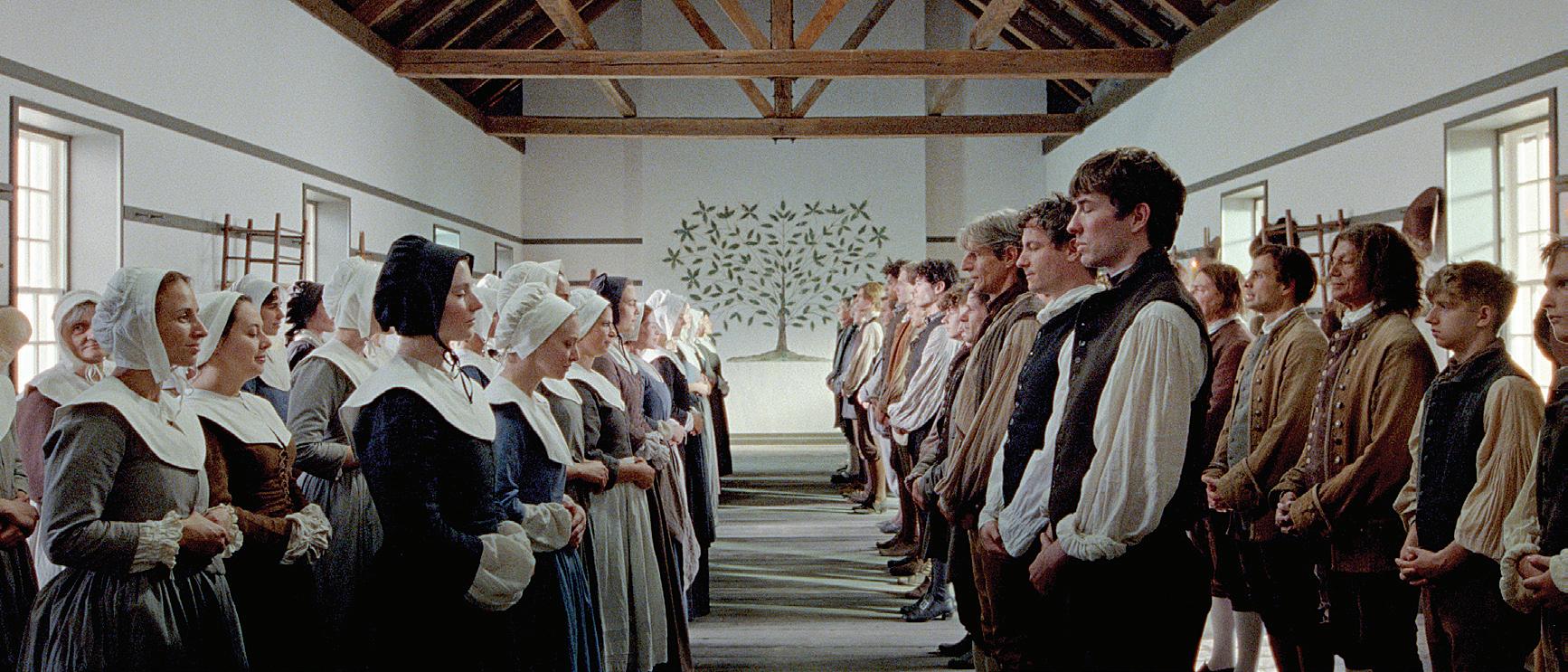



















Register at esacamp.org For more information esa@ESACamp.org



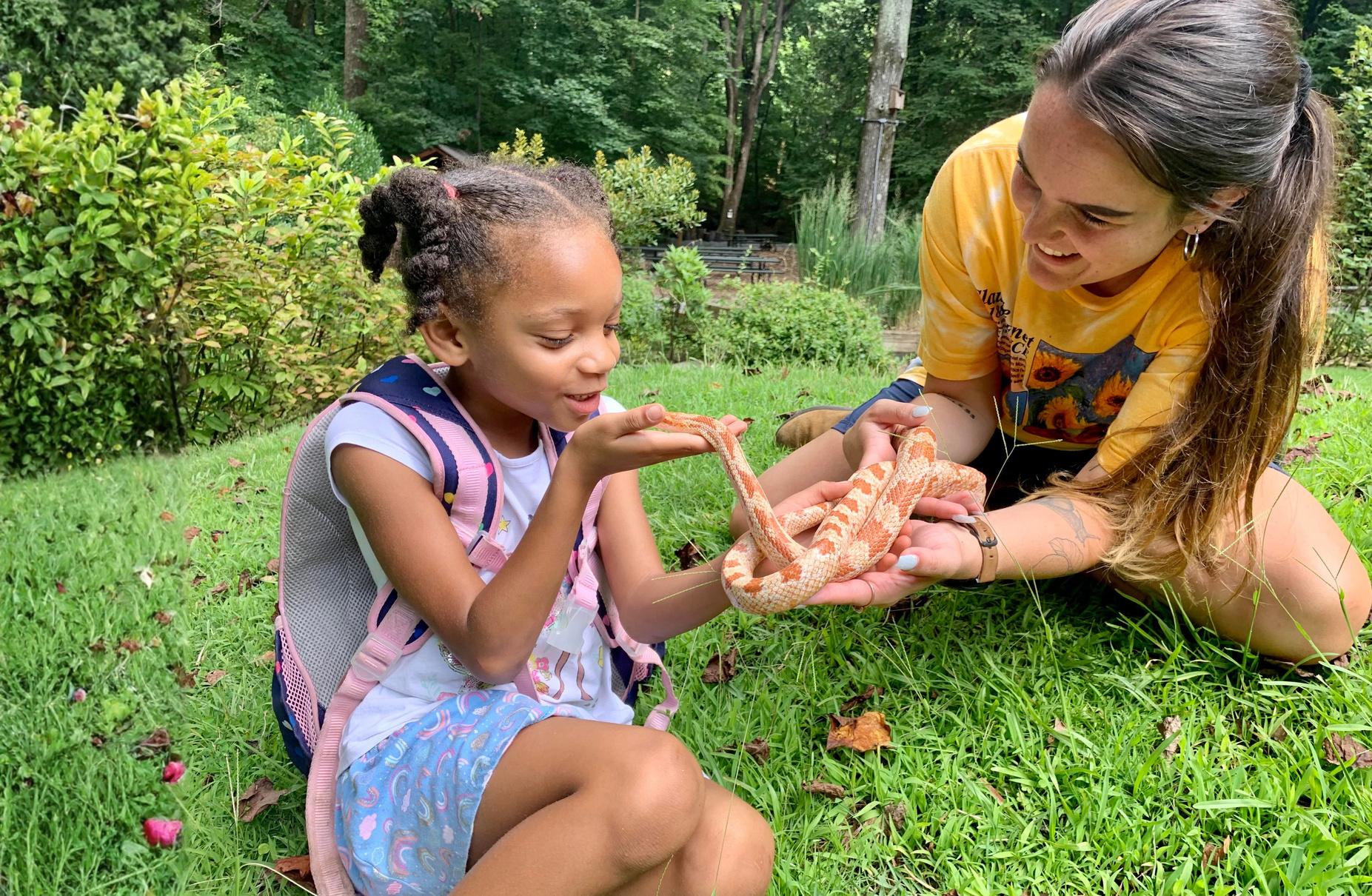







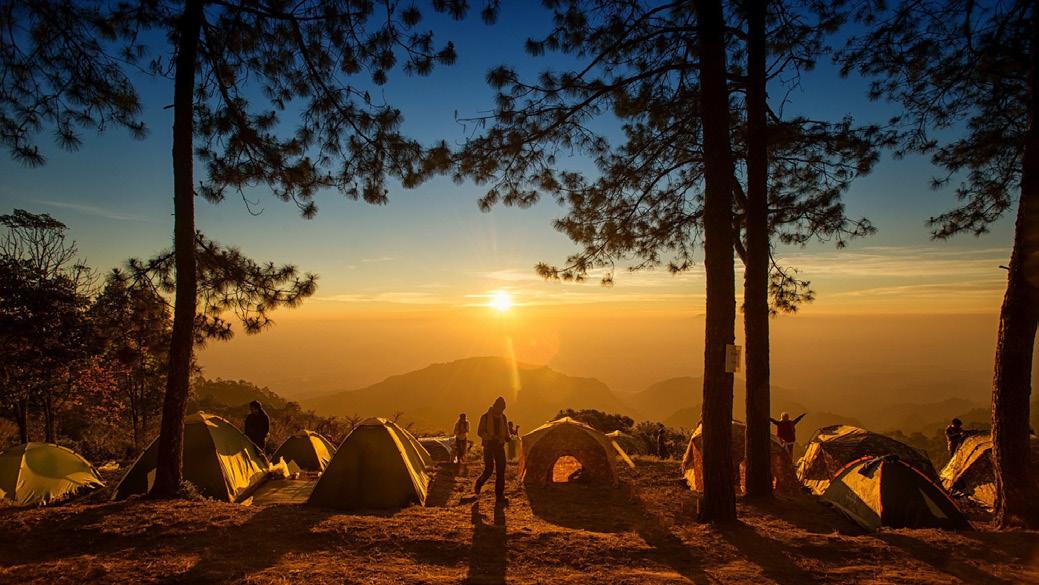






The Georgia State Capitol was never my favorite place to advocate on behalf of rivers and clean water. With its hard marble floors and inadequate seating, the building is not a comfortable place to spend much time. Worse, it’s not easy to determine exactly what’s going on during the annual legislative sessions. The process by which bills are introduced, evaluated, and passed (or killed) is byzantine–perhaps intentionally so.
Despite my lack of enthusiasm, when the legislature convened for its fortyday session every January, I put on my business suit and joined the circus under the Gold Dome. As a registered lobbyist for more than twenty years, until I retired, I represented Chattahoochee Riverkeeper and its efforts to clean up and defend the river that flows through Atlanta, sustaining more than five million people with drinking water.
Lobbyists hang out on the third floor of the capitol, watching televisions that show the activity in each legislative chamber (House and Senate). This makes them accessible to legislators, who periodically dash out of their chamber doors to ask for advice or to meet with constituents. Public interest lobbyists who advocate for the environment, healthcare, families, education, and other progressive causes–uplift for everyone–can be found on the north side of the third floor. Business lobbyists dominate the south side of the building: a deep philosophical (and compensation) chasm between them.
Since 2005, when both the Georgia House and Senate became Republican majorities for the first time since Reconstruction, the Republican leadership has largely been controlled by pro-growth (at any cost) and anti-environmental interests. Prior to that time, environmental advocates frequently collaborated with Republican leaders, who understood that a healthy economy and environment are not mutually exclusive. Sadly, those days are long gone. Over the past two decades, and continuing today, environmentalists must primarily play defense under the Gold Dome.
Eroded soil that flows off-site from development and road projects during storms is the most common pollutant in
Georgia, threatening virtually every waterway. The cost to clean drinking water sources is higher when they’re contaminated with sediment and other harmful substances that attach to dirt particles. Public health is jeopardized when people recreate in muddy waters that carry high levels of bacteria. When clogged with eroded soil, fish and wildlife habitats are harmed and stormwater pipes break. Property values fall when adjacent streams fill with dirt.
During my years with Chattahoochee Riverkeeper, soil erosion and storm runoff issues dominated our workload at the state legislature, in the field, in our policy initiatives, and in our legal actions. The majority of the calls to our hotline were tips about dirty water flowing from construction sites into streets and storm drains leading to rivers and impacting downstream private property. Developers cut corners to save time and money. They ignored their approved plans and permit conditions by failing to install and maintain best management practices. They flagrantly violated clean water laws, hoping not to be caught by minimally staffed local governments. That said, some progress in stopping the flow of muddy water has been made over the years by clean water advocates, vigilant neighbors, and responsible developers.

extensive negotiation and compromise over the past 35 years. These laws were adopted to protect public waters and downstream property owners.
The groups that are pushing HB 812 (Dirty Water Bill) blame local governments for delays in evaluating and permitting land disturbance projects, which they say cost them too much money and significantly raise home prices. Supporters of this bill include the Homebuilders Association of Georgia, Georgia Association of Realtors, Georgia Residential Land Development Council, and Association of General Contractors, among others.
Last spring, at the end of the legislative session, a bill was filed on behalf of various real estate interests, purporting to address housing affordability. Sponsored by Rep. Mike Cheokas (R-Americus) and currently under consideration during the 2026 session, HB 812 would change (read: weaken) how cities and counties regulate land disturbance permits. About 240 local governments in Georgia manage and enforce erosion control laws, adhering to state standards developed through
In response, local officials say that developers often deliver incomplete and poorly prepared plans, use unlicensed engineers, and change their plans midreview. They also note that large corporate syndicates, dominating the real estate market in metro Atlanta and elsewhere, submit plans with insufficient detail.
The Dirty Water Bill would allow a state agency to override local government decisions that require flexibility for consideration of regional differences in climate, soils, and development patterns. It would demand tighter deadlines for local staff to review applications–a virtual impossibility for complex commercial
and industrial projects, including massive data centers. These facilities are already proving to be a problem for communities throughout Georgia. As one example, a data center under construction in the Flint River watershed (Fayette County) has repeatedly violated erosion control laws, turning nearby waterways red with mud. There is a serious housing affordability and availability crisis in Georgia; however, arguing that the way to reduce the cost of a home is to pollute our waterways is irresponsible and unacceptable. What about higher interest rates and materials costs, the shortage of construction workers, and other factors that are increasing housing costs?
The Dirty Water Bill puts all the responsibility for improving the review process on local governments and state regulators, but none on the developer applicants. Put simply, the Dirty Water Bill–HB 812–is not in the public interest.
As Flint Riverkeeper Gordon Rogers has said: “Relaxing this regulatory structure [erosion control laws], is a bad move for private property and Georgia’s waters.”
The Georgia Water Coalition is tracking HB 812 and other legislation. Consider participating in the coalition’s Capitol Conservation Day on Feb. 26.