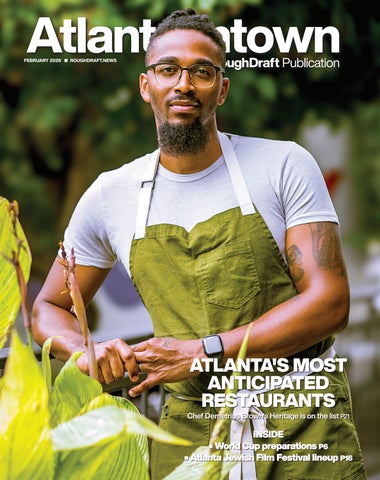
Atlanta Intown - February 2026

Page 1


Editorial

Collin Kelley

Executive Editor

Beth McKibben

Editor-in-Chief

Sr. Editor Food & Dining

Cathy Cobbs

Managing Editor, Reporter Newspapers

Sammie Purcell

Associate Editor

Staff Writers

Katie Burkholder, Logan C. Ritchie, Sarra Sedghi, Hayden Sumlin, Stephanie Toone

Contributors

Amanda Andrews, Sally Bethea, Maya Holman, Laura Scholz

Follow

@RoughDraftATL on Instagram.

Published By

Rough Draft Atlanta

Keith Pepper

Publisher

keith@RoughDraft.news

Neal Maziar

Chief Revenue Officer

neal@RoughDraft.news

Rico Figliolini

Creative Director

Circulation

Each month, 27,000 copies of Atlanta Intown are mailed to homes and distributed to businesses in and around ZIP codes 30306, 30307, 30308, 30309, 30324 and 30329. For delivery information, delivery@RoughDraft.news

To subscribe to home delivery, ($125 / year) email delivery@RoughDraft.news

Deborah Davis Account Manager | Sales Operations deborah@RoughDraft.news

Jeff Kremer

Sr. Account Manager jeff@RoughDraft.news

Suzanne Purcell

Sr. Account Manager suzanne@RoughDraft.news

Operations

Savannah Pierce savannah@RoughDraft.news

(Photo by Alphonso Whitfield)

Dining delights and drama

EDITOR'S

This issue of Intown has a food-centric angle as our dining team looks at the city’s most anticipated restaurants, what’s behind the recent spate of closures, and trends to watch out for in the new year. Turn to page 21 for all the coverage.

While I’m excited to see all the new restaurants opening this year, I’m also sad about a couple of the closures: Agave and Daddy D’z BBQ. The cayenne fried chicken at Agave in Cabbagetown was one of my favorite meals, and you couldn’t go wrong with the pulled pork at Daddy D’z on Memorial Drive. Eats was another longtime favorite (I particularly liked their pasta with the turkey meat sauce), so I’m thrilled it's being resurrected at Wild Heaven in West End.

I still lament the closure of restaurants that happened decades ago: the eclectic menu at Mick’s, the deep dish pizza at Upper Crust, pasta at Olde Spaghetti Factory, and the world-famous “Ghetto Burger” at Ann’s Snack Bar.

Since I’m not a very adventurous eater, I have a pretty tight circle of favorite restaurants: The Colonnnade, Manuel’s

Tavern, Cypress Pint & Plate, Fat Matt’s Rib Shack, and the tacos at Poncho’s are my go-tos. My favorite burger joints remain George’s in VaHi and Grindhouse.

I also love Waffle House, which is a requirement to live in Georgia. Two egg breakfast with a biscuit instead of toast, please.

My friends, dismayed at my limited palate, have tried to expand my dining horizons with some success. I have become a big fan of the pho restaurants along Buford Highway, especially Pho Dai Loi, Pho 24, and Lee’s Bakery. My new favorite is the recently opened New Super Pho next door to the Super H Mart in Doraville. The Michelin-rated Nam Phuong is another spot for the best Vietnamese food in town.

Apparently, I had a much more extensive palate as a child, but somewhere along the way, I developed food texture issues. I have literally tried every type of lettuce and still cannot eat it without gagging. That means salads have been off the menu for me since, well, forever. And, yes, I’ve tried drenching it in salad dressing, cheese, and vinegarettes. Now and then, I’ll take a bite of a dining companion’s salad just to see if anything has changed. As of January, it has not.

Like lots of folks, I worked at a restaurant in my 20s to help make ends meet even while I was a journalist. For a time back in the late 90s/early 00s, I DJ’d on Sundays at an East Atlanta restaurant during their weekly trivia. The owner liked me and said I’d make a great host if I wanted to pick up some extra cash. So, one fateful summer, I decided to try it. The restaurant was on the decline, staff were leaving in droves, and so were the customers. Let’s just say it didn’t go well for me, and my tenure as a host lasted about three months after I stormed out, as the Brits would say, in full strop. I’ll stick to journalism, working on expanding my eating habits, and tasting lettuce every now and then.

Collin Kelley
New Super Pho in Doraville.

On Jan. 16, 150 days out from the 2026 FIFA World Cup, the Atlanta Host Committee held a virtual press conference to provide journalists with updates on the city's preparations ahead of the global soccer event taking place this summer in the United States, Canada, and Mexico.

Speakers included Dietmar Exler, Chief Operating Officer of MercedesBenz Stadium; Dan Corso, President of the Atlanta World Cup Host Committee and Atlanta Sports Council; and Adam Fullerton, Vice President of Stadium Operations for Mercedes-Benz Stadium.

Exler remarked on Atlanta’s rise as a major soccer city over the last 15 years. Atlanta announced it was getting a professional soccer team in 2014, with Atlanta United debuting at Mercedes-Benz Stadium in 2017. The team won the MLS Cup Championship a year later.

In 2022, FIFA named Atlanta as a

2026 World Cup host city — one of two U.S. cities to host both the World Cup and the Olympics. This summer, teams from future World Cup host countries, Spain and Morocco (2030) and Saudi Arabia (2034), will compete in Atlanta.

“Atlanta is truly the center of soccer in the United States,” Exler said. “We are all set to have tremendous events in Atlanta. The stadium is ready, and the city is ready.”

Cooperation across the city

Corso highlighted the importance of cooperation across Atlanta’s communities, which makes the city's host committee stand out from other 2026 host cities.

“We get the civic and the business communities together and we bring the operational expertise from those organizations and their staff, and we pool them together into our host committee,” he said. “So, whether it's the Atlanta Sports Council staff, the Mercedes-Benz Stadium staff or others, all of us work very

closely together."

Corso highlighted the "consistency" of the local organizations involved in Atlanta's World Cup planning, calling it "effective" because the committee doesn't rely on short-term, outside contractors who come in just for a particular event.

He noted that the committee is collaborating with various consulates around Atlanta to address cultural needs, fan behavior, and travel patterns. He also provided updates on FIFA Fanfest days, which will take place at Centennial Olympic Park, and MARTA preparations.

MARTA is expecting high-volume usage during the World Cup and is in the process of introducing a tap-to-pay fare option. Each station will include 100 volunteers to help guide passengers and address problems on match days.

Changes at MBS

Fullerton provided updates on changes Mercedes-Benz Stadium will undergo in advance of the 2026 FIFA World Cup. On Jan. 31, the stadium will replace its synthetic turf with natural sod. Improvements to the stadium's audio systems, field lighting, and wireless capabilities will also be made. Per FIFA's "clean site" regulations, staff will cover up more than 2,000 brand names on display at the stadium, including the MercedesBenz emblem on the retractable roof.

“This stadium was designed to host these types of events,” Fullerton said. “We pride ourselves on being a world-class stadium. The tournament has been a bit of a driver for us to speed some of those upgrades up."

With remarks finished, local, national, and international journalists were allowed to question the panel. Questions ranged from asking their thoughts on hosting two games featuring the world's top soccer

team, Spain, to making international fans and teams feel welcome in Atlanta, given the Trump Administration's suspension of processing immigrant visas from 75 countries. Teams from at least three of those 75 countries – Haiti, Cape Verde, and Uzbekistan – will play matches in Atlanta this summer during the World Cup.

Calls to boycott or forgo attending the 2026 World Cup in the U.S. have risen in response to the Trump Administration's recent foreign policy plays and the shooting of civilians by U.S. Immigration and Customs Enforcement (ICE). Corso stressed that Atlanta’s host committee is focused on providing all fans with a "memorable experience."

Local opportunities

On the local level, Rough Draft asked the panel if local restaurant stalls at Mercedes-Benz Stadium would be affected by FIFA’s clean site regulations, including whether any businesses would be replaced during the World Cup.

“We are doing our best to make sure that [our venue’s] local brands have an opportunity to sell and operate here in the venue during the tournament,” Corso said. He stated that a few of FIFA’s restaurant partnerships may change some of the stadium’s concepts and/or menus. The committee is currently working through stadium menus to determine next steps.

The Atlanta Host Committee will continue holding monthly meetings ahead of the 2026 FIFA World Cup, which runs from June 11 through July 19. Atlanta will host eight matches, including a semifinal on July 15, and host teams from Cape Verde, Haiti, Morocco, Saudi Arabia, Spain, and Uzbekistan. The remaining teams have not yet been determined.

Courtesy MBS

Unbeknownst to the public, a small group of officials from the city of Atlanta, the Atlanta Beltline, and MARTA voted to stop all work on the Eastside Beltline light rail project last summer, according to an exclusive report from the AJC.

The final report of the Edgewood Corridor Public Safety Task Force includes recommendations for a temporary moratorium on new liquor licenses, adding additional cameras, and prohibiting “party houses” in the district.

Morris Brown College President Kevin James was fired and then rehired in a week amid ongoing allegations of sexual harassment, abuse, and threats by James.

The James Beard Foundation announced the semifinalists in the chef and restaurant categories for the prestigious awards.

Pastry chef Claudia Martinez, Sommelier Taurean Philpott, the Kamayan ATL owners, Aria, and Madeira Park are among the semifinalists from Atlanta.

Kemp proposes tax cut, needs-based scholarships in address

Georgia Gov. Brian Kemp called for an expedited income tax rate cut and another tax rebate, new spending for law enforcement retirement savings and funding for a needs-based scholarship program in his annual State of the State address on Jan. 15 before the Georgia General Assembly.

The speech — Kemp’s eighth and final address as governor — highlighted many of the policies that have shaped his legacy, including his efforts to raise wages for teachers and other state employees, issue tax rebates during years the state had a revenue surplus and shore up the state’s multibilliondollar reserves. According to Kemp’s projections, Georgia’s state reserves and rainy

day fund combined will have more than $10 billion by the time he leaves office. The state’s current reserves sit at $14.6 billion.

“There’s no question the state of our state is stronger, more prosperous and safer today than it was in January of 2019,” he told lawmakers.

But Kemp’s speech also highlighted the rising costs of living across the state, and cautioned lawmakers against taking the state’s economic stability for granted.

“The reality is that too many of our citizens are still struggling to make ends meet and everyday costs are still too high,” he said. “Groceries, rent, insurance, clothes for the kids, it all adds up to more than it used to.”

In his speech, Kemp also previewed his priorities for his last legislative session

as governor, which includes a proposal to accelerate a plan lowering the state income tax rate below 5%.

Kemp’s proposed tax cut would bring the state’s income tax rate to 4.99%, down from 5.19%. His proposal would take effect for this year’s tax year and cost the state about $750 million each year in future lost revenues.

“This will fulfill a promise to the people of the state that I made during my reelection campaign to lower our state income tax rate to under 5% and with the General Assembly’s passage and my signature, it will come a full three years ahead of schedule,” he said.

But there is a push in the Senate to move aggressively toward eliminating Georgia’s income tax. A special Senate panel recently released a plan that would waive the tax on up to $50,000 a year for individuals and $100,000 for married couples starting in 2027 – and eliminate the income tax entirely by 2032. Republican House leaders say they are also readying a bill that would nix the property tax on primary residences.

Rep. Victor Anderson, a Cornelia Republican and chair of the House Governmental Affairs Committee, said that with Kemp’s proposed accelerated income tax cut, lawmakers could consider some sort of property tax relief reduction without impacting local government services.

“I also think there’s plenty of room for us to work with our local government on property taxes and still allow them to provide the services the citizens need,” Anderson said.

Notably absent from Kemp’s speech were discussions of hot-button social issues like banning diversity, equity, and inclusion efforts or restricting access to genderaffirming care.

Instead, Kemp centered his speech on cost-of-living issues, including a proposal to distribute a one-time $2,000 bonus to state employees and fund a needs-based scholarship for Georgia students that had previously been funded through private donations.

The University System of Georgia Foundation’s DREAMS Scholarship would complement the state’s existing HOPE Scholarship, which is awarded to students based on merit. Under Kemp’s proposed budget, the DREAMS Scholarship would receive a one-time contribution of $325 million from the state to create more opportunities for Georgia residents to graduate without student debt.

“I believe we owe it to every child to ensure they start out on a level playing field, no matter their zip code,” Kemp said.

House Minority Leader Carolyn Hugley applauded Kemp’s push to fund the scholarship during his final year in office.

“We’ve been asking for a need-based scholarship for years,” she told reporters after the speech. “As you know, HOPE started out as a needs-based proposition, and they turned it into a merit-based scholarship. So I’m happy that on his way out the door, he’s giving a nod to something that we’ve been asking for for several years.”

But Hugley, a Columbus Democrat, also criticized Kemp’s proposal to send out onetime tax rebates to Georgia residents, saying it would not go far enough to address the state’s affordability issues.

This year’s rebates, which also require lawmakers’ approval, would be the fourth time Georgia taxpayers received an extra payment in recent years, and it would again show up as $250 for individuals, $375 for head of household and $500 for married couples filing jointly. All told, the rebates would cost the state’s rainy day funds about $1.2 billion.

The rebates “will not take care of the needs that most families are thinking about,” she said. “They’re thinking about child care. They’re thinking about paying rent. But a one-time $250, a one-time $500, what is that really going to do?”

Kemp also released his budget proposal, including $46.4 million to replace the recent reduction of federal funding for a key food aid program, the Supplemental Nutrition Assistance Program. Roughly $2 billion in Kemp’s proposed budget would go toward highway improvements around metro Atlanta, and another $250 million would be allocated to local road projects. Rural parts of the state would also receive $100 million to strengthen or replace failing bridges, and $35 million for natural gas infrastructure upgrades.

The proposal would also include $5 million to fund a full hand recount for this year’s election, and another $1.8 million to help scan and tabulate ballots based on the human-readable text.

The new spending will bring the size of this year’s budget up to $42.3 billion. Next year’s budget, which will take effect in July, is set at $38.5 billion.

Georgia Recorder editor Jill Nolin and reporter Alander Rocha contributed to this report.

During these uncertain times, HammerSmith is here for you and your family. We provide safe, essential services, architectural designs and home renovations. Start planning today for how to live better in a changed world. HammerSmith is here for you and your family. We provide exceptional architectural designs and home renovations. Start planning today for how to live better in an ever-changing world.

Dickens begins second term

On Jan. 5, Atlanta’s leaders gathered at Georgia State University’s Convocation Center to celebrate the inauguration of the city’s new and returning leadership.

The event, led by Masters of Ceremonies Lori Geary, host of The Georgia Gang, and Jorge Estevez, anchor for WSB-TV, drew attendance from Congress members Sen. Raphael Warnock, Rep. Lucy McBath, and Rep. Nikema Williams; former Atlanta mayors Ambassador Andrew Young, Shirley Franklin, and Kasim Reed; and Valerie Jackson and Sandra Massell, representing their late husbands and former mayors Maynard Jackson and Sam Massell.

The highlights of the ceremony were the swearing in of City Council President Marci Collier Overstreet, who was elected in November after former President Doug Shipman did not run for reelection, and Mayor Andre Dickens for his second term after being reelected with 85 percent of the vote. In their acceptance speeches, both Dickens and Overstreet highlighted the successes of their past terms –Overstreet as a member of City Council – and their goals to move Atlanta forward.

Dickens said the “defining work” of his second term would be the Neighborhood Reinvestment Initiative, an ongoing project focused on uplifting and interconnecting Atlanta’s neighborhoods through the development of affordable housing, youth opportunities, public spaces, and accessible transit. The project is focused on seven neighborhoods: Thomasville Heights, English Avenue/Vine City, Grove Park/Bankhead, West Hollowell, East Campbellton, West Campbellton, and Downtown.

“At a moment when the federal government has pulled back from that group project, Atlanta chooses not to retreat,” Dickens said. “…We are all choosing to lean in. We are choosing to remain indivisible. The Pledge of Allegiance we recited earlier today says, ‘Indivisible, with liberty and justice for all.’ Atlanta, we are indivisible, committed to one city, to one future, and most importantly, to one another.”

Overstreet said she is planning to institute presidential town halls across the city throughout the year so people who work 9-5 and are unable to attend weekday City Council meetings can still interact with city government.

“Everything I do is rooted in love, love for my community, love for my city, love for a future in which every voice is honored and every life is cherished,” Overstreet said. “I promise to leave this city with

compassion, courage and an unwavering belief in Atlanta’s greatness. Thank you for trusting me Atlanta to serve as your council president. Let’s keep building Atlanta together.”

Other Atlanta officials who were sworn in on Monday included the City Council, who took the oath of office administered by Fulton County Superior Court Judge Robert C. I. McBurney, and the Atlanta Municipal Court Judges, whose oath was administered by Chief Judge of Fulton Superior Court Ural Glanville.

Newly inaugurated City Council members included Kelsea Bond, Thomas Worthy, and Wayne Martin. Reelected members included Michael Julian Bond, Matt Westmoreland, Eshé Collins, Jason Winston, Byron Amos, Jason Dozier, Liliana Bakhtiari, Alex Wan, Mary Norwood, Dustin Hillis, Andrea Boone, and Antonio Lewis.

Chief Judge Christopher E. Ward, Judge Gary E. Jackson, Judge Terrinee L. Gundy, Judge JaDawnya C. Baker, Judge Christopher T. Portis, Judge Ardra L. Bey, Judge Theresa A. Mann, Judge Pierce Hand Seitz, and Judge Allyson R. Pitts were all inaugurated as the Atlanta Municipal Court.

Mayor Andre Dickens waves to the crowd after his inauguration. (Photo by Katie Burkholder)
New Atlanta City Council President Marci Collier Overstreet is sworn in. (Photo by Katie Burkholder)
Members of the Atlanta City Council are sworn in. (Photo by Katie Burkholder)

SUSTAINABILITY Legislative Notebook: Developers love that dirty water

THE WATER LINE

The Georgia State Capitol was never my favorite place to advocate on behalf of rivers and clean water. With its hard marble floors and inadequate seating, the building is not a comfortable place to spend much time. Worse, it’s not easy to determine exactly what’s going on during the annual legislative sessions. The process by which bills are introduced, evaluated, and passed (or killed) is byzantine–perhaps intentionally so.

Despite my lack of enthusiasm, when the legislature convened for its fortyday session every January, I put on my business suit and joined the circus under the Gold Dome. As a registered lobbyist for more than twenty years, until I retired, I represented Chattahoochee Riverkeeper and its efforts to clean up and defend the

river that flows through Atlanta, sustaining more than five million people with drinking water.

Lobbyists hang out on the third floor of the capitol, watching televisions that show the activity in each legislative chamber (House and Senate). This makes them accessible to legislators, who periodically dash out of their chamber doors to ask for advice or to meet with constituents. Public interest lobbyists who advocate for the environment, healthcare, families, education, and other progressive causes–uplift for everyone–can be found on the north side of the third floor.

Business lobbyists dominate the south side of the building: a deep philosophical (and compensation) chasm between them.

Since 2005, when both the Georgia House and Senate became Republican majorities for the first time since Reconstruction, the Republican leadership has largely been controlled by pro-growth (at any cost) and anti-environmental

interests. Prior to that time, environmental advocates frequently collaborated with Republican leaders, who understood that a healthy economy and environment are not mutually exclusive. Sadly, those days are long gone. Over the past two decades, and continuing today, environmentalists must primarily play defense under the Gold Dome.

A Major Pollutant

Eroded soil that flows off-site from development and road projects during storms is the most common pollutant in Georgia, threatening virtually every waterway. The cost to clean drinking water sources is higher when they’re contaminated with sediment and other harmful substances that attach to dirt particles. Public health is jeopardized when people recreate in muddy waters that carry high levels of bacteria. When clogged with eroded soil, fish and wildlife habitats are harmed and stormwater pipes break.

Property values fall when adjacent streams fill with dirt.

During my years with Chattahoochee Riverkeeper, soil erosion and storm runoff issues dominated our workload at the state legislature, in the field, in our policy initiatives, and in our legal actions. The majority of the calls to our hotline were tips about dirty water flowing from construction sites into streets and storm drains leading to rivers and impacting downstream private property. Developers cut corners to save time and money. They ignored their approved plans and permit conditions by failing to install and maintain best management practices. They flagrantly violated clean water laws, hoping not to be caught by minimally staffed local governments. That said, some progress in stopping the flow of muddy water has been made over the years by clean water advocates, vigilant neighbors, and responsible developers.

Joy is as good as they get. She helped me sell my home in Morningside and we were under contract for full asking price within three days. She was incredibly knowledgeable of the local market and had a clear price and listing strategy that worked to perfection. She seamlessly guided me through the process and put forth an incredibly high level of professionalism in doing so. She always kept me updated and responded promptly in detail in all communications. Out of all of the REALTORS® I have worked with over the years, I can say with certainty that Joy is the best. – W.B., Seller

Another Bite at the Apple

Last spring, at the end of the legislative session, a bill was filed on behalf of various real estate interests, purporting to address housing affordability. Sponsored by Rep. Mike Cheokas (R-Americus) and currently under consideration during the 2026 session, HB 812 would change (read: weaken) how cities and counties regulate land disturbance permits. About 240 local governments in Georgia manage and enforce erosion control laws, adhering to state standards developed through extensive negotiation and compromise over the past 35 years. These laws were adopted to protect public waters and downstream property owners.

The groups that are pushing HB 812 (Dirty Water Bill) blame local governments for delays in evaluating and permitting land disturbance projects, which they say cost them too much money and significantly raise home prices. Supporters of this bill include the Homebuilders Association of Georgia, Georgia Association of Realtors, Georgia Residential Land Development Council, and Association of General Contractors, among others.

In response, local officials say that developers often deliver incomplete and poorly prepared plans, use unlicensed engineers, and change their plans midreview. They also note that large corporate syndicates, dominating the real estate market in metro Atlanta and elsewhere,

submit plans with insufficient detail.

The Dirty Water Bill would allow a state agency to override local government decisions that require flexibility for consideration of regional differences in climate, soils, and development patterns. It would demand tighter deadlines for local staff to review applications–a virtual impossibility for complex commercial and industrial projects, including massive data centers. These facilities are already proving to be a problem for communities throughout Georgia. As one example, a data center under construction in the Flint River watershed (Fayette County) has repeatedly violated erosion control laws, turning nearby waterways red with mud.

There is a serious housing affordability and availability crisis in Georgia; however, arguing that the way to reduce the cost of a home is to pollute our waterways is irresponsible and unacceptable. What about higher interest rates and materials costs, the shortage of construction workers, and other factors that are increasing housing costs?

The Dirty Water Bill puts all the responsibility for improving the review process on local governments and state regulators, but none on the developer applicants. Put simply, the Dirty Water Bill–HB 812–is not in the public interest.

As Flint Riverkeeper Gordon Rogers has said: “Relaxing this regulatory structure

IN OUR PREHISTORIC ERA

[erosion control laws], is a bad move for private property and Georgia’s waters.”

The Georgia Water Coalition is tracking HB 812 and other legislation. Consider participating in the coalition’s Capitol Conservation Day on Feb. 26.

North Fulton's Big Creek sends muddy water into the Chattahoochee in the 2000s. (Photo courtesy Sally Bethea)

Atlanta Jewish Film Festival announces lineup

The Atlanta Jewish Film Festival has announced the lineup for its 26th annual event, which will run in person at multiple theaters across Atlanta from Feb. 18 to March 3.

The opening night film is the French dramedy “Once Upon My Mother,” which will play at the Sandy Springs Performing Arts Center on Feb. 18. This year’s festival lineup includes 49 feature films and 16 shorts.

This year’s festival will also include a sneak peek of the film “The Day After,” which is the recipient of the inaugural ATL Jewish Film Filmmaker Fund. “The Day

After,” from filmmakers Yuval Orr and Aziz Abu Sarah, follows a group of Israelis and Palestinians who travel to Northern Ireland to learn about the region’s peace process.

While the festival is still known as the Atlanta Jewish Film Festival, the organization recently rebranded to ATL Jewish Film, an umbrella term that covers both the yearly festival and the organization’s push for year-long programming.

“The 26th annual festival marks a monumental moment as we both launch a full season of ATL Jewish Film programming, and begin our second quarter-century,” said Kenny Blank,

and artistic director, in a press release. “Our films invite reflection, conversation, and connection long after the credits roll, and we’re proud to share them with audiences across Atlanta and throughout Georgia.”

According to the release, the films

“Nuremberg 45” and “My Friend Sam” will have their world premieres at the festival. The documentary “Proud Jewish Boy” will have its U.S. premiere, and the films “Kichka: Telling Myself,” “Raoul Wallenberg: Missing Inaction,” “The Soundman,” and “They Fight With Cameras” will have their regional premieres.

This year’s guests include actress and writer Jennifer Westfeldt of “Kissing Jessica Stein,” writer/director Matthew Shear of “Fantasy Life,” and musician Regina Spektor, who produced the documentary “My Friend Sam.”

After the in-person festival, select films will be available streaming online from March 6-15. The full film schedule and ticket information can be found at ajff.org. Member presales begin on Jan 21 and tickets go on sale to the public on Feb. 4

+ Jazzy Clarinet Concertos by Aaron Copland & Artie Shaw

+ Zemlinsky’s The Mermaid America@250: Bernstein’s West Side Story

Sibelius Fifth Symphony

+ Lutosławski’s Cello Concerto Rachmaninoff’s Fourth Piano Concerto

executive
Courtesy AJFF

Theatrical Outfit’s premieres ‘Bleeding Hearts’

Theatrical Outfit kicks off the new year with the world premiere of Atlanta playwright Steve Yockey’s “Bleeding Hearts” at the Balzer Theatre in Downtown.

The “breakneck, pitch-black farce” about the disappearing middle class and how people forget to put themselves in each other’s shoes runs from Jan. 28 to Feb. 22.

The story: Sloane isn’t sure why exactly her husband, Timothy, brought home a probably dangerous drifter with a knife, but she doesn’t like it. Of course, it’s hard to focus when her wealthy neighbor keeps dropping by to steal anything not nailed down.

“We’re thrilled to be starting the new year with the world premiere of a new play,” TO Artistic Director Matt Torney said in a statement. “And, we are even more thrilled that it’s a play by one of Atlanta’s most celebrated playwrights, Steve Yockey.”

Torney said “Bleeding Hearts” is part of the theatre’s commitment to new plays by Atlanta playwrights as part of its “Made in Atlanta” development program. Since starting five years ago, “Made in Atlanta” has developed and premiered the hip hop musical “Young John Lewis,” which won Best Musical in the 2025 Suzi Bass Awards, “FLEX” that went on to play at Lincoln Center in New York.

“Bleeding Hearts” will feature anensemble of current, returning, and

new faces, including: Josh Adams as “Griff O’Brien,” Veronika Duerr as “Sloane Burke,” Christopher Hampton as “Timothy Burke,” Tony Larkin as “Old Blindy,” and Tess Malis Kincaid as “Felicia Reed-Walker.” Under the direction of Sean Daniels (former Artistic Director of Dad’s Garage), the design team includes: Scenic Design by Kat Conley, Costume Design by April Andrew Carswell, Lighting Design by David Reingold, Sound Design by Dan Bauman, Properties Design by Leah Thomas, Special Effects by Sarah Beth “EssBee” Hester, Intimacy Coordination by Bridget McCarthy, and Stage Management by Gabby Peralta. Tickets are available at theatricaloutfit. org or call (678) 528-1500 for more information.

Photo by Casey G. Ford

Film Review: ‘The Testament of Ann Lee’ is a testament to rapturous community

At the beginning of “The Testament of Ann Lee,” revelers make their way through a forest. As they move, they sing and chant, their bodies erupting with abrupt, almost violent spurts of movement. The narrator, Mary (Thomasin McKenzie), a follower of the Shaker religion and a close confidant of its founder, Ann Lee, begins to share her testimony. It almost feels as though you’re being recruited for something — something rapturous, something glorious.

Directed by Mona Fastvold and cowritten by Fastvold and Brady Corbet, “The Testament of Ann Lee” relays the story of the Shakers’ founder (portrayed by Amanda Seyfried) from her humble beginnings in Manchester, England to her eventual status as one of the most radical religious figures of the 18th century. The Shakers — splintering off from the Quakers — practiced celibacy (a doctrine straight from the Mother Ann herself), believed in social and gender equality for all people, and were pacifists. But they are perhaps best remembered for their fierce, ecstatic movement in song and dance during worship.

“The Testament of Ann Lee” has been described as a musical, but in Fastvold’s film, the music and choreography feel far more like a tone poem of sorts — bursts of movement and sound meant to express emotions that are not so easily put into words, particularly in the oppressive and harsh society Ann and her cohort inhabit. That movement is particularly mesmerizing, but “The Testament of Ann Lee” is most striking in its insistence on viewing its subjects strictly in the context of their own time. Hauntingly modern in its visuals yet divorced from modernity at the same time, “The Testament of Ann Lee” is a story about the nature of community and belief, about suffering and joy in equal measure.

Ann’s journey to becoming Mother Ann (whom the Shakers believed was the second coming of Christ) is rooted in her declaration that fornication is the primary sin for which Adam and Eve were cast out of Eden, the idea of which came to her during a vision while she was

imprisoned. But in the film, the truth of Ann’s commitment to celibacy stems from a thorny, pain-ridden relationship with sex. In one scene, a young Ann watches her father rut on top of her mother, covering her mouth with one rough hand to keep her silent. When she calls her father out at breakfast the next morning, she’s lashed across her hands for her insolence. When she is married to Abraham (Christopher Abbott), she indulges in his preferred version of sex (kinky, by 18th century standards) to make him happy. She gets pregnant four times. Each child dies. Ann takes this pattern as a punishment, her due suffering for engaging in original sin. From that suffering arises the Shakers, which, with celibacy at the forefront, understandably attracts people who have varyingly complex relationships with intimacy. At the beginning of the film, we’re introduced to a would-be Shaker who admits to having improper thoughts about his underage sister. Ann’s brother William (Lewis Pullman) is attracted to men. Those two things are not the same, but from an 18th century frame of mind, you can see why both people might have been drawn to the idea of cutting sex out of the equation all together.

“With nothing left to lose, Ann boldly converted her suffering to evangelism.” This is probably the most honest thing that our narrator, Mary (her voiceover continues throughout the film, contributing to the film’s mythic quality) says about Ann. Religion often operates this way, a group of people trying to find a reason behind their hardship, trying to find a community who understands that pain. Watching Ann’s story from a contemporary point of view, it’s easy to become wrapped up in the sadness that permeates through it, to ruminate on what she willingly gives up in the name of God. When her niece, Nancy (Viola Prettejohn) falls in love and aims to be married, Ann forces her to leave the Shakers. Her religious ties are stronger than her familial ones. But, while the film doesn’t shy away from that complexity, it also forces you to reckon with how the Shakers would have provided an outlet for oppressed and repressed people to process emotions

“The Testament of Ann Lee.” (Photo by Searchlight Pictures/William Rexer)

they have no words for. Where Ann and the others find ecstasy is song and dance — and those sequences are as orgasmic as they come, characterized by forceful, joyful, passionate movement. Through the camera and through Celia Rowlson-Hall’s choreography, Fastvold so clearly expresses this form of worship’s ties to sexuality. In one scene, Ann raised high and sensuously draped across her writhing revelers, she evokes the sinful images of Adam and Eve that came to her in her vision. Seyfried is splendid throughout “The Testament of Ann Lee,” but the way she infuses her body with tension and release in her dance is hypnotizing. The camera focuses primarily on her face, but every time you see her hands or another part of her body, rigid with hunger and yearning, it makes you long to see her entire physical performance in all its glory.

The tension between the audience’s modern sensibility and Fastvold’s commitment to looking at the past with

time period accuracy is exactly what makes “The Testament of Ann Lee” such a fascinating object. The character of William is perhaps one of the better examples of that tension. William never outwardly expresses his desire for men, or delivers a wordy monologue about the anxiety or pain that desire causes him — as so many period films or television shows that try to incorporate queer characters do. Instead, he transfers all of that feeling into his worship, into his belonging in a group that holds relatively progressive beliefs compared to the rest of society.

It’s easy to look at Ann, and William, and other Shakers and find tragedy in the circumstances that led them to find each other. But “The Testament of Ann Lee” forces you to witness their exaltation, to experience their unbridled joy at finding somewhere they can express themselves with no shame.

When culture becomes clout

EDITOR’S NOTE: This story is a partnership with VOX ATL, a youth-led nonprofit media organization that prepares teens for life, career, and community by harnessing the power of youth voice and uncensored self-expression. Find out more at voxatl.org.

Walking into school as a little girl, my hands were covered in a brown stain that displayed a beautiful design.

I was excited to tell my friends about all the festivities that had taken place, as Eid had been celebrated the previous day. I was ready to show them the stain that covered my hands. I would call it mehndi; others would call it gross.

As soon as I walked into school, people started asking me all sorts of bizarre questions. Like “Your mom let you get a tattoo?” “That’s gross, it looks like poop,” and “It looks like you have a skin disease.”

As a shy, quiet girl, I was hurt by these questions, but I kept silent. I was excited to show everyone my mehndi, but their reactions made me rethink whether my culture was truly beautiful. I thought it was, but after everyone’s reactions, maybe it was not.

This thought process caused a lot of damage to my self-esteem and my relationship with my cultural identity, and the reactions of others unfamiliar with my culture. As I grew older, I gained back my self-esteem. I walked into school once again with the same stain on my hands and the same feeling in my heart. The only thing that had changed was my age. But when I walked into school this time, my mehndi wasn’t considered gross. Instead, everyone loved it.

I was shocked because growing up, I faced so much hate for my mehndi.

Everyone was in love with my mehndi, constantly asking me if my mom could do their henna like how she had done mine. People were showing me different Pinterest and TikTok mehndi designs they wanted. Then it all made sense to me. The reason people now favor my mehndi is because of social media. Social media painted a positive picture of mehndi, and this sudden interest helped stop hate towards the art form. This example illustrates how social media can alter one’s perspective.

Despite this, social media doesn’t always present an optimistic view of every topic.

Social media’s influence

High school student Fatima Kashif, whose family originated from India, discusses how social media’s influence negatively impacts her culture. “On Instagram reels, there are a lot of weird Indian TikTok videos that have been made where people misinterpret that and think everyone in India is like that. I think that if they were to go and see what India was like or even do just the slightest bit of research, no misinterpretation would be there.” Kashif states.

She explains how TikTok and Instagram portray her culture in a negative light, as they highlight particular stereotypes that are not representative of the country. She explains that her government has a lot more to offer than it appears to from a social viewpoint.

Sai Chava, an 18-year-old college student from southern India, recounts how she was teased for bringing ethnic food to school. She states, ”In elementary school, I would experience instances of discrimination, such as being mocked for the ethnic food I brought, etc. Therefore, those moments eventually contributed to me not feeling like I belonged and fit in with my peers. I guess you can say it

YOUR VOICE MATTERS!

shunned me in the sense that it made me feel isolated, which is one of the main reasons I didn’t have many friends in elementary school and middle school.”

After she faced all this discrimination about her ethnic food, all the hype is now on TikTok; there are many creators posting videos eating Indian food, doing “mukbang” videos with it, and raving about the food. When Sai was a child, no one would even want to endure the smell of her food. It’s remarkable how a simple TikTok clout can alter how something is perceived.

She replied similarly as she went on about the new TikTok trend, “Scandinavian outfits.” Despite the name, these outfits have closer ties to South Asian cultural outfits. Chava expressed her concern for this, saying, “I’ve recently become aware of the ‘Scandinavian’ outfits going viral on TikTok, etc. Yet, that is very much South Asian culture. It is appalling how, in 2025, corporations are using ethnic culture for their benefit without giving credit.”

Discrimination and appropriation

I interviewed high school students

Victoria Mobley, 16, and Jamaya Ardis, 15, both African Americans. I asked, “What’s one thing people always get wrong about your culture on social media?” Mobley stated, “That being put together and speaking properly means you are whitewashed.”

The issue is never that these women are following the traditions of ethnic women; the problem is that they are not ready to call it anything that relates to these ethnic women. The article “The Culture Behind The ‘Clean Girl’ Style – Give Credit Where It’s Due” states, “Now that these style elements are being worn by white influencers, does it become more socially acceptable and trendy?” Are white women with Eurocentric features considered more beautiful? They beautify themselves in the same way as ethnic women. Ethnic women are still considered less than, never correctly credited.

TikTok clout

It’s not only teens who experience this; the pursuit of clout and the desire to be seen online by doing the next “big” thing shape the narrative.

Ardis then stated, “That we’re uneducated, bums, and ghetto.“ They both expressed how, as African Americans, they are put at a lower standard and are considered unintelligent and dull-witted, which causes people to be surprised and even more discriminatory when they defy racial stereotypes. I asked Ardis, “Is there something in your culture that you used to get hated on for, but now that it’s a trend and everybody is all for it?” She listed “bonnets, lashes, big earrings, speaking in slang/Ebonics/AAVE” as significant things from her culture that she was often shunned for and considered “ghetto” for. Although it’s now considered the opposite, this is because others, besides African Americans, are participating in the trend.

The “clean girl” trend has been quite popular lately. A trend that emphasizes oneself in a “clean” manner, it prioritizes perfectly slicked hair, clothes in neutral colors, simple, glowy makeup, and minimal accessories. However, what this trend emphasizes has been emphasized for years by African American, South Asian, and Hispanic women. Oiling your hair and slicking it back is vital in the lives of many ethnic women, and it’s a tradition that has been practiced for years due to its practical benefits. As time has passed, women outside of these ethnicities have started following these practices and saying they solely originate from the “clean girl” ideology.

Adults such as Feminista Jones, a 46-year-old African-American social worker, have experienced this firsthand growing up in a neighborhood with many immigrant and first-generation families. Many of these families’ native countries and cultures have been brought to the forefront solely because of the need for TikTok clout and the adaptation of elements from these cultures for personal gain. Jones touched on how acrylic nails were initially considered improper due to their length and intricate designs. As soon as the nails became a trend and White Americans started following the trend, they were considered professional. This was not fair to African Americans, as they had been doing their nails like that for years, and when they did them like that, they were considered unprofessional and improper. Jones expresses how she was one of the African American ladies who got her nails done as described. I spoke to Jones about what Ardis had stated earlier and how African Americans are considered “uneducated” and “ghetto.”

Jones said that she is glad that now social media can show the side of educated African Americans, as it helps portray a narrative of African Americans that is not represented enough. She also expressed how social media helps spread the stories of African Americans and their contributions to the overall benefit of American culture.

Clout has enabled many cultures to flourish and gain recognition. Though as much as clout has helped different cultures, it has damaged others just as much. You can not control what social media clout will make your culture look like. Clout has shaped our view so many times, not only culture. The influence social media has over people is immense, as one opinion can dictate the views of millions of others.

As tradition gives way to trend, cultural truth becomes collateral in the race for relevance.

The most anticipated Atlanta restaurant openings of 2026

With the whole of 2026 still ahead of us, it’s simply too difficult to gauge the number of new restaurants that will eventually open around Atlanta this year. But these eight upcoming restaurants opening over the coming months have already captured our attention in 2026.

Babygirl

East Lake

Anticipated early 2026

In early 2026, Whoopsie’s and Pure Quill Superette chef Hudson Rouse will bring East Lake an all-day bistro serving breakfast and lunch. Taking over the former Mix’d Up Burger space at Hosea & 2nd, Babygirl is meant to fill the gap in service hours before restaurants like Gene’s and Poor Hendrix open for dinner. Rouse wants to provide East Lake residents with a place to grab breakfast and lunch – or a glass of wine and a cocktail before 5 p.m. –without having to leave the neighborhood. He thinks of Babygirl as a cafe with dinerlike menu options that might include a burger and fries, club sandwich, pasta, and daily specials taking inspiration from Rouse’s world travels.

Sugar Loaf

Reynoldstown

Anticipated early 2026

Owners Nebi and Lindsay Berhane describe their farmers market food stall and upcoming restaurant, Sugar Loaf, as “Southern-inspired” and “globally influenced,” with flavors that tap into their Ethiopian and Albanian heritages. Located across from Atlanta Dairies, breakfast will feature Sugar Loaf’s popular dabo, buttermilk, and pimento cheese-studded biscuits, housemade granola and yogurt bowls, and ricotta and fresh jam toasts. Look for Liege waffles and caramel-topped “sticky buna” infused with Ethiopian coffee on the weekends. Lunch will include an Oklahoma-style fried onion smashburger, sandwiches like the “World Tour” made with Cajun-spiced mushrooms, Ethiopian lentil salads, and a zesty Albanian chicken sandwich. Expect coffee leaning into the flavors and cultures of Ethiopia and Albania, along with a robust tea program and seasonal drinks, such as hot chocolate and variations on the Arnold Palmer.

Some Luck

Poncey-Highland

Anticipated spring 2026

Delays kept Some Luck from opening in 2025, but it’s still on track to open, and that’s all that matters. Chefs Parnass Savang and Rod Lassiter, owners of Summerhill Thai restaurant Talat Market, plan to open their Thai bar by spring. Taking over the Highland Ballroom

Lounge adjacent Madeira Park, Some Luck will serve a decidedly Thai-focused menu of bar snacks, noodle soups, wings, and late-night bites inspired by dishes found at street stalls throughout Thailand. Expect quick-fired, stirred cocktails mixed with Thai ingredients and base spirits like rum, as well as pitchers of Singha beer and local beers on draft at the basement-level bar.

South Downtown

Anticipated spring 2026

Nearly a decade after launching one of Atlanta’s first pop-ups, The Plate Sale, husband-and-wife duo Mike and Shyretha Sheats will open their first restaurant, Mule Train, this spring in South Downtown. The restaurant’s name references the place where Mike’s family gathers back home in Oglethorpe, as well as the Civil Rights-era campaign Martin Luther King, Jr. worked on days before his assassination. Identical in all but name, Mule Train will continue The Plate Sale’s culinary ethos, combining Southern fare, local, seasonal ingredients, and hospitality. While the couple hasn’t settled on a final menu, expect Mule Train to include popular dishes from The Plate Sale, like the smoked bologna sandwich and fried quail.

Heritage

Summerhill

Anticipated spring 2026

After operating Heritage Supper Club as a dinner series for the past five years, founder and chef Demetrius Brown will evolve it into a restaurant in Summerhill. Brown, along with his Bread & Butterfly partner, Brandon Blanchard, will open Heritage on Georgia Avenue this spring. From the music to the food, Brown wants to tell a story here, and one that centers on the global roots of the African diaspora. An evening at Heritage will start with drinks in the cocktail lounge, before moving to the dining room for a 10-course tasting menu exploring the cuisines of Black cultures from around the world. The night concludes with dessert in an intimate area of the restaurant. You’re meant to enjoy more than just a meal at Heritage, according to Brown, who calls his new Summerhill restaurant a “full-body experience.”

Broad

Street BBQ

South Downtown

Anticipated spring 2026

South Downtown will become the center of World Cup activities in Atlanta this summer, with the spotlight shining on the new restaurants soon to become part of the redevelopment plans for the neighborhood. This includes Broad Street BBQ, owned by Jason Furst and Chef Sam Pinner of Sammy’s in Adair Park. Expect brisket and smoked pork sandwiches and plates at Broad Street, along with other smoked meats paired with sides of mac and cheese, hoecakes, and baked beans. Pinner is playing with the idea of a collard green lasagna, while Furst is working with Sammy’s bar manager, Connor Hammond, to create Broad Street’s cocktail menu. Want a sneak peek of the menu? Order the Uncle’s Sam’s barbecue sandwich at Sammy’s. It features the smoked pork butt Pinner became known for when he and Furst worked together on Bainbridge Island in Washington.

Sargent

Old Fourth Ward

Anticipated spring 2026

Five years after opening Lucian Books & Wine in Buckhead, Jordan Smelt and Katie Barringer will debut their next restaurant together this spring. Located beside 3 Parks Wine Shop on the Eastside Beltline, Sargent takes its name from American portrait artist John Singer Sargent. Smelt and Barringer see Sargent as a more casual, everyday kind of restaurant serving wood-fired dishes, small plates, and cocktails. Unlike the European-leaning wine list at Lucian, Smelt’s wine list at Sargent will favor domestic producers, along with New World vintages from countries like New Zealand and Australia. Sargent will also include an expanded retail section, where Barringer will continue to sell books and magazines on art, music, architecture, food, and fashion.

Kinship

Grant Park

Anticipated fall 2026

A second location of VirginiaHighland’s Kinship Butcher & Sundry will open at the Beacon in Grant Park this fall. Kinship will take over an unoccupied retail space next door to the former Elsewhere Brewing, which closed in 2024 at the Grant Park complex. The expansion into Grant Park will triple Kinship’s current operations, allowing owners Chef Myles Moody and Rachael Pack to build upon the whole-animal butchery production, add a seafood butchery program, and provide more room to stock market shelves with seasonal produce, wine, and local pantry goods. Most significantly, however, the Grant Park location will include a cafe and coffee shop serving breakfast, lunch, and dinner, with a full bar offering beer, wine, and cocktails.

Mule Train
Chefs Parnass Savang (L) and Rod Lassiter outside Some Luck
Mike and Shyretha Sheats (Courtesy of Mika Kim)
Chef Demetrius Brown
Katie Barringer and Jordan Smelt
(Photo by Andrew Thomas Lee)

What’s up with all the Atlanta restaurant closures?

There’s been a lot of chatter online and in the news about the recent spate of restaurant closures in Atlanta and what these closures mean for the food scene. But what you might not realize is that December and January tend to be higher closure months for the restaurant industry – and not just in Atlanta.

Leases are up and new agreements can’t be reached. Yearly permits come due again. Ownership changes and retirements take place. Year-over-year patronage is down. A restaurant has simply run its course and it’s time to close up shop.

The restaurant industry is notoriously difficult. Restaurants run on thin margins and high operating costs, while relying on a fickle dining public living on a diet of social media content meant to induce FOMO (fear of missing out). It’s a huge achievement for a restaurant to make it beyond a decade. The average lifespan of a restaurant is five to 10 years.

Stats to consider:

■ Around 30 percent of restaurants fail within the first five years.

■ Close to 17 percent of restaurants fail within the first year.

■ According to Toast, restaurant profit margins (percentage of annual sales) average between 3 and 5 percent.

■ Rent on commercial spaces in Atlanta has increased by almost 28 percent since 2020.

■ Most restaurants lock in leases at five or 10 years.

Why pull thousands of dollars worth of permits for a restaurant that might not last the year, or sign another 10-year lease with an untenable rental agreement? Decisions need to be made, and the turning of a calendar year provides a clean break. In fact, most restaurant closures come down to a complicated combination of factors.

High restaurant closure years tend to be cyclical, especially if a set of restaurants opened around the same time.

For instance, in 2025, the leases were up on a few original Ponce City Market food hall tenants, including W.H. Stiles Fish Camp, Miso Ko, and Ton Ton. Thai restaurant Terminal 26 will replace W.H. Stiles this spring, while NoriFish and Okiburo will replace Miso Ko and Ton Ton.

A new wing of the central food hall opened last summer, featuring three Asian street food stalls backed by the owners of Vietnamese restaurant Vietvana. Cocktail bar and listening room La Cueva will open soon in the former Root Baking Co. space on the second floor of the food hall. And while we did lose a handful of legacy restaurants in 2025, including

Feeney Legacy Project .

Daddy D’z, JavaVino, Julianna’s, and Eats, not all is lost.

Daddy D’z owner Christianah CokerJackson isn’t giving up and wants to reopen the Grant Park barbecue restaurant elsewhere in Atlanta. The owners of Wild Heaven Beer purchased Eats and will reopen it inside the brewery’s West End taproom this spring. JavaVino transitioned to a wholesale coffee business. All-day cafe and workspace At Arbeta will replace JavaVino in PonceyHighland, serving its coffee.

A large concentration of restaurant closures within a specific neighborhood, however, is more worrisome. This typically indicates a problem. Remember the closures in West Midtown in 2024 and 2025?

According to a Rough Draft report last summer, a powder keg of overdevelopment, steep rents, high parking fees, too-similar restaurant concepts, lack of everyday amenities, and traffic fueled a rapid succession of closures around West Midtown. In response to the closures, restaurant and business owners formed a coalition to regularly discuss issues before bigger problems arise. Then, in October, Lidl finally brought a grocery store to the area, opening at the Interlock complex on Northside Drive.

Even amidst a turbulent economy, rising ingredient costs, and diners tightening purse strings, there were restaurant success stories in 2025, with restaurateurs across metro Atlanta adapting their businesses to meet the times. New restaurants like Gula Indonesian Desserts continued family legacies on Buford Highway. To stay relevant, restaurants like Breaker Breaker

and Roshambo adjusted menus and service to meet customers’ expectations and budgets. To secure the future of Home Grown in Reynoldstown, owners Kevin Clark and Lisa Spooner purchased the 15-year-old restaurant’s property on Memorial Drive.

There’s a lot to look forward to in 2026, including several anticipated restaurants led by Atlanta’s next-gen chefs, serving everything from Thai bar food to dishes exploring the African diaspora. If our trends predictions hold true, lunch and late-night dining are finally returning to Atlanta’s post-pandemic restaurant scene.

But as diners, we also need to do our part to keep restaurants afloat. For many of us, restaurants act as third spaces in the community.

Dine at your favorite restaurant on a random Tuesday night when you don’t feel like cooking. Make it a point to eat at an old-school or legacy restaurant that might not have the sexiest vibe or shiniest social media presence. Become a regular at a neighborhood spot you’ve always adored. Attend neighborhood planning meetings and speak up when you have questions or concerns about the direction of development.

In other words, support the restaurants you don’t want to see disappear in 2026.

Courtesy PCM

The key to success for Atlanta restaurants may lie in adaptability

With its expansive Beltline-facing patio, relaxed atmosphere, and seafood shack menu, Breaker Breaker has been a warm-weather gathering spot in Reynoldstown since it opened in 2023. But as the temperature drops, less people stroll by the restaurant on the Beltline. Rather than suffer through the colder months with a menu and theme that doesn’t really fit the weather, owners Alex Brounstein and Johnny Farrow, along with Chef Maximilian Hines, temporarily transitioned Breaker Breaker to a winterthemed restaurant called Long Haul Lounge.

Breaker Breaker is among a growing group of Atlanta restaurants adjusting operations and menus to meet diners where they are, especially as people scale back on eating out due to economic

uncertainties.

“I think restaurants have to pivot somewhat in this [economic] environment to stay relevant,” explained Hines of why Breaker Breaker became Long Haul Lounge for the winter.

With Long Haul Lounge, the restaurant maintains its seafoodforward ethos, but focuses on an indoor dining experience, complete with a Northeastern-inspired tavern menu. Hines said the new winter concept and slower dining season allow him to devote more time to creating labor-intensive, technique-forward dishes often too difficult to execute in warmer months.

During the spring and summer, Breaker Breaker can serve up to a thousand people a day.

New menu additions to the Long Haul Lounge include a beurre montepoached lobster roll and pastas like

chicken and roasted cauliflower piccata with sauces made to order. And while people can still sip on Breaker Breaker staples like the frozen blood orange margarita, the winter drinks menu features coldweather cocktails such as a maple bourbon hot toddy.

When 7th House opened in Adair Park last winter, it offered a reservation-only, zodiac-inspired cocktail omakase experience.

While the prix-fixe cocktail menu was a strategic move to minimize waste and maximize revenue, owner Alex Sher, Chef Chris McCord, and Beverage Director Trenton Austin discovered the price point and overall concept weren’t resonating with the neighborhood.

customers to share their honest opinions about Roshambo’s menu and design.

Last October, after just nine months of service, 7th House ditched its set menu and pivoted to à la carte, adding daily happy hour specials to help draw people into the restaurant after work. Not only did 7th House sales double, but Sher said the restaurant now attracts a core group of regulars, most of whom work or live in surrounding neighborhoods.

“We’re now a destination for date nights, for groups, and for solo diners, which makes me really happy, because it means my staff is engaging with people really well,” said Sher. The Abrams Fixtures restaurant is particularly popular on Friday evenings, when people walk over for cocktails and snacks after dinner at neighboring Sammy’s.

Sher credits his team for pushing him to switch up the menu, which now includes budget-friendly options, like $1.50 raw oysters and $10 buttermilk fried pickles at happy hour, as well as pricier dishes like a dry-aged New York strip steak for dinner.

Rising ingredient costs, rent hikes, and declining foot traffic over the last two years factored into the closures of several longstanding Atlanta restaurants, including West Egg Cafe, Agave, Daddy D’z, and even Eats prior to the ownership change in January. Established restaurant groups like Unsukay (Local Three Kitchen & Bar, Muss & Turner’s, Roshambo) don’t want to be part of that trend, instead making the necessary changes to ensure long-term viability.

Unsukay partner Ryan Turner said leaning into feedback has been crucial to the success of Roshambo, the group’s neighborhood restaurant at the Peachtree Battle Shopping Center in Buckhead.

From day one, when Roshambo opened in 2022, the restaurant appeared to be a hit. It received rave reviews on Google and OpenTable, and the Roshambo staff had to set up a separate hotline just to manage reservations.

By mid-2024, Turner and his business partners noticed reservations had dropped significantly, and sales were extremely sluggish beyond the usual summer slump—indicators that Roshambo’s concept was no longer resonating.

In the fall of 2024, Turner hosted four focus groups at the restaurant, allowing

“People told us they were looking for healthier, fresher selections, but our menu format at the time was leaning toward indulgent and comfort food, like buckets of fried chicken,” Turner said of the feedback from the focus groups.

Those customer conversations informed an overhaul of the menu, which Roshambo launched in May 2025. A few original opening dishes, like Roshambo’s popular chicken parmesan and grilled cheese, made the cut. But the restaurant also added vegetable side dishes, salads, bowls, and seafood plates, including fish tacos and a blackened redfish.

Turner and the Roshambo staff updated the decor, incorporating a textured rug and softer lighting in the private dining room to minimize noise and enhance the intimate, clubhouse-like atmosphere. They plan to update more design elements over the coming weeks.

“We want the restaurant to be warm and relaxing for everyday dining, whether that’s going out on a Tuesday because you just don’t want to cook, or are celebrating a special occasion—we can accommodate both,” said Turner.

Like Turner and his Unsukay partners, Sher switched up the menu at 7th House to make it more accessible for everyday dining.

“We didn’t want to be a destinationonly spot, because there are 364 days a year it’s not somebody’s birthday or anniversary,” he explained. “We want them to show up on all of those days in between.”

The gamble on adding happy hour and à la carte dishes to the mix at 7th House paid off with record sales for the fledgling restaurant and a packed dining room most nights. Sher and McCord began hosting chef pop-ups on weeknights at 7th House, too, like Long Game and Beksa Lala.

A willingness to adapt, listen to feedback, and meet diners where they are may be the keys to success and longevity for local restaurants like 7th House, Roshambo, and Breaker Breaker.

“You’re only as funky as your last cut,” Hines said, quoting legendary Atlanta hip-hop duo Outkast. “You kind of have to stay fresh for people to keep checking in on you. If not, they will just go to the next ‘hot’ thing.”

Roshambo in Buckhead. (Courtesy Treebird Branding)

The restaurant and food trends to watch in 2026

When we talk about food trends, we’re not talking about those viral fads that come and go as quickly as they flare up on social media. (Remember “girl dinner” and Dubai chocolate everything in 2025?)

The food and restaurant trends we’re talking about have staying power and are scenedefining responses to the current economy or consumer dining and spending habits. Even climate change and life-altering events like the pandemic can cause substantial shifts in how and what we eat, as well as how restaurants regularly operate.

For 2026, the Rough Draft dining team has its eye on a handful of such food and service trends already emerging on the Atlanta restaurant scene.

Lunch is back

We told you last year that lunch was on the rise in 2025. Lunch is officially back in 2026 after a five-year hiatus from the Atlanta dining scene due to restaurants eliminating the service in response to the COVID-19 pandemic.

Power lunches are out. These days, lunchtime strategy sessions are a bit more low-key. Coffee shops, neighborhood cafes, and lively counter-service spots offer lowstress, casual environments in which to catch up with friends or talk shop with colleagues. Menus meet the chill vibes at lunch, with restaurants serving protein-rich, fiber-packed salads, combo meals that come with drinks, or French bistro-inspired brunch dishes, including decadent omelets with sides of dainty salad greens.

Friday and Saturday lunch have also become the new date nights, as people find ways to keep their budgets in check, while still indulging in the pleasures of dining out.

For a date-night-worthy lunch, try Elise at the Woodruff Arts Center, Lucian Books & Wine in Buckhead, the bar and lounge at any Rumi’s Kitchen location, or Madeira Park in Poncey-Highland. To rock it old school at lunch, it’s hard to go wrong with Joey D’s Oak Room in Dunwoody or the Highland Tap in Virginia-Highland. This spring, Chef Hudson Rouse will open Babygirl in East Lake, an all-day cafe serving breakfast and lunch. Kinship plans to do the same in Grant Park.

Late-night dining returns

Just as lunch is enjoying a renaissance, late-night dining also appears to be returning. (The pandemic all but wiped out Atlanta’s thriving late-night scene.) There’s hope on the horizon, however, with new restaurants and bars kickstarting a late-night dining resurgence in Atlanta.

Bar Ana brought sexy vibes, good lighting, and stellar desserts and cocktails to the old El Bar space on Ponce at the end

of 2025, complete with music from local DJs. Some Luck will open later this year in the former Highland Ballroom, serving dive bar cocktails, beer, and Thai bar food. Thankfully, Octopus Bar endures in East Atlanta Village for chef-driven dinners and cocktails, starting at 10 p.m. The last call for food and drinks here is 2:15 a.m. And long live late nights at Euclid Avenue Yacht Club in Little Five Points.

Budget-friendly dining

Expect the budget-friendly food trends of 2025 to continue in 2026. Although it’s not just meal deals on the rise at restaurants around Atlanta, but entire restaurants aimed at affordable dining. This includes finer dining and omakase.

If you enjoy an omakase experience, but not the hefty price tag, check out 1678 Omakase in Brookhaven. A 12-course lunch costs $58. At dinner, 16 courses ring in at $78. The aforementioned Elise also features a five-course tasting menu at dinner for $95 per person. The team behind Michelinstarred Moju will open an intimate Japanese restaurant called Koshu Club in Buckhead this year, serving yoshoku dishes (think omurice, karaage, and tonkatsu), along with grilled Japanese seafood, meat, and vegetables. For us, Bovino After Dark in West End still rules the budget-friendly chefs' counter experience. A five-course tasting with optional wine pairings is just $125 per person.

See more restaurant trends we’re following by scanning the QR code.

Photo by Sarra Sedghi

SUMMER CAMPS Wild Heaven will resurrect Eats at West End taproom

Fans of a classic Atlanta restaurant won’t have to go much longer without their beloved institution: Eats is reopening in March.

Atlanta brewery Wild Heaven Beer has purchased the rights to Eats and will reopen the restaurant at its West End taproom in the Lee + White development. Mexican restaurant El Tesoro is moving out of Wild Heaven’s kitchen for another space at Lee + White – perfect timing for Eats’ resurrection.

Wild Heaven won’t simply bring back the Eats name and menu of jerk chicken and vegetables, but will recreate the vibe of the original Ponce de Leon Avenue spot as well.

“We bought everything that’s inside the building,” Wild Heaven co-owner Nick Purdy said. “We’re planning to bring over the furniture, [and] the wall hangings that everybody loves so much.”

Wild Heaven also tapped longtime manager Levi Nichols to ensure they’re faithful to Eats’ original mission. “We’re not trying to be a tribute band. We’re trying to be the band and keep it going,” Purdy said.

Wild Heaven will redecorate the Lee + White taproom to include the original Eats furniture and paraphernalia. “We just have to see what fits and how it all works, but the idea is that when you walk into our West End taproom, you’re going to see and feel a lot of what Eats physically, actually was.”

They’re also transferring the kitchen equipment. “I mean, even the chicken will get cooked in the same ovens,” Purdy said. The new version of Eats will also include the return of its pasta menu, which disappeared during the COVID-19 pandemic.

“A lot of us at Wild Heaven have been fans of Eats for a long time, and we love Atlanta,” Purdy said. “For anyone who thinks this is an important part of Atlanta that’s getting preserved, we definitely agree

with that and are really excited to be able to do all that.”

Purdy recalled dining at Eats after it opened in 1993. “I had a friend who was like, ‘Hey, something opened. I’ve gotta show you,” he said. “I remember sitting in that first booth to the right when you go up the little two stairs, and I was immediately like, ‘Whoa, I love this.’ And so I’ve been going there ever since.”

In addition to the food, Purdy was taken by Eats’ cultivated atmosphere and clientele.

“When I go into Eats, I feel like I’m sitting with a cross section of Atlanta,” Purdy said. “I see people with tattoos and piercings. I see people with starched white collars coming out of the office towers in Midtown. I see workers in their uniforms. I see college students. I see everybody, and it felt like a place where everybody just agreed was great and it wasn’t for any one particular group.”

After Eats’ closure was announced last year, Purdy was a frequent visitor. It was during one of these visits that Purdy spoke to owner Bob Hatcher and asked if he was selling anything beyond the building.

Purdy had gotten to know Hatcher over the years, both as a customer and supplier. Mutual friends and longtime Eats customers Brent and Amity Dey vouched for Wild Heaven. While the Deys played a role in the deal and are part of the “family,” they will not have an operational role, Purdy said.

“The conversation went on through December, and we figured out a way to make everybody happy and got the deal,” Purdy said.

In addition to being the closest Wild Heaven outpost to Eats’ original home, the West End location offers the best logistics. Wild Heaven’s original location in Avondale Estates doesn’t have a kitchen, Purdy said, and Fox Bros. BBQ is faring exceedingly well in the Toco Hills location. “It’s just one of those situations where everything kind of fit,” he said.

Wild Heaven owners Nick Purdy (L) and Eric Johnson (R) pose with Eats founder Bob Hatcher. (Courtesy Wild Heaven Brewery)

REAL ESTATE

City over halfway toward building, preserving 20,000 affordable housing units

At the beginning of his term, Atlanta Mayor Andre Dickens set a goal to create or preserve 20,000 units of affordable housing by 2030.

About five years into the effort, the city is over halfway toward the goal.

So far, Atlanta has built or is in the process of completing 12,441 units. According to the federal Department of Housing and Urban Development definition, affordable housing should cost no more than $1,700 a month.

Atlanta has built affordable housing using shipping containers, vacant church properties and old office buildings.

Atlanta Chief of Staff Courtney English said interagency collaboration through the Affordable Housing Strike Force cuts through red tape.

“We’re going to do a lot of work to reduce the regulatory burden, make

permitting easier, make zoning easier, he said. “Which we believe will create a shift in the market towards additional affordability and that’s on top of all the other efforts.”

For the remaining units, Atlanta will focus on single-family housing and developments on city-owned land.

English said the city wants to build long-term wealth for residents.

“Atlanta, unfortunately for too long, has been a tale of two cities,” he said.

“And when we look at home ownership across neighborhoods in the city of Atlanta, there’s a wide disparity that exists. So, we’ve got to lean in on that effort to ensure that folks can reach that American dream.”

The city is looking into public funding tools such as tax allocation districts and additional housing bond to subsidize more affordable development.

City of Refuge receives $1.25M grant for affordable housing

Delta Community Credit Union has secured a $1.25 million grant for City of Refuge to help fund the construction of 35 multifamily rental units in metro Atlanta.

The money was awarded through the Federal Home Loan Bank of Atlanta’s 2025 Affordable Housing Program General Fund. Delta Community, a member of the cooperative bank, facilitated City of Refuge’s application and serves as the administrator of the grant.

The planned affordable housing units represent the final phase of a major development project that City of Refuge says advances its work in “helping individuals and families gain economic stability.”

As part of the last phase, a total of 25 units will be constructed at 1343 Joseph E.

Boone Blvd. NW, while an additional 10 units are to be built at 285 Burbank Drive.

Construction of all 35 units is expected to be completed sometime this year.

“We are grateful for Delta Community’s partnership and the Federal Home Loan Bank’s consideration,” said Bruce Deel, founder and chief executive officer of City of Refuge. “Their combined support has enabled us to raise the final $1.25 million of our $35 million goal for our ‘Breaking Barriers. Building Momentum.’ capital campaign, and we are excited to provide affordable housing for an additional 35 families each year.”

Delta Community previously supported City of Refuge through its annual community investment efforts, including a $10,000 grant that the credit union awarded through its Philanthropic Fund in 2024, as well as providing the nonprofit with an additional $10,000 through various sponsorships last year.

“We always welcome opportunities to work with non-profit organizations that strive to enhance the quality of life in the communities we are privileged to serve, particularly through public programming in the areas of youth development, responsible personal finance and home ownership,” said Hank Halter, chief executive officer of Delta Community Credit Union.

Turn static files into dynamic content formats.

Create a flipbook
Issuu converts static files into: digital portfolios, online yearbooks, online catalogs, digital photo albums and more. Sign up and create your flipbook.