
Temptress
Temptress
Carnival comes early this year, and the party is already in full swing!
Parade barricades are up, krewes are getting ready, marching bands have been practicing for weeks and the festivities are rolling.
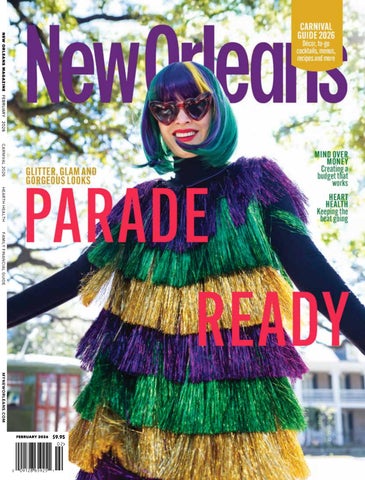
Top off your Carnival season with just the right accessories. We have all the purple, green and gold for the entire family (including our furry friends) to stand out in the crowd and get you noticed for that special throw you are wishing for. Columnist Mike Scott gives us a special take on all the fun, plus, check out our calendar of events, recipes and news on seasonal menus and cocktails to round out your Mardi Gras fun.
February is also a month to celebrate love, with plenty of red and pink hearts decorating the middle of the month. But beyond Valentine’s Day, it’s important to embrace what’s more important all year — heart health for you and those you love. Registered dietician and nutrition journalist Molly Kimball breaks down the essentials for cardiac health along with 10 tips to stay on top of a heart healthy diet.
As we approach early spring, many of us are also looking beyond the Carnival holiday season of excess to a quieter time of reflection, especially when it comes to family budgets and expenses. From grocery prices to challenges with big item purchases, making a plan and sticking to it is essential. We have some tips from local pros to get your spring financial to-do list in order.
For most people across the U.S., this is a dreary time, deep in winter and in a post-winter holiday lull. But not for those of us in New Orleans. This is, for many, a time to dance in the street, celebrate life with friends and neighbors, and embrace the unique music and pulse of the city.
Happy Mardi Gras! And when Lent rolls around, keep in mind it’s just a short time until festival season when the parties begin again.
Send us a line!
Have something you want to share with us? Email ashley@myneworleans.com.
Associate Publisher Kate Henry
Editorial
Editor Ashley McLellan
Creative Director Tiffani Reding Amedeo
Digital Media Editor Kelly Massicot
Style Editor Andy Myer
Contributing Writers Jyl Benson, Cheré Coen, Lee Cutrone, Fritz Esker, Scott Gold, John Kemp, Misty Milioto, Liz Scott Monaghan, Elizabeth Pearce, Eve Crawford Peyton, Mike Scott, Melanie Warner Spencer
Advertising
Vice President of Sales and Marketing
Kate Henry, Kate@MyNewOrleans.com
Account Director Meggie Schmidt
Senior Account Executives Erin Chiartano, Brooke Genusa
Account Executive Jennah Dillon, Lauren McCanse
Sponsored Content Coordinator
Jeremy Marshall
Marketing
Marketing Manager Haley Nash
Video Media Producer Mallary Wolfe
Renaissance Publishing
Production
Manager Rosa Balaguer Arostegui
Senior Designer Ashley Bravata
Designer Czarlyn Ria Trinidad
Circulation
Distribution John Holzer
Administration Office Manager Emily Ruiz
Chief Executive Officer Todd Matherne
New
70005 MyNewOrleans.com



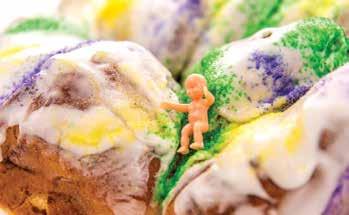
Carnival Cake Madness Place your vote in our March-Madness-Style bracket and help us crown the best local King Cake! Semifinals close February 2 at 4pm. The final round (February 3-10) determines the 2026 King Cake Champion. Sponsored by Alluvia Apartments. myneworleans.com/ king-cake-madness/

the Latest Tune in to Season 7 of "Beyond the Beads!" Our #1 podcast dives into the traditions and modern celebrations of New Orleans Carnival. myneworleans. com/mardi-grasbeyond-the-beads

Broadway Bound Enter to win two tickets to "The Great Gatsby: Broadway Musical” at the Saenger Theatre. myneworleans.com/ sweepstakes
ASHLEY
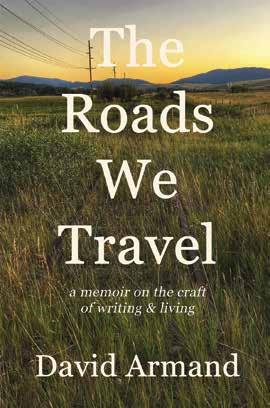
“The
Author David Armand takes readers and aspiring writers on a heartfelt road trip through his life and creative process in the latest University of Lafayette Press release “The Roads We Travel.” Armand, a state native and the recipient of the 2022 Louisiana Writer Award, is currently an associate professor of creative writing at the Southeastern Louisiana University and uses his teaching skills to show, not so much tell, “ to pass on what he’s learned over the years about what makes good writing work (as well as what makes some writing unsuccessful),” as noted in a description of the book. Praise has come from fellow writers who have compared this work by other notable books on writing such as Anne Lamott’s “Bird by Bird,” Stephen King’s “On Writing” and Ellen Gilchrist’s “The Writing Life.”

Shop local and pick up one (or more) of these small journals to start your own writing journey:
Thrive Notebook by Goods That Matter, handmade in New Orleans by John Fitzgerald, from Dirty Coast. dirtycoast.com
Refillable leatherbound notebook, made in Italy, at Scriptura. scriptura. com
Endless Recorder notebook from Papier Plume. papierplume. com
Royal Peacock pocket journal created and designed in New Orleans by Alex Pulitzer, alexapulitzer. com
NOLATONE Notebook in K&B purple, from Dirty Coast, dirtycoast. com

Lagniappe A great writing pen Kaweco AL Sport Pen in silver ballpoint, from Lionheart Prints, lionheartprints.com

Thursday, Feb. 5
A “Virtual Author Talk, Swashbuckling Heroines and High Seas Adventures,” 6 to 7 p.m., hosted by the New Orleans Public Library will feature a conversation with writer Vanessa Riley. Riley will discuss her latest novel, “Fire Sword and Sea.” Register in advance to submit questions and receive a link to the event. nolalibrary.org/events
Sunday, Feb. 8
Blue Cypress Books hosts the monthly Working Title: A Writing Group meet-up for writers, poets, journal keepers looking to perfect their skills, get feedback and connect with fellow writers. bluecypressbooks.com
Wednesday, Feb. 11
The New Orleans Book Festival at Tulane University (March 12-16) announced its line-up of writers, speakers and literary figures. The list includes more than 100 local, regional and national names, plus a Family Day at the Fest specifically designed with young readers and families in mind. Highlights of the line-up includes: Jami Attenberg, Tarriona “Tank” Ball, Ken Burns, Walter Isaacson, Emeril and E.J. Lagasse, Michael Pollen, Maurice Carlos Ruffin, Salman Rushdie, Dax Shepard and Kara Swisher, just to name a few. Bookfest.tulane. edu
The Garden District Book Shop Book Club discusses “The Refugees” by Viet Thanh Nguyen at its monthly get-together, Uptown at the Rink at 6 p.m. gardendistrictbookshop.com
Thursday, Feb. 12
The New Orleans Library hosts Dr. Lindsey Stewart for a “Virtual Author Talk, The Conjuring of America,” 1 to 2 p.m. Feminist philosopher Stewart will discuss her book “The Conjuring of America: Mojos, Mermaids, Medicine, and 400 Years of Black Women’s Magic,” and take questions from participants. Register in advance to submit questions and receive a link to the event. nolalibrary.org/events
Saturday, Feb. 14
Lovers of sci-fi can get together to discuss selected works with the Octavia Books Science Fiction Book Club (each second Saturday of the month), 10:30 to 11:30 a.m. octaviabooks.com

Top things to do in February
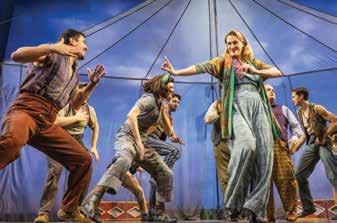
Feb. 3-8
“Water for Elephants”
The Saenger Theater hosts this musical adaptation of the acclaimed bestselling novel about a young man who joins a traveling circus. saengernola.com
Feb. 4-7
“A Chorus Line Teen Edition”
Check out the next generation of Crescent City theater talent with A Chorus Line Teen Edition at the Jefferson Performing Arts Center. jpas.org
Feb. 5
Nine Inch Nails
Nineties alternative legend Trent Reznor and Nine Inch Nails performs at the Smoothie King Center. smoothiekingcenter.com
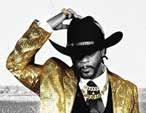
Feb. 7
Katt Williams
Comedian Katt Williams brings
his The Golden Age Tour, featuring all new material, to the Smoothie King Center. smoothiekingcenter.com

Feb. 7
Shorty Gras
Mardi Gras World hosts Shorty Gras, Trombone Shorty’s festival featuring Diplo, Big Freedia and New Breed Brass Band (featuring Trombone Shorty himself). shortygrasnola.com
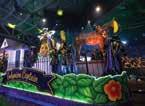
Feb. 14
Endymion Extravaganza
Katy Perry and Train showcase this year’s Endymion Extravaganza at Caesars Superdome. endymion.org
Feb. 16
Zulu Lundi Gras Festival
The Zulu Social Aid and Pleasure Club hosts its annual Lundi Gras Festival at Woldenberg Park. It is free and open to the public, featuring food, music, arts, and crafts. lundigrasfestival. com

Feb. 19
The Queens! Four Legends, One Stage Gladys Knight, Chaka Khan, Patti Labelle and Stephanie Mills unite for an unforgettable tour, coming to the Smoothie King Center for one night only. smoothiekingcenter.com

Feb. 20-Mar. 2
“Waiting Around (The Restaurant Musical)”
Ricky Graham and Harry Mayronne’s humorous and heartfelt tribute to the service industry returns to Rivertown Theaters for the Performing Arts. rivertowntheaters.com
Feb. 21
Dine and Dance: Swingin’ Sweethearts
The National WWII Museum’s Victory Swing Orchestra
Check all event websites for the most up-to-date information.
celebrates big bands of the WWII era. Guests will be treated to great food and music. nationalww2museum. org
Feb. 26-Mar. 1
“Murder Most Meemaw” Local playwright Ricky Graham puts a New Orleans twist on Agatha Christie classics with “Murder Most Meemaw” at the Westwego Performing Arts Theatre. jpas. org

Feb. 27
Phil Rosenthal
Globetrotting foodie Phil Rosenthal, host of the Netflix show “Somebody Feed Phil,” will be having a moderated conversation followed by an audience Q&A at the Orpheum Theater. orpheumnola.com

Feb. 28
Monster Jam
The action-packed motorsports spectacle comes to Caesars Superdome with pulse-pounding fun for the whole family. caesarssuperdome.com

Bar Tab BY ELIZABETH PEARCE
Iris Inspired
Tujague’s is home to the Iris Room, inspired by the Krewe of Iris. It is the city’s first private dining space dedicated to an all-female krewe. Members and fans of the krewe can raise a toast to this century-old organization with the Iris 75, a vibrant twist on a classic French 75, crafted with gin, sparkling wine, lemon, butterfly pea flower and simple syrup. Both the cocktail and the room honor the many Iris groups who gather at Tujague’s throughout the season, celebrating tradition, sisterhood, and the spirit of Mardi Gras. 429 Decatur St., 504- 525-8676, tujaguesrestaurant. com.
Revelers of a certain age will fondly recall the groovy exploits of Cheech and Chong. The mellow duo recently launched a line of THC-infused seltzers, with flavors like Mango Twist and Wondermelon. Their aptly named High Teas include a Tommy Palmer, a woozy riff on an Arnold Palmer. The canned seltzers, which use only naturally derived THC from American-grown hemp, are an alternative to alcohol for sipping on the parade route. Their promise of “High Time in No Time” seems to fit with a certain Carnival vibe. cheechandchong.com
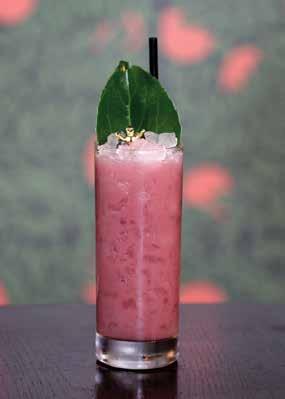
The award-winning Jewel of the South has launched its annual Carnival menu, giving guests another reason to enjoy a tipple in its lush courtyard. The Carnival Colada returns for the duration of the season, and includes a homemade king cake-flavored Coco Lopez, three different rums, ginger, honey and lime. It is joined by the Harlequin, named for one of the best-known characters in the Italian Commedia del’Arte and the Neapolitan Carnival, and features both cachaça and rhum Agricole, a papaya and mango cordial and lime juice. 1026 St Louis St., 504- 265-8816, jewelnola.com.

Cure is bringing back their fabulous Mardi Gras menu, available through Fat Tuesday. Locals may recognize the Ojen Cocktail, enjoyed by Rex on Mardi Gras day. Owner Neal Bodenheimer feels that, “The Ojen Cocktail is the drink of the Carnival season... basically an adult version of a sno-ball, made pink and pretty by the addition of plenty of Peychaud’s bitters.” Other New Orleans classics include the Absinthe Suissesse, similar to an anise-flavored eggnog; the Obituary Cocktail, a gin martini with extra dry vermouth and absinthe; the Roffignac, made with Armagnac; and a raspberry shrub. Additionally, Neal’s Mardi Gras Punch featuring overproof rum, red wine, fresh lemon and lime juice, and Angostura Bitters, is perfect for sipping on the parade route, no matter the weather. 4905 Freret St., 504-302-2357, curenola.com.
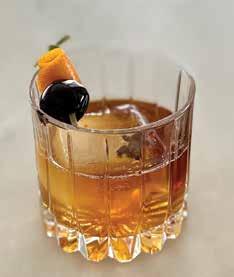
Loa bartender Abigail Gullo has once again created a Carnival menu inspired by float and costume designer Carlotta Bonnecaze. Bonnecaze, a Creole who lived in the late 1800’s, was the first woman known to design a parade and tableau ball, primarily for the Krewe of Proteus. Gullo notes that, “Bonnecaze’s intricate, creative, and downright sassy designs perfectly capture the gilded golden age of Carnival.” The menu features the Three King’s Old Fashioned, named for the Wise Men whose nativity visit on Epiphany marks the start of Carnival. Gullo describes it as “an ode to the galette des rois” with flavors of rye and apple brandy. The vodka-based Carlotta’s Cup honors its namesake’s creative streak and international inspiration with flavors of the Buddha’s hand citrus and spice. The Zulu Espresso Martini features coconut and coffee, which Gullo describes as “a magical combination,” appropriate to get up early to catch Zulu. 221 Camp St., 504- 553-9550, ihhotel.com
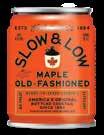
Carnival is a marathon, not a sprint, and low-proof drinking is usually the way most of us make it to the end of the season. However, for those who want a well-made, easy-to-access Old Fashioned while on the route, Slow & Low can help. The brand’s bottled cocktail history dates to the 19th century, but now imbibers can sip their cocktails in a more modern fashion: cans rather than bottles. They can also enjoy flavors beyond the classic Old Fashioned. In addition to their coffee flavored cocktail, Slow & Low now offer two new flavors: maple and cherry. The 100 milliliters cans keep the servings reasonable and are a robust alternative to standard parade fare. drinkslowandlow.com
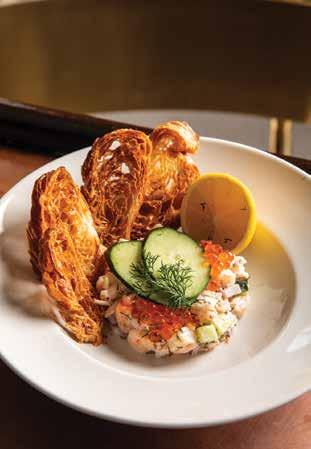
Since 2015, a once-vibrant space at 1041 Dumaine St. in the French Quarter has been dark. Over the years, it has been home to lively (and storied) restaurants, including Marti’s (two iterations) and Peristyle. The lights are on again under the direction of chef and owner Kimberly Cochran, aka Chef K. Cochran aims to bring her version of elevated southern fare to the long-neglected space. Which began service on New Year’s Eve. succotashnola.com
Barrio Bites The former Church Alley space, at 4201 Canal in Mid-City, is now home to Barrio Bites. The Latininspired bakery and cafe is by the motherdaughter team from Covingtonbased Elizabeth’z Bakery and Kupcake Factory, and will serve breakfast and lunch (including breads, pastries and desserts). instagram.com/ barriobitesmidcity
Deep Gras
Gather your glam gang and celebrate with Copper Vine Wine Pub & Inn’s “Mardi Gras in Bloom: A Deep Gras Lunch” Friday, Feb. 13, 11 a.m. to 2 p.m. The festivities include a threecourse seated lunch, mimosas, burlesque and much more. For reservations visit coppervine. com/ mardi-gras-inbloom-lunchfeburary-13
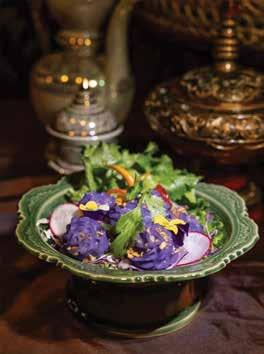
Many know Glenn Mahiya and Warakorn “Tom” Intavichai from their beloved Central Business District Thai restaurant Dahla. Fans will be thrilled to learn the duo is bringing their skills and vision to Mid-City with a new offering, Chada. Open to the public in January, Chada is located at 3420 Bienville St. and focuses on a delectable fusion of Thai, Indian and Japanese cuisines. instagram.com/chada.nola

Kira
December also saw the soft launch of the new Downtown restaurant, Kira. With its glowing bar, DJ stand and elevated, vibey design, Kira is vying for hotspot status. The menu focuses on seafood, combining Mediterranean with elements of Japanese (omakase is in the works for later in the year). The space, at 601 Tchoupitoulas St., was most recently Mister Oso and prior to that, Barcadia. Cocktails are innovative, featuring ingredients including yogurt, according to a Nola.com report. kiranola.com
Shell Games
In December 2025, The Local Palate released the documentary “ShellBound: An Anthology of Southern Oysters.” The cinematic, three-part series — available to stream at thelocalpalate.com — dives into the “people, ecosystems and traditions that define the Southern oyster” from Virginia and North Carolina to South Louisiana. The series was produced by the Fayetteville, Arkansas-based creative studio BLK ELK, with support from the Decatur, Georgia-based nonprofit Oyster South, as part of Charleston, South Carolina-based The Local Palate’s Southern foodways coverage. Bivalve lovers, bi-valve curious and people who simply love good storytelling alike will be captivated as the series follows scientists, oyster farmers and harvesters, restaurateurs and oyster advocates. thelocalpalate.com

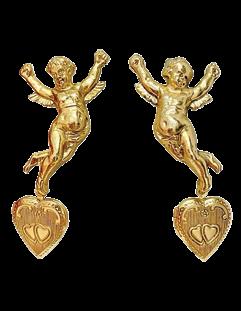
Cupid will shoot an arrow straight from you ear to you lover’s heart with these Rococo-style Say Yes to Heaven cherub earrings from Century Girl. Keep a photo of a loved one or a tiny note near and dear in the precious heart-shaped lockets. Available at Century Girl Vintage, centurygirlvintage.com.

Marni’s open-toe sandals in Camelia are made from pleated satin and feature a delicate ankle strap for stability. A spherical jewel heel with gold-plated finish and flat bottom makes these a perfect pair for dancing cheek to cheek. Available at Pilot + Powell, pilotandpowell.com.
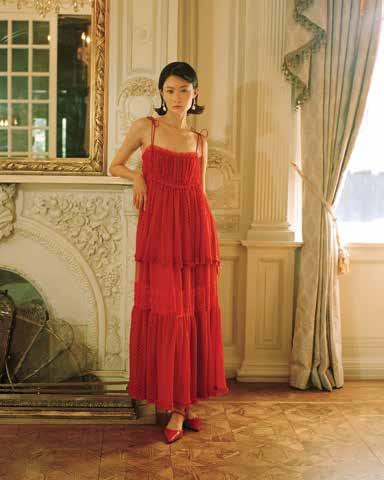
Lapeyre’s enchanting Stella gown sways effortlessly with each step. Cascading ruffles in Swiss dotted mesh and an empire waist offer a flattering cut, with an option to keep the neckline closed or open. Hand-picked charms adorn the sleeve ties and optional belt. Available at shoplapeyre.com.
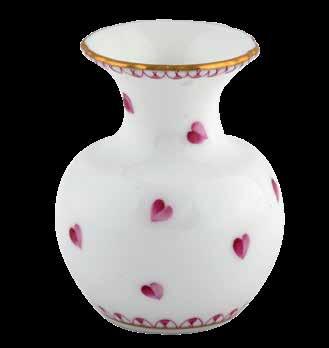
It’s easy to overlook Valentine’s Day when it falls on the weekend before Mardi Gras but turn to these charming picks to mark the occasion and celebrate in style.
A bouquet is always lovelier in a pretty vase. This darling porcelain option by Herend with hand-painted hearts will take any arrangement up a notch, whether you’re setting the table or giving as a gift. Available at Friend & Company, friendandcompany.com.
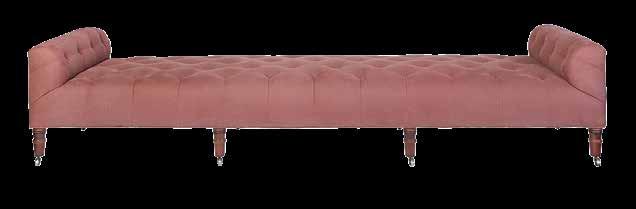
Lounge like Marie Antoinette on John Derian’s take on a classic silhouette, The Field Bench. Large enough to work as a daybed or to divide a room as a bench, this piece is a worthy investment. Available in a range of beautiful fabrics at Sunday Shop, sundayshop.co.

BY KELLY MASSICOT
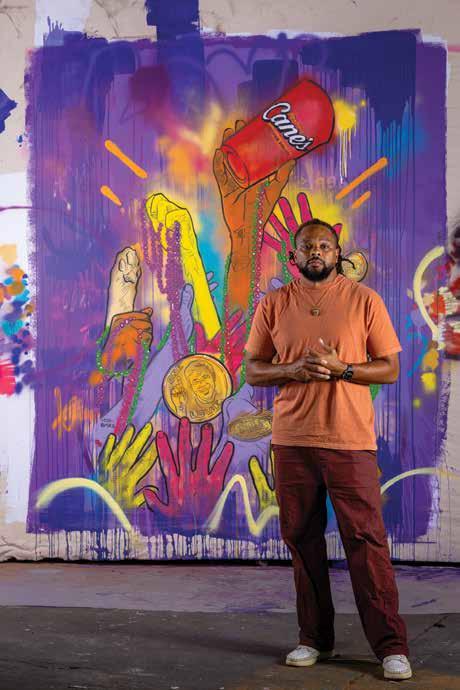
Brandan “BMike” Odums is one of New Orleans’ most recognized visual artists and culture bearers of the last decade. His works, reflecting both historical figures and that of New Orleans post Hurricane Katrina, are iconic symbols of activism and community. Additionally, Odums is adamant on giving back to the city that gave him so much by continuing mentorship and helping those young artist artists much like himself with his philanthropy Eternal Seeds. While Odums has collaborated with many brands over the years, this Carnival season he’s partnering with Raising Cane‘s on their Mardi Gras 2026 campaign highlighting a visual representation of the flamboyant season in New Orleans.
Q: You started out in filmmaking before visual art. What was the transition from video and filmmaking to now being known for painting murals of local and historical figures? I was doing a lot of music videos in New Orleans. This was about eight years after Hurricane Katrina, and it was at a time when technology shifted. DSLR made independent filmmaking a lot more accessible. You didn’t really need a big production. I found myself trying to find interesting locations for backdrops of music videos and ended up always in these abandoned Katrina-damaged spaces throughout New Orleans in the East, the 9th Ward, on the West Bank. The more I would navigate and try to find these interesting spaces, the more I would constantly confront all these amazing graffiti and street art pieces deep in the middle of these spaces. It was impactful in a way. Here I was in the middle of these amazing derelict buildings and seeing these really striking, bold paintings, and it just
made me want to try it myself. I started going back in these spaces, not with my camera but with a bag of spray paint. I had no idea that I would fall such in love with the process, but also that it would snowball into a series of projects that people would pay attention to.
Q: You once said about Studio Be — your 36,000 sq ft gallery space in the Bywater — that it attracts people that don’t normally consume art. What do you think it is that attracts people? I think it’s unassuming in a way. It’s a warehouse that is not hiding its flaws, it’s not prestigious. I think some art institutions or galleries or
museums you go into, it sort of forces you to alter yourself. Without even thinking about it, you walk differently, you’re talking quiet. I’m always conscious of how does a space sort of dictate that to you, there’s no rules on the wall that says keep quiet, but everyone just assumes that the way you behave in those spaces is, you sort of adjust yourself. And what I love about Studio Be is that whether it’s the unassuming nature of it, whether it’s the flawed aspect of this old warehouse and the history it presents, people kind of treat it more like a living space. They treat it more like a space where they can call out to their friend 20 feet down and
not be ashamed of being louder. I do think there is a level of like, unassuming aspect of the space that does call people who aren’t the typical art, enthusiasts, and I love that there is a level of living aspect of this space or people would come up to me and ask me questions about who else should be on the walls or what else should be included.
Q: Why is mentoring and giving back to younger artists so important to you? One of the most beautiful things about New Orleans to me is that there’s always this organic apprenticeship aspect of the arts community. I grew up with. I went to NOCCA, so a lot of my peers, especially the musician friends, they all were working with elder musicians, having opportunities to gig with them and perform with them at a young age. The way we could do art in New Orleans is always about passing it on. Whether you’re in the kitchen with your grandmother, whether you’re on the stage with a musician, it’s always like, “OK, you want to do this? Well, let me show you, let me put you in a position.” I grew up around that. I grew up benefiting from that. There are people in my life when I was young who saw potential in me and poured into me or challenged me. That was always a part of the journey for me, where every step of the way I was either challenged to come teach this workshop or come to the school and talk to the kids. It was always a part of the process and it just continued to formalize. One of the benefits of having the space Studio Be is that we were able to further formalize that process and continue to invest. For example, we’ve been a summer program for the last 14 or 15 years and it’s slowly changed in its nature in terms of being more and more serious. Creating Eternal Seeds five years
ago now, it was a way for us to do it with the most serious intention possible to really formalize it, to create a program where now we’re working with at any given time up to 40 young folks that are in high school, and then continuing to work with them even after they graduate. To the point where we have this full robust, programming in the space that’s all about how do we give the necessary tools to young and emerging artists, and to me that’s one of the most exciting parts of the practice right now.
To continue this conversation, visit our website for exclusive online content. MyNewOrleans.com
Q: How did your partnership with Raising Cane’s Mardi Gras promotion come about? New Orleans is a beautiful small town. There’s been a few moments in the past where there’s been some conversations with the Cane’s team about some other projects and some things that didn’t work out in the past that, you know, but it did for a familiarity. My whole conversation is always like, what can I do that’s beneficial? What can I do that really is something that could be dynamic or exciting. I think it’s always just about like how to, I think as an artist from New Orleans, I’m conscious of. The subtle ways that New Orleans shows up in my work. There are many great artists in New Orleans that New Orleans is the star of their work. New Orleans is the main attraction to the things they create. And for me as an artist, I don’t know if that’s always the case. I think the fact that I’m from New Orleans, the fact that I create in New Orleans is such a huge part of my process, but it doesn’t show up as often in the work itself. One of the challenges for me was thinking, OK, can I authentically show New Orleans in my art without it. Being something different from what I would normally do. And so we found a medium, a mid-ground that I think really, really, really served that purpose.

Iwas thinking the other day about how we got thousands of people coming in from other places to watch parades every year, and at least half of them got the misimpression that the only way to catch beads is to show their boobs. This absolutely ain’t so. Not that no MAN will tell you that.
But most local people think of it as cheap and tasteless and it’s probably a mortal sin, too. Plus, of course it will wind up on Facebook and your grammaw will see it.
Sin don’t pay.
Here are Modine’s seven rules for catching a lot.
1. Squat on something, preferably a wheelchair, and look pathetic. And when a float rider feels sorry for you and throws a whole dozen beads, leap up like Lebron James.
2. When the float you are dying to catch something from — like in Muses — approaches, wait until it’s almost in front of you, and toss up a handful of them cheap rubber bouncy balls. When everybody goes to the ground to get them, only you are standing for The Shoe.
3. Make friends with the people around you, so they’ll be less likely to claim a pair of beads when both of you have caught it.
4. Don’t be ashamed to scramble on the ground yourself for some

nice long beads or something.
5. If you got a toddler, wave him or her around some. They always attract the good stuff.
6. Try to catch stuffed animals in the air, or else handed down, to avoid having to fish them out a puddle.
7. Stand out somehow, (without showing your boobs). Maybe by holding up a sign that says “FROM NEW JERSEY. FIRST TIME.” Or some equally touching lie.
Well, this year I was all set to instruct the Gunch cousin Giselda, who was in from Pennsylvania. She claimed that she had NOT come in for Mardi Gras, but she was doing research on katrotypes of five species of cockroaches — or something like that. But she stayed at my sister-in-law Gloriosa’s house, which is Uptown, home of cockroaches and also near where
all the parades roll.
Gloriosa is busy one Saturday and she asks me to stop by and take Giselda for a ride on the streetcar (which Giselda calls “the trolley”).
So I do. But it’s Carnival Time, and naturally the streetcar stops at Napoleon and St. Charles because the parades are coming.
We get off, and I ask Giselda if she wants to stay for the parade and she smiles and says, “Oh, why not?”
Now Giselda is kind of short, maybe five-two, with ordinary hair, an ordinary face, and an ordinary build. Not somebody that would catch anybody’s attention, ordinarily.
The parade is coming pretty quick. So I don’t have time to tell her my seven rules. I find a plastic bag on the ground and hand it to her to put stuff in.
Kings normally don’t throw anything, much less stand up on the float and throw a dozen beads to a stranger.
And then, every single float that comes by proceeds to bomb her with stuff. Bomb her! I have to give her my bag, and then scrounge around on the ground between people’s feet to find her two more bags.
She is a that rare species. A NBM — Natural Bead Magnet. And with her boobs covered. By the time it’s over, and I am standing there panting, she says, “Well, that was fun!”
For her maybe. I caught maybe three things.
This woman has to come visit next year. We could rent her out. I still stand by my seven rules.
But to every rule there’s an exception. That’s what the nuns used to tell us. And they were right.

Give your walls a smooch by applying a perfectly pink Lip Gloss paint from Benjamin Moore. benjaminmoore.com.
AMY MARIE GABRIEL
Add some synchronized whimsy to your walls with the Splash! wallpaper by Dupenny. The playful bathing beauty inspired design is a swimmingly perfect backdrop for a lively loo. Available by appointment at spruceshowroom. com 504-265-0946 or via studio@spruceshowroom.com.
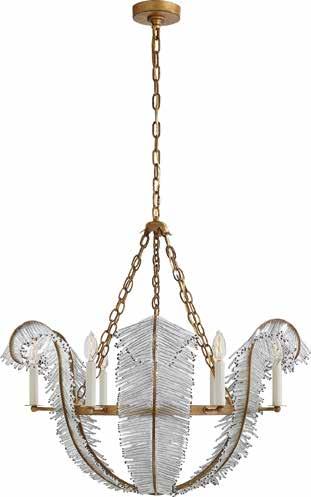
Like a glamourous boa, the feather-like design of the Calais Chandelier for Visual Comfort & Co. provides a stunning suspended focal point that is both fanciful and radiant. Visual Comfort & Co., 3535 Magazine St., 504-3897854, visualcomfort.com.

For an artistic way to display party favors or matchbooks, a handsculpted Eve accent bowl with a glimmering gold interior will lend a hand. Eclectic Home, 8211 Oak St., 504-866-6654, eclectichome.net.

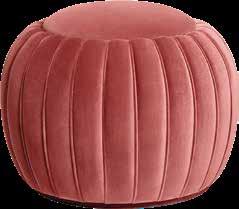
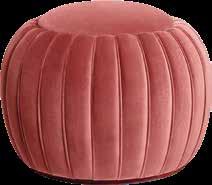
While primping, take a pause upon a Mellow 70 stool from Munna. Blending Midcentury Modern and Art Deco, the cotton velvet covered seat features an organic silhouette with intricate vertical piping. Villa Vici, 4112 Magazine St., 504-899-2931, villavici.com.
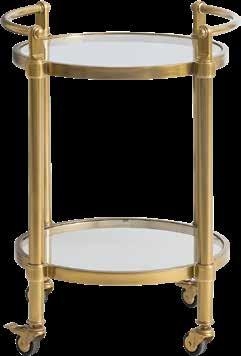
Place your dressing drink on top of an Everson round metal bar cart. This sleek trolley with an antique brass finish features casters that lock to keep your libation from wheeling away. Pottery Barn, 3301 Veterans Memorial Blvd., 504-2190168, potterybarn.com.
Why Carnival season has to be lived and why it matters to come home for it
It’s impossible to understand the experience of Carnival season from someone telling you about it, reading about it, looking at pictures on someone’s blog, or even watching it on TV. Yes, you might hear the bands and see the floats and admire the elaborate and creative costumes … but it’s not the same as being there. No matter how strong your vocabulary or how good your camera lens, you can’t fully capture the feeling of the crush of the crowd as a band goes by – “back up, baby, back up,” the chaperones mutter, pushing everyone to the side – or the thwack of beads hitting your outstretched hands or the way your throat hurts after screaming and your calves ache after walking for blocks. It is a full-on glorious sensory assault that must be lived.
Likewise, it’s impossible to understand the devastation of watching Carnival season go on without you when you’re in another part of the country. You can write words like “bleak” or “lonely” or “empty,” but they don’t really get at how it feels when you know it’s Krewe du Vieux Saturday or Muses Thursday and you’re somewhere where life is
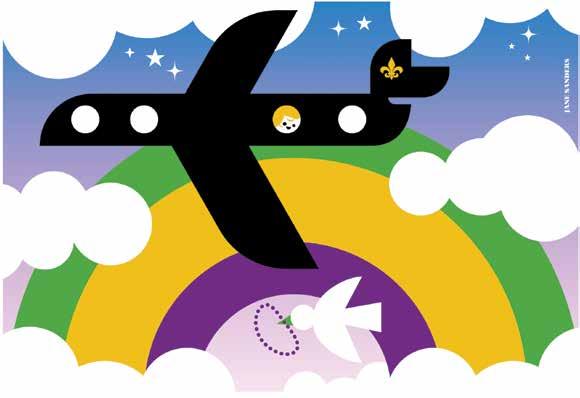
just going on as normal, without even the distraction of King Cake to make things better.
My first Mardi Gras Day while I was away at college in Missouri was so sad that I still remember almost every moment of that Tuesday in the dead middle of a bleak gray February, from my shower-damp hair freezing as I walked to my first class past a field of dead cornstalks to the Hoppin’ John they served in the dining hall that night on purple, green, and gold paper plates in their attempt to be festive.
“Oh, Eve,” my friend Kim from Coffeeville, Kansas, said sweetly, “look! You don’t have to be sad – they brought Mardi Gras to you! See?”
And I said something to the effect of, “What the hell is Hoppin’ John and why can’t I just be left
alone to suffer in peace.”
When you’ve lived 17 Carnival seasons in New Orleans, you can’t be served an oversalted South Carolina rice dish on a colorful paper plate when it’s 12 degrees outside and think that you’re in any way close to celebrating the holiday as it’s intended to be celebrated.
Luckily, Rowan, who is away at college this year, has heard me tell this story enough times that she bought her ticket home for Mardi Gras with her high school graduation money back in July. Although she will miss the fun of the run-up – Chewbacchus and Cleopatra and Freret and Barkus and King Arthur – and the actual day itself, she will at least be here for Muses and Hermes, Iris and Bacchus. It’s not the same as a full Carnival season, but she will stand
on the route again, will hear the same bands and catch the same beads and feel that same familiar ache in her legs and throat. I am grateful that she will feel again this year what it means to be here when the city opens itself up and spills joy into the streets.
Carnival season, despite what many merchants would have you believe, is not something you can ship across state lines or dish up on a paper plate. Once you’ve lived it, it is something you carry with you wherever you go and that you always will know you are missing.
This year, Rowan will be here for enough of it, a reminder that leaving does not have to mean losing, that distance does not erase belonging to a place, and that some traditions always wait for you to come back.
CARNIVAL ACCESSORIES
THAT WILL MAKE YOU STAND OUT IN THE (PARADE) CROWD.
BY ALI MCNALLY
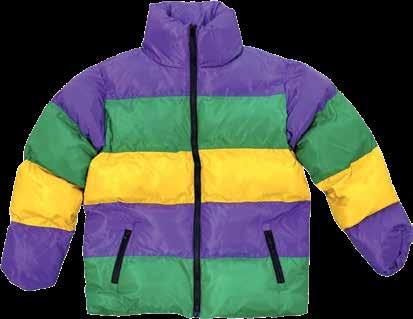
Mardi Gras Full Length Puffer Jacket, $216
An early Mardi Gras is often a cold Mardi Gras, so be sure to bundle up in this festive full length puffer. Plush Appeal, mardigrasspot.com
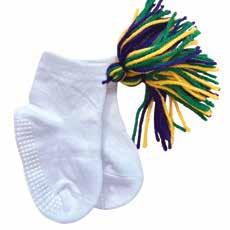
Krewe Marching Co.
Infant Mardi Gras Tassel Socks $14.99
Baby’s first Mardi Gras should definitely include these sweet tasseled socks. Ponseti’s, ponsetis.com
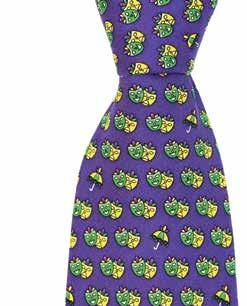
NOLA Couture x Haspel Mardi Gras
Masks Silk Tie $68
This 100% silk tie is part of a collaboration between NOLA Couture and Haspel’s, the originator of the seersucker suit in 1909. Haspel, haspel.com

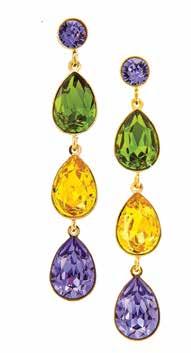
Rain Earrings $165 A festive earring for the luxury lover, these Carnival colored earrings are 24k gold plated and set with Austrian crystals.
Ella Bartlow, ellabartlow.com
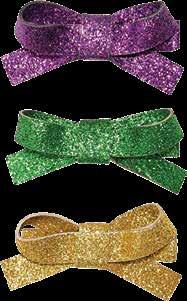
An adorable glitter hair bow
for the young Mardi
enthusiast in your life. ZukaBaby, zukababy.com
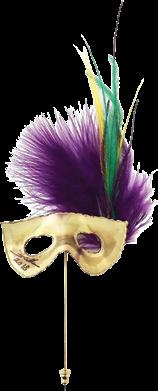
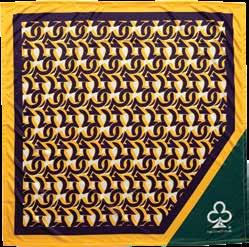
Artist Kurt Salla handmakes these beautiful brass lapel pins, available at the Louisia na Craft Guild. The Louisiana Crafts Guild at The Shops at Canal Place, louisianacrafts.org
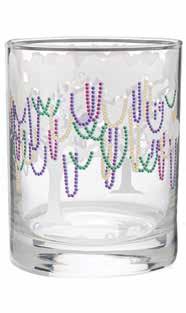
your glass game with these collectable Double Old Fashion glasses from Mignon Faget.

Is there anything more classic than a
on the parade route? We thought not.
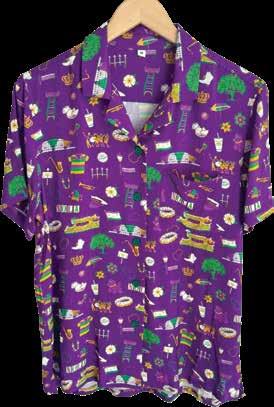
Mardi Gras Icons Hawaiian Shirt $56.99 This cute unisex Hawaiian shirt encapsulates the spirit of the season. In sizes S-3XL. Nola Boo, nolaboo.com
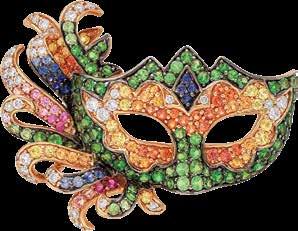
Mardi Gras Mask Brooch Pendant, Carnivale $3750 Make a statement with this mask brooch, made of 18k white and rose gold and accented with diamonds and multicolored gemstones. Lee Michaels Fine Jewelry, lmfj.com
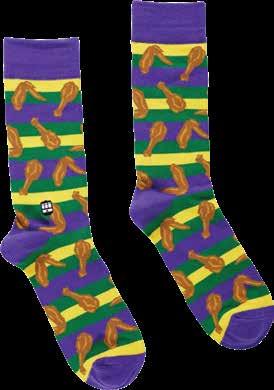
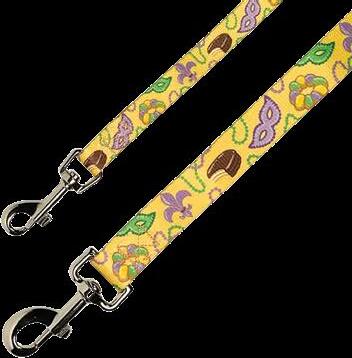
Yellow Mardi Gras Leash $21.95 This Mardi Gras-themed leash will brighten up your dog’s walks. Southern Paws, shopsouthernpaws.com
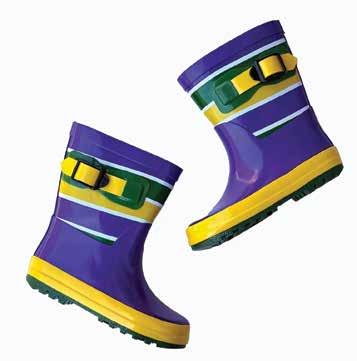
Rain Boots $60 Sometimes it rains on your parade. But at least their little feet can stay dry in these cute rain boots. Pippen Lane, pippenlane.com
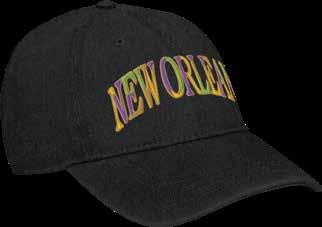
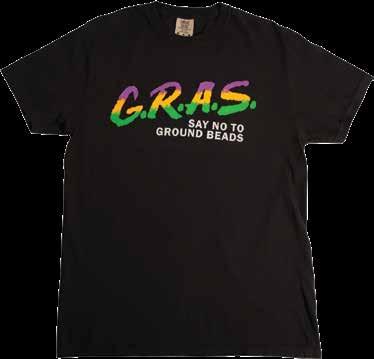
G.R.A.S. T-Shirt $30
Because the overenthusiastic newbies on the parade route need to be reminded to just say no. Dirty Coast, dirtycoast.com
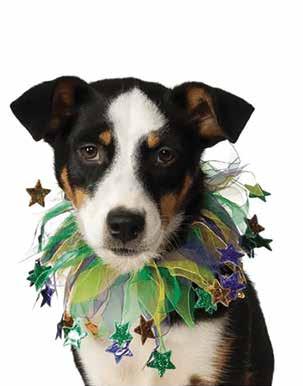
Deluxe Mardi Gras Organza Dog Collar $12.99 For the Barkus bow wow in your life: adorn your darling doggie with this organza collar from Petcetera. Petcetera, petceteranola.com
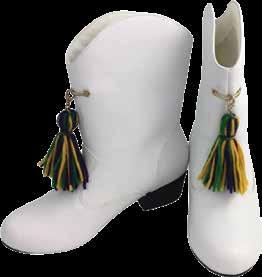
Mardi Gras Marching Boots $80 The classic majorette marching boot with pom pom, available in both children and ladies sizes at Haase’s, a family business on Oak Street for over 100 years. Haase’s, haaseshoestore.com
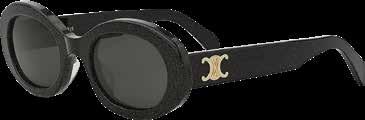
$550 These gold glitter infused Celine shades are the perfect thing to wear for a sunny day parade. Art & Eyes, artandeyesneworleansla.com
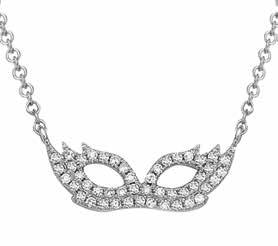
14K White Gold Mardi Gras
Mask Diamond Necklace, Inquire for price
This 14k white gold and diamond mask necklace is a showstopper for sure. Aucoin Hart Jewelers, aucoinhart.com
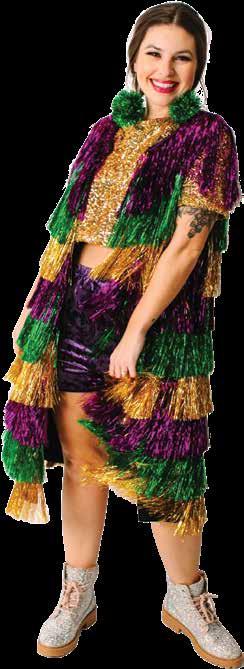
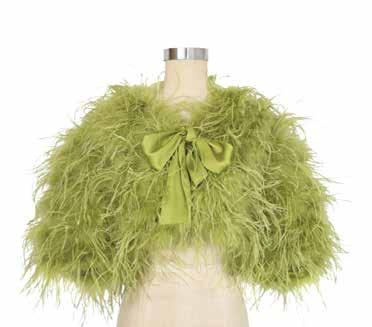
Ostrich Feather Bolero Jacket in Chartreuse, $298 Be the belle of the ball in this stunning ostrich feather bolero in chartreuse. Trashy Diva, trashydiva.com
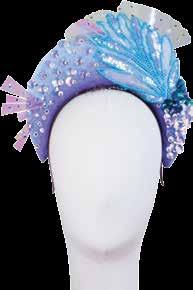
Mermaid Headband $169
A one-of-a-kind headband from Maria Etkind is the perfect topper to any Mardi Gras outfit. Maria Etkind Millinery, mariaetkindmillinery.com
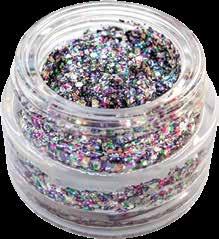
King Cake Glitter
Smear yourself in glitter from this collaboration between Hotel Saint Vincent and Lemonhead L.A.
ByGeorge New Orleans, bygeorgeneworleans.com
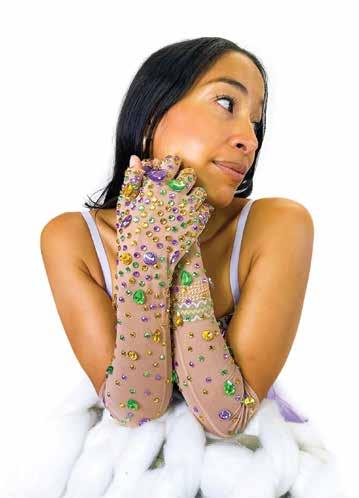
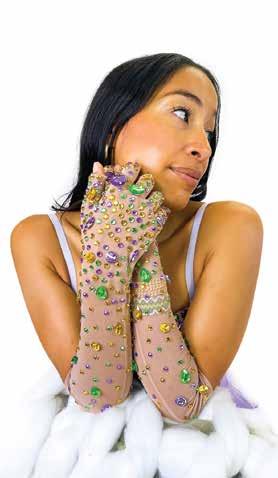
Mardi Gras Rhinestone and Jewel Gloves $89.99 Dazzle ‘em in these rhinestone and jewel encrusted fingerless gloves. Mardi Gras Creations, mardigrascreations.com
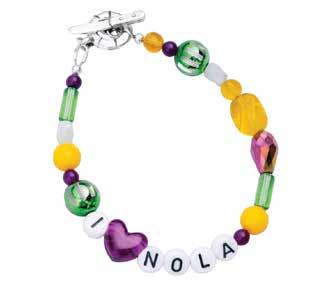
Mardi Gras Throw Bracelet $95
Throw me something, mister! Jose Balli’s sweet beaded friendship bracelet is perfect for the season. Jose Balli, joseballi.com

King Cake Slippers $20
Carnival season is a marathon, not a sprint. Treat your feet to these cozy king cake slippers while you’re recovering from the hours spent standing on the route. Fleurty Girl, fleurtygirl.com
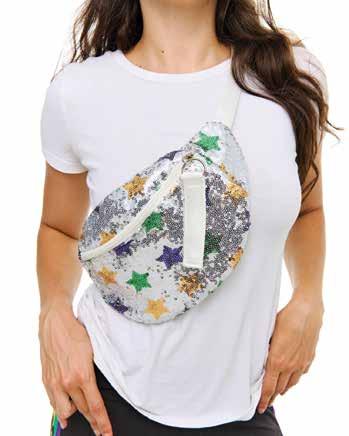
Mardi Gras Sequin Star Fanny Pack $20
Because you need a cute way to stash all your essentials on the route. Alligator Eyes, alligator-eyes.com
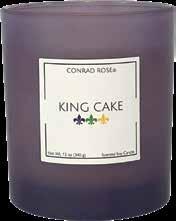
King Cake 2-Wick Candle $30
This soy based candle boasts lead and zinc free wicks, while scenting your home with the delectable aroma of king cake. From Black and women owned brand Conrad Rose. Conrad Rose, conradrose.com
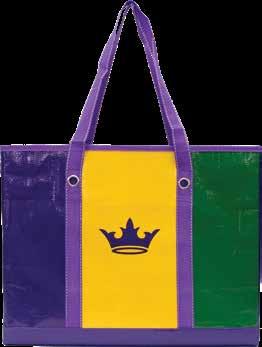
Mardi Gras Bead Market Tote, $35 For all the throws you will catch along the way! The Royal Standard, theroyalstandard.com
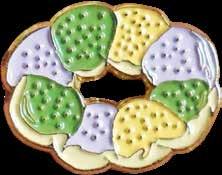
Mardi Gras King Cake Enamel Pin, $12 Display your love for king cake with this adorable enamel pin. The Collective Shop, statementgoods.com
Hey Mister! Mega Mug, $50 Because let’s face it: you’re going to get thirsty out there. Lucy Rose, shoplucyrose.com

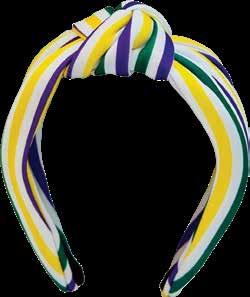
Headband Mardi Gras, $18 The cutest little headband from everyone’s favorite purveyors of beignets, Cafe du Monde. Cafe du Monde, shop. cafedumonde.com
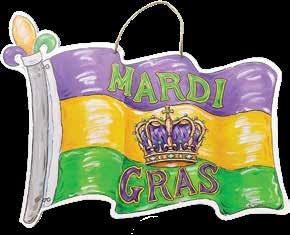
Door Hanger
Mardi Gras Flag, $65 It’s the most wonderful time of the year (sorry Christmas). Show your allegiance with this door hanger from Phina. Phina, phinashop.com

BY MIKE SCOTT ILLUSTRATION BY AMBER DAY



Table but undeniable force, he had already spent almost three years of life on the river – and a person grows up quickly when earning his keep between the levees.
But even young Sam Clemens – by then still four years from adopting the nom de plume Mark Twain – was left agog by the surreal scene he found upon stepping onto the New Orleans riverfront of March 1859.
“I posted off up town yesterday morning as soon as the boat landed, in blissful ignorance of the great day,” he wrote to big sister Pamela Moffett. “At the corner of Good-Children and Tchoupitoulas streets, I beheld an apparition! – and my first impulse was to dodge behind a lamp-post. It was a woman – a hay-stack of curtain calico, 10 feet high – sweeping majestically down the middle of the street.”
He then spotted another young woman dressed like a Spanish cavalier, complete with “a nodding crimson feather in the coquettishest little cap in the world.” When the young cross-dresser doffed said cap and bowed to him, he could think of little else to do but bow back.
“And then I saw a hundred men, women and children in fine, fancy, splendid, ugly, coarse, ridiculous, grotesque, laughable costumes, and the truth flashed upon me — ‘This is Mardi-Gras!’”
Not much has changed.
Then as now, New Orleans had a taste for seizing Fat Tuesday with both fists, whooping it up rapturously one final time before the descent on the city of Ash Wednesday and its somber reminder that this life, like all good things, is but temporary.
It also hints at one of the dualities of Carnival in New Orleans: Whatever else it is, Mardi Gras is and has long been a study of the ecstasy of life in the present tense. At the same time, it is firmly rooted in the past, draped in centuries of tradition.
It is in that spirit, with one foot planted in today’s world and the other in yesteryear, that we embark on a journey through Carnival history to commune with ghosts of Carnivals past – many of which continue to whisper through the streets where the city first learned the fleeting joy of the now.
It is one of those debates that will, in all likelihood, never end: Where did the first Mardi Gras in the Americas take place?
The practice of indulging in a day of gluttony before the wet blanket of Lent was by no means invented in New Orleans. Its roots lie in ancient European traditions. We have, however, perfected it.
Be that as it may, if you ask anyone from Mobile, they will strenuously insist the first Mardi Gras celebration in these parts took place in their Alabama city – not New Orleans. That claim is not without at least a modicum of merit.
Brushing aside the unverifiable assertion that Mobile was celebrating Carnival by 1711, many historians recognize a roving public celebration in 1831 Mobile as the first documented public observance of Carnival in the Americas.
That perambulating rumpus, an antecedent to the myriad walking krewes that add to the pageantry of Carnival in New
Orleans today, was instigated by a group of merry mischief-makers calling themselves the Cowbellion de Rakin Society. Remember them. They will prove important.
There are noteworthy “buts” to Mobile’s party-starting claim, however.
To begin with, the Cowbellions’ celebration took place on New Year’s Day, and as any self-respecting reveler will tell you, Carnival does not begin until King’s Day, on Jan. 6. New Orleans, on the other hand, was marking Carnival with public celebration on Mardi Gras itself – as is proper – by 1838, as reported in that year’s Ash Wednesday edition of The Daily Picayune.
Which brings us to the crux of this Carnival debate: Is an out-of-season Carnival parade a true Carnival parade?
How a person answers can be accurately predicted by his or her area code.
Secondly, there’s the fact that French-Canadian explorer-siblings Iberville and Bienville, upon landing on the east bank of the Mississippi River on the day before Mardi Gras 1699, deemed that spot Pont du Mardi Gras, as recorded in Iberville’s journal. The waterway running alongside it was additionally dubbed Bayou Mardi Gras.
True, this was all about 60 miles downriver from present-day New Orleans – which wouldn’t be founded for another couple of decades. Also, it wasn’t much of a party. But it was an observance.
Which brings us back to our animating question: Where was the first Mardi Gras in the Americas observed?
The answer can be found by driving down to Fort Jackson, near Triumph in Plaquemines Parish. There, you will find a historical marker directing visitors’ attention across the river to the mouth of Bayou Mardi Gras, the very spot on which Iberville and Bienville made history – and, depending on whom you ask, got the good times rolling.
Although they were celebrated on Fat Tuesday itself, the earliest documented Carnival celebrations in New Orleans proper didn’t bear much resemblance to the rolling displays of art and satire that roll through the street throughout the season today. Rather, they were dominated by raucous street parties that, at one point, had city leaders considering doing away with the celebration altogether.
Enter (or re-enter) the Cowbellions, those OG paraders from Mobile – and unlikely saviors of the city’s signature celebration.
In January 1857, a collection of six former Cowbellions decided New Orleans’ Carnival did not need to be banned. It just needed a little organization. And they were just the fellows to introduce it.
Which is how 30 hand-picked men came to receive mysterious invitations in January 1857 summoning them to a room over barman Alfred Arnold Pray’s Gem Saloon on Royal Street. It would be the first meeting of the Pickwick Club, the secret society that begat the Mystic Krewe of Comus – which begat New Orleans’ first modern Mardi Gras parade that same year.
To stage that inaugural pageant, Comus notably borrowed inspiration – along with floats and costumes – from their Cowbellion contacts in Mobile.
They did more than throw a good party. They helped write the
rulebook. They gave us the word “krewe” for a parading society. They reached back to ancient mythology for their name, Comus. And they introduced the template Mardi Gras more or less still follows: a formal nighttime parade lit by flambeaux, masked riders rolling through the streets, and a ball to cap it all.
In other words: They invented Mardi Gras as we know it today.
As for the Gem Saloon, it is long gone – but the three-story brick building at 127-129 Royal St. that housed it still stands. What’s more, it is open to the public. But not as a museum.
Today, that spot – ground zero for all of New Orleans’ modern Mardi Gras traditions – is home to the Unique Grocery, a no-frills quickie mart where you can get cheap wine, cold beer and overpriced liquor to go with your Carnival history.
It is entirely possible that young Sam Clemens, upon his arrival in New Orleans in 1859, was genuinely unaware it was Fat Tuesday. It is also entirely possible – perhaps likely – that the young scribe was merely exercising a bit of literary liberty to add a comic throughline to his observations.
Whatever the case, there is no doubt he appreciated the pageantry of it all. It was in that same letter to his big sister, in fact, that he famously wrote, “It has been said that a Scotchman has not seen the world until he has seen Edinburgh; and I think that I may say that an American has not seen the United States until he has seen Mardi-Gras in New Orleans.”
Less famous is his description of another enduring Carnival tradition: the seemingly at-odds blend of ennui and excitement that comes with waiting for a parade to arrive.
“I waited – yes, I waited – standing on both feet as long as I could – then on one – then on tother — and was just preparing to stand on my head awhile, when a shout of ‘Here they come!’ kept me still in the proper position of a box of glassware,” he wrote. “But it was a false alarm – and after a while we had another false alarm – and then another – each repetition stirring up the impatience and anxiety of the crowd and setting it to heaving and surging at a fearful rate. … Five thousand people near me were tip-toeing & bobbing & peeping down the long street, & wondering why the devil it didn’t come along faster.”
Those hoping to experience Carnival from the same vantage point as Clemens might have a little trouble today. The corner of Good Children and Tchoupitoulas, where he first encountered that calico hay-stack, is no more. Good Children Street would become St. Claude Avenue – we know that much – but it no longer crosses Tchoupitoulas, that intersection having fallen victim long ago to the city’s ever-changing street grid.
Later in his letter, however, he describes taking in the Comus parade on St. Charles Avenue “near the middle of the street opposite the St. Charles Hotel.” That onetime landmark, known far and wide for its grandness, ain’t there no more, either; in its place stands the Place St. Charles officer tower.
But based on his description, it can be determined Clemens was standing between Gravier and Common streets and across the street from the hotel. That places him roughly in front of the main entrance to the Hancock Whitney Bank branch that stands there today, almost directly opposite the entrance of
Place St. Charles – and a locale that remains on the downtown parade route.
From the beginning, New Orleans adored its Mardi Gras parades.
After Comus and the Cowbellions demonstrated how it was done, more krewes joined the annual cavalcade.
Still, one of the most cherished parts of today’s Carnival parades was missing until 1871: throws.
Then, the spectacle of elaborately designed floats rolling through the city’s streets, illuminated by flambeaux and mounted by mysteriously masked riders, was a gift itself. Never mind that there were no beads or boas, no cups or coconuts, no “throw me something, misters.”
Then, on Jan. 7, 1871, came the second-ever edition of the Twelfth Night Revelers parade. It rolled mostly as one would expect. Until the final carriage.
That carriage was sponsored by Piffet’s, a department store so proud of its toy selection that it trumpeted itself every holiday season as “Santa’s local headquarters.” Consequently, few were probably surprised to see an out-of-season Santa Claus riding atop the Piffet’s carriage.
But what he was doing would change everything.
“Very liberally did he along the route of procession distribute his presents, alternately out of a panier with which his back was encumbered, and out of a box marked ‘From Piffet’s, Canal Street,’ standing at his feet,” The Daily Picayune reported.
Those gifts are recognized as the first Mardi Gras throws.
The concept wouldn’t catch on until the 1920s, when riders with the Rex Organization began tossing beads to the masses – but Santa, and Piffet’s, did it first.
Alas, even its friendship with St. Nick couldn’t save Piffet’s from time. With the death of third-generation store owner John Piffet in December 1889, there was no one left in the family to run things. The company’s assets were liquidated.
Just like that, Piffet’s – which operated stores on Chartres Street and later, Canal – was gone.
Its flagship store in the 700 block of Canal – part of the crowded row of similarly designed commercial buildings known as Touro Row – went on to house the Marks Isaacs Department Store, a retail landmark that catered to New Orleans shoppers well into the 20th century.
In the early 2000s, the Marks Isaacs space – and, by extension, Piffet’s old footprint – was folded together with several neighboring buildings to create the then-new Astor Crowne Plaza hotel. It still occupies that spot today.
Which is how Carnival works in New Orleans. Faces change, buildings are repurposed, costumes evolve. But the impulse remains.
Each year we step into the street knowing we are part of something older than ourselves, celebrating in the present tense while standing on ground still warm with memory.
Then, when the last float passes and the street sweepers arrive, we do what New Orleanians have always done: fold it all up, store it away and start counting the days until next year.


BY MOLLY KIMBALL
After more than 25 years as a registered dietitian, I’ve learned that one of the hardest parts of ‘hearthealthy’ isn’t fat or carbs – it’s confusion and misinformation. Knowledge evolves, headlines shout absolutes, and advice that was cutting edge a decade ago can feel trite now. That doesn’t mean experts are fickle. It means science refines itself – we get sharper lenses, better measurements, and a clearer picture of what truly protects or harms our heart and vascular wellbeing.
When I started out in the late ’90s, the guidance was all-or-nothing: fat bad, cholesterol bad, low-fat everything, avoid egg yolks, buy skim milk, opt for margarine, and let oatmeal and Cheerios work their magic.
Today, the conversation goes much deeper: inflammation and metabolic health, lipid particle number (ApoB) and genetics (Lp(a)), sleep and stress physiology, resistance training and body composition, and the very real difference between a fried chicken biscuit and an avocado omelet – even if a nutrition app says the saturated fat looks similar. Context matters. Our daily habits matter.
What follows isn’t a list of tips. It’s how I approach heart health now – through the lens of science and experience, including my own.
BEYOND LDL: THE MARKERS THAT MATTER MOST
Despite an active lifestyle, healthy weight, and a nutrient-dense diet (along with no alcohol and very few ultra-processed foods), my LDL cholesterol crept from comfortably under 120 mg/dL into the mid-160s – and stayed there.
I interviewed Carl “Chip” Lavie, MD, cardiologist at Ochsner for my podcast, and his message was clear: LDL matters, but it’s not the whole story. When LDL is elevated, it’s okay to ask your provider for a deeper look.
Some individuals with elevated LDL are actually at a lower risk than they feared, while others may uncover additional red flags. More data helps us make more precise decisions, including whether to prioritize lifestyle for three to six months or consider medication sooner.
Two additional tests that Dr. Lavie recommends are lipoprotein(a) and a cardiac CT calcium score.
Lipoprotein(a) or Lp(a), is largely genetic and an independent risk factor; the optimal range is less than 30 mg/dL. Elevated levels are associated with an increased risk of plaque buildup in arteries, blood clots, and inflammation – all risk factors for heart attack and stroke.
Cardiac CT calcium score measures calcification in the arteries. A score of zero is ideal, indicating no significant blockage. Higher scores suggest increased risk.
Other key markers to consider when LDL is elevated:
• Apolipoprotein B (ApoB): ApoB directly counts the number of atherogenic (plaquepromoting) particles circulating in the bloodstream. Fewer particles mean less “traffic” capable of penetrating arterial walls and triggering plaque formation.
• LDL particle number and size: Not all LDL behaves the same. Small, dense LDL particles are more likely to infiltrate artery walls and contribute to atherosclerosis, whereas larger, ‘fluffier’ LDL particles are considered less harmful. Knowing particle type and size helps to understand risk.
• High-sensitivity C-reactive protein (hs-CRP): This blood marker reflects systemic inflammation, which plays a major role in plaque instability. Even mildly elevated inflammation levels can increase cardiovascular risk, particularly when paired with abnormal lipids.
Dr. Lavie also recommends the Atherosclerotic Cardiovascular Disease (ASCVD) calculator to estimate 10-year risk of heart attack or stroke. It’s available online and incorporates multiple variables to give a more complete picture of risk.
Back to my own challenges with a steadily rising LDL: since the rest of my health profile was reassuring, my physician’s take was that we didn’t need to talk statins until my LDL approached the 190s.
I wasn’t comfortable just watching and waiting, though, especially since it had only continued to rise. With my providers looped in, I started taking red yeast rice, a
natural source of monacolin K, which acts similarly to a low-dose statin.
At 600 mg daily, my LDL dropped from 164 to 143 mg/DL in 12 weeks. It hovered there for a few months, so I increased the dose to 1,200 mg – and it dropped to 108 mg/dL.
This isn’t a blanket recommendation. Red yeast rice isn’t risk-free; it can affect liver enzymes and should never be combined with a statin. But it’s an example of a personalized, data-guided approach: test, intervene thoughtfully, re-test, and let your numbers drive decisions.
To be clear, I’m not anti-medication. If risk is severe or urgent, medication can be lifesaving. When it isn’t, I encourage a trial of lifestyle first – improvements in nutrition and movement – with a defined window (12–24 weeks) and follow-up labs. That way, you’ll know what your body can do before layering on a prescription.
It’s not either/or; it’s about strategy and clarity. Progress happens when we use the right tools, in the right order, with the right health providers, for the right person. And that same principle applies to nutrition. Unfortunately, this is also where we tend to run into outdated or oversimplified guidance (or worse, advice individuals with no formal training on the topic – especially those that stand to make a profit from our wellness choices). So let’s step into the bigger picture: what does a modern, heart-supportive style of eating actually look like today?
“Follow the Mediterranean Diet” is a common recommendation – and a vague one. The heart-protective version isn’t a prescription of pasta, focaccia and nightly wine. It’s plant-forward plates filled with non-starchy vegetables and herbs; generous amounts of extra-virgin olive oil; seafood often; modest portions of whole grains and legumes. Meat is used sparingly – more as an accent than the main event.
Soluble fiber does helps lower LDL – but studies have used 5 to 10 grams per day.
In practical terms, it would take 3+ cups of cooked oatmeal or 10+ cups of Cheerios to reach the upper end of this range. A more realistic approach is to layer sources:
• Add psyllium husk (about 3 grams soluble fiber per teaspoon) to yogurt or a smoothie.
• Use chia and ground flaxseed liberally.
• Include beans and lentils as part of an overall soluble-fiber-rich pattern.
The bottom line: Oats are great, but a typical bowl isn’t enough on its own to create the LDL drop people expect.
EGGS: BRINGING THE YOLK BACK
It’s true that egg yolks are high in cholesterol. For most of us, though, dietary cholesterol has minimal impact on our blood levels of cholesterol. Eggs are also relatively low in saturated fat and rich in choline, B12, lutein, and zeaxanthin – nutrients that can be hard to find elsewhere, especially all in one package. For healthy adults, an egg a day typically fits just fine (as always, talk with your provider about what’s best for you).
DAIRY, RECONSIDERED
The evidence has shifted here as well: moderate dairy intake – reduced-fat or full-fat – appears generally neutral to modestly beneficial for cardiovascular outcomes in healthy people. Fermented dairy, such as plain Greek yogurt or kefir, shows some of the strongest benefit.
For those with elevated LDL, established heart disease, or weight-management goals, reduced-fat options are still a solid fit; my preference is usually reduced-fat rather than fat-free. And of course, watch for added sugars.
OMEGA-3S: DHA + EPA
Fish oil supplements don’t seem to budge LDL much, but omega-3s (EPA + DHA) can lower triglycerides, reduce inflammation, and support healthy heart rhythm. I typically recommend at least 2-3 servings of omega-3-rich fish per week – think salmon, sardines, or tuna – and omega-3 supplementation if intake is low.
And beyond any single nutrient, one of the strongest patterns emerging in cardiovascular research is centered on how foods are made. Large-scale studies now link high consumption of ultra-processed foods – those packaged snacks, sugary drinks, and even many ‘diet’ or ‘low-fat’ items – with higher rates of cardiovascular disease and stroke. These foods
promote inflammation, raise blood pressure, disrupt the gut microbiome, and contribute to insulin resistance – even when calories and nutritional content look similar on paper.
We don’t have to eliminate all processed foods, but reducing ultra-processed products from our diet – especially packaged snacks and sweetened drinks – just may be one of the most powerful steps we can take for our heart health.
For years, we heard that a nightly glass of red wine was “good for our heart” — a message that has lingered for decades. Much of that early research was based on flawed observational studies: moderate drinkers tended to be healthier overall, and many “non-drinkers” in those studies were actually people who had stopped drinking due to illness. The narrative was further reinforced by the alcohol industry, which helped shape public perception of wine as a heart-healthy staple.
Newer, more rigorous studies paint a clearer picture — one that contradicts alcohol’s so-called “heart-healthy” reputation.
ALCOHOL & ANXIETY: WHEN THE FIX BECOMES THE PROBLEM
We often turn to alcohol to relax – to take the edge off, unwind, and quiet our racing thoughts. And in the moment, it can feel like it works. But when drinking becomes a regular part of our routine, it actually has the opposite effect, priming the body for more anxiety, not less.
Here’s why: alcohol temporarily suppresses the central nervous system, creating a temporary sense of calm. But as it wears off, the brain rebounds by releasing more stress hormones and ramping up neural excitability – essentially over-sensitizing our body’s stress response. That means reacting to small stressors as if they’re major events, leaving us on edge and emotionally overcharged.
It’s an easy cycle to miss because it feels like it’s helping in the short term, yet over time it amplifies the very stress and anxiety we’re trying to manage.
That same rebound effect also interferes with sleep – another key player in mood and cardiovascular health. Alcohol shortens and disrupts the REM cycle, the phase most critical for emotional regulation. So while it might help us fall asleep faster, it robs us of deep, restorative rest – which, in turn, fuels anxiety and inflammation.
Health organizations now emphasize that there is no safe level of alcohol for cancer risk – with the National Cancer Institute noting that even light drinking increases breast cancer risk – roughly 7–10% higher per alcohol-containing drink per day – with risk rising exponentially at higher intakes.
Cardiovascular issues are clearer too: blood pressure increases even at low levels, and risk of atrial fibrillation increases about 6% for each additional daily drink. The American Heart Association’s current stance is straightforward: if you don’t drink, don’t start for your heart.
For most of us – especially women – any potential benefit is outweighed by the risks, including breast cancer, blood pressure, arrhythmias, sleep disruption, and anxiety. In a city that celebrates most things with a cocktail, this can be a tough truth; but also one that I hope is empowering. If heart health is the goal, alcohol simply isn’t part of the prevention plan – and is actually working against us.
OTHER PILLARS TO CONSIDER
And all of this works even better alongside the basics we too often overlook:
• Sleep: Short or poor-quality sleep keeps cortisol and inflammation elevated – neither are good for cardiovascular wellbeing.
• Stress: Chronic stress shifts blood pressure, blood sugar, and cravings; regular practices like focused breathing or movement help offset daily stressors.
• Movement: Speaking of movement, it doesn’t have to be a structured workout –walking, gardening, or playing with kids or pets all count.
Invest in sleep, stress coping skills, regular movement, and strength. Every one of those inputs supports your heart and vascular wellbeing as much as your mindset.
Heart health, at its core, isn’t about eating perfectly or fearing the wrong foods — it’s about making informed choices with clarity instead of anxiety. When we understand the “why” behind our decisions, nutrition stops feeling restrictive and becomes a way of living that supports a strong, steady rhythm for years to come.

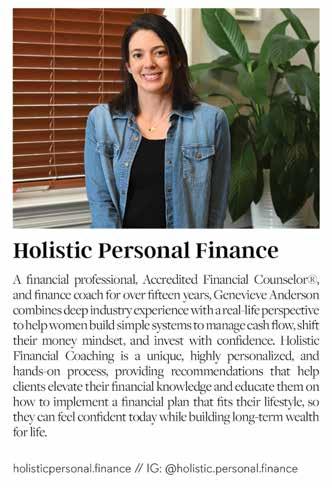

Following the consumerdriven holiday season, a lot of families are starting 2026 by taking a hard look at their finances and tightening their figurative belts. “When did everything get so expensive?” has become a ubiquitous question commonly overheard at grocery stores, restaurants, and — if you found yourself shipping gifts over the holidays — the post office. Prices are high everywhere you look, and for many, healthcare and housing costs are further compounding financial stress brought on by inflation.
“The famous economist John Maynard Keynes once said ‘Inflation is as violent as a mugger, as frightening as an armed robber, and as deadly as a hit man,’” said Eric Greschner, fee-only financial advisor at Regatta Research &
Money Management, LLC. “This is as spot on today as it was when he first said this in 1916.”
Just as we try to protect ourselves from theft and physical harm, there’s also an urgency to protect oneself from spiraling financial woes. Inflation can attack somewhat silently, especially if a person isn’t paying close attention to their receipts and bank or credit card statements. Many of us have our routine checklist at the grocery store — have you noticed if you’re paying significantly more for your usual purchases?
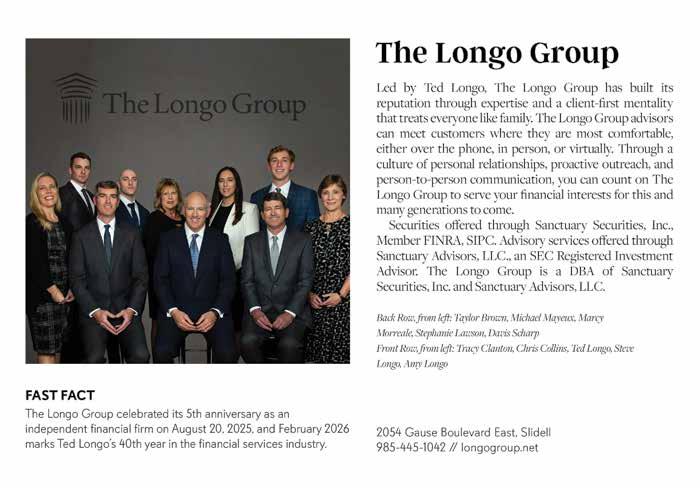
“Although the rate of inflation has slowed, there is still compounding on all the previous inflation that began back in 2022,” said Ted Longo, president and senior wealth management advisor at The Longo Group. “Many items are still more expensive than they were three or four years ago.”
According to Longo, there’s another concern as well: market speculation. When there’s increased participation in predictive markets, Longo notes that it rarely ends well.
“Speculation is definitely a bad sign — it means that people are no longer paying attention to risk and are in more of a gambling mindset instead of an investing mindset,” he said.
While today’s high market speculation around artificial intelligence raises the eyebrows of financial advisors and wealth managers, high overall costs have the average person tuned in to their money and spending. So what should families do?
“Clearly, spend less than you make,” said Longo.
The goal is simple but surprisingly hard for many people to accomplish. Basic budgeting
is the best way to know what you have coming in and what you have going out. It’s the best way to get the big picture of your family’s situation, whether you’re an individual, a couple with no children, or a large and extensive family household.
“Many investors tend to know what they should do; in reality they often fall short of taking even the most basic steps toward tracking and managing their spending,” said Greschner. Simply increasing awareness of spending and promoting discipline and accountability can have a dramatic long-term impact on one’s financial well-being.
To that end, Greschner recommends creating and managing a written cash flow plan that supports your lifestyle and goals. This should include cash flow planning basics such as
income sources, essential and discretionary spending, debt and taxes and goal funding.
“Once this is done, it needs to be analyzed to see where you can decrease spending, pay off any debt and increase your savings,” he said. Once implemented, the plan needs to be tracked on an ongoing basis, and course corrections should be made along the way.
How to begin? At J. Heath & Co. CPAs, Co-owner Jennifer Heath recommends looking back at the last two to six months of bank and credit card statements and categorizing your expenses.
“Begin with broad categories rather than getting lost in the details,” she said. The basic structure that she personally uses includes the following broad-stroke categories: People, Home, Necessities, Education, Work, Assets, Lifestyle, Taxes and Savings. These categories can be used to help you prioritize both your nonnegotiable items and discretionary ones.
While some people have a strict sense of their spending, many of us are simply afraid to look. But for even the careful spender, Longo said there are bound to be surprises when you examine closely.
“It is expensive to dine out, and even the cost of simple pleasures — like your favorite specialty coffee — can add up quickly,” he said.
Many people are mentally living in the past, when a fast-food stop for the kids would be under twenty bucks or when lunch with a friend only set us back $20 to $25. These days, a burger and a beer plus tax and tip can easily be a $30+ ordeal. Sitting down and looking at the hard numbers in your statements will show you just how high that “Lifestyle” spending has gotten.
Another item to consider, according to Longo, is automatic payments. We have become very
accustomed to auto-drafts and automatic billing, whether it’s a utility bill or app subscription. When you never see the money exchanged, how well do you remember that it’s even happening? These are important transactions to identify in your budget.
Another tip from Longo is breaking down your larger annual or semi-annual bills like insurance into monthly amounts. This gives you a clearer picture of what you are spending compared to your monthly income and gives you an opportunity to adjust if needed.
Once you’ve assessed your spending, where do you set your priorities? Every family has necessities. When prioritizing your spending, Longo said to take care of necessities first. These are items like your mortgage/ rent, car payments, utilities, and tuition (if applicable). Then, Longo said, the compromising starts.
“Anyone who has been in a relationship for any length of time knows that compromises need to be negotiated and agreed upon,” he said.
He suggests looking for that can be eliminated or cut back. For instance, how much would you save by brewing your own coffee in the morning? Have you examined your automatic payments? Are you actually using the services you’re paying for?
Beyond adjusting spending, Greschner adds another budget priority: determining your financial goals.
“We suggest they start prioritizing their goals by assigning a time horizon to each goal along with its associated costs,” said Greschner. Then, he said, review how the different goals may compete and allocate resources according to greatest importance.
“Finally, adopt realistic expectations and adjust goals as necessary to get the optimum trade-off for each goal and spending category.”
A short-term, one- to three-year
goal might include building up emergency savings, buying a car, or paying off high-interest debt.
A medium-term goal of three to ten years could include major home renovations, saving for a child’s education, or starting a business. Long-term goals could be building retirement savings, paying off a mortgage early, or building generational wealth.
“Communicate among family members to determine overall family values and make sure they align with your family’s goals,” said Greschner. “It is important to have buy-in from all family members—especially at the beginning—to increase the probabilities of a successful outcome,” he said.
Heath agrees and said her adult children still reminisce with eye-rolls and laughter over their family’s Saturday morning meetings.
“We had a weekly budget check-in before we did any fun for the weekend, comparing our actual spending to our planned,” said Heath.
Another budget tip from experts is to pay yourself first.
“The 401k came out just before I started my career, and it is a fantastic savings tool. It is a great way to pay yourself first, and many companies offer a match on some part of the savings,” said Longo.
Heath echoes this sentiment.
“Anything that can be transferred automatically on payday out of your checking account and into savings will help you reach your savings goals,” she said. She recommends the savings app SmartyPig because it lets you save according to your specific goals.
There’s no shortage of budgeting apps available, from the general to the niche. Eric Greschner’s top picks for general budgeting are Rocket Money, Quicken Simplifi, and Monarch Money. Some budget apps feature options for partners/ spouses to view or co-manage accounts.
“If the apps are utilized on a consistent basis, they can be very useful by encouraging awareness, accountability, and positive reinforcement,” he said.
Longo adds, “There is an old saying, ‘If you cannot track it, you cannot manage it.’ Apps are helpful if you use them. Old fashioned pencil and paper is also an effective option.”
Tax season is drawing near, and a number of changes for tax year 2025 could impact your budget. According to Heath, important tax changes that may affect families this year include changes in deductions such as the Tip Income Deduction, Senior Deduction, Overtime Deduction, and Above-the-Line Vehicle Interest Deduction. Additionally, the Child Tax Credit has increased from $2,000 to $2,200 per qualifying child. The seven federal tax rates remain unchanged, but the income thresholds have increased, which may result in income being taxed at a lower rate. Experts suggest talking with your tax preparer about these changes and others.
One final note on budgeting: “Keep in mind that perfection is the enemy of good,” said Greschner. “Waiting for your budget to be perfect often prevents you from finishing or making progress. Doing something well enough is usually far better than doing nothing at all,” he said.
Disclaimer: The content of this article is for informational purposes only. Do not construe any information or other material as official legal, tax, investment, financial or other advice. This article is not a substitute for personal advice from a financial professional.


It’s that time of year when those New Orleanians weary of Carnival crowds and traffic long for an escape. Colorado ski slopes remain a favorite of city residents so we asked travel writer, author and ski instructor Lisa Blake of Breckinridge to offer advice for those heading west this month.
Blake’s home of Breckenridge and many of the surrounding ski towns pride themselves on being laid back, so visitors will feel comfortable dressing casually for any occasion—jeans or cotton pants, sweater or fleece jacket are the norm. You might want to include something more upscale — but warm — for a special night on the town in Aspen and Vail.
Just layer up! “Layers always stay stylish in the mountains and will easily transition from keeping you warm on your afternoon hike to keeping you cozy at happy hour,” Blake said.
Do bring 25- or 30-strength sunscreen for days on the slopes for the sun can be intense at higher elevations.
Most people heading to Colorado to ski fly into Denver and drive the one to two hours to Summit County, where Breckenridge, Keystone, Arapahoe Basin and Copper Mountain ski resorts are located. It’s a bit further to Vail or south to Aspen. “Because traffic on Interstate 70 from Denver to the mountains is always so heavy during ski season and the crazy snowstorms make me a nervous driver, I like to book a shared shuttle service ride with Summit Express or Peak 1 Express,” Blake said. “I read, write or sleep while the driver gets me up the hill safely.”
Those of us from the Bayou State don’t just travel to the Rockies to rise from ground zero, we ascend altitudes from below sea level. So, it’s imperative to always have a reusable water bottle at the ready for hydrating. “At 10,000 feet,” Blake explained, “the oxygen is thinner and drinking a ton of water makes a world of difference in how you feel, sleep, headaches, energy — everything. If you start to feel the effects of altitude sickness, slow down, stay out of the hot tub, drink water and electrolytes, eat carbs, and call the pros at High Country Oxygen.”
You can read more altitude adjustment advice from Blake on her blog, gobreck.com/plan-your-visit/ breckenridge-altitude.
Blake suggests checking out the Airbnb or Vrbo markets if traveling as a family or with a large group of friends or multiple families. “The Airbnb market is rich with beautiful mountain homes stocked with all the comforts and perks like game rooms, theater rooms, hot tubs and saunas, easy access to the ski hills, etc.,” she said.
For those who prefer hotel amenities, there are plenty of options. However, the closer you are to the chairlifts, the more likely you’ll pay higher prices. “Hotels are also known for providing free shuttle services around town and to the ski slopes,” Blake added.
There are numerous spots throughout the ski towns and prices range from high-end restaurants to those on a more family friendly budget. Blake’s personal favorites at Breckinridge includes “Rootstalk or Briar Rose happy hour, Sancho tacos, cocktails at Ember, pizza from North Side, Italian at Giampietro’s, breakfast burritos and lattes at Cool River, donuts from Daylight.”
“Bring your sense of adventure and try something new,” Blake said. She suggests signing up for dog sledding, tubing, ice skating or cross-country skiing. Learn more from Blake, including her take on Colorado hot springs, at lisablakecreative.com.


Melissa Weber considers herself cursed. With a near-encyclopedic knowledge of 15,000 records scrounged from a lifetime as a “crate digger,” the worldrenowned DJ artist known as DJ Soul Sister has been sharing that curse with New Orleans for over 30 years, working a turntable as a savant beholden to the long-lost art of mixing and beat matching straight from vinyl records.
A young omnivore for funk and disco tracks, Weber spent much of her childhood “borrowing” her father’s record cutouts, sequestering them into her room where she would play them repeatedly on her nearly indestructible Fisher Price record player. Considered musically gifted by her teachers, Weber never practiced and frankly didn’t have to as she absorbed the melodies that were bumping across the bass lines of Kool & The Gang, Brass Construction, or Funkadelic records, reshaping and radicalizing her synapses into a network of references upon which her artistry would one day be built.
“I was born in 1975, but I felt like I was born a decade too late,” Weber said. “I always felt like I should have been born in 1965 and partying at the discotheque instead of being stuck at home with a babysitter.”
After hours spent kneeling at the
altar of long-forgotten records, Weber found success DJ’ing for WWOZ, where she still performs every Saturday night on “Soul Power with Soul Sister,” before being coerced by a friend into performing her first live set at The Caddyshack on Poydras in 1997. With little more than a crash course in the finer points of the turntable, DJ Soul Sister’s curse was finally unleashed as two decades’ worth of religious devotion to the groove uncorked upon an adoring crowd who were eager to subsume themselves within the melodic menagerie her fingers found and the love she, above anyone else, wanted to hear in the music.
“By the time I did that first night, I had been performing my show ‘Soul Power’ on WWOZ for a few years, and the joy of community radio is that your show is who you are,” Weber said. “DJ’ing isn’t about technique or debating vinyl versus digital, it is about the love of music and expressing that in a way that reveals true to you. If you don’t love the music, you have no business DJ’ing anywhere.”
DJ Soul Sister’s unique sound has offered her the opportunity to perform alongside the totemic acts whose records she lovingly spun in the dark of her childhood bedroom: Chuck Brown & the Soul Searchers, Tower of Power, and George Clinton and Parliament-Funkadelic. Considered by
some of the greatest DJs in the world to be one of the greatest DJs in the world, Weber directly credits George Clinton and his uninhibited, barefoot style of performance as inspiration for the special something she is chasing each time she steps upon the stage.
“George Clinton is why I perform my sets barefoot, as a way of what I call ‘feeling the feeling’. Feeling the feeling is so important because it’s about channeling from above and feeling sound from below, having the music flow into you from every direction. It’s all very metaphysical and weird, not normally what DJs say, but for me it’s an absolute necessity,” she said.
Though she performs fewer sets than she once did, with the notable exception of her monthly ‘HUSTLE! with Soul Sister’ nights at Tipitina’s, Melissa has evolved her instrument, today sharing her love of music through writing, scholarship, and research as she is in the midst of completing her master’s thesis in musicology. It’s a new era for her, though don’t be surprised to see DJ Soul Sister manning the turntables into her 80s, because that curse, that blessing, it never dies. It’s not something you can’t buy; it’s not something you can teach, as DJ Soul Sister knows all too well; it’s simply a feeling you have to feel.
Must-see performances this month
Feb. 5
Nine Inch Nails, “Peel It Back Tour “with special guest Boys Noize, 8 p.m. at The Smoothie King Center, smoothiekingcenter.com
Feb. 7
Lost Bayou Ramblers with Juzz Bunny DJ, “25 years of Psychedelic Cajun Punk,” 8:30 p.m. at Gasa Gasa, gasagasanola.com
Feb. 11
Inzo: Mirrorverse Tour, 8 p.m. at The Joy Theater, thejoytheater.com.
Feb. 17
“Mardi Gras Morning Sunrise Set” featuring Big Chief Juan Pardo & The Golden Comanches with Billy Iuso, 5 a.m. at Tipitina’s, tipitinas.com
Feb. 19
“The Queens! 4 Legends, 1 Stage,” featuring Chaka Khan, Patti LaBelle, Gladys Knight and Stephanie Mills, 8 p.m. at The Smoothie King Center, smoothiekingcenter.com
Feb. 24
Aimee Mann, “22 ½ Lost in Space Anniversary Tour” with Jonathan Coulton, 8 p.m. at The Joy Theater, thejoytheater.com.
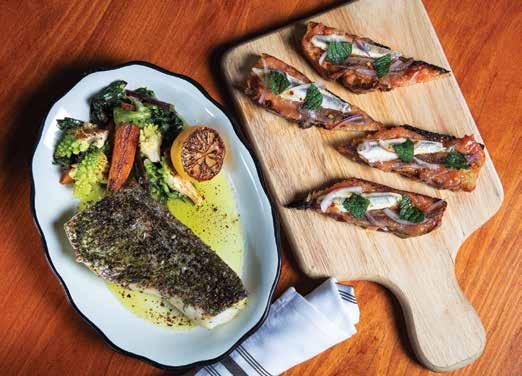
Evviva brings a shapeshifting menu to the Marigny
In all creative pursuits, few things feel more exciting than a good, old-fashioned team-up.
From rock supergroups to star-studded films, there’s just something palpably joyful about seeing passionate artisans come together to create something new and, hopefully, exhilarating. This is especially true in the culinary world, when likeminded chefs decide to pair up to design a menu that combines their individual talents and imaginations into something genuinely special. Such is the case with Evviva, the suave, cozy new Marigny spot that opened last year at the hands of chefs Rebecca Wilcomb and Marcus Jacobs and restaurateurs Heather Lolley and Humberto Suazo. Local gourmands who follow the movements of our brightest culinary talents will likely recognize those names; the chefs worked together
for years at Herbsaint, perhaps one of the best eateries in New Orleans for talented chefs to hone their craft.
According to Wilcomb, the project came together naturally. “Heather approached me and asked if I was interested in getting back into restaurants,” Wilcomb said. “I told her I didn’t really know. At the time, I had a two-year-old and just wasn’t really sure what direction I wanted to go in and if it would fit with my schedule as a mom, so we came and looked at the space, which was the former Franklin. We loved it immediately. It’s a great size. Not too small, not too big. We’ve traveled a lot together and have had a lot of really great dining experiences together, so we knew what we wanted out of a neighborhood restaurant, and what we’ve experienced in neighborhood restaurants, and talked at length about what that was like for us and what we wanted it to look like in a
space of our own. And then Marcus and I started talking about it, and it all just kind of fit. We did a really quick turnaround, opened up, and all of a sudden, here we are eight months later.”
Jacobs concurs with his co-chef. “I think we like a lot of the same stuff,” he said. “We have pretty disparate backgrounds in a lot of ways, but I think we approach food the same way, and we also cooked together for a long time as young professionals who were just getting our careers moving. So we bring a lot of different viewpoints and different experiences in, but I think that we’re in sync on a lot of the ways that we’d like dishes to be and what we like to eat. And I think that there’s a lot of crossover there.”
Atchafalaya
When it comes to cozy neighborhood spots with reliably fantastic food and warm ambiance, we always find ourselves coming back to Atchafalaya. It does that rare magic trick of New Orleans eateries that successfully manage to combine a casual vibes with upscale cuisine, and that warm hospitality and comforting fare will always keep it on our radar. It’s a perfect spot for a romantic weekday dinner, with refined but hearty southern fare like shrimp and grits, panseared gulf fish, steaks and chops. But the real winner here is the popular jazz brunch, featuring a makeyour-own Bloody Mary bar and spectacular morning options like duck hash, breakfast risotto, and the praline apple pie waffle topped with whipped cream cheese, rum caramel and cane syrup. There’s usually a generous line for obvious reasons, but it’s always worth it.
Seeing Jacobs and Wilcomb partner in the kitchen should be exciting enough, but Evviva also has another trick up its sleeve: a constantly evolving menu that changes daily, depending not just on the creative whims of the chefs, but also the seasonality and availability of the best local ingredients. The result is a restaurant that simultaneously keeps you on your toes with fresh flavors and techniques, but always feels gratifying, especially in a handsome room that also straddles the line between elegance and comfort, perfect for a romantic night out or just a quiet drink and snack at the bar. The fact that Evviva pulls off this balancing act so deftly right out of the gate is a testament to the talent behind it, something rare and delightful in the culinary corners of the Crescent City.
So, if the menu changes daily, what can you expect during an evening at Evviva? The menu is divided smartly into three sections, with just enough options to satisfy most appetites without feeling either overwhelming or sparse. To start off, you might opt for a snack of marinated olives and orange slices flavored with Aleppo pepper, sumac and coriander. Or perhaps an elegantly simple plate of yellowfin tuna carpaccio with tonnato,

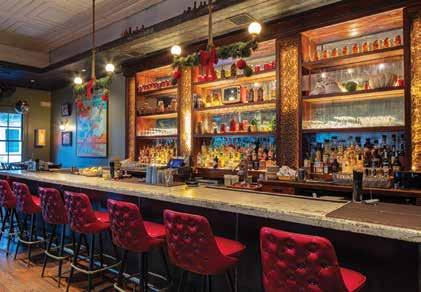
a sliced farm egg, dill and crispy capers. “It’s nice to have a carpaccio or a crudo or something on the menu somewhere,” said Wilcomb. “I crave them when it’s cold, I crave them when it’s warm. We get these really great farm eggs from Four River pastures. It was just inspired by the ingredients on hand.” And while that particular dish was a one-night-only affair, which is to be expected for a restaurant that changes things up on a daily basis, there are few fan favorites that tend to appear more frequently. One of those is the not-to-be-missed anchovy bread, yet another deceptively simple and rustic pairing of glistening whole anchovies with crushed tomatoes, chili and lemon atop Bellegarde focaccia. “The reason that it’s great is because it’s an umami bomb,” said Jacobs. “I think that a lot of folks aren’t used to just eating anchovies straight like that, or having them be the centerpiece of the dish. But, I think people like it because it is straightforward. It’s well balanced, while still being aggressively flavored.”
Such refined simplicity carries over to Evviva’s larger dishes as well. Take, for instance, a recent offering of pan roasted duck breast with French lentils, chicories, and a Lyonnaise vinaigrette. It’s the kind of dish that allows the ingredients and technique to speak for themselves without being overwhelmed by a mountain of ambitious and perhaps unnecessary components. According to Wilcomb, “We focus on technique and good ingredients rooted in classic dishes. So we went crunchy with the mustardy
vinaigrette and the French lentils, and great chicories from River Queen Greens. You just can’t go wrong there.” Similarly, the broiled gulf fish on a recent visit, flavored delicately with green peppercorn butter, feels both light and satisfying. You might also encounter gems like squid ink chitarra pasta with squid ragu, lemon and chilis, or maybe deviled duck livers with onion and mustard espagnole is more up your alley. Whether you’re an adventurous diner or more reserved, there’s a good bet you’re going to find more than a few things to love at Evviva. Anticipating what these two chefs have in store without any foreknowledge is one of the best aspects of its charm, and something that will surely keep many of us coming back.
It’s remarkably refreshing to encounter a neighborhood restaurant that feels perfectly at home in its space, with cuisine that, on any given night, might rival some of the finest white tablecloth establishments in town. “We’re a ‘chefy’ restaurant, and that can be intimidating for some people that maybe aren’t in the restaurant world as much,” said Jacobs. “But when you come in here, you’re greeted with warmth. It’s not uptight, it’s imminently casual, but also still feels like you’re being taken care of, and that goes to the hospitality that we show here. You can come in as you are, and you’re going to have a great time, whether you sit at the bar and have a couple drinks, or if you’re here for a special celebration. It’s really a restaurant that’s for everyone all the time.”
Toups’ Meatery For ages, New Orleans restaurants have skewed more towards Creole than Cajun cuisine. Fortunately, that’s been changing in recent years, and those of us with a hankering for Acadian fare no longer have to venture West to get a taste of those rustic Louisiana flavors. Toups’ joined this mission in 2012, and has been one of our favorite neighborhood spots ever since. Chef Isaac Toups has all but perfected the fine art of bringing Cajun country staples and techniques into the land of fine dining, taking ingredients like turkey and lamb necks to elegant new heights and placing them on the generous menu alongside foie gras and Raines Farms Wagyu steaks, all in an environment that welcomes you whether you’re wearing wingtips or flip flops. Just make sure you come packing a serious appetite; Toups’ absolutely refuses any notion that their diners might walk away hungry, judging by that lamb’s neck the size of a cantaloupe. All the more reason to bring friends. Remember, sharing is caring!
Chef Rebecca Wilcomb moved to New Orleans from Massachusetts. Wilcomb honed her craft at Herbsaint, where she rose in rank over the course of a decade before opening another Donald Link eatery, Gianna, where she stayed for a few years before deciding to take some time away from the kitchen. In 2025, Wilcomb was called back to the culinary life with an enticing offer to helm alongside her former colleague Marcus Jacobs, and very soon thereafter Evviva opened its doors to excited local diners.
Chef Marcus Jacobs originally hails from Ohio, and found himself cooking in places as far afield as Northern California, where he worked in boutique Humboldt County hotels, to San Francisco’s Zuni Cafe, and even a stint doing farm work in Japan. Eventually, Jacobs found himself in New Orleans to watch the Saints NFC Championship game, and – in true New Orleans fashion – he simply didn’t leave. Taking a job behind the line at Herbsaint, he met and worked alongside Wilcomb for seven years, before developing a number of lauded projects, including the sadly departed Seafood Sally’s and Marjie’s Grill. Last year brought him back together with Wilcomb to open Evviva.

Celebrate the season with a special crowd-pleaser
Chef Isaac Toups, of Toups Meatery and the soon-to-open Armada, presents a refined yet simple dish that truly celebrates caviar, a popular culinary trend. Isaac and Amanda Toups, partners in both marriage and business, have made food, family, and entertainment central to their lives. Since 2012, they have successfully run Toups Meatery in Mid-City, with Isaac as executive chef. His culinary achievements have earned repeated recognition from the James Beard Foundation, and he became a well-known competitor on Bravo’s “Top Chef.” In 2018, Isaac published his cookbook, “Chasing the Gator: Isaac Toups and the New Cajun Cooking.” The couple is set to open their new restaurant, Armada, in the CBD later this year.
Cook With us!
Join us each third Tuesday of the month and cook along with New Orleans Magazine and our featured chef on Instagram.
@neworleansmagazine
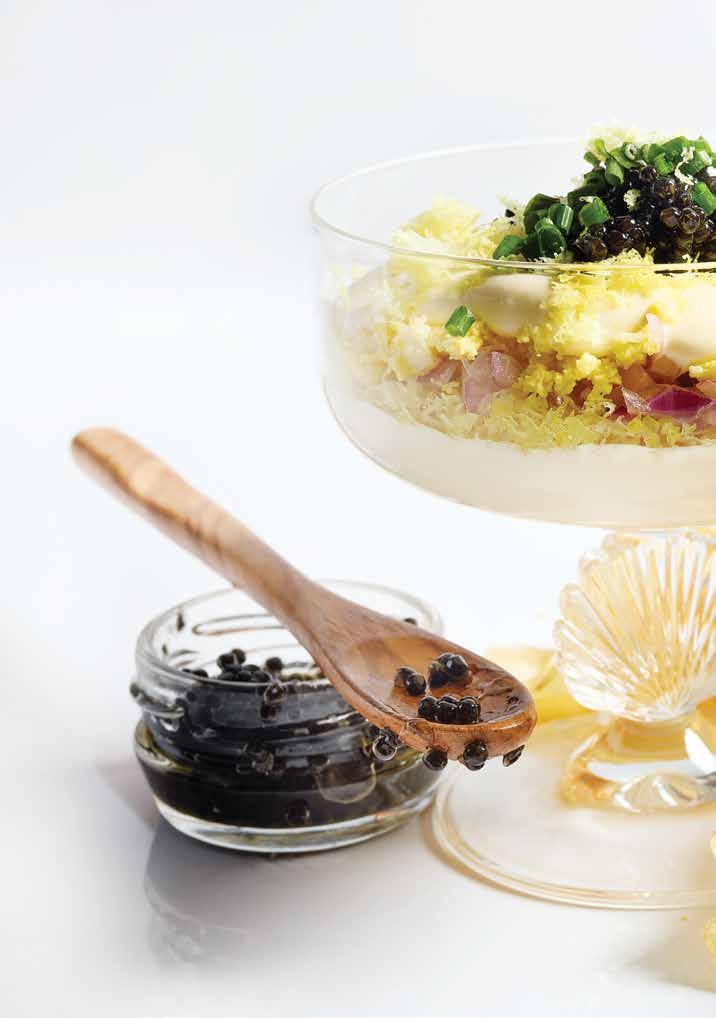
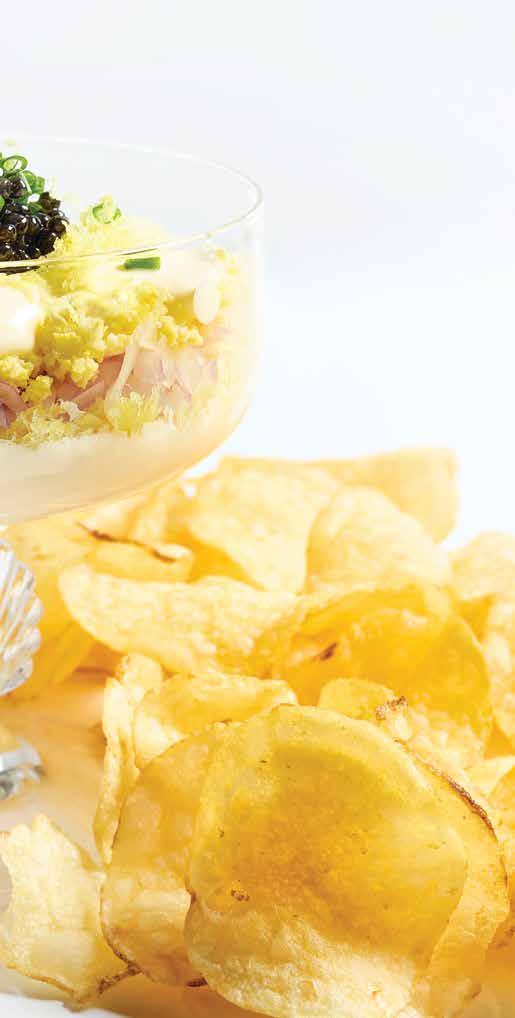
by Chef Isaac Toups
Makes 4 small trifles
6 ounces crème fraiche, at room temperature
2 tablespoons lemon zest
1 tablespoon finely minced shallots
1 hard-boiled egg, passed through a fine sieve
1 tablespoon finely minced chives
Notes
Presentation is key for this dish. Classic caviar dishes from Avis Aldine Vintagewares (3614 Magazine St., @ avisaldine on Instagram) added an elegant touch.
This dish is perfect as a starter for a Valentine’s Day dinner for two (halve the recipe) or as a show-stopping layered dip for a crowd (use a clear trifle bowl and multiply the volumes by four for a Mardi Gras Brunch).
The Toups recommend Royal Osetra caviar for this preparation, but Siberian Sturgeon caviar is an excellent alternative. Locally harvested Cajun Caviar is also highly recommended.
A bold, assertive Champagne is an ideal pairing to cut through the richness. Opt for a dry, high-acid Champagne with a rich, toasty, or mineral profile. Notable choices include Krug Grande Cuvée (complex), Bollinger Special Cuvée (full-bodied and nutty), Stéphane Coquillette Cuvée Diane (mineral and lemon), or Francis Orban Extra Brut. Ice-cold vodka also complements the dish well.
2 ounces caviar (Osetra or locally produced Cajun Caviar)
Zapp’s plain potato chips, for serving
1. Divide the crème fraiche in half. Spoon half into four 4-ounce caviar dishes, parfait dishes, or small mason jars.
2. Divide the lemon zest in half. Sprinkle half atop the crème fraiche in each dish.
3. Distribute the minced shallots evenly over the lemon zest.
4. Layer the sieved hard-boiled egg over the shallots.
5. Add the remaining crème fraiche as the next layer.
6. Sprinkle the remaining lemon zest over the crème fraiche.
7. Top with the finely minced chives.
8. Finish with a generous spoonful of caviar on top of each dish.
9. Serve immediately with Zapp’s plain potato chips.
BY ELIZABETH PEARCE | PHOTO BY EUGENIA UHL
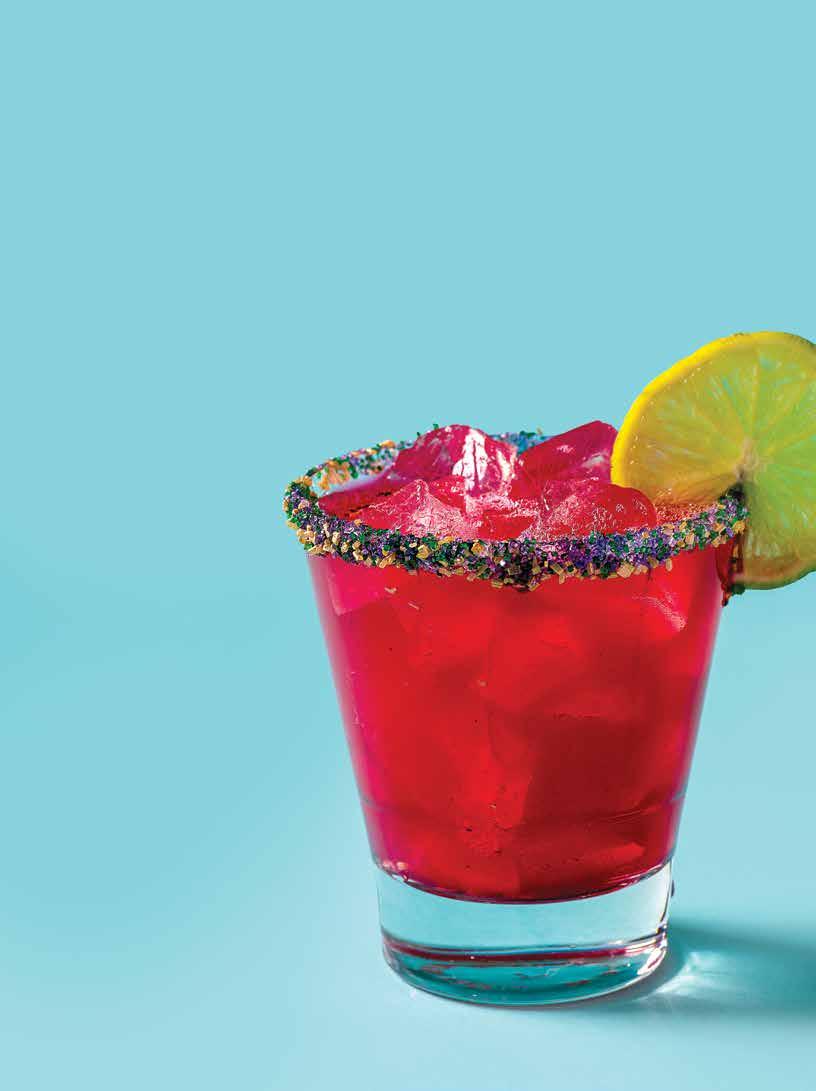
Cindy Brennan has seen more than 40 Mardi Gras from the doorstep of her restaurant, Mr. B’s Bistro. “People are so creative. No two days-or two hours-are the same.” She loves the people watching, where “someone from the Garden District is sitting next to a couple from Minnesota who’ve never caught a throw before, all laughing, sharing parade stories.” Cindy is gratified that Mr. B’s creates those connections. “We welcome everyone into the celebration... Mardi Gras in the French Quarter is pure magic, and we get to be part of everyone’s story.” This hospitable environment extends to her staff — many have worked there for decades, including a cook who has been there since the restaurant opened. In an industry known for high turnover, that loyalty is a testament to Cindy’s leadership. She notes that running a restaurant can be “hard as hell,” but it’s the relationships with both guests and employees that make it worth it. “I’m very proud..and honored by that.”
TIPS
Cindy notes that this festive, batchable margarita is a nice change from typical Carnival drinks like a Bloody Mary or Milk Punch, and if the weather is warm, it can also be very refreshing.
Colored sugar is available in many grocery stores, though you may have to buy each color separately to create a purple, green and gold mix.
You can choose to rim only one half of the glass for a cleaner look.
2 ounces Don Fulano blanco tequila
1 ounce triple sec or Cointreau
11⁄2 ounces fresh lime juice
1 ounces mixed berry simple syrup (recipe below)
Garnish Mardi Gras–colored sugar (purple, green, gold)
Lime wedge
Lime wheel
Rub the lime wedge along the rim of a rocks glass. Dip the rim into Mardi Gras sugar. Fill the glass with ice. In a shaker with ice, add tequila, triple sec, lime juice, and berry syrup and shake hard for 10–12 seconds. Strain into the decorated rocks glass.
Garnish with the lime wheel.
Mixed Berry Simple Syrup
1 cup water
1 cup sugar
11⁄2 cups mixed berries (strawberry, blueberry, raspberry)
1⁄2 tsp lemon zest
Bring water and sugar to a simmer until dissolved. Add berries and zest; simmer 8–10 minutes, gently mashing. Double strain the mixture, discarding the berries. Cool the remaining syrup completely and refrigerate for up to seven days.
Podcast
Listen to Elizabeth’s podcast “Drink & Learn;” visit elizabeth-pearce.com
BY JOHN R. KEMP
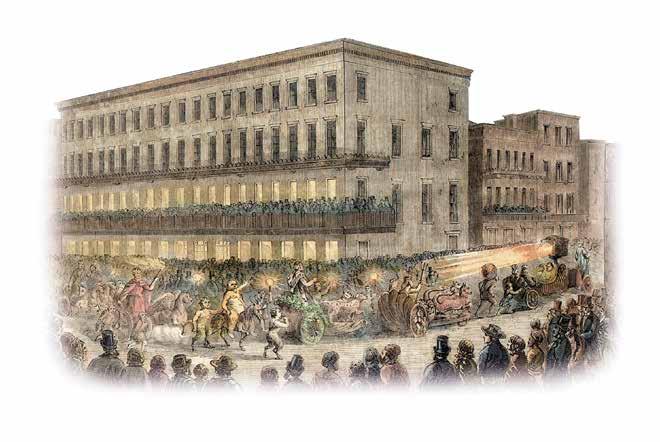
It’s that time of year again when Carnival revelers hit the streets throughout the Greater New Orleans area and Northshore to catch their favorite parades and to shout themselves hoarse.
Of course, that’s nothing new. Back in the mid-1800s, New Orleanians did the same thing, as seen here at the Mistick Krewe of Comus’s night parade in 1858. At the time, Comus was little more than a year old.
Until 1857, Carnival in New Orleans was pretty much a Creole Catholic event celebrated before Lent with evening balls and an occasional procession through the French Quarter. Then came Protestant Americans. Not to be outdone, they formed their own Carnival organization in 1856 when, according to Mardi Gras historian Henri Schindler, six American young men originally from Mobile formed the Mistick Krewe of Comus, named for John Milton’s “Masque of Comus” and the Greek god of revelry. The Mobile six had been members of that city’s parading group the Cowbellions and that’s what they had in mind for New Orleans. By the way, “Krewe” and “Mistick” were faux spellings supposedly based on Old English forms of the words crew and mystic.
says “Carnival was forever changed.”
And what a change it was, considering how rowdy Mardi Gras had been prior to the formation of Comus. A horrified young North Carolinian living in New Orleans in 1853 confided to his journal the “profanation” spectacle he had just witnessed.
“The street was full of men, women and children of the lower classes on foot and the higher in carriages,” he wrote. “As I walked down the street, I was met by a crowd of boys and men fantastically dressed and masked running with a crowd at their heels who were hollering and yelling and filling the air with flour, eggs, and mud which they were throwing at the maskers who in turn filled the eyes of all with whom they came in contact with flour – I got out of the way, least they should give me some of their favors in the liberal distribution.”
Comus Night Parade 1858. London Illustrated Daily News. Courtesy Arthur Hardy’s Mardi Gras Guide
With an outpouring response from the city’s Uptown community, Comus held its first Mardi Gras parade in February 1857 with the fitting theme “The Demon Actors in Milton’s Paradise Lost.” It was an “instant sensation,” says Mardi Gras historian Arthur Hardy. Not everyone was impressed, however. The parade and evening tableau ball were held on the American, or Uptown, side of Canal Street. And, as Schindler wrote, “the new organization did not count a single Creole among its members.” Although a prominent Creole newspaper gave only a brief but sarcastic mention to the parade and ball, Schindler
After a lengthy description of the day’s events, he concluded: “The whole street was alive with spectators and the scene to me was certainly strange and as a hideous or foolish looking masker would pass me and the horrid oaths and noises fell upon my ears, I could not help exclaim – Is this festival recognized by the Church of Rome? Can any Christian Church countenance much less allow such a profanation of its ceremonies?”
Comus did indeed change Carnival forever. The parade fever caught on quickly. After Comus, came the Twelfth Night Revelers in 1870, Rex and Momus in 1872, and Proteus in 1882. That was just a start. Over the last century carnival organizations and marching clubs have come and gone. While several of the old line krewes still delight paradegoers, more recent organizations such as Bacchus, Endymion and Zulu also have become favorites with locals and visitors from across the world.

Food and fun are Carnival’s bread and butter. Find your new favorite spot to toast the season!
Bellegarde Bakery bellegardebakery.com
Bellegarde Bakery’s Brioche Monkey Bread King Cake is a Carnival standout—pillowy brioche baked with cinnamon, finished with cream cheese frosting, brown butter streusel, and a little Mardi Gras magic. Available for preorder all Carnival long.
Breads on Oak breadsonoak.com
Discover New Orleans’ most distinctive café and bakery—home of organic, Old World–style sourdough and a fully plant-based menu. From hearty biscuit sandwiches and artisan toasts to flavorful burgers, comforting soups, and an irresistible selection of all-natural pastries, cookies, and cakes.

Galatoire’s Galatoires.com
What’s your tradition? From the world-famous New Orleans cuisine to impeccable service, every aspect of the dining experience at Galatoire’s reflects the traditions guests have enjoyed for generations. Open TuesdaySunday for lunch and dinner. Visit Galatoires.com or call 525-2021.

Juan’s Flying Burrito juansflyingburrito.com
Celebrating nearly 30 years, Juan’s Flying Burrito is a vibrant Creole Taqueria offering a refined New Orleans-inspired twist on tacos, burritos, and quesadillas. Thoughtful flavors, local seafood, seasonal ingredients, and a relaxed rock-and-roll vibe make it a reliable, community-focused favorite.
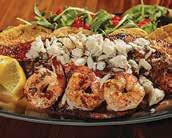
A historic gem tucked cozily among the historic warehouse district, Briquette offers the finest in modern tastes and design. Featuring a signature open kitchen and an 18-foot seafood display, enjoy watching fresh fish being prepared before your eyes on red-hot briquettes while sampling an extensive wine list and beautifully crafted cocktails. Join us for our threecourse Valentine’s Dinner for $65.00 per person, February 13-15 and February 20-22nd. Open Mardi Gras Day!
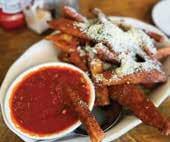
Mandina’s mandinasrestaurant.com
Family owned since 1932, Mandina’s offers a casual mix of authentic Italian and Cajun-Creole cuisine, from steak and seafood to pastas and po-boys. A jewel in the heart of Mid-City, make Mandina’s your pre-parade fuel spot for pure New Orleans flavor.

Copper Vine coppervine.com
Crawfish Beignets: A savory reimagining of the New Orleans classic, Copper Vine’s crawfish beignets are golden and crisp, filled with creamy Louisiana crawfish and herbs, and served with sweet red pepper purée and zesty pickles—comforting, indulgent, and unmistakably local.
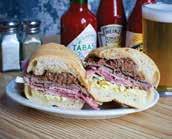
Mother’s Restaurant mothersrestaurant.net
Did you know that debris, the popular po’ boy topping made of beef au jus generously flecked with shredded roast beef, originated at Mother’s? It’s made from roast beef trimmings that fall into the pan while the meat roasts.
NOCC
neworleanscreolecookery.com
New Orleans Creole Cookery offers the finest Cajun and Creole cuisine in an innovative fashion that ignites appetites. Join us for our three-course Valentine’s Dinner for $65.00 per person, February 13-15 and February 20-22nd. Open Mardi Gras Day!
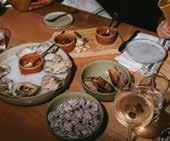
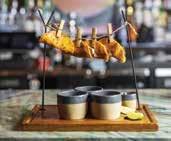
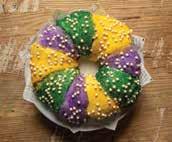
Pulcinella! dirtydimeproductions.com/pulcinella
Oyster Artichoke Soup is a beloved family recipe from Executive Chef Matty Hayes at Pulcinella! Silky, house-made artichoke soup, crispy P&J Oysters, fennel, basil oil, creme fraiche, and topped the way Matty’s family always has, with oyster crackers. It’s a delightful on cold winter days.
Really Really Nice Wines reallyreallynicewines.com
After gracing the cover of New Orleans Magazine in December 2025, Really Really Nice Wines is ready to help you start 2026 off with a bang, offering a delicious seasonal snacks menu created by Chef Luci Winsberg that perfectly accompanies their rotating by-the-glass selections of low-intervention wines.
Tacos Del Cartel tacosdelcartel.com
Tendedero de Birria: Tender, slowbraised birria presented hanging from a clothesline, accompanied by our rich, aromatic consommé for dipping.
Willa Jean willajean.com
Willa Jean’s king cake keeps it classic and comforting, with soft dough, a cozy cinnamon swirl, and a creamy glaze on top. Order two days ahead for daily pickup and enjoy a slice of Mardi Gras sweetness all season long.
Good times don’t roll all by themselves. Bring the party with you all season long with these Mardi Gras partners!
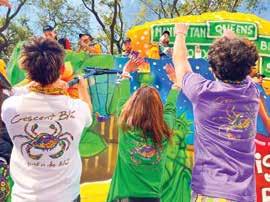
Crescent Blu crescentblu.com
Crescent Blú is a Gulf Coast brand known for refined Mardi Gras style and iconic crab designs. With premium fabrics, flattering fits, and attentive customer service, their parade-ready apparel is designed locally and available with convenient New Orleans pickup and delivery throughout Carnival season.
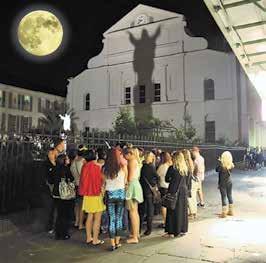
Haunted History Tours hauntedhistorytours.com
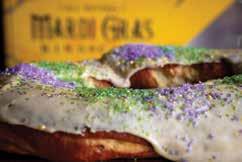
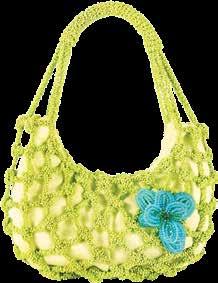
Sosusu Boutique sosusuboutique.com
Nodi Codette Bag, $847: Handcrafted by Italian artisans, the “Nodi Codette” features an intricate, three-dimensional hand-knotted design with vibrant color. An elegant yet expressive statement piece for the Mardi Gras season!
Breads of Oak breadsonoak.com
Breads On Oak’s award-winning King Cakes are crafted in-house using only a select few natural, high-quality ingredients, including organic wheat flour and real maple syrup. From the decadent Bavarian cream and cream cheese to chocolate tiramisu and pecan praline, we offer all flavors daily—and yes, we ship nationwide.
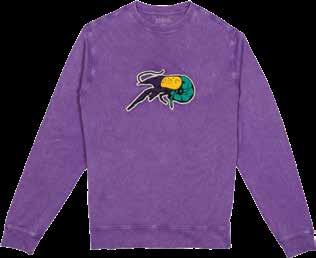
PERLIS Clothing Perlis.com
The 100% cotton lightweight unisex Crawfish Applique Crew
Sweatshirt is the perfect outerwear piece for the parade route.
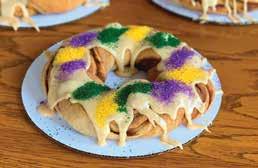
These are the New Orleans tours you’ve heard about!
The Travel Channel called Haunted History Tours “The #1 tour in New Orleans… a must-do!” Mildly theatrical, hugely historical, and thoroughly entertaining xfor 30 years, our tours will leave you spellbound!
Loretta’s Authentic Pralines lorettaspralines.com
Loretta’s Authentic Pralines has been in business for over 35 years. Loretta was the first African American woman to successfully own and operate her own praline company in New Orleans. Today, Loretta’s Authentic Pralines is a thriving business with two locations, representing the spirit of New Orleans and the heart of resilience.
The gift of love is priceless. But a little something extra is always welcome! Find your beloved something they’ll cherish in our Valentine’s Day Gift Guide.
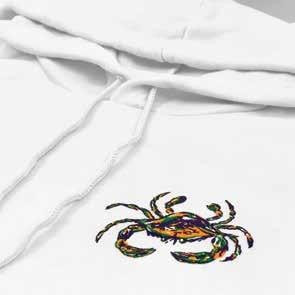
Crescent Blu crescentblu.com
Sponge Fleece Hoodies: Made from ultra-soft sponge fleece, this sweatshirt feels like wearing a cloud—smooth on the outside, plush on the inside. Offered in Signature Crab, Purple & Gold Crab, and Mardi Gras Crab designs, it’s an elevated, thoughtful gift they’ll love.
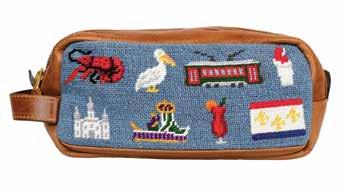
PERLIS Clothing perlis.com
Exclusively at PERLIS, gift your Valentine the NOLA Life 100% hand-stitched needlepoint toiletry bag by Smathers & Branson with an array of local icons, full-grain Italian leather body and handle, and a solid brass outer zipper.

Carnival may be the heart of New Orleans, but your own heart needs some consideration, too. Luckily, your local heart health specialists are here to keep your feet tapping.
Blue Cross and Blue Shield of Louisiana Louisiana Blue is devoted to its mission to improve the health and lives of Louisianians. Heart disease is the leading cause of death in the U.S. – but you can lower risks with heart healthy habits: Get 30 minutes of exercise five days a week, all at once or broken into shorter workouts. Limit salty, fried, or high-fat foods. And, schedule a checkup with your healthcare provider! Everyone should have at least one checkup per year. People with a condition like high blood pressure or heart disease may need a few checkups each year. Your provider can talk with you about your family and medical history and check your numbers for blood pressure and cholesterol to assess your heart health. If you are prescribed medication to keep those numbers in a healthy range, take it exactly as directed and don’t skip doses. Protect your heart and keep the beat going strong at lablue.com.
Ochsner
At the John Ochsner Heart & Vascular Institute, your heart health is our mission. Our expert physicians and care teams deliver advanced cardiovascular services across the New Orleans region and the Gulf Coast, combining clinical expertise with compassionate, patient-centered care.
Ochsner has a long legacy of innovation in heart care—from performing the region’s first heart transplant to pioneering pediatric transplants and total artificial heart implants. Today, that leadership continues through minimally invasive procedures, advanced diagnostics and cutting-edge solutions such as wearable technology to support blood pressure management and long-term heart health.
Whether you’re managing a complex cardiovascular condition, navigating a new diagnosis or taking proactive steps to reduce your risk, you can trust Ochsner’s heart and vascular experts to guide you every step of the way.
Learn more about the John Ochsner Heart & Vascular Institute at ochsner.org/cardio.
LSU Osher Lifelong Learning Institute (OLLI)
As an opportunity for adults over 50 to explore new interests, meet like-minded people, and stay active, OLLI at LSU is the ideal way to build connections and begin new adventures to last a lifetime. Engaging classes are offered through OLLI at LSU’s four chapters - Crescent City (New Orleans & Metairie), Camellia City (Covington & Slidell), Felicianas (St. Francisville & New Roads), and Lagniappe (Baton Rouge) - allowing members to learn close to home while still being part of the broader OLLI at LSU community.
By bonding through the joy of learning, OLLI at LSU members are able to explore new passions focused on health and wellness, history, technology, the arts, and more; all designed for maximum fun and enrichment. From walking clubs to yoga or Pickleball, OLLI at LSU encourages both mental and physical vitality through non-credit learning, with no homework or grades to worry about, just meaningful engagement and intellectual enrichment.
Visit ce.lsu.edu/olli/ to learn more and join today! •
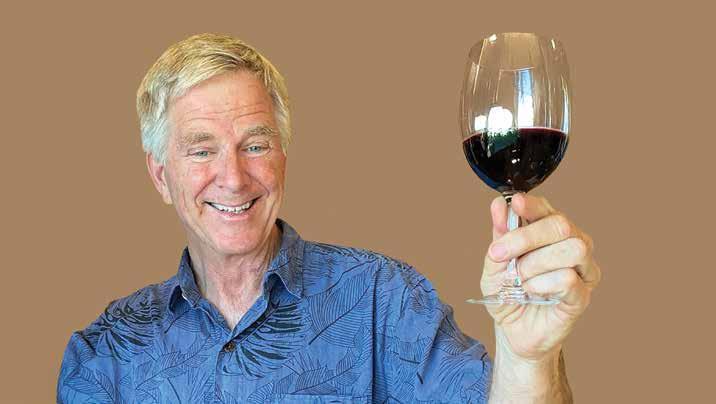
Raise a glass and explore the world of wine with Rick Steves!
WYES VIRTUAL WINE TASTING WITH RICK STEVES
Thursday, February 26 from 7-9pm
$150
*Deadline to purchase: Thursday, February 5 at 4pm Details & Tickets: wyes.org/events
Join a virtual wine tasting hosted by travel expert Rick Steves and explore Europe one glass at a time. From the comfort of home, you’ll sample standout European wines while hearing the stories, culture, and traditions behind every sip. Guided by a professional sommelier, this live Zoom experience includes six mini bottles of red, white, and rosé delivered to your door—setting the stage for a relaxed, flavorful, and memorable evening.
Thank you to our sponsor:

By participating in WYES events, you’re doing more than enjoying unique experiences—you’re directly strengthening and supporting WYES’ quality PBS programming, award-winning local documentaries and cooking series.
To explore upcoming WYES events and to purchase tickets, visit wyes.org/events.
WYES PROGRAM SCHEDULE AT WYES.ORG



Canadian Rockies & Glacier National Park
June 19 — June 25, 2026 • 7 Days • 10 Meals
Starting at $4,499: Air Taxes and Fees/Surcharges, Hotel Transfers, Round Trip Air from New Orleans

Tuscan & Umbrian Countryside featuring Italy’s Charming Hill Towns
November 14 — November 24, 2026 11 Days • 15 Meals
Booking deadline: April 15, 2026
Starting at $4,999: Air Taxes and Fees/Surcharges, Hotel Transfers, Round Trip Air from New Orleans
Curious about our upcoming Italy trip? Join us for a free information session with a travel representative on Wednesday, February 25 at 5:30pm at WYES. No obligation — just bring your questions! RSVP at wyes.org/events.

Each dinner is thoughtfully crafted by the chef to perfectly complement the wines featured that evening. Reservations open online Tuesday, March 3 at 8am at wyes.org/events. Dinner dates and menus will be announced soon.




Thank you to our sponsors:





Raise a glass to WYES at an unforgettable afternoon on the Northshore! Enjoy a feast of delectable bites, irresistible sweet treats, and sparkling champagne, all while mingling with friends—both new and old. A special thank you to the Walkers for welcoming us into their beautiful Covington home for this festive celebration. Don’t miss out—join the fun on Thursday, March 26. Grab your tickets now at wyes.org/events!

See the full itineraries at wyes.org/travel.

Thursday, May 7 WYES JULEPS & GENEROSITY GALA presented by Oscar J. Tolmas Charitable Trust
Dear Switzerland, You, of all places, must appreciate the sound of silence, I would imagine. Neutrality is your brand, after all, and a hushed serenity is often its soundtrack.
Some value such things, as I understand it. But here in New Orleans – which stands as proof positive that the Almighty appreciates a rollicking rhythm section – clamor is a commodity, from the peerless live music pouring from a random corner bar to the rumble-clatter song of a streetcar trundling down the Avenue.
This time of year, we are further blessed with perhaps the most soul-stirring sound in the local songbook: the honeyed drift of a marching band warming up somewhere in the middle distance.
Here, a distant drumline is a Pavlovian signal that joy is on the move. One would have to be a fool or a corpse to ignore its call.
But before the first parade rolls, every New Orleanian must answer a fundamental question of identity: Are you neutral-ground side or sidewalk side? How one answers speaks volumes.
Given your expertise in neutrality – and as part of my ongoing mission to explain New Orleans’ peculiarities to the uninitiated – you seem a fitting audience for a discussion of its role in the hedonistic celebration we call Mardi Gras.
What does neutrality have to do with Carnival, you ask? More than you might think. Allow me to elucidate.
What the rest of the Englishspeaking world calls a median – that grassy strip dividing traffic – we call a “neutral ground,” reflecting both our habit of inventing our own language and of celebrating our history.
It all dates to a once-upon-a-time in which the wide median running down Canal Street served as a geographic demarcation between
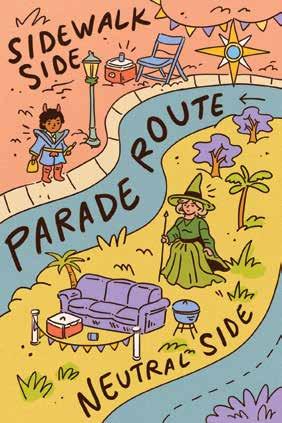
the city’s French Creole population – who at the time occupied the French Quarter and environs – and the more newly arrived American population, who largely settled in Faubourg St. Mary, around today’s less elegantly named Warehouse District.
Those two factions did not care much for each other, and so that Canal Street dividing line was deemed neutral ground. The term stuck. Over the years, it was applied to all the city’s medians.
Today, our neutral grounds are treasured parts of the local landscape, serving variously as linear parks, festival grounds and, in times of high water, parking lots of last resort.
Most notably, come parade season, they describe which side of the street one prefers for viewing:
house or explore the delirious madness unfolding around them without dodging floats or half-fast marching krewes.
Then there are the neutralground people, in all their slightly feral, frat-boy glory. Reviled in some quarters for roping off swaths of public land and defending them at all costs, they are loud, unapologetic and party with a zealot’s enthusiasm. Establishing a robust base camp is their primary pursuit. Comfort, appearances and manners are secondary.
And every New Orleanian, from the east to the farthest realms of Kenner, from the kid dressed as a K-Pop Demon Hunter to the grandma dressed as a more impressive Elphaba, has a preferred side – an allegiance that seems inconsequential but is somehow profound.
Just like those residents of a long-ago age, the two factions view the other with something hovering between disapproval and disdain.
the neutral ground side (i.e., the driver’s side) or the sidewalk side. It is more than convenient shorthand. Neutral-ground-sidevs.-sidewalk-side has become a local sociological sorting hat, determining who you are, how you see the world and how early you are likely to arrive at a parade with a sectional sofa complete with end tables.
The sidewalk side, you see, appeals to parade-going pragmatists. The efficient. The get-thereearly, king-cake-knife-carrying families who have settled upon the same five-by-eight patch of concrete since the first Morial administration.
They value easy access to real bathrooms – not those olfactoryassaulting porta-poopers – and the ability to dash to a friend’s
I know what you are thinking: Does it really matter? And the answer is no. And also absolutely yes. Because in New Orleans, identity is rarely about logic. It is about joy – about knowing where you belong not because anyone told you, but because your spirit called you there.
So, Switzerland, if you ever visit this time of year – your neutral nature notwithstanding – you will have to pick a side. I urge you to choose wisely.
Wherever you land, we will hand you a drink and welcome you in. But we will not stay neutral when judging which side you stand on.
Insincerely yours, New Orleans
Ask Mike Have a question or a thought to share about New Orleans etiquette or tradition? I’d love to hear it. Email it to mike@ myneworleans.com