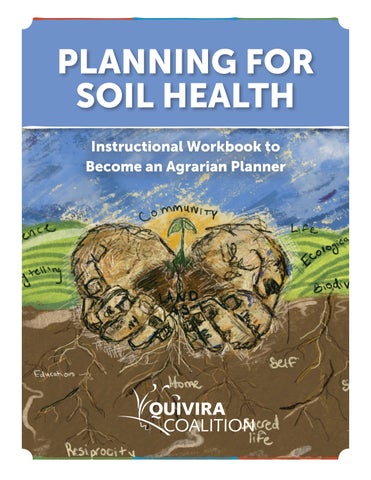
Instructional Workbook to Become an Agrarian Planner
Workbook developed by
Katherine Ottmers; Elise Suronen, M.S.; Amy Larsen, M.A.L.D.; and Eva Stricker, PhD.
Based on and in collaboration with
Mad Agriculture and CSU COMET-Tools team from Keith Paustian’s Lab. With contributions by Reid Hensen and Jess Robinson.
Funding support provided by USDA NRCS Conservation Collaboration Grant and several foundation grants.
This material is based upon work that is supported by the U.S. Department of Agriculture. USDA is an equal opportunity employer and service provider. Any opinions, findings, conclusions, or recommendations expressed in this publication are those of the author(s) and do not necessarily reflect the view of the U.S. Department of Agriculture.
Acknowledgments
Document was reviewed by Genna Fudin. Calla Rose Ostrander spearheaded and leveraged funding.
Layout and design by
Jessica Brothers, Earth Hands Co. based on an original layout design by Nick Tramontina
Copyediting provided by Anica Wong
Cover
Regenerate Art co-created by artists Anna Brief and Audrey Sayles during the 2022 REGENERATE Conference.
Text
This work is licensed under the Creative Commons Attribution 4.0 International License.
To view a copy of this license, visit: http:// creativecommons.org/licenses/by/4.0/ or send a letter to:
Creative Commons PO Box 1866 Mountain View, CA 94042
Photography
Photos in this publication are not included in this Creative Commons license and require permission to be used or reproduced in any way, and each organization or business should be contacted for permission to use these images.
We have done our best to attribute material and fact check but we may not have caught our own errors. We urge you to reach out with corrections. We will make corrections and provide updated versions as quickly as possible.
Table of Contents
Glossary
Active listening:
Adaptive management:
Cash Flow Report:
COMET-PlannerTM:
Communication Plan:
The practice of noticing the speaker’s tone, tonation, facial expressions, and body language in addition to the content and underlying feelings of what they are saying Practicing active listening means that the listener is not distracted by their own thoughts, opinion, response, or personal agenda
An iterative cycle of planning informed by current awareness and assessment, implementation per the informed plan, monitoring the results of the implementation and then evaluating the trends in the monitoring data, which could lead to adjustments in the plan .
A table that compiles all expenses and income from every product on the ranch/farm . The table breaks these expenses and income out by month, so one can see how much money is made or needed each month .
An evaluation tool designed to provide generalized estimates of the greenhouse gas impacts of conservation practices and is intended for initial planning purposes . Soil organic matter is a main metric of soil health and is part of the interacting biogeochemical cycles in soil Understanding management practices that reduce emission of carbon-based and other greenhouse gasses can be useful to guide producers towards practices that are more likely to keep or increase soil organic matter in the soil .
A detailed agreement of how the Planner, Plan Partner(s), Decision Makers, and stakeholders will communicate during and after the Planning for Soil Health process . It is important that all parties agree to the terms of the Communication Plan to facilitate a smooth planning process .
CPA (Conservation Planning Activity):
Natural Resources Conservation Service (NRCS) plan that addresses specific resource concerns identified on the ranch/farm . The Conservation Planning Activity is the first step in applying for cost share programs and other resources that support the Plan Partners in implementing healthy soil practices
Glossary
CPS (Conservation Practice Standards):
CSP (Conservation Stewardship Program):
Decision Makers:
Decision Making Plan:
Natural Resources Conservation Service (NRCS) creates specific standards to describe certain agricultural practices in detail including why and where the practice is applied, along with minimum planning criteria that must be met during the implementation of that practice in order for it to achieve its intended purpose(s) . Conservation Practice Standards are used across the United States but are adapted and modified by state to insure that all state and local criteria are met, which may be more restrictive than national criteria .
A Natural Resources Conservation Service (NRCS) cost-share program that reimburses producers for the maintenance and management for their existing conservation system and for the CPS that they received technical and financial assistance to implement
The group of individuals who have approval and veto power over the vision, goals, and activities (financial and management) of the Plan Partners’ ranch/farm
A detailed agreement of how the Planner, Plan Partner(s) and Decision Makers will make specified types of decisions during and after the Planning for Soil Health process It is important that all parties agree to the terms of the Decision Making Plan to facilitate a smooth planning process
Dynamic soil properties:
Production Plan:
Characteristics of the soil that are influenced by both land management practices and inherent soil properties Dynamic properties can change over the course of months to years . These characteristics include, for example, water and nutrient holding capacity, water infiltration rate, soil organic matter, soil structure, and bulk density .
Each food, fiber, medicinal, or service product from a ranch/ farm is related to a specific production method which includes the timing or calendaring, the input costs, and the management of livestock, crops, and natural resources in context
Glossary
EQIP (Environmental Quality Incentives Program):
FSA (Farm Service Agency):
Healthy Soil Principles:
Indirect costs:
Inherent soil properties:
NRCS (Natural Resources Conservation Service):
Pathfinding Team:
Planner:
A Natural Resources Conservation Service (NRCS) costshare program that helps agricultural operations finance and implement conservation practices that address specific natural resource concerns
An agency of the United States Department of Agriculture (USDA) that provides loans and emergency support to agricultural producers
Recommendations developed by the Natural Resources Conservation Service (NRCS) for how to align management practices with the process of soil biology to build soil health
A table to document all other ranch/farm expenses not tied to a specific product, thus these expenses are not captured on a production calendar
Characteristics of soil that exist due to topography, parent material, time, climate, and biota that change little due to land management practices over large areas These characteristics can include depth to bedrock, pH, type of clay, soil texture, drainage class, and cation exchange capacity .
An agency of the United States Department of Agriculture (USDA) that provides technical assistance to ranchers/ farmers and other private landowners and managers .
The Plan Partners, Decision Makers, and Stakeholders who synthesize the collected background information and create the Soil Health Goals and work plan
A trained individual who works in partnership with key stakeholders to create a written document that compiles information and offers a plan of action for the ranch/farm
Glossary
Planning Map:
Plan Partner:
Production Calendar:
An aerial view (typically using satellite imagery and/or soil data) of the entire ranch/farm that is receiving a Plan These maps denote existing infrastructure on the ranch/farm as well as current management on the ranch/farm These maps are used throughout the planning process to facilitate and document discussions of potential improvements .
The ranchers/farmers who are the primary contacts in the work with a Planner to create a Plan for their operation
A tool to help visually show when certain activities are taking place throughout the year and the costs or income related to those activities to produce a specific product .
Resource concern:
Soil health:
Soil Health Goal:
Soil Health Work Plan:
Soil Health Plans:
A phrase used by Natural Resources Conservation Service (NRCS) to describe the condition of the soil, water, air, plant, animal, or energy resource base that does not meet minimum acceptable standards established by NRCS; a condition that impairs the sustainability or intended use of the resource .
The Natural Resources Conservation Service (NRCS) defines soil health as “the continued capacity of soil to function as a vital living ecosystem that sustains plants, animals, and humans “
The Plan Partner’s identified goal to inform what they prioritize in their management practices to build soil health
The series of activities that need to occur in order to achieve the Soil Health Goal(s) . This plan includes which field/ pasture/area is the focus, the time scale of the activity, who is responsible for which activity, and the anticipated cost
Detailed documents for a ranch/farm that capture current management activities and propose new action steps based on the Soil Health Goal(s)
Soil Health Plan Template:
Soil Health Principles:
A document provided within this workbook to assist Planners in the writing and compiling of a Soil Health Plan It is primarily an outline of a Soil Health Plan with some boilerplate language to describe certain sections .
Natural Resources Conservation Service (NRCS) describes the foundation of soil health management as consisting of four soil health principles which broadly serve to protect/ armor the soil and feed/nourish the soil . These principles are listed in Sections 1 and 8 of this workbook .
Conservation districts were created after the Dust Bowl and are organizations that work with landowners to conserve and promote natural resources There are nearly 3,000 conservation districts in the U S
A group of individuals and/or organizations/agencies that the Plan Partners identifies as engaged and willing to provide technical assistance, share information, and respond to solve problems or just listen to the Plan Partners’ ranch/farm management
People who influence or are influenced by decisions made by operation managers
A strategic planning and management technique used to create a synthesized view of the current state of an operation or project by identifying the strengths, weaknesses, opportunities, and threats to ground decision making and goal setting on the current context Strengths and weaknesses are internal; and opportunities and threats arise from external factors .
an individual certified by the Natural Resources Conservation Service (NRCS) within a particular area of expertise who is approved to provide technical assistance that meets NRCS standards for NRCS programs and contracted projects .
the branch of the federal government in charge of development and execution of federal laws pertaining to agriculture, food, forestry, and rural economic development .
Section 1. Introduction to Planning
This workbook provides information and exercises to support a person with ranching/ farming background to become a Planner and to collaborate on and write a Soil Health Plan that focuses on aligning decisions and management with the Healthy Soil Principles.
Business owners (including agricultural operations), government agencies, and funders value plans as a means to document and evaluate context, goals, outcomes, and strategies over time. Plans inform management strategies that can lead to thoughtful adaptations or adjustments to meet a desired goal. In addition, plans are often a required prerequisite to cost-share programs or grants provided by government agencies and other funders because plans inform how funding contributes to the big picture of regional agriculture and ranch/farm operational priorities.
There are multiple layers and potential contributors to the planning process, and knowledge and ideas can come from many sources. These sources may include the rancher/farmer’s intimate relationship with the daily operations and seasonality of the ranch/farm as well as Indigenous, cultural, and historical land-based knowledge. Additional information may originate from research and data from academic institutions, natural resource organizations, government agencies, and consultants that provide technical and financial assistance. There are a wide range of
topics that agricultural planning documents can focus on and/or cover, such as grazing, wildlife, invasive species, soil health, carbon farming, habitat conservation, and watershed management. A list of planning schools for people seeking further educational opportunities in specific focus areas can be found in the online resources at https:// quiviracoalition.org/cri-resources/. This planning process is focused on alignment with the Healthy Soil Principles.
Learning Outcomes
By the end of this section and completing the exercises, you will be able to:
1.1 Explain how soil plans are different from other plans
1.2 Explain the roles of a planner
At Quivira Coalition, we focus on Soil Health Plans and work with producers interested in building healthy soils as the basis for improved resilience and productivity, including enhanced carbon sequestration, improved aggregation and water infiltration, reduced risk of flooding, support for biodiversity/habitat, etc. Because soil is involved in all major ecological cycles (carbon, water, nutrients, energy) and can house an astonishing biodiversity of microbes, invertebrates, and
plants, focusing on the soil enables us to think both broadly at the watershed scale or regional socioeconomic context as well as at the variation among pastures/fields in a single operation. Focusing on soil health involves whole-systems or holistic thinking. Soil Health Plans are designed to align with the Healthy Soil Principles in all aspects of prioritization, implementation, and monitoring/evaluation. The purpose of this planning work is to support food producers to build healthy soils.
Healthy Soil Principles
1. Keep soil covered/maximize cover
2. Minimize soil disturbance and external inputs
3. Maximize biodiversity
4. Maintain a living root
5. Integrate animals into land management, including grazing animals, birds, and beneficial invertebrates
More detail of the Healthy Soil Principles is provided in Section 8, and referenced in Quivira Coalition’s Soil Health Workbook (go to quiviracoalition.org/soil-health-workbook/ to download this free workbook).
Note: NRCS defines four principles, which combine maximizing biodiversity with integrating animals into land management. Some people include an additional principle— “Know your context”—to recognize that soil is impacted by its locality. Understanding the climate, geography, history, topography, and ecological processes are important factors when considering management options. In addition, “Know Your Context” also refers to the size and type of operation, the operation’s available resources such as labor and equipment, and the personal situation and goals of the land owner, managers, and stakeholders. Understanding context is extremely important in the planning process.
1.1 The Planning Process
Soil Health Plans are an excellent product of the important process of planning. Planners and Plan Partners dedicate time and attention to collect information, reflect, discuss, dream, and then refine and document next steps toward a future Soil Health Goal. The planning
process, especially when led by a trained Planner, can be motivating, impactful, and grounding for an agricultural producer. The planning process itself should be valuable to the producer as a tool for decision making and evaluation of their work plan and should help
people reach their goals regardless of whether future funding is secured. For an overview outline and flow of the planning process, see Table 1: Planning Process.
Important: At Quivira Coalition, we use the terms “Planner” and “Plan Partner” instead of “Technical Service Provider/Consultant” and “Client” to more accurately reflect the required reciprocity of the relationship and need for buy-in, dedication, and commitment by both groups. A Planner will avoid providing prescriptive suggestions that the Plan Partners will implement; rather, planning is a trust-building relationship where, over time, each learns from the other. Plan Partners are ranchers/farmers or other agricultural professionals who work with a Planner to create a Soil Health Plan for an operation.
The planning process primarily has two components:
1 Past/present focused: inventory and exploration of existing conditions, resources, and stakeholders, and
2 Future focused: goal setting, prioritization, creating a work plan, and evaluation/assessment process
This workbook provides some initial guidance to help a Planner with setting up their planning consultancy (Section 2), and then it takes a Planner step by step through the process of creating a Soil Health Plan. Planners will learn how to collect and interpret past/present context as well as exercises and suggestions to make realistic goals for the future. This curriculum also includes instructions on how to: assemble the information on the current operation, listen to the concerns of the Plan Partners, incorporate their goals, and
Section 1. Introduction to Planning
match their ranch/farm to the best current existing resources in the Plan Partners’ community and context. To start the planning process, the Planner creates a framework for collecting and managing private information, determines their legal implications, and begins to compile a list of resources that they can leverage. (Section 2.3). The Planner then selects and onboards the Plan Partners by setting expectations for the planning process, creating Decision Making and Communication Plans with the Plan Partner, and formalizing the relationship by signing agreements (Sections 4). Planners establish a relationship and gather information on the current products and the resources available at an operation during an initial site visit (Sections 5 and 6) and use publicly-available information such as climate records, satellite information of production, and other tools to gather ecological contextual information (Section 7). After all of the informationgathering, the soil health component of the Soil Health Plan unfolds by going outside to look at the soil, take samples, photos, or measurements, and discuss how current and potential management aligns with Healthy Soil Principles (Section 8). The Planner and Plan Partners create a basic financial assessment to create the financial context of the Soil Health Plan (Section 9). The Planner facilitates pathfinding to build the goals and work plan (Section 10). Finally, the Planner compiles the information in a written form (Section 11). Remember that planning is a process - the people involved do not always know where they will end up when they start.
Planning Process Table
Table 1 The Planning Process Table shows the overall process of Planning for Soil Health, including each activity, the estimated time each activity takes to be completed, where or how the activity gets completed, who completes each activity, and which section in the workbook corresponds to each planning activity.
Planning process listed in order
Set up your planning business
Find Plan Partners
Select and commit to your operations and information storage option. Research liability and risk.; Create your list of “go-to” experts and resources to fill in your gaps. varies Practice listening, reflecting and observation skills; Practice your facilitation strategies for planning. varies
Create your transparent selection process, which includes preparing the following documents: applicant questionnaire and interview questions, applicant rubric and applicant interview steps.
Review applications and conduct interviews.
applicant Onboarding (complete all onboarding steps in one meeting)
Complete onboarding paperwork; modify all paperwork to accurately represent your planning process
Recording and documenting Conduct interviews.
Assess the Plan Partner’s administrative capacity.
Tasks that happen throughout the planning process:
• Build a Planner list of expert contacts and resources (Section 2.3), think about helping your Plan Partner create a support network (Section 5.4), curate a specific resource list for the Plan Partners (Section 11.2)
• Regular communication with the Plan Partners following the Communication Plan (Section 4.3b) and documenting the meeting using Plan Partner(s) Meeting Form (Section 4.3c)
• Writing and compiling documents that can then get inserted in the Soil Health Plan Template (Section 11.3)
Planner completes these activities on their own. Communicate with people as necessary.
Make application (Section 4.1a) available, answer by phone, or send by mail
Planner before beginning any planning process
Site visit
Discovering ecological context
Healthy soils education
Discovering financial context
Create a site visit agenda 30 min
Conduct the site visit: take photos and fill out site visit and pasture/field assessment forms ½ to 1 day
Generate soil reports, climate trend information, rangeland data, and greenhouse gas emissions report for the ranch/farm, and then summarize in the Ecological Context Summary Table (Section 7.6a) 4 hr
Conduct baseline soil monitoring ½ - 1 day
Evaluate management decisions in light of Healthy Soil Principles 1 hour
Create a production calendar, cash flow report, and categorize indirect costs 4 hr
Facilitating planning reflection, values, and vision 1 hr
Facilitate SWOT and setting SMART goals
Pathfinding (All pathfinding steps except for ‘Planning Process Reflections’ can be completed at one meeting)
Writing and compiling
Outline the path and strategy
Assess funding goals
Finalize the Soil Health Work Plan
Create strategies for adaptive management and decision making
Each subtask is about an hour or 4-6 hours for all in one meeting
Create the final Planning Map and develop Plan Partners’ support network 2-4 hr
Use and modify the Soil Health Plan Template to write and compile a Soil Health Plan
Plan Partners review and hand off
Celebrate the completion of the planning process
Varies
How Do Soil Health Plans Differ From Other Plans?
Agricultural plans are detailed documents for a ranch/farm that capture current management activities and propose new action steps based on the goals of the ranch/farm.
A Carbon Plan Compared to a Soil Health Plan
There is growing interest in carbon plans, where the elements of management that relate to the carbon cycle are evaluated and used to prioritize activities that reduce emissions of greenhouse gasses or enhance sequestration of atmospheric carbon into the biota (i.e. vegetation, animals, and soil). At Quivira Coalition, we consider Soil Health Plans to be strongly related to carbon plans because soil health is strongly tied to soil carbon content and carbon cycling. Practices aligned with the Healthy Soil Principles are likely to increase soil carbon in the form of organic matter, and also have many cobenefits to water cycling, wildlife habitat, and human well-being. In turn, building soil health may reduce the need for using items with a high greenhouse gas footprint such as running a tractor for tillage or purchasing inorganic fertilizer produced with industrial methods. Thus, while carbon is not the single lens through which planning is viewed in this workbook, it could be used for that purpose. For that reason, the COMET-PlannerTM tool (see Section 7.5) that estimates greenhouse gas flux scenarios with different Natural Resources Conservation Service Conservation Practice Standards can be easily integrated into the planning and prioritization process.
Technical Service Provider Compared to a Soil Health Planner
The Natural Resources Conservation Service (NRCS) is organized to provide technical and financial assistance to producers in order to address various natural resource concerns (i.e. soil health, erosion, non-point source pollution) through the implementation of Conservation Practice Standards. NRCS created Conservation Practice Standards (CPS) to establish a common language, baseline understanding, and norms for the various management activities used in agriculture. When applying for NRCS financial assistance programs, NRCS contracts directly with producers to address a specific natural resource concern that the agency’s program is prioritizing; furthermore, that contract will specify certain Conservation Practice Standards to address the natural resource concern. In order to secure a costshare agreement from NRCS, producers work directly with an NRCS Conservation Planner to write up a Conservation Planning Activity (CPA), which compiles the necessary information that allows the agency to justify the use of its program dollars toward the natural resource concern. Sometimes, a local NRCS office has the funding to pay Technical Service Providers (i.e., federally-certified NRCS contractors within a specific area of expertise). NRCS can match a rancher/farmer with a Technical Service Provider (TSP) that can work with them to develop a specific Conservation
Planning Activity. For example, NRCS has a Conservation Planning Activity that focuses on promoting and enhancing healthy soils called CPA 116 Soil Health Management Plan. This workbook is designed to teach Planners how to write a Soil Health Plan that provides foundational information supporting a CPA 116, but it cannot serve as a CPA 116 due to the USDA NRCS current policies and structure.
The NRCS planning process, with a NRCS Conservation Planner or Technical Service Provider, usually begins with an interview during the initial ranch/farm visit to gain an understanding of the land history, current management practices and concerns, as well as the goals regarding soil health for the operation. Through additional site visits, the NRCS Conservation Planner or certified Technical Service Providers will take detailed inventory of an operation’s resources, which would include nutrient management regimes, the kind/class of livestock, soil amendments, etc. Technical Service Providers also use government-approved tools to assess the health of the soil, pasture, and other indicators of cropland or rangeland health. All of the collected information is used to produce a plan that will address soil health concerns by identifying the particular conservation practices that the producer can implement over the course of three or more years to meet soil health goals. The plan will include documentation of long-term goals based on the results of the inventory, assessments and objectives. A key benefit to the program is that the cost of developing and implementing the plan may be covered by USDA funds through programs such as the Environment Quality Incentives Program (EQIP) and the Conservation Stewardship Program (CSP).
In contrast, a Soil Health Planner using this workbook may address a wider breadth of the operation and longer time period but will not directly fulfill requirements for government funding programs. Additionally, the Planner can use Healthy Soil Principles to create a Soil Health Plan for both rangeland and cropland components of an operation. Plan Partners will direct the Soil Health Planner to engage in the most pressing issues or operational concerns. These issues may come from anywhere in the wider context of the ranch/farm operation, including relationships between people, the Plan Partners goals (whether financial, social, or ecological), and optimizing the production of the ranch/farm.
Organizations like Quivira Coalition offer planning support and these can stand alone as well as supplement agency planning work in several ways, but there may be additional steps needed to directly access funding programs. For producers, working with a non-governmental organization with less paperwork may help them, the producer, understand the process and value of working with well-funded and knowledgeable agencies. Quivira Coalition encourages Planners to connect producers and stakeholders with local technical support and agency personnel throughout the process.
Other Types of Plans
Ranchers/farmers may also seek out a specialist in grazing planning, financial planning, estate planning, time management planning, mediation and facilitation, regional planning, adaptive management monitoring, and other specialties. In addition, there may be subject matter experts the rancher/ farmer engages with to learn more about
herd health, low impact livestock handling techniques, keyline and yeoman’s plow use, pollinator habitat and apiary establishment, orchard establishment, greenhouse growing practices, etc. Besides filling knowledge gaps, these subject matter experts may also
advise a rancher/farmer on incorporating new methods into their production, and thus into a plan. Each of these areas of planning may be distinct and separate or integrated with other types of planning.
Activity
Write down or discuss with friends, family, or neighbors the following questions to take stock of your planning skill set.
Are there friends, family, or community members that come to you now with questions on certain subjects, technologies or natural resource concerns?
Are you the one who always handles the ranch/farm taxes? Or the insurance? Or the marketing?
What Are the Roles of the Planners?
A Planner’s job, simply put, is to ensure that a Soil Health Plan 1) serves the needs and addresses the goals of the Plan Partners and their operation; and 2) is implementable. Planners step into an intimate experience with the Plan Partners because they talk about their livelihood, failures, successes, and more. As Planners, it is good practice to pause and reflect on “How can I be of service to our Plan Partners?”
1 Planners bring something new: Planners bring a new perspective and a fresh set of eyes to the ranch/farm. It is extremely helpful to work collaboratively with others, as everyone has a unique background and set of life experiences; having open and respectful conversations can truly bring forth new ideas or affirm that current practices are the best for the topography, land history, climate, and operation.
2 Planners are a resource: Planners continually develop skills, learn new information, expand their perspective, and learn from the Plan Partners through each Soil Health Plan they write. Planners then share their knowledge, expertise and skills with new Plan Partners as they guide them through the planning process.
3 Planners facilitate connection to other resources: By nature of working with a wide and diverse group of people, Planners gather a broad set of resources, which can be shared with other Plan Partners. A curated list of timely and relevant resources will be invaluable for Plan Partners and ultimately help them achieve their goals.
4 Planners are brave and empathetic: The Planner models being brave and empathetic because navigating change sometimes requires stepping outside of one’s comfort zone. Planners ask Plan Partners to step back from the day-to-day activities and emergencies that come up while stewarding lands and take time to really look at where they are now and where they want to go. Because of how deeply land stewardship is tied to identity, Planners ask people to engage with feelings in ways that many people in society are not comfortable with, as it creates vulnerability (see Section 3.1). Planners may need to support Plan Partners as they see that things that worked in the past (for their parents or grandparents) may not work in the future because the context has changed.
5 Planners maintain professionalism and confidentiality: Planning can sometimes bring up stresses and challenges that can be difficult to confront. It is critical that Planners keep Plan Partners’ information confidential unless they have permission from the Plan Partners to share
information about the operation with others. Maintaining confidentiality and professionalism through challenging times helps build trust and moves the process forward.
Note to Planners: Although Plan Partners may communicate and list their top concerns, a Planner may find that addressing those concerns are not the immediate, actionable priority ahead of other aspects of their operation, such as paying the bills. The key traits for a Planner in this stage of the process are to be open, responsive, and most importantly, judgment-free.
Planners must recognize that it is not their job to fix things but to ensure that the Soil Health Plan is implementable. Equally important is for Planners to acknowledge and empathize with the feelings that emerge. The challenge is for the Planners not to pry, but create open-ended questions and build trust. They can then help reality-check the hopes and dreams of the stewards so that the values/mission/goals drive the action plan.
Activity
1a Write down your imagined response as a Planner to the following scenario, where a Plan Partner confides, “I will be okay this year as long as it rains ¼” in July If not, I won’t have enough grass to feed the cattle and I will have to sell When I was a child, the only time I saw my grandfather cry was the time he had to sell half the herd and I want to make him proud So I don’t know what to do ”
1b In your response above, were you responding with your own experience? Were you trying to pose solutions to the problem? How do you think the Plan Partner would have reacted to your response?
2 What are your strengths as a Planner when it comes to sharing new perspectives, facilitating connection to resources, empathy, and confidentiality? Where can you be of most value and service to your clients? What are areas you could improve?
3 How can you make the planning process valuable to the Plan Partners whether they receive funding to implement management changes or not?
Section 2: First Steps
A Planner has some initial things to think about prior to beginning the planning process. First, it is important for the Planner to decide how they will set up and handle their workload and workspace. Throughout the planning process, Planners will collect and share a lot of information from and with the Plan Partners, thus it is helpful to decide up front how they want to manage these elements of the process. Second, the Planner needs to consider liability, property damage, and legalities prior to working closely with the Plan Partners and visiting their land. Third, during the planning process, situations might arise for which a Planner might want outside help from a technical expert or consultant. Over time, Planners develop a team that they can call on as needed to help them and the Plan Partners in the planning process and implementation.
While the broad focus of these Plans and the planning process is on soil health, there are many considerations that may be a prerequisite for accomplishing soil health goals. The Planner serves the Plan Partners in identifying pathways to management practices that enhance soil health, which may include addressing a variety of factors from team work, communication, time management, equipment resources, seed sources, and innovative ways to incorporate animal impact. As a Planner, it is important to model the time and attention that is required to work with care and integrity.
Learning Outcomes
By the end of this section and completing the exercises, you will be able to:
2.1 Select operations and information storage options
2.2 Investigate liability, legality, and risk
2.3 Identify and resource outside expertise
Select Operations and Information Storage
Depending on regional infrastructure, some Planners will have access to advanced computing and high speed internet, while others will prefer paper copies or a digital workplace that is not connected to the internet. In this planning process, up-todate computing power and high speed internet access are helpful for collecting soil data, ecological context, mapping, etc. The local library or community college are good resources for public computer use with internet access.
Planners collect and compile a substantial amount of information during the planning process and they must decide how this information will be stored, organized, and managed.
Information storage options include:
• Hard copies or digital files - this includes paper or documents saved on a local computer. These are not easily shareable and are vulnerable to events like fire and flood.
• Cloud storage - this includes digital information backed up remotely through an internet connection and often requires an annual subscription fee but can be shareable. It is best practice to regularly and automatically back up any digital storage system, but it is important to consider how to ensure that all private information is protected.
Liability, Risk, and Legal
Considerations
The Planner will write and sign agreements with Plan Partners and will visit their ranch/ farm, thus it is wise to consider the liabilities and risks involved in these activities and how to mitigate those risks. Some activities during the planning process or on the property of Plan Partners could create an undesired outcome of harm to property or person. Some of these undesired outcomes may be mitigated by good business policies such as:
• Always obtain permission in advance to be on private property, or to bring another person (and plan to leave your pets at home!).
• Require the Plan Partners to provide transportation once you are on the ranch/ farm.
• Bring a second person to accompany you, the Planner, when you are visiting the ranch/farm.
• Avoid referring a person to a single vendor for a service or product. Providing
at least two sources or vendors reduces the Planner’s liability and gives the Plan Partner options to evaluate.
• Always have an attorney or use a trusted legal source when creating contracts for your business.
Other undesired outcomes or liabilities can be mitigated with worker’s compensation insurance to cover harm to the Planner personally while they are working, general liability insurance, or errors and omissions insurance. The Planner should work with a professional to assess their insurance needs.
The questions, policies, and situations given as examples above are not exhaustive. The Planner may wish to consult with the local office of the Small Business Administration, speak to an insurance agent about additional coverages specific to their business, and develop a written set of policies that is then shared with Plan Partners during onboarding.
Activity
Consider potential risks or liability that could affect your business or you personally, and ask “What could go wrong?.” Write your answers down or discuss the following question before moving to the next page.
1 Are you having the Plan Partners sign a contract for services? Are you consulting an attorney?
2 Are you insured if there are accidents involving equipment, people, or property?
3 What would you do if your negligence affected a clients’ livestock or property?
4 What if the professional advice you give results in lost operational income?
5 What would happen if you accidentally released a client’s confidential information?
Create a Contact List: Identify and Resource Outside Expertise
No one Planner will have expertise in all contexts that may arise. Therefore, identifying personal strengths and skill sets as well as knowledge gaps is an important step. Once gaps or needs are identified, the Planner may reference outside expertise required for specialized knowledge, skills, or mediation to their Plan Partners and to others by request. This is common professional practice that helps with maintaining professional
boundaries. There is an old saying: “You don’t have to know it all, you just have to know who to call.”
If there is a team that is contracted to work together with the Planner, it is a good idea to document and lay out the expertise and roles of each team member so that the Plan Partners know who to reach out to with different topics and questions.
Some of the common resources to identify in your region are found below, but this list is not exhaustive
• Local NRCS, USDA staff, and Conservation District staff
• National Association of Conservation Districts - Soil Health Champions Network
• Farm Service Agency and Farm Bureau staff
• University extension agents or researchers
• Community colleges, pre-K and K-12 schools and programs
• Master gardeners/composters
• Acequia association or land grants
• Land trusts and conservation organizations
• Stream, lake, watershed restoration organizations
• Wildlife conservation organizations
• Climate and weather-related organizations
• Organizations focused on climate change, carbon sequestration, carbon markets
• Farmers market associations and local market managers
• Funding resources (national, state, local)
• Farm and agriculture policy organizations
• State and federal legislative initiatives and programs
• Forest Service, State Land Office, and Bureau of Land Management staff
• Black, Indigenous, and people of color (BIPOC) organizations and agencies that work for/in Tribal contexts
• Women in Ranching/farming associations
Section 2: First Steps
• National Coalition of Young Farmers
• Soil testing facilities
• Compost, biochar and mulch producers
• Seed companies and libraries, feed stores, hatcheries, private treaty online livestock sale sites
• Youth organizations, internships, and apprenticeship programs
• Paper and other format resources from credible sources
• Books, magazines, videos
• Professional and academic societies
• Agriculture, ranching/farming, and conservation websites
• Livestock professionals
• Butchers/processors
Also consider connecting with experts in:
• Cover crops, rangeland vegetation, perennial vegetation, and soil maps
• Greenhouse/hoop houses, hydroponics, and aquaponics
• Apiary, pollinators, and beneficial insects
• Silviculturists and orchardists
• Urban farming
• Pasture or range management
• Soil test interpretation
• Irrigation, drought, water conservation, water budgets
• Facilitation and mediation
• Bookkeeping, tax preparation, financial management, liability insurance, worker’s compensation insurance, land and water law resources, county zoning and ordinances
• Financial and agricultural business planning
• Estate and legacy planning
• Diversifying and marketing products
• Health and wellness for farmers and ranchers
• Innovative technology and makerspaces
• Mapping and planning tools
• Blogs and podcasts
• Social media and networking platforms
Activity
Create your own Planner resource list based on the categories above. Think of some of the people who you have gone to for help with ecological, economic, or social problems that you have had. Compile and organize the names, contact information, and area of knowledge in one place for easy reference. This list is a good place to start for who you may reach out to when Plan Partners have a question outside of your expertise.
Name: Phone: Email: Area of Knowledge:
Create another resource list of online and printed materials.
Subject Matter: Title: Material Type: Accessible at: Ex: Soil Organic Material NRCS Helps You Build Soil Organic Matter Video YouTube (link)
Section 3: Communication Skills
Communication is at the core of the planning process. While planning involves considerable technical knowledge about soils, management, and local funding resources, the Planner must also have thoughtful communication and networking skills. The Plan Partners need to trust the Planner in order for a valuable planning process to unfold and result in a meaningful, actionable document. This section introduces active listening, reflecting, facilitation, and observation skills.
Because soil health is affected both by the individual operation as well as the land and water across physical and jurisdictional boundaries, to build soil health at the regional scale requires communication with many entities including neighbors, agencies, researchers, and others to make decisions that build resilience and productivity for everyone involved.
Learning Outcomes
After reading through this section and completing the exercises, you will be able to:
3.1 Demonstrate listening, reflection, facilitation, and observation methods
3.2 Use different facilitation strategies for planning
Listening, Reflecting, and Observation Skills
The Soil Health Planning process is based on listening to the Plan Partners. The Planner can follow their curiosity and ask engaging questions that result in new understandings and discoveries for both the Plan Partners and Planner. The ability to observe without judgment or refrain from offering advice during the phone calls, site visits, emails, and other communication builds trust and results in a robust description of the current operation that will help with future goal-setting.
Skills
1. Ask open-ended questions. Open-ended questions require an answer longer than “yes/no”. Forming open-ended questions requires attention and practice, so here are some tips.
• Before asking the question out loud, think about whether the answer to a question is “yes/no”, “true/false”, “either this or that.” These are often phrased as “Is this happening?” or “Which is better?” Instead, consider prompts such as “What do you notice…”, “What do you already know about… and how does it relate to…”, “How could you learn more about…”, “Do you agree or disagree, and what did you consider to reach that decision?”
• Strive to start a question with: “how, what, where, and when?” Avoid asking a question that starts with “Why?” as sometimes the tone of this word can put individuals on the defense as it can sound like you are passing judgment.
• Avoid asking questions that lead Plan Partners toward a predetermined conclusion or answer. Planners will have a chance to provide input and expertise later on in the planning process.
Notice that open-ended questions often elicit more detailed answers and in a slower, often less linear communication flow than “yes/ no” answers. Planners should know that while the communication may seem ‘less efficient,’ it is typically more rich in useful contextual information.
2. Practice the skills of active listening, specifically, acknowledging what you are hearing. Active listening is much more challenging than most people realize. Think of how often you are on the phone with someone and instead of deeply listening, you are already crafting a response in your head, or remembering an email that you forgot to reply to, or scrolling through your phone. Fortunately, each person can train themselves to engage more deeply with the speaker, and truly demonstrate that they are being of service to that person.
A few things to begin the practice of acknowledging:
1. Remove yourself from your response. For example, “For you and your farm, changing tillage methods sounds like a lot of work …”
2. Acknowledge the feeling behind the action. For example, “I’m hearing that there’s some tension or disagreements in the family about doing things differently from what’s been done in the past...”
3. Match the extent of their statement with your response. For example, “You just switched last year to your own private label beef. That sounds like it was a significant change and required a lot of planning for the transition and you appreciated your team’s work.”
4. Pay attention to body language and tone of voice, as these will help you assess where there might be stress, worry, hesitation, excitement, joy, and aspirations on the part of Plan Partners.
5. Verbally recap what the Plan Partners shared in order to ensure you’re hearing what they intended to communicate. That may prompt further reflection and they may share additional information. Use a phrase such as “It sounds like…”
6. Ask follow-up questions if it is beneficial to the Plan Partners or the process, not just if it is of interest to the Planner.
Activity
Write your answers down or discuss the following question before moving to the next page
1 Write out several open ended questions that you might ask the Plan Partners to gain deeper knowledge about what challenges or excites them about their ranch/farm products Include one question that is about healthy soil
2 Find a friend, family member, or colleague and take turns asking questions and listening to one another Practice the listening, reflection, and observation methods that you read about in this section Write down your reflections on the embodied experience of active listening
3 What would it feel like for you if the person you were talking to never looked up from their notes or screen? Would you want to share more or less?
Facilitation Strategies for Planning
Below are techniques that a Planner can use to facilitate conversations with Plan Partners. While these techniques tend to be more powerful and effective in-person, they could also be adapted to online discussions if people in the team are remote.
Tip 1: Bring physical copies of useful documents
The planning process involves both space (the land, water, infrastructure) and time (past and present context and future goals). The Planner will collect substantial context from interviews, site visits, public databases, and local experts. Thus, it will be helpful to bring the documents that you create in the next sections for reference during the process.
Tip 2: Have working agreements for the session
Planning can be a time that conflict arises if different people want a different destination or different path. A Planner can help keep this conflict moving in a productive direction by reminding everyone or updating Decision Making and Communication Plans (Section 4) or establishing some session working agreements with the participants if there are people not already included in the documents that set those expectations.
For example:
• Please be present
• Speak from your experience, listen to learn, give space
• Make comments to amplify value and respond to prompts
• Commit to learning and understanding, not debating, persuading, or criticizing
• Offer constructive criticism of ideas, not individuals
• Avoid blame, speculation, and inflammatory language, or generalizing social groups
Tip 3: Use generative and collaborative processes when brainstorming ideas
If a single stakeholder comes with a list of goals and ideas that everyone else is looking at, this is less generative and collaborative than if each person starts with a “blank slate” together.
One method when meeting in-person is to use large sheets of paper for each goal and idea and provide each participant with sticky notes to write responses. As a facilitator, read each item one by one and ask participants to group the similar ideas together. Allow adequate time for discussion. If there is a single dominant voice that takes up all the time and space, you can suggest that you set that sticky note aside and come back to it at the end; if you do that, be sure to allow time to come back to that note to maintain trust. Providing breathing room by setting a timer for three to five minute silence for jotting down notes can sometimes allow people space to think and reflect and have movement. Once there are a few groups of similar items shared, these may be used to build a single statement.
Tip 4: Use visualizations or artistic expression to encourage each person to think deeply about the operation in new ways
One way to help engage people to think of a vision rather than a concrete goal is to ask them to engage all five senses while imagining what the ranch/farm will be like when it matches their vision - what are the smells, sounds, tastes, and colors as they walk around their property, and what does the soil feel like beneath their feet?
Other visualizations include asking people to imagine that they are a hummingbird (or any animal of their choice) migrating through the ranch/farm. “The hummingbird has been flying for a long time. Where is the first place the hummingbird can rest in the shade? Where is the hummingbird’s first drink of water? Are there nectar sources for the hummingbird? Are there hazards on your place or on adjoining land, such as insecticides?”
Alternatively, Plan Partners could be asked to create a collage, drawing, song or other expression that reflects the value and vision based on their interests.
These visualizations can then be distilled to a few words and those words can be shared with the group; when there is universal or near-universal agreement on the words, that’s probably an important aspect of the ranch/farm vision.
Activity
Write your answers down or discuss the following question before moving to the next page .
1 Write down one strategy that you are interested in using and why How might you practice it and adjust it to best meet your needs?
Section 4: Selecting and Onboarding Plan Partners
The Planner’s expertise, experience, and interests will not always match with the people seeking planning services. It is important to select Plan Partners that the Planner can support and who are willing to engage in the work together to result in a successful Soil Health Plan. Taking time to exchange information about services and the Plan Partners’ needs and interests and how these will be addressed with a Soil Health Plan can help to determine if this is a good match for the Planner, or if the Plan Partners should be referred to someone else.
When grants are funding the planning process, the Planner needs to communicate and prioritize the grant requirements and priorities such as “must have livestock” or “must be a person that the USDA considers Historically Underserved.” For each grant, the Planner will adapt the selection process to communicate the grant requirements and priorities to the applicants and modify the selection criteria to reflect grant funding prioritization, as needed.
The Planner guides and facilitates the planning process. Setting clear expectations is important for fruitful collaboration. Thus, a Planner needs to establish expectations for the process and result, including 1) how they will communicate with the Plan Partners
throughout the planning process, and 2) how the Plan Partners will come to decisions and communicate with the Planner during the planning process and then into the implementation and evaluation stages.
Clear communication around expectations not only supports a successful planning process and Plan, but serves to facilitate improved soil health across a region. Good communication is the connective tissue which clarifies and synthesizes the complexity and diversity of landscapes containing different land uses, histories, cultural importance, and economic status. When people work together engaging in transparent and consistent practices around communication and decision making, trust is built and progress can be made for soil health at local and regional scales.
The Planner should review all documents and contracts with the Plan Partners and both parties should retain a signed copy of each document. Example agreements for the onboarding process are provided on the Planning Resources webpage and templates 4.4a-b.
Onboarding Process
Once an applicant is selected to become a Plan Partner, the Planner takes them through an onboarding process. The onboarding process includes:
1. Documenting existing values, vision, and mission statement or facilitating this process.
2. Creating Decision Making and Communication Plans for the duration of the planning process (and after the planning process). The Decision Making and Communication Plans can be “living documents” as the group moves forward together through the planning and implementation process.
3. Interviewing the Plan Partners for more detailed information on the ranch/farm to build the context for the plan.
4. Completing paperwork to set expectations.
Transparent Selection Process
Application
It is helpful to have an initial set of questions that an applicant answers in writing (or verbally while taking notes), referenced in this curriculum as Application Questions (Section 4.1a), and then follow up with an interview for people who meet initial criteria (Section 4.1b).
Application questions—such as demographics, operation type, acreage, location—help determine whether they are a good fit for the planning program and if so, they move to the interview process.
Applicant Interview
The planner schedules an interview by phone, video call, or in-person. During the interview, the Planner follows the subsequent steps to establish expectations, rapport, and gain information needed to make decisions about moving forward with the planning process. The Planner learns more about the applicant’s operation, their role in its management, and their commitment and willingness to work with collaborators to both build and implement the plan. The interview also
provides an opportunity for the applicant to determine whether the planning process meets their needs, goals, and time constraints. If there are many stakeholders (such as siblings that co-own the ranch, a nonprofit organization with a director and staff, or even a married couple), the Planner should conduct additional interviews with all of the key stakeholders to ensure that they are all aligned with the planning process from the start.
Plan Partner Selection
Once a determination is made, notify the identified Plan Partner. Also, take a moment to notify applicants who were not selected and consider staying in contact with helpful emails that include educational events, initiatives, or agricultural resources.
Three examples* are provided below based on this section’s information to assist the planning process:
*The Planner will need to edit each example to suit their own needs and the situation based on funding source requirements. In addition, the Planner’s expertise and preferences will impact the information collected and which projects are prioritized and ultimately selected for a Plan.
Activity
1. Edit the application (Section 4.1a), the interview steps (Section 4.1b), and interview questions (Section 4.1c) to ensure they are relevant to your interests and expertise as a Planner. Ensure that the application, when filled out, will provide you with a good sense of the applicant’s healthy soil concerns and needs.
2. Fill out your revised application (Section 4.1a) and interview questions (Section 4.1b) for your own ranch/farm.
3. Brainstorm various situations or stages of operational development of potential partners that might not be a good fit to partner with, and which questions would help identify those people to you? Make a list of these questions. Then role play asking these questions with a willing partner, and record modifications you made, if any.
4. Provide a description of your ideal Plan Partners and list three reasons why.
5. Next, provide two examples of non-ideal Plan Partners and the reasons why.
Application Questions (example)
Please provide your contact information
• Name
• Email
• Phone
• Address
• Location of operation
Do you wish to voluntarily self identify the following:
• What gender do you identify with?
• What race(s) and/or ethnicity(ies) do you identify with?
Operation and goals
• Please tell us about your operation.
• This may include size, crops/livestock, management strategy, etc.
Please tell us about the goals of your operation
• This could include ecological, economic, and social goals.
Please share your current soil health concerns
Please tell us about the ways that you engage with your community around agriculture
• This could be at the neighborhood, watershed, state, or national level.
Optional:
1. Please share the mission and values of the ranch/farm.
2. Provide channels you are currently using on social media, if applicable.
Application Interview Steps
Interview Step 1: The Planner begins by describing their expertise, services, the planning process (including expectations of the applicant), and the final Soil Health Plan product.
Interview Step 2: Describe that the goal of the Soil Health Plan is to facilitate better soil health on lands cultivated, managed, or foraged for production by incorporating the Healthy Soil Principles into each Plan. This is the time to explain any grant requirements as well, if applicable.
Interview Step 3: If the Plan Partners wish to continue based on the aforementioned information, the Planner then proceeds with the interview questions. (see Section 4.1c)
Interview Step 4: At the end of the interview, the Planner summarizes the description of the current operation based on the written application and interview. The applicant requests amends, as necessary. This is an active listening practice - a first step to building trust in the planning process if the applicant and planner continue to work together.
Interview Step 5: The Planner needs to know the decision-making power of the applicant, and how decisions are made within the operation. This helps to “reality check” the Plan; if only one person wants to prioritize a certain management practice, but that person does not have decision-making authority, it is unlikely to be implemented. The Planner summarizes the decision-making process as described by the applicant The applicant amends if necessary.
Applicant Interview Questions (example)
Operation questions if people are qualified to request an FSA Farm Track Number
1. Are you engaged in producing food?
2. What are the operation’s water resources?
3. If a ranch/farm product fails, do you lose time and money? Are you at financial risk?
Decision-making questions
4. Are any entities (LLC, Partnerships and/or Associations) used for this operation?
5. What is your role/title for the ranch/farm operation?
6. Who is involved in the decision-making process regarding land management decisions?
7. What is your role in the decision-making process?
8. How would you describe your relationship with the other Decision Makers?
Applicant questions
9. How many years has the ranching/farming operation been established?
10. How long have you been involved in the operation?
11. Do you live/work on the ranch/farm full-tie or part-time?
12. What inspired you to apply for a Soil Health Plan?
Applicant Section Rubric (example)
Rubrics help clarify and document the process of selecting applicants and make it more transparent, but rubrics must be scrutinized and edited to match the Planners experience, skills, and desired Plan Partners. Circle the description that most accurately describes the applicant, then write the value of points in the “points” column. When comparing more than one person, the higher score will indicate a better fit between the applicant and the Planner.
Plan Partners’ Values and Vision
When the Plan Partners agree on values and a vision for their ranch/farm, it can be easier to prioritize goals and those goals are more likely to be achieved. It is important to check and see if the team already has a vision statement and/or clear values that they operate from. Regardless of the existence of agreed-upon values and vision, the Planner is encouraged to guide the Plan Partners and their Stakeholders to renew their values and vision, or create them from scratch.
A value refers to one’s perspective of what is important in life, which can be personal principles or standards of behavior. Shared values often inform a vision statement.
A vision is a statement of a desired future that is grounded in the values of the ranch/farm stakeholders and it captures the emotional experience that one would have being on that ranch/farm. Values and vision statements are anchors that withstand the test of time, and are the foundation of goal setting (Section 10.3).
People sometimes describe this as a mission statement. A useful shared vision statement can often be quite short; a long paragraph may not be as helpful as one or two sentences that highlight the most important shared values of the operation.
A Planner can guide the Stakeholders to their values and vision statement in a variety of ways. A Planner may use visualizations (Section 3) to help people write freely, then ask them to circle key words to share with the group. Shared values could be identified when an overlap of ideas occurs. Then, together, the group brainstorms how to phrase the shared values and vision, often on a large white board, or butcher paper, or shared screen on a video call. Once everyone agrees, the Planner documents the values and vision.
An example below is provided based on this section’s information to assist the planning process.
Values and Vision Statements Example
Shared values:
“We value self-sufficiency and local community empowerment” or ”We value the health and well-being of the people and animals on the farm.”
Vision statement:
The land will have healthy soil and water to support robust and diverse plants and animals. Our operation will provide profit to support stewards and healthy food to feed the local community.
Activity
1. Practice facilitating a visioning session with a partner, friend, or family member. Is there another visualization technique that you think would work well for you to facilitate the process? Try it out!
2. Write down the agreed-upon values and vision statements.
Shared values:
Vision statement:
Decision Making and Communication Plans
The Planner develops a Decision Making Plan because the engagement of the Plan Partners is essential to the planning process. If all relevant Plan Partners provide their input at the level that they desire, it fosters buy-in to the planning process. Some Plan Partners will be content to provide a few suggestions but otherwise go along with the group. Others may remain quiet, but actually care deeply about the outcomes. The Planner could spend time with each stakeholder individually as well as in groups so that each person feels acknowledged and has buy-in to the written values, mission, and goals. In practice, this can involve multiple emails, phone calls, video calls, and time spent over the kitchen table.
In forming Decision Making and Communication Plans, a good place to start is to review each team member’s understanding of how decision making and communication are currently happening. In many ranch/farm situations, how Plan Partners communicate is known but rarely written down.
Typically, there is some form of standing meeting, or expectation of reaching out to get buy-in needed for certain financial and other major decisions. Less common is the practice of an annual planning meeting or monthly financial/operational reports.
For decision making, some situations are simple: the landowner is the rancher/farmer and they are also the key Plan Partner. Adding a business partner sometimes makes determining who is a Decision Maker for
which topic more complicated; however, one definition of who is a Decision Maker is anyone who can veto a decision. By describing the current communication and decisionmaking process, there may be a need for more formalization of this process than just Communication and Decision Making Plans, including a mediation plan or written lease agreement especially between family members (though these are outside the scope of this workbook).
After the Planner guides the Plan Partners through a discussion of the Plan Partners’ current communication strategy, the Planner then facilitates brainstorming and coproduction of a Communication Plan for how to communicate moving forward in the Planning for Soil Health process. The Plan Partners must decide how often and in what form ( emails, mail, phone calls, video calls, in-person meetings etc.) to review/monitor the planning process, and how to include and adequately inform other Plan Partners. A good Planner engages the Plan Partners consistently and expresses how they would like to engage with the Plan Partners throughout the planning process. For example, the Planner expresses that ideally they would like to set up biweekly calls with the key Plan Partners, requests attendance from all Plan Partners at the site visit and baseline soil monitoring training, and asks that all Plan Partners review documents and complete forms monthly. Plan Partners may agree except in months of harvest or weaning, and that should be clearly
articulated in the documents. These types of conversations set expectations in the process to ensure that a time of low communication does not stall the process but is appropriately built in.
In general, it is important that the Planner keep records of WHO was in attendance at every meeting/site visit, WHEN and WHERE it happened, and WHAT was discussed or decided upon. A template note-taking document (Planning Resources webpage Form) is provided to capture those relevant items (this is also an NRCS requirement for writing CPAs). This practice can help avoid potential future conflict by tracking what was decided and when.
Conflict and misunderstanding are inevitable in human relationships. A Planner must be prepared to engage in conflict if they themselves are involved, or if they witness conflict among Plan Partners. A Planner may seek training in or potentially bring in outside facilitation, conflict communication, mediation, or other such skills if they and the Plan Partners get stuck due to conflict. If those conflicts are not resolved or addressed, the Soil Health Plan may not be implementable. Oftentimes, people are kept up at night or
do not move forward with the ranch/farm soil health goals because of issues in the communication and decision-making process.
Keeping in mind that the Communication and Decision Making Plans are living documents. Certain agreements contained within them may need to adapt or shift once Soil Health Plan goals have been established and implementation work begins (Section 11.4). In addition, a Planner should take the time to convey to what extent they are available to support the implementation of the Soil Health Plan.
Three templates are provided based on this section’s information to assist the planning process:
• Decision Making Plan (example below and template in Appendix)
• Communication Plans (examples below and templates in Appendix)
• Plan Partner(s) Meeting Form: phone call, remote, or in-person (template on Planning Resources Webpage Form)
Use the space below to describe how a group that you work with regularly makes decisions - this could be your family, church, a volunteer group, or simply when you are with friends deciding where to have dinner
Example: There is a family farm with three generations living on the farm. The grandmother has the final say, while the parents and children discuss and propose options to the grandmother.
Use the space below to create an example Communication Plan based on your operation’s agricultural calendar For example, do not schedule an all-hands, in-person meeting during times when people need to travel for processing
Reflect on your personal experience in group decision making on a ranch/farm Write down what worked for you and what did not in the process
Decision Making Plan (example on next page)
Reflecting on the work you completed above, create a meeting schedule that encourages engagement from your Plan Partner
When a Plan Partner returns feedback and edits, how will you handle positive/negative feedback?
Decision Making Plan (example on next page)
Review Decision Making based on the answers provided in the initial interview questions with the Plan Partner. Then ask the Plan Partners how they would like to communicate the decisions with the Planner. This grid is based on the DARCI model, (Decision-Maker, Accountable, Responsible, Consulted, Informed) which could be investigated if more nuance would be helpful for the particular Plan Partners.
Notes
Who needs to be informed that decision is occuring/has occurred?
Who needs to provide input to guide decision making?
Who makes the final decision?
Owner should be informed monthly; ranch staff have weekly check-ins with ranch manager
other ranch staff
Ranch manager is in charge of researching preferred and other options and providing to owner; ranch manager is in charge of training the staff to use equipment safely as needed.
Ranch staff will be provided resumes of final candidates at least 1w in advance of hiring decision and should provide input at least 2d before hiring decision. , Owner will be informed at the monthly meeting.
Topic
call Use the phone call template to record notes and make available to all stakeholders
Documents to be reviewed will be provided at least 3d in advance.
15-30 min during existing standing meeting
except
Prepare agenda and review or bring any relevant notes or reports that provide site context
Spring or fall ½ a day to a full day walking tour of all fields
3-6hr training for in-field soil testing Prepare agenda and bring data sheets for monitoring
1 month after site visit
Baseline soil monitoring training
Onboarding Paperwork
Because the planning process continues over the course of months and includes the collection and completion of detailed information of a ranch/farm, it will take more than a handshake with Plan Partners to forge a planning agreement. Paperwork in the form of signed agreements is important to formalize the planning relationships and ensure that all parties understand their role, responsibilities, work agreements, and how information will be handled. The Planner might need to modify the onboarding documents provided as templates in this section, especially when their work is funded by a grant or they enter into a joint venture partnership with another entity. Modification could include defining new roles and responsibilities if there are other planning team members, or adding grant requirement information to the documentation.
Onboarding Process
The purpose for each document in the onboarding process:
• A Roles and Responsibilities document articulates the roles and responsibilities of each participant in the planning process.
• An Information Management Plan provides transparency and addresses many potential concerns that the Plan Partners might have about the use and storage of their ranch/farm information. The Plan Partner is in the driver’s seat about how, when and with whom they want to share their business, soil
monitoring, values or plan. If there is funding that requires reporting, the documents should clearly state if there is a need for identifying information to be shared. Some people may wish to share information more widely so that they can compare results with other area ranches/ farms. The Planner outlines where and how information collected is stored and how the Plan Partner can access this information. The Plan Partners are informed of and make these decisions during a meetingso that the Planner can fill out the Information Management Plan. In regards to collecting, storing, using, and sharing information, we encourage people to learn about the “FAIR” principles and “CARE” principles; detailed information about these principles is outside of the scope of this workbook but may be found on the Planning Resources webpage.
• A Memorandum of Understanding/ Contract acts as a work agreement between the Planner and the Plan Partners. Planners who are paid for their services should consult a lawyer to ensure that contract language is appropriate.
The following table is organized according to information type and name. The description of the information and method of collection, storage, and use are explained below.
Additional Resources:
• Information Management Questionnaire
• Working Agreement
Description
Mapping, collecting information from public databases
Ranch/farm
Latitude and longitude of ranch/ farm borders
Summaries, soil nutrient analysis or soil health assessment
Name
Information type
Borders of land tenure
Geographic
Summaries, vegetative biomass, soil health assessment
Summaries, financial modeling
Soil sample lab test results Certified testing lab
Ecological Soil sample results
Plant community and soil cover field data
Vegetation measurements
This will depend on the operation, but relevant financial information regarding revenues, costs, and asset value
Financials
Ecological
Economic
Communication and outreach, diversity/equity, and inclusion [grant reporting]
Past, current, and future management decisions and practices Ranch/farm Practice
Decisions and practices
Agricultural management
Soil carbon and greenhouse gas emission changes
Ranch/farm scenario simulations
Modeled data
Activity
Edit the onboarding documents (Planning Resources webpage)
How would you improve these documents to match the needs of your business and your potential clients? Is there anything you think should be addressed that is not?
Section 5: Discovering Operational Context
When the Planner documents what is known about past and current agricultural management, the planning team begins to assemble clues about what has been affecting soil health through time. To enhance soil health, it is important to understand both past agricultural management practices as well as cultural context related to those practices. Soil health relates, fundamentally, to people’s cultural and historical ties to the land that has sustained them through the generations, and which continue to the present. One important aspect to keep in mind is that there may be powerful motivation based on cultural context for continuing to manage an operation in a particular way, but the results may change over time as the soil, markets, climate, and other external factors change around them.
A Planner can begin by researching the region and asking questions of the Plan Partners about what cultural or historical agricultural practices relate to the site or the surrounding community. The Planner requests from Plan Partners existing ranch/farm information such as grant applications, conservation plans or easements, maps of pastures/fields and boundaries, or soil surveys, historical information, etc. If this information exists, Plan Partners can send it over to the Planner; digital documents can be sent via email or the paper file may be copied/scanned and returned.
Learning Outcomes
After reading through this section and completing the exercises, Planners will be able to:
5 1 Conduct an interview with the Plan Partner
5 2 Document current recordkeeping, monitoring, technology use, and map use of the Plan Partner
5 3 Create a ranch/farm map to document existing and proposed conservation practices
5 4 Help the Plan Partners develop a support network
Questions to better understand culture and management context could include:
1. How was land irrigated in the past? Are there acequias that run through the property? If irrigated with supplemental wells, have there been changes to the water table, volume output, or quality?
2. Are there/were there old orchard trees, mills, or forges onsite or in the community?
3. What crops/livestock existed onsite in the past? What was traditionally grown in the surrounding community and why those particular crops or livestock?
4. Does anyone grow or save heritage or landrace seeds? Is there a seed bank or seed library nearby?
5. What agricultural tools or implements were used in the past?
6. Were there significant events that interrupted production, such as floods, drought, fires, etc? How was this site impacted?
7. What do you know about the past growing conditions, particularly related to climate? These questions not only give the Planner a glimpse of how land and soil conditions may have changed over time, but also an awareness of what was possible then and could be possible in the future, given the current climate, and both agricultural and cultural conditions. It also gives Planners an understanding of how past events could inform current soil health conditions.
Some examples include:
• If a field was historically plowed in the 1920s and is in a region affected by the Dust Bowl, there is a high likelihood that the winds removed all of the previous topsoil.
• If berms were created in the 1950s to prevent water from entering a field, there may be sediment accumulation behind the berm and risk of flooding from a breach.
• If an area had heavy machinery stored on it for a few decades, there may still be areas of high compaction.
Information on Land Acknowledgements:
Planners may wish to learn about and use Land Acknowledgements as part of the cultural context for the land.
In addition to the past context, the current stewards have made decisions, implemented improvements, and invested in their products to be where they are now. The activities that they do are constantly being tweaked based on current conditions, prices, novel predator or disease threats, and available time. Much of this information is common knowledge for the Plan Partners and some of the information may be in notes in calendars or almanacs, or potentially in digital ranch/farm management software about when they planted or moved animals, dates of irrigation or rain events, and pest or fertility treatments. Some Plan Partners may use maps or apps on their phone for recordkeeping. The Planner records the systems and production which are currently in place by compiling, documenting, and analyzing all the information that serves to tell a holistic story about the ranch/farm.
Methods of recording and documenting include interviewing, note-taking, photo documentation, marking up a map of the operation, and accessing existing records of the Plan Partner. The Planner incorporates all of this information and knowledge to help Plan Partners decide on an implementable Soil Health Plan later in the process.
Finally, Planners can help Plan Partners connect to current people in the area or region and cultivate supportive relationships. While this activity may not necessarily relate to a written part of the plan, it helps move forward the goal of having the planning process benefit the Plan Partners regardless of the outcome of the written plan.
Interviews with Plan Partners
One of the Planner’s major tasks is to document all of the information that is kept “in the head” of the Plan Partners. One important tool is interviewing, both with structured question sets and by allowing ample time for emergent topics to be shared. The Planner should be sure to review and practice active listening skills introduced in Section 3. The Planner can complete the interviews in multiple sessions, including during regular phone or video calls, site visit (Section 6), or baseline monitoring (Section 8.1). Before ending a conversation, it is good practice to ask a Plan Partner if they have any lingering questions, thoughts, or ideas.
There is a lot of information to collect and organize, and it is beneficial in creating the new relationship with Plan Partners to let them share what they want, when they want. As both parties gain a level of trust and comfort
with each other and the planning process, the Planner can circle back around for important and unanswered questions. Some questions in the interview are about ideas for the future, and these questions help the Plan Partners to think about their goals and visions throughout the planning process.
As the Planner meets with the Plan Partner, it is important to review the land and the management activities through the lens of soil health, noting all the ways in which the operation aligns or does not align with Healthy Soil Principles.
One template is provided based on this section’s information to assist the planning process:
5 .1a Interview Questions for Plan Partners (Appendix)
Activity
Conduct an interview with an experienced ranch/farm operator in your family or community. Use the Interview Questions for Plan Partners in the Appendix, and practice your note-taking skills.
Assessing Administrative Capacity of Plan Partners
There is a saying that the difference between a hobby and a business is record-keeping. Most ranchers/farmers have systems to keep track of how much they spend, how much they produce, and what price they sell for. In addition, they have livestock records, monitoring of well water, soil testing, seeding and fertilizer/pesticide rates and costs, etc.
The Planner goes through the RecordKeeping Checklist with the Plan Partners to document what systems are being used now and any ideas or goals the Plan Partners have in mind for next steps or improvements. When reviewing the Record-Keeping Checklist, it is common to find that some part of the recordkeeping is not getting completed. The Planner and Plan Partners discuss any important gaps in record-keeping that are hindering operations and communications. Lack of capacity to monitor soil health seasonally, or to comply with grant reporting requirements, or communicate financial positions to the ranch/farm team, need to be addressed to ensure success in implementing new
practices. This assessment of record-keeping can be useful later in the planning process when planning for assessment and Adaptive Management (Section 10.6).
As Plan Partners’ operations expand in scale or complexity, such as incorporating additional strategies to implement Healthy Soil Principles, the methods of efficient record-keeping may need to change. When ranch/farm managers hire a laborer or get a grant, they may move from a spreadsheet to an online accounting system to make the required tracking more efficient. Plan Partners may consider getting some outside help, such as a bookkeeper or consulting service, that does monitoring to fill identified needs in this area.
One template is provided based on this section’s information to assist the planning process:
1. Fill out the Record-Keeping Checklist (Planning Resources webpage) for your ranch/ farm operation.
2. In the blank portion of the Record-Keeping Checklist add any additional recordkeeping you are doing or plan to implement.
3. Review your checklist for important gaps in record-keeping that are hindering your operation. Note these and brainstorm ideas to fill these record-keeping needs.
Record-Keeping Checklist (example)
The Plan Partners should fill out and add to this list and discuss with the Planner. This list is meant to show what is currently being done, how the records are being kept, and who is responsible. Also, the Plan Partners should review and reflect any gap in record-keeping that is hindering the operation. This form can be used to brainstorm what is and is not needed in record-keeping and how to handle record-keeping going forward. (Record-Keeping Checklist on Planning Resources webpage 5.2a)
Records
Bookkeeping: Reconcile accounts, record expenses and income, accounts receivable, accounts payable, payroll
Financial management: Reporting budget vs. actual through year, cash flow, debt ratio
Financial Reports: account balance, cash flow, factors affecting production in season, purchase decisions, etc.
How are records stored?
Use one account for all ranch transactions, tally up by category each month. Cash operation.
Person(s) managing information?
Operations manager
Digital reports stored in on the cloud
Local Tax preparer
Cash operation, but we need to organize our capital to start our grassfed beef label
No one is currently managing this but we need to assign someone
Same as above
Livestock records
We usually take a good look at this at the end of the season or per large purchase
Calendar in mudroom with record of births, mortality events, and counts for administering vaccines. Tag #’s of doctored cows are recorded here as well.
No one is currently managing this but we need to assign someone
All team
All team
Crop records
Separate calendar in mudroom for recording planting, tilling, treating, and harvesting of our alfalfa. Also, yields.
Operational manager who primarily manages the alfalfa production
Create a Planning Map to Document Existing and Proposed Healthy Soil Practices
A map is a Planner’s number one tool for tracking information and aiding discussions throughout the planning process. Typically, Planners make a map that captures the entire ranch/farm in one view, but sometimes additional maps at a smaller or larger scale are helpful. Adding contextual layers to the map — such as soil type (Section 7.1), infrastructure locations, topographic contours, or property boundaries — can bring new insights to management options or constraints. Maps can help Planners connect how these layers or processes relate or intersect both spatially and through time, which in turn informs what can realistically be accomplished on the landscape.
A Planner will use maps at least three times throughout the planning process:
1 2 3
Initial planning map. During the site visit (Section 6), the map helps document logistical information relating to how the ranch/farm operates to reference and mark existing infrastructure and management activities. Through the process, knowledge held by individuals is gathered and transposed into a map that can be readily understood visually by a group (Section 6).
Brainstorming map(s). During the goal-setting phase, the Planner helps the planners to mark their proposed improvements on the initial map for more detailed specification, budgeting, and future prioritization. When the Planner facilitates a Pathfinding and Goal Setting Discussion (Section 10), the map is a useful visual to ensure all team members are clear on what is being specifically referenced and document possible scenarios. Scaled maps assist with measurement and budgeting for costs like pipeline or fencing based on lengths required.
Soil Health Plan Map. This map is a visually-accessible way to capture the results of the Soil Health Plan. After the Planner has compiled all of the information into the Soil Health Plan Template (Section 11.3a), the Planner then creates the final Planning Map (Section 11.1).
Planning Maps are an easy go-to reference for the Plan Partners to use in future planning. In addition, the Planning Map can also be shared with collaborators, such as local agency staff, nonprofits, and contractors.
Planning Maps can be made on paper or in a computer program, including online platforms such as Google Maps or Google Earth Pro. Maps in the data formats of “KML” or a “Shapefile” may be helpful to run in-depth, high-resolution analysis of complex data sets such as precipitation, temperature, drought history, soil types, ecological site descriptions, and rangeland/vegetative cover analysis. Sharing Planning Maps can happen on the back of a tailgate, on a porch, or during a video call.
Create a Planning Map
This activity takes you through the process of creating a Planning Map. There are many online portals and software options available. Software is often updated so we suggest finding online tutorials that are up-to-date for the software that you select. Note: if there is limited computer or internet access, this activity can be accomplished with a hand-drawn map that shows roads, pastures/fields, and infrastructure with approximate distances and landscape features.
General Requirements For a Map
Maps should include, but are not limited to:
a) Map title
b) Plan Partner(s)’ name(s) or operation
c) Prepared by [Planner’s name]
e) Date map is completed
f) Map scale
g) Information needed to locate the planning area, such as the address.
h) North arrow
i) Appropriate map symbols and map symbol legend on the map
j) Locations of planned and applied soil health activities
k) General location map of the planning area showing access roads to the location
*A large area may require several maps to account for the entire planning area. You may also create a map for each pasture/field and/or include some regional maps to show the location of the ranch/farm in the county or state.
Step One: Create or Obtain a Ranch/Farm Boundary File
Some Plan Partners may have existing geospatial files (e.g. Shapefiles, KMZ files, etc.) that they can share. Otherwise, the Planner can sit with Plan Partners and look at a printed map or an online site, such as Google Maps or Google Earth, to create the boundary of the ranch/farm and fields. Depending on the scope of the potential work or relationships with neighbors, the Plan Partner may need to ensure that the boundaries are legally accurate.
Create a Planning Map
This basic overhead view of the ranch/farm is then printed and laminated for a Planning Map to be used for the initial site visit as a reference, for marking improvements in the works, brainstorming, and as a reference for the final Planning Map. This is done by using dry erase markers on the map at each stage, and then taking a picture of the marked up map before the Plan Partners or Planner erases the notes. Alternatively, the Planner can print a paper map and use a transparency over the top in the same method.
For Soil Health Plans, adding soil types and details from web soil survey can be helpful. Keep in mind that the soil type boundaries are best estimates and may not be perfect at the scale of a pasture/field.
Step Three: Use the Planning Map to Document Existing Features
Step Two: Add Layers
Whether using a handmade map or online map, mark all property improvements, including existing fence lines, gate openings, roads, wells, sheds, barns, houses, and all other infrastructure. Give each improvement a name or number (pasture/field names or numbers, well names or numbers, structure names or numbers, etc.). Use a consistent key (such as triangles for wells, rectangles for barns) or one color for structures, one color for pastures/fields) to improve understanding. Mark all natural resources, such as springs, ponds, woods, wetlands, special animal sightings, or geological features. Be sure to include old homesteads or archeological sites. Name these features with descriptive names that can be easily interpreted.
The Planner encourages the Plan Partners to brainstorm during pathfinding using the map. The Plan Partners first show the existing features of the map and discuss some challenges or interests. Brainstorming suggestions are marked with a dry erase marker on the map. It is a good idea to take pictures of the marked brainstorming map for reference and type up notes from the meeting. The Planning team can use the suggestions and interests as ways to identify gaps in goals or prioritize activities.
Step Five: Create the Planning Map for the Soil Health Plan (Section 11.3a)
Step Four: Brainstorming
For the completed Soil Health Plan document, the Planner creates a final Planning Map that highlights the goals identified and any necessary pieces of infrastructure or management practices involved in those goals. Examples could include changes in fence lines, gate openings, additional drinker for livestock, cover crop seeding in certain pastures/fields, or expanding an on-farm compost production area. Soil health activities on the Soil Health Work Plan are each occurring on a specific part of the ranch/farm. Express these activities by location and annotation on the Planning Map.
Activity
1. Create an initial map. This map will be used during the initial site visit (Section 6).
2. After the initial site visit (Section 6), update the initial map with existing infrastructure to create a brainstorming map to be used in future meetings with the Plan Partner.
Planning Maps (example)
Google Earth Pro was used to create a simple map of a field under development (Figure 1). This map is created prior to the initial site visit, so the Planner can mark down existing infrastructure and practices. The map has a scale in the bottom right corner, which you can use with a ruler to determine things like length of fence to be built or irrigation main to put in. This map can be used to measure the size of the beds, determine number of rows, calculate planting numbers, and estimate production. A Planner might decide to make a map of a specific field, like this one, along with a map of the entire farm; this depends upon the size of the farm and
the planning scope that the Planners and Plan Partners agreed to.
The initial Planning Map in Figure 1 will get marked-up during brainstorming (Figure 2) as it is helpful to visualize various scenarios on a map. Mapping different features allows a Planner to measure infrastructure or the application area for analyses to inform the decision-making dialogue. Several different brainstorming maps might get created throughout the planning process before the Plan Partners commit to certain goals that are then mapped on a final Planning Map.
Figure 1: Map of lavender field with property boundary created using Google Earth Pro. The yellow line was created using Google Earth Pro, and can be turned into a geospatial file that can be uploaded into other platforms for ecological context analyses.
Add perennial pollinator corridors?
Sacrifice area for new no-till drill?
Add perennial pollinator corridors?
Site for new
Developing a Support Network
There are innumerable options for Plan Partners to connect with like-minded practitioners in local, regional, and global contexts offered online, through social media, or through conservation organizations. The Planner and Plan Partners can brainstorm and record what support networks created resilience in the past, including the site, neighborhood, community, and
regionally. If relevant, the Planner could facilitate introductions and networking throughout the planning process. For example, the Planner could invite agency personnel to the site visit (Section 6) or host a workshop to train the Plan Partner, neighbors, and other interested people about baseline soil monitoring (Section 8).
What activities or events in your community support you or your operation, and in what ways?
Figure 2. Example of a brainstorming map created using Google Earth Pro. This map is created after the initial site visit and can be updated multiple times throughout the planning process to help facilitate brainstorming discussions with the Plan Partner.
drinker?
Section 6: Site Visit
The purpose of the initial site visit is to establish a face-to-face relationship and get a snapshot of the operation, including a visual assessment of the ranch/farm soil conditions. The initial site visit should be treated as “building a partnership” rather than “extracting information.” The first part of the site visit is focused on listening and letting the Plan Partners lead. The second part of the visit is ensuring that all of the Planner’s and Plan Partners’ questions are answered or noted. The third part of the visit is discussing next steps.
The site visit primarily orients the Planner to the context of the site, both within the property boundaries as well as its place in the broader community, historical, or watershed context. While driving to the site, the Planner should pay close attention to the regional and neighborhood context surrounding the operation. What is the quality of the roads? Where are the waterways? What are the neighbors growing? What businesses are thriving and which are shuttered? Are there any noticeable signs of climate-related or environmental events (wildfires, floods, etc.) or changes? These features may provide information about the socioeconomic status of the area and the community resources available. Relationships between Plan Partners, Stakeholders, neighbors, and community leaders inform the cultural and regulatory
Learning Outcomes
After reading through this section and completing the exercises, Planners will be able to:
6 1 Create a template site visit agenda that includes: introductions (roles and intentions), orientation with a map, and a tour of the ranch
6 .2 Conduct a ranch/farm site visit and use the Pasture/Field Assessment forms to capture all necessary ranch/farm information
6 .3 Establish photo point documentation .
norms that can influence the site as well. At the site visit, it is important to take note of details that may affect or pertain to soil health conditions and how aspects of the operation align with Healthy Soil Principles.
Prior to the site visit, the Planner should review existing ranch/farm information the Plan Partners have shared and print and bring a Web Soil Survey map. During the Site Visit, the Plan Partners lead the Planner through the property, while the Planner actively listens
to what is said and not said,asks open-ended and clarifying questions, and observes and takes notes. The Plan Partners show how things are, describe what they are working on, and how they want things to be. The Planner asks questions about how management is impacting the soil, and the Plan Partners can share their perspective and knowledge of the soils. The Planner asks these questions from a place of curiosity, not judgment or criticism.
The Planner also observes what is on site as well as what important elements may be missing. The Planner is observing current practices — the layout of the land,the condition of the soil, how livestock, wildlife, humans, equipment, and water move through the land, what resources are/are not available; etc. — to understand the site context. Ideally, at the end of the visit, trust would be built such that the Planner could initiate a conversation about what is keeping the Plan Partners up at night.
The Planner may bring a second person for the site visit, both for safety and to include a second set of ears. The Plan Partners must be notified and approve of the second person’s inclusion to the site visit. It can be helpful to organize the visit such that the second person takes notes and photographs so that the Planner can be fully engaged in the conversation. Having a second person can also be helpful for debriefing and ensuring that important points were not overlooked.
After the visit, the Planner begins to populate the Soil Health Plan Template (Section 11.3a) with information from the visit. It is good practice to scan any paper notes and archive them in a folder where the Plan Partners can also access them.
Create a Site Visit Agenda
The time needed for a site visit will depend on the size and complexity of the operation, with larger or more diversified operations likely to take more time than smaller or less diversified operations. The Planner must balance having time to get a complete picture of the operation with the time that the Plan Partners must spend away from running the operation, and thus the Planner should be careful to reduce redundancy or excessive detail.
Planners should be organized, prompt, and manage time effectively. Planners should arrive on time and be sure to have the Plan Partners’ phone number and directions on hand in case the Planner cannot find the location. A typical site visit starts with making introductions, which include roles and intentions of each participant, a land acknowledgement (references on how to make a land acknowledgement are located at the bottom of Section 6.1a), and orientation of the site with a Planning Map (Section 5.3). This introduction time is followed by a tour to show how the Plan Partners operate their
ranch/farm while the Planner asks questions and takes notes (refer to Section 6.3). Ensure that the Plan Partners include a tour of equipment, sheds, livestock pens, crop and garden areas, orchards, irrigation systems, roads, fences, and anything else the Plan Partners wish to share. The Planner should make sure to document and understand the water sources and infrastructure, and what resources are available. The Soil Health Plan is informed by the available resources, such as available supplemental irrigation for establishing cover crops or fences for integrating animals. Lunchtime is a good time to review the site visit assessment form, catch up on notes, and ask whether anything was overlooked. Sharing a meal is also a good time to build rapport and get to know each other. After lunch is a good time to inquire about the financial recordkeeping and financial goals of the ranch/farm. A closing should include all attendees and clarify next steps.
Collecting Information During the Site Visit
The Planner must understand the current inventory and scale of an operation to help the Plan Partners make priorities about incorporating healthy soil practices and meeting other identified goals.
There is a lot of information to take in and record during site visits, which can be captured using two templates: Site Visit Form and Pasture/Field Assessment Form. A Site Visit Form provides a list of questions to cover during the site visit. The Planner prepares this form by using the answers from the application and interview. This information is then confirmed during conversations onsite. This form allows the Planner to create a description of the operation as a whole, the production methods in use, and the larger social, economic, and ecological landscape of
the ranch/farm. The Pasture/Field Assessment Form is used to catalog, record, and describe each different pasture/field. The form is a good way to list information that details how areas are utilized in production and their current soil condition. A Planner should bring many copies of this form so that a separate form can be used for each pasture/field.
Two templates, with examples below, are provided based on this section’s information to assist the planning process:
6 2a Site Visit Form (Planning Resources webpage)
6 2b Pasture/Field Assessment Form (Appendix)
Activity
1. Fill out the Site Visit Form for your own operation (Section 6.2a).
2. Walk through your own operation, take pictures, and fill out the Pasture/Field Assessment Form (Section 6.2b).
3. Reflect back on the site visit experience. What did you, as Planner, learn about the state of the soil on the ranch/farm that you visited?
Date: 06/01/2004
In Attendance: + position or relationship to business:
Site Visit Form (example)
Ranch/Farm Name: XYV Ranch
1. Milton, XYZ operation owner; 2. Sheila, Milton’s former wife;
3. Xavi, XYZ ranch manager + Pearl, Xavi’s child; 4. Sal, planner; 5. Marie, colleague to Sal
Ranch/Farm Overview
How has the land been managed over time? Do you know what the management was prior to your ownership/use?
example answer: Cow-calf operation for 4 generations. Do not know prior management. They used to run 300 head but have been destocking over the past 4 years.
What scale or size of production? How many heads? How many acres?
example answer: We run 200 head for the home herd plus their calves in season on 600 acres.
What are your current management practices? How have you come to use those practices?
example answer: Sold bulls two years ago and tried artificial insemination because they were tired of managing bulls separately. It is going ok but still getting the process down.
Who manages and operates the neighboring/adjacent land? How would you describe your relationship with them?
example answer: Mrs. Romero lives to the north; her husband died 10 years ago and we help her out with branding every year. State land on the other three sides and privately leased land on the 4th side; we don’t know who will lease in the coming year.
What impacts have climate change had on your land and your ability to manage your operation?
example answer: Drought has really hammered the operation - much less grass than when Milton was a child.
Production Assessment
What are the products that you currently have? (Confirm information from application)
example answer: Cow-calf. They tried to rent one old ranch house for vacationers but it wasn’t worth it.
What future products are you interested in?
example answer: They’ve heard about certified grassfed programs but don’t know much about them.
Basic Financial Goal
In general, what are the financial goals of the ranch/farm? Make enough to pay for improvements? Replace an off-ranch/farm income? Cover a year-round worker?
example answer: Cover Xavi’s salary; enough income to help put Milton’s son through college then build retirement for Milton’s family. Milton has an off-ranch job.
*Note to Planner: Conversations around financial goal-setting may need more time in order to develop the trust these types of difficult conversations often require. This conversation can also wait until after the first site visit.
Social and Personnel
* Note to Planner: This is important to ask again to ensure that you know all Decision Makers and to further refine roles. It’s important to confirm information gathered from prior onboarding discussions; do not worry about sounding redundant.
1. Primarily Milton, his ex-wife Sheila (amiable terms; she lives in town but still helps with some events like cooking for branding),
2. Milton’s son George - don’t know if he’s interested in returning to the ranch.
3. Xavi, the Ranch Manager - Used to have a state land lease and liked working with the local personnel but didn’t renew his lease after coming on with Milton.
form continued on next page
Social and Personnel, continued
How does the identified team communicate? What conflict resolution strategy do they have? (i.e. Are decisions made by a simple majority or by the ranch/farm owner?)
example answer: Milton leaves most management decisions to Xavi. Only time they had a disagreement was over Xavi’s desire to try electric fencing in one pasture - Xavi purchased materials before consulting Milton and it was outside of available budget; Milton wanted materials returned to get their money back but Xavi wanted to see if it would result in higher productivity and pay for itself. All discussions were over email and they both agreed it would have been easier to talk on the phone. (ended up returning the electric fence)
Identify Plan Partner relationships (i.e.: Partnerships, Grazing association, LLC, Family structure, other. Confirm information from applications on community involvement.)
example answer: Ranch is an LLC.
Regional Characteristics
* Note to Planner: Write down what you noticed and what the Plan Partners mentioned about local and regional characteristics.
What is going on regionally? Good things? Challenges? What has changed? What may change?
Social/Cultural Young people are moving away from town so the population is shrinking. New cafe opened about 30 miles away off the highway, but sometimes Milton is the only one there.
Economic Noticing more wind power in the region.
Environmental More salt cedar in all the riparian areas as Xavi drives around; there was a big piñon die-off about 5 years ago.
Wrapping-Up the Site Visit
Sum up major points discussed during the visit.
Ask the Plan Partner:
Is this ranch/farm responsible for generating a certain amount of annual income?
example answer: Roughly $40,000 needed to break even
Is there anything I didn’t ask about that you think is important I should know? Anything else you would like to share?
example answer: Have heard of carbon markets and wonder if it will be helpful to this operation.
What questions do you have?
example answer: None additional
If the Planner is comfortable, ask:
What is keeping you up at night?
example answer: What will happen to the ranch if my son doesn’t move back?
What is going well on the ranch/farm? How can we harness the energy behind what is going well already? What do you not want to change?
example answer: Xavi is really reliable and consistent and I hope to keep them on.
Pasture /Field Assessment Form (example)
Pasture/field Name: West Field Number of acres: 750
Use the table below to capture how the Plan Partners are managing the pasture/field. If grazed, describe how, when, and number of animals used on land. If cropped, describe how, when, and make sure all crops in the primary rotation are listed. If changes were made to infrastructure or if there are new activities in the works, add these items as well.
Two years ago Last year This year
How used: Continuous grazing
Continuous grazing; added new drinker
Resting due to drought - no grass
Notes: 30 cows 25 cows none
Soil characteristics
Continuous grazing
Hopefully 25 cows
What do you notice as you walk around. Is there bare ground? Is the ground compacted? If you dug a hole, what was noted? What biodiversity do you notice?
example: Lots of bare ground. Beginning to be sediment accumulation along fence linesindicating wind erosion. Noticed antelope at one end of West Field near the adjacent arroyo (outside property boundary). Mostly black grama and some annual forbs such as kochia and tumbleweed.
Pasture/field story
Describe the history, personal/cultural value, or distinctive characteristics:
example: Used to be most productive on ranch- maybe because of slight northern aspect that keeps it cooler and more moist? But now it’s similar to other fields and to what Milton sees driving around the area.
Water source: Water availability impacts what can be grown in that field, and what types of practices you can put into place, which impacts yield and production, thus scale.
Ask the following questions about water sources within the pasture/field: What is the water source(s) for this pasture/field? ex: rainfall
Have there been any recent changes in the water source? ex: drought
Do you have a planned improvement on the horizon? ex: This was where Xavi wanted to try electric fencing
Ask the Plan Partners to look at the pasture/field through the lens of each category listed below in the table give their gut reaction if that particular category within that pasture/field is concerning them or exciting to them. and jot down a quick note of why.
Category Subcategory Concern
Bare ground x
Seems to be increasing
Biodiversity x Glad to see antelope
Living root
Soil
Climate
Neither - seems that existing plants are persisting
Animal integration x Need to get livestock back on field
Disturbance x Wind erosion is concerning
Monitoring x Interested in how to monitor for soil carbon
Drought susceptibility x We’ve been in drought for >20 yr
Fire susceptibility
Flood susceptibility
Land
Animal
Neither: Good regional fire breaks and local fire department
Neither - most infrastructure unlikely to be flooded; shallow north facing slope
Wind x Wind erosion is concerning
Geographic or topographic features x Nice to have arroyo nearby that seems like corridor for wildlife
Distance from home x Easy drive - 5 minutes
Security of lease NA - deeded
Certifications x AGA certified-grassfed
Shade x
Feel stuck - don’t want juniper but not much else will grow
Adjacent land use x Potential for Xavi to buy out Mrs. Romero?
Predator? Pest? x Coyotes but not a big problem
Wildlife
Neither - not interested in selling hunting tags
Insect Beneficial/pest? x Grasshopper years really cause problems
Disease
Fencing
Include threat, how identified and how spread x Cattle had flies this year but not bad; sprayed them during routine checks
Include type and percentage intact x
Barbed wire; potentially interested in electric.
Water Drinker? Valve? x Water table dropping in region
Other Human health x
Ex-wife is cancer survivor but it made us all aware of how disruptive it would be if any of us got sick
Photo Documentation
Prior to taking pictures, the Planner must request permission from the owner or manager concerning what photos are allowed and what areas are off-limits to photography. Photography is often limited or not permitted on Tribal Land, so the Planner should ask what is permissible and be respectful of these boundaries.
There are many ways that Planners use photographs to add rich context to documentation. With permission granted, the Planner takes pictures of pastures/fields, livestock, equipment, infrastructure and systems, buildings, and areas on the ranch/ farm that are doing well or need improving. The Planner should pay close attention to any details that relate to soil health conditions. These photos facilitate notetaking, and selected photos may be used in the Soil Health Plan as visual references. Certain photos may serve for future photodocumentation, or other reference. The photos are also added to the site assessment report.
Photos serve to document the process of soil testing during the baseline soil health monitoring (Section 8) and photo points can be part of a soil monitoring protocol.
The Planner must develop a method of keeping context with the photos, for example, by holding up a sign with the pasture name in each photo, or noting the photo number in the Pasture/Field Assessment Form. Neither the Planner nor Plan Partners will find value in a photo of dirt and grass if there is no context.
Lastly, photos are an invaluable addition to the plan, as they add visual context, reference points, and document key areas of interest to the Plan Partner and the project. Photos are more valuable with captions that indicate date, location, and descriptive labels of the object(s). Consider using software to geotag a series of photos (sites where soil samples were taken, for example) and adding those tagged locations to a larger field or ranch/farm map.
Two resources are provided based on this section’s information to assist the planning process:
1. Soil Health Workbook (see Planning Resources webpage)
Take photos during the first site visit and catalog them for later use.
2. NRCS “Quick Guide to Photo Monitoring” (see Planning Resources webpage)
Section 7: Discovering Ecological Context
The Planner and Plan Partners build the overall context of the current ranch/farm from rancher/farmer knowledge, in-field assessment, and other freely-available regional information and online models. Online data platforms and models may include past information — such as soil information, historical precipitation, past patterns of vegetation cover — as well as forecasting tools — such as predicting regional drought and longer-term climate conditions. The forecasting tools can also include models to estimate the ranch/farm’s approximate carbon sequestration and greenhouse gas emissions based on the current and potential management practices.
To understand the soil on the ranch/farm, it is important to know the ecological context because soil has inherent characteristics based on parent material and climate. These inherent properties set the parameters for soil health and can help Planners and Plan Partners set realistic expectations of outcomes due to management changes. For example, some soil types cannot hold as much organic matter as others due to high pH. Some soil types are prone to flooding or sealing, so management strategies could be employed to mitigate these aspects. Additionally, it is important to assess trends in dynamic properties, such as the amount of bare ground
Learning Outcomes
After reading through this section and completing the exercises, Planners will be able to:
7 1 Obtain Web Soil Survey data to understand the historically mapped soils of the ranch/farm to inform decisions
7 2 Collect a Rangeland Analysis Platform report to show changes in precipitation and vegetative cover over time
7 .3 Define extent of drought region wide with U S Drought Monitor tools
7 .4 Download Climate Predictions by county with the Climate Explorer .
7 5 Use COMET-PlannerTM to obtain a report of modeled approximate greenhouse gas emissions or reductions on the ranch/farm
7 .6 Interpret and summarize the ecological data gathered from Sections 7 .1-7 .5 into a table
or relative proportion of woody or herbaceous plants, as this relates to organic matter and biodiversity. Together with management, these characteristics will relate to how much and how quickly organic matter can increase and in turn how much greenhouse gas could be sequestered.
There are other tools and databases available, such as LandPKS (https://landpotential.org), that a Planner may find useful to explore and use for specific needs and interests of Plan Partners.
In this section the Planner will use some or all of the following tools to access ecological information:
1 Web Soil Survey - creates a map of soil types within a selected area of interest and can generate reports on inherent soil properties, such as pH and texture, as well as dynamic soil properties, such as soil organic matter depletion, texture, available water storage, and much more.
2 Rangeland Analysis Platform - provides a report on current and historical (back to 1984) precipitation and vegetative cover for a selected area of interest of rangeland based on remote sensing and modeling.
3 U S Drought Monitor- resource for defining extent of existing droughts, YTD comparison slider and a drought forecast map.
4 Climate Predictions by County - predictive modeling of anticipated changes in temperature and precipitation based on a lower emissions future and a higher emissions future.
5 COMET-PlannerTM - provides a report on the approximate net greenhouse gas emissions and reductions per the application of one to several NRCS conservation practice standards that impact healthy soils on ranches/farms in given counties. This tool is intended to assess business-as-usual compared with other management scenarios.
NRCS Web Soil Survey Report for Ranch/Farm
The Web Soil Survey is an online soil information database (https://websoilsurvey. nrcs.usda.gov/app/) maintained by NRCS; and which provides an interface for finding information on soils anywhere in the United States. Once an area is selected on a map, the website will provide extensive information on soil properties (Figure 3).
A Planner can choose a suite of soil characteristics within the Web Soil Survey and then download those into a written report. However, it is important that the Planner tailor and interpret the Web Soil Survey information based on the goals and interests of the Plan Partners. Soil characteristics that would populate a Web Soil Survey report could include soil organic matter depletion, surface texture and available water storage. Additionally, the Ecological Site Description reports provide information about rangeland and forestland soils and vegetation, and how similar land units respond to management and disturbance.
The ecological context will be more helpful to Plan Partners if the Planner can synthesize and distill the multitude of characteristics into simple summaries that are relevant to the operation. For example, once the Planner has the soil map, they can research what characteristics of the different soils may affect management. In a crop system, an area of high clay may drain more slowly. In a range system, a wet clay-rich field may need to be avoided to reduce wear and tear on the roads. Once the Planner has the climate projections, the Stakeholders can discuss what it means if
rains come later in the season and the grasses dry out, or if snowpack decreases water availability via acequias. The more the context data can be interpreted for the individual Plan Partner, the better.
Note: The Web Soil Survey soils boundaries are estimated for many areas; therefore, it is best to verify soils data with field tests and/or soil sampling.
Activity
1. Create a Web Soil Survey report for your ranch/farm. Follow the steps and tutorials on the site.
2. How does this information provide context for the soil health of this ranch/ farm?
Figure 3. A Web Soil Survey map overlaying a satellite image with numbers indicating different soil types. The boundaries between the types are shown in orange and the property boundary is shown in green.
Collect Rangeland Analysis Platform Data
The graphs created by the Rangeland Analysis Platform are designed for rangeland systems and may be used to discuss recent changes to vegetation cover or composition. Planners and Plan Partners can brainstorm how these changes relate to climate and management in the region. The Planner can run a large area of interest, which includes a Plan Partner’s cropland or smaller operation, to provide thirty year trends of precipitation and temperature, as well as context to regional changes in vegetative cover. The Rangeland
Analysis Platform (https://rangelands.app/) has rangeland data for the majority of the United States from 1985 to the present (Figure 4). The data includes precipitation, vegetative cover, biomass per acre, and 16-day forage amounts per acre per year. The site will provide graphs summarizing the data for a specified area of interest. On this site, Planners can draw or use a shapefile of the property boundary to create the area of interest. The Rangeland Analysis Platform continually updates reports and offerings via their website.
4. View of the Rangeland Analysis Platform once an area of interest polygon has been clicked to populate the information in the graph on the right side of the screen.
Activity
1. Gather the data on the ranch/farm generated by the Rangeland Analysis Platform.
2. How does this data inform soil health for this rangeland system?
Figure
U.S. Drought Monitor Tools and More
U.S. Drought Monitor hosts a number of easy-to-use tools. (https://droughtmonitor.unl.edu/). This map and the colors indicating different stages of drought are familiar to many Plan Partners (Figure 5). Comparison sliders within the platform can show differences between years. Below are the screenshots from this simple analysis.
The Planner may introduce the Plan Partner to a forward-looking seasonal climate forecast to bring awareness to another facet of ecological context. The NOAA National Weather Service Climate Prediction Center (https://www.cpc. ncep.noaa.gov/) has a U.S, Drought Information Seasonal Drought Outlook report in a graphic form as shown to the left. (Figure 6).
Figure 5: U.S. Drought Monitor comparison slider tool. May 2022 drought conditions are on the left and May 2023 drought conditions are on the right.
Figure 6: U.S. Seasonal Drought Outlook tool. May-July 2023 drought outlook during user-inputed period of time.
Climate Predictions by County with Climate Explorer
Climate forecasts bring a perspective that can be integrated into the Plan Partner’s historical knowledge of their ranch/farm. Because the future is uncertain, there are often multiple scenarios that are modeled based on different amounts of greenhouse gas emissions, and each of those scenarios has some uncertainty around it based on other factors, such as a volcanic eruption, wildfires or pandemics. Thus, predictions often are presented as both a single trend line as well as a band of other potential scenarios. For producers, the models themselves are probably not as useful as what this might mean on the ground - is their region expected to have less snow accumulation in the next 30 years than they are used to? Is their region expected to have delayed monsoons, meaning that there won’t be cooling rains during the hottest months of the year compared to past monsoon patterns? The Planner can help interpret the climate forecasts into useful strategies for the Plan Partner based on what they know about the operation. Awareness of temperature and precipitation regimes that are possible in 10 to 20 years can help set the Plan Partner up for success in the long run by, for example, considering crops or livestock that can tolerate hotter or drier conditions than what has historically been reared in that area.
Various U.S. agencies have developed climate data visualization tools. Below are samples of reports or graphs from various online portals. These spatial layers and graphs can be downloaded and printed to include in the Soil Health Plan (Figures 7 and 8).
The Climate Explorer in the U.S. Climate Resilience Toolkit hosts county-level climate model predictions in graph and map form (https://toolkit.climate.gov). The county data has many different parameters a Planner may explore including changes in temperature and precipitation, predicted change in the number of frost free days or the predicted number of days with below freezing temperatures. The future prediction of any of these parameters informs current and future decision making around production challenges and opportunities. Awareness of these climate predictions is one of the most important ecological contexts that we, as Planners, can draw our Plan Partner’s attention to.
Figure 7: This graph is for Mora County, New Mexico monthly temperature predictions. The black line is observed temperatures from 1950 to 2013. Two possible future scenarios for 2010 to 2040 based on higher or lower greenhouse gas emissions are represented with the red and blue line. The wide colored band represents inherent variability of temperatures off of the red and blue line.
In the example above, the Planner may note that all months are predicted to generally be much hotter than current temperatures because the red and blue bands are generally all above the black line with much less of the red and blue band below the black line. Thus, the growing season may be extended
substantially, but summers will be hotter. The uncertainty is also higher in the winter months, so there may be much colder than usual winters as well as much warmer than usual winters, while autumns are expected to be less variable.
8: This graph is for Mora County, New Mexico monthly precipitation. The black line is observed precipitation from 1950 to 2013. The blue line represents predicted precipitation based on a low future greenhouse gas emissions scenario for 2010 to 2040. The wide blue band represents the variability of the predicted precipitation.
In the example above, the trend indicates little change from winter precipitation, there is enormous variability expected in spring and especially monsoon precipitation amounts in the future, and some indication of a delayed monsoon (note blue line is lower than black line in June, July, and September).
Activity
1. Download the climate trend graphs for the county of the ranch/farm.
2. How does this data inform soil health for this ranch/farm?
Figure
Create a COMET-PlannerTM Report
The intended use of COMET-PlannerTM is for planning purposes when Plan Partners desire to inform and/or modify their management strategies to reduce greenhouse gas emissions and increase ranch/farm sequestration of atmospheric carbon. This online tool (https:// comet-planner-global.com/) can help a Planner or Plan Partners to compare the climate benefits of current management practices with proposed or suggested practices.
It is important to note that COMET-PlannerTM uses NRCS Conservation Practice Standards as the required input to create a report. If the Planner and Plan Partners have not identified the corresponding Conservation Practice Standard or suite of Conservation Practice Standards that describes the management activities being implemented on the ranch/ farm, then this is a required step to take in order to run these reports. If needed, the Planner can arrange a meeting with a NRCS Conservation Planner or Technical Service Provider to help translate the management practices into Conservation Practice Standards.
A Planner creates a COMET-PlannerTM report for the Plan Partners in order to give them a sense of the ranch/farm operation’s impact on carbon sequestration and greenhouse gas emissions and reductions with different new management scenarios (Figure 9). If the Plan Partner is interested, the Planner can run additional reports when the Plan Partners are evaluating Soil Health Goals. The reports will
reveal how different management decisions will positively or negatively impact greenhouse gas cycling.
Once the acreage is entered with the NRCS Conservation Practice Codes, the COMETPlannerTM table automatically populates showing carbon dioxide, nitrous oxide, and methane estimates using the model for each practice. This table totals all greenhouse gas emissions into tonnes of CO2 equivalent per year, as it is a way to summarize the data into one unit. Note that values can be positive, negative, or missing as follows:
• Positive values indicate an increase in carbon sequestration or a reduction in greenhouse gas emissions to the atmosphere.
• Negative values indicate increased emissions to the atmosphere.
• Missing values are due to a lack of data.
A report can be downloaded and printed by clicking the print button below the table.
*Note: the COMET-PlannerTM uses county-level data and if the ranch/farm is on a rare landform for that county (e.g. a volcanic outcrop on an otherwise flat county), the estimates may not be robust. It is important to know that not all possible NRCS Conservation Practice Standards or possible management scenarios will be in the COMETTools because only certain practices are identified to reduce greenhouse gasses and sequester atmospheric carbon. Visit the Planning Resources webpage for video tutorials and a link to the “NRCS Practice Standards for Greenhouse Gas Emission Reduction and Carbon Sequestration”.
Figure 9. Screenshots of steps in COMET-PlannerTM to input one or multiple NRCS Conservation Practices to determine the effects of ranch/farm management on greenhouse gas sequestration and emissions.
1. Create a COMET-PlannerTM report for your ranch/farm. Use the directions provided at www.comet-planner.com.
2. How does this data inform soil health for this ranch/farm?
Summarize Actions Based on Data
The various reports in Section 7 help the Planner develop the context of the ranch/ farm. In order to make the information and data gathered above from Sections 7.1-7.5 meaningful to a Plan Partner, it should be organized, for example, in a summary table (Section 7.6a) like the one shown below. This table has a section for each major category investigated above: soils, climate, vegetation, and greenhouse gas emission/ reduction. It provides space to summarize current conditions and expected changes for each subcategory. This exercise can inform and prioritize actions and implementation strategies.
One template is provided based on this section’s information to assist the planning process:
Ecological Context Summary (Example on the next page. You can also locate the form template on the Planning Resources webpage online.)
Activity
1. Populate the Ecological Context Summary Table (Section 7.6a) using the information collected from Sections 7.17.5.
2. After entering this information, reflect on what this says about soil health for this ranch/farm.
Ecological Context Summary (example)
Summarize the information gathered from various platforms in throughout section 7 to build the ranch/farm ecological context, including climate (temperature, precipitation, and drought), soil, vegetation, growing season, and carbon sequestration. Write down the main takeaways from the Rangeland Analysis Platform, climate and other reports below.
It is important to separate the current conditions from the expected changes in order to help give the Plan Partners a bird’s eye view of what is forecasted in the future because that will likely impact their priorities and 1-3 year goals for their Soil Health Plan.
Category
Climate -Temperature
Precipitation
Past and current ecological context
Avg 80°F in summer and 20°F in winter. Summer max can reach 102°F
Winter precipitation 20% of total for the year
Expected changes in ecological context Notes
Nights are expected to warm more rapidly than days over the next 30 years.
Higher variability and overall less snowpack expected. Monsoon is difficult to forecast and has been below average
Drought history
Inherent soil properties
Dynamic soil properties
Vegetation
- Recent trends from Range Analysis
Moderate drought after several years of severe drought.
Sandy soils in upland fields with generally high pH; more clay in riparian areas with higher organic material and lower pH.
Soils are compacted due to historically heavy livestock use by the previous owner.
Shrub encroachment and increasing bare ground over the past 10 years.
Growing season Hard freezes expected from October 15 - May 1.
Carbon sequestration and greenhouse gas emissions/ reductions
Projections show that next year will be wet, but plan for the frequent drought years to continue.
Sandy soils are susceptible to erosion from increased wind. Clay susceptible to increased compaction due to extended droughts.
Compaction unlikely to substantially change from current conditions without management
Potential to continue the trend of shrub encroachment and increasing bare ground without management
Frost days might decrease due to 1-3°F increases in temperatures throughout the year.
The COMET-PlannerTM report shows that the ranch is currently a carbon sink except one practice is creating emissions. N/A
Hottest part of the year will now be drier.
The 40-year history shows an increase in drought frequency over the past several decades.
Shouldn’t change much unless there is a major earth-moving event (mechanical, wind, flood)
Explore the possibilities and interest in decreasing or eliminating emissions by changing the practice.
Explore the possibilities and interest in increasing the ranch’s carbon sink capacity.
Section 8: Healthy Soil Education Skills
Soil health encompasses many aspects of an operation because it is at the intersection of the carbon, water, energy, and nutrient cycles. Soil supports wildlife, pollinators, and is the medium by which most food is produced (either directly in crop systems or indirectly in pasture and range). Thus, soil health can relate to two aspects of an operation at the same time: building resilience and building productivity. For example, soil health builds resilience because having the soil act as a sponge for water can help an operation withstand the impacts of drought or flood. Soil health builds resilience because having high biodiversity can reduce impacts of disease and drought as well as the need for external inputs. These benefits may help promote productivity so that the operation can be financially sustainable and can produce quality food for its community.
The Healthy Soil Principles should be the foundation of Soil Health Plans. Each management decision should be assessed based on which and how many of the Healthy Soil Principles it aligns with. At Quivira, we specifically use the phrase “aligns with” to remove any judgment from past activities or future considerations. Given how complex management can be on any operation, we want to provide guidance of what practices are likely to build soil health, but without the implication that something is “wrong” or “bad” if Plan Partners chose to do something that
does not align with the Healthy Soil Principles.
The first and second Healthy Soil Principle relate to protecting the soil from extreme heat, moisture loss, pressure/compaction, wind/water erosion, and inputs, which can disturb the complex ecosystem of plants, microbes, and animals in the soil and reduce their functioning together. The last three principles are focused on nourishing and feeding the soil — how to keep food and energy flowing into and among the organisms in the soil ecosystem.
Learning Outcomes
After reading through this section and completing the exercises, Planners will be able to:
8 .1 Conduct baseline soil testing to assess soil health properties
8 2 Evaluate a management decision in light of the Healthy Soil Principles
Healthy Soil Principles
1. Keep soil covered/maximize cover
2. Minimize soil disturbance and external inputs
3. Maximize biodiversity
4. Maintain a living root
5. Integrate animals into land management, including grazing animals, birds, and beneficial invertebrates
*Note: NRCS defines four principles, which combine maximizing biodiversity with integrating animals into land management.
An additional principle is “know your context,” which refers to the concept of recognizing that soil is impacted by its locality, so understanding the past and current climate, geography, history, topography, socioeconomic situation, and ecological processes are important factors when considering management options. In addition, “know Your context” also refers to the size and type of operation, the operation’s available resources, such as labor and equipment, and the personal situation and goals of the land owner, managers, and stakeholders. The Planner has been using this principle as they complete Sections 4-7 of this workbook.
In addition to using Healthy Soil Principles to guide management decisions, monitoring can help Plan Partners evaluate progress toward healthy soil goals. Monitoring can include both qualitative methods (e.g. photo points or visual assessments) or quantitative methods (e.g. monitoring a transect or quantifying aggregate stability). Monitoring can be especially useful if compared across space or time. Plan Partners should have buy-in on the monitoring strategy and understand how to use the information in adaptive management (Section 10.6). Thus, during the planning process, the Planner can 1) collect baseline information ,and 2) train the Plan Partners at the same time, setting the Plan Partners up to be able to evaluate the outcomes of their activities over time.
Conduct Baseline Monitoring of Soil
There are many possible reasons why regular soil monitoring will help orient management practices toward healthy soil, and ultimately (hopefully) improve the bottom line. At Quivira, we approach baseline soil monitoring with the framework of “listening to what the soil has to say” because it serves to remove our biases and prescriptive recommendations, and replaces them with observations and data that comes from the land itself. Given that some management practices are likely to produce rapid ecological, social, or economic
1 Track the management activities
response, while some are likely to produce changes more slowly, it is useful to train people to evaluate progress toward soil health and build that evaluation into regular ranch/ farm activities. In this section, the focus is on the ecological indicators of healthy soil.
It is helpful to both 1) track the management activities that directly relate to the healthy soil principles, and 2) track the responses observed.
Management activities to track include the diversity of crops or different types of livestock in a pasture/field, the type of disturbance (physical, chemical, or biological) to a pasture/field, and when there is a living root in the pasture/field. We will revisit this type of tracking in Section 10.6.
2 Track the responses
The responses include qualitative observations, such as photo points or anecdotal observations of flora and fauna (antelope? new weeds?). Additionally, observations should include what the Plan Partners notice when they dig a couple of small holes in the pastures/fields (earthworms?). Some examples (not an exhaustive list) of observation questions related to soil health conditions:
• Is there evidence of compaction?
• Is there a plow pan?
• Are there a lot of pores or channels from microbial structures, earthworms, or burrowing animals?
• What size and distribution are the aggregates?
• Where are the roots and are they different types of roots or all the same?
• What other physical, chemical, and biological soil characteristics do the team notice together, and, most importantly, what does that tell them about how the soil is functioning?
2 Track the responses, continued
The responses to track can also include quantitative observations, such as results of in-field, laboratory, or remote sensing analyses. Doing field tests can help educate Planners and Plan Partners to be better students of observation and hypothesize what is going on below ground. Lab tests provide further information about unseen soil health indicators (soil nutrients, soil microbiome, etc.). Analyzing the data year after year gives a clearer picture and understanding of what changes are happening over time, and whether those changes are beneficial or detrimental to the health of the soil, plants, and animals.
Soil health assessment should be a balance of simplicity, repeatability, utility, and relevance to solve questions around soil health; otherwise, people will be unlikely to continue assessing through time. For example, if someone is interested in entering into a carbon market, they will have a different need for tests and standard of precision and accuracy than someone who is just curious if a new cover crop is helping their cash crop. There is more
information about different tests, sampling strategies, and soil sampling techniques in the Quivira’s Soil Health Workbook (see Planning Resources webpage). There are many other monitoring techniques that may require specialized equipment (infiltration rings, penetrometers) but for planning, it is easier to use tests that can be done quickly and with inexpensive and easily-obtained supplies.
A table of in-field soil tests by soil characteristic and equipment needed is provided below; however, there are many other soil testing options available. Additional links to soil health assessment guides, instructional videos for soil tests, and Data Sheets can be found on the Planning Resources webpage.
Capacity of soil as a sponge
Vegetative cover, litter and bare ground
Biomass/forage Clip plot
Porosity, state of soil biology
Biodiversity
Infiltration Ring, rubber mallet
transect Tape measure
Earthworm count
Surface observations
Visible physical characteristics Soil profile
Shears, clippers
Shovel and tarp
Quadrat or hoop
Soil Health Characteristic
Name of Test
Special Equipment
At Quivira, we conduct at least two in-field quantitative tests: aggregate stability and soil cover. These protocols broadly align with NRCS in-field assessments. Aggregation is how soil minerals (sand, silt, clay, rocks) cluster together with soil organic matter and are held together or divided by roots, microbial ‘glues’, insect channels, mineral deposits, and the like. Good aggregation looks like crumbly chocolate cake, where one can see channels for air and water to flow through as well as evidence of insects, worms, fungi, and other soil creatures. Aggregation is created, in part, by the activity of living organisms; as they live, eat, and die, their residues create small soil clusters that have space for air, water, and nutrients to move around and through the soil profile. Whether a field has a sandy or clay soil, adding organic material will help glue the particles together into stable aggregates. Aggregate stability on the surface correlates to how well the soil surface may respond to raindrop impact (a raindrop’s speed is 16-20 mph!). Will the surface be blasted apart by the raindrop, or will it soak it up and hold on to the water? Aggregate stability deeper in the soil profile also increases as the plant rhizosphere and soil microbiome work in tandem to increase soil organic matter, biodiversity, and improved soil structure; therefore this test can relate to soil health trends over time.
Soil cover surveying assesses how much bare ground, litter/dung, and plant diversity there is, and so directly relates to the Healthy Soil Principles of “keep the ground covered” and “maximize biodiversity.” This survey can be done seasonally, annually, or more infrequently depending on the goals of the operation and the degree of management change. It should be performed at the same
time of year for better comparisons over time, given that some vegetative species are green and active early in the spring and others in monsoon season. The transect can either be permanently marked if it is valuable to record the exact transect every time, or a comparable location and method can be used.
For whichever tests are selected, it is crucial to spend enough time training the Plan Partners so they can demonstrate doing the tests correctly on their own. This training does not guarantee that they will remember every nuance of the test in subsequent years, but hopefully they can re-read the protocol, call and ask the Planner questions, and be able to complete the evaluation on their own in the future.
Baseline soil monitoring is conducted in the field and the information is collected in field data sheets or using smartphones/tablets. The Planner then fills in the Healthy Soil Tracker Sheet for the baseline column for each pasture/field as shown in the example below. The information gathered now and in subsequent years is an essential component of Soil Health Goal assessment, evaluation, and determination of next steps in future seasons. (Section 10).
Soil health data collection tips: when collecting data in the field, it is critical to record:
• WHO collected the data
• WHERE it is (pasture/ field identity)
• WHEN it was taken
• OTHER GENERAL OBSERVATIONS Did it just rain? Was there a herd of elk that passed through last week?
Assess the results
Many ranchers/farmers will send in a soil sample for testing, receive the test results and ask, “So what does this mean?” For the process of establishing a baseline and then evaluating change through time, the key concept is to compare consistently over time.
• What are the characteristics of the pasture/ field that is performing better than the pasture/field that is performing worse?
• What happens next year after the rancher/ farmer makes a change in this half of the pasture/field?
Timing of in-field testing should ideally be during peak growing season or prior to planting, as most relevant to the producer. Otherwise, select a time that matches some other part of the production cycle and, for consistency, testing should be done at the same time of year.
When choosing a soil sampling location, it is a good idea to pick areas that are representative of the larger pasture/field or landscape. Sampling should occur at least 25-50 feet away from a road because dust and disturbance can alter the soil properties near roads. If there are sites with a lot of burrowing animal activity, that is not necessarily a good indicator of the general conditions of the soil, so sampling can be moved away from that area. If there is a small patch of weeds, sampling in that patch will not help the Plan Partners understand the whole pasture/field (unless of course, someone is interested in that patch of weeds in particular).
• Do the photo points of a pasture/field or landscape from consecutive years look different?
Planners can help Plan Partners practice interpreting the management activity, qualitative, and quantitative information by comparing values from different pastures/fields after compiling the baseline observations. For example, if one field has had less disturbance from tillage and has higher aggregate stability than the adjacent field that was recently tilled, the Plan Partners may hypothesize that management affected that difference. The comparisons across space will help prepare the Plan Partners to assess changes through time (Section 10.6).
Healthy Soil Tracker Sheet (example)
For each pasture/field, fill out this form to collect information related to soil health and to track progress, based on soil or vegetative test data collected (from field and/or lab results). The Planner or Plan Partner fills out year 0 (baseline info-gathering time), and year one, two and three are filled out by the Plan Partners as they can continue to track the health of the soil within the pasture/field.
Observations: field tests, lab tests, photo points
Pasture/field name: North
Pasture
Date:
Soil: aggregate stability
Soil: lab/field tests (Other soil test data like nutrients, infiltration, compaction, etc.)
Soil showed good aggregate stability. Clod remained intact and water was clear.
A pin could be inserted easily up to 6 inches then had more resistance
The north part of the field had some salt crusting on top
Year 1: / /24
Year 2: / /25
Year 3: / /26
Diverse root structure from diverse cover crop
61 earthworms & 8 insects within 1 cubic footof soil.
100% coverage from cover crop vegetation and litter
Aboveground biomass, very diverse, effective multi-cropping in vegetable rows
Bees observed from bee box at edge of field
Good pictures of vegetation and multi-cropping
Activity
1. Select a pasture/field on your operation, perform your selection of in-field or lab tests, and fill out the Year 0 (baseline data) column in the Healthy Soil Tracker Sheet in Section 8.1a.
2. What questions do you have about the tests? What does the data you collected tell you about soil health?
3. During your soil monitoring, set up photo points for photo monitoring (see Section 6.3) at a site of your choosing.
4. How does setting up photo point monitoring help manage healthy soils?
Evaluate a Management Decision in Light of the Healthy Soil Principles
Evaluating management activities with how they align with the Healthy Soil Principles encourages producer engagement, particularly when they are trying to decide among and balance many possible management options. The more Healthy Soil Principles that are incorporated in management activities, the more likely that the producer will be able to move toward improved soil health. A Planner can help the Plan Partners practice evaluating how management aligns with Healthy Soil Principles by thinking about how something they tried in the past, or are considering for the future, aligns with the Healthy Soil Principles. Additionally, the Planner can help the Plan Partners think about how they would evaluate if the activity were leading to a desired outcome; this can help prime the Plan Partners to have buy-in for the monitoring activities.
In the event that Plan Partners are interested in applying for a NRCS cost-share program, the Planner can help the Plan Partners connect with NRCS Technical Service Providers to understand which Conservation Practice Standard(s) apply to the management changes that they want to implement on the ranch/ farm (Section 5.4). NRCS will prepare a Conservation Planning Activity that addresses specific resource concerns identified on the ranch/farm. Each resource concern may be addressed with one or several NRCS
Conservation Practice Standards, each with an identification practice code. Each state has a different list of approved practices and these can be found by searching online for NRCS Conservation Practice Standards or contacting local NRCS agents (see Planning Resources webpage).
The Planner can then help the Plan Partners connect the dots with how these practices relate back to Healthy Soil Principles, which will better prepare them to decide on the cost-share agreement in light of their Soil Health Plan.
An example is provided based on this section’s information to assist the planning process:
8 2a Aligning Management Activities to Healthy Soil Principles (example below, template on Planning Resources webpage)
Activity
1. Reflect on two or three management activities that you have used or observed that worked well for building productivity or addressing a particular problem. Fill out the Aligning Management Activities to Health Soil Principles template (Section 8.2a on Planning Resources webpage).
Aligning Management Activities to Healthy Soil Principles (example)
Management activity
Last year, I planted a cover crop of winter oats and rye to a small portion of my field. I noticed that there was less wind erosion, and my cash crop performed better than usual.
Alignment with Healthy Soil Principles (P1, P2, P3, P4, P5)
P1. Cover crop kept the soil covered and minimized bare ground.
P2. Seeding caused a bit more disturbance because we had to run the tractor across the field more times than usual, so it does not align with that principle particularly well and may result in some areas having slightly more compaction.
P3. Cover crop increased biodiversity over time by adding a new species to the field
P4. Cover crop maintained a living root which meant more sugars from the plants were feeding the microbes in the soil during the off-season.
How would you evaluate if management was leading to improved soil health?
I am interested in bringing goats in to control weeds
P3. Hopefully the goats will indirectly increase biodiversity by reducing the dominance of the few big weeds.
P5. This aligns with “integrate animals” - they will contribute manure to the system.
• The cover crop germinated and grew
• The vegetation transect would show less bare ground with more plant litter at the surface
• Aggregate stability at the surface would increase
• Over time, I would need less water for that field
• Photo points would show more diverse vegetation in the field
Section 9: Discovering Financial Context
A major challenge for ranch/farm operations is that production is time-sensitive and expenses change seasonally. To understand this temporal-financial context, the Planner and Plan Partners create a current production calendar for each product on the ranch/ farm. The Plan Partners fill out a table listing the steps involved in production, what month of the year each step occurs, and the associated costs or revenue. By adding activities to the calendar and relating them to soil health, Planners and Plan Partners can discover two aspects of context: 1) how are existing operations affecting soil health, and 2) how to find time and money to implement changes? This information is then transformed into an annual cash flow chart. Often, large investments are made at the beginning of the season and then revenue comes in large chunks at the end of the season, or even in coming years. With the annual cash flow chart, the Plan Partners have a decision support tool to better inform timing and progression of next steps of incorporating more healthy soil practices.
Another common challenge for ranchers/ farmers is managing expenditures because each one affects the bottom line. If an expenditure for a product creates an income opportunity in the same season, it makes sense to prioritize that expense. For example,
Learning Outcomes
After reading through this section and completing the exercises, Planners will be able to:
9 1 Create a Production Calendar for each system operated on the ranch/farm
9 2 Determine cash flow for the ranch/farm using the Production Calendars
9 .3 Categorize indirect costs that are not associated with a specific product, but needed for ranch/farm operations
in a pastured meat bird production, adding a chicken tractor on pasture doubles the amount of birds that can be raised without additional labor for their care and doubles the income of this product; thus, the expense of a chicken tractor is likely justifiable by a rapid increase in revenue. Sometimes unexpected costs arise, such as a weather event, that requires a repair/rebuild to infrastructure and the Plan Partners must pivot quickly by delaying other planned expenses to maintain end-of-season income. It is important that during the planning process, the Planner and Plan Partners review, sort, and prioritize
existing expenses in order to maximize income generation or save for planned changes to build soil health.
Financial information that the Plan Partners share with the Planner should be kept strictly confidential. Additionally, financial advisors are an important part of the Plan Partners’ professional team, and include accountants, tax preparers, estate and succession planners, loan officers, farm insurance brokers, and bank officers. While providing detailed information regarding these financial areas of expertise is outside of the scope of this planning workbook, Planners can refer to other organizations like Holistic Management International and Ranching for Profit, both of which offer comprehensive educational programs for financial planning and management.
The steps outlined below assist Plan Partners in looking at their basic financial profile for the Soil Health Plan. Assigning these financial accounting documents (Sections 9.1a, 9.2a, and 9.3a) as homework for the Plan Partners, and then discussing the results over the phone or in-person, is an effective way to get a snapshot of the basic financial context of the ranch/farm. Looking at this financial profile may help the Plan Partners answer the following questions:
• Do my current products bring in enough money to cover expenses?
• Is there a week or two that I can take a much-needed family vacation?
• How much money for operational upgrades can I set aside for soil health stewardship?
If the Plan Partner did not share their financial goal at the end of the site visit, then the completion of these exercises provides an opportunity to document the financial goal of the ranch/farm operation. The financial goal may be stated broadly, and the following questions are examples to prompt this conversation:
• Is the goal to reinvest the money made by the ranch/farm back into the ranch/farm?
• Is the goal to earn an income of $2,000 to $10,000 a month year-round from the production?
• Is the ranch/farm the Plan Partners’ fulltime job?
• Is the Plan Partner transitioning from offranch/farm income to full-time ranch/ farm income?
If there are major existing or anticipated financial shortfalls, the pathfinding process (Section 10.5) may help prioritize and illuminate steps to address these issues.
Calendar Each Production System
When handling livestock or growing crops, timing is everything. Each product has its own timing or calendar of what activities need to get done when, and some activities incur a cost to the product. The more products produced by a ranch/farm, the more complicated the calendar becomes. A ranch may have hay/alfalfa fields, a cow/ calf operation, take on stocker cattle, run a hunting lease in the winter, take on an apprentice, and host educational events or work days. The sequence of activities that need to happen to grow hay/alfalfa, rear a calf, ec. for the season is the production system.
A simple way to document the production system is to use a Production Calendar. A Production Calendar is essentially a table that is used to document the activities associated with production of a product that occur throughout the year, month by month To help the Plan Partners get acquainted with this table, the Planner asks them first to fill out a Production Calendar (Section 9.1a) per product. Each product (whether food, fiber, or a service) gets its own table. The Plan Partners list all of the activities that they do to create the product and then, under each month, the expenses or income per task. This table helps to clearly show the cost of a product by month and when the income is expected, which will help with future planning steps. The Plan Partners also add the implications on soil health per activity, if applicable, and estimate the relative value of that activity’s impact on
the soil. Activities on a ranch/farm can benefit the soil, which can be considered as “dollars saved” (e.g. raising meat chickens created a manure source that fertilizes the soil) or can negatively impact the soil, thus leading to an expense (e.g. running heavy equipment that can degrade the soil structure). See Section 8.2 for practice evaluating a management activity in light of the Soil Health Principles. Each product’s calendar is added to a master calendar of the entire ranch/farm operations to create the Cash Flow Report (see Section 9.2a).
The steps are shown in two examples using this section’s information to assist the planning process:
9 1a Production Calendar including expenses, income, and implications of soil health activities
Activity
1. Fill out the activities in the Production Calendar (Section 9.1a on Planning Resources webpage).
2. Using the activities list in your Production Calendar, write down the expenses and income per month, and include the “Implications for Soil Health” for each activity.
Production Calendar Example
An example of calendared activities with expenses, income, and soil health implications
The Planner asks the Plan Partners to fill out a Production Calendar for each product to capture all expenses and income per month in order to understand the financial needs of the production throughout the year. In addition to tracking money, the Plan Partners also note any soil health implications from the production activities and, if possible, an estimated dollar value of that impact. Soil health is an asset on the ranch/farm and should be treated as such; thus, this exercise asks a Plan Partners to evaluate the impact of their production system on soil health.
2022 Meat Bird Production System
Summary: 150 birds sold @ $20 each for a total of $3,000)
Note: Dollar amounts in parentheses are expenses.
Chicken brooder infrastructure ($500) for materials
Clean out 300egg hatcher, start incubation in barn, build waterers and feeders at hoop house, set up chicken runs (21 days to hatch)
Start incubator ($175) hatching eggs
Purchase feed ($450) feed cost
Chicks in brooder at hoop house, feed and water (30 days inside)
Pinned out chicks let out in runs. (31 to 150 days)
Process cockerels (100 to 120 days); band hens for laying flock or process full grown birds for meat (120 to 150 days)
Monthly cash totals: (income less expenses for each month)
Annual total: $1,775 revenue less labor
Note: This graph shoawcases one product of a multi-product farm.
Jun Jul Aug Sep Oct Nov Dec
In brooder
$0
Soil Health implications
N/A
May have some disturbance and compaction around waterers, feeders, and along fencing for runs
N/A
Chicken manure adds organic matter to the soil saving $50/ month In run $0 In run $0 In run $0 In run $0
Cover crop forage in run saves $50/month on feed; chicks disturb vegetation and bugs in runs
First birds processed: ($50) for plucker rental; $1,500 income
Last birds processed, ($50) for plucker rental; $1,500 income
$0 $0 $0 $0 $1,450 $1,450 $0
Compost carcass waste in a static aerated pile. Finished compost valued at $700.
$1,000 less labor and start-up cash
Determine Cash Flow
A Cash Flow Report shows where the money is coming from to pay for all ranch/farm products and when the income is expected. A monthly Cash Flow Report is created for expenditure amounts due, and income expected. This documentation helps inform the pathfinding process (Section 10.5) portion of the planning process by identifying the amount of funding available or needed for changes.
The Cash Flow Report records each product as a row with its “Production Monthly Cash Totals” (income or expenses) using all the Production Calendars (Section 9.1a). Additional rows are included for any labor needed to operate the production. This table allows the Plan Partners to total the monthly expenses and/or income from all products for a total per month. Plan Partners get a current season picture of how much a particular healthy soil strategy will cost and determine how much money they can afford to put toward their soil health goals or if they need to find additional funding (Section 10.5).
The Planner and Plan Partners may brainstorm to identify cash saving opportunities or identify multiple improvements on different products that limit expenses. By changing when an activity begins, cash flow for that production may be smoother because timely income was received from another product’s harvest.
One template, with an example, is provided based on this section’s information to assist the planning process:
9 2a Cash Flow Report (example below, and template on Planning Resources webpage)
Activity
1. Fill out the Cash Flow Report (Section 9.2a) for your ranch/farm. This report includes all products (food, fiber, services, etc.) that are part of the ranch/farm. Use the information in the Production Calendars created in Section 9.1a to streamline this process. For each product, write down ‘Production Monthly Cash Totals’ for each month (this amount could be positive or negative). Once all products are entered, total the dollar amounts to fill out the “Monthly Financial Totals (revenue lessexpenses)” row. Then fill out the “Checking Account View” row, which shows how each month is impacting the entire budget of the ranch/farm.
2. Once the Cash Flow Report is filled out, consider, “How much money do I need at the start of the year/season to ‘stay in the black, that is, to end the year without debt?” Write this amount down on the calendar. Write down below whether or not having some money set aside to start the year/season is helpful or not.
3. After completing this calendar, sit back, and look at it. Does this information reveal something new to you regarding soil health? If so, make notes under the “Implications for Soil Health” column.
Cash Flow Report (example)
The Plan Partners should fill out this Cash Flow Report. Capture the “Production Month Cash Total” across all products on a ranch/farm, and include the potential soil health implications, and its estimated potential savings or cost. Add up the rows to get the monthly financial totals and annual total. Then consider how much money is needed at the start of the season/year to stay in the black. Fill that amount in the “Checking Account View” row. (see next page)
This Cash Flow Report is for: The entire farm so all products are listed Note: Dollar amounts in parentheses are expenses.
Categorize Indirect Costs
In addition to expenses that are directly related to a particular product, each ranch/farm has other indirect costs and expenses, such as utility bills, insurance, and maintenance. These indirect costs are harder to assign to one product, and most ranch/farm operators find value in assessing their indirect costs annually. An annual assessment of indirect costs allows the Plan Partners to comparison shop for services, review insurance coverages, and research options to reduce and better allocate their indirect costs. Efficient allocation of indirect costs may help expand capacity at the ranch/farm.
In this process, the Plan Partners prepare a list of all expenses which are not directly related to a product. The Plan Partners’ previous years’ accounting and bookkeeping is a good place to start to compile and estimate these expenses. The Planner and Plan Partners sort the annual expenses into three categories:
1 Hard costs: These expenses may be changed/reduced/renegotiated, but the process is difficult and requires substantial time.
Examples: land or loan payments, real estate taxes, income taxes, car/truck/ tractor or equipment payments
2 Soft costs: These are discretionary expenses that have some flexibility on payment and are not required in order to keep the other production going. If the need arises, identified soft costs may be reduced, suspended, or deferred for a short time.
Examples: subscriptions to magazines or streaming services, business travel, donations, entertainment and dining out, advertising, printing, office supplies, vehicle or ranch/farm maintenance, contributions to savings
3. Overhead: (everything else) These are expenses that are necessary to remain in legal compliance or to mitigate risk.
Examples: auto insurance, product liability insurance, health insurance, payroll, and monthly services such as electricity, propane, cell phones, fuel, and internet
Once sorted, the Plan Partners answer questions like:
• What do I pay monthly and annually for all these expenses?
• How much could I save a month in a cash flow crisis by suspending my soft costs?
• Are there costs I want to compare and shop around for in my overhead category?
• Are there soft costs that I could allocate more efficiently?
One template, and an example, is provided based on this section’s information to assist the planning process:
1. Compile, sort, and total your ranch/farm expenses using the Section 9.3a template.
Cash Flow Report (example)
Hard Costs Soft Costs
Mortgage Total: $12,000
Operating loan Total: $5,000
Truck payment Total: $0
Lease agreements Total: $0
Annual Totals: $17,000
Ideas on what could be adjusted for this year?
Cannot change anything here.
Fence maintenance Total: $2,000
Road maintenance Total: $2,000
Cover crops Total: $200
Owner’s draw Total: $0
Subscription services Total: $80
Annual Totals: $4,280
Ideas on what could be adjusted for this year?
Review subscriptions and ensure that we are really using them.
Liability and property insurance Total: $2,000
Electric and utility service Total: $1,800
Advertising Total: $300
Continuing education Total: $500
Fuel Total: $1,200
Annual Totals: $5,800
Ideas on what could be adjusted for this year?
Shop around with different insurance companies. Consider a solar program to reduce utilities.
1. What do I pay monthly and annually for all these expenses? All costs above are annual.
2. How much could I save a month in a cash flow crisis by suspending my deferred expenses?
3. At this time, we can’t save based solely on product income. We need to bring in off-farm job income.
4. Do my current products bring in enough money to cover these expenses?
5. My products do not, but my off-farm full-time job helps cover these expenses.
Optimizing Financial Decisions
Adopting new practices aligned with Healthy Soil Principles into an existing production system requires time to do research, time to implement chosen practices in a growing season, and money to cover additional labor costs, equipment rental/purchase, soil amendments/seeds, etc. Thus, the financial context is an important reality check in the Planning for Soil Health process. The expectation is that even if there is a short-
term cost to investing in soil health, the Plan Partners are building long-term resilience and productivity into their production systems.
After all production is calendared, the Cash Flow Report is finished, and the expenses are sorted, the Plan Partner reviews their financial context and considers the following questions. This review may lead to adjustments that optimize their current financial decisions.
Questions for Plan Partners Related to Optimizing Financial Decisions
1. Do we need a loan?
2. Can we bring in income from a product earlier to offset expenses and help balance the cash flow?
3. Do we know how much money we need in reserve for the next season?
4. Are there any expenses I can eliminate or reduce?
5. Can I shift my monthly cash flow for production to even out when I am starting up/spending money or receiving end of harvest income?
6. Can I move start and end dates of certain products?
7. If I add more crops or more livestock, how much more income can I generate for the same amount of time? When would I need more time or more labor to scale up? Can I add an “offseason” production into quieter months?
8. Can I reduce production costs, such as feed, by purchasing in bulk for the season or setting up a large order to split with other local producers?
9. Where am I most at risk? Is there a program or insurance to mitigate my risk?
10. If I invest in X for this product, how can that change my income?
11. Most importantly, what if a larger amount of my expenses served to generate more income?
Section 10: Facilitate Pathfinding
Once the Planner has gathered social, management, ecological/soil, and financial context for the ranch/farm, it is time to facilitate a soil health goal-setting meeting with the Pathfinding Team (Plan Partner and relevant Stakeholders and Decision Makers). The process of setting soil health goals is like the Pathfinding Team identifying a destination for a hike. Then, they pick their route through the mountains, rivers, and meadows, determine the amount of time this journey will take, what resources and other people they will need along the way, and what other routes they can take if the first path becomes blocked.
To facilitate successful pathfinding sessions with the Pathfinding Team, there are useful tools and types of questions to ask to create an environment conducive to developing shared soil health goals and a work plan. These tools include visualizations, generative and collaborative brainstorming processes, effective group facilitation, and the communication skills that were introduced in Section 3.2. In addition, it can be helpful for the pathfinding session to occur off ranch/ farm in order to get the team away from the daily demands of work, to encourage ‘outside the box’ thinking, and to allow new ideas and perspectives to emerge.
Learning Outcomes
After reading through this section and completing the exercises, Planners will be able to:
10 1 Host an integration session with the Pathfinding Team to reflect on discoveries made during the planning process to date, and to renew or create a new statement of shared values, vision, and soil health goals
10 2 Guide the Pathfinding Team through a SWOT analysis as preparatory work for the Pathfinding process .
10 .3 Facilitate a Soil Health Goal-setting meeting that results in specific, measurable, attainable, relevant, and time-bound goals .
10 .4 Create a Soil Health Goal Work Plan with the Pathfinding Team to break down their Soil Health Goals into a series of activities to achieve .
10 .5 Review the answers to the Optimizing Financial Decisions in Section 9 4 and brainstorm with the Plan Partner on how they can fund their Soil Health Goals
10 6 Discuss the importance of adaptive management and decision-making with the Pathfinding Team in regards to their Soil Health Work Plan in order to evaluate their progress annually
Section 10: Facilitate Pathfinding
Instead of leaping into creating soil health goals immediately, Planners can purposefully create space for the Pathfinding Team to reflect, comment, and discuss existing and emerging understandings about their operation prompted by discoveries made in the planning process (Section 10.1). During this time, the Planner may invite the Pathfinding Team to reevaluate or recommit to their values and vision for the ranch/farm, as these are at the heart of planning for the future and will influence next steps. Additionally, the Planner can present the synthesized context gathered from Sections 5-9 to get everyone on the same page about the current conditions of the operation. The display of this information can help the Pathfinding Team understand what the information means to them in the subsequent exercises.
Next, the Planner leads the Pathfinding Team through a SWOT (Strengths, Weakness, Opportunity, and Threats) analysis that captures each team member’s current perception of the ranch/farm as a whole (Section 10.2). A SWOT is a quick exercise that can take into account all aspects of the operation, such as soil health concerns, finances, weather, infrastructure, markets, labor, neighbors, regulations, and more. The operation’s internal strengths and weaknesses and external opportunities and threats are identified by each team member and then shared. This exercise helps the Pathfinding Team get on the same page and synchronize their current view of the operation. This cocreated operational context is a helpful bird’s eye view that will support the identification of two to three Soil Health Goals.
Following the SWOT process, Planners facilitate the development of two to three Soil Health Goals (Section 10.3), which will provide a foundation for planned activities that will hopefully lead to improved soil health outcomes.
The Pathfinding Team will draft a calendared Soil Health Work Plan, which breaks down each goal into actionable steps (Section 10.4), and then reality-checks this plan by considering time and resources, including funding (Section 10.5). This process may be iterative, as resources and constraints will affect what priorities the Pathfinding Team decides to address and how. Once the Pathfinding Team commits on steps that include spatial, temporal, financial, and personnel components of each activity, as well as how each step relates to the Healthy Soil Principles, the Soil Health Work Plan is complete.
A crucial final step to pathfinding is establishing how to evaluate progress toward the goals. The Pathfinding Team should understand that context will change, and thus, there will always be a need for the practice of adaptive management. Therefore, the Planner helps the Plan Partners create a Soil Health Goals Evaluation plan (Section 10.6) as part of an iterative annual process.
Facilitating Planning Reflection and Review
It is important to reflect on what each person has discovered during the planning process. The Planner facilitates this part of the conversation in a way that allows the Pathfinding Team to:
• share reflections, insights or questions on the planning process
• assess how this planning process is serving the Pathfinding Team’s values and vision
• review, discuss, and evaluate all of the information pertaining to the site context and the results of the baseline soil monitoring, and then use this information to inform management decisions for the future term of the planning process
The purpose of the planning process reflection is to hear the Pathfinding Team’s insights or questions that have emerged as part of participating in the planning process. The planning process likely encouraged Plan Partners to consider new ideas (particularly
around building healthy soils) or partnerships, and maybe even got them thinking about their soil health goals. Therefore, scheduling time to have an open, candid discussion about what everyone is thinking, processing or perseverating on is important. This discussion is the opportunity for the Planner to gauge where the Plan Partner is in the process and to open a dialogue around tangible steps the Plan Partners want to take. This discussion helps to integrate everyone participating in the planning process. Allowing time to reflect, share, express, and digest information is important to set thoughtful, meaningful goals.
Presenting maps, graphs, summaries, and photos of the context that has been gathered to the Pathfinding Team can help stimulate discussion and prime participants to holistically consider resources and opportunities given current constraints and make thoughtful choices around goals and activities toward those goals.
SWOT
The planning process reflection (Section 10.1) primed the participants for the Soil Health Goal setting by helping the Pathfinding Team weave the planning process and their values and vision together, which can generate a clearer direction for the ranch/farm and inform short term goals.
To help prioritize, it is important for the Pathfinding Team to have a full awareness of all the factors affecting an operation. For
S W
O T
soil health planning, it is especially important to consider both inherent properties and dynamic properties of soil that build or degrade soil health. A simple exercise can quickly capture the operation’s internal Strengths and Weaknesses, and external Opportunities and Threats (SWOT). This analysis uses the four categories to provide situational assessment of a particular operation or project.
• Strengths: Anything that your operation does well.
• Weaknesses: Anything lacking, could be improved, or that causes internal problems for your operation.
• Opportunities: External events or conditions which have potential to benefit the operation.
• Threats: External factors that the organization cannot control, but they may cause negative/adverse effects to the operation now or in the future.
Factors to consider when conducting a ranch/farm SWOT:
• climate
• landform
• water
• wild places
• cultivated places
• infrastructure
• plants
• animals
• soil
• the steward(s)
• decision-making team
• markets
• community
• capital
• products/production system
The SWOT will reveal what strengths and opportunities the operation can use to even out in the context of its weaknesses and threats, which is helpful when setting goals. SWOT analyses are helpful for all operation decisions or projects, from updating internal policies, exploring new markets, changing operations, switching practices to optimize soil health, or pivoting midway through the execution of a plan. While the focus is soil health for this planning process, a SWOT creates a snapshot of all aspects of a ranch/ farm and enables a new perspective of how
various aspects are impacting soil health and what Plan Partners can leverage to make the shifts that they desire.
One template, with an example, is provided based on this section’s information to assist the planning process:
10 2a SWOT Analysis Form (example below, template on Planning Resources webpage)
Activity
1. For your ranch/farm, complete the SWOT Analysis Form, using Section 10.2a template.
SWOT Analysis Form (example)
2022 Meat Bird Production and Soil Health
STRENGTHS
• Quick turnaround to profit
• No other local producers of chicken
• Not much labor between when the birds pin out and the harvest
• No animals to maintain year-round
• Chickens incorporate organic matter into top layer, and add manure directly to soil
OPPORTUNITIES
• Look into animal welfare certification
• Can host workshops with butcher for processing birds, providing additional income and labor for processing
• Purchase processing equipment and rent it to other producers
• Collaborate with other like-minded local producer to increase production for cooperative marketing
• Collect chicken manure to spread on other areas of the ranch to increase soil organic matter.
How Management Currently Aligns with Healthy Soil Principles:
• We are integrating animals into the farm system
• Composted chicken manure enriches food resources for plants and soil microbes
• Chicken coop or feeding locations could create areas of localized compaction
• Cover crops could protect and feed the soil while also feeding the poultry
WEAKNESSES
• Not certified organic
• Have to process meat ourselves
• Regulatory limit of 1,000 or 20,000 birds per year
• High price of feed and chicks
• Need to purchase some processing equipment, can’t always get the plucker when we need it
• Birds destroy ground cover and potentially compact ground when left in one area for too long
THREATS
• Avian Flu
• Predators
• Nitrogen loading into the soil from birds being on pasture all the time
Future Healthy Soil Practices to Consider:
• Consider incorporating composted carcass, blood meal, and feather meal as additional organic matter
• Consider building moveable chicken tractors to rotate birds to various areas of the farm, increase animal integration, and reduce potential compaction
Setting Soil Health Goals
In facilitating the goal setting conversation, human nature is to make a “to do” list of actionable items. This action-focused energy is a common response at this point from Plan Partners who are, by nature, doers. However, we want people to first agree on the destination before making the path, and certainly before starting to walk.
Goals are important for setting expectations and matching the Soil Health Plan to those expectations. At Quivira, we often talk about goals as “the way we want the world to be” rather than “what we want to do” as a way of focusing on outcomes, not activities. For example, a goal of “We want no more than 10 percent bare ground” in a field is very different from “We want to use cover crops.” Foremost, an outcomes-based goal means that there are many paths to get there, and that can lead to adaptive management and creativity rather than a feeling of failure if the particular action is not possible. For example, in this scenario, if the cover crop seed isn’t available, maybe the farmer adds mulch or manure, and thereby meets the goal of having 10 percent bare ground. Thinking about “the way we want the world to be” can help avoid prescriptive thinking and instead help Plan Partners use their own knowledge and resources to help meet their goals.
A good activity to begin the brainstorming process is a series of questions called the ‘Five Whys’. The Planner starts by asking the Pathfinding Team this question: “Why do you
want to change your operation to align with healthy soil practices?” Each person writes down their individual answers on a piece of paper, then has the option to share their answers. The group may identify common themes or overlap. The Planner then asks a second “why…” question to drill that thinking down further; the Pathfinding Team shares out their answers, and the Planner continues asking “why” questions until they’ve reached the fifth “why.”
When moving through the exercise of the “Five Whys,” the participants’ answers will change from soil health principles or practices to interests and values that they are aligned with. The Pathfinding Team will then land on a level of interest and influence that can be transformed into a goal, together. In the previous example, rather than having the goal be “We want to use a no-till drill to add cover crops,” this group of stakeholders may realize that “We want to have earthworms in the field to improve soil aeration and for our pastured chickens” or “We want enough productivity to provide food to the other families in the valley” are broader, outcomes-based goals that reflect the deeply-held values and needs of the stakeholders. However, the goal-setting process doesn’t end there.
The results of this exercise leads into refining the goal to make it a “SMART” goal. To increase the likelihood of the Plan Partners successfully achieving and attaining their Soil Health Goals, the goals need to be Specific,
Measurable, Attainable, Relevant and resultsoriented, and Time-bound, also known as SMART goals. Once the broad, outcomesbased goal is articulated, the Planner directs
the Pathfinding Team to use the prompts below as part of the process of creating a SMART Goal.
For example, a “Five Whys” session with two stakeholders may look like this:
The Planner asks these questions: Plan Partner responds: Stakeholder #1 responds:
Q1: Why do we want to align your operation with healthy soil principles?
We want to introduce cover crops in order to improve the health and function of our soil.
We want to use our new no-till drill to add cover crops to increase biodiversity.
Q2. Why do you want to improve soil health and add biodiversity?
Q3. Why is it important to boost productivity or have a place for kids to explore?
We’ve noticed that our cash crops were stunted last year and we’re hoping to boost the fertility of the soil so that the productivity can improve.
We like that our granddaughter gets to go out and look for worms in the field.
Q4. Why is it important to sell quality food and have a family member on the farm in the future?
We want to be able to sell quality food to our customers.
We want her to take over the farm someday.
Q5. Why is it important for the family and community to be healthy and integrated together?
We want our family and community to be healthy.
Because we share the beauty of this valley and believe that a vibrant, healthy human and animal community depends on healthy soils that can support healthy crops, which produce nutrient-dense foods
We want our family to be part of the community, like we have been for generations.
Because we have strong traditions that tie us to this place
S MSpecific
What is the change that is desired and what is the magnitude and direction of that change?
Measurable
How could the team quantify the goal so progress can be tracked? Note: they may not choose to actually measure that thing every year, but it should be measurable.
TRAAttainable Can the group achieve this goal within the timeframe and given the resources and constraints? Is the goal realistic?
Relevant and resultsoriented
Why is the team setting this goal? Refer back to the shared values and vision and SWOT analysis for evidence.
Time-bound
What is the desired deadline? Does something else depend on this goal getting met?
These five metrics can be used to spark discussion about a topic or to “reality check” a goal. For example, if someone’s goal is to increase soil organic matter by 50 percent in one season, that is specific and measurable (detailing both the magnitude and direction of the change desired), but may not be attainable in the time frame due to soil type and other physical conditions. For the example above, the final goals may be something like “We want to find at least one earthworm in the top six inches of soil if we dig in three different places in the field after three years”. This is a specific, measurable, and perhaps attainable goal and supports the outcome and value communicated by the Plan Partner in the “Five Whys” section.
Another example of a final goal might be: “Host two community events each year that invite youth and community to the farm to learn about soil health principles and to celebrate the rich heritage of our valley.” While this goal doesn’t address the health of the soil on the farm directly, it supports the value of investment in youth and the local community to learn about and appreciate local agriculture, and is relevant to the vision of the operation and supports building healthy soil regionally.
Planners are encouraged to help the Pathfinding Team prioritize their ambitions to one to three goals for a three-year Soil Health Plan in order to increase the chances that these goals are achieved. Limiting the number of goals helps ensure that the energy, time, and finances will be focused and not thinly spread amongst daily chores, seasonal responsibilities, and their new goals. If the Pathfinding Team really wants to set a longterm goal (5-20 year goal), then Planners
Section 10: Facilitate Pathfinding
could encourage them to set one long-term and two short-term goals. Short-term goals allow someone to feel and see success more quickly, and are less likely to be affected by circumstance and situational changes, unlike a longer-term goal. Goal-setting is a fine balance between what is practical and achievable and what the Pathfinding Team can agree upon and are excited to implement.
One template, with an example, is provided based on this section’s information to assist the planning process:
1. Create 2-3 goals using the SMART statement framework and Section 10.3a template. Take a moment to look through your list of priorities. Are they written in a way that is specific, measurable, attainable, relevant, and targeted? If not, revise and discuss the revisions with another person.
SMART Goal Setting (example)
Goals are important for setting expectations and matching the Soil Health Plan to those expectations. Because soil health is fundamental to the health of the operation, focusing on goals to address soil health should be prioritized.
Write down the Plan Partners’ 1-3 goals identified Double check that they meet the SMART criteria:
Goal 1 Decrease bare ground by 10 percent compared to our baseline (2023) soil monitoring by summer 2026.
Check the goal, is it:
Specific
Measureable
Attainable
Relevant
Time-bound
Goal 2 Create a succession and business plan via family discussions by fall 2025. Check the goal, is it:
Specific
Measureable
Attainable
Relevant
Time-bound
Goal 3 Produce enough food to share one basket of a variety of corn, beans, squash, chiles, and tomatoes with nine families in the valley each year by 2024. Check the goal, is it: `
Specific
Measureable
Attainable
Relevant
Time-bound
Outlining the Path and Strategy
The planning process must help the Plan Partners prioritize the goals among all possible goals and prioritize activities to reach their goal among all the possible activities that they could undertake. While previous parts of Pathfinding were meant to be brainstorming and generative, now is the time to focus on building an implementable plan based on the priorities and goals. This focused time may take several hours or days, and it is important that sufficient time is given so that the final Soil Health Work Plan is realistic to the context and helps them meet their goals. Key details can be addressed with the following questions:
1. What needs to be accomplished?
2. What steps need to be taken to achieve it?
3. Who is responsible for it?
4. How much time/funding/other resources are needed?
At this point, the Plan Partners should be fairly comfortable in considering how activities align with Soil Health Principles (Sections 8.2, 10.3). As they are making the work plan, the Planner can help prompt them to consider how the Soil Health Principles can help them decide among multiple potential options. For example, if they can use a no-till drill, that would cause less soil disturbance than tilling and seeding. If they can add goats to graze down a nuisance weed, they are incorporating animal activity and reducing external inputs compared to spraying herbicide to control that weed. Planners and Plan Partners should keep track of different options in their notes;coming back to these options will help
them think creatively during the adaptive management part of implementation and assessment (Section 10.6) when their plan encounters a setback.
As the Planner begins to structure a Soil Health Work Plan, it is helpful to alternate between addressing the big picture and small-scale details across both the temporal and spatial aspects of the operation. Timing of each activity can be based on priorities, seasonality, or a necessary progression of events when certain activities rely on another activity occurring first. The Planner should add notes to the Planning Map as brainstorming occurs and decisions are made about where changes will occur spatially. This annotated map will help the Planner create the final Planning Map. The Planner and Plan Partners must iteratively revisit the relationship each activity has to the goals and the effectiveness of the proposed activities in accomplishing these goals.
One template, and an example, is provided based on this section’s information to assist the planning process:
10 4a Soil Health Work Plan (example is below, template in Appendix)
Activity
1. Complete a Soil Health Work Plan, using Section 10.4a template, for each pasture that addresses a goal that you have identified for your ranch/farm.
Soil Health Work Plan (cropping example)
For each pasture/field, the Soil Health Work Plan lists all of the steps required to achieve the relevant goal(s). Write down each activity, where it is occurring, on how many acres (if applicable), when it needs to happen, who is responsible for executing that step, and what is the anticipated cost. Portions of this information are also reflected on the Planning Map. The time markings can be customized as relevant to the Plan PartnerFor people whose activities are anticipated to take multiple years, it may make sense to mark the form by quarters or seasons rather than months.
Determine planting rate for hand sow and for no-till drill
Reserve no-till drill at SWCD
cool season seeds
Sow cool season seeds
Schedule grazing or flail mower for termination of fall cover crop
fall cover crop
Pasture: __________ Vegetable Plot 1 on 10,000 square feet.
Soil Health Goal #1: Decrease bare ground by 10 percent compared to our baseline (2023) soil monitoring by summer 2026.
X
Funding Goals and Getting Paid
As different actions are implemented through time, ideally the Plan Partners’ soils become healthier. These healthier soils store water like a sponge and potentially support more vegetative growth. In turn, as the ecological resources become healthier, the economic opportunities grow. However, there may be an initial dip in productivity as a new system is implemented, or a spike in costs when some cash outlay may be required. Plan Partners must be aware of this short-term potential loss in light of the future long-term gain. After outlining goals, it is important to determine within the financial context (Section 9) whether the operation has the financial capital or other resources needed to implement the goals now, later, or not at all unless additional funding is found.
Ranching/farming is all about timing and scale. Funding goals is a balancing act between many factors: what is produced, what are the income/expenses, how much time is available, what goals are prioritized, and how the soils are performing. The timing of grazing, recovery periods, and cropping systems affects soil health and profitability at market. The scale pertains to size of equipment and access to supplemental irrigation, as well as the amount of labor needed for harvesting or processing. Thus, part of the Soil Health Plan may need to address scale — either increasing or downscaling parts of the operation as needed to balance the many interrelated factors. The Planner and Plan Partners review the results of the Production Calendar, the
Cash Flow Report and the Categorization of Indirect Costs form (Section 9) to optimize current financial decisions and integrate the financial impact of implementing their Soil Health Goals.
Additionally, there are many opportunities for funding conservation activities to help Plan Partners pursue goals, even if the operation is not currently earning enough money to cover the costs of the new activities. The Farm Service Agency (FSA) has many loans and other compensation programs. As mentioned previously, the NRCS has several options for cost-share agreements. For all of these options, a rancher/farmer must get a Farm Tract Number from FSA as a first step. Additionally, state funding sources, such as the Healthy Soil Program in New Mexico, can provide technical support and funding. Other organizations, such as farmers market associations, research funding entities such as the Sustainable Agricultural Research and Education Program (SARE), and emerging groups such as Zero Foodprint, may offer financial support to producers. The Planner is encouraged to build capacity in identifying opportunities and providing grant writing support for funding programs relevant to the Plan Partners in their region (see Planning Resources webpage for possible grant programs).
The Planner is also encouraged to help the Plan Partners strategize alternative ways to get goals accomplished. Could the Plan Partners
host a group work day on their operation with all of their neighbors? Can an agency or nonprofit host a workshop to train people in a management activity, and use the participants to make progress toward some of the activities on the ranch/farm?
One template is provided based on this section’s information to assist the planning process:
10 5a Questions for Plan Partners for Funding Goals and Getting Paid Discussion
Questions for Plan Partners Related to Funding Goals and Getting Paid
1. Review the answers formulated in Section 9.4 to brainstorm any possible optimizations of current financial decisions which result in cost savings or increases in income.
2. How do your ranch/farm expenses relate to soil health?
3. Is there a grant or cost-share opportunity that matches your goal?
4. Are their groups of people who may help you if you’re able to reciprocate, even if it’s not monetarily?
Adaptive Management and Decision Making
A good Soil Health Plan can serve to direct team meetings, inform decision making and implementation, define short and longterm goals, and establish a framework for measuring change through evaluations such as those described in the Soil Health Work Plan (Section 10.4). These plans are “living documents” because ranching and farming are dynamic; therefore, the Soil Health Goal Work Plan also needs to be dynamic or else it quickly becomes outdated. To accommodate for the various changes that could happen — such as an agricultural well going dry, receiving a grant for a hoop house, or a new poultry processing business opening in the region — the Planner and Plan Partners should employ adaptive management into their strategy (Figure 10). Adaptive management is an iterative cycle of planning informed by current awareness and assessment, implementation per the
informed plan, monitoring the results of the implementation, and then evaluating the trends in the monitoring data, which could lead to adjustments in the plan.
A good adaptive management process might include updating inventory and assets, collecting end of season data on expenses and income per product, and analyzing what has been measured, such as yields, weight, rainfall, changes in vegetative cover, biodiversity, and aggregate stability. This information, combined with observations of changes in the cultural, social, economic and natural resource contexts, informs the next season’s decision-making.
Figure 10: The iterative cycle of each phase of adaptive management.
Example:
Table 1 Suggested times to assess or update plan documents to assist decision-making
Soil Health Plan Forms & Activities Spring Summer Fall Winter
Assess Decision Making and Communication Plans x
Conduct in-field soil testing and update Healthy Soil Tracker x
Update production calendar(s), categorize indirect costs x
Update Soil Health Goals evaluation x
Update work plan based on adaptive management meeting x
During the planning process, the Planner should encourage the adaptive management process by setting up the producers to be able to efficiently and routinely evaluate their progress towards their goals. For each activity in the Soil Health Work Plan, the following questions can be answered annually for evaluation and to understand change over time:
1. Is this activity being implemented and is the Soil Health Goal being met? Why or why not?
2. Has progress been made toward this activity and/or Soil Health Goal in the last 12 months?
3. What factors have impacted (positively or negatively) activity implementation and progress toward this goal?
4. Does this activity and/or goal need to be modified? If so, how?
The Soil Health Goals evaluation (example below and templates in Appendix) prompts the Plan Partners to revisit their calendared work plan and compare their planned implementation time with the time it was actually completed, as well as take notes about what outside forces affected the activity/goal and subsequent decisions. Additionally, this form (Part 2) prompts people to assess the activities that they are doing on each pasture and how it relates to the Healthy Soil Principles. For example, if a single species cover crop was used in the baseline and first year, and a three-species cover crop was used in years two and three, this change indicates that management was aligned with increasing diversity over time.
In addition to assessing their management activities, the Planner can encourage Plan Partners to evaluate the responses to those activities. In Section 8.1, the Planner set up a method to collect baseline information and subsequent years’ observations on responses related to soil health by pasture/ field. That information can be assessed if the indicators show a trend toward increased or decreased soil health, and thus inform future management decisions.
To conceptualize the soil health trend, here are examples of questions and observations that help one understand the trend toward or away from soil health:
• Is there evidence of more biodiversity, living roots year-round, and surface cover?
• Is there evidence of improved soil aggregation or increased organic matter?
• How are plant or livestock productivity responding?
If the soil health trend seems to be improving, then the Plan Partners could continue what they are doing and consider adding more management practices that 1) align with Healthy Soil Principles, and 2) make sense for the ranching/farming context, considering size and type of the operation, resources (time, equipment, labor, financial), climate, and location.
If the trend over time indicates a decrease in overall soil health, the Plan Partners may need to access other resources to understand why, or how to respond. The
Plan Partners can reach out to local NRCS, conservation district, university cooperative extension agents, farm service agents, acequia managers, or other professionals to help identify the problem and appropriate course of action. However, the Plan Partners should also use common sense; if there is a severe drought and their production overall declines, but their pasture has less bare ground than their neighbor across the fence, then likely they are building soil health compared to business as usual. Importantly, the Plan Partners may need to revise the Soil Health Work Plan if the original planned activities are not resulting in improved soil health.
One template and an example are provided based on this section’s information to assist the planning process:
10 6a Soil Health Goals evaluation (example is below, template in Appendix)
1. Fill out parts 1 and 2 of the Soil Health Goals evaluation form. (Section 10.6a) example on following pages.
Soil Health Goals Evaluation (example)
This example shows how a Plan Partner might have updated the Soil Health Goals evaluation after the first two years of a three year plan. The Planner would have filled out the goal, activity, and planned implementation columns in part 1 and the baseline column in part 2, and instructed the Plan Partner to fill out the columns and notes each year.
Part 1: Implementation of activities
Track your execution of activities to achieve your Soil Health Goals. Add a check mark or date in the years that you accomplish the activities, and add notes each time you think about the five evaluation questions.
Evaluation of progress toward Soil Health Goals questions:
1. Is this management activity being implemented and is the goal being met? Why or why not?
2. Has progress been made toward this activity and/or goal in the last 12 months?
3. How do these activities relate to Healthy Soil Principles? Are we seeing changes in soil health from this activity?
4. What factors have impacted (positively or negatively) activity implementation and progress toward this goal?
5. Does this activity and/or goal need to be modified? If so, how?
Section 10: Facilitate Pathfinding
#1
Determine planting rate for hand sow and for no-till drill Mar 23 Apr 23
Reserve no-till Drill at SWCD Aug 23 Jul 23
Purchase cool season seeds Sep 23 Aug 23
Sow cool season seeds Sep 23 Sep 23
Schedule grazing or flail mower for termination of fall cover crop Sep 23 Sep 23
Terminate fall cover crop Sep 23 Oct 23
Monitor Aug 24
Part 2: How have implementation actions aligned with healthy soil principles?
Track your execution of activities to achieve your Soil Health Goals. Add a check mark or date in the years that you accomplish the activities, and add notes each time you think about the five evaluation questions.
Evaluation of progress toward Soil Health Goals questions:
1. Is this management activity being implemented and is the goal being met? Why or why not?
2. Has progress been made toward this activity and/or goal in the last 12 months?
3. How do these activities relate to Healthy Soil Principles? Are we seeing changes in soil health from this activity?
4. What factors have impacted (positively or negatively) activity implementation and progress toward this goal?
5. Does this activity and/or goal need to be modified? If so, how?
For crop systems:
Diversity: flora could be the number of species grown within the year, including cash crop, cover crop or intercropping, etc.; fauna could be the number of animals and species that grazed in the field.
Soil disturbance: physical could include tillage and cultivation; chemical could include chemical fertilizers and pesticides; biological could include overgrazing or plant/pest invasion.
Soil covered: could include mulching, cover cropping, adding manure, etc.
Living root: This could include how many months there was a living root in the ground, even if dormant.
For range systems:
Diversity: flora could be the number of range seed diversity added, or woody species added (silviculture)/removed (brush management); fauna could include the number of animals and species that grazed the field.
Soil disturbance: physical could include vehicles or heavy machinery, having animals in the pasture during a time of year where hoof impact in mud creates compaction, etc; biological could include overgrazing or plant/pest invasion.
Soil covered: could include mulching, high concentration of manure, etc.
Living root: Is there a transition from annuals to perennials? How much of the year is the forage green and active vs. senesced.
Section 10: Facilitate Pathfinding
Diversity
Flora #
Fauna #
Soil disturbance
Physical Chemical
Biological Natural disturbances
(e.g. drought, fire, flood)
Year 0: (baseline data) 2022
Just annual weeds, saw a lizard
Year 1: 2023
Sowed diverse cover crop mix of 15 seeds; 9 were identified in vegetation,
Year 2: 2024
Year 3: 2025
Noted two of the species of the ADD total emerging naturally
Tilled
Soil covered Not covered
No-till drill to sow seeds
Cattle for 2 weeks
Living root
Only annual species, no living root in winter
Good coverage by fall cover crop, <25% bare ground and mostly living plant
None
Good coverage by litter, <20% bare ground
All months had a living root 8 months had a living root
Section 11: Writing and Compiling Skills
After all of the preparation, discussions, and monitoring, the Planner must produce a document that provides additional layers of value to the Plan Partners, including easy access to important contact information of the identified support network, a calendar of steps to take to reach each goal, and an annotated Planning Map. To organize and streamline the Soil Health Plan document creation process, this workbook includes a Soil Health Plan Template (Section 11.3a in the Appendix) for the Planner to use as a guide to compile all the work collected to date in order to create the final Soil Health Plan. The Soil Health Plan Template indicates where a Planner should summarize collected information and where completed templates from the planning process can be inserted into the document without further work. Note that Soil Health Plans are considered “living documents,” meaning they are never truly finalized; Plan Partners should be encouraged to make notes and edits in the document as they implement the Soil Health Plan and apply adaptive management strategies.
Learning Outcomes
After reading through this section and completing the exercises, Planners will be able to:
11 .1 Create the Planning Map
11 2 Assemble a curated support network list of resources and individuals for Plan Partners to complete their Soil Health Work Plan
11 3 Use and modify a Soil Health Plan Template to write a Soil Health Plan
11 .4 Train Plan Partners to use the Soil Health Plan during hand-off
11 .5 Plan a celebration to mark the end of the planning process and beginning of the implementation phase
Soil Health Plans provide two services: 1) documenting a simple strategic plan consisting of one to three goals that will increase the potential implementation of management practices that will enhance soil health on a ranch/farm, and 2) increasing knowledge and understanding of soil health between all who participated in the planning process. Increasing soil health knowledge provides value beyond the duration of the one- to three-year Soil Health Plan because it potentially influences the perspectives and behaviors of the participants in the planning process over the long term. The knowledge may filter out from individuals to their community as that person may look at the soil differently and have new knowledge about what they can do to help the soil be healthier.
As this first Soil Health Plan process is completed, the Planner, Plan Partners, and their team are encouraged to make a formal hand-off (including documenting followup steps) and celebrate the moment. As the Plan Partners continue down their path, the living document will be shared and reviewed in coming months, activities will be assigned on white boards or communicated through weekly meetings, and monitoring will occur at the end of the season to measure progress and use feedback to practice adaptive management. The Planner and Plan Partners will discuss follow-up expectations and opportunities for targeted engagement.
Create the Planning Map
The portion of the Soil Health Plan that is typically the Plan Partners’ favorite is the final Planning Map, as it is a quick visual overview of the one to three goals that the Plan Partners have chosen to focus on within the next three years. Throughout the planning process (Sections 5 and 10), numerous possible goals and ideas are shared and discussed so the Planner should wait until the end of the planning process to make a final Planning Map (Figure 11).
An example is provided based on this section’s information to assist the planning process.
Activity
1. Create the final Planning Map.
Goal 1: Increase biodiversity with pollinator corridor. Year 1 Goal21: Incorporate animals with a wildlife drinker to attract pollinating birds & insects. Year 2
Develop the Plan Partners’ Support Network
A key component of the planning process is setting the Plan Partners up for future success by discussing and documenting appropriate future partners to help in the implementation of the Plan, as well as educational resources to further the Plan Partners’ knowledge as needed. There are innumerable resources available, but producers do not always have the time to expand their network or compile useful lists of contacts and resources. The Planner can help by providing some targeted resource suggestions based on the needs of the ranch/farm and the goals and interests of the Plan Partners that were refined throughout the planning process. We suggest that the
Planner independently build relationships with appropriate technical and financial service providers (Section 2.3), then, as appropriate, facilitate introductions between these contacts and the Plan Partner.
The Planner must carefully consider resource recommendations. We suggest relying on scientific or evidence-based resources (such as the Cooperative Extension System), academic societies (such as Soil Science Society of America), or federal/ local government guidance (such as NRCS or SWCD). It is important to be discerning when sharing information produced by for-
Figure 11. Example of a final Planning Map. The map states the Soil Health Plan goals and shows the physical location of any aspects of elements associated with those goals.
profit companies or individuals that have a commercial interest. The Planner should maintain a list of online resources that represent the diversity and range of topics of interest and learning formats, including books, magazines, websites, social media platforms and networks, online mapping and planning tools, podcasts, blogs, youth and apprenticeship organizations, academic or professional societies, and the like.
Traditional, Indigenous, and cultural, landbased knowledge is crucially important to many communities, and these practices should also be acknowledged, honored, and respected. Awareness of how communities have maintained their resilience throughout history helps Planners understand what could support or hinder resilience in our current context. Given the context and history of colonialism, some traditional knowledge, data, stories, and practices may or may not be appropriate to share outside the context of the communities from which the knowledge originated.
Peer-to-peer knowledge sharing is also invaluable. Some of the best resources may come from neighbors or friends who intimately know the context of the area, have tried something, and had it work or not work on their operation. This localized knowledge is important to share and elevate in order to build resilient agricultural communities.
The concept of soil health has been gaining attention nationally and globally. Over half of all U.S. states have healthy soils legislation on their dockets, affording producers more opportunities and resources to address concerns on the ground. International organizations and movements are diversifying
the conversation and understanding of soil health in the global context.
Lastly, the Planner may compile lists of student and youth organizations as well as apprenticeship and internship opportunities for new or young agrarians. Young people and beginners to ranching/farming can support and strengthen an operation, and in turn can be trained to be new leaders in agriculture.
To make these references and recommendations useful to a producer, it is good practice to include not just the name of the person or organization, but also the web address (typed out so that it can be used both in digital and print form), contact information (name, title, phone numbers, email address, physical addresses), and a brief description of what the organization does or has specialized knowledge in. The more tailored the information provided to the Plan Partner, the easier it will be for them to reach out to get appropriate and desired support. If the Plan Partner approves, the Planner may also make some initial phone calls or emails to provide context and specific asks that the Plan Partner can return to during the implementation phase.
Refer back to Section 2.3 and 5.4 to create the curated contact and resource list for the Plan Partners to help them achieve their specific Soil Health Goals.
Activity
1. Write down three different contacts or resources that would be helpful for your operation to implement a Soil Health Plan and state why.
Use and Modify the Soil Health Plan Template to Write and Compile a Soil Health Plan
A completed Soil Health Plan is the end result of this planning process. Broadly, the Soil Health Plan Template has two sections: 1) Building Soil Health, and 2) Context and Background Information. However, all Plan Partners are unique, so each one will use the Soil Health Plan and all of its components differently. It is the Planner’s job to curate all of the information gathered into one document by either summarizing the information or simply inserting existing, completed templates.
Part 1 of the Soil Health Plan Template: Building Soil Health
The first section of the Soil Health Plan includes the information that will most frequently be referenced by the Plan Partner. This information includes a section on how to use the document, which outlines the various ways that the Plan Partners can use this Soil Health Plan to avoid having the document sit on a shelf gathering dust. The Building Soil Health section includes the Healthy Soil Principles and a list of the Plan Partners’ goals and why they chose those goals, (to serve as a reminder of their planning journey and how they are striving to apply the Healthy Soil Principles on their ranch/farm). Following the description of the goals is the Planning Map. The Soil Health Work Plan is next for easy reference and updating.
The middle parts of the Building Soil Health section focus on implementation of the Soil Health Work Plan by 1) providing the Decision Making and Communication Plans as a reference of who agreed to be part of certain decisions and conversations to reduce conflicts, and 2) the contact and resource list to know who to call for implementation or funding assistance. The contact and resource list is curated by the Planner and is specific to each Plan Partner to help them achieve their Soil Health Goals.
The last part of the Building Soil Health section is an explanation of the adaptive management cycle and prompts for assessment through time. The cycle shows the movement from plan > implementation > monitoring so that the Plan Partners can evaluate what they are doing and assess if they need to update the work plans based on what is going on inside and outside the ranch/farm. The Soil Health Plan is a living document and the process to reach the goals is expected to be iterative. Plan Partners are encouraged to make notes in their Building Soil Health section as they move forward through time.
Part 2 of the Soil Health Plan Template: Context and Background
The Context and Background Information section is where the Planner will create a narrative using all of the contextual information collected and insert the completed templates that were filled out during the planning process. The context section may not be as useful to the Plan Partners, who live and work on-site and may already know the information in their head, but may be useful to agency folks, new employees, or other stakeholders who need to get familiarized with the operation. This section may also be useful to utilize in grant proposals or outreach material. The completed templates are helpful information
that the Plan Partners will likely want to reference as they move forward through the implementation process because they might incorporate these activities/practices into their management or they might want to compare the data collected during the planning process to new data collected.
Appendix
The Planner should also include blank templates of Production Calendars, in-field soil monitoring data spreadsheets, and other useful prompts for the Plan Partners to use in the years to come.
One template is provided based on this section’s information to assist the planning process:
11 3a Soil Health Plan Template (see Appendix)
Activity
The following activities, once all completed, will lead to a completed plan .
1. Go to the Soil Health Plan Template (Section 11.3a) and create the Building Healthy Soil Section. This section includes a combination of stock language, new summary narrative to be compiled by the Planner, and the insertion of information already gathered in templates during the planning process.
2. Write the context narrative for the Context and Background Information section of the Soil Health Plan Template (Section 11.3a)
3. Compile the Background Information for the Context and Background Information section of the Soil Health Plan Template (Section 11.3a). This activity mainly consists of locating and organizing all of the templates completed throughout the Planning Process. Some templates might need to be printed or digitized in order to create a digital and physical copy of the Soil Health Plan to hand over to the Plan Partner.
4. Review your current Soil Health Plan draft, edit as needed, and flag for needed input from the Plan Partner.
Plan Partners Review and Hand-Off
While the Plan Partner should be communicating with the Planner throughout the planning process, there needs to be a point at which the Plan Partners review the draft Soil Health Plan and provide feedback. Other Decision Makers may also be included in this final review process based on the Decision Making Plan. At this point, the Planner should help the Plan Partners review the Decision Making and Communication Plans and update based on the implementation phase. The Planner should schedule sufficient time for the Plan Partners final review period before the contract or other important deadlines are met to make updates to the Plan.
Once the Soil Health Plan is finalized, including updates based on the Plan Partners’ feedback, the Planner hands off to the Plan Partner the Soil Health Plan and accompanying documents in a digital (e.g. PDF or Word document stored in Google Drive) and/or hard copy (e.g. a binder) . Upon Plan handoff, the planning process is complete. The Planner and Plan Partner may agree on future dates to follow-up or check in on progress and/or future availability for more guidance or support.
The Planner should encourage the Plan Partners to set dates (see example 10.6) for when they will revisit the Healthy Soil Tracker Sheet and Soil Health Evaluation Plan and use the adaptive management framework to reevaluate activities. Blank worksheets can be used by the Plan Partners during their reevaluation process.
Previously recorded information used at the end-of-season evaluation include last season’s Soil Health Goals Evaluation (Section 10.6a), the current Decision Making Plan (Section 4.3a), and Communication Plan (Sections 4.3b). As decisions are made about next steps, the Planner and/or Plan Partner updates these documents for the upcoming year.
Activity
1. Add a reminder to your calendar for several weeks or months in the future to review the plan that you’ve made while using this workbook. Add check marks to anything that you have completed and assess anything that may have shifted. While you won’t necessarily ask the Plan Partners to review the Soil Health Plan with such high frequency, it will be useful for you to experience what Plan Partners will experience when they look at the Soil Health Plan with fresh eyes. See Section 11.4 for an example and use Section 11.3a template.
2. Update a Decision Making Plan for the Soil Health Plan Goals implementation phase. (Form 4.3a in Appendix)
3. Update a Communications Plan for the Soil Health Plan Goals implementation phase. (Form 4.3b in Appendix)
Celebration
The Planner should give some thought to how to mark the completion of this planning process. This may look like coffee or lunch at a local restaurant, a picnic on the ranch/farm, or a meeting with the team at the ranch/farm headquarters to install the new Planning Map on the wall and write up the first activities on the work board.
The Planner may request feedback or the Plan Partners’ participation in a third-party exit interview (conducted by someone other than the Planner to encourage honest feedback) to harvest valuable information about the actual planning process, which helps refine the Planner’s practice and services.
To set the follow-up expectations, the Planner and the Plan Partners will decide how to move forward with annual planning, additional education, assistance with grant writing, receiving email notifications of ranch/farm events in the area, performing annual soil health sampling, or transforming a support network into a community of practice.
Two important markers of any life experience are the bookends: beginnings and endings. Celebrate the achievement of a job well done and share praise and gratitude for the team’s hard work. Stay in relationship. Spread the good work.
Activity
1. How do you like to celebrate?
2. How can you celebrate with the Plan Partner?
Appendix
There are examples of completed forms in each section of the workbook. Here are key blank templates and forms, which have been designed and used with the Soil Health Planning process. Additional blank templates and forms are available on the Planning Resources webpage.
Forms and Planning Templates Library
The following are forms that Planners can use or adapt to track information and insert into Soil Health Plans. There are additional templates and forms as indicated in the text on the Planning Resources webpage.
DecisionMaking Plan, during planning process
Notes
Who needs to be informed that decision is occuring/has occurred?
Who needs to provide input to guide decision making?
Who makes the final decision?
Topic
5 1a Example Interview Questions for Plan Partner
This is an extensive and comprehensive list of questions. These questions are usually asked over several meetings, such as in follow-up phone calls, at the first site visit, after the visit when you are working on a part of the project, etc.
1 Community involvement
a) Who are your mentors and leaders in your community?
b) Have you identified any value-aligned partners?
c) What organizations or community groups do you engage with around agriculture and ranching more specifically? i.e. local chapters, volunteering, etc.
d) How do you share your agricultural knowledge and skills with your community?
i) Would you be willing to share your story to help others?
e) What state, federal, tribal, or land grant entities or programs are you involved with for agriculture?
2 . Your land base
a) Where is your agriculture operation? Describe the location(s), geography, and history. i) How has the land been managed over time? Do you know what the management was prior to your ownership/use?
b) How would you describe the vegetation and soil conditions of your operation? How have they changed?
c) What is the weather like and how has it changed? -or- What impacts have climate change had on your land and your ability to manage your operation?
d) What are the property's water resources and how have they changed? Do you irrigate and if yes, how, how often, and how much?
e) What natural, historical, cultural or heritage resources exist on this land and what condition(s) are they in?
f) What concerns do you have for the land?
g) Who manages and operates the neighboring/adjacent land? How would you describe your relationship with them?
3 The ranch/farm business
a) What is the “why” (the purpose) of this business? Have you written a vision statement or mission statement for your operation?
b) What are your values?
c) How old is your operation?
i) How long have you been managing the operation?
d) Where do you see growth opportunities for your business?
e) What aspect of the business concerns you the most?
f) Do you have a map of your ranch/farm? What other technology are you using to track management? (e.g. pasture maps or Maia Grazing).
4 . What and how you do what you do
a) What are your initial goals for your land and operation? Include both short-term and long-term goals.
b) What are your current land management practices? How have you come to use those practices?
c) Where are you doing these activities?
d) What types of ranching/farming practices would you like to learn more about?
e) What would be the next piece of equipment you would buy or sell?
f) What is your system’s current limitation (i.e. social, ecological, economic, geographical)? List examples: staff, pests, cash flow, distance from markets, etc.
g) Of these three categories —social, economic, ecological — where does your biggest barrier exist?
h) What other plans do you have or have had in place and who else have you worked with?
5 Financial basics
a) Please describe the major sources of income.
b) What do you cultivate, manage, or forage? What enterprises are contributing to the business?
c) Who does the bookkeeping? Are you using software like Quickbooks?
i) Does the ranch/farm know their unit cost of production for each enterprise?
d) Who does the taxes? Do you file a Schedule F?
e) Are you satisfied with your current financial planning?
f) Do you have product liability or general liability insurance?
g) Please describe your financial situation for the agricultural operation.
i) What are the ranch/farm financial goals?
(1) Long-term goals
(a) What sort of changes in income do you need to sustain yourself in the longterm?
(2) Short-term goals
(a) Do you have a big note you need to pay off this year?
(b) How has the recent drought impacted your ability to sustain yourself on the ranch?
(3) What is your debt situation? What fiscal obligations do you have each year? (i.e. child in college, paying off land, etc.)
(4) Do you have any off-ranch income that you rely on?
h) Does the business have short-term or long-term debts?
i) What are the marketing channels the ranch/farm currently uses? How do you access markets?
j) Are you willing to explore other market opportunities?
6. What’s off limits? What’s going to rock the boat too much? How can we navigate those challenges together?
7. What’s going well? How can we harness the energy behind what is going well already? What do you NOT want to change?
8. Is there anything else you would like to tell us about yourself and your operation that you feel is important for us to know?
9. What questions do you have for us about the planning process? Are there any important topics we did not cover? Anything we missed?
6 2b Pasture/Field Assessment Form
Pasture/Field Name:
Number of acres:
Use the table below to capture how the Plan Partners are managing the pasture/field. If grazed, describe how, when, and number of animals used on land. If cropped, describe how, when, and make sure all crops in the primary rotation are listed. If changes were made to infrastructure or if there are new activities in the works, add these items as well.
Two Years Ago Last Year
Year (anticipated)
How used:
Notes:
Soil characteristics
What do you notice as you walk around. Is there bare ground? Are plants pedicled? Is the ground compacted? If you dug a hole, what was noted? What biodiversity do you notice? Etc.
Pasture/field story
History, personal/cultural value or distinctive characteristics:
Water source: Ask the following questions about water sources within the pasture/ field. Water availability impacts what can be grown in that pasture/field, and what types of practices you can put into place, which impacts yield and production, thus scale.
What is the water source for this pasture/field?
Have there been any recent changes in the water source?
Do you have a planned improvement on the horizon?
Ask the Plan Partners to look at the pasture/field through the lens of each category listed in the table, give their gut reaction if that particular category within that pasture/field is concerning them or exciting to them, and jot down a quick note of why.
Category Subcategory
Soil Bare ground
Soil Biodiversity
Soil Living root
Soil Animal integration
Soil Disturbance
Soil Monitoring
Climate Drought susceptibility
Climate Fire susceptibility
Climate Flood susceptibility
Climate Wind
Land Geographic or topographic features
Land Distance from home
Land Security of lease
Land Certifications
Land Shade
Land Adjacent land use
Animal Predator? Pest?
Animal Wildlife
Insect Beneficial/pest?
Disease
Fencing Include type and percentage intact
Water Drinker? Valve?
Other
Concern Excitement
Note your reasoning:
8 1a Healthy Soil Tracker Sheet
For each pasture/field, fill out this form to collect information related to soil health and to track progress, based on soil or vegetative test data collected (from field and/or lab results). The Planner or Plan Partner fills out year 0 (baseline info-gathering time), and year one, two and three are filled out by the Plan Partners as they can continue to track the health of the soil within the pasture/field. Customize the spreadsheet to serve the goals and needs of each Plan Partner or operation.
Observations: field tests, lab tests, photo points
Pasture/field name: Date: / /
Soil: aggregate stability
Soil: lab/field tests (Other soil test data like nutrients, infiltration, compaction, etc )
For each pasture/field, the Soil Health Work Plan lists all of the steps required to achieve the relevant goal(s). Write down each activity, where it is occurring, on how many acres (if applicable), when it needs to happen, who is responsible for executing that step, and what is the anticipated cost. Portions of this information are also reflected on the Planning Map. The time markings can be customized as relevant to the Plan Partner. For people whose activities are anticipated to take multiple years, it may make sense to mark the form by quarters or seasons rather than months.
This example shows how a Plan Partner might have updated the Soil Health evaluation after the first two years of a three year plan. The Planner would have filled out the goal, activity, and planned implementation columns in part 1 and the baseline column in part 2, and instructed the Plan Partner to fill out the columns and notes each year.
Part 1: Implementation of activities
Track your execution of activities to achieve your Soil Health Goals. Add a check mark or date in the years that you accomplish the activities and add notes each time you think about the five evaluation questions.
Evaluation of progress toward Soil Health Goals questions:
1. Is this management activity being implemented and is the goal being met? Why or why not?
2. Has progress been made toward this activity and/or goal in the last 12 months?
3. How do these activities relate to Healthy Soil Principles? Are we seeing changes in soil health from this activity?
4. What factors have impacted (positively or negatively) activity implementation and progress toward this goal?
5. Does this activity and/or goal need to be modified? If so, how?
10 6a Soil Health Goals Evaluation
This example shows how a Plan Partner might have updated the Soil Health evaluation after the first two years of a three year plan. The Planner would have filled out the goal, activity, and planned implementation columns in part 1 and the baseline column in part 2, and instructed the Plan Partner to fill out the columns and notes each year.
Part 2: How have implementation actions aligned with healthy soil principles?
For crop systems:
• Diversity: flora could be the number of species grown within the year, including cash crop, cover crop or intercropping, etc.; fauna could be the number of animals and species that grazed in the field.
• Soil disturbance: physical could include tillage and cultivation; chemical could include chemical fertilizers and pesticides; biological could include overgrazing or plant/pest invasion.
• Soil covered: could include mulching, cover cropping, adding manure, etc.
• Living root: This could include how many months there was a living root in the ground, even if dormant.
For range systems:
• Diversity: flora could be the number of range seed diversity added, or woody species added (silviculture)/removed (brush management); fauna could include the number of animals and species that grazed the field.
• Soil disturbance: physical could include vehicles or heavy machinery, having animals in the pasture during a time of year where hoof impact in mud creates compaction, etc; biological could include overgrazing or plant/pest invasion
• Soil covered: could include mulching, high concentration of manure, etc.
• Living root: Is there a transition from annuals to perennials? How much of the year is the forage green and active vs. senesced.
Year 0: (baseline data)
Diversity
Flora #
Fauna #
Soil disturbance
Physical Chemical Biological Natural disturbances (e.g. drought, fire, flood)
Soil covered
Year 1: Year 2: Year 3:
Living root
11 3a Soil Health Plan Template
The Soil Health Plan Template is the empty shell document with the headings and sections which are filled in during the different exercises, lists, and site visits. This template streamlines compiling the Soil Health Plan by referencing specific sections of the Planning for Soil Health workbook. The Soil Health Plan template has paragraphs of language that are the same for every Soil Health Plan such as “How to Use this Document”. Any blue text below can be inserted into your Soil Health Plan as stock language, except for when you are prompted to make slight edits based on your Plan Partners’ needs and context.
The initial items are the core of the Soil Health Plan, are most frequently referenced by the Plan Partner, and are therefore placed in front for quick and easy access. Later items are more in-depth context that may be useful for new employees, collaborators, or funders to know.
How to Use This Document
Note to the Planner: Insert the blue text below and add/change anything as relevant to each specific Plan Partner:
• For grant writing or cost sharing: Copy, paste, and revise sections of the Soil Health Plan that are relevant to grant proposals or agreements.
• For planning with family, partners, and other stakeholders: Print or send ahead of time to each stakeholder so everyone has the same information prior to conversations. Make edits directly onto the document or maps, or use transparencies or sticky notes during brainstorming.
• For sharing with community members: Networks of peers are some of the best resources for ranchers/farmers so share this document if you are seeking help or wishing to share resources with others.
• For sharing on social media, with the press, the public and for educational purposes:
• Having a ready-made source for sharing your story with the public, whether it is your website, social media or the press, is critical to relaying a story that is effective and impactful.
• For implementation: The contents of the Soil Health Work Plan includes actionable steps in order to achieve the ranch/farm’s goals.
• For monitoring and evaluation: Revisit the Soil Health Plan at least once per year (mark your calendar), but ideally at both the beginning and end of the growing season so that you can see what you set out to do and what you accomplished in the time period. That said, do not hesitate to refer to this document as often as possible to ensure your efforts are focused and meeting your goals.
• For revising and updating as needed: Save a new copy and update the date so you have a record of what changed.
Healthy Soil Principles
This plan is designed to implement activities and practices aligned with the Healthy Soil Principles, as these principles help build soil organic material, which in turn can improve water and nutrient cycling that supports plant growth.
1. Keep soil covered/maximize cover
2. Minimize soil disturbance and external inputs
3. Maximize biodiversity
4. Maintain a living root
5. Integrate animals into land management, including grazing animals, birds, and beneficial invertebrates
Building Soil Health
Note to Planner: Building Soil Health provides the structure for how the goals will be implemented. The Planning Map shows the ranch/farm site along with the location of any infrastructure or practices to be implemented. The Soil Health Work Plan for each goal provides the action items or tasks, when the task is to be done, where on the farm this occurs, how much it costs and who is in charge of that task completion. Resources identified for implementation are available in the Contact and Resource List. This section also includes the Decision Making Plan and Communication Plan in order to get all stakeholders on board and on the same page with how these tasks will be carried out. In addition, how each goal relates to or impacts soil health is included for developing feedback in support of the Adaptive Management Cycle
Overview, Values, Vision and Soil Health Plan Goals
Values and a vision statement are anchors that withstand the test of time, and are the foundation of goal setting. A value refers to one’s perspective of what is important in life, which can be personal principles or standards of behavior. Shared values often inform a vision statement and future goals. A vision is a statement of a desired future that is grounded in the values of the ranch/farm stakeholders and it captures the emotional experience that one would have being on that ranch/farm.
Summarize the operation to give basic context
to the reader
☐ List the Plan Partners’ shared values, vision, and goals (Section 4.2).
☐ Write a small paragraph explaining how their goals will improve soil health by aligning with the Healthy Soil Principles (bring in information from Sections 8 and 10 to tell a story of how these goals relate to soil health).
☐ Planning Map
☐ Print out the Planning Map (Section 11.1) and insert it into the document here.
☐ Write instructions on how to access the online version of the Planning Map and how to use the online platform to navigate and edit it.
☐ Soil Health Work Plan
Note to Planner: The Soil Health Work Plan breaks each goal into manageable, actionable steps with specific timelines and deadlines so that once all steps are carried out, the goal is achieved. Some actionable steps might require specific sequencing or a progression, thus it is helpful to calendar these steps to correlate with the months or seasons of the year. The Soil Health Work Plan delegates who is responsible for the actionable step and anticipated cost. A Planner walks the Plan Partners’ Pathfinding Team through the process of creating this table in Section 10: Facilitate Pathfinding.
Insert information from Planning for Soil Health Workbook Sections:
• 10.4a Soil Health Work Plan
Contact and Resource List
Note to Planner: This is where the Planner provides the curated list of contacts and resources for the Plan Partners based on the results of the plan. The list can include: local experts and agencies, vendors, possible funding partners, equipment access, reading material or quality online educational videos that will help the Plan Partners with their specific implementation needs. The Planner customizes this information with relevant names, information, and personal tips of how to access these resources.
Insert the Plan Partners Support Network created for the Plan Partners’ specific goals (Section 11 2)
There are no templates for these lists. Examples were provided in:
Section 2.3: Identify and Resource Outside Expertise, Section 5.4: Developing a Support Network.
Decision Making and Communication Plans
Insert the following from Planning for Soil Health Workbook Sections:
• 4.3a Decision Making Plan
• 4.3b Communication Plan
Adaptive Management Cycle
Note to Planner: It is important to remind the Plan Partners that if they need to adapt the plan, then they can make adjustments to achieve their goals.
The Soil Health Plan and implementation process is iterative. While the Soil Health Plan identifies goals and lays out a Soil Health Work Plan to achieve those goals, the work is not set in stone. After the planning process, you, the Plan Partners, will begin to implement activities. As you implement the plan, you will gain more information and see the results of your work. Continual monitoring and evaluation of the results of the implementation will help determine if you are achieving the desired result or not.
The Healthy Soil Tracker Sheet and the Soil Health Goals evaluation forms are to be used in the years to come as the plan is implemented. They will help you track and evaluate what is going on and then document any pivots in strategy and management moving forward.
Add the following:
☐ Healthy Soil Tracker sheet
☐ Soil health goals evlauation forms
Quivira Coalition fosters resilience on working lands. To create a culture of land stewardship that integrates ecological, economic, and social health, we work in coalition with ranchers, landowners and land stewards, public agencies, conservationists, educators, students, and the general public. We believe this culture is rooted in three areas of practice: education, innovation, and collaboration at the radical center, a way of working together that champions coalition building and results over compromise.
At the foundation of all of Quivira’s work is the concept that effective and adaptive stewardship of working lands is one of the most powerful and immediately viable paths to remedy the imminent impacts of climate change.
Our efforts are dedicated to communities and working lands in arid regions of the western United States and to connecting these to landbased communities around the world.