T O W A R D S A T R U LY J U S T, H E A L T H Y A N D P E A C E F U L W O R L D
UNDER THE
SUN
FEBRUARY 2026 | GRATITUDE
NEWS FROM ALONGSIDE HOPE
The birth and life of a midwife Alongside Hope supports Indigenous parteras in Mexico By Jose Zárate
D
oña Juana Jiménez Cruz’s calling to midwifery began in a dream. At age 25, a woman appeared to her — unknown, yet deeply familiar, as ancestral spirits often are when they visit in dreams — teaching her to care for mothers in labour and use the healing plants of the earth. Unsure at first, Cruz confided in her mother, who recognized the vision immediately. “It is the same light,” she said. “It only moves from one pair of hands to another.” Embracing that inheritance, Cruz assisted in her first birth, a relative who trusted her more than she trusted herself. She prayed for strength to be an instrument of life, and the delivery went well. From that moment, she was no longer simply Juana — she had become la partera, the midwife. Cruz began practising Indigenous midwifery in the Tzeltal community of San Juan Rómulo Calzada, Ocosingo. But word of her gift spread beyond her village to neighbouring communities of Ramón Balboa, Palma and Luis Espinoza. Women began calling for her when their time came, sometimes in the quiet hours before dawn, when the only light was a small lamp. “The road is dark,” Cruz told me, “but it always opens when the child is ready to be born.” I met Cruz in July in Chiapas, Mexico. As part of the Tejiendo el Buen Vivir (“Weaving the Good Life”) initiative supported by Alongside Hope, the Indigenous organizations XILOTL in Mexico and ODIGUA in Guatemala are revitalizing ancestral health practices and women’s leadership within their communities. Her hands, weathered by 28 years of attending births, carry the memory of her mother and grandmothers before her. Her presence reflected a quiet authority born from service, devotion, and an unbroken bond with the sacred rhythms of life. From the early months of pregnancy, Cruz accompanies mothers with care, offering guidance on nutrition, rest and emotional balance. As birth approaches, she remains a calm and caring presence. Her tools are simple — olive oil, cotton, alcohol, gloves, a small clock — yet her true instruments are patience, intuition and prayer. Before every birth, she invites the mother to light two candles at the church — offerings of gratitude and protection.
www.alongsidehope.org
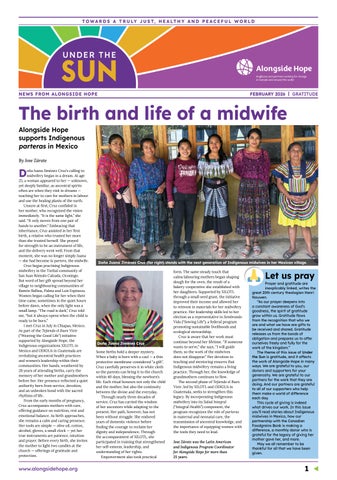
Doña Juana Jiménez Cruz (far right) stands with the next generation of Indigenous midwives in her Mexican village.
Doña Juana Jiménez Cruz Some births hold a deeper mystery. When a baby is born with a caul — a thin protective membrane considered “a gift”, Cruz carefully preserves it in white cloth so the parents can bring it to the church within 40 days, blessing the newborn’s life. Each ritual honours not only the child and the mother, but also the continuity between the divine and the everyday. Through nearly three decades of service, Cruz has carried the wisdom of her ancestors while adapting to the present. Her path, however, has not been without struggle. She endured years of domestic violence before finding the courage to reclaim her dignity and independence. Through the accompaniment of XILOTL, she participated in training that strengthened her self-esteem, leadership, and understanding of her rights. Empowerment also took practical
form. The same steady touch that calms labouring mothers began shaping dough for the oven, the result of a bakery cooperative she established with her daughters. Supported by XILOTL through a small seed grant, the initiative improved their income and allowed her to reinvest in materials for her midwifery practice. Her leadership skills led to her election as a representative in Sembrando Vida (“Sowing Life”), a federal program promoting sustainable livelihoods and ecological stewardship. Cruz is aware that her work must continue beyond her lifetime. “If someone wants to serve,” she says, “I will guide them, so the work of the midwives does not disappear.” Her devotion to teaching and mentoring ensures that Indigenous midwifery remains a living practice. Through her, the knowledge of grandmothers continues to flow. The second phase of Tejiendo el Buen Vivir, led by XILOTL and ODIGUA in Guatemala, seeks to strengthen this legacy. By incorporating Indigenous midwifery into its Salud Integral (“Integral Health”) component, the program recognizes the role of parteras in maternal and neonatal care, the transmission of ancestral knowledge, and the importance of equipping women with the tools they need to lead. Jose Zárate was the Latin American and Indigenous Program Coordinator for Alongside Hope for more than 25 years.
Let us pray
Prayer and gratitude are inexplicably linked, writes the great 20th century theologian Henri Nouwen. “As our prayer deepens into a constant awareness of God’s goodness, the spirit of gratitude grow within us. Gratitude flows from the recognition that who we are and what we have are gifts to be received and shared. Gratitude releases us from the bonds of obligation and prepares us to offer ourselves freely and fully for the work of the kingdom.” The theme of this issue of Under the Sun is gratitude, and it affects the work of Alongside Hope in many ways. We are grateful to you, our donors and supporters for your generosity. We are grateful to our partners for the work that they are doing. And our partners are grateful to all of our supporters who help them make a world of difference each day. This cycle of giving is indeed what drives our work. In this issue you’ll read stories about Indigenous midwives in Mexico, how our partnership with the Canadian Foodgrains Bank is making a difference, a monthly donor who is grateful for the legacy of giving her mother gave her, and more. May we all remember to be thankful for all that we have been given.
1