T O W A R D S A T R U LY J U S T, H E A L T H Y A N D P E A C E F U L W O R L D
UNDER THE
SUN
NOVEMBER 2025 | COMMITMENT
NEWS FROM ALONGSIDE HOPE
Time + commitment = partnership
A
FARMER PLANTS a seed deep into the ground, covers it with warm earth, and waters it regularly. She adds mulch and compost to help it thrive, making a commitment to nurture the plant, keep it alive and healthy until it bears fruit. It might take months or even years. A partnership – like the farmer’s plant – begins with a seed of hope. When Alongside Hope supports a partner, we commit to walking alongside them, nurturing the relationship as it grows. When you give to Alongside Hope, your faith in us – like the seed – grows every day. Whether it’s a onetime donation or a monthly gift or a legacy bequest – you’re committing to a life-giving project. When we all work together to love our neighbours, we are nurturing our baptismal covenant, feeding the commitment we have made to follow Christ. This issue of Under the Sun honours all of these commitments. We ask you to prayerfully consider committing to a monthly gift. Just as steady rain helps seeds grow strong, your monthly gift gives us the stability to plan ahead, respond quickly, and make a lasting impact. Please use this prayer at home or in your parishes to deepen your relationship with our work: God, Creator and Giver of all that is good, we thank you for our many blessings. Mindful of your generosity, we acknowledge that all that we have is from you. Daily, we offer you thanks and praise for the beauty of the earth, our work, our family and our loved ones. In the dawning of a new day, You are with us. In each dark hour, You are here. Blessed by Your grace, we show gratitude by sharing what we have. By serving our brothers and sisters, we serve You. As You protect and guide us on our journey, we, Your stewards, remain ever grateful for Your constant love. Amen. (Anglican Fellowship of Prayer)
www.alongsidehope.org
“I used to rely on food aid due to poverty. But this year, I chose not to submit my name for assistance, as I harvested more than enough.”
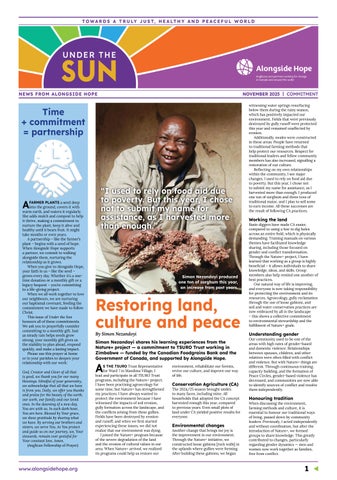
Simon Nezandoyi produced one ton of sorghum this year, an increase from past years.
Restoring land, culture and peace By Simon Nezandoyi
Simon Nezandoyi shares his learning experiences from the Nature+ project — a commitment to TSURO Trust working in Zimbabwe — funded by the Canadian Foodgrains Bank and the Government of Canada, and supported by Alongside Hope.
A
S THE TSURO Trust Representative for Ward 7 in Mandima Village, I lead and participate in all TSURO Trust programs, including the Nature+ project. I have been practising agroecology for some time, but Nature+ has strengthened my practices. I have always wanted to protect the environment because I have witnessed the impacts of soil erosion, gully formation across the landscape, and the conflicts arising from these gullies. Fields have been destroyed by erosion and runoff, and when we first started experiencing these issues, we did not realize that our environment was dying. I joined the Nature+ program because of the severe degradation of the land and the erosion of cultural values in our area. When Nature+ arrived, we realized its programs could help us restore our
environment, rehabilitate our forests, revive our culture, and improve our way of life.
Conservation Agriculture (CA)
The 2024/25 season brought smiles to many faces, including mine. All households that adopted the CA concept harvested enough this year, compared to previous years. Even small plots of land under CA yielded positive results for everyone.
Environmental changes
Another change that brings me joy is the improvement in our environment. Through the Nature+ initiative, we constructed loose gabions [rock walls] in the uplands where gullies were forming. After building these gabions, we began
witnessing water springs resurfacing below them during the rainy season, which has positively impacted our environment. Fields that were previously destroyed by gully runoff were protected this year and remained unaffected by erosion. Additionally, swales were constructed in these areas. People have returned to traditional farming methods that help protect our resources. Respect for traditional leaders and fellow community members has also increased, signalling a restoration of our culture. Reflecting on my own relationships within the community, I see major changes. I used to rely on food aid due to poverty. But this year, I chose not to submit my name for assistance, as I harvested more than enough. I produced one ton of sorghum and three tons of traditional maize, and I plan to sell some to earn income. All these successes are the result of following CA practices.
Working the land
Basin diggers have made CA easier, compared to using a hoe to dig holes across an entire field, which is physically demanding. Training manuals on various themes have facilitated knowledge sharing, including those focused on gender and conflict transformation. Through the Nature+ project, I have learned that working as a group is highly beneficial – it allows individuals to share knowledge, ideas, and skills. Group members also help remind one another of best practices. Our natural way of life is improving, and everyone is now taking responsibility for protecting the environment and its resources. Agroecology, gully reclamation through the use of loose gabions, and soil and water conservation practices are now embraced by all in the landscape – this shows a collective commitment to environmental stewardship and the fulfillment of Nature+ goals.
Understanding gender
Our community used to be one of the areas with high rates of gender-based and domestic violence. Relationships between spouses, children, and other relatives were often filled with conflict and violence. But with Nature+ things are different. Through continuous training, capacity building, and the formation of Peace Circles, gender-based violence has decreased, and communities are now able to identify sources of conflict and resolve them independently.
Honouring tradition
When discussing the environment, farming methods and culture, it is essential to honour our traditional ways of living, passed down by community leaders. Previously, I acted independently and without coordination, but after the introduction of Nature+, we formed groups to share knowledge. This greatly contributed to changes, particularly regarding gender dynamics — men and women now work together as families, free from conflict.
1