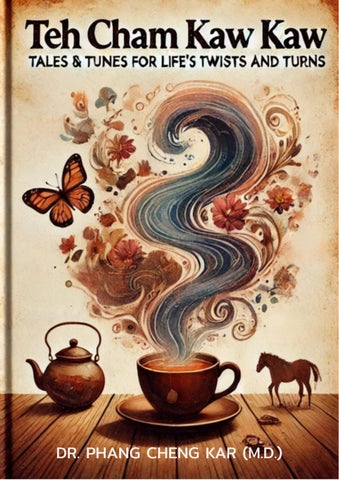
A relaxed, informal and unusual style
THE CHAM KAWKAW DR. PHANG
CHENG KAR (M.D.)
DR. PHANG CHENG KAR (M.D.)
Table Of Contents 1. Introduction: The Magic of Stories
4
1. The Empty Cup
11
2. The Old Man & The Horse: Maybe
18
3. The Falling Petals
25
4. The Flowing River
33
5. The Bamboo's Wisdom
39
6. The Tiger, Snake & Honey
45
7. The Two Bad Bricks
53
8. The Cracked Pot
59
9. The Wise Farmer & Shit Collector
65
10. The Perfect Garden
72
11. Donkey: Shake It O & Step Up
78
12. The Bu er y’s Struggle
84
TEH CHAM KAW KAW: Tales & Tunes For Life's Twists & Turns
Copyright
© 2025 Kuala Lumpur Buddhist Mental Health Association (BMHA).
All rights reserved.
This book is lovingly offered by the Kuala Lumpur Buddhist Mental Health Association (BMHA) to support the emotional well-being of the community. It’s intended for educational and non-commercial purposes, to be shared freely for the benefit of all beings.
May the messages and guidance of the stories in these pages bring you joy, peace, and happiness.
For inquiries, please get in touch with BMHA:
klbmha.info@gmail.com drphangsunmed@gmail.com
2
Dedication
To all my patients, past and present.
May you be safe, May you be healthy, May you be happy.
Thank you for trusting me with your journeys. Your courage and resilience have been my greatest inspiration. Every challenge you face and step you take reminds me of the incredible stories in this book and the strength we all have inside.
3
1. Introduction: The Magic of Stories
What is "Teh Cham Kaw Kaw"?
Teh Cham is a popular drink from Southeast Asia, especially Malaysia
and Singapore. It’s a unique blend of tea and coffee, combining the smooth, slightly bitter depth of coffee with milk tea's creamy, floral richness. The name comes from Cantonese—“teh” (tea) and “cham” (mix) —so it literally means “mixed tea.”
Teh Cham Kaw Kaw is a playful, flavorful Malaysian phrase that literally
means "a strong, thick blend of tea and coffee." In local slang, 'Kaw Kaw' also symbolizes something that’s rich, intense, and fullbodied—an experience that lingers, stirs the senses, and leaves you reflecting.
In this book, Teh Cham Kaw Kaw becomes a metaphor for life itself:
~ 5
5
A mix of bitter and sweet. A blend of story and song. A fusion of insight and kindness.
Like the drink, these tales and tunes are meant to be sipped slowly, savored deeply, and shared with warmth—especially during challenging times.
Let's listen to the theme song of this book now and set the 'kaw kaw' emotional tone of the book.
Teh Cham Kaw Kaw: Tales & Tunes for Life’s Twists & Turns Inspirational Stories & Songs
6
Verse 1:
When doubt and fear begin to grow, Tales help me find what I should know, They calm the tides that overflow, And guide my heart when winds do blow.
Verse 2:
Reflect on life’s twists and turns, In each challenge, new truth returns, Gentle reflections lift me higher, Songs of hope spark inner fire.
Chorus:
Teh Cham, sip the wisdom slow, A brew of stories, warm and bold. Teh Cham Kaw Kaw, where sweet and bitter flow, Taste the blend that soothes the soul.
Bridge:
Let words and melody intertwine, Breathe in calm and still your mind, Release the weight you hold inside, Find your peace with each new stride.
End:
With every sip of life you take, You FALL AWAKE, yeah... Teh Cham Kaw Kaw, you FALL AWAKE!
7
Since ancient times, stories
That’s how I created a unique way
have been one of the most
of sharing stories—one that doesn’t
powerful ways to teach—
just entertain but immerses you,
capturing the imagination,
guiding you through a five-step
stirring the heart, and
journey where each tale is
planting seeds of wisdom in
something to read, live, reflect
ways that lectures never
upon, and integrate into daily life.
could. From the parables of the spiritual masters to folk tales whispered through generations, stories don’t just tell—they transform.
Much like a cup of Teh Cham Kaw Kaw—a rich, bold, and deeply
satisfying mix of flavors—this book blends stories, reflections, and melodies to nourish the heart and
I’ve always been fascinated
mind during challenging times.
by stories. They carry truths that can’t always be explained but must be felt, experienced, and lived. Over the years, I realized that the most powerful stories don’t just sit
A New Way to Experience Stories
on the page—they pull you in, engage your senses, and invite you to explore your
Each story in this book unfolds in five engaging parts designed to draw you in, help you reflect, and
mind.
leave a lasting impact: Then I thought: What if storytelling could be more than just telling? What if it could be an experience?
1. The Story Unfolds – First, you’ll
read the tale in its classic form as it's passed down through generations.
TEH CHAM KAW KAW: Tales & Tunes For Life's Twists & Turns 8
2. Your Turn to Reflect – Here, the story becomes interactive. You step
into the world of the tale, making choices and discovering new perspectives.
3. Inner Dialogue – This section simulates the thoughts and emotions we
all experience in real life, helping you connect the story’s lessons to your journey.
4. Guided Meditation – A gentle visualization designed to help you
embody the story’s wisdom, understand it, and feel it deeply.
5. Song: The Story in Melody – I’ve created original songs with Suno AI to
reinforce each lesson. These tunes help anchor the messages in your heart, making them easy to recall when you need them most.
Through this five-step storytelling experience, each tale becomes a journey of self-discovery, offering insights beyond words and into real, lived experiences.
12 Stories, 12 Journeys In this book, I share twelve of my favorite stories—timeless tales that have helped me navigate uncertainty, embrace change, and find meaning in life's challenges. These aren’t just stories; they’re companions for difficult times, offering new ways to see, feel, and respond to whatever life throws your way.
TEH CHAM KAW KAW: Tales & Tunes For Life's Twists & Turns 9
Like a strong cup of ‘Teh Cham Kaw Kaw,’ these stories are meant to be savored—rich, layered, and deeply enriching. Life can be unpredictable, bittersweet, and full of contrasts, but sometimes, the blend of experiences makes it meaningful.
I hope these stories speak to you, bringing insight, comfort, and inspiration whenever needed. Whether you’re searching for guidance, clarity, or simply a moment of peace, may these tales and tunes be a source of strength in your journey. Let the adventure begin!
TEH CHAM KAW KAW: Tales & Tunes For Life's Twists & Turns 10
1. The Empty Cup
TEH CHAM KAW KAW: Tales & Tunes For Life's Twists & Turns
A. The Story Unfolds A professor of philosophy visited a Zen master, eager to learn about Zen. He had read many books, studied the teachings, and considered himself knowledgeable in the field.
As the professor sat down, the Zen master quietly prepared tea. He boiled the water, arranged the cups, and carefully began pouring.
TEH CHAM KAW KAW: Tales & Tunes For Life's Twists & Turns 12
The professor started talking about all that he knew—his understanding of Zen, his theories, his interpretations. As he spoke, the Zen master continued to pour tea into the professor’s cup.
The tea reached the brim, but the master did not stop. The tea overflowed, spilling onto the table, dripping onto the floor.
"Master!" the professor exclaimed. "The cup is full! No more will go in!"
The Zen master stopped pouring and looked up. "Like this cup," he said, "You're full of your own opinions and ideas. How can I teach you Zen unless you first empty your cup?"
B. Your Turn to Re ect You sit across from the Zen master, watching as the tea overflows. The warm liquid spills over the edges, soaking into the wood.
"Master," you ask, "why do you continue pouring when the cup is already full?"
The Zen master looks at you with a gentle smile. "Why do you seek learning when your mind is already full?"
You pause. His words sink in. How many times have you approached something new already convinced that you know the answer? How often have you been so sure of your beliefs that there was no room for another perspective?
Now, reflect on your own experience.
TEH CHAM KAW KAW: Tales & Tunes For Life's Twists & Turns 13
Option 1: "I approach learning with a full cup."
You realize that in conversations and life itself, you often hold onto what you already know. Your past experiences, opinions, and certainties shape how you listen. Could it be that your certainty prevents deeper understanding? What would it feel like to empty your cup, even just a little? Imagine listening without needing to be right, approaching each moment with curiosity. What new insights might flow in if you made space for them?
Option 2: "I want to empty my cup, but I don’t know how."
Letting go of what you know is difficult. The mind clings to familiarity, drawing comfort from past knowledge. But true learning begins when we step into the unknown. Could you try, just once, to listen without preparing a response? To be present without assumption? Growth doesn’t come from knowing—it comes from questioning. What might you discover if you let yourself unlearn?
Option 3: "I have been on the other side."
Think back to a time when you tried to share something important, but the listener wasn’t open. Their cup was already full, leaving no room for your words. How did that feel? And now, looking at yourself—have you ever done the same? Before dismissing another’s perspective, what if you paused and made space to hear them? What shifts when you listen, not to reply, but to understand?
TEH CHAM KAW KAW: Tales & Tunes For Life's Twists & Turns 14
C. Inner Dialogue How often do I walk into a situation thinking I already know the answer?
You remember when you dismissed another perspective because it didn’t fit what you already believed. How many learning opportunities have been lost because you assumed you already understood?
Maybe my mind is like the cup—so full that nothing new can enter.
You imagine what it would feel like to approach a conversation, a lesson, a new experience with genuine openness. To listen without needing to be right. To be humble in the face of learning.
I don’t need to throw away what I know. I just need to make space for something new.
You take a deep breath, feeling the weight of certainty loosen.
I can empty my cup.
D. Guided Meditation Close your eyes.
Take a deep breath in… hold it for a moment… and then slowly breathe out, releasing any tension, any rigidity of thought.
Now, imagine you're sitting across from the Zen master.
In front of you is an empty teacup. The porcelain is smooth, the rim cool beneath your fingertips.
The Zen master lifts the teapot and begins to pour.
TEH CHAM KAW KAW: Tales & Tunes For Life's Twists & Turns 15
As the warm tea flows, imagine it represents knowledge, wisdom, and experience.
But your cup is already full.
The tea spills over, dripping down the sides, unable to be contained.
Now, imagine your mind as the cup.
Everything you already know, opinions, and judgments fill the space, leaving no room for anything new.
Now, take a deep breath in… and as you exhale, imagine gently emptying the cup.
See the tea slowly receding, making space for something fresh.
With each breath, your mind softens. You become open and receptive. You don't need to abandon what you know—only to make space for what you don't yet understand.
Silently affirm to yourself:
"I release my need to be full. I create space to learn. I open my mind to new wisdom."
As you breathe in, feel the openness, the curiosity, the lightness of not needing to know everything.
When you're ready, gently open your eyes, carrying with you the wisdom of the empty cup.
Now, ask yourself: In what part of my life do I need to empty my cup?
TEH CHAM KAW KAW: Tales & Tunes For Life's Twists & Turns 16
E. The Story in Melody:
The Empty Cup Song: Cultivating an Open & Beginner’s Mind
In the beginner's mind there are many possibilities, in the expert's mind there are few — Shunryu Suzuki, Zen master & author of Zen Mind, Beginner’s Mind
TEH CHAM KAW KAW: Tales & Tunes For Life's Twists & Turns 17
2. The Old Man & The Horse: Maybe
TEH CHAM KAW KAW: Tales & Tunes For Life's Twists & Turns
Once upon a time, in a small village, there lived an old man who owned a horse. This horse was invaluable to him, assisting with many daily tasks. One day, the horse ran away.
Upon hearing the news, the neighbors came to the old man and lamented, "Oh, what bad luck! Your horse has run away. How will you manage without it?"
A. The Story Unfolds
The old man simply replied, "Maybe."
A few days later, the horse returned, bringing with it a wild stallion. The neighbors, seeing this, exclaimed, "Oh, what good fortune! Now you have not only your horse back but also this magnificent wild stallion!"
The old man responded, "Maybe."
TEH CHAM KAW KAW: Tales & Tunes For Life's Twists & Turns 19
The following day, his son attempted to tame the wild stallion. In the process, he was thrown off and broke his leg. The neighbors, upon hearing of this misfortune, came to console the old man, saying, "Oh, what bad luck! Your son is injured and can't help you now."
The old man replied, "Maybe."
Sometime later, the king's army marched through the village, conscripting young men to fight in a distant war. Seeing the son's injury, they passed him by. The neighbors, witnessing this, said, "Oh, what good fortune! Your son is spared from the war and possible death."
The old man answered, "Maybe."
B. Your Turn to Re ect You sit beside the old man, observing the unfolding events. First, the horse’s departure is deemed bad luck. Then, its return with a wild stallion is seen as good fortune. The son’s injury is labeled bad luck, but his exemption from war is considered good luck.
"Master," you inquire, "How do we truly know if something is good or bad? The villagers seem so certain in their judgments."
The master smiles gently and replies, "Maybe."
You feel a sense of calm with his words, but the idea of not labeling events feels unfamiliar. In your own life, how often have you judged a situation as either good or bad? You may have faced setbacks in your career, health, or relationships—did you immediately label them as failures? What if, like the old man, you allowed life’s events to unfold before making a judgment?
TEH CHAM KAW KAW: Tales & Tunes For Life's Twists & Turns 20
Think about a situation in your life where you’ve immediately labeled it as either "good" or "bad." What if, instead, you took a step back and said, "Maybe?" How would this change your perspective?
Pause for a moment. How does this relate to your own life?
Option 1: "This is bad luck."
You face a challenge or loss, and the first instinct is to label it as bad luck. It could be a setback in a relationship, career, or health. But how often have you later seen that what seemed like bad luck actually led to growth, new opportunities, or even deeper understanding? Could this event be part of a larger, more complex journey that you don’t yet understand?
Option 2: "This is good fortune."
You experience a success or gain, and you immediately celebrate it as good fortune. Perhaps it’s a new job, a new relationship, or an unexpected gift. But what if the good fortune brings challenges that you haven’t seen yet? Could this "good" fortune lead to unexpected difficulties that might ultimately help you grow? How might your understanding of success change if you acknowledged that both joy and struggle exist side by side?
Option 3: "I don’t know what this means."
You sit with the uncertainty of a situation, neither labeling it as good nor bad. Instead of rushing to judgment, you choose to observe. What if you embraced this "Maybe" mindset and allowed yourself to be present with your experiences without rushing to label them? Could you find peace in accepting that life will reveal its meaning over time?
TEH CHAM KAW KAW: Tales & Tunes For Life's Twists & Turns 21
C. Inner Dialogue Why do I need to label everything as good or bad? you wonder. How often have I made quick judgments about events in my life, only to realize later that my initial reaction wasn’t the whole truth?
Maybe this story is a reminder to pause, to not rush to conclusions about life’s events, you reflect. The old man doesn’t react with judgment, but with acceptance—he remains open to the possibility that everything has its purpose.
You think about your own life. How often have you rushed to conclusions about challenges or successes? You recall a situation where you immediately labeled it as bad luck, only to discover later that it was a necessary part of your growth. Perhaps there was a relationship that didn’t work out or a project that failed, but they eventually led you to something far better. Would you have been able to see that if you hadn’t been so quick to judge?
Maybe I don’t need to know the outcome right away, you tell yourself.
Maybe I can let go of the pressure to label everything, and simply trust that life is unfolding exactly as it should.
D. Guided Meditation Close your eyes.
Take a deep breath in… hold it for a moment… and then slowly breathe out, releasing any tension. With each breath, feel yourself becoming more relaxed, more present.
TEH CHAM KAW KAW: Tales & Tunes For Life's Twists & Turns 22
Imagine sitting beside the old man, observing the events unfold. The horse runs away, the villagers react with distress. The horse returns with a wild stallion, and the villagers celebrate. The son is injured, and the villagers are concerned. But then, the king’s army comes and passes by the son due to his injury, and the villagers rejoice.
Through it all, the old man remains serene, responding with "Maybe." There’s no judgment, no rush to declare whether things are good or bad. The old man trusts that the full meaning of life’s events will reveal itself in time.
Feel the peace in this response. As you breathe deeply, consider how you might apply this "Maybe" mindset to your own life. What if, instead of rushing to judge the challenges you face, you simply observed them, knowing that only time will reveal their true meaning?
Let go of the need to label every situation. Embrace the uncertainty and trust that life is unfolding as it should. With each breath, feel yourself becoming lighter, more at peace with the flow of life.
When you're ready, open your eyes, carrying with you the wisdom of "Maybe." Life’s events may not always be what they seem, and by
releasing the need to judge, you open yourself up to the deeper lessons they bring
TEH CHAM KAW KAW: Tales & Tunes For Life's Twists & Turns 23
E. The Story in Melody:
You can put any text here
Old Man’s Horse: Maybe – A Tranquil Song for Equanimity & Emotional Balance.
Good, bad, who knows? — Taoist Proverb
TEH CHAM KAW KAW: Tales & Tunes For Life's Twists & Turns 24
3. The Falling Petals
TEH CHAM KAW KAW: Tales & Tunes For Life's Twists & Turns
A. The Story Unfolds A Zen master and his student sat beneath a cherry blossom tree. The spring breeze whispered through the branches, sending delicate pink petals floating to the ground.
The student sat with his brows furrowed, frustration evident in his posture. “Master, I feel like I'm not progressing. I meditate, I practice, but nothing changes.”
The master remained still, his eyes on the falling petals. “Do you see the petals?” he asked.
“Yes,” the student replied. “They are beautiful, but they fall so quickly.”
“Exactly,” the master said. “Everything is like these petals. The beauty is in the falling, the change, the impermanence. Your practice isn't about reaching a point of stillness but learning to find peace amidst the falling.”
As the student watched the petals drift to the earth, his frustration softened. He understood that progress was not a destination but a way of seeing the world.
B. Your Turn to Re ect You sit beneath the cherry blossom tree, its branches swaying gently in the breeze. Petals fall around you, soft and delicate, like fragments of spring itself. Despite the beauty, a weight presses on your chest, and you sigh in frustration.
TEH CHAM KAW KAW: Tales & Tunes For Life's Twists & Turns 26
"Master," you say, your voice tinged with weariness, "I meditate, I practice, but I don't feel any different. I’m not progressing."
The master looks at you, his gaze calm. He points to the falling petals. "Do you see the petals?" he asks.
You nod. "Yes, they are beautiful, but they fall so quickly."
"Exactly," the master replies. "Do you think the petals fail because they fall? No. They fall because it's their time. Peace is found not in stillness, but in accepting the flow."
You watch the petals fall, feeling the weight of your frustration shift.
Now, the choice is yours:
Option 1: "I see that everything is in constant change."
You watch the petals as they fall, touching the earth before being carried away by the wind. You realize that everything in life, including your thoughts and feelings, is like these petals—momentary, fleeting.
Can I find peace in the flow?" the master asks.
You close your eyes, breathing deeply, and feel a soft smile form as you embrace the change around you.
Option 2: "I wish the petals would stay longer."
The thought crosses your mind—why can’t the petals stay a little longer? But as you focus on them, you notice that their impermanence enhances their beauty. You see that holding onto them would be like trying to stop time. The master speaks softly:
TEH CHAM KAW KAW: Tales & Tunes For Life's Twists & Turns 27
"Would the petals be as beautiful if they did not fall?"
You look at the petals, and for the first time, you let go of the desire to hold them, realizing that the beauty lies in their impermanence.
Option 3: "The petals fall, but my mind keeps spinning."
You watch the petals flutter and fall, but your mind keeps racing. You’re not at peace, not yet. The master turns to you with a gentle expression.
"Can you sit with your mind, just as you sit with these falling petals?" he asks.
You breathe in deeply, letting your thoughts be as they are. With each exhale, you feel the tension ease, and the petals fall, reminding you that peace comes from allowing.
Reflect on what you’ve experienced in this moment. Do you notice a shift in how you view your struggles, desires, and regrets? The Zen master’s words remind you that everything in life is impermanent. Like the falling petals, you too can flow with the changes, releasing what no longer serves you.
C. Inner Dialogue What am I doing wrong? you think. Why can’t I progress? Why is it so hard to let go?
You look at the falling petals again. Maybe I’ve been holding on too tightly to my expectations. I thought I would be somewhere else by now, but here I am. Still struggling, still trying.
TEH CHAM KAW KAW: Tales & Tunes For Life's Twists & Turns 28
But isn’t that the point? you ask yourself. That’s the nature of life—to be in constant change. If I’m holding on, I’m resisting what’s already happening. What if peace is found in letting go of the need to be different, to be somewhere else?
You close your eyes, breathing deeply. Let it go. Let it all go. Just like the petals.
And as you think this, you begin to realize—maybe you’ve been fighting your struggles instead of accepting them. Maybe, just like the petals, your challenges don’t need to be fixed or held onto. They can be allowed to fall, and in that letting go, peace may find you.
You're not alone in your struggles, just as the petals aren't alone in their fall. Life’s challenges are part of the flow, and by releasing your grip on them, you can move forward, just as the petals do.
The ower that blooms in adversity is the most rare and beautiful of all. — Walt Disney’s Mulan (via the Emperor)
D. Guided Meditation Close your eyes.
TEH CHAM KAW KAW: Tales & Tunes For Life's Twists & Turns 29
Take a deep, gentle breath in… hold it for a moment… and then slowly breathe out, letting go of any tension you may be holding. With each breath, you feel more relaxed, more at ease. Feel the rhythm of your breath, steady and calm.
Imagine you're sitting beneath a cherry blossom tree. The air around you is fresh, cool, and the scent of the blossoms fills your senses. The soft rustling of the leaves above is accompanied by the quiet whisper of the breeze.
You're safe here. This is your place of peace.
Now, look up at the branches of the tree. You see the delicate pink petals floating down, carried gently by the wind. Each petal drifts slowly through the air, touching the earth softly before it’s carried away by the breeze.
These petals remind you that everything is temporary, and that's perfectly okay. With each falling petal, you're reminded that you, too, can let go and flow with life.
Feel the softness of the ground beneath you, and as you inhale again, feel yourself becoming more grounded, more connected to this moment.
The Zen master sits beside you, calm and serene. His presence is gentle but strong.
"Do you see the petals?" he asks softly, his voice a calming presence in the stillness. "They fall not because they fail, but because it's their time. Just like you, they move with the flow of life."
TEH CHAM KAW KAW: Tales & Tunes For Life's Twists & Turns 30
Take a moment to absorb his words. Feel them sink in. Everything in your life, just like the petals, is part of an ever-moving flow. Nothing is permanent, and that's the beauty of it.
Now, imagine that you're holding a petal in your hand. It’s light, fragile, but it holds all your worries, your regrets, the weight you’ve been carrying.
Hold the petal gently. Notice its delicate texture. Feel its softness between your fingers. This petal represents all that you’ve been struggling to let go of.
Take another deep breath in… and as you exhale, feel the weight of this petal in your hand, acknowledging its presence.
"When you're ready," the master’s voice comes to you softly again, "you may release the petal into the breeze."
Take your time… You don’t have to rush. Notice how the petal feels, how it fits perfectly in your hand. Then, when you’re ready, slowly open your fingers. Watch as the petal floats away, carried by the gentle wind.
Feel the lightness as you release it. Feel the freedom as it drifts away from you. You're no longer holding on to it. It’s okay to let it go.
The master’s voice reaches you again. "The petals fall, just as you can release. You can let go and move forward."
Now, imagine that all of your thoughts, your worries, your regrets, and your burdens are like that petal. They are drifting away, carried gently by the breeze. You’ve given them up, and they no longer weigh you down.
As you sit there, breathing deeply, feel something shift inside of you. A gentle warmth spreads through your chest, and with each breath, a sense of peace grows stronger.
TEH CHAM KAW KAW: Tales & Tunes For Life's Twists & Turns 31
The master’s final words are a soft reminder: "Let go, and trust that the flow will carry you to where you need to be." The petals continue to fall
around you, each one a reminder that everything changes, everything flows, and everything has its time.
And as you sit there, calm and still, you realize that you, too, are part of this beautiful flow. You're in the present moment. You're at peace.
When you're ready, open your eyes. Take a deep breath in, and carry the peace of this moment with you, knowing that you can always return to this place whenever you need to.
E. The Story in Melody
Falling Petals: Let It Be – Song on Finding Peace Amid Life’s Changes & Challenges
TEH CHAM KAW KAW: Tales & Tunes For Life's Twists & Turns 32
4. The Flowing River
TEH CHAM KAW KAW: Tales & Tunes For Life's Twists & Turns
A. The Story Unfold A Zen master and his student sat by a gently flowing river. The student sighed in frustration, staring at the water.
"Master," he said, "I can't stop thinking about my past mistakes. They follow me like shadows."
The master picked up a leaf and placed it in the river. The student watched as the current carried it away, out of sight.
"See how the river doesn't hold onto anything?" the master said. "It flows, letting go of all that enters. Be like the river—release the past, and move forward."
The student exhaled slowly, watching the water, feeling lighter with each breath.
B. Your Turn to Re ect You sit by the river, watching the gentle flow of water as it moves effortlessly along its course. The sound of the water, the rustling of leaves, and the peaceful atmosphere help calm your mind.
"Master," you say, your voice heavy with regret, "I can't seem to let go of my past mistakes. They linger in my thoughts, like shadows that follow me wherever I go."
The master nods, picking up a leaf from the ground and placing it gently in the river. You watch as the current carries the leaf away, out of sight.
TEH CHAM KAW KAW: Tales & Tunes For Life's Twists & Turns 34
"Do you see how the river doesn't hold onto anything?" the master asks. "It simply flows, letting go of everything it touches. Just like the river, you too can release the past and move forward."
Imagine yourself in this situation. What would you do?
Option 1: "I can release my past, just like the river."
You watch the leaf drift away, carried by the current, and feel the weight of your regrets lift from your shoulders. You realize that, like the river, you too can let go of the past. Take a deep breath, and imagine your regrets flowing away with the river. How would it feel to release them, just like the leaf?
Option 2: "I wish I could forget my past mistakes."
You watch the river, and for a moment, you long for the peace of forgetting the past. But as you look closer, you realize that the river doesn't try to forget. It simply moves forward, unburdened by what has passed. You, too, can move forward, carrying the wisdom of your past without holding onto it. How would it feel to embrace the flow and let go?
Option 3: "I want to move forward, but my past still holds me back."
You observe the river’s steady flow, and a thought arises: The water doesn’t try to hold onto anything. It simply flows. Perhaps you can do the same. Take a moment to think about a specific past mistake or regret that's holding you back. What would it feel like to release it, trusting that the current of life will carry you forward?
TEH CHAM KAW KAW: Tales & Tunes For Life's Twists & Turns 35
C. Inner Dialogue Why can't I let go of my past? you wonder. I want to move forward, but these thoughts keep coming back, like shadows that follow me wherever I go.
You look at the river. The river doesn’t resist; it just lets go and moves forward. Why am I fighting to hold onto the past?
Maybe I've been trying too hard to forget, you realize. I don’t need to forget. I can simply release it, like the river releasing everything it touches.
You close your eyes, taking a deep breath. Let go. Let the current carry it away, just like the river. I don’t need to carry the past anymore.
D. Guided Meditation Close your eyes.
Take a deep breath in… hold it for a moment… and then slowly breathe out, letting go of any tension you may be holding. With each breath, you feel more relaxed, more at ease. Feel the rhythm of your breath, steady and calm.
Imagine yourself sitting by the river, its gentle flow soothing your mind. The water moves effortlessly, carrying everything in its path without resistance. The sound of the water is peaceful, and the breeze caresses your face.
TEH CHAM KAW KAW: Tales & Tunes For Life's Twists & Turns 36
Now, picture a leaf floating gently in the river. Watch as the current picks it up and carries it downstream, far from sight. Just like the river, you, too, can release your past. Feel the weight of your regrets, mistakes, and worries lift away, like the leaf, as the river moves forward.
With each breath, you feel lighter. You realize that, just like the river, you don't need to hold onto anything. The past has passed, and now you can flow with the present moment, unburdened.
As the river continues to flow, you feel the peace of releasing what no longer serves you. You're free to move forward, trusting that life will carry you, just as the river carries the leaf.
When you're ready, open your eyes, carrying this wisdom with you— the wisdom of the flowing river: to let go, release the past, and trust in the current of life.
TEH CHAM KAW KAW: Tales & Tunes For Life's Twists & Turns 37
E. The Story in Melody:
Like The River: Free & Wide – Soothing Music on Flowing Beyond Yesterday's Troubles
No man ever steps in the same river twice, for it’s not the same river and he’s not the same man. — Heraclitus, Greek philosopher
TEH CHAM KAW KAW: Tales & Tunes For Life's Twists & Turns 38
5. The Bamboo's Wisdom
TEH CHAM KAW KAW: Tales & Tunes For Life's Twists & Turns
A. The Story Unfolds A Zen master and his student walked through a bamboo forest. The towering stalks swayed gently in the wind, their rhythmic creaks filling the air.
The student sighed. "Master, my heart is heavy. I hold onto the past, and it weighs me down."
The master stopped and tapped a bamboo stalk. It bent gracefully but did not break.
"Do you see how the bamboo bends?" he asked.
The student nodded.
"The bamboo doesn't resist the wind, nor does it cling to it. It simply sways and returns to its natural state. Be like the bamboo—flexible, resilient, and unburdened by what has passed."
The student touched the bamboo, feeling its strength. He smiled, understanding at last.
B. Your Turn to Re ect You walk through the bamboo forest, the tall stalks swaying with the gentle breeze. The sound of their rhythmic creaks fills the air, and you feel the softness of the wind brushing past your face.
"Master," you say, your voice weighed down by the past, "I find it hard to let go. The regrets and memories from the past still hold me."
TEH CHAM KAW KAW: Tales & Tunes For Life's Twists & Turns 40
The master stops and gently taps a bamboo stalk. It bends gracefully, yielding to the wind.
"Do you see how the bamboo bends?" he asks.
You nod. "Yes, it bends with the wind, but it doesn’t break."
"Exactly," the master replies. "The bamboo doesn't resist; it flows with the wind. Just like the bamboo, you too can bend with life’s changes and let go of what burdens you."
Take a deep breath. What lessons from this story echo in your own journey?
Option 1: "I can bend like the bamboo."
You take a deep breath, imagining yourself as flexible as the bamboo, letting go of the past. You feel lighter, knowing that you don’t need to carry the weight of regrets. Think about a situation in your life where you’ve been holding on to the past—maybe an old hurt, a failure, or a missed opportunity. Now, imagine releasing that burden, just like the bamboo bending with the wind. How would it feel to let go and move forward?
Option 2: "I want to let go, but I feel stuck."
You sense resistance inside. You’ve tried, but there’s something that keeps pulling you back. But as you watch the bamboo bend, you realize that it doesn't fight the wind. It simply yields, and in that yielding, it remains strong. Maybe you, too, can let go. Think about something in your life you’re struggling to release—what would it feel like to simply yield, trust that you don’t need to fight it, and let it flow away?
TEH CHAM KAW KAW: Tales & Tunes For Life's Twists & Turns 41
Option 3: "Can I be as resilient as the bamboo?"
You observe the bamboo’s grace and resilience. It bends but never breaks, returning to its natural state. You, too, can find this resilience, moving with the winds of life without being weighed down by them. Think about a difficult challenge you’ve faced—how did you bend and adapt, just like the bamboo, in order to grow stronger? Imagine yourself with that same flexibility, accepting the flow of life.
C. Inner Dialogue Why do I still hold on to the past? you think. I want to move forward, but the memories feel like heavy chains.
You look at the bamboo. It bends, but it doesn't break. Why can’t I do the same?
Maybe I’ve been trying too hard to resist the flow of life, you realize. Just like the bamboo, I can bend with the wind. The past doesn’t need to hold me. I can let go and find peace.
You close your eyes, taking a deep breath. Let go. Let it all go, just like the bamboo sways with the wind.
And as you think this, you begin to realize—maybe you’ve been fighting your struggles instead of accepting them. Maybe, just like the bamboo, your challenges don’t need to be fixed or held onto. They can be allowed to fall, and in that letting go, peace may find you.
You're not alone in your struggles, just as the bamboo isn't alone in its bending. Life’s challenges are part of the flow, and by releasing your grip on them, you can move forward, just as the bamboo does.
TEH CHAM KAW KAW: Tales & Tunes For Life's Twists & Turns 42
D. Guided Meditation Close your eyes.
Take a deep breath in… hold it for a moment… and then breathe out slowly, letting go of any tension. With each breath, you feel more relaxed, more at ease. Feel the rhythm of your breath, steady and calm.
Imagine yourself standing in the midst of a bamboo forest. The tall bamboo stalks sway gently around you, their creaks filling the air. The breeze brushes past your skin, and you feel calm, centered, and present.
Now, look at the bamboo. See how it bends with the wind, not resisting, but flowing with the natural rhythm of life. Just like the bamboo, you too can bend and sway, releasing the past and embracing the present.
Feel the strength of the bamboo beneath your touch. it's flexible, resilient, and unburdened. You're like this bamboo—strong yet gentle, unburdened by what has passed.
Take a deep breath in, and as you exhale, feel yourself letting go of any past burdens. Allow them to drift away, like leaves carried by the breeze. You don't need to hold onto them anymore.
The wind continues to blow, and the bamboo bends but doesn't break. You, too, can bend with life’s winds, knowing that you will always return to your natural state of peace and strength.
When you're ready, open your eyes, carrying this wisdom with you— flexible, resilient, and free.
TEH CHAM KAW KAW: Tales & Tunes For Life's Twists & Turns 43
E. The Story in Melody:
Bamboo: Bend, Don’t Break – Tune on Strength in Flexibility
The bamboo that bends is stronger than the oak that resists. — Japanese Proverb
TEH CHAM KAW KAW: Tales & Tunes For Life's Twists & Turns 44
6. The Tiger, Snake & Honey
TEH CHAM KAW KAW: Tales & Tunes For Life's Twists & Turns
A. The Story Unfolds A man was being chased by a tiger in the jungle. Tigers can run much faster than men, and they eat men too. The tiger was hungry; the man was in trouble.
With the tiger almost upon him, the man saw a well by the side of the path. In desperation, he leapt in. But as soon as he committed to the leap, he saw what a big mistake he had made. The well was dry, and at its bottom, he could see the coils of a big black snake.
Instinctively, his arm reached for the side of the well, where his hand found the root of a tree. The root stopped his fall. When he gathered his senses, he looked down to see the black snake raise its head to strike at his feet; but his feet were just out of reach. He looked up to see the tiger leaning into the well, trying to paw him from above; but his hand holding the root was just too low.
As he contemplated his dire predicament, he saw two mice, one white and one black, emerge from a small hole and begin chewing on the root.
As the tiger pawed at him, its hindquarters rubbed against a small tree, causing it to shake. On a branch of that tree, overhanging the well, was a beehive. Honey began to drip into the well. The man stuck out his tongue and caught some.
"Mmmm! That tastes good," he said to himself and smiled.
But just as he savored the honey, the mice chewed the root thinner and thinner, the black snake stretched closer to his feet, and the tiger leaned even farther into the well.
TEH CHAM KAW KAW: Tales & Tunes For Life's Twists & Turns 46
Then, the tiger leaned too far. It tumbled into the well, missing the man, crushing the snake to death, and dying itself in the fall.
B. Your Turn to Re ect You find yourself in the well, suspended between dangers. Above you, the tiger waits, fierce and relentless. Below, the snake coils, ready to strike. The mice chew steadily at the root, symbolizing time slipping away.
TEH CHAM KAW KAW: Tales & Tunes For Life's Twists & Turns 47
Yet, amidst all of this, the honey drips. Sweet, golden, untouched by fear or danger.
"Master," you say, "How can the man enjoy the honey when his life is hanging by a thread?"
The master smiles. "Because at that moment, there's nothing else he can do. The past has already brought him here. The future is uncertain. But right now, there's honey, and he can choose to taste it."
Now, reflect on your own life.
Option 1: "I feel trapped, overwhelmed by problems."
You're caught between challenges—responsibilities, worries, fears. Life feels like a tightrope, with threats at every turn. But is there something sweet even now? A simple joy, a quiet moment that reminds you that life is still happening?
Option 2: "I fear the future, but I don’t know what will happen next."
The tiger leaned too far, and everything changed. What if, right now, you're fearing something that may never happen? Or something that, when it does happen, might unfold differently than you expect? Could life surprise you in a way you don’t yet see?
Option 3: "I focus too much on what I can’t control."
The man in the well couldn’t control the tiger, the snake, or the mice. But he could taste the honey. What if, instead of trying to fix everything, you allowed yourself to experience the sweetness of what is here, now?
TEH CHAM KAW KAW: Tales & Tunes For Life's Twists & Turns 48
C. Inner Dialogue Why do I always worry about what’s coming next?
You think about your own struggles—the things that keep you up at night, the fears that linger in your mind.
But what if I don’t need to figure everything out?
You recall times when you were certain things would turn out badly—yet they didn’t. Something unexpected happened, shifting everything in ways you couldn’t have predicted.
Maybe I don’t need to predict everything now either, you realize. Maybe life is full of surprises, and some of them will save me in ways I can’t yet see.
You take a deep breath.
I can enjoy the honey, not because my problems are gone, but because I don’t know how they will unfold yet. Maybe something unexpected is waiting for me too.
TEH CHAM KAW KAW: Tales & Tunes For Life's Twists & Turns 49
D. Guided Meditation Close your eyes.
Take a deep, slow breath in… hold it for a moment… and then slowly exhale, letting go of any tension. With each breath, allow yourself to soften, to settle into the present moment.
Now, imagine yourself in the well.
Above you, the tiger growls, its claws reaching for you. Below, the snake coils, watching. The mice chew at the root, steadily, inevitably.
But then, something else.
A golden drop of honey falls in front of you.
You put out your tongue, catching it. it's warm, rich, sweet. And in that moment, nothing else matters. Not the tiger, not the snake, not the mice.
For just a moment, there's only the sweetness of now.
And then—
The tiger leans too far.
It tumbles into the well, crashing down, missing you entirely.
The impact crushes the snake, and the danger disappears.
You did not need to fight. You did not need to fix anything.
Life took care of it for you.
And just like that, everything changes.
TEH CHAM KAW KAW: Tales & Tunes For Life's Twists & Turns 50
Now, reflect on your own life.
Is there something you're worrying about that might resolve in a way you don’t expect? Could the thing you fear most end up being the thing that saves you?
Take a deep breath in… and as you exhale, let go of the need to control it all.
You don't need to have all the answers. Life will take care of them.
Silently affirm to yourself:
"I trust life’s unfolding. I release the need to control. I allow myself to enjoy life’s sweetness."
Feel this truth settling in your heart.
Life is uncertain, unpredictable… and sometimes, the tiger falls.
When you're ready, open your eyes. Carry this wisdom with you. The future remains unknown, but at this moment, there's honey.
Will you taste it?
TEH CHAM KAW KAW: Tales & Tunes For Life's Twists & Turns 51
E. The Story in Melody:
A Drop of Honey in the Rain – Soundscape to Embrace the Present Moment
You can’t stop the waves, but you can learn to surf. — Jon Kabat-Zinn, founder of Mindfulness-Based Stress Reduction (MBSR)
TEH CHAM KAW KAW: Tales & Tunes For Life's Twists & Turns 52
7. The Two Bad Bricks
TEH CHAM KAW KAW: Tales & Tunes For Life's Twists & Turns
A. The Story Unfolds A young monk, eager to contribute, was assigned the task of building a brick wall for the monastery. With great care and precision, he laid each brick, making sure they were perfectly aligned.
Days of hard work passed, and when the wall was finally completed, he stepped back to admire his work. But then he saw them—two bricks that were out of place.
They weren’t perfectly aligned like the others. They stood out, crooked and uneven. His heart sank. The entire wall was ruined.
The monk was deeply upset. Every time he walked past the wall, his eyes focused only on those two bad bricks. He even asked the abbot if he could tear the wall down and start again.
One day, a visitor came to the monastery. As they walked past the wall, the monk couldn’t help but point it out. "Look at those two bad bricks. I built this wall, and I ruined it with those mistakes."
The visitor smiled. "Yes, I see the two bad bricks. But I also see the 98 perfect bricks surrounding them."
The monk was stunned. He had been so focused on the two mistakes that he had failed to see the rest of the wall—the solid, well-built, beautiful work that stood strong.
For the first time, he saw the whole wall instead of just the flaws.
TEH CHAM KAW KAW: Tales & Tunes For Life's Twists & Turns 54
B. Your Turn to Re ect You stand beside the monk, looking at the wall. The two bad bricks stand out, impossible to ignore.
"Master," you say, "How can I stop seeing only the mistakes? How can I see the whole wall?"
The master gestures toward the wall with a gentle smile. "Why do your eyes always go to the two bad bricks? Why not look at the 98 good ones?"
You pause. The question lingers. How often do you focus only on what’s wrong, what’s missing, what’s broken?
Option 1: "I always notice my mistakes."
Every time you think about your work, your relationships, or your past, you fixate on the things you did wrong. But what if you also acknowledged what you did right? What would it feel like to recognize the 98 good bricks in your own life?
Option 2: "I focus too much on the flaws of others."
Do you often find yourself criticizing people for their faults, forgetting the good they’ve done? What if you shifted your focus and saw the whole person—their kindness, their efforts, their struggles? How would that change your relationships?
TEH CHAM KAW KAW: Tales & Tunes For Life's Twists & Turns 55
Option 3: "I struggle to see the good in my life."
Sometimes, it feels like life is made up of only bad bricks— disappointments, losses, regrets. But could it be that there are also good bricks you’ve overlooked? The people who care for you, the small joys, the lessons learned? What would it be like to step back and see the whole picture?
C. Inner Dialogue Why do I always focus on what’s wrong?
You think back to times when you fixated on your mistakes—how one flaw in a project, one awkward moment in a conversation, or one failure in your past seemed to define everything.
But what about everything I’ve done well?
You recall moments of kindness, of perseverance, of growth. The 98 good bricks that have always been there, unnoticed.
Maybe I’ve been looking at things the wrong way. Maybe I can choose to see the whole wall instead of just the flaws.
You take a deep breath, feeling lighter.
I can appreciate the whole picture.
D. Guided Meditation Close your eyes.
TEH CHAM KAW KAW: Tales & Tunes For Life's Twists & Turns 56
Take a deep breath in… hold it for a moment… and then slowly breathe out, releasing any tension, any self-judgment.
Now, imagine yourself standing before the wall.
At first, all you see are the two bad bricks—the imperfections, the flaws. Your eyes fixate on them, unable to look away.
But then, slowly, you shift your gaze.
You start to see the other bricks—the 98 that are perfectly placed, strong and aligned.
The wall isn't ruined. it's whole.
Now, think about your own life. The times you only saw your mistakes, your flaws, your regrets.
Imagine stepping back, widening your perspective. See the full picture— the kindness you’ve shown, the things you’ve achieved, the ways you’ve grown.
You're not just your mistakes. You're the whole wall.
Silently affirm to yourself:
"I choose to see the whole picture. I acknowledge my mistakes, but I also honor what I have done well."
With each breath, feel the weight of self-criticism lifting. Feel the lightness of acceptance, the peace of seeing things as they truly are.
When you're ready, gently open your eyes, carrying with you the wisdom of the 98 good bricks.
Now, ask yourself: What are the good bricks in my life that I’ve been overlooking?
TEH CHAM KAW KAW: Tales & Tunes For Life's Twists & Turns 57
E. The Story in Melody:
Ajahn Brahm's Two Bad Bricks (Song) – A Reminder to Cherish What’s Right
When you focus on the good, the good gets better. — Abraham Hicks
TEH CHAM KAW KAW: Tales & Tunes For Life's Twists & Turns 58
8. The Cracked Pot
TEH CHAM KAW KAW: Tales & Tunes For Life's Twists & Turns
The perfect pot stood tall, proud of its flawless service. But the cracked pot felt only shame. It saw itself as broken, incomplete—a failure.
One day, unable to hold back its sorrow, the cracked pot spoke to the water bearer as they walked along the path.
"I'm ashamed of myself," it said.
A. The Story Unfolds A water bearer in India had
"Every day, I lose half the water I'm meant to carry. I fail you. I waste your effort."
The water bearer smiled gently.
two large pots, each hanging on the ends of a pole that he
"Have you ever noticed," he asked, "that on your side of the
carried across his shoulders. path, flowers bloom, while on
One pot was perfect—strong,
the other side, where the perfect
whole, and always delivered a
pot is, there are none?"
full portion of water. The other pot, however, had a
The cracked pot was silent, confused.
crack. Every time the water bearer walked from the
The water bearer continued:
stream to his master's house, half of the water from the cracked pot would leak out, leaving it only half full when they arrived.
For two years, this went on every single day.
TEH CHAM KAW KAW: Tales & Tunes For Life's Twists & Turns 60
"I planted flower seeds along your side of the path, knowing about your crack. Every day, as we walk back, you water them without realizing it. Because of you, the path is lined with beauty. Because of your flaw, I can pick fresh flowers to decorate my master’s house. If you were perfect, there would be no flowers."
The cracked pot no longer felt broken. It had never been a failure—it had been a giver of beauty all along.
B. Your Turn to Re ect You walk along the same path, noticing for the first time the difference between the two sides of the road.
"Master," you ask, "Why did the cracked pot feel ashamed when it was doing something beautiful all along?"
The master smiles. "Because it only saw what it lacked, not what it gave."
You pause. How often do you judge yourself for your imperfections, seeing only what is wrong instead of what is meaningful?
Option 1: "I often feel like I’m not good enough."
You focus on your shortcomings, feeling like you don’t measure up. But what if your imperfections bring something valuable to the world in ways you don't see? What if, like the cracked pot, you're watering flowers you never noticed?
TEH CHAM KAW KAW: Tales & Tunes For Life's Twists & Turns 61
Option 2: "I compare myself to others too much."
Like the cracked pot envying the perfect one, you might believe that those who seem flawless are better. But what if your unique qualities— not your perfection—are what make you special? What would happen if you embraced them?
Option 3: "I want to appreciate my flaws instead of hiding them."
Instead of trying to fix everything about yourself, what if you looked for the flowers your cracks have nurtured? How would your perspective change if you saw your imperfections as gifts instead of burdens?
C. Inner Dialogue Why do I always focus on my flaws?
You think back to all the times you felt not enough—when you compared yourself to others, when you felt inadequate, when you wished you were different.
But what if my struggles, my quirks, my so-called "imperfections" have actually shaped something beautiful?
You recall moments when your kindness, your resilience, your unique way of seeing the world made a difference to someone.
Maybe I have been watering flowers all along… and I just never noticed.
You take a deep breath, feeling lighter, more at peace with who you're.
I'm not broken. I'm useful, just as I am.
TEH CHAM KAW KAW: Tales & Tunes For Life's Twists & Turns 62
D. Guided Meditation Close your eyes.
Take a deep breath in… hold it for a moment… and slowly breathe out, releasing any tension, any self-doubt.
Now, imagine yourself walking along a quiet dirt path, carrying two pots —one perfect, one cracked—balanced on your shoulders.
As you walk, water drips from the cracked pot, soaking into the earth. At first, you feel frustrated, thinking of all the water you're losing.
But then, you look to the side of the cracked pot.
Lush, vibrant flowers line the path where the water has fallen. Bright colors bloom in the sunlight, swaying gently in the breeze.
You stop walking, realizing the truth—your imperfections have been nurturing something all along. You had only been looking in the wrong place.
You kneel down, running your fingers over the petals, feeling their softness.
Silently affirm to yourself:
"I'm not broken. My flaws create beauty. I embrace who I am."
With each breath, feel yourself becoming lighter, more whole, more accepting of yourself.
When you're ready, gently open your eyes, carrying with you the wisdom of the cracked pot.
Now, ask yourself: What flowers have I unknowingly watered? And how can I start appreciating them?
TEH CHAM KAW KAW: Tales & Tunes For Life's Twists & Turns 63
E. The Story in Melody:
The Famous Cracked Pot Story in Song: “Flowers On My Side” - Finding Purpose in Every Crack
There's a crack in everything, that’s how the light gets in. — Leonard Cohen, from the song Anthem
TEH CHAM KAW KAW: Tales & Tunes For Life's Twists & Turns 64
9. The Wise Farmer & Shit Collector
TEH CHAM KAW KAW: Tales & Tunes For Life's Twists & Turns
A. The Story Unfolds There were once two farmers living in the same village—one was wise, and the other was unwise.
The wise farmer carefully picked
up the fresh eggs and carried Each morning, both farmers went to their chicken farms to collect eggs and clean the area.
them home. His wife cooked them for their family, providing nourishment and warmth at the dinner table. The extra eggs were sold at the market, bringing in money to support their household. As for the chicken droppings, he left them in the farm, allowing them to rot and turn into fertilizer, making the soil richer for future crops.
TEH CHAM KAW KAW: Tales & Tunes For Life's Twists & Turns 66
The unwise farmer did something very different.
Instead of taking the eggs, he collected the chicken shit. He carefully scooped up the waste and carried it back home. His house soon filled with a terrible smell, making it unbearable for him and his family. Meanwhile, the eggs he left behind in the farm rotted, wasted and forgotten.
The villagers started noticing the stark difference between the two farmers. The wise farmer’s home was filled with warmth, good food, and prosperity, while the unwise farmer’s home became an unbearable place, full of stench and decay.
One day, an elder in the village asked the unwise farmer, "Why do you bring the shit into your home and leave the eggs behind?"
The farmer thought for a moment and replied, "I don’t know. I just do it every day, without thinking."
The elder laughed. "You're like so many others in this world. Instead of collecting the good things in life—the kindness, the gratitude, the joys—you gather the negativity, the resentment, the regrets. You let
them rot inside your mind and make your life miserable. Stop being a shit collector. Learn to be like the wise farmer."
The unwise farmer finally understood. From that day on, he chose differently.
TEH CHAM KAW KAW: Tales & Tunes For Life's Twists & Turns 67
B. Your Turn to Re ect You walk into the wise farmer’s home and see the warmth of family, the smell of fresh food, and the abundance created by his choices. Then, you step into the unwise farmer’s home and are overwhelmed by the stench of what he has been carrying.
"Master," you ask, "why do people hold onto the bad and leave behind the good?"
The master smiles. "Because they have done it for so long, they don’t even realize they have a choice."
You pause. The words sink in. How often have you collected negativity without even thinking about it? How many resentments, worries, and painful memories do you carry with you every day?
Option 1: "I hold onto negativity without realizing it."
You think about the times you have replayed old mistakes, carried grudges, or let small inconveniences ruin your day. But what if you could let go? What would it feel like to leave the burdens behind and carry only what nourishes you?
Option 2: "I know I should let go, but it’s hard."
Just like the unwise farmer, you may recognize that you hold onto things that don’t serve you, but the habit feels too ingrained. Could you take one small step today—just one moment of choosing to let go of something that doesn’t need to be carried anymore?
TEH CHAM KAW KAW: Tales & Tunes For Life's Twists & Turns 68
Option 3: "I want to collect more of the good."
Instead of focusing on what you shouldn’t carry, what if you focused on gathering the eggs—collecting the joys, the gratitude, the kindness around you? How would your life change if you made it a habit to collect the good?
C. Inner Dialogue Why do I hold onto so much negativity?
You think about the burdens you carry—past arguments, disappointments, regrets. They sit in your mind, heavy and rotting, just like the shit the foolish farmer brought into his home.
But what if I don’t have to carry them?
You remember moments of kindness, of joy, of laughter. Those are the eggs—the nourishment, the abundance that life offers.
Maybe I don’t need to keep carrying the waste. Maybe I can choose differently.
You take a deep breath, feeling the weight of old burdens loosen.
I can collect the eggs.
D. Guided Meditation Close your eyes.
TEH CHAM KAW KAW: Tales & Tunes For Life's Twists & Turns 69
Take a deep breath in… hold it for a moment… and then slowly breathe out, releasing any tension, any heaviness.
Now, imagine yourself standing in a farm.
In one basket, you see fresh eggs—each one representing something good in your life: a kind word, a moment of joy, a lesson learned.
In another basket, you see waste—resentments, worries, self-criticisms. The smell is strong, the weight is heavy.
Which basket have you been carrying? Now, imagine yourself putting the basket of waste down. You don’t need it. You never did.
Instead, you pick up the basket of eggs. You feel their warmth, their nourishment. You choose to collect the good.
Silently affirm to yourself:
"I release what no longer serves me. I choose to collect the good. I nourish my heart with kindness and gratitude."
With each breath, feel yourself becoming lighter, freer.
When you're ready, gently open your eyes, carrying with you the wisdom of the wise farmer.
Now, ask yourself: What are the eggs in my life that I should collect more of? And what waste am I ready to leave behind?
TEH CHAM KAW KAW: Tales & Tunes For Life's Twists & Turns 70
E. The Story in Melody:
Ajahn Brahm’s Wisdom in Song: “Chicken Egg or Shit” - Harvest Life's Blessings
Even broken crayons still color. — Trent Shelton, motivational speaker
TEH CHAM KAW KAW: Tales & Tunes For Life's Twists & Turns 71
10. The Perfect Garden
TEH CHAM KAW KAW: Tales & Tunes For Life's Twists & Turns
A. The Story Unfolds In a serene monastery, a young monk was given the honorable task of tending to the temple garden—a garden famous for its beauty and harmony. He took his work seriously, carefully arranging every twig and leaf with great attention.
Day after day, he ensured that the garden remained pristine. Each leaf that fell was inspected; only the most perfect were allowed to stay, placed meticulously to enhance the elegance of the landscape. The rest were gathered and discarded.
Visitors from all over the world came to admire the temple garden, marveling at its order and precision.
One day, an older monk arrived, curious to see why this garden was said to be so inspiring. He watched silently from behind a bush as the young monk diligently adjusted each detail, striving for perfection.
Hours passed before the old monk finally stepped forward.
"You have done well," he said. "Your garden is almost perfect."
Hearing this, the young monk was filled with self-remonstration. Almost? He had dedicated himself fully to this garden—how could it not be perfect? With a pleading tone, he asked the old monk for guidance.
The old monk smiled and nodded. "Let me show you how to create a truly perfect garden."
He walked over to the nearest tree, grasped its branches, and shook them vigorously. Leaves and twigs rained down onto the meticulously arranged ground. The young monk gasped as his hours of work were undone in an instant.
TEH CHAM KAW KAW: Tales & Tunes For Life's Twists & Turns 73
When no more leaves would fall, the old monk stepped back, his eyes filled with kindness.
"Now," he said gently, "your garden is perfect."
The young monk looked around. The garden was no longer immaculate. It was no longer arranged according to his rigid vision of perfection.
But somehow, in its natural, untouched state, it was complete.
B. Your Turn to Re ect You stand beside the young monk, gazing at the garden now scattered with fallen leaves.
"Master," you ask, "How can this be perfect when it looks so messy?"
The master smiles. "Perfection isn't about control. it's about acceptance."
You pause, reflecting. How often in life do you try to arrange everything, making sure every detail is just right, only to be frustrated when things don’t go according to plan?
Option 1: "I struggle with letting go of control."
You try to make things perfect—your work, your home, your relationships. But the more you attempt to control every detail, the more exhausting it becomes. What if true beauty lies in allowing things to be as they are?
Option 2: "I feel overwhelmed when things don’t go as planned."
TEH CHAM KAW KAW: Tales & Tunes For Life's Twists & Turns 74
Life often shakes the tree, scattering the carefully arranged order we try to create. Unexpected challenges arise, schedules fall apart, things don’t get done the way we want them to. Could it be that the imperfections are part of the flow of life, not disruptions to it?
Option 3: "I want to embrace life’s natural rhythm."
Instead of resisting change, what if you moved with it? What if, instead of constantly rearranging the leaves, you took a step back and admired the garden as it is? What would life feel like if you accepted that everything is already complete?
C. Inner Dialogue Why do I hold on so tightly to control?
You think back to times when you felt everything had to be arranged just right—when you believed that success, happiness, and peace depended on getting everything in order.
But what if life is more like a garden than a perfectly structured plan?
You recall times when things didn’t go as expected—when plans failed, when challenges appeared, when the leaves of your life scattered in ways you hadn’t planned.
And yet, despite the imperfection, life continued.
Maybe I don’t need to control every detail. Maybe the beauty of life is in its natural unfolding.
You take a deep breath, feeling the tension in your mind begin to ease.
I can allow life to be as it is.
TEH CHAM KAW KAW: Tales & Tunes For Life's Twists & Turns 75
D. Guided Meditation Close your eyes.
Take a deep breath in… hold it for a moment… and then slowly breathe out, letting go of any tension, any need to control.
Now, imagine yourself in a beautiful garden.
At first, everything is arranged perfectly. Each leaf, each stone, each blade of grass is in its place. You feel a sense of accomplishment, of order.
Then, a wind blows through.
Leaves begin to fall. Twigs scatter. The neatness you worked so hard to maintain starts to disappear.
For a moment, panic rises. But then… you pause.
You look around, and for the first time, you see it. The garden is still beautiful. It's still whole. The fallen leaves don't ruin it—they complete it.
Now, reflect on your own life. Where are you trying to control too much? Where are you resisting the natural flow of things?
Silently affirm to yourself:
"I release the need for perfection. I embrace life as it is. I trust in the beauty of the present moment."
With each breath, feel yourself softening, opening, accepting.
When you're ready, gently open your eyes, carrying with you the wisdom of the perfect garden.
TEH CHAM KAW KAW: Tales & Tunes For Life's Twists & Turns 76
Now, ask yourself: Where in my life can I allow things to be, rather than always trying to fix them?
E. The Story in Melody:
Finding Beauty in Imperfection: “The Perfect Garden” (Song) Inspired by Zen Better to do something imperfectly than to do nothing awlessly. — Robert H. Schuller, minister and motivational speaker
TEH CHAM KAW KAW: Tales & Tunes For Life's Twists & Turns 77
11. Donkey: Shake It Off & Step Up
TEH CHAM KAW KAW: Tales & Tunes For Life's Twists & Turns
A farmer once had a donkey that had served him faithfully for many years. But one day, the donkey accidentally fell into an old, dry well.
The farmer heard the donkey braying and rushed over. He looked down and saw his old friend struggling at the bottom, unable to climb out. The farmer thought hard, but the well was
A. The Story Unfolds
deep, and the donkey was too heavy to lift.
After much deliberation, he decided that since the donkey was old and the well was dry, it was best to fill it in. He called his neighbors for help, and they began shoveling dirt into the well.
When the first shovelful of dirt landed on the donkey’s back, the animal panicked. He brayed and shook his body. More dirt rained down, covering his back and head. He shook again, and the dirt fell to the ground beneath him.
Then something remarkable happened. The donkey stepped up onto the dirt.
TEH CHAM KAW KAW: Tales & Tunes For Life's Twists & Turns 79
Each time more dirt was thrown down, the donkey shook it off and stepped up. Slowly, inch by inch, he rose higher.
After hours of shoveling, the farmers were astonished to see the donkey near the top of the well. With one final shake and step, he climbed over the edge and walked away—tired but free.
The very dirt meant to bury him had become his way out.
B. Your Turn to Re ect You stand at the edge of the well, looking down at the donkey.
"Master," you say, "Why didn’t the donkey give up?"
The master looks at you kindly. "The donkey had no control over the dirt being thrown on him. But he had control over how he responded to it."
You pause, considering this. How often in life do you feel buried by problems, setbacks, and hardships?
Option 1: "I feel like I’m sinking under my struggles."
Challenges pile up, making it hard to see a way forward. Every setback feels like another shovelful of dirt, pushing you deeper. But what if you could shake it off and step up? What would it feel like to rise, even if only a little at a time?
Option 2: "I focus too much on what’s being thrown at me."
It’s easy to feel defeated when life keeps piling problems on top of you. But the donkey didn’t waste energy complaining—he simply kept moving. Could you shift your focus from what’s happening to you, to how you respond?
TEH CHAM KAW KAW: Tales & Tunes For Life's Twists & Turns 80
Option 3: "I want to rise, but I feel stuck."
Sometimes, we know what we need to do but feel too exhausted or hopeless to try. But just like the donkey, you don’t have to climb all at once. One small step at a time is enough. What is one small step you can take today?
C. Inner Dialogue Why do I feel like life keeps burying me?
You think back to times when problems felt overwhelming, when you thought you’d never get out of a difficult situation.
But what if the dirt falling on me isn’t meant to bury me? What if it’s meant to lift me?
You recall challenges that, at the time, felt like they would break you— but instead, they made you stronger, wiser, more resilient.
Maybe I don’t need to fight every challenge. Maybe I just need to shake it off and step up.
You take a deep breath, feeling a quiet strength inside you.
I will rise.
D. Guided Meditation Close your eyes.
Take a deep breath in… hold it for a moment… and slowly breathe out, releasing any tension, any weight you’ve been carrying.
TEH CHAM KAW KAW: Tales & Tunes For Life's Twists & Turns 81
Now, imagine yourself at the bottom of a well. The walls rise high above you, and you feel trapped.
Suddenly, dirt begins falling from above.
At first, you panic. The weight of your worries, your struggles, your past mistakes—everything is falling onto you.
But then, you remember the donkey.
You shake your body, letting the dirt fall away. Then, you step up.
Another shovelful comes. You shake it off and step up again.
Slowly, you rise.
With each breath, you lift yourself higher. You realize that every hardship, every difficulty is giving you something to stand on.
Silently affirm to yourself:
"I shake off what weighs me down. I step up toward my strength. I rise."
With each breath, feel yourself moving higher, stronger, freer.
When you're ready, gently open your eyes, carrying with you the wisdom of the donkey.
Now, ask yourself: What is one challenge in my life that I can shake off and step up from today?
TEH CHAM KAW KAW: Tales & Tunes For Life's Twists & Turns 82
E. The Story in Melody:
Donkey: Shake It Off, Step Up – Motivational Anthem on Overcoming Criticism & Hardship
Life is 10% what happens to us and 90% how we react to it. — Charles R. Swindoll, author and educator
TEH CHAM KAW KAW: Tales & Tunes For Life's Twists & Turns 83
12. The Butter y’s Struggle
TEH CHAM KAW KAW: Tales & Tunes For Life's Twists & Turns
A. The Story Unfolds One day, a man discovered a cocoon hanging from a branch. He watched it for days, fascinated by the tiny creature inside, waiting for its transformation.
Then, one morning, he noticed a small opening. The butterfly was beginning to emerge.
The man sat and watched as the butterfly struggled to push its body through the narrow gap. Minutes turned into hours, and still, the butterfly fought against the cocoon’s resistance.
Feeling pity for the creature, the man decided to help. He gently took a small knife and carefully cut open the cocoon, making it easier for the butterfly to come out.
The butterfly emerged with ease, but something was wrong.
Its body was swollen, and its wings were small and crumpled. The man expected the wings to expand and strengthen, but they never did. The butterfly, unable to fly, spent the rest of its life crawling weakly, never reaching its full potential.
What the man did not know was that the struggle to emerge from the cocoon was essential. The pressure of pushing through the tiny opening forced fluid from the butterfly’s swollen body into its wings, strengthening them for flight.
By trying to make things easier, the man had unintentionally taken away the butterfly’s ability to fly.
TEH CHAM KAW KAW: Tales & Tunes For Life's Twists & Turns 85
B. Your Turn to Re ect You watch the butterfly, its wings forever weak. The man looks down, realizing his mistake.
"Master," you ask, "Why did the butterfly have to struggle? Why couldn’t it just be free?"
The master looks at you kindly. "Without the struggle, the butterfly would never fly."
You pause, reflecting on your own life. How many times have you wished for an easier path, hoping that someone or something would take away the struggle? How often have you seen a loved one in difficulty and wanted to rescue them?
The struggle feels unfair at times. Painful moments, obstacles, and setbacks make you wonder if things will ever get better. But as you gaze at the butterfly, you realize something: it wasn’t struggling against the cocoon. It was struggling for its wings.
Hold this story in your heart. What personal truth does it reveal?
Option 1: "I want to avoid pain and difficulty."
Challenges feel overwhelming, and you sometimes wish things could be easier. But could it be that your struggles are shaping you, preparing you for something greater? What if the difficulties you face are strengthening your wings? What if, without them, you would never fully grow into who you're meant to be?
TEH CHAM KAW KAW: Tales & Tunes For Life's Twists & Turns 86
Option 2: "I struggle with letting others face their own challenges."
When loved ones are in pain, you want to help. It's difficult to watch someone you care about suffer. But sometimes, helping too much takes away their opportunity to grow. Could it be that your role isn't to remove their struggle but to support them as they find their own strength?
Option 3: "I want to trust the process of my growth."
You’ve faced hardships, and sometimes it feels like too much. But looking back, you see how each challenge has made you who you're. What if every difficulty is actually leading you toward your own transformation? Can you trust that this process, however painful, is preparing you to fly?
C. Inner Dialogue Why do I always wish for things to be easier?
You think about the struggles you’ve faced—the ones you resented, the ones that felt unfair. The moments when you wished for things to change, for someone to step in and make it easier.
But what if the struggles were necessary?
You recall a time when you overcame something difficult. The strength you gained, the wisdom you earned, the confidence you built—all of it came not from ease, but from struggle.
Would you be the same person today if you had never been challenged? If life had never tested you, would you have grown?
TEH CHAM KAW KAW: Tales & Tunes For Life's Twists & Turns 87
You begin to realize that growth doesn't happen in comfort. Wings don't strengthen without resistance.
Maybe I don’t need to escape my challenges. Maybe I just need to trust that they are shaping me.
You take a deep breath, feeling the weight of resistance lessen.
I'm growing. I'm becoming.
I'm ready.
D. Guided Meditation Close your eyes.
Take a deep breath in… hold it for a moment… and slowly breathe out, releasing any fear of struggle, any resistance to growth.
Now, imagine yourself inside a cocoon.
It's dark, tight, and restricting. You feel stuck, unable to move. You wish for someone to cut you free, to make the struggle easier.
Then, a small crack appears.
You push against it. It's difficult, exhausting. You want to stop, to rest. But something inside you knows that you must keep going.
With every effort, something shifts. Your body strengthens. Your wings begin to form.
The struggle is painful, but you don't stop.
You push once more, and the cocoon finally splits open.
TEH CHAM KAW KAW: Tales & Tunes For Life's Twists & Turns 88
You emerge into the sunlight.
At first, your wings are small, damp, and weak. But as you stretch them, they begin to expand. The struggle has made them strong.
Slowly, you lift off the ground. You rise. You soar.
You realize now that the cocoon was never meant to trap you. It was meant to prepare you.
Silently affirm to yourself:
"I trust the process of growth. My struggles are shaping me. I'm ready to fly."
With each breath, feel yourself becoming lighter, stronger, freer.
When you're ready, gently open your eyes, carrying with you the wisdom of the butterfly.
Now, ask yourself: What struggle in my life is shaping me for something greater? And how will I trust the process instead of resisting it?
TEH CHAM KAW KAW: Tales & Tunes For Life's Twists & Turns 89
E. The Story in Melody:
Butter y: Let It Struggle & Fly Inspiring Song on Hardship & Transformation
The struggle you’re in today is developing the strength you need for tomorrow — Robert Tew, inspirational author
TEH CHAM KAW KAW: Tales & Tunes For Life's Twists & Turns 90
My Favourite Drink 𝗰𝗵𝗮𝗺' (惨, chaam2 in Cantonese, meaning 𝗮 𝗰), but let’s take inspiration from ' 𝗵 𝗰𝗵𝗮𝗺'—a 𝗺 of coffee and tea, my favorite drink (掺, chaam4 in Cantonese, meaning 𝗺 ). Even in tough times, it's mixed
Life can feel '
with good moments; focus on the small blessings. This helps buffer stress so that when life is ' become '
𝗰𝗵𝗮𝗺' (惨), it doesn’t 𝗰𝗵𝗮𝗺' (够够惨,
gau3 gau3 chaam2 in Cantonese, meaning
𝗺
𝗮
𝗰).
Gratitude is the secret ingredient to sweeten life’s bitterness.
91
About the Author Dr. Phang Cheng Kar (Zhen-Phang), M.D., is a highly respected consultant psychiatrist and mindfulness therapist at Sunway Medical
Center. He's passionate about empowering individuals to lead healthier, more balanced lives and created MINDFULGym, Malaysia’s leading mindfulness-based stress reduction and wellness program. He has delivered hundreds
of engaging talks and workshops, sharing practical tools for cultivating mindfulness, reducing stress, and enhancing well-being.
A prolific author and thought leader, he has written several impactful books, including
“I’m Still Human: Understanding Depression with Kindness”
and “NOW: Who Wants to Learn MINDFULGym? - 12 Mindful Tools for
Stress Reduction & Wellness.” His writing blends professional expertise with deep Buddhist wisdom, making complex mental health concepts accessible and relatable.
In addition to clinical and teaching roles, he founded the Malaysia Association for Mindfulness Practice & Research (MMPR) and the Kuala Lumpur Buddhist Mental Health Association (BMHA).
Through these organizations, he continues to champion the integration of mindfulness into mental health care and community well-being. Known
for a warm, approachable style, he inspires others with a mission to promote mindfulness, kindness, and resilience in everyday life. Whether through workshops, books, or advocacy, he remains dedicated to helping others navigate life’s challenges with clarity and compassion.
92
93