Pakistan might shelve the Iran-Pakistan Gas Pipeline project, what does that mean for the country’s energy future?
The market is expecting big things for Quice. Can it deliver?
08 Jaecoo J5 shakes up the SUV market; will it be able to fill the hybrid-affordability gap?
11 Pakistan looks to improve $465 million seafood exports with new processing zone at Korangi
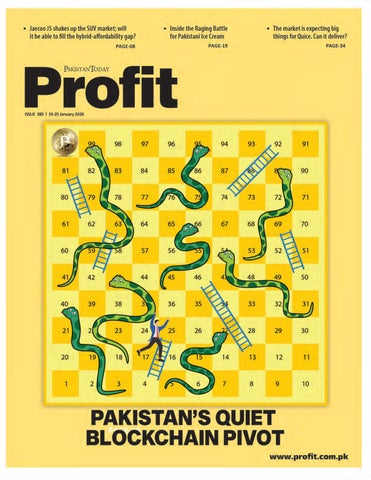
14 The on-chain state: Pakistan’s quiet blockchain pivot
19 Inside the Raging Battle for Pakistani Ice Cream 22 Post-spinoff Siemens Pakistan faces slowing markets 24 Signature Residency REIT offers familiar asset class in a new form 26 What the government is doing to bring its interest costs down 28 Shakarganj ends 2025 on a dour note, with revenue down 31%
Publishing Editor: Babar Nizami - Editor Multimedia: Umar Aziz Khan - Senior Editor: Abdullah Niazi
Editorial Consultant: Ahtasam Ahmad - Business Reporters: Taimoor Hassan | Usama Liaqat Shahab Omer | Zain Naeem | Nisma Riaz | Shahnawaz Ali | Ghulam Abbass Ahmad Ahmadani | Aziz Buneri - Sub-Editor: Saddam Hussain - Video Producer: Talha Farooqi Director Marketing : Muddasir Alam - Regional Heads of Marketing: Agha Anwer (Khi) Kamal Rizvi (Lhe) | Malik Israr (Isb) GM Special Projects Zulfiqar Butt - Manager Subscriptions: Irfan Farooq Pakistan’s #1 business magazine - your go-to source for business, economic and financial news. Contact us: profit@pakistantoday.com.pk
Jaecoo J5 shakes up the SUV market;
will it be able to fill the hybrid-affordability
Affordable, feature-packed, and in high demand, Jaecoo J5 is reshaping expectations in Pakistan’s auto market
When Jaecoo first arrived in Pakistan with the J7, the market took note, but cautiously.
Positioned as a higher-end PHEV with seven airbags, a 360-degree camera, and a cool box, the J7 was less about immediate disruption and more about establishing credibility. Backed by the Nishat Group, the move signaled that Jaecoo was serious, a brand with deep local support and the resources to maintain long-term operations in Pakistan.
But the true market earthquake didn’t come from the J7. That shockwave arrived quietly, then explosively, in the form of the J5.
Showroom Surge: Buyers Overwhelmed by Value
Across multiple Jaecoo showrooms in Lahore, the J5 has caused a near-constant stream of interest. Unlike typical launches, curiosity quickly converted into serious inquiries and confirmed
bookings. Within minutes, several cars were being processed.
Interestingly, the Premium variant has drawn more attention than the Comfort, suggesting buyers are willing to pay extra for additional features rather than simply chasing the lowest price.
The J5 is resonating with buyers who had previously been priced out of hybrid SUV options and the delivery times March for Comfort, May for Premium are a reflection of its overwhelming demand. While competitors like Toyota and Honda, are offering quicker deliveries in some cases, Jaecoo’s timeline highlights
that the craze is driven not by scarcity but by value perception.
Upon survey, it was revealed that many buyers upgrading to the J5 are coming from sedans or older SUVs. They are moving into a segment that has long been inaccessible due to high prices, poor availability, or both. The J5’s combination of affordability, hybrid technology, and export-grade quality makes it feel like a breakthrough in the compact SUV space. But is it really?
Credibility First, Disruption Second
Jaecoo’s strategy which now seems to be paying dividends is one to be studied.
J7 established Jaecoo’s foothold in Pakistan’s higher-tier SUV market. With a slightly lower price than the Haval H6 PHEV (PKR 10.499M vs PKR 12.895M), comparable features, and hybrid technology, it demonstrated that Jaecoo could deliver quality and sophistication. Buyers could trust that the brand was serious, especially with Nishat Group backing a reassurance missing from earlier Chinese entrants.
But credibility was just the opening act. The J5 is the headliner. Aggressively priced at PKR 6.699M for Comfort and PKR 7.699M for Premium, it undercuts Haval’s Jolion HEV by more than PKR 2.5M, while remaining below most Japanese rivals, including Toyota Corolla Cross HEV (PKR 8.535–8.935M) and Honda HR-V e:HEV (PKR 8.999M). For many buyers, the J5 represents a value proposition previously unheard of in the hybrid SUV segment.
Filling the Market Gap
The J5 also addresses a long-standing void. Rising prices from Haval, combined with Japan’s premium hybrids, had priced many buyers out of the compact hybrid segment. The J5 made entry into this segment possible, offering features, space, and efficiency without breaking the bank.
Is it sustainable? Unlike MG, which initially launched with hype and aggressive pricing but later saw its momentum fade due to being fully CBU, Jaecoo’s CKD assembly in Pakistan positions it differently.
CKD status allows better supply management, service networks, and customer support, giving buyers confidence that their investment won’t diminish through poor after-sales support or inconsistent availability.
However it is of equal importance to understand that Jaecoo Omoda will have to ensure the best possible aftersales in terms of servicing and parts to retain their newly won customers. Dealers consistently emphasize that Jaecoo’s combination of CKD production,
Nishat Group backing, and export-quality standards separates it from MG’s early hype cycle and many other Chinese entrants that struggled to sustain interest. This, however, remains to be seen and only the test of time will determine the outcome.
Does Jaecoo highlight Haval’s vulnerability?
This brings into question another major Chinese player in the SUV segment. Haval, whose original value-for-money edge has eroded over time as prices increased.
Rising costs, slower delivery for popular variants, and incremental CKD expenses left a segment of price-conscious buyers exposed. Remember not too long ago Haval shook up KIA and Hyundai with lower prices and comparable if not better products.
The J5 similarly entered this vacuum with perfect timing, taking advantage of buyers’ dissatisfaction and offering an alternative that combines price, features, and credibility. Dealers describe it as a strategic, almost predatory move shark-like in its execution.
The contrast is stark: while competitors can still promise faster delivery for some models, it’s the J5’s combination of pricing and perceived value that is driving bookings and is sustaining hype. Buyers are not scrambling due to limited production; they are queuing because the offer represents unmatched bang for buck in a crowded segment.
Chinese vs Chinese: Strategic Positioning
Framing the competition Chinese-to-Chinese highlights Jaecoo’s strategy. The J5 undercuts the Haval Jolion HEV while offering hybrid efficiency, airbags, and cameras. The J7 competes directly with H6 HEV, slightly undercutting it in price while delivering comparable features and comfort. The approach is deliberate: J7 legitimizes the brand, J5 dominates the market conversation.
This positioning forces competitors to respond on multiple fronts. Haval faces a threat not just from Japanese hybrids like Corolla Cross and HR-V but from a newcomer attacking the same DNA it once dominated Chinese hybrid SUVs priced for the middle class. Jaecoo’s dual strategy creates tension, reshapes buyer expectations, and sets a new benchmark for value in the market. Very similar to what Haval did when it entered the market or what KIA and Hyundai did to Honda and Toyota so long ago.
The Nishat Group’s involvement adds
another layer to it. It is more than a marketing footnote. It signals operational capability, confidence in after-sales service, and reliability in parts availability, critical factors in a market where early Chinese entrants often struggled. Buyers are willing to commit to Jaecoo in part because the conglomerate’s support reduces risk and reinforces trust in the brand’s longterm prospects.
Pricing Caution
While Jaecoo’s entry has been fiery, Pakistan’s SUV market has shown that early pricing advantages can be fragile. Kia’s Sportage, Sorento, and Stonic disrupted segments with aggressive pricing but later fluctuated prices, affecting resale value and eroding initial buyer enthusiasm.
Jaecoo currently enjoys high demand and strong perceived value, but much of it is strictly price-dependent. Any abrupt price adjustments or trim changes could weaken the J5’s narrative. Maintaining supply, managing variants, and preserving affordability will be critical for sustaining momentum. So the question is will Jaecoo learn from Kia or will it fall prey to similar hungrier competitors as Kia has?
The Big Picture
Jaecoo’s launch strategy J7 to establish credibility, J5 to disrupt the market has created a rare storm in Pakistan’s hybrid SUV segment. Buyers are moving from sedans and older SUVs, filling a market gap and redefining what is possible in terms of pricing, features, and access. Competitors, particularly Haval, now face the challenge of responding to a newcomer that combines timing, pricing, quality, and credibility with ruthless efficiency. Something they did to already established manufacturers previously.
The MG comparison is instructive: hype alone cannot sustain market dominance without supply management, after-sales support, and CKD advantages. Jaecoo has learned from these lessons, translating aggressive pricing into sustained market traction rather than a temporary spike in interest.
For now, the J5 has ignited not just Lahore’s but the entire Pakistan’s market, not just selling cars but reshaping buyer expectations, filling a neglected segment, and setting a benchmark for value in hybrid SUVs. The real test will be whether Jaecoo can sustain supply, pricing, and service quality over the next year or whether competitors will find ways to claw back the market share it has claimed. Either way, the J5 has already demonstrated that disruption is possible, and the SUV segment in Pakistan will never be quite the same again. n
Pakistan looks to improve $465
million
exports
seafood
with new processing zone at Korangi
100 acre seafood processing zone would cost USD 60-80 million
Recently, the Federal Minister for Maritime Affairs, Muhammad Junaid Anwar Chaudhry, announced that Pakistan would be opening a 100-acre seafood processing zone at the Korangi Fisheries in Karachi.
This effort would cost anywhere between USD 60 and 80 million dollars, not an inconsiderable sum, and is projected to be developed under a public-private partnership model. The government would provide institutional backing and retain regulatory oversight, while the private partners would take care of the financing, developing, and operating bit.
The main purpose of this facility would be to assist in transforming Pakistan’s seafood exports, which are currently low value products down the value chain, into high-value processed products. These would then be exported to the Gulf, East Asian, and East African markets.
This is part of a recent series of public-sector attempts to support Pakistan’s seafood export industry. While the industry has recently seen an uptick in its exports on the back of some recent developments, opening a value-addition and processing zone would be a significant step towards increasing the value of Pakistan’s seafood exports.
Yet, while it would likely be effective in pushing up the value of Pakistan’s seafood exports, on its own it might not be sufficient to turn around the fortunes of the industry. The seafood industry in Pakistan has been suffering from not only stagnant fishing stocks, but also high power costs, as well as a lack of proper infrastructure for sustainable fishing as well as export enablement.
With this recent announcement, however, there are signs that things might be changing for the better, albeit slowly. Sustainable development, as it is most of the time, would be dependent on formulating and sticking through a plan that takes into account not only the environmental sustainability of fishing practices, but also includes development of a whole publicly-supported ecosystem of infrastructure geared towards that.
Pakistan’s Seafood Industry
Pakistan has a long coastline, over 1,000 km long, on its southern hem, with an Exclusive Economic Zone of 222,000, km2.
Of the total fish production in Pakistan, the marine sector’s production (as opposed to inland fishing and aquaculture) makes up around 70 percent of the total capture and 53 percent of total fish production.
As for the species available in the marine fishing ecosystem of Pakistan, it is estimated that the waters are home to around 250 demersal fish species and 85 pelagic fish species (of which 50 are small, 15 medium, and 20 large). These species include varieties of shrimp, tuna, industrial deep-sea, small-
scale demersal, and small pelagics. Moreover, 15 commercial species have been identified of shrimp, 5 of lobster, and 12 of cephalopods.
The industry has seen some positive developments recently. For instance, in 2025, it was reported that for FY 2025, Pakistan’s seafood exports amounted to 216,350 metric tonnes, worth USD 465 million. This represented an 8.3 percent increase in tonnage, and a 13.4 percent increase in value over the previous fiscal year, but still fell short of the USD 500 million target. This seafood was exported mainly to the following destinations: China, Thailand, Indonesia, and Malaysia.
By value, these exports accounted for just over 1 percent of Pakistan’s total national exports, which were worth USD 32 billion. At the same time, their contribution to Pakistan’s GDP is estimated to be 0.31% percent, again not a mind-boggling number. The point, however, is that it can be better.
One key facet of Pakistan’s seafood exports is our neighbour towards the north and northeast. China is by far the biggest destination for Pakistani seafood. In the first eleven months of 2025, seafood exports to China accounted for approximately USD 235 million, compared to around USD 189 million during the same period in 2024. This bulk was made up of frozen fish varieties like anchovies, mackerel, and squid, but the exports also included other varieties like crabs, cuttlefish, and squid.
This volume does make sense, however. First, China is by far the world’s biggest consumer of seafood by volume. In fact,
Seafood Trade Statistics with China (2015-2023):
according to the World Population Review, in 2022, China consumed around 59 million tonnes of seafood. India, which came second, accounted for a comparatively measly 12 million tonnes.
Then, there’s the fact that we share a border with them. And, then, perhaps the most important of all, is the fact that we have a trade partnership with them, exemplified by the CPEC initiative, which has led to infrastructural development in Pakistan, as well the streamlining of supply chains, which have placed Pakistan in a prime position to trade with one of the world’s biggest trading countries.
As the table reflects, Pakistan has increased its imports to China, while importing comparatively negligible values of seafood. This is because Pakistan’ per capita consumption of seafood is very low, a mere 2 kg per capita, while the global average is around 30 kg per capita.
In any case, for seafood, Pakistan’s trade balance with China is constantly in surplus, unlike in most other sectors, where it is heavily tilted beyond the negative. And this provides Pakistan’s seafood export market with a much-needed cushion, and the need for this cushion brings us to the next section.
Pakistan’s Seafood Woes
Now, one of the main problems besetting Pakistani seafood is quality control and lack of adherence to international fishing standards and practices. This has led Pakistani seafood to being banned from some of the biggest markets in the past.
For instance, in 2017, the United States banned the import of seafood from Pakistan because the latter failed to implement the wide-scale usage of turtle excluder devices (TEDs) in its fishing practices.
TEDs are devices that allow sea turtles and other large marine mammals that have been caught in shrimp trawling nets to escape, reducing harm to the ecosystem that normal netting practices would normally have caused. The United States mandated their use in 1987, and Pakistan’s lack of effort in this regard meant the closing of the American market. The ban was suspended in 2025. But we’ll return to it in a bit.
Figures are trade volumes in thousands
Source: “Exploring FTAs, seafood exports, and SDGs: a gravity model analysis of Pakistan’s seafood trade with China and regional partners” by Yuxiang Xia, Hengbin Yin, et al.
Similarly, the EU banned the import of Pakistani seafood in 2007 because of quality and hygiene concerns over EU-bound shipments of seafood. Saudi Arabia placed a similar ban – over hygiene and safety concerns – in 2016.
Now, making up for the loss in these markets with increased exports to China did
make sense. And that’s what has happened, more or less. But there is a catch with this overreliance on the Chinese market, and that’s to do with the value of our exports.
First, the rates Pakistani seafood products find in China is much lower than they would find in Western markets. In fact, it was estimated that while currently Pakistani shrimp was being sold for about USD 2 per kilogram, with more of the international market opening – especially the United States – the rate could jump up to as high as USD 6 per kilogram. This means that for the same amount of seafood products, the money Pakistan makes would be greater, and so would be its positive effect on the country’s GDP. And, conversely, that the current state of our exports is pushing the prices down by virtue of where Pakistan’s sending them.
The other reason also has to do with price, but as it is dependent on the product, and not simply the market the product is being exported. The fact is that most of the seafood we export to China is low value, with little processing or value addition done. Then, Chinese processors induce value into those varieties of frozen fish, and export them to other countries for higher rates. The over-reliance on the Chinese market – at least how Pakistan trades with them now – then means that Pakistan is not making full use of the raw fish it produces, and is foregoing a crucial opportunity for increased revenues by foregoing the processing of seafood into higher-end items.
Other than that, it’s the usual infrastructural deficit. A lack of enough cold storage facilities means that we are currently exporting less, and making even less, than what we could even with the current catch.
Saeed Farid, Senior Vice Chairman of Pakistan Seafood Export Association, was reported last year saying that “if stored at minus 60 Celsius, it [Pakistan’s yellowfin tuna] could fetch USD 20 per unit, but it earns only USD 1.5 today,” which in turn reduces Pakistan’s ability to export to nearby countries like Sri Lanka.
Similarly, the facilities we do have for processing fish into exports are suffering from expensive power expenses, as well as lack of government incentives to encourage sustainable fishing practices to not only bring us in line with international standards, but also to increase our fish production. For instance, deep sea fishery resources remain comparatively underexplored because the run-of-the-mill vessels used are unsuitable and unequipped for deep sea fishing.
And then we come to the fact that Pakistan’s fishing stocks – such as for shrimp landings –have been on the decrease. And this has meant that Pakistan’s fish produc -
tion is not increasing as might have been assumed with greater access to modern technology. Rather, Pakistan’s total production of fish – including inland and aquaculture as well – has stayed more or less constant over the past decade.
In 2015-16, for example, the total fish production was 788,000 tonnes. In 2024-25, this figure was around 798,500 tonnes. There were higher peaks in the middle, but not too far off the average. While we do not know the exact portion of marine fisheries in these figures, it would be reasonable – on the basis of reports that the fishing stocks are falling because of overfishing, failure to adopt sustainable practices, and lack of adequate infrastructure to encourage those practices – to expect that the situation is not too different in the marine fisheries sector either.
Pakistan’s Seafood Exports Outlook
With the current announced move of setting up a facility for seafood processing in Karachi, it would appear that the government is taking some steps to buttress the local seafood industry. And, this must be understood in context of the government’s previous steps towards the same step.
In fact, the reversal in 2025 of the seafood exports ban placed by the United States came at the heels of assurances as well as steps taken to ensure the quality of Pakistani fishing products. More importantly, Pakistan last year launched a PKR 90 million project to protect endangered sea turtles from getting caught in the shrimp trawling nets.
This project is supposed to include not only the free distribution and installation of TEDs, but also involve capacity building and training works for trawler crews. Moreover, it would also entail data collection to account for the devices’ impact on the efficiency of shrimp catches.
The reversal of the ban, on the surface of it, was good. But concerns were raised at the time that the varieties of fish allowed in the move to reverse the United States’ ban concerned only a few varieties that weren’t even being exported to the United States. Seafood exporters, even then, dismissed this as an undiluted prospect of great futures, and urged that long term trade with the United States would still hinge on Pakistan’s adoption of the TED devices and other protocols to meet their standards for protecting marine mammals from incidental injury and death during fishing.
So, there we have one major variable: how would Pakistan’s program to safeguard and conserve sea turtles fare. Again, one can
be hopeful that some steps are being taken, and our resumed exports to the United States depend on it, but it would squarely depend on the execution of this program, and its widespread adoption by local producers.
Then, we must consider the China factor, as well. As mentioned, we have been selling most of our fish and seafood products to China, with little value addition on our part. And we have seen how this reduces the potential of our exports to bring in more money. Steps to equip the seafood industry with heavier processing capabilities – as the current proposed zone purports to do –would go quite some way in helping address this issue.
However, this is a plan, and plans might not turn out as planned. What the proposed public-private partnership to develop the processing zone looks like, is not clear. Similarly, for this to really bear fruit, it must be integrated in a broader economic mechanism – leading from the fishing to the last step of the export process. But, it’s still something, slightly encouraging, even..
Then again, it would have to be seen whether we would have enough demand for our higher-value seafood exports in China, and, in case there’s a volume decrease, would that be made up for by the increase in price of Pakistan’s seafood products, as well as the – ideally assumed – increase imports to Western economies. Again, the key measure to hedge against a possible loss in this scenario seems to be ensuring that Pakistan’s seafood is brought to a level that opens it up to other high-value markets – such as the EU – as well.
Value addition to the product, certainly, is one way to increase the overall revenue that can be generated from the total production. Even if the volume doesn’t increase, if Pakistan can access more lucrative markets, the earnings will increase. But it is questionable whether this would be – on its own – sufficient to lead to sustainable growth in Pakistan’s seafood sector.
And that leads us to our final point: infrastructural investment needs to be undertaken to materially promote fishing practices that, by following international standards of fishing, not only preserve our current marine biodiversity but which are then also instituted as part of a broader national push towards countering climate change and promoting environment-friendly practices in various economic sectors.
Otherwise, in a blind rush to catch more fish, the seafood industry would only harm itself, and find itself caught not only by its dwindling available stocks, but also lose access to markets which it needs to take the next step for its growth. n
The on-chain state: Pakistan’s quiet blockchain pivot
In less than a year, Pakistan has gone from active aversion towards crypto to a wholehearted embrace. What does the fast pivot mean for the country?
By Taimoor Hassan
Quietly, efficiently, and with very little fuss the Pakistani government has embraced crypto. Up until March 2025
the stance of Pakistan’s financial regulators on cryp to was clear: it was illegal, no framework to regulate it existed, and they were not interested in creating such a framework. Crypto was untraceable, analysts warned it could cause serious capital flight, economists worried it had been linked in other parts of the world to terror financing, and the State Bank of Pakistan (SBP) warned banks to cut crypto exchanges off from formal financial systems.
Even the mention of crypto in regulatory and government circles would elicit scoffs and groans. In less than a year that attitude has done a complete one-eighty.
Last week, Pakistan signed an agreement with an affiliate of World Liberty Financial, a crypto company linked to US President Donald Trump’s family, to explore a dollar-linked stablecoin for cross-border payments within a developing digital-payments framework. A month before this, Pakistan signed a memorandum of understanding with global crypto exchange Binance, signaling the government’s intent to explore tokenisation of up to $2 billion in sovereign bonds, treasury bills, and commodity reserves.
In parallel, regulators have given initial clearance to Binance and HTX, two of the world’s biggest crypto currency exchanges, to establish local subsidiaries, laying the groundwork for a regulated digital asset market. A third company is also planning an entry into the scene with plans to do more than establishing just a crypto exchange. The plans for them are grander with sights set on creating an ecosystem of products and services based on blockchain technology.
The shift might seem sudden, but it is a natural reaction to an opportunity. Pakistan already sits among the world’s most active crypto markets, a reality that policy has only recently begun to acknowledge. The country ranks third on the Chainalysis 2025 Crypto Adoption Index, trailing only India and the United States, and ranks second globally for retail - a measure that points to everyday, utility-driven usage rather than speculative spikes. This pattern matters. Crypto adoption in Pakistan is not confined to a narrow investor class; it is broad, decentralised, and grassroots, reflecting how digital assets are being used to navigate real frictions in the financial system, from access to dollars to cross-border payments.
This usage profile mirrors other high-adoption emerging markets, most notably Turkey, where prolonged currency volatility pushed millions of individuals and businesses toward crypto, especially stablecoins (crypto currency pegged to a global currency such as US dollar) as an alternative for value preservation and payments. Pakistan’s market shows similar dynamics. Estimates point to tens of millions of active users of crypto currencies, many operating outside formal banking rails but already comfortable with digital wallets, exchanges, and on-chain transfers. This activity has created a parallel financial layer, one that exists largely outside regulatory supervision but demonstrates clear product-market fit. That is why it will be vital to follow how the trajectory of crypto adoption unfolds and what it will be used for. Understanding this topic is a complex game. Definitions of crypto currencies, stablecoins, and figuring out the blockchain mechanism can be a lot to digest. In this story we will try to define in the simplest and most relevant possible terms for our readers who might not be familiar with this subject. But before we get into the details, it is important to understand why crypto has become so relevant in Pakistan over the past few years.
From “hands off” to state-led rail-building
Pakistan’s crypto story officially starts in April 2018 with the first state acknowledgement of its existence.
The State Bank of Pakistan (SBP) issued a circular in 2018, instructing banks and regulated payment institutions not to process or facilitate dealings in “virtual currencies/ tokens,” effectively cutting crypto off from the formal financial system even as interest was rising online. That posture hardened through public warnings that no entity was licensed by SBP to offer remittances or related services using virtual currencies, and that cross-border value transfer via such means could trigger legal consequences. The result was not a clean “ban” as much as a choke point: crypto could exist in the shadows, but it could not easily touch regulated rails.
The year 2019 added a different kind of signal: not pro-crypto, but pro-innovation. The Securities and Exchange Commission of Pakistan (SECP) rolled out Regulatory Sandbox Guidelines (2019) a framework meant to let novel financial products be tested under supervision. It did not legalize crypto trading, but it hinted that Pakistan’s regulators were building the muscle memory to evaluate new financial tech rather than only swat it away.
By mid-2021, the gap between policy and reality was getting harder to ignore. Reuters described a boom in trading and mining activ-
ity, noting that while crypto was not straightforwardly “legal tender,” it also was not neatly eradicated. And that Pakistan’s AML context (including FATF pressure at the time) made regulation the central tension. January 2022 brought that tension into courtrooms: The SBP urged that cryptocurrency should be banned in filings tied to an ongoing case, citing risks like capital flight. Around the same period, Pakistan’s debate was increasingly defined by a single question: Is the state trying to stop crypto or trying to control the conditions under which it can exist?
The next year saw the pendulum swing back toward caution. Pakistani officials rejected legalization of crypto trading, pointing to terrorism-financing and money-laundering risks especially sensitive after Pakistan’s FATF trajectory. The message to the market was blunt: whatever adoption existed, it was not going to get a regulatory blessing yet.
The year 2025 flipped the script. In March 2025, the start of a more coordinated, state-led posture with the official launch of the Pakistan Crypto Council (PCC) under the finance apparatus, pitched as a platform to “regulate and integrate” blockchain and digital assets into the country’s financial landscape.
In May 2025 a political face was given to the shift: Prime Minister Shehbaz Sharif appointed Bilal bin Saqib as Special Assistant on blockchain and cryptocurrency with the status of minister of state. Within weeks, the government’s tone became unmistakably industrial-policy: Pakistan moved to channel surplus electricity toward bitcoin mining and AI data centers, including an allocation of 2,000 MW as part of a phased plan - less “should people trade crypto?” and more “how do we monetize infrastructure and attract capital?” SBP, for its part, publicly clarified the legal status of virtual assets while describing ongoing engagement with the PCC and the broader policy process signaling that the central bank was preparing a more formal architecture, not merely repeating the 2018 posture.
A month later, the true structural milestone came: Pakistan moved to create a dedicated regulator and approved the Virtual Assets Ordinance, 2025, establishing an independent authority to regulate cryptocurrencies and virtual assets. The Pakistan Virtual Assets Regulatory Authority (PVARA) frames itself as the licensing and supervisory body for virtual assets and VASPs (Virtual Assets Service Providers) under that ordinance. In parallel, Pakistan’s central bank began speaking in “CBDC language” with fewer caveats: SBP started preparing a digital currency pilot and finalizing legislation to regulate virtual assets, positioning this as modernization of payments and financial infrastructure rather than an ideological embrace of speculative trading.
Tokenization lowers minimum investment size, which increases the number of participants, while 24/7 on-chain trading increases the frequency. For example, an SME exporting commodities or holding tokenized warehouse receipts could convert inventory into liquidity immediately instead of waiting several days for settlement. Even a 2–3 day reduction in settlement time can materially improve liquidity for businesses operating on thin margins
Vugar Usi Zade, chief operating officer at MEXC
By December 2025, Pakistan’s crypto push was not just domestic institution-building, it was outward-facing deal flow. An MoU with Binance to explore tokenization of up to $2 billion in sovereign assets, alongside regulatory steps for exchange licensing processes. And January 2026 brought a new frontier: Pakistan signed an agreement with an affiliate of World
Liberty Financial, a crypto company linked to US President Donald Trump’s family, to explore a dollar-linked stablecoin for cross-border payments within a developing digital-payments framework. Taken as a timeline, Pakistan’s crypto “push” reads less like a sudden conversion and more like a multi-act pivot.
Crypto basics: key terms explained
Cryptocurrency
A form of digital money that exists online and is not printed or controlled by a central bank. It can be sent directly between users using the internet.
Blockchain
A digital record book that stores transactions in a secure and transparent way. Once data is added, it cannot easily be changed or erased.
Stablecoin
A type of cryptocurrency designed to keep a stable value. It is usually linked to real-world money like the US dollar.
Tokenisation
The process of turning real-world assets into digital tokens on a blockchain. These tokens can represent things like money, property, or shares.
Crypto wallet
A digital tool used to store, send, and receive cryptocurrency. It holds secure keys, not physical cash.
What tokenisation actually means
Tokenisation is often misunderstood as financial alchemy or speculative crypto activity. In reality, it is more mundane and more powerful. Tokenisation simply means placing traditional assets such as government bonds, commodities, warehouse receipts, even state owned assets onto blockchain rails. More precisely, it is the process of creating a digital token that represents a legally enforceable claim on a real world asset, recorded on a distributed ledger.
Tokenisation unlocks fractional ownership by transforming traditionally indivisible assets into digitally native units that can be owned, traded, and settled with precision. Instead of a bond or commodity being held by a single big owner or a small pool of large investors, tokenisation can legally map ownership rights onto millions of digital tokens, each representing a proportional share of the underlying asset.
These tokens are recorded on a distributed ledger, creating a single, tamper-resistant source of truth that updates ownership in real time and prevents duplication or double-selling.
A distributed ledger is a shared digital record of transactions that is maintained across multiple computers rather than being stored and controlled by a single central authority. Each participant in the network holds a synchronized copy of the ledger, and updates are added only when the network reaches agreement through defined consensus rules on which transactions are valid. This exactly is the manifestation of the blockchain technology. That data is stored, shared and validated on a network computer in a way that is decentralised, tamper resistant and verifiable without relying on a single authority.
Exchanges can bring distribution power and operational maturity, but the “center of gravity” has to remain with the state’s legal framework, regulator-led supervision, and enforceable investor protections
Jawad Ashraf, CEO of Vanar
Unlike traditional databases, where one institution owns the master record, a distributed ledger ensures that no single party can unilaterally alter history. Once a transaction is recorded, it becomes extremely difficult to change without the knowledge and agreement of the network. This design creates built-in transparency, auditability, and resilience, since the system does not depend on one central server or intermediary.
Crucially, the tokens are not mere representations; they embed enforceable rights such as income entitlement, redemption terms, and transfer restrictions through smart contracts. The result is a model of ownership that lowers entry barriers, enables instant settlement, improves liquidity, and allows assets like real estate and gold to be owned in fractions rather than wholes. By replacing paperwork-heavy, illiquid structures with digital, globally transferable instruments, tokenisation redefines who can participate in asset ownership and how capital itself moves.
Vugar Usi Zade, chief operating officer at MEXC, one of the largest cryptocurrency exchanges in the world explains that from a market microstructure perspective, liquidity improves when the number of participants and trading frequency increase. “Tokenization lowers minimum investment size, which increases the number of participants, while 24/7 on-chain trading increases the frequency.”
In practical terms, liquidity grows with participation and usage, and declines as transaction costs rise.
Vugar explains that the instant settlement feature of a tokenised asset reduces the days receivable close to zero, allowing small businesses to reinvest capital faster, pay suppliers on time, and reduce dependence on expensive short-term borrowing.
“For example, an SME exporting commodities or holding tokenized warehouse receipts could convert inventory into liquidity immediately instead of waiting several days for settlement. Even a 2–3 day reduction in settlement time can materially improve liquidity for businesses operating on thin margins,” says Vugar.
On ground, faster settlement lowers reliance on overdrafts and informal credit, where annualized financing costs can exceed 20-30%, explains Vugar. Tokenization, therefore, acts not only as a capital-market innovation but as a financial inclusion tool for entrepreneurs who are capital-constrained but asset-rich.
For instance, bonds and commodities are mostly accessible to banks, institutions, or wealthy investors. Tokenization, on the other hand, would allow smaller and fractional investments, which would consequently allow more retail investors, including Pakistanis living overseas, to participate.
In practice, this will play out at the level of day-to-day cash flow for a small business. Consider an SME exporting rice or cotton that stores its inventory in a warehouse. Under the traditional system, the warehouse issues a paper or digital receipt, which the exporter then submits to a bank to obtain financing against the inventory.
The bank must manually verify the document, confirm ownership, assess risk, and process the transaction, steps that often take days before funds are approved and released, if financing is approved at all. During this waiting period, the exporter still has to pay for transport, labor, utilities, and raw materials, often relying on short-term credit to bridge the gap.
With tokenised warehouse receipts, the same inventory is represented as a digital token issued at the moment the goods enter the warehouse. That token, which embeds details such as quantity, quality, location, and ownership, appears instantly in the exporter’s regulated wallet and can be sold, pledged, or financed on a licensed digital exchange or through a participating bank.
Because ownership and authenticity are already verified on the ledger, settlement can occur within minutes or the same day rather than several days later. For an SME operating on thin margins, completing the transaction quickly can materially improve liquidity, reducing dependence on costly short-term borrowing, enabling faster in -
ventory turnover, and allowing the business to reinvest cash into production or new orders more efficiently.On the tokenisation of government assets, consider the example of treasury bills. In Pakistan, the State Bank acts as the agent of the federal government for managing public debt and conducting auctions of government securities, including Market Treasury Bills (MTBs) and Pakistan Investment Bonds (PIBs).
These instruments are the primary way the government borrows from the domestic financial market to finance fiscal needs instead of direct borrowing from the central bank.
Pakistan’s government regularly holds auctions where banks and institutional investors submit bids to buy these securities, and the SBP accepts competitive and non-competitive bids based on yield criteria and auction targets. Accepted bids result in the transfer of funds from the buyer to the government, with repayment and yield defined by the auction’s weighted average rate.
After issuance, these securities are tradable in the secondary market through banks, allowing holders to sell before maturity, though prices can fluctuate with interest rates and demand. Commercial banks are the dominant holders because they often have surplus liquidity and view government papers as low-risk investments; investors wishing to participate typically do so through primary dealers or banking intermediaries, with holdings recorded in scriptless form via investor portfolio accounts. This system ensures liquidity for the government’s short-term financing while providing institutional buyers a risk-free asset, but the process involves multiple intermediaries, manual settlement conventions, and standard market cycles that can take days to settle fully.
In contrast, tokenisation aims to represent such assets or receivables as digital tokens on a distributed ledger, potentially allowing issuance, transfer, and settlement to occur more rapidly and without the layered intermediaries of auctions, custodial accounts, and traditional clearing and settlement systems. When everything is tokenised,
everything happens on a decentralized exchange, however and this is where players like Binance and HTX come in.
Enter Binance and HTX
This is where the role of crypto currency exchanges becomes evident: it is all going to happen on the exchange but the exchanges could be involved in more than just providing a platform where transactions happen.
Both Binance and HTX have received an NOC from the Pakistan Virtual Assets Regulatory Authority to start exchange operations, with a third exchange also trying to enter the foray soon. As part of the regulatory process, both Binance and HTX will proceed with completing Anti-Money Laundering (AML) registration with the Government of Pakistan’s Financial Monitoring Unit (FMU) and establish a locally incorporated entity under the Companies Act, 2017. Once these steps are finalised, the company will submit its final application for a Virtual Asset Service Provider (VASP) license, paving the way for full operational authorisation and start exchange operations where trading will take place.
Before that, Binance and HTX will have a role in designing how to tokenize the assets that we are talking about. In the opinion of Jawad Ashraf, CEO of blockchain company Vanar, Binance and HTX do not “tokenize Pakistan’s assets” in the sense of owning the issuance; they sit on the market-infrastructure side of the equation.
“They can help Pakistan design a workable model, and, if licensed, become distribution and liquidity venues for whatever the state (and its regulated agencies) ultimately issues,” says Jawad.
Jawad explains that Binance’s role is the more explicit one right now as Pakistan’s Ministry of Finance has signed an MoU with Binance to evaluate tokenizing up to $2 billion in government-owned assets. Those are reported as sovereign bonds, treasury bills, and commodity reserves (oil, gas, metals).
That frames Binance primarily as an adviser or an implementation partner. The deal is to help define the token structure, issuance workflow, custody model, and investor access rails. And also, the operational plumbing needed for “real” distribution at scale.
“HTX, by contrast, shows up more as a “second exchange entrant” in the licensing track than as the named tokenization partner. Pakistan’s Virtual Assets Regulatory Authority (PVARA) has issued No Objection Certificates (NOCs) to both Binance and HTX. Yet, those NOCs are not operating licenses. They’re a controlled on-ramp: AML registration steps
(including Pakistan’s goAML reporting framework), incorporation of local entities, preparation for full VASP license applications once the rules are finalized.”
Thus, HTX’s near-term role is about becoming eligible to operate under Pakistan’s oversight. This could later support trading, access, and liquidity for tokenized instruments, instead of shaping the tokenization blueprint itself.
Jawad explains that where this gets important is governance. If an exchange advises on token design and later becomes a major venue for trading it, Pakistan will want clean separation, transparent selection, and clear public accountability. “Exchanges can bring distribution power and operational maturity, but the “center of gravity” has to remain with the state’s legal framework, regulator-led supervision, and enforceable investor protections.”
Once licensed digital asset exchanges go live, they become the formal bridge between Pakistan’s existing and new crypto activity and the regulated financial system. Individuals who already hold cryptocurrencies, whether stablecoins, major digital assets, or tokens issued on approved blockchains, will be able to trade directly against other digital currencies within a supervised market structure.
A user holding say Bitcoins will be able to exchange them for other cryptocurrencies, or for tokenised real-world assets listed on the exchange, without exiting into cash. Market-based price discovery replaces bilateral negotiation. Trades are cleared and settled digitally, often within minutes, reducing risk and eliminating the multi-day settlement cycles common in traditional markets. As tokenised assets such as government securities or commodity-backed instruments are introduced, exchanges become the venue where digital currencies and real-world value intersect. What emerges is a unified marketplace in which cryptocurrencies are not isolated instruments, but interchangeable components of a broader digital financial system, connected by common rails and governed by a single regulatory framework.
It is against all this backdrop that initiatives such as the MoU between Pakistan and Binance and HTX for the tokenisation of up to $2 billion in state assets start making sense. Tokenisation is not being introduced into a vacuum; it is being layered onto an ecosystem where users and liquidity already exist. It just currently exists outside a regulated regime.
Regulated exchanges will become the venues where tokenised government assets, commodities, or receivables can be traded; compliant wallets become the holding layer; and on-chain settlement replaces multi-day clearing cycles. What emerges is a closed loop:
grassroots crypto adoption provides demand and liquidity, exchanges provide price discovery and access, and tokenisation supplies real-world assets that anchor on-chain activity to the formal economy.
Binance and HTX did not respond to Profit’s request for comments.
How to make it successful?
Implementing tokenisation and building a regulated crypto market in Pakistan will be less of a technical challenge than a trust and incentives problem, and that distinction matters for policy design. A large share of existing crypto activity has grown precisely because it operates outside formal disclosure requirements. Users are accustomed to pseudonymity, informal peer-to-peer settlement, and minimal reporting, often as a response to weak trust in state institutions, unpredictable taxation, and concerns around retrospective enforcement. Moving this activity onto regulated rails will therefore face natural resistance, regardless of how sophisticated the underlying technology is.
One immediate challenge is income and asset disclosure. Tokenisation requires clear provenance: who owns the asset, where it originated, and how it is transferred. Regulated exchanges and wallets will be obligated to enforce KYC, transaction monitoring, and reporting standards. For users who have historically used crypto to avoid friction rather than to seek financial innovation, this shift can feel punitive. If disclosure requirements are perceived as abrupt or punitive, activity may simply remain offshore or informal, limiting the effectiveness of domestic exchanges and tokenised instruments.
Another risk lies in credibility of enforcement and policy continuity. Tokenised assets only work if participants trust that rules will remain stable across political and fiscal cycles. Sudden changes in tax treatment, capital controls, or reporting thresholds could undermine confidence just as markets begin to form. Without clear, forward-looking guidance especially on how digital asset gains, tokenised securities, and on-chain transactions will be treated, participants may hesitate to commit meaningful capital to regulated platforms.
The practical path forward is that tokenisation must offer users something they cannot easily get in the informal market: faster settlement, cheaper financing, access to regulated yield products, or the ability to use tokenised assets as collateral. That would scale not because users are forced into it, but because the system makes compliance economically rational. Trust will follow incentives, not the other way around. n
Inside the Raging Battle for Pakistani Ice Cream
This is the story of how the Wall’s And Omore were stripped of their ‘Ice Cream’ status, and everything they did to try and avoid it.
By Usama Liaqat
Who, really, is the emperor of ice cream?
Those who might have encountered the elliptical Wallace Stevens poem might have been stumped by the significance of the titular figure.
But, in the Pakistani market it turns out, it was a much simpler equation. Here, it was, more or less, a case of ‘spot the odd one out’. And a recent decision by the Competition Appellate Tribunal has squarely confirmed this.
Only a few days ago the Tribunal upheld a December 2024 decision by the Competition Commission of Pakistan, which had decided that the two major players in the ice cream and frozen desserts market – namely Unilever and
FrieslandCampina Engro had been falsely marketing their products as “ice cream,” while, in fact, they were “frozen desserts”. The Commission fined the corporations Rs 7.5 crore each, with Unilever being slapped with an added Rs 2 crore for a related violation.
These two corporations had taken this verdict up to the Competition Appellate Tribunal, which has now agreed with the findings of the Competition Commission. However, exercising their discretion, they have reduced the fines due to “mitigating circumstances”. The Rs 7.5 crore figure has been reduced to Rs 1.5 crore for each, while the Rs 2 crore sum has been cut down to Rs 50 lakh.
Whatever these reduced sums might mean, the story behind these fines is more interesting. It was a battle fought between giants. Unilever Pakistan, the biggest ice cream and frozen dessert manufacturer in Pakistan,
was one. FrieslandCampina Engro Pakistan, the second biggest player in the market, was another. Together, in 2023, they accounted for over 60 percent of the market. Taking these two on was the comparatively modest Pakistan Fruit Juice Company, which had commanded a mere 2 percent share in that year.
The stakes couldn’t be higher: who, in fact, could claim to be producing “ice cream,” let alone claim to be the leading Pakistani player to be doing so.
At its core, it is a tale of three shifty terms – “ice cream,” “dairy ice cream,” and “frozen dessert” – and the sleight of hands that some companies had been relying on, swapping one for the other. Played in front of the Competition Commission of Pakistan, it is also a tale of self-contradictions, brazen denials, and furtive self-exonerations.
Any know-it-all can tell you that the
delicious lollies you are biting on are, well akchually, not ice cream. But what made this distinction legally enforceable, and set giants of the desserts industry against each other in head-on collision, we will explore in this piece. We will also see how the Commission went about balancing consumer rights against the marketing strategies of massive corporations, and how and why it decided in favour of the former. In short, we will see how the Commission came to its decision.
The Complaint
The matter started when Pakistan Fruit Juice Company – the company behind Hico ice cream – lodged a complaint against the respondents, Unilever Pakistan and FrieslandCampina Engro Pakistan Limited. Unilever’s product in question was the Wall’s brand, while for FrieslandCampina Engro, it was Omore.
The Pakistan Fruit Juice Company (let’s call it PFJC for short) brought its complaint before the Competition Commission of Pakistan (CCP) on 21 February 2022. It alleged that Unilever and FrieslandCampina Engro had engaged in deceptive marketing practices. Their products were actually “frozen desserts,” but they had instead falsely advertised them as “ice cream”. In doing so, it was alleged, these two companies had caused harm to the consumers as well as to the business interests of the PFJC.
Now, the PFJC’s supporting claim was that “ice cream” was a category distinct from “frozen dessert”. It asserted that while “ice cream” was primarily made from dairy fats (such as milk, cream, butter, etc.), “frozen desserts” on the other hand were composed of vegetable fats (e.g., palm oil). Moreover, to be considered an ice cream, the product must contain at least 10% milk fat and 10.1% nonmilk fat solids.
The PFJC alleged that by using phrases like “Thand mein ice cream,” “Creamy vanilla ice cream,” “Hey, yaar tu ice cream ho ke kaanp raha he,” and using the word “ice cream” and showing splashes of milk in their advertisements for frozen desserts, Unilever and FrieslandCampina Engro had engaged in deceptive advertising.
Moreover, PFJC claimed, the two respondents had failed to comply with the requirement to clearly indicate on the packaging of the products a phrase i.e. “frozen dessert contains edible vegetable oil”. Thus, they caused consumers to believe that their products were ice cream, which in fact they were not.
Now, this was also, of course, substantiated by a framework of rules and regulations that recognised the significance of this distinction. These were the Punjab Pure Food Rules (2011) and Punjab Pure Food Regula-
tions (2018), which had defined the differences between the two types of products. And since the practices of the two respondents had contradicted these regulations, the PFJC argued, they were in violation of Section 10(2)(b) of the Competition Act, 2010.
This provision defined one type of deceptive marketing practice as “the distribution of false or misleading information to consumers, including the distribution of information lacking a reasonable basis, related to the price, character, method or place of production, properties, suitability for use, or quality of goods.” Section 10(1) just before this provision expressly prohibited any undertaking of “deceptive marketing practices”.
But this charge was not the whole of the PFJC’s complaint. It singled out Unilever (Wall’s) for another violation of the Competition Act (2010). This alleged violation concerned Section 10(2)(c) of the Act which defined yet another type of deceptive marketing practices as including “false or misleading comparison of goods in the process of advertising”.
PFJC’s basis for this argument was that Unilever had engaged in a false and misleading comparison of “frozen dessert” with “ice cream”, especially claiming that the “frozen dessert” was a healthier choice as compared to the “ice cream”. This behaviour was in the context of an earlier consumer advisory stance taken by the Punjab Food Authority, that had publicised that “frozen dessert” was not a substitute of “ice cream,” and had urged the parents to prefer “ice cream” over “frozen desserts” for their children.
So, there were essentially two issues before the court. The first was to determine whether both the respondents had disseminated false and misleading information to consumers and, in doing so, had violated Section 10(b) of the Competition Act 2010. The second was to determine whether Unilever in particular had engaged in a false and misleading comparison of goods, and had therefore violated Section 10(c) of the same Act of 2010.
Before we move on the how the CCP thought through these two issues, let us examine what Unilever and FrieslandCampina Engro had to say in their defence.
A Defence is Made
Unilever argued that the food regulations mentioned by the PFJC in their complaint – including Punjab Pure Food Rules, 2011 and Punjab Pure Food Regulations, 2018 – were provincial standards, and not national standards. Only the latter standards were applicable all over Pakistan. It was a question, they argued, of which legal regime they were following. The Punjab rules just weren’t applicable.
Now, the reason Unilever made recourse to the federal standards was that, as framed by the Pakistan Standards and Quality Control Authority (PSQCA), the category “ice cream” was open to some interpretation. The standards for ice cream, i.e. PS 969-2010, identify “ice cream” as a general category, which has as its sub-categories “dairy ice cream” and “frozen desserts”. Therefore, Unilever argued, since their product clearly falls under the general category of “ice cream,” they were not forbidden from using this same category in their marketing campaigns.
Secondly, it was argued that since PSQCA’s regulations for packaging and labelling of “ice cream” products were the once actually applicable in this case, Unilever was not even obligated to provide any disclosure on the packaging. But, in a fervour of thrashing good faith, they had gone one step ahead of the required minimum, and still mentioned on the packaging that their concerned products were “frozen desserts”.
Regarding the second issue – the one regarding false and misleading comparison – Unilever argued that “dairy ice cream” and “frozen desserts” are “compositionally similar in nature,” with one key exception: the former contains only dairy fats, while the latter may consist of dairy or vegetable fats (or both). It argued that contrary of the public announcement of the Punjab Food Authority, there was no good reason to assert that “dairy ice cream” was inherently superior to “frozen desserts,” because the latter are usually lower in trans and saturated fats, but also provide a non-dairy option, which might be preferred for several health and dietary reasons.
As for FrieslandCampina Engro, it essentially said that Unilever’s arguments regarding the primacy of PSQCA’s standards were also applicable in its case. Moreover, it admitted that some of the Facebook posts advertising Omore products were erroneously published without any intention to mislead consumers. Those posts were not shared or advertised again. Here, their approach was to play down the significance of their posts by agreeing that they were wrong, but were mistakenly put out there, and not used again.
How did the CCP think through this Defense?
The CCP recognised, first of all, that there was some need to comparatively review both the Punjab food regulations and the standards set by the PSQCA. And the court reasoned that both were different rules which had different purposes.
The purpose of the PSQCA, the Commission reasoned, was to standardise a wide range of products in various business sectors. The
Punjab Food Authority, on the other hand, was designed to enforce food hygiene and quality standards. So, the Punjab food laws were concerned with issues that were different from the concerns of the PSQCA. Their scopes were different; so the argument that the respondents had relied on – that one superseded the other –was not tenable.
Then, the Commission moved on to the main issue: were “ice cream” and “frozen desserts” similar products, or were they distinct enough to nullify the argument that “frozen desserts” were a sub-category of “ice cream”?
And in deciding this issue, the Commission pulled a delicious trick. It turns out Unilever Pakistan’s predecessor, Lever Brothers Pakistan Limited, had in 1992 found itself caught in a similar situation – what was the difference between “ice cream” and “frozen dessert”? The issue moved from the Single Bench of the Lahore High Court to the Division Bench of the same court to the Supreme Court. The Supreme Court finally maintained that “ice cream” would contain at least 10 percent milk fat, while products manufactured using the derivatives of milk fat or vegetable fat or a combination of both, would be called “frozen desserts”.
Lever Brothers had raised no objection to this, and this was one point where Unilever was caught. The Commission reasoned that they had to know the difference between the two products, since they themselves had accepted it – and were there – when the Supreme Court laid down the standard.
The Commission, in fact, doubled down on this line of reasoning. It argued that the behaviour and practices of both the respondents in the past shows that they were actually fully aware of the difference between the categories of “ice creams” and “frozen desserts”. In fact, it highlighted, the PSQCA issues separate license certificates bearing specific nomenclature i.e. specific licence for “frozen dessert” and a definite and separate licence for “ice cream”. This meant that the PSQCA itself recognizes “ice cream” as “dairy ice cream” as the same category.
And both Unilever and FrieslandCampina Engro knew of this difference because they had, in fact, obtained separate licences for different products! To top this all, both these companies were, in fact, branding and labelling their products as “frozen desserts” ...
In order to really drive deeper the dagger, the Commission considered how the category “ice cream” was used in global food standards. And it turned out – examining the American, Indian, and Australian regulations – that it was used exclusively to refer to products containing milk fats. For similar products containing other kinds of fats, other categories like “mellorine” or “frozen desserts” were used.
So, this issue was a slam dunk for the Commission, really.
It found, therefore, that the respondents weren’t justified in using the generic term “ice cream”. And, here they also brought in something you might not have heard of: General Standards for the Labelling of Pre-packaged Foods. Yes, they exist, and stipulate that the name of the product “shall indicate the true nature of the food and normally be specific and not generic”. If their claim – that they were allowed to use the supposed general category of “ice cream” – were to be respected, even then the respondents had run afoul of this rule as well.
Then, the Commission concerned itself with the issue of the disclosures - that those products were “frozen desserts” - both respondents had made on the packaging of their products, Here, the Commission relied on zingers from past cases such as: “It is a settled principle that ‘fine print disclaimers are inadequate to correct the deceptive impressions’. In fact, such disclaimers are, in themselves, a deceptive measure.” The precedents stated that the disclosures had to be clear and conspicuous. It turns out they were anything but. Unilever had placed these on the extreme right corner of the bottom of the wrapper, and FrieslandCampina Engro too had failed to prominently or appropriately place these proclamations. Both had failed to meet the requirements for appropriate disclosures here, as well.
Someone was watching out for the customers who barely care for the fine print, especially when the prospect of an ice cream looms in the instant future.
Decision and Coronation
So, the Commission moved to decide upon the two issues highlighted earlier. As for the violation of the Section 10(2)(b) of the 2010 Act, it decided that both Unilever Pakistan and FrieslandCampina Engro had violated the section in question by “marketing, branding, promoting and selling” their “frozen dessert” products as “ice cream”. In this regard, FrieslandCampina Engro’s argument that they had “erroneously” put up those posts, was deemed weak. The Commission said that their intent did not matter. The fact was that those posts were made where the public could access them.
Regarding the violation of the Section 10(2)(c) of the 2010 Act, the court set out to determine whether Unilever had made a false and misleading comparison of goods during the course of its marketing activities.
Here the commission pointed out that Unilever had not submitted any satisfactory evidence that proves ‘objectively’ that “frozen dessert” is healthier than “ice cream”. Since, the claim of being healthier was open to many
variables and interpretations, the lack of any methodical research to substantiate their claim meant that they failed to establish its veracity. The mere fact that Unilever had claimed that their product was healthier than “ice cream”, and that the burden of proof was on the Enquiry Committee to prove otherwise, was not enough.
In fact, the Commission recognised that the burden of proof always lies on the one making the claim. It is they who must substantiate support of their claims, and not the Complainant or the Enquiry Committee. Unilever had merely provided information regarding the nutritional value of the components , which is at most a description of what the product is actually composed of or what the nutritional value of the product is. This nutritional information on its own is not enough to show how their product is objectively healthier than dairy ice cream.
Unilever had also tried to make a defence that their claim was directed against the announcement by the Punjab Food Authority, given that their claim came after that. The Commission was ready for this line too. Even if their claim was directed at the Authority, it didn’t change the fact that their claim was posted on social media, and the targeted audience of the post were ordinary consumers and not the Authority. They should have taken it up with the Authority, and not have tried to advertise their product to the general public.
And here, the Commission pulled out yet another dagger from its ankle straps. The fact that they were comparing their “frozen dessert” products to “ice cream,” and claiming that their products were healthier meant that while advertising their products as “ice cream,” they were preying on consumers for whom “ice cream” and “dairy ice cream” were one and the same thing. They knew all about it!
Unilever could not be allowed – in the words of the Commission – to “blow hot and cold in the same breath,” and was therefore liable for violation of this section as well.
All in all, the Commission fined both Unilever and FrieslandCampina Engro Rs 7.5 crore each for the breach of Section 10(2)(b) of the 2010 Act. In addition, it fined Unilever an additional Rs 2 crore for the violation of Section 10(2)(c) of the 2010 Act. And now, the Competition Appellate Tribunal has upheld the Commission’s findings, though it has reduced the fines.
And this is the story of how the brands Wall’s and Omore – which were the primary challengers of Hico’s position in the ice cream market – were dethroned from their ice cream thrones. You gotta be in the game to win the game. The former two were in some other game altogether, according to the Commission. And there was only one ice cream among these three. n
Slowing expenditures on electricity infrastructure by state-owned companies causes company to see revenue declines.
Siemens (Pakistan) Engineering Company Ltd (PSX: SIEM) has reported a markedly reshaped set of financials for the year ended 30 September 2025 – its first full reporting year straddling the separation of its energy business – and the headline story is a smaller company confronting softer end-market demand.
On the surface, the results looked like a turnaround: the company swung to a net profit of Rs829.4 million (earnings per share Rs100.57) in FY2025, compared with a net loss of Rs2.048 billion the year before.
But that profit recovery is not the clean, demand-led rebound the bottom line suggests. The more telling figure for operating momentum sits inside the continuing businesses – the portfolio Siemens Pakistan kept after divesting its energy segment. Net sales and services from continuing operations fell to Rs8.855 billion in FY2025 from Rs9.698 billion in FY2024, a decline of roughly 9%.
That might sound modest compared to the dramatic change in the group’s total revenue base – and it is. Total net sales and services (continuing plus discontinued operations) dropped to Rs12.427 billion from Rs35.166 billion once the energy operations were stripped out. But the key point for investors trying to value “post-spinoff Siemens Pakistan” is that even within the remaining portfolio, demand softened rather than accelerating into a clean post-carveout growth narrative.
Analysts tracking the name point to a slowdown in the company’s core end-markets – particularly infrastructure-related spending patterns in the power sector and large-project
procurement cycles – as customers delayed or reprioritised expenditure.
That pressure is not happening in a vacuum. Pakistan’s state-owned distribution companies (DISCOs) – major buyers of grid modernisation equipment and automation – continue to operate under severe financial strain. NEPRA’s State of the Industry Report has been cited as putting power-sector circular debt at Rs2.393 trillion as of 30 June 2024, with DISCOs adding Rs591 billion in FY2023–24 amid weak recoveries and high losses. In practice, that kind of balance-sheet stress tends to lengthen procurement cycles, disrupt planned capex and push utilities towards short-term fixes – a challenging backdrop for premium-grid equipment suppliers.
The biggest strategic change for Siemens Pakistan in the past year was the disposal of its energy business segment – a portfolio historically tied to large, lumpy projects and, in Pakistan’s context, heavily exposed to government and quasi-government counterparties.
The board approved the sale and transfer of the energy business on 11 October 2024 to Siemens Gamesa Renewable Energy (Pvt) Ltd, described in the company’s disclosures as a non affiliated Siemens Energy Group entity. The deal was communicated as being for an aggregate consideration of around Rs17.82 billion at the valuation date of 31 March 2024, with the net book value at that valuation date around Rs17.61 billion.
The transaction was subsequently concluded on 31 December 2024, according to company disclosures carried by Pakistani business media, marking the effective separation point in operational terms. The
carve-out becoming effective on 31 December 2024 matters because FY2025 still includes a partial period of energy operations before the separation date.
One nuance that is easy to miss in the headlines: while Rs17.82 billion was the widely reported valuation-based consideration, the company’s FY2025 annual report later disclosed that, following adjustments under the sale agreement, Siemens Pakistan received an “adjusted final purchase price” of Rs7.041 billion, calculated on the net book value at the effective date (31 December 2024). It also noted that for certain contracts where legal transfer was still in process, Siemens Pakistan would continue managing performance and related receivables/payables on the buyer’s behalf.
This distinction is important for investors assessing cash generation and one-off gains: the deal economics were not simply “cash equals Rs17.8 billion”. Instead, the final cash settlement moved with completion-date balance-sheet values and post-signing adjustments, as is common in carve-outs where working capital, contract assets and liabilities, and contingent items can materially shift between valuation and completion.
Strategically, the sale also sits within the broader Siemens group reshaping that began years earlier. Pakistani business reporting on the transaction explicitly framed it as part of a wider spin-off strategy initiated by Siemens AG in 2020.
After the energy separation, Siemens Pakistan is effectively a two-engine company built around smart infrastructure, which includes electrification products and solutions, including low- and medium-voltage equip-
ment, grid software for distribution networks, and building management systems. The second business line is digital industries, focused on industrial automation, motion control and engineering software – the portfolio Siemens globally positions as the bridge between the physical factory floor and digital optimisation.
Financially, FY2025 shows these segments are now the core. The annual report breaks out continuing-operations sales of roughly Rs5.307 billion for Smart Infrastructure and Rs3.202 billion for Digital Industries, with additional revenue in discontinued operations and other lines. New orders for FY2025 were similarly concentrated: Smart Infrastructure recorded Rs5.718 billion in new orders and Digital Industries Rs3.514 billion.
Management’s pitch is that this “new Siemens Pakistan” can be a more resilient, higher-quality earnings story: less exposed to mega-project volatility, more tied to repeatable electrification and automation demand, and supported by Siemens’ global technology pipeline. The company describes its Pakistan portfolio as increasingly centred around electrification, automation, digitalisation and software.
However, the FY2025 revenue decline in continuing operations shows that resilience is not automatic in a market where a meaningful share of demand is still linked to public-sector or regulated-sector spending.
The attached equity research briefing highlights how management is trying to keep the pipeline active despite the soft patch. Among the specific themes are channel expansion. The company “onboarded around 20 business partners” to broaden its reach beyond direct selling, a common tactic in industrials when capex cycles slow.
Then the are the public-sector and infrastructure wins. Management pointed to orders secured for water treatment plants and distribution networks in Northern Pakistan, plus a telemetry project covering 27 barrages –a reminder that Siemens’ addressable market is not only power distribution, but also broader infrastructure automation.
Finally, there is the utility engagement. The company cited engagement with GEPCO and said it was evaluating opportunities with LESCO and FESCO, three of Pakistan’s key state-owned distribution companies.
If those engagements translate into contracts, they could support a stabilisation in Smart Infrastructure revenues – but the dependence on state-linked counterparties is precisely why the subheadline of this story matters. When DISCOs are struggling with losses, recoveries and circular-debt dynamics, procurement often becomes intermittent and price-focused, with longer payment cycles and greater execution risk.
Another notable data point from Siemens Pakistan’s FY2025 disclosures is customer concentration. The company reported that two customers each accounted for more than 10% of revenue and together contributed Rs2.601 billion in FY2025 (down sharply from FY2024). That concentration can cut both ways: a single large tender can move the numbers meaningfully, but the absence or delay of one procurement cycle can also show up quickly in annual revenue.
Siemens Pakistan does not operate in a comfortable niche. Its two remaining portfolios place it in direct competition with large local manufacturers that compete aggressively on price and local relationships for grid and building electrification equipment and other multinationals selling energy management, automation and building solutions through partner networks.
Among the most frequently cited local competitors is Pak Elektron Ltd (PEL) – a long-established Pakistani player that, like Siemens, sits at the intersection of electrical equipment demand and Pakistan’s stop-start infrastructure cycles.
PEL’s recent numbers suggest it has maintained momentum, at least in the early part of 2025. For the quarter ended 31 March 2025, PEL reported net revenue of Rs14.471 billion (after sales tax and discounts), up from Rs12.718 billion a year earlier. Profit after tax rose to Rs657.0 million from Rs445.0 million, with basic EPS improving to Rs0.71 from Rs0.51.
For Siemens Pakistan, the implication is clear: domestic competitors with scale and entrenched channels are not standing still. In a tender-heavy market – particularly one influenced by DISCO procurement – suppliers often compete on delivery capability, payment terms and localisation as much as on technical performance.
Meanwhile, global players remain active in Pakistan’s electrification and automation arena. Schneider Electric, for example, positions itself in Pakistan as an “energy technology partner” focused on electrification, automation and digitalisation, and lists offices in Karachi and Lahore alongside a network of authorised partners. Even when multinationals do not manufacture locally, partner-led models can keep them competitive, especially in building systems and low-voltage product categories.
This is the post-carveout challenge for Siemens Pakistan: it is selling high-value solutions into end-markets that are frequently budget constrained, tender driven and sensitive to short-term macro shocks. The company’s advantage lies in brand, technology depth and the ability to bundle hardware with software and services. But the FY2025 revenue
dip indicates that, at least in the near term, the market is not rewarding premium capability with uninterrupted demand.
Siemens’ relationship with Pakistan predates the listed entity by decades. In a 2017 Siemens press release on a major Pakistani power project, the company described Siemens as having been a contributor to major infrastructure projects in the country since opening its first office in Lahore in 1922.
The listed company, Siemens (Pakistan) Engineering Company Ltd, traces its formal corporate existence to 1953, and is quoted on the Pakistan Stock Exchange. Its registered head office is in Karachi’s S.I.T.E. industrial area – a detail that underlines its legacy as an engineering and manufacturing-linked business rather than a pure services franchise.
Ownership is also a defining feature. Siemens Pakistan is explicitly disclosed as a subsidiary of Siemens AG, with Siemens AG holding 93.03% of shares as at 30 September 2025. The parent’s stake has been rising: Siemens AG held 74.65% as at 30 September 2024, and the company disclosed that subsequent purchases – including a share purchase agreement with National Investment Trust and acquisitions via the stock exchange’s platform – took Siemens AG’s holding to 92.1% by 28 November 2024.
That ownership structure can matter for minority investors in two ways. On the positive side, high parent ownership can align local operations with Siemens’ global technology roadmap and governance standards. On the other hand, it can raise questions about long-term free float and the strategic optionality of the listed vehicle – especially after a major carveout has already reduced the size and scope of the Pakistan business.
For now, Siemens Pakistan’s story is best read as a case study in what happens after a high-profile portfolio sale: the “old” company’s topline disappears, the reported numbers become difficult to compare year-on-year, and the market’s attention shifts to whether the remaining core can grow in a tough environment.
FY2025 suggests the answer is not yet clear. Siemens Pakistan has successfully repositioned itself around Smart Infrastructure and Digital Industries – and returned to profitability at the group level – but its continuing operations still saw revenues drift lower, reflecting a slowdown in the very markets it must win to justify a post-spinoff valuation.
In a Pakistan where DISCO finances, circular debt and public-sector procurement remain persistent constraints, the company’s next chapter will likely depend less on the elegance of its portfolio slide and more on the pace at which electricity infrastructure spending – and private-sector industrial investment – can regain momentum. n
Signature Residency REIT offers familiar asset class in a new form
Pakistan’s capital markets are about to get a new wrapper around an old obsession.
Signature Residency REIT (SRR) is heading to the Pakistan Stock Exchange (PSX) as the country’s first residential REIT to be listed – a milestone that matters less because Pakistan lacks apartments, and more because it lacks formal, investable residential real estate exposure for small investors.
Structurally, SRR is not a perpetual, rent-collecting landlord. It is a closed-end developmental REIT scheme with a limited life of around 48 months, beginning 22 March 2023 and ending tentatively 22 March 2027, after which the scheme is expected to wind down. This is closer to a time-bound development vehicle than the REIT models Pakistanis may recognise from international markets.
The listing itself is being done through an Offer for Sale (OFS) – meaning the units being sold to the public are coming from existing unitholders rather than freshly created units raising growth capital for the scheme. The offer comprises 8.25 million units, representing 25% of SRR’s total units, and is being offered via the fixed price method at Rs14 per unit (Rs10 face value plus Rs4 premium). The public subscription window is scheduled for 19–20 January 2026, with applications routed through PSX’s e-IPO and CDC’s centralised e-IPO systems.
The OFS is being made by SRR’s sponsors/offerors – Arif Habib Corporation Ltd, Javedan Corporation Ltd and Abdul Ghani Usman – who are proportionately selling down their holdings to create a public float. (The manager explicitly notes that the document is an offer-for-sale by the offerors, not a prospectus by the REIT manager.)
Where is the asset? SRR’s underlying project is located on Com-102 in Naya Nazimabad, Karachi – a master-planned gated community on Manghopir Road in the city’s north. The REIT scheme was established to acquire land parcels (Com-102 and Com-109/1) and develop them into apartments and retail units; Com-109/1 was subsequently sold, leaving Com-102 (2,067 sq yards) as the remaining land parcel within SRR.
The development metrics underline why this is being marketed as a relatively short-dated proposition rather than a multiyear construction gamble. As of the prospectus disclosures, the project shows: 255,450 sq ft built-up area, 173,604 sq ft constructed area,
68% completion, and 21 floors planned (with 12 floors plus basement and ground floor completed at that reporting point). It comprises 105 apartments. The project is being marketed as “completely sold-out” with completion expected around September 2026, turning the public offer into a bet largely on collections and timing, rather than demand generation.
That timing point dominates the investment story.
A Chase Securities research note frames the pitch in blunt terms: “Rs14 in, Rs20 out”, built around an issuer-guided cash return profile of roughly Rs20.06 per unit, combining an expected final dividend of Rs10.06 and Rs10.00 at liquidation (i.e., return of par value).
The prospectus, meanwhile, flags the inherent risks of a development REIT: construction, cost inflation, sale and collection risks, and the possibility of unexpected delays.
Importantly, SRR’s cashflows appear back-ended: investors are not buying a stream of quarterly rental distributions; they are buying into a scheme where a large chunk of value is expected to be realised at or near maturity, once delivery and collections are completed. That is why the same pre-IPO analysis warns that returns are highly sensitive to when liquidation proceeds are actually paid out.
There are also governance and structural disclosures investors may not expect if they are treating SRR like a typical “safe” property play.
The prospectus notes, for example, that under Pakistan’s REIT rules, the management company may add additional projects to the REIT scheme without unitholder approval (subject to information disclosure requirements). It also notes there are no restrictions preventing sponsors/initial subscribers from selling units immediately after listing – i.e., no automatic lock-up promise.
In short: SRR is not “property on the stock market” in the simple sense. It is a regulated, listed structure designed to monetise a specific development project within a defined timeframe.
To understand why a 105-apartment tower is being treated as a capital-markets milestone, you have to understand Pakistan’s relationship with real estate.
Residential property remains the country’s default store of value: a hedge against inflation, a tangible asset that feels safer than financial products, and a cultural marker of stability. But it is also an asset class that, historically, has been largely informal – hard to measure, hard to finance in a structured way, and difficult to access in small ticket sizes without stepping into the murkier world of files, plots, agents and opaque documentation.
A detailed analysis published by Profit in 2020 argued that Pakistanis “overinvest” in real estate, despite the market’s distortions. Prices in Pakistan are high relative to incomes, rental
yields are low, and mortgage financing is limited – yet the asset continues to attract disproportionate capital. Using Zameen.com-indexed data and other sources, real estate delivered average annual price increases of about 11.3% over a long period, and with rental yields (assumed around 3%) could take total returns to roughly 14.3% – a powerful narrative in a country where savers are perpetually searching for inflation-beating outcomes.
At the same time, this national preference can become economically unhealthy: it pushes up affordability pressures and diverts capital from more productive investments.
What has been missing is a mainstream, regulated, listed route for ordinary investors who want property exposure but cannot (or do not want to) buy a flat outright. The SECP itself has been publicly framing SRR’s listing within a broader push to expand public offerings, improve market inclusion, and widen investment opportunities – noting that SRR will bring the total number of REIT schemes listed on PSX to five.
In that context, SRR’s novelty is not simply that it is residential. It is that it translates the country’s favourite asset class into something with units, pricing transparency, a trustee-held asset base, public reporting, and an exchange-based entry point – even if the underlying economics remain tied to the very old-fashioned business of building homes and collecting instalments.
SRR is managed by Arif Habib Dolmen REIT Management Ltd (AHDRML). To investors, AHDRML matters because Pakistan’s REIT model is explicitly built around the manager-and-trustee architecture: the trustee holds legal title to the real estate for the benefit of unitholders, while the REIT management company handles investment decisions, reporting and distributions. That structure is designed to impose discipline on a sector where “trust” historically has been informal and interpersonal rather than institutional.
AHDRML is not presenting SRR as a one-off. Its own disclosures position the manager as a platform with multiple schemes under management. On its website, it lists a roster of REITs (including Dolmen City REIT and Globe Residency REIT) alongside SRR, signalling a broader ambition to industrialise property securitisation in Pakistan rather than merely list a single asset.
SRR itself also sits within the Arif Habib ecosystem in more direct ways. The prospectus discloses that Arif Habib Ltd was initially a sponsor of the scheme, but that its share was acquired by Arif Habib Corporation Ltd in October 2024 – aligning the sponsor base with the offerors named in the OFS document.
If SRR is the first listed residential REIT, it is being launched into a market where the
public already has one clear REIT reference point: Dolmen City REIT (DCR).
AHDRML launched Pakistan’s first REIT, Dolmen City REIT, in June 2015. It is a perpetual, Shariah-compliant, rental REIT listed on the Pakistan Stock Exchange. DCR’s assets are part of Dolmen City Clifton, centred on Dolmen Mall Clifton and The Harbour Front office building – a mix that gave DCR both recurring retail rents and corporate tenancy strength.
The numbers AHDRML presents for DCR show why it became a poster child for “property, but formal”. As of 30 June 2025, the corporate briefing notes: fund size grew from Rs22.237 billion at inception to Rs74.776 billion, with NAV of Rs34.41 per unit, and high occupancy – 97.80% at Dolmen Mall Clifton and 100% at The Harbour Front. It also cites steady dividend history (with dividend yield on face value rising over time in its presentation) and a strong tenant proposition.
That track record matters for SRR in two ways.
First, it gives retail investors a lived example of what a Pakistani REIT can do: provide access to a real estate asset base with liquidity and visible cash distributions, rather than relying on informal price discovery and private resale markets.
Second, it creates a psychological benchmark that SRR will inevitably be compared against – even though the underlying economics are different. DCR is a rental machine. SRR is a development-and-liquidation vehicle. One behaves like a dividend stock; the other behaves more like a short-dated project with a large terminal payout.
The challenge for SRR’s advocates is to communicate that difference clearly. The opportunity is that Pakistan’s investor base already understands the basic REIT concept because DCR gave it a decade-long public-market footprint.
SRR’s project location – Naya Nazimabad – is not incidental. It ties the new listing to a longer story about how Pakistan has previously created listed exposure to residential development, even without a REIT wrapper.
Naya Nazimabad is a large, gated housing community launched by Javedan Corporation Ltd (JVDC) in 2011. The SRR prospectus describes it as a self-contained community with education, healthcare, religious and sports facilities, positioned on Manghopir Road with connectivity improved by public transport links such as Karachi’s BRT Green Line, and reinforced by new infrastructure including the Sakhi Hasan–Naya Nazimabad flyover inaugurated on 9 June 2024. The document also states that the project has provided 2,000+ sub-leases, with around 1,940 families
having taken occupancy.
JVDC itself has a legacy story: it was nationalised under the Economic Reforms Order of 1972 and renamed Javedan Cement Ltd, and later privatised. The SRR prospectus states that 96.34% of JVDC’s shares were acquired by the “present sponsors” through privatisation in 2006, with the privatisation letter of acceptance reflecting a transaction value of Rs4.316 billion.
For the Arif Habib group, this created an earlier pathway to listed real estate exposure: JVDC is a PSX-listed company, and its transformation from a cement legacy into a real estate development story effectively allowed public-market investors to ride along – albeit through a corporate operating-company structure rather than a regulated REIT scheme. Arif Habib’s own group website frames JVDC as the vehicle through which the Naya Nazimabad housing society was developed after the cement plant’s closure.
But JVDC was never a clean residential “product” for investors. It did not come with REIT-style constraints, distribution rules, trustee-held assets, or the simple promise that cashflows would be returned as a structured payout. It was – and remains – a listed company operating a development business.
SRR, by contrast, is attempting something more specific and more formal: ring-fence a defined development (Com-102 in Naya Nazimabad), sell units in a regulated scheme, and return cash to unitholders as the project reaches completion and collections are realised.
That is the “familiar asset class in a new form” proposition in its purest sense.
It is also why SRR should be read with the caution appropriate to developmental vehicles. The prospectus highlights exposure to construction delays and commodity price shocks, and explicitly warns that dividends depend on net profit after costs and successful realisation of sales proceeds. The research note circulated ahead of the IPO is even more direct: the biggest risks are delays in customer collections, delays in liquidation payouts, and delays in delivery/handover.
If SRR succeeds – delivering completion, executing handovers, collecting proceeds, and winding down on a predictable timetable – it may do something Pakistan’s market has long struggled with: give small investors a way to participate in residential property with the protections and transparency of public markets.
If it stumbles, it will serve as a reminder that formal structures cannot fully eliminate the country’s oldest real estate risk: timelines slip.
Either way, SRR’s listing is likely to be remembered not for the height of its tower, but for what it signals – that Pakistan’s favourite asset class is finally being asked to live under the same disclosure regime as everything else on the bourse. n
What the government is doing to bring its interest costs down
Issuing Panda bonds, elongating the duration of its bond portfolio, and attracting more retail investors into the government bond market are on the menu of options
At a briefing for financial market participants at the Pakistan Stock Exchange on 12 January, the federal government’s Debt Management Office (DMO) outlined what officials described as a “pipeline” of initiatives intended to lower the government’s borrowing costs and reduce refinancing and foreign-exchange risks. The timing is not accidental. After several years in which policy tightening pushed domestic yields to generational highs, debt service became the single most politically constraining line item in the federal budget.
Official figures underline why the government is now treating debt management as a front-line economic policy, not back-office plumbing. Pakistan’s public debt stock rose to about Rs80.5 trillion by the end of FY25, with roughly 68% domestic and 32% external, and a public debt-to-GDP ratio around 70%. Even as inflation cooled sharply in FY25, the legacy of the high-rate period remained visible: the Ministry of Finance says interest expense in FY25 was Rs8.9 trillion, rising 9% year-on-year – far slower than the roughly 43% jump recorded a year earlier, but still an enormous cash drain.
Those numbers are the aftershock of a monetary cycle in which the State Bank of Pakistan (SBP) held the policy rate at 22% as recently as early 2024. With inflation later easing, SBP began cutting; by late October 2025, the policy rate was 11%, and by mid-December 2025 it had been reduced by a further
50 basis points (implying 10.5% if one assumes a simple step-down from the prior 11%). Lower policy rates matter – but the government’s point, as framed by officials, is that how it borrows can matter almost as much as what the policy rate is.
That is why the DMO is simultaneously talking about (i) exploring foreign-currency alternatives such as Panda bonds, (ii) locking in longer-term domestic rates by shifting issuance away from Treasury bills, and (iii) broadening the investor base – especially retail – so that the state is not perpetually hostage to a narrow set of banks and institutional buyers.
The most headline-grabbing part of the DMO’s briefing was its intention to tap global markets again – possibly through China –after Pakistan’s recent years of limited market access. The DMO is “expected to issue 4 RFPs” to global banks for the issuance of a Panda bond and/or a US dollar bond, according to the research note summarising the meeting.
What is a Panda bond? A Panda bond is a renminbi-denominated bond issued by a foreign issuer in China’s onshore bond market, typically into the interbank market under Chinese regulatory frameworks. For Pakistan, the seduction is obvious: the research note points to a striking yield gap – China’s 10-year bond yield is “less than 2%”, versus “4–4.5%” for a similar-tenor US bond – and suggests officials hope a Panda issue could price competitively relative to Pakistan’s existing dollar bonds.
There is also a signalling element. Paki-
stan’s Eurobond yields have narrowed into a “6–9%” range, the Finance Ministry says – a sign of improving market confidence compared to the distressed levels of recent years. Officials told participants that last year’s September 2025 Eurobond repayment was “a non-event” due to available resources, and noted that the next Eurobond maturity falls on 8 April 2026 for $1.3 billion – a near-term milestone markets will be watching closely. (SBP, in late October 2025, also referenced the repayment of a $500 million Eurobond as reserves continued to rise.)
Have other governments issued Panda bonds successfully? Yes – several sovereigns have used the format, typically in modest sizes compared with their US dollar programmes. Among the more cited examples:
• South Korea (2015): Korea issued RMB-denominated sovereign Panda bonds, which its finance ministry framed as a step in deepening financial cooperation with China.
• Poland (2016): Poland’s Ministry of Finance described itself as the first European sovereign to issue Panda bonds, aimed at diversifying funding sources and investor base.
• Philippines (2018): The Philippines’ Department of Finance announced what it called the country’s inaugural Panda bond issue, likewise emphasising diversification and investor access.
• Portugal (2019): Portugal’s debt agency announced a 2019 Panda bond transaction in the Chinese market.
• Hungary (2021): Hungary’s debt agency reported a green Panda bond issue, again positioning it as diversification and part of a sustainable finance agenda.
But the case for Pakistan is not straightforward – and a sceptical reading is warranted.
First, the Panda market is not the US dollar market. Even if China’s overall bond market is huge, Panda issuance remains a specialised sub-segment, and its liquidity profile can be very different from the deep, standardised market for dollar sovereigns. By contrast, the US Treasury market alone has about $30 trillion outstanding and trades around $1 trillion per day on average – a scale and liquidity ecosystem that supports enormous global benchmark activity.
Second, currency mismatch risk does not disappear – it changes shape. Pakistan’s external obligations and reserve management are still overwhelmingly oriented around dollars (and other hard currencies). Borrowing in renminbi may look cheaper on a yield chart, but if proceeds need to be converted into dollars for payments, the state can end up swapping one risk (high coupons) for another (currency basis, hedging cost, convertibility frictions, or the politics of where funds are deployed).
Third, Panda bonds are not a magic “cheap money” spigot. Even for frequent issuers, market windows can be narrow; issuance volumes can swing, and the investor base may not have the same appetite for sub-investment-grade sovereign risk that the global EM dollar market has historically priced (even if expensively). Recent reporting has highlighted that Panda bond issuance can set records in some years, but it remains comparatively niche in how international investors perceive it and how easily it can be traded and hedged.
In short: Pakistan can pursue Panda bonds as a diversification experiment – other sovereigns clearly have – but it should not be marketed domestically as a structural replacement for the far more liquid dollar market. The more realistic best case is marginal cost savings and a broadened creditor mix, not a funding revolution.
If Panda bonds are the headline, the quiet domestic shift may be the real story.
The DMO says it wants to issue more fixed-rate and longer-term domestic bonds to reduce “upward repricing risk” and, implicitly, to stop the budget from whipsawing every time short-term rates move. The core metric here is Average Time to Maturity (ATM) –how long, on average, the government has before it must refinance its domestic debt.
The research note says the ATM of the domestic debt portion was 4.02 years in Dec 2025, up from 3.8 years in Jun 2025, with a 2028 target of 4.25 years. It also says the government intends to increase net issuance of
Pakistan Investment Bonds (PIBs), fixed-rate and zero-coupon bonds, while limiting net issuance of T-bills.
This lines up with the Finance Ministry’s own narrative: it says the ATM for domestic debt increased to 3.8 years in FY25 (from 2.8 in FY24), signalling a deliberate lengthening of maturities.
Why does this matter? If the government funds itself largely at short tenors, every rollover exposes the budget to the current interest-rate environment. Lengthening maturities turns today’s rate environment into something closer to a multi-year “fixed cost”.
Budget planning gets easier when debt service is less sensitive to short-term volatility, especially in a country where inflation and FX shocks have historically forced abrupt rate adjustments.
Longer maturities mean fewer “cliff” moments where enormous amounts come due at once, which can spook markets or force the government into expensive emergency funding.
The DMO is also trying to change the composition of what it owes. The note says the fixed-rate share rose to 24.75% in Dec 2025 from 18% in Jun 2024, with a target of above 30% by 2028. Meanwhile, the share of shortterm instruments fell from 24% to 16.7% over the same period.
This, again, is the unglamorous but potentially most meaningful element of the strategy. If executed consistently, it could reduce the kind of interest-cost blowouts seen when short-term rates were pushed into the 20s.
The final leg of the DMO plan is political economy: who holds government paper, and on what terms?
Officials told participants they want to attract “real money” in local currency by broadening the investor base, while also reducing FX risk in a debt mix described as roughly 70:30 domestic to external. (This broadly matches Finance Ministry reporting that external debt is about 32% of the total stock.)
To do that, they are promising a more “investor-friendly” posture, including roadshows and outreach to international investors, with an emphasis on long-term holders rather than “hot money” hedge funds; the note claims officials have compiled a list of 100+ global investors for engagement.
In addition, they want to do regular quarterly or semi-annual meetings with analysts to improve coverage and feedback loops. They also have a plan for a dedicated investor relations office to handle investor queries and grievances – a nod to the fact that “access” is not just about yields, but also about confidence in communication and governance.
And the government is setting up a Capital Market Development Council under the finance minister, aimed at improving retail par-
ticipation and diversifying the investor base. There is also an intriguing idea floated: exchange-rate linked notes/bonds for local investors, intended to “attract dollar liquidity within [the] country” or meet demand from investors who already hold dollars domestically. If designed cleanly, such instruments could provide a formal channel for currency-risk sharing without forcing dollarisation of the entire market. If designed poorly, they could become yet another contingent liability that explodes when the rupee weakens – history offers enough cautionary tales on that front.
What the government is not eager to do – at least not quickly – is touch the politically sensitive structure of the National Savings Schemes (NSS). The DMO was explicitly asked about “higher rates” on National Saving Certificates that restrict the development of a broader retail bond market, and officials said they are “working on this”.
That answer is telling: NSS products have long functioned as a mass-market savings option, but they can also distort the market by anchoring retail expectations to administered returns rather than traded yields. The government has adjusted NSS rates at times, typically in line with movements in government securities yields – but the pace is often cautious, precisely because these products are held widely and any cut can trigger public backlash.
For a genuine retail government bond market to flourish – one that trades transparently and supports longer-term funding – NSS rates would need to be integrated more credibly into market pricing. The political difficulty is that, for many households, NSS is not a portfolio allocation; it is a substitute for a pension.
Pakistan’s debt managers are, at least rhetorically, moving beyond the old playbook of rolling short-term bills and hoping the macro cycle turns. The outline presented to market participants – tap new foreign formats like Panda bonds, lengthen domestic maturities, and widen the investor base – is coherent on paper.
The risk is that the flashier pieces (Panda bonds, FX-linked local notes) may draw more attention than the dull but essential work of extending duration and resisting the temptation to revert to short-term funding when it looks temporarily cheaper. Pakistan has lived through what happens when “cheap shortterm funding” meets a shock: interest costs do not merely rise – they detonate.
If the government wants durable relief, the least glamorous lever may be the most powerful: keep lengthening maturities, keep shifting the mix toward fixed-rate funding, and treat retail participation as a structural reform rather than a marketing campaign. n
Shakarganj ends 2025 on a dour note, with revenue down 31%
Sugar and food production giant struggled during the year as prices tumbled and sales fell further
Shakarganj Ltd closed its financial year ended 30 September 2025 with a sharply weaker top line and another year of red ink, underscoring how unforgiving Pakistan’s consumer and commodity markets can be when demand softens and working capital tightens.
In its annual results filing to the Pakistan Stock Exchange dated 13 January 2026, the company reported consolidated gross revenue of Rs16.36 billion, down from Rs23.82 billion a year earlier – a decline of 31%. After sales tax and related levies, net revenue fell to Rs14.00 billion from Rs21.80 billion the previous year. Losses persisted: loss after tax widened to
Rs3.11 billion (from Rs2.97 billion in FY2024), while loss per share was reported at Rs21.17. The topline contraction was accompanied by a deterioration at the gross margin line. Shakarganj’s consolidated accounts show a gross loss of Rs1.34 billion versus Rs397m the year before, reflecting the difficult arithmetic of a manufacturing business when volumes
slow, fixed costs remain stubborn, and pricing power is limited.
For investors, the headline number is the revenue drop – but the filing also contains several cautionary signals that go beyond weak sales.
First, the company disclosed that its auditors issued an adverse opinion on the unconsolidated financial statements, flagging concerns that go to the heart of disclosure quality and balance-sheet resilience. Among the points highlighted in the exchange filing: the company sustained a further annual loss (unconsolidated), pushing accumulated losses to Rs6.87 billion, with the auditors noting an adverse current ratio, overdue statutory obligations, and the textile segment remaining closed during the year (and in recent years).
The same filing also points to operational and documentation issues that investors will not ignore. The auditors referenced sugar inventory linked to an export consignment and stated it was not physically verified at the reporting date; the company also described political restrictions that prevented shipment to Afghanistan, leaving the stock stored until year-end.
Second, liquidity appears strained. Shakarganj’s consolidated statement of financial position shows total assets of Rs26.41 billion and total liabilities of Rs17.44 billion at year-end. Within current liabilities, trade and other payables stood at Rs9.82 billion, while contract liabilities were Rs2.48 billion. Cash also thinned meaningfully: the consolidated cash-flow statement shows cash and cash equivalents falling to Rs24.5m at year-end, down from Rs263.7m a year earlier.
Third, there is no shareholder payout. The board meeting held on 13 January 2026 recommended no cash dividend, no bonus shares, and no right shares for the year ended 30 September 2025.
Taken together, the numbers describe a company that is still operating at scale –Shakarganj’s revenue base remains in the tens of billions – but is struggling to translate that scale into profitability, while simultaneously carrying the baggage of a stressed balance sheet and uncomfortable audit commentary.
Shakarganj is one of Pakistan’s longstanding industrial groups. The company says it was incorporated in 1967 and is listed on the Pakistan Stock Exchange under the symbol “SML”, with its registered head office in Lahore and manufacturing facilities in Jhang district.
At a high level, Shakarganj positions itself as a business that converts renewable crops – notably sugarcane and cotton – into value-added products. The company profile highlights refined sugar, textiles and biofuels as key areas.
Business press coverage over the years
has similarly described Shakarganj as the flagship of a wider group, with activities spanning sugar and allied products, biofuel/biopower, farming, and textiles.
In practice, however, diversification only helps when the segments are healthy at the same time – and Shakarganj’s own filing suggests at least one line of business is effectively dormant. The auditors’ observation that the textile segment remained closed during the year is a reminder that “portfolio” does not always translate into operational diversification.
Shakarganj’s modern business structure is best understood as two stories under one listed shell: (1) the legacy sugar-and-allied industrial complex, and (2) the consumer-facing dairy/juice platform housed in its subsidiary.
Public disclosures and company materials describe Shakarganj operating across segments that include sugar, biofuel, dairy, juice, textile, and farms. And the PSX “company brief” notes that Shakarganj holds a controlling interest in Shakarganj Food Products Ltd (SFPL), describing SFPL as a leading producer of dairy and fruit products that has become a household name since its launch period.
Shakarganj Food Products (SFPL) markets itself through the “Good Food” umbrella and describes two core divisions:
• A Dairy Division, using Tetra Pak packaging for UHT products and highlighting the launch of its “good milk” brand as the company’s entry point into dairy in 2006; and
• A Juice Division, focused on concentrates, pulps and purees, with exports to regions including Europe, the Middle East, Africa and the Far East.
These are, in theory, attractive categories. UHT dairy and packaged beverages can offer recurring demand, brand stickiness, and pricing leverage – particularly when informal supply chains are disrupted. But in Pakistan, “defensive” consumer staples have not been immune to the broader squeeze on household budgets in recent years. Even where inflation cools, consumers often continue to trade down, buy smaller packs, and delay non-essential purchases – dynamics that can quietly erode volumes and realisations for branded producers.
In Shakarganj’s case, the annual filing does not provide a detailed, investor-friendly bridge explaining exactly how much of the revenue fall came from lower volumes versus weaker pricing. Yet the combination of a steep revenue drop and a larger gross loss suggests the company faced an uncomfortable mix: reduced sales momentum at a time when cost absorption mattered most.
The auditors’ commentary adds another layer: a stressed working-capital cycle can become a business risk of its own, especially when inventory movements, export consign-
ments, and receivables require tight documentation and verification.
To understand why a large consumer-and-commodity producer can see such a sharp revenue slide, it helps to look at the broader economic story Pakistan has lived through.
Pakistan’s inflation shock in 2022–2023 was historic in intensity. Officially reported figures showed annual inflation reaching 37.97% year-on-year in May 2023, according to the statistics bureau, as covered by Reuters and local media. The policy response was equally forceful: the State Bank of Pakistan’s Monetary Policy Committee maintained the policy rate at 22% in late 2023 amid ongoing inflation concerns.
By FY2024–FY2025, the picture began to improve on inflation, but the recovery came with an important caveat: disinflation does not automatically mean a rebound in purchasing power. In April 2025, the SBP noted that inflationary pressures had receded markedly – and attributed the steep disinflation partly to policies that kept domestic demand in check. A later SBP economic review likewise referenced “still sluggish domestic demand” even as inflation fell and policy rates were eased from mid-2024 into early 2025.
This matters for companies like Shakarganj because many of their end markets – household staples, packaged foods, and even industrial sugar demand linked to downstream activity – remain sensitive to disposable incomes and credit conditions. When borrowing costs are high, working capital becomes expensive; when consumers are cautious, volumes become harder to defend; and when price controls, export restrictions, or enforcement drives enter commodity markets, the commercial landscape becomes even more volatile.
Shakarganj’s FY2025 results show a company still searching for a stable footing. The 31% fall in consolidated revenue is stark on its own; paired with persistent losses and audit red flags, it signals that the turnaround – if one is coming – will not be straightforward.
For shareholders, the near-term watchlist is likely to include three themes:
1. Whether volumes and realisations recover enough to reverse the gross-loss position;
2. How the company manages liquidity and payables, especially with cash balances thin and current liabilities large; and
3. Whether governance and disclosure issues flagged by auditors are resolved in a way that restores investor confidence.
Shakarganj’s name is old, its footprint broad, and its brands recognisable. But FY2025 was a reminder that in Pakistan’s current economy – even as inflation cools – a weak demand environment and balance-sheet stress can quickly turn a difficult year into a bruising one. n
Pakistan might shelve the Iran-Pakistan Gas Pipeline project. What does that mean?
With increasing US sanctions on Iran, an out-of-court-settlement seems like a means to a sad end, but does Pakistan have another option?
Pakistan has reportedly informed Iran of its decision to shelve the long-stalled Iran-Pakistan (IP) gas pipeline project, under an out-ofcourt settlement. Despite this, Pakistan has expressed willingness to revive the project if the United States grants a waiver from its sanctions on Iran.
The gas pipeline, originally envisioned to connect Iran’s vast natural gas reserves to Pakistan, and potentially India, has remained frozen since 2014 due to political and economic pressures, particularly the sanctions imposed by the US.
A 15-Year Journey: The Struggles Behind the Pipeline
The IP pipeline’s origins trace back to the early 1990s, when Iran, seeking avenues to export its vast natural gas reserves, proposed a pipeline that would run through Pakistan and possibly extend to India. The project was seen as a mutually beneficial deal, with Iran looking for buyers for its cheap gas, while Pakistan hoped to alleviate its growing energy deficit with a
more reliable and cost-effective energy source.
Initially dubbed as the Iran-Pakistan-India (IPI) pipeline, the project was a symbol of hope for regional cooperation and economic integration. However, tensions between India and Pakistan, combined with international political dynamics, soon led to India’s exit from the project in 2009, leaving Iran and Pakistan to continue the venture alone.
Despite these setbacks, Iran continued to construct its section of the pipeline, while Pakistan repeatedly delayed its own work.
A huge part of that was due to domestic and international pressures, as cited by Pakistan.
Sanctions and Legal Challenges; Why Pakistan
could not fulfil its promise?
One of the key factors contributing to the delay has been the imposition of US sanctions on Iran, which intensified after Iran’s nuclear activities came under international scrutiny. These sanctions, which have been in place since the mid-1990s, created significant obstacles for Pakistan.
Despite this, Pakistan’s commitment to the pipeline remained strong, with both countries signing agreements in 2010 and
2013 to complete their respective portions of the pipeline.
The new agreement held that a length of 1150 kilometres within Iran and 781 kilometres within Pakistan was to be implemented by each country in their respective territories. The first gas flow was to start from 1st January 2015. Iran completed construction of over 900 kilometres within Iran. Meanwhile Pakistan continued to stall them.
Even when the two countries were reaching an accord the pressure from the United States was palpable. The US went so far as to offer assistance in constructing a liquefied natural gas terminal and importing electricity from Tajikistan through Afghanistan’s Wakhan Corridor if Pakistan cancelled the deal like India had.
Pakistan, also, even after signing the deal, was hesitant to get things started because of the threat of US sanctions. There were also reports that Saudi Arabia, a country Pakistan was relying heavily on to manage its debt situation, had expressed its concerns regarding the pipeline being built. In short, geopolitical pressures got the better of Pakistan and it failed to comply with its agreement.
And not just Pakistan, potential financiers hesitated, international suppliers of critical equipment stepped back, and reputable contractors grew wary of exposure to sanctions violations. What was envisioned as an infrastructure project increasingly became a geopolitical liability.
From Pakistan’s perspective, these conditions fundamentally altered the environment in which the agreement had been signed. The sanctions, it argued, were not peripheral obstacles but events that struck at the heart of the project’s feasibility. On that basis, the Pakistani state company Inter State Gas Systems (ISGS), responsible for the project, invoked the force majeure and excusing events clauses of the Iran-Pakistan Gas Sales and Purchase Agreement (IP-GSPA) and formally raised the matter with the Iranian authorities, seeking recognition that circumstances beyond its control had intervened. That argument, however, failed to gain immediate acceptance. In a letter dated April 14, 2014, the National Iranian Gas Company rejected the force majeure notice outright, maintaining that the situations cited did not meet the threshold required under the agreement. In their view, sanctions and financing difficulties did not excuse performance. The rejection hardened the legal contours of what had already become a politically fraught standoff.
At the same time, the calendar was closing in. Both sides were facing a deadline to contract and complete their respective
segments of the pipeline.
Things kept on staying the course, until the next few years. Some hope resurfaced in 2016 after sanctions on Iran were lifted and President Rouhani visited Pakistan, where the gas pipeline was discussed with Prime Minister Nawaz Sharif. Pakistan agreed to move ahead after securing Chinese funding, with China offering 85% of total financing and seeking to replicate the LNG pipeline model for the Gwadar–Iran border stretch.
However, the Iran nuclear deal soon began to unravel. The US withdrawal under President Donald Trump in 2018 led to renewed sanctions, reviving pressure on countries engaging with Iran and forcing the project back into limbo. Political instability in Pakistan, marked by Nawaz Sharif’s ouster, a brief Abbasi premiership, and the arrival of the PTI government under Imran Khan, further weakened momentum and stalled progress.
Iran had already completed its side of the pipeline by 2014, but it was becoming clear that Pakistan was struggling to keep up with its commitment, following Pakistan’s failure to meet its deadlines, and this failure led to legal repercussions.
Iran demanded that Pakistan fulfill its obligations or face a daily penalty of $1 million for every day the project was delayed. In addition, Iran initiated legal proceedings, which raised the stakes considerably for Pakistan, potentially resulting in a fine of up to $18 billion in international arbitration.
The dispute took on a sharper legal edge on February 27, 2019 when Iran issued a formal notice alleging material breaches of buyer’s warranties under the IP-GSPA. The notice raised the spectre of penalties and deepened concerns about the financial and legal exposure stemming from a project that had been stalled more by global politics than engineering failures.
Negotiations resumed, and by September 5, 2019, both governments opted for de-escalation rather than escalation. An addendum to the IP-GSPA was signed, extending the limitation period for any claims by a further five years from the date of the addendum. The move effectively pressed pause on litigation risks. Following the agreement, Iran withdrew its notice of material breach, and no penalties were accrued under the terms of the gas supply agreement.
Despite the years of delay, contested interpretations, and shifting geopolitical winds, the project was not formally abandoned. Management continued to maintain that the pipeline remained viable, at least in principle. Both the government and the company reiterated their commitment to pursuing the project, holding onto the possibility that a change
in the international environment could still revive an agreement long suspended between diplomacy, sanctions, and unfinished steel in the ground. However that hope now seems to be fading.
Economic Repercussions
of a failed deal
The economic implications of this delay for Pakistan were profound. Pakistan’s energy sector continues to suffer from chronic shortages, with the country facing power deficits of 5,000 to 6,000 MW.
Natural gas, which supplies nearly half of Pakistan’s energy needs, has become increasingly scarce, and the country has had to turn to more expensive sources like liquefied natural gas (LNG) and imported oil to meet demand.
The lack of a reliable, cost-effective gas supply has further strained Pakistan’s economy, contributing to inflationary pressures and rising energy costs for both domestic and industrial consumers. The IP pipeline was expected to provide Pakistan with up to 750 million cubic feet per day (mmcfd) of natural gas, which would have been significant enough to boost power generation and industrial output.
Without the pipeline, Pakistan has increasingly relied on LNG imports, which come at a premium. This has resulted in ballooning energy bills and a growing debt burden, making it harder for the government to keep up with subsidy payments. The broader economic impact includes stagnation in key sectors, including manufacturing and agriculture, both of which are heavily dependent on affordable energy supplies.
The 10-year extension Pakistan had asked for in 2014 ended in January 2024, and Iran was once again knocking at Islamabad’s door. Reports started coming in that if Iran took Pakistan to international arbitration court, the country could be fined up to $18 billion for not holding up its half of the agreement.
The potential of the fine set things straight. A meeting of the Cabinet in February 2024 finally approved the construction of the first 80 kilometres of the Pakistani side’s pipeline to avoid the fine. Reports started coming in that Russia was providing funds for this initial construction which would cost Pakistan somewhere around $160 million. But none of that ever materialised.
Speaking of economic costs, the mere legal consultancy that the ISGS paid, with help from the government exchequer, has been an increasing burden over the years.
Legal fees, just in 2024-25 amounted to more than Rs 350 million, clocking at similar levels since 2019, making the delay and arbitration more and more expensive over time.
Geopolitical Ramifications: The US Factor
The United States has been a persistent obstacle in the realization of the IP pipeline. In 2010, the US pressured Pakistan to abandon the project by offering alternative energy solutions, including LNG imports and the Turkmenistan-Afghanistan-Pakistan-India (TAPI) pipeline. Despite these threats, Pakistan, in the past, resisted U.S. pressure, arguing that its energy needs cannot be ignored or deferred indefinitely. Yet the legal battle over the pipeline only intensified Pakistan’s geopolitical dilemma, turning an already difficult policy choice into a higher-stakes test of alignment and consequences.
Should Pakistan proceed with the pipeline, it risks antagonising the United States, a power that continues to wield significant influence over international financial institutions and, by extension, Pakistan’s economic room to manoeuvre. On the other hand, shelving the project entirely would be seen as a major setback in Pakistan’s efforts to diversify, signalling that even long-negotiated options can be sacrificed when external pressure sharpens. As fate would have it, Pakistan can apparently concede on the latter but not the former.
Over the last two years, Pakistan has been able to cosy up to the United States, owing to a new administration in Washington and a novel form of administration in Islamabad/Rawalpindi. That shift has materially altered Pakistan’s position on foreign trade, tariffs, mineral deals, and even energy needs. With policy choices increasingly calibrated around managing economic exposure and geopolitical signalling, Iran seems like a very distant choice of ally.
And this change is not just for Pakistan. After what ensued in Venezuela, the entire world is becoming more and more wary of its energy needs and energy mix, treating energy security less as a sectoral concern and more as a core geopolitical vulnerability.
One part of the dynamic, however, has not changed: the U.S. is still calling the shots for Pakistan. With newfound “benevolence” that the U.S. now has for Iran, President Trump stated that any country dealing with Iran will face an additional 25% tariff; an escalation Pakistan might not be willing to risk, given its diplomatic reliance on the Trump administration over the last year.
The Future of the IP Pipeline: A Path Forward
As of now, the fate of the IP pipeline remains uncertain. Iran has extended the gas sale agreement, and despite the legal challenges, both countries remain committed to the project. However, Pakistan’s ability to proceed hinges on securing a waiver from the US, as well as renegotiating terms with Iran, including reduced gas volumes and lower prices.
In this pretext, what seems to be prevailing is the might of the US. “Pakistan wants the agreement extended if the U.S. grants a sanctions waiver, along with reduced gas volumes and lower prices from Iran,” were the words of a source close to the negotiations cited by a local newspaper. Backdoor diplomacy between the two countries has also been ongoing.
The diplomatic and legal wrangling over the pipeline’s future highlights a complex intersection of energy politics, where technical feasibility is rarely the decisive factor. Pakistan’s energy crisis is real, and the need for affordable and reliable energy is more urgent than ever. Yet the longer the dispute drags on, the clearer it becomes that the IP pipeline, while once framed as a potential game-changer, may no longer be the silver bullet it once appeared to be: not because the underlying logic of supply has vanished, but because the cost of pursuing it has been steadily inflated by sanctions risk, legal exposure, and the diplomatic price of defying a “partner” with too much leverage. That leverage matters because Pakistan has, over the last few years, dug a hole too deep for itself on the U.S. side for it to simply jump out of it when convenient. Its economic dependencies, diplomatic calculations, and reliance on pathways shaped, directly or indirectly, by U.S. influence have narrowed the range of choices it can credibly take without triggering blowback. In this context, deciding whether to proceed with the project or explore other avenues is no longer a strategic choice.
Either path carries weighty implications. For Pakistan’s energy future, for its relationship with Iran, and for its broader geopolitical standing in a region where alignment is crucial.
The gas pipeline remains an unresolved question, one suspended between necessity and consequence. One of the biggest what-ifs in our energy debate. Its eventual fate could have shaped Pakistan’s energy landscape for decades to come. Whether it can still become a revived corridor of supply, is not yet official. But the decision has the potential to show one thing. And that is, how serious is Pakistan in its intention to meet the immediate needs of its economy and populace, against the realities of an external order in which the country’s options will become increasingly conditional. n
The
market
is expecting big things for Quice. Can it deliver?
The recent activity in the share shows renewed interest in the plans being put forward
By Zain Naeem
When people think of the stock market, they imagine hundreds of shares being traded at an array of different prices all at once. This understanding is based on the layers of complexity that have been laid on top of the fundamental tenet of the exchange. Once all these layers are stripped away, the crux of the market sees a buyer buying a share while a seller is selling it. The pillar on which this function is carried out is the valuation or the expectation that a buyer and seller attach to the company itself. On one hand, the buyer expects that he is getting the share at a bargain while the seller considers the share to be overpriced and is selling based on his understanding.
The price at which the share is traded can be considered as being the point at which both parties are agreed upon. In other words, this is their valuation of the company based on the future projections of income, revenue and economic conditions. In order for the transaction to be carried out, this valuation is the rupee amount that both parties agree upon and the price is set. In economic jargon, this is known as price discovery as the trading allows for the price to be determined and set.
Many might feel that the buyer is paying too much or that the seller is selling at too low a price. Regardless, the valuation attached by each of the parties is based on their own expectations and analysis. The fact that supply and demand are allowed to interact with each other means that the price being set has some economic grounding in its rationale. Case in point is the scrip of Quice Foods Industries.
From the time it was listed, the company has seen its share price fluctuate between Rs 0.4 and Rs 15. This share price has been indicative of the financial performance of the company as it has oscillated due to growing revenues and shrinking profits. It has only happened recently that the share price has not only broken past the Rs 15 threshold but has actually hit a high of Rs 41.87. As the share price has increased, this change has not been mirrored by any change in the performance of the company itself. The best that can be gauged from the data available is
an expansion plan that is being implemented by the company which is expected to reap profits into the future.
The only significant move that has taken place is a disclosure made to the market on the 5th of January that Mohammad Munir Mohammad Ahmed Khanani Securities Limited had acquired 14.5 million or 14.8% shares of the company by itself. The brokerage house had done so at a cost of Rs 23.4 crores or roughly an average cost of Rs 16.08 per share. With little in the way of change taking place in the financial performance of the company, the expansion plan and the acquisition of the shares are the only sign of something significant taking place.
Still, the truth holds that the market is valuing the future plans to come good which is why they are willing to buy the shares at a historic high for the scrip. The market is attaching a greater value to the shares and investors are willing to pay a higher price for the shares. This can be seen in the fact that the share price grew by more than 4 times in a span of a month from Rs 9.55 to Rs 41.87 between 5th of December 2025 and 8th of January of 2025. What is the history of the company, how has it been performing lately and why is the market valuing the company so highly? Profit tries to break down each of these elements separately.
History of Quice Food Industries
The history of Quice Foods can be traced back to 1990 when the company was incorporated as a private limited company before becoming a public limited company in 1993 and listed on the stock exchange in August of 1994. The company considered itself a long standing player in the food and beverage sector. It has its manufacturing plants in Hub, Balochistan and Mingora in the Swat Valley. Over its life, the company has expanded itself from local markets to international markets and has steadily grown its product portfolio. Quice is known for its syrup concentrates, fruit juice and drinks, carbonated soft drink, jam, jellies and related products.
One can be forgiven to think of Quice as a major player at a time when names like Rooh Afza and Jam-e-Shirin are the first names that come to mind when someone thinks of sharbat. The word association has built up over
time where Hamdard and Qarshi respectively have marketed their products extensively to the masses. In a market dominated by bigger brands, Quice has struggled to make a mark and corner a market share for itself.
This does not mean that there has not been an effort at the company to look to expand its market. The company tried to set up a manufacturing plant in Hattar, Khyber Pakhtunkhwah, however the lack of sales meant that they could not use these facilities to spur revenue growth. This plant had to be closed in 2001 and then was sold subsequently at a loss in 2011. The plant established in Swat Valley also had to be shut down in 2009 due to the terrorism situation in the region that was taking place back then.
In essence, the production capacity and the facilities that had been set up had a potential to produce 1.4 million litres of syrup which is only producing 572,000 litres currently. With capacity utilization of less than 50%, it is clear that the sales potential has not been reached till now. Similar patter is seen in juices where the plants can produce 17 million litres and are currently producing only 4.2 million litres. The only plant which is producing at above par is the water segment which produced 4.1 million litres compared to a capacity of 6.9 million litres.
The picture that develops shows that the company has been marred by production issues and even when production could be carried out, the lack of sales meant that true potential could not be reached by the company.
As the company has struggled to carve out a niche for itself, its financial performance has also suffered. At one end, the revenues have been increasing for the company while it has failed to turn a profit consistently. This means that its financial performance is not up to the mark where it should be. With lack of profits, the company cannot market or expand its operations to the same degree leading to lower profits. This spiral keeps going downwards leading to lower and lower profitability.
Financial Performance
Taking a deeper dive into the financials of the company, numbers can be used to portray the bleak situation present at the company.
In 2008, the company was able to make revenues of Rs 5.3 crores which translated to a net profit of Rs 60 lakhs and an earning per share of Rs 0.56. Just a year later, the company had to shut down its operations in Swat causing the revenues to halve and for Quice to suffer a net loss of Rs 10 crores. The size of loss was so large that it was four times more than the revenues earned. The reason for this loss was the company impairing its brand name which was worth Rs 10 crores in its own books.
From 2010 onwards, a positive for the company was its growing revenues which were Rs 5.6 crores in 2010 and grew to 90 crores by the end of 2024. Even though this should have been a positive shift, the problem was that the cost of raw material grew during this period causing gross profit margin to fall. In 2010, gross margin was 17.6% which increased to 37.3% in 2014 before falling steadily to 13.95% in 2024. The increase in raw materials was caused by local inflation, minimum wages and currency devaluation which led to the decrease in margins.
The impact of the increasing costs was seen in the other operating expenses of the company as its operating profit margin went from 18.7% in 2012 down to -37.6% in 2019 and settling at -2.54% in 2024. The net margin also went through the same trajectory as it registered at -3% in 2024.
The damage caused by the losses can be seen in the equity situation. In 2008, the company had accumulated losses of Rs -3 crores and issued capital stood at Rs 10.6 crores. As losses started to pile up, the accumulated losses went to Rs -28.2 crores in 2024. In order to supplement this, the company carried
out equity injections which led to issued capital increasing to Rs 98 crores. This included one conversion of loan to equity given by the directors at a discount and a right issue carried out at a discount. The situation had gotten so dire that the company also started to record a revaluation surplus in the equity for the increase in the value of its property, plant and equipment.
The result of all this was that even with issued share capital of Rs 98 crores, the equity value of the company stood at Rs 44.6 crores at the end of 2024.
The biggest flaw present at the company is the fact that it has very relaxed credit terms that it offers to its debtors. Trade debts recognized in the balance sheet were Rs 2.4 crores in 2008 while the provision for doubtful debts stood at Rs 5.2 crores. This means that the company expected to only be able to get back a third of its total debts that it had extended. By 2011, the provision of
doubtful debts had increased to Rs 6.9 crores while debts considered good were valued at Rs 4.8 crores. Quice had been successful in growing its sales, however, the increase is of no value if the ones being sold to are seen to be uncertain when the company expects the debt to be paid back.
From 2012 to 2019, the provision was not disclosed and losses piled up as trade debts decreased. Once the provision started to be disclosed again, the provision again started to outpace the trade debts. In 2024, the trade debts considered payable were at Rs 5.4 crores while the provision for doubtful debts was seen at Rs 7.2 crores.
The impact of debtors not paying back is having an adverse effect on the financial situation of the company as it has seen its trade payables balloon in recent years. In 2008, trade payables for the company were only valued at Rs 8 lakhs which has increased to such a degree that they were valued at Rs 67 crores in 2024.
These trade creditors were being used as a lifeline by the company in order to be able to fund its operations and allow trade debts to increase over time. This cushion allowed the company to have a current ratio of 1.5 which meant that it had enough resources to pay off its current liabilities with its current assets. Once inventory was taken into account, the quick ratio fell to 0.5 which meant that Quice would not be able to pay off its creditors if its creditors come knocking.
This is a bad omen for a company which is suffering from losses, has already restructured its past long term liabilities with banks, considers most of trade debts to be bad or irrecoverable and is holding too much inventory
on its hands.
So why is the market suddenly seeing an interest in the stock?
Future Outlook
Some of this optimism has to do with certain developments that have taken place at the company. The recent annual statement shows that the company has been able to cross the Rs 1 billion threshold for the first time in its history. Out of these sales, 42% of the sales are export sales which were made to the USA, UK, Middle East, South Africa and Mauritius. These amounted to around Rs 55 crores of total sales showing that Quice is looking to establish its markets outside the borders which was non-existent in the past.
As the sales have increased, the gross profit has increased while the operating loss has decreased compared to 2024. After taking finance cost and taxation into account, the company has been able to shrink its net loss from Rs -0.276 per share to Rs -0.119 per share in 2025. This is a positive development, however, the magnitude of improvement is too little to make a decent impact.
The most recent quarter ended is another step in the right direction as the company has seen its quarterly profit triple compared to the same period last year. Sounds like a huge deal when it is put like that. Sales for the quarter registered at around Rs 42 crores compared to Rs 28 crores in the last year and gross profit also increased from Rs 5 crore to Rs 8 crores. However, the earning
per share increased from Rs 0.01 to Rs 0.036 only. The main driver for the revenue growth was once again exports which increased to 63% of total sales for the company.
So what exactly is the market expecting that cannot be seen in the financials?
For starters, the rise in revenues and exports is one of the first thing that is driving this sentiment in the market. Quice has recently established its own mineral water plant which is going to contribute to topline growth in the future. In addition to that, a prisma tetra machine has been commissioned which will enable production to take place in larger batches and will complement the smaller stock keeping units that are operating currently.
Quince has also set up two carbonated soft drink plants which were commissioned
and established recently. With the boycott movement still going strong, there is a large market as consumers shift towards local brands. One sign of this shift was how local carbonated soft drink sales rose from 81,000 cartons in 2024 to 217,000 cartons in 2025. Some of the headwind being caused for the company is the imposition of 20% FED on fruit juices which has not been transferred to the consumers.
There is also a fresh drive to hire new sales and management teams to establish a distribution network within the country which will further increase sales revenue.
Even with all these milestones and achievements, there seems to be a disconnect between what the market is expecting from the company and how the company is responding to these expectations. For market price to quadruple in a space of a month should mean that there is an expectation that the half yearly results will beat expectations hands down. To justify such a price increase, the company needs to show profitability increasing beyond any level they were seen in the past. Some of the rally in the stock can be attributed to the market rally bleeding into the stock as well.
Until the truth is proven in the financials of the company, it seems like the rumored buying activity of one broker seems to have spread into the market which led to the rally taking place. As the shares were being accumulated, the market responded by pouring more interest in the share lead -
Undecided JF-17 Thunder customer wants to see another advertisement/ mini-war before making purchase
By Profit
Officials confirmed on Wednesday that a prospective international customer for Pakistan’s JF-17 Thunder fighter aircraft has asked to review an additional advertisement before proceeding with a purchase, saying last year’s India–Pakistan air battle under Operation Sindoor did not sufficiently remove doubts.
According to defence officials familiar with the talks, the buyer acknowledged that Operation Sindoor had been one of the most effective advertisements in modern military history, delivering global visibility, clear messaging, and measurable outcomes within hours.
However, procurement officials noted that the most prominent performance during the engagement came from a different platform.
“Operation Sindoor was an excellent ad campaign,” said a senior air force official from the prospective buying country. “Unfortunately, it advertised the wrong product.”
The official clarified that while the operation demonstrated beyond-visual-range engagement capability, sensor fusion, and missile effectiveness against a peer adversary, the decisive moments were attributed primarily to the J-10C platform rather than the jointly produced JF-17 Thunder currently under evaluation.
“Our board is very data-driven,” he said. “They want to know what the JF-17 does when the situation is unscripted, contested, and being livestreamed by the international media.”
Pakistani officials described the request as “commercially understandable,” noting that Operation Sindoor had functioned as a live demonstration watched closely by defence planners, analysts, and rival procurement committees worldwide.
“It was essentially a real-world ad buy,” said one defence marketing official. “High reach, high impact, excellent recall.”
Analysts say Operation Sindoor sharply increased global confidence in Chinese-origin aircraft, avionics, and missile systems, leading to a noticeable uptick in export inquiries shortly after the engage-
ment.
“The problem,” said one regional defence analyst, “is attribution. The audience remembers the ad, but not all of the brand lineup.”
The prospective buyer reportedly asked whether Pakistan anticipated another opportunity in which the JF-17 Thunder could be featured more prominently, ideally under conditions similar to Operation Sindoor.
“Brochures are fine. Simulators are fine,” the air force official said. “But Operation Sindoor moved markets. That’s the benchmark now.”
Pakistani authorities declined to comment on whether a follow-up advertisement was being planned, but stressed that the JF-17 Thunder remains “combat-ready” and capable of delivering performance “should circumstances permit.”
The buying country, meanwhile, signalled it was willing to wait.
“These platforms stay in service for decades,” the official said. “We can afford to be patient. Another advertisement will come along eventually.”