Profit TRUMP INVITES GLOBAL LEADERS TO JOIN GAZA ‘BOARD OF PEACE’ In partnership with
Sunday, 18 January, 2026 | 28 Rajabul Murajjab, 1447
g
g
Rs 20.00 | Vol XVI No 194 | 8 Pages | Karachi Edition
g BOARD TO SUPERVISE TEMPORARY BOP FOR POSTCONFLICT GAZA BEGAN TO TAKE SHAPE, WITH LEADERS OF EGYPT, TURKIYE, GOVERNANCE OF GAZA, WHICH HAS BEEN UNDER A FRAGILE CEASEFIRE ARGENTINA AND CANADA ASKED TO JOIN
STEP COMES AFTER A PALESTINIAN COMMITTEE OF TECHNOCRATS MEANT TO GOVERN GAZA HELD ITS FIRST MEETING IN CAIRO
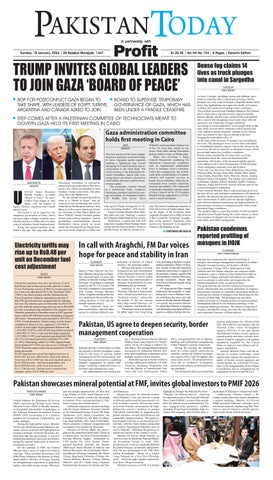
Gaza administration committee holds first meeting in Cairo GAZA
agencies
U
WASHINGTON agencies
NITED States President Donald Trump’s so-called “Board of Peace” for postconflict Gaza began to take shape, with the leaders of Egypt, Turkiye, Argentina and Canada asked to join. The board is set to supervise the temporary governance of Gaza, which has been under a fragile ceasefire since October and lies in rubble after two-plus years of relentless Israeli bombardment. Trump had named members of the board a day ago. The step came after a
Palestinian committee of technocrats meant to govern Gaza held its first meeting in Cairo, which was attended by Jared Kushner, Trump’s son-in-law, who plays a key role in the Middle East. He has already declared himself the chair of a “Board of Peace” and announced its full membership that will include former British prime minister Tony Blair, as well as senior Americans, Kushner, Secretary of State Marco Rubio and Steve Witkoff, Trump’s business partner turned globe-trotting negotiator. Turkish presidential communications director Burhanettin Duran posted on social media that President Recep Tayyip Erdogan received the proposal in a letter sent
Electricity tariffs may rise up to Rs0.48 per unit on December fuel cost adjustment PROFIT
staff report
Electricity consumers may face an increase of up to Rs0.48 per unit in their power bills after the Central Power Purchasing Agency (CPPA-G) sought approval for a fuel cost adjustment (FCA) for December 2025. CPPA-G has filed a petition with the National Electric Power Regulatory Authority, requesting an increase of Rs0.4781 per kilowatt-hour compared with the reference fuel cost. The reference price for December was Rs9.1419 per unit, while the actual average fuel cost rose to Rs9.6200 per unit. According to data submitted to the regulator, total electricity generation in December stood at 8,487 gigawatthours, with 8,208 GWh delivered to distribution companies after losses. Transmission losses amounted to 259 GWh, or 3.05% of total generation. Nuclear energy was the largest contributor to the power mix, supplying 2,126 GWh or 25.05% of total output. Hydel generation followed with 1,534 GWh (18.07%), while RLNG-based plants produced 1,464 GWh (17.24%). Local coal-fired plants generated 1,187 GWh (13.99%) and imported coal plants 860 GWh (10.13%). Gas-based generation contributed 951 GWh (11.20%). Wind energy added 162 GWh, bagasse-based plants produced 97 GWh, and solar power contributed 74 GWh. Electricity imports from Iran accounted for 33 GWh during the month. RLNG-based power carried the highest fuel cost at Rs20.5457 per unit, followed by electricity imports from Iran at Rs21.9685 per unit and imported coal at Rs14.3088 per unit. Gas-based generation cost Rs13.8030 per unit, while local coal stood at Rs13.1286 per unit. Nuclear power remained the cheapest source at Rs2.3009 per unit.
The first session of the Gaza Administration Committee convened Friday in Cairo, Egyptian media reported, marking a significant step toward managing civil administration and reconstruction in the Gaza Strip. The initial meeting of the Palestinian National Committee, tasked with overseeing Gaza’s governance, focused on relief efforts and post-conflict reconstruction plans. The committee, recently formed as a technocratic body, comprises Palestinian members selected to manage civil affairs. Its formation follows US Middle East Envoy Steve a day ago by Trump, inviting him to “become a founding member” of the board. Egypt’s Foreign Minister Badr Abdelatty said Cairo was “studying” a request for President Abdel Fattah al-Sisi to join. Meanwhile, a senior aide told AFP today that Canadian Prime Minister Mark Carney has also been invited by Trump to join the board, an offer he intends to ac-
Witkoff’s announcement of phase two of the US Gaza plan, based on outcomes from talks among Palestinian factions held in Cairo on Wednesday. Phase two envisions a Peace Council framework combining the Palestinian technocratic committee with an international stabilisation force to facilitate Gaza’s transition. Under this arrangement, the technocratic body would handle civil administration and essential services as Israeli forces withdraw, while the international force ensures temporary security and stability. The framework is reportedly intended to operate under a Peace Council led by US President Donald Trump, supported by a UN Security Council resolution. cept. The senior Canadian government official did not provide further details. Sharing an image of the invitation letter, Argentine President Javier Milei wrote on X that it would be “an honour” to participate in the initiative. Separately, Blair said he was “honoured” to be tapped by Trump to the fledgling board.
CONTINUED ON PAGE 03
In call with Araghchi, FM Dar voices hope for peace and stability in Iran ISLAMABAD
staff report
Deputy Prime Minister and Foreign Minister Ishaq Dar on Saturday expressed hope for peace and stability in Iran, the Foreign Office (FO) said. According to a statement posted on the FO’s X account, FM Dar held a telephonic conversation with Iranian Foreign Minister Abbas Araghchi, during which the two counterparts discussed the prevailing situation in Iran and the broader regional context. “Dar expressed hope for peace and stability, and both sides agreed to continue bilateral con-
sultations on matters of mutual interest,” the statement added. Pakistan had earlier conveyed its hopes for an early normalization of the situation in Iran at the United Nations Security Council, where the country has witnessed some of its largest demonstrations in years, challenging the government. Speaking at the UNSC on Thursday, Pakistan’s Ambassador Asim Ahmad described Iran as a “brotherly country,” noting that the people of the two nations share deep-rooted historical, cultural, religious, and friendly ties. The protests in Iran were sparked by public anger over rising living
costs, prompting authorities to impose internet restrictions. While US President Donald Trump had repeatedly threatened intervention in support of the protesters, monitors reported that demonstrations subsided following a security crackdown. Trump later stated he had decided against taking military action. FO spokesperson Tahir Andrabi emphasized that instability in neighboring Iran is not in Pakistan’s interest, underlining that peace and calm in Iran are directly linked to Pakistan’s own security and economic interests. He added that Pakistan is engaging with Washington regarding tariffs imposed on countries trading with Iran.
Dense fog claims 14 lives as truck plunges into canal in Sargodha SARGODHA
staff report
At least 14 people, including women and children, were killed on Saturday after a mini-truck carrying a family plunged into a dry canal in Punjab’s Sargodha district amid dense fog, highlighting once again the deadly toll of poor visibility and unsafe travel during winter conditions. The accident occurred near Ghalapur Bangla in Kot Momin tehsil, where heavy fog had severely reduced visibility. Rescue officials said the truck veered off the road and fell into a canal while navigating a local route, taken after the motorway was closed due to foggy conditions. According to rescue authorities, seven people died on the spot, while several others sustained critical injuries and were rushed to nearby hospitals. Another seven victims later succumbed to their injuries during treatment, bringing the total death toll to 14. At the time of the accident, 23 people were travelling in the truck. The passengers were en route from Islamabad to Faisalabad to attend a funeral. Due to the closure of the motorway, the driver opted for an alternative route, which proved fatal under low-visibility conditions. Rescue teams reached the site soon after receiving information about the crash and launched relief operations. The bodies of the deceased and the injured were shifted to the Tehsil Headquarters (THQ) Hospital, where emergency measures were put in place. Those who lost their lives were identified as Misri Khan, Haleema Bibi, Yaseen, Sonia Bibi, Pathani Bibi, Hania, Iman Fatima, Rani Bibi, Haris, Waseem, Horain, Aamna, Hareem Fatima and Saqlain. The injured were identified as Hasnain, Saqlain, Zaheer, Mumtaz, Kashif, Nadeem, Shamim, Nadia and Parveen. Rescue officials said all the victims belonged to Islamabad. Prime Minister Shehbaz Sharif expressed deep grief over the loss of lives and extended condolences to the bereaved families. He directed the relevant authorities to ensure strict enforcement of traffic laws on national highways and ordered enhanced monitoring and implementation of precautionary measures to safeguard public safety amid persistent foggy conditions. The incident adds to a growing number of fatal accidents reported across Punjab during the winter season, as dense fog continues to disrupt road travel and expose gaps in road safety and traffic management.
Pakistan condemns reported profiling of mosques in IIOJK ISLAMABAD
Pakistan has condemned the reported profiling of mosques and mosque management committees in Indian Illegally Occupied Jammu and Kashmir (IIOJK). In a statement, Foreign Office Spokesperson Tahir Andrabi said this blatant intrusion into religious affairs constitutes a grave violation of the fundamental right to freedom of religion and belief and reflects yet another coercive attempt to intimidate and marginalise the Muslim population of the occupied territory. The spokesperson said forcible collection of personal details, photographs and sectarian affiliations of religious functionaries amounts to systematic harassment aimed at instilling fear among worshippers and obstructing the free exercise of their faith. The spokesperson said these actions form part of a broader pattern of institutionalised Islamophobia driven by the Hindutva ideology of the occupying Indian government. The selective targeting of mosques and Muslim clergy lays bare the discriminatory and communal character of these policies.
Pakistan, US agree to deepen security, border management cooperation ISLAMABAD
staff report
Pakistan and the United States on Saturday agreed to further strengthen cooperation in the areas of security, border management and law enforcement, reaffirming their commitment to expanding bilateral engagement on shared challenges, including counterterrorism, cybercrime and transnational crime. The understanding was reached dur-
ing a meeting between Interior Minister Mohsin Naqvi and a high-level US delegation led by US Chargé d’Affaires Natalie Baker. The meeting featured detailed discussions on enhancing bilateral relations and broadening cooperation across multiple security-related domains. Both sides agreed to further reinforce existing collaboration under the US AntiTerrorism Assistance Programme and with the Bureau of International Narcotics and Law Enforcement Affairs
staff correspondent
(INL), recognising their role in capacitybuilding and institutional strengthening within Pakistan’s security framework. During the meeting, the establishment of a crime control centre and an academy within the Federal Investigation Agency (FIA), with US support, also came under review. The proposed initiatives aim to modernise investigative practices and enhance professional training standards. The delegation discussed expanding
training programmes for officers of the FIA, the Federal Constabulary and the National Cyber Crime Investigation Agency (NCCIA). It was also agreed that Pakistan’s border security agencies, coastal guards and other relevant institutions would be equipped with modern equipment supplied by the United States to improve surveillance and response capabilities. Interior Minister Naqvi said the induction of modern technology would significantly enhance the operational capacity of border security agencies and coastal guards. He welcomed US assistance in the reorganisation of the Federal Constabulary and in strengthening the capabilities of the FIA and NCCIA.
Pakistan showcases mineral potential at FMF, invites global investors to PMIF 2026 RIYADH/ISLAMABAD staff report
Federal Minister for Petroleum Ali Pervaiz Malik, representing Pakistan at the Future Minerals Forum (FMF) in Riyadh, formally invited global stakeholders to participate in the Pakistan Minerals Investment Forum (PMIF) 2026, positioning it as a premier platform for investment, collaboration, and policy dialogue. During the high-profile forum, Minister Ali Pervaiz Malik showcased Pakistan’s immense mineral potential and highlighted the country’s strategic vision for the sector, emphasizing that the government is actively simplifying regulatory processes and harmonizing the mineral framework to attract international investors. On the sidelines of FMF, the Federal Minister held a series of high-level bilateral meetings. These included discussions with HRH Prince Abdulaziz bin Salman Al-Saud, Saudi Arabia’s Minister of Energy, focusing on strengthening cooperation in petroleum supply, renewable energy, energy efficiency,
and investment opportunities. He also met Engr. Khalid Al-Falih, Saudi Minister of Investment, to explore avenues for increasing investment flows and partnerships in Pakistan’s energy and mineral sectors. Additional interactions included meetings with Mr. Jassim Alshirawi, Secretary General of the International Energy Forum; Mr. Sami Takaluoma, CEO, Metso Corporation; the Chairman of Delta Oil; Mr. Badr Al-Aiban; Eng. Saad Alkhalb, CEO, Saudi EXIM Bank, where prospects of mutual cooperation and investment were extensively discussed. Minister Ali Pervaiz Malik also participated in the ministerial panel titled “Dawn of a Global Cause: The Role of Governments in Driving Mineral Supply,” moderated by CNN anchor Ms. Eleni Giokos. Distinguished panelists included Mr. Bandar Alkhorayef, Saudi Minister of Industry and Mineral Resources; Ms. Leila Benali, Moroccan Minister of Energy Transition; Mr. Thiam Tidjani, Mauritania’s Minister of Mines; Ms. Aurora Williams Baussa, Chilean Mining Minister; and Mr. Claude Guay, Canadian Parliamentary Secretary for Energy and Nat-
ural Resources. During the panel, the Minister emphasized Pakistan’s vast and diverse mineral wealth and underscored the government’s efforts to reduce systemic friction and create an investor-friendly environment. He highlighted the country’s readiness to partner with global stakeholders in supporting the global transition toward electrification and sustainable mining practices. The panel acknowledged Pakistan as an emerging mineral hub, with Ms. Eleni Giokos noting that the world is “knocking at Pakistan’s door to secure minerals,” reflecting the growing international interest in the country’s sector. Minister Ali Pervaiz Malik formally invited investors to attend the Pakistan Minerals Investment Forum in April 2026, positioning the event as a landmark platform for global dialogue, investment, and partnership. He also participated in the FMF Ministerial Roundtable, “Dawn of a Global Cause: Minerals for a New Era of Development,” which brought together representatives from 100 governments. Pakistan’s presence at FMF was further
highlighted through the Pakistan Pavilion – “Pakistan: The Mineral Marvel” – featuring live demonstrations of the National Minerals Data Center (NMDC), a state-of-the-art platform for mineral sector modernization. Visitors engaged with interactive exhibits, including 3D geological modeling, high-resolution GIS mapping, and real-time data vi-
sualization of Pakistan’s mineral-rich belts. Additionally, Pakistan hosted a 90minute country showcase session attended by a packed audience. Minister Ali Pervaiz Malik presented Pakistan’s strategic vision for critical minerals, emphasizing that “Pakistan is open for business, and the government stands firmly behind investors.”