Oysters_ISSU (1)

Page 1


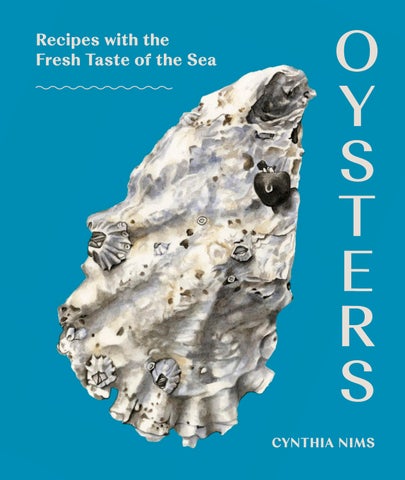
Recipes with the Fresh Taste of the Sea

Y S T E R S

Recipes

with the

Fresh

Taste of the Sea

CYNTHIA NIMS

Photography by Jim Henkens

This book is dedicated to all those—friends and family, chefs and farmers, writers and advocates—who keep me inspired in this wonderful world of food

What Is It about Oysters?

BASICS

The Life & Times of the Modern Oyster

How They Grow

Seasonality

Pacific Coast Oysters

Pacific Coast Growing Regions

Pacific Coast Oyster Bar Culture

In the Kitchen

Buying & Storing Oysters

Sizing Them Up

Shucking Oysters

Health & Safety

What to Drink with Oysters

RECIPES

Raw

Zippy Oyster Shots

How to Serve Half-Shell Oysters

Champagne Vinegar–Roasted

Shallot Mignonette

Lemon-Rosemary Mignonette

Rice Vinegar–Ginger Mignonette

Pear–Black Pepper Granité

Grapefruit-Basil Granité

Cucumber-Shiso Granité

“Cocktail” Relish

Kimchi-Cucumber Relish

Fennel-Aquavit Relish

Gazpacho Relish with Tequila Chaser

Baked & Grilled

Baked Oysters with Tender

Leeks & Thyme

Oysters Baked with Devil Sauce

Green Curry Oyster & Spinach Puffs

Oyster & Kale Gratin with Brown-Butter Crumbs

Alder Smoked Oysters

Crostini with Smoked Oysters

How to Serve Grilled Oysters

Arugula-Almond Pesto

Smokey Tomato-Bacon Relish

Garlic-Sage Butter

Fried & Sautéed

Pan-Fried Oysters with Fennel Tartar Sauce

Oyster Sliders with Togarashi Slaw

Oyster Okonomiyaki (Savory Japanese Pancake)

Endive & Radicchio Salad with Fried Oysters & Hazelnuts

Cracker-Coated Oysters with Dilled Cream

Hangtown Hash with Fried Eggs

Ale-Battered Oysters & Chips

Steamed & Poached

Oyster Stew

Oysters en Escabeche

Oyster & Celery Root Bisque

Oyster Crackers

Oyster Chowder

Steamed Oysters with Sake-Ginger Butter Sauce

Cider-Poached Oysters on Toast

Oyster Excursions

Oyster Resources

WHAT IS IT ABOUT OYSTERS?

they inspire hip oyster bars, backyard grilling feasts, and elegant celebration meals. They evoke songs, poems, and fashion shows. They bring out our competitive streak to see who can shuck and slurp the most. They prompt pilgrimages to their home territory, which might include late-night forays to moonlit bays seeking the best of the season at its pinnacle of freshness. They satisfy our hunger, fuel our romance, and feed our souls. I’ve written quite a lot about Northwest foods over the years, and no other food seems to strike the kind of food-culture chord that oysters do.

Oyster culture is a natural part of our lives all along the Paci c Coast of the United States and Canada. Both culture in terms of the customs and values of us who live here and the practical business of raising oysters in this proli c growing environment. For some it’s a particularly rich dose of both types of culture, as many oyster-growing operations are now run by third, fourth, even fth generations of family members keeping their slice of local oyster heritage alive.

The sheer volume of production re ects the geography of this coast, with its countless bays, sounds, inlets, channels,

x and coves that provide ideal habitats for oysters. And the quality of those oysters is a direct product of the water they live in, nutrient rich and managed in ways to help preserve healthy seafood populations. The diversity of avors that Paci c Coast oysters have echoes variants in the types of phytoplankton, zooplankton, and other microorganisms that thrive in the region’s water, not to mention variations in water depth, temperature, tidal activity, and other environmental attributes.

This conglomeration of natural in uences on the oyster’s character has come to be known as meroir, the seaworthy version of terroir. We on the Paci c Coast are lucky to live in a place where the meroir produces superlative oysters that folks just can’t seem to get enough of.

Oysters have a capacity to transport us, right there in our kitchen or on our oyster-bar stool, more than other foods. When we hold the creature in its pure form, it only takes a short leap of the imagination to put us on the shore where it was harvested. The fact that the shell may carry along some evidence of its marine cohorts makes it seem all the more vivid: barnacles, a tuft of seaweed, maybe a minuscule oyster or mussel. And that liquor that surrounds the oyster in its shell—it seems pure essence of the sea, a taste of place like none other.

I realize that not everyone is mad about oysters, nor necessarily feels transported when consuming them. But I will say that the mere mention of this book’s topic launched more interesting conversations with both friends and strangers than I recall from any other project.

There was my weekend on Washington’s Long Beach Peninsula, at the historic Shelburne Inn. I’ve known the owners, David Campiche and Laurie Anderson, for many years, originally in the context of doing wild mushroom research. On

this recent early winter visit, I’d been to see Goose Point and Ekone oyster operations on Willapa Bay en route to teaching a wild mushroom class at the inn. As David put down a plate of his Hangtown fry (eggs cooked frittata style with oysters and bacon; he adds spinach and a dash of Parmesan) the next morning, he talked about growing up in that area. And how his Ilwaco High School football team was hard to beat because some of them worked at collecting oysters on the Willapa Bay mud ats, building up extraordinarily strong thigh muscles with each bushel they lled.

Another time I had just own into San Francisco International Airport and was picking up my rental car. The fellow at the counter, being friendly while taking care of the paperwork, asked where I was headed. “Up to Tomales Bay,” I said, “to have some oysters at Hog Island.” “You know how I like to cook oysters?” he offered, without any prompting from me. “Just put them right on the grill and cook them until they pop open. Some Tabasco sauce. That’s it.” I nodded in total agreement. “Oh, and Hennessy Cognac, that’s what I drink with those oysters.” Hmm, now that was a pairing idea I hadn’t considered before.

The road trips I took while researching this book ampli ed my realization that oysters are the source of hallmark Paci c Coast experiences. Oyster lovers can visit oyster farms, buy from the source, slurp oysters on the beach, enjoy a picnic within view of the oyster beds, and attend myriad oyster-centric events. There are many dynamic traditions built around oysters that exemplify the region’s oyster engagement.

I cut my journalistic teeth on the subject of seafood as an editor at Simply Seafood magazine, published by a Seattle company founded by former shermen who put out a couple

xii of publications for the seafood industry as well. That magazine position was my rst job back home after my culinary education in France. It was there that I wrote a 1997 article about the then renaissance of oyster bars. And it was thanks to that job that I found myself one chilly, dank late-fall morning on the doorstep of Julia Child’s home in Cambridge, Massachusetts. It’s not as though she didn’t know I was coming and wouldn’t have let me in otherwise. But showing up with a cooler containing Olympia oysters and some rst-of-theseason Dungeness crab in hand seemed to have swiftened my entry. Within moments I was in her warm kitchen and she shucked open an oyster, slurping it down with glee. That was just one of many occasions that have made clear to me how broad and devoted the fan base is for oysters from the Paci c Coast.

When it comes to exploring oysters, there are interesting parallels drawn to the world of wine. As we sip different wines from different places, sometimes side by side, it helps us better understand the range of options available as we form opinions about what suits our personal palate best. The same is true of sampling oysters, particularly when various types can be tasted at the same time for a clear comparison. This is the best way to appreciate how much diversity of avor there is to be had with oysters. Soon you learn that not all oysters are the same, which invites only more delicious exploration. Opportunities for just that kind of exploration abound along the Paci c Coast, fueled in large part by access to oysters through a number of channels. Beyond the usual retail store and restaurant options, some oyster farms sell direct to customers on-site, whether through a simple service window or in a small store with other oyster-friendly offerings. A few oyster growers have gone so far as to open restaurants at

which they showcase their product from the oyster bed direct to the customer’s plate.

But oyster-farm-to-table dining isn’t a new phenomenon here. The origin of today’s Oregon Oyster Farms and Dan & Louis Oyster Bar can trace to a mid-nineteenth-century shipwreck off Yaquina Bay, which precipitated an unscheduled introduction to the vast supply of oysters found in the bay. Meinert Wachsmuth was on board and didn’t stay in the area at the time but retired there later. His son Louis Charles Wachsmuth is the one who took the oyster and ran with it in the early twentieth century, raising oysters on the coast and serving oysters in Portland. The family no longer owns the oyster-growing business, but its legacy lives on in both establishments. It also lives on in chef Cory Schreiber, greatgreat-grandson of Meinert, longtime chef/owner of Portland’s beloved (and now closed) Wildwood restaurant and today chef/instructor at the Art Institute of Portland. He visited the family oyster beds many times growing up and hung out in the shucking room where the radio blasted as women shucked and gossiped all day long. If not through genetics alone, his fate of an oyster-rich life was surely sealed with the baby shower in his honor held at the family oyster bar.

So you see that it is a rich fabric that’s woven with oyster culture all along the Paci c Coast. Family traditions, commercial industry, celebrations, recreation, history, conversation, and pure culinary enjoyment can all be fed by the humble oyster.

B A

S I C S

Turn static files into dynamic content formats.
Create a flipbook
Issuu converts static files into: digital portfolios, online yearbooks, online catalogs, digital photo albums and more. Sign up and create your flipbook.