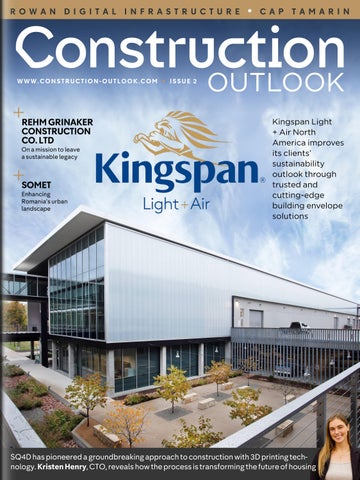
Construction Outlook - issue 2

Page 1


REHM GRINAKER CONSTRUCTION CO. LTD

On

Enhancing

Africa Outlook, APAC Outlook, EME Outlook, North America Outlook, Mining Outlook, Healthcare Outlook, Manufacturing Outlook, Supply Chain Outlook, Food & Beverage Outlook, and Construction Outlook are digital publications aimed at boardroom and hands-on decision-makers, reaching an audience of more than 800,000 people around the world.

With original and exclusive content compiled by our experienced editorial team, we look to promote the latest in engaging news, industry trends, and success stories from across the globe.

Your company can join the leading industry heavyweights enjoying the free exposure we provide across our platforms with a free marketing brochure, extensive social media saturation, enhanced B2B networking opportunities, and a readymade forum to attract new investment and help you grow your business.

Visit www.outpb.com/work-with-us for details on how your company can feature for free in one of our upcoming editions.

EDITORIAL

Head of Editorial: Jack Salter jack.salter@outpb.com

Deputy Head of Editorial: Lucy Pilgrim lucy.pilgrim@outpb.com

Senior Editor: Lily Sawyer lily.sawyer@outpb.com

Editor: Ed Budds ed.budds@outpb.com

Editor: Rachel Carr rachel.carr@outpb.com

Copy Editor: Lauren Kania lauren.kania@outpb.com

PRODUCTION

Art Director: Stephen Giles steve.giles@outpb.com

Senior Designer: Devon Collins devon.collins@outpb.com

Designer: Louisa Martin louisa.martin@outpb.com

Production Manager: Alex James alex.james@outpb.com

Digital Marketing Director: Fox Tucker fox.tucker@outpb.com

Website Content Manager: Oliver Shrouder oliver.shrouder@outpb.com

Social Media Executive: Jake Crickmore jake.crickmore@outpb.com

BUSINESS

CEO: Ben Weaver ben.weaver@outpb.com

Managing Director: James Mitchell james.mitchell@outpb.com

Chief Technology Officer: Nick Norris nick.norris@outpb.com

ADMINISTRATION

Finance Director: Suzanne Welsh suzanne.welsh@outpb.com

Finance Assistant: Victoria McAllister victoria.mcallister@outpb.com

CONTACT

Construction Outlook

Norvic House, 29-33 Chapelfield Road

Norwich, NR2 1RP, United Kingdom

Sales: +44 (0) 1603 804 445

Editorial: +44 (0) 1603 804 431

SUBSCRIPTIONS

Tel: +44 (0) 1603 804 431 jack.salter@outpb.com

www.construction-outlook.com

Follow us on Linkedin: @constructionoutlook

LIGHT UP THE ROOM

Welcome to our second edition of Construction Outlook magazine.

The Collin College Technical Campus (CCTC), a unique education facility in Texas, lights up this issue’s front cover. Natural light plays a key role in the design of CCTC, with each building designed to maximise daylight penetration, whilst advanced diffused daylighting techniques help regulate light throughout the campus.

Translucent wall systems allow plenty of natural light in, reducing glare and hot spots for a more comfortable atmosphere, whilst also improving energy efficiency by minimising the need for artificial lighting during the day.

Kingspan Light + Air North America (KLA NA), established in 2016 as a gateway to greater geographic expansion for Kingspan Group, was proud to be part of CCTC.

With a vision to make buildings across the US healthier, smarter, and more sustainable, KLA NA improves its clients’ sustainability outlook through trusted and cutting-edge building envelope solutions.

“Our mission remains focused on helping customers meet sustainability goals through transparency and innovation,” outlines Marci Bonham, President –Americas.

REHM Grinaker Construction Co. Ltd is also on a mission to leave a sustainable legacy for Mauritius’ construction industry.

The leading multidisciplinary contractor is strengthening its commitment to sustainability through realistic and measurable approaches.

“I believe in coherence before image,” says CEO, Remy Couve. “We’re at the beginning of this journey. My focus is on organising our environmental efforts properly, so that what we announce is something we truly deliver.”

Elsewhere in Mauritius, Cap Tamarin is a mixed-use development and collaborative city located on the west coast of the island.

It was conceived as a walkable, human-scale city that allows residents to live, work, study, and play all within a five-minute radius.

“By blending walkability, green infrastructure, and community engagement, we’re shaping a city designed not just for today, but the decades ahead,” affirms Yannick Louison, CEO – Real Estate.

This edition shines additional light on Rowan Digital Infrastructure, Somet, TMSRedec, and Turner Construction.

We hope that you enjoy your read.

SERVING THE UK’S BIGGEST EV BATTERY PLANT

BRITISH CONSTRUCTION AND engineering company, Costain Group, has won a £123 million contract to design and build a new junction on the M5 in Somerset to serve the UK’s biggest electric vehicle (EV) battery plant.

The five-year junction project, nicknamed ‘22A’, is hoped to alleviate pressure on the motorway. It will only cater to southbound traffic and

TO CONSTRUCT NEW MEGA DAMS

THE GOVERNMENT OF Kenya has announced plans to build at least six mega dams and expand irrigation to two million acres of farmland in an effort to strengthen food security, protect local farmers from climate catastrophes, and unlock the

comprise one slip road for vehicles coming from Bristol, Weston-superMare, and Highbridge, alongside an additional northbound slip road to return drivers to the M5.

Costain Group has pledged to work closely with partners to design and deliver this new junction, which will provide necessary access to the new gigafactory and help drive economic growth across the UK.

CHINA LAUNCHES ‘MEGA EMBASSY’ PLANS

THE UK GOVERNMENT has recently approved plans for China to construct its largest European embassy to date.

Set to be built on the site of the Royal Mint Court near the Tower of London, China has paid approximately £255 million to buy the land, with the projected cost of construction unclear at the moment.

economic potential of the country’s arid and semi-arid landscapes.

Anchored under the National Agricultural Sector Investment Plan and headed by the State Department for Irrigation, this programme will support its citizens against the vulnerable effects of erratic rainfall, prolonged drought, and rising food prices.

Construction for these flagship dams is anticipated to begin in 2026, stimulating broader economic

Despite opposition from lawmakers, local residents, and pro-democracy campaigners, the decision to go ahead with the plans has been made in time for China’s anticipated visit to the country. The new embassy is expected to cover 20,000 square feet (sqft) and will be designed by David Chipperfield Architects alongside involvement from the engineering and design firm Cundall.

activity, including agro-processing, value addition, and rural employment. ASIA

Two Rivers Dam, Eldoret, Kenya
Tower of London

BREAKING GROUND ON MAJOR INDUSTRIAL PARK

SC CAPITAL PARTNERS, a major real estate investment manager, has begun construction on a 3.2 million sqft industrial park within the Ras Al Khaimah Economic Zone (RAKEZ) in the United Arab Emirates (UAE).

The project is the inaugural development of the SC Gulf Cooperation Council (GCC) Real Estate Industrial Development Fund – SC Capital Partners’ first fund in the GCC. Co-sponsored by CapitaLand Investment, the industrial park will

comprise 11-metre clear ceiling heights and integrate sustainability initiatives.

Breaking ground on this project is a testament to the company’s ability to convert strategy into execution in the GCC, and it is committed to building an institutional-grade platform that can scale across the UAE.

PROTESTS LEAD TO SUSPENDED CONSTRUCTION

THE GBARNGA-MENDIKORMA ROAD, currently being constructed by China Henan International Cooperation Group (CHICO), had its pavement works temporarily suspended after local residents staged a protest.

The subject of disagreement from the residents of Gweayea

Town included CHICO’s failure to fully honour its social and corporate responsibility commitments outlined in a memorandum of understanding (MOU) signed in 2018 with the community.

The protesters brought CHICO’s operations to a halt in an attempt to draw national attention and government intervention to the situation, whilst the company claims it has fulfilled its obligations under the MOU and seeks to return to dialogue to resolve the dispute.

EUROPE & MIDDLE EAST

BOWMER + KIRKLAND – one of the UK’s most successful family-owned construction and development groups – has been named the primary contractor to erect one of the largest film studios in Europe.

However, having faced many delays after primary backer, Cain International, pulled out of the deal in the summer of 2025, a new investor has yet to be confirmed for the £450 million government-backed project.

Set in Sunderland, the local city council has announced construction will begin in the first half of 2026, with a new investor expected in the upcoming months. The studio will cover 82 acres and feature 20 sound stages.

NORTH AMERICA

CONTRACTOR CONFIRMED FOR LANDMARK FILM STUDIO COST OF CONSTRUCTION MATERIALS INCREASING

DESPITE NEARLY THREE years of stability, construction materials are rapidly growing in price, with copper and electrical components – key to data centre construction – expected to rise the most by the end of 2026.

Non-residential input prices have increased by approximately 44.5 percent since the onset of the COVID19 pandemic in 2020, and industry analysts are predicting that these higher costs will persist as supplyside restrictions add to demand pressure.

Besides copper and electrical components, concrete and masonry are seeing constrained demand and pricing sitting at their highest nominal levels since the height of the pandemic.

AFRICA

RESILIENCE: Construction’s Real Challenge

Terry Naden, Managing Director for Energy, Infrastructure, and Build at Morson Edge, explores how the main obstacle facing the global construction industry is no longer productivity but a lack of systematic resilience, and details how leaders can overcome these challenges

For years, construction has measured success through productivity – how quickly projects move, how efficiently labour is deployed, and how tightly costs are controlled. Those metrics still matter, but they are no longer sufficient.

Across global construction markets, projects are not stalling because ambition is lacking or funding is unavailable, they are faltering because the systems designed to deliver them are no longer resilient enough to absorb scale, complexity, and disruption at the same time.

Construction is not facing a single

crisis of skills, cost, or capacity, it is facing a resilience crisis. Until the industry reframes the challenge, it will continue to treat symptoms rather than causes.

SKILLS SHORTAGE AS A SYMPTOM

The industry’s default explanation remains labour scarcity. Yet, a closer look at delayed or over-budget construction programmes worldwide tells a different story.

In many cases, skills exist within the system, but they are misaligned, repeatedly remobilised, or lost between project cycles.

Workforce planning sits downstream of design and procurement decisions, rather than shaping them. Delivery models prioritise short-term flexibility over long-term continuity. In that environment, churn becomes inevitable. Talent follows visibility, certainty, and investment and exits when those disappear.

Therefore, what is labelled as a ‘skills shortage’ is often a lagging indicator of deeper structural weaknesses, and not the cause itself.

These pressures are also forcing change within the wider supply chain. At Morson Edge, a recent structural transformation was driven by exactly these signals. The company recognised that transactional approaches to skills and delivery no longer reflect how construction programmes succeed or fail.

Bringing technical consultancy and workforce deployment closer together through businesses such as Morson Praxis and Morson Vital reflects a wider industry shift away from fragmented capability and towards models that align design intent, buildability, and workforce continuity as part of a single delivery system.

FRAGMENTATION INCREASING DELIVERY RISK

One of the most consistent themes in global construction is not technical failure, but coordination failure.

Fragmentation has become normalised under the banner of efficiency. In practice, this has pushed risk down the supply chain and diluted accountability across interfaces between design, engineering, construction, and commissioning.

The consequences of fragmentation are rarely revealed under stable conditions, only becoming visible when assumptions break, programmes accelerate, designs evolve late, or external pressures force change.

Resilience is not tested in businessas-usual; it is tested under stress. Systems with too many brittle interfaces struggle to respond coherently. Productivity gains matter, but without resilience beneath them, they are fragile.

WHEN SCALE OUTRUNS RESILIENCE

The consequences of this imbalance are already visible across major construction programmes.

In the past decade, a landmark urban infrastructure project in a major global city was launched with strong political backing, committed funding, and an aggressive delivery timetable. Tier 1 contractors were experienced, engineering solutions were proven, and the ambition was clear.

As the programme moved from design into construction, however, progress slowed. Public reporting focused on familiar explanations –labour shortages, supply disruption, and cost inflation.

But, those explanations masked a deeper issue. Work packages were fragmented across numerous Tier 2 and Tier 3 contractors, each operating to different schedules, commercial incentives, and workforce assumptions.

Design changes continued deep into the build phase, often without full alignment to construction sequencing or available skills. Specialist trades were repeatedly mobilised, stood down, and re-mobilised as scopes shifted.

There was no single point of failure. The project did not lack capability; what it lacked was system resilience.

Delivery only stabilised once interfaces were simplified, Tier2 capacity was engaged earlier, and construction sequencing was aligned more closely with workforce reality. The lesson was clear: the challenge had never been technical competence; it was the fragility of the delivery model itself.

A BOARDROOM SHIFT BEYOND CONSTRUCTION

This reframing was echoed at this year’s World Economic Forum, where global CEOs spoke less about growth ambition and more about execution under sustained volatility.

Across infrastructure-heavy sectors, leaders acknowledged that supply chain disruption is no longer cyclical but structural, and that operating models optimised purely for efficiency are struggling to cope.

The consistent question was not whether construction demand will continue, but whether delivery systems are resilient enough to turn intent into built reality.

Nowhere is this more apparent than in the growing pressure on Tier 2 and Tier 3 contractors. As project scale accelerates, from transport and commercial developments to industrial and mission-critical construction, Tier 2 capacity is being asked to scale faster than the surrounding system can support.

Commercially, these tiers often absorb disproportionate risk without long-term visibility. Operationally, they are expected to mobilise and retain skilled workforces at pace. Strategically, they are rarely engaged early enough to shape buildable programmes. This is not a performance failure; it is a structural imbalance. Resilience cannot be built on perpetual short-term mobilisation.

INTEGRATION: OPTIONAL TO ESSENTIAL

Across global construction markets, the most resilient delivery models share a common trait: integration. Not vertical integration for its own sake, but alignment across design, engineering, construction, and workforce strategy. The organisations that perform best under pressure treat delivery as a connected system, not a sequence of transactions.

Where construction sequencing reflects workforce reality, design decisions account for buildability and capacity, and Tier 2 capability is treated as strategic rather than interchangeable, outcomes improve. Delivery risk lives between disciplines, not within them.

Solving this requires changing how construction delivery systems are designed. Through Morson Praxis, we work upstream to align design, buildability, and sequencing with real delivery capacity before programmes mobilise.

Through Morson Vital, we maintain continuity downstream, structuring workforce mobilisation, retention, and development around the lifecycle of the programme, not individual packages. Together, this shifts construction away from reactive resourcing and towards delivery systems that can scale without fragmenting.

WHAT CONSTRUCTION LEADERS SHOULD PRIORITISE

For C-suite leaders, this moment demands a change in questions, not just answers.

Construction organisations should be asking:

• Where does construction delivery actually break when projects scale?

• Which parts of the supply chain lack continuity and what does that cost over time?

• How early are workforce realities influencing design and sequencing decisions?

• Are delivery models optimised for lowest upfront cost or for sustained performance under pressure?

At Morson Edge, our evolution has been shaped by confronting these questions directly, because construction delivery reality has made them unavoidable.

The next decade will not be defined by perfect conditions, but by how well construction systems absorb disruption and still deliver. Productivity will always matter, but resilience is what will determine who endures.

ABOUT THE EXPERT

With 28 years of recruitment expertise – over 17 of which have been with Morson Edge

– Naden has been instrumental in delivering high-quality workforce solutions to a range of businesses across multiple sectors, overseeing strategy, compliance, and operational excellence. He is currently the Managing Director for Energy, Infrastructure and Build, and responsible for strategy and operational management at Morson Edge.

Shape the future of data centres on 4-5 March 2026 . Tackle AI’s impact, sustainability challenges, and global regulations head-on. Discover cuttingedge solutions and bridge the skills gap. Join the world’s largest data centre gathering to drive innovation in our rapidly evolving industry. www.techshowlondon.co.uk/ constructionoutlook2026

A TRANSFORMATIVE DESIGN FOR CONCRETE SOLUTIONS

Pioneering a groundbreaking approach to construction with 3D printing technology, SQ4D has reimagined a world where homes are not just built but crafted with precision and purpose. Kristen Henry, CTO, reveals how the process is transforming the future of housing

Writer: Rachel Carr

TRANSFORMATIVE CONCRETE

The field of architecture is continuously evolving, especially in the digital era, where technological advancements have introduced construction methods that are both time- and costefficient and more precise in design.

3D construction printing (3DCP), also known as additive manufacturing, involves the creation of components or complete structures using an automated 3D printer engineered explicitly for this purpose.

This innovation is poised to revolutionize the industry by addressing modern challenges commonly faced in construction, and trailblazer SQ4D is stepping up to meet these demands.

“The construction industry is facing a perfect storm of challenges: skyrocketing costs, labor shortages, and an urgent need for affordable homes. The founders of SQ4D saw an opportunity to modernize an outdated industry while delivering

homes that are stronger and more attainable for the families who need them most.

“After first attempting to engineer a home-building robot that walked around with a nail gun to attach 2x4-inch pieces of lumber, automating the process using 3D printing technology emerged as the better solution,” opens Kristen Henry, CTO. Technology is transforming the industry in remarkable ways. Indeed, the Autonomous Robotic Construction System (ARCS) has had a significant impact.

SQ4D’s ARCS is a large-scale, on-site 3D printer that automates home construction by extruding concrete layer by layer, enabling the company to print footings, foundation walls, slabs, interior and exterior walls, and insulation for the structure.

The machine consists of a

gantry-style 3D printer, silo, volumetric, and pump, all designed to work together and streamline steps in the build process.

“By replacing dozens of traditional labor-intensive steps, ARCS can build faster, with fewer workers, and

significantly reduce material waste.

“We have demonstrated that it can print full-size permitted homes in a fraction of the time required by traditional methods, offering potential cost savings and greater durability compared to wood-frame construction.

“Furthermore, it challenges long-standing building practices, pushes regulators to modernize building codes, and introduces a path toward more affordable and scalable housing solutions,” explains Henry emphatically.

REVOLUTIONARY SOLUTIONS

SQ4D’s innovative 3DCP methods improve multiple aspects of the process, including automating many labor-intensive phases of building.

“Automation slashes labor requirements, minimizes material waste, and eliminates the need for formwork, framing, and multiple subcontractor steps.

“IN THE LONG-TERM, I EXPECT 3D PRINTING, ROBOTICS, AND ADVANCED MATERIALS TO HELP SOLVE AFFORDABLE HOUSING SHORTAGES, REDUCE ENVIRONMENTAL IMPACTS, AND TRANSFORM CONSTRUCTION INTO A SAFER INDUSTRY”
– KRISTEN HENRY, CTO, SQ4D

“At the same time, quality and efficiency are enhanced by a digitally controlled process, ensuring consistent, repeatable results with fewer errors,” expresses Henry.

The printed concrete walls provide added durability, fire resistance, and long-term structural stability, while integrated processes, such as installing electrical boxes during printing, streamline subsequent trades.

Additionally, a spray-paint tool marks the exact locations of stub-ups and outlets, eliminating electricians’ and plumbers’ need for tape measures.

The concrete used has high compressive strength, far exceeding all building code requirements, and SQ4D’s homes are reinforced with vertical and horizontal rebar, providing ample support. These more durable homes are also cheaper to insure.

Together, these advances enable homes to be delivered faster, at lower costs, and with a higher degree of precision than traditional construction methods.

Moreover, SQ4D addresses sustainability and environmental concerns in its construction practices through innovative 3D printing techniques.

“Typically, a great deal of material waste is sent to landfill from construction sites, and any cut sheetrock, siding, trim, lumber, or packaging is discarded.

“By fundamentally changing how structures are built, we are using automation and material efficiency to reduce the environmental footprint of construction.,” she observes.

“In 3DCP, much of the material is removed, and the concrete is mixed on-site in the amounts required. Any extra produced during start-up or cleanout is poured into forms to create roadblocks, pavers, tiles, or any desired shape.”

WHAT CHALLENGES HAS SQ4D ENCOUNTERED IN THE IMPLEMENTATION OF NEW TECHNOLOGIES, AND HOW HAVE THEY BEEN RESOLVED?

Kristen Henry, CTO: “SQ4D has faced many of the same challenges that come with introducing any disruptive technology into a traditional, highly regulated industry.

“One major hurdle has been navigating building codes and permitting, since most jurisdictions were not initially prepared to evaluate 3D printed structures.

“We tackled this issue by working directly with local officials, providing engineering documentation, third-party testing, and realworld demonstration projects to build confidence.

“Additionally, rather than incorporating geopolymers, admixtures, plasticizers, and other uncommon chemicals, we use locally sourced materials to make concrete – one of the most studied building materials on Earth.

“On the technical side, the company has worked hard to overcome the machine and system challenges in order to create a user-friendly system. Workforce adaptation was a concern because 3D printing requires different skills than traditional construction, but SQ4D addressed this by keeping the technology as simple as possible.

“When I have personally operated the 3D printer on some of our past projects, I have described the process as similar to playing a video game with the remote in hand.”

The homes themselves also benefit from durable, fire-resistant concrete walls that require less long-term maintenance and can offer improved energy performance.

“Unlike traditional construction, which requires upgrading from a 2x4-inch piece of lumber to a 2x6, 2x8, 2x10, or 2x12-inch piece at a considerable cost, 3D-printed beads can be placed anywhere to provide far more insulation and much higher R-values, making the homes more energy-efficient,” Henry tells us resolutely.

A SHIFT FROM TRADITION 3D-printed houses offer several advantages in terms of aesthetics, customization, and functionality. Their architectural design fundamentally differs from traditional construction methods because it relies on digital modeling and the printer’s capabilities.

“Creating curves or wavy patterns on a 3D printer is just as simple as printing straight lines, unlike stickbuilt construction,” Henry states assuredly.

Instead of designing around straight lines and standardized materials, architects can create

“BY FUNDAMENTALLY CHANGING HOW STRUCTURES ARE BUILT, WE USE AUTOMATION AND MATERIAL EFFICIENCY TO REDUCE THE ENVIRONMENTAL FOOTPRINT OF CONSTRUCTION”
– KRISTEN HENRY, CTO, SQ4D

organic curves, sweeping forms, unique wall textures, and complex geometries that would be expensive or impractical to build conventionally.

“In our various homes, we have printed sweeping kitchen islands, planters, tables, chairs, hooded windows, and even parapets. This digital freedom enables far greater customization, since changing a layout is as simple as adjusting a computer-aided design (CAD) file.

“A potential homeowner can see the model of their future home in virtual reality, rather than just as a 2D sketch on a set of plans,” Henry points out.

Another advantage is that 3DCP technology can assist humanitarian organizations in the reconstruction of disaster-affected areas and providing affordable housing, as it has core

strengths that directly address the challenges in these environments.

“3DCP automates much of the process, significantly reducing labor requirements, which is important in disaster zones where skilled crews may be unavailable,” she highlights.

“Material efficiency and reduced waste also lower overall project costs, making it feasible to deliver more housing with limited budgets. The printed concrete walls are strong, fireresistant, and able to withstand harsh climates, flooding, and high winds.”

This durability is essential in disaster-prone areas and regions with limited long-term maintenance. By using locally sourced materials, organizations can build housing directly where it is needed.

AUTOMATION AND AFFORDABILITY

As projects and developments progress at SQ4D, a transformative future for the construction industry is approaching.

“What excites me most about our company is its transition from proving the technology in R&D to deploying it in real projects. Our continued refinement of ARCS allows us to push toward larger and more complex builds,” Henry shares enthusiastically.

“Each new project shows greater speed, improved print quality, and a more straightforward path toward scalable, community-level developments rather than one-off demonstrations. I am also thrilled about the developments in making the process even more eco-friendly with carbon sequestration and different aggregates.”

Henry believes that if SQ4D can develop homes that are cheaper, stronger, safer, and faster to build, while also being more sustainable, it can play a significant role in tackling the housing affordability crisis.

Meanwhile, these structures will be more durable in the face of a changing climate, all while benefiting

the environment. This approach truly represents the best of all worlds.

“I envision the construction industry entering a new era of automation and digitization, with 3D printing playing a central role. Homes will be designed with more flexibility, built faster and more sustainably, and tailored more easily to individual needs or community requirements.

“In the long-term, I expect 3D

printing, robotics, and advanced materials to help solve affordable housing shortages, reduce environmental impacts, and transform construction into a safer industry,” Henry positively concludes.

ON A MISSION TO SAFETY

Installing emergency low-cost, home-built, shatterproof windows to the war-torn communities of Ukraine’s frontline, Insulate Ukraine is enabling local people to return to their homes – one window at a time

Since the war in Ukraine began in February 2014, an estimated 367,000 windows have been destroyed or shattered due to ongoing conflict across nearby towns.

In the face of sub-zero winter temperatures and soaring energy prices, broken windows have become an increasingly urgent issue as they are a key component of good building insulation.

Some inhabitants have devised rudimentary solutions to block harsh winds and rain passing through buildings, such as muslin, plastic wrap, or PVC.

However, these solutions not only

fail to insulate but also block light and can be difficult to install.

In 2022, a simple yet highly effective solution to this problem was devised by Harry Blakiston Housan, a BioTech PhD student at Cambridge University.

Initially working alongside a small team of engineering students at the university, Blakiston Houston designed, built, and tested a makeshift window that effectively insulates like double glazing and uses accessible materials.

The solution also lets light through, costs just £10 per square metre, and can be built at home in under 10 minutes from a flat-packed kit.

Today, Blakiston Houston’s once small team has grown into the successful non-profit organisation Insulate Ukraine, which is entirely focused on fitting homes, schools, and hospitals with shatterproof windows to get them through harsh winters.

FROM CAMBRIDGE TO KHARKIV

The charity’s window system combines polyethylene sheeting, PVC piping, pipe insulation, and duct tape, creating four distinct layers of insulation.

According to Blakiston Houston, who has put his BioTech studies at Cambridge University on hold to focus on the Insulate Ukraine initiative, the design works in a similar way to triple glazing, offering stronger insulation than doubleglazed windows whilst also being shatterproof.

The effectiveness of the window lies in its simplicity, with the team beginning the design process by gathering information on how people were already attempting to repair damage.

CORE VALUES

• Empathy – The organisation strives to deeply understand the circumstances of those it serves and the communities it supports.

• Innovation – Championing creativity in its response to resolving the problems faced by the communities it supports.

• Trust – By building trust with donors and those it impacts, Insulate Ukraine can serve communities effectively whilst fostering transparency in its practices.

They asked contacts in Ukraine to share photographs of the makeshift solutions being used and, whilst residents were doing everything they could, it became clear that many of the solutions were extremely basic and relied on a single layer of insulation.

These materials acted as a temporary barrier against the wind but often resulted in homes that were

still cold and poorly lit.

Other replacement window options, commonly made from wood and polystyrene, proved expensive to manufacture, transport, and fit.

The materials required for 4,000 of Insulate Ukraine’s innovative windows can be transported in a single truck, which could comparatively fit just 30 traditional glass windows.

The charity’s priority was to develop

a window that was affordable, allowed daylight in, retained heat, and could be installed easily by local residents themselves.

The windows are constructed using some of the most widely available building materials in the world, including stabilised polyethylene that does not degrade in sunlight.

In addition, all components can be recycled or repurposed after a few years, resulting in minimal waste.

A REFINED SOLUTION

Using toolkits from Makespace – a design lab and community workshop in the heart of Cambridge – Insulate Ukraine’s Nikopol team has created a second iteration of its window design, the IU Window V2.

The updated PET-based design is transparent, more durable, and easier to recycle than the first version, significantly enhancing the organisation’s ability to deliver effective aid.

The team began by installing Blakiston Houston’s original window design, but areas for improvement soon became clear.

Its translucency allowed only for partial light to be let through, and

its limited ability to provide security were key issues the team wanted to address.

When Houston proposed launching a renovation project to redesign the window, the team worked together to research a solution that would allow people to keep their homes both bright and warm and, after a month of development, launched the new version.

Today, more than 62,000 windows have been fitted by Insulate Ukraine across the nation, helping to protect residents and restore warmth and security to their homes.

Indeed, the project has provided insulation and protection for more than 23,000 people throughout Ukraine.

This achievement marks just one stage in a much broader effort. With continued support and the shared commitment of everyone involved, the charity is working towards its next target of 75,000 installed windows.

Each window installed represents another family able to stay safe and warm.

Insulate Ukraine continues to support Ukrainians in returning to and remaining in their homes, one window at a time.

INSULATE UKRAINE –IN NUMBERS

As of December 2025:

• 62,342 windows installed across Ukraine

• 23,036 Ukrainians helped thanks to its windows

• 20,256 windows installed by the Izium teams

• 8,977 windows installed by the Kherson teams

• 15,686 windows installed by the Izium teams

• Lyman – 9,896

• Sloviansk – 1,780

• Mykolaivka – 2,876

• Drobysheve – 1,134

• 15,811 windows installed by the Nikopol teams

• Nikopol – 11,431

• Marhanets – 3,239

• Dnipro – 989

• Semenivka – 152

• 1,610 windows installed by the Zaporizhzhia teams

• Zaporizhzhia – 1,136

• Pokrovsk – 474

TOWERING TRIBUTE TO GAUDÍ

The Sagrada Família, Barcelona’s most famous tourist attraction, has now been crowned the tallest church in the world as the Tower of Jesus Christ is installed – almost 150 years after construction first began

Construction of the Sagrada Família in Barcelona, Spain has infamously been ongoing for over a century.

Originally designed by diocesan architect Francisco de Paula del Villar, the first stone was placed all the way back in March 1882.

Villar’s original designs followed the prevailing guidelines of the time, with neo-Gothic elements including ogival windows, flying buttresses, and a pointed bell tower.

Up-and-coming architect Antoni Gaudí replaced Villar the following year and took the project in a different direction, transforming the original designs for the basilica into a far more ambitious proposal.

At the time of Gaudí’s unexpected death in June 1926, just one of the planned 18 towers – the Tower of Bernabé – had been built.

The Sagrada Família has since hit numerous other roadblocks throughout its construction, such as

during the Spanish Civil War in the 1930s when the crypt was set on fire by Catalan anarchists – destroying Gaudí’s plans and plaster models – and most recently during the COVID-19 pandemic when work was halted.

In October 2025, however, a significant milestone was achieved as it became the world’s tallest church, surpassing the Ulm Minster in Germany, which had impressively held the record since 1890.

TOWER OF JESUS CHRIST

The Ulm Minster was officially pipped by the Sagrada Família when the lower arm of the cross was placed on the Tower of Jesus Christ.

This increased the basilica’s height to 162.91 metres (m) and signalled the start of the final phase of construction of this central tower of the temple.

The lower arm arrived in July split into four panels that were positioned on a work platform above the main nave to get it ready for placement, as well as to carry out glazing and interior works such as stone masonry.

Assembling the lower arm represented a significant step towards completing the Tower of Jesus Christ, the tallest of the central tower group.

After the lower arm, central core, and first two horizontal arms were put into place between October and November, the third and fourth horizonal arms were installed in midJanuary, with work on completion of the Tower of Jesus Christ entering its final stretch and progressing at pace.

The arms follow the double-twist geometry that Gaudí gave to the columns and crosses of the Sagrada Família. They are a square shape at the outer end and octagonal at the inner end, which connects to the core.

Placement of the fourth and final horizontal arm rounded off the assembly before the upper arm is installed and, inside it, the sculpture of Agnus Dei by Italian artist Andrea Mastrovito, following Gaudí’s original design.

ARCHITECTURAL MILESTONE

Once completed, the cross will be 17 m high – approximately the height of a five-storey building – bringing the total height of the Sagrada Família to 172.5 m.

As Gaudí wanted the cross to shine by day and illuminate by night, white glazed ceramic and glass have been used – two materials that are radiant and can withstand atmospheric exposure.

ANTONI GAUDÍ

Born on 25th June 1852 in Reus, then the second-largest city in Catalonia, Gaudí has become a universal figure in modern architecture whose contribution to this discipline broke all the established rules.

With never-before-seen building and structural systems, he created his own unique, unprecedented methodology.

It was based on trial and error, so models were very important to him, even taking precedence over floor plans.

Gaudí would normally set up his workshop on-site and experiment with scale models, testing the shapes and structures that would later be used in his constructions.

He did the same at the Sagrada Família, where the architects who have carried on the works continue to use this method, now with the help of modern technology.

Aside from the Sagrada Família, the most important project of his life, Gaudí left behind many other one-of-a-kind works in Barcelona, including Park Güell, Casa Vicens, Casa Batlló, Casa Milà, Casa Calvet, Torre Bellesguard, and Col·legi de les Teresianes.

There will also be spotlights installed on the Towers of the Evangelists and the Apostles, which will illuminate the pinnacle.

Completion of the Tower of Jesus Christ will be historic for the Sagrada Família and a tribute to its architect, coinciding with the centenary of Gaudi’s death.

This anniversary is not only an architectural milestone – it is also a celebration, remembrance, and collective tribute.

Over the next decade, work on decorative details, sculptures, and a stairway leading to the building’s main entrance is expected to continue.

Adding to the success of its regional titles; Africa Outlook, EME Outlook, APAC Outlook, and North America Outlook, Outlook Publishing is proud to introduce a new platform dedicated to the construction sector.

A multi-channel brand, Construction Outlook brings you the positive developments driven by organisations across the global construction industry through its various platforms.

Discover exclusive content distributed through its website, online magazine, social media campaigns and digital dispatches, delivered straight to your inbox with a bi-weekly newsletter.

Through these compelling media channels, Construction Outlook will continue to foreground the movers and shakers of the industry.

To participate as a featured company and join us in this exciting endeavour, contact one of our Project Managers today.

www.construction-outlook.com/work-with-us

CRAFTING

ENHANCED ENVIRONMENTS

Kingspan Light + Air North America (KLA NA) was established in 2016 as a gateway to greater geographic expansion for Kingspan Group (Kingspan), diversifying its building envelope offerings beyond insulation and insulated panels.

Over the last nine years, KLA NA has developed a full portfolio of daylighting, ventilation, and smoke control products.

“Our mission remains focused on helping customers meet sustainability goals through transparency and innovation,” opens Marci Bonham, President – Americas.

Equipped with this steadfast objective, KLA NA provides third-party-verified environmental product declarations (EPDs) that allow architects and building owners to accurately measure their project’s embodied carbon and Scope 3 emissions.

This translates into the provision of state-of-the-art daylighting and natural ventilation systems that cut the reliance on artificial lighting and heating, ventilation, and air conditioning (HVAC) units, ultimately reducing operational emissions.

The company continues to invest in digital tools to help customers model potential carbon impacts during design.

“Sustainability is not just an

NATURALLY ENVIRONMENTS

With a vision to make buildings across the US healthier, smarter, and more sustainable, Kingspan Light + Air North America improves its clients’ sustainability outlook through trusted and cutting-edge building envelope solutions. Marci Bonham, President – Americas, shares more

initiative – it’s at the core of how the business operates,” Bonham expresses.

ECO-FRIENDLY BUILDING ENVELOPE SOLUTIONS

The push towards net zero has dramatically changed the architecture, design, and façade sector in recent years.

“The building and construction industries account for about 39

percent of global carbon emissions, so there’s growing urgency to reduce both operational and embodied carbon,” Bonham informs us.

With this in mind, high performance façades, dynamic shading, and integrated daylighting have become essential for meeting new energy and climate goals.

On top of this, architects are now working more closely with manufacturers to incorporate passive

strategies that improve occupant wellness and reduce energy demand, making the sector a fast-moving and highly rewarding space to work in.

A key operator in the architectural space which takes such industry evolutions seriously, KLA NA provides daylighting, translucent wall solutions, natural ventilation, and smoke vent systems for commercial, educational, industrial, and civic buildings across the US.

Headquartered in Lake Forest, Illinois, the company’s main offerings comprise UniQuad®, UniGrid®, and PentaClad® translucent wall systems; QuadSpan™ and KlearSky™ skylights; and tubular daylighting devices from Solatube, International Inc. (Solatube), alongside a full range of roof safety and smoke vent solutions.

KLA NA works closely with architects across every project, from the design phases to final completion. The company’s architectural solutions team provides daylight modeling, custom engineering, and specification support to ensure every solution aligns with the project’s overall vision, performance targets, and building codes.

“For example, we use simulation tools to assess how daylight will enter a space and recommend optimal configurations. We also assist with energy code compliance and product

selection, offering a consultative approach from concept through installation,” Bonham outlines.

Aligning with its sustainabilitydriven strategy, KLA NA’s Planet Passionate program means the company is lowering its embodied carbon by increasing recycled content in the materials it regularly uses, such as aluminum and polycarbonate, and designing products for circularity purposes.

By increasing the availability of lower embodied carbon products and scaling the use of recycled materials across its product range, KLA NA reduces the upfront environmental impact of construction, supporting its customers’ sustainability goals.

STRENGTH THROUGH ACQUISITION

Key to KLA NA’s success is its extensive stream of acquisitions

which have been a key driver of both the company’s and Kingspan’s growth over the last decade.

By integrating companies such as CPI Daylighting, Major Industries, Inc., and Solatube in recent years, KLA NA has been able to efficiently expand its product range and technical experience.

“These partnerships have allowed us to serve more markets, develop new innovations, and become a one-stop resource for building envelope solutions.

“Each acquisition has also strengthened our customer network, project experience, and in-house expertise,” she reflects.

Kingspan also recently announced plans for a potential initial public offering (IPO) of ADVNSYS, the group’s advanced building systems segment, slated for Q1 2026.

CAN YOU TELL US MORE ABOUT YOUR CAREER TO DATE AND EXPLAIN WHAT DREW YOU TO THE ARCHITECTURE, DESIGN, AND FAÇADE SECTOR?

Marci Bonham, President – Americas: “I’ve spent nearly 30 years in the construction and industrial sectors, leading global building product brands across several countries.

“I was drawn to façade and daylighting systems because design and performance directly shape how people experience a space.

“My time managing Kingspan’s Insulated Panels division in Ireland deepened my appreciation for how building envelopes influence energy efficiency and sustainability.

“This sector allows me to combine technical innovation, aesthetics, and environmental responsibility.”

“SUSTAINABILITY IS NOT JUST AN INITIATIVE – IT’S AT THE CORE OF HOW THE BUSINESS OPERATES”
– MARCI BONHAM, PRESIDENT – AMERICAS, KINGSPAN LIGHT + AIR NORTH AMERICA

KLA NA will subsequently be part of the division, contributing its full daylighting portfolio and integrated infrastructure offering.

“ADVNSYS is described by Kingspan as a world-leader in bespoke infrastructure for critical applications, primarily focusing on data centers, ventilation, and daylighting – including support services for other infrastructure such as water,” Bonham tells us.

With demand driven by artificial intelligence (AI)-related, data centerled infrastructure growth, ADVNSYS is poised for accelerated expansion.

More specifically, Kingspan plans to float 25 percent of ADVNSYS while

retaining a 75 percent ownership stake following the IPO.

“We’re proud to be part of this next chapter and excited about the opportunities ahead to work as part of ADVNSYS, continuing to develop innovative solutions in this dynamic and fast-growing space.”

PLANET PASSIONATE

Aiming to have a long-term and farreaching impact, KLA NA is proud to spearhead Planet Passionate – a 10-year global sustainability program with steadfast energy, circularity, and water usage targets.

“Through Kingspan’s Planet Passionate Communities initiative, we

have supported more than 250 local projects worldwide, from tree planting and recycling drives to renewable energy installations for non-profit organizations,” Bonham prides.

So far, KLA NA’s teams have volunteered with Habitat for Humanity, hosted e-waste events, led neighborhood and beach clean-ups, organized clothing donation drives, and supported school gardening programs.

“The company has hosted a number of events, including an electronics recycling drive in its Lake Forest, Terrell (Texas), and Wausau (Wisconsin) facilities – which have collected over 1,000 pounds (lbs) of

material; a shoe drive that provided more than 60 pairs of footwear to local groups in need; and area clean-ups at our Santa Ana and Vista locations that brought out more than 70 participants,” she details.

Additionally, the Solatube team in Vista, California recently joined a Planet Passionate clean-up, removing trash from sidewalks and greenspaces.

“They collected 676 lbs of waste –an effort that reflects our mission to not only bring natural light and fresh

air indoors but help keep outdoor spaces clean and healthy for future generations.”

Elsewhere, KLA NA is also proud to support diversity in the construction industry, demonstrated by campaigns centered around building equity, whereby the company supports local charities, youth programs, and disaster relief while maintaining strong ethical sourcing and labor standards.

Bonham has also mentored women

“THROUGH KINGSPAN’S PLANET PASSIONATE COMMUNITIES INITIATIVE, WE HAVE SUPPORTED MORE THAN 250 LOCAL PROJECTS WORLDWIDE, FROM TREE PLANTING AND RECYCLING DRIVES TO RENEWABLE ENERGY INSTALLATIONS FOR NON-PROFIT ORGANIZATIONS”
– MARCI BONHAM, PRESIDENT – AMERICAS,

in the engineering industry and served as a judge for the European Women in Construction and Engineering (WICE) Awards.

DECARBONIZATION PROWESS

As part of its ongoing growth, KLA NA is working hard to decarbonize operations, with its three main manufacturing sites transitioning to renewable electricity to improve energy efficiency and reduce operational emissions.

Collin College Technical Campus

Building Safer, Smarter Schools For Tomorrow.

Envision Glass Handrails with laminated glass provide safety, clarity, and comfort in modern educational environments. Designed for strength and visibility, they reduce sound, block UV rays, and create open spaces that feel secure and connected.

Safetyline Entrance Systems create secure, inviting entrances that enhance energy performance and withstand the demands of high-traffic environments. Designed for strength, durability, and cohesive aesthetics, they provide lasting value across modern educational spaces.

Digitally printed glass transforms ordinary surfaces into expressive design features that reflect school branding, improve privacy, and maintain color and durability.

For instance, the company’s Solatube facility in Vista produces, on average, approximately 1,323 megawatt-hours (MWh) of solar energy annually, while its Wausau and Lake Forest facilities generate around 171 MWh and 419 MWh respectively.

“These installations support our emissions reductions while helping meet operational energy demand

with clean power,” Bonham highlights.

At the group level, Kingspan has reduced its Scope 1 and 2 emissions by 61 percent in the last six years and has installed solar photovoltaic (PV) at 57 percent of its sites, aiming for 100 percent by 2030.

KLA NA, meanwhile, applies an internal carbon charge to accelerate decarbonization projects and

continues to increase the use of recycled and low-embodied carbon materials.

“In our supply chain, we are working closely with key suppliers to improve embodied carbon data and emissions reporting. We’ve developed a data scorecard and offer access to training and tools to support supplier engagement and emissions reduction

Greenbuild International Conference and Expo
Solatube facility
Los Angeles International Airport

Looking to the future, KLA NA is focused on expanding its product innovation, continuing to deliver value for its customers, and scaling sustainable practices.

The company likewise plans to grow its presence in sectors like education, life sciences, and technology manufacturing, helping clients meet their carbon goals through transparency and data tools such as EPDs.

www.kingspanlightandair.us efforts,” she tells us.

This will be achieved by investing in lower-carbon materials, digital design tools, and renewable energy across its facilities.

“These are all part of our goal to make buildings healthier, smarter, and more sustainable,” Bonham concludes.

Tel: 800-759-6985

info@kingspanlightandair.us

AFAS Center for the Arts
Lanphier High School, Springfield
Santa Ana clean-up

POWERING PROGRESS SUSTAINABLY

On a mission to deliver customized, sustainable data center infrastructure for its hyperscale partners, Rowan Digital Infrastructure is redefining North America’s data center landscape. We sit down with Charley Daitch, CEO, who outlines the company’s latest initiatives and projects

Over the past five years, the North American data center industry has shifted dramatically.

Demand has surged, driven by artificial intelligence (AI), machine learning (ML), and cloud workloads, pushing hyperscale operators to prioritize speed, sustainability, and scale.

Power density per rack has also increased, with many data center campuses in the US now exceeding 1,000 megawatts (MW).

“This growth creates opportunities for developers like us to lead with power-first strategies and turnkey solutions,” introduces Charley Daitch, CEO of Rowan Digital Infrastructure (Rowan).

On the other hand, Daitch notes how some of the challenges from five years ago still persist, such as utility interconnection delays, supply chain constraints, and escalating capital costs.

“These hurdles have opened doors for Rowan to innovate, such as creating bridging power strategies and green financing frameworks, accelerating delivery while enabling our customers to meet their aggressive climate goals,” Daitch insights.

Delivering customized hyperscale data center campuses through powered shell and turnkey models, Rowan’s services span site origination, permitting, energy and water infrastructure, sustainable engineering, construction, and operations.

“We partner with the world’s leading technology companies to deliver the IT infrastructure they need to provide cutting-edge computing,” he shares.

Rowan’s customers are US-based Fortune 50 companies that provide internet and computing services used by hundreds of millions of people every day.

Since the company was founded in 2020, it has grown from just a handful of employees to over 125 across its headquarters in Denver, Colorado and an office in Seattle, Washington.

Across its portfolio, Rowan has more than 3.5 gigawatts (GW) in development, including active construction on projects representing

1.6 GW across Frederick County, Maryland (MD); San Antonio and Temple, Texas (TX); and Boardman, Oregon (OR).

A SIGNIFICANT MILESTONE

As a company which seeks to de-risk and deliver customized data center campuses for hyperscale partners efficiently and sustainably, Rowan prioritizes its customers as its ‘North Star’ – evident in every decision the team makes.

Meeting customer demand by planning ahead, the company eliminates the common barriers that typically delay hyperscale data center development, such as infrastructure constraints, regulatory hurdles, local opposition, and skilled labor shortages.

“We anticipate and address challenges early – conducting rigorous site evaluations to avoid environmental or permitting risks, engaging local stakeholders early on to ensure community alignment, and structuring financing and infrastructure plans to maintain accelerated project timelines,” Daitch tells us.

Rowan’s design and construction practices, meanwhile, reflect the same discipline. Each campus incorporates

“I AM INCREDIBLY PROUD OF THE PROGRESS WE’VE MADE FOR OUR CUSTOMERS IN A RELATIVELY SHORT AMOUNT OF TIME”
– CHARLEY DAITCH, CEO, ROWAN DIGITAL INFRASTRUCTURE

renewable energy access, water conservation systems, and materials strategies that reduce lifecycle carbon impact.

“By combining foresight, sustainability, and execution, we enable our hyperscale partners

to deploy capacity efficiently and reliably,” he adds.

As the company celebrates its fifth anniversary, Rowan is proud of this significant milestone, which reflects the resilience and ambition of the entire team.

“I am incredibly proud of the progress we’ve made for our customers in a relatively short amount of time,” Daitch reflects.

“For me, this anniversary isn’t just about scale – it’s about proving that sustainability and speed can coexist in hyperscale delivery.”

HYPERSCALE FUNDING

Having recently secured over $3 billion in project financing for its flagship Bauxite data center campus, this major achievement validates Rowan’s model and sets the tone for nationwide growth.

The campus currently comprises three projects – Bauxite I, II, and III – all located within a 2,000-acre industrial development near Frederick, MD.

Rowan’s Maryland campus is the state’s first hyperscale development and offers proximity to the world’s largest cluster of data centers in Northern Virginia. The site spans 2.2 million square feet and will deliver more than 630 MW across several phases.

The company secured the most recent round of financing under its new Green Finance Framework, rated as ‘Strong’ by Sustainalytics, a leading independent provider of environmental, social, and governance (ESG) research and ratings, underscoring the company’s commitment to sustainable growth.

“This project defines how Rowan works – transparent, collaborative, and focused on anticipating hyperscale partner needs,” Daitch shares.

From day one, the company has prioritized sustainability, pursuing building research establishment environmental assessment methodology (BREEAM) certification and embedding responsible resource management into every phase of the project.

“Bauxite also became a model for community engagement for us, with investments in local partnerships, workforce programs, and education initiatives,” he details.

SOCIALLY RESPONSIBLE

As a company that is always looking to its community partners to help identify initiatives that are important beyond data center project boundaries, Rowan invests meaningfully in local partnerships with intentional emphasis on empowering communities through technology.

This is why it has invested in two new Cal Ripken Sr. Foundation STEM Centers – one at Carroll Manor Elementary and one at Lincoln Elementary – as well as a Rowan Tech Lab at the Boys & Girls Clubs of Frederick County.

It also supports Frederick Community College through various means, like building out a new Trades Lab to help with electrician education and other training – all because the company deeply understands the importance of educating and inspiring the next generation.

Aware of the need to help build more housing in the areas where it operates, Rowan additionally supports Habitat for Humanity of Frederick County with both time and resources.

“For us, philanthropy means creating lasting value beyond the data center footprint,” Daitch surmises.

As such, Rowan has built a strong coalition of support in the region that is helping it to lead the conversation around data center development.

“What began at Bauxite established the foundation for Rowan’s industryleading, community-driven approach to digital infrastructure.

“We’re now taking that model to other key markets across the country, starting with our hyperscale projects in TX,” Daitch adds.

With a focus on renewable power, water conservation, and efficient infrastructure, the Bauxite campus sets a new bar for sustainable delivery.

Boasting 100 percent renewable energy access, advanced cooling systems to cut water usage, and

estimated energy cost savings of 16.7 percent versus the baseline, it offers a more sustainable option for Rowan’s hyperscale clients.

PROLIFIC PROJECTS

Elsewhere, Rowan is developing a 300 MW hyperscale Temple data center campus in Central TX, which represents a transformative opportunity for the state.

“Beyond delivering more than 700 acres of hyperscale-ready infrastructure, we anticipate over 600 construction jobs and significant long-term tax revenue – a minimum $700 million investment in the region,” Daitch explains.

All told, this project is similar in

size and scale to the Bauxite projects, with more than $3 billion in planned investment.

This not only supports Temple’s growth as a digital hub but also positions Rowan to meet the scaling needs of hyperscale clients in a dynamic and expanding market.

Project Cinco in Medina County, TX, meanwhile, is a standout project for the company, with more than 300 MW currently under active development and over 600 construction jobs created.

“Our work here has been in close collaboration with local leaders, who have unanimously approved voluntary development agreements that really set the tone for how we’re building this capacity,” confirms Daitch.

#1 Largest Electrical Contractor in the Greater Washington Region since 2013 Washington

Power Solutions is the Mid-Atlantic’s premier electrical contractor. Putting energy into motion where power — and success — are imperative.

(301) 794-0330 powersolutions-llc.com Bowie, MD / Frederick, MD / Ashburn, VA / Newport News, VA

“WE AIM TO BE THE INDISPENSABLE PARTNER FOR HYPERSCALE AND AI INFRASTRUCTURE OPERATORS – DELIVERING SPEED, SUSTAINABILITY, AND CERTAINTY IN A MARKET DEFINED BY COMPLEXITY AND URGENCY”
– CHARLEY DAITCH, CEO, ROWAN DIGITAL INFRASTRUCTURE

The company is also advancing projects in OR and exploring expansion into emerging AI-driven markets.

“Each of our sites reflects our strategy – power-first, sustainabilityled, and meeting our customers where they need us most,” he says.

SCALING FOR THE FUTURE

Looking ahead, Rowan’s focus is on scaling rapidly and strategically. This involves expanding turnkey

and powered shell delivery while growing its pipeline to more than 7 GW across key US markets.

In just five years, Rowan has grown into a multi-billion-dollar platform with more than 3.5 GW in development.

Over the next five years, Rowan aims to further expand its global footprint and remain at the forefront of enabling efficient, resilient capacity for its hyperscale partners across key geographies.

“We’re deepening partnerships with hyperscalers and AI-first customers while continuing to make sustainability a core competitive advantage,” Daitch posits.

Indeed, international expansion and diversification into AI infrastructure are firmly on the horizon for Rowan.

As such, the next chapter is about disciplined growth and innovation.

“We aim to be the indispensable partner for hyperscale and AI infrastructure operators – delivering speed, sustainability, and certainty in a market defined by complexity and urgency,” he confidently concludes.

Tel: 971-219-5561 nbrown@rowan.digital www.rowan.digital

AA JOURNEY OF INNOVATION AND IMPACT

We revisit Turner Construction to provide updates on the company’s activities while emphasizing its dedication to development and sustainability, paving the way for a brighter future in the industry

s a prominent construction management company known for its wide-ranging services, Turner Construction (Turner) has a strong presence in North America, delivering projects across various sectors including commercial, mission-critical facilities, public, healthcare, higher education, and aviation.

Emphasizing innovation, safety, and sustainability in its operations, Turner has made significant strides in prefabrication and technology adoption.

In addition, the company is committed to community partnerships and workforce development, ensuring projects positively impact the communities it serves.

Over the past year, Turner has continued to strengthen its presence across North America by successfully delivering major projects on time and with a focus on innovation, safety, and sustainability.

Recent notable milestones, such as advancing prefabrication capabilities, expanding in aviation and healthcare, and accelerating technology adoption,

highlight Turner’s ongoing progress and commitment to innovation.

Turner has also reinforced its commitment to community partnerships and workforce development.

As the industry evolves through technology, lean construction practices, and a growing demand for sustainable solutions, Turner has teams in emerging markets such as data centers, mass timber, and affordable housing, while also embracing prefabrication and digital tools that are reshaping how it delivers projects.

In this dynamic environment, calculated risk is essential for growth; therefore, Turner ensures opportunities are evaluated through a rigorous process that balances clients’

needs, market trends, and operational strengths.

This proactive mindset has allowed the company to pursue bold projects, such as large-scale prefabrication, while ensuring the protection of its clients, partners, and workforce.

With an increasing emphasis on technology in the industry, Turner is leveraging cutting-edge advancements in xPL Offsite – a recently launched subsidiary that seeks to transform how construction is delivered – which will undoubtedly have a positive impact on future operations.

Incorporating state-of-the-art technology at the company’s xPL Offsite facility, such as advanced building information modeling

(BIM) integration, robotics, and modular assembly systems, enables it to deliver higher-quality work with greater efficiency, reduce waste, and improve safety.

For those reasons, Turner sees off-site solutions as a game-changer that will redefine how projects are delivered in the coming years.

INNOVATING INFRASTRUCTURE

The Turner team is constantly innovating, as evidenced by the prefabricated terminal at Dallas Fort Worth International Airport (DFW).

This was a landmark project for the company, highlighting its ability to efficiently deliver large-scale aviation infrastructure using prefabricated modules that reduced construction timelines and minimized disruption at an active airport.

The innovations implemented here will serve as a model for future aviation projects.

Another significant project is Turner’s work in Oakville, Canada with PowerON Energy Solutions, supporting Oakville Transit’s move to electrify its bus fleet and expand its garage facilities.

Playing a key role in this critical infrastructure upgrade, Turner is delivering construction that integrates the grid, site, charging facilities, and vehicle operations into a single seamless system.

This is a perfect example of how the company is evolving with the market as the project is deeply sustainable, aligning with zero-emission goals and helping reduce greenhouse gas (GHG) output within the public transit sphere.

Moreover, as the project demands tight integration across various disciplines such as electrical, civil, mechanical, and structural, Turner’s experience with lean construction processes and modular thinking is essential.

The company will use innovation and precision to ensure the infrastructure is futureproof, scalable, and built to support evolving electrification technologies.

Additionally, it is also continuing work on a National Dog Guide Training Center for the Lions Foundation

of Canada Dog Guides (LFCDG) in Oakville – an 89,000 square foot (sqft) facility with classrooms, training rooms, guest accommodations, and indoor and outdoor spaces.

This remarkable project demonstrates that the company’s role extends beyond construction as it is helping to deliver a facility that is entrenched in the community and has lasting social value.

Building on these successes, Turner is also establishing purposeful and strategic partnerships to pursue significant social infrastructure opportunities, including upcoming projects in the airport and healthcare sectors.

These partnerships are critical for expanding its reach, enhancing collaboration, and positioning the company to deliver transformative projects that strengthen communities and public services.

Together, these initiatives, along with Turner’s growing portfolio of astute pursuits, reflect how it

is combining sustainability, social purpose, technical excellence, and innovation to build a better future in its own backyard.

DIVERSITY AND DEVELOPMENT

In addition to its innovative projects, Turner is making strategic investments in workforce development, technology platforms, and sustainability initiatives.

One of Turner’s most important priorities is its people, viewing workforce development as more than just training.

Rather, it’s about creating longterm career pathways and ensuring teams are ready to lead the industry into the future by expanding apprenticeship and mentorship programs and investing in leadership development at all levels.

Futhermore, the company is strengthening partnerships with schools, trade organizations, and community groups to cultivate a more diverse talent pipeline.

TURNER CONSTRUCTION COMPANY FOUNDATION

Founded in 1983, the Turner Construction Company Foundation is a private non-profit organization dedicated to making a positive impact wherever it operates.

The foundation supports charitable organizations that promote ‘active caring’, wellness, workforce readiness, and inclusion through the company’s local offices.

This mission aligns with its core purpose of supporting organizations that positively affect people and communities, ensuring a sustainable future for the construction workforce.

• 129 fundraising events

• 20 active states

• $17 million donated to charity

INCLUSIVE WORKPLACE

Turner is committed to fostering an inclusive workplace where everyone feels valued, respected, and supported. For the company, diversity is not just a value –it’s a driver of innovation, collaboration, and long-term success.

At the Toronto business unit, the company is proud to have been recognized at the Canadian Building Diversity Awards, which highlights its leadership in creating equitable opportunities and advancing inclusion within the construction industry.

This recognition reflects the intentional steps Turner has taken:

• EMPLOYEE RESOURCE GROUPS (ERGS) – Supporting active ERGs that create space for employees to connect, share experiences, and advocate for positive change, such as the Women’s Network ERG and Mosaic Network ERG.

• MENTORSHIP AND DEVELOPMENT – Running mentorship and leadership programs designed to level the playing field and open doors for underrepresented groups in construction.

• SUPPLIER DIVERSITY – Through partnerships such as with ACCA and initiatives like the Turner School of Construction Management, we provide training and support to help underrepresented businesses thrive.

• COMMUNITY ENGAGEMENT – Actively supporting initiatives that build stronger, more inclusive communities.

This includes volunteering during Founders’ Month at organizations such as Youth Without Shelter and The Riverwood Conservancy and providing ongoing support to Ronald McDonald House Charities Toronto. Together, these efforts demonstrate the company’s commitment to inspiring future talent, giving back locally, and making a lasting social impact.

One notable example is Dreamer Day, a student empowerment event designed to motivate and encourage young women to dream big and explore exciting career opportunities in industries like construction.

Proud to sponsor Dreamer Day for the second consecutive year, Turner is engaging directly with students and playing a pivotal role in inspiring the next generation of leaders.

Through this initiative, the company is not only shaping individual aspirations but also contributing to a more inclusive and dynamic workforce for the future.

Another cornerstone of Turner’s workforce strategy is its partnership with the Afro Canadian Contractors Association (ACCA).

Together with ACCA, the company hosts the Turner School of Construction Management, which provides underrepresented business enterprises with the tools, training, and mentorship needed to grow and thrive in the construction industry.

This program strengthens the company’s supplier diversity and expands opportunities while building capacity across the market by managing its supply chain operations to ensure efficiency and reliability, recognizing that supplier relationships are imperative.

Turner emphasises collaboration and transparency with long-term suppliers as strong relationships are central to its success, especially in today’s volatile market where

resilience and flexibility are critical.

Partnering closely with suppliers not only ensures consistency but also innovation and quality at every stage of a project, and investing in market intelligence helps clients and partners navigate changing conditions.

Each quarter, Turner’s Toronto business unit publishes its Toronto Market Conditions Report, which provides insights into construction cost trends, supply chain pressures, labor availability, and material pricing in the region.

This report supports informed decision-making and helps the company and its trade partners anticipate challenges before they affect projects.

Beyond data, the company’s

LFCDG project
LFCDG project team

CONSTRUCTING PROJECTS THAT INSPIRE SUCCESS

As a well-established mechanical contractor with nearly four decades of experience in the design/build, construction management, traditional planning and spec contracting, and infrastructure sectors, Sprint Mechanical is an unparalleled industry leader ready to take your project to the next level.

The company is proudly partnered with Turner Construction, working in tandem to produce high-quality, longlasting, and awe-inspiring construction projects.

Sprint Mechanical Inc

50 Woodbine Downs Blvd

Toronto, ON M9W 5R2

Tel: 416-747-6059

www.sprintmechanical.com

Some of Sprint Mechanical’s recent projects that showcase its industrial expertise include a ServerFarm data center, CPA office renovations, a Mizuno office fit-out, and the University of Toronto’s Woodsworth Academic Tower.

relationships are built on trust and shared success as it engages suppliers early in the design and planning process, collaborates on prefabrication and lean logistics strategies, and fosters open communication throughout delivery.

This approach allows Turner to align goals, mitigate risks, and adapt quickly when market dynamics shift.

BUILDING TOMORROW

Looking ahead, Turner’s priorities for the coming year reflect its ongoing commitment to excellence, growth, and innovation.

The company’s top priority will always be the safety and well-being of people, and this commitment was recently recognized by the Ontario General Contractors Association (OGCA) with a Safety Award, which honors member companies that demonstrate exceptional dedication to health and safety and achieve significant milestones without

lost-time injuries (LTIs).

Turner continues to strengthen its ‘active caring’ approach by integrating wellness initiatives, encouraging proactive engagement, and reinforcing a culture where everyone takes responsibility for safety across all project teams.

Another of Turner’s priorities is expanding the business locally while driving a sustainable, long-term backlog.

That means deepening relationships with existing clients, pursuing new partnerships in core markets, and delivering exceptional value on every project to ensure repeat success.

It is also pursuing larger-scale, more complex projects that align with the company’s technical expertise and reinforce its reputation as an industry leader.

This includes opportunities that challenge Turner’s teams to innovate, collaborate, and deliver best-in-class

solutions for clients.

Lastly, the company is growing its self-perform operations to add scope of work, particularly in its key sectors of data centers, healthcare, higher education, and affordable housing.

This expansion strengthens quality control, improves schedule certainty, and allows the company to bring even greater value to clients by leveraging its internal expertise.

Together, these priorities position Turner to deliver excellence safely, grow responsibly, and continue to lead with purpose within the markets it serves.

Tel: (416) 607-8300

Info_tor@tcco.com www.turnerconstruction.com

A CITY OF CONNECTION AND WELLBEING

Blending the vibrancy of urban living with the serenity of Mauritius’ west coast, Cap Tamarin is a collaborative city equipped with a long-term vision of creating an exceptional quality of life. Yannick Louison, CEO – Real Estate, talks us through how this dream is being realised

Writer: Lucy Pilgrim | Project Manager: Ryan Gray

The real estate development market in Mauritius has seen a major upward trajectory in recent decades, driven by a stable political environment, growing demand for next-generation residential and commercial developments, and increasing interest from foreign investors.

Taking the sector one step further into a new age is Cap Tamarin, a 44-hectare mixed-use development and collaborative city located on the west coast of the island.

Cap Tamarin represents the beating heart of Western Mauritius, conceived as a walkable, humanscale city that allows residents to live, work, study, and play all within a five-minute radius.

Indeed, the development’s

ecosystem brings together residential neighbourhoods, commercial spaces, schools, healthcare, sports, and leisure facilities – all seamlessly integrated within a lively coastal environment that celebrates community and quality of life.

“As a collaborative city, Cap Tamarin was co-created with a network of best-in-class partners we call our ‘Champions’. Each plays a strategic role in shaping a vibrant, self-sustaining lifestyle ecosystem that makes everyday life here streamlined, convenient, and inspiring,” introduces Yannick Louison, CEO – Real Estate.

As such, the project’s success has been built from key partnerships in the areas of education, health, sports, well-being, retail, and lifestyle.

“Together, our Champions represent the core pillars of modern urban life, all harmoniously integrated within the city. Their presence ensures Cap Tamarin functions not merely as a neighbourhood, but as a self-contained city designed for connection and well-being,” he elaborates.

The development welcomes a vast range of clients, from Mauritian families and young professionals to a growing community of expatriates and international investors seeking secure, lifestyle-focused property opportunities.

“Collectively, they form a diverse and connected community that truly lives the Cap Tamarin philosophy of

“CAP TAMARIN IS NOT JUST BEING BUILT - IT IS BEING LIVED. BEYOND BRICKS AND MORTAR, OUR FUTURE CITY CENTRE IS SHAPED BY COMMUNITY SPIRIT, WELL-BEING, AND THE LIFESTYLE OUR RESIDENTS DESERVE”
– YANNICK LOUISON, CEO – REAL ESTATE, CAP TAMARIN

smart, sustainable, and happy living.”

PURPOSEFUL ORIGINS

The story of Cap Tamarin is deeply rooted in the legacy of the Jhuboo family, whose entrepreneurial spirit, integrity, and sense of purpose have long guided their contribution to Mauritius’ progress.

“At the heart of that legacy stands the late Dr Seewoosunkur Jhuboo, a respected physician, humanitarian, and community leader remembered for his compassion, discipline, and commitment to improving the lives of others,” Yannick shares.

“His philosophy, centred on service, respect, and excellence, shaped the values his sons would carry forward in

their own endeavours.”

Inspired by their father’s example, the Jhuboo brothers founded Trimetys Group in 1998, guided by the conviction that hard work, responsibility, and integrity should underpin every enterprise.

Their journey began with Le Poulet Fermier, the family’s first company and a pioneer in local poultry farming – the foundation upon which the brothers would later build a group spanning education, hospitality, and real estate.

“Each new venture reflects the family’s long-term vision of creating opportunity, nurturing communities, and delivering tangible value to Mauritian life,” Yannick expands.

It is this same philosophy that inspired the creation of Cap Tamarin, whereby the spirit of integrity endures under the leadership of the Jhuboo family.

“Through sustainable urban planning, responsible construction, and partnerships with trusted Champions across education, healthcare, sport, and retail, Cap Tamarin continues to grow as a selfsustaining, inclusive, and forwardlooking community – a tribute to Dr Jhuboo’s enduring influence and values.”

AN IMPORTANT BLUEPRINT

At the core of Cap Tamarin’s collaborative approach is the Masterplan, a blueprint for a truly next-generation urban community that evolves organically, adapts to the

Jhuboo brothers

CAP TAMARIN’S CHAMPIONS

EDUCATION

École Paul et Virginie – A leading bilingual primary school that offers a holistic curriculum within walking distance to residents. It anchors Cap Tamarin’s commitment to family life and quality education for the next generation.

HEALTH

Life Together – A multidisciplinary medical and wellness clinic providing integrated care, from general practice to specialised treatments, ensuring residents have access to quality healthcare right at their doorstep.

SPORTS AND WELL-BEING

RM CLUB Tamarin – A world-class fitness, tennis, and padel centre with a range of leisure facilities that encourages active, balanced living. Today, it serves as a vibrant social hub for residents and visitors from across the region.

RETAIL AND LIFESTYLE

Coeur de Ville Tamarin – The west coast’s first modern shopping centre, featuring a Super U hypermarket alongside a curated mix of boutiques, cafés, restaurants, and essential services. The centre anchors everyday convenience at Cap Tamarin and serves as a lively meeting point for residents and visitors alike.

ENTERTAINMENT AND NIGHTLIFE

Big Willy’s - A beloved west coast institution, Big Willy’s brings together dining, sports, and nightlife in a relaxed, friendly atmosphere. From family lunches and live sports screenings to evening events and live music, it offers a vibrant social setting that complements Cap Tamarin’s dynamic lifestyle and community spirit.

needs of its residents, and continues to create long-term socioeconomic value.

The Masterplan has been structured into four progressive layers that set out a roadmap for the development, each designed to strengthen the foundations of a complete, connected city.

First is the project’s core anchors – comprising a school, health clinic, sports club, public park, co-working spaces, and shopping centres like La Place Cap Tamarin – which form the heart of the community.

Complementing these anchors is a cultural layer that reflects the unmistakable spirit of Tamarin.

“Our park and public spaces are designed to bring people together to gather, create, and connect – from open air concerts and community festivals to everyday moments shared outdoors.

“Building on initiatives such as the Bridge Tamarin Eco-Arts Festival and

AN EXCEPTIONAL QUALITY OF LIFE

Cap Tamarin’s collaborative Champion model and Masterplan work to serve one central idea – a fulfilling life is built on balance.

“Our city brings together the vibrancy of urban living and the serenity of coastal life, ensuring residents have access to everything they need whilst staying connected to nature,” Yannick highlights.

Its five-minute lifestyle concept means schools, clinics, offices, cafés, and parks are all within walking or cycling distance, promoting both well-being and sustainability.

Nestled between La Tourelle Mountain, the Tamarin River, and the Indian Ocean, Cap Tamarin enjoys an exceptional setting with direct access to a rich outdoor lifestyle - from mountain climbing and surfing at the bay to mountain biking, paddleboarding, and more.

For golf enthusiasts, the region is blessed with five world-class golf courses within a 45-minute reach, a unique advantage that elevates everyday living.

The project’s amenities are equally as impressive. For example, RM CLUB Tamarin offers an active lifestyle, whilst the Life Together clinic provides highquality healthcare and wellness services.

Elsewhere, La Place Cap Tamarin and Coeur de Ville Tamarin offer lively social hubs with restaurant, cafés, shops, and essential services.

“Combined with our diverse residential offering, from apartments to villas, the result is a complete, walkable community where residents can truly live, work, and play in harmony – a lifestyle reminiscent of the best coastal cities around the world, from Mauritius to Sydney.

“Cap Tamarin is not just being built - it is being lived. Beyond bricks and mortar, our future city centre is shaped by community spirit, well-being, and the lifestyle our residents deserve,” Yannick smiles.

Happy Sakili, Cap Tamarin continues to champion local talent and joyful, inclusive events,” Yannick prides.

This creative spirit comes alive through collaborations with Mauritian artists, whose murals and installations add colour, storytelling, and a distinctly west coast flair to the neighbourhood.

Together, these experiences celebrate the area’s natural creativity and deepen the community’s sense of belonging.

“These core anchors make the city immediately liveable and demonstrate that our vision is not a concept, but a reality that’s already thriving,” Yannick emphasises.

The second phase of the Masterplan is Cap Tamarin’s immediate growth, the next phase of which will see the launch of the Financial Hub –positioning the development as the economic and business centre of the west coast.

Cap Tamarin Beach Club, a highend social and leisure destination, will also soon be launched as part of the development’s growth.

Cap Tamarin will cement this cultural vision through a dedicated Centre for the Arts. This project is

SPECIALITY COATINGS

Our long-standing expertise allows us to support contractors, developers and architects with durable materials, precise engineering and proven project results. We understand the demands of construction environments, and our commitment to quality ensures consistent performance across every application.

From sourcing to installation, we prioritise efficiency, compliance and technical excellence—helping our partners build stronger, faster and smarter.

Phone number: +2302601504

Email address: contact@specoat.mu

Website: www.specoat.mu

“BY BLENDING WALKABILITY, GREEN INFRASTRUCTURE, AND COMMUNITY ENGAGEMENT, WE’RE SHAPING A CITY DESIGNED NOT JUST FOR TODAY, BUT THE DECADES AHEAD”
– YANNICK LOUISON, CEO – REAL ESTATE, CAP TAMARIN

being developed as a public-private partnership to ensure long-term sustainability and broad community access.

A plot of land has already been reserved within the city for this purpose, reinforcing Cap Tamarin’s commitment to culture, education, the environment, and community well-being.

“Together, these projects will balance professional and lifestyle appeal, attracting entrepreneurs,

investors, and residents seeking worklife integration,” he highlights.

Between 2026 and 2030, the third pillar of Cap Tamarin’s Masterplan will focus on the expansion of its ecosystem with new educational institutions, a wellness hub, boutique hotels, senior residences, and an iconic mixed-use building.

“Each addition enhances the diversity of experiences within the city, ensuring it caters to every generation and stage of life.”

Finally, Cap Tamarin’s longterm vision is to be recognised as Mauritius’ first truly urban coastal city – a benchmark for sustainable development, inclusion, and smart living in the Indian Ocean.

“By blending walkability, green infrastructure, and community engagement, we’re shaping a city designed not just for today, but the decades ahead,” Yannick affirms.

Indeed, Cap Tamarin’s humancentric approach drives the Masterplan’s innovation, with each phase being guided by three core principles of sustainability, inclusivity, and connectivity.

“Through this structure, Cap Tamarin is becoming a living model of smart urbanism – a city that grows responsibly, nurtures community, and continues to inspire confidence amongst residents, partners, and investors,” he reflects.

EMPOWERING PARTNERS

Collaboration is undeniably fundamental to Cap Tamarin’s success.

“From the very beginning, we

envisioned a city that not only serves its residents but also empowers partners, businesses, and investors to grow within a shared ecosystem of trust and innovation,” Yannick divulges.

Cap Tamarin attracts collaborators by building long-term value propositions rather than shortterm opportunities, as evidenced by the comprehensive approach of its Masterplan which unifies and reinforces education, health, sports, retail, and business sectors, generating sustained activity.

Collaboration is therefore integral to Cap Tamarin’s Champion model as it doesn’t just simply lease space – it co-creates with leading brands and operators who share the development’s values of quality, sustainability, and community well-being.

Key partners are brought into each project well in advance through an early contractor involvement (ECI) model. Cap Tamarin was the first company in Mauritius to adopt this procurement approach, which has since been integrated into local

INTEGRAL CONSTRUCTION ENTERPRISE

In 2020, Cap Tamarin established its own in-house construction company, Integral Construction Enterprise.

The strategy behind this was simple – to offer greater flexibility, faster execution, and full customisation to its clients.

“By operating as a management contractor, we retain full control of the project whilst sourcing the best suppliers and craftsmen in Mauritius. This allows us to coordinate every stage of construction – from structure to finishes – with a high level of precision and quality,” Yannick confirms.

For Villas A’loès, this set up allows the company to customise each villa according to the individual needs and lifestyle of the client, optimise costs and timelines as it is no longer dependent on a third-party contractor, and ensure consistency in quality architecture across the entire project.

“This approach transforms Cap Tamarin’s accommodation offering from standard residential units to tailor-made homes, blending personal design with the character of the future city centre.

“It allows future residents to feel they are not just buying property but building a home that truly reflects who they are,” Yannick urges.

procurement practices.

This model fosters stronger collaboration, ensures more accurate and efficient cost control, and enables projects to be delivered on time and within budget - ultimately contributing to a complete, seamless, and thriving city experience.

Cap Tamarin’s collaborative ethos also extends to its investors, whereby it ensures transparency, clear returns, and tangible value through prime locations, strong demand, and thoughtful urban design that enhances asset appreciation.

Designed as an open and connected community, the development’s neighbourhood and services extend well beyond its borders – supporting the neighbouring village of Tamarin, Black River district, and Western Mauritius, making it a genuine hub of activity, connection, and opportunity.

“We attract collaborators and investors in the same way we build – through authentic partnerships, proven performance, and a shared belief in sustainable, long-term growth.

“Cap Tamarin offers not just real estate, but a rare opportunity to help shape the future of urban life on the west coast of Mauritius,” Yannick reflects.

NEXT-GENERATION URBAN COMMUNITY

In order to keep building on its mission of facilitating an exceptional quality of life, Cap Tamarin has a range of forward-thinking projects both nearing completion and in the pipeline.

At the forefront is O’Patio, a collection of 72 thoughtfully designed apartments arranged around a beautiful interior garden, creating a calm, green space that promotes neighbourly interaction and well-being.

“Marking an important milestone, the residential project was conceived

as an inclusive, community-driven development offering quality homes at accessible prices – starting at just MUR3.6 million.

“This opens doors for many families who would otherwise be unable to afford high-standard housing in such a desirable market, where prices are usually much higher,” Yannick explains.

Also nearing completion are a public park and H57, an ultramodern office building that offers modular, flexible workspaces ranging from 25 to 630 square metres (sqm) designed to meet the needs of modern professionals.

“Together, these projects reflect our mission to build a vibrant, inclusive, and self-sustaining urban ecosystem that meets the evolving needs of modern living,” he insights.

Elsewhere, Cap Tamarin’s Villas A’loès will be home to a boutique enclave of 14 premium four-bedroom villas, each combining elegant architecture, private pools, and lush landscaping.

To date, six villas have been

delivered, six are nearing completion, and one final unit remains available for sale.

Beyond O’Patio, H57, and Villas

A’loès, Cap Tamarin is particularly excited about Zetwal, a new residential development of 33 apartments and duplexes designed to suit diverse lifestyles.

True to Cap Tamarin’s ‘à taille humaine’ philosophy, Zetwal is a smallscale, people-focused development centred around community living and proximity to key amenities – creating a warm, connected, and convenient neighbourhood experience.

Another key development is the upcoming Financial Hub, created in partnership with a leading finance company.

“Designed to serve as a centre for business, innovation, and entrepreneurship on the west coast, the hub will attract companies, start-ups, and professionals seeking a modern, flexible workspace environment seamlessly integrated into the vibrant urban fabric of Cap Tamarin.”

SHAPING THE CITY CENTRE OF THE FUTURE

Going forward, Cap Tamarin’s main priority is to continue shaping the future city centre of Tamarin with a strong focus on residential, commercial, and office spaces, creating a vibrant urban heart where people can live, work, and thrive.

With over 100,000 sqm of land still to be developed, its other goals for the coming year include expanding its network of partners and operators.

“We are constantly looking for passionate Champions and industry specialists to bring expertise in areas such as healthcare, education, hospitality, wellness, sports, gastronomy, and culture,” Yannick reveals.

“We firmly believe the success of Cap Tamarin lies in trusting the right experts to shape exceptional experiences. Our role is to create the framework – a well-designed city –where these specialists can elevate the way we live.”

Additionally, the city will focus on elevating everyday life by integrating thoughtfully designed public spaces, walkable streets, sustainability, and smart solutions, whilst also strengthening its community-first vision.

“What makes the development special is that it has been built for everyone – Mauritians, expatriates, young professionals, families, and retirees.

“We have created a true community where daily life unfolds seamlessly, naturally, and sustainably. That inclusivity and authenticity are what truly set Cap Tamarin apart,” Yannick concludes.

Tel: +230 483 49 75 admin@captamarin.mu www.captamarin.mu

GROUNDED IN EXPERIENCE, FOCUSED ON THE FUTURE

REHM Grinaker Construction Co. Ltd is on a mission to leave a sustainable legacy for Mauritius’ construction industry, delivering growth for all stakeholders, employees, and communities. Remy Couve, the company’s new CEO, tells us more

EXPERIENCE, FUTURE

Having undergone rapid evolution in recent years, Africa’s construction industry continues to expand at a steady pace.

Technological progress has streamlined processes and improved efficiency, whilst government initiatives have helped attract foreign investment.

Yet these changes also raise fundamental questions: how can technical skills be preserved? How will an increasingly demanding sector continue to attract young talent? How can the industry ensure that growth remains responsible and sustainable?

Leading multidisciplinary contractor REHM Grinaker Construction Co. Ltd (REHM Grinaker), present in Mauritius for 35 years, intends to address these issues through a strategy that places people, coherence, and responsibility at the centre.

“We can deliver a full spectrum of projects locally for both public and private clients,” opens Remy Couve, CEO.

“I have only recently joined REHM Grinaker, and my first priority has been to listen, observe, and understand.

“I am joining a company with 35 years of solid expertise, built by teams who have shaped parts of Mauritius’ landscape. My ambition is not to change that legacy – but build upon it.”

STANDING OUT FROM THE COMPETITION

Over the decades, REHM Grinaker has benefitted from international heritage through its long-standing association with Grinaker-LTA, now part of Aveng, which has enabled the company to develop strong technical capabilities.

“This heritage gives us a valuable foundation,” Remy explains.

“But today, we are entering a new phase. It’s still very early for me – I’m meeting teams, observing our sites, and studying our processes. What I want is to bring structure, clarity, and coherence to everything we do.”

The company operates with documented procedures and integrated digital tools across tendering, planning, and delivery.

For Remy, however, tools only matter if the people using them are empowered.

“What strikes me most is the talent within this company - people who know how to build, understand the island, and care deeply about the quality of their work,” he acknowledges.

“My role now is to create the right environment for them to perform at their best. I’m just starting to put this in place, step by step.

“Joining REHM Grinaker feels like joining a new adventure, one where long-standing expertise and renewal can reinforce each other,” Remy smiles.

INGRAINED SUSTAINABILITY

REHM Grinaker is strengthening its commitment to sustainability through realistic and measurable approaches.

“I believe in coherence before image,” Remy says.

VISION AND VALUES

Vision

• To build a better future

Values

• Safety

• Accountability

• Integrity

• Client satisfaction

• Employee fulfilments

“We’re at the beginning of this journey. My focus is on organising our environmental efforts properly, so that what we announce is something we truly deliver,” he adds.

Since Remy’s arrival, the company has begun implementing a new environmental committee and laying the groundwork for a five-year roadmap built around several key priorities, including environmental responsibility, innovation, and knowledge transmission.

“Education is essential if we want to build for future generations,” he explains.

“But it is only one of several challenges we must address. Sustainability and education are two important pillars, amongst others, that will shape the way we evolve. This transformation touches multiple dimensions of our work.”

Remy then goes on to emphasise the importance of consistency.

“WE HAVE 35 YEARS OF EXPERTISE BEHIND US; NOW, WE MUST BUILD THE NEXT 35”
– REMY COUVE, CEO, REHM GRINAKER CONSTRUCTION CO. LTD

“Sustainability only makes sense when it becomes a habit, not a slogan. What matters is discipline, continuity, and long-term impact.”

The company aligns itself with frameworks such as Leadership in Energy and Environmental Design (LEED) certification, not for publicity but as guidance for continuous improvement.

PROLIFIC PROJECTS AND PROCUREMENT

One of the company’s recent successes is the award of the Telfair 47C contract in the dynamic new city of Telfair in Moka, a mixed-use district designed around modern urban living.

“This project is a chance to demonstrate the direction in which we want to go,” Remy explains.

“It’s an opportunity to show professionalism and discipline, and we’re using it as a benchmark for the standards we aim to strengthen,” he continues.

Indeed, Mauritius’ supply chain requires foresight and partnerships built on trust.

“Procurement is a key element in this ecosystem,” Remy notes.

“We are a small island; success depends on discipline, planning, and collaboration. Part of my work now is to organise how we approach this systemically.”

AN ONGOING LEGACY

As a 100 percent Mauritian-owned company, REHM Grinaker prioritises local employment – though workforce dynamics have shifted in recent years.

“Over the past decade, the proportion of expatriate workers has increased across the industry,” Remy notes.

“Many young Mauritians are choosing careers in other sectors. We need to show that construction is a noble profession, one that builds the country, offers stability, and carries real pride.”

Upskilling is therefore a central pillar of his strategy.

MAKING HISTORY

Having recently been contracted to construct Milestone Limited’s world-class car museum, founded by collector and car enthusiast Terry Smith, Remy reflects on this landmark project.

“This project is a major milestone for the company,” he explains.

“It sets a new benchmark for design and construction standards on the island and showcases the level of engineering excellence that our teams are capable of.”

The project involves complex formwork, advanced support systems, and large in-situ concrete structures, requiring significant technical expertise and coordination.

“We are looking forwards to the completion of the museum, which will enhance Mauritius’ profile as a major cultural and tourist destination,” he adds.

A project of this scale represents a prestigious addition to REHM Grinaker’s portfolio and illustrates the company’s ability to deliver high-end, technically ambitious operations.

“DIGITAL TOOLS HELP US WORK FASTER AND BETTER, BUT CONSTRUCTION REMAINS A HUMAN-DRIVEN ACTIVITY”

– REMY COUVE, CEO, REHM GRINAKER CONSTRUCTION CO. LTD

“I’m beginning to organise how we will train, support and upskill our teams. It will take time; you don’t transform a culture overnight, but we have an excellent base to build on – people with strong experience, deep know-how, and a sense of responsibility.”

“We have 35 years behind us, now, we must build the next 35. My ambition is to gradually strengthen our methods, elevate our standards, and make REHM Grinaker the best people to work with.”

Whilst technology will support this journey, Remy remains clear-eyed.

“Digital tools help us work faster and better, but construction remains a human-driven activity. The value we create comes from people, their judgement, skills, and hands,” he insights.

SPECIALITY COATINGS

that places quality, precision and excellence at the forefront of every project.

Our reputation is built on reliability, meticulous attention to detail and a commitment to transforming complex requirements into seamless, durable solutions. From large-scale developments to bespoke installations, we bring the same level of technical mastery and elevated service to each engagement.

As we continue to expand across the region, we remain driven by one mission: to provide exceptional value through uncompromising standards and innovative, future-ready solutions.

Phone number: +2302601504

Email address: contact@specoat.mu Website: www.specoat.mu

“We’re at the beginning, but the foundation is there – strong expertise, committed teams, and a shared ambition.

“If we continue to build with discipline, respect, and coherence, I’m convinced we can take REHM Grinaker to the next level, and we will do it together,” Remy concludes.

Tel: +230 249 3501

info@rgcl.mu www.rehmgrinaker.mu

A POWERHOUSE POSSIBILITIES

POWERHOUSE OF POSSIBILITIES

As a dynamic industrial services provider offering comprehensive turnkey solutions, TMS-Redec is a true leader of the South African energy and utilities sector. Nico Schoeman, Managing Executive, tells us more about his introduction to the field and the company’s plans for supporting the country’s future

Writer: Lauren Kania

Project Manager: Joshua Mann

At TMS-Redec, ‘do it once, do it right, do it safely’ is how we plan, execute, and hand back every job.”

This steadfast sentiment towards quality, safety, and successful outcomes – as stated by Nico Schoeman, Managing Executive of TMS-Redec – is evident in the company’s position as an industry stalwart in South Africa (SA).

Established in 1998, TMS-Redec is a turnkey industrial services provider to the energy, petrochemical, oil and gas, mining, marine, manufacturing, and construction sectors. The company’s core disciplines include everything from access scaffolding and abrasive blasting to high-pressure water jetting and asbestos removal, and much more.

“We operate nationally from Waterfall City in Midrand, with branches in Cape Town, Durban, Richards Bay, Sasolburg, and Secunda, as well as a regional footprint including Mozambique and Tanzania. We support leading brands

across power, fuels, petrochemicals, mining, and fast-moving consumer goods (FMCG),” details Schoeman.

With a career at the intersection of complex operations and peoplecentred leadership, Schoeman initially trained as an engineer before moving into industrial services.

“What drew me to energy and

CAN YOU TELL US MORE ABOUT TMS-REDEC’S CULTURE REGARDING SAFETY, COMMITMENT TO QUALITY, AND THE ENVIRONMENT?

Nico Schoeman, Managing Executive: “Safety is the first line on every agenda – we embrace fearless reporting, encouragement, recognition, and learning.

“Our ISO-aligned integrated management system governs planning, risk assessment, method statements, and incident learning across all disciplines. We maintain good standing and relevant industry memberships and training credentials, resulting in consistent, auditable performance from pretask risk assessment to close-out.”

utilities was the real-world impact –when you keep a refinery, mine, or power station running safely, you keep communities and economies moving,” he insights.

Currently, Schoeman views the energy and utilities industry as particularly exciting, as the South African power system is gradually stabilising but remains sensitive to shock, making high-quality maintenance and disciplined shutdown execution more critical than ever.

Simultaneously, mining is gaining momentum because when commodity prices strengthen, capital budgets unlock, thus driving infrastructure upgrades, enhanced maintenance routines, life-extension work, and larger, better-planned shutdown scopes.

TMS-Redec is also witnessing a drive towards clean fuels, which is catalysing capital projects. Meanwhile, many ageing petrochemical plants are facing heightened reliability and compliance pressures, translating into a greater need for integrated maintenance solutions.

“For us, that convergence makes this a demanding – and very exciting – time to deliver multi-discipline outcomes safely and at speed,” expands Schoeman.

MERGING TWO INDUSTRY GIANTS

TMS-Redec is a merged entity of the businesses formerly known as TMS Group Industrial Services and Redec Services and is a proud member of the Sekta Group – a company providing clients with a simple route to plan, execute, and commission projects through one aligned ecosystem, thus reducing interfaces and delivering safely at speed.

As part of Sekta Group, the company integrates the planning, commissioning, and construction capabilities for end-to-end delivery with fewer interfaces.

This merger consolidated deep capability sets, from heavy-duty industrial cleaning and access to coatings, corrosion protection, and specialist repairs. It also provided the platform for an expanded services offering and geographic reach into Africa.

“This union simplified contracting for clients by delivering more disciplines under one accountable partner with common systems, supervision, and reporting,” informs Schoeman.

TMS-Redec continues to differentiate itself from the competition through this unique and powerful merger alongside other factors.

Notably, the company’s position as a frontline solutions partner allows it to work shoulder-to-shoulder with site teams to diagnose root causes and design fit-for-purpose methods. It consistently leads with innovative approaches, bringing new solutions to old problems. From alternative access strategies and accelerated surface-prep to specialised linings and catalyst-handling methodologies, TMS-Redec is always aligned with safety and schedule.

Equally, the company prioritises safety and quality in every activity it undertakes. It boasts ISO-aligned integrated management systems, governance planning, risk, and closeout across every discipline.

This aligns with TMS-Redec’s emphasis on empowerment and local value. The company is a Level 1 broadbased Black economic empowerment (B-BBEE) contributor, 100 percent black-owned, and 51 percent black women-owned.

Most importantly, the company highlights its culture.

“We care for our people, work on management visibility, and have a ‘we all go home safely’ mindset evident in disciplined planning, clean worksites, and incident-free execution,” prides Schoeman.

TMS-REDEC SERVICES –AT A GLANCE

• Abrasive blasting and industrialscale painting

• Asbestos removal

• Catalyst handling

• Chemical cleaning

• Cold cutting

• Concrete rehabilitation and repairs

• Epoxy and specialised floor coatings

• Fireproofing

• Heavy metal removal, power tooling, sandblasting, and repairs to marine vessels

• High-pressure washing

• Industrial cleaning vacuumation and waste removal

• Industrial fire prevention and suppression

• Industrial scale specialised corrosion protection coatings and linings

• Insulation and cladding

• Kwikstage, Ringlock, and Layher® access scaffolding

• Rope access

• Tank desludging and cleaning

MAKING WAVES IN INDUSTRIAL MAINTENANCE

TMS-Redec expertly specialises in shutdowns, general outages, largescale maintenance, and projects where schedule control, multi-trade coordination, and safe execution are non-negotiable.

“Our teams deliver scaffolding, access, and alternative access solutions at scale and apply coatings with precision and insulation with perfection,” details Schoeman.

“We execute complex catalyst change-outs – including inert and continuous monitoring environments – whilst performing high-pressure water jetting, vacuumation, chemical cleaning, the application of specialised floor and tank linings, and structural repairs to extend asset life.”

By doing all of this under one contractor, plan, and quality system, it consistently shortens outages and improves hand-back certainty, making TMS-Redec the partner of choice for

many.

The company’s industry-leading expertise is also evident in the recent projects it has undertaken.

Within the petrochemical sector, the company conducted an insulation remove-and-replace on a 97-metre-tall vessel using Layher® access scaffolding system, delivering a two-and-ahalf-month schedule improvement over prior project performance.

Additionally, the company delivers twice-yearly catalyst changeouts under inert atmosphere conditions for several consecutive years whilst maintaining an incident-free safety record throughout.

“We have a multi-year track record of successful boiler outage execution, achieving a consistent combined downtime reduction of up to four days per event through the use of Layher® access scaffolding systems and suspended access solutions, achieving a multi-million Rand benefit to the client,” informs Schoeman.

At Bazibi Engineering, we transform concepts into reality, reliable, and future-ready solutions. Our expert team delivers Mechanical and Piping Engineering Design and Drafting, and Structural Design services tailored for projects of any scale. Whether you’re expanding a plant, developing new systems, or upgrading existing infrastructure, we provide accurate designs, quality workmanship, and efficient project execution. From concept to completion, we ensure every detail counts.

LET US ENGINEER YOUR SUCCESS.

Another snapshot of TMS-Redec’s range is its work on new boilers. Specifically, as the scaffolding and insulation partner for three new boilers for a petrochemical client, enabling a shift away from coalderived steam – a strategic move to reduce greenhouse gas emissions, with the project expected to cut imported coal steam to zero and reduce carbon footprint.

KEEPING CRITICAL INDUSTRIES WORKING

TMS-Redec is proud to assist the critical and core industries that play a vital role in SA’s sustainability and well-being.

“Our purpose is to keep critical industry working – safely and reliably. We translate that purpose into measurable outcomes for power, fuel and petrochemical, mining, and manufacturing operators,” impassions Schoeman.

The company upholds this role through various means, most notably by its uptime and resilience, asset integrity and life extension, people and environmental protection, energy transition readiness, local value and skills, and partnerships and continuous improvement.

Specifically, its partnerships and continuous improvement involve a frontline solutions approach, with root-cause analysis, fit-for-purpose methods, and close-out learnings, all of which compound reliability gains over successive outages.

Equally as important to TMSRedec’s reputation as an industry leader is how it treats its team members.

“Our people are our edge. We invest in formal certifications, on-the-job mentorship, and supervisory development,” explains Schoeman.

The company recognises excellence with visible leadership engagement on sites and ‘safety moments’

“OUR PURPOSE IS TO KEEP CRITICAL INDUSTRY WORKING – SAFELY AND RELIABLY. WE TRANSLATE THAT PURPOSE INTO MEASURABLE OUTCOMES FOR POWER, FUEL AND PETROCHEMICAL, MINING, AND MANUFACTURING OPERATORS”
– NICO SCHOEMAN, MANAGING EXECUTIVE, TMS-REDEC

that celebrate proactive hazard identification. It is most excited about its graduate internship programme, which has yielded a 68 percent conversion to permanent employment over the past six years, lifting the company’s competency levels, creating

opportunities for qualified professionals to enter the industry, and underpinning succession planning.

“The result is confidence, careers, and – most importantly – sustained improved service delivery,” concludes Schoeman.

As TMS-Redec continues to look towards an ever-successful future, it is prioritising reliability partnerships, selective regional growth, capability deepening, and talent pipeline and transformation – ultimately allowing it to retain its well-earned and timeproven status as a game-changer in the energy and utilities industry.

Tel: +27 11 554 8600

info@tms-redec.co.za

www.tms-redec.co.za

A BLUEPRINT FOR VISIONARY INFRASTRUCTURE

As Romania embarks on a transformative journey to enhance its urban landscape, Somet’s CEO, Andrei Stanciu, updates us on the company’s pivotal projects which showcase its commitment to innovation and sustainable development in construction

Since our last interaction with Somet, several noteworthy developments have unfolded for both the company and those venturing to Romania.

“We have begun the execution of the Metro 6 (M6) line on the Bucharest Metro, which will connect our capital city to the largest airport in the country – Henri Coandă International

Airport in Otopeni,” updates Andrei Stanciu, CEO.

The public transport network, which covers almost the entire urban area, will now link part of the subway system to Romania’s busiest airport, situated 10 miles north of Bucharest.

This provides several benefits, including enhanced convenience and accessibility, economic growth, and

a positive impact on the community and environment by reducing traffic congestion.

“The contract, known as M6 Package 1.2, involves the construction of six metro stations along with tunnels. This year, we also signed a significant contract for the M6 line, referred to as M6 Package 2,” he adds.

In the two years that have passed

following our last conversation with Somet, the company has evidently been busy focusing on various projects.

Another considerable endeavour is the large laser site in Măgurele, part of the Extreme Light Infrastructure – Nuclear Physics (ELI-NP) facility which recently reached a record power of 10 petawatts (PW), the highest in the world.

This is a meaningful project for Somet, as Romania is pushing the boundaries of science and technology.

The ELI-NP is an important research centre for areas such as medicine and managing nuclear waste materials, and the company is helping to construct and equip the new High-Power Optics Centre, which, once completed, will manufacture components and mirrors.

This is alongside the modernisation of Henri Coandă International Airport and the consolidation of necessary structures.

“It is a challenging project because it is being done whilst the airport is in operation,” Stanciu declares.

Playing a crucial role in connecting Romania to the rest of the world,

Henri Coandă International Airport is an essential part of the country’s transportation infrastructure, with a processing capacity of six million passengers per year. As such, Somet’s work is integral to its operations.

A TRANSFORMATIVE IMPACT

Successful completion of the M6 line will also greatly benefit passengers, and Stanciu notes that the project is progressing well, with effective advancements and increased production to help tackle the country’s transport challenges.

“Drumul Național 1 (DN1), the road along which the M6 line is being built, and its intersection with the Bucharest Ring Road are the busiest in Romania with the highest daily traffic. Near this intersection, the project includes a

multi-story parking lot.”

“Various measures are being implemented to minimise environmental impact during construction, including dedicated truck-washing equipment, building monitoring, and logistics and suppliers with specific certifications,” he adds.

The M6 line is a key project for Somet and exemplifies the positive impact of its expanded management team. The company’s dedication and ongoing investment in training have additionally led to increased efficiency and better project execution.

“We have a growing and very capable team in which we invested a lot of time, and we have continue to search for bright and dedicated people,” informs Stanciu.

“WE HAVE A GROWING AND VERY CAPABLE TEAM IN WHICH WE HAVE INVESTED A LOT OF TIME, AND WE CONTINUE TO SEARCH FOR BRIGHT AND DEDICATED PEOPLE”
– ANDREI STANCIU, CEO, SOMET

“We periodically participate in training modules dedicated to our company. For instance, this year, we had three different ones, with key people being the main focus. Without them, growth is too risky.”

INNOVATIONS IN CONSTRUCTION

Somet’s sister company, CONSPEC, plays a crucial role in contributing to the business by providing essential services and solutions that complement its offerings.

“CONSPEC manages the

construction equipment we have, but recently it has also acquired its own equipment, such as cranes, excavators, front loaders, trucks, concrete pumps, and more. We also have a strategy to grow this business,” Stanciu outlines.

This expansion strategy is part of Somet’s larger vision to enhance its services in the construction industry by demonstrating its dedication to modernising operations through cutting-edge equipment and state-ofthe-art machinery.

“The machinery we recently

acquired is an excavator capable of digging from ground level to a depth of 25 metres. Additionally, the software we implemented this year includes a couple of IT robots that automate various processes within the company.

“However, one of the standout achievements is the implementation of a prefabricated column launched inside a barrette under bentonite protection, a groundbreaking innovation that, to our knowledge, has not been seen before in Romania,” Stanciu prides.

This significant project has garnered attention in local news, illustrating Somet’s leadership in adopting novel technologies.

The company also conducted thorough research across Europe but found no similar examples, further emphasising its pioneering efforts in the construction industry.

WHAT MAKES SOMET UNIQUE IN THE ROMANIAN CONSTRUCTION INDUSTRY?

Andrei Stanciu, CEO: “In my country, it’s not very common for familyowned companies to be passed down to the second generation. Unfortunately, many founders tend to sell their businesses as they age. Somet was founded by my father in 1991. I became involved in the company in 2012 and have been the CEO since 2018.”

MAKING STRATEGIC ADVANCEMENTS

Somet has recently completed various types of hotels and residential projects, whilst facing key challenges in these sectors.

“We have completed works for three hotels in the Romanian capital – Courtyard by Marriott Bucharest Floreasca, The Marmorosh Bucharest, Autograph Collection, and Novotel Bucharest City Centre. As for residential, there are quite a few; the most recent one we completed is Atria Urban Resort Phase 3. A beneficiary just launched the tender for Phase 4, and we are participating.

“One of the key challenges for these types of projects is the high percentage of manpower required from the total selling price, meaning out of the entire turnover, the labour

SOMET’S PROJECTS

• M6 Package 1.2 – Structure, utility rerouting, traffic diversion, surface dismantling, and restoration works for six stations, six interstations, and tunnels. This project is on the DN1 road, connecting the centre of Bucharest to Henri Coandă International Airport. Project value - €300 million.

• M6 Package 2 – Architecture, track, and mechanical, electrical, and plumbing (MEP) for 12 stations and interstations. High coordination with M6 Package 1.2 and 1.1 for the scope of the works. Project value - €340 million.

• Otopeni Airport modernisation – Finishing works, heating, ventilation, and air conditioning (HVAC), fire safety for the older part of the airport, and intervention surface of 15,000 square metres (sqm). Project vvalue - €22 million.

• ELI-NP – Construction of a new centre which will provide the necessary optical components for operating high-powered lasers worldwide. Project value - €30 million.

• Atria Urban Resort Phase 3 – A 350 apartment project spanning 32,000 sqm. Project value - €20 million.

PERFORMANCE ON TRACK®

PERFORMANCE ON TRACK®

Innovative System Solutions for Future-Proof Networks

Innovative System Solutions for Future-Proof Networks

voestalpine Railway Systems is the global leader for system solutions in the field of railway infrastructure, offering outstanding products, logistics and services for rails, turnouts, signaling and monitoring applications. With smart digital solutions voestalpine provides the basis for modern track management concepts to guarantee “Performance on Track®”.

With smart digital solutions voestalpine provides the basis for modern track management concepts to guarantee “Performance on Track®”.

voestalpine Railway Systems is the global leader for system solutions in the field of railway infrastructure, offering outstanding products, logistics and services for rails, turnouts, signaling and monitoring applications. With smart digital solutions voestalpine provides the basis for modern track management concepts to guarantee “Performance on Track®”.

voestalpine Railway Systems www.voestalpine.com/railway-systems

voestalpine Railway Systems www.voestalpine.com/railway-systems

voestalpine Railway Systems www.voestalpine.com/railway-systems

voestalpine Railway Systems www.voestalpine.com/railway-systems

“WE HAVE A SPECIFIC TARGET FOR NEXT YEAR OF AROUND €70 MILLION IN TURNOVER, AND ARE ENTERING ANOTHER SECTOR – WIND FARMS”
– ANDREI STANCIU, CEO, SOMET

cost is higher than, for example, an infrastructure project,” Stanciu informs us.

The company anticipates strategic developments in the coming years to sustain its position in the underground infrastructure market and remain competitive.

“We are following other upcoming metro projects like the Metro 5 line as we keep expanding our team. Also, we participated in the tender for the Metro 4 line extension, which is currently under evaluation by the beneficiary,” he reveals.

To support this, Somet employs

a strategic approach to procuring materials and services for its diverse range of projects.

“We have a dedicated procurement department and are focusing on buying locally as much as possible, but sometimes also from abroad,” comments Stanciu.

Key plans and priorities for Somet in the next 12 months include achieving defined goals.

“We have a specific target for next year of around €70 million in turnover, and are entering another sector – wind farms,” he enthusiastically concludes.

As the company forges ahead with innovative projects such as the M6 line and continues to strengthen its capabilities through a skilled team and advanced technologies, it is making a lasting impact on the region’s infrastructure landscape.

Somet is indeed actively structuring the future of transportation, underpinning its mission to improve connectivity in Romania.

Tel: +4021/345.18.19

contact@sometconstruct.ro www.sometconstruct.ro

Shape the future of data centres on 4-5 March 2026 . Tackle AI’s impact, sustainability challenges, and global regulations head-on. Discover cuttingedge solutions and bridge the skills gap. Join the world’s largest data centre gathering to drive innovation in our rapidly evolving industry. www.techshowlondon.co.uk/ constructionoutlook2026

Turn static files into dynamic content formats.

Create a flipbook
Issuu converts static files into: digital portfolios, online yearbooks, online catalogs, digital photo albums and more. Sign up and create your flipbook.