Opinion: Oregon has the highest tuition among public Oregon universities, increasing for the past five years while receiving the least state funding. The tuition setting process at UO fails students by not listening to their input.
UO partners with EWEB to provide Eugene emergency power, climate advocates concerned
The university and Eugene’s Water and Electric board have initiated a pilot program for gas turbines, but climate activists remain critical.
By Reilly Norgren & Sasha Love News Editor & Senior News Reporter
The University of Oregon and the Eugene Water and Electric Board are partnering so the university can provide emergency electricity to the city in the event of a power outage. Currently, UO operates two boilers that provide heat to campus. In 2011, it implemented a combustion turbine generator at the university’s Central Power Plant.
HOUSING MARKET
Mitrovcan Morgan: The paradox of affordable housing
Opinion: Affordable housing looks indistinguishable from marketrate, but the subsidy chase required to make it “affordable” can make it cost dramatically more to build.
By David Mitrovčan Morgan Opinion Columnist
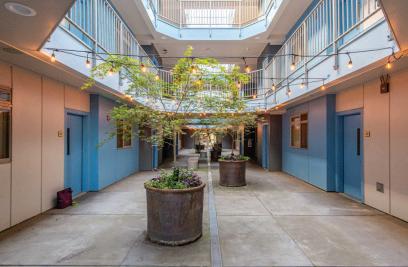
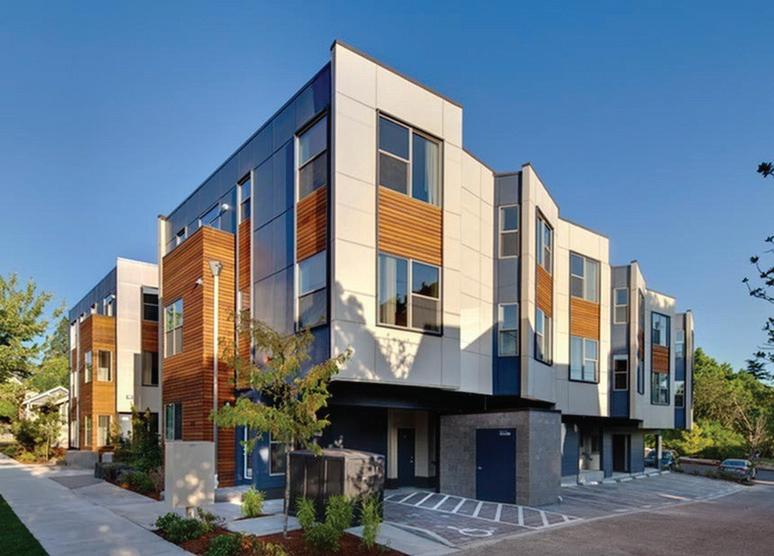
Utter the phrase “affordable housing” and an old civic ghost rises: cheap, neglected government buildings where poverty and decay concentrate. That picture hasn’t matched reality for a long time. In the modern sense, “affordable housing” is not a building type at all, but rather an administrative definition. To qualify, “affordable housing” must allow renters of a specific income to pay less than 30% of their income on rent plus utilities. In Eugene, the target income is typically 60% of the Area Median Income or less.
It’s usually built by private developers and is often indistinguishable from market-rate apartments next door, except for one respect: it’s routinely more expensive to produce.
That is largely because of how we chose to pay for it. In a characteristically American move, we outsourced the mission to the market, hoping it would build mixed-income housing, set aside a slice of units at below-market rents, and use the tax credits to offset the losses. Subsidy, in other words, would be provided as a tax write-off, not a government check.
But the developer this system imagined never arrived. Instead, nonprofits with zero tax obligations became the dominant builders of 100% affordable housing projects; exactly the builder least able to use tax credits. So, the subsidy had to be converted: sold to banks and insurers with large tax bills, routed through middleman, priced, documented, monitored, lawyered and audited into submission.
EDITOR IN CHIEF
Tarek Anthony
PRINT MANAGING EDITOR
Ryan Ehrhart
DIGITAL MANAGING EDITOR
Ysabella Sosa
NEWS EDITOR
Reilly Norgren
INVESTIGATIONS EDITOR
Ana Narayan
A&C EDITOR
Claire Coit
SPORTS EDITOR
Jack Lazarus
OPINION EDITOR
Gracie Cox
PHOTO MANAGING EDITOR
Corey Hoffman
COPY CHIEF
Olivia Ellerbruch
VIDEO EDITOR
Jake Nolan
PODCAST EDITOR
Stephanie Hensley
SOCIALS EDITOR
Ysabella Sosa
VISUALS EDITOR
Noa Schwartz
DESIGN EDITOR
Adaleah Carman
DESIGNERS
Asha Mohan
Ellery Burton-Tillson
Eva Andrews
Maya Gooneratne
Nina Rose
BUSINESS
PUBLISHER AND PRESIDENT
Eric Henry (X317) ehenry@dailyemerald.com
VP OPERATIONS
Kathy Carbone (X302) kcarbone@dailyemerald.com
DIRECTOR OF SALES & DIGITAL MARKETING
Shelly Rondestvedt (X303) srondestvedt@dailyemerald. com
CREATIVE & TECHNICAL
DIRECTOR
Anna Smith (X327) creative@dailyemerald.com
ACCOUNT EXECUTIVES
Torin Chevalier
Camcole Pereira
Ava Stephanian
Elliot Byrne
THE DAILY EMERALD
The Daily Emerald is published by Emerald Media Group, Inc., the independent nonprofit media company at the University of Oregon. Formerly the Oregon Daily Emerald, the news organization was founded in 1900.
Emerald Media Group
1395 University St.,#302 Eugene, Or 97403 (541)-346-5511
Women’s tennis vs. Portland State
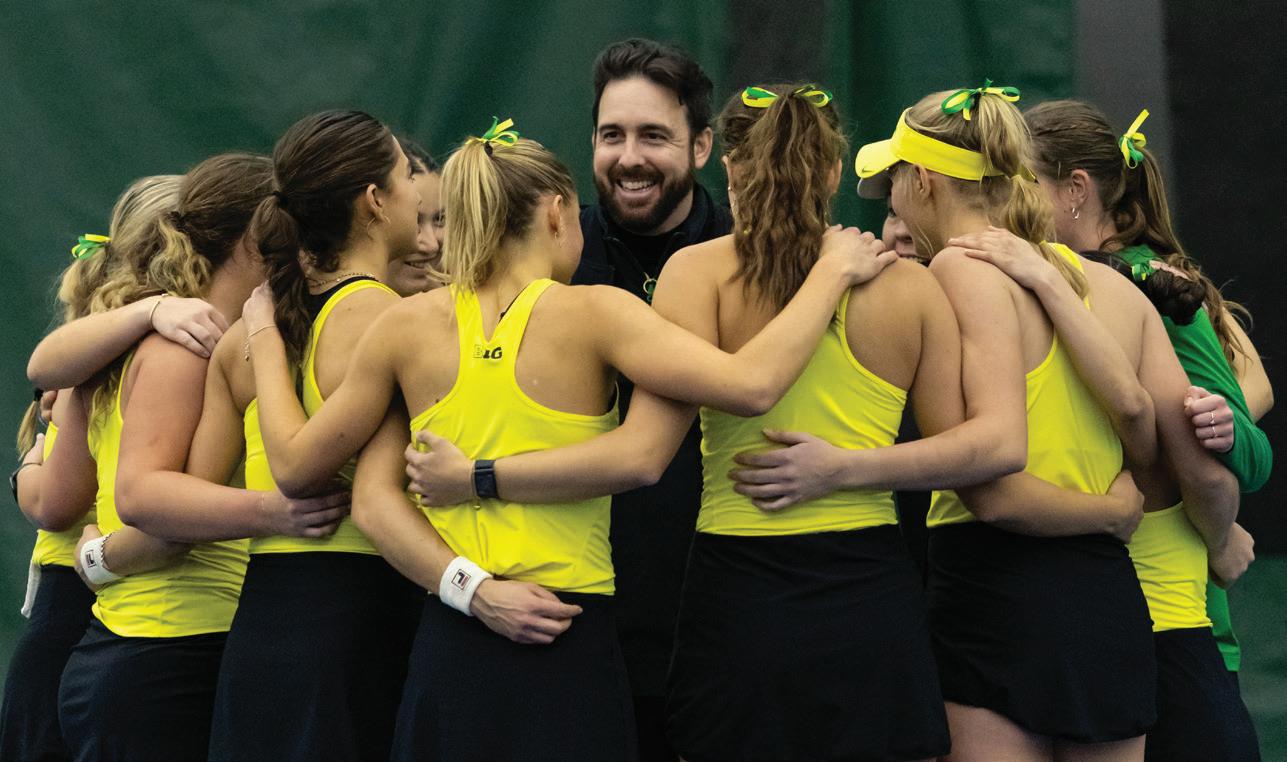
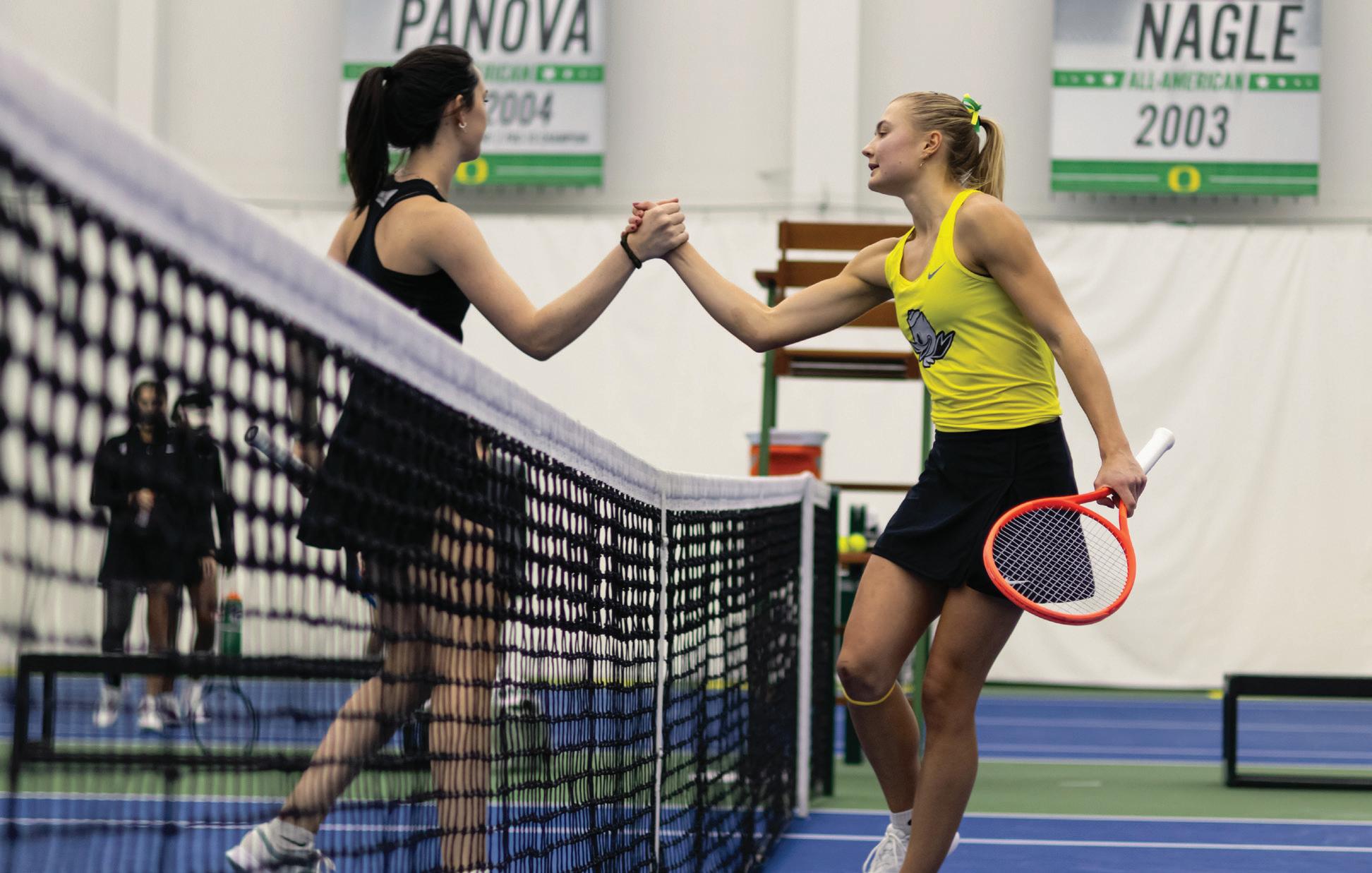
The University of Oregon women’s tennis team started their season against Portland State University at the Student Tennis Center in Eugene, Ore, on Jan. 16.
Tilde Jagare shakes hands with her opponent Scarlett Perkins after defeating her in three sets.
Junior Tilde Jagare reaches for the ball above her head.
Photos by Owen Burriss
Team huddle led by coach Pete Yellico encourages players before singles matches began.
Hinata Furutani takes a moment before beginning her serve.
Duck Store CEO retires with 49-year legacy
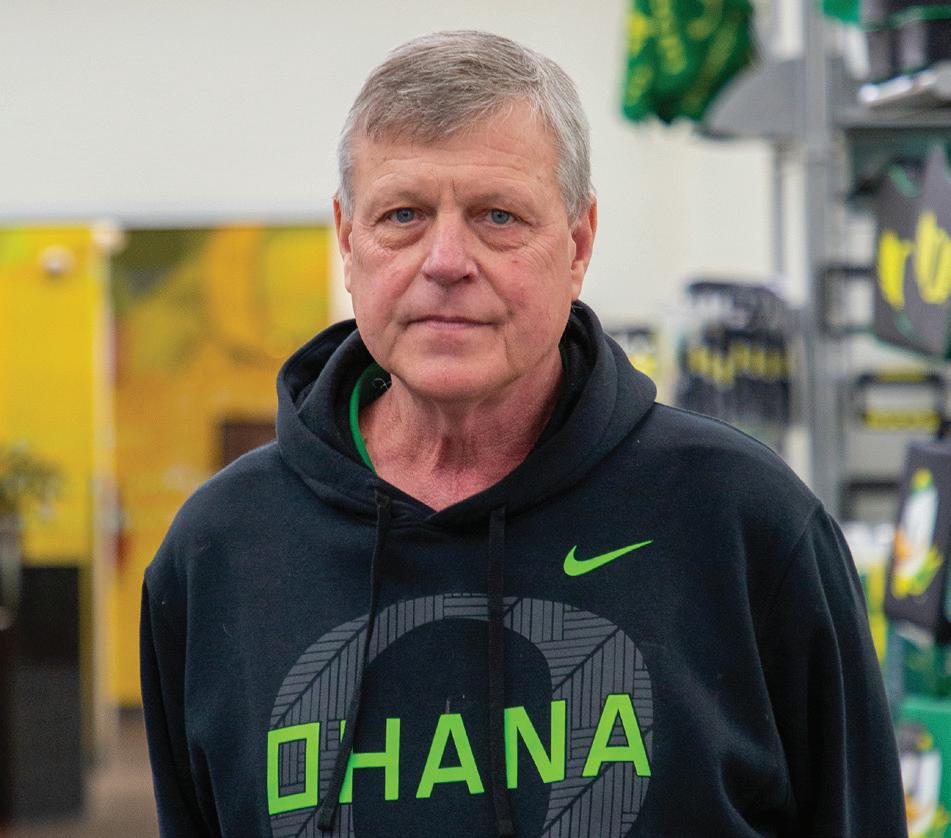
Arlyn Schaufler has been CEO since 2012, helping transition the campus bookstore into an online era.
By Sasha Love Senior News Reporter
When Arlyn Schaufler started working at the Duck Store, he was welcoming in an era of Walkmans and Sony televisions. In his 20s, the store partnered with Kodak to create a film developing station, a major hit at the time, and through COVID-19, Arlyn transitioned the “book” part of the bookstore to an online platform that prioritized curbside pickup.
“We have always felt like we want to pioneer things,” Schaufler said. “The Targets of the world were way out in front of us, and we need to behave like regular retailers — not like just an old-fashioned college store.”
The Duck Store has remained an independent nonprofit since the 1920s, while other campus bookstores like The Husky Shop at the University of Washington have transitioned to for-profit models. This business model has allowed the store to operate under a board of directors that includes students, faculty and staff that give input on how the store should operate.
“We’re owned by the university students, faculty and staff, but we’re not owned by the institution,” Schaufler said.
Alex Lyons, the incoming Duck Store CEO, said hearing opinions from the University of Oregon community helps determine the store’s direction.
“Every decision that we make has to do with what’s best for the student,” Lyons said. “They are able to have their voices heard about what their concerns are and what some of the challenges are that they face. We’re connected with them in a really unique way.”
Lyons said students provide valuable feedback by bring-
ing new ideas to the table and pointing out marketing trends aligning with a college-aged audience.
“They are able to provide us with this vantage point of how to connect with people their age,” Lyons said. “Online and in the store that’s really unique and really valuable.”
The community-oriented model of The Duck Store was also a large part of why Schaufler continued to work at the store for so long.
“For me, it always comes down to the people. I love working here. I love the people that I work for and serve on this campus: the community, the students and the fans,” Schaufler said.
Through his time at the store, he has always been “looking for the next thing” and he doesn’t want that energy to fizzle out after he retires.
That’s why Schaufler and the board chose Lyons to be the next CEO. Schaufler has been training Lyons for nearly a decade and said she is always looking to the future.
“She’s wicked smart, OK? She’s gonna do things that I couldn’t do. She can take this place, this store, places I couldn’t take it to,” Schaufler said.
Lyons started out in the information and technology department of The Duck Store solving computer challenges. Now, she wants to apply her problem-solving skills to leadership.
“Programming and coding is about problem solving at its core and so if you take those same theories of problem-solving and you look at it across the board in leadership, there’s a lot of opportunity to apply the same type of philosophy,” Lyons said. “As we get more and more enmeshed in that world of technology, you have to find the connection between the technology and the people.”
Since 2010, Lyons has been working to make e-books more available and accessible. As technology changes, she plans on continuing to build these partnerships with e-book systems and providers, while working with UO Basic Needs on textbook affordability.
“Every student can come here and feel like they belong and that we are trying to give as much value to the student experience as we can,” Lyons said.
Upon retirement, Schaufler plans to coach his granddaughter’s fourth-grade basketball team with his newfound freetime.
UO partners with EWEB to provide Eugene emergency power, climate advocates concerned
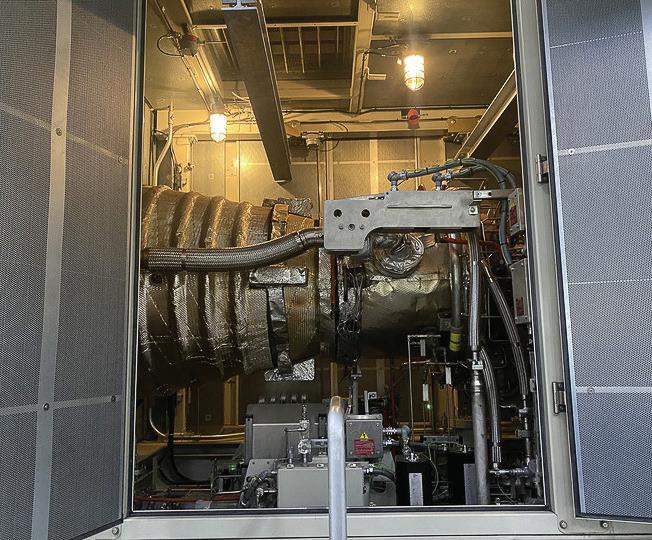
UO’s generator is able to keep the waste heat that is ousted and then runs it through a heat recovery generator to use in the steam system that heats the campus. It has largely gone unused, operating as a backup option for outages.
This pilot program runs from January through February and allows EWEB to use UO’s generator when demand is highest. To determine when the generator will be turned on, regional power supply conditions will be assessed.
EWEB predicts that their current grid will increasingly fall short of sustaining the energy needs of Eugene in especially cold and dry winters. To fill the gap, UO’s generator will provide energy to EWEB, which could increase emissions during these specific periods, but keeps EWEB’s sourcing local, meaning the company will not have to purchase energy from less efficient, more polluting power plants, according to Brian Booth, EWEB’s chief energy resource officer, said.
Throughout the year, hydropower fills 80% of EWEB’s
energy needs. When energy demands spike, like during the winter, weather-dependent sources bottom out and gas plants are used to meet demand.
“That power has got to come from somewhere. If we provide it, it’s fewer emissions, and then it gets our organizations working together and helps us prepare for big emergencies like a massive storm or Cascadia event,” Steve Mital, director of UO’s Office of Sustainability, said.
UO’s Climate Justice League is critical of the partnership, in part because they say the need for the program is based on a flawed interpretation of a study. The study from which EWEB is basing its predictions of grid failure measures the regional energy transition across the entire Pacific Northwest, and not the specific energy needs of Eugene.
“We do face challenges with our grid (but) there hasn’t been sufficient study to show whether or not this would actually give us the resiliency that they are saying it would,” Declan Zupo, CJL’s co-president, said.
The study EWEB cites was carried out by consulting firm E3 and commissioned by the Public Generating Pool and Puget Sound Energy. Renewable energy advocate GridLab did its own review of the study and concluded that E3 left out important details.
The E3 study makes predictions of energy needs that account for growing data centers, but there are not nearly as many data centers in the Eugene area as there are in other parts of the state and region. EWEB can also more comfortably rely on the hydropower it gets from the Bonneville hydropower plant — as compared to other utility companies in the study’s region — because EWEB is a public utility company and benefits from priority access.
Still, EWEB said the 2023 ice storm caused the power grid to come “precariously close” to failure, while Springfield’s power system was already collapsing. If a collapse were to happen, Booth not only fears the effects on residents, but also on the broader future of renewable energy.
“We cannot allow something like what happened in Texas to happen in the Pacific Northwest. If that were to happen, if the lights were to go out, our failure would be hung around our necks,” Booth said.
In a broader scope, Zupo said the partnership is moving resources away from the mission of transitioning to renewable energy boilers.
“If they really wanted to do a sustainability measure, they would, for one, cancel this pilot, and two, implement thermal transition option 2B, which has immense community support,” Zupo said.
Thermal transition option 2B is a system that would see electrode boilers introduced to the current heating system. Electrode boilers use electricity that flows through water, generating steam.
CJL and other groups, including Fossil Free Eugene and ASUO, have been advocating for 2B since 2022, when the transition options were first introduced. Then, in 2024, a Thermal Systems Taskforce recommended the option to President John Karl Scholz, and in 2025 ASUO also passed a resolution with the same recommendation.
However, the furthest progress so far is development of low carbon heating system concepts, and cost estimates and construction timelines.
“There is a lot of concern and understandably so, and… we are, multiple times on record, trying to navigate a path toward a fossil-free or a carbon-reduced world. We’re committed to that,” Mital said. “This is a short-term thing we can do for all the right reasons (but) it doesn’t detract from our longer-term (sustainability) efforts.”
( ABOVE) A combustion turbine generator used by the University of Oregon as a backup generator during outages.
(Reilly Norgren/Emerald)
Duck Store Chief Executive Officer Arlyn Schaufler is set to retire after 49 years. (Corey Hoffman/Emerald)
OPINION /ARTS & CULTURE
Nag: Hunger is a policy choice
Opinion: OSPIRG’s
hunger and homelessness campaign
shines an important light on student hunger.
By Aishiki Nag Opinion Columnist
Food insecurity is prevalent on college campuses, with the U.S. Government Accountability Office estimating that 23% of the 3.8 million college students nationwide experience it; the University of Oregon is not an outlier in these national statistics. However, student hunger has rarely been addressed in national conversations about higher education, even though its consequences harm the entire campus community. An article published from American Psychological Association analyzed studies that show food insecurity has been linked to ongoing academic distress, lower grade point averages, and increased mental health challenges. But the problem of food insecurity has been coupled with another oxymoronic problem the State of Oregon is facing — food waste. Between 2016 and 2023 Oregon threw away more than 800,000 tons of food, and within 2023 of Oregonians in Lane County 14.6% reported food insecurity, with childhood hunger in the county reaching 20.2%. How can so many students and community members face food insecurity when over 70% of the discarded food in Oregon could have been eaten?
The Oregon State Public Interest Research Group’s Zero Hunger campaign is working to address rampant food waste and food insecurity
ARTS & CULTURE
on college campuses, aiming to reduce both with a single policy solution. Currently, the proposed policy would require large food producers to divert food they would otherwise trash or burn to food banks when it is safe to eat.
This proposed bill would reduce overall food waste, lower total carbon emissions and address the large population of food-insecure individuals in Oregon. Although it won’t be introduced in the 2026 short session, the bill is gaining traction for the next legislative session.
“Student hunger is a really big issue, and I think that sometimes when it’s not happening to them, it won’t seem like a big deal… but that’s simply not true,” Kali Kleven, chapter chair for OSPIRG and a lead for the Zero Hunger campaign on the UO campus, said. “I think that actual campuses are often overlooked, (when thinking about hunger) we don’t think about the students who are having to pay for tuition, housing, class materials and basic necessities, such as food.”
Kleven followed this comment by highlighting that nearly one-third of all food produced is wasted and that local resources, such as Food for Lane County and other food banks, could benefit from additional donations.
“Unfortunately, it is rooted in our society that people facing hunger and homelessness is normal, and I don’t think that’s how it should be,” Kleven
said. “Continuing to work on it and recognizing that it does take all of us and everyone's efforts are so appreciated, and every step we take is a step.”
Riley Taylor, head coordinator for the OSPIRG University of Oregon Hunger and Homelessness Week in 2025, helped recruit volunteers and coordinate events to build momentum and raise awareness of food insecurity on college campuses.
“When I heard about the OSPIRG student hunger campaign, I immediately wanted to get involved,” Taylor wrote in a statement. “To make systemic change, you have to start somewhere, and OSPIRG to me represented that ‘somewhere.’”
Taylor had hosted multiple tabling events to gain perspectives from UO students and students from Oregon State University, and brought it to their Salem Lobby Day, where students were able to show their representatives and senators the importance of solving student food insecurity.
Taylor also spoke with local food businesses and restaurants in downtown Eugene, and they have received over 10 signatures from supporters to reduce food waste.
“I find it unjust that every day, people all over the world go to bed hungry… no one should ever have to wonder where their next meal is going to come from,” Taylor wrote in a statement. “Especially when millions of pounds of edible food goes to waste every year — food is a basic human right.”
‘The Rocket Men’ portrays the complicated history of space travel
The all-female cast portrays the men responsible for winning the Space Race.
By Vinny White Arts & Culture Writer
Crystal Skillman’s “The Rocket Men” made its West Coast premiere at Eugene’s Oregon Contemporary Theatre on Jan. 17. The play, featuring an all-female cast, takes place between the 1950s and 1970s. It follows a group of scientists poached from Nazi Germany as they attempt to break ground in the realm of space exploration. While the real-life “Operation Paperclip” responsible for importing German scientists to assist with United States military efforts brought
over 1,600 Germans to the states, “The Rocket Men” focuses on a select group of individuals responsible for America’s space efforts. The show focuses on Heinz-Hermann Koelle (Kathleen Borrelli) as he joins a team of German scientists who already have a history. Koelle has aspirations of sending humans to Mars, and Wernher von Braun (Katie Worley Beck) leads the charge to do so. Conflict arises when Koelle gradually becomes suspicious as to how complicit his co-workers were in Germany’s war crimes.
“The Rocket Men” is currently showing as a “rolling premiere,” meaning it’s still in a state of development before it finally hits New York City and officially gets published. Skillman was actually in the audience on opening and saw the audience reaction to her work firsthand. The writing and acting are certainly not going for all-out realism, hence the all-female cast, but the stylized versions of these very complex individuals is enjoyable to watch while still maintaining a semblance of broader historical accuracy.
The writing is largely comedic, which accounts for much of the show’s weaker elements. There certainly are some funny moments, but oftentimes the jokes lead to the group feeling more chummy than what feels natural. The story really hits its stride when it comes face to face with the atrocities that many of the characters in the play were privy to. Fortunately, the transition from comedic to dramatic rarely feels abrupt, and that is largely due to the performances.
Jessica Jae Unker does an excellent job at playing Sol, a recurring voice of descent to von Braun’s past. Her solemn yet powerful demeanor truly suits the role, and is a highlight of the show. Ruth Adele Mandsager, in turn, manages to take the morally complex Arthur Rudolph and portray him with just the right balance of sinister and empathetic to make him an enjoyable character while not taking away from the very real horrors he was involved in. The heart of the show real-
Aishiki Nag is a senior studying political science and global studies. She likes to cover state and national politics, and international peace-building efforts. When she’s not writing for The Emerald, she likes to read, hike and travel to new places.
ly lies in the hands of Beck and Borrelli, which is fortunate given they seem to exude an almost effortless chemistry. Zayne Clayton is also a highlight, primarily acting as a Rod Serling-type omniscient spectator that keys the audience in on historical contexts. She also gets a brief yet significant role towards the end of the play that truly makes the show. While the first act is dragged down by some shoehorned exposition and questionable comedy, the second and third acts contain some compelling writing on behalf of Skillman as well as meaningful performances. The play spends much of its time addressing Germany’s atrocities in World War II, but is sure to distill the issue down to the characters’ involvement in the prison camps designed for building V-2 rockets. Focusing on these camps instead of the issues with Nazism as a whole grants the story enough specificity to create drama without getting too broad, and it leads to some powerful moments. Oregon Contemporary Theatre’s black box is well-suited for the play. Though focusing on the men behind space travel, the story largely takes place in an office with five desks. Behind the desks is a wall that acts as a surface for a projectionist to show historical clips relevant to the story. This projection technique is a novel way to utilize the space presented, and is often helpful when attempting to relate the fictionalized story to real-world events, such as von Braun’s partnership with Walt Disney.
“The Rocket Men,” while a little rough around the edges with its comedy and exposition, is worth seeing for those interested in history. The performances are solid and the story is consistently entertaining.
(Courtesy
( LEFT ) Katie Worley Beck as Wernher von Braun (left) and Kathleen Borrelli as Heinz-Hermann Koelle (right). “The Rocket Men” in Eugene’s Oregon Contemporary Theatre on Jan. 17, 2026.
of Bob Williams)
ART & CULTURE
Cogswell: Eugene needs more girl bands
Female representation is important to the Eugene music and house show scene.
By Everette Cogswell Arts & Culture Writer
What has happened to the classic girl band? While the Eugene music scene showcases many talented artists and bands, when I attended a recent house show, I couldn’t help but notice how male-dominated the bands were. Of the five bands playing that night, there were only two female members.
Girl bands have disappeared within the campus scene, and the absence hasn’t gone unnoticed. There are talented bands on campus, such as 10 or 11 Deer and Dog Plays Dead which have female artists, and without a doubt, there is a community of female-identifying musicians in the Eugene area. However, since the departure of GrrlBand last year — an all-girl band in the Eugene scene — the representation of female musicians has gone away, and a new girl band has yet to take the stage.
The popularity of bands ebbs and flows, but right now, the bands performing the most hardly have any female members. Nina Roy, a resident of The Black Pearl house, a house show venue run by students, says she has noticed the lack of female artists.
“As a venue, we meet lots of bands, and although we do meet women who are a part of bands, it is overwhelmingly a male-dominated space,” Roy said. “I only know of a few bands that have women as members.”
Something important to note about Eugene bands is that there are some musicians in multiple groups. The guitarist for one band might be in three bands total, making it rare to see fresh faces at shows. This is something the bands have noticed as well.
“Since as a house you get more involved in it, you really see how male-dominated it is,” Roy said. “Talking to some of the bands, they also notice the lack of women in the scene in general, but would be enthusiastic to meet more.”
Like any other music scene, it can be hard to get involved in the world of Eugene house shows. Tallulah Hutchinson, guitarist and songwriter for Eugene/Portland band Corky St. Claire, agrees. “If I could best describe the Eugene music scene, I would call it a bit intimidating. It seems like you need to have connections to get to a place where you’re playing house shows,” Hutchinson said. “Just because it’s difficult to enter a male-dominated space doesn’t mean it isn’t important.”
Music is for everybody; this isn’t to say anything different. House shows are a big part of nightlife culture in the Eugene and University of Oregon community, which is why it’s important to have more variety in the artists that perform in these shows.
That’s what it comes down to: representation. With more representation in the music scene, it can open up a whole new world for artists of all identities, not just female artists, but musicians from all walks of life.
Having female representation in an otherwise male-influenced field should be prioritized.
“I think it’s really important to have girl bands and female artists because it shows other people you can do this; you don’t have to be perfectly, classically trained to still make music and put it out there,” Hutchinson said. “Art is important, and more girl bands, more female artists, can only be good for art.”
Filmlandia brings Oregon’s best to campus
Cinema studies professors talk about their screening series — a free, weekly opportunity to watch films on all things Oregon.
By Amelia Fiore Arts & Culture Writer
Over the course of winter and spring terms, the Univesity of Oregon Cinema Studies department is hosting a series of screenings, beginning this term with 14 films. Some notable features include “Coraline,” “The Shining” and a series of short films, one of which is the “Portlandia” pilot episode. It will close in June with a silent film, alongside a live musical accompaniment.
Peter Alilunas, an associate professor of cinema studies, co-founded the series with assistant professor Colin Williamson this year. The idea came to mind after the cinema studies program’s recent migration from McKenzie to Villard Hall.
“Partly to celebrate that, we thought, ‘Why don’t we do a screening series that will help us celebrate this new place?’ So, we were thinking about place as a theme, and that’s when we landed on the idea of Oregon,” Alilunas said. “Oregon is not just a literal place, it also has kind of these multiple layers of meaning.”
The big decision was carefully choosing a select group of films to screen. According to Alilunas, movies like “Animal House” have had their time to shine on campus; they wanted to do something fresh, create a space to explore the entire state from one room and share its influence on cinema.
To accomplish this, they constructed a catalog that includes filmmakers of Oregon origin, movies filmed in Oregon and stories that center Pacific Northwest ways of life. They also prioritized representation of the state’s diversity by paying homage to underrepresented communities in film.
“We have pretty solid representation across race, class, gender and sexuality, independent filmmaking, commercial entertainment,” Williamson said. “Indigenous representation was really important to us, too, thinking about the longer histories of those communities who have been here long before the UO and the cinema.”
The event is also a celebration of our state’s eccentricity, one which holds a special place in the hearts of cinephiles. Alilunas said, “I think Oregon is a place where filmmakers have come to capture something that is slightly askew or different.”
Along with inspiring Oregon appreciation, the pair hope to revive an art lost on the UO campus. Labeling the series with “University Film Society Presents” on its flyer is a nod to the organization which was present and thriving in the 1960s, that hosted screenings with an abundance of participants.
“One of the things Colin and I have done is we brought that name back as a way of kind of bringing that past into the future and then the present and the future as well,” Alilunas said. The move away from communal filmgoing hasn’t just occurred on campus, but is a cultural shift felt around the world.
“I think we all feel that sense that something about the cinema has eroded or disappeared,” Williamson said. “A lot of the students that come through my classes talk about having nostalgia for those kind of communal forms of engagement that are not really readily available to them anymore or are more difficult to access, and with the series, one of our community building approaches was to say, ‘Here’s a designated place in time for us all to come together.’”
Each screening will begin with a short introduction to spark conversation between filmgoers, something Williamson believes is integral to their mission.
In an age of streaming, movie-watching can all be a bit overwhelming. Throughout this digital migration, there have been cries warning of the slow, painful death of cinema — believe it; these professors/film historians have heard it all.
“The cinema has died many, many times before. Before it was a communal event, it was like a solitary, organized event with people looking in little peep show devices, right? And there have been cycles of this throughout film history. We are, I think, in the midst of a cycle,” Williamson said. The event is free for all students and faculty, and films will be shown on Wednesdays at 6 p.m. in Lawrence or Villard Hall.
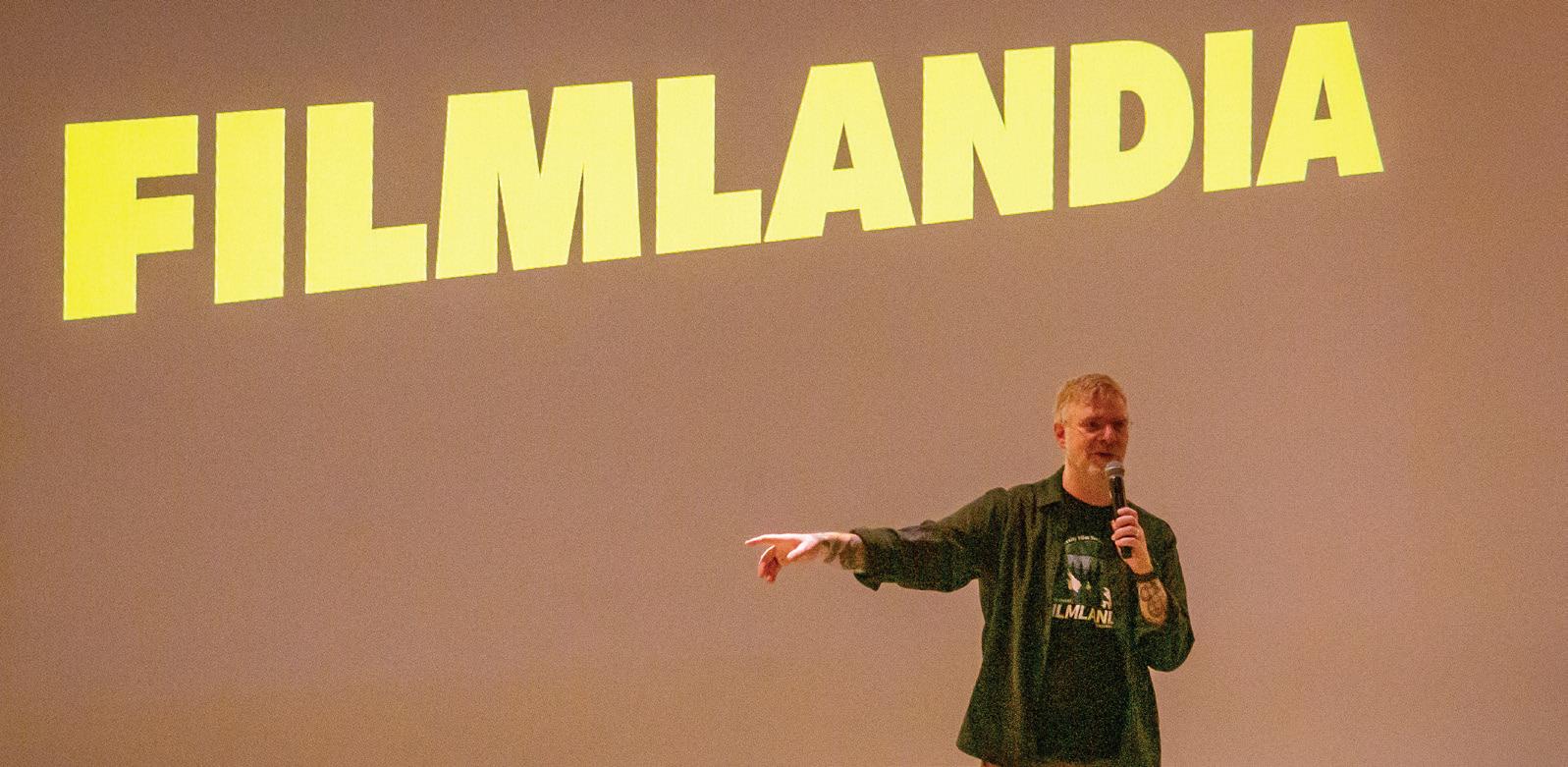
( ABOVE) University of Oregon cinema studies professor Peter Alilunas addresses the audience ahead of the second screening in the Filmlandia Screening Series hosted by the Department of Cinema Studies and the University Film Society on Jan. 21, 2026.
(Corey Hoffman/Emerald)
ON THE COVER
Mitrovcan Morgan: The paradox of affordable housing
David is an opinion columnist for The Daily Emerald and a senior studying data science, economics and philosophy. In his writing, he enjoys finding the abstract relationships between systems and the decisions we make everyday, weaving them into a tangible story readers can easily digest.
Continued from page 1
The result is the paradox: the housing we call “affordable” costs more to produce than comparable market-rate housing. Why does it need a subsidy? Why do we deliver it this way, and how do we stop the system from inflating the price of its own solution?
Why does affordable housing need subsidy?
We’ve chosen that all housing must meet a floor of quality set by building and health regulation, for good reason. But this same floor also means that “what renters with… low incomes can afford to pay… does not cover the development and operating costs”, according to the National Low Income Housing Coalition.
Affordable housing thus depends on subsidies to fill the gap. Without them, most projects wouldn’t “pencil”; balancing construction and ongoing maintenance costs with rental revenue.
Moreover, costs have historically risen faster than income. Because regulated rents track income, not expenses, they can’t freely be raised like in market-rate housing, so the shortfall widens year by year.
Subsidies are therefore necessary to reconcile housing standards, rising ongoing costs, and limited tenant incomes.
Shifting to the Low Income Housing Tax Credit (LIHTC)
The modern subsidy regime arrived in the mid-80s with the LIHTC under the Reagan administration, shifting away from vouchers and further distancing the government from direct involvement.
Christina Bollo, an Assistant Professor in UO’s Department of Architecture and Design, says another goal “was trying to create mixed income housing” — a reaction to an earlier era of federally built
public housing that concentrated poverty in specific parts of cities with harsh social consequences.
Bollo also said the LIHTC was “set up for the small family investor… to alleviate their tax liability by including housing that was affordable (in their developments).” The idea was small developers would dedicate a certain portion of their developments as “affordable housing” at a loss, then use the tax credit on the whole complex to recover it.
In practice, LIHTC’s intended users never materialized. “As a result, non-profits were created to build 100% affordable housing buildings,” Bollo said. But nonprofits were structurally mismatched with the delivery mechanism: a tax credit is only valuable to someone with taxes to pay after all.
This mismatch drives the defining feature of LIHTC: syndication. Developers discovered they can monetize tax credits by selling them to third-party investors who have large, predictable tax obligations, like insurance providers and banks.
Syndicators emerged to broker the deal between nonprofits and these “investors,” collecting fees along the way.
The adaptation was effective. GAO reported the LIHTC “has financed about 2.9 million rental units,” with surveyed syndicators playing a role in “75 percent… (between) 2005–2014.”
The Paradox: Affordable Housing is more expensive than market rate
On sheer unit count, LIHTC delivered. But turning credits into cash requires a small cast of syndicators, investors, and lawyers, each skimming a fee. The leakage means LIHTC is “rarely sufficient to close the gap between the costs of development and the rents that would be affordable to households with low to moderate incomes,” UC Berkeley’s Terner Center notes. So, projects are forced to layer additional city, state, and federal programs to break even.
Stacked funding means stacked gatekeepers; every pot of money brings its own rules, paperwork, and deadlines — rarely aligned — demanding round after round of review and underwriting. Changes to satisfy one source can also ripple into another, triggering more reviews and approvals.
This is where “soft costs” exact their toll: through rework that breeds delay and the
A brief history of predominant affordable housing subsidies
GOVERNMENT BUILDING
Congress allocates funds to local public housing agencies to build and operate lowrent housing
URBAN RENEWAL
Congress provides additional funding to local authorities for slum clearance and urban redevelopment
SUBSIDIZED PRIVATE BUILDING
Congress steps back from direct government construction and instead subsidizes private development with cheap loans at below-market interest rates
SUBSIDIZING RENTERS
Congress pivots from subsidizing builders to subsidizing renters, helping them afford private market units through Section 8 vouchers
TAX CREDIT SUBSIDY
Congress shifts focus from direct to indirect subsidy, using tax incentives like the LIHTC to attract private investment into affordable housing
SUBSIDY LAYERING
As it became clear the LIHTC isn’t enough, federal and local governments passed additional gap-filling subsidies, creating the modern affordable housing finance stack
steady drip of unending billable hours of lawyers, accountants, and consultants.
As a result, affordable housing carries a premium. While the end result may be comparable to market-rate housing, the gauntlet developers must pass through to get subsidies paradoxically makes “affordable housing” far costlier to build than its market-rate counterpart.
Bollo says for Eugene specifically, another factor to consider is that “sometimes in order to amortize all of these soft costs, (affordable housing) buildings are bigger… (and) taller than market rate buildings.” These denser buildings are usually more expensive to build, which further elevates the affordable housing premium.
Potential Solutions
The modern affordable-housing system’s prices didn’t swell because builders were uniquely wasteful or the government inefficient, but because we’ve built a financing maze that treats complexity as necessary for accountability. Thus the most credible solutions are the ones that simplify.
To start, we ought to cultivate the developer ecosystem LIHTC was designed for: small scale for-profit developers producing mixed-income housing where the cross-subsidy is internal and the credit functions as an incentive rather than a commodity that must be sold.
Second, government has to coordinate deliberately, not piecemeal. The most practical reform is creating a state or local “aggregator” that combines potential funding sources and their requirements. This would allow developers to interact with one set of requirements sourced from one agency, rather than a myriad of agencies pulling in different directions. Bollo says Seattle is a good example, where “agencies are in communication, so... they’ll work together to figure out how to leverage (different sources) for projects.”
Third, a more concerted effort should be made, either by developers or local governments, towards “land banking:” the acquisition of sites ahead of construction. Due to long predevelopment timelines, land price inflation plays a big part in project feasibility, often eroding it as time goes on. Land banking
can stabilize the cost base and reduce exposure to escalating land costs while a project awaits allocations or approvals. Affordable housing will always depend on subsidies because we’ve chosen minimum living conditions that the market cannot provide at a price low-income households can pay. Subsidies, however, are not a stable foundation. They rise and fall with recessions, legislative priorities and the political winds that decide what counts as “essential” this year.
If public support is the lifeline, we shouldn’t braid it through a thicket of intermediaries, duplicative reviews, and professional fees that grow with every funding layer. The opportunity isn’t to wish away subsidy, but to make each dollar go further by lowering the price of using it.
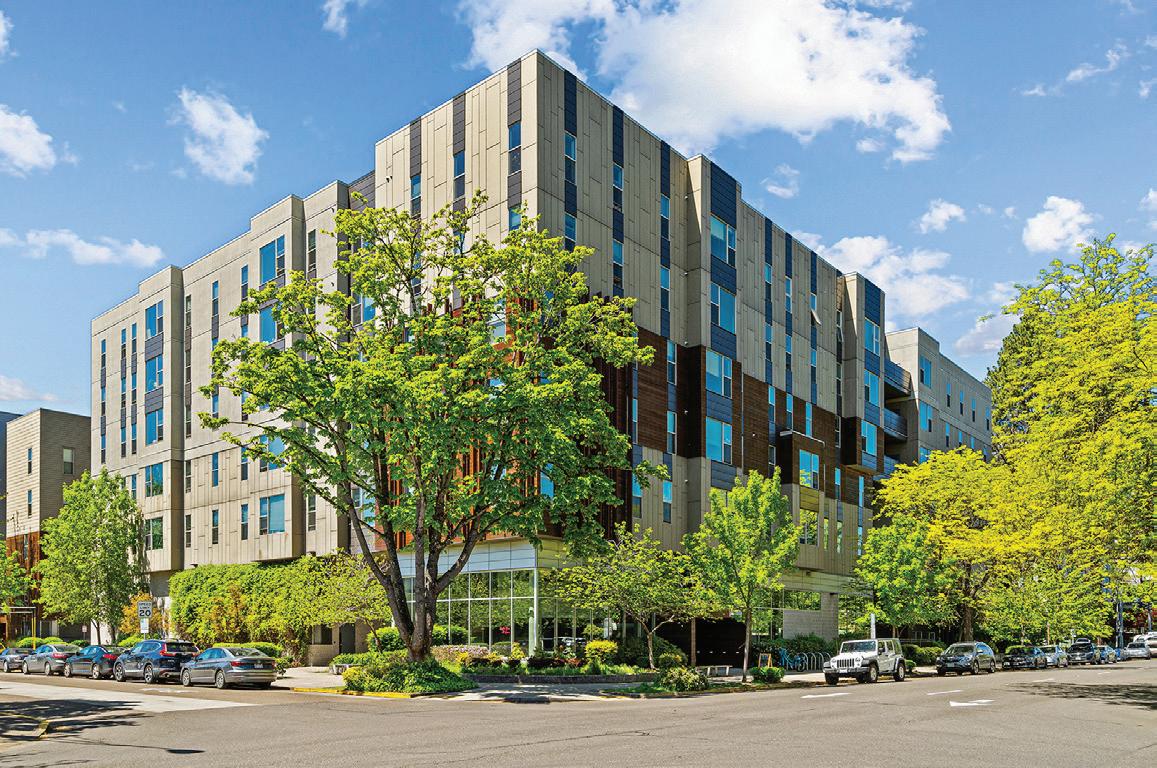
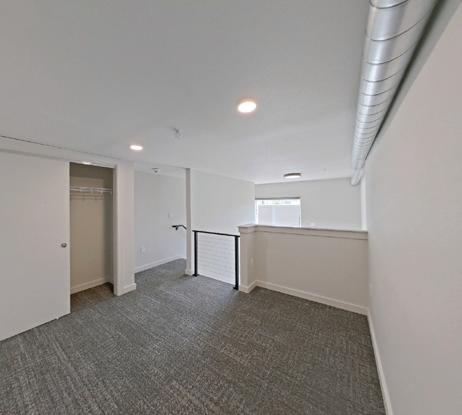
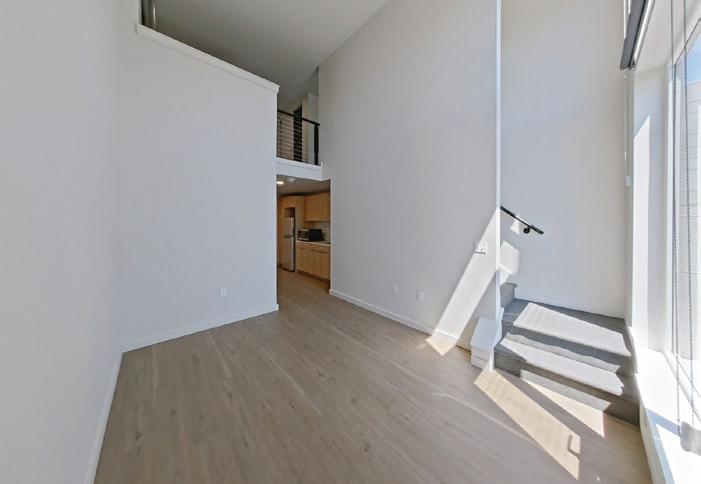
( ABOVE) An excavator moves ground as construction continues on 13th and Alder in Eugene, Ore. (Tyler Graham/Emerald)
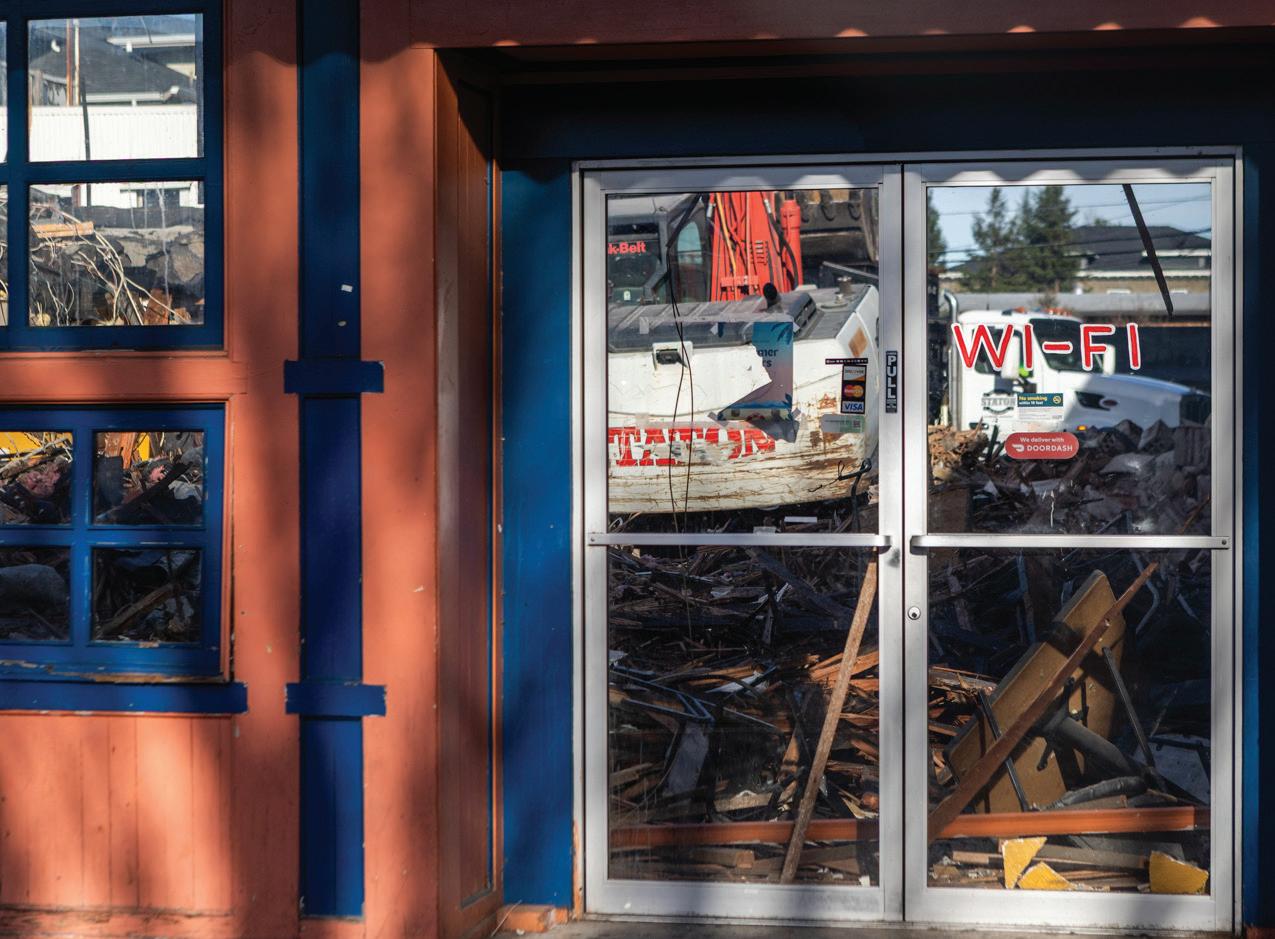
( LEFT ) Debris from the demolition of Espresso Roma is visible through the front doors of the café in Eugene, Ore. on Thursday, Dec. 11, 2025. (Max Unkrich/Emerald)
(ON THE COVER, ABOVE, LEFT ) Local coffee shop Espresso Roma is demolished to make way for a new student housing high-rise at the corner of 13th Avenue and Alder Street in Eugene, Ore., on Dec. 11, 2025.
Ehly: UO’s high tuition may not be worth the cost
By Rachel Ehly Opinion Columnist
Money is always on my mind.
I like to think that I’m responsible with my money. But, with the weekly latte and bagel from Meraki I buy myself at the end of a hard week, to the mountain of tuition and fees I have to pay every term, the money leaving my bank account adds up.
I can keep track of my weekly treats, but knowing exactly what my tuition expenses are going toward is harder to pin down.
So, on Jan. 13, when the Tuition and Fee Advisory Board and ASUO held a forum to give UO students an opportunity to learn more about the tuition setting process, I had to go.
The forum focused on where UO’s funding comes from and explained why UO’s tuition is so high, despite the university’s five-year tuition guarantee.
According to the State Higher Education Finance report, in 2024, on average, each United States state appropriated $10,820 per full-time resident student at four-year institutions. Oregon allocated about $4,000 less than the national average, only appropriating $6,200 per full-time resident student in 2024, ranking it No. 46 in the nation.
Oregon splits its higher education funds among all public Oregon universities, including UO, Oregon State University, Portland State University and Western Oregon University.
“Oregon over the last several decades… has chosen to invest relatively little in its public universities,” Brian Fox, UO’s associate vice president for budget, financial analysis and data analytics said. “So (UO has) to balance across different revenue streams — state appropriations and tuition being the biggest of those.”
According to Fox, although UO has the most full-time resident students, the university receives the least amount of state funding of all public Oregon universities.
Because of the low amount of state funding UO receives, the university has to set a higher tuition to manage the university’s budget. This leads to UO having a larger tuition revenue than all other public universities in Oregon.
When it comes to comparison across Big Ten schools, UO’s tuition ranks relatively high at $37,091 for in-state students and $65,553 for outof-state students for the 2024-25 tuition cohort, according to UO Finance and Administration.
UO Executive Chief of Staff and TFAB board member Daphne Patrick says that UO’s extremely high out-of-state tuition is valued by the university.
“Administration and enrollment services of UO rely extremely heavily on out-of-state students to essentially subsidize the education of in-state students,” Patrick said. “I think (UO) does enough to justify the cost to students whose only other
option is UC schools… we are really reliant on (those students).”
Even as an in-state student, Patrick says she remembers doing projects on Oregon’s public universities in elementary school when the tuition was half the price that it is today.
“I fear we’re approaching a moment in higher education where (tuition) can’t just keep doubling every five to 10 years without a serious reconsideration of the value of an education,” Patrick said.
Serving as an ASUO-appointed member of TFAB, Patrick said she struggles with the small number of undergraduate students elected to serve on a board that merely acts as a recommendation body to UO’s president.
Students have very little input into the conversations surrounding tuition at UO, conversations that directly affect each and every student.
The way in which the university goes about setting the tuition needs to change.
More students should be eligible to serve on TFAB. More tuition forums should be held throughout the year. UO should be transparent about what they plan to do with our tuition dollars.
The university runs on tuition that students pay; the least they could do is listen to what we have to say.
Rachel Ehly is an opinion columnist for The Daily Emerald and is studying journalism and political science. She could talk for hours about all things politics, pop culture and music.
Brewer Knight: Save the Owyhee Canyonlands
Maddox Brewer Knight is an opinion columnist at The Daily Emerald. She is a third-year CHC student pursuing a double major in English and Spanish. As a lifelong Oregonian, Maddox cares deeply about confronting social issues both within UO and in the greater community to make our home region a better environment for all.
Opinion: As a child, I was awed by the Owyhee Canyonlands. Now, they are under threat of destruction.
By Maddox Brewer Knight Opinion Columnist
Western Oregon gets all the love.
As someone who has spent a lifetime living west of the Cascades, I know firsthand that it can be easy to reduce Oregon to a state of evergreens, stormy beaches and winding rivers. Across that jagged mountain range, however, lies an entirely different side of our state — one that is less populous but no less beautiful.
When I was nine years old, my parents took me on a road trip to the desert. I was less than thrilled — I imagined myself sweating in a tent amid a scorching hot wasteland, barren except for tumbleweeds and maybe a rattlesnake or two.
I couldn’t have been more wrong. I was awestruck by the otherworldly beauty of Smith Rock and the intricate rock formations of the Painted Hills. We hiked through cliffs carved with thousand-year-old petroglyphs and woke up at midnight to hear coyotes howl.
Many of these stunning attractions were located within a 2 million-acre region called the Owyhee Canyonlands. This region, while currently unrecognized by the federal government, is one of utmost importance.
Located in the far southeast, the Owyhee Canyonlands is one of the most remote sites in Oregon, and thus has been preserved from the ecological devastation caused by urbanization and industrialization.
The canyon is home to some of the most endangered species in the Northwest, such as the kit fox, the big-eared bat, and the California bighorned sheep. My family was even lucky enough to see the elusive wild mustangs gallop through the hills. The Owyhee’s Sagebrush Sea conceals a
wealth of biodiversity, including 26 native plants that are found nowhere else on earth.
But the Canyonlands isn’t just alluring to visitors. The area’s natural wonders are beloved by locals, especially to the Shoshone, Bannock and Northern Paiute tribes, for whom it is a cherished heritage site.
However, this desert paradise is in danger of destruction. As the rural Northwest slowly develops, once-pristine habitats are becoming polluted by large-scale ranching, mining and oil and gas extraction.
The Owyhee’s advocates, including Senators Ron Wyden and Jeff Merkley, Gov. Tina Kotek, conservationists, family ranchers, and local city and tribal representatives, have pushed for the federal government to recognize the Owyhee Canyonlands as a national monument. This designation would limit further development, protect native species, preserve important cultural sites and keep the land public and accessible for future generations to experience its beauty.
Despite its sweeping bipartisan popularity within Oregon, Sen. Wyden’s bill to designate the location as a national monument died in Congress in 2024. While many conservationists hoped that President Biden would heed Gov. Kotek’s plea to unilaterally designate the region as a national monument, he failed to act, leaving the Owyhee in limbo as the anti-conservation President Trump took office.
“National Parks guarantee the preservation of the natural world,” said Clyde Oglesby, a UO junior majoring in political science. “The only force that has proven capable of averting, even temporarily, the course of environmental destruction, has been the state. National Parks are the foremost instance of that federal environmental regulation.”
A new, less protective bill passed in Dec.
2024, created in a collaboration between Wyden and Republican Senator Cliff Bentz but it has been criticized as a bare-bones first step towards federal protection.
The fight to protect Owyhee is not over — and as Oregonians, we must join the effort.
“As an environmental science major, I feel that it is very important for the Owyhee Canyonlands to be preserved as a national park,” Mallory Hartung, a UO freshman, said. “Protecting the Canyonlands would maintain biodiversity and prevent anthropogenic pollution.”
If you are an Oregon or Idaho resident, you can contact your senators to express support for the Owyhee’s designation as a national monument. Even if you hail from out of state, you can spread awareness by discussing the importance of the Owyhee within your community.
As a child, I was awed by the Owyhee Canyonlands, and I hope to share that experience with my future children. For this dream to be possible, we must act — before it is too late.
(Courtesy of Damon Knight)
Struggling Oregon men’s basketball move forward without Jackson Shelstad for the foreseeable future
The Ducks’ season of woes gets a whole lot worse after the team’s top playmaker and point guard was confirmed to be out indefinitely.
By Jack Lazarus Sports Editor
While head coach Dana Altman said the decision whether to get surgery or not still stands undecided, the sentiment stayed clear; Oregon men’s basketball (8-11, 1-7 Big Ten) would be without its primary ball handler for the remainder of the season with a hand injury.
With the surgery, Shelstad’s recovery timeframe would go beyond the season and into the offseason. Without the surgery, the time he’d miss would end up amounting to the rest of the way.
“The time I was told was 6-8 weeks, so basically the season,” Altman said. “And obviously, if he has to have surgery, it’ll be the season. I’m sure we won’t have him for the rest of the year, so a decision will be made on surgery next week.”
Whatever the case, this team couldn’t afford another injury blow after its center and leading scorer, rebounder and rim protector Nate Bittle went down for “at least a month” after turning his ankle in the Ducks’ 90-55 thrashing at the hands of the No. 7 Nebraska Cornhuskers.
This also won’t be the first time Oregon dealt with Shelstad being absent. For preseason and the opening game, the Ducks faced a reality without their point guard, as he nursed a similar, albeit much less severe hand issue.
During those games, the Ducks’ offense struggled mightily against relatively weaker opponents. During Oregon’s nonconference schedule, Altman routinely bemoaned the lack of creativity on offense, even when Shelstad came back. The ball movement was stunted, the Ducks turned the ball over and it translated to fewer quality looks, especially as Oregon started going up against stronger opponents.
Shelstad didn’t reinjure his hand; he actually picked up new damage in the Ducks’ 80-57 victory over the University of Nebraska-Omaha.
“This happened in the Omaha game, not connected to the previous injury,” Altman said. “It looks like there’s some tendon and ligament damage. I have not
talked with the doctor, but he may need surgery and if not, he’s gonna need some time.”
Going forward, much of the ball-handling and playmaking onus falls on shoot-first guards Wei Lin and Takai Simpkins, who have each seen their own struggles running the offense.
Simpkins, much more of a shooting guard than anything, averages 12.6 points this season mostly coming off-ball. His favored play, a curl action from one of the corners to a quick elbow or straight-ahead three, easily defines his play style. He’s proven himself a willing, but not exceptionally effective passer, which won’t help the Ducks in their quest for more creation.
Lin, as Altman reiterated during the early portion of the season, struggled to get the ball moving, and often takes a contested shot when in trouble. He averages a subpar 6.7 points, but has improved since Shelstad went down, and it’s become clear he is slowly adjusting to the offense.
With more shots, hopefully Lin will get into rhythm and be able to run a cohesive offense. For now, much of the scoring onus falls on forwards Kwame Evans Jr. and Sean Stewart, who put up 18 and 22 points respectively in a narrow 81-71 loss against the No. 3 Michigan Wolverines, but each struggled along with the offense in a 68-52 crushing at the hands of No. 10 Michigan State.
With March Madness already seemingly out of the question, Shelstad out and Bittle being out for significant time as well spells doom for the back half of the Ducks’ season.
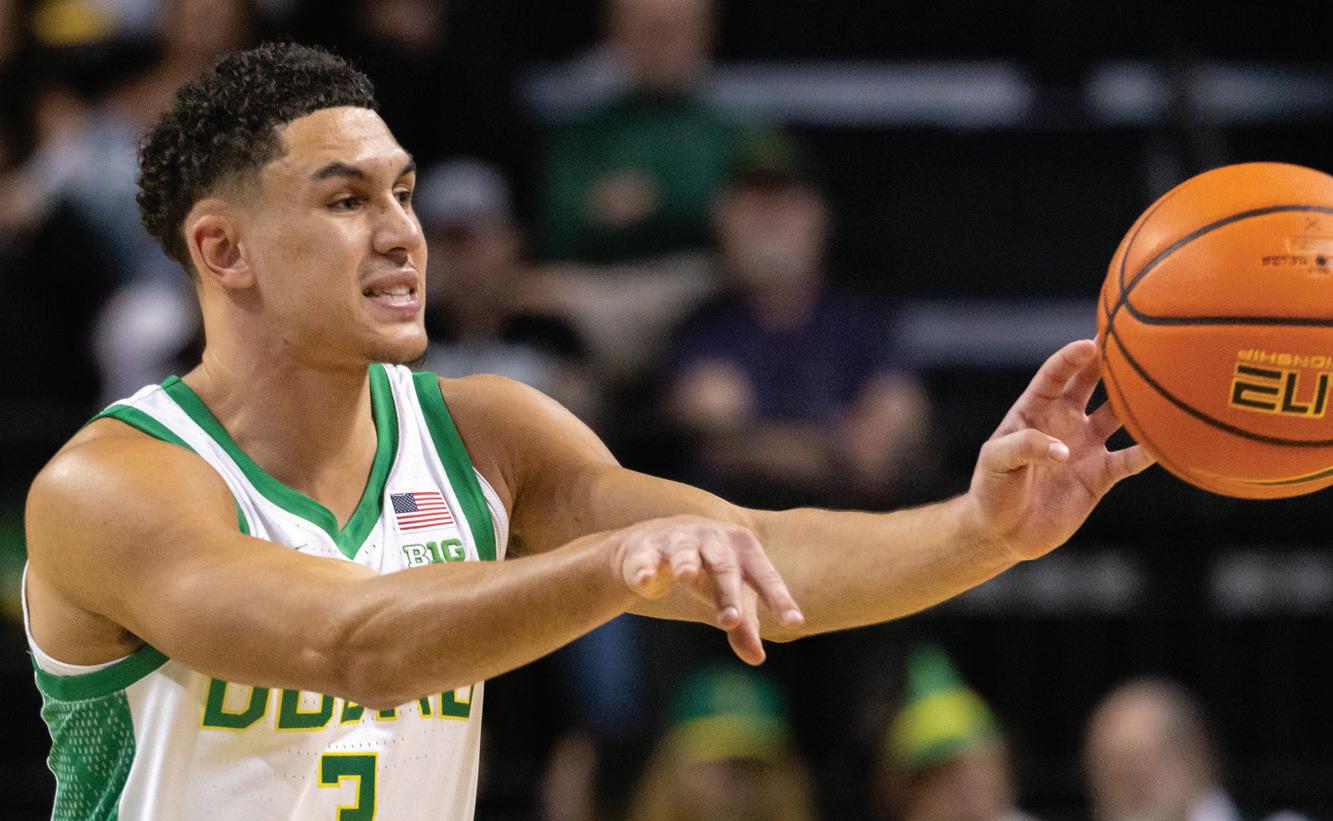
( ABOVE) Oregon Ducks guard Jackson Shelstad (3) passes during the game. The University of Oregon Ducks Men's Basketball team was defeated by the USC Trojans 82-77 in a home game at Matthew Knight Arena in Eugene, Ore., on Dec. 2, 2025. (Max Unkrich/Emerald)
New faces: Defense
Breaking down Oregon football's latest transfer portal additions.
By Harry Leader Sports Writer
With the football season coming to an end, it’s time for the Ducks to hit the transfer portal to fill in some much-needed positions following the departures of multiple star players to the NFL and transfer portal. The Daily Emerald breaks down all of Oregon’s latest transfer portal additions to the Ducks’ defense.
Koi Perich – Safety/ Wide Receiver –Minnesota
With the departure of star safety Dillon Thieneman to the NFL draft, the Ducks’ secondary needed a boost. Enter Minnesota safety Koi Perich. Perich is coming off his second season with the Golden Gophers, where he had 82 total tackles, two pass deflections, one sack, one forced fumble and one interception, which was returned for a touchdown.
Perich also got reps playing wide receiver, kick and punt returner. He caught seven passes for a total of 89 yards and had five rush attempts for a total of 9 yards. Perich returned 19 kickoffs for a total of 499 yards, with his longest return being 93 yards.
Perich brings versatility to a Ducks team that lost many players in the portal and is seeking its next big star on defense.
Carl Williams IV – Safety – Baylor University
Carl Williams IV had a difficult season in 2025 after sitting out for almost the entire season with a meniscus injury. In 2024, Williams had a solid year, picking up 35 total tackles, one sack, one forced fumble and one pass deflection.
If Williams can stay healthy, it wouldn’t be a surprise to see him contributing as a part of a new Ducks’ secondary.
Aaron Scott Jr. –Cornerback – Ohio State
Aaron Scott Jr. is coming off a mediocre season with the Buckeyes after only putting up nine total tackles this season.
Scott saw much more action in his sophomore year than in his freshman year, but still saw limited action this year.
Scott could be a solid addition to an Oregon secondary that has lost four corners to the transfer portal, but he'll have to
prove he can develop and adapt to new defensive coordinator Chris Hampton's schemes.
Jerome Simmons –University of Louisiana at Monroe – Defensive Tackle
Following the departure of five defensive linemen to the transfer portal, the defensive line room was struggling and looked to ULM defensive tackle Jerome Simmons. He played eight games this past season and racked up 10 total tackles and a pass breakup.
Simmons stands at 6’4” and 340 pounds, and brings much-needed depth and size to the dwindling defensive line room.
D’Antre Robinson –University of North Carolina at Chapel Hill –Defensive Tackle
Another addition to the defensive line room is former Tar Heel D’Antre Robinson. Robinson had a solid first season at UNC following his transfer from the University of Florida last offseason. In 2025, he recorded 22 total tackles, 2.5 tackles for loss, one forced fumble and four quarterback hurries.
Robinson saw action both on the inside and outside of the defensive line, but struggled against pass blocking in multiple matchups. He has solid upside and adds more depth behind Bear Alexander and A’Mauri Washington.
Bleu Dantzler – Oregon State University –Defensive End
Following a redshirt season with the Beavers, where he only appeared in four games, Bleu Dantzler is heading south from Corvallis to join the Ducks. Dantzler is a former three-star recruit out of Chandler, Arizona.
In his four games this past season, he recorded one solo tackle against Pac-12 opponent Washington State. As a senior in high school, he recorded 11 sacks and 30 solo tackles as well as three forced fumbles. With the return of edge rushers Teitum Tuioti and Matayo Uiagalelei, it's unlikely Dantzler will see much action as a starter, but he is someone to look out for in this year's spring game.
transportation.uoregon.edu/bus
Ride the bus –it’s smart, safe, and included in your student fees*.
Get to Downtown Eugene and Springfield, Target, Walmart, Fred Meyer, and more with no transfers on EmX.
With an easy transfer at Eugene Station, you can spread your wings to more destinations, like Valley River Center, Oakway Mall, and 5th Street Public Market.
*Provided to you through a partnership between LTD and the ASUO.
54 The ___ (2022 thriller with Anya Taylor-Joy)
Phenomenon that causes your sink to smile at you... or an apt descriptor for the circled entries
Expore Taking Flight, Oregon’s Déjà vu Season
Oregon club hockey splits Bend Outdoor Classic series with Alabama
SATURDAY
Jan. 31, 2026
Oregon vs. Maryland
Ehis Etute has played her way into the starting lineup
Etute’s great rebounding and physical play opens up the court for the Ducks.
By Rowan Shea Sports Writer
The Oregon women’s basketball team is having a good season. While they aren’t blowing the competition out of the water — they have an overall record of 14-7 and a conference record of 2-6 — the Ducks have seen members of this team stepping up and taking full advantage of the chances they have been given.
“We got homegrown talent that came up in the program,” head coach Kelly Graves said. “They had smaller roles last year, and they’ve stepped up.”
Sophomore forward Ehis Etute has been one of those players who has stepped up for Oregon. Etute started her Ducks career last season after coming over from Luxembourg. She was an All-Star twice for the FIBA (the world governing body for basketball) U18 Women’s European Championship Division B, and she won the MVP in that same division in 2023.
The native of Dudelange, Luxembourg, was a good pickup for the Ducks in her first season. She played 22 total games, 21 of which she came off the bench. Etute averaged 9.7 minutes per game and stuck to only shooting from the field and the free-throw line. Where she showed a lot of promise was on the defensive side of the ball, as well as her rebounding ability.
Etute in her first year had 34 offensive rebounds paired with her 37 defensive rebounds and 12 steals. This year, she has blown past her freshman year numbers.
Etute is a great physical player. She plays tough under the basket, driving into the paint and pushing defenders out of the way to get the layup. The 6-foot forward does a great job of boxing out opponents so she can set herself up for the rebound.
“Oh my goodness. That was a bullying move by Etute,” The Big Ten Network said in their broadcast of the Oregon and USC game after Etute shoved USC’s Laura Williams out of her way.
That’s what Etute is doing this season. She uses her size and physicality to provide a spark for the Ducks.
“A lot of times she doesn’t know her own strength,” Graves said about his
decision to move Etute into a starting role. “People bounce off her and they (the referees) call fouls on her… But I think she’s doing great.”
The sophomore, through 20 total games, six of which she has started, has been a force to be reckoned with, whether she’s coming off the bench or starting. She is still shooting the same type of shots, having only taken one 3-point shot, but her average has gone up in both the field and at the free-throw line.
The area of Etute’s game that is stellar for the Ducks is still her rebounding. Last season, she finished at 71 total. She has more than doubled that through three fewer games so far. She is the best overall rebounder on this Oregon squad: Etute leads in offensive rebounds by 35, but she does fall to Mia Jacobs in defensive rebounds with only 83 (Jacobs has 93).
Etute is so good this year at getting the basketball back for the Ducks that she ranks No. 6 in the Big Ten with an average of 7.9 rebounds per game.
Having Etute in the starting lineup is giving the Ducks more opportunities to switch up their playing on the court.
“What she does is she gives us the opportunity to defensively switch a lot more and to change things up defensively,” Graves said. “Because she (Etute) can guard anybody.”
Etute’s strong performance against USC helped the Ducks snag a comefrom-behind victory on the road against the Trojans. Etute played 30 minutes, at that point a season high (she played 36 against Wisconsin), shot six for 10 from the field and she logged 13 total rebounds, seven on offense and six on defense.
Etute has been getting better as the year goes on. Though Graves has highlighted some areas she needs to work on, mainly her shooting and her issues with fouls, the 20-year-old is looking to become a mainstay in the Oregon starting five.
Watch Etute and the Ducks take on Rutgers in New Jersey on Jan. 28, then catch them back at home on Feb. 4 as they take on Illinois.
( LEFT ) Duck Ehis Etute (35) stands tall to block the Western Oregon Wolves. The Oregon Ducks defeated the Western Oregon Wolves 113-36 at Matthew Knight Arena in Eugene, Ore. on Oct. 30, 2025. (Katie Poluyansky/ Emerald)
The Ducks dropped game one after taking a 2-1 lead into the second intermission, but held onto the same lead in game two.