TUESDAY, JAN. 20, 2026
ARTS & CULTURE
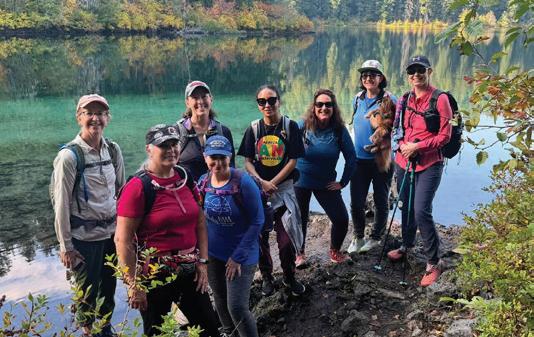
HikerBabes help women find their footing
Betts: Johnson Hall and the power of protest

ACROBATICS & TUMBLING
‘People
TUESDAY, JAN. 20, 2026
ARTS & CULTURE
HikerBabes help women find their footing
Betts: Johnson Hall and the power of protest
‘People
More than a decade since hosting its first championship, acrobatics and tumbling will host an NCAA-sponsored postseason for the first time next year. Getting there took years of unexpected phone calls, deep breaths and repacked bags.
Read story on page 8
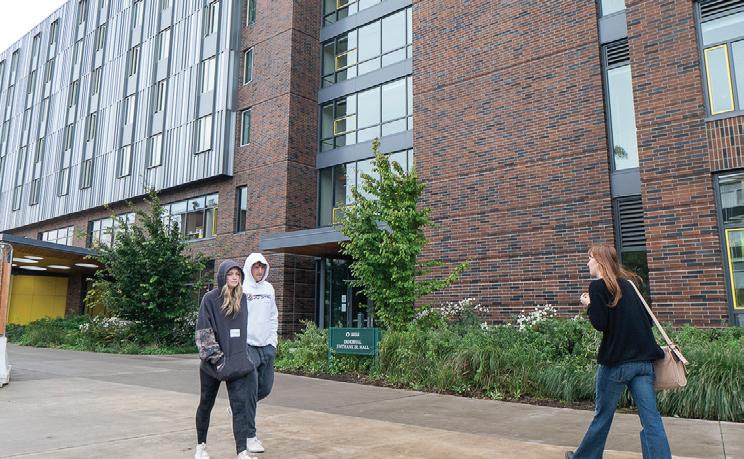
Room selection will no longer operate on an entirely first-come, first-served basis.
By Angelina Handris News Reporter
As housing registration began for next school year, University of Oregon Housing ushered in a new, lottery-based system for first-year and returning students.
Previously, housing selection operated on a first-come, first-served basis, with students who confirmed acceptance to UO earlier having the earliest pick of dormitories.
The new system is broken down into three registration groups. Within each group, the order in which students select rooms is determined by lottery — but Group 1 still gets priority selection over Group 3.
Group 1 consists of students who register by Feb. 28, Group 2 are students who registered from March 1 to May 1 and Group 3 is anyone who registered for housing on or after May 2.
“It’s not like every student is randomly as-
Continue story on page 4




















EDITOR IN CHIEF
Tarek Anthony
PRINT MANAGING EDITOR
Ryan Ehrhart
DIGITAL MANAGING EDITOR
Ysabella Sosa
NEWS EDITOR
Reilly Norgren
INVESTIGATIONS EDITOR
Ana Narayan
A&C EDITOR
Claire Coit
SPORTS EDITOR
Jack Lazarus
OPINION EDITOR
Gracie Cox
PHOTO EDITOR
Saj Sundaram
COPY CHIEF
Olivia Ellerbruch
VIDEO EDITOR
Jake Nolan
PODCAST EDITOR
Stephanie Hensley
SOCIALS EDITOR
Ysabella Sosa
VISUALS EDITOR
Noa Schwartz
DESIGN EDITOR
Adaleah Carman
DESIGNERS
Asha Mohan
Ellery Burton-Tillson
Eva Andrews
Maya Gooneratne
Nina Rose
PUBLISHER AND PRESIDENT
Eric Henry (X317) ehenry@dailyemerald.com
VP OPERATIONS
Kathy Carbone (X302) kcarbone@dailyemerald.com
DIRECTOR OF SALES & DIGITAL MARKETING
Shelly Rondestvedt (X303) srondestvedt@dailyemerald. com
CREATIVE & TECHNICAL
DIRECTOR
Anna Smith (X327) creative@dailyemerald.com
ACCOUNT EXECUTIVES
Torin Chevalier
Camcole Pereira
Ava Stephanian
Elliot Byrne
The Daily Emerald is published by Emerald Media Group, Inc., the independent nonprofit media company at the University of Oregon. Formerly the Oregon Daily Emerald, the news organization was founded in 1900.
Emerald Media Group 1395 University St.,#302 Eugene, Or 97403 (541)-346-5511

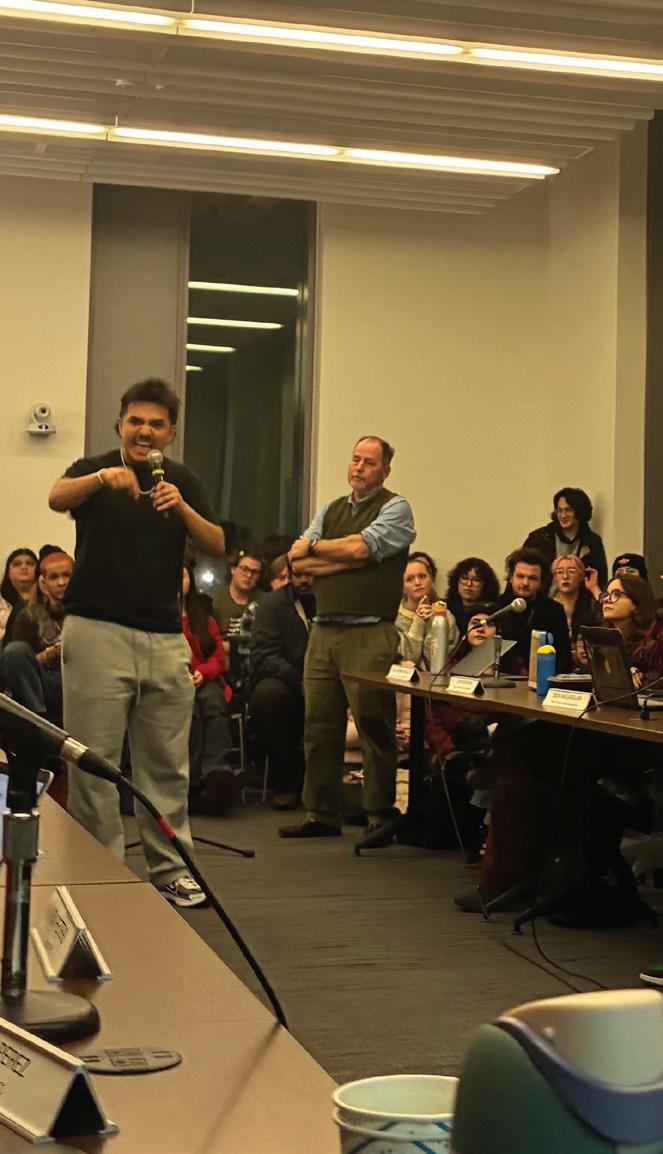
University legal official and student leaders discussed safety, alerts and student rights during an ASUO Senate forum on Immigration and Customs Enforcement.
By Sasha Love Senior News Reporter
About 75 students packed the ASUO Senate meeting Jan. 14, at which Kevin Reed, vice president for the University of Oregon Office of the General Counsel, discussed the potential implications of ICE agents on the University of Oregon campus.
Reports of ICE across the Eugene and Springfield communities and recent shootings of civilians in Portland and Minneapolis have renewed tense discussions about how to interact with agents.
The current advice UO provides for handling a situation in which ICE is trying to detain a student, whether they have a warrant, is to call the Office of the General Counsel for guidance.
The council voted unanimously to nominate the former city manager of Beaverton.
By Billie Corsetti News Reporter
The Eugene city council passed a motion Jan. 14 to unanimously nominate Jenny Haruyama as the city manager. The city council began interviews for the open city manager position in December, and announced the three finalists on Jan. 6.


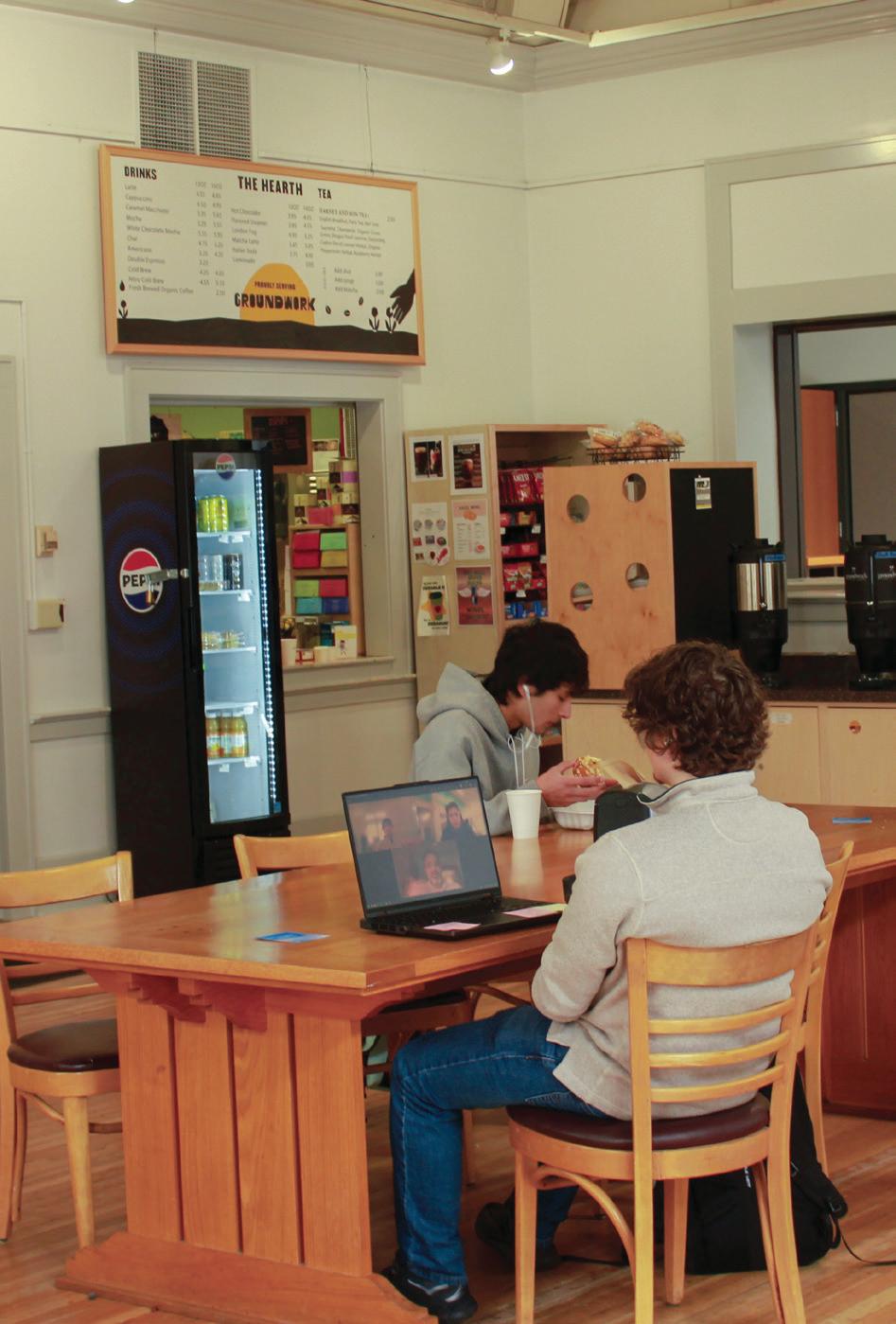
Bring your own cup discount aims to reduce waste and cut down on the coffee bill.
By Sasha Love Senior News Reporter
All campus cafes run by the University of Oregon offer students a 25-cent discount for filling up with a reusable cup. The program has been around for well over 10 years, according to Director of Dining Services Tom Driscoll.
The six cafes include Amy’s Corner, Elements Ca-Fe, Lillis Café, Café Verso, Education Station and Hearth Café.
“The thought of people bringing in their mug every day would be my favorite,” Poppie Sterup, UO’s coffee outlet dining manager, said.
Driscoll said he and his team thought about increasing advertising around the discount after a group of UO students last term offered to hang up promotional signs for an experiment, and the cafe managers realized only 3% of campus coffee was sold in reusable cups last year.
“We have a lot of new people on campus every year so just continuing to get the word out every year (because) it has to be continuous education,” Driscoll said.
Driscoll said incentivizing a reusable option is part of a broader sustainability mission within UO’s food services.
“(Sustainability) is just part of being a part of the UO and being good community members. We generate a lot of food waste but we know a greener option is better,” Driscoll said.
In the past, the campus cafes have tried both selling reusable mugs and have offered thrifted mugs for students to use while enjoying their coffee in the shop, similar to the model used for returning dishware in the dining halls. According to Driscoll and Sterup, these experiments were not feasible in the long term.
“Mostly people take their coffee away and they may come back to our cafe but they may be going someplace else,” Driscoll said. “They are often in their world with their cup of coffee so what works best is if you just bring your cup and we’ll put coffee in it and then you can go along your way.”
The discount is set at 25 cents partly because of the cost of buying and shipping the cups, but it is also marked up to try to incentivize waste reduction.
“We are receiving this thing on a truck, you are using it once and it gets on another truck and it’s going to a landfill,” Driscoll said. “I mean you just think of it and it’s mind boggling.”
( LEFT ) Hearth Café located in Lawrence Hall.
(Eva Andrews/Emerald)
signed; it’s still within those certain groups, so it does advantage students who register a little bit earlier, it’s just not the exact order of when they register,” Bryson Beck, director of promotions and student recruitment at UO Housing, said.
Beck said the new system is more equitable to students who are unable to pay the $400 in total registration fees right away.
“There (has been) students that didn’t have that $400 right when they were admitted, or right when housing opened, so they would have to wait days, a couple of weeks or even a couple of months before they were able to submit the housing registration,” Beck said.
There is a deferral option for the fees, but not every student is eligible. Beck said the process for deferrals has been streamlined recently, becoming a simpler process where students can fill out a form requesting a deferral rather than having to email UO Housing.
UO sophomore Kenzie Hobdy said she found using a lottery room selection system to be “a little absurd.”
“I feel like there’s so much pressure to sign up early, which I guess could be good or bad, but it’s almost like a reward when you sign up early to be able to (select your room) earlier,” Hobdy said.
Returning, transfer, exchange and visiting students are also on a lottery-based system, but only for the first two groups. Group 1 is for students who registered by Jan. 23, and Group 2 is for students who registered from Jan. 24 to Feb. 20. Group 3 is entirely first come, first served for students who registered on or after Feb. 21. 2026.
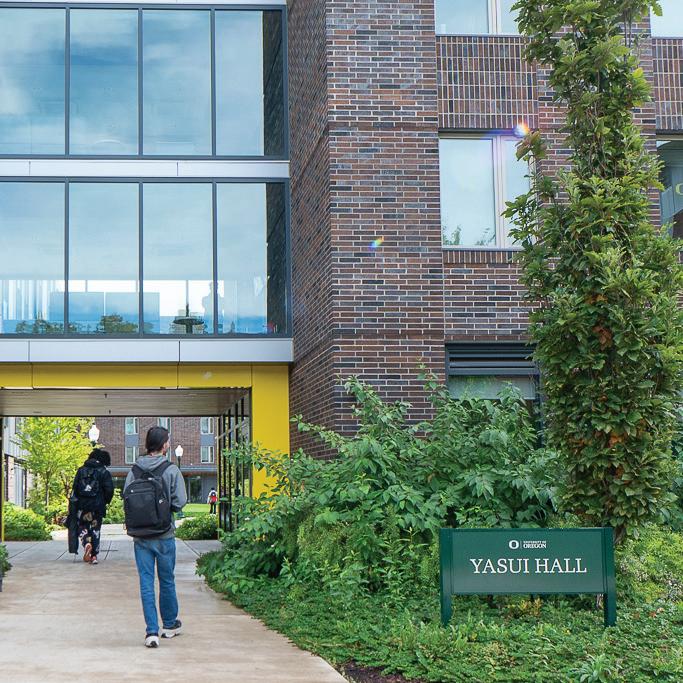
The new building offers advanced laboratories and sustainability-driven design.
By Elle Kubiaczyk News Reporter
Building 2 at Knight Campus, a $330 million project, funded by a second $500 million gift from Phil and Penny Knight and $10 million in state funding, is set to open in March 2026. The building will welcome broader access following spring break.
According to Campus Planning and Facilities Management, “The exterior landscaping and planting are nearly done. Finishes are being completed and furniture installed, and the building systems are being tested.”
In the coming months, construction fencing will be removed, opening up pedestrian pathways along Building 2.
Designed by Portland-based ZGF architects, the 184,000-square-foot building will offer expanded space for the undergraduate and graduate programs at Knight Campus: bioengineering, applied physics, brewing innovation, chemistry and biology.
Building 1, a $225 million project constructed by Ennead and Bora Architects, opened in spring 2020. It was funded by a prior $500 million gift from Phil and Penny Knight, along with $70 million in state appropriation. The 166,000-square-foot building received a prestigious Leadership in Energy and Environmental Design Gold certification, awarded for the green building’s commitment to sustainability. ZGF is chasing the same LEED Gold accreditation for Building 2.
“Over 40% energy savings is achieved through daylight harvesting and efficient HVAC design, which includes heat recovery, chilled beams and enhanced ventilation with high-quality filtration to improve indoor air quality,” ZGF said.
Knight Campus borders Mill Race, a channel off of the Willamette River. Mike Harwood, vice president of CPFM, states, “the project has minimal impact on the ecosystem” and “the Mill Race is healthier now than it has been in a very long time.”
Beyond sustainability efforts, architecturally, the exterior of the building will be inspired by Building 1’s glass facade. Both buildings will be connected via a skybridge. The four-story building will feature the forum, or “the social heart of the building,” and span two stories. The forum will connect public amenities on the first and second floors — a public bistro, seminar rooms, student spaces and teaching laboratories.
Notably, outdoor terraces will be accessible on each floor providing views of Building 1 and the surrounding scenery. ZGF notes, “These volumes (level three and four terraces) evoke a treehouse quality while being covered from above to offer year-round use in the potentially wet, Northwest climate.”
New technologies and biotech facilities in Building 2 will further the overall mission of Knight Campus in creating a Science Advancing Society, Taylor said.
The new building will feature 17-20 research groups fixed on advancing biomedical and bioengineering science. Both Sara Keller and David Peeler, new faculty members in the Department of Bioengineering, will open new labs at Building 2.
The Keller Lab will delve into the promise and potential of ultrasound technology to effectively treat infections. David Peeler’s BRIDGE lab will strive to advance vaccines and treatments to combat “infectious diseases, cancer and support tissue repair,” states Knight Campus’s Fall 2025 Annual Report.
A key feature is a new maker space with state-of-the-art technology to include “3D printers, fume hoods, microscopes and electrical engineering tools among other items,” Taylor said.
Additionally, Building 2 will expand the Papé Family Innovation Center, which provides leasable space for early stage companies. According to the 2025 Annual Report, Building 1 housed seven startups in the 4,000-square-foot center – Building 2 will add an additional 3,000 square feet.
The Center for Biomedical Data Science, opened in 2019 as a collaborative research effort between the UO and the Oregon Health and Science University, will now have a physical home in Building 2. The initiative’s goal is to train up-and-coming biomedical data researchers to use “advanced computing and machine learning tools” to prevent and cure diseases at a faster rate, as stated by the Phil and Penny Knight Campus website.
The Knight Campus BioFoundry, a completely new core facility, will be concurrently located in Building 2. The BioFoundry will “centralize diverse cellular analysis techniques in one space, including DNA and RNA sequencing,” with the use of advanced equipment, Taylor said.
Through collaboration between bioengineers and data scientists, “the hope is to reveal insights that might otherwise be missed,” he adds.




















A collective list of potential nominees and who might walk away with a trophy (and bragging rights.)
By Amelia Fiore Arts & Culture Writer
As the winners of the Critics’ Choice Awards and Golden Globes walk away with their heads tilted high, Oscar season has crept in. The ceremony, which takes place on March 15, will recognize hundreds of films from 2025, and finally, the Academy has implemented a new rule that requires voters to watch all nominated films. There are dozens of categories for all aspects of filmmaking, so I picked a few of the most significant.
“The Testament of Ann Lee” — Małgorzata Karpiuk
“Frankenstein” — Kate Hawley (Critics’ Choice winner)
“Wicked: For Good” — Paul Tazewell
“Hedda” — Lindsay Pugh
“How to Train Your Dragon” — Lindsay Pugh
This one is tough. I adore the styling in “Wicked,” especially its playfulness with color schemes and attention to detail, but “Frankenstein” is a film expertly crafted through its visuals, costumes included. Hawley does an amazing job bringing The Creature to life while also capturing the beauty of Victorian Gothic fashion in Victor and Lady Elizabeth’s attire.
“Sinners” — Ludwig Göransson (Critics Choice and Golden Globes winner)
“Frankenstein” — Alexandre Desplat
“Sirāt” — Kangding Ray
“Avatar: Fire and Ash” — Simon Franglen
“Jay Kelly” — Nicholas Britell
“F1” — Hans Zimmer
While I believe “Sinners” deserves a win for its lively soundtrack, “Avatar’s” score is a one-of-a-kind listening experience. Franglen does an excellent job carrying the
legacy of the late James Horner, as the music from this film plays a key part in bringing Pandora to life through theater speakers.
“Sinners” — Ryan Coogler (Critics’ Choice winner)
“Sorry, Baby” — Eva Victor
“Marty Supreme” — Ronald Bronstein & Josh Safdie
“Sentimental Value” — Joachim Trier & Eskil Vogt
“Is This Thing On?” — Will Arnett, Mark Chappell & Bradley Cooper
“Materialists” — Celine Song
The story of “Sentimental Value” is a complex one, complete with family relationships, grief, art and legacy. And yet, it is told with genuineness by Trier and Vogt. Its script allows for nuance between characters, allowing the actors to command the scenes. The other contenders in this category bring originality and excitement, but “Sentimental Value” might take this award home due to its emotional authenticity.
“Demon Slayer: Kimetsu No Yaiba Infinity Castle” “Elio”
“KPop Demon Hunters” (Critics’ Choice and Golden Globe winner)
“Little Amélie or the Character of Rain” “Zootopia 2”
Besides being ubiquitous online and in pop culture for the past several months, “KPop Demon Hunters” has solidified itself as not just a movie for young people, but a layered story atop a killer soundtrack. I think I’ve heard “Golden” and “Soda Pop” at least a hundred times this past month, but I’m not complaining.
James Cameron — “Avatar: Fire and Ash”
Park Chan-wook — “No Other Choice”
Best Actress
Emma Stone — “Bugonia”
Kate Hudson — “Song Sung Blue”
Jesse Buckley — “Hamnet” (Critics’ Choice and Golden Globe winner)
Cynthia Erivo — “Wicked: For Good”
Jennifer Lawrence — “Die My Love”
Tessa Thompson — “Hedda”
Buckley stars in the film adaptation of the historical fiction novel, “Hamnet,” which tells the story of the loss of the young son of William Shakespeare and his wife, Agnes Hathway. Her acting feels refreshingly raw and she portrays the grieving mother with unexpected ferocity. Although up against some pretty strong actors, she definitely deserves this one.
Dwayne Johnson — “The Smashing Machine”
Ethan Hawke — “Blue Moon”
Timothée Chalamet — “Marty Supreme” (Critics’ Choice and Golden Globes winner)
Leonardo DiCaprio — “One Battle After Another”
Michael B. Jordan — “Sinners”
George Clooney — “Jay Kelly”
DiCaprio has been nominated for an Academy Award every seven-ish years since his role in “What’s Eating Gilbert Grape” in 1994. In “One Battle After Another,” he plays Bob, an impassioned, paranoia-stricken explosives expert working within a group of revolutionaries. His acting skills translate beautifully into this character, where he blends silliness with sincerity to make for a layered performance. While Chalamet is an endearing personality and Jordan is a powerful contender, DiCaprio’s skill has skyrocketed over the years and cannot be overlooked.
“Bugonia”
“Frankenstein”
“Hamnet” (Golden Globe winner (drama))
“Marty Supreme”

Paul Thomas Anderson — “One Battle After Another” (Critics’ Choice and Golden Globe winner)

(Kate James/Emerald)
Ryan Coogler — “Sinners”
Chloé Zhao — “Hamnet”
Joachim Trier — “Sentimental Value”
Guillermo del Toro — “Frankenstein”
The story of Frankenstein has been through hundreds of iterations since the film’s birth, and will likely go through hundreds more. What del Toro does so masterfully with his version, though, is expertly blend themes of religion and the weight of creation while weaving in visual boldness and color motif. He puts a unique sort of care into this film and each of its components, which isn’t as apparent in the other nominees, as if “Frankenstein” is his own fantastical monster child.
“One Battle After Another” (Critics’ Choice and Golden Globe winner (comedy))
“Sentimental Value”
“Sinners”
“Train Dreams”
“Wicked: For Good”
I have a deep adoration for “Bugonia,” but I don’t think Hollywood is ready to commemorate alien weirdness and class analysis just yet. “Marty Supreme” was fun, but lacked an air of maturity often demanded of this category. “One Battle After Another” is an outstanding film, so I believe its current wins are well deserved, but “Sinners” needs to get its flowers. Coogler’s story is so engaging and groundbreaking, and the combination of original music and acting powerhouses has captivated audiences — it has all of the ingredients that make up a Best Picture.
By Owen Murray Associate Sports Editor
Felecia Mulkey was going to make it very, very clear.
“It’s not a matter of ‘if,’ she said. “It’s simply ‘when.’”
The head coach of the University of Baylor’s acrobatics and tumbling team was sitting in the middle of a clearedout press room on the basement level at Oregon’s Matthew Knight Arena. The tables were pushed to the corners. It didn’t need to be formal.
She was in Eugene for the Bears’ marquee meet against the Ducks, but before that, the woman who calls herself one of the sport’s historians was there to lay out a timeline for its (in her eyes, inevitable) ascension to NCAA Championship status. It was Feb. 22, 2025, she just had to say what she knew, and she was prepared to be direct, right then, at the end of her interview.
“In 36 months, the trophy will have a blue dot on it,” she said.
The final legislation hadn’t been put in motion yet — that wouldn’t happen for another two months — but she was confident anyway. She reiterated it one more time, for good measure.
“We will be an NCAA Championship sport,” she said.
What she didn’t know then was that they were ahead of schedule. 11 months later, on Jan. 16, ‘when’ finally arrived.
Three votes at the NCAA’s annual convention in January approved acrobatics and tumbling as an NCAA Championship sport. It passed the Division I cabinet meeting Jan. 14, then the Division II and III votes on Jan. 16. After its final season of competition as a non-Championship sport begins next month, it will become the seventh to have risen through the Emerging Sports for Women pipeline, and will host its inaugural competition at the new level in 2027.
“People like an underdog story,” NCATA Executive Director Janell Cook said in December 2025. “And ours is a bit of an underdog story, you know?”
I: Pick up the phone
Cook didn’t expect the phone to ring.
The woman responsible for managing acrobatics and tumbling’s climb lives in Everett, Washington. She was sitting in her office in May 2025 — outside the door were two assistants. She knew that the sport was close to approval, and that the Committee on Women’s Athletics was meeting to discuss its progress. The next step was for the committee to vote to recommend the approval legislation to the three NCAA divisions. Cook didn’t think it would come up until the fall.
Her journey started a few hundred miles south, at the University of Oregon, where she returned to the athletic department in a role focused on funding and exposure for women’s sports in 2006 after graduating as a softball student-athlete in 2003.
With the NCATA, which she joined in 2014, her role became focused on pushing acrobatics and tumbling through the NCAA emerging sport process. Often, that meant hearing negative feedback.
“There were many people who said really directly, ‘This will never happen. You guys will not be able to make this happen,’” Cook said.
The process by which a sport rises from unrecognized to NCAA Championship level has — in the official guide — eight steps. An application is submitted, which is then reviewed by the committee, who then recommends that each applicable division add the sport to the Emerging Sports for Women program. The divisions then independently intro duce and vote on legislation to adopt the sport.
After its adoption as an Emerging Sport, a minimum 40 programs — 52 schools are expected to sponsor acrobatics and tumbling in 2026 — are required for consideration as an NCAA Championship sport. After that mark is met, the CWA meets to decide whether to recommend it again to the divisions — this time as a Championship sport, which was the May 15, 2025 vote for acrobatics and tumbling.
Then, after a budget approval, the legislation is intro duced again at the divisional level. Board members vote, typically at the NCAA Convention held annually in Janu ary. A deciding margin there is the final barrier; pass at all three levels by simple majority, and the sport is adopted and a committee is established.
After the Sports for approved next goal took shape.
Her ten ure, after reaching Emerg ing Sport status, has been focused on checking the next box in the Emerging Sport process: program count. Acrobatics and tumbling needed to grow from the 27-school mark it reached in 2020 to 40 in order to set the second set of leg islation in motion.
When Cook took the role with the NCATA, now-Ducks head coach Taylor Susnara was starting her journey with the sport as a student-athlete. She remembers how much growth still needed to happen.
“I've said this a thousand times, but when I started as an athlete back in 2014, there were maybe like 10 to 15 schools, max,” Susnara said from her office last week. “And so the fact that it's grown so much is just amazing.”
The growth is for real. It took eight years, but in 2022, the 40th school, Morgan State University, agreed to sponsor. That set the stage for another three years of waiting — this time for the committee to approve the 40-program margin and set the legislative recommendation in motion.
That’s who called when Cook picked up the phone.
Greg Bamberger needs to get up to speed on arm wrestling. Two years ago, when the NCATA National Champion ship returned to Fairmont, W. Va, Bamberger was there to see it. He was in his fourth year at Fairmont State Univer sity as the athletic director, and while he wasn’t the point man on the competition, he was there to notice something: people showed up.
The NCATA contacts local gymnasiums and groups around host sites — “And I say local — they might have been out 50, 75 miles, especially in a little more remote area

Oregon vs. Missouri State University
Springfield, Mo.
Feb. 8 @ 1:00 p.m. PT
Oregon vs. Quinnipiac University
Eugene, Ore.
Feb. 21 @ 4:00 p.m. PT
Oregon vs. Baylor University
Waco, Texas
Feb. 28 @ 3:00 p.m. PT
Oregon vs. Gannon University
Eugene, Ore.
Mar. 6 @ 6:00 p.m. PT
Oregon vs. Iona University
Eugene, Ore.
Mar. 15 @ 4:00 p.m. PT
Oregon vs. Hawaii Pacific University
Honolulu, Hawaii
Mar. 25 @ 9:00 p.m. PT
Oregon vs. Baylor University
Eugene, Ore.
Apr. 6 @ 6:00 p.m. PT
that we’re in as compared to Waco, Texas (at the University of Baylor) or Eugene, something like that,” Bamberger said — in order to welcome young athletes.
“(Fairmont doesn’t have) quite the population base, but they would work with these groups and they would bring students or young girls, mostly, down to get exposed to the sport and allow them to see what it’s like,” Bamberger said.
As the NCATA looked to grow towards the 40-program mark, those moments were major, even if the universities that hosted them weren’t. That’s by design. There have been 14 NCATA Championships in the sport’s history. Seven different programs — Oregon, Baylor, Quinnipiac, Azusa Pacific, Fairmont State, Gannon and West Liberty — have hosted. Each of them birthed new connections.
For Cook, those moments are crucial. Local gyms and coaches are where the NCATA’s athletes come from, and her job revolves around educating them in order to grow the sport. A national championship is her opportunity. They choose non-Power Four schools like Fairmont (the 2024 host) or Augustana University (2025) in order to expand that base even further.
“We want to obviously drive fan attendance and have lots of people there to enjoy the event,” Cook said. “But the primary reason is to expose young women to the opportunities that acro and tumbling affords at the college.”
The arm-wrestling part comes in handy for the future. The NCAA will host the first edition of its acrobatics and tumbling national championship in 2027. Everyone, Bamberger thinks, will want to host — he thinks Fairmont would be a great option; Mulkey said it’s brought up to her often by colleagues in Waco. There’s a clear solution in the Fairmont athletic director’s eyes.
“We're all going to maybe arm wrestle for it,” Bamberger said.
III: Pack your bags
“I'm so terrible at packing,” Mulkey said, three days before the final vote.
She’d come back from practice in Waco earlier on Jan. 13, where she’d spent time explaining the enormity of the occasion to her team. She has to repack her bag from another trip. This time, her dogs are watching her get ready to head to D.C., to meet Bamberger and Cook. They were expecting good news from the NCAA’s meetings.
Did she pack anything special to watch a sport reach championship status?
“I came home, washed all the same clothes, put it back in
the bag,” Mulkey said. It wasn’t a huge deal; just her “life’s work,” she said.
Later that day, she was en route to Washington. Susnara, in Eugene, expected to be with her team or her staff when the vote went final. They regrouped after the school’s winter break — they’re finalizing events for the season.
“I’ll be jumping up and down,” she said. “I'm eager to share the good news with the team.”
The news came through for the first time on Jan. 14, when the NCAA Division I Cabinet approved — unanimously — the sport for a national championship. It came again Jan. 16, when Divisions II and III approved it, too.
Susnara and Mulkey don’t expect much to change in their day-to-day routines. They’ll still work through seasons, still on the collision course that has seen them battle in three of the last five national championship meets.
The change comes when they lift the trophy. It’ll have a blue dot on it — that’s what matters.
“I could think about all of the women that were competing the first year on the Oregon A&T program,” Cook said in December 2025. “And I was witnessing that and seeing how being able to participate changed our lives.”
She paused and reset.
“I gotta practice this, so I’m prepared,” she said.
“I'm most excited for all of those people that really invested when it was unsure what was going to happen,” she said.
“When there were a lot of people that said, ‘Oh, this will never come to fruition,’ and the people that believed invested anyway, I'm really, really, really excited for those people.”
This year, they’ll all pack their bags again, for the final NCATA National Championship in Azusa, Calif. in April 2026. The next time they do, it’ll be for the first NCAA edition in its history.
Oregon hosts its first home meet of the 2026 season Feb. 21, against Quinnipiac University.
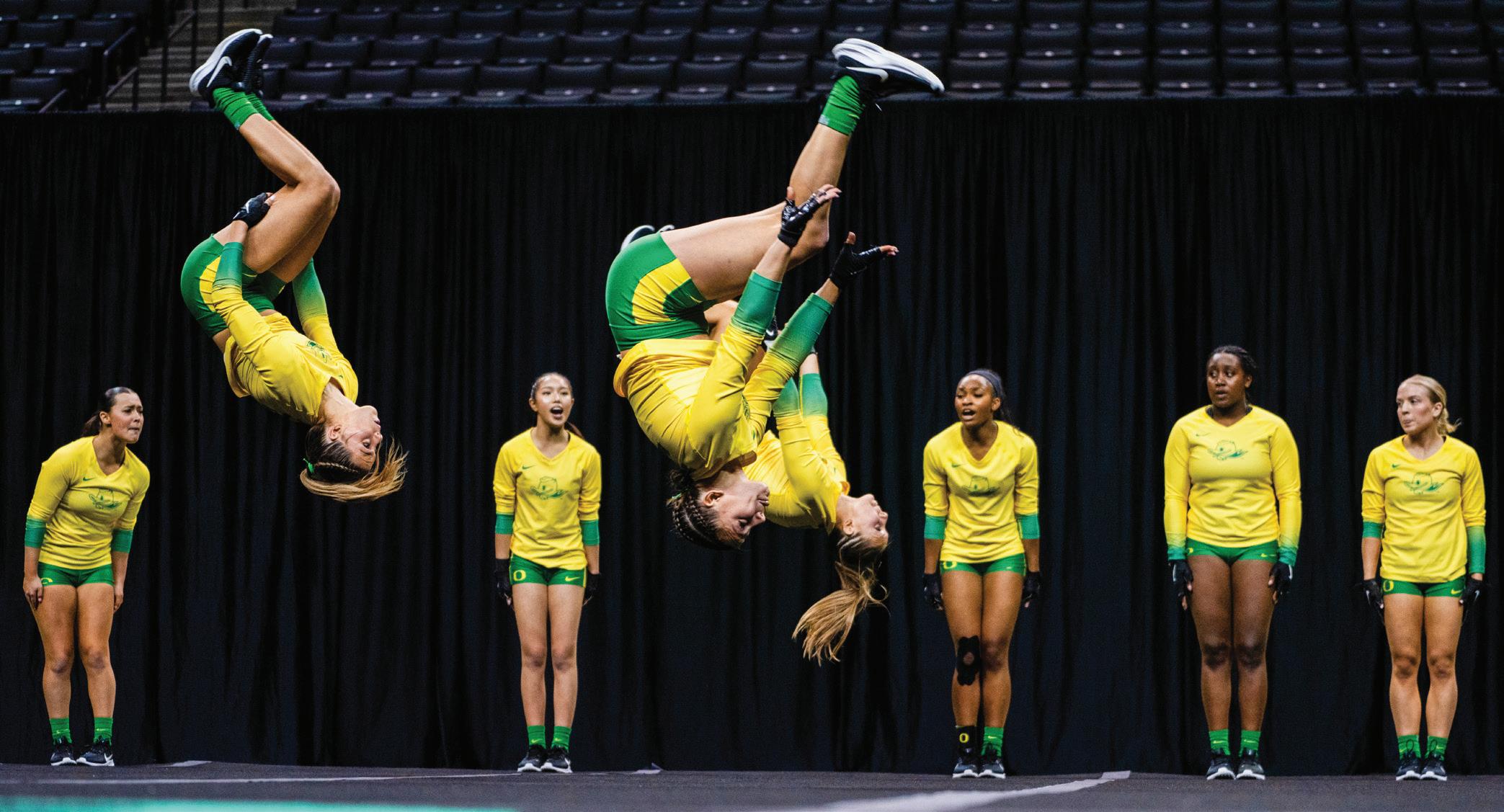
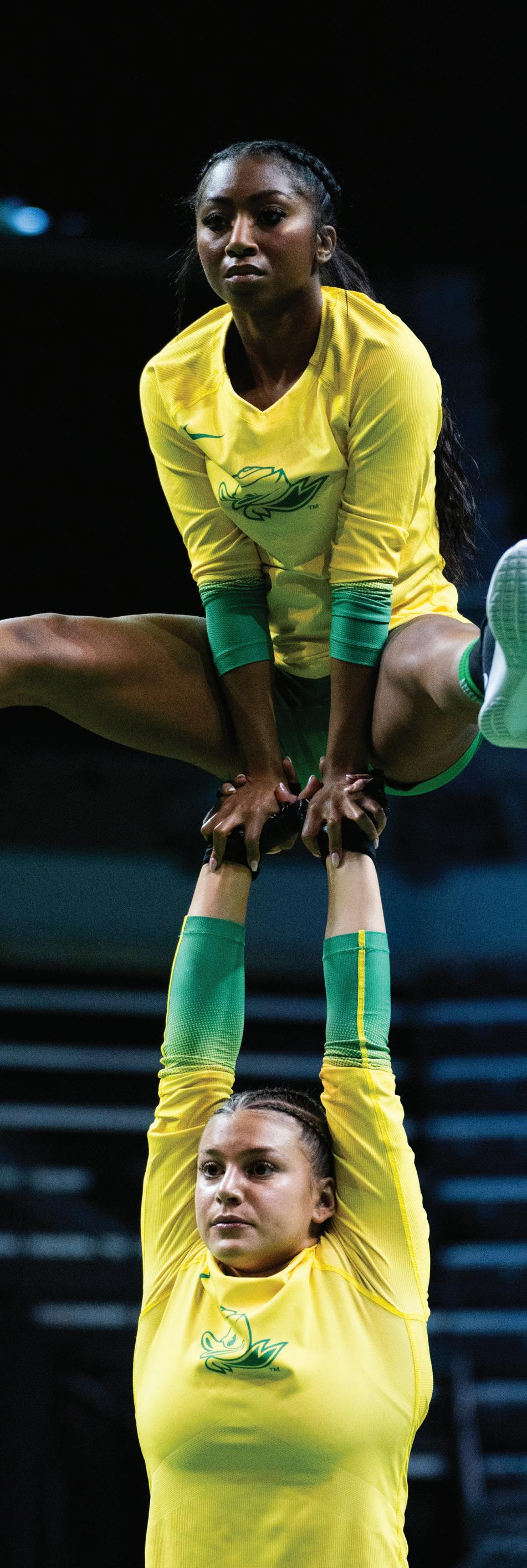
(ON THE COVER) Bella Swarthout (10) during warm ups. The University of Oregon Ducks Acrobatics and Tumbling team practiced at Matthew Knight Arena in Eugene, Ore., on Feb. 6, 2025.
( LEFT ) Selah Bell (23) is held up before competition starts. The University of Oregon Ducks Women’s Acrobatics and Tumbling team in a home match against Morgan State at Matthew Knight Arena in Eugene, Ore., on Feb. 15, 2025.
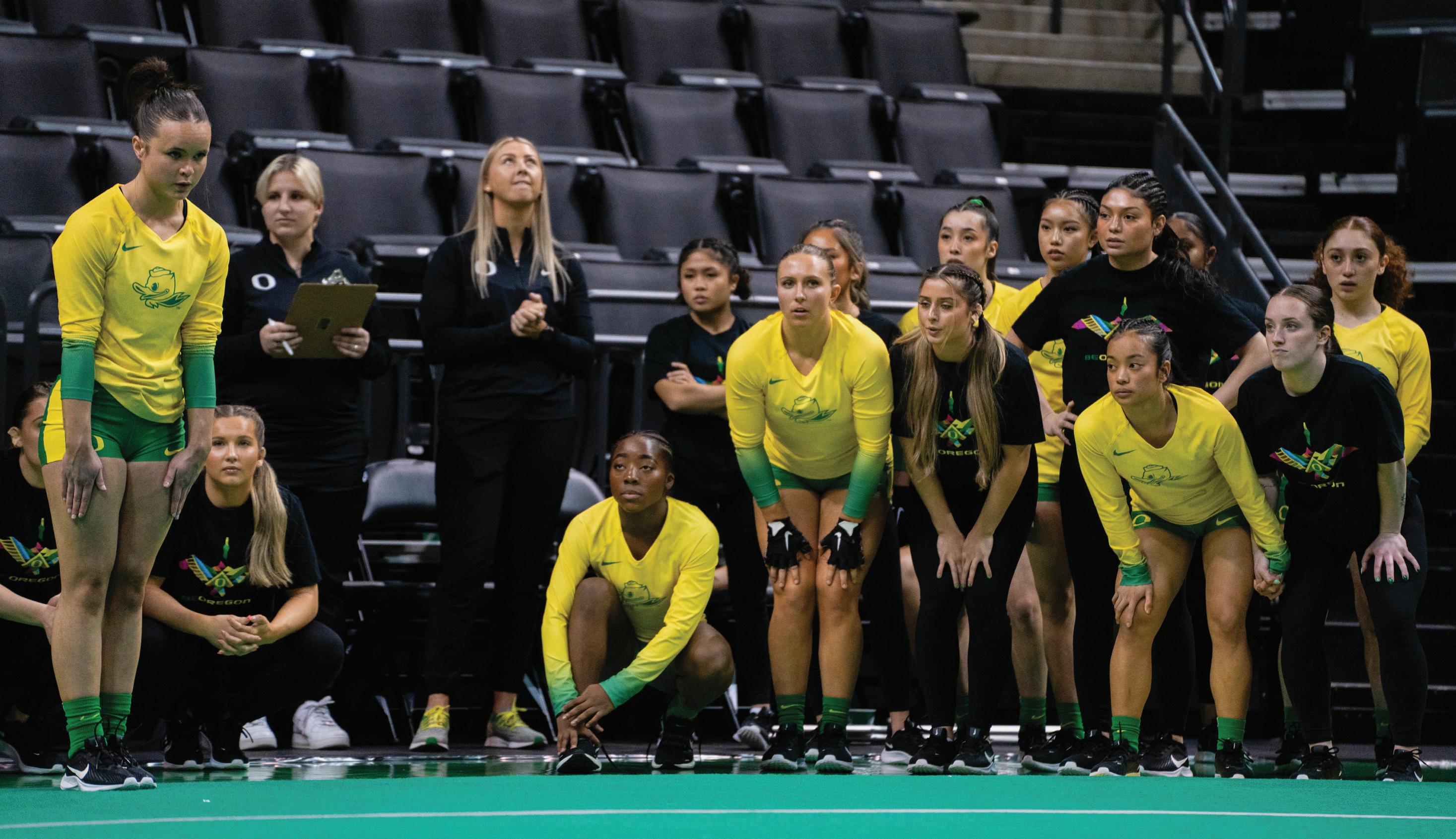
( BELOW ) Oregon watches as Haley Ellis (41) is about to start her routine.
(Rowan Campbell/Emerald)
The worldwide female hiking network builds community and confidence in nature.
By Gigi Roddick Arts & Culture Writer
HikerBabes is a global community of female hikers, born from a 2017 Instagram challenge started by founder Monique Redmon. Today, HikerBabes has over 165,000 members across 205 chapters globally.
Chapters are led by ambassadors — volunteer members who are expected to plan eight to 12 events a year. Events can range from two mile weekend hikes to multi-day backpacking trips. Available to VIP members are out-of-state retreats and international hiking trips, organized by Redmon.
Amy Goodale Singer, a lifelong Oregonian, has traveled to Croatia, Thailand and Italy through HikerBabes. She currently serves as an ambassador for the Eugene-Springfield chapter.
Singer found the community on Facebook as she was searching for places to hike in Eugene with her children. It took her a while to attend an event after joining, but once she did, she never looked back.

Emma Kahl is an opinion columnist for The Daily Emerald. She is currently a senior, majoring in written journalism and minoring in global studies. Her writing focuses on social commentary, culture and politics.

“I was your typical reluctant member, so I just kind of lurked,” Singer said. “I was afraid of joining, and then I finally pulled the trigger and started going to events.”
She now runs weekly Fitness Fridays on the local Ridgeline Trail, leads weekend hikes and organizes chapter retreats to the Wallowas, the Columbia River Gorge and Zion National Park.
Each outing requires large amounts of preparation. Singer organizes lodgings and carpools, researches trail conditions and ensures maps are up-to-date and waivers are signed. Her experiences on the trail makes all her work worthwhile.
“To see women bonding, connecting, chatting, enjoying the views and enjoying the achievement… that’s the reward,” Singer said.
Mia Kubu is another ambassador for the Eugene-Springfield chapter. She joined five years ago after her children went to university. On her first HikerBabes excursion, she found she was not alone; many other members joined to enjoy leisure time with their children off at college.
“There’s this gap in age in the hiking community because women have careers and kids and all these other external factors that are limiting how much free time they have. A man can still go golfing for five hours every Saturday, but for some reason a woman can’t go hiking,” Kubu said. “There’s really a gender gap in what we feel we’re able to do.”
HikerBabes and its community of supportive members encourage women to take up space and be confident getting outside.
“It’s okay to go out and spend time on self care,” Kubu said. “Women just need a big confidence boost in thinking they can go out and go hiking.”
Kubu’s beginner backpacking trips serve this very purpose. Last August, she led five women on an easy two-night trip. For the majority of participants, it was their first camping experience ever.
“Most people are like ‘oh yeah, I’m totally into this. I want to go more.’ But they’re not going to go by themselves, and I think a lot of people just don’t have other people to go with,” Kubu said.
Hence HikerBabes, where no woman hikes alone. The organization gives more than just hiking buddies. For many, it offers a sense of belonging.
“I thought maybe I’d make some friends. I didn’t realize I’d find a community,” Singer said.
Opinion: UO’s inconsistent attendance policy prioritizes presence over learning.
By Emma Kahl Opnion Columnist
With winter term kicking off, we’ve all gotten used to syllabus day where professors go over their policies, their course overview and then jump straight into content. With attendance rules set by each professor individually, it can feel like attendance expectations become confusing and high-stakes.
During my freshman year, I took a class where missing more than one discussion section would result in failing the course. On the flip side, I’ve had professors who don’t care if you show up to class as long as you get your work done.
While professors can use their own discretion to decide how many absences are reasonable before a student’s grades are impacted, UO adopted a reason-neutral absence policy back in 2022 that prohibits instructors from asking why students missed a class.
The office of the provost noted that the implementation of this policy “is intended to provide
more transparency and equity in application of course attendance.”
As good as this sounds in theory, the reason-neutral policy can overlook unexpected life events. Students shouldn’t have to weigh staying home due to illness, family emergencies or experiencing mental health challenges against showing up just to keep their attendance grade.
UO junior Grace Mangali said the daily attendance tracker she has in one of her classes makes it feel like “the incentive to go to class is to get the attendance points and not to learn something.”
“I think class is most valuable when you’re showing up and getting something that you can’t get outside of it,” Mangali said.
At this point, are these policies meant to encourage learning or punish absence? If students are only showing up due to the fear of missing points, they are not going to truly get what they need out of their class.
UO junior Jay Bramhall said he noticed that while many professors set high attendance expectations, they often don’t enforce their own rules. He also said he thinks the policy is in place mostly to “uphold staff ego.”
“People don’t like teaching to an empty classroom, but it’s on the faculty to make it so that I want to go to their class,” Bramhall said.
When students are paying up to tens of thou-
sands of dollars to attend their classes each term, they should have some input in deciding how they learn best.
A study published by the National Library of Medicine looked at how attendance hurdles impact students’ perception of attendance policies. It found that the majority of students would still attend most classes even without mandatory attendance requirements. Many also said that mandating attendance can unfairly disadvantage certain students.
Last year, UO senior Henry Perrine suffered from a concussion before finals week. He already had two absences from the class, so he tried to get accommodations for the injury. With too little time left in the term, his professor landed on excusing just one assignment, forcing him to show up to class.
“Even writing out an email was hard for me. I kind of just gave up; it was pretty frustrating,” Perrine said. “I think the whole thing is a little twisted.”
Students are often not asking to just skip class, but they’re asking for flexibility and a bit of understanding. At the end of the day, strict attendance policies lead to unnecessary stress for students. UO’s policy should encourage learning and not penalize students for life’s unpredictability.











Reed is a firstyear political science student who’s interested in unusual historical facts and sharing the stories behind them. He plans to pursue law in the future, but for now, he enjoys exploring Eugene, trying out new clubs, and diving into any friendly debate that comes his way.
Opinion: Johnson Hall symbolizes powerful student voices at UO.
By Reed Betts Opinion Columnist
For many students of the University of Oregon, Johnson Hall is likely the least memorable of the university’s many buildings. As the administration center, many people will never set foot inside it. Unless, of course, it becomes the site of another student occupation.
Since the 1960s, Johnson Hall has been the center of campus activism, a beacon of social change and resistance to university leadership. It has been occupied, demonstrated on and even chained to, by students speaking their minds on everything from the Vietnam War to the actions of ICE. Not only have these actions been foundational to the dialogue and governance of the UO, but they have also been expressions of unity that help bring these critical issues to the forefront of the national consciousness.
The beginning of Johnson Hall’s illustrious protest history was in 1968. The UO had struggled the entire decade with intense disagreement over student autonomy, and despite seeing some success with the aid of President Arthur Flemming, it wasn’t enough.
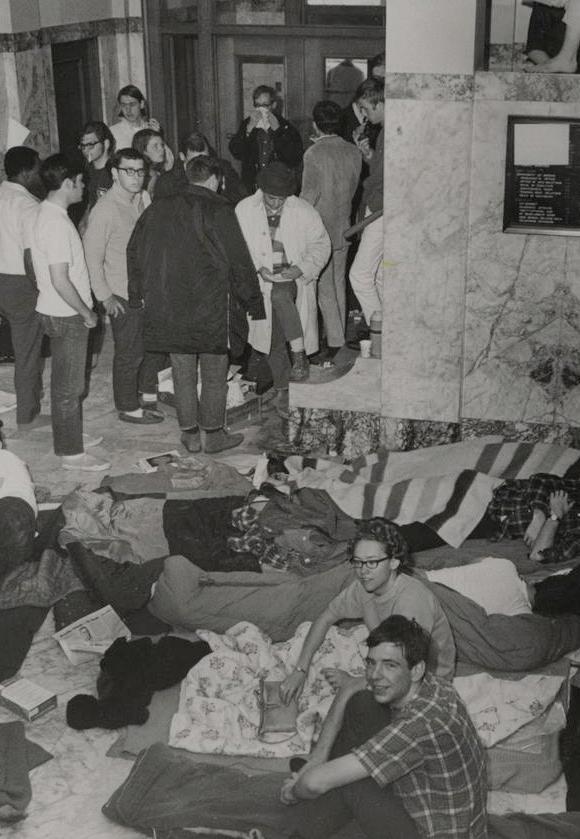
The conflicts culminated in April of 1968 with a “sleep-in” at Johnson Hall, the administrative heart. Fifty students held out for an astonishing three days, refusing to leave the hall until they were given equal representation on the Presidential Search Committee, which selects the university’s next president. On the third day of occupation, joint negotiations resulted in a deal to add 3 student representatives to the committee, a tremendous win for student power at the university, giving them a say over the organization’s future.
The 1968 Sleep-In was only the beginning for Johnson Hall. Just two years later, 300 students descended on Johnson Hall to give their opinions on an issue that had made national headlines: the Vietnam War. The UO was one of the epicenters of the student antiwar movement, with protests turning violent, including the burning of the Eugene ROTC.
As part of the protests, 300 UO students camped out for two days in the lobby of Johnson, and on the final day, a small cohort of disruptive protesters went into the president’s office. The situation only escalated from there, with Eugene police swooping in to arrest 61 students. Then, despite the protest quieting down, the National Guard was called in, launching tear gas at students congregating outside Johnson. Thousands more protesters later came out in opposition to the National Guard’s actions, and according to Benjamin Murphy, University of Oregon archivist, “one permanent [impact of the protests] was the closing of 13th Ave. to traffic,” as students took the street.
Even in modern times, Johnson Hall has remained the center of discourse on campus; in May 2025, 60 members of the University of Oregon Student Workers Union occupied the hall overnight as part of a larger strike for better pay and other grievances. In the words of Robin Bailey, communications committee chair,
“Johnson Hall is a site symbolic of administrative power. To occupy it is to challenge that power.” These efforts resulted in a historic deal between the university and UOSW.
The list of protests that have occurred in this single building is long, including the pro-Palestine encampment and the recent actions of ICE. While these later protests have had a less obvious impact, they are still important: social movements are primarily grassroots, and only work if a large number of people come out and protest, bringing the issue to the public eye (which is increasingly fragmented thanks to social media). If it weren’t for individuals such as those who have picketed the Johnson Hall steps, there would be less incentive for state and local governments to address grievances and less pressure on national politicians to seek meaningful change.
The total social impact of these many Johnson Hall sit-ins and protests has been immense, both on and off campus. The 1968 “sleep-in” catalyzed the expansion of student power within UO governance. The violence around Johnson’s Vietnam demonstrations brought the UO into center stage on the nationwide movement, helping it gain the traction it needed for it to ultimately succeed, as well as creating local change. The UOSW strike led to a contract between the UO and the workers that met many of their demands.
Johnson Hall is far more than a building it is a symbol of the power of the student voice at the UO.

The Ducks promoted from within to replace outgoing coordinators Will Stein and Tosh Lupoi.
Nate Bittle out for ‘at least a month;’ Oregon men’s basketball eyes rough stretch ahead

SATURDAY
Jan. 24, 2026
Oregon vs. Penn State
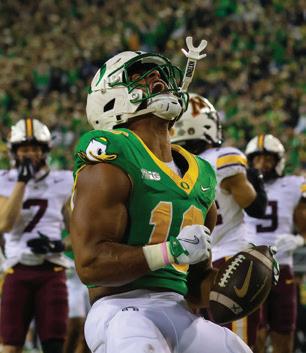
Several players, including the Ducks’ entire starting defensive line and quarterback Dante Moore, decided to come back to school ahead of the deadline to declare for the 2026 NFL Draft.
By Owen Murray
Associate Sports Editor
By the time Oregon football quarterback Dante Moore went live on ESPN’s SportsCenter broadcast last Wednesday morning, the Ducks were already returning a major part of their 2025 group. Tight end Kenyon Sadiq and safety Dillon Thieneman declared for the draft, but Oregon was bringing back its entire defensive line to go with offensive skill position players and its center.
When Moore announced on the show that he too would return, one of the final pieces fell into place. The recruiting class was strong, but Oregon’s depth chart is changing a little bit less with these notable draft-eligible players officially coming back to school in 2026:
QB Dante Moore
The biggest domino fell with hours to go before the draft declaration deadline on Jan. 14, when Moore joined SportsCenter live to announce that he planned to forgo the 2026 draft and return to school at Oregon. With Moore’s return, the Ducks gain a top starter — without him, they’d either be searching for a new starter in the transfer portal, integrating Nebraska transfer Dylan Raiola or putting an underclassman in his place.
Moore’s decision is a boon for the Ducks, who get the 20-year-old back after his 3,565 yard, 30 touchdown, 10 interception season that ended in the Peach Bowl. He’s gaining time to grow by waiting on the NFL; despite a strong first full season of starting football, he showed room for improvement throughout and will get the chance to do so in 2026 while mentoring Raiola, who steps into a position to sit behind Moore while looking for a starting role in 2027.
WR Evan Stewart
Stewart’s return, while anticipated, wasn’t certain. He told reporters before the Orange Bowl that he thought declaring for the draft was a possibility after missing the entire 2025 season with a patellar tendon injury, but also was excited at the possibility of playing with Moore as his quarterback. The former Texas A&M University transfer is a fast threat on the outside who was a top target for Dillon Gabriel when the Ducks won the Big Ten Championship in 2024 and should play well off rising sophomore Dakorien Moore and rising redshirt sophomore Jeremiah McClellan.
TE Jamari Johnson
Johnson, who transferred into Oregon before the 2025 season from the University of Louisville, sparked with 510 yards and three touchdowns on 32 receptions as the Ducks both leaned into 21-personnel packages and missed starter Kenyon Sadiq (who declared for the draft) for periods of the season due to injury. He’ll be back as the expected starter in 2026 under a new offensive coordinator — Drew Mehringer, the former co-offensive coordinator and Johnson’s
position coach last season. Expect the rising redshirt junior to fight for a place near the top of the 2027 tight end class, and boost a Ducks receiving core that boasts multiple experienced underclassmen and in coming blue-chip recruits.
C Iapani Laloulu
Laloulu is one of only two starting linemen from the 2025 season able to return — all of Oregon’s other starters save right guard Dave Iuli are out of eligibility. The center’s decision to come back anchors change among the Ducks’ group in a room that has finished as a finalist for the Joe Moore Award (given to the nation’s best offensive line) each of the past three seasons. He’ll be a senior in 2026, and won’t have to forge a new bond with the quarterback af ter Dante Moore announced his intent to return, too. Oregon allowed 19 sacks through 15 games in 2025, good for 16th-best nationally.
DT Bear Alexander and DT A’Mauri Washington
Alexander, who transferred into Oregon before the 2025 season after time at USC and the University of Georgia, nailed down an immediate role along the defensive line and was the first Duck to announce his decision to forgo the draft (on Dec. 12, more than a week before Ore gon played its CFP First Round game against James Madison University). He’ll pair with Washington, who broke out in 2025 with a 1.5 sack, 33-tackle season to keep building a home in opponents’ back fields. The Ducks ranked 24 nationally in rushing yards allowed in 2025, when they averaged 115.7 yards per game allowed.
EDGE Teitum Tuioti and EDGE Matayo Uiagalelei
The Ducks officially returned their entire starting defensive line, which included Alexander, Washington and the edge duo of Tuioti and Uiagalelei. Despite los ing multiple depth pieces to the transfer portal, Ore gon will have an experienced group expected to start in the defensive trenches, and its edges are a major part. Tuioti’s 2025 season included a tackle for loss in 14 of 15 games to go with a team-leading 9.5 sacks and two forced fumbles, while Uiagalelei, who led the team in sacks in 2024, stacked it with a six-sack, two-forcedfumble season that peaked with his strip sack of Tex as Tech University quarterback Behren Morton in the Ducks’ 23-0 Orange Bowl win over the Red Raiders.


1 Profession for John Cena or The Rock
8 Satanic
9 Like Eugene, vis a vis Cannon Beach, maybe
10 ____ later, alligator
12 Totally destroys, in gamer slang
13 “Game of Thrones” network
15 National weather alarm, for short
16 What you can find in the Jordan Schnitzer Museum
17 Goosebumps author ___ Stine
18 Green Charli XCX album
19 Start a tennis game
20 Ad on a telephone post, often DOWN
1 Performs ASMR, maybe
2 Extended lease of library books
3 DeGeneres and Barkin
4 Aces it, in slang
5 Fey of “SNL”
6 Hallucinogenic initials
7 “I don’t care”
11 Last name of 13-D, whose childhood room is represented by this puzzle
13 “You’re a wizard, ___”
14 Courageous
18 Fresh Prince of __ Air
19 CA Bay Area city