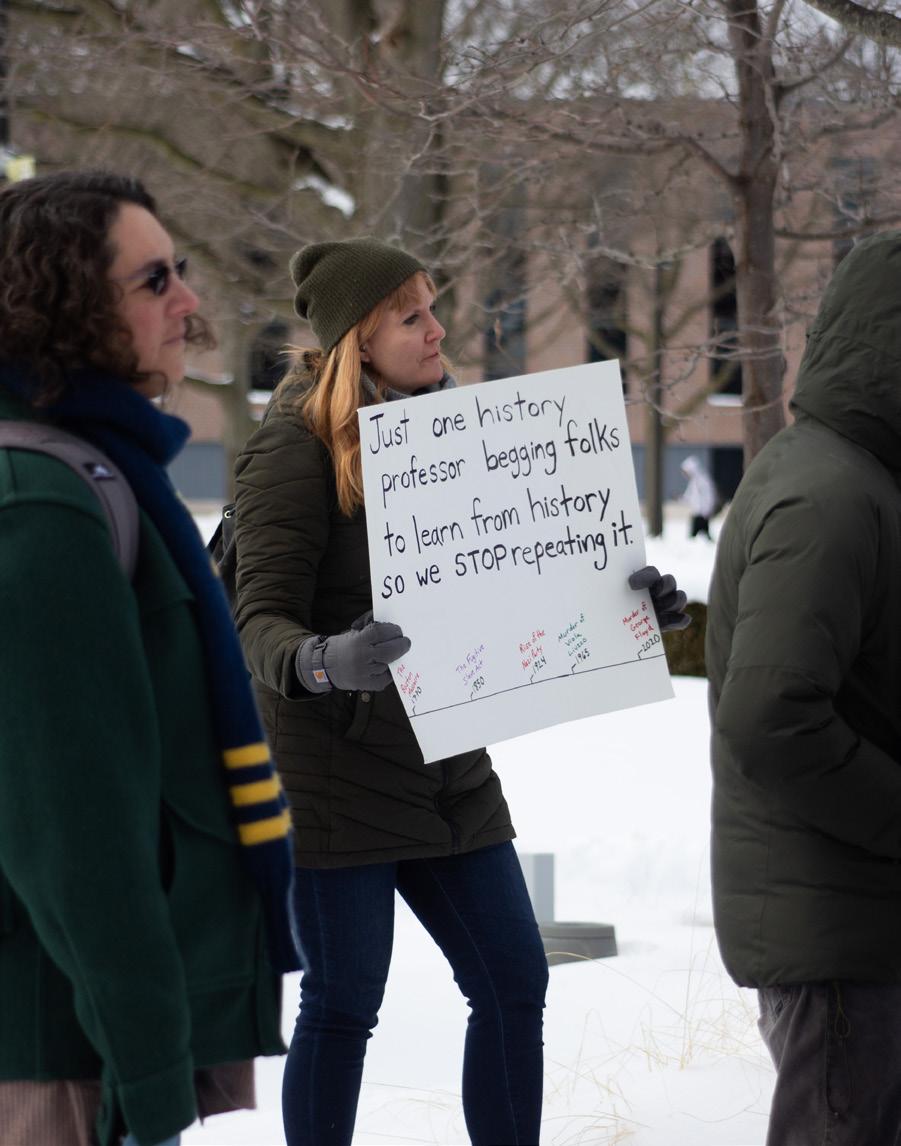
CAMPUS COMMUNITY PROTESTS ICE (U.S. Immigration and Customs Enforcement) amid rising national concerns and discontent with the militarization of law enforcement. The campus protest called for OU President Ora Hirsch Pescovitz to commit not to collaborate with ICE as immigration related detentions increase across Michigan.
EDITORIAL BOARD
Adrian Jimenez Morales Editor-in-Chief ajimenezmorales@oakland.edu
Don Ritenburgh Business Adviser ritenbur@oakland.edu
248.370.2533
CORRECTIONS CORNER: The Oakland Post corrects all known errors of fact. If you know of an error, please email editor@oaklandpostonline.com.
PHOTO BY MATTHEW VIGELIUS
When OU cancels classes last-minute, commuters pay the price
JENNIFER THOMASMA Campus Reporter
Michigan winter driving is unpredictable, and Oakland University commuters say late class cancellations can make conditions more dangerous. Most students travel from surrounding communities, so the timing of weather-related decisions can determine whether they stay off hazardous roads or are already on them. Even a short delay in announcements can turn an otherwise manageable commute into a risky journey.
On Jan. 14, Oakland University canceled evening classes effective at 5 p.m., after some students had already traveled to campus. One student said they drove nearly two hours through heavy snow to attend a 3:30 p.m. class before receiving an OU Alert.
The alert read, “Due to adverse weather conditions, OU has canceled evening classes effective at 5 p.m. on Wednesday, January 14.”
Bianca Miller, a nutrition major, said she commutes from Royal Oak, a drive that typically takes about 30 minutes. On days with uncertain weather, Miller said she checks university communications before deciding whether to travel. She also monitors the local news for additional updates.
“When I first get up, I always definitely check my OU email, and I know they also send text messages,” Miller said. “Secondary to that, I’ll also check the news.”
Miller said a cancellation alert was sent after she had already attended two classes. By the time the message arrived, she said she had already completed her second class and was preparing to leave campus.
“They sent the alert basically saying that evening classes were canceled, and by that time I was already done with my second class,” she said.
She described road conditions as dangerous and said walking across campus felt unsafe.
“It was a very late alert that they sent,” Miller said. “It was definitely a huge inconvenience.”
Staff members who commute to campus said late notifications can also be frustrating. Stacey Clayton, an assistant curator technician and housekeeper at Meadow Brook Hall, said afternoon cancellations often come after commuters have already arrived.
“By the time the notification came, I had already arrived,” Clayton said. “I live in Rochester, and it made me think about commuters from other districts. My husband used to drive two hours.”
Faculty members said weather-related decisions can be difficult because forecasts change rapidly. Sociology professor George Sanders said Jan. 14 demonstrated how unpredictable conditions can be.
“According to the weather forecast, we were predicted to get one to two inches of snow, which, in the minds of many Michiganders, is trivial,” Sanders said. “So the predictions were incorrect.”
Sanders said meteorology relies on probability, meaning uncertainty is unavoidable.
“It was unfortunate, but since meteorology relies on models that are probabilistic, there’s always a possibility for error,” Sanders said.
Criminal justice professor Lori Burrington said Jan. 14 was one of the most difficult days of the semester. Burrington said her class met from 3:30 p.m. to 5:17 p.m., placing students on the roads as the storm intensified.
“My drive was harrowing, and many students had
the same experience or simply didn’t make it in,” Burrington said.
Once evening classes were canceled, Burrington said she dismissed students early, which created additional challenges as students traveled home in the same conditions.
“Ideally, maybe something could have been done a little earlier, but it was an extraordinary situation,” Burrington said.
Students said weather-related closures also reveal inconsistencies in how classes proceed. Tasia Little, a senior majoring in criminal justice and art, said the lack of standardized procedures creates confusion.
“There are no set rules for whether classes go online, get canceled or have work assigned,” Little said. “It’s up to each professor, which makes it difficult for students with multiple classes, and even for faculty.”
Sanders said late cancellations can disrupt course planning, particularly for classes that meet once or twice a week. He said instructors often carefully sequence course material throughout the semester.
“Most professors I know put a great deal of thought into how the class materials unfold over the course of the semester,” Sanders said.
Losing class time can require instructors to reorganize assignments and deadlines.
“Any changes to the schedule usually result in
a great deal of reshuffling, which can be a lot of work,” Sanders said.
Burrington said instructors now have more flexibility during weather disruptions, including shifting some activities online. She said that flexibility has been helpful.
“Yes, we do have some flexibility, which is very appreciated,” Burrington said.
Burrington added that the university has become more aware of commuter safety in recent years.
“I think in the last several years, our administration has been better attuned to the fact that we have a lot of commuters who shouldn’t put their lives at risk coming to campus on days with adverse weather events,” she said.
Sanders said safety should remain the top priority.
“I also care deeply for the safety and well-being of my students and colleagues, and that should be, and I think it is, the foremost priority,” Sanders said. “I’m glad I’m not in the position of having to navigate the complexities required to make a decision on whether or not to close campus or cancel classes.”
For commuters like Miller, earlier alerts would help students make safer decisions before traveling.
“Please give us a message early or something to notify us so we can have time to plan,” Miller said.
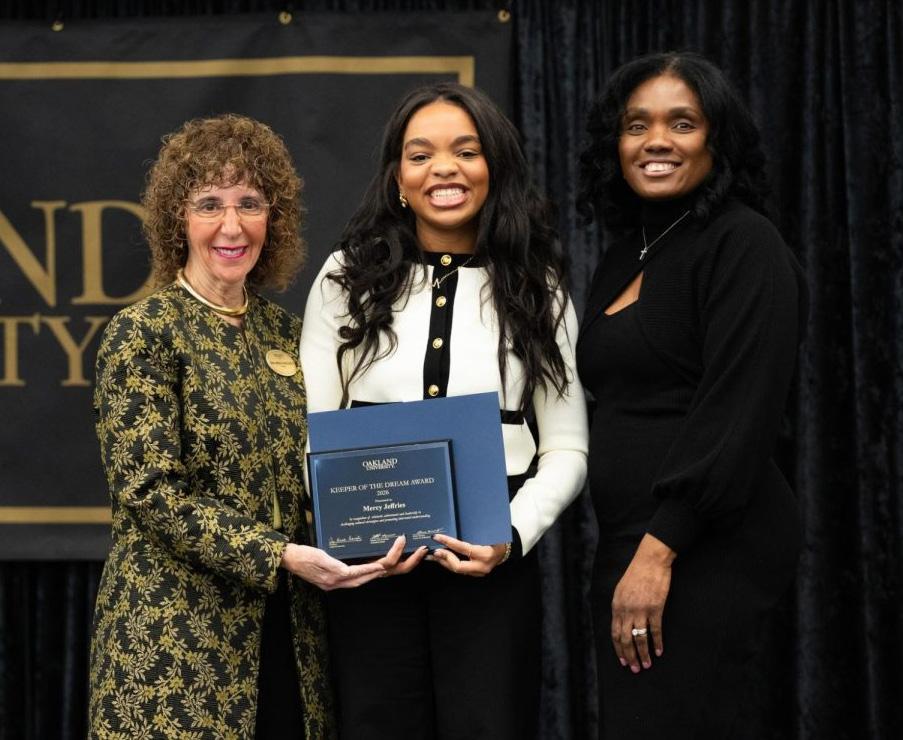
Mercy Jefferies: Keeper of The Dream recipient
ERIN BANES Campus Reporter
Oakland University student Mercy Jeffries has been named a recipient of the 2026 Keeper of the Dream Scholarship in recognition of her leadership, service and commitment to fostering an inclusive campus community. Jeffries is a finance major in the College of Arts and Sciences and the School of Business Administration. The award honors students who demonstrate a dedication to equity, service and community engagement at OU.
Jeffries said receiving the scholarship was deeply meaningful and affirmed her commitment to supporting others.
“This scholarship motivates me to continue using my voice and creating spaces where others feel seen and supported,” she said.
She described the recognition as both a reflection of her personal growth and a reminder of the responsibility that comes with leadership.
Much of Jeffries’ involvement on campus centers around her work with the Center for Multicultural Initiatives and Orientation and New Student Programs. As a peer mentor with CMI, she works closely with students during their transition to college life. Her role focuses on helping students build confidence, community and a sense of belonging during their early years at Oakland.
Through Orientation and New Student Programs, Jeffries supports incoming students from a wide range of backgrounds. She said these experiences allow her to
engage intentionally with new students and help create meaningful connections early in their college journey.
“Through mentorship and intentional conversations, I work to help break down cultural barriers and foster connections,” Jeffries said.
Jeffries explained that her commitment to inclusion is shaped by her own experiences navigating spaces where representation was limited. She said those moments made her more aware of how important visibility and support can be for students.
“Navigating spaces where representation was not always present made me more aware of how important
it is for students to see themselves reflected and supported,” she said.
Her involvement at Oakland University has helped shape her leadership style and sense of purpose. Jeffries credits campus communities like CMI for providing guidance and encouragement throughout her time at OU.
“They have kept me grounded, encouraged my growth and inspired me to continue doing positive and impactful work on campus,” she said.
Academically, Jeffries remains focused on her studies in finance while continuing her involvement in service and mentorship. She said she plans to pursue a career in the finance field while maintaining a commitment to advocacy and inclusion. Jeffries views leadership as something that extends beyond professional goals and into everyday interactions.
“My journey is rooted in community, resilience and a genuine desire to support others,” Jeffries said.
Looking ahead, she hopes to continue contributing to Oakland University’s culture of unity and understanding. She said she aims to make an impact wherever possible and remain engaged in campus life.
Jeffries was honored alongside six other recipients at Oakland University’s 34th annual Keeper of the Dream Scholarship Awards Celebration on Jan. 19, 2026. Other honorees included Qamar Naji, Jayson Miller, Jaliyah Eaton, Marcus Johnson, Triasure Golden and Ndeye Marieme Sarr Samb.
Career panel to combat human trafficking
ADRIAN JIMENEZ MORALES
Editor-in-Chief
Under the slogan, “led by survivors, supported by allies,” the Criminal Justice Department at Oakland University hosted a career panel addressing human trafficking on Jan. 29. From law enforcement and social work to counseling and nursing, the panel delved into the complexities and opportunities of combating human trafficking daily.
The recruitment, transportation, harboring or receipt of people through force or deception to exploit them for profit is defined as human trafficking. Trafficking for sexual exploitation is of great concern for Michigan and the United States at large, where you can “get a child ordered and delivered to your door faster than a pizza,” FBI Victim Specialist Melissa Novock said.
Working with survivors for 30 years and more than six at the FBI, Novock cautioned students and attendees from “quantifying” human trafficking. With many instances of trafficking crimes going unreported, miscommunication among agencies and nonprofits, and the different fronts from which professionals can identify survivors, Novock explained, the whole story cannot be told without human testimonies.
“The biggest thing is that you just listen,” Laura Dillaber, victim advocate at Common Ground, said. “That and be patient and look them in the eyes, talk to them, and take your time when you’re talking.”
As a survivor, Dillaber highlighted the importance of not re-victimizing survivors as many OU students prepare to help them across various fields.
“People want to hear the stories, you know, they want to hear about what happened, because, I mean, those are things that interest us,” Dillaber said. “That’s something that [survivors] need to deal with, and we don’t want to pressure them into talking about something that they’re not ready to talk about.”
With an outline of the field and the six speakers’ life stories, students inquired about career guidance and words of wisdom from the interdisciplinary panel. As a licensed professional counselor, Jennifer Dulchavsky, one of the panelists, advised students to be proactive and specific with their education.
“A lot of people come straight out of their programs and want to do the best help that they can, which I totally understand, but aren’t necessarily trained, and that does create a lot of burnout and kind of those moral challenges that we tend to see,” Dulchavsky said.
Underscored by all the professionals, self-care and a close-knit support system are the best ways to provide compassionate and healthy care for trafficking survivors.
“Belonging to groups is helpful, being able to talk about things,” Dulchavsky said. “The challenge with being a therapist is that it is confidential. You can’t just talk to anybody about the clients that you see, which is why, like doing individual supervision, as well as group supervision, can be extremely helpful. Then seeking my own therapy.”
Patience was also a key point for panelists who shared stories of helping people who didn’t know they were being trafficked or had returned to endangering situations. With almost 27 years of service at the Detroit Police Department, Commander Jevon J. Johnson said
progress is being made across the board, thanks to longterm initiatives.
“That’s the hard part about law enforcement, it’s very long-term,” Johnson said. “That’s the difference between TV and real life: it’s not over in 30 minutes. A lot of the stuff that happens on TV does happen, but sometimes that takes years or months or even decades.”
Whether it is getting more funding at the state level, training workers on prevention, gathering social work resources for people in marginalized communities, or providing emergency care for survivors, the panelists agreed that working intentionally makes the biggest impact.
“The number one thing is, you have to care,” Johnson said. “You’ve got to care, and then you put in the work, and then, as you see the results, I think that that gives you a little extra energy. If you put in the work, you are going to see the difference.”
If you or someone you know is a victim or human trafficking or have identified someone who may need help please contact the National Human Trafficking Resource Center at 888-373-7888.
PHOTO COURTESY OF THE CENTER FOR MULTICULTURAL INITIATIVES
PHOTO BY ADRIAN JIMENEZ MORALES
Jordanian Student Association dances culture into Elliott Hall
ANDREW MCNAMARA MAY
Features Reporter
Dancing spreads the groups together like a benign virus. Music drifts through Elliott Hall with the easy confidence of a sweet little lie. The smell of food — nostalgic, inviting, and unfamiliar to many — hangs in the air. Big smiles, and the lively, woody ginger of the oud and an abundance of excellent designer clothes fill the room.
The ancient stone streets of Petra remain an ocean away in Jordan. The same cannot be said of worldfamous Levantine chic, nor of the Middle East’s unrivaled hospitality. At Oakland University, the Jordanian Student Association strives to bring the warmth and “good vibes” of home to campus with its Sahrah night.
“That’s honestly the main reason [for organizing the event],” Joseph Hadad, co-president of the Jordanian Student Association, said. “We love it when other people enjoy our events and our culture. We love seeing them experience it — and come to understand us.”
Hadad’s wide smile, gracious movements, and the small army of people eager to greet him signify that the evening provides a key opportunity for Jordanian cultural expression on campus.
“I feel like we don’t have enough big spaces,” Rama Alhyari, the association’s other copresident, said. “As you can see, we’re doing a dance party here.”
Sahrah is the Jordanian equivalent of “grabbing a
cold one with the boys” — except alcohol is almost never involved. Instead, drinks include premium tea and coffee. Rather than devolving into Mario Kart after food and board games, the night escalates into dancing and loud jokes.
The capacity of the small classroom in Elliott Hall is well past its limit. Every wall is obscured by a different group of friends, all dancing to music pulled from across the Middle East.
Given the specificity of the association’s name, one might expect a more culturally insular group.
This assumption would be incorrect.
“We do not limit it to our Jordanian stuff,” Hadad said. “People are coming from different cultures. We like to give them a chance to showcase their culture at the same time.”
PHOTO BY ANDREW MCNAMARA MAY
The hypnotic, percussive trance of Iraqi dance music fills the air one moment — music that freezes the mind while keeping the body alive in motion. Kurdish music sweeps in happily after, the energy opening into clear, communal line dances.
Line dances are recognized by some social anthropologists as a cross-cultural communication method — one where dopamine levels run high and social barriers fall fast.
Ultimately, this cross-cultural joy seems to be the most important thing to the JSA at OU. It is not about who is in the club. The world is a club; what matters is who wants to join the table.
The club does not limit itself to occasional dance parties, however.
In the coming months, the association plans to share the warmth and hospitality of Jordan to such an extent that even King Abdullah II might feel some pressure to step up his game.
An iftar is planned for March. Iftar is the breaking of a day’s fast during Ramadan, typically shared with close friends and family. At this iftar, however, all are welcome — to embrace the culture, the conversation, and the food.
The club is especially excited for A Night in Jordan in April, an ambitious event designed to allow attendees to hear, if only briefly, what their heels might sound like against the ancient bricks of Petra.
The association also calls for more collaboration between student cultural organizations. More people at the table means a bigger, happier party.
The world should take notes.
Teaching in place expands learning at Oakland University Art Gallery
SARA BULGARELLI Campus Reporter
Faculty and staff gathered at Oakland University’s Art Gallery in Wilson Hall on Jan. 27 as part of Teaching in Place, a CETL session demonstrating how the gallery can serve as a classroom and support interdisciplinary learning.
Teaching in Place encourages faculty to use nontraditional campus spaces for experiential learning. According to Oakland University’s website, the gallery allows students to engage with ideas beyond a traditional classroom and supports faculty in planning sessions in the space.
Christina Moore, associate director for Excellence in Teaching and Learning, introduced a teaching guide highlighting the gallery’s role in experiential learning. The guide included logistics and information about the larger series. Participants were encouraged to explore the gallery and consider how exhibitions could be incorporated into course assignments and class discussions.
Leo Barnes, art gallery manager, said the gallery offers versatile opportunities for teaching and introduced faculty to its resources.
“We do four exhibitions a year during the semester. So there’s always new content, always new things,” Barnes said. “Also the university has a huge art collection that can be used by professors and students.”
The gallery collaborates with other galleries, including institutions in New York, to bring diverse
exhibitions to campus. This allows students to see artistic trends and works beyond Michigan and Detroit. Barnes said the gallery is designed to support accessibility and active engagement.
“It’s about going and enjoying and finding something you find interesting. We’re really trying to make it accessible,” he said. He added, “I envision the gallery as a hub where a class can engage directly with art.”
Moore said the program allows faculty to experience learning differently.
“Through this program, faculty experience what it is like to learn with the physical space rather than simply at the physical space,” she said.
PHOTO BY LILIANA AVALENZA
Moving beyond traditional classrooms can renew teaching and learning, she added.
“Both faculty and students are looking for renewed engagement in the class experience, and physically moving out of the general purpose classroom is a simple and generative starting point,” Moore said.
Claude Baillargeon, an art history professor at OU, said the exhibition on the bombing of Japan is both historical and relevant today. The exhibit features artifacts from the Wilmington College Peace Resource Center and shows the lasting impact of the event. Baillargeon said it demonstrates the long-term effects of trauma and encourages dialogue across the campus community.
The session invited educators to think creatively about space and learning. Moore said she hopes faculty leave with confidence to explore new possibilities.
“Even if they haven’t yet arrived at a specific way to include the Art Gallery or other places featured in our Teaching in Place series, they know they can explore those possibilities with the space managers,” Moore said. “They are eager to be a part of the educational mission of the university.”
By presenting the gallery as a flexible learning space, the Teaching in Place program encourages faculty to integrate experiential learning into their curricula. The gallery provides both historical context and contemporary perspectives. Faculty and students are challenged to connect directly with exhibits, consider interdisciplinary approaches and reimagine how learning can occur outside traditional classroom walls.
What OU students are streaming right now
ALEXA DUDEK Campus Reporter
On weeknights after long days of classes and work, many Oakland University students curl up with their laptops, TVs or phones and press play. A familiar show fills the room, giving them something to share, talk about and return to when their schedules finally slow down. For these students, streaming is not just a way to pass time, but a small ritual that helps them stay connected to the people around them.
According to Nielsen Media Research, streaming accounted for 47.5% of monthly TV viewing in December 2025, surpassing broadcast and cable combined. Young people in particular favor on-demand access over traditional broadcast schedules. For OU students, streaming has become a shared experience, with popular shows serving as a way to connect with friends and family.
OU students use a wide range of streaming services. Popular platforms among students include Hulu, YouTube TV, Amazon Prime Video, Netflix and Apple TV. The availability of multiple services allows students to tailor their viewing habits to their schedules, budgets and personal interests.
Students find new shows through several methods, including peer recommendations, family suggestions and social media discourse. OU finance major Ben Lopes, a fan of crime shows and procedurals, began watching “The Mentalist” after his grandmother recommended it to him. The two occasionally watch the series together when time permits.
Lopes recommends “The Mentalist” to OU students due to its engaging but accessible format. The series follows former con artist Patrick Jane, who works with the California Bureau of Investigation. Using sharp observational skills rather than the psychic abilities he once claimed to have, Jane helps track serial killer Red John.
“It’s not too serious or heavy,” Lopes said. “You don’t need to be completely locked in.”
Balancing school and work responsibilities, Lopes appreciates that the show remains entertaining without demanding full attention. Shows that allow for casual viewing are particularly appealing to students navigating packed academic and work schedules.
OU students Aleah Richards and Alaina Hillman discovered “His & Hers,” a psychological thriller miniseries on Netflix, through TikTok. Initially selecting the show for its cast, including actor Tessa Thompson, the pair stream episodes of the series separately and discuss episodes when they get together.
“His & Hers” is a murder mystery centered on a journalist investigating a crime in her hometown. Richards and Hillman say the show’s realism adds to its appeal.
“This show isn’t actually true crime, but it feels like something that could very much happen,” Hillman said.
The series keeps viewers guessing about who can be trusted until the end.
“At the end, [the perpetrator] was someone I would never have guessed,” Hillman said.
Discussing theories and reactions has become an essential part of Richards and Hillman’s viewing routine. They often bond over conversations about the show.
“People kept talking about it, and [Hillman] brought it up to me,” Richards said.
Hillman recommends “His & Hers” to students who enjoy murder mysteries, noting that it offers a different viewing experience from similar shows. She also cautions that the series includes sensitive subject matter and encourages viewers to be mindful before watching. Whether enjoying a streamed series with friends or family, shared streaming experiences bring students closer together throughout another busy semester.
What a farmer wants OU students to understand about food
JENNIFER THOMASMA
Campus Reporter
At the Oakland Center, lunchtime arrives like a wave. Students gather to socialize, study and eat, and when the rush hits, lines form at the counters. Meals become something to fit in between classes — quick, convenient and easy not to think about.
That distance is what Detroit farmer Miles Wood wants young adults to notice. In an interview, Wood described food as more than what ends up on a plate. He framed it as a relationship built on soil, time and the people who do the work — farmers, cooks and servers — whose labor is easy to overlook in daily routines.
Wood is a farm co-manager with Keep Growing Detroit, a nonprofit focused on food sovereignty and community agriculture. He said his work includes growing fruits, vegetables, herbs and mushrooms, producing honey, and managing greenhouse and tunnel systems that extend the growing season.
Oakland University has its own version of that work on campus. The Campus Student Organic Farm, operated through the Department of Biological Sciences, grows more than 40 types of vegetables, fruits, flowers and herbs and offers weekly farm shares during the growing season, according to the university’s website.
In 2024, the farm dedicated a new hoophouse — dubbed the “Salad Palace” — to focus on more “student-friendly” produce, including leafy greens, according to an Oakland University news release.
Wood said farming demands patience. Days revolve around planting, maintaining and problem-solving long
before anything is ready to pick. Harvesting, he said, is the moment when the work becomes visible.
“My favorite part is harvesting,” Wood said, “because it is the fruits of all the labor.”
His connection to growing started early. Wood said both of his grandmothers kept gardens, and he sees farming as a way to reconnect with his roots.
PHOTO BY JENNIFER THOMASMA
As he learned more about modern food systems, he said he felt compelled to get involved.
He also emphasized that farming in Detroit is not only about production, but about community. Wood said many growers share resources, knowledge and labor instead of competing because the goal is to feed neighbors and expand access.
He added that barriers such as land access, capital and skills can determine who gets to grow food and who remains dependent on systems they cannot control.
Money shapes access, too. Wood said local produce can become out of reach for people with lower incomes when prices rise, even when fresh food is being grown nearby.
For OU students, Wood framed the issue as both practical and cultural. He encouraged students to think beyond convenience and consider what they would do if shelves were not stocked or supply chains faltered.
“If the grocery stores don’t fill their shelves with food,” Wood said, “What will you do? What will you eat?”
Even in winter, he said, the work continues. While active growing slows for about a month, planning does not — budgeting, infrastructure decisions and crop schedules keep the season moving forward.
Wood said he hopes people slow down enough to recognize the land and labor behind their meals and show more gratitude for the workers who help feed their communities.
“The earth is speaking to us every day,” Wood said. “We just have forgotten how to listen.”
PHOTO COURTESY OF UNSPLASH
Whiteouts leave Michigan with a black eye
ANDREW MCNAMARA MAY
Features Reporter
Winter is a drag. This winter, in particular, has been unrelentingly cruel.
Michigan winters in recent years have differed from historical trends. Rather than the epic blizzards of the 1970s which so many baby boomers still reference, Michigan from the late 2010s onward has faced an Eastern European–style mud season with occasional dramatic snow events. This year cannot be characterized that way.
“The lady who does my nails says that she thinks this crazy snow is being made by the government,” Sam Sobah, a master’s student studying psychology at Oakland University, said. “That if you put a torch to it burns black and ashy.”
The systemic pressures can be felt everywhere. Michigan schools are running out of allotted snow days, forcing students, staff and faculty into potentially life-threatening scenarios amidst the season’s uncharacteristically dire weather.
At the moment of writing, McMurdo Sound in Antarctica is warmer than metro Detroit.
It is not just schoolchildren who are faced with the tempest. Over 100 vehicles were caught in a massive pileup near Grand Rapids earlier this month. The image is Lovecraftian: hundreds of tons of icy steel fused under the diamond-dust cover of a vengeful Midwestern snowstorm, caring not for the souls trapped inside its freezing, bent tendrils.
Oakland University, meanwhile, has wrestled
with this winter in its own right. The campus has been forced to shut down more frequently than preferred, struggled with communication regarding last-minute closures, and recently experienced a facility-wide heating failure that could have been exacerbated by recent months’ encroaching permafrost.
Dormitory parking lots have faced emergency closures, with towing and fines issued to anyone too afraid to face the cold.
Travel concerns and school policy are not the only aspects of Michigan life to be railroaded by
the winter weather. Seasonal Affective Disorder (SAD) is characterized by depressive symptoms that emerge in response to a seasonal reduced sunlight. It is a misconception that SAD is a winteronly condition — some people are affected in the summer. However, winter onset is far more typical, and it responds effectively to light treatment.
But this is not some mass onset of SAD. The uneasiness people are feeling does not respond to light treatment.
It is the fear that grips you when you see your breath during a lecture, or when the windshield wiper fluid freezes before it can wash away the salt.
“I cannot tell the difference between this and a Canadian winter,” Vincent Stabile, a Canadian graduate student at OU, said.
The Winter of 2025–26 will be remembered for running up the scoreboard on an unprepared populace: people who lost their fur gloves in 2018 and could not replace them; souls who forgot how to tie a scarf knot, coughing like Tiny Tim; and the minor stock-market heroes moving Walmart’s windshield scraper sales.
Here at OU, students — the icy blood coursing through the campus — dash from building to building to outrun the ferocious polar bear that is frostbite. In 30 years, today’s Gen Z students will repeat the same speeches about walking uphill in the snow both ways.
That generational trauma will all be this cruel season’s fault.
Why
“The Let Them Theory” is resonating with readers — and where its limits may lie
MADDIE SHORT Features Reporter
In an era in which burnout, constant connectivity and heightened awareness of personal boundaries are omnipresent, a two-word phrase has gained traction: let them.
Popularized by author, lawyer, CEO and podcast host Mel Robbins, the idea is the centerpiece of her 2024 book “The Let Them Theory,” which encourages people to stop attempting to manage the behavior, opinions and reactions of others.
The book’s popularity has been difficult to ignore. More than eight million copies have been sold, and it has reached No. 1 on bestseller lists for The Sunday Times, The New York Times, Amazon and Audible. Robbins regularly discusses the concept on “The Mel Robbins Podcast,” where clips related to the theory circulate widely on social media.
At its core, the theory argues that much of people’s stress stems from attempting to control what is ultimately uncontrollable: other people. Robbins presents the idea as a shift in focus away from external validation and toward personal agency.
Throughout the book’s 336 pages, Robbins encourages readers to observe others’ actions without assigning them authority over one’s emotions. Rather than reacting negatively to perceived slights or unmet expectations, the theory suggests acknowledging those behaviors and redirecting attention inward.
“The let them theory is not about changing them. The let them theory is learning to accept the reality
of who people are as they are without changing them,” Robbins said in a Nov. 17, 2025 podcast episode. She emphasized the importance of “taking your power back and changing how you respond in these situations” in the same episode, titled “How to Deal With Difficult People & Not Get Stressed Out.”
For many readers, the message aligns with a broader cultural conversation around boundaries and emotional stress. As work, family and social interactions become increasingly digital, the pressure to remain constantly available has intensified. The
let them theory offers a framework for opting out of that cycle.
Robbins explores several areas where she believes the approach can be applied, including managing stress, dealing with rejection, navigating comparison and strengthening relationships.
“Two simple words, let them, will set you free from the exhausting cycle of trying to manage everything and everyone around you,” Robbins said in a Nov. 14, 2024 podcast episode.
Still, the theory’s simplicity has prompted criticism about its scope. Christine Rosen, columnist for the magazine Commentary, contends that disengagement may not always be practical, particularly in close relationships, delicate workplace environments or situations involving power imbalances. Letting others act without response may not be feasible when collective accountability or broad course correction is necessary.
Rosen also argues that universal acceptance of the let them theory may lead people to tolerate certain harmful behaviors or social problems rather than confront them, citing examples such as perpetuated societal issues and political tribalism. She warns that, in some contexts, confrontation and engagement may be essential for bringing about positive change.
Rather than a universal solution, the let them theory may function best as a tool — effective in some contexts and limited in others. Whether readers adopt the theory fully or selectively, its reception reflects a popular approach to searching for some much-needed relief from emotional overload.
PHOTO BY ANDREW MAY
PHOTO COURTESY OF PEXELS
A gift-giving guide for college girls
MALLORY WALIGORA
Content Editor
As a college girl, I will admit that we are a very difficult demographic to buy for. We’re picky, and often, it’s very difficult to narrow down our tastes.
In light of this, I put together a gift guide of items I personally own, love and use regularly. These are all gifts I would be genuinely excited to receive, and chances are, another collegeaged girl would also love to receive.
Print subscriptions
Let’s start with something you don’t really hear about a lot in the realm of gifts, but it’s actually a great idea: print subscriptions. They’re thoughtful and old-school, and I think it’s chic to have a magazine sent to your house every month.
For example, I had a Vogue membership for just $12 a year, which then renewed at a higher price after the first year. Fashion magazines, lifestyle magazines or other print subscriptions that align with their interests are
a solid choice.
As a political science student, I would also be super happy if someone got me a New York Times subscription or a Washington Post subscription – though this may not be for everyone.
Athletic equipment and fitness
Fitness-related gifts are another solid and safe pick – especially when they are functional. I use my Lululemon yoga mat multiple times a week for Pilates and yoga. Although it is a bit pricey, it’s a great material and long-lasting.
For my birthday, I was gifted pickleball paddles, which I frequently use in the summertime with friends. A pickleball set is a fun and simple gift that will be both useful and fun.
Comfort
Comfort is key for college. Students constantly use and wear sweatpants, lounge sets, fuzzy socks and blankets. Soft pajamas are a safe option if you know the sizing.
I have seen Target’s weighted stuffed animals in multiple friends’ bedrooms, including mine.
Nice slippers, such as the fur-lined ones from Crocs, are a solid pick as well.
Accessories
Hair accessories such as claw clips, hair ties and scrunchies are always appreciated and difficult to get wrong. Women are always in need of an extra hair tie, and it seems like I’m always low on my stock. Additionally, a chunky scarf is practical, especially during Michigan winters.
A quilted travel duffle is a staple in my gym routine. I’d also recommend the Vera Bradley large duffel, which seems to be a popular travel duffel among college students. The Uniqlo shoulder bag is especially useful for travel.
Technology
Technology gifts are another solid option. These Skillcandy earbuds are better than my AirPods – and they stay in during sweaty workouts. Noise-canceling wireless headphones are perfect for airplanes and cancel out background noise during study sessions.
A Fujifilm instant camera is a great gift for making memories and capturing them. My Tile by Life360 remains in my luggage when I travel so I can track it; otherwise, it’s in my wallet or backpack for emergencies. The tile also has a safety button with an alarm that sends a notification to your emergency contacts, which can provide a good peace of mind.
Clothing
In general, buying clothing is risky – it’s tricky to get the sizing right.
However, a baggy graphic tee can never be too big. This Detroit classic Eminem shirt is a favorite of mine. This pack of tube tops is the perfect beach cover-up for summertime.
Sports merchandise, such as Lions or Tigers merchandise, is generally well-received. My Havaianas flip flops have been to three continents and multiple countries with me –they’re the best flip flop brand.
Beauty
In terms of makeup or skincare, I would avoid buying anything that is a shade-specific product or a skincare lotion. It’s a very personal thing.
The e.l.f. Glow Reviver Melting Lip Balm is my go-to item for any secret Santa. Clinique’s Black Honey Almost Lipstick is another Holy Grail. Chapstick or hand lotion is great for smaller gift exchanges.
Something personal
Think about whether there is anything personal that you can gift.
When I was leaving for Prague to study abroad, my family got me travel books for the Czech Republic, which I used during my summer studies. I’m going to Japan this year, so I’ll be getting some yen as spending cash, which is both useful and thoughtful.
Rochester Mills Brewing Co. beer glasses are on display in my otherwise super girly and aesthetically pleasing room, simply because it’s one of my favorite places, and I was gifted the merch.
Decorative items or books tied to personal interests can show thoughtfulness.
PHOTO COURTESY OF HAPPIFUL MAGAZINE
The rise of social media presence for small businesses, explained
MADDIE SHORT
Features Reporter
Despite the popular stigma surrounding social media use and concerns of overconsumption, small businesses around the world have been impacted greatly by increasing their online presence. This shift toward digital platforms has become essential, as more consumers rely on online interactions than traditional storefronts, creating opportunities for brands to reach audiences they might not have accessed otherwise.
Posting on social media and engaging in digital marketing can help business owners gain recognition, promote products or services, and interact with consumers, acknowledging their voices and opinions. It also allows small businesses to humanize their brand, showing personality and values that resonate with customers in ways traditional advertising cannot.
Rather than paying for ads that appear briefly on a screen, small businesses can post photos or videos on Instagram, TikTok, Facebook and X, where their marketability can skyrocket. Not only does the media’s impact lie in the post itself, but also in the interactions it attracts. Each like, share, and comment provides insight into what audiences find engaging, allowing businesses to adjust strategies in real time.
According to digital marketing publication Search Engine Journal, worldwide social media users number over 5 billion, while “the average time spent on social media daily is 2 hours and 24 minutes.” During this time, individuals are presented with posts they choose to interact with or scroll past. The sheer volume of engagement
emphasizes the reach businesses can achieve with content that captures attention quickly.
Whether consumers engage with a post depends on how the small business presents itself and its brand. Companies can experiment with endless, cost-effective opportunities. Trial and error on social media often leads to creative campaigns that stand out and differentiate the company from competitors.
In a study conducted by the National Library of Medicine (NLM), research indicated “consumer social media practices such as browsing, liking, sharing, commenting can be conceptualized as behavioral manifestations of
customer brand engagement.” Tracking these behaviors provides measurable data that informs product and brand marketing decisions.
To succeed in digital marketing, it is essential to develop a strategy for social media implementation. The NLM described the main elements of a social media strategy as the “target audience, channel selection, goals, resources, policies, monitoring and content activities.” A thoughtful strategy ensures every post aligns with business goals while ensuring consistent relevance and appeal to followers.
Consumers have long voiced dissatisfaction with the bombardment of commercials and advertisements — giving them the freedom to either stay and watch a video, comment on a photo, or disregard the post entirely, is beneficial for brand followers and general consumers alike. This voluntary engagement builds trust, as consumers feel they are choosing to interact rather than being targeted.
As small businesses continue to use social media to their advantage, they will grow their brand and relationships with customers. The strategy is convenient for both parties, fostering growth while increasing traction and sales. Consumers are encouraged to recognize the meaning behind a product’s value, rather than coerced into accepting it blindly. A compelling campaign often drives purchases more effectively than price or promotion alone. Without social media, small businesses would struggle to spread their name in the digital, data-driven contemporary marketplace. Now, with a click, they can boost interactivity to gain tremendous growth — all without massive marketing budgets, delays and other issues associated with the legacy approaches that may have otherwise proven stifling.
PHOTO COURTESY OF UNSPLASH
OU students respOnd to natiOnal immigration pOlicy
Despite the cold weather, the Oakland University community gathered on campus near Elliott Tower on Thursday, Jan. 29, 2026, to protest U.S. Immigration and Customs Enforcement (ICE).
The anti-ICE protest, hosted by College Democrats at Oakland University, drew more than 150 participants, including students, faculty and union leaders. The protest followed national news reports of recent deadly encounters with federal immigration authorities in Minnesota, events that sparked concern among immigrant communities and higher education institutions across the country.
“In terms of setting up the protest, there are semi-new time, place and manner regulations that the university set, I believe, in Oct. of 2024 that have added further restrictions to the ability to assemble and speak on campus,” Clover DeVore, president of College Democrats at OU, said. “Something that we had to do for the first time was we had to actually register the space out by Elliot Tower and declare that, like, ‘Hey, we’re having a protest here.’”
The university president, Ora Hirsch Pescovitz, addressed the campus in a letter on Jan. 27, highlighting the role of universities as spaces for learning, civic engagement and ethical reflection. Drawing from her experience at the University of Minnesota, she acknowledged the impact of recent events on communities and emphasized that universities can serve as forums for thoughtful discussion, reflection and advocacy.
She noted that engagement may take different forms, from classroom discussions and contacting elected representatives to participating in nonviolent demonstrations, and underscored the importance of maintaining civility and safety in such efforts.
DeVore, however, feels differently about the support the university provides its students regarding free speech and assembly.
“There’s a whole bunch of extra steps and I take that as especially with now that there’s, like, the free speech zone signs outside of the Oakland center, the university is trying to restrict the right to assembly and speech at our university, which I find very problematic, because those are just basic first amendment
story by Addison Koch and Maryam Somo photo by Liliana Rose Valenza graphic by August Wicker
rights awarded to all of us as US citizens,” DeVore said. “I think we should be able to do that, because college campuses have been a cornerstone of activism for a very long time since, especially like the civil rights movement and trying to block that for the purpose of campus safety is just, very problematic.”
Throughout the protest, speakers including professors, faculty members, students and alumni shared their perspectives, each offering a distinct viewpoint shaped by different experiences.
Lilac Lehman-Pace, an OU alum and one of the event organizers, noted the strong turnout and the impact of organizing efforts in bringing participants together.
“We blew past the expected numbers. I think we had a lot of success in peerto-peer relations, just honestly through word of mouth, getting those posters up, getting shares on Instagram, getting people to talk to their friends and we were really able to capitalize on the moment that we’re seeing nationwide and the outrage against ICE,” LehmanPace said.
Between the speeches several chants were led by the speakers including some profanity directed at ICE. “No fear, no hate, no ice in our state,” “when immigrant rights are under attack, stand up, fight back” and “abolish ice, defend human rights” were some of the chants among many.
The event included references to historical immigrant communities in Detroit and broader discussions about civic responsibility, encouraging participants to reflect on the longstanding contributions of immigrants to local and national communities. One speaker structured their remarks around a series of lessons on democracy and engagement, emphasizing the importance of truth, ethical responsibility and public contribution.
Participants emphasized both the symbolic and practical aspects of campus advocacy. Calls were made for Oakland University to consider sanctuary policies, with some speakers asking student governance, campus security and administration to take steps in support of vulnerable students.
“One of the main goals of the protest was,
first and foremost, to make students’ voices heard, letting people know that our campus community does not want ICE on our campus and that we do not approve of what the Trump administration is doing right now,” Ethan Vela, co-chair of the OU Young Democratic Socialists of America and parliamentarian of the Oakland University Student Congress said. “We don’t like mass murders. We don’t want ICE on our campus. One of the things we wanted the protest to help with and one of the things we’re pursuing, is a noncooperation agreement between the university and ICE.”
Marcus Johnson, president of OUSC who was in attendance at the protest, had previously posted a statement on the OU Student Congress Instagram account stating his and the institution’s stance on ICE. He included that the Student Congress adopted a resolution calling on the University to take action to protect its students.
“In plain terms, C.R. 68-08 is a statement of values and expectations from the Oakland University Student Congress in response to the growing fear and uncertainty many students, particularly immigrant and international students, are experiencing,” Johnson said. “The resolution affirms that students deserve to feel safe on campus and that a university should be a place of learning, not intimidation or fear. It expresses solidarity with immigrant students, condemns the revocation of student visas without due process and makes clear that Student Congress will not cooperate with ICE or any other agency seeking to harass or deport students unless legally compelled by a court order. It also urges the University to actively protect students through legal avenues when possible, to maintain enrollment access for affected international students and to continue providing institutional support through offices like International Students and Scholars and the Provost’s Office.”
At the same time, other voices on campus offered a different perspective. Caterina DiCosmo, president of NeW at Oakland University, acknowledged the effort of the protesters while expressing skepticism about outcomes.
“I respect them. I think it takes a lot of courage to be out there on campus… I don’t think that they’re gonna get any
action from this. I think there’s a lot of like, I think there’s a lot of say…but there’s nothing we can do.” DiCosmo said.
Oakland University Police Department (OUPD) officers were present during the protest and observed the event from inside the Oakland Center. Several participants also noted seeing military helicopters flying overhead during the demonstration, though it is not known whether the aircraft activity was related to the protest.
On Jan. 29, The Oakland Post reached out to OUPD for comment, and as of now, it has not yet responded.
The OU Jazz Club seeks fresh talent
MARIA MAGNOLI Arts Reporter
A riveting college experience may seem out of reach for the 83% of OU students who live off-campus or commute, according to the OU Office of Institutional Research and Assessment (OIRA) 2024-2025 Common Data Set. Between rigorous school and work hours, a surplus of stress-relieving activities awaits one’s attention — one being music.
The OU Jazz Club, established in the fall of 2025, is an organization willing to lend a hand in scratching one’s itch for rhythm and soul. Comprised of over 40 members, there are instruments and musicians from all walks of life: piano, voice, bass, saxophone, drums, congas, melodica and even violin.
Meetings take place every other Friday at 4 p.m. in Hill House — east of Vandenberg Hall and across the street from Oak View Hall. In their jam sessions, musicians of varying levels explore the jazz genre, from learning classic repertoire to executing diverse jazz rhythms. Additionally, accommodations are made for those not yet specialized in an instrument.
“No one has to bring music, and you don’t have to read music because we can teach you by ear. We will bring a tune to clap to every meeting, and we’ve been working a lot on blues — a typical jazz 12 bar blues — we’ve done a lot of swing, bossa nova and now we have transitioned over to funk,” Isabella Barba, president and jazz minor, said.
Phenomenal mentors are available for the rhythmic section, particularly, including bass guitar, piano and
drums. To institute a sturdy foundation, the group often touches on famous jazz standards by artists like Miles Davis, Herbie Hancock and John Coltrane.
Playing a designated jazz instrument is not a requirement for this organization. Barba, who is a violinist, continues to integrate instruments into rehearsals that are not necessarily synonymous with the style because “any instrument can play jazz.”
In the next two months, the Jazz Club will be collaborating with the World Music organization. A blend of African drumming and jazz will be readily available, and the highly sought-after Detroit jazz musician Jordan Schug will be giving a masterclass.
Martyna Gogołkiewicz, vice president and jazz minor, looks forward to meeting with her jazz colleagues bimonthly to decompress.
“We all feel so warm and united when we rehearse. I love the improvisational part of rehearsals where we all learn and begin using new techniques. It’s really cool because we will go around the room and whoever feels comfortable will do a solo,” Gogołkiewicz said.
To show off developed skill and technique, the club encourages members to attend a jazz jam on Sundays at Aretha’s Jazz Café in Detroit — formerly known as the Jazz Café. Secretary and Social Media Coordinator Michael-Ashton “Mars” Samuel plays a crucial role in preparing students for that opportunity to play in a historic space that has been graced by the likes of Lady Gaga and Beyoncé.
“Teaching others jazz gives me a chance to enhance what I already know, but also to take into account what other people are starting with. It has helped me become a better listener,” Samuel said. “Being able to share
this music is really special, especially since February is Black History Month.”
To join the Jazz Club, students can register through MySail. They may also email oujazzclub@gmail. com to be added to the email list, or email Bella Ray, secretary, at isabellaray@oakland.edu.
Cracks in the palace: Labor unrest shakes the louvre
SARAH WASIELEWSKI Arts Reporter
The Louvre Museum has faced significant disruption in January following a series of labor strikes by employees that underscore long-standing concerns over wages, working conditions and the deterioration of the historic building itself.
On Jan. 19, the employees of the museum staged yet another strike, forcing the museum to close its doors entirely for the third full day in January. On six other occasions the museum was only partially accessible, with visitors experiencing half-day closures or limited access to the collections.
As the most visited museum in the world, welcoming over 30,000 visitors each day, the Louvre is particularly vulnerable to such disruptions. Each day of complete closure costs the institution an estimated 400,000 euros in lost revenue. As a result, the financial impact of January’s labor actions has already surpassed a million euros, adding pressure to a museum already grappling with operational and structural challenges.
At the center of this dispute is wage disparities between Louvre employees and staff at other national museums and monuments. Louvre employees earn between 70 to 200 euros less per month than their counterparts at comparable institutions, a gap that feels unjustified given the Louvre’s global prominence and high visitor numbers.
In addition to pay increases, unions are also advocating for basic maintenance and infrastructure investment. The Louvre’s vast scale and age have
become major points of concern. Originally constructed in the 1500s and gradually expanded, the former royal palace requires constant upkeep to remain safe for both staff and visitors.
Recent incidents have heightened fear about neglect. In November of last year, a water leak damaged hundreds of books and manuscripts in the Egyptian department. A month earlier, a gallery housing ancient Greek ceramics was closed because the ceiling beams posed a risk of collapse.
While wages and safety are central issues, museum staff are also criticizing the museum’s leadership. The Louvre’s director, Laurence des Cars, has been under considerable scrutiny since late last year, following the highly publicized theft of several priceless crown jewels from the museum’s collection.
Union representatives claim that management has adopted an inflexible approach to problems, frequently making decisions without consulting the staff. Some employees argue that without changes in leadership style and communication, wage increases alone will fail to address deeper institutional problems.
In an effort to offset financial losses and rising labor costs, the Louvre has implemented higher ticket prices for non-European Union citizens, raising the cost to 35 euros.
Meanwhile, adding further complexity to the situation, French President Emmanuel Macron announced last year a 700-million-euro renovation of the Louvre. The plan includes a new entrance, a separate exhibition space for the Mona Lisa and new interior spaces. However, the plan received massive backlash and is considered unrealistic in the face of more urgent structural repairs and workplace concerns.
The trade unions met with museum management on Jan. 29 to discuss potential pay raises. Although the outcome of the negotiations remains unclear, the ongoing strikes and losses make it evident that the Louvre cannot continue on its current trajectory without meaningful reforms. As tensions persist, the future stability of one of the world’s most iconic cultural institutions remains uncertain.
PHOTO COURTESY OF REUTERS
PHOTO COURTESY OF JEFF DUNN PHOTOGRAPHY
Golden recommendations: OU’s declassified medieval media surviva l guide
SARAH WASIELEWSKI AND MARISSA GETSCHMAN
Once a year, the Student Programs Board transforms the Oakland Center into a themed casino for their beloved Casino Night event. This year the event is themed after the medieval era and what better way to prepare than by consuming media befitting the theme. Get ready for a crash course in the medieval era, some historical and some comical; one show, one movie, one novel and one artist.
“Shogun” (2024)
Based on the 1975 novel by James Clavell, “Shogun” stands as one of the most ambitious and immersive historical dramas of recent years. Drawing loosely from real historical events and figures, the show brings to life the complex political, cultural and social structures of medieval Japan during the rise of the Edo period.
At the center of the story is John Blackthorne, an English pilot on a Dutch trading ship seeking to challenge Portuguese dominance in Asian trade. When the ship is blown off course and wrecked near the Japanese fishing village of Ajiro, Blackthorne and the surviving crew are captured by the local samurai. Stripped of his power and status, Blackthorne is thrust into a world governed by customs and values entirely alien to him. Blackthorne’s fate becomes entwined with Lord Toranaga, a powerful feudal lord locked in a deadly political battle with rival lords. Recognizing Blackthorne’s value as a military asset and source of foreign knowledge, Toranaga draws the captive Englishman into his web of intrigue.
One of the strengths of “Shogun” is its authenticity. The series switches between English and Japanese, enhancing immersion and reinforcing the sense of disorientation felt by Blackthorne. The show is also praised for its production design, costuming and nuanced portrayal of Japanese society.
The show is also elevated from captivating performances from Hiroyuki Sanada as Lord Toranaga, Cosmo Jarvis as John Blackthorne and Anna Sawai as Toda Mariko. With a second and third season already confirmed and set to start filming in 2026, the show promises to continue to deliver its trademark grit and drama.
“All’s Faire in Love” (2009)
Filmed at Michigan’s very own renaissance festival, located down Dixie Road in Holly, this star-studded comedy movie follows a small cast of friends through a series of subplots and shenanigans. The plot line is silly, strange and even cringey at times, but it’s worth the watch to see Christina Ricci and Mathew Lillard romping around the familiar village of Hollygrove.
The main plotline follows a college football star (Will, played by Owen Benjamin) who is tasked with working at the renaissance festival in order to pass a class (taught by a professor played by Cedric the Entertainer) and an ex-investment banker (Kate, played by Christina Ricci) who really just wants to be an actress. Will wants nothing to do with fest while Kate is more than happy to be there. They work toward a successful season and talent competition at the end for the cast and crew.
The main subplot follows festival cast members Crockett (Mathew Lillard) and Jo (Louise Griffiths) who navigate a curse and what could be the ultimatum of a long-term relationship. Their story
is perhaps the most enjoyable part of the film.
Also worth noting is the queen, played by AnnMargret who is best known for her leading roles in “Viva Las Vegas,” alongside Elvis Presley, and “Bye Bye Birdie.”
“No Good Deed” by Kara Connolly
Kara Connolly’s “No Good Deed” is a fast-paced and inventive time travel novel that breathes fresh life into the timeless tale of Robin Hood by blending historical adventure, modern humor, and a strongwilled protagonist.
The novel follows Ellie Hudson, a highly skilled archer on track to qualify for the U.S. Olympic archery team. However, her life takes a turn when she travels to Nottingham for a qualifying event. While exploring the historic town, Ellie accidentally takes a wrong turn and stumbles back in time to the medieval ages. Ellie appears on land controlled by the Sheriff of Nottingham, where her modern clothing, speech, and behavior immediately mark her as suspicious. When she is mistaken for a boy, Ellie takes on her brother’s identity as Robert Hudson to protect herself. What begins as a desperate attempt to survive quickly evolves into something far more dangerous as Ellie becomes a wanted fugitive in a world governed by brutal laws and rigid social hierarchies.
As Ellie navigates medieval Nottingham, she witnesses firsthand the suffering of its people under the sheriff’s corrupt rule. Despite her determination not to interfere with history, her conscience makes inaction impossible. Alongside a supporting cast
of familiar characters such as Will Scarlett, Little John, Maid Marian and the Merry Men, Ellie takes a stand against the sheriff’s tyranny. Armed with a bow and her snarky wit, Ellie becomes an unlikely symbol of the resistance, unknowingly stepping into the role of the legendary Robin Hood.
Hildegard von Blingin’
Hildegard von Blingin, not to be confused with the Gregorian chant composer Hildegard von Bingin, is a Canadian artist known for her medieval parodies of modern pop music. Her discography boasts titles such as Chappel Roan’s “Pink Pony Club,” Billy Joel’s “We Didn’t Start the Fire” and The Rolling Stones’ “Paint It, Black.”
She takes famous songs that pique her interest and transforms them to fit the medieval style of music. Her music is best described as bardcore, which is a genre comprised entirely of modern music made to fit the medieval and renaissance eras. Think instrumentation including the Celtic harp and the Irish tin whistle, both instruments used by Hildegard von Blingin’.
She also takes the lyrics of these well known songs and shifts them to sound more Shakespearean-esque. “I’m up and jaws are on the floor, lovers in the bathroom and a line outside the door. Blacklights and a mirrored disco ball, every night’s another reason why I left it all,” Roan’s lyric shifts from the Pink Pony Club to the Pink Pony Inn. “Barefoot, I spin upon the floor. Ale and mead aplenty and a sign above the door. Firelight, and a boar’s head on the wall, every night a new reminder why I left it all.”
PHOTO COURTESY OF IMDB.
Olivia Rodrigo: The voice of Gen Z
ALEXA DUDEK Campus Reporter
The thought of a Disney star transitioning into a universal voice for feminine rage may seem surprising to some, but for Olivia Rodrigo, it is reality. Rodrigo gained fame and grew her love of music through her hit roles on “Bizaardvark” and “High School Musical: The Musical: the Series.”
These roles set the stage for her to begin her career as a musician after performing her original songs, such as “All I Want,” which was featured in “High School Musical: The Musical: The Series.”
In January 2021, Rodrigo released her hit single, “Drivers License,” and quickly gained popularity as an artist. This single was the first song to reach more than 1 billion streams in 2021. “I’d been writing songs and working my whole life, but it did seem sort of instantaneous,” Rodrigo said about her rise to fame as a musician in an interview with BBC.
Released by 18-year-old Rodrigo, her debut album, “Sour,” quickly gained traction among her adoring fanbase for her shining authenticity as she delved into the sour feelings of adolescence. In this album, her music focuses on themes like teenage heartbreak, jealousy, insecurity and transitioning into adulthood.
Through her hit songs “Brutal” and “Good 4 U,” Rodrigo departs from her melancholic sound to a poppunk sound, exploring feminine rage and the societal pressures set on young women. “Good 4 U” channels the sour feelings of a breakup into a scathing anthem that expresses betrayal. “Brutal” voices the insecurity
that many face during their teenage years.
“Guts,” Rodrigo’s sophomore album, turns the young adult experience into universal anthems for those struggling through heartbreak. Discussing topics like mental health struggles, unattainable standards for women, and heartbreak, Rodrigo provides a safe space for her fans that have felt the same struggles.
“Lacy” and “Pretty Isn’t Pretty,” hit tracks off of this album, discuss a prevalent problem, the pressure that society sets on young women to reach unattainable beauty standards. In these songs, Rodrigo is open about her own personal struggles with comparing herself to others, appealing to her audience through authenticity.
Some may argue that her discography feels dramatic and intense, but this style of songwriting benefits her audience. Rodrigo attracts an audience struggling with similar emotions of heartbreak, and they find solace in her discography. Rodrigo encompasses all of the feelings of a young adult going through heartbreak, such as sadness, rage and acceptance.
Aside from her career as a musician and actress, Rodrigo advocates for mental health awareness by encouraging others to destigmatize therapy. Since her father is a therapist, she recognizes the stigma around going to therapy, and validates the emotions of her young fanbase.
“But it feels so real when you’re in it, and it’s so valid, and just because it’s not an adult problem, or you don’t have to pay taxes yet or whatever doesn’t mean it doesn’t hurt,” Rodrigo said in an interview with People Magazine. Rodrigo’s albums provide more than music. They provide a glimpse into the sour feelings provided by the young adult experience. With her honesty and
authenticity, Rodrigo resonates with young women who are struggling in their own minds.
The vibrance that was Valentino Garavani
MARIA MAGNOLI Arts Reporter
Valentino Garavani, the famous Italian fashion designer who dressed the likes of Jacqueline Kennedy, Princess Diana and Elizabeth Taylor, passed away on Jan. 19, 2026, at the age of 93 at his home in Rome. His foundation announced that he had passed away from natural causes.
The prodigious service was attended by more than 10,000 people at the Basilica of Saint Mary of the Angels and Martyrs, near Piazza della Repubblica in Rome. It was a star-studded event with celebrities and fashion moguls like Global Editorial Director of Vogue Anna Wintour, actress Anne Hathaway, fashion influencer and socialite Olivia Palermo and actress and model Elizabeth Hurley, paying their respects.
Mourners held signs to commemorate the passionately creative life of Garavani. One of them read “Addio Valentino. Liftimo imperatore della Moda,” which translates to “Goodbye Valentino. The Emperor of Fashion.”
Garavani was the longest serving couturier of the 20th and 21st centuries, known for crafting the most sensational red-carpet looks. Born to a middle-class family in 1932, he was raised in the town of Voghera, just south of Milan. He commonly accompanied his older sister to the theatre as a child, where his deep infatuation for elegantly dressing women expanded.
“Ziegfeld Girl,” a musical starring Judy Garland, Hedy Lamarr and Lana Turner piqued Garavani’s interest upon its 1948 release in Italy. Drawn to the
sprawling crowns, flowing fabrics and extravagant silhouettes, he began seeing signs to enter the industry.
That inspiration was coupled by viewing a live production of Georges Bizet’s “Carmen,” an opera about an independent woman who breaks the barrier of societal norms, demanding a better life for herself. The superfluous use of red to depict a variety of emotions left a deep impression on him, leading to the creation of his dominant Valentino red.
“I am not so enchanted when I see lots of people dressed in black on the street,” Garavani once said, demonstrating an impenetrable preference for glamor and maximalism, rather than simplicity and minimalism.
At the age of 17, he moved to Paris to study at the École des Beaux-Arts and Chambre Syndicale de la Haute Couture Parisienne — schools that prepared their students to lead at the French maisons, including Chanel, Dior, Hermès and Maison Margiela. From there, he worked at Jean Dessès, Guy Laroche and eventually returned to Italy in 1959 to start his own couture house in Rome.
He partnered up with architecture student Giancarlo Giammetti in 1960. In their first year, Giammetti saved the brand from bankruptcy and transformed it quickly, eventually dropping out of architecture school. They formed a bond that transcended both business and life, as Giammetti was Garavani’s longtime companion.
Following a period of struggle to attract customers, Garavani would meet one of his most loyal clients: Jacqueline Kennedy. As she mourned the loss of her husband President John F. Kennedy, she stood with power and grace in a multitude of monochrome Valentino looks.
When Kennedy and her second husband, Aristotle Onassis, married in 1968, she wore a knee-length ivory couture dress designed by Valentino from the Spring/ Summer 1968 “Sfilata Bianca” (all-white) collection. It didn’t take long until “The Last Emperor” built an A-list clientele, dressing Julia Roberts, Sharon Stone and Cate Blanchett.
Throughout Garavani’s career, he was owner of Valentino, Valentino Garavani, REDValentino, Valentino Roma and Valentino Beauty. His work spanned five decades, and despite retiring in 2008, he remained a prominent figure until his death.
PHOTO COURTESY OF ROLLING STONE
PHOTO COURTESY OF GETTY
Inside Governor Whitmer’s keynote speech at the Detroit Auto Show
MARYAM MOSS Political Reporter
At the Detroit Auto Show, Governor Gretchen Whitmer delivered a compelling address on the auto industry’s challenges, successes and an urgent need to strengthen ties with manufacturing partners.
In the 19th and early 20th centuries, the United States, and many other countries, instated high tariffs and traded selectively with other nations. These measures, known as trade protectionism, were intended to buffer the domestic economy in times of financial uncertainty.
Yet, these policies became unproductive, and a more coordinated management was needed. In 1944, world leaders met to establish the IMF (International Monetary Fund) and World Bank to achieve the shared objectives of an exchange-rate system, an international loan reserve and positive trade relationships.
In her speech, she referenced a past meeting with President Donald Trump, where Whitmer stressed the importance of a united front as Chinese automakers seek to dominate global markets heading into 2026 and beyond.
“When we say no to Canada, we are saying yes to China,” she said.
Although foreign policy has alternated between protectionism and zeal for free trade, Trump’s tariffs, applied on 91 nations, have undermined vital trade links — namely with Canada, Mexico and the European Union.
Trump, on many occasions, argued that his tariffs reduced the U.S. trade deficit and benefited domestic producers.
“My tariffs are bringing in hundreds of billions of dollars, and are helping to slash the deficit this year by more than 25%,” he stated on Nov. 12 via a post on X.
While the trade deficit has decreased, the 25% figure is an exaggeration; the fiscal year 2025 deficit, estimated from Sept. 30, 2025, when the term ended, was only down 2% from FY 2024. Meanwhile, in the third quarter of 2025, between July, August and September, GDP increased by 4.4% to reflect increased consumer spending and export totals.
Whitmer, in her speech at the Auto Show, critiqued his approach, acknowledging the value tariffs can have in stabilizing domestic capital flows and their consequences to an industry that heavily relies on an international supply chain.
She emphasized that tariffs do not work alone, in the same way that an economy cannot truly thrive without the goodwill of its trading partners.
“Tarrifs have their place, but they won’t magically restore American manufacturing”, she said.
In her speech, Whitmer noted the detrimental impact of tariffs on U.S. automaking. These don’t immediately cripple industry but erode the protective mechanisms that make it viable. One such is long-time industry partners like Canada.
In a recent trade deal, signed on Jan. 16, Canadian Prime Minister Mark Carney and Chinese President Xi Jinping signed an agreement to relax duties on
U.S. tariffs face possible higher rates
MATILDE RABAJOLI Political Reporter
Due to recent international tensions, U.S. tariffs on imported goods might be rising even more than recent rates.
President Trump famously first raised the tariffs on international imports during the beginning of his second presidency in August of 2025. Since then, various deals have been reached with some European countries in order to come to a manageable tariff accord.
We, as consumers, have seen the equivalent of these tariffs on prices shooting sky high for products such as our daily coffee, motor parts and vehicles, retail items and certain grocery item staples.
As of late, different international affairs regarding the U.S. sights settling on trying to acquire the Nordic island of Greenland, have pushed for more pressures on behalf of the Trump Administration to get the Danish government and its European allies to fold.
Separate leaders of the nations that have stood for Denmark the most have verbalized their lack of fear of tariffs and their continued support. Among these happen to be President Emmanuel Macron of France, English Prime Minister Keir Starmer and the European Parliament have famously voiced their standings.
The European Parliament has expressed their condemnation for the recent statements President Trump has made in regard to various different
European countries. Even going so far as judging and ridiculing the efforts that some NATO countries spent for the war in Afghanistan.
With the public views of allying with Denmark, many separate countries have now exposed themselves to the wrath of the American tariffs. Countries such as Germany, Iceland, Norway, Sweden and the Netherlands would fall under scrupulous detection and risk.
The reason as to why raising the tariffs anymore is precarious is seen by what they have done so far in the domestic and international markets between the European continent and its cross-Atlantic ally.
the import of 49,000 electric vehicles into Canada, in exchange for lowering tariffs on Canadian agricultural products. The move comes after relations soured between the U.S. and Canada last year, when tariffs were first imposed and President Trump introduced the idea of buying Canada, sparking outrage across the border.
U.S. Trade Representative Jamieson Greer, expressed opposition to the trade deal in an interview with Canadian news outlet CNBC, concerned that it would give Chinese automaking a “foothold in North America—” dissolving a critical front that reinforces the domestic auto industry.
Whitmer acknowledged this bipartisan concern. She also explored the reasons behind the rising competition.
According to the governor, in 2025, China exported 6.8 million vehicles as compared to 1 million in 2020—a nearly sevenfold increase in five years. One of the factors behind this that she named was vertical integration—a term that refers to consolidating ownership of all the processes involved in production. The effect extends from rare earth mineral extractions to supply parts, to EV manufacturing.
Chinese vehicles also offer a kind of novelty not experienced before.
In an article by Singapore-based Channel News Asia (CNA), correspondent Deborah Wong explains that, as a saturated domestic market struggles, China looks to export AI-powered electric vehicles to the European Union and Gulf countries, where demand is high for cutting edge-technologies.
Continue reading at oaklandpostonline.com
The 15% roof on most US-EU trades that was negotiated halfway through 2025 leaves the EU economy to fundamentally rebalance itself, leading to many European leaders and economists discerning pessimistic thoughts about future trading ideals.
Now, a year later, the issue remains, it is only covered up by a new international design. The targeted countries have called out President Trump for his manner of “undermining transatlantic relations and risking a dangerous downward spiral.”
Even with countermeasures being placed or offered, the act of tariff stacking for not receiving one’s way has placed President Trump in an incredibly negative light with the European public, and now its heads of state.
This past Saturday, European leaders met to properly address how Europe could start depending less on the U.S. after President Trump’s remarks have rendered the relationships so tense and uncooperative.
“The past few weeks have made it painfully clear that the European Union often drifts on waves created by others, that we are too dependent on factors beyond our control and have not built on our strengths enough,” Prime Minister of Belgium, Bart De Wever, said during a meeting in Brussels.
Even Giorgia Meloni, the Italian Premier, who holds her country’s friendship with the U.S. as one of the utmost importance, wanted President Trump for his tariff threats. Meloni remarked that though they had good relations, “friendship requires respect.”
PHOTO COURTESY TO SHUTTERSHOCK
Student Congress Passes Resolution Addressing ICE Concerns
MICHAEL GORDON AND SOPHIA CURRAN
The Oakland University Student Congress adopted a resolution encouraging the university to limit cooperation with the U.S. Immigration and Customs Enforcement (ICE), citing concerns over student safety, due process and transparency amid a national climate that has left some students feeling fearful and uncertain.
The resolution, C.R. 68-08, calls on Oakland University to protect student data, restrict cooperation with ICE, unless required by a court order, and continue providing support for international students and those from immigrant families. While the resolution cannot mandate university action, it formally states the position of the student government and urges consideration from university leadership.
Following the rise of ICE’s presence and violencerelated incidents across the country, OUSC has developed a “statement of values and expectations” reaffirming that students, especially those who are international and immigrants, can confidently feel that they are safe and protected on campus— not in a constant state of “intimidation or fear.”
Student Body President Marcus Johnson said the resolution was driven by concerns raised by students before the start of the semester. He said fear and uncertainty had become recurring themes in conversations with students across campus.
He also discussed his main goals and possible outlooks for passing this resolution. Overall, he and student congress have expressed their solidarity with immigrant students, disapproves of the cancellation of student visas without due process and they have made it clear they will not be cooperating with ICE or any other agency “seeking to harass or deport students unless legally compelled by a court order.”
“One of the most consistent concerns we’ve heard from students, particularly international students and students from immigrant families, has been fear and uncertainty around their safety and status,” Johnson said in an interview with The Oakland Post. “Even when enforcement actions are not directly happening on our campus, the national climate has real, tangible impacts on students’ mental health, academic performance and sense of belonging.”
Johnson said those concerns led students to question whether the university would advocate for them during moments of uncertainty. He said the resolution was meant to address that question directly.
“The resolution reflects Student Congress responding to students who were asking a simple question: ‘Is my university willing to stand up for me?’” Johnson said.
The resolution urges the university administration to do whatever they can to protect students through legal action, if possible, and ensure that international students affected can still continue their education with the University and to continue their support through offices such as the International Students and Scholars office and the Provost’s Office.
“The resolution does not claim that the university can unilaterally prevent ICE from entering campus, but it does outline what the institution can and should do within the bounds of the law to minimize harm and fear,” Johnson said.
Johnson also addressed his framework for how he will navigate protecting students through legal, rather than symbolic, action. The resolution includes limiting cooperation with federal agencies without the presence of a court order, securing student data, working with existing
administrations such as the Strategic Response Team and ensuring that students who are affected within reasons out of their control are not academically penalized.
The Strategic Response Team (SRT) was established in the beginning of last year by University President Ora Hirsch Pescovitz that aims to navigate and establish “proactive strategies” to ensure student success, research, teaching, community engagement and DEI and transgender rights as universities face changes under the Trump administration. They inform the OU community about upcoming changes expected by executive orders and the most rational and ethical actions that should be taken as a result of said order.
According to Johnson, the resolution was not drafted in response to a single incident but rather a broader pattern of developments. He referenced reports of ICE activity near educational institutions, revocation of student visas without clear due process and outreach from students seeking reassurance. Johnson said OUSC began working on the resolution during the summer term, and it was developed through collaboration, open debate and a formal vote consistent with standard OUSC procedure.
“The main goal of the resolution is to clearly state that student safety, due process and institutional transparency should be prioritized,” Johnson said. “Oakland University should not be a passive or willing participant in actions that place students in harm’s way.”
“In terms of navigating this with the administration and the broader student body, my approach has been to balance transparency with realism. I have been clear with students about the limits of student government authority while also pushing the administration to be proactive, communicative and student-centered. With administration, the focus has been on dialogue, policy clarity and ensuring that there are established protocols rather than ad hoc reactions if federal agents were to appear on campus,” Johnson said.
Johnson also referenced a quote from Martin Luther King Jr., saying, “In the end, we will remember not the words of our enemies, but the silence of our friends.” He added that interpretations of such statements remain subjective, noting that opinions and perspectives can vary.
The passage of the resolution followed a public statement released earlier in the week by OUSC on social media. The statement framed immigration enforcement as a moral and humanitarian issue rather than a political debate and emphasized solidarity with students and families affected by immigration enforcement. It was posted ahead of a protest organized by Young Democratic Socialists of Oakland University.
Johnson said both the statement and the resolution were intended to clarify OUSC’s values and reassure students. He also said the resolution outlines plans for OUSC to meet with Oakland University Police Department leadership to discuss protocols related to federal immigration enforcement.
“Our role would be to ask questions, understand existing policies and advocate for clear guidelines that prioritize student safety while respecting the law,” Johnson said. “The goal is transparency and preparedness, not unrealistic promises.”
And in all truth and honesty, as Johnson had said just now, there are limits to what he and campus administration may wish to do. Universities have been facing funding threats from the Trump administration for a variety of reasons—such funding cuts over alleged acts of antisemitism and cuts over universities failing to comply with the Diversity, Inclusion and Equity (DEI) cuts— since he took office at the beginning of last year. Campus administration and OUSC face the battle of
not being able to legally prohibit ICE from campus. Oakland is a public university, meaning that federal officers can enter the non-private premise without warrant, but if they wish to access nonpublic areas on campus, then that requires the approval from the campus administration. With that being said, Oakland University will do their best to protect students while also lawfully obliging to federal orders.
Johnson acknowledged that not all students agree with the resolution, but said disagreement is a normal part of campus discourse.
“Oakland operates within a system where funding, compliance expectations and political scrutiny are real constraints, and I do not discount the risks institutions face when speaking out or taking firm stances. Acknowledging those constraints, however, does not absolve the University of its responsibility to prioritize student safety, due process, and transparency. The resolution is deliberately written to push for action that is lawful, measured and defensible, rather than reckless, while still making clear that student well-being must remain the guiding principle,” Johnson said.
“This resolution is not about partisan politics,” Johnson continued. “It’s about whether students deserve to feel safe, supported and treated with dignity while pursuing their education. Even students who disagree with the framing should be able to agree that fear and uncertainty should not be barriers to learning.”
As a formal statement, the resolution places OUSC’s position on record while encouraging continued dialogue between students and university leadership.
“Ultimately, the resolution is about setting expectations and drawing lines,” Johnson said in his final remark. “While no resolution can physically bar ICE from campus, it can make clear that Oakland University will not be a willing participant in enforcement actions that undermine student safety, due process or trust. That clarity matters, both for institutional accountability and for students who need to know where their university stands.
PHOTO BY COURTNEY BLACKETT
Michigan legislators rethinking property taxes: What could this mean?
MARYAM MOSS Political Reporter
In the Michigan legislature, property taxes are being rethought, echoing the concern of many residents that rising taxes do not adjust for household income.
House Speaker Matt Hall (R-Richland Township) said that the two-third majority needed to approve a plan for tax relief is only possible with bipartisan support. If passed, the bill would expand eligibility for the Homestead Property Credit which, for qualifying households, offers refunds and absorbs part of the property tax into rent charges.
Political strategist John Sellek observed that this may present a double-edged sword, as property tax relief could ease the burden on local taxpayers while subtracting a significant source of revenue from public schools.
In a Jan. 27 meeting held by members of the Wayne County Commission (WCC) Ways and Means Committee, county revenues came into question when revisions to property tax law and a dubious marijuana tax were considered.
The committee, which convenes to discuss financial matters affecting Wayne County residents, presented economic data from the 2025 fiscal year to demonstrate the importance of local revenue collections. In Wayne County, property taxes came in at about $392 million in the county’s General Fund, with projected increases throughout 2026, 2027 and 2028. One commissioner noted that sustaining these revenues—notably on property taxes, public roads and recreation becomes even more paramount as federal grants like ARPA dry up.
District 4 Commissioner, Cara Clemente, addressed her concerns over the legislative talks on property taxes.
“They haven’t really presented anything yet, but that could be a real problem,” she said.
Speaker Matt Hall, one of the figures behind the potential bill, said that House members were working on a proposal. He acknowledged the challenges of amending the state constitution to extend property tax credits but reframed it as a “tax shift” rather than an abridgment.
Additionally, Hall clarified that property tax breaks would target those who don’t directly benefit from government schools—those who don’t have children, enroll them in non-public schools, or opt for homeschooling. Cutting taxes for this group could reduce burdens for those who don’t benefit as much from reinvestment, while ensuring that the remaining share of tax payments go toward schools.
Michigan ranks 14th in the country for highest property taxes. In a 2024 survey by the Lincoln Institute For Land Policy, Detroit, out of 53 municipalities, had the highest tax burden for homeowners. Senator Sarah Anthony (D-Lansing) echoed the sentiment of many that “property taxes are out of control.”
Currently, the cap for increases is set at an annual 5% or the rate of inflation for a given year—whichever is less—under the 1994 Proposal A amendment. However, the tax ceiling is still too high for low- and median-income residents alike.
Among the most affected is the older demographic. As AARP notes, Americans 65 and older overwhelmingly prefer to remain in their homes as they age. The rise in home values over time benefits future resales yet increases taxability, leaving many older Americans shouldering high rates along with the cost of insurance and basic
necessities. Joanna Firestone, 75, residing in a home of 34 years northwest of Detroit, put it this way in an interview with AARP.
“You’re sinking a little bit lower every year,” she said in alluding to a struggle to keep up with climbing taxes as income is stalled, particularly with regard to seniors.
Tax Foundation, a nonpartisan organization for tax policy reform, weighs the calls for radical tax policy changes or abolition against the risk of a crippled system.
“Property taxes are good,” Senior Policy Analyst Manish Bhatt said, in defending them as an economically viable revenue.
He noted that they are “the most efficient source of municipal funding” for their alignment with benefits received, as taxes are reinvested into public schools, police departments and other much-frequented public services. Additionally, in his words, property taxes are transparent; they can be disputed, unlike other levies like that of the standard sales tax.
Whether the property tax reforms spoken of by House Republicans are passed or not, the challenge lies in finding a way to alleviate the burden equitably.
A recent executive order, signed by Detroit Mayor Mary Sheffield on Jan. 30, contains promise.
The legislation aims to realign auditing with the standards of the International Association of Assessing Officers (IAAO)—promoting transparency as to how property values are calculated. This, she says, can prevent the over-assessments that have, for a long time, decreased residents’ faith in the evaluation system. The order’s other injunctions — to align tax assessments with recent fluctuations in market value and economic indicators— also serve to boost accuracy.
Continue reading at https://oaklandpostonline.com
Denmark on Trump’s Greenland acquisition threats
MATILDE RABAJOLI Political Reporter
Recent discussions over President Donald Trump wanting to gain acquisition over the territory of Greenland and his conflicts with the Danish government has made new moves.
The rumors of President Trump alluding to wanting to gain the nation of Greenland were first heard in December of 2024.
Recent headlines have shown that what was initially taken as a trivial claim has turned into a genuine territorial ambition for the Trump administration.
The Danish government has replied that its earliest statements of Greenland not being “for sale” still stand strong.
The most recent World Economic Form in the Swiss Ski Resort in Davos, Switzerland reported a statement by President Trump regarding his newfound vigor for Greenland’s acquisition.
“I don’t want to use force. I won’t use force. All the US is asking for is a place called Greenland,” he said. “You can say yes, and we will be very appreciative. Or you can say no and we will remember.”
In recent times, Europeans have stood their ground against the U.S. and President Trump’s “Greenland grab.”
European leaders have commented on their reactions and positions to the Greenland affront.
“on asserting our European sovereignty, on our contribution to Arctic security, on the fight against foreign interference and disinformation, and on the fight against global warming,”
French President Emmanuel Macron said the Union’s need to come together even stronger against President Trump threats.
President Macron also reinstated France’s consensus with Greenland and “its commitment to your sovereignty and territorial integrity.”
With him, “I will not yield, Britain will not yield, on our principles and values about the future of Greenland under threats of tariffs, and that is my clear position,” English Prime Minister Keir Starmer said
Later that week met with the Danish Prime Minister, Mette Frederiksen.
Premier Frederisken has been nicknamed the “woman who stands between Donald Trump and Greenland,” as she stands as the youngest Danish Prime Minster from her ascend to office in 2019, and has created a strong and stubborn opposition to Trump’s perpetual requests to have the Arctic island.
Frederisken has created a coalition with willing allies from Britain, France, Iceland and Germany and imported troops to the country of Greenland to act as a defensive line.
On Wednesday, leaders of the U.S., Denmark and Greenland met to “discuss how we can address American concerns about security in the Arctic while respecting the Kingdom’s red lines.”
The nations’ leaders had the common goals of ensuring the respect for NATO, as both Denmark and the US are founding members and pillars of the organization, and trying to reclaim a sense of calm between the Atlantic allies.
“The future of Greenland belongs to the Greenlandic people,” she said. “It’s more two countries now working together than an old colony, with all that is included in that, Frederisken said”
Frederisken pointed out that the US has been of vital aid to Denmark for decades.
“So my starting point is that I will do whatever I can to keep us together in this world, and therefore I’m not starting a conflict,” she said. “I’m trying to solve a conflict.”
DANISH PRIME MINISTER METTE FREDERIKSEN SPEAKING TO NEWS REPORTERS
Houge hauls high as Oakland outlasts Fort Wayne
MIKE OKORONKWO Sports Reporter
Oakland University improved to a 13–10 record after a hard‑fought 74–65 win against Purdue Fort Wayne at the Gates Sports Center.
This victory was particularly significant given the depth challenges facing the Golden Grizzlies, who had to compete with a limited squad due to injuries to key rotation players like Nate Deer, Nassim Mashhour and Isaac Garrett. Despite these absences, the team maintained remarkable composure throughout the contest, leading for over 23 minutes and effectively responding to every run made by the Mastodons.
The Golden Grizzlies finished the night shooting 44.1% from the field and 38.1% from beyond the arc, consistently outperforming the Mastodons’ 34.8% shooting effort as they controlled the tempo of the game from the opening tip.
Player of the Game: Michael Houge’s dominant double‑double
Leading the charge for Oakland was Michael Houge, whose relentless performance in the paint earned him Player of the Game honors. Houge played over 35 minutes and anchored the Golden Grizzlies’ interior presence, recording a powerful double‑double with 15 points and 11 rebounds.
His physicality on the glass was a game‑changer, including two critical offensive boards that ensured Oakland maintained control of the game’s pace and limited second‑chance opportunities for the opposition.
Houge’s ability to battle through contact and remain
a constant threat in the frontcourt provided the stability Oakland needed to overcome their shorthanded roster.
Dominance in the paint and physicality on the glass
The frontcourt was further bolstered by Brett White, who also recorded an impressive double‑double with 13 points and 11 rebounds. White was extremely efficient, finishing with a True Shooting Percentage of 59.1%.
He and Houge worked in tandem to establish a physical presence that Purdue Fort Wayne simply could not match, allowing Oakland to outrebound the Mastodons 46–34.
This internal strength resulted in Oakland doubling their production in the paint, outscoring Purdue Fort Wayne 36–20 in that area.
Tuburu Naivalurua also provided a highly efficient scoring punch in the starting lineup, making 6 of his 10 field‑goal attempts to finish with 13 points.
Defensive execution and perimeter lockdown
Oakland’s defensive strategy was a primary factor in the win, as their signature zone was executed with precision throughout the game.
The defense focused on limiting clean looks for Purdue Fort Wayne’s primary scorers and contesting perimeter shots without committing unnecessary fouls.
Corey Hadnot II led the Mastodons with 22 points, but the Oakland defense forced him into a difficult 7‑for‑18 shooting night, resulting in a True Shooting Percentage of 52.2%.
Even more impressive was the lockdown on Mikale Stevenson, who struggled to find any rhythm against the zone and was held to a rough 3‑for‑12 shooting performance, finishing with a True Shooting Percentage of 29.2%.
Ziare Wells added to the defensive highlights by remaining active and coming up with a crucial block on a fast‑break attempt by Hadnot II.
Bench contributions and the dagger
The Golden Grizzlies’ bench stepped up to provide 12 critical points, which proved vital given the short rotation.
Khoi Thurmon continued his recent string of strong performances by contributing 8 points on 3‑of‑4 shooting along with 2 rebounds and an assist, finding his groove with the increased minutes he has seen lately.
Warren Marshall IV also brought high energy and defensive playmaking, recording 3 blocks and 6 rebounds in his 19 minutes on the floor.
While Brody Robinson had a difficult shooting night, making only 2 of his 8 field‑goal attempts, he remained aggressive by getting to the free‑throw line 10 times. His ability to draw fouls boosted his True Shooting Percentage to 52.4%.
Robinson eventually put the game out of reach by hitting a clutch, knife‑like sidestep three‑pointer with less than a minute remaining to seal the road win for Oakland.
UFC launches new streaming era with record‑setting Paramount+ debut
MATT LEWAKOWSKI
Sports Reporter
The Ultimate Fighting Championship (UFC) officially kicked off a new era of mixed martial arts broadcasting on Jan. 24, 2026, when UFC 324: Gaethje vs. Pimblett marked its first live event on Paramount+ — a monumental shift away from the traditional pay‑per‑view model and into the world of mainstream streaming.
Under a groundbreaking seven‑year, $7.7 billion media rights deal between the UFC and Paramount Skydance, all UFC numbered events, Fight Nights, and additional programming — including Dana White’s Contender Series and The Ultimate Fighter — are now exclusively available on Paramount+ at no extra cost beyond the standard subscription fee.
Held at T Mobile Arena in Las Vegas, UFC 324 lived up to the hype on and off the canvas. Headlined by a thrilling interim lightweight title fight between veteran Justin Gaethje and fan favorite Paddy Pimblett, the event delivered spectacular action, with Gaethje edging Pimblett by unanimous decision in a gritty five‑round battle that many fans are already calling one of the year’s most memorable fights.
But while the in‑Octagon drama was compelling, what happened outside the cage was equally historic. Paramount+ reported that UFC 324 averaged nearly five million viewers during the main card and reached over seven million households, making it the largest exclusive live event in the platform’s history and the broadest reach for any UFC event in almost a decade across broadcast, linear and digital platforms.
To put the scale in perspective, previous pay‑per‑view buys rarely reached those kinds of numbers, even on major blockbuster cards. The debut also reportedly drew around one million new Paramount+ subscribers in a single day, highlighting the UFC’s power as a driver of streaming growth.
One of the most dramatic aspects of the new partnership is the elimination of the traditional pay‑per‑view model for UFC’s marquee events in the United States. Instead of paying an additional fee on top of a PPV purchase — often costing upward of $70–$80 per event — fans can watch every fight included with their Paramount+ subscription. This strategy not only lowers the barrier to entry for many viewers but also offers the potential for significantly wider reach for the sport.
The shift mirrors broader trends in sports broadcasting, where major leagues and promotions — from the NFL to Formula 1 — are increasingly striking exclusive streaming deals to capture younger audiences and international fans. Despite the nearly universal praise for the debut’s viewership figures, not all feedback has been positive. Some fans expressed frustration with the heavy commercial load during the broadcast, as advertisements were more prominent than in typical UFC events. UFC
COURTESY OF WIKIMEDIA COMMONS
President Dana White publicly defended the ad strategy, noting that the lower cost for consumers helped justify the commercials and kept the product competitive with other sports content platforms.
For fighters, the Paramount era also brought changes to compensation structures. Ahead of UFC 324, the promotion announced a revised bonus payout system, doubling traditional “Fight of the Night” and “Performance of the Night” bonuses in an effort to balance the financial ecosystem in a world where PPV revenue shares are no longer part of the equation.
The success of the Paramount+ debut sets the tone for what could be a transformative period for mixed martial arts. With a full slate of 13 numbered events and 30 Fight Nights scheduled annually on the platform — along with access to the vast UFC archives dating back decades — subscribers now have one of the most comprehensive libraries of MMA content available anywhere.
Paramount’s chief executives have touted the deal as a cornerstone of the company’s sports strategy, betting that UFC’s passionate global fan base will help drive engagement, retention and growth across the service’s broader entertainment offerings. The combination of live events, historic fights, original series and in‑depth fighter content gives fans more ways to connect with the sport than ever before.
As the UFC continues its journey on Paramount+, the promotion and its broadcast partner are aiming to build on the momentum of UFC 324’s blockbuster debut. With the upcoming UFC 325 card already set to stream live from Sydney, Australia and future major events on the horizon, this new era promises growth, accessibility and, most importantly, more fights for fans to enjoy in the digital age.
PHOTO COURTESY OF GOLDEN GRIZZLIES
Lianna Baxter helps guide a new era of Golden Grizzly basketball
MARYANNE SANFORD Sports Reporter
In the 2025–26 season, the Golden Grizzlies women’s basketball team features an entirely new coaching staff and nine newcomers on a 13‑player roster. Of the four returning players, only one has four years of experience in an Oakland uniform: Lianna Baxter.
As a freshman, Baxter appeared in 22 games, scoring 23 points and grabbing 21 rebounds. She reached double figures for the first time with a 10‑point performance in a win over Madonna.
Her sophomore year brought a setback — a knee injury that sidelined her for the entire season — but it didn’t derail her determination heading into her junior campaign.
During the 2024–25 season, Baxter averaged 6.3 points, 4.0 rebounds and 0.8 blocks per game. She shot 47.8% from the floor and 41.5% from three, started 20 of 31 games, and posted at least eight points and five rebounds in seven contests. She also earned spots on the 2025 CSC Academic All‑District Team and the Horizon League All‑Academic Honorable Mention, proving her value on and off the court.
Now a redshirt senior and team captain, Baxter has continued that momentum. She has started all 22 games this season, shooting 34.7% from three and 65.1% at the line while averaging 9 points, 5 rebounds and 1.2 steals per game.
When the Golden Grizzlies hit a rough patch — a five‑game losing streak — Baxter never wavered. Oakland snapped the skid with an exhilarating road win over Robert Morris, a game in which she scored 13 points.
“I feel like that was the game where it was a mentality and momentum shift, and we were like, ‘We belong here,’” Baxter said. “After the game, it was just a moment where we were all so proud of each other.”
She is especially grateful for the support she’s felt from her teammates and coaches throughout the season. Team bonding, encouraging notes and a culture of uplifting one another have shaped her understanding of leadership.
“No matter how full my cup is, I want to make sure my teammates are being better people, better players,” Baxter said.
Her actions reflect that mindset. Even on nights when her own game feels off, she focuses on how she can help her teammates rather than dwelling on mistakes.
Baxter also draws strength from her family. Though they live miles away, she knows they are always a phone call away. Her parents — both former college basketball players — continue to inspire her.
“They are always inspiring me to be a better person,” she said.
She also plays in honor of her late Uncle Scott, whose relentless work ethic she carries with her every time she steps on the court.
Before every game, Baxter begins her ritual with prayer, using a rosary or Divine Mercy chaplet, followed by worship music. She is always the first player on the court, moving through her warm‑up routine in a precise order.
Basketball wasn’t always the plan. Before committing to Oakland, Baxter was set on playing volleyball in college.
“If I would have gone to any other school, I would have been playing volleyball,” she said.
She spent her final two years of high school focused on volleyball, enjoying the independence of having a sport that was “her thing” in a basketball family. But when Oakland’s coaching staff reached out, something shifted.
“When I was hearing the coach talk, I just felt like it was God’s way of telling me that this is what my path was going to be,” Baxter said.
Her four years at Oakland have been anything but predictable. She has played under three different head coaches and watched countless teammates come and go. Through it all — including her knee injury — she has remained the program’s constant.
“Seeing it all at the same school is rare,” Baxter said. “It has been a difficult challenge, but one
that I was prepared for because I had a lot of those experiences in high school as well.”
Now, with seven games left before the Horizon League tournament in March, Baxter is ready to lead her team down the stretch. With steady improvement and a clearer sense of identity, she’s excited for what’s ahead.
“We all have so much confidence in each other, so we know that even if our confidence is lacking, our teammate will pick it up,” she said.
The Golden Grizzlies will continue to take the season one game at a time — with Baxter guiding them not just as a captain, but as a reliable, grounded and compassionate leader who knows her way around both the court and the campus.
The Post picks: Super Bowl LX
JAMES ELLING Sports Editor
It all comes down to this — Super Bowl LX.
The big game will be played at Levi’s Stadium in Santa Clara, Calif. on Sunday, Feb. 8, cementing the immortality of one franchise’s 2025–26 season.
By the time the confetti falls, the champion will be crowned — if the Santa Clara sunset rains red, white and Patriots blue, the Lombardi Trophy will head back to New England for an NFL‑best seventh time, opening the door for another New England Patriots dynasty.
Navy and the Seahawks’ “Action Green,” however, would announce that the Seattle Seahawks are more than legit — and so is their journeyman quarterback Sam Darnold.
It’s a matchup few saw coming in September, as neither team was widely expected to make the playoffs, let alone the Super Bowl.
New England is just two years removed from one of the worst records in the league and picking third overall in the NFL Draft.
Their roster was so disparaged that many said the Patriots weren’t ready to draft a franchise quarterback — that New England would be setting Drake Maye up for failure.
It’s safe to say that New England made the right decision.
In his second season, Maye became one of the best deep‑ball passers in the league and gun‑slung his way into consideration as an MVP finalist.
The Patriots’ improvement was marked by more than quarterback play, though, as free‑agent additions bolstered the supporting cast — especially the defense — to the tune
of a double‑digit win improvement.
The Seahawks weren’t supposed to be here either.
They weren’t supposed to survive the NFC West gauntlet, weren’t supposed to outlast the conference’s heavyweights and certainly weren’t supposed to be led by Sam Darnold.
No one has more to prove in the game than Darnold. Once a third‑overall pick, a few (very) underwhelming years left him written off.
He had been cast off by the New York Jets and given up on by the Carolina Panthers.
Things began to look up when the 49ers and Vikings patiently developed Darnold and he performed as their backup, but both teams ultimately decided to let him walk in free agency.
Seattle, however, put its faith in Darnold as its starter — and oh, how it has paid off.
Led by Darnold and head coach Mike Macdonald, the Seahawks have become a team defined by relentlessness: a defense that flies to the football and an offense that thrives on explosive plays and controlled chaos.
Jimi’s Prediction: Seahawks 17, Patriots 13
Seattle is rolling, and New England hasn’t looked the part for two consecutive weeks — and while Maye is probably the better player, Darnold has performed this postseason.
Maybe the game should be a Seattle blowout. That said, the key matchups lean the Patriots’ way.
The focal point of the Seahawks’ offense, Jaxon Smith‑Njigba, will be covered by one of the NFL’s best in Christian Gonzalez — not to say he won’t produce, but it won’t come as easily as it did against the 49ers and Rams, who both lack cornerback talent.
Seattle’s rushing offense took a big hit with the loss
Is an MLB lockout inevitable?
MATT LEWAKOWSKI
Sports Reporter
Baseball has been one of, if not the best, sports to bring this country together. Baseball has created history for humanity in different ways for centuries — but is baseball coming to a halt?
In 2026, the MLB has a major problem its the salary cap — or the lack thereof.
Sports journalists and executives might say a salary cap is something like “a league‑mandated, maximum total amount of money that a professional sports team is permitted to spend on player salaries.”
The purpose of a salary cap is to keep every team financially viable and as competitive as possible. A salary cap usually implies both a total amount spent on a roster and the athlete’s contract year by year.
In the National Football League (NFL), for example, each team is given a maximum amount of money it can spend on player salaries in a single season. If the salary cap is set at $255 million, a team must fit all of its player contracts — star quarterbacks, role players and backups combined — under that limit.
This prevents wealthy teams from outspending others, promotes competitive balance and forces teams to make strategic decisions about which players to sign, trade or release.
Unlike the NFL, NBA and NHL, Major League Baseball operates without a hard salary cap, instead relying on a luxury tax system meant to discourage excessive spending. While owners argue this system is no longer effective, players strongly oppose any
move toward a cap, creating conditions that could lead to a lockout.
From the owners’ perspective, the lack of a salary cap has contributed to growing financial imbalance across the league. Wealthy franchises such as the Dodgers and Yankees can spend far more on player payroll than small‑market teams, creating what owners claim is an uneven competitive landscape.
They argue that a salary cap would provide cost certainty, stabilize franchises and allow more teams to compete consistently rather than cycling through rebuilding phases. Owners also point to declining local television revenues and rising operational costs as reasons to seek more financial control.
Players, however, see the situation very differently.
of running back Zach Charbonnet, and Kenneth Walker might experience uphill sledding into the teeth of New England’s stout defensive line led by Milton Williams and Christian Barmore.
Despite Seattle’s heightened challenges, I don’t see how New England’s offense can score a substantial amount of points against Seattle’s dominant defense that has studs at every level.
Despite a mediocre performance, Sam Darnold wins his Super Bowl MVP, as the winning quarterback seemingly always does.
Linebacker Ernest Jones IV, Seattle’s unsung defensive hero, commands the defensive unit, and rookie safety Nick Emmanwari makes a few splash plays that limit the Patriots to one touchdown drive.
Both teams have multiple turnovers, but ultimately Seattle’s ability to limit ensuing points gives them the win.
No matter which way the confetti falls, Super Bowl LX promises to be a clash of narratives — a young Patriots team proving its rise, and a Seattle squad showing the power of perseverance.
The Lombardi Trophy will belong to the team that played smarter, fought harder and seized the moment. Super Bowl LX will be remembered not just for the score, but for the journey each franchise took to get there.
The MLB Players Association has historically rejected any form of salary cap, arguing that it would artificially suppress player earnings in a sport without a fixed revenue split.
MLB players already face limitations through service‑time rules, arbitration and the luxury tax, which many believe functions as a “soft cap” in practice. Introducing a formal salary cap, in their view, would further restrict free‑market value and shift power even more heavily toward ownership.
This disagreement cuts to the core of how MLB’s economic system should function. Owners want predictability and spending limits; players want earning freedom and a system that better reflects league revenues, which continue to grow nationally.
Without compromise, the divide becomes difficult to bridge, especially as the current collective bargaining agreement approaches expiration.
A lockout would be a strategic move by owners, halting league operations to pressure players into accepting new economic structures.
MLB has seen this tactic before, most recently during the 2021–22 lockout, which delayed offseason business and strained public trust; another work stoppage tied to salary‑cap disputes would risk canceled games, damaged fan relationships and long‑term harm to the sport’s momentum.
Ultimately, unless both sides find common ground on payroll balance and revenue sharing without imposing a hard cap, the salary‑cap debate could once again push Major League Baseball toward a costly and contentious lockout.