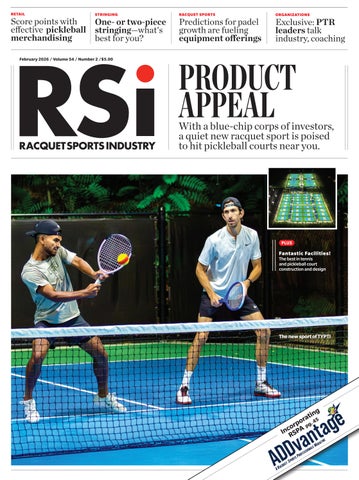
RSi Magazine February 2026

Page 1


Score points with effective pickleball merchandising

One- or two-piece stringing what's best for you?

Predictions for padel growth are fueling equipment offerings

talk industry, coaching

PRODUCT APPEAL

With a blue-chip corps of investors, a quiet new racquet sport is poised to hit pickleball courts near you.

Product Development

RACQUET SPORTS

OurServe

EDITOR'S NOTE

Educational Requirements

Growing the game at the grassroots won't happen unless providers take advantage of key education opportunities.

This month inaugurates a conference designed specifically to grow tennis at the grassroots. I’d like to say it’s a “new” conference, but it really brings back one of the best things the USTA used to do—the national Community Tennis Development Workshop (CTDW)—and pairs it with the powerful USTA Foundation Impact Conference. This new, combined event will be Feb. 19-21 at the Gaylord Texan Resort near Dallas.

The last national CTDW was about 10 years ago, and it truly was one of the best things the USTA did annually to help grow the game. A key strength was that the presentations and panels were, for the most part, generated by those who were delivering tennis at the grassroots. Key personnel at local Community Tennis Associations (CTA) and National Junior Tennis & Learning (NJTL) chapters, along with other industry and USTA leaders, determined, created and delivered a curriculum that packed audiences would bring back to their local organizations to put into practice.

When the USTA decided it no longer wanted to host a national CTDW, you could almost hear that collective, resigned sigh from those who spend so much of their time making this sport the best it can be for recreational players. Thankfully, some sections and states kept the “CTDW” idea alive with their own, successful regional versions. And many of us continued to talk up the need to bring back a national event. It may have taken a few years, but the USTA listened.

While the schedule and some speakers were still being finalized at press time, this year’s conference is looking to have an impact with its target audience of CTA and NJTL administrators, volunteers, and program leaders. Built

to spark new ideas, strengthen and inspire leadership and volunteers, and elevate the impact of CTAs and NJTLs nationwide, the schedule will include capacity-building sessions, networking opportunities, tracks to help with organizing and advocating for tennis, and much more.

This conference, though, is simply one of many that need to happen to elevate this sport and the broader industry, too. Many of RSI's readers attend both the the PTR/PPR International Racquets Conference held in February (this year's will be, Feb. 13-16 in Wesley Chapel, Fla.) and/or RSPA’s World Racquets Conference held every September (this year Sept. 20-23 in Dallas). And the USTA is bringing back the highly regarded Tennis Teacher’s Conference (although the name may be different) during US Open Fan Week in August.

But it’s not just these national events that tennis providers should be attending. There are sectional, regional and statewide education in racquet sports that we all should be taking advantage of. Many of you also have incredible experience, skills and talents and should offer that up for these events, too. And keep in mind, it’s not just about skills on court—it’s about all aspects of growing our industry and helping people to enjoy the game. That includes how to promote and advocate for the sport at the local level. Because if there’s one thing all of these conferences teach us, growing our sport is all about reaching people in your own communities.

PRESIDENT/PUBLISHER

JOHN HANNA

MANAGING DIRECTOR

ROBYN SOBELSON

EDITOR

PETER FRANCESCONI peter@acepublishinggroup.com

MANAGING EDITOR CORY SEKINE-PETTITE

ART DIRECTOR GARON HART

PRODUCTION MANAGER MEGAN WILLIS mwillis@nspmag.com

SPECIAL CONTRIBUTOR BOB PATTERSON

CONTRIBUTING EDITORS

KIM BASTABLE, CYNTHIA CANTRELL, PEG CONNOR, JOE DINOFFER, JUDY LEAND, GREG MORAN, KENT OSWALD, CYNTHIA SHERMAN, MARY HELEN SPRECHER, JOE TEDINO

CONTRIBUTING PHOTOGRAPHER DAVID KENAS

CIRCULATION MANAGER AMY FINE afine@nspmag.com

RACQUET SPORTS INDUSTRY 9040 Roswell Rd., Suite 210 Atlanta, GA 30350

ADVERTISING DIRECTOR JOHN HANNA jhanna@nspmag.com/770-650-1102, x125

APPAREL ADVERTISING CYNTHIA SHERMAN cstennisindustry@gmail.com/203-558-5911

ADVERTISING EXECUTIVES SHERRY GASAWAY JENNIFER GONZALEZ

Racquet Sports Industry is published 10 times per year: monthly, January through August, with combined issues in September/October and November/December, by New South Publishing, Inc., 9040 Roswell Road, Suite 210, Atlanta, GA 30350. Periodicals postage paid in Atlanta, GA and additional mailing offices (USPS# 004-354). February 2026, Volume 54, Number 2, (C) copyright 2026 by New South Publishing, Inc.

All rights reserved. Racquet Sports Industry, RSI and the logo are trademarks of New South Publishing, Inc. Printed in the U.S.A. Yearly subscriptions $25 in the US, $50+ elsewhere. Postmaster: Send address changes to Racquet Sports Industry, 9040 Roswell Road, Suite 210, Atlanta, GA 30350. Racquet Sports Industry is the official magazine of the USRSA, RIRG and ASBA. Looking for back issues of Racquet Sports Industry? Visit the archives at our website at TennisIndustryMag. com for free digital versions.

HONORS

IndustryNews

Information to help you run your business

Jasmine Paolini Image Wins 2025 ITF Tennis Photo

An image of Jasmine Paolini captured through the strings of her racquet, with her eyes and mouth aligned within the circles and triangles of the Yonex logo on the strings, has been named the 2025 ITF Tennis Photograph of the Year. The winning shot was taken by Australian photographer Ray Giubilo during her first-round match at the 2025 US Open. The image received widespread attention on social media and has earned Giubilo the top prize of $3,000.

In second place is French photographer Loic Wacziak (earning a $1,000 prize), whose dynamic image captures Corentin Moutet in mid-leap, straining to reach a shot and losing a shoe in the process during the Rolex Paris Masters. The third-place image, taken by Chinese photographer Zhong Zhi (receiving a $500 prize), was captured at a local junior tennis finals event in Guangzhou, China, and shows a coin toss between two young players. The winners and top 10 shortlisted images were selected by a judging panel comprising ITF

of the Year

President David Haggerty, two-time Grand Slam champion Garbiñe Muguruza, and tennis photographer Paul Zimmer. “The ITF Tennis Photograph of the Year once again highlights the creativity, skill and passion of photographers from across the global tennis community,” says

Haggerty. “This year we received entries from 37 countries, reflecting both the reach of our sport and the many different ways tennis can be experienced and captured.”

Visit www.itftennis.com for more information and to view all the winning images.

Tecnifibre Named Racquet Sports Partner of NYJTL

New York Junior Tennis & Learning (NYJTL), the nation’s largest youth tennis and education nonprofit, announced a new multi-year partnership with Tecnifibre, which will become NYJTL’s Official Racquet Sports Partner. The collaboration is expected to strengthen programming at NYJTL’s Cary Leeds Center for Tennis & Learning in the Bronx, N.Y., and enhance access to world-class racquet-sport equipment for youth and families citywide.

Cary Leeds Center coaching staff and select NYJTL program participants will receive packages including racquets, strings, grips, bags and other essentials. Tecnifibre will provide NYJTL with customized pricing on racquets, strings, apparel and bags, and the partnership will also include a discount for NYJTL players.

Tecnifibre will strengthen NYJTL’s mission by sourcing used racquets, demo equipment, and other gear for community programming, helping ensure that young people can participate regardless of financial barriers. Tecnifibre will also serve as a sponsor of the NYJTL Mayor Dinkins Cup, the largest free junior interscholastic tennis competition in the nation.

Gauff Surprises Tennis Clinic at Refurbished Facility in N.O.

Two-time Grand Slam singles champion Coco Gauff surprised a local tennis clinic in New Orleans East in November, visiting the tennis facility that was recently refurbished in her honor.

The 10 courts at Joe W. Brown Park were refurbished earlier this year as part of the US Open Legacy Initiative, which was launched in recognition of Gauff’s 2023 US Open women’s singles title. As part of the initiative, the USTA pledged $3 million—equivalent to Gauff’s prize money in 2023—to refurbish public tennis courts across the country. The New Orleans project was hand-picked by the

USTA Hosts Premier Facility Leadership Summit in Orlando

The USTA Industry and Sales Team hosted a Premier Facility Leadership Summit in November, bringing together top tennis facility leaders from across the country for a high-energy, idea-sharing gathering in Lake Nona, Fla.

Across strategic updates, coaching and programming discussions, and interactive sessions on technology, data and the “World’s Healthiest Sport” initiative, attendees collaborated on practical ways to strengthen player and coach pathways, enhance retention and elevate the tennis experience nationwide.

Gauff family due to the family’s extensive ties to the city.

“New Orleans has a super close place in my heart and to be able to be back here is really cool,” said Coco Gauff. “To be able to do this initiative with the USTA is amazing.” The November event featured a clinic run by local non-profit A’s and Aces, which offers programs and events at the Joe W. Brown Park courts.

USTA Foundation Receives $2.7M Chess Foundation Grant

The USTA Foundation, the philanthropic arm of the USTA, has received a threeyear, $2.7 million grant from the Chess Foundation to expand its impact in underresourced communities through tennis, education and mentorship.

The funding will provide the foundation—which uses tennis and education as tools to assist young people—with additional organizational capacity to boost its revenue and visibility.

The USTA Foundation supports 270 community organizations that serve more than 200,000 young people with mentorship opportunities, academic support, scholarships and grants, along with college and career readiness programs.

Corrections

In RSI’s January issue, an ad on page 26 listed incorrect sections for two of RSI’s Champions of Tennis winners: Stringer of the Year Jay Palmieri is in the USTA New England Section and Adaptive Tennis Champion of the Year Wendi Eusebio is in USTA Southern California. Also, on page 40, the name of the store owner for our Pro/Specialty Retailer of the Year should be Ray Wendeln. These corrections were made in our digital edition at tennisindustrymag.com.

USRSA Names

New MRTs and CS Master Racquet Technicians

Isaiah Romero, Los Angeles, Calif.

Chris Steck, Seattle, Wash.

Certified Stringer

Bob Romano, Washington Crossing, Pa.

People Watch

Lindsay Davenport has signed a two-year renewal to continue serving as the U.S. Billie Jean King Cup captain through 2027. Since taking over the captaincy in 2024, Davenport has led the U.S. to a 5-2 record in Billie Jean King Cup competition, including an appearance in the Final in 2025—the U.S.’s first since 2018.

The International Tennis Integrity Agency has suspended Chinese tennis player Pang Renlong from the sport for 12 years and fined him $110,000 (of which $70,000 was suspended) after fixing, or attempting to fix, 22 matches between May and September 2024. Pang, 25, who reached a career-high singles ranking of 1,316 in November 2024,

admitted to fixing five of his own singles matches, in addition to making 17 corrupt approaches to other professional players, resulting in six further matches being fixed.

Agassi Sports Entertainment has entered into an advisory and brand partnership agreement with Stefanie Graf, the 22-time Grand Slam tennis champ and wife of Andre Agassi, shareholder and cofounder of the company. In her role, Graf will serve as a brand partner, promote the ASE brand, and play a role in advising the company on strategic direction in the global racquet sports industry.

Industry executive Fred Viancos is stepping down from his job as executive director of USTA Texas for personal and family reasons, and is looking forward to entering a new chapter to his life, moving from Austin back to Houston.

Tennis: Europe Junior Tour Gears Up for 52nd Season

For your junior players, the 2026 Tennis:Europe tour June 27-July 20 (for either 17 or 25 days) is designed to provide a capstone to club winter junior clinics and programs. Founder and Director Dr. Martin Vinokur says the goal is to follow up on your own camps and clinics and focus on improving strategy and mental toughness on the red clay courts in countries such as Spain, Switzerland and the Czech Republic.

Now in its 52nd year (and bringing nearly 6,000 past participants for overseas play and competition), Tennis:Europe is geared toward high school varsity and JV players through a separate team for highly ranked juniors. All tournaments on the trip count toward a player’s UTR rating.

“Our players see the world in a team atmosphere, as student-athletes, and this personal growth experience can make a big difference in their lives,” says Vinokur. “Each week they’re in a different country, playing like a touring pro.” Visit www. tenniseurope.com or call 203-322-9803.

Survey: Americans Plan To Invest $60B in Health & Fitness

A new survey from the Health & Fitness Association finds that Americans plan to spend $60 billion in 2026 to support health, fitness and exercise goals and New Year’s resolutions. Among the 56 percent of U.S. adults who plan to set personal goals for the New Year, a majority 54 percent, approximately 82 million Americans, say they intend to focus on health, fitness and exercise, making it the most popular resolution focus for 2026.

The goals of individuals setting health and fitness resolutions reflect a broad view of well-being, including building muscle or strength (50 percent), improving mobility, flexibility and/or posture (48 percent), and improving overall mental health through physical activity (46 percent). To turn these ambitions into action, Americans emphasize the importance of structured exercise environments. About 86 percent say access to fitness facilities such as gyms, studios and health clubs will be important to achieving their goals.

“Americans are not just setting fitness goals; they are budgeting for them,” says HFA President and CEO Liz Clark. “This research shows that people increasingly see exercise as an essential investment in their long-term health.”

CourtsApp Launches In New York Tri-State Area

CourtsApp, an AI-powered marketing and booking platform, has soft-launched in the New York tri-state area. Founded by New York entrepreneur Daren Hornig and creative executive Kate Daggett, CourtsApp is designed to make reserving a court in any racquet/paddle sport seamless and easy.

The developers say they have signed on more than 150 facilities, comprising over 1,500 courts, in the New York, New Jersey and Connecticut area, where the app is live for players. They say they’re looking to expand up and down the East coast in the first quarter of 2026, with additional markets throughout the country later in the year.

The app is available at the Apple App

Store (for iOS) and Google Play Store (Android). Visit CourtsApp.com for more information.

SUSTAINABILITY

RecycleBalls Hits Milestone, Collecting 18 Million Balls

Just before the holidays, RecycleBalls announced that it had officially collected 18 million tennis balls, converting them into new materials and saving them from going into landfills across the U.S.

“Thank you to our donors, tennis and padel facilities, volunteers, universities and cities,” said Executive Director Erin Cunningham (below). “Thank you to the arena owners, educators, doctors, and court installers who choose reused and recycled. Thank you to everyone who cares so deeply about reducing waste and supporting healthier people and the planet. We also know the work isn’t finished. Sports still have a long way to go in reducing waste and there are so many balls that still need to find second and third lives through reuse and recycling.” Visit recycleballs.org.

Kyrgios Takes Ownership, Creative Roles in Stack Athletics Apparel

Racquet sports apparel brand Stack Athletics announced that global tennis star Nick Kyrgios is joining the company as owner and creative director. “Stack represents everything I stand for—making noise and pushing boundaries,” says

Kyrgios. “We’re building a brand with real personality. If it doesn’t make people feel something, I’m not interested.”

With this new role, Kyrgios will influence design direction, storytelling, athlete collaborations and the evolution of Stack’s aesthetic across tennis, pickleball, padel and lifestyle apparel. “Tennis has its traditions — I’ve never cared about fitting into them,” says Kyrgios. “As creative director, that’s the energy I’m bringing to Stack. Raw, expressive, unapologetic. This brand is for people who show up exactly as they are. No filters.” Visit stackathletics.com.

TennisLibrary.com Launches For Players, Fans, Enthusiasts

Digital Information Resources LLC (DIR) has launched TennisLibrary.com, a new digital destination that brings together engaging stories, practical guides and curated resources that cover everything from the history of the game to modern training, gear and culture. The site is built for players, fans and all tennis enthusi-

asts, say officials at the company.

“TennisLibrary.com is about more than articles, it’s about creating a place for community,” says Michael Gursha, CEO of DIR. “We’re building a place where tennis enthusiasts can explore, learn and share their love of the game in one dedicated space.” Visit TennisLibrary.com.

ATP Unveils New Logo and Brand Identity

The ATP has revealed the latest evolution of its iconic logo—the sixth in its 54-year history. The refreshed design modernizes ATP’s visual identity while retaining the legacy and spirit that define men’s professional tennis. It’s part of ATP’s long-term strategy to engage younger audiences and build deeper fan connections.

Nick Kyrgios

Short Sets

Racquet Sports Professionals Association has been named a recipient of the prestigious BoardRoom Magazine’s Association of the Year Award for 2025. The recognition highlights the RSPA’s accomplishments, innovation and commitment to raising the bar in the racquet sports industry.

The Dallas Open and Tecnifibre have announced a new three-year partnership, making Tecnifibre the Official Stringing Service of the Dallas Open, which will take place Feb. 7-15 at the Ford Center at the Star. Tecnifibre will provide stringing services to all participating players throughout the tournament and will have a dedicated on-site retail store and fan engagement area.

After receiving noise complaints from residents, and following weeks of debate, the city council in Carmel, Calif., has voted to permanently ban pickleball at Forest Hill Park, the city’s only public park with pickleball courts. Despite the vote, Carmel’s mayor expressed hope that the council could work with both sides to find a compromise.

The 2026 USA Pickleball National Championships will return to the Barnes Tennis Center in San Diego, taking place Oct. 31-Nov. 8. The announcement marks the return of the sport’s most prestigious championship to Southern California for a second year in a row. Visit usapickleballnationals.com.

The 2025 Garmin Connect Data Report provides insights into how the

brand’s users engaged in fitness over the past year, and racquet sports dominated, outrunning Pilates, HIIT, strength training and running, according to the latest report from wearable giant Garmin. Racquet sports, including tennis, pickleball, badminton, padel, racquetball and squash, grew 67 percent in 2025. Women and 18- to 29-yearolds drove the biggest spike in participation.

ESPN says its coverage of the 2025 US Open delivered standout audiences across the tournament, with double-digit growth throughout all rounds, and the Men’s Championship the highest in a decade and ESPN’s second mostviewed on record.

Racquet Tech

One-Piece or Two?

There are advantages and disadvantages with each stringing method. So which one should you use?

There are two primary methods for stringing: the one-piece method and the two-piece method. When I am teaching a beginning stringing course, this is the first decision the technician must make.

Each method has its own advantages and disadvantages, and understanding these differences can help you make informed decisions tailored to your client’s playing style and preferences. In addition, knowing the pros and cons of each method will come into play with the particular frame and string you’re dealing with. While most frames can be strung using either method, there are exceptions. Obviously, if you’re using a hybrid (different strings for the mains and crosses), you’ll be using the two-piece method.

Also, if you are stringing a frame where the main strings end at the throat, you’ll likely want to choose the

two-piece method because installing cross strings from the bottom to top puts undue stress on the frame. Many manufacturers require a two-piece method on these frames for this reason, and doing otherwise can void any warranty. You could opt to use the one-piece method on these frames utilizing a “box” or “aroundthe-world” technique, allowing the crosses to be installed from the top to bottom, but these methods are timeconsuming and come with their own lists of pros and cons.

Let’s look at the advantages and disadvantages of both one-piece and two-piece methods.

ONE-PIECE STRINGING

The one-piece method involves using a single piece of string that is threaded continuously through both the main strings and the cross strings of the frame. You’ll need to measure out the short side, which will be used for half

the mains, with the remainder of the strings used to install the other side of mains and all the cross strings. Use caution when choosing which side of the frame to install the short side on as there are some frames that require it to be on a certain side due to the frame design, but in most cases either side is fine. For consistency, most professional stringers choose either the right or left and stick with it for all their racquets.

Pros

• Efficiency: Note that this is both a “pro” and a “con.” The one-piece method can be quicker, as there is no need to tie off and start a second set of strings. On the other hand, having to deal with handling the long side of string can slow you down.

• Reduced Waste: With only one piece of string used, there is less leftover material, making it a costeffective option when using a reel of string.

Cons

• Efficiency: As noted, handling the long side of the string can be more cumbersome, especially when threading the crosses through with delicate string and/or a dense pattern.

• Potential Stress on the Frame: The single piece of string can exert uneven pressure on certain parts of

the racquet frame, especially if the tension is high, which could lead to damage over time. The hazard here is nominal unless you are installing the crosses from bottom to top as discussed above.

• Limited Customization: The onepiece method does not allow for customization of tension between the mains and crosses. Players seeking different tension levels might find this method restrictive.

TWO-PIECE STRINGING

The two-piece method uses two separate pieces of string—one for the mains and another for the crosses— requiring the stringer to tie off and start anew when switching between the two.

Pros

• Consistency: There is uniform tension of main strings, since both are installed and tied off in the same manner.

• Customization: This method allows players to set different tensions for

the mains and crosses, tailoring the racquet’s performance to their specific needs.

• Frame Protection: The two-piece method distributes stress more evenly across the racquet frame, reducing the risk of damage over time.

• Compatibility with Hybrid Stringing: Players can use different types of strings for the mains and crosses (e.g., natural gut for mains and polyester for crosses), optimizing playability, durability and spin.

Cons

• Time-Consuming: Stringing a racquet with two pieces requires more time and effort due to the need to tie knots and start a second set of strings.

• Increased Material Waste: Using two separate pieces can lead to more leftover string, because tying four knots versus two knots requires slightly more string, which may not be as cost-effective over time when using string from a reel.

Which Method Is For You?

The choice between one-piece and two-piece stringing ultimately depends on the technician and the player’s preferences, goals and the type of game they play.

Often, less experienced technicians favor the one-piece method simply because there is less tying of knots, which is generally the most intimidating aspect of learning to string

However, once you have learned to tie a sufficient knot, the two-piece method is considered easier by most technicians.

Regardless of the method chosen, it is essential to ensure the stringing process is done with precision and care to maximize the racquet’s performance and lifespan, and give your customer the best possible service. Technicians should be proficient in both methods and practice consistency in every job.

To comment or for more information, contact Bob@RacquetTech.com.

TENNIS PARTICIPATION

Growing the Game

Family Matters

To reach 35 million players by 2035, we need to recognize the value and potential of family-based play.

The USTA has embarked on an ambitious plan to increase the number of tennis players in the U.S. to 35 million by 2035. The current estimate places the number of players at about 26 million. Challenges may stand in the way, but my focus here is on one specific impediment, which is the need for an updated mental model for how to attract, engage and retain junior tennis players.

The traditional viewpoint is that junior tennis is like other youth sports. In this model, the ideal scenario is that a youth tennis player joins an introductory program that involves modified equipment, offers quality instruction and provides the right mix of coaching and competition. If those qualities are present, then a junior is more likely to continue playing tennis.

While this model is accurate, it’s incomplete. There are two foundational factors that drive ongoing tennis participation: perceived skill development and the need for connection.

Players may not think of skill development in these terms, but their perceptions constantly answer the questions, “Am I any good at this?” and “Am I improving?” The answers to these questions need to be “yes,” and the use of modified equipment along with quality coaching helps young players perceive and indeed achieve rapid improvement (i.e., competence). But also shaping this improvement is the number and frequency of play occasions. Increasing play occasions enhances skills, improves confidence and creates additional commitment to tennis.

Increasing play occasions could mean taking more group and private lessons, but that can be costly. So this is where

the second foundational factor comes into play—the need for connection.

Quality tennis programs foster connection between players by offering team-based play and providing other programming opportunities to help players develop friendships. While lessons and other scheduled play occasions are valuable both in terms of creating competence and fostering connection, these effects are even stronger when they combine with opportunities to play and connect outside of structured programs.

If you ask long-term tennis players, and particularly coaches, how they started playing tennis, you will frequently hear they began playing with their families. This is no accident. Family-based play has unique qualities that amplify the likelihood that junior players will play for a lifetime. Playing with family offers children the chance to gain additional play occasions and experience, strengthen relationships with family members, and create memories they will treasure. It also nudges them toward seeing themselves as “tennis players” because they are in a

family of tennis players, which bolsters their commitment to the sport.

Family tennis offers at least three additional advantages. First, it allows for spontaneous or unscheduled play as families can play at their convenience. Second, it is a less expensive way to get additional play occasions. Third, family-based play allows, for example, grandparents and grandchildren to play tennis together, something that is less likely to occur in many other sports.

Recognizing the value of familybased tennis play is one thing, but thoughtfully and thoroughly promoting family play as a powerful tool toward achieving “35 by 35” is something quite different. Many tennis facilities offer occasional festivals and other opportunities for families to play together, but these one-off events by themselves cannot make a significant difference.

One approach that would make a large-scale impact would be to promote introductory family-based lessons that use modified equipment and courts, pair parents and children together, incorporate team-based play, encourage families to play outside of the program, and feed into follow-up lessons and programs.

I have created and have seen this type of family-based program work, and it has the chance to be successful in any community that tries it. However, this effort requires that the USTA lead the charge initially by incorporating and emphasizing family play in its Red Ball Tennis product and then connecting family play with other products in the pathway.

Family-based play has always been a strength of tennis that elevates it above other sports. It is time we fully leverage the strength of family-based tennis play to help us reach 35 by 35.

Kevin Theos is First Vice President of the RSPA and an RSPA Elite Pro with over three decades of experience in the racquets industry. He is an immigration lawyer focused on international coaches and players and may be reached at Kevin@TheosImmigrationLaw.com.

Industry

TEACHING PROS/COACHES

Forward Progress

In an exclusive Q&A, the PTR/PPR’s Lynne Rolley and Martin van Daalen talk about coaching education, the industry and changes their organization has seen.

In early November, the Professional Tennis Registry officially named longtime coach and industry executive Martin van Daalen as its new Chief Executive Officer, the latest in a series of moves designed to keep the organization moving forward.

Van Daalen brings to PTR/PPR more than 35 years of experience developing players and guiding coaches at every level of the game, including as a national coach and Director of Women’s Tennis in Holland and serving for 11 years as a USTA National Coach. He works closely with Lynne Rolley, the Chair of the PTR Board of Directors, who herself has a long history as a coach, director of tennis and industry executive.

As the PTR gears up for its annual International Racquet Conference,

at which it will celebrate its 50th anniversary, Racquet Sports Industry magazine connected with both van Daalen and Rolley to answer wide-ranging questions about their organization, the industry, coaching education, relationships in this business and more.

RSI: How would you describe the current state of PTR and PPR?

Van Daalen: Both the PTR and PPR are in a good place. They are both growing in membership every day, and altogether, we’re at about 24,000 U.S. and international members, across tennis (PTR), pickleball (PPR), padel and platform tennis, with more than 15,000 members in the U.S. We’re expanding in all our sports—tennis is strong, pickleball

continues to explode, and with padel and platform tennis, I only see those numbers going up. We have a large and growing international contingency, which I believe gives us an advantage over other teaching pro organizations.

Rolley: We’re now at the international membership renewal period, so I think those numbers will continue to go up even more, as we’ve put an emphasis on growth worldwide in recent years. Asia, for instance, is growing rapidly; they’re crazy about pickleball. And padel, as you know, is huge in Spain and Italy, and continues to grow. While we’re somewhat new to padel, we can see the potential for growth.

RSI: PTR and PPR have seen significant evolution in the past year. What are some of the accomplishments you’re most proud of as you look ahead to your 50th anniversary as an organization?

Rolley: We are so proud of the large group of loyal PTR members who have supported us—in the good times and through the challenging times. We feel we have the best education across all levels—from

Lynne Rolley
Martin van Daalen

beginning coaches up through high performance—and coaches recognize us as the company they can rely on.

Van Daalen: We’re very much focused on our 50th anniversary this year, especially for our annual International Racquets Conference [Feb. 13-16 at Saddlebrook Resort in Wesley Chapel, Fla.]. We have so much to be thankful for and to honor, including our rich history and long impact in the growth of this sport and industry, but also in our bright future and the many opportunities and partnerships we’re looking forward to.

RSI: Talk about the leadership transition the organization has gone through in the last couple of years.

Rolley: The transition to Martin as CEO has been seamless. He’s been on staff for about four months now, but he had been a longtime board member and vice-chair, and has been very active and involved in the organization. He brings heavy experience in all aspects of our business and in this industry, and it shows in the amazing job he’s doing.

“We’re very much focused on our 50th anniversary this year, especially for our annual International Racquets Conference.”
— Martin van Daalen

For my part, I’m in my fourth year as president and chair—the board voted to keep me on past the three-year term for continuity through these transitions. Our full board should have seven members, but [as of press time] we have two openings and are operating with five board members. However, we have had a lot of applications and expect to fill those board positions by our conference in February. We are looking to have board members specialize in and take on particular areas, especially with all our sports growing so much.

RSI: After decades on Hilton Head Island, S.C., how has the headquarters move to Saddlebrook Resort been? There were concerns and complaints, the first few years, about the facility. What can we expect at the International Racquets Conference?

Van Daalen: Saddlebrook has seen major improvements—nearly everything has been redone, from new and upgraded hotel rooms with

modernized bathrooms, completely redone conference facilities, improved and renovated restaurants, new pool area and golf courses, and much more. There is still more to do, including new fencing for the tennis and pickleball courts, but we’re so pleased with all the renovations and know our members will be too when they come for the conference. The resort also is looking to add three padel courts to the racquets complex. It’s a great home for us.

Rolley: And the leadership at Saddlebrook is thrilled to have us there. Kevin O’Connor, Saddlebrook’s president, is very supportive of our partnership. And Martin meets weekly with Patrick Farrell, Saddlebrook’s V.P. of operations, to talk about what we’re doing and how to do it better. When you look back on where we were a few years ago—in a small, expensive office above a bank, having to pay for court time at local facilities—to what we have now, it was the right move for us. Staying in Hilton Head was holding us back to growing as a company. Saddlebrook

Saddlebrook Resort
International Racquets Conference

has changed the landscape for us completely. We can hold many more workshops and events. There are many opportunities for growth.

Van Daalen: For instance, from my meetings with Pat, we’re starting a bi-monthly pickleball tournament at Saddlebrook. But not only that, we’ve attracted a national, professional pickleball team that will play its home matches here.

And we’re talking about creating a pickleball academy, much like the Saddlebrook Tennis Academy, which grew out of the legendary Hopman Tennis Academy. We’ve also talked about helping the resort with its corporate events. We benefit, our members benefit, and Saddlebrook benefits.

RSI: PTR and PPR have undergone substantial updates to education materials. What inspired these changes, and what can coaches expect from the new curriculum?

Van Daalen: Yes, we are continually trying to upgrade our workshops and provide our coach-educators with new and updated curriculum from the latest research and development for coaching education. I think this is a normal development in any good company, and having ongoing training of our coach developers is a result of this. And of course, we’re thrilled to have Carl Maes as our

International Director of Coaching for our tennis sport.

We’re trying to do a lot of varied things; we’re always busy upgrading the quality of our workshops. For instance, we recently rewrote and improved our Level 1 workshop and are working on Levels 2 and 3. We not only want to make sure we have the highest quality workshops, but we’re also doing a ton of webinars, which are extremely popular.

RSI: Pickleball continues to grow worldwide. How is PPR elevating education standards in a sport that is growing so rapidly?

Van Daalen: We are lucky to have many of the best educators in pickleball coaching already working for us. Sarah Ansboury is our V.P. and director of this division and is also still playing at the top level in this sport, so she has a front-row seat to all the latest developments concerning pickleball, padel and platform tennis. We also recently added Nik [Nicola] Slater to our team, who has done a lot of work internationally in pickleball, tennis and padel.

RSI: How is PTR/PPR approaching padel education? What do you have planned for padel?

Rolley: We’ve already attracted two top coach instructors who will take the lead in developing workshops and

events for padel, and Saddlebrook has committed to building three padel courts close to our headquarters. We feel this will be the next sport to explode in the U.S., so we’re expanding our efforts in this sport.

RSI: What new initiatives, programs or long-term strategies are you most excited to bring to the industry in the next three to five years?

Van Daalen: We are excited about the many partners who are reaching out to work with us and the many different avenues we are developing to reach coaches looking for education or continued or highperformance coaching. Webinars and teaching coaches online seems to be the trend in reaching coaches in this large country. We still have the majority of teaching face-to-face, but developing online courses seems to be in larger demand.

To help build stronger pathways for coaches at every stage, we’ve also added many specialty topics relating to our levels of development, for instance for technique, strategy, fitness training, mental game training, etc.

We’re a one-stop shop for coaching education, and we’re constantly looking at how to expand our company and find new ways to reach coaches and promote coaching education in general for all. We also have a ton of new sponsorships, especially in pickleball.

Rolley: We also want to recognize the great work and importance of our PTRW initiative, which is a groundbreaking program created to recruit, certify and empower women in coaching with the skills, tools and networks to advance their careers. PTR Vice President Milena Vidos has been a leader in this field. PTRW is a part of many of our workshops, and the program has had a great partnership with the WTA. We continue to invest in this to encourage women to get into some aspect of the coaching profession.

RSI: How do you view PTR/PPR’s responsibility in shaping the next generation of racquet-sports coaches globally?

Saddlebrook Resort

Rolley: We take this responsibility very seriously. We realize there are many options worldwide that coaches can choose from, so providing high-quality coaching education should be the method to spread the word about our programs. Making sure they are what the market needs is our priority.

RSI: How is your relationship with both the RSPA and USTA? Do you see ways to collaborate to grow both tennis and the overall racquet sports industry?

Rolley: The relationship with the RSPA has only gotten better. Plus, we have many members who have joined both organizations.

Lately, since Martin came on board, we have tried to strengthen that relationship even more and have talked about collaborating on a joint conference, workshops or events. We’d love to do things with the RSPA. This should be an example of how the relationship should be with the USTA as well.

The history between the PTR and RSPA [USPTA] has had its challenges, but when Trish Faulkner became RSPA president, she and I got together and we just agreed, let’s just stop this. We want to work with the RSPA. It only makes sense that we’re all working for tennis.

As far as the USTA, I think it’s really wonderful that they’re involved in coach education. They’ll invest a lot of money in talking about and promoting certification and it will push coaches toward us, particularly at that higher level. I consider it a really great investment for the whole coaching community.

Van Daalen: With these three companies all working on coaching education, friendly competition is not a bad thing. It shines a light on it and pushes all of us to be better. It’s all good stuff.

RSI: How do you think USTA Coaching will affect this industry overall, and affect what PTR is doing/planning for the future? Will PTR be involved in USTA Coaching in some way?

“We realize there are many options worldwide that coaches can choose from, so providing high-quality coaching education should be the method to spread the word about our programs.”
— Lynne Rolley

Rolley: As the governing body of tennis, the USTA should be involved in coaching education, and we are happy that they are. But we have much longer experience in this arena, starting 50 years ago with Dennis Van der Meer. In the USTA’s mission to promote and grow tennis, part of it could be supporting companies like the PTR and RSPA. But besides that, we are all members of the USTA. It is not the USTA’s job to hurt us, control us or try to take over. Instead, we should all try to work together to raise the level of coaching in the U.S. It is our hope they eventually will share this vision as well and plan to collaborate for an even stronger future of coaching education.

Van Daalen: You would think that USTA coaching would have affected us, but the numbers aren’t saying that. We continue to grow in numbers, and that’s all a good thing. As Lynne says, the USTA should be involved in coach education, and I think it would be good for them to work with us a bit more, so they can get further into the critical details and particulars of it all. We’ve had meetings, but nothing concrete has come out of it as far as a plan or collaboration. Let’s do this together.

RSI: Coaches often look for community, mentorship and ongoing support. How are you enhancing the member journey?

Van Daalen: Enhancing the member journey is exactly what we started looking into when I came on board as CEO. We want to make sure we

enhance their experience by, for example, adding a video learning site online and increasing the benefits to coaches in what we offer in programs and services so they can save money on all kinds of products, insurance and travel. Also, in tools to connect to other coaches, students and new job positions.

Our insurance, benefits, continuing learning and business tools are the key strengths of the PTR. We have great benefits in insurance programs, including liability, health and disability insurance. We feel we are delivering quality products with lower costs for our members. We’re looking to expand all this and, especially, to make members more aware of the kind of benefits we have and how easy it is for them to take advantage of these benefits.

RSI: With PTR’s 50th anniversary, what message would you like to share with the global community of coaches who have shaped the organization?

Rolley: We’ll never forget all that Dennis and Pat Van der Meer did in the U.S. and internationally. Dennis really spread the love of tennis to everyone, and you can feel that. Dennis and Pat formed a wonderful partnership, and we need to always honor and thank them for what they did for this organization and this industry.

And we also have to look to the future to make sure this is a sound company that every coach can be proud to call their home!

Industry

Product Development

TYPTI,

a quiet new sport played on a pickleball court with a 22-inch strung racquet and foam ball, is looking to make big noise in the racquets industry.

Steve Bellamy, the founder of The Tennis Channel and creator of LiveBall, has debuted his latest endeavor, an amalgam of tennis and badminton, played on a pickleball court with a 22-inch strung racquet and 3.5-inch channeled foam ball. Called “TYPTI,” Bellamy says it is “big rips and

chest-high ball strikes with so much spin that the ball seems to always find the court.”

He runs through a list of attributes for TYPTI (visit TYPTI.com): “It’s ‘artisan,’ with highlight-reel points where topspin lobs, sharp angle passes, and wrist flick missiles come easy. It’s completely new scoring and

rules—there is no kitchen or lets, you can play balls off the net, and use your hands, feet, etc.”

And he has plans for the future of TYPTI: “We’ll have amateur and professional tours, junior circuits, and leagues. It’s not just a new racquet sport, it will have infrastructure, and a nimble governing body.”

Bellamy, who has owned seven Southern California tennis facilities, says the growth of pickleball facilities is unparalleled, but that large rents, insurance, energy costs and specialized labor make running them a challenge. “It takes about 550 members to break even, and most [pickleball facilities] seem about 250 short, with new clubs and public courts opening next door every quarter. TYPTI will be their financial shot of

adrenaline—like snowboarding was for ski resorts in the late 1980s by multi-purposing the facility.”

Another reason Bellamy believes TYPTI will be popular is that it is virtually silent. Communities and facilities that are now challenged with the noise produced by pickleball will have no such concerns with TYPTI, which is played with a specially designed yellow foam ball that is safer if it hits a player.

LOVE OF RACQUET SPORTS

While Bellamy started “getting serious” about promoting TYPTI in late 2023, he says his push for a shortercourt, more exciting game started about 25 years ago, with pitches to “the alphabet soup” of ITF, ATP, WTA, USTA, TIA, etc.

“My premise was simply that a 7,200-square-foot playing field was too big. The Slams, colleges, parks and places where land was plentiful were fine. But 25-court tennis centers in dense population hubs— the backbone of U.S. tennis participation—would be challenged, and sports like paddle, platform, padel or pickleball would fill the void. I got laughed out of every room.”

Bellamy has a palpable love of racquet sports. “Tennis is the best professionally played sport. Pickleball is the greatest social phenomenon in sport. Racquet sports are the most longevous human activity,” he notes. “We don’t want to disrupt any of them.”

He says TYPTI is targeting the 25 million ex-tennis players who aren’t playing either tennis or pickleball. “We want to grow racquet sports, not cannibalize them. We’re less concerned about court size. And if players migrate to tennis or pickleball from TYPTI … we’re good, as we care about the category.”

But, while Bellamy sings the praises of all racquet sports, he is proud of his. “TYPTI is the most fun racquet sport. That’s its thing. You can make shots you can’t in other sports, leading to so many hero moments. The rules and scoring are the best and there’s constant joy on player faces. It’s like everyone’s in disbelief as to what they just pulled off.”

So how do you scale a new sport?

“TYPTI is a blast and an incredible workout. The points are spectacular, and players pull off shots they could never dream of in other sports.”

“We’re searching for entrepreneurs, cities, family offices, sports property owners, etc., to create the first generation of TYPTI stakeholders,” says Bellamy. “We’ll own events, but partners will also own amateur and professional tournaments, junior events, leagues, teams, etc. at local, regional and national levels. We want lots of oars in the water.”

The first pro TYPTI event is scheduled to be a $100,000 prize money tournament in L.A. at the end of February, with initial world rankings based off those results. A tour will follow—Bellamy says he’s putting together a $1 million prize money event.

BIG-NAME SUPPORTERS

Bellamy has raised millions of dollars for TYPTI from a “dream team of value-add partners” that includes JJ Abrams, Tony Robbins, Drew Brees, Chris Pine, Tiffany Haddish, Bert Kreischer, Kyle MacLachlan, tennis players like Milos Raonic and Nick

Kyrgios, and business mavens like Tony Pritzker, Barry Allen, Andrew Segal and Jeff Clark.

“What I love about TYPTI is its accessibility,” says best-selling author and life and business strategist Tony Robbins. “While it’s mindblowing what the top players are already doing with the ball, beginners can have great rallies in minutes. That’s not typical for racquet sports, where traditionally the barriers of entry have been so high that the majority can’t use them as a tool for physical fitness. TYPTI has blown the doors off those barriers and will make it an unparalleled tool for physical fitness and mental health.”

TYPTI has another storied partner, Prince Tennis, which will relaunch the Prince Mono this year in a 22-inch TYPTI-approved spec. The initial racquets are made by the OLO brand and available now at TYPTI.com.

Bellamy has a long history in the industry, having owned tennis

centers with pro shops, and a top junior academy. In 2003, he launched The Tennis Channel, and in '05, he launched the Tennis Channel Open in Las Vegas, a “lollapalooza” of tennis that was voted “player favorite” by the ATP and was profitable in year one. After the event, Bellamy left to start the Ski and Surf Channels. It was while running Ski Channel that he began to direct films, and he “fell in love with the craft.” In 2015, Bellamy became president of Motion Picture at Kodak to “fix” its film business, and after nine years and 900 movies later, working with directors like Steven Spielberg, Paul Thomas Anderson and Martin Scorsese, Kodak swept the Oscars, and film became the halo division of Kodak again, he says. He also created the Kodak Film Awards, which is a mainstay during award season.

In September, Bellamy introduced TYPTI to coaches at the RSPA World Racquets Conference in Hawaii. The presentation was packed, and

afterwards pros took to the courts to play for hours. “They saw the presentation, and just got it,” says Bellamy.

RSPA CEO Brian Dillman says the initial TYPTI response has been “very positive. In November, we had a webinar to talk in more detail, and our members were captivated. The connection to tennis, utilization of pickleball courts, reduced noise and Steve’s tenacity will entice many members to give it a try.”

Dillman notes: “The advent of alternative racquet sports is on the rise. TYPTI along with POP Tennis and others are positioned to offer facilities new opportunities to build whole new businesses and attract new customers.” He says RSPA is partnering with TYPTI and will be developing the first coaching modules, which will

be exclusive to RSPA members.

Adds Bellamy, “TYPTI is a blast and an incredible workout. The points are spectacular. The strategies for singles and doubles are so different and fun. And we’re finding it’s an incredible teaching aide for pickleball and tennis. So many people say they’ve played their best pickleball and tennis after they play TYPTI.”

ADVERTORIAL

Opening Volleys!

The new tennis facility in Sandusky, Ohio, has laid a foundation for the sport's growth, and for furthering the community’s mission.

In challenging times, it is inspiring to consider a model of progress and positive transformation. That’s exactly what’s exemplified by the new Sandusky, Ohio, tennis complex.

As Sandusky City Schools Chief Executive and Superintendent Dennis Muratoris explained on opening day this past August, the six-court complex, planned and constructed through funding from multiple local sources and USTA Tennis Venue Services, “is a powerful example of what we can achieve when we work together for the benefit of our city.”

The first ball on the new courts was struck in a match between the St. Mary Central Catholic High School and Sandusky High School girls’ tennis teams, a fitting inaugural as both the parochial institution and Sandusky Educational Foundation contributed to the approximately five-month project built on

land that once was home to the American Crayon Factory. Their play, on what will serve as home court for both schools under a 10-year licensing agreement, provides a state-of-the-art foundation to programs that previously played on surfaces in a physically threatening state of disrepair.

Recognition of that threat and the opportunity to provide greater recreational facilities for the municipality was the convincing argument when Sandusky voters approved their part in the funding for the Rec Center, leading quickly and directly to, “a plan to accommodate both schools and give our residents a great facility,” according to Sandusky Recreation Projects Manager Chris Mehling.

A network of connections within the city led town officials to Cheryl Birch, Executive Director of the USTA Midwest Northern Ohio District, who helped

guide the proposal toward USTA Tennis Venue Services. The TVS group awarded the project a $200,000 grant, matching the USTA’s largest investment in a single project in the history of the program.

Of course, it wasn’t just about the money. Mehling says a “phenomenal” team from TVS assisted the project with their overall expertise and with a thorough review of the plans. For instance, original planning for the courts included asphalt specifications that were based on lower state standards intended for roadways. TVS, however, offered insights that helped focus on the specific needs of a tennis court surface and aided in aligning construction details with ASBA-USTA court construction industry standards. Adding to the quality of the finished product was the work of Sandusky-based SportMaster Sport Surfaces, which also made a $30,000 in-kind donation for paint and materials.

The TVS grant—among over $16 million the USTA has awarded through TVS in 2025—was made because “Sandusky is thinking big,” says Todd Carlson, USTA Senior Director, Tennis Venue Services, Parks and CTAs. “By kicking off this site development with six new tennis courts, they’ve laid the foundation for a future recreation hub. This initiative proves their dedication to expanding tennis opportunities locally and to promoting the health and wellness of their community.”

The vision is that these courts will do much more than support play from the two schools. The Recreation Department has reached out to other local schools to develop plans for at least 300 junior high school students to learn (and improve) their tennis as part of physical education classes. Also in various stages of development are the hosting of regional and local tournaments for various levels of play; league play and summer lessons; and conversations with neighboring communities about increasing their access to tennis as well.

And the story of tennis growth in Sandusky doesn’t end there. Spurred on by the opening of this new facility, all ages are coming forward in a popular embrace of the sport, demonstrating how well this fits with the municipal mission, according to Mehling, to “Get ’em up, get ’em moving, and get them socializing with other people.”

Sponsored content. For more on how USTA’s Tennis Venue Services can help your facility or project, visit usta.com/facilities or email facilities@usta.com.

Growth Factors Industry predictions for growth in padel courts

are fueling manufacturer plans for increased paddle

offerings.

Padel, the tennis/squash hybrid taking over the participatory niche between tennis and pickleball, appears to be finding its moment. The International Padel Federation (FIP), the world governing body for the sport, estimates 35 million players worldwide, and Playtomic, the Spain-based racquet sports booking app, terms it “the fastest growing sport in the world,” calculating a 26 percent increase in club openings year-over-year worldwide.

According to the second edition of the FIP’s “World Padel Report," the sport is most popular in Europe but gaining ground worldwide. At the start of 2025, padel reached 70,000 courts worldwide; that number topped 77,000 by the end of June. Europe is estimated to have over 51,000 courts, or 66.1 percent of the total (led by 17,300 courts in Spain and 10,220 courts in Italy); followed by South America, 18.3 percent; Asia, 6.0 percent; Central and North America, 5.1 percent; Africa, 4.4 percent; and Oceania, 0.1 percent.

Miami, Boston, Chicago, Houston, Los Angeles, Montreal, San Francisco and Toronto, with Playtomic predicting continued expansion for 2026 and “real acceleration predicted in 2027.”

In response, equipment manufacturers, some long-established in racquet sports and others that are specialists in padel, are gearing up to

aggressive mindset. And the roundheaded Arrow Hit Ctrl ($465) offers a stable, balanced and customizable platform for high-level play.

BABOLAT babolat.com

The carbon-framed and cored Technical Viper 3.0 ($390) at 370 grams, and at maximum, 38mm, is for those whose on-court theme is dominance through power. Players whose games require greater balance between power and control can turn to the Technical Viper Soft 3.0 ($300), whose carbon twill 3k construction and softer EVA core offer greater flexibility and shock absorption, while still allowing for a barrage of heavy hitting. The head-heavy, diamondshaped Technical Veron 3.0 ($240) at 360 grams is created to enhance swing acceleration for those seeking to attack from anywhere on the court.

The U.S., says the FIP, remains in a transition phase from an initial growth phase. In July, it was estimated there were 700 padel courts in the U.S. “Florida has emerged as the fastest-growing state for padel, boasting the largest number of padel courts in the country (41 percent of the total number of courts in all U.S. states), followed by Texas (18 percent), California (10 percent) and New York (4.7 percent),” according to the FIP. North American hotspots include

The wide-ranging Adidas line offers paddles customizable to fit every game style. Highlights from the high-performance series include the Ale Galán-endorsed Metalbone 2026 ($455) with weight and balance systems that can be adjusted and personalized, a textured surface to enhance control, and a low-density foam core offering consistent feel and comfort. The Cross IT Light 2026 ($210) is designed to deliver power, handling and precision spin for the intermediate player with an

DUNLOP dunlopsports.com

The Galactica series brings a new dimension to high-performance play with its BASF expanded thermoplastic polyurethane layered

at the 3 and 9 o’clock positions of the frame, creating exceptional rebound and structural strength. Paddles include the high-balanced, 370-gram Galatica Pro ($270) for those who plan to dominate at the net; the medium-balanced, 265gram Galatica Pro LS, supporting those seeking to enhance all-court games; the maneuverable, 355-gram Galatica Lite ($270); and the versatile Galactica Team ($220), which is quickly adapted to the games of new and intermediate hitters.

reduced vibration for comfort, and meshed with outstanding energy transfer for power. The 345-gram Extreme One ($330) cuts through the air, showcasing the exceptional maneuverability and ball feel of its diamond-shaped head, with a high balance bringing extra leverage on overheads and a rough surface that adds grip and spin from the face.

GAMMA

Recognizing the exponential growth of interest, the company is revamping its padel offerings with the launch of a new line of premium, highperformance racquets scheduled for April. Check with Gamma for details, announcements and updates.

PROKENNEX prokennex.com

HEAD head.com

Aggressive play is rewarded by the Extreme One X ($352), a 370-gram, diamond-shaped paddle with a high balance point, generous sweetspot, roughed surface for enhanced spin,

Continuing to up its game, the company known for its biomechanic awareness in racquet construction introduces the Black Ace Diamond 2026 ($300) and Black Ace RND 2026 ($300). The former, featuring a diamond-shaped head with a face designed for ball grip and spin consistency, is built for the power game, weighing in at 370-grams and with an RA 68 stiffness. The latter, with its rounded head, 365-gram weight, and RA 65 flexibility, provides the touch and maneuverability necessary to control play from anywhere on the court.

STAR VIE starvie.com

Crafted in Spain since 2013, the line offers options for all playing styles. The Black Titan ($375) delivers the most pop, a good balance of control and vibration dampening, and player-controlled weight options enabling a balance variation from .3 to .6 cm. The teardrop-shaped

player with a 3D carbon surface and a medium feel for an ideal mix of power, control and maneuverability. The Astrum+ ($350) supports multiple styles with its aerodynamic design, expansive sweetspot, and soft, precise feel. Diamond-shaped paddles include Triton Power+ ($345) and Triton Balance ($345). The Power has a high balance to enhance powerful, attacking play and an 18K carbon hybrid surface with a firm feel, and the Balance features medium balance, a manageable feel, and is built for hitting with a little more oomph but no loss of control. The Teardrop-shaped Drax+ ($315) offers a comfortable and responsive feel with an enlarged sweetspot. The round-head Kenta+ ($310) is a lighter racquet for intermediate play, offering an exceptional shot balance of control and power.

TECNIFIBRE tecnifibre.com

Teardrop-shaped Curva paddles can be considered the go-to’s for club players. Designed to facilitate penetration through the air, the Curva Power ($279) at 360 grams features a neutral balance and 18k carbon fiber core supporting every shot’s “oomph.” Built for the more defensive-minded, the Curva Soft ($259) is an exceptionally comfortable stick with a face featuring rough embossed markings that grip the ball to maximize

spin and a carbon and fiberglass construction that helps generate low bounces. The lightweight Curva Speed ($239) is built with 16k carbon construction and a firm foam core supporting expansive control for all types of shots. A mix of carbon and fiberglass materials, the Curva Team ($179) is both an outstanding lightweight racquet for adults, but also a comfortable fit for junior play.

of power and control should consider the teardrop-shaped Fernando Belasteguín signature Bela V3 line, while those whose focus is attack will be drawn more to the diamond-

PLAYMATE_Ball_Machines_Half_Page_Ad_700_by_475_12_2024.pdf 1 12/17/2024 8:02:09 AM

shaped Defy V1s. Among the Belas are the Bela V3 Pro ($369) with a 24k carbon, highly textured face and superior stability and feel; the touch-lighter Bela V3 ($309) with a 3k carbon face and textured surface; and the lightweight Bela V3 LS ($259) with its soft foam core and woven carbon fiber face providing extra comfort with every swing. The Defys are led by the Defy V1 Pro ($359) endorsed by Top 20 player Javi Garrido with a 15k carbon fiber face optimized for spin and stiffened for power; the Defy V1 ($299) with a textured 3k carbon fiber face and enhanced aerodynamic design; and the 355 g Defy V1 LS ($249) offering excellent maneuverability and optimal swing speed.

COURT CONSTRUCTION

OUTSTANDING FACILITY-OF-THE-YEAR AWARDS

Fascinating Facilities

Racquet Sports Industry and the ASBA bring you the best in tennis and pickleball court construction and design.

The American Sports Builders Association celebrated its 60th anniversary in December in grand style—and with a record number of award-winning construction projects. The ASBA’s Awards Program, instituted in 1996, honors projects across its four divisions (Courts, Fields, Track and Indoor) that exemplify the ASBA’s theme, “Build It Right,” and are shining examples of the collaboration between designers, builders and suppliers who have worked together to produce the highest quality in sports construction.

For 2025, there were 41 tennis and pickleball projects that were honored in December at the ASBA’s Technical Meeting in San Antonio, Texas, with six of those cited by the ASBA panel of judges for “Outstanding” honors.

Any ASBA members contributing to the design and/ or construction of an outstanding project or facility are encouraged to submit an application for one of several industry awards. A complete listing of this year’s award winners, along with the winners from the past three years, can be found on ASBA’s website at www.sportsbuilders.org.

The deadline for the ASBA’s 2026 Outstanding Facility-of-the-Year Awards is June 15, and awards will be presented at the 2026 ASBA Technical Meeting scheduled for Tampa, Fla., Dec. 1-4. For details, contact the ASBA at 443-640-1042 or info@sportsbuilders.com, or visit www.sportsbuilders.com.

OUTSTANDING TENNIS & PICKLEBALL FACILITY OF THE YEAR

Lake Kennedy Racquet Center

Cape Coral, Fla.

Nominated by: Nidy Sports Construction Co. Inc.

Number of Courts: 12 Tennis, 32 Pickleball

Participants: Putterman Athletics; California Sports Surfaces

Completed: August 2024

The Lake Kennedy Racquet Center features 12 tennis courts and 32 pickleball courts, with plenty of parking and accommodations for spectators. All seating and shade structures are permanently installed with concrete footers below grade. The project was originally intended to be completed in phases, but with the fast rise of pickleball and a community committed to racquet sports, it was able to be completed all in one phase. The success of the Cape Coral project has inspired other municipalities in Florida to begin planning for their future facility.

LAKE KENNEDY RACQUET CENTER

OUTSTANDING OUTDOOR TENNIS FACILITY OF THE YEAR

Rush Henrietta Senior High School

Henrietta, N.Y.

Nominated by: LaBella Associates

Number of Courts: 8

Participants: Super Seal Sealcoating Co.; Sportsfield Specialties Inc.; Advanced Drainage Systems Inc.; Douglas Sports; Bakko Bak Bord

Completed: May 2025

The new tennis courts at Rush Henrietta Senior High School were built as part of a comprehensive facility improvement initiative by the school district; the previous tennis courts had deteriorated to the point of being unplayable. The new courts were placed to make efficient use of previously underutilized space on the site, enhancing the overall experience for players and spectators, offering features such as a spacious, decorative concrete plaza, shaded areas between courts, and well-designed concrete walkways. Two courts were striped for pickleball and tennis to enable the flexible use of space for community members.

OUTSTANDING OUTDOOR PICKLEBALL FACILITY OF THE YEAR

Pelican Golf Club

Belleair, Fla.

Nominated by: Fast-Dry Courts Inc.

Number of Courts: 2

Participants: All Pro Surfaces LLC; Advanced Polymer Technology Corp.; Putterman Athletics

Certified Tennis Court Builder: John Sonner

Completed: November 2024

The two new pickleball courts at the exclusive Pelican Golf Club were each constructed as standalone courts, featuring a laser-graded rock base, hot-mix asphalt surface, and poured concrete perimeter curbing, with integrated sleeves for fencing. The project required modifications to existing stormwater infrastructure; each court slopes toward the shared concrete walkway/viewing area. Inside the walkway are two surface spot drains connected to the stormwater system in the parking lot.

OUTSTANDING RESIDENTIAL TENNIS FACILITY OF THE YEAR

Henegan Residence

Lutz, Fla.

Nominated by: Fast-Dry Courts Inc. & 10-S Tennis Supply

Number of Courts: 2

Participants: All Pro Surfaces LLC; Frasure Reps Sports Lighting; Tennclosure Fence Systems LLC

Certified Tennis Court Builder: John Sonner

Completed: September 2023

The homeowner’s vision was to build two red-clay courts integrated into the landscaping, including with a building that features an open patio deck for viewing, and to allow for a future home build. The site’s location required careful elevation to avoid low-lying areas. Laserguided grading ensured a level 4-inch clean fill and 6-inch rock base, critical for the porous red clay system with embedded PVC lines and clay topping. A unique irrigation layout provides full misting coverage for the clay’s maintenance needs.

RUSH HENRIETTA SENIOR HIGH SCHOOL
PELICAN GOLF CLUB
HENEGAN RESIDENCE

COURT CONSTRUCTION

OUTSTANDING INDOOR PICKLEBALL FACILITY OF THE YEAR

Missouri Pickleball Club–Ellisville

St. Louis, Mo.

Nominated by: McConnell & Associates Corp.

Number of Courts: 15

Participant: Douglas Sports

Certified Tennis Court Builders:

Justan Vaughn, Aidan Delgado

Completed: April 2025

The Ellisville location, which is the Missouri Pickleball Club’s third indoor facility, is a 15-court tournament-

focused venue with oversized courts and plenty of spectator areas. The original site was a retail store location, which meant that the floor needed a lot of preparation and leveling, including dealing with old plumbing and electrical lines below the slab. Once the initial demo was completed, it was determined that about 10,000 square feet had to be brought up to level. The building also needed new AC units, lighting, roofing and electrical.

OUTSTANDING INDOOR TENNIS FACILITY OF THE YEAR

The University of Georgia

Athens, Ga.

Nominated by: Lower Bros. Co. Inc.

Number of Courts: 6

Participants: California Sports Surfaces; Signature Tennis

Certified Tennis Court Builder:

Linn Lower

Completed: May 2024

The University of Georgia tennis facility has hosted many National Championships over the years, and when selected for the 2026 season, the

school needed to increase its indoor facility from four to six courts to meet a new NCAA requirement. This required tearing down the existing facility and building the new six-court arena, expanding into an adjacent parking lot. In addition to the challenges of surfacing the asphalt base while many other construction activities were taking place, the work had to be done during the cold (and wet) month of January, which slowed down the drying and curing process.

MISSOURI PICKLEBALL CLUB–ELLISVILLE
THE UNIVERSITY OF GEORGIA

Distinguished Tennis and Pickleball Facilities

In addition to the six Outstanding Facility Award winners, the following projects were chosen by the 2025 ASBA panel of judges as excellent examples of court construction, receiving Distinguished Facility-of-the-Year Awards. The ASBA also awarded Silver and Bronze awards in various categories. You’ll read about these winners in upcoming issues of RSI. (The nominating company is in italics.)

Tennis & Pickleball Facility–Silver Award

Drury University–The Panther Pad Springfield, Mo.

McConnell & Associates Corp.

Tennis & Pickleball Facility–Bronze Award

Governor’s Island Club

Gilford, N.H.

Huntress Associates Inc.

Distinguished Tennis & Pickleball Facilities

Broken Sound Club

Boca Raton, Fla.

Fast-Dry Courts Inc. & 10-S Tennis Supply

Delaire Country Club

Delray Beach, Fla.

Fast-Dry Courts Inc. & 10-S Tennis Supply

Outdoor Tennis Facility—Silver Award

Rockford Public Schools

Rockford, Mich.

GMB Architecture + Engineering

Outdoor Tennis Facility–Bronze Award

Town of Weston Tennis Courts

Weston, Mass.

Activitas Inc.

Distinguished Outdoor Tennis Facilities

Allen Park High School

Allen Park, Mich.

Foresite Design Inc.

Audubon Country Club

Naples, Fla.

Welch Tennis Courts Inc.

Bay View Middle School

Suamico, Wis.

Fred Kolkmann Tennis & Sport Surfaces

East St. Louis High School

East St. Louis, Ill.

McConnell & Associates Corp.

Esplanade by the Islands

Naples, Fla.

Welch Tennis Courts Inc.

Esplanade Lake Club

Fort Myers, Fla.

Welch Tennis Courts Inc.

Hornell Jr./Sr. High School

Hornell, N.Y.

LaBella Associates

Miami High School

Miami, Ariz.

GA Sports Construction

Oswego High School

Oswego, Ill.

Fred Kolkmann Tennis & Sport Surfaces

Richard L. Cretella Tennis Center at Vassar College

Poughkeepsie, N.Y.

Classic Turf Co. Inc.

William H. Hall High School

West Hartford, Conn.

Classic Turf Co. Inc.

Yelm High School

Yelm, Wash.

RWD Landscape Architects

Outdoor Pickleball Facility–Silver Award

Kearney Pickleball Complex

Kearney, Mo.

McConnell & Associates Corp.

Outdoor Pickleball Facility–Bronze Award

Frontier Family Park

Queen Creek, Ariz.

GA Sports Construction

Distinguished Outdoor Pickleball Facilities

Audubon Country Club

Naples, Fla.

Welch Tennis Courts Inc.

Bentwater Country Club

Montgomery, Texas

CourTex Construction Inc.

Boca Royale Golf & Country Club

Englewood, Fla.

Fast-Dry Courts Inc. & 10-S Tennis Supply

Cascade Lakes

Boynton Beach, Fla.

Fast-Dry Courts Inc. & 10-S Tennis Supply

Country Club at Mirasol

Palm Beach Gardens, Fla.

Fast-Dry Courts Inc. & 10-S Tennis Supply

Dave Waks Memorial Park

Township of Wayne, N.J.

Suburban Consulting Engineers Inc.

Esplanade Lake Club

Fort Myers, Fla.

Welch Tennis Courts Inc.

Jim & Michelle Berger Pickleball Courts–

Jokerst Park

Festus, Mo.

McConnell & Associates Corp.

Suntree Country Club

Melbourne, Fla.

Fast-Dry Courts Inc. & 10-S Tennis Supply

The Randolph Pickleball Complex for City of Murray

Murray, Ky.

Tarkett Sports Construction–Central

Valencia Cay at Riverland

Port St. Lucie, Fla.

Fast-Dry Courts Inc. & 10-S Tennis Supply

Residential Tennis Facility–Silver Award

MacTier Private Tennis Court in Ontario’s Cottage Country

MacTier, Ont., Canada

Court Surface Specialists Ltd.

Distinguished Residential Pickleball Facilities

Miller Residence

Pleasant Hill, Ill.

McConnell & Associates Corp.

Residential Pickleball Courts at Aridian

Indian Harbour, Fla.

Fast-Dry Courts Inc. & 10-S Tennis Supply

Indoor Pickleball Facility–Silver Award

Picklers Hub

Mississauga, Ont., Canada

Court Surface Specialists Ltd.

Pickleball

RETAILING

Play It Up! Score

points—and dollars—with innovative pickleball merchandising.

As pickleball’s popularity continues to soar, many racquet sports specialists—both retailers and vendors—are seeking ways to capitalize on the growth by improving their in-store merchandising. But what exactly constitutes effective pickleball merchandising? And how should pickleball products be integrated (or not) and highlighted on the sales floor? Here are some pointers from the experts.

From the vendor perspective, “Effective pickleball merchandising starts with a thoughtful and organized in-store presentation. Retailers should ensure that the sales floor is visually appealing and easy to navigate, with a clean layout that doesn’t overwhelm shoppers,” says Tammy Yu, Selkirk’s community engagement and retail store manager. “Products should be displayed in size order and by product category, with popular or high-margin items placed in hightraffic areas. Creating a standalone pickleball area signals to customers that your store understands and supports the sport and makes it easier for enthusiasts to find exactly what they need.”

Yu also suggests, “Where possible, provide areas where customers can test shoes for fit and performance or demo paddles to better understand the differences between models. A well-stocked but streamlined display allows customers to see the breadth of the product line without feeling

cluttered, and having backup stock organized and easily accessible helps staff maintain shelves without disrupting the customer experience.” She adds that educational signage

where customers can test paddles.

“In our store, we provide a variety of pickleball-specific point-of-sale and point-of-purchase materials that are designed to educate customers, highlight product features, and help drive conversion,” says Yu. “They include informational graphics, paddle comparison charts, shoe technology callouts, and signage that showcases key differentiators.

“Our goal is to empower retail staff and customers alike with clear, digestible information that improves the shopping experience and helps customers make confident purchasing decisions.”

and POP displays can help explain product benefits and guide customer decisions without requiring staff intervention.

This past April, Selkirk opened its first-ever retail store, The Selkirk Pickleball Pro Shop in Meriden, Idaho. The Boise-area location includes the brand’s full line of paddles, apparel and accessories, as well as a custom-built indoor skinny court

Likewise, Sally Morris, marketing manager at Babolat, says. “The key is to have a dedicated space for pickleball paddles, bags and accessories. We have had some retailers display both pickleball-specific footwear in their pickleball area as well as on the main shoe wall in their stores.

“As more tennis retailers are becoming ‘racquet sports’ retailers, carving out areas for each sport

becomes necessary,” she continues. “Outside signage and window displays for tennis and pickleball are vital for success at brick-and-mortar retail.”

While Morris believes that a dedicated pickleball area is necessary and less confusing to customers, there is more leeway with court shoes. “For footwear, we’ve seen it done both ways—displayed on the main shoe wall with signage indicating pickleball footwear, and if space is available, to also locate pickleball-specific shoes in the pickleball area in the store.” Babolat also provides branded pegs for hanging product as well as shoe shelves for footwear.

“With so many pickleball brands in the market, retailers can’t carry them all,” notes Morris. “It’s best to focus on six to eight brands that offer the most requested paddles. Established brands typically offer the best customer service support such as dealing with warranty issues or product availability, and also have a local sales rep to assist the buyers in making the best business decisions for their store. For retailers who carry multiple racquet sports such as tennis, pickleball and padel, it is convenient to work with the brands that also offer those products.”

Another part of the merchandising equation includes training for retail staff that covers both product knowledge and the fundamentals of the game. Many vendors such as Selkirk and Babolat also provide in-store clinics, educational modules, coaching tips, custom signage and window graphics, and branded giveaways for pickleball activations—all of which help retailers deepen their understanding of the sport.

WHAT TO CARRY?

While pickleball has positively impacted many racquet sports specialty stores, figuring out exactly what—and how much—to carry has often been tricky. However, some

“Our strategy focuses on the presentation and grouping of brands."

Adam Burbary, owner, Game-Set-Match in Colorado and Nevada

retailers have proven especially adept in the category. One example is Game-Set-Match. With three locations in Colorado and two in Nevada, the business is recognized as one of the largest brick-and-mortar racquet sports retailers in the U.S.

This past April, Game-Set-Match opened its marquee Henderson, Nev., location—its second store in the Las Vegas metro area—which offers premium racquet sports gear and is

set to become a central hub for the local tennis and pickleball communities. Among the new store’s many features are a racquet/paddle demo wall designed to look as though players are facing pickleball’s No. 1 Ben Johns, a luxe relaxation area with high-end couches, big screen TVs, and a premium water bottle filling station. The store boasts more than 11,300 tennis racquets, 6,875 pairs of shoes, 5,700 apparel items, 4,600 pickleball paddles, 2,000 bags and 2,700 cases of balls in its inventory.

“We’re doing very well with pickleball,” says Adam Burbary, owner of Game-Set-Match. “We have a separate area for pickleball, including one area with a backboard for testing paddles.” He says the challenge is how to display pickleball paddles

because they’re difficult to stack and present well.

“Most stores don’t have enough room for a separate pickleball area. Our strategy focuses on the presentation and grouping of brands,” Burbary explains. “Instead of doing ‘good-better-best,’ we organize paddles by brand segment. We also have a demo program in which customers pay $10 per paddle for 60 days, and the fee goes toward the purchase.”

He adds, “We absolutely will expand pickleball, but we’re trying to be more strategic and we’re starting to consolidate more.”

At Rockville, Md.-based Tennis Topia, general manager Sara Healy says pickleball is doing well and has consistently grown over the past few years. “We’re currently one of the largest pickleball retailers in the area. Paddles are displayed on a separate wall and have their own space, whereas apparel, bags and shoes are mixed in. We do our best to stick with a few established brands and go deeper into those brands.”

Healy also reports, “We have expanded the category already and now we’re in the process of streamlining—that involves keeping up with changes and picking the right paddles. Space is not generally an

issue for us. We have displays that are visually appealing and they act as story-telling to help consumers understand paddles. We put branded paddles together and then segment them by ability level.”

She adds that Tennis Topia works directly with brand reps who understand the store’s client base and can help lead the business in the right direction.

Meanwhile, at Tennis Junction in Bryn Mawr, Pa.., owner Philip van Asselt says his pickleball business is “slower than ever,” and he suspects that there are a lot of ambassadors who are sending customers directly to vendors. Nevertheless, the store features a separate wall for paddles.

“We’re trying to carry fewer brands because customers are confused— there’s too much out there and it’s tough to keep up,” says van Asselt. “Pickleball is less than 5 percent of our overall business, and there’s not as much traffic for pickleball as for tennis.” On the other hand, he adds, “We’re excited about Wilson’s new Vesper paddles, and Selkirk has been very helpful in supplying merchandising materials and displays.”

Overall, “As pickleball continues to grow, consumers are becoming more discerning. Retailers who invest in product education, personalized service, and curated shopping experiences will be best positioned to capture this loyal and fast-expanding customer base,” says Selkirk’s Yu.

“Ultimately, merchandising should serve both the novice and the enthusiast, guiding customers toward the right products for their level and encouraging return visits through an enjoyable, informative experience.”

Merchandising Tips from Pickleball Equipment Vendors

• Have a dedicated space for pickleball paddles, bags and accessories.

• Have a thoughtful and organized in-store presentation. Place popular or high-margin items in high-traffic areas.

• Take advantage of product training from vendors so that floor staff can more confidently sell pickleball products.

• Use signage to engage and inform consumers. This can include highlighting new arrivals, staff picks, beginner equipment, paddle comparison charts and shoe technology callouts. Educational signage and pointof-purchase displays can help explain product benefits and guide customer decisions without requiring staff intervention.

• Cross-merchandise products, such as bags with footwear, or create a beginner’s bundle.

• Offer an extensive paddle demo program so that consumers can try before they buy, and ideally put the demo fee toward purchase.

• It’s impossible to carry everything from every company, so focus on brands that offer the paddles most requested by your clientele.

• Be community-focused. Offer branded demo events and have a community bulletin board that lists local programming, tournaments, leagues and lesson programs. www.tennisindustrymag.com

Your Serve

Send and Receive

As a tennis provider, make sure you’re training students to not just hit the ball, but to read and react to the incoming shot.

Ido a lot of work as a coach developer, often training coaches to work with beginner to intermediate players. Most coaches have good intentions and want their players to succeed, but often they fail to understand how players learn. Worse, they may have a weak understanding of how the game of tennis should be taught.

problem is, not enough coaches train novice players in both sending and receiving. Many choose instead to stand kids in a line and feed balls from their cart. When game time comes, the kids can’t “play”—because they haven’t trained for it.

I love the work of Mark Tennant, who talks about the 5 Rs: Ready, Read, React, Racquet and Recovery. “Ready” is the state of readiness, looking for the ball. “Read” involves reading the incoming ball, i.e. its direction, height and depth. As the player reads the ball, he or she “Reacts” and moves to the ball. Then comes the hit, or “Racquet.” After the ball is struck, the player is in “Recovery.”

When I work with coaches, I love to use my golf analogy. My son was a collegiate golfer, so I watched a lot of golf. Golf is straightforward—you hit the ball over and over until it goes in the hole. No one is standing down the fairway firing the ball back at you. Golf is a pure “sending” game—you send the ball to an inanimate target.

Tennis, on the other hand, involves people on opposite side of the net. What one person does affects the other. Players must respond to the incoming ball and devise an effective reply so they can win the point. The

With the 5 Rs, only “Racquet” involves the “sending” part of the cycle. Much of the rest is on the receiving side. In tennis, being able to do both defines how well a player can play the game.

Consider this as well: Tennis is a movement game. When coaches stand players in line, they literally rob students of critical movement skills that allow them to judge the direction, height, pace and depth of the incoming ball. The receiver in tennis must respond to all situations, yet often we don’t let them.

Players learn by experiencing play in an open environment, where they

need to respond to the specific ball coming their way. They can’t do this in the closed “perfect” coach-ball-fed world.

But wait, it gets worse if you add coach-fed yellow balls to beginner students. Yellow balls travel fast, bounce high and cannot be controlled well by those new to the sport. What to do? Use slower moving, low-compressions balls, a smaller space and add the returner to the mix. Allow your players to learn to rally with each other. Think Red Ball Tennis—and it’s fun, too!

With Red Ball Tennis (RBT), players of all ages are sending and receiving and learning as they go. The adults in my RBT classes have fun, get exercise, improve their tennis and make friends. They tell me the class looks a lot different from their previous experience when they felt the sport was too hard to play.

And the kids? They need to learn the same things as the adults. With younger kids, time spent tossing and catching Beanie Babies, tossing into a bucket, playing Big Ball Tennis, etc. will help them develop hand-eye coordination, depth perception and key movement patterns. Continuous rallying builds concentration and ultimately conditioning.

So when you are on court with novice players, skip the racquet feeding and let them do the hitting. Remember, the game is about sending and receiving. We need to teach it the way it is played. Develop players who are problem solvers and who can judge every ball to determine their best response. Give your players the best chance possible!

Ellen Miller is a USTA Coach Developer who also works for the Houston Tennis Association NJTL as Director of Player and Coach Development. She is RSPA Elite certified, High Performance certified and over the last 20 years has worked on multiple USTA youth training initiatives focusing on the redorange-green ball pathway.

We welcome opinions and comments. Email peter@acepublishinggroup.com.

Your Membership has Meaning

Afew years ago, I traded the word goals for mission. And each year, I update my mission both personally and professionally. In this brand-new year, for our profession advocacy is at the top of my mission list, along with being a better husband and father. What is your mission in 2026? I would love to hear from you if you want to share.

We are so appreciative of what you do and who you are. Your commitment to our membership means everything to us, and we hope it’s also meaningful to you, as you continue to grow over the next 12 months. You have been leaders in this industry for years and will be for years to come, and we’re here to walk alongside you.

What meaning do you attribute to your certification credentials and professional development? We hope you feel this gives you a much-respected gold standard of credibility. Why credibility? Because we’ve been doing this with you for nearly 100 years at the highest level. We set the standard the industry still looks up to today. Your credibility strengthens the entire marketplace. And your Racquet Sports Professionals Association credential, earned through testing and commitment, is the most trusted, highly respected credential in the industry.

The RSPA leads the way in shaping racquet sports. With 70% of facilities offering multiple sports, we’re defining the industry’s future. You’re part of this mission when you adapt your mindset, facilities and customer approach. Embrace new opportunities in pickleball, padel, platform, squash and the continued growth of tennis, as the industry has now doubled in size.

In the competitive world we’re in, you want to get the most value out of the money you pay for your RSPA mem-

bership. Though the list of what you get with your membership is very long, I think it is essential to know you get the most valuable network, which is far superior to anything else in the market anywhere in the world. Our network of professionals is in the trenches, working in the industry every single day. Whether you’re just starting as an assistant pro, working as a head pro, director or even in a role not on the court every day, our mission is to support you with the tools you need to grow. Our network, throughout our 17 divisions and our volunteer leadership, is poised and ready to help you.

As a member, you receive continuous education through TennisResources. com, webinars, divisional conferences and the World Racquets Conference to make sure you are always leading and getting the latest knowledge about the racquet sports world. It changes every day and we’re here to help you stay on top of it. Your expertise is what your clients notice and value.

In 2025, we launched new career advancement tools including our website’s job finder, where you can list or find your next role. Access is free of charge as a benefit of being a member.

Throughout the magazine and our website, you can see the many more benefits we offer. From equipment and apparel to tennis balls, AI apps and advanced coaching tools, everything we offer is built to support your daily business, helping you save money and build revenue.

With RSPA credentials, you’re not just landing a job; you’re building a career. Our members are dedicated professionals who believe in our sports and our industry. And now, with five sports under one umbrella, the RSPA gives you the chance to lead and achieve the career you’ve worked hard for. Will you be among the first to be certified in all five?

The RSPA is for professionals who want real growth, not just a certificate or a quick fix. If you’re serious about your career and want a place where credentials matter and commitment counts, you’ve joined the right people.

Insurance may not be exciting, but it’s essential to who we are and what we provide. From court liability coverage up to $6 million to affordable sexual and molestation insurance, now increasingly required in public and commercial sectors, we’ve got you covered. And we offer a full suite of additional insurance products designed with you in mind.

We encourage you to stay connected, stay involved and develop your growth mindset. Continue to learn and stay involved with the RSPA. We’re counting on members like you to bring us and to keep us at the forefront of what we’re doing as an industry, and we do that together. When you win, we win, the industry wins and we win as one. We encourage you to expand. Whether you joined the RSPA through tennis, pickleball or padel, it’s time to grow.

With five sports now under our umbrella, you can add more with one membership, costing about a single day’s work.

Being a member of the RSPA is more than just a piece of paper. It’s more than a badge. It’s more than a hat. Being part of the RSPA is being part of a movement that cares about our industry, cares about professionalism and cares about the

Pathways to Hire International College Tennis Players

Pathways to Hire International College Tennis Players

There is significant demand for skilled and motivated racquet sports professionals. Through its certifications and continuing education offerings, the Racquet Sports Professionals Association (RSPA) does its part in preparing its members to succeed in filling these roles. Still, directors frequently find themselves searching for qualified individuals to fill open positions. One sometimes overlooked group of candidates is international college tennis players. In this article, I will discuss pathways to hire these players.

Most international college tennis players are in the U.S. on an F-1 visa. This visa allows them to work on-campus and then after their first year to participate in Curricular Practical Training (CPT), which amounts to an off-campus internship in connection with their major. By connecting with local college coaches, racquet directors can learn of international players who are interested in and eligible for pursuing CPT. One advantage of bringing on players under CPT is that it allows clubs to get to know these players better and evaluate whether trying to keep them after they graduate makes sense.

After players graduate and depending on their course of study, players may be able to participate in Optional Practical Training (OPT), which is like CPT except it begins after graduation. CPT is generally

valid for one-year post-graduation.

Whether or not individuals participate in OPT, they will eventually need to secure a new visa to remain in the U.S. and there are a few employment options to consider. One option is the H-1B visa, which is for skilled workers. This visa has received a great deal of attention recently because of a new and substantial application fee. It’s important to note that this fee does not apply to individuals who are in the U.S. and applying for a change of status, like those moving from an F-1 visa to H-1B. So, for most international college tennis players, this fee is not a factor.

The H-1B visa requires a sponsoring employer and falls into two categories. The first category, which applies to for-profit private employers, has a cap on the number the U.S. awards each year, and includes a specific application period and a lottery for eligible slots. Those who “win” the lottery are eligible to apply for the visa. Not all who apply will receive the visa, but those who successfully obtain the H-1B visa can work in the U.S. for up to three years and then apply for one renewal for an additional three years.

The second category of H-1B applies to universities and other designated tax-exempt organizations. This category is not subject to a specific application period or a cap on the number the U.S. awards each year. But like the first category, it allows visa holders to remain in the U.S. for up to six years. By exploring opportunities with the school where they play, some former international college players find this to be a fruitful path to remain in the U.S.

Before an H-1B expires or in lieu of pursuing an H-1B, individuals may apply for an O-1A visa. This visa is for individuals of “extraordinary ability.” Like the H-1B, this visa

requires a sponsoring employer, but an advantage over H-1B is that the O-1 visa has no associated cap or lottery. To meet the requirements of the O-1A visa, one must apply and submit evidence of substantial achievement in at least three of eight categories. These categories include things such as certifications, awards, articles written by the individual in industry publications, articles written about the individual in industry publications, etc. It is worth noting that certification with RSPA and active involvement in the association provides pathways to achieve many of the categories of accomplishment necessary to secure an O-1A visa.

One important consideration to keep in mind is that playing ability does not equate to coaching ability. If one aspires to be a coach, they need to establish significant coaching credentials if they wish to secure an O-1A visa. Those who obtain an O-1A visa can work in the U.S. for up to three years. They can then renew in one-year increments indefinitely. Unlike the H-1B visa, which limits individuals to a maximum of six years after their one renewal, the O-1A visa can renew year after year and go well beyond the limitation of the H-1B visa.

Many visa holders decide that they want to obtain their green card and remain in the U.S. as permanent residents to eventually become citizens. There are pathways to accomplish this, but it is a topic that goes beyond the scope of this article.

Whether you are in search of quality staff or a current or former international college tennis player wishing to remain in the U.S. and coach, know that there are visa pathways to meet the needs of both employers and individuals. This article covers only a couple of options. If you have questions about visa pathways, send me an email at mentoring@rspa.net and I would be happy to answer your questions.

PHOTO

The State of American Tennis

As we leave a captivating 2025 behind us and move on to another season which is now just underway, this is a particularly good time to examine the state of American tennis. The leading men and women from the U.S. hit some important milestones in 2025, giving fans a strong dose of encouragement about where things stand in their country, making many followers believe that the future is promising to say the least.

In the 2025 year-end WTA rankings, no fewer than four Americans were stationed among the top 10. Coco Gauff found herself at No. 3, followed by Amanda Anisimova at No. 4, Jessica Pegula at No. 6 and Madison Keys at No. 7. The exploits of these women were extraordinary and far reaching. Gauff took her second career major at Ro-

land Garros, fighting from behind with enormous composure to defeat Aryna Sabalenka in a three-set final contested under exceedingly capricious conditions. On that windswept afternoon in Paris, Gauff calmly carved out a hard-fought victory with remarkable gumption and unwavering determination.

Anisimova played spectacularly to reach the Wimbledon final before suffering a penetrating 6-0, 6-0 setback against Iga Swiatek. But she upended both Swiatek and a surging Naomi Osaka to reach the U.S. Open final before losing a well played contest against Sabalenka. As if to underline her growing progress and stability in the upper echelons of the sport, Anisimova was a semifinalist at the season ending WTA Championships, striking down Swiatek again at that prestigious tournament.

Pegula was honorable, as usual, all year long. She held the distinction of being the only woman player in the world to win tournaments on hard courts, clay and grass. Moreover, her three title runs

defeating Swiatek from match point down in the semifinals and then eclipsing Sabalenka in a down to the wire three set final.

To fully appreciate what Gauff, Anisimova, Pegula and Keys did by joining each other as Top 10 residents, remember that the last time four American female players ended a year in the top ten was in 2004, when Lindsay Davenport landed at No. 1, Serena Williams was No. 7, Venus Williams No. 9 and Jennifer Capriati finished at No. 10.

Examining the men, two American players concluded 2025 in the world’s Top 10. The ever industrious and increasingly enterprising Taylor Fritz—who finished at No. 4 in the ATP Rankings in 2024—remained formidable in 2025 and ended the season at No. 6. Not that far behind Fritz was the dynamic left-hander Ben Shelton at No. 9. Fritz, making his debut in a Wimbledon semifinal, was two points away from stretching Carlos Alcaraz to five sets. He also was victorious in 53 of 76 matches, took two titles and demonstrated unequivocally that his exalted status in 2024 was no accident. Fritz was a stalwart performer across the board once more.

were more than any of her countrywomen managed to secure. Last, but not least, Keys realized a lifelong dream in a blaze of glory at the 2025 Australian Open,

As for Shelton, he opened his 2025 campaign by reaching the penultimate round at the Australian Open, losing to Jannik Sinner in Melbourne. At Roland Garros, he admirably acquitted himself, making an impressive run to the round of 16, giving Alcaraz a serious test before bowing in four sets. After advancing to the quarterfinals on the lawns of Wimbledon, Shelton was magnificent

in claiming his first career Masters 1000 title on the hard courts of Toronto.

But he suffered an abysmal shoulder injury in a four set, third round U.S. Open appointment against Adrian Mannarino. After splitting the first four sets in that clash, Shelton had to forfeit the match. The robust American was back on tour about a month later and qualified for his first appearance at the prestigious Nitto ATP Finals, but the wind had been taken out of his sails.

Nevertheless, both Fritz and Shelton had much to celebrate, contributing significantly to American tennis with their range of successes. Not since 2008 had two American men been ranked in a year-end top 10 lineup. That year, Andy Roddick garnered the No. 8 world ranking and James Blake was two places behind his compatriot at No. 10. Moreover, the presence of six Americans combined in the men’s and women’s games at the end of a year had not happened since 2004. In addition to the aforementioned Davenport, Serena Williams, Venus Williams and Capriati, Roddick was the world’s second ranked player and Andre Agassi finished at No. 8 that season.

how to navigate her way through the daunting territory at the tail end of major championships. Her ball striking can be a sterling asset when she is at peak efficiency.

The view here is that 2026 will be even more of a goldmine for American tennis. Gauff might well secure a third career Grand Slam title. She has endured ongoing battles with ball control off the forehand and a sometimes troublesome second serve, but the fact remains that Gauff is surely the fastest woman in tennis; not to mention a player who knows

Anisimova has arrived at a fascinating juncture in her career. Perhaps even she could not have envisioned making it to the finals of the two biggest tournaments in the game of tennis last year, but now her world has been altered irrevocably and she will be out to prove this year that 2025 was not a fluke. My feeling is that she will win a Grand Slam championship this year. Her backhand down the line is one of the single greatest shots in tennis. Her return of serve is outstanding. The framework of her game is made to take her eventually to the summit of her sport. It will all come down to Anisimova’s propensity to handle the increasing pressure from within to live up to what are surely lofty expectations.

In my view, Keys will be hard pressed to maintain her top 10 status, but she should remain somewhere in that vicinity. Pegula will inevitably be in the forefront of the sport as usual. The purity of her strokes and the strength of her mind have never been more apparent. I expect her to end 2026 back in the world’s top five.

Fritz reminds me of Pegula in terms of shotmaking cleanliness and the pride he displays every time he steps on a

tennis court. I believe this estimable competitor will stand his ground in 2026 and might well return to the Top Five. Shelton in my view is going to move to another level of the game in 2026. He will find his way into the latter stages of two or three majors, win his share of tournaments, improve his level of consistency, start threatening Alcaraz and Sinner more than he did over the past couple of seasons, to almost inevitably stand alone at the top of American tennis. To be sure, 2026 is going to be a very good year for the powerfully driven Ben Shelton.

So there you have it. The state of American tennis has not been this healthy for a very long time.

REFLECTIONS

The Hidden Side of the Court: A Pro’s Journey From Burnout to Balance

If you’ve ever unlocked the courts before sunrise, you know the silence hits differently. The air is cool and the lines are damp. For a slight moment, the day feels wide open. Racquet sports professionals live for that moment—the calm before the first player walks in, before the emails, before the chaos. Most days, it’s the only quiet we get.

What most folks picture when they think of our job is a sunny court, a few fed balls, maybe a laugh or two thrown in with the daily instruction. What they rarely see is what happens between the lines—the emotional load, the expectations, the constant “on-switch” that never fully turns off. They don’t see the pros who limp to their cars after a 12-hour day, or the ones who feel guilty for taking a single day off. They don’t see the moments when the passion that brought us into the sport starts fighting for air.

But they do see the smile. And we keep giving it.

This is the hidden side of the court—and the journey to finding balance inside it.

problem-solver, the listener, the connector and oftentimes; the therapist. Players open up to us in ways they don’t with most people. Over time, we create a bond with players and members that turns into deep levels of trust and reliance. It’s one of the great privileges of the profession, but also one of the great weights.

Between lessons, there’s no real break. There’s a ball machine to fix, a member to greet, a text to answer, an event to promote, a conflict to navigate, or a staff discussion waiting. The court may be 78 feet, but the job is a much larger universe.

We love it. But it takes everything we have.

The Day Burnout Caught Me

Most pros don’t realize they’re burning out until they’ve already hit the wall. For me, it wasn’t dramatic. No big meltdown. No particular moment.

It was a pattern.

It was waking up and feeling dread instead of excitement.

It was pushing through pain because “there’s no one else to take this lesson.”

It was smiling while mentally checking out of the sport I loved.

It was hearing a ball bounce and feeling… nothing.

If I want juniors to believe in balance, I must live it.

If I want to stay in this game for the long run, I must redefine how I show up.

So I started coaching myself the way I coach others:

1. I built small rituals of recovery.

A five-minute stretch between lessons. Hydration as a priority. Two deep breaths before switching courts. Micro-refuels matter.

2. I stopped glorifying overbooking.

A full schedule isn’t a badge of honor. An effective one is. I can care deeply without absorbing everything.

3. I created emotional boundaries.

4. I learned to say no without feeling guilty.

Not every request needs an immediate yes. Not every slot needs filling. Not every event needs my presence.

5. I reconnected with the parts of the job that give me life.

Every pro has a version of the same day. I think most of us can relate to the junior who overslept, followed by an adult beginner who apologizes 15 times for missing the ball, followed by two competitive players who want completely opposite emotional energy from me. Then comes the league conflict, the unhappy parent, the scheduling puzzle and the “quick question” that’s never quick. By noon, you’ve coached a dozen personalities and wore each one like a different jacket. You’re the motivator, the

The toughest part? Feeling guilty for feeling that way. After all, aren’t we supposed to love this? Isn’t this a dream job?

That guilt is the quiet accelerant of burnout in our industry.

The shift didn’t come from time off— hough that helped. It came from finally giving myself permission to treat my own well-being with the same seriousness I treat a player’s development.

I realized if I want players to thrive, I must thrive.

The breakthroughs. The small wins. The moments when a player says, “I never thought I could do that.”

That’s the oxygen of our profession—and it’s easy to forget it when we’re sprinting.

The Beautiful, Messy, Human Side of Coaching

One of the things I love most about racquet sports is how deeply human they are. From the outside, it’s technique, footwork, tactics. But spend enough time on court, and you see the truth:

People come to us for far more than strokes. Adults come for confidence. Juniors come for belonging. Older players come for community, purpose and longevity. Competitive players come to feel alive.

We are there for life moments: the promotion, the divorce, the injury, the fear and the comeback. We stand beside players during chapters of their lives most people never witness.

This is the part of the job that makes burnout so dangerous. The emotional work is heavy, but also the greatest gift we’re given. When you learn to balance it right, the job becomes more meaningful, not less.

What I Want Every Racquet Sports Professional to Know

If you’re reading this as a coach or director, I want you to know:

You’re not alone. Every pro has struggled. Every pro has had a day where love for the sport felt far away.

Every pro has hit the edge.

You can’t pour from an empty tank. Your energy influences hundreds of players a year. Protect it.

Balance doesn’t remove passion—it preserves it. The pros who last aren’t the ones who push the hardest; they’re the ones who recharge the smartest.

Your work matters more than you know. A simple drill you ran last week could be the highlight of someone’s year. A single encouraging comment could be the reason a junior sticks with the sport. What feels routine to you can feel transformational to someone else.

Why I Still Love This Work

Despite the long hours, the emotional weight, and the challenges, I love this profession now more than ever— because I understand it more deeply.

I love the first hit of the morning. I love watching a player surprise themselves.

I love knowing I get to shape not just athletes, but people.

I love the community racquet sports create.

I love that this profession gives us the chance to make an impact every single day.

Most of all, I love that I’ve learned how to stay in love with it—sustainably.

Final Thought: Protect the Passion That Brought You Here

Racquet sports have a way of giving back when we give them the right kind of attention. Balance isn’t a luxury in this career—it’s a requirement. When we care for ourselves as much as we care for our players, something remarkable happens: The joy returns. The energy returns. The purpose returns. And the court feels like home again.

That’s the journey—the real one. And it’s worth every step.

How to Succeed as a FirstTime Racquets Director

Stepping into the role of racquets director for the first time is one of the most significant moments in a professional career. It is exciting, intimidating, energizing, and transformative. One day, you are the pro everyone loves. The next, you carry responsibility for an entire department. Culture. Financial performance. Staff development. Member experience. Strategic direction. Operational excellence.

Whether you work at a private club, a resort, a public center, or a facility focused on tennis, pickleball, padel, or platform, the principles for success remain universal.

This is not simply a promotion. It is a shift in identity. Below is the roadmap every first time racquets director needs on Day One.

Your job is no longer defined by drills or great lessons. Your job is leadership.

You shape the direction of the program. You set the standards. You influence the culture. Members and staff look to you for clarity and confidence.

Your responsibility is to guide people, not just performance. Motivate your team. Manage personalities. Communicate clearly. Model the professionalism you expect from others.

Your attitude becomes the staff’s attitude. Your presence becomes the membership’s trust.

This mindset shift is the foundation of your success.

A strong start builds authority that lasts.

Weeks One and Two

Listen first. Meet every staff member. Meet your general manager and

membership director. Ask what’s working, what’s not, and what they hope the program can become.

Weeks Three through Six

Create a 100 day plan and share it with leadership. Keep it simple. Focus on visible improvements and two or three meaningful projects.

By Day One Hundred

Launch something new that creates excitement and measurable value. Update standards. Track participation, court usage and revenue so you can demonstrate progress.

Early clarity creates long term confidence in your leadership.

Your success rises with the strength of your staff.

Hire for character and service. You can teach skills. You cannot teach care. Give your team a simple structure so everyone knows who owns juniors, adults, pickleball, padel, the shop and stringing. Clear roles create stability.

Hold weekly meetings that reinforce expectations and strengthen culture. Pay fairly. Communicate openly. Mentor consistently. A supported staff becomes a loyal staff. A loyal staff becomes the heartbeat of your department.

Your goal is to make racquets the best part of someone’s day. Learn names. Learn stories. Learn families. Presence builds trust.

Greet members with enthusiasm. Listen with patience. People want to feel welcome and understood.

Run events that members talk about long after they end. Socials, mixers, holiday events and member guest experiences create connection and momentum.

Members forget the drill, not the feeling you created.

A modern director cannot focus on one sport. Tennis, pickleball, padel and platform support each other. Growth in one builds growth in the others.

Design your facility with multi-sport programming in mind. Hire professionals who can teach across disciplines. Create pathways that encourage players to explore something new without hesitation.

You are not choosing sports. You are building a racquets culture that welcomes every participant.

Your courts communicate your standards before you speak.

Walk them daily. Notice everything. Net tension. Lines. Debris. Windscreens. Teaching carts. Cleanliness.

Partner closely with your grounds team or contractor. Their responsiveness shapes member perception.

Keep a clear maintenance schedule. Replace equipment consistently. Fresh equipment signals care. Worn equipment suggests the opposite.

Your courts speak for you long before you arrive.

Directors manage expectations as much as programs.

Share good news often. Share difficult news quickly and with solutions. Members value honesty delivered with calm confidence.

Speak clearly and avoid long explanations. Provide facts and offer opinions when needed.

Translate your success into metrics leadership understands. Participation. New member referrals. Pro shop perfor-

1. Accept Your New Identity as a Leader
2. Execute a Clear First 100 Days
3. Build a Team That Elevates Everything
Embrace

mance. Event impact on food and beverage. Racquets revenue in the context of overall operations.

Clear communication earns freedom to lead.

8.

Become Fluent in the Financial Side

Your racquets skills earned you the role. Your financial literacy will help you keep it.

Know your numbers. Understand every line of revenue. Lessons, clinics, events, pro shop sales, camps, leagues and contract programs. Understand expenses. Payroll, supplies, maintenance and insurance.

Present a 12-month budget early. Include operational and capital needs. Leaders value predictability and foresight.

Financial fluency turns you into a true business leader.

9. Protect Your Energy and Longevity

Burnout is real and preventable. Protect one full day away from the courts each week. You cannot serve well if you are exhausted.

Invest in your growth. Attend conferences. Study leadership. Learn

from other industries. Stay connected to the trends shaping racquets.

Find a mentor who has lived the challenges you are stepping into. Good guidance saves years of trial and error. A fresh director inspires a fresh staff.

10. Remember What Members Truly Want

Members do not come to you for another hour of instruction. They come for belonging and connection. They come to feel part of something vibrant and welcoming.

When your department creates community, everything improves. Participation. Revenue. Retention. Reputation.

You are not only directing a program. You are building a racquets community that people are proud to call home.

That is the work. That is the calling. That is the privilege of becoming a racquets director.

CERTIFICATION CALENDAR PREVIEW

FEBRUARY 2026

MARCH 2026

Calendars

FEBRUARY

NO.1 BALL ON TOUR

OFFICIAL BALL OF RSPA TENNIS COACHING

RECYCLABLE PAPER LID MADE FROM 30% RECYCLED PLASTIC

WORLD-CLASS WINDSCREENS

Unmatched Durability Unbeatable Performance

TUFFY® windscreens deliver top-tier performance with 50% more microfibers than standard VCP, offering exceptional strength, tear resistance, and UV protection. With 23 color options and a 5-year limited prorated warranty, TUFFY® is highly recommended for printing, making it the perfect choice for tennis and pickleball courts in schools, resorts, and residential communities.

Endless Possibilities

Enhanced Privacy & Focus: Reduce distractions and create a sleek, professional backdrop.

Customizable Style: Elevate your space with bold, vibrant designs using CHROMA-BOND® world-class printing.

Durable & Lightweight: Built with an excellent strength-to-weight ratio for lasting reliability.

NEW OFFICIAL SPONSOR

PREMIUM TENNIS RACQUET, STRING, GRIP,

: The Beginning of a New Racquet Sports Goldrush

We first made a special, exclusive announcement to our membership in a webinar last December with CEO Brian Dillman and Steve Bellamy on Steve’s all-new racquet sport: TYPTI! Created by the founder of Tennis Channel, inventor of live-ball tennis, industry game-changer and racquet sports enthusiast, Steve is creating a pathway for former tennis players who most likely have not picked up a racquet in years, or those seeking an alternative to pickleball, to get back on the court. This sport also invites other racquet sports players to experience the potential of what tennis offers, but at a smaller, more inviting, scale. I highly encourage everyone to visit our TennisResources.com platform to watch the webinar in its entirety, but I have taken some of the questions answered by Steve to give you a teaser of what we learned!

Q: What was the reason behind creating this sport?

A: Twenty-five years ago, Steve pitched to the ITF, ATP, USTA and WTA about creating a companion sport to tennis, citing concern of losing tennis courts to short court sports – shown to be true with the loss of over 30,000 tennis courts to pickleball today, according to the USTA. While he believes tennis is the best professionally played sport and pickleball is the greatest social phenomenon in the history of sports TYPTI is to allow ex-tennis players to hit tennis strokes and play with a racquet again, ideally leading them back to the tennis court! The infrastructure is there at pickleball facilities and this sport will do for them what snowboarding did for ski resorts, ultimately growing the racquet sports marketplace.

Q: What do you need to play?

A: Two racquets will be available the da Vinci and the Renoir. The da Vinci provides a wider beam and less dense string pattern as a great groundstroking racquet. The Renoir

BOARD OF DIRECTORS

President. Mark Faber

First Vice President Kevin Theos

Vice Presidents ..Molly Card Beckmann, Jenny Gray, Milos Vasovic, Mel McRee and Scott Burton

Immediate Past President Trish Faulkner

CEO & Contributing Editor Brian Dillman

Legal Counsel George Parnell

provides a thinner beam and more dense string pattern, which is great for volleying. The ball is a 90 mm, 75% density PUR foam ball with three channels, complementing the racquets wonderfully. The goal for Steve was to provide all the tools in the chest for the player to play in the most artisanal way possible.

Q: How do you play TYPTI?

A: This sport is played on a pickleball court, with a 22-inch custom carbon fiber racquet and 3.5-inch foam ball. You are able to hit huge loading and exploding groundstrokes, taking full swings, just like tennis! This allows for longer rally’s and makes it easier to place the ball and adjust the trajectory with the ability to add spin. You are also able to play the ball off the net and even your arms and legs allowing for the opportunity for longer and more exciting points. The serve must be hit under your belly button.

Q: What is the scoring system?

A: Following the stakes method, a player must win three points in a row to win a game, and five games to win a set. Best two out of three. For example, if Federer is up 2-0 against Agassi, but loses the next point, Agassi now has one point and Federer has zero. If the player is up or down by one point, the point is played on the Ad side. As soon as someone scores two points, they move to the Duece side.

Q: How is this different from sports like touch tennis, soft tennis, speck tennis, etc.?

A: Execution. Steve has raised millions of dollars and taken 18+ months in developing the most robust roll-out plan to make this sport as successful and enjoyable as possible.

Q: Who is the audience that this sport will target?

A: Steve’s goal is to target those who played tennis in high school and recreationally

in college, but then started their careers and families. Now, they’re looking for a way to slowly get back into tennis to find this sport and ease their way back onto the courts. Along the way, picking up table tennis , badminton, squash and other racquet sports, while emphasizing that the goal is not to cannibalize tennis and pickleball.

Q: How will this sport be launched?

A: By now, the announcement will have been made at a press conference in Los Angeles regarding the sport itself, a $100,000 Pro tournament at the end of February and in the summer where they will host live exhibitions, red carpet with celebrity and VIP guests. Steve is cordially inviting all RSPA members to be a part of all of the excitement and even sign up for the tournament as this will be the start of the world rankings!

Q: How can I become a stakeholder?

A: TYPTI will become the next racquet sport certification added to our umbrella of sports! Becoming a coach will be the best way to promote this sport and help it grow. Secondly, have your club become a “Founders Club,” simply stock the product required, host a club championship, and offer a regular class. In return, you’ll receive marketing material, discounts and waver for any fees! The next level would be an “Amateur Events Holder,” starting out with member tournaments exclusively for your club members, hosting local tournaments trading court time for entry fees, providing incredible local marketing for member acquisitions, as well as hosting regional and national event. And of course, becoming a “Professional Events Holder,” facilitating events with prize buckets between $50,000 to $1,000,000 where the Super Bowl meets the Kentucky Derby meets the Indy 500 of TYPTI.

Circulation

RSPA World Headquarters 11961 Performance Dr. Orlando, FL 32827 407-634-3050 – www.RSPA.net

Turn static files into dynamic content formats.

Create a flipbook
Issuu converts static files into: digital portfolios, online yearbooks, online catalogs, digital photo albums and more. Sign up and create your flipbook.