Wingfield KS4 Options Booklet 2024

Page 1


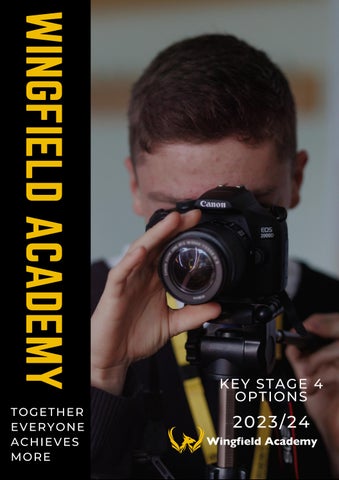
W I N G F I E L D A C A D E M Y

STAGE 4 OPTIONS 2023/24 TOGETHER EVERYONE ACHIEVES MORE

introduction FOR PARENTS AND CARERS

Over the coming weeks you will be making decisions with your child about their choices of subjects to study in years 10 and 11

In this booklet you will find information about the subjects available

There will be a further opportunity to discuss your child’s progress in these subjects at our Options/Progress evening on Thursday 1st February 4.00pm – 7.00pm.

Students will receive advice on how to make their choices in assemblies and through individual guidance interviews with members of the senior leadership team

They should complete their choices on their options google form by Monday 5th February 2024

Starting from Monday 12th February 2024, every student will have an interview with a member of the senior leadership team to discuss their option choices.

If you have any questions, please contact your child’s form tutor, subject teacher or head of year, Mr Lavendar (mla@nclt ac uk) If this does not resolve your query, please feel free to contact me at jon@nclt.ac.uk

MISS J O’NEILL

Deputy Headteacher

KS4 SUBJECTS

Core subjects at Key Stage 4

SUBJECT

Core PE (GCSE PE / BTEC Sport can still be chosen in the options below)

* Students will have 5 lessons in one week and 4 lessons in the next week.

^ Students will have 3 lessons in one week and 2 lessons in the next week

Optional subjects at Key Stage 4

Your choice of subjects here will make up the other periods of the week You will study 3 options subjects

This is the list of subjects you can choose from.

• You must make 3 choices and a 4th back up choice.

• You will submit your choices on the google form by Monday 5th February, 2024

Options 2023-24

SUBJECT

Citizenship

Childcare

Dance

Drama

Engineering

Enterprise and Business

Food and Cookery

Fine Art

iMedia

Music

Photography

IMPORTANT:

Product Design

PE - BTEC Sport

Religious Studies

History/ Geography/ Spanish

You must pick one of these as a core subject, but you can pick another if you would like You should be aware this will require you to be resilient with additional revision and examinations

advice on making Do options choices

Think seriously before making your decisions

Take account of your strengths and importantly, what you enjoy!

Find out as much as you can about what each subject involves

Think about what you would like to do after GCSEs

Do not

Choose a subject because a friend is doing it

Choose a subject because you like your current teacher of that subject

After GCSEs - What are your choices?

Further Education:

You can continue your education either in Sixth Form or at one of the local colleges.

Employment/Training:

You can find a job or more likely a training placement which will prepare you for a certain job.

Whatever route you intend to take, it is important that you end Key Stage 4 with the very best grades you can

The national benchmark is a grade 5 in English and Maths, but it is crucial that you achieve your minimum expected grades

Employers and training providers regard this as an important standard of education. In further education you will need that standard to go on to advanced courses, which can in turn lead to university.

your key stage 4 subject options

fine art

Why should I study Fine Art?

Studying the arts offers you freedom in what you study based around your own interests rather than following prescribed topics You are encouraged to be independent in your decision making and reflect upon your choices

Arts graduates are incredibly employable! Steve Jobs (founder of Apple) believed his success was due to his hiring of artists and musicians who were fascinated by technology

Creativity is now ranked third in the top ten skills desired by employees, moving up from tenth place in 2015.

1 in 8 adults in London work in the creative industries; 1 in 11 in the UK The creative economy has risen by 13 7% since 2011 against an average increase of 2.1% in total jobs in the wider economy

You will learn a range of transferable skills that will be essential in all jobs such as: resilience, creative thinking, independence and observation skills

What will I study?

Component One: Personal portfolio

This is a portfolio of work that shows coverage of the four assessment objectives.

You will be given a title as a starting point, which you then independently research to develop ideas You will discover and mimic artists that influence you and trial and test a variety of techniques from: glass, ceramics, print, paint and pencil. You will develop a personal style, and form opinions about your art and the art of others You will communicate your ideas and intentions through a range of personal experiments and unique creative outcomes

Component Two: Externally set assignment

This is a mini portfolio of work in which you respond to a starting point set by the exam board In the same way as component one, you will cover all four assessment objectives whilst undertaking this creative journey You can create art in the media of your choice exploring new techniques or refining favourites

This project will conclude with you creating a final outcome in a 10-hour formal assessment (over two days)

How will I be assessed?

Component One: Personal portfolio – 60%

Component Two: Externally set assignment – 40%

It is essential that all four Assessment Objectives are met by each unit of work, or project 25% of the marks are available for each Assessment Objective.

Students are assessed on their ability to:

AO1 Develop ideas through investigations, demonstrating critical understanding of sources

AO2 Refine work by exploring ideas, selecting and experimenting with appropriate media, materials, techniques and processes

AO3 Record ideas, observations and insights relevant to intentions as work progresses

AO4 Present a personal and meaningful response that realises intentions and demonstrates understanding of visual language

What skills will I need?

The art GCSE course offers students the opportunity to develop their creative ideas and practical skills in a variety of ways. Painting, drawing, collage, digital art, printmaking, fused glass, ceramics and sculpture are the main specialisms alongside studying the work of other artists The projects are more thematic than at KS3 and allow the students to explore more personal ideas and particular techniques Students are encouraged to work from observation and individual research in order to creatively develop their own ideas using a variety of materials and media – and demonstrate a skilful and sensitive command of techniques

Students will be expected to demonstrate the ability to record ideas, observations, insights and independent judgements visually and through informative written annotation, using suitable specialist vocabulary In order to be successful, a high degree of interest and commitment is more important than having an artistic ability.

Studying art is a favoured route for related careers in the creative industries such as: graphic design, game design, architecture, engineering, interior design, industrial design, product design, theatre design, fashion & textiles, advertising, illustrating, photography and many more

What will happen in learning and ILT?

All lessons will be practical and based in the art rooms Students are expected to do all research tasks at home, in art P6 or in the Learning Resource Centre Occasionally there will be opportunities to work outside the classroom on location based photoshoots, educational visits and outdoor drawing tasks.

All students have a personalised plan, which is updated during 1:1 tutorials Students will be setting their own classwork and ILT, so need to be organised, responsible and proactive

Students are expected to complete a minimum of two hours ILT per week. We recommend this to be undertaken at the weekend when students can spend two consecutive hours on their practical tasks

citizenship

Why should I study Citzenship

Ever thought of becoming a lawyer, a police officer or working in public office? GCSE Citizenship study prepares you to apply critical thinking skills like reasoning, analysis and interpretation, all of which ranked a key skill in the workplace by recruitment giant Indeed You will gain a deeper knowledge of democracy, government, and the law, developing skills to create sustained and reasoned arguments, present various viewpoints and plan practical citizenship actions to benefit society You will also gain the ability to recognise bias, critically evaluate argument, weigh evidence, and look for alternative interpretations and sources of evidence, all of which are essential skills valued by higher education and employers.

What will I study?

The course consists of 3 components:

Life in modern Britain

This looks at the make-up and dynamics of contemporary society, what it means to be British, as well as the role of the media and the United Kingdom’s role on the world stage

Rights and responsibilities

This looks at the nature of laws, rights and responsibilities within the UK It has a global aspect due to the nature of international laws, treaties, and agreements by which the UK abides

Politics and participation

This third theme aims to develop understanding of the political process, the knowledge and skills necessary to understand how to resolve issues, bring about change, and how the empowered citizen is at the heart of our society

Taking Citizenship Action

Alongside studying classroom content, students will be expected to either work alone or with others to carry out an investigation into a citizenship issue based upon any part of the subject content.

How will I be assessed?

You will be externally assessed through two written examinations each lasting 1 hour 45 minutes at the end of the course.

To make sure you are prepared for the exams, assessment will be on-going throughout the course

Regular tests will allow you to practise exam style questions and improve your understanding of the course

What skills will I need?

Analytical and strategic thinking

Debating skills

Research skills

Critical evaluation

Teamwork

Conflict resolution

Problem-solving

Leadership skills

Written communication skills

Enquiry

What will happen in learning and ILT?

GCSE Citizenship lessons will include a variety of different learning activities These include whole class discussion work, debates and community project work. You will be required to work both independently and in groups regularly to contribute your ideas and opinion. You will also partake in written tasks, as well as watching and analysing the media coverage of pivotal news stories through news footage, current affairs podcasts and printed news articles

ILT will be set weekly and include both knowledge retrieval and the application of knowledge and skills If you enjoy debating how the country is run and hot topics in the news, GCSE Citizenship is an excellent option for you!

childcare

Why should I study Childcare?

Childcare at Wingfield is an excellent subject to choose if you aspire to work with young children in the future. This may be in an early years setting such as a nursery, or in any number of roles that require an understanding of child development, such as nursing or social work

Childcare is a course that equips you with study skills that can be incredibly useful in your life after Wingfield, as you will be researching, writing and referencing at a college level

What will I study?

This course is made up of a none examined assessment (NEA), which you will study for throughout Year 10 and complete in Year 11 The tasks you are given are professional tasks that you would be expected to carry out if you worked in an early year’s setting such as activity planning and risk assessments

You will cover content on the role of an early year’s practitioner, the development of children aged 0-5, transitions that children may experience and factors that can affect their learning and development.

How will I be assessed?

The overall course is assessed by 50% exam and 50% nonexamined assessment (NEA) The NEA is marked internally

The exam is marked externally, you will sit one paper that is an hour and a half long in the summer exam series of Y11

The exam is worth 50% of the final grade.

What skills will I need?

Writing is a key skill in childcare, NEA and a written exam there is a lot of extended writing involved in the course and so you must be proficient and willing to write independently for extended periods of time.

The main skill required for this subject is the ability to research well You must be able to research and write independently during lessons

A good understanding of ICT is needed as you will be using Google Documents and different search engines to find information

What will happen in learning and ILT?

Lessons are all computer based and you will spend a large percentage your time researching and learning content for your NEA and exam

During work experience at the end of year 10, we prioritise childcare students to have a placement in an early year’s setting to gain experience ILT is set once every two weeks on Google Classroom, and it is often exam based to give you experience answering exam style questions.

dance

Why should I study Dance?

Dancing promotes a positive physical and mental health lifestyle Dancing helps boost your self-esteem, social skills and general well-being. In dance confidence is key when taking to the stage therefore embedding it into your everyday life

Possible career opportunities; Professional performer, choreographer, dance instructor, movement therapist, artistic director and many more

What will I study?

Component 1: Exploring the Performing Arts

You will develop your understanding of performing arts by examining work of performing arts professionals and the processes used to created performance

Component 2: Developing skills and techniques in the Performing Arts

You will develop your performing arts skills and techniques through the reproduction of dance repertoire as a dancer.

Component 3: Responding to a brief

You will work as part of a group to contribute to a workshop performance responding to a brief and stimulus.

How will I be assessed?

Component 1: Exploring the Performing Arts

(30% of overall grade)

This is assessed through practical and theory coursework

Practical: Stylistic workshops (Recorded)

Theory: Portfolio (Evaluating practical workshop and professional works, both off and onstage job roles)

Component 2: Developing skills and techniques in the Performing Arts

(30% of overall grade)

This is assessed through practical and theory coursework.

Practical: rehearsal and performance assessment in front of a live audience

Theory: Written rehearsal logs

Component 3: Responding to a brief (40% of overall grade)

This is assessed through written and practical exams

Written exam 1: Initial Ideas Log (1 hour)

Written exam 2: Rehearsal Log (1 hour)

Practical Exam: Devised Performance in front of a live audience

Written exam 3: Evaluation Log (1 hour)

Written notes can be taken into the exam.

What skills will I need?

Collaboration and team skills

Confidence and creativity

Dedication and reliability

Desire to improve physical technique

Enthusiasm and passion for dance

Interest in gaining/ developing knowledge of professional dance works

Self-reflection and evaluation (Verbal and written)

What will happen in learning and ILT?

Lessons will be a mix of practical and theory lessons

Practical lessons – these are physically active lessons where you will participate in teacher/ student led workshops, rehearse performances and regularly perform with evidence being collated.

Theory lessons - All theory lessons and written exams are computer based; completing research tasks, coursework assignments and exam preparation.

ILT will be set regularly, including task such as creating choreography, practising choreography, completing research and evaluation tasks alongside completing coursework assignments

drama

Why should I study Drama?

Drama promotes a variety of skills; collaboration, confidence, emotive expression and the ability to solve problems are all but a few.

Drama stimulates the imagination and creativity; it develops a better understanding of human behaviour and empathy with situations that might seem distant. That is what you get from working in a drama studio

Possible career opportunities include Professional performer, Director, drama, Musical Theatre Performer, teacher/ instructor, Drama/ play therapist, Artistic director and many more…

What will I study?

Component 1: Exploring the Performing Arts You will develop your understanding of performing arts by examining work of performing arts professionals and the processes used to created performance.

Component 2: Developing skills and techniques in the Performing Arts: You will develop your performing arts skills and techniques through the reproduction of drama repertoire (Drama/Musical Theatre)as an actor/ performer.

Component 3: Responding to a brief:You will work as part of a group to contribute to a workshop performance responding to a brief and stimulus.

How will I be assessed?

Component 1: Exploring the Performing Arts (30% of overall grade)

This is assessed through practical and theory coursework.

Practical: Stylistic workshops (Recorded) Theory: Portfolio (Evaluating practical workshop and professional works, both off and onstage job roles)

Component 2: Developing skills and techniques in the Performing Arts

(30% of overall grade)

This is assessed through practical and theory coursework.

Practical: rehearsal and performance assessment in front of a live audience Theory: Written rehearsal logs

Component 3: Responding to a brief (40% of overall grade)

This is assessed through written and practical exams

Written exam 1: Initial Ideas Log (1 hour)

Written exam 2: Rehearsal Log (1 hour)

Practical Exam: Devised Performance in front of a live audience

Written exam 3: Evaluation Log (1 hour)

Written notes can be taken into the exam.

What skills will I need?

Collaboration and team skills

Confidence and creativity

Dedication and reliability

Desire to improve acting technique

Enthusiasm and passion for the arts

Interest in gaining/ developing knowledge of professional performance works

Self-reflection and evaluation (Verbal and written)

What will happen in learning and ILT?

Lessons will be a mix of practical and theory lessons

2 hours practical – these are physically active lessons where you will participate in teacher/ student led workshops, rehearse performances (scripted and devised) and regularly perform with evidence being collated Every lesson is assessed towards your final overall grade.

1 hour theory – All theory lessons and written exams are computer based; completing research tasks, coursework assignments and exam preparation.

ILT- This will be set regularly, including task such as; learning scripts, practising performances, completing research and evaluation tasks alongside completing coursework assignments

engineering

Why should I study Engineering?

The disciplines that a learner will study within the qualification include: mechanical, electrical and electronic, aerospace, communications, chemical, civil, automotive, biomedical, software

Learners could progress to a wide range of apprenticeships, A level courses in Maths, Science, Engineering and Technology or a variety of Diplomas in Engineering. This qualification will also prepare learners for recruitment into the armed forces in the Army, Royal Air Force or the Royal Navy

What will I study?

The study of engineering is the application of maths and science to solve real world problems This involves an understanding of the different disciplines of engineering and how they have shaped the products and projects of the modern world You will also learn about engineers such as Henry Ford and Alexander Bell Learners will be able to read technical drawings, select appropriate materials along with tools and machinery, and know how to carry out a practical task, working in a safe manner in line with current health and safety legislation

How will I be assessed?

Written Exam Paper - 1 hour 30 minutes

40% of the final grade

The written paper will include: multiple-choice questions, a varying number of short-answer questions, three 9mark extended response questions, equations, SI units

Synoptic Brief - 22 hours

60% of the final grade

Synoptic assessment enables learners to show that they can transfer knowledge and skills learnt in one context to resolve problems raised in another by designing and making a product This will consist of a portfolio of research and engineering drawings (done by hand and on AutoCAD) and the product that has been made Each year a different brief will be issued by the exam board, this has previously been tool box, bird box and a dump truck

What skills will I need?

Drawing skills

Making skills

CAD skills

Mathematic and Scientific principles

Problem

Solving skills

What will happen in learning and ILT?

Lesson time will consist of one practical lesson and four fun and engaging theory lessons every two weeks

There will also be a number of trips and workshops that will enhance learning and provide future opportunities.

ILT- Students will be expected to complete 1-2 lessons per week in the learner workbook and 30 minutes practice using the revision cards. A parent/guardian’s signature will be required to confirm this has been done

Scientists investigate that which already is. Engineers create that which has never been.

Albert Einstein

FOOD FOOD AND COOKERY

Why should I study Food?

Studying Level 1/2 Technical Award in Food and Cookery will give pupils the fundamental skills and knowledge they’ll need to prepare for a career in the hospitality and catering sector This qualification covers key subject areas, from food health and safety and information on key food groups and key nutrients, to recipe development, amendment and evaluation.

Upon completion of this course, students will be qualified to go on to further study such as a T level in catering, Level 3 applied certificate/Diploma in Food Science and Nutrition. Apprenticeships as a production chef, commis chef or chef de partie

What will I study?

1. Health and safety relating to food, nutrition and the cooking environment

2. Food legislation and food provenance

3 Food groups, key nutrients and a balanced diet

4. Factors affecting food choice

5 Food prep, cooking skills and techniques

6. Recipe amendment, development and evaluation

7 Menu and action planning for completed dishes

How will I be assessed?

WrittenPaper-1hour30minutes

40% of the final grade

The written paper will include: Multiple choice questions, short answer questions and extended response questions (80 marks).

Non-ExamAssessment

60% of the final grade

Students' knowledge, skills and understanding in relation to the planning, preparation, cooking, presentation of food and application of nutrition related to the chosen task

What skills will I need?

Writing skills

Understanding recipe adaptations

Interest in diet and nutrition

Problem solving

Professional behaviour

Organisational and planning skills

What will happen in learning and ILT?

Lessons will include a wide variety of theory lessons that cover all 7 content areas You will need to make sure you are organised and prepared for the practical lessons

There will be 1-2 practical lessons each term

Independent Learning Tasks will be set weekly and will reflect the learning that has taken place during each week of study

geography

Why should I study Geography ?

Geography is the study of the world in which we live, important in itself to know and understand. Geography will help you better understand the world’s people, places and environments from the local to the global scales. It helps you connect places and make well considered decisions as a global citizen.

With rising numbers of students studying this subject, and geography graduates experiencing some of the lowest levels of graduate unemployment, there has never been a better time to study geography

Additionally, geographical skills such as decision making and investigating are key in preparing for 21st century living and working.

What will I study?

he Physical content includes Weather Hazards and Climate change, Ecosystems and Biodiversity and River/Coastal landscapes. This content allows you to understand key processes which affect our day to day weather, the fauna in our gardens and the reasons for natural disasters such as droughts, hurricanes and floods Many of these core concepts have been covered in Y9

Changing cities, Global development and Resources and Energy are all included in the Human paper. These allow is to develop an understanding of the inequality in society around wealth, resources and jobs. All features key to 21st century living

Paper 3 is based on Fieldwork skills and understanding the geographical challenges of the UK such as migration, climate change and transport There are 2 fieldwork trips where you practice data collection and geographical concepts in real life

How will I be assessed?

The course consists of 3 exam papers with no coursework element anymore. The skills we work on during the 2 fieldwork trips will be assessed in paper 3:

The Physical Environment

37 5% - 1hr 30mins

The Human Environment

37.5% - 1hr 30mins

Geographical Investigations: Fieldwork and UK Challenges

25% - 1hr 30mins

What skills will I need?

Geography is based around the skills of geographical investigation, using this information and data to be able to write in detail and in a balanced manner to form geographical decision and learning.

We expect you to be focussed, resilient and well considered in your learning and geographical decisions

What will happen in learning and ILT?

Lessons are based around a key idea or concept in geography with tasks such as data analysis, explanation of patterns, understanding viewpoints and developing problem solving solutions.

We use ICT, recent documentaries and clips alongside tasks such as discussions, decision making and investigation to understand the content

Y10 ILT is currently an online retrieval quiz based on previous content or exam application. During Y11 you will be expected to complete retrieval alongside an additional task such as revision, wider reading and example exam application

health & SOCIAL CARE

Why should I study Health and Social Care?

If you have a passion for helping people and wanting to make a difference to their lives then Health and Social Care will provide you with the knowledge and understanding to take on further study and work or train in careers such as:

• Registered care homes

• Social work

• Hospital and primary care trusts

• Nursing homes

• Health centres

A BTEC Tech Award prepares you for employment and provides a good grounding to go onto a more advanced course such as BTEC Level 3 National Extended Certificate/Diploma in Health & Social Care

What will I study?

Component 1 – Human Lifespan Development

You will look at how people grow and develop from birth up until the end of their life. You will study the impact of different factors such as relationships and lifestyle factors on growth and development. You will then study how different life events such as parenthood and bereavement may impact on growth and development and how support and personality traits can help them to adapt to these life events

Component 2 – Health and Social Care Services and Values

You will study how different service providers and social care services meet the needs of services users. You will look at the types of barriers which may prevent a service user from accessing a service. You will find out about the different skills, attributes and values which are important in the health and social care profession.

Component 3 – Health and Wellbeing

You will look at the factors that can have a positive or negative influence on a person’s health and wellbeing You will learn to interpret physiological and lifestyle indicators, and what they mean for someone’s state of health You will develop the knowledge and understanding of how this information is used to recommend appropriate actions for improving a person’s health and wellbeing. You will also explore the difficulties an individual may face when trying to make these changes.

How will I be assessed?

Component 1 is assessed by an internally assessed and externally moderated assignment, consisting of 3 tasks which is set by the exam board This involves extended amounts of time typing up your work on a computer.

Component 2 is assessed by one internally assessed and externally moderated assignment, consisting of five tasks This involves extended amounts of time typing up your work on a computer

Your internally assessed assignments are worth 60% of your overall grade

Component 3 is an externally assessed exam lasting two hours. This exam paper is marked out of 60 and includes extended written answers This is worth 40% of your overall grade.

What skills will I need?

What are the things that will make me successful in this subject?

You will need the ability:

Get involved in group discussions

Self manage

Meet deadlines

Organise your time

Work independently

You will need an interest in health and social care

What will happen in learning and ILT?

Theory lessons for the internally assessed components will: Introduce you to the content of each task for the Pearson Set Assignments (PSA’s)

Allow you to gain knowledge understanding of the component content

ILT is an expectation to support planning and completion of each Learning Aim

The exam component will involve regular practice of exam papers, particularly for ILT

You will be expected to attend a period 6 session for Health and Social Care.

HISTORY

Why should I study History ?

Studying history helps us to understand the world around us, how the past has shaped global and national events and relationships and how this can link to our lives today. It explains the way that people and communities interact with each other even today!

History is seen as being a challenging topic and provides evidence of complex thinking and analytical skills which many employers want Even if you do not wish to work in education, law, politics or the heritage and tourism industry, History is a very desirable GCSE to have

What will I study?

Conflict and Tension 1918-1939

Britain, Health and the People Medieval to Modern

Germany Democracy and Dictatorship 1890- 1945

Elizabethan England 1568-1603

How will I be assessed?

No coursework

Four exam papers, one hour each paper

25% per paper

A mixture of sources questions, a few short answer questions, mainly essay answers, marks available for spelling grammar and punctuation

Examples:

Describe two ways the Wall Street crash of 1929 affected Germany

Explain the significance of Hippocrates in medieval medicine.

What skills will I need?

You will need to be willing to read and write

You should have an analytical enquiring mind and an interest in why things happen

A good memory is an advantage as detail is important

Being able to give an opinion on a subject is essential to reach the top levels.

What will happen in learning and ILT?

Lessons are heavily based around literacy skills. We will do lots of reading and writing We will learn about events and people, remember and link them together. Analyse how one event leads to another and what is the most important factor in creating change. We will regularly use textbooks and some videos to help discover information In your exercise book you will answer exam style questions and in your topic booklet you will make notes which you can revise from.

ILT is every week and it is an online SENECA quiz to build topic knowledge and an exam question to practice exam skills

imedia

Why should I study iMedia ?

This qualification will encourage independence, creativity and awareness of the digital media sector. It is designed to assess your application of creative media skills through their practical use. This involves web design, game design, app development and creating digital images using Photoshop It will provide you with essential knowledge, transferable skills and tools to improve your learning in other subjects with the aims of enhancing your employability when you leave education Future careers could include Animator, Computer programmer, Graphics designer, Web developer, Digital video technician, Audio digital technician plus many more

What will I study?

R093 Creative iMedia in the media industry

R094 Visual identity and digital graphics

R097 Interactive digital media

R099 Digital games

How will I be assessed?

Exam Unit - (Worth 40%)

R093 is an exam unit completed on paper The exam lasts for 1 hour 15 minutes

Coursework - (Worth 60%)

R094, R097 and R099 are coursework based All work is submitted to Google classroom.

What skills will I need?

Students who are interested in taking this course should have followed the Key Stage 3 Programme of Study in Computing

You will need to have a hands on approach to learning with a creative mind that will enable you to create fully functioning digital media products Also good literacy skills and enjoy problem solving as well as the ability to stick to deadlines and targets.

What will happen in learning and ILT?

Planning is an essential part of working in the creative and digital media sector You will hand draw some of the key documents needed to create digital media products and gain an understanding of their application

The majority of work is completed on the computer using specialist software You will research and prepare reports on the use of digital graphics in industry. You will learn Photoshop to digitally edit graphics for the creative and digital media sector. We also hold competitions to create fun graphics such as editing an image of yourself to fit a theme e.g. Halloween. You will also have the opportunity to take part in national competitions gaining certificates relevant to Computing.

You will learn how to use Dreamweaver web creation software to combine components to create a functional, intuitive and aesthetically pleasing website. At the same time, you will create some of the website using HTML coding language

Interactive multimedia products are used widely in everyday life and the creative and digital media sector. You will learn where and why interactive multimedia is used and what features are needed for a given purpose. ILT will be set every two weeks and will be designed to reinforce key skills learnt during lesson time.

Enterprise and marketing (Business Studies)

Why should I study Enterprise and Marketing?

Studying Cambridge National in Enterprise and Marketing equips individuals with essential skills for the dynamic world of business. This specialized course offers a practical understanding of entrepreneurial concepts, marketing strategies, and business operations. By delving into realworld case studies, students gain insights into effective decision-making, customer engagement, and the fundamental principles of successful enterprises

The Cambridge National in Enterprise and Marketing not only fosters a strong foundation for future business endeavours but also nurtures a mindset focused on innovation, adaptability, and strategic thinking in the everevolving landscape of commerce

What will happen in learning and ILT?

What

will I study?

R067: Enterprise and marketing concepts

R068: Design a business proposal

R069: Market and pitch a business proposal

How will I be assessed?

Exam - (Worth 40%)

R067 is a written exam paper that is set and marked by OCR. The paper is 1 hr 15min long.

Coursework - (Worth 60%)

R068 and R069 are both centre-assessed tasks

Completed over roughly 36 hours of lesson time.

What skills will I need?

Students who are interested in taking this course should have followed the Key Stage 3 Programme of Study in Computing

Success in this course requires strong communication, critical thinking, and problem-solving skills Additionally, creativity, and a keen interest in business concepts are crucial for navigating the coursework effectively and preparing for success in the dynamic field of enterprise and marketing.

Planning is an essential part of working in the business and enterprise sector You will hand draw some of the key documents needed to design parts of your business proposal and pitch

The majority of work is completed on the computer using Google Classroom You will research and prepare reports on different markets in the industry. We also Conduct research including other peers and students to gather data, e g Icecream taste testing.

You will also study the economics involved with starting and maintaining a business, being introduced to concepts such as viability, revenue and profit.

You will come to an understanding around the psychology of popular business strategies such as strategic pricing Your knowledge will be contextualised with real-world examples of businesses that have used the concepts that you will learn of to their advantage and become success stories

ILT will be set every two weeks and will be designed to reinforce key skills learnt during lesson time, this will form part of your revision of theory topics throughout the course.

MUSIC

Why should I study Music ?

Music is a form of self-expression Studying music boosts self-esteem and helps develop self-confidence It helps to relieve stress and has a positive effect on mood and mental health. Studying music provides transferable skills such as self-management, creativity, teamwork, problemsolving, and communication skills. These are all skills which colleges, universities and perspective employers look out for!

Possible career opportunities include: Performer, sound engineer, social media manager, event’s organiser, music producer, song writer, music teacher, music therapist, club promoter and many more

What will I study?

Component 1: Exploring Music Products and Styles

You will explore the techniques used in the creation of different musical products and investigate the key features of different musical styles

Component 2: Music Skills Development

As a performer you will develop two musical disciplines through practical activities, while documenting your progress and planning for further development.

Component 3: Responding to a Music brief

You will be given the opportunity to develop and present music in response to a given music brief.

How will I be assessed?

Component 1: Exploring Music Products and Styles (30% of overall grade)

This will be assessed via coursework.

Task 1: Portfolio (Understanding of 4 different styles connected to a theme)

Task 2: Music products (3 30-60seconds examples related to a theme)- DAW Project, Composition and Performance

Component 2: Music Skills Development (30% of overall grade)

This will be assessed via coursework Portfolio: Rehearsal evidence with explanations and two musical outcomes

Component 3: Responding to a brief (40% of overall grade)

This will be assessed via external exam

Activity 1: Initial response to a Music Brief (2 hour)

Activity 2: Create a music product (16 hours)

Activity 3: Individual commentary on the creative process (1 hour)

Written notes can be taken into the exam

What skills will I need?

You need to enjoy performing and have enthusiasm for music!

You need to be well-motivated, dedicated, determined and resilient

You need to be confident enough to perform in front of others

You need to be creative and be able to work and rehearse as part of a group and on your own.

You need self-discipline and good time management.

What will happen in learning and ILT?

Lessons will be split between practical and theory

2 hours (Practical) – Practicing your instrument independently and in a group.

1hour (Theory) - computer-based research tasks on different musical genres to prepare for component 1

ILT- Practicing your pieces at home and completing research and evaluation tasks alongside completing coursework

photography

Why should I study Photography ?

Studying the arts offers you freedom in what you study based around your own interests rather than following prescribed topics.

You are encouraged to be independent in your decision making and reflect upon your choices

Arts graduates are incredibly employable! Steve Jobs (founder of Apple) believed his success was due to his hiring of artists and designers who were fascinated by technology.

Creativity is now ranked third in the top ten skills desired by employees, moving up from tenth place in 2015 1 in 8 adults in London work in the creative industries; 1 in 11 in the UK The creative economy has risen by 13 7% since 2011 against an average increase of 2 1% in total jobs in the wider economy.

You will learn a range of transferable skills that will be essential in all jobs such as: resilience, creative thinking, independence and observation skills.

What will I study?

Component One: Personal

portfolio

This is a portfolio of work that shows coverage of the four assessment objectives

You will be given a title as a starting point, which you then independently research to develop ideas. You will discover and mimic photographers that influence you and trial and test a variety of techniques from light painting, moving image, digital image manipulation, practical image manipulation, contemporary and traditional photography techniques. You will develop a personal style, and form opinions about your work and the work of others This project will conclude with you creating a final outcome in a 10-hour formal assessment (over two days)

Component Two: Externally set assignment

This is a mini portfolio of work in which you respond to a starting point set by the exam board In the same way as component one, you will cover all four assessment objectives whilst undertaking this creative journey You can create work in the media of your choice exploring new techniques or refining favourites

How will I be assessed?

Component One: Personal portfolio – 60%

Component Two: Externally set assignment – 40%

It is essential that all four Assessment Objectives are met by each unit of work, or project. 25% of the marks are available for each Assessment Objective

Students are assessed on their ability to:

AO1 Develop ideas through investigations, demonstrating critical understanding of sources

AO2 Refine work by exploring ideas, selecting and experimenting with appropriate media, materials, techniques and processes

AO3 Record ideas, observations and insights relevant to intentions as work progresses

AO4 Present a personal and meaningful response that realises intentions and demonstrates understanding of visual language

What skills will I need?

The art GCSE course offers students the opportunity to develop their creative ideas and practical skills in a variety of ways. Students will explore a range of photographic styles and techniques inspired by both historical and contemporary photography. Students will learn a range of practical skills such as special effects and also explore digital media. The projects are more thematic than at KS3 and allow the students to explore their own personal ideas and specialisms of their choice. Students are encouraged to work from observation and individual research in order to creatively develop their own ideas using a variety of practices and media – and demonstrate a skilful and sensitive command of techniques

Students will be expected to demonstrate the ability to record ideas, observations, insights and independent judgements visually and through informative written annotation, using suitable specialist vocabulary. The purpose of integrated written annotation is to encourage students to analyse critically, evaluate and reflect on their own work (and that of others )

In order to be successful, a high degree of interest and commitment is more important than having an artistic ability.

What will happen in learning and ILT?

Lessons- In lessons students will complete research tasks, learn editing techniques, complete photoshoots and present work on digital portfolios Students are expected to complete photoshoots both in and outside of learning as part of their projects

There will be opportunities to work outside the classroom on location based photoshoots and educational visits

As projects develop, students will have a personalised plan which is updated during 1:1 tutorials. Students must keep up with tasks and ILT must always be completed as this is actual coursework; so students need to be organised, responsible and proactive

ILT- Students are expected to complete a minimum of two hours ILT per week. We recommend this to be undertaken at the weekend when students can spend two consecutive hours on their practical tasks

pe BTEC SPORT

Why should I study PE?

This course will allow you to experience different sporting situations and develop a wide range of sport analysis and leadership skills, gaining new theoretical knowledge linked to health and fitness You will explore different types of participants and types of providers of sport and physical activity, looking at technology and equipment available for participation.

This course can lead to a wide variety of different careers, such as:

A sports performer/official

Sports coaching/ teaching

Sports scientist

Personal trainer/Army PTI

Physiotherapist/Sports team doctor/ Sports Psychologist

What will I study?

This course is made up of 3 Components.

Component 1: Preparing participants to take part in sport and physical activity

Component 2: Taking part and improving other participants sporting performance

Component 3: Developing fitness to improve other participants performance in sport and physical activity

How will I be assessed?

Component 1 and 2:

Internally assessed by your teacher and externally moderated

Worth 30% of overall grade each Each Component is made up of 3 Learning Tasks/Aims ranging from: Presentations

Practical Tasks-Video/picture evidence

Extended writing pieces

Component 3: Exam unit

Externally assessed written exam

1hr 30mins

60 marks

Worth 40% of overall grade

What skills will I need?

Good levels of performance in range of sport and leadership roles

A keen interest in health and fitness

Attendance at extra-curricular clubs/teams

Be able to work effectively independently and as a member of a team

Be able to meet deadlines

Confidence

Good communication skills

What will happen in learning and ILT?

Your lessons will be divided into theory and practical lessons

Theory lessons will:

Introduce you to the content of each learning aim

Allow you to gain knowledge understanding of unit content

Present your learning to support your practical performance

Mostly delivered in IT rooms

Practical lessons will:

Develop key practical skills to support each learning aim

Allow you to practically demonstrate your learning and provide evidence to support internal assessment

ILT is an expectation to support planning and completion of each Learning Aim

product design

Why should I study Product Design?

Studying the arts offers you freedom in what you study based around your own interests rather than following prescribed topics.

You are encouraged to be independent in your decision making and reflect upon your choices

Design graduates are incredibly employable! Steve Jobs (founder of Apple) believed his success was due to his hiring of artists and designers who were fascinated by technology

Creativity is now ranked third in the top ten skills desired by employees, moving up from tenth place in 2015. 1 in 8 adults in London work in the creative industries; 1 in 11 in the UK. The creative economy has risen by 13.7% since 2011 against an average increase of 2 1% in total jobs in the wider economy.

You will learn a range of transferable skills that will be essential in all jobs such as: resilience, creative thinking, independence and observation skills.

What will I study?

Component One: Personal portfolio

This is a portfolio of work that shows coverage of the four assessment objectives.

You will be given a title as a starting point, which you then independently research to develop ideas You will discover and mimic designers that influence you and trial and test a variety of techniques from casting, wood crafts, Glass, ceramics and wire sculpture You will develop a personal style, and form opinions about your work and the work of others You will communicate your ideas and intentions through a range of personal experiments and unique creative outcomes

Component Two: Externally set assignment

This is a mini portfolio of work in which you respond to a starting point set by the exam board In the same way as component one, you will cover all four assessment objectives whilst undertaking this creative journey You can create work in the media of your choice exploring new techniques or refining favourites

This project will conclude with you creating a final product in a 10-hour formal assessment (over two days)

How will I be assessed?

Component One: Personal portfolio – 60%

Component Two: Externally set assignment – 40%

It is essential that all four Assessment Objectives are met by each unit of work, or project. 25% of the marks are available for each Assessment Objective

Students are assessed on their ability to:

AO1 Develop ideas through investigations, demonstrating critical understanding of sources

AO2 Refine work by exploring ideas, selecting and experimenting with appropriate media, materials, techniques and processes

AO3 Record ideas, observations and insights relevant to intentions as work progresses

AO4 Present a personal and meaningful response that realises intentions and demonstrates understanding of visual language.

What skills will I need?

The 3D product design GCSE course offers students the opportunity to develop their creative ideas and practical skills in a variety of ways Wood work, metal work, casting and digital design are the main specialisms alongside studying the work of other designers. The projects are more thematic than at KS3 and allow the students to explore more personal ideas and particular techniques. Students are encouraged to work from observation and individual research in order to creatively develop their own ideas using a variety of materials and media – and demonstrate a skilful and sensitive command of techniques

Students will be expected to demonstrate the ability to record ideas, observations, insights and independent judgements visually and through informative written annotation, using suitable specialist vocabulary

The purpose of integrated written annotation is to encourage students to analyse critically, evaluate and reflect on their own work (and that of others )

In order to be successful, a high degree of interest and commitment is more important than having an artistic ability

What will happen in learning and ILT?

Lessons- All lessons will be practical and based in the technology rooms Students are expected to do all research tasks at home, in 3D art P6 or in the Learning Resource Centre

Occasionally there will be opportunities to work outside the classroom on location-based photoshoots and educational visits

All students have a personalised plan, which is updated during their 1:1 tutorial. Students will be setting their own classwork and ILT; so, need to be organised, responsible and proactive.

ILT- Students are expected to complete a minimum of two hours ILT per week We recommend this to be undertaken at the weekend when students can spend two consecutive hours on their practical tasks

Why should I study RE?

Google will tell us the answers to many of life’s questions

BUT Google won’t tell us the answers to life’s BIG questions. You’ll have to study GCSE Religious Studies for this!

Issues of religion and belief often top the news agenda

Religious Studies allows you to consider the views and opinions of others different from your own and disagree respectfully. It provides space for you to develop your own ideas and develop your own thoughts It will equip you to handle issues in your own life and prepare you for your future workplace and adult life

A knowledge of other cultures and world religious beliefs can be useful in many jobs where you are working with the public or communities Many employers value GCSE Religious Studies because it shows you are good at understanding the views of others.

What will I study?

The course consists of 3 components:

Religious, Philosophical and Ethical Studies in the Modern World

You will study the four following themes:

Theme 1: Relationships

Theme 2: Life and Death

Theme 3: Good and Evil

Theme 4: Human Rights

Study of Christianity

You will study the beliefs, teachings and practices of Christianity.

Study of a World Faith

How will I be assessed?

You will study the beliefs, teachings and practices of Islam. At the end of Year 11, you will sit three examinations, one for each of the three components as follows:

Religious, Philosophical and Ethical Studies in the Modern World

You will sit one 2 hour written examination accounting for 50% of your final qualification

Study of Christianity

You will sit one 1 hour written examination accounting for 25% of your final qualification

Study of Islam

You will sit one 1 hour written examination accounting for 25% of your final qualification

What skills will I need?

Analytical and strategic thinking

Debating skills

Research skills

Critical evaluation

Teamwork

Conflict resolution

Problem-solving

Leadership skills

Empathy

Negotiation

Written communication skills

What will happen in learning and ILT?

GCSE Religious Studies lessons will contain a variety of different learning activities However, a major focus will be on discussion work. You will be required to work in groups and regularly contribute your ideas and opinions to class debate You will also partake in written tasks and watching and analysing the media ILT will be set weekly and include both knowledge retrieval and the application of knowledge and skills. If you enjoy class discussion and possess good, clear written communication skills GCSE Religious Studies is an excellent option choice for you!

Spanish

Why should I study Spanish?

Besides making you a more attractive candidate to universities and employers, a second language opens doors to worldwide travel and communication The study of a foreign language will help if you are considering the following careers:

• Journalist / Foreign Correspondent

• Air Cabin Crew

• Tour Guide

• MFL teacher / ESOL teacher

• Interpreter

• Translator

• HR Officer

• Logistics/Distribution Manager

• Marketing Manager (social media)

• Charities Administrator

• Investment Analyst

• Lawyer

• Advertising / Marketing

• Publishing & Media

What

will I study?

The Spanish GCSE course is made of 3 themes: People and lifestyle (identity and relationships with others, healthy living and lifestyle, education and work)

Popular culture (free time activities, customs, festivals and celebrations, celebrity culture)

Communication and the world around us (travel and tourism including places of interest, media and technology, environment and where people live)

How will I be assessed?

What skills will I need?

If you have any of these qualities, then Spanish is for you!

Active listener

Confident communicator

Meticulous reader and writer

Curious about Spanish speaking countries way of life and language

What will happen in learning and ILT?

In lessons, we will cover all four skills through reading, writing, listening and speaking practice tasks You will be expected to take part in speaking pair work activities

ILT will be set weekly through a vocab quiz on google classroom and an application task on the Seneca learning website

Turn static files into dynamic content formats.
Create a flipbook
Issuu converts static files into: digital portfolios, online yearbooks, online catalogs, digital photo albums and more. Sign up and create your flipbook.