Association with

A magnet for bright minds from all around the world


Association with
A magnet for bright minds from all around the world
James
Howes on Launching Procurement at BrainRocket

When James Howes stepped into BrainRocket as Director of Procurement, there was no playbook, no legacy system, just a high growth tech company moving fast and building big. With a career spanning industries from FMCG and Financial Services to Energy and Real Estate, James brings a refreshingly pragmatic mindset to the table: procurement should accelerate progress, not slow it down. In this candid and insightful interview, he shares what it takes to build a procurement function from the ground up, balancing technology with people skills, structure with flexibility, and speed with smart decision making. From machine led negotiations to the power of trust and tone, James offers a clear eyed view of what procurement can, and should, look like in a modern, fast paced business.
Can you share your career journey and what led you to your current role as Director of Procurement at BrainRocket? What key experiences have shaped your approach to procurement?
I fell into it, really. I earned a place on an ultra competitive graduate scheme at A.P. Moller-Maersk and did a placement in procurement toward the end. From there, I moved to Sweden and then Denmark, sharpening the skills I’d picked up. Later, I returned to the UK and leaned into one of procurement’s best traits, its massive transferability.
I pivoted into Financial Services, then FMCG, broadening my category exposure, and then spent a decade as an independent contractor across Financial Services, FMCG, Energy, Telecoms, Consulting, Real Estate, and Payments. I’d been eyeing a departure from the UK for a couple of years, which came to fruition with my move to BrainRocket.
Now, I’m building the procurement function from scratch, something I’m excited about, not just because of the challenge, but because it brings together everything I’ve learned so far in a truly dynamic environment.
“People buy from people, and they’ll go the extra mile for someone they like and respect.”
BrainRocket is known for developing innovative software products across various markets. How does the procurement function support the company’s commitment to delivering cutting edge digital solutions?
Speed is everything. Time to market is critical in our industry, and as companies scale, the agility once gained from a lack of structure can become a liability. That’s where Procurement comes in, securing great deals, reducing risk, and ensuring high quality service delivery from suppliers, while still moving fast.
I often recall Einstein’s quote: “Things should be made as simple as possible, but no simpler.” That mindset guides me as I build this function. Procurement here isn’t about control for its own sake, it’s about enabling progress without friction. Decision making is pragmatic, and bureaucracy is the enemy.
I’ve worked in huge enterprises before, and while they often had impressive systems, they also had layers of unnecessary process. At BrainRocket, I’m deliberately designing something leaner, sharper, and more responsive.
You’ve joined BrainRocket at a time when no procurement function exists. What are your first priorities, and how do you begin building structure without slowing down the business?
Henry Ford used to take executive candidates to lunch as a final test. He’d watch discreetly to see if they salted their food before tasting it. If they did, they didn’t get the job. Why? Because he believed one shouldn’t make decisions without first understanding the situation. I share that belief.
At BrainRocket, my first priority has been to observe—how things are bought today, where the pain points are, and what stakeholders need. Only once I’ve “tasted the food” do I begin to introduce structure.
That said, the day to day still needs handling, contracts must be negotiated and signed, and work can’t stop while the function is being built. So it’s not passive. It’s responsive, adaptive, and grounded in what the business needs now, not what a textbook might say procurement should look like. This isn’t about bringing in a pre-packaged solution, it’s about building the right solution for BrainRocket, and meeting the company and its stakeholders where they’re currently at.

In past roles and in this new role, what strategies do you use to build strong, transparent relationships with suppliers, and how do you ensure suppliers consistently meet the high standards required for quality?
I treat suppliers as people, not businesses. I make time for small talk and build rapport on a personal level, which helps create trust. I’m also transparent, I run fair processes, but I’m not overly rigid about communication protocols. I don’t believe in creating artificial barriers between suppliers, stakeholders, and my team. Removing myself as a bottleneck not only accelerates the process, but fosters stronger cross functional relationships.
People buy from people, and they’ll go the extra mile for someone they like and respect. That human connection has helped me navigate plenty of tough spots over the years.
As we grow, I’ll introduce more formal Supplier Relationship Management, but not the kind filled with unnecessary meetings for meetings’ sake. It’ll be focused instead on innovation, problem solving, and proactive engagement. Relationships are an asset, especially when things go wrong. And they always go wrong eventually. The question is: will your supplier care enough to help you fix it?


How is BrainRocket leveraging digital technology to enhance procurement operations, and what recent advancements have had the most significant impact on efficiency and transparency?
The biggest challenge I’ve identified is a lack of visibility into the procurement process. Stakeholders often don’t know what to do, who approves what, or what information is needed. Most legacy ERP based systems have very poor UX and, as a result, very low adoption rates. There’s a reason every company that uses them has to rigidly enforce compliance, with varying success. These tools often overlook the upfront workflow, the ‘orchestration’ of getting something from initial request to a signed contract which, to me, misses the point entirely.
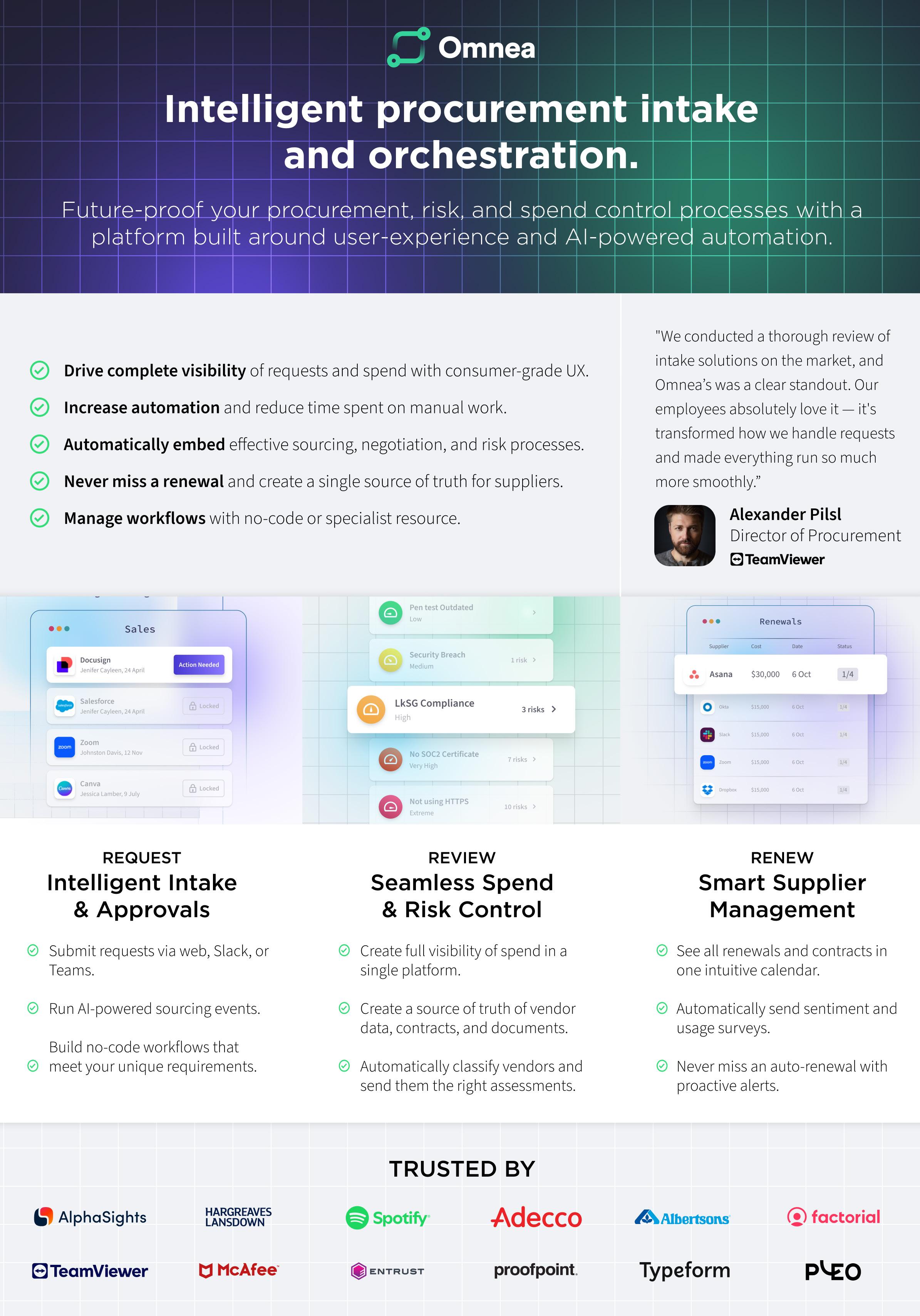
In this respect, tools like Omnea are changing the game. They focus on intake and intelligent procurement workflow, making the process intuitive for requesters, approvers, and the procurement team. This encourages adoption rather than circumvention, critical when you’re building from scratch. If no one uses the tools, the function won’t gain traction.
Beyond intake, Omnea also offers AI powered sourcing capabilities that let me spin up RFPs in minutes, not days, along with integrated third party risk management that lays the groundwork for effective SRM. Technology should enable agility, not create friction, and Omnea does just that
How did you defi ne BrainRocket’s requirements for a technology partner, how did you run the selection process, and why did you choose Omnea?
I approached the market with a clean slate and a clear set of priorities that really mattered to us: our focus areas were high adoption, automation, and a user interface that makes things faster—not more bureaucratic. We needed a platform that could support the full procurement process—from intake and approvals to renewals and risk—without requiring specialist resources to maintain or optimise. Good UI wasn’t a nice-to-have; it was essential to ensuring the process would quickly be adopted across the business.
I spoke to a wide range of vendors, from P2Ps like Zip and Procurify to negotiation-as-a-service providers like Vertice and Tropic. While each had strengths, and different value propositions, the fit with Omnea was best. It was the solution that truly combined scalable procurement governance with modern, user-centric design. Everything from supplier assessments and onboarding to renewals and stakeholder routing, is orchestrated through a single, intuitive platform that is easy to manage without complex development work or extensive workshop sessions. Risk, finance, legal, and infosec are all looped in at the right moments, and the whole thing is designed to be easy to adapt as our needs evolve.
Did you also consider folding accounts payable (AP) functionality into the same tool?
We did explore that path, but ruled it out. AP is a specialised, deeply complex function, and we didn’t want to compromise on functionality—or take on unnecessary risk—by trying to transform everything at once.
Some of the “all-in-one” platforms we looked at tried to package procurement and AP into a single proposition, but in reality, that added cost, complexity, and implementation risk. Instead, Omnea’s orchestration layer gives us the flexibility to integrate with our AP systems where it makes sense—without compromising on core procurement functionality or speed. It’s created the strongest possible foundation for our procurement tech stack—and the agility to evolve it over time by integrating the right tools for each team when needed.
Working with Omnea has felt like a true partnership from day one. They didn’t come in with a one-size-fits-all pitch—they took the time to understand our specific pain points, challenges, and goals, and worked closely with us to shape the right solution. It was clear they were focused on building something that would actually work for us—not just on making a sale.
The team brings deep expertise across procurement, risk, and finance, and that’s been invaluable as we’ve designed and built out our workflows. Their consultative approach has made a huge difference. We’re not just implementing software—we’re establishing a set of processes and controls that will help BrainRocket grow efficiently, stay compliant, and maximise the value we get from every supplier relationship.
What are the biggest procurement related risks that come with rapid expansion in a company like BrainRocket, and how do you keep them in check while the business continues to grow aggressively?
The biggest internal risk in any business is overspending. In a high growth company, this becomes even trickier, there’s often a mindset that you have to invest aggressively to grow. I agree to an extent, you can’t save your way to prosperity. But you can spend your way out of it.
Growth brings a rising cost base, and the idea of “savings” often becomes irrelevant. What matters more is smart spend: are we spending on the right things, in the right way, with the right flexibility? Long term software deals might look great on paper, but if they lock you into a direction you later need to pivot from, they can become liabilities. Flexibility is sometimes worth paying for.
I also keep in mind a piece of advice I was once given: numbers on their own don’t matter, it’s the relationship between them that does. Context is everything. So while you won’t see a reducing cost base in a growing company, you may see a reducing cost base relative to revenue, or customers, or other growth related metrics.
When onboarding new vendors or managing existing ones, what risks do you pay closest attention to, and how do you mitigate them without adding friction?
I work closely with our legal team who, I should say, are some of the fastest and most pragmatic I’ve ever worked with. As our Head of Legal once put it to me: “I don’t need another lawyer, I need commercial people who can understand contracts.”
When onboarding or reviewing vendors, I’ll pre read contracts, engage with suppliers, and clarify key points before sending anything over. That way, Legal receives a contract overview, not a blank file, as well as an engaged partner to help us reach agreement pragmatically and quickly. It saves time and reduces back and forth.
What do I focus on? Termination rights (flexibility is crucial), renewals, overages, liabilities, data protection, and most importantly from my perspective, the schedule of services. That’s where expectations live or die.
My view? The best contracts are the ones you can file away and never look at again. But if you do have to dig them out, they need to be watertight.

Procurement is often misunderstood or met with resistance in growing companies. How have you approached shifting perceptions and gaining buy in for the function at BrainRocket?
When you’re building procurement from scratch, you’re not just creating a function, you’re changing how people work. That’s always going to generate some friction. Procurement is often misunderstood as a blocker, a cost cutter, or a bureaucratic gatekeeper. I’ve worked hard to flip that narrative by being visible, responsive, and pragmatic. I try to show that procurement can accelerate progress by removing ambiguity, enabling better decisions, and taking unnecessary admin off people’s plates. Ironically, the things Procurement does already exist in many companies budgeting, legal reviews, infosec checks, with Procurement driving each strategically and shepherding requests through the mire.
A lot of it comes down to tone and timing. No one wants to be handed a rulebook, or have a fat policy foisted upon them, when they’re in a hurry to keep moving forward. So I focus on partnership early in the process, and I never forget that the goal isn’t compliance for compliance’s sake, it’s outcomes.
What trends do you see shaping the future of procurement and supply chain management, and how is BrainRocket preparing to adapt to these changes?
I see a future of radical transparency and machine led negotiation. As data becomes more accessible and AI matures, I can imagine a world where most deals are negotiated between bots, each representing buyer and seller, optimising terms in seconds, not days. Trust in these tools will be so high that humans won’t need to intervene in the mechanics.
Ironically, that makes the human side of procurement even more important. Relationship building, empathy, loyalty these will become key differentiators. I also expect an explosion in dynamic pricing and smart contracts, micro adjustments happening automatically based on live variables. This will fundamentally reshape Legal, Procurement, and Sales roles. In that future, what will matter most won’t be your process, it’ll be your people skills.
You’ve worked across multiple industries and now stepped into a completely greenfield role. What principles or mindsets have served you best in progressing your procurement career?
Get really good at more than one thing. The future belongs to the adaptable. Those with a couple of standout skills, and a solid grasp of many others, will connect dots faster and see the bigger picture more clearly. To build that range, expose yourself to variety. Seek out new challenges. Be curious, even when you think there’s nothing to learn. Often, it’s one small idea, a way of framing a problem, a clever analogy, that sticks with you and reshapes your thinking elsewhere.
Also, as a general rule: ask for forgiveness, not permission. Back yourself. Be bold, but not reckless. Some of the best opportunities in my career have come from having the confidence to just go for it.

BrainRocket is a fast-growing international software development and digital solutions company headquartered in Cyprus, with additional offices in Malta and Portugal. Established in 2020, the company has rapidly expanded to over 1,300 employees representing 15 nationalities. BrainRocket has developed more than 100 innovative products across 20 global markets, focusing on areas such as backend and frontend development, DevOps, UX/UI design, and product management.

James Howes Director of Procurement