Wisconsin Energy Cooperative News February 2026 Eau Claire
February 2026
SUPPLY CHAIN STILL A CHALLENGE
COME HAVE A PIECE OF CAKE SEE MEMBER SPOTLIGHT FOR A DISCOUNT ON PASSES AT METROPOLIS RESORT!
Homeowners around the world have switched from propane to a WaterFurnace geothermal comfort system. That’s because WaterFurnace units tap into the clean, renewable energy found in your own backyard to provide savings of up to 70% on heating, cooling and hot water. A WaterFurnace system provides complete comfort for your home with a single unit. And because the system doesn’t burn fossil fuels, there are no carbon monoxide safety concerns. Contact your local WaterFurnace dealer today and make the smart move from propane to geothermal.
Contact Your Local WaterFurnace Dealer
Adams/Mauston Deans Refig. & Htg (608) 372-6928
Arcadia/Mondovi Water Source Htg & Clg (715) 833-9001
Ashland/Iron River Elza Htg Co. (715) 209-7628
Beaver Dam/Green Lake Air Care, Inc. (920) 356-8860
Black River Falls/ Stevens Point Northern Indoor Comfort (715) 937-2676
The Wisconsin Energy Cooperative News (Formerly Wisconsin R.E.C. News) has been published monthly and distributed since July 1940 to members of Wisconsin’s non-pro t, consumer-owned rural electric cooperatives. It is available to non-members for $13 per year or $35 for three years. Members pay $6.93 per year.
Published by the Wisconsin Electric Cooperative Association, 6405 Century Avenue, Suite 102 Middleton, WI 53562-2200. Rob Richard, president & CEO.
USPS number: 688-480.
Postmaster: please send address changes to Wisconsin Energy Cooperative News, 6405 Century Avenue, Suite 102 Middleton, WI 53562-2200
Periodicals postage paid at Sun Prairie, Wis.
Send correspondence to Wisconsin Energy Cooperative News, 6405 Century Avenue, Suite 102, Middleton, WI 53562-2200. Phone (608) 467-4650.
Website: www.wecnmagazine.com.
Co-op Members: Please send address changes to your local electric co-op. Contact information can be found on page 18.
Rob Richard WECA president & CEO
Dana Kelroy editor
Beth Alesch associate editor
Julie Lund contributing writer
Ann Bailey graphic designer
Geri Miller advertising consultant
Jennifer Taylor editorial assistant
For advertising opportunities please email geri@weca.coop. The appearance of advertising or events does not constitute an endorsement of the products or services advertised. We reserve the right to refuse advertisers.
Please recycle
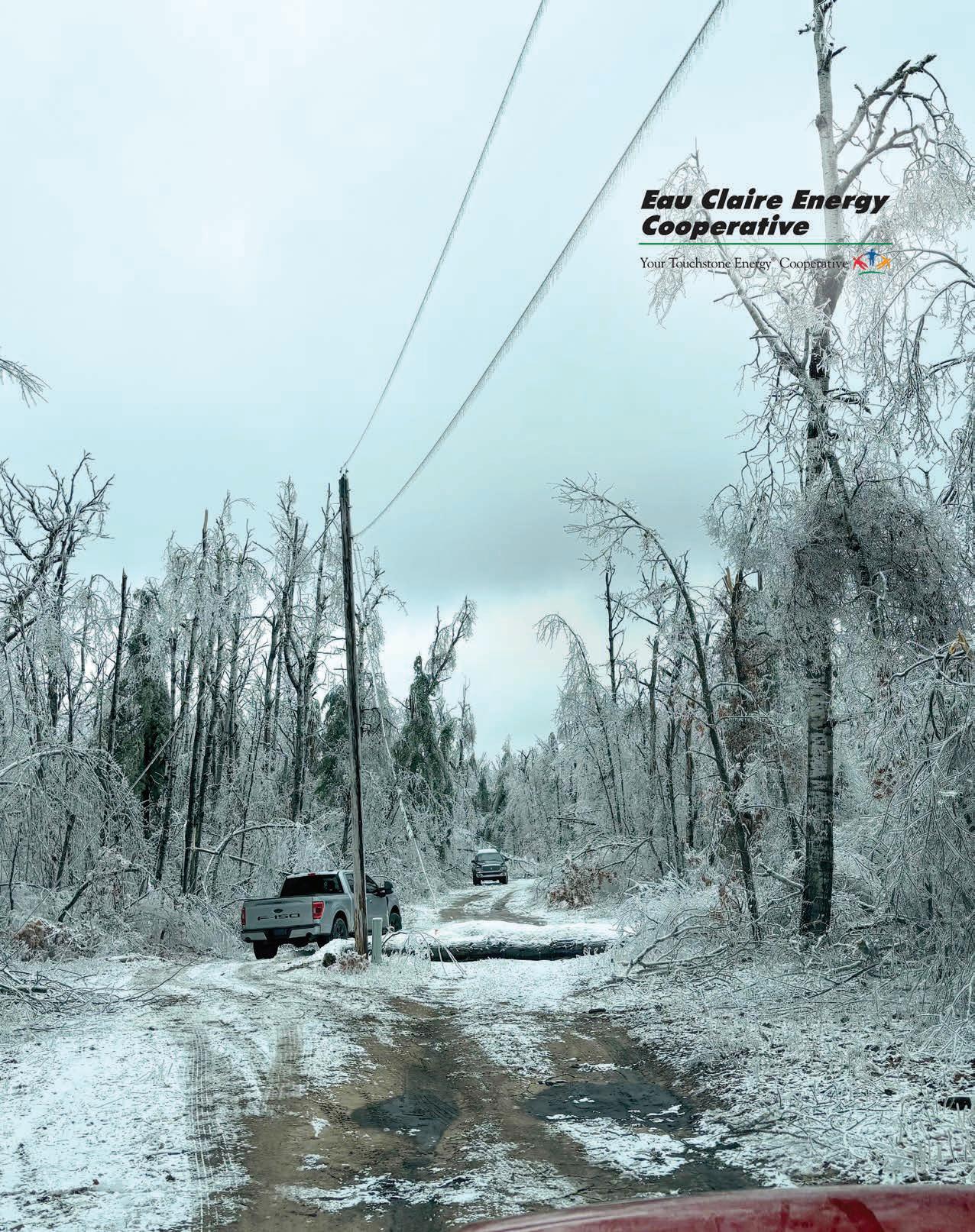
Denied FEMA aid after historic ice storm devastating for two Michigan co-ops.
Disruptions challenge the mission for a ordable, reliable service.
Wisconsinite and legendary Olympic speed skater Bonnie Blair is pure gold.
Kids & Critters
Cute co-op kids get cozy with their critters.
Photo courtesy of Michigan Electric
SYMBOL SEARCH
HIDDEN OBJECT GAME
Nu said.
Winning our January search was James Brakken, a member of Bay eld Electric Cooperative, who found the snow ake, “On page 31. Lower right corner. It is centered on the blue tee shirt of the boy on the left above the words ‘Energy Explorers.’ Both characters are staring through binoculars and encircled by an extension cord. Nu said?”
This month, we challenge you to nd this cake to inspire you to try our cake recipes on page 20. Remember that the symbol can be anywhere and any size. One randomly selected winner will receive a Wisconsin Energy Cooperative News kitchen kit. One entry per household, please, and provide your permanent home or mailing address with your entry. Entries are due February 12.
Enter via the “Symbol Search” link on the homepage of wecnmagazine.com.
You can also enter by mail (don’t forget to include the name of your cooperative):
SYMBOL SEARCH WECA 6405 Century Avenue, Suite 102 Middleton, WI 53562-2200
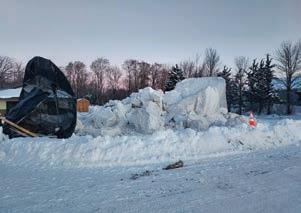
Rememberthis guy? We told you about this enormous, cheerful snowman near Milltown in Polk County in last March’s magazine. Every year since 2019, the Carlson family has poured their hearts into building Je ery, honoring a lost loved one, and raising scholarship funds for local youth.
Well, this year, Je ery shattered records. Standing an aweinspiring 67 feet tall—56 feet of snow topped with an 11-foot cowboy hat—he was a beacon of winter wonder. But just days after he was completed, a thunderstorm swept in, causing him to lean precariously forward. On New Year’s Day, Je ery collapsed.
As a result of his tumble, Je ery lost his new hat with a glowing snow ake, eyes, nose, mouth, pipe, buttons, and bolo tie—all destroyed in the fall. But the spirit behind Je ery endured. His devoted creators rallied the community, raising funds for a rebuild, and, incredibly, met their $3,000 goal by mid-January. Plans are now in place for a “head and shoulders” rebuild.
Watch the progress on Je ery’s Facebook page (search “Je ery the Snowman”) and consider making a donation to the scholarship fund to keep the magic of Je ery alive.
—Photos courtesy of Je ery the Snowman Foundation
Check donations can be mailed to Je ery the Snowman Foundation, 215 Eider Street, Milltown, WI 54858.
Dana Kelroy Editor
START THE NEW YEAR RIGHT SAFEGUARD YOUR WEALTH
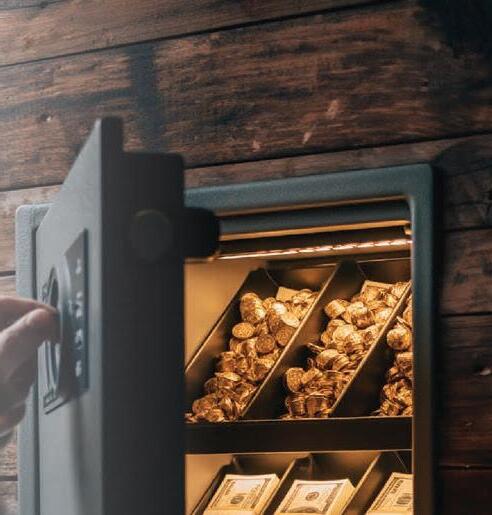
In times of economic uncertainty—when inflation rises, markets fluctuate, and long-term financial stability feels less predictable— many investors turn to gold as a dependable store of value. By holding a portion of your wealth in gold, you can help safeguard your portfolio and preserve long-term financial security, even when broader economic conditions are unclear.
American Gold Reserve is releasing Government issued $5 Gold American Eagles completely free of dealer mark-up for only $459 each. These beautiful $5 Gold American Eagles are a perfect way to enter the gold market. They are set for immediate public release and will sell out fast.
Since 2015, gold has surged over 400% — outpacing both the S&P 500 and the Dow during the same period.
• Teach the importance of wealth preservation.
• Great way to pass on wealth to children and grandchildren.
• A symbolic act of the commitment to your family.
• Gold provides your children and grandchildren with a built-in safeguard during times of financial instability.
Ben Bella Joins WECA
Ben Bella, a leader in safety and compliance for electric cooperatives, joined the staff of the Wisconsin Electric Cooperative Association as director of compliance services in December.
Bella is responsible for all aspects of WECA’s compliance services program including program design, curriculum, implementation, scheduling, evaluation, and budgeting. He will lead a team which will create a uniform curriculum that is largely consistent among cooperatives.
Bella will monitor changes to state and federal regulations and work with program staff on implementation strategies and will serve as the WECA representative on the Job Training & Safety committee.
Bella previously served as safety and loss control manager for Eau Claire Energy, Riverland Energy, Oakdale Electric, and Jackson Electric Cooperatives.
Bella was awarded the Potthast Award for his commitment and dedication to safety in the electric cooperative field in 2022.
Evers Declares Energy Emergency
Governor Tony Evers has signed backto-back executive orders declaring energy emergencies in the state of Wisconsin.
Evers cited “persistent challenges caused by a pipeline disruption within the Midwestern pipeline distribution system, coupled with high demand from severe winter weather for residential heating fuel, including heating oil and propane” as the reasons for the declarations.
The orders allow for a waiver of certain state and federal hours of service restrictions, allowing suppliers to get caught up from the pipeline and weather-related delays. The waiver remained in effect through January 16, or as long as drivers transporting residential heating fuel are responding to the emergency, whichever is shorter.
NEWS BRIEFS
Delayed Heating Funds Released
During the government shutdown last year, $3.6 billion in funding for the Low Income Home Energy Assistance Program (LIHEAP), known as WHEAP in Wisconsin, was withheld, but the funding was released in December, according to the National Energy Assistance Directors Association. States typically receive funds at the beginning of November. The federal government shutdown ended November 12.
WHEAP offers energy assistance in the form of a one-time payment to households making less than 60 percent of the state median income, which is about $38,000 for a single person and about $78,000 for a family of four.
Last year, more than 180,000 Wisconsin households received federal heating assistance through WHEAP.
EIA Cuts 2026 Power Generation Forecast
The Energy Information Administration (EIA) has revised its 2026 power generation projection and dropped its growth forecast by more than one percentage point. EIA had projected U.S. electricity generation to grow by 3% in 2026 but now estimates it will be 1.7%.
The revision is “based on how much large load electricity demand has come online so far this year,” particularly in Texas, “and its implications for nearterm growth,” EIA said in its ShortTerm Energy Outlook.
EIA now projects generation growth to hit 2.4% this year.
House Hearing Focused on “New Nuclear Era”
The U.S. House Energy and Commerce Subcommittee on Energy held its first hearing of 2026 with a focus on advancing nuclear energy. “American Energy Dominance: Dawn of the New Nuclear Era,” was the title of the hearing which took place on January 7. Lawmakers and industry leaders talked about a potential
resurgence of nuclear energy and how it can help meet surging electricity demand driven by artificial intelligence, data centers, advanced manufacturing, and national security needs.
The hearing confirmed this remains one of a few topics that maintains bipartisan support as committee members from both parties reaffirmed support for nuclear energy as a clean, reliable source of power.
Trump Withdraws from International Organizations
In a presidential memorandum issued January 7, Trump announced the withdrawal from the UN Framework Convention on Climate Change (UNFCCC), the Intergovernmental Panel on Climate Change, UN Energy, the International Solar Alliance, and 63 other organizations, groups, and commissions that he deemed “contrary to the interests of the United States.”
Secretary of State Marco Rubio said in a statement that the withdrawal will save billions and exit the country from international organizations that are “wasteful, ineffective, and harmful.”
Most of the agencies, commissions, and advisory panels that Trump ordered withdrawal from are focused on climate, labor, migration, and other issues that do not align with current administration priorities.
Rock Youth Visit Co-op
WECA Director of Youth Education Tina Walden joined a group of Rock Energy Cooperative youth members in wrapping up 2025 with a visit to the co-op.
Five of Rock Energy Cooperative’s youth members—including past youth board members Thomas Peters and Garrett Schneider, and current youth board member Kelby Schneider—met with the cooperative’s board of directors and CEO for a special Q&A session.
The youth members also enjoyed a behind-the-scenes tour of the facilities led by Justin Busfield, assistant operations manager–north, getting an up-close look at how they keep energy flowing safely and reliably every day.
IN TIMES OF NATURAL DISASTER, RECOVERY IS SOMETHING WE SHOULD ALL BE ABLE TO AGREE UPON
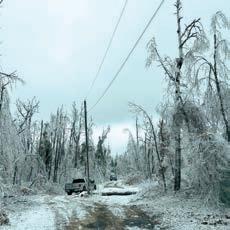
In late March of 2025, a series of fierce ice and windstorms struck a small portion of northern Wisconsin but left a much more lasting and destructive impact on a number of counties in Michigan’s northern lower peninsula. The severity of the damage in Michigan is still being felt to this day, as the fiscal implications are front and center in a state and national debate for FEMA disaster assistance for two of their electric cooperatives. More on this in a bit.
Back in Wisconsin, Washington Island Electric Cooperative General Manager Robert Cornell reported at the time, “I’m going on 23 years here, and this is the worst storm that I have ever seen. There was not a section of line that was not affected.” On page 10, Julie Lund’s feature story gives you a deeper look into the storm’s lasting physical and financial impact in both Wisconsin and Michigan.
While Washington Island faced challenges with recovery, they fully restored power within six days with the help of utility crews from several other electric cooperatives. Michigan, on the other hand, particularly the two electric cooperatives previously mentioned—Great Lakes Energy (GLE) and Presque Isle Electric and Gas (PIE&G)—would see nearly 100,000 customers without power for as long as 20 days and would incur costs of over $300 million in restoration efforts. Nearly 6,000 poles had to be replaced, and more than 8,000 miles of line was affected and restored. And this was just for these two cooperatives, let alone what other areas of the state faced.
So, you’re probably thinking everything must be fine and good because they’ve had time to recover, and the Federal Emergency Management Agency (FEMA) has likely provided federal disaster assistance. You’d be wrong.
In October, FEMA denied Michigan’s appeal for federal dollars for GLE and PIE&G. The funding, called Category F Public Assistance, is available to help cooperatives access the financial resources necessary to rebuild after a significant natural disaster like the March storm. As reported, if no federal assistance comes, PIE&G is looking at $150 million in recovery costs, or about $4,500 per member. GLE storm rebuilding and recovery efforts are about 40 times its typical annual storm
budget. This isn’t a sustainable option for the cooperatives, or any rural electric cooperative for that matter. It’s not just a Michigan problem, either. We’ve seen disaster assistance denials in numerous other states, including Wisconsin.
This is one reason your local cooperative leaders are supporting FEMA reform in Congress. H.R. 4669, the Fixing Emergency Management for Americans (FEMA) Act of 2025, is legislation in the House of Representatives that would streamline and expedite the delivery of public assistance disaster relief funds. Having passed the House Transportation and Infrastructure Committee last September by a vote of 57–3, the bill would speed up aid, allow co-ops to rebuild their systems stronger, and reimburse co-ops for the interest paid on loans to repair their systems while awaiting FEMA funding.
According to the National Rural Electric Cooperative Association, grassroots electric cooperative member activists have sent more than 60,000 letters to lawmakers, and local cooperative leaders have sent an additional 2,000 letters, asking our federal elected officials to pass H.R. 4669 this year. WECA is strongly urging our state’s congressional delegation to support the bill.
Our electric cooperatives are incredibly resilient and nimble in their work to provide you with safe, affordable, and reliable electricity. History has shown us that when natural disasters strike, the work crews are up to the challenge of restoring and rebuilding the systems that bring you power. We also need to recognize that when natural disasters hit, we must work together to rebuild our homes, businesses, and communities. I believe this is a core function of government and of who we are as Americans. FEMA reform can make this a reality.
Rob Richard WECA President and CEO
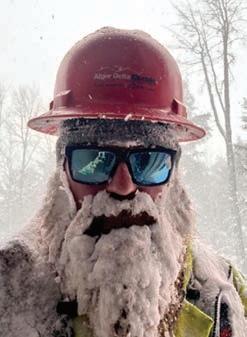
Alger Delta Electric Cooperative Lineworker Brandon Lind works to restore power in the March 2025 storm. Photo courtesy of Alger Delta
Please scan the QR code with your smartphone. Support FEMA Reform Now!
voicesforcooperativepower.com/femareform/
THE FEMA EMERGENCY
He could hear it coming down, and he knew it was bad. As the freezing rain tapped away at the roof of the home of Washington Island Electric Cooperative General Manager Robert Cornell last March, he got ready for what he knew would be days of little sleep. He just didn’t realize how many.
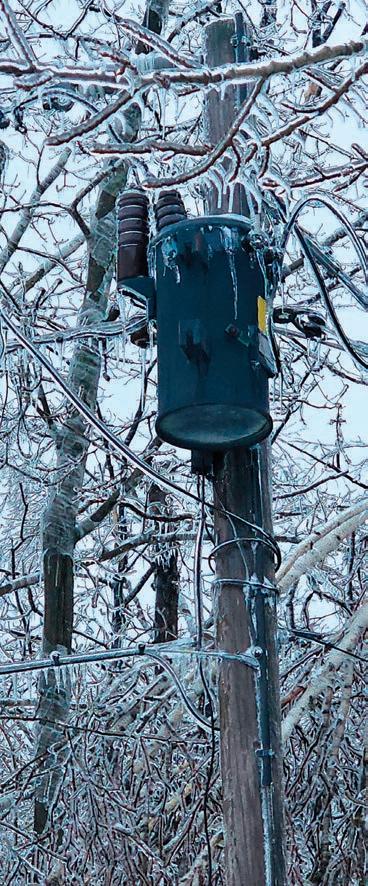
March 2025 wrapped with a massive late spring storm that lasted several days and brought heavy, wet snow, high winds, and the kryptonite for electric utilities—ice. It weighs on power lines and branches until they break under pressure. It’s dangerous and it’s damaging and last spring, it was historic.
“In my 23 years here, this was the worst storm that I have ever seen,” Cornell said. “There was not a section of line that was not a ected.”
Restoring power was a monumental task, and residual cleanup stretched into the summer.
“It was an ‘Act of God’ storm,” Cornell said.
And yet, it could have been worse. Just across Lake Michigan from Washington Island, a huge swath of northern lower Michigan was crippled by the same storm system. Hundreds of thousands of people across thirteen counties lost power for as long as three weeks. The Michigan National Guard and Department of Natural Resources deployed several hundred personnel to help, and the state’s Emergency Operations Center was activated for 19 days straight.
Like Washington Island, two Michigan electric cooperatives —Great Lakes Energy (GLE) and Presque Isle Electric & Gas (PIE&G)—had to rebuild portions of their systems, but on a much larger scale. Following the storm, the co-ops replaced almost 6,000 poles total, 4–5 times as many as they typically replace in an entire year.
The storm cost the Michigan electric cooperatives more than $150 million each. Great Lakes’ expenses from this single event totaled more than 40 times its annual average for storm restoration, which typically falls between $3.5 and $4 million. And before this, the worst storm recovery cost that PIE&G experienced over the last two decades was $1.3 million.
Michigan Governor Gretchen Whitmer requested a federal disaster declaration, and in late July, President Donald Trump granted it, but the assistance fell far short. The Federal Emergency Management
Administration (FEMA) approved funding assistance for things like debris removal and repairs to roads and bridges, but funding for “Category F,” which helps co-ops with the cost of rebuilding, such as pole and line replacement—was denied.
A subsequent appeal was also denied. FEMA said the request for
“We as co-ops need to band together to send a message of the importance of FEMA. And while we’re willing to look at ways to make FEMA more e cient, one of them isn’t having FEMA walk away from rural America.”
rebuilding aid was “unwarranted.”
Not-for-profit electric cooperatives don’t have insurance coverage for storm recovery, so in times of major crisis, they depend on FEMA. Without it, all electric cooperatives and their members would be vulnerable, especially those who find themselves in the path of a hurricane, or other major disaster.
“This type of denial, if this is the future of FEMA, could result in bankruptcies or it could force
electric co-ops to consolidate in order to keep their rates at some level of affordability by spreading the costs out across a larger member base in a business environment where co-ops are already challenged due to the sparse areas they serve,” said Tim Clay, vice president of the Wisconsin Electric Cooperative Association.
Great Lakes Energy had to take out emergency loans to cover its costs and has already implemented a rate change in direct response to the storm, as did PIE&G.
“The event that happened in Michigan, you hope is a once-in-alifetime type of situation, but that could happen here at any time. Just look how close it was,” Clay said.
The core mission of FEMA, which falls under the Department of Homeland Security, is to help people before, during, and after disasters. But the agency has also become a major expense for the federal government. FEMA’s annual spending has skyrocketed from about $1 billion in the 1980s, to more than $40 billion in recent years.
President Trump, in his effort to cut government costs and reduce the federal deficit, floated the idea of eliminating FEMA altogether, but has since settled on reforming the agency, which is expected to cut its staff by half in 2026. Trump has been clear about his end goal—to shift the responsibility of disaster aid and recovery from the federal government to the states.
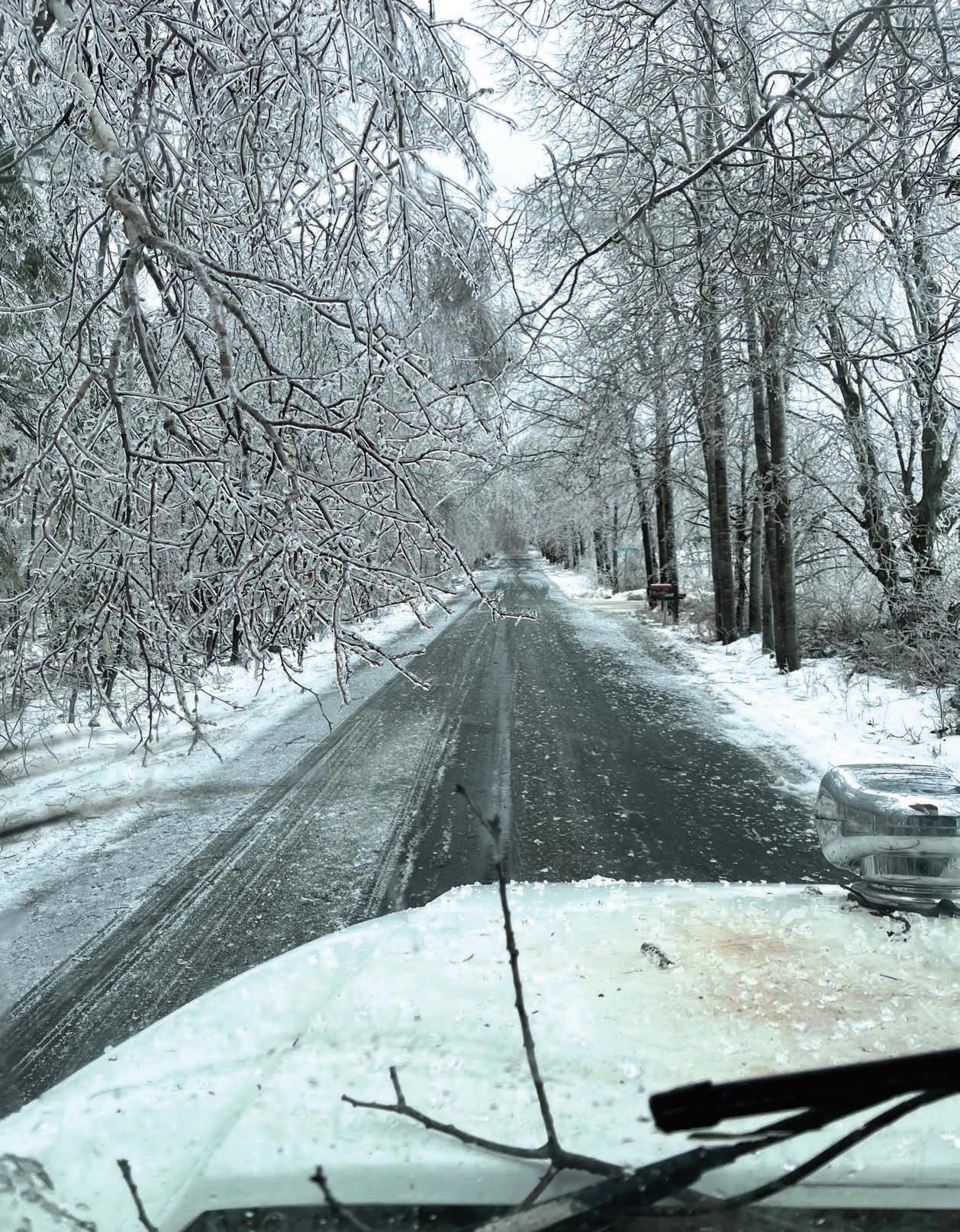
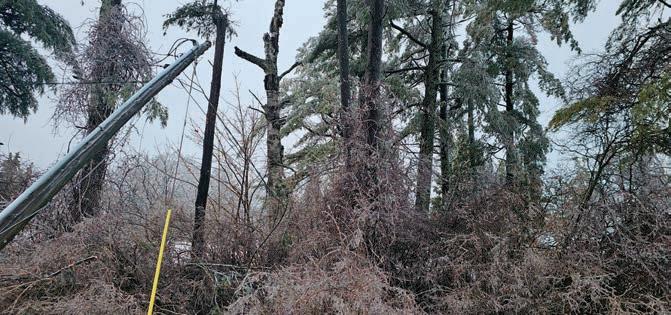
A late spring storm hit Washington Island in 2025 that was the worst in recent memory. Why? Ice coated everything, including tree branches, resulting in down power lines. But across Lake Michigan, two Michigan electric cooperatives were hit even harder.
Photos courtesy of Danny Wagner, WIEC
Trump says FEMA is “slow and bureaucratic,” and he’s not wrong. Wisconsin electric cooperatives have experienced this first-hand, waiting for months, or even years, for disaster reimbursement.
“Each year the process seems to get more cumbersome,” said Vernon Electric Cooperative General Manager and CEO Craig Buros. Vernon has been hit with a series of catastrophic storms, including massive flooding in 2018.
“A dam broke and completely washed out about a half mile of line,” Buros said. “There wasn’t a pole, or wire, or anything to be found. It was all gone.”
Crews working to restore power rebuilt the line in the existing right-of-way along the road, minimizing the environmental impact. But since the line was not set exactly where it was before the storm, FEMA denied funding. According to the agency, relocating the line required a federal environmental review, which takes months to complete and would have left Vernon Electric members without power during the process.
“When flooding occurs, the landscape changes, and in many cases, it is not possible to put the facilities back in the exact location. We went around and around with them for a couple of years, and finally we just had to let it go,” said Buros. Denials due to the need to relocate facilities while restoring power cost the co-op $190,000. (FEMA did cover about $237,000 of the $540,000 in total damages from the flood, and state emergency management paid about $44,000.)
But Buros says, even without the dispute, the process of getting emergency funds from FEMA is wrought with red tape and redundant rules complicated by governmental bureaucratic delays. Even when all goes well, reimbursement for funds spent recovering from a catastrophic event can take over a year or more.
“There has to be oversight, but the entire process should be streamlined,” Buros said.
It’s an issue electric cooperative leaders brought to the nation’s Capital during lobbying trips in 2025, urging support for the “FEMA (Fixing Emergency Management) Act of 2025,” which would streamline the agency and expedite funding. It would also allow electric cooperatives to be reimbursed for interest paid on loans while waiting for FEMA funds to come through. Co-op leaders successfully lobbied for inclusion of the interest reimbursement in the bi-partisan bill, but that’s of little help when a co-op is facing millions of dollars of uncovered costs, like in Michigan.
In Wisconsin, when damages are significant but do not reach the threshold for federal aid, the state often steps up to help via the Wisconsin Disaster Fund (WDF). This was the case for Washington Island. The state fund, which covers 70% of eligible costs, paid more than $150,000 of the co-op’s $210,000 storm recovery bill.
When a claim is approved, FEMA typically covers 75% of costs, and some states pitch in to help cover a portion of the remaining 25%. In response to the massive ice storm, Michigan is not contributing.
“We’ve been blessed here,” Clay said. “The Joint Finance Committee has always voted to approve additional disaster funds when needed. Not every state has that.”
But even in Wisconsin, the scale of state funds available for emergency relief is nowhere near the millions needed by the Michigan co-ops.
With FEMA in flux, Michigan is not the only state to recently claim it was denied FEMA assistance following a crisis, without cause. Maryland, North Carolina, Washington, and Arizona all claim denials for emergency assistance for what they consider qualifying events. In Wisconsin, following the “thousand-year flood” that hit the Milwaukee area in August 2025, FEMA approved more than $123 million in financial assistance for homeowners to make repairs in some counties, but Door, Grant, and Ozaukee counties were denied. (Washington Island also incurred costs in this event.) FEMA also denied a request to help pay for $34 million in damages to public infrastructure from the Wisconsin flooding.
In response to the FEMA funding fallout, Wisconsin lawmakers proposed the “Wisconsin State Emergency Relief (WISER) Act,” a bipartisan bill that would offer grants to individuals (up to $25,000) and businesses (up to $50,000) to help cover disaster-related expenses.
But that legislation doesn’t address the potential crisis that could threaten the future of electric cooperatives, the driver of rural America’s economy.
“I think the significance of this is that we as co-ops need to band together to send a message of the importance of FEMA,” Clay said. “And while we’re willing to look at ways to make FEMA more efficient, one of them isn’t having FEMA walk away from rural America.”—Julie Lund. See page 9 for how you can support FEMA reform.
SUPPLY CHAIN KINKS STILL CHALLENGE
MISSION FOR AFFORDABLE, RELIABLE SERVICE
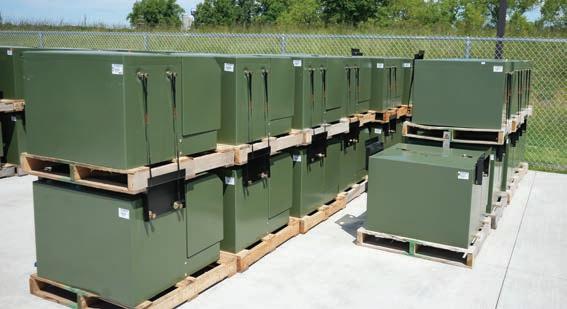
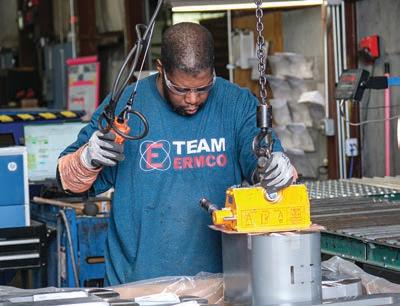
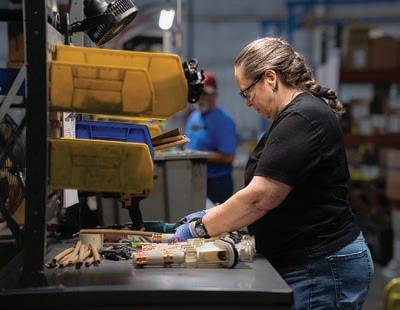
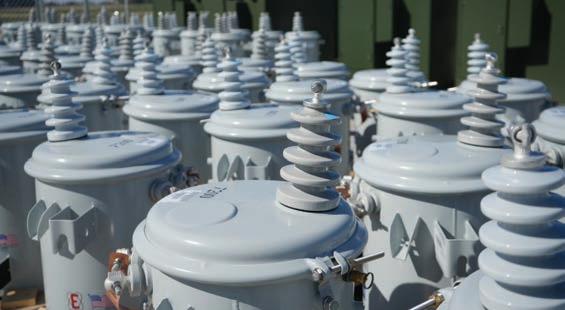
After the pandemic, many skilled workers retired from manufacturing jobs making distribution transformers and other essential energy equipment. The shrunken labor force is challenging the supply for new power plant construction, maintenance, or outage recovery. Electric co-ops are seeing lag times of up to four years between orders and delivery of transformers at double the prices compared to pre-pandemic times. Photos courtesy of ERMCO
Kinks in the supply chain caused by the COVID pandemic—remember the run on toilet paper?—may be in the rearview for regular consumers, but new bottlenecks in the flow of goods and services are challenging Wisconsin’s electric cooperatives to deliver affordable and reliable service. And the circumstances squeezing the supply chains for electric co-ops are unlikely to ease in the foreseeable future.
Basically, we’re talking about a higher demand for electricity, but supply of equipment needed to maintain or build more power plants has not kept up. Then there’s a skilled labor shortage to get the job done and tariffs on imported materials. All these things add up to delayed energy projects at increased costs.
With all things digital from phones to thermostats, electricity use is up. To sustain the growing digital economy, huge data centers
with appetites for electricity akin to that of a small city are sprouting up across the country. These centers use large amounts of power to serve the internet’s demand for high-speed networking, data storage, and AI (artificial intelligence) that make the World Wide Web user-friendly.
But even in this post-pandemic world, there still remains a scarcity of materials, equipment, and workers to get new power generation sources built.
FEATURE
After the pandemic forced manufacturing to shutter for months in 2020, a lot of experienced employees retired or never even went back to their jobs making transformers and other equipment essential to distributing electricity to consumers. The supply of some transformers has never been fully replenished, and the lack of a competent workforce today makes that a constant game of catch-up.
U.S.-based engineering, procurement, and construction firms are scrambling to meet work orders for new power projects as there is more demand today than they can keep up with, says Stephanie Crawford, regulatory affairs director at the National Rural Electric Cooperative Association.
Electric co-ops are “finding that these firms cannot respond to requests, they’re charging price premiums, or that planning for projects four years out is already ‘too late,’” she said.
As a result, equipment crucial for electricity projects—from new substations to power plant maintenance and outage repairs after storms hit—are on delay and coming in at much higher prices.
“ . . . early planning and purchasing is key to controlling costs in today’s supply environment.”
Co-ops are seeing lag times of up to four years between an order for a transformer and its ultimate delivery.
Prices are up 70% to 100% compared to 2020. Lead times for new gas turbines for a power plant can range from three to six years and cost 25% more than just three years ago.
According to one industry insider, an electric co-op that spent $10 million on materials and equipment for electricity projects and maintenance in 2020 had to spend over $15.5 million in 2025 to keep up.
So, what is your electric co-op doing to maintain reliable and affordable service?
Collaboration, which is baked into every co-op’s DNA, is key. Co-ops are finding themselves working with equipment suppliers and contractors closer than ever and planning their orders at least a year in advance of construction to work out the snags of the current supply chain.
Knowing their exact inventory and the physical storage space also helps co-ops keep necessary equipment on hand, materials flowing, and projects as near to schedule as possible.
Matt Brandrup, president and CEO of Rural Electric Supply Cooperative, works with Wisconsin’s electric
cooperatives. He said that early planning and purchasing is key to controlling costs in today’s supply environment.
“This is especially important as our members [cooperatives] have faced more and more inflationary cost pressures on the material they need and also on overhead costs over the past four to five years,” said Brandrup.
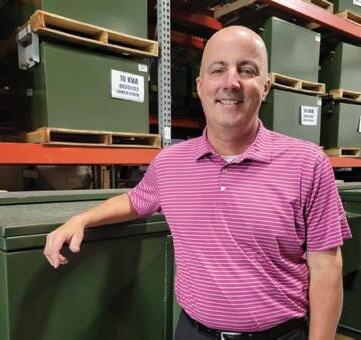
Matt Brandrup, president and CEO of Rural Electric Supply Cooperative, emphasizes that early planning and purchasing are essential for managing costs in today’s challenging supply environment.
ERMCO, a subsidiary of Little Rock-based Arkansas Electric Cooperatives, makes distribution transformers with American-made steel at its facilities in Tennessee and Georgia and is not experiencing price spikes or delays. Still, the transformer market as a whole is not immune to price pressures impacting other manufacturers reliant on imported cores made with foreign steel.
The biggest challenge right now is “navigating uncertainty,” said ERMCO President and CEO Tim Mills.
“The best path forward is to develop a long-term sourcing strategy and work closely with suppliers to lock in future needs. We need to embrace a more collaborative model between co-ops and their suppliers.”
By working as a team, electric co-ops, manufacturers, and their industry partners will be able to improve forecasting their equipment needs, stay ahead of potential demand changes, and experience a smoother supply chain.
Cathy Cash writes on consumer and cooperative affairs for the National Rural Electric Cooperative Association, the national trade association representing more than 900 local electric cooperatives. From growing suburbs to remote farming communities, electric co-ops serve 42 million Americans across 56% of the nation’s landscape.
WMAKING SENSE OF WINTER ENERGY USE
By Monica Obrycki, President and CEO
inter is a season when we spend more time indoors, relying on electricity to keep our homes warm, comfortable, and running smoothly. That’s why winter energy bills can sometimes come as a surprise, even when it feels like nothing has changed. When that happens, the first question is often why, and the second is what can I do about it?
One important thing to remember is that a higher winter bill doesn’t automatically mean your electric rate increased. In fact, for many Eau Claire Energy Cooperative members, winter rates don’t change much at all and may even be slightly lower. Most higher winter bills are driven by one simple factor: using more electricity. Colder temperatures mean heating systems run longer, lights are on more hours each day, and electric equipment works harder to keep homes comfortable.
the holidays or using temporary heating in a workshop or garage, can make a noticeable difference on a monthly bill.
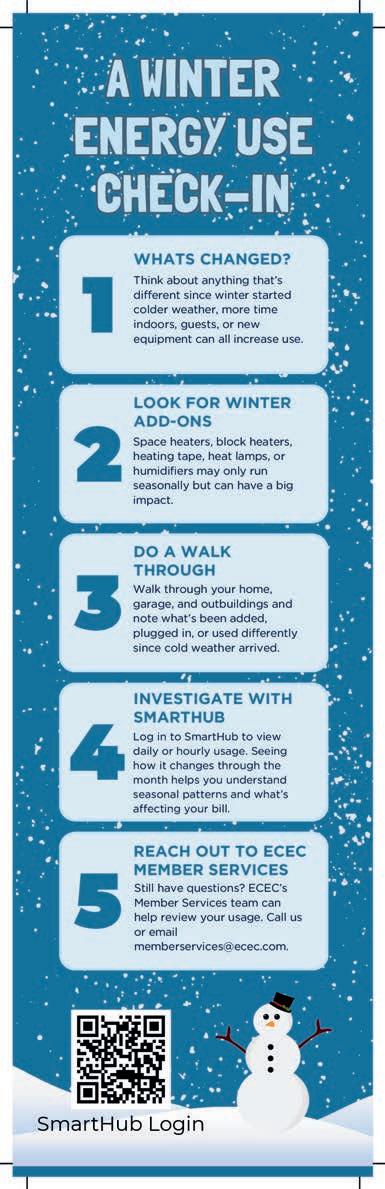
What often catches members off guard are the “extras” that show up in winter. Our Member Services team hears stories regularly about space heaters running in spare rooms, vehicle block heaters plugged in longer than needed, heating tape or heat lamps quietly running day and night, or humidifiers added when the air turns dry. In some cases, a malfunctioning pump, heater, or piece of equipment can be the culprit. Even short-term changes, like hosting extra family over
If your bill looks higher than expected, a good first step is a quick walk-through of your home, garage, or outbuildings. Think about what’s been plugged in since colder weather arrived and whether it still needs to be running. Identifying those seasonal additions is often the fastest way to understand where usage increased. There are also simple ways to manage winter energy use without sacrificing comfort. Sealing drafts, keeping vents clear, lowering the thermostat slightly, and being mindful of how long winter equipment runs can all help make your home more efficient. Another helpful tool is utilizing your SmartHub account. ECEC members can log in to SmartHub to check their usage during the month. By checking during the month, instead of waiting for the bill to arrive, you may be able to spot changes early and make adjustments before that electricity shows up on your statement.
Winter bills can be frustrating, but a little awareness goes a long way. And if you ever have questions about your bill or want help understanding your energy use, our Member Services team is always happy to help. At Eau Claire Energy Cooperative, we’re here to help you stay informed, comfortable, and in control, no matter the season.
Metropolis Resort: BIG FUN, SMART ENERGY
Metropolis Resort is a wellknown destination located on Eau Claire Energy Cooperative lines, offering year-round entertainment, lodging, and meeting space for families, businesses, and groups. Metropolis is more than a destination—it’s one of the region’s largest attractions.
Metropolis Resort is best known for its attractions and hotel, but the property offers far more than slides and splash pads. Guests can enjoy Action City attractions like go-karts, trampolines, laser tag, arcade games, and more. The resort also features on-site dining, extensive meeting and event space, and accommodations designed for families, groups, and business travelers alike.
Between heating and pumping water in Chaos Water Park, charging go-karts at Action City, and keeping hotel guests comfortable, Metropolis Resort needs to use energy wisely. With large energy use comes thoughtful energy management. Over the years, the resort has made significant investments in energy-saving technologies that reduce waste without compromising the guest experience.
One of the most impactful upgrades can be found in the hotel itself. Each of the resort’s 111 guest rooms is equipped with infrared occupancy sensors tied to the thermostat system. These sensors detect when a room is occupied and
automatically adjust temperatures when guests are away, saving thousands of dollars in energy costs while maintaining comfort when it matters most.
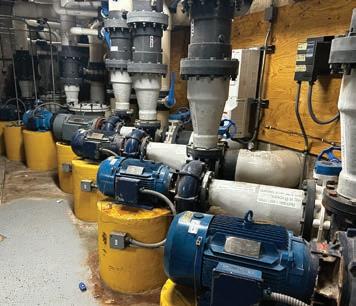
In the water park, efficiency is built into the system. Metropolis uses regenerative filtration technology that reduces the amount of water, heat, and chemicals needed to keep pools clean and safe. Even more impressively,
Member Coupon
Exclusive o er for Eau Claire Energy Cooperative members 30% o park passes valid in February 2026
• Valid at Chaos Water Park or Action City
• Must present coupon at purchase
• Valid on full-priced passes only
• Not valid with any other o ers or coupons
• No cash value
pool water is heated using waste heat recovered from the adjoining hotel through an advanced heat-recycling system. Instead of letting that heat go unused, it’s captured and repurposed, cutting energy demand while keeping the water warm.
Metropolis Resort isn’t slowing down. Construction is underway on a new building that will expand the resort’s entertainment offerings even further. The addition will include an indoor roller coaster, ropes course, indoor mini golf, and new go-kart facilities. The current go-kart space will be transformed into a bowling alley, adding yet another attraction for guests. As the resort grows, energy planning remains part of the conversation, ensuring new spaces are designed with efficiency and fun in mind.
Large commercial members like Metropolis Resort play an important role in the cooperative system. Their energy needs help shape infrastructure planning, and their efficiency efforts help manage demand across the grid. It’s a partnership that benefits all members’ homes and businesses alike.
CHOICES
Whether you’re planning a weekend getaway, a birthday celebration, or just a fun day trip, Metropolis offers something for everyone.
Activities for Every Season
Visitors to Metropolis can fill their days (and nights) with a wide range of activities:
• Chaos Water Park — Indoor slides, lazy river, hot tub, and aquatic play zones, perfect for rainy days or winter breaks.
• Action City — A massive indoor fun center with go-karts, trampoline park, laser tag, mini golf, and arcade games.
• On-site Dining — City Eats restaurant, City Pizza Company, Caribou Coffee, and even Dairy Queen treats keep energy up between adventures.
• Group Events & Retreats — Flexible meeting and event spaces make the resort an ideal location for corporate retreats, school groups, or family reunions.
SAVE THE DATE FOR THE 89TH ANNUAL MEETING
Tuesday, March 17
Florian Gardens
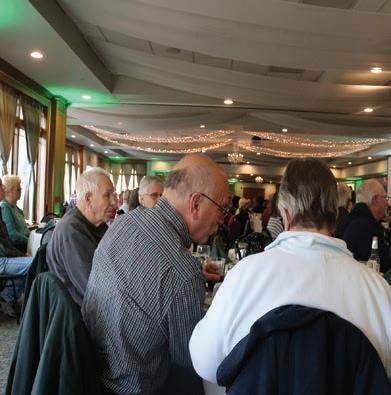
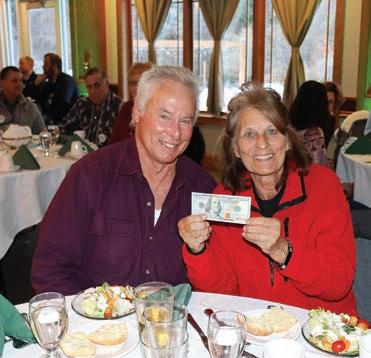
Eau Claire Energy Cooperative’s 89th Annual Meeting will be held on Tuesday, March 17, 2026 at the Florian Gardens in Eau Claire at 5:30 p.m. We love interacting and engaging with our members! There will be dinner, cash prizes, and so much more. This year, we will feature the people behind your power. Join us to learn more about what ECEC sta does every day to support, engage, and connect with you, our member-owners. We can’t wait to see you there!
How a Safe Step Walk-In Tub can change your life
Remember when…
Think about the things you loved to do that are dif cult today — going for a walk or just sitting comfortably while reading a book. And remember the last time you got a great night’s sleep?
As we get older, health issues or even everyday aches, pains and stress can prevent us from enjoying life.
So what’s keeping you from having a better quality of life?
Check all the conditions that apply to you.
Personal Checklist:
Arthritis Dry Skin
Insomnia Anxiety
Diabetes Mobility Issues
Lower Back Poor Pain Circulation
Then read on to learn how a Safe Step Walk-In Tub can help.
Feel better, sleep better, live better
A Safe Step Walk-In Tub lets you indulge in a warm, relaxing bath that can help relieve life’s aches, pains and worries.
A Safe Step Tub can help increase mobility, boost energy and improve sleep.
It’s got everything you should look for in a walk-in tub:
• Heated Seat – Providing soothing warmth from start to nish.
• MicroSoothe ® Air Therapy System – helps oxygenate and soften skin while offering therapeutic bene ts.
• Safety features –Low step-in, grab bars and more can help you bathe safely and maintain your independence.
• Free Toilet
1/2 cup whole milk ricotta
COME HAVE A PIECE of Cake
Blueberry Swirl Cheesecake
Recipe and photo courtesy of the U.S. Highbush Blueberry Council.
BLUEBERRY SAUCE
2 cups fresh or frozen blueberries (if using frozen blueberries, rinse before use)
1/4 cup sugar
1 tsp lemon zest
Cook the blueberries, sugar, and lemon zest in a small saucepan over medium-low heat until they are tender and the sugar dissolves, approx. 5 minutes. Blend the mixture with a blender or immersion blender until pureed.
GRAHAM CRACKER CRUST
1 cup (5 oz) graham cracker crumbs
3 Tbsp brown sugar
1/2 tsp cinnamon
1/2 tsp salt
2 oz unsalted butter, melted
Preheat oven to 350 degrees. Grease an 8-x3-inch springform cake pan and line the bottom with parchment paper. In a food processor, mix the graham cracker crumbs, brown sugar, cinnamon, salt, and butter. Pour the mixture into the prepared pan and press it out into an even layer. Bake for approx. 12 minutes, until it starts to look lightly toasted.
CHEESECAKE BATTER
1-1/2 lbs cream cheese, room temperature
1 cup sugar
1/2 cup sour cream
4 eggs, room temperature
2 tsp vanilla extract
1/4 tsp lemon extract
1 tsp lemon zest
1/2 tsp salt
Whipped cream (for garnish)
Fresh or frozen and thawed blueberries (for garnish)
Lower the oven to 325 degrees. Using a mixer tted with a paddle attachment, mix the cream cheese on medium speed for approx. 1 minute. Scrape down the sides and mix for another 30 seconds. Add the sugar and mix for another minute, scrape down the sides of the bowl. Add the sour cream and ricotta until smooth. Add the eggs one at a time, scraping down the sides after each egg. Add the vanilla, lemon extract, zest, and salt. Mix for 30 seconds. Pour 1/3 of the cheesecake batter over the baked crust. Drizzle 3 tablespoons blueberry sauce over the batter. Use a skewer or knife to gently swirl the sauce into the batter. Pour half of the remaining cheesecake over the swirled blueberry sauce and repeat the swirling with 3 tablespoons of the blueberry sauce. Add remaining cheesecake batter and nish by swirling 3 tablespoons of the blueberry sauce on top. Bake cheesecake on a cookie sheet in the center of the oven for approx. 75–90 minutes. Place a second sheet on a lower rack and ll with boiling water. The cheesecake will sou é as it bakes, which is normal for this style of baking. Once the top of the cake is set, remove from the oven and gently run a knife around the edge of the pan. Cool to room temperature before refrigerating. Chill for 4–6 hours or overnight. When ready to serve, run a hot knife blade around the outer edge of the cake, then remove the sides of the springform pan. Lay a piece of plastic over the top and invert the cake to remove the bottom of the pan and parchment paper. Invert the cake onto the serving plate, graham cracker crust-side down. Serve with whipped cream, fresh blueberries, and remaining blueberry sauce. Makes 12 servings.
Banana Upside-Down Cake with Caramel Sauce
Recipe and photo courtesy of the Home Baking Association.
You
BOTTOM LAYER
a
2/3 cup packed brown sugar
5 Tbsp butter, cut into pieces
3 bananas, sliced into 1/4-inch rounds
Preheat the oven to 350 degrees. Grease an 8-x8-x2inch square cake pan or a 9-x2-inch round cake pan, set aside. (Pan sides must be a minimum of 2 inches hight to avoid overflow.)
Spread brown sugar evenly over entire bottom of the pan; distribute butter pieces over the brown sugar. Place the pan in the oven until butter is melted, approx. 4–7 minutes; remove pan from oven. Using a spatula, blend sugar and melted butter well and spread over bottom of pan evenly. Arrange the slices of banana to completely cover the bottom of the pan.
Savory Cake with Ham, Cheese, and Olive Oil
Recipe
A savory cake—known in France as cake salé—is a delicious twist on the classic quick bread. Moist, dense, and full of avor, this cake trades sugar and frosting for cheese, herbs, and other savory mix-ins. In France, it’s often enjoyed as an apéritif with a glass of wine, but its versatility makes it a welcome addition to any meal. Unlike quiche, which bakes its llings in a custard inside a pastry crust, a savory cake incorporates its ingredients directly into the batter, giving every slice a satisfying texture. And while it may resemble a traditional cake in shape, the key di erence lies in its avor pro le—savory cakes skip the sugar and instead rely on herbs, cheese, seasoning, and olive oil for richness and depth.
BATTER
1 cup all-purpose flour
3/4 cup whole wheat flour
1-1/2 tsp baking powder
1 tsp baking soda
1 tsp cinnamon
Pinch of salt
1/3 cup butter, room temperature
3/4 cup granulated sugar
1-1/2 tsp vanilla
2 large eggs
1/3 cup sour cream (may substitute Greek yogurt, if desired)
1 cup mashed overripe bananas
In medium bowl, whisk together flours, baking powder, baking soda, cinnamon, and salt; set aside. Using a mixer fitted with a paddle attachment, cream together butter and sugar until light, creamy, and fully blended. Turn mixer to low, add 1 egg at a time and vanilla, fully incorporate the eggs. Add sour cream and mashed bananas; mix until fully blended. Continuing on low speed, add whisked dry ingredients. Mix lightly until combined. Pour the batter over prepared bananas, evenly smooth the top and bake for 55–60* minutes, until toothpick inserted in the center comes out clean. Remove from oven and allow to cool completely before removing from the pan. Loosen edges with a knife, place a plate upside-down on top of the pan, then invert cake.
*NOTE: If after 40 minutes it appears to be becoming too brown, turn oven down to 325 degrees for remainder of the baking time.
CARAMEL SAUCE
4 Tbsp butter
1/4 cup brown sugar
1/4 cup heavy cream 1/4 tsp salt
In a saucepan combine butter, brown sugar, heavy cream, and salt and bring to a boil over medium heat stirring constantly. Simmer for 2–3 minutes, remove from heat, and let it sit for 1–2 minutes. After inverting cooled cake to a plate, gently ladle caramel sauce over the entire cake, reserve a bit for drizzling on cut slices. Makes 6–8 servings.
1-1/2 cups all-purpose flour
2 tsp baking powder
1 tsp kosher salt
1/2 tsp freshly ground black pepper
4 eggs
1 tsp Dijon mustard
1/2 cup milk
1/2 cup extra-virgin olive oil
1 cup grated cheese such as cheddar, Swiss, or Gruyère
1 cup diced ham
Fresh herbs such as chives, parsley, or thyme (optional)
Preheat oven to 350 degrees. Prepare a springform pan by lining the bottom with parchment paper. Grease the pan with olive oil and sprinkle with flour. In a mixing bowl, whisk together the flour, baking powder, salt, and pepper. In a separate bowl, mix the eggs, mustard, milk, and olive oil. Combine the wet and dry ingredients and then fold in the cheese, ham, and herbs. Transfer the batter to the prepared pan and level it with a spoon or spatula. Bake for 45 minutes until it is golden and a toothpick inserted in the center comes out clean. Remove from the oven and let cool for 15 minutes. Makes 6–8 servings. NOTES: Possible modifications include 1. Use a muffin pan lined with paper cups and bake for 20 minutes or until a toothpick inserted in the center comes out clean. 2. Use a loaf pan and bake for 45 minutes until a toothpick inserted in the center comes out clean. 3. Substitute cooked, chopped bacon for the ham, or make it vegetarian by substituting cooked vegetables or omitting the meat. 4. Use a mix of cheeses instead of just one type of cheese.
can’t go wrong with
delicious dessert of caramel sauce and thick banana slices, all baked up into a moist and avorful cake!
and photo courtesy of the North American Olive Oil Association.
READER RECIPES
FARMER’S CASSEROLE
RECIPE COURTESY OF BARB RICE, THORP
You can put it together the night before, let the avors blend, then bake it in the morning. I have been making this recipe for years and getting lots of compliments.
REQUESTS FROM OUR READERS
An anonymous reader is looking for gumbo or jambalaya recipes.
3 cups frozen, shredded hash brown potatoes 3/4 cup shredded Monterey Jack cheese 1 cup cooked ham, cubed 1/4 cup green onions, chopped 4 large eggs
SEND TO: WECN, Reader Recipes, 6405 Century Avenue, Suite 102 Middleton, WI 53562-2200 or jennifer@weca.coop
1 (12 oz) can evaporated milk 1/4 tsp pepper 1/8 tsp salt
Place shredded potatoes in an 8-inch baking dish; sprinkle with cheese, ham, and onions. In a separate bowl, whisk together eggs, evaporated milk, pepper, and salt; pour over all in baking dish.
Cover and refrigerate for several hours or overnight. Remove from refrigerator 30 minutes before baking. Preheat oven to 350 degrees and bake uncovered until a knife inserted in the center comes out clean, approx. 55–60 minutes.
MEATBALL SUB CASSEROLE
RECIPE COURTESY OF DARLA MARTIN, LOYAL
This recipe is from the 1998 cookbook Simple Cooking.
1/3 cup chopped onion 1/4 cup seasoned breadcrumbs
3 Tbsp Parmesan cheese
1 lb ground beef
3/4 loaf Italian bread, cubed 1 (8 oz) pkg cream cheese, softened 1/2 cup mayonnaise
1 Tbsp Italian seasoning
2 cups shredded mozzarella cheese, divided 1 (28 oz) can spaghetti sauce 1 cup water
Combine onion, breadcrumbs, and Parmesan cheese. Mix in beef and shape into 1-inch balls. Bake at 400 degrees for approx. 15–20 minutes or pan-fry in a skillet. Arrange cubed bread in a layer in an ungreased 13-x9-inch pan. Combine cream cheese, mayonnaise, and Italian seasoning and spread over bread. Sprinkle with half of the mozzarella cheese. Combine spaghetti sauce and water, add meatballs, and pour over the layer of cream cheese mixture. Sprinkle with remaining mozzarella. Bake uncovered at 350 degrees for 30 minutes.
Submit your favorite recipes to be featured on our reader recipe page. Email to jennifer@weca.coop or submit directly at http://wecnmagazine.com/submit-a-recipe/.
PLEASE NOTE: Recipes submitted must include quantities for all ingredients. If no measurements are used, your recipe will not be printed. Due to food safety issues, we cannot accept canning recipes.
LAMB RAGOUT
RECIPE COURTESY OF ROMAYNE LINDSTROM, NEW LONDON
2-1/2 lbs lamb shoulder, cut into 1-inch cubes
1/4 cup all-purpose our
1/3 cup butter or margarine, divided
2 tsp salt
1/2 tsp pepper
1/2 tsp dried thyme leaves
3/4 tsp dried rosemary leaves
1 (13.75 oz) can clear chicken broth
1 (6 oz) can tomato paste
1-1/2 tsp sugar
4 medium white turnips, pared and quartered (1 lb total)
8 small white onions, peeled
3 medium carrots, pared and cut into 1-inch pieces
1 clove garlic, crushed
1 cup green pepper strips
2 leeks, cut into cubes
1 (9 oz) pkg frozen artichoke hearts, thawed
2 tomatoes, peeled and cut into eighths
Cooked noodles of choice
EASY BEEF STEW
RECIPE COURTESY OF ROMAYNE LINDSTROM, NEW LONDON
1 to 1-1/2 lbs lean stew meat, cut into cubes
3 tsp instant beef or vegetable bouillon
1 tsp vinegar
3 Tbsp breadcrumbs
2 Tbsp minute tapioca our
1 medium onion (or more), cubed
3 medium potatoes, cubed
3 medium carrots (or more), sliced
Coat lamb with our. Melt 3 tablespoons of the butter or margarine in a 6-quart Dutch oven; add the lamb and brown all over. Stir in salt, pepper, thyme, rosemary, chicken broth, and tomato paste. Bring to a boil, reduce heat, and simmer, covered, for 45 minutes. In a medium skillet, slowly melt remaining butter with sugar. Add turnips, onions, carrots, and garlic; cook over low heat, stirring occasionally, until vegetables are glazed and golden—approx. 10 minutes. Preheat oven to 350 degrees. Stir glazed vegetables, green pepper strips, and cubed leeks into lamb mixture in the Dutch oven. Cover and bake for 30 minutes. Add artichoke hearts and bake 20 minutes, then add tomatoes and bake 10 minutes more. Serve over cooked noodles. Makes approx. 6–8 servings. PAST
1 (15 oz) can green peas (optional)
Salt and pepper, to taste
3 cups boiling water (or more)
Combine all stew ingredients into a large casserole dish and add salt and pepper, to taste. Pour boiling water over until covered. Bake covered at 350 degrees for 2-1/2 to 3 hours.
NEED HELP WITH YOUR HEATING BILLS?
The Department of Administration o ers heating and electric assistance to quali ed households through the Wisconsin Home Energy Assistance Program (WHEAP).
WHEAP assistance is a one-time payment per heating season (October 1–May 1) to cover a portion of a home’s energy costs. It is not intended to cover the entire energy costs of a residence. Eligibility is based on the household’s previous month of income. In most cases, the bene t is paid directly to the household’s energy supplier. Most types of fuel qualify for assistance.
In addition, crisis assistance may be available if you have no heat, have received a disconnect notice, or are nearly out of fuel and are unable to purchase more.
Find Out More
You may be eligible for WHEAP services based on several factors, including your household’s size, income, and energy costs. If the gross income for your household is less than the amount shown on the chart at right, you might be eligible to receive assistance.
For more information on WHEAP and how to apply for energy assistance, please call 1-866-HEATWIS (432-8947), or visit www.homeenergyplus.wi.gov
HOW BONNIE BLAIR SKATED INTO OLYMPIC HISTORY
EDITOR’S NOTE: This month, we’re taking a slight detour from our usual “Wisconsin Favorites” destinations to honor a “Wisconsin Favorite” Wisconsinite—legendary Olympic speed skater Bonnie Blair. One of the most decorated athletes in U.S. Winter Olympic history, Blair’s story continues to inspire generations. As we look back on her accomplishments, we also look ahead to the excitement of the upcoming Winter Games. Be sure to tune in to the 2026 Winter Olympics in Milan, taking place February 6–22, and enjoy a little armchair travel to Italy right from your living room as you cheer on the next wave of athletes.
As she brought the tip of her skate to the starting line, she assumed her position. The starting gun went off. She raced the first 100 meters and could hear the public address announcer state the split times. She knew she was hundredths of a second ahead—her biggest opponent was typically faster. She remembers thinking that if she could skate a regular lap, she should be able to beat her. As she crossed the finish line, the crowd knew before she did. As the saying goes, the rest is history.
Born for the ice No one could have foreseen the 2-year-old, whose feet were so small she had to
wear shoes inside her skates, going on to win Olympic gold. Bonnie Blair grew up in Champaign, Ill., in a family of skaters, but unlike her siblings who chose to pursue college degrees, Bonnie chose to persist.
Bonnie can’t recall ever going on a family vacation because they traveled many weekends to skating competitions. Equipment and travel, both stateside and international, are expensive. Bonnie credits the community support she received as an impetus to push forward.
She qualified for her first Olympics in 1984. At the time, she was competing in both short- and long-track events, eventually switching over to the longtrack 500-, 1,000- and 1,500-meter races.
At the 1988 Winter Olympic Games in Calgary, Canada, she was up against strong competitors in the Chinese
and East German teams, including Olympian Christa Rothenburger. Choking up at the memory, she recalls her feelings when she crossed that finish line.
“I beat her by two one-hundredths of a second—that’s about 10.5 inches. We had the exact same lap time, but I beat her in the first hundred meters,” she recounts. She took the gold medal and set a new world record at the same time. She went on to earn a bronze medal in the 1,000-meter race.
At the 1992 Winter Olympics in Albertville, France, Bonnie swept the gold medals in the 500- and 1,000-meter races. It was the first time a woman had successfully defended her title in the 500. At the Lillehammer, Norway, Olympics in 1994, she not only won the 500 but put up a 1.38-second margin of victory, the largest in Olympic
history. She missed the bronze medal at 1,500-meters but set an American record—the fastest she had ever skated.
“Race per race, that was my best executed race at the Lillehammer games. I was just as excited for that race as I was for the other two because I set a personal best,” she explains. “I accomplished the goals I had set out for that race. Winning doesn’t always mean being first. Winning means you’re doing better than you’ve ever done before.”
U.S. Coach Peter Mueller, a 1976 Olympic gold medalist in the 1,000-meters, commented, “It’s like she was born on ice. Her long strides make her the best technician in the world, man or woman, over the sprint distances.”
A member of four Olympic Speed Skating teams, Bonnie won five Olympic gold medals and one bronze
Wisconsinite Bonnie Blair remains one of the most decorated athletes in U.S. Winter Olympic history.
from 1988 to 1994 and holds numerous World Records. To date, she is the most decorated American female Winter Olympian.
After her success in 1992, Bonnie continued to compete. She moved to Milwaukee and began training at the Pettit International Ice Center, a newly opened state-of-the-art indoor ice rink. She competed in the 1995 World Championships on her 31st birthday, March 18, 1995, won the 500, and shortly after, retired.
The following year, she married David Cruikshank, her former teammate and fellow speed skater. Although she had retired from the sport, she was never far from it.
The road to the Olympics Other than talent, in order to become an Olympic-caliber athlete, Bonnie says it also takes drive, passion, a willingness to listen and be coached, and people who will be there to support and help you chase what you want to do.
She compares it to a tire on a bike. “They all have spokes, and they all have to be tightened in a good way to make it roll in a perfect circle,” she explains. “Having a core group around you is what creates that balance and makes success possible.”
It takes a desire to work every day, even when you aren’t having a great day. It’s about digging down deep inside to get it done.
“For instance, my husband was in four Olympics. Between the two of us, we have five gold and a bronze, and yes, they’re all mine,” says Bonnie. “But guess what? He knows he put in the blood, sweat, and tears to be the best he could be. He can hold his head high knowing he tried, executed, and learned so many things in life. It’s about perspective.”
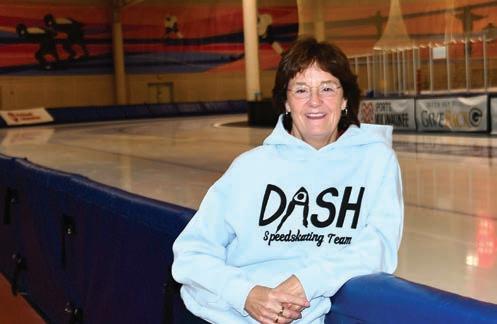
DASH Bonnie and Dave are passionate about advancing the sport of speed skating.
Bonnie is currently the director of community engagement for The DASH Project, Inc., a 501c(3) organization with a mission to grow speedskating. DASH stands for Developing Athletes for Speedskating High-Performance (dashskating.org). Dave is president and head coach of the organization. The organization’s Gold Medal Advisory Board is a “who’s who” of gold medal speed skating excellence: Bonnie Blair-Cruikshank ’88, ’92, ’94; Dan Jansen ‘94, Joey Cheek ‘06, Chris Witty ‘02, Chad Hedrick ’06, and Casey FitzRandolph ‘02.
“Dave and I dream of getting more athletes into the sport,” says Bonnie. “It isn’t a typical
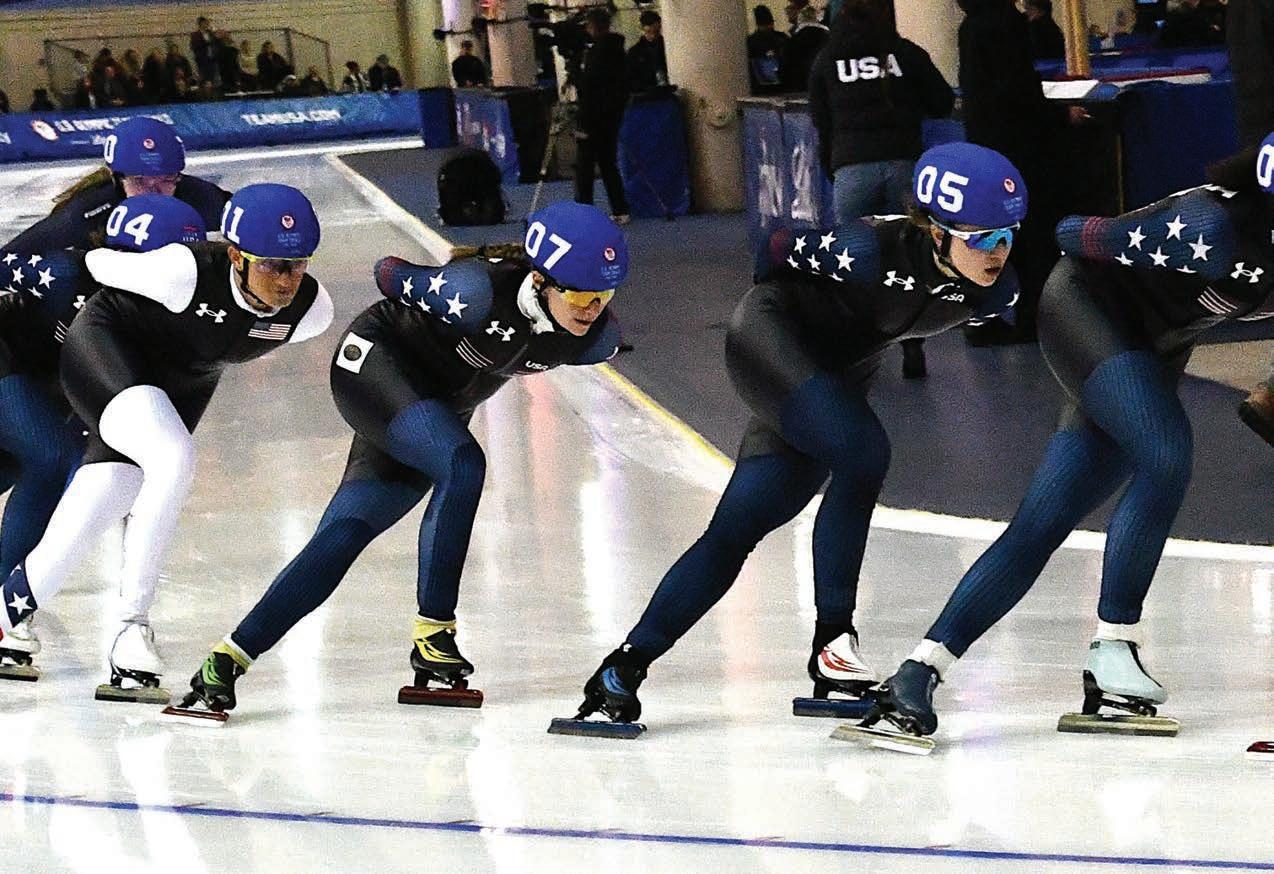
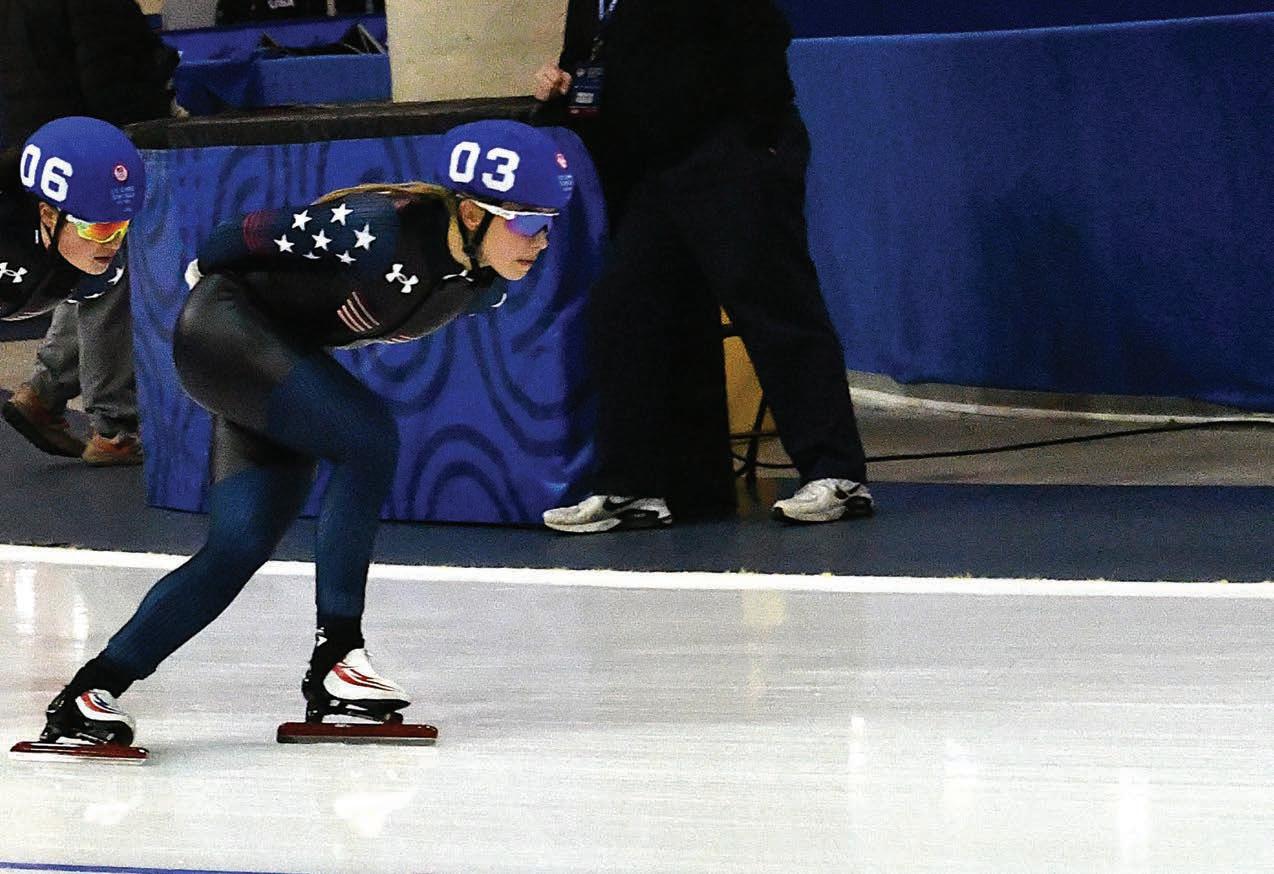
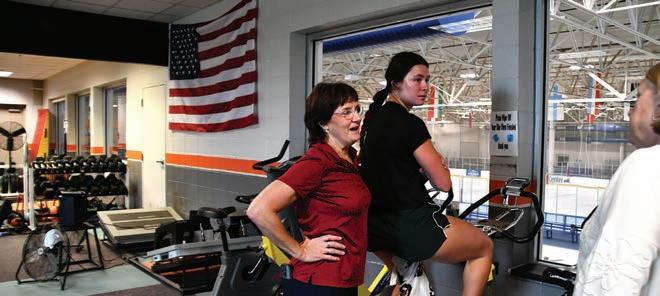
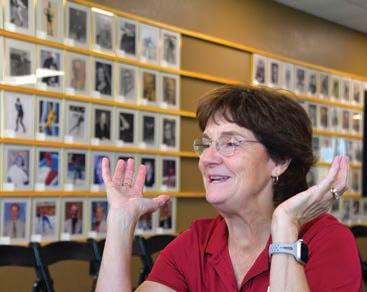
Bonnie Blair cheers on her daughter, Blair Cruikshank, as she rounds a turn. Bonnie chats with Blair on an exercise bike in the training room. Bonnie discusses her passion project, DASH, which stands for Developing Athletes for Speedskating High-Performance.
Up-and-coming stars of the Olympic speed-skating world made their marks at the 2026 U.S.
Speedskating Trials held in January in Milwaukee (clockwise from top left): Finn Siebert (at
from
Piper
and Tanner Worley in the Men’s 500-meter, outside the Pettit National Ice Center in Milwaukee, and Siebert in the Men’s 1,000-meter.
sport like football or basketball, nor is it collegiate-based. It takes a lot of commitment from parents and athletes alike.
The Cruikshanks are always looking at public ice-skating sessions for kids who look like they could have that desire. The number of individuals chasing the medal podium is dwindling, and the DASH program offers ways for them to try out the ice. They work with some hockey groups where kids come try speed skating on evenings when they aren’t practicing.
Specialized skates are available to those who want to try speed skating, and races are set for them to get on the ice and try it. The students don’t have to buy into U.S. speed skating unless they get to the point where they want to move up. The group wants to be proactive. The sport isn’t cheap, but by eliminating a possible deterrent, it allows kids the opportunity to try. If their feet grow, they can get a larger size skate.
“We hope we’re getting kids moving, teaching them life lessons, and giving them the experience of a good, wholesome, healthful sport,” says Bonnie. “We want to touch kids’ lives and put a smile on their faces. When you see them racing and how excited they get, that’s priceless.”
Who to watch in 2026
The 2026 Winter Olympics are being held in Milan-Cortina in northern Italy from February 6-22, and the U.S. has several athletes who could be medal contenders. The 2026 U.S. Olympic Speedskating Trials were held January 2–5 in Milwaukee. Visit usspeedskating. org for a full team listing.
Some of those expected to vie for medals include:
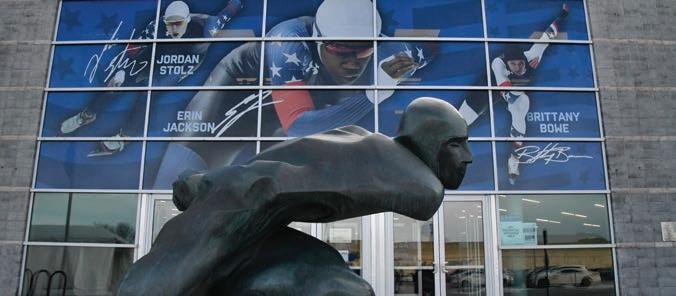
Jordan Stolz is the youngest world champion in the sport’s history and the reigning World Cup champion. Watch for him in the 500- and 1500-meter races.
Brittany Bowe is a two-time
Olympic bronze medalist and will compete in the 1500-meter and team pursuit races.
Erin Jackson is the reigning 500-meter champion and the first Black woman to win an individual gold medal at the Winter Olympic Games. She should be a gold contender in the 500.
Casey Dawson set his third national record in 5,000-meters on the way to his first World Cup in Calgary.
The U.S. men’s team pursuit team of Casey Dawson, Emery Lehman, and Ethan Cepuran set a new world record at the Salt Lake City World Cup race.
While not vying for a medal in 2026, Bonnie and Dave’s daughter, Blair, is currently “sitting around sixth or seventh in the 500 and is working on her turns,” explains Bonnie. “If her desire and everything is still there, she’s looking at 2034 when the Olympics are in Salt Lake City, Utah.”—Valerie Cheatham, special to WECN. Photos courtesy of Geri Miller
Olympic
left)
Waukesha,
Yde from Nashotah, Jordan Stolz
CLASSIFIEDS
WANTED: PAYING CASH FOR WWII FLAGS, DAGGERS, SWORDS, GUNS, ETC. Also buying guns and collections. 715-340-1974.
WANTED: DEER TAGS, BACK TAGS. Trapping, bear, hunting licenses. Otter, fisher, bobcat tags, party permits, old traps. 715-2559284 David Schober, W4234 Rock Creek Rd., Loyal, WI 54446.
GOT TRAPS - NEED TRAPS? Wanted: bear or large, odd traps, lever-action ri es. For sale: beaver, coyote, Newhouse traps. 715-563-6658.
GEOTHERMAL We service & install all models and brands. Niesen@charter.net. Contact us today.
CHAINSAWS WANTED DEAD OR ALIVE. Buying 1 or 100 McCulloch, Pioneer, Jonsereds, Echo, STIHL, Homelite, Remington, Mall. Buying all brands and sizes. Non-running, running, siezed, parts. Let me know what you have - will travel. Call Chainsaw Mike at 715-828-9414.
THROW YOUR HOME MOVIES IN THE TRASH! Or pro transfer 8mm, VHS, slides, audio, and all formats to DVD or ash drive. Gene DVD Productions 715-827-2302.
WANTED: COLLECTOR LOOKING FOR VINTAGE SPORTS CARDS 1986 or older. 608-343-3503.
E-BIKES FOR SALE Let me get you on the right E-bike/E-trike. E-Cycle Bike Shop Mobile, Boyceville, WI. Call or text Bicycle Larry 715-702-1452.
NEW PACKER CHEESEHEADS ITEMS! Check out www.cheeseknits.com for some great knit accessories. Perfect gifts for any Packer or Cheesehead fan!
WANTED TO BUY: Model 1895 Winchester ri e, 30-06 caliber. Please call 715-765-4670.
CHIPPEWA VALLEY BEE EXPO. Held at the Northern Wisconsin State Fairgrounds, April 11 and 12, 2026. Natural living pollinator information, food plots, bees, birds, butter ies. We cover all of nature, cooking with honey. Speakers’ presentations all days on various topics. See us at www.bee-expo.org or on Facebook Chippewa Valley Bee expo.
WANTED: COLLECTOR LOOKING FOR OLD WOOD AND METAL SIGNS. Any condition. Also, old motorcycle items and bell helmets. Call Jerry 920-373-3515.
WANTED: SKID STEER BOBCAT. Medium to small size with low hours. Available to travel to look at machine. Home 715-835-1305 / cell 715-577-7249.
WANTED: GATOR TX OR TS in good condition with low hours. Could be older machine. Home 715-835-1305 / cell 715-577-7249.
WANTED: COLLECTOR LOOKING FOR VINTAGE SPORTS CARDS 1986 or older. Also, looking for comic books, 1970’s or older. 608-343-3503.
POND DEPTH CONTROL. 1/2” PVC inline water level control structure, 5” and 7” stop logs for adjustability. Complete with all stop logs and handle. Height is 4’ and pipe size is 10”. Comes with 32 feet of 10-inch PVC inlet pipe and 20 feet of 10-inch outlet pipe. All collars included. Call Scott 414-719-2793.
FOR SALE: POLKA BAND EQUIPMENT. Star Concertina and Iorio-Accorgan accordions. Both in good condition. Southern Wisconsin area. Call 608-558-2698. Leave message, I will return your call.
WANTED: SHOTGUNS - 10 GAUGE OR 28 GAUGE. Single shot, break-action models. Please call Bob at 715-563-4005.
Plants & Shrubs
HARDWOOD AND CONIFER SEEDLINGS AND TRANSPLANTS. Thousands available, Oaks, Maples, Hybrid Poplar, Hickory, Black eyed Susan, Cone owers, Bee Balm, Dogwoods, Elderberry, Cranberry, Balsam, Fraser Fir, Spruce, Pine, Cedar, Techny Arborvitae, Potted cedars, grafted and wild apple trees, large bareroot shade trees including Autumn Blaze. Check us out on the web at www.paintcreeknursery.com, Facebook, Instagram, and YouTube also. Paint Creek Nursery, Cadott, WI. 715-723-2072.
THUNDERBIRD VILLAGE. ONE, FIVE, AND TEN BEDROOM, FULLY FURNISHED LODGING. Located 10 miles NE of Black River Falls with direct access to snowmobile, UTV, and Lake Arbutus. Great shing and boating. Seasonal campsites available. www.thunderbirdvillage.net 608-989-2275.
Classi ed ads reach more than 152,000 mailboxes. RATES: For non-members of Wisconsin rural electric co-ops: one insertion, $25 minimum (up to 20 words); additional words, $1.25 each. For members of Wisconsin rural electric co-ops: one insertion, $14 minimum (up to 20 words); additional words, $.70 each. Count name, address, and phone number as part of ad. Please include zip code. FOR PROOF OF MEMBERSHIP, please include your address label from your copy of the magazine. FREQUENCY DISCOUNTS: 2% discount for 3 months; 5% for 6 months; 10% for 12 months. DEADLINE: 1st of the month prior to the month in which the ad is to appear. All classi ed ads must be paid in advance. There is no agency discount on classi eds. Make check or money order payable to: WECA. Mail to: WECN—Classi eds, Attn. Jennifer, 6405 Century Ave., Ste. 102, Middleton, WI 53562. Ph: 608-467-4638. Email jennifer@weca.coop. We reserve the right to refuse ads.
Real Estate
POWERING YOUR LIFE
It’s good to know your Touchstone Energy® Cooperative is always there. For generations we’ve powered the growth of our neighborhoods, businesses, and everything in between. Today our commitment is stronger than ever to provide affordable and reliable energy on which you can depend.
YOUR SOURCE FOR POWER. AND INFORMATION. Visit us at : WWW.TOUCHSTONEENERGY.COM
WISCONSIN EVENTS February 2026
7 Northern Pines Sled Dog Race—Iron River. Northern Pines Golf and Event Center, 8 a.m.–4 p.m. Come watch more than 60 mushers compete in five different mushing categories, plus the fan favorite— kids mutt run. Watch the action up close or from the warm clubhouse. Free admission, free shuttle, and free snowshoeing! Lunch, craft vendors, race merch, and sled dog rides. 715372-8558.
7 Frozen Fun—Shiocton. Navarino Nature Center, 9 a.m.–2 p.m. Winter fun with a Frozen theme! Snowshoeing, cross-country skiing, crafts and games, warm hugs from Olaf, sledding, campfire & S’mores, guided snowshoe hikes, horse-drawn sleigh rides (weather permitting & additional fee). Chili luncheon available. $1 admission. 715-758-6999.
7, 8 Orchid Quest—Madison. Monona Terrace Community and Convention Center, 10 a.m.–3 p.m. The Upper Midwest’s largest orchid show and sale, featuring thousands of exotic orchids on display. Educational lectures and demos, plus a children’s area with fun games and prizes. Adults $10, students $7, and children under 5 are free.
14 Jig’s Up Blugold Ice Fishing Contest— Chippewa Falls. The View on Lake Wissota, 7 a.m.–2 p.m.
14 Dunn County Fish & Game Ice Fishing Contest—Menomonie. Lake Menomin (1600 Pine Ave), 11 a.m.–3 p.m. $600 fishing awards. $1,500 cash drawing awards. Contact Dave with any questions. 715-235-3840.
14 UW Madison Marching Band Runout Concert—Neillsville. High School Fieldhouse, 1–2 p.m. Concert performance by the University of Wisconsin-Madison Marching Band. $15 for adults, $10 for students at the door, and $12 and $8 in advance. Call 715-743-2240 for more info.
15 ‘Fun on the Frozen Flambeau’ Ice Fishing Contest—Tony. Leonhard’s Landing, 10 a.m.–2 p.m. Fish prizes, bucket raffles, food, and refreshments available. Kids’ fishing area. 101 prizes.
15 Fish Fry—Melrose. North Bend Lions Park, 10 a.m.–2 p.m. or until the fish runs out. Please join family and friends for a wonderful meal!
17 Mardi Gras Pancake Supper— Cable. United Church of Christ - Fellowship Hall, 5–6:30 p.m. Pancakes, toppings, sausages, ham, syrup, and beverages. Glutenfree pancakes available. Free will offerings at the door. 715-798-3066.
21 Clifton Sportsman’s Club Wild Game Feed— Camp Douglas. Almost Home Bar & Grill, 11 a.m.–3:30 p.m. Serving 11 a.m. until gone. Raffles and prizes. Adults $10, and children 12 and under are $5.
21 Ice Fishing Contest—Holcombe. Lake Holcombe Pond north of Phat Bob’s, 12–3 p.m. Stop by for a day of fishing and fun, win prize money for your school, raffle prizes, or just enjoy a tasty grilled brat in the middle of winter.
21 Free Sportsmen’s Wild Game Feed— Ogema. Baptist Church Convention Hall, 1:30–8 p.m. Vendors 1:30–4:30 p.m. Wild game cooking demonstrations by Buffy Miller Jackson of NorthWoods Kitchens. Free prize giveaway including guns, a fly-in Canadian fishing trip, chainsaw, kayak, and many more. Must be present to win. Free wild game meal and pies 5–6 p.m., speaker at 6 p.m. 715-820-2214.
21 Snowmobile Trails of Monroe County Event—Wilton. Community Center, 7–10 p.m. Raffles, drawings, food, refreshments, and fun for everyone. Come and meet Miss Snowflake! Tickets available from Snowmobile Club members or at the door.
28 Ice Fishing Jamboree—Butternut. Donner’s Bay Resort, 7 a.m.–4 p.m. Cash prizes will be given for the largest fish caught in several categories. Hot food, warm and cold beverages, and tickets for many raffles. Fun for all! For more info, call 715-476-2555.
28 Vintage Snowmobile Show—Fall Creek. Brackett Bar, 10 a.m.–2:30 p.m. Registration 10 a.m.–12 p.m. Concessions, silent auction, and raffles throughout the day. At 2 p.m. there will be awards for sleds, wearing vintage attire, and a drawing for larger prizes including a 1973 Polaris Charger 400! For more info, call 715-559-0523.
28 Winter Candlelight Hike—Babcock. Sandhill Wildlife Area, 5:30–8 p.m. Enjoy a candlelight hike through a winter wonderland. An approx. 1.5-mile lighted trail will be laid out for participants to walk and explore at their own pace. Afterward, enjoy a warm campfire, hot beverages, and sweet treats. If there is snow, please bring your own snowshoes. Cost is $10, but no pre-registration is required. For more info, email Rich at Rich.L.Schroeder@gmail.com.
Upload events directly to the wecnmagazine.com through the “Events” tab.
Wisconsin Events is a public service for our readers. Due to space limits, we may need to eliminate details, so be sure to include a phone number (with area code) where callers may obtain more info. If we receive more listings than space allows us to print, we reserve the right to select those we believe will be of interest to the greatest number of readers. Please no virtual events. Events can also be mailed to: WECN, Events, 6405 Century Avenue, Suite 102, Middleton, WI 53562-2200. DEADLINE: 1st of the month prior to the month in which the event is to appear.
Upload events to wecnmagazine.com
Bristol likes teaching calves to lead and taking them with her everywhere she goes. Photo submitted by Gloria
2. Jaxson loves animals and has no problem handing out kisses. Photo submitted by Jackie Burlingame, a member of Clark Electric.
3. Jr. relaxes on the couch with his bunny friend, Benjamin. Photo submitted by Grandpa Dave Lorenz, a member of Riverland Energy.
Upload photos directly to wecnmagazine.com through the “Submit a photo” tab.
Send photos of kids with animals, along with a brief description, to WECN Magazine, 6405 Century Avenue, Suite 102, Middleton, WI 53562-2200. Please include the name of your electric co-op. Photos will be returned. If in good-resolution, electronic format, photos may also be uploaded via wecnmagazine.com through the “Submit a photo” tab. By submitting, sender implies that he/she has rights to and owns the image, and grants WECN permission to use the image. By submitting, the parent or legal guardian also authorizes us the right to publish the image.
Score Big with Energy Savings!
Every Super Bowl MVP makes big plays—and you can too! Use the clues below to fill in the blanks and learn how you can help save energy at home by making smart, e cient plays. Double check your work in the anwer key.
1. Spend time outdoors or unplugged to reduce your ________________________ time and save energy.
2. Turn o the ________________________ while brushing your teeth.
3. When it’s cold, wear an extra layer of ________________________ instead of turning up the thermostat.
4. Keep doors and ________________________ closed when your home’s heating/cooling system is turned on.
5. Unplug smaller electronics like ________________________ when you’re not using them.
6. Turn o ________________________ when you leave a room.
1.
Brooks, a member of Jump River Electric.
“ My overall experience was great. I love the window, and from sales to scheduling, the experience was very good. The installers are highly skilled professionals and I would recommend Renewal by Andersen to all my contacts.” LYNN F. | RENEWAL BY ANDERSEN CUSTOMER