


















COOPERATIVE YOUTH LEADERS





Cooperative Energy, together with the 11 Member distribution cooperatives it serves, announced recently the award of two Cooperative Competes grants to the Hancock County Port and Harbor Commission to assist with the production of marketing for Port Bienville Site No.1 and Ignition Park.
Port Bienville Site No.1 will be a prime, pad-ready parcel located within Port Bienville Industrial Park. The site is directly served by Port Bienville Shortline Railroad and has proximity to U.S. Highway 90 and Interstate 10. The port’s shallow-draft barge canal is suitable for industries requiring flexible, cost-effective logistics. With the commission extending water and sewer utilities to the site, Site No.1 is well-positioned to support heavy manufacturing, logistics, and processing operations. Importantly, all due diligence and environmental studies have been completed for Site No. 1, and the site has earned Bronze Level Designation through CSX’s Select Site Program.
Ignition Park is a newly re-branded, pad-ready industrial development located at Stennis International Airport in Hancock County. After years of infrastructure development, site preparation, and permitting, the commission has now poised to transition into marketing phase for the park. Ignition Park represents a long-term public investment in Mississippi’s economic future, with more than $11.6 million in infrastructure improvements already secured.
The two $10,000 Cooperative Competes grants will be used to assist with production videos that will use aerial drone footage, animated site graphics, infographics, and text overlays to communicate key information such as available sites, infrastructure details, regional connectivity, and workforce strengths. With no voiceover narration, the video will be clean, accessible, and versatile across all
digital platforms including trade shows, prospect outreach, social media, and economic development websites.
In 2023 and 2024, Port Bienville and the Ignition Park enrolled into the Cooperative Energy SiteInvest program, making it eligible for Cooperative Competes grant funds.
The Cooperative Competes initiative is aimed at increasing community competitiveness and encouraging economic growth. A component of the initiative allows economic development organizations to apply for grant funds to support industrial property, workforce, or community development efforts throughout Mississippi.

The House has passed two significant permitting reform bills that would help protect affordable power nationwide by reducing delays for electric cooperatives making crucial improvements to their systems.
“Federal environmental permitting has become increasingly complex, unpredictable and unworkable over time,” said NRECA CEO Jim Matheson. “It interferes with co-op efforts to maintain the infrastructure that is essential to keeping the lights on and build new infrastructure to meet growing demand. These hurdles delay critical projects and can significantly increase costs for electric co-op consumers.”
The bills passed by the House offer solutions to those problems, Matheson said.
House members voted 221-196 on Dec. 18 to approve the bipartisan Standardizing Permitting and Expediting Economic Development (SPEED) Act, which would streamline the requirements imposed by the National Environmental Policy Act
on electric co-ops applying for federal permits to build new generation, transmission and distribution capacity, strengthen existing systems or perform crucial maintenance work.
The bill’s lead sponsors say it would shorten permitting timelines and reduce the frequency of “frivolous litigation” that stymies construction of vital infrastructure.
In another important change, co-ops would no longer have to go through the NEPA review process every time they get federal grants or other types of funding for an improvement project.
The House also voted 221-205 on Dec. 11 to pass the Promoting Efficient Review for Modern Infrastructure Today (PERMIT) Act.
The NRECA-supported bill would improve permitting under the Clean Water Act by cutting red tape and providing greater regulatory certainty for co-ops that obtain permits.
Both bills must still be passed by the Senate and signed into law by President Donald Trump. — NRECA



“Improving the quality of life for all those we touch.”
Like many of you, I enjoy doing projects around the house. Before I start, I usually ask myself some questions. What do I want to accomplish? What materials do I need? And if the work involves weatherization, will it really help me save money on my electric bill?
Generally, the answer to that last question is a resounding “yes.” Even small energy e ciency measures will save money. For a small investment (the cost of an outlet and switch plate insulator kit or some weatherstripping), you can begin to drastically improve comfort around your residence.
What areas should you focus on? Start with the basics: applying weather stripping and caulk around doors and windows; replacing traditional incandescent light bulbs with light-emitting diodes (LEDs) light bulbs; and insulating your water heater. Then look at some bigger expenditures: adding insulation to your attic, installing a programmable thermostat, and sealing ductwork. You can find even more ways to save on our 4-County webpage under Energy Savings.
At 4-County Electric Power Association, we’re committed to doing everything possible to keep your electric bills a ordable.

And we’re controlling costs through innovation — our energy e ciency programs are just one way we can help you manage your energy use.
Consumers can learn more about how to make their homes more energy e cient, and qualify for incentives by scheduling a home energy audit by a 4-County marketing specialist. We can also provide an energy e ciency presentation for your organization. Call 4-County at 662-327-8900 for more information. Ask for the marketing department. You can also download 4-County’s app to help you manage your bill and your energy use and put savings in the palm of your hand.

CEO/General Manager by Brian Clark





by Brad Barr
FASTnet recently celebrated five years of providing area folks with quality, a ordable high-speed broadband.
The story began with the Shannon family in western Clay County. Roy and Mary Shannon were the 4-County Electric Power Association subsidary’s first customers. Today, FASTnet has nearly 22,000 customers and serves fiber internet service across 4-County’s service area and has expanded into Macon and West Point.
The Shannons continue to enjoy FASTnet. “It works beautifully,” said Mary Shannon. “We have no problems with it. We stream everything. When people come visit, they hook up immediately. It’s the only way we can have good service in our area.”
“This is a monumental time for FASTnet and its customers,” said 4-County CEO Brian Clark. “We’re really excited about the FASTnet journey and for the access we’re providing to high-speed internet. We’re looking forward to the months and years ahead.”
Fast, reliable, quality. These three adjectives embody the FASTnet brand, according to Clark. “Our goal is and has always been to live up to the FASTnet name,” Clark said.
Members with questions or comments about broadband can call 1-800-431-1544 or email broadband@4county.org.


















by Brad Barr
Longtime 4-County employees Junior Eads, Gina Beaird, Jimmie Daniels, Karen Smith, and Eddie Pennington retired recently after serving the cooperative for a combined nearly 143 years.
For most of 4-County’s membership, these employees have been co-op mainstays and frequent faces of the cooperative.
4-County CEO Brian Clark said the quintet has been instrumental in the co-op’s success story. “Placing a value on the impact these employees have had on 4-County is hard to explain. Su ce it to say, they have, individually and collectively, helped the co-op achieve a goal of service excellence. They are much appreciated and will be missed. Each is leaving big shoes to fill. We wish them all the very best in their retirement endeavors,” Clark said.
Junior joined 4-County in 1987 as a laborer. He has worked as a groundman, equipment operator, senior equipment operator, rightsof -way maintenance trimmer, rights-of-way foreman, and, most recently, as a marketing specialist.









Jimmie joined 4-County in 1996 as a rights-of-way trimmer 3. He also served as a vehicle mechanic, staking engineer 2, staking engineer 1, district service coordinator, and, most recently, as manager of consumer services/system security.
Gina joined 4-County in 1994 as an executive secretary in the public relations/marketing department. She has also worked as an executive secretary in the human resources and training department, a human resources and training administrator, and, most recently, as a human resources assistant/benefits coordinator.
Karen joined 4-County in 2001 as a cashier/accounting clerk. She has also served as an accounts payable clerk, and, most recently, as senior accounts payable clerk.
Eddie joined 4-County in 2007 as a fleet management supervisor and worked in that position until his retirement.
Employees celebrated the group’s valuable years of service in ceremonies and luncheons held recently.
by Brad Barr
Liz Hankins and Tyler Miles have joined the 4-County/FASTnet team.
A Columbus resident, Liz comes to 4-County from the pharmacy field. She will serve 4-County/FASTnet as a member service representative. Liz has an associate’s degree from Northeast Mississippi Community College. She has two grown children and one grandchild. Her hobbies include travel and spending time with her family.
A native of Noxapater, Tyler has joined 4-County as a pre-apprentice lineman. Prior to 4-County, Tyler worked for an electric contracting company. He is a graduate of the East Mississippi Community College Lineman Training Program. He is a veteran of the U. S. Army. In his spare time, Tyler enjoys fishing.
Welcome to the 4-County/FASTnet team, Liz and Tyler!
A listing of elected o cials, along with their addresses, is being provided for the convenience of readers who wish to contact them.
Roger Wicker • 555 Dirksen Senate O ce Building, Washington, D.C., 20510. 202-224-6253.
Cindy Hyde-Smith • 702 Hart Senate O ce Building, Washington, D.C., 20510. 202-224-5054.
Trent Kelly • District 1, 1005 Longworth House O ce Building, Washington, D.C. 20515. 202-225-4306.
Bennie Thompson • District 2, 2466 Rayburn House O ce Building, Washington, D.C. 20515. 202-225-5876.
Michael Guest • District 3, 230 Cannon House O ce Building, Washington, D.C. 20515. 202-225-5031.
Mike Ezell • District 4, 2349 Rayburn House O ce Building, Washington, D.C. 20515. 202-225-5772.
Governor Tate Reeves • P.O. Box 139, Jackson, MS 39205. 601-359-3150.
Lt. Governor Delbert Hoseman • P.O. Box 1018, Jackson, MS 39215. 601-359-3200.
Secretary of State Michael Watson Heber Ladner Building, 401 Mississippi St., Jackson, MS 39205. 601-359-1350.
Attorney General Lynn Fitch • Walter Sillers Building, 550 High St., Suite 1200, Jackson, MS 39201. 601-359-3680.
Treasurer David McRae • P.O. Box 138, Jackson, MS 39205. 601-359-3600.
State Auditor Shad White • P.O. Box 956, Jackson, MS 39205. 601-576-2800.
Commissioner of Agriculture and Commerce J. Andrew (Andy) Gipson 121 North Je erson St., Jackson, MS 39201. 601-359-1100.
Insurance Commissioner Mike Chaney P.O. Box 79, Jackson, MS 39205. 601-359-3569.







Sen. Hob Bryan
District 7: Itawamba, Lee, and Monroe counties
Address: P.O. Box 75, Amory, MS 38821
Sen. Angela Turner Ford
District 16: Clay, Lowndes, Noxubee, and Oktibbeha counties
Address: P.O. Drawer 1500, West Point, MS 39773
Sen. Rod Hickman
District 32: Kemper, Lauderdale, Noxubee, and Winston counties
Address: P.O. Box 1018, Jackson, MS 39215
Sen. Benjamin A. Suber
District 8: Calhoun, Chickasaw, Lafayette, Pontotoc, and Yalobusha counties
Address: P.O. Box 8, Bruce, MS 38915




Rep. Andy Boyd
District 37: Clay, Lowndes, and Monroe counties
Address: P.O. Box 1018, Jackson, MS 39215
Rep. Karl Gibbs
District 36: Chickasaw, Clay, Monroe, and Oktibbeha counties
Address: P.O. Box 1018, Jackson, MS 39215
Rep. Joey Hood
District 35: Choctaw, Oktibbeha, Webster, and Winston counties
Address: P.O. Box 759, Ackerman, MS 39735
Rep. Kabir Karriem
District 41: Lowndes County
Address: P.O. Box 1018, Jackson, MS 39215
Rep. Jonathan “Jon” Lancaster
District 22: Chickasaw, Monroe, and Pontotoc counties
Address: P.O. Box 1018, Jackson, MS 39215











Rep. Dana Underwood McLean
District 39: Lowndes and Monroe counties
Address: P.O. Box 1018, Jackson, MS 39215
Rep. Carl L. Mickens
District 42: Kemper, Lowndes, Noxubee, and Winston counties
Address: P.O. Box 427, Brooksville, MS 39739
Rep. Loyd B. (Rob) Roberson II
District 43: Oktibbeha County
Address: P.O. Box 1018, Jackson, MS 39215
Rep. Perry Bailey
District 23: Calhoun, Lafayette, Pontotoc, and Webster counties
Address: P.O. Box 1018, Jackson, MS 39215
Rep. Cheikh Taylor
District 38: Clay, Lowndes, and Oktibbeha counties
Address: P.O. Box 1018, Jackson, MS 39215
Sen. Bart Williams
District 15: Choctaw, Montgomery, Oktibbeha, and Webster counties
Address: P.O. Box 1018, Jackson, MS 39215
Sen. Charles A. (Chuck) Younger District 17: Lowndes, Monroe, and Oktibbeha counties
Address: P.O. Box 1018, Jackson, MS 39215




















by Brad Barr

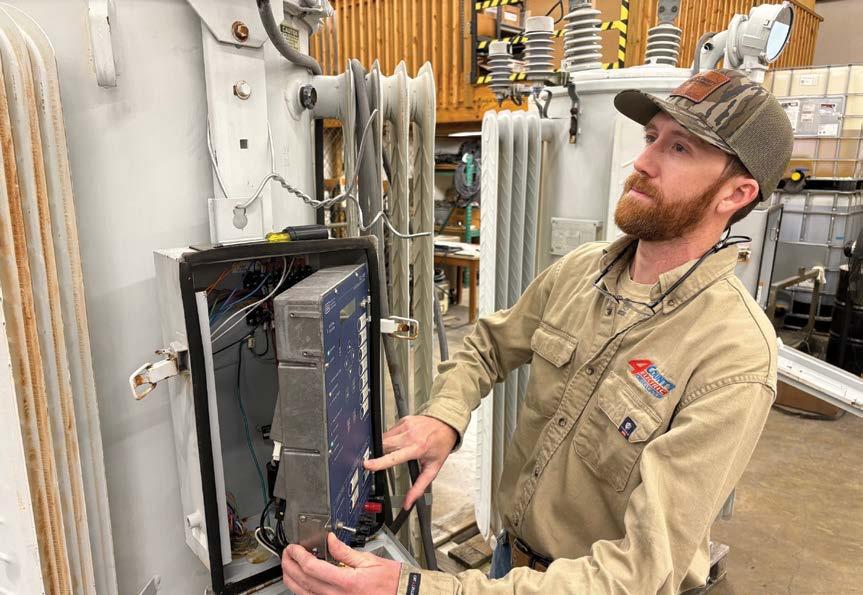
Cole Bright enjoys putting the spotlight on 4-County Electric Power Association.
The co-op’s substation maintenance technician 4 acknowledges that his surname fits in perfectly with the shining reputation 4-County has in the communities it serves. “We work together as a team to make sure we keep the lights bright for our members,” Cole said. “It’s a responsibility we take seriously.”
Cole began working at 4-County two years ago, following an eight-year stint as an industrial maintenance technician for Yokahoma Tire Company. He has an associate’s degree in electrical technology from East Mississippi Community College.
He grew up in the Sapa community of Webster County and continues to live there. Cole attends Maben Baptist Church.
Growing up at the family homestead, Cole enjoyed riding horses. In fact, he competed in rodeo events throughout the Southeast, often winning titles and the coveted belt buckles that come with that success. “Now, I’m just all washed up,” he said with a laugh. In all seriousness, he may have hung up his competition rodeo hat, but he has traded it in for a coach’s hat. “I still enjoy coaching up

my nieces and nephews as they compete in rodeo events. And I always enjoy riding the horses,” Cole said.
“It was a thrill, for sure,” Cole said of his rodeo experience. “The competition and camaraderie were good too.”
Today, in his spare time, Cole enjoys spending time on the river in search of the elusive catfish. The avid fisherman has a 53-pound catch to his credit. “I just enjoy being out on the river with my friends and family.” And I’ve only sunk one boat,” he added in jest.
He has two dogs, a Catahoula Cur, and a lab mix. “Charlene and Lily keep watch around the homeplace.”
At 4-County, Cole maintains and tests equipment related to substations. He enjoys the versatility of his job. “We’re never in the same place or doing the same thing each day. Our work extends throughout our service area. We’re continually working with di erent applications,” he said.
The co-op is a good place to work, he stressed. “I work with some good people. It’s very family oriented. I appreciate that we often open meetings with prayers. We work together as a team.”









































CARTHAGE: 601-267-5671 | PHILADELPHIA: 601-656-2601 | RANKIN: 601-829-1201 | SEBASTOPOL: 601-625-7422 A tradition of dependable, hometown service since 1937


Central Electric Power Association will hold its 89th annual membership meeting on Mar. 17 at the Carthage Coliseum on Highway 16 East in Carthage.
As pursuant to Central Electric Power Association’s bylaws and to provide each Central Electric member an opportunity to vote in a director election, the o cial ballot and proxy will be mailed to all Central Electric members the week of Feb.16.
Enclosed will be an information sheet with “how-to-vote” details along with a self-addressed, postage-paid envelope for members to return their ballot or proxy. Your o cial ballot must




be received via mail no later than March 17. The election results will be published in Today in Mississippi magazine and on the association’s website.
In accordance with the laws of Mississippi and the bylaws of the association, members will elect three directors for three-year terms: two directors from Leake County, and one director from Attala County.
Mark your calendars for March 17, and we’ll see you at the annual meeting!














































by Miranda Boutelle
Buying a new appliance can feel daunting. Before you hand over your hard-earned money, here’s how to choose an appliance that will help you save money over time.
When shopping, keep in mind that not all new appliances are high e ciency and not all old appliances are ine cient. The less e cient your current appliance, the more you will save with an upgrade. The yellow EnergyGuide label on new appliances shows the yearly energy cost, kilowatt-hour electricity use, and ENERGY STAR® logo, if certified.
Let’s look at some appliance examples to see how the costs and savings stack up.
Refrigerators have seen major e ciency improvements over the years. New refrigerators use up to 73% less energy than 1970s models and about a third less than 20-year-old models.
On a visit to my mom’s house, she proudly showed o her 1980s refrigerator she bought when her 1970s harvest gold model died. If her 80s fridge uses 2,000 kWh per year, at 14 cents per kWh, it costs $280 per year to operate. New ENERGY STAR-certified refrigerator prices start at $500 with yearly energy costs ranging from $38 to $122. If mom buys a new ENERGY STAR-certified refrigerator for $1,000 with $100 yearly energy cost — saving her $180 per year — it will pay for itself in about five and a half years.
If you intend to keep your old appliance, be sure to weigh the additional energy costs. Maximize e ciency and keep your food safe by setting your refrigerator to 37 degrees and your freezer at 0 degrees.
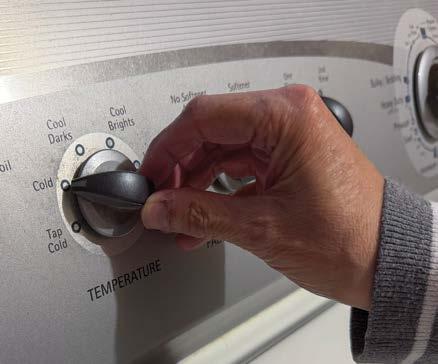
New ENERGY STAR-certified clothes washers and dryers are also more efficient than older models. Use the ENERGY STAR Product Finder at energystar.gov to compare products. Integrated Modified Energy Factor measures the washer’s energy efficiency. A higher number is better. Integrated Water Factor measures water efficiency. A lower number is better.
I recently bought a new washing machine when my old front-load machine died. I was considering a top-load machine. When I compared ENERGY STAR-certified top loaders to front loaders, I changed my mind. Energy Star-certified front loaders use about 50% less energy and water than top-load agitator washers and about 25% less energy and water than top-load impeller washers that don’t have an agitator.
My new washer cost $698. According to the appliance’s EnergyGuide, based on six loads of laundry a week and an electricity cost of 14 cents per kWh, the yearly energy cost is $15. Similar non-ENERGY STAR-certified models were $48 per year. Mine didn’t cost much more than non-Energy Star models and will help me save over time.
Then I had to make the decision about buying the matching dryer. My dryer was functional but had features I didn’t like. At 14 cents per kWh and running roughly six loads a week for an hour each, my old dryer used $131.04 per year.
The new matching ENERGY STAR-certified dryer cost $698 and estimates annual energy use at 607 kWh, which is $84.98 per year at 14 cents per kWh. With an estimated savings of $46 per year, the dryer would take 15 years for the savings to cover the price. That’s a long time and not worth the cost.
To improve your washer and dryer efficiency, wash in cold water, don’t over dry clothes, and clean your lint trap between every load.
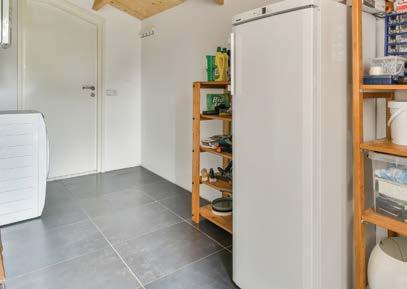
Buying a new ENERGY STAR-certified refrigerator and putting the old one out in the garage won’t save energy. However, sometimes the secondary fridge or freezer allows you to save through groceries by stocking up on sales, preserving your own food, and saving gas with fewer trips to the store. It’s all a balance.
Just like the light bulbs in your home, LED televisions offer increased efficiency. ENERGY STAR-certified televisions are 34% more efficient than conventional models. If you have a working LED television, swapping to an ENERGY STAR model is more efficient but may not make up for the cost of a new TV. Instead, check the efficiency settings on your TV or buy a smart power strip that turns off other connected devices when not in use.
Whatever appliance you are upgrading or replacing, make an informed decision by comparing the cost of operation and shopping ENERGY STAR models to help lower your electric bill.
Miranda Boutelle is the chief operating officer at Efficiency Services Group in Oregon, a cooperatively owned energy efficiency company.







by Jennah Denney
Our homes are changing, and so is the electric grid. Across the country, more households are becoming “smart” and connected. From thermostats that adjust automatically to electric vehicles that charge overnight, the devices we plug in are becoming intelligent, flexible, and increasingly central to how we use and even produce electricity.
For your electric cooperative, this growing network of connected devices creates new ways for co-ops and their members to work together to keep power reliable and a ordable.
A connected home is one where everyday appliances and devices can communicate with each other, you or even with your electric co-op. These could include thermostats that adjust to your patterns and preferences, water heaters that operate when electricity is cheaper, home batteries that store solar-generated power for later use, or air-source heat pumps that e ciently heat and cool your home.
Each of these tools can help you use energy more e ciently — and when they are managed e ectively, or when many homes coordinate and balance their energy use together, they can also help your co-op keep power flowing reliably and a ordably for the entire community.
You might have heard the phrase “behind the meter.” This simply refers to energy equipment that operates on your side of the electric meter that you own or control. This could include solar panels, battery storage systems, or connected devices like EV chargers or smart thermostats.
Individually, they may seem small, but together they can make a big di erence. If hundreds of water heaters slightly delay heating during a peak time of day (when electricity use is high), the co-op can avoid purchasing power at a higher cost, which essentially keeps rates lower for members. If home batteries store solar-generated energy during the day and release it back to the grid at night, it helps balance the overall supply and demand of electricity.
Each day, our electric grid must maintain a perfect balance to match the amount of electricity generated with the amount of electricity we are using — all in real time. Because electricity can’t easily be stored at scale, this balancing act is constant and complex. Connected devices give electric co-ops powerful new tools to help manage this complexity. Traditionally, electricity use was simple: flip a switch and power flows instantly. But today, many devices can
shift when and how they use energy, also known as load flexibility. Load flexibility allows you and your co-op to better align energy use during times when electricity is more a ordable, without sacrificing comfort or convenience.
The cooperative advantage
Electric co-ops are led by the members they serve. That means co-ops can design connected home programs that work for your community, not Wall Street. Members who participate can often earn bill credits or incentives, and every member benefits from lower peak costs and improved reliability.
Together, we can build a grid that’s smarter, more flexible, and ready for the future that’s powered by what’s plugged in. Contact your local electric co-op or visit their website to learn more about programs for connected devices and additional ways you can save energy (and money!).
Jennah Denney writes on consumer and cooperative a airs for the National Rural Electric Cooperative Association.

Connected devices such as smart thermostats can help you use energy more e ciently. When many homes coordinate and balance their energy use together, connected devices can also help your co-op keep power flowing reliably and a ordably for the entire community. Photo Credit: LG


























by Qua’Shara Monix

February is often wrapped in the language of love. We think of hearts, kindness, compassion, and the people who matter most to us… our families, friends, coworkers, and the communities we serve. Though it is the shortest month of the year, February has a powerful way of reminding us that love is not just something we feel; it is something we show and share every day, at home, outside our homes, and in the workplace.




It is also a month that can bring fierce weather. Winter storms do not always announce themselves politely. They test our patience, our preparedness, and our willingness to look out for one another. In many ways, how we respond to winter weather mirrors how we handle relationships: with intention, care, and a commitment to safety.
Showing love at home can be as simple as checking in, listening, and ensuring our loved ones are safe and warm. Outside our homes, love shows up when we look out for neighbors, especially those who may need extra help during cold weather. In the workplace, love and care are reflected through teamwork, clear communication, and a shared focus on safety. Making sure everyone goes home at the end of the day is key.
February reminds us that compassion doesn’t pause when conditions become di cult. In fact, it matters more. Whether we are responding to winter storms or navigating daily responsibilities, the way we treat one another can either strengthen preparedness and trust or disrupt it.
Preparing for unpredictable winter weather is more than a checklist, it is an act of kindness. As we focus on planning ahead, we reduce risk, ease stress, and protect those around us. Following safety procedures and remaining patient with one another helps create a culture where care and compassion thrive, even under pressure.








Our resolutions, both personal and professional, play a role here. Choosing to be ready, courteous, and patient helps keep everyone safe and reinforces strong relationships at home and at work.
As February continues, keep these important winter safety reminders in mind




• PREPARE AHEAD: Keep emergency supplies on hand, including flashlights, batteries, blankets, and a way to receive weather updates.
• STAY INFORMED: Monitor forecasts and follow guidance from local authorities and Coahoma Electric Cooperative.
• SLOW DOWN: Icy roads and cold conditions require extra patience. Give yourself and others time and space.
• DRESS FOR THE WEATHER: Wear layers and appropriate protective gear when outdoors or working in cold conditions.
• LOOK OUT FOR OTHERS: Check on neighbors, coworkers, and family members, especially the elderly or those living alone. February may be brief, but its message is lasting. Love, care, and compassion are not seasonal, they are daily commitments. As we prepare for winter’s unpredictability and face challenges together, let us choose actions that reflect respect and responsibility. Be ready. Be courteous. Be prepared. Be patient. Be safe!! When we lead with love and preparedness, we protect not only ourselves but everyone around us. This type of protection is a powerful way to carry February’s spirit into the months ahead.
Coahoma Electric Power Association has partnered with Survey & Ballot Systems to administer the 2026 proxies. This will be a hybrid proxy. Paper proxies were mailed to all active members, and electronic proxies sent to all members with emails on file with Coahoma Electric. Proxies were scheduled to arrive by the third week of January.
by Miranda Boutelle
Buying a new appliance can feel daunting. Before you hand over your hard-earned money, here’s how to choose an appliance that will help you save money over time.
When shopping, keep in mind that not all new appliances are high e ciency and not all old appliances are ine cient. The less e cient your current appliance, the more you will save with an upgrade. The yellow EnergyGuide label on new appliances shows the yearly energy cost, kilowatt-hour electricity use, and ENERGY STAR® logo, if certified. Let’s look at some appliance examples to see how the costs and savings stack up.
Refrigerators have seen major e ciency improvements over the years. New refrigerators use up to 73% less energy than 1970s models and about a third less than 20-year-old models.
On a visit to my mom’s house, she proudly showed o her 1980s refrigerator she bought when her 1970s harvest gold model died. If her 80s fridge uses 2,000 kWh per year, at 14 cents per kWh, it costs $280 per year to operate. New ENERGY STAR-certified refrigerator prices start at $500 with yearly energy costs ranging from $38 to $122. If mom buys a new ENERGY STAR-certified refrigerator for $1,000 with $100 yearly energy cost — saving her $180 per year — it will pay for itself in about five and a half years.
If you intend to keep your old appliance, be sure to weigh the additional energy costs. Maximize e ciency and keep your food safe by setting your refrigerator to 37 degrees and your freezer at 0 degrees.
New ENERGY STAR-certified clothes washers and dryers are also more efficient than older models. Use the ENERGY STAR Product Finder at energystar.gov to compare products. Integrated Modified Energy Factor measures the washer’s energy efficiency. A higher number is better. Integrated Water Factor measures water efficiency. A lower number is better.
I recently bought a new washing machine when my old front-load machine died. I was considering a top-load machine. When I compared ENERGY STAR-certified top loaders to front loaders, I changed my mind. Energy Star-certified front loaders use about 50% less energy and water than top-load agitator washers and about 25% less energy and water than top-load impeller washers that don’t have an agitator.
My new washer cost $698. According to the appliance’s EnergyGuide, based on six loads of laundry a week and an electricity cost of 14 cents per kWh, the yearly energy cost is $15. Similar non-ENERGY STAR-certified models were $48 per year. Mine didn’t cost much more than non-Energy Star models and will help me save over time.
Then I had to make the decision about buying the matching dryer. My dryer was functional but had features I didn’t like. At 14 cents per kWh and running roughly six loads a week for an hour each, my old dryer used $131.04 per year.
The new matching ENERGY STAR-certified dryer cost $698 and estimates annual energy use at 607 kWh, which is $84.98 per year at 14 cents per kWh. With an estimated savings of $46 per year, the dryer would take 15 years for the savings to cover the price. That’s a long time and not worth the cost.
To improve your washer and dryer efficiency, wash in cold water, don’t over dry clothes, and clean your lint trap between every load.
Buying a new ENERGY STAR-certified refrigerator and putting the old one out in the garage won’t save energy. However, sometimes the secondary fridge or freezer allows you to save through groceries by stocking up on sales, preserving your own food, and saving gas with fewer trips to the store. It’s all a balance.
Just like the light bulbs in your home, LED televisions offer increased efficiency. ENERGY STAR-certified televisions are 34% more efficient than conventional models. If you have a working LED television, swapping to an ENERGY STAR model is more efficient but may not make up for the cost of a new TV. Instead, check the efficiency settings on your TV or buy a smart power strip that turns off other connected devices when not in use.
Whatever appliance you are upgrading or replacing, make an informed decision by comparing the cost of operation and shopping ENERGY STAR models to help lower your electric bill.
Miranda Boutelle is the chief operating officer at Efficiency Services Group in Oregon, a cooperatively owned energy efficiency company.
If you’re looking for a new TV, ENERGY STAR-certified models are 34% more efficient than conventional models.
by Jennah Denney
Our homes are changing, and so is the electric grid. Across the country, more households are becoming “smart” and connected. From thermostats that adjust automatically to electric vehicles that charge overnight, the devices we plug in are becoming intelligent, flexible, and increasingly central to how we use and even produce electricity.
For your electric cooperative, this growing network of connected devices creates new ways for co-ops and their members to work together to keep power reliable and a ordable.
A connected home is one where everyday appliances and devices can communicate with each other, you or even with your electric co-op. These could include thermostats that adjust to your patterns and preferences, water heaters that operate when electricity is cheaper, home batteries that store solar-generated power for later use, or air-source heat pumps that e ciently heat and cool your home.
Each of these tools can help you use energy more e ciently — and when they are managed e ectively, or when many homes coordinate and balance their energy use together, they can also help your co-op keep power flowing reliably and a ordably for the entire community.
You might have heard the phrase “behind the meter.” This simply refers to energy equipment that operates on your side of the electric meter that you own or control. This could include solar panels, battery storage systems, or connected devices like EV chargers or smart thermostats.
Individually, they may seem small, but together they can make a big di erence. If hundreds of water heaters slightly delay heating during a peak time of day (when electricity use is high), the co-op can avoid purchasing power at a higher cost, which essentially keeps rates lower for members. If home batteries store solar-generated energy during the day and release it back to the grid at night, it helps balance the overall supply and demand of electricity.
Each day, our electric grid must maintain a perfect balance to match the amount of electricity generated with the amount of electricity we are using — all in real time. Because electricity can’t easily be stored at scale, this balancing act is constant and complex.
Connected devices give electric co-ops powerful new tools to help manage this complexity. Traditionally, electricity use was simple: flip a switch and power flows instantly. But today, many devices can
shift when and how they use energy, also known as load flexibility. Load flexibility allows you and your co-op to better align energy use during times when electricity is more a ordable, without sacrificing comfort or convenience.
Electric co-ops are led by the members they serve. That means co-ops can design connected home programs that work for your community, not Wall Street. Members who participate can often earn bill credits or incentives, and every member benefits from lower peak costs and improved reliability.
Together, we can build a grid that’s smarter, more flexible, and ready for the future that’s powered by what’s plugged in. Contact your local electric co-op or visit their website to learn more about programs for connected devices and additional ways you can save energy (and money!).
Jennah Denney writes on consumer and cooperative a airs for the National Rural Electric Cooperative Association.
Connected devices such as smart thermostats can help you use energy more e ciently. When many homes coordinate and balance their energy use together, connected devices can also help your co-op keep power flowing reliably and a ordably for the entire community. Photo Credit: LG










At Coast Electric and CoastConnect, we believe that listening to our members and subscribers is the foundation of exceptional service. Every year, we conduct satisfaction surveys for each company to ensure we’re meeting your expectations. This year, your feedback speaks volumes. Coast Electric and CoastConnect each earned an outstanding score of 90 on the American Customer Satisfaction Index (ACSI®), placing us among the top service providers nationwide. This achievement reflects not only your trust in us but also the dedication of our employees who work tirelessly to serve you.
Your input matters. When you take the time to share your experiences, you help us identify what we’re doing well and where we can improve. In fact, six key areas — some of which include east of contact, keeping you informed, resolving issues quickly, and o ering convenient payment options — showed significant improvement over last year. These gains are a direct result of listening to you and acting on what you told us.
























A good response from your cooperative isn’t just about answering questions — it’s about anticipating needs and delivering value. Whether it’s restoring power quickly after an outage or providing flexible ways to manage your account, we strive to make every interaction positive and productive. Our commitment to continuous improvement ensures that we’re not only meeting today’s expectations but preparing for tomorrow’s challenges. Thank you for your trust, your feedback and your partnership. Together, we’re building a stronger, more responsive cooperative — one that puts members first in everything we do.

by Chris Rhodes
President and CEO



When Coast Electric members round up their bills each month, they are not only helping fund community grants for charities that make a local impact, they are also helping friends and neighbors who need temporary help with life’s necessities. Most everyone will experience a financial setback at some point and, when they do, the Share Your Blessings fund can help. Electric use is largely impacted by weather, so extreme cold in the winter means higher bills for consumers. Heating accounts for nearly half of electric use in the winter, and when temperatures are low, heating units cycle on more often, increasing energy use and creating higher bills for members, even when they practice energy e ciency. Increases in bills cause a greater need for assistance. Members who wish to make an additional gift to Catholic Charities can visit any Coast Electric o ce or call us at 877-769-2372. All donations will be designated to help Coast Electric members. Coast Electric members in need of assistance can reach out to our partners at Catholic Charities of South Mississippi at 855-847-0555 to see if they qualify for help. Funds are distributed based on need, not religious a liation. Thanks to all of our members who participate in Operation Round Up each month. Your generous contributions make life a little brighter for our community.































Coast Electric and CoastConnect recently received results of their 2025 member and subscriber satisfaction surveys, and consumers gave both companies overwhelmingly positive feedback! Both companies received an overall score of a 90 out of 100 on the American Customer Satisfaction Index (ACSI®), putting them in the top 12 % of providers nationwide.
OF THE 17 PERFORMANCE QUALITY ATTRIBUTES MEASURED... OF THE 10 PERFORMANCE QUALITY ATTRIBUTES MEASURED...
4.0 ALL 17 ATTRIBUTES SCORED ABOVE “GOOD”
HIGHEST RATED ATTRIBUTES:
SIX ATTRIBUTES INCREASED SIGNIFICANTLY
4.5
12 ATTRIBUTES SCORED HIGHER THAN “EXCELLENT”
• FRIENDLY/COURTEOUS EMPLOYEES
• HIGHLY TRAINED/PROF ESSIONAL EMPLOYEES
• RESTORING POWER QUICKLY AFTER OUTAGE
• BEING EASY TO REACH • KEEPING CONSUMERS INFORMED •
• RESOLVING ISSUES • DELIVERING GOOD VALUE FOR THE MONEY •
• HAVING MEMBERS’ BEST INTERESTS AT HEART •
• CONVENIENT PAYMENT OPTIONS •
Coast Electric completed its annual member satisfaction survey, where over 590 members were asked to participate. The member responses were sent to the American Customer Satisfaction Index (ACSI®), a company that measures customer satisfaction across multiple industries throughout the entire United States. For 2025, Coast Electric received an ACSI score of 90, on a 100-point scale. Coast Electric’s score is higher when compared to publicly measured cooperative utility scores reported in the syndicated 2025 ACSI Energy Utility Study and places Coast Electric 16 points higher than the average investor-owned utility score of 74, as well as 15 points higher than the municipal utilities score of 75, per the industry ratings. For more information, please visit https://theacsi. org/industries/energy-utilities/.
9 WOULD RECOMMEND COASTCONNECT TO A FRIEND OR FAMILY MEMBER ARE PROMOTERS OUT OF 10 SUBSCRIBERS
4.0 ALL 10 ATTRIBUTES SCORED ABOVE “GOOD”
8 ATTRIBUTES SCORED HIGHER THAN “EXCELLENT”
4.5
HIGHEST RATED ATTRIBUTE: FRIENDLY/COURTEOUS EMPLOYEES
CoastConnect completed its annual subscriber satisfaction survey, where over 428 subscribers were asked to participate. The subscribers’ responses were sent to the American Customer Satisfaction Index (ACSI®), a company that measures customer satisfaction across multiple industries throughout the entire United States. For 2025, CoastConnect received an ACSI score of 90 on a 100-point scale. 1 CoastConnect’s score is higher when compared to 2025 Fiber Internet Service Provider scores/ Non-fiber Internet Service Provider scores reported in the syndicated 2025 ACSI Telecommunications Study and places CoastConnect 15 points higher than the average Fiber Internet Service Provider score of 75, as well as 20 points higher than the average Non-fiber Internet Service Provider score of 70, per the industry ratings. For more information, please visit https://theacsi.org/industries/ telecommunications-and-information/internet-service-providers/.
Coast Electric wants you to reduce your energy use and see savings on your monthly energy costs. Each month, you will have an opportunity to register to win a prize that will help you reduce energy consumption in your home.
Congratulations to Millerree Varnado the winner of our December Reduce Your Use prize. Visit coastelectric.coop and fill out our entry form. It only takes a few seconds, and you could win a prize that helps you save!




Coast Electric, in partnership with Cooperative Energy, is proud to announce that Julie Berry has been selected as the 2025 Powering Possibilities Community Service Grant winner representing Coast Electric.
Berry was selected among other nominees for her 11-year commitment to supporting vulnerable children in Hancock County through her service as a Court Appointed Special Advocate. Having advocated for 30 children through some of the most challenging moments of their lives, Berry also ensures their educational, emotional, and developmental needs are met with compassion and integrity. Berry’s steadfast advocacy, consistency, and deep care have left an enduring impact on the lives of countless children.
As part of this recognition, Cooperative Energy will make a $1,000 charitable donation in Berry’s name to CASA of South Mississippi, a nonprofit organization serving communities within the cooperative’s service area.
The Powering Possibilities Community Service Grant celebrates volunteers who embody the cooperative principle of Concern for Community. These men and women dedicate their time and talents to making a positive di erence in the lives of others. Through this program, Cooperative Energy and its 11 Member electric cooperatives honor outstanding community volunteers by awarding donations to qualifying nonprofit organizations selected in each cooperative’s territory.











“It’s very rewarding,” Berry said of her e orts with CASA. “We’ve got a great court system here. They are very supportive of CASA’s input in the cases. We’re trying to help the courts make decisions on these children’s futures, so it’s really important that we understand what the objectives are and that we are able to be objective and give the court facts.” Berry notes the excellent training volunteers are given as one of the reasons CASA is successful for our community’s children. She said the most rewarding part of volunteering as an advocate is seeing cases that have a conclusion that works for the families. Many of the families Berry has advocated for have stayed in touch throughout the years, allowing her to see the long-term success of CASA.
“Julie’s commitment to advocating on behalf of the coast’s most vulnerable children truly represents the cooperative spirit,” said Coast Electric Director of Community Development Janell Nolan. “We’re honored to recognize her dedication and to support CASA of South Mississippi, which shares that same mission of strengthening our communities.”

Founded on the principle of local people serving local needs, the Powering Possibilities Community Service Grant reflects the ongoing partnership between Cooperative Energy and its Member cooperatives, including Coast Electric, to power meaningful change beyond electricity.

“Our members and their communities inspire us,” said Christa Bishop, executive vice president and chief communications o cer for Cooperative Energy. “Through Powering Possibilities grant program, we’re proud to highlight the volunteers and organizations that power Mississippi through compassion and service.”
The donation will support CASA’s mission to advocate for South Mississippi’s abused and neglected children by supporting volunteers who promote safety, permanency and resilience, creating a community where all children thrive in safe and nurturing families.





Julie’s commitment to advocating on behalf of the coast’s most vulnerable children truly represents the cooperative spirit.
CoastConnect is extending the fast, reliable WiFi experience you know and love beyond your home and into the community. With SmartTown, CoastConnect subscribers will be able to enjoy a secure, authenticated WiFi connection around town, to keep you connected wherever you live, work and play.
We’re rolling out SmartTown, starting with our first responders. Providing reliable, high-speed access in the field helps our local first responders share information quickly and e ciently and keep our community safe. We’re proud to support the people who serve us every day.
As SmartTown expands, you may notice the network name “CoastConnect_SmartTown” appear on your router. It’s important to note that enabling SmartTown will not impact your connection in your home. Your personal network and devices will remain separate, secure and private. You will not see any changes in the way your service works today.
Stay tuned as CoastConnect brings next-level connectivity to the place we all call home! For more information, please visit www.CoastConnect.com/community.





Here’s how it works:



















Sign up to be a CoastConnect Ambassador today, so you can start turning your connections into cash. It’s our way of saying thanks for spreading the word about our high-speed internet and phone service.
• Visit coastconnect.com to sign up to be a CoastConnect Ambassador.
• Once signed up, you will receive a personalized referral QR code to share with friends, family, neighbors and anybody who needs faster internet.
• When someone signs up for CoastConnect service using your referral QR code, you and the new subscriber will receive a gift card after the referred subscriber pays their first bill.
• The more people you refer, the more you earn. It’s that easy!
Sign up to be a CoastConnect Ambassador today! You can receive $50 for each residential referral or $100 for each business referral.
Visit CoastConnect.com to learn more and start earning today.


































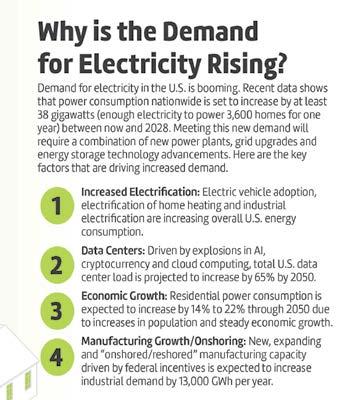
Across the U.S., the demand for power is climbing at one of the fastest rates in decades. As the economy becomes more reliant on electricity, electric cooperatives are preparing to meet the challenges that skyrocketing demand brings.
The North American Reliability Corporation — the watchdog for the U.S. electric grid — recently released the 2025-2026 winter reliability assessment, which echoed other recent reports, including longer-term outlooks that expect su cient energy resources during normal conditions but potential supply shortfalls and outages under more intense weather conditions.
Extreme weather coupled with additional factors that are driving increased demand creates challenges for electric utilities, including cooperatives, in their mission to provide reliable power around the clock.
Several key factors are driving increased demand — including economic growth, expanded manufacturing, and increased electrification in transportation. Together, these trends are reshaping how much electricity we consume and how quickly co-ops must adapt to meet future needs.
One of the biggest drivers of rising demand is increased electrification. More homes and businesses are transitioning to electricity for home heating, water heating, and transportation. EVs are becoming more common on the road, and many states are o ering incentives to help consumers make the switch. Additionally, electric heat pumps are replacing traditional furnaces in many homes due to their e ciency. These transitions mean more energy use and pressure placed on our electric grid.
Economic and manufacturing growth are also contributing to higher electricity use. As businesses expand and new industries take root, especially in rural and suburban areas, the demand for reliable, high-capacity power is increasing. The resurgence of domestic manufacturing has led to major facility construction. These facilities often require substantial energy loads, and many operate continuously to keep production lines running. This growth brings jobs and investment, but it also puts new pressures on the electric grid.
Population growth and housing development are also contributing to rising demand in many regions, and everyday life is becoming more energy dependent, too. Smart appliances, connected devices, home o ces, and entertainment systems are adding to overall consumption, even as e ciency improves.
While increased demand presents new challenges for electric utilities, it also has the potential to create significant opportunities





for co-ops and the communities they serve, such as job growth, steady revenue, and improved infrastructure. Electric co-ops are responding by planning carefully for the future — investing in grid modernization and o ering programs and services to help co-op members conserve energy. Exploring additional generation sources, strengthening transmission systems, and implementing technologies that help manage peak load are just a few of the ways co-ops are planning for increased demand. Strategic planning is critical to ensuring the grid can support everything from EV charging to large-scale manufacturing plants.
Electricity powers nearly every aspect of today’s economy, and its role will only grow stronger. As electrification accelerates, long-term planning becomes more important than ever.
Your electric co-op is ready to meet rising demand in our local communities. Through innovation, investment and collaboration, we are preparing for a more reliable and resilient energy future.
by Miranda Boutelle
Buying a new appliance can feel daunting. Before you hand over your hard-earned money, here’s how to choose an appliance that will help you save money over time.
When shopping, keep in mind that not all new appliances are high e ciency and not all old appliances are ine cient. The less e cient your current appliance, the more you will save with an upgrade. The yellow EnergyGuide label on new appliances shows the yearly energy cost, kilowatt-hour electricity use, and ENERGY STAR® logo, if certified.
Let’s look at some appliance examples to see how the costs and savings stack up.
Refrigerators have seen major e ciency improvements over the years. New refrigerators use up to 73% less energy than 1970s models and about a third less than 20-year-old models.
On a visit to my mom’s house, she proudly showed o her 1980s refrigerator she bought when her 1970s harvest gold model died. If her 80s fridge uses 2,000 kWh per year, at 14 cents per kWh, it costs $280 per year to operate. New ENERGY STAR-certified refrigerator prices start at $500 with yearly energy costs ranging from $38 to $122. If mom buys a new ENERGY STAR-certified refrigerator for $1,000 with $100 yearly energy cost — saving her $180 per year — it will pay for itself in about five and a half years.
If you intend to keep your old appliance, be sure to weigh the additional energy costs. Maximize e ciency and keep your food safe by setting your refrigerator to 37 degrees and your freezer at 0 degrees.
New ENERGY STAR-certified clothes washers and dryers are also more efficient than older models. Use the ENERGY STAR Product Finder at energystar.gov to compare products. Integrated Modified Energy Factor measures the washer’s energy efficiency. A higher number is better. Integrated Water Factor measures water efficiency. A lower number is better.
I recently bought a new washing machine when my old front-load machine died. I was considering a top-load machine. When I compared ENERGY STAR-certified top loaders to front loaders, I changed my mind. Energy Star-certified front loaders use about 50% less energy and water than top-load agitator washers and about 25% less energy and water than top-load impeller washers that don’t have an agitator.
My new washer cost $698. According to the appliance’s EnergyGuide, based on six loads of laundry a week and an electricity cost of 14 cents per kWh, the yearly energy cost is $15. Similar non-ENERGY STAR-certified models were $48 per year. Mine didn’t cost much more than non-Energy Star models and will help me save over time.
Then I had to make the decision about buying the matching dryer. My dryer was functional but had features I didn’t like. At 14 cents per kWh and running roughly six loads a week for an hour each, my old dryer used $131.04 per year.
The new matching ENERGY STAR-certified dryer cost $698 and estimates annual energy use at 607 kWh, which is $84.98 per year at 14 cents per kWh. With an estimated savings of $46 per year, the dryer would take 15 years for the savings to cover the price. That’s a long time and not worth the cost.
To improve your washer and dryer efficiency, wash in cold water, don’t over dry clothes, and clean your lint trap between every load.
Buying a new ENERGY STAR-certified refrigerator and putting the old one out in the garage won’t save energy. However, sometimes the secondary fridge or freezer allows you to save through groceries by stocking up on sales, preserving your own food, and saving gas with fewer trips to the store. It’s all a balance.
Just like the light bulbs in your home, LED televisions offer increased efficiency. ENERGY STAR-certified televisions are 34% more efficient than conventional models. If you have a working LED television, swapping to an ENERGY STAR model is more efficient but may not make up for the cost of a new TV. Instead, check the efficiency settings on your TV or buy a smart power strip that turns off other connected devices when not in use.
Whatever appliance you are upgrading or replacing, make an informed decision by comparing the cost of operation and shopping ENERGY STAR models to help lower your electric bill.
Miranda Boutelle is the chief operating officer at Efficiency Services Group in Oregon, a cooperatively owned energy efficiency company.
If you’re looking for a new TV, ENERGY STAR-certified






by Jennah Denney
Our homes are changing, and so is the electric grid. Across the country, more households are becoming “smart” and connected. From thermostats that adjust automatically to electric vehicles that charge overnight, the devices we plug in are becoming intelligent, flexible, and increasingly central to how we use and even produce electricity.
For your electric cooperative, this growing network of connected devices creates new ways for co-ops and their members to work together to keep power reliable and a ordable.
What is a connected home?
A connected home is one where everyday appliances and devices can communicate with each other, you or even with your electric co-op. These could include thermostats that adjust to your patterns and preferences, water heaters that operate when electricity is cheaper, home batteries that store solar-generated power for later use, or air-source heat pumps that e ciently heat and cool your home.
Each of these tools can help you use energy more e ciently — and when they are managed e ectively, or when many homes coordinate and balance their energy use together, they can also help your co-op keep power flowing reliably and a ordably for the entire community.
You might have heard the phrase “behind the meter.” This simply refers to energy equipment that operates on your side of the electric meter that you own or control. This could include solar panels, battery storage systems, or connected devices like EV chargers or smart thermostats.
Individually, they may seem small, but together they can make a big di erence. If hundreds of water heaters slightly delay heating during a peak time of day (when electricity use is high), the co-op can avoid purchasing power at a higher cost, which essentially keeps rates lower for members. If home batteries store solar-generated energy during the day and release it back to the grid at night, it helps balance the overall supply and demand of electricity.
Each day, our electric grid must maintain a perfect balance to match the amount of electricity generated with the amount of electricity we are using — all in real time. Because electricity can’t easily be stored at scale, this balancing act is constant and complex.





Connected devices give electric co-ops powerful new tools to help manage this complexity. Traditionally, electricity use was simple: flip a switch and power flows instantly. But today, many devices can shift when and how they use energy, also known as load flexibility. Load flexibility allows you and your co-op to better align energy use during times when electricity is more a ordable, without sacrificing comfort or convenience.
Electric co-ops are led by the members they serve. That means co-ops can design connected home programs that work for your community, not Wall Street. Members who participate can often earn bill credits or incentives, and every member benefits from lower peak costs and improved reliability.
Together, we can build a grid that’s smarter, more flexible, and ready for the future that’s powered by what’s plugged in. Contact your local electric co-op or visit their website to learn more about programs for connected devices and additional ways you can save energy (and money!).
Jennah Denney writes on consumer and cooperative a airs for the National Rural Electric Cooperative Association.

Connected devices such as smart thermostats can help you use energy more e ciently. When many homes coordinate and balance their energy use together, connected devices can also help your co-op keep power flowing reliably and a ordably for the entire community.







































From time to time, it’s good to pause and remind our members about ways to save energy, especially during the winter months. When temperatures drop, our heating systems work harder and run longer, which leads to higher energy use — and that often results in higher bills.
It’s important to remember that your electric meter works a lot like a register on a gas pump. As you fi ll up your car, the number of gallons and the cost increases as you pump fuel into your car. Your electric meter works the same way; it measures the amount of electricity your home uses and tallies it up. In much the same way that how much gas you put in your tank determines how much you pay for it, the energy you pay for is entirely determined on how much energy your home consumes. The power to manage your bill is literally in your hands.
While comfort during the cold is important, it unfortunately does come at a cost. Heating accounts for the largest portion of most members’ winter energy use, but a few small adjustments can make a noticeable di erence.
Here are a few practical ways to reduce your energy use without sacrificing comfort:
• Seal up drafts. A few dollars worth of caulk or weatherstripping around doors and windows can go a long way in keeping the warm air inside and the cold air out. It’s a small investment that can make a big di erence.
• Be mindful of the thermostat. Setting your thermostat just one or two degrees lower can lead to meaningful savings over time. Consider using a programmable smart thermostat to automatically adjust temperatures when you’re away or asleep.










• Avoid space heaters. They may seem convenient, but space heaters consume a significant amount of electricity and can quickly increase your bill. They are intended to warm people, not rooms, and should not be used as a substitute for your central heating system.
• Let the sun help. Open curtains or blinds during the day to allow natural warmth to enter your home, and close them at night to keep that heat from escaping.
• Install a timer on your water heater. If your water heater is electric, it’s the second-largest source of energy consumption in your home during the winter months, right behind your heating unit. It runs even while you sleep to maintain the water temperature you’ve set. By installing a timer, you can prevent it from running during those overnight hours, reducing your energy use during the coldest (and most expensive) part of the day.
At Dixie Electric, we’re committed to helping our members make smart, informed choices about their energy use. We understand that comfort matters, especially during the coldest months of the year. However, by taking small steps and staying mindful of your energy habits, you can keep your home comfortable and your bill manageable.



by Randy Smith General Manager












by Amanda Mills


After nearly three decades of dedicated service, Mike Chancellor is retiring from Dixie Electric, closing a chapter on a career defi ned by hard work, mentorship, and a genuine love for serving others.
Mike began his journey with Dixie Electric in July 1998 as a collector. Just two years later, he transitioned to the line crew as a groundman, laying the groundwork for a career that would span multiple roles and departments. Through determination and hard work, Mike worked his way up to become a lineman, a role in which he spent many years serving members and mentoring others. In 2019, he was promoted to his current position as a staking technician.
Those who have worked alongside Mike know his presence is hard to miss, but it’s his character that truly sets him apart.
“Mike’s stature may stand out, but it’s his heart that truly defi nes him,” said Distribution Engineer Andrew Jones. “He leads with kindness, treats everyone with respect, and brings a level of warmth and sincerity that makes a lasting impact on everyone he meets.”
Throughout his career, Mike has been known not only for his knowledge but also for his willingness to teach and encourage others. General Manager Randy Smith said that mentoring has always been a defi ning part of Mike’s legacy.
“Mike has always been known as Big Daddy, and it fits in more ways than one,” Smith said. “He’s been a good teacher and mentor over the years, especially to the younger guys on his crews when he was a lineman. Several younger employees in the staking department have also been mentored by Mike. He’s a huge prankster with a great sense of humor, but he takes his job seriously and always does his best to provide our members with what they need.”
Smith added that Mike’s ability to connect with members has been invaluable. “When members don’t know or aren’t sure what they need, Mike patiently guides them through the process and helps them understand what they’re getting and the costs associated with it. Mike has been an asset to Dixie Electric for a long time, and we are going to miss him.”

For Mike, the relationships he’s built over the years are what stand out most.
“The part of my job I enjoyed the most was helping and guiding people and meeting the needs of our members,” Mike said. “I’ve met so many new people while working at Dixie. Many of my coworkers and the members I’ve served have become lifelong friends.”
When asked who had the biggest impact on him throughout his career, Mike pointed to the leaders who shaped him early on. “During my time as a lineman, I learned so much from my foremen Harold Ishee, David Hayes, and Guy Shelton,” he said. “These men were knowledgeable, hardworking, and led by example.”
One of Mike’s most unforgettable experiences came during one of the most di cult times in Dixie Electric’s history — Hurricane Katrina. “Working through all the hardships and seeing the destruction Katrina brought to our area is defi nitely something I’ll never forget,” Mike said. “It was truly an honor to work for a company that was helping people rebuild their lives.”
As he looks ahead to retirement, Mike said leaving won’t be easy. “Dixie Electric has been more than a job to me,” he shared. “The company, the coworkers, and the people we serve have been a huge part of my life for the last 27 years. I know I’ll miss all of it.”
Retirement, however, will give Mike the opportunity to spend more time doing what he loves. “My wife tells me I have too many hobbies,” he laughed. “I enjoy traveling, fishing, hunting, and gardening, and I never seem to have enough time for everything.”
He also plans to continue giving back through volunteer work at his church. “I serve as a greeter for guest services at Journey, and meeting new people and making them feel welcome has been a huge blessing,” Mike said. “My wife and I hope to serve our church and community well with our extra time.”
As Mike Chancellor steps into retirement, Dixie Electric thanks him for 27 years of commitment, leadership, and heart. His legacy will live on through the employees he mentored, the members he served, and the countless lives he touched along the way.






















by Amanda Mills

February is the month of love, and for many of us, there’s nothing better than a cozy night at home with the ones we love most. Maybe that means takeout, fuzzy blankets, and a favorite movie streaming on the TV. But for others, just the word “streaming” feels overwhelming. With so many services, remotes, and apps to choose from, it can be hard to know where to even begin.





Over the years, we’ve heard countless testimonials from members who have saved a significant amount of money by switching to streaming. Many were paying high cable bills fi lled with hidden fees for channels they rarely watched. Once they made the change, they were surprised by both the simplicity and the savings.
That’s where we want to help. At Dixie Electric and DE Fastlink, we know that streaming can feel like learning a new language, but it doesn’t have to be. On our website, defastlink. net, you’ll fi nd a resource called StreamNow, designed to simplify the process and make it easy to understand, no matter your comfort level with technology.
The StreamNow guide walks you through every step — from choosing your equipment to fi nding the streaming services that fit your household best. You’ll learn how to connect devices like Amazon Fire Sticks, Roku Sticks, and smart TVs; how to sign up for your favorite services; and how to explore live TV, on-demand, and even free streaming options.
One of the coolest features of the site is our Live TV Channel Lineup tool. Think of it as a matchmaking service, but for your television. If you’ve ever thought about cutting the cord and switching from cable but weren’t sure which service o ered your favorite channels, this tool does the searching for you. Simply type in the channels that matter most to your family, and it will show you which streaming services carry them. It’s a fast, easy way to see which service is your perfect match.
Streaming isn’t just a new way to watch, it’s a smarter, more flexible option that puts the control back in your hands. You choose what you want, when you want it, and how you want to watch it. Whether you’re a movie bu , sports fan, or binge-watcher, there’s a perfect setup for every household, and StreamNow helps you fi nd it.
So, this Valentine’s Day, skip the crowded restaurants and fall in love with the idea of a stay-at-home date night. Pop some popcorn, get cozy, and stream a favorite movie or show using the power of DE Fastlink fiber.
After all, when you have fast, reliable internet, every night can feel like movie night — and that’s something to truly love.
Scan here to learn more

Calvary Baptist Church, Petal
Richton Methodist Church First Baptist Runnelstown
These organizations have programs to help children with food insecurities in our communities.






























DeKalb 601-743-2641 • Louisville 662-773-5741 • Quitman 601-776-6271 • Meridian / After-Hours Outages 601-581-8600
MEMBER OWNED. LOCALLY OPERATED. THAT’S THE COOPERATIVE DIFFERENCE.
At East Mississippi Electric Power Association (EMEPA), our goal is simple: to provide reliable electricity at the lowest possible cost. As a member-owned cooperative, we work hard to manage expenses and plan carefully, so we can keep rates stable. Sometimes, though, factors outside our control a ect the cost of power for utilities across the region.
Beginning Jan. 1, 2026, EMEPA experienced an increase in wholesale power cost — the price we pay for electricity before it reaches your home or business. Wholesale power makes up the largest portion of your electric bill, and the biggest driver behind this increase is the rising cost of natural gas, which is widely used to generate electricity throughout the Southeast.
Natural gas prices are influenced by supply and demand. During periods of extreme heat or cold, electricity use rises, which increases demand for natural gas–fueled power plants. At the same time, U.S. natural gas is in high demand around the world, and exports can tighten supplies at home. Production challenges, pipeline constraints and weather-related disruptions can also a ect availability and pricing.
Because of these factors, members may notice a modest increase in power costs. For the average residential member, this increase amounts to about 37 cents per day, or roughly $11.47 per month. We understand that any increase matters, and we do not take this lightly.
The good news is that there are steps — both now and in the long term — that help stabilize energy costs. Expanding natural gas production and improving pipeline and storage infrastructure can help better balance supply and demand over time. Diversifying how electricity is generated also plays an important role. Using a mix of energy resources, including
According to Section 4.04(b) of the Bylaws of East Mississippi Electric Power Association, any 50 members acting together may nominate a qualified member to serve as director on the Board of Directors by petition. Any petition nominating a qualified member shall be submitted on a form designated and provided by the Association. Each member signing such petition shall place thereon the date of signing and the address, account number and service location of the member.
renewables and other baseload generation, reduces reliance on natural gas alone and helps limit the impact when fuel prices rise.
Energy e ciency is another key piece of the puzzle. When overall electricity use is lower — especially during peak times — less natural gas is needed to generate power. That helps control fuel costs for everyone. Utilities also rely on long-term planning tools, such as fuel hedging and power supply contracts, to help reduce exposure to short-term market swings.
EMEPA works closely with our power suppliers to support these strategies while planning carefully for the future. Our focus is always on reliability, a ordability and responsible stewardship of member dollars.
As a not-for-profit cooperative, EMEPA does not make money from electricity sales. Any adjustments to power costs are made only to cover the actual cost of providing safe, dependable service. If costs go down, those savings flow back to our members.
If you have questions about your bill, would like help finding ways to save energy, or need information about assistance programs, our team is always here to help. Thank you for being a valued member of EMEPA and for trusting us to power your home and community.

by Randy Carroll
Qualified nominations made by petition, if any, must be received at the principal o ce of the Association (2211 A Street, Meridian, MS 39301) on or before the second Wednesday in April. The Credentials Committee shall review and consider suggestions for nominees from members of the Association and shall review all nominations and petitions for compliance with Association Bylaws.
| FEBRUARY



by Miranda Boutelle
Buying a new appliance can feel daunting. Before you hand over your hard-earned money, here’s how to choose an appliance that will help you save money over time.
When shopping, keep in mind that not all new appliances are high e ciency and not all old appliances are ine cient. The less e cient your current appliance, the more you will save with an upgrade. The yellow EnergyGuide label on new appliances shows the yearly energy cost, kilowatt-hour electricity use, and ENERGY STAR® logo, if certified. Let’s look at some appliance examples to see how the costs and savings stack up.
Refrigerators have seen major e ciency improvements over the years. New refrigerators use up to 73% less energy than 1970s models and about a third less than 20-year-old models.
On a visit to my mom’s house, she proudly showed o her 1980s refrigerator she bought when her 1970s harvest gold model died. If her 80s fridge uses 2,000 kWh per year, at 14 cents per kWh, it costs $280 per year to operate. New ENERGY STAR-certified refrigerator prices start at $500 with yearly energy costs ranging from $38 to $122. If mom buys a new ENERGY STAR-certified refrigerator for $1,000 with $100 yearly energy cost — saving her $180 per year — it will pay for itself in about five and a half years.
If you intend to keep your old appliance, be sure to weigh the additional energy costs. Maximize e ciency and keep your food safe by setting your refrigerator to 37 degrees and your freezer at 0 degrees.
New ENERGY STAR-certified clothes washers and dryers are also more efficient than older models. Use the ENERGY STAR Product Finder at energystar.gov to compare products. Integrated Modified Energy Factor measures the washer’s energy efficiency. A higher number is better. Integrated Water Factor measures water efficiency. A lower number is better.
I recently bought a new washing machine when my old front-load machine died. I was considering a top-load machine. When I compared ENERGY STAR-certified top loaders to front loaders, I changed my mind. Energy Star-certified front loaders use about 50% less energy and water than top-load agitator washers and about 25% less energy and water than top-load impeller washers that don’t have an agitator.
My new washer cost $698. According to the appliance’s EnergyGuide, based on six loads of laundry a week and an electricity cost of 14 cents per kWh, the yearly energy cost is $15. Similar non-ENERGY STAR-certified models were $48 per year. Mine didn’t cost much more than non-Energy Star models and will help me save over time.
Then I had to make the decision about buying the matching dryer. My dryer was functional but had features I didn’t like. At 14 cents per kWh and running roughly six loads a week for an hour each, my old dryer used $131.04 per year.
The new matching ENERGY STAR-certified dryer cost $698 and estimates annual energy use at 607 kWh, which is $84.98 per year at 14 cents per kWh. With an estimated savings of $46 per year, the dryer would take 15 years for the savings to cover the price. That’s a long time and not worth the cost.
To improve your washer and dryer efficiency, wash in cold water, don’t over dry clothes, and clean your lint trap between every load.
Buying a new ENERGY STAR-certified refrigerator and putting the old one out in the garage won’t save energy. However, sometimes the secondary fridge or freezer allows you to save through groceries by stocking up on sales, preserving your own food, and saving gas with fewer trips to the store. It’s all a balance.
Just like the light bulbs in your home, LED televisions offer increased efficiency. ENERGY STAR-certified televisions are 34% more efficient than conventional models. If you have a working LED television, swapping to an ENERGY STAR model is more efficient but may not make up for the cost of a new TV. Instead, check the efficiency settings on your TV or buy a smart power strip that turns off other connected devices when not in use.
Whatever appliance you are upgrading or replacing, make an informed decision by comparing the cost of operation and shopping ENERGY STAR models to help lower your electric bill.
Miranda Boutelle is the chief operating officer at Efficiency Services Group in Oregon, a cooperatively owned energy efficiency company.
If you’re looking for a new TV, ENERGY STAR-certified models are 34% more efficient than conventional models.





February brings a welcome sense of routine after the busy holiday season. As families across East Mississippi settle into the year, many are looking for ways to make life simpler, smoother and more connected. With East Mississippi Connect’s fiber internet now available throughout the entire service area, every household has the opportunity to get more from technology than ever before. This month is an ideal time to explore how your fiber connection can elevate daily life, whether you are working, studying, streaming, gaming or managing a smart home.
Fiber internet is built for modern living. Today’s homes rely on connected devices—smart TVs, video doorbells, thermostats, tablets, laptops, gaming systems and voice-activated assistants. As these devices multiply, the demand on your Wi-Fi network grows. East MS Connect’s fiber network provides the bandwidth and reliability you need to power them all at once. This February, take a moment to review your home setup—router placement, device connections and Wi-Fi coverage—to ensure you are getting the strongest signal in every room.
Another trend shaping 2026 is the expansion of remote work and virtual classrooms. The quality of your internet connection can influence productivity, communication and overall work performance. With symmetrical upload and download speeds, East MS Connect ensures smooth video calls, fast file sharing and frustration-free collaboration. If you experienced slowdowns before fiber service arrived, you now have access to performance that supports the demands of today’s workplace—right from your kitchen table or home o ce.
Entertainment continues to evolve, as well. Streaming platforms o er ultra-high-definition programming, online gaming grows more advanced each year and virtual reality is becoming more mainstream. These digital experiences require a sturdy, high-speed connection. East MS Connect’s fiber infrastructure ensures your home remains ready for the next generation of entertainment, allowing multiple family members to stream, game and browse simultaneously without bu ering or delays. It’s a level of reliability that older technologies simply cannot match.
February is also a good time to review digital safety habits. As the number of connected devices continues to climb, securing your home network is becoming increasingly important. East MS Connect’s fiber foundation o ers built-in resilience, but customers can further strengthen security through updated passwords, parental controls and router management tools. Protecting your devices helps safeguard your personal information and ensures your network runs e ciently.
Finally, staying informed is key to getting the most out of your service. By visiting eastmsconnect.com, you can access helpful resources, troubleshoot issues, learn about new features and manage your account with ease. The website is your gateway to updates, tips and tools that help you use your fiber connection to its fullest potential.
With fiber now reaching every corner of the East MS Connect service area, explore what high-speed fiber can do for your home. The technology is in place. Now is the time to unlock its full power.























As a member, if you know you cannot attend the Annual Meeting in person, we ask that you send in your proxy.
The proxies were sent in the mail on Jan. 28 and were slated to arrive in mailboxes in early February.
“I ask that our members look for the proxies and be a part of our election process by sending in your proxies if you cannot attend the meeting,” said General Manager Darrell Smith. “It is very important that our members take part in our election process.”
For sending in your proxy, you








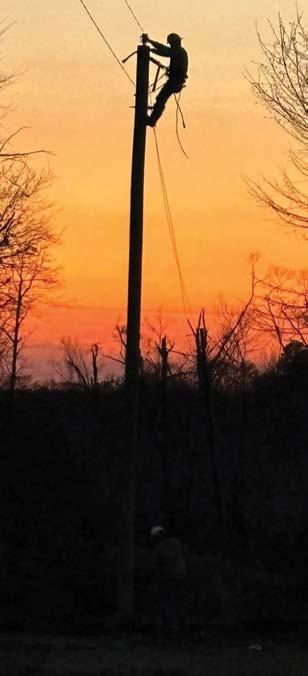





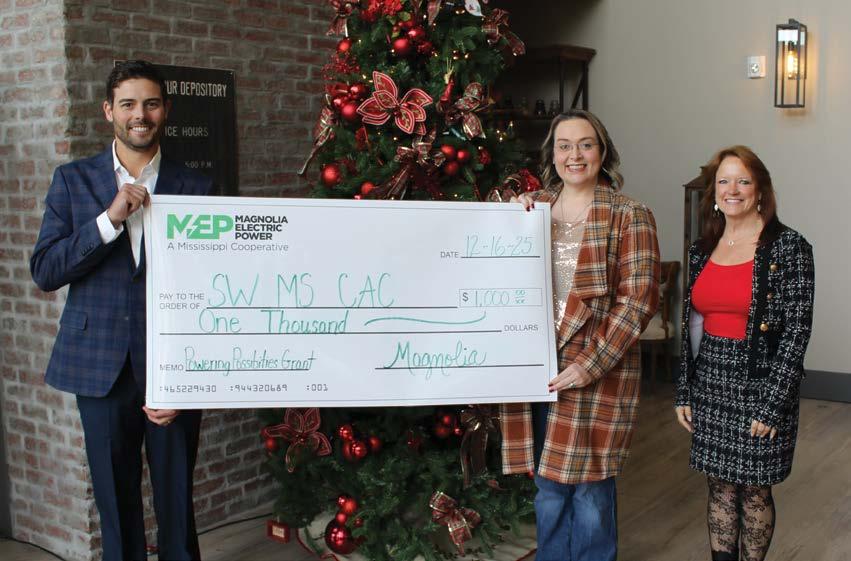

Magnolia Electric Power, in partnership with Cooperative Energy, is proud to announce that Johanna White has been selected as Magnolia’s 2025 Powering Possibilities Community Service Grant winner.
White plays a key role with the Southwest Mississippi Children’s Advocacy Center, helping provide a safe and supportive space for children in need. White volunteers her time to organize major events such as a local silent auction and the Bingo and Bubbly fundraiser, and she recently served as chair of the center’s annual fundraising event.
As part of this recognition, Cooperative Energy made a $1,000 charitable donation in White’s name to Southwest Mississippi Children’s Advocacy Center, a nonprofit organization serving communities within the cooperative’s service area.
The Powering Possibilities Community Service Grant celebrates volunteers who embody the cooperative principle of Concern for Community. These men and women dedicate their time and talents to making a positive di erence in the lives of others.
Through this program, Cooperative Energy and its 11 Member electric cooperatives honor outstanding community volunteers by


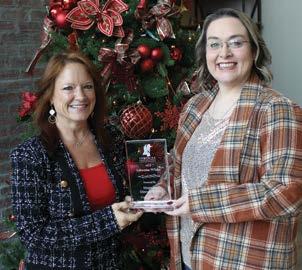


awarding donations to qualifying nonprofit organizations selected in each cooperative’s territory.
“White’s commitment to supporting southwest Mississippi’s most vulnerable children truly represents the cooperative spirit,” said Magnolia Electric Power Manager of Member Services and Communications Lucy Shell. “We are honored to recognize her dedication and to support Southwest Mississippi Children’s Advocacy Center, which shares that same mission of strengthening our communities.”
Founded on the principle of local people serving local needs, the Powering Possibilities Community Service Grant reflects the ongoing partnership between Cooperative Energy and its Member cooperatives, including Magnolia Electric Power, to power meaningful change beyond electricity.
“Our members and their communities inspire us,” said Christa Bishop, executive vice president and chief communications o cer for Cooperative Energy. “Through the Powering Possibilities grant program, we’re proud to highlight the volunteers and organizations that power Mississippi through compassion and service.”
The donation will support victims of childhood and vulnerable adult abuse.












Those receiving awards for their years of service were
45 years Dennis Butler
40 years Chris Anglin
35 Years Tracy Lambert, John Lee, Mike McKenzie, and Tony Nettles
25 Years Terry Causey and Justin Thomas
20 Years Carl Fuller



15 Years Lawrence Weems and Luis Ybarra
10 Years Kaylan Bracey, Yvonne Dillon, and Alex Fortenberry
5 Years Scotty Brown




Magnolia Electric Power employees, retirees, and board members gathered for a lunch recently to celebrate MEP employees’ service awards.














































Buying a new appliance can feel daunting. Before you hand over your hard-earned money, here’s how to choose an appliance that will help you save money over time.
by Miranda Boutelle
When shopping, keep in mind that not all new appliances are high e ciency and not all old appliances are ine cient. The less e cient your current appliance, the more you will save with an upgrade. The yellow EnergyGuide label on new appliances shows the yearly energy cost, kilowatt-hour electricity use, and ENERGY STAR® logo, if certified.
Let’s look at some appliance examples to see how the costs and savings stack up.
Refrigerators have seen major e ciency improvements over the years. New refrigerators use up to 73% less energy than 1970s models and about a third less than 20-year-old models.
On a visit to my mom’s house, she proudly showed o her 1980s refrigerator she bought when her 1970s harvest gold model died. If her 80s fridge uses 2,000 kWh per year, at 14 cents per kWh, it costs $280 per year to operate. New ENERGY STAR-certified refrigerator prices start at $500 with yearly energy costs ranging from $38 to $122. If mom buys a new ENERGY STAR-certified refrigerator for $1,000 with $100 yearly energy cost — saving her $180 per year — it will pay for itself in about five and a half years.
If you intend to keep your old appliance, be sure to weigh the additional energy costs. Maximize e ciency and keep your food safe by setting your refrigerator to 37 degrees and your freezer at 0 degrees.
New ENERGY STAR-certified clothes washers and dryers are also more e cient than older models. Use the ENERGY STAR Product Finder at energystar.gov to compare products. Integrated Modified Energy Factor measures the washer’s energy e ciency. A higher number is better. Integrated Water Factor measures water e ciency. A lower number is better.
I recently bought a new washing machine when my old front-load machine died. I was considering a top-load machine. When I compared ENERGY STAR-certified top loaders to front loaders, I changed my mind. ENERGY STAR-certified front loaders use about 50% less energy and water than top-load agitator washers and about 25% less energy and water than top-load impeller washers that don’t have an agitator.
My new washer cost $698. According to the appliance’s EnergyGuide, based on six loads of laundry a week and an electricity cost of 14 cents per kWh, the yearly energy cost is $15. Similar non-ENERGY STARcertified models were $48 per year. Mine didn’t cost much more than non-ENERGY STAR models and will help me save over time.
Then I had to make the decision about buying the matching dryer. My dryer was functional but had features I didn’t like. At 14 cents per
kWh and running roughly six loads a week for an hour each, my old dryer used $131.04 per year.
The new matching ENERGY STAR-certified dryer cost $698 and estimates annual energy use at 607 kWh, which is $84.98 per year at 14 cents per kWh. With an estimated savings of $46 per year, the dryer would take 15 years for the savings to cover the price. That’s a long time and not worth the cost.
To improve your washer and dryer e ciency, wash in cold water, don’t over dry clothes, and clean your lint trap between every load.
Just like the light bulbs in your home, LED televisions o er increased e ciency. ENERGY STAR-certified televisions are 34% more e cient than conventional models. If you have a working LED television, swapping to an ENERGY STAR model is more e cient but may not make up for the cost of a new TV. Instead, check the e ciency settings on your TV or buy a smart power strip that turns o other connected devices when not in use.
Whatever appliance you are upgrading or replacing, make an informed decision by comparing the cost of operation and shopping ENERGY STAR models to help lower your electric bill.
Miranda Boutelle is the chief operating officer at Efficiency Services Group in Oregon, a cooperatively owned energy efficiency company.

If you’re looking for a new TV, ENERGY STAR-certified models are 34% more e cient than conventional models.

























Across the U.S., the demand for power is climbing at one of the fastest rates in decades. As the economy becomes more reliant on electricity, electric cooperatives are preparing to meet the challenges that skyrocketing demand brings.
The North American Reliability Corporation — the watchdog for the U.S. electric grid — recently released the 2025-2026 winter reliability assessment, which echoed other recent reports, including longer-term outlooks that expect su cient energy resources during normal conditions but potential supply shortfalls and outages under more intense weather conditions.
Extreme weather coupled with additional factors that are driving increased demand creates challenges for electric utilities, including cooperatives, in their mission to provide reliable power around the clock.
Several key factors are driving increased demand — including economic growth, expanded manufacturing, and increased electrification in transportation. Together, these trends are reshaping how much electricity we consume and how quickly co-ops must adapt to meet future needs.
One of the biggest drivers of rising demand is increased electrification. More homes and businesses are transitioning to electricity for home heating, water heating, and transportation. EVs are becoming more common on the road, and many states are o ering incentives to help consumers make the switch. Additionally, electric heat pumps are replacing traditional furnaces in many homes due to their e ciency. These transitions mean more energy use and pressure placed on our electric grid.
Economic and manufacturing growth are also contributing to higher electricity use. As businesses expand and new industries take root, especially in rural and suburban areas, the demand for reliable, high-capacity power is increasing. The resurgence of domestic manufacturing has led to major facility construction. These facilities often require substantial energy loads, and many operate continuously to keep production lines running. This growth brings jobs and investment, but it also puts new pressures on the electric grid.
Population growth and housing development are also contributing to rising demand in many regions, and everyday life is becoming more energy dependent, too. Smart appliances, connected devices, home o ces, and entertainment systems are adding to overall consumption, even as e ciency improves.
While increased demand presents new challenges for electric utilities, it also has the potential to create significant opportunities
for co-ops and the communities they serve, such as job growth, steady revenue, and improved infrastructure. Electric co-ops are responding by planning carefully for the future — investing in grid modernization and o ering programs and services to help co-op members conserve energy. Exploring additional generation sources, strengthening transmission systems, and implementing technologies that help manage peak load are just a few of the ways co-ops are planning for increased demand. Strategic planning is critical to ensuring the grid can support everything from EV charging to large-scale manufacturing plants.
Electricity powers nearly every aspect of today’s economy, and its role will only grow stronger. As electrification accelerates, long-term planning becomes more important than ever.
Your electric co-op is ready to meet rising demand in our local communities. Through innovation, investment and collaboration, we are preparing for a more reliable and resilient energy future.
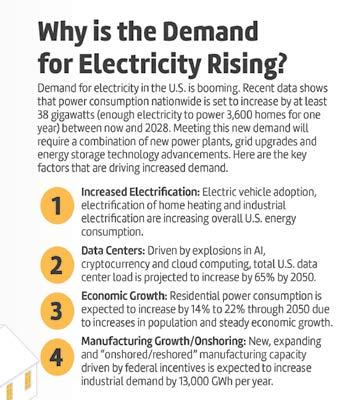
by Miranda Boutelle
Buying a new appliance can feel daunting. Before you hand over your hard-earned money, here’s how to choose an appliance that will help you save money over time.
When shopping, keep in mind that not all new appliances are high e ciency and not all old appliances are ine cient. The less e cient your current appliance, the more you will save with an upgrade. The yellow EnergyGuide label on new appliances shows the yearly energy cost, kilowatt-hour electricity use, and ENERGY STAR® logo, if certified.
Let’s look at some appliance examples to see how the costs and savings stack up.
Refrigerators have seen major e ciency improvements over the years. New refrigerators use up to 73% less energy than 1970s models and about a third less than 20-year-old models.
On a visit to my mom’s house, she proudly showed o her 1980s refrigerator she bought when her 1970s harvest gold model died. If her 80s fridge uses 2,000 kWh per year, at 14 cents per kWh, it costs $280 per year to operate. New ENERGY STAR-certified refrigerator prices start at $500 with yearly energy costs ranging from $38 to $122. If mom buys a new ENERGY STAR-certified refrigerator for $1,000 with $100 yearly energy cost — saving her $180 per year — it will pay for itself in about five and a half years.
If you intend to keep your old appliance, be sure to weigh the additional energy costs. Maximize e ciency and keep your food safe by setting your refrigerator to 37 degrees and your freezer at 0 degrees.
New ENERGY STAR-certified clothes washers and dryers are also more efficient than older models. Use the ENERGY STAR Product Finder at energystar.gov to compare products. Integrated Modified Energy Factor measures the washer’s energy efficiency. A higher number is better. Integrated Water Factor measures water efficiency. A lower number is better.
I recently bought a new washing machine when my old front-load machine died. I was considering a top-load machine. When I compared ENERGY STAR-certified top loaders to front loaders, I changed my mind. Energy Star-certified front loaders use about 50% less energy and water than top-load agitator washers and about 25% less energy and water than top-load impeller washers that don’t have an agitator.
My new washer cost $698. According to the appliance’s EnergyGuide, based on six loads of laundry a week and an electricity cost of 14 cents per kWh, the yearly energy cost is $15. Similar non-ENERGY STAR-certified models were $48 per year. Mine didn’t cost much more than non-Energy Star models and will help me save over time.
Then I had to make the decision about buying the matching dryer. My dryer was functional but had features I didn’t like. At 14 cents per kWh and running roughly six loads a week for an hour each, my old dryer used $131.04 per year.
The new matching ENERGY STAR-certified dryer cost $698 and estimates annual energy use at 607 kWh, which is $84.98 per year at 14 cents per kWh. With an estimated savings of $46 per year, the dryer would take 15 years for the savings to cover the price. That’s a long time and not worth the cost.
To improve your washer and dryer efficiency, wash in cold water, don’t over dry clothes, and clean your lint trap between every load.
Buying a new ENERGY STAR-certified refrigerator and putting the old one out in the garage won’t save energy. However, sometimes the secondary fridge or freezer allows you to save through groceries by stocking up on sales, preserving your own food, and saving gas with fewer trips to the store. It’s all a balance.
Just like the light bulbs in your home, LED televisions offer increased efficiency. ENERGY STAR-certified televisions are 34% more efficient than conventional models. If you have a working LED television, swapping to an ENERGY STAR model is more efficient but may not make up for the cost of a new TV. Instead, check the efficiency settings on your TV or buy a smart power strip that turns off other connected devices when not in use.
Whatever appliance you are upgrading or replacing, make an informed decision by comparing the cost of operation and shopping ENERGY STAR models to help lower your electric bill.
Miranda Boutelle is the chief operating officer at Efficiency Services Group in Oregon, a cooperatively owned energy efficiency company.
If you’re looking for a new TV, ENERGY STAR-certified models are 34% more efficient than conventional models.
by Jennah Denney
Our homes are changing, and so is the electric grid. Across the country, more households are becoming “smart” and connected. From thermostats that adjust automatically to electric vehicles that charge overnight, the devices we plug in are becoming intelligent, flexible, and increasingly central to how we use and even produce electricity.
For your electric cooperative, this growing network of connected devices creates new ways for co-ops and their members to work together to keep power reliable and a ordable.
A connected home is one where everyday appliances and devices can communicate with each other, you or even with your electric co-op. These could include thermostats that adjust to your patterns and preferences, water heaters that operate when electricity is cheaper, home batteries that store solar-generated power for later use, or air-source heat pumps that e ciently heat and cool your home.
Each of these tools can help you use energy more e ciently — and when they are managed e ectively, or when many homes coordinate and balance their energy use together, they can also help your co-op keep power flowing reliably and a ordably for the entire community.
You might have heard the phrase “behind the meter.” This simply refers to energy equipment that operates on your side of the electric meter that you own or control. This could include solar panels, battery storage systems, or connected devices like EV chargers or smart thermostats.
Individually, they may seem small, but together they can make a big di erence. If hundreds of water heaters slightly delay heating during a peak time of day (when electricity use is high), the co-op can avoid purchasing power at a higher cost, which essentially keeps rates lower for members. If home batteries store solar-generated energy during the day and release it back to the grid at night, it helps balance the overall supply and demand of electricity.
Each day, our electric grid must maintain a perfect balance to match the amount of electricity generated with the amount of electricity we are using — all in real time. Because electricity can’t easily be stored at scale, this balancing act is constant and complex. Connected devices give electric co-ops powerful new tools to help manage this complexity. Traditionally, electricity use was simple: flip a switch and power flows instantly. But today, many devices can
shift when and how they use energy, also known as load flexibility. Load flexibility allows you and your co-op to better align energy use during times when electricity is more a ordable, without sacrificing comfort or convenience.
The cooperative advantage
Electric co-ops are led by the members they serve. That means co-ops can design connected home programs that work for your community, not Wall Street. Members who participate can often earn bill credits or incentives, and every member benefits from lower peak costs and improved reliability.
Together, we can build a grid that’s smarter, more flexible, and ready for the future that’s powered by what’s plugged in. Contact your local electric co-op or visit their website to learn more about programs for connected devices and additional ways you can save energy (and money!).
Jennah Denney writes on consumer and cooperative a airs for the National Rural Electric Cooperative Association.
Connected devices such as smart thermostats can help you use energy more e ciently. When many homes coordinate and balance their energy use together, connected devices can also help your co-op keep power flowing reliably and a ordably for the entire community. Photo Credit: LG




















February has never been my favorite month. It sits in that awkward space between winter and spring; long enough to test our patience, but just short enough to remind us that change is coming. Maybe that’s why February has a way of making us slow down and take notice of what’s just ahead.
One bright spot this time of year is Mardi Gras, which continues to grow as a fun, family-friendly tradition here at home. The annual parade put on by the Olive Branch Olive Twigs brings energy, color, and community together. Events like this reflect the spirit of connection that makes our communities strong.
February also signals that baseball season is just around the corner. As players report for spring training, it’s a reminder that warmer days, longer evenings, and time spent outdoors are on the way. That sense of anticipation feels a lot like what we’re seeing with Northcentral Connect as well. With new fiber packages now

Auditorium
Tuesday, February 24, 2026 12:00 pm to 4:00 pm



available, subscribers have more options to fit their lifestyles. It’s another step forward in keeping our community connected with reliable, local service.


Maybe February isn’t so bad after all. If we take a moment to look, there’s always something good unfolding, even in the shortest month of the year.
Stay safe.

by Kevin Doddridge General Manager/CEO

These 10 high school juniors have been selected by Northcentral Electric Cooperative to participate in the 2026 Cooperative Youth Leaders program.
The program, initiated in 1986 by the Electric Cooperatives of Mississippi, is a prestigious opportunity for students to delve into the world of electric cooperatives. By exploring the history and impact of cooperatives on communities, these young leaders will gain valuable insights into the crucial role played by electric cooperatives.
In January, the students participated in Northcentral’s inaugural Cooperative University, a day filled with educational sessions, interactive games, and networking opportunities. Cooperative University helps these students learn about electric cooperatives, the electric power industry, and expand their leadership skills.
In February, they will dive in with a three-day workshop in Jackson, featuring leadership and communication exercises, a visit to the state Capitol, and breakfast with state lawmakers. The workshop promotes networking, confidence building, and provides them with lifelong relationships and experiences.
This summer, the program will take these students to Washington D.C. for a weeklong tour, o ering the opportunity to explore our nation’s capital and engage with Mississippi’s U.S. senators and representatives. The experience includes visits to the Smithsonian museums, national landmarks, a major league baseball game, and a leadership conference with students from across the country.
For consideration into the program, applicants submitted a brief video explaining more about themselves. Finalists were interviewed by representatives from the Electric Cooperatives of Mississippi.
We congratulate these students as they embark on this exciting journey with confidence that they will represent their schools, families and Northcentral proudly.



County Career Tech/
Central High School

























4,547











15,979



































COLUMBIA: 601-736-2666 | HATTIESBURG: 601-264-2458 | PURVIS: 601-794-8051 | WIGGINS: 601-928-7277
Member owned. Locally operated. That’s the cooperative di erence. • Visit us online at www.PRVEPA.com. PAY BILLS or REPORT OUTAGES: 855-2PRVEPA (855-277-8372)
Valentine’s Day reminds us that the strongest relationships are built on trust, commitment, and a shared purpose. Our story began in 1938 when local men and women came together with a simple but powerful idea: neighbors helping neighbors. In the early days of rural electrification, private utilities didn’t see value in serving sparsely populated areas. So rural families, farmers, and community leaders joined forces to create a member-owned cooperative that would bring reliable electricity to rural homes, farms, and businesses. PRVEPA wasn’t built by investors looking for profits, it was built by people who believed that everyone deserved access to a ordable, dependable power.
That cooperative spirit still guides us today, and we have worked to improve the lives of our members by providing programs that enrich their lives. Our Round Up for Education scholarships encourage higher education, while the Comfort Advantage program promotes smart energy use to save money on power bills.
We also work extensively in the community supporting charitable organizations with our Sharing Success grants and help






promote electrical safety and scientific learning by partnering with area schools. Our Cooperative Youth Leaders program helps students experience leadership and team building, while also learning about the state and federal government.
While Valentine’s Day celebrates love in many forms, we see it as a reminder of the bond we share with our members, a bond built on service and care for the communities we call home. We’re proud of where we started and grateful for the people who built this cooperative.
by Matthew Ware
CEO/General Manager












Energy conservation continues to play a vital role in today’s world, and Pearl River Valley Electric Power Association remains committed to helping our members make smart, cost-saving decisions. By understanding how electricity is used, and choosing e cient options at home and at work, members can lower monthly bills, increase comfort, and enhance long-term value.
To support these goals, Pearl River Valley Electric o ers online resources, rebates, and programs designed to simplify the path to better energy management. From interactive calculators to incentives for high-e ciency heat pumps, our tools equip members with practical ways to reduce energy use.
For more than 20 years, our Comfort Advantage Program has helped members build homes that meet proven, energy-e cient standards. These guidelines, regularly reviewed and updated as new technologies emerge, provide homeowners with measurable savings on energy bills and increased resale value.
• Comfort Advantage (Basic): New homes with a 14.3 SEER2 or 15 SEER heat pump may qualify for up to 150 feet of free underground service.
• Comfort Advantage Plus: New homes with a 15.2 SEER2 or 16 SEER heat pump qualify for up to 150 feet of free underground service plus a $500 rebate.
• Geothermal systems: Installations qualify for an additional $500 rebate.
• Existing homes: Upgrading from older central heating/cooling systems or heat pumps (10-13 SEER or below) to a 14.3 SEER2 15 SEER or higher unit qualifies for a $400 rebate.




1. Heating and cooling • Heat pump(s) rated at 14.3 SEER2 or 15 SEER or higher or a qualified geothermal heat pump(s). Flex duct work will be limited to runs of 8 feet or less. Ducts must be sealed with mastic and wrapped with R-6 or higher insulation.
2. Water heating • Electric tank water heater(s) with a .90 energy factor or higher. Include heat traps and insulate pipes. Outdoor gas tankless water heaters also qualify. Electric instantaneous water heaters do not qualify.
3. Wall insulation • Install insulation R-value of 13 or greater.
4. Attic insulation • Install insulation R-value of 38 or greater. (Exception: R-20 foam-encapsulated, semi-conditioned attic.)
5. Floor insulation • Install insulation R-value of 19 or greater in floors over unconditioned areas or crawlspaces.
6. Windows • Double pane windows with a U-value of .60 or less and a solar heat gain coe cient (SHGC) of .60 or less.
7. Air sealing • Air sealing must be applied to all penetrations through exterior walls and to holes in attics or crawlspaces. Apply sill insulation between the slab and bottom plate. Properly install housewrap or building paper to cover exterior sheathing in wood framed homes. Inside the home, apply appropriate caulk or gaskets to electrical boxes, and seal around plumbing penetrations.





(ADDITIONAL UPGRADES FOR GREATER EFFICIENCY)
1. Heating and cooling equipment • heat pump(s) rated at 15.2 SEER2 or 16 SEER or higher; or a qualified geothermal heat pump. Upgrade to a programmable thermostat.
2. Windows • Double pane windows with a U-value of .40 or less, and a SHGC rating of .35 or less.
Understanding how your home uses energy is one of the best, first steps toward lowering your bill. Our website, prvepa.com, o ers a variety of tools to help you do just that.
UNDER THE “SAVE ENERGY” SECTION OF THE HELP CENTER, MEMBERS CAN ACCESS:
• Appliance energy calculators for TVs, dishwashers, ovens, and more
• A customizable Home Energy Calculator that provides a tailored energy analysis
• Tips and guidance on simple improvements that can make a noticeable di erence
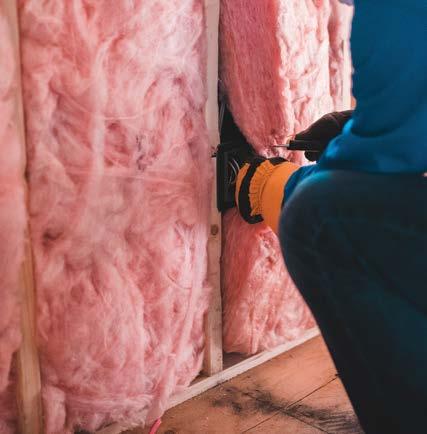

If you’d prefer one-on-one help or have questions about your home’s energy efficiency, our team is always ready to assist. Call us at 601-736-2666.


At Pearl River Valley Electric, we’re always looking for ways to enhance your experience and make managing your electric service easier and more convenient. That’s why we’re excited to share that our EmPowered Member Portal is getting a refreshed look designed to improve usability while keeping essential tools you rely on right at your fingertips.
While the portal’s appearance will be updated, members will still enjoy the same trusted features, including:
• Secure bill payment with just a few clicks
• Access to daily electricity use, helping you monitor and manage your energy habits
• Customizable alerts, so you’ll always know when payments are due or energy use reaches certain levels
The new EmPowered portal, located on our website, prvepa.com, will be available on February 16th. These improvements are part of our ongoing e ort to create a smoother, more intuitive experience for every member. Whether you track your energy use daily or simply log in to pay your bill each month, the updated design aims to make navigation clear and simple.


As part of the upgrade, all existing EmPowered users will need to recreate their username and password when first logging into the updated portal. In addition, users will need to update payment information and set-up two factor authentication. These one-time steps help ensure a secure transition to the improved platform. For users of the PRVEPA App, the new app will be updated to mirror the changes to our portal. In addition to the security changes, the current “estimate my bill” feature will be going away.
We appreciate your patience as we move forward with these enhancements and encourage you to explore the new portal once it becomes available. Our commitment is to provide tools that help you stay informed, connected, and in control of your energy use—because empowering our members is at the heart of

If you have questions or need assistance with logging in, our team is always here to help. once it becomes available. Our commitment is to provide tools everything we do.




• Applications are available at PRVEPA o ces and at prvepa.com.
• Completed applications must be postmarked or emailed by Aug. 14.
• Scholarship recipients must be a PRVEPA member, spouse, or child of a member participating in the Round Up program.
• Recipients must be full time (12 hours or more per semester) freshmen students enrolled in academic or career-technical programs.
• Scholarship funds will be credited to each student’s college account — no checks will be issued to individuals.
• Scholarships should be awarded by the end of September. Students must be enrolled in good standing at the time funds are released to the colleges.



Funded by members who are rounding up their monthly bills, these scholarships are intended to assist students who will attend a Mississippi community college as a freshman this fall.











































On Nov. 19, 2025, students from each of the schools in PEPA’s service area attended Cooperative University at PEPA’s Pontotoc o ce. The event included demonstrations of line work, safety, automated metering, and even a scavenger hunt for items located in the PEPA Historical Museum.
Students interacted with each other during ice breaker games and a group project using magnetic tiles, popsicle sticks, and other items to construct a model substation, power lines, and homes.
PEPA Youth Leadership Advisor Jennifer Johnson said the event is the first step in choosing delegates for the three-part program. “We involved outside judges who observed the students in action in the sessions. The judges also interviewed the students one on one during the program.”
Johnson said Leah Fields of South Pontotoc High School and Mary Alex Kakales of Bruce High School were chosen to continue on to the workshop in Jackson and later a tour of Washington, D.C. in the summer of 2026.
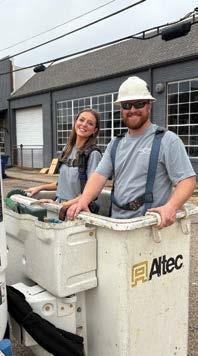
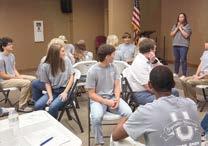
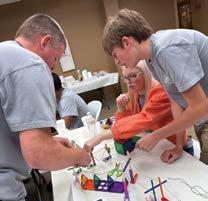
A. This group of students from schools in PEPA’s service area learned about the work of an electric utility, heard from State Senator Kathy Chism, and enjoyed projects and activities at Cooperative University. B. Apprentice Lineman Clay Kidd and Ingomar High School student Ava Swords prepare to view Pontotoc from the lofty perch of the bucket. C. Ice breakers like this one helped students learn more about each other. D. Pontotoc High School students Barrett Lewis and Suzy Park work on their model of generation and transmission with the assistance of PEPA General Manager Frankie Moorman.
Electric Power Association will be closed on Monday, Jan. 19, 2026, in observance



Pontotoc Electric Power Association salutes Mississippi’s senators and representatives who represent our state in Washington, D.C. and at our state capitol in Jackson. TATE




The Electric Cooperatives of Mississippi offers an easy-to-use mobile app of Mississippi’s state and federal elected officials. Look for “ECM Legislative Roster” in the Apple App Store. An Android version is also available through Google Play.












Sen. Nicole Akins Boyd
District 9: Lafayette and Panola counties
Address:
P.O. Box 1018
Jackson, MS 39215


Sen. Kathy L. Chism
District 3: Benton, Marshall, Pontotoc, Prentiss, and Union counties
Address:
P.O. Box 1018 Jackson, MS 39215

Sen. Benjamin A. Suber
District 8: Calhoun, Chickasaw, Lafayette, Pontotoc, and Yalobusha counties
Address:
P.O. Box 8
Bruce, MS 38915

Sen. Neil Whaley
District 10: Lafayette, Marshall, Tate, and Union counties
Address:

P.O. Box 1018 Jackson, MS 39215

Sen. Chad McMahan
District 6: Itawamba and Lee counties
Address:
P.O. Box 1018 Jackson, MS 39215



Rep. Perry Bailey
District 23: Calhoun, Lafayette, Pontotoc, and Webster counties
Address:
P.O. Box 1018 Jackson, MS 39215
Rep. Sam Creekmore
District 14: Union County
Address:
P.O. Box 1018 Jackson, MS 39215


Rep. Steve Massengill
District 13: Benton, Lafayette, Marshall, Pontotoc, and Union counties
Address:
P.O. Box 1018 Jackson, MS 39215
Rep. Jerry Turner
District 18: Lee and Prentiss counties

Address:
P.O. Box 1018 Jackson, MS 39215




Rep. Justin Crosby
District 22: Chickasaw, Monroe, and Pontotoc counties
Address:
P.O. Box 1018 Jackson, MS 39215

Rep. Beth Luther Waldo
District 15: Pontotoc County
Address:
P.O. Box 1018 Jackson, MS 39215



















INGREDIENTS
1 pound boneless, skinless chicken breasts
3½ cups low-sodium chicken broth
2 cups heavy cream
1 pound fettuccine
3 teaspoon kosher salt
4 tablespoon unsalted butter
1 teaspoon garlic powder
Finely chopped parsley (garnish for serving)

In honor of National Slow Cooker Month, we o er these recipes to make life a little easier. Treat yourself to some free time while your slow cooker does the work!



INGREDIENTS


½ teaspoon black pepper
½ teaspoon onion powder
1 teaspoon Italian seasoning
½ teaspoon crushed red pepper flakes
2 ounces Parmesan, finely grated (extra for serving)
In a large slow cooker, cover chicken with cream and broth. Add salt, garlic powder, Italian seasoning, red pepper flakes, black pepper, and onion powder. Stir to combine. Cover and cook on high until chicken is cooked through, about two hours. Transfer chicken to a plate and shred with two forks. Set aside.
Add fettuccine and butter to slow cooker and continue to cook on high about 20-40 minutes, depending on your slow cooker’s heat level.
Return chicken to slow cooker along with Parmesan and toss to combine. Cook uncovered, until sauce clings to pasta, about five minutes. Top with parsley and more Parmesan before serving.


1 pound dried red beans
3 cloves garlic, chopped
7 cups water
½ pound Andouille sausage, sliced
1 green bell pepper, chopped
3 tablespoons creole seasoning
1 medium onion, chopped hot cooked rice
3 celery stalks, chopped
sliced green onions (garnish for serving)
Place first eight ingredients in a four-quart slow cooker. Cook, covered, at high for seven hours or until beans are tender. Serve with hot cooked rice. Add garnish if desired.





























Apprentice Linemen Jacob Beard (left) and Jimmy Moore moved to year four in the Lineman Apprenticeship program at PEPA. Congratulations to both of them!






























































































As your local power provider, Singing River Electric’s mission has always been simple: keep the lights on and support the communities we serve. But behind every switch, every warm home, and every business that opens its doors is a complex system that requires constant care. Reliable electricity doesn’t happen by accident. It requires ongoing investment in our local grid — through system repairs, maintenance, upgrades, and the integration of new technologies that help us operate smarter and more e ciently.
Much of the energy system we rely on today was built decades ago. While it continues to serve us well, age alone means that components must be repaired or replaced to maintain performance and safety. From poles and wires to transformers and substations, every part of the grid has a lifespan. Routine maintenance helps extend that lifespan, but eventually equipment must be updated to meet modern standards. These proactive investments reduce the likelihood of outages, shorten restoration times when disruptions do occur, and create a stronger backbone for our growing community.
facilities add load to our distribution system. As these technologies take hold, the grid must be able to support increased demand while maintaining the reliability our members expect. Strategic upgrades are essential to ensuring we can meet these needs both today and in the decades ahead.
Reliable electricity doesn’t happen by accident. It requires ongoing investment in our local grid — through system repairs, maintenance, upgrades, and the integration of new technologies that help us operate smarter and more e ciently.
At the same time, new technologies are reshaping how we operate. Tools such as SCADA devices, fiberoptic infrastructure, smart meters, and outage management software allow us to detect problems faster and respond more e ectively. Implementing innovative technologies into the grid is not just a convenience — it is a necessity for ensuring reliability in an increasingly complex energy landscape. While these improvements require thoughtful planning and financial investment, the return is significant. A stronger grid supports local economic growth, improves service quality, and enhances safety for our linemen and community. Most importantly, it ensures that the essential power you rely on is available whenever you need it.
The demands on the electric grid are also evolving. Homes and businesses today use more electricity than ever, and that trend will only continue. Electric vehicles, advanced HVAC systems, smart appliances, and new commercial


Our commitment to reliability runs deeper than infrastructure alone. It reflects our responsibility to the people and communities we serve. Every upgrade, every repair, and every technology we deploy is an investment in your daily life — from the comfort of your home to the success of local businesses and schools. By investing in our local distribution system today, we are building the foundation for a brighter, more resilient tomorrow.
by Brian Hughey
General Manager and CEO










Gabe Robbins Energy Services Representative robbins@singingriver.com






Even though south Mississippi winters are usually mild, February cold snaps can drive up energy bills, especially with our heaters running more often. A simple way to use less energy is to lower your thermostat a few degrees at night or when you’re away — even a 2 to 3-degree adjustment can reduce heating costs. Staying comfortable is easy with cozy layers and extra blankets.
Changing your HVAC air filter every month helps your system run more e ciently and improves airflow, so your unit doesn’t have to work as hard to heat your home.
During the day, take advantage of the sunshine by opening blinds and curtains on south-facing windows to let in natural warmth; remember to close them at night to keep the heat inside. Sealing drafts around doors and windows helps prevent cold air from sneaking in. Simple fixes like caulk, weather stripping, and door sweeps can keep warm air where it belongs and lower your energy use.
These small steps add up to real savings while keeping your home comfortable all winter long.
Notice of Singing River Electric director qualification period
Candidates seeking election to Singing River Electric Cooperative’s board of directors must visit Singing River Electric’s Lucedale o ce located at 11187 Old 63 South to obtain a director qualification packet. Completed forms and petitions must be returned to the Lucedale o ce by 5 p.m. on the last business day of February (Friday, Feb. 27, 2026).
Singing River Electric is saddened by the passing of our board member, Travis Baxter, on Dec. 28, 2025. Baxter represented our members in George, Stone, and Mobile counties for 48 years. His kind face was often seen at monthly employee safety meetings and while sharing vegetables grown in his garden. His knowledge of our cooperative and its history and the wisdom he attained will truly be missed.


Energy consumption spikes during winter months as we spend more time indoors and heating systems work overtime. You can help reduce demand and strain on the electric grid by conserving during peak energy times. Reducing energy use will also help lower your energy bills.
Turn o unnecessary lights and electronics when you aren’t using them.
Seal air leaks and drafts around windows and exterior doors.
Run large appliances like clothes washers, dryers and dishwashers early in the morning or before you go to bed.
Maintain your heating system by replacing dirty, clogged filters and scheduling an annual inspection for necessary maintenance.
Home heating accounts for a large portion of energy consumption. Adjust your thermostat to the lowest comfortable setting (68 degrees or lower).















Thank you to our subscribers for choosing Singing River Connect as your trusted local provider of fast fiber internet and leaving 5-star Google Reviews!

"The best move we have made. We have had three other top name internet services and to say the least, they were expensive and awful service. The Singing River experience has been great and costs less with no issues."









- Ronnie Castille



"Local and reliable! Service is always top notch. Speeds are fast and you get what is advertised. No hidden fees. Can't say enough good things about them."

- Richard Carmical







FEBRUARY 2026


"Singing River Electric (AKA SR Connect) has First Class Installers AND Faster Internet AND Better Tech Support than the world-renowned […]!! Do yourself and your community a great service and be LOCAL!!"





- Shane Russell



"We are extremely happy with our service. From the office staff to the installers, they all have provided wonderful service. I totally recommend SR Connect."
- Carla McMellon















Step 3: Fiber construction
Running fiber lines on poles and burying lines underground
• Bayou Cassotte
• Singing River Mall
• Gautier
• Fountainbleau
Step 4: Splicing
Connecting fiber lines to the network
• Monaco Lake

Step 5: Service drop and drop splicing
Step 6: Installation
Bringing mainline fiber to the exterior of your home and connecting your home to blazing-fast fiber internet
• Gulf Park Estates
• Ocean Springs
• Hamill Farm
• Sunplex
• Fort Bayou
• Martin Blu
• Hickory Hills
• St. Martin
• Tucker Road
• Forts Lake
• Helena
• Helena Industrial
• Escatawpa South
• All Singing River Electric areas in George, Greene, Perry, Stone, Wayne, Harrison, Mobile, and Washington counties and north Jackson County










More than 200 Pre-K through 4thgrade Cherokee Elementary students are discovering that learning doesn’t just happen in the classroom — it can happen in the garden too. A $2,500 Neighbors Helping Neighbors Community Grant from Singing River Electric purchased raised beds and gardening tools for the Pascagoula school’s new hands-on project.

Along with being a garden, ‘Roots for Learning’ is a living, growing, educational space where students will engage in handson lessons that bring science, math, and nutrition to life.
Serving both high school and middle school students, the Moss Point Career and Technical Education Center empowers students through academic and technical curricula, including engineering, culinary arts, welding, aviation, health, aquaculture, and business marketing.
A $2,383 Neighbors Helping Neighbors Community Grant purchased VR headsets, virtual college exploration toolkits, soft skills flashcards, a mock interview toolkit, career decision-making card sets, and life skills career board games. These items will enhance students’ understanding of career pathways and education options through virtual reality and interactive learning.

Visit singingriver.com/my-community to view Singing River Electric’s Neighbors Helping Neighbors Community Grant program application requirements. Grants for up to $2,500 are awarded to non-profits in our local service area three times a year in January, May, and September.

Singing River Electric linemen have been showcasing their trucks, along with the equipment and tools they use, to build power lines and restore power for our members at local Touch-A-Truck events. Our linemen loved talking to our young members and giving out hard hats and electric safety coloring books at events held in George County and Pascagoula.










February is known as the month of love. We see it in cards, flowers, and kind words shared with those closest to us. But here at Southern Pine, I’m reminded every year that love shows up in quieter, more meaningful ways through neighbors helping neighbors and communities taking care of one another.
One of the best examples of that love in action is our Members Helping Members program.
Because of the generosity of Southern Pine members who choose to round up their electric bills each month, we are able to turn spare change into real help for real people. Those small round-ups, often just a few cents at a time, add up to powerful support for local nonprofits and community organizations working every day to make life better across our 11-county service area.
I’m proud to share that the application period for Members Helping Members community grants is now open for the month of February.
These grants are designed to support nonprofit organizations that are meeting critical needs right here at home. From food assistance and emergency services to youth programs, education, and community outreach, Members Helping Members helps ensure that compassion stays local and that help reaches the people who need it most.
What makes this program especially meaningful is that it is funded entirely by you, our members. There are no outside donors and no hidden sources of funding. Southern Pine receives no fi nancial benefit from this program, only the satisfaction of seeing our communities made stronger and better. It is neighbors helping

neighbors, plain and simple. When you round up your bill, you are choosing to show love for your community in a practical, lasting way.
Over the past year, I’ve seen fi rsthand the impact these grants can make. I’ve met dedicated volunteers, nonprofit leaders, fi rst responders, and community champions who stretch every dollar to serve others. That’s what cooperative spirit looks like.
If you are part of a nonprofit organization serving Southern Pine members, or if you know of an organization doing good work in your community, I encourage you to apply. The application process is straightforward, and our goal is to make these funds accessible to organizations that are making a real di erence.
February reminds us that love isn’t just something we say, it’s something we do. Every rounded-up bill is a quiet act of kindness. Every grant awarded is a reflection of our members’ hearts. And every life touched is proof that when we come together, even small actions can lead to meaningful change.
Thank you for showing what it means to care for one another. Thank you for believing in your community. And thank you for continuing to support Members Helping Members.
Find out more or apply at southernpine.coop/MHM.

by Drummonds McAlpin
President/CEO Southern Pine Electric















In December, Southern Pine Electric welcomed 48 high school juniors from 30 area high schools to its annual Cooperative University program, a day designed to introduce students to the cooperative business model, the electric power process, and the importance of leadership and teamwork. Held at Southern Pine’s headquarters, the event brought together students from across the cooperative’s service area for hands-on learning and meaningful conversations about service, responsibility, and community.
Throughout the day, students learned how electric cooperatives operate, from generation to delivery, and gained a better understanding of the teamwork required to safely and reliably power homes, schools, and businesses. Southern Pine team members led sessions focused on problem-solving, collaboration, and leadership, giving students a behind-the-scenes look at how cooperation plays a vital role in everyday life.
At the conclusion of Cooperative University, 12 students were selected to return the following day for interviews. From that group, five students were ultimately chosen to serve as Southern Pine’s
delegates in Electric Cooperatives of Mississippi’s Cooperative Youth Leaders program, one of the state’s premier youth leadership opportunities.
These five delegates will represent Southern Pine at the Cooperative Leaders Workshop in Jackson this February, followed by the NRECA’s Electric Cooperative Youth Tour of Washington, D.C., in June. During the tour, delegates will learn more about the United States’ rich history, visit some of our nation’s most treasured sites, and meet with delegates from across America. All expenses for the program are paid by Southern Pine Electric as an investment in developing future leaders.
“Programs like Cooperative University and Cooperative Youth Leaders allow us to invest directly in young people who are curious, capable, and eager to serve,” said Drummonds McAlpin, president and CEO of Southern Pine Electric. “These delegates represent the very best of our communities, and we are proud to support them as they grow as leaders and carry the cooperative spirit forward.”

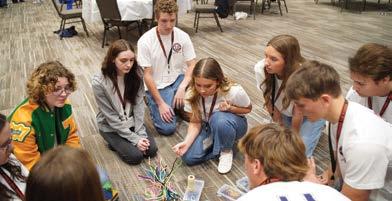
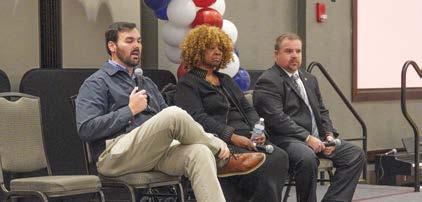
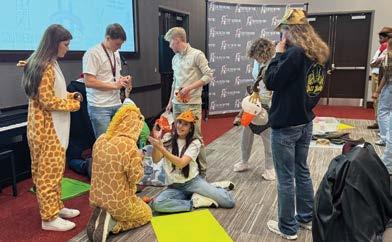

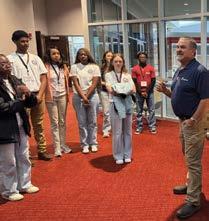
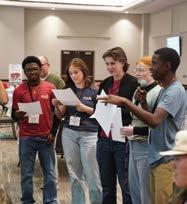
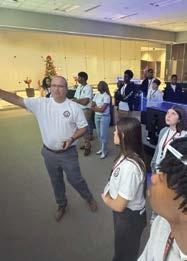
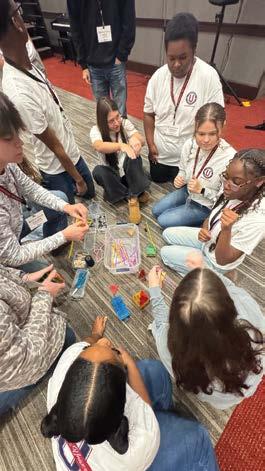
RYDER IVY
RALEIGH HIGH SCHOOL
PAYTEN MYERS
SIMPSON COUNTY ACADEMY
CARLY GIBSON
SEMINARY HIGH SCHOOL
BAY SPRINGS HIGH SCHOOL

LAWRENCE COUNTY HIGH SCHOOL



Southern Pine Electric is proud to announce Carly Gibson, a junior at Seminary High School, as the cooperative’s Student Ambassador for the 2026–2028 term. Selected through a competitive process, Carly will serve as a representative of Southern Pine while gaining handson experience in communications, public relations, and community engagement across the cooperative’s 11-county service area.
As a Student Ambassador, Carly will be mentored by key cooperative sta and work closely with Southern Pine’s communications team. Through this role, she will gain real-world experience in a wide range of areas, including web design, photography, graphic design, writing press releases and original articles, and representing the cooperative at local and state public service and community events. The program is designed to give students a behind-the-scenes look at how a member-owned electric cooperative communicates with and serves its communities.



“Carly is already a leader in her school, her community, and her church, and that says a lot about her character and her heart for service,” said Drummonds McAlpin, president and CEO of Southern Pine Electric. “We look forward to seeing her apply those experiences in new ways as she helps tell the Southern Pine story and serves our members across the communities we’re proud to call home.”
Carly participated in Southern Pine’s Cooperative University and will serve as one of the 2026 ECM youth leadership delegates, attending the Electric Cooperatives of Mississippi’s Cooperative Leaders Workshop in Jackson, and representing Southern Pine on the all-expenses-paid Youth Tour to Washington, D.C.
Carly is the daughter of Southern Pine members James and Wendy Gibson of Collins.

10 YEARS
Ryan Robertson
Curtis Nelson
Melissa Nixon
Renee Robertson
Michael Helton
Thomas McCallum
Derek Bruce Allen Emanuel Jr.
James Holder
Ronald Hughes
Heather White
Brian Gordon
Jimmy Jordan Timothy McPhail
Brice Hughes
Dale Stewart James Mason
Patrick Qualls
Carolyn Wilson
Ramona Anderson
Lee McCrory
Angela Jordan
David Odom 15 YEARS
Greg Bryant
YEARS
Richelle Smith






























Adams • Amite • Claiborne • Copiah • Franklin Hinds • Je erson • Lincoln • Wilkinson


Southwest Electric is an equal opportunity provider and employer.



P.O. Box 5 • 18671 Highway 61 • Lorman, MS 39096 | 601-437-3611 | 800-287-8564 | Fax: 601-437-8736 | Payments & Outages: 844-975-2728
southwestelectric.coop info@swepa.coop Southwest Electric sw_electric_coop Southwest Electric

Above: Linda Sue Stuart presents $1,000 donation to Mercy House Adult and Teen Challenge Ministries. Left to right is Thomas Reif, Campus Director; Matt Milliman, CEO/Executive Director; Linda Sue Stuart, Port Gibson Hands of Hope; Jessica Bratton, O ce Administrator; and Dakota Jones, Prison Ministry/3rd Phase Sta . Right: Employee Deb McGee presents Linda Sue Stuart, Powering Possibilities community service grant recipient, with the $1,000 check from Cooperative Energy.
Southwest Electric, in partnership with Cooperative Energy, is proud to announce that Linda Sue Stuart has been selected as the 2025 Powering Possibilities community service grant winner representing Southwest Electric.
Stuart founded Port Gibson Hands of Hope in 2012 to collect and deliver donated goods to families in need, first in Welch, West Virginia, and later through local projects across Mississippi. Under Stuart’s leadership, the group provides free medical equipment, builds wheelchair ramps, and assists families recovering from fires or natural disasters. Each year, she organizes Christmas celebrations for nursing home residents, prepares shoebox gifts for Operation Christmas Child, and coordinates food boxes for veterans and local families. Stuart also partners with Mercy House Adult and Teen Challenge Ministries, supporting their thrift stores and community events.
As part of this recognition, Cooperative Energy made a $1,000 charitable donation in Stuart’s name to Mercy House Adult and Teen Challenge Ministries, a nonprofit organization serving communities within the cooperative’s service area.
The Powering Possibilities community service grant celebrates volunteers who embody the cooperative principle of Concern for Community. These men and women dedicate their time and talents to making a positive di erence in the lives of others. Through this program, Cooperative Energy and its 11 Member electric
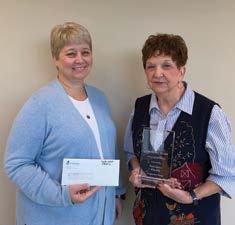
cooperatives honor outstanding community volunteers by awarding donations to qualifying nonprofit organizations selected in each cooperative’s territory.
“Stuart’s commitment to serving her fellow man truly represents the cooperative spirit,” said Southwest Electric CEO Kevin Bonds. “We’re honored to recognize her dedication and to support Mercy House Adult and Teen Challenge Ministries, which shares that same mission of strengthening our communities.”
Founded on the principle of local people serving local needs, the Powering Possibilities community service grant reflects the ongoing partnership between Cooperative Energy and its Member cooperatives, including Southwest Electric, to power meaningful change beyond electricity.
“Our Members and their communities inspire us,” said Christa Bishop, executive vice president and chief communications o cer for Cooperative Energy. “Through Powering Possibilities grant program, we’re proud to highlight the volunteers and organizations that power Mississippi through compassion and service.”
The donation will support e orts to provide adults with an e ective and comprehensive Christian faith-based solution to life-controlling drug and alcohol problems and thereby empowering them to become productive members of society.






by Miranda Boutelle
I tend to live in the “if it isn’t broken, don’t fix it” school of thought, but a failed water heater can cause damage to your home and property. Emergency replacement of a water heater can add unnecessary cost, not to mention inconvenience.
Here are some signs that your storage water heater might be approaching the end of its life.
The typical lifespan of a storage water heater is 10 to 15 years, according to the U.S. Department of Energy. If your water heater is older than that, plan to replace it soon. Don’t have records of when it was installed? No problem. Find the serial number on the water heater’s sticker or metal plate. Look up the serial number online or call the manufacturer to find its age.
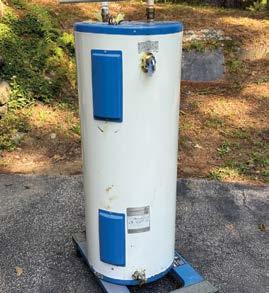
Sediment or water on the floor or at the bottom of the water heater could mean its days are numbered. Sediment can be a sign of corrosion, which leads to a leak or failure.
Seeing rusty or discolored water when you turn on your faucets can be a sign the tank is rusting inside. If water is not getting as hot as it used to, it could be a sign of a failing electric element or a gas burner not functioning properly.
Odd noises could indicate an issue with the components. If you’re hearing unusual noises from your water heater, schedule a checkup with a plumber. Well-functioning water heaters typically don’t make much noise.
A professional plumber may be able to replace failing components. If you are having issues with the tank itself, it’s likely time for a new unit.



We’ve all gotten used to having reliable hot water in our homes. Nobody wants to get caught o guard with an unexpected cold shower or failed water heater.

If you’re in the market for a new water heater, a heat pump water heater might be a good fit for your home. These systems are two to three times more energy e cient than conventional electric-powered tank water heaters, according to the DOE. If your water heater is past its useful life or showing any signs of failure, consider investing in a new one.
Even if your water heater is in great shape, you can save at home by lowering your hot water use. Some easy ways to do this are washing laundry in cold water and installing high-performance aerators on faucets and showerheads to reduce the amount of hot water you use. If you have time-ofuse rates, you can save by installing a timer on your water heater to prevent it from operating during peak energy use hours, typically in the mornings and evenings. It also helps lower the strain on your electric utility.
Knowing the signs of water heater failure can save you from home damage and o er opportunities to explore options for more e cient equipment to lower your electric use.
Miranda Boutelle is the chief operating officer at Efficiency Services Group in Oregon, a cooperatively owned energy efficiency company.
If your water heater is 10-15 years old, it’s time to start planning and budgeting for a replacement.
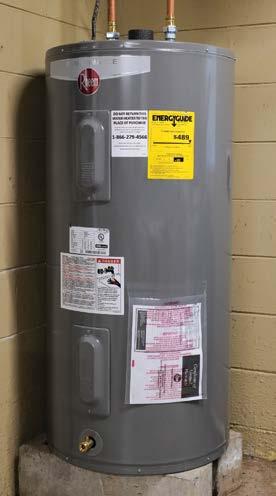


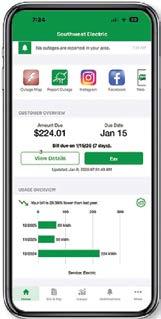































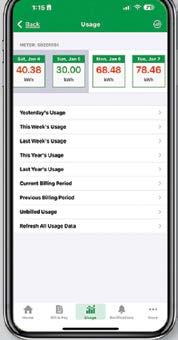









by Steven Ward



When Coach Jimmy “JimBob” Allgood of Natchez was 8 years old, his grandfather took him out to the Mississippi River, sat down with him, and told stories about his time in the U.S. Army.
Allgood’s grandfather was one of the first soldiers sent to Hiroshima and Nagasaki after the U.S. dropped atomic bombs on the Japanese cities in 1945.
“He saw the aftermath. He saw the bodies. And tears rolled down his cheeks when he was telling me what it was like,” Allgood, a Southwest Electric Member, said recently.
That’s when Allgood first learned about PTSD — post traumatic stress disorder.
“Of course that’s not what it was called back then. But later, I realized that the outdoors could help heal wounded soldiers and special needs children. And that’s one of the most important things we do today,” Allgood said.
Allgood’s nonprofit organization, Team Up For All, raises money to help fund outdoor adventures for those in need.
Allgood, a volunteer coach for most of his life, grew up spending a large part of his life outdoors hunting and fishing.
Although he went on to become an IBM engineer who worked with his family’s computer and copier business, his first love was the outdoors.
In the early 1990s he started an outdoors website called Redneckadventures.com.
The website led to a television show in 1999 that started out on one local cable station and eventually was broadcast on di erent network stations around the state. Before long, the 30-minute show was syndicated nationally.
“I call it a mix of a hunting and fishing show, ‘Hee Haw,’ and ‘The Andy Gri th Show.’ We do everything from hand grabbing catfish to squirrel hunting. And we laugh,” he said.
The website and TV show led to two radio stations, broadcasting high school sports on TV, and a video production class for Mississippi students.
On Feb. 28, Team Up For All is hosting its 26th Annual Redneck Adventures Mid-South Broadcasting World Championship Squirrel Hunt Weekend. In past years, the event has hosted more than a 1,000 wounded veterans and special needs children.
The outdoors is “therapy” for veterans and special needs kids, Allgood said.
“The water has a soothing property. The water and the woods help participants feel like they did before their injuries.”
According to Allgood, five di erent veterans that participated in outdoor events in five di erent locations, including in Louisiana, Florida, and Alaska, told him they were contemplating suicide before those activities.
“I do what I do because it can be life changing. To give back with God’s great outdoors,” Allgood said.
For more information, visit Redneck Adventures on Facebook, redneckadventures.com, email KFNVTRAFFIC@gmail.com, or call 601-597-6658.

I do what I do because it can be life changing. To give back with God’s great outdoors.





























































Staff and members congratulate Twin County Electric employees who have reached important career milestones. Congratulations on reaching this









Thank you for your hard work, loyalty, and commitment and dedicated service to our members. We are truly proud of your professionalism, your work ethic, and the impact you continue to make here at Twin County.

FEB.
The Mississippi River Marathon was created to help children receive an excellent education by donating marathon money to the Washington County and Southeast Arkansas Community Foundations. Twin County EPA is proud to support and power participants across the finish line. Visit msrivermarathon. raceroster.com for more information.
The Junior Auxiliary of Greenville will host its Annual Charity Ball on Feb 20. The auxiliary was founded on the principles of helping children and making a di erence in their lives. The group also provides women the opportunity to serve and be a vital part of their communities. Twin County EPA will once again partner with this organization that has been helping children since 1941.
DEC. 3
Cooperative University – Cooperative Youth Leaders program



Twin County EPA held its first Cooperative University, a half day event featuring speakers, games, and hands-on demonstrations. Area 11th-grade students learned about Twin County EPA, what it means to be a cooperative, and why co-op members matter.
Cooperative University serves as the first introduction to our Cooperative Youth Leaders program. We extend our appreciation to all the bright students who participated, as well as to our dedicated sta and our guests from the Electric Cooperatives of Mississippi, Cooperative Energy, and Yazoo Valley EPA. The event was a wonderful display of cooperative spirit.
DEC. 6
49th Hollandale Christmas Parade



One of Hollandale’s largest and best attended parades in years marched throughout downtown. Congratulations to Grand Marshal Dell Jones. Twin County EPA enjoyed participating in the festivities.
Two local high school juniors, sponsored by and representing Twin County EPA, will travel to Jackson to learn about the value of the cooperative business model, specifically the impact that electric cooperatives have on lives and communities. The delegates will also grow in their leadership qualities through team building exercises as well as expanding their communication skills, confidence, and courage in decision making. Delegates will experience the democratic process by visiting the state capitol.
DEC. 19
Gift Box Drop Off –Hollandale School District office



Twin County EPA is proud of the area 11th grade students who participated in our Cooperative University. The students showed a meaningful display of Concern for Community — one of our seven cooperative principles. Together, students prepared 15 holiday gift boxes, each filled with care and accompanied by a handwritten note. Gift boxes were delivered to the Hollandale School District o ce for distribution among young children throughout the community to spread joy and kindness this holiday season.



Buying a new appliance can feel daunting. Before you hand over your hard-earned money, here’s how to choose an appliance that will help you save money over time.
by Miranda Boutelle
When shopping, keep in mind that not all new appliances are high e ciency and not all old appliances are ine cient. The less e cient your current appliance, the more you will save with an upgrade. The yellow EnergyGuide label on new appliances shows the yearly energy cost, kilowatt-hour electricity use, and ENERGY STAR® logo, if certified.
Let’s look at some appliance examples to see how the costs and savings stack up.
Refrigerators have seen major e ciency improvements over the years. New refrigerators use up to 73% less energy than 1970s models and about a third less than 20-year-old models.
On a visit to my mom’s house, she proudly showed o her 1980s refrigerator she bought when her 1970s harvest gold model died. If her 80s fridge uses 2,000 kWh per year, at 14 cents per kWh, it costs $280 per year to operate. New ENERGY STAR-certified refrigerator prices start at $500 with yearly energy costs ranging from $38 to $122. If mom buys a new ENERGY STAR-certified refrigerator for $1,000 with $100 yearly energy cost — saving her $180 per year — it will pay for itself in about five and a half years.
If you intend to keep your old appliance, be sure to weigh the additional energy costs. Maximize e ciency and keep your food safe by setting your refrigerator to 37 degrees and your freezer at 0 degrees.
New ENERGY STAR-certified clothes washers and dryers are also more e cient than older models. Use the ENERGY STAR Product Finder at energystar.gov to compare products. Integrated Modified Energy Factor measures the washer’s energy e ciency. A higher number is better. Integrated Water Factor measures water e ciency. A lower number is better.
I recently bought a new washing machine when my old front-load machine died. I was considering a top-load machine. When I compared ENERGY STAR-certified top loaders to front loaders, I changed my mind. ENERGY STAR-certified front loaders use about 50% less energy and water than top-load agitator washers and about 25% less energy and water than top-load impeller washers that don’t have an agitator.
My new washer cost $698. According to the appliance’s EnergyGuide, based on six loads of laundry a week and an electricity cost of 14 cents per kWh, the yearly energy cost is $15. Similar non-ENERGY STARcertified models were $48 per year. Mine didn’t cost much more than non-ENERGY STAR models and will help me save over time.
Then I had to make the decision about buying the matching dryer. My dryer was functional but had features I didn’t like. At 14 cents per kWh and running roughly six loads a week for an hour each, my old dryer used $131.04 per year.
The new matching ENERGY STAR-certified dryer cost $698 and estimates annual energy use at 607 kWh, which is $84.98 per year at 14 cents per kWh. With an estimated savings of $46 per year, the dryer would take 15 years for the savings to cover the price. That’s a long time and not worth the cost.
To improve your washer and dryer e ciency, wash in cold water, don’t over dry clothes, and clean your lint trap between every load.
Just like the light bulbs in your home, LED televisions o er increased e ciency. ENERGY STAR-certified televisions are 34% more e cient than conventional models. If you have a working LED television, swapping to an ENERGY STAR model is more e cient but may not make up for the cost of a new TV. Instead, check the e ciency settings on your TV or buy a smart power strip that turns o other connected devices when not in use.
Whatever appliance you are upgrading or replacing, make an informed decision by comparing the cost of operation and shopping ENERGY STAR models to help lower your electric bill.
Miranda Boutelle is the chief operating officer at Efficiency Services Group in Oregon, a cooperatively owned energy efficiency company.

If you’re looking for a new TV, ENERGY STAR-certified models are 34% more e cient than conventional models.
by Jennah Denney
Our homes are changing, and so is the electric grid. Across the country, more households are becoming “smart” and connected. From thermostats that adjust automatically to electric vehicles that charge overnight, the devices we plug in are becoming intelligent, flexible, and increasingly central to how we use and even produce electricity.
For your electric cooperative, this growing network of connected devices creates new ways for co-ops and their members to work together to keep power reliable and a ordable.
A connected home is one where everyday appliances and devices can communicate with each other, you or even with your electric co-op. These could include thermostats that adjust to your patterns and preferences, water heaters that operate when electricity is cheaper, home batteries that store solar-generated power for later use, or air-source heat pumps that e ciently heat and cool your home.
Each of these tools can help you use energy more e ciently — and when they are managed e ectively, or when many homes coordinate and balance their energy use together, they can also help your co-op keep power flowing reliably and a ordably for the entire community.
You might have heard the phrase “behind the meter.” This simply refers to energy equipment that operates on your side of the electric meter that you own or control. This could include solar panels, battery storage systems, or connected devices like EV chargers or smart thermostats.
Individually, they may seem small, but together they can make a big di erence. If hundreds of water heaters slightly delay heating during a peak time of day (when electricity use is high), the co-op can avoid purchasing power at a higher cost, which essentially keeps rates lower for members. If home batteries store solar-generated energy during the day and release it back to the grid at night, it helps balance the overall supply and demand of electricity.
Each day, our electric grid must maintain a perfect balance to match the amount of electricity generated with the amount of electricity we are using — all in real time. Because electricity can’t easily be stored at scale, this balancing act is constant and complex.
Connected devices give electric co-ops powerful new tools to help manage this complexity. Traditionally, electricity use was simple: flip a switch and power flows instantly. But today, many devices can
shift when and how they use energy, also known as load flexibility. Load flexibility allows you and your co-op to better align energy use during times when electricity is more a ordable, without sacrificing comfort or convenience.
Electric co-ops are led by the members they serve. That means co-ops can design connected home programs that work for your community, not Wall Street. Members who participate can often earn bill credits or incentives, and every member benefits from lower peak costs and improved reliability.
Together, we can build a grid that’s smarter, more flexible, and ready for the future that’s powered by what’s plugged in. Contact your local electric co-op or visit their website to learn more about programs for connected devices and additional ways you can save energy (and money!).
Jennah Denney writes on consumer and cooperative a airs for the National Rural Electric Cooperative Association.
Connected devices such as smart thermostats can help you use energy more e ciently. When many homes coordinate and balance their energy use together, connected devices can also help your co-op keep power flowing reliably and a ordably for the entire community. Photo Credit: LG

























Yazoo Valley recently recognized our dedicated employees during a western-themed annual service awards banquet. These individuals were chosen for their awards by their peers.













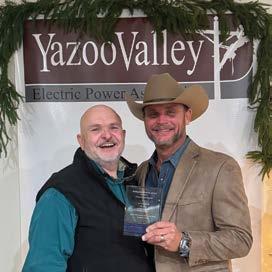






15 YEARS OF SERVICE 05 YEARS OF SERVICE



YEARS OF SERVICE 05 YEARS OF SERVICE

YEARS OF SERVICE 15 YEARS OF SERVICE 10 YEARS OF SERVICE







Yazoo Valley Electric Power Association, in partnership with Cooperative Energy, is proud to announce that Fran Twiner has been selected as the 2025 Powering Possibilities Community Service Grant winner, representing Yazoo Valley Electric.
Twiner operates a local thrift store where all proceeds support the Manna House, a nonprofit providing meals to those facing hunger. Twiner manages the store, organizes donations, and ensures it remains a reliable source of funding for this vital cause. Through her tireless efforts and commitment to helping others, she has become a cornerstone of support for her community.
Twiner’s commitment to supporting those in need truly represents the cooperative spirit.
As part of this recognition, Cooperative Energy will make a $1,000 charitable donation in Twiner’s name to Manna House Ministries.
The Powering Possibilities Community Service Grant celebrates volunteers who embody the cooperative principle of Concern for Community. These men and women dedicate their time and talents to making a positive difference in the lives of others. Through this program, Cooperative Energy and its 11 Member electric cooperatives honor outstanding community volunteers by awarding donations to qualifying nonprofit organizations selected in each cooperative’s territory.
“Twiner’s commitment to supporting those in need truly represents the cooperative spirit,” said Yazoo Valley Electric General Manager Michael Neely. “We’re honored to recognize her dedication and to support Manna House Ministries, which shares that same mission of strengthening our communities.”
Founded on the principle of local people serving local needs, the Powering Possibilities Community Service Grant reflects the ongoing partnership between Cooperative Energy and its Member cooperatives, including Yazoo Valley Electric, to power meaningful change beyond electricity.
“Our Members and their communities inspire us,” said Christa Bishop, executive vice president and chief communications officer for Cooperative Energy. “Through Powering Possibilities grant program, we’re proud to highlight the volunteers and organizations that power Mississippi through compassion and service.”


February is one of our favorite months of the year.
This month, the Electric Cooperatives of Mississippi (ECM) is hosting 84 high school juniors from all around the state for our Cooperative Leaders Workshop.
The delegates will spend three days in Jackson learning about leadership and team building. They will also tour the state capitol and meet their state legislators.
Speaking of state lawmakers, our cover star this month happens to be a member of that influential political body.
And that’s no coincidence.
District 9 State Sen. Nicole Akins Boyd of Oxford spent time telling us about her career journey to the state Legislature. Part of her career origin story is also the origin of ECM’s Cooperative Youth Leaders program.
Boyd was the state’s first Cooperative Youth Leaders delegate.
In 1986, when Boyd was a junior in high school, she was asked by her family’s cooperative — North East Mississippi EPA — to attend the National Rural Electric Cooperative Association’s (NRECA) Youth Tour in D.C. and to come back and report to Mississippi co-op leaders why the state should participate in the national program.
Boyd did just that, and ECM has participated in the NRECA program ever since.
Before the delegates are picked by their sponsoring electric co-ops for inclusion in the program, they attend a Cooperative University put on by the cooperative.
The Cooperative University teaches the students the value of the cooperative business

model and the impact electric cooperatives have on their lives and their communities.
The Cooperative University concept started out with one co-op creating the program and sharing with a few others in 2006. Following strategic planning by ECM’s board of directors to encourage other co-ops to put on the event, 19 electric co-ops now hold Cooperative Universities.
Following the Cooperative University, delegates are chosen to attend the February workshop in Jackson and to go on an all-expense paid trip to Washington, D.C. in June. The sponsoring electric co-ops pay for the trips to Jackson and D.C.
The youth of Mississippi are the future of Mississippi.
Electric cooperatives hope to inspire delegates to lead in some way, so they can give back to the communities that nurtured them.
The delegates might not become a state lawmaker like Boyd, but, hopefully, what they learn in our Cooperative Youth Leaders program is something they can use to make positive change — however small or large — in their community and home state.
We hope you enjoy the issue.

by Michael Callahan
Vice President/CEO





























The Electric Cooperatives of Mississippi o ers an easy-to-use mobile app, which provides information on Mississippi’s state and federal elected o cials. Look for “ECM Legislative Roster” in the Apple App Store. An Android version is also available through the Google Play Store.