

Ocean Riches, Empty Nets?
Fishing Industry Earns N$14 billion, Government Collects Only N$300 million
Namibia's fishing industry generated N$13.8 billion in exports last year, yet government revenue from the sector stood at just N$278 million. The figures were presented by the new Minister ofAgriculture, Fisheries, Water and Land Reform, Hon. Inge I. Zaamwani, during her first consultation with the fishing industry in Walvis Bay this week.
In her Speech, the minister said, “the fishingindustryisone of the economic enablers for our growth. It contributes to GDP, export earnings, value addition, and employment creation which underscores its importance.” Despite this, the numbers paint a striking picture. While billions flow out through exports,
less than N$300 million returnstostatecoffersin the form of quota fees, levies, and penalties
According to the Minister, the sector contributed 4 1% to Namibia'sGDPin2024, down from 4 5% in 2023. Reduced quotas due to declining fish stocks were cited as the main cause. The Total Allowable Catch (TAC) for 2024 was 438,080 metric tons, compared
to457,380in2023. Employment remains one of the industry's strongest impacts, with more than 19 440 Namibians working in the sector Ofthese,71%are employed onshore, and women make up 45% of the factory workforce. Offshore, however, only 140 women are employed,highlightingthegender gap at sea. Zaamwani stressed that stability and sustainability
must guide the sector's future: “It is our collective responsibility to stabilise the industry by ensuring consistent and predictable policies that safeguard jobs ” The Minister also announced tougher measures against bycatch violations Operators who exceedthe2%threshold will be forced to surrender the excess to government Bycatch fees have been sharply increased from 15% to 50%, and repeat offenders face “more severe sanctions, including license revocation, quota deductions, and, in extreme cases, confiscation of fishing gear or vessels.” She further
Stormy Public Consultation Erupts at Goanikontes
Tensions flared at a heated public consultation held at Goanikontes in the NamibNaukluftarea onTuesdaywhen residents and affected parties challenged the environmental consultants for Omegore Mineral and Trading CC on Exclusive Prospecting Licence (EPL)10877.

The purpose of the Environmental ScopingAssessment (ESA) is to identify potential environmental and socio-economic impacts associated with the proposed exploration programme and to recommend mitigation measures to ensure prospecting activities are undertaken in an environmentally responsible and socially acceptable manner The meeting,convenedbyconsultantsfromExcelDynamic Solutions on behalf of the project developers,

confirmed that the Ministry will begin publishing an annual
“name and shame” list of violators. On future plans, Zaamwani poin-
was intended to gather input on an ESA for the planned operations However, it quickly turned stormy, with affected parties demanding clarity on potential risks to water resources, livelihoods, and the fragile desert ecosystem. “We are not against development, but it must not come at the expense of our environment and future generations,” one participant said. Others argued that developers were sidelining local voices and rushing the process without adequately addressing concerns raised in earlier consultations. Some residents
ted to the government's goal of increasing local
Continues on page 2
went further, vowing: “we are going to go to the ends of the world to stop youfromcominghereandminingour things,especiallywhenitcomestoan international company.” Tour operators warned that mineral prospectingintheDorobNationalParkcould undermine one of Namibia's strongest tourism economies and that the application threatened heritage sites, landscapes, and wildlife that attractthousandsofvisitorseachyear
Continues on page 2













Hon Inge I Zaamwani
Rudi Bowe
Eileen van der Schyff


DBOOT Tender Process for Lüderitz Supply Base Halted
The Namibian Ports Authority (Namport) has cancelled the pre-qualification tender for the proposed Design-Build-Own-Operate-Transfer (DBOOT) oil and gas supply base at Lüderitz. This decision, halts what was expected to be one of Namibia'smostsignificantinfrastructureprojectssupportingtheoffshoreenergy sector.
TheDBOOTprojectvaluedatmorethanN$3billion was designed to attract private developers who would finance, design, construct, and operate the supply base before eventually transferring ownership back to the government. The facility was intended to serve as a logistics hub for offshore exploration and future production activities, positioning Lüderitz as a strategic gateway for Namibia's growing oil and gas industry Namport decision to cancel the bid was informed by several factors, one critical one
beingthatthereareseriousindicationsofpublicand stakeholder confusion and misalignment regarding this project and the current Environmental Impact Assessmentstudythatiscurrentlyunderwayforthe projectinRobertHarbourandwhichincludesaheritageimpactassessmentstudyonpossibleimpactsto Shark Island. Following this important consideration, Namport deemed it most appropriate to first clear up these misconceptions with the public and keystakeholdersandnotundulyriskcompromising an otherwise very sensitive and important en-


vironmentalimpactassessmentstudy
The decision also has local implications.
Businesses in Lüderitz had anticipated economic opportunities linked to the project, from construction jobs to long-term service contracts. With the cancellation, questions remain about how soon the town will see tangible benefits from Namibia's oil and gas discoveries. Despite this pause, government officials maintain
that Namibia remains committed to developing the infrastructure needed to support offshore exploration and production Stakeholders expect clarity in the coming months on whether a new tender will be issued or if alternative approaches will be explored.
For now, the cancellation underscores boththepromiseandthechallengesof building large-scale oil and gas infrastructureinemergingmarkets.
Elderly Woman Robbed While Escorting Children to School
An elderly woman was robbed in the dunes of Kuisebmond onMondaymorningwhileescortingthreeyoungchildrento school, but both the police and the Narraville NeighbourhoodWatch confirmed that the incident was a robbery andnotanabduction,aswasinitiallyfeared.
According to Narraville Neighbourhood Watch member, Ryan Gordon, the woman was accompanying three learners — a Grade One boy and two Grade Three girls — on their way to school when they were accosted by two masked suspects lying in wait in the dunes.
“One of the children reported that one of thesuspectspulledout a knife, which caused the children to scatter in fear,” Gordon explained. The two girls ran together in one direction, while the Grade One boy fled separately Theelderly
woman managed to get the two girls to the policestation,whereshe reported the matter She thenlefttosearchforthe missing Grade One boy Upon her return, she asked police about the children's whereabouts and was told they had been taken to school.
The school later confirmed that the children had indeed been dropped off by the police, althoughofficersdidnot enter the school premises. The elderly woman subsequently collected the children from their classes, confirming that the Grade One boy was alsosafe.
Mr Gordon, who spoke
directly to the school principal, emphasised that while the incident was traumatic for the children, it was strictly a robbery targeting the elderlyescortandnota kidnappingattempt. Police further confirmed that no case has yet been opened in connection with the robbery Thisstretchof dunes in Kuisebmond has previously been flaggedasahotspotfor criminal activity, and community members are urged to remain vigilant when passing through the area, particularly when escorting children to and from school.

Rudi Bowe
Eileen van der Schyff

Residents Accuse Regional Council of Fraud, Corruption
Concerned residents last Friday voiced their dissatisfaction regarding what they believe to be serious and ongoingincidentsoffraud,theftandcorruptionattheErongo RegionalCouncil(ERC).
The small group of protestors staged a peaceful demonstration at the regional Council's offices in Swakopmund where an official petition was handed over to representatives of the ERC. According to the petition the abovementioned allegations have been addressed through multiple channels, but were allegedly met with “silence, obstruction and out-
right inaction by those in positions of authority.”
The petition also questions alleged irregularities regarding project funding and scholarships offered by the Regional Council, expressing residents' concerns about breaches of fairness and transparency in the allocation ofthesefunds.
Financial mismanagement regarding subsistence and travel (S&T) payments and other
travel expenses as well as obstruction of justice in a pending registered police case concludetheaccusations. The petition warns that legal action and mass mobilisation of Erongo residents who demand accountability might be the consequences of non-adherence to their petition- demands. The demonstrationwasorchestrated by Mr Paulus Kaulungamenwa, a Swakopmundactivist.

NOTICE OFTHE CONSENTAPPLICATION IN TERMS OFTHE WALVIS BAYTOWN PLANNING SCHEME
CONSENT: Air BNB ON ERF NO: 4280w (Unit 17) TOWNSHIP/ AREA: Fairways STREET NAME & NO: Omwandi Street, Fairway Ave-nue.
In terms of the Walvis Bay Town Planning Scheme, notice is hereby given that I/we, the undersigned, have applied to the Municipality ofWalvis Bay forpermissiontoerect/establishonthesitea/an:AirBNB
Plansmaybeinspectedorparticularsofthisapplicationmaybeobtainedat TownPlanning,FirstFloor,Rooms101&105,CivicCentre.
Any person having any objection to the approval of this application, must lodge such objection, together with grounds thereof, with the General Manager:RoadsandBuildingControl,(TownPlanning),PrivateBag5017, WalvisBayandtheapplicant,inwriting,notlaterthan5September2025.
NAMEANDADDRESSOFAPPLICANT:
WilsonDenisWana,POBox2203,WalvisBay email:wanaandson@gmailcom
Erongo Summit Focuses on Transparency,Innovation, and Regional Develop-
ment
The ErongoRED Shareholders Summit kicked off on Monday in Swakopmund, bringing together shareholders, government officials, and industry leaders to discussstrategy,governance,andthecompany'sroleinregionaldevelopment.
Governor of the Erongo Region, Nathalia /Goagoses, welcomed participants to the ErongoRED Shareholders' Summit, emphasising the region's economicpotentialandthevitalroleofreliableelectricityindrivinggrowth.Shecalledonstakeholders to use the summit as a platform for constructive dialogue, innovative solutions, and strategic partnerships, rather than assigning blame. Praising the company's leadership and governance, she stressed that today's discussions should translate into tangible improvements for the people of Erongo and Namibia's broader development Addressing shareholders at the ErongoRED Summit, Board Chairperson Dr Martin Tjipita reaffirmed the company's commitment to transparency, accountability, and collective ownership of its future. Dr Tjipita said the summit aims to openly communicate the company'sstrategy,reflectonshareholderconcerns, and strengthen collaboration in shaping ErongoRED's trajectory. Key issues on the agenda include perceived imbalances in capital investment across towns and the challenge of expanding electricity to underserved areas. Management will present a decade-long review of investments, while the Chief Executive Office (CEO) Mr !Hanabeb is expected to outline both past performance and the new Integrated Strategic Business Plan. Dr Tjipita noted the inclusion of sector partners such as NamPower, the ElectricityControlBoard,andtheNamibiaInstitute
ofCorporateGovernance,sayingtheirinsightswill enrich discussions on governance and sustainability “This summit is not just about reviewing thepast,”hesaid,“butaboutco-creatingaresilient, innovative, and future-ready ErongoRED ” Namibia's RED's reform, launched over two decades ago, remains vital today as the best way to ensure a financially sound, professionally managed, and fair electricity distribution system supported by the government. Executive Director of the Ministry of Industries, Mines, and Energy, Moses Pakote, outlined four major hurdles slowing the reform of Regional Electricity Distributors (REDs).Hesaidlocalauthoritieslosevitalrevenue when electricity distribution shifts to REDs, callingforatransparentfundingframeworktoprotect servicessuchaswater,waste,androads.Mounting debtstoNamPower,particularlyinregionswithout functioning REDs, were highlighted as a serious riskrequiringurgentrepaymentplansandstronger creditcontrol.
He also stressed the need for clear roles: REDs should distribute power, NamPower should generateandtransmit,andlocalcouncilsshouldgovern, warning that duplication undermines efficiency and investment. On public concerns over high tariffs, the Minister urged open communication, simple explanations, and visible service improvementsratherthandefensiveness.

Photos Marshallino Beukes
Sharlien Tjambari
Marshallino Beukes
Stamgeweld Glo Oorsaak vir Bendegeveg by Omaruru-skool
Marshallino Beukes
'n Video wat op sosiale media versprei is, en leerders van S. I. !Gobs Sekondêre Skool in Omaruru uitbeeld wat in 'n straatgeveg betrokke is, het die Erongo goewerneur, Natalia /Goagoses en die Erongo polisiehoof, Kommissaris Nikolaus Kupembona genoop om die skoolDinsdagtebesoek.
Die video, wat skokgolwe deur die klein Omaruru-gemeenskap gestuurhet,wysleerders wat mekaar met vuiste en lyfbande op straat toetakel terwyl hulle in hul skool-uniforms geklee is. Daar word beweer dat die geveg veroorsaak is deur stamgeweld tussen Herero-
en Damara-sprekende leerders. Nampol, sowel as 'n hoogs betroubare bron in Omaruru het dit bevestigenbygevoegdat dwelmhandel ook 'n rol gespeel het, aangesien sommige van hierdie leerders blykbaar lede van verskillende bendes is wat gebruik word om dwelms by die skool en
opstraatteverkoop.
Die Erongo polisie se segspersoon, Senior Inspekteur Shomongula het bevestig dat amptelike klagtes van aanranding met die doel om ernstig te beseer teen twee leerlinge van die skool aanhangig gemaak is. Hulle is onderskeidelik19en20jaarouden
is nie gearresteer nie. Volgens Shomongula is daar tydens Dinsdag se byeenkoms besluit dat al die leerlinge wie by die geveg betrokke was proffessionele berading moetkry Sy het ook aangedui dat leerlinge op die skoolterrein deursoek was vir dwelmsenwapensophul


Request for Proposals
Design, Supply, Delivery, and Installation of Two (2) Containerized 11kV Mobile Substations
Terminal Investment Namibia (Pty) Ltd, based in Walvis Bay, invites reputable and qualified vendors to submit proposals for the design, supply, delivery, and installation of two (2) containerized 11kV mobilesubstations
Closing Date: Tuesday, 02 September 2025
Interested parties are required to request the full RFP document by sending an email to: na002-tin.procurement@tilnamibia.com
Important Notice:
Allrequestsforproposalswillonlybeacceptedfrompartieswho haveformallyrequestedtheRFPdocumentviathedesignated emailaddressabove.
Requestssubmittedthroughanyothermeanswillnotbe entertained.
Allrequestersmustincludeacompanyprofilewhensubmitting theirrequest.
TIN looks forward to engaging with capable vendors to support the operational excellence of its terminal facilities.

liggame en tasse, maar niks is gevind nie.Die hoofuitvoerende beampte van die Omaruru Dorpsraad, Valentinus Sindongo, het sy teleurstelling uitgespreek in die leerders se gedrag, en ander gemeenskapslede
wat Namib Times in hierdieverbandgekontak het, se gevoel dat dit beslis nie 'n goeie beeld van die dorp skep nie en dat daadwerklike stappe geneem moet word. Een inwoner het aangedui dat Omaruru 'n klein plekkie
is en dat almal weet wie die dwelmhandelaars is enookwaarhullewoon. Onmiddellike polisie aksie teen hierdie dwelmhandelaars word vereis aangesien hulle volgens die inwoner besig is om jeugdiges se lewens te verwoes deur hulle te misbruik om dwelmsteverkoop. Namib Times het die waarnemende skoolhoof, Me T Gebhardt telefonies gekontak ten einde die skool se kant van die saak te verkry Syhetaangeduidatsyin 'n vergadering was en dat ons na 10-minute terug kon skakel. Ongelukkig het sy nie weer haar mobiele foon beantwoordnie.
Die Erongo Onderwysdirekteur, Me Erenfriede Stephanus, wie huidiglik met verlof is, het ook haar skok en teleurstelling in die leerlinge uitgespreek Fotos: Skermgrepe uit die video
Namibia's Mining Sector Sustains Growth Amid Global Headwinds
Eileen van der Schyff
The global economic backdrop has been mixed this year, with sluggish growth in advanced economies such as the United States and the United Kingdom, and uneven performances across emerging markets. Elevated inflation,tradevolatility,andweaker globaldemandpromptedtheBankof Namibia to revise its 2025 growth forecast downward from 3.8% to 3.5%. The contraction was largely attributedtochallengesinagriculture and diamond mining. Against these headwinds, mining remains the cornerstoneofNamibia'sexporteconomy, with uranium, gold, copper, and tin delivering robust performances. Gold shone brightest, with prices averaging US$3 352.66 per troyounceinJune2025,a44%jump compared to the same period last year The surge, fueled by investor demand for safe-haven assets amid global uncertainty, is expected to significantly boost Namibia's export earnings and fiscal revenues. Gold production itself rose by 7% both month-on-month and year-on-year, strengthening the sector's outlook.
Copper prices also maintained upward momentum, reaching US$9 434.4 per metric tonne, up 3% yearto-date, supported by strong industrialdemand.Tin,akeyinputinelectronics and semiconductors, remained elevated at US$32 097.2 per metric tonne, underpinned by supply constraints.
Uranium, Namibia's flagship export, continuestothrivewithpricessitting 167% above pre-pandemic levels, reflecting renewed global confidence in nuclear energy Production surged by 36% year-on-year in June 2025, despite a temporary monthly dip. Diamonds, however, remain the sector'sweakspot.Priceshavefallen
by 45% since late 2022 due to oversupply and stiff competition from lab-grown alternatives. Despite a 24% monthly rebound in June, annualproductioncontinuestodecline. Zinc also faced significant operational and market challenges, with production down 36% month-onmonth and 37% on a 12-month average basis. Trade data further highlights the sector's dominance. Namibia's exports in May 2025 totalled N$11.8 billion, with mining contributing 49%. Uranium led the pack, accounting for 29.3% (N$3.45 billion), largely exported to China. Gold bullion contributed 14 3% (N$1.69 billion), primarily to South Africa, while diamonds made up 10.2% (N$1.20 billion), with key markets including Botswana, the UAE, and Belgium. In a recent policy shift, the United States reduced tariffs on Namibian exports from 21% to 15%, offering some neartermrelief.
However,theunpredictablenatureof global trade policies continues to weigh on exporters. Domestically, Namibia's inflation rate stood at 3.7%inJune,comfortablywithinthe Bank of Namibia's target range. Projections show a gradual increase to 4.1% in July and 4.2% in August, providing relative price stability for mining operations The sector's outlook remains cautiously optimistic. Sustained global demand for uranium, gold, and copper, driven by the energy transition, infrastructure development, and investor appetite for safe-haven assets, positions Namibia well in the long term. However, structural risks remain in the diamond industry, where market pressures and competition from syntheticsposeongoingchallenges.
Namibia's mining sector continues to demonstrate resilience despite aturbulentglobaleconomy,accordingtotheChamberofMines'July 2025MonthlyMiningUpdateexplainedthechamberthisweek.
Swakop Uranium, MUN Lock Horns
Marshallino Beukes
Disgruntled employees of Swakop Uranium's Husab mine in the Erongo Region have expressed their dissatisfaction with the company's management, citing exploitation and non-compliance among others during a peaceful demonstration at the company's headquartersinSwakopmundlastFriday.

The demonstration was organised by the Mineworkers Union of Namibia (MUN) and Swakop Uranium was cautioned to be careful not to provoke an already fragile situation. In a formal petition, handed over to Swakop Uranium's chief executive officer Mr Luo Wei by MUN's Erongo regional chairperson, Niklaas Afrikaner, the workers' main concerns are stipulated as a lack of transparency, meaningful engagement, and a fair balance between company operational needs and employee welfare.
This include, among others, that any hours more than 45 worked per week must be paid as overtime and apparently the company has declined to comply According to the petition Swakop Uranium has also declined to comply with the fact that employees must receive a weekly rest interval of at least 36 consecutive hours. It is
furthermore stated that employeesarriveonsite an hour before their shifts start but are paid for only 30 minutes and they request payment for the remaining 30 minutes or an adjustment to travel schedules.
The petition is calling for improved benefits and compliance with labour laws before supporting the renewal of the mine's continuous operations (ContOps) exemption “Despite several consultation meetings and exceeding production targets over the past two years, including targets for the first half of the current financial year, these requests have not been met,” the petition reads.
On another issue, regarding sick leave, the Union says it rejects the assumption that improving entitlements will inherentlyleadtoabuse.
“Manyemployersinthe industry grant extended sick leave without operational disruption.
We are open to exploring accountability
mechanisms that addressabsenteeismwhile safeguarding employee wellbeing,” the petition reads.
Meanwhile, Swakop Uranium responded to the petition on Wednesday, citing that the company reaffirms its commitment to meaningful and transparent engagements on the application for renewal of exemptions under section 139(2) of the Labour Act. “The exemption renewal being
sought is not a new benefit requiring renegotiationbutacontinuation of the established shift pattern that has beeninplacesince2016 and repeatedly approved by the Ministry of Justice and Labour Relations,”theresponse reads.
Swakop Uranium further noted that in addition to the industry norm on standardised benefits, they are the only mining operation in the country which offers extra 13 hours to each employee per month, paid at a rate of 1.5 as ContOps additional allowance. The response, which was signed by the Swakop UraniumCEO,LuoWei also dismissed the Union'sclaimthatbenefits have remained unchanged for the past six years, counter claiming that benefits are regularly adjusted to reflect changes in costof-living.Regardingthe Union's claims on

weekly rest intervals, the mine responded that “the continuous shift systemdoesnotprovide for a weekly rest interval of 36 hours, the way the shifts are structured has previously been approved for a rest of 32 hours for the first two-week cycles and 5 days off after every third week cycle. All additional hours worked,andnotallocated to a rest period, are paid for.” The company stresses that the appropriate forum to discuss benefit enhancements is through the formal wage/substantive negotiations process On travel and on-site repor-

ting time, Swakop Uranium responded that in termsoftheLabourAct, commuting is not regardedasworkingtime. However, the company says they compensate employees for 30 minutes before each shift at overtime rates and argue that the Union's request to extend this to one hour is not feasible operationally In response to Swakop Uranium's response, the MUN Swakop Uranium branch chairperson, Rudolf Kahingungua came out guns blazing, fuming that the company in their response are reframing employees lawful demand for payment of hours worked into a request for "improved allowances and benefits." “This is the heart of their strategy They want to move this to the wage negotiation basket where they can argue affordability,ratherthan the compliance with the Labour Act basket, where they have no defence,” Kahingungua maintains.“Ourpetition is not, and has never
been, about improved allowances, "goodwill gestures,"ortherenewal of exemptions as a mereformality It is about one incontrovertible fact: Swakop Uranium systematically requires employees to work a 56hour week but refuses to pay them for all hours worked in excess ofthestatutory45-hour ordinary workweek, as mandated by Section 16 of the Labour Act, 2007,” Kahingungua stated. In his response he informed the mine that MUN's position is clear and non-negotiable, stressing that failuretoprovideasubstantive proposal to rectify this “illegal underpayment” will be interpreted as a refusal to comply with Namibian law “In such an event, we will have no choicebuttoadviseour members accordingly andpursueallavailable legal and industrial avenues to secure their rights,” the MUN branch chairperson concluded.

Photos: Marshallino Beukes
Community Requests Frequent Police Visibility, -Patrols
Marshallino Beukes
Residents of Swakopmund's Mondesa and DRCsuburbsareurgingformorevisibility and patrols from Nampol, especially between the night hours of 23:00 and 6:00 intheirsuburbsasthisisthetimecriminals roamthestreets.
This concern was aired during a Nampol community engagement meeting on Wednesday at the Germina Shitaleni Multi-purpose Centre in Mondesa. The meeting was spearheaded by the Erongo police commander, commissioner Nikolaus K. Kupembona Swakopmund municipalitycouncillor Heinrich Hafeni, in his welcoming remarks noted that the municipality is concerned regarding the increase of crime in the town and stressed that crime affectsallresidents. He urged residents to take hands with the police in the fight against crime and by doing so contribute to a safe and secure environment for every-
one. Hafeni also expressed his concern regarding the high number of youth perpetrators.
Commissioner Kupembona shared the councillor's sentiments and advisedresidentstojoin community policing structures like neighbourhood watches. The police chief also urged residents to become police reservists andinformants, promising thatthelatter'sidentities will be always protected. “Gone are the days when safety and securityrestedsolelyon the shoulders of the police. Cooperation between residents and the police is vital in the securing of safe towns and neighbourhoods,” Commissioner Kupembonastated.

He also touched on shebeen owners, not adhering to prescribed lawsandwarnedthemto keep with stipulated business hours and also not to allow the selling of alcohol to minors.
Vehicle drivers were also in the Commissioner's line of fire, and he urged them to follow the rules of the road and abstain from drinking anddriving.
According to him most vehicle accidents (especially over weekends) occur because of drunken driving. Regarding police patrols in DRC, Kupembona noted that some residents do not
supportthiseffortofthe police and damage official police vehicles by throwing stones at it. An incident like this apparently occurred recently in the said neighbourhood.
Streetkids
The social issue of street kids also surfaced, with residents urging police to act on this matter as they are a danger to themselves as well as the community Commissioner Kupembona acknowledged thatthepoliceareaware of this scenario, and tryingtheirbesttofinda solution for it in cooperation with the rele-

vantMinistries.
According to him most of these kids do have parents and homes but refuse to live there When escorted to their homes they apparently only run away to the streets again and survive by begging, the Commissioner remark-
ed. Churches
Excessive noise by some churches was also a concern of residents present at the meeting, and they wanted to know if churches do not have specific operating hours. In this regard Commissioner Kupembonanotedthataby-law is in place regarding noise pollution and that the police, in cooperation with the Swakopmund municipality, have already started to enforce it. He advised residents to report churches not adhering to the by-law In conclusion the Erongo police chief urgedresidentstoutilize the Nampol suggestion
boxes all over town in front of businesses and air their complaints, concerns, crime tips or suggestions via this medium should they be scared to physically visit a police station in fear of their identities beingdisclosed. He also advised community members to take pictures of houses where drugs are being sold, illegal shebeens, among others, and provide the police with it. This very important Mondesa meeting was unfortunately not well attended by members ofthecommunity
Walvis Bay Municipality Launches Extensive Road Maintenance Program
Eileen van der Schyff
The Municipality of Walvis Bay has embarked on a large-scale road maintenance program aimed at improving driving conditions across the town's bitumen-surfaced road network. The project, which commenced on 6 August, will focus on pothole repairs and resealing worksandisexpectedtocontinueuntil31January2026.
The Municipality confirmed that the works form part of the town's routine road maintenance efforts to enhance safety and prolong the lifespan of key roads. “We thank residents and road users for their patience and cooperation as we undertake these essential improvements,” the municipality said in a statement. Currently, three teams are deployed in different sectionsofWalvisBay Team 1 is working from the intersection of Dr Sam Nujoma Avenue with Nataniel Maxuilili Avenue, moving southwards to 10thRoad.
Team 2 is focusing on the stretch from the intersection of Hanna Mupetami (18th Road) with
Nangolo Mbumba Drive, southwardstoMainRoad.
Team 3 operates as a mobile unit, responding to emergency internal works orders, reinstatement works, andhigh-riskareasrequiringurgent attention. The municipality has urged all road users to exercise caution, obey traffic signage, and allow work crews the necessary space to operate safely Enquiries regarding the project can be directedto:
Municipality of Walvis Bay: KennethAngula (Project Manager) |Cell: 081 128 3238 | Email:
kangula@walvisbaycc org na
Contractor (Shisho Trading CC JV
DJJ Investment CC): Theophilus Nicodemus (SiteAgent) | Cell: 081 3991586

Photos: Marshallino Beukes

Wheel of Change: Youth Climate Action Rolls into Green Valley
TheMunicipalityofWalvisBay,throughtheYouthClimate ActionFundmanagedbytheOfficeoftheMayor,continues to drive meaningful change in local communities. One of its latest successes is the bicycle empowerment project in Green Valley, Farm 37, led by 20-year-old local changemakerIyamboImmanuel.
With a grant of N$92 500 from thefund,Iyambopartneredwith the Municipality and Circle for Youth to provide 21 bicycles to school-going children in the area. This initiative promotes not only safer and more sustainable transport but also environmental responsibility and healthylivingamongtheyouth. An educational workshop held recently introduced children to cyclingsafety,bikecare,andthe broader benefits of eco-friendly transport. Just days later, the Mayor of Walvis Bay, His Worship Trevino Forbes, officiated the handover ceremony, joined by officials from the Traffic Office and Department ofEnvironment.“Thisprojectis another step in our journey
towards sustainability,” said Mayor Forbes, who encouragedthechildrentousetheirnew bikes responsibly and safely within the community He also commended Iyambo's passion andleadership.
The Youth Climate Action Fund, made possible through a successful application by the Mayor to Bloomberg Philanthropies, continues to empower young leaders with resources to drive environmental solutions on the ground.
Together, with the community and dedicated youth, the Municipality remains committed to building a greener, moreresilientfutureforall.
Service Delivery Tops Agenda at Parliamentary Committee, Stakeholders' Workshop
Marshallino Beukes
The National Assembly Parliamentary Committee on Economy, Industry, Public Administration and Planning, conducted a stakeholder's engagement and oversightworkshopinSwakopmundthis week.
In his opening remarks, the chairperson of the committee, Mr Ipumbu Shiimi, (MP) emphasised the significant role the committee is playing to supporttheachievementofthecountry'sVision2030 initiative. “This Committee is charged with the responsibility of overseeing the economy, industry, public administration and planning and all these issues are critical ingredients in achieving Vision 2030,”Shiimistated.
HealsocautionedthatshouldtheCommitteeandthe public institutions it oversees, and other key stakeholders fail in performing their duties, the aspirations of the Namibian people, articulated in Vision 2030, will not be realised.Topping the workshop's agenda was effective service delivery and, in this regard, Shiimi remarked that while the Public Service is performing its duties reasonably well, moreneedstobedonetoimproveservicedeliveryto theNamibianpeople.
The National Assembly Parliamentary Committee


chairpersonfurthernotedthatthecurrentrecruitment process in Government is unnecessarily lengthy, negatively affecting the delivery of public Services, and that this needs to be reviewed urgently “We will also interrogate the effectiveness of the current policy where civil servants are not allowed to jump ranks even when they qualify to serve in senior positions,”Shiimiremarked.
Members of Parliament, Executive Directors, Chief Executive Officers/Managing Directors, and senior officials from key Offices, Ministries and Agencies (OMAs), alongside representatives from StateOwned Enterprises (SOEs) and leading business associations were attendingthe workshop.As part of the programme, and in conclusion, the Committee will also undertake site visits to key green energy pilotprojects,CleanergyandHyIrontoday(Friday)–focusing on the production of green hydrogen and greenammonia.
The main focus points of the 5-day workshop were effective public service delivery, understanding public finances, development planning, industrialisation, transport and statistics for development. Photo:MarshallinoBeukes


Tribute to: Paul Dansie /Gâseb –The man who named Mondesa
Christof Tatusi Maletsky
Tucked away in the 'old' part of Mondesa cemetery to the western boundary wall, lies the grave of one of Mondesa's unsung heroes, , the man who named the formerblacktownshipofSwakopmundasMondesa.
His name became synonymous to MondesawhentheSwakopmund Municipality called for proposals on the naming of the suburbin1978.
A competition was stagedandasoneofthe participants who is the child of the suburb,
was the eventual winner At that time, he explainedthatthename Mondesa had roots in Swakopmund. As the town was named after the end of the Swakop River, he also took 'mund'butchangeditto Afrikaans 'mond' and rounded it off to Mondesa which is today's Mondesa.
A bright mind of that era, Dansie was educated at Rhenish Mission School of the Old Location which was initially located at the Erholungsheim in the 1950s Around 1952 the school was moved to the current suburb where it was later renamed Festus !Gonteb Primary and he was among the first pupils of the school as he was a resident of the current Kleophas Kuruseb StreetinMondesa. He later went on to do tertiary studies at Augustineumandreturned to work in Swakopmund before moving to Khorixas.
It is during that period that his proposal to name the suburb was
selected as best by the Municipality But Dansie is not just somebody who won the naming competition. He stood out as one of the social activists of the time and a bright mind as well as a soccer star
Paul Dansie /Gâseb
Ruben Ruby Kamulu, Theofellus Namupala and Piet Ramakhutla where his dribbling skills and football wizardryearnedhim the nickname 'Castro' after the legendary Brazilian forward of the 1900s.
It is thus only appropriate for me to pause today to honour the man whose legacy lives on through the name Mondesa.
- The author, Christof Tatusi Maletsky, is a born and bred child of


Mondesa who spent his early journalism years

coming from the rich multi-talented lineage of the brothers who included former Orlando Pirates and Robber Chanties striker Ben 'Kleintjie' , one of only two Namibian footballers who became Springboks and siblings Erastus 'Bright' , Otto , Epson and Andrew His footballing career started with Blue Boys 'Ospana Yetu' at Swakopmund, alongside the likes of the great Herman Pele Blaschke,
He later moved on to play for crosstown
/Gâseb /Gâseb /Gâseb /Gâseb /Gâseb /Gâseb
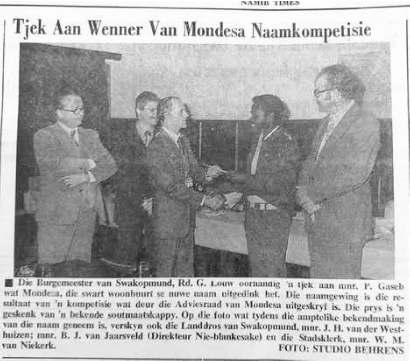

Paul Dansie is seen receiving the prize for naming Mondesa township in Swakopmund in 1978 from the then Mayor G Louw
Photo: Studio Behrens /Gâseb
Paul Dansie
Photo: Studio Behrens
/Gâseb (centre front) in the presence of Councillors and Magistrate JH Van Der Westhuizen.
A clipping from the Namib Times showing the moment he received the award in 1978.
Paul Dansie /Gâseb

In the front row: Assistant Commissioner Tom Kahimise; Head: Case Management Services at Walvis Bay Correctional Facility, Principal Kuisebmond Secondary School, Jonathan Mashawu, Governor of the Erongo region, Natalia /Goagoses, Deputy Commissioner Erastus Iikuyu and CODAC Chairperson Fabian Langenhoven. Behind: a member of CODAC the Walvis Bay Correctional Facility and learners of Kuisebmond Secondary School.

Vacancy

Barloworld Equipment represents world leading equipment brands manufactured for earthmoving and marine applications in Southern Africa and the world, adding value to its customers in the Mining, Construction, Marine and Energy Industries We provide technical and logistical support to our Customers.
Product Support Sales Representative Walvis Bay
The Position Reporting to the KeyAccount Manager: Erongo, the successful incumbent will be responsible for marketing after sales products and services, assisting the Technical personnel to maintain machine health for ultimate production at the lowest cost per hour and assisting Customers to practice highest possible technical integrity
Key Accountabilities
• Building relationships
• Regular machine inspections
• Preparing and discussing parts quotations with the Customers
• Regular site visits to monitor customer operations and advising on improvements
• Attending Customer meetings
• Assisting Customers with component forecasting
• Assisting Customers with rebuild planning and forecasting
• Monitoring component life and assisting customers with failure analysis
• Monitoring component turnaround time
• Coordinating repairs on customer fleets. (Manpower and parts availability)
• Communicating customer needs for new equipment.
• Driving parts sales through the different marketing campaigns
Qualifications & Experience
• Qualified Diesel Mechanic or relevant trade with at least 5 years post apprentice experience in the mining industry
• Ability to interact with different levels of the Customer (Chief Engineers, Technical Manager, Purchase Department and internal (Field Service, sales, parts and planning)
• Business and Marketing Acumen
• Able to build and maintain lasting relationships with Customers
• Self motivated, with high energy and an engaging level of enthusiasm
• Sound product systems knowledge (SIS, AMT, ET)
• Sound MS Office knowledge
• Must be in possession of a Code of Conduct not older than 1 year
• Must be in possession of a valid Code B/ BE driver’s licence (manual transmission)

Interested candidates that meet the above requirements should send their CV’s and certified copies of educational qualifications and relevant documents to: Recruitmentwindhoek@barloworld-equipment.com
Candidates from designated groups are encouraged to apply. If you have not been contacted two weeks after the closing date, please consider your application as unsuccessful. Closing date: 29 August 2025
“Barloworld is an equal opportunity employer”
Choices, Consequences and Change
Rudi Bowe
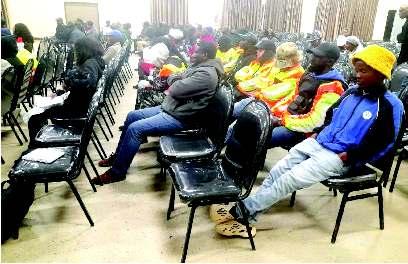
The Coastal Drug Awareness Campaign (CODAC), a non-profit communitydevelopmentinitiative,hosteda powerful youth engagement program at Kuisebmond Secondary School in WalvisBay.
The initiative under the theme 'Choices, Consequences, and Change' aimed to raise awareness about substance abuse and promote informed decision-making among Namibia's youth. This is about raising awareness and creating a culture of hope, building a generation that is resilient, empowering lives, shaping decisions, purpose-driven and inspiring transformation, one learner, one community at a time. The governor of the Erongo region, Natalia /Goagoses highlighted the role of leadership and education in youth development. /Goagoses said, “the choices you make today will shape the quality of your tomorrow We know that adolescence is a critical stage-full of dreams, but also full of pressure.And in that space of pressure, sometimes,substancesareofferedasafalseescape oraquickrelief.”Thegovernorsaidthatdrugsand alcohol do not solve problems, they only multiply them.“Theytakeawayyourabilitytothinkclearly, they hijack your potential, and they rob you of the future you rightfully deserve,” /Goagoses added. She stated, “If you have made mistakes, you can still make new choices that create new paths, let this campaign is your turning point and let it by a reminderthatit'snevertoolatetosay,Ichooseme. Ichoosemydreams.Ichooselife."/Goagosessaid totheyoungpersonwhomayalreadyfeeltrapped, whomaybestrugglinginsilence,helpisavailable. You are not alone. Talk to your teacher, your parent,yourchurch,yourclinic,orcometous.” /Goagoses stated that the future is yours. Own it ShapeitProtectit,sayyestoeducation,yourgoals and to life. She added that to reaching out is not weakness but strength. “I also want to acknowledge the power of peer influence. You can be the reason someone says no to drugs You can inspire your friend to stay in school. You can be a role model not by being perfect but by being courageousenoughtochoosetherightpath.”/Goagoses said, “as a government, we are working tirelessly with schools, law enforcement, social workers, NGOs, and faith-based organisations to create a safeandsupportiveenvironment.“Wecannotwalk thisjourneyalone.Weneedyouourlearnerstorise as champions of change within your schools, your families, and your communities.” she added. “To the community, let us not give up on our children, speak life into them guide, support, and encourage them.Letusremindthemdailythattheyareloved, they are seen, and they are worth the investment,” /Goagosesstated.Thegovernorurgedeveryparent and community member to start with a renewed sense of commitment, to uplift our learners, reject substances, promote mental wellness and create a community where every young person can dream, grow, and thrive,” she said. The governor concluded by saying, “you are not your circumstances, you are your choices, you are powerful beyond measure and are capable of turning any situation around.”JosefNghilunanyeHaufiku,Correctional OfficerforPublicRelationsatWalvisBayCorrectional Facility and Director of CODAC, emphasised the importance of community collaboration in guiding young people toward healthier lifestyles.“Throughsharedexperiences,expertinsights, and open dialogue, we hope to inspire young minds to make informed choices, understandtheconsequencesofactions,andembracethe valueofcommunityengagement,”hesaid.

“Baby Box” Receives Welcome Donation
The Ruach Elohim Foundation in Swakopmund, better knownasthe“BabyBox”recentlywasonthereceivingendof goods to the value of N$10 000, compliments of Namibia Diamond Trading Company (Namdia) through Republikein newspaper's 2025 Bridal Couple of the year winners, Edwin andZeneaBlaauw
This welcome donation included nappies, baby products, cleaning materials, food, fruit and vegetables among others. Part of the winning couple's prices from Namdia was a donation of this value to a registered charity organisationoftheirchoice. According to Edwin and

Vacancy
Barloworld Equipment represents world leading equipment brands manufactured for earthmoving and marine applications in Southern Africa and the world, adding value to its customers in the Mining, Construction, Marine and Energy Industries We provide technical and logistical support to our Customers.
Receptionist Walvis Bay
The Position Reporting to the Product Support Manager: E&T, the successful incumbent will be responsible for providing office administrative services to the Walvis Bay and other depots within the Erongo region
The Ideal Candidate:
• Beneficial to have a professionally pleasant and mature demeanour, coupled with dedication, enthusiasm, eloquence and loyalty
• Communicate well at all levels, combined with the profound ability of giving front desk services in a fast-paced environment
• Skilled in supporting the productivity of the office through filing, answering incoming calls, greeting guests, confidentiality and ordering supplies.
• Capable of creating a professional and inviting environment, offering outstanding customer service for clients
Key Accountabilities:
• Prompt answering switchboard and transferring calls
• Receiving and directing visitors
• Processing purchase orders followed by good receiving invoices
• Post office duties
• Stationery ordering and control
• Staff refreshments ordering and control
• Assist with adhoc duties relating to BWE events as and when required
• Keeping record of employee site access information
• Create and maintain MSA (marine service assessment) archive
• General admin duties
Qualification & Experience
• Sound Microsoft Office knowledge
• Grade 12 with 2 years’ experience in Office Management
• Effective self-management and performance ownership
• Professional appearance
• Excellent communicator (telephone manner & etiquette). Must have a wellpitched voice and above average listening skills
• Customer service orientation
• Attention to detail, resilience (stress handling), drive/ initiative
• Assertiveness & Punctuality &
• SAP experience essential
• Must have good command of English
• Must be in possession of a Code of Conduct not older than 1 year
• Must be in possession of a valid Code B/ BE driver’s licence (manual transmission)

Interested candidates that meet the above requirements should send their CV’s and certified copies of educational qualifications and relevant documents to: Recruitmentwindhoek@barloworld-equipment.com
Candidates from designated groups are encouraged to apply. If you have not been contacted two weeks after the closing date, please consider your application as unsuccessful
Closing date: 29 August 2025
“Barloworld is an equal opportunity employer”
Zenea Blaauw they chose Ruach Elohim Foundation for the values they stand on. “They protect and uplift children and give them a second chance they would not have had if it wasn't for this foundation,” Zenea remarked The couple also emphasised that they are stronglyopposedtobaby dumping and abortion.
“We truly felt blessed and it's a humbling experience.As believers of Jesus, we're just grateful to God for putting us in a position to give back, and we're thankful to Namdia for making it possible,” the humble couple shared with
should ever end up in an orphanage,” was Ronel's response on questions sent to her by Namib Times.Atotal of six babies, until date, were received in the baby box for this year She accentuated the fact that Namibia has so many parents who want toadopt,andthereareso many children in need of loving homes. “We invitethepublicandprivate companies to support this lifesaving and life-importantinitiative. We need big companies (like MTC) to help us raise more awareness andcombatthehorrorof babydumping. Wearea registered welfare orga-

Photos provided
Namib Times Ruach Elohim Foundation's founder, Ronel Peters expressed their heartfelt gratitude towards all parties involved in this gesture. Regarding the Baby Box she noted that altogether, since the inception of the baby box in 2020 (the first and only baby saver box in Namibia), they have received 42 babies in the box to date. Currently, eighteen babies are in theircare,ofwhomthree babies are special needs babies.Shefurthernoted that last year, sixteen babies were adopted, and this year, seven babies found their forever homes.“Wehaveadedicated, private social worker, Ms Catrien du Toit, who works tirelessly and intensely to givethesebabiesachance in life to have loving parents and a place they can call home. No baby
nisation, and we are entirely dependent on donations and support from the public,” Ronel concluded. “At NAMDIA, giving back is at the heart of what we do, and we are passionate about showing how diamonds can make a difference. We are delighted to partner with the Bridal Couple of the Year initiative for the thirdconsecutiveyear Weddings and diamonds share a natural connection, making this the perfect platform to engage with the public. As part of the winning couple's prize, a N$10 000 donation is made to a registered charity organisation of their choice, encouraging them to sharetheirjoybygiving back to their community,” says Namdia's spokesperson,Beverley Coussement.
Marshallino Beukes
Egyptian Ambassador Graces Local Bridge Club with Participation


Marshallino Beukes
The annual Bridge Coastal Tournament took centre stage at the Swakopmund RetirementVillagelastweekend.
A total of 28 players from Swakopmund, Windhoek, Omaruru, and Henties Bay participated, includingtheEgyptianAmbassadortoNamibia,Wael Lofty Swakopmunders, Camien Lens and her partnerHallmutWormsbacherclaimedtophonourswith Allan Walden and Dominique Robers from Windhoek in second position. The EgyptianAmbassador andhispartner,MikeBeavissecuredthethirdplace. The Swakopmund Bridge Club meets every Tuesdayafternoonat14:00attheLionsOldAgeHome.

Vacancy
Barloworld Equipment represents world leading equipment brands manufactured for earthmoving and marine applications in Southern Africa and the world, adding value to its customers in the Mining, Construction, Marine and Energy Industries We provide technical and logistical support to our Customers.
Mechanical Assistants: Marine x 2 Walvis Bay
The Position
Reporting to the Service Supervisor, the successful candidate will be responsible to assist General Mechanics and Service Specialists to perform repairs, services, and maintenance on Caterpillar Equipment to supplier standards and Customer requirements.
Key Accountabilities
• Assisting and supporting General Mechanics and Service Specialists to perform moderate to complex maintenance and repair work on Caterpillar Equipment offshore onboard vessels, on customer sites and on Barloworld sites while maintaining an orderly and safe workplace.
• Sound knowledge of where tools are specifically used to ensure thorough assistants and support.
• Physically lifts, keeps in place, or move up to 20kg, or use appropriate lifting and slinging equipment for objects larger in size.
• Cleaning and maintaining facilities and equipment
• Maintaining a safe and orderly workplace
Qualifications & Experience
• Minimum Grade 12
• Ability to obtain certification as Forklift Operator within 90 days of appointment
• Ability to follow instructions under Supervision
• Verbal comprehension and physical resilience
• Must be willing to work in the Marine industry with the Marine Team as and when required
• Must be prepared to temporarily work in other countries
• Must be willing to work overtime, weekends, and public holidays
• Must be in possession of a Code of Conduct not older than 1 year
• Must be in possession of a valid Code B/ BE driver’s licence (manual transmission)

Interested candidates that meet the above requirements should send their CV’s and certified copies of educational qualifications and relevant documents to: Recruitmentwindhoek@barloworld-equipment.com
Candidates from designated groups are encouraged to apply. If you have not been contacted two weeks after the closing date, please consider your application as unsuccessful Closing date: 29 August 2025
“Barloworld is an equal opportunity employer”
Photos contributed
Katora PS Gets a New Lease on Life

Katora Primary School learners can now enjoy warm showers, clean toilets, and safe hostel rooms thanks to a joint effort by Rössing Uranium, NIMT, and local partners who came together to restore dignity and hope at the rural school near Spitzkoppe.
Rössing has an annual initiative under which it executes the Communities Mandate, “The Bigger-Than-MeProgramme”.For2025,KatoraPrimary School is the beneficiary under one of Rössing'sexpectedoutcomes.KatoraPrimarySchool is situated near the Spitzkoppe Tourism Office (Info & Ticket Office). Daylight Ekandjo, Manager of Corporate Communications at Rössing Uranium Ltd, mention that Rössing had been asked by NIMT to assist with an official event afterthecompletionoftheirworkatKatoraPS.“I knewthatwedidnothavethebudgetallocationto support themwiththat,but insteadof saying no, I thought to speak to our communities, and they in turn reached out to their communities to garner support for this worthwhile request. What we were able to get amounts to the exponential outcome that is visible all around us today,” said Ekandjo. On Friday, Rössing celebrated Sustainable Development Goal 17 – Partnerships for the Goals – by handing over the collective result of what happens when the Rössing community comestogethertosupportacause.MrRalphBussel,ExecutiveDirectoroftheNamibiaInstituteof Mining and Technology (NIMT), described the shocking state of the school's facilities: most toilets were non-functional, no showers or basins worked, ceilings were damaged, over 500 windows were broken, and the sewage system was completely blocked. Children had to relieve themselves in inappropriate places, including on mattresses and even inside the roof, due to the lack of sanitation. Bussel said this neglect reflectedafailureofresponsibilitybystaffandmanagement, despite significant government investment in the school. To address the crisis, NIMT intervened with their trainees during the school's mid-
termbreaktorepairandrestorefacilitiesatminimal cost, making use of both local and international donations. He emphasised the need for the community to protect and build on government investment, rather than repeatedly spending money on preventablerepairs,inordertoensuresustainability and proper care for children's learning environments.The Principal of Katora Primary School, Mr Elvin Majiedt, explained that Friday's event was essentially a maintenance assistance initiative, where companies joined in to help the school preserve the renovated hostel and classroom facilities. The initial phase of renovations at Katora PS was fundedbytheMinistryofEducation,withmoreimprovementsstilltocome.Majiedtsaid,“wegatherto celebrate a powerful achievement in the life of our school, one built on compassion, shared purpose, and the unwavering belief that every learner deserves a safe, clean, and dignified place to live and learnin.”Herecalledhowthehosteloncetoldavery different story: the rooms were run down, windows broken, and toilets urgently in need of repair “All hostel boarders lived in conditions that none of us would accept for our children. But today, that story has changed. We walked through the hostel this morningandsawrenovatedroomswithcleanwalls, functioning lights, and a refreshed atmosphere that feels like home.” The toilets, once a source of discomfort and embarrassment, are now modern, clean, and fully functional. Just last week, learners proudly shared that they can now take warm showers and properly use their toilets. The rooms are neat, tidy, and the hostel has become a pleasant placetostay Majiedtthankedtheindividuals,families, and organisations whose generous donations made the transformation possible. “Your support has not only renovated our school hostel, you've

restored comfort, dignity, and pride for every learner who calls this place home. To our local corporates, the Spitzkoppe Lodge and Gaingu Conservancy, thank you very much for annually assisting us in maintaining and improving Katora Primary School.” He added that education transformslives,butlearnerscanonly thrive when their basic needs are met.
“Today, we've taken a major step forward in ensuring that every student who stays in our hostel is treated with the dignity and respect they deserve.”
Ekandjo also acknowledged NIMT's Ralph, Randy, and Mark, along with

their apprentices and artisans, for the additional work they did during the Ministry-fundedrenovations.“MightI add, this work was supported by materials and funding that Rössing donated toNIMTin2023and2025,”shesaid. She further recognised Advanced Fire Namibia for providing fire extinguishers for the hostel, classrooms, dining hall,andkitchen.
This donation included installation and short training on fire safety Other contributing companies included Boost, Welwitschia Cleaning & Catering, and Rapha Counselling and Consulting Rössing Lived Legacy members also collected 49 bales of toilet paper for the school and hostel. Katora Primary School currently operates with 15 teachers and 14 classrooms.
VACANCIES


Vacancies
Huigong Namibia Mining Equipments (Pty) Ltd is seeking qualified and experiencedSafetyOfficerandAutoElectriciantojoinourteam,atGMSSite -SwakopUraniumMine.
Safety Officer
PrincipalAccountabilitiesandRequirements
EnsurecompliancetotheCompany'sSHEQstandardOperating Procedures(SOPs)andrelevantlegislations
Promoteandsupportallcompanypoliciesandprocedures
MaintainconstantcommunicationofupdatedSHEQrelatedinformationto co-workers
AssisttheProjectManagertoimplementandtrainthecoworkersonthe SHEQsystem
UpdateandmaintaintheSHEriskmanagementsystemaccordingtothe Company'srequirements
ReportallaccidentsandSHErelatedincidentstotheProjectManager withintheprescribedtime
Activelyparticipateandprovidesupportduringincidentinvestigations
Conductsafetytrainingtoco-workersasrequired
AssisttheEmergencyResponseteamasrequiredfromtimetotime
Ensureintegrityofthesafetyinformationandassistincompilinginternaland externalreports
ActivelyparticipateinmeetingtheSHEQsettargets
Conductinspectionstodetermineandimprovelevelofcompliancetohealth andsafetyregulations
Keeptheteaminformedandupdatedwithregardtothestatusofhealthand safetyattheMine
Activelypromotesafetycultureandsharesafetyslogansthrough workgroupsonadailybasis
Activelyparticipateinsafetyand/ortoolboxmeetings,andconducta monthlysafetyinspectionofworkareabasedontheschedulesetby Management.
Maintainasafeworkingenvironment,andkeepingtheassignedworkarea
Grade12certificate
RelevantSafetyqualificatione.g.SAMTRAC,aNationalDiploma (NQFlevel6)willbeanadvantage
Minimumof5years'experienceintheHSEfield
Experienceintheminingindustrywillbeanaddedadvantage
ValidcodeBdriver'slicense
FamiliarwithOfficeSystem
Auto Electrician
Qualification and Requirements
Grade 12 Certificate.
Recognised Trade Diploma as a Qualified Auto Electrician. 5Yearsapplicableexperienceinmaintenance,diagnosingandrepairingof allelectricalcomponentsindifferentequipmentwithinamining environment.
Experienceoftroubleshootinghydraulicandelectronicsystems.
Experienceworkingonair-conditioningsystems.
Earthmovinghydraulicsystemsexperiencewillbeadvantageous. CodeBdriverslicence.
Thisspecificpositionrequiresthattheapplicantbeabletoworkshifts, overtimeandstandby
If you are skilled and dedicated, we want to hear from you!
Kindly forward a letter of application and resumé with recently certified copies of supporting documents via email to:
recruitment.huigong@gmail.com
Closing date: 03 September 2025
Please consider your application unsuccessful if not contacted within twoweeksaftertheclosingdate.
Sharlien Tjambari
VACANCIES

We are an Equal Opportunity Employer seeking to employ an:
PAYROLL CLERK(B5)
If you honor our values
We care? We serve? We think smart? We grow people? We talk to each other? We walk the talk
And have the following Experience, skills, knowledge
A minimum qualification: Grade 12
A minimum experience of 2 years as a Time and Attendance administrator (Timekeeper), preferably in a food processing, fishing or manufacturing environment.
Basic knowledge of the Labour Law (hours and payment), Social Security
Must have good knowledge of clocking procedures and time and attendance management
Must have computer skills on an advanced level (MS-office)
Preferably good knowledge of VIP, NAV and Jarrison
Must be able to work independently
Must be able to take initiative
Must have a high attention to detail and must work accurately Must support and co-operate others
Must have high integrity and adhere to principles and values
Must have excellent communication skills (preferably multilanguages)
Must work according to strict deadlines, must have excellent time management skills
Must have excellent adaptation skills
Must have excellent numeric and verbal abilities
Must have good organisational and administrative abilities
Must have excellent writing and reporting skills
Must be able to deliver on results
Must follow instructions and procedures
Must work overtime if required
Preferably a Namibian citizen
Please forward your resume, cover letter, and any relevant supporting documents to: by no later than 29 August 2025.
recruitment@gendev.com.na
Only shortlisted candidates with the relevant support documents attached to their application will be contacted for interviews. Candidates from designated groups defined in the Affirmative Action Act (1998) are encouraged to apply

We are an Equal Opportunity Employer seeking to employ an:
If you honor our values
We care? We serve? We think smart? We grow people? We talk to each other? We walk the talk And have the following skills:
A minimum qualification: Grade 12 (accounting)
A minimum experience of 3-5 years in a payroll environment, preferably in a food processing, fishing or manufacturing environment.
Preferably good knowledge of VIP, NAV and Jarrison
Must have knowledge of the Labour Act, Social Security Act, Workmen's Compensation, Injury on Duty process
Must have knowledge of Namibian Income Tax Law
Must have knowledge of Pension processes
Must have computer skills on an advanced level (MS-office)
Must be able to work independently
Must be able to take initiative
Must have a high attention to detail and must work accurately (high detail consciousness)
Must support and co-operate others
Must be able to work well with people, must have excellent interpersonal skills
Must have high integrity and adhere to principles and values
Must have excellent communication skills
Must work according to strict deadlines, must have excellent time management skills
Must have excellent adaptation skills
Must have excellent numeric and verbal abilities (preferably multilanguages)
Must have good organisational and administrative abilities
Must have excellent writing and reporting skills
Must be able to deliver on results
Must follow instructions and procedures
Must work flexible hours when required
Preferably a Namibian citizen
Please forward your resume, cover letter, and any relevant supporting documents to: by no later than 29 August 2025.
to apply
KSS Hall Project is on the Move
Rudi Bowe
Kuisebmond Secondary School (KSS), located in Walvis Bay is constructing a multipurposeschoolhallthatwillserveboththeschoolandthebroadercommunity.
This hall will serve as a cornerstone for academic and extracurricular activities, fostering a vibrant learning environment and providing a much-needed space for community engagement The school started the construction of a multi-purpose school hall in 2012. The main purpose of the hall is to accommodate school as well as community activities and promote the entire Erongo region These activities that is already ongoing at the school hall, include Namcol classes, the Namibian University ofScienceandTechnology (NUST) part-time Saturday classes and literacy eveningclassesforadults.
The school's hall project hastodatereceivedaround N$350 000 from various donors. The Namibia Fish Consumption Promotion Trust (NFCPT) has given theirsupportsince2023by contributing N$150 000 to the school hall project, N$50 000 in March 2023, with another N$50 000 in August 2024 and N$50 000 in August 2025 whilst ErongoRED donated N$200 000 in April of 2022. NFCPT has pledged to support the school until it completes the hall Despite contributions, a funding gap remains the total cost is about N$4.9 million, and available donations so far fall short ofthetotalamountneeded. Thecompletionofthishall

will play a vital role in the upliftment and academic improvement of the school, directly impacting the lives of thousands of learners Investing in educational infrastructure is an investment in the future of the nation, empowering the next generation with the resources theyneedtosucceed.
Principal of the school, Jonathan Mashawu said that the school is profoundly grateful to Namibia Fish Consumption PromotionTrust(NFCPT), “by accepting your generous donation of N$50 000 toward the completion of our school hall project. This significant con-
tributionbringsuscloserto realising a long-held commitment, one that NFCPT has steadfastly supported since 2023 Your continued dedication to this vital infrastructure is a testament to your commitment to corporate social responsibilities and the future of our youth.” He urged other companies andbusinessindividualsto emulate NFCPT's exemplary commitment and support this project. Current partners include Erongo Red, Namport, Flamingo group Sweeden, NFCPT and former alumni.Theschoolinvitesthe business community to join this esteemed and

Pam Golding Properties' "Stir the Pot for a Purpose" Potjie Cook-Off competitionwhichtookplacerecentlyat the Swakopmund Paintball Centre & Adventure Park saw a total of N$79 500 raised in support of Have-a-Heart Spay andNeuterProjectNamibia.
Gerda Christoph, Pam Golding's Swakopmund branch manager, described the fun-filled fund-raising day as a huge success with outstanding team spirit amongalltheparticipants.Atotaloffifteen teamsentered,andcompetitionwastough. Pam Golding announced at the event that they are planning to make this an annual fundraising event, with Windhoek next year's destination. This year marked their debut. Christoph conveyed Pam Golding's appreciation to all the businesses that participated in the Potjiekos Competition, as well as community members who pitched in numbers “Without your contribution and team spirit, this successful fun day would not have been possible,”shenoted.
The first three winning ticket numbers were ticket 0767 (Hot Air Balloon Trip valued at N$7 500), ticket 0509 (Weekend for 2 at White Lady Lodge valued at N$6 350), and ticket 1148 (Marine Kayak excursionfromAmazing5
N$2800).
forward-thinking partnerships aimed at enhancing education for a Namibian child, your future employees, during their upcoming gala dinner for the ongoing hall project on the 31 October 2025. “Bethe"Octopus",extend your social responsibilities-charity begins at home,” Mashawu said The school's community believes that with the collective support of the community and corporate partners, they can transform this vision into a tangible reality, creating a lasting legacy for generations to come KSS continues to seek additional support from companies,NGOs,andindividualstofinishthehall. Therefore, reach out to KSS directly to inquire about current progress, funding milestones, or donation options. Their contact info: Phone: +264 64205329.Email: kuisebmondss.edu@ gmail.com


Cliff Shikuambi the chairperson KSS hall project and Principal of the school, Jonathan Mashawu received the donation from Chairperson of theNFCPTBoardofTrustees,SuzanNdjalekaandNFCPTCEOVictor Pea.
Toursvaluedat
PhotosMarshallinoBeukes
Have-a-Heart Scores Big at “Potjiekos” Competition
Marshallino Beukes
SERVICES: KONTAK VIRALLE
VERFWERK: Huis, gastehuis, lodges, geboue. Enige plek in Erongo streek. Gratis kwotasie!!
Skakel: B von Seydritz 081 819 6117
Richard: 081 692 3590
NAMIBIAGARDEN SPECIALIST SERVICES
Landscaping & plant doctor
Original palm & tree trimming. Planting grass and flowers Painting: house, palm trees and thatch roofs
Cutting big trees
Training companies of original palm tree trimming, painting and cutting.
Contact: 081 274 8447

OFFICE & HOUSEHOLD FURNITURE REMOVAL SPECIALISTS
Namibia Household & Office. Mobile: + 264 814093522 email: nktransportnam @gmail.com
Traditional Dr Herbalist
Dr Lovemore Ben Banda (The old man) From Malawi is in Walvis Bay with 30 years vast experience in various problems & diseases such as bringing back lost lover, to get a new job, to win court cases, to clean out bad luck from your body, to pass exams, to pass driving, to protect your body from withcraft, to boost small business to be big business, to be liked with people, to win contractors, to win a woman or man of your choice, to stop smoking and drinking, alcohol and drugs, divorce, stop your lover to be stingy with money, to make you sleep nicely in your house, to stop bad dreams, a man to be strong in bed during sex, a woman to have feelings for a man, headaches, swelling of your body, madness, epilepsy, joints pain, pregnancy problems, if you need a new baby, period pains, to recover stolen property, BP, ulcers, diabetes, asthma, & many more.. Come & experience wonderful miracles happening in your life, you will never regret. Sms or call:081 643 1482 find the Old man in Kuiseb, Mass Houses, at NHE 6751
Johannes Nakuafila Street
MALAWIAN TRADITIONALDoctor Bomba Bazuka – the name is enough. The doctor is in Walvis Bay with 40 years experience and has done wonders and great things in many SADC countries, such as bringing back lost lovers in 4 days. Removal of bad luck, very tough and challenging court cases, binding your love and to be your only And to get a man/woman you want of your choice. Pregnancy problems, jobs and promotions, business, protection of bodies and houses from witchcraft, protection of kraals farms from thieves, wining tenders, and contracts, revenge kapsule, rejuvenate mens power during sex, magic wallet and get rich within short notice. Chest pains, headache, swollen legs &feet, epilepsy, drinking /smoking, to be released from prison, manhood enlargement. Hips/breast. I know you have been let down by others but now your time has come. Come and experience the wonderful miracles happening in your life and you will never regret.
Call/sms Bomba Bazuka: 081 602 7102
TRADITIONAL
DOCTOR: Dr. S Jeke
(The Best). Bad LuckLuck Muti - Love ProblemsMarriage to keep your lover just for yourself - Work problems - Promotions - To get ten-ders and to boost your business - People don’t want to pay you backPregnancy ProblemsProtection of Farms, Houses, Cars andAnimals - Sexual transmitted sickness - all sicknessAsthma, BPRemove to-koloshi from bodies, houses - Men’s power sexuality - Spiritual doctors in need of more spiritual powers, etc. House Nr.(79) 3191D. Johanna Benson Street Kuisebmond, Walvis Bay 081 303 3149
Dr. Mbuya tembo (0812806149)
African herbal ministry
For the first time in Walvis Bay and Namibia at large:
Ever surprised why you do not excel in life despite your hard work; got married; established good business; studied hard; applied for several jobs; missed opportunities; poor health ...?Yet others succeed by just doing it once and for all. Come to Dr. Mbuya tembo for all your life matters: Get a job, promotion; personal protection; business growth and protection; removal of bad omens; calling for lost lovers; inviting a relative who left home; personal health for men/women and many more....! Dr tembo promises you nothing but guaranteed results. You have tried many others, but now, do it smart with Dr .Tembo. Call for appointment and consultation 0812806149
URGENTLY LOOKING TO RENT:
Narraville 2 bedroom flat Water can be included Electricity can be prepaid N$ 4 000.00 p/m - N$ 4 500.00 p/m ready to move in immediately. Ruan 081 347 5087
WANTED: I am looking for an old caravan to buy N$ 3 000.00 Walvis, Swakopmund etc. Contact: 081 795 7662
BLYPLEK GESOEK:
Dringend opsoek na n 2 of 3 slaap kamer huis met double garage. Verkieslik Dorp, Meersig, Fairways area.
Kontak 081 272 0362 081 285 5425
MARITIME SHORT COURSES ON DEMAND 2025
At Monarch Lifeguard Aquatic training center, Next to KFC, Walvis Bay
•Safety at sea stcw!! N$ 2300.00 (On special)
•Beginner swimming
Kids N$ 500.00 (5 Days)
Adults NS600.00 (5 Days) Monthly Kids N$ 730.00 (Twice per week)
Monthly Adult N$ 800.00 (Twice per week)
•introduction to swimming pool operations and water maintenance N$ 2300:00
•Water safety and drowning prevention for mining industry N$ 3250:00
•SCBA breathing apparatus N$2240.00
•Intermediate swimming N$ 1150.00
•Advanced swimming N$1250.00
•Snorkel lesson
Kids N$ 500.00
Adults N$ 600.00
•Water rescue technique N$ 2500.00
•Open water diving: N$ 7500,00
20 Meters Deep
•Lifeguard N$2800.00
•Swim coach N$ 3500.00
• One on one swimming Kid N$ 800.00
Adult N$ 1000.00
•Occupation health and safety management N$1700.00
•Firefighter Water Safety With Full Gear N$ 1850.00
•basic first aid N$400.00
•B asic fire prevention and fighting N$ 450.00
• flash flood water rescue techniques N$2200.00
CLOSING TIME: 10:00 day prior to publication

Raysonics Inspection Testing and Certification
JOB VACANCY
POSITION: NDT Technician
LOCATION: WALVIS BAY
PURPOSE OF THE ROLE:
We are seeking a qualified and experienced NDT Technician to join our team.
QUALIFICATIONS:
Grade 10 or Grade 12
certificate
Ultrasonic Testing (Level 2)
Magnetic Particle Testing (Level 2)
Dye Penetrant Testing (Level 2)
Vacuum box Testing (Level 2)
Offshore survival qualification –Opito approved Valid Driver’s License (Code B)
BEHAVIORAL
COMPETENCIES:
The candidate must be action oriented with a proven track record of problem solving and analytical thinking. Display of exceptional time, task and resource management skills. Strong interpersonal, verbal and written communication skills
Interested candidates are invited to send their detailed CV’s to: request-ndt@ritcnam.com or reception@ritcnam.com
CLOSING DATE: 31 AUGUST 2025
VACANCY SALES ASSISTANT
We are seeking a dedicated and dynamic individual to join our team as a Sales Assistant.
Requirements
- Honest and vibrant
- Namibian citizen
- Fluent in both Afrikaans and English
- Experience in Pastel
- Willingness to learn and adapt
PLEASE NOTE!
Only applicants who meet all the above requirements will be considered. If you do not meet these criteria, kindly refrain from submitting your CV Application Process
Submit your detailed CV to: LF@bdmnam.com
JOB WANTED: A 34 year old lady looking for domestic work in Walvis Bay
Contact: 081 827 4308
JOB WANTED: A 32 year old lady looking for domestic work in Walvis Bay. Mondays to Fridays.
Contact: 081 438 9567
JOB WANTED: A 35 year old lady is looking for is looking for domestic work in Walvis Bay. I have previous experience. Ready to start immediately Contact: 081 228 2230
JOB WANTED: I am looking for domestic work or stay in nanny/ care giver or in hospitality industry. I have thirteen years of experience. It should either be in Walvis bay or langstrand, Dolfynstrand. I am 42 years old and can start immediately Contact 081 331 1530 / 0816199392

Rgtd:
LOOKING FORAJOB: in Swakopmund / Langstrand.
I am a 46-year-old woman looking for domestic job or training of kids. I am very hardworking, reliable lady with sober habits. Can start immediately
Please contact me on 081 373 1294
.JOB WANTED: I am a 40 year old lady looking for housekeeping work in Walvis Bay or Langstrand. I am ready to start as soon as possible. Contact: 081 405 0656
JOB WANTED:
I am a 48 year old lady looking fro domestic work in Fairways, Langstrand, Lagoon. I have 4 years experience. Ready to start immediately Contact: 081 686 4081
JOB WANTED:
I am a young Namibian lady looking for work as a nanny in Walvis Bay I have experience of 6 years and very responsible. Contact: 081 708 0249
PET ALERT FOUND

TRENDHAUS SWAKOPMUND Live Trendhaus Busking Sessions in the Otto Günther Courtyard. This Saturday 23 August, 10h00 –13h00. Free coffee for every musician that plays! Listen to some fantastic artists! 081


“ITS NOT A BAKKIE IT'S A HILUX”
INDONGOTOYOTAGolf Day “ITS NOTABAKKIE IT'SAHILUX” played at WalvisBayGolfCluboverthepastweekendsaw40golfersturnedouttotakeona Betterballcompetition.
As normal there was a twist in the cable with a bonus hole on each nine where both scores were to count.
The draw for the two bonus holes was done b y A n t o n v a n Rensburg, and lo and behold he drew hole number 2 where he and partner Hannes Crafford both had a blackout,ai.Theother hole was hole 11 Making good use of the bonus holes and getting 2 bonus shots were Nardo Sardinha and Koot Potgieter

coming in on 43 points plus the two to win the competition on 45 points Second place went to Joe Hermann and Pieter van Aarde also on 43 points but only one bonus point. The best use of the bonus holes were third placed Thomas Wolff and Bertus Venter who scoredfourbonuspoints to add to their 40 points, however losing the count out. Closest to the pin was won byThomas Wolff who hit his shot within two feet (aka 6 0 c m ) a n d t h e n

promptly left his putt short. Two clubs were recorded by Kevin de Reuck, Sandro de Gouveia, Bertus Venter, Schalk van Wyk and Andre Burger each 50 buck richer for their efforts All players donated a tin of food, with 94 cans of various tinned food collected. At the prize giving Amos Ferris committed t h a t I N D O N G O TOYOTA will return next year The management and members of Walvis Bay Golf Club

Namibia to host ICC women's T20 World Cup Africa Qualifier

thanks the INDONGO TOYOTA team for the watering hole and their continued support BossieBosmanwonlast week's SENIORS on 37 points, with Ken Roberts second on 33 pointsandAndreBurger third on 32 points. not too sure who won 'die brood'. Remember tee off is at 8:30 each Thursday


CricketNamibiaispleasedtoannouncethattheICCWomen's T20 World Cup Africa Qualifier will be staged in Windhoek from 31August to 6 September 2025, bringing together eight countries in pursuit of two coveted spots at the Global QualifierfortheICCWomen'sT20WorldCup.
The event marks another milestone for women's cricket in the region, with tournaments like this underscoring the rise and growth of the women's game across Africa Participating teams are Namibia (hosts), Zimbabwe, U g a n d a , K e n y a , Nigeria, Tanzania, Sierra Leone, and Rwanda. Rwanda and Sierra Leone secured their spots in July after finishing first and secondattheICCAfrica Division 2 Qualifier in Botswana The tournamentwillbeplayedat two world-class venues: the new FNB Namibia Cricket Ground and the HP Cricket Oval, both of which are set to cohost World Cup matches. Namibia will be aiming to capitalise on home advantage, while Zimbabwe and Uganda arrive as higher-ranked teams with proven records in ICC pathway events Fixtures are expected to be fiercely contested, with emerging African teams
eager to make their mark. Cricket Namibia CEO Johan Muller said, “Namibia is pleased to host the ICC Women's T20 World Cup Africa Qualifier and to welcome seven international teams to our new home of cricket. This event is not only about qualification, but also about celebrating the incredible rise of women's cricket in Africa We hope all participants enjoy the competition and the warm hospitality our countryisknownfor.”
Fixtures with venue in brackets:
Sunday 31August
9:30-Nigeria vs Sierra Leone ( N a m i b i a CricketGround)(NCG)
9 : 3 0 - K e n y a v s Rwanda(HPOval) 14:30-Zimbabwe vs Namibia(NCG) 14:30-Uganda v s Tanzania(HPOval)
Monday 1 September
9:30-Zimbabwe vs SierraLeone(NCG) 9:30-Tanzania vs Kenya (HPOval)
14:30-Nigeria vs
Namibia(NCG)
14:30-Uganda vs Rwanda(HPOval)
Wednesday3Sept
9:30-Tanzania v s Rwanda(NCG)
9:30-Namibia v s SierraLeone(HPOval)
14:30-Uganda vs Kenya (NCG)
14:30-Zimbabwe vs Nigeria (HPOval)
Thursday4September
9:30-1st GroupAvs 2nd GroupB(SF1)(NCG)
9:30-3rd GroupAvs 4th Group B (SF3) (HP Oval)
14:30-1st Group B vs 2nd Group A (SF2) (NCG)
14:30-3rd Group B vs 4th Group A (SF4) (HP Oval)
Saturday6September
9:30-LoserSF1vsLoser SF2 (NCG) (3rd Playoff)
9:30-LoserSF3vsLoser
SF4 (HP Oval) (7th Playoff)
14:30-Winner SF1 vs Winner SF2 (NCG) (Final)
14:30-Winner SF3 vs Winner SF4 (HP Oval) (5thPlayoff)

Kudus Demolish UNAM
FNB Kudus first team beat FNB UNAM 32–0 whilst the second team, RDI Kudus defeated Unam second team 52-12 in their JSB Gold Cup fixture at Jan Wilken StadiuminWalvisBayonSaturday.

This weekend FNB Kudu Rugby Club will host top of the log FNB Grootfontein who beat FNBWanderers on their home ground lastweekend.Intheirhead-to-headhistory, Kudusfirstteamhasdominatedwith6total wins, including 3 home wins and 3 away wins, while Grootfontein has secured 2 wins, both at home. In recent encounters between these two teams Kudus beat Grootfontein33-27.

The winners of the INDONGO TOYOTA Golf Day Koot Potgieter and Nardo Sardinha with Amos Ferris from INDONGO TOYOTAin the middle.
Rudi Bowe
Rudi Bowe
Namport 7-A-Side Expected to Heat up
Walvis Bay

The Namibian PortsAuthority (Namport) in partnership with Pindulo Logistics, launched the inaugural 7-A-Side Corporate Soccer Tournament with the theme: “ScoreGoalsforaGreaterCause”onWednesday20Augustin
Atotal of 33 corporate teams entered to showcase their teamwork and football skills from the kick off, today (Friday 22 August) and every Friday and Saturday until 27 September at the Narraville Stadium. Beyond soccer, the initiative is about promoting wellness, fostering teamwork, a n d c o m m u n i t y engagement, while creating opportunities for local SMEs and entrepreneurs Elias Mwenyo, Executive: Commercial at Namport said at the launch of the first-ever Namport 7-A-Side Corporate Soccer Tournament under the theme “Score Goals for a Greater Cause” is to promote healthy lifestyles within the work environment and com-
munities, strengthe-ning Namport's com-munity relations through initiatives of this nature as well as build a culture of fitness and holistic well-being and create long-term partnerships with public and private stakeholders Mwenyo stated that the Namport 7Aside Soccer Tournament was proudly conceptualised under Namport's CSI thematic pillar that serves to enhance Community Health & Wellbeing Initiatives Mwenyo said, “Sport, in this context, becomes more thanacompetition;itisa catalyst for broader social and economic benefit Through the Namport 7Aside Soccer Tournament, we are fostering teamwork, discipline, wellness, and inclusivity while actively supporting local

businesses and contributing to the social fabric of Walvis Bay, and in doing so, demonstratethatcorporate initiatives, when ethically and strategically executed, can deliver shared value for all stakeholders.” He encourages all participants to embrace the valuesthatunderpinthis initiative: teamwork, respect, discipline, and fair play “Each goal scored represents not only a sporting achievement but also a step forward in fostering community engagement, wellness, and inclusive economic development.” “Together with our stakeholders, partners, and the Walvis Bay community, we are creating a landmark event—one that strengthens our corporate networks, uplifts local
enterprises, and contributes meaningfully to the socio-economic and cultural vitality of our region,” Mwenyo said. In line with our motto, “Score Goals for a Greater Cause,” the winners will receive a monetary reward of N$15 000, a floating trophy, and medals, alongside an additional N$10 000 donation to a charity of the team's choice.Thisensuresthat the spirit of this tournament extends far beyond the field, supporting social initiatives and reinforcing Namport's role as a responsible and ethical corporate citizen. The runners up will walk away with N$7 000, whilst the third place will receive N$ 4 000 with medals respectively


NSA to Host Laser & Junior Nationals Championships
The Namibian Sailing Association (NSA) will host the Laser & Junior Nationals Championships in partnership with Catamaran Charters on 23–24 August at Walvis Bay Yacht Club.
This year Championships will bring together 17 of the country's best young sailorsandseasonedcompetitorsforashowcaseoftalent,skill,andendurance on the water The championships will feature Laser class races as well as junior divisions aimed at nurturing Namibia's next generation of sailing champions. According to Elaine Thompson, the championships play a vital role in the development of competitive sailing in Namibia, offering both experienced athletes and emerging sailors an opportunity to compete in a structured environment. “The Laser & Junior Nationals is more than just a competition,”saidNSA.“Itisasteppingstoneforyoungsailorswhoaspireto represent Namibia on the international stage.” Thompson said that the event promises to be an exciting weekend of sailing. “We invite the public to come and watch young and old sailors battle it out and support this growing sport code.” Thompson added that the competition will be divided into two main categories:thelaserclassandthejuniordivision.

Husband and Wife Win
in Henties
Husband and wife, Elrico & Nicolene Janse van Rensburg took the honours in the men & ladies divisions at highly anticipated coastal leg of the Nedbank for Good Series respectively at the Henties Bay Golf and Lifestyle Estate on Saturday.
The series will now head to the Rossmund Golf Course in Swakopmund this weekend, followed by the Walvis Bay Golf Course on 30August to conclude the coastal stretch of the series.After the coastal stint, the Nedbank for Good SerieswillcontinueattheWindhoekGolfandCountryClubon13September Series organiser Dan Zwiebel confirmed that preparations are well underway in uniting passionate golfers and community champions for a weekend of sport, camaraderie, and purpose. The 2025 Nedbank for Good Series is sponsored by Nedbank Namibia as the title sponsor, while Autohaus Windhoek, Vivo Energy,AfricaOnline,Agra, B2Gold, Gondwana Collection Namibia, JTC Namibia, King Price, Pupkewitz Megabuild, Town Lodge Windhoek, and WV-Manufacturing are co-sponsors, and Future Media the mediapartner

WalvisBay
Rudi Bowe
Rudi Bowe
Henties Bay Golf & Lifestyle Estate Chairman, Jurie Engelbrecht with Elrico & Nicolene Janse van Rensburg. Contributed.
namib times
Namibia Bags Ten Medals in Japan
Goju-Kai Namibia managed to win ten medals at the eighth International KaratedoGoju-KaiAssociation(IKGA)GlobalChampionshipsattheChibaPort ArenainJapan.
The Championships held from 7 to 11August this year, took place every four years and featured the best karate athletes training in the style of GojuKai from around the world. Goju-Kai Namibia sent a team of 51 athletes to participate with 3 000 karatekas from 35 countries in this prestigious event.This year the IKGAGlobal Championships returned to its birthplace in Chiba, Japan, for its eighth edition, where it was first staged in 1993, following a break in its quadrennial hosting cycle in 2021 due to the coronavirus pandemic. Three Namibian officials, Burtie Woest, Nathan Goliath and Luke de Vries officiated at the IKGA Global Championships.Thisyear'stallyofelevenmedals marks Namibia's second-best performance at the championships, only behind the 2017 edition in Canada. Despite being relatively inexperienced at international level, the Namibians competed fiercelytoendthecompetitionwithelevenmedals courtesyofLeonardMartin(Gold–MaleVeterans Kumite; Silver – Male Veterans Kata), Shaun Willemse(Silver–MaleVeteransKumite),Roche Thomas (Silver – Female Senior Jiyu Kumite; Bronze – Senior Female Kumite), Amelie Rothkegel (Silver – Female Cadet Kumite), Jean Scholz (Silver – Male U12 Kumite), Ava Izaks (Bronze – Female Senior Kumite; Bronze –Female Senior Kata) and Nathan Goliath (Bronze – Male Senior Kumite). Martin also teamed up withhissonBrandon-Leeintheseniormen'steam bunkai, placing fifth out of 18 countries, while Shaun Willemse and Bruno Lourenco also competedinbunkai.Brandon-Leestoodoutasthe only Namibian to participate in all seven events. Goju-Kai Namibia has a successful history of competing at these championships since the first oneheldinJapanin1993,achievingthefollowing results:1993Japan(1Bronzemedal), 1997Brazil (noparticipation),2001Australia(1goldmedal;2 silver medals; 2 bronze medals), 2005 Holland ( 1 goldmedal;1bronzemedal),2009SouthAfrica(1 bronze medal), 2013 India (3 bronze medals), 2017 Canada (4 gold medals; 2 silver medals; 10 bronze medals). According to Shihan Leonard Martin, coach and chief instructor of Goju-Kai Namibia, this was a great achievement for
Namibia Goju-Kai, given the limited exposure to competitive karate. “In fact, the majority of the team achieved positions in the top eight of their respective categories, he said. “I'm very proud of the team's performance after the hard work we put in as preparation for the championships for last year,” said Martin. Martin has tallied four gold medals across 24 years, the most ever recorded for Namibia by a single individual at the global showpiece. Goju-Kai, translated as 'hard and soft', balances power and relaxation, much like the yinyangtheory


Kuisebmond School Boys the Rugby 7s Plate winners in South Africa

The Duinesig High School Rugby ended fifth out of 18 schools at the under 19 Zibi Sevens School Rugby tournament hosted byBridgtonSecondarySchoolinOudtshoorn,SouthAfrica.
TheWalvisBayschool's team of 13 players and three coaches played 5 games of which they won four and lost one to returned home as the winners of the Plate division after winning four of five games. The schools under 19 Rugby team consisted of Roberto Simbo, Petrus Diedericks, Tangeni Simeon, Brandeley Isaack, Dawid Silva, Bradley Gawanab, Ralton Kisting, Mattashwin Cloete, Pablo Gawanab, Tyrese Wakalenda, Matheus Sheehama, Celestino Ngonga and Nathan Jansen Duinesig lost their opening game against Langeberg but beat Villiersdorp and Parkdene in the group stage. In the Plate semifinal they beat Swellendam and defeated VilliersdorpinthePlateFinal. According to the head coach of the school's rugby team Daniel Bock it was a closely contested event, with a points difference deciding which teams made it to the playoffs. He added that in addition to the tournament, the team also enjoyed somesightseeing.

We spent two days in Cape Town, where the b o y s h a d t h e opportunity to hike up Table Mountain It became a competition, and they completed the Platteklip GorgeTrail in 51 minutes, which was impressive,”coachsaid. Bock thanked the following sponsors who made the trip possible: G&D Hydraulics, JK Cyber Consultants CC, CL Marine Inspector Services CC, DS9 Sportswear, Zeus Logistics CC, Tukondja Trading Pty Ltd, GAC Investment CC, Dr J. Strong, Dennis Kock, Taati Thomas, Herle Otto, and Aston Mwikilongo.

Rudi Bowe
Rudi Bowe
Duinesig High School under 19 Rugby team at the Plate winners of the under 19 Zibi Sevens School Rugby tournament.
Photo contributed