My one and only rock climb was in 1987 with a local legend at the time – Col Smithies, I believe.
Col took me and my husband on the climb as part of a group ascending Mount Tibrogargan in the Glass House Mountains. His words still ring in my ears: “When you look at a mountain, you often just see the hard way up. There’s always an easy way.”
We then seemed to proceed to take the hardest ‘easy route’ possible!
Col taught us to free climb by showing us how to use even the smallest protruding rock ‘ledges’ to lift ourselves skyward.
At one point, we did some abseiling in harnesses. But the true leap of faith came when we were harnessed, helmeted up and asked to follow his roped path.
In essence, we were walking straight out into oblivion (with a 300m drop), guided by encouraging voices out of sight, before taking a 90-degree turn toward the rest of the waiting party.
Those first few tentative steps were the hardest of my life.
We all celebrated by eating our lunch on what is known as ‘the gorilla’s forehead’
(the mountain looks like an ape from a certain angle). But while it was exhilarating, the climb was never something I ever wanted to repeat.
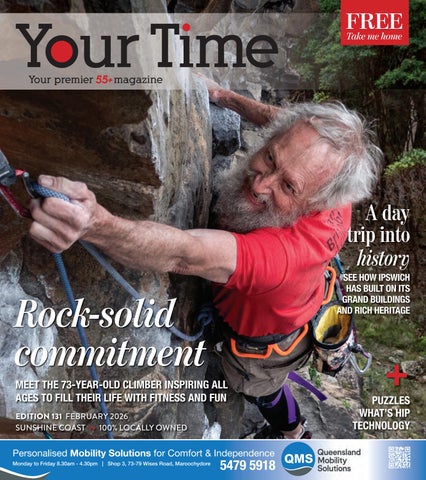
That’s what makes Ian Elliott’s hobby and accomplishments so amazing. The 73-year-old climbs mountains – just for fun.
For our cover story this month, journalist Janine Hill interviewed this fascinating former cane farmer who is so inspiring, filmmaker Matt Raimondo made him the subject of an acclaimed documentary.
While Ian has climbed in other parts of the world, he finds regular exercise on Mount Coolum near his home.
Now, most people, including myself, have enjoyed the glorious views from the top of that mountain after a slow but steady 2km, Grade 4 (Hard) walk to the summit.
That’s not the way Ian likes to do it, preferring to challenge himself using harnesses and ropes on a rock climb. More power to him, I say.
But if you like keeping your two feet on the ground, travel writer Cath Johnsen has you covered as she takes a day trip to discover the rich heritage, grand old buildings and thriving arts and dining scene in Ipswich.
So grab a cuppa, take a seat and enjoy this month’s magazine!
Shirley Sinclair Editor
DISTRIBUTION INQUIRIES distribution@yourtimemagazine.com.au or call 0419 746 894.
ADVERTISING INQUIRIES 0438 717 210 or 0413 855 855, sales@yourtimemagazine.com.au
FOR DIGITAL EDITIONS AND MORE yourtimemagazine.com.au
IMAGE: MATT RAIMONDO
Your ‘Everest’ may be found much closer to home
JANINE HILL keeps her feet firmly on the ground as she speaks with an inspiring older athlete who is always striving to reach new fitness heights.
Look up ‘popular leisure pursuits for people in their 70s’ and you will find gardening, walking, swimming, painting and travel high on the list.
Rock climbing? Well, you might have to turn the page and the next one and a few more, but that is exactly what 73-year-old Ian Elliott does for fun.
His interest in rock climbing has taken him on adventures, transported him to legend status in the sport and put him on the big screen.
A short film about his age-defying exploits, simply titled Ian, made the line-up of the 2025 Banff Mountain Film Festival: a prestigious international film competition focusing on sports, mountain culture and the environment.
For the retired Sunshine Coast cane
farmer, the attention is all a bit of a lark.
After all, rock climbing is something he has been doing for years, although he was a bit of a late bloomer.
A keen bushwalker who had done four- and five-day treks with his partner Jeanette through rough, trail-less back country, he progressed to rock climbing in middle age, doing his first serious climbing with ropes and harness at Girraween National Park, near Stanthorpe, about 1996.
“We’d gone out to the Sphinx, that area of Girraween, and met some people there who were rock climbing and they said, ‘Do you want to have a go? Here’s a harness, a pair of shoes and off you go’ sort of thing,” he says.
“They were top roping. They had a rope up and belayers underneath. The rope’s
always going up to an anchor above you so you can’t really fall. That’s how I started.
“I thought, ‘This is fun. I like this. This is good’. That’s when I started doing a bit more and it just sort of kept going. It’s one way of going places and doing things.”
By 2004-05, Ian was seriously into climbing. He was travelling to Thailand for a month to climb with climbers all around the world.
Ian climbed several times a year with the son of friends but when that person was drawn towards a different activity, Ian looked for other climbing options such as Mount Coolum, just down the road from his home at Yaroomba, on the Sunshine Coast.
“I’d been overseas and climbed over there in South Thailand, and I came back here and didn’t have anyone to climb with anymore,” he recalls.
“I looked up ‘rock climbing on the Sunshine Coast’ and there was a comment in there on one of the web pages about Matt Eaton bolting routes at Coolum cave.
“I’d been up there in 1998 and we
hadn’t seen any sign of any climbing there at all. This was 2005, maybe early 2006.”
Ian went along, met Matt and another nearby resident, Frey Yule, who both climbed several times a week. And so he began climbing with them regularly at Mount Coolum.
All climbs are named and graded. Just before his 70th birthday, Ian tackled a long and hard climb at Mount Coolum called Call of Duty: an extension of another climb known as Weapon of Choice and graded at 28, which is regarded as reasonably difficult.
“The grades are open ended. It’s up around 37, 38 now,” he says.
“There’s only about two or three climbers in the world who climb at those grades. You’re getting a lot more younger climbers now who are spending a lot more time in the gym.
“When I started climbing, very few people climbed those grades. That’s a whole different story: the evolution of climbing around the world and … the levels of difficulty people are climbing now and the amount of training they’re doing to do it.
“People are climbing much harder stuff.” Ian tries to climb at least once a week.
“There’s a group of us around the Coast
who climb there regularly,” he says. “We all know each other so you can go virtually any time.
“We have a contact group so you know who’s going to be there and when.
“You just rock up and go for a climb.
“You only ever do two or three (climbs) because it’s hard work.
“It’s also very social up there. Coolum is one of the most social areas you’ll find.”
One of the major attractions of climbing for Ian is the opportunity to forget about the rest of the world for a while.
“The most enjoyable are climbs of what I call mid-range of difficulty,” he says.
“They’re not particularly physically challenging but more mentally challenging, some of the longer ones. But it’s just an enjoyable thing being out there.
“It’s something about the focus, climbing. You’ve got to focus on what’s in front of you.
“That’s a similarity with bushwalking as well. If you’re bushwalking in hard country, you’ve got to focus on your walking all the time. You can’t be thinking about anything else.
“You’ve just got to focus on your walking, where you’re going to put your foot next, while trying to look around and enjoy the scenery.”
Years of practice mean Ian slips into the mental zone for climbing.
“The switching off, the focus and the control of your thoughts become much easier the more that you do it,” Ian says.
“I don’t find it stressful. If you’re on familiar territory, it’s much easier because you know how everything’s going but even unfamiliar climbs that I’ve been on, you know your ability.”
Ian regards his age as an asset as a climber: “I’m a lot older and more cautious than a lot of younger climbers. That comes with the territory. I analyse the risks much more than younger people do and work out where it’s all good.”
His only injuries to date have been to a
finger tendon, a partially torn hamstring and some bursitis behind a knee.
“The thing that stops you climbing, basically, is injury and I haven’t had any injuries that have been significant enough to stop me climbing,” he says.
Regular climbing helps Ian maintain his core and upper body strength, as do plenty of pull-ups.
“In any sort of climbing, it’s good to have that strength,” he says.
“Everyone really needs core strength because if your foot slips or something like that when you’re walking, that’s what stops the whole of you going.
“That strength in there allows you to control your whole body. That’s one of the advantages of that sort of training.”
Ian hopes Matt Raimondo’s documentary, which focuses very much on his climbing at Coolum cave, will help others realise what they can achieve.
“Matt just thought it would be an interesting story because there’s not that many 70-year-old climbers,” Ian says.
“There are a number of them around the world but it’s not that common: 70-year-old climbers climbing that sort
of difficulty. Some of the younger climbers have said that they can see that their bodies don’t have to stop them from climbing if they want to keep climbing.
“There’s not an end date. There probably is an end date but it’s probably not until you’re well into your 70s.”
Ian subscribes to the ‘use it or lose it’ theory when it comes to fitness and ageing.
He says physical activity such as rock climbing assists with maintaining bone density and balance, reducing the risk of falls, and being outdoors is good for mental health. Although weIl aware that everyone has an end date, his is not in sight yet.
He remembers a group of four Japanese, the youngest in his mid-60s and the oldest in his 80s, whom he saw climbing in Thailand.
“They would come and climb quite difficult climbs, even the old guy. I’d seen him climb,” Ian says.
“He might have to have a rest. He wouldn’t fall but he might have to have a rest on a rope.
“He was in his 80s and still enjoying climbing, so it’s really just a matter of ‘if you want to do it, you can’.”
Ian Elliott regularly climbs Mount Coolum
Ian Elliott is happy to keep climbing as long as his body lets him
No, not the replacement surgery type of ‘hip’. It’s a selection of on-trend snippets that could include places to dine, travel destinations, where to shop, what to see and visit, as well as what to watch, read and listen to, so you can stay up to date with family, friends and neighbours of all ages.
Back in the day …
THE Jackson 5 (later known as The Jacksons) made their TV debut on American Bandstand on
February 21, 1970 – a time when ‘Jacksonmania’ was taking over America and the world. The five Jackson brothers – Jackie, Tito, Jermaine, Marlon and very young Michael – originally formed their pop group in Gary, Indiana, in 1964, managed by their father Joe Jackson. The Jackson 5 made the world sit up and take notice of their unique sound, with hits including ABC, I Want You Back and I’ll Be There and became one of the biggest groups on the planet. It was the springboard for Michael’s solo career. The making of his 1992 Dangerous World Tour is told in MJ The Musical, coming to QPAC’s Lyric Theatre from March. Get tickets via mjthemusical.com. au/tickets/brisbane/
What to watch
IT’S a new series that seems to nod to the movies
PS I Love You (starring Gerard Butler and Hilary Swank) and 2 Hearts (starring Brisbane boy and Hollywood heartthrob Jacob Elordi), balancing drama with tasteful comedy and Aussie wit. The Stan original series Dear Life has acclaimed Aussie actress Brooke Satchwell in the lead as Lillian. The part-time worker at Ballarat’s Sovereign Hill historical attraction is still grieving the sudden death of her doctor fiancé Ash. To help claw her way out of the depths of darkness, she illegally starts to track down and make connections with the recipients of his organs. While lighter than the storyline suggests, Dear Life covers a lot of ground and highlights many grey areas of concern for organ donors, their families, recipients and their loved ones. Satchwell is sensational in the lead, ably supported by Eleanor Matsuura, Ryan Johnson and Ben Lawson. Highly recommended and (spoiler alert) a second series may be on the cards, given how the first one ends.
What to read (and book)
What to listen to
CAN you believe it’s been 25 years since The Secret Life of Us first aired? Acclaimed actor and producer Spencer McLaren is helping us reacquaint ourselves with one of Australia’s most culture-defining TV series in a special season of his podcast McLaren Versus. Set in St Kilda in Victoria and premiering in 2001, The Secret Life of Us captured the raw, messy, hilarious truth of being in your 20s — an authentic look at friendship, love, ambition and heartbreak. Now, McLaren, who starred as Richie Blake, brings together the cast and creative alumni for a candid, warm, deeply nostalgic celebration of the series and its legacy. The new podcastseason is now available, with video episodes on YouTube.
Save the date (and book)
IF YOU’RE like me, you’re busily reading/re-reading Emile Bronte’s literary classic Wuthering Heights. The latest sizzling screen adaptation of the gothic novel, first published in 1847, hits Australian cinemas on February 12, featuring Margot Robbie and Jacob Elordi in the lead roles. For the uninitiated, this is not your usual passionate love story. Rather, it tells of the tumultuous and destructive relationship between Catherine (Cathy) Earnshaw and Heathcliff, set against the backdrop of the Yorkshire moors. It’s one of the most anticipated films of 2026, so let’s see if the hype matches the performances.
THE Noosa Food and Wine Festival from June 12-14 has announced a refreshed program, including new collaborations and pioneering talents. The action-packed, four-day event of mouthwatering delights and wildly diverse flavours is one ambitious celebration of Noosa’s top chefs and culinary leaders from across Australia. Expect menus as extraordinary as their beachside settings, as powerhouse chefs take your tastebuds on a journey you won’t forget. At the time of going to print, some tickets to the American Express Festival Village – the hub of festivities with pop-up restaurants, new lounge spaces, a culinary stage and live entertainment – plus some Signature Events (such as Sunset Sessions: Beachside Dinner on June 13 and The Festival Sundowner on June 14) were still available. Visit noosafoodandwine.com.au
Lead Assistant, Mikaylah & Dr. Joseph Hollywood BDS
Retiree GARRY REYNOLDS shares his thoughts on the world around us.
CATS ARE STILL IN CONTROL
IN ANCIENT times, cats were worshipped as gods. They’ve not forgotten this.
I’ve been sharing what I once believed was my home with my daughter’s two cats.
Ellie has the manners of a Victorian governess: all prim little steps and quiet judgment. Coconut is a confident young lad that strides about the house built in his honour.
I recognise I’m now merely a tenant allowed to stay on compassionate grounds.
Scientists say cats aren’t aloof, they’re connoisseurs of company. They prefer interactions they initiate.
For instance, Ellie has strong views on my daughter’s work/life balance. If a Zoom meeting runs too long, Ellie strolls into frame like a disapproving supervisor and sits squarely on the keyboard.
Both cats have perfected baby-like mews designed to melt our human resolve.
Coconut adds interpretive body language with his backside. Scientists assure us this is a compliment.
I remain unconvinced.
Coconut also responds to the word ‘chicken’ with the speed of a sprinter leaving the blocks. We now have to spell it out because he recognises the word and even the crackle of the warm packet being pulled apart. Takeaway chicken used to be known as a bachelor’s handbag, but now it’s Coconut’s, and I’ve been promoted to waiting staff.
Genetic studies back up what anyone sharing a home with cats already knows: they’re very clever. Cats are natural problem solvers, able to memorise routines with surprising accuracy. They form genuine emotional bonds with the humans in their lives, even if they prefer to express affection in subtle, carefully timed ways.
Ellie and Coconut have studied and trained me with the patience of seasoned behavioural scientists. In return, I receive companionship, much amusement and the privilege of being chosen by furry personalities which could, at any moment, decide to ignore me completely but graciously choose not to … most of the time.
Life in the slow lane
By Mocco Wollert
THEY used to be known as ‘men in blue’: our police force.
Now, I am pretty sure, there are just as many women as men serving in the police force and wearing the blue uniform.
Why would I want to write about the police? Because I want to honour them and to acknowledge that they are a strong – maybe the last – barrier against chaos and lawlessness in our society.
Comparing the role of police from the time when I came to Australia to now shows that things are very different. They have changed a lot.
One thing was for sure: signing up to be a police officer then did not also mean to sign up to lay your life on the line every day.
The attitude towards police by a large element of population has changed dramatically. And not for the better!
To show the height of stupidity to me was when I listened to a woman speaking on a radio show, complaining
that police were ‘hiding’ so they could trap people who are speeding.
She demanded that there should be warning signs: ‘Speed trap ahead’, so drivers could slow down. I can assure you it is true.
Then, there are the complainers that police are just out there to collect revenue. As far as I am concerned, the more perpetrators caught –people driving over the speed limit or when intoxicated – the better. One only has to look at the road-death statistics to endorse anything to bring those numbers down.
Police used to be treated with respect. A warning word to a youngster would have immediate results, usually backed up by concerned parents.
Officers did not have to draw their weapons to keep a criminal in check.
Nobody would have dared to damage a police vehicle.
The role of a police officer has changed drastically. It once was the role of the police to maintain law and order. Now, they also must be counsellors, advisers, confidantes, child protectors and social workers, and arbitrators in domestic violence situations – just to name a few.
I feel very much for police officers who have to draw their weapon and, even worse, have to fire it and kill the criminal who is threatening the general public or them.
I am sure when they committed to ‘serve and protect’ the citizens of Australia, they didn’t expect killing to be part of everyday duties like a soldier who goes to war. I am sure, despite counselling or whatever other help is available, it will impact their and their family’s lives forever.
Were I a police officer, I don’t think I could control myself when confronted with a criminal caught committing a serious crime or even murder. I might just want to apply the ‘eye for an eye’ principle on the spot before he or she’d get off ‘on a technicality’ and leave the court scot-free.
May your life be safe and not need the attention of police.
Email mocco.wollert@bigpond.com
an adventure
By Cheryl Lockwood
MANY people claim they cannot sing. I’ve probably said it myself at times.
However, you don’t have to have pipes like Sinatra or Adele to enjoy this feel-good activity.
I was lucky enough to take part in a Café Choir and I was surprised at just how happy this made me feel. Community choirmaster Gen Douw, based in the Noosa hinterland and Sunny Coast, runs this event.
Basically, it’s a workshop where a group of people get together, learn a song in the space of two hours and then perform it at a local venue.
Generally, this is at a nearby café – and latte-sipping patrons get surprise entertainment, flash mob-style.
You may have heard of Pub Choir, a similar concept founded in Brisbane by Astrid Jorgensen.
Astrid teaches a song to a large group (think more than a 1000 people) and the result is recorded and shared on social media.
Café Choir may be much smaller, but with about 50 of us attending, we certainly turned some heads with our performance.
If you’ve seen Pub Choir, then you couldn’t miss the huge smiles all round. It’s obvious everyone is having a ball.
Could it be possible that belting out a tune can
actually invoke cheerfulness? Scientists believe that singing releases endorphins, serotonin and dopamine, which boost your mood, making you feel happy. You may even continue to feel uplifted and positive for some time after a good singing session.
Singing engages the muscles around the rib cage and increases lung capacity. So, there’s some serious exercise right there. It can help you relax and lessen stress levels. It can even help improve the memory (but I can never remember all the lyrics to any song and there are many tunes that I’ve been singing incorrectly for years).
As teenagers, we teased our mother for her terrible singing – horrible brats that we were. We did exaggerated imitations of what we called her ‘church voice’. It didn’t stop her from joining the local choir. She may not have been the lead
wanted to do and am especially glad that she ignored her cheeky children.
Mum would tell us, “The woods would be very silent if no birds sang there except those that sang the best.”
Now, mum had many sayings, so I thought she made it up. But it’s part of a quote by author Henry Van Dyke. The words, “Use what talents you possess” make up the first part of that quote.
When you burst into song with other people, there is a sense of togetherness.
If you don’t hit every note perfectly, believe me, it will be masked by all those other voices. Being part of something so uplifting removes any nerves you may have about singing in public.
I love to sing, but I never imagined I’d be standing on a footpath, belting out Crowded House’s Don’t Dream It’s Over with the gusto of a rockstar.
I’m more of a shower singer with no audience involved.
Incidentally, I saw Crowded House perform live in a pub in Adelaide some decades ago and I daresay I sang along at full volume with the rest of the audience, possibly with some wrong words.
•
•
I now hope the surviving members of the band see the online video of our rendition of their hit song as I’m sure they’d be impressed.
May you all sing until your heart’s content!
Visit lockwoodfreelance.com
This region has weathered the good years and the bad
AUDIENNE BLYTH looks back over more than 130 years of meteorological events that have left their mark on farmers, businesspeople and residents.
Weather events that are out of the ordinary give us much to talk about.
Our average yearly rainfall on the Sunshine Coast is 1400mm.
Records show that there can be great variance in different years.
Two of Queensland’s wettest years were 1893 and 1898.
In 1893, the year’s total was 4401mm.
Two cyclones followed each other, with the heaviest rain in January and February.
Our pioneers have handed down catastrophic tales about the flooding of 1893.
Rivers spread out over farmlands, destroying crops and livestock. All communications were lost as roads, rail lines and telegraph lines were destroyed.
Timber-getters lost badly when logs were washed out to sea. The SS Dicky was wrecked (on what became known as Dicky Beach), falling victim to the cyclonic winds and rough seas.
In 1898, five years later, the flooding and devastation almost equalled that of 1893. Records were set for the first three months of the year’s total of 3634mm of
rain. But 1902 was the absolute driest on record, with only 379.2mm for the whole year. There were severe losses of crops and livestock on farms, as well as hardship for town communities as water was rationed.
The 1950s was a wet decade, when six of the years received over two metres of rain. Older residents recall where the floods reached and how they coped. They warn of repetitions.
Our worst year for cyclones was probably 1954 with two, both unnamed.
February’s rainfall of 601.8mm that year was accompanied by fierce winds. The coastline became heavily eroded and low-lying areas were flooded.
The Cooloolabin community hall was destroyed, as was the Catholic Church in Cooroy.
The North Arm hall was blown off its stumps. In Eumundi, the Anglican Church and the School of Arts Hall lost sheets of iron from their roofs.
Six months later, in July, a second cyclone struck. It knocked down the crops that survived the February cyclone. Hundreds of hectares of cane at Rosemount, Bli Bli and Maroochy River
were flattened. Buildings, almost repaired after the February cyclone, were damaged again by the July cyclone.
In April 1955, a freakish, tornado-like wind struck Yandina.
Roaring like a steam engine, it was said to travel at 130kmh in a 200-metrewide strip, cutting a path of destruction.
Buildings were destroyed.
The sky was littered with flying iron and debris.
Flooding blocked roads. Cane fields and buildings along the Maroochy River suffered as hinterland rain flowed to the ocean.
‘Wet Wednesday’ – June 22, 1983 –saw 350mm of rain fall over a 24-hour period. A similar event happened in March last year.
On both occasions, residents were alarmed to find Petrie Creek flooding Nambour streets. The damage bill was horrendous.
The weather bureau says it names its cyclones from an alphabetical list to easily identify them.
Female names such as Daisy, Wanda and Dinah were used from 1963, but female and male names have been used since 1975.
Names of prominent Australians are not used. So, the March 2025 cyclone was named Alfred, avoiding the name Anthony.
Audienne Blyth is a member of the Nambour Historical Museum, open 1-4pm Wednesdays to Fridays, and 10am-3pm on Saturdays.
• All Rolex watches (including Oyster, Submariner, Daydate and Datejust)
• All Omega (including Seamaster and Consellation)
• Tudor and Breitling
• Gold chains
• Gold bracelets
• Gold rings
• Bullion bars
• Gold earrings
• Gold necklaces
• Nuggets and alluvial gold
• Worn and broken gold jewellery
• Mechanical (automatic and wind up)
• Gold and silver pocket watches
• Military pocket watches
g d s
• No quartz / battery watches
Shillings, Six Pences, Three
• Australian - Crowns, Florins, Shillings, Six Pences,Three Pences, 1966 50 cent rounds
• South Africa, USA & Canada
• NZ, Great Britain, Fiji
• New Guinea Shillings
• Misc Silver Coins
• All Other World silver coins
COINS
• All world coins
• Collection and accumulation
• Error and mis-strikes
• Proof sets and singles
• Trade tokens
• All Perth Mint and Royal Australian Mint sets
• Rings & brooches
• Watch chains and lockets
• Gold cuff links
• Bracelets and bangles
• Necklaces and all broken jewellery
• Pendants and sovereign cases
broken jewellery
JEWELLERY
JEWELLERY
In 1983, a flooded Petrie Creek spilled into nearby streets in Nambour
EUROPEAN CURRENTS
SAVE UP TO $2,000 PER COUPLE^ ENJOY 2 INCREDIBLE CRUISES ACROSS OCEAN
A Duo of European Icons: Danube Delights & the Majestic Mediterranean
25 Nights
10 June 2026
Your Holiday Includes
Full-Board River Cruise
7 night full-board river cruise on board Emerald Destiny
Visiting: Regensburg(overnight in port), Passau, Melk, Dürnstein, Vienna, Bratislava, Budapest (overnight in port)
Included Excursions
Guided tour of Passau, Vienna ar t tour with a visit to the Kunsthistorisches Museum, walking tour of Bratislava, and guided coach tour of Budapest
EmeraldPLUS
Traditional Bavarian band on board, walking tour of Regensburg with Bavarian sausage tasting, guided tour of Göttweig Abbey with wine tasting, and more
EmeraldACTIVE
Guided bike tour to the Walhalla monument, guided bike tour
along the River Inn, guided bike tour along the Danube River, guided bike tour to Danube Island, and more
Full-Board Ocean Cruise
14 night full-board cruise on board Sun Princess®
Visiting: Athens, Santorini, Bar, Corfu, Messina, Barcelona, Mallorca, Marseille, Ajaccio, Genoa, La Spezia (overnight in port), Civitavecchia
Hotel Stays
1 night four-star stay in Munich at the Wyndham Garden
Munich Messe
1 night four-star stay in Athens at the Meliá Athens
All hotel stays include breakfast All Flights, Taxes & Transfers Overnight flights
Differences between heat and cold therapy
CAITLYN HUTH looks at how these two ‘opposing’ remedies can be used effectively to reduce pain.
When managing pain, one of the most common go-to remedies is reaching for a heat source or ice pack.
But how effective are they really? While these therapies don’t necessarily heal the tissue itself, they can play a helpful role in managing how pain is experienced – particularly in chronic conditions and flare-ups.
Heat and cold therapy don’t ‘fix’ injuries or speed up tissue repair. Instead, they influence the nervous system, temporarily altering how pain signals are processed.
Heat and cold stimulate different sensory receptors in the skin, essentially acting as a natural form of distraction for the brain:
• cold therapy (such as ice packs or cooling gels) can dull overactive nerve endings and reduce the intensity of pain signals during a flare-up, particularly for people with arthritis, tendinopathy or nerve sensitivity. It doesn’t
heal the area, but it may provide short-term relief and reduce that burning or throbbing sensation
• heat therapy can soothe muscle tension, promote relaxation and improve perceived mobility. It’s especially helpful for persistent back pain, neck tightness or general aches in the joints. Applying heat may improve blood flow and help muscles feel looser, making it easier to move and engage in exercise.
Current best practice highlights that heat and cold are comfort strategies, not treatments for tissue repair.
In chronic pain management, where the nervous system becomes hypersensitive, these
therapies may help regulate sensory input, calming the system just enough to support movement or sleep.
There is less support for the use of ice in acute soft-tissue injuries, as it may interfere with the body’s natural inflammatory and healing responses. Rather than trying to ‘freeze out’ pain, the goal should be to support healing with movement, education and loading strategies.
Pain is complex. It’s influenced by your body, brain, environment and even beliefs.
While a heat pack or cold compress won’t fix everything, they can be part of a broader self-care toolkit. So, if a heat pack helps you relax before exercise or a cold wrap helps calm a pain flare-up, it’s okay to use it.
Just remember: the path to recovery involves more than managing symptoms. Movement, mindset and support matter most.
Caitlyn Huth is an exercise physiologist at Full Circle Wellness. Call 5456 1599 or visit fullcirclewellness.com.au
FIT HAPPENS with Tom Law
WHEN we were younger, we spoke about fitness and how tough people were.
We marvelled at their endurance and physical and athletic ability.
Well, at least I did, and so did the people I associated with to a large extent.
I worked hard at keeping fit and strong. My mates and I entered trail runs, fun runs, half-marathons and some even completed full marathons and triathlons.
The fitness craze of the 1970s and 1980s became a lifestyle. Media, celebrities and gyms seemed to pop up everywhere, telling us the benefits of being in shape. Fitness became very commercial and remains so today.
But for me at least and perhaps for you, the language has changed. I like to think the frenetic fitness culture of the past also has changed or adapted.
I now prefer to be healthy and well, rather than fit and strong.
Mental health has become more prominent and wellness is
spoken of more and more. No longer do I plan extended endurance tests, hiking for days on end or expect to repeat some of my better physical achievements. I prefer to maintain strength, balance, flexibility and regular cardiovascular activity. I write about myself but believe many as they age follow a similar path –preferring consistent regular exercise combined with good mental health practices and a sense of contentment. Sleep, rest, nutrition and fun are important ingredients in the health and wellbeing self-care bundle.
We are an ageing population and our health and wellness services have adapted along with our vocabulary.
Of course, I would like to be as fit as I was 20 years ago, but I am content being healthy and well.
My new book on exercise for over-60s, called Prime Movers, will be published this month.
Tom Law is the author of health and exercise-related books. Visit facebook.com/tomslawtraining or call 0409 274 502.
I’M STILL STANDING
BETTER
THAN I EVER DID …
•Better than I ever did … Consistently ranked in the Top 2% of Century 21 Agents Worldwide having achieved yet another “Centurion Award” for 2025.
•Looking like a true survivor … through 23 years of Real Estate here on the Sunshine Coast and all the twists and turns that have come with it.
•Feeling like a little kid … as I love what I do and aim to make the experience as seamless (and fun) as possible.
•Picking up the pieces … like buying, selling, culling, packing & moving for you and guiding you through to a whole new lifestyle!
•Yeah, yeah, yeah … I’m still standing, and ready to deliver an outstanding result for you.
Get ready for a fun-filled afternoon and meet the team behind GemLife Kilcoy Greens, the stunning new over-50s lifestyle resort now under construction at Woolmar.
Kilcoy on the Green is a family-friendly event that celebrates the spirit of community that GemLife resorts are known for. With live entertainment, refreshments and family-friendly games. This is a great opportunity to discover the range of homes and resort facilities on offer.
Be there on the day to enter the draw to win great prizes.
DATE Thursday, 19 February 2026
TIME 2pm to 5pm
WHERE GemLife Kilcoy Greens 1 Settlers Rise, Woolmar RSVP Register online by Wednesday, 18 February at GemLife.com.au/onthegreen
Don’t fall into the big telco trap of overpaying on monthly bills
EDIN READ does the calculations and suggests revisiting our mobile phone plans to ensure we’re getting value for money.
I’ve written before about mobile phone plans and how much money many Australians are quietly overpaying every month.
The reason I’m revisiting the topic now is simple: despite all the advertising noise and shiny new plans, very little has changed where it actually matters. Telstra and Optus remain costly, while alternative providers continue to offer strong value using the same underlying networks.
One of the most common concerns I hear from clients is that leaving Telstra or Optus means giving up coverage or reliability. In practice, this is rarely the case.
Providers such as Aldi Mobile, Tangerine, Belong and Boost operate on the Telstra or Optus wholesale networks. That means the signal reaching your phone is often exactly the same, just without the higher price tag attached to it.
If you want to save money, for most seniors a sensible place to start is with a smaller data allowance. About 10-15GB per month suits most people I work with.
Aldi Mobile currently offers a plan at $23 per month with 12GB of data and
unlimited calls and texts. Tangerine offers comparable plans at $25 per month.
These plans comfortably cover calls, texts, emails, browsing, photos and the occasional video call, and unused data rolls over to the next month. If you do need more data later, you can simply increase your plan the following month. What you cannot do is get a refund for unused data.
A fair concern with these lower-cost providers is the lack of physical shopfronts. You cannot generally walk into a store if something goes wrong.
That said, many people find the trade-off worthwhile. There is no sales pressure, no surprise add-ons appearing on the bill, and no attempts to up-sell services you did not ask for. Billing is simple and charged monthly, with no lock-in contracts.
The savings are where this really becomes meaningful. Many Telstra and Optus plans start around $55 per month and quickly rise to $65 or more.
When you compare that with a $23 to $30 plan from an alternative provider, the difference can easily be $30 to $40 every month. Over a year, that adds up to about
$360 to $480-plus. For many retirees, that is money that could go towards rising living costs, a short trip away or simply peace of mind.
It is also important to know that you keep your mobile number when you change providers. Your number belongs to you, not the telco, thanks to changes made by the Australian government a while back. Switching is far easier than it used to be, and in most cases your phone continues working throughout the change.
On a personal note, our mobile service at Greyology runs on the Aldi Mobile network, including all of our business mobile phones. My own personal mobile does as well. We made that decision years ago after testing it properly and we have never had an issue. Calls are reliable, data works exactly as expected and coverage has been solid in metropolitan areas and when travelling.
If it is good enough for a tech support
business that relies on being contactable, it is more than suitable for everyday use.
For those who prefer simplicity, long expiry plans are also worth considering. Paying once per year rather than every month appeals to many seniors, and alternative providers offer annual options at far lower prices than Telstra or Optus equivalents. Aldi Mobile offers a plan of $289 for 300GB of data.
The message here is simply that loyalty is rarely rewarded in the mobile phone industry. Taking the time to review your plan, understanding what you actually use and considering alternatives that cost $23 to $30 instead of $60 or more can result in genuine savings without sacrificing quality.
If switching feels overwhelming or you would like someone to check if your current plan suits, Greyology can help.
Edin Read is founder and chief technician at Greyology Tech Support for Seniors. Visit greyology.com.au
Buying Now
Mike and Nate Cornish will be in the Sunshine Coast for 6 days only, from February 23rd to 28th. We want to buy your unwanted items as listed. Please visit us at one of the venues shown below. These events are often compared to the ‘Antiques Roadshow’ on TV, but without the long queues. Don’t miss this opportunity! If you are unable or have too many items to bring in, and would like a home visit, phone Nate on 0426 820 646 NOW to arrange a time.
Fully Licensed Antique, Numismatic, and Precious Metal Buyers with over 45 years Industry Experience.
Security Supplied by Security International Limited. Mike
Are you moving or downsizing? Are you worried about security? Unwanted coins?
Any jewellery, incl damaged? Do they sit in a drawer or cupboard? Are you no longer collecting? Are the family not interested?
Visits 1:30pm – 6:00pm Phone 0426 820 646 For a Home Visit FRIDAY 27TH FEB Home Visits 1:30pm – 6:00pm Phone 0426 820 646 For a Home Visit
Home Visits 3:00pm – 6:00pm
2:00pm – 6:00pm Phone 0426 820 646 For a Home Visit Maroochy RSL (Boardroom 3) 1:00pm – 3:00pm 105 Memorial Ave, Maroochydore
0426 820 646 For a Home Visit Home Visits 1:00pm – 6:00pm Phone 0426 820 646 For a Home Visit Club Kawana (Boardroom) 10:00am – 12:00pm 476 Nicklin Way, Wurtulla
Caloundra RSL (Sub Branch Lounge, in the main club) 10:00am – 1:30pm 19 West Terrace, Caloundra The J Noosa Theatre (The Lorikeet Room) 10:00am – 2:00pm 60 Noosa Drive, Noosa Heads SATURDAY 28TH FEB Home Visits
2:00pm – 6:00pm Phone 0426 820 646 For a Home Visit
Worn Jewellery.
A gold-medal performance is what’s needed on our roads
BRUCE McMAHON knows Brisbane will need to lift its game in traffic management long before the 2032 Olympic and Paralympic Games come to town.
Queensland’s Southeast corner is growing and growing. With that comes more and more traffic and increased silliness on the roads.
How about in 2026 we try and stay on the pace? Be polite to other road users. Pay attention. Don’t just rely on buzzers and bells to stay in your lane.
How about, to keep the place moving, we consider this from the New York State Department of Motor Vehicles: a car going 5mph (8kmh) slower than the surrounding traffic has a greater chance of causing an accident than one going 5mph faster.
“One of the most common reasons motorists drive under the speed limit is because they are driving while distracted. Typically, drivers are distracted by cell phones. They are paying more attention to their phone and trying to slow down to multitask,” reports The New York Times
“Driving too slowly can make other drivers around you constantly brake and speed up. It can be frustrating for other drivers, cause confusion and could lead to an accident.”
Back here, Brisbane Lord Mayor Adrian Schrinner leads a push for mature, new-age approaches to reducing slowmoving traffic and congestion plus, in turn, exhaust emissions. He suggests the right decisions – allowing left runs on red lights, updating clearway times and the use of artificial intelligence – will help keep the city moving.
“We’re focused on practical congesting-busting solutions – from Brisbane Metro and the new bus network to improved clearway, using AI on transport corridors and the return of left turn on red,” Lord Mayor Schrinner says.
Today, Brisbane is a busier, almost 24-7 metropolis. So, extending clearway times on some major corridors could be on the agenda. Other answers may lay with ‘traffic-reading’ technology.
“When our existing system was implemented, floppy disks were the height of data management and mobile phones couldn’t fit in a pocket,” Lord Mayor Schrinner says.
“We are seeking advanced traffic-
management solutions that can learn, predict, adapt, plan and control to optimise our existing network and make smarter use of the road corridors we already have.”
Left turn at red traffic lights was trialled between 2013 and 2021 at five to 55 Brisbane intersections at various times. It was estimated drivers made more than 15 million left turns on red, saving between nine and 30 seconds. It saved fuel, too.
The state Labor government shut the trial down, arguing there was a risk to vulnerable road users, particularly pedestrians. Yet, across bustling jurisdictions such as Los Angeles, drivers turn right on red. Mind you, many suburban intersections there – even up to
five-ways – are controlled by stop signs alone. And pedestrian crossings are controlled by flashing yellows, rather than having to stop for a kid who’s pushed the button and darted across the road well before the light turns red.
Australian driving regulations are nanny-narrow. Rules keep multiplying and the road toll keeps rising. It’s time to get serious about driving, licences and driving lessons as a mandatory school subject. And it’s time for authorities to better correlate Australian road-incident data so there’s a far deeper, more nuanced understanding of the causes of road fatalities.
All that will help make it easier and safer to get around this corner of Australia.
YOUR LOCAL EYE DOCTOR
Associate Professor
Kristopher Rallah-Baker
I want to give a big ‘thank you’ to me
With gratitude, CHARLIE GRIFFITHS takes a moment to reflect on who he is today, how he got there, and the effort he had to put in personally.
Idon’t mind watching a spot of tennis when there’s no cricket on, and I enjoyed watching Mirra Andreeva become a worthy winner of the 2026 Adelaide International.
What grabbed my attention was the motto she wore on her tracksuit jacket after the match that read: “I want to thank myself.”
Her victory speech is available online and should be watched to appreciate the context of her tongue-in-cheek, yet genuine, affirmations.
Humbly, she thanked herself last on a long list of deserving contributors, including umpires, ball kids, volunteers, sponsors, organisers and challenging opponents.
Andreeva thanked herself for being brave, tenacious and hardworking, as well as doing what her coaches and fitness managers asked of her. I like the girl!
I would like to thank myself for being brave in the face of scary things that love to ambush me physically, spiritually, financially – any opportunity that bullies think they can take advantage of to inflict some pain.
Of course, I have an amazing support
CLOSING DOWN
crew to convince me that it will all be worthwhile, but I’m the one who has to face the enemy and I’m pretty proud of the counterpunching I’m capable of when under attack.
I’d like to thank myself for always believing in me. When facing a new challenge, it’s nice to know my supporters trust me but none know me better than myself.
I can’t ignore fear and doubt, but I must embrace these and surge forward, regardless. It’s my tenacity that will achieve my milestones and I’m the one battling my demons the whole time.
I think of the old cartoons with the prospective hero forced to listen to the opposing motivators on each shoulder. Thanks, me, for having the wisdom to heed the right voice.
Thank you, me, for having the smarts to know that I don’t know it all. Coaches, medical professionals and even bosses got there because they know their stuff.
I’ve learned that respect is hard earned, a thrill to receive and an honour to bestow. Following good advice is not always a leap of faith, it’s knowing that I need help and I trust my advisors to look out for my
best interests. I must thank myself for always keeping my decision-making processes in sharp focus. Vision can become blurred by external and internal expectations, perceptions and pressure and it’s my job to ensure that my choices are made for what I believe are the ‘right reasons’.
Thanks, me, for being honourable enough to pursue truth over gratuitous privilege or profit. I thank myself for insisting that there are no excuses: my actions determine how well I sleep at night.
I want to express gratitude to myself
for allowing me to be happy. No meaningful achievement comes without sacrifice and I am glad that I don’t dwell on the blood, sweat and tears to the degree that they cause resentment.
I’m thankful to myself for celebrating small victories and sharing the joy with those who have helped me on the journey.
Thank you, me, for being me.
Charlie Griffiths is a certified life coach and Neuro Linguistic Programming practitioner. Contact Charlie at his website: charliegriffithscoaching.com
“Fed
Construction is Completed - Ready and Waiting For You.
Comino, The Cove offers spacious, architect-designed apartments set directly on the Pelican Waters waterfront.
The residences feature generous two and three bedroom layouts, expansive balconies, luxury finishes, secure parking, lift access, and beautifully maintained common areas designed for everyday comfort and ease. All within a private, gated precinct. Walking distance to local amenities.
Only a small number remain. This is a rare opportunity to secure northeast-facing luxury waterfront residences. Premium
Boutique over-50s resort living.
Thyme Lifestyle Resorts are about living with purpose and feeling at home. Set in the heart of Hervey Bay, our thoughtfully designed communities put you right where you want to be.
Our low-maintenance homes let you downsize without compromise, giving you more freedom to travel, explore the natural surrounds and spend time doing the things you love. This is a community built around real friendships, shared experiences and the freedom to live life your way.
THE THYME ADVANTAGE
More
Thyme Lifestyle Resort Hervey Bay 5 Serenity Drive, Eli Waters
KAILAS ROBERTS outlines a trial that aimed to give participants the best chance of minimising the impact of processes that lead to the condition.
You have to be careful about hyperbole. This is why I was somewhat sceptical when I first came across a book called The End of Alzheimer’s, by Dr Dale Bredesen.
Despite his credentials (he is an esteemed neurologist in the US, actively involved in Alzheimer’s research for decades), the claim of finding a cure for this condition when so many others have failed seemed a little far fetched.
The title of the best-selling book at least grabbed people’s attention.
Among experts in the field, its reception has been more lukewarm, however. The main criticism of the claims was that they were based on interventions that had not been subjected to the usual research rigor and might be inaccurate or misleading.
To be fair to Dr Bredesen, his approach is by its nature difficult to study, as it is based on the hypothesis that Alzheimer’s develops for a number of different but potentially connected reasons. As he puts it, Alzheimer’s is like having a leaky roof. There are multiple holes and there is no
point just plugging one if the water continues to leak through the others.
So, you must do multiple things to address the separate issues. If you then have a positive result, which of these things is responsible? It can be tricky.
I do think there is validity in this idea, however. Certainly, we know that there are a number of different processes associated with Alzheimer’s disease, including inflammation, disturbed metabolism (such as insulin resistance, high blood sugar and high cholesterol), problems with blood flow, and a decline in nutrient supply and hormones with age. To give yourself the best chance of avoiding the condition, you need to minimise the impact of these processes, and this is what the so-called Bredesen Protocol aims to do.
The protocol involves an assessment of your specific issues (through blood tests, predominantly) and the institution of regular exercise, a mildly ketogenic diet (with a 12-hour daily fast and no eating for three hours before bed), optimising sleep and stress, and the use of targeted supplements to improve inflammation or metabolic health, eradicate infection or address nutritional problems.
This year will see the formal release of results of the Evanthea study, which is a randomised controlled trial based on the Bredesen Protocol, but some information is already available – and it is encouraging.
The trial involved 73 adults in mid- and
later-life who already had memory problems. Over a period of nine months, some of the participants received standard medical care, and the others were put through an intensive, personalised program that involved blood-sugar control, sleep quality, inflammation, exercise, nutrition, hormone balance, infections and toxin exposure.
Those who had undergone active treatment showed clear improvements in several areas of cognition (such as memory and processing speed) – not just less decline than the standard medical care group, but actual improvements. This is very unusual for Alzheimer’s trials.
Physical health also generally improved, though the brain did not show any significant structural changes.
The authors claim that the effect size of the intervention – how much the participants improved – was manifold that of the new disease-modifying drugs that became available in 2025.
There are a number of caveats with the trial results. But in an era where mainstream medical approaches to Alzheimer’s yield underwhelming results, this is an optimistic development and I am watching this space closely.
Kailas Roberts is a psychogeriatrician and author ofMind Your Brain: The Essential Australian Guide to Dementia, available at bookstores and online. Visit yourbraininmind.com or uqp.com.au
In-home care feature
A LITTLE CARE AND ATTENTION GOES A LONG WAY
By SHIRLEY SINCLAIR
IT’S the little things that often make the biggest difference.
Most of us want to stay in our own home as long as possible as we age.
But without the right support, in addition to small adjustments to the home and ongoing maintenance, the ability to remain among familiar surroundings could become much harder.
My Aged Care should be your first port of call in your research.
The website (myagedcare.gov.au/ aged-care-programs/support-at-homeprogram) says the Support at Home program was introduced by the Australian government in November last year, replacing the Home Care Packages and the Short-term Restorative Care Programs.
The Support at Home program is designed to look after your health and wellbeing in the comfort of your own home – a home that also can be made clean, safe and manageable.
It’s an option if you need a coordinated approach to the delivery of your help at home.
It aims to improve an individual’s access to services, products, equipment and home modifications to help them remain living independently for longer.
If eligible for government-subsidised costs, you and your service provider can discuss creating a personalised Support at Home plan tailor made to your lifestyle and needs.
Maybe you just want someone to ‘lighten the load’ with cleaning, gardening, putting washing on the line or walking the dog.
Perhaps your meal preparation needs some help or you’d like assistance with the weekly grocery shopping.
Thankfully, you have the freedom to choose your own service provider that is a ‘good fit’ for you, ticking all the boxes for your care.
“Under Support at Home, you have access to a defined list of services to support you to live at home for longer,” the My Aged Care website says.
“This can include support for: • clinical supports, such as nursing care, occupational therapy and podiatry • independence, such as help with showering, taking medications, transport and respite care
“It also includes services that support culturally safe care, such as help to join in cultural activities and access to Aboriginal and Torres Strait Islander health practitioners and health workers.
“If you’re approved for Support at Home, you will receive a letter letting you know what services and funding you’re approved for.
“This includes any approvals for ongoing or short-term care, depending on your assessed needs.”
You can take the necessary steps to choose a service provider once your funding comes through.
Go online to see what’s available in your area. Services are provided by a variety of organisations across Australia.
There’s even organisations available to help you sort through the service providers in your area and find the best one for you, without the process becoming too overwhelming. Or ask a loved one, friend or neighbour to help in the search.
“Your chosen provider will discuss with you the mix of services to meet your assessed needs and budget,” My Aged Care says.
“You can request to change this mix at any time. You can also ask for a reassessment if your needs change at a later point.”
You might be surprised at how much
HOW TO STAY IN CONTROL WHILE LIVING AT HOME, CHANGING YOUR AGED CARE PROVIDER AS NEEDED
MANY people receiving governmentfunded aged care support don’t realise they have the right to change providers.
If your current provider no longer meets your needs, or you feel your voice is not being heard, you can choose to move to a provider that suits you better.
Your funding is linked to your assessed needs, not the provider, reinforcing your right to choice and control.
All About Living CEO Leonie Fowke says many people stay with the wrong provider longer than they need to.
“A common mistake is choosing a
provider based on availability alone, or assuming it is too hard to change,” she says.
“People are often surprised to learn how much choice they have, and how important it is to find a provider that listens to what matters to them.”
People often consider changing providers when services feel rushed, communication is unclear, staff change frequently, or their needs have changed but support has not kept pace.
These concerns are common and are valid reasons to explore other options.
A good aged care provider should work with you. You should expect clear communication, respect for your independence, flexibility as your needs change, and involvement in decisions about your care.
You should also feel comfortable asking questions and raising concerns.
Changing providers is usually straightforward. Your new provider can help coordinate the transition to ensure services continue with minimal disruption.
Visit allaboutliving.com.au
THERE’S something deeply comforting about home.
It’s where routines are familiar, memories live and independence feels possible – even as our needs change.
Across the Sunshine Coast, more older locals are choosing to stay at home for as long as they can, with the right support around them.
At Suncare Community Services, that belief sits at the heart of everything it does.
For more than 55 years, Suncare has worked alongside individuals, families and carers to provide in-home care that’s practical, flexible and genuinely personal.
The approach is simple. Start by listening, because good care isn’t just about tasks: it’s about understanding what matters to each person and helping them live well, in their own way.
Support can look different for everyone. For some, it’s help around the house or getting to appointments.
For others, it’s clinical support, social connections, respite for carers, or guidance navigating aged care services.
Whatever the need, Suncare’s focus is on building trusted relationships and offering care that feels respectful, reliable and human.
As Australia’s aged care system continues to evolve, having clear
information and local support has never been more important.
Suncare’s team can help people understand their options, plan ahead and access services that support independence and wellbeing – without it feeling overwhelming.
The team is proud to be part of the Sunshine Coast community, supporting people to remain connected to the places and people they love, because growing older shouldn’t mean giving up your lifestyle. It should mean having the right support to keep living it.
Visit suncare.org.au
MAKING HOMES SAFER AND LIVES EASIER
AS THE aged care sector undergoes significant changes, Maroochy Home Assist (MHA) remains committed to supporting older residents and people with disabilities to live safely and independently in their own homes.
Clients and their families have always been at the heart of what the organisation does, and that dedication is stronger than ever.
“We want to reassure the community that MHA is still here, providing most of the trusted services we have always offered, along with some additional options to meet evolving needs,” general manager Julie Stacey says.
“Everyday tasks such as changing a light bulb or clearing gutters can become safety hazards as we age. Through state and federal government-subsidised programs, we help reduce these risks and enable people to remain in the place they feel most comfortable: their own home.”
The recent move to a new, purposebuilt facility has allowed MHA to deliver home maintenance and modification services more efficiently than ever before.
It offers a comprehensive range of home modification and maintenance services designed to improve safety and accessibility. From renovating bathrooms and installing ramps to create easier access,
to installing bidets and stairlifts, solutions can be tailored to your needs.
The team also fits grab rails and key safes, repairs locks and handles, replaces insect screens and light bulbs, clears gutters and provides subsidised plumbing and electrical work.
Ms Stacey says the priority has always been helping people feel safe and supported in their own homes.
“Even with all the changes in aged care, we want the community to know that we’re still here, offering the same reliable services to meet their needs,” she says.
Email office@mha.org.au or call 5476 6130 between 8.30am and 2pm.
MAXIMISE your independence
Feel safer at home with minor home modifications including grab rails, door wedges and hand held showers. We also subsidise minor home maintenance related to your safety and security.
• Changing light globes • Gutter cleans
NEEDING A MAJOR HOME MODIFICATION?
Our team of specialists has over 25 years of experience and can provide subsidised modifications to your bathroom, as well as access ramps and stairlifts.
CELEBRATING 40 YEARS OF COMMUNITY SUPPORT
IT’S not every day a community organisation reaches its 40th anniversary, but this year RangeCare does exactly that.
This year marks four decades of helping people across the Blackall Range stay independent, connected and supported in the place they call home.
For many locals, it’s hard to imagine the hinterland without this service.
RangeCare began in the mid-’80s as a small, volunteer-driven idea: neighbours helping neighbours. While the organisation has grown enormously, that original spirit hasn’t gone anywhere.
Today, RangeCare offers everything from domestic assistance and personal care to nursing, respite, home maintenance, social support and flexible in-home programs.
But at its heart, it’s still about people looking out for one another.
One of the services people talk about most is transport. On the Range, getting to appointments or even just going out for a bit of shopping can be a real challenge.
RangeCare’s drivers have become familiar faces on the road and sometimes the only way someone can stay active and involved. As one client said recently: “It’s not just a lift. It means I can keep living my life.”
Social connection is another big part of what RangeCare does. Whether it’s group outings, community activities, or simply sharing a cuppa with someone who needs company, these small moments add up.
Forty years is a long time, but RangeCare’s purpose has stayed steady: to make life a little easier, a little brighter and a lot more connected for the people who call the hinterland home.
Visit rangecare.com.au
CARAVANS WANTED
ENSURE THAT LIVING OPTIONS FOR RETIREMENT (AND BEYOND) REFLECT WHO YOU REALLY ARE
By LESA MACPHERSON
THE Christmas decorations are packed up and the new year has been celebrated.
We really hope 2026 is a good one for you and your loved ones.
Many of us have gathered together during the holiday period and enjoyed the company of our beloved family members.
However, sometimes, there can be worrying changes we can’t unsee easily.
These can be changes that spark conversations about lifestyle.
It is important to get any changes to our elder’s lifestyle just right.
‘Bespoke’ is a word that is used a lot these days, but it has real meaning when applied to choices for lifestyles in our later years and as our elders age.
In the discussions with older family members, or perhaps even reflecting oneself, when considering a change, it would help the decision making to ask:
• are you a people person who loves the company of others and would thrive in a bright and engaging community with lots to offer?
• do you want to continue to travel and have your home easily secured and maintained while you’re away?
• do you have beloved grandchildren?
What facilities are available to share with them in the retirement living option you choose?
• are you a person who has wonderful memories of beach holidays – loved surfing and beach walks? Would you consider a move to a beachside area an exciting option?
• if you love nature, how will you reflect that within the community in which you live?
On a practical level, remember to think ahead about the availability of higher-level aged care facilities nearby.
These are the qualities of aged care we want to look forward to in our old age:
• a desire to know who we are
• quality, individualised care
• respect and kindness
• time to listen to our stories and precious memories
• having the time to do things we love.
We all have a story and memories. We are all individuals. We need to remember who we are and let our dreams for our future years be informed by our essence.
Sunshine Coast Elder Law specialises in all aspects of elder law, including wills, estates, aged care, and over-50s resort and retirement village contracts. Call 1800 961 622 or visit sunshinecoastelderlaw.com.au
EXPLAINING THE ROLE OF PROPERTY DEBT FUNDS
GLOBAL financial markets continue to experience turbulence, driven by shifting economic policies and ongoing geopolitical uncertainty.
The uneven application of tariffs, slowing global trade and evolving inflation dynamics have contributed to persistent volatility across major indices. In this environment, investor confidence remains fragile. The challenge for policymakers is clear: balance inflation control with the need to support growth.
As central banks tread this delicate line, the appeal of traditional income-generating investments has diminished.
With interest rates fluctuating and equity markets unsettled, many investors are re-evaluating their approach in favour of more stable, asset-backed strategies.
Property debt funds are increasingly being viewed as a compelling option. These funds pool capital and lend to property developers, with loans secured by a registered mortgage over real estate assets.
This structure offers a built-in layer of protection: should a borrower default, the underlying property provides recourse.
In Australia, real estate remains a relatively robust sector and property
debt funds benefit from this stability.
Unlisted property debt funds are also shielded from the day-to-day volatility of public markets. Importantly, property debt funds provide consistent income through fixed interest payments made by borrowers – an attractive feature in a low-yield environment.
With banks continuing to scale back their lending to small-to-mid-sized developers due to regulatory constraints, private lenders are stepping in to fill the gap. This dynamic has opened the door for property debt funds to secure favourable lending terms, translating into higher potential returns for investors.
And as borrowing conditions improve with lower rates, the risk of default may also decline. For investors seeking a more measured approach in uncertain times, property debt funds offer a combination of income, security and resilience.
WORDS: Joe Christie, executive director, Capital Property Funds.
Visit capitalpropertyfunds.com.au
This article is for general information only and is not financial advice. Readers should seek independent investment advice.
IF YOU do not specifically include your pets in your will, they fall into your residuary estate by default.
This risks them passing to someone unable to provide proper care or sparking legal disputes among beneficiaries over who’ll look after the beloved companions.
Secure your pet’s future by including specific instructions in your will. Common ways to provide for your pets include:
1. Appoint a guardian and leave your pet to a specific person who has your pet’s best interests at heart.
2. Set aside funds that a trustee must use exclusively for your pet’s
ongoing care and expenses.
3. If you have no one to act as a guardian, you can name a charity committed to finding them a safe, loving new home. While a will legally establishes ownership, a custom Pet Care Guide ensures a seamless transition for your companion. This document provides your chosen guardian with information such as dietary requirements, medical history, daily routines and veterinary contacts.
WORDS: Johanne Viavattene, solicitor, Ryans Solicitors and Attorneys. Mention this article when you call 5443 9911 for a free, no-obligation 30-minute consultation. Visit ryansolicitors.com.au
The lawyer, the iPhone and $13m – the sequel
You might recall my article in June 2025 about whether a digital note saved on an iPhone by a Mr Colin Peek – a multi-millionaire – was his will.
If it was his will, Colin’s estate would be received by a long-term friend, his cleaner and his long-term solicitor.
If it was not his will, Colin’s estate would be received by his brother – his only surviving relative.
The Trial Judge that first heard the matter wasn’t satisfied the note was intended by Colin to be his will and ruled that Colin’s estate be received by his brother.
In December 2025, the Court of Appeal delivered a completely different result.
It accepted that the digital note did clearly express Colin’s final wishes
and that he did intend it to operate as his will – even though it was never signed or witnessed.
Other factors relevant were that:
• the digital note was made just days before Colin’s death, shortly after a near-fatal medical episode
• the note was headed: ‘Last Will of Colin L Peek’
• Colin told his cleaner he had made a will.
It was another costly dispute that could have been avoided.
NO AIR-CONDITIONING or power during a hot summer day? What’s your plan?
Every summer seems hotter than the last. For Australians aged 65 years and over, rising temperatures aren’t just uncomfortable, they can disrupt daily routines, reduce independence and affect health in ways people may not always realise.
For older adults, the summer heat can also be deadly. The increased risk that older adults face due to chronic illnesses, the taking of multiple medications and age-related changes that reduce the ability to regulate the body’s temperature often goes unnoticed until it’s too late.
Heatwaves kill more Australians than any other natural disaster, yet these deaths are largely preventable. So why do they keep happening?
Often, when heat warnings are issued, the advice seems simple: seek out public air-conditioned places to stay cool and reduce your risk of heat-related illness.
But for many older adults, the advice is not so straightforward. Navigating busy public places or unfamiliar environments can feel uninviting and impractical.
When creating cool places for older adults, what’s often missing isn’t ideas, but listening. Too many cooling solutions
are designed for older adults rather than with them. Griffith University researchers aim to understand what influences older adults’ use of public air-conditioned places during hot weather. By sharing your perspectives, you’re helping shape how Queensland responds to rising heat.
Researcher and Registered Nurse Sarah Rogers is completing research on older adults and their use of public air-conditioned places to stay cool during extreme heat and heatwaves.
Until the end of February, an online survey is available for Southeast Queensland residents aged 65 and older to complete. The data gathered from this survey will be used to understand the use of public air-conditioned places as a strategy to stay cool by older adults.
The research aims to improve heat resilience and adaptation for older adults in the face of rising temperatures due to climate change.
Email sarah.rogers2@griffithuni. edu.au to take part.
WHY A GOOD NIGHT’S SLEEP STILL MATTERS
IF YOU’VE been feeling forgetful, foggy or simply struggling to stay focused, poor sleep may be playing a bigger role than you think.
Sleep is where the magic happens that allows for building, strengthening and protecting your memory.
Memory works in three key parts: learning, storing and recalling – and sleep supports each one.
Deep non-rapid eye movement (REM) sleep acts like the brain’s filing system.
During this stage, new information from the day is organised and stabilised so it can be remembered later. It also clears out unimportant details so your brain can focus on what matters.
REM sleep plays a different but equally vital role.
In this dream-heavy stage, the brain connects ideas, processes emotions and creatively reorganises information.
This is why ‘sleeping on it’ often brings clarity the next morning. REM sleep helps you better understand, integrate and apply what you’ve learned.
When sleep quality is disturbed, we lose the ability to store new information or recall it.
The first night of sleep after any learning is vital for locking in those memories properly.
Common disrupters of sleep quality, that can lead to brain fog and the inability to learn and remember important information, are alcohol, caffeine and untreated sleep apnea.
The good news is that improving sleep quality can have a powerful impact on memory, focus and overall wellbeing.
If you snore or think you may have sleep apnea, CPAP Direct is ready to help.
Drop into your nearest store to talk to CPAP Direct experts about what you can do to sleep better and wake up refreshed. Visit cpap.com.au
CAPTURING EVERYDAY MOMENTS THAT SHAPE CULTURAL LIFE
IF ONE picture tells a thousand words, imagine what incredible stories are created from an entire exhibition that reveals the everyday exchanges, rituals and celebrations of our diverse and vibrant community.
As part of Picture Culture: Here & Now photographic exhibition, Sunshine Coast locals with diverse backgrounds, traditions and customs have been sharing photographs depicting their cultural life. Selected works will be exhibited at the Old Ambulance Station Gallery, Nambour, from May 1-30 as part of Horizon Festival 2026.
Sunshine Coast Council strong community portfolio Councillor David Law says it is a rare privilege to be granted access into people’s lives.
“Whether we realise it or not, the way we greet family and friends, the food we prepare and how we celebrate love and life are all uniquely shaped by our culture,” Cr Law says.
“To see those moments pieced together is a wonderful way to honour, celebrate and better understand, the many cultures that make up our community. I encourage everyone to share their moments. Whether you use a phone or a camera, have no experience or are a professional, your stories are important and we want to see them all.”
Horizon Festival is on May 1-10 across the region and selected works will be exhibited at the Picture Culture: Here & Now photographic exhibition during the festival.
TRAVELLING FILM FESTIVAL
THE Travelling Film Festival, established by the late David Stratton, is returning with an unmissable line-up of the best new movies from around the world.
Audiences will enjoy exclusive screenings including an anticipated multi-Golden Globe nominee, and award winners from the Venice, Cannes, Sundance and Sydney film festivals, and a special screening of a new Aussie hit with the director in attendance.
Highlights of the program include Jim Jarmusch’s wry and inmate portrait of families in Father Mother Sister Brother, starring Cate Blanchett, which won the Venice Film Festival.
Other major award recipients include three-time Golden Globe nominee No Other Choice from Korean master Park Chan-wook (Oldboy), Cannes Camera d’Or winner The President’s Cake –a rare and unforgettable film from Iraq, and the multi-BIFA winner set
GENEALOGY SUNSHINE COAST
GENEALOGY Sunshine Coast is having a Discovery Day on Saturday, February 28, from 10am-2pm at its premises in Petrie Park Road, Nambour (opposite the swimming pool).
Head along and find out how the group can help with your research through free access to world
among the whirring streets of Lagos: My Father’s Shadow.
The biggest Aussie hits of the year will also screen. One is The Golden Spurtle: a charming and hilarious Australianmade documentary about Scotland’s World Porridge Championships. WHERE: BCC Cinemas Maroochydore, Sunshine Plaza.
WHEN: February 20-22, at various times. TICKETS: Via sff.org.au/tff/program/ maroochydore/
records in Ancestry, Familysearch and other websites.
See the treasure trove of local history records and peruse the vast library and digital collection.
Morning tea is supplied but bring your own lunch.
Call 5329 2315 for more information.
Father Mother Sister Brother
A NEW STANDARD IN OVER-50S RESORT LIVING
LIVING Gems Moreton Bay offers a fresh approach to over-50s living, where lifestyle, comfort and freedom come together in a thoughtfully designed resort setting.
Located in Burpengary, this gated community brings relaxed bayside living to the heart of the Moreton Bay region, with 186 modern homes and a wide range of resort-style amenities that encourage connection and enjoyment.
Through the land lease model, homeowners can enjoy high-quality, well-designed homes at a more accessible price point, allowing residents to focus on valuable experiences.
Close to the coastline and Caboolture, Living Gems Moreton Bay is ideally positioned for convenience and tranquillity. Residents enjoy easy access to shopping, dining, healthcare and essential services, while the resort itself provides a peaceful retreat.
Every detail has been designed to make daily life feel easy, comfortable and rewarding.
IN THE COMMUNITY
With low-maintenance living at its core, homeowners are free from ongoing upkeep and able to spend more time doing what matters most.
Days can be as active or relaxed as you choose – from morning walks and fitness sessions to social catch-ups and quiet moments at home.
The lifestyle there is about balance, flexibility and choice.
Homes reflect the easy elegance of bayside living, with open-plan layouts, high ceilings, quality inclusions and al fresco spaces.
At the heart of the resort, the Country Club brings residents together with a grand ballroom, cinema, golf simulator, lawn bowls, tenpin bowling and inviting social spaces, creating a community where connection comes naturally.
With construction underway and interest continuing to grow, register your interest in Living Gems Moreton Bay Information Sessions at livinggems.com.au
SPORTS and nature enthusiasts have a new destination with the launch of GemLife Kilcoy Greens.
This is the first GemLife resort in Southeast Queensland’s Somerset region.
Located at Woolmar, just outside Kilcoy, the $210 million community is setting a new benchmark for over-50s living.
“Designed to appeal to downsizers wanting to stay close to the places they know and love, GemLife Kilcoy Greens has much to offer, both within the resort and in the stunning surrounds,” says sales consultant Vicki Sweedman.
With the Kilcoy Race Club next door, a golf course minutes away and boating and fishing at nearby Lake Somerset, residents can embrace an active outdoor lifestyle.
Everyday conveniences – including shops, a hospital, art galleries and an indoor sports centre – are just around the corner, while Kilcoy’s strong sense of community ensures newcomers feel right at home.
The 18ha resort dedicates more than half its grounds to open space, including walking tracks and a tranquil 1.5ha lake.
Facilities abound – from tennis and pickleball courts, lawn bowls and a golf simulator to a gym, heated pool, spa, cinema and dance hall. Social life thrives
at the Country Club, Summer House and residents’ lounge with bar.
RV-friendly Kilcoy makes travel easy, with an on-site caravan compound offering lock-up-and-leave convenience. When complete, the resort will feature 276 architecturally designed homes, each with premium inclusions such as high ceilings, solar panels and a 7-star energy rating –delivering comfort, sustainability and effortless living.
To discover more about GemLife Kilcoy Greens, call 1800 941 564.
GemLife Kilcoy Green’s inviting entry statement will set the tone for a vibrant, nature-inspired lifestyle in the heart of the Somerset region
most welcome to assist with tasks including reception, visitor engagement, maintaining exhibits, research and computer work, gardening and general maintenance.
NAMBOUR Museum is seeking volunteers of any age to help keep this much-loved historical icon up and running.
Men and women of all skillsets are
While the museum is open from Wednesday to Friday from 1-4pm, and on Saturday from 10am-3pm, volunteers can opt to spend all or part of the day helping out.
Call 5441 2119 or email nambourmuseum@gmail.com
ARTISAN MARKET
A VARIETY of stallholders with a selection of products will be available at the Golden Beach/Caloundra Handmade
Boutique Valentine’s Day Market on Saturday, February 14, from 8am-1pm. The market, with free entry, will be held at Caloundra Indoor Bowling Association at 55 Burke Street, Golden Beach.
THE INNER WHEEL CLUB
THE Inner Wheel Club of Sunshine Coast is holding its charity Cent Sale from 1pm on Saturday, February 14.
The event will be held in Connections on King, corner of King Street and Gloucester Road, Buderim.
The event is raising funds for Thomas House: a home for the disabled, the elderly and children in Cambodia.
Guest speakers are Roy and Gaye McPhe e, instigators of the charity. Entry is $10. Devonshire teas will be provided.
OLDER WOMEN’S NETWORK
LOOKING to meet other women, enjoy guest speakers, social activities and stay active in your community? The Older Women’s Network Maroochydore Branch meets on the third Monday of each month at The Avenue Retirement Community at 32 Baden Powell Street, Maroochydore, at 1.30pm. Call Lee on 0429 831 414.
Volunteer Daphne Heaton
history, culture
It’s a rainy late afternoon in Ipswich – one of Queensland’s oldest cities – and I step inside The Hotel Commonwealth to seek refuge, just as weary travellers and local revellers have been doing since 1910. Feeling cosy inside the terracottacoloured exposed brick walls, I peruse the menu over a glass of wine. I decide on whipped smoked feta cheese with marinated beetroots on Romana bread, followed by barramundi with braised peas, potatoes and bearnaise sauce. It’s a gourmet selection, but traditionalists will be pleased to know the menu also features pub classics such as parmi and schnitzel.
Sitting under the oversized lampshades that hang from the high ceilings, I watch as a local band begins tuning up for the dinner
Adaytripbyroad orrail Ipswich
entertainment and themed markets. The area is also home to two libraries with co-working pods, recording studios and dedicated kid zones. A few steps away is a plethora of places to lunch, with dining that spills out onto the footpath such as Stellarossa, and dinner drawcards including Kickin’ Inn’s seafood experience, sans cutlery (yes, full permission to eat that Moreton Bay bug with your hands!).
Also bringing people to the Nicholas Street pedestrian mall are the entertainment options. Hoyts’ new six-screen cinema has daybeds and D-BOX motion recliners which synchronise movement and vibration with thrilling moments on the screen.
And there’s the state’s first General Public: a venue with eatery, tenpin bowling, arcade games, golf simulators, darts and Mini Bounce for children with trampolines and ball pits. It’s little wonder that the Nicholas Street Precinct won the Minister’s Award for Urban Design, as well as the Movement and Place Award in 2024.
After checking out all the new and shiny attractions, I’m ready for something a little slower paced, and so I while away a few hours at the Ipswich Art Gallery.
from tribute bands to Shakespearean theatre in an accessible venue.
On the evening that I visit, I watch a line-up of amateur comedians test out their material on a willing audience. I doubt I’ve witnessed the ‘next big act’ in comedy, but a few punchlines elicit hearty laughs.
For a warm-up drink before you hit the civic centre, I can recommend the Rusty Nail: a moody and dimly lit bar which serves up beer, wine and classic cocktails alongside a tapas menu.
The Rusty Nail cocktail (Scotch whisky and Drambuie served over ice) is one no-nonsense item on their drinks menu. However, I opt for a bougie Elderflower Spritz, albeit a bit incongruent with the rain still pelting down outside.
The bar looks out over the Nicholas Street Precinct, which is situated only an hour from Brisbane. A day trip from Brisbane or the Sunshine Coast means there’s time to not only check out the city centre, but also other attractions that are just outside town.
In nearby Bundamba, a yarn with Jason and Maree at the Imbibis Craft Distillery is high on my list of must-dos.
CATH JOHNSEN discovers a modern city with rich heritage, grand old buildings and a thriving arts and dining scene, not too far from home.
entertainment slot, and a party of family and friends commandeers the long table next to me to celebrate a 21st birthday.
The hotel, situated in the newly revitalised Nicholas Street Precinct, is positively buzzing.
Earlier in the afternoon, I walked the length and breadth of the new $311 million precinct, almost unrecognisable from its former incarnation, with its modern facades, new eateries and world-class facilities. But upon closer inspection, the older Federation-era architecture can still be spotted, with well-preserved buildings such as the Soldier’s Memorial Hall.
At the northern end of Nicholas Street lies the Bremer River. Just before that is a public space which regularly stages local
Housed in a Heritage-Listed building at the southern end of Nicholas Street, originally constructed in 1911 as St Paul’s Young Men’s Club, the space also served as a soldiers’ rest room during World War I.
Today, it’s the city’s cultural hub, showcasing the work of local artisans, as well as national treasures.
Rachel North’s Anthology of Memory was particularly captivating. The talented ceramicist and textile artist hails from Ipswich, and her work explores “connections between the landscape and memory and how the colours and textures of a place can hold, heal or hinder memory”. Hers is one of many ever-changing exhibitions, displayed among the gallery’s permanent collection.
If your day trip spills into the evening, as mine does, the Ipswich Civic Centre –opened in 1975 by former prime minister Gough Whitlam – offers a variety of shows
The two have deservedly won a string of international accolades for their gin, with a standout being their purple Jacaranda Gin (coloured by butterfly-pea flowers), which earned silver in the 2024 London Spirits competition. Try a tasting and I challenge you to leave without a purchased bottle tucked under your arm.
There is so much to see and do in the heritage city that it can feel difficult to know where to start.
Nicholas Street Precinct
IMAGES: CATH JOHNSEN
Do you want to hike to the top of Flinders Peak or don an Akubra at the CMC Rocks country music festival?
My advice is to begin your trip with a stop at the Ipswich Visitor Information Centre.
Pick up a visitor’s guide and then find a café to peruse and create a personalised itinerary.
And if I may make one more suggestion, head to the retro Ungermann Brother’s Milk Bar on Brisbane Street
(only a short walk from Nicholas Street) to begin your day’s adventures.
Over a burger, sundae, malted milkshake or cappuccino, you can soak up the nostalgia, plot your next stop and ease into the day at your own pace. By the time the sun is setting, you’ll leave with a newfound appreciate of this corner of Queensland.
*The writer travelled courtesy of Discover Ipswich.
BE A SCIENTIST IN THE LAND OF ICE AND WHALES
IN THE frozen expanse of the Antarctic, where icebergs drift silently and the waters teem with life largely unseen by most of the world, a rare adventure awaits.
With Quark Expeditions, you can join the Antarctic Marine Mammals: The World of Whales & Seals itinerary, which gives you the chance to step into the shoes of real scientists and turn every observation into a contribution to global conservation. This is citizen science at its most exciting and hands-on.
From the moment World Voyager sets course along the Antarctic Peninsula and South Shetland Islands, you are immersed in a world of research.
Co-developed by Ari Friedlaender, founder of the renowned Friedlaender Lab, the itinerary is designed to maximise opportunities to see migratory whales, including minke, humpback and fin whales. Guided by a research associate from HappyWhale, you actively identify individual whales, adding your observations to a global database.
Each photograph and note helps track populations and migration patterns, supporting conservation in one of the planet’s most untouched regions.
The onboard Science Hub is the heart of the experience. There, you meet expert scientists, join interactive workshops and learn how to recognise whales and other
marine mammals. Talks from polar specialists cover Antarctic wildlife, glaciology and marine ecology, giving every observation context and meaning.
Penguins and seals are observed not just as charming residents of the ice, but as key indicators in a complex ecosystem.
Birds are recorded as part of the bigger picture, helping researchers understand this fragile environment.
This Quark expedition is more than a cruise. It is a chance to contribute to science, play an active role in protecting marine life, and experience the Antarctic in a meaningful way.
Contact your local Travellers Choice agent to save up to $3100 and receive 25 per cent off with Quark Expeditions when you book by February 28.
Visit travellerschoice.com.au
APRIL 2026
Alpine High Country to the Murray Delta (11 Days)
MAY 2026
O’Reillys Rainforest Retreat (4 Days)
Wallaroo Outback Retreat (7 Days)
JUNE 2026
Darling River Run (15 Days)
Red Centre & Top End (18 Days)
JULY 2026
Lightning Ridge (7 Days)
Broome to Darwin (12 Days)
AUGUST 2026
North Queensland Savannah (11 Days)
Tropical North Queensland (12 Days)
SEPTEMBER 2026
Fraser Island (5 days)
Wallaroo Outback Retreat (7 Days)
Toowoomba Carnival of Flowers (4Days)
Spring Gardens & Floriade (11 Days)
OCTOBER 2026
Wild Wild West of WA (13 Days)
Fraser Coast & Lady Musgrave Island (5 Days)
NOVEMBER 2026
Tasmania (15 Days)
DECEMBER 2026
O’Reillys (4 Days)
NSW Central Coast & Blue Mountains (11 Days)
Imbibis Craft Distillery
Quark Expeditions is all about polar exploration, led by a team of the world’s most seasoned, passionate, and respected guides who ensure you get off the ship and into the adventure. Whether by helicopter, Zodiac, kayak, bike, on foot, camping, hiking or immersing in local culture, Quark offers countless ways to explore on every voyage.
South Greenland Adventure:
The Majestic Alpine Arctic
Journey through South Greenland’s fjords, glaciers and mountains with exclusive Quark excursions, helicopter access aboard Ultramarine and activities for every pace.
Departs 29 August 2026 • 14 days from $17,022*pp
Svalbard Explorer:
Best of High Arctic Norway
Experience an immersive Arctic adventure with expert-led exploration of Svalbard’s wildlife, tundra landscapes, polar history and the remote Norwegian Arctic Islands.
Departs 22 May 2026 • 11 days from $17,234*pp
Antarctic Marine Mammals:
The World of Whales and Seals
This voyage focuses on citizen science, guided by whale experts, maximising whale sightings while supporting conservation efforts across the Antarctic Peninsula and the South Shetland Islands. Departs 05 March 2027 • 11 days from $18,802*pp
THE SEARCH PARTY
By Hannah Richell
Thriller
Reviewed by Jan Kent
WHEN old friends are invited for a glamping weekend in Cornwall, the book’s title indicates all will not go well.
As this plays out with the developing plot, the reader is drawn into the drama of past resentment and hurt from their student days, with the conflict between their offspring fuelling the mounting tension. With a storm threatening, emotions run high when one of the party goes missing and the group is cut off from the outside world.
So cleverly structured is the plot that the reader is constantly conjecturing: who’s missing? Which character is lying in a hospital bed? Whose body is discovered at the bottom of the cliffs?
While the number of characters at the start seems too complicated, as the story unfolds, the development of these is masterful, leading you to empathise with some and inwardly shout at others.
As the story drew to a conclusion, it compelled me to read on with some urgency, unable to foresee what was coming.
Isn’t that what we look for in a thriller?
This book had it all. Highly recommended – and I’ll be searching for the author’s past titles for my must-read list.
THE TERROR
THE IMPOSSIBLE FORTUNE
By Richard Osman
Murder mystery
Reviewed by John Kleinschmidt
THE Impossible Fortune is the fifth book in a series by Richard Osman that utilises the skills, contacts and talents of The Thursday Murder Club
The club is an exclusive group comprising four central characters: Elizabeth, Joyce, Ron and Ibraham – all residents of Coopers Chase Retirement Resort. At the wedding of Joyce’s daughter Joanna, best man Nick Silver tells Elizabeth that someone had tried to kill him that morning by placing a bomb under his car. Then Nick disappears.
Holly, his business partner, is murdered, revealing the existence of an accidental Bitcoin fortune secreted away in Cold Storage: an underground, high-security compound that can only be accessed using a secret code of two parts – one held by Holly and the other by Nick.
Osman layers his plot with clever misdirections and intrigue. Fans will not be disappointed by the quirky contributions of our four amateur sleuths
By Dan Simmons, Historical horror
Reviewed by Annie Grossman, of Annie’s Books on Peregian
DAN Simmons’ books span the genres of science fiction, fantasy, horror and suspense.
This new book is a very clever blend of true history and supernatural horror – neither of which are my preferred genres! However, I have long been fascinated by the stories of the ill-fated Franklin Expedition which set sail in 1845 to find the rumoured North-West Passage.
The true story is frightening in itself: 120 men abandoning their ice-bound ship and vanishing into the remote, icy wilderness of the
Arctic. Simmons has stayed true to the story, using real historical characters, but has used his storytelling skills to create a tale of why the men perished, introducing a threatening and terrifying beast which has chosen to prey on the seamen.
This is a an adventure, set in one of the most remote parts of the globe, with a cast of real characters.
A unique setting and an intriguing storyline.
OF AIR AND MEN
By Damien Lay
Non-fiction/Historical mystery
AWARD-winning Australian filmmaker and explorer Damien Lay released his first book Of Air and Men about the life of famed aviator Charles Kingsford Smith recently and it has been resonating with readers, climbing best-seller lists and attracting five-star reviews.
Kingsford Smith was the first person to circumnavigate the globe and is one of the greatest long-distance flyers in history.
The book’s release coincided with the 90th anniversary of the disappearance of Kingsford Smith’s legendary Lockheed Altair 8D aircraft Lady Southern Cross.
In 1935, Kingsford Smith and co-pilot Tommy Pethybridge went missing while attempting to break the flight speed rec ord between England and Australia. The final resting place of the pilot, crew and plane has baffled historians for generations – until now.
Of Air and Men follows and tells this dramatic tale, offering the final unwritten chapter in this amazing story, now more than 90 years in the making. Lay, considered one of the world’s leading authorities on the disappearance of the Lady Southern Cross, has spent more than 20 years researching and documenting the historic event.
The wreckage was first discovered in 2009, about two kilometres off the Burmese coast on the floor of the Gulf of Martaban, using sonar imaging. It took Lay and his team 18 expeditions to Myanmar (Burma) – a country marred by political turmoil, war, pirates, militias and some of the worst diving conditions on Earth – to recover about 45 pieces from the wreck.
Of Air and Men is now available in paperback and hardcover through Amazon and good bookstores.
BRISBANE, 1975:
TENDERFOOT
By Toni Jordan, Coming-of-age nostalgia
Reviewed by Karen Weiber, of Books@Stones, Stones Corner
Andie Tanner’s world is small but whole.
Her mum is complicated, but she adores her dad and the kennel of racing greyhounds that live under their house.
Andie is a serious girl with plans: finish school with her friends, then apprentice to her father until she can become a greyhound trainer, with dogs of her own.
But real life rarely goes to plan, and the world is bigger and more complicated than Andie could imagine. When she loses
everything she cares about – her family, her friends, the dogs – it’s up to Andie to reclaim her future. She will need all her wits to survive this new reality of secrets and half-truths, addictions and crime.
Tenderfoot is the eighth novel by Brisbane’s Toni Jordan. Jordan evokes her setting and era with ease. This is a story that will certainly strike a chord with the baby boomers, with plenty of references to the pop culture of the day. A compassionate, heart-wrenching story, intertwined with resilience and strength.
With Quizmaster Garry Reynolds
1. What is the capital of Tanzania?
2. Who was the birth father of Peaches Geldof?
3. What is the main river flowing into Sydney Harbour?
4. What was the name of the cat on Matthew Flinders’ ship?
5. What is the triatomic form of oxygen?
6. Who had the hit song Roar?
7. How many points are on the largest star of the Australian flag?
8. What is the term for a pig’s foot?
9. Which nation banned the use of Q, W and X from 1928-2013?
10. What gets stuck in your head if you have an earworm?
11. Which state contains Brisbane Ranges National Park?
12. What is the safe light developed for underground coal mining?
13. What do New Zealanders call thongs?
14. Who was the woman, born in Newgate Prison, in Daniel Defoe’s novel?
15. What is the name for an Israeli collective?
16. In opera, what is the libretto?
17. What was the winning yacht in the first Sydney to Hobart race?
18. What was the first product barcode scanned in an Australian store?
19. What is the term for an elderly Russian lady?
20. What area was set aside as the port for Canberra?
3 Slogan agitated crowd running around at church(9)
4 A lout involved with swindle is surviving(10)
5 Divide up gin(4)
6 Draw near, somehow bypassing new location finder(5)
7 Stranger residing at rear of place is a battler(7)
8 Escape finishes after leader of desperados falls(8)
13 Detective tossed the rope at confidential informer(4,6)
ACROSS
1 Rugby gathering, tucking into beer, didn’t do well(6,3)
6 Fleet quietly moved in to invade(5)
9 Half of army understood group’s peculiar language(5)
10 Secretion from weeping wound doctor linked to operations(9)
11 Core of magma in planet contains methane(5,3)
12 Unloved dog taken in by faithful tramp?(6)
14 Fiery step-mother ordered claret, say(5-8)
17 Clumsy pair connected in a strange way(8-5)
21 Piece of auntie’s pie definitely is spotted(6)
23 Crested wave reformed with speed in the opposite direction(8)
25 Counterfeit coin fool spent in function under an assumed name(9)
26 Page, one painted in water colour(5)
27 Partakers of banquet ate roast potato(5)
28 One immediately restricted by less flexibility(9)
15 Lack of cultivation damaged root in area of gum(4,5)
16 Latitude provided in part’s renovation(4,4)
18 Imitator’s first to yield in business pact strangely(7)
19 Fugitive is to get relief after rescheduling of case(7)
20 Leaders from Slovakia and Sweden hosting summit talks(6)
22 Enthusiastic teenager missing out on a perfect score in gymnastics(5)
24 Young lady lifted equipment and left(4)
QUICK CROSSWORD
Today’s Aim:
8 words: Good
12 words: Very good
Every row, column and 3x3 outlined square must contain the numbers 1 to 9 once each.
17 words: Excellent
20 Modernises (7)
21 Support (4,2)
23 Beauty of Muslim paradise (5)
24 Egyptian peninsula (5)
Using the nine letters in the grid, how many words of four letters or more can you list? The centre letter must be included and each letter may only be used once.
No colloquial or foreign words. No capitalised nouns, apostrophes or plural words ending in “s”.
WORD STEP
Complete the list by changing one letter at a time to create a new word at each step. One possible answer shown below.