PROGRAM NOTES
Program notes by Sebastián Serrano-Ayala
"A vivid mosaic of identity, memory, and rhythm across the Americas." This program brings together works by Gabriela Lena Frank, Randall Smith, Adolfo Mejía, and Oscar Lorenzo Fernández—each offering a distilled portrait of the human spirit. From expressive musical storytelling and folkrooted language to cross-cultural energy and the unrelenting Afro pulse of a vibrant finale, “Human Landscapes” celebrates the rich tapestry of the Americas in sound.
Frank: Escaramuza
Gabriela Lena Frank (b. 1972) is a Peruvian-Chinese-Lithuanian-Jewish American composer acclaimed for blending diverse cultural influences into vibrant, contemporary music. This season, we’re thrilled to welcome her as composer-in-residence at Pacific—and to open our program with Escaramuza, a stunning showcase of her rhythmic imagination and cultural voice.
Composed in 2010 for the Huntsville Symphony, Escaramuza (Spanish for “skirmish”) draws inspiration from the pre-Columbian kachampa dance of the Andes, a ceremonial display of strength and agility once performed by Inca warriors. Frank describes the piece as a “brightly chiseled romp”—and from the first crack of the bass drum, it’s clear we’re in for a ride. That explosive solo, evoking the bomba drum of Andean folk music, sets a pulse that drives the entire work forward.
Scored for strings, harp, piano, and an expansive battery of percussion, Escaramuza is an athletic tour de force. Asymmetrical 7/8 rhythms give the piece its propulsive lilt, while snapping gestures, rapid-fire exchanges, and bold folk-inspired motifs keep the energy high. There’s no resting here— every section of the ensemble is swept into the momentum. Moments of sudden playfulness emerge amid the combativeness, but the overall spirit remains triumphant.
By the final bars, as the relentless beat fades into silence, we have heard not only the echo of ancient rituals but also a powerful statement of living tradition. Escaramuza is a thrilling opening to our program of “Human Landscapes”—and a joyful celebration of identity through rhythm, motion, and sound.
PROGRAM NOTES
Smith: Suite Humana
Randall Smith’s Suite Humana is a five-movement journey through diverse facets of human experience, each movement adopting a distinct musical voice. It opens with “Without form and void,” an ethereal soundscape built from barely audible flute whistle tones that create an atmosphere of primordial mystery. The second movement, “Wandering,” is at its core a blues: a mournful tune based on a minor third emerges in the strings, soon joined by winds and horns in an expanding soulful chorus. As with any blues, the values of song and dance are paramount here, and the music settles into a gentle groove that listeners can feel at a visceral level. The third movement, “Chorale, fanfare, and recitation,” introduces a hymn-like serenity and a dignified brass fanfare, then culminates in a spoken text adapted from the preamble of the U.S. Declaration of Independence—an affirmation of universal human value at the suite’s heart. This striking narrated section underlines the work’s humanistic spirit, literally giving voice to ideals of equality and rights amid the music.
In its final movements, Suite Humana celebrates cultural convergence and vitality. The fourth movement, “Don’t stop now,” reimagines the Lutheran hymn Ein feste Burg ist unser Gott (A Mighty Fortress Is Our God) in a contemporary context, blending early music influences with modern energy. The suite then concludes with “It Is (a dance),” an exuberant finale that fuses Afro-Latin rhythmic concepts with an American swing feel. Notated in a lilting 9/8 (so that it “should feel a bit like it is swinging”), this closing dance movement brings the suite to a festive close. Layers of Latin percussion, jazz inflections, and driving syncopation reflect a vivid synthesis of styles. Across its five movements, Suite Humana lives up to its name by traversing the soundscape of humanity—from creation and struggle through faith and celebration—in a bold collage of musical languages.
Thank you to Jelani Brown for narrating on the third movement of the suite.
Mejía: Pequeña Suite
Colombian composer Adolfo Mejía (1905–1973) offers a vibrant tour of his homeland’s musical landscapes in Pequeña Suite (Little Suite), composed in 1938. This prize-winning suite received its first performance in 1938 at an Ibero-American music festival in Bogotá, celebrating the city’s 400th anniversary. Pequeña Suite consists of three movements, each based on a traditional Colombian dance form. The first is a Bambuco, an Andean songand-dance typically sung in duet with guitar accompaniment. Mejía’s take on the bambuco starts gracefully but “heats up considerably” in its final
section, ending the courtship dance on a fiery note. The second movement is a Torbellino, a gently lilting highland waltz in accented triple meter. It opens with a flowing flute solo that evokes the airy melancholy of the high Andes, returning tenderly after a lively middle episode.
For the finale, Mejía boldly turned to the music of Colombia’s Atlantic coast—marking one of the first times Afro-Colombian folk music was elevated into a national orchestral work. This third movement is a spirited Cumbia, an Afro-Indigenous dance traditionally performed by candlelight with couples swaying in a circle. Mejía introduces the cumbia with layers of infectious rhythmic patterns, soon joined by a prominent flute melody riding atop the percussion groove. A faster secondary section features playful calland-response between instrumental groups and a dramatic pause, before an exuberant final sign-off brings the suite to a rousing close. In blending Andean serenade with coastal drum-driven fiesta, Mejía’s Pequeña Suite paints a rich musical portrait of Colombia’s dual heritage, perfectly aligning with the concert’s theme of human and cultural landscapes.
Fernández: Batuque, from Reisado do Pastoreio
Brazilian composer Oscar Lorenzo Fernández (1897–1948) composed Batuque as the electrifying finale to his 1930 orchestral suite Reisado do Pastoreio (roughly, The Shepherds’ Epiphany), a work rooted in Afro-Brazilian folk traditions. A batuque is a percussion-driven secular dance of African origin that took root in Brazil through Afro-diasporic traditions. Fernández captures the essence of this drumming dance through insistent polyrhythms and a virtually unbroken, unrelenting rhythmic pulse. In Batuque, thundering low strings and percussion introduce a repetitive motif like a primal drumbeat, soon answered by bold brass and wind fanfares layered above. This builds hypnotic intensity as Afro-Brazilian rhythms take center stage, until the music reaches a frenzied, carnival-esque conclusion.
When Reisado do Pastoreio premiered in Rio de Janeiro, the first two movements’ gentle pastoral scenes left audiences unprepared for the finale—Batuque’s explosive Afro-Brazilian music virtually burst into the concert hall. The audience went wild, and Batuque was an instant hit, soon enjoying life as a standalone orchestral favorite beyond its original suite. Legendary maestros like Arturo Toscanini, Serge Koussevitzky, Leonard Bernstein, and Carlos Chávez later championed the piece, drawn to its infectious energy and “hypnotic rhythmic intensity”. Batuque embodies the vibrant Afro-Latin spirit—a fitting finale of rhythm and joy to conclude this program of human landscapes.
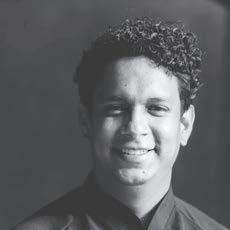
Sebastián Serrano-Ayala, is an assistant professor of practice in orchestral conducting for 2025-26 at University of the Pacific. Recognized for his inclusive leadership, international reach, and innovative, fresh programming, Colombian-born conductor Serrano-Ayala has led professional and student orchestras across the U.S., Latin America, the Philippines, and the Netherlands, blending cultural perspective with artistic excellence.
Serrano-Ayala is an active conductor and guest artist, with recent engagements including the Saratoga Orchestra and Skagit Symphony, and fellowships with Symphony Tacoma, Cabrillo Festival, the National Orchestral Institute, the Allentown Symphony, and the Mostly Modern Festival. He has premiered and recorded new works with the American Modern Ensemble in New York and served as cover conductor for the Seattle Youth Symphony and Yakima Symphony Orchestra.
At the University of New Mexico, he served as director of orchestral studies, conducting the UNM Symphony Orchestra and Sinfonia, teaching graduatelevel conducting, and facilitating guest residencies with Michael Sanderling, Colonel Jim Keene, Sérgio Azevedo, and others. He frequently collaborates with regional honor ensembles and educational programs across Washington and New Mexico.
Serrano-Ayala holds a Doctor of Musical Arts degree from the University of Cincinnati College-Conservatory of Music and has studied with Marin Alsop, Mei-Ann Chen, and JoAnn Falletta. His competition honors include finalist distinctions from The American Prize and the Denver Philharmonic, and a semi-finalist award at the World Music Contest.
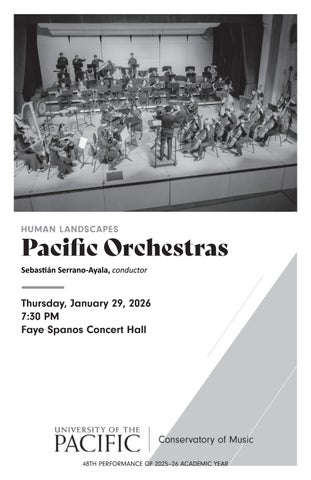
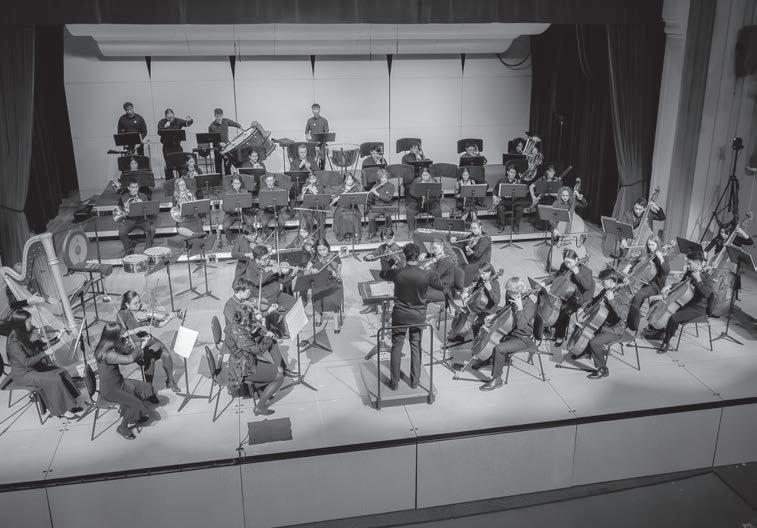
The Pacific Orchestras perform an inclusive range of contemporary and historically significant works. The ensemble provides performers with a variety of sizes and settings to explore an exciting range of repertoire. Pacific faculty, students, and guest artists perform with the ensemble as concerto and aria soloists and as guest conductors. Participation in the ensemble is open to all Pacific students by audition.
Violins 1
Erick Sariles, concertmaster
Carissa Lee
Alizon Lopez
Christopher Thant
Alyssa Yen
Violins 2
Lizzie Mendoza, principal
Kiersten Hogue
Rafael Marinas
Ana Maria Quintero‡‡
Julianna Ramirez
Yaretzi Castro Rios
Violas
Izzy Knittle, principal
Angela Arroyo
Lindsey Liaw
Tom Pham
Cellos
Nicholas Trobaugh, principal
Tyler Chang
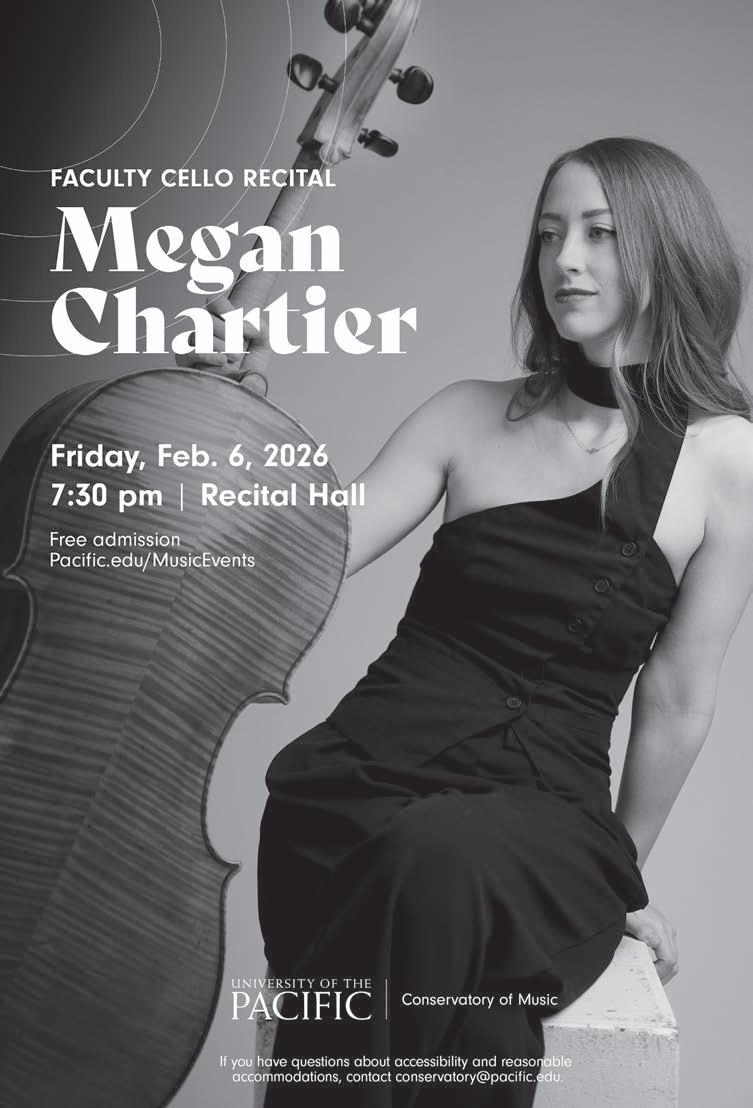
Megan Chartier††
Hope Lee
Jiangshuo Ma
Benedict Ventura
Double Basses
Elijah Atchley, principal
Victor Camacho
Emiko Hernandez
Wesley Shafer
Flutes
Riko Hirata†‡
Henrie Notley
Jasmine Valentine, piccolo
Ethan Williams**
Oboes
Walker Austin, principal
Ernesto Pena
Emily Zamudio, English horn
Clarinets
Tommy Galvin†‡
Edmund Bascon
Audrey Ewing**
Adrian Rodriguez Mandujano
Bassoons
Nadege Tenorio, principal
Enrique Valdez
Jess Vreeland, contrabassoon
Faculty Coaches
Ann Miller, violin, viola
Megan Chartier, cello
Kathryn Schulmeister, double bass
Brittany Trotter, flute
Kyle Bruckmann, oboe, English horn
Patricia Shands, clarinet
Nicolasa Kuster, bassoon
Sadie Glass, horn
Alia Kuhnert, trumpet
Bruce Chrisp, trombone, euphonium
Jonathan Latta, percussion
Natsuki Fukasawa, piano
Jonathan Latta, ensembles program director
Breanna Daley, ensemble librarian
Every gift to the Conservatory from an alum, parent, or friend makes an impact on our students. Our students rely on your generosity to enable them to experience a superior education.
Please contact the Assistant Dean for Development at 209.932.2978 to make a gift today. You may also send a check payable to University of the Pacific: Conservatory of Music, University of the Pacific Attn: Assistant Dean for Development 3601 Pacific Avenue Stockton, CA 95211
To view our upcoming events, scan the QR code or visit Pacific.edu/MusicEvents.