Issue 3: TRANSFORM News Magazine

Page 1


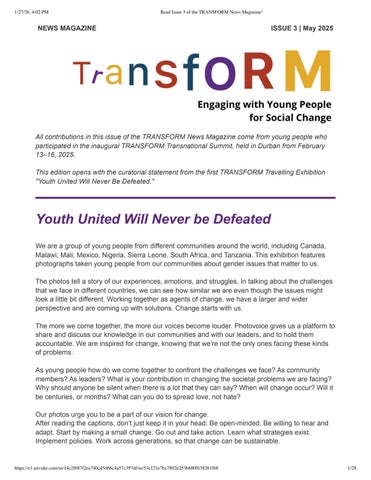
All contributions in this issue of the TRANSFORM News Magazine come from young people who participated in the inaugural TRANSFORM Transnational Summit, held in Durban from February 13–16, 2025.

This edition opens with the curatorial statement from the first TRANSFORM Travelling Exhibition "Youth United Will Never Be Defeated."

Youth United Will Never be Defeated

We are a group of young people from different communities around the world, including Canada, Malawi, Mali, Mexico, Nigeria, Sierra Leone, South Africa, and Tanzania. This exhibition features photographs taken young people from our communities about gender issues that matter to us.

The photos tell a story of our experiences, emotions, and struggles. In talking about the challenges that we face in different countries, we can see how similar we are even though the issues might look a little bit different. Working together as agents of change, we have a larger and wider perspective and are coming up with solutions. Change starts with us.

The more we come together, the more our voices become louder. Photovoice gives us a platform to share and discuss our knowledge in our communities and with our leaders, and to hold them accountable. We are inspired for change, knowing that we’re not the only ones facing these kinds of problems.

As young people how do we come together to confront the challenges we face? As community members? As leaders? What is your contribution in changing the societal problems we are facing? Why should anyone be silent when there is a lot that they can say? When will change occur? Will it be centuries, or months? What can you do to spread love, not hate?

Our photos urge you to be a part of our vision for change. After reading the captions, don’t just keep it in your head: Be open-minded. Be willing to hear and adapt. Start by making a small change. Go out and take action. Learn what strategies exist. Implement policies. Work across generations, so that change can be sustainable.

We want people to start daring conversations to shift destructive societal norms. Focus on the future. We want change that will create a more inclusive, equal, and welcoming society.

We believe in the power of love.

Getting to the Summit

The path to the Summit was different for everyone—marked by distance, determination, and anticipation. Some travelled over 30 hours by air, while others drove across borders to be part of this global gathering. The following reflection by Blessing Azhime offers a glimpse into one of the many experiences that brought us together

From Jos to Durban: A Journey Through Change and Innovation

My name is Blessing Azhime Moses, a young activist from Jos, Plateau State, Nigeria, who believes in the power of change and has offered myself as an agent of change. I traveled to South Africa for a Transnational Youth Summit, which was held from the 13th to the 15th of February 2025 in Durban, South Africa. My expectations for the summit were to learn the basic ethics of change, how to approach change, and how to engage with it.

My preparation for this journey was quite smooth and interesting, as it was stress-free. I faced no challenges with either the passport or visa applications, and the travel arrangements were completed swiftly with no delays. During the course of the trip, I researched everything I needed to know about South Africa, such as the weather, food, common issues, and more.

My actual journey from Nigeria to South Africa was indeed a memorable one, as it involved Author Blessing Azhime Moses [Credit: Blessing Azhime] three landings — from Nigeria to Ethiopia, Ethiopia to Johannesburg and then to Durban. It was comfortable for me in the air, regardless that it was my first time of being in the air. The layovers and logistical experience was not bad.

My arrival in South Africa was a blast, and all my expectations were met — just the way we see it in the movies. I had an interesting conversation with the driver who took us from the airport to the town of Durban. I believe he was one of the first locals I engaged with, apart from the airport attendants. The weather was just as I had expected and researched before arriving in the country.

Durban is where the Summit was held, at a hotel called Protea Hotel. The environment was calm and cool, their foods tasted nice, their music was also cool because we actually vibe to their [South African] songs in Nigeria, so it wasn't a big deal liking their songs and dance. Less I forget the beach was a lifetime experience.

During the Transnational Youth Summit, I learned a lot. My perspective and cognitive reasoning towards other people has changed, regardless of your gender or personal decisions, I learned to see everyone as equal, black or white, tall or short, fat or slim. This program has honoured eight (8) countries namely South Africa, Nigeria, Sierra Leone, Malawi, Mexico, Canada, India and Mali and what surprises me is the common challenges or issues that all this countries have. For example gender discrimination, drugs abuse, teenage pregnancy, gender inequality, are some of the challenges these countries have. Is that not surprising? Of course it is, considering some countries are ranked above others but, yet we face similar challenges.

During the program, every section of the program was a blast because I enjoyed every part of it without regret and no part was a waste. I had fun with all the peers, exchanged contact and hoped to see each other again someday

This experience has meant a lot to me — and to my community — because whatever I learned at the program will be shared and applied back home. I would like to encourage anyone reading this to follow the path of change and embrace equity, justice, and peace for the good of our local communities. As I always say: “Common mistakes bring common enemies.” Let’s embrace change and do away with the common enemy.

---- Blessing Azhime, Nigeria

Local Youth Gatherings Leading up to the Summit

One of the initial steps leading up to the Summit was a series of local youth gatherings held across Canada, Malawi, Mali, Mexico, Nigeria, Sierra Leone, South Africa, and Tanzania. During these gatherings, young people participated in Photovoice workshops, capturing images that would later form the Travelling Exhibition. Each photo responded to a shared prompt, inviting youth to reflect on gender, community, and change. Below, Aliou Ball shares his reflections on the youth gathering in Mali.

Mali Photovoice Gathering

Top left: Abdulai Sahid Tencoid Conteh, Bintu Dumbuya, and Ruby Boston Griffiths . Top middle: Brenda Ojinaga Zapata, and Miguel Ángel Sosme Campos. Top right: Marian Murray, and Keira O'Brien. Bottom left: Sani Abdullahi, Blessing Azhime Moses, and Bilkisu Ibrahim. Bottom middle: Khalid Muhammad, Blessing Azhime Moses, and Sani Abdullahi. Bottom right: Ellah Tambalaweko, and Taonga Mtambo

As young Malians, we have learned from TRANSFORM and contributed to social change in our community. First, we were fortunate to take part in the CELLPHILM project, where our group received an honorary award. More recently, through the Photovoice project, we had the opportunity to learn and unlearn social norms. After an insightful workshop with our facilitator, Dr. Fatoumata Keita, we put our knowledge into practice by deciding to take part in the Summit. The process and outcomes have been truly transformative, offering us several valuable insights.

Picture from the Photovoice Project: Inequal Burdens Participating in the Photovoice project has been thought-provoking, pushing us to question certain social norms in our community. When selecting photos that give voice to social changes, we realized that these changes are often more beneficial to the community than the old practices, despite their past acceptance. Moreover, societal norms evolve across generations, and some gender-related norms must be reshaped for the well-being of the community

In fact, identifying these issues was not difficult for us. They highlight social injustices that are still present. The relevant topics standing out are unequal burdens placed on girls and boys after school, barriers preventing women from participating in decision-making, and inequalities in opportunities.

Above all, our favorite part of the project was the brainstorming sessions with participants. Many interesting ideas emerged, unconsciously shifting participants' perspectives on social norms. Indeed, working in a group involves identifying common problems, exploring various solutions, and learning from each participant’s unique experiences.

Engaging with the Photovoice Exhibition

Working with the photos and deciding what would go into the Travelling Exhibition was not a simple task. Summit participants were divided into groups and given over 100 photos with captions to sort through. Bintu Dumbuya shares her experience.

Picture from Photovoice Project: Barriers to Women

Capturing Moments: The Power of Working Together

Working with the photos at the TRANSFORM Summit was an amazing experience that showed how powerful teamwork can be. As we gathered in groups to choose and sort through many images, the excitement in the room was clear. Each photo had its own story, and it was interesting to see how our different views influenced our choices.

At first, I thought that Sierra Leone was the only country dealing with female genital mutilation (FGM). But during the photo exhibit, I learned that this practice happens in other countries too, with the same challenges. This realization opened my eyes to a global issue that affects many people.

All of the photos we sorted focused on issues affecting youth or gender-based violence. We talked about how each image made us feel and discussed how they connected to the themes of the Summit.

Many people in my group were eager to understand why FGM happens, how it continues, and what is being done to stop it. I enjoyed sharing my knowledge and experiences, explaining the cultural reasons behind FGM in detail.

When I finally saw the exhibit, I felt a great sense of pride. The photos came together to create a powerful visual story that captured the spirit of the Summit. My favorite part was the section with candid moments—laughter, connection, and inspiration captured in real life.

In the end, working with the photos was not just about creating an exhibit; it was about celebrating the journey we all shared at the Summit, reminding us of the connections we made and the ideas we exchanged.

Bintu Dumbuya, Sierra Leone

Unpacking Sex, Gender, and Sexuality at the Summit

On Day 1 of the Summit, attendees participated in a workshop led by Brian Bongani Sibeko-Ngidi from the Uthingo Network . This workshop delved into topics of sex, gender, and sexuality, as well

Bintu Dumbuya at the Cultural Calabash - Day 3 of the Summit

as LGBTQ issues and their impact on community members. Lindelani from South Africa, also part of the Uthingo Network, shares thoughts and experiences.

Everyone Deserves Respect and Dignity, Regardless of their Sex, Gender, and Sexuality

The TRANSFORM Youth Summit held in Durban included a session on sex, gender, and sexuality aimed at fostering inclusivity, creating awareness, and most of all educating participants on issues surrounding SOGIESC (Sexual Orientation, Gender Identity and Expression, and Sex Characteristics).

Most of the young people's questions centred around sex and gender. What was visible is that most of the youth used these terms interchangeably or thought they were the same. Through the session, we learned that the confusion stems from using sex to define gender and vice versa.

The session highlighted that sex is a biological concept, it basically describes the reproductive system, e.g., Male, female, and intersex. Gender is a social construct, looking at the roles, behaviours, and expectations assigned to an individual based on their sex.

The session caused a lot of discomfort because many of the questions raised challenged cultural, traditional, and personal beliefs and norms. This led to mixed engagement and participation from the youth. At the end of the session, a certain mind shift was visible, and from this, we learned that open and honest dialogues can shift perspectives.

The proudest moment was when one participant expressed remorse for their past behaviour and vowed to be more accepting.

Sex, gender, and sexuality are complex and diverse, and we should celebrate our differences.

Lindelani Zuma for the Cultural Calabash Day 3 [Credit: Lindelani Zuma]

Transforming Gender Futures with Cellphilms

Cellphilming is a method of physically and visually expressing one's thoughts and concerns on various issues using a cellphone as a tool. During the Summit, attendees participated in a workshop on Gender Futures, led by TRANSFORM Co-Director Shannon Walsh. In this workshop, they created five powerful cellphilms, exploring themes from Love in the Future to Youth at the Center. Mandisa Mkhize from South Africa shares her experience filming with her group.

The Cellphilm: A Powerful Experience of Gender Issues

I will focus more on the cellphilm I was part of. Our cellphilm was inspired by the struggles of LGBTQ+ women and aimed to shed light on the pervasive issues of abuse and misconceptions surrounding the community. By portraying the harsh reality of corrective rape, we sought to raise awareness about the need for acceptance and understanding.

With limited time to plan and film, our group had to think creatively to bring our message to life. Fortunately, wise counsel from two elder participants encouraged us to take a step back and

From left to right: Uyanda Sibisi, Lindelani Zuma, and Zee Mkhize [Credit: Lindelani Zuma]

strategize — a decision that ultimately paid off. The emotional impact of our film was palpable, with one viewer moved to tears and expressing regret for past actions.

The Summit provided a valuable platform for us to engage in meaningful discussions and creative expression. As young people, we often lack opportunities to explore serious issues beyond academics. This experience taught us the importance of planning, teamwork, and using creative mediums to drive social change. Our cellphilm stands as a testament to the power of storytelling in promoting empathy and understanding.

Making Zines at the Summit

Day 3 of the Summit, attendees had the exciting opportunity to participate in a workshop led by TRANSFORM co-investigator Naomi Nichols. In this workshop, they created their own zines on various issues, sparking creativity and discussion. Khalid Muhammad shares his insights on zinemaking, drawing from his experience conducting zine-making workshops back in Nigeria.

What is a Zine?

A “Zine” is a small magazine that is produced cheaply by one person or a small group of people, and is about a subject they are interested in. (Cambridge Dictionary, 2025).

Creating a zine during the Summit in South Africa was an amazing and informative experience. It was my first time encountering the term "zine", and I felt fortunate to be there and learn how to make one.

Zines are a powerful tool for change because they provide a platform for self-expression that many people may struggle to find elsewhere. While some may find it difficult to share their thoughts and emotions openly, the zine-making session gave us the opportunity to put our feelings and stories into words. It felt like a fun activity, yet we created meaningful and impactful zines in the process.

I wrote about an activist who dedicated his life to advocating for girls' education and fighting against gender-based violence. Through his

Photo Collage from the Summit [Credit: Mandisa Mkhize]
Khalid Muhammad making Zines during the Summit. [Credit: Khalid Muhammad]

activism, he transformed the lives of many young girls—some have graduated and secured jobs, while others have started their own businesses, employing and mentoring others in turn. I shared his story to inspire others to follow his example and encourage young people to embrace activism in addressing these important issues.

Zines are a powerful strategy for driving change, especially in addressing our challenges. Some people may not feel comfortable speaking in public but can express themselves through writing. During the zine session at the Summit, many participants initially saw it as a joke, but we ended up doing an incredible job. As we looked around, we saw beautifully designed zines filled with meaningful stories. Everyone has a story to tell, but time is often limited — that’s why we used this session to share and connect in a meaningful way

After returning from the Summit, I taught some of my friends in the neighbourhood how to create a zine. Through this, I gained valuable insights as they shared deeply personal stories that truly resonated with me. I plan to continue engaging them in meaningful conversations to help address their concerns.

Cultural Calabash

To close the Summit on a high note, Queen and Tuka, two attendees from South Africa, organized a lively Cultural Calabash — an evening filled with dancing, storytelling, and the sharing of cultural traditions from all participants. In this section, Tuka Sikhakhane offers the first reflection, followed by a piece from Queen, capturing the spirit and joy of the celebration.

Youth Summit Cultural Calabash: A Celebration of

Unity and Diversity

Khalid Muhammad at the Summit - Day 2 [Credit: Khalid Muhammad]

Our inspiration for organizing the cultural calabash for the first Youth Summit came from the belief that it would be something exciting and different. I have only seen the cultural calabash celebrated by African countries. Therefore, having other countries outside the African continent participate in the calabash would make it unforgettable.

When we were planning the cultural calabash, we wanted it to, first and foremost, be a space for cultural exchange. A place where we can share and learn more about

each other ’s traditions, cultures and values from all the project sites.

Secondly, we wanted a place to celebrate the diversity of our cultures, languages, identities and desires. We saw this as an opportunity to promote inclusivity and equality. A moment to make it visible. Thirdly, we also wanted the cultural calabash to be a place to learn about each other ’s countries and history. This is because, for some of us, this was the first time we met other young people outside South Africa. Lastly, we wanted to showcase our talents through cultural performances, music, dance and poetry.

I have several highlights from the cultural calabash. The first highlight was the traditional music played from each country's side and the dance that accompanied the music. This was my favorite highlight. It made it easy for everyone to engage at the calabash. My second highlight was audience participation. People stood up at random moments to dance to songs they had just heard for the first time. This was such a vibe. I enjoyed hosting such a lively group. There was never a dull moment at the calabash. Lastly, it had to be the fashion. People showed up wearing different cultural attire, which made it special. Everyone looked stunning in their traditional outfits. Some attire had intricate designs that were super cool, and some accessories included beads from different countries. I can proudly say these were my best highlights.

The cultural calabash fostered a sense of community and understanding among attendees through sharing our cultures and traditions. This broke down cultural barriers and built stronger connections among us. Participating in this event was also a transformative experience. It fostered personal growth, helped me gain new skills and confidence, and formed lasting connections. In essence, the cultural calabash was a vibrant celebration of cultures. It was a platform where everyone from different backgrounds could learn about and appreciate each other's heritages.

--- Tuka Sikhakhane, South Africa

Left to right: Mandisa Mkhize and Tuka Sikhakhane dancing Day 3 - closing ceremony. [Credit: Angela MacDonald, PCL]

A Journey of Leadership and Cultural Celebration

Dressing for the Calabash. Left to right: Miguel Ángel Sosme Campos, Zee Mkhize, Sani Abdullahi, Abdulai Sahid Tencoid Conteh, Khalid Muhammad, Angelo Bernard, and Uyanda Sibisi

As one who revels in the art of leadership, I felt a surge of excitement—YES, a chance to oversee something magnificent! Yet, a shadow of concern flickered within me regarding the individuals I would be collaborating with, for they were strangers to my journey. The Summit unfolded across seven sites, some hailing from distant lands beyond mere cities. Eagerly, I volunteered to craft the poster, determined to make it as dramatically enchanting as possible, weaving in intimate and heartfelt treasures from these diverse locales.

Having keenly observed the seamless orchestration of the Summit, I gathered insights to ensure that our own Calabash would shine, aiming for perfection—or perhaps even surpassing it, which it ultimately did! The heart of the Calabash pulsed with joy, filled with dancing, poetry, engaging Q&A sessions, and, most importantly, learning through delightful means, as I fondly termed it (we explored the rich histories of our countries and tribes).

During the planning phase, I encountered numerous trials, such as a lack of participation.

Some seemed indifferent, while others attended yet contributed little; only a few engaged as I had hoped. However, what truly warmed my heart was witnessing the joy that blossomed—my expectations were met as the crowd mirrored the vibrant energy we, as hosts, poured forth. I was pleasantly surprised by the remarkable dance moves that emerged (they must teach me their secrets!). Ultimately, since the Calabash cantered on the joyous celebration of culture, the atmosphere was alive, and learning became a delightful adventure rather than a chore.

Back in Malawi: Implications for iHEARD

IHEARD is project taking place in Malawi and focusing on Sexual and Reproductive Health Rights, building on the work of CODE and other NGOs in a consortium. Two of the youth leaders, Ellah and Taonga from Malawi write on the significance of TRANSFORM ACTIVITIES to their work with IHEARD.

The author Sbusiso QUEENG Mahlinza. [Credit:Queen Sbuurh Mahlinza]

Empowering Youth Through IHEARD: A Path to Transformative Change

Attending the TRANSFORM Summit in Durban was an enriching experience that deepened our commitment to the IHEARD (Innovations in Health, Education, and Rights for Development) project in Malawi. IHEARD focuses on empowering young people with accurate information on Sexual and Reproductive Health and Rights (SRHR) and providing access to SRH services. This aligns closely with the Summit’s goals of youth engagement and empowerment.

The TRANSFORM project resonates with the IHEARD project, which seeks to dismantle the barriers to education, communication, and healthcare that young people face. IHEARD is rooted in the belief that youth must be at the center of decision-making to ensure meaningful engagement and participation, from the planning stage to implementation, amplifying young voices throughout the process. The Summit served as a powerful reminder of the importance of this approach.

As youth representatives, the Summit provided us with a platform to share our stories, challenges, experiences, and aspirations. Through mediums like photo-exhibitions, cellphilms, discussions, and zines, we specifically explored issues around gender The Summit allowed us to network, interact with researchers, and learn from others working on similar challenges. It highlighted the potential for collective action and the importance of amplifying youth voices in creating lasting change.

For us, the TRANSFORM Summit reaffirmed the importance of integrating youth perspectives into all levels of decision-making. We return to Malawi more committed than ever to amplifying the voices of young people in SRHR using the powerful tools of photovoice, cellphilms, and zines, ensuring that our concerns are heard and addressed as we continue our work with IHEARD.

From left to right: Taonga Mtambo, and Ellah Tambalaweko. [Credit: Ellah Tambalaweko, and Taonga Mtambo].

Youth-to-Youth Spaces: Meeting New People

The final section of this youth-produced issue features a series of reflections from members who attended the Summit. They share what it was like to meet people from around the world and reflect on what the experience meant to them. The first piece is by Bilkisu Ibrahim from Nigeria, the second by Muhammad Sani Abdullahi from Nigeria, and the third is by Brenda Ojinaga Zapata from Mexico.

My Reorientation

The Youth Summit was a new experience for me. I work with adolescents in communities in Northern Nigeria, focusing on ways to improve their sexual and reproductive health. However, I had never had the chance to collaborate with young people from other regions. I wondered what it would be like to interact with youths from different countries. I worried about whether they would understand me and the gender issues in our communities, such as early marriage, sexual abuse, and violence. I also wanted to learn what gender issues might mean from other viewpoints. I searched online about gender issues in other places, but I couldn’t understand much.

During the Summit, I listened to the views and experiences of other young people. This gave me firsthand information about gender issues in other countries. I realized how connected we all are.

I especially remember making a cellphilm with peers from Mexico. Discussing with them made

me realize that LGBTQ people in my community face struggles like those in Mexico. They are denied freedom of expression, they face segregation, stigmatization, and are viewed as deviant. This and the earlier education session made me realize that people are different and are born different. I reflected on my previous attitudes and became emotional. Everyone supported me through this.

The Summit helped me to unlearn and relearn. I now have a strong sense of responsibility to collaborate, innovate and find ways to create an inclusive and safe space for LGBTQ people and other vulnerable people in my community

The author: Bilkisu Ibrahim [Credits: Bilkisu Ibrahim]

--- Bilkisu Ibrahim, Nigeria

Empowering Change

My participation in the TRANSFORM Transnational Summit 2025 in Durban was a golden opportunity and a great experience. Meeting other young people from different backgrounds and communities inspired and strongly motivated me. We came from different places, but we shared a common drive to create change, so every conversation was an opportunity to share knowledge. This was especially true during the youth-to-youth discussions on photovoice in small groups to create a traveling photo exhibition, as well as the discussions on art-making, youth leadership, and governance.

It was a memorable experience to gain a better understanding of diversity in gender identity during the human sexuality session. This changed my perceptions. I learned that gender diversity is a natural part of human experience. I also learned that everyone has the right to live peacefully and to choose their gender identity as they truly feel within themselves.

During the Summit, I was fortunate to connect with many intellectuals. I became good friends with someone from Veracruz, Mexico. We always sat together at the same table and created a Cellphilm together. We shared many of the same ideas and feelings, exchanged gifts from our countries, and, in the end, it was hard for both of us to say goodbye.

Overall, my participation in the TRANSFORM Transnational Summit 2025 was meaningful, enjoyable, enriching, and safe.

--- Sani Abdullahi, Nigeria

Left to right: Miguel Ángel Sosme Campos, Sani Abdullahi, Brenda Ojinaga Zapata, Blessing Azhime Moses, Bilkisu Ibrahim. [Credit: Bilkisu Ibrahim]

The Voices of Youth

Africa had always seemed like a distant continent to me. However, that changed last February when after a long journey, I arrived from Mexico to Durban, South Africa to be part of the TRANSFORM Transnational Summit 2025.

In this event, I got the opportunity to meet young people from different countries and to know the diversity of their voices and projects, but for me, it wasn't just getting to know their stories, it was also getting to know the people behind them: it was talking with Professor Lebo from University of Kwazulu Natal about the situation of women in both Mexico and South Africa, Angelo's heartfelt poems about his life in the Eskasoni First Nation, sharing laughs with Mandisa and the girls of the Uthingo Network, who besides being young activists are excellent dancers, or teaming up with Miguel, Blessing, Bilkisu and Sani to discuss our views on gender and love and seeing the similarities we shared with Nigerian youth.

I learned that the voices of young people are not only ideas and opinions, they are knowledge. I realized young people are not only able to speak for themselves, but they also need a platform to do so, it was about recognizing that not all the voices have had the same spaces be heard and it was to witness what happens when they are given this space. These experiences enriched not only my time at the Summit, but my own perceptions about equality, gender and youth.

---- Brenda Ojinaga Zapata, Mexico

Photo collage of Sani Abdullahi though out the Summit. Third picture is Sani Abdullahi and Miguel Ángel Sosme Campos. [Credit: Sani Abdullahi]

TRANSFORM Announcements

Coming Soon: Transforming Gender: Youth

Voices for Social Change

Filmed and edited by local filmmakers Liam Whitcher, and Vinnie Salanji this intimate documentary offers a behind-the-scenes look at the three-day Summit. Through candid interviews, personal reflections, and insider footage, viewers will gain a deeper understanding of the powerful conversations and transformative activities led by youth from across the globe.

Keep an eye out—more details shortly! In the meantime, enjoy the trailer below!

From left to right: Bilkisu Joga Ibrahim, Brenda Ojinaga Zapata, and Blessing Azhime Moses [Credit: Brenda Ojinaga Zapata]

Save the Date: Cellphilm Festival Screening on June

19!

Mark Your Calendars: The International Cellphilm Festival Online Screening is on June 19, 2025, from 5 to 7 PM EDT!

Join us for an inspiring online evening of short films at this year ’s Cellphilm Festival, centred on the theme:

Conversations & Connections: This is not a time for silence.

In a time of global uncertainty—social, political, and environmental—this festival is a call to action. We invite you to gather, reflect, and engage with powerful cellphilms that explore gender justice, climate activism, reproductive rights, and the importance of community.

Festival Screening

June 19, 2025

5:00–7:00 PM EDT

Online event – accessible from anywhere

Registration for the screening will be announced soon—stay tuned!

There’s still time to be part of the lineup! Submissions are open until Saturday, May 31, 2025 at internationalcellphilmfestival.com

For questions, email us at thecellphilmfestival@gmail.com.

We can't wait to see your submissions!

— The Cellphilm Festival Organizing Team

From January to June 2025, Season 2 of the TRANSFORM Learning Series included book launches, exhibition workshops, reflection and discussion-based webinars, and the International Cellphilm Festival.

Want to hear more about the Summit ? Check out the Stories from the Summit Webinar on our YouTube.

Did you miss a session? No problem! Check out the recordings on the TRANSFORM Website

TRANSFORM Learning Series – Season 3

Get ready for an exciting new season of the TRANSFORM Learning Series!

Season 3 will explore a dynamic lineup of topics and conversations, including:

Gender Transformation and Climate Justice

Learning Across the Sites: How Did Our Photos Travel?

Youth-to-Youth Regional Summits … and much more!

Stay tuned for session dates, featured guests, and how to participate.

TRANSFORM Partners

Turn static files into dynamic content formats.

Create a flipbook
Issuu converts static files into: digital portfolios, online yearbooks, online catalogs, digital photo albums and more. Sign up and create your flipbook.