“Hamba Thobekile” (The collage book) 2018

Page 1


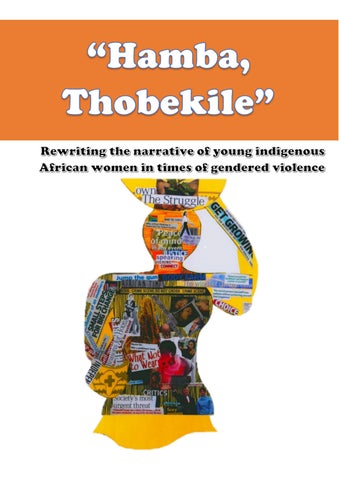
“Hamba, Thobekile” Rewriting the narrative of young indigenous

African women in times of gendered violence

„Girls leading change’

Sandisiwe Gaiza, Zethu Jiyana, Melissa Lufele, Zamahlubi Mabhengu, Bongiwe Maome, Bongiwe Mhambi, Lelethu Mlobeli, Asisipho Mntonga, Takatso Mohlomi, Wandiswa Momoza, Happy Mthethwa, Elethu Ntsethe, Zikhona Tshiwula, Thina Kamnqa

Copyright (2018). Networks4Change

All rights reserved. No part of this book may be used or reproduced whatsoever without written permission except in the case of brief quotations embodied in critical articles, reviews, and academic publications.

For information, contact Naydene de Lange at naydene.delange@mandela.ac.za

ISBN: 978-1-920508-97-5

Published by: Networks4Change

Printed by: Networks4Change

Special contributors:

Cover design: Vimbiso Okafor

Layout design: Vimbiso Okafor

Language editor: Moira Richards

Acknowledgement (funders)

Nelson Mandela University

University of KwaZulu Natal

Social Sciences and Humanities Research Council

International Development Research Centre

1

Foreword

We are told that change is inevitable, yet it remains a challenge to change the way we as women and girls are seen in communities and societies around the world. Many women have worked relentlessly as activists, teachers, researchers and politicians to push social, religious and cultural boundaries that hold women and girls back from experiencing equality in various spheres of life. Yet, countless women and girls continue to experience inequality and discrimination in their lives, and their stories of pain remain hidden and concealed. We –Relebohile, Claudia and Naydene – have for several years been working with a group of fourteen young indigenous African women, who, when we first met them, were first year teacher education students at a university in a city in South Africa. Our work with the Girls Leading Change (GLC) focused on addressing sexual violence on their university campus. They too, had stories of inequality and discrimination that needed to be told. These powerful stories were taken up in the book, Fourteen times a woman: Indigenous stories from the heart. In this book, “Hamba, Thobekile”: Rewriting the narrative of young indigenous African women in times of gendered violence, some of these same young women – most of whom are now teachers and working in various schools in South Africa – share further stories of their own work of activism and “changing the narrative.”

3

In the winter school holiday of July 2017, some of the GLC participated in a writing retreat in Port Elizabeth. Over the years, they have had several conversations about redefining themselves as African women and were grappling with trying to live this out in their communities. So the writing retreat was organised to create a space for this discussion. We chose to use collage as a tool and an entry point to the work. As we found out, there is something about this art-making work that is highly conducive to reflection, conversation and debate! We started the workshop by defining what collage is and the various ways of creating collage. For the collages to be produced in the workshop, we used the prompt: “What does it mean to be a young indigenous African woman in times of sexual violence?” We had magazines, glue, scissors, and markers and large coloured poster sheets on hand, and a lot of time to browse through the magazines, choose relevant pictures and texts and to construct the actual collages. When the young women completed their collages and added a caption, they had a chance to talk about their creations to the whole group. The productions invited comments and responses. We provided the other group members with sticky notes to write down all the characteristics they identified as strengths or resilience as they listened to each presenter. The sticky notes were later gathered and gifted to the relevant collage maker as an affirmation of her strengths. We noted with interest how the collages differed in form and style and how the members of the GLC used this artistic expression to explore their own feelings and views about being a young African woman in times of sexual violence in South Africa.

4

The collages were then used to develop stories that the young women could share with a wider audience. To develop these stories, we asked each young woman to draw on her collage and the discussions that followed. Using this, they wrote stories about themselves and how they, as indigenous African women, could contribute towards change –individual and collective. Each of the women wrote their story and read it aloud to the group, who responded with affirmations and suggestions to the author.

“Hamba, Thobekile”: Rewriting the narrative of young indigenous African women in times of gendered violence includes the collection of collages with their captions, and the stories created by each collage creator. Through their words and images, they express how they see redefining themselves as indigenous African women in times of sexual violence in South Africa. These stories give the reader a glimpse of the young women beginning the rewriting of their own narratives, with them saying “Hamba” [goodbye] to Thobekile. Thobekile, a typical name given to many indigenous African girls, means „the one who is obedient and humble‟, and for these young women, the one who is subservient, and lacks agency and power in society, something they wanted to say goodbye to as they began to rewrite their own narratives and those of the girls and boys they were now teaching in schools.
Naydene, Relebohile and Claudia

PAGE 5

Melissa’sCollage:Circleofhope

Inspiredpurpose

It is said that change is the only constant thing in life. For me this does not mean that change is always constructive, acceptable or even desirable. Sometimes change can be destructive, overwhelming and uncomfortable. But even with that said, change remains a constant.

Recent events around the country have confirmed that things are no longer the same. This is evident in how we do things, relate to events and even how we accept certain behaviours that in the past would have been impossible to accept. An example is the sudden hype around violence in South Africa. How do we explain that it has suddenly become a regular news feature that some adults brutally kill and mutilate innocent children? How do we explain that young men now find it acceptable to abuse and even murder their partners in the name of “love”? The word “love” used to carry so much meaning and power, but today it is so carelessly used that it has even lost its value and strength. Yet, amidst all this confusing and very unsettling change, one unanswered question lingers in my mind: “What is my role as an indigenous African woman in this era of violence against women and children?”

Walk with me as I uncover my answer to this critical question. My journey began with me as a fragile child who lacked confidence and had very little exposure to life outside my immediate surroundings. My life was simple because things were either black or white. I had no extraordinary dreams because I always thought of myself as an

ordinary person. My life had always been about me: Am I safe? Am I educated? Am I successful? Am I happy? But was I really happy? Did I even know what it means to be happy?

A wise man once told me that there are two important days in everyone‟s lives, i.e., the day you are born and the day you discover the reason you were born. Discovering my purpose has been the best adventure for me. It has forced me to really engage in a courageous conversation with myself and, since then, I have never stopped. I have discovered that happiness is not about having money, status, recognition or even fame. For me, happiness is reaching a state of contentment where I am genuinely satisfied and, as Prof N (Professor de Lange) would say, having a mentality of abundance where I pay no notice to things I lack but, rather, be thankful for the things I do have.

Reaching this state of contentment has not been entirely up to me because I faced serious challenges before getting to this point, challenges that I thought would break me. In fact, they nearly broke me, but I now view those challenges as a process that transformed into a finished product that would be beneficial to those who hear and see what I put out to the world. Most importantly, though, it helped me discover and identify my role as an indigenous African young woman in these trying times of violence against women.

I am no longer just Melissa Lufele, the ordinary girl, but I am now Melissa Lufele the mentor, the teacher, the counsellor, the motivational speaker, the facilitator, the author. I am Melissa Lufele an

PAGE 8

inspiration and role model. My purpose branches out from being just about me as I suddenly find my joy in helping others, particularly young people because it is my belief that when you touch the youth you plant a seed to change the outlook of the upcoming generation. My contribution to society as one of the Girls Leading Change is to help teach young men how to love, care, provide and to protect the women in and around their lives. It is also to help teach young women how to make their voices heard and, most importantly, how to use that voice to bring about positive change.

One may think that all this is beautiful and easy, but the reality is that it is not easy at all. The work that I do as a volunteer family care worker and youth mentor at King Me and Queen Me Mentorship Club (a nonprofit organization located in Humansdorp in the Eastern Cape) has taught me that we cannot dismantle some ideologies unless we find the root cause of the problems. Like a tree, we can never water the leaves and expect the tree to grow, rather, the most effective method to promote growth would be to target and water the roots because the moisture will be transferred from the roots to the stem and finally be visible on the leaves.

As part of our mentoring process we engage the families of the young men we work with to find out what vision they have of being a man. What types of masculinities are being displayed to them on a daily basis? What do they learn from such masculinities? Is it something positive or negative? Are there men to look up to in their communities? Together, we help them draw a picture of the man they

PAGE 9

would like to become and work towards that goal, giving them practical strategies on how to reach their goal and ultimately become the man they want to be.

Why the focus on boys and not so much on girls one may ask? While we do work with girls as well, our focus in the programme is primarily focused on boys. Having worked with Girls Leading Change for the past four years, as well as another leadership platform with women, I have noticed that we empower each other as women. However, the reality is that as educated and empowered as we are, we still come back to a society dominated and governed by patriarchy. Men, the same people who perpetuate acts of violence against women, occupy our workplaces, our churches, our schools; they are our fathers, brothers, husbands, boyfriends and even our pastors. I believe that in order for us to alleviate this violence we need to make sure that all of us, including our boys and men in our society, must be educated and empowered through dialogue that engages and challenges our views on society‟s norms and how we occupy our respective roles in harmony and respect for one another.

There are many tools that one may choose to use in developing young men and women. However, each day I see young, brilliant boys and girls from disadvantaged backgrounds with so much potential to achieve greatness but also with a huge possibility of failure because of the lack of education and guidance in dysfunctional families. For me, focusing on these young men is a preventative measure to make sure that they do not continue perpetuating patriarchy, are educated to

PAGE 10

challenge the status quo and to empower other men to treat women with respect. I saw what mentorship did for me; there is nothing greater than reaching out and rekindling a dream because it means I have invested in the future.

More than anything I want you, the reader, to take from my story that you can be the change you want to see, investing in the future and helping create a new, safer South Africa not just for yourself but for generations to come. No impact is too small because what you offer might be just what the other person needs to better their lives and the society in which we live. It is my belief that one has not lived until one has found a purpose in life. I am slowly finding my purpose and it is my hope that this story inspires you to seek and find your own purpose.

Melissa Lufele completed a bachelor’s degree in education (Further Education and Training) at the Nelson Mandela University. She is currently working as a teacher at Patensie Agricultural School, previously known as Patensie High School, in the small rural town of Patensie, Eastern Cape.

Bongiwe’sCollage:Transcendence

Hamba,Thobekile

Being a young indigenous African woman represents a whole variety of things. But, more than anything, it represents a time where things are evolving. However, regardless of this global evolution, the treatment and expectations of women, specifically African women, are still as they were for our mothers and their mothers before them.

For many years, subservience and conforming without contest formed an intricate part of the realities of young and older African women alike. Society‟s abuse, oppression, forced ownership of the female form and the consistent treatment of the African woman and her body as a dumping ground, a means to an end, a crime scene, was met with very little, or no, resistance. And so it continued, and became “normal.”

For generations, the reality for African women was that they had a duty to sacrifice themselves for the benefit of a patriarchal African, and global society – whether they wanted to or not. And so, because this was the only “reality” that they were raised into and knew, they too (our mothers), raised us to live up to these patriarchal standards, and to do so without contest. They, too, raised us to submit to men, renounce our titles as black queens and live our lives to accommodate, satisfy, and obey men because, unlike us, they were “stronger.” They, too, raised us to be like them: to keep our heads down, “respect” men and to not disrupt this oppressive cycle. But why not, Mama? If the current gender roles, treatment and expectations strip women of all

claims to their own bodies and lives, why should I, an African woman, find it reasonable to support and perpetuate it?

The thing is, it is not reasonable. Therefore, it is up to us as young African women – products of these “realities” – to challenge and change them. It is up to us to reclaim our bodies, and our voices with them, and demand to be heard, demand to be recognised as equal and valuable members of society. But, how? Where do we start?

For me personally, the aching need to change things in the world around me started with me daring to get a deeper understanding of who I am as an individual: being comfortable and confident with who I am as a woman. From that introspection, came personal growth. I was finally able to realise and believe that I, too, am human and, as such, I too deserve to live in a world that acknowledges both my woman-ness and human-ness. This deep understanding and reevaluation of self and personal growth is, I believe, the first step towards bringing about change. Because, once you know who you are, you put yourself in a better position to re-evaluate your surroundings and be confident, as well as daring enough to challenge systems and practices that threaten and oppress you.

Through all that I have experienced, I have learned who I am as an African woman; I learned who I am in a global society. This set the foundation for my contribution towards the process of redefining what it means to be an African woman and consequently, the reconstruction of a new and just narrative for women, globally. If my fellow African

PAGE 14

sisters were to learn anything from me, this (opening yourself up to experience personal growth) would be it. But again, how?

Often, in the dialogues and conversations that we have, we highlight the problem extensively. Granted, this is an invaluable part of the problem-solving process. However, the solutions to the problem are rarely ever voiced. And so, at the end of the day we walk away with the awareness of what the problem is and an, often crippling, lack of knowledge on how to change it – both as individuals and as a collective. Often, we do not realise that, perhaps, being part of the problem solving is not always about waiting for someone else to bring solutions to you but that, as individuals, we also have a wealth of resources or tools that we need to use to help generate solutions to problems that affect us. We, together, can jointly rewrite our stories as young African women, one story at a time.

My story, for as long as I can remember, could be described as a series of events that, one after the other, conditioned me to believe that my life would be no different from those of countless African women who came before me. Mine was an inherited legacy of women who were used, abused, broken and forced to perform miracles in the face of the most stressful and dehumanising of situations including marrying, bearing children, feeding, loving and nurturing their families without any help, and all this without complaining. I would have to learn to abide by the “law” of the land, I would have to learn to conform, to accept my position as subhuman and, as irony would have it, I would have to thrive under those conditions too. Imagine!

15

But that was then. And now, that could not be further from the truth. That could not be further from who I am now – a Bongiwe Maome who knows herself, understands herself and wants better for herself. I have grown so much as a person and understand now that I simply cannot afford to remain the same, not if I want to see change around me. As a young African woman, it would have been a great injustice to myself to have gone through what I have gone through, seen what I have seen, been where I have been and learned what I learned and still allow myself to be a victim of an unjust society and its practices. I have learned to take advantage of my wealth of knowledge and experience and use it to challenge oppressive systems in my community. I have learned that in them, lie the solutions to the problems that many women in my community are confronted with. I have learned to reclaim ownership of and redefine myself as an indigenous African woman and through that, begin to model a different/alternative reality for my sisters in my community and in the classrooms that I have the privilege to teach in.

My story, now, is not to groom comfortable victims but to inspire conscious and proactive leaders and members of society, individuals who draw strength from their own experiences and use them to help rewrite the narrative for themselves and young women in their communities. As an African teacher, my task is to inspire young women not to settle for roles as complacent victims of their unfair and oppressive surroundings, but to dare to change them. It is to guide strong, confident and courageous young women who will not hesitate to fight to be equally represented and treated in this evolving world,

PAGE 16

not as angry black women but as black women who are not scared to confront society‟s unjust practices and systems – and if that ruffles a few feathers, then so be it! After all, change is not likely to occur or last until discomfort is felt by those perpetuating abuse of women and those who are affected by it. If speaking out against an unjust society, qualifies us as “angry black women,” then so be it. How dare they try to silence a black African queen! How dare they try to renounce her title!

Bongiwe Maome completed a bachelor’s degree in education (Further Education and Training) at the Nelson Mandela University. She is currently working as a teacher at Nathaniel Pamla High School in the small rural town of Peddie in the Eastern Cape.

PAGE 17

Asisipho’sCollage:Knock-Knock!Untiltherightdoor opensforyou

18

Myyesterdayismyownhistorymadefortomorrow

The hardships I have encountered, the experiences I have gone through, have been the contributing factors towards building me to become a woman who is much stronger than yesterday. By writing this story, I hope to encourage all young women, especially African women, that being an indigenous African woman is a blessing and the greatest gift of them all.

Growing up was not easy for me as a child and I strongly believe that nobody has to go through what I went through. I grew up feeling out of place and feeling not accepted for who I am, or not good enough for anything. In spite of all those stumbling blocks, I rose above and stood tall – not because I was strong or better than anyone but because I was provided with a great opportunity at the right time, and life changed. I came to feel better about myself. What made me to feel good about myself was the small achievements I have had and being around people who believed in me. The support I have received does not necessarily come only from my biological family, but also from friends, neighbours, community, people who support and celebrate with me in my small achievements. The Girls Leading Change played a big role in terms of supporting me.

I have realised that not everything is smooth in life, not everything is freely given and available for all of us. But one thing I have learnt is that life is a workable experience, with trials and errors, and that mistakes and failures are part of learning, not a definition of who you

19

are but a learning curve. The best thing about life is that as long as you are still alive, it offers many chances and great opportunities for exploring and not giving up until you get it right. Now I see life as a workable experience and it is not easy.

My experiences of growing up as a young African indigenous woman where I have known how it feels to feel hopeless, being told what to do, say, think and feeling insecure have been difficult to deal with. I ask, how does one get up from these life difficulties? The first thing I did was not to give up. It may seem easier said than done. One thing that helped me in my struggle is to realise that knowledge is power and that there are various ways of attaining it. I had to stick to my values and recreate them to make sense to me and know their importance. Another thing that helped me to be where I am today is setting my goals, having dreams and being self-driven. Being self-driven helped me because, in the community where I come from, nobody thinks or dreams for you – it is only you, yourself, who can do that.

Even when I listened to the conversation of some of my school mates, I would hear them hoping to finish Grade 12 and take a gap year or do a six months computer course and that, for them, was the greatest achievement. Even though I did not know about great places, I kept faith in myself that if I passed very well and attained a few distinctions then it would be easy to obtain a bursary that would help me to further my studies. An additional thing that helped me not to give up has been the support structure, the sisterhood, family and talking about problems with others.

Change can be very scary and it is not easy to adapt in any situation but it can bring something positive and new inspiration. This also reminds me of my teaching practice experience as a student teacher. I always motivate learners, sharing inspirational quotes as a way of encouraging them. Life‟s ups and downs provide a window of opportunities that enabled me as woman to stand up and be courageous to build the life I deserve. Gone are the days of feeling sorry for myself, gone are the days of being a victim of my own kindness. Sometimes as a woman – in my own experience – I thought being kind was to let someone have a say over my life, and putting people‟s needs before mine. That was my idea of kindness. In the process or along the way I was victimising myself or letting myself become a victim. I managed to get out of that trap of being a victim of my own kindness through having a backbone and sticking to my values.

I can imagine how sad and painful it is to be a young African indigenous woman during times of sexual violence. First of all, being a woman is not just a word; you are seen as a weak person and someone who is not able to stand on her own or is given orders upon her life. I relate to the women in my collage wearing traditional clothes with the caption, “Made from Africa.” It is important to know who you are, the significance of having a sense of belonging, a place to call home. But what happens when all that is taken from you as a woman, when this violence is storming out from different angles? In the midst of it all happening, women being violated, raped, killed, beaten up? In that moment of darkness, as woman you lose yourself, in terms of who you

21

are. That is why in my own struggles I ended being the victim of my own kindness. Fortunately enough I was able to realise that it was not supposed to happen to me or anyone.

As a woman, activist, feminist, I say that I do not have to lose myself in the name of pleasing people. I refuse to be given a false name; I refuse to be told what to do because I am a woman. According to Fredrick Douglas, “knowledge makes a man unfit to be a slave.” At the university where I am currently situated, I was fortunate to have worked with Girls Leading Change and other societies. I have also learnt the importance of teamwork, that as women we need to work together and not undermine each other and ourselves. Working with Girls Leading Change has helped boost my confidence and selfesteem.

Back to the collage I created: Being an Indigenous African woman in a time of sexual violence. The caption is: Knock–Knock! Until the right door opens for you. As a woman, I have learnt not to let limitations define my abilities and who I am as a person. What I know now, makes me a better person than I was before.

All I see is women from different walks of

You are never too young to dream

You are never too old to smile

You are never too small to make it in life

You are never too imperfect to be worthy

The time has caught up with me

life

The world has shown its ugly face

Life is not always smooth

Rough, but is has all the important elements.

Asisipho Mntonga completed a bachelor’s degree in education (Further Education and Training) majoring in accounting and economics at Nelson Mandela University.

Takatso’sCollage: Inanetofexpectations,but courageoustoovercome

24

Trapped in society norms but courageous to overcome!

A woman was beaten to death, the scene was a pool of blood and her deformed face. That is what people perceive as violence. However, I know that violence is not only that, but can also come in many different forms. In my world, violence can be emotional, mental, and verbal. It can come through brutal words. Violence can kill one‟s spirit and destroy motivation. Thus, being a young African indigenous woman in this time of violence can be quite stressful and energy draining. For example, there is a huge mountain of society‟s expectations and norms which a woman first has to climb and work through for her to discover herself and her purpose in life. Women have to have the approval of society before their voice can be heard. Often, women‟s worth is only recognised if they conform to society‟s norms. Nonetheless, I believe in women‟s agency, in that they tend to rise against these odds.

While society expects women to conform, it has also groomed them to be bold and strong in the face of adversity. This is because society has actually normalised hardships for women and has painted these as the strongest ladder to success. In African communities, this is evidenced in the proverbs re expectations for men and women. For example, Basotho people say: “Bomme ba tshwara thipa ka bohaleng,” which translates into “Women hold the knife by its sharp edge ” Such proverbs make women believe that it is normal to be violated. It conditions women to see life as a one-way route in which one has to

first endure hardships in order to be great (or be a quality woman). It conditions them to believe that violence makes them stronger.

Most African women are trapped in these unjust norms and situations in which they are seen as less human and have less power or ability to achieve their goals. In their families and communities, women are seen as men‟s property and in need of their care. There is less space in which a woman can grow and reach her potential. They have to belong in order to be recognised For example, from birth they are their mom‟s cute little princess and, as they grow, they become somebody‟s girlfriend or wife, and then somebody‟s mother, and the circle continues. Where is the time in life where they realise who they are and embrace the purpose they live for? If a woman tries to portray that, she is seen as someone who thinks too highly of herself.

Being a woman in this time of violence can be stressful. It is like driving a car on a meandering road with sharp curves where the driver is forced to either drive slowly or keep stepping on the brakes. As a woman, you cannot own your body and freely do what feels right to you. You cannot wear what you like because it is regarded as showing too much of “that” (the body parts which are seen as private). You have to live in fear of “what-will-the-people-say?” This becomes evident in most rape cases when victims are re-victimised by brutal words like, “The skirt she was wearing was too short, therefore, she asked for it” or “She was showing too much cleavage, so she seduced him.” We live in hard times where rape and sexual assaults are justified and perpetrators are protected or given more power over victims. We

live in times where it seems to be too difficult to teach men not to sexually assault women, but at the same time where it is too easy to teach women to bear the burden of not getting raped (sexually assaulted); where it is easier to say “Don‟t get raped” than to say “Don‟t rape.” If we teach men not to rape, I believe there won‟t be much of a need to teach women not to get raped! There is just too much pressure put on women. They are seen as weak, and yet are expected to be strong.

In these times of violence, men are bold or confident to say, “I slapped or beat her because I love her,” “I forcefully slept with her because I love her” or “I hurt her because I love her.” People use the word love to disguise their bad characteristics. What kind of love is that which portrays so much hate? What kind of love is that which hurts her? We live in times where so many vicious things are normalised and women are groomed to accept them. We end up saying that “love hurts.” That is the kind of love we mostly can relate to as African women in this time of sexual violence. We cannot relate to the notion that “love is a beautiful thing and should be celebrated.” We have never seen the beauty of love. For many of us, it has to hurt to be love.

It is time to end all the injustice and sexual assaults against women. It is time that we resist the violent acts against indigenous African women. It is time women emerge and act against sexual violence or violence of any form. Women need to reclaim their strength. This begins with changing one‟s mind-set and believing in yourself. As Nelson Mandela said, “it always seems impossible until it is done.” It is

PAGE 27

possible for an indigenous African woman to take a stand and do what she believes is right for herself. I am a living example of an indigenous African woman who has reclaimed her strength. If I managed to do it, I believe any woman can. It takes courage to get there and I am grateful to be amongst young indigenous African women who raise awareness against sexual violence and women abuse, who create platforms where women can gather together and talk and have empowering dialogues and, most importantly, stand together and network to bring about change. Our aim is to create a generation of indigenous African women who are rooted in information and knowledge. In the words of Maya Angelou, “When you know better, you do better ”

TakatsoMohlomi completed a bachelor’s degree in education (Intermediate Phase, majoring in languages) at the Nelson Mandela University. She is currently working as a teacher at a township school in New Brighton, Port Elizabeth, Eastern Cape.

Thina’sCollage:Inspiration

Daretomakeadifference

The experiences and challenges that I have gone through, I think, inspire my community and people around. I am a hard worker, a strong and persevering woman who is beautiful and courageous. I can now help change and improve people‟s lives, help people who experience the same problems as I did, persuade the youth to speak and not be silent about the challenges they are facing, and advise young women to speak about their daily life problems. Importantly, I can now help South Africans to stop sexual violence in our country. Women are facing many challenges and one of them is sexual violence, so I encourage them to speak about those challenges so that they can get help. For instance, I can refer victims of violence to people and agencies that can help them.

An opportunity that has helped me to become who I am today is my involvement with the Girls Leading Change group. The GLC has helped me by giving me their support, for example, to learn to accept the mistakes that I have made, so that I don‟t repeat them. In turn, I am going to help those who experience the same problems to speak out so that they can get help. As young woman, I will gently offer my support if I suspect that a woman close to me is being abused or has been sexually assaulted. I will participate in training programmes and coordinate efforts that increase awareness of violence against women, identify resources, and teach appropriate ways of responding to incidents of sexual violence, for instance reporting requirements, referrals to victim support services, and so on. As young woman, I will

volunteer at local shelters or rape crisis centres to gain a better understanding of the dynamics of violence in women‟s lives and to show my support for ending sexual violence against woman. As a teacher, I will also allow class time for discussion of violence against women and girls and encourage involvement in school events that promote non-violence and a safe learning environment for all learners and ask my colleagues to do the same.

ThinaKamnqa is studying towards her bachelor’s degree in education (Intermediate Phase) at the Nelson Mandela University.

Sandisiwe’scollage:Collage:Plantroots!

I grew up in a community were violence was the norm and never seen as a crime or misconduct, and where women were taught and told what to do and how to behave. My community is a place where big dreams are dashed, where young girls are taught what to do and not to do, as specific tasks are linked to gender. Education is meant for boys and girls are prepared for becoming housewives. There is so much that needs to be adjusted in our communities, but that also is linked to our culture and beliefs. Joining the Nelson Mandela University‟s Girls

Leading Change has been an eye opener to me as I have managed to unlearn some of the expectations for indigenous African women.

I am an educator, and a part-time honours student, who is purposedriven and strives for the best in life. I am a mother, a sister and a friend to my learners. Being a member of the Girls Leading Change group, my goal is to contribute to changing the lives of my learners. It was January 2017 when I started teaching at a primary school in Motherwell NU 12, one of the disadvantaged areas most known for drugs and alcohol abuse. This is not only an issue in the surrounding area, but also inside the school premises for primary school children (both girls and boys). The rapid increase of drug abuse at school led to high rates of absenteeism and children dropping out of school. This became my concern as a new teacher who wanted to contribute to change. I knew change was needed.

I started questioning myself: “If this is a problem, what am I doing to stop this from happening?” I started helping out in the school choir which consists of 120 learners (60 boys and 60 girls). I had the idea that if I spent time with the learners, they would come to trust me, and this would create a bond between us and a safe space. We have choir practice from Sunday to Sunday. The idea behind practising all the time is to keep them busy and less focused on their social issues. Learners are all different; some are not strong academically while others are strong in extra-curricular activities. During our rehearsals we sit down in a circle (circle time) where individuals talk about things that are bothering them. We have a rule that says: “Whatever happens in the circle stays in the circle.” At times, they write letters telling me how they feel and what happened at home as many come from abusive homes and homes where their parents are giving birth and where they have to be caregivers.

I use weekends to talk about issues that are happening in our country. One issue is prostitution in the community. We, the choir, raised awareness about that as we marched to Motherwell police station and where we got men to sign our petition. Through my interactions with the learners, I have also started working closely with our school social worker. Some of the children have dropped out because of not having school uniform. So I went to SASSA (social security) to negotiate for school uniforms, and managed to get some.

As a lifelong learner, I learn a lot from my learners I strongly believe that change starts with a foundation, just like building a house. The

PAGE 34

foundation needs to be strong so that the house can be stable regardless of the seasons. So, empowering the young learners before they reach high school is important. My learners know that I am a teacher who values education more than anything. I encourage them to stay focused and study. Participating in the collage workshop with the GLC has planted an idea in my mind: I am going to use it as one of my methods with my learners, for example, to motivate them and remind them that being different is acceptable, and that what is important is what you make out of your differences.

Sandisiwe Gaiza completed a bachelor’s degree in education (Intermediate Phase) at the Nelson Mandela University. She is currently enrolled for BEd Honours in school leadership and management whilst working as a teacher at Cebelihle Primary School located in the Missionvale Township in Port Elizabeth, Eastern Cape.

Woman,embraceyourwomanhood!

We live in a world where women are not safe anywhere. Each day we hear reports of women being abused, raped, abducted and murdered all over the world. As young indigenous African women, we live in fear of being sexually assaulted, abused and murdered. We live in communities where women are marginalised and controlled in terms of being told what to do, when to do it and how to do it. We as women are not given the voice to express ourselves, to do what we want. Instead we are dehumanised, made into tools to be used by men. Our communities have created expectations for us. Being an African woman, you are expected to marry and have children, and when you do not have children you are labelled negatively and may be chased out of the marriage because our society expects that, as a woman, you have to bear children. That it may be the man who is infertile, is never considered. We live in a world where women are not accepted as leaders and should always take the backseat. This is even though we all have the ability and should be given equal opportunities. All this should not be happening and it does not have to stay this way, we can bring about change. Brigham Young once said, “Educate a woman, educate a nation” and I, Zethu Jiyana a high school educator, was fortunate enough to be part of a project that educates women about addressing issues of sexual violence. Through this project I was educated but, most importantly, the nation will be educated because I am taking this knowledge forward to my community and, furthermore, to the world so that I can contribute to change.

I come from a rural background, a place where abuse and sexual violence are normalised and hardly ever reported. This is a place where you grow up as a young woman with so many fears: fears of being molested, being forced into marriage at an early age or being abused in every way possible. It is a place where women are not given voice and do not have the right to own their sexuality. The hardest thing is being sexually violated by a breadwinner and when you report it to elders they tell you not to mention it to anyone because people fear poverty more than they respect the wellbeing of a person. This is a place where a woman who has been raped is at fault because she must have sent wrong signals or seduced the perpetrator somehow, or maybe she was not dressed appropriately. This is a place where you are called a slut if you are dressed in an “unacceptable” way. This is a place where a woman has to obey men, bear children and do house chores. This is a place where a woman can never be accepted as a leader or even be allowed to preach at church because these are men‟s jobs. I, like many other indigenous African women, have grown up with the idea that men are dominant, that they are always the heads of the family, and that I as a woman must stay silent and obey. Breaking out of that shell took a lot of work but, through the workshops I attended with the Networks for Change programme, I realised it is not okay to keep quiet about abuse, it is not okay to stay in an abusive relationship, it is not okay for men to do as they please with my body. I learnt that I have a voice. I learnt that I have rights, rights to safety and well-being. I came to understand that I am my own person, and I have the right to live my life the way I want to, and the right to make my own decisions. The question was how do I support other young women? I have

realised how important education is because when you are educated it is not easy for people to rule over you. So, my strategy in empowering and building grounded young people is through education.

Being part of Divine Achievers, a non-profit organisation that promotes education in rural areas, has given me a platform to empower young people, to tell them they can dream and be whatever they aspire to be. The best part is that I get to follow up on these young people, find out how they are doing after the career expos and the empowerment sessions. An even greater opportunity I have is through my career as a teacher. I get to influence a lot young people, even through my lessons in class. For example, in a lesson I was giving on reproduction and fertilisation, my learners and I started engaging in a conversation about sex and why men think they can just take sex whenever without consent. The boys in my class argued that if a girl agrees to be your girlfriend she should not say no to sex. They also argued that girls do not know what they want, they are always undecided, so they make the decision for them. This conversation turned into a debate to which we concluded that it is necessary to wait for consent and at any time she says NO or STOP to do so. In that way, the young man avoids jail time which would destroy his future plans. It was very exciting to be part of that discussion and, more importantly, seeing my learners think differently and being transformed.

Since I arrived at the school as a new teacher, I teach learners about public holidays, their importance and significance. For example, on the

9th August 2016 I came to school wearing my women‟s studies T-shirt, which I acquired during my visit to St. Cloud State University in the USA. I had already prepared my class for this day by getting them to do a song and poem about power of women. All I did was gather all the learners in the school – with permission from the principal – and taught them about the background of women and their struggles and why we came to have Women‟s Day. This did not only conscientise learners about the power and importance of women, but it also got them to think about and look at public holidays differently. This project is still continuing because we gather for other public holidays and I explain why we celebrate these days and what they mean to us as today‟s generation. Such programmes pave the way for striking conversations about issues we face today – issues of inequality and gender-based violence – and is an opportunity to educate young people so that when they leave school they are moulded into wellinformed, transformed and engaged members of the community who will contribute to change.

One of my greatest moments was being able to interact with a wider range of people, members of my community. As a youth leader at my church, I had an opportunity to host a youth event in my community. This is where a lot of people and especially young people come for the youth events. That is where I taught them about why we celebrate Youth Day, what happened in 1976, how the young people of that time fought for us to live in a just country. Most importantly, I posed the questions: “What have we as youth of today done about the injustice and inequality that we are facing today?” “What have we done

about our fellow sisters who get raped and abducted?” The message was simply this: “What are we doing to contribute toward change as this generation?” My emphasis was that a little change can go a long way, and that protecting one person makes a difference and changing the attitude of one person can make a huge difference. Change begins with one person. For example, recently, I unknowingly saved lives, first, when a friend of mine was told by her boyfriend to abort the baby she was carrying. It was also what she wanted to do. I never advised her on what to do, but I just told her the decision was hers to make. When she came back from the abortion clinic, she was still pregnant; she told me that when she was in the waiting room, all she could think about was how much I love my son, the pictures of him on my walls, and the calls I make to him even though he cannot respond. She realised that if I kept my baby then so could she. I had touched her life without knowing, just by being open and honest and sharing my story with her. The second example involved a friend who had already terminated her pregnancy and wanted to die after the termination. I remember her calling me, crying, telling me how she hated herself for what she had done. I started telling her about a film I saw at St. Cloud State University titled, She’s Beautiful When She’s Angry, and I explained to her how women had fought for the right to abort so they could be mothers when they were ready. Just by sharing that I gave her a different perspective which made her feel better and she could live again.

The work of addressing sexual violence, empowering women and contributing towards change still continues. This can be done through

mentorship, advocacy and using any platform one comes across to engage these issues and work on coming up with solutions. We should not stop until women are treated equally to men, respected and allowed all leadership positions without hesitation or limitations. We should not stop until women are safer and more comfortable in the spaces they live in. It begins with one person and ends with a transformed nation and a transformed world where patriarchy does not exist. Educate a woman, educate a nation!

ZethuJiyana completed a bachelor’s degree in education (Further Education and Training) at the Nelson Mandela University. She is currently working as a teacher at JJ Njeza High School located in Qina in the rural town of Butterworth, Eastern Cape.

42

Zikhona’scollage:Womenempowerment

Identitycrisis?

Who am I? I am young African woman who is beautiful on the inside and out, who is trying to find her real self, her identity. I define myself as a courageous and a brave person who has overcome and conquered many things. I have worked hard to be where I am today.

Women in our society are expected to be submissive and to obey everything that they are told by men. In turn, men label or see us as too weak to be leaders. As a young indigenous African woman, I would like to make a difference by transforming other women into leaders who are strong, who can stand up for themselves, voice their opinions, and not be victims but victors. I want to be that woman who instils values and agency in women and gives them hope.

As a person who has experienced physical and emotional abuse, I still find it hard to be confident. I was once weak and vulnerable and I gave my ex-boyfriend power to control me and I believed that what he told me about myself was true. He used to tell me that I was ugly, weak and not good enough and that my opinion did not count because I was a woman. I believed him and I saw myself as worthless. Because of this I had very low self-esteem and no confidence in myself. This made me look at myself in a very negative way. It tore my heart to pieces because he damaged and destroyed me inside.

Women should not be made to feel worthless and useless. We should not allow men to determine who we are, but we should take a stand

I knew that quitting was not an option, so I pushed myself to keep going. I took responsibility for my actions by seeking help. It was the wisest decision I made because I had a very good support system. Professor N gave me hope and she encouraged me to keep going and be strong. I am grateful to have her in my life.

Agency made my life much easier. It opened a lot of opportunities for me and got me to really find myself. It made me stronger because I had realised my mistakes and learnt from them. I became a better person. I made wise choices and decisions. I got a job at Masinyusane, a non-profit organization that works with children from Grades 1 to 3 from a primary school. We teach them how to read and write in

PAGE 45 and unite as women and speak up on what we believe is right. Not knowing who you are and your worth makes you believe what another person tells you. I relied on being told by someone else how I looked. I was very young and confused back then and I allowed someone to define me and make decisions for me. I tried very hard to impress men just because I did not know myself and I wanted to look beautiful and attractive. I pretended to be someone that I was not, turning myself into a “fake” and restless young woman who depended on weaves to look pretty, partying and dressing in revealing clothes, just because I wanted to look cool and be wanted by men. Little did I know that I was taking a wrong turn, making unwise choices and decisions that I would later regret. I failed, and broke promises that I had set for myself. I felt bad, I wanted to give up and just quit everything. There was a point where I wanted to even drop out of university.

English. I am passionate about what I do because I am also gaining experience in working with young ones and that it is in line with what I am studying. I have gained a lot of experience working with the young ones and it feels good to know that I am making a change in their lives. I see that through the positive feedback that I get from them.

I want to encourage other young women not to give up and keep going even when things are hard, because we all go through challenges and those challenges make us stronger because we learn from them –“What doesn‟t kill you only makes you stronger.” Women should also take charge and rise and not let men oppress them. I know who I am and I don‟t take life for granted because it‟s too short. I smile, laugh, work hard and I am happy. I don‟t depend on anyone to tell me who I am and how I should do things. I do what is best for me and what I know is right. It all starts with us by respecting ourselves, knowing who we are and what we are worth. Hold on to good values, be agentic and you will succeed in life.

Zikhona Samantha Tshiwula is studying towards a bachelor’s degree in education (Intermediate Phase) at the Nelson Mandela University.

Wandiswa’scollage:Transforming

Transforming

My collage shows two puzzle pieces with a space in between. The word “transforming” refers to the old puzzle piece – the old person trying to fit in with a new puzzle piece, the new person who is trying to transform to a new person. The space in between the two pieces of the puzzle refers to obstacles or challenges when you are trying to transform from an old person to a new person. I also placed the word “unique” next to a finger print that says “ you. ” This means that each person or woman is unique, has a different purpose and is different in life. The woman looking at the mirror, looking at herself, is trying to know who she is and what she is capable of and what her purpose in life is. The woman on the old puzzle piece, with a finger on her lips, depicts a woman who is trapped, who is afraid. So this old person is fearful, is afraid to speak, and is afraid of coming out of her comfort zone. There is also a picture of a person who is trying to come out of her comfort zone, through the door, but she‟s afraid to. The new person in the new puzzle piece has a graduation gown, she has new knowledge, and the family is there as support system.

I included a picture of a woman inside a globe but this woman is afraid and what I want to show is that there‟s light around you but as a person sometimes you are scared, you are afraid to look around you, and are reserved looking just inside of you. The picture below her is dark, it seems as if it‟s at night but there‟s a smaller picture with a sun, so I also put the picture of a leaf growing that says “nurturing growth.” I put it next to the picture of the sun, because it says “growing” so, it‟s

also like as a person you should grow in spite of darkness, in spite of negativities, you should see light, so there‟s a light. There‟s a sun in the midst of that darkness. There‟s a tree that is growing as well, the text says “refresh, renew, revive, and rejuvenate.” As a person striving to transform to this new person, trying to connect with this new puzzle piece, you should be willing to be renewed, you should be willing to be revived and flourish into this new idea, “flourish into someone new all over.” The picture of a woman speaking to other women means that we should empower each other and should learn also from other women as per our topic or as per our theme. I found the picture of a woman carrying a baby very interesting, with the four women in the background holding hands, so I saw unity. I was trying to connect this whole collage with the theme of what it means to be a young indigenous African woman in times of violence. So as a woman you should learn and also be willing to teach other women. In this picture of a woman carrying a baby, I‟ve shown that all this violence, the situation in our community, starts from the family. Some of the children grow up fatherless, some of them grow up without parents, so I show how these four women holding each other – that we as women must support each other and we should try to reach out to each other.

If we see that a woman is struggling – this woman is just carrying her baby, there‟s no father, there‟s no other person – so these four women act as the support system. I also included the word hope – that in order to rise above all odds one needs to be hopeful. I also show how we evolve from birth to death, hence I have written “die empty or strive to die empty.” As women we should try to live a purposeful life.

There‟s a person, Dr Mayas Mundo, who would say that the greatest

tragedy in life is not death but it is to live a life without purpose. So one should strive to die empty, like to empty herself, to do whatever she‟s able to do and willingly help other people. I added a picture of a crown which reminds me of scripture that I like, Philippians Chapter 3, Verse 13; it says forgetting what lies behind and pressing towards what lies ahead. So as women, as this growing generation, we should strive and run forward to reach what is ahead. We know that at the end you will have to die, and each and every one will receive a crown for his or her work on earth, even here on earth if you are working hard, you know that it will pay off in the end.

Wandiswa Momoza completed a bachelor’s degree in education (Further Education and Training) at the Nelson Mandela University. She is currently working as a teacher at Mdatya Senior Secondary School situated in Bizana, a small rural town in the Eastern Cape.

I could not make it to the writing retreat where the Girls Leading Change created collages. I, however, wanted to tell my story in response to the prompt: “What does it mean to be an indigenous African young woman in a time of violence?”

Itisallinourhearts

I was born in the rural Eastern Cape in South Africa. This is synonymous with saying that one is born in a very brutal world – if one is a woman. In this context, the life of a woman is becoming harsher and harsher. We, as women, cannot make an appraisal of our own worth, we cannot express who we really are, and we are only seen as objects of abuse or exploitation. In a creative sense, I always find myself left with questions. How do we and our future generations resolve our destiny? How do we write about a world long since lost, a world that never seemed meant for women in the first place, a world that only reflects misery and hate? It was my attempt to answer some of these questions that brought out the indigenous woman who lives within me.

Gender-based violence is complex in origin and finding ways to prevent it is equally complex. The drivers that encourage this violence to continue include patriarchy and the constant devaluing of women and their contribution to the society at all levels. I remember this day as if it was only yesterday – it was in 2014 and I was in a taxi that was

still waiting at the taxi rank. The drivers would make nasty comments about the girls passing by and laugh about it. I felt angered and then again I thought that it is not my place to say anything. The taxi left. Weeks later I happened to be passing by the same taxi rank and this time the comments were directed at me. I knew right there and then that I had to make a stand so that this could all stop. I looked back to the one taxi driver who was laughing the most and went straight up to him. I stood in front of him, so close that I felt his breath and said “Let this be the last time I hear you say anything of such low profile to any woman. I might not be your mother, sister, wife or even daughter but I know that I have feelings. I am equally human as you are and I would like to be respected. I am worth at least that much, something as little as respect.” With that said, I turned around and disappeared into the streets. It felt so good and I realised that this was all in the heart. Sometimes we let the fear of the unknown take over our consciousness. We endure the pain even when the heart has had it all because we were told, or so we believe, that a woman has no say regarding the injustices in the land we call our own. We were brought up in ways that made us fear to even stand up for ourselves.

When women stand for what they believe in they are called names, seen as disrespectful, tortured for their beliefs and seen as threats to the society. The Bill of Rights in the South Africa‟s Constitution enshrines the right “to be free from all forms of violence from either private or public sources.” However, this means nothing because half the population has its liberty and choices restricted because of gender. We should all unite as women and help each other in reaching our

PAGE 52

destinies. There may be a happy day when the incoherence flows out in a smooth pattern. We may not see it now because of the challenges we are facing on the ground, but let us keep the spirit inside us. Let us be women enough and reclaim our worth!

Elethu Ntsethe completed a bachelor’s degree in education (Intermediate Phase) majoring in maths and sciences at the Nelson Mandela University. She is currently working as a teacher at Dingana Senior Primary school located in Lusikisiki, a small rural town in the Eastern Cape.

Turn static files into dynamic content formats.

Create a flipbook
Issuu converts static files into: digital portfolios, online yearbooks, online catalogs, digital photo albums and more. Sign up and create your flipbook.