Dear Nosizwe: Conversations about gender inclusive teaching in schools (Letters to my teacher) 2019

Page 1


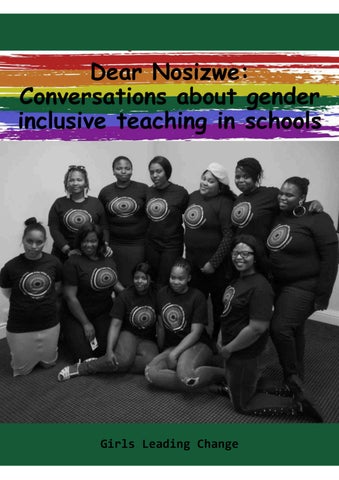
Dear Nosizwe: Conversations about gender inclusive teaching in schools

Girls Leading Change

Sandisiwe Gaiza, Zethu Jiyana, Melissa Lufele, Thina Kamnqa, Zamahlubi Mabhengu, Bongiwe Maome, Asisipho Mntonga, Takatso Mohlomi, Happy Mthethwa, Elethu Ntsethe, Zikhona Tshiwula

Copyright (2019). Networks4Change

All rights reserved. No part of this book may be used or reproduced whatsoever without written permission except in the case of brief quotations embodied in critical articles, reviews, and academic publications.

For information, contact Naydene de Lange at naydene.delange@mandela.ac.za

ISBN: 978-1-928472-16-2

Published by: Networks4Change

Printed by: Networks4Change

Special contributors:

Cover design: Naydene de Lange

Layout design: Vimbiso Okafor

Language editor: Fran Saunders

Acknowledgement (funders)

Nelson Mandela University

University of KwaZulu-Natal

Social Sciences and Humanities Research Council

International Development Research Centre

1

Introduction

GirlsLeading ChangeasNewTeachers

It excites me to think about the calibre of young academics professionals, conscious and proactive citizens of the world that this project 1 has groomed, and is grooming, over the years. … In South Africa, we have 13 young Indigenous African teachers who are beginning their teaching careers in schools across the country. In these schools, they have the opportunity to educate and inspire girls and boys in their classrooms to become active agents in effecting social change in their schools and communities. (Bongi Maome, 2018, p.271).

We wondered how these indigenous African female teachers, at the start of their careers were taking up opportunities in their classrooms to effect positive social change. We wondered how we might draw together their collective learnings over the many years as Girls Leading Change in the Networks4Change project, and create a tool to clarify for themselves how they identify opportunities, and to encourage other young teachers to also be

1 Networks4Change

4

agents of social change. To this end we, Relebohile Moletsane and Naydene de Lange, invited the Girls Leading Change to a two-day biographical letter writing retreat in Port Elizabeth in September 2018. Eleven of them were able to take up the invitation: Zethu, Melissa, Bongiwe, Asisipho, Happy, Zama, Thina, Sandisiwe, Zikhona, Takatso and Elethu.

It was a happy reunion for all of us, having not seen each other for quite a while. We wanted to hear about their ‘lives’ as new teachers and so did circle work for the sharing of lived experiences. We were also keen to explore what differences participating in and engaging in the project, Networks for Change, had made. Using the prompt: What I wish I had known about gender as a first-year student entering university, we invited them to use drawings to reflect on their lives, looking back and looking forward. Each one explained her drawing which elicited further discussion by the group. We then gave them a second prompt: What I, as a new teacher, would like to teach young African girls about gender in my school in preparation for university, and asked them to also respond to this prompt with drawings. The participants then used the ideas which emerged from the two drawings to craft a letter to young teachers focusing on:

• What I wish I was told about gender as a young African woman entering university.

PAGE 5

• What I, as a new teacher, hope to or are teaching young African girls in my school about gender to prepare them for life at university.

Once the first draft was ready, they read their letters to each other and then to the whole group. The comments from the group sparked revisions to ensure clarity of the message put across. Once done, like with the previous books they had written, we wanted them to suggest a title for the book. Here too we followed a democratic process with each providing a title, followed by ‘voting’ using self-adhesive dots. With a bit of rejigging, the participants concluded that a suitable title would be, ‘Dear Nosizwe: Conversations about gender inclusive teaching in schools.’ Nosizwe (or mother of the nation), was the name chosen to reflect the importance of teachers in society, especially in the fight for gender equality and the eradication of gender-based violence in and around schools. After the retreat Bongi reflected: The retreat offered us a refreshing outlook on being new teachers and feminists; it provided us with a platform to motivate one another and help each other solve problems and overcome challenges that we experience in the rural and township schools that we teach in. We challenged one another to re-visit and re-evaluate our own education as indigenous African girls and from that, we challenged one another to keep working towards being the generation of women and educators that teach differently - more holistically.

The most important take-away from the retreat was that education is a social activity and with society forever changing through the efforts of activists in their various areas of social interest, there is no reason why the education of young rural girls should remain the same. Therefore, as young teachers, it was and is crucial that we recognise our position in facilitating the evolution of the education of young African children.

This book is offered as a reminder to all of us to continue working towards making a difference!

Naydene and Relebohile

Reference

Maome, B. (2018). How we see it: what can girls and young women learn from national and transnational dialogue about sexual violence? In Mitchell, C. & Moletsane, R. Disrupting

Shameful Legacies. Girls and young women speak back through the arts to address sexual violence. Leiden, NL: Brill.

Figure 1. Re-defining myself

9

Figure 2. Thinking …

Dear Educators,

I am writing this letter out of curiosity and concern about how we could develop girls who are critical thinkers, and to make sure that they stay motivated and resilient. The purpose of this letter is to give my insights into how we can ensure that gender-based violence is addressed in schools and communities, and that girls have a better understanding thereof. The main question for me is: How do we move from here to a better future? How do we stay relevant in changing times? I seek to understand effective ways of developing girls and to be part of their transformation.

Looking back at my own schooling, I wish I was told that despite my disadvantaged background and community, I could re-define myself through developing my own identity and values. I always told myself to dream big, but not too big for it to be impossible to accomplish the dream. I limited myself in terms of what I wanted and how to get it. In other words, I remained in my comfort zone. I wish I was told at the time that my voice was a powerful tool. I wish I was told not to be submissive, and to learn to say ‘no’; I was raised in a home where you could not say ‘no’ to an elder, and was taught not to question but to do what was asked.

I had no knowledge or information about gender-based violence. However, I went to university and became educated through reading and accessing information about what was happening in my surroundings. Further reading and dialogues with others have given me much more knowledge and I now have a clear idea about gender inequality which is still a huge issue in the South African school context.

Educators, how do we create a world filled with critical thinkers?

In my own classroom, I start by educating girls about gender, encouraging them to read books and articles, and making use of technology. We also need to involve parents and the community. In our communication with the community members we should embrace multilingualism, and integrate one of the African languages which is dominant in the community. It is also important for a facilitator to allow learners to do their own research and to engage in discussions rather than being the only source of information. It is important to educate girls about their gender rights and responsibilities, to avoid favouritism, and to promote inclusive education.

To conclude, teachers should choose the right words to use and build on learners’ prior knowledge. We want a world where girls are spiritually, physically and mentally free. We can be the change

11

Warm regards, Sandisiwe

PAGE 12 we want. Change does not happen overnight, but together we can do it.

3. A community United

Figure
Figure 4. Gender Equality

Dear new teacher,

I am writing to you because of some issues I struggled with being an African girl at school. We live in a time of gender violence and gender insensitivity which leads to loss of lives, loss of confidence, lack of identity and even suicide - all because we do not have sufficient understanding of gender and gender issues. Some of the reasons for this include societal norms, and cultural and religious beliefs. Today I would like to share with you what I wish I was told about gender before I went to university. I wish to share what I teach and intend to teach differently with regard to gender to better prepare my learners for university and for life after school. I also wish to share my ideas on how we can change the situation for the girls we teach today.

As a young girl I wish I was told that I had the right to make my own decisions about what I wanted for myself. I wish I was told to think critically about culture and religion, and to choose what I wanted to believe in. I wish I was told that I, and only I, own my body and that no one has a right to my body without my consent. I wish I knew my rights as a girl and where to go if I experienced injustice. If I and many other girls knew all this, maybe the girl who committed suicide would still be alive; maybe the girl who got raped by her uncle would have received support

15

16 and protection; maybe the girl who got raped because of her sexual orientation would have known it was not her fault and that it was a reportable crime; maybe more girls would support and protect one another instead of judging each other. I wish I was told that I was free to dream big and that I had equal rights to men. I wish I knew that I, as an African girl, did not have to be obedient to men which violates my rights - all in the name of ‘respect’ for men. I wish I lived in a society that is not patriarchal. I wish we had effective judicial services that protect the rights of girls and women. I wish I knew more about gender and was more gender sensitive and inclusive. I wish I knew that women have the right to follow their dreams and that we can redefine womanhood and not be limited or marginalised by societal or cultural expectations. I wish I was taught more about the role of women and their impact in freeing South Africa from apartheid. I wish I was taught about the resistance and resilience of women all over the world who have contributed to my having rights as a woman today. I wish I was told that we are all equal and have equal rights and that no one is ever superior to another.

As an African teacher I already take any opportunity in class to teach about gender. I remember an instance in my class where I was giving a task to one of my learners, and asked the learner how he preferred to be referred to in terms of gender. The other

learners accused me of promoting transgenderism and lesbianism. I had to enlighten them further about gender and sexual orientation and told them how I too had been stereotypic in my approach to such issues, but that through a Social Justice project called Networks4Change at my former university, my eyes were opened. It has not been easy for my learners to unlearn what they have been told about sexual orientation, but my testimony made a big difference. I am also teaching the importance of consent. Consent is everything and this is what I will continually teach. What I intend to further teach differently about gender is that we are all equal and have equal rights. I will teach my learners not to judge but to be supportive of one another. I intend to teach girls that being raped is never their fault. I want to teach them never to feel accountable for men’s bad behaviour. I hope they will understand when I tell them that protecting an abuser and staying with them is not being strong, but supports the abuse. I want to teach them independence so that they never have to stay in an abusive situation. I want them to know they have a voice and they can use their voice to change their lives and change the world.

All this I will accomplish by engaging them in book reading, and sharing knowledge and stories about resistance and the resilience

of women. I plan to engage them in research. I plan to teach them how to responsibly use the media to address issues of genderbased violence. I plan to engage the girls in dialogue about gender not just among each other and myself, but also with the community, social development and protection services. A community united will not be defeated.

As women we should speak with one voice to address issues of inequality and injustice, and work together towards a better world for girls and the nation; a nation in which women know their rights and are safe in their spaces; a nation where women have a voice and can stand and speak boldly on any platform without fear of being discriminated against because of their gender; a nation where one has the right to think critically about culture and choose cultural roles and actions one wishes to follow; a nation that promotes equity, equality and inclusivity for all. All of this is possible with young teachers such as myself, and you. We have so much influence on the future of this land; let us use it to make girls safer, more comfortable and happier. Together we can!

Yours

18

5. Different shades of discovery

Figure

20

Figure 6. A box of connected tools

Dear Teachers of the 21st Century,

It was the year 2012 just after the June recess, and I was in my Grade 12 year in school. We always had visitors at school, but this day was not just any visit, for me it was a life changing visit. I remember looking behind me and to find that I was the only person standing when the lady from the bursary scheme asked boldly, "Who amongst you want to pursue a career as an educator after school?" In a room of +- 60 learners, I was the only one brave enough to choose teaching as a career!

You are probably asking yourself, why I am telling you this. Well, just like you, I chose this career because I could not see myself doing anything other than teaching and touching lives every day. So today I have decided to dedicate this letter to young teachers like myself and share with you what I call a “Box of connected tools” to help ourselves and generations to come to tackle the big elephants in the room called gender, gender-based violence and our roles as teachers in equipping young minds for the journey ahead. This is my gift to you and it is my sincere wish for you to

one day pass this baton on to other young girls so that unlike us, they may be prepared for this cruel world.

Imagine walking into a strange, pitch dark room, blindfolded, and the room is without any source of light. Your mind is racing, you are curious and just then the blindfold is removed and a voice asks you to find your way out. It sounds like an impossible task, right? Well, that is how I felt when I first went to University. I had my own set of preconceived notions of how I had to act and what I had to become to fit in, but no set plan to help me navigate my way on this journey and I felt trapped and backed into a corner.

This made me think, what if my teachers had told me about this new big world I was entering? What if they had warned me about all the insecurities that would arise in me in this new place and that it would be okay to embrace them as long as they did not take anything away from who I was. I wish I knew that my sense of worth did not need to be validated by my peers or societal standards, and that it was okay to be unique and embrace my differences. I wish

22

someone had told me that as an African woman I would be forbidden in certain spaces because of patriarchal and traditionalist views that still dominate the majority of spaces we desire. At least this would have given me a chance to think of solutions because for me giving up was and is never an option. I wish I knew how powerful a voice I had, a voice that could break down the invisible walls of my inferiority complex, a voice so sharp it forces men into an uncomfortable place, a space so uncomfortable it urges them to initiate change and to face the brutal acts of injustice against women and children. I wish I knew how powerful I was, how powerful we are as women, because maybe then, just maybe, I would have broken out of my shell sooner.

Do you ever ask yourself these questions? Well, here is another one for you. What are you going to do to prepare your learners for the journey ahead? Let me introduce you to my “Box of Connected Tools.” See, through our experiences as underprepared students during our varsity years we gained knowledge, learnt survival tricks, adapted, and emerged victorious. Today we are teachers assigned the difficult task of preparing the future leaders of this country.

23

It seems impossible, but believe me dear teacher, when I tell you it is doable. Do you know why? Your experiences will be your box of connected tools.

I use and share my tools by first creating a space where my learners can exist freely and honestly; this is an environment free from prejudice or judgment, an environment of open communication where we share information, learn from each other, create together, grow simultaneously, and prepare for the unknown tomorrow. I narrowed it down to a few principles which have always been my supporting pillars: Family, Values and Spirituality. From these emerge two important concepts "Live" and "Do not forget". My experiences have taught me to live limitlessly and fully, using opportunities as a chance to learn. In all of this I also took a vow never to forget who I was, where I came from and where I wanted to go. This helped shape my focus. I share this tool with my learners in a manner that is not indoctrinating but one that suggests "This has worked for me now let us find one that will work for you."

24

My box teaches the power of voice as a connecting component. This voice is responsible; it adapts but does not conform, it seeks information and it learns every day. This voice fights to gain entry into patriarchal spaces, it speaks against injustice and the broader scope of gender-based violence, the construction of gender identities, and our perceptions of gender. This voice is not apologetic about its struggles and triumphs; it embraces differences in the midst of other different and unique voices. This voice in us, our learners, and our communities, it produces new knowledge and shares this knowledge whilst opening avenues for growth and evolution. Finally, this newly created creature with a bold voice in us and our girls connects to a network, extends a hand, and offers a lifeline to a fellow sister in need, lighting a new candle that will continue to light up and brighten the whole country.

My experiences have crafted my tools, making them personal. This means that your experiences will shape your own connected tools. Use them, share them with your learners and communities. It has been a humbling experience sharing with you my gift, the gift that keeps on

25

giving because I believe even when we cease to exist, our differently connected tools will keep connecting generations and generations to come.

I want you to remember that we have been selected amongst many others to carry out this tremendous task - the task of preparing young minds. It will require us to be patient, available, to love more, to be conscious and curious. Above all, the task will demand that we nurture our girls until they can stand on their own. I know you can do it because you, dear colleague, are powerful beyond measure.

Your colleague, Melissa Lufele

Figure 7. How to stand up for myself
Figure 8. Young girls raising awareness

Dear new teachers,

I am writing to you about gender-based violence, but firstly I will explain to you how I understand it. Gender-based violence involves men and women where the female is usually the target. It is derived from unequal power relationships between men and women and it includes, among others, marital rape, sexual violence or sexual abuse. I choose to write about this topic because it is a challenge that many South African women are facing. So, basically, I am striving to stop gender-based violence, because it is killing many South Africans, particularly girls and women.

What I wish was told about gender-based violence before entering university, is how to say ‘no’ when someone is manipulating or deceiving me. I wish I knew how to stand up for myself, not to be scared to speak out and to make my voice heard. Perhaps if I knew how to stand up for myself, I would not have become pregnant at a young age. I would have fought if I had to, and I would have said no. I wish I had the knowledge that I have gained from participating in the Girls Leading Change project, because if I knew then what I know now, I would have tried to do things differently.

As a new teacher, I intend to teach young African girls to speak out about the challenges they face and not to be silent about what they believe is right. I intend to convince or encourage them to not be afraid to engage or join social talks or societies concerned with gender-based violence. For instance, if there is a march against gender-based violence or dialogue, I will encourage them to join, because they might get help, and can gain more knowledge about things that they do not know. For example, when I was invited to join the Girls Leading Change project as an activist, I grabbed the opportunity to fight against gender-based violence. As a result, I have gained knowledge about things I did not know, I now know how to make my voice heard, and I now know how to stand up for what I believe is right for myself.

I believe it is important to educate girls at an early age about gender-based violence so that they do not make the same mistakes I made.

Yours

Thina

Figure 9. Women’s Stories

Figure 10. Towards love and equality

11. Values of Peace

Figure

Dear African Educators,

I am writing to you from the pain of witnessing the ill-treatment of young African girls at places meant to be their safe spaces. As a new teacher I am concerned about the increase in the statistics on the violation of girls’ bodies by people they trust most. I am writing to you to share my experiences around the issue of gender as I grew up, in the hope that my narratives will sharpen and strengthen your understanding of gender-based violence in Africa. In this letter I will discuss some of the issues related to gender that I wish I knew before I went to university. Finally, I will also share with you the teaching approaches and practices which I use and intend to use in my classroom to ensure a gender inclusive environment.

What I wish I had known about gender at school is how to love and appreciate myself as a woman, before looking at differences. I wish my parents and teachers were brave enough to tell me that we are all equal and that gender does not determine our abilities and potential. I struggled with my self-concept because I was not in a community where, as a child I was embraced, reminded how special I was, or how loved and worthy I was. Instead, my community focused on negative aspects; on what was not valuable or appealing to them. I wish I knew that I

34

was responsible for my happiness, actions and future. I wish I knew that it was alright to take calculated risks or make mistakes in my attempts to find my talents and potential - without having to worry about failure and what my community or other people were going to say. I wish there was a support system from school or my educators to assist us as young girls in discovering our abilities, talents and potential, which is totally different from academic achievements. I wish I was told that a young woman’s voice matters. I wish I knew how to use the resources available to me to create solutions to social challenges such as gender violence. I wish I knew how to use our language to voice concerns, to raise questions or to narrate stories in a way that makes us proud of the stories.

With that being said I believe it is our role as educators to view young African girls as brave and special. We, as young educators, can achieve that by viewing or treating them as equal to other genders. I think it is important for educators to teach young girls how to build their self-esteem from a young age and to feel bold, strong, and motivated.

I would suggest that we teach young girls the importance of consent, the need to be comfortable with saying ‘No’ and to know that no one should determine what is right for them. I think that

35

teaching learners about the culture of asking questions can begin in our classrooms while we discuss topics they are comfortable with, and then we can move on to topics that are regarded as taboo but which impact our society.

Educators, it is our role to teach our young girls how to embrace each other instead of teaching them to compete or divide and group them into classes. It is also important to teach them how to use the available resources to find their voices through their different abilities, experiences and the talents they have. We also need to guide them on how to reflect on their past experiences, through sharing our own experiences and telling them what we learnt from our experiences and allowing them to draw strength and choose what they want to take from our experiences, instead of determining for them what to look for. This is what is important. I see us as a generation of educators who will encourage girls to invest their energy in developing themselves through reading, working towards their dreams, and empowering them with financial literacy skills because I believe most women are abused in terms of finances. For example, if we are talking about the issue of ‘sugar daddies,’ most girls are exploited in that way because they are not financially aware and have no skills for making money, and thus may look for shortcuts that may damage their future.

In conclusion, the solution to the challenge of gender-based violence is within us. We need to use what we have, our abilities, our talents, and our skills to change the world. I believe we can break this culture of silence by collaborating and sharing our ideas and experiences.

Zama

Bongiwe

12. #Unlearning & Uncovering & Discovery

Figure

Figure 13. Balanced Equation

My dearest colleague Nosizwe,

Until this very moment, I would never have thought that I would be addressing you using this medium. I mean, what is the appropriate language that one can use to address pioneers such as yourself, selfless people who have taken on the magnificent task of developing young minds, especially in the village communities that we come from?

As a product of various social and economic backgrounds in South Africa, I too, have experienced life as a young female learner in the rural parts of the country. I too, have been affected by systems and practices that sought to oppress and indoctrinate my young mind into a culture of unchallenged conformism. I too, have been raised to accept that my body, identity and entire being was not my own; that I was all but a tenant in my own body and the complete ownership of it was privileged to another. As a young female learner in our overcrowded classrooms, I too, have experienced neglect, rejection, and a constant struggle for the attention of and validation by my teachers. I know what it feels like to disappear into the crowd. I too, know how it feels to be a faceless number - to be completely anonymous and deprived of the knowledge and support that I desperately needed.

And now, I write to you as a teacher, much like yourself, who has taken it upon herself to enrich, enhance and re-imagine the experiences and realities of young women in rural communities. So, how do we, both you and I, use education to develop a new young girl who is critical, non-conforming and evolving, a young girl who flourishes beyond the levels of adversity that surround her within and beyond her rural home? Dearest colleague, you and I, have a very profound task ahead of us.

The history of our country and the current socio-economic status within our rural communities force us to acknowledge the pervasive relationship that poverty and gender-based violence have with one another, and the additional strain that this relationship places on how we learn and teach. The extent of the impact of these issues of course varies from child to child. However, as a rural girl myself, I have learned that the impact on young rural girls is two-fold: in addition to contending with poverty and other societal issues, a girl is also confronted with violence, deprivation, misogyny, marginalisation and oppression on the basis of her gender. Therefore, you and I both need to use our conscience, consideration and resources towards guiding the young women in our classrooms to overcome the plethora of challenges that they are confronted with at home, in their communities, at school and in the various other spaces that they

42 occupy. We need to be mindful of their individual journeys, respect their journeys and where we can, equip them with the tools necessary to enrich and enhance their journeys. Beloved colleague, we both know the difficulties that these young women are going through, as we have gone and are still going through them ourselves. We have also been taught to surrender our individuality, freedom and sexuality, no questions asked; yet through education, we have been empowered to overcome this. And so, disregarding the wealth of knowledge that our experiences have afforded us would be indicative of us discrediting the humanness and lived experiences of the young women whom we teach.

I wish I had known then that an educator can be a source of comfort and support to her learners. I wish I had known that an educator can be someone who cares for her learners beyond the academics. I wish I had known that in addition to teaching core subjects, a teacher can connect with learners on a human level without censorship or judgement. And so, I wish you and I could become the sort of teacher that we so desperately needed. Let us be the generation of teachers who create safe spaces in our classrooms where young women are able to discover themselves, express themselves, redefine and reposition themselves within the spaces that they occupy, outside of the confines of gender and the

roles assigned to them on the basis thereof by society. Dearest colleague, I challenge us to be the sort of educators who make ourselves available to listen to and learn from one another and from our learners. I challenge us to use our experiences to guide a new, self-determined generation of rural young women and men who actively seek justice for themselves and for others like themselves.

I challenge you and I to be the generation of teachers who does right for the rural child.

Yours,

43

Figure 14. Not knowing is not seeing

Figure 15. Becoming a part of the solution

Dear Nosizwe,

I hope this letter finds you well. It is always good to have opportunities to communicate openly with you about anything at any time. I received the letter you sent me about issues of genderbased violence. It really pierced my heart to hear the bad news that one of your learners has been sexually abused. I felt the need to respond to you more quickly, so that you can know that you are not alone. As young African women teachers we need to work together to address sexual violence and achieve the greater outcome which is to enrich the minds and lives of our learners. I feel that teaching is very important as it is the mother of all professions.

I would like to share my views that teaching should not be draining and need not be a demotivating job. It should be an opportunity for discovery where minds are free and without fear, and where knowledge is freely shared. Speaking of being free, I would like to share my own experiences about what it was like to be a young African girl at school and reflect on what I was told and not told about gender before I came to university. I would also like to share my thoughts about teaching learners differently about gender and preparing them to go university and for life in general.

The way we are suffering as young women in the teaching field is close to my heart and so I write you this letter and try to converse with you, pouring my heart out and saying that I am with you. I remember those dark days, when we were not told what we wanted to know. I now sit and wonder how things could have been. I so wish I knew that change is a continuous process and that it only needs someone to be ready for it. Change is a good thing since it happens as maturing or growth takes place. In saying that, what I used to like as a young girl and thought was good, suddenly became less interesting as I grew older, looking at what is happening in and around schools with gender-based violence.

I wish I was told that gender-based violence continues because we allow it to happen through giving excuses in the name of old traditions and cultural practices, that “it is the way things are”.

I wish I was told that we are ONE, no matter your race, culture, or religion. We may be different in many ways but we are human beings; that fact remains. My drawing shows a six and a nine (6 and 9); they look similar in shape, both are numbers, but they are different. My drawing represents what I wished I was told about gender before I came to university. This is also to say who you are is the best you can be, and everyone is the best version of themselves, simply because they are who they are. I wish I was told that making assumptions can be very dangerous. Making

assumptions can be very dangerous just like the saying, “little knowledge is very dangerous”. Looking back at what I was told about so many things - such as that going to university was for rich individuals - I realise that most of it was not true.

I did not know that when assumptions are made about people or things they turn to form ‘true lies’. The ‘lies’ about who we are as women include that we are weak, fragile and dependent on men, and these become truths that we believe. I also realised that these assumptions come from stereotypic points of view influenced by culture and patriarchal systems that we find ourselves stuck with.

I wish I was told that talking about sexuality (women’s sexuality) is not taboo. It could have been a topic to be embraced and learned about. I wish I had been equipped with the necessary knowledge and information to build me up as a young African woman. I wish I was taught how to be me, without feeling threatened by what people think of me. It does not matter what other people think about me, but that what I think about myself is more important.

There is a poem titled “Sometimes we are what we think we are” by Valerene M. In this poem she speaks about her thoughts, good and bad. She terms the bad thoughts ‘stinking thinking’. From the poem I learnt that negative energy is caused by many things, but

how you deal with it entirely depends on you. Oh, how I wish I was told all that before I entered university! Maybe my life would have been different. I wish I was told that knowledge is power and without it, is like being blind. Having sight/vision does not only mean eyes but knowledge that can be used to help. In my drawing I have also used a blind-folded bird and the face of a boy without eyes in order to show that I believe that not knowing is like being blind. I wish I was told that life without making your own choices is a borrowed life of false dreams. I wish I was told about women’s history (herstory), that we are human beings with so much capability just as men are. I wish I was told that gender is part of life and forms part of your identity and that it does not have to be taken away from you or make you feel any less of a human being. We do not ask for our gender or being, but we are given it so that we can become who we are meant to be.

Now that I have seen some of the things happening to me and around me, I feel like I am in a new generation that says now that I know, things will never be the same again. Every day I strive to do better and ensure that young people do not go through what I went through. There are things I intend to teach differently about gender to better prepare learners for university in order help them not to repeat the same mistakes and to live freely. The first thing to do is to have or try to create platforms where young

girls and boys will be able to talk about issues such as genderbased violence, drugs and other challenges without being afraid. It is also important for me as young a teacher to know and realise that dialogue is an essential part of learning. Children at school need to be allowed to dialogue, and I should create safe spaces for them to express themselves and learn that everybody’s opinion matters.

It will be of great benefit as a young teacher to also encourage learners to read, to instil a culture of learning, and to tell them that in everyone there is power and purpose - these things are already given to us, it is just a matter of discovering them through various experiences. Boosting young girls’ self-esteem can be achieved by allowing them to become part of the solution, and not excluding them. It is important to make my learners feel appreciated, loved and part of the solution, for example being open to their ideas, being willing to listen and consider every opinion before making decisions.

I would like to work together with learners to be able to sing a song in one accord: “No to gender-based violence against women and children!”, and to focus on self-love and discipline. I, as a young teacher intend to work together with teachers, learners, and parents to make a difference. As a young woman teacher, I need

to recognise and appreciate the equality amongst ourselves. As a young woman teacher, I would like to motivate learners to know that within the circles - the places where we are at - we can make a difference.

I hope I have drawn you a full picture of what goes on in my mind and that what I wrote here will give you courage and strength to stand tall and bring about change. Words are easy to say but actions speak louder than words. In every lesson we teach in our classes we must not forget the lesson about hope, because without it we are doomed. Women are the spears of the nation and can make the flags of beauty and pride fly higher!

Yours

Figure 16. Gender Prep 4 University

Takatso

Figure 17. Informed

Dear New Teachers,

You shape minds, in your hands you have power to create a better and brighter future for all. I believe there is no greater remedy than that of healing minds. However, I would like to draw something to your attention. It has become common in our communities to see young South African girls being brutally violated and then silenced into seeing violence as the norm. A Sesotho proverb says: Bomme ba tshwara thipa ka bohaleng (Women/mothers hold the knife by its sharp side). I believe it is through such idioms that young powerful girls are silenced and their power taken away from them. I would like to invite you to join me as I walk on a journey of sharing ideas about how we can join hands and act against gender-based violence.

I hope this will be a journey which enlightens our perspectives on how we view gender-based violence. I have come to see how the patriarchal society we live in has twisted a lot of concepts around gender-based issues. As a young South African teacher I would like to walk with you as the beauty of this journey unfolds.

What I wish I was told about gender-based violence before going to university is the importance of awareness. It is always exciting and fun to enter new spaces especially when going to university. I

have realised how harmful it could be for one to go anywhere without being informed about gender-based violence in particular.

I wish I was equipped with information before I came to university. Had I known, I would not have been deceived by prejudice against the roles of young South African women. As illustrated in my drawing, if I had been informed, I would have been able to see things from a bird’s eye view. I would have been able to stand my ground and own my space, to be confident and embrace who I truly am without the fear of what others might think of me.

Had I known the power of women and their true essential role, I would have been free to fly like a bee, which, as small as it is, has an important role in life. It pollinates plants so they can reproduce and give us food. With the right information, I would have been able to be an activist of change even from a young age. That knowledge would have given me freedom of mind, confidence to walk tall, to use my voice, and to take information from one source to another. This might have helped to pollinate other young girls’ minds until they mature and can stand firm.

55

However, it is never too late to mend. It is through our lived experiences on our journey that we reflect and learn to see what it is that we can still do better. Also, it is through these that we learn to appreciate even the simplest things in life. For example, I wish I was told that it is through the heart of a willing teacher that we can correct the past. As much as we cannot go back to our own experiences, we can help transform and reshape the future of the young South African girls.

We do not have to be sophisticated to do it right. Maybe we can start with things as simple as creating personality workshops in our respective schools. In these personality workshops we could use simple things that learners can relate to. For example, using something as simple as an egg to learn from. We can encourage the young girls to stand strong in the face of adversity, but always to come back to their comfortable and safe spaces and be soft as an egg yolk. This is in spaces where they can open up and share their different experiences to motivate and or educate each other. We should enable them to empower and hatch themselves with developmental and constructive information regarding genderbased violence. They can then mature into adults who can take a stand and have a sense of agency.

Bearing in mind that our aim is not to turn them into impetuous and emotionless beings, we should empower them to live their lives colourfully and with no regrets. They should allow themselves to live and experience life. Experience is the best teacher. We can challenge them to be in spaces that will allow them developmental changes. We can motivate them to emerge and evolve, but mostly empower them to never forget to glow in all they do.

In conclusion, if there is one thing to be grateful for as a teacher, it is that we have the power to change the whole world right in our own hands. My idea and the sincerity of this letter may sound all easy and doable in black and white, but the reality is, it can never be a reality unless we act it out. This is where I need you, South African teachers and your friends. We can do this. Nelson Mandela said, “It all seems impossible until it is done.” This letter on its own can achieve very little, but together we can achieve a great deal!

Figure 18. Rise and Educate

Figure 19. Rights and Voice

Dear Mbokodo,

Growing up in an unsafe society cluttered with gender inequality leads us to knowing our self-worth and identity. I am writing this letter to you as an African woman teacher who is concerned about the future of young African girls. I will not allow the experiences that I went through to be experienced by the young girls coming after me. I wish for them to be free, to appreciate and know their worth, and to understand issues relating to gender equity and roles. In this letter I write about the issues I wish I was informed and educated about before I went to University. Furthermore, I share how I intend to teach differently regarding gender to better prepare my learners for life after school. It is time that we as young African women teachers took a stand against gender-based violence and create safer, inclusive environments for our young girls.

Through experiences we learn, and I am grateful for the journey I went through. However, I wish that in the foundation phase in school and by my family, I had been encouraged to appreciate and love myself. I cannot recall any time I was told at school and at home, how special and beautiful I was. I wish that back in primary school someone had helped me to realise my potential and bring out the best of my abilities. Maybe I would, at an early age, have

developed the skill to cultivate a voice. I wish someone had reminded me of who I was at that early age and walked me through gaining knowledge about gender-based violence. I wish back in high school I had been equipped with skills on how to deal and tackle issues of gender as a young girl. I wish that at high school they had created platforms where we were given the opportunity to talk about gender-based violence, to exchange views, and to come up with solutions that could protect us and also help us to relate to the present context.

I wish I had been reminded numerous times, as I grew up, that one can redefine oneself and set boundaries based on what one feels is appropriate and right. I wish as I grew older my family had continuously reminded me that happiness begins within myself and that I should assess whether my actions connected with my identity.

As a young informed African teacher, I intend to continuously educate myself, participate in events that relate to addressing gender-based violence, and take initiative in such events. I intend to continuously motivate my young learners to rise above all odds regardless of any situation, to learn how to stand up for themselves, to have confidence and to strongly voice what they feel is right for them. I intend to create a space and platforms

where learners, including myself, have open discussions on issues relating to gender-based violence. I intend to enable every learner, including the shy ones, to voice their opinions. This is to ensure that everyone develops a voice and confidence. I, continually throughout the year, intend to remind everyone in the class that everyone is special and unique, and encourage them to respect each other’s differences with the aim that when they get to University they will not change to try to fit in, but rather accept themselves as they are.

I am proud of the initiative I took at my school where I teach, namely addressing issues of gender-based violence. My school is in a deep rural community where most learners rely on public transport, so it makes it difficult to create time after school for any kind of dialogue. What I however ensure I do, within the timeframe of the periods, is to use ten minutes or even more to say to the learners, let us drop everything and talk about issues relating to gender-based violence. With the learners we define what gender-based violence is. If they are comfortable, I allow them to share instances where they have experienced genderbased violence and around these instances we come up with solutions. This is to ensure that learners are equipped with the knowledge on how to deal with a situation if it happens to them one day. It is amazing how eager the learners are to find out and

learn. I ensure that a month does not pass by without me creating space in my classroom to discuss gender-based violence.

I think life is not about finding yourself, rather life is about creating yourself. It is very important that as young and wellinformed educators we instil in our girls the belief that they have the right to create their lives the way they feel pressed to do. It is time we took a stand against gender-based violence and create a safer and inclusive environment for our young girls. Every opportunity we get should be used wisely to educate them about gender-based violence.

With love

Figure 20. Care and Share

Figure 21. Information

Dear young and marginalised teachers,

I am writing to you about my lived experiences as an African woman who teaches from the margins. The world of the policymaker is privileged and the lived world of us teachers is positioned on the margins. The way our programmes are planned and rushed scares our young girls and drives them out of the education gates into the hands of the perpetrators of violence who devalue and mislead them. The forces from the outside are much stronger than I as a young teacher can say. The voice of the teacher and the art of teaching are being challenged and prescribed like medication. Who would not take medication to feel better? No one, right!? However, how come we have people who default and rather face the increased side effects and symptoms? I am concerned about the young and innocent lives that we drive into the clutches of gender-based violence and substance abuse because of our failure to adapt to change and rise to the needs of today. My concern deepens as we are made to miss the chance to share our experiences about the societal issues that our learners face every day. This is my letter to

you and I can only hope its message reaches the young girls in our classrooms.

Blood has been shed, lives have been lost and spirits have been broken. Yet these facts have not made it into the news media. Being a girl in Africa comes with a prescribed set of patriarchal rules by which we are meant to live our lives. The storms that have been ongoing for centuries now seem to have matured and are more damaging. Gender-based violence is being passed from generation to generation. It is an inheritance that we embrace when we should not. Would I want my younger sister to relive my experiences and to pass them on to the next generation of girls?

Even after twenty-five years of democracy in South Africa, we feel the effects of the system of apartheid. The way in which our education system is set up for young teachers is limiting. The value of our education has been degraded in many ways. For example, I note the omission of gender education in the curriculum. We are made to believe that it is an abomination to talk about issues of gender and genderbased violence in classrooms. Yet our classrooms have

become war zones on our watch. Our schools have become crime scenes. What do we do? How do we close the gap between the generations? How do we reach out to the oppressed? It is a shame that we must go through what our mothers went through in life. We are never sufficiently prepared to face the challenges of gender-based violence; we accept and live with it because ‘it is meant to happen’. It is as if we grow up to never look back to see how others behind us are doing. In our patriarchal society, gender education and gender-based violence would be included in the curriculum if it affected those who dominate.

I wish I had known that falling down in life is a way of rising up again; becoming stronger than I was before. I wish I had known how to stand my ground and never give in. I wish I had been prepared enough not to remain in the shade that is obscuring the hope for marginalised young girls. I wish I had known how to be a better person for the one behind me. I wish I had known that at the end of every storm there is a silver lining. Learning the hard way can have more damaging than productive outcomes.

The reader might wonder why I have so many wishes. The answer is simple; it is because we have been taught to be competitors in life and never to help the next person because they might be using you to better themselves. Does it matter though? I would like to think it matters not, because we all have different paths to walk in life.

Young teachers at schools are labelled ‘unruly’ because they are moving out of their shells. We share our lived experiences with the young girls we meet in our classrooms. Having learnt from other young teachers makes me want to share my journey with the young girls coming in and out of my class. I want to teach my girls to care enough to share their moments with me, be it good or bad. When you are young and uninformed, you get to the front of the door and push it, hoping it will open. The pushing gets you tired. I want my girls to be used to opening doors even when there is no response from the inside. I will teach them to identify their values from a young age and to live by these values. This is because I do not want them to give in to the greed of society. I hope for a generation of girls who know how to stand for what they believe in. I hope for strategic

thinkers who will join forces and move into the centre of the problem and root it out. I want to teach a generation of girls to find their voices from a young age and to give positive input to create a gender equal and free society. I want my young girls to own their voices and open all doors to life. A closed door limits the rays of the light from penetrating in. Once opened, the light will enter and lighten up the room. It is always good to share our lived experiences whenever possible with people who stay behind closed doors for them to see the light. It is only when we share our stories that we can move from the trap of gender-based violence. I wish girls could know that being strong believers of their dreams is right. I hope my girls never sell their dreams to please others, and always dream big and never limit themselves because of the circumstances of today.

In conclusion, I wish to remind you that you do not have to experience violence first-hand to speak out. Sometimes it is right to step in even when the call has not been made. The steps you take allows you to think more critically and have more power because you do not live in fear. You get time to strategise and know when to hit. Break the silence when you

71 are least expected to because it is only then you will be heard. We need to educate our girls to embrace themselves and live by their values. I wish to invite you to a gender just society which we can only reach if you join me because we are stronger when we act together.

Elethu

Figure 22. Together we can

Zikhona
Figure 23. Circles of Change

Dear Young Women Teachers,

I am writing to you because I want to educate, to empower, to give hope and to encourage every young woman to know her own worth, to speak up, and to know her rights. As a very young woman I experienced gender-based violence, and had no idea what it was. I hid behind walls and was ashamed to speak up. I thought everything that was happening to me was right; little did I know that it was abuse in all forms - emotional, verbal, physical and mental. It shifted my perspective of how I saw myself. In this letter I write about what I wish I was told before I went to university and what I as a young woman teacher intend to teach differently about gender so that I can better inform young women about gender-based violence.

What I wish I was told is that I must not be silent, but that I should speak up. That would have made me aware that what was happening to me was wrong. If only I had someone who I could talk to and share what I was going through. I was fortunate to have met a group of young women who were strangers to me at first but became my family when I went to university. I shared my stories and they did not judge me but gave me hope and encouraged me to stand up and speak out. Since then I have

healed emotionally. I have become a stronger person because I had people I could talk to.

I want to encourage young women to become gender activists who will fight for women’s rights. We should unite because if we stand together, we can fight gender-based violence. I intend to teach young women about my own life experiences and those of my peers in the Girls Leading Change project. To do this, I will use stories from our book which is called Fourteen times a woman to better prepare young women for university.

As a young woman it was difficult for me to talk about what I was going through because I feared what people would think of me, what they would say. I suffered from the fear of “Bazakuthini abantu?” (What will people say?). So I want to encourage young women not to fear what the society will say, and to ignore all the negative comments because this will not take you anywhere. I will tell them: You need to be brave and come out of your comfort zone and speak out about gender-based violence since it will make a difference. I also want to educate young women to read more about gender-based violence, and share what they have learnt with other young women.

In conclusion, sharing stories with other women is the most powerful and bravest thing to do because it gives the other person hope and the strength to know which path to take when faced with a similar situation. It also heals you inside, but mostly it inspires other young women to have the courage to speak out. Circles of change start with you. You have to be brave, strong, and know that “No means no”, “Enough is enough” and “Speak up”! “Sizomemeza”. Together we will speak out!

Turn static files into dynamic content formats.
Create a flipbook
Issuu converts static files into: digital portfolios, online yearbooks, online catalogs, digital photo albums and more. Sign up and create your flipbook.