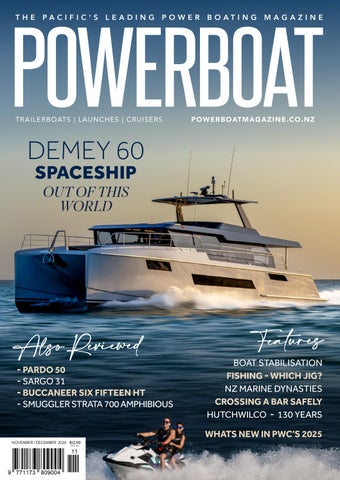
Pacific PowerBoat Nov Dec 2024

Page 1


A LIFE WITHOUT LIMITS

The new M600 Black Edition is the result of Maritimo’s objective to constantly improve even its best-selling models. Our meticulous review of onboard style, comfort, and functionality has led to new elements of elegance and sophistication. All of this is accomplished through the unparalleled engineering and performance that Maritimo yachts are known for. Relentless in our quest for excellence, Maritimo is proud to adorn new models with the striking Black Edition mark. maritimo.com.au

140 SARGO 31

FEATURES REGULARS

64

THE BUILD –WEBER MARINE, GULF HARBOUR

The first in an ongoing series following the design and build of the Elite 22m flybridge motor yacht currently under construction

90 DYNASTIES – PART ONE

A three-part series, exploring both prominent and lesserknown family dynasties in the Marine Industry 106

HUTCHWILCO’S ANNIVERSARY

Hutchwilco celebrates 130 years!

116 PWC NEWS AND NEW MODELS

We check out the latest and greatest in the PWC World for 2025

Bar Crossings – we learn about the ins and outs of safe bar crossings

The wizardry of the whizz versus the play of the paddle. Kyle Barnes delves into the stabiliser universe to answer the question

Which Jig? Mat Hewetson looks at the options

BUYING A TRAILER BOAT

It’s easy to make the right choice, it just takes a little research.

8 & 9

DESIGN FORUM:

Alia Yachts – 45M Superyacht - SAN 10

PUBLISHER’S COMMENT

Summers coming - Marine Industry is alive and kicking

12, 14 & 16

SEEN & ADMIRED

Riviera 6800 Sport Yacht Platinum Edition Aquila 42 Yacht Power Catamaran Fleming F85

News, boats and events

The latest and greatest marine products

Hot new electronics products from some of the world’s leading brands

72

LEARNING TO LAUNCH

Dock Lines – Chafing at the Dock

74

PHIL GILBERT

Two Wheeling – the rise of production Power Cats

76

STRAIGHT FROM THE GALLEY

Derek the Chef prepares Cajun Style Pan Scallops 152

FLETCH’S TIPS

New products for the powerboating world 70 ELECTRONICS COLUMN

Aaron Fletcher shares his tips learned after years of getting it right and getting it wrong

ALIA YACHTS 45M SUPERYACHT – SAN

Alia Yachts is thrilled to announce the world debut of the all-aluminium 45-meter SAN at the 2024 Monaco Yacht Show, which took place in late September. Designed by Sinot Yacht Architecture & Design with naval architecture by Lateral Naval Architects, SAN is a marvel of modern engineering and design. This full custom yacht features a sleek, attractive and innovative design powered by quadruple Volvo IPS drives, ensuring both performance and efficiency.

“It’s projects like SAN that attract the best clients from all over the world, reinforcing our reputation as a leading custom yacht builder.”

SPECIFICATIONS

Length: 45m

GT: 370 GT Yacht

Subtype: Displacement

Guests: 10 in 5 staterooms

Builder: Alia Yachts

Exterior & Interior

Design: Sinot Yacht

Architecture & Design

Naval Architecture:

Lateral Naval Architects

SAN features a fully open main deck extending from the stern to the bow, framed by full-height glass facades and sliding doors both aft and forward. This design offers an unparalleled sense of openness and a seamless connection to the sea. SAN integrates indoor and outdoor spaces harmoniously, allowing for a straight walk from aft to forward and providing panoramic views through the expansive glass around the salon. The exterior deck furniture is multi-functional, adapting perfectly for dining, cocktail settings, and sunbathing, enhancing the versatile and luxurious outdoor living. The aft deck's bulwarks can fold down to expand the sunbathing area, further enhancing the alfresco socialising experience. The lower deck houses four guest cabins and the owner’s stateroom, each tailored to the owner's minimalistic yet richly detailed interior preferences. This elegant accommodation ensures comfort and style, making every voyage an unforgettable experience.

Having successfully completed her sea trials, SAN has been delivered to her owners and is currently crossing the seas. Once the summer season winds down, SAN will be ready for her world premiere at the 2024 Monaco Yacht Show. Gökhan Çelik, President of Alia Yachts, shares his enthusiasm: “SAN is a striking and innovative superyacht that highlights our strengths as a truly custom builder. This project has been a significant milestone for us, showcasing our dedication to crafting superior custom yachts that meet the highest standards of quality and innovation. It's projects like SAN that attract the best clients from all over the world, reinforcing our reputation as a leading custom yacht builder.”

PUBLISHER

Doug Dukeson

D&B Publishing Ltd

EDITORIAL TEAM

Ron Czerniak, Richard Milner, Doug Dukeson, Derek the Chef, Mike Rose, Carla Dukeson, Rebecca Hayter, Phil Gilbert, Aaron Fletcher, Freddy Foote, Peter Morgan, Kyle Barnes

editorial@boatmags.com

+64 9 428 2328

ADVERTISING

New Zealand & Australia

Doug Dukeson

+64 9 428 2328

+64 21 772 202 doug@boatmags.com

Holly Dukeson

+64 21 028 66849 holly@boatmags.com

PRODUCTION

Annabelle Rose Design design@annabellerose.co.nz

Printer: SCG

WEBSITE

Stealth Media Ltd

Gustav Wentzel

+64 21 0201949 info@stealthmedialtd.co.nz

ACCOUNTS accounts@boatmags.com

+64 9 428 2328

CIRCULATION

Are Direct NZ

+64 9 979 3018

Are Direct Aust

+61 2 99728886

SUBSCRIPTIONS

(Printed & Digital) subs@boatmags.com

Pacific PowerBoat is published bi-monthly January, March, May, July, September, November

REGISTERED OFFICE

2 McKenzie Ave, Arkles Bay, Whangaparaoa, Auckland, New Zealand.

POSTAL ADDRESS PO Box 886 Whangaparaoa, Auckland 0930, New Zealand.

POWERBOATMAGAZINE.CO.NZ

COPYRIGHT Pacific PowerBoat incorporates: Propeller and Pacific MotorYacht Magazines. The contents are copyright and may not be reproduced without the written consent of the publisher. Unsolicited editorial material may be submitted. While every care is taken, no responsibility is accepted for material submitted. Opinions expressed by contributors are not necessarily those of Pacific PowerBoat Magazine. All rights reserved.

MARINE INDUSTRY –ALIVE & KICKING PRE SUMMER 2024!

What an eventful couple of months it has been for the marine industry! We’ve seen a flurry of celebrations, especially among New Zealand’s marine community. The highlight was the DMW 50th anniversary, a spectacular event that attracted over 200 industry members, including past and present retailers, suppliers, staff, and friends. It was a pleasure for the Powerboat Magazine team to attend this memorable evening.

About a month later, the excitement continued with two significant events. First, Yamaha hosted a grand celebration in Auckland City to honour Hugh Stewart and his retirement after 43 years of service to the company. The very next night, over 100 guests gathered for the opening of the new 7000 sqm Rayglass Factory during the Rayglass/NZ Marine’s Boating After Five event.

Propspeed proudly celebrated its 25th anniversary, a remarkable milestone reflecting a quarter-century commitment to protecting running gear and underwater metals. Their success is a testament to the dedication of their team (past and present), the trust of their partners, and the loyalty of their customers.

We also celebrated Hutchwilco’s impressive 130th anniversary. This iconic New Zealand company has a rich history dating back to the early 1890s, and you can take a look at their journey on Page 106.

We’re thrilled to introduce the first part of a unique editorial feature in Pacific PowerBoat Magazine, showcasing the complete build process of the new Elite 22m flybridge motor yacht designed by Bill Upfold, currently under construction at Weber Marine in Gulf Harbour, Auckland.

During our travels around the country in the past couple of months, including our visits to the NZ Boat, Fish and Dive Expo in Hamilton, and the Christchurch Outdoor Expo, the atmosphere in the industry has certainly felt more optimistic.

With the recent decrease in the OCR and interest rates and improved business confidence, there is certainly renewed confidence in recreational activities like boating—just in time for summer!

Happy boating!

Doug Dukeson Publisher

The PPB team enjoying the DMW 50th Celebrations
Hugh Stewart, Yamaha Legend
Dean Harris addressing the crowd at the NZ Marine After 5

Be inspired by the exceptional Riviera fleet from 39 to 78 feet in five design collections. Discover a unique synergy of blue water heritage, engineering excellence, innovative design, and supreme luxury. Marvel at smart technology that makes boating easier and more pleasurable. Our world class luxury motor yachts will allow you to create your ultimate boating experience. We invite you to step aboard Riviera today.

RIVIERA 6800 SPORT YACHT PLATINUM EDITION

The Riviera design group in collaboration with superyacht designer, Luca Vallebona, have created the much anticipated 6800 model which has been years in the making and now the new flagship of Riviera’s Sport Yacht Collection. These world-class motor yachts share a design philosophy that embodies

four imperatives: timeless styling, luxurious single-level living, effortless blue-water performance and ease of operation.

Platinum Edition means superior appointments and amenities, greater refinement and luxury, gleaming colour palettes, and aesthetics guaranteed to stand out. Perfect for a long-range adventure or a weekend away, it offers a choice of three or four staterooms and three bathrooms, a crew cabin or utility laundry, a full-height walk-through engine room, and an impressive tender garage devoted to water sports.

Riviera’s 6800 Sport Yacht has so many separate entertaining areas that family groups, friends and couples can all find their own space to enjoy the world around them. Enjoy the sunshine on the forward deck, or entertain on the all-weather aft

deck with a sunroof to invite the sunshine or stars. Relax on one of three lounges in the saloon, also with the luxury of a sunroof. Slide open the saloon door. Then, lower the electric galley window with the push of a button. Now, the aft deck flows into the saloon, creating one grand living and entertaining space with two designer dining areas.

Enjoy even greater boating ease – the Volvo Penta Assisted Docking system is the next generation of marine automation. It simplifies yacht docking and improves control for manoeuvring in tight spaces, making docking easy in challenging conditions.

RIVIERAAUSTRALIA.COM

Look out for the entire boat review coming up in the March/April issue of PowerBoat Magazine.

AQUILA 42 YACHT POWER CATAMARAN

By introducing a smaller Yacht Power Catamaran to the existing lineup, Aquila is able to expand to a wider audience.

The new 42 Yacht Power Catamaran from Aquila is a two-stateroom/twohead yacht with an additional utility cabin with a single berth. A three-cabin/ three-head layout and a four-cabin/threehead version are available. For guests, the yacht features three alfresco entertainment areas serviced by a full galley and wetbar.

The Aquila 42 Yacht Power Catamaran has an LOA of 41’6” (12.64 m), a beam of 21’ (6.4 m) and a draft of 3’7” (1.1 m).

The Aquila 42 Yacht Power Catamaran is equipped with features that will bring a smile to any boater's face—whether they plan on cruising near or far. The 42 Yacht is built to CE Certification Category A and designed by world-renowned power catamaran design firm VPLP Design; this ensures that it is safe and seaworthy. Advanced electronics packages make this boat easy to operate. Engine options from Volvo Penta are both remarkably efficient

and easy to maintain. The mission of the 42 Yacht Power Catamaran is to bring a quality cruising yacht — with the interior space of a much larger yacht — creating a smaller, more affordable introductory version to Aquila’s Yacht model lineup. AQUILABOATS.COM

MAJOR FEATURES

Twin 230-hp or 300-hp Volvo Penta D4 inboard engines

Vinylester Resin-infused construction

Bulbous bows

Planing hull design FRP hardtop

Central steps from the flybridge to the bow provide direct access

FLEMING F85

After hundreds of years of combined experience in designing, building and cruising yachts on the open ocean, Fleming Yachts is delighted to showcase its ultimate cruising yacht. A brand new design from the keel up - the Fleming 85.

Design and Engineering

The renowned naval architects of Norman R Wright and Sons designed the hull to be the most efficient and beautiful semidisplacement hull on the water. Building on their experience, they have extensively used Computational Fluid Dynamics (CFD) software to fine-tune the hull design to ensure it is absolutely the most efficient and has the best possible behavioural characteristics in all sea states. Composite engineers have designed the optimum strength/weight ratio of the vessel, so the robust construction is retained – but is achieved with less weight and is all verified by DNV.

Two versions

Open air – for those who prefer the wind in their hair, the traditional style Fleming open flybridge or Enclosed – The pilothouse

is moved to the upper deck where it is fully enclosed and still fully outfitted like a Fleming pilothouse should be. Down below more space is opened up for flexible dining and entertaining.

Style

Exterior – The lines and the look are unmistakably classic Fleming. Furthermore, the exterior details have been refined and simplified to create a cleaner look with flush and hidden hardware throughout. Interior – Various options from traditional to contemporary. Double glazing as standard throughout.

Interior Layout options

Accommodation A - 3 cabin layout

Accommodation B - 4 cabin layout

Crews quarters A - Twin cabins and crew galley

Crews quarters B - Single cabin and crew galley

Fleming Yachts Mission

To design and build literally the finest possible ocean-going pilothouse motoryacht, in every respect. With true ocean crossing range the Fleming 85 will take you anywhere you want to be in the world, in total comfort, grace and peace of mind.

SPECIFICATIONS

The Ultimate Cruising Yacht

Fleming Yachts represent the point at which adventure and luxury converge. From the efficient performance that offers unmatched range, to the durability of the construction, to the impeccable comfort found throughout our interiors, Fleming is the Ultimate Cruising Yacht.

Learn why at FlemingYachts.com/Research

The new Fleming 85

FROM THE SEA TO THE SHORE:

DMW CELEBRATES THEIR 50 YEARS

It was a spectacular night at DMW's recent 50th anniversary celebration — an extraordinary night for their company and family.

It was great to see so many members of the marine industry in attendance, including DMW's past and present dealers, suppliers, staff, and friends; it was a privilege for the Powerboat Magazine team to attend. DMW celebrated its 50-year history across three generations and over 23,000 trailers. They recognised some of their dealers and manufacturers that have been involved with their brand for a significant amount of time. Rollos Marine, Gulfland Marine, Marine North and Peninsula Marine Ltd were awarded for their long-standing and loyal relationship. Haines Hunter NZ, Senator Boats, Profile Boats and Stabicraft were recognised for their contributions as key manufacturers to the DMW brand. Family Boats was awarded Top Sales for a North Island Dealer for the past decade, along with Bays Boating for the South Island. 2 awards were also given out to Woodbine Marine and Ocean Sports Marine for outstanding growth in sales over the last ten years. The award winners all shared kind words, along with Peter Busfield and Lionel Sands, who presented speeches.

"We would like to thank everyone who made the effort to join us from near and far and for all the congratulatory conversations we received on the night and the messages we have received since. Fifty years for any company is a significant achievement. Still, we are super proud that DMW Trailers has done it and remains owned and operated by our family, and we aim to continue the legacy started by Rollo Dutton 5 decades ago. Thanks to our staff and suppliers who help us make the best boat trailers in NZ. Thanks also to all the retail customers who buy our trailers - you are the reason we do what we do!" commented Brad Dutton, Director, DMW Trailers.

DMWTRAILERS.CO.NZ

LONGHURST FAMILY INDUCTED INTO HALL OF FAME

The Longhurst family was inducted into the 2024 Queensland Business Leaders Hall of Fame at the 15th annual Awards Ceremony held in Brisbane earlier this year.

Tourism, property, and boating entrepreneurs, the Longhurst Family has a proud history of pioneering and innovation that spans over 50 years. Brothers Tony and Rodney Longhurst accepted the accolade on behalf of their family.

Tony is a former racing car driver, two-time winner of the Bathurst 1000, former Australian water skier champion, and is CEO of The Boat Works at Coomera, the world-class boat yard and marina on the Coomera River. Rodney owns Riviera, Australia’s premium luxury motor yacht builder, which builds around 150 yachts annually for the global market. Rivera operates a state-of-the-art facility that is the largest luxury yacht building facility in the southern hemisphere and is located adjacent to The Boat Works. Together, The Boat Works and Riviera own almost 40 hectares of prime riverfront land along the Coomera River, not far from Dreamworld, where their family began their history of investment in the Gold Coast. “Riviera and The Boat Works are a testament to the Longhurst legacy,” says Tony. “We are dedicated to keeping the tradition of building alive – building boats, building infrastructure and creating jobs. I know our father would be proud of us.”

The Business Leaders Hall of Fame was established in 2009 and is a partnership between QUT and the State Library of Queensland recognising outstanding Queensland business leaders for their public contribution to the state’s reputation and economic and social development.

RIVIERAAUSTRALIA.COM

RECENT CELEBRATIONS IN MARINE INDUSTRY

INDUSTRY GATHER FOR HUGH STEWART'S RETIREMENT

After 43 years of dedicated service to Yamaha Motor New Zealand, Hugh Stewart finally retires.

Hugh’s contributions to the industry have been invaluable and will leave an indelible mark on our organisation with a legacy that will endure. In September of this year, Yamaha hosted an industry gathering at the Wynyard Pavilion in Auckland to celebrate Hugh Stewart’s retirement. There was a vast industry turnout.

Executive Director of NZ Marine, Peter Busfield, thanked Hugh for his instrumental role in developing the now-MAST Powerboat Rigging and Powerboat Systems qualifications for rigging and servicing outboard motors. Peter advised the audience that part of Hugh’s legacy is the 150 MAST apprentices enrolled in these qualifications this year and into the future.

Happy retirement, Hugh, from the team at PowerBoat magazine! YAMAHA-MOTOR.COM

HUTCHWILCO CELEBRATES

130 YEARS

Hutchwilco is a prominent New Zealand company with a rich history that dates back to the early 1890s.

Initially, it was founded as a manufacturer of canvas goods, but over time, it evolved into a leading producer of marine safety equipment,particularly lifejackets, a product they are best known for today. We take a trip down memory lane and have a look at an overview of Hutchwilco's history – see Page 106 for the full story. HUTCHWILCO.CO.NZ

PROPSPEED CELEBRATES 25 YEARS

Propspeed, leader of underwater foulrelease coatings, is proud to announce its 25th anniversary, marking a quarter of a century dedicated to protecting running gear and underwater metals.

For 25 years, Propspeed has set the standard with its industry-leading foul-release coatings systems, exceptional customer service and in-field support. Committed to enhancing the boating experience, Propspeed’s products optimize vessel performance, reduce operational and maintenance costs, and protect our shared playground - the ocean.

The idea of Propspeed resulted from a passionate fisherman with an entrepreneurial mindset, a paint factory, and a problem—nothing on the market protected his running gear from the fouling growing on his sportfishing boat moored in the Bay of Islands, New Zealand. A quarter of a century later, Guy Jacobsen and his family still own Propspeed and are proud to have built a business that adds value to the marine industry and boaters alike.

“When we first started out with Propspeed we had no idea the impact it would have on the industry,” said Jacobsen. “We not only created a market segment that has grown tremendously over the past 25 years, but we’ve added considerably to the enjoyment of recreational boaters, benefitted commercial mariners and built new revenue streams for boatyards and applicators, while continuing to focus on how we can be part of the solution to sustainability in the marine industry. We couldn’t be prouder of this impact and look forward to breaking new ground in the next 25 years.”

“Our 25th anniversary is a moment to reflect on our journey and express our gratitude to everyone who has been part of it,” said Marcus Hamilton, CEO, Propspeed. “Our success is a testament to our team's dedication, our partners' trust, our customers' loyalty and the performance of our products over the past 25 years. We’re extremely proud to have become an important part of our customers’ businesses and boating experience, and we invite all of our customers and partners to join us in toasting the legacy that we have all built together.”

PROPSPEED.COM

Guy & Eryn Jacobsen

CELEBRATING 55 YEARS IN OUR BOATING INDUSTRY: THE GARY DUTTON STORY

From starting in the family business right out of school to celebrating 55 years in the same industry, Gary Dutton’s journey is truly remarkable.

As a lifelong marine retailer, Gary stepped up to become General Manager of Rollo’s Marine after Gerry Gerrand transitioned to Buccaneer Boats. Loyalty and commitment define Gary’s career. He has been a fixture at most Auckland boat shows, showcasing a wide range of new and used trailer boats and outboard brands; in fact, he has sold pretty much every trailer boat brand new and used and every outboard brand to go with it.

Gary served for many years on the MIA board as the Chairman of the Boat Dealers Group and played a crucial role in establishing the Hamilton Boat Show in its early days. He has witnessed the evolution of trailer boats, from clinker dinghies to the stunning, fully equipped ocean vessels we see today.

Achievements:

• OMC Dealer Councillor for many years

• 2016 NZ Marine Industry Hutchwilco Boat Show Hall of Fame inductee alongside his brother Greg

• Honoured with Bridge to Bridge Legend status in 2013 for his contributions to water ski racing

• Former water skier and driver, sharing proud moments in powerboat racing with his father, Rollo

Biggest Highlights:

Gary treasures working alongside industry greats like Frank Simpson (Fi Glass) and Lionel Sands (Haines Hunter), as well

RAYGLASS OPENS BRAND-

NEW 7,000SQM FACTORY

Rayglass has announced the grand opening of its new, purpose-built Heb Place production facility in New Zealand. The new 7,000sqm factory will handle all production of Rayglass and Protector Boats, allowing Brunswick’s Boat Group to significantly increase production and shorten wait times following huge growth in international demand for the brands.

Rayglass previously had five facilities in Auckland and one in Hamilton, as well as three additional facilities operated by a third party. The Company will consolidate all those facilities into its Rayglass headquarters in Mt. Wellington and the new Heb Place factory, both of which are Rayglass-operated.

“We’re extremely excited about the future of Rayglass,” said Dean Harris, Rayglass president. “Brunswick’s investment in the company and the trust they've given us is amazing, so we’re really

as having loyal staff members, some with decades of service. Nine years ago, his sons Mark and Jared joined Rollo’s Marine as shareholders, ensuring the business remains family-owned and operated for 66 years and counting. He cherishes attending boat shows around the world with his family.

Previous marine-related companies over the years have been:

• Canoe manufactures

• DMW Propellers

• DMW Trailers

• Cambridge Marine

• Performance Marine

• Nautique NZ

Biggest Change in the Industry:

Gary cites advancements in modern technology as the industry's most significant shift, particularly the introduction of four-stroke outboards.

As Gary prepares to wind down his career, we thank him for his years of dedication, which have made our industry enjoyable and memorable for countless families. He looks forward to travelling more, enjoying golf and fishing, and spending quality time with his beloved grandchildren and wife, Janet.

ROLLOSMARINE.CO.NZ

looking forward to continuing growth and model development of our brand. The new facility, additional space and manufacturing capabilities will allow us to meet the demand of our customers and shorten their wait time.” Consolidating six facilities into two enables significant cost and time savings, which will allow Rayglass to increase production.

RAYGLASS.CO.NZ

NZ BOAT, FISH & DIVE EXPO –HUGE SUCCESS

8000 people attended the NZ Boat, Fish & Dive Expo held at Mystery Creek in Hamilton last weekend. Feedback on the event was extremely positive, especially from exhibitors across the board, who all experienced extremely positive sales figures, with some selling out of stock midway through the very first day and many selling much higher volume than anticipated.

There was good enquiry overall for the boat dealers there, and there were many reports of multiple boats being sold by individual brands in attendance, including some in the higher-end bracket.

“Approximately 75% of the exhibitors have rebooked for the 2025 event already, plus we have had an avalanche of enquiry from those who didn’t attend wanting to book, which bodes well for a much bigger event in 2025 if we decide to expand on what we implemented this year” commented Mike Penn, organiser of the event. “The attendance included a large percentage of children, which is particularly important to us as event organisers. Utilising the platform for fundraising initiatives, of which we had three for this year’s event….. Coastguard NZ, Legasea, and the Wish4Fish Foundation are also important”, he added.

The NZ Boat, Fish & Dive Expo will continue to implement fundraising and education projects into the event and welcome any initiative that requires some exposure, support, or fundraising within the NZ Fishing, diving, or boating communities. Caleb Turley from Whangarei won the $22,000 door prize of “A trip for 4 to Fiordland” aboard the vessel Legacy with the “Get Wet Waikato Dive Shop” team.

NZBOATFISHDIVEEXPO.CO.NZ

mtu SERIES 2000

EXCELLENCE MEETS PERFECTION

Rolls-Royce Power Systems’ mtu brand is the first-class choice globally for high-performance yacht propulsion systems.

Penske is your exclusive mtu regional distributor supplying and servicing New Zealand, Australia and Pacific Islands.

Contact us for all your marine power needs: marine@penske.co.nz penske.co.nz 0800 782 762

FIRST FOR SEALEGS –NZ BOAT, FISH & DIVE EXPO

The NZ Boat, Fish, and Dive Expo was a first for Sealegs this year, and they were thoroughly impressed.

The excitement was evident from the start, with people queuing before the doors opened, leading to a busy weekend filled with boating and fishing conversations, great brand awareness, and, most importantly, connecting with prospective buyers. Visitors came from as far as Australia, Taupo, and Kerikeri. Mystery Creek proved to be one of the best venues, offering ample parking and worldclass facilities, and Sealegs will definitely be back in 2025! Overall, the show was a huge success, especially with the attention their new 8.6 Alloy MAX model received. The unique colour and Sealegs’ unmatched quality truly stood out.

SEALEGS.COM

ELITE
Nicholas Glanfield and Zach McKee Wright next to the 8.6 Alloy MAX ready for the day

LLOYD STEVENSON YACHTS LAUNCHES TE WHARA V

Te Whara V is a custom-built, 16-metre vessel designed with precision to meet the unique specifications of its experienced owners.

Built by Lloyd Stevenson Builders and designed by Elite Marine, this is the third Elite design and the second built by Lloyd Stevenson Boatbuilders for the same yachtsman who wanted a vessel suited for extended cruising in New Zealand’s remote areas. It’s powered by two derated 13-litre Scania engines, and showcases the engineering prowess of both companies involved.

The interior, finished to Lloyd Stevenson Boatbuilders’ impeccably high standard, exudes contemporary elegance, with teak joinery and warm-toned fabrics creating a

relaxing and inviting atmosphere. Equipped with top-of-the-line systems selected by the owners, Te Whara V is both functional and luxurious, reflecting the owner's deep knowledge and research in yacht outfitting. Its purpose is clear: a comfortable and capable cruiser for long voyages, exactly meeting the clients brief.

The mid-pilothouse style, combined with a low centre of gravity, enhances the vessel’s sea-worthiness and ability to maintain stability in rough waters, reduces rolling and improves overall performance. Additionally, the choice of powerful yet derated 13-litre

Scania engines ensures reliable propulsion with optimal fuel efficiency and durability, crucial for long-distance cruising in remote areas where sea conditions can be unpredictable. Built to the highest of standards by one of New Zealand’s preeminent boat builders, Te Whara V is more than capable of safely navigating the often harsh and varied sea conditions around New Zealand’s coastlines.

ELITEMARINE.CO.NZ

LLOYDSTEVENSONYACHTS.CO.NZ

REALISE YOUR DREAM

We are very proud to announce the launching of Te Whara V, our newest Elite Mid Pilothouse

This is the second Te Whara we have built for our client; she is the ultimate refinement of the previous four, custom built to their exact needs lloydstevensonyachts.co.nz

RIVIERA 4600 SPORT YACHT ANNOUNCED AS FINALIST IN EUROPE’S PRESTIGIOUS BEST OF BOATS AWARD FOR 2024

The Riviera 4600 Sport Yacht Platinum Edition was announced at the recent Cannes Yachting Festival in France as a finalist in the Best of Boats Award 2024, the world’s largest annual international motorboat award.

Riviera Australia is the only nonEuropean builder and one of only five yachts to be named as a finalist in the ‘Best of Big Boats’ category for the prestigious awards. The other countries represented in this category are Spain, the United Kingdom, Sweden and Greece. The 2024 awards will be announced and presented at a special ceremony that will take place on Thursday, November 28, during the Boat & Fun Boat Show in Berlin which runs from November 28 to December 1.

The Best of Boats Award is the largest award for motorboats in the numbers of countries represented together with the number of

magazines and judging panel members involved. As the only worldwide motorboat award, the Best of Boats Award covers all European and international water-sports regions. The Best of Boats Award was launched in 2014 by boating journalists from many countries and different editorial offices with two things in common: very extensive experience as boat testers and particular interest in the practical needs of boaters.

Riviera Australia owner Rodney Longhurst said the acknowledgment as a finalist placed Riviera motor yachts among the leading yacht builders in the world, and was recognition of the company’s constant

commitment to world-class quality and craftsmanship. “This is one of the most respected boating awards in the world –and is a fantastic accolade for our amazing 900-strong team. We are all immensely honoured to be the only finalist from outside of Europe,” Mr Longhurst said. “We are always striving to be different and better. Being named as a finalist in the Best of Boats Award really highlights the dedication of our extremely talented team in designing and creating luxury motor yachts of distinction.”

RIVIERAAUSTRALIA.COM

MARITIMO’S NEW CUSTOMER & FACTORY TOUR EXPERIENCE CENTRE

Arriving at the entrance to Maritimo’s headquarters on the Gold Coast, Australia, is almost as spectacular as the vessels themselves, with the launch of Maritimo’s brand-new customer experience centre and factory tour experience.

As customers step out of their vehicle in the dedicated, personalised VIP parking space, they are greeted by the grand ambience in the foyer that was designed to give the look and feel of the brand DNA with deep blacks and a sophisticated minimalist look. Guests are then greeted with a personalised message on the large TV display screen as they are welcomed by the Maritimo staff, who usher them to the new Maritimo reception space.

Taking the stairs to the first level, you arrive at the most convivial reception area, where a personalised digital screen displays your boat of interest. A full bar will provide your preferred refreshments, along with Pommery Champagne, to make it the most special occasion as you start your Maritimo journey.

There is a grand boardroom and a bespoke interior design room where new owners are taken through every colour and finish available on their Maritimo to personalise their vessel just how they like it.

With all of that done, owners and guests can return down to the carpark, where they are shown to one of two Maritimo VIP buggies that will whisk them away to begin their tour through design, R&D, lamination, steel and timber fabrication, and then fitout and finishing.

More than four years ago, the extensive new buildings within the complex were upgraded and improved. The design studio inside recently received a significant makeover to ensure it was on par with the main customer experience centre, where the tour starts and ends. This space gives guests an insight into where the vessels originally came to life, and sometimes, guests will get a glimpse of Maritimo's future.

Expanding on this, Maritimo’s Marketing Manager, Simon Stewart, commented, “There has always been a customer centre at Maritimo, but now it is a more grand experience for clients where every part of the visit feels more resolved and a true reflection on what we stand for as a brand. To that end, we now greet them literally from the moment they step out of their car and then chaperone them through the whole journey to provide that unique Maritimo experience. The factory itself has also undergone a makeover, with fresh white paint and black accents to reflect the boats themselves, it is all very Maritimo now. Customers can see boats on the water, and/or visit one being built in the factory. It is very personalised, and we tailor the experience to suit each client.”

“Our factory tour has always been spoken about highly, as it provides a wonderful connection with the brand, reinforcing what you would expect from a luxury manufacturer. This is even more so the case now with the additional works we have undertaken, along with the packages they

receive at certain milestones along their journey.”

“Customers have been blown away with the changes that have been made in the last 12 months which is the result we were aiming for. This obviously has an immediate effect on the perception of Maritimo the brand, and reconfirms everyone’s desire to be part of such a distinct, luxury, dream fulfilling pathway”, said Stewart. It is really important to us to have the customer know that they are the priority at all times. Wants, needs, and desires take on a different form when you get the luxury motor yacht level, where quality and service literally have to exude from every touch point in what can often be a multi-year process.”

“As we have more and more overseas customers it will be fantastic to welcome them to the factory for a tour and even a hangover experience in Australia. For them to see and experience first-hand the dedication our entire team put into creating their craft is bound to be utterly captivating. The new, complete factory tour is available to anyone considering a new Maritimo. We encourage them to book through their consultant and look forward to welcoming them to the Gold Coast. There is even more personalisation to come, which buyers will see when they return to witness the creation of their new Maritimo. From factory to boat show, Maritimo Migration to next new craft, we are sure our customers will enjoy their time in our family even more than before”, said Stewart in closing.

ALL HAIL THE KING

The Quintrex Trident range of boats is built to impress. Not just fishermen, not just friends, but the family as well. Our signature Blade Hull, constructed with durable 5mm plate bottom sheets, ensures a smooth ride even in challenging conditions. Whether you’re cruising through calm waters or tackling choppy seas, Trident’s stability and reliability will keep you feeling confident and secure.

Discover the thrill of Trident for yourself. Scan the QR code below to learn more.

quintrex. WHERE NEXT?

FLEMING YACHTS THRILLED TO ANNOUNCE LATEST ADDITION - THE FLEMING 60

Built on the well-proven hull design of the Fleming 58, introduced over a decade ago, the Fleming 60 retains the timeless classic look that is unmistakably a Fleming.

With its elegant lines and meticulous attention to detail, the Fleming 60 embodies the epitome of sophistication and style. Key Features of the New Fleming 60: Raised Aft California Deck: Experience unparalleled views and alfresco dining with our innovative raised aft California deck. Perfect for entertaining guests or enjoying quiet moments at sea, this elevated space

incorporates fixed seating with built-in storage and a large dining table.

Extended boat deck: Provides additional shade and protection from the elements, enhancing comfort and enjoyment during extended voyages.

Entertainment centre: Equipped with a sink, drinks fridge, and docking station with engine and thruster controls for easy shorthanded handling.

GRAND BOATS NEW RIB SHOWROOM OPENS ON THE GOLD COAST

Grand Inflatable Boats, a leading European manufacturer of luxury rigid inflatable boats and tenders, have officially opened the doors to their new boat showroom on the Gold Coast.

The premium RIB brand, who specialise in centre console fibreglass RIBs and tenders from 3 – 8.5 metres, announced their arrival in Australia earlier this year, and have since welcomed the entire Grand range into the region, now available to view at their Gold Coast head office.

Grand was founded 23 years ago in Ukraine and currently operates in over 40 countries worldwide. The brand is internationally renowned for the distinctive styling, superior craftsmanship, and functional design ethos of their boats. Moving away from the customarily utilitarian appearance of RIBs, Grand’s purposeful practicality adds to their contemporary styling and underpins the angular, sleek lines of their modernized range of rigid inflatable boats. Grand’s versatile choice of RIBs range from luxury yacht tenders, high-performance sports boats, fishing RIBs, family cruiser boats and commercial RIBs – all of which

Crew Cabin: A dedicated crew cabin with a head and shower. Providing enhanced comfort and privacy for the crew.

Exceptional Craftsmanship: Built with meticulous attention to detail and uncompromising quality, the Fleming 60 embodies our decades-long commitment to yacht design and construction excellence.

FLEMINGYACHTS.COM

can now be viewed in-person or virtually at the newly-opened dealership in Arundel. Here, customers can enjoy a high-end boat viewing experience, peruse brand merchandise, and test the boats out for themselves on sea trials. Customers are also able to sit down with the sales team and create a boat entirely tailored to suit their preference, from the styling of upholstery and flooring, to the inclusion of onboard extras such as an electric toilet, fridge or sink & shower system, and the colour of their tubes, flooring and cushions – down to the very colour of the material stitching itself.

Daniel Arscott, Sales Director for Grand Boats Australia, expressed his delight at the interest the brand has seen already: “Since opening our doors not too long ago, we’ve seen really positive levels of interest, in particular for our tenders and our sports model – the D600. With several sales already in the region, we believe Grand has

the potential be an exciting new option for individuals and families looking for a leisure boat that offers both comfortable cruising and luxury amenities.”

Grand’s latest model – the Grand G680 – is projected to be a particularly popular choice for families looking for a boat that trailers easily and cruises comfortably in all conditions. This centre console 6.8m (22ft) craft is fitted with a fridge-freezer, freshwater sink, tap & shower system, wet bar & extensive sun bed areas, a combination of features that are hard to come by in midsize vessels of this size. The brand has also aligned themselves with Yamaha as their outboard partner of choice for the Australian market, as well as Garmin as their chosen electronic partner. With boats in stock and ready for the upcoming summer boating season, their Gold Coast showroom is open now for visitors to experience the brand firsthand.

GRANDBOATS.COM.AU

AUCKLAND BOAT SHOW 2025 DATES ANNOUNCED

New Zealand’s festival on the water is back

Dates have been released for the Auckland Boat Show in 2025. Bringing a festival on the water to the heart of central Auckland, it will showcase all things boating from 6-9 March. The Auckland Boat Show, scheduled to run as part of Moana Auckland, New Zealand’s Ocean Festival, is timed to allow boating enthusiasts to enjoy a feast of March marine activities.

Making the most of an Auckland summer on the water, the show gathers together 2025’s latest releases from boatbuilders and brokers across New Zealand and the world. It’s a show which has become known throughout the region for the spectacular sight of the central city filling with hundreds of boats. The Auckland Boat Show is one of the key events of Moana Auckland and runs after the NZ Millennium Cup superyacht regatta in February to give visitors plenty to enjoy on the water. A large marina display will spread through Jellicoe Harbour, filling the space outside the former America’s Cup bases with newly-released yachts, motoryachts, multihulls, superyachts, amphibious vessels and trailer boats.

On-land exhibits will complement the on-water component of the show, taking up a Viaduct Events Centre spot in central Auckland’s buzzing Wynyard Quarter. “There’s nothing like an Auckland summer on the water,” says show organiser, Stacey Cook. “Which is why we stage the show in early March. It’s such a pleasure to showcase New Zealand’s marine industry where it’s at its best; on the water, enjoying the sun and lifestyle that boating brings.”

Uniquely in this part of the world, sea trials are a crucial component of the event. With the Waitematā Harbour as the show’s neighbour, manufacturers and brokers are able to demonstrate vessels in their element to buyers, allowing them to bring performance, sea-kindliness and handling to the forefront.

For 24 years the Auckland Boat Show has also provided an important stage for regional and international parts and services providers. With a large on-land component of the show, the event has become a launching point each year for annual releases of innovative products and new developments.

AUCKLAND-BOATSHOW.COM

CARBON YACHTS WELCOMES ASTENDERS TO AUSTRALIA

Carbon Yachts, a leading distributor of luxury marine vessels in Australia & New Zealand, is excited to announce the arrival of ASTenders to Australia. The highly anticipated range of ASTenders is now available at Carbon Yachts' premier Sydney showroom.

ASTenders are celebrated for their innovation and superior craftsmanship. Their hulls are constructed entirely from carbon fibre, ensuring exceptional durability and performance. The range features a classleading options list, including Flexiteek decking, custom RAL gel coat finishes, and a variety of steering consoles available across all models. The range on display includes the lightweight ASTender 280, weighing just 30 kilograms, perfect for those needing a tender that is easy to handle and transport. The ASTender 340 range, including the revolutionary Revolve model, offers a unique folding motor design and impressive performance capabilities,

with a top speed of 25 knots and a range of 120 nautical miles at 3 knots. The newly introduced ASTender 400, capable of reaching speeds of up to 37 knots, provides the ultimate speed and comfort for discerning yacht owners.

Chris Hrones, from Carbon Yachts, emphasised the demand for tenders that match the luxury standards of their motherships: “We’ve seen a strong appetite among varied boat owners for dinghies that not only complement but also enhance the aesthetic and performance of their luxury yachts. The ASTenders range answers this demand by offering tenders that align with the sophistication and craftsmanship yacht owners expect. Whether it’s the lightweight

ASTender 280 or the high-performance ASTender 400, each model meets and exceeds these expectations.” Hrones also addressed the growing interest in electric options: “Over 90% of the enquiries we received leading up to this shipment’s arrival asked about the electric options available for these tenders. Yacht owners are increasingly drawn to the sustainability aspect, but just as important to them is the desire to avoid having a smelly petrol outboard on the back of their boat. ASTenders' electric options provide a cleaner, quieter, and more enjoyable boating experience, which is exactly what our clients are looking for.”

CARBONYACHTS.COM.AU

TENOB APPOINTED TO DISTRIBUTE SHARK BOAT SEATS

Every now and then we find a product so special, clever in its design and so obviously simple in operation, that we wonder why we didn’t think of it ourselves.

Meet Shark Seats, an elegant solution to comfort aboard your vessel. They will undoubtedly work for you if they are good enough for the Team NZ Americas Cup chase boats!

Shark, the popular NZ designer of suspension seats, is a wholly owned subsidiary of Springfield Marine, so you know the quality and performance you can expect immediately.

Founder and Managing Director Paul Zwaan, recently announced it has appointed Tenob Wholesale Marine to distribute Shark shock mitigation suspension seats in New Zealand.

"Shark has been a leader in shock mitigation for 12 years since making its first sale to the NZ Navy. Since then, it has become NATO registered and provided seats to private users and maritime authorities, Navies, Coastguard, Customs and Police in 50 countries," he said. "Our goal has always been to make suspension seating available to all boat users, yielding fun, safe and comfortable boating experiences. Joining the Tenob team allows us to accelerate the process of bringing these successful and life-changing products to our home market". The patented design has three times the suspension travel of other products and in a smaller package that costs much less".

Tenob’s Managing Director, Danny Bassi, said, “We have been looking for a good quality shock mitigating suspension seating system for a while now, and, as a distributor for Springfield seating for almost a decade, being appointed to distribute Shark seating was just a no brainer. It fits our existing product range well, extending our offering to all our customers”. Available as either the Shark seat mount only or as a complete seat and mount package, there will be a model to suit.

TENOB.CO.NZ

SHARK-EVO
SHARK-ULTRA

NEW TESORO T50 SPECIALE STUNS WITH ARMANI/CASA COLLABORATION

Tesoro Yachts stole the limelight at the 2024 Cannes Yachting Festival when it unveiled its largest and most ambitious project to date, the stunning new T50 Speciale.

Elevating the standards for exquisite luxury, the new T50 Speciale is the result of an exclusive collaboration between the Spanish shipyard and the renowned Armani/Casa design studio. The T50 Speciale is a masterpiece of engineering and design, challenging the boundaries of aesthetics and dynamics to delight the most discerning clients. Tesoro Yachts has incorporated the

impressive Cullinan T Top, built entirely in carbon fibre as a single piece integrated with the windscreen, achieving a sleek aesthetic that delivers a unique space and enhanced performance. The Armani/ Casa studio’s philosophy of elegance and style is unmistakeable throughout the T50 Speciale’s design employing simple lines, perfect proportions, refined finishes and the finest textiles.

Available in seven unique layouts, the T-50 Speciale can also be ordered in a choice of propulsion systems, including an IPS version or triple outboard with Mercury 600hp engines. Clients have the luxury of fully customising their yacht, collaborating with the shipyard and Armani/Casa design team to create a result that reflects their own distinctive style and cruising requirements.

YACHTSALESCO.COM

Step into a new era of yacht design with the revolutionary Whitehaven Atrium. Inspired by the elegance of a New York loft, the Whitehaven Atrium connects the flybridge, saloon, and lower decks in a seamless, three-level layout flooded with natural light. Whether you opt for the forward-facing staircase or the traditional rear staircase, the Atrium enhances the connection between living areas, creating a sense of openness and

social flow. Available on the 7000 Flybridge and 7000 Sports Flybridge models and soon to feature on other flybridge models, the Atrium is a testament to Whitehaven’s commitment to redefining luxury yachting.

Discover these innovations and more, redefining luxury yachting with Whitehaven. Call or visit us today to design your dream Whitehaven with the ground-breaking Whitehaven Customiser.

• Revolutionary Design

• Lightweight and Durable

• Weld-Free Construction Scan the QR code to find out more www.futuratrailers.com/nz/range/boat-trailers For enquiries email: trailers@futuratrailers.com

MAXTEK MARINE INTRODUCES REVOLUTIONARY 2024 XP CYLINDER SERIES

maXtek Marine, a leader in marine engineering solutions, is proud to announce the launch of its ground-breaking 2024 XP Cylinder Series.

Engineered for the most demanding applications, these cylinders set new durability, performance, and longevity benchmarks. The 2024 maXtek Marine XP Cylinders now boast an industry-leading 5-year seal life, ensuring long life without leaks and reducing maintenance costs. We’ve designed the most robust cylinders we’ve ever made”, says Cameron Ball, Head of Design & Engineering at maXtek. “These cylinders are built to withstand extreme conditions, ensuring reliability and performance that surpasses all previous models. Hence, we are so confident with our exceptional seal warranty”.

Material Excellence:

• Superior Stainless Steel: The cylinders are constructed with high-grade stainless steel, providing exceptional resistance to wear and corrosion.

• Highly Polished Chrome Shaft: The chrome shaft’s mirror-like finish reduces friction, enhancing the cylinders operational efficiency and extending component life.

Enhanced Durability Features:

• Heavy-Duty Connection Plate: Engineered to eliminate any possibility of torsion twists, these connection points offer unparalleled structural integrity.

• Triple Seal System: Our superior triple seal design not only enhances sealing efficiency but also dramatically reduces the risk of fluid leaks, ensuring optimal performance over extended periods.

Corrosion and Pitting Resistance:

maXtek Marine’s 2024 XP Cylinders are designed with materials and finishes that guarantee no corrosion or pitting issues, making them ideal for marine applications.

ABSOLUTEMARINE.CO.NZ

BUILT LIGHT. BUILT TOUGH. BUILT TO GO THE DISTANCE.

POWERFUL 135/150HP FOURSTROKE

The most durable 135hp & 150hp FourStroke outboards the world has ever seen. The large 3.0 litre displacement produces class leading torque and efficiency from its lightweight compact design. Delivering unbeatable performance, extreme reliability and maintenance free operation to keep you on the water longer.

mercurymarine.co.nz

MERCURY ENGINES ARE MADE FOR EXPLORING. SO ARE YOU. GO BOLDLY.

GURIT - WELCOMING NEW STAFF AND SAYING GOODBYE TO OTHERS

Customer Service Team

Gurit have recently welcomed Amy Grenfell to their customer service team to work alongside Elyse McCann in their Auckland office and Warwick Smith who is based at our Queensland branch. Together the team manage customer enquires and order processing for their Australia, New Zealand and South East Asia clients. nzcustomerservice@gurit.com or aucsutomerservice@gurit.com

Gurit Australia Sales Team

Gerard Laffan, Gurit’s long-standing Australian sales manager, will be retiring from Gurit later this year. During his time with the company, Gerard, together with the commitment of all their clients, has been instrumental in the significant growth of the Gurit Australian business to the success story it is today - thank you, Gerard! The Gurit team wishes Gerard all the very best for his next chapter and thank him for the many years of dedication and commitment to Gurit. In August, we were fortunate enough to bring Daniel Chatley into our Gurit Australia sales team. Daniel has been working closely alongside Gerard since then, and will be the main point of contact for customers in Victoria, Tasmania and West Australia when Gerard leaves. daniel.chatley@gurit.com GURIT.COM

HAMPTON ENDURANCE

680 EN ROUTE TO BRISBANE

The Hampton Endurance 680, a purpose-built luxurious cruiser, is on her way to Brisbane. The team at Leigh-Smith Yachts are eagerly awaiting her arrival.

Combining the ultimate in performance, luxury and functionality, the Endurance 680 is one of the most popular models produced in Hampton’s long-range cruising series.

With an open-plan layout, timeless design and the highestquality finishes, the E680 is a standout in its class with serious cruising capabilities, labelled as ‘80 feet of yacht and a 68 ft hull’. We look forward to reviewing this fourstateroom luxury yacht and sharing our experience with you in early 2025.

LEIGH-SMITH.COM

Daniel Chatley
Elyse McCann and Amy Grenfell

Leigh-Smith Yachts are excited to announce the addition of a new stock yacht set to be delivered to our shores in 2024. Labelled as “80 feet of yacht in a 68 foot hull” by our friends at BoatTest.com, the four-stateroom, four-head E680 cruises effortlessly at 10 knots in absolute luxury. Comfort on-board is at the heart of the E680’s conception, offering users a functional layout and an interior brimming with the highest quality finishes. With extraordinary sea-keeping ability, twin 1,136hp CAT C18’s on straight shafts and an 8,000L fuel capacity, the E680 is ready to comfortably tackle any journey.

CL YACHTS SHOWCASES CLX99

When CLX96 debuted during FLIBS 2022, the head-turning design and function-fit performance showed CL Yachts was not only drawing on its 150-year heritage but was also firmly focused on the future.

CLX96’s bold styling came as the result of a decision to look outside the traditional yacht sector for design inspiration, and that in turn led the yard to Milan-based Jozeph Forakis of forakis...design. At first glance, it is clear the new CLX99 draws heavily on her sibling, and not just in styling and design DNA. But this is much more than a facelift –CLX99 is essentially a new model, which takes the core ethos and essence of the striking and functional CLX96 and carries it further into the realm of the superyacht with more interior volume, more external space, more clever design elements, and more features that have been refined to meet the demands of European and Asian markets.

“The hull is the same great hull as CLX96,” confirms Martin Lo - CL Yachts Director, “with its excellent design ensuring performance, stability, handling, and seaworthiness, but the beach area has been extended, and the new yacht reaches an overall length of 100 feet. Indeed, there are substantial differences in terms of naval architecture, layout, and choice of materials and finishes,” he continues. “The desire to create this new model stems from an analysis of market and owner needs, combined with the aim of having a version that can satisfy all markets, including the Asia and European ones, as well as the secondary charter market.” CLX99 bears the clear, rugged-yet-finessed workboatchic of CLX96 that hints at the yacht’s

serious cruising capabilities but stretches the dimensions of every facet which in turn has created all new areas and opportunities to enhance the general arrangement.

The main deck benefits from a two-metre extension, which has led to a reorganisation of the interior space. “ CLX99 features a generous dining room forward with the galley adjacent and with portside access for the crew,” says Forakis, “as well as featuring a relaxation area with an enlarged sofa –from sanctuary to dining to observation lounge, multifunctional space highlights the diverse operational roles the yacht as a whole is capable of taking on.” The lower deck has also been revised and redesigned, with the standard version of CLX99 offering five generous staterooms that include a large, full-beam master suite, two VIP doubles forward, and two guest twin/ double cabins, all ensuite. The crew area has also been extended and reconfigured to accommodate up to 5 crew members, making CLX99 highly suitable for fully crewed charter operations.

Up top, the sundeck, skylounge and flybridge helm have all been modified to optimise the proportions and further carrying the CLX range into new realms of luxury. Of course, CLX99 retains the trademark ‘Terrazza Portoghese’ of CLX96, creating an expansive seating and sunning area forward of the bridge that serves as a secondary, elevated bow terrace. But the real transformation has taken place aft of the striking, forwardraked windscreen. “The skylounge has been extended by over three

metres, with the helm – which is on the same level as the skylounge. “However, the skylounge forward bulkhead is essentially largely glass, which not only means CLX99 retains the 360-degree panoramic views, but also means guests can still observe the operation of the yacht”.

“The aft sundeck also benefits from the increased space, with a dedicated lounge settee for relaxation,” Forakis says. “Additionally, the arch has been incorporated into the bulwark, increasing the available width of the aft deck.” The aft end has also received a major change, with the aft water-level beach and swim platform now boasting large drop-down bulwarks that create generous sea terraces on either side. “The drop-down bulwarks really enhance the aft terrace, while there is an option for a spa pool on the foredeck,” Forakis enthuses. “There’s also much more storage space available everywhere. We have also redesigned the hull windows on the lower deck with cleaner continuous lines, so the profile – while unmistakeably of the lineage of the CLX range – flows even better.”

In addition to the extended hull, styling tweaks and layout enhancements, Forakis has also turned his attention to the interior themes and finishes, drawing on sinuous and sensual curves combined with elementary shapes and ideas inspired by nature and coastlines.

CLX99 is beautifully balanced, wonderfully proportioned and architecturally refined,” he concludes. “She is a true ‘navetta’ epitomizing the pinnacle of nautical luxury, promising an unparalleled experience to owners, guests, and charterers alike, no matter how or where they indulge their yachting lifestyle.”

CLYACHTS.COM

PARDO GT75 SETTING A NEW COURSE IN YACHTING EXCELLENCE

Pardo Yachts proudly presented the brand new Pardo GT75 at the recent Cannes Yachting Festival 2024 - a vessel that opens new horizons, redefining standards not only for Pardo and the GT range but for the entire segment of luxury yachts.

The company's commitment to enhancing the onboard experience has driven them to elevate past achievements. They envision a new model where distinctive design meets advanced engineering, placing the owner, as always, at the heart of the project and in deep connection with the sea.

The new flagship, measuring nearly 23 metres in length, embraces the distinctive

Pardo Yachts family feeling characterised by signature elements such as the reverse bow, forward-leaning windshield, and unparalleled connection to the sea. With its sleek and streamlined design, the Pardo GT75 harmoniously integrates with its surroundings as described by Gigi Servidati, President of Cantiere del Pardo: "It’s a luxurious villa on the sea, designed to offer a unique and sophisticated

experience." He adds, "The Pardo GT75 embodies the vision we aimed to achieve, thanks to our boatbuilding heritage, combined with outstanding design and cutting-edge technology. You can only fully understand the immense potential of the Pardo GT75 by living it firsthand!”

EYACHTS.COM.AU

EYACHTS.CO.NZ

Our electric amphibious technology is whisper quiet, so you can slip out for a morning fish without anyone knowing. Find out more at tectrax.co.nz

TAIWAN INTERNATIONAL BOAT SHOW RETURNS IN 2024

After a six-year hiatus, the Taiwan International Boat Show (TIBS) returns in full force from November 28 to December 1.

Taiwan, often referred to as the "Kingdom of Yachts," is Asia's leading yacht exporter and ranks fourth globally. TIBS offers the perfect platform for yacht enthusiasts and industry professionals to network, showcase their products, and expand their reach to a broader audience. The show will feature a comprehensive range of yachts, sailboats, motorboats, fishing vessels, machinery, equipment, parts, accessories, maritime

survey and design services, shipping services, associations, water sports and recreation products.

Over 70 yachts from top global manufacturers have registered to attend and will be docked across four docking venues.

In addition to the yachts, land exhibits will offer yachting services and water sports activities, providing visitors with a full TIBS experience.

As of the publishing date, key exhibitors

A NEW GENERATION OF EXCELLENCE

Introducing a new generation of our D4 and D6 propulsion packages, from 150–480 hp. After having spent years refining and developing the proven platform ever further, this complete system delivers new exciting features – from helm to propeller. All to offer a more powerful and reliable experience.

Learn more at: www.volvopenta.com

include Alexandre Marine, Amal Yachting, Apenberg Marine, Cadcam Marine, Corum Yachts, Grand Harbour, Godex Boating, Horizon Yachts, Jinsunfa Yacht, KhaShing Enterprise, Princess Yachts, Queen Long Marine, and Yacht PinAn.

Venue: Horizon City Marina, KhaShing Pier 22 Marina, Argo Marina, Basin No.3, Kaohsiung, Taiwan BOATSHOW.TW/EN/

PANTAENIUS PARTNERS WITH THE INTERNATIONAL SEAKEEPERS SOCIETY

The International SeaKeepers Society (SeaKeepers) is proud to announce a new partnership with Pantaenius, a leading yacht insurance specialist, to bolster the SeaKeepers Global DISCOVERY Yacht Programme, dedicated to ocean conservation and stewardship.

The DISCOVERY Yacht Programme is a multifaceted initiative that includes a wide range of initiatives, including Scientist-Led Expeditions, Citizen Science projects, Educational Outreach, and Community Engagement. SeaKeepers is committed to advancing responsible marine practices through its Green Marine Programme and advocating for an ocean-conscious future, in collaboration with industry partners and members around the world.

Since its inception in 2014, the DISCOVERY Yacht Programme has successfully completed over 150 scientific expeditions aboard DISCOVERY Yachts. These efforts have directly engaged more

than 2,700 students in ocean conservation discussions and indirectly impacted over 85,000 students through research and educational outreach. The success of these initiatives has been made possible by the unwavering support of industry partners and private vessels globally, which serve as platforms for SeaKeepers programming. Pantaenius, Europe’s leading yacht insurance specialist with 100,000 clients worldwide, is committed to promoting SeaKeepers to encourage broader participation in its ocean conservation programmes. “We share one planet, one ecosystem, and one ocean. The oceans are the cornerstone of our business models. While we aspire to be altruistic

and contribute to saving the world, we must also ensure that our businesses remain sustainable for the long term,” says Pantaenius MD Martin Baum. “This new partnership with Pantaenius marks a significant step forward in our mission to protect and restore the oceans”, said Gill Rodrigues, Director of International Relations for The International SeaKeepers Society. “With their support, we can amplify our efforts in marine conservation and education, ensuring a sustainable future for the next generation around the world”.

PANTAENIUS.COM SEAKEEPERS.ORG

POWER YOUR BOAT WITH CONFIDENCE

Our lithium battery systems from Mastervolt and Victron Energy are ideal for boats, offering faster charging, extended lifespan, and dependable performance when you need it most. From system design to integration, installation, and servicing, contact Beacon Marine for more information.

VIADUCT EVENTS CENTRE AND JELLICOE HARBOUR

AWARD-WINNING SIRENA 48 COUPE HYBRID SETS NEW STANDARD

Sirena Yachts is thrilled to announce the world debut of the ground-breaking Sirena 48 Coupe Hybrid at the recent Cannes Yachting Festival.

This innovative model showcases the future of sustainable yachting with its hybrid propulsion system, combining sleek coupé styling with advanced environmental technology.

After its debut at the Festival, the Sirena 48 Coupe won the Hybrid Yacht Trophy from World Yachts Trophies. Sirena Yachts shared on their social media. “We’re proud and honoured to receive this award, a special trophy that is given each year to the yacht that best exemplifies the idea of a hybrid yacht. At Sirena Yachts, our focus on design and craftsmanship is coupled with a healthy dose of proven technology. Our introduction of the new Sirena 48 Coupe Hybrid has proven to be a popular yacht on the docks as those show visitors curious

about alternatives to traditional propulsion systems explore the latest offerings. The Sirena 48 Coupe Hybrid continues the legacy of Sirena’s commitment to efficient and luxurious cruising. Featuring a highperformance serial hybrid powertrain, this new model offers silent power on demand and zero exhaust emissions, paving the way for a more eco-friendly yachting experience. With its elegant hardtop design, the Sirena 48 Coupe Hybrid reduces windage and weight, enhancing its electric propulsion performance and extending its range. The Sirena 48 Coupe Hybrid’s interior combines comfort and sophistication with a spacious three-stateroom layout and ample outdoor areas. Solar panels integrated into the coupé roof contribute to its impressive

range, while the twin 213kW electric motors ensure a top speed of 14 knots. The yacht’s hybrid system can cover up to 30 nautical miles on electric power alone before activating its efficient generators, allowing for uncompromised and highly economical cruising. Our team is incredibly excited about the Sirena 48 Coupe Hybrid and its potential impact on the Australian and New Zealand markets,” said Peter Hrones, Managing Director of Eyachts. “This model represents a significant leap forward in sustainable luxury, and we anticipate it will be a game-changer for yacht enthusiasts who are looking for both performance and environmental responsibility”.

EYACHTS.COM.AU

EYACHTS.CO.NZ

Nyalic (NZ)

P:0800 692 542

M:0274 351 069

E: sales@nyalic.co.nz

W: www.nyalic.co.nz

Nyalic (Aust)

P: 0420 982 329

E: jeff@nyalic.com.au

W: www.nyalic.com.au

The joy is in the journey

Yacht Tenders Family Boats Fishing RIBs Commercial Boats

Find your next adventure with Grand Rigid Inflatable Boats, now available in Australia. Crafted for those in search of elevated comforts, purposeful practicality and excellent handling, our European-made fibreglass RIBs are defined by their distinctive styling and detailed design.

Revel in the thrill of performance while enjoying a stable, comfortable ride and relaxing amongst extensive onboard social areas, customised to your taste.

Unlock the joy and discovers yours today.

CARBON YACHTS ANNOUNCES LAUNCH OF THE VIRTUE V10 CABIN

Carbon Yachts, the exclusive distributor of Virtue Yachts in Australia and New Zealand, is thrilled to announce the launch of the Virtue V10 Cabin, the next exciting evolution in the V10 series.

Following the success of the Virtue V10 T-Top, this new model offers a versatile, all-weather vessel designed for year-round freedom on the water.

Scheduled to debut at boot Düsseldorf 2025, the Virtue V10 Cabin promises to capture attention with its advanced design and versatility. This premium vessel is perfect for tropical climates and cooler waters, making it ideal for adventurers across Australia, New Zealand, and beyond. The launch of the V10 Cabin follows the widespread acclaim of the V10 T-Top, which set a high standard in performance and innovation. Notably, the Virtue V10 T-Top is one of only four boats listed as a finalist for the Best of Boats Award in the 'Best Performance Boat of 2024' category,

with the winner soon to be announced. The design process for the Virtue V10 Cabin has been a collaborative effort. Critical feedback from Peter and Chris Hrones of Carbon Yachts ensured the boat was perfectly suited for Australian waters, while Dominic Lowe, Carbon Yachts' agent for New Zealand, provided valuable insights for tailoring the model to meet the specific needs of New Zealand boaters. Reflecting Virtue’s high standards of craftsmanship, the V10 Cabin is built upon Swedish Petestep hull technology, ensuring superior fuel efficiency and smooth handling. The boat’s spacious layout includes a generous 1.95-meter cabin height and sleeping accommodations for up to four people, making it ideal for extended

trips. Both the front and main cabins are equipped with air conditioning and heating, ensuring the V10 Cabin is ready for all weather conditions—from sun-drenched coastlines to cooler, more rugged waters. While the V10 Cabin represents a significant milestone for Virtue, the brand is already planning the next step, considering a larger model. Virtue Yachts continues to innovate at a steady, thoughtful pace, ensuring each model not only meets but exceeds customer expectations. Carbon Yachts is proud to bring these world-class vessels to the Australian and New Zealand markets, perfectly adapted to the unique boating conditions of the region.

EYACHTS.COM.AU | EYACHTS.CO.NZ

STRYDA 900C

- TOP OF THE RANGE

At the top of the range is the Stryda 900C, equipped with four-wheel-drive technology.

Stryda has designed the 900C for boating enthusiasts who demand the best in terms of size, luxury, and functionality. Specifically crafted as a large-volume dive and fishing

platform, it meets all the requirements for onboard living. With its spacious layout, the 900C provides a pleasant and stable ride, offering plenty of room to relax and enjoy the water. We were

fortunate to experience the latest model first-hand and look forward to sharing our full review in the January-February issue of Pacific PowerBoat magazine! STRYDAMARINE.COM

HAINES HUNTER’S OVERLAND ROAD SHOW

Haines Hunter’s Overlander Road Show has been an incredible journey filled with adventure, stunning scenery, and unforgettable experiences! They kicked off their trip in Auckland with the launch of the new Haines Hunter OP725, the first amphibious model from their brand. From there, they travelled to the picturesque Marlborough Sounds, connecting with the local community and showcasing their versatile boats at Bays Boating and the beautiful Kaiteriteri beaches.

After completing a two-day stop in Blenheim, they continued their exploration, staying at camps right on the water’s edge. This unique experience of waking up on the Overlander and driving directly into the water each morning has been a highlight, often envied by motorhome and caravan enthusiasts alike. The convenience and freedom the OP725 amphibious boat provides has truly enhanced their adventure.

Throughout their journey, they visited many captivating locations, such as Kaikoura, where they enjoyed fishing and attended the vibrant Kaikoura Hop car show. They made their way through Gore Bay, Motunau Beach, and Akaroa, conducting demonstrations along the way. Despite a weather setback in Lake Tekapo, where they encountered heavy snow, their spirits remained high as they spotted wildlife and continued south to Queenstown.

In Queenstown, they hosted a successful demo day with local dealers, showcasing the

agility and performance of Haines Hunter boats in one of New Zealand's most breathtaking settings. Their trip concluded with a memorable visit to Te Anau and Milford Sound, where the beauty of nature left them in awe.

From Te Anau they travelled to Wanaka and Hawea before heading out and starting the journey to Haast on the West Coast with its exhilarating rugged coast line. They then ventured up the South Island to land in Motueka with their local dealers Bays Boating, plus two busy days meeting with Haines Hunter customers. The weather turned it on for them on the last leg of their South Island Haines Hunter National Roadshow, they spent the weekend with the wonderful team at Waikawa Marina in the Malbourgh Sounds along with their dealers, it was excellent to showcase the range of boats to the many that turned up.

“Throughout our journey we have encountered all seasons, from heavy snow to glorious sunny days, we have

met so many hospitable locals and it’s been exciting to meet our customers and entertain everyone with our demonstration days”, commented the Haines Hunter Team.

“Thank you to our friends at Toyota New Zealand for the use of a new Toyota Hybrid Hilux. The Hilux has been amazing there has been truly no compromise when towing the Overlander OP725 (3.5 tonne boat) travelling over 6000kms around New Zealand, was hassle free. The Hilux Hybrid drove with efficiently and accelerate smoother and has the same towing capacity as any other Hilux. Our team highly recommend the Toyota New Zealand Hybrid Hilux. This road show has showcased not only the capabilities of Haines Hunter but also the joy and freedom that comes with the Overlander experience. We look forward to more adventures ahead”!

HAINESHUNTERHQ.CO.NZ

HAINESHUNTER.CO.NZ.

N EW HA IN ES HU N TE R

OV E R LA N DE

R

From land to sea, the new Overlander Pursuit provides unmatched freedom. Combining Haines Hunter’s award winning 725 21° deep V hull, and Anura S25 Electric Over Hydraulic all-wheel drive amphibious system, the OP725 is the ultimate go anywhere machine. Capable of 44+ knots, the Overlander has a supremely comfortable, quiet, and dry ride To arrange a test drive of the new Overlander, register for the National Haines Hunter Roadshow, or contact your nearest authorised Haines Hunter dealer today

RAE LINE’S LATEST CREATION – THE 206 OB – JUST LAUNCHED

Experience the 206 OB… Rae Line’s latest offering in their cabin range, bringing you all the latest and greatest in technology, features & style that will provide you with one of the most versatile 6.5m cabin boats available.

Developed off the 205 OB hull, the 206 provides the great same wide beam platform and the same aft end features and layout of the 205, coupled with a streamlined foredeck & cabin space to deliver one sharp looking boat. The 21 degree deadrise and additional weight forward on the boat offers an even better ride.

With a fully fold-away aft seating system, including a fold-up dual wide centre seat and a starboard side tuck-away single seat in behind the storage hatch, the 206 can convert in a matter of seconds to offer up all the cockpit space required for fishing or simply to move around the boat easier. The completely flush-mounted dash display with optional digital switching provide the latest technological offerings, along with a wireless charging pocket and optional USB charging ports on both the dash and glovebox sides for keeping all manner of devices powered and charged. The features do not stop there, with a unique adaptable underfloor storage locker that has any items that would normally be too long to fit in the locker, push through a self-closing hatch into the cabin footwell space to ensure the cockpit can remain uncluttered from longer items that would normally just sit on the floor or fill up the side pockets.

A fully moulded cabin door with integrated

steps allows easy and convenient access through the folding centre section of the windscreen onto the foredeck of the boat.

The fully enclosed anchor hatch provides a dedicated spot to fit an optional electric windlass system for the ultimate ease in anchoring with the fairlead held down to the fully moulded bowsprit which has been incorporated as part of the deck.

The 3-step swim ladder is fully recessed and covered by a hatch to prevent any foot tripping hazards. The starboard selfdraining aft wet locker from the 205 is back and accompanied by a new port side ropes locker on the walk-through from the platform into the cockpit.

An optional king/queen back-to-back seating option that has been specifically designed for the 206 will offer you an abundance of internal cockpit storage, and the innovative fold-down backrest for the aft-facing seat provides a great prep station for any food or drink while onboard, while also allowing the passenger bucket seat to be fully rotated 180 degrees and have the passenger sit aft facing from the bucket seat as an observer to any water sports action happening in tow.

With many thought and design elements culminating from many years of boating experience built into the 206 OB, it is certainly one worth considering as an ultimate multi-purpose boat!

SPECIFICATIONS

Overall Length 21’ 1” / 6.45m

Beam 8’ 2”/ 2.48m

Draft 17” / 440mm

Dry Weight 3,500 lbs / 1,580 kg

Fuel Capacity 47.5 gal / 180 L

Deadrise 21 degrees

Max. engine weight 617 lbs / 280 kg

Max. power 300hp / 220kw

RAELINEBOATS.COM

ST SIANDRA RESTAURANT, SYDNEY –MEDITERRANEAN SUMMER VIBES

Nestled on a private beach at Mosman's The Spit, Sydney, St Siandra Restaurant is a sunny waterfront haven that embodies coastal Mediterranean summer vibes.

With breathtaking views of crystal-clear turquoise waters and luxury yachts, this bar, restaurant, and events venue invites you to leave your worries behind and indulge in a slice of paradise.

As you step inside, you’re greeted by an atmosphere that promises a holiday feeling, evoking the sun-soaked, carefree essence of the Amalfi Coast. Head Chef Sam McCallum has curated a menu that transports your taste buds with sensational seasonal produce and locally-sourced

seafood, allowing you to savour the vibrant flavours of the Mediterranean.

Every day at St Siandra feels like a getaway, especially with the recent addition of made-to-order seafood platters, available for pick up by boat. Whether you’re enjoying a dozen fresh oysters or sharing a selection of exquisite dishes with friends, these culinary delights ensure your seaside experience is nothing short of extraordinary. This season, St Siandra has unveiled a new menu that showcases the best of the region's produce, bringing an exciting twist to classic

favourites. Pair your meal with a bottle of bubbles as you revel in the permanent vacation vibes, just a terracotta tile away from the pristine beach.

For both locals and visitors, St Siandra stands out as a must-visit destination. With its enchanting ambiance and exceptional cuisine, it’s the perfect place to celebrate special occasions or simply unwind with good food and great company.

STSIANDRA.COM

PRINCESS YACHTS ANNOUNCE

THE ALL-NEW PRINCESS X90

The all-new Princess X90 is the latest addition to the awardwinning X-Class series. Sitting between the X80 and the series flagship X95 Vista, the X90 brings a new dimension to this pioneering range of ‘super flybridge’ yachts.

Combining ground-breaking design with exceptional space and a level of luxury and attention to detail that is unmistakably Princess, this new yacht is an evolution of an already forward-thinking X-Class range. Her cockpit is the first striking point of difference to her siblings. The creation of space has always been a key feature of the X Class, but on the new X90, this has been taken to new dimensions with a low-level, open-design cockpit that not only maximises space but brings its occupants even closer to the water. A glass transom balustrade and folding bulwark balconies extending the cockpit to port and starboard provide uninterrupted 180º views, whether standing or seated in the sumptuous sofas on three sides of the area. Another first for Princess is the beautiful curved patio doors that connect this area with the main deck saloon. When open, these effectively place the 10-place dining table that is situated aft of the saloon, in the cockpit providing incredible flexibility.

Moving forward, the main deck saloon is also surrounded by glass to fill the area with natural light. The galley is also situated on the main deck and can be specified to be open to the saloon with a sociable breakfast bar or fully enclosed. With either configuration, a side deck door to the port deck and access down to the forward crew accommodation are both situated here to ensure owner and guest privacy. This entire deck, from forward cockpit to master stateroom, is on a single level utilising a favoured detail of her larger sibling the X95. The owner’s suite is situated forward of the main deck and, with 180º glazing, provides breath-taking views.

On the flybridge, there is the signature X Class enclosed ‘Skylounge’ with generous sofas to port and starboard and the option to fit an 85-inch TV creating an incredible place to enjoy that family film or catch some live sport. There is also the option to place a day head up here. Sliding doors lead to the enclosed wheelhouse where owners can experience speeds of up to 28 knots from her multiple engine options. Moving aft, the canopy of the Skylounge provides shade to the dining area for those wanting to remain cool whilst enjoying the sea views this exceptional deck provides.

Below deck, guest accommodation features 3 en-suite double cabins as standard with the option for owners to specify two en-suite cabins in lieu of the full beam stateroom creating a 5-cabin yacht. Crew quarters are situated forward of the lower deck and feature up to 3 crew cabins, a crew bathroom, and crew mess area with seating and galley.

The first Princess X90 will debut in 2026 and already promises to be a very popular addition to the Princess X Class series.

We specialise not only in helm chairs but also custom made furniture, boat interiors, soft furnishings and all your upholstery needs.

AUCKLAND INDIE AGENCY ONFIRE

WINS YAMAHA MARINE ACCOUNT

Yamaha Marine has appointed Onfire Design to drive sales of its recreational range of on-water machines as well as finance and insurance products. Already off and running, Onfire recently launched a new retail campaign for Yamaha Outboard, Wave Runner and Finance.

Including digital, print and above the line, the campaign identifies Yamaha as the ‘Real Deal’ with a series of impressive retail offers. Capitalising on Yamaha’s market leading credentials and superior dealer network, the campaign aims to ignite sales for the coming boating season and reassert its No.1 position. The Yamaha outboard promotion also features a powerful endorsement from Kiwi fishing

legend Matt Watson who claims, “Your boat just goes better with a Yamaha.” The Yamaha win is an endorsement of Onfire’s credentials in the Marine Industry. Having worked with many well-known boat and yacht builders, including several luxury brands. (Who says that fire and water can’t mix?) Sam Allan, Onfire Design founder, said it was a privilege to work on the prestigious brand. “The Yamaha team

has big plans, and its product range is built to achieve them. Packed with market leaders and ingenious innovation, Yamaha truly is the ‘Real Deal.’ We’re delighted to help them increase sales momentum and cement Yamaha’s position at the top of the marine industry.”

WEAREONFIRE.CO.NZ

New Zealand Composites

Reinforcement: Woven, Stitched, Uni-tape, Carbon ,Glass , Aramid.

Vacuum Consumables: Peel Ply, Vac Film, Perf film, Combo Options.

PET Foam Sheets from Armacell 100% Recycled Plain Board, Blocks.

5300-1 Variable Cure Pre-Preg 71C-135C Woven, Stitched, Uni Tapes.

Euro Composites: Honeycomb Core Material and Associated services

NZ/Australia / and NZ Authorized Agents and Distributors.

nzcomposites.com dean 021 300 151 pannett.d@xtra.co.nz

NEW DIGITAL INNOVATIONS FROM AKZONOBEL

Following the successful launch of the Awlgrip® 3D Color Visualizer, AkzoNobel has added two further digital capabilities to its technical service offer. The new innovations include RealWear, a camera headset that will change the way applicators worldwide can access support, and Virtual Reality (VR) Spray Gun technology.

Both RealWear and the VR Spray Gun are compatible with the Awlgrip, Interlux®, International® and Sea Hawk® brands and will help train and upskill both the current and future generation to deliver superior yacht finishes, globally. The RealWear camera headset is a safe and hands free visual assistant tool that connects applicators directly to the AkzoNobel team for realtime technical support. Users wearing the RealWear glasses can stream video and take pictures, allowing the AkzoNobel technical team to observe issues and offer support in real time from anywhere in the world. The software can be used via mobile and is compatible with both Apple and Google operating systems. Through the digital solution, AkzoNobel is able to increase access to its renowned technical team by offering quick and convenient communication, removing the applicator's need for travel to access support and allowing them to continue their work with minimal delays. All of which, ultimately save the customer time and money, so they can get back in the water quicker. Additionally, new VR Spray Gun equipment using cutting edge technology will now be available to teach and refine painting techniques, without the use of any liquid paint. The VR Spray Gun Equipment is portable, hands-free and intrinsically safe, allowing the AkzoNobel technical teams to transport it anywhere to help train distributor representatives, boatyard applicators, as well as an additional training tool at AkzoNobel’s Yacht Painting Application Centers (YPAC) located around the world. Users of the VR Spray Gun Equipment can choose between conventional, pressure pot and electrostatic spray guns, which are all complete with air compression sounds and the real life resistance that is felt when pulling the spray gun trigger. The combination of spray guns and VR technology provides a lifelike feel and touch for those who are learning to paint boats or yachts, or want to refine their techniques.

Applicators are taken through the whole process of ‘virtually’ spraying an entire Awlgrip, Interlux®, International® or Sea Hawk system on either the top or bottom of the boat and can learn the difference between primers, topcoats and fouling controls without the need to wait for the paint to dry between coats. The process allows users to see the way they virtually painted the part, how much paint was used, the application time and the cost associated in both time and product.

These two advancements follow the launch of the interactive Awlgrip 3D Visualization earlier in the year, which simplifies selecting and customizing boat colors from an extensive database, allowing boaters and professionals to view their designs on various boat types. Richard Jennings, Global Technical Service Manager at AkzoNobel’s yacht coatings comments: “The yachting industry is spread across the globe and accessing real-time technical support and on-site training can be a challenge for boatyards and applicators. That’s why we have invested in cutting-edge digital solutions to strengthen our support and increase access to our renowned technical team. “Our customers always tell us that they highly value the support and capabilities of our technical team and that this is an important contributor to their success.

RealWear will be available in late 2024.

AWLGRIP.COM

CHECK THE MARINE PEST RISKS & RULES BEFORE SUMMER BOATING STARTS

Marine biosecurity teams are reminding boaties and all marine users to make sure they are across marine pest risks and rules before heading out on the water this summer.

There are three types of rules to be aware of:

1. Most regions have rules about biofouling and/or marine pests. These are slightly different between regions, but generally, if your hull has no more than a light slime layer, you’ll be good to go.

2. Some marinas take extra steps to protect themselves including the ‘6 or 1’rule. To visit these marinas, you may need to provide evidence of either an antifoul within the previous six months or a lift and-wash within one month of leaving an area infected with marine pests. Ask for more info when you make your marina booking.

3. There are also restrictions related to exotic Caulerpa species including locations where you cannot anchor or disturb the seafloor.

These rules are designed to protect our coastlines from marine pests, which can have devastating impacts on the places we love visiting. This summer, divers will be checking boat hulls in locations across the regions such as the Bay of Islands and Bay of Plenty, and hull surveillance can take place at any time of the year throughout marinas in Northland, Auckland, Waikato and the Bay of Plenty in the North.

MARINEPESTS.NZ/RULES

WEBASTO BLUECOOL VX-SERIES

The new Blue Cool VX-Series uses the climate-friendly refrigerant R32, is available in different performance levels and, thanks to its modular design, can be scaled to the required cooling and heating capacity for small boats through to large yachts.

Webasto is expanding its air conditioning technology portfolio for the marine sector. The compact BlueCool VX-Series will initially be available in the 36, 48, 60 and 72 kBTU/h performance levels and is based on a new chiller system with variable compressor speed. The individual modular units can be centrally controlled and flexibly networked so that they also offer sufficient power reserves in combination for higher heating and cooling requirements. The VX-Series

achieves an Energy Efficiency Ratio (EER) of up to 5.6, making it extremely efficient. With the new product range, Webasto integrates all components into a compact housing and reduces the size of the devices by up to 55 percent compared to other chiller models, depending on the variant. The modular concept of the VX product family offers the option of organizing several units flexibly in a network. This means that the new VX series meets the requirements of a whole range from small boats to large yachts. The different models

have a new, robust titanium seawater condenser in common, which ensures the corrosion resistance of the appliances. The extended user interface of the MyTouch control element, in combination with the VX system bus, allows the individual appliances to be controlled centrally. This also provides access to the most important performance data on the touch-sensitive screen.

WEBASTO.COM

LENCO LAUNCHES PRO CONTROL TRIM SYSTEM

Lenco, a leader in the design and manufacture of trim tabs, actuators, hatch lifts and accessories, have just announced Lenco Pro Control Auto, an industryleading auto-levelling solution that provides boaters with more precision, control and confidence on the water, and Pro Control Assist, a manual control option that provides a best-in-class user interface.

“Lenco has been a leader in trim tabs and actuators for more than 30 years and they are thrilled to introduce their latest innovation that was developed to help boaters get more enjoyment and comfort out of their on-water experience,” said Patrick Roberts, VP and General Manager, Performance Components at Navico Group. “With Pro Control, nothing comes close. We know that precision on the water is paramount and that’s why Pro Control was designed with best-in-class position sensing accuracy, leading to faster, safer boating for all boat sizes in any situation. Lenco aims to develop products that will enhance the boating experience, and we are confident that Pro Control will deliver more stability, comfort, and durability than anything else on the market at any price point.”

Pro Control Auto revolutionises boat stability, automatically counteracting a variety of dynamic running conditions, including weight shifts, keeping passengers on an even keel. The new trim tab system boasts an industry-best 74% improvement in autolevelling*, outperforming the leading interceptor brand by 25%**. Pro Control Auto features a newly refined responsive algorithm that allows for greater control at all speeds and improved response times, providing enhanced control to the helm and making nearinstant adjustments in response to sea conditions. Additionally, improved hole-shot gets boaters on the plane faster, providing superior comfort and visibility sooner, with a rapid transition into auto-levelling. Averaging an industry-best 24% reduction of re-entry impact*, Pro Control Auto makes for a smoother, more comfortable and cushioned ride.

For boatbuilders, dealers and service technicians, an advanced service and setup tool is offered to accompany Pro Control, allowing for advanced configuration, diagnostics, and vessel profile loading. The Pro Control system offers several user-customisable sensitivity and authority settings to dial in performance modified to an individual vessel.

*versus baseline testing

**versus leading competitor

LENCOMARINE.COM

• Secure and modern berthing facilities

• Live aboards welcome for additional fees

• Prime location with easy access to the beautiful Hauraki Gulf sailing grounds

• Top-notch amenities: fueling station, sewage pump out, power and water to every berth

• Friendly and responsive marina team

• Motorhome campsite also available

NOAH SKIPPS, KIWI JET SKI RACER, COMPETES IN USA

Incredibly, Noah had his first jet ski race just over 18 months ago and has since become the current 1NZ and 2NZ in multiple classes over the past two NZ seasons.

He’s also the reigning 2AU champion in Australia and is now competing on the world stage, racing alongside legends for Farthing Racing, including Dustin Farthing. Noah is now number 3 in the world for pro Stock and has just finished 2nd in the Amateur 300 class for P1.

For the past four months, he’s been a Farthing Racing Team rider in the P1 Aqua Cross series in the USA, with one round still to go. Recently, he participated in the prestigious World Championship in Lake Havasu, Las Vegas, achieving remarkable results. The fact that Dustin gave up his jet ski at the Worlds for Noah speaks volumes about the Kiwi kid's talent!

Yamaha NZ has been Noah's major sponsor from the beginning. Now is the time for him to pursue big opportunities, especially after the World Champs, as many are starting to take notice of this impressive 20-year-old Kiwi talent. To follow Skipps’ progress, follow him on Instagram NOAHSKIPPS373 or his Facebook page — NOAH SKIPPS

Seaforce 530 Skipa
Seaforce 530 Mate

MARITIMO M50 FLYBRIDGE AND S50 SEDAN MOTOR YACHTS

Design and development update

Globally Revealed at the Sanctuary Cove International Boat Show, the M50 Flybridge and S50 Sedan Motor Yachts have undergone a thorough review process with loyal owners and the R&D team to further enhance the plethora of unique features these vessels will bring to market in 2025. The new Maritimo M50 Flybridge Motor Yacht and S50 Sedan Motor Yacht are no different in that regard, taking cues from Maritimo’s flagship 75s and the recent Black Editions of the 55s and 60s into their new forms, while once again adding their own unique elements to the formula. Collaboration with current and prospective Maritimo owners, following the global reveal of these new models at this year’s Sanctuary Cove International Boat Show, has cultivated further refinements and enhancements, including:

Neil McCabe, Maritimo Design Office Manager, along with Senior Designer Julian Villegas, explained the nuances of the new models and why these distinguish the vessels from everything around them while distinctly making them Maritimo. The reworking of the accommodation area floorplan to deliver a class-leading Master Stateroom space, along with an even larger VIP Stateroom featuring a double bed that splits into two singles and an abundance of overhead storage lockers. The scale and grandeur of both bathrooms have also been increased significantly. A key focus has been reducing the number of steps and their height; now, one deck level is

maintained from the upper cockpit to the galley. Refinements that maximise the headroom available throughout the vessel (minimum 1.9m), benefiting the staterooms, galley, saloon, and bridge.

The addition of an integrated hydraulic lifting and hinging swim platform to minimise the overhang and vessel length when docked, aiming for a 15m berth length. Improved access when moving from the adventure deck to the side decks, along with the squaring off of the rear rope lockers to allow for the inclusion of side boarding gates as an option.

Having discussed the interior features, some important features found on the exterior. Chief among these is the reverse chine that runs nearly the entire length of the hull. This is where the hull curves back over itself at the outer extremity of the running surface, delivering lift and stability—great outcomes. There is a slight angle visible at the transom, which is all about ensuring the quality of ride, but it is by no means a deep-V. In all, 24 knots cruising, with 30 knots at full pace, seems to be the order of the day from the twin 800hp inline sixes that fit so well into the engine room. We should be around 25 metric tonnes dry weight. This is very much part of our client expectations,” said McCabe. Moving to the main deck level now, “It was important to keep the hull length under 51 feet to accommodate owners who might be restricted by pen (slip) size. We have several swim platform options as a result.

“The engine room is accessed through a large hatch in the upper cockpit, which is at the same level as the galley, just inside the double sliding doors. The galley features a central island bench, plus plenty more benchtop space as it sweeps around the right-hand side in an L-shaped format. The lazarette can be accessed through a hatch in the back of the cockpit entertainment module or via the seat component at the forward end of this unit. In this way, you do not need huge actuators to lift up the deck, BBQ, and fridge, which helps reduce weight and makes access easier while underway. We can also offer gunwale doors on both sides, just in front of the rope lockers, which many North American customers love.” continued McCabe.

“Height is critical to the overall aesthetic,” said Villegas, “so a lower profile is great, but you then have to ensure standing height inside. We have created long spaces in both the saloon and the bridge deck. Height also enhances the appreciation of space, and the new M50 and S50 have an impressive minimum standing height of 1.9m.”

Overall, functionality, storage, entertainment, dependability, safety, style, and quality are the guiding principles for the newest Maritimo. In either the M or S version, it is about rewarding owners visually and tactilely with one of the rarest commodities at sea: peace. The first of the new M50 and S50 pair from Maritimo is set to debut at the 2025 Sanctuary Cove International Boat Show.

MARITIMO.COM.AU

NEW ZEALAND OFFSHORE

This season introduces a new format featuring two days of racing at each venue.

January 25-26 – Napier

February 15-16 – Taupo (TBC)

March 22-23 – Whitianga

The goal is to host 3-4 races each weekend.

NZ Offshore is also excited to introduce a Nominated Speed component to encourage all boat owners to participate. In this format, drivers set an 'intended' speed for the race, earning error points for any deviations each lap—similar to golf. The boat achieving the lowest score is the winner.

Additionally, there will be no season entry fees this year. Instead, they’ll adopt a “day entry” model based on the South Island, allowing participants to pay as they go. This gives newcomers the opportunity to join in without significant upfront costs while still being eligible for season points, making it easier for smaller boat classes to participate.

NZOFFSHORE.CO.NZ

HYDRO THUNDER NEW ZEALAND SERIES

Round One

30 Nov – 1 Dec 2024

Mangakino

Round Two

18-19 January 2025

mangakino

Round Three + 100TH MASPORT CUP

8-9 February 2025

Lake Karapiro

Round Four + AE BAKER CUP

8-9 March 2025

Lake Rotoiti, Nelson

Round Five

29-30 March 2025

Twizel

Cule hatches are proudly made in NZ so we can customise to your needs and supply any parts.

Easy online purchasing backed by friendly local customer service and a manufacturers warranty.

Get in touch to discuss your next project.

Fury – Winner of 60mile for 2024

NAVIGATING THE BUILD PROCESS

The Weber Marine ELITE 22M FLYBRIDGE MOTORYACHT

PacificPowerBoatMagazine is thrilled to present an ongoing series starting with this issue, on the complete build process of the new Bill Upfolddesigned Elite 22m flybridge motor yacht, currently under construction at Weber Marine in Gulf Harbour, Auckland.

We will follow the journey from the initial concept discussions with the owner to the on-water launch, culminating in a comprehensive boat review scheduled for late 2026.

This 22-metre marvel will combine cutting-edge engineering with custom luxury. The yacht will be built using epoxy resin, E-glass, and a PVC foam core over a male mould, ensuring a lightweight and robust vessel. Nina Heatley of Cleaver Fox Projects is overseeing the structural engineering.

The yacht's design includes four staterooms: a full-beam master suite amidships, a VIP stateroom forward, and twin guest cabins, all with ensuite bathrooms. The spacious

lazarette will accommodate all the necessary equipment for outdoor activities, including mountain bikes, various water toys, and a tender garage. The main living area is designed to emphasise entertainment and relaxation, featuring an openplan layout. The fully enclosed flybridge, accessed internally, will serve as the centrepiece when underway, offering extensive lounges and large windows for panoramic views.

As a custom build, the owners have been deeply involved in the design process, ensuring the yacht reflects their personal vision. Bill Upfold and Braden Weber have assembled an expert team of industry leaders for the project, noting, “We have brought together top professionals across all trades, from engineers and electricians to painters and interior designers, to create an outstanding vessel.”

Part One - Where it began and Construction gets underway

Weber Marine's initial conversations with the owner started in 2017. The owner closely observed as they built, completed and launched Crazy Diamond, an Elite 18m Sportfisher, in 2021, followed by Hijack, an Elite 15.5m MPH, in 2023.

After these projects were completed, Braden Weber, owner of Weber Marine, resumed discussions with the potential owner about his new build.

The new boat needed to fit within the owner's existing 21m berth, achieve a cruising speed of 25-28 knots, and make round trips to the Bay of Islands without refuelling.

The decision was made at this stage to create a custom sedan similar to the owner’s current vessel. After multiple meetings to finalise the layout, the team needed to choose the engines. The decision was made to use MAN engines.

The options included the V8 1300HP or the V12 1550HP; however, the V12's additional length of 500mm would intrude into the master cabin space. Ultimately, the team required fuel consumption data to make an informed decision. On researching this data, a conclusion was made.

The V12 engine, while providing only three extra knots, would increase weight and fuel consumption, making it a less favourable choice; therefore, the MAN V8 1300 engine was selected.

With the decision made, a contract was signed, and Head Designer Bill Upfold from Elite Marine completed the hull design. The V8 engines were ordered, and the project moved forward. Not long after this, Braden discovered a 25m marina berth for sale, which seemed like an ideal investment

and a better location than the owner’s current 21m berth. The owner agreed, and the berth was purchased. This allowed Weber Marine to extend the boarding platform, which was smaller than the one on the owner's current boat. Given the owner's love for fishing, this enhancement was approved.

Just as the build was about to commence in May, Bill (the designer) and Braden (the boat builder) accompanied the owner and his wife to the Sanctuary Cove International Boat Show on the Gold Coast to explore interior designs and marine hardware. During their visit, a discussion about adding a flybridge arose. Incorporating a flybridge weighing about 2500kg and the associated windage would impact the current boat’s performance.

This threw a spanner in the works as the frames were underway and the V8 engines ordered. Thanks to a very accommodating designer and builder, this was soon resolved. With new flybridge plans that included a little more length, the team also saw justification for including the V12 engines without affecting the master cabin space. Adding an extra metre to the boat and the flybridge would meet the owner’s horsepower preferences. The engines could be upgraded, and the Twin Disc gearboxes suited to both engine options.

Consequently, the hull design was revised to accommodate these changes, and construction could begin.

Next time - Construction is well underway!

FRESH FINDS - FRESH FINDS

SALT SHARK

Designed for optimal performance and convenience.

Salt-Shark was Founded by Taylor, who's simply a 21-year-old kid from New Zealand. It all started when Taylor was 19 and onto his third boat, all bought and paid for by himself; he couldn't find a good value-for-money option to clean the salt off his boat! So he decided to make one. Almost 2 years later, he's now partners with chief engineer and YouTube star Colin MacRae from Parlay Revival and Below Deck! This has allowed Salt-Shark to reach new markets in all different corners of the earth! From the support and demand Salt-Shark has seen, it's clear Taylor has truly solved a problem a lot of people faced when it came to washing their boats! “Salt-Shark is averaging ten times better value for money than all other brands whilst maintaining their eco-friendly and biodegradable values,” comments Taylor.

SALT-SHARK.COM

NU-D TOWING SHACKLE

Easier to tighten and loosen without the use of tools. The NU-D Rated Towing Shackle stemmed from Chris’s frustrations at dealing with ‘difficult to remove’ shackles. A keen boatie and regular trailer user, he often heard of other people’s predicaments of being caught out at the boat ramp without the necessary tools to undo the traditional fiddly shackle. At the same time, feeling the heat of holding up a queue while trying to release your boat off the trailer, he decided there had to be a better way – a shackle that can be ‘easier to tighten and loosen without the use of tools. After refining the shackle and developing an early prototype, Chris teamed up with Alistair, a fellow boatie. Together, they have tested and trademarked the NUD-rated towing shackle. The NU-D Rated Towing Shackle is available in galvanised and stainless steel in various sizes.

CUSTOM TAPERED STANCHIONS

Now available from dixon stainless. Dixon Stainless finally has a machine operating in New Zealand that can once again produce custom stanchions. The previous machine, which was located in Wellington, broke down and was dismantled around 2007. There is a range of stanchion blanks in sizes from 25.4mm, 31.8mm, and 38.1mm in diameter and custom lengths to 1200mm. Dixon Stainless offers a full fabrication service with life-line fittings and bases to replicate your existing fittings, all in marine-grade 316L stainless steel. Feel free to contact the Dixon Stainless team to find out more.

SHACKLES.CO.NZ

DIXON.CO.NZ

COLOURFUL NEW SPINLOCK FIDO

The stylish, comfortable way to keep pets safe. Spinlock FIDO is a stylish new way to keep our canine companions safe and comfortable during their offshore adventures. Designed and manufactured with the same precision and highquality materials as Spinlock’s renowned adult and child lifejackets, FIDO also boasts the same high levels of comfort.Featuring lightweight foam flotation, Spinlock FIDO has been tailored with adjustable straps to create a snug, secure fit. This ensures complete freedom of movement while preventing chafing or discomfort, even when worn for long periods of time. Breathable fabrics ensure great ventilation and help keep the pet cool. Bright, high-visibility colours ensure the pet is always easy to spot, both in and out of the water, and a convenient handle on the back makes it easy to lift it in and out of the water. Spinlock FIDO canine lifejackets come in three convenient sizes: extra small, small, and medium.

FRESH FINDS - FRESH FINDS

NEW SHARROW PROPS FOR 40-200HP OUTBOARD ENGINES

Brings Sharrow’s award-winning technology to a far wider range of boaters.

Sharrow Marine has just announced the launch of its new propeller series, the Sharrow MX-A™, designed specifically for boats with outboards in the 40-200 HP range. The new Sharrow props will be made of red anodised aluminium, with starting prices at $1,995 and up. The revolutionary Sharrow props have only been available in stainless steel for outboard engines from 150 hp and up, with retail prices starting at $5,000. By using aluminium alloy instead of stainless steel, as it does for its larger horsepower props, and by eliminating the costly investment casting required for stainless steel props, Sharrow Marine can substantially lower the price to the consumer for its patented propellers. This latest release brings Sharrow’s award-winning technology to a far wider range of boaters, including pontoon boat owners and smaller fishing and pleasure boat owners.

SHARROWMARINE.COM

2024 ULTIMATE ROD RACK RANGE

The ultimate in rod storage.

Since 2020, GR8NZLIFE has been dedicated to creating the most versatile rod storage system for fishing boats. They are proud to introduce this year’s breakthrough—the Low Rider series. Fully adjustable and designed to fit a wider range of boat models, it offers enhanced storage possibilities and lets you store your rods even closer to the deck. Whether your bottom pocket is just 10 inches from the floor or angled, they’ve got you covered.

Why Choose Ultimate Rod Racks NZ by GR8NZLIFE?

• Protection: Keep your valuable rods and reels safe from saltwater damage and physical wear.

• Versatility: Our portable racks are perfect for use on the water, in the garage, or wherever you store your gear.

• Easy Installation: Simple friction fit system makes setup a breeze.

• Capacity: Choose from racks that hold 3 to 10 rods, including game setups and their specialised Bent Butt system and home storage options.

• Durability: The Series 3 range is engineered for superior performance and long-lasting durability.

• Custom Fit: With multiple backframe options, our racks are compatible with most boat manufacturers— aluminium or fibreglass, we’ve got the perfect fit.

• Tailored Solutions: Unsure about compatibility? Send us a photo, and we’ll help customize a solution just for you.

ULTIMATERODRACKS.NZ

LUXE LIE-ON LOUNGER FLOAT

Where luxury meets leisure.

Experience the best of summer, where luxury meets leisure. The Le Weekend Luxe Lie-On Lounger is stylish and oversized and is the CEO of relaxation, perfect for floating in the pool and long balmy days spent by the seaside. Designed in an easy-tolie-on shape with head and shoulder support and side handles, and with its luxurious size, floating has never been so effortlessly comfortable. Take delight in the simple pleasures and have twice the fun with its vintage stripe print and nautical colour scheme that will have you drifting into a daydream.

SUNNYLIFE.COM.AU

MERCURY RACING UNVEILS NEW 150R AND 200R V6 OUTBOARDS

Mercury Marine and Mercury Racing launched two new Racing outboards on the opening day of the recent Cannes Yachting Festival. In addition, Mercury also announced new colour options for the 150hp FourStroke and introduced a new mid-range Jet outboard engine. Mercury Racing announced the all-new 150R and 200R outboard engines, built on a V6 platform. The new 150R and 200R are all about torque. Displacing 3.4 litres, these V6 outboard engines are designed to deliver exceptional hole shot and acceleration without the weight of a V8. Technology electronically adjusts ignition timing as needed, producing additional torque for faster hole shot and acceleration. At full throttle, the150R develops up to 6000 rpm, while the 200R tops out at 6400 rpm. These outboards come with the full suite of the Mercury Marine’s V6 platform features, including Digital Throttle & Shift (DTS), which gives drivers precise, seamless engine control. “With the new 150R and 200R, we are bringing Mercury Racing DNA to our V6 outboard range. When it comes to bottom-end torque, these engines are best-in-class,” said Mercury Racing Category Director Jeff Broman. MERCURYMARINE.COM

ZF MARINE EXPANDS THRUSTER PORTFOLIOWITH NEW ZF AT 50 SERIES

ZF’s new azimuth thruster provides propulsion for vessels with power outputs of up to 815 kW per single unit and a bollard pull of up to 28 tonnes with a twin thruster installation. The new gear and casing design make the ZF AT 50 up to 17 per cent more efficient than comparable systems. Availability in all installation configurations, plus a variety of add-ons, makes it ideal for a wide array of vessel types. “For us, great design is a systematic approach. We anticipate what our customers and their markets need – and then get to work achieving it”, said Jeroen Vedder, Business Development Manager at ZF Krimpen, The Netherlands. After the recent success of its larger siblings, the ZF AT 80 and AT 90, ship builders looked for a similar propulsion solution for less powerful engine and vessel types. “And naturally, we were more than happy to provide,” Vedder added. The ZF AT 50 is available as a well-mounted, deck-mounted and stern-mounted type, as well as tunnel or retractable thruster, plus configurable as either an L- or Z-Drive.

AZIMUT AND VOLVO PENTA COLLABORATE

At the recent Cannes Yachting Festival 2024, Azimut and Volvo Penta unveiled the world’s first yacht to combine Volvo Penta IPS with hybrid power. The new Seadeck 7 is equipped with Volvo Penta’s helm-to-propeller hybrid-electric package, piloted for the first time in collaboration with Azimut. Azimut introduced the Seadeck 7, the world’s first yacht to combine hybrid power with Volvo Penta IPS propulsion, based on revolutionary Volvo Penta hybrid-electric pilot technology. This marks the first time a yacht combines diesel engines, electric motors, and batteries with the efficiency of Volvo Penta IPS drives, allowing hybrid operation without a generator. The Seadeck 7 can cruise in pure electric mode up to 11 knots and stay at anchor with zero emissions for up to 12 hours, with the aim to significantly enhance onboard comfort and sustainability. "When it comes to reducing CO2 emissions, our approach is aimed at generating tangible results now, also by developing new solutions that we are already implementing at a prototype stage. Boats under 24 meters are the most prevalent in our waters, therefore making a difference in this segment of vessels means making a difference for many owners” said Giovanna Vitelli, Chair Azimut|Benetti Group. Volvo Penta and Azimut will continue to develop and optimise the hybrid-electric package on the Seadeck 7 throughout 2024. This pilot project aims to demonstrate reliability and outstanding performance as the package is targeted to become integral to the Azimut Seadeck series, offering a market-defining hybrid-electric experience.The Seadeck 7 is available for pre-order, with delivery starting in 2026.

VOLVOPENTA.COM

“Of course, great design also encompasses scalable solutions,” concluded Vedder, “which is why we are currently working on the ZF AT 40, to be released by the end of 2024.”

ZF.COM/AU

GLOBAL DATA SIM OFFERINGS

eSIM & FusionSIM now available

Global Marine have partnered with almost every single telecom in the world to now offer 2 types of global SIM cards with true global coverage.

Name: Global FusionSIM

Platform: FusionSIM only

Type: Global, Multi-carrier Peplink only eSIM System

Requirements: Peplink Modem with FusionSIM Support

Coverage: Aland Islands, Austria, Australia, Azerbaijan, Azores, Balearic Islands, Belgium, Brazil, Bulgaria, Canada, Canary Islands, Chile, Colombia, Costa Rica, Croatia, Cyprus, Czech Republic, Denmark, El Salvador, Estonia, Finland, France, French Guiana, Germany, Gibraltar, Greece, Guadeloupe, Guatemala, Guernsey, Hong Kong, Hungary, Iceland, Indonesia, Ireland, Isle of Man, Israel, Italy, Jersey, Latvia, Liechtenstein, Lithuania, Luxembourg, Macau, Madeira, Malta, Malaysia, Martinique, Mayotte, Mexico, Moldova, Montenegro, Myanmar, New Zealand, Nicaragua, Norway, Pakistan, Panama, Peru, Poland, Portugal, Puerto Rico, Réunion, Romania, Russian Federation, Saint Barthelemy, Saint Martin, San Marino, Saudi Arabia, Serbia, Singapore, South Korea, Slovakia, Slovenia, Spain, Sri Lanka, Sweden, Switzerland, Taiwan, The Netherlands, Thailand, Tunisia, Turkey, United Kingdom, US Virgin Islands, Ukraine, United Arab Emirates, Uruguay, USA, Vatican City, Vietnam.

Name: Roaming Global Platform: FusionSIM, eSIM & Physical SIM with multi-carrier support Type: Global, Multi-carrier plan Requirements: Any modem Coverage: Aland Islands, Austria, Australia, Azerbaijan, Azores, Balearic Islands, Belgium, Brazil, Bulgaria, Canada, Canary Islands, Chile, Colombia, Costa Rica, Croatia, Cyprus, Czech Republic, Denmark, El Salvador, Estonia, Finland, France, French Guiana, Germany, Gibraltar, Greece, Guadeloupe, Guatemala, Guernsey, Hong Kong, Hungary, Iceland, Indonesia, Ireland, Isle of Man, Israel, Italy, Jersey, Latvia, Liechtenstein, Lithuania, Luxembourg, Macau, Madeira, Malta, Malaysia, Martinique, Mayotte, Mexico, Moldova, Montenegro, Myanmar, New Zealand, Nicaragua, Norway, Pakistan, Panama, Peru, Poland, Portugal, Puerto Rico, Réunion, Romania, Russian Federation, Saint Barthelemy, Saint Martin, San Marino, Saudi Arabia, Serbia, Singapore, South Korea, Slovakia, Slovenia, Spain, Sri Lanka, Sweden, Switzerland, Taiwan, The Netherlands, Thailand, Tunisia, Turkey, United Kingdom, US Virgin Islands, Ukraine, United Arab Emirates, Uruguay, USA, Vatican City, Vietnam.

Name: NZ/AU & APAC

Platform: FusionSIM, eSIM & Physical SIM

Type: Vodafone Group Coverage

Requirements: Any modem Coverage: Australia, New Zealand, Fiji

Name: NZ Unlimtied

Platform: FusionSIM, eSIM & Physical SIM

Type: Vodafone Group Coverage

Requirements: Any modem Coverage: New Zealand

They also offer other localised SIMs for places like China, India etc.

GMTS.CO.NZ

THE KIWI WASSP CREATING BUZZ FOR JAPANESE GIANT

Furuno has a proud role to play

The little-known New Zealand distributor and technology partner for global marine giant Furuno has a proud role to play in the Japan-based conglomerate’s latest record sales success. Furuno, developer of the world’s first fish-finder back in 1948 and now one of the biggest international producers of marine navigation and communication equipment, recently recorded its largest revenue year ever, 114 billion Japanese Yen or $1.26 Billion NZD. The brand is best known in New Zealand for sitting atop the radars on most superyachts and commercial fishing vessels around NZ waters, but tucked away in an industrial area of Auckland’s Northshore in the Wairau Valley is the NZ business Electronic Navigation Ltd (ENL), parent company of WASSP and Furuno New Zealand. ENL is single-handedly responsible for opening up a lucrative new product line for the multinational giant.

ENL majority owned by Furuno - is the brainchild behind the world leading WASSP Multibeam Sonar used extensively in the commercial fishing, surveying and defence industries as well as the lucrative international super yacht market. WASSP’s revolutionary multibeam technology makes it more accurate and 100 times faster compared to single-beam sounders with a huge focus on very user-friendly, intuitive design and user interface. ENL Managing Director Gareth Hodson says the very first WASSP was sold into Saudi Arabia 20 years ago this month for mapping pipelines, and it’s the international nature of that first sale that has set the tone for WASSP’s continued meteoric expansion. “WASSP now has established markets in nearly 40 countries with a number one market share in many of them from Asia to Europe to North America for the commercial fishing sector especially. “Furuno began its association with WASSP 10 years ago as part of a capital raise by ENL – a hugely strategic investment that secured global channels to market for our product as well as a key collaboration with the most advanced R&D in marine electronics on the planet.” A decade on and Hodson says: “We’ve only just begun.

ENL.CO.NZ

Gareth Hodson and Satoshi Miwa - Furuno HQ

CHAFING AT THE DOCK

Dock lines are a front-line of boat insurance, keeping our boats correctly positioned in their berths.

Like many aspects of boating, dock lines often go unnoticed until they break, so I asked Adam BonhamCarter of Ropetek in Nelson how to ensure dock lines do their job. Generally, Adam says, nylon is the chosen cordage for dock lines because it has good shock absorption. Since dock lines are usually fairly short, the shock absorption factor is minimal, but nylon remains the popular option.

Owners typically select three-strand polypropylene, based on price, or reuse a length of old anchor line. Adam recommends double braid nylon as the best option. The extra cost is generally not too painful because dock lines don’t require excessive lengths of line.

Double braid line comprises an inner, hollow braided core inside a similar, hollow braided skin. The two layers share the load which is key to their strength. Double braid suits dock lines because it has good chafe-resistance, it doesn’t stiffen, it doesn’t twist under load and, unlike three-strand lines, it doesn’t hockle.

Hockling is that thing that three-strand line does when it twists under load and forms a coil. Under sustained tension, the fibres become permanently unlaid, which reduces their strength. Even without hockling, three-strand line seldom stows neatly. For these reasons, double braid or multi-plait nylon has largely replaced the traditional three-strand ropes for anchor lines on recreational boats. Double braid looks tidy, too, especially when it’s black.

Size-wise, Adam says a rule of thumb is that dock lines are the same diameter as the boat’s anchor warp, plus a bit. That sounds generous considering that dock lines work in teams and anchor warps work alone, but dock lines are often unattended for weeks at a time and at greater risk to chafe. About Chafe. Chafe can significantly reduce the strength of rope, or even break

it. When checking for chafe, pick up the line and turn it over. The chafe may be underneath.

The main options for attaching the dock line to the ring, cleat or bollard on the dock are a spliced soft eye, knot, or spliced eye with thimble. Any knot reduces the strength of the line by varying amounts, whereas a splice provides almost the full strength. Adam’s preferred method is a soft eye, i.e., a splice luggage tagged to the fitting on the dock. Luggage tagging is nautical speak for feeding the eye of the splice through the dock fitting and pulling the line through the eye, like attaching a tag to a suitcase.

Compared with a bowline, for example, luggage tagging doubles the material on the ring and, because it tightens up under load, it barely moves, which minimises chafe. An anchor bend is a similar concept. Unlike a splice, a knot weakens its part of a line by up to 50 per cent because it creates tight bends in which the outer edge is greater than the inner edge so the load isn’t evenly distributed.

As for a thimble spliced into an eye and shackled to a fitting on the dock – Adam is not a fan. The outer edge of the rope becomes hardened and more susceptible to chafe. ‘If you can ensure it will never touch the dock,’ he says, ‘great, but usually that’s not the case.’ Thimbles are great for anchor lines where this type of chafe is not an issue.

Adam advises against having an eye in the boat end of the line because it can’t be adjusted to a different boat or a different berth. Instead, he recommends marking the dock lines at the point where they meet the cleat on the boat.

If you’re inspired to set up new dock lines, check out YouTube to create an eye splice in double braid line and keep your boat snug in her berth.

Double

the

is luggage-tagged with chafe

The middle line is

direct to the eye, potentially more vulnerable to chafe. The lower line may chafe on the

A bowline on a ring, with chafe clearly evident against the dock.
The lower line will be chafing against the non-skid on the dock.
An eye splice in three-strand line, luggage-tagged around the ring.
braid nylon:
upper line
protection.
shackled
dock.

TWO WHEELING….

Who hasn’t noticed the rise and rise of production Power Cats?

Ihave been a fan of cats from an early age. Initially in a Ron Given Tiger Cub sailing cat, later I progressed to Paper Tigers. Easily driven and very fast they provided the buzz all young folk need.

My interest was rekindled during my brokerage career when I sold a Roger Hill-designed 11.5m Alloy power cat from Tauranga to Auckland, and I volunteered to deliver this craft for the purchaser. In the comfort of the Sulphur Point Marina with a crewman whose sole nautical ability was to pour drinks in any sea state, we waited out a significant NE wind which had rendered the Bay of Plenty unsafe at best. We allowed a night after the blow abated which should have left a large but manageable swell in the BOP, and headed off for the Mercury Islands. Within 5 NM from the Mount, a stiff SSW developed, turning the sea state into a mash of large waves from 2 directions. We had been cruising @ 18kts, but things were banging and not knowing the boat’s characteristics, I did, as most do, buttoned off until we were essentially wallowing in semi-displacement mode. This proved worse, so we gradually increased speed until we were cruising at @23kts. The boat loved it, the ride was stiff yet soft, and any landings were cushioned by air. The banging and tunnel slap went away, and we averaged 20+kts for the voyage to Gt Mercury. We arrived so early we went and had a drift fish off the Old Man. Standing on the rock steady platform in 2m swells, I developed a massive case of the ‘I wants”. Cats, in general, and power cats, in particular, made up a very small proportion of craft being built at that time. I surmised that the boat-buying public needed educating, and with the enthusiasm of the recently converted, I knocked on doors. At that time in New Zealand, Roger Hill, Scott Robson and Malcolm Tennent were doing custom planing and displacement power cats, Alan Wright and Angelo Lavranos were designing their semi displacement range which later became the first production power cats in NZ. In Australia, two expat kiwis, Gary Lidgard and Peter Brady were leading the powered multihull charge.

Harassing Roger Hill until he finally agreed to meet, I enthused about his

designs and offered my undoubted abilities in promoting his produce. He must of previously turned a few Bible sellers away at his door, as his ‘and who are you?’ left little room for manoeuvre. In an effort to get me to go away, he did tell me there was a GRP version of the 11.5 being built in a temporary mould in Whitford, and perhaps the gentleman funding that might need or want help. Long story short, my enthusiasm and other people’s money resulted in the development and production of the Cat Concepts 11.5 power cat. Initially built by Ian Harvey of Eagle Yachts, this was a big volume, very efficient planing hull cat. When Len Gilbert did his fuel flow trials, he requested we rerun the measured mile as the figures seemed incorrect. They were right, and he was stunned that at 34kts, the craft was doing 2nm/gal. The 11.5 was moderately successful with sales of around 15 boats here and to the USA, but NZ and Australia were probably not ready at that time for the benefits of multihulls over dinosaur sports fishers.

Consequently, the moulds ended up being sold to an RHYD-sanctioned builder in Australia, who extended it to 12.5m and built a few. Then USA based Arrowcat, bought the (now) 12.5m tooling and shipped these to China. Arrowcat had

previously bought the RHYD designed, and NZ built 9.0m Blackcat moulds and also relocated these to China, rebranded the boat and exported these back to NZ amongst other countries. The 9.0m craft has been a success story in itself, with nearly 100 built to date. I am unsure how many 12.5ms were constructed in China. Still, as shipping costs escalated and Trump inspired import tariffs made the landed cost onerous, the moulds were shipped to Florida where they continue to be built today. In true American fashion, they have chopped off the flybridge, put big outboards on the back and rocket around their coastal waters. Certainly, there would be few sets of multihull tooling that had travelled so far and still be producing a top craft 25 years later.

Slowly, the nautical world understood the many efficiencies of multihulls, and now many world-leading manufacturers do a range of powercats. Mainly in a semidisplacement hull form for versatility, these craft offer the volumes and speed of much larger monohulls, with twice the efficiency. As most know, fuel is now a significant cost, and a cat is positively miserly by comparison.

Sadly, as a mere struggling broker, I could never afford an 11.5m for myself.

CAJUN STYLE PAN SCALLOPS

with Chorizo & Vegetable

INGREDIENTS

500 gm fresh Scallops

500 gm Chorizo sausage

2x med courgettes sliced (green and yellow)

½ bunch asparagus cut into thirds

2x red capsicum roughly chopped

8-10 cherry tomatoes

Sea salt and freshly ground black pepper to taste

2x Tbsp Cajun seasoning

2x Tbsp Cocavo Chilli & lime or olive oil

CHEFS TIP:

METHOD

1. Melt the Cocavo/oil in a large wok or heavy-based pan, then toss in the Chorizo. Cook for a little while until just browned, remove and set aside.

2. Next, place the vegetables (courgettes, asparagus, capsicum) in the hot Cocavo chilli and lime and cook them through.

3. Add the Cajun seasoning to the scallops, toss to coat and combine, and quickly sear on both sides.

4. In the same pan as above, add a little more Cocavo Chilli & Lime (this becomes the sauce) and bring to medium heat. Return the vegetables from above and bring up to temperature.

5. Add in the halved tomatoes and just wilt the skin a little.

6. Check and adjust the seasoning, then turn into a serving bowl.

7. Garnish with chopped fresh parsley.

You can replace the yellow Courgettes (seasonal availability) with Yellow capsicum.

Pairing perfectly...

Anchorage Nelson Viognier, known for its vibrant fruitiness and aromatic profile, pairs beautifully with Cajunstyle pan scallops. The Viognier’s rich flavours of stone fruits and subtle floral notes complement the spice of Cajun seasoning. Its acidity helps balance the scallops’ richness. Enjoy!

ANCHORAGEWINES.CO.NZ

ISLAND GYPSY

50

Wide Body

This luxurious vessel with traditional lines is gaining popularity for its impressive appearance, speed, and tremendous interior volume. It is perfect for those who love spending time on the water ready for an adventure about to happen.

• Two Cabin Layout

• Full beam master

• Two heads

• 800hp Scania

• Shaft drive

THE NEXT GENERATION OF CLASSIC CRUISERS

ISLAND GYPSY

40 Wide Body

The stunning Island Gypsy 40 features enough space for up to 7 guests, boasting a generous sized cockpit, a spacious saloon for easy entertaining, and stacks of innovative features complete with a luxurious twin cabin fit out.

• Diesel shaft drive

• Full keel protection

• Generator

• Air conditioning

• Bow and stern thrusters

Contact: Brett Flanagan (Director) P: 0414 997 654 | brett@igboats.com.au www.igboats.com.au

A Roger Hill design semidisplacement catamaran: Its composite construction consists of carbon fibre and e-glass epoxy with a foam core.

OUT OF THIS

WORLD

Nic de Mey’s aptly-named new 18-metre Spaceship catamaran is a stunning “out of this world” creation, combining genuine range at speed with a truly spacious, inventive interior.

Sitting in the cockpit of Wilma², the first of his new DEMEY 60 Spaceships (the second is already well underway in his Tauranga yard), Nic de Mey has no doubts about what separates this boat from the rest: “Range at speed.”

“These days, there are quite a few boats around this size that can cross the Tasman or head up to the Islands. But how many have the ability to do it at the speed they choose? Most need to throttle right back to around 8 knots to get there without strapping on extra fuel.

“Wilma², on the other hand, can travel at pretty much any speed the owner chooses. For example, with its 10,000-litre fuel capacity, it can cover an impressive 1600 nautical miles at a relatively quick 18-21 knots and, just as importantly, can do so in comfort.”

That means, when Wilma² heads off to her new home in Sydney, her trans-Tasman crossing is expected to take just 2 and a half days, without troubling either her fuel reserves or her crew.

However, as impressive as this range at speed is, there is far more to like about the DEMEY 60 than just that. For one thing, this is a BIG vessel. Watching it

come in to berth in the Tauranga marina, it captures the eye in a way most 18-metre monohulls (or even other catamarans) don’t. Adjectives such as “burly”, “staunch”, and “muscular” spring to mind. Boats are normally referred to as “she” and “her” but despite her name, at first sight, Wilma² strikes me as unashamedly masculine. This is, unquestionably, a man’s boat.

This is not to say it is ugly or brutish in any way. Quite the contrary. It is undeniably attractive and well-balanced with lovely lines. It’s just way more solid front rower than silky winger. To me, it has the air of: “I’m a-coming through, don’t get in my way.”

It also seems to dominate the space around it, making it appear much bigger than its 18.3-metre LOA. Part of that is probably its substantial 6.9-metre beam although its forward raked screen, high proud bows and towering boat deck cover also play their part.

This size was an important consideration for her owner, too. He was keen to get a vessel that was as big as possible without needing crew to man it, clean it or service it. He also wanted a design that had no speed “hump”, had great stability at rest and underway (without the need for a gyro and additional generator) and had great all- round visibility without compromising either privacy or protection.

Wilma² can cruise offshore at pretty much any speed, she can cover 1600 nautical miles at a relatively quick 18-21 knots.

LIGHTWEIGHT PERFORMANCE

Wilma² is a Roger Hill design semi-displacement catamaran. Its composite construction consists of carbon fibre and e-glass epoxy with a foam core supplied by Gurit. Nic de Mey, renowned for his lightweight performance vessels, has ensured it displaces just 32 tonnes (half full) and, powered by a pair of 550hp Cummins diesels through conventional shafts, has a top speed of 26 knots and an “ideal” cruising speed of 20.6 knots.

In response to the owner’s request for a “no speed hump” ride, Wilma² varies just one degree in trim from at rest to flat out and without any use of trim tabs (a set of Humphree Interceptors are planned to be installed, although it is not clear if they will be needed).

For such a substantial vessel, Wilma² is surprisingly easy to control. The skipper has a choice of using a centrally mounted toggle, a joystick or a Dockmate remote, as well as the effective twin Vetus Pro 210 bow thrusters, which provide exceptional manoeuvrability.

GREAT ONBOARD SPACES

Apart from that imposing appearance, the thing that most impresses me about Wilma² is the way the space on board has been used. Obviously, at 18.3m LOA and nearly 7m across, there is no shortage from which to work but in this writer’s experience, that doesn’t always mean good outcomes.

Here it does. From the huge elevated boat deck, through the large, almost enclosed cockpit and the open plan saloon (with its numerous little niches), to the four separate and spacious cabins, the owner, Nic de Mey and the company’s impressive in-house design team (responsible for all the interior details, accents and the like) have combined superbly to create something that really is special.

With the owner a keen sailor and not at all interested in fishing (and with a son who is an aspiring Olympian in the sport), the design team have been free to focus on making Wilma²’s aft areas all about accessing the sea, launching and retrieving smaller vessels and being able to swim in safety.

“Wilma²’s aft areas all about accessing the sea, launching and retrieving smaller vessels and being able to swim in safety.”

With the entire aft bulkhead opening up, there is a truly seamless transition from the outside space to the in.

The galley features a stunning 7mm stainless steel one-piece bench top that has literally been pressed into shape.

To ensure the latter, the large swim platform drops down a full 400mm below the water, providing a safe space for kids to swim without being exposed to deeper water. In a handy garage between the pontoons lives the ship’s custom-made carbon tender, a 4m catamaran easily launched and retrieved on rails.

Up the stairs, the cockpit features not only a huge shady overhang (from that massive boat deck above) but also actual windows deep down both sides. This sturdy glazing ensures both protection and privacy without compromising visibility. To ensure the owner and his guests do not dehydrate in the hot Australian

sun, the aft settee is flanked by a pair of handy fridges, ideal for housing refreshments. There is also a large pullout freezer drawer under the ladder up to the boat deck. A handy day head sits just inside the entrance to the saloon.

There is also a separate settee and table area over on port, handily positioned next to the galley. Like the matching tables up on the boat deck, this one is dark, polished walnut, complete with carbon inlays. These accents and the meticulous attention to detail that accompanies them are found throughout the boat, from the custom-made air conditioning vents to the scribed indents on many of the upright surfaces and internal “invisible” hinges on all the cockpit hatches.

With the entire aft bulkhead opening up, there is a truly seamless transition from the outside space to the in. As is usually the case these days, the galley is situated aft to port to easily service both the cockpit and the saloon. What is not usual, is the galley bench top created by the Mt Marine Engineering team, a 7mm stainless steel one-piece creation that has literally been pressed into shape. This is complemented by striking hand-finished metallic silver composite facades on the cupboards and drawers.

POWER TO BURN

The oven, dishwasher and fridge freezer are all standard domestic models and, thanks to a deliberately designed electrical system, able to run virtually continuously without troubling the generator.

“The cockpit features not only a huge shady overhang (from that massive boat deck above) but also actual windows deep down both sides.”

The unique design includes various zones around the saloon flanking the raised centre helm.

Dominating the helm station are three 22in Garmin 4k MFD screens delivering the precise information the skipper needs.

A veritable Spaceship indeed!

Wilma² has three distinct accommodation areas. The owner’s cabin in the bow, a full beam affair (top left) with views for’ard and to starboard and, from its large fore and aft ensuite (bottom right), to port; the port pontoon (top right) for the VIP guest cabin and the “kid’s quarters” (bottom left) over on starboard.

“One of the owner’s requests,” says Nic, “was that all the house loads, including the water heating, air conditioning and the dishwasher, were able to run throughout the night and, in the morning, the kettle could be boiled and the hair dryer used, all while maintaining a silent ship.”

To do this, Nic and his team installed a 36kWh lithium-ion battery bank, a set of inverters, and a large solar array. This means the generator is solely used as an auto-start failsafe and is hopefully seldom if ever, needed.

Another of the owner’s “must haves” was a centre line helm that not only boasted great all-round visibility but was also an integral part of its surrounds. It is to his credit that Nic has not only managed to accommodate this but has also combined it with another desire: for there to be distinct areas within the saloon in which different members of the crew can “do their own thing.”

The result is a variety of different zones around the saloon and flanking the raised centre helm where individuals or small groups can be both separate and close to the skipper and others on board.

Dominating the helm station are three 22-inch Garmin 4k MFD screens. With connections to the engines, the C-Zone digital monitoring system and the multiple cameras (boat deck, engine room, cockpit, transom and bow), as well as the GPS, radar and sonar, they deliver all the information the skipper needs, in precisely the way they want it. A Perspex panel, containing push button controls and large, prominent colour-coded start/stop buttons for the engines, provides a striking big- ship-like contrast to the stylish carbon fibre surrounds.

The elevated position, large raked trawler-like windscreen, the large windows down each side and the open plan saloon behind combine to give almost complete 360- degree visibility, a real bonus on a vessel of this size.

FOUR SPACIOUS CABINS

Wilma² has three distinct accommodation areas: the bow for the owner, the port pontoon for the VIP guest cabin and the “kid’s quarters” over on starboard. The former is a full beam affair with views for’ard and to starboard and, from its large fore and aft ensuite to port. The king-sized island berth is complemented

n

n

The aft settee is flanked by a pair of well-positioned fridges, plusthere is a large pullout freezer drawer under the ladder up to the boat deck. A handy day head sits just inside the entrance to the saloon.

Custom Marine Fabrication

Stainless steel & aluminium manufacturing within the marine industry, using CAD and CNC design for an exacting process.

• Trailer Boat Soft Tops / Canvas & Clears / Bimini Tops / T-Tops

• Hand Rails, Bow Rails, Stern Rails, Pull Pits, Push Pits

• Rod Holders / Rod Racks / Rocket Launchers

• Stainless Steel & Aluminium Welding Repairs

• Bow rollers and fairleads

• Stainless Steel & Aluminium Baitboards

• Yacht Solar Arch / Davits

• Stainless Steel Benchtops

• Boat Ladders

• Fuel Tanks & Water Tanks

• Ski Poles

• Tuna Tubes

• Superyacht Fabrication Services

• Stainless Steel Benchtops

• Boat Insurance Repairs

Get in touch with us today to discuss your next custom marine fabrication welding project. info@mountmarine.co.nz www.mountmarine.co.nz

by a comfortable settee, subtle strip lighting and more of those wonderful de Mey accents. The VIP cabin is also blessed with great views, a queen-sized bed and attractive metallic silver and walnut joinery, complemented with aromatic cedar lining in the hanging locker. There is also an aft head, which also services the kid’s quarters, and the ship laundry. Metallic silver finishing is also a feature of the twin starboard cabins, each with its own distinct feature wall.

HUGE COVERED BOAT DECK

Nic boasts that Wilma² has the toy stowage of a 90ft monohull, and he is probably right. In addition to that aft garage for the tender there is a huge boat deck above the cockpit. With multiple anchor points and its own 250kg davit, it easily accommodates the owner’s jet skis, sailing dinghies and the like. It also has twin lounging areas, with suede upholstery and walnut tables, the port side one capable of dropping down and forming a delightful al fresco double berth. For’ard of the boat deck is the ship’s solar panel array, 12 full-sized panels doing their job of maintaining that large battery bank. For those that need to move around outside, the side and foredecks are covered in an effective antiskid, anchoring duties are handled by the Lone Star GX6 drum winch (their largest) and all the hatches are flush mounted with drainage for’ard to avoid any unsightly run-off down the sides.

The huge boat deck with its multiple anchor points and its own 250kg davit, combined with the aft garage for the tender, means Wilma² boasts the toy stowage of a 90ft monohull.

The twin 550hp Cummins diesels can power the DEMEY 60 to a top speed of 26 knots and an “ideal” cruising speed of 20.6 knots.

SUMMARY

Wilma² is a seriously impressive vessel, whichever way one looks at it. It is an example of what happens when there is close collaboration between an experienced owner who knows exactly what he wants, a top-of-his field designer who literally owns the semi-displacement space and a creative master boatbuilder with an almost pathological focus on detail and finishing. Its size and muscularity will ensure that those who encounter it in a marina or bay will be sure to stop and take another look. For those lucky enough to be invited onboard, they will find an enchanting mix of stylish design, stunning attention to detail, brilliantly practical functionality and lots of the very latest technology.

A veritable Spaceship indeed.

SPECIFICATIONS

Designer Roger Hill

LOA 18.3m

LOH 18m

Beam 6.9m

Displ (1/2 full) 32 tonnes

Max Speed 26 knots

Construction Composite (carbon & e-glass epoxy w/foam core)

Fuel Cap 10,000 litres

Water Cap 1800 litres

Engines Make 2 x Cummins 550hp diesels

Drive Train Conventional straight drives

Thrusters 2 x Vetus Bow Pro 210

Trim Tabs Humphree Interceptors

Lighting Hella MFD Garmin

Management C-Zone

Windlass Lone Star Ent System Fusion

Flooring Esthec

Contact Nic de Mey Yachts, Tauranga, Ph: + 64 275 595 093

NICDEMEYYACHTS.COM

PERFORMANCE

Who knows where the urge might take you? A distant port, a tropical island, or even another country. No matter where you choose, the long-range DEMEY 60 Catamaran can get you there quickly, comfortably — and economically.

If you’d like a few more stamps in your passport, call +64 7 281 0078 or office@demeyyachts.com.

nicdemeyyachts.com

MARINE DYNASTIES

PART ONE

YESTERDAYS, TODAYS & TOMORROWS

ADVANCE TRIDENT

Advance Trident was established in 1993 by the late Trevor Geldard, and has become a key supplier of electronics and hardware for the New Zealand marine industry.

TBlair, Craig, Trevor and Brett Geldard

revor Geldard, inducted into the Hutchwilco NZ Boat Show Hall of Fame in 2006, has possibly done more to foster New Zealand’s renowned excellence in sailing than any other person. Epiglass, the company he headed for many years, sponsored a huge number of both sailing and powerboat events and many of our very successful sailors and powerboat racers first competed in an event which he helped sponsor. Geldard was also responsible for the marine industry’s first million-dollar sponsorship and was instrumental in New Zealand’s first challenge for the America’s Cup in Fremantle in 1986 & 1987.

A former Chairman of the New Zealand International Yachting Trust and a life member of Yachting New Zealand, Geldard began his working life on the land and originally planned to make farming his career. As a young man, he travelled the country selling the newly launched Epiglass products and quickly became a huge fan of grass roots sponsorship. As he rose to become chairman of the company, Epiglass became sponsor of a truly massive number of events, both power and sail; events that would have really struggled without that support.

With all three of Trevor’s sons having worked in the business, Blair Geldard now owns Advance Trident, having bought out brother Brett in 2021 – with Brett officially retiring in May 2024. The third Geldard, Craig owns and runs ATL Commercial, servicing the commercial fishing industry. Advance Trident is a proud national distributor of the world's best Marine Electronics and Power Products. It is proudly New Zealand family-owned and has enjoyed over 25 years of successful trading history.

dynasty noun

A succession of people from the same family who play a prominent role in business, politics, or another field.

We hope you enjoyed the six instalments of the Looking Back series. Now that we've wrapped that up, we're excited to present this new three-part series, which will explore both prominent and lesser-known family dynasties in the Marine Industry. We started this feature with the belief that we would cover this in one issue. As we researched further and travelled the industry, more and more came to light, hence having now had to split and run this article over three issues.

BUCCANEER BOATS

Having started his boat-building career at Rollo’s Boats in the late 1960s—early 1970s, Gerry Gerrand and his wife Jenny formed Buccaneer Boats in 1976.

The first model was a 4.7-metre cabin boat, and soon after, the first dealer appointed was Rogers Boat Shop in Auckland.

Ongoing input from Buccaneer owners and enthusiasts has enabled them to build superbly designed boats with features that deliver all-day comfort and lots of family and fishing fun. Buccaneer boats were the first to feature pre-fitted wiring looms, ensuring more consistent quality for the boat owner and greater longevity. A hallmark of the Buccaneer name is the exceptional resale value of their boats. Gerry and Jenny’s son Wade joined the business full-time in 2004 and continues on his father’s boat-building expertise and the development of new models for the New Zealand trailer boat market. Offering a smooth, dry ride and practical features that show Buccaneer understand family boating and fishing – because they are their passions too!

BUCCANEER.CO.NZ

Jenny, Gerry and Wade Gerrand

D&B PUBLISHING – PACIFIC POWERBOAT MAGAZINE

Established in 1996 by Doug Dukeson and the late Barry Thompson, D&B Publishing launched its first title, Propeller Magazine, which quickly became the foremost publication for trailer boating.

Shortly after, the Australian edition of Propeller was introduced. In the late 1990s, Pacific MotorYacht was launched to cater to the 10-meter-plus market. In 2010, due to the global financial crisis (GFC), Propeller and MotorYacht merged, forming the magazine you are reading today, PowerBoat Magazine, now just a few issues away from its 200th edition.

Over the past 28 years, the team has published various annuals, including Alloy Boat Magazine, PWC Annual, Performance and Race Boat, Pacific PassageMaker, RIB Annual, and even an edition of China Yachting, a Chinese version of Pacific MotorYacht.

Today, Doug Dukeson runs the magazine alongside his wife, Carla, and daughter, Holly. Carla’s daughter Millie helps out at most boat shows. This multigenerational team is moving with the times to deliver a mix of digital and printed versions of your power boating fix.

POWERBOATMAGAZINE.CO.NZ

DMW TRAILERS

The company was started in 1974 in Mahana Road, Te Rapa, Hamilton by Rollo Dutton, who saw the need for locally produced boat trailers to go under both local and imported boats.

The early DMWs were under many of the Bonito, Plylite, Glastron and Sea

Nymph hulls of that era. In the early 1980’s brands like Haines Hunter, Buccaneer, Fi-Glass, Seaswirl, and Fyran began production and partnered with the DMW Trailers brand.

In 1983, Rollo retired and sold the business to his 2 sons, Gary and Greg, who continued the business. Greg managed the business through the late 1980’s and early 1990’s, while Gary ran the family’s other business, Rollo’s Marine.

In 2014, Greg and Trudy bought Greg’s brother, Gary, out of DMW Trailers to separate the companies in an amicable split. This meant Greg could solely focus on DMW trailers and their customers. Greg and his wife Trudy went back to DMW Trailers and are still running the business with the next generation. Their son, Brad Dutton, is now at the helm. Now in its 50th year, with over 23,000 trailers built, DMW Trailers is still looking to grow with the marine industry, pioneer, and innovate alongside its customers.

DMWTRAILERS.CO.NZ

Holly, Doug, Carla & Millie
Brad, Trudy, Greg Dutton & Abby Strong (nee Dutton)

FI-GLASS BOATS

Fi-Glass is a household name among boating families and represents the essence of Kiwi boat building.

It proudly holds the title of the most enduring manufacturer of trailerable fibreglass powerboats in New Zealand.

Fi-Glass Boats was founded by the late Frank Simpson, a pioneer of fibreglass boat building in New Zealand. Simpson, originally from the South Island, built a familyowned business that still thrives today. His contributions were honoured in 2005 with a Lifetime Achievement Award at the Hutchwilco New Zealand Boat Show. In the early 1950s, he began building R Class cats and wooden trailers in his mother’s garage and participated in Olympic trials in New Zealand and Australia in 1954. After witnessing fibreglass manufacturing in Germany, he started producing shower and washtubs in 1957. Simpson established Fi-Glass in 1958 and launched the first Fi-Glass Fisherman in 1959, revolutionising production boatbuilding in New Zealand. Since then, 66 years later, over 13,000 Fi-Glass boats have been manufactured.

The FISHERMAN, designed by Brian Wall, became a hit, paving the way for models like the FIRECREST and FIREBALL, with over 3,000 units produced. In 1972, the VISCOUNT was launched as New Zealand’s first fully moulded cabin boat. Other successful models include the DOMINATOR and WARRIOR, both recognised for their performance and resale value.

Today, the company is led by Frank's son, Griff Simpson, who has been part of the business since 1995. As Managing Director, Griff has preserved the company’s reputation for high-quality fibreglass boats while introducing innovative new designs. Under his leadership, Fi-Glass expanded its product range to include updates on models like the FiGlass LIGHTNING and WARRIOR. These boats are well respected for their durability, affordability, and stylish designs, all while meeting modern CPC safety standards. Griff has also emphasised the importance of the company’s heritage, exemplified by his restoration of a 1962 Fi-Glass Fisherman, which highlights the enduring quality of their designs. Through his guidance, Fi-Glass continues to evolve while honouring its legacy and securing its status as a respected name in the boating industry.

FIGLASS.CO.NZ

Three generations of Simpson's, L-R Jack (baby), possibly to step into the shoes of his grandfather Frank and father Griff.

HAINES HUNTER / SEA CRAFT

SeaCraft, the forerunner to Haines Hunter New Zealand, was established by Yeoman ‘Sandy’ Sands in 1946.

The company produced clinkerbuilt timber boats and oars, powered by Seagull Outboards or small inboard motors. Investing heavily in apprenticeship training, the blueprint was established: quality designs, quality materials, and skilled boatbuilders. During the 1950s, solid demand for quality timber boats combined with greater accessibility to outboard motors led to the company consolidating its position as one of NZ’s most prominent production boat builders. As the entire industry expanded rapidly, the Boating Industries Association (BIA) was formed, and Sandy was elected as the inaugural President.

Lionel Sands, son of Sandy, was born into the industry, appearing in this world in his father’s Cawley St premises, where Seacraft and Miller Moyes stood for over 60 years. (Even his grandfather was a boat builder, building wooden dories in Dover). He has been a New Zealand marine industry member his entire life. During that time, he was an integral part of the switch from the well-built, solid timber boats of the 1960s to the gleaming, well-built, solid GRP boats of today.

Under the guidance of his legendary father, “Sandy”, apprentice boat builder Lionel built his first boat, a 12ft Seacraft clinker dinghy. He worked in all facets of the business before gradually taking over from his illustrious father. He became an accomplished boat builder, designer and salesman for the company’s quality range of boats. Lionel oversaw the purchase of the Haines Hunter franchise in the 1980s and the later acquisition of the brand. Over the following years, he quickly built Haines Hunter into one of New Zealand’s top GRP boat brands, a position it still holds today under the new ownership of Denis and Andrea Kendall. Lionel was inducted into the Hutchwilco NZ Boat Show Hall of Fame in 2011.

HAINESHUNTER.CO.NZ

MCLAY BOATS

Established in 1981 by Steve McLay, McLay Boats has evolved from a small engineering firm in Milton, New Zealand, into one of the country’s premier manufacturers of high-quality aluminium boats.

Steve began his journey as a fitter and welder at the age of 15, working his way up from Toko Engineering to Toko Engineering & Marine before launching McLay Boats.

With over 40 years of expertise, McLay Boats offers a versatile range of 18 models and has broadened its dealership network throughout New Zealand and Australia. McLay Boats is now actively shipping various models to Australian dealers, including Destiny Marine on the Gold Coast. Taupo Powersports was appointed earlier this year as the first McLay dealer in Taupo and Rogers Boat Shop was designated as McLay's dealer in Auckland. The company now boasts eight dealers in New Zealand and seven in Australia.

Recently, Steve has scaled back his involvement in daily operations, handing over the reins to his son, Martin McLay, who now serves as Managing Director.

MCLAYBOATS.CO.NZ.

Steve and Martin McLay
A young Lionel with his father Yeoman “Sandy” Sands

ROLLO’S BOATS / ROLLO’S MARINE

Since 1958, the Dutton family has been dedicated to the NZ marine industry. Founded by Roland ‘Rollo’ Dutton, a Hamilton boat builder, Rollo’s Boats was formed.

Firstly building pram dinghies and then runabouts and cabin cruisers, Rollo’s boats were timber and powered by makes/models such as Corvette, Zephyr, Vauxhall, Ford, and Dodge, all converted for work on the water. 182 Rollo’s plywood boats were produced. Ten years later, fibreglass manufacturing spelled the end of plywood boat building as we knew it.

Rollo then moved into marine retailing in a Te Rapa Road showroom, where Rollo’s is still based today. From there, sons Gary and Greg built up Rollo’s brand to be one of the leading dealers in the country, and it has gone from strength to strength. Also working in the family business over time were Jared and Mark, sons of Gary and Brad Dutton, Greg’s son.

In 2014, Gary bought brother Greg out of Rollo’s Marine to separate the businesses in an amicable split. This allowed Gary to focus solely on Rollo’s Marine and its customers.

Ownership has always been important in a true family business, especially with the Dutton third generation, Mark and Jared, becoming shareholders in 2015. This made the Rollo Marine a family-owned and operated business for over 60 years.

ROLLOSMARINE.CO.NZ

SMUGGLER

MARINE

Established by David and Pauline Pringle in 2002, Smuggler Marine evolved out of David Pringle Boat Builders, which was established in 1984.

David built his first boat, a Sunburst, at the age of 11/12 years old, with his father, going on to start his apprenticeship at Salthouse when he was 16/17. Acquiring the Smuggler moulds and purchasing the Bonito moulds a few years later, the company has gone from strength to strength, developing its range of RIBs and Amphibious Boats. David and Pauline’s son Logan now also works in the business day to day, co-ordinating the technical department and sales.

SMUGGLER.CO.NZ

Dave, Pauline and Logan Pringle
Roland “Rollo” Dutton
Mark, Gary, Janet & Jared Dutton

HARDTOP HATCHES

Designed for workup spotting and to introduce natural light and airflow into the wheelhouse area.

CAD DESIGNED

Computer-Aided Design (CAD) ensures moulding precision and delivers ultimate blue water performance.

2.78M BEAM

Offering unmatched stability and buoyancy, a spacious and configurable interior, and wide walkaround side decks.

70L LIVE BAIT TANK

Moulded into a walkaround bait station, complete with a curved acrylic viewing panel.

CURVED GLASS

For superior windscreen strength in the toughest conditions.

400L FUEL TANK

For multi-day long range offshore adventures.

An unsurpassed premium performer, available in Outboard or Diesel Sterndrive.

SPORTS MARINE

In 1978, Ian Williamson, a 23-year-old passionate about high-quality boats and watercraft, defied all advice and opened Sports Marine Ltd.

He aimed to establish a reputation for luxury and success in the marine industry. However, the path to success for Sports Marine was not without its obstacles.

In 1979, they continued to innovate and expand their offerings, importing the first Jet Ski to New Zealand in September of that year and purchasing the assets of Shark Cat boats in March 1980. By December 1986, Sports Marine had sold their first new boat over 30 feet, and in February 1987, they opened a retail store in Auckland. Their success continued to grow, with six new Sea Ray boats sold in one week from Auckland alone in April of that year. In July 1989, Sports Marine sold their first boat over 50 feet, cementing their position as a leading provider of high-quality boats and watercraft in New Zealand. Sports Marine continued to innovate and expand, purchasing a marine business in Sydney, Australia in May 1991 and Sports Marine New South Wales was born. In 2011 Scott Williamson started as Managing Director. Ian, still a Director today, is joined by Scott and his other son Rhys, who are heavily involved in the business, with Rhys overseeing the family’s Rae Line Boats brand.

SPORTSMARINE.COM

TOKO TRAILERS

Toko Trailers Ltd is a family-owned business with over 30 years of experience in trailer manufacturing, specialising in lowmaintenance boat trailers made in New Zealand.

Founded in Milton in October 1999 by Alvin Stephen, the company was taken over by his two sons, Josh and Dan, in 2022. Toko Trailers is the top supplier for the awardwinning McLay Boats. Their factory-built boat trailers feature multi-roller designs that are fully galvanised and user-friendly, making launching and retrieving your boat easier. Thanks to their innovative design, boats can be driven directly onto the trailer, reducing the need for winching.

With their expertise and initiative, Josh and Dan are poised to elevate the business through custom design and manufacturing tailored to individual customer needs. They are also expanding into the Jet Ski and Boat market with some of New Zealand's leading boat businesses.

TOKOTRAILERS.CO.NZ

Alvin, Josh and Dan Stephen
Scott, Rhys and Ian Williamson

TRISTRAM MARINE

Ray Fink left school as a teenager to become a carpenter. However, Ray loved boats more than houses and, in the mid-1950s, became a boatbuilder for the late Bob Wild in Hamilton.

Ray went out in 1960, building his first commission in the basement of his Hamilton house, a Hartley hull with decks and a cabin of his design. Ray shifted to another home and workshop in Tamahere, just outside Hamilton, where he spent the next 36 years building timber boats as his business grew.

Lance and his brother Andrew followed in the footsteps of their father, with Lance creating Tristram Marine and Andrew taking over Raymond’s boat-building business.

Tristram Marine

Lance Fink started his timber boatbuilding apprenticeship with his father, Ray, in 1976. He would spend the next 11 years alongside him. He is passionate about the industry in which he was raised. His other passion, his wife, Bronwyn, has been another huge part of Tristram Marine’s development. They have

TOKO TRAILERS LTD

built the company over four successive sites since setting it up three months before the untimely share market crash in 1987. Their sons, Tristram and Kingsley, have always been closely involved in Tristram Marine, always present at boat shows, folding brochures and polishing fingerprints off hulls. Now, Tristram, the eldest son, markets the brand, and Kingsley has taken over the general manager role, including boat design. With Lance and Bronwyn now taking more of a backseat approach in the family business, Tristram and his brother Kingsley handle the day-to-day running of the business.

TRISTRAMBOATS.COM

Andrew Fink Marine

Lance’s younger brother Andrew and his wife Fleur run Andrew Fink Marine across the road from Tristram Marine in Te Rapa, Hamilton. The family ties are strong, with Andrew Fink Marine building the Enduro range of trailers for Tristram boats and other major trailer boat builders.

ENDUROTRAILERS.CO.NZ

launching

Ray and Thelma Fink with their four sons from left to right Warren, Lance, Miles and Andrew.
Lance & Bronwyn Fink
Tristram and Kingsley Fink

BLACK BEAUTY

Amphibious boats aren’t anything new on the Kiwi boating landscape, in fact they have been around for around 20-years now, and it’s not uncommon to see them out on the water and on shorelines up and down our coast. Freddy Foote steps aboard the Smuggler Strata 700 Amphibious Centre Console.

WORDS BY FREDDY FOOTE
Heading out in perfect conditions on the Waitemata Harbour.
SCAN THE CODE TO WATCH THE VIDEO

42 knots on water, 10km/hr on land.

The ultimate beach retrieval.

The 700 enjoys a spacious layout.

A large 12” Simrad display dominates the dash.

Not only is Smuggler Marine one of New Zealand’s leading RIB builders, they have been at the forefront of the amphibious boat market for close to two decades, partnering with New Zealand amphibious system manufacturer Anura to produce a range of RIBs.

The Strata 700 Centre Console Amphibious sits below the flagship 800 model and can be configured into a smaller length such as a 620 and 660 model, whilst still based off the 700 hull.

“The 700 Amphibious centre console is a popular model for us. It’s just that little bit smaller than the bigger 8-metre model, fits a little bit easier in driveways, and in a lot of cases can be garaged quite easily,” says Smuggler Marine Managing Director David Pringle.

“It’s an ideal boat for fishing and diving and well suited for those who have coastal property and easy access to the water.”

“We’ve also built a number to be used as tenders for superyachts. It’s a great option for many yacht owners, as they have the versatility of a RIB and an amphibious boat for exploring.”

Smuggler recently completed a unique custom 700 Amphibious for a superyacht tender. This boat allows a person in a wheelchair to access it either from land or aboard the mothership.

Our test day saw us hit the inner Waitemata Harbour earlier in the year (when the sun was shining!) and exploring the waters around Motuihe Island. Conditions were pretty much perfect for boating, with only a very light chop presenting itself in the channel whilst leaving the inner harbour.

Step aboard, and the layout is a quintessential centre console RIB. In fact, you can quickly forget that the boat has amphibious capabilities.

In the bow area, there is a forward-facing seat with a small sun pad further forward. There is storage space under both as well as a locker under the floor. There are some removable rod holders if you want to utilise this space for fishing. Storage is also available inside the helm console by lifting the backrest for the forwardfacing bow seat.

Step back towards the helm and cockpit area, the large rigid Targa top above provides plenty of shade while also accommodating a rocket launcher above with

storage for up to six rods. A large LED light bar is located on the aft section of the hardtop, providing illumination at night should you need it. There are plenty of handhold positions for passengers to grab onto also while underway.

As seen on the rest of the Smuggler centre console range, removable side clears are located either side of the helm. These easily zip into place and can be utilised in colder conditions to keep wind chill to a minimum.

Seating at the helm is made up of a large bench seat with reversable back rest. The seat base also houses the 40hp combustion engine and hydraulics for the Anura amphibious system.

A traditional console layout is at the helm, albeit with some extra amphibious gadgetry. Sitting in the centre is a large 12” Simrad multifunction display, and should you wish at the time of manufacture,

you could specify two 12” screens to work in tandem. As well as the regular digital display from Mercury for the outboard, trim tab controls were also fitted within easy reach. A Fusion stereo provides sound to two sixinch speakers located in the bow area.

When in ‘Amphibious’ mode, a small camera is located up under the hull which points at the front wheel, with the picture feed on the navigation screen on the dash. So when you are navigating in and out of the water, you’re able to view any obstacles you might encounter, rocks etc. This camera also assists when setting and retrieving the auto-anchor, which is deployed from under the tubes. Underway and on land, and depending on ground conditions, you can expect a maximum speed of 10 km/hr with unlimited runtime. A full electric drive system is also available as an option from Anura should you wish.

Across the aft section of the cockpit, there are passenger seats in either corner, as well as locker storage across the stern itself. In the centre sits a bait

The bow area has seating and a small sun pad.

The Anura Amphibious system sits under the helm seat.

anchor sits below the tubes, and can be observed from the helm via a camera feed.

The
Smuggler’s Strata 700 Amphibious Centre Console.
Motuihe Island, Auckland. Busy!

board, which also incorporates the exhaust outlet for the internal combustion engine.

The entire floor of the 700 was also fitted with the optional U-Dek flooring, which gives a nice, fresh look and is soft underfoot.

POWER A PLENTY

The 700 Amphibious hull is rated for up to 200hp, and this example seen here is powered by a Mercury 200hp V6 – the vast majority of 700 hulls leaving the Smuggler factory leaving with 200hp outboards.

According to Dave Pringle, “The 200hp is the best option for the 700, it delivers the best all-round performance and economy for the owners, and it gives you that extra grunt you need if you are going to load the boat up with passengers of dive gear etc.”

The Mercury 200Hp V6 four stroke delivered a respectable 42 knots @ 5800rpm, burning through 67L/H. Pull that back to a reasonably fast cruise of 29 knots at 4000rpm, and expect to see a fuel burn of 31L/H. All fed from the 175L underfloor fuel tank, giving plenty of range.

SPECIFICATIONS

Manufacturer & Model

Smuggler Strata 700 CC

Amphibious

Price as tested $285,000

Type Centre Console

Construction GRP/Hypalon LOA 7.0m Beam 2.7m

Deadrise 23- degree

Height on wheels 2.8m

Boat Weight full of fuel 1620kg

Test Power Mercury F200

Four-stroke

Power options Outboard

HP Range 175hp - 200hp

Fuel Capacity 175L

Manufacturer Smuggler Marine

PERFORMANCE DATA

Underway the ride was comfortable, smooth and dry. The 23-degree deadrise hull cuts easily through the chop that we encountered on our test day. The drive position was comfortable, with plenty of visibility forward. The response of the Mercury 200hp was more than adequate, and made the boat bit of a rocket.

Our test boat was finished with the ‘Ebony Edition’ spec which sees it with a charcoal black gelcoat for the hull and black tubes. However, if black isn’t your colour there is a wide variety of colour options available from greys, whites etc allowing you to really customise the look of your amphibious Smuggler.

As tested, this example was quite highly optioned and had an on-water (or land!) price of $285,000. It is a very niche type of boat but also an exceptional craft for its purpose.

If this 700 isn’t quite big enough for you, keep an eye out for a new model that’s in development currently, an amphibious 800 SS bowrider with an Electric Over Hydraulic (EOH) power system. Black on Black.

HUTCHWILCO CELEBRATES 130 YEARS!

Hutchwilco is a prominent New Zealand company with a rich history that dates back to the early 1890s. Initially, it was founded as a manufacturer of canvas goods, but over time, it evolved into a leading producer of marine safety equipment, particularly lifejackets, a product they are best known for today. We take a trip down memory lane and have a look at an overview of Hutchwilco's history:

Hutchwilco’s Coastguard (L) and Spindrift (R) from 1982

Founding and Early Years

1894: Hutchwilco was initially established in Wellington, New Zealand, under Hutcheson Wilson & Co Ltd. At the time, the company specialised in manufacturing canvas goods, which were essential in various industries, including agriculture, shipping, and the burgeoning outdoor recreational sector.

1940s-1950s: As the company grew, it became known simply as Hutchwilco, and its focus shifted more towards marine products. New Zealand's strong maritime culture provided a solid foundation for this shift, and the company soon started manufacturing and importing marine safety equipment.

Evolution into Marine Safety Products

1960s-1970s: With New Zealanders becoming more involved in boating and water activities, Hutchwilco became an essential name in marine safety. It began designing and producing lifejackets, eventually becoming its signature product. The company gained a reputation for its commitment to quality and safety, becoming one of the few trusted manufacturers in the marine safety industry.

1980s: Hutchwilco's lifejackets and other marine products began to dominate the market in New Zealand and beyond. The company worked closely with international safety standards organisations to ensure its products met the highest safety benchmarks, further solidifying its position as a field leader.

Diversification and Continued Growth

The 1990s-2000s: Hutchwilco expanded its product range beyond lifejackets and included other marine safety products like flares, lifebuoys, safety harnesses and a selection of water sports items, including wakeboards, skis, tubes and associated water sports equipment. They became known for their innovation, blending new materials and technologies to enhance safety and comfort for marine users. The company also played a pivotal role in promoting water safety education in New Zealand.

Early Hutchwlico manufactured Life Jacket –Circa 1945
Hutchwilco retail store in Wellington
An early Hutchwilco advert

Today, life rafts and survival suits are an important part

Hutchwilco’s buoyant life vest from 1973
Hutchwilco’s early premises at the corner of Cuba Street and Jervois Quay
Hutchwilco’s Head office is now In Farmhouse Lane, Glen Innes
Hutchwilco introduced life jackets for all family members for all boating activities
View of inside the Cuba Street factory
of Hutchwilco’s business

Present Day

Today, Hutchwilco remains a household name in New Zealand for lifejackets and other marine safety and recreational watersports equipment. It is still headquartered in Auckland and remains committed to producing high-quality, New Zealandmade products. The company also remains a key player in promoting water safety, sponsoring events like the Hutchwilco New Zealand Boat Show, and supporting key water safety organisations, Coastguard NZ and Surf Life Saving NZ. In addition to Hutchwilco’s recreational products, today, they have expanded into life rafts, lifeboat sales and service and all manner of commercial and offshore marine safety equipment.

Hutchwilco has expanded and diversified over the last 15 years, adding another 4 businesses under its umbrella with Actron Fire Services, Denray Marine, Wilco Marine Services and Hutchwilco Southern Service Centre, allowing greater sales and service in all manners of marine and land safety equipment. With 4 service centres strategically placed throughout New Zealand in both the north and south islands, Hutchwilco are able to provide essential sales and service for boats, ships and vessels of all sizes.

Throughout its long history, Hutchwilco has been a trusted and undoubtedly the most respected name in New Zealand's marine safety industry, known for its focus on quality, safety, and innovation.

HUTCHWILCO.CO.NZ

Some of the Hutchwilco Team at a recent Hutchwilco NZ Boat Show
The original Hutcheson Wilson & Co Ltd logo
The Italian built Pardo 50 is a stylish weekender with good performance.

LA DOLCE VITA

A Stylish Weekender on steroids - just one way to describe this multifaceted Pardo 50 from Italy.

First impressions often set the tone in many walks of life, so when my eyes fell upon this first Pardo 50 to reach Australia at the Sydney Boat Show on the EYachts pontoon, it definitely got my attention. A towering hull with a plumb bow and vast aft deck, I imagined myself back at my favourite Italian lake – Lago di Garda – where many graceful powerboats dart around. However, the Pardo 50 has more muscle than merely

a lake boat, being rated at CE Cat A (Ocean), so it was a fitting idea to take it for a blast on Sydney's answer to those Italian lakes: Pittwater.

Casting off from the dock at Quay's Marina, company owner Peter Hrones gave me the helm while talking about this north Italian brand. “We find the quality is really good and the attention to detail fabulous”. Peter should know, given this is the tenth hull of the brand to reach Australia.

Ranging in size from 38 to 75 feet and available in various topside configurations, the Pardo 50 is the mid-range model.

The T-Top version with open cockpit is, I think, ideal for most Australian conditions; but for more temperate waterways the fully enclosed GT52 model might be the go.

These two or three cabin boats have the deck space, performance and overnight capabilities to have wide appeal; based on heavily chined hulls intended to deal with offshore conditions.

Towering topsides and the centre console should give good protection in most conditions on the Pardo 50.

At rest, the Pardo 50 has generous usable deck space, and the hydraulic swim platform can quickly launch the Williams jet tender.

Tankage and the five KVA generator are forward in the hull, which nicely optimises the trim without tabs; plus, jack shafts also locate the engines further into the hull.

This first Australian hull, number 206, shows the popularity of the model, which is clearly aimed at the premium end of the market, where it could be a standalone vessel or superyacht tender. However, its ability to sleep four guests plus a crew berth (or two kids' bunks there) means it's a versatile boat, as I found when spending a morning on it. Stepping on the aft transom, the first point of interest is the dinghy garage that opens to reveal a Williams 280 jet tender, with more space for offshore essentials such as a life raft. I've had some high-speed and scary drives on these British made Rotax powered Williams but they are fun and of course safer because there's no propeller. It slides out via rollers onto the large teak swim platform.

Stepping up to the aft cockpit, the wide beam creates a vast sunpad in front of an equally large U-shaped lounge. It's clad in tough Silvertex with a locally finished hardwood table in the centre that folds out. It's lovely varnish work will require covering from the harsh sunlight but the overhead extending sunshade is ideal for al fresco dining. There's dual fridges plus extensive wet bar facilities beside it, all under the carbon T-Top to give lots of catering options, including a sensibly deep sink. Also here on the portside is another hatch cover with ladder leading down into the small crew cabin. It has basic ablutions, along with single bunk; alternatively its bulkhead could be removed to create a larger stern guest cabin that holds three single beds.

I move forward to the console, with UV-resistant Flexiteek under my deck shoes to lean on the dual bucket, and bolster seats. They are well-shaded under the prow of the carbon T-Top with a large frameless spray window out front. This steering position gives the best of both worlds – protection, yet with the feel of a sports boat. The premium level fit-out means there are dual 16-inch Garmin navigation screens here, along with a Volvo engine screen for the two 425HP pod drives, along with an obligatory joystick for easy close manoeuvring. Good ergonomics include two sturdy 316 stainless handrails on the console, which match those on the deck bulwarks. The centre console design allows me to dart out to the deck and amble to the foredeck, easily and safely done within the waist-high bulwarks. This

is relaxation central with elongated sunbed and more of those sturdy handrails. At the bow, the recessed seat is also the cover for the deep chain locker with vertical Quick windlass that deploys the anchor from within the hull via a bow hatch at the stemhead. Neat and of course safe because there's nothing sharp to bump other boats or people. But perhaps a bow ladder would also be handy. Other quality finishes include the recessed and oversized cleating all round; and even recessed steps in the bulwarks to aid boarding from higher quaysides.

BELOW DECKS

Steps beside the steering console, with a sliding tinted glass door, lead me down into the main cabin. Here, there's a large (1.6mx2.0m) island berth in the bow, and it is spacious, with about seven feet of headroom, falling to 6'2 over the master bed in the V-berth thanks to the deep bow section of the Pardo 50. Two opening side windows and a sealed one forward, plus a skylight, mean this there is cool respite when you choose not to click on the aircon. The light oak finish adds to this airiness with lots of it, used for cupboards, including a stylish glass rack in one. But the entire area is unfussy, so easily maintained, and very much Euro-Chic in its minimalist approach, which gets my vote. Equally

spacious is the bathroom on portside, which stretches aft to include a large shower cubicle. Other basics include the electric head with a sensibly sized Corian sink with vanity. Again, an opening hatch allows air in. Moving aft to the guest cabin with its twin beds. Here, the ceiling is lower because of the cockpit sole, but a deep well between the bed gives added headroom, but there are no portlights, so it’s a wee bit claustrophobic for those unused to maritime sleeping, perhaps. But it does have an ensuite toilet with sink, so a handy weekend berth.

PITTWATER SOJOURN

Speeding past Scotland Island on the glassy waters of Pittwater I was again reminded of the stunning landscapes and seascapes that we live among in Sydney. Ahead, the snub-nosed profile of Lion Island could be clearly seen because the neutral trim of the Pardo 50 gave me clear views. Looking down at the Garmin, it showed 30 knots, so we were really moving and, in my view, officially at sports boat speed; being 30 knots. Yet there was more available when I pushed the electronic throttles fully down, which pushed the Pardo 50 to ease up to 34 knots. Seeking a bump or two I turned the wheel to put us into some tight turns and then a figure of eight which created enough wash to hear

The GRP, hard-chined hull reached 34 knots on a calm Pittwater near Sydney, powered by twin 425HP Volvo IPS engines. At high speeds the Pardo 50 handled predictably and with a sporty feel to the helm.

The master cabin boasts a large island berth in the bow and is spacious with about seven feet of headroom.

The main bathroom is well ventilated, spacious and is finished in Corian.

The bow cockpit is protected well because of the tall topsides which had enough flare to deflect spray.

The aft cockpit is a versatile space - a dinette and sunpad/ daybed - and robustly built; like much else on this Pardo 50.

The console has two large Garmin screens with separate one for the Volvos while other key controls include the IPS joystick and electronic throttles.

any complaints from the 50 foot hull; but none came. Easing back to a more sedate (and economical) cruising speed of 29 knots with only 20% tabs felt very much in the groove for the Pardo 50; giving a reasonable range of 322nm. Behind the screen, the ride was sheltered but thrilling, and visibility was good all around, especially handy when we spotted a bunch of kayakers up ahead, which prompted me to turn into Little Mackerel Beach. Here, I clicked the joystick to precisely and easily go astern towards the beach, before spinning round and coming to a halt. Ideally, I'd then click another button to release the anchor for an overnight sojourn to enjoy more of la dolce vita that this slick Pardo 50 clearly offers.

HULL AND SYSTEMS

The hull is infused with monolithic parts such as the keel, chines and engine grid, with the rest in foam sandwich for lightness; The deck is moulded in highdensity PVC for rigidity and thermal/ acoustic insulation. Composite structural bulkheads segregate the engine room and are also beneath the console area. The engine room is accessed from the aft

cockpit sole, with a tall ladder required to descend into the deep hull. The dinghy garage impinges on the twin Volvo 425HP units but thanks to sunken footplates in the deep bilges, there's plenty of room for me to investigate the transom section. Here is a remarkable find – jack shafts used to connect the IPS pod drives. This immensely improves the trim by putting the engines much further forward into the hull. That indeed was my experience underway, with little need for the Volvo Interceptor trim tabs. Engine options are IPS 700 (2 x 550HP) or IPS 800 (2 x 600HP) and there's even a space for a gyro stabiliser for those prone to mal de mer. In the engine room, there are five KVA Kohler generators onboard and twin-wing fuel tanks. Again, all this weight is nearly midships longitudinally to improve trim. Other notable features I liked were the use of sight gauges on the stainless steel fuel tanks (should the electronics gauges fail) and quality bronze seacocks throughout. Also, all the switchboards were high up on the bulkheads to avoid water; plus, thick soundproofing clearly worked as my helm time was more about wind noise than engine noise.

Engines 2 x Volvo IPS 600 (2 x 435 HP) or 550HP/600HP

Fuel capacity 2,000 L

Water 450 L

Design Zuccheri Yacht Design & Cantiere del Pardo

Builder Cantiere del Pardo

Category E/ CE category A Cabins 2 plus skipper option EYACHTS.COM.AU

one on port. The guest cabin can be optioned to have a third single to replace the small crew cabin on port.

THE ULTIMATE ADVENTURE BOAT

Discover the enduring appeal of the Axopar 37 Cross Cabin –designed to conquer New Zealand’s rugged conditions . With its proven track record and unmatched capabilities, this performance boat offers unparalleled comfort, safety, and agility. Enjoy social outdoor and indoor spaces and the versatility of an outboard walkaround centre-console with a spacious , fully enclosed weather proofed cabin.

Whether navigating choppy waters or exploring remote coastlines, the Axopar 37 X Cabin delivers the reliability and performance needed for unforgettable adventures

DISCOVER THE FUTURE OF PERSONAL WATERCRAFT INTRODUCING

THE TARFORM RAYE

For New Zealanders passionate about marine innovation, the Tarform Raye introduces a ground breaking way to explore the water. Tarform, renowned for its electric motorcycles, now ventures into marine territory with the all-electric personal watercraft (PWC) named Raye. This state-of-the-art PWC is inspired by the elegance of the manta ray, resulting in a stunning and efficient design.

The Raye’s biomorphic design is crafted from sustainable materials, including recycled carbon fibre and a proprietary plant-based composite. This eco-friendly approach not only reduces environmental impact but also enhances the watercraft’s performance and durability.

Performance enthusiasts will appreciate the Raye’s capabilities. It reaches speeds of up to 80 km/h, powered by an electric waterjet propulsion system. With power configurations ranging from 70 to 120 horsepower, riders can enjoy instant torque and smooth acceleration. The Raye offers up to two hours of ride time on a single charge, making it ideal for adventures along New Zealand’s stunning coastlines. Also equipped with advanced features such as over-the-air software updates, machine learning, and sensor technologies. These innovations ensure a connected and evolving riding experience, adapting to the rider’s needs over time. Starting at around NZ$110,000, bespoke models of the Raye allow for customisation to meet individual preferences. Whether it’s unique colours, materials, or additional features, each Raye can be tailored to its owner’s taste, offering a truly personalised watercraft.

Currently in development, the Tarform Raye represents a significant leap towards sustainable and high-tech marine travel. As it progresses, this innovative PWC promises to revolutionise personal watercraft with its blend of performance, technology, and environmental consciousness.

TARFORM.COM/RAYE

KAWASAKI ANNOUNCES

2025 JET SKI LINEUP & NEW FISHINGFOCUSED MODEL

Kawasaki has introduced its 2025 Jet Ski lineup, featuring a brand-new fishing model with a distinctive design. The highlight is the Ultra 160LX-S Sea Angler, which is specifically tailored for fishing enthusiasts and boasts a variety of built-in features that set it apart in the jet ski and PWC market. The 2025 lineup will showcase six new models across the LX and LXS series. The Ultra 160LX-S Sea Angler is powered by a robust 1498 CC normally aspirated four-cylinder, four-stroke engine that produces 152 PS, leveraging Kawasaki's Ninja technology. Key features include a 7” Garmin Echomap UHD2, providing clear sonar and navigation aids with recorded routes. Its compact design facilitates easier solo launches and retrievals, allowing access to shallow, secluded areas unreachable by larger PWCs.

The rear deck is equipped with a spacious 14.5-gallon Orca hard cooler and built-in fishing rod holders, along with a specially designed seat for optimal comfort during fishing. Additional floats in the footrests enhance stability while moving on the craft. The 5-way adjustable handlebars make it easy to find the ideal riding position. Other features include a multi-purpose rear rack, a 7" full-colour TFT display with Bluetooth® connectivity, LED accent lighting, side-access storage, and an impressive fuel capacity of 21.1 gallons (80 litres). Like the rest of the 2025 Kawasaki Jet Ski range, the Sea Angler offers a wide array of options, allowing owners to customise their machine to fit their specific needs. The lineup will also feature the Ultra 160 and Ultra 310 series in both LX and LXS models, which provide enhanced comfort, advanced instrumentation, and innovative features like the Kawasaki Smart Reverse with Deceleration (KSRD) system.

KAWASAKI.COM.AU

THE 2025 KAWASAKI ULTRA 160 LX-S ANGLER

yamaha

THE ALL NEW JET BLASTER

Yamaha blasts into 2025 with the all-new JetBlaster Series, bringing a distinct new look and exhilarating ride to the WaveRunner lineup.

Completely redesigned from the ground up, with its edgy styling, striking colours and affordable price point, this craft has been developed for a new generation of WaveRunner riders.

With its compact and highly stable hull design, and powerful TR-1 1049cc marine engine, this craft is built to thrill. Above the waterline, is Yamaha’s first-ever reinforced polypropylene top deck, incorporating sharp angles and aggressive styling that's sure to turn heads. The new deck design also provides improved ergonomics, delivering improved knee and foot grip for enhanced rider comfort and control.

You can choose from four models—starting with the two-seater JetBlaster, three-seater JetBlaster Deluxe, or your choice of a two- or three-seater JetBlaster Pro—for the ultimate combination of stand-up and sit-down freestyle riding.

‘Improved volume and overall sound clarity, as well as a stylish new design aesthetic.’

Also new for 2025, is the factory installed audio system by Yamaha. Designed by the Yamaha Corporation, which specialises in musical instruments and audio equipment, these speakers have been tuned and optimised for greater acoustics when out on the water.

The large 6.5-inch speakers replace the previous 4.5-inch factory fitted speakers, delivering improved volume and overall sound clarity, as well as a stylish new design aesthetic.

The built-in Auto Volume Adjust feature, automatically increases the volume as the craft accelerates, and decreases the volume when the craft decelerates, for an improved onwater listening experience.

These speakers are available on all 2025 GP, FX and VX Cruiser WaveRunner models.

JETBLASTER
JETBLASTER PRO 3-UP
JETBLASTER DELUXE
SOUND BY YAMAHA
JETBLASTER PRO 2-UP

LUXURY PERFORMANCE – FX SERIES

For the ultimate in big-power and luxury performance, Yamaha’s FX Series delivers on all accounts. The 2025 line-up sees all new colours rolled out across the supercharged SVHO 1.8L FX Limited SVHO, FX Cruiser SVHO and FX SVHO models, and the 1.9L naturally aspirated FX Cruiser HO and FX HO models. In addition, all FX models receive the new factoryinstalled audio system by Yamaha, plus an upgraded touchscreen display, which allows you to customise the onscreen graphics to either a Classic, Modern or Sport themed look.

RACE INSPIRED – GP SERIES

The world’s most successful racewinning ski, the supercharged 1.8L GP SVHO, is back in black, while the 1.9L naturally aspirated GP 19HO comes in an eye-catching pearl finish.Both models have Yamaha's new factoryinstalled audio system. The Connext LCD display also receives an upgrade, with a new ‘race performance’ graphics interface, a new Music tab for more control over your tunes, and the ability to receive Call and Text notifications from your connected mobile device.

FREESTYLE – SUPERJET

Yamaha’s legendary four-stroke SuperJet is back again for 2025, to deliver the ultimate combination of high-speed action and stand-up agility. This craft is for those looking to push their mind, body and ski to the limit. YAMAHA-MOTOR.COM/WATER

RECREATIONAL – VX SERIES

The world’s best-selling watercraft, the VX Series, returns for 2025 with new colours and livery across the 1.9 Litre big-horsepower VX Cruiser HO, the VX Cruiser with the new factory-installed audio system by Yamaha, and the ever-popular VX Deluxe. The Connext LCD display receives an upgrade with a new more vibrant and minimalist design, a new Music tab, for more control over your tunes, and the ability to receive Call and Text notifications from your connected mobile device.

FX HO
FX SVHO
FX LIMITED SVHO
GP HO
GP SVHO
VX CRUISER
VX CRUISER HO
SUPERJET
VX DELUXE
FX CRUISER HO
FX CRUISER SVHO

Sea-doo

CATCHING IS MORE FUN - SEA-DOO CONTINUES TO INNOVATE TO DELIVER FISHING PERFORMANCE THAT IS SECOND TO NONE

Sea-Doo continues to innovate and strengthen its focus in the fishing space with the new 2025 Sea-Doo models and the redesigned Alumacraft models.

Sea-Doo is casting its line into the deep end of the lake with the new FishPro Apex personal watercraft (PWC) as the brand broadens its line-up in the fishing space and helps customers find their water. “Fishing continues to be one of the world’s most popular recreational activities. We see more and more of our customers utilising our brands to get out on the water and enjoy fishing with family and friends. With that said, it only made sense to continue to capitalise on the innovation we are known for to create an even more immersive fishing experience for our customers,” says James Heintz, Director of Global Product Strategy, Sea-Doo & Marine Group at BRP. The FishPro Apex with its exclusive design, unique colouration and limited one year production run represents the pinnacle of Sea-Doo’s fishing line-up of PWCs. Equipped with all the features that has made the FishPro Trophy one of the best fishing PWCs on the water, the

FishPro Apex raises the bar once again by continuing the innovation that Sea-Doo has come to be known for with new features found throughout. As a tournamentworthy vehicle, getting to the hot fishing spot first is important, so the FishPro Apex is powered by a 300 hp Rotax 1630 ACE Engine, allowing anglers to get there quickly. A tall touring windshield, hydraulic steering damper and adjustable handlebar riser helps the rider find the ideal riding position so they can be comfortable as they blast along the water to the next spot. Once at the spot, it's all about catching fish as efficiently and comfortably as possible. The Sea-Doo FishPro Apex is equipped with tournament-worthy features, like a 9-inch Garmin fish finder GPS with a picture-window view below the surface, chart plotting, ride tracking and more compatible apps to help find the fish. A modular swivel seat makes fishing easier and the LinQ cooler with

integrated livewell and washdown keep the fish or bait alive and rinse the PWC clean.

In addition, an intelligent debris free (iDF) pump system allows riders to get as close to the action as possible and clear a clogged intake with just the push of a button should the rider get a little too into the weeds. The FishPro Apex comes standard with seven rod holders capable of standing up to rough conditions and high speeds to keep the tools of the trade secure and within arms reach so they’re easy to grab as soon as the first fish are seen on the Garmin. A rear deck extension adds stability and 4 LinQ attachment points allow riders to carry more tackle, equipment, or fuel for the day’s adventures. Finally docking and beaching with the FishPro Apex has been made even easier and safer with pop-up cleats that safely store out of the way when not in use and a heavy-duty grab handle along the front of the PWC.

SEA-DOO.BRP.COM

MARITIMO EVENTS

- THE JOURNEY OF OWNERSHIP IS ONE OF FUN, ADVENTURE, LEARNING AND SHARING

In the ninth chapter of Maritimo’s 20th-anniversary celebration, we take a closer look at Maritimo's Migrations, Musters, VIP Events and Boat Shows.

When you enter the world of Maritimo, you get so much more than just the purchase of a wonderful ocean-going and highly credentialed vessel. You will also be instantly welcomed into the Maritimo family and the strong connection that exists between all Maritimo staff and Maritimo owners around the globe.

Maritimo owners are their greatest brand ambassadors. Many of them are on their second, third or fourth Maritimo. So, it makes sense to say they are part of the family because they have grown with Maritimo from the very beginning, and have shared in the company’s journey and, in return, their stories. As an organisation Maritimo grow, evolved and benefitted from these connections. More formally, Maritimo believe their product improves with the feedback they receive and the collaborations they have with owners. Capturing this has become an embraced element of their new model development program.

From the very beginning boat shows have been key to launching and marketing the latest and greatest in Maritimo’s line-up. Certainly, way back at the beginning the launch by Bill Barry Cotter of the ground breaking Maritimo 60

in 2004 at the Sydney International Boat Show was a key ingredient for its resounding success. “Boat shows are such a great opportunity for us to connect in more depth with those thinking of purchasing, and also those existing Maritimo owners who have come along to look and learn,’ said Simon Stewart, Maritimo’s Marketing Manager. “People are really waiting for those boat shows to make certain decisions on their purchases, and Sanctuary Cove International Boat Show (SCIBS) is a great event for us. We consider it our home show, with it being so close to the factory. The stand’s been set up where we have an owner’s exclusive VIP area. It’s a great venue and great space to educate everyone whether it’s a new product, new innovation, new models, new enhancements, or whatever it might be,” Stewart added.

“I believe Bill has done every single SCIBS. Right back to the launch show with Frank Sinatra and Whitney Houston, which was before my time, unfortunately,” Stewart added. “SCIBS is also a great show due to its proximity to the Southeast Asian Markets and also its similar time zone. It makes sense to target premier shows that are more accessible for our customer base and to work in conjunction with our dealership network in the relative jurisdiction.”

“As we expand globally, our strategic partners follow a plan which includes attendance at identified premier shows. This establishes a Maritimo presence with our visuals and scale models, and then as the market develops, we extend and progress the program to providing vessels on display. It’s a program that takes many years to develop and it’s an investment by Maritimo to establish and build these markets.”

“So, whether it’s shows in Singapore, Thailand, Japan, Dubai or the USA, they are all in various stages of their evolution and necessary to our marketing mix, rollout and ongoing engagement in that marketplace.” We’re seeing the benefits of this program in the US, one that we started many years back now. We just had a very successful Palm Beach Show back in March and the Fort Lauderdale International Boat Show was also a key event for us again in October of this year, another great opportunity to connect with Maritimo’s US current and future owners alike,” Stewart said.

“Musters and Migrations are also a way in which we keep connected with our extended Maritimo family. Owners come and enjoy their vessel and spend time with other Maritimo owners. Musters are a one day only event and the ideal way to introduce new owners to the joy of ownership, and boating or cruising in general. Owners always chat and we get lots of feedback about the things they’ve learnt from others, in an informal way. It all builds confidence.” he said. Our Maritimo Migrations are bigger, longer, multi-layered events, again designed around fun, exploration and adventure. Migrations gives owners the

opportunity to push out and cruise a bit further than what they might do on their own, with the confidence of other vessels being around and Maritimo experts guiding the way. There’re always opportunities for sharing, learning and lots of fun to be had at the destination, with a host of activities.”

Cam Wood, Australasian Customer Manager at Maritimo Gold Coast, described the Maritimo Migration south to Sydney by saying, “Whilst there’s quite a lot of lovely New South Wales coastline to see, the chance to get down and really experience, say, Pittwater and Sydney Harbour, or even down towards Shell Harbour.” Migrations are a great managed event, and of course the migration allows owners to actually use their boats in a practical manner. So, when we all head south they get the experience and also benefit from Captain Isaac Marshall’s vast knowledge and each and every one of them will talk about their local area and the things that they’re familiar with, and share their knowledge.”

Wood encapsulated it well by adding, “I think this is the thing that the migrations and boat shows have shown us. Buying a boat is not a singular activity, it’s a community activity. People love to get together. The knowledge building gained from other owners, as well as product experts from our equipment suppliers only adds to the enjoyment. They go back to their marinas and favourite anchorages and tell others just how much they have gained from the experience.”

“Buying a boat is not a singular activity, it’s a community activity. People love to get together.”

BAR CROSSINGS

Navigating New Zealand’s stunning coastal waters is an exhilarating experience, but bar crossings remain one of the most challenging aspects for even the most seasoned mariners. Coastguard is committed to ensuring every boatie knows the ins and outs of safe bar crossings, a crucial aspect of boating safety that can prevent potentially dangerous situations.

WHAT IS A BAR?

A bar is an underwater build-up of silt, sand and mud at the entrance to a harbour or river, formed by silt carried downriver or by wave action.

WHY ARE THEY DANGEROUS?

As the open water becomes shallow, waves can become steep and dramatically increase in height. Add to this an outgoing tide, and you’ve got waves breaking in an unpredictable and treacherous pattern. Trying to cross this in any boat can be extremely dangerous – in fact, some of NZ’s worst maritime disasters have occurred when vessels have been swamped going or coming back over a bar. Even container ships aren't immune from the power of the waves over bars.

UNDERSTANDING BAR CROSSINGS

Before attempting a crossing, it’s essential to thoroughly understand the bar's current state. Start by observing the water surface for patterns and changes in wave behaviour, which can indicate submerged hazards or shifting sandbanks.

INTERPRETING CONDITIONS

Good preparation includes seeking local knowledge, checking tide times and weather forecasts. The optimal time to cross is dependent on the bar, so asking local Coastguard units or regular bar users is important to ensure you are informed of any local hazards or conditions. Always study the sea conditions and remember that calm conditions can change rapidly.

VITAL SIGNS TO WATCH OUT FOR

• Breaking Waves: Indicate shallow waters or obstacles.

• Foam Lines: Show current direction and strength

• Water Colour Changes: May suggest depth variations or shoals.

PREPARING YOUR BOAT AND CREW

Ensure your boat is in top condition—check that the engine and steering are functioning well, secure all loose items - the last thing you want is an anchor bouncing around, and distribute weight evenly. Every person on board must wear a well-fitted life jacket and crotch strap. If you have PLB’s then make sure you are wearing these too. Prepare for a crossing by assessing the channel's shape and continually monitoring the ever-changing conditions.

COMMUNICATING WITH COASTGUARD

Before and after crossing a bar, it’s crucial to communicate with Coastguard via VHF radio. Inform them of your intention to cross and your estimated time of crossing, so they can monitor your journey and provide assistance if needed. This step is vital for your safety and ensures someone is aware of your location and actions.

A FEW EXTRA THINGS TO TAKE NOTE OF

• Don't rush, be safe: going out over the bar should be done slowly and cautiously. Pick up the rhythm of the waves, and look for a good opening.

• Once you spot a good opening, commit! This is important – once you’ve committed to crossing, you have little choice but to continue. It can be dangerous to try to turn back, as you might get swamped.

• Keep the bow of your boat pointing directly into the waves, with the bow trimmed up. Throttle

back as you crest the wave (so you don’t get too much air on the other side), then get ready for the next set.

• Assign a crew member to watch your rear, in case a wave starts to catch up. If a wave rears up unexpectedly behind you, don’t panic – pick up the pace a little to keep ahead of it.

• As soon as you’re over the bar, don't forget to close your Bar Crossing Report with Coastguardhere's a reminder of how.

WHAT IS A BARCROSSING REPORT?

A Bar Crossing Report is logged with Coastguard Radio when a boat is crossing one of NZ's many challenging harbour or river bars. Unlike a Trip Report, a Bar Crossing Report must be closed once you have safely crossed the bar. When you make a Bar Crossing Report, you'll be put on a SAR (search-and-rescue) watch of anywhere between 10 and 30 minutes, depending on which bar you're crossing.

Remember you MUST close your Bar Crossing Report once you're safely over the bar. If Coastguard hasn’t heard from you by then, and if attempts to contact you or your shore contacts on known numbers fail, search and rescue procedures will be initiated.

COASTGUARD’S ROLE IN SAFE CROSSINGS

The Coastguard’s Bar Awareness seminars serve as an invaluable resource for gaining the skills and knowledge required for safe crossings. By participating in these seminars, you can learn about local bar features, emergency procedures, and the best practices for navigating tricky waters. The expertise shared by local legends and experienced volunteers can be the difference between a smooth journey and a dangerous encounter. Check out the dates for a bar seminar near you.

In conclusion, safe bar crossings are a combination of preparation, knowledge, and communication. By staying informed, preparing your vessel and crew, and utilising Coastguard’s resources, you can ensure safer and more enjoyable experiences on the water. Join our seminars to enhance your understanding and confidence in navigating New Zealand’s beautiful yet challenging coastal bars.

Stay safe, remain vigilant, and enjoy the waterways with peace of mind. For more information head to:

BOATINGEDUCATION.ORG.NZ/COURSES/38/ BAR-AWARENESS-SEMINARS/

AN ADAPTABLE ALLROUNDER for every adventure

September had arrived, and with it, we expected more settled spring weather when we had eagerly arranged to review the recently released Buccaneer Six Fifteen Hard Top.

Wade Gerrand of Buccaneer Pleasurecraft had travelled up from the Waikato to Gulf Harbour, and we had our drone videographer on-site, ready to go, even though outside the breakwater awaited a one-metre chop with a 30 kph souwesterly blowing straight into the bay. Having previously reviewed the smaller sister ship, the Buccaneer Five Seven Five HT, earlier in the year, I was expecting very few issues with the Six Fifteen HT’s capabilities. It was more about the crew's comfort, drone launching and retrieval (at sea), and the drone's ability to keep up with the boat in strong winds. We were ready, so we headed out, busting through the rough conditions, looking for smoother waters to perform fair performance and fuel data readings.

Heading straight out from Gulf Harbour, we took the sea pretty much on the nose. Keeping the boat trimmed down a little

more than usual, allowed more of the forefoot to take on some of the work of cutting through the chop, making the trip much more pleasurable.

We had to head west to the more sheltered east coast bays to conduct the performance and fuel data readings, which meant taking the brunt of a quarter-on-sea. This, however, caused little concern, with a little trim tab adjustment to counter the side wind catching the hard top. I was expecting a little shudder as the quarter-on swell hit us, but thanks to the construction system—a full stern-to-bow fibreglass hull liner (hull-within-a-hull with foam filling) - the boat remained rigid and resilient to what was being thrown at us. At the helm, the steering did seem a little heavier than usual, a result of the resistance from the Autohelm fitted, an option that was a personal choice for the owner.

Once we arrived in the calmer waters, while Mat, our videographer, set up, Wade explained more about how the Six Fifteen HT had come about. Basically, through customer feedback, there had

been an increase in interest among boaters wanting a little more protection, allowing them to extend their boating season with the added protection of a hard top; this would extend their boating season into the cooler months and the added benefit of protection from the sun in the hotter summer months. So, based on their everpopular Buccaneer 605 model, Buccaneer listened to this feedback and swung into action to deliver such a craft.

It was not simply a matter of throwing a hard top onto the existing 605; the additional 200 kgs of weight and aesthetics also had to be considered. As a result, the 605 hull was extended by 150mm at the waterline (the transom angle was also increased to 22 degrees), offering the additional buoyancy required (+5%) to carry the extra weight and maintain the boat's balance. Also considered was the need for buoyancy for up to four fishermen fishing from the cockpit at any one time. The other significant aspect of the design process was raising the sheer line, not just for aesthetics but also to provide additional headroom in the hard top.

Up to four fishermen can easily fish from the generous cockpit at any one time.

To the port side of the transom is a live bait tank/ aerator with a washdown pump.

The helm's dash provides generous and well-planned accommodation for the 12-inch Raymarine Axiom PRO MFD and other electronics.

In the fully lined cabin, there is good headroom with accommodation for two adults (and possibly one small child).

Under the standard port pedestal is an optional Engel 12-volt fridge complete with a 230v plug.

From our day out on the water, performance-wise, they got both the design and balance right. The boat, coupled with the warm fusion-coloured Mercury (matching the Buccaneer gel coat), looked great, too!

Layout: Looking forward down into the fully lined cabin, there is good headroom with accommodation for two adults (and possibly one small child). The upholstery and infill are made of hard-wearing outdoor-grade material. There are generous side pockets along the cabin's length, offering good dry storage for items that need to be protected from the conditions. Additional storage can be found under the bunks, where there is also provision for a portable toilet, a must addition ‘for some’ when overnighting or long days out. Overhead, good light is provided through a Cule hatch, which also offers access to the foredeck; access to the foredeck is also available via the side decks. Up on the foredeck is a Maxwell RC6 winch; which feeds into a deep anchor locker offering storage for 100 meters

of rope and ten meters of chain; Buccaneer has also added an optional shelf within this anchor locker, a handy shelf, ideal for those panic moments trying to locate a dock rope.

Positioned at the helm, the Six Fifteen offers excellent visibility all around. As with the Buccaneer Five Seven Five, which we reviewed earlier this year; it is fitted with Sandbrook twin screens; our test boat had a wiper for the skipper, while an additional port-side wiper is optional.

Adopted from the Billfisher range, the helm's dash provides generous and well-planned accommodation for the 12-inch Raymarine Axiom PRO MFD which sits proudly with Mercury gauges above and GME stereo and VHF below the steering. The Maxwell winch control, a rode counter, and a handy wireless phone charger are to the right. Other electronics include the Connex switch panel, a battery condition monitor, controls for the Raymarine autohelm, and a ‘Doug

“The Six Fifteen gains an extra 100mm in the cabin and 400mm in the cockpit over the Five Seven Five.”

Proof’ easy-use rotational control for the Sea Star Trim Tabs. The design team has placed a cupholder at the top right of the helm, which also leaves provision for a joystick control option.

Excellent visibility is available both standing and seated, and good airflow is easily created via the sliding side windows. The sliding bolster seats are mounted on a fibreglass pedestal and are reversible— great for days spent trolling or socialising. Under the standard port pedestal is an optional Engel 12-volt fridge complete with a 230v plug to chill down before heading out. Available as an option are the rear-facing seating port or starboard. The other seating offered on our test was available through the removable upholstered fish bins, which provide storage for bait or food and can be moved or removed altogether for extra cockpit fishing space when required.

The generous cockpit area (CPC rated for seven passengers) offers more than enough space for up to four anglers. The Six Fifteen gains an extra 100mm in the cabin and 400mm in the cockpit over the Five Seven Five. The cockpit sole, as is most of the boat, is covered in SeaDek, with any surplus water onboard draining through to the hull and pumped out via the bilge pump. A good-sized storage locker in the cockpit sole can easily accommodate up to 3 dive tanks. Forward of this is the 165-litre fuel tank, with

a 205-litre long-range option available if specified. Down each side of the cockpit are side pockets, each able to hold three rods/gaffs/paddles, etc.

To the port side of the transom is a live bait tank/ aerator with a washdown pump. Starboard is a storage locker that can also be converted to accommodate tuna tubes, ticking more boxes for the most serious fishermen.

There are plenty of handrails in the cabin and cockpit, as well as rod holders—I counted four in the coamings, four on the generous-sized bait station, and three on each of the cabin side mounts—fourteen in total—so there is certainly no need for a rocket launcher, which, for the vertically challenged like myself, can sometimes be difficult to reach on a hardtop boat.

The boarding platform has a telescopic ladder and robust cleats for tying off. Domes are dotted around to secure the side clears and backdrop for security, waterproofing, and the ability to convert into an overnighter. Add a solar panel, a portable

The hard top extends the boating season into the cooler months with the added benefit of protection from the sun in summer months.

The 22 degree deadrise hull cut through the chop with ease.

Up on the foredeck is a Maxwell RC6 winch which feeds into a deep anchor locker.

A good-sized storage locker in the cockpit sole can easily accommodate up to 3 dive tanks.

The sliding bolster seats are mounted on a fibreglass pedestal and are reversible.

Side clears and backdrop add security, waterproofing, and the ability to convert into an overnighter.

toilet, and an optional 35-litre water tank, and you could easily enjoy a long weekend.

Weighing in at 1820 kgs (with ½ fuel), the Six Fifteen HT (1660 kg dry) was easy to tow behind the Range Rover Discovery on the Enduro tandem axle trailer.

Performance: The Six Fifteen HT, with half a tank of fuel and four passengers onboard, performed effortlessly; powered by a 3.4 litre 200 HP V6 Four Stroke Mercury, she was quick to get up on the plane and offered a cruising speed of 22 knots (burning 23.7 LPH) with a 14.6x17-inch 4-blade prop, a four blade prop is a preference of the owner, who preferred the earlier planning speed and extra lift offered and helped keep the boat up on the plane at slower speeds, albeit at the cost of a few knots at the top end. Since our day out on the water, the team at Buccaneer has experimented with props and, with a 19” Inertia 3-blade prop, achieved a top speed of 46 knots at 5,800 rpm.

One could consider a 150 HP outboard as an option. Still, for me (petrol head aside), for the little extra spend, I believe having the additional horsepower would undoubtedly take some of the load off the engine and give you that little extra oomph when needed, whether it's the extra load for diving and fishing or getting out of the hole easier when enjoying water sports with the family.

Summary: I came away with a sense of satisfaction; the Buccaneer Six Fifteen HT is an adaptable allrounder, whether for fishing, overnighting, water sports, or family boating in general. After our day out (one of the more unpleasant days one could get caught out in weather-wise) I am very confident in the Six Fifteen HT’s abilities. It’s undoubtedly one to have on your shopping list if you are considering a 6-meter GRP hard top.

“The Buccaneer Six Fifteen HT is an adaptable allrounder, whether for fishing, overnighting, water sports, or family boating in general.”

PERFORMANCE DATA

There is certainly no need for a rocket launcher, with plenty of rod holders about the boat including three mounted on each side of the cabin.

The Buccaneer Six Fifteen Hard Top on smooth East Coast Bays waters.

Make & Model Buccaneer

Six Fifteen HT

Price as tested $185,000

Priced From $150,000

Type Hard Top

Construction GRP

LOA 6.78m

Hull Length 6.15m

Beam 2.34m

Deadrise 22 degrees

Trailer Enduro Braked Tandem Axle

Height on trailer 2.750 m

Length on trailer 8.0m (engine tilted up).

Trailerable weight 1820 kg (120 litres of fuel)

Test Power Mercury 200HP Four-Stroke

Propeller 19 Enertia 3 Blade

Power options Single Outboard

HP Range 150hp-200hp

Fuel Capacity 165L (205L long-range option)

Manufacturer Buccaneer Pleasure Craft Ltd

BUCCANEER.CO.NZ

685 Exess

STABiLISERS

BALANCING EVERY MOVE WITH PRECISION

The wizardry of the whizz versus the play of the paddle. We dive into the stabiliser universe to see which is better for your boating, or can they coexist?

Both fin and gyro stabilisers work to dampen sea forces acting on your vessel’s hull. These movements are referred to as “degrees of freedom” and include pitch, roll, yaw, heave, surge and sway.

These days, stabiliser technology has come a long way since the agricultural outrigger or “flopper stopper” days of the prawn trawlers, which are obviously tried and true because they are still feature onboard trawlers in both New Zealand and Australia. They are a very agricultural method and work with long boom arms on both sides of the vessel with a heavy fish or triangle plate on the end of a chain. Think of the movie Perfect Storm, where poor George Clooney had to shimmy out on the boom to cut one off so it didn’t destroy his trawler’s wheelhouse.

Even my father, a commercial fisherman from New Zealand’s port of Houhora, first discovered the flopper stopper back in the ‘80s on a trip to Queensland. He brought the idea home, and we made them from

Experience unmatched stability both at anchor and while cruising with Humphree's All Speed Fin Stabilisers.

memory using some 44-gallon drum lids and scrap jungle gym materials from the school next door - at least, he did tell me they were scrap. After a couple of disastrous near-tipping false starts and once we refined the round lids into triangles and got the length of the chain correct, everyone in the port started to install them, and a new, comfortable era of fishing began.

These basic stabilisers work on the resistance of the plate hauling through the water as the vessel rolls and dampen the rolling effect. But they do not work on the pitch, yaw, heave, surge and sway due to their simplistic design.

These days, we have two main types of stabilisers, gyros and fins, which are designed to reduce the effects of the sea on the stability of your vessel, both while at anchor and underway. The purpose of this article is to let you, the boat owner, decide which system is best for you based on the size, projected usage and cruising grounds of your vessel. I asked industry representatives, who each understandably

have their own barrow/brand to push, and each delivered convincing arguments for their products.

Firstly, let’s shoot the elephant in the room, size does matter, so if you have or intend to get a trailer boat, you can’t trailer with fins, and a small gyro is for you. But read on as I have taken the mystic out of three types of gyro boxes.

I started my journey of discovery by talking to Humphree stabiliser dealer in Auckland, Wayne Patten, asking how they work and when they were developed.

“The fins can rotate 360 degrees using servo motors which run off DC current, so a generator is not required (depending on onboard charging systems and battery bank), and they adjust left and right to counteract the roll and pitch of the vessel. The system detects a motion in one direction and paddles in the opposite direction to make the boat stay level,” Wayne said.

“But it is worth noting only the stabiliser

Quick Gyros use a vertically spinning flywheel design to stop the roll of the vessel.

fins also work in conjunction with the Interceptors to keep the vessel’s ride level when underway, which the same can’t be said for gyros. And we are achieving a high percentage of roll reduction at low speeds and excellent results the higher the speed.

“The development of the fin stabilisation has been a little bit later in the piece than the gyro stabiliser markets, and the fins were first being developed 10 or so years ago. As you know, boat building companies are putting them in their bigger vessels now, and initially, they had a restricted size for the fins up to one metre, but now they go from 1.3 to 1.5 square metres. They are very light and made of carbon fibre and designed to fill with water which is where the weight and push comes from once submerged.

“Where they bolt up to the Servo, there's a zinc anode, so every couple of years, you're supposed to pull those off, replace the anodes and put new bolts back in and re-torque them. The fins rotate right through 360 degrees so they can paddle backwards at zero speed to keep weight on the anchor and prevent the vessel walking forward over the anchor. But, when you put them in anchor mode, you're supposed to acknowledge that you're aware of the surroundings, and if anyone's in the water, be aware that the paddles are moving, so stay clear of them.”

Wayne says the Humphrees are for 50-to-165-foot vessels, with larger vessels, requiring a second set in which

they interface perfectly together. “Most cases require the input of a designer or naval architect to work out, among other things, the LCG of the vessel, which is the longitudinal centre gravity of the vessel.”

With long phrases like “longitudinal centre gravity” entering the rhetoric it was time to take an Aspirin, wrap up the conversation with Wayne and pick up the phone to Pier Gambacorti (PG) from Quick Gyro.

“The Quick Gyro is really the new kid on the block. The unique patented vertically spinning mass design means we are the only brand that spins the mass like a motorcycle tyre as opposed to the traditional horizontal spinning mass designs.

“Quick also has adaptive precession. That means that the computer constantly monitors the velocity and the angle of roll of your boat and adapts the precession angle to deliver the maximum amount of anti-roll torque at precisely the right time.

“It's like active suspension in your car. If you're at the supermarket and you're driving at 8 kilometres an hour, your car is riding high, and the suspension is soft. But, on the other hand, you start doing 110 kilometres an hour on the freeway, the car, unbeknownst to you, drops its ride height and stiffens the suspension because as you go around a high-speed corner, you don't want soft suspension.

“Now, there is no way in God's given universe that passive precession can match

adaptive precession. It's like, as I said, active suspension in your car, and passive old school shock absorbers in your car. What gives you a better ride?

“Seven years ago, an Italian engineer called Roberto Chiesa said he couldn't understand why the older brands were spinning the mass horizontally, like an LP record. He found that there was a series of problems when you spin the mass horizontally. Firstly, you only have one bearing underneath doing all the work, and everything else is just along for the ride.

“He said that forces you to use the lightest possible mass, and in terms of physics that means this light mass needs to spin very fast to generate the anti-roll torque required to stabilise your boat. That fast spin speed generates high friction and heat on the bottom bearing, and that bearing therefore needs water cooling.

“The second problem with spinning the disc horizontally, like a record, is not only does it try to stop the boat from rocking port to starboard, but the vertical ‘rocking’ precession movement can also put downward pressure on the bow and restrict the bow from riding over waves. That is not ideal because you want boats to ride over waves in rough seas.”

Roberto decided that the solution was to turn the mass 90 degrees and spin it vertically. This is the basis of the patent.

“This is what I'm getting to, the difference

“Both fin and gyro stabilisers work to dampen sea forces acting on your vessel’s hull.”

The Seakeeper 10.5 marks a pivotal advancement in their quest to provide the most stabilisation in the smallest, lightest, most powerefficient package.

between the Quick gyro and everything else on the market. When you were a kid riding your bicycle, if the wheels were turning, the bike wanted to stay upright. If the wheels stopped turning, the bike would fall over to one side, so you had to put your foot on the ground to stay upright. Our patented vertically spinning design means the gyro keeps the boat upright. The same simple principle applies here.

“The additional advantages of the vertically spinning mass is that you no longer have just one bearing underneath doing all the work. It has two bearings, one on the left and one on the right of the spinning mass, sharing the weight of the mass. This means they don’t work as hard and can therefore be air-cooled. That eliminates all the complex systems of a water-cooled gyro that require expensive yearly servicing.

“In summary, the difference between our product and the rest of the gyros on the market is the innovative patented vertically spinning mass design. This, combined with adaptive precision, means a 30 per cent smaller gyro, which has a simpler air-cooled system, whilst delivering market-leading anti-roll performance in any sea state.

“Quick gyros really are smaller, simpler and smarter technology.”

But PG represents only one of the three methods of gyro stabilisation so to dig a little deeper I talked to Chris Thompson from Twin Disc Pacific, the APAC distributor for Seakeeper to see what his point of difference was.

“Back when gyros were first designed and implemented, they were massive, around 100 plus tonnes designed and put into cruise liners and ships. They were huge and heavy and cumbersome. As boats became

“The Seakeeper 1,2,3 & 4 will run off DC power and then anything from the 4.5 and up runs on AC power.”

more modern, they just didn't have the space for them anymore. It was more about putting larger numbers of passengers on ships than fitting gyros, so gyros sort of sat on the sidelines.

“The two guys behind Seakeeper wanted to bring that sort of technology back to fishing boats and smaller boats. The first one hit the water in 2007 and that was the M7000, the 7000 denotes the amount of Newton metre seconds of angular momentum and that's a measure of torque over time. That's the important number when you're measuring gyroscopic force, it's kind of like horsepower for gyros.

“So, Newton metre seconds is the sort of universally accepted way of measuring gyroscopic force and that's how much torque it can produce per second. Since 2007 we've now got about 26,000 Seakeeper gyros in operation throughout the world, which is a long way ahead of any other manufacturer and makes Seakeeper far and away the market leader in terms of gyro technology.

“The unique proposition of what we have brought to gyros is the fact that they're vacuum sealed, so it's an enclosed sphere that we spin the flywheel inside. That's taken down to a vacuum and then backfilled with helium. The reason we do that is to be able to spin the gyro faster because there's no air resistance and if you can spin a gyro faster, then you can reduce weight to achieve the same performance. That's what makes Seakeeper lighter than if you look at the other brands in the market and achieves more angle momentum for the size.”

Talking about the smaller size boats which can be fitted with a Seakeeper, Chris has a great yarn.

“We’ve got a customer in Queensland who is in his 80s, and he's got a little 15-anda-half foot Haines Signature, and the gyro would be worth more than the boat. He's owned this boat for 30 years, he loves the thing, he goes fishing five days a week, and his knees have all but given up. To enable him to go fishing on pretty much any day in any conditions, he went and put a $35,000 gyro in his 30-year-old boat.

“We custom-fitted it down the back of the boat with a box on top of it for his bait board and a battery system in it, and off he went. He runs his gyro, sits there, fishes for whiting, and goes out for a couple of hours every day so that that gyro doesn't need a genset to work.

“The Seakeeper 1,2,3 & 4 will run off DC power and then anything from the 4.5 and up runs on AC power. So just to break that down for you, the Seakeeper 4.5 you would put on a vessel around that 45foot mark. So anything up until about 45 feet we can work just using lithium batteries and then anything from 45-feet upwards is more than likely going to have a genset.

“A big point of difference with Seakeeper is power consumption, and it's a big thing that's really commonly missed. Because we spin in a vacuum, so there's no air resistance. Yes, we consume a fair bit of power in that first half an hour of spool up, but once the unit's spooled up, because there's no resistance inside that sphere and we're spinning at 8000 RPM or more, it takes very little power to continue spinning the flywheel.”

“Using a single gyro, at the moment, we can go up to about 130-feet or about 100 tonnes from the aforementioned 15.5-foot. Past that, the sky's the limit in terms of how many gyros you want to add, and yes, we've

An internal view of the Seakeeper 9, specially designed to stabilise boats ~50-60 feet, or up to ~30 tons.

fitted big boats. We've got navy frigates that are 500 tonnes and 200-plus feet and 500-plus tonne ships running multiple gyros which don't need to talk to each other because each individual gyro is actively controlled. Our gyros work like spinning tops, always trying to reduce roll and keep the boat upright.”

What about larger boats?

“Using a single gyro we can go up to about 130-feet or about 100 tonnes from the aforementioned 15.5-foot. Past that, the sky's the limit in terms of how many gyros you want to add, and yes, we've fitted big boats. We've got navy frigates that are 500 tonnes and 200-plus feet and 500-plus tonne ships running multiple gyros, which don't need to talk to each other because each individual gyro is actively controlled. Our gyros work like spinning tops, always trying to reduce roll and keep the boat upright.”

Last but certainly not least I spoke to Dean Ryder from Motor Yacht Service Centre and agent for TOHMEI, which is now AntiRolling-Gyro (ARG).

The ARG can be mounted anywhere in the boat.

“Back in the day Mitsubishi Heavy Industries in Japan developed gyros for the International Space Station. They have an aerospace division, and they build rockets, missiles, planes…all sorts of things. So, they're a very high-tech company, and in 2000, they developed the first commercially available pleasure boat gyro. Shortly after that, they were locked in a commercial agreement

The ARG Gyro has been designed with simplicity and continued functionality in mind.

with a specific boat builder for a significant period. This boat builder had access to the product, but the rest of the world didn't, and by the time that agreement was finished, there were other competitors in the marketplace.”

Dean says the ARG gyro is self-contained, without complicated hydraulics or sea-water cooling. “Fundamentally, it’s an aircooled spinning flywheel, with long-life bearings that sits in a gimbal. Because the ARG doesn’t have hydraulic rams to limit the precession travel, it will achieve 180 degrees of angle, essentially meaning it will work in larger and longer waves, compared to ram driven equivalents. There's nothing to go wrong, we don't take the covers off. And we’ve been selling these things for 15 years, and we haven't actually had a failure yet. So, in the pleasure boat market they're extremely reliable. And with very low running costs and good performance.”

What size vessels do you cater for?

“It seems our competitors are a bit quicker off the mark into that small boat market and we've been concentrating on the bigger pleasure boats in the 40 – 90ft range. But now we do all models all the way down to big trailer boats, as we have gyros now that run off batteries through an inverter internally to power the units. So, there's a full range of product.”

Market leading anti-roll torque for safer and more comfortable boating.

Ocean Liner ”Conte di Savona” 3x gyros - Flywheel diameter: 13 ft Weight of 1x gyro: 108 tons

Conclusion

As stated at the beginning of this yarn, we would lay out all the facts for folks to draw their own conclusions. And the points to look out for when making your mind up as to what product suits your usage are:

Power usage

Do you need to drive your stabiliser with a generator, what are the associated fuel costs versus benefits of the product.

Usability

Are you a weekend warrior, a long-range cruiser, a mud skipper or a combination of all three.

Facts

Look at test analysis and comparative test and be careful you are looking at the same yard stick of measurement.

Size

What is the size of your vessel, and what piece of stabiliser kit is best for your needs?

Maintenance

What is your maintenance schedule going to cost you per cruising mile.

Gyro and fins co-existing on the same boat

For years, both in the gyro and stabiliser camps have said both won’t work together and are, in fact, counterintuitive to each other. But the camps are starting to warm to the fact that if a vessel has both systems, they can be used together, not just as a redundancy if one or other fail. It appears, reading between the lines, that a true groundswell of opinion in favour of both systems on larger vessels is happening. And there seems to be a lot more development in the space and into the future that will ensure both methods of stabilisation can work in harmony.

Whether you’re fishing or cruising, Seakeeper can enhance your boating experience. By eliminating boat roll, Seakeeper reduces seasickness, improves your ability to target fish, and provides a more comfortable and enjoyable ride for all your passengers.

Visit twindisc.com.au/seakeeper to see why Seakeeper.

EXPLORER THE

FEISTY

The July/August 2024 issue of NZ Powerboat profiled the Sargo 36 from Finland. Rebecca Hayter enjoys its smaller, easily handled and robust little sister, the Sargo 31 Explorer.

WORDS BY REBECCA HAYTER
PHOTOS BY SARGO BOATS & BRUCE MCGILL
LEAD PHOTO SUPPLIED BY ROGER MILLS ( BOATING NEW ZEALAND)

Visually, the Sargo 31 Explorer packs a punch, especially as European Marine presents it with the Explorer option of a dark charcoal hull set off with black, wide-diameter, all-round railings. A shrinking violet, this is not.

European Marine’s Auckland representative Bruce McGill describes the Sargo 31 as a natural progression from a trailer boat to a launch. With a generous swimboard

surrounded by sturdy railings, sheltered cockpit and spacious walkaround, the Sargo 31 is well suited to fishing. European Marine has enhanced that with ex-factory rocket launchers mounted on the rear eyebrow over the cockpit.

The full walkaround decks slope gently with no steps to negotiate and are wide enough to allow fishers to take strides, not the sideways shuffle. ‘The ease of the walk-around marks the fishability of the boat,’ says McGill. ‘It’s a whole lot easier

to do everything: parking it, picking up a rope from the dock, managing a fish – if a kingfish takes off on you, you can run around the deck and chase it.’ High bulwarks and secure railings make the sidedecks safe and secure in all weather, and it’s easy to hose down, too.

Either way, the swim platform will likely be Fishing HQ; it’s got the space and security for one or two fishers, plus space for a baitboard, barbecue and the option of adding a livebait tank. The swimboard

extends well over the sterndrive and has a large hatch –this is a great idea, especially for the ice-tinkling waters of Finland. If a rope or line fouls the sterndrive, the skipper can open the hatch, raise the sterndrive and remove the ropey obstruction without going for a swim.

My first view of the Sargo 31 was at Westhaven Marina, Auckland. Thanks to the generous swimboard, it’s an easy step onboard and I joined McGill on a sunny day with plenty of weekend traffic on the Hauraki Gulf.

The Sargo 31 demonstrated its ease of manoeuvrability as we exited the berth – a feature that makes the boat well-suited to solo or short-handed operation; more on that later. In open water, however, we welcomed the

Sargo 31’s launch-like persona: a robust craft with a displacement of five tonnes, a planing hull, moderate-vee bow sections and wide, well-defined strakes. The Sargo’s fly-by-wire steering is super-smooth and responsive, as is the acceleration.

With a Volvo Penta D6 400 coupled to a Volvo sternleg with a Duoprop, the Sargo 31 has another essential element in being a fisherman’s friend – the ability to get out wide and get home quickly in comfort if bad weather is chasing it home. The Sargo 31 planes at around 13-14 knots, cruises comfortably at 22 – 29 knots, and boasts a top speed of 34-plus knots.

The Volvo Penta power trim assist allows manual adjustment of the sterndrives to achieve optimum pitch for the speed. It also has manual and automatic adjustment of the trim tabs.

The feeling that someone else is trimming the boat takes a bit of getting used to, but most skippers quickly find the system knows how to trim the boat best. There is an autopilot, but with plenty of boats around, I didn’t use it.

The Sargo 31’s handling attributes came into their own in the steep wind-against-tide chop in the busy Motuihe Channel. The hull deflects spray, lands smoothly and answers the helm quickly. It’s quiet, too, thanks to the insulation included throughout the hull during construction. With the rear door closed to reduce engine noise, conversation was easy in the saloon while underway. The visibility is good as long as the skipper is mindful of the mullions.

The saloon and galley, to starboard and aft of the helmseat.
The galley is neat, but snug. The saloon table is available for prep work.
Steps beneath the saloon settee lead to the ‘secret’ cabin.

There’s a definite ship-like character to the helmstation, thanks in part to the reverse-sloping windscreen and the well-spec’d helm console. The console, steering wheel and helmseat are all adjustable, allowing the skipper to custom fit to his or her requirements, although I preferred to stand and set the seat as a bolster.

The timber bulkhead above the helm houses switches for the instrument lights, black water tank, windlass and main power switches, along with Volvo analogue style gauges. The console features the chartplotter, electronic gauges such as the touchscreen autopilot, control for the adjustable searchlight, auto trim tab system, wipers, anchor, navigation lights and windscreen demister. The controls for the heating system, which runs off the engine’s heat exchanger, and for the engine room’s fire extinguisher system are to the lower left of the steering wheel.

One of the boat’s most useful attributes is the sliding doors to the sidedeck beside the helm to starboard and opposite it on the port side. These doors provide easy

access to the foredeck and cockpit via the sidedecks and easy communication with crew outside. Attractive timber latches on the sliding doors keep them closed or partially open for air flow.

For singlehanded berthing, the sliding doors are the next best thing to being in two places at once, because the skipper can pick up lines from the sidedecks, lean inside to give a quick flick to the helm or bow thruster – which also has a remote control – and whizz off again to secure the bow or check the anchor. Due to the open bow rail, the anchor is offset to starboard. All external fittings, including cleats, are ultra-rugged.

The skipper’s buddy has a compact two-seater to port with foot rests and a solid grab handle. A lid lifts to reveal storage for papers, pens and, in this case, remote control for the bow thruster and anchor winch. The back of the buddy seat flips forward, like some seats on a train, to provide an aft-facing seat for the saloon table, which seats four to six.

In terms of galley and saloon layout, the Sargo 31 is a mirror image of the Sargo 36. On the Sargo 31, the

The wheel and even the helm console are tiltadjustable for skipper comfort.

Access to the for’ard cabin is concealed in the helm cabinetry.

The head, beside the for’ard cabin.

The Sargo 31 at play in Finland.

skylight

The wide swimboard is Watersports Central.

galley is to starboard. It is disguised as an attractive sideboard, but the lids lift up to reveal the three-burner gas stove with oven and grill, and one-third, two-thirds sink. The stainless steel splashback protects the timber. The fridge is under the helmseat and there is good stowage in the galley, including a decent sized locker under the galley sole. All stowage is easy-clean moulded fibreglass. The gas detector and water tank indicator are handy to the galley, too.

Accommodation overall is fitted out to a nice standard with a good quality carpet and upholstery selected from a choice of colour swatches.

Like its siblings, the Sargo 31 is set up for year-round boating. The fully enclosed wheelhouse provides comfortable, sheltered seating and heating throughout the boat, keeping it cosy in winter. The sliding skylight above the saloon can be fully or partially opened in summer for fresh air and sunshine. This all-season capability and its rough water ability would also make it ideal for New Zealand lakes such as Taupo, Wanaka, and Wakatipu in Queenstown, which experience climatic conditions similar to those in Finland.

McGill believes the Sargo 31 suits fishers, single skippers or a couple, perhaps with kids, although the boat can accommodate two couples for sleeping. The main sleeping cabin is for’ard of the helmstation, but you have to go looking; a lid folds back behind the helm console and saloon-style doors swing open to reveal the step down to the for’ard cabin. The vee berth can be configured as two singles or, with an in-fill, a double. There’s a compact head/shower, a wet room to starboard and a wardrobe to port.

To find access to the second cabin, you have to look even harder. In a similar concept to the Sargo 36, the rear seat at the saloon table lifts up on a gas strut to reveal steps

below to the ‘secret’ cabin. There is minimal standing room on the port side beneath the seating in the saloon above. Mostly, it’s crouching room on the double berth which lies athwartships. There are opening ports either side for light and air. It is fairly compact for adults, but kids will probably love it.

The cockpit provides sheltered outdoor seating space for 4 – 6 people. A large hatch in the cockpit sole lifts up to reveal the engine space and stowage, under the lid, for the cockpit table. The hatch is supported and lowers slowly on a gas strut. The table legs are under one of the seats. It’s a good system, except that the skipper can’t check the engine oil during lunch. The fenders stow in a dedicated rack on the transom.

The hot and cold deck shower resides in the seat to starboard; the seat cavity against the cockpit-saloon bulkhead can be refrigerated for the catch. The fuel filler is in the seat to port, in a small ditch where it is easy to mop up spills.

The Volvo Penta D6 400hp with sterndrive resides beneath the cockpit. As a single installation, there is plenty of servicing space. This area is also home to the inverter, house batteries to port, engine batteries to starboard, hot water cylinder, windscreen washer tank, fire extinguisher system and holding tank. All engineering and cable installations are immaculate.

One of the Sargo’s 31 most endearing characteristics is its ease of berthing and handling in close quarters. As the owner of a single-engine launch with a bow thruster, I was in familiar territory reversing into the berth. Even better, the bow thruster was fairly quiet, so it almost looked like I did it the old-fashioned way. Besides, the seriously robust rubbing strakes are a friend to nervous boaters.

The
fully open above the saloon.

‘It’s ideal for someone going up through the ranks,’ says McGill, ‘or someone coming down,’ meaning a retiree who has downsized for a simpler boating style. There is even an ice-breaking rail that runs down the stem and along the keel to protect the gel coat.

With its striking angular styling and dark hull, the Sargo 31 Explorer drew plenty of interest at the 2024 Hutchwilco New Zealand Boat Show in May. Another Sargo 36 and a Sargo 33 are on their way to New Zealand for a pre-Christmas delivery.

The Sargo 31 is a reliable day tripper for fishing parties with heaps of power to get home quickly and an excellent cruiser. It is well suited for singles, couples, young families, or retirees with grandkids who want to go on overnight trips. And, inside and out, as you’d expect from a boat built in Finland, it comes in a high-quality finish.

The cockpit table stowed beneath the sole above the engine bay.

LIGHTNING by HumphreeTM is an automatic trim &

SPECIFICATIONS

Maker & Model Sargo 31

Price as tested $799,000

Type Fishing Launch

Construction Hand-laminated fibreglass LOA 9.96m Beam 3.30m

Its combination of our advanced technology, user-friendly interface, mobile app integration, and beautiful underwater LED lighting system is what truly sets it apart.

Deadrise 19.5degree

Dryweight 5500kg

No matter which propulsion system you use; outboards, electric, sterndrive, inboard—this new system will be the perfect choice

Test Power Volvo Penta D6 400hp HP Range 340hp-440hp Drive Sterndrive

Fuel Capacity 500 L Water Capacity 120 L

Manufacturer Sargo Boats

PERFORMANCE DATA

Setting a new standard in trim & stabilization. Again. Priced for 20-45ft boats.

LIGHTNING by HumphreeTM is an automatic trim & stabilization system that brings world class comfort, increased speed and fuel savings. LIGHTNING is suitable for 20-45ft boats.

Its combination of our advanced technology, user-friendly interface, mobile app integration, and beautiful underwater LED lighting system is what truly sets it apart.

brings world class comfort, increased speed and fuel savings. LIGHTNING is suitable for 20-45ft boats.

Its combination of our advanced technology, user-friendly interface, mobile app integration, and beautiful underwater LED lighting system is what truly sets it apart.

No matter which propulsion system you use; outboards, electric, sterndrive, inboard—this new system will be the perfect choice for new build boats or for when you refit a used boat. It will take you to the next level.

No matter which propulsion system you use; outboards, electric, sterndrive, inboard—this new system will be the perfect choice for new build boats or for when you refit a used boat. It will take you to the next level.

AUTOMATIC FUNCTIONS

“We have seen a lot of new types of jigs introduced by the local tackle companies who are all eager to sell the next best jig and competition is high.”
Mat, with a Northland snapper taken on a Sea Falcon Dashing Slider jig. This slow pitch jig has a double-keel structure to create slide.

WHICH JIG?

As spring has arrived, it is one of the best times of the year to jig for snapper and with the explosion of jigs on the local Kiwi market, Matt Hewetson looks at your options when out on the water.

When I started out fishing many new moons ago, it was pretty much just bait fishing for most anglers, whether straylining, using ledger rigs or the classic old-school flasher rigs that most anglers would employ to target snapper.

There were a couple of local Kiwi jig options available, with Grim Reaper or Lethal Lures jigs in most tackle boxes. Some Kiwi anglers were early adopters on using these basic jigs that typically had a simple treble hook on the bottom for targeting snapper, especially in the Hauraki Gulf under the workups and for good results.

Overseas and jigs were common amongst recreational and commercial anglers, especially in Japan and Asia. These jigs have made their way to New Zealand, and we have seen a lot of new types of jigs introduced by the local tackle companies who are all eager to sell the next best jig and competition is high. If you go into your local tackle shop the walls are covered with many styles, weights and colours. The options are endless, and as a keen lure angler, I will break down the styles and best jigs to consider when fishing over spring when out on the water.

SLENDER / VERTICAL JIGS

Slim designed jigs that are designed to get down faster to the seabed and are best fished vertically like Ocean Angler Fish Fingers that have a slender shape. They typically come with twin-assist hooks and smaller skirts than slow jigs to aid in their quick descent.

METHOD:

Best fished vertically and lift high or with short quick lifts, this faster action looks like fleeing baitfish. As they drop back down and you lift, large predators will hit them hard. Fish them in deeper water (30m+) to work from the bottom up to mid-water, then back down. Great jigs for using under workups with diving gannets and dolphins rounding up baitfish.

SLOW PITCH JIGS

A popular Asian method of jigging, these jigs are best when prospecting in deep water (30m+) and will catch several species with their erratic action enticing fish. Many of the jigs have keels or offset sides to create a flutter when on the drop. This action helps the jig look like a wounded baitfish. Make sure you have a good slow pitch rod and overhead reel combo on board to work these jigs well.

METHOD:

Dropping your jig down to the bottom, lift high and let the jig drop down steady while retrieving line once the jig drops and stops. You are looking to create a yo-yo effect and slow pitch jigs are best fished vertically, while staying connected with the jig ready for strikes. A longer handled overhead reel with a quicker retrieve is also ideal.

MICRO JIGS

Small micro jigs under 30gm are suprisingly very deadly on catching big fish. These little slender jigs can also be cast in shallow harbours or fished in deeper water. Ocean Angler Fleas have caught a lot of good snapper, trevally, and even kingfish on these tiny lures.

METHOD:

Use lighter leaders (15-18lb) to work the jig better and cast them in shallow water or fish vertically in deeper water. If the current or drift is too fast, cast them well ahead of the boats drift.

SLOW JIGS (INCHIKUS)

Lucanus were one of the first to be introduced as a new slow or inchiku type jig. Soon after other jigs followed and probably the best selling at the time was Ocean Angler Jitterbugs that arrived on the scene. There are now many brands of inchiku jigs on the local market from most tackle companies and they typically have a squid looking skirt or tentacle with twin-assist hooks hidden in the tassels.

In Spring the baitfish schools arrive in force, followed by larger predators.

METHOD:

The best way to fish them is dropping to the bottom while drifting and lift slowly with a slow retrieve. They are best fished over sandy, muddy, or flat bottoms. Not ideal over reefs or structure where they can easily snag and break off. Many anglers will simply leave them in the rod holder with the drag backed off, as the boat’s motion in swell will help hook fish by themselves.

“John Dory will happily take jigs, they work on many species.”
“On slower fishing days, we find the jigs with skirts tend to pick up more fish as the gentle movement of the tentacles seems to produce interest from lethargic fish.”

Baitcaster reels are popular for jigging combo options.

Find

the gannets and work your jigs drifting around the birds.
This snapper hit an Ocean Angler Fish Finger in deep water (50m) off Mangawhai in spring.

Take overhead reels on jigging rods such as this Lanza medium rod rated for jigs 60 -200gm.

A jig with a skirt such as this slider is good to drag behind the boat and you can leave in the rod holder.

SLIDERS

A very popular jig the Slider would currently be one of the top selling jigs here in NZ. These jigs enable the heavy round head to simply slide up and down the leader, with the end tied to the twinassist hooks/skirt. The skirts action waving around in the current or as you move the jig up and down, encourages fish strikes. G-Bombs are another updated version with a different shaped weighted head, and you can also add Jelly Baby skirts which provide a bigger profile in the water.

METHOD:

Again, the best way to fish them is by dropping to the bottom while drifting and lifting slowly with a slow retrieve over a flat seabed, not over reefs. Remember not to strike at any fish hits, simply keep winding until the small hooks connect to the fish and the weight comes on.

On slower fishing days, we find the jigs with skirts tend to pick up more fish as the gentle movement of the tentacles seems to produce interest from lethargic fish. But as with all styles of fishing, you sometimes need to change things up with your jigs to find out the flavour of the day.

Since 2020, Ultimate Rod Racks NZ by GR8NZLIFE have been the go-to for versatile, durable & game-changing rod storage solutions. Now the 2024 rod rack range is here, it’s even better than ever.

Rod racks from 3 to 10 rods

Game rod racks including BB rods

Perfect for aluminium & glass boats

Custom solutions available

Low-rider series for boats with low/angled pockets

Easy installation with no fixings required: simple design sits securely on the parcel tray

GROUP LIMITED

FLETCH'S TIPS

This New Zealand summer promises to be perfect for enjoying time on the water, and the best family fun is to plan activities everyone can enjoy. Start by deciding what options you’d like to try—from swimming and scuba diving to biscuit-towing and fishing. Once you’ve made a plan, create a list of boating accessories you will need to ensure you’re prepared for a fun day out on the water and always have a plan in place for any unforeseen emergencies (extra life jackets, spare water, extra fuel). With this preparation, you’ll be all set for a summer filled with fun memories on the water!-and don’t forget the cameras!

TIP #161

SECURE YOUR OUTBOARD

When towing your boat, securing the outboard motor is crucial to prevent it from being damaged or dragged down the road. Before you hit the road, make sure the motor’s safety latch is locked in place and as extra security use a sturdy strap or rope under the outboard. Consider using an outboard motor support bracket for added stability, as this helps distribute weight and keeps the motor in place.

Pro Tip: Double-check that the motor is locked and won't bounce around before you leave the boat ramp.

TIP #162

TIDAL INFORMATION BEFORE HEADING OUT ON THE WATER

It’s important to know the times and heights of high and low tides. This knowledge can be crucial when deciding whether to enter or exit a waterway, inlet or harbour. Understanding tide schedules helps you navigate safely, reducing the risk of grounding in unmarked areas during low tide. It’s always best practice to plan your boating trip around tidal changes and avoid potential low tide hazards.

Pro Tip: Always check local tide charts and forecasts from where you will be launching from, ensuring you’re wellinformed and prepared for any conditions while boating.

TIP #163

KEEP IT BAGGED

Protect your valuables by placing items like cell phones, keys, and wallets in a waterproof bag or a zip lock bag. Water can be unpredictable, and even a small splash can damage electronics in keys or ruin important belongings. Waterproof storage not only keeps your items safe but also gives you peace of mind, make it a habit to secure your essential bits before leaving the dock.

Pro Tip: Keep a roll of zip lock bags on board, they are also great for storing fresh fillets as well.

TIP #165

PACK LOTS OF SNACKS

Pack plenty of snacks and fresh water bottles this summer; keeping everyone well-fed and hydrated is key to boating, especially for kids, who can quickly become cranky when hungry or thirsty. Bring a variety of snacks and opt for healthy options that provide sustained energy. Additionally, having extra water on board is always a smart choice, as staying hydrated is crucial in the New Zealand Sun.

Pro Tip: Don’t forget the sunscreens and hats, and check the expiry dates on your lotion.

TIP #164

FIRSTMATE DUTIES

As captain or skipper, it’s essential to appoint a first mate to ensure that someone on your vessel is competent to operate the boat and call for help in case of an emergency. Design a teamcapable individual (wife, son, friend) who can take the helm if you are unable to do so, whether due to a medical event or another unforeseen situation. Make sure they are well-acquainted with the boat’s controls, emergency procedures, and safety equipment. Additionally, provide training on how to drive the boat, use the radio, activate flares, and when to hail for assistance.

Pro Tip: This level of preparedness can make all the difference in critical situations.

BUYING A TRAILER BOAT

MAKING THE RIGHT CHOICE!

Some years ago we ran an article on what you should look for when buying a trailer boat. Since then, we have sent off hundreds of copies to readers who missed the magazine and wanted to understand a little more about making the right boat purchase. So, here it is again, updated with additional information in some areas, but the message remains the same. It’s easy to make the right choice, it just takes a little research.

WHICH BOAT FOR ME? STEP 1:

RESEARCH AND BUDGETING

1. Define Your Needs: Determine the type and size of the boat you need based on your intended use (fishing, cruising, racing, etc.).

2. Budget: Set a budget considering not just the purchase price, but also ongoing maintenance, storage fees, insurance, and operating costs.

3. Research: Look online, visit boat shows, and consult with brokers to get an idea of available boats and their prices.

Buying a boat can be a daunting experience, especially if you don’t know in the first place exactly what you want. Buying a boat isn’t that hard. Buying the right boat that suits your needs just takes a little more time. Make the wrong choice and you probably will not enjoy your boating. Make the right choice and it will be hard to keep you off the water. The problem is there are so many models that you have to work through a process of elimination to even get to the final few.

The important thing is that when you are comparing boats of a like size then you must find out exactly what you are paying for. Don’t disregard one particular brand from another because there is a $3000 price difference, before first comparing everything from the seating options to the bilge pump. Backto-back seats are more expensive than

pedestals and an underfloor fuel tank or bimini top can make a big difference to the final price when buying a boat. It also may be a fully packaged boat that will include the boat, motor and trailer. If you’re buying a boat that carries the Marine Industries Association CPC plate, it means that it is officially certified as complying with the CPC code of quality assurance in building and equipment. Standard features on all CPC-rated boats include an electrical switch panel, fuel system, navigation lights, bilge pump, battery cut-off switch, battery box, minimum 2-year hull structure warranty and a maximum horsepower rating. The Coastguardapproved CPC compliance code is like a warrant of fitness on the water for new boats and is supported by many of New Zealand’s major boat builders in both aluminium and fibreglass.

THE RIGHT STYLE

When deciding you are going to look for a new or second-hand boat, the first decision to make is what type of boat you want. While every boat is somewhat of a compromise, if you are planning to spend most of your time offshore fishing, then you should be looking at a hardtop. On the other hand, if you plan to spend your days towing water toys on lakes, then your first choice should be a specialist ski/wake boat. The following is a brief description of the different styles of boats.

Runabout Boats –Runabouts are open except for a foredeck. They come in a variety of guises and are virtually all outboard-powered. Aluminium runabouts are mostly targeted towards the fisherman, looking for a light, easy-to-handle open boat for sheltered water fishing.

Sports Cabin Boats – New to the market are the sports cabin boats that look like runabouts from the outside but successfully incorporate a small cabin area under the foredeck.

Ski/Wakeboard Boats – Specialist in their design and fit-out, the new breed of American and Australian ski/ wakeboard boats are dedicated to skiing and wakeboarding. Not the sort of boat you buy to fish off the West Coast.

Bowrider Boats – A bowrider is a runabout with a walk-through windscreen and no foredeck! The area is replaced with wrap-around seating. This style of boat has been made popular by American

manufacturers, where they are the largestselling style of trailer boat in North America. The major benefit is a boat that provides maximum use of space from the transom to the bow.

Cuddy Cabin Boats – This is another name for a half-cabin or semi-cabin, where the enclosed area forward of the driver’s bulkhead is too short to accommodate full-length berths. There is usually sitting headroom for one or two people and either short-side squabs or no squabs at all. The space is best used for dry storage and is not suitable for overnighting.

Cabin Boats – To be a full-size cabin there should be berths of around 1.6m to 2m long and sitting headroom for 3-4 people. The smaller the boat the smaller the cabin, but it is surprising what a good design of cabin/cockpit can achieve. It’s also possible in larger cabin boats to include a toilet under the squab.

Hardtop Boats – While a few years ago hardtops were few, today they are almost the norm on larger trailer boats. This is

especially so with aluminium boats and there are now few built over 7m that are not hardtop. The hardtop, be it aluminium or fibreglass comes in two forms; semienclosed or fully enclosed and is basically a lid on the forward section of the cockpit.

Walkaround Boats – Again, the walkaround is a style of boat that has been developed for fishermen, who require maximum space and workable cockpit area, yet want a true weekender that provides plenty of internal comfort. The walkaround derives its name from the ability to be able to walk around the outside of the cabin.

Centre Console Boats – Production fibreglass and aluminium centre console boats have never been that popular in New Zealand, but when it comes to inflatables they are market leaders. The centre console is a separate helm station – usually a fibreglass moulding – in the cockpit that provides a basis for the steering, instrumentation, electronics etc and doubles as a storage locker.

Open Boats (Pic 11) – These are boats that are, as the name suggests, completely open. Examples are big dories, oversized dinghies and a lot of inflatables. They are usually tiller-steer and serve a multitude of purposes from boat tenders to laying fishing nets.

Seaforce 530 Mate
Tristram 581 Prima
Saronic SX6 Crossover
FC 560 Cuddy Cabin
Southern Pacific SeekR 6.2
Dreadnort D4000
White Pointer 870WA
Haines Hunter SF635
Purekraft 800HT Admiral 9m
Smuggler Bowrider 570

HULL MATERIAL CHOICE

This is where you can make the split if the list that follows is just too daunting. There are two main mediums of boat construction, aluminium and fibreglass. However, there is also polyethylene to consider and there are the inflatable RIBs (left)which are based on either aluminium or fibreglass hulls with fabric tubes around the outside. So what are the main differences between them?

Aluminium Boats – Some say that if you are really serious about your fishing then you have to have an aluminium boat. While there are certainly advantages, the fact is you can fish from anything and just because it’s alloy doesn’t mean it’s going to catch you any more fish or be better to fish from. Aluminium boats are either constructed with plate or pressed aluminium. Plate boats are just what they say, plates of aluminium, cut and welded together to form the hull, deck, bulkheads and superstructure. Aluminium boats are not indestructible and do require maintenance. If they are unpainted then you should consider getting the factory to at least give them a Nyalic coating. This adds a clear protective film over the hull and stops the alloy from dulling and looking well used after only a few times on the water. Like any boat, they should be washed thoroughly with fresh water after every use if you want them to retain their good looks. Being lighter has the advantage of being powered by a smaller horsepower engine and therefore less initial financial outlay and running costs. It also means you don’t need a big tow-car to move it around – unless you’re into something over 7m.

Fibreglass Boats – New Zealanders have taken to fibreglass or grp – glass reinforced plastic – since the first boats were built in the early 1960s by Christchurch based Arnold France and a few years later by Frank Simpson’s Fi Glass Boats. However while the construction materials and the way it is applied has been perfected and changed over the years, the basic concept of building a boat from a mould has not. For manufacturers to bring new models to market requires a huge investment in developing new plugs and moulds. Because of this, it is not uncommon to see boats that are over 20 years old still being produced. There may be a name change or even a new deck, but the basic hulls have remained unchanged. The fibreglass boat in many ways is no different to an aluminium boat when it comes to style and appointments. The big difference is that with a moulded fibreglass boat, what you see is what you get. There is little room for serious changes, like a walkthrough transom, different cabin height or special storage lockers.

Fibreglass boats of a similar size are heavier and do require plenty of TLC to keep them in top trim. Leave a fibreglass boat untouched and outside in the sun for long enough and the gelcoat starts to craze and oxidise. The beauty is it can be restored to its former glory with the right gel coat cutters and with no effect on its structural integrity. Just because it’s built of fibreglass and looks a little flashier than an aluminium boat it doesn’t mean you have to treat it with kid gloves! Materials are almost bulletproof and like any boat require no more than a simple clean-up after use. Wellbuilt fibreglass boats often last for more than 30 years, and even when the gel coat is chipped and chalked from long exposure to hard knocks and the elements, it can be cleaned, filled, sanded and painted with modern two-pot polyurethane to look better than new.

Boats – This is a building medium that is somewhat new to the trailer boat market, although has been around in the manufacture of canoes and small dinghies for several years. There are two main producers of ‘plastic’ boats in New Zealand and both offer a wide range of vessels from open runabouts to cuddy cabins. Polyethylene boats are built in a huge oven where tiny polyethylene beads are put into an aluminium mould and heated. As the mould is rotated the liquid polyethylene runs around the mould to form the finished boat. After the cooling process, the basic boat is then fitted with the external hardware and it is ready to rig. They have become very popular for their hard-wearing and durability and will take plenty of hard knocks from rocks or coral. They are slightly heavier than a similar-sized RIB or aluminium dinghy or open runabout.

Amphibious Boats – Currently, nearly 50 amphibious boats are available from 15 manufacturers in NZ, and the numbers are growing. The market share is dominated by Sealegs, which uses its own system on ten models, but the competition is growing fast from manufacturers using the Anura and Tectrax Systems. The sizes range from the 3.8m Sealegs tender to the 12.3m Sealegs 12m cabin. Amphibious boats are available in alloy, fibreglass and as RIBs in open, console, walkaround cuddy and full cabin boats.

Polyethylene
McLay 651 Sportsman
Senator 1700 Pro Sport
Buccaneer Five Seven Five
Fat Cat 4000
Sealegs 8.5
Alloy Cabin

ARRANGING A SURVEY/INSPECTION STEP 2:

WHERE AND HOW TO BUY THE RIGHT BOAT

1. Dealer, Private Sales or Brokerage: Decide whether to buy from a reputable dealer, a private seller or a brokerage. See what after-sales service a dealer offers, for second-hand purchases a Broker can offer more security and guidance than a private seller, but may charge fees.

2. Inspection: Physically inspect boats of interest to assess their condition, equipment, and overall suitability.

3. Legal Checks: Ensure the boat has clear legal title and there are no outstanding debts or liens.

1. Importance of Survey: A marine survey is crucial to assess the boat's condition, safety, and value. It's even recommended for new boats to ensure quality.

2. Choosing a Surveyor: Select a qualified marine surveyor. Look for someone accredited by bodies like the New Zealand Marine Surveyors Association (NZMSA).

3. Survey Types: There are different types of surveys:

Pre-Purchase Survey: A pre-purchase survey is typically commissioned by the potential buyer of a vessel once a decision has been made to proceed with the purchase and a deposit has been made. An insurance company will also request this type of survey before the vessel is insured. The buyers’ interest will be to know in detail, whether there are any issues with the vessel. As a buyer you need confidence in the vessel, that there are no hidden defects which may result in future costs. A pre-purchase survey is a comprehensive, non-invasive inspection of the vessel on and off the water. It covers the structural integrity of the hull, decks, internal structural members and the overall condition of the systems, fixtures and fittings.

Insurance Survey: An insurance company may request a survey from an owner before accepting a particular vessel for insurance purposes. Commonly, such a request is made for older, or unique types of vessels.

Engine Survey: Specific inspection of the engine and propulsion systems.

Valuation: Some buyers will ask a surveyor to carry out a valuation report as part of a survey, or a standalone document. Surveys of this type are generally commissioned for pre-purchase, insurance, finance (when the client needs to satisfy a third party such as a bank) or simply for the client’s peace of mind.

4. Survey Process:

• Contact the surveyor to schedule an inspection.

• Be present during the survey to ask questions and understand the findings.

• Receive a detailed report outlining the condition of the boat, any deficiencies found, and recommendations.

5. Survey Report: Review the survey report carefully. It should include:

• Description of the boat and its equipment.

• Evaluation of the hull, deck, superstructure, and other major components.

• Assessment of safety equipment, electronics, and navigation systems.

• Recommendations for repairs or replacements needed.

STEP 4:

COMPLETING THE PURCHASE

1. Negotiation: Use the survey findings to negotiate the final price if repairs or upgrades are needed.

2. Legal Documentation: Ensure all legal documents are in order, including the sale agreement and transfer of ownership.

3. Registration: Register the boat with Maritime New Zealand and obtain a Certificate of Registry if applicable.

4. Insurance: Arrange insurance coverage for your boat.

ADDITIONAL TIPS:

• Sea Trial: If possible, conduct a sea trial to test the boat's performance on the water.

• Mooring/Storage: Secure storage, a mooring or berth before finalising the purchase.

• Maintenance Plan: Develop a maintenance plan to keep your boat in good condition. It is also important to keep your engine servicing up to date, keeping to manufacturers schedules to keep within the warranty parameters.

Buying a boat can be exciting but requires careful consideration and planning. By following these steps and seeking expert advice when needed, you can ensure a smooth and successful purchase process.

Turn static files into dynamic content formats.

Create a flipbook
Issuu converts static files into: digital portfolios, online yearbooks, online catalogs, digital photo albums and more. Sign up and create your flipbook.