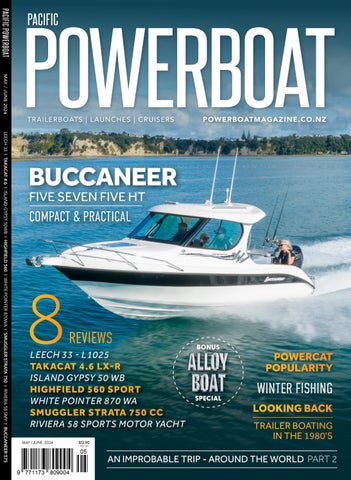

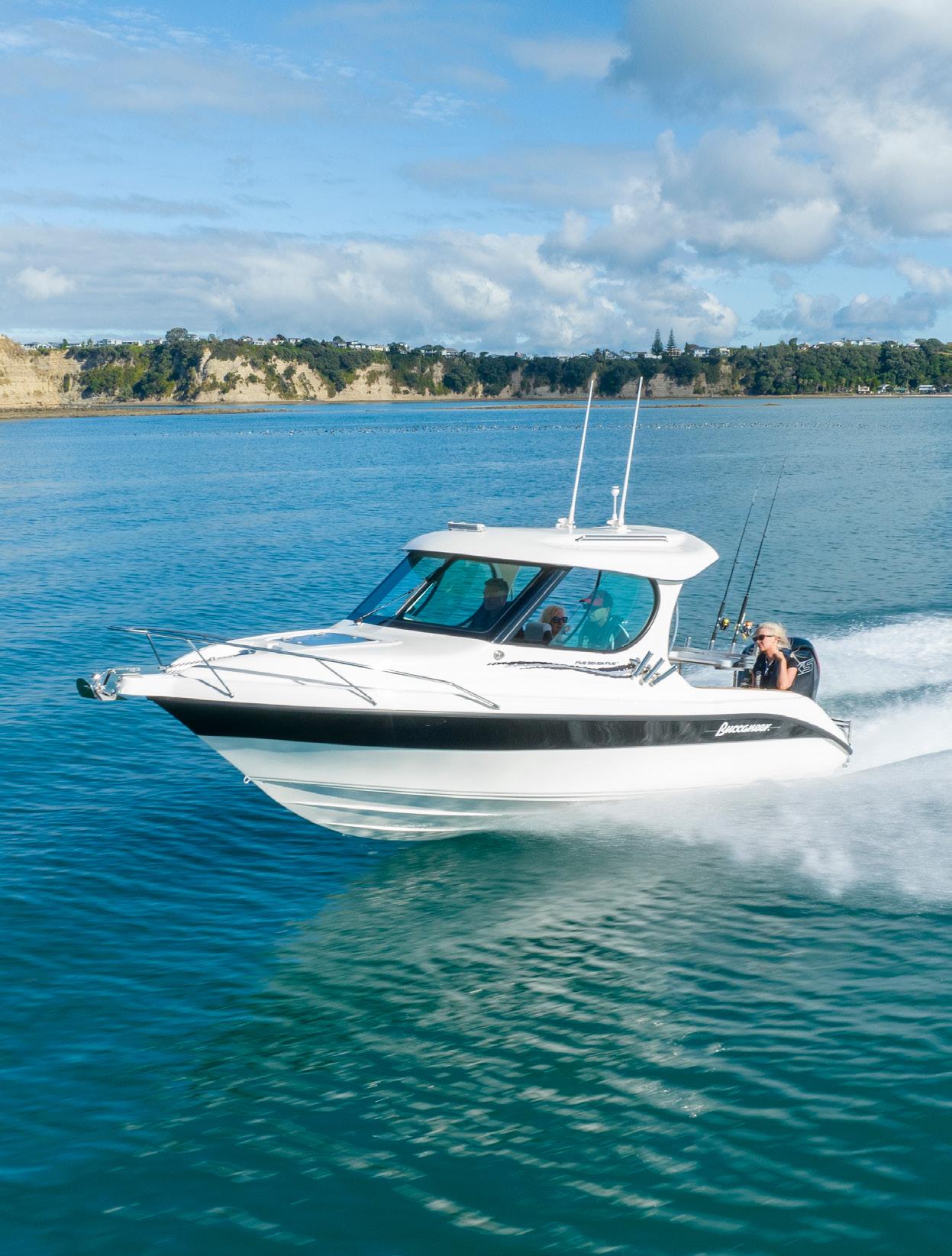

MAY / JUNE 2024 INCL GST POWERBOATMAGAZINE.CO.NZ TRAILERBOATS | LAUNCHES | CRUISERS $12.90 LEECH 33 - L1025 TAKACAT 4.6 LX-R ISLAND GYPSY 50 WB HIGHFIELD 560 SPORT WHITE POINTER 870 WA SMUGGLER STRATA 750 CC RIVIERA 58 SPORTS MOTOR YACHT TRAILER BOATING IN THE 1980'S POWERCAT POPULARITY MAY / JUNE 2024 BONUS SPECIAL 8 REVIEWS BUCCANEER COMPACT & PRACTICAL FIVE SEVEN FIVE HT LOOKING BACK AN IMPROBABLE TRIP - AROUND THE WORLD PART 2
THE LEADER OF THE FLEET
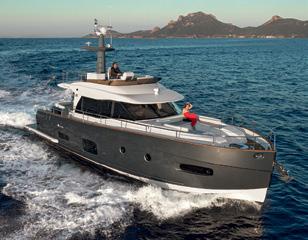
The all new M75 flybridge motor yacht combines a synergy of balanced proportions, grace and purpose with an immensity of deck and interior spaces to cater for a vast range of entertaining, relaxation, or adventuring activities. Australian built, its powerful exterior form and grand luxurious spaces reset the international standard for cruising flybridge motor yachts. Step aboard at the 2024 Sanctuary Cove International Boat Show. maritimo.com.au
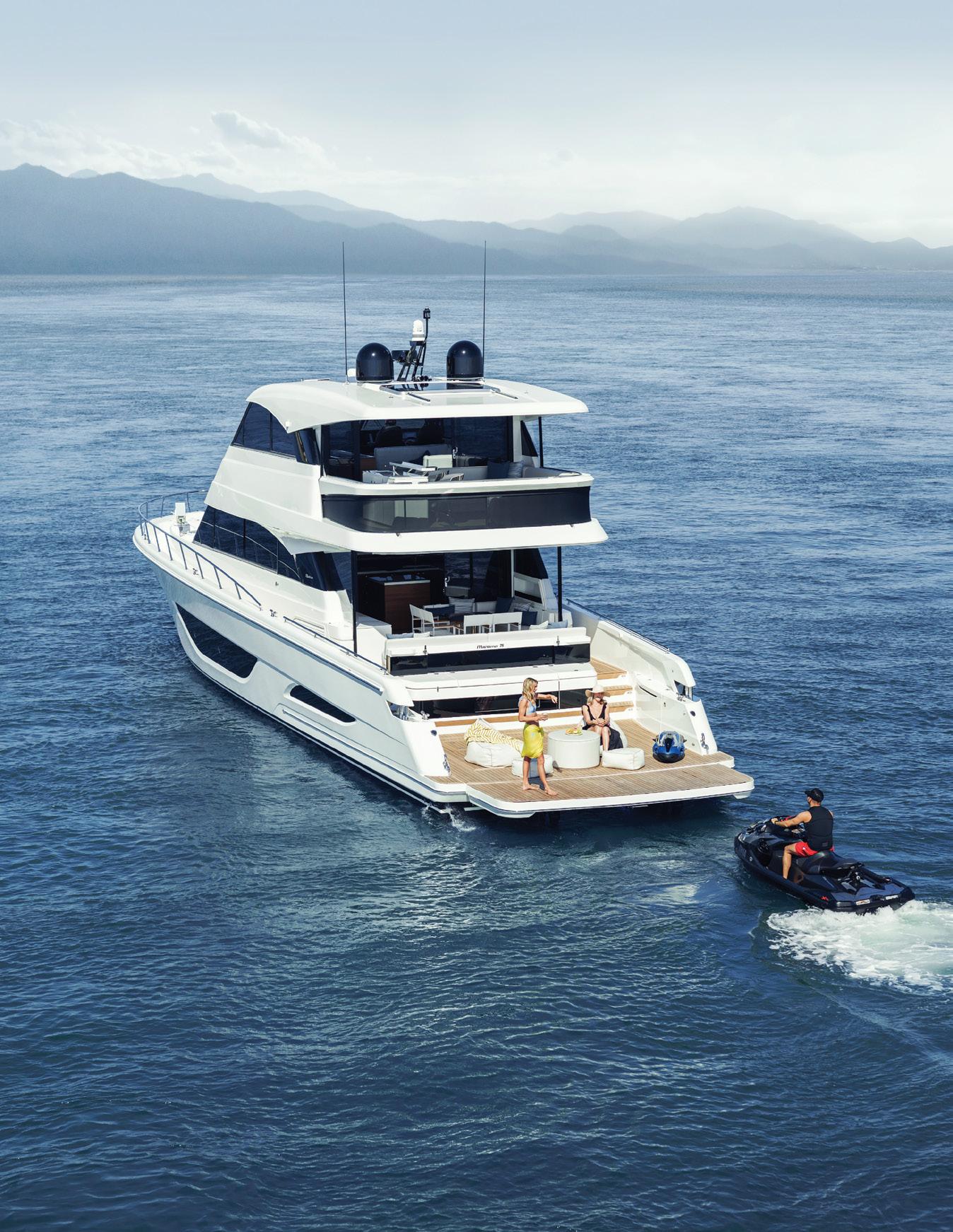
M75

The SARGO 31
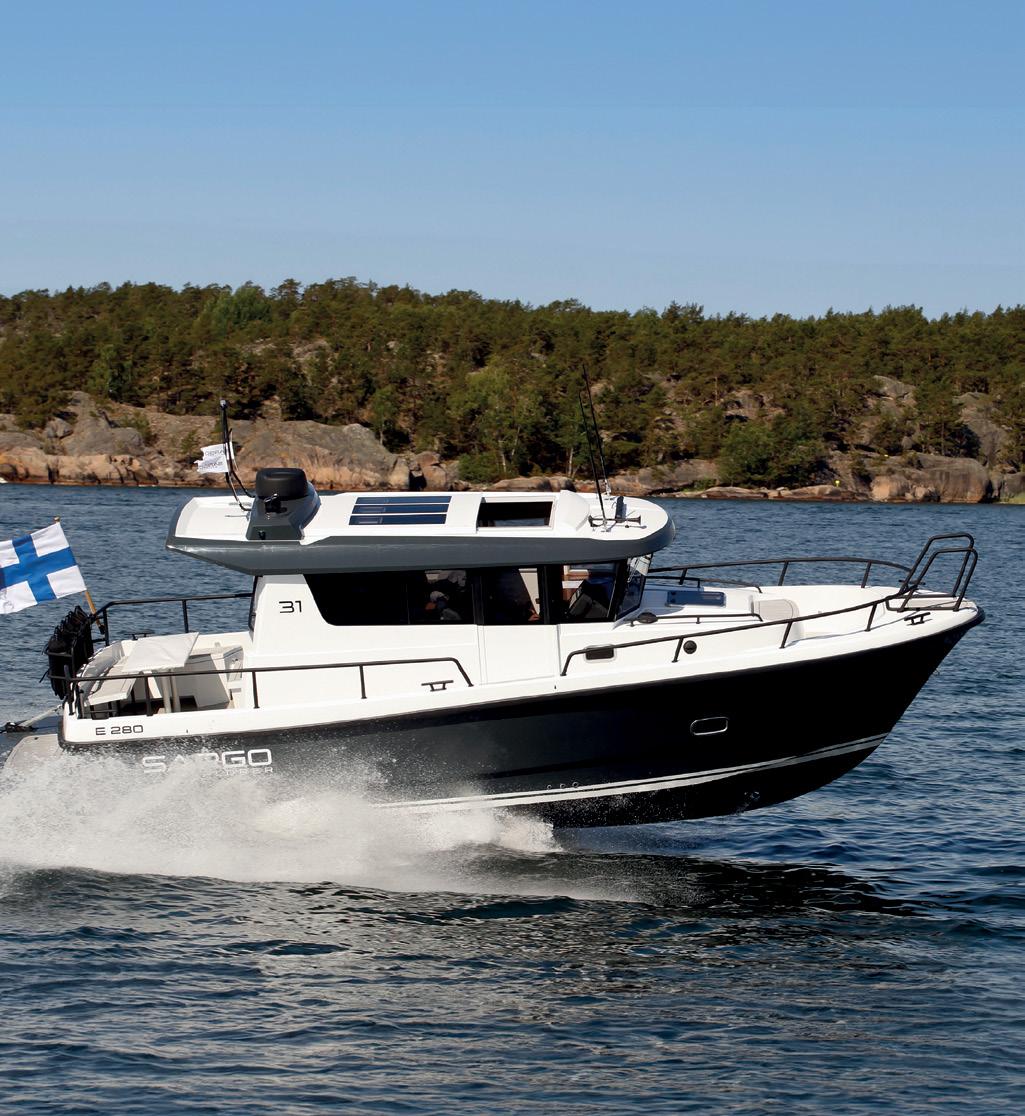
Sargo 31 Specifications
• Overall length 9.96m
• Max Beam 3.3m
• Cabins: 2 plus saloon
• Weight 5500kg
sargoboats.nz
• Fuel 500L/600L
• Certification CE/UKCA: B
• Volvo Penta D6-400 DPI – 400HP
EMI0026_PB
Marine
444 6572 | leighton@europeanmarine.nz
European
Leighton Henshaw | 027
Hamish Neal | 021 400 965 | hamish@europeanmarine.nz
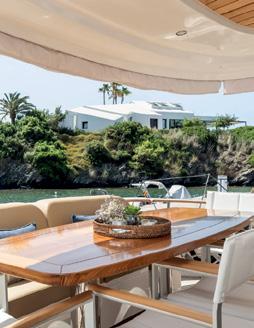
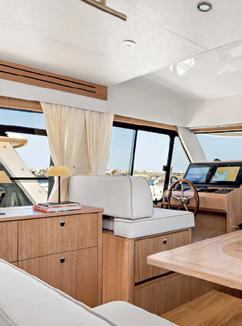
Take delivery in the Med

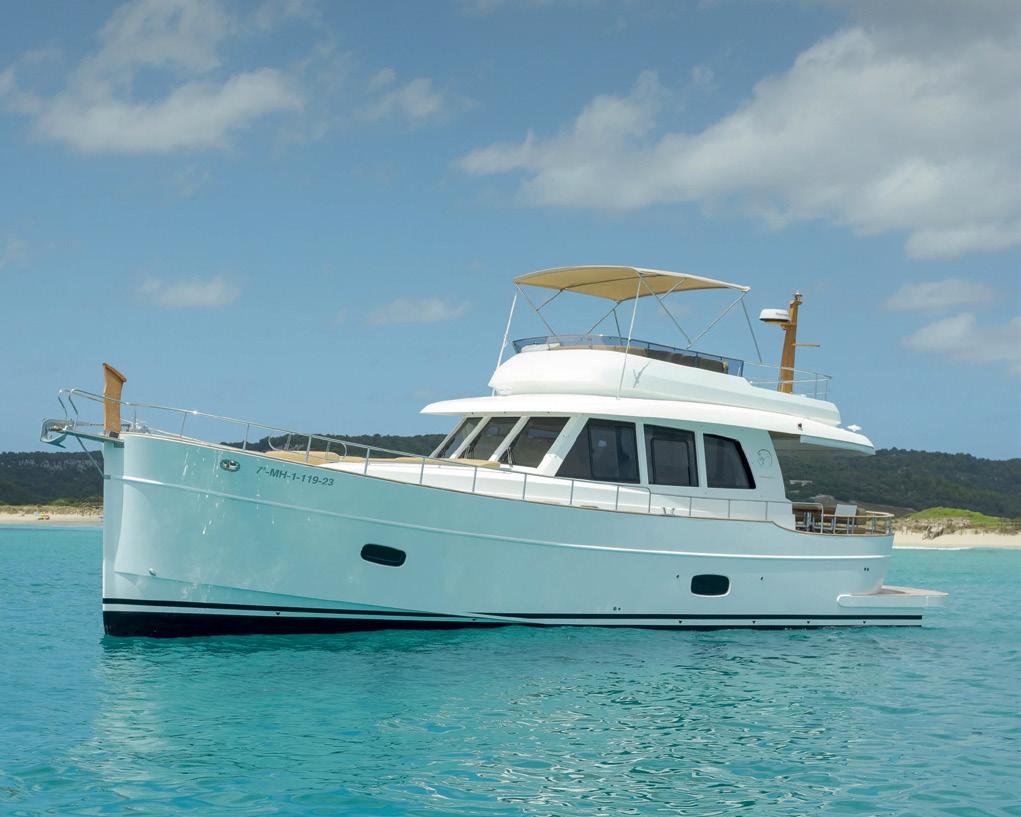
Cruise the Mediterranean in luxury, tax-free, in the Sasga Menorquín 55FB.
sasgayachts.nz
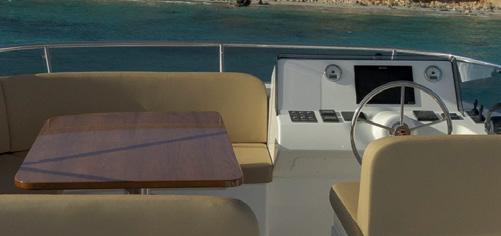 Sasga Menorquín 55. In construction for the European Summer 2024.
Aaron Fletcher shares his tips learned after years of getting it right and getting it wrong.

ISSUE #77 BUCCANEER FIVE SEVEN FIVE HT ALLOY BOAT ISSUE #71 In this issue, we review the WHITE POINTER 870 WA HIGHFIELD SP560 SPORT CONTENTS POWERBOATMAGAZINE.CO.NZ TRAILERBOATS LAUNCHES CRUISERS LEECH 33 - L1025 TAKACAT 4.6 LX-R ISLAND GYPSY 50 WB HIGHFIELD 560 SPORT WHITE POINTER 870 WA SMUGGLER STRATA 750 CC RIVIERA 58 SPORTS MOTOR YACHT TRAILER BOATING IN THE 1980'S POWERCAT POPULARITY BONUS SPECIAL 8 REVIEWS BUCCANEER COMPACT & PRACTICAL FIVE SEVEN FIVE HT LOOKING BACK AN IMPROBABLE TRIP - AROUND THE WORLD PART 2 SEE PAGE 60 46 AN IMPROBABLE TRIP – PART TWO We complete Roger Moore’s story of his 13-year voyage around the world. 68 POWER CATS We take a look at why power catamarans thrive as one of the fastest-growing sectors in the boating market. 88 THE HISTORY OF KIWI TRAILER BOATS BY THE DECADES Looking Back – Part Four - The 1980s 102 HORIZON 2024 OPEN HOUSE Doug Dukeson heads to Taiwan to report on the 2024 Horizon biennial event. 122 COASTGUARD EDUCATION Being prepared and weather wise. 148 WINTER FISHING OPTIONS Fishing in Godzone’s editor Matt Hewetson examines the multiple benefits of fishing in winter. 162 ALLOY BOAT LISTINGS FEATURES REGULARS 8 & 9 DESIGN FOCUS: BILLION DOLLAR SUPERYACHT WITH BLIMP A billion dollar superyacht that comes with its own detachable airship 10 EDITOR’S COMMENT Boat Show Season is well underway! 12 & 14 SEEN & ADMIRED Haines Hunter Amphibious – Overlander 725 Sargo 36 16 NEWS News, new products, boats and events. 50 POWER ON New products for the powerboating world. 52 ELECTRONICS COLUMN Hot new electronics products from some of the world’s leading brands. 54 LEARNING TO LAUNCH What a Gas! 56 PHIL GILBERT Fishing 101 58 STRAIGHT FROM THE GALLEY Derek the Chef, prepares Hapuka Steak with Julienne Vegetables, Potato Stacks & Cream Sauce 78 MARLBOROUGH REVISITED
share
Cod Heaven". 140 FLETCH’S
We
the magic of "Blue
TIPS
ISSUE 77 6 MAY / JUNE 2024
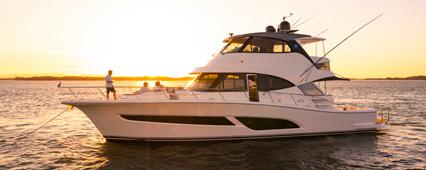
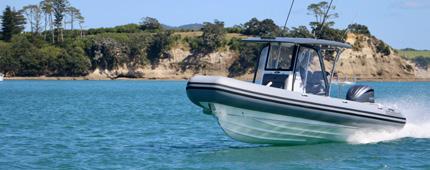
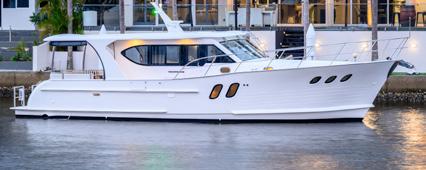
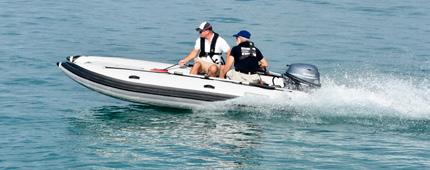
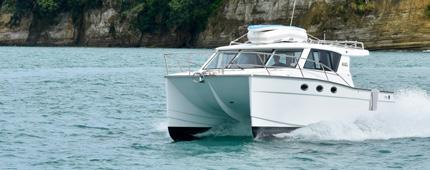
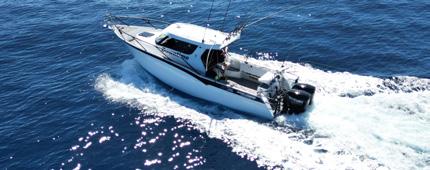
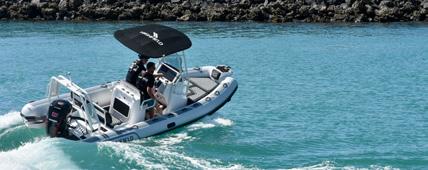
WHATEVER LIES AHEAD... THOUSAND REASONS, ONE PARTNER THE WORLD’S LEADING BOAT INSURER! REVIEWS POWERBOATMAGAZINE.CO.NZ 7 60 BUCCANEER FIVE SEVEN FIVE HT 80 RIVIERA 58 SPORTS MY 94 SMUGGLER STRATA 750 106 ISLAND GYPSY 50 WB 116 TAKACAT 4.6 LX-R 126 LEECH 33 (1025) 142 WHITE POINTER 870 WA 154 HIGHFIELD SP560 SPORT
BILLION DOLLAR SUPERYACHT WITH BLIMP
An unbelievable $1 billion superyacht that comes with its own detachable airship is gearing up to dominate the seas.
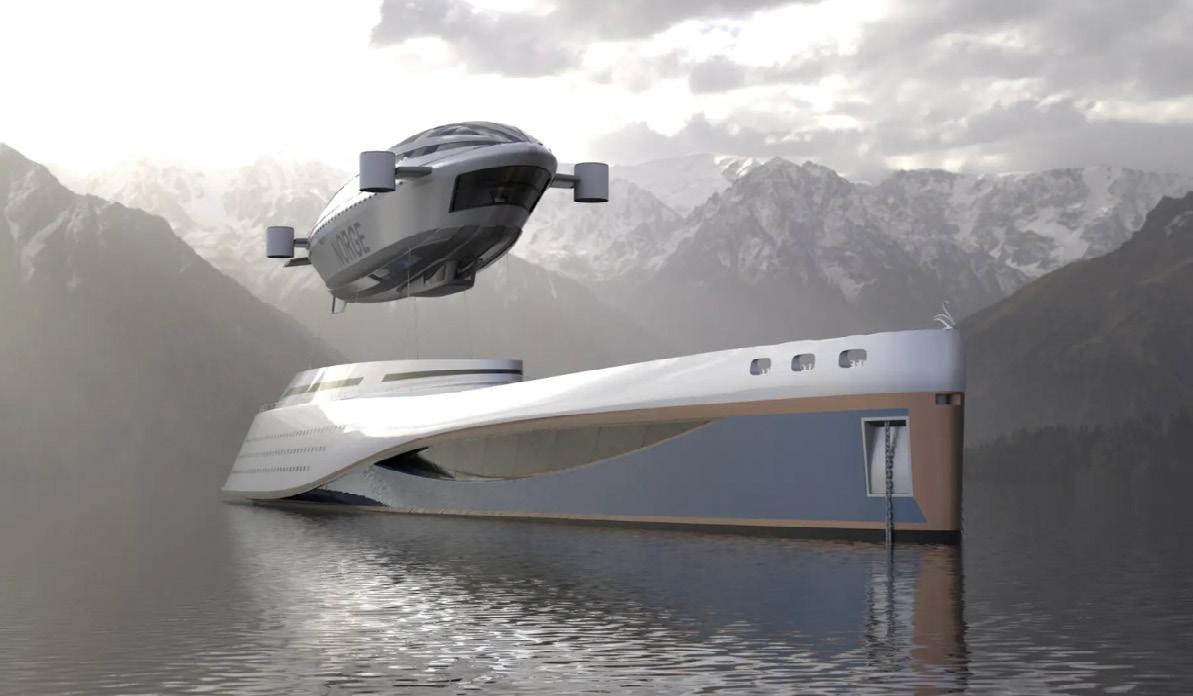
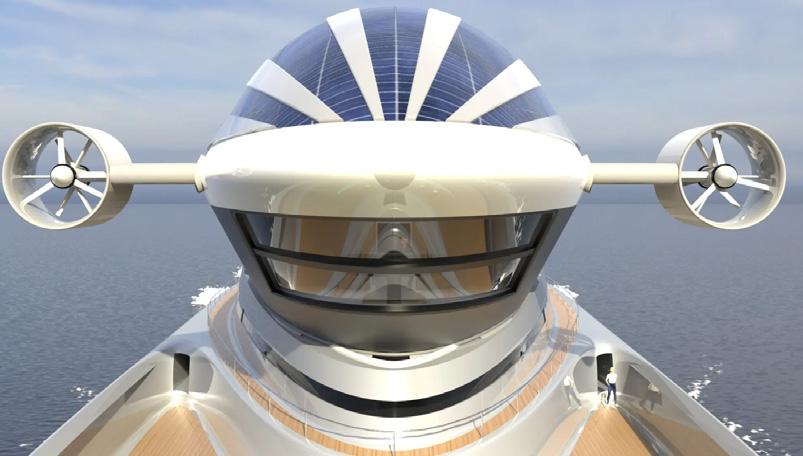
1. The Colossea is a super yacht that includes its own detachable airship.
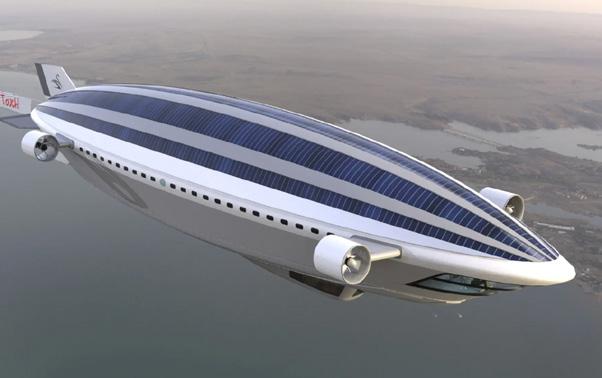
2. The blimp is a futuristic reimagining of the N1 airship Norge, which made the first trip of any kind to the North Pole nearly a century ago.
3. While 24 guests can fit in the blimp, the yacht can accommodate up to 44 guests.
4. The Colossea is described as an “itinerant floating docking station for the detachable airship.”
5. The Colossea would cost an estimated $1 billion to construct.
DESIGN FOCUS _ THE COLOSSEA MEGA-YACHT
1 2 8 MAY / JUNE 2024
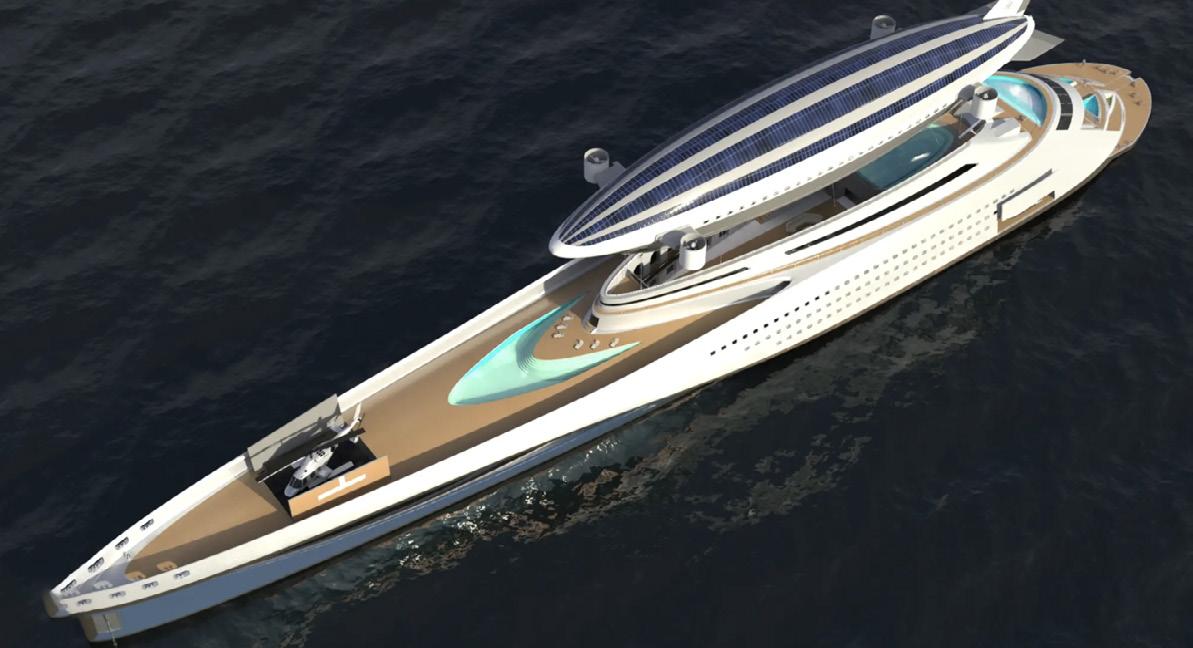
“The Colossea mega-yacht is an itinerant floating docking station for the detachable airship.”
Plans for the jaw-dropping Colossea — a 699-foot-long cruiser — were debuted this week by Italian designer Pierpaolo Lazzarini, famous for his futuristic designs. The sleek and futuristic vessel looks much like any other superyacht coasting across the ocean, except for the incredible blimp stationed on its upper deck, equipped with technology that would allow it to take off for its own voyage from the middle of the ocean.
“The Colossea mega-yacht is an itinerant floating docking station for the detachable airship,” Lazzarini’s namesake design studio said in a statement.
The concept was born from the same design group that introduced the Plectrum: a futuristic, 242-foot superyacht capable of traveling at speeds of 86 miles per hour above the water line — similar to a hoverboard.
The conceptual design for the Colossea was crafted as a tribute to the N1 airship Norge, which made the first trip of any kind to the North Pole nearly a century ago.
The Colossea’s blimp replicates the same iconic design and measurements as its predecessor but with modern materials and propulsion. It would also include its own major upgrade — a super-yacht with a take-off and landing strip perfectly formed to the blimp’s curvature. When the captain decides it’s time for flight, the yacht follows the procedures to unlock the electromagnetic blocks that keep the airship mounted and unhook the winches to release the airship’s lift.
Up to 24 lucky passengers, plus 10 crewmembers, can fit inside the blimp.
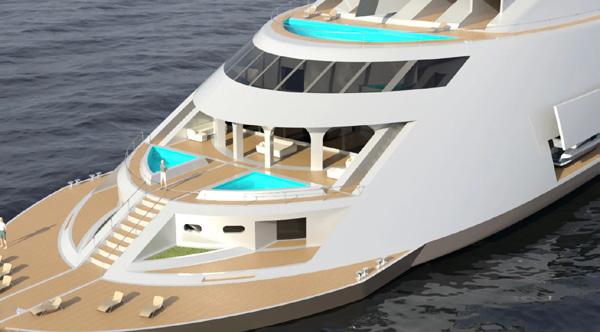
The yacht is an impressive feat of design in its own right — it offers 22 guest suites and multiple decks with indoor and outdoor pools on the rear. It also had space on its deck for a helicopter pad, a typically grand feature that pales in comparison to the blimp. Up to 44 guests and 20 crew members can enjoy the yacht.
While only still a conceptual design, the Colossea would cost an estimated $1 billion to construct.
3 4 5 POWERBOATMAGAZINE.CO.NZ 9



BOAT SHOW SEASON IS UNDERWAY….
Coming out of the Auckland Boat Show in mid-March, I received mixed responses on show results and sales feedback.
It seems the numbers attending were affected by several factors. Firstly, the clash in dates with the Kubota Fishing Competition, now officially The World’s Largest Billfish Tournament, this would have certainly taken some boat show numbers away, with 420 boats entered and about 2,500 attending the Whitianga event, all chasing the close to $2 million prize pool. Secondly was the conflict with the Motorhome and Caravan show in Greenlane. Although having both shows in Auckland may have brought some out-of-towners to both shows. The last complication for the show was the unreliable footbridge, which offers pedestrian access between the Wynyard Quarter, Viaduct, and downtown, including the ferry services - out of action once again. The show organisers did everything they could to approach the council to have it repaired but ended up having to offer bus transport to move patrons the extended distance around the broken bridge.
In general, it seems trailer boat market sales struggled a little. I guess this is the entry-level end of the market, where buyers may have to seek finance and with interest rates still a little high, many are a little reluctant to splash out. With the OCR sitting tight, it will take a little time before the rates start to come down. Many were hoping with the 2023 election behind us there would be a little more confidence, inflation would settle, rates would start to come down and things would improve again for the under-10-meter market.
The 10-meter-plus market seemed to have some good interest from what was believed to be well-qualified purchasers. I am guessing, the buyers at this end of the market are mainly cashed up, a little more mature, and possibly still in the Post Covid mentality of Bugger it - let’s just do it !!
With the NZ Hutchwilco Boat Show now just weeks away (16th – 19th May) and being predominantly a trailer boat show, the outcome will reflect and confirm just where the Kiwi Trailer boat market is at. Let’s hope the change is for the better. With the Sanctuary Cove International Boat Show the following week (23rd – 26th May), we will soon see the stance of the Australian Boat Market.
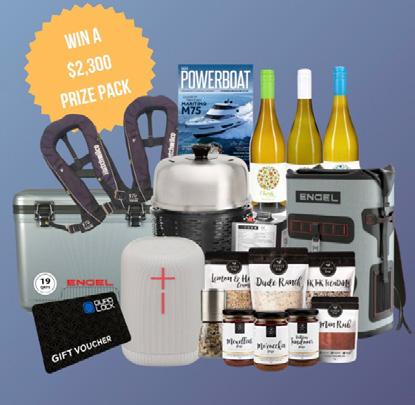
If you are passing by the Hutchwilco NZ Boat Show, be sure to call by our stand (298). We will have some great subscription offers, gifts, and a chance to win the Ultimate Boaties Subscription prize pack.
Happy reading…
Doug Dukeson Publisher.
PUBLISHER Doug Dukeson D&B Publishing Ltd EDITORIAL TEAM Ron Czerniak, Richard Milner, Doug Dukeson, Derek the Chef, Mike Rose, Carla Dukeson, Rebecca Hayter, Phil Gilbert, Aaron Fletcher, Freddy Foote, Peter Morgan, Kyle Barnes editorial@boatmags.com +64 9 428 2328 ADVERTISING New Zealand & Australia Doug Dukeson +64 9 428 2328 +64 21 772 202 doug@boatmags.com Holly Dukeson +64 21 028 66849 holly@boatmags.com PRODUCTION Annabelle Rose Design design@annabellerose.co.nz Printer: SCG WEBSITE Stealth Media Ltd Gustav Wentzel +64 21 0201949 info@stealthmedialtd.co.nz ACCOUNTS accounts@boatmags.com +64 9 428 2328 CIRCULATION Are Direct NZ +64 9 979 3018 Are Direct Aust +61 2 99728886 SUBSCRIPTIONS (Printed & Digital) subs@boatmags.com Pacific PowerBoat is published bi-monthly January, March, May, July, September, November REGISTERED OFFICE 2 McKenzie Ave, Arkles Bay, Whangaparaoa, Auckland, New Zealand. POSTAL ADDRESS PO Box 886 Whangaparaoa, Auckland 0930, New Zealand. POWERBOATMAGAZINE.CO.NZ COPYRIGHT Pacific PowerBoat incorporates: Propeller and Pacific MotorYacht Magazines. The contents are copyright and may not be reproduced without the written consent of the publisher. Unsolicited editorial material may be submitted. While every care is taken, no responsibility is accepted for material submitted. Opinions expressed by contributors are not necessarily those of Pacific PowerBoat Magazine. All rights reserved. Printed in New Zealand ISSN 2230-4134 (Printed) ISSN 2230-4142 (Online) PACIFIC PUBLISHERS COMMENT _ DOUG DUKESON
10 MAY / JUNE 2024
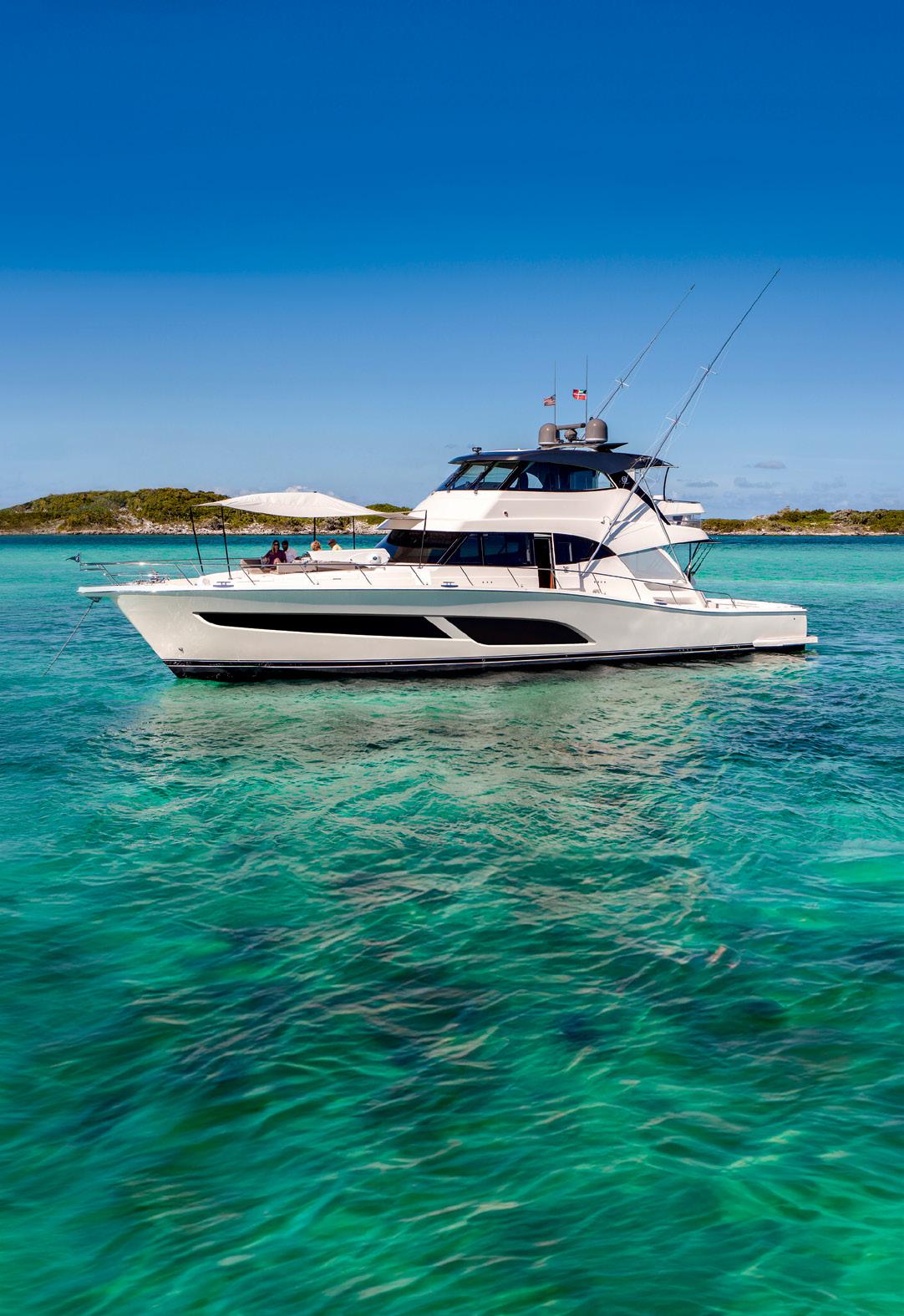
In a league of the I r own
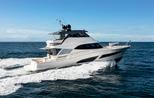
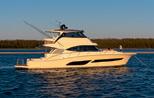
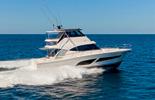
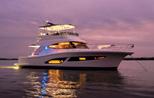
The Riviera Sports Motor Yacht Collection
Outstanding offshore and extended cruising capability are just two of the key characteristics of this range. Six individual blue water yachts offer signature sport looks, sports performance and a sporting cockpit all with the utmost of luxury. Engineering excellence and smart technology merge to make boating easier and more pleasurable. The Sports Motor Yachts are uniquely Riviera and are created for your ultimate boating experience.
RivieraAustralia.com
72 68 64 58 50 46 240008
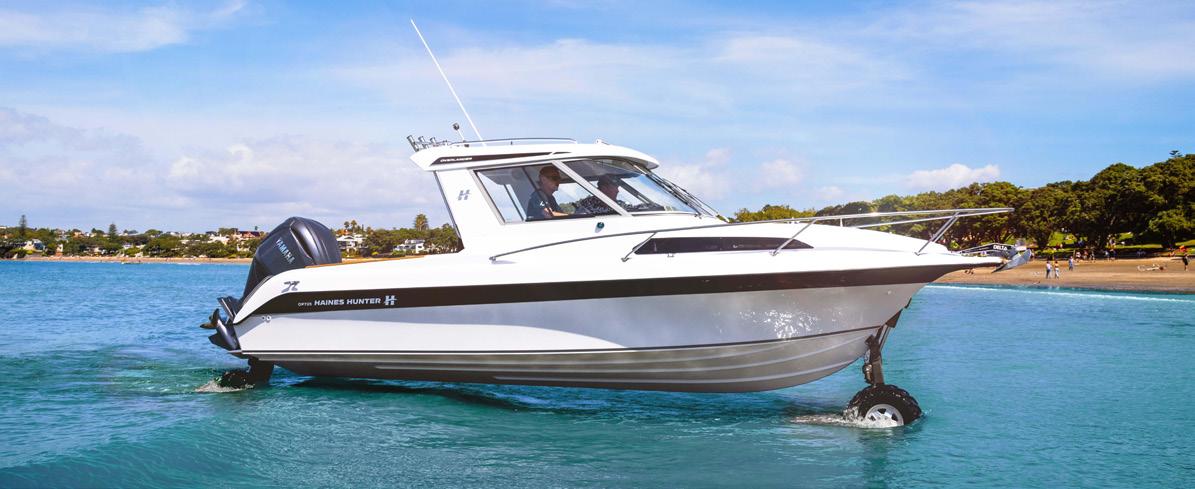
HAINES HUNTER GOES AMPHIBIOUS WITH
THE NEW OVERLANDER 725
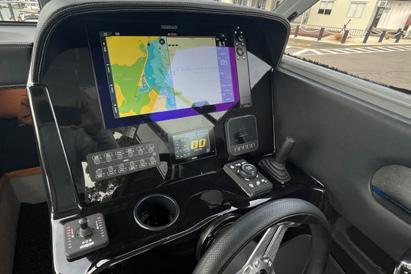
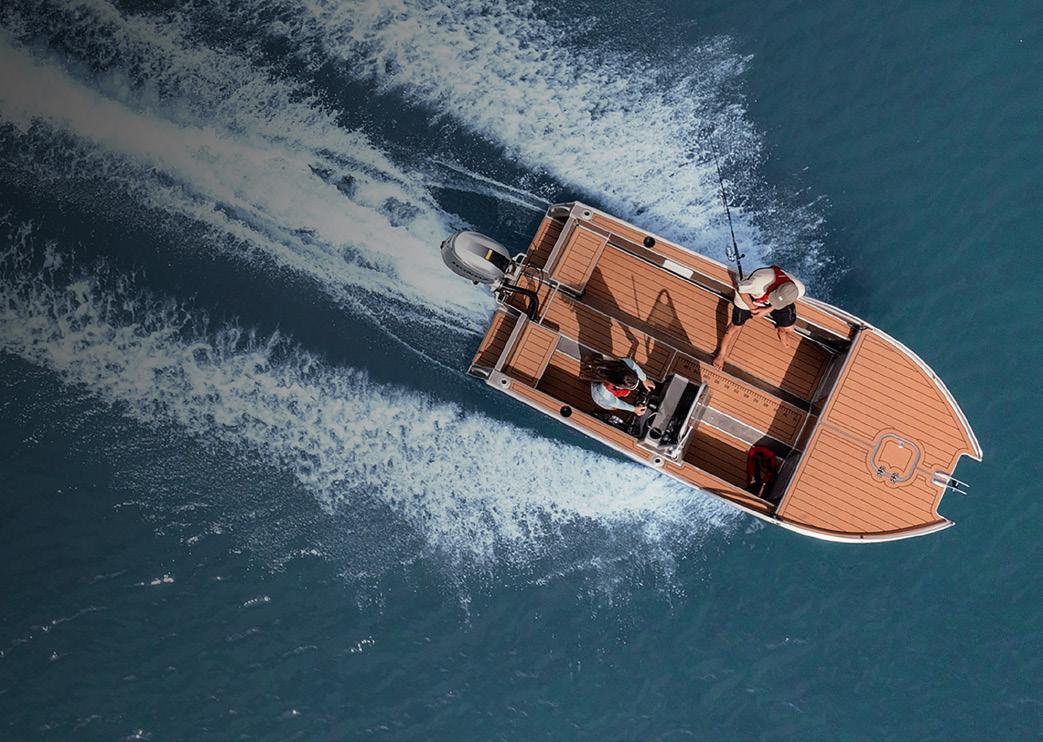
The ride has just gotten even better with the release of the new Haines Hunter Overlander Pursuit 725, Haines Hunter’s first amphibious craft.
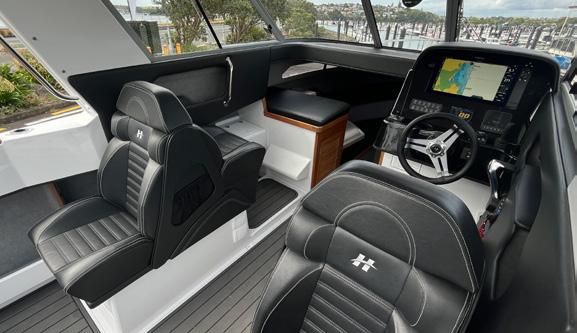
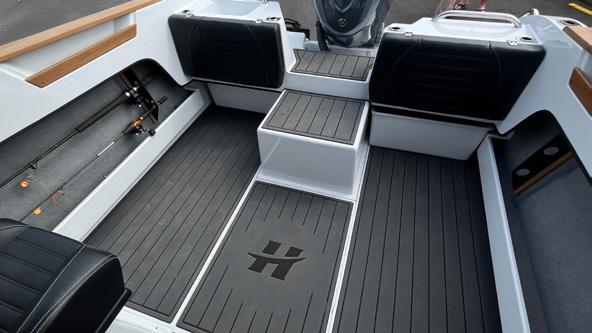
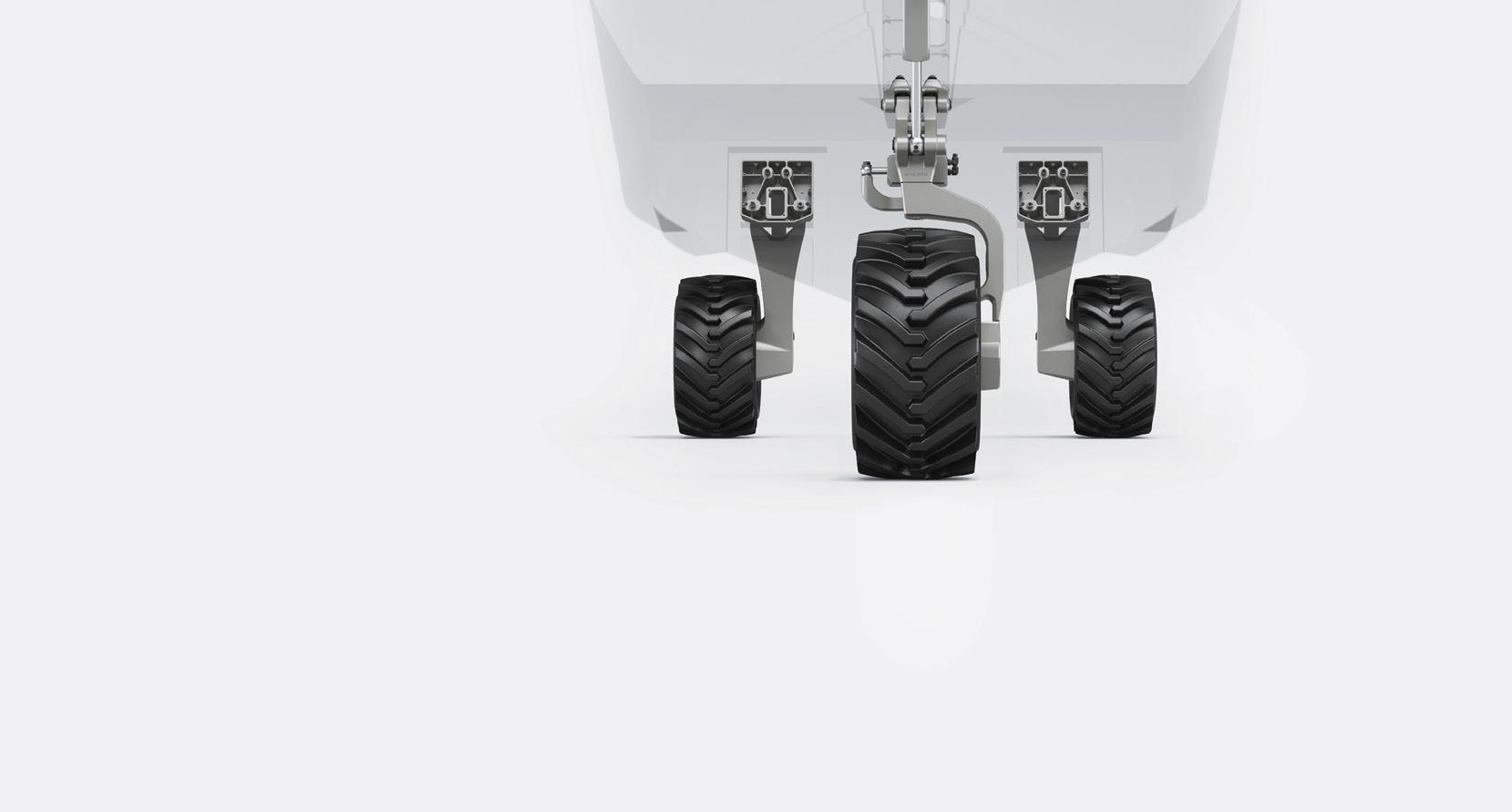
The release of the Overlander configuration expands Haines Hunter’s flagship 725 range, and sees the new model combining Haines Hunter’s award winning 21° deep V hull, and the New Zealand designed and manufactured Anura amphibious system - the Overlander is the ultimate adventure machine. Capable of over 44 knots with a 350hp four stroke outboard, the Overlander has a supremely comfortable, quiet, and dry ride, as well as all of the amenities onboard for a perfect day on the water.
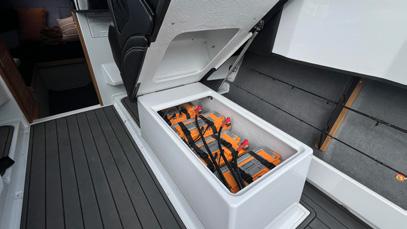
Powering the Anura S25 all-wheel drive amphibious system is their new Electric Over Hydraulic (EOH) motor. The EOH features a 48V, 28kW electric motor with
12.4kWh battery pack, which produces maximum drive torque of 3500nm and enables the Overlander to travel at 9km/ hr on land. With a hardtop and a spacious open plan layout, the Overlander can be spec’d for game fishing, diving, or escaping to your favourite bay. The Overlander comes with an impressive range of standard features and can be optioned up with enclosed head (toilet), fridge/freezer, galley and full length V-berth.
To accommodate the Anura system, Haines Hunter has replaced E-Glass with carbon fibre in some areas of the hull and transom - (E-glass fibre - also known as electrical glass, is the standard glass composition used in the construction of Haines Hunter boats
for superior strength and stiffness). The use of carbon fibre has added structural strength for the system while maintaining the same overall weight. This, combined with structural composite floors gives the same Haines Hunter ride.
SEEN & ADMIRED _ HAINES HUNTER OVERLANDER PURSUIT 725
HAINESHUNTER.CO.NZ
12 MAY / JUNE 2024
Come talk to us about our full range of amphibious systems at the Hutchwilco Boat Show (16-19 May).
You will find us in Hall 2.
Learn more at anura.nz
AMPHIBIOUS TECH NEW ZEALAND
YOUR VISION YOUR CRA F T up to 4.0m S10 4.0 to 5.0m S15 5.0 to 6.0m S20 6.0 to 7.0m S25 7.0 to 8.0m S35 8.0 to 9.0m S45 HIGH PERFORMANCE FOAM DECKING NON-SLIP DURABLE UV RESISTANT CUSTOMISABLE LOW MAINTENANCE www.udek.co.nz
114 222 POWERBOATMAGAZINE.CO.NZ 13
sales@ultralon.co.nz 0800
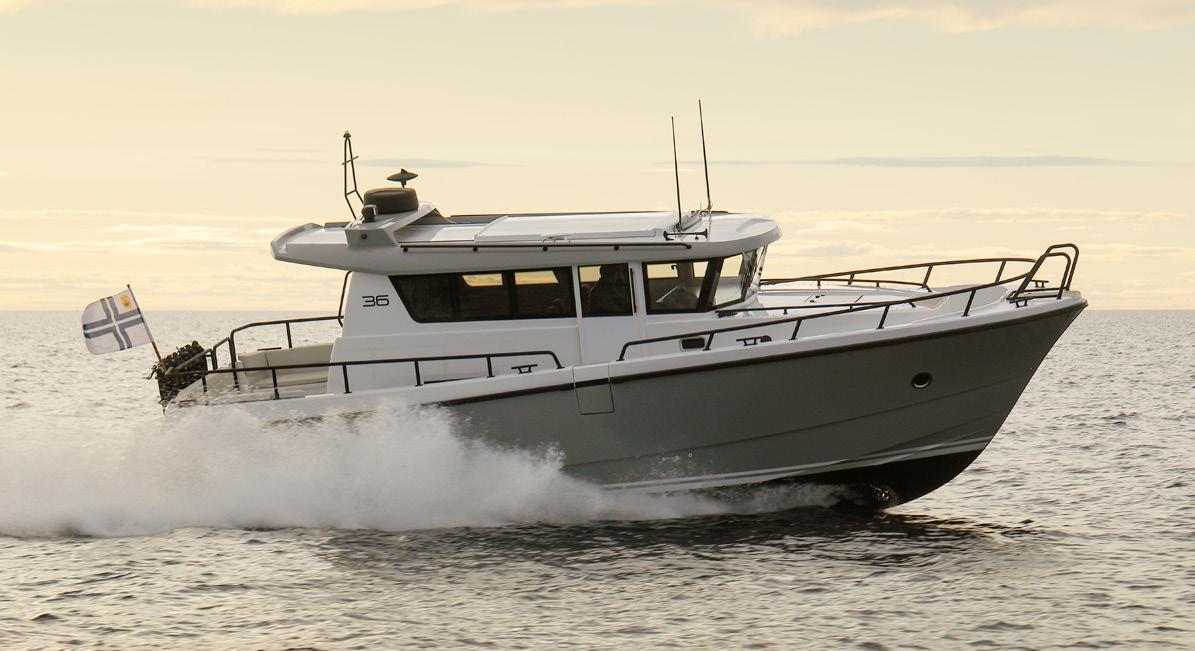
TRULY NO COMPRIMISES - ON SPACE, SAFETY & COMFORT
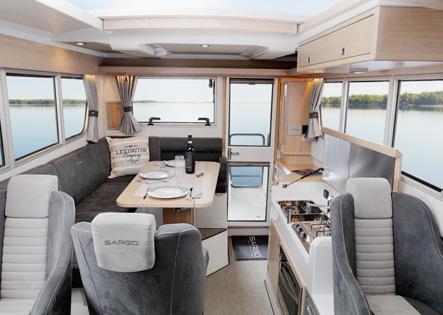
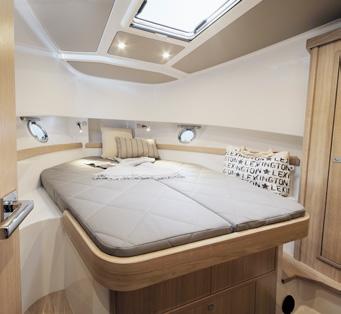
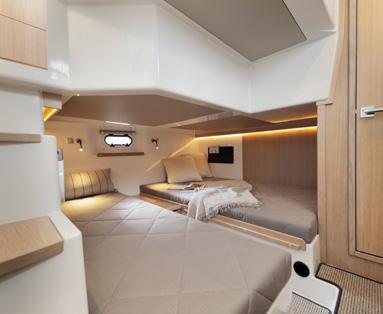
With an overall length of nearly 12 metres, the Sargo 36 boasts two spacious cabins, a full galley and seating for five. Every detail has been considered creating a uniquely versatile boat.
The 36 has lockers in the bow, behind and under the aft deck seating and various options for storage in the engine room. Cabin stowage encompasses hanging space, lockers, shelving, and large wells for stashing items under the berths. The helm position features a very large chart locker in addition to drawers under the seat. No space goes unused.
With a total displacement of nearly nine tons combined with Sargo’s signature deep V hull, the Sargo 36 is robust in all conditions. Engine options range from
540hp up to 880hp giving the 36 the capability of over 40 knots or a most efficient cruising speed of 28 knots.
Sargo 36’s are 100% hand-made in Finland, built using heavy-duty construction to withstand rough seas. They are tough, sporty and exhilarating with a wide walkaround one level deck – no steps. The stylish flybridge (option) is spacious enough for five persons to enjoy that breathtaking view while an ingenious CAD-designed wind tunnel minimizes the draught.
Sargo 36’s cabins and cockpit have the unmistakable Scandinavian flair of clean lines, well-tested ergonomics, a palette of cool colours and an array of brilliant practical details. It’s hard not to notice and appreciate the overall quality of this stately yacht.
A cosy, modern and luxurious Scandinavian design of the 21st century!
SARGOBOATS.NZ
SEEN & ADMIRED _ SARGO 36
14 MAY / JUNE 2024
The Ultimate Cruising Yacht
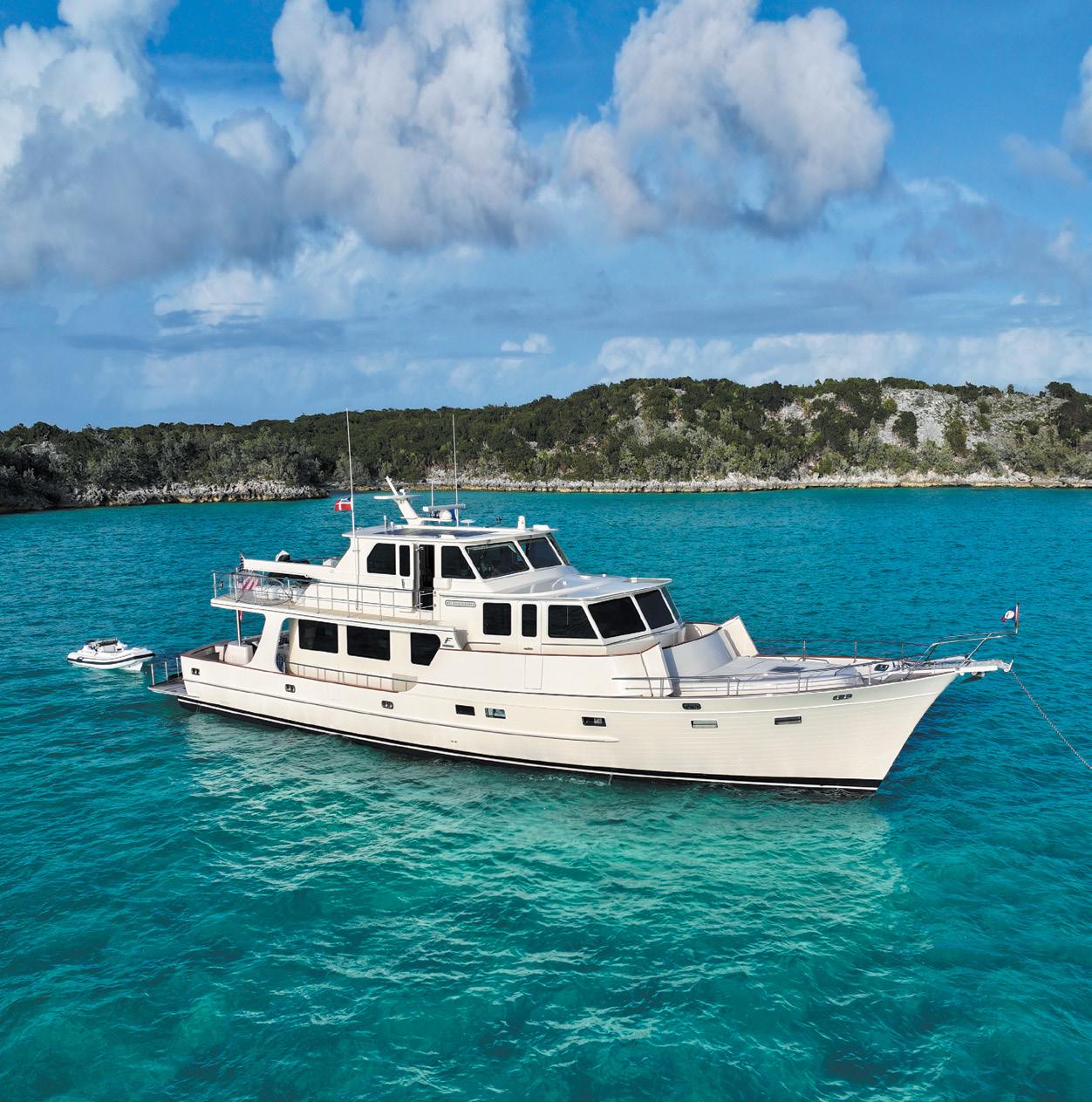
The Ultimate Cruising Yacht
Fleming Yachts represent the point at which adventure and luxury converge. From the efficient performance that offers unmatched range, to the durability of the construction, to the impeccable comfort found throughout our interiors, Fleming is the Ultimate Cruising Yacht.
Learn why at FlemingYachts.com/Research

www.flemingyachts.com
The new Fleming 85
THE HUTCHWILCO NEW ZEALAND BOAT SHOW – ALL SET FOR 16-19 MAY
The latest news out of The Hutchwilco New Zealand Boat Show includes the launch of two new powerboats including the new Strata 750 RIB Model brought to you by Smuggler Marine and a new release from White Pointer based on the 730 Sports Cruiser.
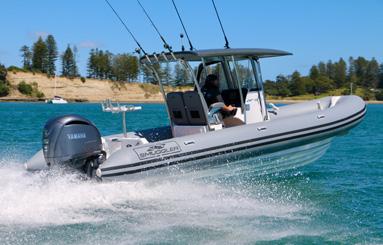
The new Strata 750 RIB is an all-new Gen 2 console designed to perform. While retaining the Smuggler’s proven 27-degree deep vee hull delivering incredible rough water performance it also boasts a Yamaha F250hp four stroke outboard and is easily capable of 50 knots. With upgraded seating and a re-designed Targa top and stainless structure, it also has the addition of new removable side clears to provide extra protection from the elements as well as seating at the helm with two Captain style seats, lift up seat bolsters and foldable armrests. In addition, you will find a toilet located under the helm console and an onboard refrigerator under the helm seat.
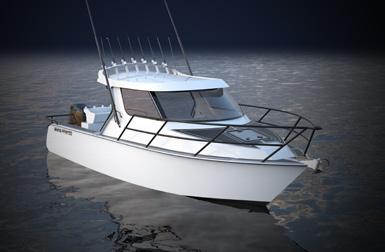
Also to be released in time for the Hutchwilco Boat Show is the new 745 Sport Cruiser from White Pointer Boats. To celebrate three decades of custom alloy boat building and craftsmanship, White
Pointer Boats is releasing this new 30-year anniversary model. More than 600 boats have left their Gisborne factory over the last three decades, so White Pointer Boats is excited to bring one of their most popular models, with a “significant upgrade” to the show.
Based on the company’s popular 730 Sports Cruiser model and with input from customers and the team of boat builders at White Pointer, the new model is a culmination of 30 years of expertise from Briant and his team of alloy craftsmen. “Our 730 model has been one of our most popular boats in the range, and over the years has seen every conceivable option fitted, we wanted to showcase its versatility and take it to the next level with this new model,” says Pointer Managing Director, Max Briant. The new 745 Sport Cruiser has been designed and built to be the perfect size for offshore game fishing expeditions as well as family water sports and just cruising and exploring in the lakes and coastlines in both New Zealand and Australia. White Pointer has also continued its traditional method of shaping the hull skin over a predetermined interlocking frame and girder type structure. Combined with a welding sequence that can produce a rounded compound curve hull shape that squeezes the water out rather than slapping over the top. Add to that, the new 745SC has White Pointer’s standard 10-year hull warranty.
Come and check out the new Strata 750 RIB and 745 Sport Cruiser at The Hutchwilco New Zealand Boat Show from Thursday May 16 to Sunday May 19 at the Auckland Showgrounds. Smuggler Marine will be located at stand #570 and you can find White Pointer Boats at stand #315.
BOATSHOW.CO.NZ
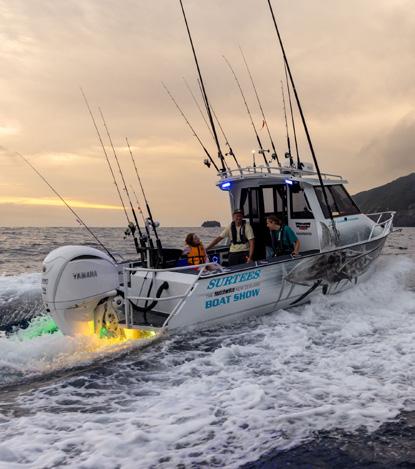
THE SURTEES/ YAMAHA GRAND PRIZE BOAT
–Drawnattheupcomingshow!
One lucky attendee at the 2024 Hutchwilco New Zealand Boat Show will score the ultimate prize: a jawdropping Surtees/Yamaha boat package worth over $300,000!
Plus, all tickets purchased online before midnight on 15 May will be eligible for a BONUS entry into the draw.
HERE’S HOW TO ENTER:
- Buy your Hutchwilco New Zealand Boat Show ticket (online for double entry!).
- Attend the show and register your ticket.
- Scan your ticket at ALL designated spots before 4pm on May 19th
- Double your chance: Buy tickets online before May 15th for a bonus entry and to save $5 per ticket.
PACIFIC POWERBOAT _ IT'S SHOW TIME
16 MAY / JUNE 2024
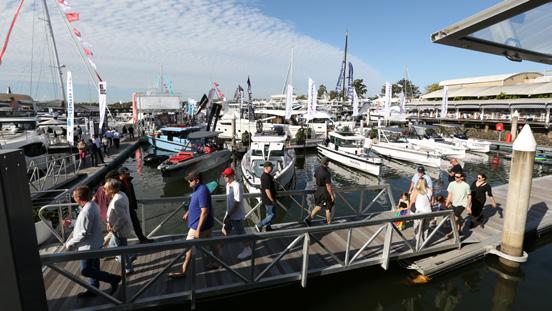
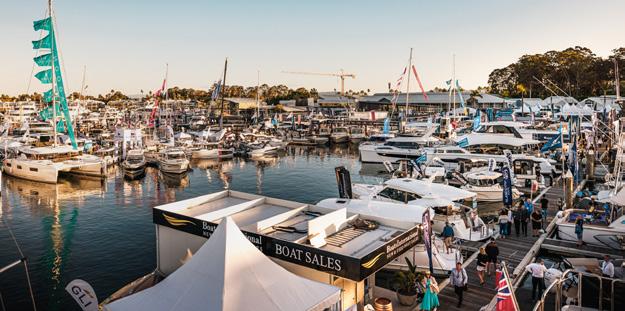
35TH SANCTUARY COVE INTERNATIONAL BOAT SHOW MAY 23-26
The much-anticipated 2024 Sanctuary Cove International Boat Show (SCIBS) is shaping up to be one of the most exciting yet, with almost 100 launches from some of Australia and the globe’s most popular and luxurious marine lifestyle brands.
This year will see a host of marine businesses launching their latest and greatest products at SCIBS including Airbeth Boat Lifts, Australian Marine Centre, Blue Diamond Marine, BRP, ePropulsion, Australia, E-Yachts, Honda, Horizon Yachts, JSW Powersports, Leigh Smith Yachts, Multihull Central, MW Marine, Nautical Marine Network, Northside Marine, Riviera, Short Marine, Sports Marine, Steber International, Surf Coast Marine, Sydney Marine Brokerage, Outdoor Connection Partners, TMG Yachts, The Yacht Sales Co, and Yacht Domain.
“There’s no doubt SCIBS is an unrivalled showcase for those in the marine industry, with an economic impact of $400M+ with manufacturers and distributors from around the world keen to secure space,” said Mulpha Events General Manager Johan Hasser. “From superyachts and luxury motor yachts, to trailer boats and personal watercrafts (PWC), to marine gear and gadgets, SCIBS 2024 is the place to see everything the marine industry has to offer.”
As well as the overwhelming array of luxury products on display, visitors can also expect to be dazzled by the all-new Lagoon Beach Club VIP Experience, a brand-new elevated precinct offering a luxury beach club vibe overlooking the resort’s lagoon pool and award-winning marina, added Mr Hasser.
A magnificent showcase for luxury yachts Lovers of luxury yachts will be spoilt for choice at this year’s SCIBS with some of the world’s most sought-after boats making their sensational debut here. Among them
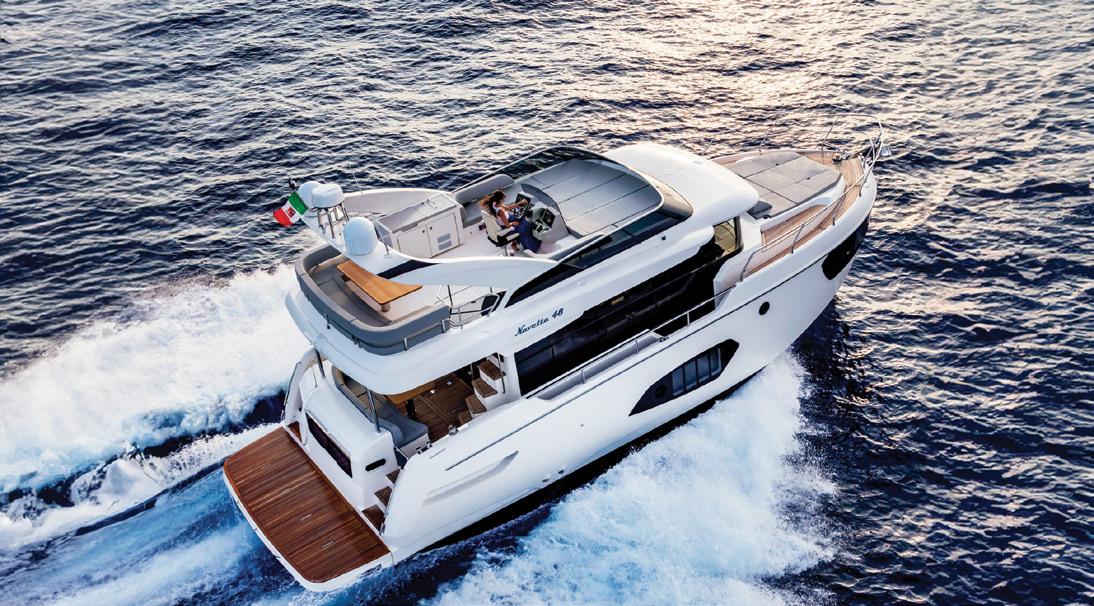
is an impressive line-up from The Yacht Sales Co, with the stunning Cora Cat 48 Power Catamaran being seen for the first time globally, the Absolute Yachts Navetta 48 from a leading prestige Italian shipyard enjoying its first Australian release, and the Dufour 41 Sailing Yacht making its Southern Hemisphere debut. Making a splash at this year’s Show will be the latest addition to the industry-leading Quintex lineup, the groundbreaking Freestyler X, said Mr Wyatt.
Attendees should get ready for yet another exclusive, world premiere from luxury motor yacht builder, Riviera, with their Festival of Boating owners’ event part of a record 12-model display. "This will be a magnificent showcase for Riviera and will be our only boat show display in Australia in 2024,” said Riviera Australia owner Rodney Longhurst. “Excitingly it will include the world premiere of a yet-to-beannounced, exceptional new luxury motor yacht.” Showgoers will also be able to inspect Riviera’s fine fleet, which represents the very latest in world-class design, from the Riviera long-range and luxurious Sports Motor Yacht, sophisticated Sport Yacht, adventurous SUV, the flagship Motor Yacht and the classic elegance of the Belize collections. Riviera’s 900-strong workforce now builds approximately 150 yachts each year, with entry level yachts starting at around $1 million and top of the range models over $6 million.
Another Australian-first at SCIBS will be an innovative eLite electric outboard motor. The eLite created for the tender and smaller boating market, represents a
new era in clean, quiet and eco-friendly marine propulsion. Said David Kentish, of ePropulsion: “SCIBS is an important event as we select Sanctuary Cove to be our annual brand ‘hero’ event.
Jack Ludemann, of Sports Marine, also praised SCIBS for consistently delivering for Sports Marine and its continued growth of its Nimbus Boats brand in Australia.
“Being crowned Nimbus Boats Dealer of the Year for 2023, we believe SCIBS 2024 is the perfect platform to showcase the latest offering from Nimbus, the Weekender 11. The relaxed atmosphere, perfect weather, and wide range of boats on display create an environment like no other.
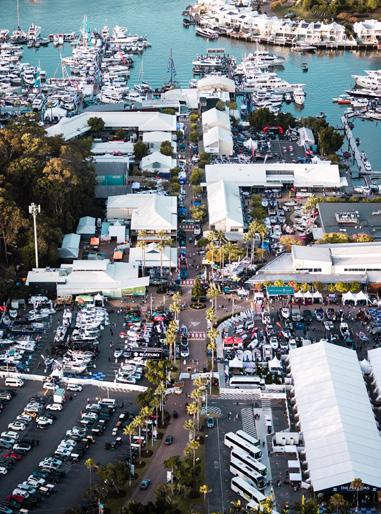
New product launches aren't the only area in which the Show is breaking records. SCIBS 2024 – the 35th edition of the annual event – has seen a record number of applications from exhibitors and, as well as the addition of the luxury Lagoon Beach Club VIP Experience, will see significantly increased space within the Sports Leisure Fishing precinct for trailer boats. This includes expanding the footprint of the show to include the Sanctuary Cove Resort grounds, including the new Marina Boulevard Hall overlooking the superyacht arm of the marina.
SANCTUARYCOVEBOATSHOW.COM.AU POWERBOATMAGAZINE.CO.NZ 17
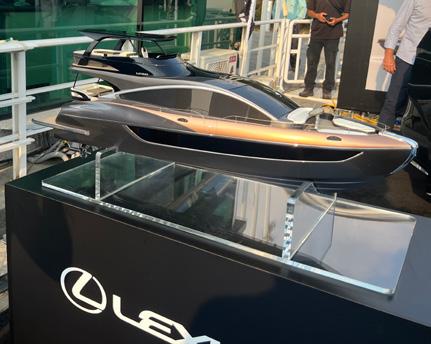
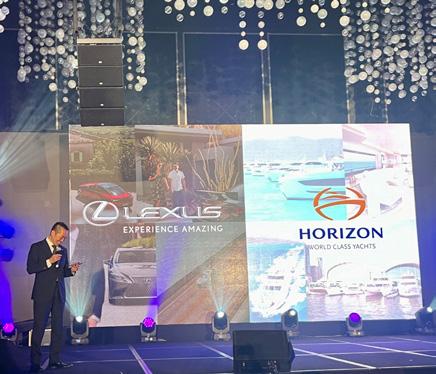
HORIZON YACHTS ENTER INTO PARTNERSHIP WITH LEXUS
At the 2024 Horizon Yachts Open House Gala Dinner on March 5th, an announcement was made by Horizon Yacht Chief Executive John Lu, that Horizon Yachts had entered into a partnership with Lexus, to build the new Lexus LY 680, the new flagship and the most exquisite Lexus sport yacht to be built - A further development of the Lexus LY 650 sport yacht introduced back in 2019.
Doug Dukeson of Powerboat magazine attended this event among others, where they were told by a Lexus executive that the 68-foot, Lexus LY 680 will embrace the luxury and performance associated with the brand. The partnership formed with Horizon Yacht, a company known for their quality in luxury motor yachts, will deliver the expected Lexus-associated quality. The first Lexus LY 680 is expected to be completed in late 2025, or early 2026.
HORIZONYACHT.COM
LEXUS.COM.AU/ABOUT-LEXUS/CONCEPTVEHICLES/LY-650-YACHT
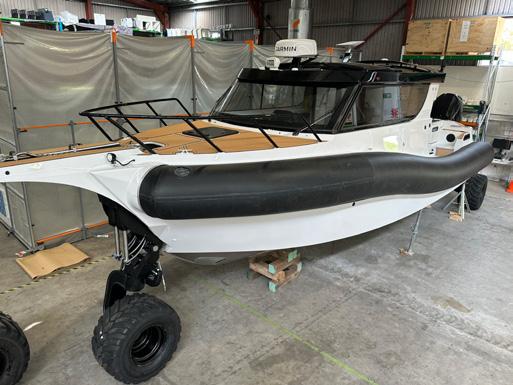
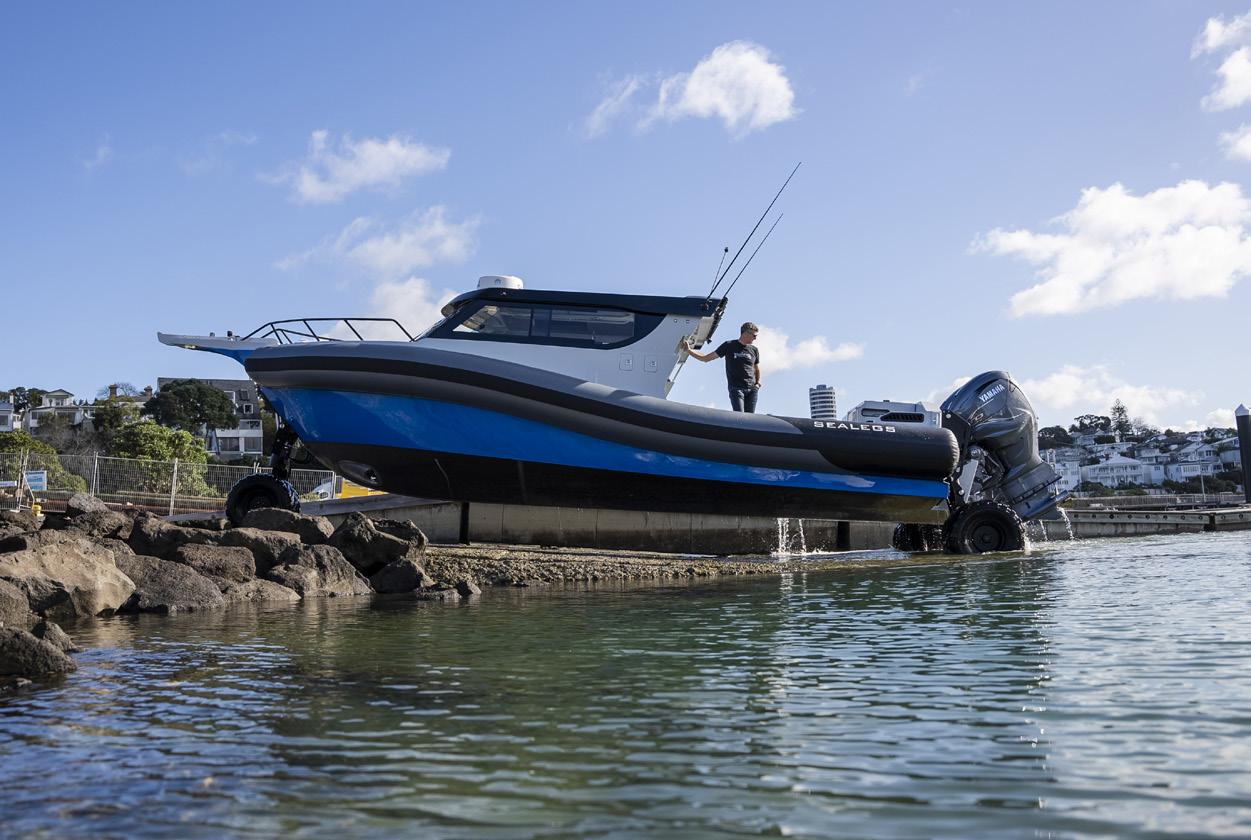
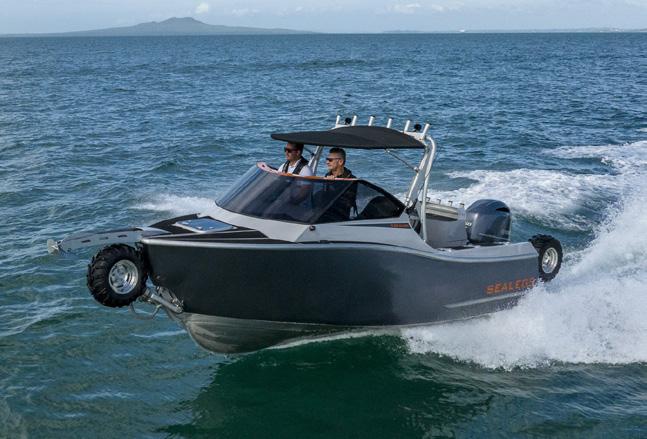
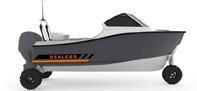
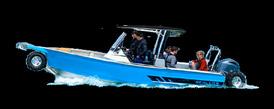
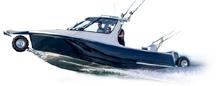
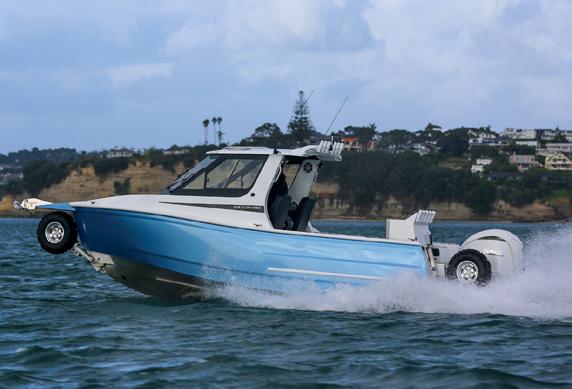
SEALEGS DELIVERS A LUXURY AMPHIBIOUS THAT CAN TAKE YOU ANYWHERE
When it comes to exploring our magnificent and at times remote coastline in luxury and style, you have to go a long way to beat Sealegs International’s latest offering. Recently launched, the range topping 12-meter Sealegs Cabin RIB (12RC) is an explorer’s dream. Add to that the significant convenience having an amphibious craft offers, and you have nothing short of a game changer in terms of size, convenience, luxury and of course functionality.
Adding to the excitement – this will be the owners fourth Sealegs craft, a craft he plans to circumnavigate the coastline of New Zealand in over the summer of 2024/25. The craft will aptly be named ‘Kupe’ in honour of the early Polynesian navigator. First launched back in 2022, the range topping 12RC provides an enviable large-format amphibious platform. Measuring in at 12.3 meters overall length with a beam of 3.6 meters, the 12RC provides a mountain of space for all manner of activities, be they overnighting, coastal exploring or serious fishing expeditions out wide - this craft will take you there.
Nicholas Glanfield, Sealegs GM of Sales & Marketing noted “To say power on the most recently launched 12m is ‘plentiful’ is nothing short of an understatement … this, the latest 12RC is being supplied with a pair of Mercury 600HP V12 outboards - that’s 1200 horsepower on a 40’ craft”. Rigged with the latest in electronics including Starlink internet, digital switching throughout, integrated electronic steering as well as Mercury’s Skyhook digital anchoring system, this 12m beauty is built for adventure... and as you can imagine performance is guaranteed to be nothing short of exhilarating!
Sealegs CEO David McKee Wright said “This, the latest 12RC build further defines a new standard of freedom, luxury, comfort … and performance in an amphibious craft. The size of the platform enables customers the freedom to use their Sealegs in nearly all-weather conditions in style and comfort’’. Further adding to the comfort factor are dual electric sunroofs and an electrically operated divider providing even more space between the cabin and cockpit. The 12RC is available in several layout options including a galley, up to 4 berths and a bathroom. The amphibious enablement system is Sealegs’ proven System100 kit based on existing Sealegs patented technology. It is the result of a three-year development project to upscale and commercialise the amphibious capability for much larger professional craft.
SEALEGS.COM

PACIFIC POWERBOAT _ NEWS
18 MAY / JUNE 2024
NAVICO GROUP TO SHOWCASE RANGE OF PRODUCTS AT THE 2024 HUTCHWILCO NEW ZEALAND BOAT SHOW
Navico Group, the world’s leading supplier of integrated systems and products, will have a presence at the 2024 Hutchwilco New Zealand Boat Show May 16-19. Located in stand number 244, Navico Group will showcase a range of products including:
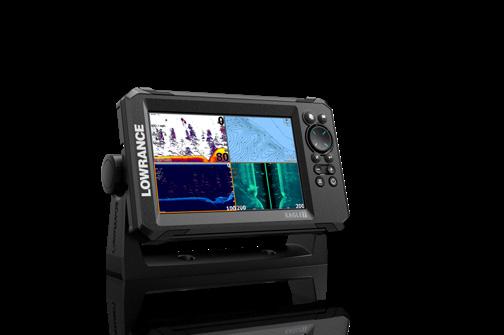
NEW Lowrance EagleLowrance’s new entry level fishfinder, Eagle features newly designed highdefinition enhanced sonar, with FishReveal technology and detailed C-MAP charting including Genesis Live.
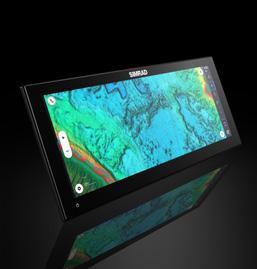
NEW Simrad NSX ULTRAWIDE – The Simrad NSX ULTRAWIDE is the world’s first fully-featured ultrawide marine display. Delivering all the benefits of dual screens in one place and providing a more streamlined and immersive experience resulting in an elevated dash aesthetic that unlocks new possibilities and a superior charting experience.
HDS PRO with ActiveTarget 2 and Active Imaging HD – Lowrance’s next generation of fishing electronics that provides anglers the complete package of the latest tools that helps them find and catch more fish.
Simrad Yachting’s new HALO 2000 and 3000 Open Array Radars – The HALO 2000, and HALO 3000 both feature higher power pulse compression and improved detection ranges to offer the most powerful Simrad HALO radars on the market.
Mastervolt and CZone – Mastervolt and CZone Products will be on display within a helm station showing the integration between Mastervolt power solutions, CZone digital switching, and Simrad multifunction displays, as well as integration between Mercury Marine.
Additionally, Simrad Brand Ambassadors Adam Clancy and Flynn Jack will be making appearances at the Navico stand.
NAVICO.COM
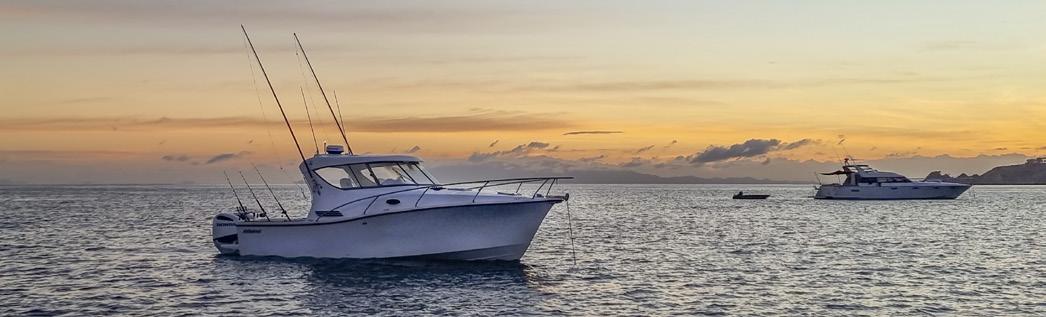
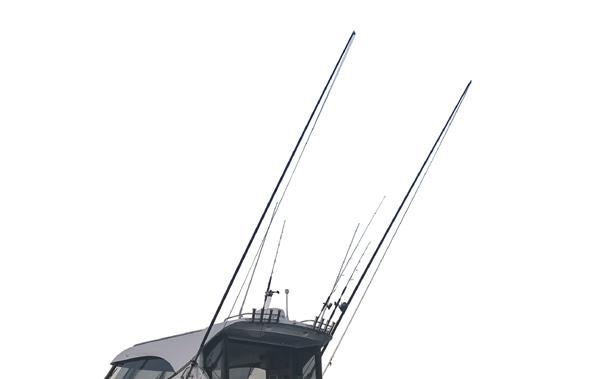

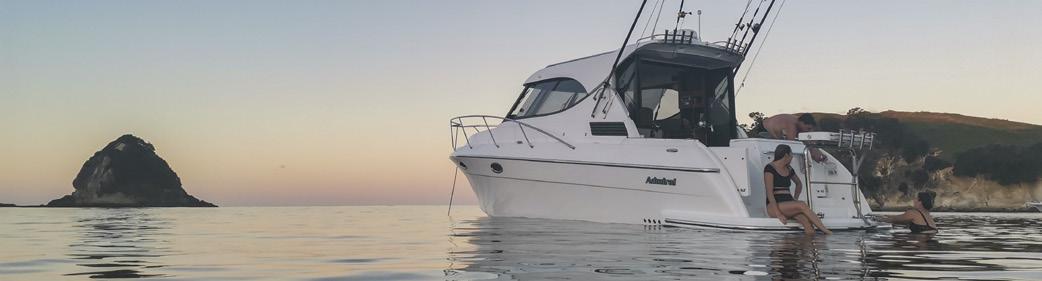

Setting the benchmark for qualiity, design, build & performance w w w . a d m i r a l b o a t s n z .com info@admiralboatsnz.co.nz | 027 600 9027 | @ admiralboatsnz Helping our clients bring their dreams to life by building truly exceptional boats.
Admiral 9m Gamefisher
DB955
Admiral 10m Sports Cruiser
POWERBOATMAGAZINE.CO.NZ 19
Setting a new standard
Setting a new standard in trim & stabilization. Again. Priced for 20-45ft boats.
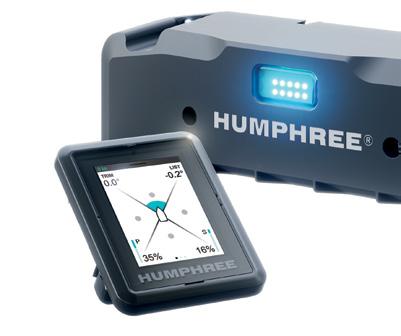
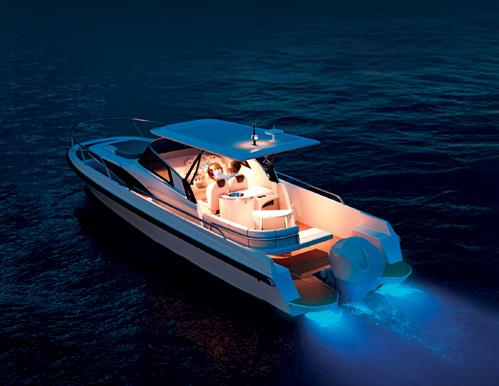
LIGHTNING by HumphreeTM is an automatic trim & stabilization system that brings world class comfort, increased speed and fuel savings. LIGHTNING is suitable for 20-45ft boats.
Its combination of our advanced technology, user-friendly interface, mobile app integration, and beautiful underwater LED lighting system is what truly sets it apart.
No matter which propulsion system you use; outboards, electric, sterndrive, inboard—this new system will be the perfect choice for new build boats or for when you refit a used boat. It will take you to the next level.
LIGHTNING by HumphreeTM is an automatic trim & stabilization system that brings world class comfort, increased speed and fuel savings. LIGHTNING is suitable for 20-45ft boats. Its combination of our advanced technology, user-friendly interface, mobile app integration, and beautiful underwater LED lighting system is what truly sets it apart. No matter which propulsion system you use; outboards, electric, sterndrive, inboard—this new system will be the perfect choice for new build boats or for when you refit a used boat. It will take you to the next level. Setting a new standard in trim & stabilization. Again. Priced for 20-45ft boats.


Setting a new standard in trim & stabilization. Again. Priced for 20-45ft boats. TAKES
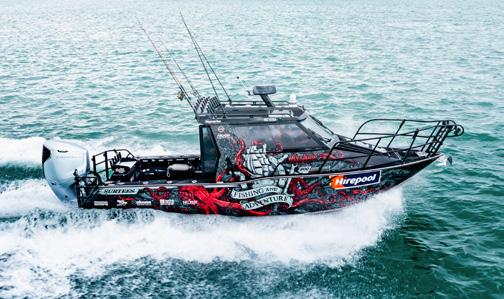
HONDA’S NEW BF350 V8 - ON WATER OPPORTUNITY
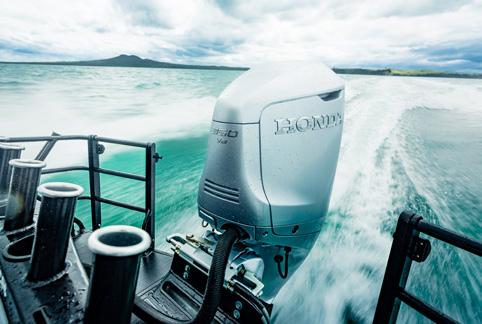
Honda’s BF350, an all-new five-litre V8 outboard, was proudly displayed at the recent Auckland Boat Show, with the added opportunity for show patrons to experience the new engine on the water.
The flagship BF350, the first V8 for Honda Marine, is Honda’s most powerful, technologically advanced outboard to date.
The BF350, a five-litre V8 outboard, delivers 350hp at the propeller shaft at 5,500rpm. VTEC (Variable Valve Timing & Lift Electronic Control) is an exclusive Honda technology incorporated into the BF350 outboard. VTEC uses a mild cam profile to operate intake valves at low rpm and engages a high-output cam profile for higher rpm operation, resulting in offering a broader, flatter torque curve and smooth power delivery throughout the rev range.
According to Honda, the BF350 four-stroke, single overhead camshaft engine boasts high speed, strong acceleration, and excellent fuel efficiency through their Honda Lean Burn Control technology, which automatically adjusts the air/fuel mixture for speed and load while maximizing power during acceleration. This combination of features optimizes fuel efficiency in cruise mode (2,000 to 4,500rpm).
Since it has just been released on our shores, we look forward to experiencing the all-new Honda BF350 V8 on the back of one of our upcoming boat reviews.
HONDAMARINE.CO.NZ
PACIFIC
POWERBOAT _ NEWS
YOUR BOATING TO THE NEXT LEVEL
VISIT THE LIGHTNING WEB PAGE BY SCANNING THE QR CODE WITH
SMARTPHONE
• Pitch
• Auto List • Coordinated Turn • Roll Stabilization AUTOMATIC FUNCTIONS
List • Coordinated Turn • Roll Stabilization AUTOMATIC FUNCTIONS DB984 Humphree Distributor New Zealand & Pacific Islands: Volpower NZ Limited. Ph: 0800 865 769 or 09 274 4305 www.volpower.co.nz
YOUR
Auto Trim
Control
AUTOMATIC FUNCTIONS
•
•
•
TAKES YOUR BOATING TO THE VISIT THE LIGHTNING WEB PAGE BY SCANNING THE QR CODE WITH YOUR SMARTPHONE TAKES YOUR BOATING TO THE NEXT LEVEL
• Auto Trim
Pitch Control
Auto List • Coordinated Turn
Roll Stabilization
20 MAY / JUNE 2024

NEW HAINES HUNTER OVERLANDER






From land to sea, the new Overlander Pursuit provides unmatched freedom. Combining Haines Hunter’s award winning 725 21° deep V hull, and Anura S25 Electric Over Hydraulic all-wheel drive amphibious system, the OP725 is the ultimate go anywhere machine. Capable of 44+ knots, the Overlander has a supremely comfortable, quiet, and dry ride. To arrange a test drive of the new Overlander, register for the National Haines Hunter Roadshow, or contact your nearest authorised Haines Hunter dealer today.





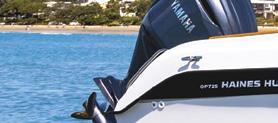



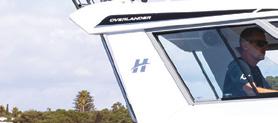



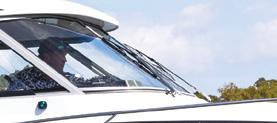
























DISCOVER MORE AT WWW.HAINESHUNTER.CO.NZ
NATIONAL ROADSHOW REGISTER NOW ONFIRE208793
RAYGLASS BOATS LAUNCHES THE ALL-NEW LEGEND 3000
Rayglass Boats, one of New Zealand’s largest GRP boat builders has just announced the launch of the newest and most versatile model in its Legend Series, the Legend 3000.
The multipurpose cabin cruiser comes fully equipped with premium features and is the perfect crossover for boaters looking to entertain family and friends, spend the day fishing, or take a weekend getaway. “Most models we see in the market today are either fully fishing focused or designed solely for entertaining. The Legend 3000 fits in the hybrid sweet spot, combining comfort, ample space, and customizable options for all-in-one trips,” said Dean Harris, President, Rayglass Boats. “The adventures are endless with this model.”
The Legend 3000 is the first in its category
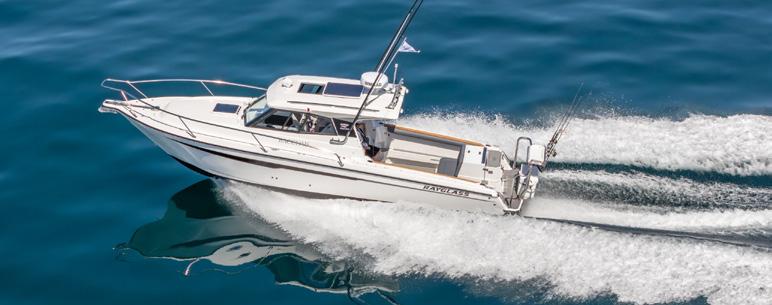
to incorporate modern elements from the Rayglass Protector range like the sleek hardtop and sharp-design hull. The ergonomic helm station is outfitted with the latest Simrad technology including the 19inch NSO Evo 3 multifunction display and 600W Totalscan Transducer. Noteworthy features for anglers include the live bait tank, bait board, easy access cockpit storage lockers, Mercury QSD 350hp diesel or twin Mercury outboard engines, and option offerings like electric reel outlets, tuna tubes, dive tank racks and more. Standard features that make the Legend 3000 the ultimate in entertaining and comfort include a large sunroof and twoway sliding glass side windows on the hardtop, a cockpit table, port and starboard king and queen seats and a transom bench seat, hot and cold freshwater stern shower, a galley with an electric refrigerator
and freezer box, twin hob gas cooker, a large separate toilet, and top of the line upholstery throughout.
Additional features and model specs include premium captain seats with soft rider pedestals, advanced controlling features for ease of use like Zipwake automatic trim tabs and optional bow thruster, optional seat configurations like a sunlounger, and fold out cockpit seats for easy entertaining and a spacious flat foredeck with easy walk around.
Length: 9meters/29.5ft, Beam: 2.5m, Inboard - 270-370hp, Outboard: 400600hp, Fuel Capacity: 320 Litres
The Legend 3000 made its boat show debut at the recent Auckland Boat Show, with both the inboard and twin outboard models on display. A single-outboard option will also be available later this summer.
RAYGLASS.CO.NZ
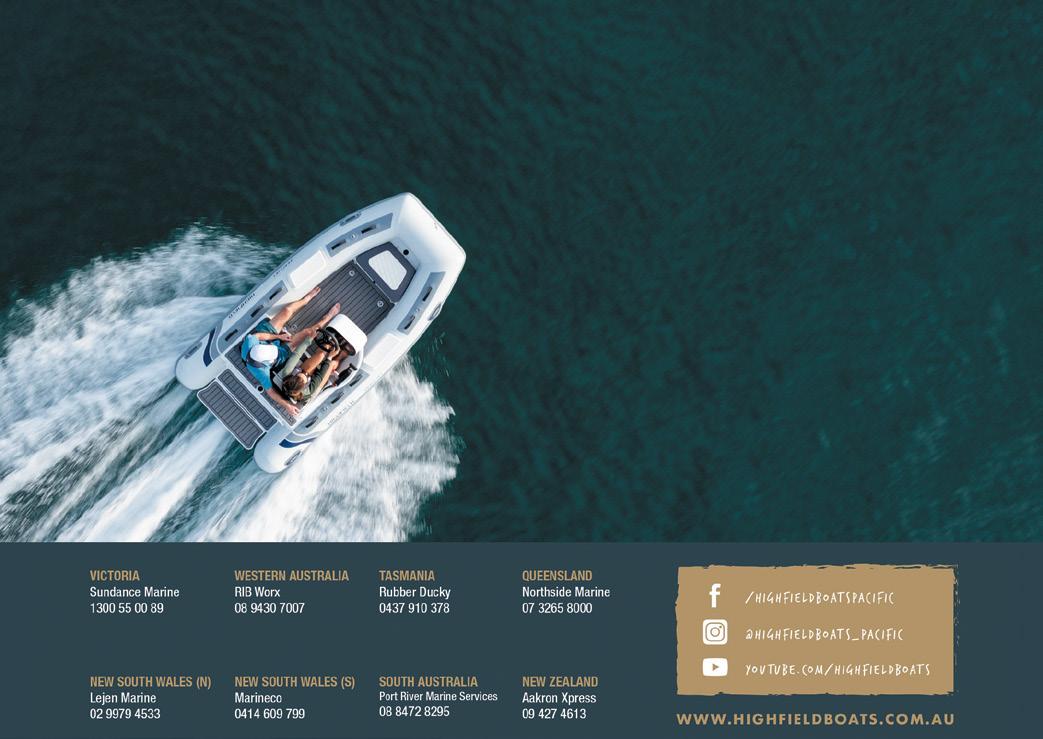
ELECTRIC JET RIB FOR ZERO COMPROMISE BOATING
The innovative and award-winning EJET 330 electric jet combines Highfield’s performance and strength as the world’s leading manufacturer of aluminium RIBs, with ZeroJet’s e�cient and powerful electric system.
• No exposed propeller means safer use in the water.
• The low-profile makes beaching easy and allows the boat to skim over shallow ecosystems.
• Compact size makes it easier to stow and store in smaller spaces.
• ZeroJet 18kW electric motor and jet pump is integrated into the hull, giving more space on the boat compared to outboard engines.
P O W E R E D See i t at Sanctua r y Cove 2 3-2 6 Ma y , s ta nd P R 2 9
PACIFIC POWERBOAT _ NEWS 22 MAY / JUNE 2024
AKZONOBEL’S AWLGRIP BRAND LAUNCHES
REVOLUTIONARY 3D COLOR VISUALIZER
REDUCE
Allowcrewandmovearoundsafely guests to Providesacomfortable diningand entertaining settingfor
Sleepincomfort oranchoredout at the dock
Keepyourvesselsteadywhendocking
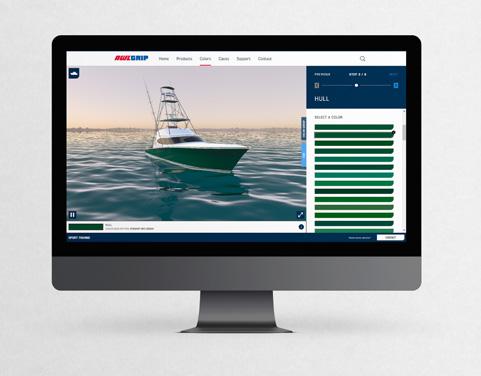
Awlgrip®, the renowned yacht brand under AkzoNobel, introduces a revolutionary 3D Colour Visualizer on its website. The innovative and industry leading tool is designed to empower boaters and applicators by simplifying their journey to find the perfect colour for their boat. Boat owners, applicators, boatyards, and builders now have at their fingertips a cutting edge 3D Colour Visualizer, offering instant access to tens of thousands of colours from the extensive Awlgrip colour database.
WTheonlyno-maintenancegyroavailable
Effectiveattrollingandzerospeeds
toEasyuse,justflipaswitch
Improvesfuelefficiency
hether it's a sailboat, sportfish, cruising powerboat, or a superyacht, users can select their vessel type and explore various colour options for the hull sides, deck, cabin, boot stripe, and including the fouling control solution for their region. Through AkzoNobel's expertise in colour and utilizing unique algorithms, boaters are now able to gain a visual representation of what their boat could look like in a 3D virtual environment, then download their project scheme to discuss with their retailer or client. Unlike traditional 'flat' panels, the user can manipulate the virtual boat to view colours from different angles, providing a lifelike impression of how complex curves and angles will appear.
Centre |09
MotorYachtService info@mysc.co.nz
4161179
www.mysc.co.nz|
12ClearwaterCove, HobsonvilleMarina,Auckland,NZ
AlsoAgentsfor:
Matthew Anzardo, Global Segment Manager of AkzoNobel's Yacht Coatings, said: "The introduction of our innovative 3D Colour Visualizator signifies another step in the way we use digital technology to support our customer experience. Extensive data analytics, investment in our colour portfolio and capability while adapting new trends and technology are key foundations which help us stand out when it comes to colour selection and performance in the boating industry.
AWLGRIP.COM/COLORS
WWW.MYSC.CO.NZ



Agent for Maritimo REDUCE Your Boat Roll At anchor and underway Fishers Sports and Trawlers Yachts, Luxury For For Luxury Yachts, Trawlers and Sports Fishers move around safely dining and setting for or anchored out vessel steady when docking Effective at trolling and zero speeds The only no-maintenance gyro available to Easy use, just flip a switch Improves fuel efficiency www.mysc.co.nz | 416 1179 Motor Yacht Service info@mysc.co.nz Centre | 09 WWW.MYSC.CO.NZ 12 Clearwater Cove, Hobsonville Marina, Auckland, NZ Also Agents for: DB979 NZWarrantyandAfter-Sales AgentforMaritimo REDUCE YourBoatRoll Atanchorand underway Fishers Sports and Trawlers Yachts, Luxury For For Luxury Yachts, Trawlers and Sports Fishers Allowcrewandmovearoundsafely Providesacomfortable diningand settingfor Sleepincomfort oranchoredout Keepyourvesselsteadywhendocking Effectiveattrollingandzerospeeds Theonlyno-maintenancegyroavailable toEasyuse,justflipaswitch Improvesfuelefficiency www.mysc.co.nz| 4161179 MotorYachtService info@mysc.co.nz Centre |09 WWW.MYSC.CO.NZ
12ClearwaterCove, HobsonvilleMarina,Auckland,NZ
AlsoAgentsfor: NZWarrantyandAfter-Sales AgentforMaritimo
YourBoatRoll
Atanchorand underway Fishers Sports and Trawlers Yachts,
Luxury For For Luxury Yachts, Trawlers and Sports Fishers
POWERBOATMAGAZINE.CO.NZ 23
SMUGGLER’S NEW RELEASE – STRATA 750 RIB
Smuggler Marine have released their new Strata 750 RIB, with a number of improvements and appointments over the previous generation model.
The new model now features Smuggler’s all-new Gen 2 console with a toilet located under the helm console and an onboard refrigerator under the helm seat. Other changes include upgraded seating, a re-designed Targa top and stainless structure, as well as the addition of new removable side clears to provide extra protection from the elements. Seating at the helm is now comprised of two Captain’s style seats, with lift up seat bolsters and foldable arm rests. The 750 retains passenger seating and a sun pad in
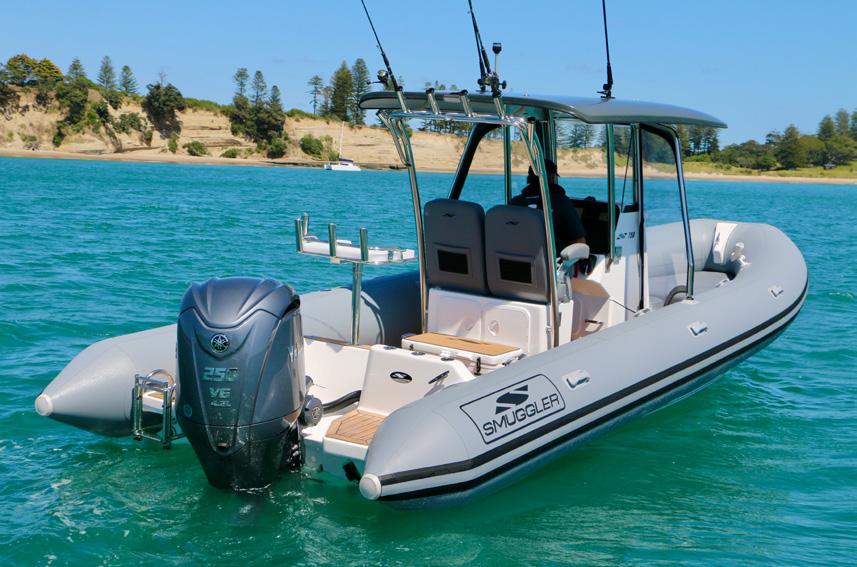
the bow area, as well as aft corner seating in the cockpit. Not short of storage, there are underfloor lockers forward and aft, as well as storage under the helm seat, and in the transom.Designed to perform, the new Strata 750 retains Smuggler’s proven 27 degree deep vee hull delivering incredible
rough water performance. With a Yamaha F250hp four stroke outboard the 750 is easily capable of 50 knots.
See the new Strata 750 Centre Console at the upcoming Hutchwilco New Zealand Boat Show, 16-19 May. SMUGGLER.CO.NZ




PACIFIC POWERBOAT _ NEWS
WHATEVER WAY YOU WANT YOUR POWER BOAT FIX PACIFIC WWW.BOATMAGS.COM TRAILERBOATS LAUNCHES CRUISERS ALSO REVIEWED BONUS 2020 PWC ANNUAL FOCUS POWER 33 HIGHFIELD 660 PATROL INTEGRITY 340XS RIBS PROJECT K 12 NEWPORT 460 NIMBUS C9 OCEAN ALEXANDER DIVERGENCE 45 NOVEMBER DECEMBER 2019 PWC 2020 BUYERS GUIDE New Colours & Innovations HOW TO CATCH BIG SNAPPER The gear, the bait & the technique NIMBUS C9 NEWPORT 460 INTEGRITY 340XS FOCUS POWER 33 JP RIBS PROJECT K 12 HIGHFIELD 660 PATROL DNA 590 XHT BELIZE 66 SEDAN AQUALINE 545CC SEALEGS 6.1 ALLOY CROWNLINE 264 CR HAMILTONJET E740 TRISTRAM 640 CABRIOLET JANUARY FEBRUARY 2021 PACIFIC WWW.POWERBOATMAGAZINE.COM TRAILERBOATS LAUNCHES CRUISERS BONUS ALLOY BOAT MAGAZINE CONTINUING THE PASSION 590 DNA 590 XHT Belize 66 Sedan Aqualine 545CC Sealegs 6.1 Alloy HamiltonJet e740 Crownline 264 CR Tristram 640 Cabriolet THE HISTORY OF TRAILERBOAT WINCHES Reviews 7 CLASSIC RACEBOAT CARACAT TOO 66 SEDAN CATCHING KINGFISH USING A FLY HOW THE OUTBOARD HELPED WIN A WAR DIESEL ENGINE MYTHS PRINTED SUBSCRIPTION One year subscription Delivered to your door One year digital subscription with unlimited access to back issues, boat reviews and features. DIGITAL SUBSCRIPTION Free DB960b $58 Save 25% $20 A free subscription to our PowerBoat Weekly E-News www.powerboatmagazine.co.nz Save 33% 24 MAY / JUNE 2024
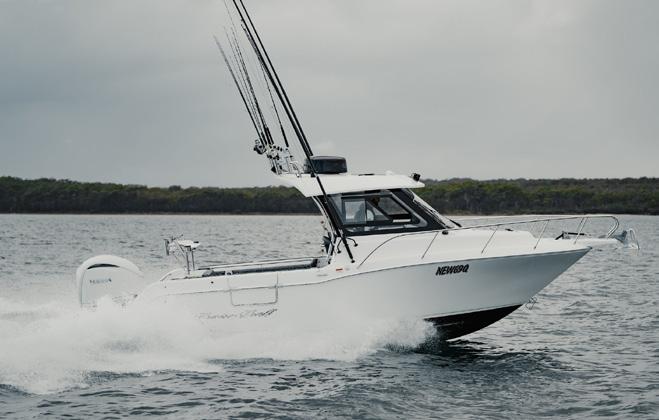
THE WAIT IS FINALLY OVER! CRUISE CRAFT BOATS EN ROUTE TO NZ
Cruise Craft Boats are en route to New Zealand, and Farnley’s Yamaha couldn't be more thrilled to announce they are now the official dealer!
Their first E695HT Cruise Craft was scheduled to arrive in-store on April 25th and will make its debut at the Hutchwilco Boat Show, showcased at their stand #330. Following this, they will host an on-water demonstration event. With just a few remaining build slots for 2024, this premium product is in high demand.
FARNLEYSYAMAHA.CO.NZ
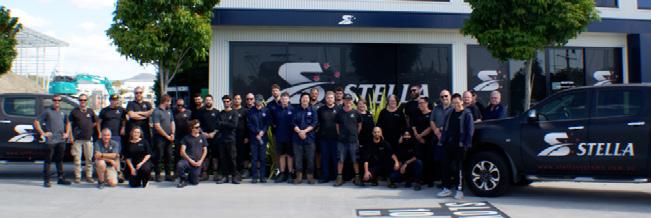
STELLA CELEBRATES 21 YEARS
Since their establishment in 2003, Stella has remained committed to engineering, manufacturing, and distributing premium marine equipment for the global market, setting standards of excellence and innovation. In 2011, they achieved a significant milestone by diversifying into manufacturing with their very own product line of Stella Watermakers.
This marked the beginning of a new chapter for Stella, as they expanded their capabilities and product offerings to better serve their customers. They now manufacture in-house a range of Watermakers, Hydraulic Swim Platforms, Helm Chairs, Tender Chocks, and Davits, whilst also maintaining strategic distribution partnerships to widen their product offering even further.
Founder & Managing Director of Stella, Gary Cooper commented "Celebrating Stella's 21st anniversary is a significant milestone for our company as we reflect on two decades of engineering, manufacturing and distributing premium marine equipment for the global market. As we celebrate this milestone, we recognise that none of our achievements would have been possible without the dedication and hard work of our team here at Stella."
STELLAMARINE.COM.AU


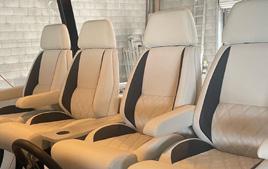
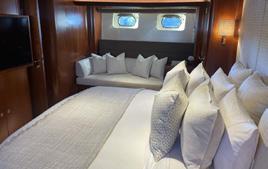
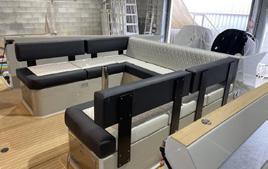
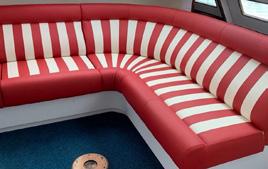
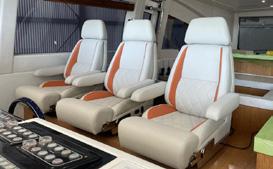
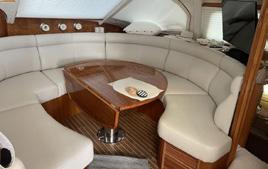
We specialise not only in helm chairs but also custom made furniture, boat interiors, soft furnishings and all your upholstery needs.

THE WAY TO
AND ENGINEERING
www. m melfi design .com LEADING
BRILLIANT DESIGN
DB983
447 | info@mmelfidesigns.com | Building J, Unit 7, Boatworks Drive, Coomera, Q 4209
M Melfi Design. P: 0412 862
POWERBOATMAGAZINE.CO.NZ 25
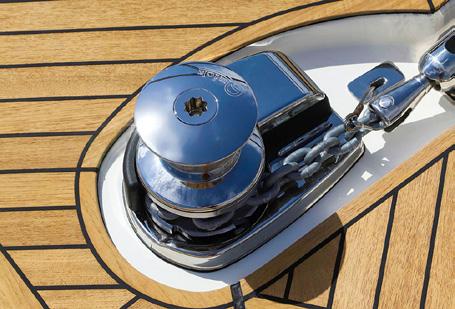
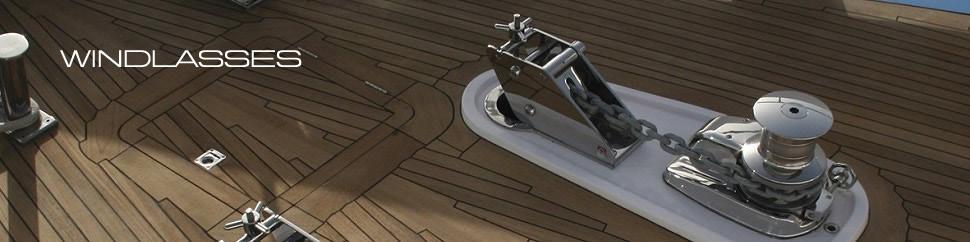
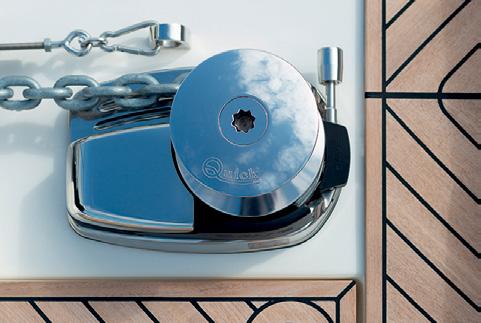
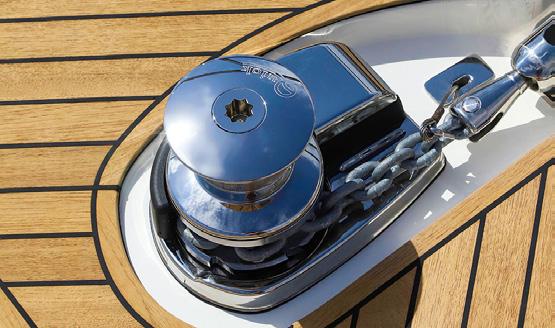
QUICK USA SELECTED AS ABA SUPPLIER OF CHOICE FOR WINDLASSES CONTRACT WITH AMERICAN BOATBUILDERS ASSOCIATION RUNS UNTIL 2027
The American Boatbuilders Association (ABA) has chosen Quick USA, the Italian-headquartered marine equipment manufacturer, as its Supplier of Choice for windlasses. The contract will run from 1 July 2024 until 30 June 2027.
ABA is a coalition of 26 leading independent US boat manufacturers, covering 21 facilities across 12 states that produce approximately 34,000 boats annually – including nearly a quarter of all fibreglass boats above 16ft built in America. The decision to select Quick USA stands as a recognition of Quick Group’s commitment to
product quality, reliability, low failure rate, ongoing R&D, and comprehensive aftersales service and support.
“The selection of Quick USA as a Supplier of Choice by ABA is another major step forward not only for the Quick brand but also for our growing branch Quick USA,” says Marco Santoro, CEO of Quick USA. “The trust that the industry has for our products lies in our commitment to excellence in every stage of the chain, from the detailed design and engineering of our equipment lines to rigorous testing, advanced production and manufacturing capabilities, a highly focused after-sales and service offering.
Quick Group has established itself as a
cornerstone of high-quality equipment for the global leisure marine market, spanning several different categories of products from tanks and water heaters to thrusters, lighting, anchoring systems, stabilisation and more. Following the acquisition of the Florida-based Service Centre in January 2024, Quick USA solidified its operations in the United States. This strategic move enhances Quick USA’s capability to provide end-to-end solutions to customers and ABA partners, encompassing everything from equipment supply to comprehensive service offerings.
Quick is distributed in New Zealand by Tenob.
TENOB.CO.NZ



PACIFIC POWERBOAT _ NEWS WHOLESALE MARINE Importer | Manufacturer | Distributor www.tenob.co.nz Tenob Wholesale Marine | 241 Ti Rakau Drive | Burswood 2013 | Auckland | New Zealand | Ph +64 9 273 9180 | sales@tenob.co.nz www.tenob.co.nz Ph: 0800 273 9180 DB990 FOR PRODUCT ENQUIRIES CONTACT
26 MAY / JUNE 2024
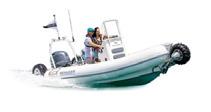
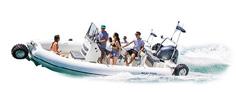
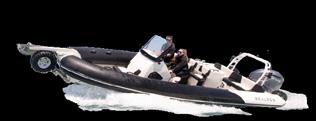
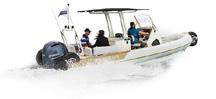
0800 SEALEGS | WWW.SEALEGS.COM | INFO@SEALEGS.COM | SEALEGS SHOWROOM: PARKHEAD PLACE, ALBANY, AUCKLAND 7.1M RIB 7.5M RIB 6.1M RIB 8.5M CABIN 9.0M RIB 12M CABIN 6.5M CUDDY 3.8M TENDER BOOK YOUR DEMO TODAY! - CALL US 0800 SEALEGS THE WORLD’S LARGEST RANGE OF AMPHIBIOUS BOATS FROM THE WORLD LEADERS IN AMPHIBIOUS TECHNOLOGY
6.5M CUDDY CABIN
8.5M ALLOY CABIN
12M CABIN RIB 7.5M ALLOY
EYACHTS SET TO SHOWCASE IMPRESSIVE LINE UP AT SCIBS
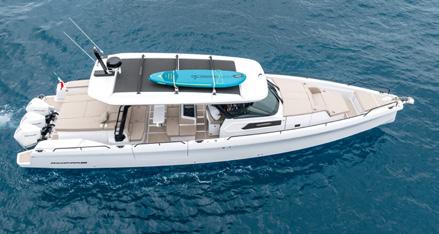
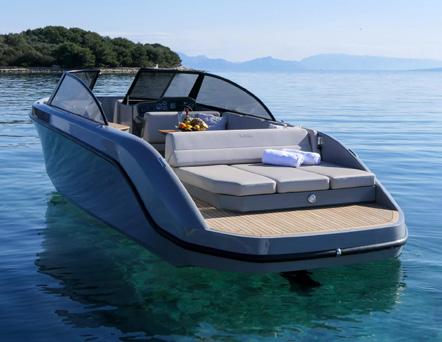
Leading European yacht distributor in Australia, Eyachts, is thrilled to announce its impressive line-up for the upcoming Sanctuary Cove Boat Show. Eyachts will be premiering some of the most cutting-edge vessels in the industry, including the much-anticipated Axopar 29 Sun Top, Axopar 45 Sun Top, and the ground-breaking RAND Supreme 27 Electric.
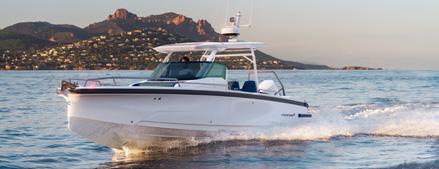
Axopar 29 Sun Top: Renowned for its sleek design and exceptional performance, the Axopar 29 Sun Top is a beacon of innovation and versatility in the world of adventure boating. Redesigned to perfection, the 29 Sun Top sets a new standard for sub-30-foot boats, offering the new opening Sun Top roof, a forward cabin with ample storage and convertible sleeping area, and a social bow area with seating for up to 8 guests. The driver-focused helm and customizable aft deck layouts further enhance the Axopar 29 Sun Top's appeal.
Axopar 45 Sun Top: With space and light on a scale never before seen on an Axopar, the Axopar 45 Sun Top features comfortable and social bow and cockpit seating areas and versatile aft layout options. Stepping into the luxurious cabin reveals seating for up to seven people, with multifunctional design allowing for quick conversion into a spacious bed. The stand-up head and shower offer convenience, while the aft cabin provides ample space for relaxation or sleeping quarters for two. Equipped with three roof racks, the 45 perfect for transporting outdoor gear for any adventure. Ranked among the most versatile boats in the market, with triple 300hp outboards and Axopars renowned fuel efficient and performance enhanced hull design, you can be confident to venture anywhere, making it an ideal choice for extended explorations.
RAND Supreme 27 Electric: Making its debut as the first electric in Australia from this category, the RAND Supreme 27 Electric represents a significant milestone in sustainable boating. With zero emissions and whisper-quiet operation, this ecofriendly vessel offers a glimpse into the future of yachting. Like nothing else in its category, RAND Supreme 27 is a spacious, comfortable, and sporty bowrider. The aft sun lounge offers comfort and panoramic views, complemented by a spacious locker for wakeboards, water skis, and other essentials for your day on the water. Meanwhile, the cockpit chaise lounge provides an ideal spot to unwind, while the optional kitchen and bar serve as the hub for entertainment and socializing. Additionally, the onboard enclosed and private toilet adds convenience to your boating experience.
In addition to these premiering boats, Eyachts will also be showcasing a selection of other impressive models, including the Axopar 37 Sun Top and 37 Cross Cabin, the RAND Spirit 25, and the Greenline 39.
EYACHTS.COM.AU
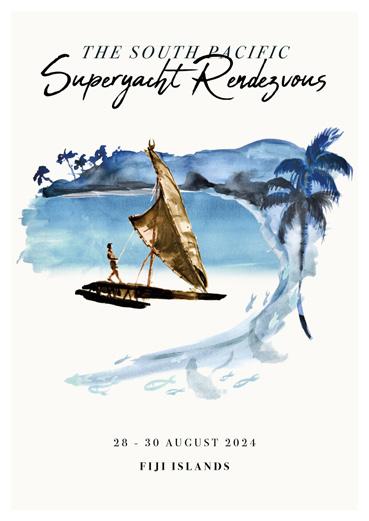
SOUTH PACIFIC SUPERYACHT RENDEZVOUS TO BE HELD IN FIJI THIS AUGUST
South Pacific-based organisation The Superyacht Gathering is set to host its inaugural Rendezvous in Fiji this August. The program will feature friendly regattas raced around the Fijian islands, interspersed with barefoot beach parties to allow owners from Oceania and further afield to meet.
The event is open to sailing and motor yachts 22 metres and above, with $500 from each yacht entry being donated to the Fiji Yachting Association’s Kids Sailing Program. The Fiji Yachting Association has also deeded the historic 1997 President’s Cup as the winning prize and will be running the races in partnership with Australia’s Southport Yacht Club.
THESUPERYACHTGATHERING.COM
PACIFIC POWERBOAT _ NEWS
28 MAY / JUNE 2024
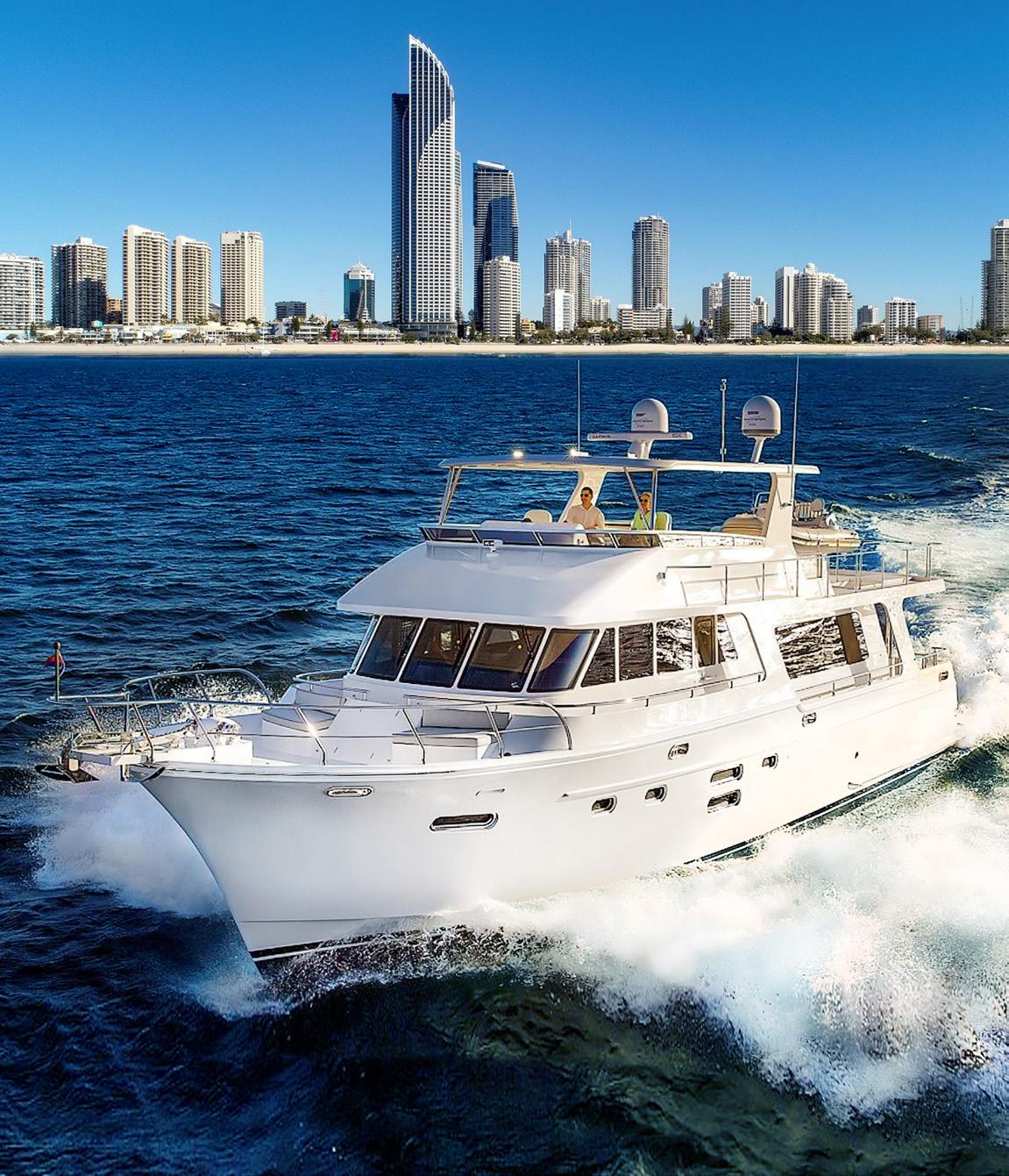
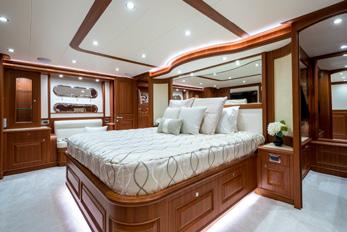

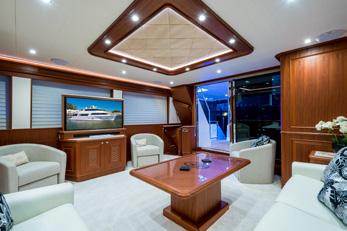
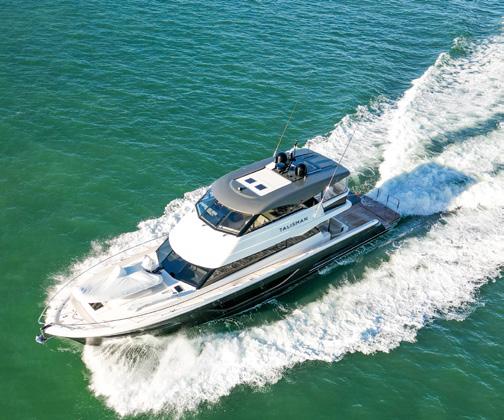
Leigh-Smith Yachts are excited to announce the addition of a new stock yacht set to be delivered to our shores in 2024. Labelled as “80 feet of yacht in a 68 foot hull” by our friends at BoatTest.com, the four-stateroom, four-head E680 cruises effortlessly at 10 knots in absolute luxury. Comfort on-board is at the heart of the E680’s conception, offering users a functional layout and an interior brimming with the highest quality finishes. With extraordinary sea-keeping ability, twin 1,136hp CAT C18’s on straight shafts and an 8,000L fuel capacity, the E680 is ready to comfortably tackle any journey.
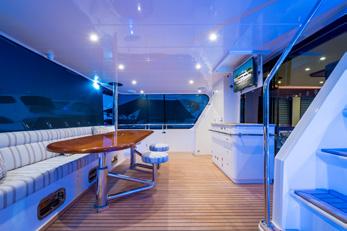

680
www.leigh-smith.com 07 5577 9200 sales@leigh-smith.com
COUNTDOWN TO 55TH SYDNEY INTERNATIONAL BOAT SHOW HAS BEGUN
The Sydney International Boat Show attracted an attendance of almost 47,000 visitors in 2023, with crowds immersed in a spectacular showcase of hundreds of boats and marine products, world and national launches, ground-breaking marine technology and show stopping entertainment.
With only months to go until the 2024 Show and consumer demand across the boating industry buoyant, there has never been a better opportunity to participate and connect brands with highly engaged, qualified visitors. Presented by the Boating Industry Association Ltd (BIA) in conjunction with event delivery partner Mulpha Events, the four-day event will
take place from August 1 to 4 2024 and will be set amongst Sydney’s iconic Darling Harbour.
The Show will present the best of the Australian boating lifestyle.
From the large fleet of powerboats and sailboats on the purpose-built event marina on Cockle Bay, through to a host of premium exhibitors displaying the latest trailer boats, personal watercraft, and marine technology in the exhibition halls of the ICC Sydney.
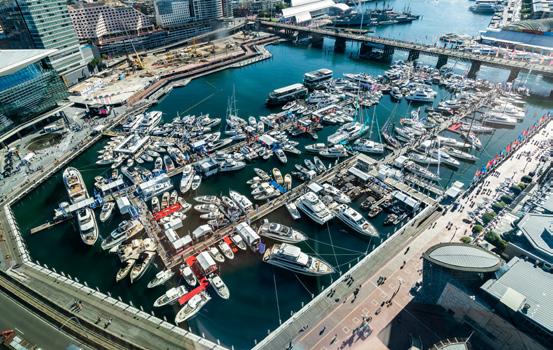
BIA President, Adam Smith said that following the opening of exhibitor registrations last month the 2024 Event is already off to a strong start. “The interest for this year’s Show has been positive with many previous exhibitors and industry already signed-up, including a cohort of international brands, plus new manufacturers and distributors joining in on the action. We have also heard some exciting national and world launches are in the pipeline as well,” he said.
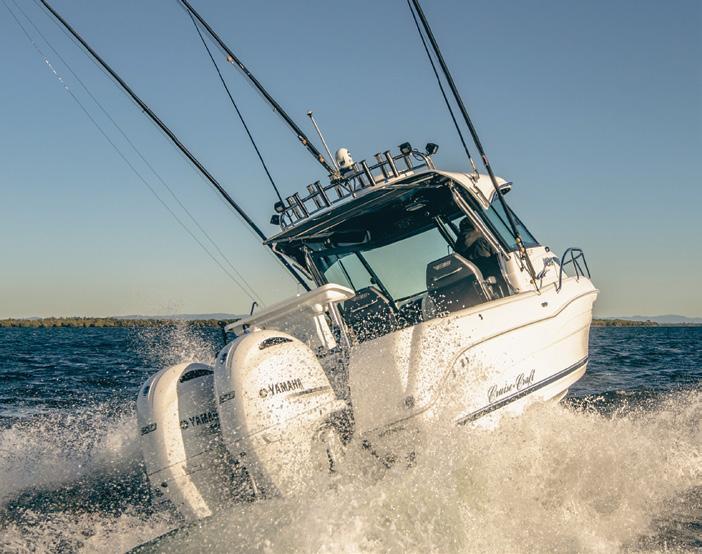
The event marina on Cockle Bay will play host to some big names including Collins Marine, Ensign Yachts, Eyachts, Fleming Yachts, Horizon Yachts, Multihull Central, Pacific Boating, Raymarine, Sacs Marine, Short Marine, Sundance Marine, TMG Yachts and Yacht Domain. After strong visitation last year, 2024 is set to be even bigger, with highlights to include an on-water display with more than 200 boats, 19,000sqm of indoor exhibitor space, and a host of popular entertainment and activities, such as the popular fishing masterclasses, watersports demonstrations, and boating and marine education, all aimed at appealing to both the novice boatie to seasoned marine enthusiasts. SYDNEYBOATSHOW.COM.AU NEW
Specifically designed for the NZ rugged weather conditions!
• Maxwell designed watertight motor cover
• Dual speed motor design See it now at


TASMAN
WWW.MAXWELLMARINE.COM
GENERATION!
V2
PACIFIC POWERBOAT _ NEWS 30 MAY / JUNE 2024
your local Maxwell dealer
125 YEARS OF PANTAENIUS - FOUNDED ON TRUST
Hamburg-based insurance broker Pantaenius celebrates 125 years, a foundation upon which Harald Baum and his family continue to build Europe’s leading yacht insurance experts.
The Hamburg-based insurance specialist Pantaenius celebrates its 125th anniversary. Today, Pantaenius Versicherungsmakler GmbH serves approximately 5,000 medium-sized companies from five locations: Düsseldorf, Eisenach, Kiel, Munich and Hamburg. The Hamburg location has characterised Pantaenius from the very beginning. In 1899, Johann C. Pantaenius founded a brokerage firm for marine insurance in the Free and Hanseatic City. His successor expanded the business in the 1920s to include property and life insurance. In 1963, Harald Baum joined the company,
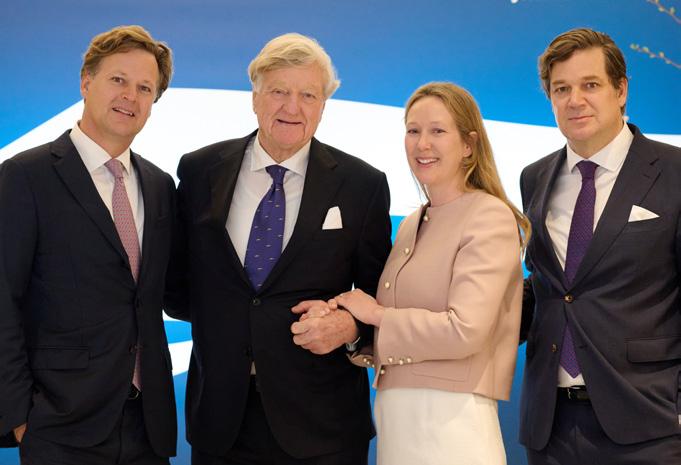
and today, his children Daniel, Martin and Anna are at the helm.
Harald took over Pantaenius in 1970. He developed a new type of hull insurance for yachts. His innovative approach revolutionised the yacht insurance business. Over the following decades, Pantaenius expanded its business to ten locations in Europe and Australia. At the end of the 1990s, the yacht insurance business was

separated from the traditional brokerage business into a separate company. Today, in addition to the yacht insurance branch, the Pantaenius Group encompasses the surveyors office Marine Claims Service, the yacht management company Zucker & Partner - and Pantaenius Versicherungsmakler GmbH, which has been in operation since its founding in 1899.
PANTAENIUS.COM.AU
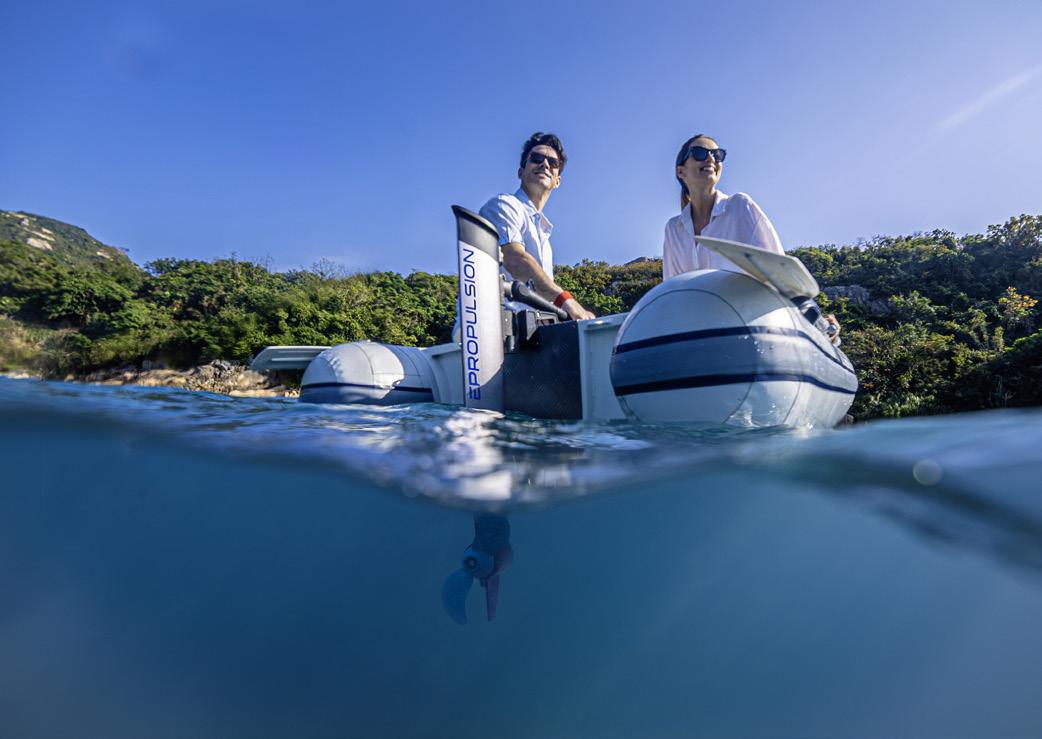

Presenting the all new eLite - 500w - 7kgs - 45min run time. Come see it on stand 236 at the Hutchwilco NZ boatshow DB987 POWERBOATMAGAZINE.CO.NZ 31
BARBER BOATS LOOK TO BUILD A ROGER HILL DESIGN
Greg McDonald, Keely Landon-Lane, and their team are excited to introduce you to their new brand Barber Boats. Barber Boats is the new build division of Tots Marine Coatings Ltd. “We have been working with suppliers and boat designers and look forward to creating some beautiful GOP boats,” says Greg McDonald.
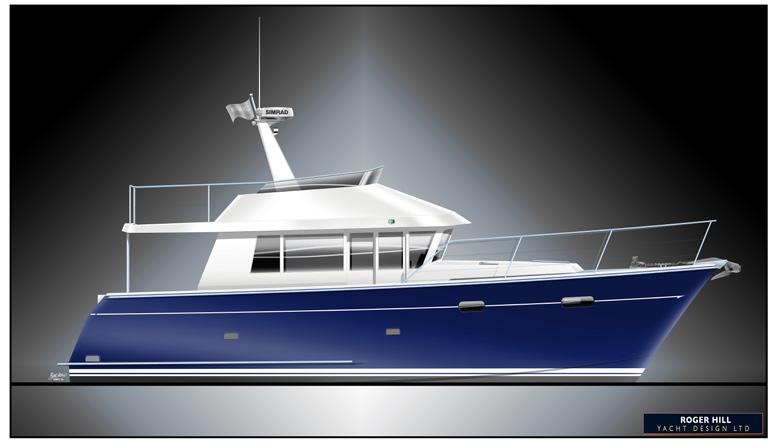
Greg at Barber Boats has been in the industry for 30+ years, and been involved with the building of many GOP boats at Careys Boatyard in Picton. Barber Boats can assist with designing your perfect
boat, providing practical solutions and advice as to what will and won’t work in a boat. The Barber Boats brand will allow custom-made, quality-built boats designed around each customer’s wants and needs. The Greymouth-based boat building business released the boat designed by Roger Hill at this year’s Auckland on Water Boat Show. “Greg is and always has been passionate about boats, and started working for Jack Guard in Nelson after school and
school holidays. Then in 1993 started a boat building apprenticeship at Carey’s boatyard in Picton, working there until they closed in 2012. Having been involved in the building of at least 20 boats, Greg and his team are very keen to carry on with high end custom made Glass Over Ply boats. “Whether it’s for fishing, private, or charter, get in touch and we can discuss your requirements. We want to turn your dream into reality.”
BARBERBOATS.CO.NZ
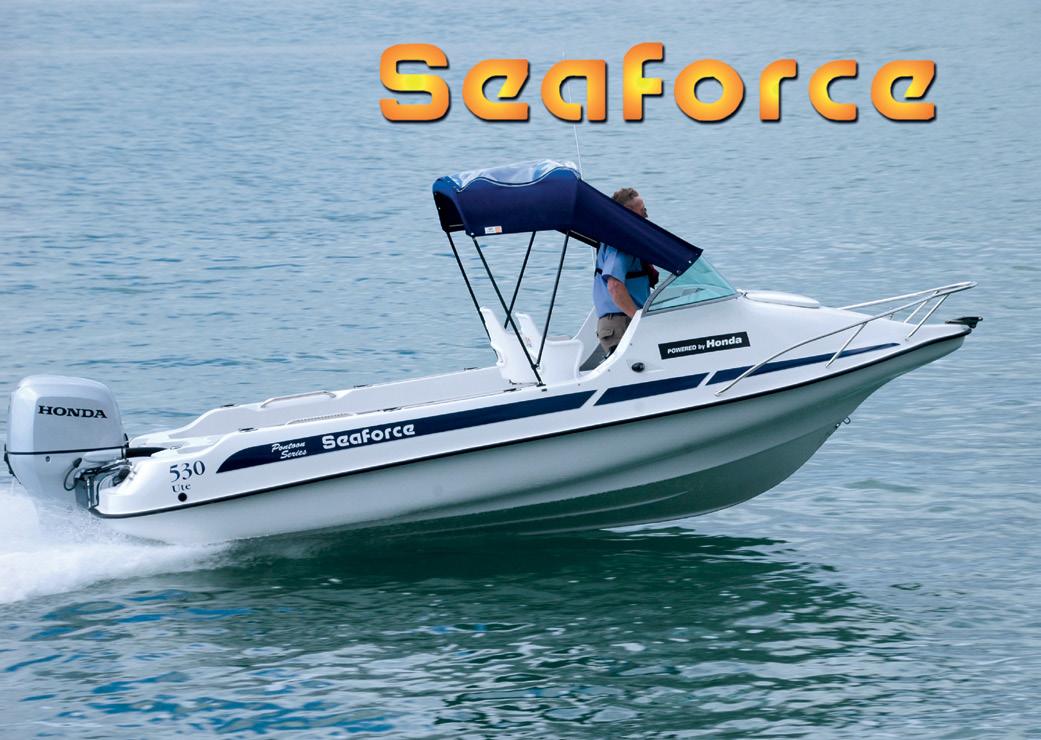


PACIFIC POWERBOAT _ NEWS DB377 FIBREGLASS PONTOON BOATS TM TM www.seaforce.co.nz
Seaforce 530 Skipa
Seaforce 530 Ute
SEE THE FULL RANGE AT 32 MAY / JUNE 2024
Seaforce 530 Mate
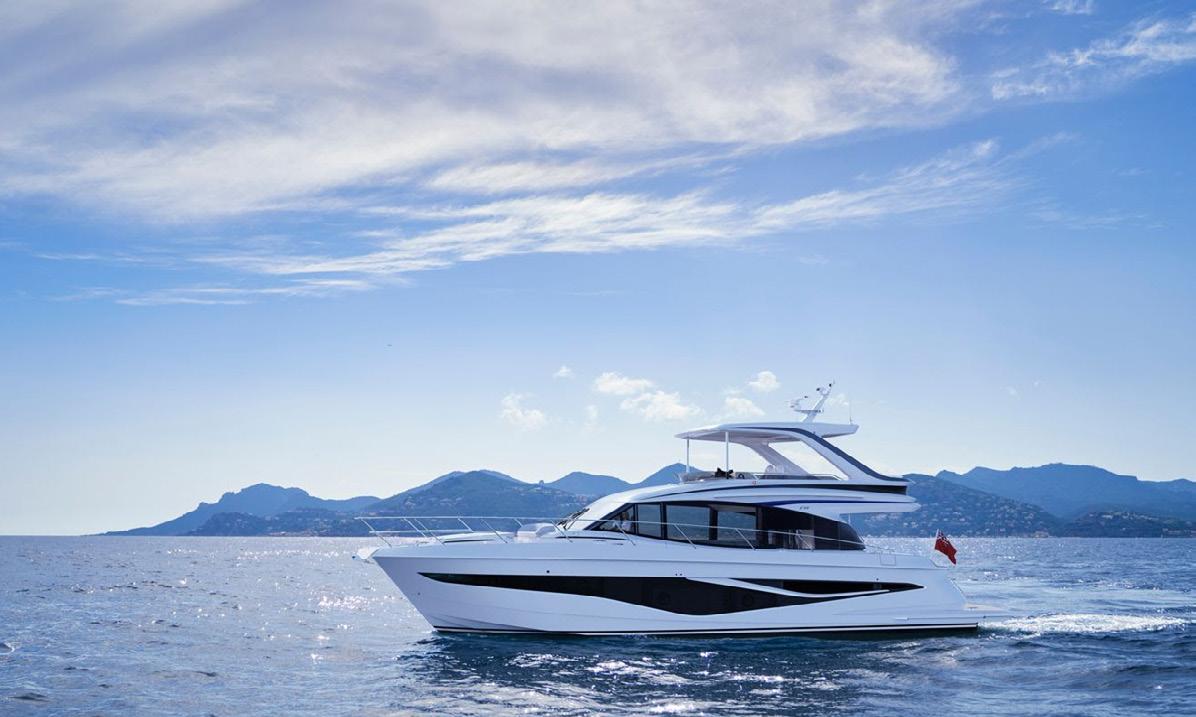
This exceptional range of Flybridge yachts is the epitome of elegance, innovation, and exhilarating performance on the water and the F58 is no exception. Featuring elegant lines, exceptional space and a level of specification and standard of finish normally reserved for much larger craft, she is unmistakably Princess.
The exterior spaces of the F58 have been designed with sociability and relaxation at the forefront. The expansive flybridge has been designed to maximise guest space, while allowing whoever is at the helm to feel connected to the engaged with the festivities onboard. The generous cockpit flows seamlessly and down on to the bathing platform which is itself equipped with seating and an optional BBQ to create a mini beach club adjacent to the water. The saloon is flanked by large windows filling the space with natural light and connecting
effortlessly to the outside. The fully equipped galley is situated aft of the saloon and links the cockpit and interior dining spaces making this a highly sociable layout. On the lower deck are three beautifully detailed cabins including a spacious forward VIP guest cabin, a twin to starboard, which can be converted into a third double, and a full-beam owner’s stateroom featuring a ‘superyacht’ style ensuite bathroom and walk-in wardrobe which also make full use of her generous beam.
SPORTSMARINE.CO.NZ
Redefined for the ultimate experience
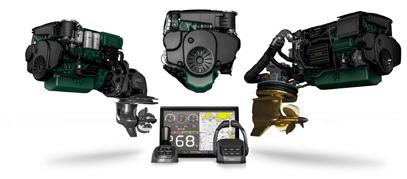
Introducing a new generation of our D4 and D6 propulsion packages, from 150–480 hp. After having spent years refining and developing the proven platform ever further, this complete system delivers new exciting features – from helm to propeller. All to offer you the ultimate boating experience. Visit our store or www.volpower.co.nz to learn more.
Authorized dealer for Volvo Penta Distributed by Volpower NZ Limited for New Zealand & Pacific Islands ph. 0800 865 769 or 09 2744305 www.volpower.co.nz
New D4 & D6 propulsion packages
POWERBOATMAGAZINE.CO.NZ 33
INTRODUCING THE ALL NEW PRINCESS F58
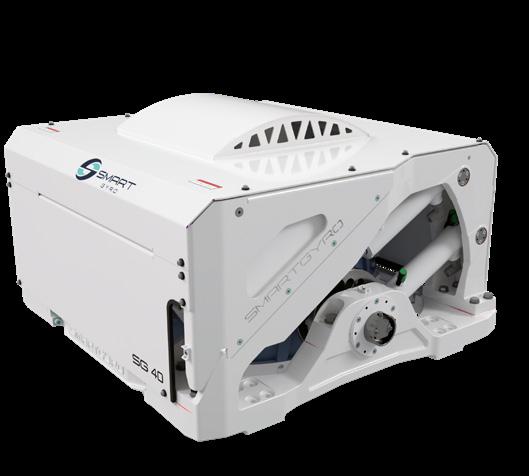
SMARTGYRO JOINS THE POWER EQUIPMENT FAMILY
Power Equipment, one of Australia’s leading engine suppliers, is excited to announce that Smartgyro, a global leader in marine gyroscopic stabilization technology, has joined the Power Equipment stable of brands.
This move marks a significant milestone for Power Equipment, reinforcing its commitment to providing cutting-edge technology, a full suite of marine solutions and unmatched support to their customers. Combining Smartgyro’s growing global presence and Power Equipment’s renowned reputation across the entire Australasian marine industry, it’s a winning partnership!
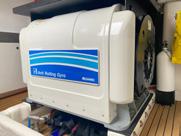
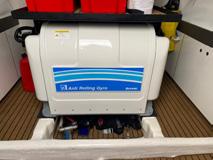
The range of Smartgyro marine stabilizers help to eliminate boat roll, and maximise vessel’s efficiency and overall performance in just about any sea conditions. With six models in the range, Smartgyro stabilizers are suitable for boats from 13m right up to 29m in length. Commenting on the new partnership, Luke Foster, CEO of Power Equipment remarks “We are extremely pleased to add Smartgyro to our line-up, it gives us the ability to fully service and provide a full range of propulsion, on-water power, propellers and stabilisation products to our vast network of marine dealers and our customers.” “With our world-class parts and warehouse infrastructure, along with our highly experienced marine team and vast dealer network, we are well placed to grow the Smartgyro brand throughout Australia and New Zealand.” This collaboration is not only an opportunity for growth for Smartgyro but also strengthens their presence and partnership with another trusted brand in the YANMAR family. Australian customers have the opportunity to explore Smartgyro’s solutions at Sanctuary Cove International Boat Show in Queensland on the 23rd – 26th May, where Power Equipment will be showcasing their newest range of gyro stabilization units.
POWEREQUIPMENT.COM.AU
POWEREQUIPMENT.CO.NZ
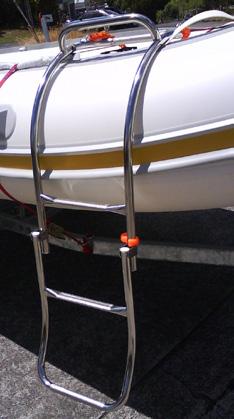
DB214 Call us for more info: p: +64 9 422 3595 or e: mx@pl.net. 59 Woodcocks Rd, Warkworth 0910. NZ DB949 Crafted Marine Grade 316 Stainless Steel Transom Ladders, Removable Gunwale Ladders,Telescopic Ladders, RIB Ladders, Handrails, fittings and accessories. QUALITY LADDERS CHOOSE FROM AN EXTENSIVE RANGE CUSTOMISED OPTIONS AVAILABLE www.dixon.co.nz
34 MAY / JUNE 2024
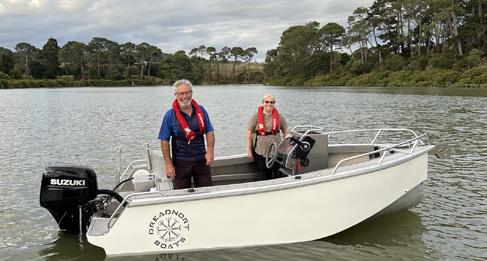
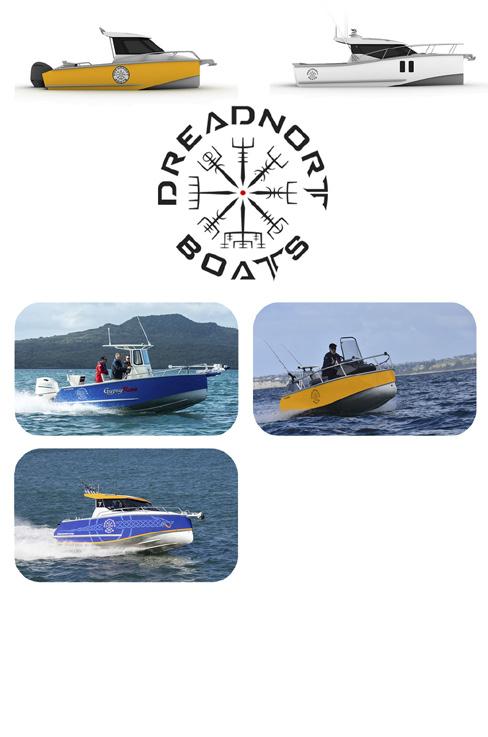
DREADNORT V4250CCJUST LAUNCHED!
Transformarine and Dreadnort Boats are excited to announce the recent launching of a new boat - The new V4250 Centre Console which comes on a custom aluminium trailer.
They worked with the owner on the design, bringing in all the features and styling that he wanted.
This was a slightly different build where the owner had his ‘not so old’ donor boat with a near new engine, in which they transferred the engine and certain fittings over onto the new hull. The owner, designer and builder are extremely happy with the performance and stability right out of the box!
TRANSFORMARINE.COM | DREADNORT.COM
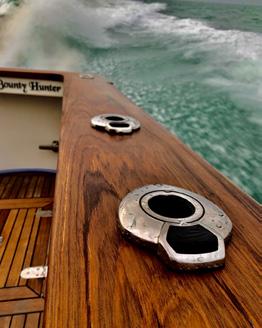
WORLD’S FIRST ‘INVISIBLE MOUNT’ ROD HOLDERS
Available now through Lusty & Blundell
Exploding Fish’s innovative new patented Streamline Series of flush-mounted rod holders feature a first of its kind “no-visiblemounting-screws” design that is both stylish and functional. Exploding Fish’s new Streamline Series “invisible mount” rod holders are available as either Streamline Pro rotating mounts or Streamline Edge fixed mounts.
With just the push of a button, the incredibly versatile Streamline Pro enables a rod to rotate up to 360 degrees in 5 degree increments. This allows anglers to quickly and easily fine tune their rod’s position to account for changes in wind, tide, current and wave action. In addition, Streamline Pro has three integral sleeve angles (0, 15 and 30 degrees) enabling fishers to configure the fishing gunwale to match their desired fishing styles and vessel use, whether deep dropping, trolling, drifting, fishing at anchor or bottom fishing.
As with the Streamline Pro, the new Streamline Edge fixed mount rod holders, with no visible mounting screws, are equally stylish and attractive.
LUSTY-BLUNDELL.CO.NZ



Blair Lewis B.Eng AM.Rina – Naval Architect | Transformarine@gmail.com | +64 21 613 990 Stuart Dawe – Shipwright | Altechmarine02@gmail.com | +64 21 833 080 VISIT THE WEBSITE TO SEE THE FULL RANGE DB985 @DREADNORTBOATS We’re Keen Yachties Too We provide mobile marine services Auckland wide • Antifoul • Touch up & repaints • Propspeed • Gel Coat Repairs • Detailing • Repairs Call free no obligation Bryce Wood 027 444 6583 & Toni Wood 027 aboveandbelowmarine@gmail.com | aboveandbelowmarine.co.nz • Antifoul • Touch ups • Repaints • Propspeed • Gel Coat Repairs • Detailing • Repairs We’re Keen Boaties Too We provide mobile marine services Auckland wide Call us for your free no obligation quote Bryce Wood 027 444 6583 & Toni Wood 027 487 3981 aboveandbelowmarine@gmail.com aboveandbelowmarine.co.nz DB972
POWERBOATMAGAZINE.CO.NZ 35
ILIAD CATAMARANS AWARDED MULTIHULL OF THE YEAR
ILIAD Catamarans continues to enjoy international acclaim with its ILIAD 53F power catamaran announced as 2024 Multihull of the Year in the MultiPower category.
The impressive flybridge motor yacht beat an elite field of nominees from long-established brands and is a glowing testament to the model’s outstanding quality and features. The awards were organised by Multihulls World / Multicoques Magazine with the winners announced at a special ceremony on April 3 at the La Grande Motte International Multihull Show in France.
ILIAD Catamarans general manager
Michael ‘Nod’ Crook said the award was an exciting validation of the ILIAD 53F’s remarkable features that have seen the
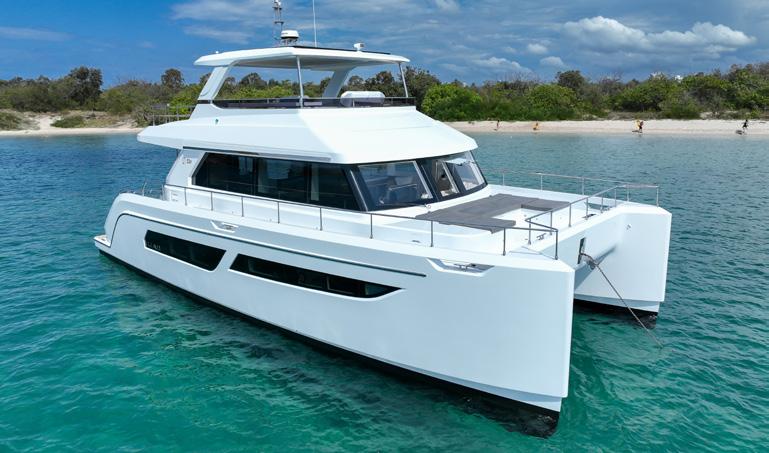
model enthusiastically embraced by buyers across the world since its 2023 launch. “We’re thrilled that the ILIAD 53F has been recognised in these prestigious awards, particularly as ILIAD Catamarans is still a relatively young brand in the power catamaran market with our first model launched in 2019,” Michael said. The ILIAD 53F is part of the shipyard’s ILIAD 53 Series, which also comprises the ILIAD 53S sedan version and the ILIAD 53E electric/hybrid version.
The ILIAD Catamarans range also includes the impressive ILIAD 62 and the new flagship ILIAD 75 luxury power catamaran.
Since the company’s inception in 2016, it has constructed 25 vessels that are now cruising predominantly throughout Asia Pacific, with numerous new orders currently in production. ILIAD Catamarans expanded to the North American market in 2024 following extremely strong demand from this region, and the brand has been swiftly embraced by US buyers
The ILIAD 53F will be on display at the major 2024 Australian boat shows, including the Sanctuary Cove International Boat Show in May and the Sydney International Boat Show in August.
ILIADCATAMARANS.COM
PACIFIC POWERBOAT _ NEWS
36 MAY / JUNE 2024
AUCKLAND BOAT SHOW WRAP UP
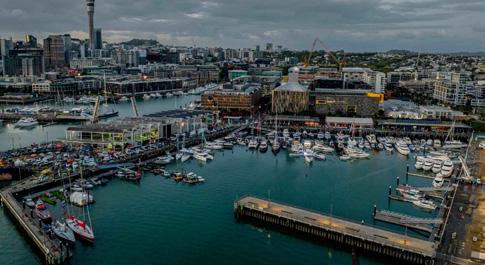
The Auckland Boat Show wrapped up for 2024 and, in an industry facing challenges, New Zealand companies have risen to the challenge and kept selling boats while Mayor Wayne Brown added his support.
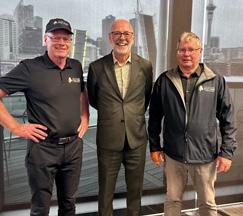

“This is what it means to be in Auckland,” said Mayor Wayne Brown to the New Zealand marine industry companies gathered at the Auckland Boat Show. The Mayor of Auckland was speaking to the assembled marine representatives during the show, New Zealand’s largest boat show on water, which ran from 14th to 17th March. “It’s events like this that make Auckland unique. We’re here celebrating the playground of Auckland - the Hauraki Gulf - and what it means to be in Auckland; out enjoying its waters.”
Mayor Brown’s speech came as the marine industry presented its new releases, technology and innovation at the 2024 show, with a larger number of new releases than had previously been seen at an Auckland Boat Show.
“Like many industries, we have our challenges at the moment,” said Auckland Boat Show organiser, Stacey Cook. “However we’re meeting them head on. The Auckland Boat Show gives our industry an opportunity to show its products in the way they’re meant to be experienced; on the water.” The show, which is held in the Viaduct Events Centre and Jellicoe Harbour, is the only boat show in New Zealand where boats can be viewed on the harbour. As New Zealanders’ appetite for the marine world grows, the show has grown and this year featured 180 trailer boats and RIBS with a further 130 large boats berthed in Jellicoe Harbour to be explored.
Boats were also selling within the show’s on land section. Graeme Heaphy, Makaira Boat’s sales manager, travels with the aluminium boat brand from its Northland factory. “We’ve sold a boat because of the show. The show demonstrates our wares so well, and it’s great to come and get the temperature of the industry. We love this show, we wouldn’t miss it.” The Auckland Boat Show’s footprint spreads to the Viaduct Events Centre, with a number of stands inside the VEC demonstrating New Zealand innovations. “The work postboat show will keep us busy for a month,” said Richard Cleave, of HullWell. HullWell creates advanced antifoul and substrate protection for aluminium, steel, composite, and timber.
The Auckland Boat Show will run again in March 2025, bringing showgoers in contact with New Zealand’s, and the international marine industry.


New Zealand Agent For: WWW.MYSC.CO.NZ and Supplied Installed Quality 316 Stainless Steel Made From Full Electric and Hydraulic Options Options 200KG - Available 1500KG Single Stage and Fixed Boom Hydraulic Swim Platforms Motor Yacht Service 09 416 1179 Centre | www.mysc.co.nz | info@mysc.co.nz 12 Clearwater Cove, , Auckland NZ Hobsonville Marina Installation Completed at Our Hobsonville Location NZ Warranty and After-Sales Agent for Maritimo Also Agents For: DB978
AUCKLAND-BOATSHOW.COM POWERBOATMAGAZINE.CO.NZ 37
SIROCCO MARINE, THE ULTIMATE IN RIBS AT SCIBS 2024
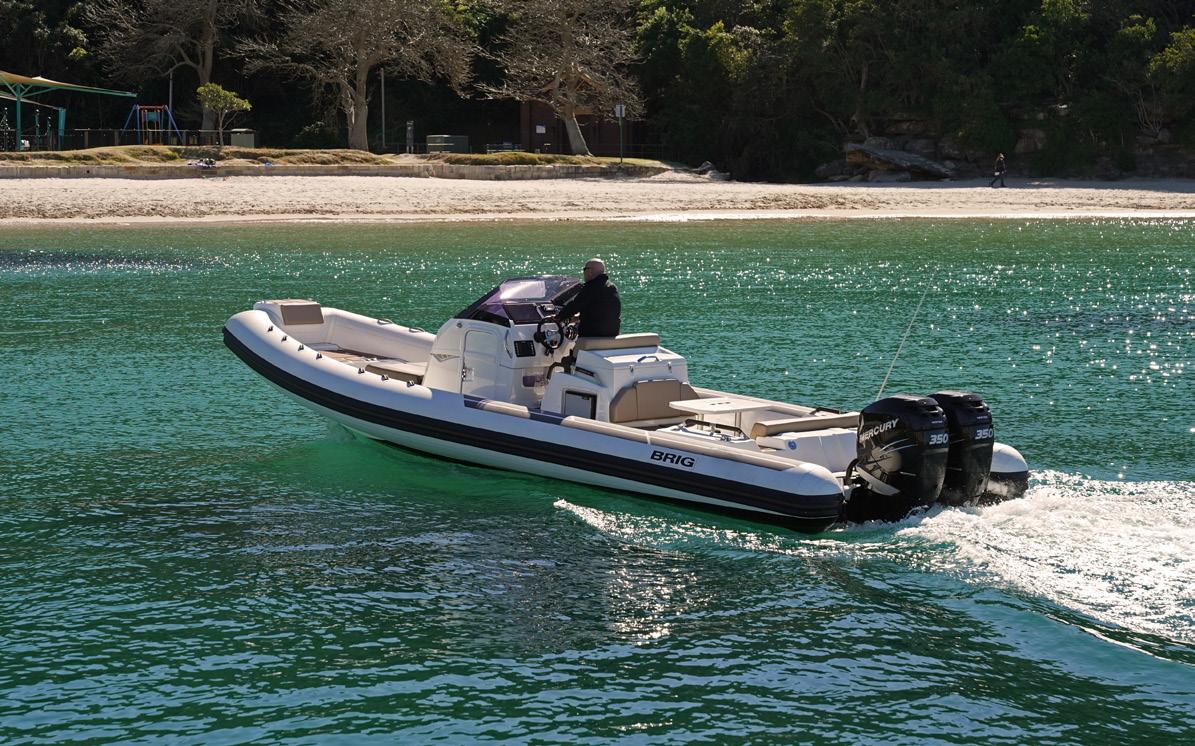
At this year’s Sanctuary Cove International Boat Show, 23 to 26 May, Sirocco Marine will have a massive line-up of Rigid Inflatable Boats (RIBs) from the world’s leading brands. Occupying their traditional space along Masthead Way, Sirocco Marine dealers from all over Australia will present around 30 boats in total, representing the most popular models from BRIG, Zodiac and Williams.
“Visitors to this year’s SCIBS will be able to inspect a wide range of RIBs from Zodiac and BRIG, including the larger models in the 6 and 8-metre segment,” said Sirocco Marine Managing Director, Neil Webster.

PACIFIC POWERBOAT _ NEWS
®
Sirocco Marine on Masthead Way at the 2023 Sanctuary Cove International Boat Show, 23 to 26 May 2024.
Visit
SIROCCOMARINE.COM.AU
38 MAY / JUNE 2024
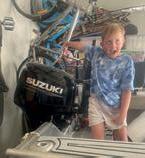
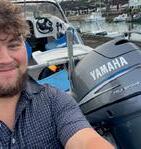
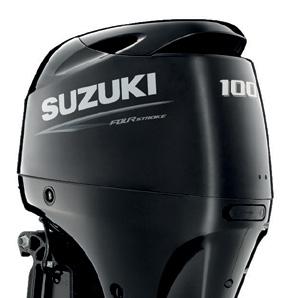
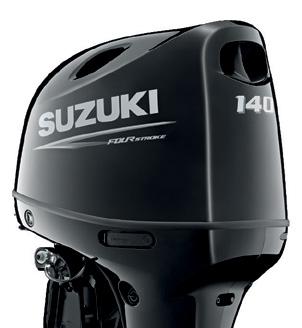
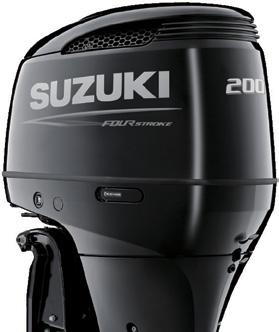
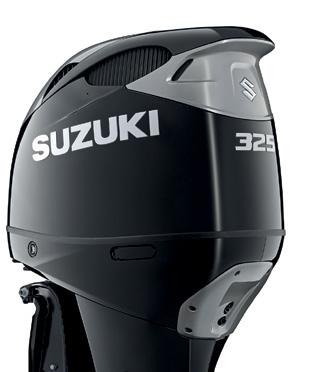
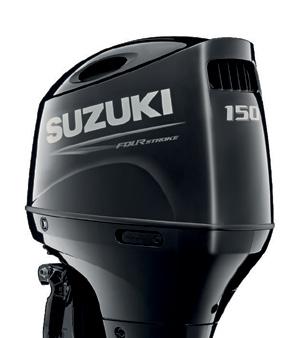
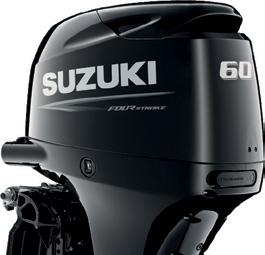
T&Cs: This Fully Fitted offer is available on new Suzuki models between 40 - 350hp, and excludes DF40/50/60ATHL tiller models, DF60AVT, and DF75. Price excludes removal of previous outboard motor and controls, repairs to electrical systems, fuel system/dash repairs, and transom repairs. Excludes demo units and all other promotions. Available from 11/03/24 – 20/06/24, or while stock lasts. Great fully fitted offers on our 40 - 350 HP range. DF100BT $18,649 FULLY FITTED READY TO GO LIGHTEST IN CLASS 2-STAGE GEAR REDUCTION EXCLUSIVE OFFSET DRIVE SHAFT DF350A $59,900 FULLY FITTED READY TO GO DUAL PROP SYSTEM INTEGRATED STEERING SYSTEM RENEWED GEAR CASE Visit your Suzuki dealer or suzukimarine.co.nz
MAST ACADEMY GRADUATION
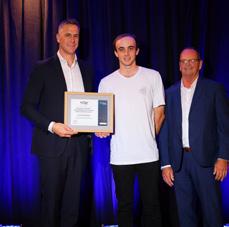
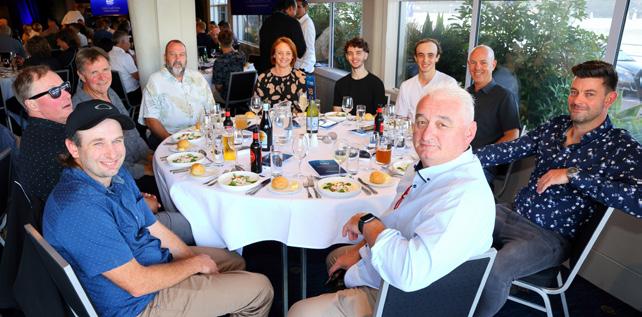
It has been a time of connections and celebration for MAST, the marine industry partners and importantly, the apprentices. Marking the completion of their apprenticeship, graduates were recognised for their achievements at the MAST Graduation on 14 March at Auckland’s Royal Yacht Squadron.
Celebrating alongside our graduates were all who have supported them throughout their training to obtain their trade qualification, including the MAST Training Advisors. “It’s a journey of opportunities and challenges – all of which shape their personal and professional growth” says MAST Training Advisor Robert Howatson. “We’re extremely proud to shake their hand as they receive their qualification certificate.”
The strong presence of marine-related industries (including composite and industrial textiles) at graduation, highlighted the interconnectedness and collaboration essential for developing skilled trades people in our sectors. “It was a fantastic evening celebrating the achievements of our newest industry graduates! Recognising their hard work and the diverse talent across the trades in front of 220 guest and industry peers was extremely rewarding for those that have supported their journey. It’s reassuring to know that the future of the industry’s is bright with such talent.” - Chris van der Hor, MAST CEO.
MAST graduates are from a diverse range of marine industries covering areas of boatbuilding, composites, marina operations & marina facilities, marine systems engineering, outboard servicing, powerboat rigging, industrial textiles, marine coatings, marine interiors and sail making.
Before presenting the special awards, guest speaker and one of New Zealand’s
most respected sportsmen, Rob Waddle inspired graduates and guests alike with key areas of his success and motivations. Each award sponsor spoke of the winners outstanding attributes and recognised for their forward thinking and mentorship were the winners of Outstanding Marine Graduate, Jay MacDonald from Gulfland Marine and Outstanding Composite Graduate, Joshua Court of Buckland Marine.
The Dale Carnegie Emerging Leader Award went to Ethan Holland of Makaria Boats for his determination and commitment to producing highquality work. MAST Training was proud to sponsor one of the two Rotary Youth Leadership Awards (RYLA) which were awarded to Courteney Fox. The second RYLA award for the week-long leadership programme was given to Hunter McKay-Coombe by Lesley McLagan of the Rotary Club of Highbrook. In addition, MAST recognises those who train within the workplace, the supervisors and leaders who mentor support and encourage the continuity of quality. This years’ Workplace Trainer Award went to Gavin Bickers from Stabibuild in Warkworth.
The MAST graduation was not only a celebration of individual achievements, but an occasion to recognise and appreciate the collective efforts of all those involved in developing talent and fostering excellence within our marine and specialised technology industries.
MASTACADEMY.COM

PACIFIC POWERBOAT _ NEWS
40 MAY / JUNE 2024
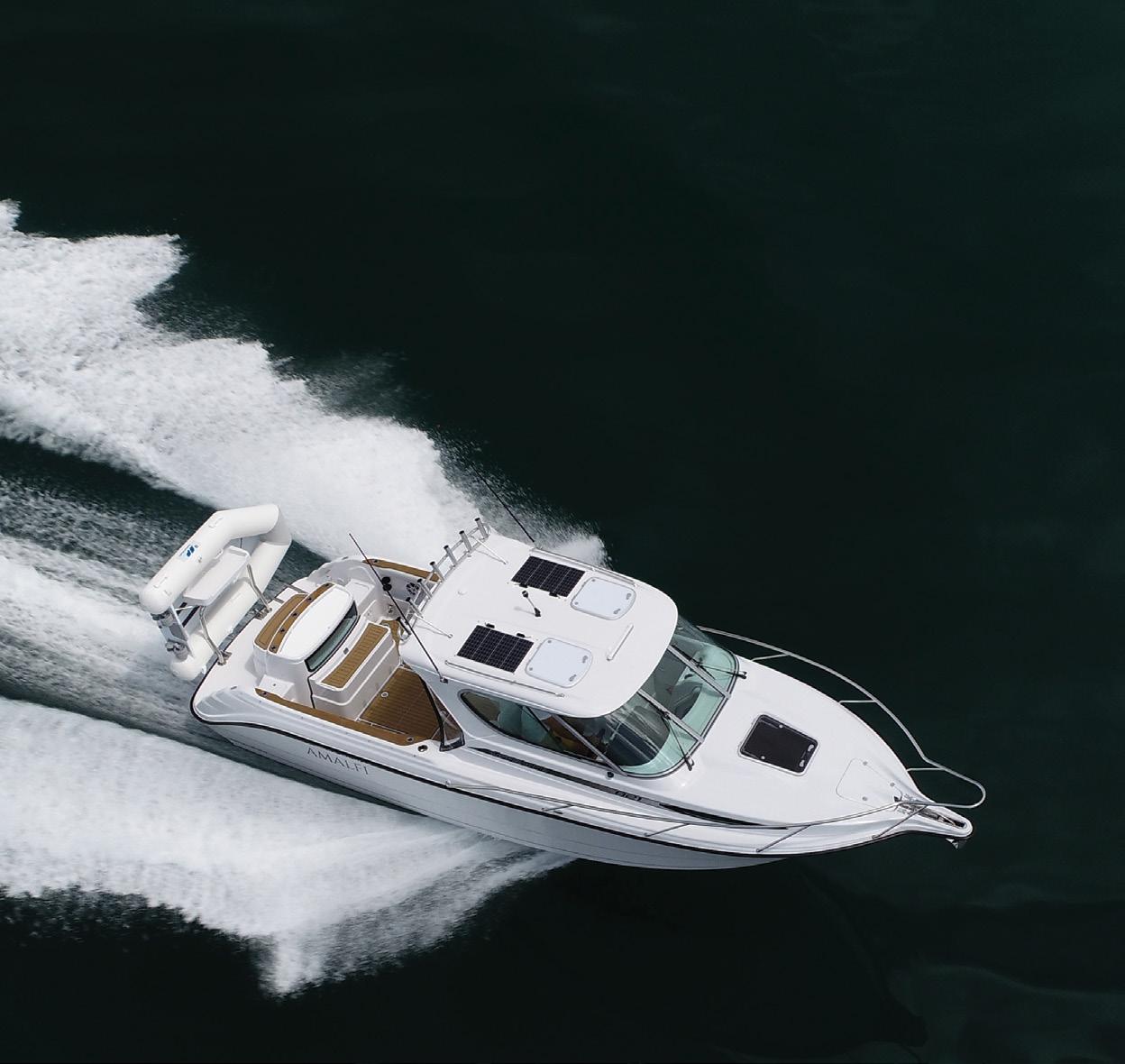
Every element of the Tristram Ownership Experience is premium, from a new models CAD designed inception through to production, handover, and aftersales service. Our diverse range of Tristram Hardtops, Targa Tops and Cabriolets are designed and crafted to perform by a talented team of innovators who live for the ocean. We continue to redefine trailer boating for thousands of proud Tristram owners who seek to venture beyond the ordinary. Discover more at www.tristram.co.nz
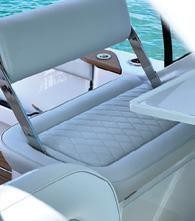
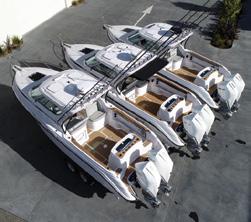
PREMIUM WEEKENDS SHOWROOM - SERVICE CENTRE - PRODUCTION PLANT 5 Udy Place, Te Rapa Park, Hamilton, NZ Te Rapa Expressway Exit SH1 pacificpowerboat@tristram.co.nz / +64-7-849-5225 PREMIUM OFFSHORE TRAILER BOATS / WWW.TRISTRAM.CO.NZ
Tristram 821 Offshore / Available in Twin Outboard or Diesel Sterndrive
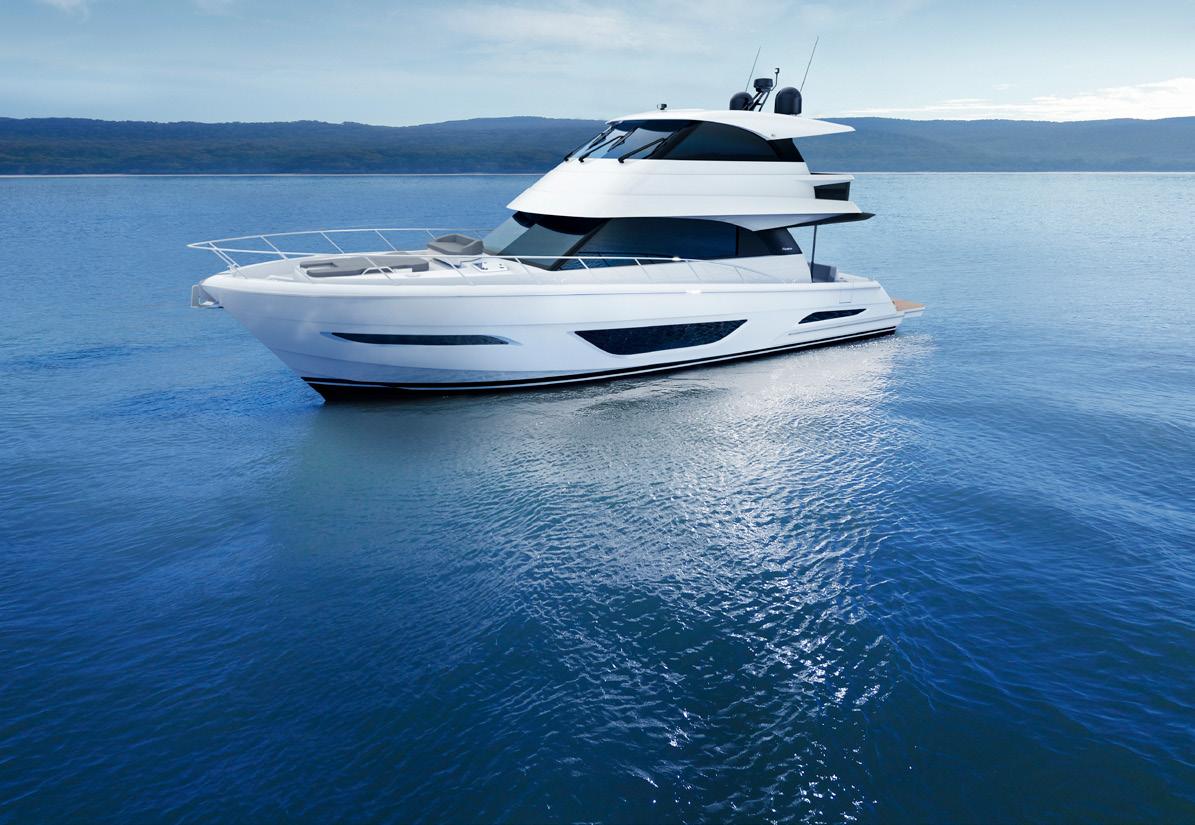
MARITIMO ANNOUNCES NEW BLACK EDITION
Leading Australian luxury motor yacht builder Maritimo introduces a series of updates to its revered line of cruisers. These enhancements add yet another level of refinement and style to every Maritimo, and are aptly labelled the Black Edition.
The Black Edition is borne of Maritimo’s objective to constantly perfect and improve even its best-selling models. The company’s meticulous review of onboard style, comfort, and functionality has
resulted in new elements of elegance and sophistication. All of this is accomplished and integrated with the unparalleled engineering and performance Maritimo yachts are known for.
The Black Edition includes all the features and functions of preceding models but with deeper refinement and styling to their Enclosed Flybridge Motor Yachts - M55, M60 and M600 Offshore.
Within the enclosed flybridge, the Black Edition helm brings the enhanced styling and layout of the flagship M75 into the new models. The low-profile dash features a totally redesigned multifunction and engine screen pods, with enhanced ergonomics for easy access to all the necessary controls. The upgraded fully electric helm seats complete the space to make it a comfortable zone for travelling long distances. The Black Edition also upgrades the existing cabinet
to a two and three-door wet bar, as well as an entirely new lounge seat with storage options, adding comfort, functionality and even more style to the Skylounge.
Current model Maritimos are renowned for their performance and handling in any conditions. The placement of their engines and tanks increase stability, and low shaft angles provide incredible efficiencies. The new Black Edition Maritimos maintain the engineering and design forged from over twenty years of building enclosed flybridge motor yachts.
The Global Launch of the Maritimo Black models will take place at the 2024 Sanctuary Cove International Boat Show, 23 to 26 May in Queensland, Australia, followed by the U.S. debut in Fort Lauderdale, Florida, in October 2024.
MARITIMO.COM.AU


Clear Protective Coating Preserves both Metal and Painted Surfaces Highly Corrosion Resistant Highly Cleanable Surface Restores Paint Appearance Long Lasting Protection www.nyalic.co.nz 0800 692 542 0274 351 069 sales@nyalic.co.nz Protecting Marine Craft in New Zealand and the world for 30 years PACIFIC POWERBOAT _ NEWS
42 MAY / JUNE 2024
CEO OF SUZUKI NZ RETIRES
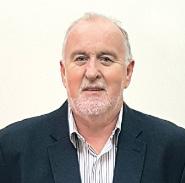
Ian (Tom) Peck would probably describe himself as a Suzuki aficionado above all else, after all when you spend nearly 50 years of your life with one brand it's not just a job. When Tom retired on 8 April he left some fairly big boots to fill and took with him a wealth of knowledge spanning more than 38 years of continuous service at Suzuki New Zealand Limited.
His career started as a fresh-faced motorcycle apprentice to the Colemans group who at that time operated stores in several centres including Hamilton where Tom fell in love with motorcycling. It wasn’t long before Tom had set his sights on some loftier goals eventually finding himself at head office in the role of service manager across motorcycle, marine and automobile. His love for all things mechanical shone through especially the development and engineering of road race motorcycles.
Working with some of our best road racers saw riders like Andrew Stroud take 10 titles for Suzuki and the support was not only for the riders but also for event sponsorship such as the Suzuki winter road race series and Boxing Day Cemetery Circuit. Motocross didn’t miss out and it was a very young Josh Coppins that first signed to Suzuki in a contract penned by Tom. Josh became a world title contender narrowly being pipped for a second spot during the 2002 World Motocross Championships.
In 2003, Tom expanded the marketing responsibilities to also include developing the motor vehicle division. It was also during this time that the Suzuki Swift became a success story for the motor vehicle department with sales improving not only market share but the dealer network across the country. In 2011 Tom was promoted to CEO and guided Suzuki New Zealand through some difficult post-GFC territory. Suzuki New Zealand is one of the few company-owned distributors that do not have a resident Japanese staff member which reflects the confidence and trust they had in Tom’s management.
In 2018 Marine made a welcome return to the umbrella of Suzuki New Zealand following a 20-year absence. Since the change in distributor, market share has more than doubled under his management. Retirement for Tom will be the start of a new adventure as he uproots and moves to be closer to his two daughters in Australia.
SUZUKI.CO.NZ
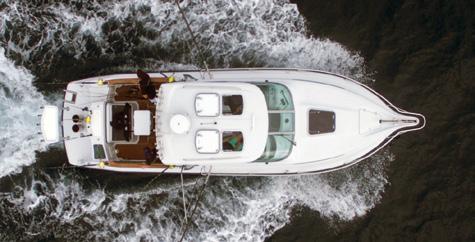
Cule hatches are proudly made in NZ so we can customise to your needs and supply any parts. Easy online purchasing backed by friendly local customer service and a manufacturers warranty. Get in touch to discuss your next project. Call 09 835 9706 or visit culemarine.co.nz
POWERBOATMAGAZINE.CO.NZ 43
22M CARBON FIBRE FOIL ASSIST HIGH PERFORMANCE POWER CAT
Roger Hill Yacht Design and DEMEY
Yachts proudly announce their latest collaboration, unveiling an exceptional 22-meter hydrofoil assisted Power Catamaran concept for a North American client seeking speed, safety, and social versatility, with the Gulf of Mexico being its intended playground. With a length of 22 meters and a beam of 7.7 meters, this design represents a seamless fusion of cutting-edge technology and elegant design. Its foil-assisted configuration ensures
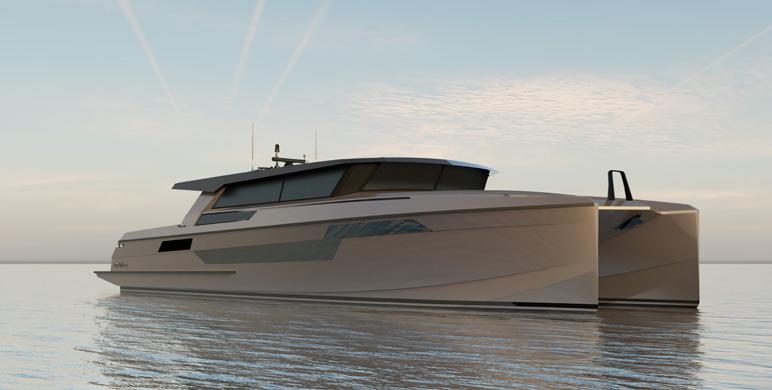
unparalleled stability and efficiency, making it a perfect choice for leisurely cruises and swift mediumrange passages.
This model, tailored to meet the specific needs of its North American client, features a rear-open fixed ‘beach club’ configuration, ideal for social gatherings and onboard entertainment. Additionally, clients can customize their vessel with a tender garage and swim platform configuration, further enhancing its versatility and functionality. A powerhouse of performance, this catamaran is powered by twin V12 MAN diesel engines through
Hamilton Jet drive units, enabling it to reach a top speed of 48 knots. Accommodating up to 8 guests and two crew members, the interior of this vessel is meticulously designed to provide the utmost comfort and luxury.
Constructed from infused carbon fibre composites, this Power Catamaran combines strength and durability with lightweight efficiency, ensuring optimal performance and structural integrity in any conditions.
NICDEMEYYACHTS.COM
POWERCATSNZ.COM
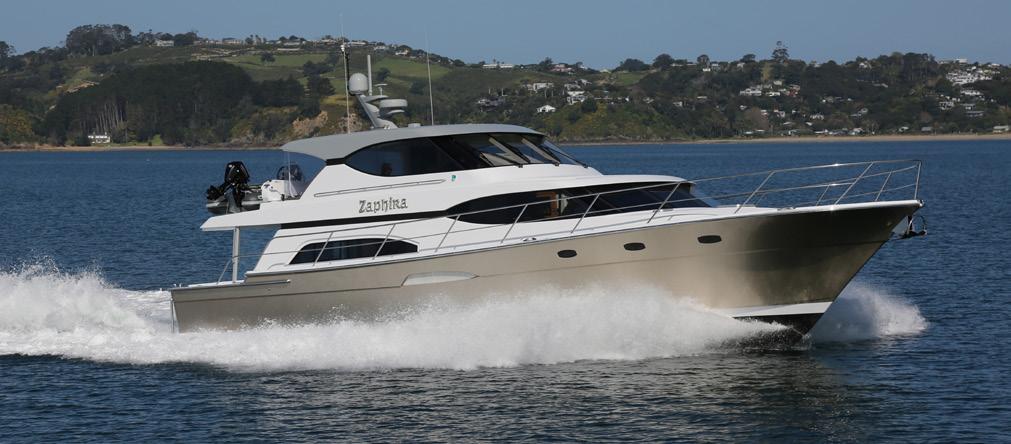




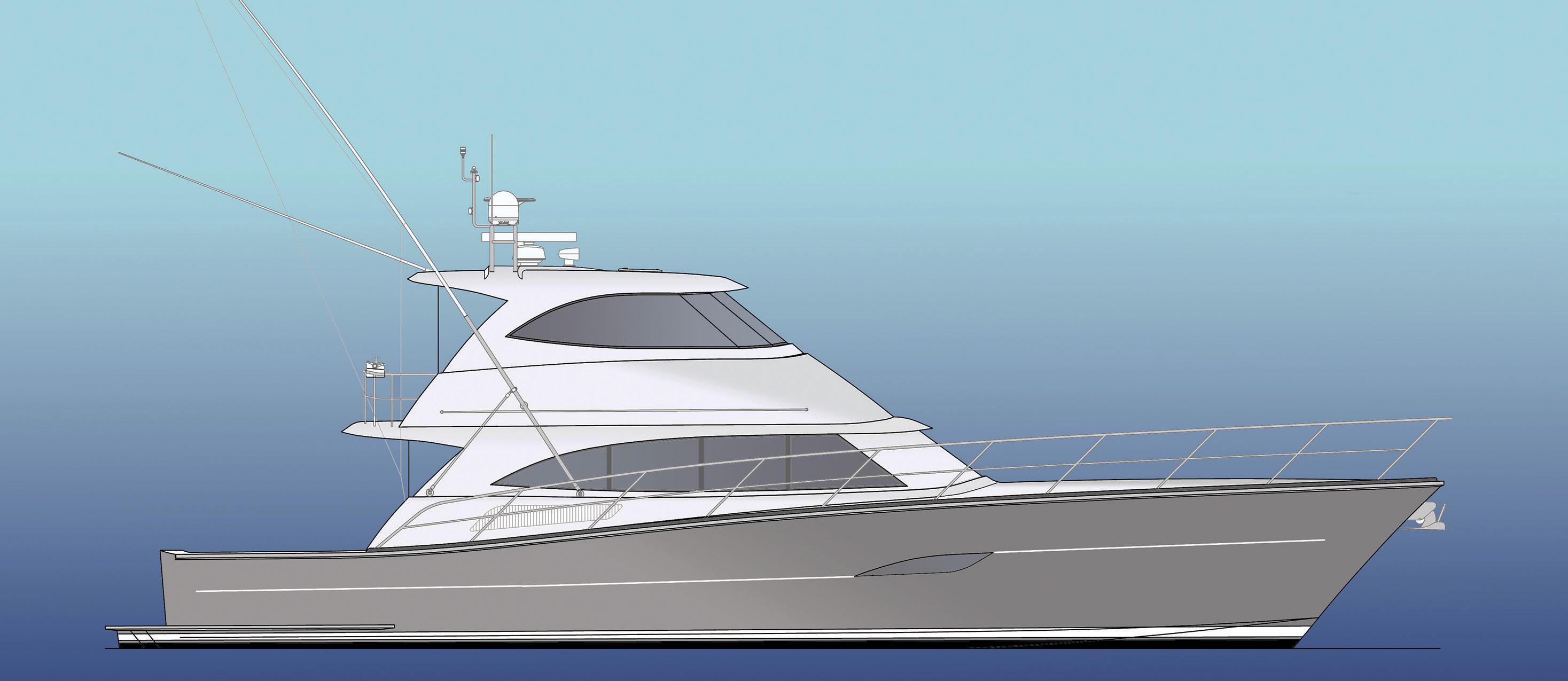
www.lloydstevenson.co.nz
design Sedan, Mid-Pilothouse and Sportsfisher Motor Yachts
elite marine.co.nz • +64 (0) 9 530 8501
design Sedan, Mid-Pilothouse and Sportsfisher Motor Yachts
elite marine.co.nz • +64 (0) 9 530 8501
design Sedan, Mid-Pilothouse and Sportsfisher Motor Yachts
elite marine.co.nz • +64 (0) 9 530 8501
elite marine.co.nz • +64 0274 853 235 lloydstevensonyachts.co.nz DB976
www.lloydstevenson.co.nz Custom
www.
www.webermarine.co.nz www.lloydstevenson.co.nz www.lloydstevenson.co.nz Custom
www.
www.webermarine.co.nz www.lloydstevenson.co.nz www.lloydstevenson.co.nz Custom
www.
www.webermarine.co.nz www.
PACIFIC POWERBOAT _ NEWS
Elite 18m Mid-Pilothouse
44 MAY / JUNE 2024
16 - 19 May 2024
Auckland Showgrounds
MASTERCLASS SERIES

SAFET Y & EDUCATION WORKSHOPS
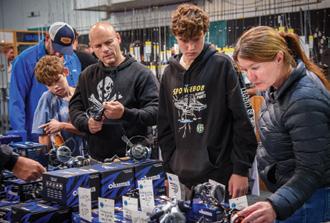
Yeah, buoy! Get set for adventure! PROUDLY
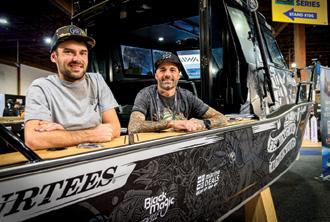
FISHING & ADVENTURE ZONE
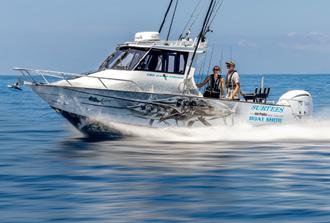
WIN THIS EPIC BOAT
* FAMILY FUN FISHING PAVILION
PLUS explore the latest boats and cutting-edge marine tech, be in to win the $300k Surtees/Yamaha grand prize* and so much more!
*See boatshow.co.nz for details. SCAN
Buy tickets at boatshow.co.nz




SPONSORED BY:
FOR
TICKETS

AN IMPROBABLE TRIP AROUND THE WORLD
PART TWO
What started as a 4-month cruise to Mexico turned into a made-for-Hollywood, 13-year voyage around the world. As told to Daniel Harding Jr.
BY DANIEL HARDING, POWER AND MOTORYACHT
Fiji
Fiji was an amazing, amazing place. To get a cruising permit in Fiji, you have to go through a class on how to respect the native Islanders there, because they own the water. So you have to go ask for permission to anchor. And the way you do that is you bring a gift of kava, which is a pepper plant root that they make a drink out of. And you present that to the chief of that village, and they give you permission to stay.
That was a license to meet all kinds of cool people and to embrace their culture. I had a guest on the boat, who's a good friend of mine. Who was our physician. And we go to this kava ceremony. So we go into this hut, grass hut. A lot of the villagers are circled around. The ladies are on the outside, the guys are in the middle and they've got this ceremonial kava bowl, which is a wooden carved bowl. And they take the pepper plant root, this kava, and they pound it into a powder, put it in a sock, literally a sock. And then they knead
the sock in the water to get the kava to dissolve. And it looks like dirty dishwater. Now here are these socks that don't look that clean. Then they take an old artillery shell with a steel rod to pulverize it. And then these guys, if you looked at their hands, they hadn't been to the groomer, hadn't had their nails done recently and they're kneading this and I'm sitting next to this doctor. Who is like, "Roger? You are not going to drink this. You're not going to drink this." And I said, "I've got to." I couldn't insult them. So, the chief comes to
46 MAY / JUNE 2024
me with this, and of course the bowl is half a coconut. So, he asks if I want “half tide or full tide?” Do I want a half a bowl or full bowl? So of course, I say, “full tide.” So anyway. So, John, the doctor, he's cringing. He says, "You can't do this." And of course I did. And I had some reaction to it the next day.
Bali
In year two of the trip, we went to Bali and we stopped at almost every island. And we had to make arrangements to go see the Komodo dragons. They've got them in a park. It's kind of an open park, but it's a designated area. So, we decided we would buy a small goat because the dragons love goats. Eating them, that is. So, we've got a guy that's taking us up there and he's got the goat over his shoulders. We bought the goat, we went up there with three or four people. And as we're going up, the guy's got a stick and he's controlling these 12foot lizards. I mean, they look like alligators. But they're lizards. And we get up to the pen, it's maybe 18-inches tall. And we go inside the pen, and then he takes the goat and very delicately puts a palm leaf over its throat and cuts the throat of the goat and then gives it to the Komodo dragons. That goat didn't last 20 seconds. It was amazing. These things are just plodding along. And then they went feverishly and everything bones, fur, everything gone. Ate the whole thing. So that was feeding the Komodo dragons.
New friend from Djibouti
Djibouti is at the mouth of the Red Sea on the east side. Very small French territory and I went with Samantha into a little store and I see on the floor this little monkey that's got a little belt around its waist and we're looking around the store. I asked the guy, "How much is the monkey?" He says, "The monkey is mine, it's not for sale." I said, "Man, I really like that monkey. It's really a cute little baby monkey." It was a Vervet. Cutest little white face and whiskers. Really cute monkey. Fifty dollars later, I leave with the monkey. We had the monkey about four and a half years, but what a four and a half years. That monkey was a riot. It really was fun. We named her Djibouti where she came from.

Saudi Arabia
We arrive and ask to seek refuge. They've got a brand new, 50-million-dollar control tower that looks out the Red Sea and we're at the base of this thing, beautiful facility, not a yacht facility, no other boats. We're there about five minutes and a forklift comes out and deposits a guard shack about 50 feet from the boat and there's a military guy there with a machine gun.
About 20 minutes later, up pulls this big Oldsmobile and two guys get out with the whole Saudi get up. I find out this is the secret police watching the military watch us. This is crazy. This is really, really crazy, but again, no intimidation, no nothing. They ask, “What do you need? Why are you here?” I told them, “We’re running a little low on fuel and water. We hit some bad weather on the way up here.”
They deliver fuel to us. It looked like
"I'm sitting next to this doctor. Who is like, "Roger? You are not going to drink this. You're not going to drink this." And I said, "I've got to." I couldn't insult them."
ROGER MOORE
POWERBOATMAGAZINE.CO.NZ 47

champagne. No charge. They fill up the boat. I asked if I could get a couple of drums and I got a couple of extra 55-gallon plastic drums. They filled those up for me. It was so nice of them to do that. Meantime, I'm up there sitting down, eating with the guards, with your hands out of the common bowl and all that sort of thing. The captain of the port police says, "Hey, Commander Byers of the U.S. military is here.” This was just after Desert Storm. He said, "He saw your American flag and would like to know if he could come down and visit?" We said, "Absolutely. Come on down." Commander Jamie Byers comes down to visit us and he says, "Let me see if I can get permission for you to come up and use our host phone." I said, "What's a host phone?" He says, "The Saudis give us a phone line and a phone so that we can call home anytime we want. I'm sure you haven't been able to get to a phone for a long time." Of course, we've been doing ham radio the whole time, so Samantha and I get permission and go up there and we call all our friends and family and all this and say, "Hey, we're in Saudi Arabia."
We've been there for four or five days now and our hosts were winking at me saying, "Samantha, don't you need to go visit; she had a little eye problem. Don't you need to get your eye taken care of? Maybe we can get you into Jeddah into the clinic to take a look at that eye." They got a medical reason for us to go in and we toured around Jeddah on the way to the clinic and then back to the boat and we decided, "We've imposed on these people enough." They were really nice people so I said, "We're going to depart." They said, "No, no, give us another day”
They send the secret police out to interview us and the guy comes up to the boat. The monkey's tied on the back deck. They've got the thobe and ghutra and the
monkey pulls up his skirt, the thobe, and starts pulling the hair on his legs and he's dancing on the back deck, laughing and having fun with this monkey. He comes in the boat and I figure, well, that just shot all our chances, but they were in love with the monkey. We start talking and he's asking us, "What are you doing here, why, where have you been, where are you going?" Nicely, respectfully asking these questions and they said, "We've got good news for you. When will you be ready?" I said, "Ready for what?" "Prince Nayfe has made a reservation for you at the Hyatt Regency Hotel. You’re guests of the Saudi government." I said, "What? We can't accept." They reply, "It would be very rude of you not to accept." Samantha interrupts and she says, "Whenever you want, we'll be ready."
Roger and Samantha enjoyed all kinds of adventures at sea, but their time in Saudi Arabia feels plucked from a Hollywood script.
They posted guards to take care of the pets and they take us to the Hyatt Regency Hotel. A suite, as guests of the Saudi government, the two secret police guys are now our tour guides. "What do you want to see? Where do you want to go? What do you want to do?" They said, "Tomorrow morning, we're going to take you to a tailor, if it's all right with you, Mr. Moore. We're going to take you to tailor and we're going to have a thobe and ghutra made for you and an abaya for Samantha. You don't have to wear them, but we're going to take you to some places where you'd be less conspicuous if you didn't. It's up to you." I said, "Let's go." They take us to the tailor. They fit us out with lovely thobe and ghutra and abaya and the black thing for that. We can't pay for anything. We go into the store. We want to pick up a couple of things. Can't pay. We are Saudi hospitality. I never understood the term. We're doing all these things with them. We've been there for four or five days and they said, "Is there anything else you'd like?" I said, "I understand that
the Kuwaiti's ruled from Taif up in the mountains. Could we see that?" We go up to Taif and they show us all around, up in the mountains there. They said, "What else would you like to do?" I said, "I'd love to ride camels in the desert." Next day, they rent a Jeep, they pick us up and we're driving, driving, driving, and here's this Bedouin tent. They drive up near the tent. They get out and they said, "You wait here, Roger", and they go over and they're talking to the Bedouins because there's a bunch of camels there.
I'm in the thobe and ghutra. I'm tan. I had a black mustache and I looked Saudi. I should have been Roger Moore. I should have been a spy because I can be Mexican, I can be Saudi. I can blend in and all of those different things and they want to know what tribe I was with and why was I out there? Bottom line is, we get to go for a ride on the camels. We get to drink camel milk and do all this stuff. It was really a hoot and by now we'd been there a couple of weeks and starting to feel really embarrassed that we're consuming all this time, but it was fun. I said, "We're going to leave. We appreciate all of you and we would like to invite you all to dinner." We had all of these people that helped us as our guest at a restaurant and still I couldn't pay.”
Winter in Israel
We're about 20 or 30 miles from Tel Aviv and a patrol boat comes out. They radio us and say, "Everybody on deck, let's see your hands." They circled the boat and there's a guy with a 50 caliber machine gun in the front. It's serious. So they said, "Where are you going? Where are you from? What are you doing?"
We said, "Well, we're going to Tel Aviv."
"Okay. Follow us in." So we follow them in. And again, the Cheoy Lee was pretty big for the port of Tel Aviv. So, we're at the police
FEATURE _ AN IMPROBABLE TRIP AROUND THE WORLD PART TWO
48 MAY / JUNE 2024
They're obviously on high alert at all times. So I'm on the back of the boat. There you get customs, immigration, health, police and the bomb squad. So all of these guys are descending on the boat. So here we are. I'm on the back deck filling out all these forms. Do you have any weapons? No. Do you have any ammunition? No. Do you have pets? Yes. Dog and monkey. And we're filling all this out and the other guy says, "Can I look inside the boat?"
I said, "Absolutely. Samantha take them through the boat." So they're going into the boat. And they go down to the master cabin, open a cabinet and they take out a briefcase that I had there. And the briefcase had 12 gauge shotgun ammo in it because I had a SPAS semiautomatic shotgun. I had a couple of weapons very well hidden on the boat that we never declared because it's really a problem to declare them. If you declare them in one place and you leaving from another, you have to go back and get them.
So, the guys opens up the case and it's full of ammo and I'm on the back deck just signed I don't have any ammo. And Samantha says, "Rog, come on down." She didn't even have her glasses on. So she didn't know what was in there. So I walked
down and here's this guy with a case open with a couple hundred rounds of shotgun ammo in it.
He asks, "What is this?"
I said, "Shotgun ammo."
He says, "You just signed that you didn't have any. Why?"
I said, "Because I lied. I'm sorry. We've never declared them. We have them for self-defense."
And he says, "Go back upstairs." So I go up, they all leave. They say, "Do not get off the boat." And they had a 40-foot ocean container there that was an office right on the dock. And I'm sitting there with Sam and I know they can confiscate the boat. They can arrest me. This is really serious stuff. So I'm waiting 10 or 15 minutes. Seemed like an eternity. I got off the boat. I walked up, opened the door to the police thing. I fell to my knees literally. And I said, "I can't stand it any longer. What are you going to do to me?" Then they all started laughing.
So they said, "You really shouldn't have done that. Bring the guns up here, take the ammo back. We don't have room for it." And oh, the thing I missed is they said, “Where's the gun? I'm trying to think of

“where is the gun that isn't next to another gun?" So, I go to the place where there's a nice Remington pump 12 gauge. I pull that out and one handgun and give it to him. I had an Uzi with a silencer and all this other stuff.
That's the end, that scary part. And we spent the next five months, six months on the police dock, not under arrest and we absolutely loved Israel. The monkey, everybody loved the monkey. The monkey ended up starring in a movie there.
EDITOR’S NOTE: After 13 years, Roger and Samantha returned to Ft. Lauderdale. He says that their assimilation back to life in the states easy but that many years of wear on the boat was anything but. The Cheoy Lee would undergo a major refurbishing and would eventually be sold. Boating, and his trip, has become a permanent part of his life. He still loves aboard a boat to this day and finds the most pleasure when helping to bring new people into boating.


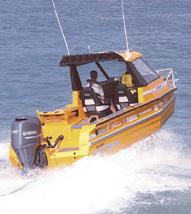





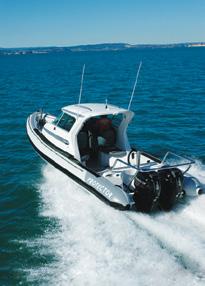

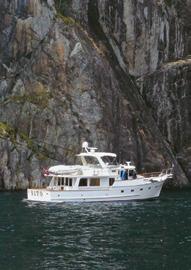


Riviera 515 SUV Fleming 58 McLay 581 CrossXover Grady White Canyon 376 Bayliner 642 Overnighter Pacific PowerBoat July/August 2014 Also Reviewed: TRAILERBOATS LAUNCHES & CRUISERS PACIFIC Hamilton Island • Envoy in Greece • Boat Show Reports RIVIERA 515 SUV Light & Bright Same Boat 4 drive options Which is best? EPIRBS & PLBS All the facts FLEMInG 58 On The Level Techo trim tabs STABICRAFT SUPERCAB 2050 TROPHY PRIZE ALLOY BOAT MAGAZINE ssue Southern XP816 Bluefin 665 Scorpion 470 Senator RH650 Surtees 5.5 HT Profile 635 Stabicraft 2050 Aqualine 645 $10.00 inc GST MAY 2014 2 THE PROGRESSION of LURES Scorpion 470 Mk2 Aqualine 645 Senator RH650 Profile Surtees 5.5 Hard ALSO REVIEWED ALSO REVIEWED PACIFIC THE 100% RIB MAGAZINE Buyers Guide TO 5.5M CENTRE CONSOLES 5 BOATS REVIEWED Luxury Tenders Big Bucks Boating EXPORT SUCCESS Kiwi RIB builders doing it right overseas EPIRBS Things you should know Rayglass 9m Protector Changing for the Better $10.00 Explorer 50 Alaska 59 Sedan Integrity 44 ISSUE 6 Pacific PassageMaker 2014 ANNUAL A FLEMING IN NORWAY Exploring the Fjords 2014 ANNUAL SATCOM AT SEA Keeping In Touching ON DEMAND POWER Facts about Generators Reviewed: • LIVING THE DREAM • THE ULTIMATE LIGHT • Integrity 44 Alaska 59 Sedan Explorer 50 Target your advertising message with precision PPB0914 The dedicated nature of our range of marine publications delivers a highly targeted audience to our advertisers – Offering your products and brand a receptive audience. Don’t miss your opportunity to reach your target market, call Doug Dukeson +64 (0) 9 428 2328 or Alex Ram +64 (0) 9 428 7277 Australian Advertising: Peter Rhodes +61 (0) 3 8786 8993 Or visit www. Phone Doug Dukeson: +64 (0) 9 428 2328 Email: doug@boatmags.com Or visit: www.powerboatmagazine.co.nz DB946 dock.
POWERBOATMAGAZINE.CO.NZ 49
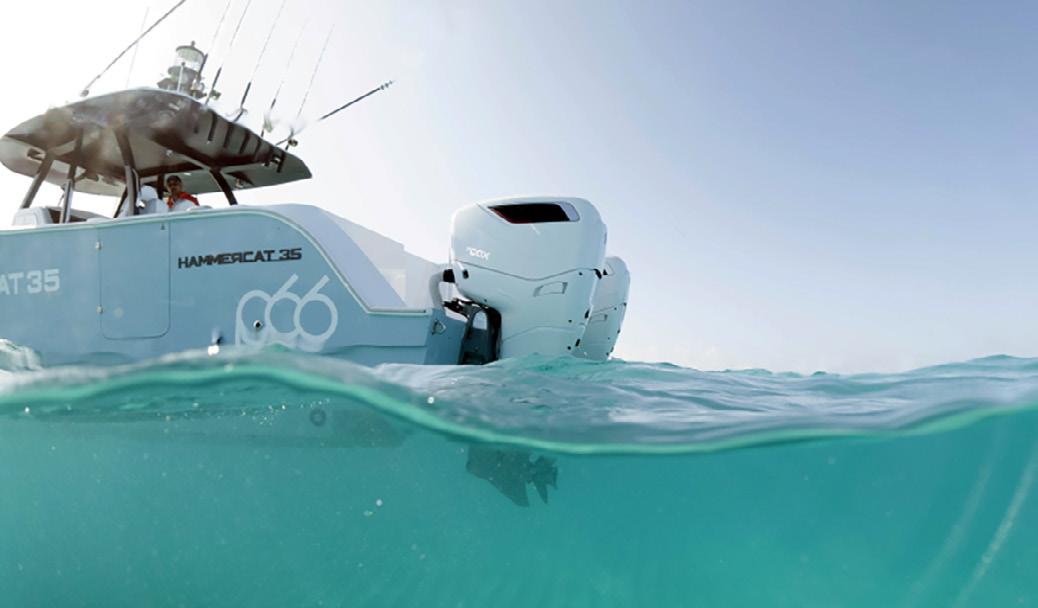
COX MARINE INTRODUCES NEWEST MEMBER THE COX MARINE 350
The ‘Here’s to the Pioneers’ recently launched campaign identifies twenty-one inspirational people from the past and present who have created the kind of “Hell, Yeah!” moments for which Cox Marine is increasingly known - it celebrates noted individuals who win on water or in life. It also marks the proud introduction of the latest addition to the Cox Marine product line-up, a 350-horsepower variant of their flagship V8 outboard. While the pioneers feature some expected names, including Amelia Earhart, Neil Armstrong, and daredevil Evel Knievel, more unexpected personalities, such as tennis powerhouse Serena Williams and groundbreaking composer and conductor Jon Batiste, are included. A moving and inspirational 60-second film was created and premiered at the recent Miami International Boat Show. The British outboard manufacturer Cox Marine was cofounded by David Cox, who firmly believed that the days of unsafe gasoline outboards were numbered. “The launch of our first product, the Cox Marine 300 – a 4.4 litre, twin-turbo, 300-horsepower V8, made that vision a reality. With that, Cox Marine introduces the newest member of its product line-up, the Cox Marine 350, the latest in The V8 family – an outboard that sets new standards in fuel economy, power delivery and safety.
Gavin Wesson, CEO of Cox Marine says, “The new 350 allows us to power higher displacement vessels efficiently across both the recreational and commercial sectors. This enables us to work with new customers and enhance our from-factory offering to existing partners. Building on our tried-and-tested V8 architecture, the Cox Marine 350 is a testament to the capability of this platform, the technology within and its growth potential.” Already proving its performance credentials, the Cox Marine 350 outboard propelled Cox forward in breaking its speed record, powered by alternative fuels, in October last year. Adam Gurr, Cox Marine’s Product Director, notes, “The creation of the V8 represented the start of a new generation of outboard technology, offering the only alternative propulsion solution purpose-built for the marine industry. The V8 meets the understandably increasing demand for a propulsion option that provides equal levels of performance, convenience, time, and economy.” The launch of the Cox Marine 350 marks the next chapter in Cox Marine’s ambition for cleaner, safer seas for everyone.
SPORTSMARINE.CO.NZ
ZF INTRODUCES NEW ZF AT 90 THRUSTERS
The ZF launches the AT 90 thruster, which supports a variety of commercial vessels up to 2,651hp. The new set-up can be customised to vessels and enable auto-trolling. The entire AT thruster series now available for tugs and ferries, in addition to inland waterway vessels. This new well-mounted, Z-Drive thruster is compatible with a wide range of commercial vessels, supporting maximum power of 1,978 kW at 2,651hp, increasing the power and thrust capabilities of the thruster product line. Fully customisable to nearly any hull shape or vessel profile, the ZF AT 90 is one of the most flexible products available on the market. It also supports auto-trolling, and the combination with ThrusterCommand ensures precise and efficient propulsion control. As is true of all thrusters in the AT
series, the ZF AT 90 can be executed as part of a hybrid or fully electric system, requiring reduced engine power during vessel operation, full electric sailing, dynamic positioning, and slow cruising while in electric mode, and more. Operators who install the AT series aboard vessels are one step closer to earning a CLEANSHIP class notation. The ZF AT 90 comes standard with an 18-month warranty, with extended warranty options available.
ZF.COM.AU
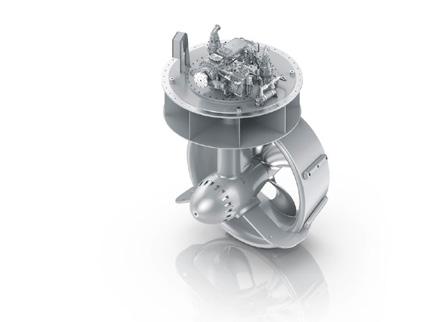
PACIFIC POWERBOAT _ POWER ON
50 MAY / JUNE 2024
THE MOST POWERFUL AXIOM EVER AXIOM 2 PRO REALVISION MAX
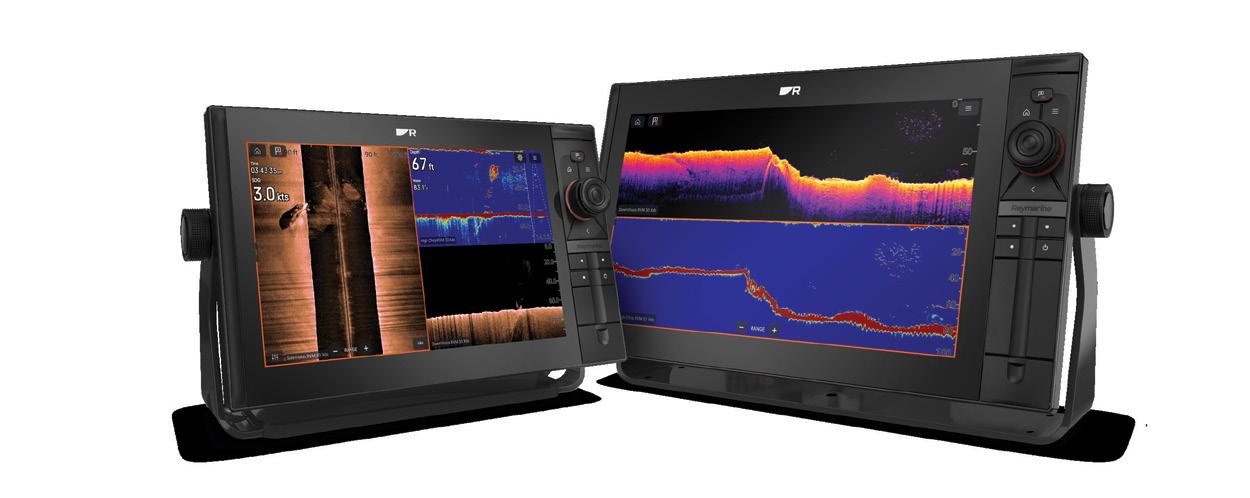
GAMEFISH VIEW – stalking bait HYDROTOUCH CONTROL with interchangeable autopilot keypad (includes access to fishing patterns)
SEE CLEARER with better resolution, higher ping rates and tighter beam widths for sharper sonar images without the loss in depth performance
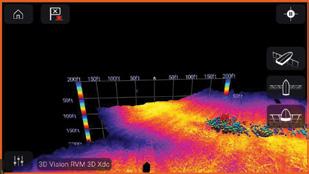
FISH AROUND THE BOAT with RealVision 3D that provides accurate target location and set up the perfect drift or spot lock
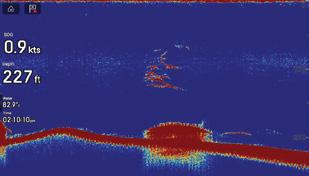
GO DEEPER with 3 times the power and 35% greater range using the built in High Chirp Sonar
High contrast colour palettes to accentuate targets and make fish stand-out from water column noise
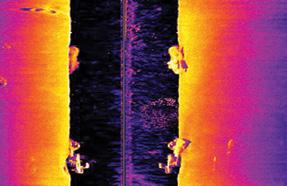
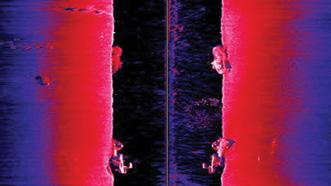
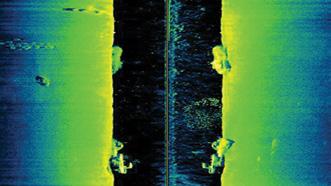
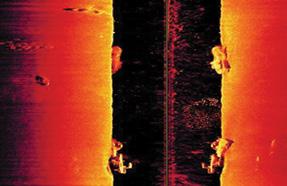

SEE THE RANGE AT THE HUTCHWILCO
LAB0921
NZ BOAT SHOW, 16-19 MAY,
2 STAND 290
HALL
SCANSTRUT’S NEW STARLINK POWER TOWER BRACKETS
A NEW RELEASE FROM LUSTY & BLUNDELL
Scanstrut’s stylish and practical new APT-150-SL-01 brackets for Starlink’s Flat High Performance Power Towers are now available in New Zealand through Lusty & Blundell. The new Starlink brackets allow boat owners to install their Starlink PowerTower anywhere they wish on their cabin top, T-top, flybridge or radar arch.
The brackets, which are 150mm high and constructed from the best marine-grade aluminium, guarantee the Starlink PowerTower is placed clear of any obstacles and positioned at an ideal 8° angle for optimal connectivity. Designed for the harsh marine environment, the APT-150-SL-01 brackets are quick and easy to install with pre-drilled holes allowing secure fastening directly to the tower. The built-in Scanstrut Cable Seal ensures a watertight connection and eliminates the need to remove Starlink connectors during installation. The bracket’s paint finishes comply with Scanstrut’s renowned unique 4-step marine paint system, no marine sealant is required and a range of accessories, including light bars, can, if wished, be bolted to the back of the PowerTower.
LUSTY-BLUNDELL.CO.NZ
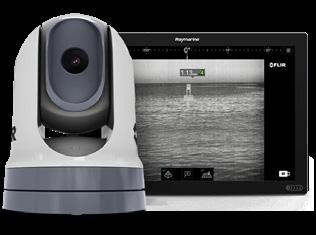
FLIR THERMAL CAMERAS’ SUPERIOR IMAGE QUALITY NOW AVAILABLE ON ALL MAJOR MFD BRANDS
While the increasing-popular range of FLIR thermal and low light cameras perform at their very best when paired with Raymarine MFD systems, the latest FLIR models can now also seamlessly connect to all major MFD brands. This means FLIR thermal cameras can now be easily and intuitively controlled direct from all major brands of MFD screens (previously this was only possible with Raymarine MFDs, others needed a joystick). They can also now be simply connected using ethernet, meaning greatly improved image quality and reliability, and less components required for their install, a great advantage for those wanting to upgrade their older electronic systems with a FLIR camera.
“It is fantastic that more boat owners are now able to enjoy the advantages of FLIR thermal cameras,” says Mark Milburn, managing director of FLIR distributor Lusty and Blundell.
“However, it is important to realise there are additional benefits that are only available with a Raymarine system. “These include Raymarine’s revolutionary ClearCruise ™ (which proactively identifies targets of interest) and ClearCruise ™ AR (Augmented Reality). This allows skippers to overlay vital navigational and AIS information directly onto their FLIR high-definition (HD) video feed, helping them make quicker, smarter and safer decisions, especially in crowded waterways.”
LUSTY-BLUNDELL.CO.NZ
LOWRANCE INTRODUCES NEW EAGLE FISHFINDER DESIGNED FOR HASSLE FREE FISHING
Lowrance, a world-leader in fishing electronics since 1957, have announced Eagle, the latest offering in the brand’s entry level fishfinder/chartplotter lineup. Featuring newly designed high-definition enhanced sonar, with FishReveal technology and detailed C-MAP charting including Genesis Live, Eagle is Lowrance’s most accessible fishfinder yet. “Eagle brings Lowrance’s high-definition sonar to our most easy to use fishfinder, providing the ultimate tool for weekend anglers,” said Jeremiah Clark, VP and General Manager, Fishing Systems at Navico Group. “Developed to make fishing simpler and more enjoyable, Eagle is quick to install and features enhanced autotuning sonar and comprehensive C-MAP charts. Eagle’s C-MAP embedded inland and coastal charts for New Zealand and Australia allow anglers to spend more time fishing than searching. It also provides the ability to create custom half foot contour maps of local lakes or unchartered water – in real time – with Genesis Live, giving anglers all the details needed to discover and navigate to the best fishing spots more efficiently. The Eagle fishfinder is available in 4-inch, 5-inch, 7-inch and 9-inch display sizes.
LOWRANCE.COM
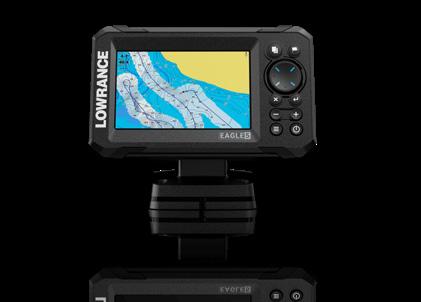
PACIFIC POWERBOAT _ ELECTRONICS
52 MAY / JUNE 2024
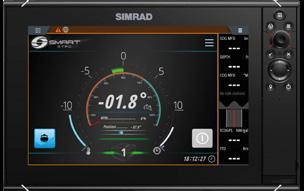
SMARTGYRO ANNOUNCES SEAMLESS INTEGRATION WITH NAVICO GROUP MULTIFUNCTION DISPLAYSNEW.
Smartgyro and Navico Group, a global leader in technology for marine, RV, and specialty vehicle industries, announce official integration to enhance the onboard experience. This strategic partnership seamlessly integrates Smartgyro's cutting-edge stabilization technology with Navico's multifunction displays (MFDs), creating a synergy that promises unparalleled marine navigation and control.
Smartgyro's mission to deliver a comfortable, safe, and seamless onboard experience to ensure boaters can live out their dreams aligns with Navico Group's commitment to shaping the future of boating with advanced navigation solutions and intuitive technology. This new integration not only signifies a union of two industry leaders but also provides captains, crew, and boat owners with a comprehensive overview and effortless control of their SG series gyro stabilizers through state-of-the-art MFDs such as Lowrance®, Simrad, and B&G®. Options include the ability to monitor in real time the behaviour and boat-roll reduction performances of one or more SG units installed on board. Users can also switch from day mode to night mode, check for alarms and access a password-protected installer/service section through which they can run diagnostics and tests.
NAVICO.COM
MERCURY’S JOYSTICK STEERING FOR SINGLEENGINE VESSELS
Mercury Marine, a division of Brunswick Corporation have recently introduced Mercury Joystick Steering for Single-Engine Vessels, compatible for use with the Mercury Verado® family of V8, V10 and V12 outboard engines from 250 to 600hp. Enhanced by electric steering, Joystick Steering for Single-Engine Vessels rounds out Mercury’s suite of joystick systems, delivering effortless command and control to owners of vessels powered by sterndrives, inboards, Zeus® pod drives, multi-outboard installations, multi-outboards with an integrated bow thruster, single-engine pontoons with deployable thrusters, and now, boats with only a single outboard engine for propulsion.
Joystick Steering for Single-Engine Vessels eliminates the need for boaters to use both hands to throttle, shift and steer during low-speed manoeuvres like docking. When Joystick Steering for Single-Engine Vessels is integrated with a compatible multifunction display (MFD) incorporating GPS and Mercury SmartCraft Connect, it also offers autopilot features.
MERCURYMARINE.COM
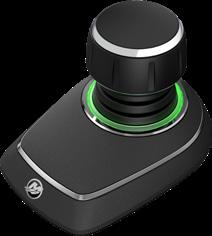
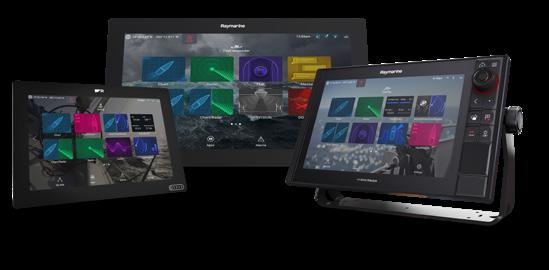
LIGHTHOUSE UPDATE NEW FEATURES, IMPROVED PERFORMANCE & STABILITY
T
he latest update to Raymarine’s renowned Axiom LightHouse operating system includes a number of new features as well as improved performance and stability.
The just-released LightHouse 4.6.103 software update includes a handy new fuel range overlay that graphically illustrates how far the vessel can travel at its current speed before running out of fuel.
The new update also gives control over Mercury Marine’s Bow Hook, Sky Hook and Drift Hook functions from the side bar and generators that come with a compatible remote controller can now be started or stopped from the display within the Dashboard app.
Among the numerous other practical improvements is expanded
AIS target data within the chart app, allowing up to 200 targets to be viewed; exhaust gas temperature data able to be viewed in the dashboard, sidebar and data overlay (under the engine category); route distance remaining readings available in the dashboard and sidebar and improvements to the storage and recording of RealBathy data.
The latest update to Raymarine’s LightHouse 4 operating system is now available and free to download using the Axiom’s software update feature or from raymarine.eu/multifunction-displays/lighthouse3/.
LUSTY-BLUNDELL.CO.NZ
POWERBOATMAGAZINE.CO.NZ 53

WHAT A GAS!
‘Replace the lot,’ I told a gas fitter shortly after I bought my boat. The existing installation of gas bottle, gas stove and oven was probably safe, but I wanted to start brand new.
After a hefty bill of around $1200, my boat was ready for a signed certificate of compliance – almost. It needed to have a non-combustible material fitted around the perimeter of the gas stove because it was within 200mm of the flame. When I had that sorted, the gas fitter would issue the certificate. Unknown to me, the gas fitter had just breached the rules because he left the job in a non-compliant state – but that’s open to interpretation.
Roll forward a year or so and I hadn’t got around to fitting that non-combustible material. I was planning a two-week cruise and wanted to fill the gas bottle. I shouldn’t admit to this, but I undid the wrong part and stripped the thread of the regulator. Since the boat was at a different location, I contacted a different gas fitter to install a new regulator. The second gas fitter declared that the entire installation was noncompliant for multiple reasons, including:
• the flexible hose from the gimballed stove to the gas bottle was longer than 600mm and should be replaced. He recommended a plastic-covered copper pipe;
• the gas sensor was in the gas locker. Instead, he needed to install a sensor beneath the stove and another in the lowest part of the interior accommodation;
• a solenoid was required so that the new gas detector would shut off the gas if gas was detected.
The second gas fitter installed new copper pipe, with a flexible connection to the stove, and fitted non-combustible material around the stove. He arranged for an electrician to fit the solenoid and install the sensors, and confirmed he would issue a certificate. I was onboard for much of the work and could see why it took around five hours. Even so, ouch! for the invoice of $2700.
At such times, I always comfort myself with this: what would I pay for a liferaft on the showroom floor and what would I pay as the boat disappears beneath the waves?
Having spent around $4000 on my gas system, I am confident it is safe as long as I follow safe practices such as turning off the gas at the bottle when not in use. But to play the cynic… If the first guy was right, I had wasted $2700 on the second guy. If the second guy was right, I had wasted $1200 on the first guy. I decided to read the AS/NZS 5601.2:2020 standard regulations. I could download a copy from Standards New Zealand as a pdf for $186.30 or a hard copy for $207. It was more than 100 pages and a quick scan online failed to answer my questions. Yeah… nah.
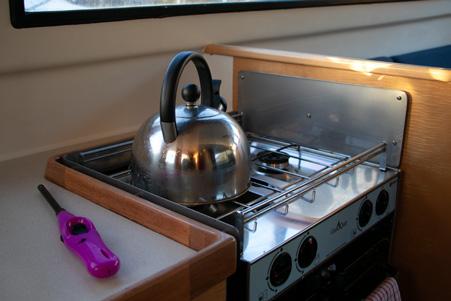
I went back to the first guy and asked for his comments. He said that his installation did comply. Regarding the hose, he quoted Section 2.11.2 as it applied to boats: ‘Hose may be used for one appliance installation as corrosion considerations would favour such installation’. Regarding the gas detection system of a solenoid and a sensor, he quoted Section 7.6 which states that a gas detection system is required if you have a continuous burning flame; eg, an LPG-operating fridge, and if there is no low level ventilation. Since I did not have a pilot light; ie, a continuous burning flame, it seemed I did not require a gas detection system. Regardless of the rules, I wanted a gas detector and had assumed that my boat’s existing detector was fully compliant.
I related all the above to the second guy. In his interpretation, the flame on my stove was continuous when it was alight. Hmmm, I could see his point. For me, it wasn’t about right and wrong. I was interested that two qualified gas fitters had such different views about what was compliant – and could that difference represent a large safety margin for other boats? I tried calling Plumbers, Gasfitters and Drainlayers Board, but I didn’t hear back, probably
because they exist for plumbers, gasfitters and drainlayers, not journalists. Then I contacted Mike McKinstry of Auckland Gas Services Limited, who regularly works on gas installations on boats. He blogs about his work and gives some plain English explanations of what is required. He acknowledges there is significant scope for interpretation in the regulations, but ultimately it’s about the safest installation for each boat, including those imported new into New Zealand. He tells his customers: ‘This is how I see the regulations in regards to your boat and what I intend to do before I issue a compliance certificate.’ That’s a good place to start – understanding how your gas fitter interprets the rules and where he sits on the safety scale. If I’d been better informed, which is ultimately my responsibility, I probably would have gone for the Gucci system that I ended up with. I just wish I’d got there the first time. For boat work, it is clearly important to check that your gas fitter regularly works on boats, which have specific regulations from residential and commercial installations.
Until 2010, it was permissible for anyone to install gas systems if the gas bottle was 15kg or less. Every gas fitter I talked to said they regularly see horror installations, most of which pre-date 2010. With that in mind, if that describes your installation, it might pay to get it checked.
REBECCAHAYTER.CO.NZ LEARNING TO LAUNCH _ REBECCA HAYTER
54 MAY / JUNE 2024
A gas hob with a suitable surround to meet the rule that all surfaces within 200mm of the flame be non-combustible.
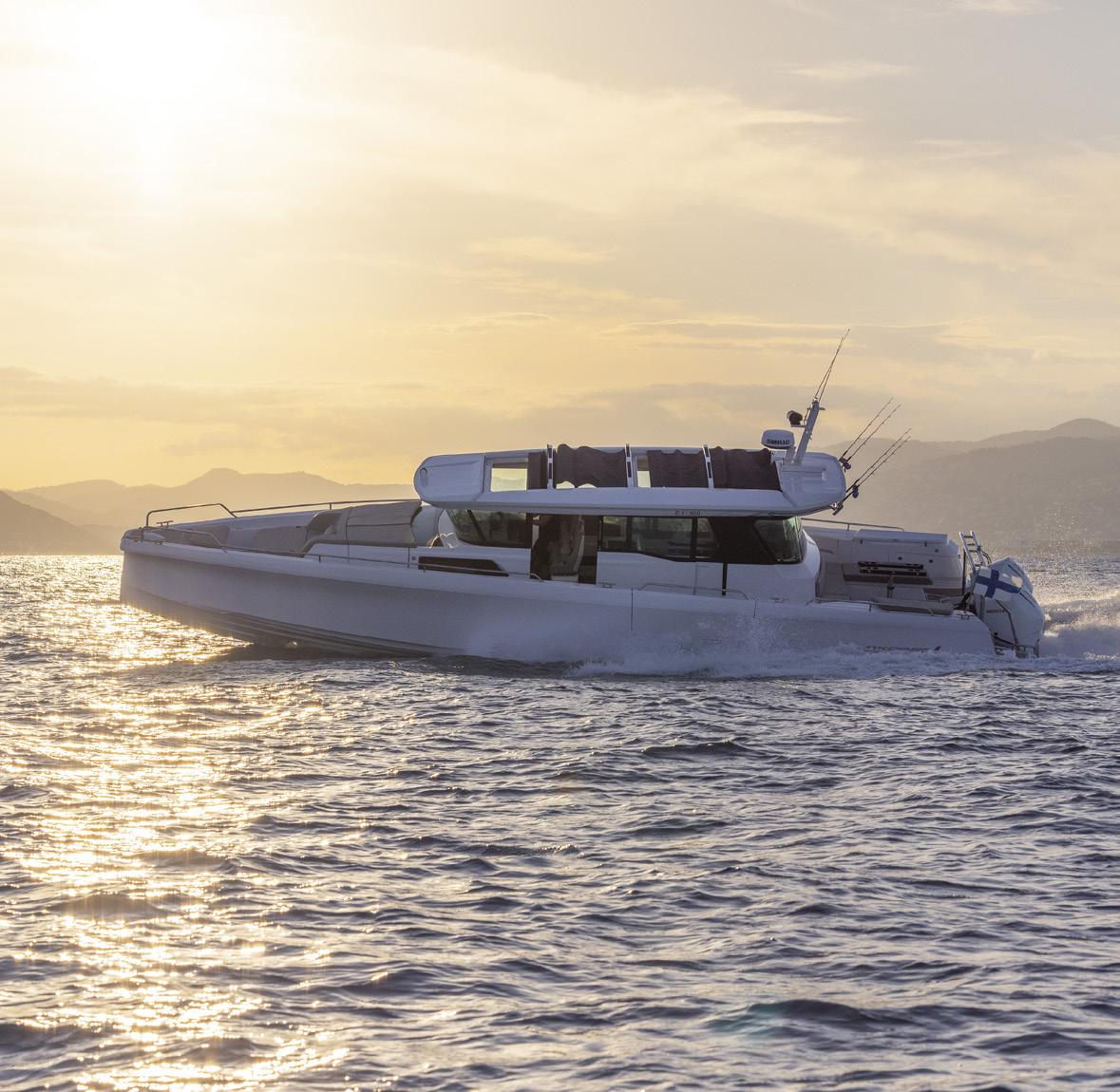
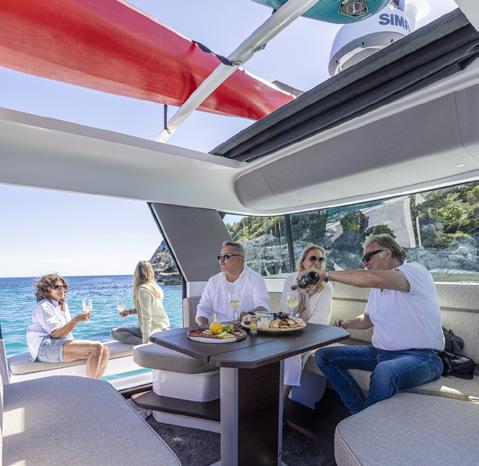


A TRUE GO-ANYWHERE BOAT
Embark on exhilarating adventures along New Zealand’s coastline with the Axopar 45 Cross Cabin. With top speeds of 50 knots and Axopars proven track record for unmatched capabilities, expect unparalleled comfort, safety, and agility both inshore and offshore.
The versatile pilothouse features a U-shaped lounge, wet bar, a seamless flow outside featuring side platforms, and seating for 12 guests. The spacious forward cabin transforms into an additional lounging area for 6 guests, while the separate head offers standing height and a shower—perfect for extended voyages.
EXCLUSIVE AU & NZ AXOPAR DEALER Learn more at eyachts.co.nz boats@eyachts.co.nz (09) 534 7196 45 YOUR
ADVENTURE AWAITS PREMIERING SANCTUARY COVE BOAT SHOW, AUSTRALIA 2 Ara-Tai Road, Anchor Building, Unit B1, Half Moon Bay, Auckland
ONWATER
FISHING 101
Over the holiday season we made quite a few trips to gather kai moana (fish) for the evening repast. To be upfront, we usually only catch 2-3 keeper fish per trip as ‘fresh is best’. What was apparent was how much more time and effort was required to catch 3 legal fish, and how Snapper was the only fish appearing on the menu.
This may be due to my preference for letting the fish sleep in the mornings, or go to sleep early of an evening, or perhaps due to only fishing through the turn of tide with less sinker weight, which eases the work load on the retrieve. There appear to be plenty of Snapper in the water but most were 27-28cm and were returned gently into the habitat from which I had rudely ripped them just moments earlier! Often there were many like fishers nearby doing similar things, and my mind turned to just how much fish is caught by recreational fishers. The commercial fishers suffer public lambasting for the decline in the Hauraki Gulf stocks, bottom trawling and by catch statistics, but how much do we contribute? I looked it up!
Google has a plethora of reports, statistics, guesstimates and outright biased numbers. Most reports were Industry or Govt aligned and funded, and trawling through the biomass of data led me to assume that despite my initial conceptions, the recreational fisher is a significant pillager. Many reports are over 5 years old, so are essentially out of date. NIWA had one great report, until I noticed it was produced in 2008. MPI do surveys every 5-6 years, with the latest over the 22/23 season. I cannot find the results for that yet. What their previous 3 reports indicate is that the recreational catch take in the greater Hauraki Gulf area has tripled over 10 years. MPI estimated that 66% of the total take is now recreational. Launching ramp surveys are notoriously inaccurate. Perhaps MPI should include something in the Census questionnaire! Of commercials’ remaining 34% share, only @ 20% of that is apparently via bottom trawling in the Gulf, the greater take (@49%) is via long line methods. I do wonder what methods create the other 31%! Bear in mind these averaged figures do not include the many tons secreted away in the bottom of small recreational boats (est that only 1-100
get caught), or the tons ‘accidently’ lost from a caught or split commercial fishing net. I cynically used to wonder how a net could catch on a foreign object when it is supposedly being dragged through a known trawl friendly zone!
Industry trawl surveys, admittedly done by Fisheries, using the same boat and bottom trawl methods each time, actually indicated an increase in Snapper abundance over 3 reports, with the proviso that the biomass concentrations seem to have moved closer inshore. I may have read the reports wrong but they then ‘spread’ this catch concentration through all the areas fished, to even the playing field, so to speak. It is accepted that fish move about, so there will be times they are just not there! One could argue the ‘Trawl corridors’ proposed as part of the Hauraki Gulf fishing plan fall quite nicely into where this biomass is now concentrating.
The proposed HPAs’, (High Protection Areas) for the Hauraki Gulf and Eastern Coromandel, created a storm of negativity over the loss of ‘Freedom to Fish’ wherever they were mooted in the Hauraki Gulf Marine Park, especially with the Customary Take allowance excluded from the restrictions. Respected Ak University fellows have endorsed these proposals strongly. I hear some Iwi don’t like that proviso, and should the HPAs be set up, they will forgo their customary rights to better align with the NZ recreational catch limits and rules.
As I fumbled through my admittedly surface deep research, I did notice that the vast bulk of the reports,
estimates, surveys and guesses were ‘Snapper Centric’. Other fish seem to have vanished during the estimating. Any recreational fisher will admit that Gurnard, John Dory, Porae, Trevally and Bluenose are pretty rare nowadays. Those few caught are usually much smaller than the ‘olden days’. In many HG areas the only fish which are seemingly sustaining their biomass are Snapper and Kingfish. The once hugely abundant Kahawai and Trevally schools are all too infrequent nowadays. Given that the bulk of the above mentioned fish are usually swept up bottom trawling, a technique which purportedly only takes 20% of the (industry) reported fish caught within this Mixed Fin Fish Assemblage, maybe they form part of the missing 31% from the above estimates… purse seining is perhaps a culprit?. My elementary schoolboy calculus stumbles at this point.
Further enquiry allowed that there are fairly accurate figures that show the NZ recreational fisher catches around 14,000T of fish in total around NZ, with only 1500T in the South Island, and the rest around the mainland. These figures also show the Recreational and Commercial inshore fishing catch stats for the North and East coast of the North Island allow @ 4000T is being caught by each. Commercial fishing reports @ 350,000T is being taken by the industry in total, so relatively speaking recreational fishers with their constantly eroded catch allowances are doing their share. Doesn’t help my $/kg cost per fish much though!!
Disclaimer: Scott Macindoe, of fishing advocate group LegaSea is the writers Brother in Law. We don’t always share the same thoughts!
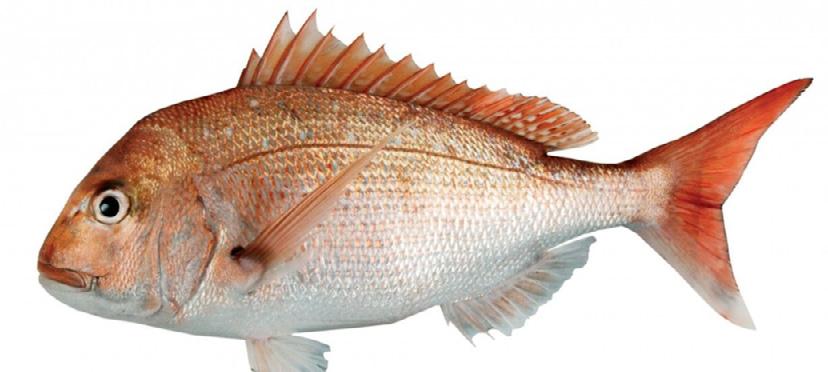
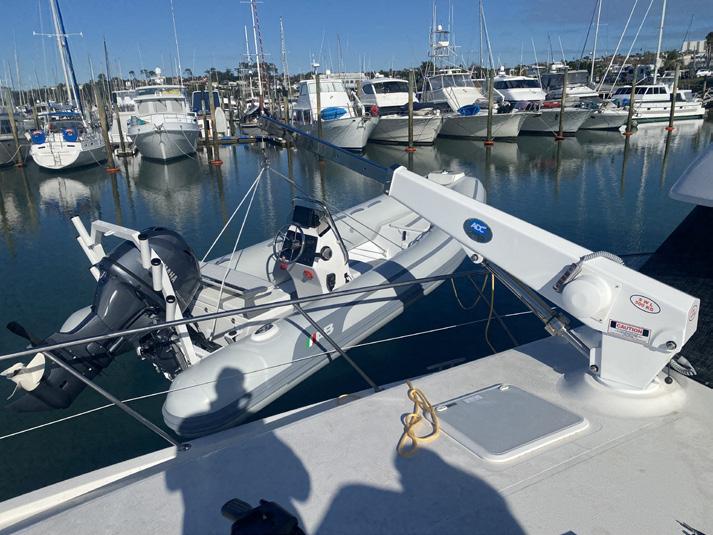
WHAT IS THE QUESTION? PHIL GILBERT
56 MAY / JUNE 2024
and Supplied Installed Quality 316 Stainless Steel Made From Full Electric and Hydraulic Options Options 200KG - Available 1500KG Single Stage and Fixed Boom Hydraulic Swim Platforms Motor Yacht Service 09 416 1179 Centre | Installation Completed at Our Hobsonville Location
Chef's tip: This dish also works well with Blue Nose and Kingfish.
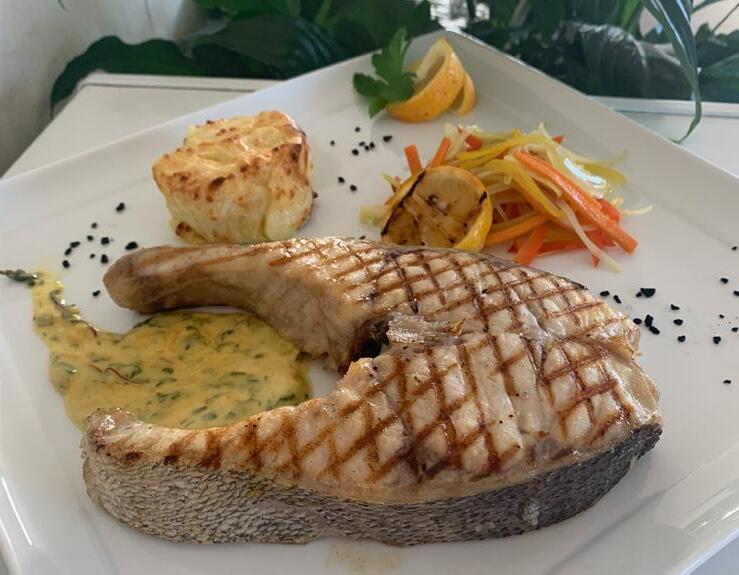

HAPUKA / GROPER STEAK
with Julienne vegetables and Individual Potato Stacks & Cream Sauce
The Hāpuku also known as groper, is a wreckfish of the family Polyprionidae, found around New Zealand, Southern Australia, Southern South America and South Africa at depths between 30 and 800 m. Hāpuku are a highly rated eating fish, reaching top value on both the local and international markets.
INGREDIENTS
4 x Hapuka / Groper steaks
1 x leek sliced into Julienne
1 x carrot sliced into Julienne
½ yellow / red capsicum Julienne
1 x brown onion Julienne
Potato Bake (Pommes Anna)
4-5 medium size potatoes, sliced 1cm thick
300mls cream
1 x tbsp sour cream
1 x small onion, finely sliced
Sea salt & freshly ground black pepper to taste
2 x cups Grated cheese (Parmesan or Gruyere)
Rosemary & Avocado Oil
Light Coconut & Avocado oil
Sauce
½ cup cream
¼ cup white wine (Anchorage Family EstateSauvignon Blanc)
½ tsp Dijon mustard
1x tsp lemon zest
2x tbsp chopped flat leave parsley to garnish
METHOD
Potato Bake
1. Preheat oven to 180C (160c fan-forced)
2. Wash and par boil potatoes, drain and set aside.
3. In a large bowl add cream, sour cream, diced onion, Sea salt, and freshly ground peppercorn Medley whisk together.
4. Add 1x1/2 cups of the grated cheese, mix until all combined.
5. In a greased tray, (We use A Muffin Tray with the Rosemary oil) layer your potatoes & onion then evenly pour the mixture over the potatoes.
6. Spread the last 1/2 cup of cheese over the top.
7. Bake in the oven for 20 minutes.
Hapuka
PAIRING PERFECTLY...
The 2023 Anchorage Nelson Chardonnay complements
Derek's groper steaks beautifully. The wine's rich, buttery notes and subtle oak integration can balance the firm texture and mild flavour of the groper, enhancing the overall dining experience.
Enjoy!
ANCHORAGEWINES.CO.NZ
1. Melt the Light Coconut & Avocado Oil in a fry pan add in carrot, leek and capsicum, sauté or gently fry until crisp but cooked around 5 minutes.
2. Remove from the pan and set aside on kitchen paper.
3. Brush the Hapuka / Groper with Rosemary & Avocado oil then season well with sea salt & freshly ground peppercorn medley.
4. Grill the Hapuka / Groper on the BBQ or Grill Pan then allow to rest for 5 minutes.
5. Into the same pan that cooked the vegetables, add the cream, wine mustard and zest then simmer to reduce to sauce consistency around 2 minutes. Do not allow to boil.
6. Finish with chopped flat leaf parsley.
STRAIGHT FROM THE GALLEY WITH DEREK THE CHEF, CHEFLINE14@GMAIL.COM
58 MAY / JUNE 2024
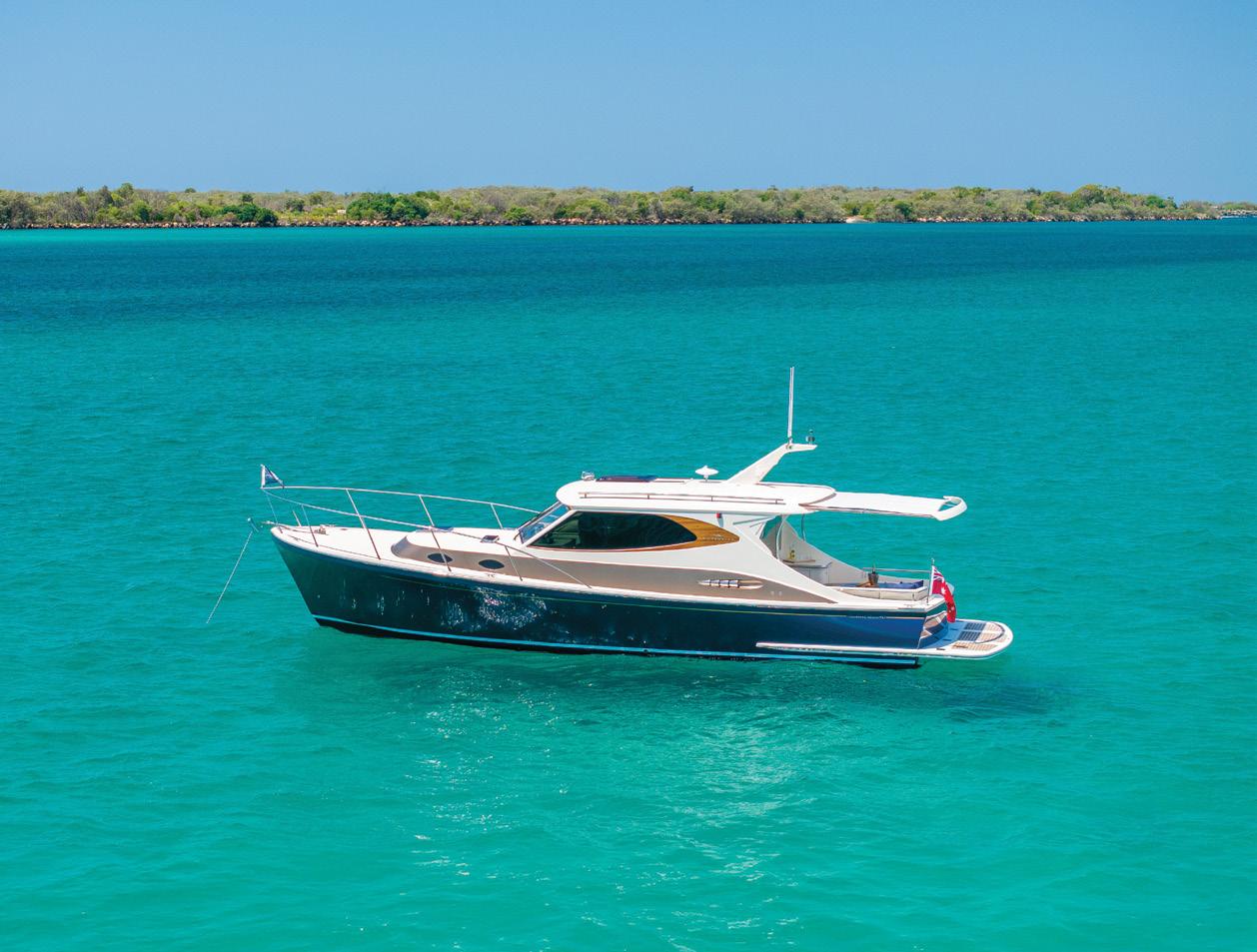
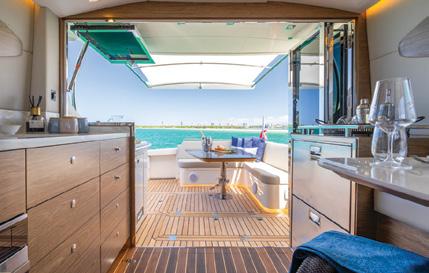
Immerse yourself in timeless elegance at the 2024 Sanctuary Cove International Boat Show with the epitome of yachting grace - the Whitehaven Harbour Classic 40.
With its generously appointed interior and comfortable accommodation for 4 adults, alongside an option of a drop-down dining table for unexpected guests, the Harbour Classic 40 stands as a testament to the perfect marriage of sophistication and functionality. This year’s model features an innovative upper galley and a fully opening cockpit saloon door, creating a seamless social flow from indoor to outdoor spaces.
Discover the new classic at the Sanctuary Cove International Boat Show at the The Alexander Marine Australia display on ‘I Arm’, or visit wmy.com.au, or contact 1300 758 896 to customise your own piece of maritime elegance and set sail on a journey of unparalleled luxury and style with Whitehaven. Discover the
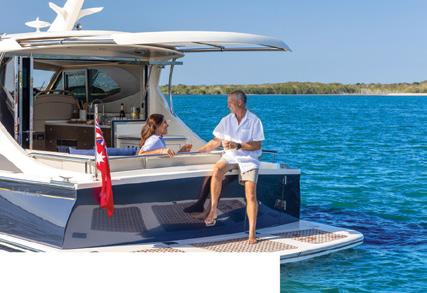
The Whitehaven Harbour Classic 40 is a statement of unparalleled style and a tribute to those with an appreciation for enduring elegance. It is crafted with meticulous attention to detail and ease of operation, ensuring every journey is as memorable as it is luxurious.
wmy.com.au
FLYBRIDGE | SPORT FLYBRIDGE | SPORTS YACHT | COUPÉ | HARBOUR CLASSIC
New Classic at the Sanctuary Cove International Boat Show.
COMPACT
PRACTICAL &
BY DOUG DUKESON
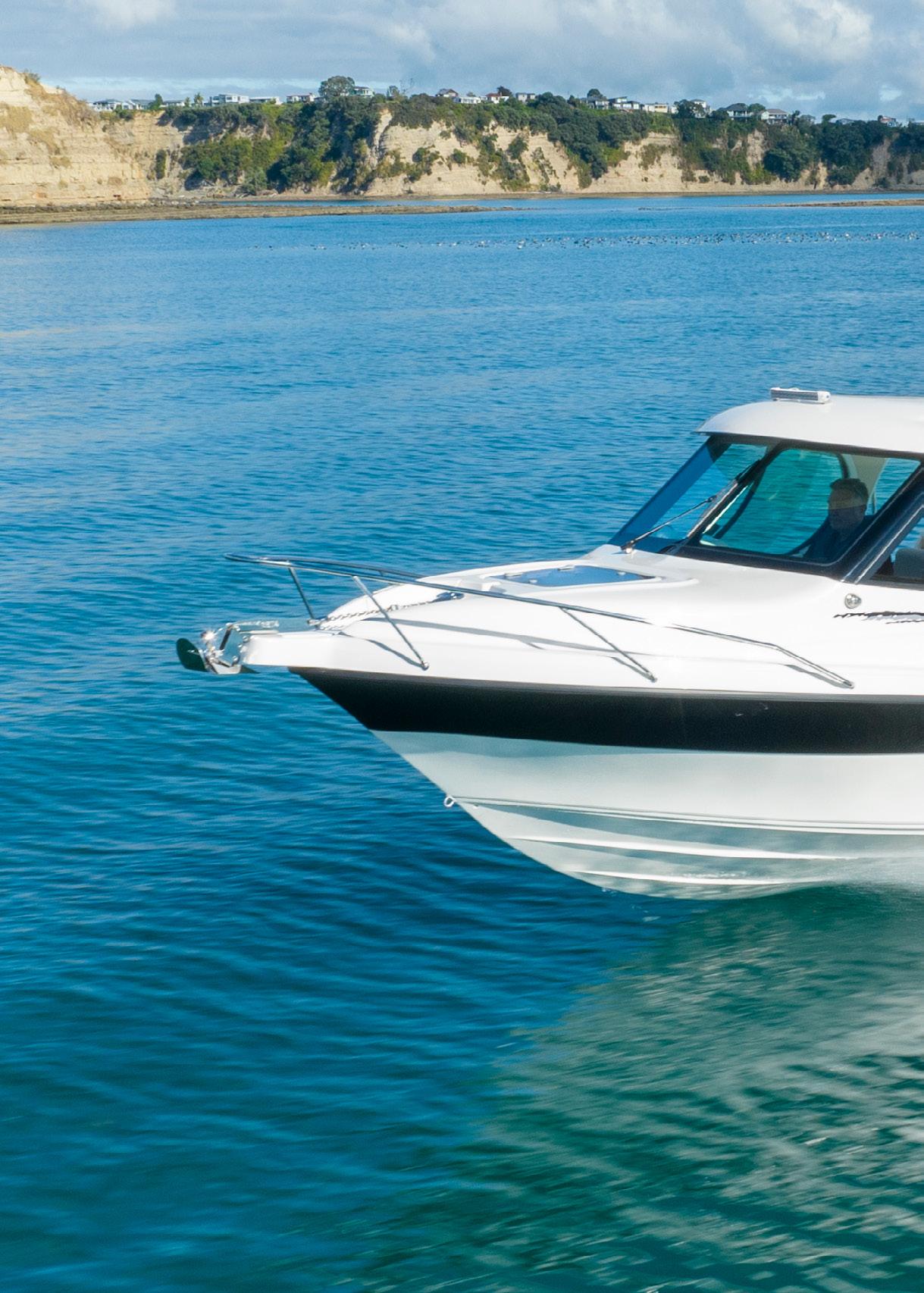
It has been a few years since I wrote a review on a Buccaneer; in fact, the last one would have been our Buccaneer 685 Exess Hard Top, which we used as our PowerBoatMagazine photography boat about five years ago. Therefore, I was familiar with Buccaneer hardtops and was quite excited to get out on the water to trial Buccaneer's latest release, the Buccaneer Five Seven Five HT.
PACIFIC POWERBOAT REVIE WS _ BUCCANEER FIVE SEVEN FIVE HT
60 MAY / JUNE 2024
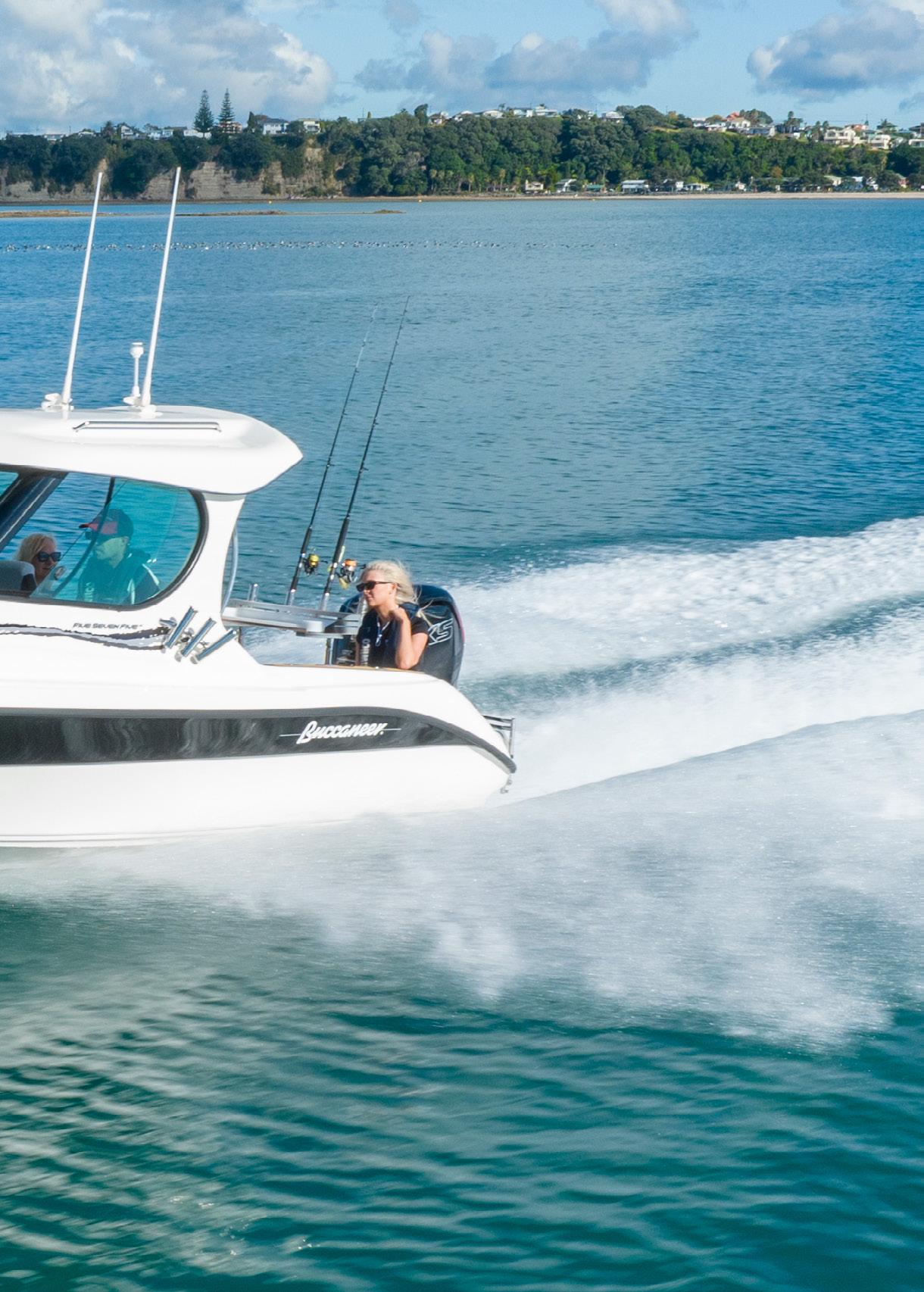

POWERBOATMAGAZINE.CO.NZ 61
SCAN THE CODE TO WATCH THE VIDEO
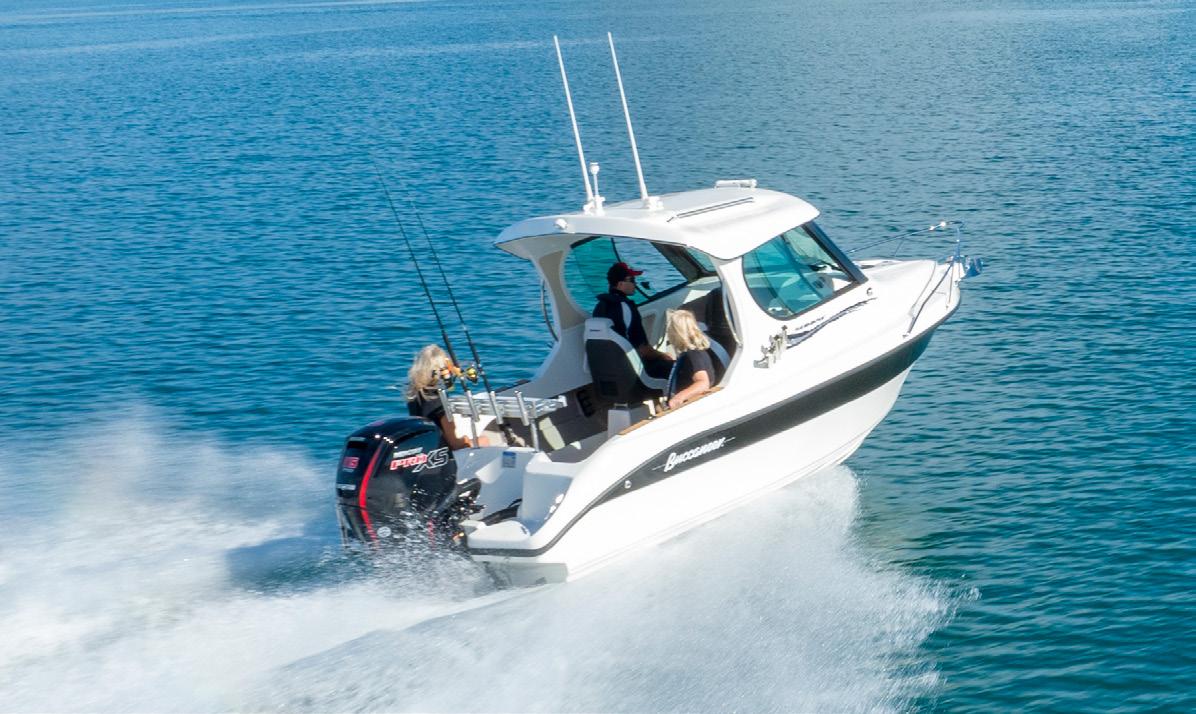
The Mercury 115
Pro XS CT FourStroke was a great match, offering a respectable top speed of 36 knots (66 kph), burning just 45 LPH.
The bolstered helm chairs are comfortable and also have a great feature where they can be spun around 180 degrees to the reverse position.
The Buccaneer brand, which has been around since 1976 (having built over 6,300 boats), would likely have New Zealand’s largest selection of GRP boat models, offering 22 models across 5 ranges. The hardtop range alone offers 8 different models in the Exess, Billfisher, El Dorado, and the new HT range. The newest additions to the HT series are the Buccaneer Six Fifteen HT and this reviewed model, the Buccaneer Five Seven Five HT, which has been designed with functionality, weight, and trailer manoeuvrability at the top of their wish list. Designer Gerry Gerrand aimed to keep the boat and motor package sitting on a single-axle trailer, enabling the (1620 kgs) rig to be towed behind an average-sized car and easily stored, which is significant for those with today's smaller sections who still want a hardtop option. These two new models now fill the gap in the Buccaneer hardtop range.
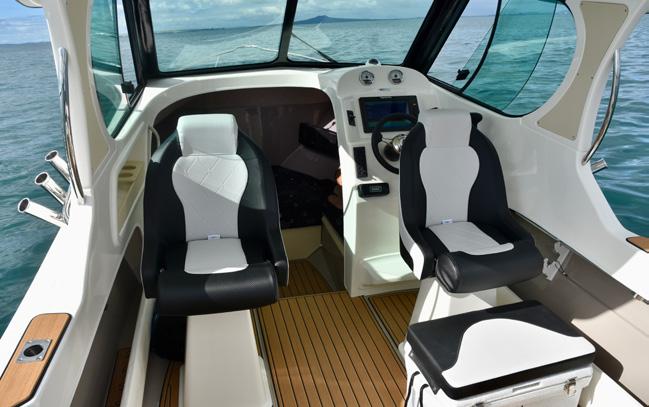
On board the boat, I was immediately impressed with the feeling of volume it gave. On several occasions, I had to remind myself that we were on a boat only 5.75 meters in length; it certainly felt much larger. Our drone operator, at a height of 6’2”, cleared the hardtop - impressive on a boat just 5.75 meters long. Designer Gerry Gerrand attributes this to the raised Carolina sheer line, which creates more height in the hardtop. Also impressive is the skill of the designer and boat builders to achieve the right balance, look, and proportions aesthetically for a boat of this size. Starting forward in the cabin, there are vee berth bunks. Adding the infill provides enough room for two of me, at 5’8’’, to lay stretched out, with perhaps a small child fitting in between for an overnight stay. Two large side lockers run the length of the cabin, offering good storage. There is also storage space between the bunks or a position for an optional portable toilet under the forward bunk, discreetly tucked away. Stepping back up into the SeaDek-covered cockpit, there is seating for five, or six at a push, with two smaller bottoms placed on the padded chilly bin (the boat is CPC rated for six). The bolstered helm chairs are comfortable and also have a great feature where they can be spun around 180 degrees to the reverse position, great for comfortable fishing under the protection of the hardtop or creating a social feel with others seated in the cockpit area. At the helm, visibility is good through the newly designed front windscreen. The twin pane front setup has a slightly commercial look but is quite unique. The frame is made in-house by Buccaneer and sent to Sandbrooks for glazing. The frame is glazed flat in a jig to give a better finish. Stocking pre-glazed front and slider units reduces vessel construction time. The arrangement offers good visibility all around and the sliders provide great ventilation and airflow which is essential with a hardtop. The instrumentation is well laid
PACIFIC POWERBOAT REVIE WS _ BUCCANEER FIVE SEVEN FIVE HT 62 MAY / JUNE 2024
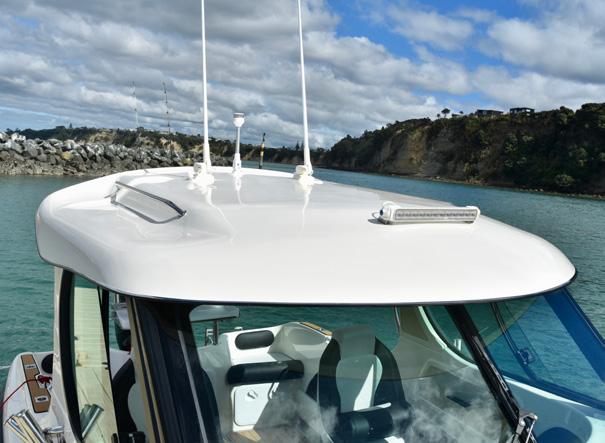
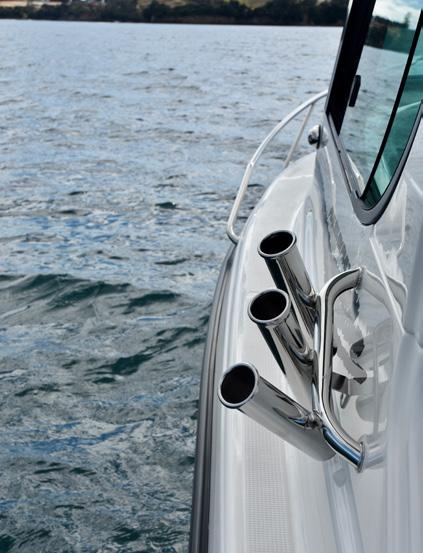
out, featuring a Raymarine 12” Element HSV, positioned prominently and clearly visible below the Mercury engine gauges. On either side of the Raymarine MFD are the Maxwell RC6 Anchor winch switch panel to the left and the Electrotab Trim tab toggle to the right. Found lower on the helm are the BEP accessory switch panel, a 12volt USB charger, GME Stereo, and VHF. The controls and helm feel comfortable, ergonomic, and accessible.
The balance between the cabin and cockpit is well proportioned with enough workspace area for three or four in the working deck space. There is plenty of cockpit storage by way of generous side trays with rod storage options on either side. Just behind the 165-litre underfloor fuel tank is a generous underfloor locker (which could also be used for water storage if overnighting). There are an additional two storage lockers under the moulded aft seats. Between these is yet another locker that houses the battery, with provision for a
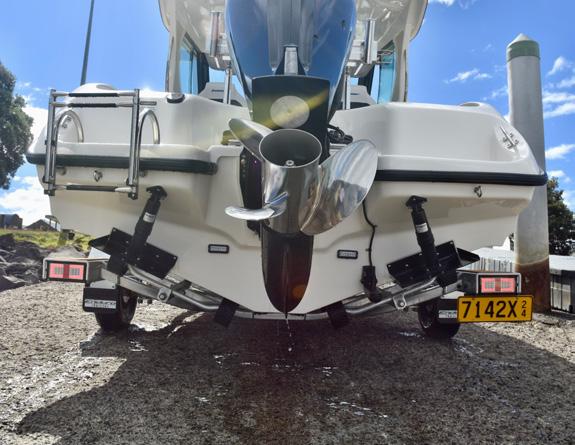
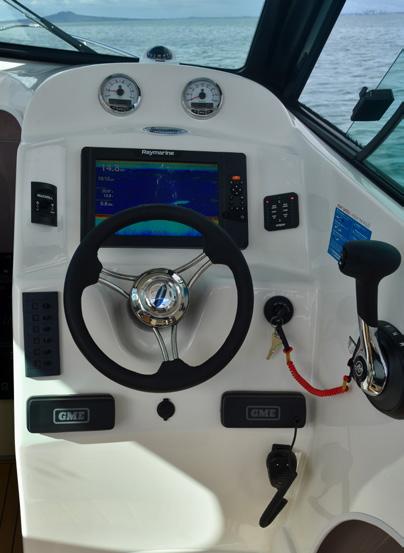
second battery if one is required. Above the battery storage, there is a Manta bait board with four-rod holders. Other rod holders are located within the coamings, and cabin side-mounted rod holders are on either side, ideal for rod storage and easy access to gaffs and nets.
Stepping through the transom is effortless, and thanks to the telescopic boarding ladder mounted on the port swim step, allows easy access on and off the boat.
The side decks allow access to move up front. Even Richard, at 6’2”, had little trouble moving forward to capture drone footage. With a Maxwell RC6 anchor winch installed (as standard), there was little need to head up to the foredeck, but if working a big kingi around the boat, the access is there if needed. There is also a Cule hatch in the cabin, allowing access through to the anchor locker and foredeck.
The transom was fitted with a Mercury 115 Pro XS CT Four-Stroke (with an 18” Inertia three-blade prop). I felt this to be an
The hard top has room for a solar panel if needed.
The 22.5 degree Transom deadrise.
The cabin sidemounted rod holders are ideal f or rod storage and easy access to gaffs and nets.
The instrumentation is well laid out with controls and helm feeling comfortable, ergonomic, and accessible.
excellent match for the Five Seven Five HT, offering good performance out of the hole and a respectable top speed of 36 knots (66 kph), burning just 45 l/ph. I could imagine those wanting a little more performance possibly looking at a 130, 140, or 150hp option. Designer Gerry Gerrand believes those not striving for top-end performance could run a four-blade prop, which would offer better out-of-the-hole performance, at the cost of just a little top-end performance, which in the case of a Hard Top, makes perfect sense which in the case of a Hard Top, makes perfect sense. (Since our review the Buccaneer team tested a 17” four-blade prop, and reported, that the boat got up on the plane quicker, was stronger mid-range and burnt about one litre per hour less at top end).
Out on the water:
Launching at Gulf Harbour, the morning conditions were reasonably flat. We took staff members Carla and Holly out for a
POWERBOATMAGAZINE.CO.NZ 63
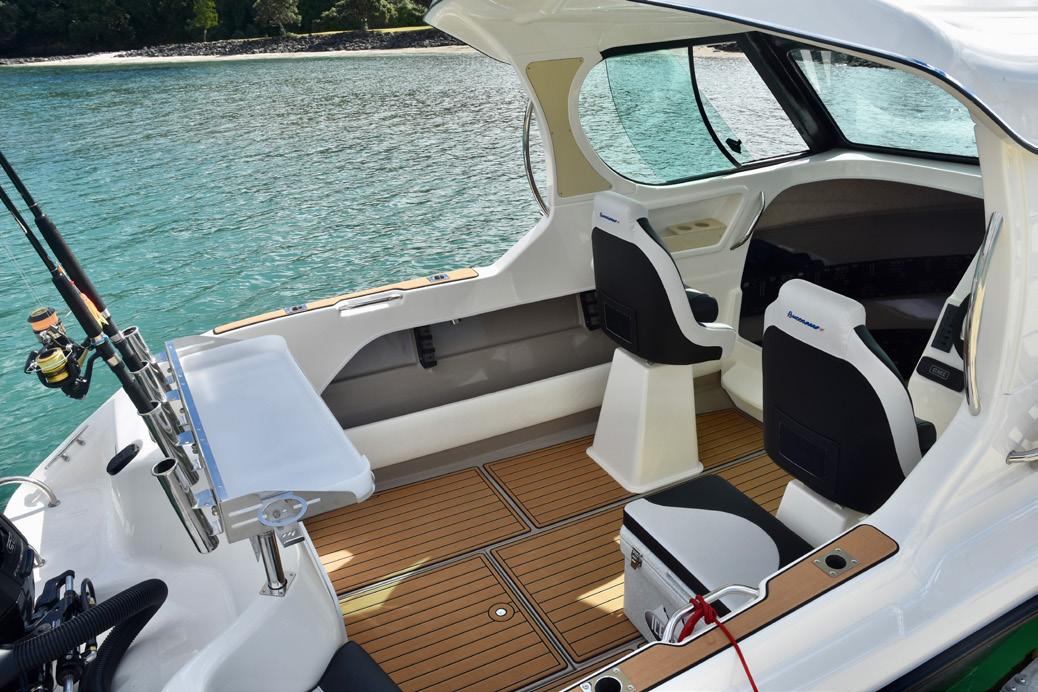
The cockpit work area offers space for 3 to 4 fishermen.
(Below) Adding the infill to the vee berth
bunks provides enough room for two adults and one child. There is also storage space between the bunks or a position for a portable toilet discreetly tucked away under the forward bunk.
run, so we could experience the boat four-up and also to improve the quality of photographic models onboard. Four-up, 80% full. The Five Seven Five, powered by the Mercury 115 Pro XS CT Four-Stroke, had plenty of power to get up and out of the water and ran well in our relatively flat conditions. It was a great opportunity to get the boat dialled in. Learning the boat, I found it preferred a little trim out, with just a slight trim tab down to have it set up nicely. Later in the day, it chopped up a little, and we took the Five Seven Five HT out into the chop, this time, three up with our 6’2” drone operator Richard onboard. Richard was ‘good enough’ to stand aft and move from side to side while out in the small chop, making me give the tabs a real workout. Again, this is a 5.75-metre boat with a 22-degree deep vee – so there was always going to be some movement. With a little
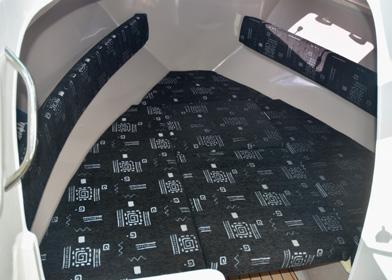
trim out and bringing the tabs into action, helped to counter his ‘circus-like’ antics in the back. Personally, if I were spending the dollars on a new boat with such a deep vee, I would look to spend just a little extra on a set of auto tabs, taking the work and thinking out of trimming the boat. Maybe I’m getting lazy in my old age! Deep vee boats are great in rougher conditions but generally introduce a little tenderness. These tab systems take much of that away, offering the best of all worlds, great performance in the rough, adding stability with no compromise.
The boat's construction, like the rest of the Buccaneer family, is a full stern-to-bow fibreglass hull liner (a hull-within-a-hull with foam filling). This produces a rigid hull with minimal wood in the construction, significantly increasing the boat’s longevity while offering a quieter and softer ride. For peace of mind,
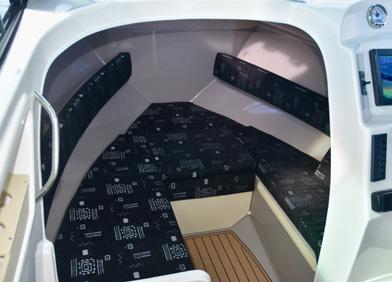
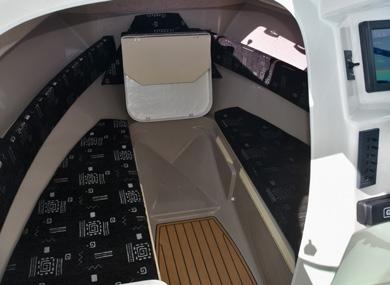
PACIFIC POWERBOAT REVIE WS _ BUCCANEER FIVE SEVEN FIVE HT
64 MAY / JUNE 2024
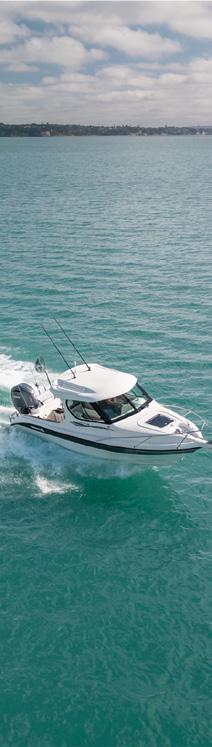
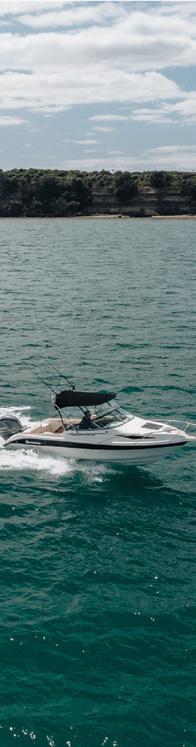
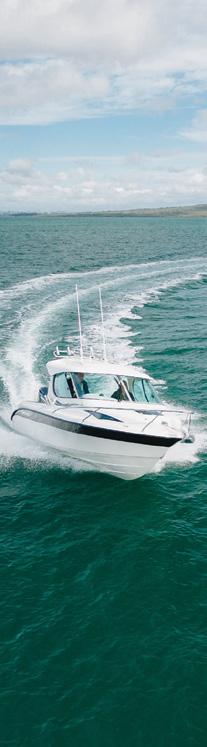
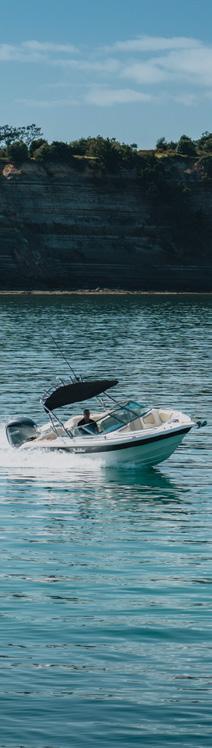

www.familyboats.co.nz/buccaneer Join the family. NEW HORIZONS DISCOVER WE WILL SORT THE HOW! YOU DECIDE THE WHERE AND WHY... For the full range visit: www.buccaneer.co.nz 650 Esprite 685 Exess 565 Exess DB936 POWERBOATMAGAZINE.CO.NZ 65
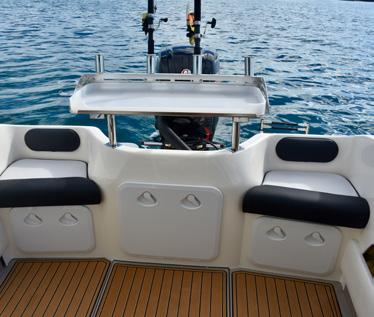
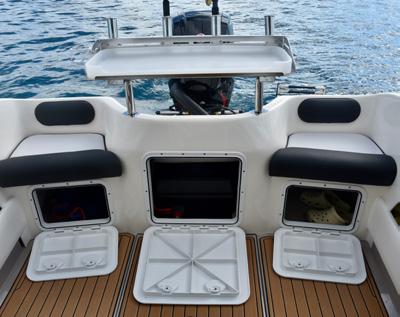
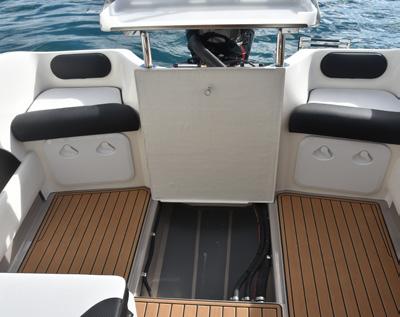
SPECIFICATIONS
Maker & Model Buccaneer Five Seven Five HT
Buccaneer backs all of their range with a 5-Year Hull Structural Warranty. They are Coastguard-approved and are built to the New Zealand Boat Building CPC Standard.
The Five Seven Five HT (and sistership the Six Fifteen HT) had been close to moving from the Buccaneer drawing board, then came Covid, followed by the surge of orders for two years following Covid… with this period behind them, the Buccaneer team worked hard to present these two new hard top models, two of the first Kiwi GRP boats to hit the water post-Covid.
We are glad she finally made it; we all enjoyed our day out on the water (must take bait next time). I believe there will be much interest in the Five Seven Five HT, particularly from those wanting the benefits a Hardtop brings, with the ability to be towed behind a medium-sized vehicle with easy storage, especially those living in built-up suburbs with limited parking or a dogleg driveway like mine.
To conclude, in addition to the ease of launching and retrieving, this compact hard top model will make a family's time on the water a lot more comfortable, offering protection from the elements, both in protection from the scorching sun in the hot summer months and also extending the boating season into the cooler months.
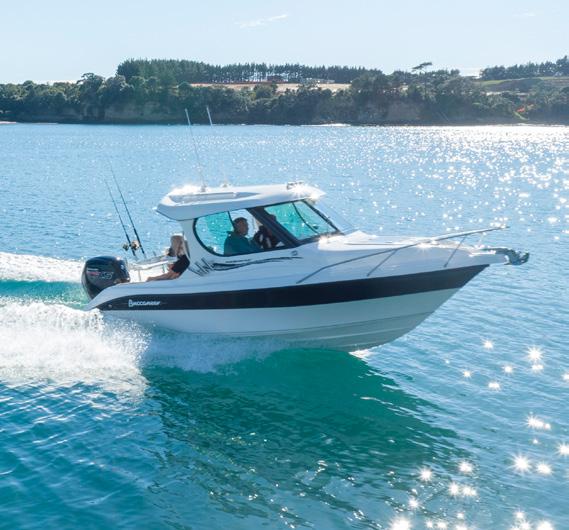
Price as tested $126,225
Priced from $116,625
Type Hard Top
Construction GRP
LOA 6.28m
Hull Length 5.75m
Beam 2.34m
Deadrise 22.5 degrees
Trailer Enduro Braked Single Axle
Height on trailer 2.750 m
Length on trailer 7.8m (engine tilted up)
Trailerable weight 1620 kg (120 litres of fuel)
Test Power Mercury 115 Pro XS CT Four-Stroke
Propeller 18” Inertia Three Blade
Power options Single Outboard
HP Range 115hp-150hp
Fuel Capacity 165L
Manufacturer Buccaneer Pleasure Craft Ltd
BUCCANEER.CO.NZ
STANDARD OPTIONS:
PERFORMANCE DATA
PACIFIC POWERBOAT REVIE WS _ BUCCANEER FIVE SEVEN FIVE HT
RPM KNOTS L/h L/NM RANGE 700 2.0 1.4 0.700 210 1000 3.2 2.2 0.690 210 1500 5 3.8 0.760 190 2000 6 5.9 0.990 150 2500 6.7 9 1.400 100 3000 10.5 11.8 1.200 120 3500 15 15 1.000 140 4000 20.5 17.3 0.850 170 4500 24 23.8 1.000 140 5000 28 27.2 0.980 150 5500 32 35.2 1.100 130 6000 35.8 45.1 1.300 110
Maxwell RC6 Winch, Electrotab
Tabs
auto retract and indicators), SeaDek
Wiper
Bolster Seating
Trim
(complete with
Flooring Helm
,
66 MAY / JUNE 2024
The rear of the cockpit offers seating and plenty of storage.

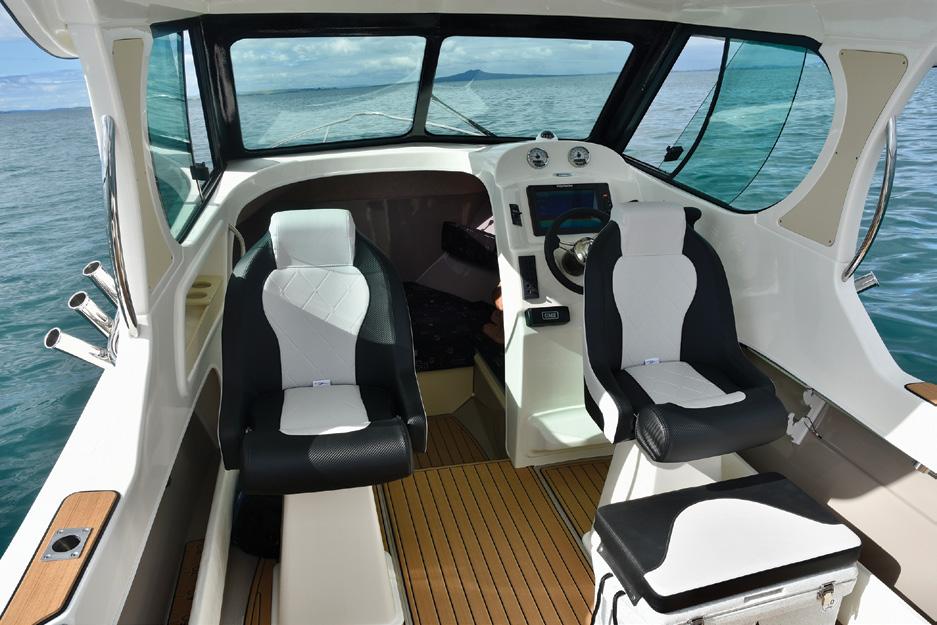

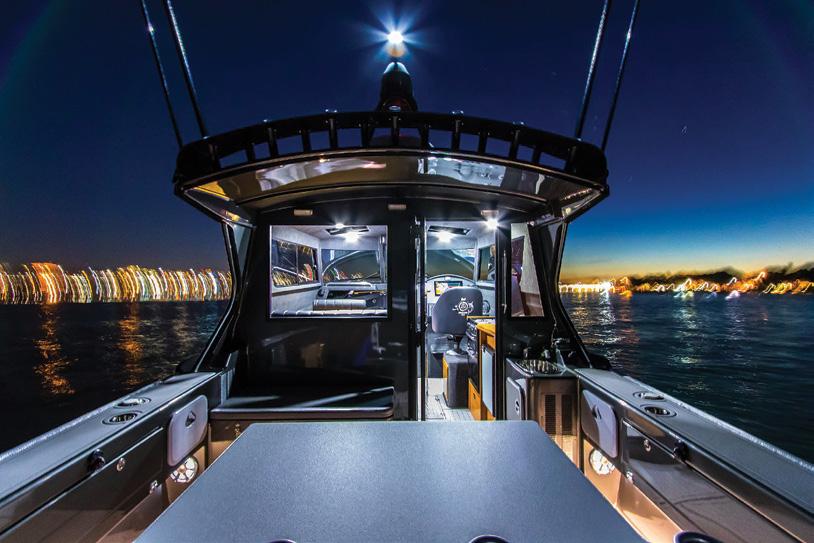
Tel:09 278 9816 hello@sandbrooks.co.nz Collaborative, Innovative Solutions. Bulkhead Electric Windows Through bulkhead design for aluminum boats. Frame and mechanism pass through, leaving a picture frame on the outside face. Inside face mount for wooden boats. Pillar-less mounts internally; glass is unsupported for a sleek look. Available in standard or custom sizes. Slim, compact envelope. GIVEAWAY GIVEAWAY GIVEAWAY GIVEAWAY GIVEAWAY GIVEAWAY GIVEAWAY SUBSCRIBE & Be in to win the ultimate boating accessory giveaway! Win $2,300+ worth of products to enhance your time on the water! Simply subscribe at the Hutchwilco Boat Show to be into win - Stand 298 Prize IncludesUltimate Ears EPICBOOM Cobb Grill Pro black gas Engel Cooler Box 18L Grey Engel Backpack Cooler 23L Hutchwilco Inflatable Life Jackets Pepper and Me Seasonings Quad Lock Voucher Anchorage Estate florals collection Salt Attack Mothers Black Streak Remover WIN POWERBOATMAGAZINE.CO.NZ 67
POWER CATS
THE PAST, PRESENT & FUTURE!
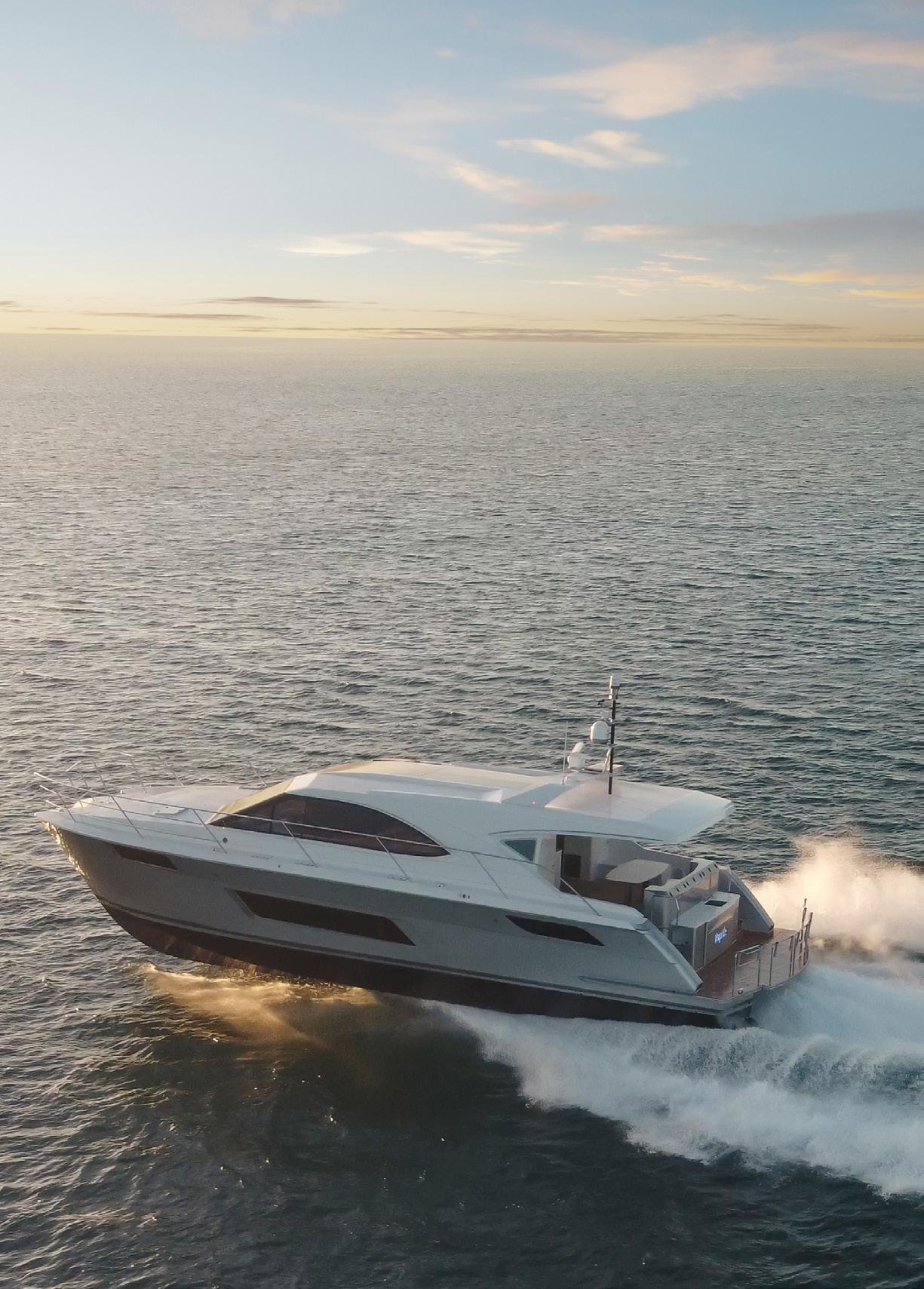
The Voodoo Yacht range of foil assisted power cats are capable of travelling great distances at speed.
FEATURE POWER CATS – THE PAST, PRESENT AND FUTURE!
68 MAY / JUNE 2024
As power catamarans thrive as one of the fastest growing sectors in the boating market, it’s timely to consider the variations of power catamarans, their hull types, performance capabilities and the features they offer new owners in their boating lifestyle.
Power catamarans, once considered a niche within the boating world, are steadily comprising a bigger slice of the market. They offer a wide range of options in performance, comfort and interior & exterior layouts. From sleek planing vessels to efficient displacement hulls, the power catamaran market delivers a large variety of designs to meet the needs of a wide variety of cruisers in New Zealand and Australia. Brands around the world specialise in producing hundreds of production power cats every year including Fountaine Pajot, Iliad and Aquila. As we featured in a company profile last year, the Aquila brand for example offers eight power catamaran models in three categories from 9.38m to 21.26m.
Ranging from 10m to more than 30m, power catamarans from overseas and local designers can be configured for applications from coastal cruising to adventurous longrange voyages. With that in mind, it’s helpful to identify your goals and the attributes that will best help you achieve them in regards to comfort, cruising times, fuel budget, and even the relationships of those onboard – a family with children, teenagers or grandchildren; several couples; a skipper and deckie with charterers; bare boat charterers; a group of young surfers or retirees on their
swansong – all will have different preferences in cooking styles, accommodation, watersports, time constraints, sleeping options, and preferences in the boat’s motion at anchor and at sea. With local and overseas designers and builders contributing to the expanding power catamaran market, there are plenty of options.
In the mid 1970s powerboat designers started creating boats in which the galley was ‘up’ not ‘down’. They drew windows larger to create light, spacious-feeling interiors. Ventilation improved and equipment such as marine hot water systems, electric toilets, marine refrigeration and gas stoves became available at more realistic prices.
However, accommodation was still a limiting factor. Only the bigger boats had choices with spacious cabins. For the smaller boats, with narrow hulls compared to modern boats, sleeping accommodation was more like camping or caravanning, with little privacy and don’t even think about ensuites. Crews tended to be groups of guys or one family per boat. But while onboard comfort was improving rapidly with modern developments, for some there was still a major factor in whether or not they would go boating: the powerboat’s motion and its effects on sensitive stomachs, particularly at anchor.
POWERBOATMAGAZINE.CO.NZ 69
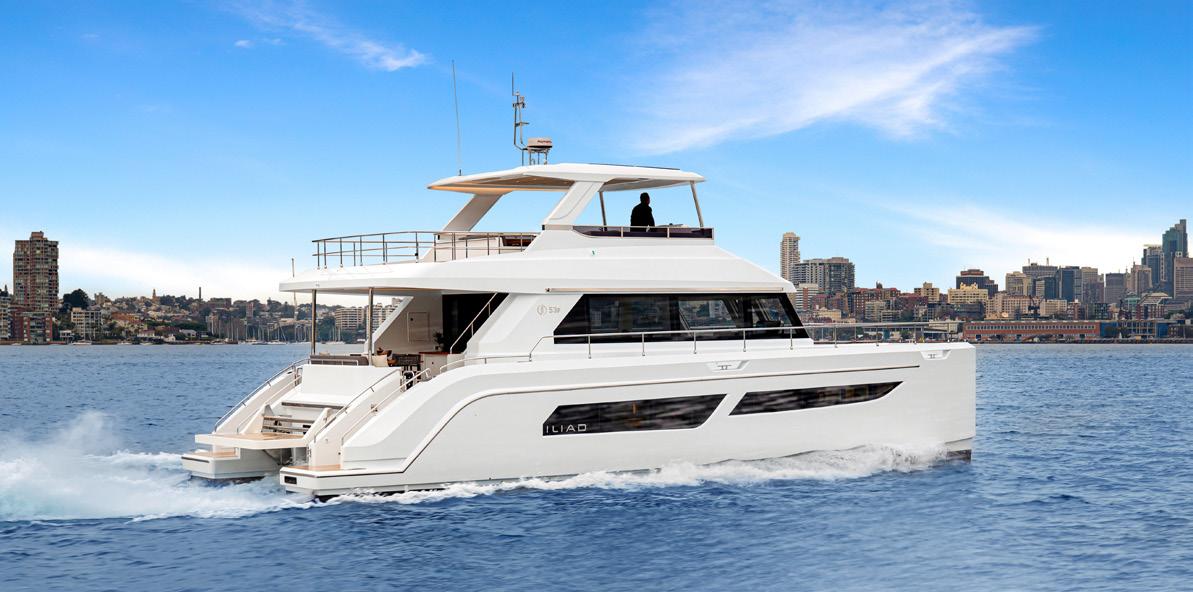
Stability on power catamarans
For many, stability is a major attraction of the power catamaran and most power catamaran owners will proudly have a bowl of fruit on the saloon table, just because they can. In particular, the beamy non-planing power catamarans demonstrated greater stability underway and at anchor.
Increased deck space
The power cat’s generous beam creates expansive deck space and interior volume, especially because this generous beam extends forward almost to the bow and aft to the stern. This consistency of beam creates a lot of deck space in terms of area and usable space. Imagine viewing a cruising power catamaran from above - it is almost rectangle in shape, with just a small taper going forward

FEATURE POWER CATS –THE PAST, PRESENT AND FUTURE!
70 MAY / JUNE 2024
ILIAD 53F, Winner of the 2024 Multihull of the Year.
Large internal volume and accommodation
The interior volume of the power catamaran and its twin hulls provides plenty of options for private cabins. Often there is a cabin in each corner; ie. for’ard and aft in the port and starboard hulls. This option is ideal for the bareboat charter market where privacy is important as the charter cost is often shared between four couples on holiday. This also works well for multi-generational family groups with kids taking one corner and adults the other. In shared boat ownership, a cabin or entire hull can be locked off when one of the owners is not on board.
A 12m power cat with a flybridge can have four sleeping cabins with two shared ensuite bathrooms and a 13-14m power cat could have four cabins with ensuites if desired.
Modern boaters love interior volume, which is why most production boats, monohulls and multihulls, have plumb stems, and wide and high-sided hulls to provide large cabins. These features are not always advantageous offshore, but when comparing boats at the marina or boat shows, interior volume can be a big factor in making a sale. The wider individual hulls of these planing coastal cruising power cats provide large floor space for bunks and bathrooms, and higher static stability than narrower, more fuel-efficient hull designs.
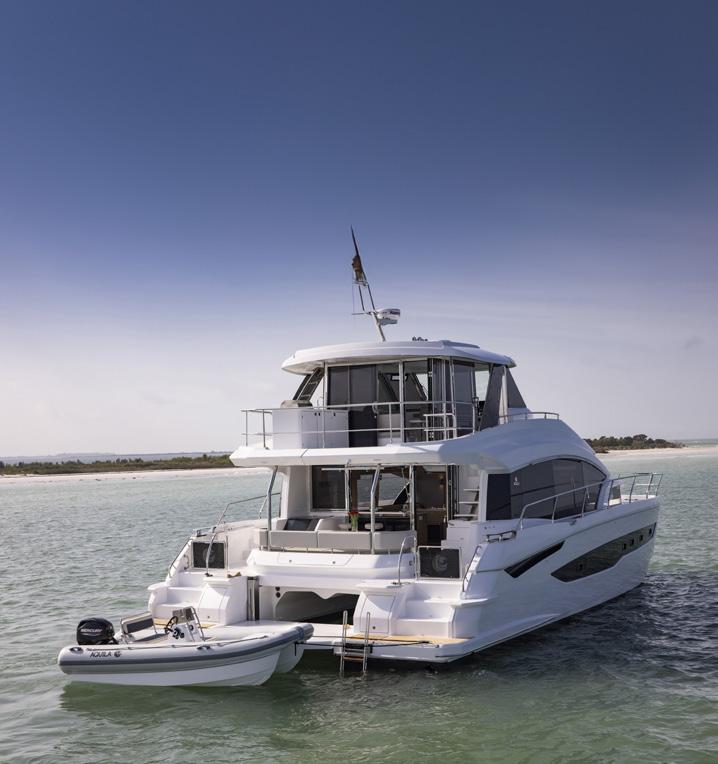

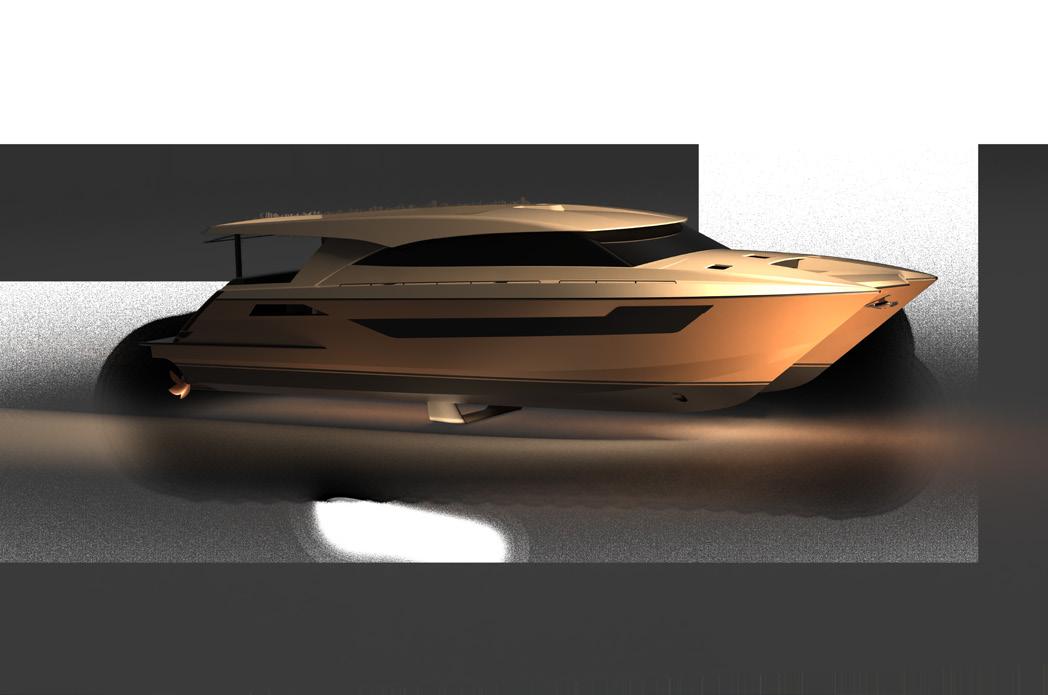
POWERBOATMAGAZINE.CO.NZ 71
The Aquila 54 Yacht Power Catamaran embodies the reliable features and construction methods of the hundreds of Aquila yachts and boats cruising the waters of the world.
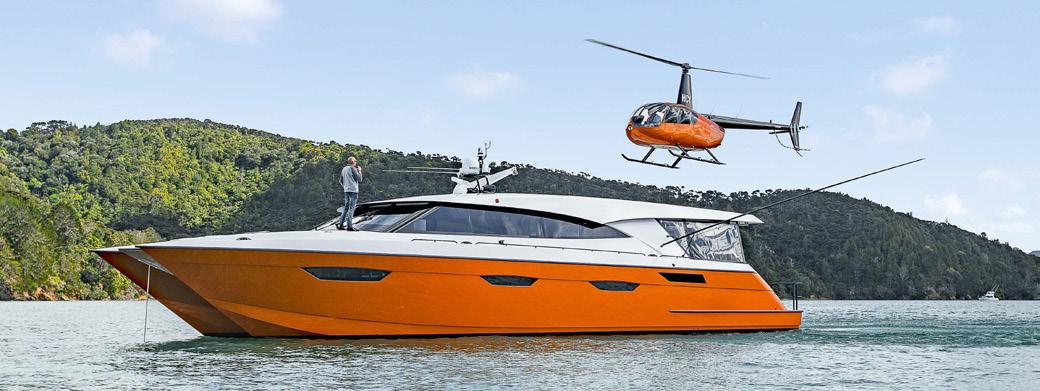
Going cruising
In New Zealand, unless you leave the country, all cruising is coastal and the distances between refuelling facilities are relatively short, therefore the planing type power catamaran will be acceptable as it will have the range at sprint speed to make ports and avoid the type of conditions for which it is less suited.
With Australia’s extensive coastline, these planing type boats generally need to cruise at displacement speed to get the range required between refuelling facilities. For this reason, they need to plan their trip carefully around weather patterns to minimise the risk of being caught out at sea, as they do not have the range at high speed to outrun them. We therefore see a greater and more consistent demand for the long range cruising power cats in Australia, which leads us to the characteristics of different hull forms.
This is not to say that production planing power catamarans cannot undertake longer passages; it just means they will have to do so at displacement speed. Likewise a power catamaran designed and optimised for long range offshore cruising will still
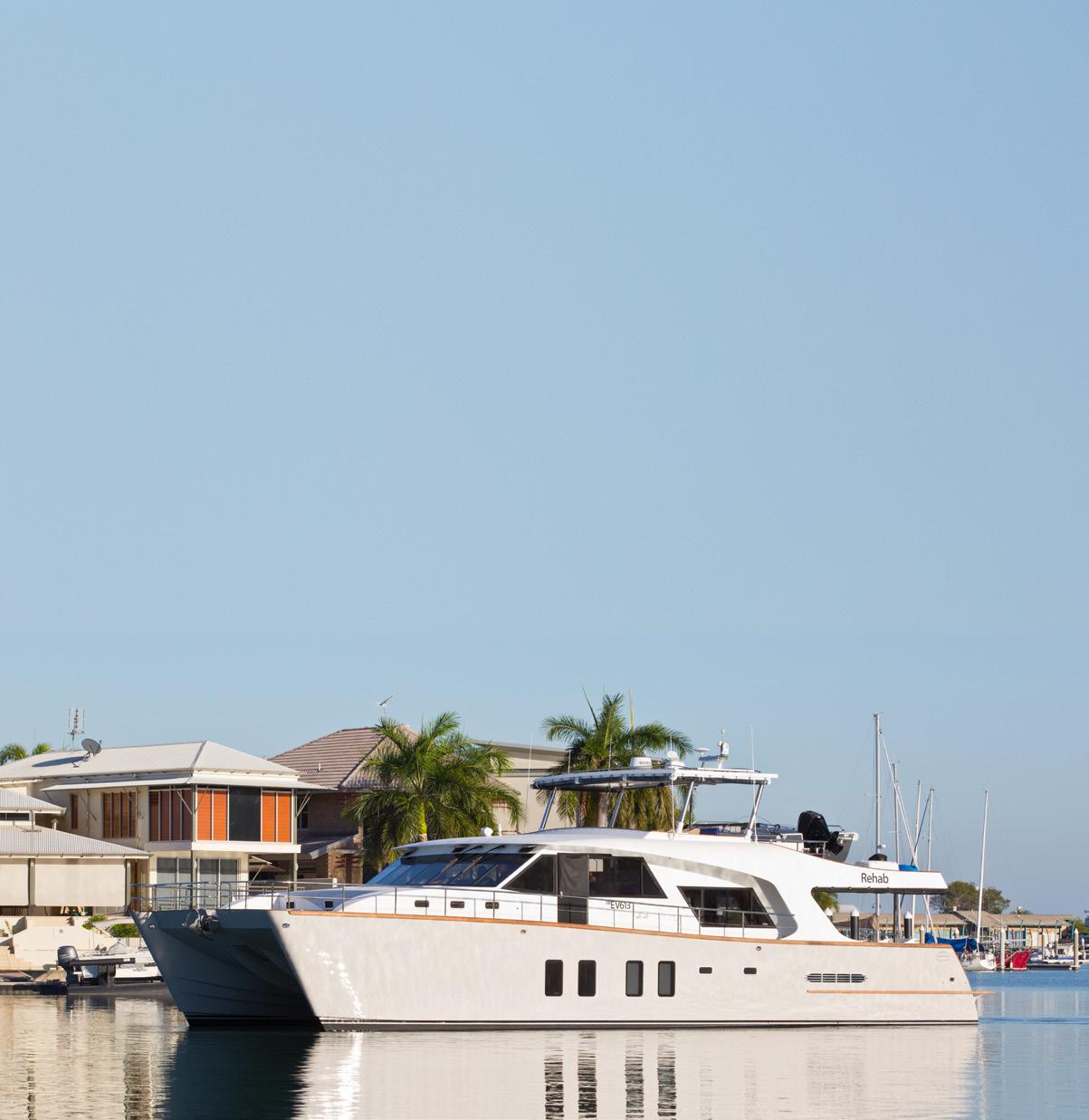
make an excellent coastal cruiser, however it will generally have less internal volume for accommodation.
The hull story
At the heart of every power catamaran lies its hull form, which dictates its performance characteristics. There are three primary hull types: displacement, semi-displacement and planing. Each type addresses different priorities, from fuel efficiency to speed and stability.
Planing Powercats - the need for speed
Planing power cats are designed for exhilarating performance, featuring medium to high deadrise hulls that skim across the water's surface. These vessels prioritise speed, utilising hard chines to reduce wave drag and achieve impressive speeds. Notable examples include Pachoud Yachts' Voodoo foil-assisted power cats, renowned for their high-speed capabilities and sleek design. Planing powercats can and do successfully undertake ocean passages; for example, the trans-Tasman crossings of
the Roger Hill-designed, 17.5m Voodoo which covered the 1229nm in 53.5hrs @ 23 knots average in 2023.
Semi-Displacement Cats - balancing speed and comfort
Semi-displacement power cats offer a blend of speed and comfort, making them ideal for leisurely cruising and extended voyages. With their good sea-keeping abilities and moderate speeds, these vessels prioritize fuel economy and spacious interiors. Models like Fusion Marine's Prowler 10.8 and Fountaine Pajot's Cumberland 47 exemplify this balance, providing comfortable accommodation and efficient performance for cruising.
Later in 2024, we anticipate the launch of two de May Spaceship 18m semidisplacement power cats, both semibespoke custom builds, from the drawing board of Roger Hill Yacht Design, built by Nic de May Yachts using hi-tech materials and systems. (Check an issue of Powerboat magazine later this year for the full review).
Kiwi Peter Brady has been designing and building power cats for over 20 years and rates Rehab as his crowning achievement.
FEATURE POWER CATS – THE PAST, PRESENT AND FUTURE!
Valder Yachts 20m foiling assisted powercat runs close to 50 knots.
72 MAY / JUNE 2024
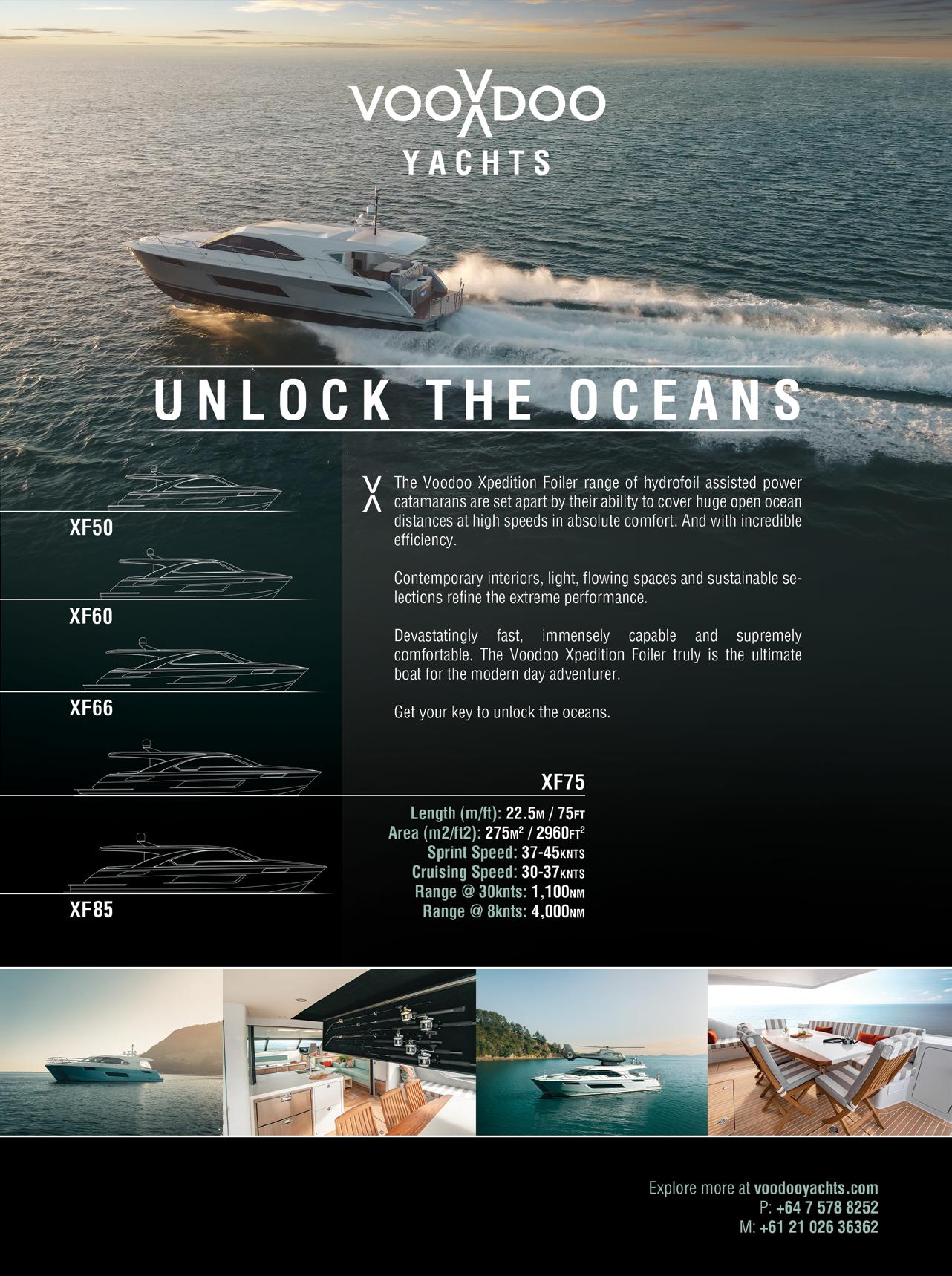
Displacement Cats - prioritising stability and economy
Displacement power cats prioritize stability and fuel efficiency over speed, offering a steady and economical cruising experience. Designed with long, narrow and easily-driven hulls, these vessels excel in seaworthiness and comfort. Notable examples include the Horizon PC60 and the Peter Bradydesigned Rehab, renowned for their economic performance and excellent sea-keeping capabilities.
As with any displacement boat, it pays to experiment with different speeds in different conditions to find what is most comfortable on the day. It’s possible for displacement cats, provided they are long enough, to run upwards of 25 knots with standard underwater running gear. The late Kiwi designer Malcolm Tennant enjoyed considerable success over the years, especially with his displacement catamarans. His approach was the ‘long and thin’ style of easily driven, round bilge, minimum wetted surface hulls that gave great performance and sea keeping capability with excellent fuel economy.
OTHER TYPES OF POWER CATAMARANS ON THE MARKET
The Sports Fishing power catamaran
With its shorter coast line, the New Zealand sports fishing cats are more likely to be of the planing hull type, whereas in Australia where long range is more important, they are often displacement hulls. Either of these hull shapes make an excellent sports fishing boat for their stability at rest and narrow transoms which allow them to back down fast if required. They differ from the volume type of power cat in their aft decks or cockpits which are designed around fishing rather than sun bathing. Expect to see multiple rod holders, bait boards, kill tanks, live bait tanks, ice makers and usually generous refrigeration to handle the beer and the fish.
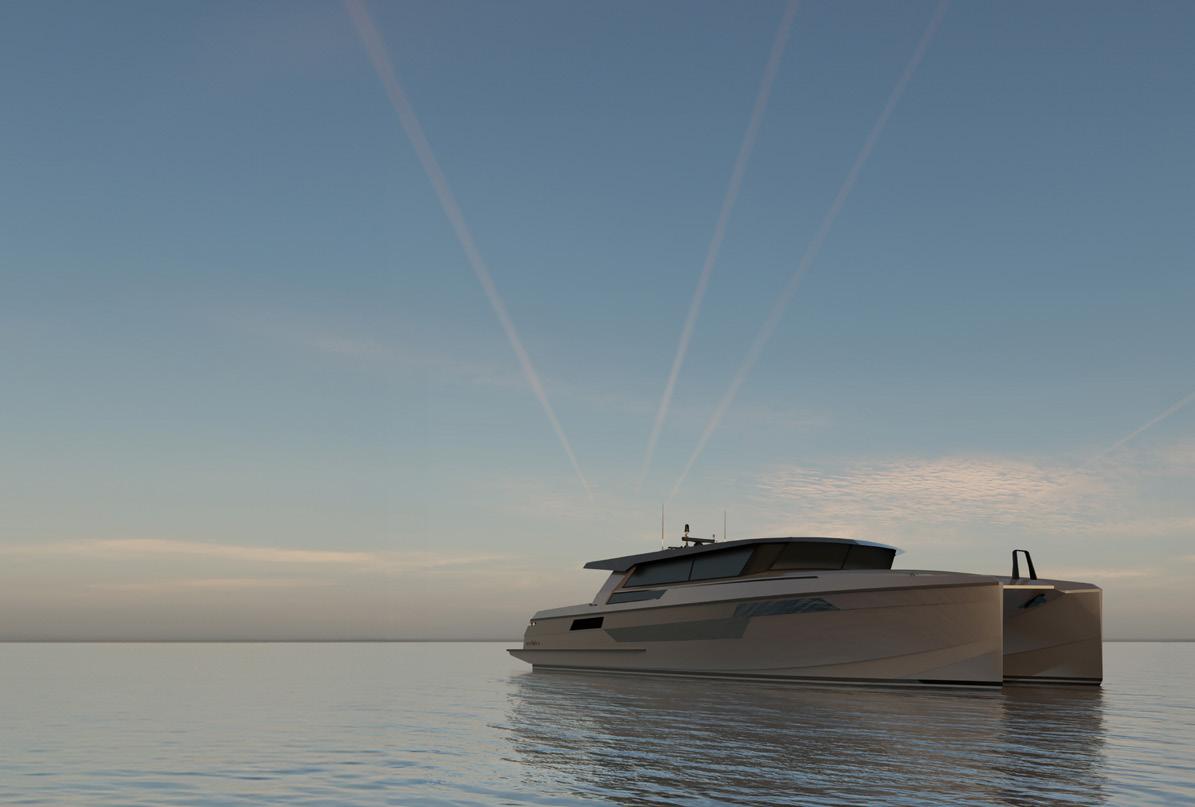
Looking for the ultimate in a comfortable long-range
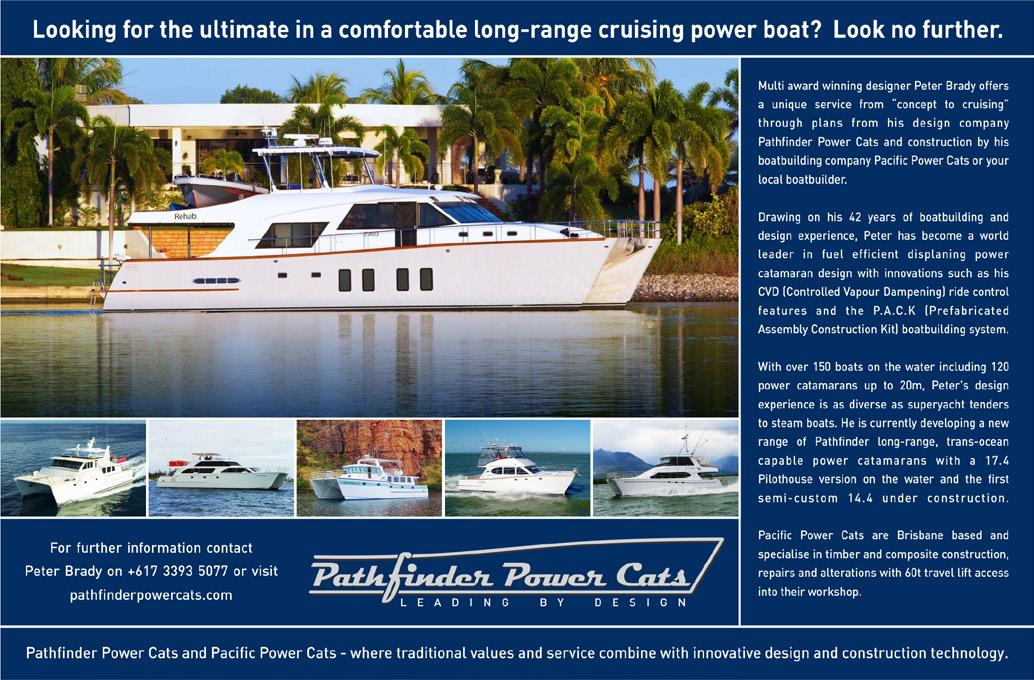
service combine with innovative design and construction technology
DB986 FEATURE POWER CATS – THE PAST, PRESENT AND FUTURE!
74 MAY / JUNE 2024
Roger Hill Yacht Design and DEMEY Yachts have recently announced their latest collaboration, unveiling an exceptional 22-meter hydrofoil assisted Power Catamaran concept for a North American client.
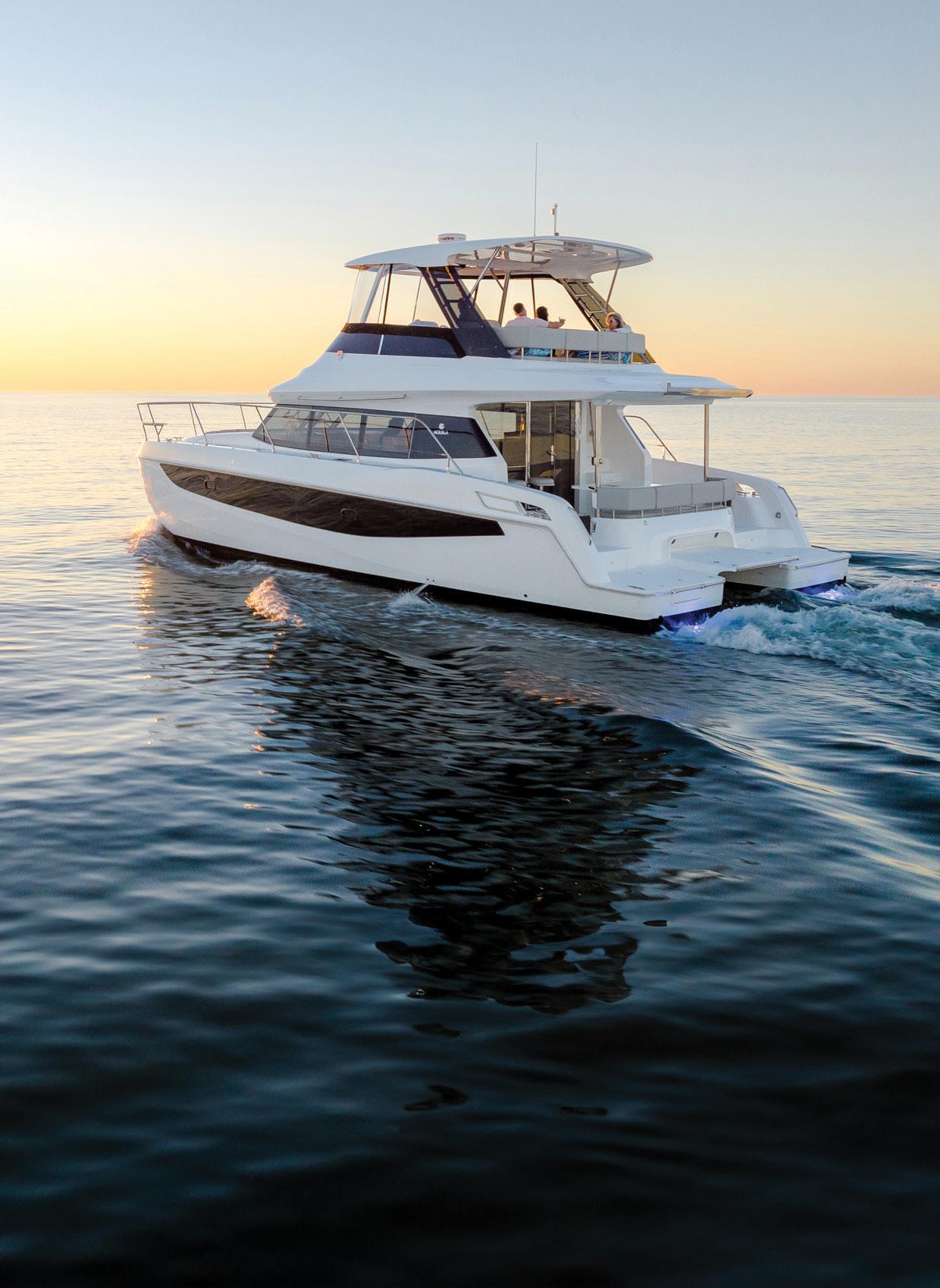
Aquila Power
is
quality,
catamarans. No other vessels on the planet offer more features, reliability, durability, and value than our world-class lineup. 28 MOLOKAI | 28 MOLOKAI CUDDY | 47 MOLOKAI 32 SPORT | 36 SPORT | 42 YACHT | 44 YACHT | 50 YACHT | 54 YACHT | 70 LUXURY aquilaboats.com.au BORN OF INNOVATION AND EXPERIENCE SEE THE AUSTRALIAN & NEW ZEALAND DEBUT OF THE NEW AQUILA 42 YACHT Sanctuary Cove International Boat Show | May 23 - 26, 2023 ON DISPLAY 36 SPORT ANZ DEBUT 42 YACHT ON DISPLAY 54 YACHT
Catamarans
the world leader in producing high
innovation-filled and exceptionally-performing power
The catamarans made by Fountaine Pajot are becoming more and more liked because of their intrinsic design characteristics, design quality and construction.
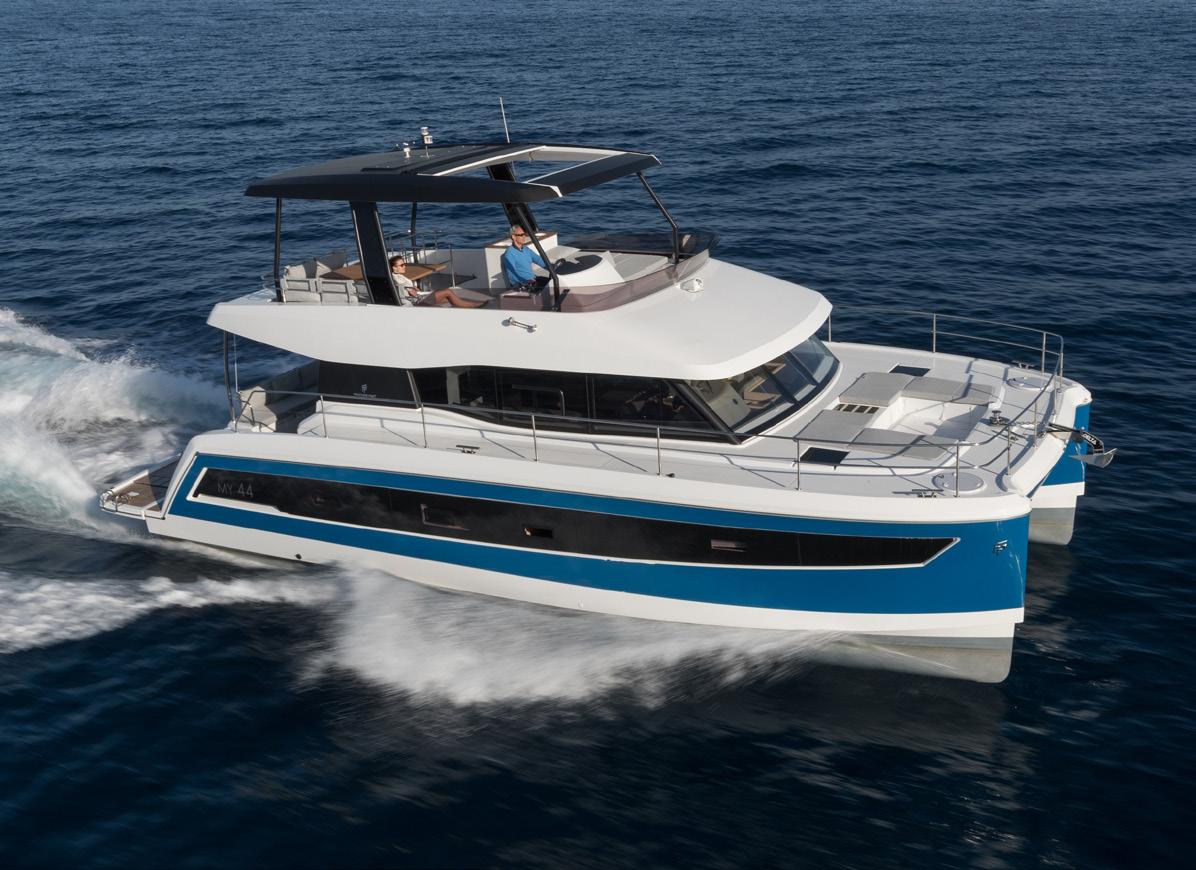
The high speed foil assisted power catamaran
This type is a relatively new development; it is a small market on the cutting edge of technology and materials. Because of the need to keep the hull bottom and particularly the foils clean and smooth, these boats will need to be well looked after to perform as designed. Their foils may be vulnerable to debris damage which may restrict their operating areas. They have proven that, with the right weather window, they can make ocean passages.
Long-range offshore cruising versus coastal cruising
In comparing power catamarans for different types of cruising, consider these qualities for a long-range offshore power catamaran:-
• Generally narrower, more fuel efficient hulls for a high cruising speed over long distances;
• Raked bows for a softer, drier ride;
• Large fuel capacity and usually old school, mechanically-injected diesel engines that are more tolerant to low-quality fuel – sometimes a concern at remote, foreign ports;
• Large engine rooms with, preferably, internal access so that deck hatches do not need to be opened in rough conditions to check the engines;
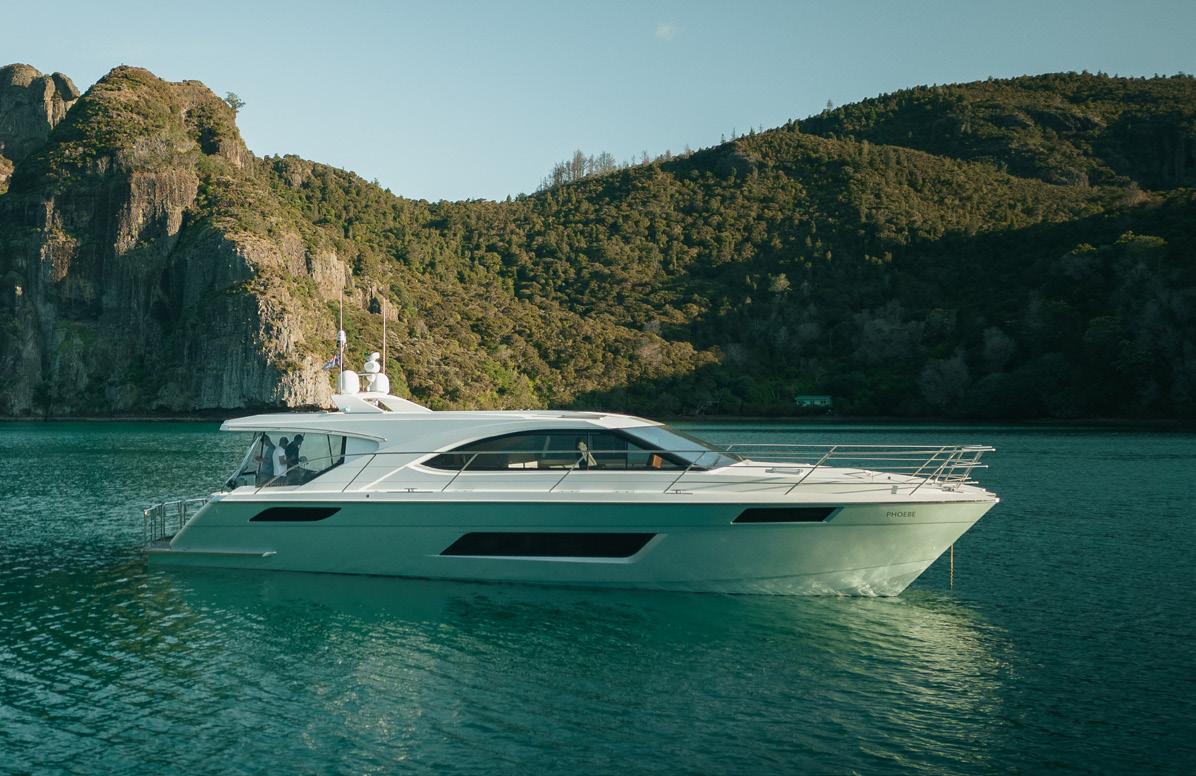
Phoebe, a Voodoo XF60 anchored up in NZ’s far north. Running immersed propellers she exceeded 45 knots on her first day on the water!
FEATURE POWER CATS – THE PAST, PRESENT AND FUTURE!
Fountaine Pajot’s MY44.
76 MAY / JUNE 2024
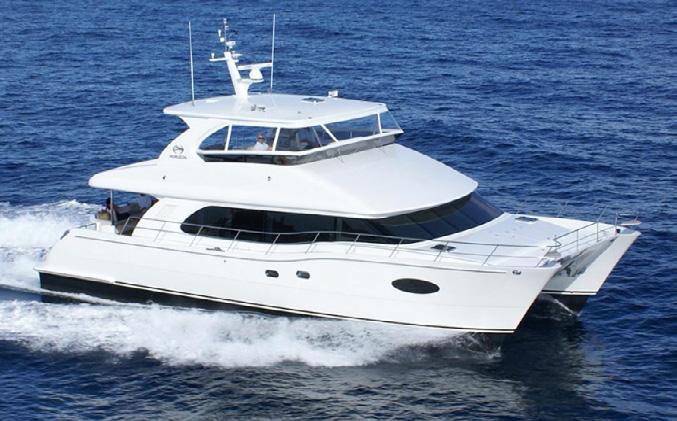
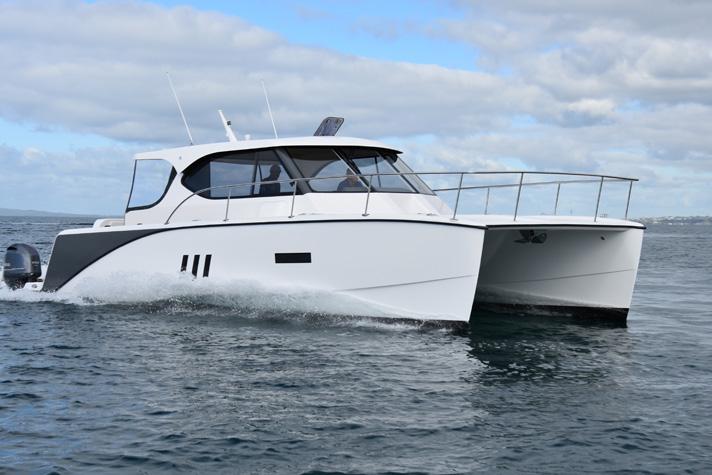
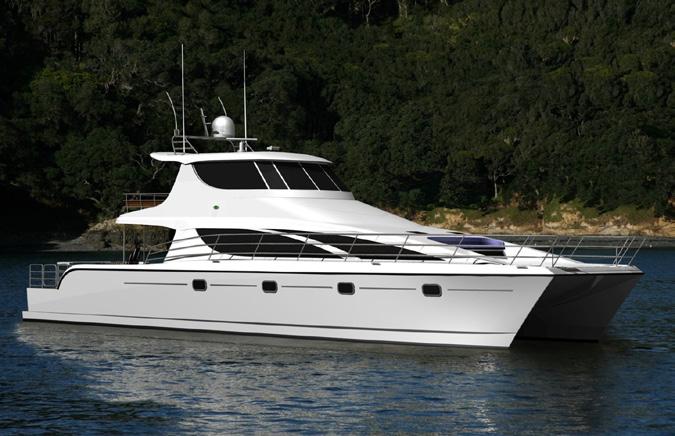
SUMMARY
The attraction of power catamarans
For many boaters, stability and comfort are paramount when choosing a vessel. Power catamarans, with their wider beam and dual-hull configuration offer good stability, which is a factor in reducing seasickness, and a manageable platform for passengers of all ages. For this reason some power monohulls are available with stabilsers and fins which enhance stability underway and at anchor. Of course, some people prefer the motion of monohulls and the ability to steady yourself from hand-hold to hand-hold in rough conditions, whereas there are often wide spaces between hand holds on the power catamaran.
When floor space is important, the spacious layout of power catamarans allows for versatile interior configurations. From expansive saloons to private cabins and outdoor entertainment areas, these vessels offer ample space for relaxation and socializing, above and below deck.
The performance of a power catamaran reflects its power-to-weight ratio and hull design. While planing vessels prioritise horsepower for high-speed planing, displacement cats rely on hull shape for efficient cruising. Understanding these dynamics helps boaters choose the optimal power configuration for their vessel, balancing performance with fuel efficiency. It is a matter of considering hull length, displacement, power requirements, accommodation, comfort and speed when selecting the most suitable boat for your requirements.
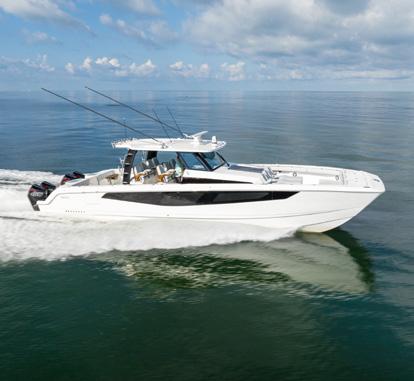 A luxury power catamaran, the Horizon PC60 offers a blend of elegance, stability and efficiency.
Fusion Marine's Prowler 10.8 Sports Fisher. While the Prowler Powercat has been around for many years, it has morphed into various forms, with each new model improving the last.
A luxury power catamaran, the Horizon PC60 offers a blend of elegance, stability and efficiency.
Fusion Marine's Prowler 10.8 Sports Fisher. While the Prowler Powercat has been around for many years, it has morphed into various forms, with each new model improving the last.
POWERBOATMAGAZINE.CO.NZ 77 Catamarans International's CI-6500 - a 20 metre 4 cabin vessel, for sale today!
Aquila 47 Molokai
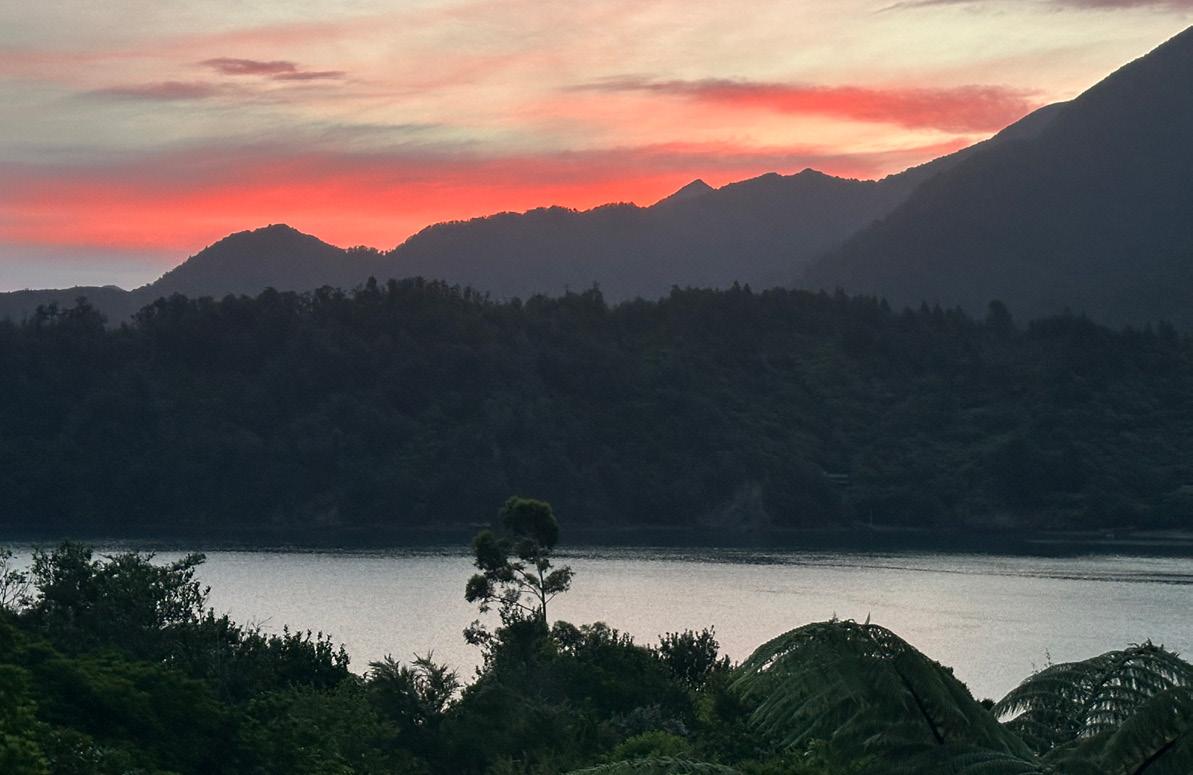
MARLBOROUGH REVISITED
BLUE COD HEAVEN
Dawson Charters have a reputation for providing personalised fishing and diving charters with a difference - packed with humour and above all providing an experience that you’d struggle to find on any Marlborough charter.
Having relished two previous Dawson Charter expeditions, we were eager to share the magic with three of our five children (and their partners). Greg Dawson, the charismatic operator, and his delightful wife, Kath, orchestrated a seamless beginning to our adventure, personally fetching us from Blenheim Airport. Two vehicles stood at the ready, setting the stage for a journey that promised excitement and unpredictability from the get go!
Our inaugural stop took us through the scenic vineyards around Blenheim, where we indulged in some of the tasty local Riesling, Pinot Gris, and Sauvignon Blanc wines. Departing from the vineyard’s grace, we made our way to Havelock for a ‘quick interlude’ at the Slip Inn, enjoying a couple
of drinks that set the tone for the adventure ahead. Soon after, we boarded “Ohana”, a 250hp Yamaha powered Southern 770, destined for Dawson Charter’s Marlborough haven in Miro Bay, in the Pelorus Sound.
The home base, two charming Kiwi-style bach’s (known as cribs in the South Island), sit cradled in a beautiful bush location in the Bay, welcomed us with open arms, offering all the amenities one could need. A deep-water wharf granted easy access to the tide, while a trusty quad, stood ready to assist those finding the initial stretch of Dawson Charter’s escapade a touch strenuous. The newer separate, twobedroom house on the property, catered to larger groups, boasting a lounge, kitchen, and bathroom.
Our first day was a leisurely affair, complete with a sound sleep and board games, as the weather played coy with some wind and showers. No qualms for the weary travellers; it served as a perfect initiation to settle in and acquaint ourselves with our new surroundings. We were well aware that pristine weather awaited us for the next 3-4 days, ideal for fishing and boating, anticipation was running high.
The subsequent days unfolded with thrilling escapades on the water. Some members of our crew, novices in the art of fishing, were a joy to witness as they discovered the delights of the experience. Blue cod, plentiful in the area, graced our haul alongside snapper and gurnard, with (for excitement only), a shark and Barracuda muscling their way into the action. Swiftly
DESTINATION: MARLBOROUGH
78 MAY / JUNE 2024
A beautiful sunset over the Miro Bay

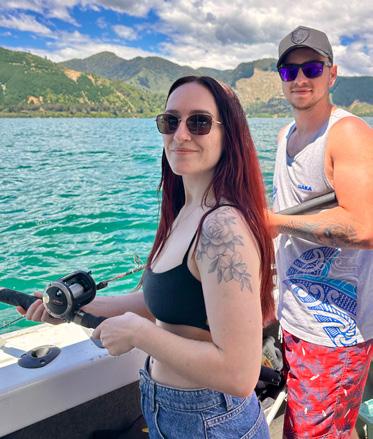
reaching our daily limit, we set off to procure fresh mussels from the generous mussels supplies throughout the Sounds. Evenings transformed into seafood extravaganzas, with sumptuous feasts of ocean bounty, while the remaining meals hailed from the skilled hands of the local butcher of Renwick.
Our explorations extended to the outer islands and bays of the Marlborough Sounds, culminating in a venture across the notorious French Pass.
Anchoring beside its entrance, with the tide roaring at an impressive 7 knots, we found ourselves in the company of the most voraciously hungry fish. Each drop of the line resulted in an instant blue cod – one bite, one fish! To heighten the fishing experience, barracudas occasionally tried to claim our cod on the ascent, but our skilful manoeuvres thwarted their attempts.
French Pass, named by Dumont D’Urville in 1827, or Te Aumiti in Maori, offered a historical backdrop that added depth to our journey. The
Marlborough Sounds, with its many spots to pause and rejuvenate, beckoned us to explore both the beauty of the landscape and the essence of maritime serenity. At Te Rawa Resort in Wilson Bay, we refuelled both the vessel and ourselves, indulging in snacks and some well-deserved drinks. Recent upgrades by the new owners have transformed Te Rawa into a popular hub for boaters in the area.
From fantastic fishing, water sports, tramping, exploring Marlborough has a lot on offer….
Combined with the excellent host skills of the Dawson’s it is a break to rejuvenate and enjoy the adventure.
As the inevitable moment arrived to bid adieu to this slice of paradise, reflections on an exhilarating six days and seven nights enveloped us. Safely returned to catch our flight back to Auckland, we carried with us a trove of stories and cherished memories (not to mention blue cod and mussels). The prospect of a return trip looms on the horizon, and who knows, perhaps we’ll extend the invitation to even more fortunate adventurers next time, ensuring that the saga of Marlborough continues to unfold with each passing expedition.
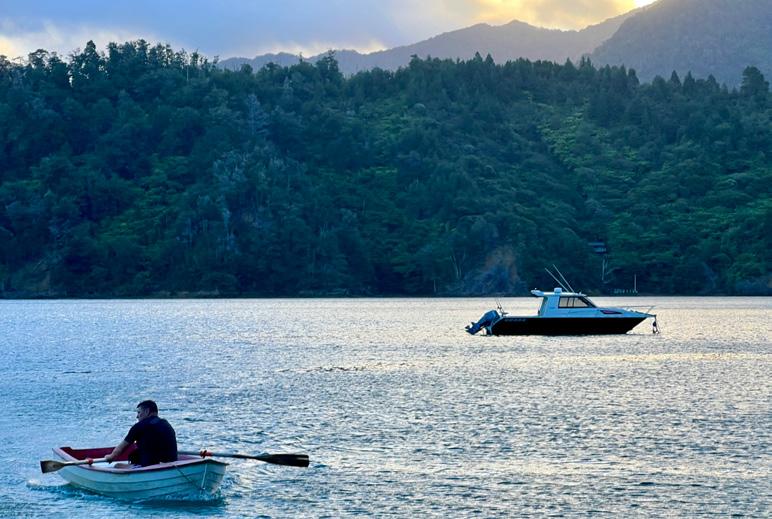
POWERBOATMAGAZINE.CO.NZ 79
The trusty quad - a great means of transport from the wharf to the house
LUXURY ADVENTURE
for all dress codes
BY KYLE BARNES
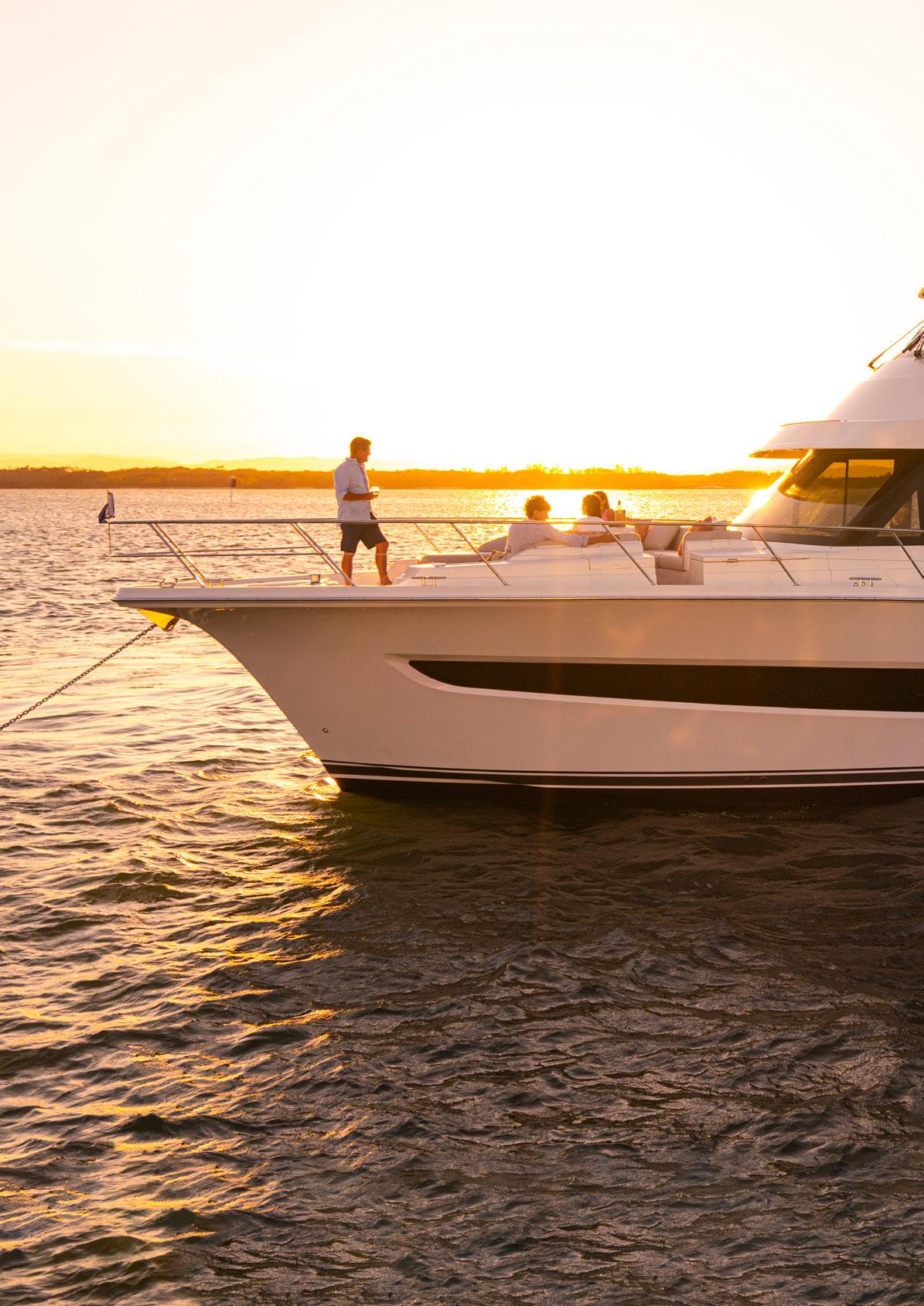
South East Queensland’s Southport Yacht Club is a fabulous spot to start our journey of discovery of the Riviera 58 Sports Motor Yacht. A true gentleman’s club with a dining room that pushes out onto the Broadwater among the giants of gleaming gelcoat - it really gets the juices flowing. Riviera Marine’s Dealer Relationship Manager for Australasia Peter Welch, a 22-year veteran of the boat builder, meets me at the club to take me onboard.
PACIFIC POWERBOAT REVIE WS _ RIVIERA 58 SPORTS MOTOR YACHT
80 MAY / JUNE 2024
It was an unusual day on the coast. Its usual sparkle had been dulled by a week’s worth of rain and moderate-to-fresh at times south easterlies had us wondering if we were going to get out through the seaway. The day was for ducks, adrenaline junkies and, as it turns out, mad fishermen in tiny boats chasing the birds. And it’s not that this maiden of the sea didn’t look like she could eat up a good sea thrashing before breakfast, but it wasn’t a factory boat and there was an abundance of respect for the proud new owner.
BLUFF AND SINEWY
The lines on this sports yacht are hard to make out dockside, she is bluff and sort of sinewy at the same time, with a bow that flares out and upwards. So, I was interested to see if we could put it to sea. Still, alongside the dock, we did a walkthrough starting with the stern with her optional 450-kilogram lift platform through to the same level cockpit. This struck me as a utility space, a sort of Swiss army knife-style thing. If out cruising, you could have a decent-sized tender
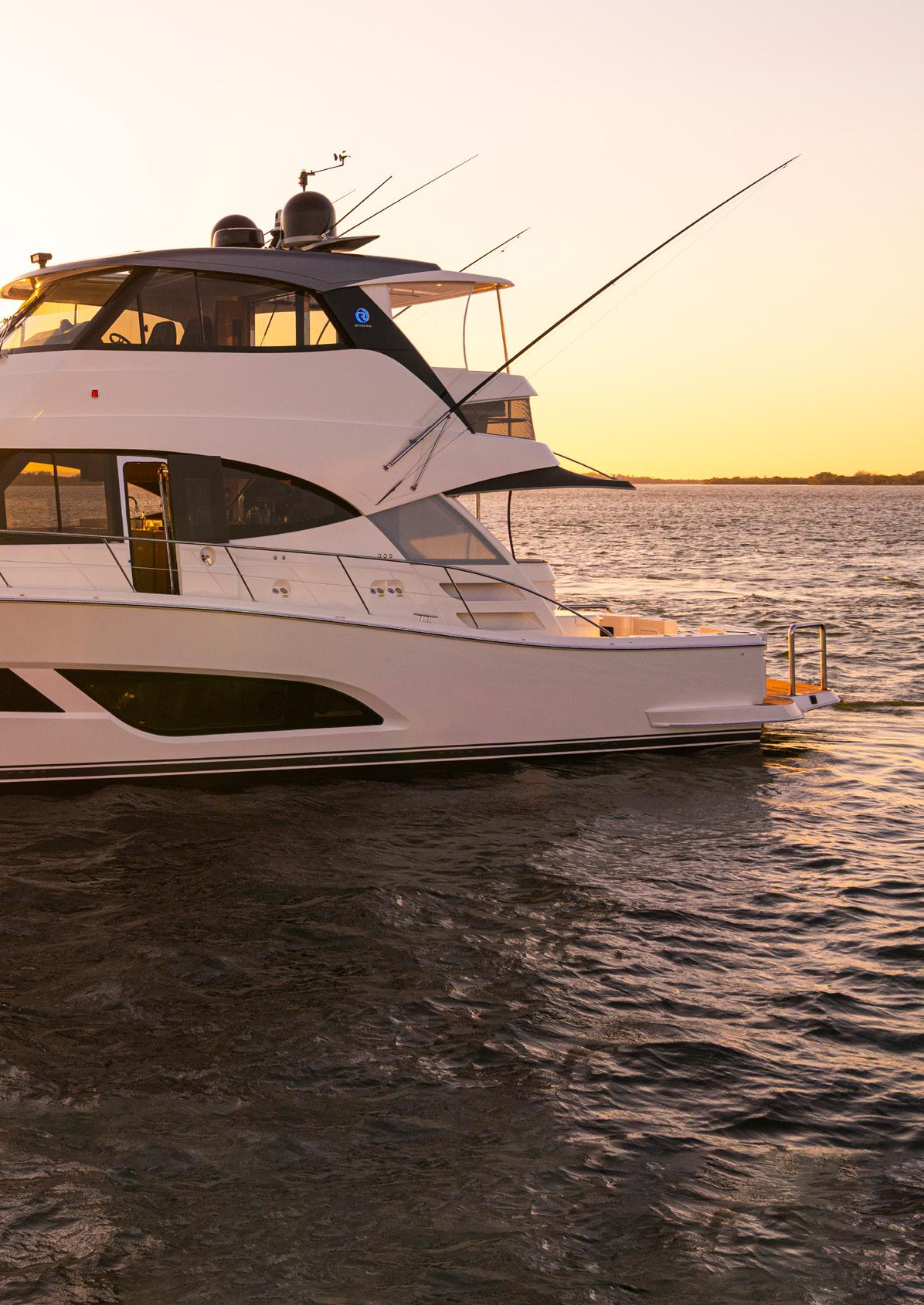
floating in a matter of minutes to get into that picnic spot or dock that’s been taken up by undeserving boaters who have pipped you at the post for a lunch spot. With the removal of the tender and the stanchions neatly placed out of the way the platform becomes denuded and the rods come out and the action begins, converting the back deck into a game boat.
GAME FISHING
The cockpit comes complete with all you need for the sport of game fishing. It is
POWERBOATMAGAZINE.CO.NZ 81
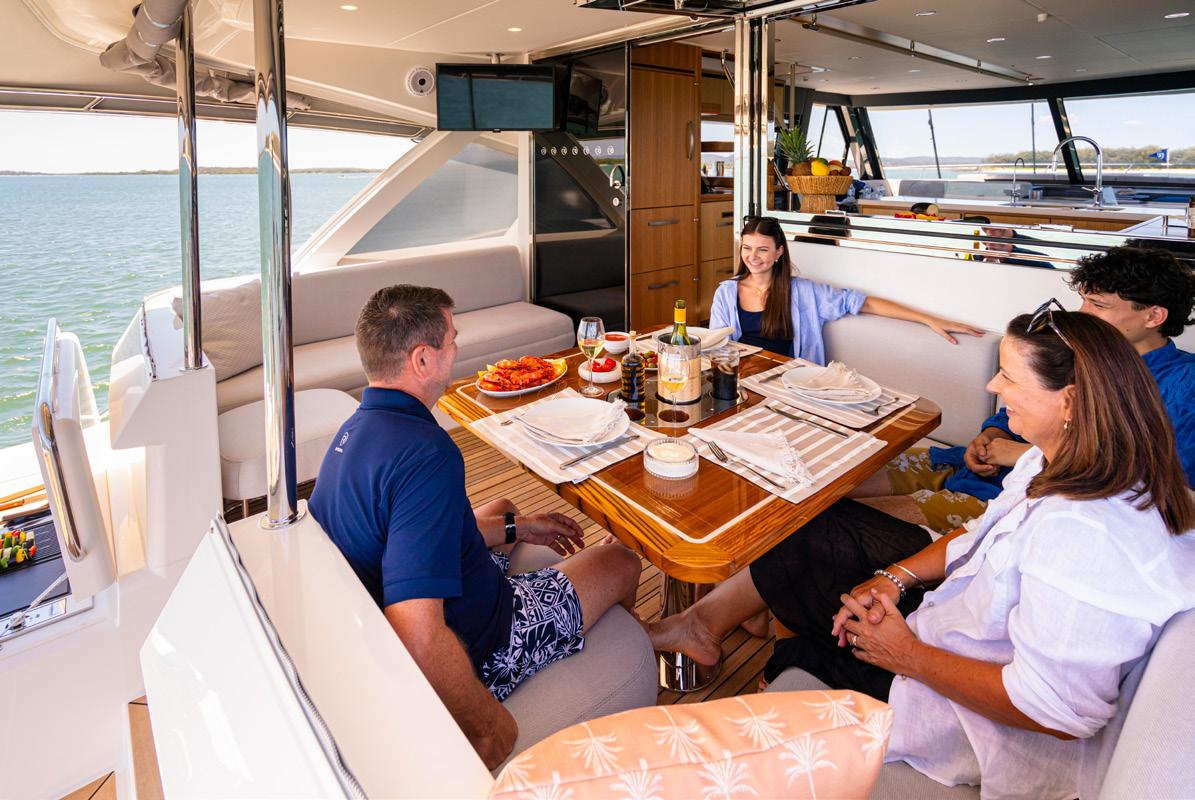
Another alfresco area which seats around six, linked to the saloon by popping up the large galley window and rolling open the doors.
completely washdown and separated by a few steps up to the saloon level where your audience can watch the action. And if it’s this sort of fishing you are after, and you have never been game fishing before, you have to give it a go. Riviera have put a sort of a paired-down helm station on the starboard side and very aft of the flybridge, so the skipper can see what’s what. The cockpit is also completed with an ice maker and heaps of refrigeration, as well as kill and live bait tanks and a plethora of underfoot storage.
Now don’t get me wrong, this rig is not designed as a blood and guts game boat, that is just one of its many metamorphoses. It is fundamentally a flybridge sports cruiser that is just as at home in a suit or overalls. Finishing off in the cockpit is the hidden BBQ, the port and starboard fixed joysticks and control units, which make a total of four steering positions talking to the twin Volvo IPS1350 D13 735kW/1000hp units in the engine room.
ALFRESCO LIVING
Moving up the stairs, once again at saloon level, there is another alfresco area which seats around six and is linked to the saloon by popping up the large galley window and rolling open the doors. I would think this would be the place to break bread as it becomes indoor/ outdoor and is handily wedged between the port side BBQ and the starboard galley.
IMPRESSIVE GALLEY
The galley is also impressive. A Smeg convection microwave oven, a four-burner hotplate, a Fisher and Paykel dishwasher and Corian bench tops in your colour of choice. Two Vitrifrigo drawers can operate independently as a fridge or freezer and there’s also a 120-litre fridge with another fridge/freezer drawer. Did I mention the dedicated wine fridge?
THE ENTERTAINER
Further forward as we explore the main saloon there is another dining table arrangement complete with a popup flat screen television on the starboard side, again for a party of six if you prefer your dining climate-controlled. Because it is sans a helm down in the saloon, the area presents as a large volume space making this boat the perfect entertainer. On the port side and punctuated with plenty of leather-wrapped chrome handholds is the staircase to the flybridge, but I’ll get to that soon. The portside boasts a serious chrome, watertight door that takes you out and forward along the gunwale to another large lounge area. This looks as if it would house around a dozen or so sunbakers and for those with a more sensitive complexion a shade sail tent can be erected using uprights that slip into the deck and are stacked away in less time it takes to refill your glass.
PACIFIC POWERBOAT REVIE WS _ RIVIERA 58 SPORTS MOTOR YACHT 82 MAY / JUNE 2024
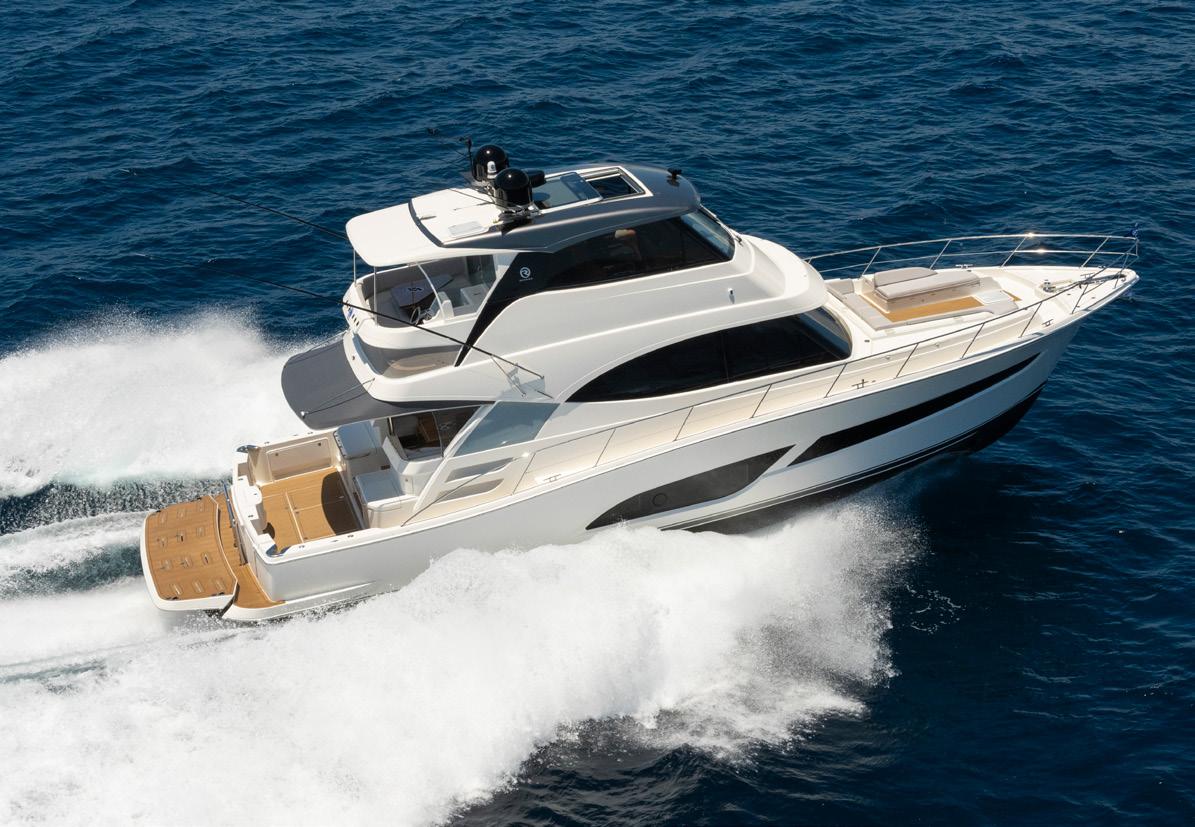
LOVE MY TENDER
This deck space has another trick up its sleeve in the form of a dock for the tender. A davit and tender cradle can be installed still leaving space for the lounge ensemble. It’s just a matter of taking out a middle cushion so the outboard has room to poke out the back. And the forward cabin skylight isn’t even affected as the clever buggers have made two smaller hatches rather than one large one, so the tender keel sits on the deck solidly. These forward deck tricks are just another couple of iterations of this motor vessel.
LIVING QUARTERS
My journey takes me forward into the first of the triple cabin layout on the waterline deck. Well, not actually waterline for the owner’s suite, sort of knee-deep at that end of things. Right up the bow is a decent-sized guest’s island bed complete with a head, and heaps of storageas you might expect with this brand by now, every inch of space in these vessels has something that pops up or out.
Back down the companionway on the portside is a couple of large single bunks that draw together by flicking a switch creating another couple’s bedding arrangement. This reveal of storage space, clever beds and a plethora of other intelligent ideas is replicated many times as you walk through the vessel. Like doors that don’t just sit against walls but back into housing specifically designed so you have maximum walkthrough space and discreetly backlit features including
back on deck the fuel and water fillers which are located on both sides, balanced and with gauges next to the filler pipes so you know how much you are loading. These are obvious decisions and inventions made from hundreds of thousands of sea and boatbuilding experience – and owners’ wish lists. Across the hallway is the day-head, which also has a full-sized vanity and shower obviously catering to the occupants of the first cabin as well as the day trippers.
I now head aft down a couple of steps into the owner’s cabin a super quiet and sound-deadened space with
The 58 Sports Motor Yacht combines design innovation and superior levels of luxury.
The foredeck offers a large lounge area which would house around a dozen or so sunbathers with a shade sail option.
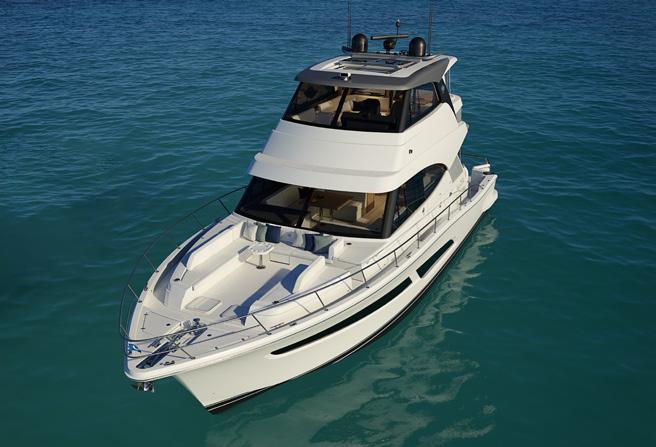
POWERBOATMAGAZINE.CO.NZ 83
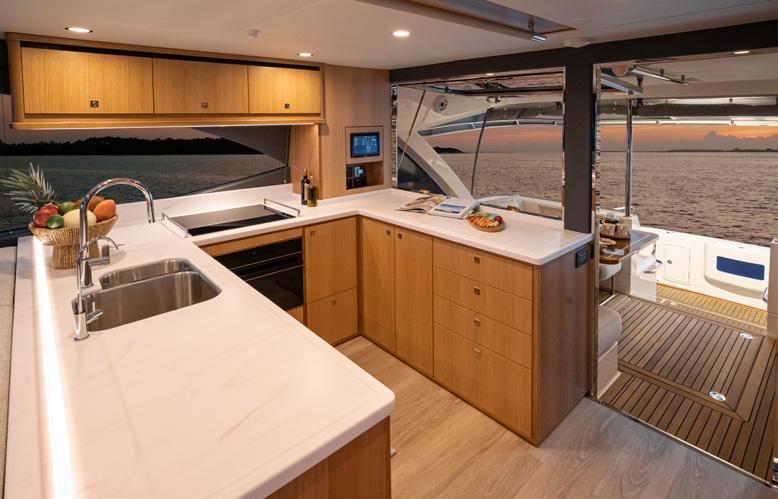
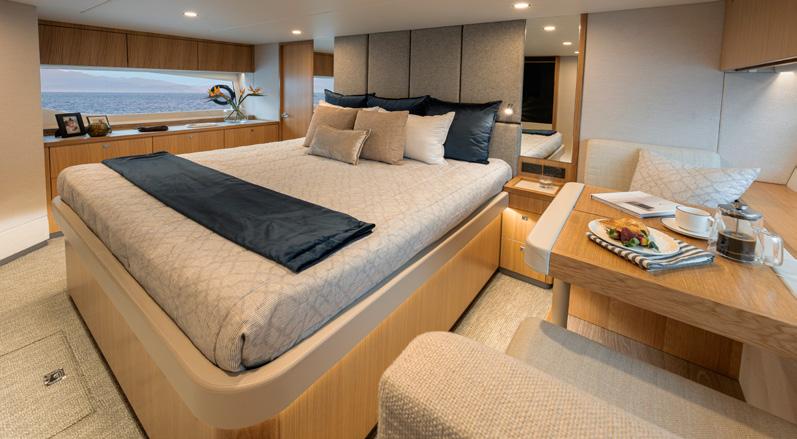
The galley is impressive with Smeg and Fisher and Paykel appliances and Corian bench tops in your colour of choice.
The owners generous ensuite with full sized shower.
Owners cabin in deluxe scandistyle with a chaise lounge, a nice place for coffee.
a deluxe scandi-style design, once again with its own full-sized bathroom with the shower with room to spare and easily accommodating this 187cm, 100+ kilogram writer. The master bed is an opulent king-size and walk around on the starboard side is a chaise lounge, a place to have a private coffee, easily prepared at your own incabin breakfast bar.
UTILITARIAN
Further aft is the walk-in robe and you’re through a door to the large utility/laundry room behind the owner’s headboard or a space sometimes referred to as a cofferdam. Which according to Google, is the space between two watertight bulkheads or decks within a ship. So, this space is more of a semi cofferdam having only one watertight bulkhead which takes you through to the engine room. But what the space (regardless of what you call it) does is to further insulate engine-room noise from the main suite.
When you walk through the watertight door to the engine department you are met with a not so lofty
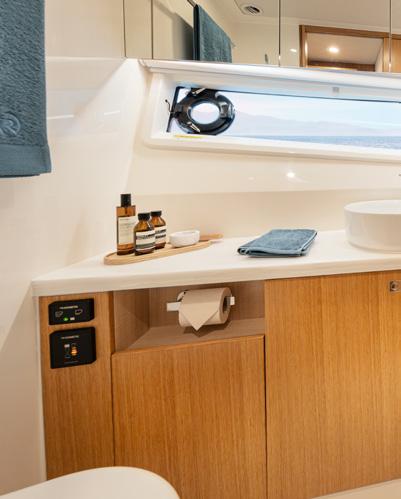
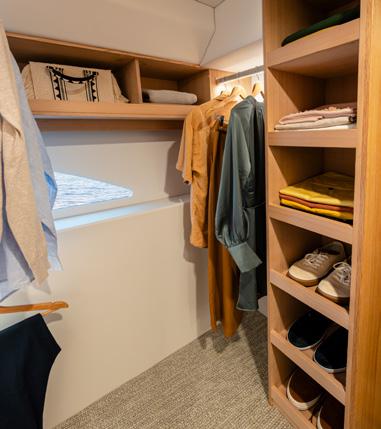
space, but everything was well put together and in its place. I do stand over the six-foot mark and I certainly wasn’t crawling around, just a little hunched. Which isn’t a bad thing, after all I can’t imagine why anyone apart from engineers and people with diagnostic equipment would want to hang out in there. But if you do need to slip down to the space, you are presented with a very clean space and nicely mapped out for most boaters to understand.
THE RIDE
As we cast off from the yacht club, the wind has subsided a bit and the tide has started to come in, which meant the resulting seas through the seaway have started to smooth out.
The flybridge is accessed by the comfortable internal stairway that runs from the saloon. And it’s not the sort of situation you feel like going backwards down, it’s a beautiful fit-for-purpose staircase with tonnes of those leather-bound, chrome handles everywhere.
PACIFIC POWERBOAT REVIE WS _ RIVIERA 58 SPORTS MOTOR YACHT 84 MAY / JUNE 2024
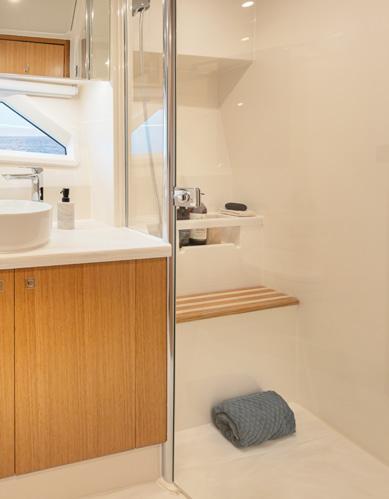
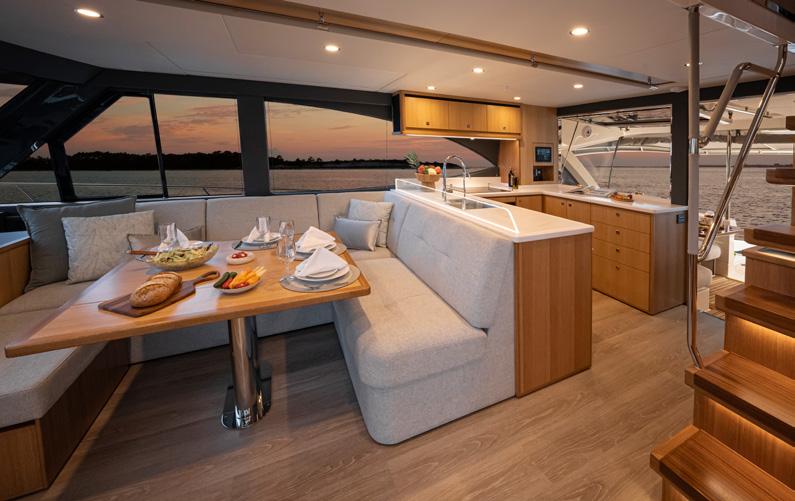
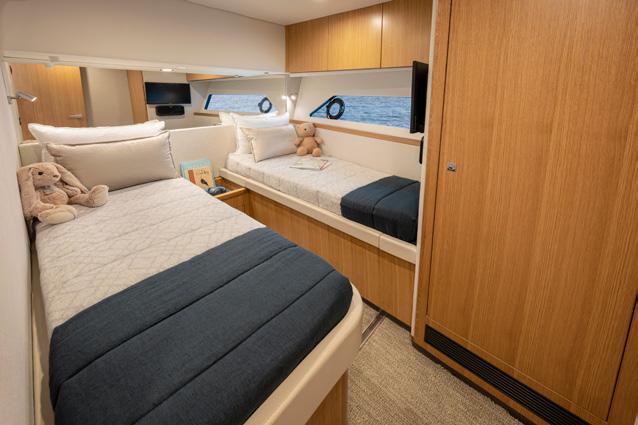
The flybridge itself has the starboard side command centre, consisting of two side-by-side sturdy helm chairs. There are plenty of things that go “ping” but nothing too hard to wrap your head around. Three heads-up 22-inch screens have all your information so you can customise the look and priority. And apart from a couple of communication devices, night vision and a bow thruster, there wasn’t too much to take your attention away from the job at hand. I must admit boats seem to have hit their peak in terms of bridge instruments and as long as you can access all the feeds to the one place there is no need to overdo things with huge ostentatious screens and too many of them. I am a great fan for the ‘less is more’ theory and this craft’s bridge has it in spades.
KEEPING DRY
So, without further adieu, we head down the Broadwater and out into the brine in what I can best describe as a sloppy day, with the sea not coming from anywhere in particular. But as we rode through the
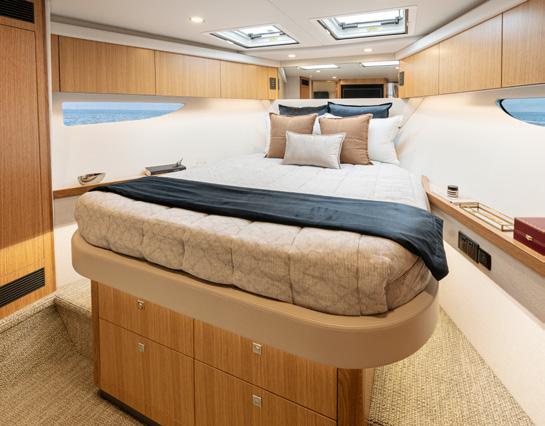
seaway humps, I started to put together what I had seen alongside in terms of this vessel’s bluff, and sort of sinewy at the same time, lines. With a bow that flares out and upwards the penny was starting to drop in terms of her ride. Even though we were coming down off some eight-foot plus rollers at around 14 knots the foredeck remained dry and so did the windshield in the flybridge. Apart from the fresh water being delivered from the heavens, she is an extremely dry boat, even when the speed was backed off and we were in the slop. Of course, the stabilisers must have been doing overtime below wiggling around in the brine trying to keep us upright, but throughout the whole sea trial, there was very little over the bow which absolutely knocked the socks off this seadog.
QUIET TIMES
After a pleasant stint at the helm, I went downstairs as Peter headed for home. There was a bit of rock and roll and I did notice that once you dismount the helm seat for a couple of steps due to the flybridge skylight
In the main saloon there is a dining table arrangement complete with a pop-up flat screen television.
On the portside is a couple of large single bunks that draw together by flicking a switch creating another couple’s bedding arrangement.
Right up the bow is a decent-sized guest’s island bed complete with a head, and heaps of storage.
POWERBOATMAGAZINE.CO.NZ 85
Her lines are bluff and sort of sinewy at the same time.
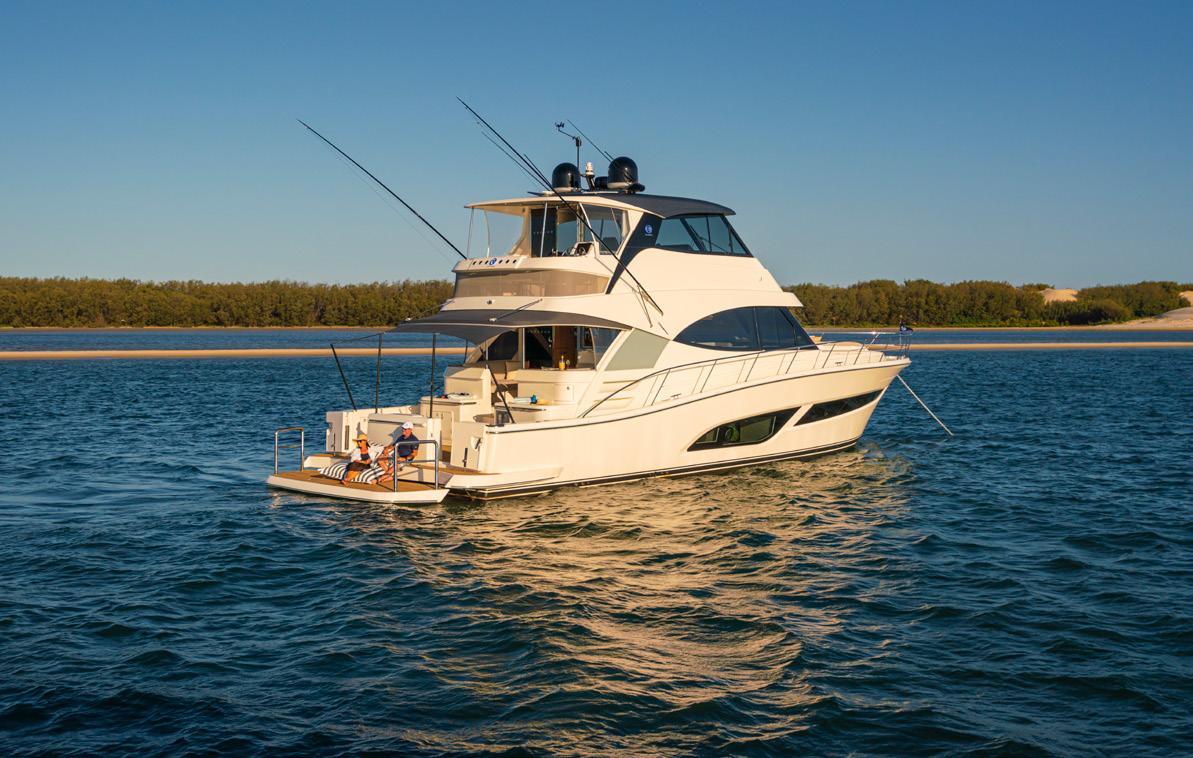
as there is nowhere to hang on to until you reach the side of the stairwell. Once I headed downstairs, firstly to the saloon, the sounddeadening engineering stood out, we were clipping along at 17 knots in the rough and it was easy to talk to my companion using a quiet inside voice. This quietness is replicated throughout the rest of the interior, especially doubled down in the owner’s suite where I snuck in to get an idea of the ride - and what a view through the windows! The scene of the wash sensationally running halfway up and across the windows with the Gold Coast’s high rises in the background.
LUXURY ADVENTURES
The 58 Sports Motor Yacht combines design innovation and superior levels of luxury in its accommodation and many living and entertaining spaces. If you are after unlimited adventure, absolute luxury, engineering excellence and a smooth ride, this vessel has your name on it.
SPECIFICATIONS
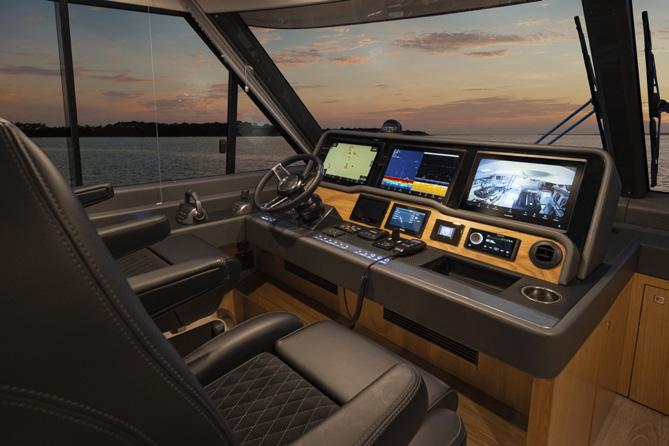
PERFORMANCE DATA
The flybridge has the starboard side command centre with plenty of things that go “ping” but nothing too hard to wrap your head around.
Boat Design Name Riviera 58 Sports Motor Yacht Price Available on Request Style Sports Flybridge Builder Riviera Australia LOA 19.71m LOH 17.90 Beam 5.67m Draft 1.7m Displacement (Dry) 36,500 kg Fuel Cap 4,500 litres Water Cap 800 litres Standard Engine Volvo Penta D13 IPS 1350 (x2) RIVIERAAUSTRALIA.COM
RPM Fuel Speed L/nm Range 600 5.6 12.5 2.23800 7.4 25.0 3.38 1598 1000 8.8 44.5 5.06 1068 1100 9.3 59.5 6.40 844 1300 9.9 94.0 9.49 569 1500 10.3 158.0 15.34 352 1800 18.7 208.0 11.12 485 2000 22.4 264.0 11.79 458 2100 24.2 302.0 12.48 433 2400 30.9 377.0 12.20 443 2470 31.9 385.0 12.07 447 Range is based on 90% of available fuel PACIFIC POWERBOAT REVIE WS _ RIVIERA 58 SPORTS MOTOR YACHT
86 MAY / JUNE 2024

There has been a growing demand in the market for a superior interior finishes system, specifically in low sheen and semigloss options.
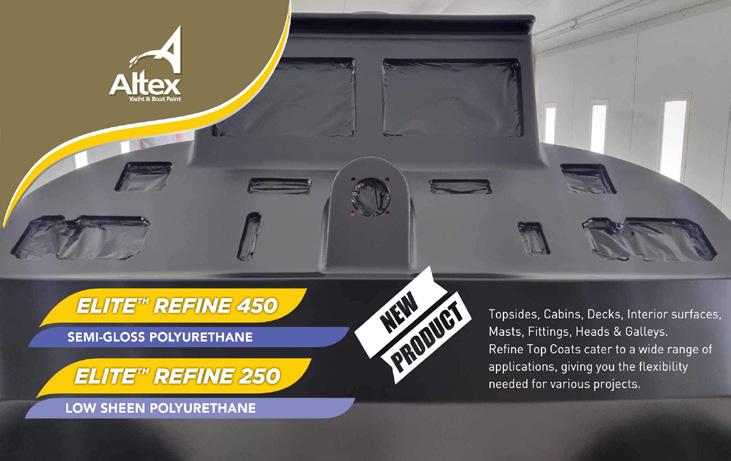
The launch of Altex Yacht & Boat Paint’s new Elite Refine 250 Low Sheen & Elite Refine 450 Semi-Gloss is designed to meet this demand head-on. TOP FEATURES OF ELITE
1. Enhanced Durability: Altex finishes are engineered to withstand everyday wear and tear, maintaining their quality for longer periods.
2. Low VOC Formulations: They prioritize environmental responsibility by offering low Volatile Organic Compound (VOC) formulations that comply with regulatory standards.
3. Versatile Applications: Whether it's for Topsides, Cabins & Decks, or other interior surfaces, Masts & Fittings, Heads & Galleys, The Elite Refine Series cater to a wide range of applications, giving you the flexibility needed for various projects.
4. Aesthetic Appeal: The Altex Elite Refine Series offer a stunning finish that enhances the visual appeal of any space while maintaining a professional look. Allows a competent brush painter to restore their boat to a high level of finish and performance.

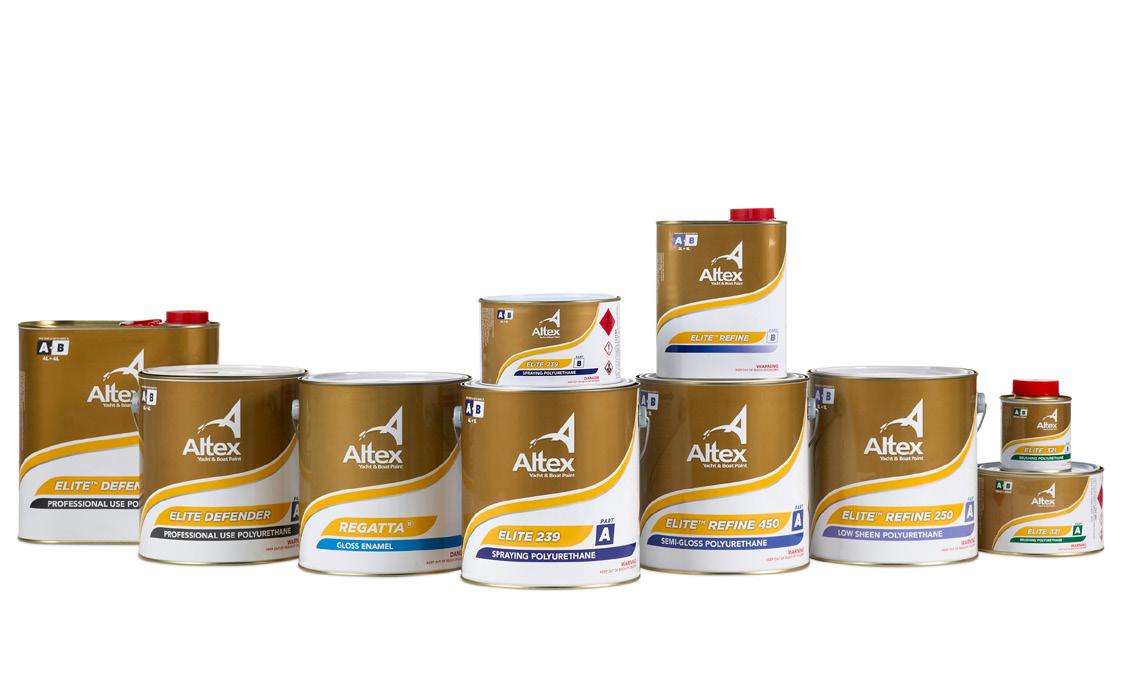
The brushable professional finish. Easy as 123. ELITE® 321 Professional grade / luxury marine finish –Slick wet look gloss. ELITE® DEFENDER DIY OR PROFESSIONAL APPLICATION
your hard work. altexboatpaint.com Top Coats Range WET LOOK GLOSS TO LOW SHEEN FINISHES Brilliant Coats for Brilliant Boats APPLI CATION SPR AY APPLI CATION BRUSH & ROLL Quality, easy to apply single pack enamel with multiple standard colour options. REGATTA® Easy to use 4:1 mix. Spray application, high gloss recoatable finish. ELITE® 239 Easy to use 3:1 mix. Spray or brush application. Lowest sheen gloss recoatable finish.
Easy to use 3:1 mix. Spray
brush application, Semi gloss recoatable finish.
Choose the right coat to protect your boat, reflecting
ELITE® REFINE 250
or
ELITE® REFINE 450
REFINE SERIES:
ELITE REFINE SPECIALISED
ALTEX LAUNCH
MARINE COATING
A HISTORY OF KIWI TRAILER BOATS BY THE DECADES
PART FOUR: The 1980's
BY DOUG DUKESON , PETER MORGAN & HOLLY DUKESON
In 1988, Bluefin launched the 490, an Alloy Hull and GRP Cabin Deck combo
KIWI TRAILER BOATS BY THE DECADES _ THE 1980S
88 MAY / JUNE 2024
In the development of New Zealand's trailer boat industry during the 1980s, several transformative trends reshaped the local trailerboat scene, including a pivotal shift towards fiberglass and alloy construction. This marked a departure from traditional wooden hulls, in response to advancements in materials and manufacturing techniques. This era also witnessed the increase in the popularity of recreational boating, fuelled by increasing disposable incomes and an increased appetite for leisure pursuits. Many prominent brands (read on) emerged, many still here today. Each contributing distinctive designs and features to cater to diverse preferences. Innovations in design, not only to improve performance but also to facilitate overnight
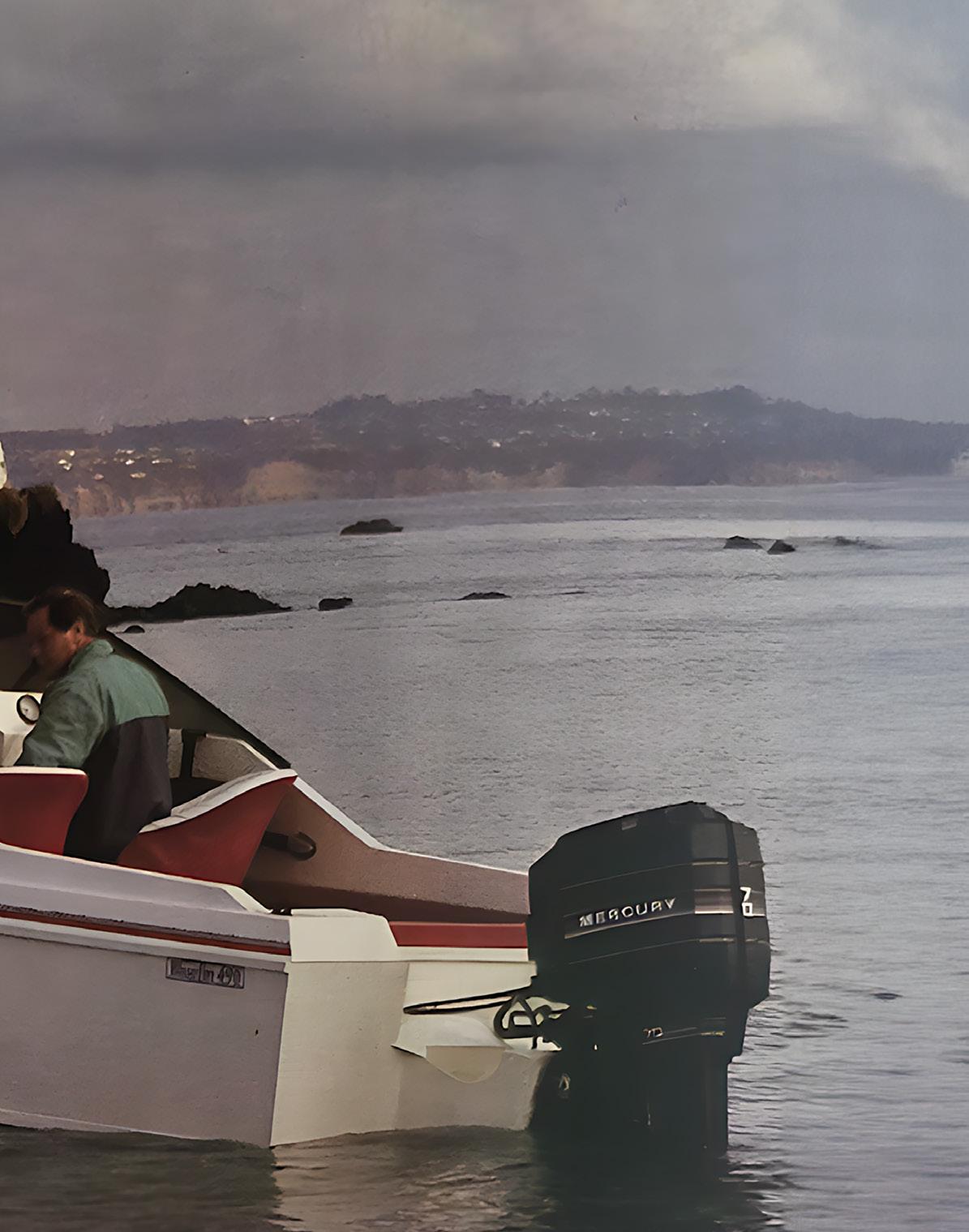
stays, expanding the opportunities for recreational activities. The spectrum of trailer boats expanded significantly, encompassing small runabouts to spacious cabin cruisers, offering versatility for fishing, water skiing, and family outings.
At the same time, technological advancements in marine engineering, exemplified by more efficient outboard engines and navigation equipment, improved the performance and safety standards of trailer boats.
In addition, New Zealand's trailer boats gained traction on the global stage, with exports to destinations such as Australia and the Pacific Islands further contributing to the industry's growth, it certainly was exciting times.
POWERBOATMAGAZINE.CO.NZ 89
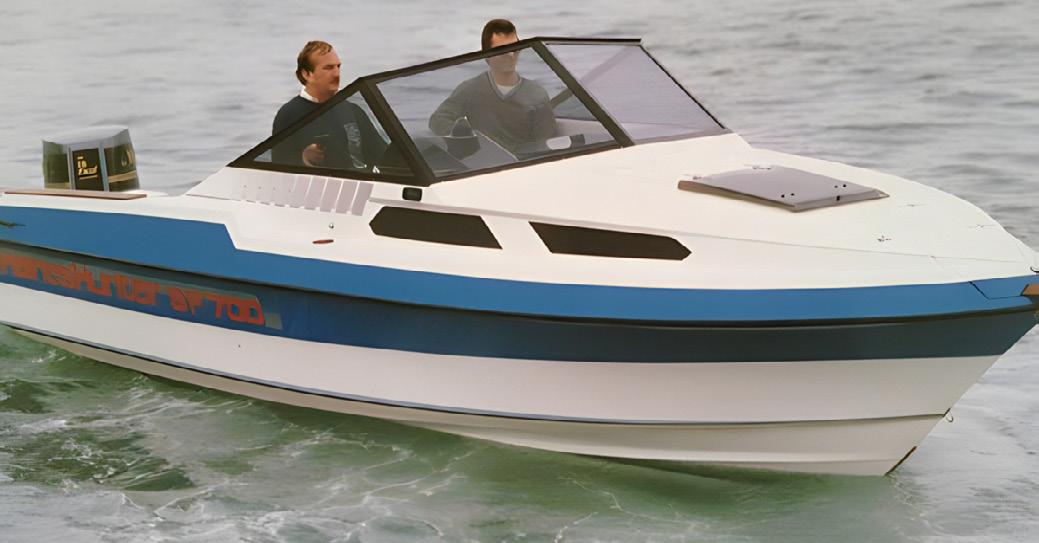
1980
• Les Miller, owner of Miller Moyes Boating Centre, had enjoyed a long friendship with Sandy Sands, whose company Seacraft Ltd had grown, after its founding in 1946, from wooden boatbuilding to manufacturing some of its own fibreglass models. Les was approached by Sandy with a proposal to merge their two companies, to make the best use of their complementary skills – Sandy’s in manufacturing and Les’s in retailing. Whereby he and Sandy Sands would form a new company, Miller Moyes Seacraft Ltd, to take over the Haines Hunter moulds from Fibreglass Moulders Ltd and started manufacturing and retailing Haines Hunter boats in New Zealand, with their first model being the Haines Hunter SF700.
• Markline became New Zealand’s largest production boat builder of large cruisers and launches, although eventually stepping away from the trailer boat market, it did start in the small boat arena. One of the early boats was the Markline 776 Express Cruiser that had the same hull as the original Marksply 22. With a $45,000 drive away price tag in 1980, it was aimed at the top echelon of the trailer boat market.
• The Buccaneer 5.6m Runabout was introduced.
The ever popular Smuggler Reefrunner
1981
• Buccaneer Pleasure Craft Ltd introduced its 4.9m Runabout and Cuddy models.
• Sea Nymph launches the popular Commander.
• The Smuggler Reefrunner was voted Australian Powerboat of the year.
Steadecraft 166, selected by the best
1982
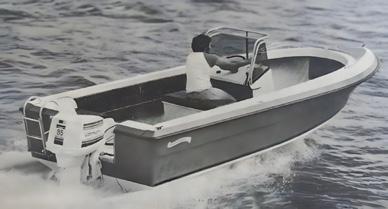
Buccaneer 5.6m Centre Console
• Buccaneer Pleasure Craft Ltd introduced the 5.6m Centre Console and 5.6m Cuddy.
• New Zealand Water Ski Association and the New Zealand Barefoot Association both choose the Steadecraft 166 for their tournament boat.
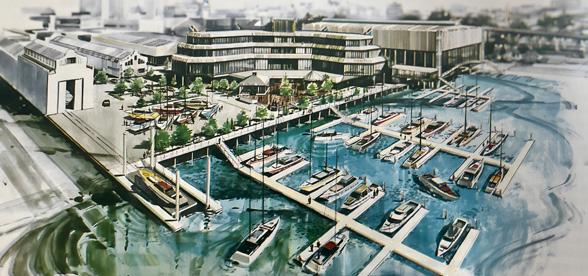
1983
• Marco Boats, builders of aluminium runabouts, and later cuddies and hardtops, was set up in Morrinsville, where it remains to this day.
• Aluminium boats increased in popularity and slowly began to take more market share from fibreglass as a powerboat construction material.
• Auckland Harbour Board’s redeveloped Westhaven boat harbour was officially opened, costing $9.7 million.
KIWI TRAILER BOATS BY THE DECADES _ THE 1980S
A young Lionel Sands at the helm of one of the first Haines Hunter SF700s
Westhaven Boat Harbour
90 MAY / JUNE 2024
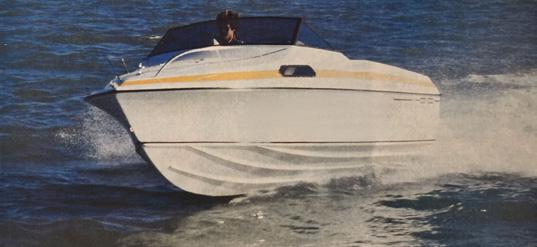
1984
• Miller Moyes/Seacraft Ltd introduced the Haines Hunter 565L, a family cuddy cabin boat suitable for outboards of around 140hp. It proved to be very a very popular model.
• After the devastation in the powerboat industry caused by the infamous Muldoon 20% sales tax imposed in July 1979, Peter Gribble and Kim McDell resurrected Sea Nymph by revamping some of their old models and after doing a deal with the Nicholls brothers of Queensland, four of the Nicholls’ Cruisecraft models. These were the 5.06m Stinger runabout and the Regal cuddy cabin, and the 5.67m Hustler bowrider and Explorer cuddy cabin. They sold well and re-established Sea Nymph as a major brand in the NZ powerboat market.
• Gavin Child started building Lazercraft Boats in Dunedin, the brand still lives on through Family Boats.
Enjoy hassle-free boating with a monthly subscription
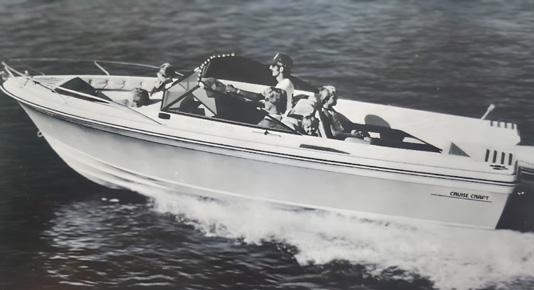
This
1985
Hustler
The Suzuki 150hp and 200hp 2.7-Litre V6 outboards were released
• After four years of R&D, Suzuki introduced its new 150hp and 200hp 2.7-litre V6 outboards at the Auckland Boat Show in October. Previously, Suzuki’s range had topped out at the 4-cyl.-in-line 140hp model.
• Kiwi powerboat industry was thriving, experiencing its highest level of trading in a decade. Sea Nymph Hustler was one of the many new models released over this period.
• Ramco Boats was founded in 1985 by Bill Mackrell, a Waikato plumber wanting to produce affordable aluminium boats. The brand today is built by Icon Marine in Rangiora.
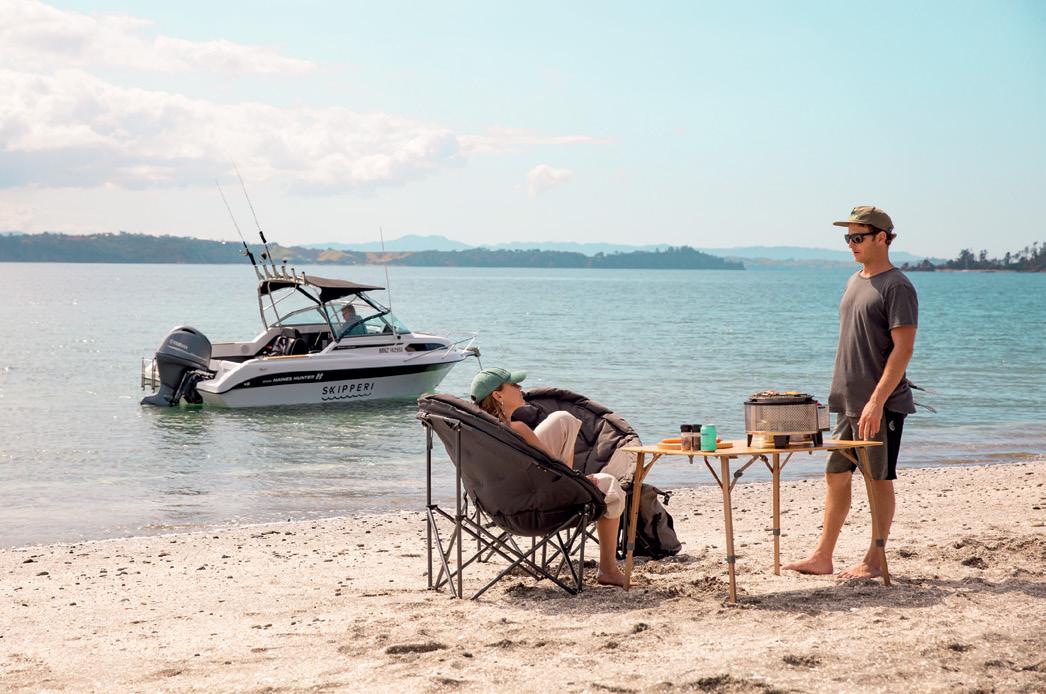
Plan your dream day out on the water and reserve your boat of choice through the app. Skipperi offers the world´s easiest way to enjoy boating. With a monthly subscription you’ll get access to a new, fully equipped, smart fleet of motorboats without the hassle of ownership.
skipperi.nz Limited spots available. Subscribe now!
Haines Hunter 565L
Cruise Craft model was introduced in New Zealand as the Sea Nymph
POWERBOATMAGAZINE.CO.NZ 91
Lazercraft Boats originated in Dunedin
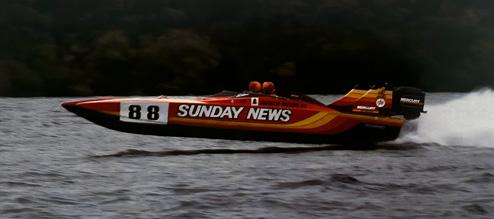
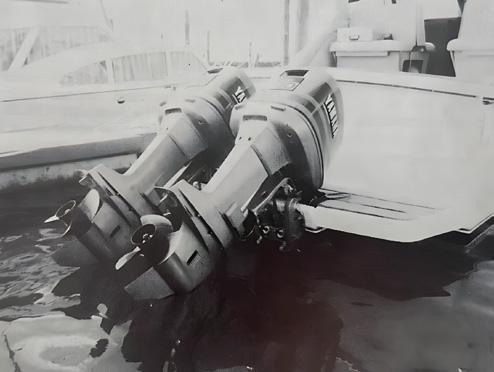
A
1986
• Our own, late Barry Thompson, and Glen Urquhart took their twin Mercury-powered catamaran Class III powerboat racer Sunday News to the UK. When their European and Argentinian competitors saw the pitch of the Kiwis’ propellors was, at 32 inches, four inches greater than they were running, they were amazed. The Kiwi boat, with its motors mounted considerably higher than those of its competitors, easily won the first two races, whereupon team manager Ron Archer calculated that they needed only to come fourth or better in the third race in order to take the World Class III D title.
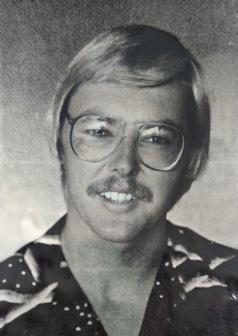
• OMC (Johnson & Evinrude) introduced the world’s first production V8 outboard, a loop-charged carburetted 2-stroke producing a then-massive 275hp.
• 1986 saw the release of the Haines Hunter SF535 - considered by some to be NZ's biggest selling trailer boat ever.
• Yamaha introduced the world’s first counter-rotating pairs of outboards; available models were either 150hp or 200hp carburetted V6s.
• In 1986, having seen a need in the recreational boating market for high performance composite craft, SeaforceTM set about refining their first design. The result was the successful 16ft SeaforceTM Utility.
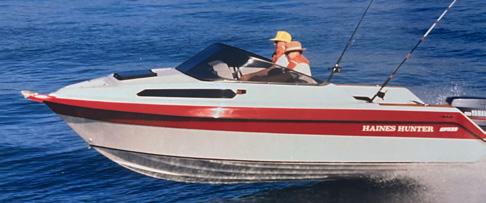
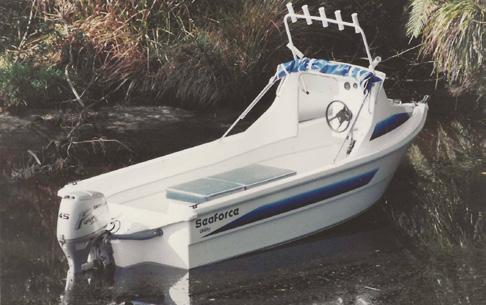
So, Thompson and Urquhart took it easy, making sure they finished, and came third, taking the title easily. The team from Argentina came second, for a Southern hemisphere domination.
• On 11 December, Barry Thompson and Glen Urquhart’s Class III powerboat racer Sunday News nosedived at 150km/h and flipped on Auckland’s Waitemata Harbour during the second race of the World Offshore Powerboat Championships. Thompson was critically injured, suffering multiple injuries including a fractured skull.The Auckland Star reported “Thompson was sedated for almost a week and woke the Wednesday after the accident. “I’ve probably come as close as anyone to death,” he said. “I died in the rescue helicopter and again when I got to hospital.” The hospital doctors told his wife that he had only a 50% chance of survival.
• Buccaneer Pleasure Craft Ltd on a roll with their new models, introduced the 490 Sport.
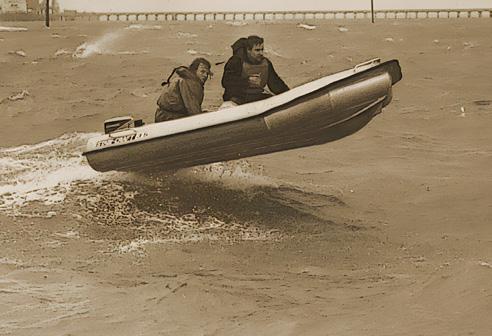
1987
• Lance and Bronwyn Fink started Tristram Marine in Hamilton. They named their company after their first son, who was born that year. The first boat they manufactured was the Tristram 28, an 8.53m long x 2.49m beam, cedar-cored sandwich hull with epoxy fibreglass skins both inside and out. It was finished with teak decks and interior trim and was powered with a Volvo 200hp diesel duoprop sterndrive. It sat on a tripleaxle trailer and its towing weight was 4.2 tonnes.
• Steve McLay, who had a manufacturing engineering business in Milton, Otago, having made a oneoff aluminium boat for himself, decided to start manufacturing aluminium boats. First came the McLay B1800 (5.5m). McLay Boats have become one of the most popular alloy brands on the market today.
KIWI TRAILER BOATS BY THE DECADES _ THE 1980S
Thompson and Urquhart win the World Class III D Offshore title
young Barry Thompson in the 1980s
The worlds first counter-rotating outboards from Yamaha
‘Ally Duck’ the first Stabicraft - a 3.5 dinghy
The 16ft Seaforce Utility
92 MAY / JUNE 2024
Haines Hunter's SF535 one of NZ's true favourites
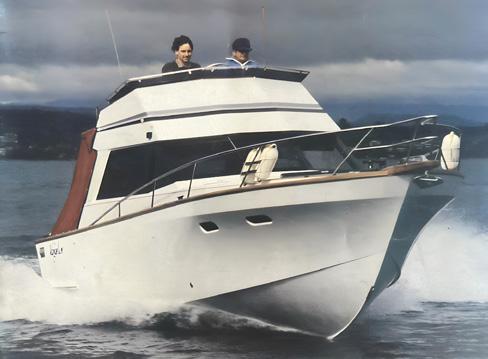
• Well-known powerboat racing identities Ian Gallop, Ron Archer and Gary Selby teamed up to produce the Exocet 24, a 7.3m deep-V cuddy cabin V6 outboard-powered sports/fishing boat. They had used as the hull plug the race boat Raro, a Formula 233 made in Australia by the Haines brothers. The Formula 233 was designed by Walt Walters of Miami and produced by Thunderbird Products Corporation in Miami from the early 1960s. Its hull has been ‘flopped’ (copied) more than any other in the history of fibreglass powerboats worldwide.
• Reflex Products Ltd teamed up with John Haines of Brisbane to build “Haines Signature” boats under contract. By 1990 Reflex products had secured the full manufacturing and distribution rights for “Haines Signature” boats in New Zealand.
• Buccaneer Pleasure Craft had a very busy year, introducing no less than four new models – the 450 Cabin ET, the 450 Sport ET, the 450 Sport Cabin ET, and the 560 Cuddy Sport ET.
• In a backstreet workshop in Invercargill, New Zealand, Paul Adams and Bruce Dickens built the first rigid hulled aluminium chambered boat - a Stabicraft 3.5 dinghy called the ‘Ally Duck’.
• Rayglass was taken over by Tony and Vicki Hembrow and production began on the first-ever and popular Rayglass Sports Cruiser 670.
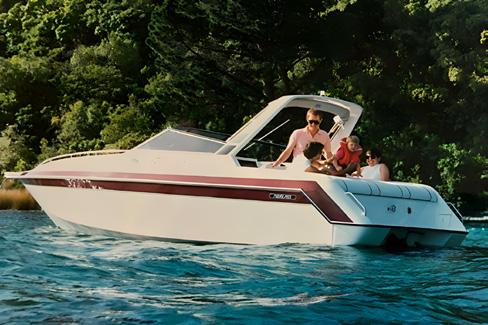
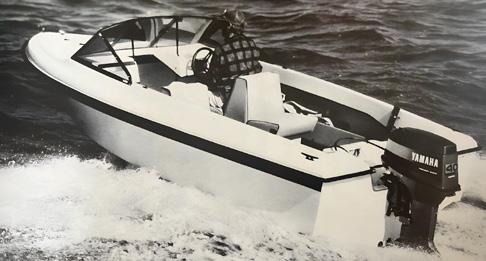
1988
The Haines Hunter 445R was just $14,998 towaway
• Roger Jones built alloy runabouts for several years, earning a renowned reputation for uncompromising quality. His latest addition to the Bluefin range was a highly successful blend of the trusted 490 alloy hull with a brand-new GRP cabin deck. Bluefin Boats are still around today and available through Sportcraft Marine.
• Haines Hunter unveiled the 445R at a total price of $14,988, which included a 40hp Yamaha outboard and trailer, ready to tow away.
• Westpark, Gulf Harbour and Pine Harbour marinas open.
• Yet another busy year for Buccaneer Pleasure Craft, releasing the Buccaneer 510 Sport ET, the 510 Cabin ET and the 560 Cabin ET.
• The Kiwi-Kraft brand grew from one man's love of diving, fishing and hunting - his name is Rodney Harris. In 1988 Rodney saw a need for a safer, better performing aluminium boat. One that also appealed to the eye KiwiKraft was born. The brand originated in Invercargill and is still built there today.
• Southern Pacific was founded and started production, the fabric was glued together by hand, transoms were crafted from plywood, and the yard operated out of Browns Bay.
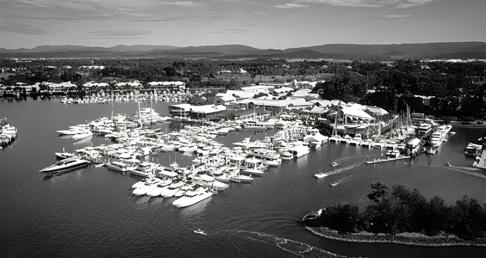
1989
• McLay Boats introduced the B1650 (5m) and later that year the B2000 (6.1m).
• Buccaneer Pleasure Craft introduced two new models –the Buccaneer 605 Cabin ET and the 605 Cuddy Sport ET.
• Sanctuary Cove was selected as the venue for the 1989 Queensland International Boat Show, the event continues at the same location under the name Sanctuary Cove International Boat Show. Over the years, numerous Kiwi trailer boat manufacturers have showcased their products at this prestigious event.
Kiwi boatbuilders have exhibited at the Sanctuary Cove International Boat Show since it started in 1989
The first RayglassThe Sports Cruiser 670
McLay launches the B1800
POWERBOATMAGAZINE.CO.NZ 93
Tristram Marines first boat, the Tristram 28
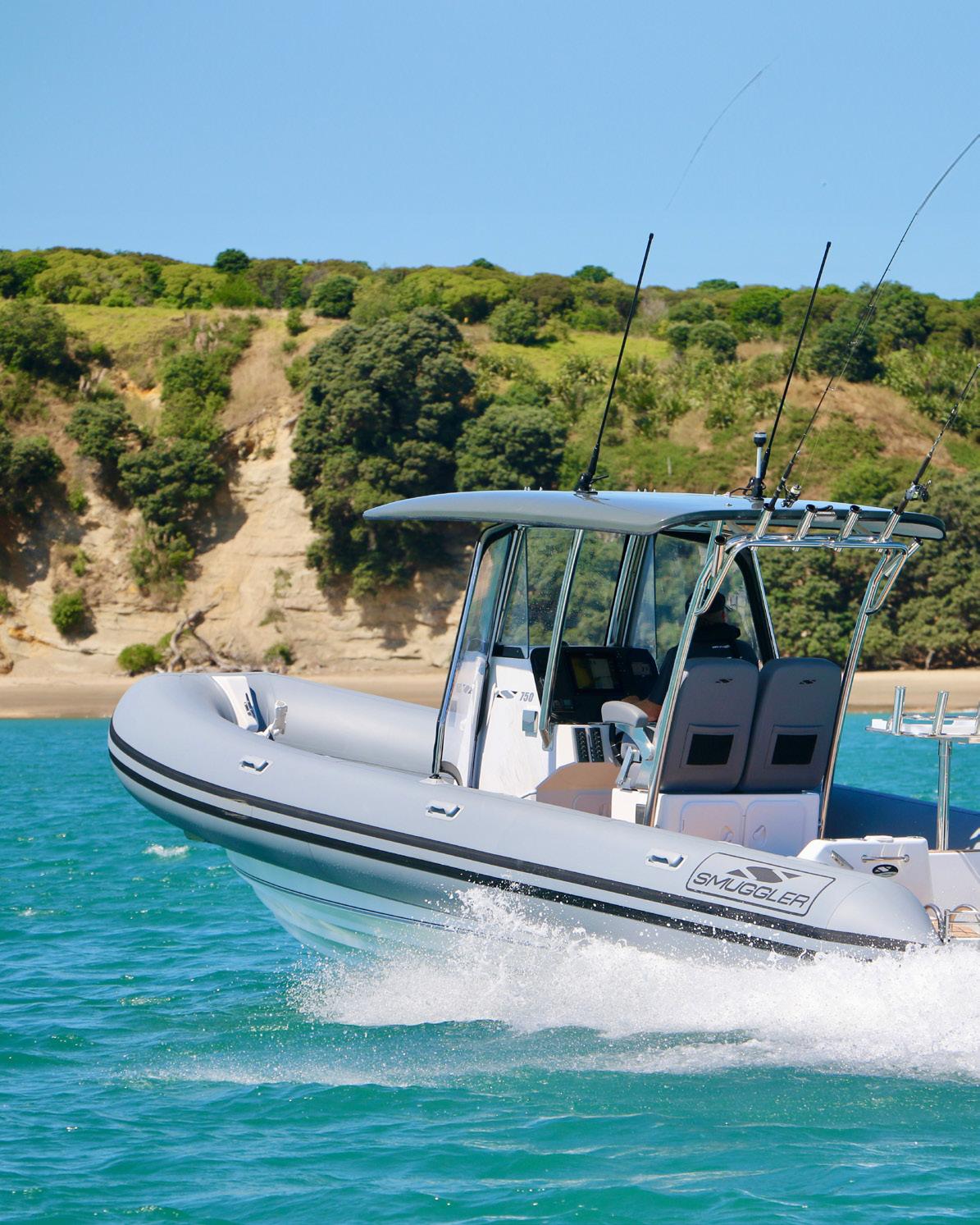
PACIFIC POWERBOAT REVIE WS _ SMUGGLER STRATA 750 94 MAY / JUNE 2024
GEN 2
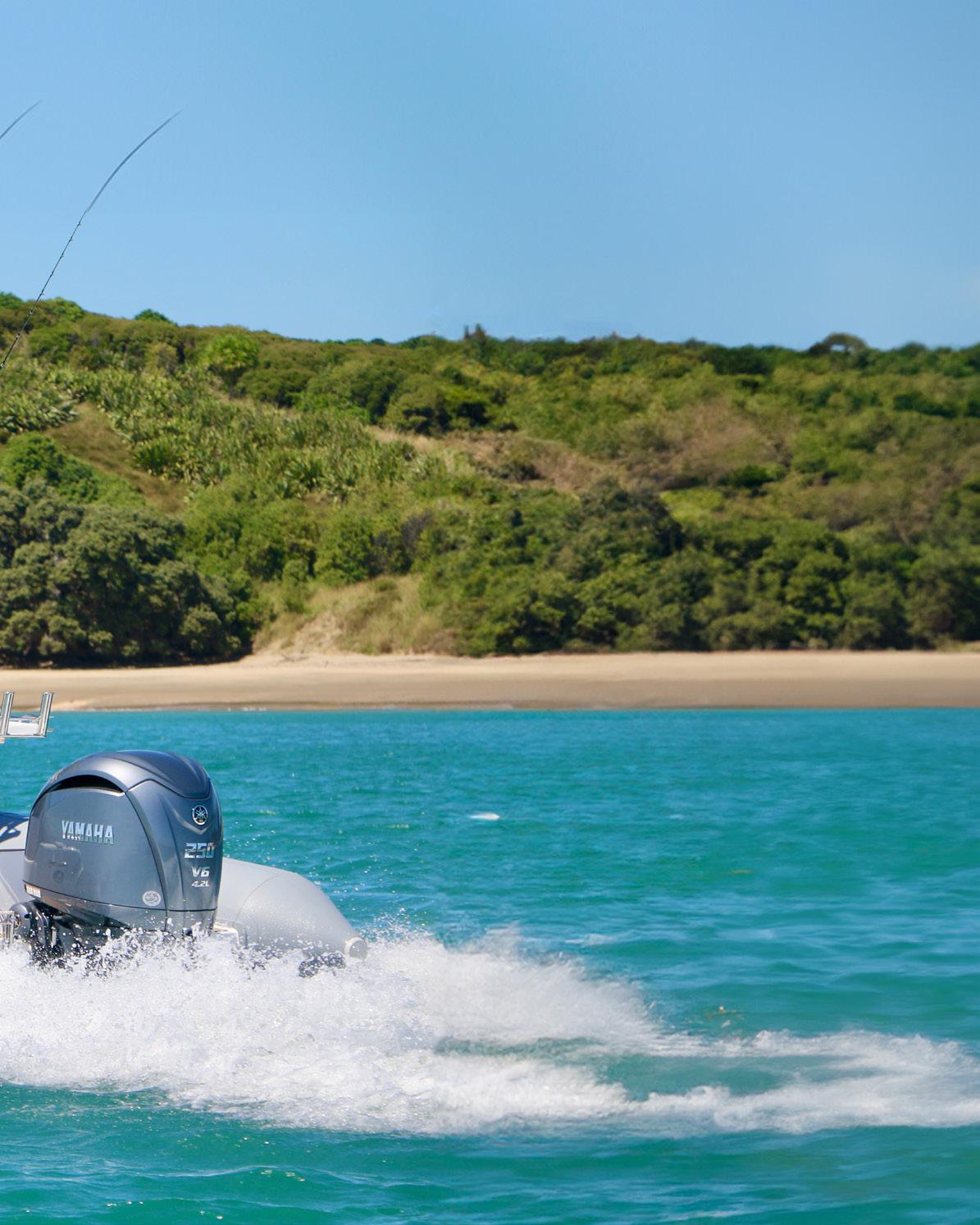
It has been a staple of the Smuggler range for 20-years, and now, the Smuggler Strata 750 has had somewhat of a birthday. Freddy Foote steps aboard to experience the Gen 2 of this hardcore blue water performer.
BY FREDDY FOOTE
POWERBOATMAGAZINE.CO.NZ 95
Smuggler Marine have released a ‘Gen 2’ version of their Strata 750.
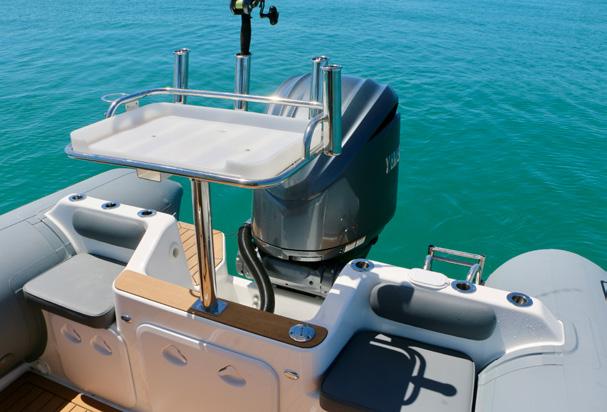
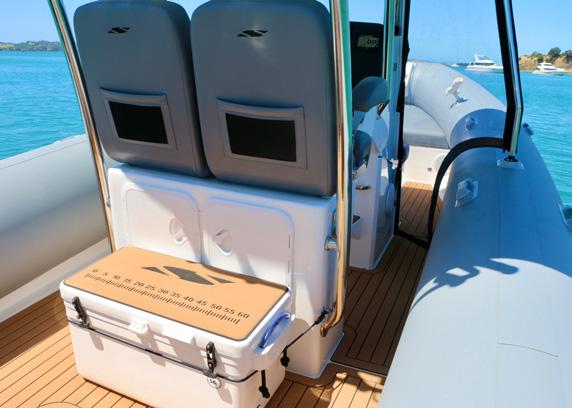
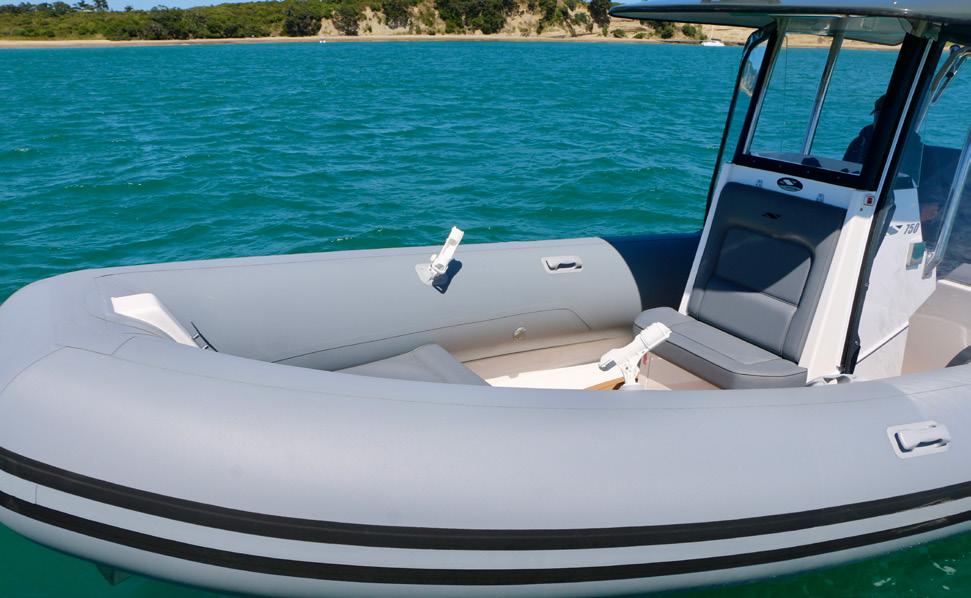
If you are in the market for a high performance RIB, Smuggler should always be at the top of your list. The family owned, Henderson based company has been building the range here in New Zealand for over 20-years, and in that time over 70 of their 750 Strata models have been built for clients all over the world.
With the hull shape remaining the same, the new model 750 now features Smuggler’s all-new Gen 2 console with a toilet located under the helm console and an onboard WAECO refrigerator under the helm seat.
Other changes include upgraded seating, a re-designed Targa top and stainless structure, as well as the addition of new removable side clears to provide extra protection from the elements.
“It’s been a successful model for us, but like anything we’re always looking for ways to make it better, so we’ve made some styling and functionality improvements throughout the boat,” says Smuggler Marine Managing Director, David Pringle.
“The Strata 750 appeals to a wide variety of buyers. We’ve sold a lot offshore, as high performance super yacht tenders, or chase boats for sailing syndicates. In fact, there are a few clients we’ve never met.
But it also appeals to those who want a high performance RIB for fishing and diving excursions. A number of Strata 750’s have also gone to Western Australia.”
As with most of the Strata range, the internal layout can be customised to suit an owner’s needs.
Step aboard, and you’ll notice that the
seating at the helm is now comprised of two Captain’s style seats, with lift up seat bolsters and foldable armrests. However, should you wish, the traditional bench seat with the moveable back rest bolster is still available.
Aft, three lockers are set into the base of the transom. In the port corner is a live bait tank, which is accessed from above. When not in use, a squab fits over the top and makes a seat for passengers. A pull out salt water wash down hose is also available. There is an option for a freshwater washdown, which is supplied via an 80-litre onboard tank.
In the starboard corner is additional storage space for miscellaneous items, while the middle hatch houses water pumps and fuel lines/filters.
PACIFIC POWERBOAT REVIE WS _ SMUGGLER STRATA 750
Storage, seating, and a bait station is aft.
A large 56L removable IceyTek chilly bin is behind the helm.
A large lounge area is located forward.
96 MAY / JUNE 2024
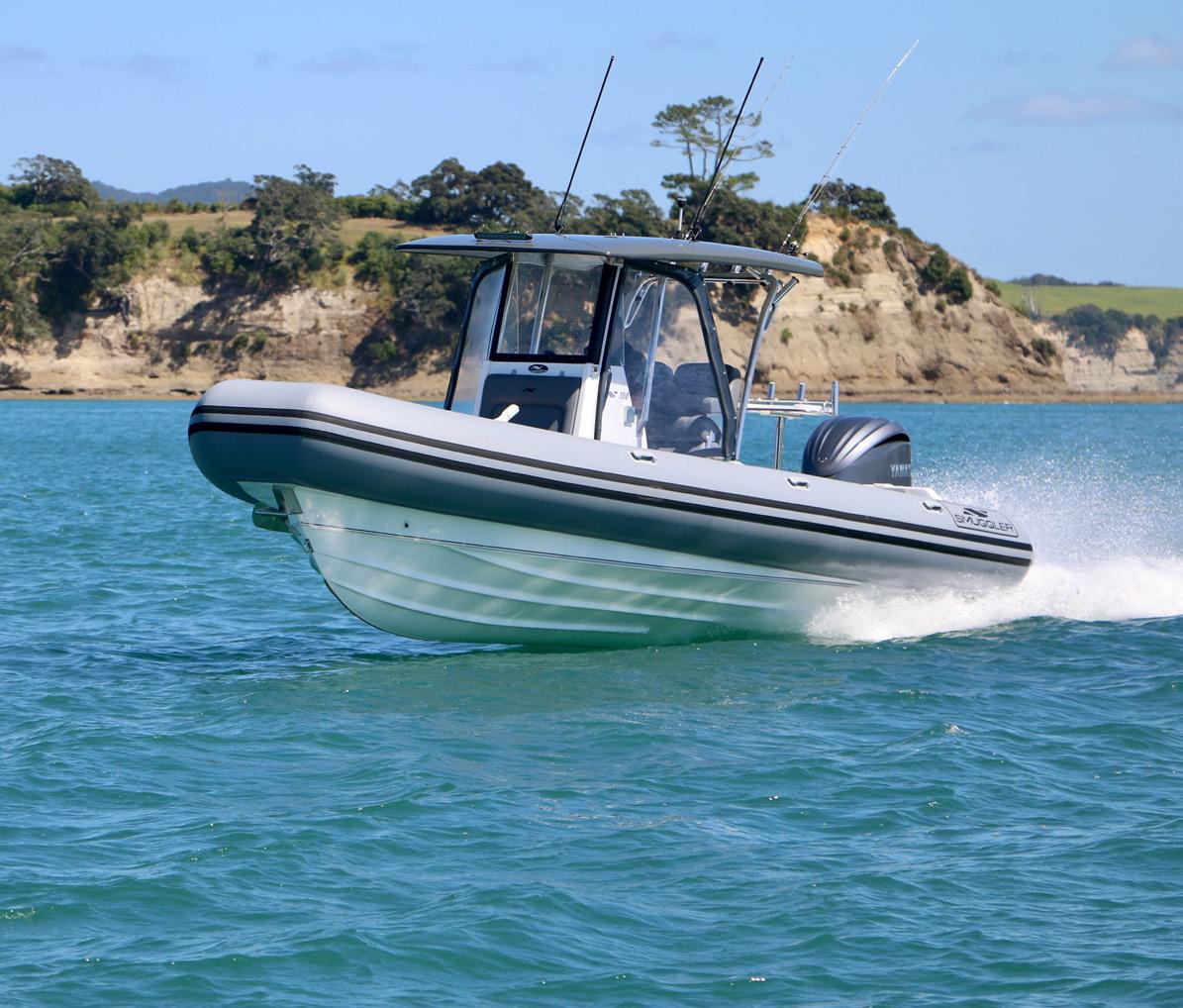
Under the cockpit floor is a large storage area, which is selfdraining and is ideal for wet gear, or your days catch. This boat also came with a 56 litre Ice-Tek removable chilly bin, with a fish measure on-top finished in U-Dek. The U-Dek is also a finish throughout the boat.
Despite all the underfloor storage available, the 750 still boasts a healthy 300-litre fuel tank, and with a modern high-tech outboard, is going to provide plenty of boating on a tank of fuel. In the bow area there is a forward facing seat, with a sun pad further forward of that, as well as another underfloor storage locker.
The helm was neat and stylish, and housed a large 12” Simrad multifunction display, however there is room for twin 12” display should be required. As well as the regular engine instruments from Yamaha, trim tab controls were also fitted within easy reach. A Fusion stereo provides sound to two six inch speakers which are located in the bow area.
The Bimini Targa top also accommodates a rocket launcher above with storage for up to six rods. A large LED light bar is located on the forward section of the hardtop, providing illumination at night should you need.
Removable side clears a located either side of the helm. Easy to zip into place, they provide added extra protection from the elements. Or simply open them up to have the wind in your hair!
PROVEN PERFORMER
The Strata 750 has Smugglers well proven 27 degree deep-vee hull. Arguably the deepest vee on the market. Quite simply the boat just goes. It’s the type of boat on which you can just hold the throttle down all the way, and hold on and enjoy the ride. It’s a very easy boat to drive, as it does all the work for you. The harder you push it, the better it goes.
Traditionally, the Smuggler hull loves horsepower and this example is no different, with the latest Yamaha F250hp V6 four stroke on the transom and was a lively performer.
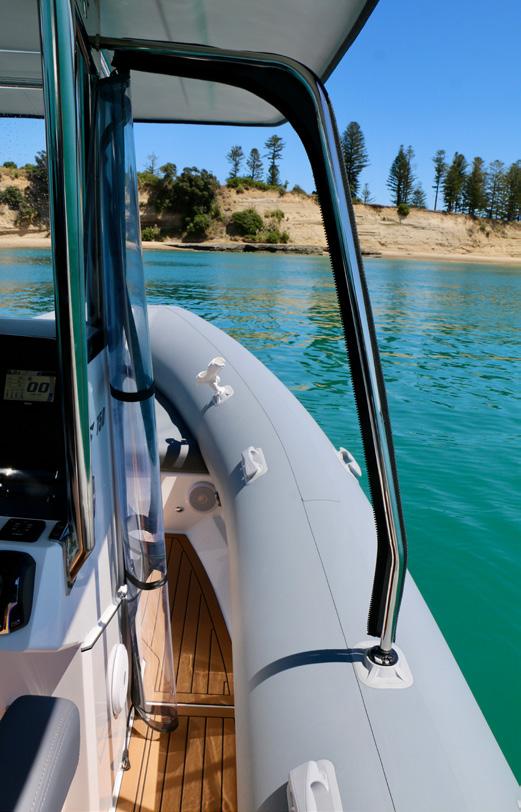
Removable
POWERBOATMAGAZINE.CO.NZ 97
The Strata 750 has Smugglers proven 27-degree hull.
clear provide protection when underway, or simply fold them away.
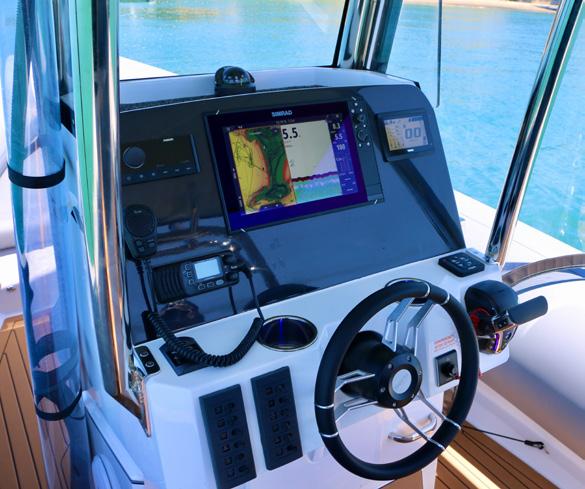
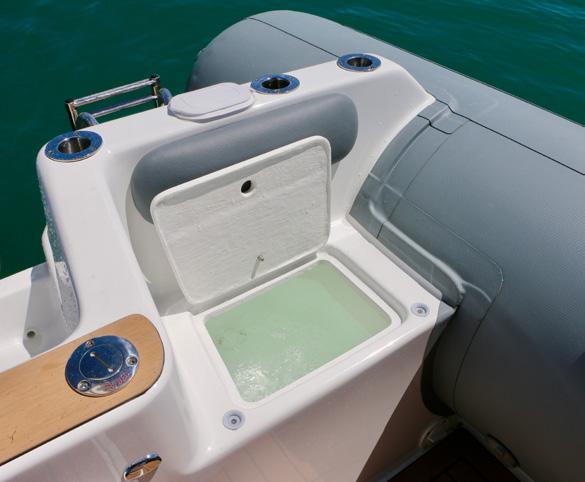
A large 12” Simrad display dominates the helm, however there is room for two.
A new feature, twin Captain’s chairs at the helm.
A live bait tank is available in the aft port corner.
Extra seating is available forward.
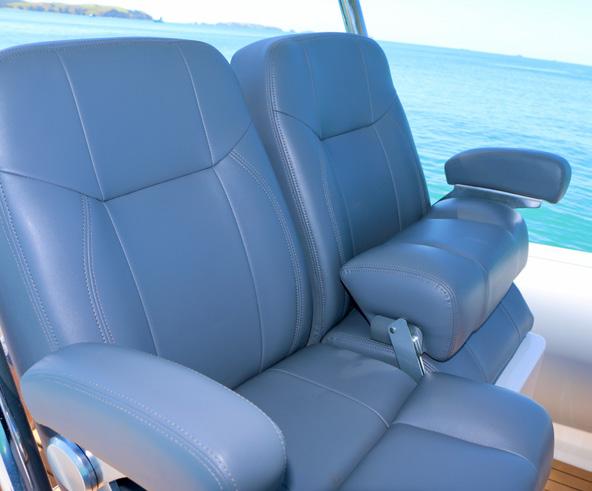
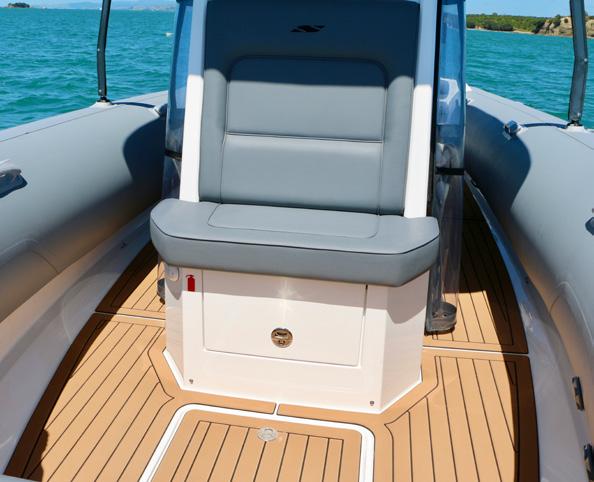
Top speed with the single Yamaha F250 four stroke, was 50 knots @ 5800 rpm with a fuel consumption of 95 litre per hour. Drop that back to a more sedate cruise speed of 23 knots @ 3000 rpm and the fuel usage drops to a very acceptable 25lph, and giving a range of 240nm based on 300L of fuel.
We elected to cruise at a higher speed, of 32 knots at 4000rpm, and in the choppy conditions, the Smuggler deep vee hull just ate up the chop with ease.
The quietness of the Yamaha was amazing, allowing you to talk to your passengers alongside you at the helm normally, even when underway at around 4000rpm.
While it’s more than capable of tackling rougher waters, it’s equally at home, cruising from bay to bay with a full crew of family and friends, and all in supreme comfort.
At rest, the 750 is exceptionally stable. The aft section of the tubes sit in the water and don’t let the boat lean to one side. This is down to the hull featuring a flooding keel, in which around 150 litres of water is taken into a
cavern built into the bottom section of the hull, holding the boat down in the water, and thus extra stability at rest.
For a boat of its size, it’s actually very light, with a trailerable weight of just 2000kg, meaning it’s relatively easy to launch and retrieve with minimal effort.
Will the centre console layout suit everyone? No, but Smuggler does have a variety of other configurations for the 750, including a ‘Mid Cabin’ model and a ‘Super Sport’ which is essentially a bow-rider type configuration. And if the boat isn’t big enough, the company has other models and configurations 8 metres and above.
Overall, a fantastic boat for its purpose, and I can see why Smuggler have now built over 70 hulls of this configuration. Will a high level build quality, and an equally high level on performance on the water, the Strata 750 RIB should be at the top of everyone’s list in this centre console RIB segment.
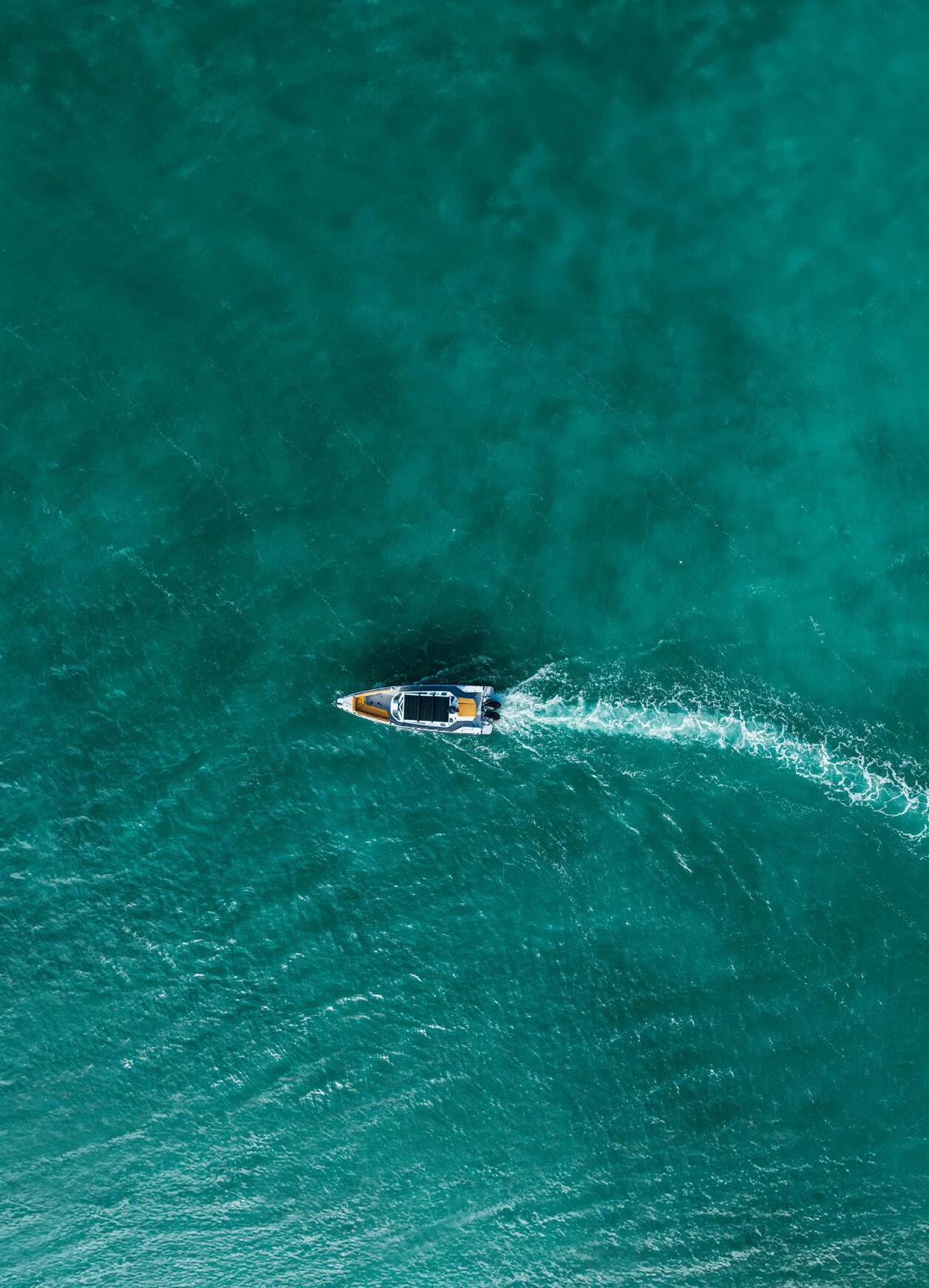
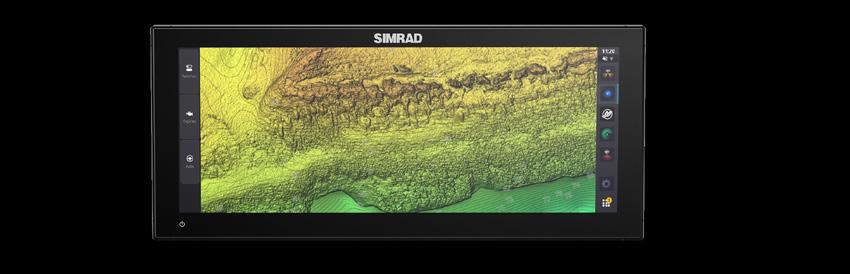
PACIFIC POWERBOAT REVIE WS _ SMUGGLER STRATA 750 98 MAY / JUNE 2024
NEVER SETTLE
NSX® ULTRAWIDE brings all the benefits of dual screens to a single display for our most immersive experience yet. Get a truly unique, eye-catching dash, see apps as they were meant to be seen, and ®’s X-Gen charts in more detail than ever. Welcome to the future of
Why settle for anything less? simrad-yachting.com/nsx-ultrawide
C-MAP® REVEAL™ X charts sold separately. ®Reg. U.S. Pat. & Tm. Off, and ™ common law marks. Visit www.navico.com/intellectual-property to review the global trademark rights and accreditations for Navico Group and other entities.
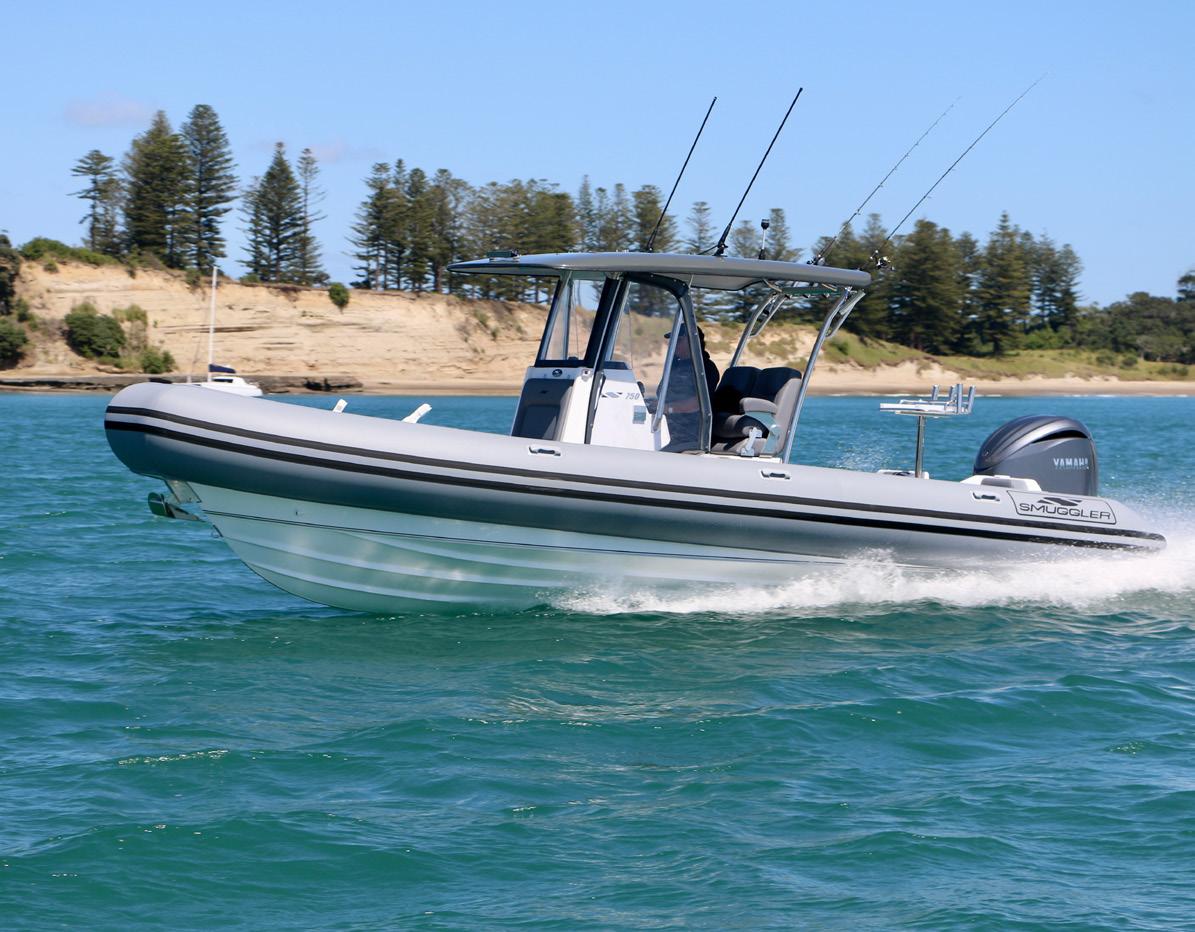
‘ The quietness of the Yamaha was amazing, allowing you to talk to your passengers alongside you at the helm.’
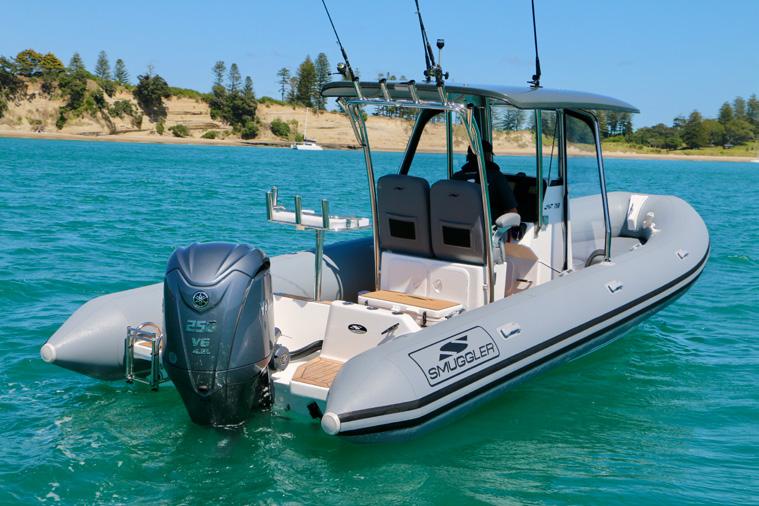
PERFORMANCE DATA RPM Knots L/h L/nm Range 1000 5 5.2 1.100 240 1500 7 8.6 1.300 200 2000 9.6 14 1.500 180 2500 16.5 19 1.200 220 3000 23 25 1.100 240 3500 29 32 1.200 220 4000 32 40 1.300 200 4500 36 49 1.400 190 5000 41 60 1.500 180 5500 45 66 1.500 180 5800 50 95 1.900 140 A Yamaha F250 HP fours-troke outboard will deliver 50 knot performance. PACIFIC POWERBOAT REVIE WS _ SMUGGLER STRATA 750 SPECIFICATIONS Maker & Model Smuggler Strata 750 Price as tested $189,160 Type Centre Console Construction GRP/Hypalon LOA 7.5m Beam 2.75m Deadrise 27- degree Height on trailer 3.61m Trailerable weight 1600kg Test Power Yamaha F250 Four-stroke Power options Outboard/Sterndrive HP Range 175hp-300hp Fuel Capacity 300L Trailer Tandem Axle Manufacturer Smuggler Marine SMUGGLER.CO.NZ
100 MAY / JUNE 2024
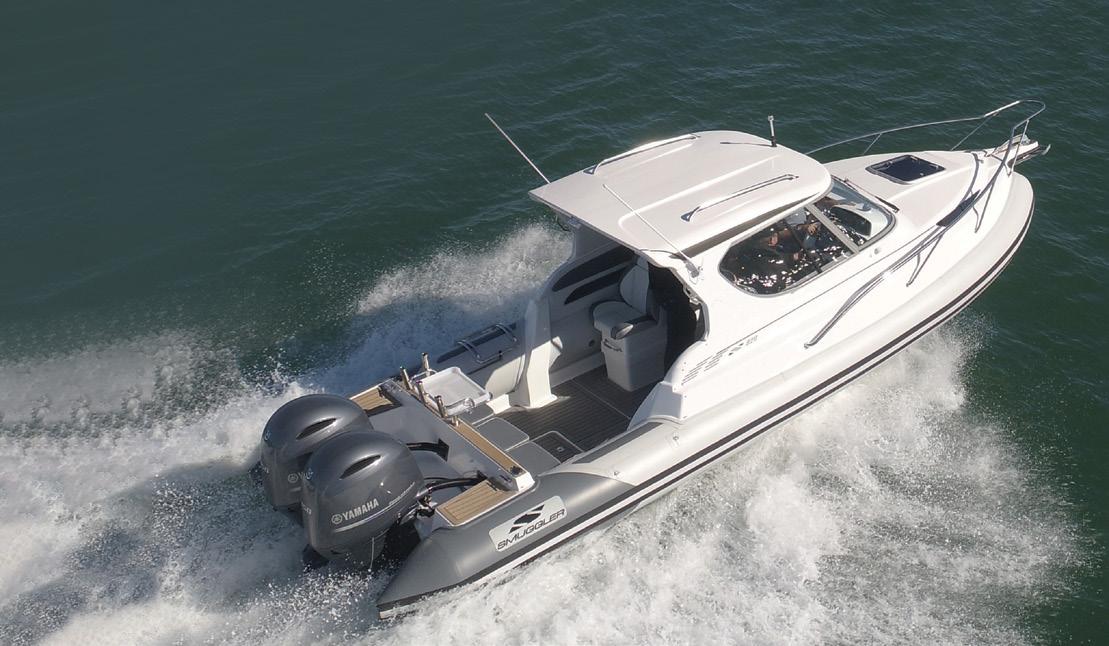
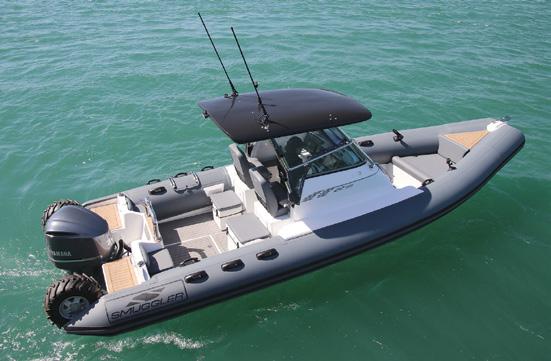
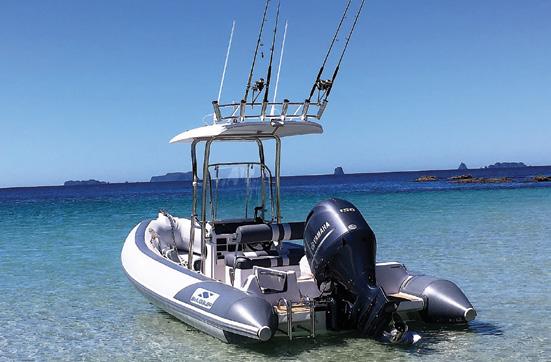
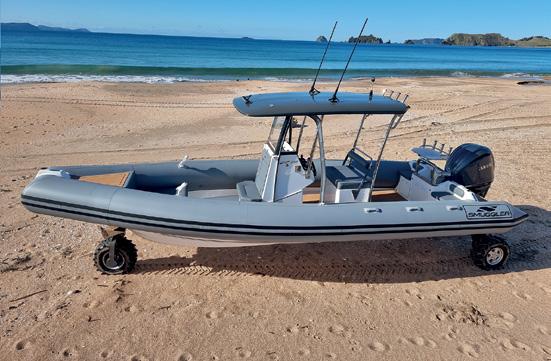
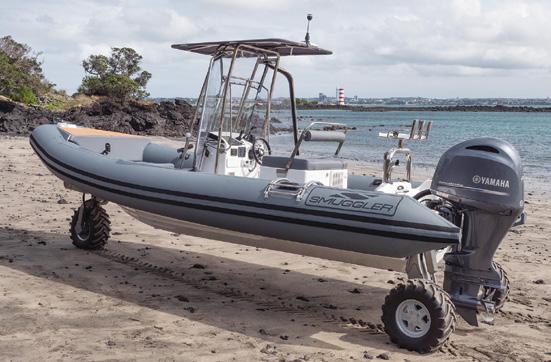



FOLLOW OUR STORY @SMUGGLERMARINE INFO@SMUGGLER.CO.NZ +64 9 838 9024 SMUGGLER.CO.NZ FOLLOW OUR STORY @SMUGGLERMARINE INFO@SMUGGLER.CO.NZ +64 9 838 9024 SMUGGLER.CO.NZ 004SM
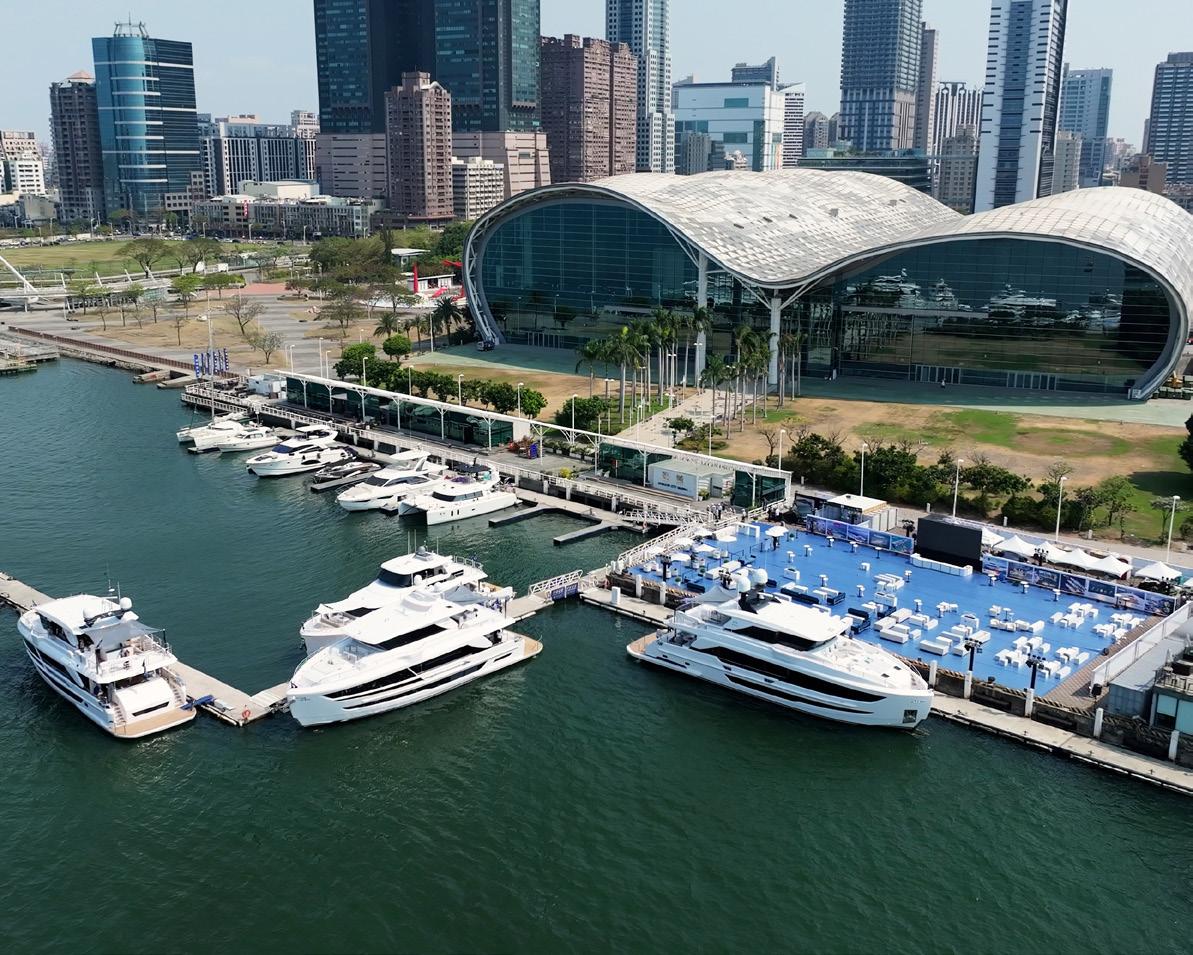
2024 HORIZON OPEN HOUSE
I have visited Taiwan on a couple of occasions in the last 15 years, once in 2010 for an investigation into the Taiwanese boat building industry and once for the first Taiwan Boat Show back in 2014. This year, Pacific PowerBoat was invited to attend the 2024 Horizon Open House. Previously, my late business partner, Barry Thompson, always jumped at the opportunity to attend the biennial Horizon Open House, and I know why!
BY DOUG DUKESON
The Horizon Open Housecocktail evening was held at the Horizon City Marina.
102 MAY / JUNE 2024
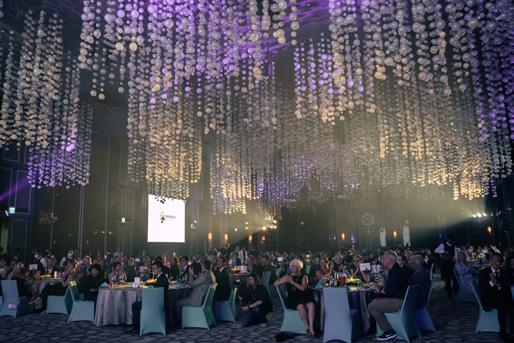
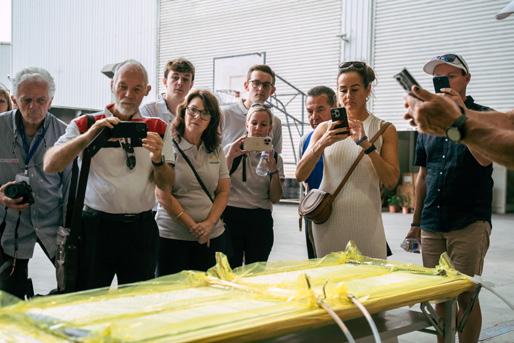
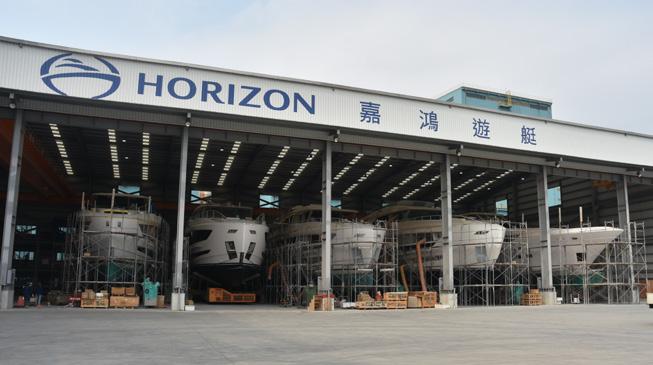
The three-day biennial event brings together over 300 Horizon owners, clients, partners, international media, and family and friends from around the world, including Japan, the USA, Australia/NZ, Europe, and Thailand to observe Horizon’s latest accomplishments and gain insight into the brand’s strengths and capabilities as a luxury yacht builder. This includes where they are heading moving forward, including the announcement of a collaboration with Lexus to manufacture the new Lexus LY680.
The 2024 Horizon Open House event was held at Horizon’s headquarters in Kaohsiung, where we enjoyed personal tours and learned more about Horizon, as a luxury yacht builder and to enjoy their showcase of the 25 different models in the 8 Horizon styles of power cats and monohulls. We experienced their shipyards in person with factory tours and were among the first press to see their latest debuts and launches, including a Horizon FD80 with a game fishing modification, due for New Zealand later this year.
In an interview with John Lu, Horizon Group CEO, he shared his growth to date and vision moving forward. He explained
ABOVE: Vacuum Infusion Process working demonstration
BELOW: The impressive Automatic 6D Vacuum Infusion Process in action
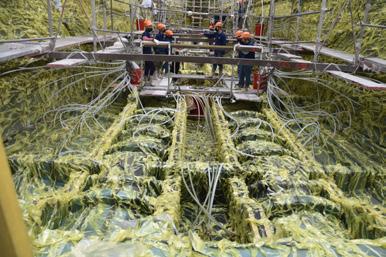
that the Horizon business is all about people, with customers being the first priority. Working with clients to offer customization options and “to make owners dreams come true”. With 50 designers on the payroll, they are ready to make this happen as quickly and costeffectively as possible.
Over the three days, we covered the five aspects of the Horizon Business (with a combined 900+ permanent employees):
1. THE HORIZON SHIPYARD:
Est. 1987 Covering an area of over 462,540 square feet, the Shipyard builds the bulk of the Horizon Yacht models (up to 150ft), with a maximum of five boats in progress at any one time. During our visit, we saw five Horizons in build (there can be up to 12 boats in build at different stages at any one time), including an RP122, E75, FD 90, and two FD 80s, one being delivered to New Zealand later this year with a customized Sport Fishing cockpit option. This showcases the customization options and willingness to work with owners. All of these boats are built on-site and are designed to be water-tested in huge tanks (run-up, flotation, and overhead sprinkler testing) before being delivered by road to the port. The commitment to innovation
and investment in new technology within this company has continued with the introduction of Stereolithography (SLA) 3D printing into its manufacturing processes, introduced alongside a PAR Systems 5- Axis CNC machine upgrade and upgraded 3D printing capabilities to further improve production efficiencies and design quality.
2. ATECH COMPOSITES: Est. 2000 At half the physical size of the Shipyard, at 249,070 square feet, this part of the company develops and tests fabrics, resins, gel coats, core and sandwich composites of all sorts, emphasizing maximizing strength and minimizing weight. We had the opportunity after a short classroom session to see the Automatic 6D Vacuum Infusion Process in action. I was impressed to view and we were told the process enables Horizon to produce boats 8% lighter and uses 40% less resin that conventional boat building processes. Moving around the factory we also got to see the destructive testing pushing materials to their absolute limits. Also on view was the two very impressive non-destructive quality control processes, Infrared Thermography and Laser Shearography – two process that scans each boat once out of the mould for any imperfections. Combined with the 3D Profile Measurement Reality Capture process, which scanned the hull and compares it against the factory hull structure design drawing for absolute pin point accuracy.
POWERBOATMAGAZINE.CO.NZ 103
Horizon Open House Gala Dinner
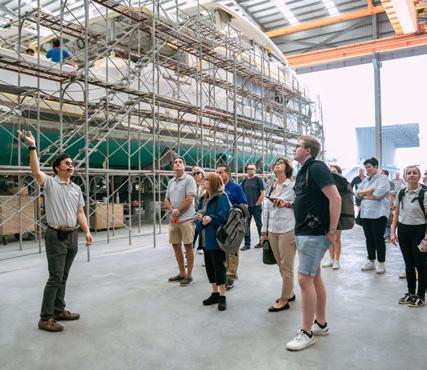
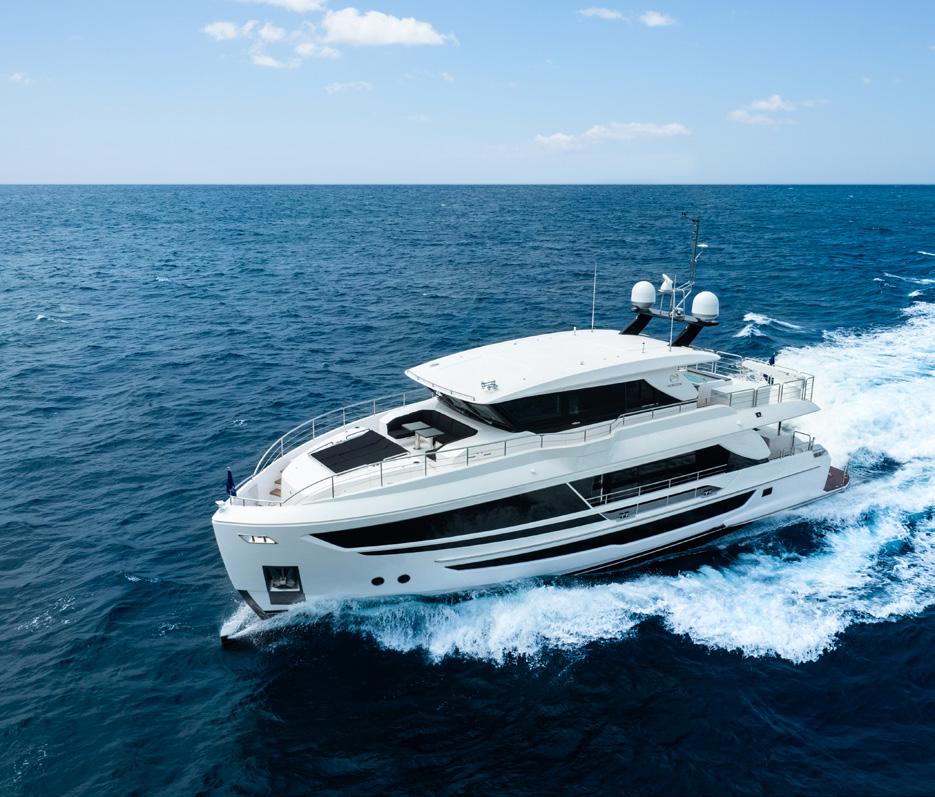
3. VISION SHIPYARD:
Est. 2001 This yard was developed in 2001 to build yachts up to 80 ft, this is where the new Lexus 680 will be developed and built.
4. PREMIER SHIPYARD:
Est. 2005 Built to be used as the delivery centre for Horizon Boats, the shipyard also offers refit services and facilities, including a 1,000-ton ship lift platform available for Horizon and outside clients.
5. HORIZON CITY
MARINA: Est. 2014 The latest development for Horizon, built right outside the Convention Centre to encourage local and visiting cruising vessels to Taiwan, offering a full-service marina right in the heart of Kaohsiung. In 2023, the Marina became the first marina in Taiwan to receive Superyacht Ready certification. At the marina we had the opportunity to experience the world debut of four brand-new yachts. The featured yachts shown were:- FD90, a Cor D. Rover co-designed fast displacement motor yacht, designed specifically for the Australian market offering a five-stateroom layout, including a full beam on deck master stateroom with an ensuite head. There were also two FD80 skyline models on display (similar to the model we featured in our
March/April issue) with their expansive saloon floor-to-ceiling windows and generous accommodations for up to eight guests in four staterooms, as well as four crew members.
We also had the opportunity to look through the impressive new US $5.7m Horizon V77 CMY (Cockpit Motor Yacht), a further development on the proven V68 hull, adding a load more fish fighting space with an array of rod holders, electric reel outlets, live bait wells, and ample storage space for all the fishing gear. Even further extending the cockpit space is the addition of a hydraulic fold down transom.
2023 AND ONWARD….
Almost 20 new-build yachts ranging from 75 to 110 feet from the FD, V, RP, and E series were delivered to clients scattered around the world in 2023 alone. We were told that one-third of the boats on order were due for delivery to existing Horizon owners. John Lu explained that this was sometimes a problem, as many owners are so satisfied with their boat that they do not want to change. While mixing and mingling with owners at the event, I found this to be true. While ‘socialising’ with one Christchurch Horizon owner, who currently has his Horizon 97 RPH (Raised Pilot House) located in Croatia. He explained he
had purchased his new Horizon 97 RPH, 15 years ago and still more than happy with his Horizon, the choice of model, his time with the boat and what it offers to his life on the water, even now fifteen years later.
Speaking with Mark Western, Director of Horizon Yacht Australia, the 30% repeat business ratio is actually higher in Australasia, with the percentage being closer to 50-70% repeat business for New Zealand and Australia. With three boats already sold this year by March 2024, and another two sold at the 2024 Horizon Open House event, the Horizon Australasian family is quickly growing every year. Mark explained on business moving forward ‘We have two more boats arriving for the Sanctuary Cove Boat Show in May 2024, a FD90 and FD80, the two boats that were displayed at the 2024 Horizon Open House Event. On top of that, I have just ordered two more stock boats, another FD80 Skyline and FD100 Skyline, which will be the first FD100 Skyline variant built’.
As previously mentioned, developing Horizon as an owners family, is a significant part of the Horizon philosophy. In 2023, in-person events continued to draw current and prospective clients as Horizon partners displayed the latest Horizon yacht builds in global boat shows. Three international
PACIFIC POWERBOAT ATTENDS 2024 HORIZON OPEN HOUSE
ABOVE: Horizon Open House Factory Tour
104 MAY / JUNE 2024
RIGHT: Horizon FD80

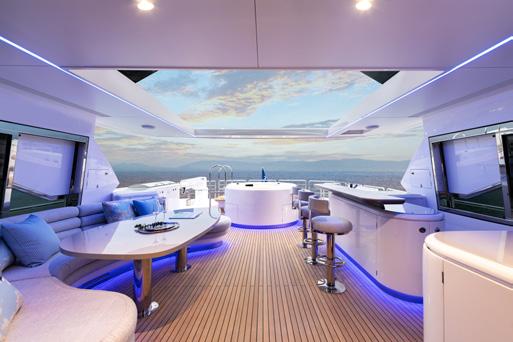
Owners’ Rendezvous were hosted in 2023, including the Horizon Yacht USA Mystic Seaport Museum Rendezvous, The Horizon Power Catamarans Rendezvous, and the Horizon Yacht Australia Airlie Beach Rendezvous. It brings John Lu and the entire Horizon family great joy to see so many Horizon owners joined together to share their build experiences and cruising stories.
While the Taiwanese boating leisure market has not taken off as it has in other countries, it is believed that this will come in future generations, as they become more comfortable spending
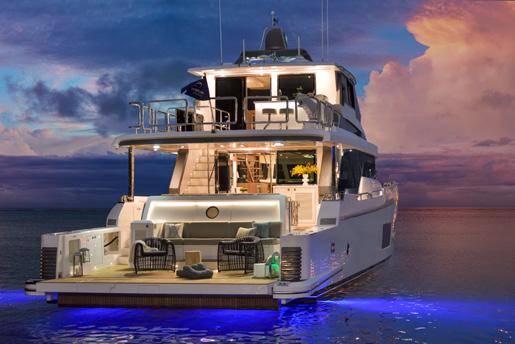
leisure time out on the water. The Taiwanese boat building industry in general is continuing to develop and in general going very well. With the old China-Taiwan clash still raising its head now and then, we the press, were assured nothing has developed or scaled up or down over the last 70 years, in fact, business investment right now is at an all-time high. John Lu reassures us, ‘It is business as usual and there should be no concerns in having a boat build in Taiwan, the Taiwanese are still living their lives at the same pace with economic activities continuing to flourish’.
Horizon Yachts certainly work as a team, and it is little wonder they already have a full schedule and production line up in place. From a relatively small country, about the size of Tasmania, and a population of 28 million (the same as all of Australia), Horizon’s openmindedness to listen to their owner’s requirements and desires has certainly helped them to develop product that has found a strong demand worldwide.
HORIZONYACHTAUS.COM
HORIZONYACHT.COM
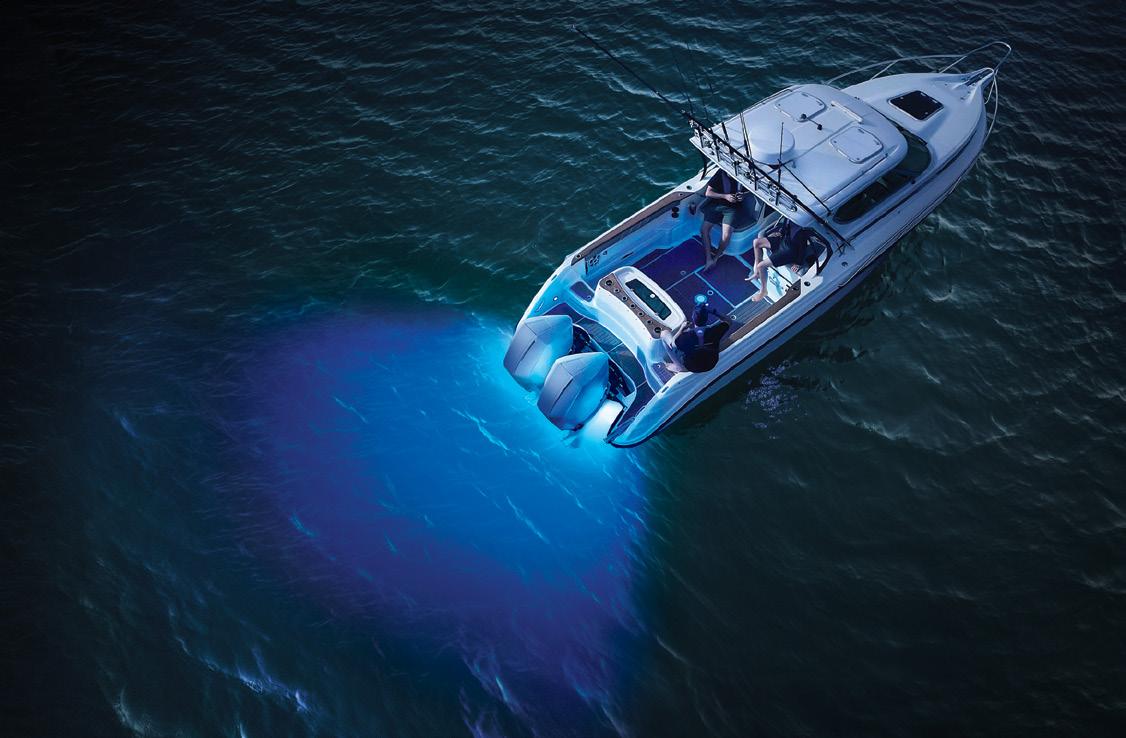
UNDERWATER BRILLIANCE
Elevate your underwater lighting experience with Hella marine’s Apelo Underwater Lights. Choose intense white, vibrant blue, or full spectrum RGB colour. Lumen outputs range from an impressive 1800 lumens, to an incredible 6000 lumens. Dive into innovation and elegance.
www.hellamarine.com
Apelo Underwater Lights
Hella marine PPB APELO Horiz 184x130 -2024.indd 1 12-Feb-24 10:48:19 AM
Horizon FD90 split-use skylounge
POWERBOATMAGAZINE.CO.NZ 105
Horizon V77 fishing cockpit
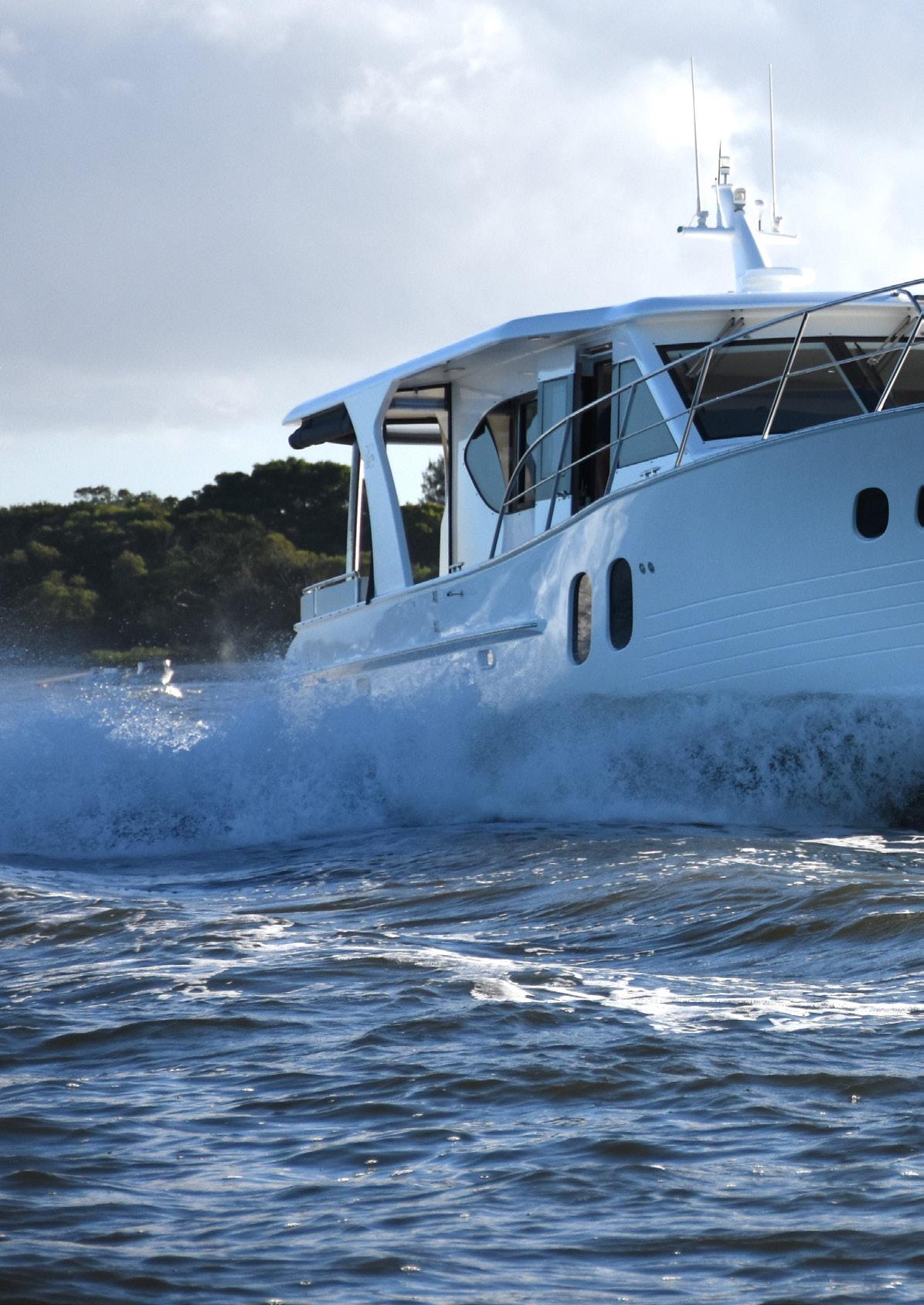
Island Dreaming
When it comes to larger single propellor boats, you wouldn’t see me lining up at the clubhouse to drive one. However, the close quarters handling capabilities of the Island Gypsy 50 WB (wide-body) has me rethinking my position.
BY KYLE BARNES
PACIFIC POWERBOAT REVIE WS _ ISLAND GYPSY 50 WB
106 MAY / JUNE 2024
My single screw allergy was formed as a young commercial fisherman deckhand being thrust into the manhood of becoming a skipper. The old skippers at the Houhora Wharf, such as my father, a daredevil fisherman of the 1970s, would be able to shoehorn a 28-foot fully laden fishing vessel sideways into the six-knot tide between two other boats, without the use of springers and thrusters, just horsepower and guesswork.
One minute we would be hard charging at the concrete monolith wharf and the next hear the blood curdling yell, “tie her off”, and you didn’t miss.
No wonder I was terrified when it came my first turn to park my father’s boat, which resulted in 10 mates with fenders, mattresses and anything else that was handy to fend me off in an easy park, straight into the tide on the side of a clear wharf.
The rest is history as I have mastered all the technologies and engine configurations and have come full circle to appreciate the

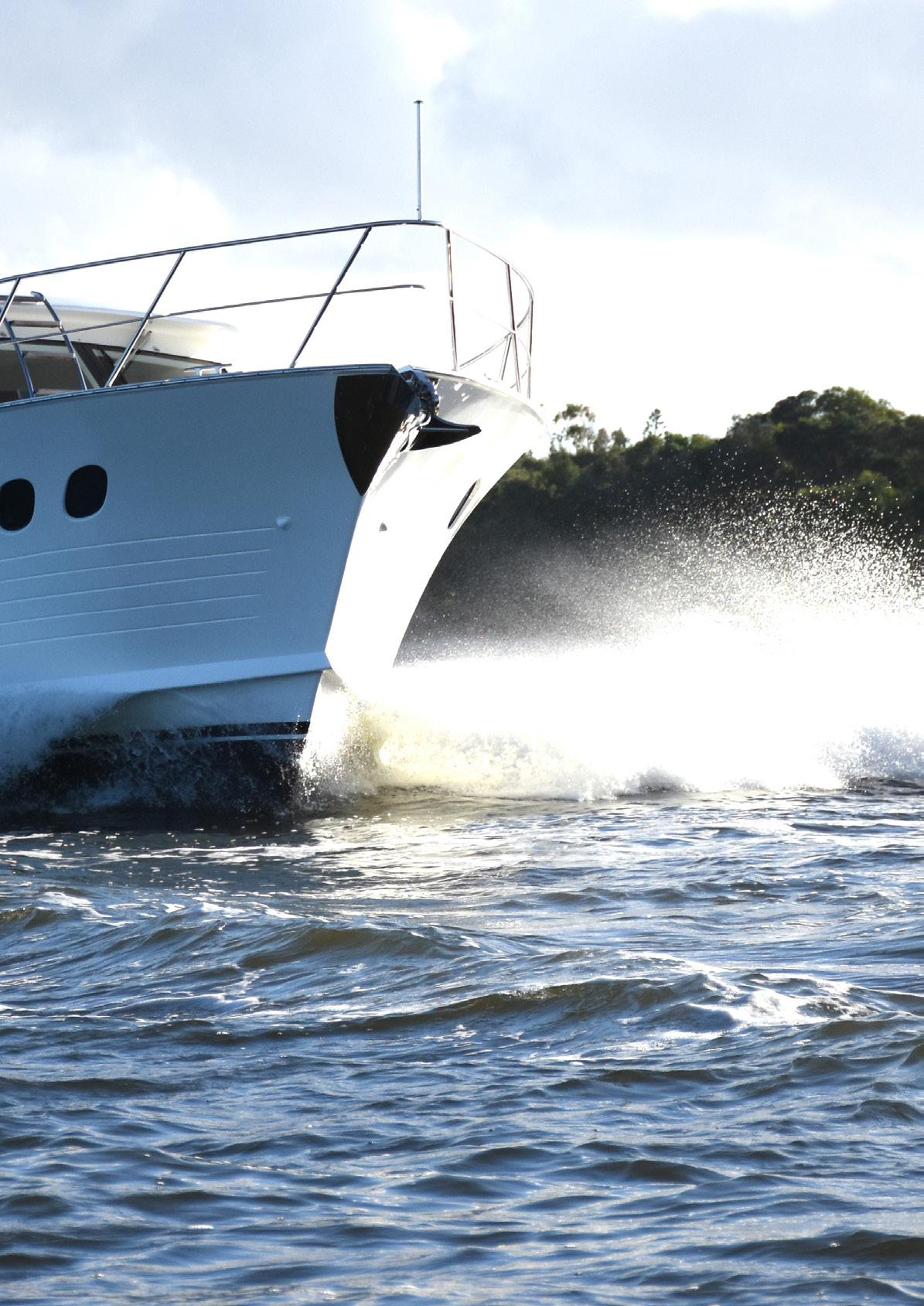
Island Gypsy 50 WB offers more than just a boat ride, it is an adventure waiting to happen.
simplicity of a single prop vessel with a couple of tricks up her sleeve.
Ken Larkins, the new owner and host aboard our ride, told me what he liked about the engineering of the vessel. “If you have two engines, 90 per cent of the time if one is going to stop, so is the other and generally because you have dirty fuel or water in the tank. Simplicity is the best. These days, good modern engines, especially our local Cummins serviced units, just don’t tend to breakdown.”
SCAN THE CODE TO WATCH THE VIDEO POWERBOATMAGAZINE.CO.NZ 107
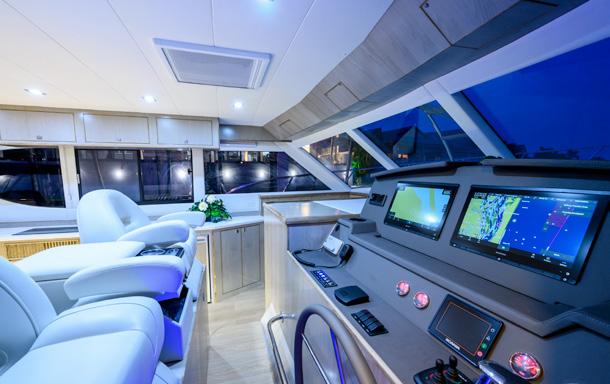
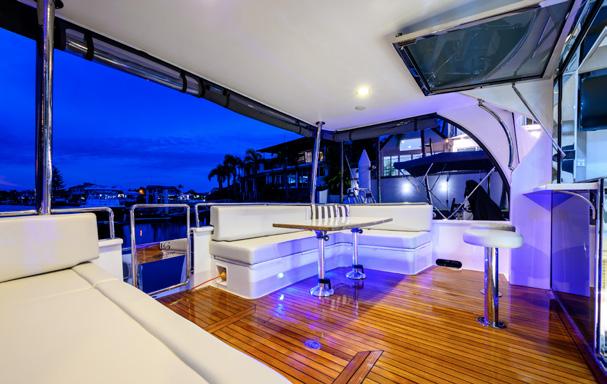
The cream leather luxstyle Jack and Jill helm chair ensemble could just as easily be at home in a Gold Class cinema.
The saloon is lofty with its head height a tick over the sevenfoot mark.
The cockpit has a couple of fixed barstools so you can keep an eye on the work of the culinary creatives in the galley.
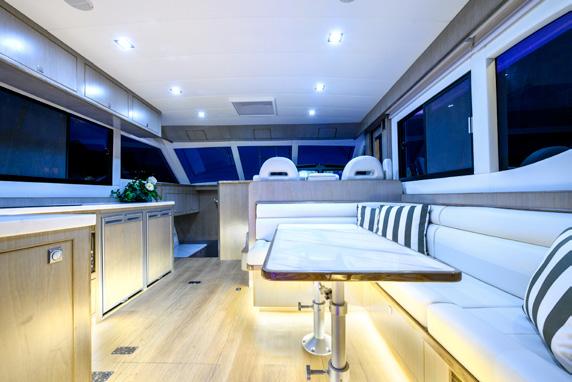
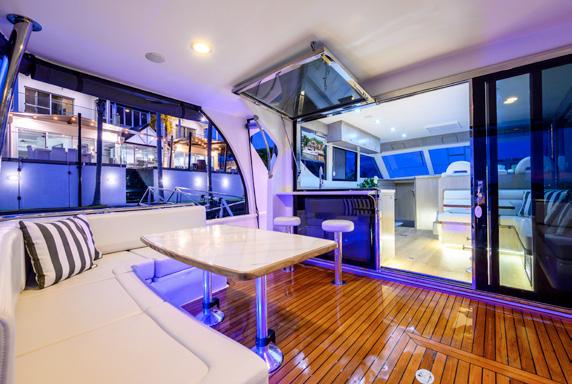
Owner of Island Gypsy and the brainchild architect of the brand, Brett Flanagan, says that during his years working as a boat broker there was a lot of compromise. “Nobody could seem to get exactly what they wanted, such as a good practicable boat for exploring the islands to the north. You need the functionality to live in the islands around the Gold Coast which mean lots of road bridges and this vessel can get most anywhere at three-quarter tide.”
LINEAGE
Island Gypsy Yachts traces its roots back to over 130 years, when Halvorsen Boats were launched in Norway in 1887 by Halvor Andersen. His son, Lars joined the family business and a few years later relocated to Sydney with his family. There the Halvorsen name became synonymous with quality and style in the boat building industry. Lars died in 1936, and the business passed to his eldest son, Harold, who continued to design pleasure, commercial and military vessels. He was awarded the Order of Australia Medal in 2000 in recognition of his contribution to the war effort.
During the 1970s, Harold’s son Harvey became the new designer for the business, and in 1975 he started a venture between his family business and marine heavyweight Joseph Kong. The new project was to design, build and market a brand-new range of
pleasure boats all over the world. Harvey started with a new 30-foot design, and while designing the vessel he began to brainstorm names for the brand. He wanted to sell a lifestyle, so began gaining inspiration from thoughts of cruising the Great Barrier Reef, and other exotic lands. He didn’t want to use the Halvorsen name in case the range was ever sold, and seemingly out of nowhere came up with the name “Island Gypsy”.
However, years later he found out that in 1948 the family business had actually built a large boat for the tourist market with the name “Island Gypsy”, to be used on the reef. At the time he was just nine, so the name had clearly stayed with him subconsciously.
HANDLING
We were manoeuvring in the Hope Harbour Marina into an occupied double berth, no more than 20 metres from a boat ramp heaving with water traffic and using her oversized 24-volt forward and aft thrusters we made short work of the tight quarters. When going astern she was well assisted with direction by the rudder and once perpendicular to our dock things became a breeze. Short jabs on the thrusters held our position while the docking speed was controlled by the main engine and midships helm. Absolute brilliant simplicity. I wish I had that to lean on back in the day in Houhora.
PACIFIC POWERBOAT REVIE WS _ ISLAND GYPSY 50 WB 108 MAY / JUNE 2024
AT FIRST GLANCE
Walking aboard this spaceship conjures up emotions that the original architect behind the name must have had in mind. She is fully open from the step-aboard portofino stern (where the gunwale line sweeps down pass the flat transom onto the integral boarding platform), forward to the double leather-seated helm station - the juxtaposing state being buttoned up and ready for action when things get a little loud outside. But for now, it felt as if we were wandering around the islands with the large galley window pinned up to the ceiling of the cockpit, the double saloon doors tucked away and the helm door and hatches fully ajar.
OUTDOOR
The cockpit is not only decked out with upscale seating both sides, but also has a couple of fixed bar stools so as you can keep an eye on the culinary creatives in the galley. And underneath this generous space is a lazarette easily capable of swinging half a dozen cats - it is less than full head-height but it makes up for that in girth and volume.
SALOON
The saloon is lofty, which is particularly puzzling when part of the design of the vessels is to get under bridges around the Gold Coast islands, yet this is no cramped longboat. I didn’t have my trusty tape measure with me, but I like to think of space and volume in terms of lifestyle not litres, and I am pretty sure the ceiling would have been a tick over the seven-foot mark. The aft portside galley has a place for everything and everything in its place, little has been missed. Something which does grind my gears in a lot of
galleys is the way the sinks have removable covers to increase bench space, but what do you do with the covers when you need the sink? Again, the innovation genie leaps out of the bottle and provides slots in the back of the sinks to place the covers so they don’t wind up on the floor, or worse, on your toe.
THE HELM
We continue across to the starboard side of the saloon where I sit down on an uber-comfy dining suite and accompanying table which is nicely highlighted by floor underlighting. This backs onto the helm station which has its own door to the starboard side walkway and is positioned around midships of the vessel. This seating arrangement is one many would think you would find on a bridge of a larger vessel with a bigger price tag but in fact, it was one of the first thing I noticed as I came onboard - with its cream leathered lux-style Jack and Jill helm chair ensemble. But as they say, wait, there is more! The helm seats also share a blue light charging box/storage for all your gear,
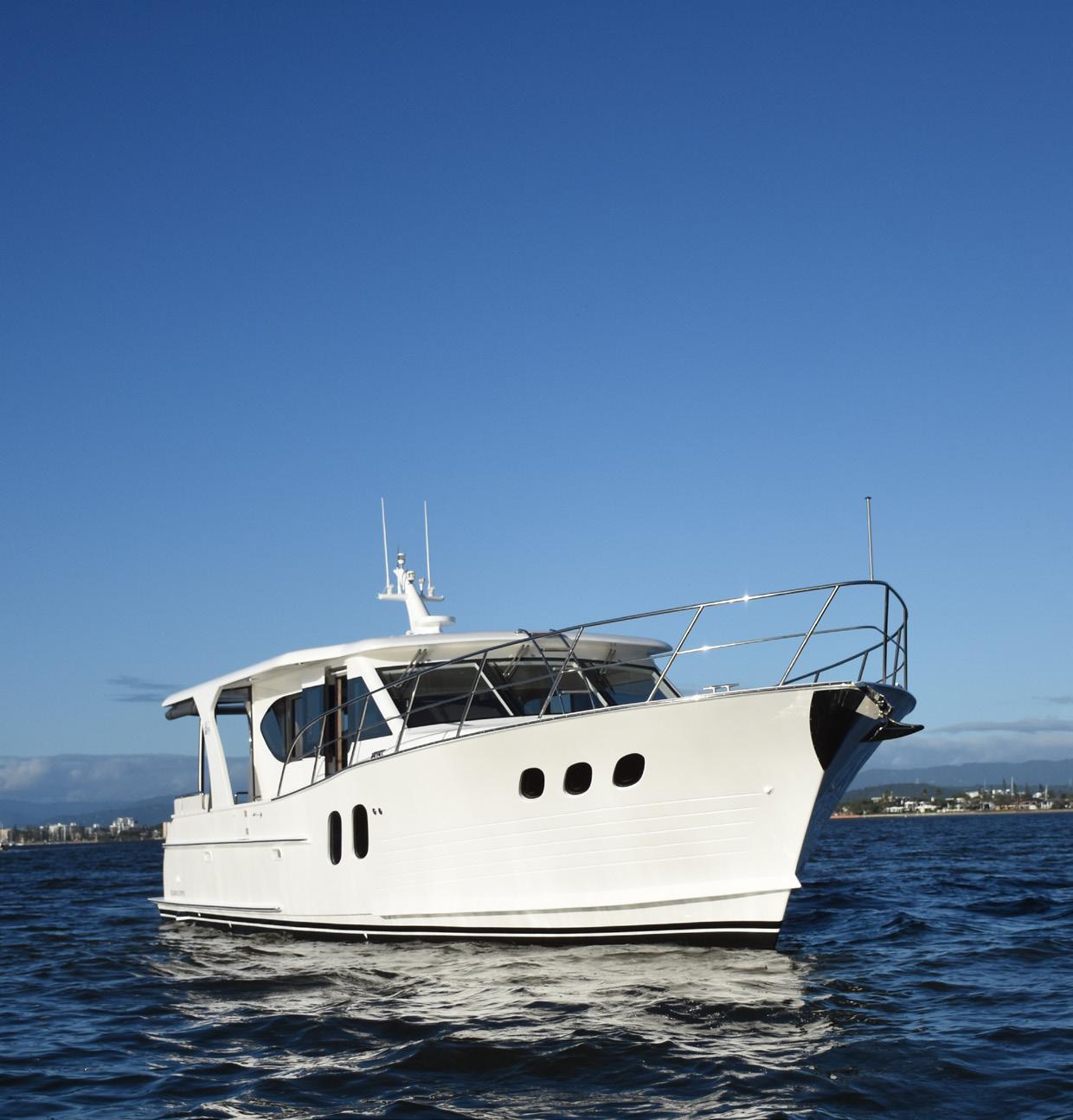
The aft portside galley has a place for everything and everything in its place.
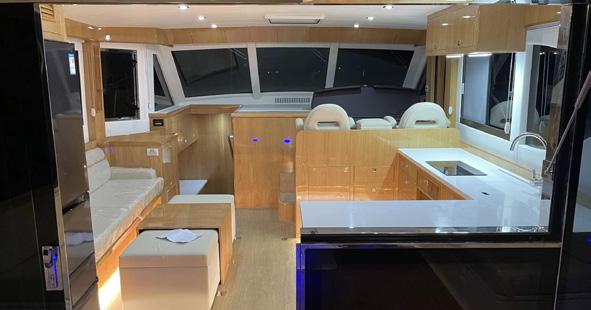
The design and versatility make it the perfect choice for anyone looking to make the most of their time on the water.
POWERBOATMAGAZINE.CO.NZ 109
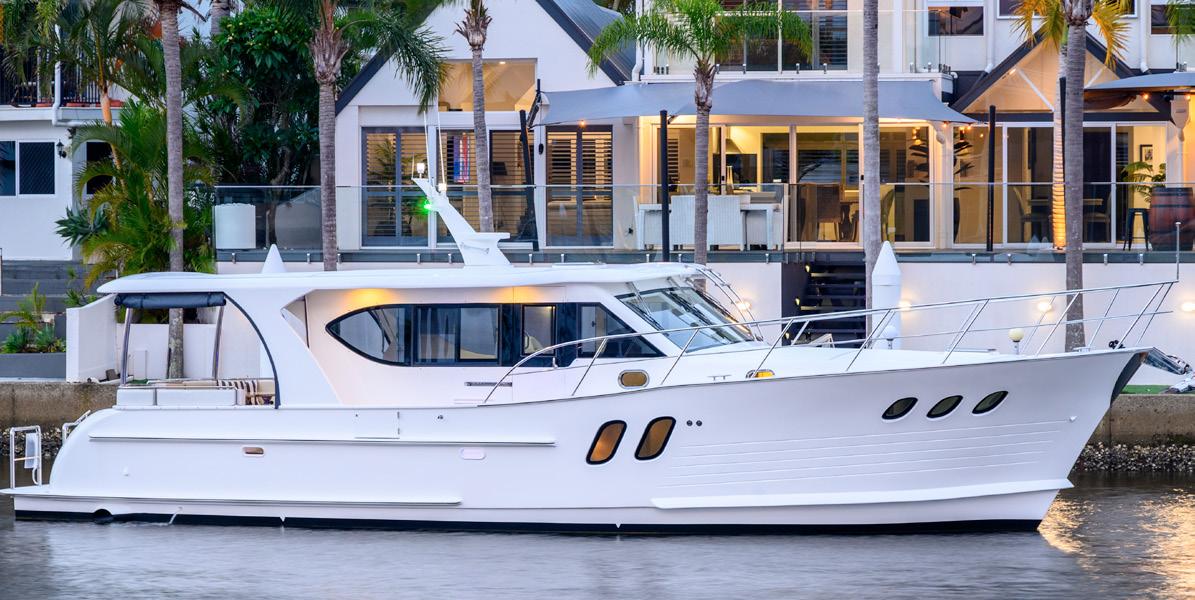
The bow deck is wide with plenty of room, functional especially at anchor, making the amount of people this boat could host easily tip over the 20-mark.
as well as cupholders – these fabulous stylings could easily be just as at home in a Gold Class cinema. The double leather seats can either wrap you up while seated or can be configured with a flip up bolster cushion to make you comfortable while standing. The gauges and controls at the helm are harnessed in and not overcomplicated or crowded, with the diagnostic gauges being limited to a couple of large “eyes up” multifunction screens which capture all the daisy-chained electronic sensors and cameras. A smaller “eyes down” display has the engine health monitor and there’s oodles of space left on the dash for communications and post market retrofitting which can be an issue on a tight helm panel.
Accommodation
Forward on the port side is a very wide companionway that looks straight ahead past the day head into the guest quarters. A couple of well-placed bunks which run down both sides and meet up at the bow as an over and under layout could easily accommodate a six-footer. On the starboard side, aft of the guests digs and kind of tucked under the helm, which also makes it midships, is the master’s suite. When I say tucked, there is at least four feet above the pillows and plenty of head-height in the main chamber of the cabin. All tastefully capped off with fabulous underlighting and separate large shower and head.
THE SEA TRIAL
With tight timelines and my editor cracking the whip from the other side of the Ditch, I can’t speak for the vessel’s seakeeping abilities outside the Gold Coast Broadwater, we had to take her as she was. We were under quarter fuel tanks with no freshwater and a lightly laden 23 tonnes (dry weight) of vessel standard engine fitment pushed along by a single 550hp
Cummins. Here is what I observed with a moderate easterly and pretty much slack water – with this vessel powered by an 800hp SCANIA engine.
5
8
14
18.5
ON DECK
The bow deck is wide with plenty of room for more folks to join the party, functional especially at anchor, making the amount of people this boat could host easily tip over the 20-mark. The gunwales both sides run all the way to the cockpit with plenty of room for those among us that have a larger than normal walking gate, it’s certainly not one foot in front of the other.
INNOVATION
Brett has a few ideas in the pipeline. “I am always tweaking and making improvements to the range. For example we have dispensed with the hull and topsides being traditional gelcoat because traditionally after a while gelcoat tends to go powdery and you’re forever maintaining it. So, I decided to use a two-pack paint finish which is more expensive but lasts the distance and is easy to maintain.”
Brett has even been playing with the joinery to produce their own exclusive colour ranges - this vessel in a modern grey oak - with a tiny highlight trim around the outside once again for longevity. “Normally you find other manufacturers wrap the edge of the door all the way to the edges and after a while it tends to fray. So, the edge is there to prevent
Speed Engine RPM Fuel Consumption
knots 650 (Idle) 4 litres per hour
knots 900 (Cruise) 11 litres per hour
knots 1100 (Planing) 37 litres per hour
knots 23,500 (Full
138 litres per hour
noise)
PACIFIC POWERBOAT REVIE WS _ ISLAND GYPSY 50 WB 110 MAY / JUNE 2024
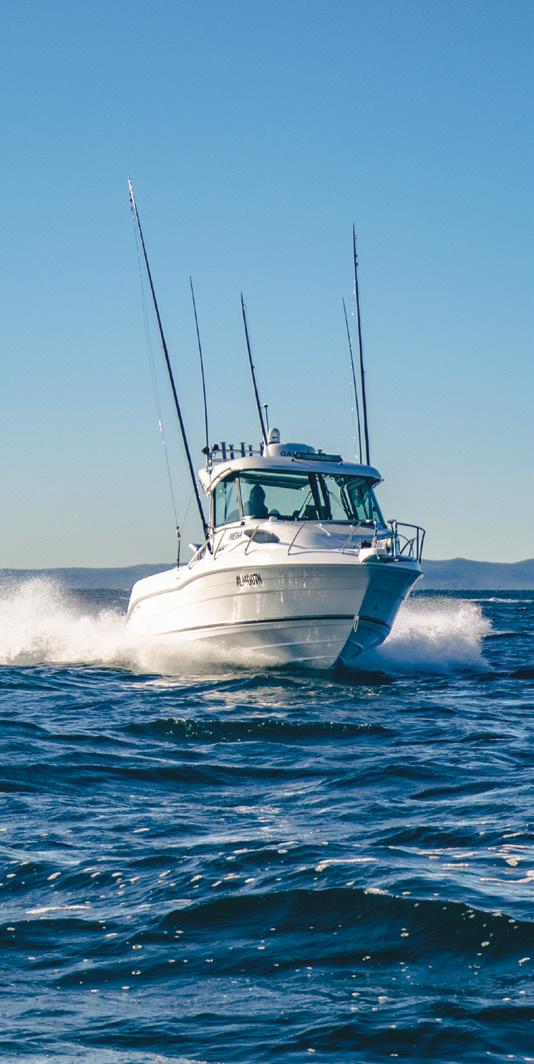


















GIVEAWAY GIVEAWAY GIVEAWAY GIVEAWAY GIVEAWAY GIVEAWAY GIVEAWAY SUBSCRIBE
WIN POWERBOATMAGAZINE.CO.NZ 111
& Be in to win the ultimate boating accessory giveaway! Win $2,300+ worth of products to enhance your time on the water! Simply subscribe at the Hutchwilco Boat Show to be into win - Stand 298 Prize IncludesUltimate Ears EPICBOOM Cobb Grill Pro black gas Engel Cooler Box 18L Grey Engel Backpack Cooler 23L Hutchwilco Inflatable Life Jackets Pepper and Me Seasonings Quad Lock Voucher Anchorage Estate florals collection Salt Attack Mothers Black Streak Remover
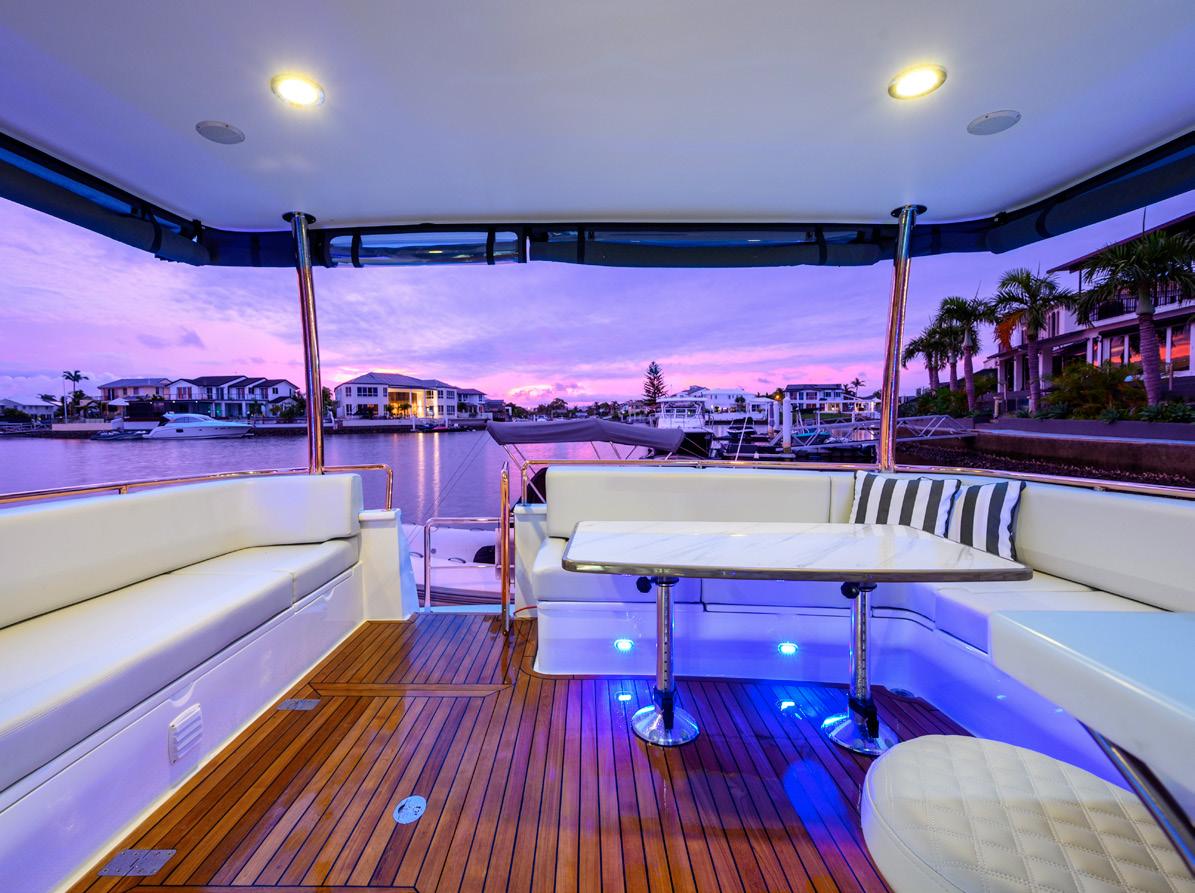
Aft cockpit – Decked out with opulent upscale seating along both sides, the cockpit provides yet another social setting.
damage and knocks which starts peeling back the laminate over time.
“The older-style original vessels we used to manufacture still have today up to 16 skin fittings, eight either side which service each drain outlet be it a shower, sink, tap…but they have become high maintenance and expensive to maintain when needing replacement. So once again for the lastingness the vessels are now plumbed like a house with 90 per cent of the drainage tracks made from PVC into one large pipe either side of the hull that flows into the single pipe that drains overboard so no skin fittings to service. An absolutely fantastic idea!”
In terms of versatility and ongoing development of the brand, Brett has a vessel under construction that makes even better use of the portofino stern which includes a wet bar with an inbuilt barbeque and fridge in the cockpit. This is a new “Yacht Fisher” style design which allows for a magnificent mezzanine deck which leads into the spacious saloon. This makes it a super functional boat and leaves the yacht fisher area for fishing, swimming, diving or what ever you like to use it for without interfering with the guests on the mezzanine level, an absolute kids’ playground. There is also another boat which has recently arrived called the 50 XL (Extra Large) where the saloon size is increased over the gunwale port side of the vessel to produce an even roomier saloon and galley. For me, Brett is the true quintessence of an “ideas man”,
putting his experience and the experience of his thousands of past brokerage buyers into action, not sitting on his innovation laurels but forever tweaking and improving them.
SUMMARY
Island Gypsy 50 WB offers more than just a boat ride, it is an adventure waiting to happen. It’s design and versatility makes it the perfect choice for anyone looking to make the most of their time on the water. It is the perfect boating choice for a small family, or couple, who like to get away from it all, or people who love to socialise, using its abundant communal areas.
SPECIFICATIONS
Boat Brand Island Gypsy
L.O.A 50’ (15m)
Beam 4.65m
Draft 1.4m
Fuel Capacity 3000L
Fresh Water Capacity 1000L
Engine Make 800 HP Scania
Fuel Type Diesel BOATSINTERNATIONAL.COM.AU
PACIFIC POWERBOAT REVIE WS _ ISLAND GYPSY 50 WB
112 MAY / JUNE 2024
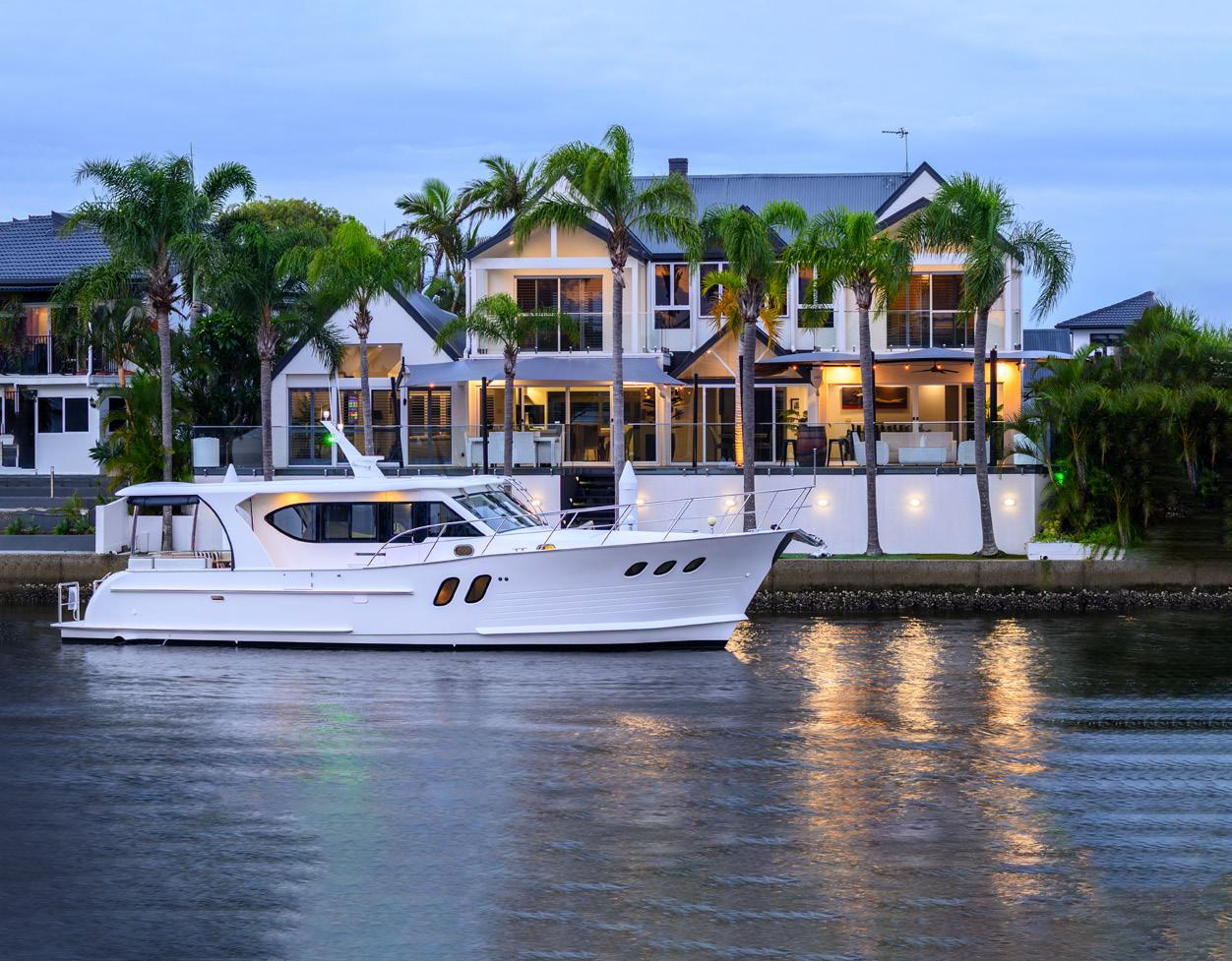
ISLAND GYPSY
50 Wide Body
This luxurious vessel with traditional lines is gaining popularity for its impressive appearance, speed, and tremendous interior volume. It is perfect for those who love spending time on the water ready for an adventure about to happen.
• Two Cabin Layout
• Full beam master
• Two heads
• 800hp Scania
• Shaft drive
THE NEXT GENERATION OF CLASSIC CRUISERS
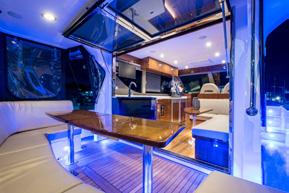
ISLAND GYPSY
40 Wide Body
The stunning Island Gypsy 40 features enough space for up to 7 guests, boasting a generous sized cockpit, a spacious saloon for easy entertaining, and stacks of innovative features complete with a luxurious twin cabin fit out.
• Diesel shaft drive
• Full keel protection
• Generator
• Air conditioning
• Bow and stern thrusters
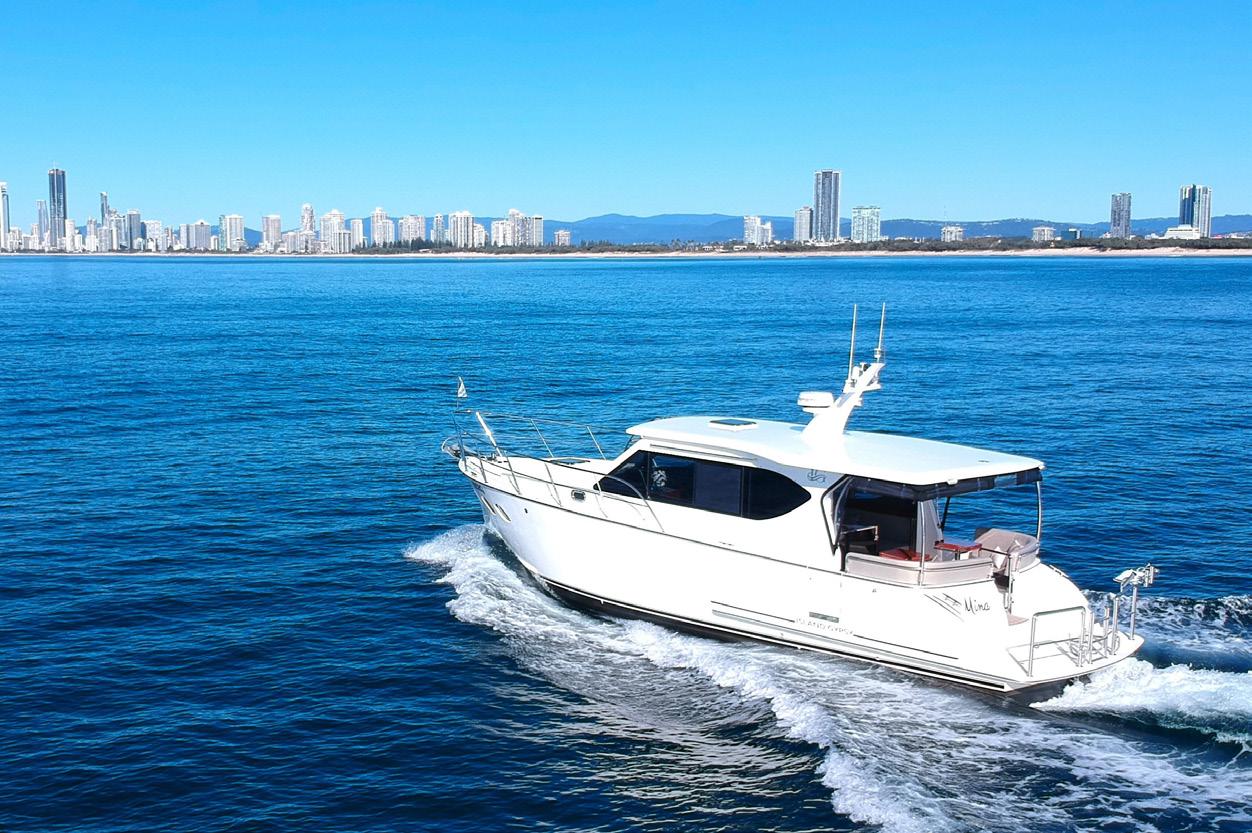
Contact: Brett Flanagan (Director)
DB975 NEWPORT 460 NEWPORT MOTOR YACHTS
Distributed by Newport Motor Yachts P/L
P: 0414 997 654 | info@newportmotoryachts.com.au | www.newportmotoryachts.com.au | Hope Harbour Marina, 9 John Lund Drive, Hope Island, QLD 4212
THE EVOLUTION OF THE
MARITIMO S-SERIES
Chapter 5
Maritimo was only a young company when its first single level vessel appeared. With the first of Maritimo’s ground-breaking flybridge models attracting buyers on both sides of the Pacific, a new, sleek, European inspired C60 was distinctive for both its lack of bridge deck, and expansive entertainment spaces. The ‘C’ stood for Cabriolet, which was a model that demanded attention on release, and certainly time has not diminished this in any way. The Continental styling was paired with the Maritimo signature hallmark aft galley and walkaround decks, which together with the tender garage made the C60 very desirable for that era. Accordingly, they still command a high resale, on the few occasions they do come to market.
Despite a recent offer for the same handsome sum that he paid for the boat back in 2008, Bill Frier says he’ll never part with his beloved C60, that sports the name ‘Number One’ on her transom. “It’s a genuine blue water boat. That’s the difference with a Maritimo – Built for distance. Built for comfort. I’ve got 40 feet of al fresco entertainment space when I open up the doors from the helm to the cockpit. This means I can be driving the boat and I’m still communicating with everybody,” Frier added. Clearly the C60 is very much about the visual cues still held today, with its timeless styling incorporating large saloon and signature aft kitchen, all
embraced within that very open and airy environment, offering great visibility and a connection with the outside.
In many ways, the styling displayed in 2008 with the C60 was further refined in 2021 with the release of the acclaimed S55. As part of the evolution of Maritimo, they were enhanced again in 2023 when the prodigious S75 was presented to the world at the Sanctuary Cove International Boat Show. There is no doubt that the sophisticated elegance displayed throughout the evolution of the S-Series models has led to a greater following, with sales ratios of overall production doubling along the journey. One person who can definitely place it all into context is Australasian Sales Manager, Ormonde Britton. “It was a quick rollout, probably one of the fastest in the company’s history, even by today’s standards. There was demand there, and it was met by the C60, and then the C55 in 2008, followed by the C50 in 2009. They all had three variants, with the Cabriolet being more popular than the open and enclosed bridge versions.”
“The aft garage ended up being less favoured over time, and people began asking for our M-series vessels, but without the bridge deck. This is really how the S-Series was conceived, with the S48 the first in 2015. The S-Series offered all the ruggedness, practicality, long range, and dependability people
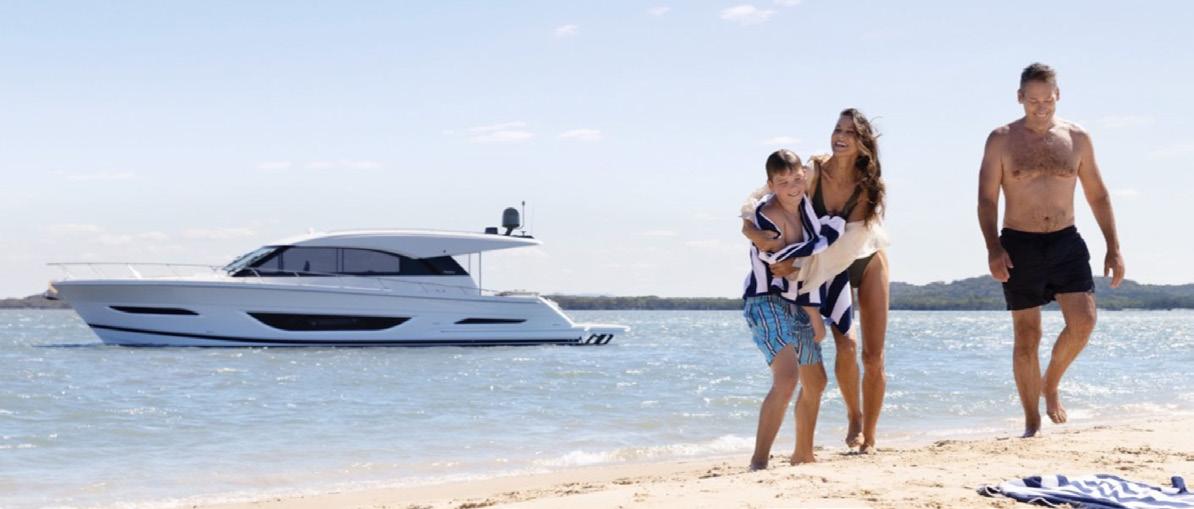
MARITIMO 20 TH ANNIVERSARY CHAPTER 5
114 MAY / JUNE 2024
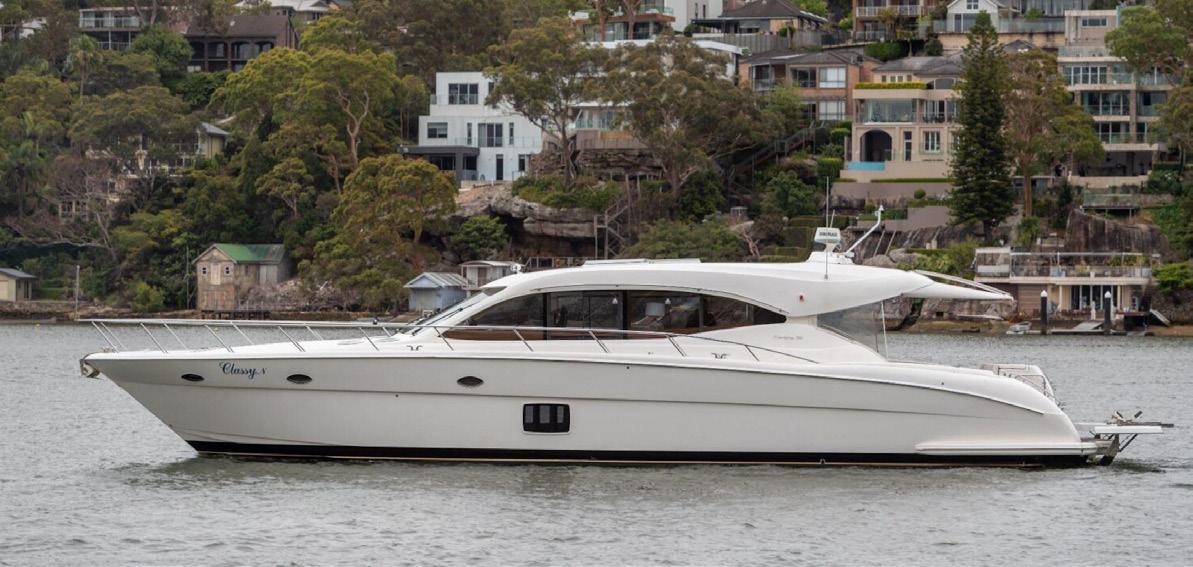
loved, together with a traditional lazarette for all manner of gear, and the tender was on a hydraulic swim platform. The arrival of the latter item into the market was probably the main reason the garage lost favour. “The S-Series craft evolved over time from that first S48, but it was really the arrival of the S55 where the enhanced rake of the windscreen, shorter ‘brow’ or overhang out front, and elongated roof to cover the cockpit deck that created the clearest demarcation between the two variants. Naturally the hulls were the same, but foredecks and saloon layouts became more unique from that model on,” said Britton.
Paul Gibbs, a three-time Maritimo S-Series owner, certainly has experienced and enjoyed the evolution of the S-Series first hand, now owning an S55, and previously the S51 and S43 Sedan Motor Yachts. “They’ve maximised the room in the S55 within the overall width and length. The boat’s got way more volume in it over and above what the 4 extra feet should have offered,” said Gibbs. “The boat went wider in the hull, it’s more upright in the sides, than the 51 and that means the downstairs bedroom gets a flat floor all the way to the sides, making it more comfortable and accessible.”
“We loved our S51 and being able to cruise single level, instead of someone being upstairs and someone downstairs, trying to make a drink and then trying to get back up the stairs whilst moving. The S-Series with the helm next to the kitchen and the fridge is excellent. So very, very enjoyable, and so very together. I thought the S51 was going to be my last boat, but when I saw the S55 under development, the volume it offered, and the included appliances and finishes it sold itself before the boat was built. I had to also build a bigger jetty at home to fit it.” “Single level boaties also take their Maritimo far and wide, such as the client who firstly took their S70 over to New Zealand, and then around both islands.” Britton went on to add.
“By and large, the reason people choose an S-Series Maritimo is a bit like why some people drive SUVs, and others are into sportscars. Perhaps think of it as one person buys the coupé, and another gets the convertible of the same model. It is a choice thing, and we also have the Offshore Motor Yachts for those who want to have the added protection of the enclosed transom for young children or pets.” All in all it is great to either be keeping existing owners in the Maritimo family, or attracting a whole new set of boaties to come and join in,” said Britton in closing.
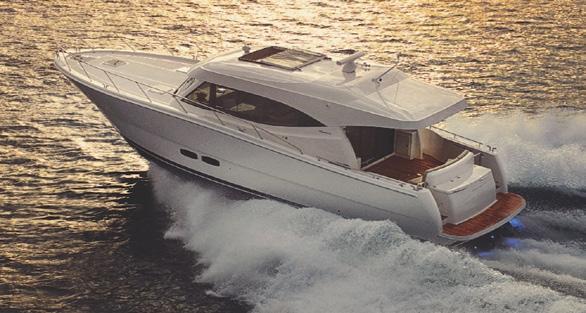
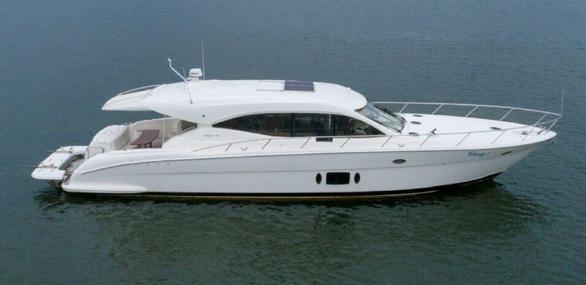
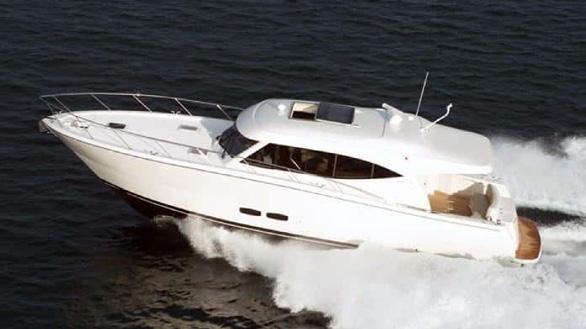
POWERBOATMAGAZINE.CO.NZ 115
THE FAMILY FUN BOAT
THAT’S EASY TO USE
Designed and developed in New Zealand by Greg Sowden (since 2007), Takacat is the original NZ portable inflatable catamaran manufacturer and has since become a global success with more than 11,000 boats sold worldwide.
Not only are they well known, but Takacat is also well awarded, having taken second place for the Altus Most Innovative Boat of the Show award at the 2022 New Zealand Hutchwilco Boat Show with their Takacat T640 Catamaran RIB. Not too shabby
when one considers that the awards were judged based on the most innovative boat, both international and local, exhibited at the show.
I will confess when writing this article, after being out on it for the morning on a fine autumn day at Gulf Harbour north of Auckland, that initially I really hadn’t known what to expect. Having been asked to do the 4.6 boat test just before going on a three-week New Zealand road trip with friends from Canada, I had no time to do my usual pre-test research regarding
the boat. Further, now that I’m in full confessional mode, I didn’t even appreciate what boat I was actually testing, other than it was a 4.6-metre-long inflatable catamaran Takacat.
As I had recently completed a boat review on a Highfield SP560 (see article on pages 156 – 160), a traditional mono hull RIB, I certainly wasn’t expecting the mini-rocket craft that awaited me on the beach at Gulf Harbour! Suffice it to say, the expression “different as chalk and cheese” between the two RIBs, came to mind.
PACIFIC POWERBOAT REVIE WS _ TAKACAT 4.6 LX-R
116 MAY / JUNE 2024
The Takacat brand has been around in New Zealand for almost two decades and over that time has gathered a strong following for its wide range of Catamaran RIBs and traditional inflatables both in New Zealand and overseas. Top features are stability and versatility.
BY RON CZERNIAK, MARINE JOURNALIST
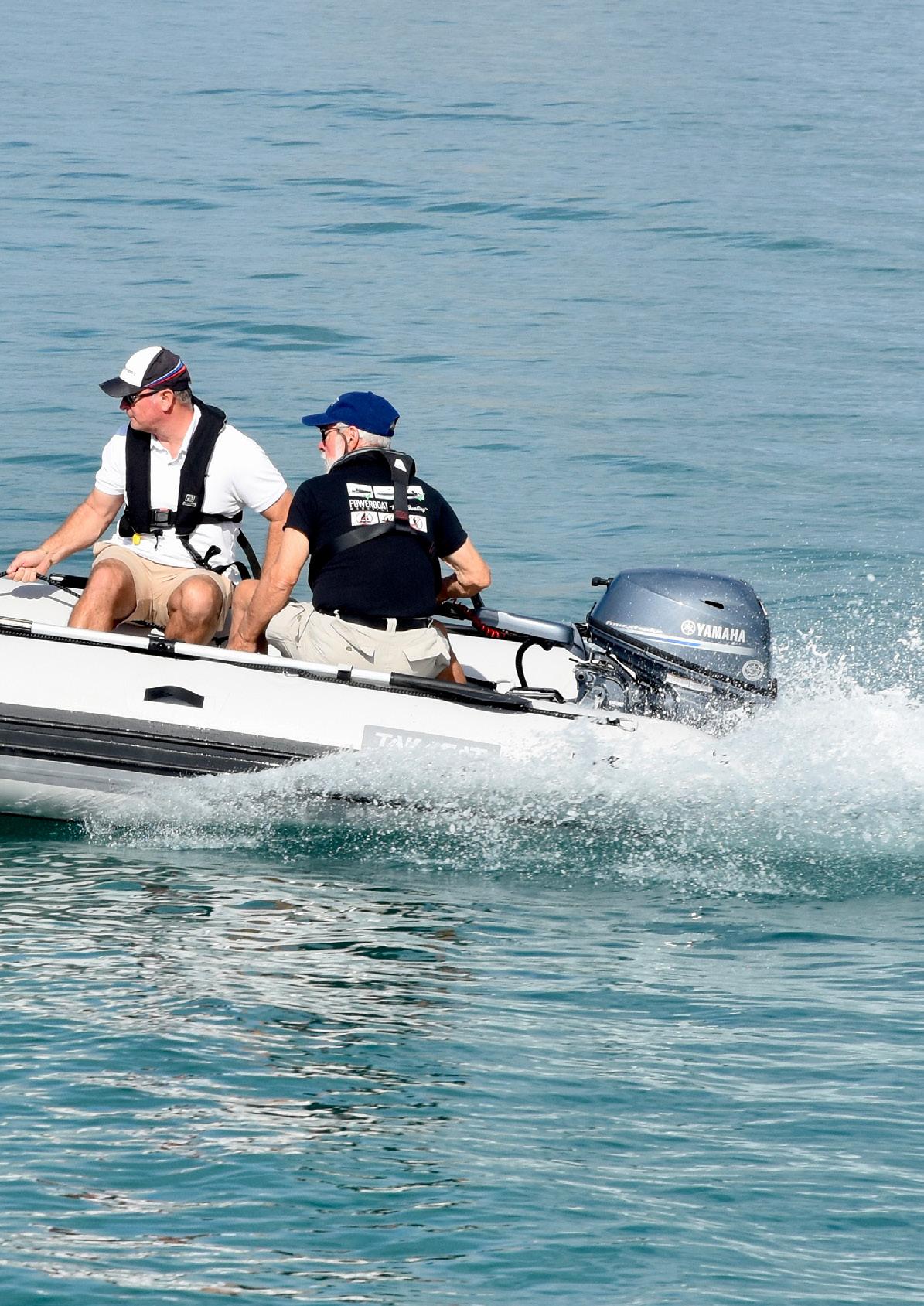
I’ll be honest, when I first saw this ‘platform’ sitting on the sand, I thought, “Oh, oh, maybe I should have brought my 3mm shortie wet suit along, this is looking like I might get wet”. But my initial concern and surprised reaction was soon to be changed. As Paul Powney (owner of Takacat NZ) and I pushed the vessel into the water (didn’t take much pushing as this is an extremely shallow draft boat) and climbed on board, I asked him to slowly motor out to our test site to demonstrate and tell me a bit about this unusual looking vessel, which at this point from my past
experience, I could only liken to a surf lifesaving type of craft.
Paul explained that their aim was to introduce an affordable family fun boat that was safe and easy to use as well as functioning as a suitable large tender. It had to be fast, efficient, and built tough (think of your teenage kids using this boat). So, the new Takacat LX-R series are built tough with performance in mind. What makes the LX-R’s tough is a durable dual plate 3mm alloy deck and central 3mm alloy hull (which isn’t really in the water when the
boat is up on the plane – more on this later) married to 1.2 mm TPU (Thermoplastic Polyurethane) welded inflatable tubes. The deck is finished with a durable and easy to clean composite decking material, which also adds to the aesthetics of this otherwise Spartan looking craft. With a beam of 2 metres, the oversized tubes provide exceptional buoyancy and load carrying capacity – this boat is rated to carry up to 8 passengers or a maximum load of 830kg. But what I found unbelievable, was that it is also rated to take up to a 50 HP (36.8 kW) outboard motor! More on this later as well.
POWERBOATMAGAZINE.CO.NZ 117
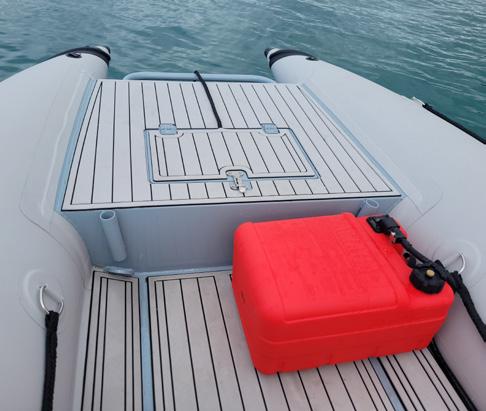
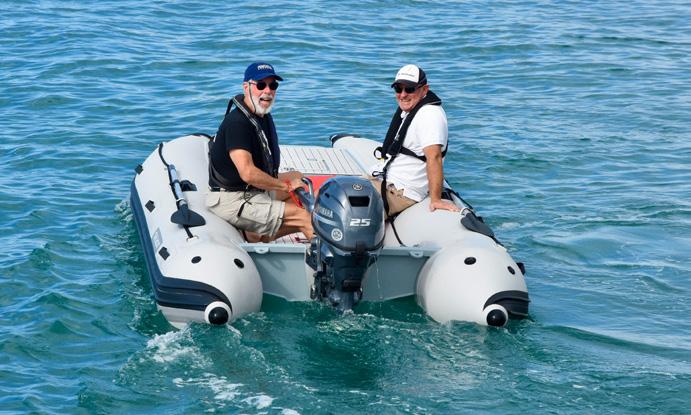
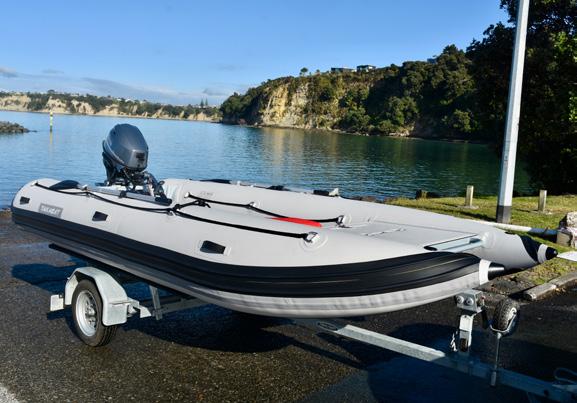
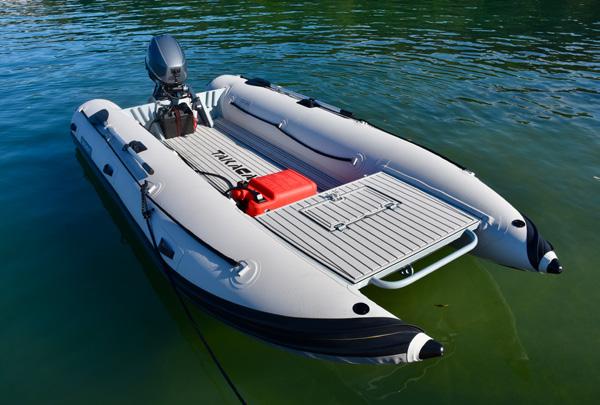
Houston, we are preparing for launch
Optional trailer provides easy launch/ retrieve capability.
Uncluttered, complete, easy to use package.
With ‘how to use’ instructions completed; Paul swapped places with me. Him mid-ships on the starboard side tube and me towards the stern on the port side tube for easy access and use of the throttle and steering arm of the 25 HP Yamaha Four Stroke outboard motor. Speaking of motors, please recall my comment above regarding the fact that this boat is rated for up to a 50 HP motor. Suffice it to say, after playing around on the 4.6 for about an hour, with just two of us on board, the 25 HP Yamaha was more than enough, thank you! In fact, there is so much torque with this motor, that the throttle control can be somewhat ‘twitchy’, and a firm hand and strong arm are required when executing more ‘adventurous’ manoeuvres. The mind boggles as to what this boat would perform like fitted with a maximum 50 hp motor!!! Not for the faint of heart, that’s for sure.
Fortunately, or unfortunately, depending on your point of view, we encountered an exceptionally beautiful, sunny, tranquil day out on the water. With a smooth sea, it was difficult to find out how this craft would perform in more tumultuous conditions, and we had to satisfy ourselves with finding wakes caused by the numerous large craft exiting the Gulf Harbour marina on this fine Easter Monday, in order to bang this boat about.
But first things first. After a few minutes of experimenting with the throttle and general steering response, I asked Paul to hold on while I executed a dead in the water to full throttle straight line acceleration run. Wow! This small performance platform got up on the plane within several seconds and as a few following runs, authenticated by Paul’s handheld GPS attested, we were hitting over 20 knots in no time, and on one run hit 23 knots. Exhilarating is the expression that came to mind. Envisage excited, happy face emoji here.
Okay I hear you saying, but straight-line runs are one thing, what about agility? My exact thought dear reader. So, after asking Paul if it was okay to give it my darndest, I set out to see if I could throw both of us overboard (slight exaggeration folks) as I proceeded to put the 4.6 through as many tight as possible, high speed turns as I could manage. Both of us hanging on for dear life, this boat refused to endanger us. No matter how tight the turn, whether a tight circle or S-type zigzags, it just stuck to the water like glue, with nary a hint of sliding out of control.
Yay, yay, but what about the rough stuff? Seeing a large launch exit the entrance to the Gulf Harbour Marina and beginning to quickly accelerate, thus throwing up a large wake, we headed aft of its stern to
Large swim platform showing huge bow locker hatch with anchor rode and fuel tank secured against forward bulkhead.
PACIFIC POWERBOAT REVIE WS _ TAKACAT 4.6 LX-R 118 MAY / JUNE 2024
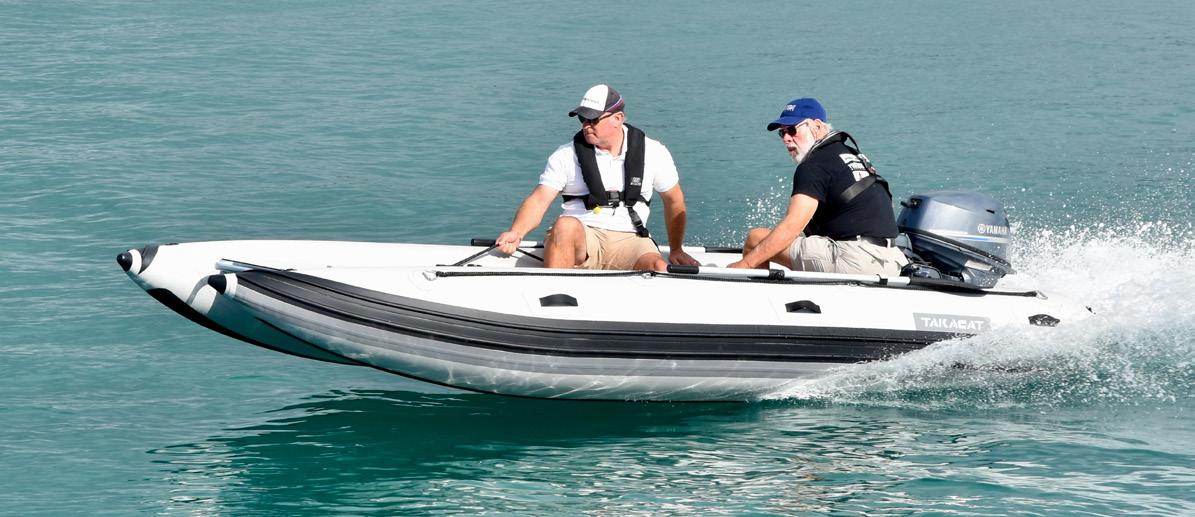
hammer the RIB through the substantially generated wake waves. Throwing caution to the 20 knot (self generated) wind, we hit the first wave with force and hanging on to both the throttle leaver and the safety line fitted along the inflatable tube, I fully expected to have my teeth fillings loosened, but I was most pleasantly surprised by two things. One, the expected spine numbing thump didn’t eventuate and two, my expectation of getting us soaking wet didn’t happen. Must have been a fluke, but no. Further attempts to make visiting a spinal specialist a priority and to also seek a change into dry clothing were not necessary. How did this magic occur?
Slowing the craft down, and idling back to the breakwater where our illustrious photographer was recording our antics, I asked Paul why we were still dry and in one piece?
Simple. It all has to do with the design of the dual plate hull/deck design and the larger than usual inflatable tubes. You will recall that near the beginning of this article I mentioned the part about the alloy hull which isn’t actually in the water when the boat is up on the plane? Therein lies the secret. When we hit the wake wave, the deep-V hull alloy deck design came into play slicing through and providing an air pocket that cushioned the wave impact and, although throwing a lot of water, the large inflatable tubes deflected most of the wave. Just so there is no misunderstanding, as I am oft accused of a certain amount of hyperbole, I would be stretching the truth in saying there was zero hard impact or a no amount of wetness. The point is, both were far less than expected and my spine was none the worse for wear and my clothing remarkably dry.
But allow me to mention a bit more about the clever dual plate hull and deck design. Suffice it to say that the ‘space’ between the hull and deck is, for lack of a better word, hollow. This is most easily seen if you look behind the battery box secured to the transom.
There you will see a large, ‘D’ shaped opening in the deck plate allowing you to observe (when the boat is riding still in the water or at anchor) water in the hull cavity beneath the deck, with a large, unbunged drain hole at the stern of the hull space. What’s this all about? Well, as Paul explained, being a catamaran it’s naturally stable at rest. However, for additional stability the drain port can be opened allowing water to fill the deck cavity through this stern hole, providing an exceptional amount of ballast, ensuring that the 4.6 won’t tip, even with a person standing on one of the inflatable tubes. What a great feature if you are using this boat for fishing, or especially SCUBA diving, when stability exiting the boat or hefting yourself back on board is paramount. So, while divers may elect to heave themselves back into the boat over one of the tubes, an easier option on this craft is to climb in over the bow platform between the inflatable tubes (refer also below). As an inexpensive dive boat, this small inflatable is definitely worth considering and although it can take up to four divers with all their equipment (remember the 830 kg maximum load rating?), it is perfect for just two divers with a safety ‘surface’ person on board. When you are ready to head off again, as soon as the boat gets up on the plane, all that water ballast quickly drains out through the
Up on the plane in seconds and hanging on!
(Below) Ballast water quickly drains as the 4.6 gets up on the plane.
POWERBOATMAGAZINE.CO.NZ 119
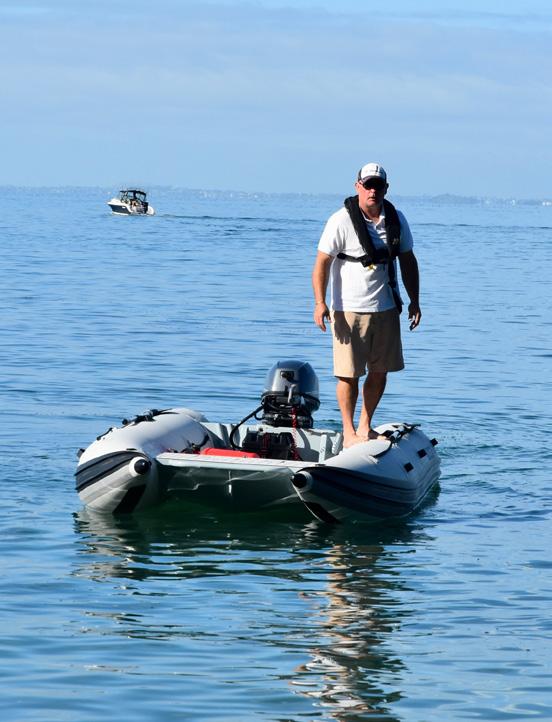
Now that’s stability!
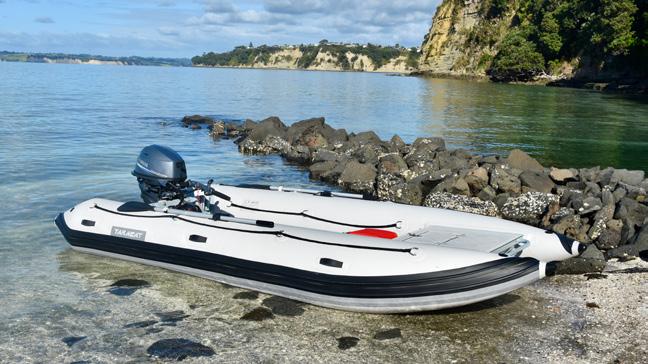
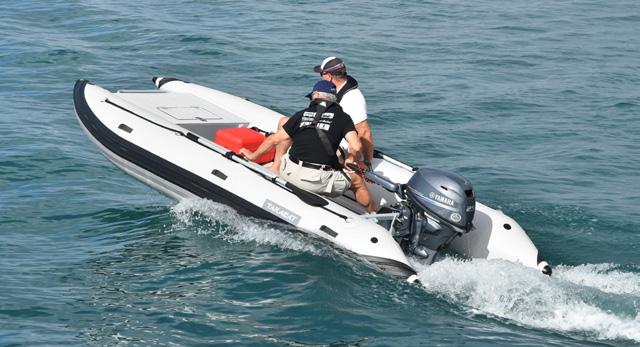
large diameter, unbunged stern outlet hole. A bung is provided with the boat for those times that you may not wish to have the hull cavity full of water.
One of the most popular water sports in New Zealand (as well as many other parts of the world) is sport fishing and the designers have not forgotten about our fisher folk. Rod holders abound, with four rod holders on the stern transom and two up forward, port and starboard of the anchor/storage locker. The interior of this craft is so roomy that four fishers will be able to comfortably enjoy their day without crawling all over each other. The forward locker could easily double as a fish storage tank, about which I have further personal thoughts which I will discuss later, along with the other bow features of the boat.
This craft has a unique bow in many ways, and I’m reminded of a manta ray, with its broad gaping mouth between mandibles designed to help it feed on small fish such as krill. Between the inflatable tubes is a large deck tread laminated bow platform that not only houses a large, multipurpose (in my mind) hatched locker, but also an extended tubular alloy rail welded to the bow platform, which serves more than one purpose. The most obvious, referring to diving, is to grab onto it before or after a dive and then utilising it to help you climb back aboard, which I feel is a much better option than climbing over either the port or starboard inflatable tubes. To this end, Paul mentioned that a ladder of sorts could also be hooked to this rail and employed to make getting back into the boat that much easier. You will note in the bow image on
Page 118, that there is also an unobtrusive, welded retrieve ring just aft and below the bow rail for your trailer winch cable to hook onto during boat launch or retrieval. Takacat provides a trailer at an extra cost –see below for details.
However, since I’ve already made such a big deal about it, let’s look at that ‘dual purpose’ bow locker. Firstly, for a boat this size, the locker and latched hatch lid are comparatively monstrous! Not only is there more than ample room for an anchor and adequate length of anchor rode (anchor locker), but there is also enough room left over to store additional gear such as fishing tackle boxes and other gear (storage locker). Note also that when the lid is closed when the boat is at anchor, there is a small, curved opening on the middle of the forward hatch lid edge (that could frankly do with being a bit bigger) for the anchor rode to sit in when the hatch is closed.
But what about that water in the forward locker? Paul and I discussed this while we were motoring back to the boat ramp. The water does get in there on purpose, as the space between the hull and deck is open and, with a large drain hole at the stern, water floods when the boat is at rest to provide ballast, as explained above. I pointed out to Paul that while the bow locker can be used for storage, things stowed there do get wet. This led to the conclusion that perhaps new builds will have the forward locker sealed with a drain bung, thus completely sealing off the forward locker when desired. Therefore, allowing for the best of both worlds. Ballast when required, dryness when needed.
Shallow draft makes beach access a dream.
PACIFIC POWERBOAT REVIE WS _ TAKACAT 4.6 LX-R 120 MAY / JUNE 2024
Well that was fun!
Before concluding, just a few other small things to be mentioned. The boat is built to ISO and CE Standards and as such, does come equipped with oars and, if needed, an optional inflatable seat can be fitted centrally athwart ships to sit on while rowing. There are a two, full cockpit length ‘grab ropes’ installed along both the top of and inside of both inflatable tubes. With a “speed demon” craft like this, grab ropes are essential! In addition, there are three carry handles on the outside of both inflatable tubes. The 25-litre portable fuel tank is secured forward against the bow locker bulkhead and the fuel supply tube, encased in protective plastic hose guard coil, is tucked out of the way under the curve of the starboard tube. The battery (for electric outboard motor starting), housed in a strong plastic battery box comes with a BEP battery on/off switch unit mounted to one end of the box. Finally, there are a total of four substantial lifting eyes welded to the transom and the forward locker bulkhead for those owners who want to lift their 4.6 aboard their larger ‘mother ship’. All these features, as well as a few more are summarised in the table below.
TAKACAT 4.6 LX-R SERIES TECHNICAL DATA
Standard Features
• 4.6m x 2m x 550mm
• 8 Pax or 830 kgs maximum load
• 1.2mm TPU Inflatable Tubes
• Strong welded seams
• Pressure relief valves on both tubes
• 4 x Air Chambers
• 3mm alloy deck
• 6 x Rod holders
• 2 x Tow eyes welded on the stern for pulling water toys
• Protective rubbing strips along both tubes
• Rubber keel protection
• Non-skid, hard wearing, soft composite decking
• Oars and fitted oarlocks.
Pricing: NZD $14,995 incl GST for standard scope of supply
• Trailer options from NZD $3,500 incl GST
• As tested, a Yamaha 25 hp 4 stroke with electric start, trim and tilt installed NZD $8995 incl GST
• Boat/Engine/Trailer Packages from $27,495 incl GST
Summary:
Takacat's large diameter tubes and catamaran hull design provide exceptional stability. When you are out on the water, whether boarding from a mother ship or enjoying a spot of fishing or diving, you will really appreciate the stability of the 4.6 LX-R Takacat. There are two other large hull variations available; a 4.2m and a 5.0m and three configurations available in the smaller hull variations, being 3m, 3.4m and 3.8m.
The light weight, low resistance catamaran hull design provides quick and level planning, exceptional stability, and fuel economy. Boasting a shallow draft with loads of buoyancy also allows for extremely shallow water navigation plus the ability to get further up the beach or boat ramp. In short, a family fun boat that’s easy to use.
Contact: Paul paul@takacat.co.nz or phone +64 21 822285 or visit TAKACAT.CO.NZ


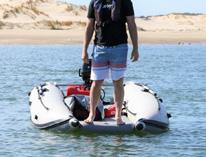
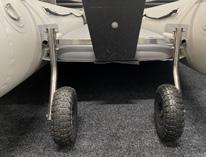
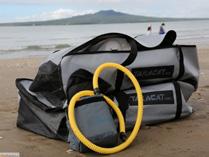
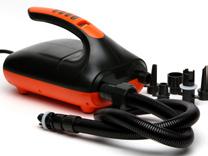
ULTIMATE PORTABLE BOATS SINCE 2007 Takacat NZ Ltd sales@takacat.co.nz | P: (+64) 021 822 285 DB874 www.takacat.co.nz
POWERBOATMAGAZINE.CO.NZ 121
BOATING SAFELY
BEING PREPARED AND WEATHER WISE
For the leisure sailors and weekend warriors of Aotearoa and its picturesque coastal areas, the allure of the sea is undeniable. The promise of tranquil waters and the thrill of navigating the sea beckon many to embark on maritime adventures. However, the beauty of New Zealand's waters is matched by their unpredictability, making weather awareness not just a skill but an essential aspect of safe boating.
COASTGUARD EDUCATION _ BOATING SAFELY
122 MAY / JUNE 2024
THE CRITICAL IMPORTANCE
OF WEATHER CHECKS
Before setting out on the water, one of the most crucial steps is to check the weather conditions. The sea is a dynamic environment, highly sensitive to changes in weather. Conditions that seem benign at the start of your journey can quickly become treacherous, affecting not only the pleasure of your day but also its safety. Wind strength, rain, visibility and sea state are all influenced by the weather, and being caught unprepared can lead to unpleasant and dangerous situations.
Sources such as the weather channel on your VHF marine radio can provide vital updates for mariners, offering localised weather information that is crucial for planning a safe journey. Additionally, digital tools like the Coastguard App, Windy, and PredictWind have become indispensable for boaties, providing real-time forecasts, wind maps, and tide information. These resources allow sailors to make informed decisions about when to set sail and when to stay ashore.
WEATHER'S QUICKSILVER NATURE
New Zealand is known to have 4 seasons in one day and the maritime climate is no exception. A sunny morning can quickly give way to gusty winds and rain by afternoon. These changes are not merely inconveniences; they significantly impact boating conditions. Wind shifts can alter the course you need to steer to maintain your planned track, sudden rain can reduce visibility, and unexpected changes on the water can affect navigational plans. The chop, or small-scale waves created by wind, is particularly sensitive to weather changes. A sudden increase in wind speed can transform a smooth surface into a rough, challenging terrain for boats, especially smaller vessels. It is also important to note that tidal flow can have an affect sea state. When wind and tidal flow are in the same direction the sea state will be calm, but once the wind or tidal flow changes, so that the two forces oppose each other, the sea will become noticeably choppier.
This just highlights why it is so important to check the state of the weather on a regular basis throughout your day or weekend away. Weather patterns can change quickly and if you are a few hours away from a port you need to know what is happening on the water.
One of the easiest signals of a weather change is the sky. Being perceptive and seeing the clouds shape change can indicate a change in weather. There are four main types of cloud and they each give you an insight into the weather and any changes that may be coming your way.
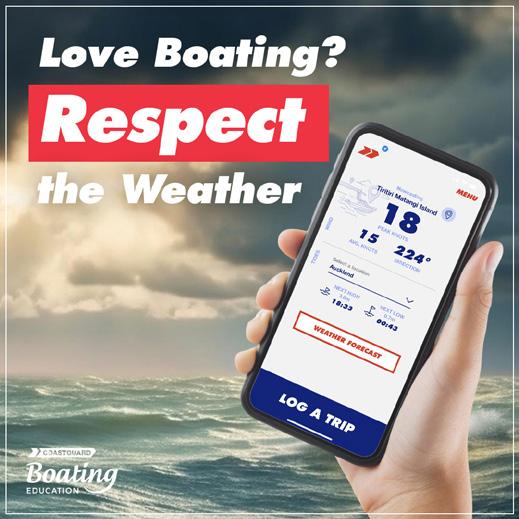
CUMULUS CLOUDS: Often likened to fluffy cotton balls floating leisurely across a blue canvas, cumulus clouds are the epitome of a sunny day's charm. These clouds are low-level formations, typically indicate fair weather. However, when they grow taller, they can evolve into cumulonimbus clouds, heralding localised thunderstorms.
CIRRUS CLOUDS: High above the earth, cirrus clouds paint delicate strokes across the sky. These wispy, feather-like formations are composed entirely of ice crystals, reflecting the sunlight in breathtaking ways. Cirrus clouds are often seen as weather's artists, hinting at changes in the air currents and signalling a change in the weather.
STRATUS CLOUDS: The overcast skies that bring grey days are often the work of stratus clouds. These low, uniform layers cover the sky like a blanket, sometimes bringing light mist or drizzle. Stratus clouds might not boast the drama of towering thunderheads or the ethereal beauty of cirrus formations, but their presence is a familiar part of the landscape, especially in cooler, damp climates.
NIMBUS CLOUDS: Bearing the Latin name for "rain," nimbus clouds are the bearers of precipitation. Whether in the form of rain, snow, or sleet, these clouds are dense and dark, loaded with moisture ready to be released onto the earth below. Cumulonimbus and nimbostratus, subcategories of nimbus clouds, are particularly associated with heavier weather phenomena, including thunderstorms and continuous rain showers. Understanding weather dynamics is crucial for navigating safely. Always make sure you have a passage plan with a few options of where you might be able to anchor if the weather changes even if you are just going out for a day.
POWERBOATMAGAZINE.CO.NZ 123
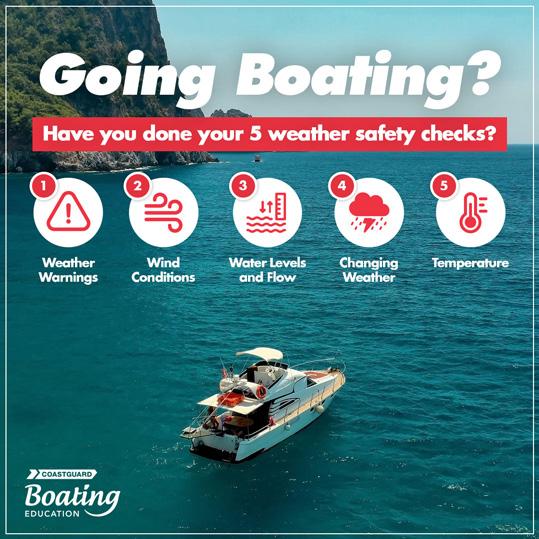
SEASONAL WEATHER VARIATIONS AND HYPOTHERMIA RISKS
Transitioning from summer to winter also brings a host of changes to New Zealand's coastal weather patterns. Cooler temperatures, increased precipitation, and stronger winds are common, affecting sea temperatures and overall boating conditions. For leisure sailors, understanding these seasonal shifts is essential for proper preparation.
One of the most significant risks associated with colder weather is hypothermia. Immersion in cold water can rapidly draw heat away from the body, leading to a dangerous drop in core temperature. This risk underscores the importance of having the right gear onboard and knowing what the sea temperatures are as part of your weather assessment before heading out. Wearing appropriate thermal protection and having emergency gear onboard can make a critical difference in safety.
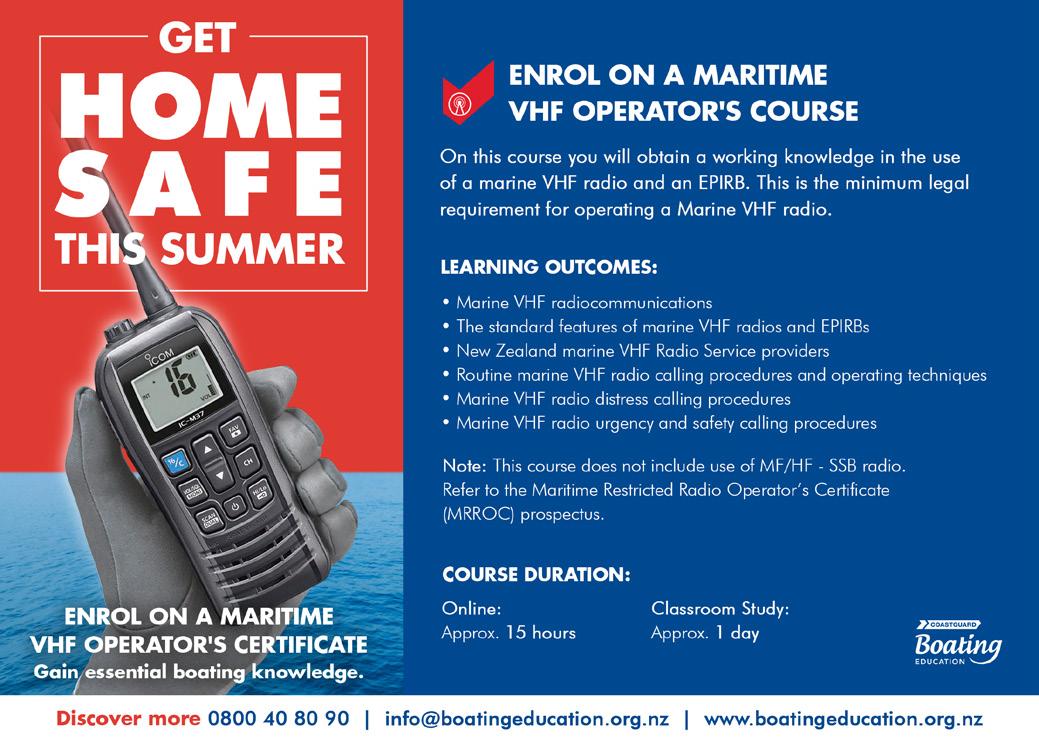
COASTGUARD EDUCATION _ BOATING SAFELY
124 MAY / JUNE 2024
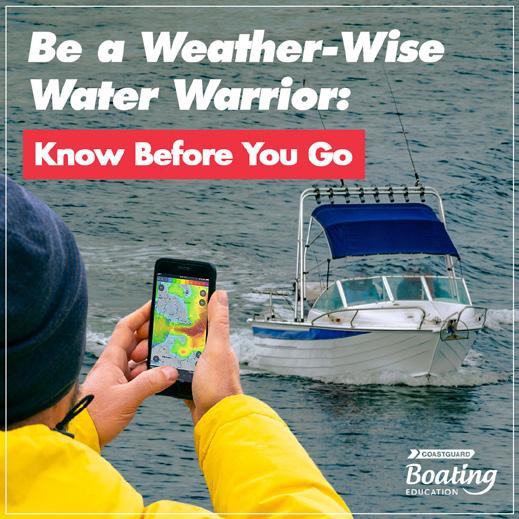
CONCLUSION
For those who love to get out on the water, weather awareness is the cornerstone of safe and enjoyable boating. By utilising reliable weather information sources and understanding the profound impact of weather on sea conditions, boaties can navigate with confidence.
Remember, the sea's mood is reflective of the sky above; so keep an eye on this and always check a reliable weather source!
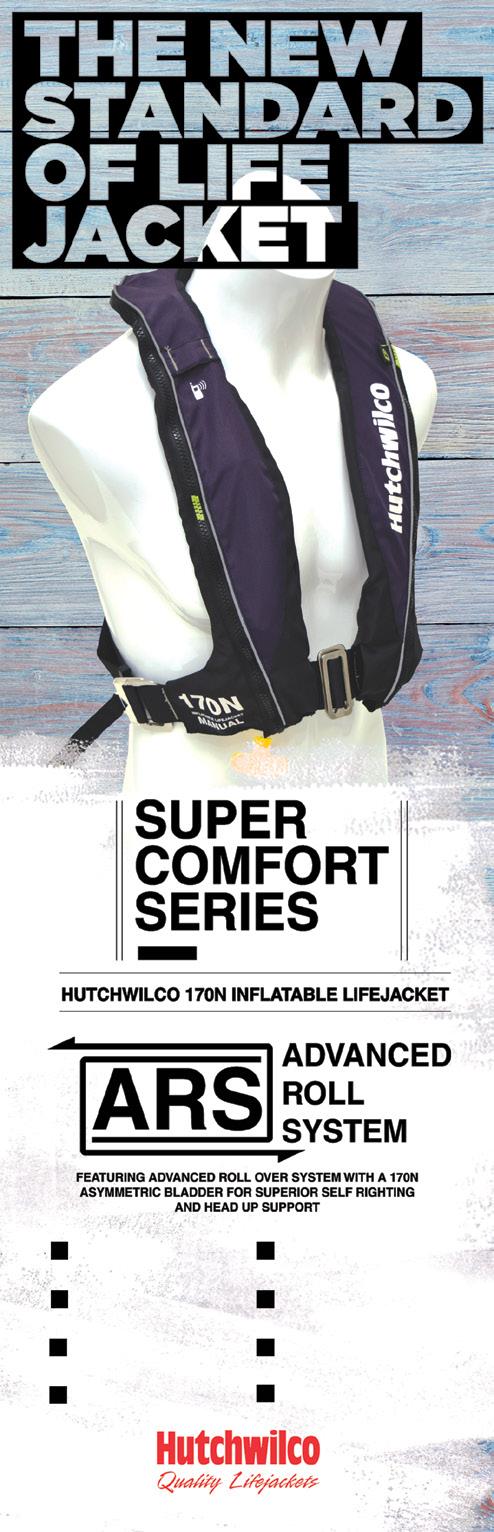

BOATINGEDUCATION.ORG.NZ
POWERBOATMAGAZINE.CO.NZ 125
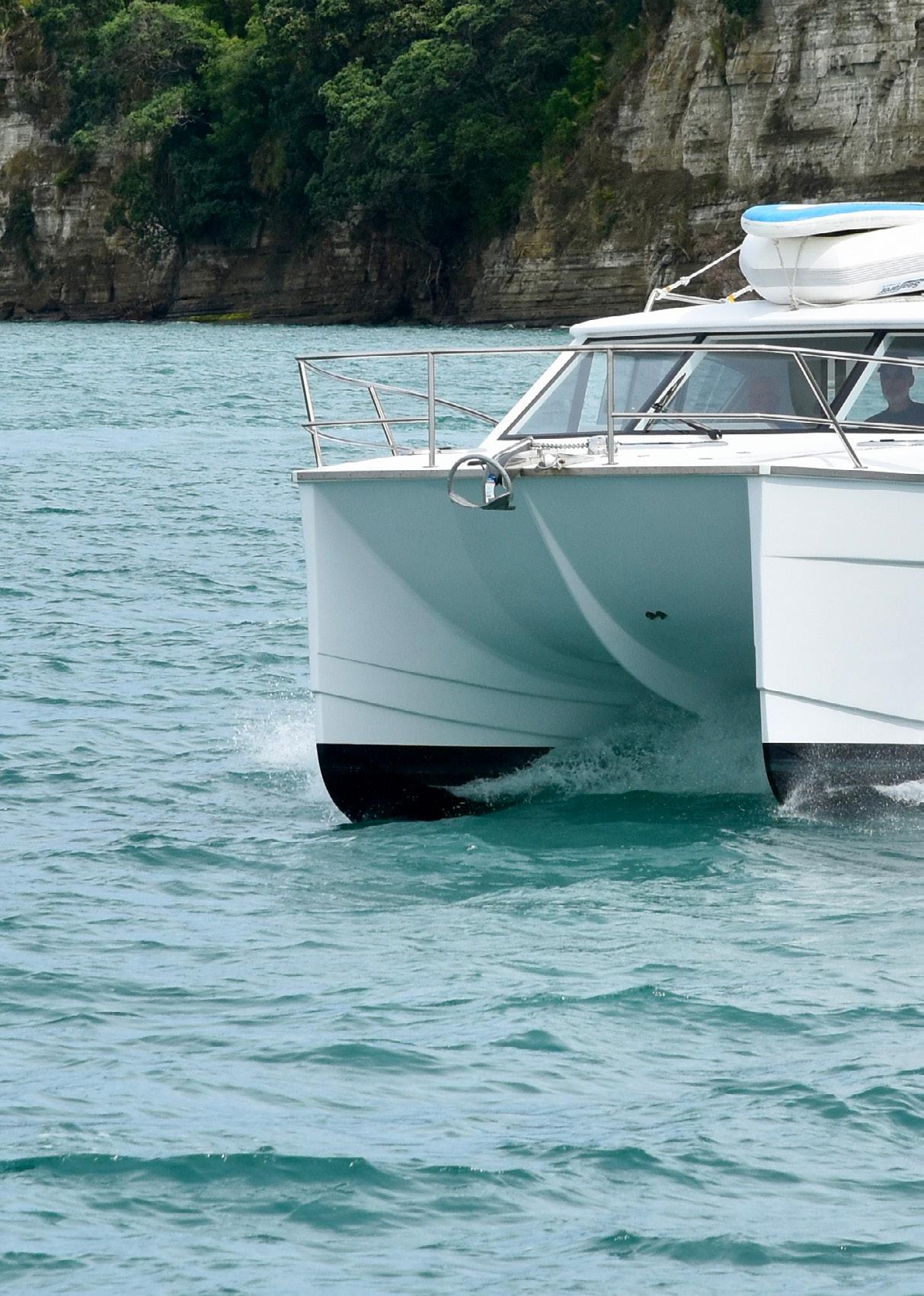
PACIFIC POWERBOAT REVIE WS _ LEECH 33 (1025M) POWER CATAMARAN A TRUE ON WATER MARVEL 126 MAY / JUNE 2024
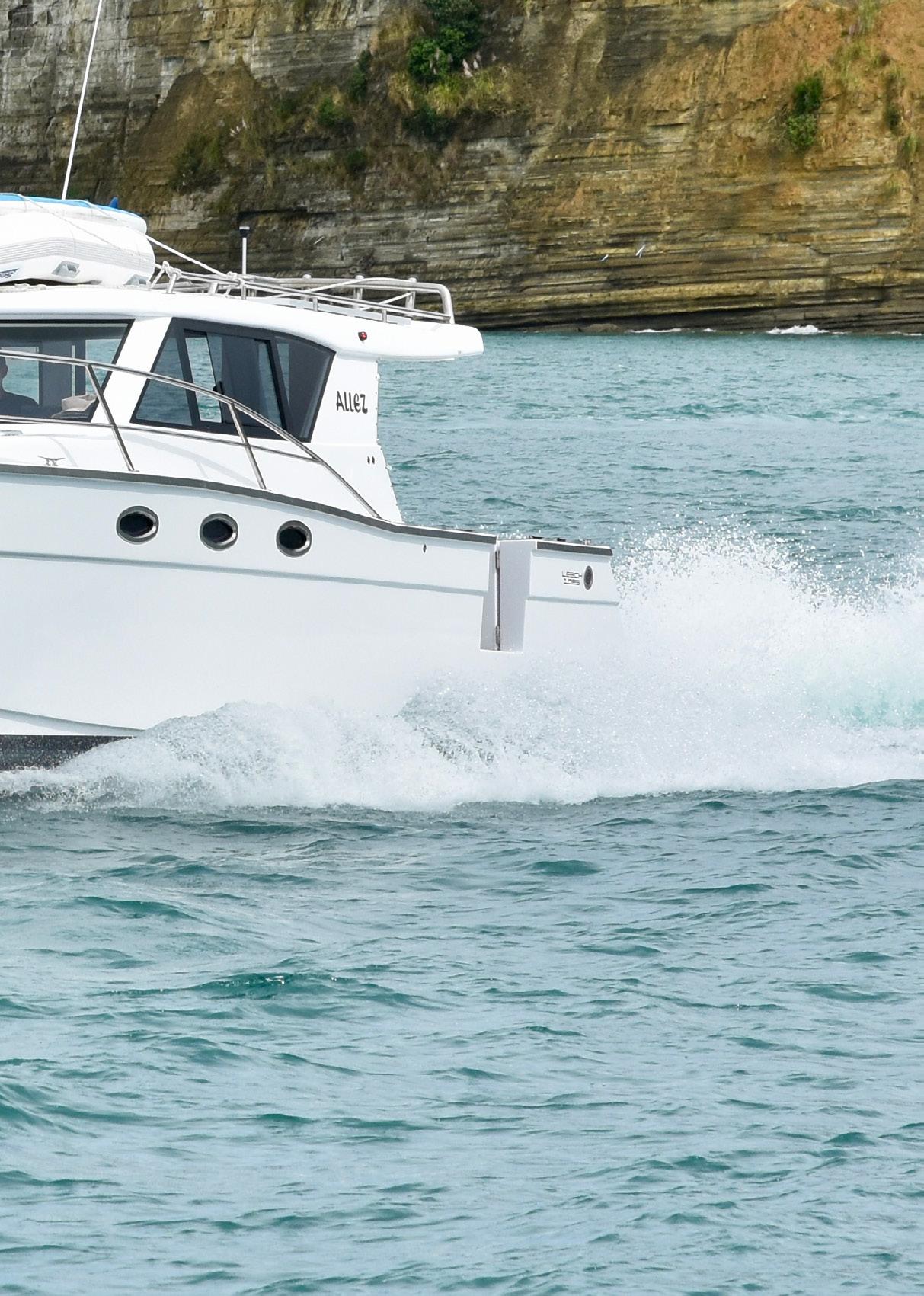
The New Leech 33 (1025) Semi Displacement Power Catamaran incorporates the latest thinking from designer Dan Leech.
BY RON CZERNIAK, MARINE JOURNALIST
POWERBOATMAGAZINE.CO.NZ 127
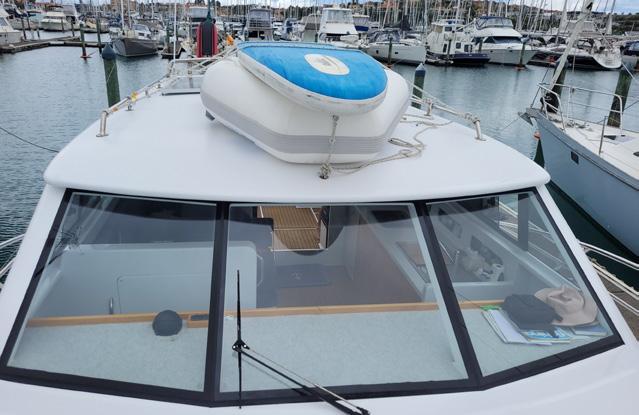
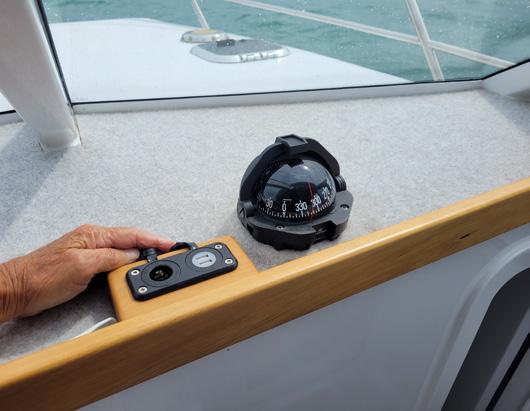
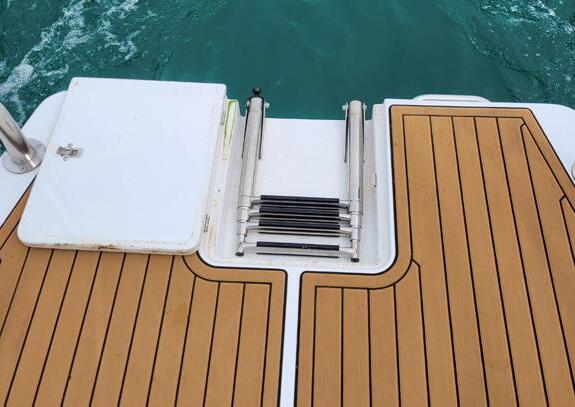
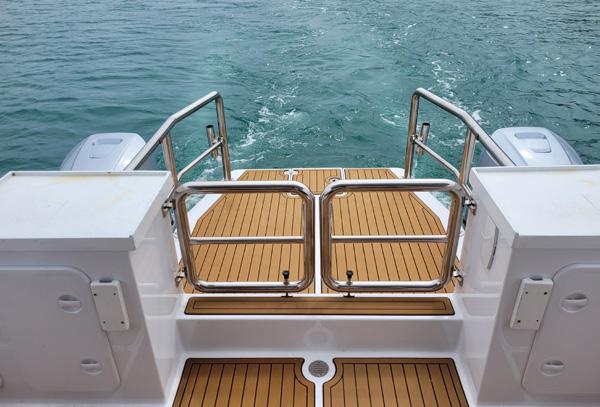
Ideally situated Plastimo compass and extra charging outlets.
Stern boarding ladder sits snugly concealed at aft end of the swim platform.
Massive cockpit area with large swim/dive platform extending between twin Honda 115 HP outboard motors.
Recently, on a slightly overcast, but warm late February day I was invited aboard “Allez”, the new Leech Designed 33’ - 1025 power catamaran owned by Paul Spence, an ‘old sea dog’ and ex-Air New Zealand pilot. Having possessed twelve different boats, of all sizes and types (barring a sailboat) during his long boating lifetime, Paul certainly knew what he wanted when he commissioned Dan Leech to design him “Allez” – which, depending on what translation from French to English you feel is most appropriate, means: ‘Come on!’, ‘Go!’, ‘Hurry up!’, or the one that I thought was most applicable to Paul and his boat, after being out on it for the morning, was ‘You’ve got this!’. And indeed, Paul has!
When I asked Paul, why this boat at this time of his life, his answer was simple. Just that – he wanted simplicity. I liked that, having always been a proponent of the ‘K.I.S.S. (Keep It Simple Stupid) Theory’ during my rather lengthy career in the marine industry. And, although my experience on larger power catamarans has been limited, I have sailed on many a sailing catamaran. That large, vertical stick aside on the latter; what is common to all catamarans is their roominess and stability. “Allez” is no exception. A lot more on this later.
“Allez” was built for Paul in Nelson by Allspec Marine, with this new Leech design offering an incredibly soft ride while exhibiting excellent fuel efficiency and sea keeping. In part, the good sea keeping is achieved by means of the, not too narrow, semi-displacement hull form. Reasonable volume in the hulls equates to good accommodation within the hulls.
Dan is a naval architect graduate from the Westlawn Institute of Marine Technology, and a qualified boat builder, who has succeeded as a naval architect for over 20 years. Having had experience in computer 3D modelling, drawing, and creating detailed CNC cut files for a long list of boats, from high performance composite race yachts and power boats to pleasure yachts and launches as well as commercial work boats ranging in materials from composite, aluminium, steel and plywood, Dan believes that the practical experience of hands-on boat building has provided him a very good grounding for good design practice. It is, therefore, not surprising that Paul Spence chose the Leech 33 (1025) as, if not his ultimate boat, perhaps his penultimate one?
Built from full composites and with a very highquality level of construction using e glass (epoxy resin) laminates and epoxy resin skins on either side
Pane windscreen with centrally located wiper and cabin top storage for inflatable and SUP board.
PACIFIC POWERBOAT REVIE WS _ LEECH 33 (1025M) POWER CATAMARAN 128 MAY / JUNE 2024
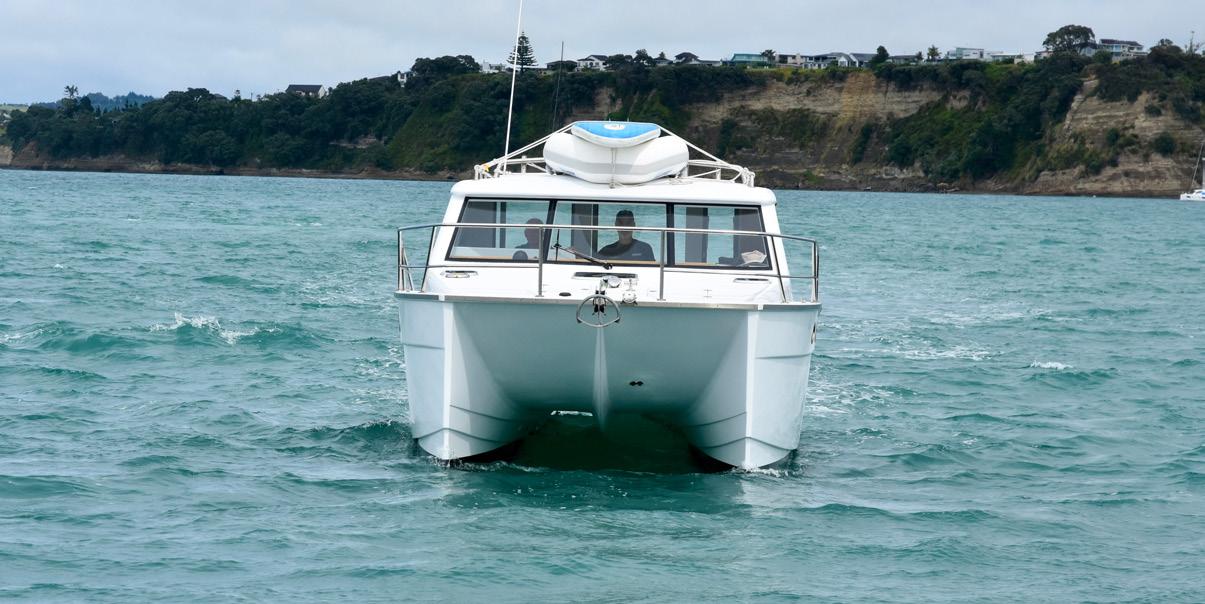
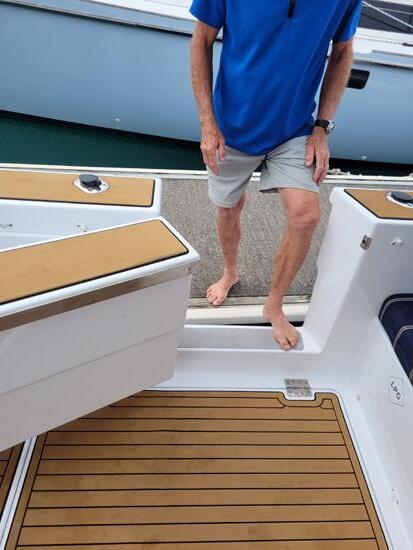
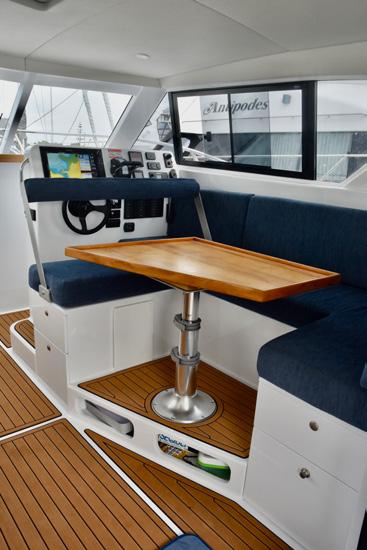
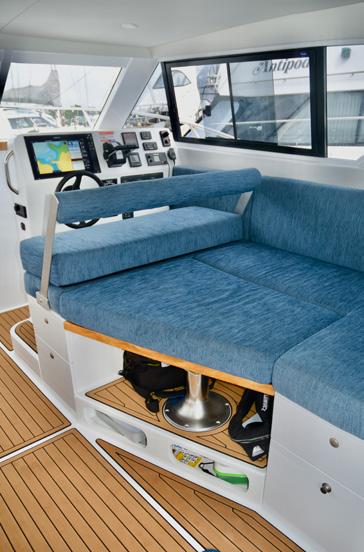
of a foam core, it is a very stiff and strong structure, but lightweight, enhancing the boat’s performance. Using a foam core also makes it a very quiet and well insulated boat.
But before reporting on our actual ‘boat test’ it will be useful to keep the following in mind as this article progresses. Firstly, this craft combines innovative design with practical features, such as full standing headroom throughout the boat. Both a queen-size berth and a separate head/shower are situated forward, along with quarter berths in both the port and starboard hulls. A large galley, just inside the entrance from the cockpit, is positioned along the port side of the saloon opposite the starboard side large U-shaped settee and hydraulically adjustable pedestal table that can form an additional double berth, when required for those extra guests (grandchildren?) who are staying
onboard for the weekend. A clever feature of this settee is the backrest at the bow end, which can be ‘flipped’ forward or aft, providing back support to the helmsperson while underway, or a backrest for a diner at mealtime.
Getting back to the galley for a moment, one is immediately impressed with the simple (hmm, that word keeps coming up), orderly design and layout. The long galley bench contains everything you need, with nothing extraneous. Fridge at the aft end of the galley unit, a hard wearing, laminate bench top with a gas hob (which can be covered when not in use, thus providing more countertop workspace), a S/S sink and drainboard for washing up dishes and a removable wooden chopping board over the sink. There are convenient ‘open’ lockers behind and above the countertop for dishes, mugs, storage containers,
Skegs designed for beaching are located on the underside of each hull, enabling the boat to rest on sand or mud when required.
Ports side, cockpit side door for easy entry from marina berth.
POWERBOATMAGAZINE.CO.NZ 129
Convertible helm station/dining area back rest.
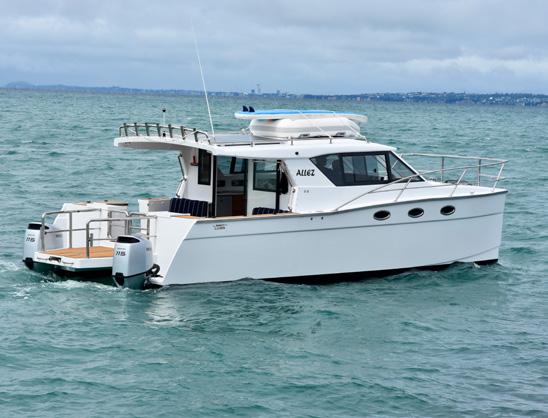
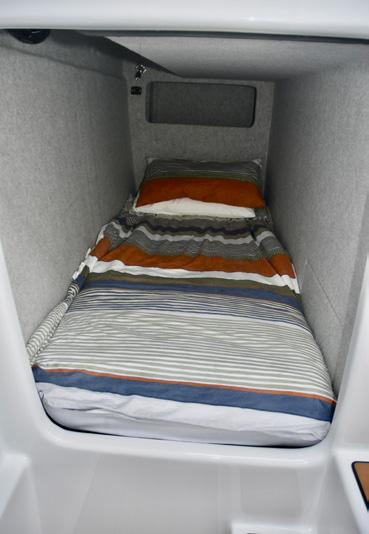
The orderly design and layout of the galley makes for easy
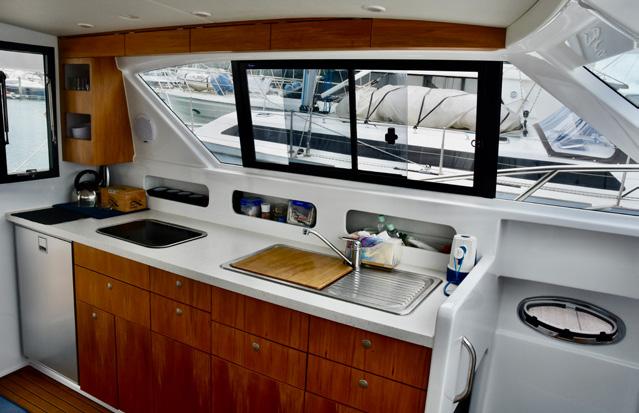
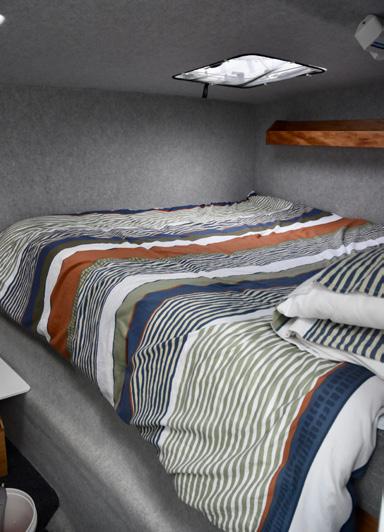
washing up and cleaning items, etc. Below the counter are numerous, wood faced storage cupboards and drawers with push button open/close latches, ensuring they stay closed at sea and don’t protrude, thereby preventing you or your clothing from getting snagged while moving about the cabin. Importantly, the aft cabin bulkhead has a gas strut supported opening window which, along with the large opening port side window above the bench and a sliding cabin door, allows the saloon to open to the cockpit, giving great indoor/outdoor air flow. Essential when cooking. The hardtop roof extends aft over the wide cockpit for sun and rain protection as well as protecting the cabin interior when the door is open.
The massive cockpit has an aft side door on the port hull for easy access from the marina berth, a considerable aft boarding platform, fishing rod locker, massive under-floor storage, saltwater wash down hose, built-in seating and the list goes on. However, I was most impressed with the cockpit side door. Keeping it simple again. Just unlatch and swing open
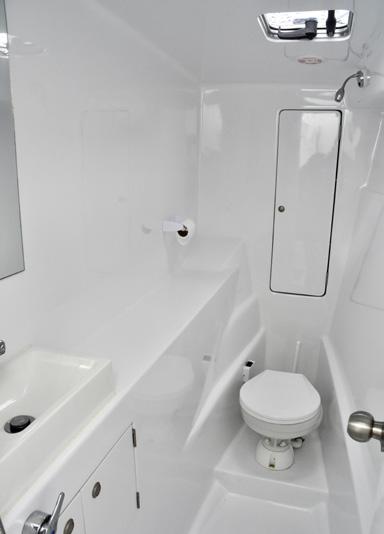
the solid door and step on board. How good is that?
When under way, the door securely latches shut and is hardly noticeable as you scan your eyes along the smooth lines of the hull.
Entering the cockpit, you cannot help but notice the easily accessible and expansive aft boarding platform located between the twin Honda 115 Four Stroke outboards. Just swing open the dual stainless-steel gates and, hey presto, ample room as a swim platform, a place to stand and fish (rod holders abound along the cockpit topsides and there are two bait boards at the stern of the cockpit). A stainless-steel ‘rocket launcher’, mounted atop the stern edge of the cabin, provides for seven more fishing rod holders. And, as a long-time diver, I was mightily impressed with the great exit/entry area for SCUBA diving. The boarding ladder slides snugly below an integrated hatch lid, which is barely noticeable at first glance. Simple!
Powered by twin Honda 115hp 4 stroke outboards, (an optional foil is available for added performance).
meal preparation and clean up.
Single berth cabin - both Port and starboard sides
Master cabin with large, queen size bed.
PACIFIC POWERBOAT REVIE WS _ LEECH 33 (1025M) POWER CATAMARAN 130 MAY / JUNE 2024
Roomy, well-lit and ventilated head/ shower area.
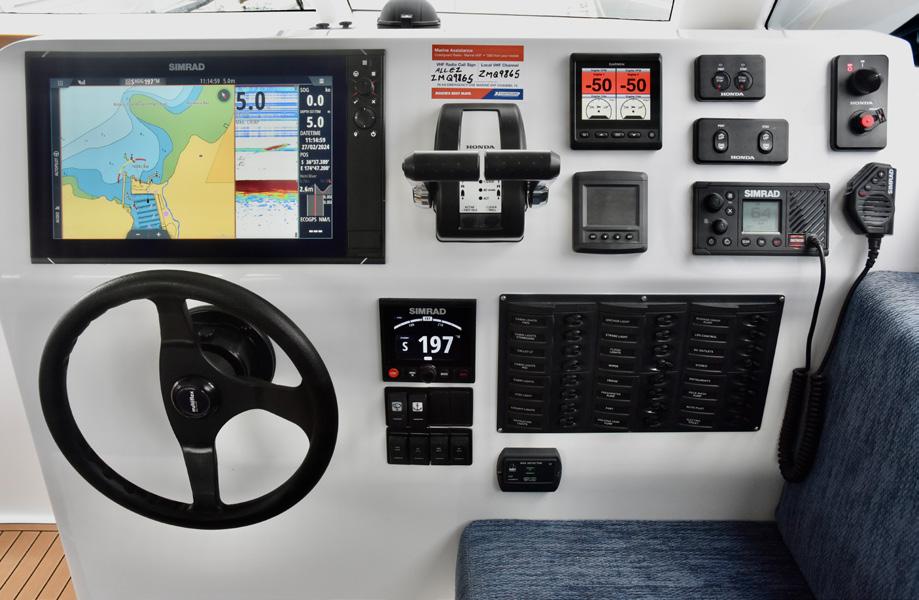
The lightweight structure and efficient hull design allow small engines to be used and provide low fuel consumption.
Access to the port forward cabins is via three steps leading down on the left side, forward of the galley bench. As with all catamarans one is always impressed with the amount of room on board compared to whatever the external dimensions of the craft may be. The Leech 33 (1025) is no exception being approximately 33.1 feet (10.1 metres) in length and with a beam of approximately 12.5 feet (3.8 metres). Not a huge boat in other words, but when you go below the space seems absolutely cavernous! At the base of the three well-lit (courtesy of a strategically positioned opening portlight) deck tread covered non-slip stairs, you will find immediately to your left as you look towards the stern, the first single berth cabin tucked under the galley. Comfortable and snug but long enough for a normal height adult, it is ideal for children. Turning back around and stepping forward towards the bow, one opens a cabin door to discover a very large step-up queen-sized bed which, while somewhat filling this private master cabin, at the same time leaves the space feeling airy and light, due in no small part, to a large opening privacy tinted see through deck hatch. And, at nighttime, several, well-positioned LED reading lights provide all the light you should need. There is ample headroom above the bed and, as mentioned previously, full head room when standing up and getting undressed and
ready for bed. A convenient storage shelf is situated along the wall above the length of the bed and a clothing locker is built into the forward bulkhead, left of the bed with a storage drawer under the step up to the bed.
Climbing back up the three steps and exiting the port hull, as you wander over towards the helm station, one thing immediately stands out. There is an unexpected narrow passageway between the helm station and the forward windscreen area. Makes perfect sense once you notice it, but not the norm to say the least. However, I like it. It’s clever and simple. This passage allows you access to the starboard hull cabin and head/shower area via, once again, three well-lit, (did I mention the discreetly recessed down lights on the face of each step?) deck tread protected steps. As with the port access passage, there are strategically located grab handles conveniently mounted ensuring there is little chance you’ll be knocked off your feet in a heavy sea – providing you hang on as you go below.
Once down these three steps you will see, to your right, a second single berth cabin tucked fore and aft under the helm station. Directly opposite this cabin is the roomy head/shower. Once again, simple and functional comes to mind. Everything you need is there in the well laid out design. Toilet forward and facing aft with a reading light and permanent air vent above it. There is also a small opening Maxwell hatch on the cabin top. A vanity sink/cupboard unit,
mirror and shower are on the port side just past the entrance door and a storage (wet weather gear?) locker is situated behind the toilet. All surfaces are finished in smooth, white fibreglass making for easy cleaning and maintenance. A glance of the vessel schematic below will quickly reveal how all this is integrated.
Now that I’ve mentioned it, I realise that the entire boat gives off a feeling of being easy to clean and maintain. Simplicity once again. Which leads us to the all-important helm station.
I have to say, I don’t recall a more well thought out and functional helm station. It is as though you say to yourself; “Where’s the throttle control?”, and there it is –exactly where it ergonomically should be – at the correct height just to the right and above the steering wheel, as you stand or sit at the helm. Navigation instrumentation? The 4060mm/16” Simrad NSS16 Evo3 MFD Screen is bang above the steering wheel exactly where it should be for you to easily glance down and read information as you need it, while keeping your eyes on the sea and land masses ahead of you. Need to file a trip report or make an emergency call? Instinctively reach out and to your right and there’s the Simrad RS20 VHF radio and mike. All engine control and information instrumentation and the BEP 24-way DC circuit breaker/isolator panel appear to be naturally where they should be. Good layout design isn’t that hard if you keep it simple. Besides all the things
1. Simrad NSS16 Evo3 2. Simrad AP44 Autopilot Control 3. Simrad RS20 VHF 4. Honda Twin DBW Binnacle 5. Garmin GMI20 gauge 6. BEP DC Systems Monitor 7. Honda Start/Stop 8. Honda Engine Trim Panel 9. Honda Key Switch 10. BEP DC circuit Breaker Panel 11. BEP gas sensor 1 2 3 10 11 4 5 6 7 8 9 Electronics - Well laid out and functional helm station: POWERBOATMAGAZINE.CO.NZ 131
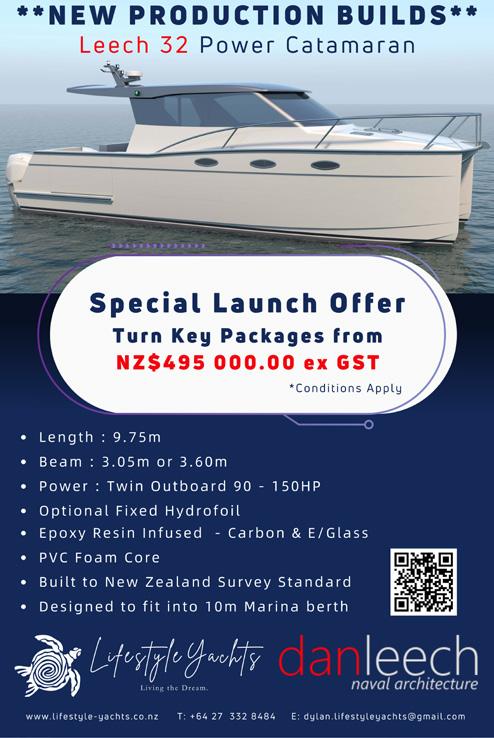
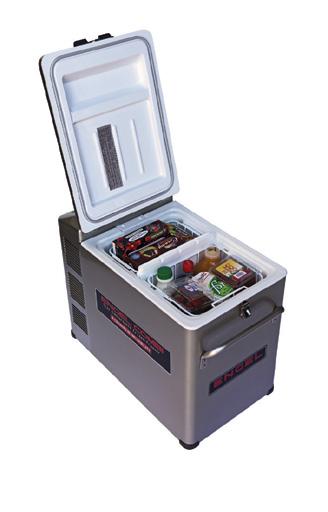

you’d expect to be in or around the helm station, there are also little things which make a big difference. Such as lots of USB type phone and tablet charging points, Fusion RA210 stereo system controls, 120/240 AC ports, convenient grab handles and the list goes on.
One thing I particularly liked, in this day and age of electronic navigation, was the purposefully placed Plastimo compass. Directly in front of the helm person but mounted on the windscreen shelf across the narrow passageway in front of the helm station, where it is easy to see and read. Nice little extra touch: two charging ports sit to the port side of the compass. All in all, an extremely well thought out and constructed helm station. However, and please appreciate I am not being nitpicky about this, I felt the placement of the windscreen wiper at the base of the centre screen of the three separate windscreen panels was not ideal. When I asked Paul about this, he agreed, saying that they really wanted the wiper mounted at the base of the starboard windscreen panel, but space constraints made this difficult, so it ended up under the middle windscreen panel. One negative out of otherwise 100% positives ‘isn’t bad.
Wanting to investigate the anchor set up, I edged forward along the starboard side deck of the boat to the bow, the numerous grab rails and handles along the way imparting a sense of confidence that unless you were to do something totally stupid, you were unlikely to go overboard.

The uncluttered bow deck area, as you would expect by this stage, was simply and practically laid out. The Maxwell RC8 rope/chain anchor winch is partially offset to starboard, but in direct line to the substantial bow roller, allowing for a secondary “day anchor” bow roller, with convenient rope mooring cleat directly aft. Mirror image bow lockers – chain locker to starboard and storage locker to port, provide more than ample room for plenty of rope/chain rode and capacity for fenders, etc. respectively. As anchoring is controlled primarily from the helm station, Paul elected to have only an ‘up’ winch footswitch on the bow. The large, low-profile Maxwell main forward cabin opening hatch is positioned centrally, aft of the winch. More than adequate, high stainless-steel rails surround the bow providing a real, as well as psychological, feeling of safety when working up forward.
Standing at the bow and looking aft you will see the centre windscreen wiper I mentioned earlier, as well as noticing that Paul utilises the cabin top deck space to store his inflatable dinghy and SUP board. Aft of these craft are large solar panels which, as Paul explained, are ample for enabling the fridge to be run full time, without utilising the house batteries.
LAYOUT
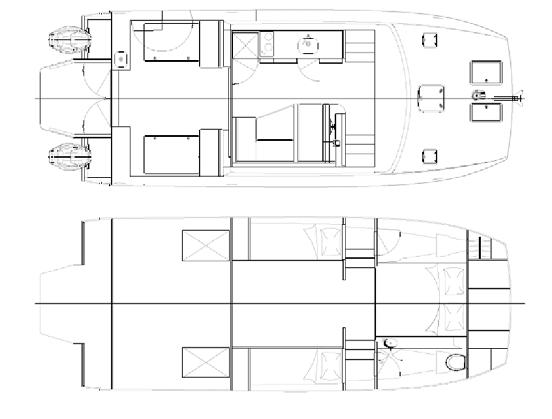
PPB0714
new model is a new combination Fridge and Freezer, with added features including the removable internal divider and thermostatically controlled fan. The MT45FCP gives three versatile configurations; Freezer 16 litres / Fridge 23 Litres (total 39 Litres) option 1 Refrigerator Only (Divider removed total 40 Litres) option 2 Freezer 22Litres / Fridge 17 litres (total 39 Litres) option 3 This model also includes the user-friendly digital control with LED display, along with built in battery monitor. Supplied with both cords, the 12 volt cord that plugs straight into your vehicle’s cigarette socket and the 240 volt lead with three pin plug, (Auto switching). For more information visit: www.engelnewzealand.co.nz Three-Year Warranty Engel’s latest addition
Engel 40 Litre Combi Fridge / Freezer This
132 MAY / JUNE 2024
SPECIFICATIONS
Beam 3.800m
Draft (engines tilted up) 0.460m
Displacement 4250 kg
Construction Epoxy / E glass (epoxy resin) laminates and PVC Foam Core
Fuel 2 x 380L petrol
Fresh Water 2 x 210L
Price when launched NZD $700,000.00 (approximately)
Dan Leech Naval Architecture
LEECHBOATS.COM
PERFORMANCE
This may sound like a cop out, but you know, when it comes to power catamarans and reasonably calm seas, you kind of expect that such a craft is going to perform well. While Paul tried his hardest to fire us through selfgenerated wake waves, execute tight circles and S-type turns, you just knew that “Allez” was going to go, ‘Oh-hum, here we go again” and effortlessly drive us through the water. And so she did. Having had a thoroughly enjoyable morning out on the Leech 33 (1025), I would love to have the opportunity to be out on her on a ‘messy’ sea, just to see how she’d handle it. But seriously? I think that you kind of know the answer, don’t you?
In summary, the Leech 1025 promised an incredibly soft ride, fuel efficiency, and excellent sea keeping. It lived up to its promise on all counts - a true marvel on the water!
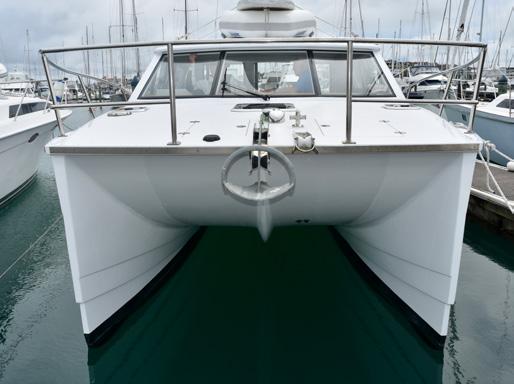
Uncluttered foredeck is simply laid out and very functional
PERFORMANCE DATA
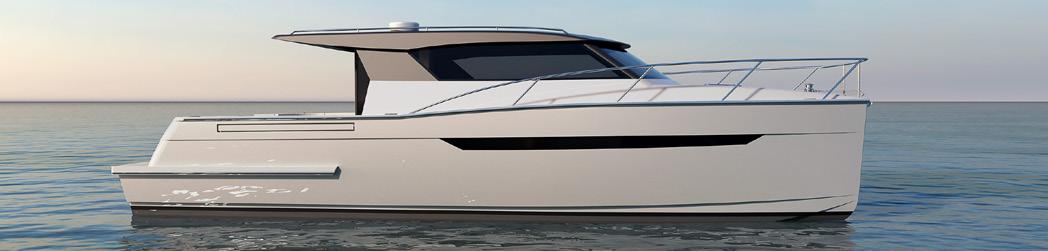
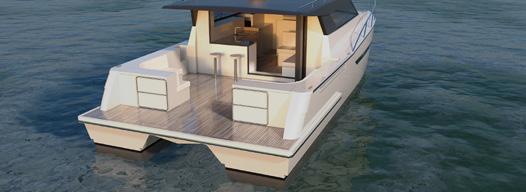

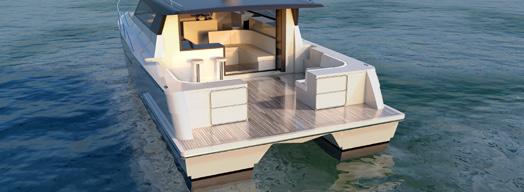
Leech 38 currently under construction in Australia LEECH POWER CATAMARANS LEECH 28 LEECH 32 LEECH 33 LEECH 36 LEECH 38 www.leechboats.com E: dan@leechboats.com T: +64 27 306 2423 DB988
RPM Knots L/h L/nm Range 750 2.3 2.4 1.1 630 1000 3.0 3.6 1.2 580 1500 5.0 7.4 1.5 460 2000 5.8 10.0 1.8 390 2500 7.5 14.4 2.0 350 3000 10.9 21.6 2.0 350 3500 14.5 28.2 2.0 350 4000 17.3 35.6 2.1 330 4500 20.0 51.6 2.6 270 5000 22.2 72.0 3.3 210 5200 23.0 80.0 3.5 200 NOTE: Range is calculated using 90% of the stated fuel capacity *Sea conditions calm to moderate with a 10-12 knot W/SW wind
10.25m
Length: (including bow sprit)
10.10m
Length: (excluding bow sprit)
Length engines tilted up (including bow sprit) 10.475m
Waterline Length 8.85m
POWERBOATMAGAZINE.CO.NZ 133

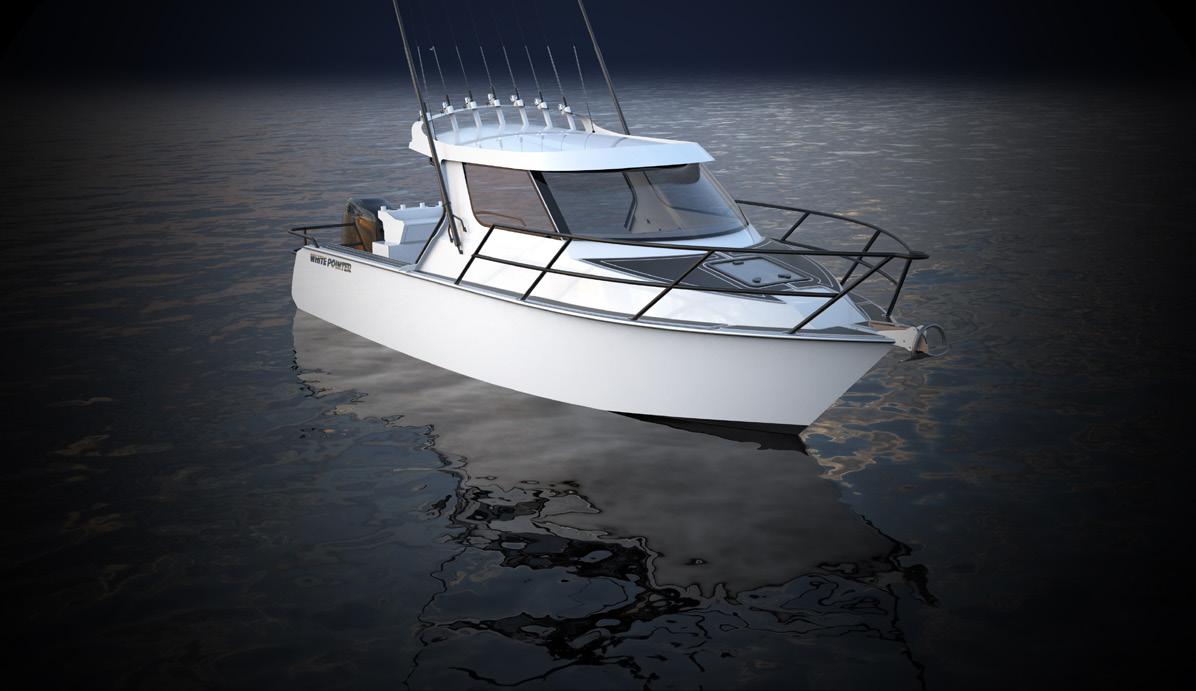
WHITE POINTER TO RELEASE 30-YEAR ANNIVERSARY MODEL
Celebrating three decades of custom alloy boat building and craftsmanship, White Pointer Boats is releasing a new ‘30-Year Anniversary’ model, to be released for the first time at the Hutchwilco New Zealand Boat Show, May 16-19.
“After 30 years of custom alloy boat building, and over 600 boats having left our Gisborne factory, we are excited and proud to be bringing one of our most popular models to the show that has been given a major makeover,” says White Pointer Boats Managing Director, Rex Briant.
Based on the company’s popular 730 Sports Cruiser model and with input from customers and the team of boat builder’s at White Pointer, the new model is a culmination of 30-years of expertise and passion from Briant and his team of alloy craftsman.
“Our 730 model has been one of our most popular boats in the range, and over the years has seen every conceivable option fitted, we wanted to showcase its versatility and take it to the next level with this new model. “The 730 has been a model that people start their White Pointer journey in, and then they continue on up the range, with some now in their fifth or sixth White Pointer.”
The new ‘745 Sport Cruiser’ has been designed and built to be the perfect size for offshore game fishing expeditions as well as family water sports and just cruising and exploring in the lakes and coastlines in both New Zealand and Australia.
The 745SC is 7.45m, but will measure in at 7.8m in length overall. It will boast large external and internal dimensions with this particular one fitted with an extralarge 400L fuel tank and partnered with a modern high performance four-stroke outboard will have an impressive range. While the exact engine is yet to be specified, the hull’s power range is 225350hp. A large sturdy bow rail is a great safety feature along with the transom cage that will provide extra functionality when it comes to fishing. The internal layout will be practical, roomy, yet packed with plenty of features and function ideal for family day boating or extended trips away. Seating comfort has been further enhanced and will conceal innovative features, making the most efficient use of space. Add to that, the
new 745SC has White Pointer’s standard 10-year hull warranty.
Like all White Pointers, the hull shape is a key factor. White Pointer has continued its traditional method of shaping the hull skin over a predetermined interlocking frame and girder type structure. Combined with a welding sequence that can produce a rounded compound curve hull shape that squeezes the water out rather than slapping over the top.
“This process can only be achieved on a heavy steel jig as the force and technique to shape up to 8mm plate is so immense. This process is a more traditional method and not followed by the well-known production builders.
“We’re so excited for this new model, especially the guys in the factory who are making this boat their own. It’s not often we get to start with a clean sheet of paper, but after 30-years, we want to make this boat something really special. We’re excited to unveil it in Auckland in May. WHITEPOINTERBOATS.CO.NZ
134 MAY / JUNE 2024
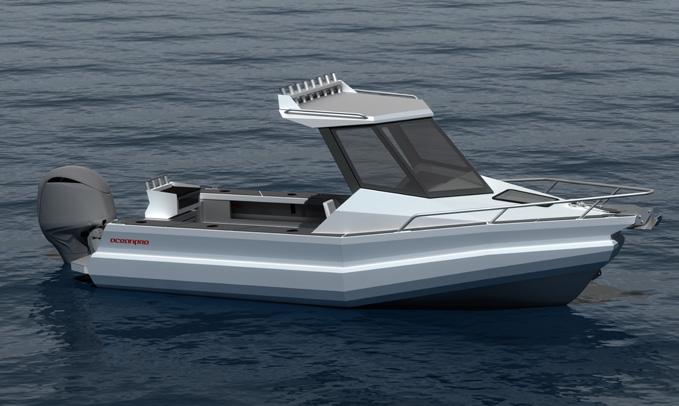
OCEANPRO BOATS NEW MODELS
Oceanpro 620 currently underway and a 535 on drawing board.
Oceanpro Boats are currently building a new Oceanpro 620 hardtop (keep an eye out for a full review in an upcoming issue of Powerboat magazine). They also have a new 535 Centre Console model on the drawing board. More to follow on this as it reaches build stage.
OCEANPRO.CO.NZ
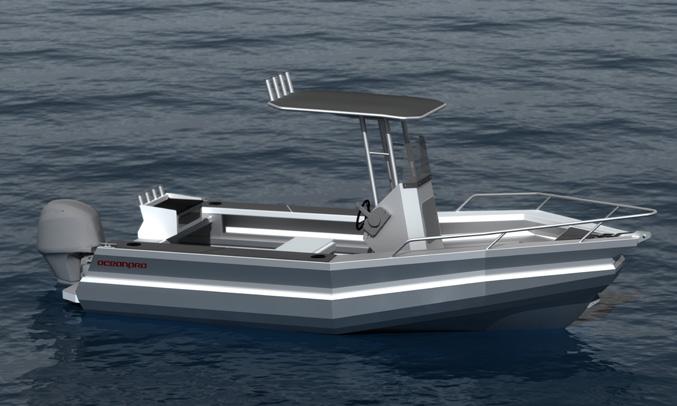
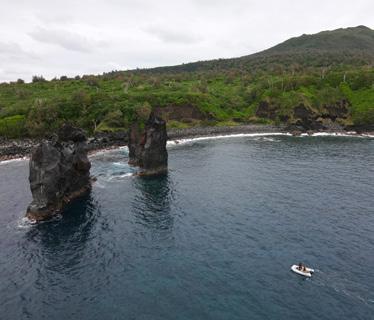
RACE AGAINST TIME IN TONGA’S VOLCANIC ARCHIPELAGO
Crucial to their work is their trusty Highfield RIB.
Dr Patrick Smallhorn-West is working with the Tongan Ministry of Fisheries to delve deep into the unique biome of Tonga’s volcanic islands, aiming to gather sufficient data to secure UNESCO World Heritage listing for the islands and protect them for future generations. These volcanic islands shocked the world in 2022 with the eruption of Hunga Tonga – Hunga Ha’apai, the largest volcanic eruption on Earth in a century.
Crucial to their daily activities is the ship’s Highfield RIB. “We couldn’t get anywhere without it – no diving, no data, no reporting,” states Patrick. “It’s our local transport - to and from islands, to and from dive sites, everything and anything to do with the project goes through this tender, so, it’s important we have one that is robust to everyday use, with enough space to store fuel, safety equipment, up to three people and of course all of our dive gear! “I personally love the fuel/anchor locker, as well as the floating floor that keeps us dry. The Hypalon is also a huge gamechanger in the tropics, where the sun destroys glue faster than you can fix it.” HIGHFIELDBOATS.COM.AU
POWERBOATMAGAZINE.CO.NZ 135
TWO NEW MODEL RELEASES FOR SENATOR BOATS
It’s set to be a bumper Hutchwilco New Zealand Boat Show for Napier’s Senator Boats, with the leading aluminium boat builder announcing it will display no less than 10 models at the show – which will be held at Greenlane Show Grounds, May 16-19.
For the first time in decades, Senator Boats will have its own corporate display in Pavilion 3, site #385, where they will showcase their award winning range from 4 metre through to 7.7 metre models.
For the Napier aluminium boat builder, there will be not one, but two new model releases at this year’s show, plus an exciting new innovation. Seen for the first time will be the new Senator 500 CU (Cuddy) – which includes a new cabin design for maximum protection from the elements, and an innovative ‘Grip Frame’ system for greater personal stability at sea. This
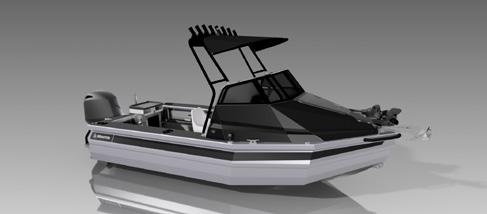
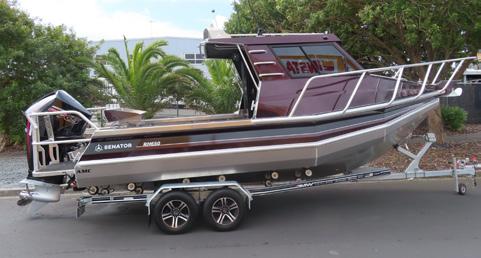
boat also has Senators ‘Mission Modular’ option system throughout which has been born out of last year’s award winning design – the Senator 500 SD (side console). Senator’s ‘Mission Modular’ option system allows owners to specify the boat however they want it, starting with a base, but allowing a very comprehensive fitout and adding features from a long list that includes a drum winch, bait board, live bait tank and washdown, hydraulic steering. Electric trolling motor mount, underfloor fuel
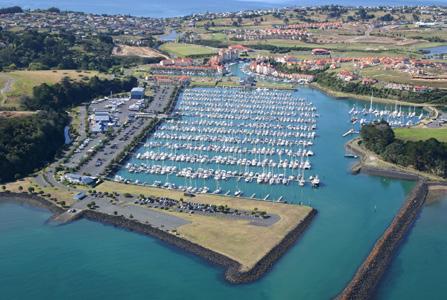
tank, various seating and storage options, a portable toilet, nav lights and more. Adding to the new 500 CU, Senator will also release their new 650 Cabin Cruiser which will feature an extended lockable wheelhouse complete with overnighting capabilities – this new model is another configuration option of their very popular 650 model.
SENATORBOATS.COM
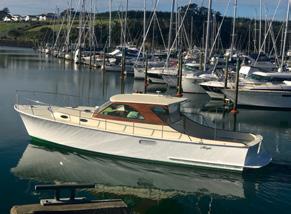
DB252 HibiscusMarineCoatings.co.nz For more information phone: 09 428 3906 Gulf Harbour Marina, Gulf Harbour, Auckland, NZ • ANTIFOULING • POLISHING • TOUCH-UPS • REPAINTS • PROPSPEED
MAST & BOOMS Blending quality marine products, craftsmanship and customer care. ALLOY BOAT _ NEWS
•
136 MAY / JUNE 2024
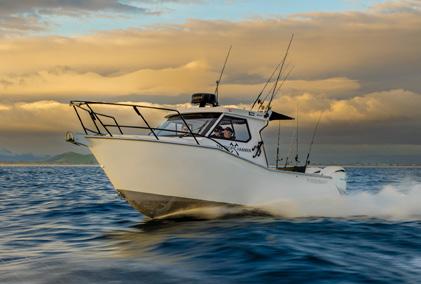
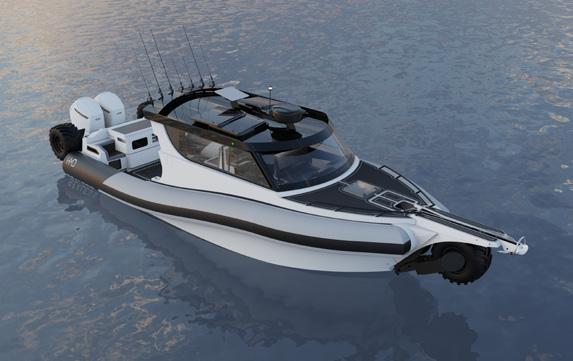
PUREKRAFT IN MIDST OF EXCITING EXPANSION
Purekraft Boats is in the midst of an exciting expansion, with a focus on enhancing their current lineup with innovative new models.
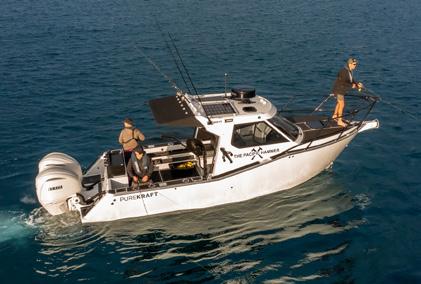
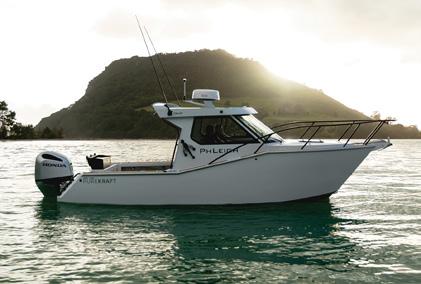
Among these developments is the eagerly anticipated 990HT, featuring both a twin outboard motor option and a single diesel inboard rig for versatility and performance.
In a notable collaboration, Purekraft has continued their partnership with Sealegs & HMD to craft the impressive Sealegs 12RC model. This joint endeavor brings together the expertise of all teams, with Hall Marine Design contributing the design styling and naval architecture. Purekraft takes the lead in construction, ensuring meticulous attention to detail at every stage of production. Once assembled, the vessels make their way to Auckland, where they undergo the fitting of the hypalon tubes and the Sealegs system100.
The upcoming Hutchwilco Boat Show will feature the team’s latest masterpiece, showcasing the company's unwavering commitment to craftsmanship and innovation. Boasting twin 600hp Mercury outboards, Czone switching technology, and even a luxurious rain shower integrated into the cockpit ceiling, this vessel exemplifies Purekraft's dedication to excellence.
PUREKRAFTBOATS.CO.NZ
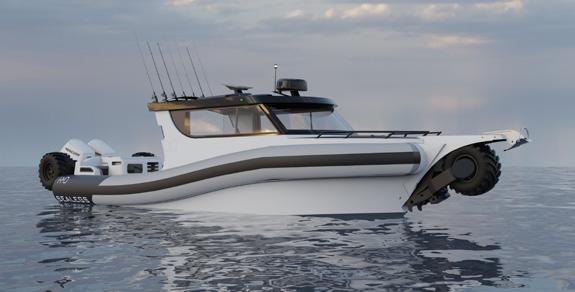
ALLOY BOAT _ NEWS
138 MAY / JUNE 2024



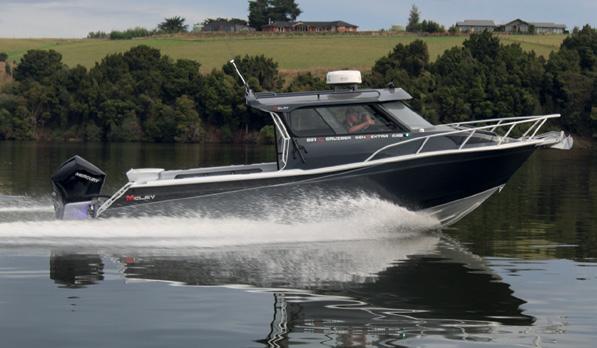

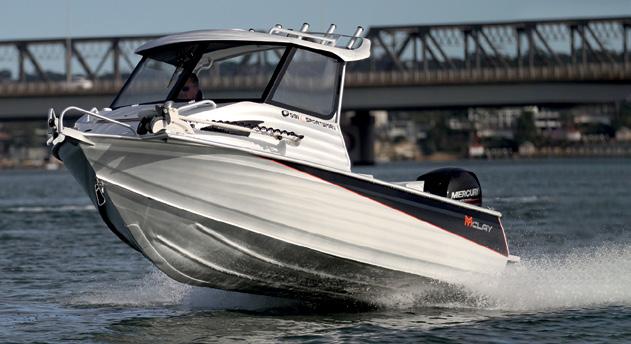
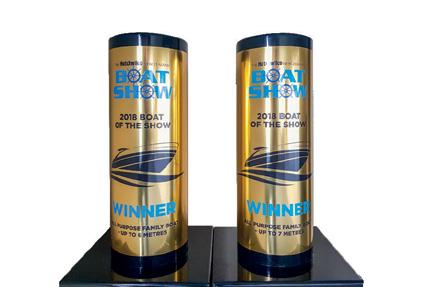
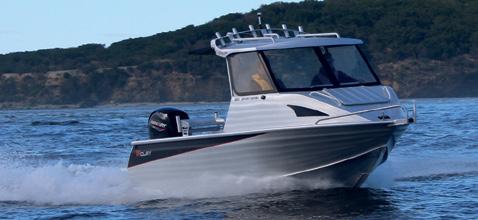
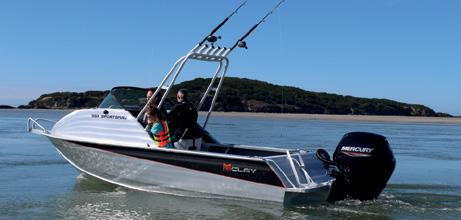
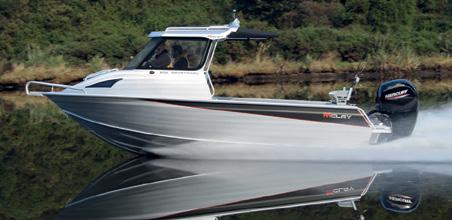



MULTI AWARD WINNING BRAND Go to our website for specifications and pricing or get down to your local dealer 651 SPORTSMAN SPORTSMAN 571 SPORTSMAN 551 651 SPORTSMAN MCLAY BOATS ARE AVAILABLE FROM DEALERSHIPS NATIONWIDE: WHANGAREI: Warren Hay Marine, ph 09 430 2666 AUCKLAND: Fish City, Albany, ph 09 476 4282 HAMILTON: Fish City, Frankton, ph 07 846 6675 WHAKATANE: Oceansports Marine Ltd, ph 07 308 4241 WELLINGTON: Boat City, ph 04 298 5931 MOTUEKA: Bays Boating, ph 03 528 5200 DUNEDIN: McLay Boats Milton, ph 03 417 8135 www.mclayboats.co.nz 571 SPORTSMAN HARDTOP DB991 801XL GEN2 661 CROSSXOVER VIEW THESE MCLAY MODELS AT STAND 360
The Auckland On Water Boat Show in March boasted an array of cutting-edge technology and stunning watercraft on display. Personally, experiencing the innovative Rayglass 3000 on the Waitemata Harbour was a standout moment.
The event, impeccably organized, showcased numerous exhibitors and their offerings. I can’t wait for the upcoming Hutchwilco New Zealand Boat Show.
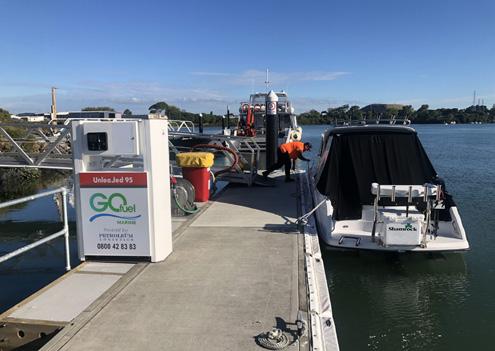
PRACTICE FUEL MANAGEMENT
TIP #146 TIP #147
Always monitor your fuel levels and consumption. I use a simple but effective formula: allocate one-third for outbound travel, onethird for the return journey, and reserve one-third for emergencies. Additionally, adopt fuel-saving practices and remain mindful of adverse weather conditions, as rough seas can double fuel consumption, especially when battling against swells on the way back home.
Pro Tip: Avoid using ethanol-based fuels (Bio-Fuel) in older outboards as it can cause carburettor seal failure. Ethanol is also hygroscopic which means it can draw moisture from the atmosphere, leading to water contamination in boat fuel that’s been unused for a few months.

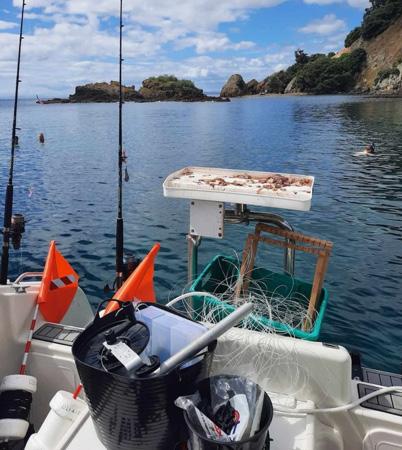
MAINTAIN CLEAN DECKS
Regularly clean your boat's deck to prevent slips and falls. Immediately clean up fuel or oil spills and wipe down with a good degreaser. Secure or stow away loose items like fishing rods, bait knives, and long lines to prevent hazards during rough seas.
Pro Tip: A clutter-free deck also facilitates safe movement and provides a secure environment.




brands expert advice
from leading boating stores DB989 NOTEWORTHY FLETCH'S BOAT TIPS
Trusted
Available
140 MAY / JUNE 2024
TIP #149
$10 TURBO SHIELD
This week marked the return of my boat back from the Marine engineers, now with its brand new turbocharged tunned to perfection - lesson learned from previously installing a turbo blanket (hey, we all make mistakes sometimes), causing turbo-exhaust to generate too much heat - whoopsie. So, with a replacement turbo installed I still needed a heat shield, so I sliced up a $10 cooking pot I got from The Warehouse and created a masterpiece of perfection with strategic fabrication via an angle grinder. The final installation looks great, but more importantly, controls the high temperature by shielding the engine from the high heat from the turbine. DIY maritime engineering at its best!
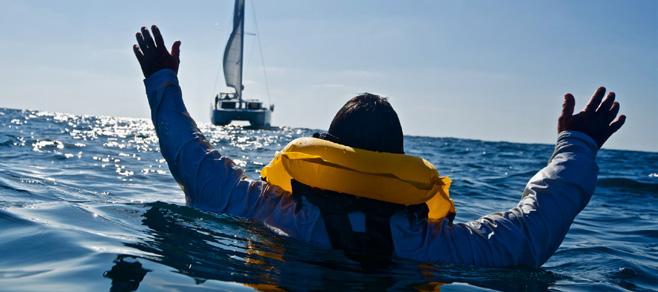
TIP #148
PRACTICE MAN OVERBOARD DRILLS
Be prepared for emergencies by practicing man overboard drills with your boating crew. Coordinated responses can save lives in critical situations. Develop an emergency plan that includes procedures for medical emergencies, onboard fires, and other critical situations.
Pro Tip: Use an old life jacket or an inflatable person-sized object for practice.
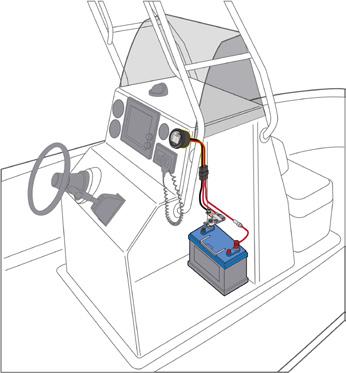
TIP #150
BATTERY RELIABILITY
Regularly check your boat's battery and charging system to avoid unwelcome break-downs out on the water. I highly recommend carrying a spare jump-start battery for added peace of mind. In my experience navigating the Hauraki Gulf, this precaution has proven invaluable in assisting fellow boaters facing battery issues.
Pro Tip: Invest in a battery monitoring system that links to your smartphone for added convenience.

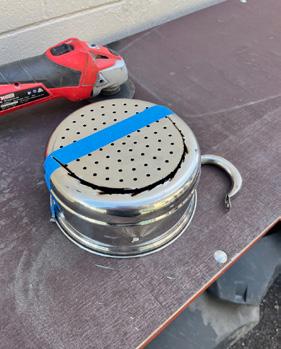
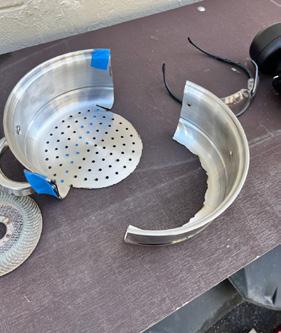
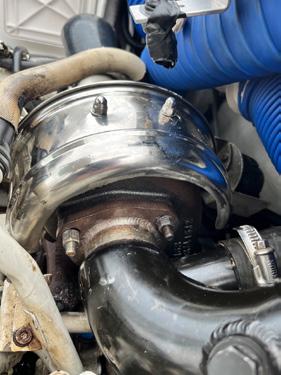
www batterytownmarine co nz 0800 962 288
POWERBOATMAGAZINE.CO.NZ 141
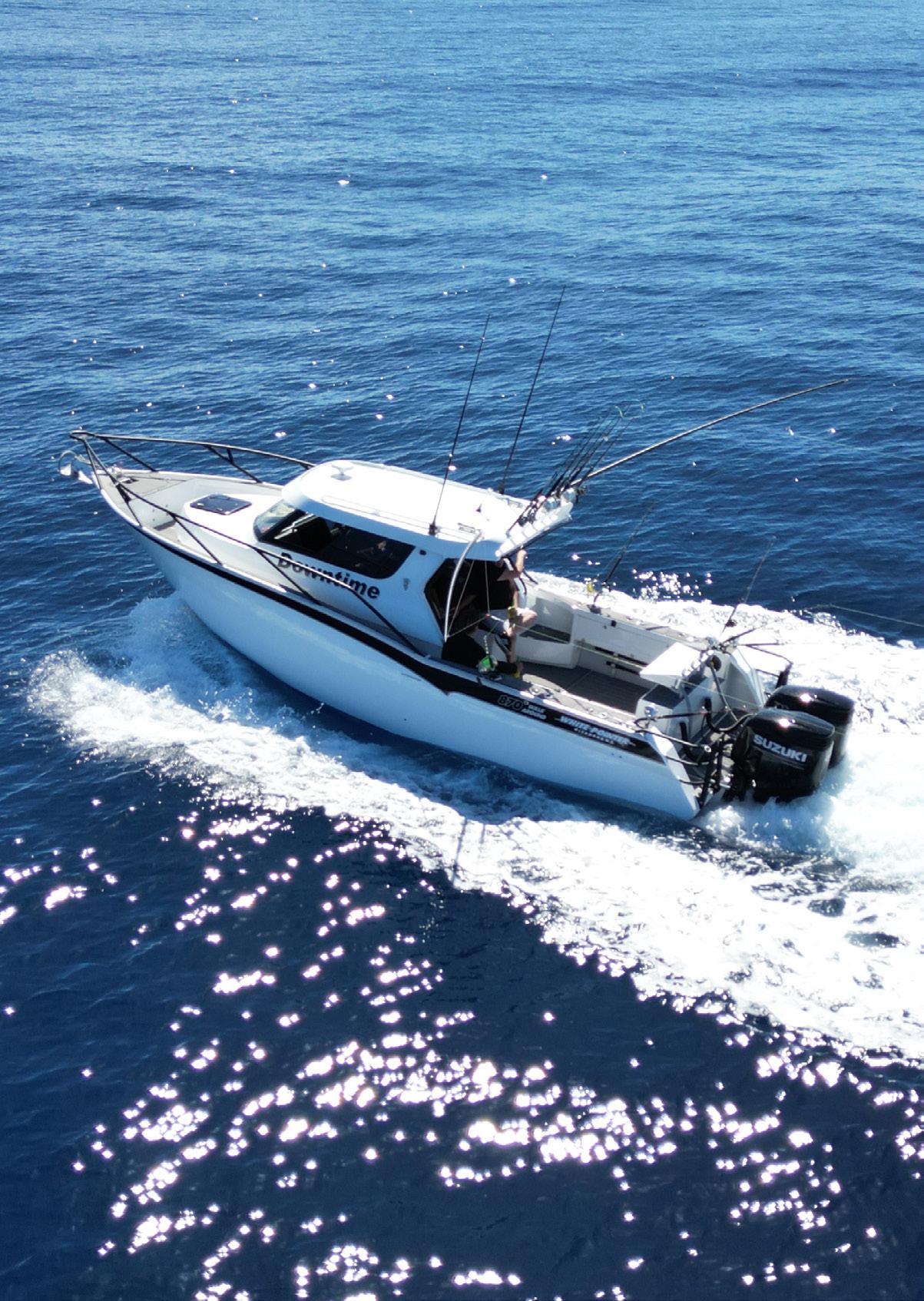
BOAT TEST_ WHITE POINTER 870 WALKAROUND 142 MAY / JUNE 2024

Gone Walkabout
With well over 600 boats now on the water in their 30-years of custom alloy boat building, White Pointer has always been at the forefront of the market. Freddy Foote headed to Tauranga to check out this custom 870, hull #2 from their Walkaround range.
BY FREDDY FOOTE
If you want a hardcore fishing boat, fully custom to suit your requirements, then White Pointer should always be in the forefront of your mind. Started by Rex Briant, Rex has been building market leading custom alloy boats for 30-years, in-fact, slightly longer than that, but more on that later.
When boat owner Andrew Thompson met with Rex Briant and Tony Bourke at White Pointer Boats to start discussing the build of his 870 Walkaround, the overwhelming design parameters were that it had to be practical.
The boat didn’t need all of the ‘frills’, but just had to be functional, easy to maintain, and most of all be practical to use.
Having had a number of other alloy boats over the years, this is Andrew’s first White Pointer.
“I’d always been impressed with the build quality, and functionality of the White Pointers. But the most important thing for me was the practicality of the boat. It had to be practical,” commented Andrew during our excursion out to Mayor Island off the Tauranga Coast.
This is the second 870 Walkaround to come out of the White Pointer factory in Gisborne, the first hull, launched a year ago, was powered by a Volvo Penta D4/320hp with a DPI leg.
Wide Load
One thing you need to understand immediately about the 870 WA, is that it’s big, real big. It is based on White Pointers 8.40m – 8.70m platform with a wide 2.75m beam. Yep, you’re going to need those little yellow flags to tow this rig down the road.
With a tow weight of around 4500KG, Andrew placed an order for a Chevrolet Silverado 2500 before taking delivery of the boat, one of the only vehicles on the market capable of towing this beast around the country. And tow it around the country he has. Exploring the coastal waters of the Far North, West Coast of the central North Island and the Coromandel.
Where things get interesting, that within this sizeable hull, White Pointer has simply dropped in the standard cabin from their 700 model. The roofline remaining much the same as the 700, albeit extended.
This makes the 870 a true walkaround, the deeply recessed bulwarks allow safe passage around the wheelhouse to the open bow area. Navigating forward and around the boat, there is plenty of room, the bulwarks are wide enough that you can actually turn around and walk back the other way, and handrails on the wheelhouse provide that extra feeling of security.
POWERBOATMAGAZINE.CO.NZ 143
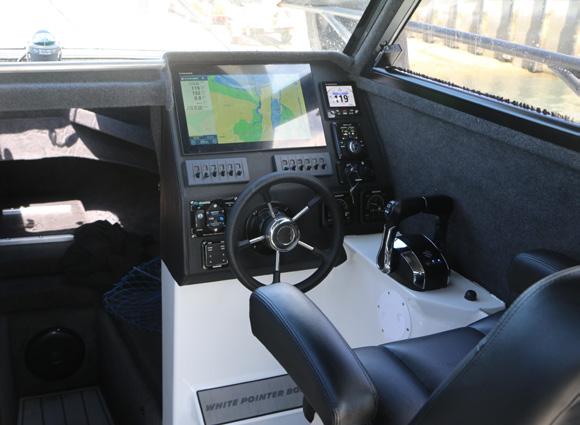
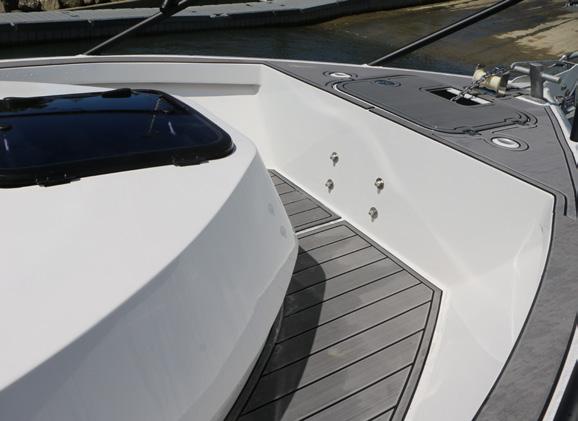
A prominent
The interior layout is custom, but this twin bench layout works well.
Plenty of room in the foredeck area to cast baits or fight a fish.
There are twin walk-thru’s and live bait tanks in each aft corner.
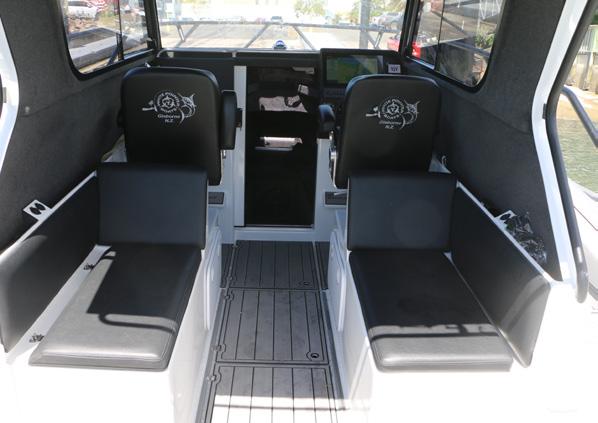
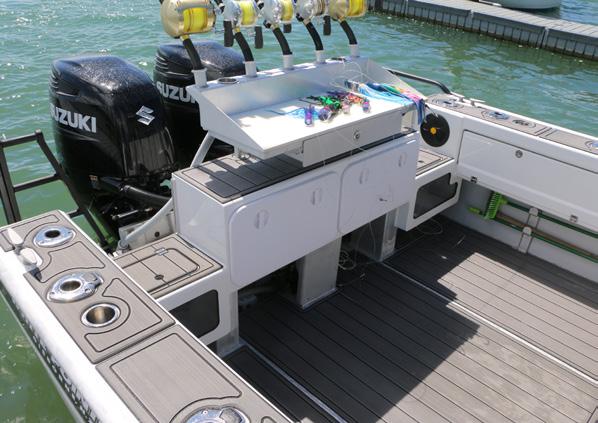
Navigate your way to the foredeck area and there is ample space to cast some lures or baits, or if you have found yourself up there having hooked a large fish from the cockpit. Aft of each bulwark is a grill and sump, so any water that does run down the side deck is expelled overboard before reaching the cockpit.
Back in the cockpit aft, there is a full width boarding platform with a safety cage all around. This adds great security when fishing in a rough sea and gives you room to fish in each corner should you wish, or for a crew member to assist with bringing aboard a large fish. There are two drop down ladders that form part of the railing on either side, with twin live bait tanks built into the walkthrough in port and starboard corners.
In the centre of the transom is a large custom bait station. However, bear in mind this is just one option, the bait station can be custom designed to suit your fishing needs.
Running below each wide cockpit coaming are long rod storage trays, with optional hinged covers that hide away the clutter, plus rod racks, a knee operated hand wash and rod /gaff holders.
Under the Boat-Deck covered cockpit sole is an extralarge kill tank with a lift-out bin. A smaller secondary
hatch means you don’t have to open the entire floor panel to drop your fish in.
A fresh water system with pull out hose is mounted in the starboard side of the cockpit, which in turn is fed by a large 85L water tank.
When you are in the cockpit, what was quite evident were the high cockpit sides – 750mm deck to gunwale, giving a very secure and safe feeling. Stability at rest was also exceptional.
Roomy Wheelhouse
Despite being a Walkaround model, the wheelhouse area was still surprisingly roomy. The wheelhouse features ample seating for the skipper and passengers, a fridge/ freezer under the bench seat on the port side, further storage under the opposing seating area to starboard. Forward there is a comfortable captain’s chair at the helm, and another one opposite for a passenger.
Large sliding side windows either side provide plenty of extra ventilation and airflow. It was a hot February day on our test, and while trolling lures, we all remained relatively cool.
feature at the helm is the large 16” Furuno display.
WHITE POINTER 870
BOAT TEST_
WALKAROUND
144 MAY / JUNE 2024
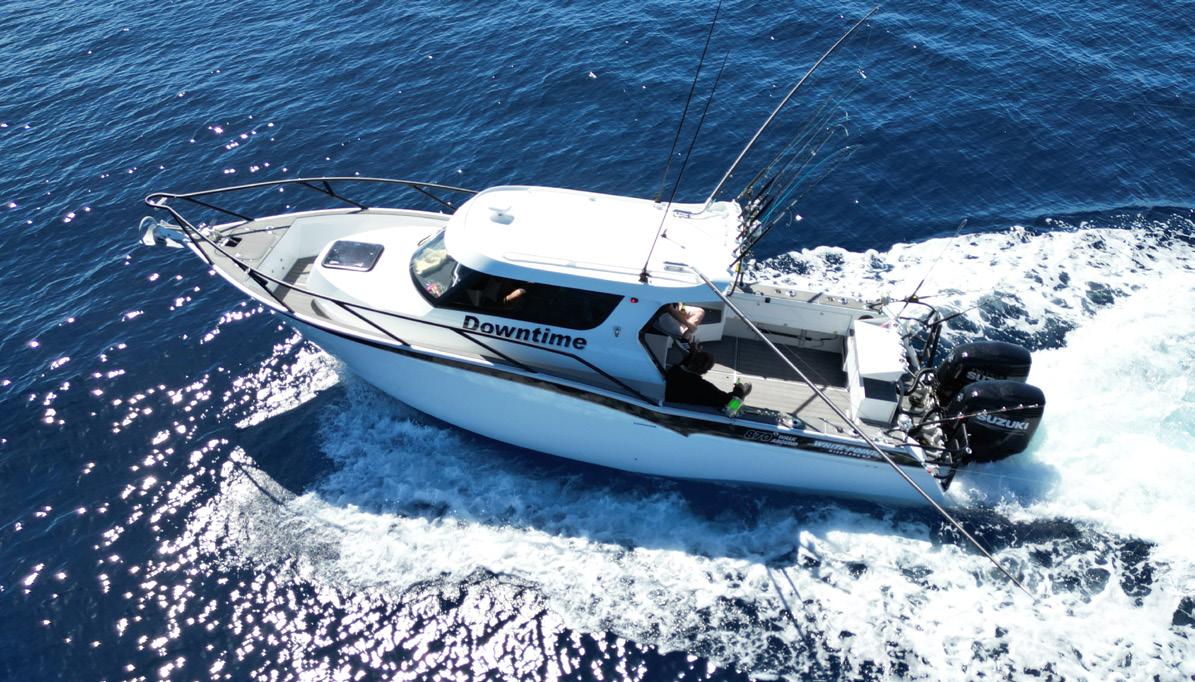
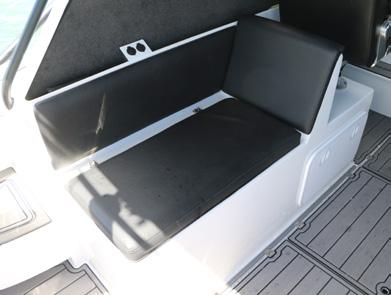
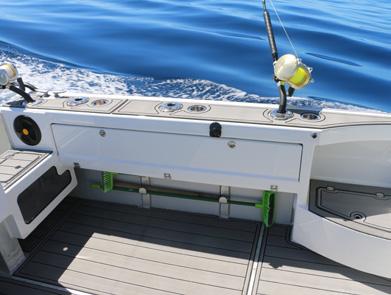
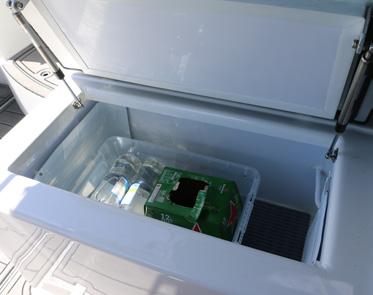
Depending on your preference, the driving position is multi-purpose. Seated, bolstered or standing, you have great visibility, with sliding side windows letting in fresh air ventilation.
A 16” Furuno MFD is flanked by the Zipwake interceptor controls, Above is a VHF and Fusion sound system with 10” subwoofer.
The lockable cuddy cabin comes with a 2m v-berth and infill to make one large berth. There is storage under the squabs and a head under the forward bunk.
Twin Outboard Power
The power options for the 870 WA are essentially wide open. The recommended outboard is between 300hp and 500hp, this one powered by twin 250hp Suzuki’s as per the owners request.
With the twin 250hp Suzuki’s, the 870 WA ‘Downtime’ was no slouch, achieving a top speed of 47 knots. At a sedate cruise of 23 knots at 3200rpm, the boat was using 43LPH across both motors. Combine that with the 500L fuel tank, and that gives the boat a cruising range of 230 Nautical Miles.
During our test day we trolled some lures around Mayor Island off the Bay of Plenty Coast, without success in hooking up, however a glance at the Suzuki instruments saw that at 7.5knots at 1800rpm, we were using 22LPH. Test day conditions were fairly calm, in fact you could have water-skied all the way to the Mercury Islands. However, conditions did worsen later in the day with a late afternoon breeze picking up and developing a very slight chop. However, nothing too severe that it was going to impact the comfort of those onboard.
Aboard the 870, the boat feels incredibly strong and solid. Like all White Pointers, the hull shape is a key factor in the brand. Briant has continued his traditional method of shaping the hull skin over a predetermined interlocking frame and girder type structure. Combined with a welding sequence he can produce a rounded compound curve hull shape that squeezes the water out rather than slapping over the top.
“This process can only be achieved on a heavy steel jig as the force and technique to shape up to 8mm plate is so immense. This process is a more traditional method and not followed by the well-known production builders. There are other boats out there that behave like a ‘cork’
Trolling at 7.5knots, sees the twin 250hp Suzuki’s using 22L/H.
The starboard bench seat houses a fridge underneath.
Lockers close off and protect the cockpit shelves.
Fridge located under the port bench seat.
POWERBOATMAGAZINE.CO.NZ 145
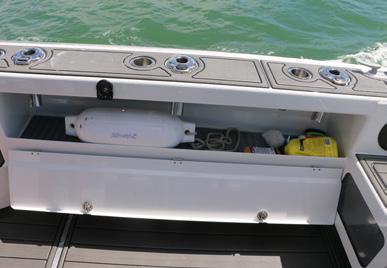
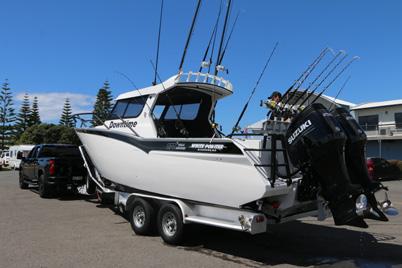
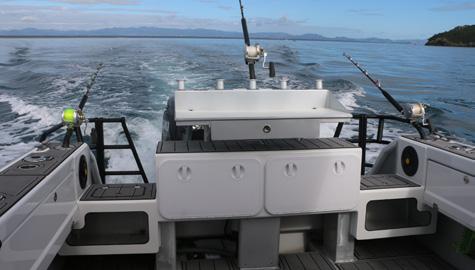
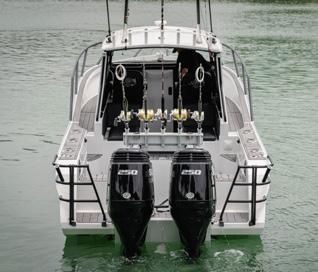
Deep cockpit side shelves provide plentiful storage.
One big rig!
The deeply recessed bulwarks allow safe passage around the wheelhouse to the open bow area.
The bait station is custom, and provides plenty of room to rig baits and lures.
The stern section is caged, with the sections dropping down to provide boarding ladders either side.
on the water. A White Pointer is and always will be a solid blue water performer.”
“This sets us clearly apart.”
Overall, I loved the 870 WA. Being a walkaround, I felt you didn’t lose any internal volume in the wheelhouse, you still had a sizeable cockpit, but you also gained more ‘fish fighting’ real estate forward.
30-Years of Alloy Building
White Pointer is currently celebrating 30-years of alloy boat building, well almost.
The company will be releasing a new ‘30-Year Anniversary’ 745 Sport Cruiser model, to be released for the first time at the Hutchwilco New Zealand Boat Show, May 16-19.
However, it’s not quite a 30-year model.
“The boat was intended to be released two years ago, but we’ve been so busy building other customer boats, we had to put it on the back burner, so you could say it’s actually our ’32-Year Anniversary’ model,” quipped Rex.
“After over 30 years of custom alloy boat building, and over 600 boats having left our Gisborne factory, we are excited to do something a little bit special.”
“We’re so excited for this new model, especially the guys in the factory who are making this boat their own. It’s not often we get to start with a clean sheet of paper, but after 30-years, we want to make this boat something really special. We’re excited to unveil it in Auckland in May.”
I think that summarises owning a WhitePointer. 30+ years of passion for boat building, and craftsmanship. White Pointer is a boat brand that people aspire to own. I have friends who have bought them over the years and
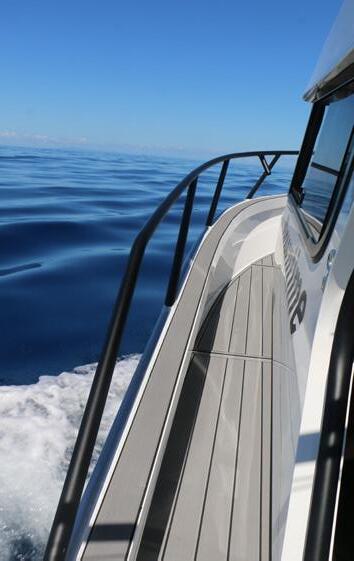
it always comes with an essence of pride and excitement to own one.
What’s more, a second generation of Briant has recently joined the family business, with Rex’s son Angus now working day to day in the factory and set to lead the business into the coming decades.
You can check out the 870 Walkaround ‘Downtime’ at the upcoming NZ Boat Show in May, along with the ’32-year 745 Anniversary’ model.
SPECIFICATIONS
PERFORMANCE DATA
RPM Knots L/h L/nm Range 1800 7.5 22 3.000 150 3200 23 43 1.900 230 5800 47 170 3.700 120
& Model White Pointer 870 WA Price as tested $474,983
Walkaround Construction Aluminium
8.7m
2.75m
18- degree
weight : 4500kg
Power 2 x Suzuki 250 Four-stroke Power options Outboard/Sterndrive HP Range 300hp-500hp
Capacity 500L
Tandem Axle Manufacturer White Pointer WHITEPOINTERBOATS.CO.NZ BOAT TEST_ WHITE POINTER 870 WALKAROUND 146 MAY / JUNE 2024
Maker
Type
LOA
Beam
Deadrise
Trailerable
Test
Fuel
Trailer
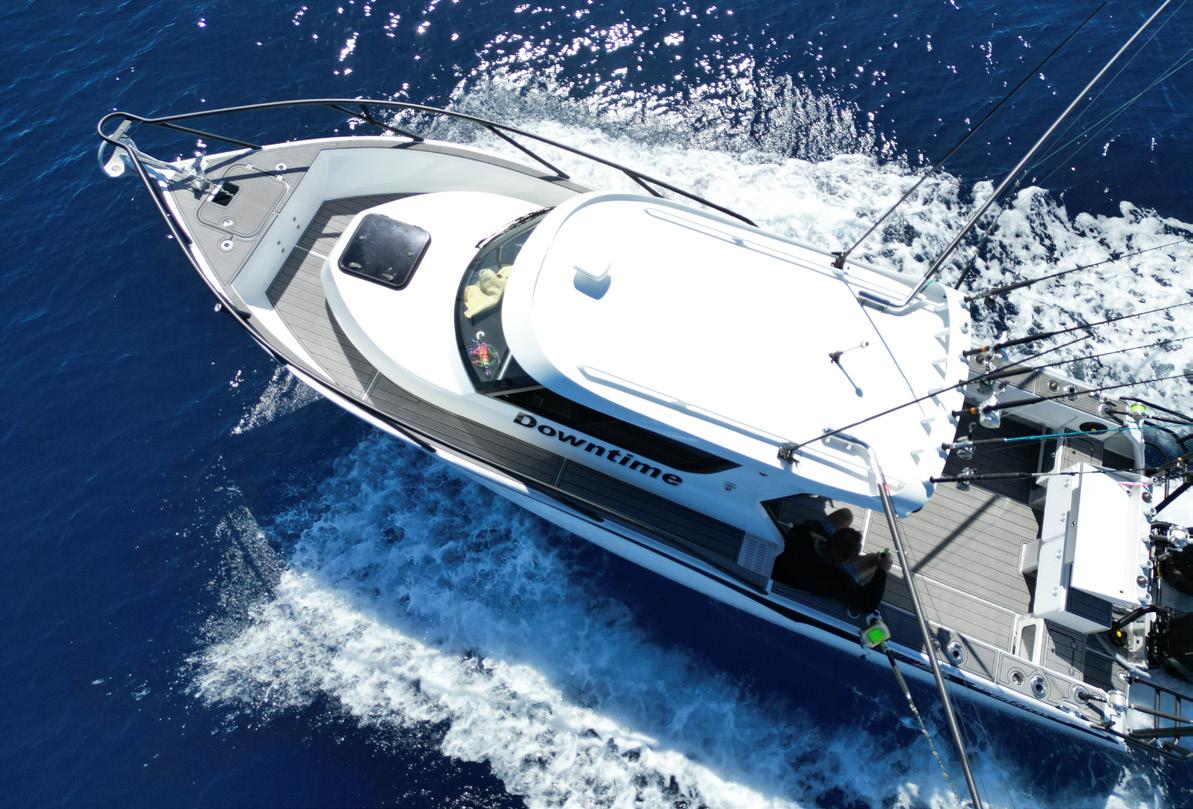
Anglers will love the Walkaround layout.
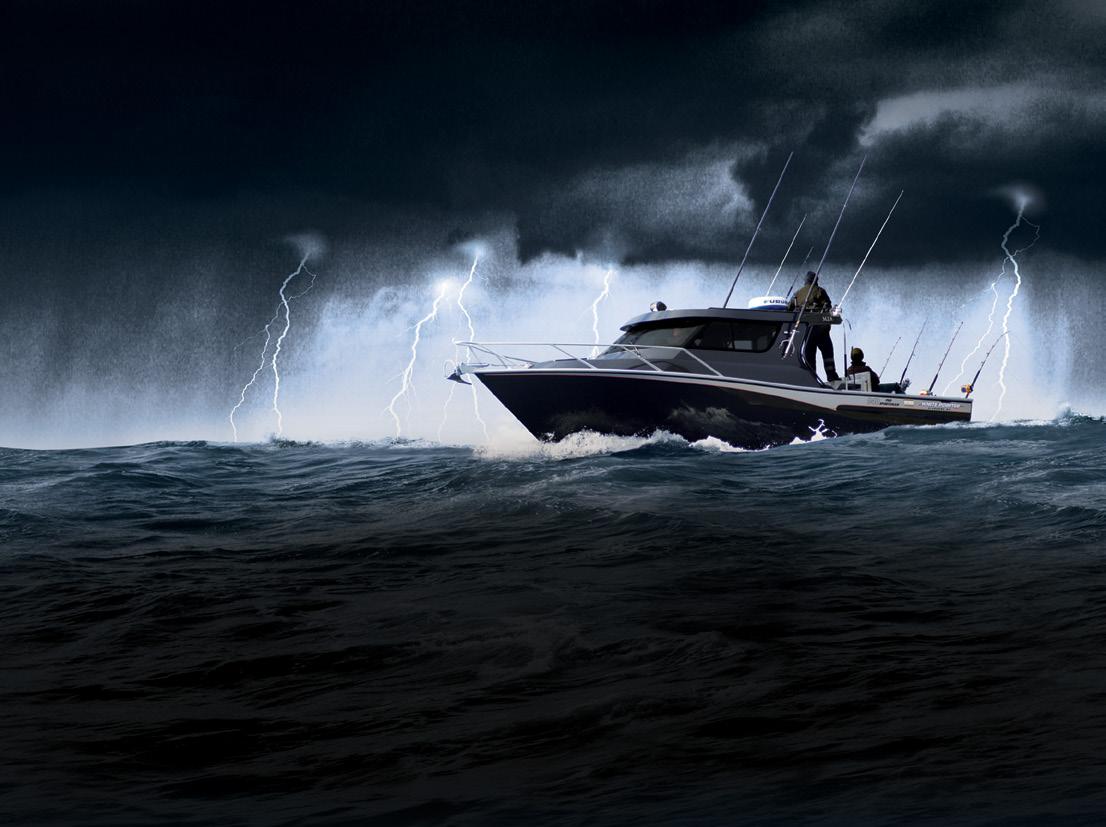
Lurking, ready to strike, a White Pointer is at the top of the food chain.
It will venture further, for longer and return with the prize. Designed for serious fishing and built tough, with its legendary non-pounding ride, White Pointer is the perfect predator. Proven in all conditions for over 30 years, it is the ultimate in custom alloy trailer boats for those who seek the very best.
Book a consultation with White Pointer to get your boat spec’d and priced Go to whitepointerboats.co.nz or call +64 6 868 6519
POWERBOATMAGAZINE.CO.NZ 147
“Take a beanie to keep the head warm and a quality pair of fishing gloves is a good idea.”
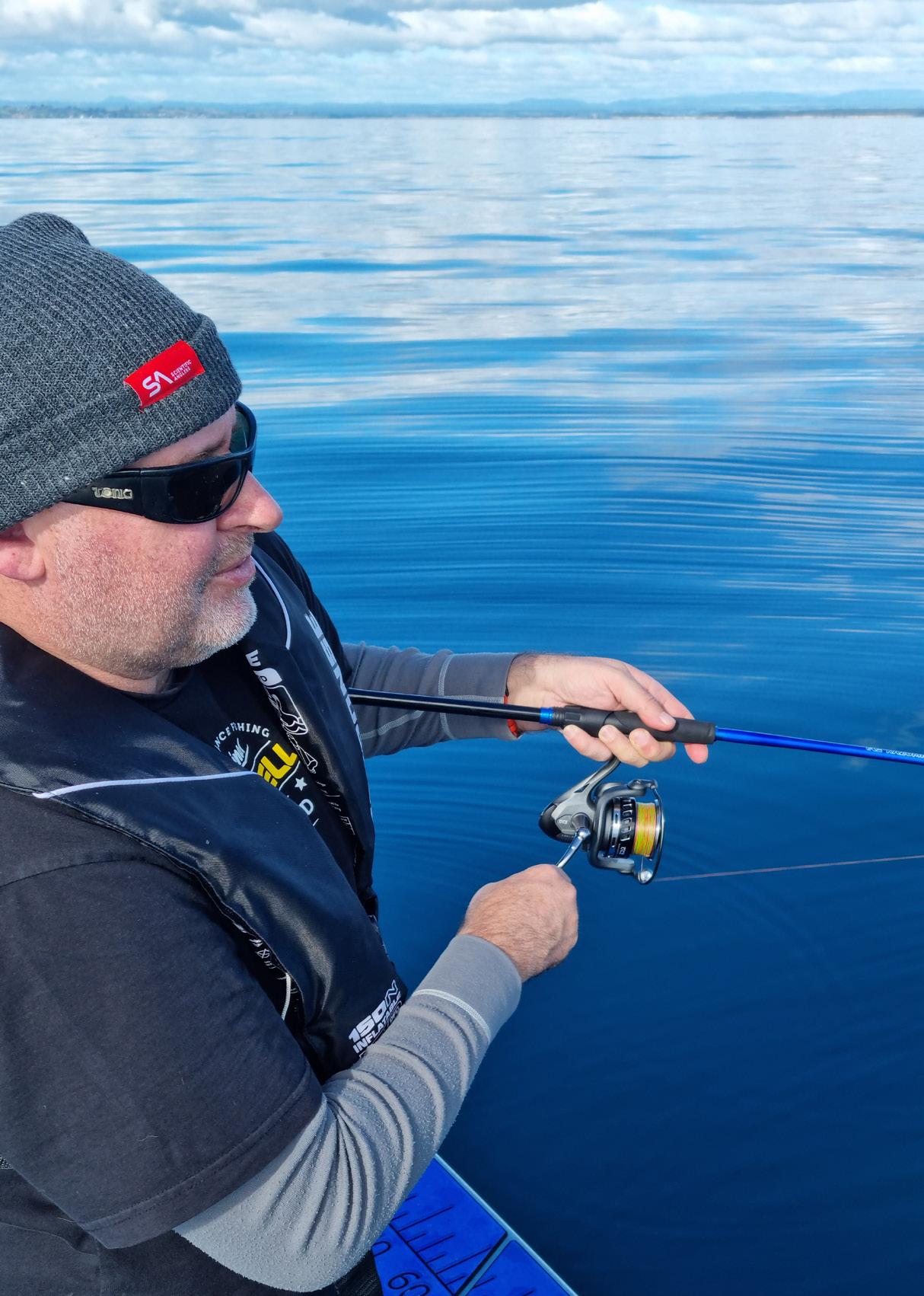
Winter often provides flat calm conditions to get out, just remember to take a beanie and several layers of clothing!
FISHING _ IN WINTER 148 MAY / JUNE 2024
WINTER FISHING OPTIONS
The colder temperatures might deter many anglers, but top fishing awaits those who head out on the water in wintertime.
BY MATHEW HEWETSON
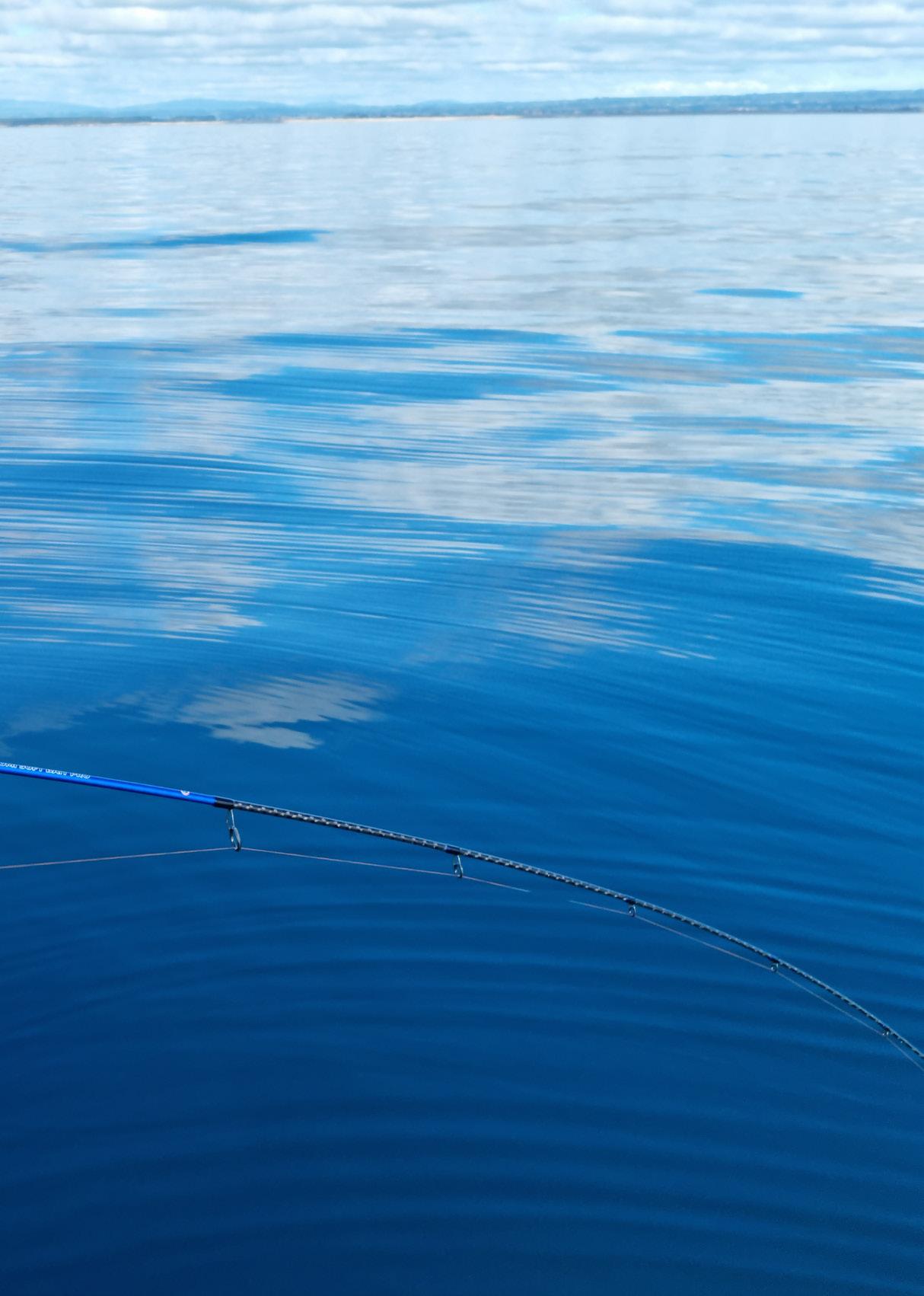
There are many anglers who put the boat and tackle away in storage over winter, as their idea of an enjoyable day on the water is with the warm sunup high in the sky and coming home with daylight savings still running over the summertime.
There are, however, multiple benefits of fishing in winter and I will cover these and what some of your best fishing options are to consider in the cooler months ahead.
CLOTHING
Before heading out on the water the first thing you must sort is your clothing. Keeping warm and dry is vital to be comfortable and enjoy your time fishing.
Wearing layers is of course the best way to keep warm, with thermals ideal but it all starts with an 100% waterproof jacket. A water-resistant jacket can be treated with a waterproof coating and have a waterproof membrane but still not be fully waterproof. For a jacket to be 100% water, all the seams need to be tapered. The tapered seams are heat sealed seams that prevent water coming through the stitching. So, make sure your winter jacket employs “waterproof/breathable” technology to fully protect you from the wet conditions. Take a beanie to keep the head warm and a quality pair of fishing gloves is a good idea on those cold early starts as you hold
onto the freezing boat on the way out and handle wet fish. Those numb fingers make retying lines difficult, so the gloves are welcome relief.
GOING LOCAL
In wintertime the number of boat traffic is considerably less, and this means you can often have places close to the ramp or those favourite spots to yourself. This can result
POWERBOATMAGAZINE.CO.NZ 149
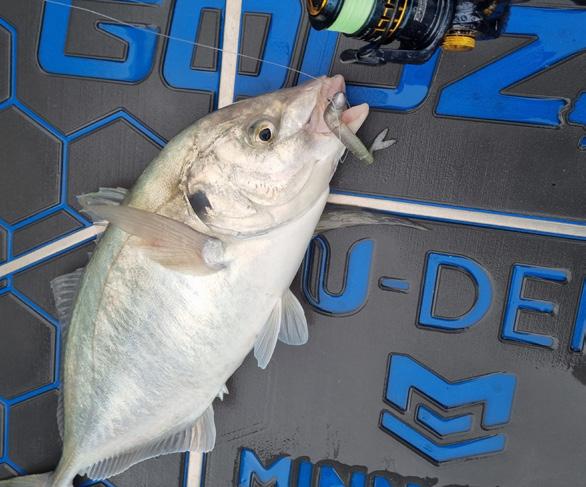
in better fishing with less pressure and if you have a reef or spot nearby, fish have often settled back into these places after the busy summertime rush is over. “Fishing your feet” is a phrase that is surprisingly effective in winter.
Snapper will take up residence in such places with a bit of foul or trevally often

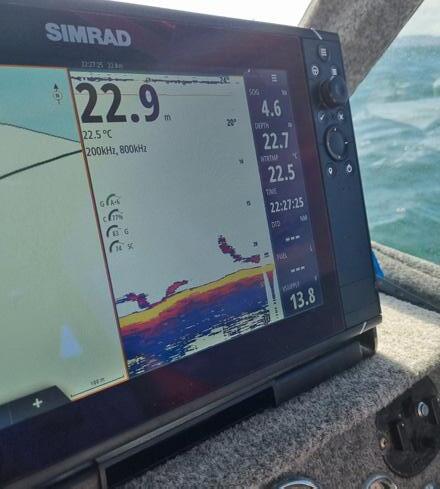
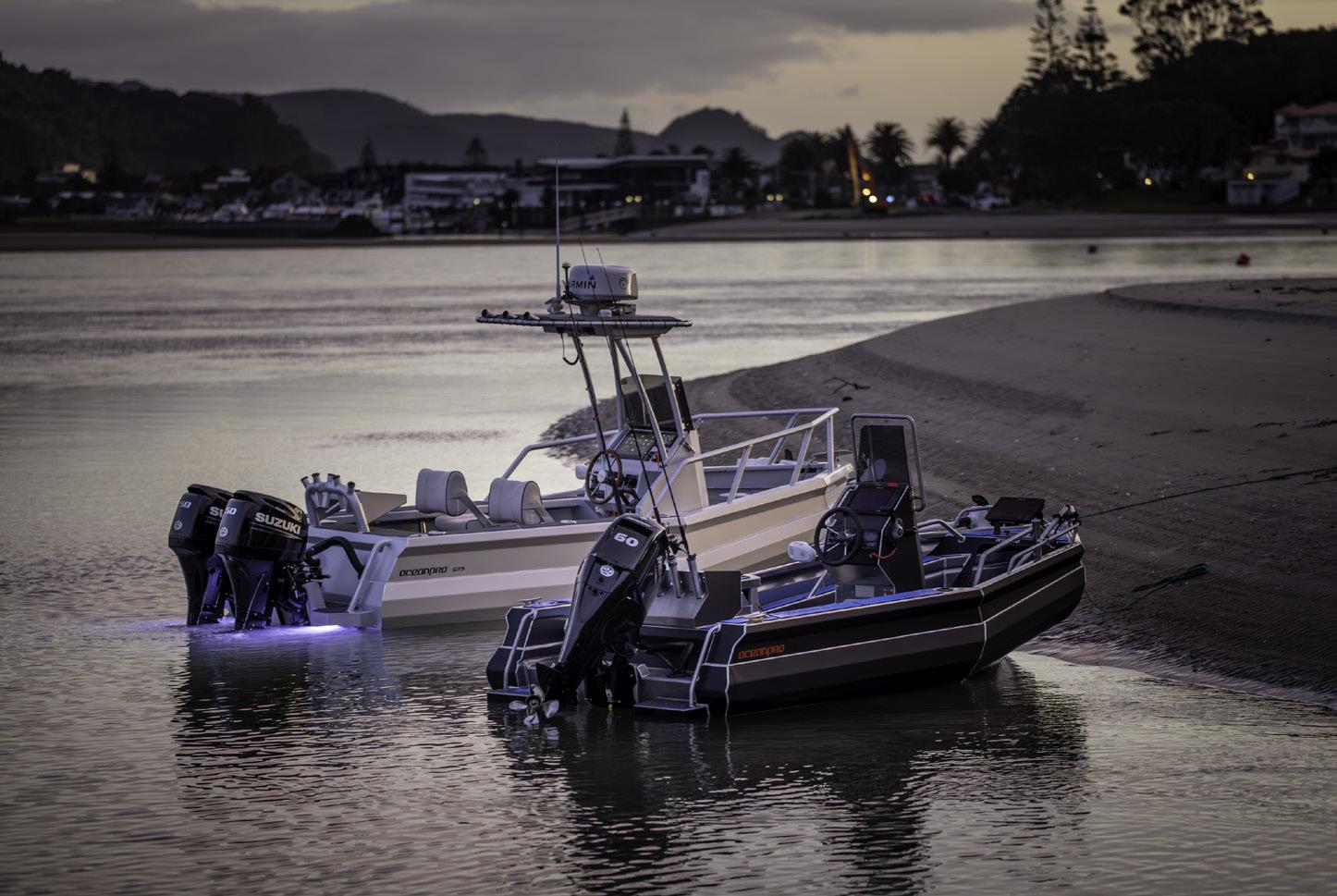
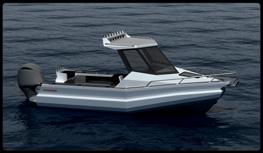
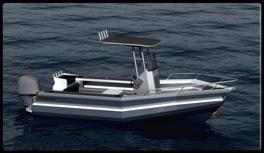
FISHING _ IN WINTER
move into harbours or on the reefs and power off to reach the deeper water.
Species like trevally move in close over winter into harbours or shallow reefs and will happily take softbaits.
oceanpro ALUMINIUM BOATS DESIGNED FOR COMFORT, SAFETY & PERFORMANCE New Oceanpro 620 & 535 coming soon oceanpro.co.nz sales@oceanpro.co.nz Ph(+64)0273884717 150 MAY / JUNE 2024
A good sounder is vital for hunting down fish sign to drop lures such as slow jigs or sliders.
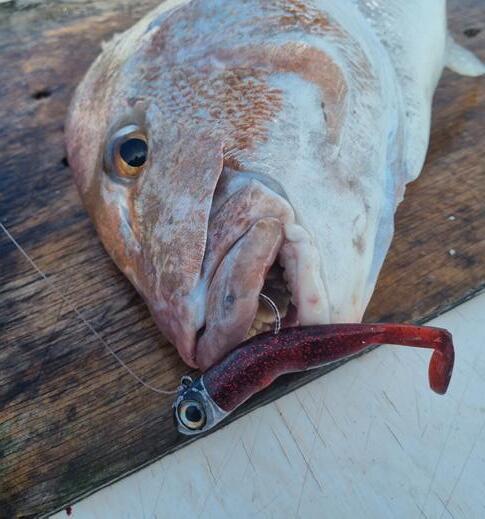
DEEPER WATER
Fishing in shallower water early until the sun climbs higher to about 11am, I would then look to move out to deeper water (over 20m), to look for sign on the sounder to drop jigs/lures down. You might think of winter as rough seas with big swell and waves making for difficult fishing, but there are often more flat, calm days to enjoy than spring and summer where cyclones and equinox winds are prevalent.
If the conditions allow and you can get out on the water at short notice, I would take the chance to head out deeper to use your sounder and find good fish sign to target. Using lures in winter works just as good in summer, sliders, slow pitch jigs or softbaits on heavier jig heads such as the new Ocean Angler Head Bangers will perform well in deeper water.
Find the fish sign on the bottom or baitfish and drift through these areas and work your lures until you get hits or fish. Drifting is best and move back to the start of the drift if you stop getting interest in your lures.
If the fishing is quiet, try adding some Secret Sauce to your jigs or lure skirts to help entice interest. Workups still occur in winter and with less traffic on the water, you can often have them all to yourself and the fishing underneath can be first class. Keep an eye out for working gannets, terns, or shearwaters as the birds to look for when out wide.
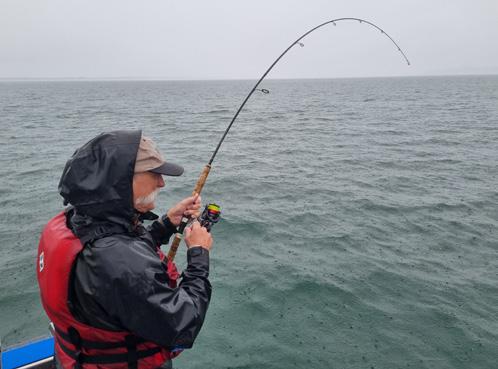
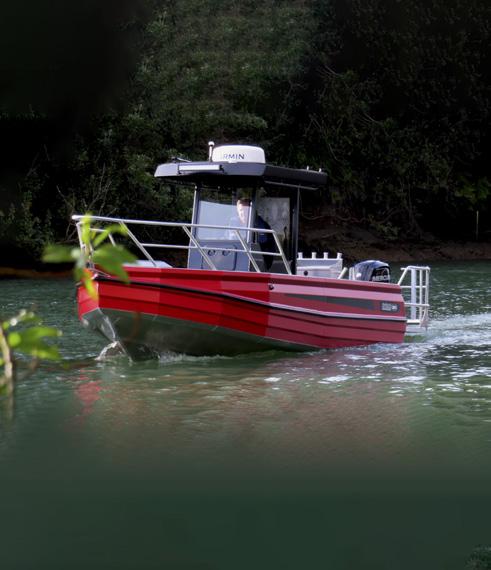







A good waterproof jacket and thermals underneath is a must when fishing in
KIWI ENGINEERING & MARINE LTD 73 Annan St, Invercargill New Zealand Phone: 03 214 1388 Email: sales@kiwi-kraft.co.nz ...when quality counts the edge in safety, performance and style www.kiwi-kraft.co.nz DB962 www.kiwi-kraft.co.nz You & your family can trust a CPC Boat. cpcstandard.com APPROVED BY Companies that are approved to build boats to CPC certified standards are: Buccaneer Boats DNA Boats Extreme Boats FC Boats Fi-Glass FREWZA Boats Haines Hunter Huntsman Boats Innovision Boats Kingfisher Boats KiwiKraft McLay Boats Marco Boats Offshore Boats Rayglass Salthouse Boatbuilders Seaforce Marine Smuggler Marine Southern Boats Stabicraft Tristram Marine POWERBOATMAGAZINE.CO.NZ 151
Ocean Angler’s new Head Banger 80gm lure is ideal for getting down quickly in deeper water.
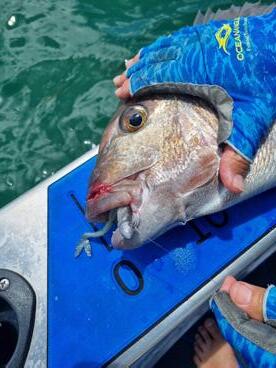
COOKING
Wearing gloves for handling fish and repelling the icy water is a good idea.
Golden panko crumbed snapper caught in winter will never taste so good with fish often in top condition with fat slicks over the filleting knife.
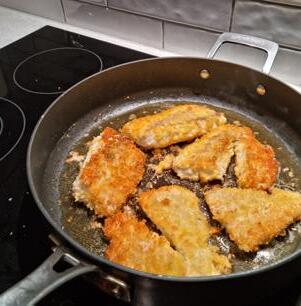
Another key benefit of fishing in winter is the prime fillets you get for cooking. The fish have put on good condition in autumn after the summer spawn and with a drop in water temperatures, they need fat to help keep warmer too. When filleting you will notice the fat slicks on the blade of your knife and in the bucket of water when you dip your knife or hands in to clean while your work. This means the pan-fried fish will be even better than the fish caught over summer, it is hands down the best time to eat snapper in my opinion due to the higher fat content. Dipping your fillets into a beaten egg, then coating with panko crumbs, and cooking in oil and a bit of butter, it doesn’t get much better!
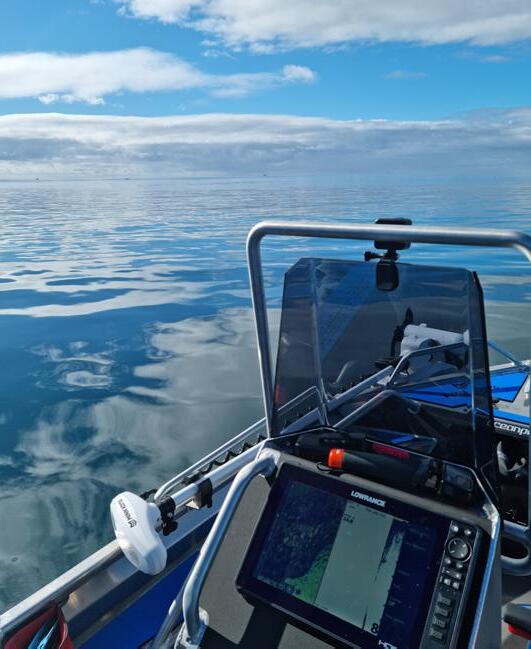
Head out wide in wintertime on those clear, calm days and pack a Thermos for a hot coffee or soup to help warm up.
ON LAND AND ON THE SEAS
Image Boats has a reputation for building customised aluminium boats, ranging from 5.8 to 12m. They combine safety, strength, durability, quality and performance to produce the perfect allrounder. If you are interested in building the perfect customised boat for yourself, then give Dean at Image Boats a call.
FISHING _ IN WINTER
24 Bay Road,
| P: 03 214 4573 | M: 0274 368 055 | E: dean@imageboats.co.nz | www.imageboats.co.nz DB953
Invercargill.
152 MAY / JUNE 2024
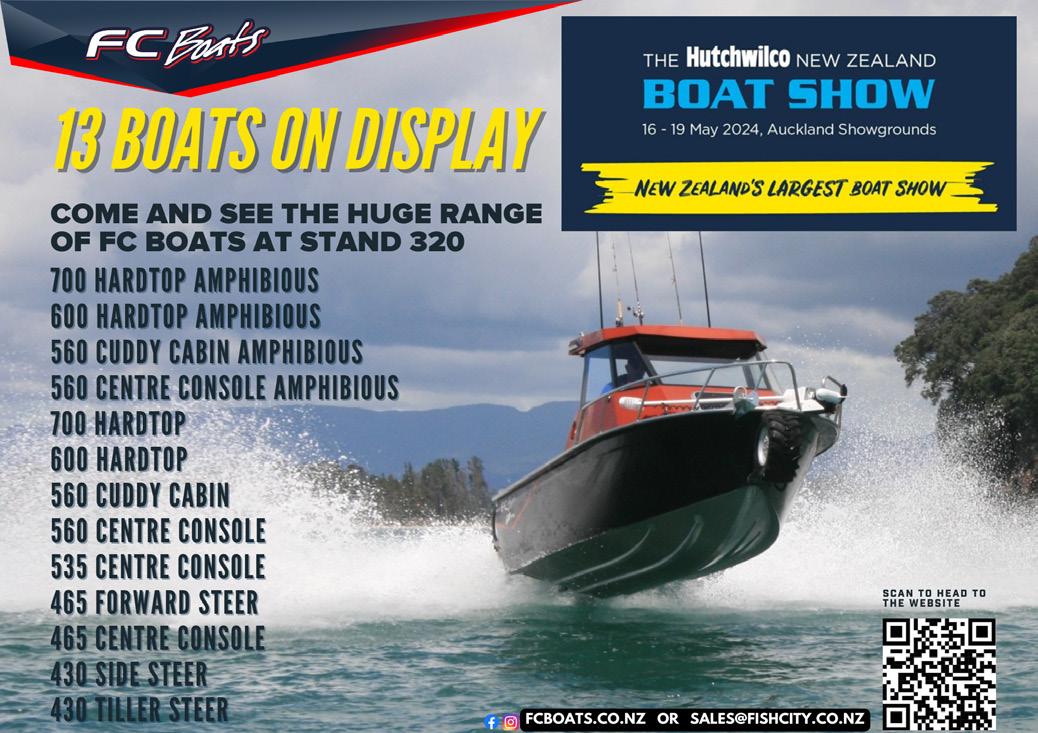
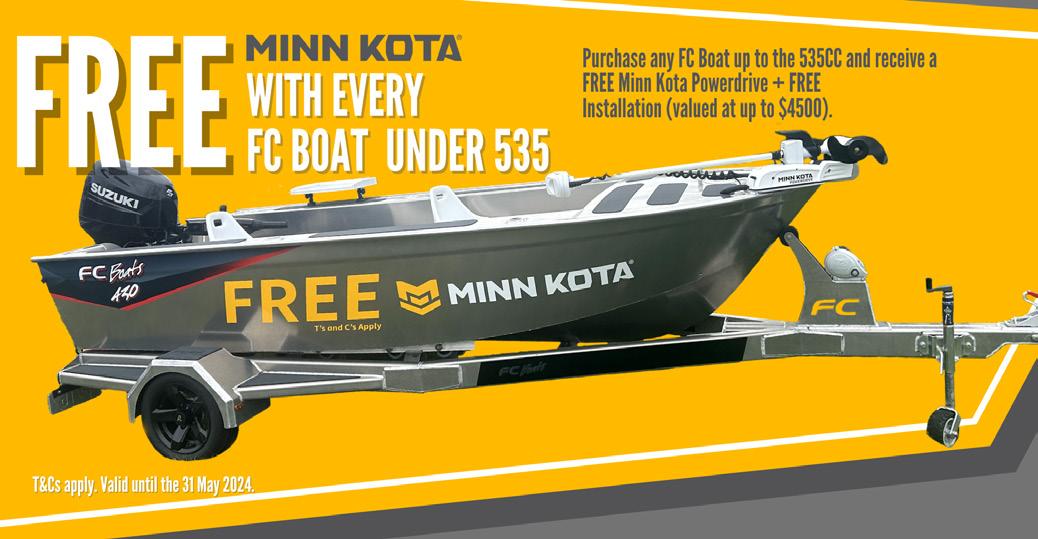
FCBOATS.CO.NZ SALES@FISHCITY.CO.NZ POWERBOATMAGAZINE.CO.NZ 153
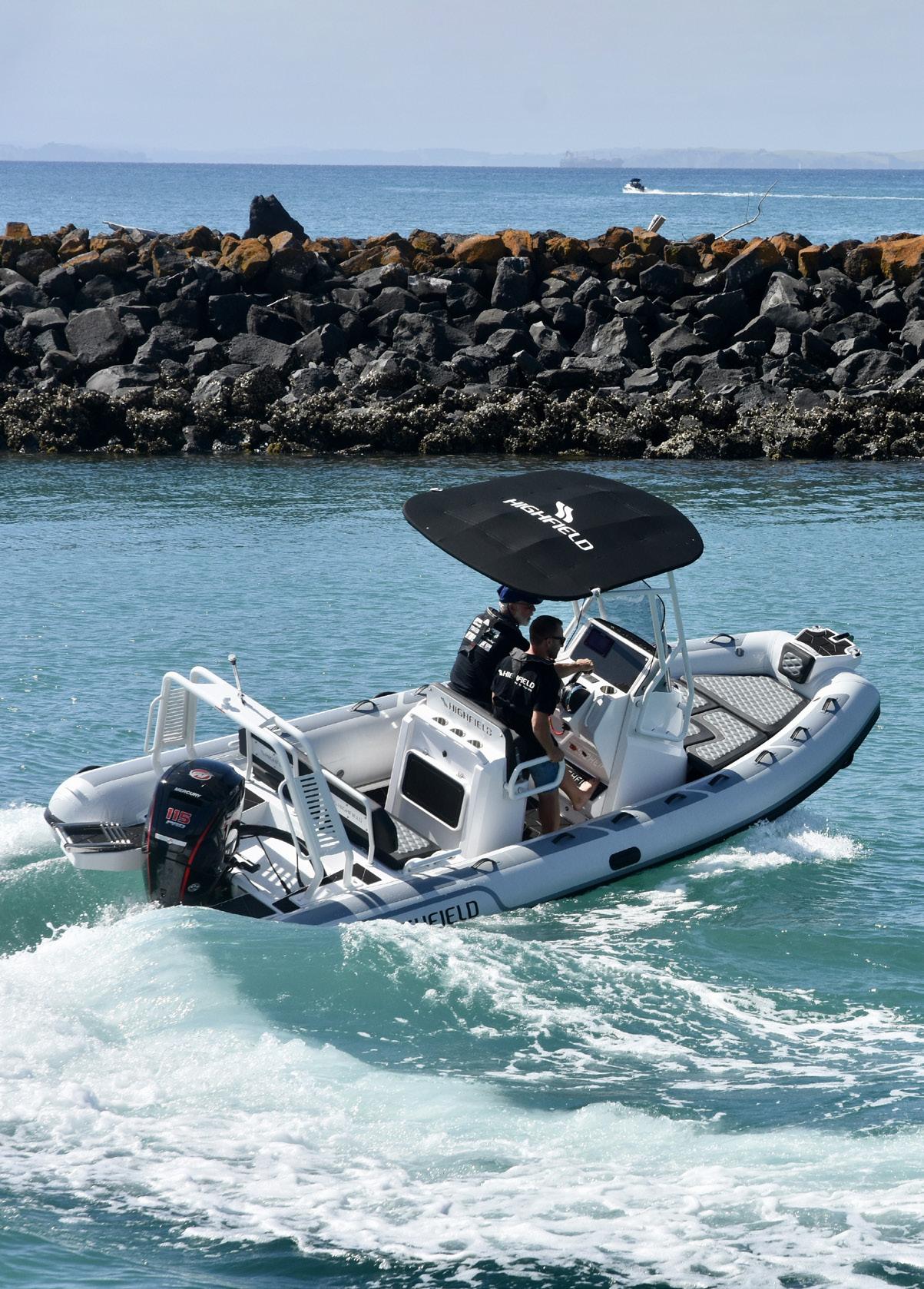
BOAT TEST_ HIGHFIELD SP560 SPORT
154 MAY / JUNE 2024
Highfield's SP560 Sport is the ideal family day boat that is both safe and exhilarating.

LOADED & VERSATILE
Back in October last year I reported on the Highfield E Jet 330, a collaboration between Highfield Boats; arguably the world's number one in the RIB (Rigid-hull Inflatable Boat) tender sector and a global player in the 5 metre plus sector, with over 27,000 boats delivered world-wide since the brand’s inception in 2011, and the New Zealand company ZeroJet, to create the Highfield E Jet 330 powered by ZeroJet.
BY RON CZERNIAK, MARINE JOURNALIST
SCAN THE CODE TO WATCH THE VIDEO POWERBOATMAGAZINE.CO.NZ 155
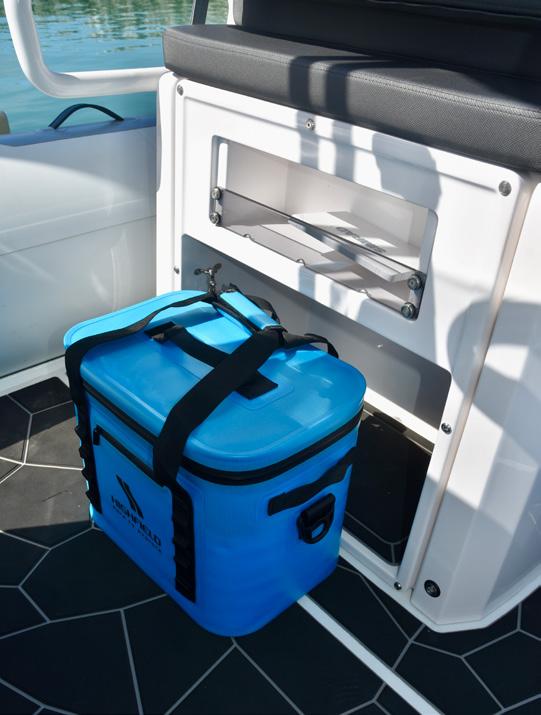
Easily accessible chilly bin slides under helm station seat when not in use
Ergonomically designed and functional helm station.
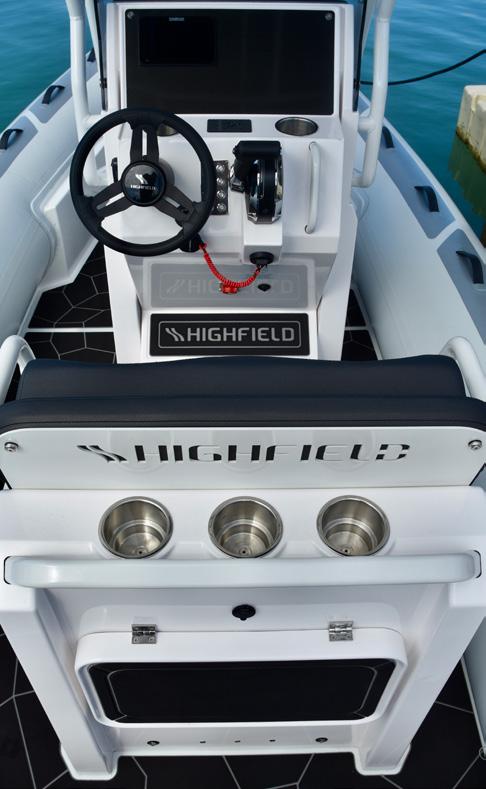
Those that have read that article (Pacific Powerboat November/December 2023) will recall that I was mightily impressed. So, when asked to test and review the new Highfield SP560 Sport, I will confess to a certain amount of, “Oh hum, here we go again, yet another Rigid (hull) Inflatable Boat (RIB) being introduced to an already overcrowded inflatable market sector”.
But despite my strong feeling of ennui as I drove up to Gulf Harbour on the Whangaparaoa Peninsula north of Auckland, where we were set to sea trial and report on this ‘new’ vessel, I will confess (spoiler alert) that from first glimpse to final haul out at the boat ramp, I was rapt with the SP560 Sport. “But hey”, I hear you say, “You’re a marine journalist Czerniak, of course you are going to say nice things about this boat”. Not so dear reader. When the guys at Pacific Powerboat magazine initially asked me to undertake boat tests for them several years ago, I said straight up, it’s got to be honest journalism. Otherwise, what’s the point? – every boat is a great boat, and we all know that’s not true!
I met Jonathan Tuboeuf, the director of Highfield operations in New Zealand, at the Gulf Harbour boat ramp on a gorgeous Auckland summer day. Sunny, clear blue skies and hardly a breath of wind. Fortunate and unfortunate, as a bit of a rough sea really tells you how good a performer any given craft is out on the water. And, as this vessel is touted as a family boat, the ability
to handle rough seas should be a given. However, with relatively smooth seas, once out on the water, we tried to create our own turbulent sea conditions. But, before we get to that part of our day, let’s start at the beginning –the launch at the boat ramp and the initial inspection of the boat alongside the pier.
First impressions, rightly or wrongly, generally tend to be the ones that stick in your mind. So, what were mine? A few quick, one-word answers in no particular order of importance. Loaded. Innovative. Clever. Spacious. Attractive. Comfortable. Quality. Those are the positive first impressions. On the flip side? OTT (Over The Top. Yes, yes that’s actually three words –– but acronyms only count for one, ok?). Expensive. Kind of a weighted view towards the positive, accordingly let’s see why.
LOADED: There isn’t much missing on this craft. However, for me the most obvious, for a family day boat, was the lack of a toilet. I’ve harked on this a few times in past reviews of other smaller boats, but sorry; if you want to convince mom (never mind the kids) that they are going to be out on the water all day and the only option is ‘bucket and chuck it’ you’re going to be pushing the proverbial (pun intended) uphill. To Jonathan’s credit, when I mentioned this, he immediately engaged me in a conversation as to how this amenity could be supplied. The solution, as it turned out, was dead simple. There is ample space in
BOAT TEST_ HIGHFIELD SP560 SPORT
156 MAY / JUNE 2024
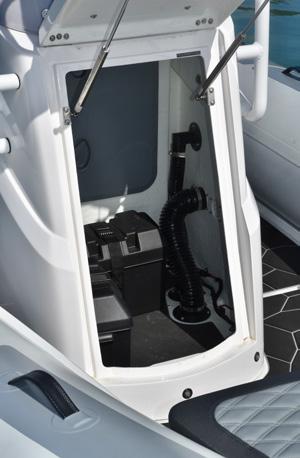
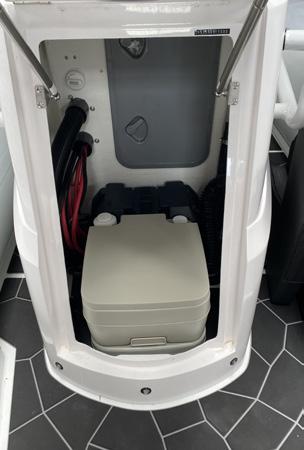
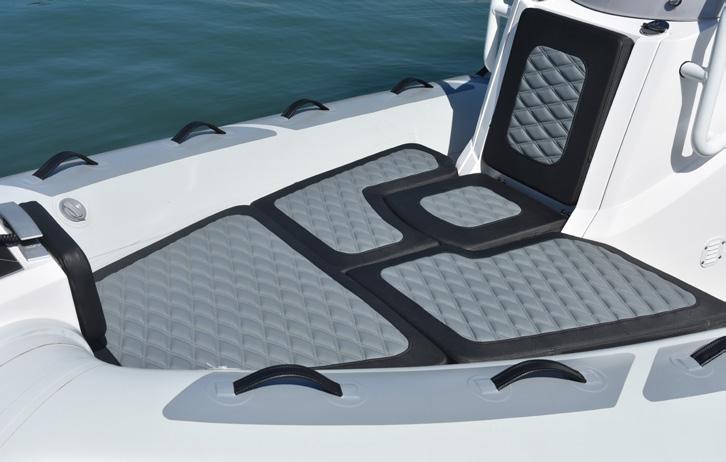
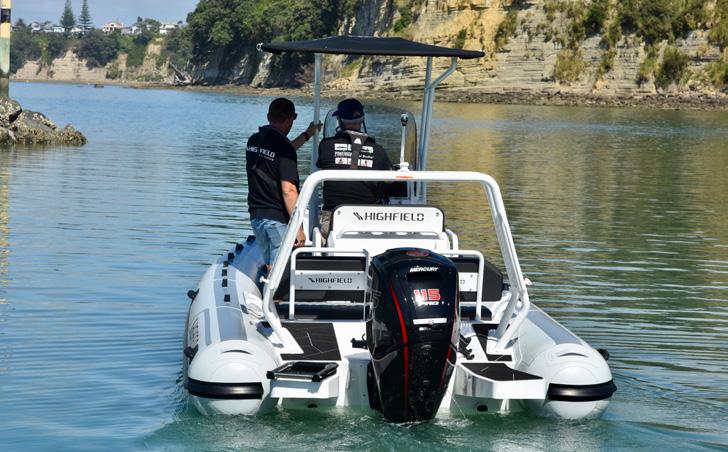
the forefront of the helm station for a porta-potty unit, and so now that will be added to the options sheet (see image). I suspect it will fast become a standard item. But if the lack of a toilet on this test boat was the only exception, what made me think ‘loaded’? Although my list is fairly long, by referring to the spec sheet at the end of the article, you will find that it covers most features. One that isn’t mentioned here, really belongs under the “Clever” heading, but here’s a hint: fire prevention.
Innovative: Simply meaning a new idea, device or method definitely applies to the onboard fire suppression system. Simple in design, but effective and easy to use. The one place where a fire is most likely to break out is where all the electrics and batteries are housed, i.e. in the helm station console. And while there is an easily accessible hatch, often the last thing you want to do in the case of a fire is give it more oxygen by way of opening the large hatch. Solution, a small opening with a rubber valve in the side of the helm station. If a fire breaks out, simply grab the readily accessible fire extinguisher, poke the nozzle through the rubber valve and operate the extinguisher as normal. The contents of the extinguisher flood the space and job done.
CLEVER: By which I mean, ingenious or slick. Examples? The swim platform for starters. A glance at the image says it all. Slanting the platform away from the outboard allows for a much larger and unobtrusive platform, without compromising the design and performance of the boat. The retractable boarding ladder, while not innovative, is slick. Then there is the ‘chilli bin’, cleverly thought out and incorporated in a very logical position under the double person helm station seat. The list goes on, but so must I.
SPACIOUS: Just look at some of the images contained in this article. Need I say more? Probably not, but here goes anyway. The centre helm station console, with clear access to the bow area, almost makes this 5.6 metre vessel qualify as a bowrider craft, allowing it to live up to the claim of being a family day boat. But not only is there ample space up forward, but there is also room for two people to comfortably sit at the helm station and behind that, yet another wide cushioned bench seat with sufficient room for two big adults or three kids.
ATTRACTIVE: Beauty, as the saying goes, is in the eye of the beholder. And only you can be the judge as to what you find attractive. But speaking for myself, I
Huge extra storage behind the helm console forward hatch cover with provision for a porta-potty.
Removable comfortable sun deck cushions up forward.
Twin swim platforms with boarding ladder to port of Mercury 115 Hp Pro X5 Outboard.
POWERBOATMAGAZINE.CO.NZ 157
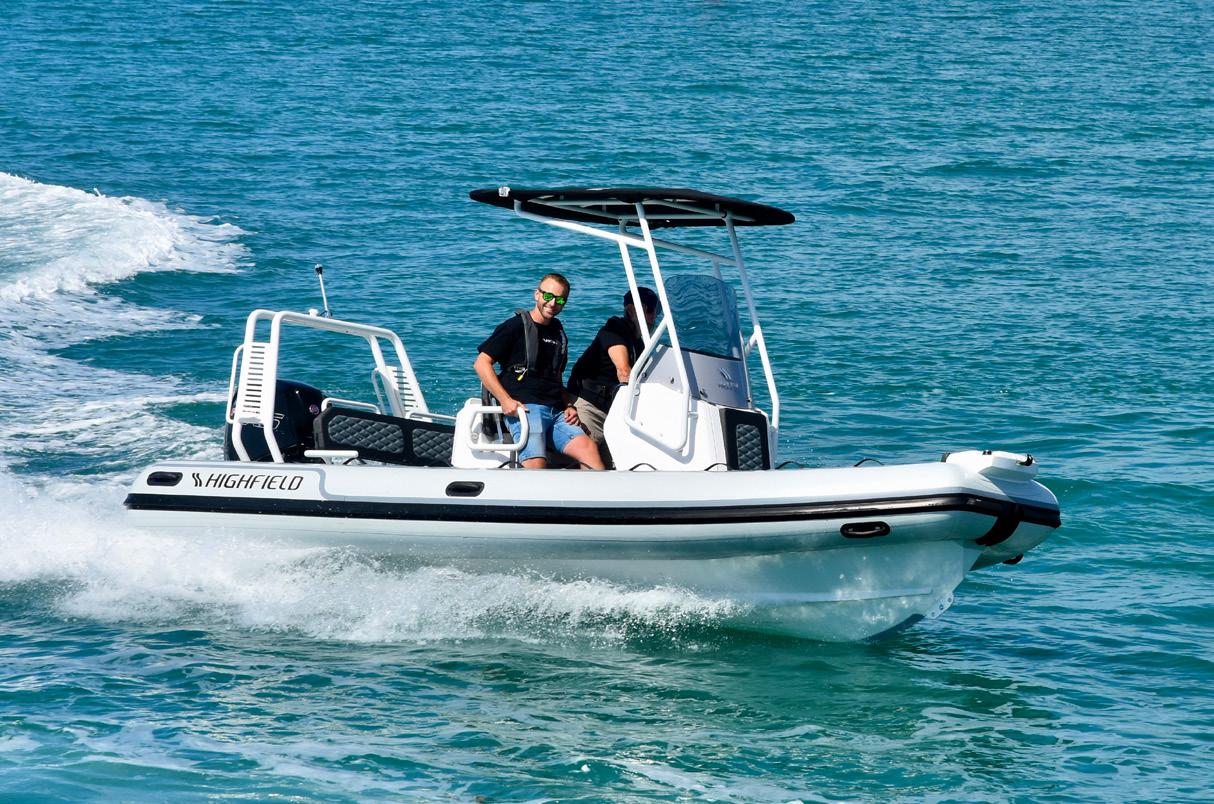
Jonathan hangs onto the convenient grab handle/lateral seat support as Ron does a sharp turn to port.
really like the clean lines of the SP560 which exemplifies that this boat design follows the age-old principle that form follows function. Everything looks well thought out and integrated. From the helm station sun shield tower to the transom tower/roll bar, which houses the stern navigation lights as well incorporating large, sturdy grab handles to ease getting in and out of the boat, to the uniquely patterned, non-slip deck tread and to simple things like the little cushioned back rest in the bow – it all works.
COMFORTABLE: Absolutely! Whether sitting at anchor, or banging through waves, this craft is comfortable. As mentioned earlier, on the day of the test we had to find our own waves, either by creating them ourselves with several tight, consecutive turns or by utilising the wake of a few large craft leaving or entering the Gulf Harbour marina entrance. Firstly, sitting at anchor. I’ve mentioned the ample seating throughout this craft. I didn’t mention how comfortable all the well cushioned seats are. Suffice it to say, they are very comfortable.
The only small complaint I had was regarding the double person helm station seat. Although more than adequate to accommodate two large adults, with a seating position that makes this boat easy to steer from either a standing or sitting position, when one is sitting the tubular port and starboard side supports could use a bit of padding. In typical fashion, when I mentioned this thought to Jonathan, he said, “That’s a good idea, I’ll look into that”. I really appreciate when any product supplier seriously takes on constructive customer feedback. This ethos seems to be very much a part of Highfields DNA, and probably contributes hugely to
the reason why they are arguably the world's number one RIB manufacturer. Listening to your customer is imperative for success.
But back to the helm seat side padding. This need only becomes apparent when you are executing tight manoeuvres or crashing through waves, saving your hips and thighs from taking a bruising on the bare metal tubes. Before reporting on the performance of the SP560 Sport, let’s address my remaining positive impression – quality.
QUALITY: You don’t get to be one of the largest manufacturers in your product sector unless you make a quality product. I learned this first hand during my 22 years as the sales manager at Maxwell Marine, especially when supplying to Superyacht clients. The smallest imperfection or lack of attention to detail, pointed out by the captain or owner of the vessel, and your days of continuing to supply to the builder of that particular Superyacht were in jeopardy. One of the hallmarks of quality is attention to detail, and the SP560 exemplifies this to the nth degree. Get on board and have a look for yourself. Whether it be the clean welds on the hull and aluminium superstructures or little things like the smart phone wireless charging pad at the helm – and I could go on and on - this boat epitomises quality and attention to detail.
Before concluding this list of first impressions, you will recall that I mentioned there was a flip side to my initial reactions. Those being as follows.
OTT (OVER THE TOP): When I first saw the boat sitting alongside the boat ramp pier I thought,
BOAT TEST_ HIGHFIELD SP560 SPORT 158 MAY / JUNE 2024
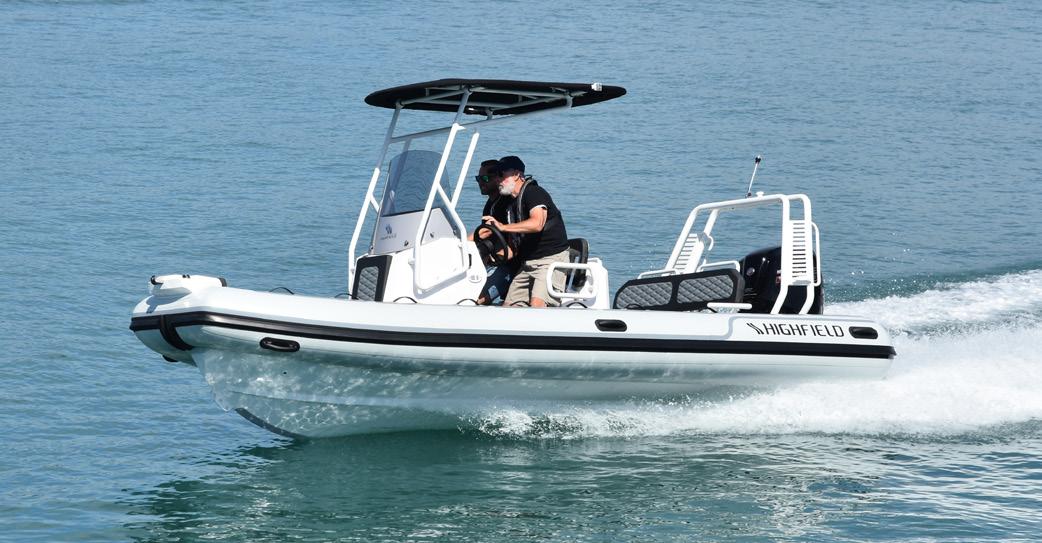
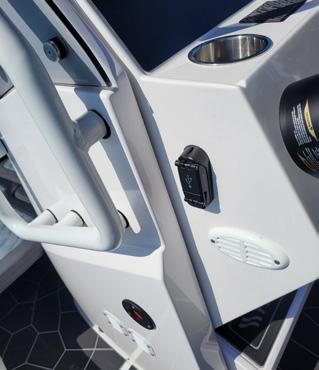
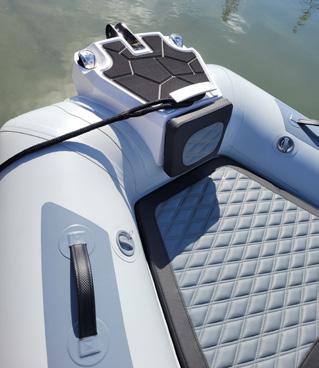
“Seriously? This thing screams overkill”. And it does, but in a good sense. Once you spend time on her you realise that everything about the boat is there for a reason, and if it isn’t there yet, and there is perhaps a good reason for having it, Highfield is probably already thinking about it. Case in point, when Jonathan and I discussed making the Bimini sun shield tower a bit more rigid; turns out that’s already on Highfields “to do” list.
Expensive: Yes, the SP560 Sport, costing over NZD $80,000.00 as tested, is expensive. But relative to what? A quick search on the internet reveals that ‘similar’ RIBs or comparable alloy craft in the 5.5 to 6 metre range are, on average, about $15 to $20 thousand cheaper. However, if you drill deeper and try a closer “Granny Smith” to “Royal Gala” apples comparison, one soon discovers that there is a lot more on offer in the SP560 Sport package. In the end, as always, it comes down to how much ‘bang for the buck’ are you getting?
PERFORMANCE: The performance of the SP560 Sport is as stirring as my list of first impressions. Over many years out on the water and spending numerous
times on both RIB’s and standard inflatable craft of all sizes, one comes to expect a certain standard of good performance from RIBs, especially in the 3 to 9 metre range. The SP560 not only met this standard, but in my opinion, especially considering that it is touted as a ‘family boat’, exceeded it. During the time on board, putting this craft through its paces, at the back of my mind was safety. You hope that any boat you are on is ‘safe’, but particularly so on a family boat. With dad driving, mom alongside and the kids securely seated on the aft bench, if I were dad, would I feel confident putting the SP560 through the same extreme manoeuvres as we did on test day? Absolutely! Careening off the wake generated by a large launch that had powered up after leaving the marina, I tried extremely hard to make this RIB lose control, but to no avail. Under full power, helm hard over and the boat heeling dramatically, there was only the barest hint of the stern losing its grip on the water and, in truth, this was most likely because this manoeuvre was so extreme, I had created prop cavitation in the air infused wave top. No water, no grip! But within a millisecond, as soon as the prop on the Mercury 115 hp outboard found solid water again, the SP560 carried
Clean and functional bow area with bow roller, navigation lights, 'pop-up' anchor/ mooring cleat, padded seat and grab handles.
The SP560 quickly gets up on the plane with a touch of the throttle.
Innovative fire protection. Insert nozzle of the provided fire extinguisher through circular red rubber valve opening and operate extinguisher to put out fire.
Attractive blue LED deck lights provide subtle lighting at nighttime.
POWERBOATMAGAZINE.CO.NZ 159
BOAT TEST_ HIGHFIELD SP560 SPORT
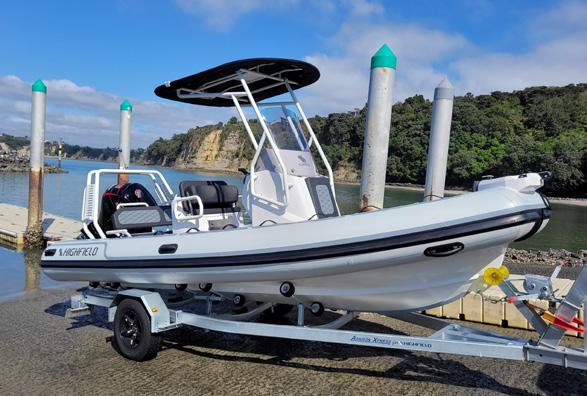
PERFORMANCE DATA
RPM
on as though nothing had happened. Thinking back, I also realised this is a very dry boat. It was only when Jonathan and I purposely slammed head on into a reasonably large wave, that we got any spray whatsoever, and behind the full helm station screen, hardly a drop hit us.
Note: Fuel Consumption was 1.1 NML at 23 knots and 1.35 NML at 20 knots
Summing up, the SP560 sport is a perfect family boat for day use or for your next exploration adventure. The heavy duty 24-degree deadrise alloy hull combined with the 115hp Mercury outboard and built-in under deck 105 litre (23 gallon) fuel tank, provides a smooth ride to your closest beach or gets you home safe when conditions get rough. In rough conditions there is more than one driving position due to the flip up standing bolster seat. Additionally, other little details make a big difference: an alcove in the seat designed especially for your cool bag combined with the flip down table behind the seat lets you enjoy a picnic without taking up valuable space.
The upright console with a tall, tinted windscreen and grab rails accommodates an 18-centimetre (7”) Simrad MPS chart plotter. There is a wide bow boarding step with roller and cleat for easy anchoring and while at anchor, lots of room to hang out in the wide comfortable bow seating area. The bow area can be converted easily to a lounging sun deck and in the stern, there is another seating area with folding table and cup holders for lunch. For watersports there is an optional removable ski pole or towing arch and a huge and flat rear transom area with telescopic boarding ladder. All deck surfaces feature comfortable, uniquely patterned EVA which won’t get hot and is so soft on the feet. There are four dry storage compartments including an extra deep rear seat area, and all include hydraulic pistons to hold up lids for easy stowing. Rated for 12 persons and 115hp, and incorporating a built-in fuel system, the New Sport 560 has everything you need for a great day on the water. Due to its nimble size the SP560 is incredibly easy to tow making this model perfect for those who wish to take their boat with them on road trips to explore further afield. In essence, one of the most versatile medium sized RIBs in its class.
HIGHFIELDBOATS.COM.AU
FEATURES
Standard Features
• High tensile chromated & powder coated aluminium hull
• NEW High-Performance 24º deadrise hull with welded lift stakes
• ORCA® Hypalon or Valmex® PVC tubeWelded seams (PVC)
• Integrated transom supports
• Flush mount non-return air valves
• Self-draining cockpit deck
• Swim platform with ladder
• Cooler bag (chilli bin)
• Sundeck
• Integrated rear seat with cushion
• Double diamond stitch cushions with carbon fabric upholstery
• Extra wide bow boarding step, with anchor line bow roller
• Recessed stainless steel folding cleats/davit lifting points (4)
• Deluxe console with tinted windshield and grab rail
• Roll bar
• Carbon finished dashboard fits a flush mount 18-centimetre (7”) MPS chartplotter
• Integrated Under Deck installed 105L/28-gal EPA Fuel System
• Three (3) storage compartments with hydraulic assist lids
• EVA brushed foam teak finished deck
• Welded direct to hull towing bridle points (2)
• LED deck lights
• Six (6) LED lit panel switches
• Electrical pack including bilge pump & lights for boat & console
• Heavy duty splash guard rubbing strake
• Full length durable keel guard
• Highfield dry bag
• Foot pump, paddles, repair kit
Optional Features
• 6 Colour options available by special order
• Boat Cover
• T-top
• Fire extinguisher
• Porta-potty toilet unit
SPECIFICATIONS
Overall
Internal
Overall
Internal
Dead
# of Air Chambers 6
Maximum Load 1375 kg 3031 lb
Maximum People 12
Boat Weight (Includes console & driver’s seat) 682 kg 1502 lb
Maximum Power 115 hp
Engine Shaft XL
Fuel Tank 105 l 23 gal
Design Category C
Length 5.86 m 19' 3"
Length 3.96 m 13' 1"
Width 2.50 m 8' 3"
Width 1.31 m 4' 3"
Rise 24°
Diameter 42-52 cm 16.5-20"
Tube
Speed in
1.9 1000 3 1500 4.5 2000 6.2 3000 11.5 4000 21.5
28
Knots 700
5000
5900 35.5
160 MAY / JUNE 2024
The SP560 is easy to tow, launch and retrieve from its custom trailer.












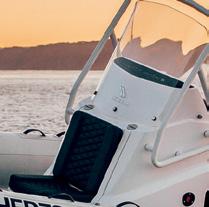
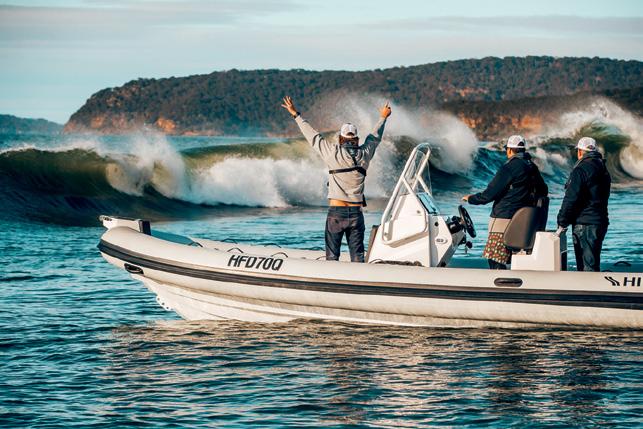
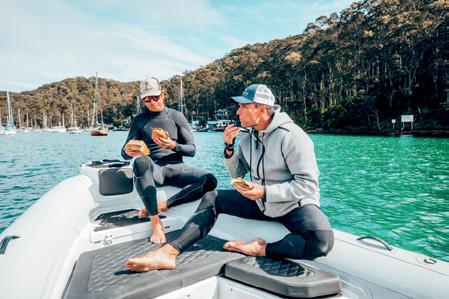
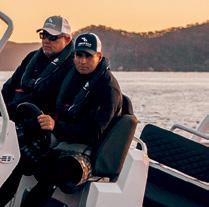



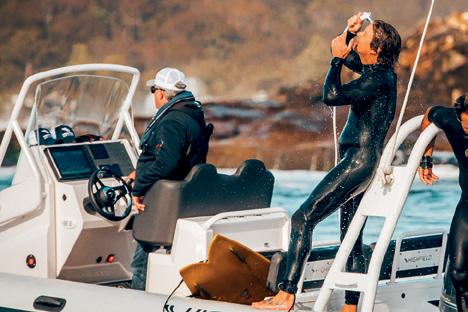
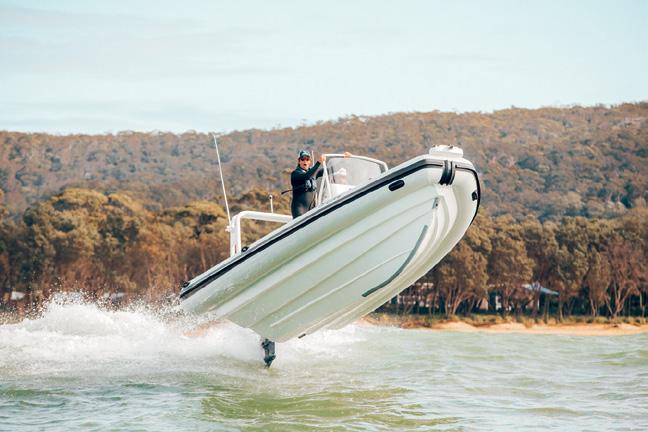


/HIGHFIELDBOATSPACIFIC YOUTUBE.COM/HIGHFIELDBOATS @HIGHFIELDBOATS_PACIFIC WWW.HIGHFIELDBOATS.COM.AU THE ALL NEW SPORT 700 14 719cm 285l 250hp The Sport 700 is a boat that is as at home for a day relaxing at anchor as it is when the weather gets up. The proven 26 degree deadrise hull eats the chop and keeps you and your family dry, comfortable and secure in all conditions. DB948a VICTORIA Sundance Marine 1300 55 00 89 NEW SOUTH WALES (N) Lejen Marine 02 9979 4533 WESTERN AUSTRALIA RIB Worx 08 9430 7007 NEW SOUTH WALES (S) Marineco 0414 609 799 TASMANIA Rubber Ducky 0437 910 378 SOUTH AUSTRALIA Lenta Marine 08 8472 8295 QUEENSLAND Northside Marine 07 3265 8000 NEW ZEALAND Aakron Xpress 09 427 4613





Make/Model LOA Beam Hull Const Type Make/Model LOA Beam Hull Const Type AIRCAT Aircat 625 5.90m 2.35m 4mm CC ALLENCO 4.6 Runabout 5.20m 1.86m 6mm RU 5.00 Runabout 4.70m 2.17m 6mm CC 5.3 Cuddy 5.70m 2.17m 6mm CA 5.5 Cuddy 5.80m 2.27m 6mm CA 5.9 Cuddy 6.28m 2.27m 6mm CA 6.25m 6.50m 2.50m 6mm HT/CA 6.60m 6.90m 2.50m 6mm HT 6.70m 7.00m 2.50m 6mm HT/CA 6.80m 7.10m 2.45m 6mm HT/CA 7.50m 7.80m 2.50m 6mm HT 8.00m 8.30m 2.50m 6mm HT 8.50m 8.80m 2.50m 6mm HT 9.00m 9.40m 2.80m 8mm HT AMC AMC 3.1 3.10m 1.60m 4mm Tiller AMC 4.3 4.30m. 2.00m 4mm Tiller/CC AMF 580 Pro Sport 5.80m 2.25m 6mm CC/CA/RU 610 Pro Sport 6.10m 2.35m 6mm CC/CA/RU/HT 660 Pro Sport 6.80m 2.45m 6mm CC/CA/RU/HT Viper 720 7.20m 2.50m 8mm HT 720 Hardtop 7.20m 2.50m 6mm HT Cobra 750 7.50m 2.50m 8mm CC 770 Hardtop 7.70m 2.50m 6mm HT/CA Viper 770 7.70m 2.50m 8mm HT Cobra 850 8.50m 2.50m 8mm HT BLADERUNNER 5m Cat 5.00m 2.45m 4mm CC 5.5m 5.00m 2.45m 4mm CA/HT/CO 6m Cat 6.00m 2.45m 4mm HT/CA 6.5m Cat 6.50m 2.50m 5mm HT / CC 7.0m Cat 7.00m 2.50m 5mm HT / CC 7.5m Cat 7.50m 2.50m 5mm HT / CC 8.5m Cat 8.50m 3.10m 5mm HT 8800 8.8m 2.7m 5mm HT 9.0m Cat 9.00m 3.10m 5mm HT Flybridge Twin Diesel 12500 4.2m 6mm HT FBG BLUEFIN Bluefin 535 Pursuit 5.25m 2.25m 5mm CC/C Bluefin 600 Profish 6.00m 2.30m 5mm C Bluefin 620CC 6.20m 2.30m 5mm CC Bluefin 620HT 6.20m 2.50m 5mm HT Bluefin 650HT 6.50m 2.45m 5mm HT Bluefin 665HT 6.65m 2.50m 5mm HT Bluefin 700HT 7.10m 2.50m 5mm HT Bluefin 720HT 7.20m 2.50m 5mm HT Bluefin 720 WK 7.20m 2.50m 5mm HT Bluefin 769HT 7.69m 2.50m 5mm HT Bluefin 769 WH 7.69m 2.50m 5mm HT BLUEWATER Bluewater 5.4 5.90m 2.30m 5mm CA Bluewater 550 5.60m 2.30m 5mm CA Bluewater 5.8 6.00m 2.30m 5mm CA Bluewater 5.9 6.40m 2.50m 5mm HT Bluewater 6.1 6.60m 2.50m 5mm HT Bluewater 6.5 6.70m 2.50m 5mm HT Bluewater 6.8 7.00m 2.50m 5mm HT Bluewater 7.0 7.30m 2.50m 6mm HT Bluewater 7.3 7.50m 2.50m 5mm HT Bluewater 7.5 7.70m 2.50m 5mm HT Bluewater 7.7 8.00m 2.50m 5mm HT Bluewater 8.0 8.30m 2.50m 6mm HT Bluewater 8.2 8.50m 2.50m 6mm HT Bluewater 8.5 8.70m 2.50m 5mm HT Bluewater 8.9 9.10m 2.50m 5mm HT Bluewater 9.3 9.50m 2.80m 5mm HT CIRCA Circa 660 6.60m 2.45m 8mm HT Circa 790 8.00m 2.45m 8mm HT Circa 850 8.70m 2.65m 8mm HT Circa 950 9.50m 2.85m 8mm HT COAST CRAFT 560 6.00m 2.25m 4mm CA Rapid Runner 460 4.60m 1.84m 4mm RU DIYNO KITSET 361 3.65m 1.67m 3mm RU 501 5.05m 1.93m 4mm CA 601 6.06m 2.13m 4mm HT 701 7.12m 2.43m 5mm HT 801 8.13m 2.48m 6mm HT DICKEY Custom 750/XS 7.88m 2.48m 6mm HT Custom 800 8.72m 2.48m 6mm HT Custom 850 8.9m 2.48m 6mm HT Custom 950 10.00m 2.80m 6mm HT Semifly 28 8.82m 2.80m 6mm HT DREADNORT V4000 4.00m 1.81m 4mm TILLER D4000 4.00m 1.81m 4mm CC V4250 4.25m 1.94m 4mm CC V4500 4.50m 2.05m 4mm CC V5500 5.65m 2.40m 5mm CC V6000 6.00m 2.45m 5mm HT V6500 6.50m 2.50m 5mm HT V7500 7.50m 2.65m 6/5mm HT V8000 8.00m 2.92m 6/5mm HT V8500 8.50m 3.10m 6/5mm HT V10000 10.00m 3.25m 6/5mm HT V11750 11.75m 3.80m 6/5mm HT DOMAIN 475 4.75m 2.07m 4mm CU/CC 550 5.50m 2.07m 5mm CC/CA www.dnaboats.co.nz - 03 542 3977 DNA 531 Sport Fisher 5.30m 2.02m 5mm CA 551 Sport Fisher 5.50m 2.28m 5mm CA 621CC 6.15m 2.41m 5mm CC 721 HT 7.21m 2.50m 5mm HT 761 HT 7.61m 2.50m 6mm HT 821 HT 8.21m 2.50m 6mm HT 850 HT 8.50m 2.50m 6mm HT 941 HT 9.41m 2.50m 6mm HT EVERYMAN 470 4.70m 1.86m 4mm CA/CC 565 5.65m 2.05m 5mm CU/CC/HT 595 5.95m 2.35m 5mm CU/CC/HT 635 6.35m 2.35m 5mm CU/CC/HT 650 6.50m 2.45m 6mm CA/CC/HT/WA 690 6.90m 2.50m 6mm HT/CC 720 7.35m 2.50m 6mm HT 750 7.65m 2.50m 6mm HT 820 8.20m 2.60m 6mm HT 840 8.40m 2.60m 6mm HT/WA 850 8.65m 2.70m 6/8mm HT 950 9.47m 3.00m 8mm HT 1080 11.00m 3.05m 8mm HT EXTREME 1770 Enduro 5.50m 2.05m 5mm TS/SC 545 Sportfisher/Console 5.50m 2.10m 5mm CA/CC/SC 605 Gameking/Sportfisher 6.07m 2.34m 5mm CA/CC 616 Gameking 6.16m 2.34m 5mm HT 646 Gameking/Sportfisher 6.46 m 2.50m 5mm CC/HT 695 Gameking 7.00m 2.50m 5mm HT 745 Gameking/Walkaround 7.43m 2.80m 5mm CC/HT/WA 795 Gameking/Walkaround 7.93m 2.80m 5mm CC/HT/WA 885 Gameking 8.85m 2.80m 6mm CC/HT 915 Gameking/Walkaround 9.15m 2.82m 6mm CC/HT/WA 985 Gameking 9.85m 2.94m 6mm HT 1185 Gameking 11.80m 3.10m 8mm HT FC BOATS FC430 4.30m 2.02m 4mm TS/SC FC Freedom 4.40m 2.00m 4mm TS FC465 4.65m 2.00m 4mm SC/RU FC535 5.35m 2.05m 4mm CC FC560 5.60m 2.25m 5mm CC/CU FC600 6.00m 2.35m 5mm HT/CC/AMPH FC700 7.05m 2.50m 6mm HT/CC/AMPH FLYFIN 150GT 4.75m 1.90m 4mm TL 1700 5.10m 2.07m 4mm CC/CA 1900 5.60m 2.25m 4mm CC/C/HT 2100 6.50m 2.55m 6mm HT 810 AMPH 8.10m 2.75m 6mm WA/CA/HT/Amph HAURAKI 4500CC 4.50m 1.93m 4mm CC Katana Cat 5.50m 2.50m 4/5mm CC 6750 Centre Cab Centre Cab 7400 Centre Cab Centre Cab HERLEY Elite 8 Elite 8 Captain Elite 9 Explorer 11 HYDRO 7600 8600 www.innovisionboats.co.nz - +64 021 407000 INNOVISION IV 515 5.25m 2.35m 5mm HT/CU/CC IV 555 5.65m 2.40m 5mm HT/CU/CC STYLE CODE: ALLOY BOAT LISTING 2024



www.mclayboats.co.nz - 03 417 8135 MCLAY Fortress 491 Wide Body 4.90m 2.20m 5mm TS/CO Fortress 531 Wide Body 5.30m 2.20m 5mm TS/CO Fortress 601 6.10m 2.20m 5mm CO Sportsman Package 461 4.60m 1.85m 5mm RU Sportsman Package 521 5.18m 2.00m 4mm CA Sportsman Package 551 5.50m 2.08m 4mm CA Sportsman Package 571 5.65m 2.20m 4mm CA Sportsman Package 591 5.95m 2.20m 5mm CA/HT Sportsman Package 591XL 6.15m 2.20m 5mm HT CrossXover 561 5.60m 2.08m 5mm CA CrossXover 581 5.80m 2.20m 5mm CA CrossXover 601 6.00m 2.28m 5mm CA CrossXover 611 6.10m 2.28m 5mm HT CrossXover 651 6.60m 2.30m 5mm HT Cruiser 701 Gen 11 7.05m 2.35m 5mm HT Cruiser 751 Gen 11 7.50m 2.45m 5mm HT Cruiser 801 Gen 11 8.01m 2.48m 6mm HT Raptor Amphibious 741 7.40m 2.35m 6mm HT Walk Round 1100 11.40m 3.09m 6mm HT MIDWEST 420 4.20m 1.57m 3mm TL/CC 7500 7.50m 2.49m 8mm WA/HT OCEANCRAFT 7.1 Alloy 7.75m 2.30m 5mm HT/AMPH OFFSHORE 650 Pro Dive 6.50m 2.50m 8mm CU Offshore 650 6.50m 2.50m 8mm HT Offshore 750 7.50m 2.50m 8mm HT ORCA 3.8 3.80m 1.60m 3mm TS 4.5 4.50m 2.05m 4mm TS/CA/CC 5.4 5.40m 2.33m 5mm C 6 6.00m 2.40m 5mm CA/HT/CC 7 7.00m 2.40m 5mm CA/HT/CC 7.0 Party 7.00m 2.40m 3mm PB 8.0 Party 8.00m 2.50m 3mm PB Seablade 19 6.52m 2.25m 5mm CC Seablade 22 6.70m 2.43m 5mm CC Seablade 24 8.29m 2.65m 5mm CC Orca 6200 Walkaround 6.20m 2.40m 5mm CA PINNACLE Pinnacle 720 7.22m 2.50m 6mm HT Pinnacle 830 8.30m 2.50m 6mm HT Pinnacle 930 9.30m 2.80m 8mm HT www.purekraftboats.co.nz - 07 282 7188 PUREKRAFT 480 Centre Console 4.95m 1.97m 5mm CC 560 Centre Console 5.80m 2.16m 5mm CC 600 Centre Console 6.15m 2.33m 5mm CC 650 Cross Cab 6.67m 2.40m 6mm XCAB/CC/HT 700 Hardtop 7.20m 2.50m 6mm HT 750 Centre Console 7.70m 2.60m 6mm CC/CAB/HT 850 Cross Cab 8.70m 2.75m 6mm CAB/HT/CC QUINTREX 310 Dart 3.20m 1.41m 1.6mm TS 350 Explorer 3.58m 1.45m 1.6mm TS 350 Dart 3.64m 1.49m 1.6mm TS 370 Explorer 3.75m 1.50m 1.6mm TS 370 Dart 3.80m 1.58m 1.6mm TS 390 Explorer 3.85m 1.79m 1.6mm TS 400 Dart 4.00m 1.69m 1.6mm TS 420 Busta 4.21m 2.09m 3mm TS 420 Renegade 4.43m 2.08m 3mm SC 460 Renegade 4.48m 2.22mm 3mm SC 430 Fishabout 4.57m 2.14m 3mm RU 450 Fishabout Pro 4.78m 2.14m 3mm RU 490 Renegade 5.17m 2.25m 3mm SC RADIAN 6 HT Vanguard 5.50m 2.55m 6mm HT 6.7 HT Nordarc 6.70m 2.55m 6mm HT 7.0 HT Vanguard 7.50m 2.55m 6mm HT 7.7 HT Nordarc 7.70m 2.55m 6mm HT 8 HT Vanguard 8.50m 2.55m 6mm HT 8.7 HT Nordarc 8.70m 2.55m 6mm HT RAMCO 4750 Prelude /Sportsman 4.75m 2.05m 4mm CA 5050 Prelude / Sportsman 5.05m 2,10m 4mm CA 5450 Prelude 5.45m 2.10m 4mm CA 5800 Interceptor 5.80m 2.25m 5mm CA IV 585 5.95m 2.45m 5mm HT/CU/CC IV 616 6.25m 2.50m 6mm HT/CU/CC IV 656 6.56m 2.55m 6mm HT/CU/CC IV 707 7.15m 2.60m 6mm HT/CU/CC IV 757 7.65m 2.65m 6mm HT/CU/CC IV 808 8.15m 2.70m 6mm HT/CU/CC IV 858 8.65m 2.75m 6mm HT/CU/CC IV 909 9.15m 2.80m 6mm HT/CU/CC IMAGE 5.8 Elite 6.10m 2.30m 5mm CA 6m Elite 6.50m 2.35m 5mm HT 6.4 Elite 6.40m 2.35m 5mm CA/HT 7.45 Fishfinder 7.45m 2.50m 6mm HT 7.5 Fishfinder 7.50m 2.50m 6mm HT 8.25 Fishfinder 8.50m 2.50m 6mm HT 8.25 Fishmaster 8.50m 2.50m 6mm HT 8.25 MasterJet 8.73m 2.80m 6mm HT 8.75 Fishmaster 9.00m 2.70m 6mm HT 9.0 Fishmaster 9.25m 2.80m 6mm HT 10.4 Cruisemaster 10.50m 3.10m 6mm HT 11.3 Cruisemaster 11.30m 3.05m 6mm HT KINGFISHER 370 Minicat 3.70m 1.80m 4mm TL 390 Minicat 3.90m 1.80m 4mm TL 410 Minicat 4.10m 1.95m 4nn TL 450 Minicat 4.50m 2.07m 4mm CC/SC/CU/TL Kingfisher 535 5.10m 2.08m 5mm CA/CC 510 Minicat 5.10m 2.33m 4mm CC/SC/CU/TL Kingfisher 595 5.80m 2.33m 5mm CU/CC Kingfisher 570 Powercat 5.70m 2.33m 4mm CC Kingfisher 620 Powercat 6.25m 2.49m 4mm HT/CA Kingfisher 670 Powercat 6.75m 2.49m 5mm HT/CU Kingfisher 725 7.00m 2.47m 5mm HT Kingfisher 795 7.95m 2.50m 5mm HT Kingfisher 820 Powercat 8.20m 3.00m 5mm HT Kingfisher 925 9.25m 3.05m 5mm HT
Flaxton Road,
KWIKKRAFT 470 4.70m 1.93m 3mm CU 535 5.37m 2.10m 4mm CU/HT 585 5.95m 2.18m 5mm CU/HT 615 6,45m 2.38m 5mm HT 665 6.97m 2.43m 5mm HT 740 7.40m 2.58m 5mm HT 795 7.95m 2.70m 5mm HT LAZERCRAFT 490 Ski 5.00m 2.00m 5mm RU 580 Divemaster / CC 5.80m 2.30m 5mm RU/CC 600 GT 6.00m 2.35m 5mm CA 650 Limited / Sportfisher 6.50m 2.30m 5mm CA/HT 700 Limited / Sportfisher 7.00m 2.25m 5mm HT MAKAIRA Makaira Gen3 750 7.5m 2.47m 8mm HT Makaira Gen3 800 8.0m 2.73m 8mm HT Makaira Gen3 850 8.6m 2.87m 8mm HT Makaira Gen3 900 9.0m 2.87m 8mm HT Makaira Gen3 950 9.5m 3.06m 8mm HT Makaira Gen3 1000 10.0m 3.06m 8mm HT MACHINA Machina 551 5.73m 2.0m 5mm CA Machina 661 6.80m 2.40m 6mm HT Machina 701 7.25m 2.40m 6mm HT Machina 731 7.50m 2.40m 6mm HT Machina 771 8.00m 2.50m 6mm HT www.marcoboats.co.nz - 07 889 7083 MARCO 400 Tiller 4.00m 1.90m 4mm TS/CO 420 Tiller 4.20m 1.90m 4mm TS/CC/RU 440 Angler/Thresher 4.40m 2.10m 4mm CC/CA/RU/TS/CO 480 Angler/Thresher 4.90m 2.10m 4mm CC/CA/RU/TS/CO 520 Angler/Thresher 5.20m 2.10m 4mm CC/CA/RU/TS/CO 550 Striker 5.20m 2.25m 5mm CC/CA/RU 600 Striker/Souwester 6.00m 2.20m 5mm CC/CA/HT 625 Striker/Souwester 6.25m 2.33m 5mm CC/CA/HT 650 Souwester 6.50m 2.49m 6mm CC/HT/WA 700 Souwester 7.40m 2.49m 6mm CC/HT/WA 725 Souwester 7.80m 2.49m 6mm CC/HT/WA 750 Souwester 8.20m 2.65m 6mm CC/HT/WA 800 Souwester 8.80m 2.70m 6mm HT 880 Souwester 9.30m 2.90m 8mm HT 950 Souwester 10.0m 3.0m 8mm HT Make/Model LOA Beam Hull Const Type Make/Model LOA Beam Hull Const Type ALLOY BOAT LISTING 2024 POWERBOATMAGAZINE.CO.NZ 163
sales@kwikkraft.co.nz kwikkraft.co.nz 305a
Rangiora 7400


6020 Fisherman 6.02m 2.20m 5mm HT 6250 Fishmaster 6.25m 2.33m 5mm HT 7010 Provider 7.01m 2.50m 5mm HT 7450 Seahunter 7.45m 2.50m 5mm HT 8450 Ultimate 8.45m 2.50m 5mm HT 9000 Ultimate XL 8.95m 2.85m 6mm HT SCORPION 360 Dinghy 3.60m 1.80m 3mm TS 400 Dinghy 4.10m 1.90m 3mm TS 440 Runabout 4.40m 1.90m 3mm RU 470 CC 4.70m 2.17m 4mm CA/CC 500 Bowrider 4.80m 2.17m 4mm RU 525 Cuddy/Profish 5.35m 2.20m 5mm CA/CC 620 6.10m 2.30m 5mm CC/HT 650 Hardtop 6.50m 2.45m 5mm HT 665 Hardtop 6.65m 2.50m 5mm HT 700 Hardtop 7.00m 2.50m 5mm HT 670 Wheelhouse 6.70m 2.40m 5mm HT 720 HT 7.20m 2.50m 5mm HT 780 HT 7.80mm 2.50m 6mm HT 890 Wheelhouse 8.89m 2.80m 6mm HT SEASPRAY SLM370 3.70m 1.50m 3mm TS SLM430T 4.30m 1.70m 3mm TS SLM430W 4.30m 1.70m 3mm RU SL450T 4.65m 1.90m 3mm RU www.seaboss.co.nz - 0800 95 95 90 SEABOSS 550 5.50m 2.42m 5mm CA 620 6.20m 2.42m 5mm CA/HT 670 6.70m 2.42m 5mm CA/HT 700 7.00m 2.50m 5mm CA/HT/CA SENATOR Typhoon 760 8.0m 2.5m 6mm HT Typhoon 800 8.35m 2.7m 6mm HT Typhoon 920 9.3m 2.7m 6mm HT SOUTHERN XP646 / XF 646 6.85m 2.50m 5mm HT XF735 7.35m 2.50m 5mm HT XP696 7.35m 2.50m 5mm HT XF726 / XP726 7.65m 2.50m 5mm HT XP746 7.75m 2.50m 5mm HT XP776 8.15mm 2.50m 6mm HT XP756 8.10m 2.50m 6mm HT AMPH XP816 8.55m 2.50m 6mm HT XP856 8.95m 2.90m 6mm HT XP896 9.00m 2.90m 6mm HT STRYDA 600C 6.43m 2.58m 5mm HT SURTEES 495 Workmate 4.95m 2.01m 4mm CA/CC 540 Workmate 5.4m 2.19m 5mm CA/CC/HT 575 Workmate 5.75m 2.15m 5mm CA/CC/HT 610 Workmate 6.10m 2.26m 5mm HT/CC/CA 650 Workmate 6.50m 2.37m 6mm HT/CC/CA 700 Workmate 7.00m 2.37m 6mm HT/CC/CA 610 Game Fisher 6.10m 2.26m 5mm HT 650 Game Fisher 6.50m 2.37m 5mm HT 700 Game Fisher 7.00m 2.37m 6mm HT 750 Game Fisher 7.50m 2.50m 6mm HT 800 Game Fisher 8.00m 2.70m 6mm HT ULTIMATE Ultimate 14 4.0m 1.8m 4mm TS/CC Ultimate 16 5.10m 2.05m 6mm SC/CC/CA Ultimate 18 6.05m 2.30m 5mm CA/CC/SC/HT Ultimate 21 6.35m 2.45m 6mm HT/CC Ultimate 21 Elite 6.35m 2.45m 6mm HT/CC Ultimate 25 Elite 7.25m 2.55m 6mm HT/CC/SC Ultimate 27 Elite 8.50m 2.80m 6mm HT WHITE POINTER 6.20 Sports Hard Top 6.20m 2.35m 6mm HT/CA 660 Sports Hard Top 6.60m 2.45m 6mm HT/CA 7m Sports Hard Top 7.20m 2.45m 6mm HT/CA 7m Sports Cruiser 7.20m 2.45m 6mm HT/CA 730 Sports Cruiser 7.40m 2.45m 6mm HT/CA 750 Custom Cruiser 7.60m 2.50m 6mm HT/CA 8m Sports Cruiser 8.20m 2.50m 6mm HT/CA 840 Pro Sportsman 8.40m 2.75m 6mm HT/CA 840 Sports Cruiser 8.40m 2.75m 6mm HT/CA 840 Pro Sportsman 8.40m 2.75m 6mm HT/CA 870 Sport Cruiser 8.70m 2.75m 6mm HT/CA 870 Pro Sportsman 8.70m 2.75m 6mm HT/CA 850 Sports Cruiser 8.80m 2.50m 6mm HT/CA 850 Custom Cruiser 8.80m 2.50m 6mm HT/CA 920 Custom Cruiser 9.20m 2.90m 6mm HT/CA 940 Pro Sportsman 9.40m 2.90m 6mm HT/CA 970 Pro Sportsman 9.70m 2.90m 6mm HT/CA 1050 Pro Sportsman 10.50m 3.10m 6mm HT/CA All models avaliable in 8mm Make/Model LOA Beam Hull Const Type Make/Model LOA Beam Hull Const Type ALLOY BOAT PONTOON ADVENTURE Adventure 1430 4.30m 1.45m 3mm TS Adventure 1450 4.50m 1.75m 4mm TS/CC/CA AQUALINE 435 4.35m 1.95m 3mm TS 495 5.07m 2.02m 4mm CA 545 5.52m 2.18m 4mm CA 565 5.65m 2.32m 4mm HT 595 5.95m 2.40m 4mm HT 645 6.47m 2.45m 5mm HT 705 7.20m 2.50m 5mm HT 780 7.77m 2.50m 5mm HT 860 8.55m 2.50m 5mm HT 890 9.00m 2.80m 5mm HT 1080 10.80m 3.10m 6mm HT ASSAULT 672 APB 6.72m 2.40m 5mm HT 692 APB 6.92m 2.50m 5mm HT BLUEFIN 420 APB 4.20m 1.87m 3mm TS 480 APB 4.80m 1.87m 3mm TS COMMANDO 3.1 Trooper 3.10m 1.72m 3mm TS 3.6 Trooper Delux 3.60m 1.72m 3mm TS 3.6 Trooper 3.60m 1.72m 3mm TS/CA 3.9 Trooper 4.20m 1.72m 3mm TS/CA 3.9 Trooper Sport 4.20m 1.72m 3mm CA/CC 5.4 Trooper 5.40m 2.22m 4mm CA/CC 5.8 Wide Body 5.80m 2.26m 5mm CA 7.5 Silverado 7.50m 2.48m 6mm CA 8.5 Trooper 8.50m 2.58m 6mm CC DNA 300 D 3.03m 1.01m 3mm TS 420 3.90m 1.71m 3mm TS/CC 440 JetX 4.40m 1.71m 4mm CC 450 4.50m 1.71m 4mm CC/CA 480 XC 4.60m 2.02m 4mm CA 480 JetX 4.80m 2.05m 5mm CC 515 CCX 5.15m 2.13m 4mm CC/CA 535 XC 5.35m 2.15m 4mm CA 570 XHT 5.70m 2.27m 4mm HT 660 XHT 6.60m 2.47m 5mm HT 680 XHT 6.80m 2.47m 5mm HT 730 XHT 7.30m 2.50m 6mm HT DREADNORT V4000 4.00m 1.81m 4mm TL D4000 4.00m 1.81m 4mm CC V4500 4.50m 2.05m 4mm CC V5500 5.65m 2.40m 5mm CC V6000 6.00m 2.45m 5mm HT V6500 6.50m 2.50m 5mm/6mm HT V7500 7.50m 2.65m 5mm/6mm HT V8500 8.50m 3.10m 5mm/6mm HT www.frewzaboats.co.nz - 03 214 1021 FREWZA 4.1 4.10m 1.75m 3mm TS F14 4.40m 1.75m 3mm CA/CC/TS F15 4.85m 2.00m 4mm CA/CC/TS F16 5.15mm 2.00m 4mm CA/CC/TS F18 5.75m 2.25m 4mm CA/CC/HT F21 6.30m 2.30m 5mm HT/CA/CC F22 6.80m 2.30m 5mm HT IMAGE 7.08 7.08m 2.36m 6mm HT KIWI KRAFT 470 4.70m 1.93m 3mm CU 535 5.37m 2.10m 4mm CU/HT 585 5.95m 2.0m 5mm CU/HT 615 6.45m 2.38m 5mm HT 665 6.97m 2.40m 5mm HT 740 7.40m 2.50m 5mm HT 795 7.95m 2.70m 5mm HT MIDWEST 580 5.80m 2.47m 5mm HT OCEANPRO 460 4.60m 1.83m 3mm TS/CC 460HD 4.60m 1.83m 4mm CC 470 4.70m 1.83m 4mm CU 520 5.20m 2.07m 4mm CC/CU 530 5.30m 2.07m 4mm HT STYLE CODE: ALLOY BOAT LISTING 2024



ALLOY BOAT LISTING 2024 2250 Ultra Centrecab 6.85m 2.54m 4mm HT 2250 Ultracab WT 6.85m 2.54m 4mm HT 2400 Supercab 7.32m 2.30m 6mm HT 2500 Ultracab XL 7.62m 2.55m 6mm HT 2750 Ultra Centrecab 8.38m 2.49m 6mm HT JET BOATS COAST CRAFT 560 6.00m 2.20m 6mm CA 720 7.50m 2.50m 6mm HT HAMILTON MARINE HJ 132 4.20m 1.80m 5mm RU HJ 141 4.55m 1.90m 5mm RU HJ 151 4.60m 1.90m 5mm RU Jet 470 4.70m 1.50m 5mm RU HJ 152 4.60m 1.75m 5mm RU HJ 161 5.00m 1.90m 5mm RU HJ 191 5.90m 1.90m 5mm RU JETTEC JT320 3.20m 1.53m 5mm/12mm RU JT360 3.60m 1.53m 5mm/12mm RU JT385 3.85m 1.53m 5mm/12mm RU JT400 4.00m 1.53m 5mm/12mm RU JT420 4.20m 1.53m 5mm/12mm RU JT440 4.40m 1.68m 5mm/12mm RU JT460 4.60m 1.68m 5mm/12mm RU JT580 Crusade 5.80m 1.85m 5mm/12mm RU JT580 Viking 5.80m 1.85m 5mm/12mm BR www.keelowcraft.co.nz - 03 208 9995 KEELOW Riverwild 320 3.20m 1.37m 5mm RU Riverwild 380 3.20m 1.37m 5mm RU Riverwild 420 4.20m 1.45m 5mm RU Riverwild 450 4.50m 1.50m 5mm RU Riverwild 480 4.80m 1.54m 5mm RU Riverwild 560 5.60m 1.80m 6mm RU Voyager 560 5.60m 1.80m 6mm CA Highlander 470 4.70m 1.47m 5mm HT KWIKKRAFT 460 Performer 4. 60m 2.1m 8mm RU 470 Performer 4.70m 2.2m 8mm RU 500 Adventurer 5.00m 2.30m 8mm RU 5500 SL 5.50m 2.35m 8mm RU 5800 RL 5.80m 2.35m 8mm RU MACKRAFT Adventure 480 4.80m 1.65m 8mm RU RAPID RUNNER RR 420 4.20m 1.82m 10mm RU RR 440 4.40m 1.84m 10mm RU RR 460 Wide Body 4.60m 1.92m 10mm RU RR 460 4.60m 1.88m 10mm RU SCOTT 3.30 Puddle Hopper 3.30 m 1.46 m 10mm RU 3.55 Puddle Hopper 3.55 m 1.46 m 10mm RU 3.55 Scud 3.55 m 1.46 m 10mm RU 3.70 Puddle Hopper 3.70 m 1.46 m 10mm RU 3.70 Scud 3.70 m 1.46 m 10mm RU 3.90 River Boat 3.90 m 1.53 m 10mm RU 3.70 Scud 3.70 m 1.46 m 10mm RU 4.30 River Boat 4.30 m 1.64 m 12mm RU 3.70 Scud 3.70 m 1.46 m 10mm RU 4.45 River Boat 4.45 m 1.64 m 12mm RU 4.45 Cross Over 4.45 m 1.64 m 12mm RU 4.55 Scud 4.55 m 1.64 m 12mm RU 4.60 River Boat 4.60m 1.64 m 12mm RU 4.60 Cross Over 4.60m 1.64 m 12mm RU 4.60 Scud 4.60m 1.64 m 12mm RU 5.10 Sea Scud 5.10 m 1.96 m 12mm RU 6.50 Sea Scud 6.50 m 1.96 m 12mm RU 13’ 6 Sprint Boat 13’ 6” 1.35 m 5mm RU WATTSCRAFT 3m 3.05m 1.54m 6mm RU 3.3m 3.34m 1.60m 8mm RU 3.6m 3.59m 1.76m 10mm RU 3.8m 3.81m 1.88m 10mm RU 4.3m 4.28m 1.87m 10mm RU 4.6m 4.58m 1.94m 12mm RU Make/Model LOA Beam Hull Const Type ORCA 3.8 3.80m 1.60m 3mm TS 4.5 4.50m 2.05m 4mm TS/CA/CC 5.4 5.40m 2.33m 5mm CA 6 6.00m 2.40m 5mm CA/HT/CC 7 7.00m 2.40m 5mm CA/HT/CC 7.0 Party 7.00m 2.40m 3mm PP 8.0 Party 8.00m 2.50m 3mm PP OSPREY Osprette 380E/S/SC/FS 4.00m 1.68m 2.5mm TS/CO/CA Osprette 420E/S/SC 4.50m 1.95m 3mm TS/CO/CA 450C/CC/SC 5.00m 2.15m 4mm TS/CO/CA 495C/CC/SC 5.20m 2.25m 4mm CC/CA 520C/CC/SC 5.20m 2.25m 4mm HT 565C/CC/HT 5.65m 2.25m 4mm CA/CC/HT 590C/CC 5.90m 2.25m 5mm HT/CA 610HT 6.10m 2.25m 5mm HT 650HT/WR 6.50m 2.50m 5mm CA Classic / Plus 700 7.00m 2.50m 5mm CA/HT Classic / Plus 750 7.50m 2.50m 6mm HT Plus 800HT 8.00m 2.50m 6mm HT Plus 850HT 8.50m 2.50m 6mm HT Plus 750HT WIDE 7.50m 2.80M 6mm HT Plus 800HT WIDE 8.00m 2.80M 6mm HT Plus 850HT WIDE 8.50m 2.80m 6mm HT Plus 890HT WIDE 8.90m 2.80m 6mm HT Plus 980HT WIDE 9.80m 2.80m 6mm HT PROFILE 1401 4.30m 1.74m 3mm TS/CC/CA 465C 4.65m 1.80m 4mm CA 545C 5.45m 2.00m 4mm CA 585C 5.85m 2.14m 5mm CA 585CC 5.85m 2.14m 5mm CC 585H 5.87m 2.14m 5mm HT 600H 6.00m 2.25m 5mm HT 635H 6.40m 2.30m 5mm HT 735H 7.35m 2.31m 6mm HT 750HW 7.50m 2.60m 6mm HT 780HW 7.80m 2.66m 6mm HT 940HW 9.40m 2.73m 6mm HT SEALEGS 6.5 Alloy CC 7.5 Alloy CC 8.5 Alloy CA www.senatorboats.com - 0800 SENATOR SENATOR IS 400 4.10m 1.80m 3mm TS RC 450 4.74m 1.87m 4mm CA RC 480 5.04m 1.87m 4mm CA RC 500 5.30m 1.52m 4mm CA RC 520/RCC 520 5.50m 1.98m 4mm CA/CC RC 540 5.70m 1.98m 4mm CA RC 580 6.12m 2.18m 5mm CA RCC 580 6.13m 2.20m 5mm CC RH 580 6.13m 2.20m 5mm HT RH 620 6.45m 2.38m 5mm HT RH 650 6.75m 2.38m 5mm HT RH 690 7.13m 2.49m 6mm HT RH 770 7.93m 2.49m 6mm HT RH 780 7.97m 2.70m 6mm HT RH 860 9.90m 2.70m 6mm HT RH 770 Stealth 8.24m 2.49m 6mm HT/AMPH RH 690 Stealth 7.50m 2.49m 6mm HT/AMPH SCORPION 392 3.92m 1.90m 4mm RU Oceanpro 460 4.60m 1.83m 4mm CC 455 4.55m 1.90m 4mm CA 530 5.30m 1.90m 4mm CA 600 6.00m 2.30m 5mm CA/HT STABICRAFT 1450 Explorer 4.42m 1.89m 3mm TS 1450 Frontier 4.42m 1.89m 3mm SC 1550 Frontier 4.72m 2.02m 4mm SC 1550 Fisher 4.72m 2.02m 4mm CA 1850 Fisher 5.40m 2.16m 4mm CA 1850 Supercab 5.60m 2.40m 4mm HT 2050 Supercab 6.27m 2.31m 5mm HT 2100 Supercab 6.40m 2.30m 5mm HT CC = CENTRE CONSOLE CO = CONSOLE CA = CABIN CU = CUDDY CABIN RU = RUNABOUT TS = TILLER STEER HT = HARDTOP PP = PARTY PONTOON Make/Model LOA Beam Hull Const Type POWERBOATMAGAZINE.CO.NZ 165
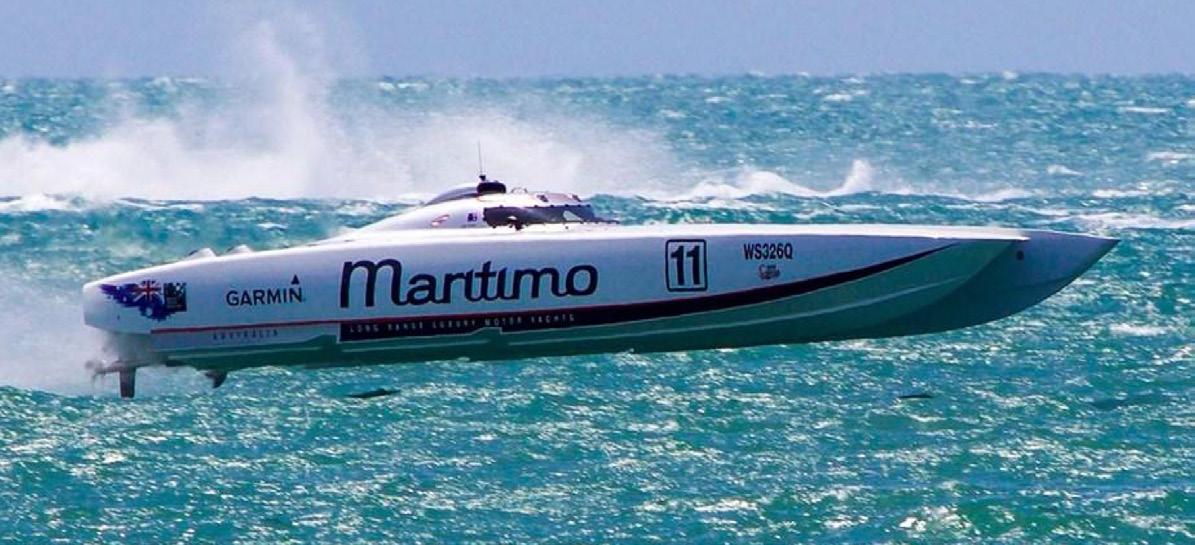
MARITIMO
FOUNDED ON A COMPETITIVE SPIRIT
Chapter
The spirit of competition has always been at the very core of everything that Maritimo creates. Competition is not just about winning; competition runs much deeper than that. It’s about creating an environment and a culture that strives to bring out the very best in the individual, the team and the organisation as a whole. Winning can be the ultimate reward, but there are many other benefits to be attained from this competitive attitude. Maritimo’s Founder Bill Barry-Cotter loved to compete right from his earliest days. A chance to sail on Sydney’s Pittwater in his teens kindled a passion for being on the water and not long after, at the age of 16, a boat building apprenticeship commenced. Bill sailed competitively in dinghies out of the BYRA Sailing Club at Bayview, Pittwater until the mid-60’s as the Mariner brand was firmly established and growing.
Although Mariner was renowned for their motorboats Bill’s underlying passion for sailing saw the factory produce many a sailboat too, notably half ton and three-quarter ton boats for the International Offshore Classes, in which he competed along with his brother, Kendall. “I wanted to build a powercat. So, I brought Michael Peters out from the USA. He was the best designer in the world. He had built most of the winners. We started there. You know you are developing
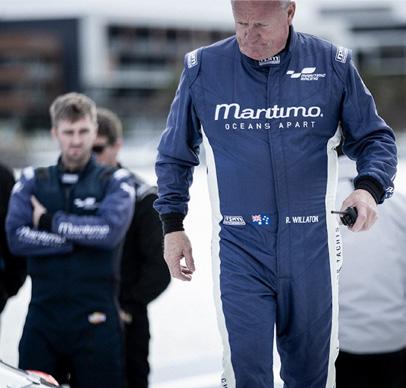
all the time – looking for a competitive edge. The next couple of boats I designed were smaller again, but they were running the same engines, the Detroit Diesels. Then it was onto another new boat, new engines, the Lamborghinis and it had to be smaller. It was effectively a wing flying!” Recalled Bill.
With the establishment of Maritimo the company and Maritimo Racing in the early 2000s there was an even greater focus on Offshore Power Boat Racing Class 1 and both Bill and his son Tom competed together at the highest level both abroad, and at home. Legendary names in power boat racing, such as Ross ‘Rosco’ Willaton and Peter ‘Muddy’ McGrath have been woven into the fabric along the way and certainly engraved deeply into the silverware.
On the home front, Maritimo have celebrated more Championship wins than any other team in history with 16 Australian Offshore Superboat ‘AUS1’ Championships. Internationally, the Maritimo Racing team of Tom BarryCotter and Ross Willaton has also beaten the world’s best having been crowned the UIM XCAT World Champions and XCAT Pole Position World Champions in 2019. Other accolades include the UIM World Championship and the APBA World Championship at Key West. “Tom pushes every
MARITIMO 20 TH ANNIVERSARY CHAPTER 6
6
166 MAY / JUNE 2024
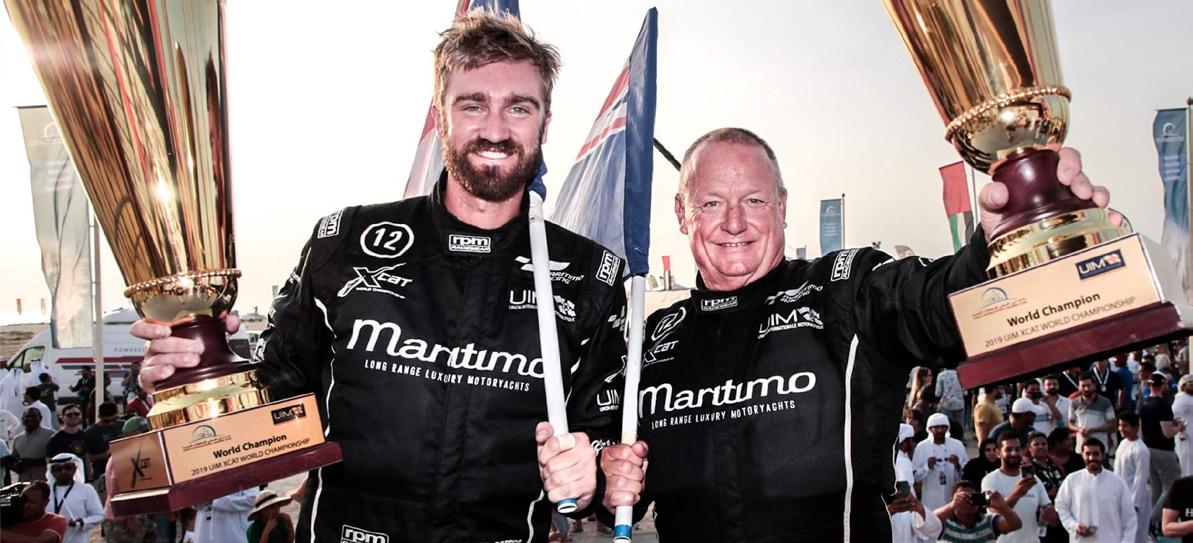
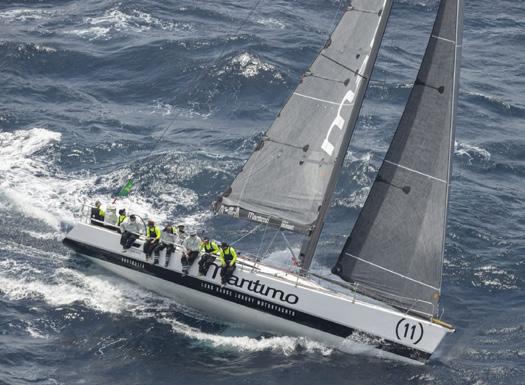
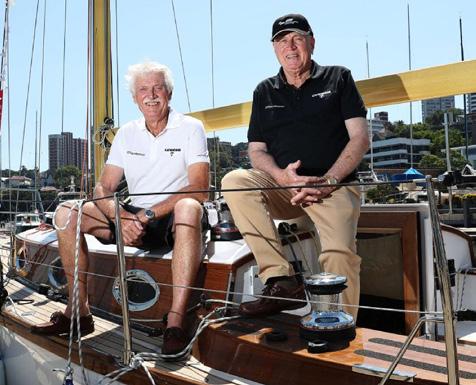
aspect of the design. He’s been working around boats since he was seven years old – his passion for racing, development and boat design and building is immense. The instant he got in a boat with me to go racing he was trying to alter it! He perseveres with every detail, no matter how small,” Bill added.
Maritimo Racing’s sail programme really kicked off with the complete and detailed restoration of Katwinchar, which had been the Barry-Cotter family vessel when Bill and his brother Kendall were just boys. She subsequently entered in the famous Sydney to Hobart yacht race and won the Grand Veterans division. Her elapsed time was 4 days 6 hours 27 minutes 47 seconds, which is very handy for a 32-foot ketch, let alone one that is 119 years old. Still, considering she sailed from England to Australia back in 1951, it would seem anything is in her stride.
There’s a long pedigree in yachting for Bill, who was actually part of the Australian Champion ¾ tonner crew in 1975, in a campaign that included other luminaries like the great Ken Beashel. Accordingly, it is no wonder that Barry-Cotter’s sights were set even higher after Katwinchar, and Skipper Michael Spies was tasked with finding a larger, faster, and more comfortable vessel. Cue the famous Schumacher 54 from San
Francisco, which after a birthday refit came out in the famous white and black Maritimo Racing livery, and took out races like the very hardy Westcoaster from Melbourne to Hobart in 2022, as well as Line Honours in the Brisbane to Gladstone race, and most recently her division at the Festival of Sail in Geelong.
The search for speed continued, and soon the ex-Patches TP52 penned by the famous Reichel/Pugh team and built by Green Marine joined the fold. She too would have a birthday as part of her commissioning into the fleet, and just recently took out the Surf to City race (Southport to Brisbane) and was just on one hour ahead of nearest rivals. It is no wonder she is the current IRC Champion in Queensland.
Bill is still very much in love with sailing, and the need for something even cruisier has led to the acquisition of an Oyster 100. Very much more down the line of superyacht, there is a distinct pedigree there that will mean 250 nautical mile days are assured in both cruise and passage race modes. It will be most competitive against the other lifestyle vessels around, and will relish the trade winds of the Whitsundays, Auckland’s Millennium Cup, the Hong Kong to Vietnam sleigh ride, Malaysia’s Raja Muda, and even Sardinia, when there is good wind.
POWERBOATMAGAZINE.CO.NZ 167



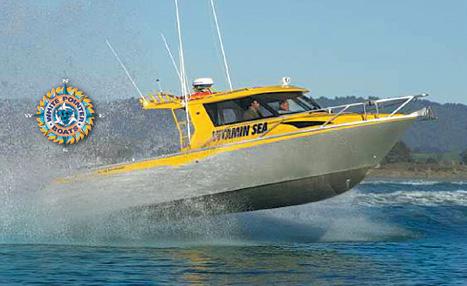

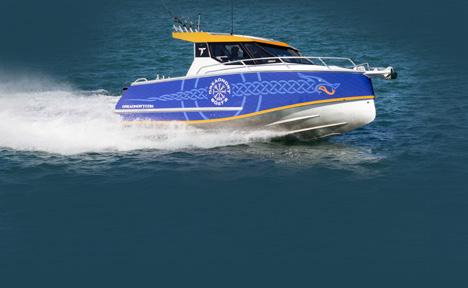


Kotaro Fuse Certified Boat Builder and Marine Painter M: 021 260 2047 E: yamatomarine@gmail.com • Refits • Repair • Maintenance • Teak Decking • Interior Cabinetry Servicing Northland Wide M: 021 260 2047 | E: yamatomarine@gmail.com DB958 Boatbuilding & Cabinetry >> DIRECTORY BOAT BUILDERS & DESIGNERS, SALES & SERVICE, PRODUCT & ACCESSORIES ADVERTISE HERE TRAILERBOATS I LAUNCHES I CRUISERS Contact: Holly@boatmags.com or Doug@boatmags.com For just $75 per month…. Cost effective – Targeted advertising. DB938 Blair Lewis B.Eng AM.Rina Naval Architect Transformarine@gmail.com +64 21 613 990 Stuart Dawe Shipwright Altechmarine02@gmail.com +64 21 833 080 @DREADNORTBOATS | VISIT THE WEBSITE TO SEE THE FULL RANGE DB947 ROGER HILL YACHT DESIGN LTD www.powercatsnz.com Ph +64 9 537 2644 Mob +64 274 595 822 roger@powercatsnz.com WHITE POINTER BOATS Custom Alloy Sports Fishing Boats “Ride with the best” 1 8 9 S t a n l e y R o a d , G i s b o r n e 189 Stanley Road, Gisborne P h : 0 6 8 6 8 6 5 1 9 F a x : 0 6 8 6 8 9 9 3 9 Ph: 06 868 6519 Fax: 06 868 9939 M o b : 0 2 7 5 8 1 5 0 0 7 E m a i l : r e x @ w h i t e p o i n t e r b o a t s . c o . n z Mob: 0275 815007 Email: rex@whitepointerboats.co.nz We b w w w. w h i t e p o i n t e r b o a t s . c o . n z Web www.whitepointerboats.co.nz 168 MAY / JUNE 2024

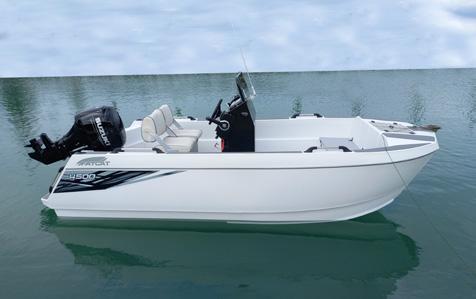

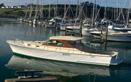


DB056 AUCKLAND’S SPECIALIST BOAT REPAIR CENTRE Insurance Work Specialists • Launch, Yacht and Runabout Repairs • Antifouling and Gelcoat Work • Full Marine Maintenance Service Spraypainting and Jetski Repairs 58 Diana Drive, Glenfield Steve@boatrepairs.co.nz www.boatrepairs.co.nz Phone: 09 441 2000 Fax: 09 441 4000 Mob: 021 908 156 Recognised member DB009 9/623 Whangaparaoa Road, Stanmore Bay, Auckland Ph: (09) 424 0004, M: 021 1142 444, E: info@fatcat.nz www.fatcat.nz DB908 Antifouling – Touch ups – Valet – Refits e: dale@touchofgloss.co.nz | P: 0275 951 443 www. touch of gloss .co.nz DB192 DB252 HibiscusMarineCoatings.co.nz For more information phone: 09 428 3906 Gulf Harbour Marina, Gulf Harbour, Auckland, NZ • ANTIFOULING • POLISHING • TOUCH-UPS • REPAINTS • PROPSPEED • MAST & BOOMS Blending quality marine products, craftsmanship and customer care. DB261 Durable kitset pods for pontoon and houseboats, jetties, barges, floating docks, walkways and more www.pontoonz.com | pontoonz@gmail.com | +64 27 555 2000 >> DIRECTORY BOAT BUILDERS & DESIGNERS, SALES & SERVICE, PRODUCT & ACCESSORIES POWERBOATMAGAZINE.CO.NZ 169

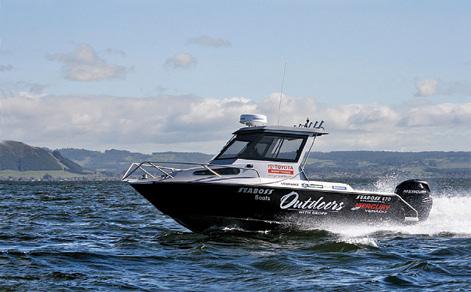


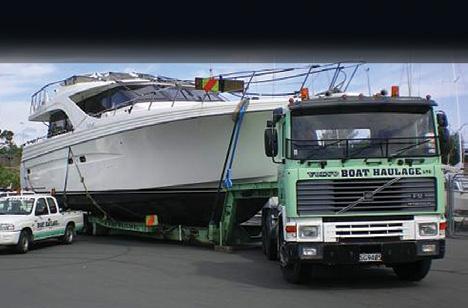





T hompson Marine T >> DIRECTORY BOAT BUILDERS & DESIGNERS, SALES & SERVICE, PRODUCT & ACCESSORIES www.salt-attack.com SALT ATTACK SALT REMOVERS KILLS SALT CORROSION Marsden Marine Services Ltd Ship Surveyors, Valuers & Consultants REPLACEMENT WINDSCREENS FOR ALL MAKES AND MODELS INSURANCE QUOTES REPLACE LIKE NEW Call 09 278 9816 www.sandbrooks.co.nz DB264 FREE Office: (09) 4838 111 – Pete: 0274 731 260 – Luke: 021 686 394 Email: pete@boathaulage.co.nz DB112 170 MAY / JUNE 2024
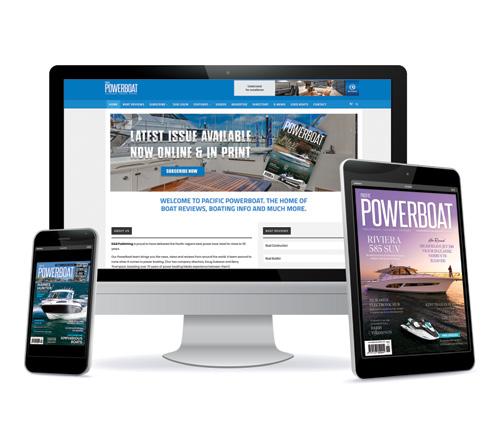


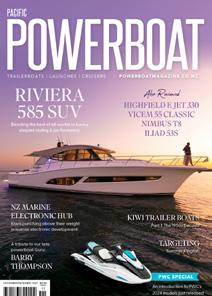
Above and Below 35 Admiral 19 Altex Coatings 87 Anura 13 Aquila 75 Battery Town 141 Buccaneer 65 Coastguard Education 124 CPC 151 Cule Marine 43 Dixon 34 Dreadnort 35 E- Yachts 55 Elite Marine 44 EPropulsion 31 Family Boats 65 FC Boats 153 Fleming 15 Haines Hunter 21 Hella 105 Highfield 161 HMC 136 Hull Well 40 Humphree 20 Hutchwilco 125 Hutchwilco NZ Boat Show 45 Image Boats 152 Island Gypsy 113 Kiwi-Kraft 151 Leech 133 Leigh Smith Yachts 29 Lifestyle Yachts 132 Maritimo 2 McLay Boats 139 Melfi Designs 25 Motor Yacht Service ADC 37 Motor Yacht Service Centre 57 Motor Yacht Service Gyro 23 Nic deMay Yachts 70 Nyalic 42 Ocean Pro Boats 150 OceanBridge 43 Pantaenius 7 Pathfinder Power Cats 74 PPB Prize Boat Show 67 PureKraft 138 Raymarine 51 Riviera 11 Sandbrooks 67 Sasga 4 Sargo 5 Seaforce Boats 32 Sealegs 27 Senator Boats 137 Simrad 99 Skipperi 91 Smuggler 101 Southern Pacific Inflatables 36 Suzuki 39 Takacat 121 Tenob 26 Tenob 140 The Yacht Sales Co 38 TNL 34 Tristram Marine 41 UDEK 13 Valder 71 Vetus Maxwell 30 Vetus Maxwell 111 Volvo Penta 33 VooDoo Yachts 73 White Pointer 147 Whitehaven 59 Yamaha OBC ZeroJet 22 ADVERTISERS INDEX WHATEVER WAY YOU WANT YOUR POWER BOAT FIX PRINTED SUBSCRIPTION One year subscription Delivered to your door One year digital subscription with unlimited access to back issues, boat reviews and features. DIGITAL SUBSCRIPTION PRINT & DIGITAL DB980 $58 Save 25% $20 $68 www.powerboatmagazine.co.nz Save 33% Save $10 POWERBOATMAGAZINE.CO.NZ 171
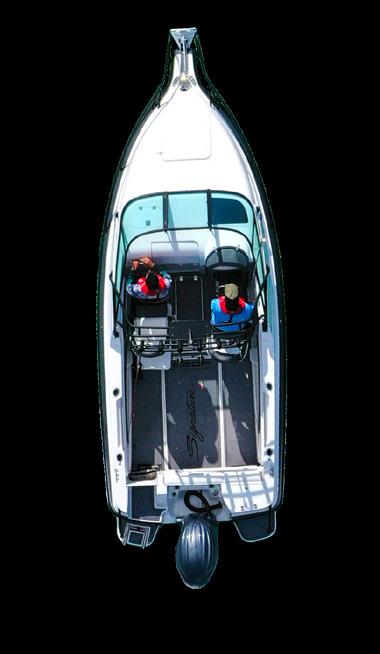
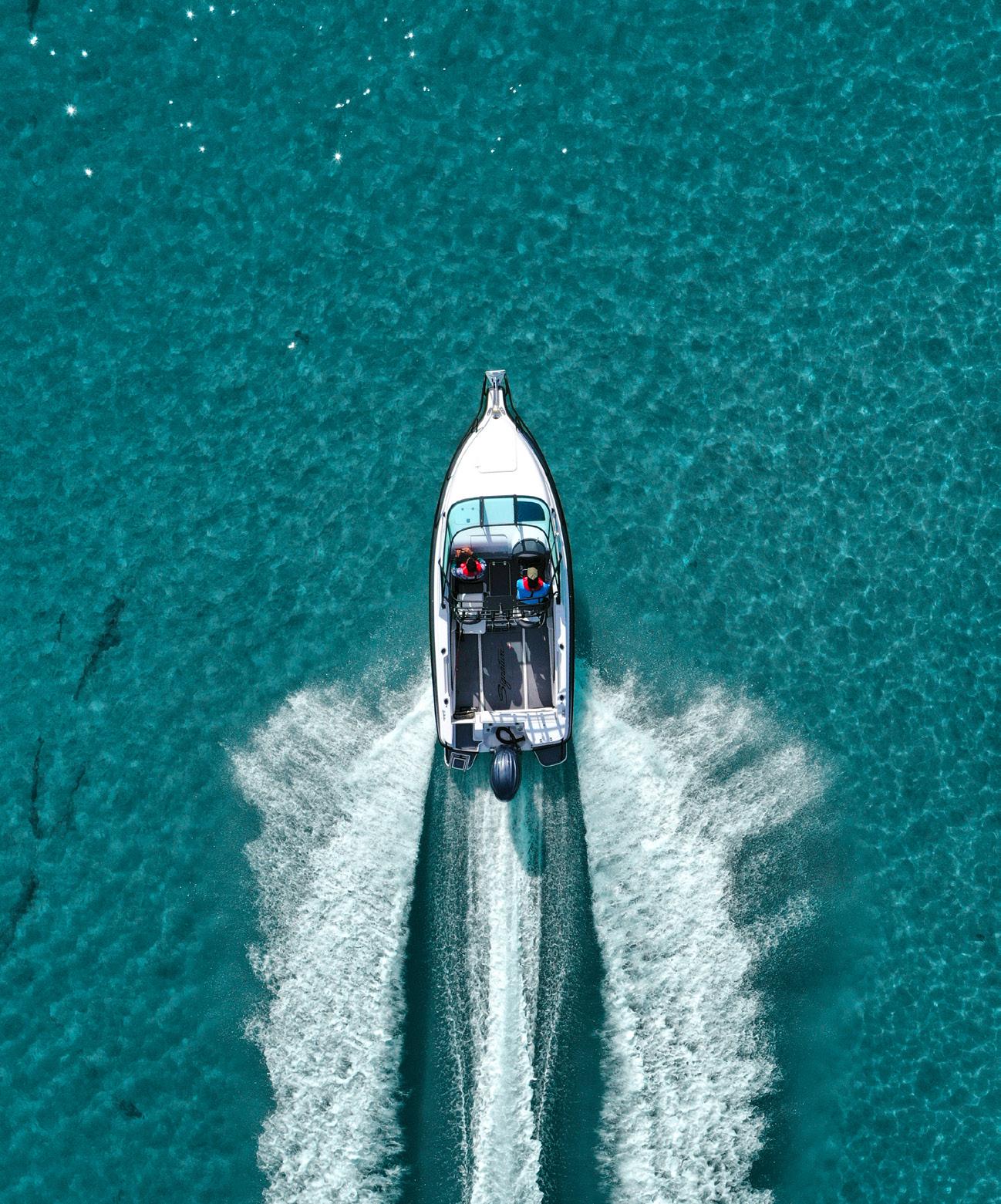

Reel in the good times Digital Gauge Remote Fitting Propeller Control Cables *Terms and conditions: All prices stated above are GST inclusive. Promotion available between 01/05/24 to 31/07/24 on new and eligible four-stroke F50LB, F50LB2, F70LA, F70LA2, F70XA, F75LB, F75XB, F115LB, F115LB2, F115XB, F115XB2, LF115XB, LF115XB2 outboards, through participating authorised Yamaha outboard dealers, while stocks last. Fully Fitted RRP for new F115LB, F115LB2, F115XB, F115XB2, LF115XB, LF115XB2 is $21,499 inc GST; Fully Fitted RRP for new F75LB and F75XB is $17,499 inc GST; Fully Fitted RRP for new F70LA and F70XA is $16,499 inc GST; Fully Fitted RRP for new F50LB and F50LB2 is $13,499 inc GST. Offer available for private buyers only on specified models and where warranty is registered on or before the 31/07/24. Fully Fitted Offer pricing includes 703 remote control, 6Y8 gauges, propeller (SS Talon for F115, F75, F70 and AL K series for F50), control cables, and boat fitting. Price excludes removal of previous outboard motor and controls, repairs to electrical systems, fuel system/dash repairs, or steering systems, and transom repairs. Not available in conjunction with other offers. ^Credit criteria, fees, charges, terms and conditions apply. Finance is provided by Yamaha Motor Finance New Zealand Limited NZBN 9429036270798, FSP 9622. OFFER ENDS 31/07/24 /YamahaMarineNZ yamaha-motor.co.nz $0 DEPOSIT FINANCE ^AVAILABLE WITH YMF FROM F70 $16,499 F50 $13,499 F75 $17,499 F115 $21,499 FULLY FITTED*