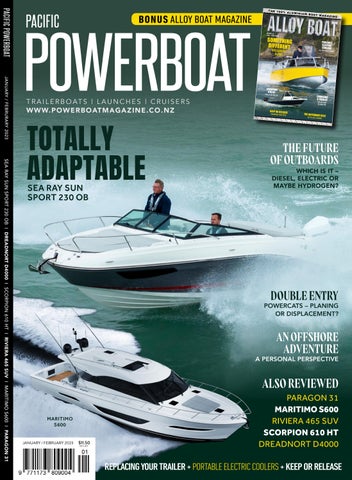


JANUARY / FEBRUARY 2023 $11.50 INCL GST WWW.POWERBOATMAGAZINE.CO.NZ TRAILERBOATS | LAUNCHES | CRUISERS BONUS ALLOY BOAT MAGAZINE THE 100% ALUMINIUM BOAT MAGAZINE ISSUE 27 JAN - FEB 2023 SOMETHING DIFFERENT DREADNORT D4000 THE OUTBOARD FILES THE ICE AGE & BEYOND KEEP OR RELEASE ENHANCING YOUR CATCH SCORPION 610 HT STILL A TOP SELLER PORTABLE ELECTRIC COOLERS ALL YOU NEED TO KNOW CHOOSING A TRAILER TIPS ON WHAT TO LOOK FOR JANUARY / FEBRURARY 2023 SEA RAY SUN SPORT 230 OB I DREADNORT D4000 I SCORPION 610 HT I RIVIERA 465 SUV I MARITIMO S600 I PARAGON 31 DOUBLE ENTRY POWERCATS – PLANING OR DISPLACEMENT? MARITIMO S600 TOTALLY ADAPTABLE SEA RAY SUN SPORT 230 OB REPLACING YOUR TRAILER + PORTABLE ELECTRIC COOLERS + KEEP OR RELEASE THE FUTURE OF OUTBOARDS WHICH IS IT –DIESEL, ELECTRIC OR MAYBE HYDROGEN? PARAGON 31 MARITIMO S600 RIVIERA 465 SUV SCORPION 610 HT DREADNORT D4000 ALSO REVIEWED AN OFFSHORE ADVENTURE A PERSONAL PERSPECTIVE
A DEFINITION OF AN ICON

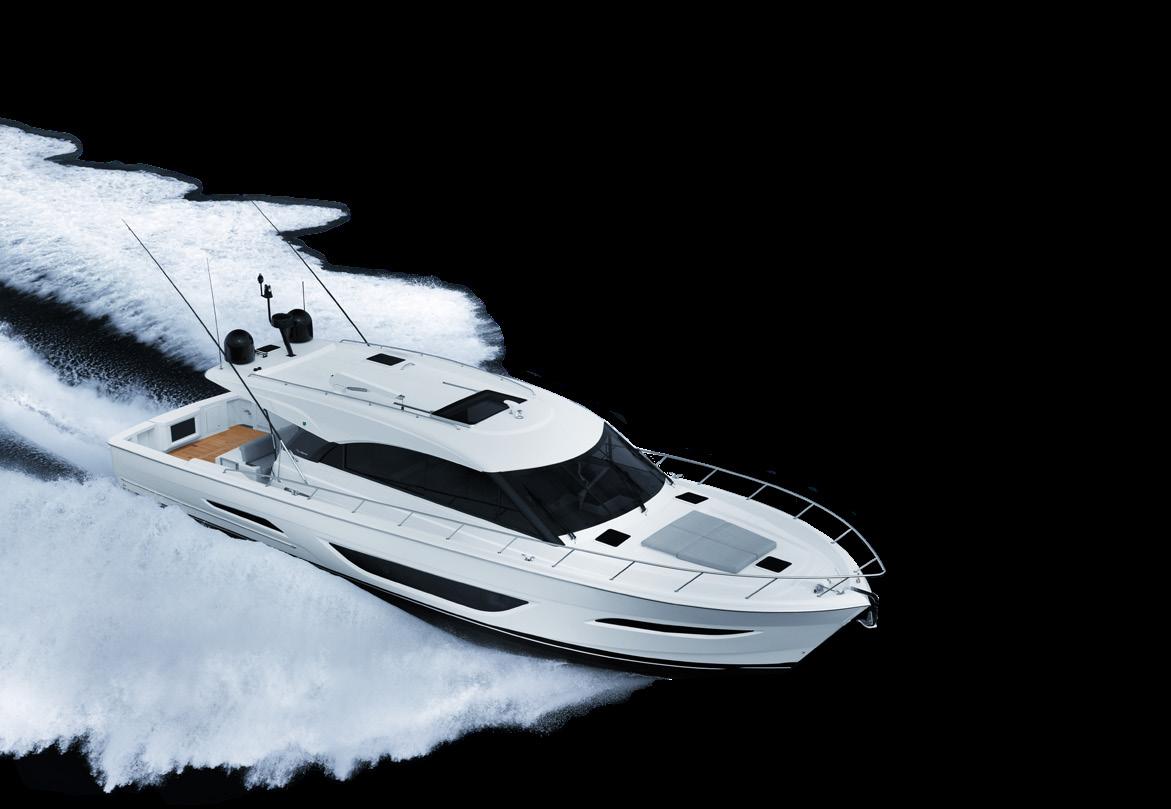
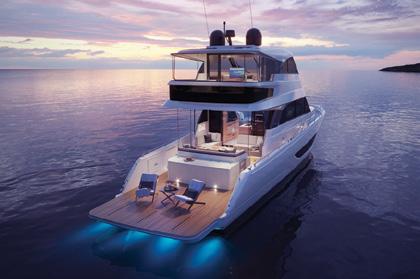
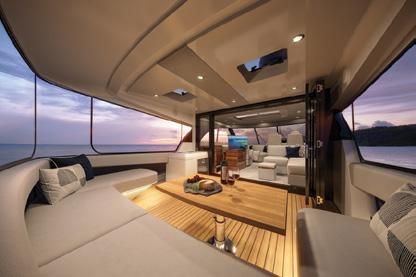
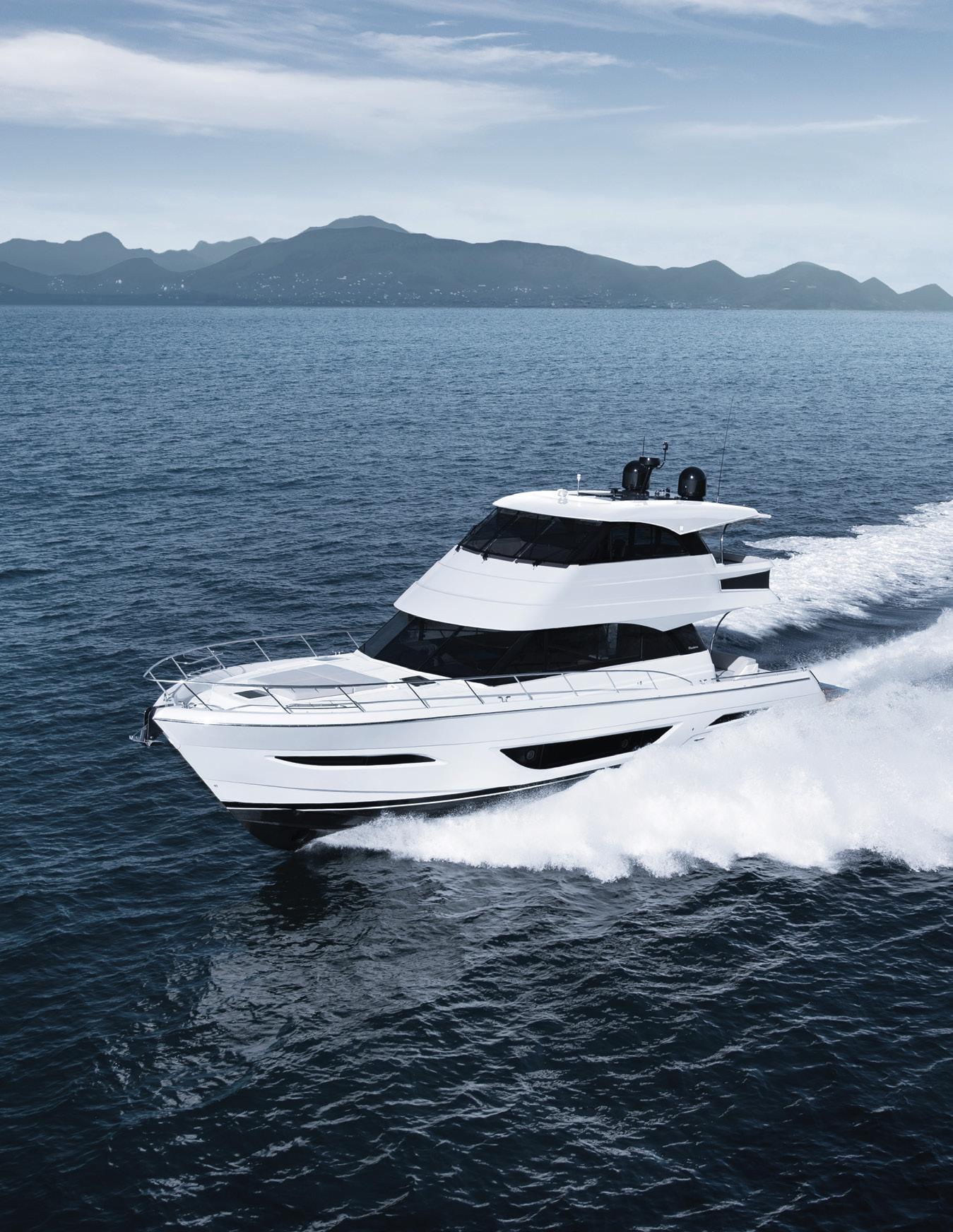
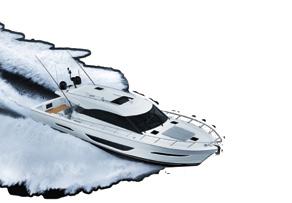
The all new M60 flybridge motor yacht combines a stunningly balanced exterior profile, with an immensity of cockpit deck, and adventure deck space with the ability to cater to a vast range of entertaining, relaxation, or adventuring activities. Australian built, its powerful exterior form and reimagined entertainment areas reset the international standard for cruising flybridge motor yachts. maritimo.com.au
M60




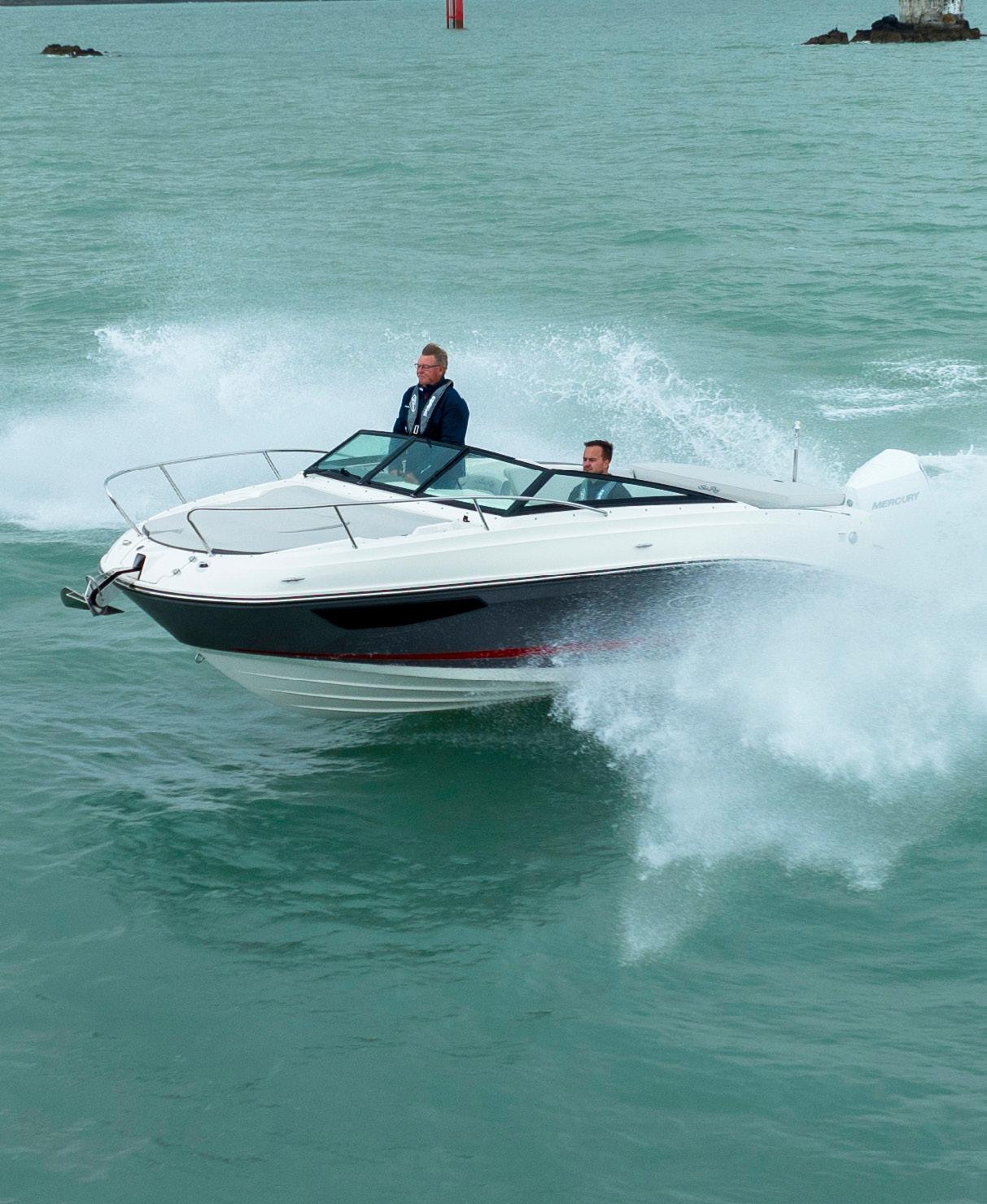
CONTENTS ISSUE 69 ISSUE #69 SEA RAY SUN SPORT 230 ON A ROUGH LYTTELTON HARBOUR SEE PAGE 72 Reviews Features THE 100% ALUMINIUM BOAT MAGAZINE ISSUE 27 JAN FEB 2023 SOMETHING DIFFERENT DREADNORT D4000 THE OUTBOARD FILES THE ICE AGE & BEYOND KEEP OR RELEASE ENHANCING YOUR CATCH SCORPION 610 HT STILL A TOP SELLER PORTABLE ELECTRIC COOLERS ALL YOU NEED TO KNOW CHOOSING A TRAILER TIPS ON WHAT TO LOOK FOR Digital readers - click play buttons to watch video review online at POWERBOATMAGAZINE.CO.NZ ALLOY BOAY ISSUE #27
we
portable
SEE PAGE 123 $11.50 WWW.POWERBOATMAGAZINE.CO.NZ TRAILERBOATS LAUNCHES CRUISERS BONUS ALLOY BOAT MAGAZINE THE ALUMINIUM BOAT SOMETHING DIFFERENT DREADNORT D4000 OUTBOARD KEEP SCORPION PORTABLE COOLERS CHOOSING TRAILER JANUARY FEBRURARY 2023 SEA RAY SUN SPORT 230 OB DREADNORT D4000 SCORPION 610 HT RIVIERA 465 SUV MARITIMO S600 PARAGON 31 DOUBLE ENTRY POWERCATS – PLANING OR DISPLACEMENT? MARITIMO TOTALLY ADAPTABLE SEA RAY SUN SPORT 230 OB REPLACING YOUR TRAILER + PORTABLE ELECTRIC COOLERS + KEEP OR RELEASE THE FUTURE OF OUTBOARDS WHICH IS IT –DIESEL, ELECTRIC OR MAYBE HYDROGEN? PARAGON 31 MARITIMO S600 RIVIERA 465 SUV SCORPION 610 HT DREADNORT D4000 ALSO REVIEWED AN OFFSHORE ADVENTURE A PERSONAL PERSPECTIVE 54 RIVIERA 465 SUV 72 SEA RAY SUN SPORT 230 OB 86 MARITIMO S600 100 PARAGON 31 CABIN 132 DREADNORT D4000 156 BLUEFIN 610HT 60 DOUBLE ENTRY While power cats are certainly not mainstream, they are certainly gaining in popularity and there are some awesome examples available both from production builders and designers. 78 STILL EXPLORING FIORDLAND Rodney Russ takes a further into Fiordland aboard the MV Strannik and asks; is this the world’s greatest remote cruising destination? 92 AN OFFSHORE ADVENTURE Experienced motor yacht owner, Leigh Hopper gives a personal perspective and insight into venturing offshore on a recent trip to Fiji in his Maritimo M70. 106 COASTGUARD BOATING EDUCATION – CHECKLIST FOR BOATING SAFETY Now is a goodtime to check you have everything you need aboard your boat for a safe and trouble free season. 114 WASTE WATER Ron Czerniak looks at the messy business of waste water. 138 THE FUTURE OUTBOARDS Danny Casey casts an eye to the future of outboards and just where technology will take us. 146 KEEP OR RELEASE Paul Walker looks at the right way to handle your fish and to enhancing your catch. 152 PORTABLE ELECTRIC COOLERS Portable coolers are not “ice chests.” That’s why they’re particularly useful for the boating application. 160 REPLACING YOUR TRAILER If you are looking to replace your boat trailer or need one for your new boat, we offer tips and hints on what to look for when buying a new one. 4 JANUARY / FEBRUARY 2023
In this issue
have two very different reviews. We check out the very unique Dreadnort D4000 and the popular Bluefin 610 HT, one of builders most popular models. Danny Casey looks at the future of outboard technology, Bruce Duncan talks about keeping or releasing your catch and we give an insight into picking a new boat trailer. There’s also a feature on
electric coolers and a look at some new models on the market.
Regulars 0800 114 222 sales@ultralon.co.nz C US TOM MAR INE D EC K IN G www.udek.com 6 DESIGN FOCUS Oceanco’s 115m canoe. 8 LEADING COMMENT A farewell to a great contributor to the magazine. 10 PUBLISHER’S COMMENT What a crazy time. 12 GUEST COMMENT Ryan Leigh-Smith on the passing of his brother Dean. 14 SEEN & ADMIRED FC 7m AMPH Dickey 36 18 NEWS News, new products, boats and events. 38 POWER ON New engines and equipment 42 ELECTRONICS NEWS Hot new products from some of the world’s leading brands. 44 CRUISING MATTERS Laurie Cranfield continues to look at handy tools to have onboard. 46 STRAIGHT FROM THE GALLEY Derek The Chef prepares Pacific Prawn Swords 48 DUNCAN ON FISHING The true value of fish. 52 ROGER’S RAMBLINGS Roger Tweddell, looks at Drum Winches 110 FLETCH’S TIPS Aaron Fletcher shares his tips learned after years of getting it right and getting it wrong. 112 WHAT IS THE QUESTION? Phil Gilbert says it’s time to hang-up his brokerage hat. POWERBOATMAGAZINE.CO.NZ _ 5
TUHURA
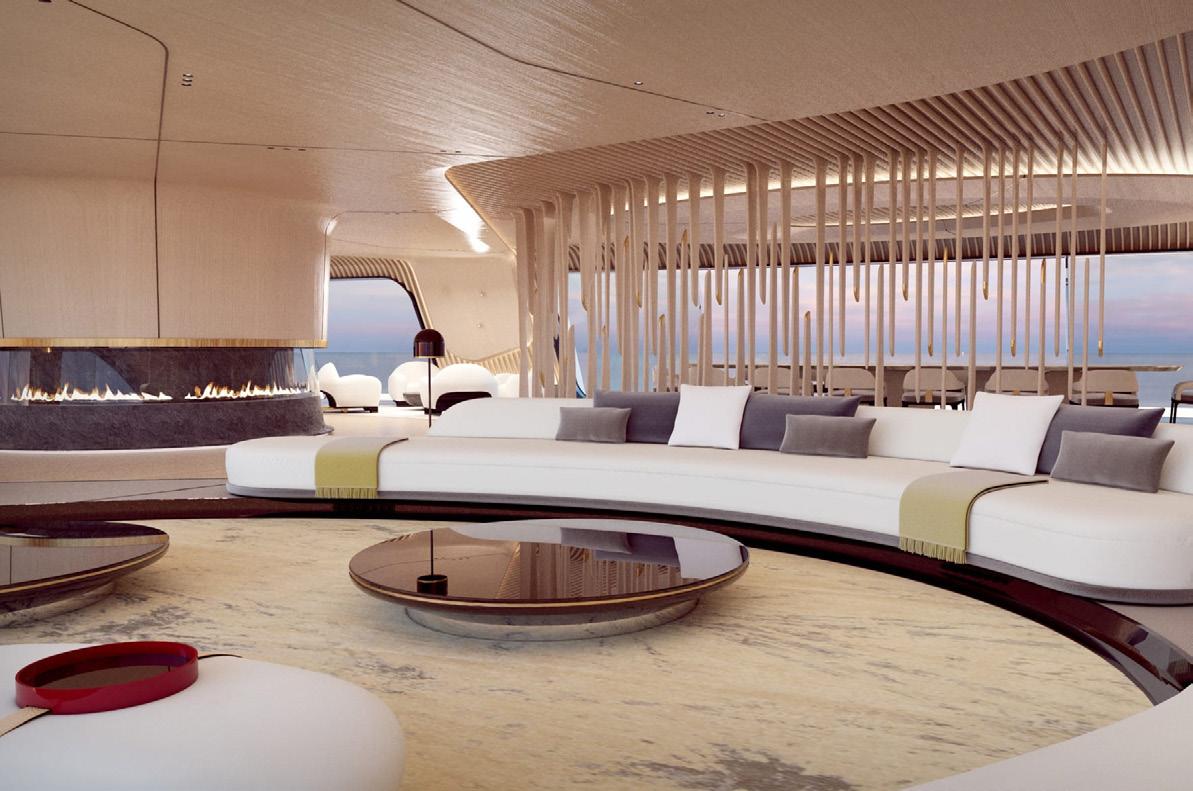
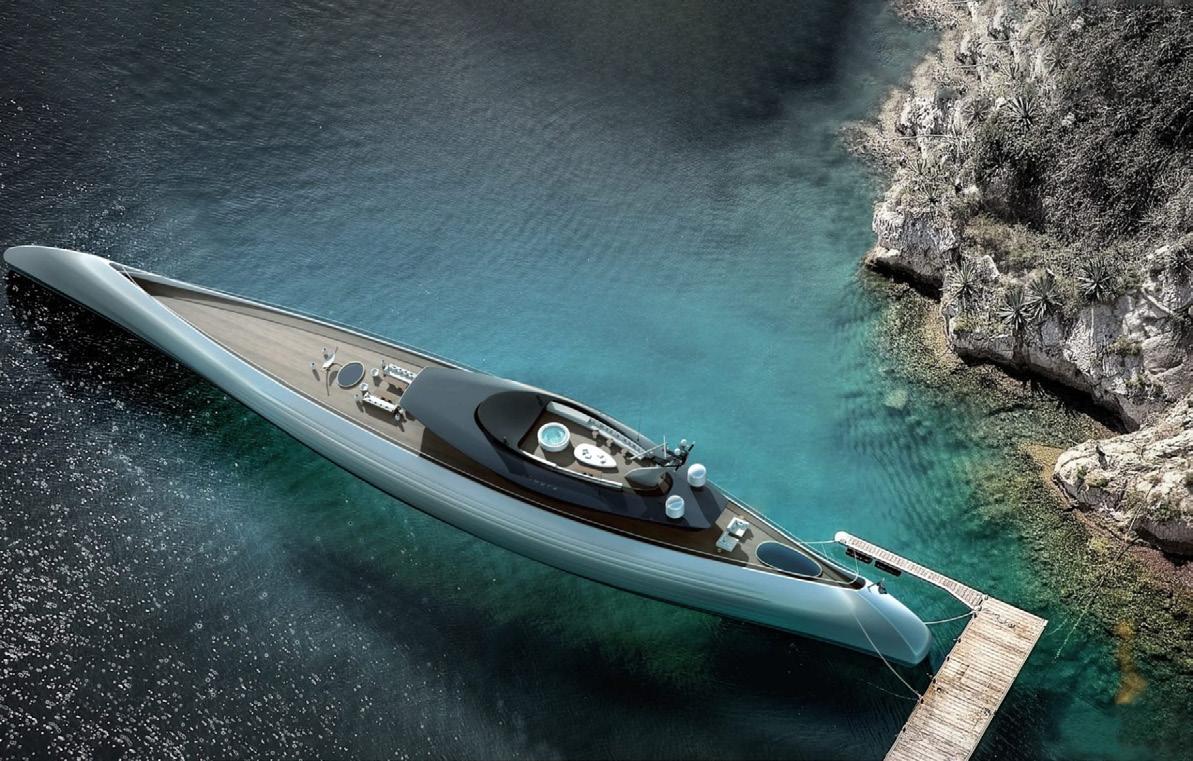
Announced a few years ago at the Dubai International Boat Show Cast Oceanco’s 115m concept is still waiting a buyer.
DESIGN FOCUS _ OCEANCO’S 115M CANOE 6 JANUARY / FEBRUARY 2023
Conceived in collaboration with Lobanov Design Studio, BMT Nigel Gee and the interior designer Achille Salvagni. “Our Tuhura is a simple idea,” explained designer Igor Lobanov, “The thought was to take a natural shape similar to those seen in the earliest canoe-type craft and augment it multifold to a larger scale, using modern technology.”
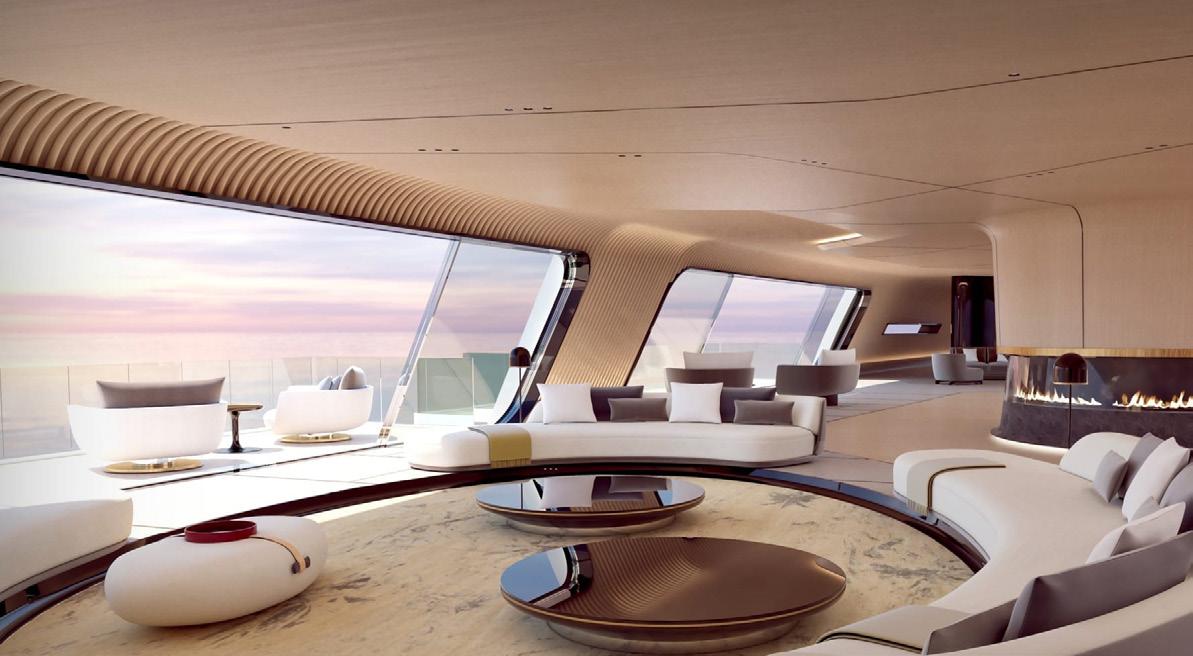
The main inspiration for the interior design is East Asia and the Pacific islands. Achille Salvagni refers to the interior as a “brushed teak habitat” including thin reveals in gunmetal and natural bronze with tatami floors.
‘Tuhura’ is derived from the Maori verb meaning: to discover, bring to light, unearth, open up, explore, and investigate. “Our Tuhura is a simple idea,” explains Igor Lobanov, “The thought was to take a natural shape similar to those seen in the earliest canoe-type craft and augment it multifold to a larger scale, using modern technology.”
Tuhura’s hull and propulsion system have been developed in collaboration with BMT. The pure simplicity of the canoe form leads to a naturally efficient hull with low overall resistance, good seakeeping and excellent manoeuvrability. However integrating a modern propulsion system in the canoe form presents a challenge and the team
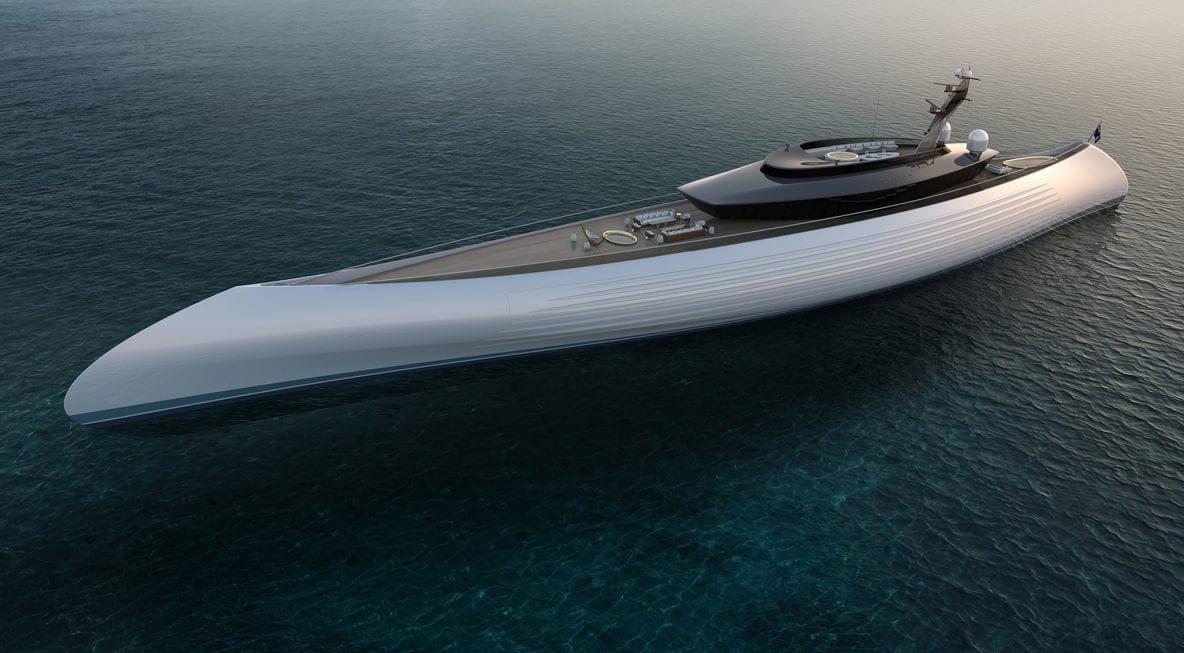
opted for a hybrid Azipod CRP (contrarotating) propulsion system from ABB. Innovation and cutting-edge technology is evident throughout the design. The hull has been conceived with multiple horizontal windows, utilising an advanced glass technology that consists of a series of dots, allowing the view from within to be completely transparent, while from the exterior, the windows appear the same colour as the hull, disguising their appearance. Glass features further in the impressive black superstructure made up of flat glass panels.
Tuhura is designed for someone who has a true pioneering spirit and who desires to break the moulds of convention.
POWERBOATMAGAZINE.CO.NZ _ 7
PUBLISHER
D&B Publishing Ltd

EDITORIAL
Barry Thompson, Editor
DDI: +64 (0)9 428 2086 Mob: +64 (0)21 777 355 email: barry@boatmags.com
CONTRIBUTORS
Doug Dukeson, Ron Czerniak, Bruce Duncan, Derek the Chef, Laurie Cranfield, Mike Rose, Phil Gilbert, Aaron Fletcher
ADVERTISING
New Zealand & Australia
Doug Dukeson
DDI: +64 (0)9 428 2328 Mob: +64 (0)21 772 202 email: doug@boatmags.com
Alex Ram DDI: +64 (0)9 428 7277 Mob: +64 (0)21 0286 5298 email: alex@boatmags.com
PRODUCTION
Design & Prepress: Annabelle Rose Design Mob: +64 (0)27 427 4559 email: design@annabellerose.co.nz Printer: SCG
WEBSITE

Stealth Media Ltd Gustav Wentzel info@stealthmedialtd.co.nz +64 21 0201949
ACCOUNTS
Soraja Thompson Tel: +64 (0)9 428 2086 email: accounts@boatmags.com
CIRCULATION ARE Distribution
SUBSCRIPTIONS
Printed & Digital subs@boatmags.com
Pacific PowerBoat is published bi-monthly January, March, May, July, September, November
REGISTERED OFFICE
14 Glamis Ave, Manly, Whangaparaoa, Auckland, New Zealand. email: barry@boatmags.com

POWERBOATMAGAZINE.CO.NZ
Postal Address: PO Box 132 Whangaparaoa, Auckland 0930, New Zealand.
All rights reserved. Reprinting in whole or part is expressly forbidden, except by written permission of the publisher. Printed in New Zealand ISSN 2230-4134 (Printed) ISSN 2230-4142 (Online)
THANKS FOR THE MEMORIES LAURIE
Ihad a phone call one day around 13 years ago. In fact, from a guy who had purchased a Nordhavn 46 and was planning to cruise the Med with his wife. Would I be interested in a story? Of course, I said yes, as I like stories about the Kiwi can do attitude. Kiwi’s out there doing it. I admit I was a little jealous as cruising around the Med sounded idyllic. That guy was Laurie Cranfield, who, with his wife, Diane, would spend the next seven years exploring just about every corner of the Med.
What started in the March 2010 issue of Pacific MotorYacht as one or two articles stretched out to an ongoing series that lasted for over eight years and more than 75 episodes. The Cruise of the Envoy was undoubtedly one of our most popular columns, and we got the Cranfield’s story, warts and all. Laurie wrote about everyday cruising life with all its ups and downs. We learnt about the best tavernas to visit, the harbours to go to or avoid and a whole lot more about local culture and customs. It was a travel log written from a cruising man’s perspective.
After seven seasons on the Med, Laurie and his wife sold Envoy and came home for good. However, the wandering lust was still there, so they brought a Salthouse launch to keep themselves on the water. They did some mods and, as expected, went cruising again. This time it was local places like the Bay of Islands, Hauraki Gulf, the Barrier and the Mercury Islands.
In 2016, Laurie started his also popular Cruising Matters column, which documented a lot of what they did and where they went. It was a documentary of their life afloat. Unfortunately, this issue sees the final Cruising Matters column after 59 episodes.
Laurie has regrettably had to put the ‘pen’ down due to ill health. He will be sadly missed by myself, and I am sure our readers. All the best, Laurie and Diane or the future, and I hope you get plenty more sea miles under the keel.
PACIFIC EDITOR'S NOTE _ BARRY THOMPSON
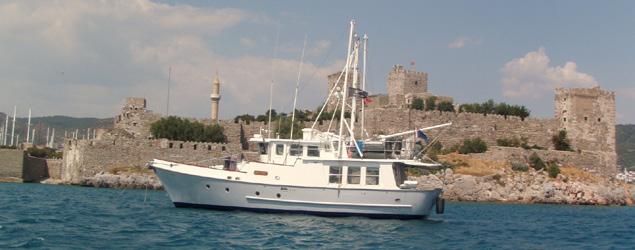
Laurie and Diane’s Med home was this Nordhavn 46, Envoy
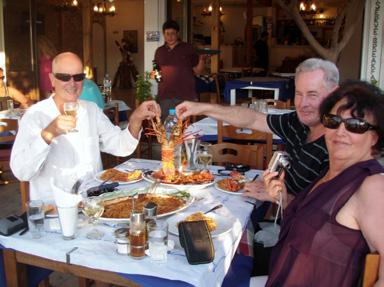
But he also followed the gastronomy trail which seemed never ending.
8 JANUARY / FEBRUARY 2023
Laurie brought us the technical aspects of cruising, such as corrosion issues.
THREE LEVELS OF LUXURY – IN A LEAGUE OF ITS OWN
WORLD PREMIERE - RIVIERA 46 SPORTS MOTOR YACHT
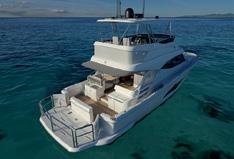
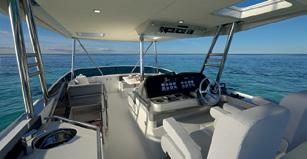
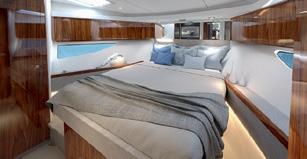
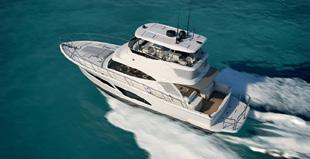
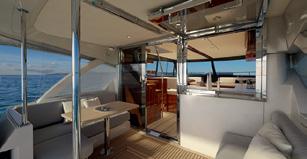
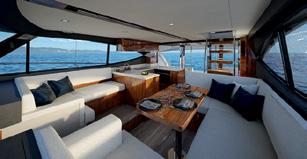
Awide, open cockpit designed for water sports action. Three entertaining and dining options. An aft gourmet galley and spacious saloon. The accommodation deck offers three staterooms and two large ensuite bathrooms. Stretch out and relax on the foredeck sunpad; or the daybed on the alfresco deck; or perhaps the flybridge daybed will be your favourite. Pamper your family and friends on board Riviera’s new ultra-luxury 46 Sports Motor Yacht. And discover easy-to-use technology that makes boating with Riviera more enjoyable; for a weekend escape or a long-range adventure. Discover more at RivieraAustralia.com
230001
Step aboard at the Americas Premiere at Miami International Boat Show, February 15 - 19, 2023
WHAT A CRAZY TIME
Mind you, we did hear this 24 months ago when it was suggested that COVID (through the same mainstream media) would launch us into the worst economic recession ever seen in our lifetime. Buckle in, they said. To then, for the marine industry anyway, experience one of the most positive, buoyant marine markets I have seen in my 35-year stretch working in the marine industry. According to recently released statistics, with 40% of the population boating annually and the nation’s fleet growing by an estimated 44,810 vessels per year, boating in New Zealand has reached new heights. The New Zealand marine industry is on a roll. Boating is New Zealand’s largest recreational activity, with 1.9 million, or 40 per cent of New Zealand’s population, participating in boating each year. However, I have heard rumblings from some companies that in 2023 they will not experience the same growth, albeit they are still positive. I have heard of at least three new fibreglass trailer boat releases for the Hutchwilco NZ Boat Show. Considering there were none from local manufacturers this year, that is a very positive indicator.
I will stick with this being another false report, blocking out the mainstream media preaching doom and gloom as they have in the past. My wife Carla, has suggested banning me from watching the evening TV news. I have tried this, and I don’t think I have been missing too much. Avoiding the negativity they preach has kept me in a better frame of mind, personally and in a business sense. We are on course for whatever will be. We can prepare ourselves, but let’s not bring it upon ourselves. On a brighter note, we are heading into our summer boating season with more boats on the water than ever. Let’s hope for some perfect weather to enjoy our beautiful waterways. Stay safe on the seas, be patient at the marinas and boat ramps, and it will be an enjoyable time for all.

Happy reading and boating Doug Dukeson.
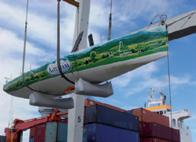
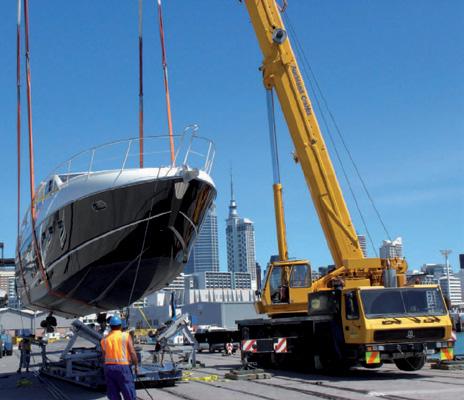
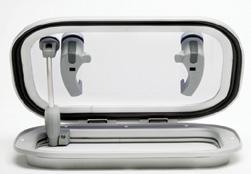
Cule hatches are proudly made in NZ so we can customise to your needs and supply any parts. Easy online purchasing backed by friendly local customer service and a manufacturers warranty. Check out our new website to buy direct or get in touch to discuss your next project. Buy direct culemarine.co.nz or call 09 835 9706 PREMIER SHIPPING • Specialist Worldwide Shipping of Boats and Marine Equipment • Contact us for a quote: Nigel Black, Trade Manager – Projects and Marine P: +64 9488 5836 M: +64 21 909 703 E: nigelb@oceanbridge.co.nz DB734 www.oceanbridge.co.nz Members of: NZ Marine Export Group NZ Marine Industry Assn PUBLISHERS COMMENT _ DOUG DUKESON
10 JANUARY / FEBRUARY 2023
One month a few in the marine industry believe they do not need to promote their brands, because they are too busy building what they have on order. Then the following month, everyone is becoming paranoid about what seems to be another mainstream media-promoted economic recession, with the nation being warned to buckle in for a potential economic rodeo.
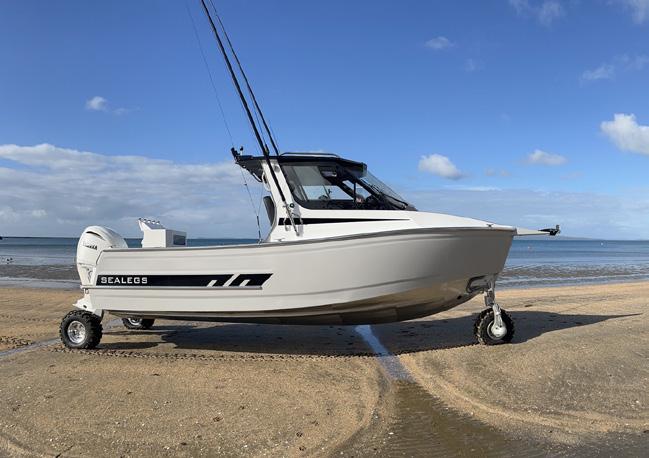
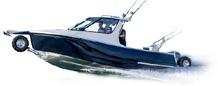
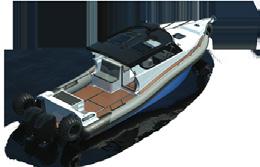
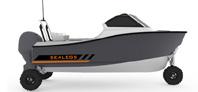
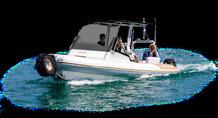
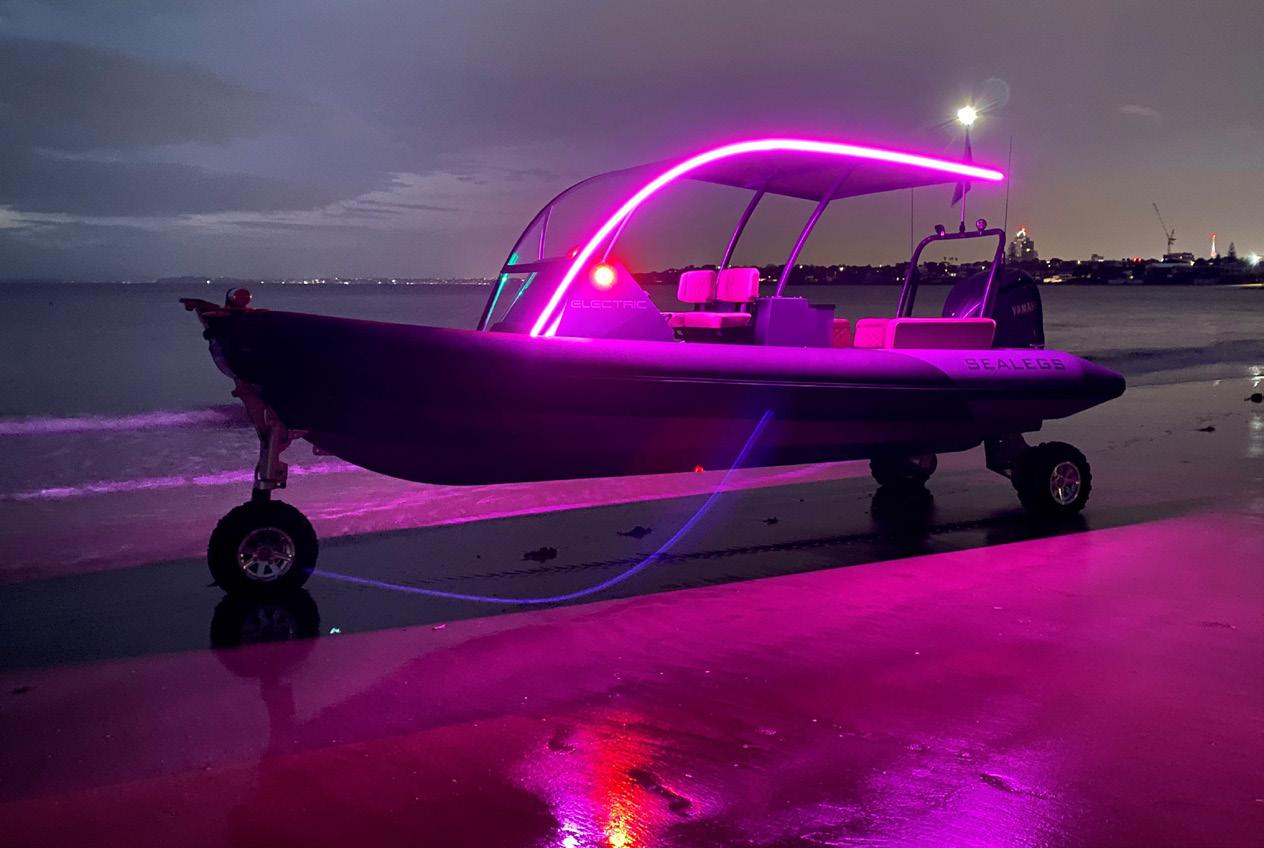
0800 SEALEGS | WWW.SEALEGS.COM | INFO@SEALEGS.COM | SEALEGS SHOWROOM: PARKHEAD PLACE, ALBANY, AUCKLAND 7.1M RIB 7.5M RIB 6.1M RIB 8.5M CABIN 9.0M RIB 12M CABIN 6.5M CUDDY 7.5M SEMI-CAB 3.8M TENDER BOOK YOUR DEMO TODAY! - CALL US 0800 SEALEGS THE WORLD’S LARGEST RANGE OF AMPHIBIOUS BOATS FROM THE WORLD LEADERS IN AMPHIBIOUS TECHNOLOGY 8.5M ALLOY CABIN 7.1M SPORTS RIB 7.5M ELECTROSOL RIB SEALEGS ELECTRIC IS HERE!
DEAN LEIGHSMITH PASSES
Australian marine industry stalwart, Dean Leigh Smith passed away recently. Along with brother Ryan he operated the very successful Leith-Smith Yachts brokerage based in Sanctuary Cove, Gold Coast. A vibrant and very active participant in the Australian marine industry, Dean followed the ethos of offering a good old fashioned service, coupled to his vast product knowledge. The Leigh-Smith family has been selling boats in Australia for over five decades with brothers Dean & Ryan Leigh-Smith drawing on their earlier generations passion, values and experiences.
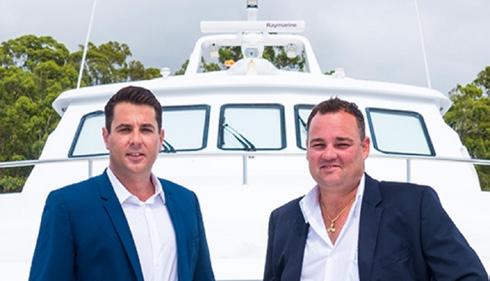
The renowned Gold Coast City Marina, was designed, built run and 50% owned by the Leigh-Smith Family until 2014. The GCCM served as a 17yr apprenticeship for Dean & Ryan LeighSmith establishing an in-depth knowledge of the marine industry. Another achievement was the Gold Coast Marine Expo, founded by Ryan & Dean Leigh-Smith and run for three years.
Ryan reflects on the passing of his brother
My life and many others changed forever at 6:45pm this Thursday. My mentor, my champion, my guide, my business partner, my beautiful brother gave into a four and half year battle with severe back pain and the horrific side affects that followed.
Dean was the one to guide many through troubled times and was always there for others in need putting his issues to the back ground to focus on the ones that needed him most.
The pain levels and and lack of options to move forward with a quality of life subsided to a level beyond the capability of even the strongest of people on this planet. He’s left a legacy and memories that for whoever enjoyed his company in good times |that will last forever.
Dean put the needs of his wife, children, parents and myself above his for which there is no words to describe the brave, decisive and selfless decisions he had to make in his journey.
I ask anyone who knew Dean not to pity this situation but to applaud he’s ultimate bravery and sacrifice for the betterment of his closest family, friends and business.
I love my brother for everything he taught and did for me over a 44 year period. Celebrate Dean, celebrate his achievements, celebrate his larrikin personality that brought so many together over many great years.
Rest easy my beautiful friend, rest easy my Brother. You will be loved continuously, forever and I will be there for your children and family until I can no more.
GUEST COMMENT _ RYAN LEIGH-SMITH DIRECTOR LEIGH SMITH YACHTS
DB214 E: RoweBoatPainters@gmail.com | Ph: +64 215 55506 www.roweboatpainters.co.nz
Antifoul and Propspeed Applications - Repaints –Touch Ups – Grooming DB893 12 JANUARY / FEBRUARY 2023
Ryan & Dean Leigh-Smith
Professional Mobile Marine Painting Services.
Swedish Quality & Innovation Since 1968.


FROM LAND TO SEA IN SECONDS
The FC 700HT Amphibious takes boating to a whole new level. The launch of the FC 700 Hardtop Amphibious (FC700HTA) has already sparked lots of interest, with boaties throughout NZ grabbing a piece of the latest innovation from FC Boats.
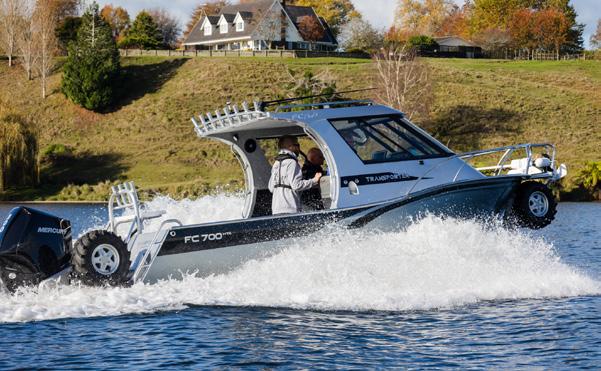
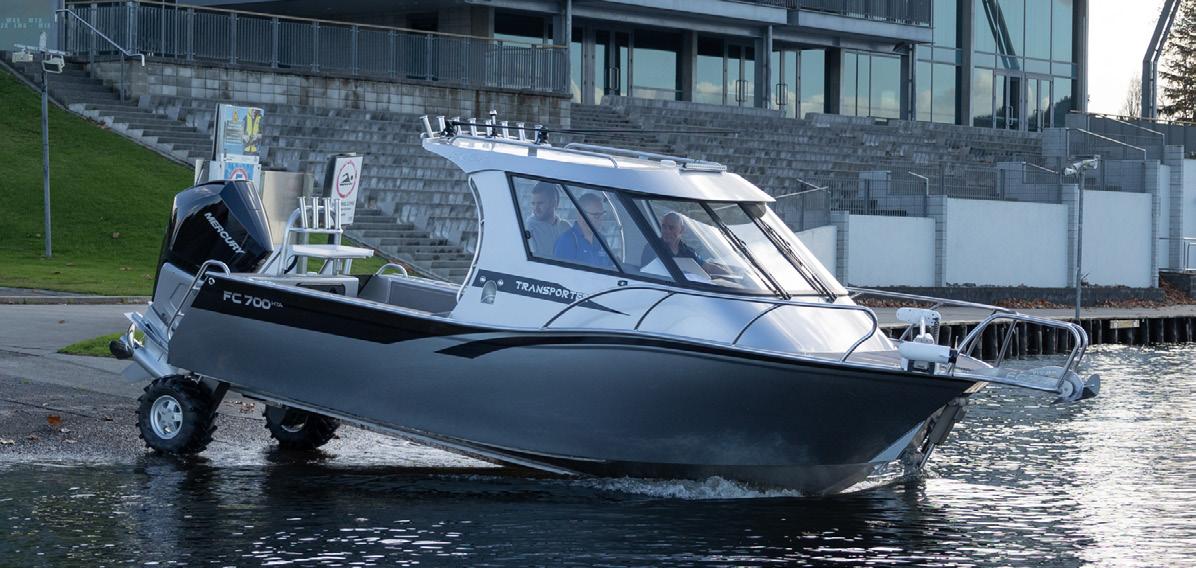
Recognised at the Waikato Business Awards, the FC 700HTA joins its sister ship the FC 700 Centre Console Amphibioius (FC700CCA) as part of the new FC Venture range.
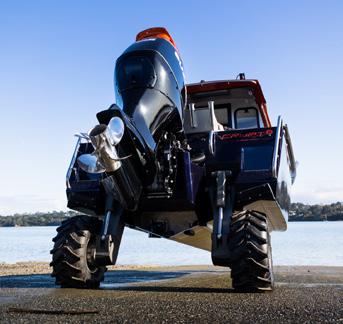
FC’s unique features are at the forefront of design, with qualities that customers will appreciate. The FC 700HTA features FC’s extended gunnels, a passive live bait tank, plus FC’s dual positive buoyancy system. At the heart of the amphibious craft though is the Anura Amphibious System. Boasting continuous run time as opposed to other electric systems, and
built for even the harshest terrain, the FC 700HTA gives the user greater freedom both on land & sea.
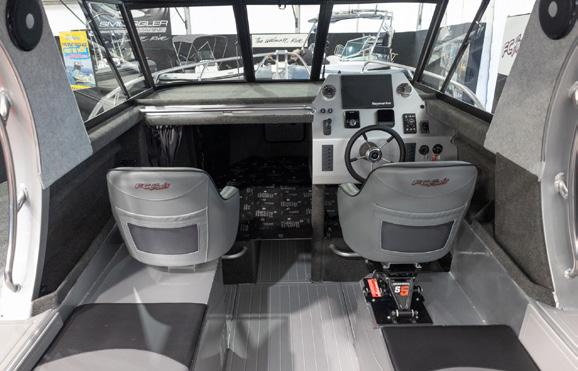
Featuring a Mercury 250 V8, Minn Kota Ulterra, Zipwake trim tabs and Seadek flooring, comfort at sea has been carefully considered. Inside, the FC 700HTA boasts great visibility, overnight bunks, a wellappointed helm, leading to the bespoke design of the king & queen seats. The Anura Amphibious motor was integrated into the queen seat, giving maximum floor space towards the stern of the boat.
FCBOATS.CO.NZ
SEEN & ADMIRED _ FC 700 HARDTOP AMPHIBIOUS
14 JANUARY / FEBRUARY 2023


Auckland | 131 Westhaven Drive (09) 274 9918 Christchurch | 507 Moorhouse Avenue (03) 379 9208 Learn more about Saxdor at saxdoryachts.com O F F I C I A L D I S T R I B U T O R S A X D O R 3 2 0 G T C Scan for more info A R R I V I N G J A N U A R Y 2 0 2 3 E U R O P E ' S F A S T E S T - G R O W I N G B O A T B U I L D E R
CUSTOM BUILD
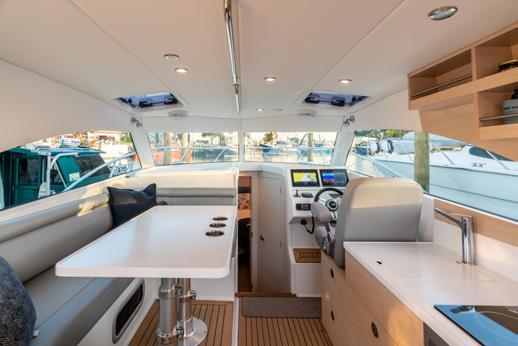
The latest Dickey 36 Semifly was recently delivered to its new Auckland owners in time for summer. As with every vessel from Dickey Boats, the most recent Semifly 36 is a fully customised build.
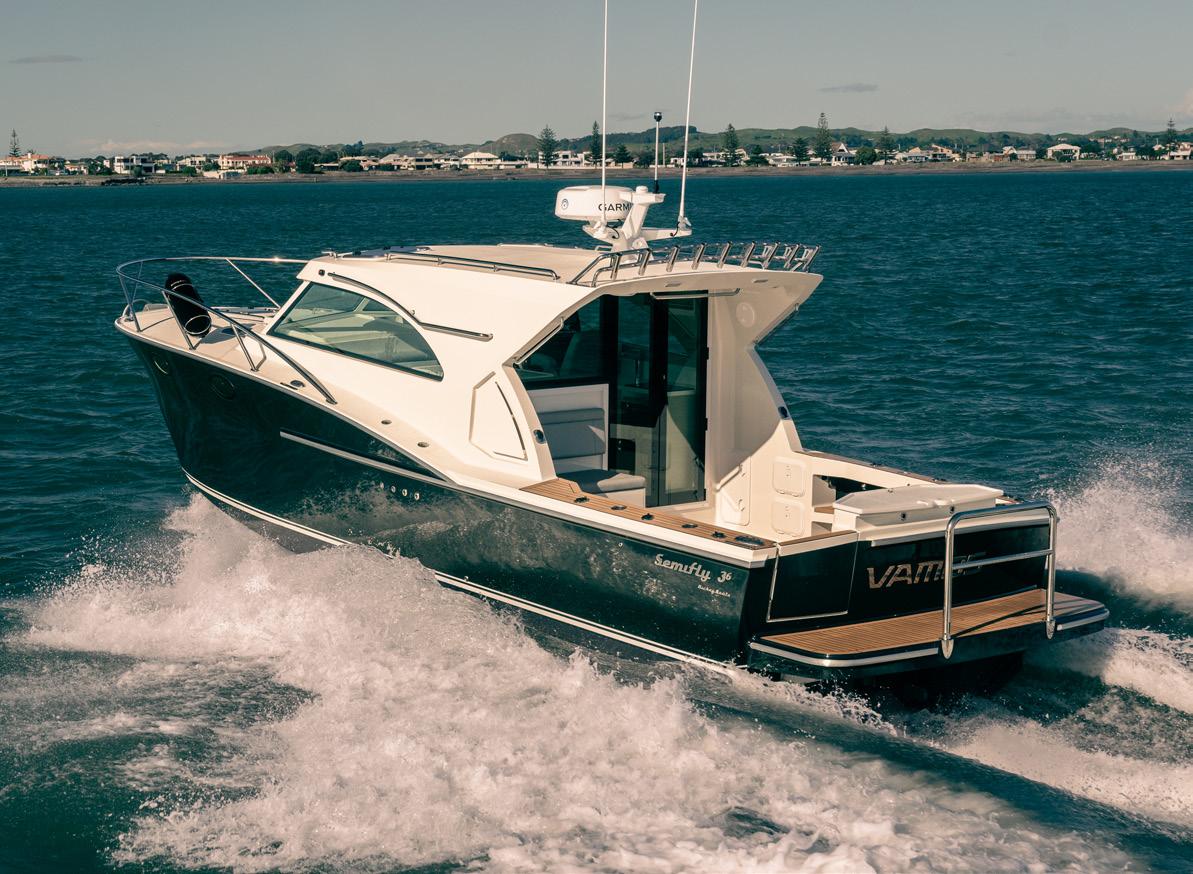
Striking in its refined green exterior paint finish, the boat offers a dedicated master suite forward plus a midship guest cabin for ad ditional comfort and privacy on liveaboard cruises.
Increased use of wood-finish laminates adds even more class to the bathroom and bedroom spaces. Subtle changes to the saloon are tailor-made to its owner’s specific requirements.
The Dickey Semifly 36 offers supreme fuel
economy via a Volvo D6-440 sterndrive with efficient lithium batteries supplying the house systems, including an induction cooktop.
The Dickey Semifly 36 is one of five models in the Semifly range and certainly one of the most popular. Bridging the gap elegantly between the highly capable Semifly 32 and the flagship Semifly 45, the completely redesigned Semifly 36 delivers in every way. Space, pace, ride and comfort all wrapped in the famously fuel efficient,
polished-to-perfection package that forms the very foundation of the Dickey Boats brand.


The 36 offers more space in the saloon, slightly more headroom than its hugely popular smaller sibling. The extra length allows for a larger fuel tank, more range and an even more impressive fishing-oriented cockpit. At cruising speed, (20 and 26 knots), the single Volvo’s fuel consumption is typically between 2.3 and 2.5 L per nm. DICKEYBOATS.COM
SEEN & ADMIRED _ DICKEY 36
16 JANUARY / FEBRUARY 2023
C M Y CM MY CY CMY K





3x LONGER LIFE 479 TORQUE LB.FT 25% LESS FUEL www.sportsmarine.co.nz OFFICIAL DISTRIBUTOR Auckland 131 Westhaven Drive (09) 274 9918 Christchurch 507 Moorhouse Avenue (03) 379 9208 Scan the QR code for more info Go further. Go diesel.
EARTHLING E-40 POWERCAT IS SILENT & GREEN
When Earthling’s founder/designer John McGettigan says; “If you want to explore nature, live in it, feed from it and don’t strangle it, he certainly backs it up."
The Earthling E-40 is a production boat, featuring an open bow lounge a large saloon and cockpit and twin cabins in the hulls. However the secret of the Earthling E-40 is its hybrid-electric propulsion system, which is made up of off-the-shelf products.
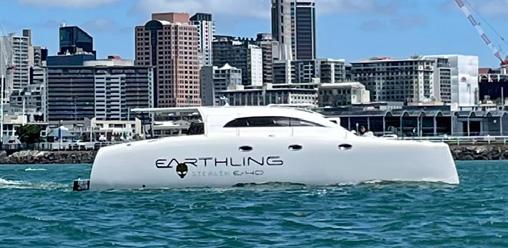
His Earthling E-40 power cat allows you to do all that and more. Incorporating Earthling’s E-THOS propulsion system, you can go boating and hardly leave a footprint in the environment.
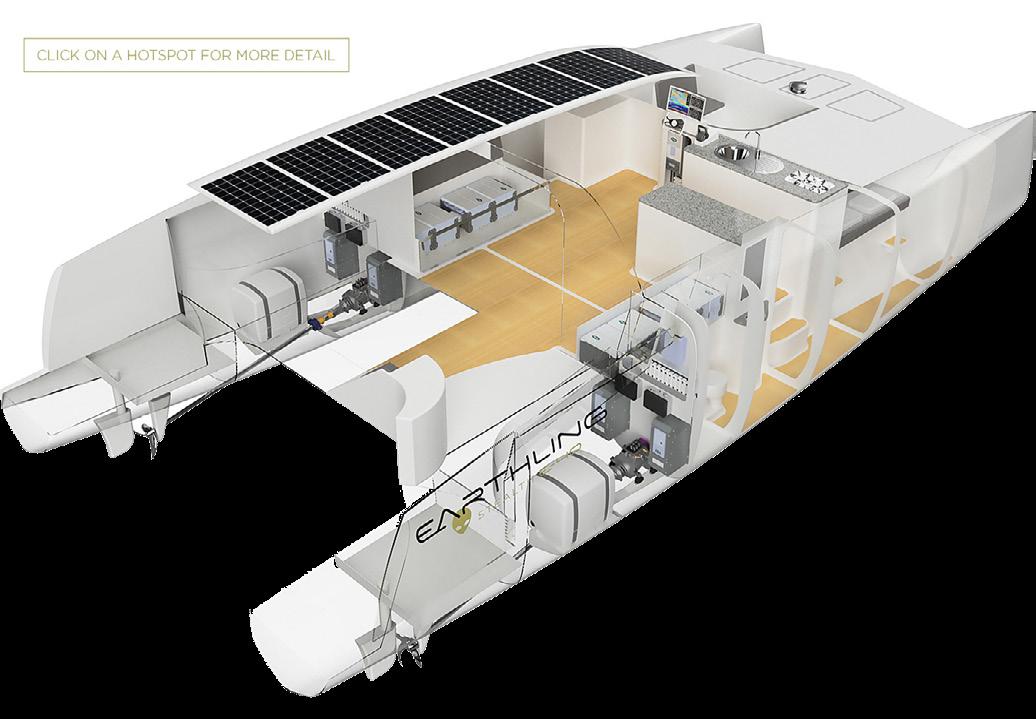
The latest European technologies integrated with the “Earthling” proprietary SCADA (Supervisory Control & Data Acquisition) E-THOS Human Machine Interface provide a truly “Plug and Play” solution. Efficient use and storage of energy are critical to silent, emission free power or sail cruising. System redundancy throughout and standby local control allow basic get home capability. However, the automated system gives the efficiency and advice that makes the difference.
That’s the Earthling E-THOS. Earthling E-40 uses 8.5kW Whisper Power generators for backup, with lightweight German Molabo electric motors as the primary power source. Four Lithium modules run at 48 volts, plus there are 2kW solar panels on the roof. Up to now, high performance meant high voltages of up to 800 volts. But this is not optimal, especially on water, so Molabo is taking a different approach. The company developed an electric drive which can provide high power at safe to touch voltages of 48 volts. This innovative 50 kW drive is what powers the Earthling E-40. Another unique feature of the Earthling E-40 is the large, slow-moving propellers that produce zero cavitation. Somewhat like sailing without sails.
Look for more detail on the Earthling E-40 and it’s drive system in the March issue of Pacific PowerBoat.
EARTHLING.CO.NZ
STEINLAGER
ULTRA LOW CARB
Steinlager Ultra Low Carb lager is a perfectly balanced, easy drinking beer with an exceptionally crisp and refreshing finish. Made with no additives and preservatives, it’s 99% carb free with just 88 calories. Available 12x 330ml bottles or 6x 330ml cans. Available in leading liquor stores and supermarkets


PACIFIC POWERBOAT _ NEWS
18 JANUARY / FEBRUARY 2023
2023 SURTEES YAMAHA $300K-PLUS GRAND PRIZE
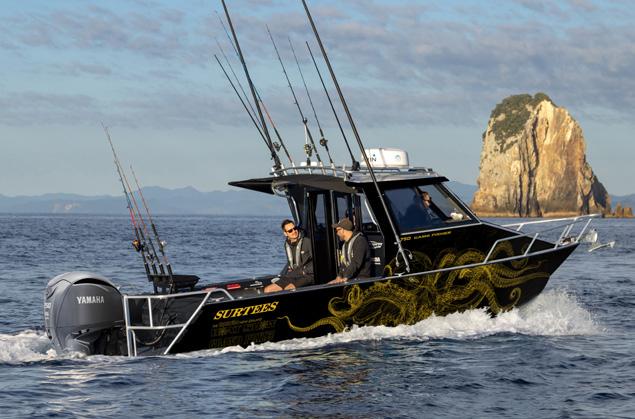
The Surtees/Yamaha Grand Prize package for the 2023 Hutchwilco New Zealand Boat Show, will be worth over $300,000 and will be the most valuable must-be-won prize ever offered at a boat show.
One of the very first of Surtees’ Limited Edition 30th Anniversary models, this very special 7.5-metre 750 Game Fisher enclosed cabin package will be powered by Yamaha’s latest technology F250 V6 DES Offshore series outboard, accompanied by a game-changing, joy-stick-controlled, fully-integrated Yamaha Helm Master EX boat control system. It will come on its own GFAB tandem axle, wirelessly-braked trailer; be fitted out with a complete set of the very latest Garmin marine electronics and come equipped with everything one will need for a comfortable, safe and enjoyable day or weekend on the water.
The special Limited Edition models are being built to acknowledge the birth of Surtees Boats in 1993. Built to fish, the Grand Prize 750 Game Fisher has been designed specifically for extended offshore cruising, with a large, 400-litre fuel tank, 530 litres of water ballast for even greater stability both underway and at rest, an 80-litre fresh water tank, electric hot water shower and sink, Engel electric fridge, an electric toilet and ample ventilation in the well-appointed enclosed cabin. Its large, uncluttered cockpit is complimented by a live bait tank under a handy walk-through transom to an enclosed platform, with protective pushpits for safer fishing in offshore waters and a robust boarding ladder for fishers and divers.
Powering the 2023 Grand Prize is a Yamaha F250 V6 DES Offshore series engine. Employing the very latest technology to deliver next generation control, integration and styling it incorporates technological advancements previously only seen on Yamaha’s flagship V8 425hp XTO models. Delivering serious offshore grunt, the new 250hp 4-stroke V6’s 4.2 litre engine has been designed to be completely integrated into the boat’s power, steering and control systems with built-in Digital Electric
Steering (DES) delivering extreme precision and smoothness. Ensuring that the Grand Prize winner is in total control all of the time, Yamaha’s industry-first, Helm Master EX boat control system makes it super-easy to navigate to those chosen destinations.
The 2023 Surtees/Yamaha Grand Prize will be equipped with a full suite of Garmin electronics, valued at over $20,000! Providing the perfect ambience for every occasion, Fusion’s Apollo MS-RA770
Stereo has been paired with a digital sound processing 5-channel D-class amp and Signature series 3i speakers, along with a Signature 3i subwoofer.
The eye-catching special 30th Anniversary wrap from Brave Design will be complemented on board with attractive brushed mocha SeaDek panels with faux teak lines. Comfortable to stand on, they also protect the cockpit floor, side decks and the platform.
A remotely-controlled Lone Star GX3 Drum Winch, complete with wide roller, Surtees bow sprit and Sarca anchor will take care of the anchoring duties while the impressive Zipwake Series S 300mm trim tabs will ensure the Grand Prize always runs on an even keel, their built-in gyro automatically controlling both pitch and roll.
To further enhance the winner’s fishing fun, the 2023 will come with a $5000 Okuma fishing gear package, a pair of Ocean Blue outriggers and a Jabsco washdown kit. Hellamarine has again supplied a comprehensive LED lighting package (trailer, navigation, spotlights, blue livebait, red/white cabin, strip and underwater to provide perfect illumination where and when required. There is also an Icey-Tek 70-litre chilly bin and 1000-litre and 700-litre Kai Cooler insulated catch bags.
To keep the lucky winner and their crew safe on the water, the 2023 Surtees/Yamaha Grand Prize will come with six Surtees Hutchwilco 170N manual inflatable
lifejackets, a Hutchwilco powerboat flare kit, an EPIRB, a fire extinguisher, a first aid kit, a large safety grab bag and a year’s worth of Yamaha Marine Insurance.
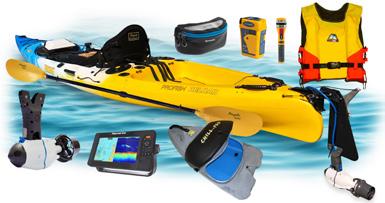
Everyone who buys a ticket to the 2023 Hutchwilco New Zealand Boat Show at the Auckland Showgrounds in Greenlane, Auckland on May 18-21, 2023, either online at www.boatshow.co.nz or at the gate will have the chance to enter the draw for this amazing 30th Anniversary Surtees/ Yamaha Grand Prize. And, thanks to the latest “scan and win” ticket technology being introduced by new show organisers XPO, visitors will be able to simply register their ticket online or onsite at the numerous iPad registration areas, before scanning their ticket at all 8 of the show’s scanning booths. What’s more, those who buy their tickets on line will also receive a second bonus entry into the Grand Prize draw ¾ and automatically go in a separate draw to win a powered Viking Profish Reload kayak package, worth over $8000.
Tickets to the 2023 Hutchwilco New Zealand Boat Show at the Auckland Showgrounds in Greenlane, Auckland on May 18-21, 2023 make great Xmas presents and stocking fillers and are on sale now at: BOATSHOW.CO.NZ
There is a separate draw for a powered Viking Profish Reload kayak package, worth over $8000.
POWERBOATMAGAZINE.CO.NZ _ 19
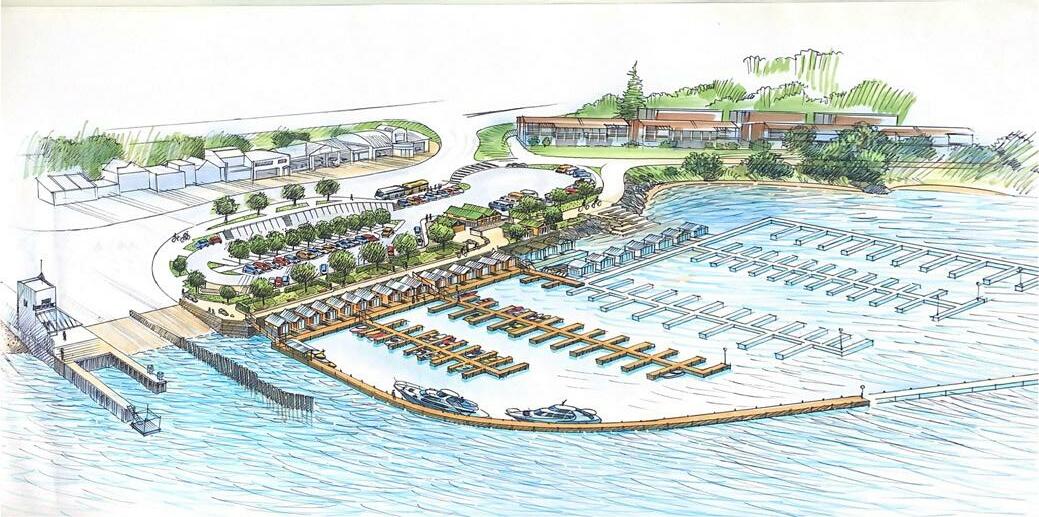
QUEENSTOWN MARINA ANNOUNCES PLANS FOR MORE BERTHS
The $20 million Queenstown Marina is now officially opened as plans are announced for Stage Two.
Work on the 85-berth Stage One started when Lakes Marina Projects Limited first applied for resource consent back in December 2013.
Construction started in November 2017 and the floating part of the marina was handed over in September 2019.
Construction of Stage One was completed just as Covid hit, and despite the timing, the
interest for berths has been unprecedented over the last two years. With just 15 private and commercial berths currently available to lease, the time is right to start construction of Stage Two mid next year. It will add approximately 100 additional berths to the marina and will also provide electric charging for boats and vehicles. The company intends to make additional
RIVIERA APPRENTICE TRAINING AWARD RECOGNITION
Riviera, has again been internationally recognised jointly winning the "Best Apprenticeship or Training Scheme" category at the recent Boat Builder Awards
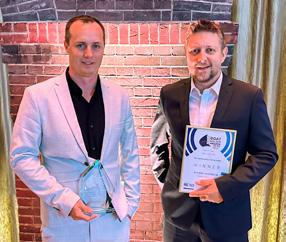
Riviera, has again been internationally recognised for its training program, jointly winning the "Best Apprenticeship or Training Scheme" category at the prestigious annual world Boat Builder Awards.
Riviera has operated an apprentice training program since 1993. In that first year, eight young Australians took up apprenticeships. Today 101 young apprentices at varying stages of training, work at the company's 16-hectare site in south-east Queensland. Alongside more than 800 highly experienced craftspeople, working together to create over 150 yachts a year, ranging in length from 39 to 78 feet, more
than 60 percent of which are delivered to international markets.
Riviera Australia owner Rodney Longhurst said: "Our team is honoured with this international recognition of our commitment to training and mentoring the future master craftspeople of our industry.
Riviera partners with Technical and Further Education (TAFE) and Plastic and Rubber Technical Education Centre (PARTEC) organisations to facilitate technical learning during which the apprentices undertake classroom studies over three of the four years of their formal further education and training.
investment to acquire a hydraulic boat trailer suitable for larger vessels, enabling boats to be pulled out of the water for essential repairs and maintenance. Lakes Marina Projects is working with the Queenstown Lakes District Council on provision of a large shed to safely house boats while the work is being carried out.
QUEENSTOWNMARINA.COM
Over the past 20 years, Riviera has enhanced its award-winning apprenticeship training with its exclusive Propel program which is designed to help apprentices develop life skills that can guide them on the path to professional and personal success.
PACIFIC POWERBOAT _ NEWS
RIVIERAAUSTRALIA.COM
Kyle Davison Manufacturing Director (left) and Dan Henderson Design & Engineering Director receive the 2022 Boat Builder Award for Best Apprenticeship or Training Scheme.
20 JANUARY / FEBRUARY 2023
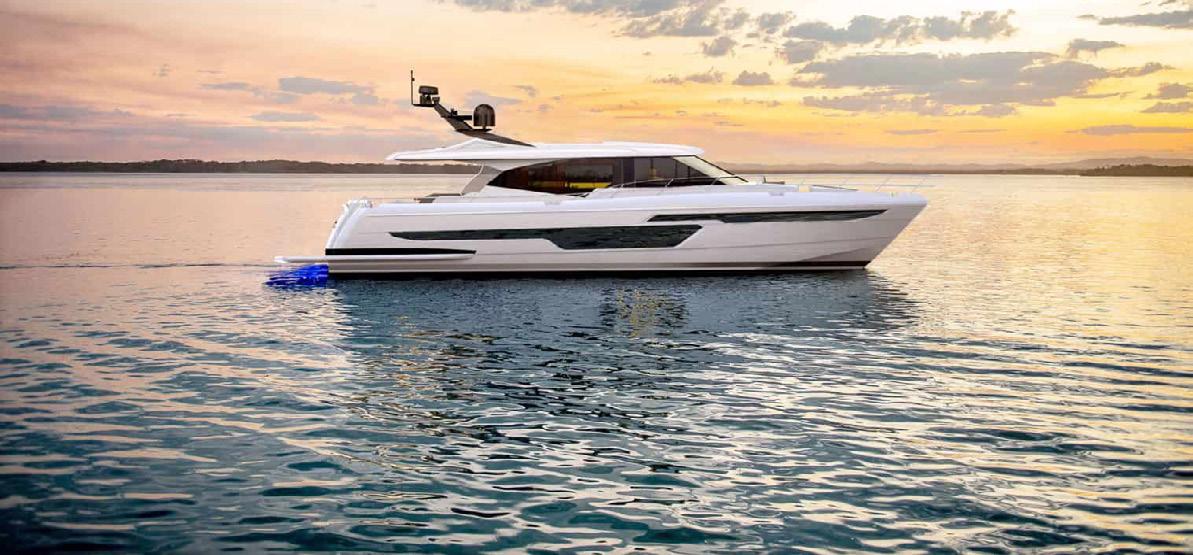
NEW WHITEHAVEN 6500 COUPE
The new Whitehaven 6500 models are essentially the 6100 models with an additional hull length of 1.3m.
This extra length capability was incorporated into the original hull design and the moulds were constructed to produce hull lengths from 18 meters to just over 19.5 meters. This extra length enables the 6500 models to include a full beam master bathroom behind the master bed which is an option often requested but cannot be incorporated into the length of 6100 models and still be in keeping with the application of traditional
straight shaft propulsion systems.
The 6500 models otherwise share the same lower accommodation as the 6100 models with the addition of a full beam master bathroom further complimenting the owner’s stateroom. This provides the option to convert the third guest bathroom into a utility room with extra storage and refrigeration which is always very helpful.
There are several options around main deck (saloon and cockpit designs) however the
main saloon area remains the same length as the 6100 with the extra 1.3 meters creating a longer and more spacious cockpit that can include several custom options for seating, bar areas, alfresco dining and BBQ locations.
The first Whitehaven 6500 Coupe will be completed in late 2023 and will be on display at the Sanctuary Cove International Boat Show in 2024.
NEW HORIZONS DISCOVER WE WILL SORT THE HOW! YOU DECIDE THE WHERE AND WHY... For the full range visit: www.buccaneer.co.nz 630 Enforcer 685 Exess 565 Exess DB913 POWERBOATMAGAZINE.CO.NZ _ 21
WHITEHAVENMOTORYACHTS.COM.AU
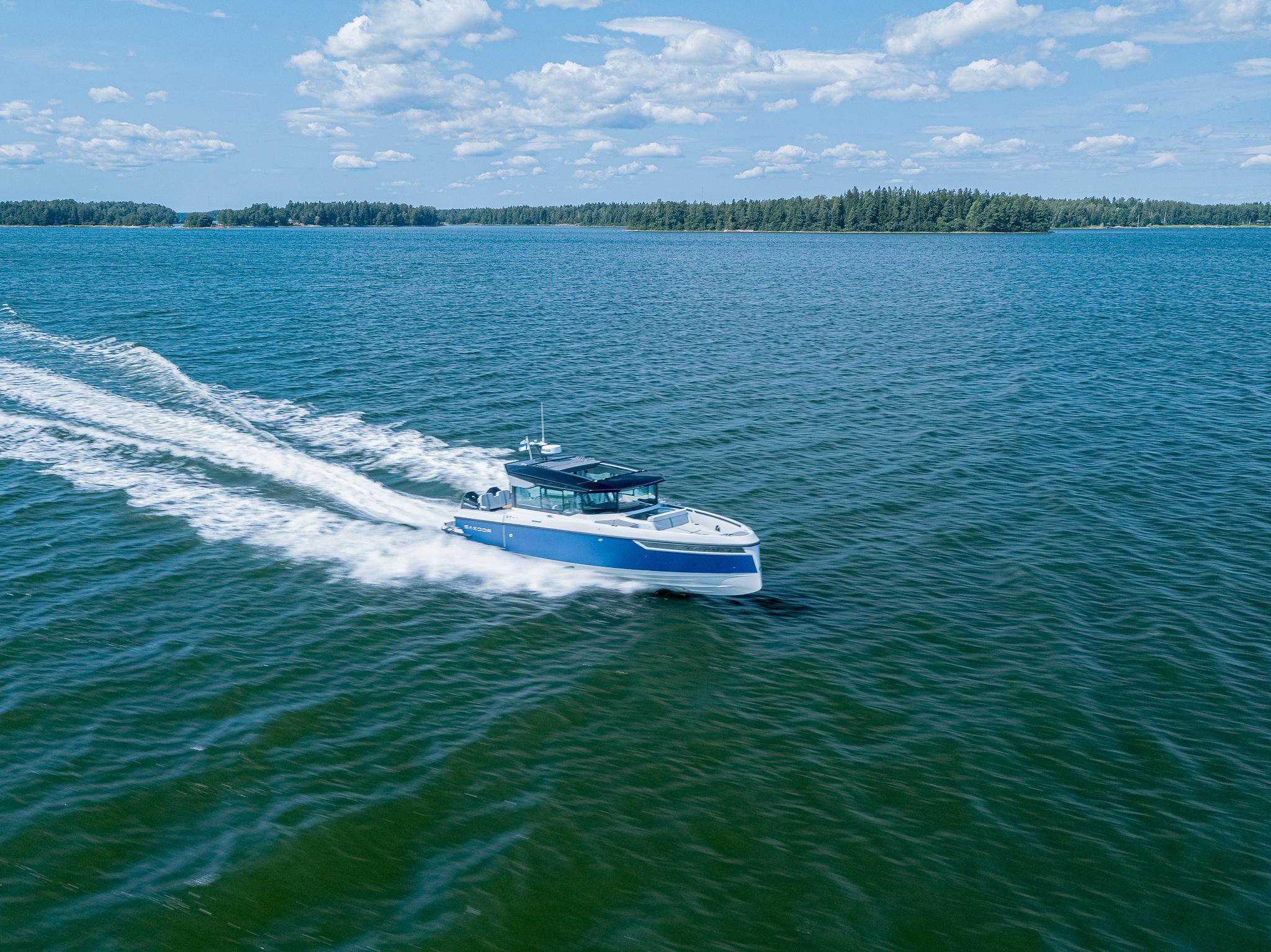
SAXDOR 320 COMING SOON
After the success of the Saxdor 200, the new Saxdor 320 is expected to be another popular model from this Finnish brand.
There are three models available. The Saxdor 320 GTO with a T-top and walk-around deck is the first boat in the series, but two different deck variations will follow. All three versions share exquisite design, fast, powerful outboard performance, and a refined, economical hull shape.
The 320 GTR model provides you with an open-air space where you can enjoy the sun to its fullest. The Saxdor 320 GTC is a blend of the GTO and GTR, with the same refined, economic and performanceoriented hull design. A low centre of gravity, low weight, sharp entry, and a twin stepped hull create a unique driving experience in all kinds of seas and weathers across the world. Obviously larger than the previous model Saxdor 200, the 10.28 m Saxdor 320, offers proportionally more space and more functional solutions.
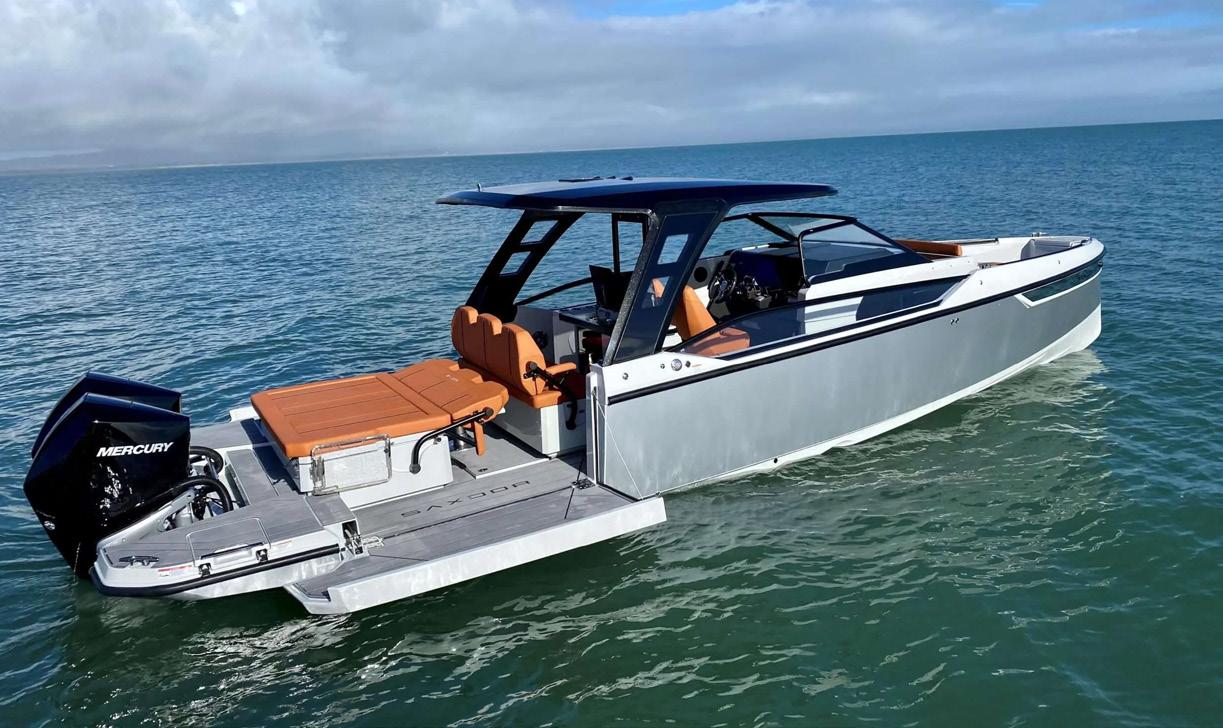
The mid cabin provides a generous double berth with a separate head/shower compartment. The 320 is a true weekender, that is well suited to cruise, fish or for overnight stays. The young Finnish builder have already announced the next model, the Saxdor 400 GTC.
Look for a full review and video in the March April issue of Pacific PowerBoat.
SPORTSMARINE.CO.NZ
SPORTSMARINESYDNEY.COM.AU
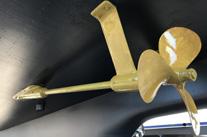
PROPSPEED RELEASE STRIPSPEED
Propspeed’s new Stripspeed is an easy and efficient solvent-based paint stripper developed to remove foul-release coatings without grinding or dust.
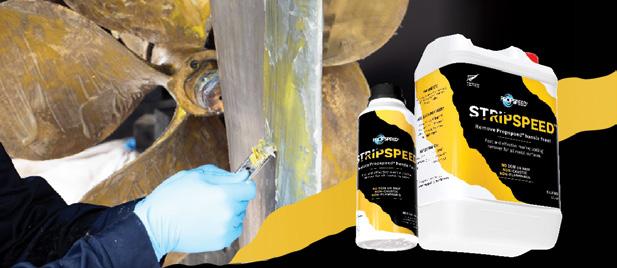
Propspeed, leading innovator of underwater foul-release coatings, has announced the launch of a new solvent-based stripper used to easily and efficiently remove foul-release coatings like Propspeed from underwater metals. Developed to help Propspeed applicators prepare metal surfaces for reapplication, Stripspeed removes foul-release coatings in 30-minutes or less. There is no mixing required to create the thick consistency,
which easily hangs on vertical and overhead surfaces, making it easy to use. Stripspeed is non-flammable, non-caustic, DCM- and NMP-free, and doesn’t create toxic dusts or debris. Unlike grinding or using abrasives, Stripspeed doesn’t cause mechanical wear through multiple refits, increasing the lifetime of the metal. Stripspeed can be used on any metal surface where Propspeed, or similar running gear coatings have been applied.
Stripspeed will reduce preparation time by approximately one-third on smooth surfaces such as propellers and shafts, with significant reduction in preparation time being observed on more complex surfaces such as swim platform armature. Stripspeed is available in two sizes: 5L bottle which will cover a surface of 10m2 and 1L bottle which will cover a surface of 2m2.
PROPSPEED.COM
PACIFIC POWERBOAT _ NEWS
22 JANUARY / FEBRUARY 2023
C M Y CM MY CY CMY K







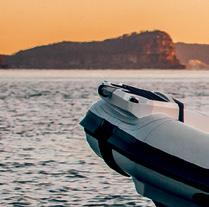
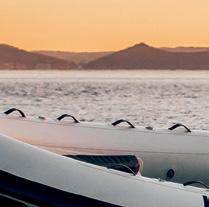
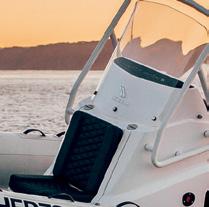
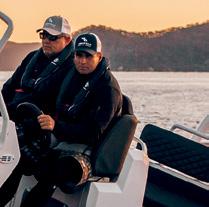
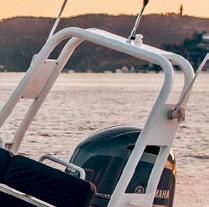



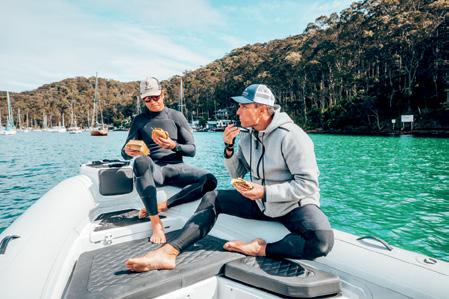
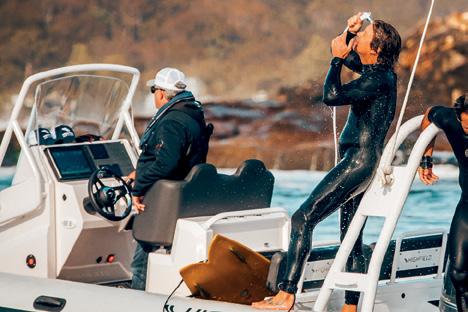
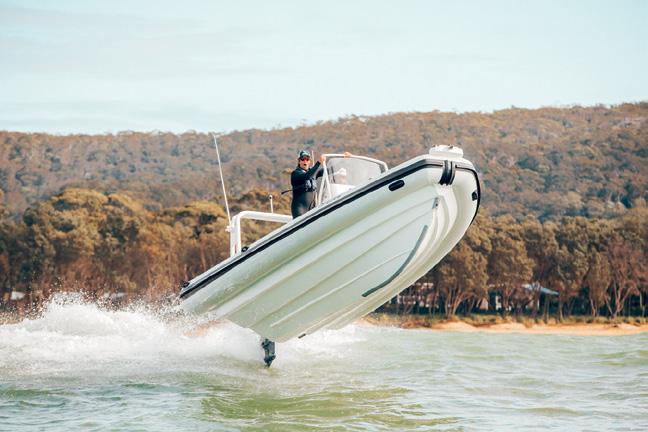


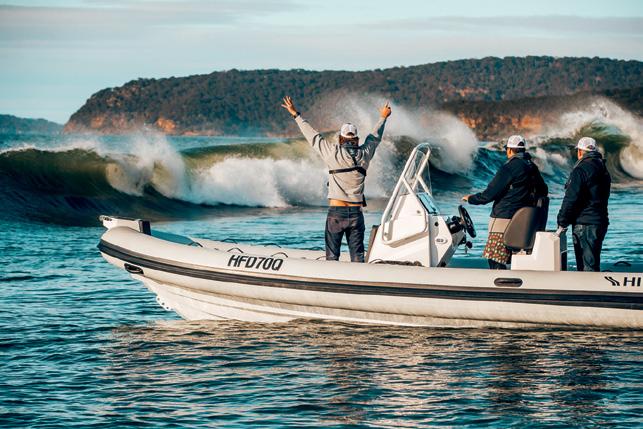


/HIGHFIELDBOATSPACIFIC YOUTUBE.COM/HIGHFIELDBOATS @HIGHFIELDBOATS_PACIFIC WWW.HIGHFIELDBOATS.COM.AU Neptune Marine 07 3290 6370 Sundance Marine 1300 55 00 89 RIB Worx 08 9430 7007 Lejen Marine 02 9979 4533 Marineco 0414 609 799 Port River Marine Services 0437 910 378 QUEENSLAND VICTORIA WESTERN AUSTRALIA Rubber Ducky 0437 910 378 TASMANIA Aakron Xpress 09 427 4613 NEW ZEALAND NEW SOUTH WALES (N) NEW SOUTH WALES (S) SOUTH AUSTRALIA THE ALL NEW SPORT 700 14 719cm 285l 250hp The Sport 700 is a boat that is as at home for a day relaxing at anchor as it is when the weather gets up. The proven 26 degree deadrise hull eats the chop and keeps you and your family dry, comfortable and secure in all conditions.
SOLAR EXPLORER UNDERWAY
Solar Explorer Yachts has been created as an offshoot of Herley Boats to focus its efforts on the future of electric boating.

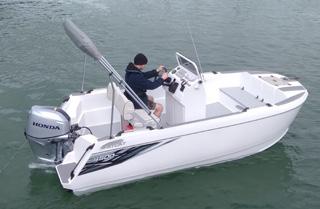
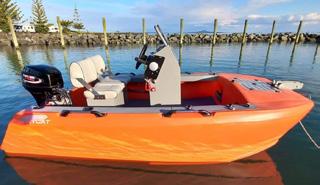
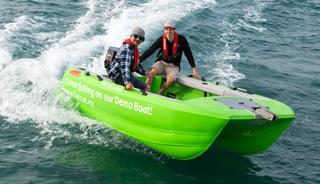
The first model to be launched under this new brand will be the 5200, a 52 ft, 15.85m, displacement catamaran produced in infused composites. The hull mould is almost complete with the deck and cabin top moulds currently underway. The first boat to be released from the moulds will be in early 2023.
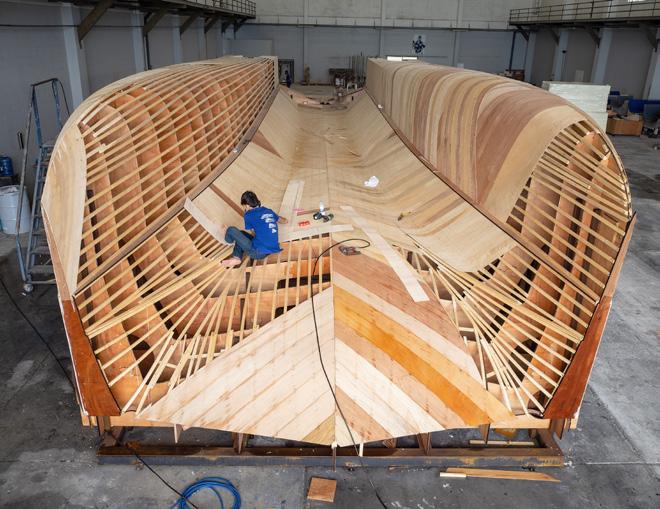
The Naval architecture has been completed by Roger Hill, with the systems design by in-house by the Solar Explorer Yachts team. The propulsion system is still being kept under wraps but promises to be extremely user friendly, focused on solar capability, ease of maintenance and safety at sea. The layout has a full beam master, with each hull dedicated to guests There is a large open plan living and dining area plus a galley on the main deck. nick@solarexploreryachts.co.nz
COMIN’ IN HOT WITH SCALLYWAG LURES
General Lee, Stray Dog, Evil Knievel and Comin’ in hot are just some of the names of the new Scallywag Lures.
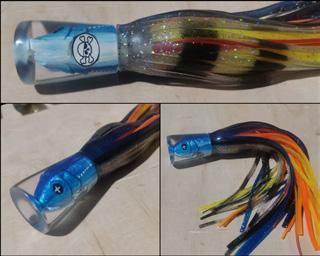
After making and hooking a marlin on a home-made film cannister lure Nick Gilmore along with Steve Clement set about testing moulding techniques and resin casting their own game fishing lures for themselves and mates.
When the lures started getting bites and catching fish out of 'star studded' lure spreads, they decided to make and offer these unique hand painted lures to everyone else. You can choose from a wide range of hand painted designs across nine lure head styles and sizes. They range in price from NZ$80 through to NZ$120 or you can buy a pack of four of the larger versions for NZ$360. Lures are bright with names such as General Lee, Stray Dog, Evil Knievel, Jane Fonda, Deep Purple and Comin’ in hot. SCALLYWAGLURES.CO.NZ
PACIFIC POWERBOAT _ NEWS Stability - Safety - Space P: +64 (09) 424 0004 M: 021 1142 444 or e: info@fatcat.nz Unit 9/623 Whangaparaoa Road, Stanmore Bay, Auckland www.fatcat.nz DB906 FATCAT 4500 FATCAT 4000
24 JANUARY / FEBRUARY 2023
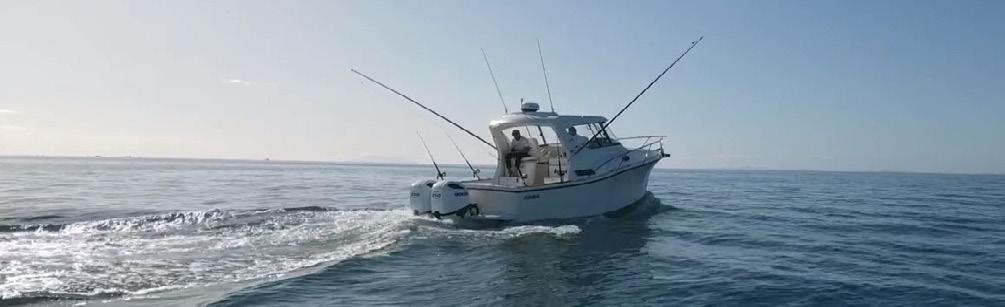
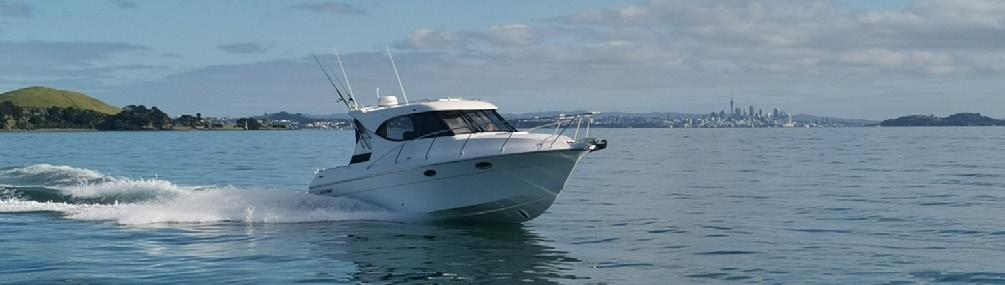
With the first race on Wednesday being cancelled due to weather, the 2022 World Championship was to be decided over just two races, which meant that all teams had to perform to their best in both heats. The winner to be decided on total overall points after two events.
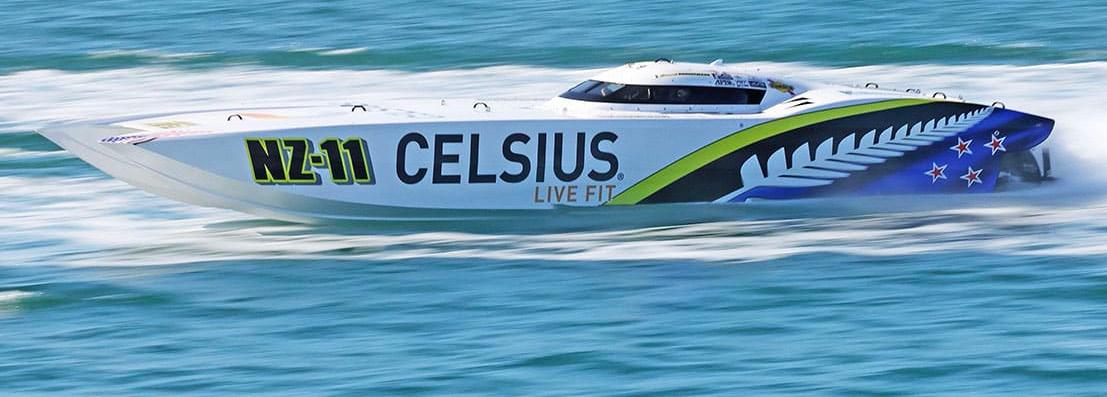
After having to pull off the course with a slit steering hose early on Friday, throttleman Grant Bruggemann and owner/driver Kiwi, Wayne Valder basically set up their 42-foot MTI catamaran, CELSIUS, (new sponsor) on all-or-nothing mode for race one on the Saturday. When the green flag waved, they used the inside lane to blast to the front to a
lead that they would not relinquish. “We were hoping M CON would take the bait and chase us and maybe break,” Valder said. “Once they backed off and we had a lead, we just took care of the equipment.”

Though they won on Sunday, a Super Cat world championship was not in the cards for Wayne Valder and Grant Bruggemann of the CELSIUS team with the DNF in race one.
Attrition played more of a role in Sunday’s calm conditions. Graydel pulled off with trim issues and owner/driver Billy Mauff and throttleman Jay Muller blew a new motor in the 40-foot Skater, WHM
Motorsports, after three laps. Liquor Split pulled off soon after with its own mechanical problems.
In the end, M CON claimed its first Super Cat world championship after Coil convinced Miller that he didn’t need to track down CELSIUS. Bruggemann and Valder finished second in the championship followed by SV Offshore.
There was another Kiwi running in Class 1, with Chris Hanley on the throttles for Mike Falco in the 48-foot Outerlimits, DeFalco Racing. Class 1 was dominated by the two Huski boats that took first and second placings.
KIWIS AT KEY WEST WORLDS The Offshore World Championships in Key West held recently was a mixed result for Kiwi Wayne Valder. Email: info@admiralboatsnz.co.nz / Phone: +64 27 600 9027 / Facebook & Instagram: @admiralboatsnz www.admiralboatsnz.com ‘Helping our clients bring their dreams to life by building truly exceptional boats.’ Setting the benchmark for quality, design, build & performance. POWERBOATMAGAZINE.CO.NZ _ 25
NEW LIGHTWEIGHT TAKACAT
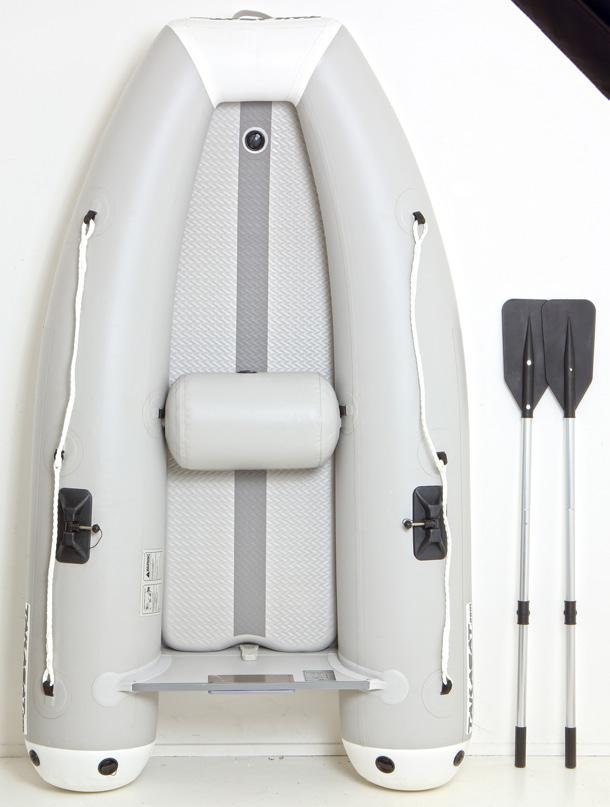
Takacat NZ have introduced a smaller Tender to their inflatable Takacat GO Series range of inflatable Catamaran tenders.
The T220GO measures 2.2m overall but retains the stability of the Takacat Catamaran design. Featuring a closed bow and closed transom weighing in at just 19kgs these are ideal tenders. They are suited for 2hp to 3hp outboards and have a RRP of $NZ1,590.00.
The GO Series comprises five models from the new 2.2m, T220GO through to the 3.0, T300GO.
An innovative range of quality proven catamaran inflatable boats has become a global success with more than 11,000 boats sold around the world through an extensive distributor network. Whether you love fishing, diving, exploring or simply looking for a quality portable tender for your yacht or motorhome. Takacat’s foldable sports boats or lightweight dinghies are a durable, stable and a fun option on any water.
Known for their stability, versatility, compact pack down size and their light-weight. The inflatable tenders can be rolled up into a carry bag with Takacat's innovative fully removable tube transom system for easy transportation and storage.
TAKACAT.CO.NZ
PACIFIC POWERBOAT _ NEWS
26 JANUARY / FEBRUARY 2023
WEBASTO TELESCOPIC SHADE 2500
The versatile new Telescopic Shade 2500 from Webasto - market leader in marine roofing solutions, is an industry-leading accessory to provide boaters relief from the sun, whether they're relaxing in the bay or running out to the reef.
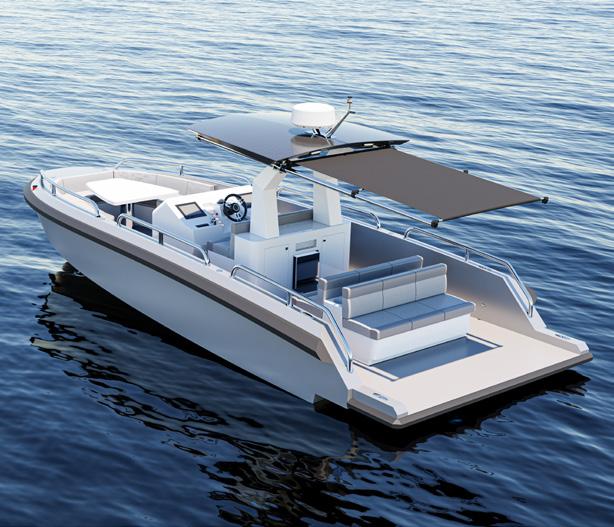


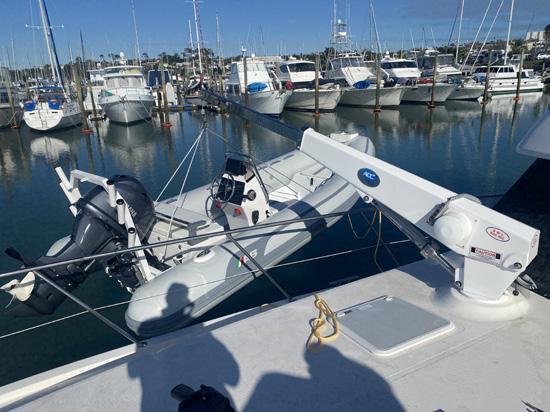
Its patent-pending design focuses on easy installation on a T-top, arch or other overhead structure, where the electrically-powered sunshade retracts discretely to be barely visible. Available in fabric widths customisable up to 2500mm, the Webasto Telescopic Shade is built for the marine environment. Stainless steel tubing and castings are exceptionally robust and polished to a high gloss to provide a premium appearance. The entire assembly is so well- engineered for stability, the shade can remain fully extended while the boat is underway in moderate conditions.
The Telescopic Shade 2500 features quick-drying Dickson (Glen Raven) Infinity fabric that resists fading, tears and UV rays, and is easy to clean. Standard colours are Noir black, Carbon dark grey, Gris medium grey and Pierre light grey, with additional options available. Installing the Telescopic Shade 2500 is accomplished in a few easy steps. The base tubes and single 12V DC drive motor with adjustable end positions are mounted to the boat's overhead structure with the adjustable brackets. Stainless steel gas springs have an extra oil chamber for consistent fabric tension for each position while cross beams self-adjust to minimize stress on the system. The Webasto Telescopic Shade 2500 concept requires no synchronization—only checking and adjusting the end positions. The power switch and wiring harness are offered as an optional kit. This canopy can also be used in tandem with Webasto's wide range of GRP and glass marine sunroofs. All Webasto Products come with a 2 year warranty.
New Zealand Agent For: WWW.MYSC.CO.NZ and Supplied Installed Quality 316 Stainless Steel Made From Full Electric and Hydraulic Options Options 200KG - Available 1500KG Single Stage and Fixed Boom Hydraulic Swim Platforms Motor Yacht Service 09 416 1179 Centre | www.mysc.co.nz | info@mysc.co.nz 12 Clearwater Cove, , Auckland NZ Hobsonville Marina Installation Completed at Our Hobsonville Location NZ Warranty and After-Sales Agent for Maritimo Also Agents For:
WEBASTO.COM POWERBOATMAGAZINE.CO.NZ _ 27
MILLIONS IN MARITIMO BOATS USA BOUND




Maritimo, recently sent US$18 million worth of boats to the US and more are to follow. Maritimo exports around half of its annual production to markets from New Zealand to Europe.
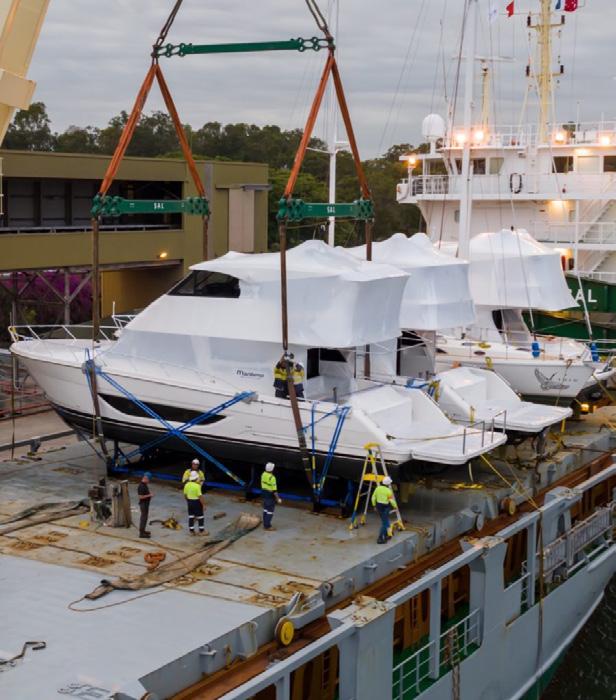
Afew weeks ago, six Maritimo boats, around 180 tonnes worth, to the value of US$18 million were shipped to the US from the Port of Brisbane where they will be welcomed by Maritimo locations across the country.
In January, another shipment of seven Maritimos will head to the US, valued at over US$21 million.

Outside Australia, the US is the next biggest market for Maritimo. New Zealand is also an important and growing market. The majority of Maritimos travel across the Tasman to New Zealand on their own hull, which is a testament to the offshore cruising capabilities of these Australian-designed and built vessels.
Tom Barry-Cotter, Managing Director at Maritimo, says the appetite for Maritimo boats in the US and Americas is only increasing.
“We have a healthy production schedule for 2023/4 and are looking forward to releasing new models at the 2023 Sanctuary Cove International Boat Show in May, before exhibiting at select US and other international shows during 2023.” MARITIMO.COM.AU







PACIFIC POWERBOAT _ NEWS
E MARINE MOTOR YACHTS Clontarf Marina
Sandy Bay Road, Clontarf,
DOWNEAST MOTOR YACHTS OF TIMELESS STYLE, QUALITY AND ENDURING VALUE 28 JANUARY / FEBRUARY 2023
1
NSW 2093 Phone: +61 417 200 165 Email: info@emarine.com.au www.emarine.com.au
State-of-the-art

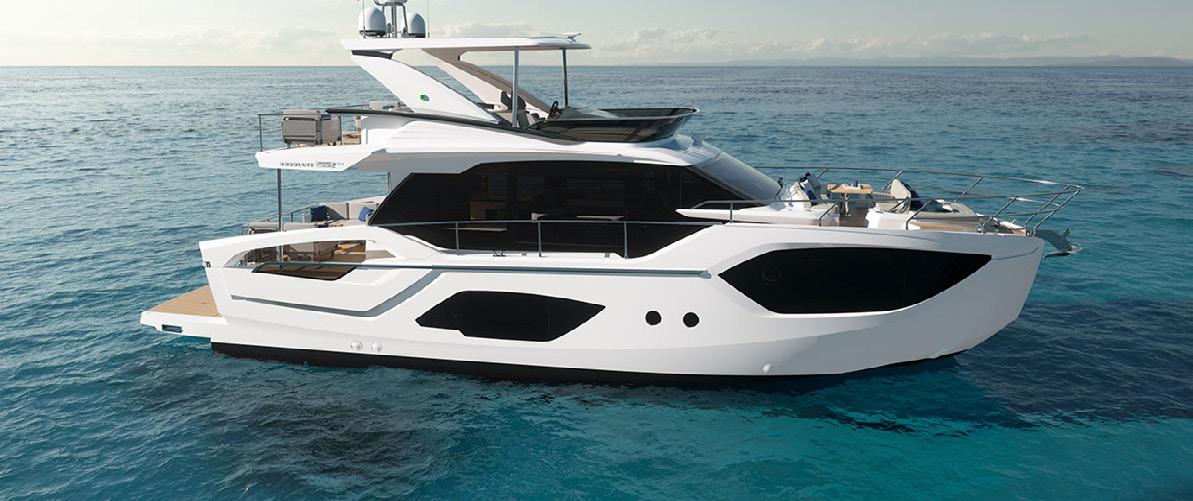
those larger versions into the new 52-foot yacht. It offers all the spaces that have become hallmarks of Absolute’s range,
windows the 52 FLY privileges unimpeded views of the marine setting. The outdoor spaces are accessorised with Absolute’s
ABSOLUTE RELEASE NEW 52 FLY
52 FLY is the latest model in the Absolute Flybridge range, and it is a truly revolutionary yacht.
design and engineering, the 52 FLY presents the brand’s extraordinary liveability in this more
and performance. Redefined.
D4 and D6
hp.
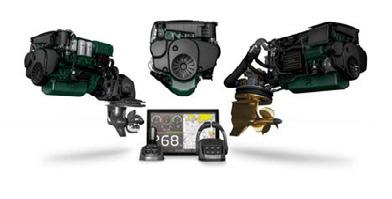
New D4 & D6 propulsion packages Power and performance. Redefined.
Power
Introducing a new generation of our
propulsion packages, from 150–480
After having spent years refining and developing the proven platform ever further, this complete system delivers new exciting features – from helm to propeller. All to offer you a more powerful and reliable experience. Learn more at: www.volvopenta.com
New D4 & D6 propulsion packages Volpower nz Limited 09 274 4305 | www.volpower.co.nz DB872 POWERBOATMAGAZINE.CO.NZ _ 29
Introducing a new generation of our D4 and D6 propulsion packages, from 150–480 hp. After having spent years refining and developing the proven platform ever further, this complete system delivers new exciting features – from helm to propeller. All to offer you a more powerful and reliable experience. Learn more at: www.volvopenta.com
NEW DEMEY YACHT TENDER
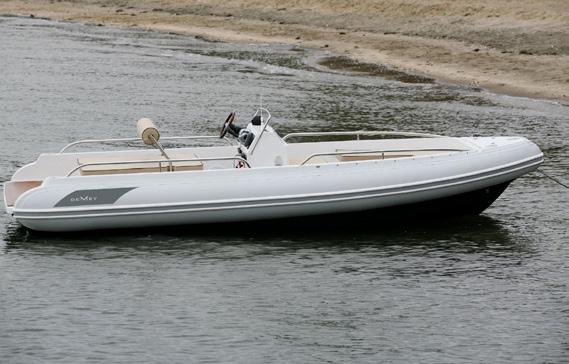
Production of the McWing 5.7 Yacht Tender has now been taken over by De Mey Yachts.


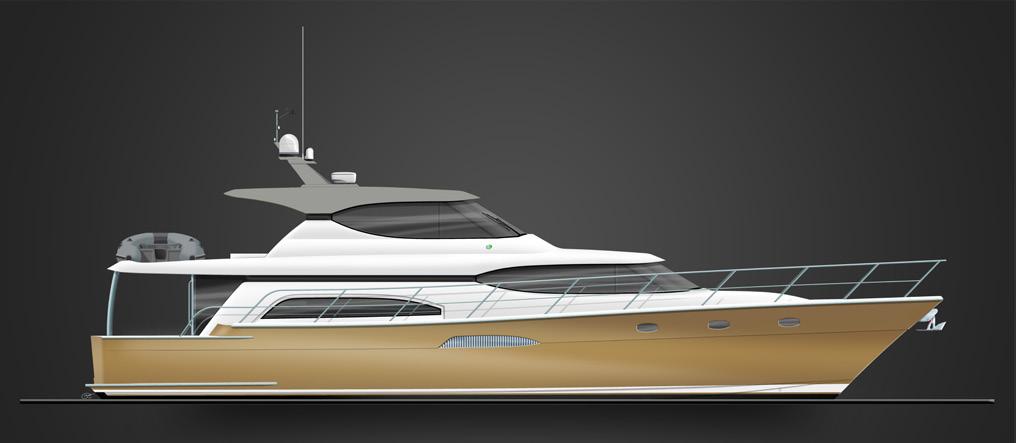
Production of the McWing 5.7 Yacht Tender has now been taken over by Nic de Mey Yachts and plans are underway to develop the initial 5.7 model using their experience in advanced carbon composites and building boats to a very high standard of finish. Measuring 5.7m, with a beam of 2.2m, they are powered by a Mercruiser diesel in either jet or stern leg configuration.
There is a seating capacity for nine, and utilising a D-section fender design they offer 22% more volume over conventional round tube designs. This makes them ideal as either a standalone powerboat for private users or as a multi-purpose superyacht tender. NICDEMEYYACHTS
AKZONOBEL DELIVERS MORE SHINE
AkzoNobel is launching a new topside system in its yacht coatings portfolio that is easier to apply than traditional one-part systems furthering its commitment to developing products and solutions that make boaters’ lives easier.

The system contains two new products under its highperformance International® range - One UP and Toplac Plus.
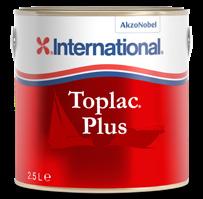
One UP is a new versatile undercoat and primer in one that saves boaters time and costs by not only drying faster, but requiring fewer coats on both wood and metal, while also providing protection for fibreglass.

It also benefits from improved aesthetics over Toplac in terms of Distinction Of Image.
Boat owners wanting to benefit from Toplac’s industry-leading high performance will have 16 bright colours to choose from from the day of launch, which remain glossy for longer as a result of UV filter technology. INTERNATIONAL-YACHTPAINT.COM

PACIFIC POWERBOAT _ NEWS
www.lloydstevenson.co.nz www.lloydstevenson.co.nz Custom design Sedan, Mid-Pilothouse and Sportsfisher Motor Yachts www. elite marine.co.nz • +64 (0) 9 530 8501 www.webermarine.co.nz www.lloydstevenson.co.nz www.lloydstevenson.co.nz Custom design Sedan, Mid-Pilothouse and Sportsfisher Motor Yachts www. elite marine.co.nz • +64 (0) 9 530 8501 www.webermarine.co.nz www.lloydstevenson.co.nz www.lloydstevenson.co.nz Custom design Sedan, Mid-Pilothouse and Sportsfisher Motor Yachts www. elite marine.co.nz • +64 (0) 9 530 8501 www.webermarine.co.nz www. elite marine.co.nz • +64 0274 853 235 DB919 lloydstevensonyachts.co.nz 30 JANUARY / FEBRUARY 2023
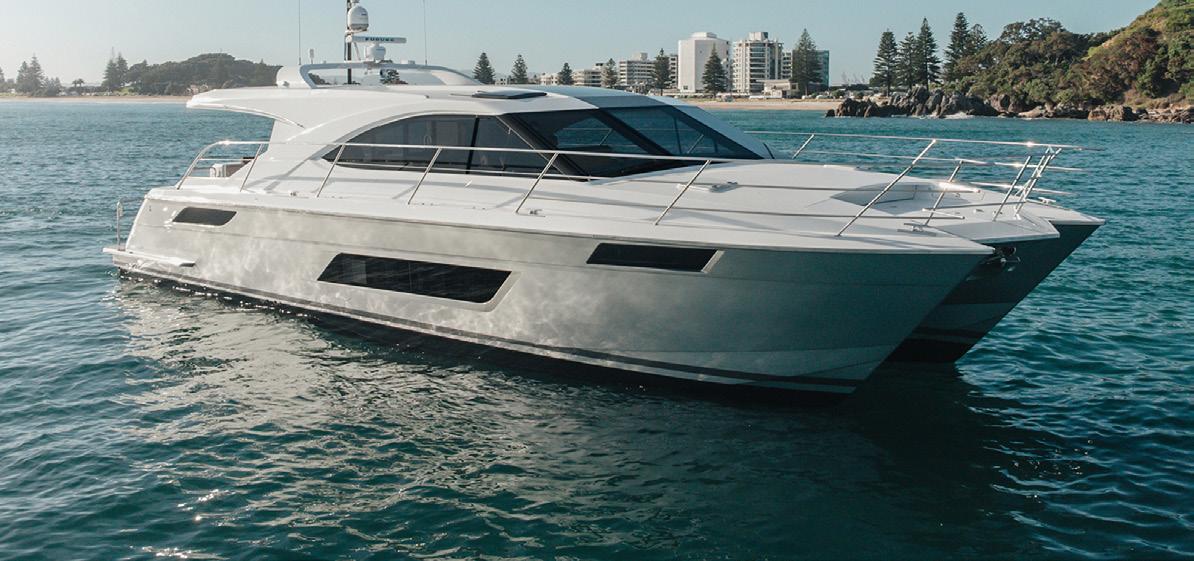
Aquila is from the XF60 (Xpedition Foiler) Series, with an LOA of 18m and a deck area of a staggering 179m2. Running two MAN i6850HP engines, Aquila boasted a top speed of 38.5 knots. However, you have the choice of various power options which give top speed of between 37-45 knots with a cruise of 30-37 knots. Range at 30 knots is anywhere between 600-1200nm. High performance boats typically have woeful
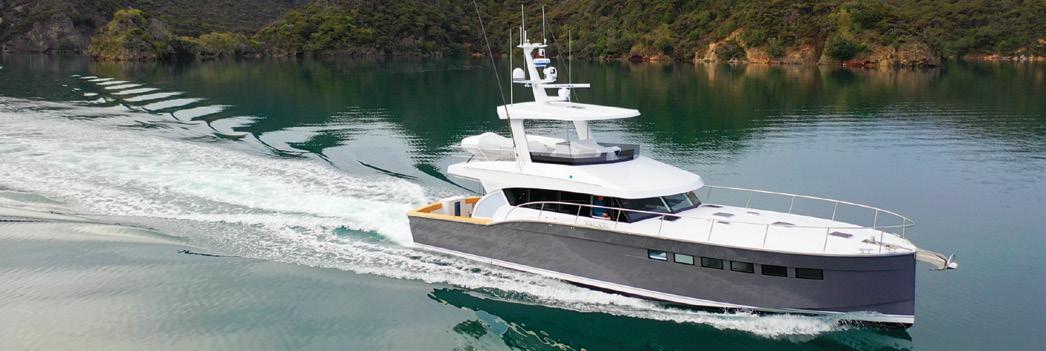
fuel burn rates and limited range but the Voodoo turns this equation on it’s head. The secret to achieving a previously unattainable balance of speed and fuel efficiency is the Xpedition Wing. The Xpedition Wing carries around 50% of the vessels displacement at cruising speed– rising 800mm providing exceptional dynamic wingdeck clearance and lowering the vessels wetted surface area allowing the powertrain to propel the hull at speeds of up to 50knots with a fuel
consumption of a vessel half the weight. Aquila’s living area has been meticulously designed to allow a genuine single level main deck floor. The cockpit, galley, saloon and helm areas merge seamlessly creating perfect flow, giving a uniquely light and spacious feel and allowing your guests to move about the boat with ease. Even with a large group onboard the Aquila always has ample seating and socialising areas for everyone.
VOODOOYACHTS.COM
We were asked to build something extraordinary... So we did. robert@lsb.co.nz 021 678 640 royce@lsb.co.nz Maintenance & refit
you
to
please contact us.
09 274 7680 lloydstevensonyachts.co.nz
Lloyd Stevenson Boatbuilders are very proud to announce the launch of Matuku, an all carbon Artnautica 60 Sportfisher by Dennis Harjamaa. For more information, or if
have a project of your own you would like
discuss,
Limited viewings available by appointment.
EIGHTH VOODOO LAUNCHED
POWERBOATMAGAZINE.CO.NZ _ 31
Aquila is Voodoo Yachts eighth Voodoo foil assisted powercat to be launched. Aquila, built for a Nelson owner is the latest successfully completed XF60 from Tauranga based Voodoo Yachts.
Catamaran Boat Share is a company that specialises in shared ownership of Luxury Catamarans for use in New Zealand in the summer and the Pacific Islands in the winter.
Currently the company has a 20m powercat under construction. The CI-6500 has been specifically designed for long range cruising with a very efficient hull form and outstanding rough water performance. The vessel features a very spacious interior with separate lounge and dining areas, a large galley, 5 cabins, 4 bathrooms, a massive cockpit and a superbly equipped fully enclosed flybridge that is accessed via a
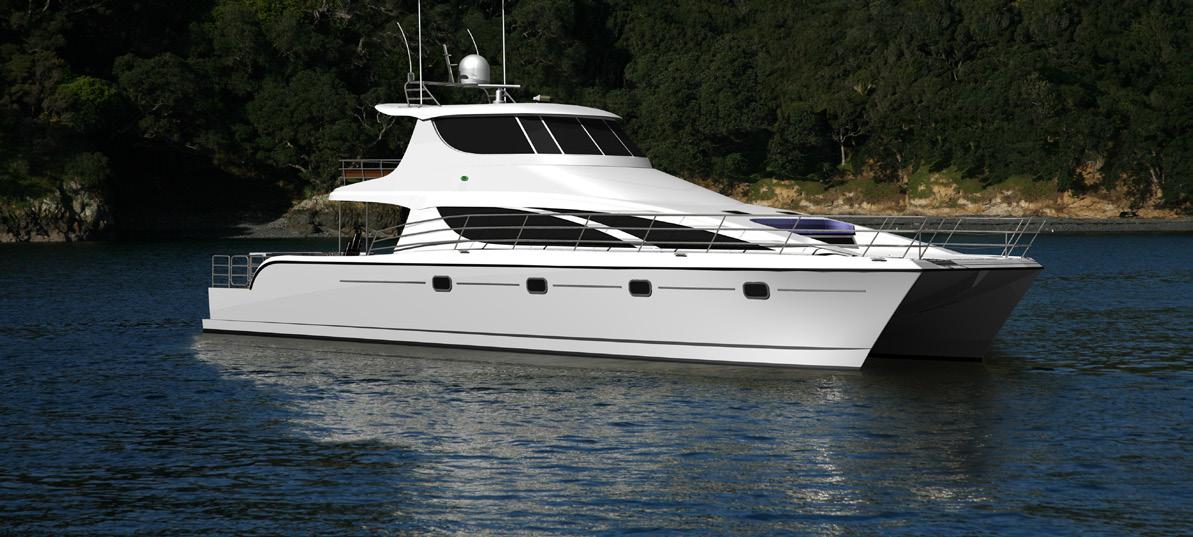
spiral staircase from the saloon. The shareholding in this vessel is limited to four quarter shares with shareholders enjoying 75 days annual use each. The vessel will be based in Auckland, New Zealand. Cruising in the New Zealand summer could include the Hauraki Gulf and the Bay of Islands. A Stewart Island / Fiordland late summer cruise is also an option for shareholders to consider. Winter cruising will be available in a number Pacific Island location.
The benefits of this Catamaran Boat Share include the use of a luxury vessel for a fraction of the usual capital outlay.
Shareholders will enjoy “walk on / walk off” use of the vessel with all maintenance and vessel management taken care of including delivery trips between New Zealand and the Pacific Islands.
One of the quarter shares has been purchased by the builder of the vessel who is a qualified diesel mechanic and also has a commercial skipper’s ticket.
A comprehensive information pack on the Catamaran Boat Share package is available and includes details of the vessel, owners use and yearly operational costs.

GLYNN@CATAMARANBOATSH ARE.COM

CATAMARANBOATSHARE.COM
PACIFIC POWERBOAT _ NEWS
Catamaran Boat Share offers you the chance to cruise in New Zealand and the Pacific islands in the same luxury powercat.
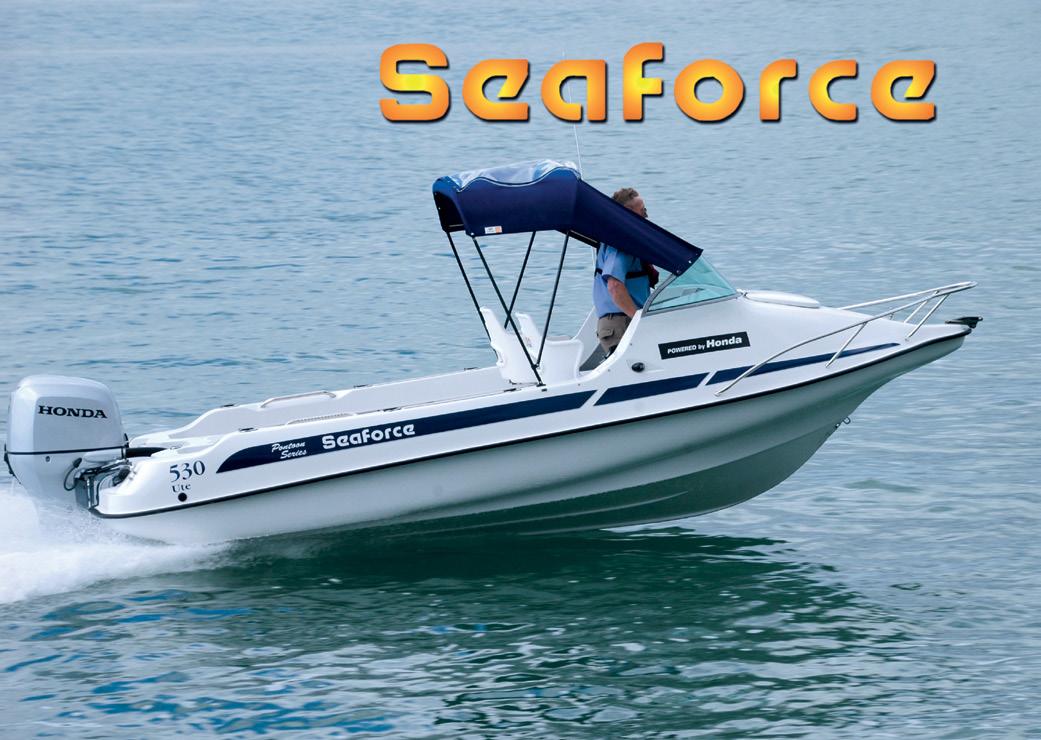
CATAMARAN BOAT SHARE DB377 FIBREGLASS PONTOON BOATS TM TM www.seaforce.co.nz Seaforce 530 Skipa Seaforce 530 Ute Seaforce 530 Mate SEE THE FULL RANGE AT 32 JANUARY / FEBRUARY 2023
COASTGUARD’S OLD4NEW IS BACK
Coastguard’s Old4New Lifejacket Upgrade Campaign is back for this summer following last season’s hiatus due to COVID.
Coastguard’s Old4New Lifejacket Upgrade Campaign Start at the of this week Dec 8 and runs through the summer till Feb 6. To make up for last year, Old4New is 30% longer and travelling to 30% more locations, heading to 80 popular boating hotspots between Houhora in the north and Invercargill in the south. We’re excited to visit a number of locations for the first time, including Hicks Bay near East Cape, Great Barrier Island and Waitangi.
Already in 2022, Water Safety New Zealand has recorded 74 preventable drowning fatalities, up 15% on figures at the same time in 2021. Coastguard CEO Callum Gillespie said Old4New is a very valuable community initiative that aims to prevent needless drownings out on the water.
The Old4New Lifejacket Upgrade is
one of Coastguard’s leading water safety initiatives, with the aim to remove as many ill-fitting, damaged and old lifejackets from circulation as possible. Kiwis have the opportunity to trade in their old lifejackets for a great discount on a range of new, modern, fit-for-purpose Hutchwilco lifejackets.
Each year Old4New Community Ambassador Lolah Yee sees lifejackets of all conditions being traded in.
“Like all pieces of boating equipment, lifejackets deteriorate and wear over time. In fact, some lifejackets that were considered safe some years ago, like the old kapok-filled lifejackets can be a hazard to you if it gets waterlogged,” she said.
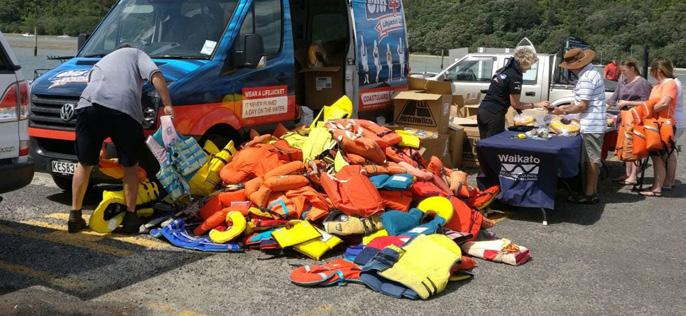
Over the past nine years more than 20,000 boaties have traded in their old, damaged or worn lifejackets for discounts on brand new, modern Hutchwilco lifejackets -
meaning over 20,000 Kiwis are now safer on the water.
If you can’t make it to one of the van locations this year, retailer Boating and Outdoors will once again be offering the Old4New Upgrade in select stores around the country.
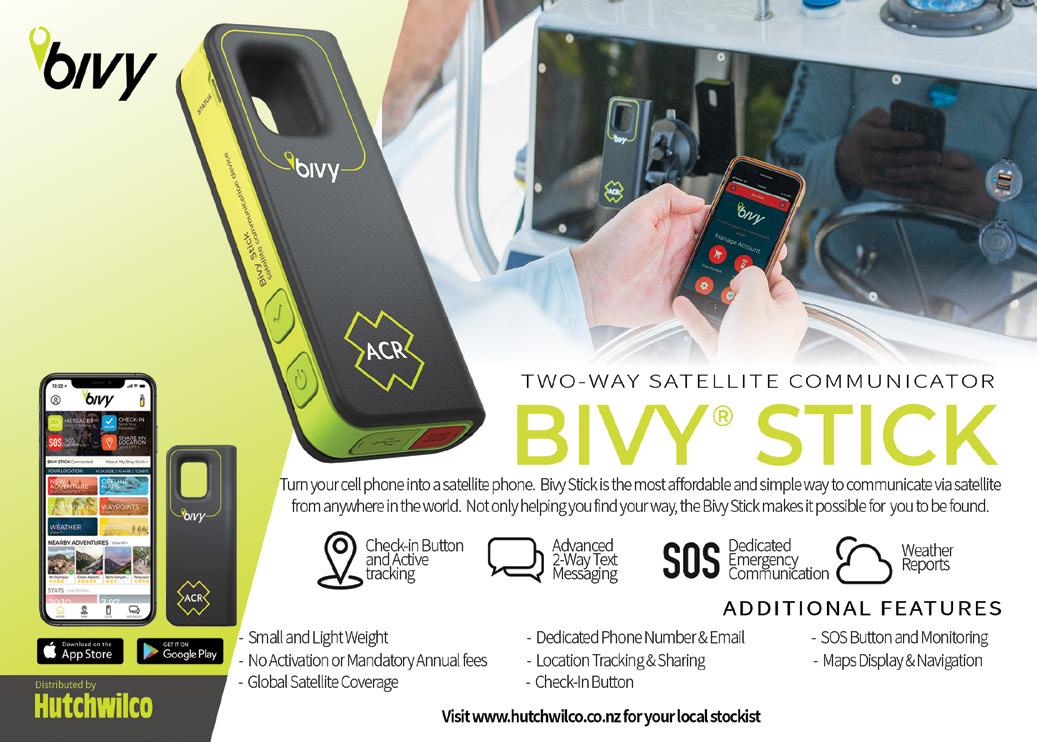
Old4New wouldn't be possible without the generous support from partners and suppliers including Hutchwilco, Maritime New Zealand, Hyundai, Bluebridge Cook Strait Ferries, Boating and Outdoors, Sealink, Pub Charity, Aotearoa Gaming Trust, Lion Foundation, Waikato Regional Council, Auckland Maritime Foundation and Half Moon Bay Marina.
For more information and a full location schedule visit OLD4NEW.NZ or contact Coastguard on 0800 BOATIE (262 843).
POWERBOATMAGAZINE.CO.NZ _ 33
HUTCHWILCO NZ BOAT SHOW SOLD
XPO Exhibitions have acquired the Hutchwilco New Zealand Boat Show from long-time owner Auckland Water Ski Club.

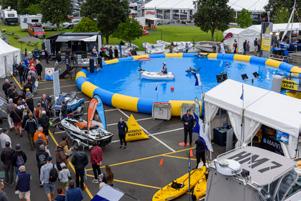
With this purchase
XPO now runs 19 of the nation’s largest sector trade shows and consumer exhibitions. “We have many synergies that will add value to the Boat Show, one example being EMEX a trade-only show with thousands of engineering business visitors and exhibitors - many with ties to the marine industry.” Couple that with hundreds of thousands of show visitors across expos like The Food Show and BuildNZ who they will cross promote and incentivise to attend. Dave and Veronica Gibbs to lead the show delivery in May 2023. “Dave and Veronica and their team bring so much value and have deep relationships within the industry. The show will be back at the Auckland Showgrounds on May 18-21, 2023. XPO exhibitions director Spillane is no stranger to the Showgrounds as the largest events hirer of the site, having just returned from the High Court with a Judgment win in hand, upholding the historic events protections on the site and quashing the attempted lease to a film studio.
THE ULTRA PHENOMENON

Ultra Anchors are one of the world’s most popular and proven anchors from 5kg to 360kg.
Motor Yacht Service Centre has been supplying the full Ultra Marine range into the New Zealand boating market for over 14 years. Dean Ryder says “I’ve been in the marine industry for over 40 years and this anchor is without a doubt the best anchor your money can buy today. I’ve had an Ultra anchor and swivel on my own Riviera for over 10 years”.
The Ultra anchor has been labelled “The Ultra Phenomenon” throughout the world and the key to the anchors success lies in its unique patented design.
The Ultra anchor features a hollow shank, a lead filled curved anchor tip and side wing plates – meaning the bulk of the anchors weight is held in the head and not through the shank. All of this translates to a very stable anchor that always hits the sea bed in the attack position, for a perfect set every time.
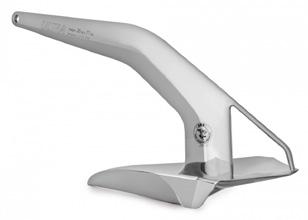
The anchor will set and stay set, no matter what the wind does. If the wind suddenly changes direction, some anchors would unset themselves and start dragging. The ultra holds strong no matter what the wind does and will not unset itself until you retrieve it. All Ultra anchors should be paired with an Ultra flip swivel. The flip swivel ensures that your anchor retrieval is a breeze and ensures it always comes up in the right orientation.
Hand made in Turkey with Swedish stainless steel , the Ultra anchor comes with a Lifetime Warranty. MYSC.CO.NZ
PACIFIC POWERBOAT _ NEWS
www.superiorboats.co.nz Superior Superior Boats Ltd : 25-27 Holmes Rd. Manurewa, Auck | +64 9 268 2222 | info@superiorboats.co.nz 1050 SPORTS SEDAN See the full Boat Review at boatmags.com NZ Built with passion & pride N N N N N Our New Twin 9-inch Raymarine Axiom touchscreens control the C Zone digital switching system 34 JANUARY / FEBRUARY 2023
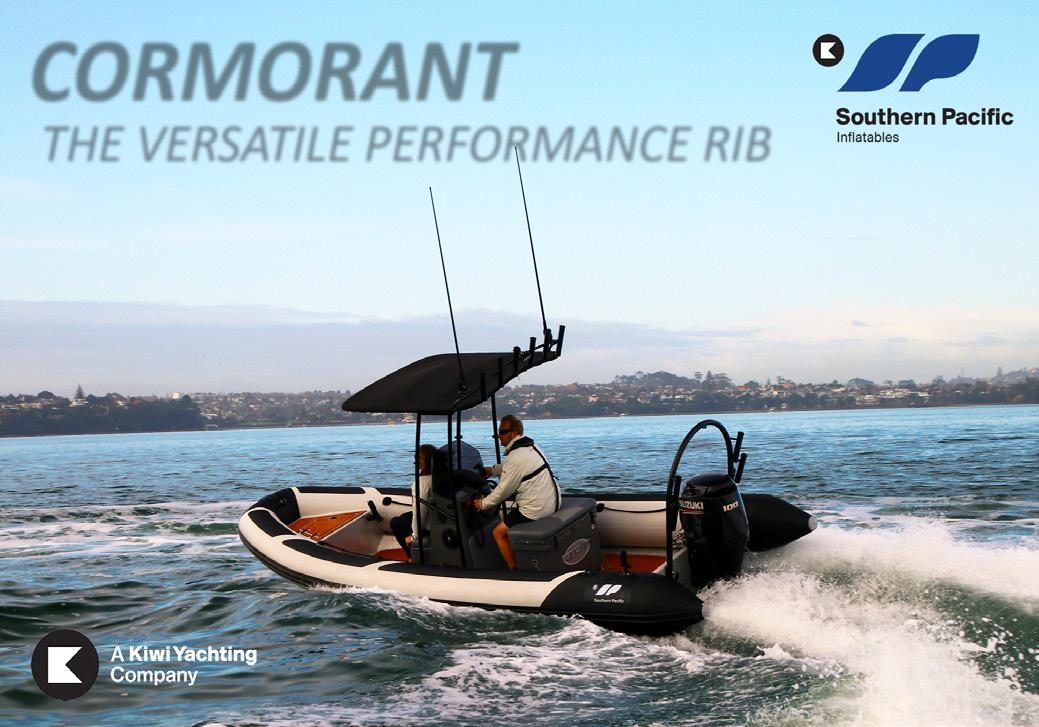
SHOTOVER JET CONVERTING TO ELECTRIC
Ngāi Tahu Tourism has signed a contract with Naut, for Naut to undertake a feasibility study to build a new fleet of electric jet boats. The initial scope of work will be for Shotover Jet’s fleet; however, Ngāi Tahu is looking to convert all their jet fleet to electric, including Hukafalls Jet and Dart River Adventures.
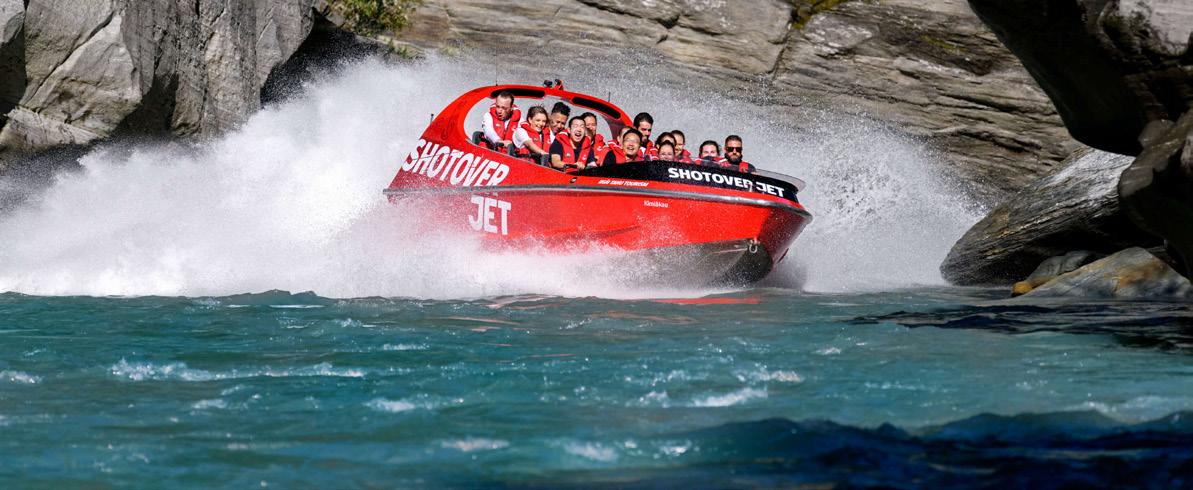
With Shotover Jet’s goal of converting 50% of their boats to electric by 2030, the signing of the feasibility study was a step in the right direction. Naut’s passion and expertise really shone through making them
a crucial piece of the puzzle, says Jolanda Cave, General Manager of Ngai Tahu Tourism.
To enable the delivery of the feasibility study, Naut has engaged the expertise of SSC Marine, Gurit, Parry Naval Architecture, McKay and WEBBCo. This is a team with proven experience in working collaboratively to deliver customised electrically propelled marine vessels, having delivered the fully Electric Ferry Ika Rere, a first for the Southern Hemisphere. Naut is an electric propulsion technology
company from Northland, New Zealand. Naut designs and manufactures electric propulsion systems for the marine industry, focusing on products for 6 to 12m. Naut aims to bring the pure joy of electric propulsion to the boating world creating a net positive experience for both people and the planet; whether this be through Naut’s electric propulsion products or working with our partners to deliver bespoke electric boat design and build packages.

NAUT.CO.NZ

PACIFIC POWERBOAT _ NEWS
36 JANUARY / FEBRUARY 2023
Electric propulsion company, Naut has announced that they will be working with one of New Zealand’s leading tourism operators Ngāi Tahu Tourism, owners of Shotover Jet.






sasgayachts.nz Menorquín 54’ Available January 2023 Hand Crafted Elegance in 34ʼ, 42’, 54’ & 68’ Sasga Yachts New Zealand Bruce McGill – Sales Director | 021 748 437 | bruce@sasgayachts.nz Ernest Henshaw – Director | 021 669 133 | ernest@sasgayachts.nz Christine Bird – Sales Executive | 021 0220 5398 | christine@sasgayachts.nz
EPROPULSION EXPANDS ELECTRIC INBOARD MOTOR
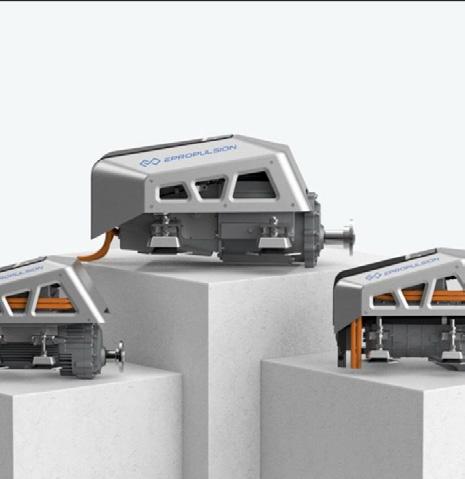
ePropulsion, showcased a number of new products and systems at this year’s METSTRADE 2022, including a new inboard motor.
The latest model range on display at METSTRADE included the new, I-20 inboard motor, part of the new I-Series which also includes the I-10 and I-40.
Available in 10KW, 20KW and 40KW input power, the I-Series electric inboard motors are ideal for leisure marine and commercial applications on small and medium size boats. All products in the I-Series have been designed for ease of use and space-saving. The models have a compact design that integrates the motor, gearbox, motor controller, system control unit and cooling system into a small area that requires 60% less space than a typical combustion engine.
The I-10, I-20 and I-40 are also 65% lighter than a typical combustion engine and feature an easy-to-maintain, high-performance and durable lithium iron phosphate battery.
ePropulsion Smart System Architecture (eSSA) is the company’s most advanced hardware and software technology and integrates the electric drive system, interactive system, battery system and cloud all into one single electronic control unit (ECU). It features a smart, modular design to deliver safe and reliable performance thanks to its fault diagnosis system and full redundancy. In addition, this modular design allows for several different batteries to be selected depending upon range requirements, providing a high level of flexibility.
The I-Series also supports the integration of the ePropulsion Connectivity Service. Based on boating IoT technology, it allows users to access cloud-based connectivity services without the need for additional accessories. From here, with user's authorization, boaters can check everything from the location of the boat to battery level, speed and charging status; automatically generate sailing logs; authorize guests to power on for easy boat sharing remotely; and even turn on the security mode, which notifies the owner instantly should the boat be stolen.
NEW HP KILO BY WATERMAKER
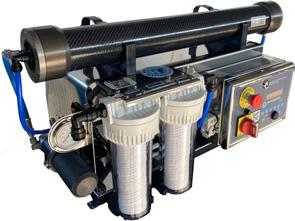
The HP KILO watermaker, is the ideal solution for plenty of fresh water on board boats and yachts from 35’ to 50’.
HP KILO, produces 120 l/h of fresh water using only 1 kwh. Having plenty of fresh water on board is a need that is very much felt by all yacht owners, on both motor and sailing yachts, from 35' to 50'.
Until now, if limited amounts of electricity were available, the solution used has consisted in 12VDC or 24VDC watermaker. HP Watermakers has come up with an innovative solution that promises to shake the market: a 220V watermaker that uses only 1 kW to continuously produce 120 l/h of fresh water. The use of alternating current guarantees undoubted advantages. It extends the life of the electric motors and their efficiency, electricity absorption is more fluid and installation is simpler with smaller cable sections.
The HP Watermakers HP KILO is expected to be a real revolution in the market of watermaker on medium sized boats, which often rely only on batteries and inverters or have generators limited to 5 kW at the most. The watermaker will also be compact in size, because HP KILO is built using the frame of the HP SCA model launched in 2021, whose unex pected sales success was linked to its small size, 840 mm x 455 x 420 (h).
HP Watermakers is the first company in its sector to develop its own interface that is fully compatible with the on board electronic systems of brands such as Raymarine, Garmin, Furuno, Simrad, B&G and Lowrance.
LUSTY-BLUNDELL.CO.NZ
MERCURY INTRODUCES V10 OUTBOARDS
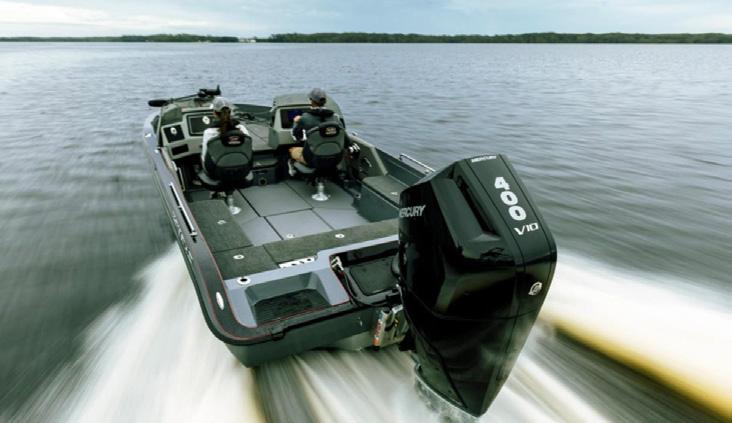
Mercury Marine, has introduced the industry’s first ever V10 outboards with the 5.7L 350 and 400hp Verados.
Consistent with the Verado brand, the new V10 engines are quiet and smooth. In addition to noise vibration harshness (NVH), the new Verados are compatible with the latest Mercury SmartCraft technologies. The V10 Verado outboards leverage many of the same market-leading features and technologies boaters love about the company’s popular V12, V8 and V6 platforms. The new V10 includes premium refinements and versatility for a wide range of applications, from large saltwater centre consoles to single-engine freshwater fishing boats to pontoons and smaller centre consoles.
Weighing only 316 kgs and with the same 26-inch mount spacing as the V8 outboards, the V10 engines maximise compatibility with current boat designs. This lightweight, compact design provides the performance boaters are looking for and makes them perfect for multi-engine applications or repowering vessels.
Mercury Australia and New Zealand will introduce the new V10 Verado in the region from April 2023.
PACIFIC POWERBOAT _ POWER ON
EPROPULSION.COM
38 JANUARY / FEBRUARY 2023


FOLLOW OUR STORY @SMUGGLERMARINE INFO@SMUGGLER.CO.NZ +64 9 838 9024 SMUGGLER.CO.NZ
VETUS RELEASE NEW
DC BOW THRUSTER
Vetus sets new DC bow thruster power standard, with first boosted 400 series models.
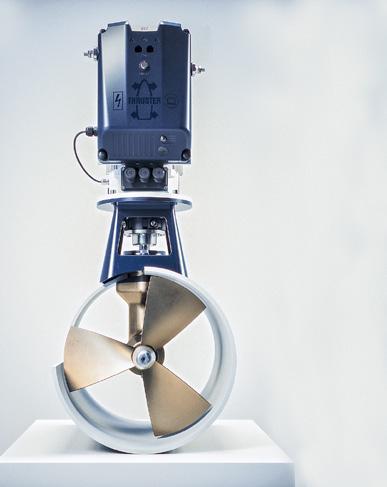
Vetus has set a new industry standard in DC thruster power with the launch of its first Bow Pro boosted units for 400-mm tunnels. Expanding the Vetus line-up of advanced Bow Pro models, the Bow Pro boosted 385 (BOWB385) and the Bow Pro boosted 420 (BOWB420) are the most powerful fully proportional brushless thrusters available on the market with 48VDC compatibility. The latest models bring the unique benefits of Vetus Bow Pro thrusters to owners and operators of larger boats, with installations ideal for vessels from 25m to 40m (82ft to 131ft). Offering a power output up to 385kgf (BOWB385) and 420kgf (BOWB420) at 48V, the two new units feature all the renowned innovations that differentiate the efficient Vetus Bow Pro thrusters from conventional units. Skippers and crew will have precision proportional control and can be confident they can extensively use their thruster system when docking or manoeuvring without the fear of overuse or overheating issues. All BowB units feature an intelligent motor controller with an integrated boost function, charging the bow thruster’s batteries using Vetus’s internal three-stage charging process. This solution enables connection to a 24V power supply to recharge the 48V battery bank to keep the thruster batteries at their optimum level. The BOWB 400 series can be used with Vetus’s standard proportional control panels – the BPPPA single thruster paddle panel, the BPPJA single thruster joystick panel with hold-to-dock functionality and the DBPPJA 360-degree double thruster joystick panel.
VETUS.COM
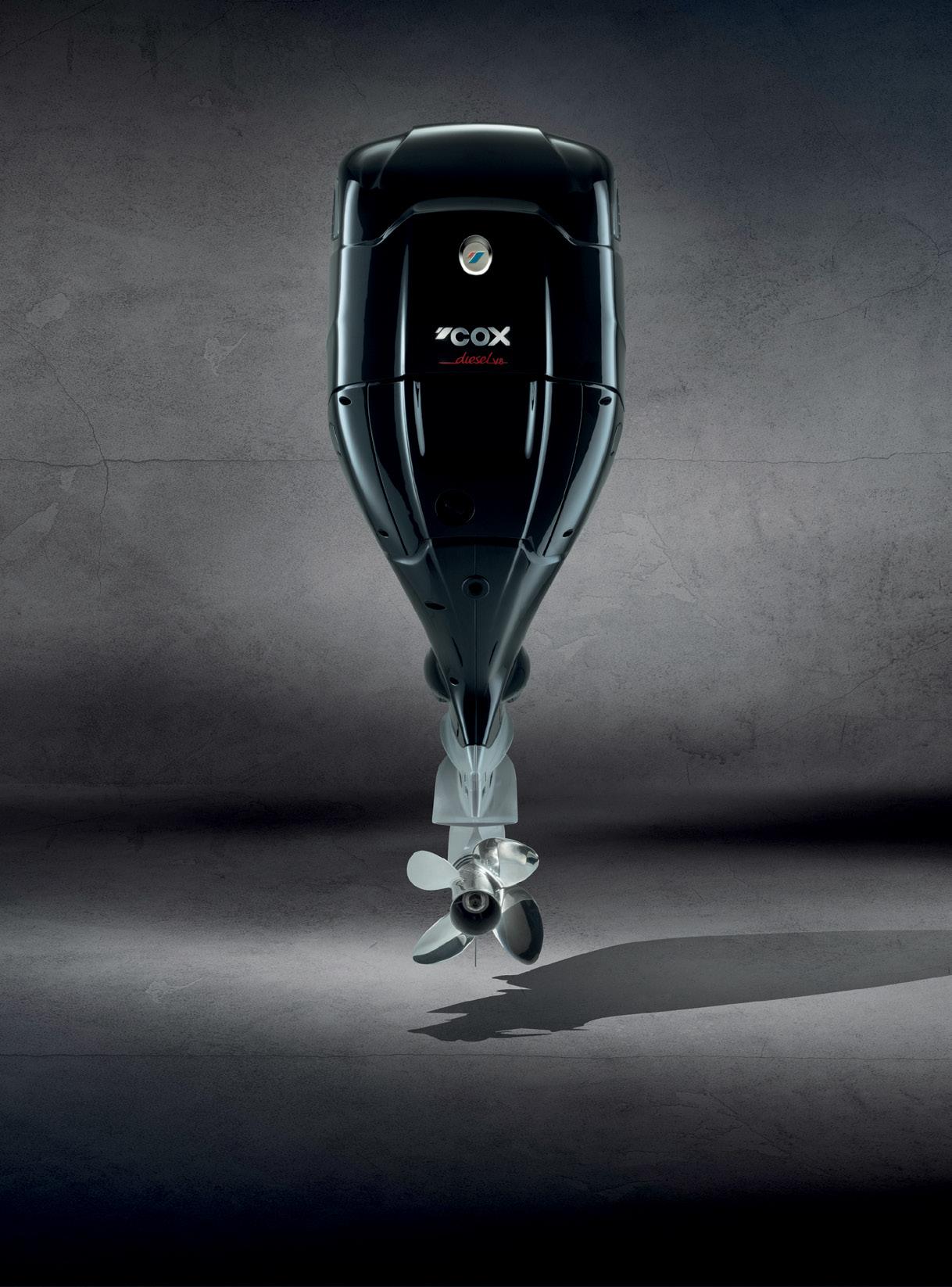
COX ESTABLISHES NEW DIESEL OUTBOARD RECORD
UK engine maker achieves diesel outboard World Speed Record of 62.27mph.
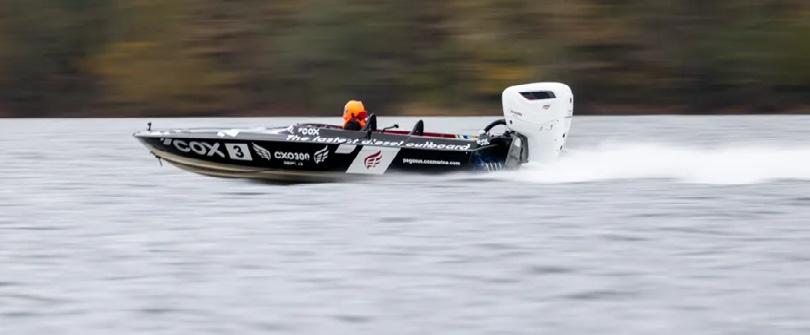
The Cox Marine team and their vessel Pegasus surpassed their own three prior speed records to clinch a coveted World Record title for the world’s fastest diesel outboard.
Participating in this year’s 50th Anniversary Speed Week, held at Coniston Water in Cumbria in the UK, Cox Marine says it achieved the industry’s first-ever diesel outboard World Speed Record.
The Cox Marine team and their vessel Pegasus, a 21ft Hallett Vector, surpassed their own three prior speed records, recorded earlier this week, to clinch a coveted World Record title for the world’s fastest diesel outboard achieving an average speed of 62.27mph.
SPORTSMARINE.CO.NZ
ED-QDRIVE ELECTRIC DRIVE SYSTEM
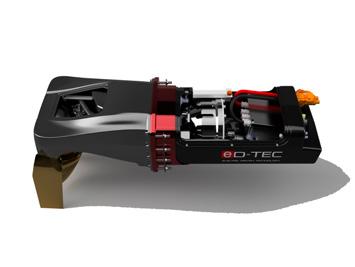
eD-QDrive is a complete system, from surface drive unit mounted through the transom to the battery system, AI controller and helm interface.
Interestingly, there is a substantial Kiwi content with the drive system designed by New Zealand based Q-SPD and the gearbox built by Cubed3 of Pukekawa, Auckland.
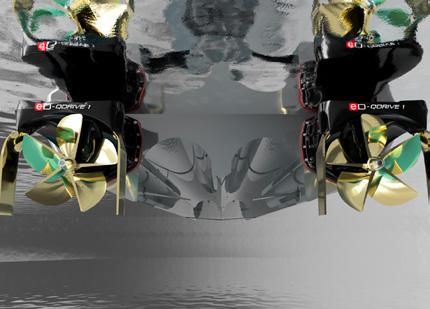
The eD-QDrive is an electric drivetrain designed to cater to the needs of the boatbuilding industry as the move toward fully electric boating grows ever closer. The drivetrain comprises a complete system, from surface drive unit mounted through the transom to the battery system, AI controller and helm interface.
The first eD-QDrive – which will make its debut in an 8.6 metre RIB with a range of 70 nautical miles at 30 knots, due to launch before the end of the year – offers 100kW continuous power which can be boosted to 200kW for a limited time thanks to a high performance, high C-rate battery bank scalable from 80 to 320kWh. The scalability includes the development of drive units capable of delivering up to 600kW each, which would enable 2,400kW combined on a quad drive installation – suitable for powering yachts up to 30 m in length – and the system also offers the option of a conventional generator to serve as a range extender. The drives are mounted through the transom and, thanks to a quick-mount frame, can be easily and quickly removed and installed. The forward end of the unit offers a power-in socket, two 24V sockets for trim tabs and foil actuators and two CAN bus connectors, making the
eD-QDrive instant plug-and-play.
All other components – the motor, cooling seawater inlet and outlet, motor controller, high-torque gearbox, and humidity, vibration and temperature sensors – are integrated into the drive unit meaning there are no additional components to mount and no through-hull fittings to be added or drilled, resulting in convenience, speed of installation and ease of use for any shipyard or operator.
The AI BOX serves as the brain of the backbone, and not only controls and optimises the drivetrain itself but also can manage the entire 24V and digital switching system on the boat. This means complete integration, which extends to the autopilot and helm electronics. Further, the AI unit will allow for continual cloudbased remote monitoring of the system, which enables predictive maintenance, OTA software updates for continual performance enhancements, and automatic remote support and parts supply.
The eD-QDrive is available now for boatbuilders and for other interested parties, with pricing available on application.
WWW.ED-TEC.DE
PACIFIC POWERBOAT _ POWER ON 40 JANUARY / FEBRUARY 2023
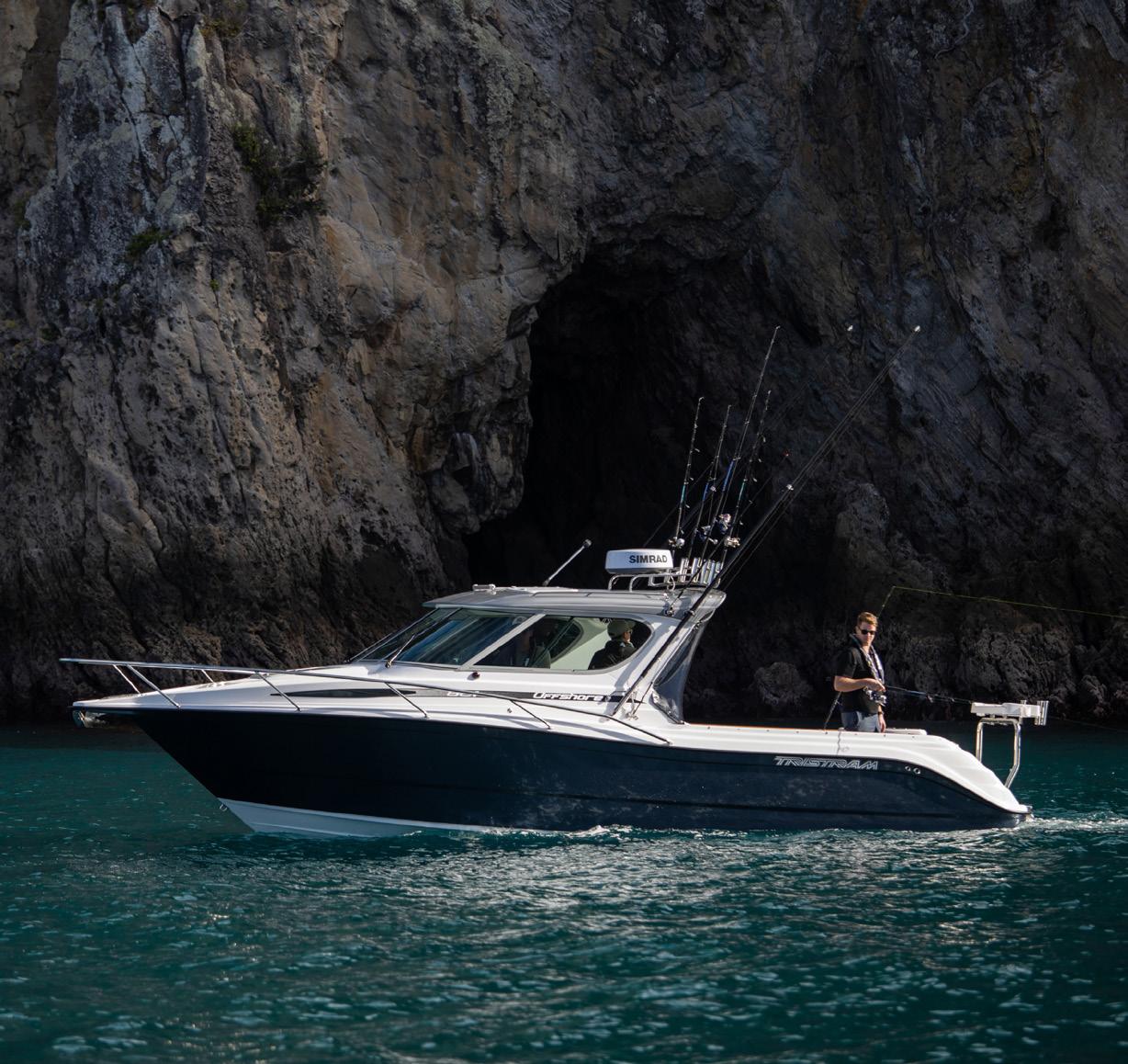


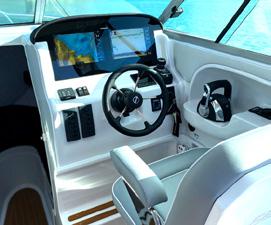
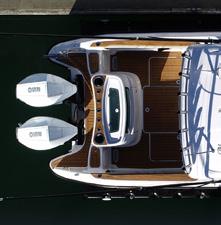
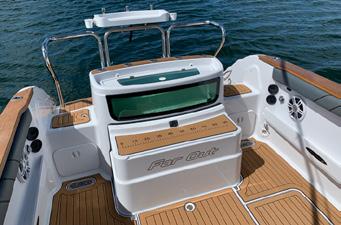
Tristram 821 Offshore / Available in Twin Outboard or Diesel Sterndrive THE PINNACLE OF PREMIUM. Every element of the ‘Tristram Experience’ is premium, from a new models inception through to production, handover and after-sales service. The diverse range of Tristram Hardtops, Targa Tops and Cabriolets are designed and crafted by a talented team of innovators who live for the ocean - a team who continue to redefine trailer boating for thousands of proud Tristram owners. For more information visit www.tristram.co.nz SHOWROOM - SERVICE CENTRE - PRODUCTION PLANT 5 Udy Place, Te Rapa Park, Hamilton, NZ Te Rapa Expressway Exit SH1 pacificpowerboat@tristram.co.nz / +64-7-849-5225 PREMIUM OFFSHORE TRAILER BOATS / WWW.TRISTRAM.CO.NZ
OCEAN SIGNAL’S
NEW EPIRB3
Ocean Signal’s new EPIRB3 comes complete with advanced, practical, life-saving features such as AIS.
Ocean Signal’s clever new EPIRB3 comes complete with advanced, practical, lifesaving features such as AIS (Automatic Identification System), Return Link Service and Near Field Communication. As well as reliably transmitting its digital mayday on 406 MHz (to the global Cospas- Sarsat satellite rescue system), the new EPIRB3 also simultaneously broadcasts an AIS VHF alert. This helps local rescuers locate the beacon even faster and ensures any nearby vessel with AIS also immediately receives the distress signal (the alert will appear on their onboard display, making it easy for them to quickly navigate directly to the EPIRB).
The new EPIRB3 also features a 121.5 MHz homing signal that, combined with visible and infrared strobe lights, speeds recovery times by allowing rescuers to pinpoint the beacon’s location, even if it has drifted, regardless of the time of day or night.
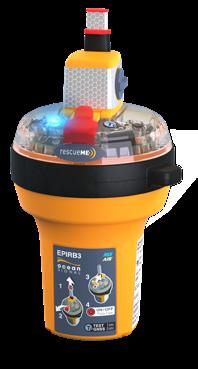
The new EPIRB3’s comforting Return Link Service reassures those who activated the beacon, confirming that their distress message has been received. A clever new feature, Near Field Communication, enables users to monitor their EPIRB3 using a free mobile smartphone App. This allows them to ensure the battery has sufficient power and the beacon is functioning properly before they head out. With its advanced new features, slim design and compact, ergonomically designed case, Ocean Signal’s sophisticated new EPIRB3 is ideal for all types and sizes of rec-reational and commercial vessels and is due for release in December through Lusty & Blundell’s nationwide network of leading marine dealers.
LUSTY-BLUNDELL.CO.NZ
OCEAN SIGNAL WINS OVERALL DAME DESIGN AWARD 2022
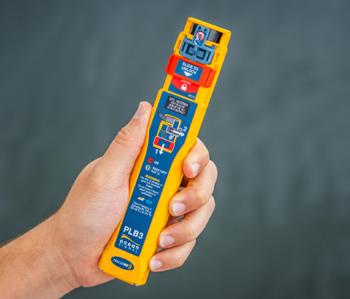
Ocean Signal has won the Overall DAME Design Award 2022 for its rescueME PLB3 AIS Personal Locator Beacon (PLB).
Described as “the standout product in the Jury room”, the next generation CospasSarsat approved PLB offers boaters the most powerful safety solution for rapid rescue in a MOB (Man Overboard) Emergency, even if the survivor is incapacitated.
The rescueME PLB3, once activated, sounds an alarm transmitting an AIS MOB signal to all vessels within VHF range indicating a MOB emergency, while simultaneously, quickly and accurately relaying your location to a worldwide network of search and rescue satellites - ensuring survivors are given the best chance of a rapid rescue on both a local and global scale.
Designed to be installed within a life jacket, the beacon is capable of automatically activating upon inflation and offers GNSS positioning, 406 MHz and 121.5 MHz signals, and visible and infrared strobe lights for final location in low visibility rescues. LUSTY-BLUNDELL.CO.NZ
NEW SIMRAD HALO RADARS
Simrad Yachting has unveiled two of its new high-performance radar products with the Simrad HALO 2000 and 3000 now available to customers around the world.
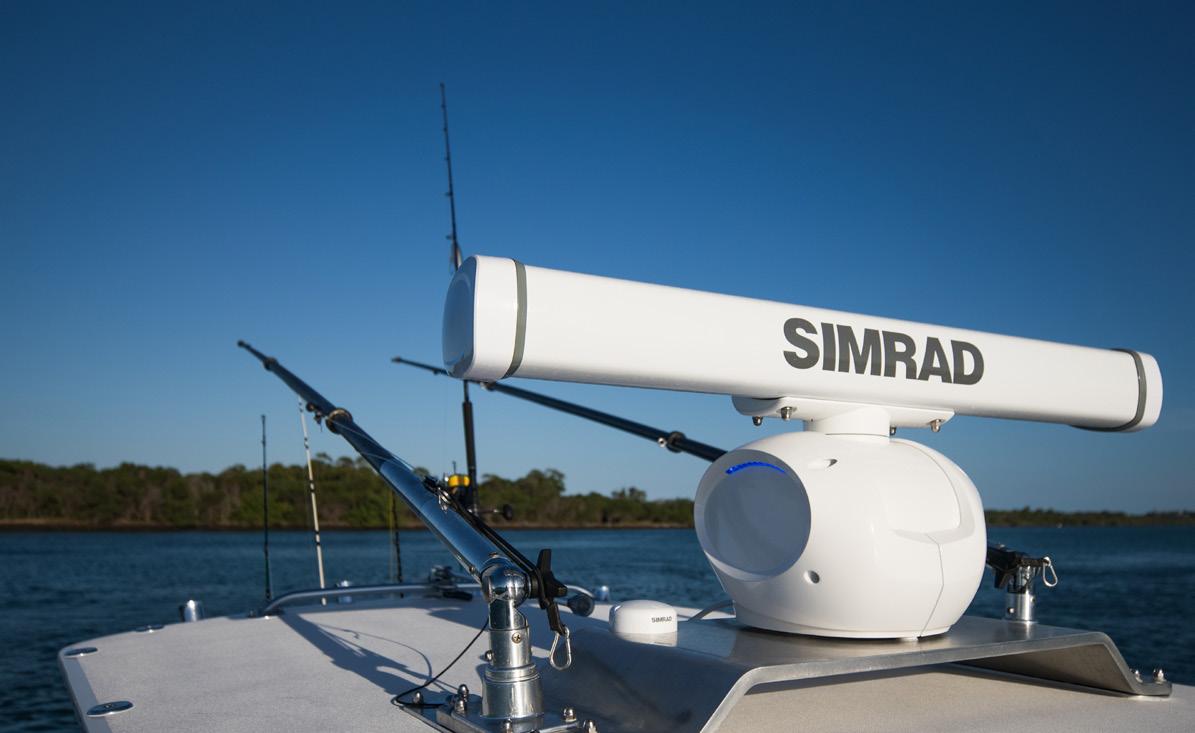
The HALO 2000 and HALO 3000 both feature higher power pulse compression and improved detection ranges to offer the most powerful Simrad HALO radars on the market. Other key integrations like Bird+ Mode, ZoneTrack and support for Dangerous Target Alerts provide users even more technical and safety benefits.
HALO 2000 comes with 50 watts of power, ensuring visibility out to 72 nautical miles, while HALO 3000, Simrad Yachting’s most powerful open array radar with 130 watts of power, provides visibility out to 96 nautical miles. That power is combined with world class beam sharpening for enhanced target separation that is unmatched in the marketplace.
Other technical upgrades include award-winning modes, situational awareness enhancements and ZoneTrack merged into the Simrad brand’s decades of expertise and experience in radar. On the HALO 3000, the new Bird+ Mode activates the radar to solely focus on maximizing 130 watts of power on targeting and identifying flocks of birds at ranges of up to eight nautical miles.
Day or night, rain or fog, the HALO 2000 and 3000 are a powerful extra set of eyes to help boaters stay aware of approaching vessels, weather, and obstacles.
NAVICO.COM
PACIFIC POWERBOAT _ ELECTRONICS
42 JANUARY / FEBRUARY 2023
NEW FROM LOWRANCE


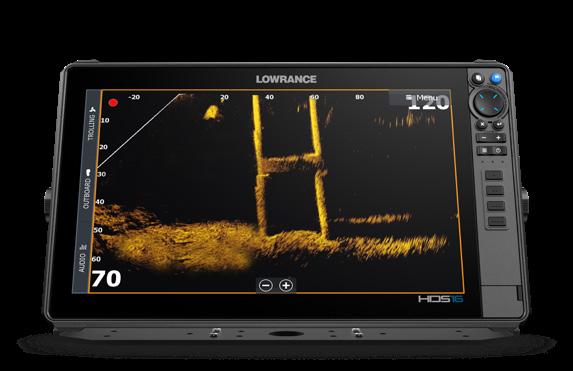
Lowrance, has rolled out its next generation of fishing electronics. The new HDS PRO chartplotter/fishfinder, highest resolution ActiveTarget 2 Live Sonar and, ultra high-definition Active Imaging HD provide anglers the complete package of the latest fishfinding technology that has helped them find and catch more fish for over half a century.


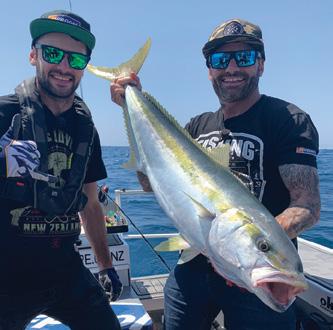
HDS PRO forms the heart of the Ultimate Fishing System, offering full networking and bow-to-stern boat control spanning trolling motors, autopilots, engines, radar, communications, and connectivity and control of PowerPole shallow water anchors. The new HDS PRO introduces two new chart overlays for ActiveTarget Scout mode and Ghost 360, as well as a new 10-inch display. Active Target 2 provides higher-resolution views of fish movement and structure and enables anglers to quickly recognize if lures and techniques are working in real-time allowing them to make adjustments to get fish to strike. It delivers a smoother and more consistent image across the entire range, with full live-action picture in Forward, Down and Scout views. Additionally, HDS PRO allows for the use of two systems at the same time giving even more views simultaneously with 180 View, Scout Wide View and Forward and Scout split screen view.
Active Imaging HD rounds out the suite of products with the clearest images of fish and structure from Lowrance CHIRP sonar, SideScan and DownScan Imaging. Additionally, a new FishReveal SideScan view is now available with a new S3100 Sonar Module, in addition to the already popular DownScan Fish reveal view, helping anglers easily identify fish targets to the sides and beneath the boat. In Australia and New Zealand, customers can find great fishing spots with Enhanced Embedded charts from the detail of C-MAP inland and coastal charts built into HDS PRO displays. The HDS PRO fishfinder is available in 9-inch, 10-inch, 12-inch and 16-inch display sizes and is on-sale now starting at a price of $4,459.
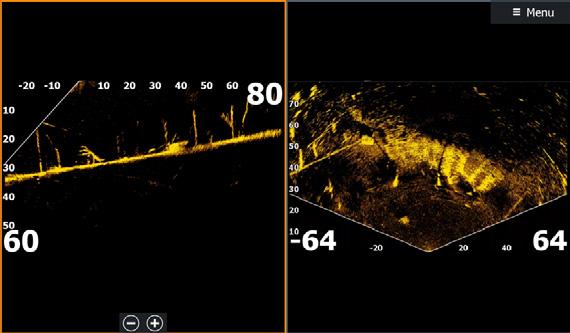
LOWRANCE.COM



POWERBOATMAGAZINE.CO.NZ _ 43 ENTRY: $40 Adults, $15 Juniors LOCATION: Tauranga Sports Fishing Club TRAILERBOAT TOURNAMENT 28&29JAN2023 (RESERVE4&5FEB) MC:RILEYELLIOT Riley will share his knowledge of the BOP region and the Great Whites. www.tsfc.co.nz/events Enter online up until midday THURSDAY 26 Jan, after this all entries through the Club please. LAB0695
MAXIMISE YOUR CRUISING INDEPENDENCE
Chandlery - PART 4
In this final article in our series considering items to be carried aboard your cruising vessel we look at chandlery.

Firstly some tips. Chandlery shops provide an essential service through the range of marine items they supply and their handy proximity to marinas. However when needing to buy multiple non-marine specific items such as tools, cleaning products, fasteners and lubricants it pays to shop around the megastores to save cost. Store your chandlery in a clean, dry environment and keep a list of what you have aboard and where it’s stored. Don’t store highly volatile and flammable products such as petrol for your outboard and acetone in your engine room or any space where vapours from a leaking container could reach your engine room or any enclosed space containing electrical equipment. We carry a container of spare petrol lashed down on the flybridge where any vapours would dissipate.
ESSENTIAL CHANDLERY
• Oils for propulsion engine(s), gearbox(es), generator, bow thruster, windlass, outboard engine and its gearbox
• Coolant and de-idonised water for propulsion engines, generator and lead acid batteries
• ATF for autopilot
• Set of funnels and measuring jug for dispensing engine room fluids
Fasteners:
• wide selection of stainless steel screws with both slotted and Phillips drives and flat and round heads in various gauges and lengths;
• wide selection of stainless steel machine screws with both slotted and Phillips drives and hex bolts in various gauges and lengths;
• wide selection of stainless steel nuts including some lock nuts, nyloc nuts, wing nuts and cap nuts;
• wide selection of stainless steel washers –standard, halfpenny, penny, spring;
• selection of steel bolts in various gauges and sizes with appropriate washer selection (these are for use on engines and drive systems where the use of stainless steel is not recommended. In the medium to larger bolt sizes select some with only partially threaded shanks); selection of set screws in various gauges; selection of copper washers; selection of fibre and plastic washers;
• Selection of Rawl plugs and selection of nails
• Set of soft wooden bungs for emergency plugging of holes and through-hull fittings
• Wide selection of cordage and lines
including light (3-5mm) cord, medium (6-10mm) cord, mooring lines and shock cord
• Selection of cable ties including extra large
• Selection of 304 or 316 stainless steel nonperforated hose clamps including extra large ones for engine exhausts and T-bolt clamps (if applicable)
• Selection of timber and plywood pieces for damage repair
• Selection of galvanised and stainless steel shackles from small to large
• Stainless steel seizing wire plus selection of heavier wire for “number 8 wire” repairs and for clearing plumbing blockages
• Selection of AC and DC tinned cables in various gauges
• Selection of crimps, ring and spade terminals, terminal blocks and connectors
• Selection of tapes – insulation in red, black, white and green; self amalgamating; aluminium; Gorilla; mounting; masking; Tear Aid clear vinyl repair and Teflon thread seal
• Araldite epoxy adhesive - 5 minute in twin syringe dispenser plus larger containers of resin and hardener plus glass cloth
• Sikaflex 291 Multipurpose Marine Adhesive Sealant cartridges in black and white
• 2 tubes of Knead It Steel polymer repair compound
• Aerosol spray lubricants – WD-40, Inox MX3, contact cleaner and silicone
• Several tubes of Superglue
• Sta-Lube or similar marine grease
• Silicone grease
• 3-In-One light lubricating oil
• Silicone sealant in clear, white and black
• Heavy duty paper towels
OTHER CHANDLERY WE CARRY
• Diesel conditioner such as Power Service Diesel Kleen and Petrol Stabiliser
• Selection of stainless steel saddles, snap spring hooks and Carabiner snap hooks
• Selection of clear pvc hose, including wirereinforced in various diameters
• Self adhesive and screw-in hooks for cupboards, wardrobes etc
• Polyethylene cutting board (for making water resistant mounting blocks etc)
• Oil absorbent mats
• 2 x anchor chain joining links
• Selection of plastic snap hooks
• Selection of stainless steel Cotter (split) pins
• Clamp-Aid hose clamp safety guards
• Selection of springs
• Selection of aluminium flat bars
• Plastic and stainless steel hose menders
• Circlip kit
• Selection of Velcro strips and pads
• Self adhesive felt pads
• Padlocks and cut-resistant lockable strap
• Heat shrink tubing in a range of diameters
• Flexible cable conduit in a range of sizes
• DC ON/OFF toggle switch
• PVA glue
• Ados F2 contact adhesive
• Sewage holding tank conditioner
• Methylated spirits
• White vinegar (for cleaning heads’ plumbing)
• Gelcoat detergent
• Starbrite aerosol rust stain remover
• Wax and grease remover
• Acetone
• Gelcoat black streak remover
• Window cleaner
• Clear vinyl cleaner
• Vinyl upholstery restorer
• Brushes including extension brush
• Buckets
• Sponges including extra large
• Chamois
• Miracle cloths (for cleaning stainless steel)
• cotchbrite pads
• Selection of rags and old towels
• Microcellular sponges (often called “Magic Foam” or similar)
• Loctite 263 thread locker and Loctite 262 stud lock
• Grunt Emer-Gel rust, stain and oxidation remover
• Selection of paints and varnishes appropriate to vessel
• Appliance White mini aerosol touch-up paint
• CRC aerosol cold galvanising paint
• Selection of small paint brushes and mixing sticks
• Plastic containers for use with paints, varnishes etc
• Bits and Bobs box – miscellaneous stuff that may be useful
I’m not suggesting readers should carry all of the above (although many aficionados carry far more), but at least have a good think about what is desirable for your own vessel. I must confess that in writing this article I’ve thought of more items to be added to our own inventory.
If cruising offshore I would carry larger quantities of chandlery and add 50m of potable water hose (to access water from wharves etc), a wide selection of fittings for the hose, several shore power adaptor plugs and 3 x 50m lines for mooring stern-to shore.
Take good care of your cruising vessel and she will take good care of you.
CRUISING MATTERS _ LAURIE CRANFIELD
44 JANUARY / FEBRUARY 2023
The Ultimate Adventure
The Ultimate Cruising Yacht
Fleming Yachts represent the point at which adventure and luxury converge. From the efficient performance that offers unmatched range, to the durability of the construction, to the impeccable comfort found throughout our interiors, Fleming is the Ultimate Cruising Yacht.
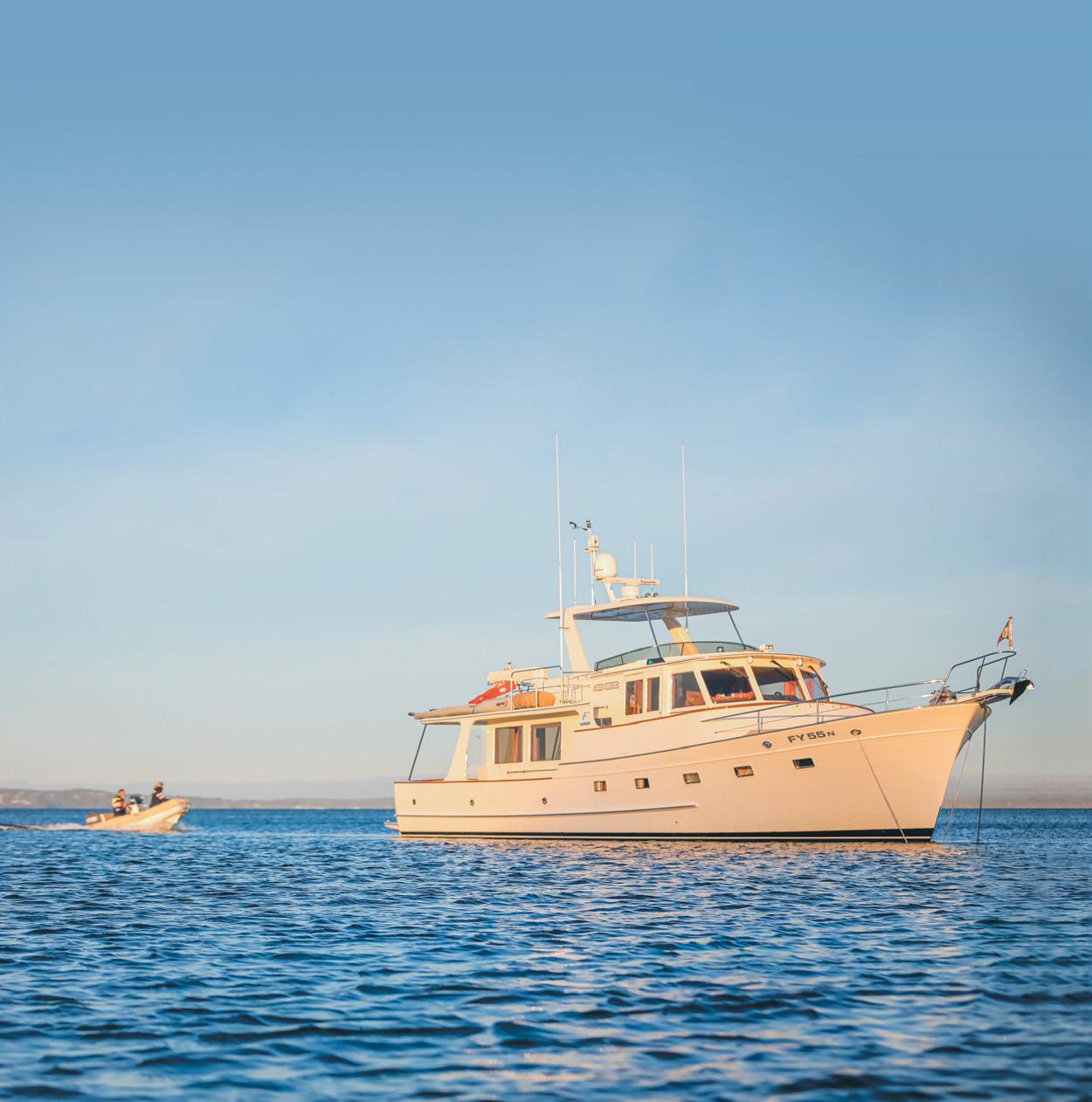
Learn why at FlemingYachts.com/Research
www.flemingyachts.com

PACIFIC PRAWN SWORDS
The term shrimp and prawn may have originated in Great Britain, but in New Zealand we know them as one of the best exports from Australia. A kilo of King or Tiger Prawns and a six pack on a hot day... nothing better. Prawns are also bigger than shrimps and can grow up to 30cm. While we are now able to buy prawns from Asia, there is nothing as good as an Aussie prawn.
INGREDIENTS:
700x gram tiger prawn heads and vein removed
2x tbsp Cocavo chilli & lime
Juice of 1x lime or lemon
1x garlic clove finely chopped
1x tsp sea salt
½ tsp ground chipotle or smoked paprika (Mrs Rogers) BBQ sauce for basting.
NEWCASTLE BBQ SAUCE
1x small brown onion
2x cloves garlic
1x tbsp Cocavo chilli & lime
225 mls tomato ketchup
450 mls tomato passata
100grm brown sugar
4x tbsp cider vinegar
2x tbsp worcester sauce
½ -1 tsp cayenne pepper
½ -1 tsp smoked paprika or chipotle powder.
METHOD:
1. Fist make or purchase the BBQ sauce.
2. Place prawns in a large bowl then drizzle with melted (but not hot) Cocavo then squeeze over the lime juice.
3. Add in the garlic, salt, and smoked paprika or ground chipotle, and toss to coat evenly.
4. Check the preheated BBQ for temperature and brush the rack with a little more Cocavo.
5. Remove the prawnsfrom the BBQ (discard marinade) and thread onto skewers.
6. Brush prawns on each side with a little of the BBQ sauce then place onto the grill to cook.
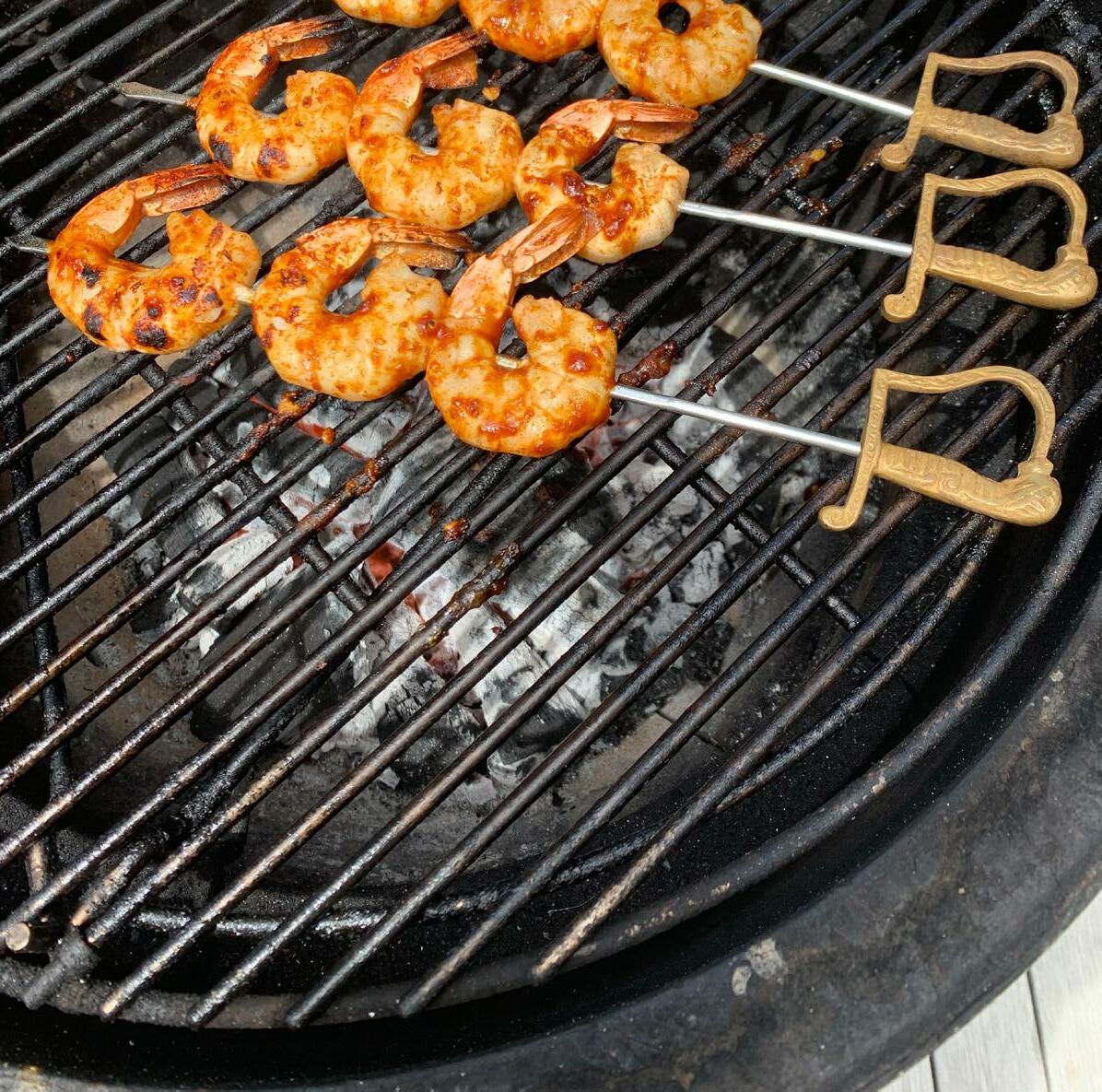
7. Allow to cook for around 5 minutes each side brushing with more BBQ sauce as required.
8. Serve over spring salad with lemon or lime cheeks on the side.
BBQ SAUCE METHOD:
1. Puree the onion and garlic in a magic bullet or food processor.
2. Heat the Cocavo in a pan or pot add in the puree and cook until it just starts to brown.
3. Add in remaining ingredients and bring to the boil, reduce heat to simmer and cook a further 45 minutes stirring occasionally until the sauce thickens and begins to darken.

4. Pour into sterilised jars, allow to cool then place into the fridge until ready to use.
Enjoy with AIX ROSÉ
A pure, pale salmon pink coloured wine with gentle onion skin hues that shine from the glass upon swirling. A fine, delicate nose with floral blossom, peach, fresh citrus, and hints of red fruit lead to a classic fresh and bright palate, a spritely acidity balanced with wild strawberry, raspberry, and stone fruit notes.
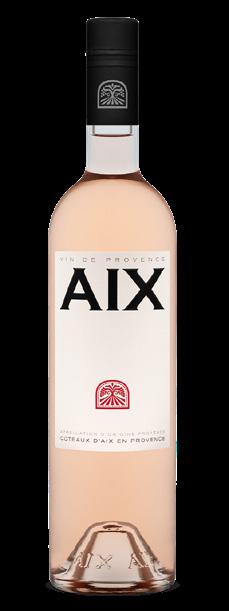
STRAIGHT FROM THE GALLEY _ WITH DEREK THE CHEF, CHEFLINE14@GMAIL.COM
46 JANUARY / FEBRUARY 2023
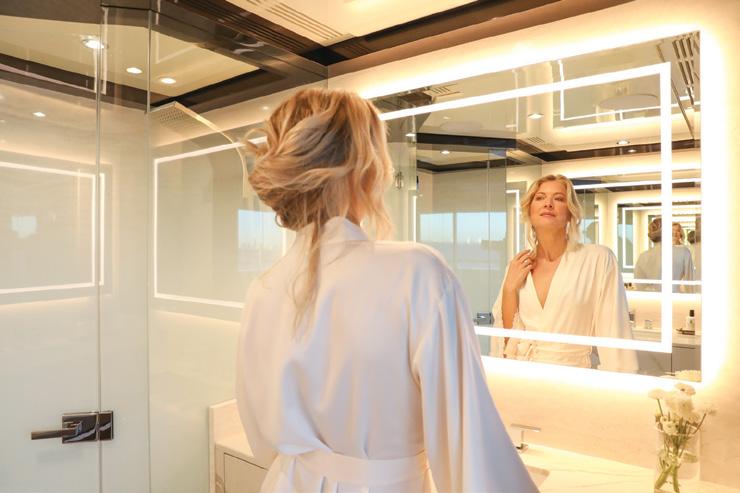
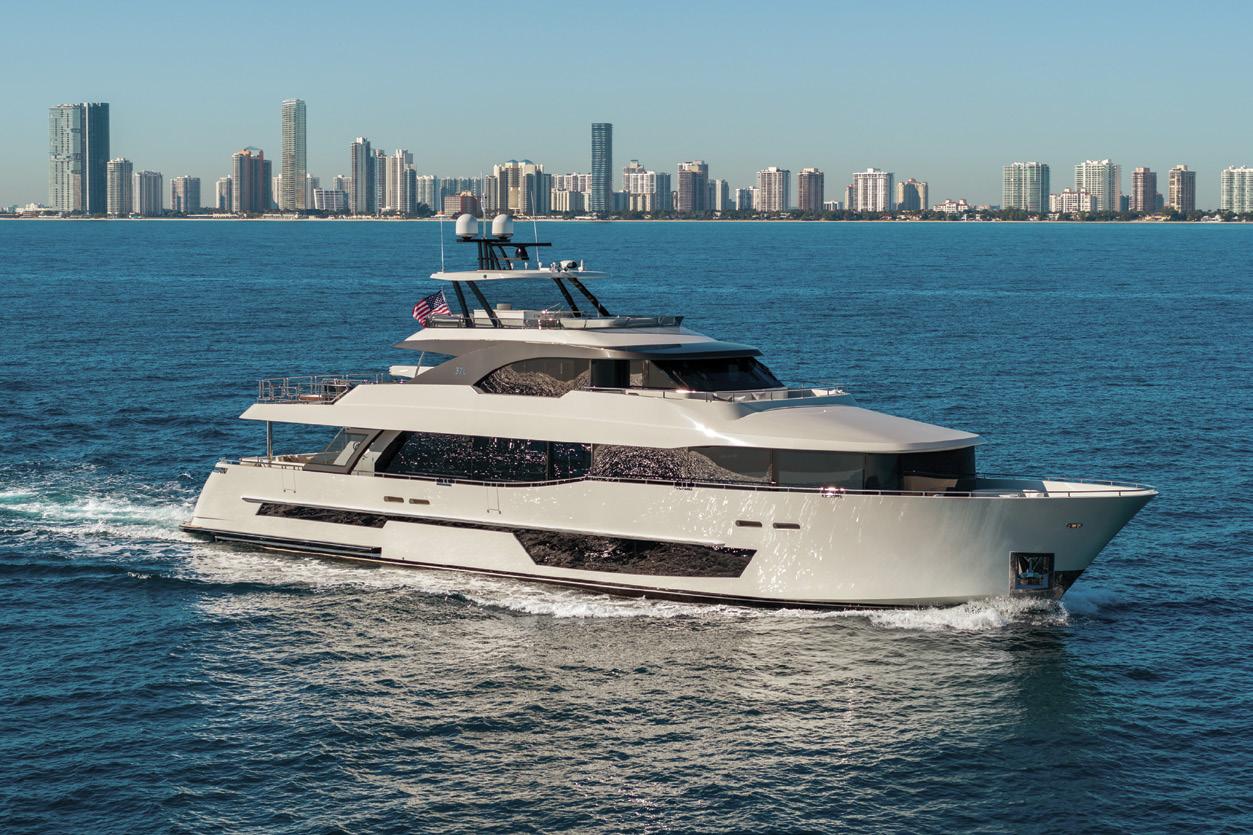
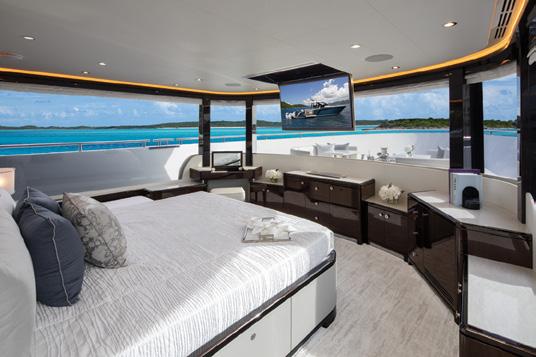
THE TRUE VALUE OF FISH
I was recently in a supermarket and shocked when I saw the price of skinned and boned snapper at $ 55.00 a kilo.
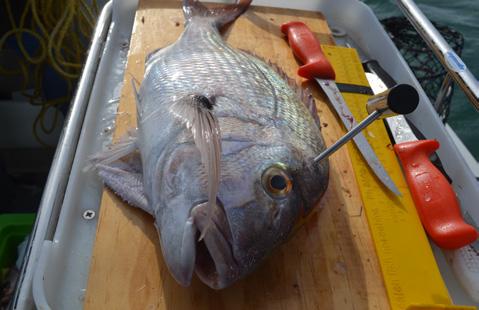
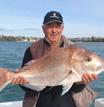
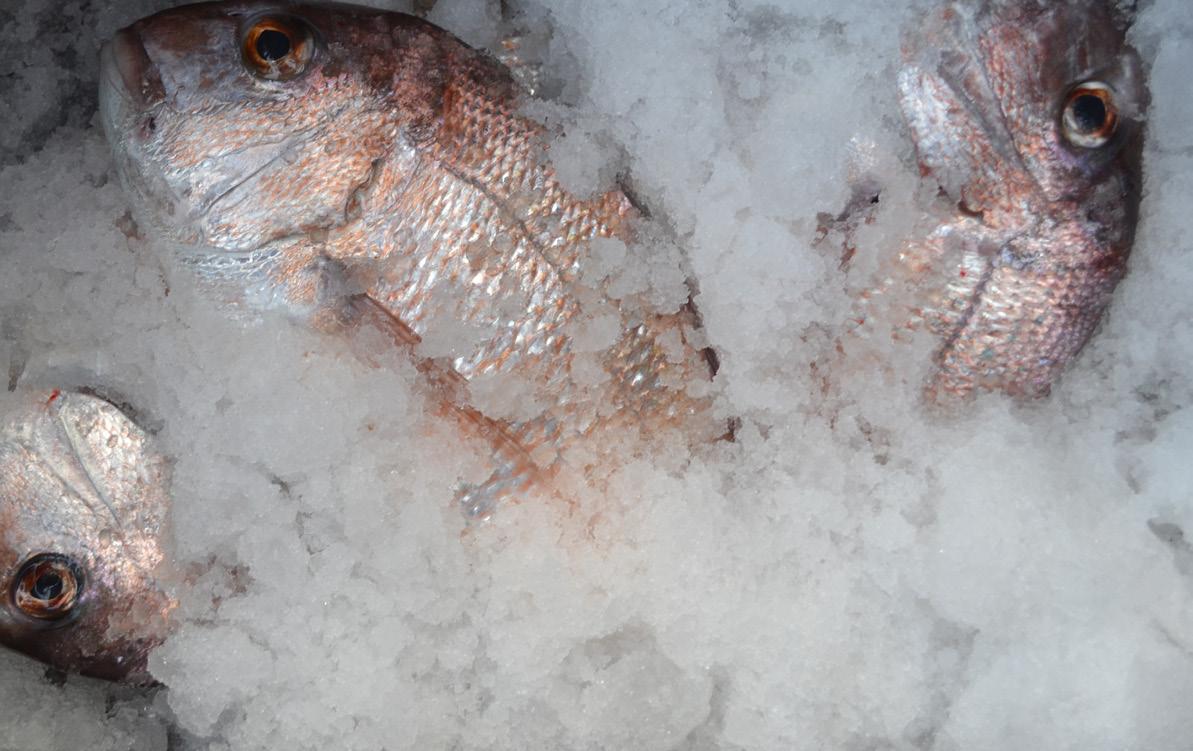
There is an old saying that “the proof of the pudding is in the eating”, and no more so than with fish. When we are forced to buy fish from the supermarket, the texture and flavour are nowhere the same as the fish we catch. Most of the fish in the shops comes off a trawler. Now think about the time it takes to get the fish from the trawler to the retail counter. Firstly the fish are compressed by the sheer bulk of the fish in the trawl net when it comes to the surface and then held alongside, waiting to be dumped onto a pitching deck. Iked and iced, then packed in the hold for a few days until it is offloaded, sorted, processed, and delivered to the retailer. Little wonder the quality, texture and taste are never as good as fish you catch yourself, yet many leisure
fishermen still need to make more effort to take care of their catch to maximise its quality fully.
The moment a fish is hooked, it is stressed. Once brought over the side, how you handle it from that point on plays a big part in its quality of fridge life and eating. Letting a fish hit the bait board or deck instantly causes bruising of the flesh. Then, if it is tossed in a fish bin to thrash about without being iked, it will further bruise itself and any other fish in the bin.
GENTLY GENTLY
Lift the fish from the water, either holding it in the gills or “upside down” with a wet rag. This stops the fish from thrashing around. Now drive the ike spike or knife blade at a 45-degree angle from just behind the eye towards the lower jaw. Hit the right spot, and you will see the tail kick around. I even go to the trouble of cutting the throat and gutting the fish, which relaxes the flesh. Salt ice is readily available from most garages, bait and tackle shops, but if not, frozen drink bottles will do a better than half decent job at chilling the catch. Ideally, fish should first be placed “not dropped but placed” into a slurry of ice. Ice cold water relaxes the flesh and is the first stage of “setting” the flesh before being surrounded and packed down in salt ice.
In the runabout I have a square 10-litre bucket with a two-litre bottle of frozen water partially filled with salt water. Leaving the fish in the chilled water for half an hour acts like a slurry. Once chilled, I then put it down on ice. Making an effort to do it is well worth it. When filleting the catch, the difference in the flesh’s firmness and quality is very noticeable.
The first step of iking, slurring and icing down fish, greatly helps to set the flesh resulting in less moisture loss, but once filleted, a lot of moisture loss takes place by the following day when the fillets have been laid flat on a plate when put in the fridge. Leaving the skin on the fillets and turning the tail end of the fillets up rather than laying them flat significantly reduces the flavour and moisture loss.
If you are going to eat the fish that night, skin and bone the fillets just before you want to cook them. Just wipe any scales off rather than wash them in fresh water. Ideally, I put the gutted and drained fish in a heavy-duty plastic bag, leaving them to chill in the fridge overnight. Chilled overnight has several advantages as the flesh has more flavour being firm, easier and cleaner to fillet. When laid on a plate, there is very little moisture loss.
Corn flour being more refined than normal flour gives a better seal to retain moisture. Any remaining scales then stand out and can be removed.
Next issue, Bruce offers hints on how he likes to cook his snapper.
FISHING _ WITH BRUCE DUNCAN
Salt ice is readily available from most garages, bait and tackles shops.
48 JANUARY / FEBRUARY 2023


99% CARB FREE ULTRA REFRESHING 88 CALORIES
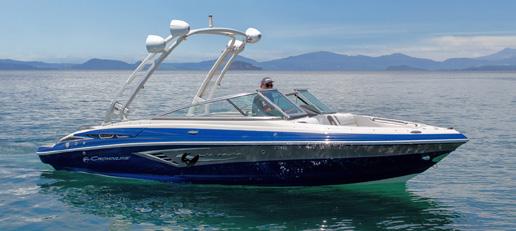
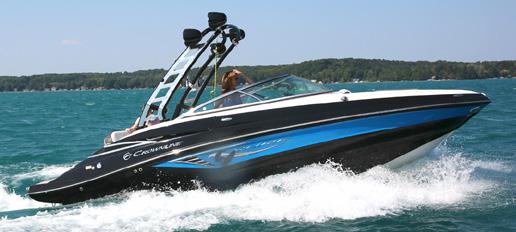
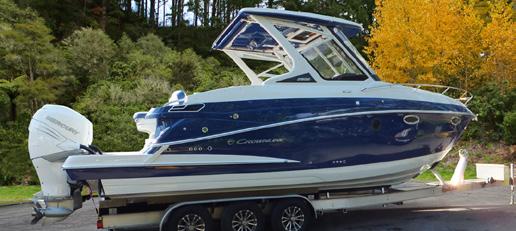
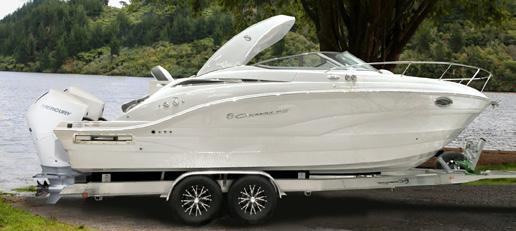
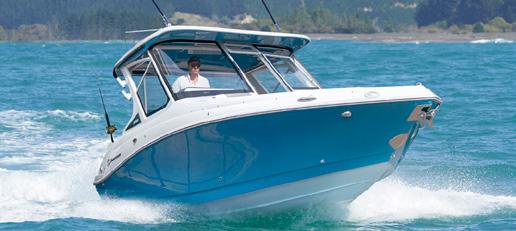
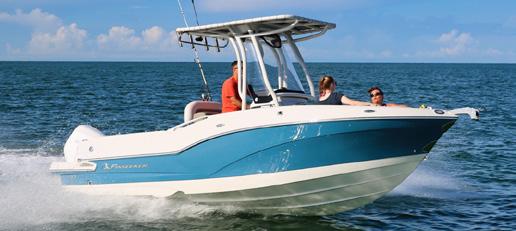
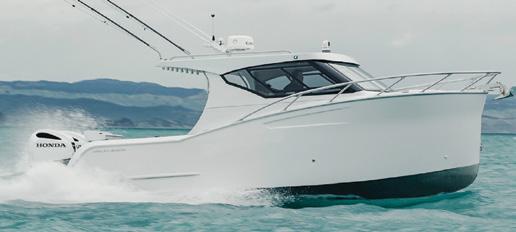
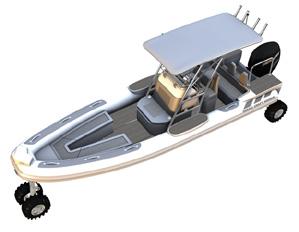
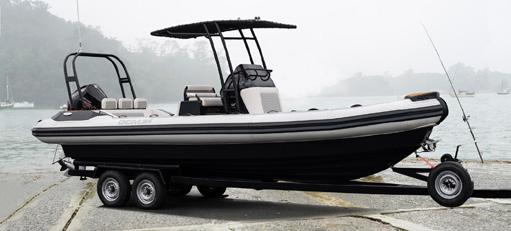
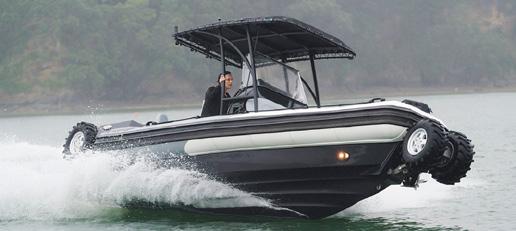
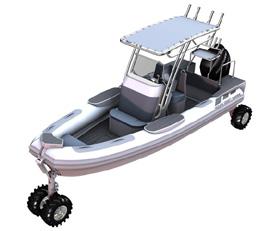
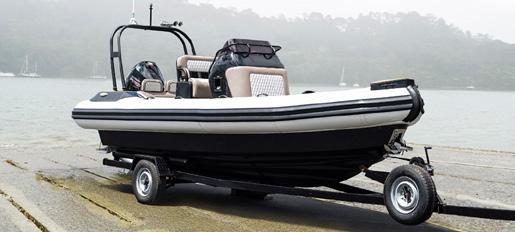


THE DRUM WINCH REVOLUTION


The bain of every small boat boatie is hauling up the anchor. Easy to put down but awkward and sometimes strenuous to bring back up. The job of hauling the anchor inevitably falls to the crew. Even if dropping and hauling the anchor is a “once a day” job, there is often little enthusiasm for the task. Keen fishermen need to be able to shift spots often sometimes or adjust the position slightly. Manually hauling the anchor can be a hand brake to a good day out. Electric anchor winches have been around for a long time and the auto windlass is standard equipment on bigger boats. The auto anchor windlass requires a decent sized anchor locker in the bow with plenty of drop to ensure efficient operation. Plenty of vertical distance between the winch on the deck and the bottom of the locker is an absolute must. If not, there is a natural tendency for the chain to pile up in a pyramid until it hits the deck above. With chain and rope setups, the warp doesn’t always want to lay neatly into the locker, and then when the chain arrives, you get a pileup. When this happens, the winch grinds to a sudden stop and often jams. You can guarantee it will happen at the most inconvenient moment.
Traditionally auto anchor windlasses for pleasure boats have two basic variations, the vertical axis on the drum and the horizontal
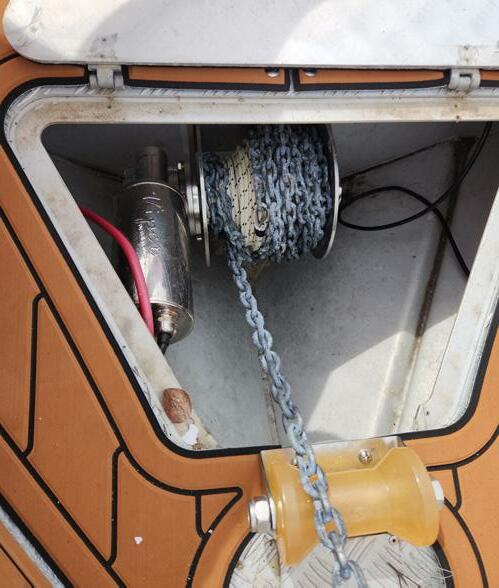
drum. Horizontal drums have allowed for a little less depth in the locker, making them suitable for boats 6m or even less in some cases. Hardly a new boat is sold without this labour-saving device. Sadly boats in the under 5m range haven’t been equipped with anchor winches until recently. They lack the size to accommodate conventional auto anchor hardware and the required drop into the anchor locker. Not enough drop equals
snarl-ups of the anchor warp. That is, until small drum winches were invented. Increasingly popular over recent years, the drum winch has made automatic electric powered anchor retrieval for small boats a reality. They are now available in smaller and smaller sizes. I recently purchased a Savwinch 450, specifically designed for really small boats up to 4.5m, which I am fitting to my Fatcat 4500. I already have a Maxwell Tasman 8-6 on my AirCat 625. What a revelation! The great advantage is that everything gets coiled up on the drum. Chain, warp and all, just like a level wind fishing reel. A neat arrangement removes the hassles of getting rope and chain to behave in a small space. It’s just a matter of flicking a switch to let it out or pull it in. For the keen fisho, some brands also offer a fast fall function and some a free fall function to get your anchor down as fast as possible. Whilst drum winches are very popular in 6 to 8m trailer boats. Some brands also offer models suitable for boats up 30m plus.
Having battled it out on trailer boats I have owned, with conventional winches, trying to dump chain and warp into a limited space, I can’t believe how easy it is. I would not go back, certainly not to manual hauling or the old-style winch. Well worth the investment.

DB837
www.aircat.nz www.fatcat.nz
ROGER'S RAMBLINGS _ ROGER TWEDDELL
52 JANUARY / FEBRUARY 2023
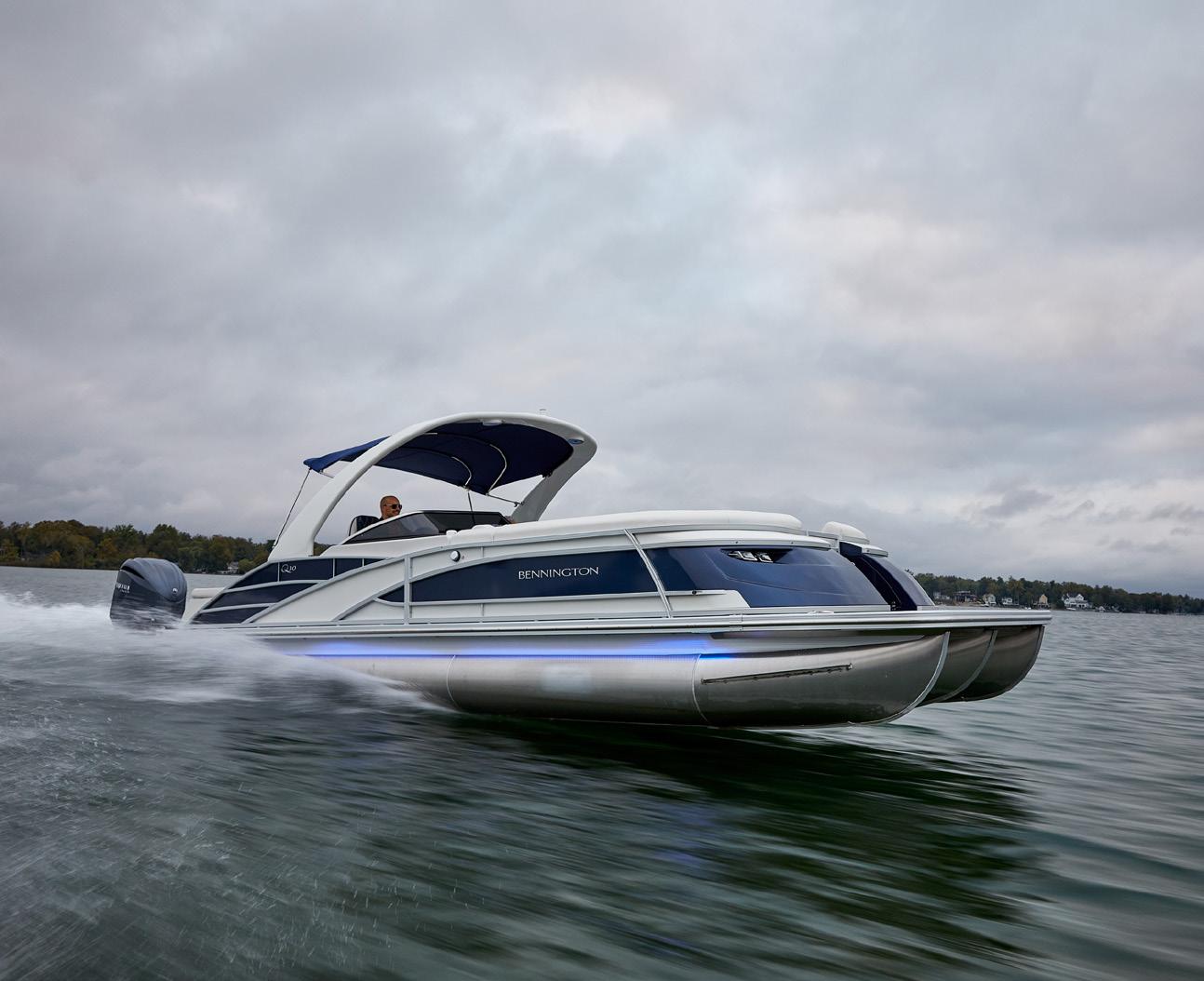

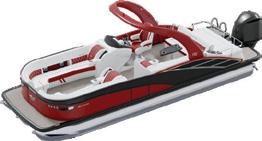
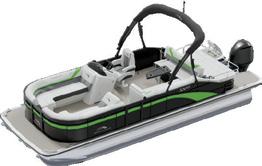
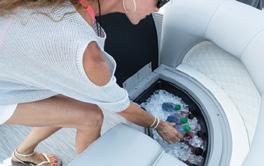
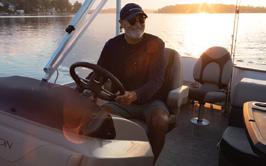
WHATEVER YOU THOUGHT YOU KNEW ABOUT PONTOON BOATS ...THINK AGAIN! Introducing the All-New 2023 Bennington Luxury & Performance Boats with f our different model series to choose from - Q, R, L & S STABILITY, PERFORMANCE & COMFORT DEALER ENQUIRIES WELCOME. www.benningtonmarine.co.nz info.marine@polaris.com From 16 to 30 foot Single or Twin Outboard engines Up to 850HP
TWO ONE
WORDS BY BARRY THOMPSON
FOR
Riviera likes to refer to their SUV series as adventure yachts, which is very apt considering what the boats have been designed for. This boat covers all bases and gives an owner a well-balanced blend of indoor luxury, outdoor practicality and, above all, performance to match.
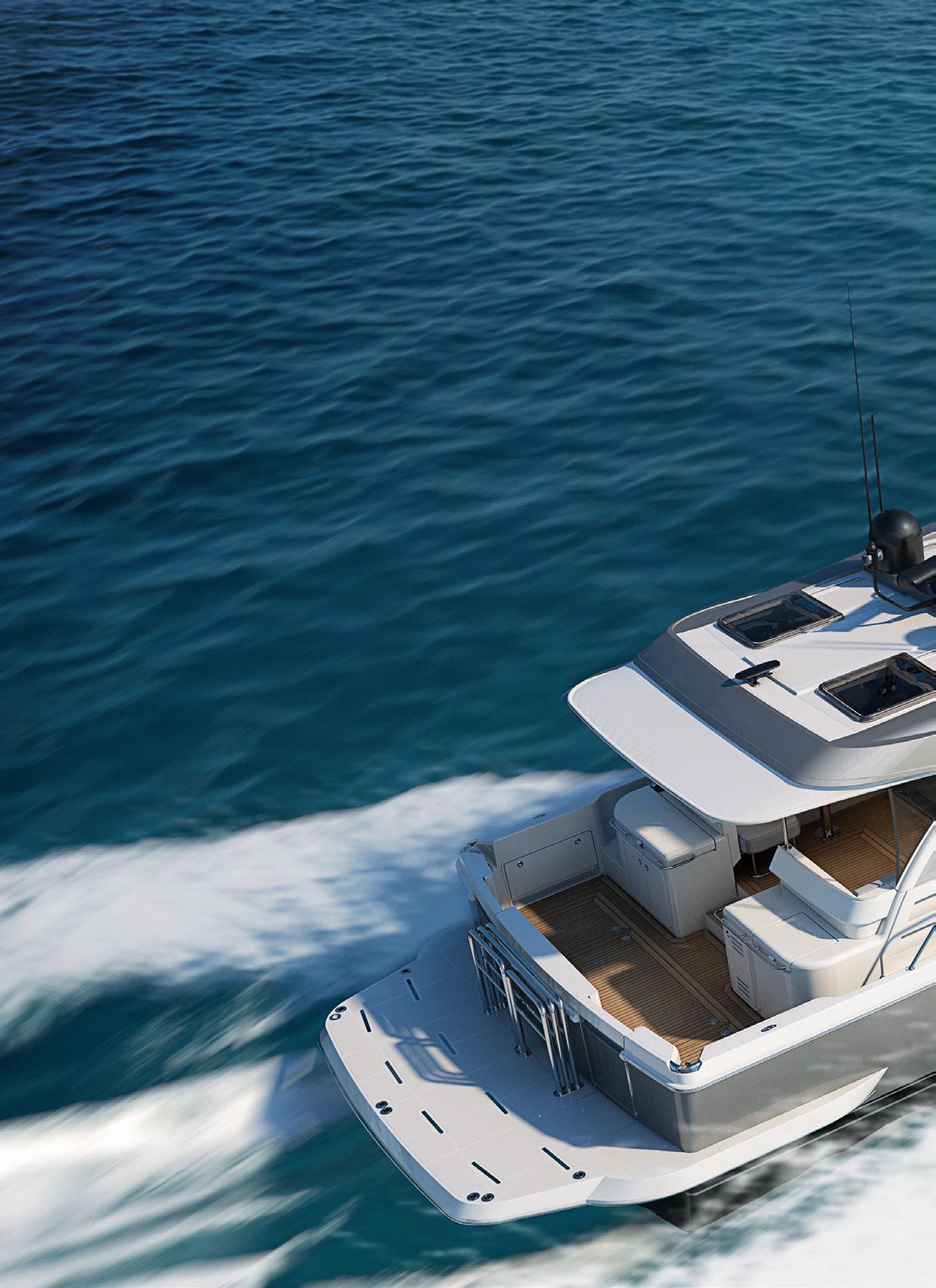
PACIFIC POWERBOAT REVIE WS _ RIVIERA 465 SUV
54 JANUARY / FEBRUARY 2023
The SUV Collection was born in 2012 with the release of the 445 SUV. This proved to be a very significant boat, as it was the 5000th motor yacht built by the company. This model is still in production, with sales exceeding 90 boats.
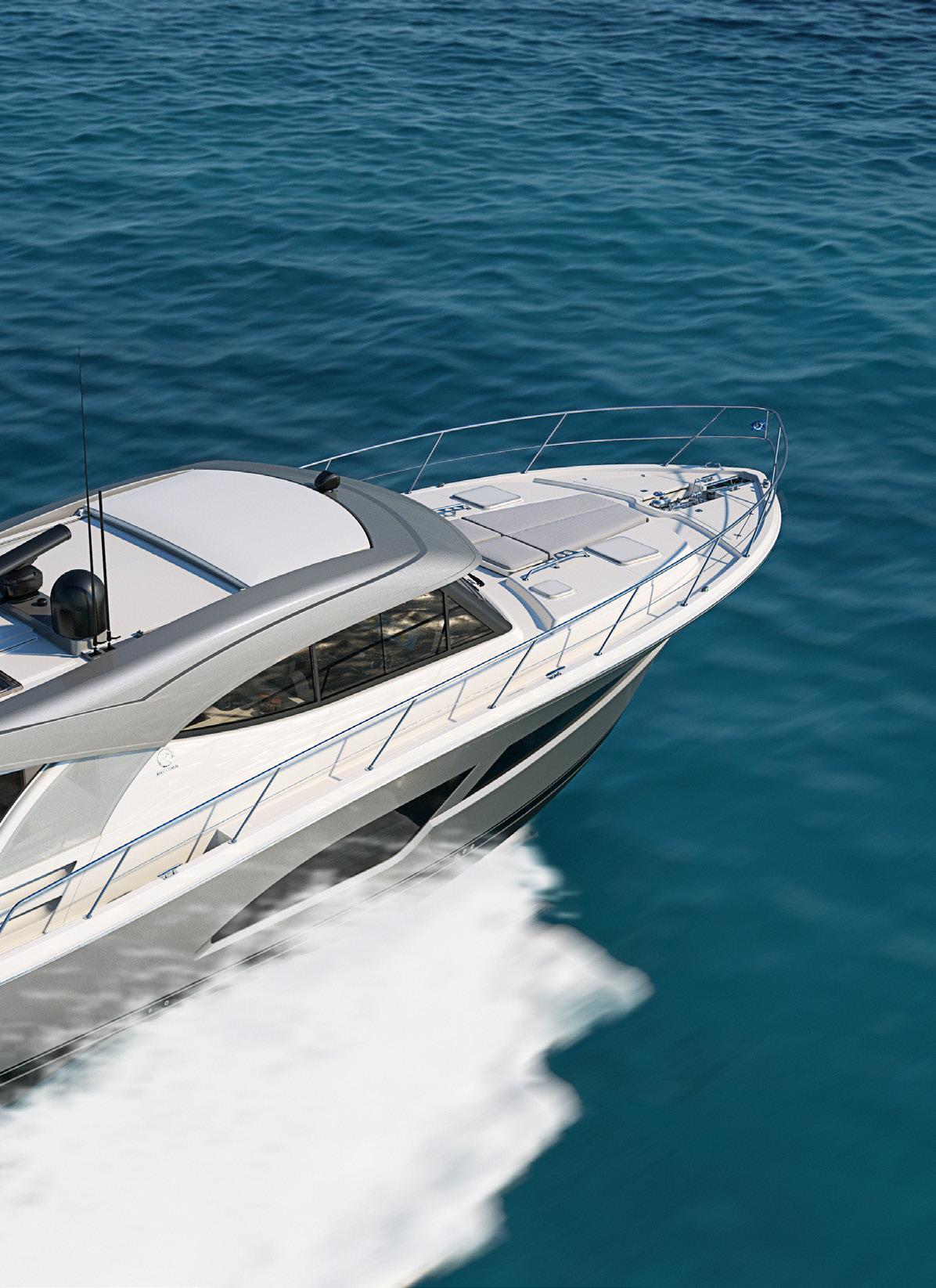
The SUV offers a flybridge style open cockpit perfectly suited to fishing or entertaining and a sport yacht influence with a single-level lifestyle. It is a flawless blend of two entirely different boating lifestyles in one superbly designed package. However, Riviera didn't stop with just one model in the new range. Soon after the 445 SUV release, it was followed by the larger 565 SUV, which was
essentially based on the same platform as its predecessor but longer, beamier and overall offering more space. Three years later, the 575 SUV replaced the 565 SUV, which was the same boat with a redesigned cockpit layout. Then the 525 SUV, released in 2015, was redesigned and transformed into the 545SUV a few years later. The 395 SUV was launched in 2018 as the entry point to the SUV line and to date over 50 of these boats have been sold. The release of the 505 SUV in 2020 saw the first of the new generation of SUVs, which brought together several innovations, such as a semi-enclosed alfresco area, a larger cockpit, and a onelevel saloon. Interestingly with the alfresco
deck (5sqm), you get around a third more internal living space. Adding breezeways or clears makes the area adaptable for both hot and cold climates, making the SUV a totally universal boat. Overall, there is also more volume in the new boats. Regarding the layout, there is a significant difference between the new generation of SUVs and previous models.
In 2021, Riviera launched the 645 SUV, which remains the largest model in the SUV Collection. While the earlier SUVs were flybridge motor yacht derivatives, the new generation models are more from the sport motor yacht genre.
The 465 SUV is the seventh member of the SUV family.
POWERBOATMAGAZINE.CO.NZ _ 55
Riviera continues to utilise the foredeck area in the new 465SUV with a dedicated sun lounger.
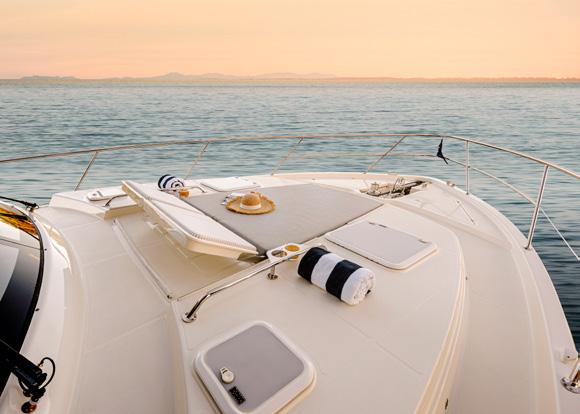
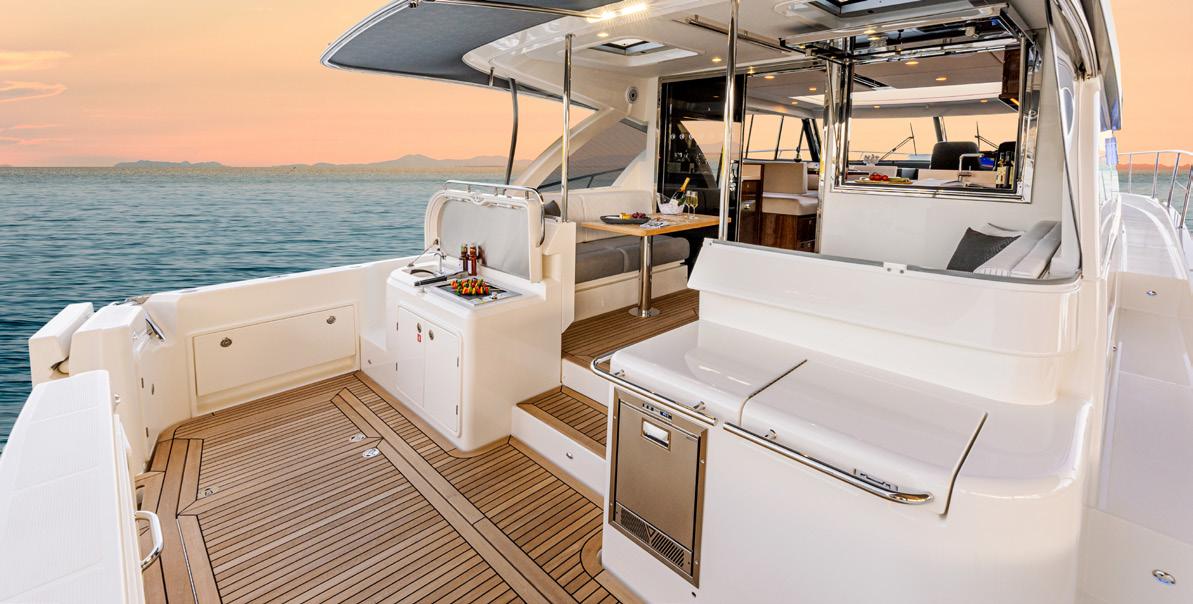
A pair of Garmin 16" screens, supply information on the vessel's engine, electronics and systems.
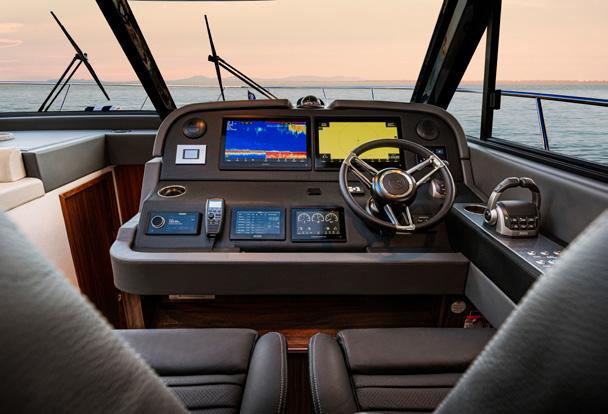
The alfresco area is a valid extension of the saloon, and is a feature of the new generation of SUVs.
SEVENTH MEMBER
The 465 SUV is the seventh member of the SUV family, which starts with the 395 SUV and goes through to the 645 SUV. At 15.9m, it is the second smallest in the SUV family but boosts the liveability of a much larger vessel. The layout is traditional for a sports sedan but accentuated with the usual Riviera flair and touch of excellence.
With consideration for their fishing owners, Riviera designated an area aft of the transom to land, clean fish and keep all the mess out of the cockpit. Stainless steel staple rails surround the large boarding platform, accessed via a pair of transom doors. Not only does this provide a perfect and safe fishing platform, but it also extends the usable area of the lower cockpit. It also doubles as the tender stowage and is available with a rise/fall option.
There's a deep fish bin and lazarette under the teak cockpit sole, plus storage under the coamings. The side decks are flush with recessed cleats, so nothing gets in the way. Moving forward, modules on either side of a central stairway to the alfresco area feature a sink unit
and BBQ to port with a fridge/freezer opposite. The alfresco area is a valid extension of the saloon, and it is easy to see why Riviera has made this a feature of the new generation of SUVs. There is plenty of lounging space to relax during the day, but you can also convert the starboard side settee into an extra double berth. A dining/coffee table and a moveable ottoman provide an extra seat when required. An awning window leads through to the galley, with sliding glass doors providing a wide opening between the inner and outer areas.
Gloss walnut is used throughout the 465 SUV, although other timber options are available. Personally, I love the walnut, which adds a rich texture that tones in superbly with the lighter fabrics and flooring. Classy yet still practical, the galley provides a centre point between the social part of the saloon and the external alfresco deck. All on the one level, there is no separation from the helm to the cockpit.
The galley is finished with a Corian bench surface, storage below and above, and all the necessary appliances for the chef. Opposite is a wet bar and
PACIFIC POWERBOAT REVIE WS _ RIVIERA 465 SUV 56 JANUARY / FEBRUARY 2023
another fridge, plus bottle and glass storage.
The U shape lounger to port is raised and sits below high side and forward windows, offering excellent sightlines for an almost uninterrupted 360deg view. A very relaxing and friendly ambience radiates throughout the 465 SUV. There's another dining table with enough space for 4-5 people. A Webasto sliding sunroof and sliding side windows allow for some extra natural light and breeze.
Not only has the alfresco area got the word entertainment stamped on it, but so does the forward area of the boat. Like in all their new models, Riviera continues to utilise the foredeck area in the new 465SUV with a dedicated sun lounger, complete with handrails and drink holders.
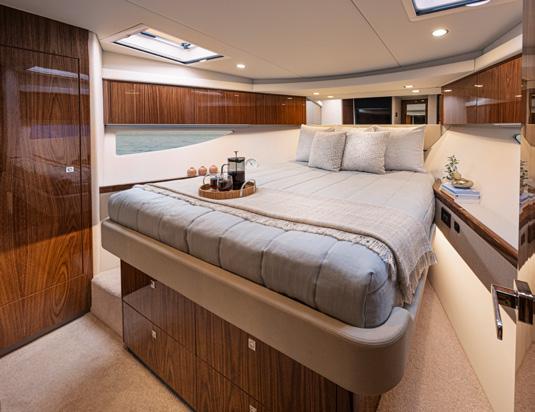
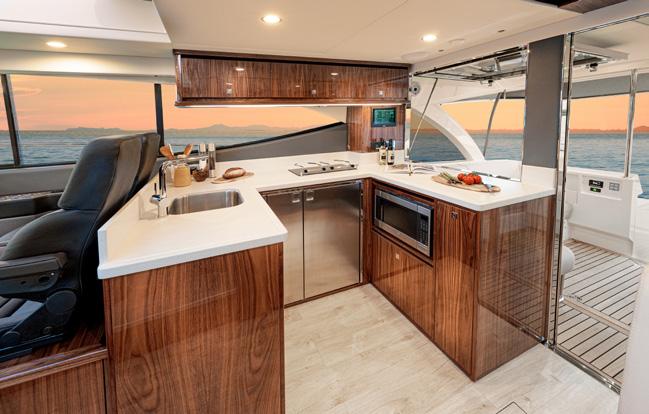
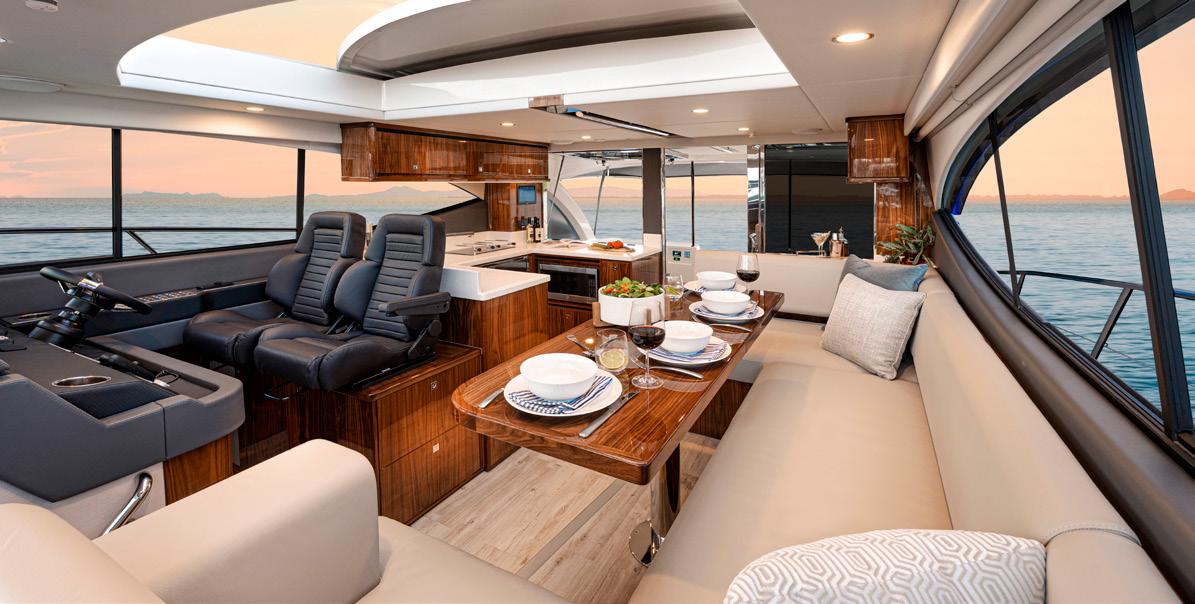
At the helm there is loads of space to mount all the necessary controls for equipment such as the Fusion sound system, CZone, auto anchor, Seakeeper and VHF.
Like all new Riviera’s, the 465 SUV is fitted with the Siren Marine remote security monitoring, control and alert system.
FORWARD MASTER
Accommodation is impressive, with three staterooms and two bathrooms. The master cabin is forward with a central island berth and private ensuite. Twin overhead hatches provide plenty of natural fresh air, but the cabin is also fully air-conditioned. The timber cabinetry features cedar-lined hanging lockers and a generous amount of storage. There is an excellent combination of Riviera's traditional timber heritage with a beautiful mix and match of various materials that blend well together.
Some choice is available regarding the berth arrangement in the two guest cabins. Either can be configured with twin singles or a double. The most popular layout is a double to port with private access to a shared ensuite and twin singles in the second guest cabin to starboard. I liked the generous proportions of the ensuites, which allow you room to move, especially in the shower. Another cool feature is the massive side windows which help eliminate confinement issues from these well-conceived cabins. The cabins all have generous headroom.
The galley is finished with a Corian bench surface and all the necessary appliances for the chef.
Accommodation is impressive, with three staterooms and two bathrooms.
The saloon has a rich texture of walnut, offset with light fabrics and is all on one level.
POWERBOATMAGAZINE.CO.NZ _ 57
Stainless steel staple rails surround the large boarding platform, accessed via a pair of transom doors.
30 PLUS AND LOVING IT
The 465 SUV is based on a brand new 15.9m (LOA) hull, with a 14.3m (LOH), 4.76m beam and a maximum draft with the IPS drives of 1.33m. Bridge clearance is 4.36m, with a dry weight is around 22,000 kgs, 2500 litres fuel capacity and 500 litres of water. Standard power is a pair of Volvo Penta D8 IPS @ 600hp each, which gives the 465 SUV a maximum speed of 32.5 knots. At 80% load, our cruise speed was 28 knots @ 2800 rpm, burning around 200 lph. I had the opportunity to drive the 465 SUV in a reasonably calm sea off The Broadwater, Gold Coast, and to be fair, it was faultless. The hull is slippery onto the plane with a low attitude, and thanks to the auto trim, the boat runs at a very level angle throughout the range. We had a Seakeeper gyro to keep us company,
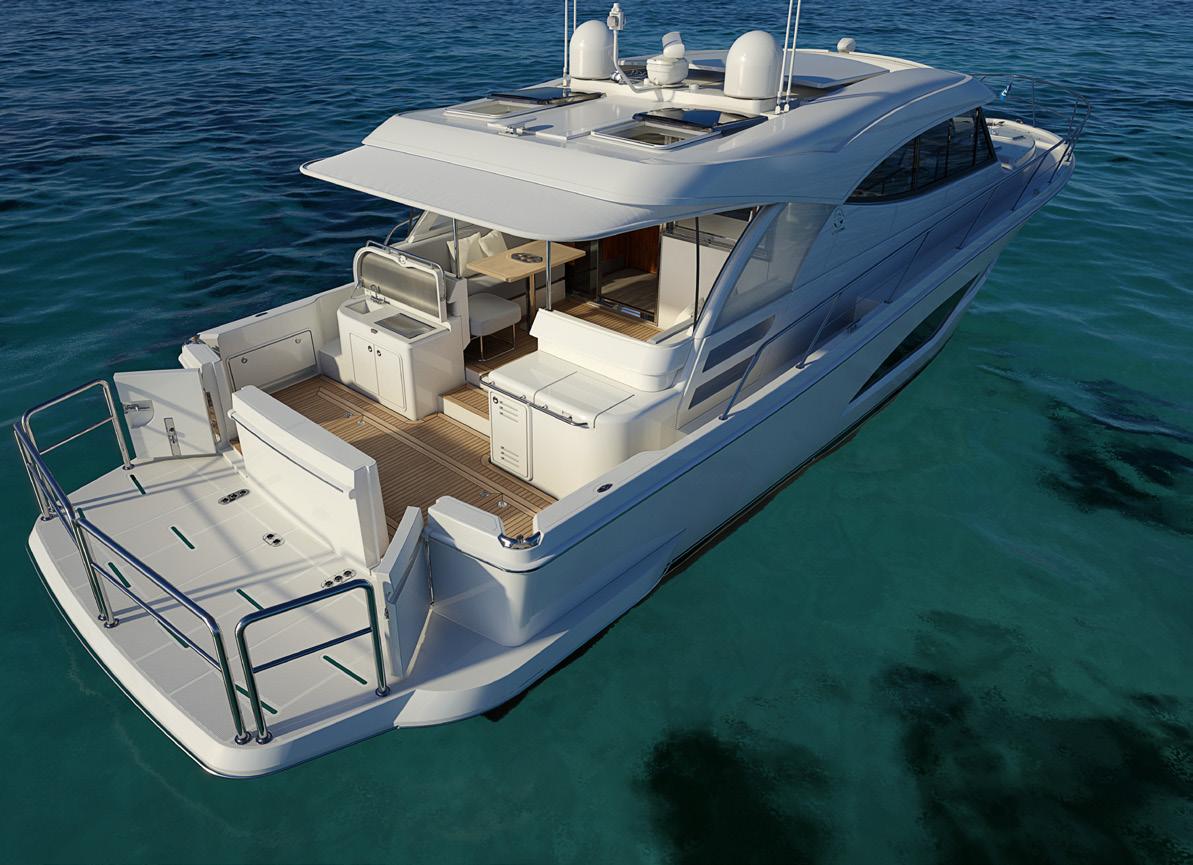
and it certainly made a difference, especially when we stopped in the middle of the Seaway in a sloppy swell. The hull is responsive, agile, and somewhat like driving a big, big runabout. Riviera doesn't offer any other engine options, but I don't think they need to. The D8 IPS 800s are a great match.
Riviera now offers 24 models from 39ft-78ft with six individual designs designed to meet the many different expectations of the market. The SUV Collection has a robust and tough look that makes you feel they can handle real offshore conditions without hesitation. I love the styling and flowing lines of all the SUVs, none more so than the new 465. Riviera has continued the SUV family heritage for over ten years, and every new model gets better. The SUV will be a big part of the Riviera line-up for many years.
PACIFIC POWERBOAT REVIE WS _ RIVIERA 465 SUV SPECIFICATIONS Boat Design Name Riviera 465 SUV Year Launched 2022 Style Sport Sedan Builder Riviera Yachts Designer Riviera Yachts LOA 15.9m LOH 14.3m Beam 4.76m Draft: 1.33m Displ (Dry) 21,925 kg Max Speed 32.5 knots Construction GRP Composite Fuel Cap 2500 litres Water Cap 500 litres Engines Make 2 x Volvo D8 IPS @ 600hp Drive Train Pod Drive Thrusters Side Power Generator Onan 11Kw Stabiliser Seakeeper S6 MFD Garmin Winch Muir VRC2500 Underwater Lights Aqualuma Gen 4 Ent System Fusion Priced From AUD$1.785 million Contact RIVIERAAUSTRALIA.COM PERFORMANCE DATA : 2 X VOLVO D8 IPS @ 600HP RPM Knots L/h L/NM Range (NM) 600 4.5 5.0 1.1 2025 900 6.4 12 1.9 1200 1200 8.2 24 2.9 769 1500 9.5 47 4.9 455 1800 11.0 80 7.3 309 2100 16.2 111 6.9 328 2300 19.1 135 7.1 318 2500 22.5 156 6.9 325 2700 26.1 181 6.9 324 3000 31.0 224 7.2 311 3090 32.5 244 7.5 300 Note: Fuel range is based on 10% reserve. 58 JANUARY / FEBRUARY 2023
 GMR FANTOM ™ 8 X AND 24 X DOME RADARS
2021 Garmin Ltd. or its subsidiari e s
DOUBLE ENTRY
While power cats are certainly not mainstream, they are certainly gaining in popularity and there are some awesome examples available both from production builders and designers.
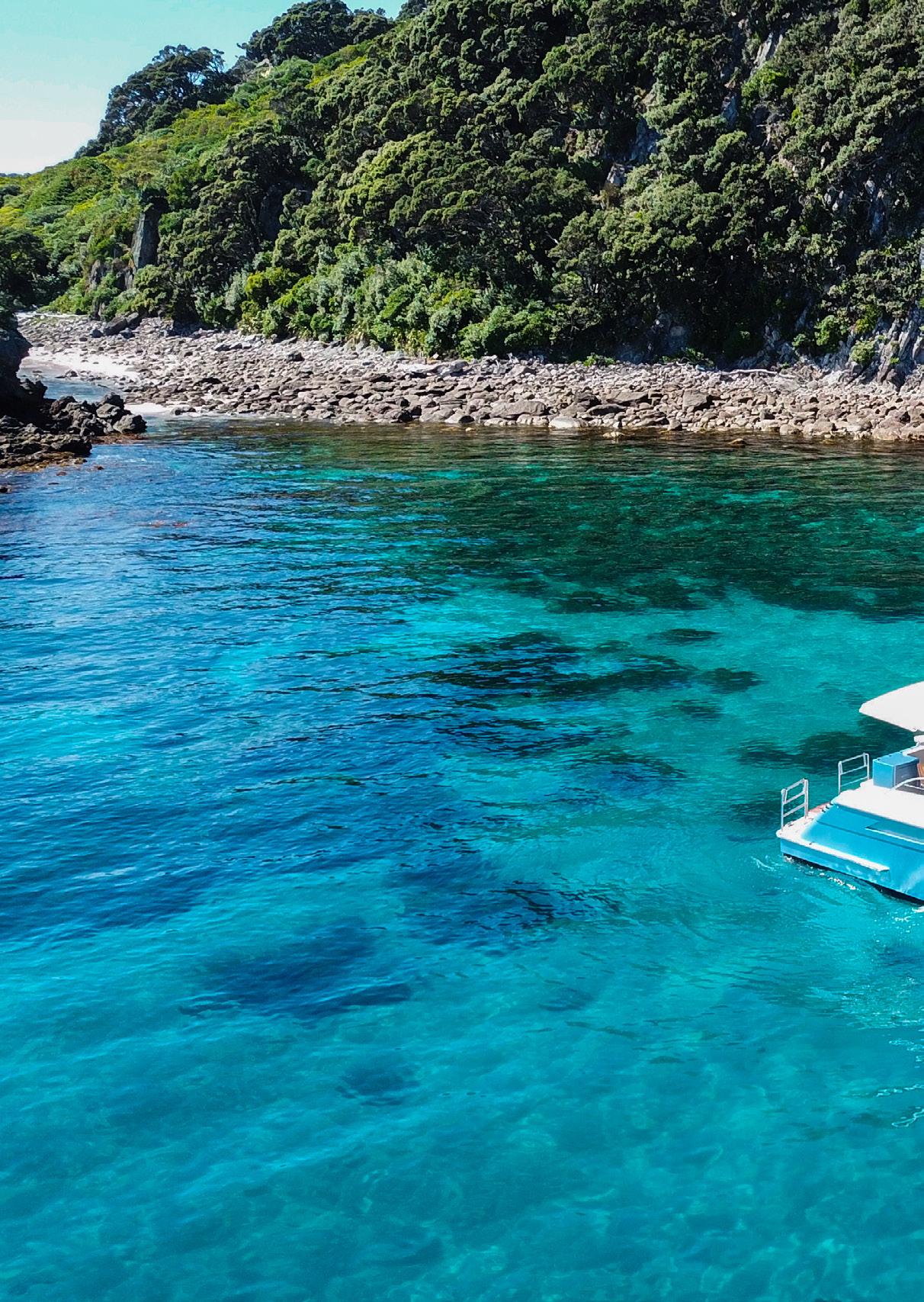
A COMPARISON _ POWER CATAMARAN
60 JANUARY / FEBRUARY 2023
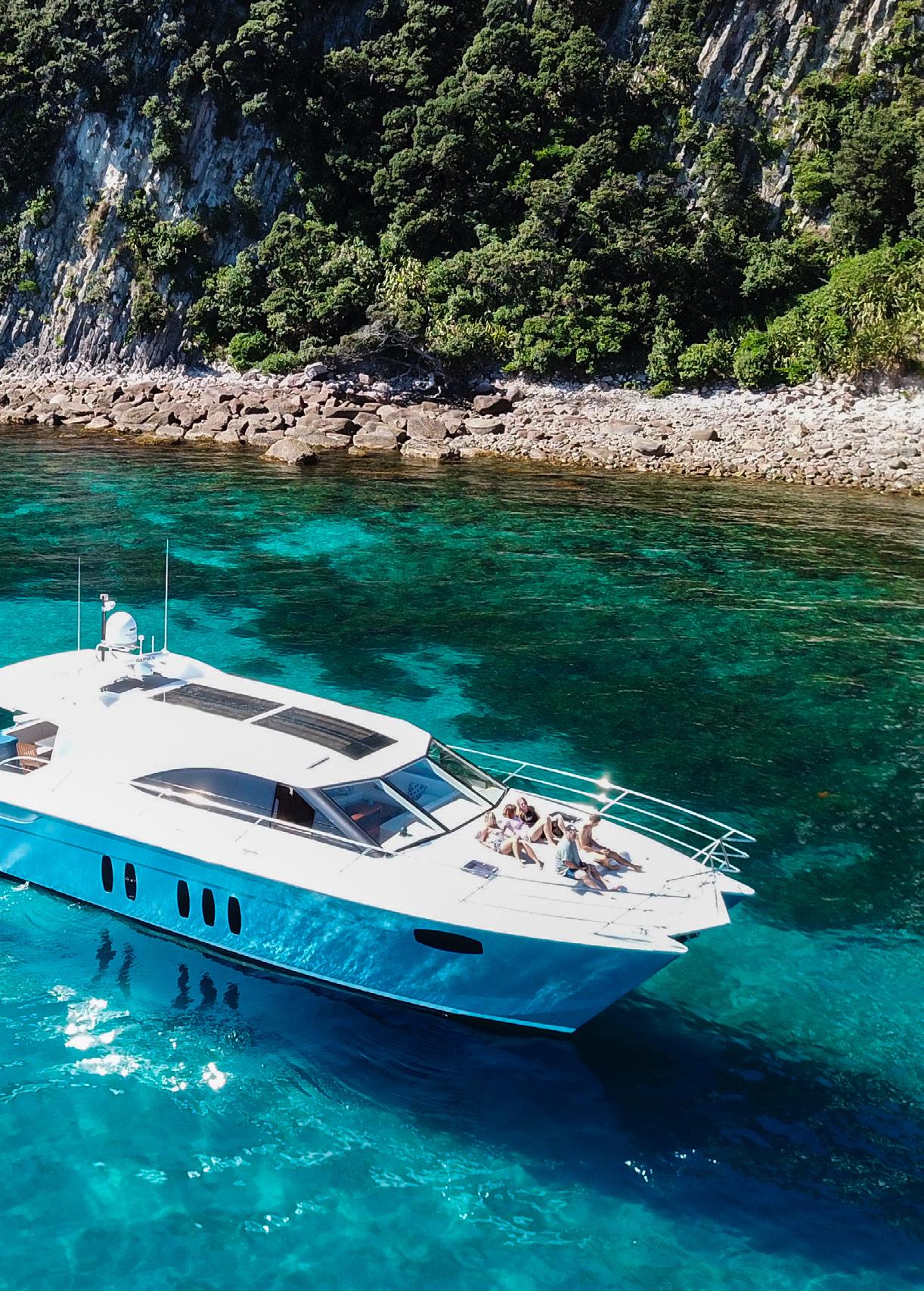
POWERBOATMAGAZINE.CO.NZ _ 61
Pachoud Yachts have had huge sales success with their range of Voodoo foil assisted high speed powercats.
The Fusion Marine built Prowler 10.8 is a displacement hull running low horsepower outboards, with amazing economy and performance.
All alloy construction, this Scott Robson designed 11m Gravois 362 CC will be launched in January in the USA. Power is a pair of 300hp Yamaha outboards. The high speed cat will be used in the Texas Gulf for offshore fishing where on a normal day they go 100 miles offshore. Speed in the rough water is essential!
If you are looking for a power cat from 10m to 50m plus, there is plenty available, from local and overseas designers and builders. Powercats come in a variety of shapes and sizes and are designed for anything from coastal cruising to long-range passage making. We look at the difference between displacement, semi displacement, and planning.
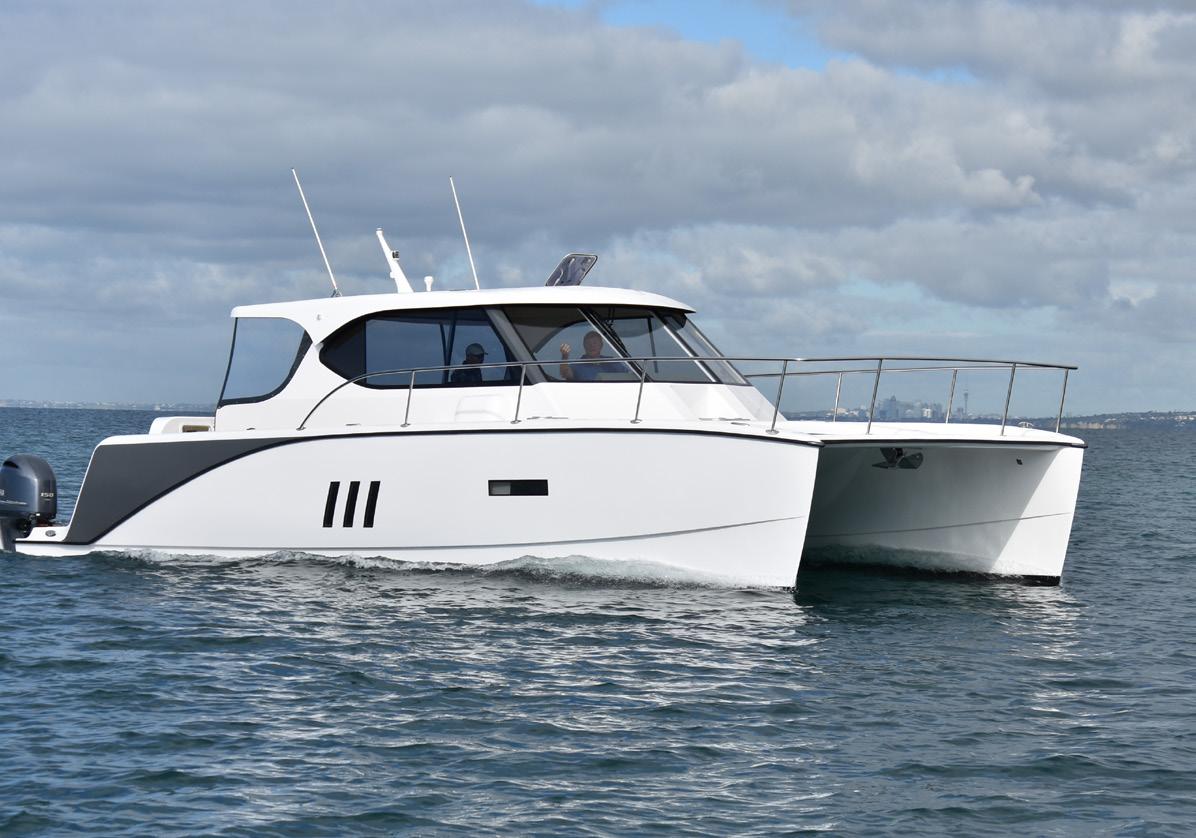
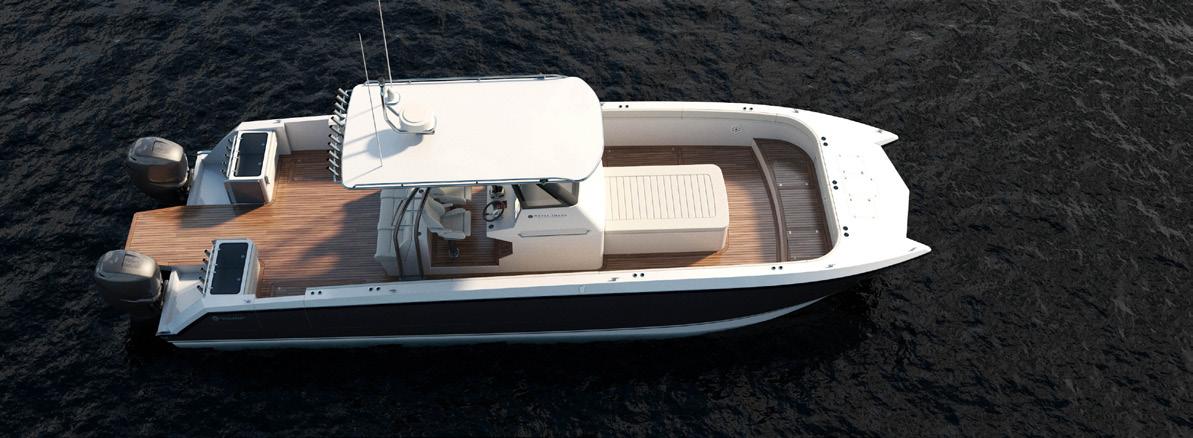
The basic difference is in the way each attempts to reduce the hull resistance to motion and this is reflected in the different hull forms employed by the various types; planning, semi displacement and displacement.
PLANING –THE NEED FOR SPEED
The planing vessel typically has medium to high deadrise hard chine hull to encourage the boat to plane on the water’s surface to reduce wave drag, whereas the typical displacement vessel is round bilged to minimise the wetted surface drag as its slim hulls slice through the water with minimal wave drag. These differences in hull form determine the differing resistances of vessels with similar parameters when moving at various speeds. Planing powercats can and do quite successfully undertake ocean passages as was witnessed recently with the Trans Tasman crossings of the Roger Hill designed, 17.5m Voodoo. Voodoo covered the 1229NM in 53.5hrs @ 23 knots average!
A COMPARISON _ POWER CATAMARAN
62 JANUARY / FEBRUARY 2023
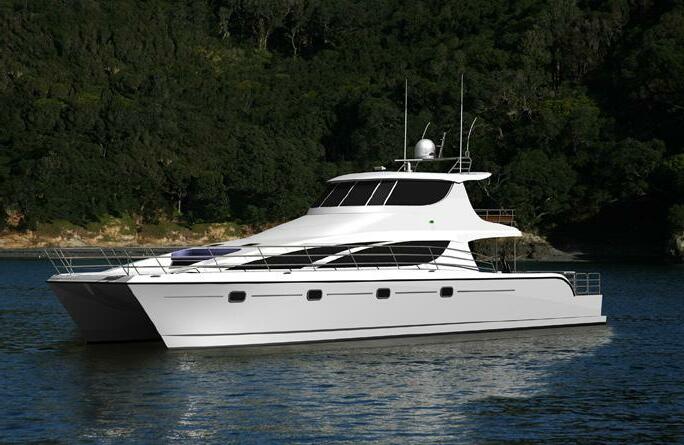

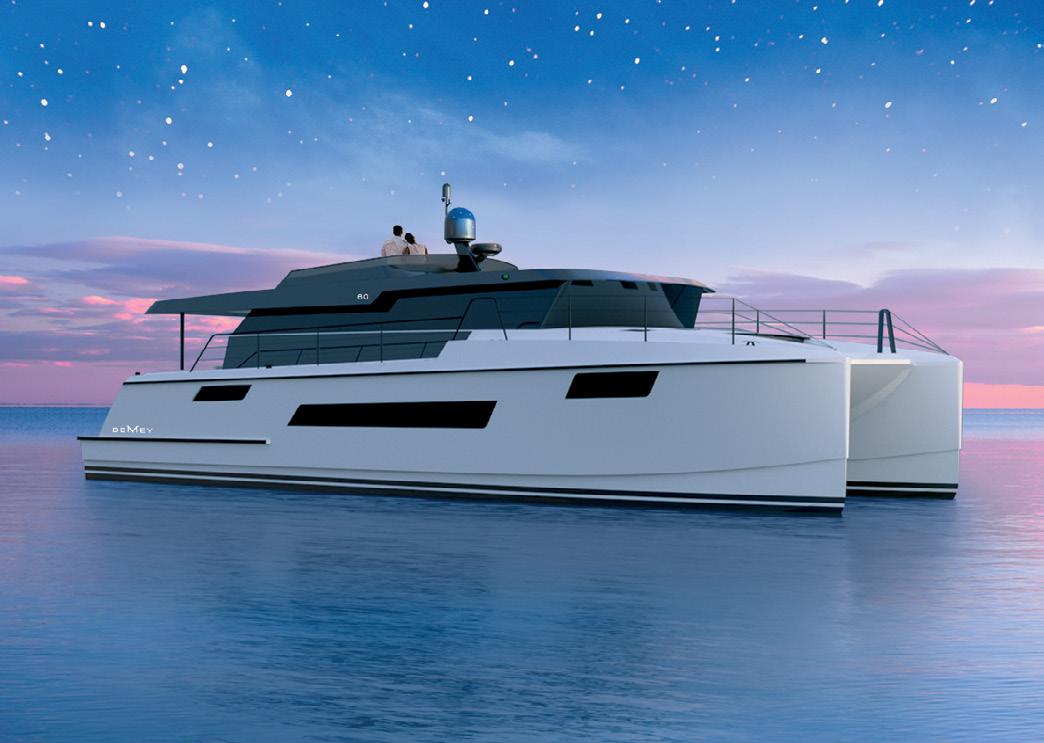
SPACESHIP Introducing the DE MEY 60 The fabulous sightlines and expansive glass give you incredible views. Offering superior space with four cabins and three living areas, carbon fibre construction, and centreline helm station. The new DE MEY 60 is truly out of this world. +64 7 281 0078 | nicdemeyyachts.com POWERBOATMAGAZINE.CO.NZ _ 63
Bay of Islands Mitre Peak, Fiordland Vava ‘u, Tonga
SEMI DISPLACEMENT –COMFORTABLE CRUISING
The typical semi-displacement catamaran has an inherently good sea keeping ability. It isn't ultra fast, but has a comfortable cruising speed and good fuel economy. Traditionally, it has a top speed not much over 20 knots, with an economical cruise around 16-18 knots, carries enough fuel for long range cruising and still has very generous interior volume.
The semi displacement hull seems to range from around 12m to 18m and the sea keeping ability around 15-17 knots can be quite outstanding. The fuel economy for the size of boat can also be very spectacular at speeds in the mid 'teens'.
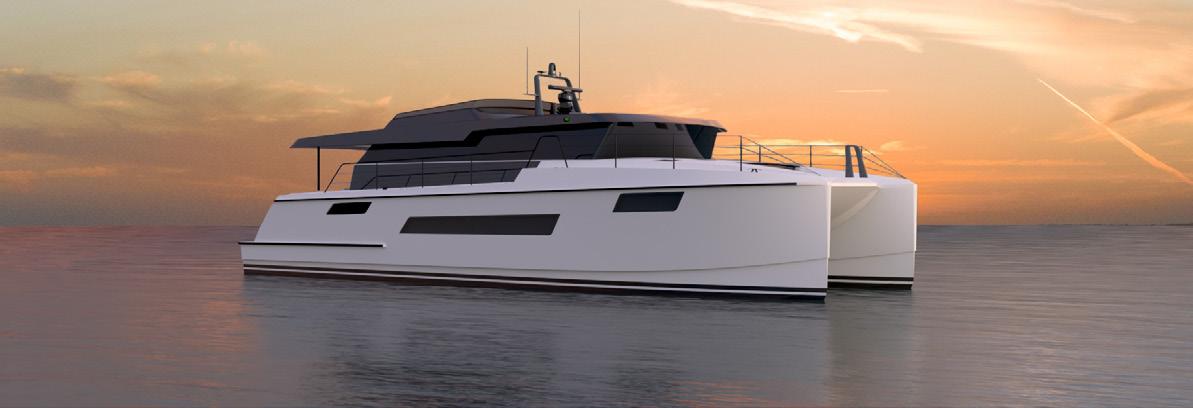
DISPLACEMENT –SLOW AND STEADY
A displacement powercat has a cruising speed anything from zero to its maximum speed – it just depends on where you find it most comfortable for your needs. It’s possible for displacement cats, provided they are long enough, to run upwards of 25 knots quite easily with standard underwater running gear, but anything over that requires a lot of detailed discussion between the designer, builder and engineer as they tend to break with convention and expand the traditional displacement powercat criteria.
Unlike the planing catamaran, where the power to weight ratio is one of the
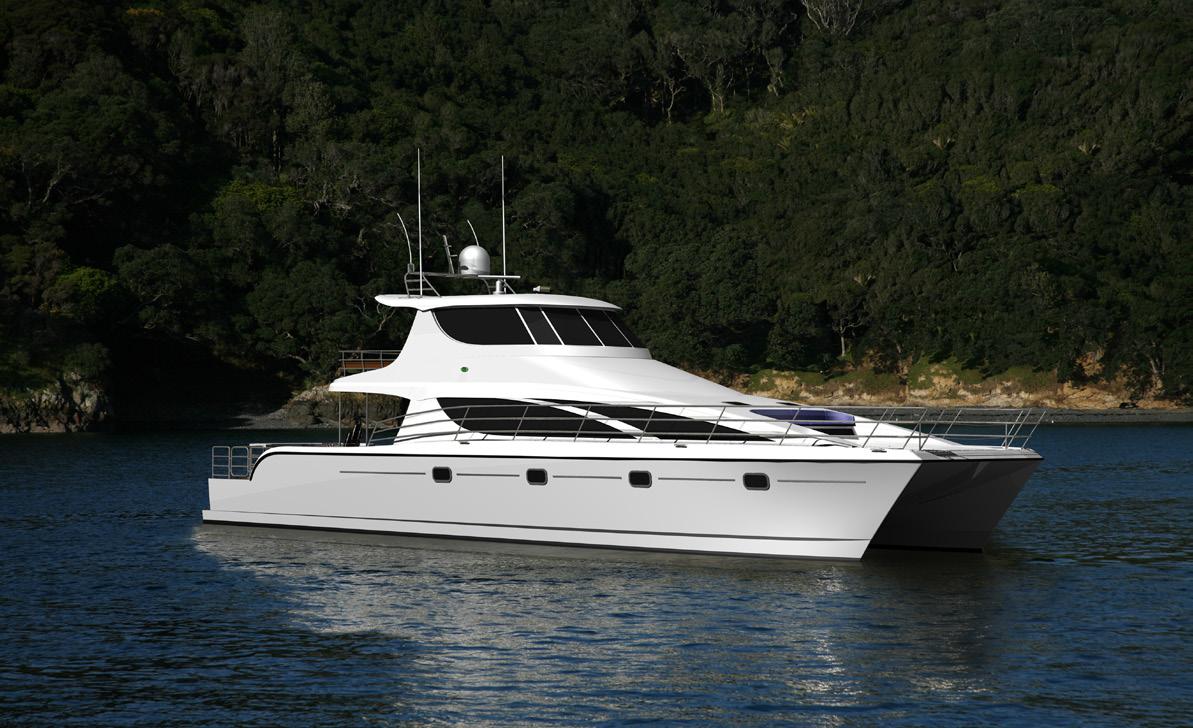
major determinants of speed, the speed of the displacement catamaran is largely a function of the fineness ratio of the hulls.
The displacement is relatively unimportant except for how it impacts on the fineness ratio of the hulls, the height of the wing deck off the water and the longitudinal moment of inertia of the vessel.
The late Malcolm Tennant was a Kiwi designer who enjoyed considerable success over the years, especially with his displacement catamarans.
His approach was the “long and thin” style of easily driven round bilge minimum wetted surface hulls that give performance on a par with planing craft, but with considerably better sea keeping capability and better fuel economy. Tennant regarded
A COMPARISON _ POWER CATAMARAN
64 JANUARY / FEBRUARY 2023
Spaceship is a new Roger Hill design being built by Nic de May Yachts, with two currently under construction in composite.
Catamaran International are offering shares in their almost completed CI-6500 luxury powercat.
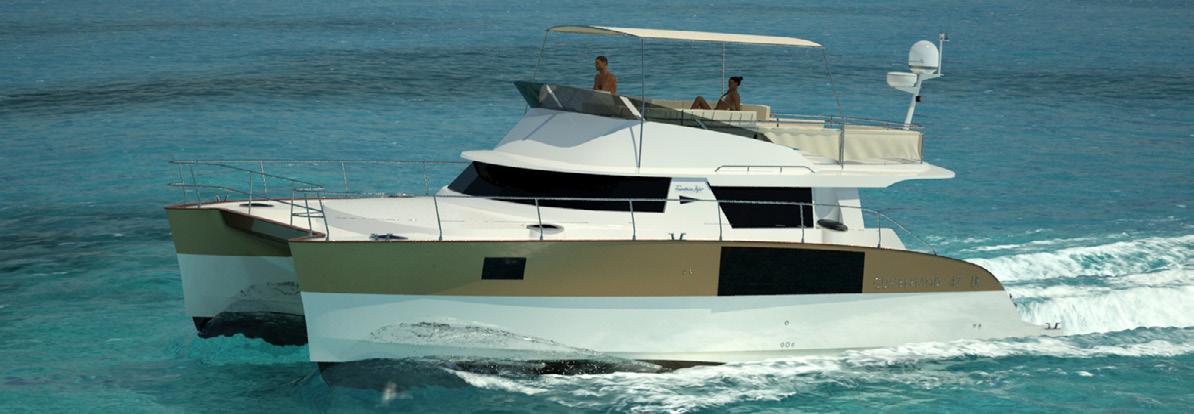
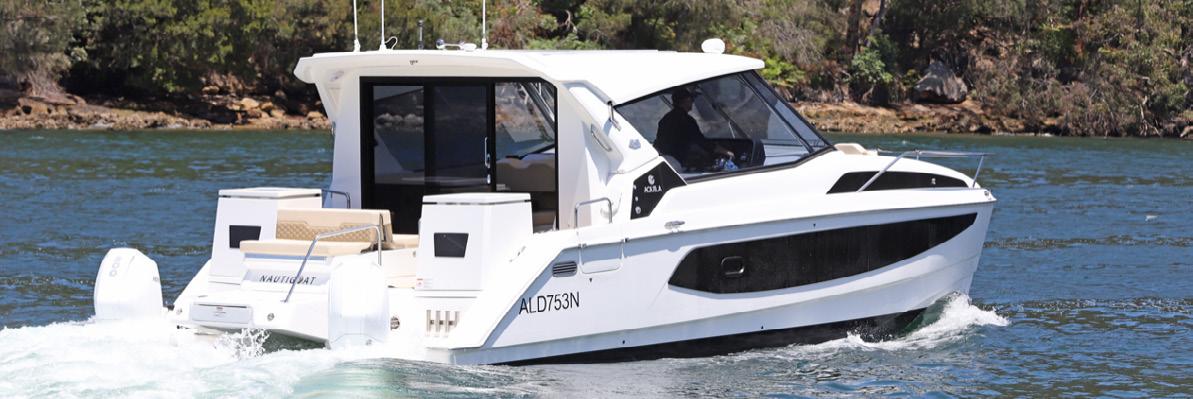
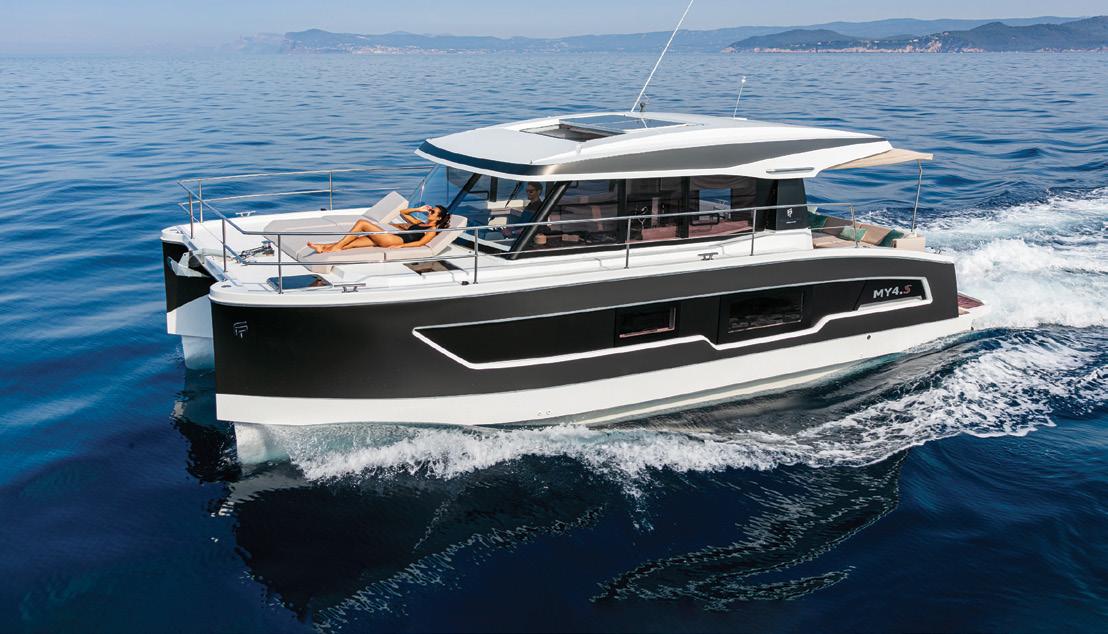
Contact Dominic Lowe today to find your dream yacht Mobile: 021 426 600 | Office: 09 217 0600 | dominic@multihullsolutions.co.nz multihullsolutions.nz AVAILABLE FOR DELIVERY IN 2023. SECURE YOUR NEW BOAT TODAY. Brand New Model MY4.S MY4.S | MY5 | MY6
Fountaine Pajot’s Cumberland 47 is one of a number
of
power cats offered by this leading French boat builder.
POWERBOATMAGAZINE.CO.NZ _ 65
The Aquila 36 is one of six powercats in the growing Aquila range
the displacement catamaran as the combination of excellent accommodation, comfort and economical performance with good old-fashioned seaworthiness.
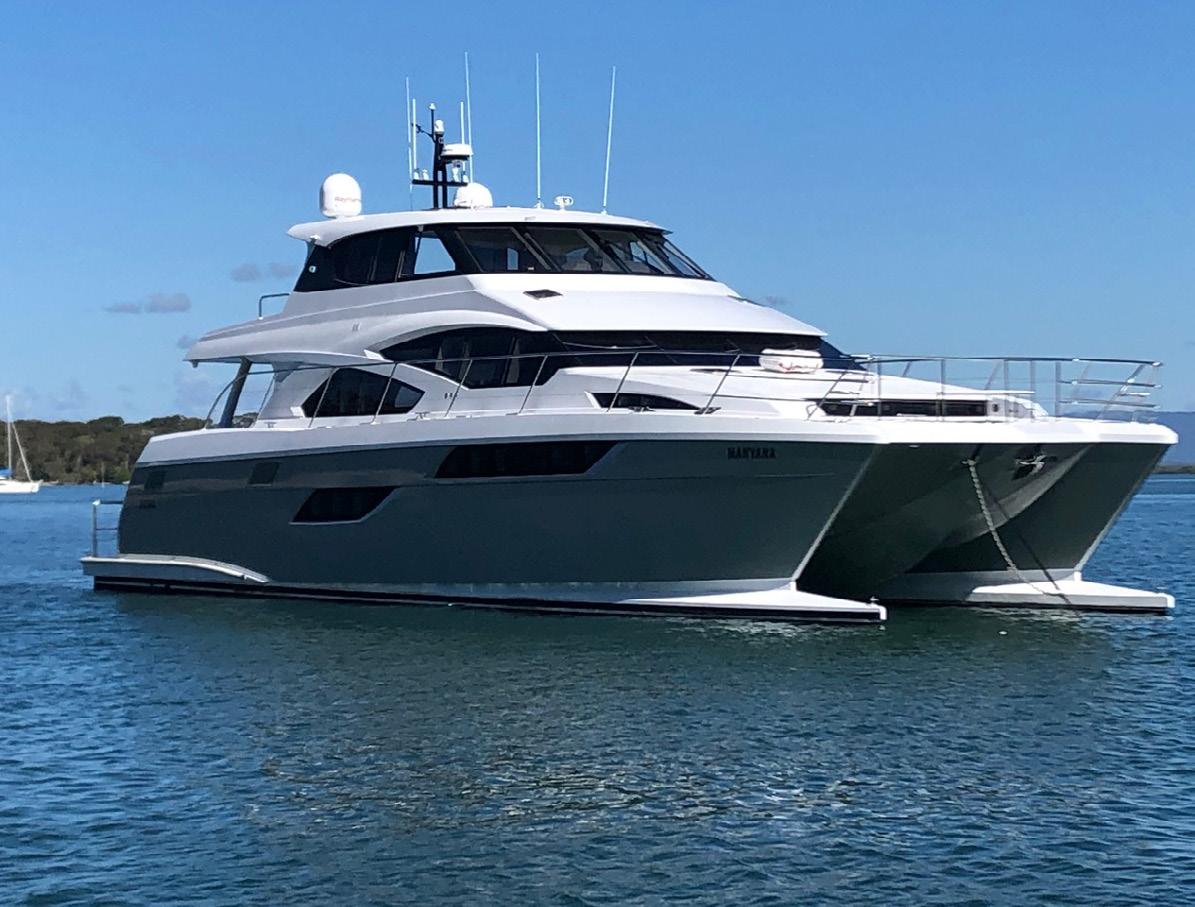
“It seems to me that there is no reason why the “long and thin” principle should not be applied to lighter weight boats with less superstructure and even finer hulls to produce 30 or even 40 knots with modest horsepower”, he was quoted as saying.
Although displacement cats may not be the fastest things in flat water they have demonstrated an ability to maintain
high average speeds regardless of the sea conditions. In situations where the high speed planing monohull is forced to drastically reduce its speed the displacement catamaran is able to continue on with very little reduction in performance.
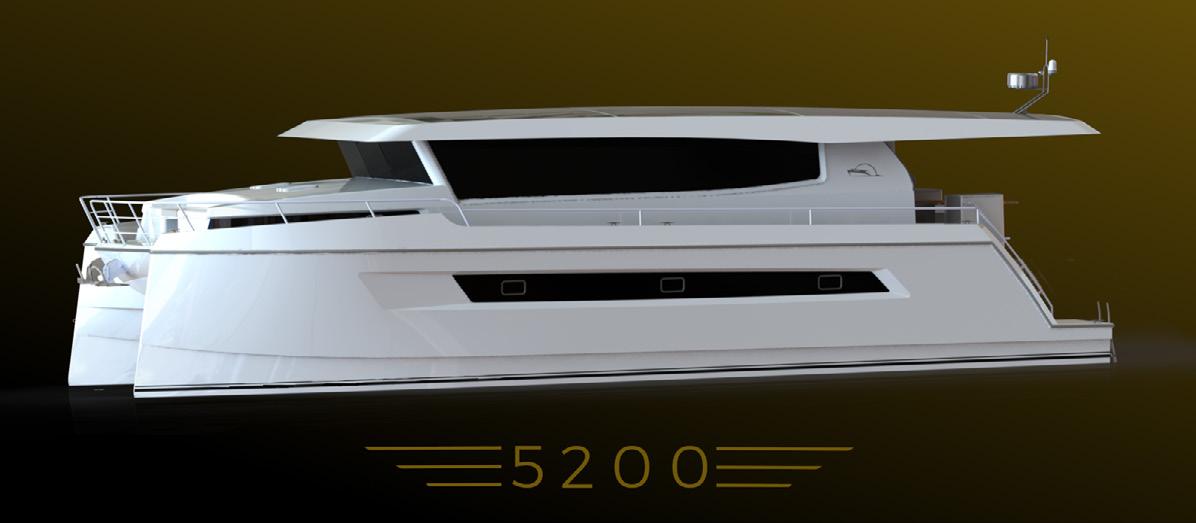
HORSEPOWER –MORE OR LESS?
How much power is required to move any particular hull form will vary with speed and these variations are reflected in the

shape, and magnitude, of their resistance curves. If you look at the resistance curve for a planing catamaran then it is virtually identical with that of a monohulled vessel with the same displacement. The catamaran may require a little more horsepower because of its lesser planing surface but there is the same initial high drag hump, which requires lots of horsepower to overcome. Once this hump is scaled there is a marked decrease in the hull resistance to motion, which only gradually begins to climb again as speed increases.
 Manyana, an all alloy Robson Design 66 was recently launched on the Gold Coast.
66 JANUARY / FEBRUARY 2023
Solar Explorer Yachts has been created as an offshoot of Herley Boats to focus its efforts on the future of electric boating.
A COMPARISON _ POWER CATAMARAN
The Voodoo Xpedition Foiler range of hydrofoil assisted power catamarans are set apart by their ability to cover huge open ocean distances at high speeds in absolute comfort And with incredible efficiency
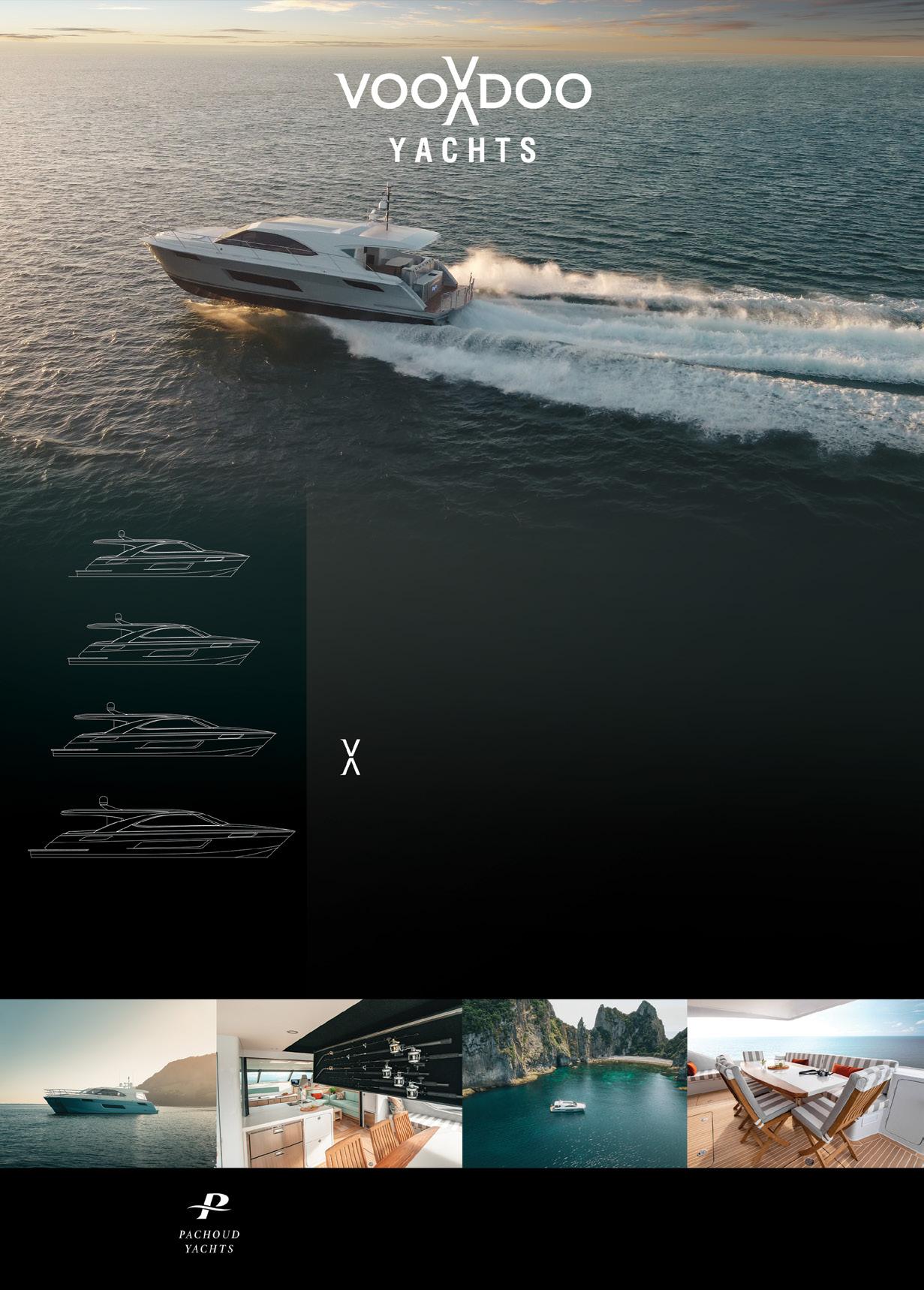
Contemporary interiors, light, flowing spaces and sustainable selections refine the extreme performance
Devastatingly fast, immensely capable and supremely comfortable The Voodoo Xpedition Foiler truly is the ultimate boat for the modern day adventurer
Get your key to unlock the oceans
What this means in theory is that once a planing vessel has overcome the initial wave resistance hump it will just go faster and faster as the available horsepower is increased. In practice of course this is not possible because such things as the sea state, and passenger comfort, intervene. Not only that but there is a physical limit to how large an engine can actually be fitted into the boat, and how much horsepower can be developed for a given engine weight, never mind the extra fuel requirements that the
larger more powerful engine brings.
In the case of the displacement catamaran the resistance curve of the catamaran and the monohulled vessel of the same displacement is somewhat different. It is true that they are of the same general type, the smoothly increasing exponential curve, but the catamaran curve will be well displaced toward the high end of the velocity continuum.
In other words; although the displacement catamaran will have a wave resistance
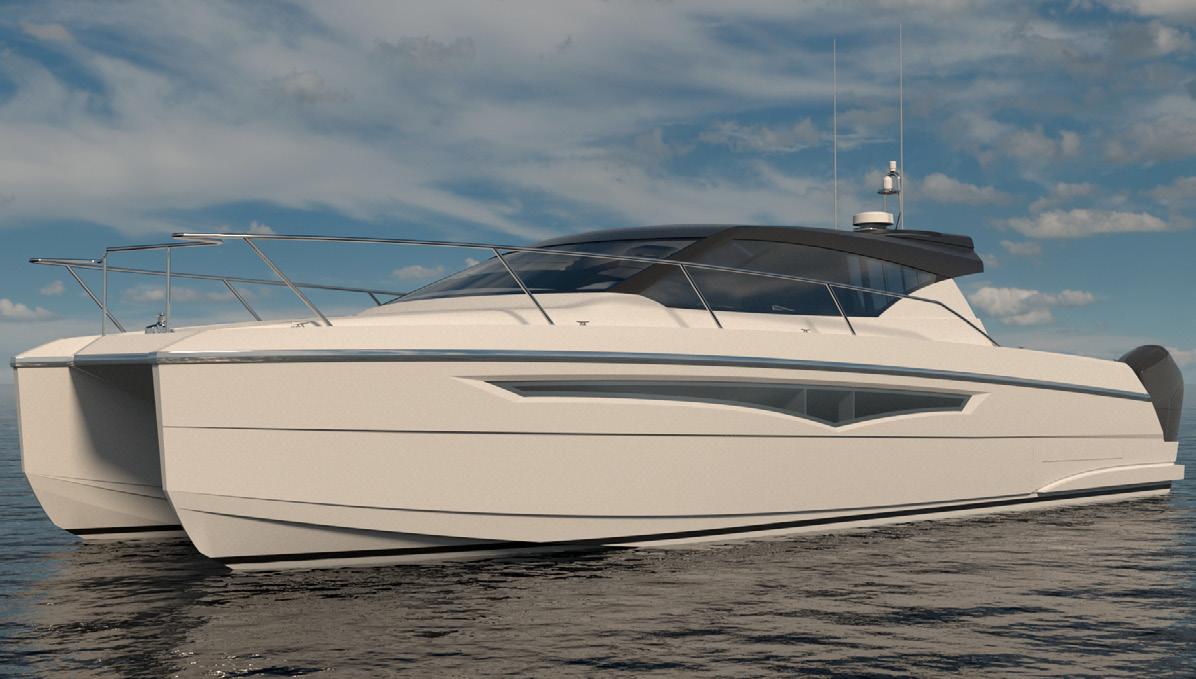
determined hull speed just like the monohull, this hull speed would be very much higher. But unlike the planing catamaran, where the power to weight ratio is the major determiner of speed, the speed of the displacement catamaran is largely a function of the fineness ratio of the hulls. The displacement is relatively unimportant except for how it impacts on the fineness ratio of the hulls, the height of the wingdeck off the water and the longitudinal moments of inertia of the vessel.
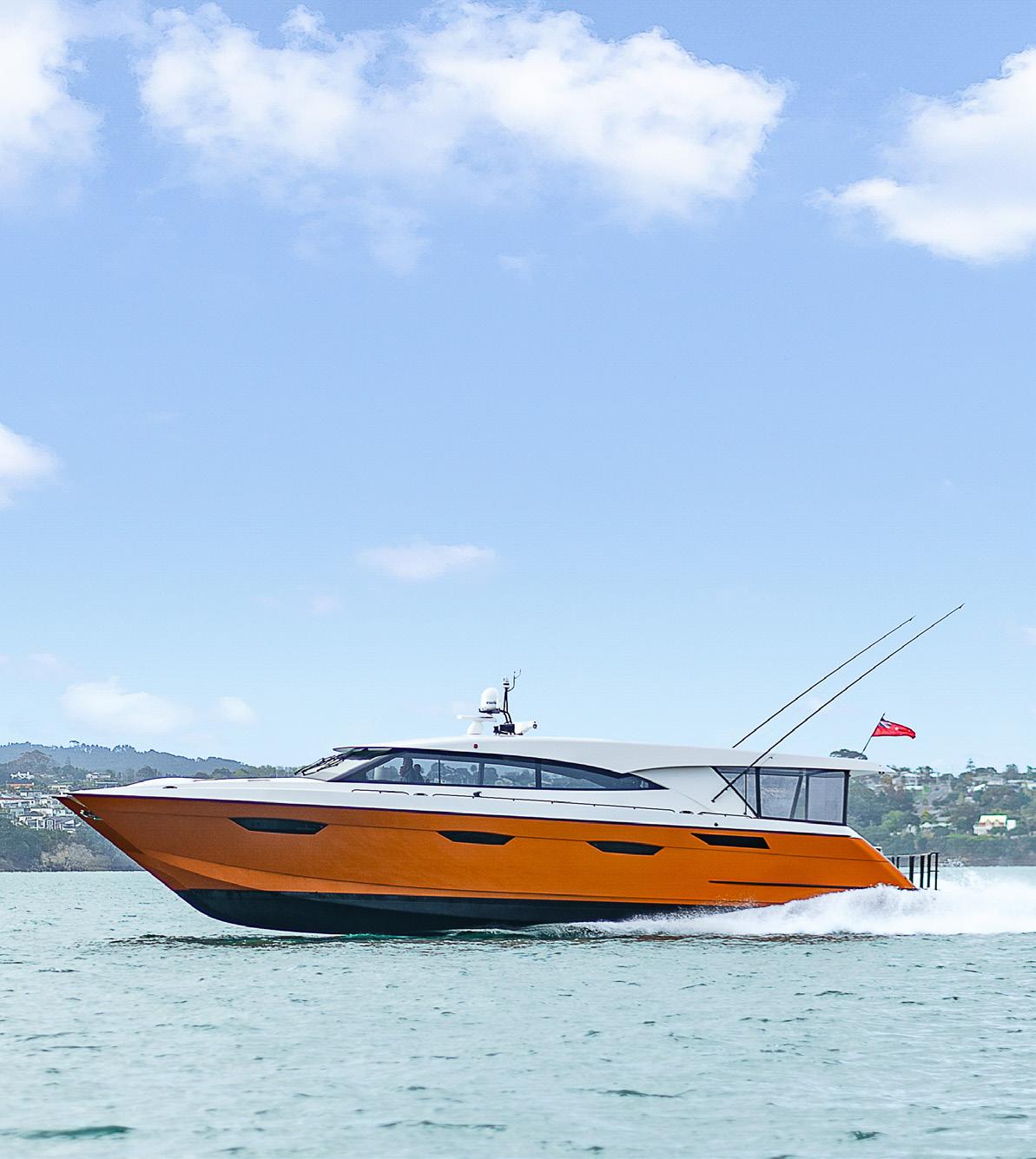
A COMPARISON _ POWER CATAMARAN 68 JANUARY / FEBRUARY 2023
Valder Yachts 20m foiling assisted powercat runs close to 50 knots.
This 13.4m composite construction, Scott Robson designed RSV 400, foiling cat is under construction in Auckland and will be launched in 2023. Power is a pair of 600HP Mercury outboards.It features dropdown cockpit sides and three cabin layout.
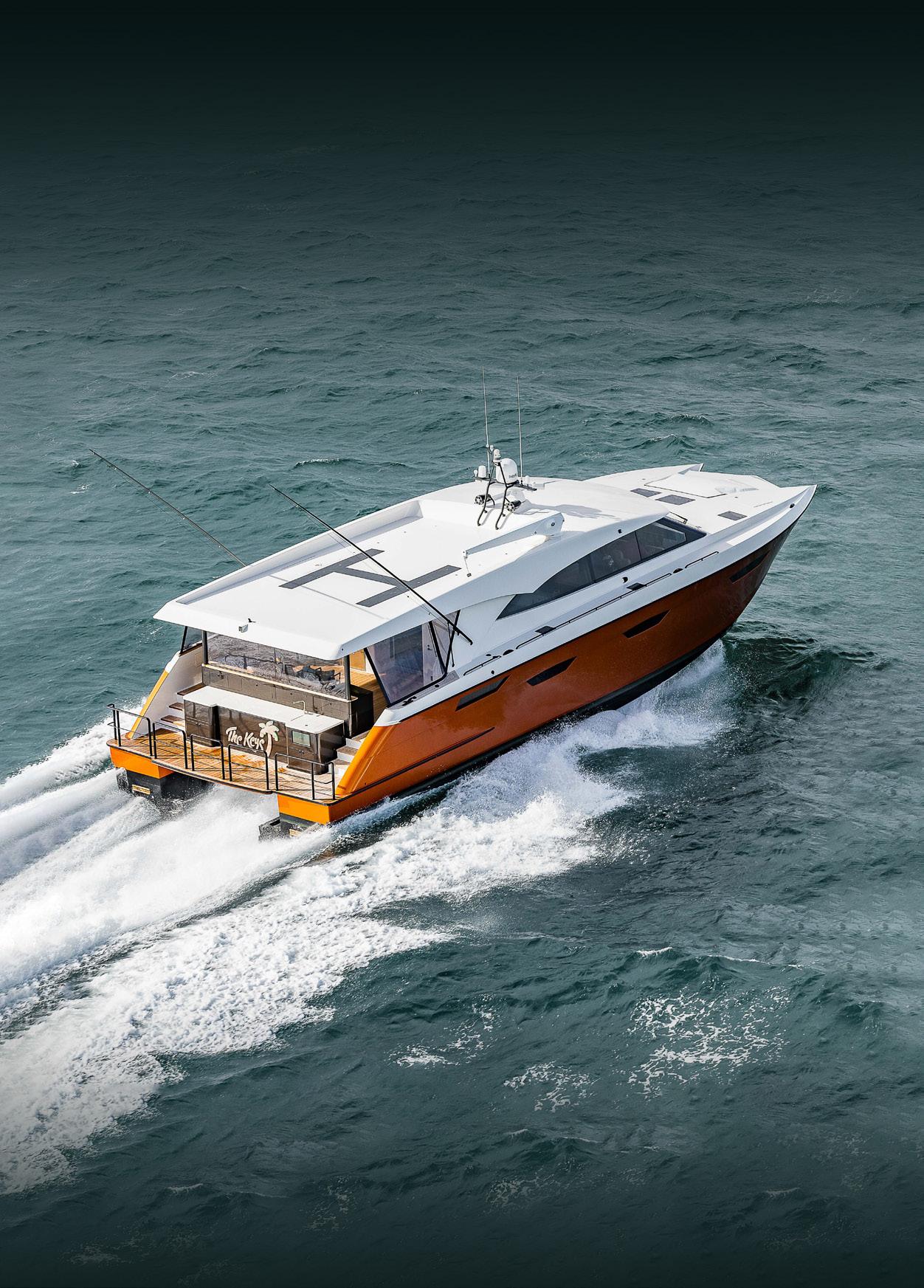
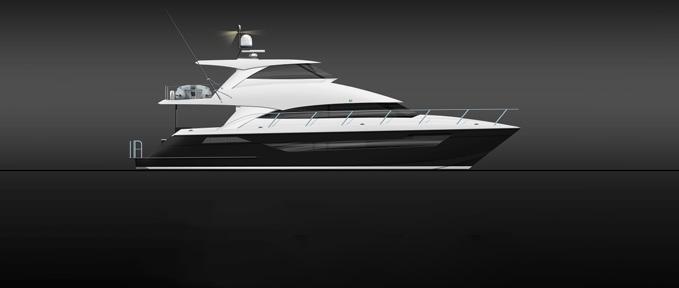

WHERE LUXURY MEETS SPEED DB910 www.valderyachts.com NOW ALSO AVAILABLE AS A FLYBRIDGE
THE RIGHT CHOICE
The conclusion to be drawn from this comparison is that, as expected, it is a matter of horses for courses. If you want to go fast in a short boat then you have to plane. If you can go a little longer then it is possible that you may be able to have the same performance but with much better fuel economy and comfort. It really is a matter of juggling all the variables of hull length, displacement, power requirements, accommodation, comfort and speed, to see which is going to be the best type of boat for you.
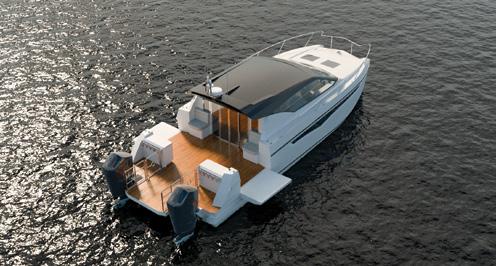
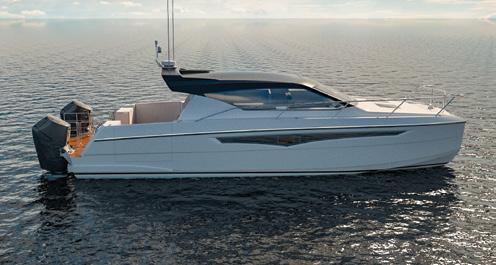
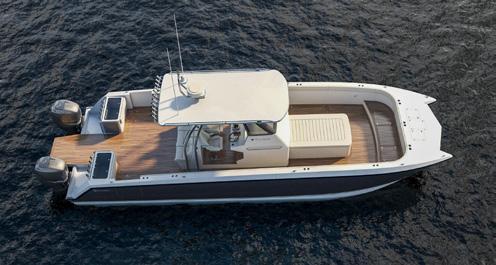
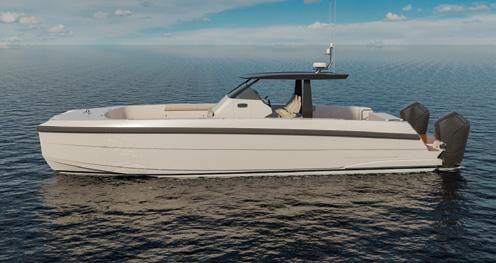
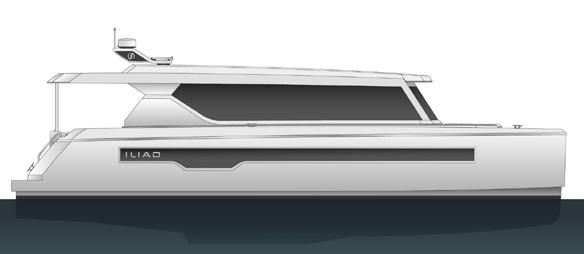
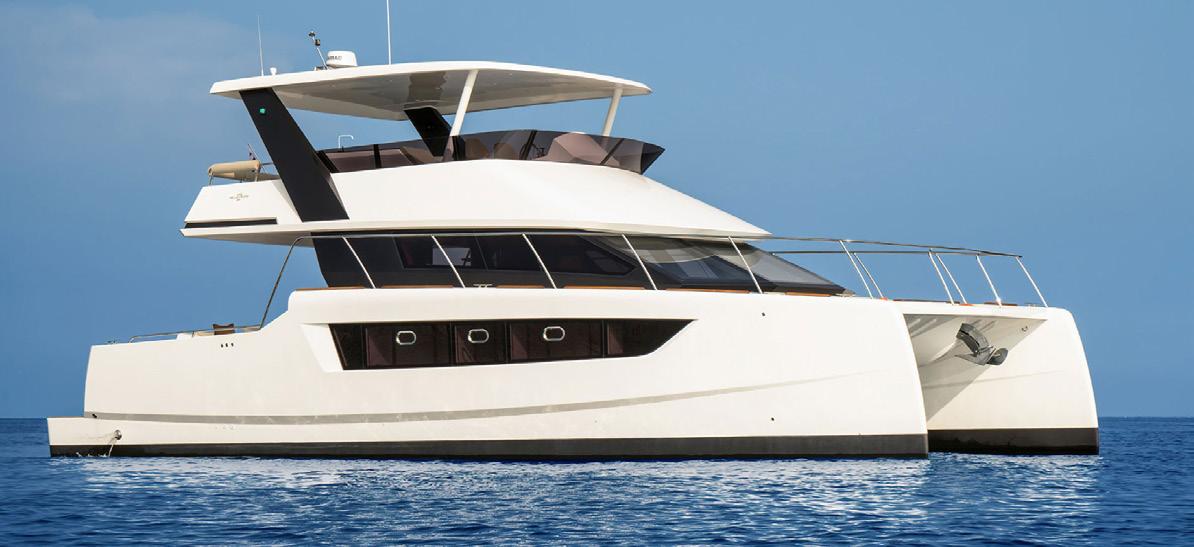
A COMPARISON POWER CATAMARAN
Multihull Solutions has added the new Cora Cat 48 to its range.
DB916 RSV 400 CAB RMT 400 CCX RSV 400 CAB RSD 362 CC • Custom Design • Production Design • Turnkey Craft Tel 64 021 320 874 • scott@robsondesign.co.nz • www.robsondesign.co.nz 70 JANUARY / FEBRUARY 2023
The Iliad 50 S edition, is one of the latest models to the brands already extensive range of power cats.
The Aquila 44 is a power catamaran with a fresh evolution of classic boating traditions. Efficiency in design and performance compliment her luxurious, spacious living. Aquila sets the new standard for luxury at every foot, from 28 to 70. Experience the full line of Aquila boats at aquilaboats.com.au
NEW AQUILA 44 AVAILABLE FOR APRIL 2023 DELIVERY. Contact us today on 1300 192 604 to arrange an inspection.
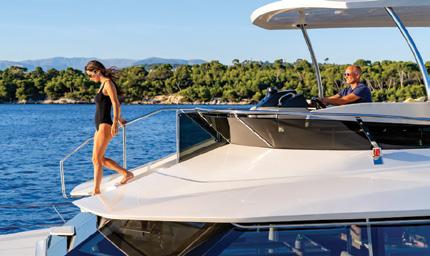
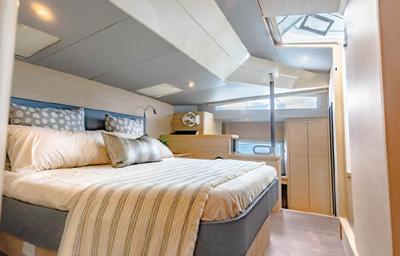
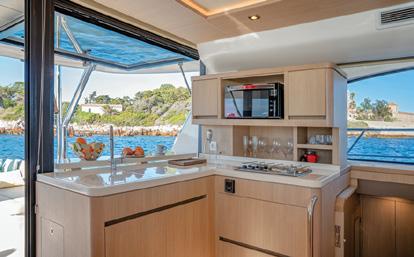
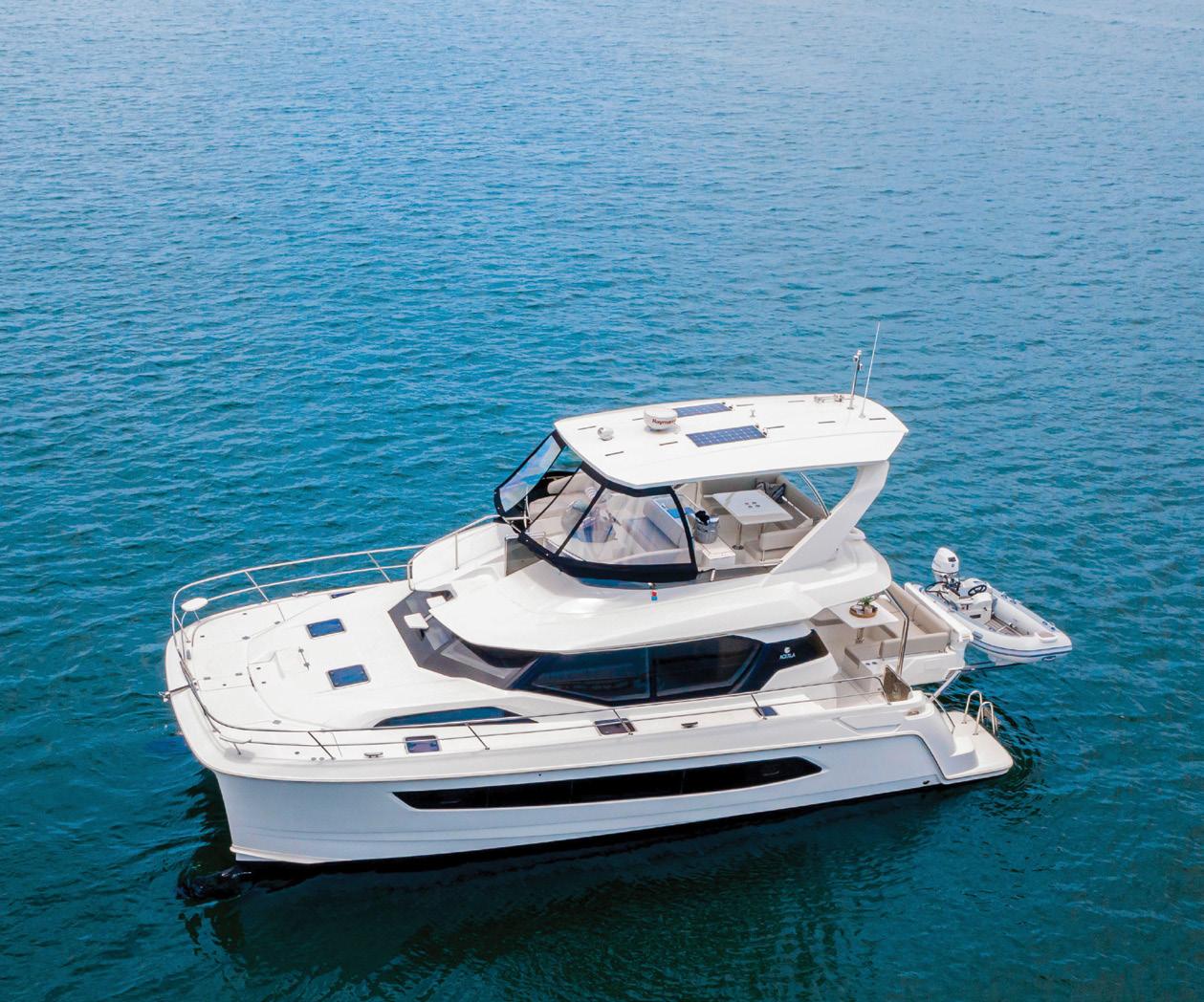
aquilaboats.com.au
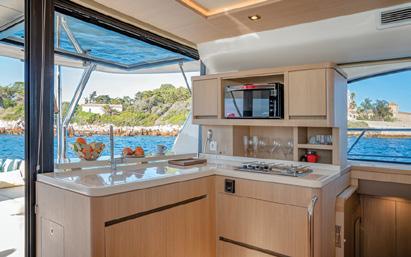
BAR RAISED. AT EVERY LEVEL. THE AQUILA 44 POWER CATAMARAN. 44 28 32 36 44 54 70
TOTALLY ADAPTABLE

The Sun Sport 230 OB is a particular model that Sea Ray has developed for the international market. Interestingly it is built in Poland and is not available in the US.
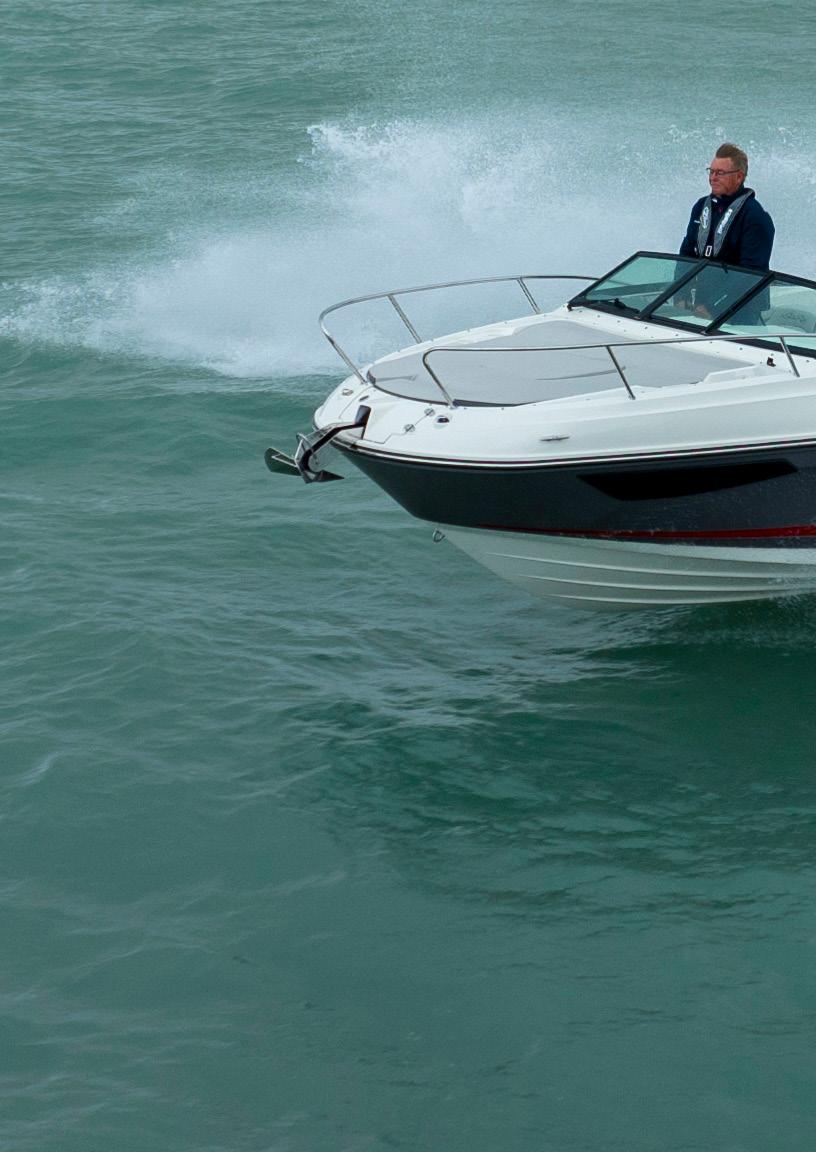
PACIFIC POWERBOAT REVIE WS _ SEA RAY SUN SPORT 230 OB
72 JANUARY / FEBRUARY 2023
WORDS BY BARRY THOMPSON
While we are more familiar with Sea Ray's innovative take on the bowrider design, such as the Sundancer and SLX Series, the Sun Sport is all about making the best use of a trailerable cabin cruiser.
The Sun Sport Series comprises two hull platforms; 230 (6.96m) and 250 (7.90m), with the 230 available in single outboard or sterndrive. The 250 is strictly a single MerCruiser sterndrive. The only difference between the 230 outboard and 230 inboards is the transom area is altered to accommodate a MerCruiser sterndrive. Other than that, it is all much the same. The 250, on the other hand, is quite different in layout, with more space to refine the cockpit and cabin spaces.
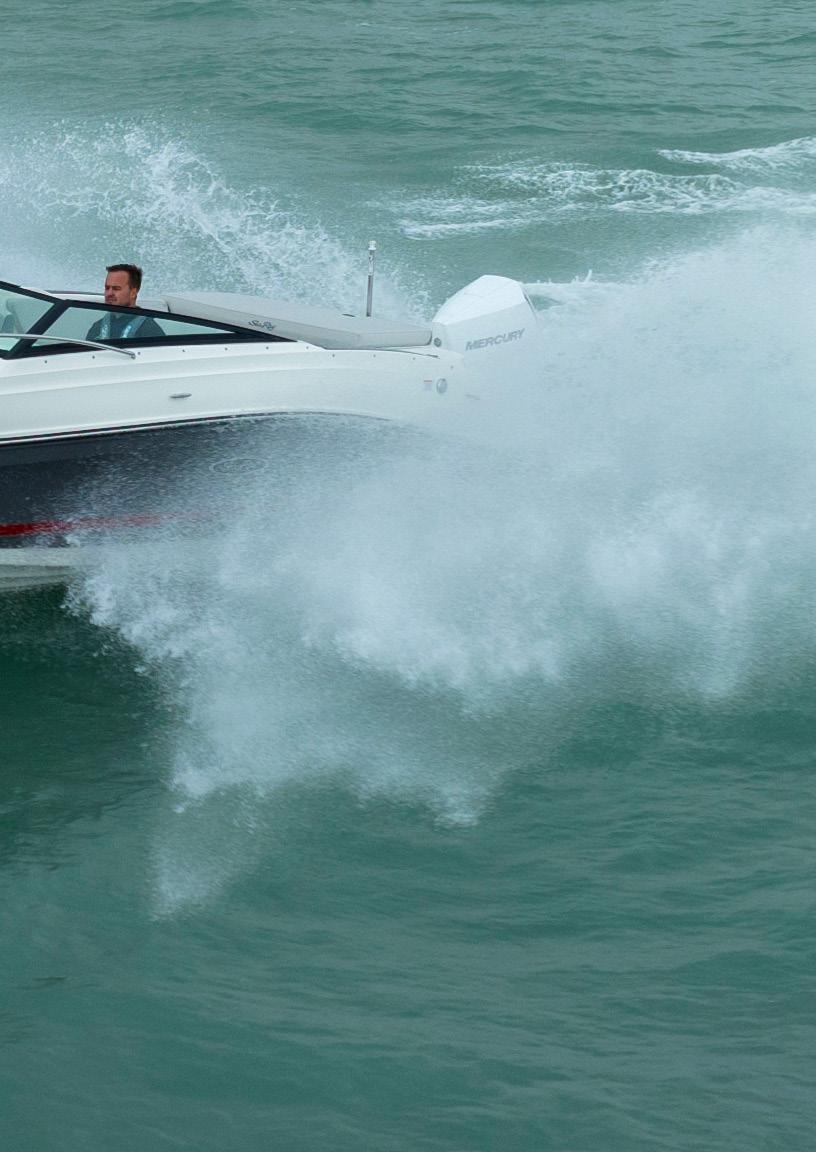
PARTY TIME
Sea Ray has designed the cockpit to be party friendly, and it's all about comfort
and convenience. There is a fully moulded U-shape seating module around the rear of the cockpit with UVprotected squabs. Storage space is provided under the seating, including an optional fridge.
Cockpit access is via a port side transom step-through, with a hinged lid and lift-out forward panel. A little messy, but it works. Removing a seat squab means you don't get wet or sandy feet on the upholstery. There's a separate sunpad across the rear deck area with massive storage space below. An optional circular teak table is a great option. Drink holders are prolific, and there is a Fusion sound system with Bluetooth, WiFi streaming, and multiple speakers. No space is left unused. The boat has three lockable storage areas to keep your gear safely stowed even when you are not onboard. Plenty of comfort for both the mind and the body.
THREE-WAY
Two fully adjustable swivelling bucket seats are provided with adjustable bolsters. You have three driving options. Seated, where you are tucked away below the screen and out of the wind, bolstered, which has your eyeline about the screen and standing. The adjustable steering wheel allows you to set the helm to suit your driving stance.
Running the boat on a choppy Lyttelton Harbour, with the occasional rain squall passing through, I certainly got to experience all three. In the calmer water and trying to dodge the rain, I was seated with the benefit of a windscreen wiper, and in the rougher water, I certainly found standing to be more comfortable.
The two-tier dash allows for a reasonably generous size MFD, in our case, a Simrad 9, with controls and switches, such as the Fusion stereo and Quick anchor winch on either side of the helm.
POWERBOATMAGAZINE.CO.NZ _ 73
Loving that choppy Lyttelton Harbour water.
An entertainer’s cockpit. Note the steps to the foredeck sunpad.
FISHING? YEAH RIGHT?
As Kiwis know them, this is not a fishing boat, but it can undoubtedly be fished from. In fact, our boat actually had a couple of rod holders fitted. While the layout isn't conducive to fishing, there are plenty of storage spaces for tackle, bait and your catch. Just be careful about squashed pillies and fish blood on the plush vinyl upholstery. While Sea Ray offers a clip-on carpet on the cockpit sole, the best option (as we had) is the Sea Dek faux teak.
Following the trend of larger sport yachts, Sea Ray has incorporated a full foredeck cushion to the Sun Sport 230 for those that like to soak up a few warm rays. However, it isn't simply domed onto the deck. It is fitted into a moulded recess below blow the deck profile and therefore isn't susceptible to being blown off by the wind when underway. There's also a cover to protect it from the elements, so it never needs removing.
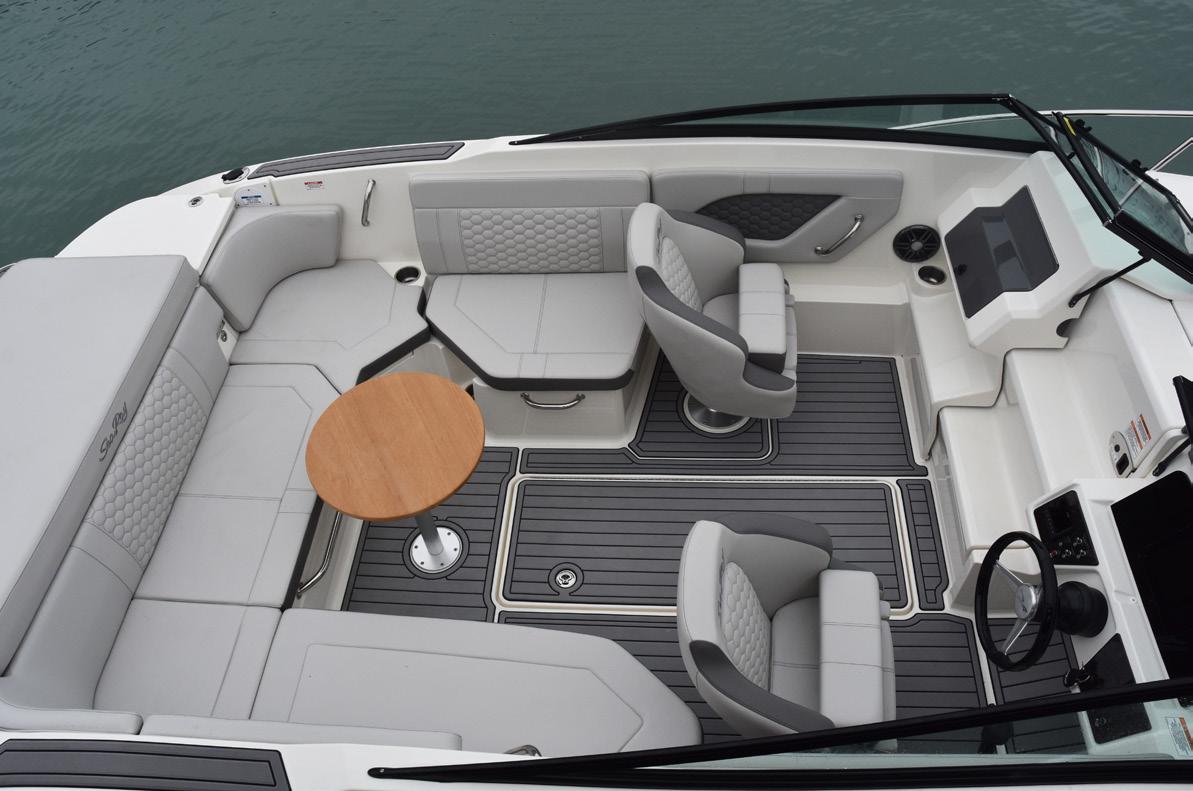
Access to the foredeck area is via a sliding set of steps, which also double as the lockable cabin door.
The Quick auto winch, complete with a remote, is neatly hidden away under a hatch which is coated with antiskid, and along with the split bow rails, helps for safe and easy entry and exit.
COSY CUDDY
The Sea Ray Sun Sport 230 has no side decks, which has allowed the beam to be maximised in the cabin. Below deck, the surprisingly spacious cuddy cabin is well-appointed with a comfortable V-berth, making it an ideal place for guests to take a break from the sun,
put the kids down for a nap, or enjoy an overnight getaway. Along with the portable head, the cuddy provides all-day convenience or the option to extend your adventure overnight.
OPTIONS
Everything you see on this boat, from the anchor winch to the four-step boarding ladder is standard. You get a Fusion stereo system, toilet, depth finder and Mercury VesselView. There are plenty of options available, but even the stock standard package is enough and more than adequate for day boating.
If you see yourself overnighting, I would add the canvas cockpit enclosure with curtains, fridge and transom shower, and maybe even a portable bbq. If you go for the Captain's Package, you get the bimini top, canvas cockpit and tonneau cover, round teak cockpit table, sunpad walk-thru cushions and a starboard windscreen wiper.
If you want to use the Sea Ray Sun Sport 230 for watersports, consider the Elevation Package, which adds a black water sports tower with a bimini top, tower racks, and a ski mirror.
PERFORMANCE
Sea Ray spent a lot of attention on the helm area's ergonomics, which is so apparent when driving. The helm seat fits snugly, and you feel secure and at one with the boat. All controls are conveniently at hand, and the instruments are easily read. With the DTS system, the steering is light and positive.
PACIFIC POWERBOAT REVIE WS _ SEA RAY SUN SPORT 230 OB
74 JANUARY / FEBRUARY 2023
I pushed the boat into the short, harsh choppy water of Lyttelton Harbour, and it handled it reasonably well. Once I had the trim set up, I felt more inclined to squeeze the throttle, but no more than around 20.5 knots @ 3500 rpm. Coming back with the following sea, I jumped that to about 33 knots @ 5000rpm, and the boat had a reliable and stable riding attitude.
Standard power is a Mercury 150, but you can go as high as the V8 250hp as we had on our boat. I managed to get 40 knots @ 5650 rpm, which saw a fuel burn of 81 lph. Overall, the Sun Sport 230 hull design
delivered excellent stability and a smooth ride considering the sea conditions. It holds a nice high bow attitude, although I did need to put the wiper on a couple of times. One of the features on the boat that I particularly liked was the VesselView Mobile system. This lets you stay alert through an onboard management system connected to your mobile device. VesselView Mobile uses Bluetooth to display gauge information on your iPhone or Android and allows you to monitor all engines and customise data points across three screens. You can also receive alerts if something isn't right with your engine.
With the sterndrive model you get the bonus of a platform with drop step.
A comfort and ergonomically designed helm area.
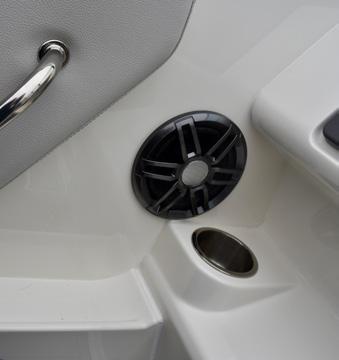
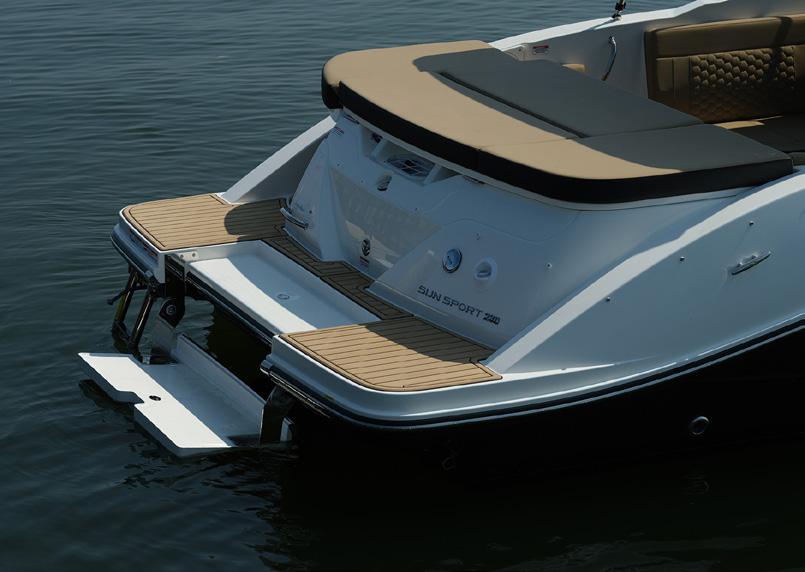
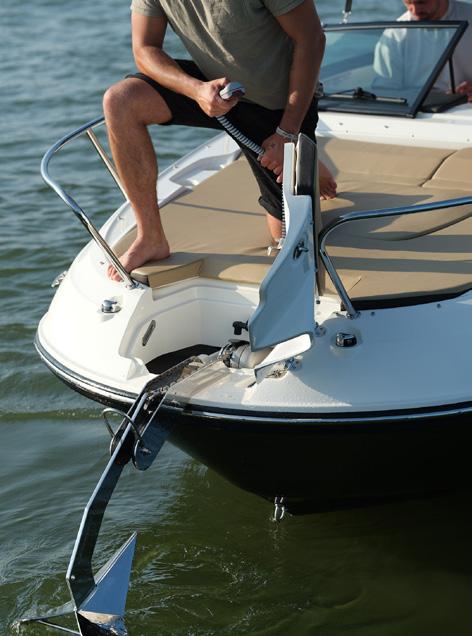
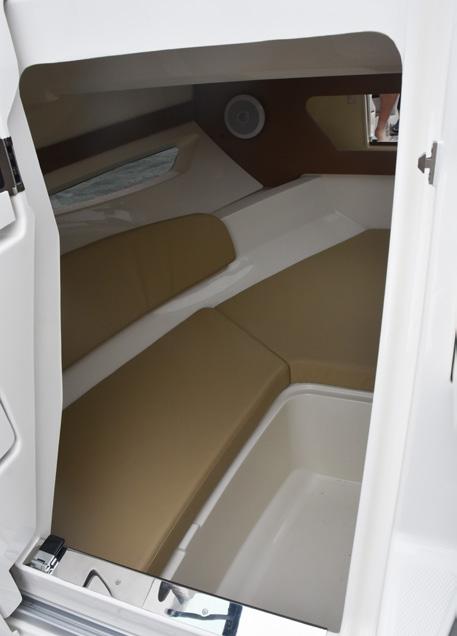
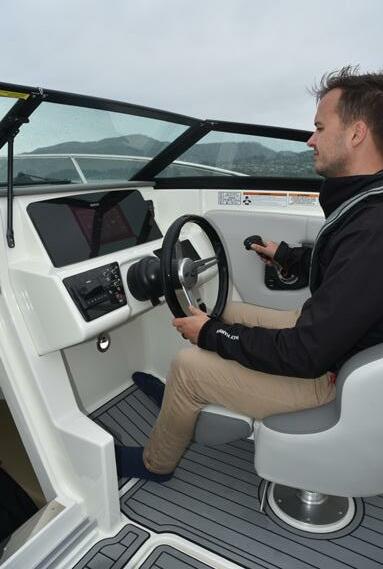
The cuddy cabin provides overnight accommodation.
The Quick auto anchor is nicely hidden below the deck.
Cupholders and Fusion speakers are everywhere.
POWERBOATMAGAZINE.CO.NZ _ 75
OVERALL
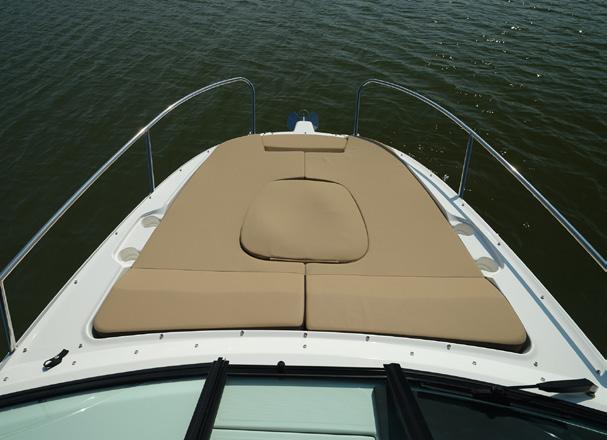

PACIFIC POWERBOAT REVIE WS _ SEA RAY SUN SPORT 230 OB SPECIFICATIONS Model & Model Sea Ray Sun Sport 230 Priced from $NZ215,000 Type Cabin Construction GRP LOA 6.96m Beam 2.59m Deadrise 19 deg Height on trailer 2.12m Test Power Mercury 250 V8 Propeller Revolution 17 4B Power options Outboard, sterndrive HP Range 150-250hp Fuel Capacity 189 litres MFD Simrad 9 Stereo Fusion Anchor Winch Quick Flooring Sea Dek Manufacturer Sea Ray Contact Sports Marine SPORTSMARINE.CO.NZ PERFORMANCE DATA : MERCURY 250 V8 RPM Knots L/h L/NM Range (NM) 1000 4.4 5.1 1.2 147 1500 6.0 8 1.4 124 2000 7.0 13 1.8 94 2500 8.5 17 2.0 85 3000 14.5 21 1.4 117 3500 20.5 27 1.3 129 4000 25.0 36 1.5 117 4500 30.0 44 1.5 115 5000 33.0 59 1.8 95 5500 37.5 75 2.0 85 5650 40.0 81 2.0 84 Note: Fuel range is based on 10% reserve. The 250hp Mercury V8 was good for 40 knots.
The fit and finish of the Sea Ray Sun Sport 230 are exceptional. It is a boat that fits well into the Kiwi boating market for those that enjoy water sports, cruising or weekending. Overnighting in the Southern Lakes, cruising in the Marlborough Sounds or towing a wakeboard on the Hauraki Gulf, the Sea Ray Sun Sport 230 has it all. Bow cushions are domed down and recessed so they don’t blow off when underway. 76 JANUARY / FEBRUARY 2023
Telescopic
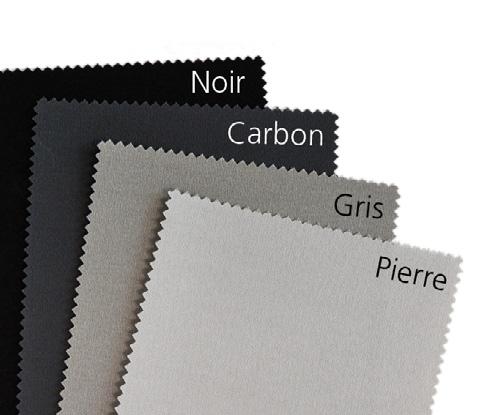
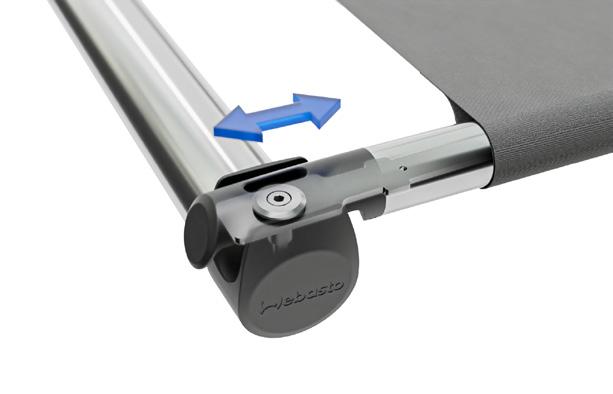

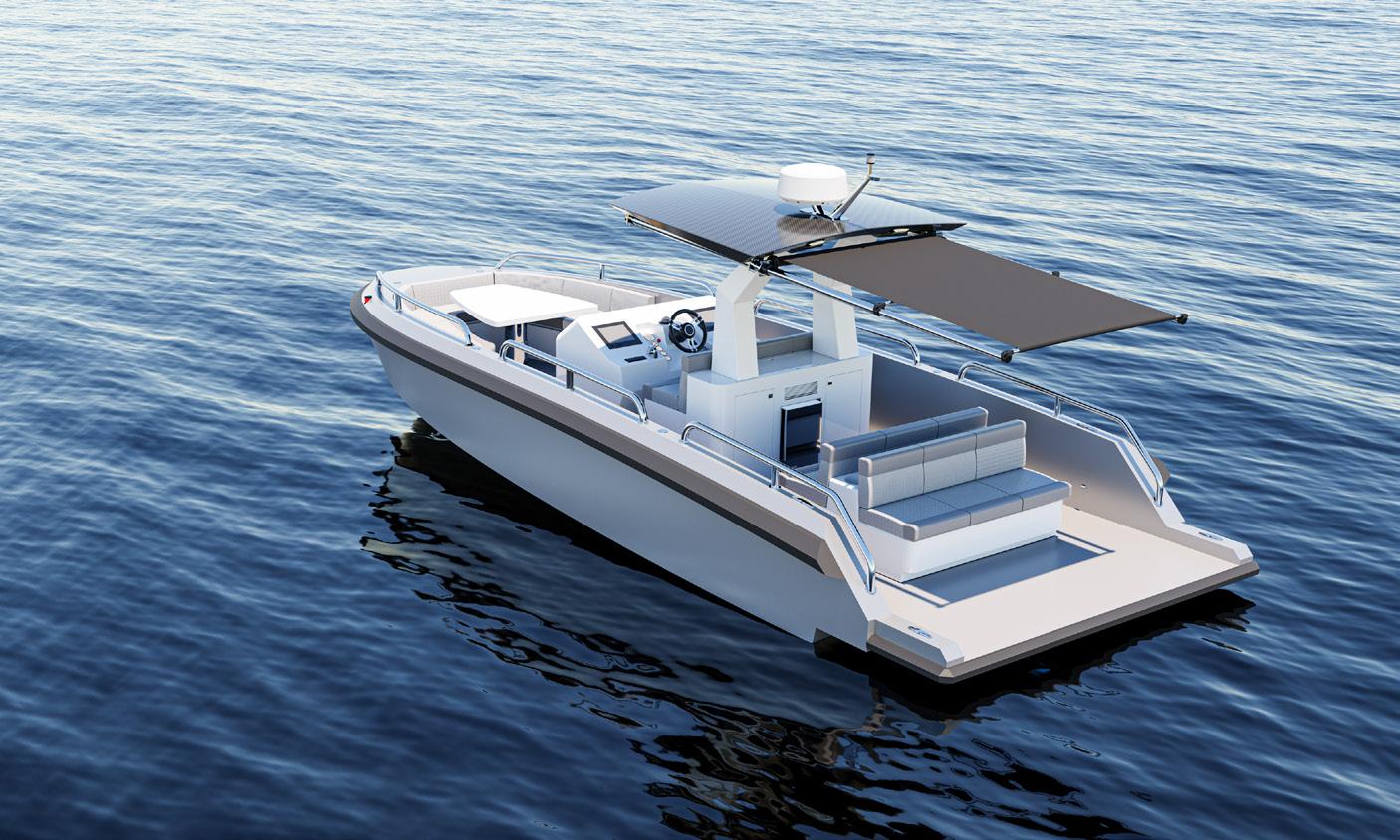
retractable
Fully
Customisable widths up to 2500mm Easily retrofitted or integrated by your boat builder Self adjusting within 5mm Marine-grade stainless steel tubing High quality eco-friendly shade fabric Can be used in tandem with Webasto's wide range of GRP & glass marine sunroofs
+61
4800 svc-info@webasto.com Webasto Thermo & Comfort
www.webasto-comfort.com Electrically Operated
Shade 2500 The all new Telescopic Shading system by Webasto is ideal for use above the cockpit or rear deck. operated with the touch of a button this smart, straight forward design can be customized to widths up to 2500mm and a range of colours ensuring a perfect match with the styling of your boat. Features:
(0)2 8536
Australia
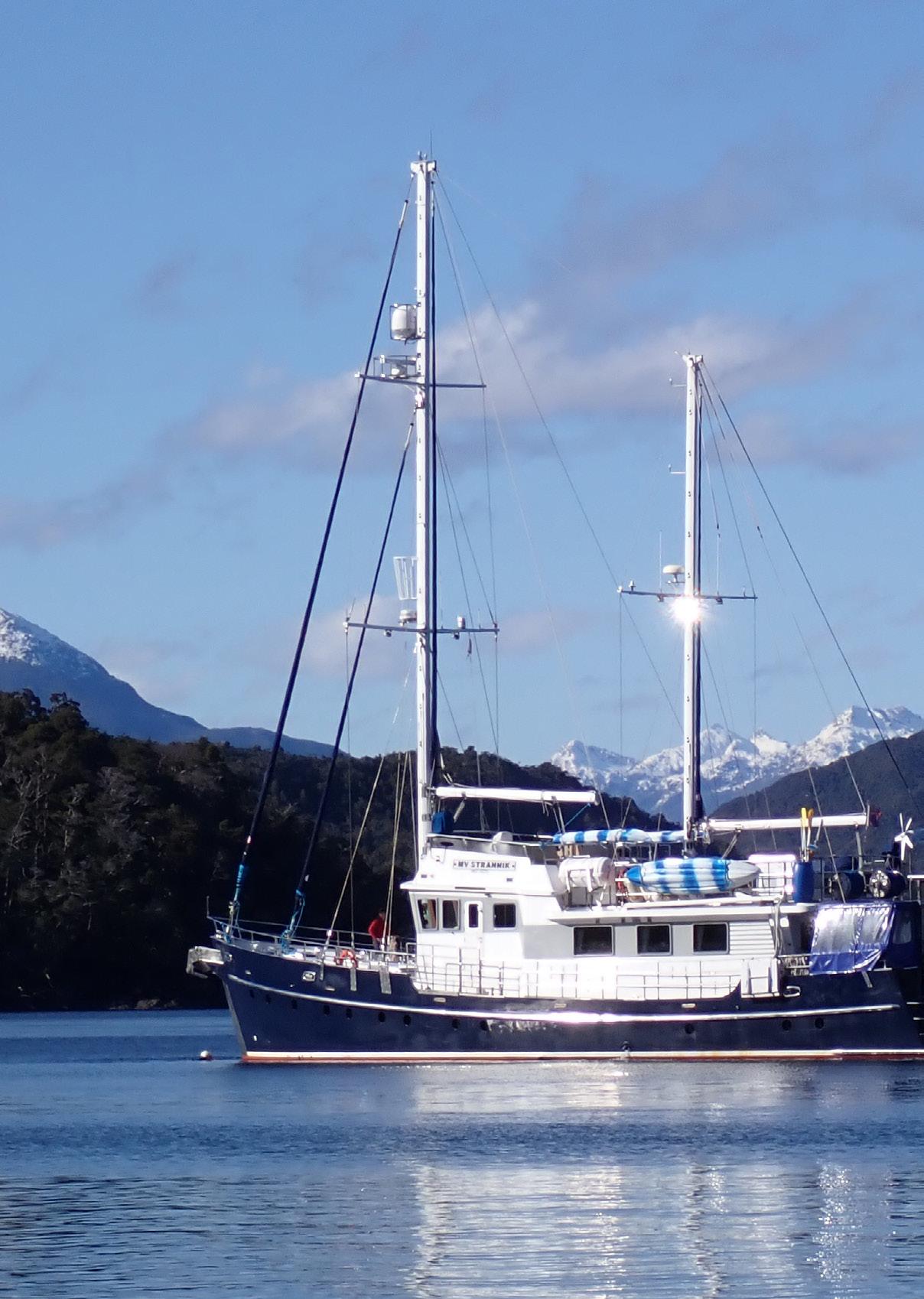
EXPLORING FIORDLAND PART 2
ONE OF THE WORLD’S GREATEST & REMOTEST CRUISING GROUNDS
Part seven on the journey of the MV Strannik, Rodney Russ continues his voyage into Fordland in the final of a two part series on this magnificent boating playground.
In Māori legend, the fiords in Fiordland were formed by a God named Tu-te-Rakwhanoa.
Chanting a powerful Karakia, or prayer, he hacked at the towering rock walls with his adze, carving them from the earth. Reputedly he started at the south, working his way north to Milford Sound. At the start he was inexperienced and had to chop repeatedly, leaving many islands and inlets. His inexperience created what is arguably one of the world’s finest and remotest cruising grounds.
In this the second article on Fiordland we look at the cruising opportunities in Breaksea Sound, Dusky Sound, Chalky Inlet and Preservation Inlet. All these are technically fiords and are often collectively referred to as the Southern Fiords. Their topography differs from the Northern Fiords
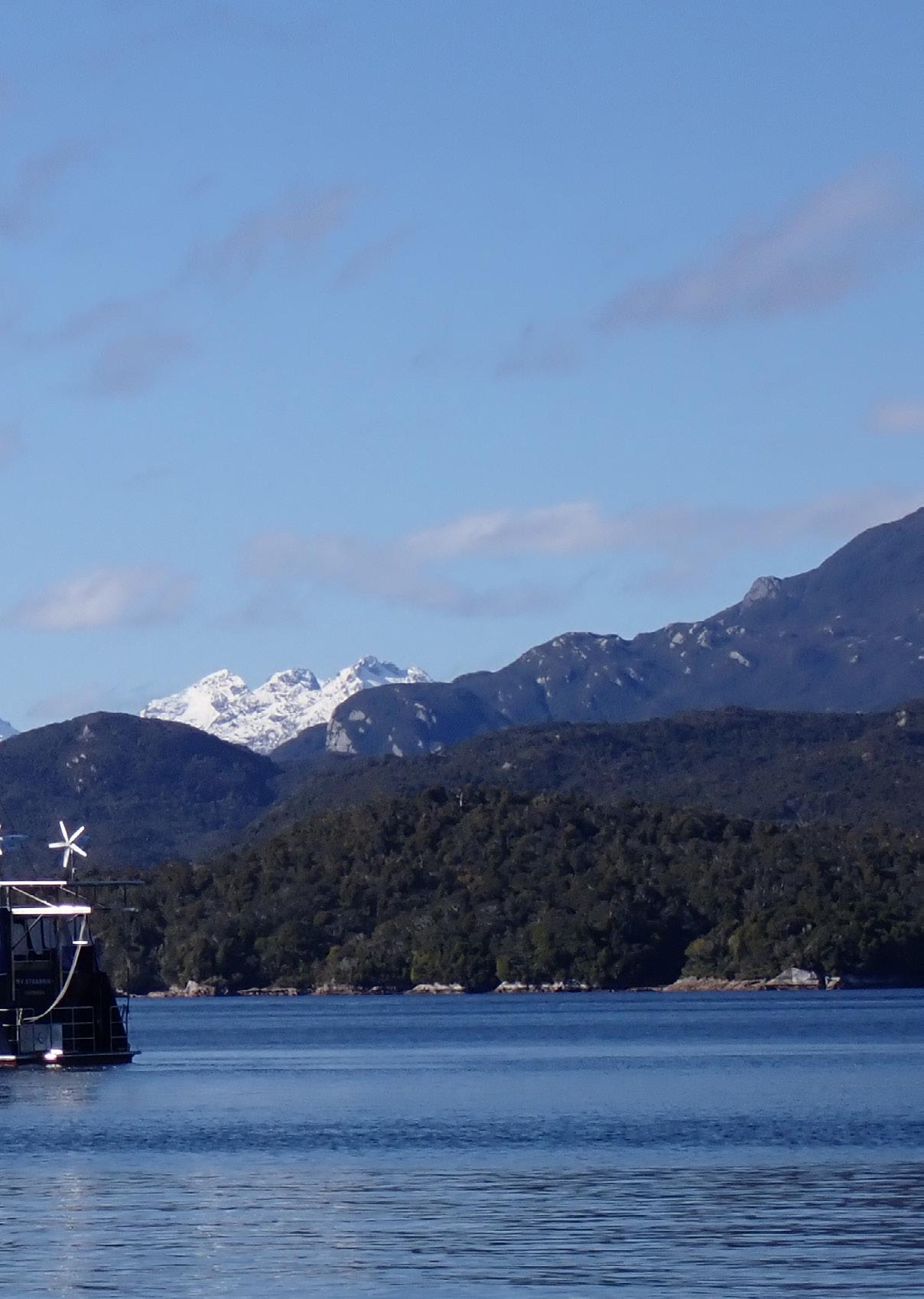
(see previous article) in that they are much more expansive, and the surrounding land is not nearly as mountainous or precipitous, in fact Preservation Inlet in the south feels and looks more like a sound than a fiord.
The Southern Fiords can be approached from the east departing from either the Port of Bluff or Stewart Island, via Foveaux Strait. This strait has a fearsome reputation, being shallow and lying wide open to the prevailing westerly winds and seas. Many a yachtsman has sat for days, if not weeks, waiting for a suitable weather window.
Alternatively, they can be approached from the North by cruising down the west coast of the South Island and through the Northern Fiords (see previous article). We will continue with the Northern approach in this article.
Strannik anchored up peacefully in Cuttle Cove.
DOUBTFUL SOUND
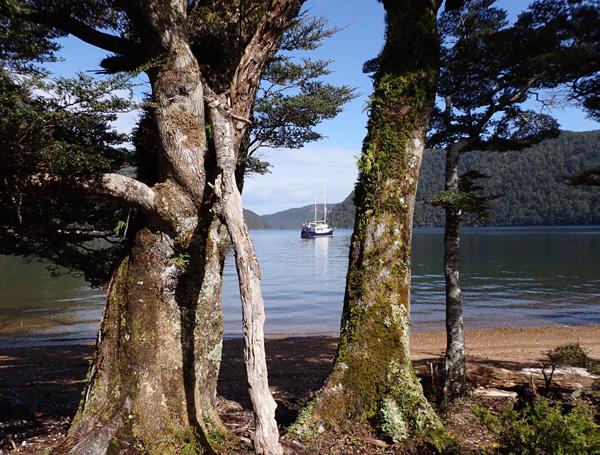
Deep Cove at the head of Doubtful Sound is a good place to replenish water, fuel (both diesel and petrol) and to arrange for fresh supplies brought in from Te Anau. There are a couple anchorages near the entrance to Doubtful Sound that provide ideal jumping off points, places to sit and wait for the best weather and sea conditions to run south. These include Snug Cove at the head of First Arm, or Blanket Bay, in the shelter of Secretary Island. As you depart Doubtful Sound you will (if you are observant) note a little cluster of Spanish place names on the chart. These were bestowed by a Spanish expedition of 1793 under the command of Captain Alessandro Malaspina. He only visited for one day and instead of bringing their vessels the Descubierta and Atrevida into the fiord, he sent a long boat in because, like Cook, who named the fiord in 1770, he was doubtful if they could safely sail in and out.
Eight miles south of Doubtful Sound is a little known, seldom visited and underappreciated fiord called Dagg Sound; if you have the time there is the most picturesque and secure anchorage at its head. From this anchorage there is an easy one hour walk (each way) to the head of Crooked Arm in Doubtful Sound.
The Dusky Sound complex includes Breaksea Sound, the Acheron Passage, Wet Jacket Arm and Dusky Sound proper and includes a labyrinth of waterways and an estimated 700 plus islands. The take-home message is simple, allow plenty of time. The upper Breaksea Sound divides into two arms, Vancouver and Broughton, immortalising the captains from a 1795 expedition to Dusky Sound. Vancouver had been a young midshipman with Cook in 1773 when Cook had named this area on his chart as “Nobody knows what”, when he returned as Commander of his own expedition he was determined to fill in the gaps. Their two ships the Discovery and the Chatham have also been commemorated in two prominent headlands near where these arms divide. It is worth sailing to the head of at least one of these arms to really sense the remoteness, grandeur and beauty of the area. Both have reasonable anchorages, with Vancouver Arm having a substantial mooring buoy.
ACHERON PASSAGE
The Acheron Passage is an eight-mile-long inland waterway connecting Breaksea Sound and Dusky Sound. Cook named it the New Passage, however the name was changed in 1851 to Acheron to commemorate the survey vessel Acheron which completed the first official charts of Dusky Sound. Midway through the passage is Wet Jacket Arm, named by Cook after Lieutenant Pickersgill got caught out in a storm and had to spend a wet night huddled under his boat. In 1910 moose were liberated in the nearby Seaforth River; just one of eleven species of deer to be liberated in New Zealand to satisfy the hunting urges of the early settlers. The habitat was marginal and the moose never established, and the eight animals that were shot were shot in Herrick Creek near the head of Wet Jacket Arm. Red deer were also liberated in large numbers (some 230 liberations) and are now well established in Fiordland and can often be seen on the beaches, or spooked during bush walks.
At the very head of Dusky Sound is Supper Cove (Cook had supper here), this is the terminus of a demanding four or five-day tramp from Lake Manapouri. The Supper Cove hut is on the North Bank of the Seaforth River which flows into the Fiord. Supper Cove was also the site of an ambitious, but doomed to fail, attempt at building a road through Fiordland. During the depression of 1903, 50 unemployed miners from the west coast of the South Island were shipped here and started construction, only 9.5 kms of road were built before the project was abandoned. There is a good mooring in nearby Shark Cove, a much more sheltered anchorage than Supper Cove which can experience severe weather conditions at times. It is approx. 16 nm from Supper Cove to the outer Dusky Sound
area where there is a lot to see and do; you have the choice of travelling via the Bowen Passage or the Cook Channel. If you take the latter take care around 9 fathom passage. Whichever way you go make sure you visit Sportsman Cove on the western end of Cooper Island, named by Cook after a successful morning’s hunting, it is an idyllic anchorage (there is a mooring) but is subject to hard to predict local weather phenomena.
Duck Cove on Resolution Island is readily accessible from the Bowen Channel; there is a water pipe from a creek halfway along the western shoreline from which you can top up you water tanks.
Cascade Cove makes a great base from which to explore the outer Dusky Sound area. There are a number of moorings in the head of Cove. If you prefer to anchor the holding is good.
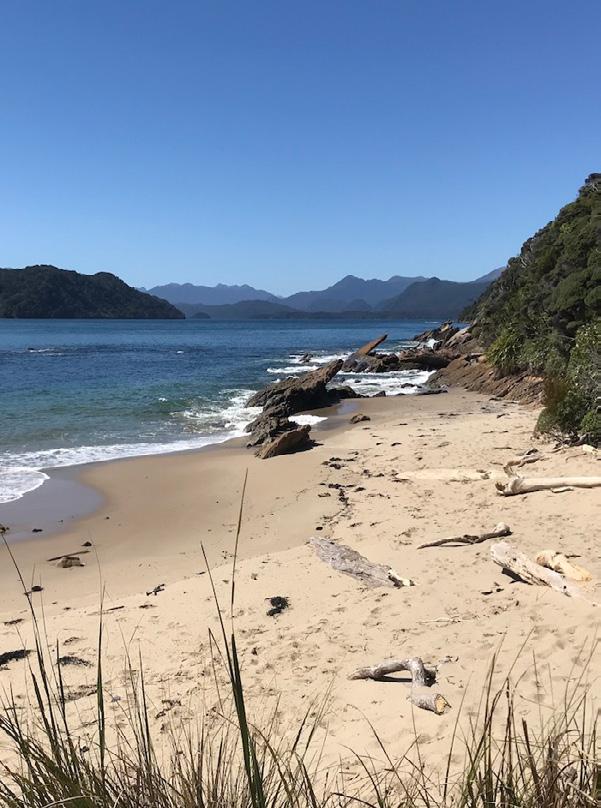
80 JANUARY / FEBRUARY 2023 EXPLORING FIORDLAND PART 7
Preservation Inlet from the oil store.
Strannik in Dawson Burn Long Sound.




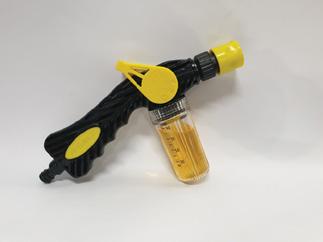
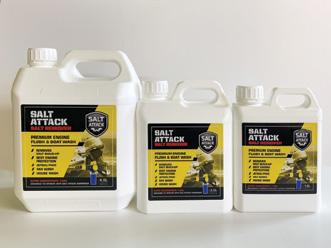
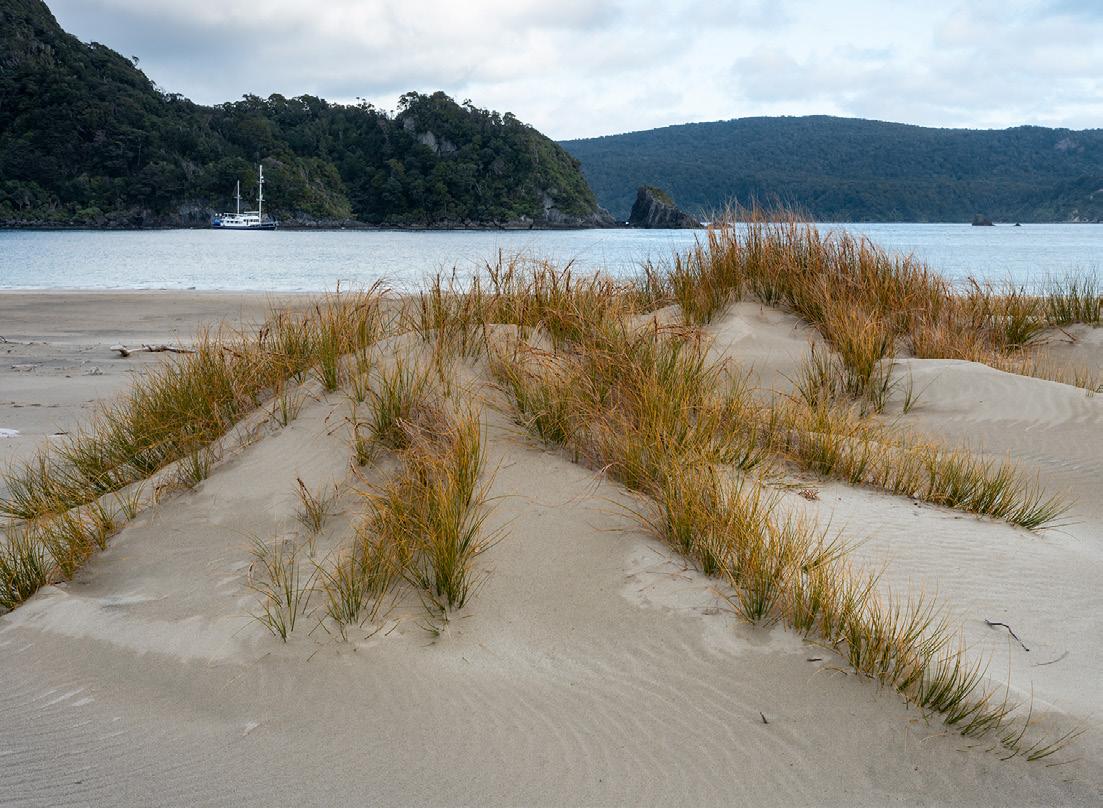
SUPERIOR TO WASH AND WAXES, USES AN ACRYLIONIC FORMULA, DESIGNED FOR USE WITH SALT-ATTACK MIXER Cleans and protects your boat and vehicle, removes stubborn road grime. CLEANS GLASS & CLEARS Leaves a streak free finish, also removes black streaks. STAINLESS AND ALLOY Cleans, shines and protects. ENVIRONMENTALLY FRIENDLY AND BIODEGRADEABLE Leaves behind a harder-than-wax protection and shine which is analytically tested to protect and delay the speed of UV damage. MARINE WASHCOAT & SHINE WHOLESALE MARINE DIRECT NZ LTD FREEPHONE 0800 272 589 www.salt-attack.com 9 out of 10 engines fail due to salt corrosion. ACT NOW and flush your engine! SALT ATTACK SALT REMOVER SUPER CONCENTRATE 1:500 Designed to operate with salt-attack dispenser REMOVES SALT BUILD-UP BEST ENGINE PROTECTION HOUSE WASH 4X4 WASH PREMIUM ENGINE FLUSH & BOAT WASH POWERBOATMAGAZINE.CO.NZ _ 81 Strannik moored at Spit Island.
ON THE MUST DO/SEE AND EXPERIENCE LIST IN THIS PART OF DUSKY SOUND
PICKERSGILL HARBOUR AND A WALK TO LAKE FORSTER
Cook moored his ship the Resolution here for 33 days in 1773 after his journey across the Southern Ocean and across the Antarctic Circle (the first vessel to do so) from Cape Town. There is a boardwalk around the small knoll and a photometric plaque with some information to help with your visit. There is a marked but muddy track to Lake Forster named after the father and son naturalists who accompanied Cook on this expedition.
LUNCHEON COVE ON ANCHOR ISLAND AND WALK TO ANCHOR ISLAND LAKE AND BEYOND
Anchor Island was named by Cook because he anchored nearby on his first night in Dusky Bay and Luncheon Cove because he enjoyed lunch here during his exploration of Dusky Sound. The island is now synonymous with the Kākāpo because it is on this island that Department of Conservation are concentrating their efforts to save this rare (less than 300 individuals remain) flightless and nocturnal parrot. The chances of seeing one of these is virtually nil but make an effort to enjoy a walk to the lake. The Island is predator free and some of NZ’s rarest birds like the Yellow Head and Saddleback have been liberated here. The bird song is special, perhaps somewhat reminiscent of what NZ forests were like before the arrival of people.
ARE:
PIGEON ISLAND
This was home for Richard Henry, caretaker of nearby Resolution Island, New Zealand’s first Nature Reserve gazetted in 1891. He was appointed in 1894 as there were concerns about the impact of introduced rats and stoats on the native avifauna, many of which were either flightless or very poor fliers. Henry caught and liberated over 700 kiwi and Kākāpo on to Resolution Island. In 1900 he saw a stoat on the island, he never transferred another bird after that. Remnants of his house and boatsheds can be seen on Pigeon Island.
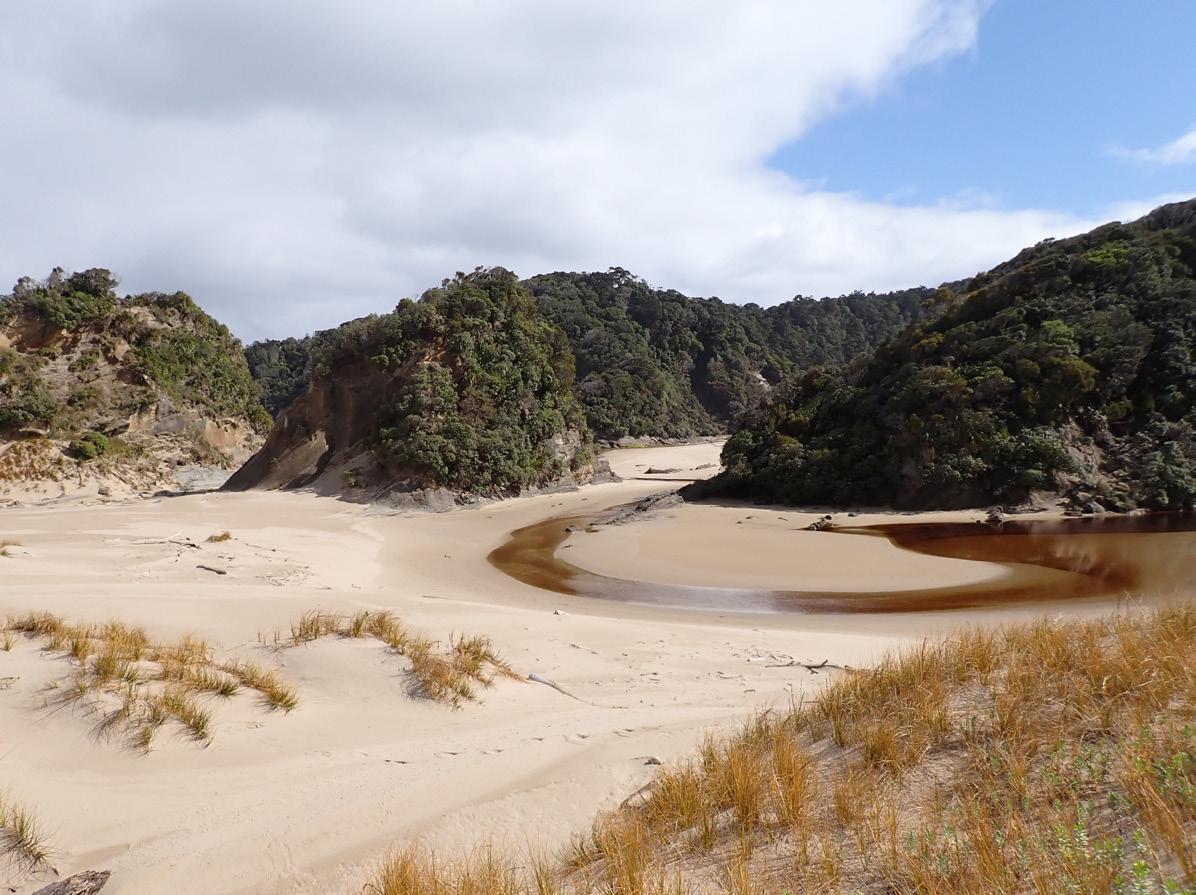
FACILE HARBOUR
Historically a very significant New Zealand site, arguably the cradle of the country’s European settlement and a site of many New Zealand firsts. The ship Endeavour was wrecked here in 1795 the first European shipwreck; the survivors included European women, the country’s first. It is unsubstantiated, but highly likely, that a child, or children, were conceived and born here during their enforced stay (the last of the survivors weren’t rescued until 1797), these would be the first European children born in the country. Some of the survivors completed the construction of a vessel that had been begun two years earlier by a sealing gang, they named it Providence and sailed to Norfolk Island. This was the first European vessel built from native timber, possibly the first built from local timber in Australasia. At low tide on a calm day it is still possible to see the ballast stones of the Endeavour.
EXPLORING FIORDLAND PART 2
Sealers Creek.
CHALKY INLET
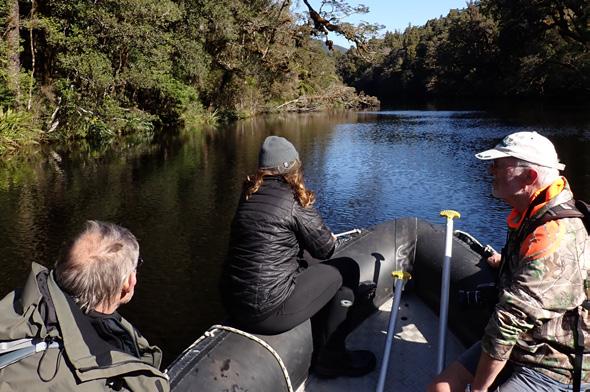
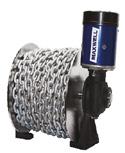
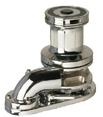
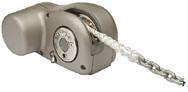
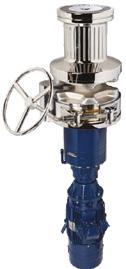
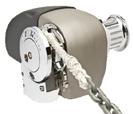


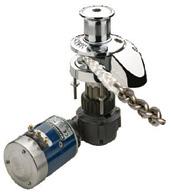

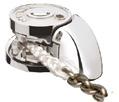
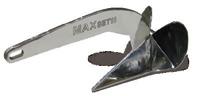
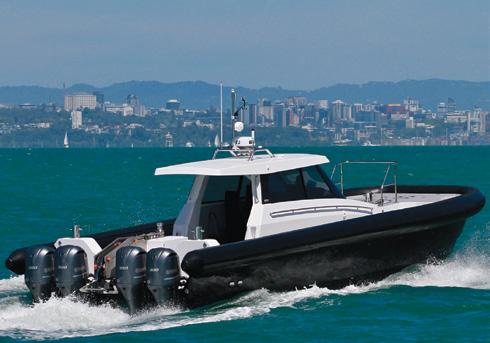
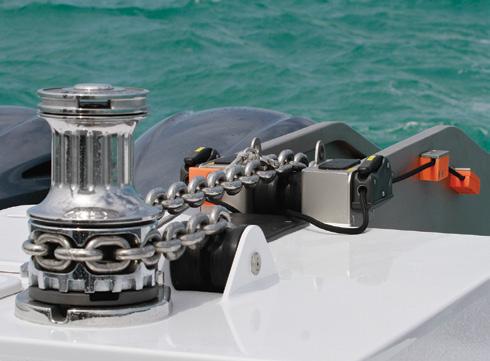
The penultimate Fiord on your journey south is Chalky Inlet, the name first appearing on Jules de Blosseville’s 1823 chart, named after the very obvious chalky (limestone) cliffs of Chalky Island, which you will see as you sail in. There are two anchorages known locally as South Port, or Lee Bay, and North Port. South Port is a good anchorage if the weather is from the South-Southwest, and North Port is good if weather is from Northerly quarter. In North Port make the effort to visit the hulk of the SS Stella, it was scuttled here in the 1940’s as a platform for a fish processing plant. Unfortunately, it rolled to starboard as it settled rendering it more or less unusable. SS Stella was a government vessel used to service the lighthouses and transport expeditions to remote places like Fiordland and is a piece of New Zealand’s maritime history.

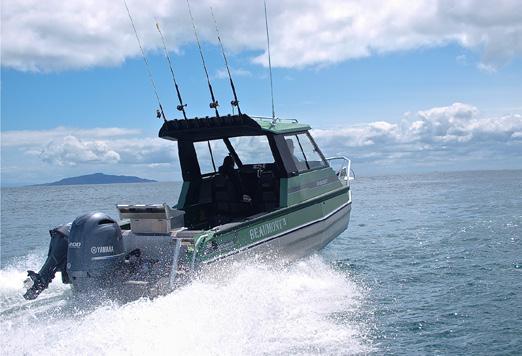
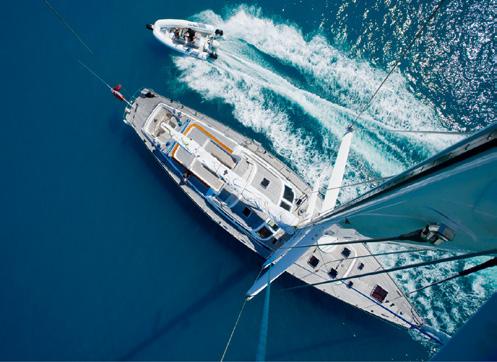
KEEPING THE WORLD ANCHORED SINCE 1969
THE SINCE POWERBOATMAGAZINE.CO.NZ _ 83
www.maxwellmarine.com
www.maxwellmarine.com www.maxwellmarine.com
Taking our RIB up the Luna Luna River
The Wilson River Tramway is well worth a visit.
PRESERVATION INLET
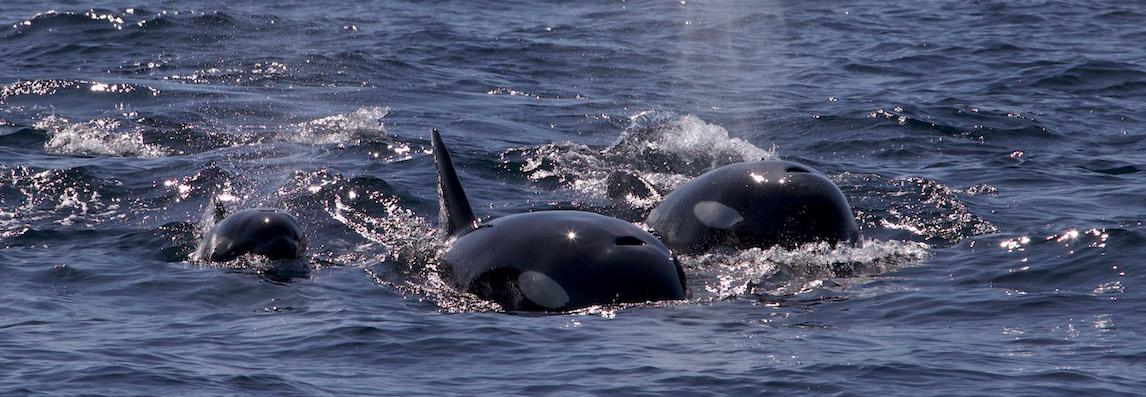
The voyage from Chalky Inlet into Preservation Inlet around Gulches Head is only a short distance, but it is potentially one of the roughest, so be prepared, it can be like being in a washing machine, but once inside Preservation Inlet there is a selection of first-class anchorages. Cuttle Cove is an historic anchorage and the site of the first land based whaling station, employing over 80 men at its peak in the late 1820’s. There is no physical evidence remaining, just a small plague on a rock. Two potential fishing villages, Dingwall and Cromarty were surveyed in 1869 in Preservation Inlet, but nothing came of either of until gold was discovered in the late 1880s. Miners flocked from other New Zealand goldfields to stake claims and set up businesses, including a hotel, a school, a post office and homes at Cromarty in Kisbee Bay. There were four quartz or hard rock mines established, the Golden Site in the Wilson River, the Alpha in Sealers Creek, the Morning Star at Te Onera and the Crown at Cuttle Cove. Significant mining relics remain at two of the remotest sites, the Alpha Battery and the Golden Site. It is a long (but rewarding) day to follow the old tramway into the Wilson River and the Golden Site mine. The Alpha battery is harder to find and not easy to give directions to. Many of the alluvial miners did well with the largest reputed nugget weighing over 30 ozs (850 grams) being found at Moonlight Point on Coal Island. Perhaps the most audacious mining enterprise was the establishment of the Tarawera smelter in Isthmus Sound in 1896. The reclining brick chimney is all that remains of this mine and smelter, which was a complete failure. Saw millers were quick to establish mills in the area, providing much needed timber to the mining community as well exporting timber to Invercargill. Relics of the sawmilling era can be found at Cromarty, South Port in Chalky Inlet and at Harries Bay. A trial shipment of coal was shipped to Dunedin in late 1872 from Coal Island, but the operation was plagued with problems and the mine was abandoned.
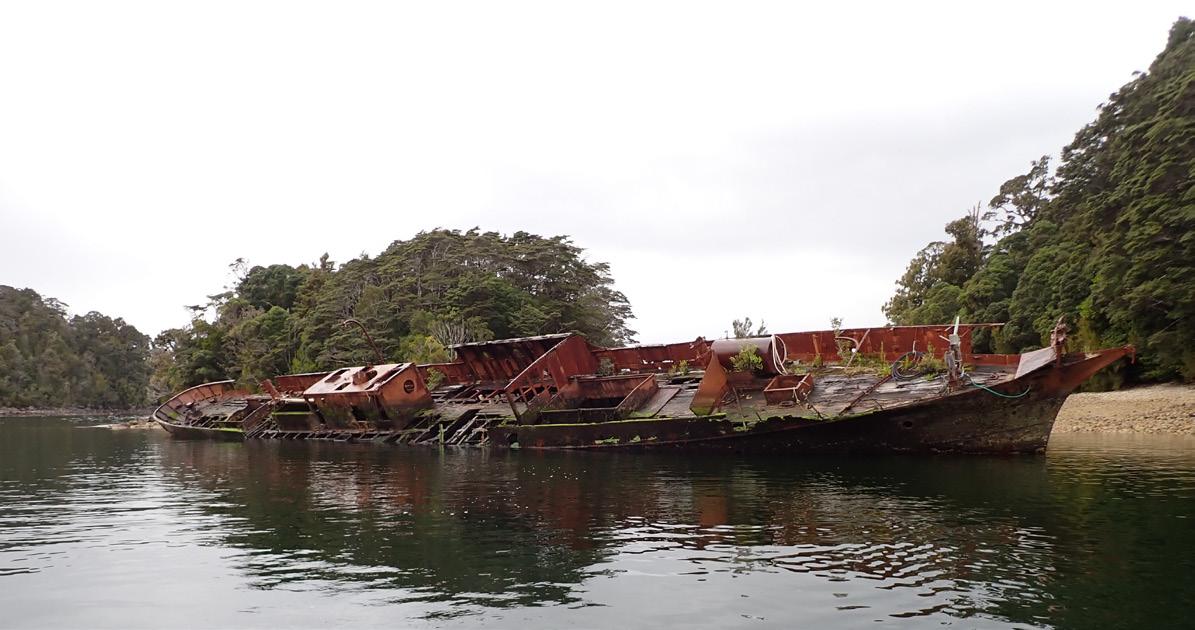
Apart from the mining and milling relics, perhaps most enduring evidence of this colourful period in the fiord’s history is a private hunting/fishing lodge built on one of the only remaining freehold sections in the village of Cromarty in Kisbee Bay; there are always caretakers in residence who welcome visiting yachties, it is a great place to catch up on the gossip and enjoy a cup of tea. Call them on channel 10 to make arrangements. A lighthouse at Puysegur Point has marked the southern entrance to Preservation Inlet since 1879, the lighthouse there today is not the original lighthouse, that having been burnt down by an arsonist (a disgruntled goldminer) tired of the light flashing in his hut window on nearby Coal Island. The present light is fully automated, the last of the lighthouse keepers leaving in the early 1980s. It is well worth a visit. Follow the old roadway/track from the Oil Store at the southern end of Otago’s Retreat; it takes one hour each way. The golden sand beaches of Spit Beach are a great place on which to finish a visit to Preservation Inlet and Fiordland. If it is too rough to anchor off the beach, there is a track from a small unnamed gravel beach at 46˚ 04 651 S 166˚38 912 E. The small island, marked on the charts as Spit Island, or Matauira, was the last stronghold of a Māori people known as the Kāti Māmoe, who had inhabited the South Island until they were challenged by a North Island tribe known as the Kāi Tahu. The battles were many, both fierce and bloody. A truce was evidently made between the two tribes but some of the Kāti Māmoe who refused to accept the truce retreated to this small island pursued by the Kāi Tahu. Both tribes sustained significant losses in the final battle, the outcome of which has been and will continue to be debated by historians
I believe that one thing that isn’t debateable is that these fiords are amongst the world’s greatest cruising grounds. I encourage you to explore them yourselves and then make your own opinion.
EXPLORING FIORDLAND PART 2
The wreck of the SS Stella in North Port.
Orcas kept us company on more than one occasion.
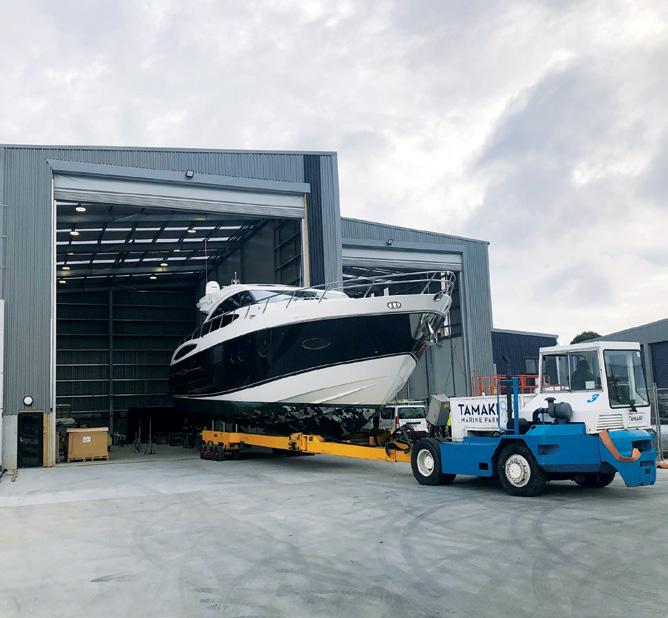
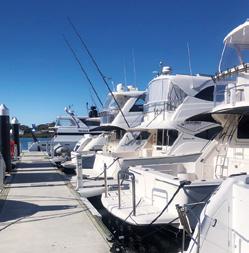
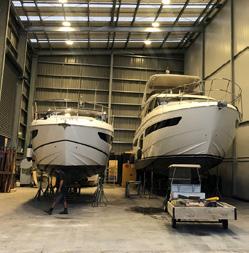
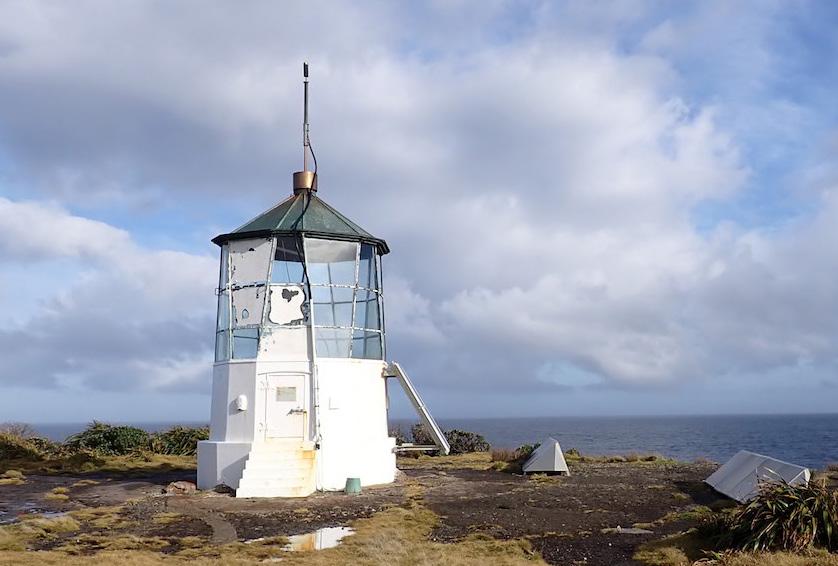
36 Gabador Place, Mt Wellington, Auckland. 09 534 8341 info@tamakimarinepark.co.nz www.tamakimarinepark.co.nz Contact us today for the latest boat yard specials and to book your next service. 20T and 60T haulout trailer (9m air draft limit) Covered and uncovered hardstand All trades available on site or DIY Onsite fuel supplied by GOfuel 270 berth dry stack boat storage 10-25m marina berths available Located 5 minutes off motorway at Mt Wellington; 20 minutes from Westhaven. MARINA, DRYSTACK, HAULOUT AND MARINE PRECINCT. POWERBOATMAGAZINE.CO.NZ _ 85
Lighthouse
Puysegur Point
OFFSHORE CAPABLE CRUISER
The S600 Offshore Motor Yacht is the first sedan model within the new generation of Offshore Motor Yachts from Maritimo and follows the M600, which was released earlier this year.
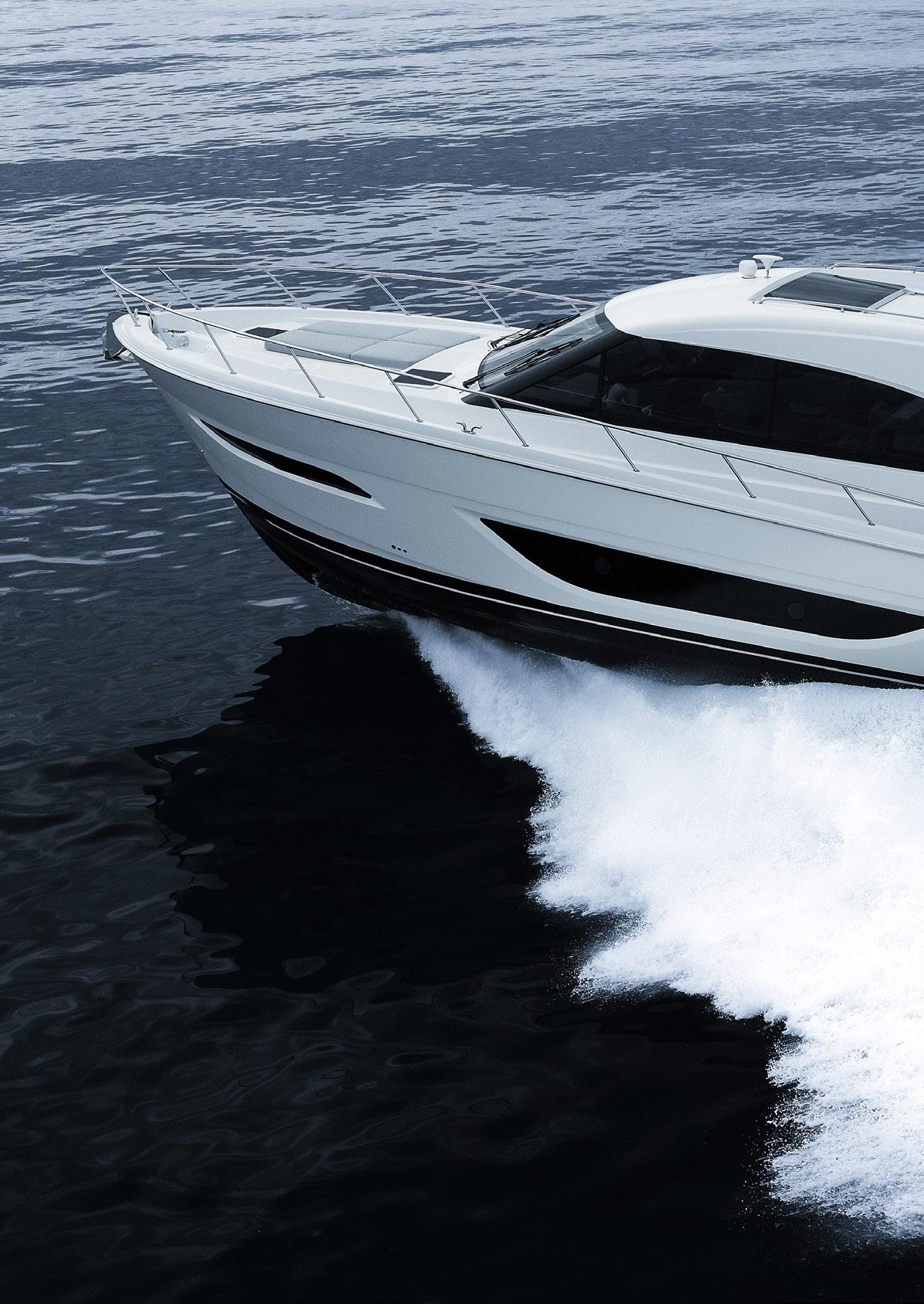
PACIFIC POWERBOAT REVIE WS _ MARITIMO S600 OFFSHORE 86 JANUARY / FEBRUARY 2023
WORDS BY BARRY THOMPSON
When you put a designation on a motor yacht that says it is offshore capable, you must be sure it is designed for purpose. While there are better boats to run across to Fiji or from Auckland to the Whitsundays, it has to be capable of handling the extreme seas we see along the New Zealand and Australian coasts.
As Managing Director Tom Barry-Cotter says, "The Offshore Series exemplifies everything that the Maritimo brand stands for – long-range cruising capability, industry-defining performance and economy, offshore seaworthiness and high levels of construction integrity.
He adds that the variable deadrise hull with deep keel, sharp bow entry and flattened progression aft has been focused on offshore cruising performance, comfort and stability."
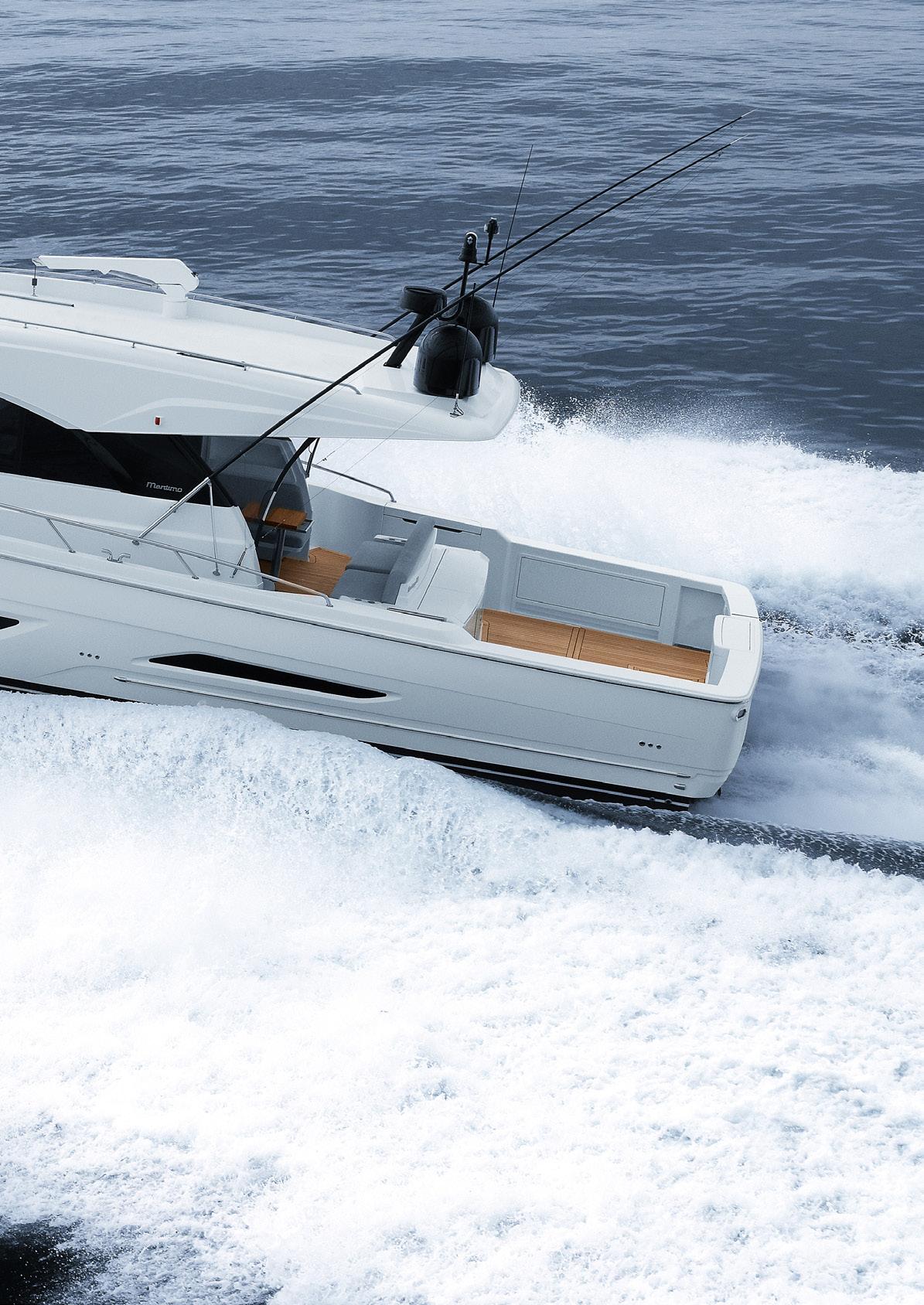
Earlier this year, I had the opportunity to review the M600 Offshore Flybridge Motor Yacht, the first in the new Offshore Series, it shares
the same hull and accommodation as the S600 but with a flybridge. In addition to its race-bred performance, engineering and robust design, the S600, like the M600, provide high levels of luxury. Maritimo has raised the bar regarding finish and presentation, which is becoming evident with all the new model releases I see. They seem to get better, with a tweak here and there, and today they are at the next level of finish. Quality also needs to be more than skin deep. Walking through the S600, opening cupboards, looking into storage areas and ferreting around the engine room, the places I usually only spend a little time looking at are as meticulously finished as what you see outside.
This was a significant change from several years ago when the Maritimo brand didn't have that extra panache they have now. Under the tutelage of Tom Barry-Cotter and his team, Maritimo has undoubtedly stepped up on the world stage to be a highly respected brand.
The S600 runs 32-35 knots depending on your power options.
POWERBOATMAGAZINE.CO.NZ _ 87
powerboatmagazine.co.nz
COCKPIT
The cockpit of the S600 Offshore Motor Yacht is designed primarily for fishing and is offered with or without a full boarding platform. You can choose a fixed platform, a high-low platform or a fixed teak slatted style for those into game fishing but still want a platform. It's your choice. There is a central live bait tank/or storage locker, plus a starboard transom door access. The lower cockpit has been kept clean and sans any furniture, so the entire 10.2sqm floor space is dedicated to fishing. The cockpit with the fully enclosed transom makes the S600 Offshore ideal for those with varying fishing interests or any that embrace the encapsulated deck space with solid separation from the sea. If you are into entertaining and who wouldn't be on a boat like this, there is a handily placed fridge/freezer, sink unit and bbq mid-cockpit. Integrated into the cockpit space are large wing lockers, transom wells, in-deck fish boxes, enclosed transom gate, rod holders, and flush gunwale capping. There is a place for everything. Beneath the cockpit floor is a cavernous lazarette
storage area, accessible by a day hatch or a large electrically actuated opening for gaining access to store large items such as paddle boards, kayaks, a tender or diving gear. If you want to increase the range of your S600, then long-range tanks can be installed in this space, and there is still an extra large area left for all your toys.
The aft deck space offers two distinct cockpit areas; the upper mezzanine lounge and entertaining cockpit, sheltered from the elements by the extensive moulded hardtop headliner, and the offshore cockpit, with a heavy consideration of fishing functionality.
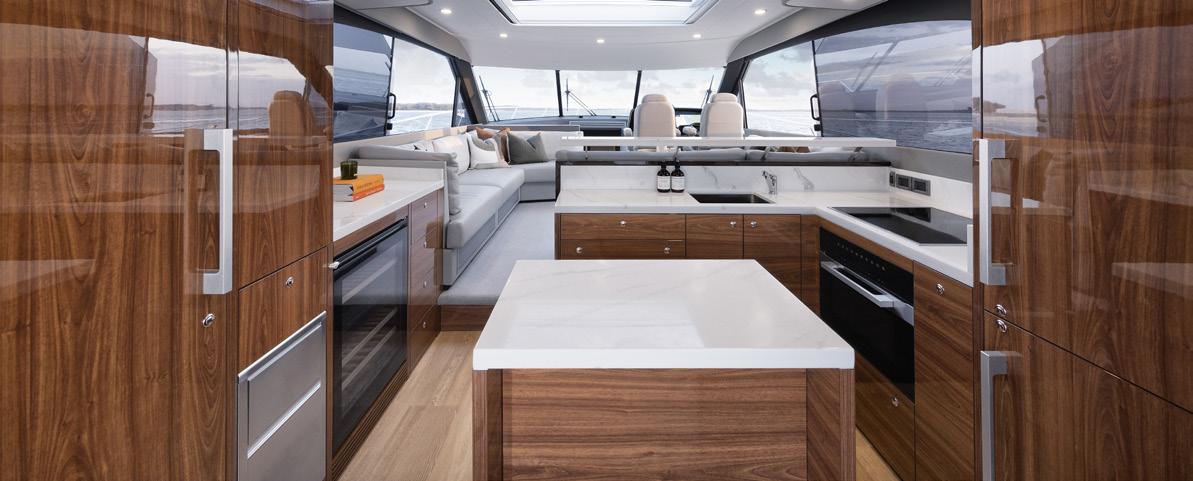
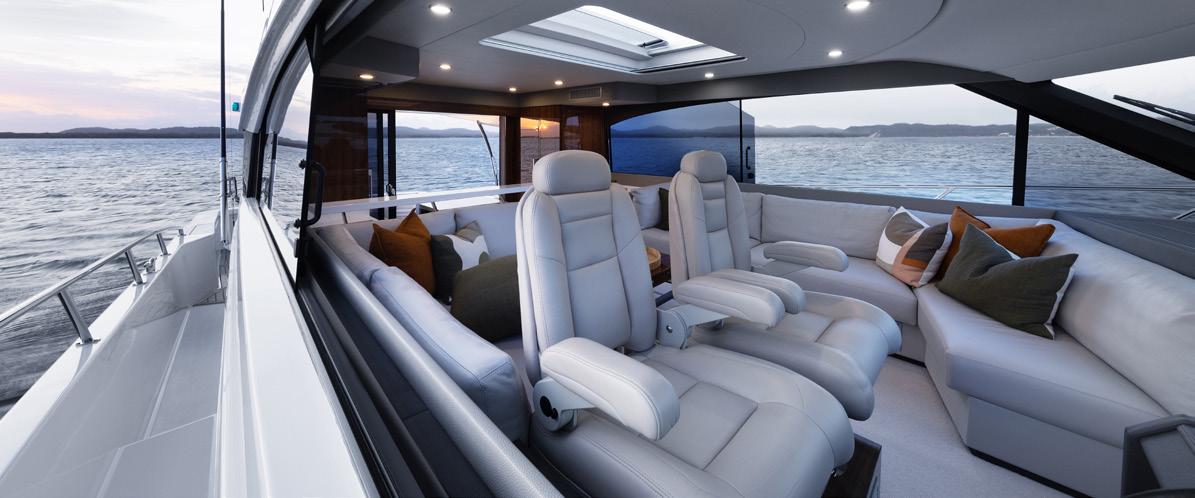
The upper lounging cockpit space offers 9.2m2 open deck and lounging space, all protected from the overhanging upper utility deck. Seating layouts in the upper lounge are optional. However, a rear settee with two smaller loungers forward and a folding table is popular. Just the right place to have a few coldies or relax and keep an eye out on the kids in the water or the fishing action.
If you need to go forward, the bulwarks are broad and deep, a signature aspect of every Maritimo. They lead to a forward entertainment deck, complete with a day bed.
A view of the saloon through the vista windows.
PACIFIC POWERBOAT REV IE WS _ MARITIMO S600 OFFSHORE 88 JANUARY / FEBRUARY 2023
The island counter is a trademark Maritimo.
UTILITY DECK
Maritimo is renowned for breaking the status quo, and the S600 is a perfect example. They have utilised the sedan hardtop by way of transforming it into a functional utility deck space. Access is from the upper cockpit deck via an overhead hatch and ladder. The hardtop has been designed and engineered to be capable of carrying the weight of 350kg davit and tender, freeing up the rear of the boat greater versatility from the offshore cockpit. The hardtop utility deck can also store large items, such as kayaks, paddle boards or life rafts, for adventuring enthusiasts. It extends well back over the mezzanine deck, adding extra protection, especially when the clears are added. Forward is a sliding sunroof.
SALOON
There is seamless access via either siding or bi-fold doors between the mezzanine cockpit and the saloon, which has the traditional Maritimo aft galley with an optional island counter. Maritimo has ensured that the galley storage areas are of household proportions. After all, if you are going on a cruise for a month or
more, you need plenty of storage for your food and drinks. There's an integrated fridge/freezer, washing machine, trash bin, wine cooler, hob, icemaker, and pantry, plus loads of storage under the composite bench surface.
The transition from the galley to the saloon is just one step, and the first thing you are struck by is the natural light radiating from huge vista windows and a sunroof. The two-stage Vista windows are another trademark of the Maritimo S range of motor yachts and, when open, give you a great sense of being connected with the environment.
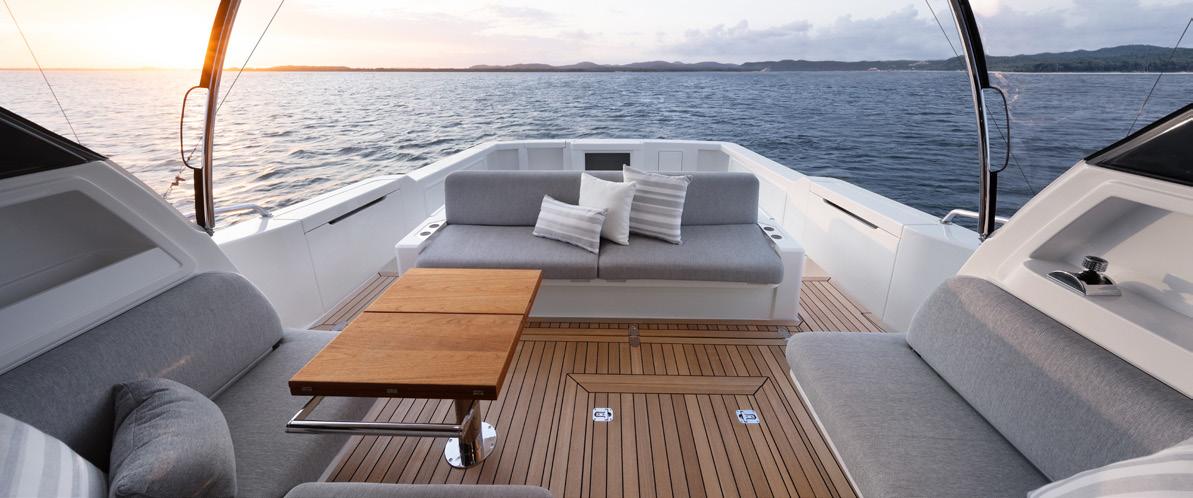
Maritimo has divided the upper saloon space with a starboard helm and a lounger on either side. The helm is impressive, with a pair of Garmin 22 screens flanked by all the associated controls and electronics. This is the owner's choice, so you can make this area as straightforward or as busy as you want it to be.
ACCOMMODATION
Access to the accommodation area is via an atrium-style staircase, which radiates a lot of natural light down the stairs. Below decks, the luxury accents are continued. There are three spacious staterooms
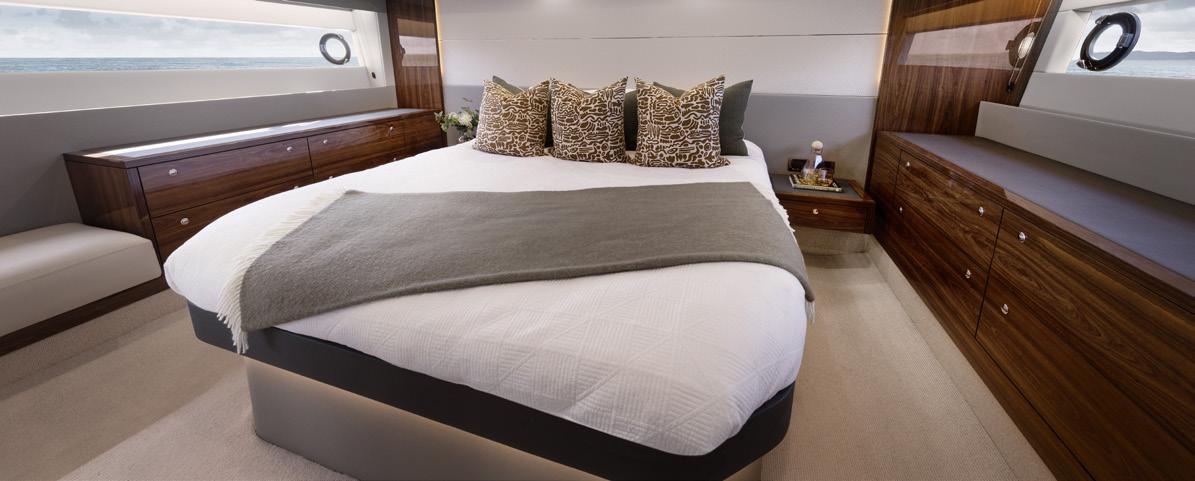
The mezzanine deck is well protected overhead.
The full beam master has huge hull windows.
POWERBOATMAGAZINE.CO.NZ _ 89
and two ensuites, with a full beam king master bed in the aft stateroom, an offset queen in the forward VIP and a pair of single berths than can slide together in the starboard guest's cabin. The offset berth means you utilise the space around the bed better, and it is more accessible from a flat floor, both when used and when making it up.
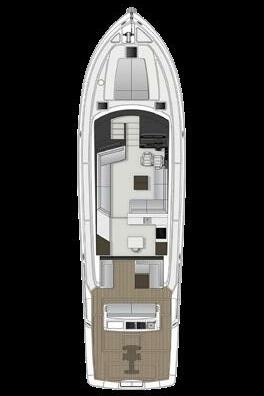
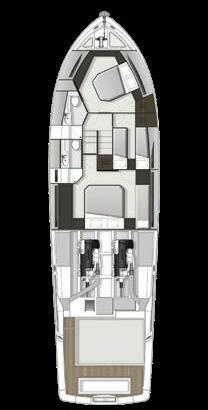
The cabins have large side windows with portholes, plus individual zoned air conditioning. Maritimo offers a variety of layouts in the master stateroom, where the starboard side storage unit can be replaced with a chaise lounge, a make-up vanity or even a small office. Maritimo has done a great job creating freeflowing spaces that best utilise the hull's enormous volume, maximising the 1.95m height and minimising the number of steps in the floors and the ceilings. Plus, if you don't want the third cabin, you can option this as a utility room or a gym. Again the choice is yours.
PERFORMANCE
The new S600, like all Maritimo models, is shaft drive, a system that Maritimo has focused on since the brand's inception. Their dedication to the development of shaft-driven technology has positioned the brand as one of the world leaders in shaft drive performance and long-range cruising.
The S600 offers several engine options, with Volvo Penta D13 as the standard package.
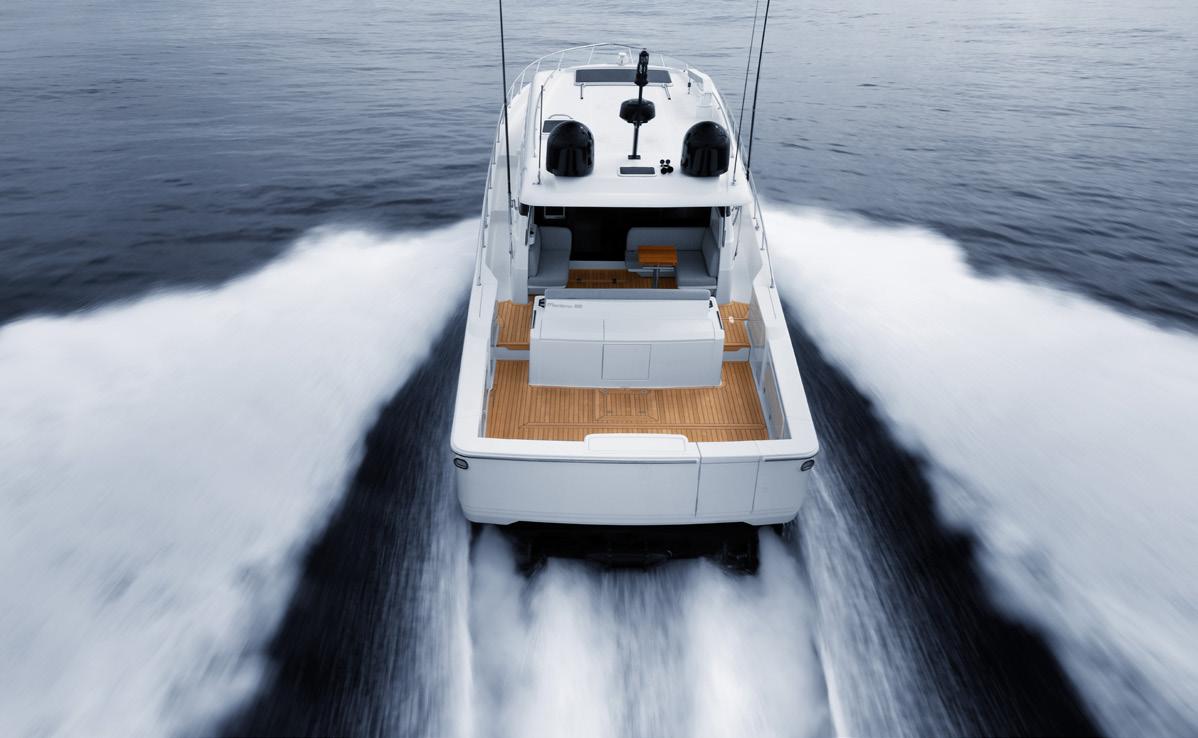
You can expect around 30 knots with a pair of 800s, but you can choose other engines from Volvo Penta or Scania, up to 1200hp. In our case, we had a pair of Di13 900 Scania's, which topped out at 32 knots. Drop in a couple of 1200s, and you will see better than 35 knots on the speedo. Cruising efficiency and capacity combine to give the S600 exceptional long-range capability with a 4550 litre fuel capacity.
CONCLUSION
Maritimo's Offshore Series attracted a lot of attention when it was first announced in 2021, and the S600 Offshore Motor Yacht, like its predecessor, the M600, has been an instant success. Sales have been strong locally and overseas, with the US and Australia particularly active. The S600 combines Maritimo's latest design and engineering ideas and encapsulates them into a superbly built and beautifully presented sport sedan motor yacht. And let's remember that the offshore designation is an extremely important aspect of the S600 Offshore.
I have always been a big fan of sports sedans, and the Maritimo S600 ticks all the boxes for me. With its offshore cockpit and hardtop utility space, the S600 has a broad appeal both as a highly functional fishing vessel, with its speciality open water fishing attributes, and as a long-range, low height, high volume,
A big expansive cockpit is a real feature of the S600. PACIFIC POWERBOAT REVIE WS _ MARITIMO S600 OFFSHORE SPECIFICATIONS Model Maritimo S600 Offshore Year Launched 2022 Priced From AUD $3,293,999 Type Sport Sedan Motor Yacht Construction GRP Composite LOA 18.62m Hull Length 18.43m Beam 5.23m Draft 1.52m Displacement 32600 kg Std Power 2 x Volvo D13-800hp Opt Power 2 x Volvo D 13-1000hp 2 x Scania V8 Di16-1200 HP Max Speed 30-35 knots Fuel capacity 4550 litres Water Capacity 750 litres Generator Kohler 15kVA MFDs 2 x Garmin 22” Controls Twin Disc Watermaker Indromar Gyro ARG Tohmei Tabs Bennett Boat Manufacturer Maritimo Offshore Motor Yachts Contact MARITIMO.COM.AU PERFORMANCE DATA: 2 X VOLVO D13-800HP RPM Knots L/h L/NM Range (NM) 650 7.2 11.0 1.5 2680 900 9.3 32
1190 1100
1300
1500
Fuel range
reserve. 90 JANUARY / FEBRUARY 2023
luxury motor yacht.
3.4
10.6 60 5.7 723
12.1 103 8.5 481
15.7 140 8.9 459 1700 20.4 176 8.6 475 1900 24.3 226 9.3 440 2100 28.1 290 10.3 397 2300 32.1 336 10.5 391 Note:
is based on 10%
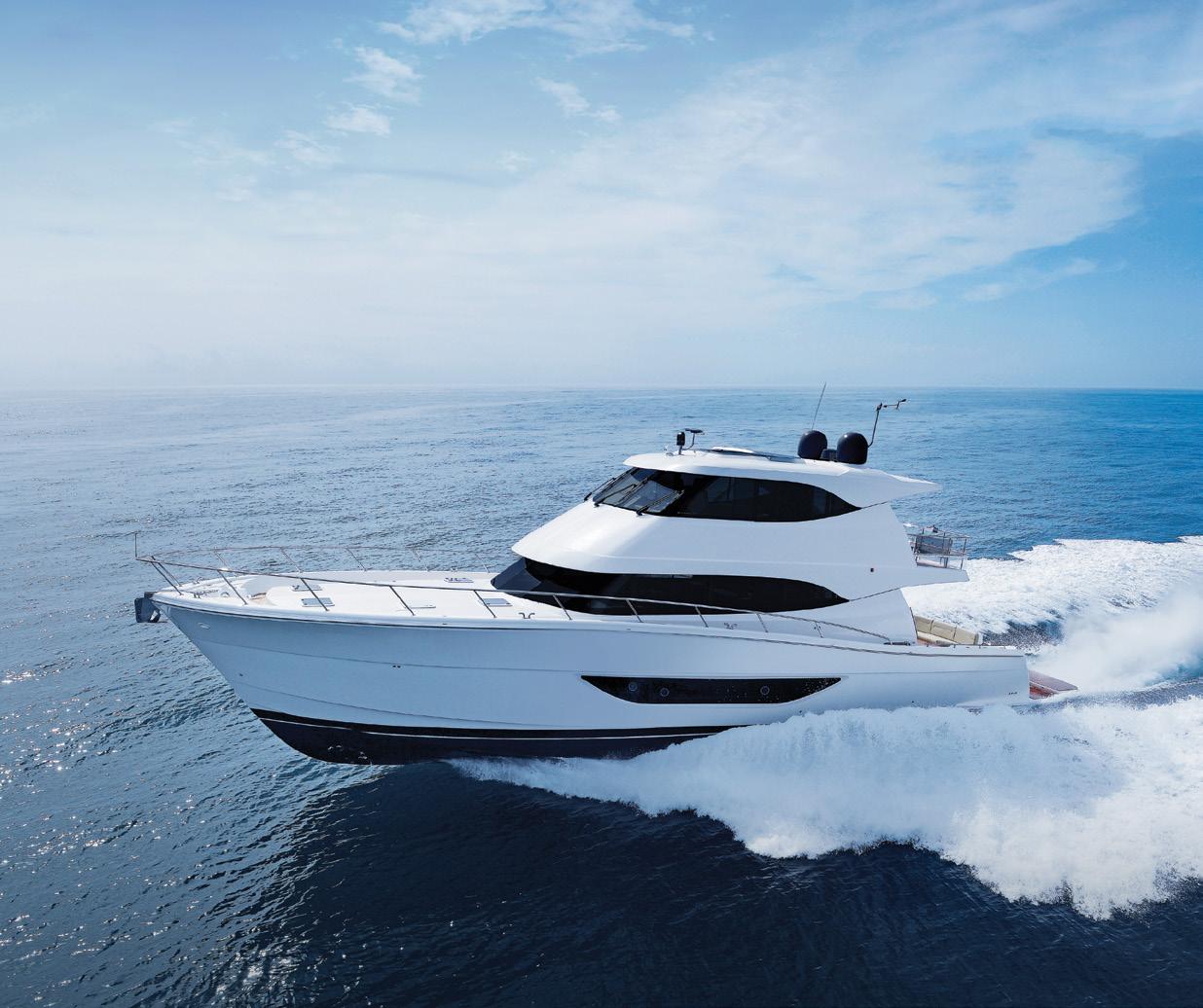



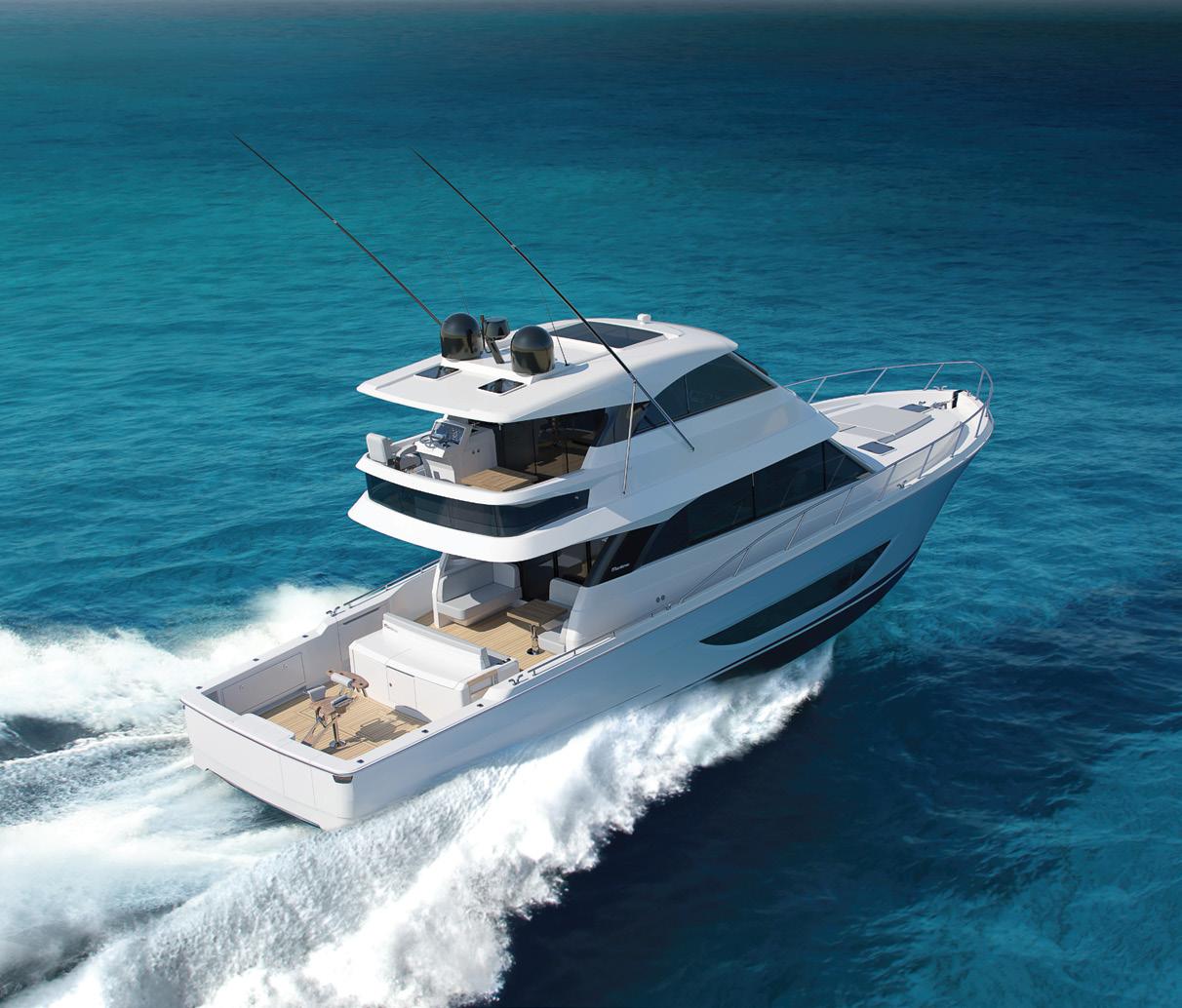

SUPPORT, SERVICE, REFITS. Clearwater Cove, Hobsonville Marina, West Harbour, Auckland, NZ. info@motoryachtservicecentre.co.nz MOTOR YACHT SERVICING & CUSTOMISATION Engine Servicing Boat Building Hull Extensions Gyro Installations Electronic Upgrades Custom Stainless Timber Work Gel Coat Repairs Interior Fit-Outs Upholstery Upgrades Valet Services Anti- Fouling Painting AGENTS FOR: CALL +64 9 416 1179 OR +64 274 725 242 MOTORYACHTSERVICECENTRE.CO.NZ • Allow crew and guests to move around safely and enjoy themselves. • Provides a comfortable setting for dining and entertaining. • Sleep in comfort at the dock or anchored out. • Keeps your vessel steady when docking. Effective at trolling and at ‘zero’ speeds. • Less maintenance means more time to fish. Easy to use, just flip a switch. Improves fuel efficiency. re d u ce At anchor and underway your boat roll re d u ce At anchor and underway your boat roll For Luxury Yachts, Trawlers and Sports Fishers There are over 3000 installed worldwide MARITIMO WARRANTY AND SERVICE AGENT POWERBOATMAGAZINE.CO.NZ _ 91
An Offshore Adventure
Around March 2022 several situations came together to trigger a decision to take on a boat trip to Fiji. These included having the boat I was comfortable with, having recently completed and enjoyed a 6 week round the North island trip. Good friends Doug
and Miriam Godfrey encouraged me to join them on their Fiji adventure, as they planned to meet family there, who were completing a 4 year round the world sailing adventure. Departure was planned for mid - July. There was much to do and little time to do it.
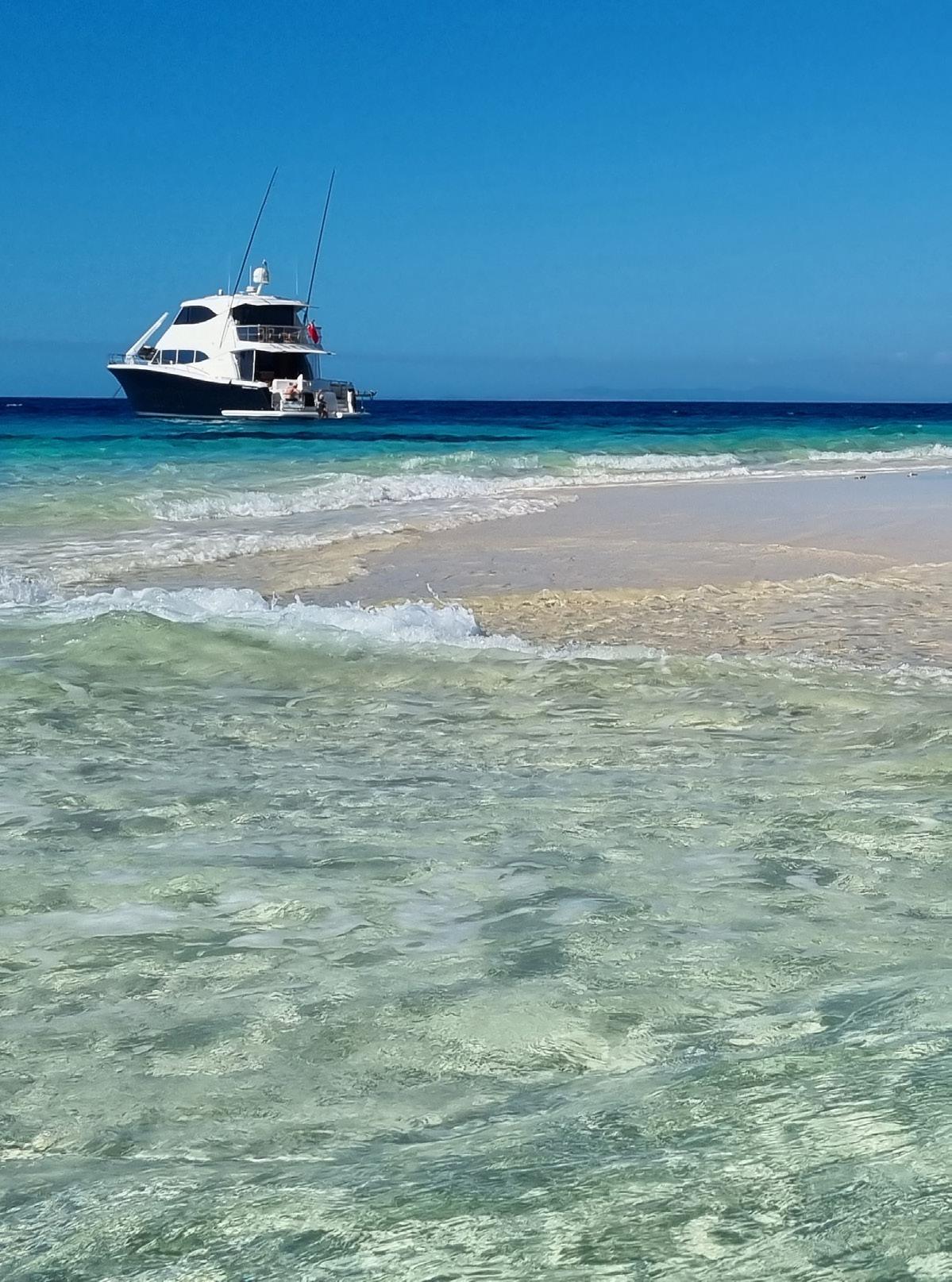
Experienced motor yacht owner, Leigh Hopper gives a personal perspective and insight into venturing offshore on a recent trip to Fiji in his Maritimo M70.
92 JANUARY / FEBRUARY 2023 HEADING OFFSHORE _ LEIGH HOPPER'S PERSPECTIVE
“Under section 21 of the Maritime Transport Act, a Master of a pleasure craft must notify the Director of Maritime NZ of their intention to depart NZ before they leave. Additionally, they must also:
Satisfy the Director that the vessel and its safety equipment are adequate for the voyage.

Satisfy the Director that the vessel is adequately crewed for the voyage.
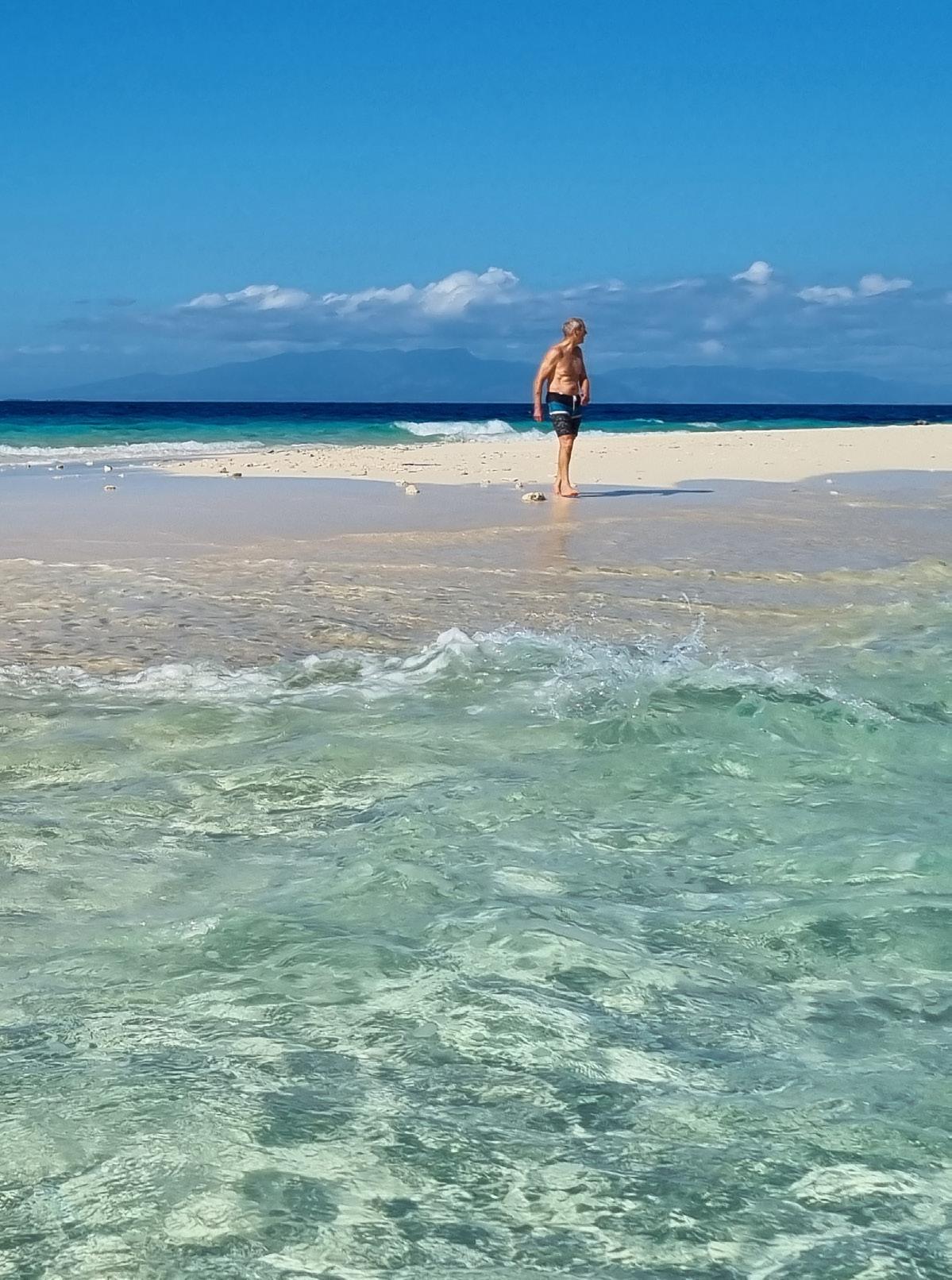
Observe any other relevant maritime rules.
All NZ registered vessels must undergo a safety inspection prior to departure to obtain a Category 1 safety certificate. The inspection will focus on:
The design and construction of the boat being suitable for the voyage and meting the required standards.
The safety and communications equipment meeting the specific requirements and ensuring all safety equipment is well within its for emergency situations. expiry date.
The skipper and crews’ ability to undertake the proposed voyage safely and demonstrate preparedness
The decision on whether to grant section 21 clearance is made by the Director or their delegate (i.e. a yacht inspector). In addition to the above requirements, all vessels must be registered as a New Zealand ship with the Registrar of Ships at Maritime NZ (MNZ).” (extract from MNZ’s web site, MARITIMENZ.GOVT/RECREATIONAL/ THE-BASICS/GOING-OVERSEAS.ASP#CAT_CAT1 ) A flow chart of the process is also on the website and is a helpful tool to chart progress.
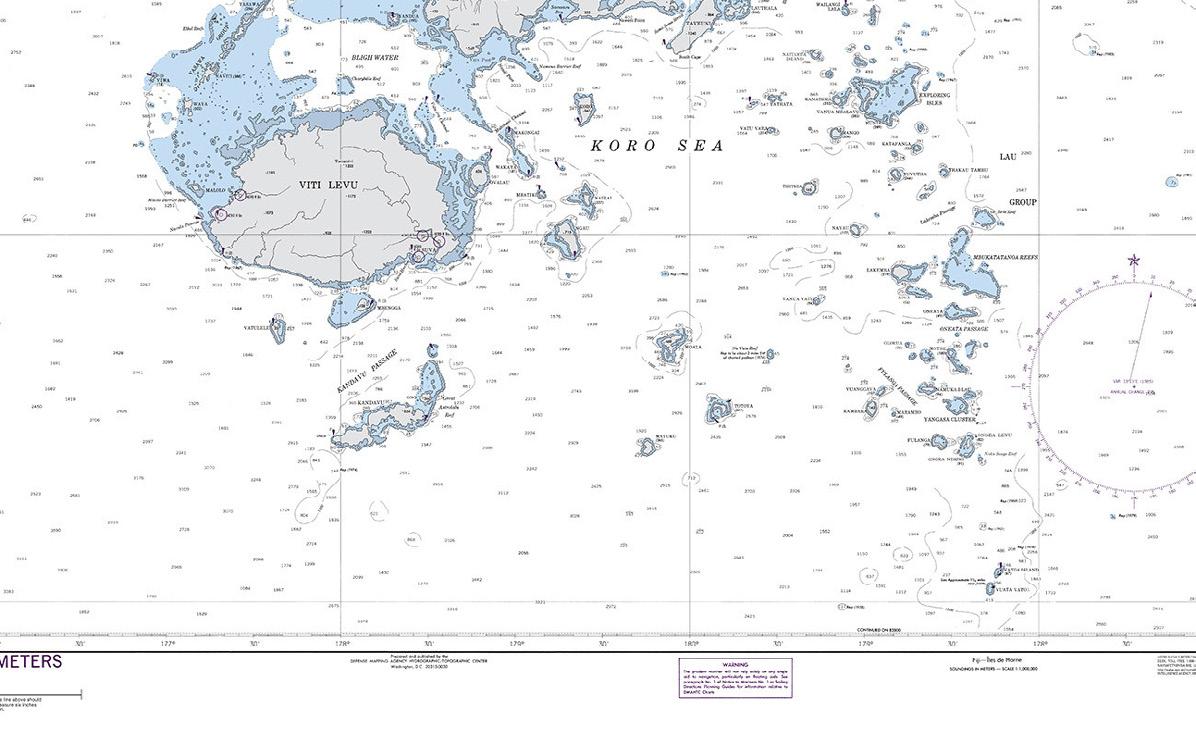
POWERBOATMAGAZINE.CO.NZ _ 93
SETTING UP THE BOAT
My vessel is a Maritimo M70 launch named Moon Shadow. She has the pedigree for offshore but did not meet the strict requirements of Cat 1. In early March, Dean Ryder and his team at Motoryacht Services in Auckland were on the case adding the deficient elements which included amongst other minor items;
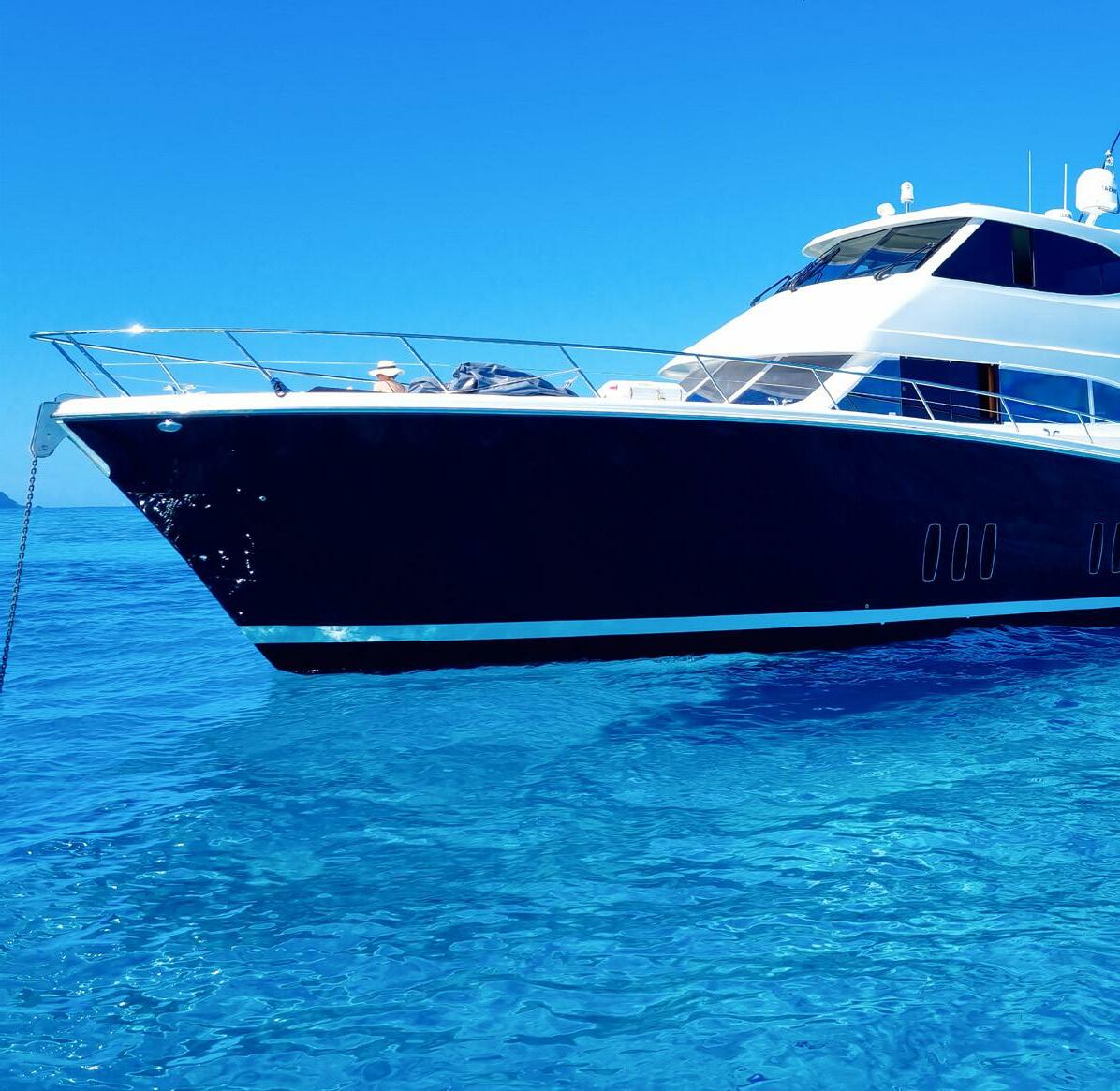
• A Tohmei ARG gyro.
• Fixing of a 6-man life raft.
• Recharging fire extinguishers where necessary.
• Manufacturing and fixing perspex shields to the saloon windows.
• Checking, repairing and fitting extra fuel bladders and associated pumps and hoses.
• Communication systems.
While on the hard it was also appropriate to check underwater items such as shaft seals, rudder seals, trim tabs, anodes, condition of skin fittings, and condition of antifoul. In our case and intending to be away for three months a clean bottom would be required for re-entry. Topside, everything needed to be checked and all maintenance items addressed. Any minor failure in the anchor winch or crane would have been a pain in the proverbial, as they were used so many times each day and we would cover more than 4000 nm over the three-month trip.
With 500 engine hours likely, extra oil was stored in 20 litre containers. An oil change and filters were carried out on the engines while in Fiji, Not for the unfit in the heat of the engine room in tropical Fiji.
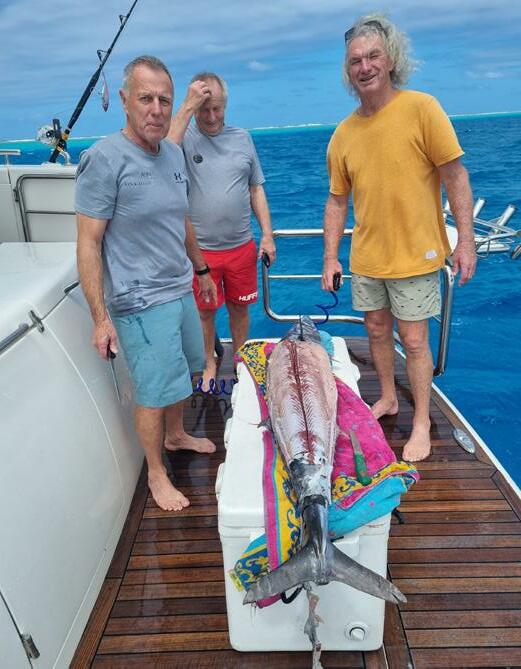
94 JANUARY / FEBRUARY 2023 HEADING OFFSHORE _ LEIGH HOPPER'S PERSPECTIVE
PAPERWORK
Insurance for offshore seems difficult to arrange within NZ. Pantaenius Australia Pty Ltd provided cover for the NZ and South Pacific regions. Premiums are generally higher but so are the risks navigating around the tropics. Much of the areas we covered remain uncharted or are simply mapped incorrectly. A 12-month policy and premium are a significant outlay, but rebated pro rata months used for the south Pacific component. Small Ship (under 24 m) Registration is required. This involved an application to the Registrar of Ships in Wellington. I also needed to supply a certified notice of deregistration of Moon Shadow X in Australia from where I had purchased her. A strict measurement of the vessel was required, and the certificate was duly issued with a registration number. Given other NZ vessels held the name Moon Shadow an X was added to differentiate. A modem was added to the VHF to enable ship tracking (AIS), Iridium Go acquired and set up with Predictwind subscriptions and downloads for satellite comms.
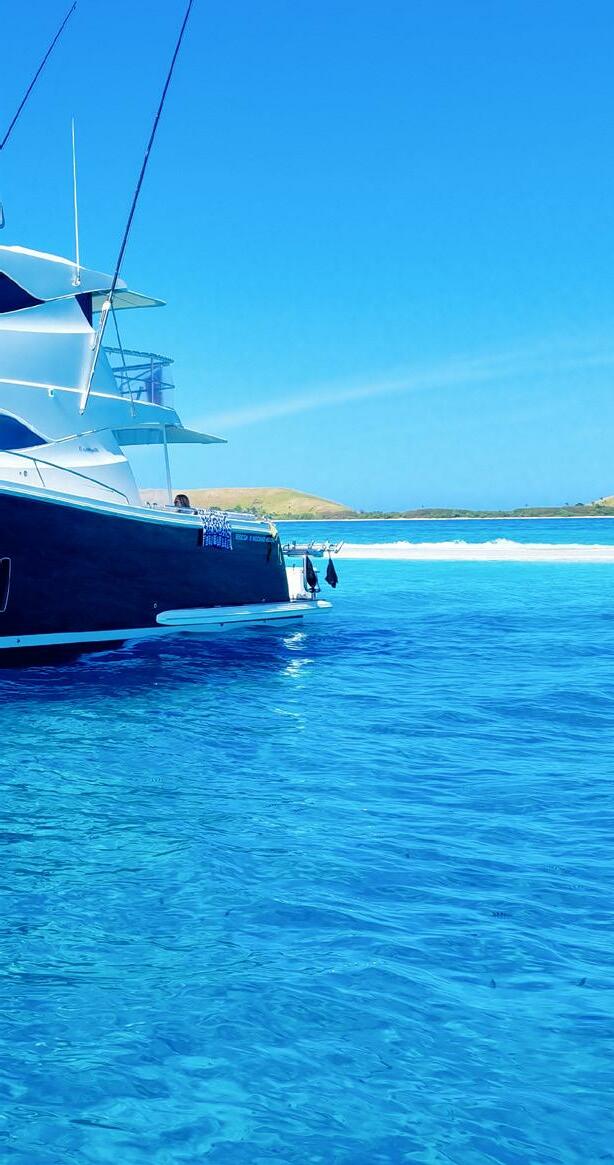
A registered yacht Inspector was engaged to vet the vessel and her crew. Half of the crew is required to hold a “Safety at Sea” certificate (a 2-day course) and one (myself) the “Offshore Medical” certificate, also a 2-day course.
Moon Shadow was back in the water a week prior to anticipated departure and I took her directly to Marsden Cove being a Customs “Port of Entry”, handy to the crew and provisions. Monitoring Predictwind indicated a window of suitable weather for our planned 4-day trip to Minerva Reef. A departure date was set. The crew included my son Gray and his keen Northland fishing mates. Plenty of time was available to stow their considerable gear, fill our 6,300 litre tanks and an additional 1000 litres in a gunwale bladder for extra measure. As it transpired, we didn’t need the extra fuel but being the first trip, it provided an extra level of comfort, and I was mindful it may take several days to pull this crew away from fishing and diving Minerva Reef.
POWERBOATMAGAZINE.CO.NZ _ 95
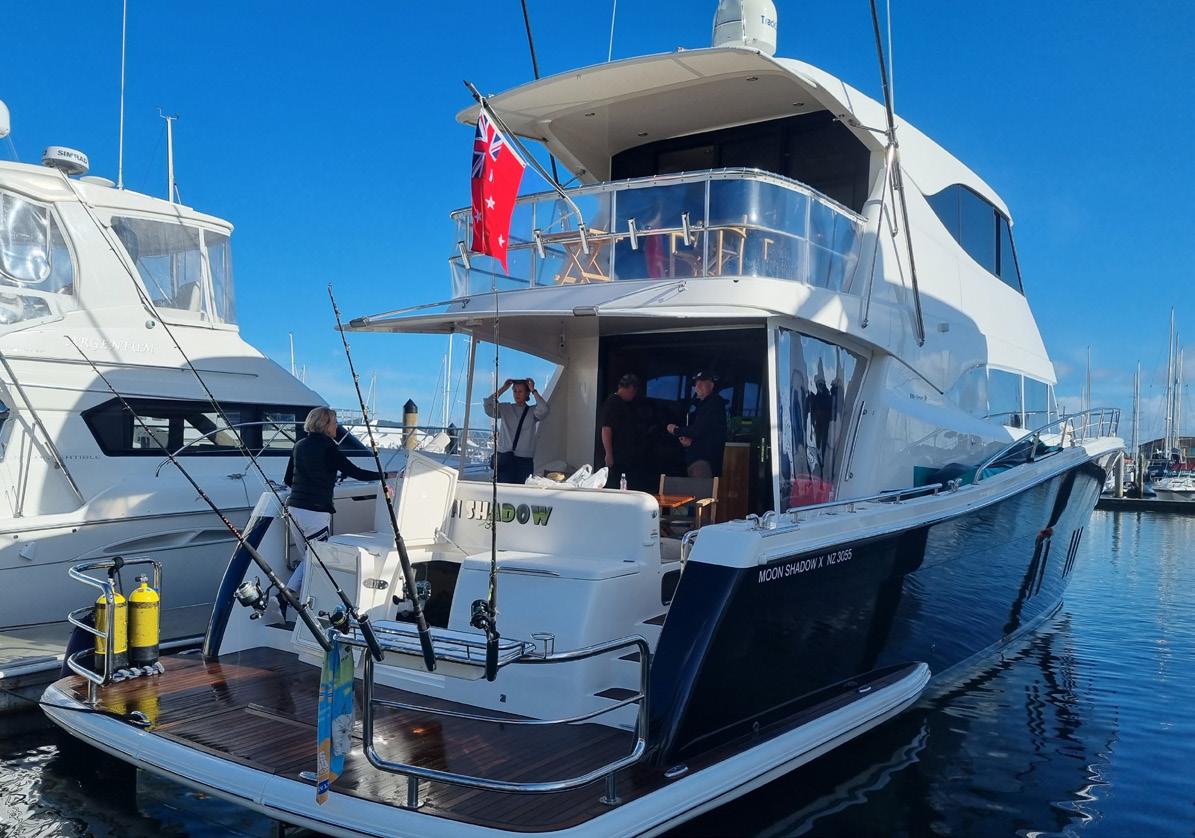
information,
273 9180 DB884 96 JANUARY / FEBRUARY 2023 HEADING OFFSHORE _ LEIGH HOPPER'S PERSPECTIVE
For more
contact: sales@tenob.co.nz 0800
DEPARTURE PAPERWORK
There is plenty of information required to be submitted. I kept electronic and hard copies of everything. You will need it for each boarder.
“Advanced Notice of Departure” (AND) which essentially discloses salient information of what and who is onboard including critical communications information.
Completed Certificate of Clearance Craft Registration
Cat 1 Certificate
Passports
Departure is required immediately on clearance, we set off loaded and well prepared.
Predictwind, through the Iridium satellite communication system enabled regular and reliable weather information to make course judgements and anticipate what was ahead. Iridium also enabled phone calls, txt and basic email service. We maintained daily discussion on the weather outlook with a land-based contact in Auckland and a call to my wife Linda as a conduit of the crew and followers on What’s App. Comforting for her also... I’m sure, I think?
It’s a six-day transit to Fiji via Minerva at 8.5 Kts. The last two days approaching Minerva were a little lumpy with 20 to 25 knot beam seas on a 3 to 4m short swell, thankfully softened by the ARG Tohmei gyro.
Minerva loomed up on the horizon, so the game gear was deployed regardless of the less than desirable condition for fishing. A ShortBilled Marlin was hooked within two minutes. Sixteen gamefish, mostly Yellow Fin tuna and Wahoo were hooked, released or taken by sharks, within 60 minutes of arriving at the reef. Four days were spent at Minerva South and North in beautiful conditions in the shelter of the reef. The crew had a ball fishing and diving in 30m visibility. Minerva is quite an experience. Prior to departure the services of Yacht Help Fiji were contracted to assist with clearance into Fiji. An Advanced Notice of Arrival (ANA) was required including similar information on boat and crew as sought for departure from NZ. Our 48-hour notice of arrival was given to Yacht Help over the Iridium. A VHF call to Denarau Marina directed us into a berth for the ensuing clearances;
Biosecurity Customs
Financial reporting
Quarantine
Food Safety
Immigration
All undertaken in the usual friendly Fiji fashion, our Certificate of Clearance was issued. Fees apply. The crew departed back to NZ and Linda arrived via the 3-hour transportation versus the 11-day option. The following six weeks were spent with rotating groups of friends and family in glorious conditions in the Yasawas and south to Momi Bay, snorkelling, diving with Mantarays, meeting locals and other boaties, including a lovely day with the locals of Hawini village at the northern tip of the Yasawa’s who prepared a scrummy lovo. We were discovering and fine tuning each leg for maximum coverage and enjoyment, meanwhile we heard nothing but bad news about the weather back home. So sad. Yeah right. Provisioning proved easy and reliable with the help of Farm Boy who would assemble the provisions required and deliver via ferry services anywhere throughout the Yasawas. Local produce is also
WHATEVER LIES AHEAD... THOUSAND REASONS, ONE PARTNER THE WORLD’S LEADING BOAT INSURER! POWERBOATMAGAZINE.CO.NZ _ 97
available at Musket Cove and Nanuya stores. Denarau has all you need but seldom an available berth so many anchor outside the entrance and tender ashore as required. Preparation for the return journey was not so arduous but still required a couple of hours on the computer filing another ANA and Inwards Small Craft Report for NZ prior to departure. I did however manage to stuff-up by submitting to the wrong email address. The correct address for all notices is yachts.yachts@customs.govt.nz.
A Fiji Customs office is 50m from the Denarau fuel dock so during the 4 hours it took to refuel (on the slow pump) we were able to arrange a departure time that dovetailed with the new crew arriving on a flight from NZ and deal with the departure documentation. Fiji departure processes were relatively simple and quickly executed. The crew were in and out of Fiji in 1 hour. Vessel and crew requirements are not as stringent coming home as vessels come from all corners of the globe and I imagine it is not possible to impose NZ standards on departures to NZ. I have no doubt they will receive the same search and rescue service in the event of need however. The return crew comprised four mates
who also demanded a diversion to Minerva, and they were not disappointed as the full freezer of Tuna and Whaloo would soon indicate.
The 4-day journey from Minerva to Marsden Cove began with 15-20 knot beam seas but eased to a pleasant aft wind and finally light head winds, exactly as predicted from the outset. One small hiccup…the Iridium connection failed or rather I failed to take account of the termination date on the SIM Card and could not activate a new card outside internet coverage. We did manage to get out a 48-hour arrival time to a Marsden Cove Customs agent who would have been monitoring our progress tracking the Automatic Identification System (AIS) to within cell coverage.
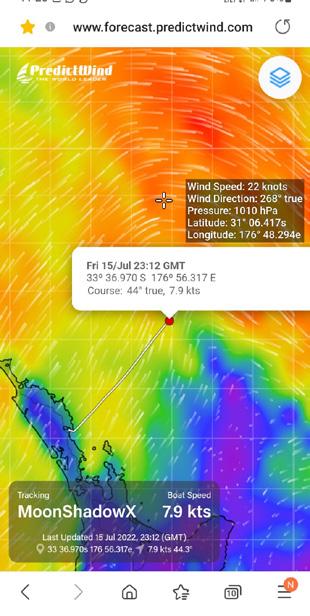
Marsden Cove is a very convenient Port of Entry given we were heading for home port of Whitianga Waterways. Once cleared by the friendly MPI and Customs agents we off loaded a bilge load of the outbound crews gear and hightailed it to Whitianga arriving to happy wives, family and friends all standing on the dock outside the house.
A party ensued.
In summary, there is much to do in undertaking an offshore adventure. The
decision to do so should be well in advance of a departure date, probably 6 months, it’s surprising how time flies in preparing for a first trip. The amount of information to be provided for both departure and arrival is extensive. The hard copy of vessel info, online documentation, issued certificates, comms data, insurance details, registrations, background info, contacts, medical, crew passports etc, the file is 60mm thick. Plan well ahead.
The costs can be significant. In our case the sum including preparation and during the trip was in the order of $160,000. Perhaps reasonable considering the hours and miles involved. Mechanically the boat never missed a beat and was perfect for the trip with only minor anticipated maintenance to be addressed on return, although, 3 months of salt on a dark blue hull will demand plenty of elbow grease.
The rewards are however significant. We have fantastic memories to share with friends and family, and the WhatsApp record of the trip will preserve memories for all. Linda and I love an adventure and this one ticked all the boxes.
98 JANUARY / FEBRUARY 2023 HEADING OFFSHORE _ LEIGH HOPPER'S PERSPECTIVE





Some boaties still haven’t tried our antifoul... Those who have - won’t try anything else! • Compatible over other antifoulings • Exceptionally high loadings of cuprous oxide • You will achieve a sprayed finish with your roller, for all you do-it-yourselfers! • Semi ablative to allow washdown without removing paint for a race-ready finish. Wet and Forget Ready to Use: • Deal to that green algae and black mould on any exterior surface on your boat. • Use on Teak Decks, Gel Coat, Sails, Sail Covers, Awnings or any fabric covers or clears. • Will not affect stitching or exotic sail fabrics. • Perfect for RIBs when the mould is growing on the PVC tubes. More info on www.wetandforget.co.nz Declare on marine fouling! Developed & manufactured here in NZ by our technical team - mad keen boaties themselves! Another great product from Salt Shaker Salt Removal Products: • Boat & Trailer Wash , salt removal, gives additional corrosion protection for galvanised boat trailers. • 2L makes approximately 240L of product. • Fresh water does not dissolve salt effectively, but the surfactants in Salt Shaker, attack the salt molecule, allowing the salt to be flushed away. • Reapply to galvanised trailer, springs and brakes to help prevent corrosion! RTU Fishing Tackle Wash is also for salt removal on reels, roller guides and rods
365 DAY BOATING
The Paragon 31 is as tough as it looks and has the seakeeping abilities to match. It’s a walk-around wheelhouse boat with attitude.
Paragon isn’t a brand that is that familiar in Zealand. To date, there has only been one imported by Kiwi dealer, Sports Marine, a Paragon 25. A bit of background to the brand. They are built in Sweden and are part of the well-known Nimbus Boat Group. The Paragon range, consisting of four models from 8.52m to 10.59m, comes with a distinctive Scandinavian look. In 2021 I reviewed the smaller Paragon 25, and I still remember how impressed I was with how the boat handled. They may look more commercial than recreational, but once you get aboard, you realise that Paragon has serious eyes on the leisure market.
The Paragon 31 has four different layouts to suit leisure and commercial buyers. The more commercial version is designed for use by harbour authorities,
police, customs, coastguard or where ever a rugged, seaworthy boat is required. It is also available with an open flybridge.
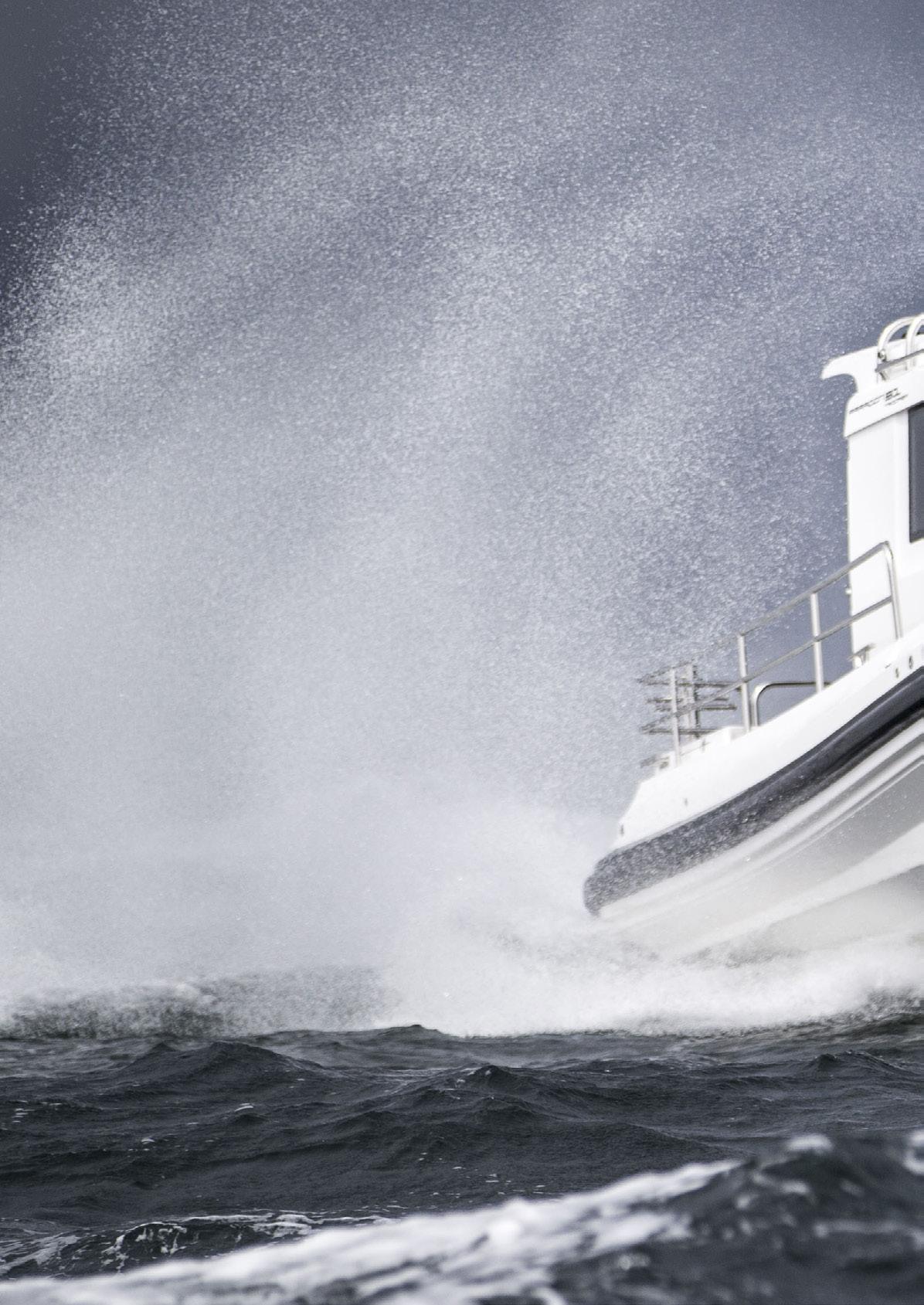
COMMUTER BOAT
When the owner of this particular Paragon 31 approached Sports Marine, he required a serious commuter boat. Hence the very clinical layout of the saloon is a little overwhelming with six huge chairs. They are not just ordinary seats. They are electric Grammer air suspension seats and are the same as you would find in the commercial version of the Paragon 31. If this is too much, a four-seat version is available, leaving the rear space in the wheelhouse for a small galley or extra seating. The seats are mounted on raised platforms with a lower centre section providing a deep
PACIFIC POWERBOAT REVIE WS _ PARAGON 31
100 JANUARY / FEBRUARY 2023
WORDS BY BARRY THOMPSON
walkway over 2.2m headroom. Paragon offer a more conventional bucket seat style if you don’t want to go to the more commercial Grammer seats.
With the owner of this boat using it primarily as a transport vehicle, little consideration was given to the rest of the layout. However, even in this mode, it has enough creature comforts to be a usable dayboat.
The six or four-seater versions will not be for everyone, so Paragon have a far more conservative and somewhat traditional layout that will relate to Kiwis. The saloon sees a couple of bucket seats forward, with an extra seat and galley unit to starboard, with the L shape settee to port. This provides a more relaxing atmosphere and transforms the harsh commuter aspect into a comfortable and roomy pleasure mode.
The Paragon 31 is designed to be used 365 days a year.
There are three extra large storage lockers in the wheelhouse sole, with one providing easy access to the fuel tank should you need to do maintenance. You have the choice of a rubber surface or teak and holly which gives the interior a more recreational and friendly feel.
What remains the same in all models is the starboard side helm, the pair of sliding doors to the bulwarks and a sizeable rear
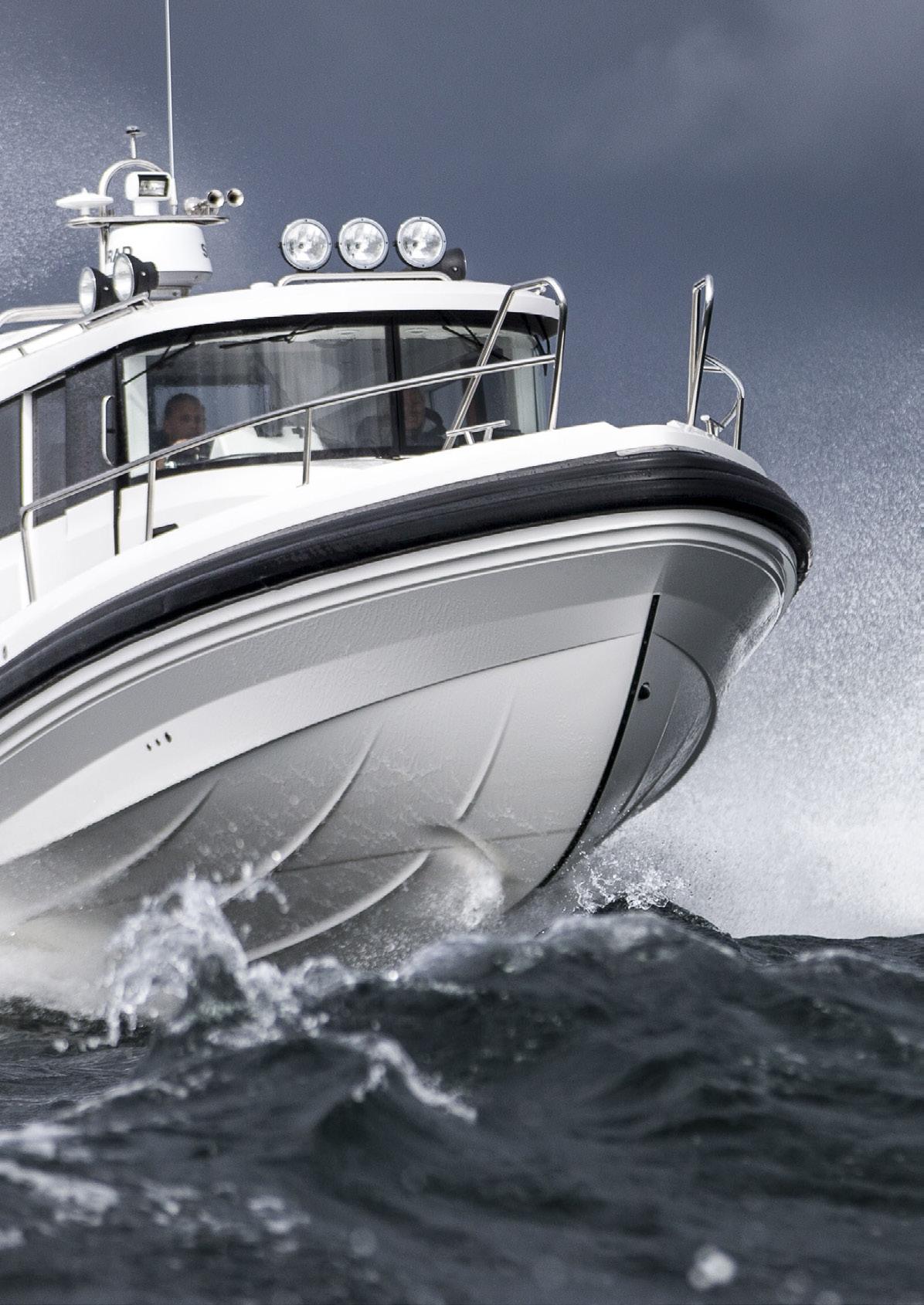
POWERBOATMAGAZINE.CO.NZ _ 101
powerboatmagazine.co.nz
A deep 24.5 deg deep vee hull makes rough water feel like smooth.
The four seat layout with a pair of rear bench seats.
The more conventional recreational layout can include a galley and lounger.
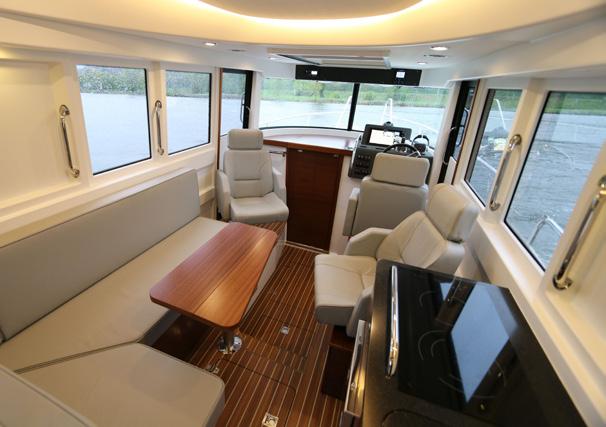
sliding door. The side doors are a great feature, giving you instant access to the side decks should you go forward for an anchoring issue or when laying up in a berth or jetty. The heavy-duty stainless railing also has a gate on either side. The helm on our boat was fitted with a single Simrad 16” MFD, flanked by Volvo Penta gauges, Humphree controls, and a Mastervolt battery monitor. There is plenty of space to fit all your electronics and controls with everything at a nice eye and hand level.
Being a boat built primarily for boating in extreme Scandanavian weather conditions, the Paragon 31 comes with a diesel heater. Another plus for making this a 365 year around boat.
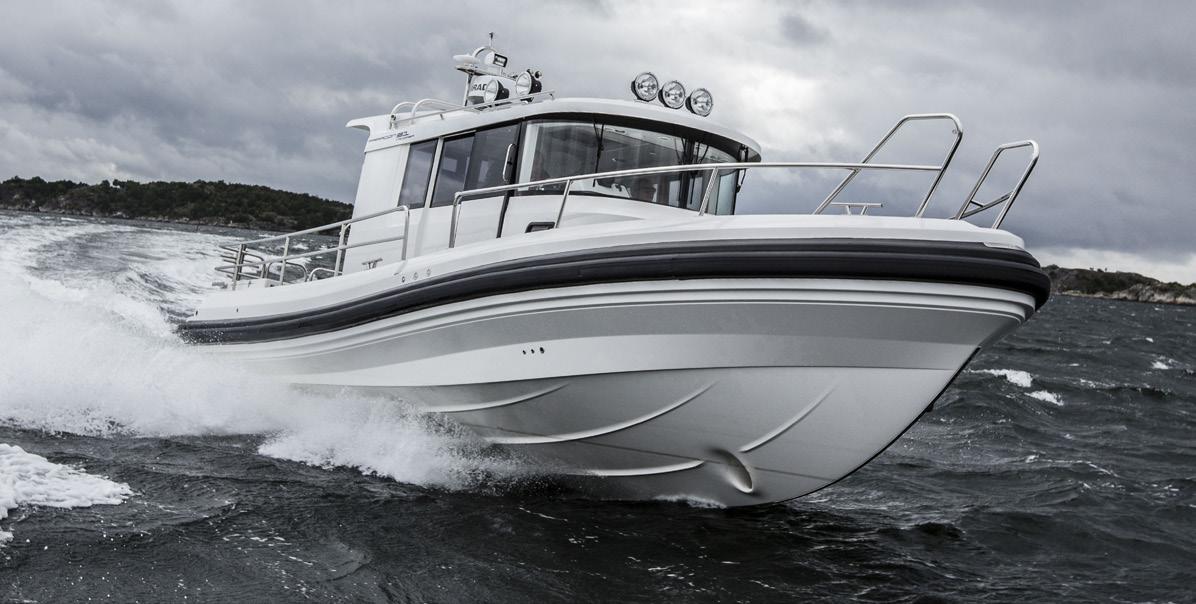
OPEN COCKPIT
The Paragon 31 has an open cockpit with no moulded transom, so you need to ensure that before your head out of the marina, all the shoes and gear are off the cockpit floor. There are lockers on either side for storage, with a forward technical locker in the cockpit sole, which doubles as another storage space. Access
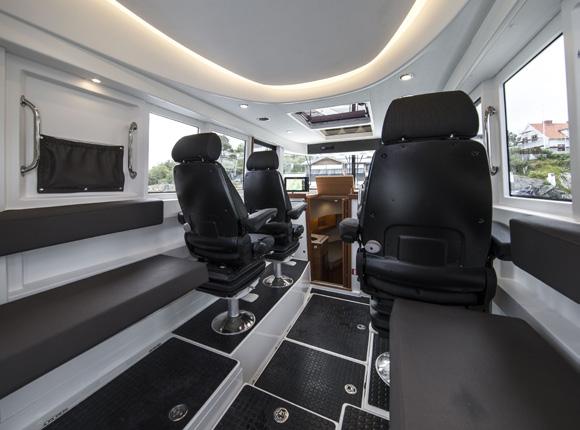
to the pair of Volvo Penta D4 320s is by large floor hatches. If you want to stow wet dive gear or your day’s catch, the Paragon 31 comes with a wet locker on the boarding platform.
On the starboard side of the boarding platform, is a extra large drop down stainless step ladder which is a plus for divers. Removable rails divide the cockpit from the bparding platform. However, it would be no trouble to retrofit a full wrap around stainless rail with a gate around the boarding platform and eliminate the one at the rear of the cockpit. It would make this area much more practical and user-friendly. This would allow you to add a bait station and also still allow you to fit some dinghy davits.
PERFORMANCE
I could go on and on about the seakeeping and how the boat tackles the rougher sea, but when you know that the hull is based on an ultra-deep vee with 24.5 deg at the transom, you can understand why. The beam is 3.38m, with broad flat chines and three deep spray rails aside doing a lot of the work. A solid rubber
PACIFIC POWERBOAT REVIE WS _ PARAGON 31 102 JANUARY / FEBRUARY 2023
belting around the hull also helps deflect the spray and doubles as your in-built fender.
There is also a set of Humphree interceptors to help assist the ride and attitude of the boat. Now I can hear you say, but what about the stability at rest? Well, it’s not much different to any other boat this size. Due to the deep vee of the hull, you can’t get away from the boat leaning in the turns a little more than you might expect from a boat with a flatter transom area, but with the Humphrees interceptors set on auto, that can be largely reduced. However, if you need more convincing about the at-rest stability, you can always add a gyro. While driving the boat, there is excellent visibility from the helm with a split curved vertical window, complete with four wipers. The helm seat is fully adjustable, and you feel the air suspension seats’ benefits when running in rough water.
Power options offered are a single Volvo Penta D6400 or D6-440, or if you want more speed, you can upgrade to twin D4-300 or D4-320 Aquamatics. That is a considerable variation of power, so the choice of engines will be down to cost and your performance
expectations. With a pair of D4 320s, I recorded 40.3 knots @ 3700 rpm. Maximum fuel burn was 142 lph, but that dropped right back to 84 lph at 3000 rpm and 28.2 knots. If you are happy to cruise around 20 knots then the fuel burn is going to be only 50 lph for both engines. Reasonably economical boating I would suggest.
Despite the hull’s extra deep vee, it leaps onto the plane with ease and rapidly achieves maximum velocity. It’s a hull that is affected a lot by trim so it took a little to get it right. Once I did it ran well in all directions, especially in the following sea when I trimmed the legs well out and ran a constant 40 knots coming back into Auckland’s inner harbour.
ACCOMMODATION
The Paragon 31 is a single-cabin three berth boat. The main cabin area features twin 2m berths that can be transformed into a single two sqm berth with the aid of an infill. Storage is plentiful under the berths and inside lockers. Light and ventilation comes via a single
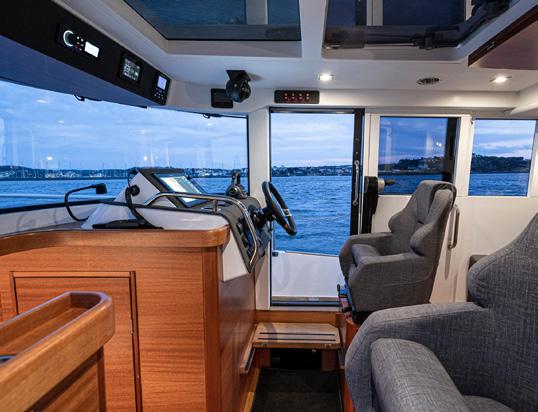
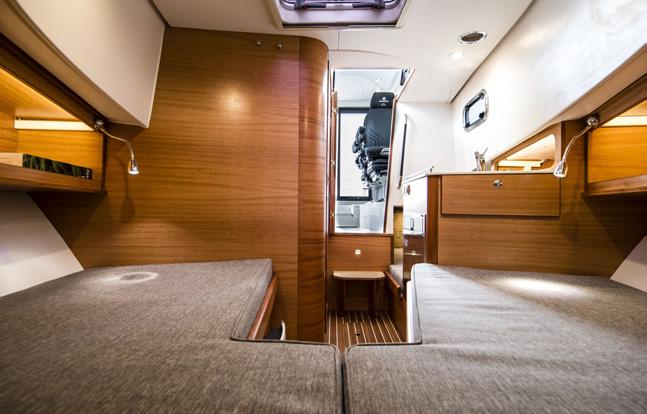
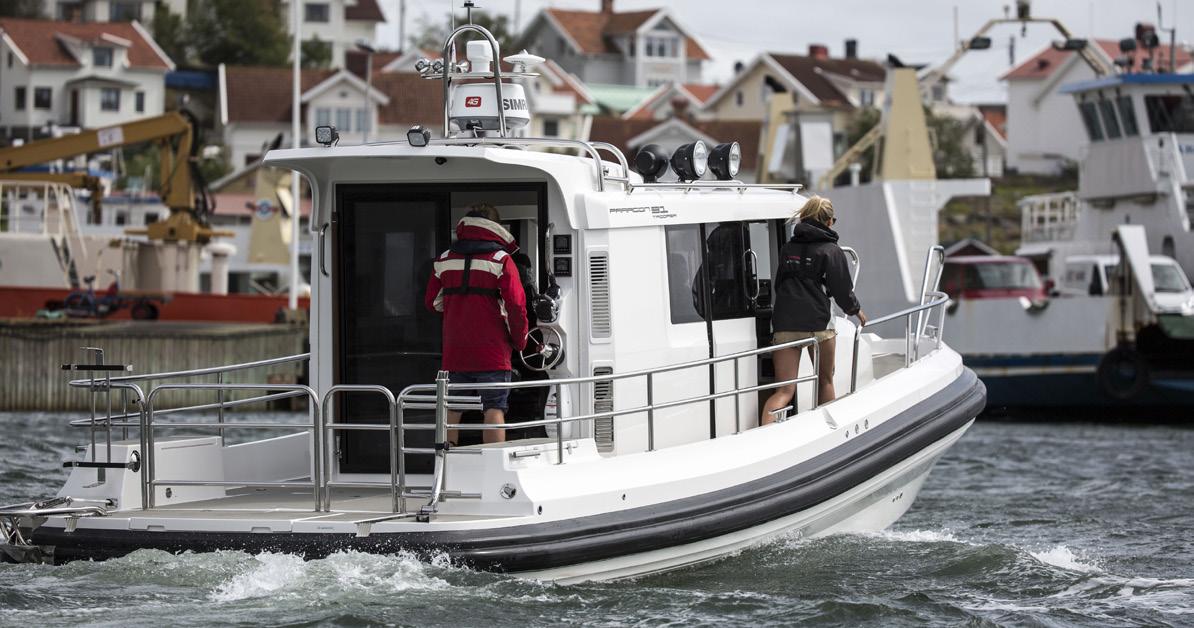
Down below there are three berths, an optional galley and enclosed head/ shower.
Sliding side doors offer excellent external access.
Wide(400mm) bulwarks have gates either side, plus there is an optional second helm in the cockpit.
POWERBOATMAGAZINE.CO.NZ _ 103
hull port, concealed and flush lighting, plus a large overhead hatch.
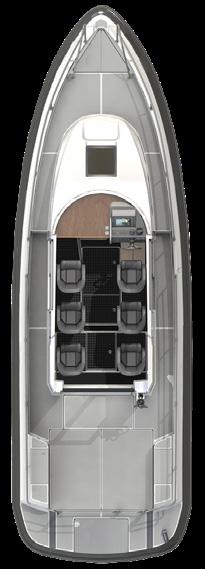
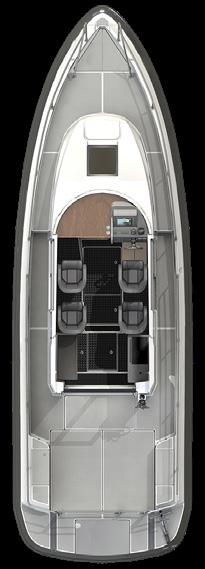
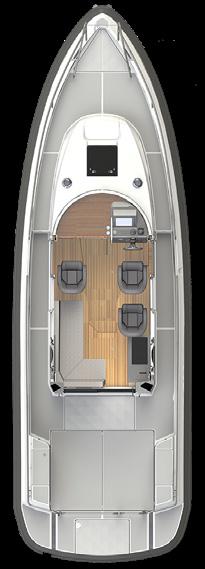
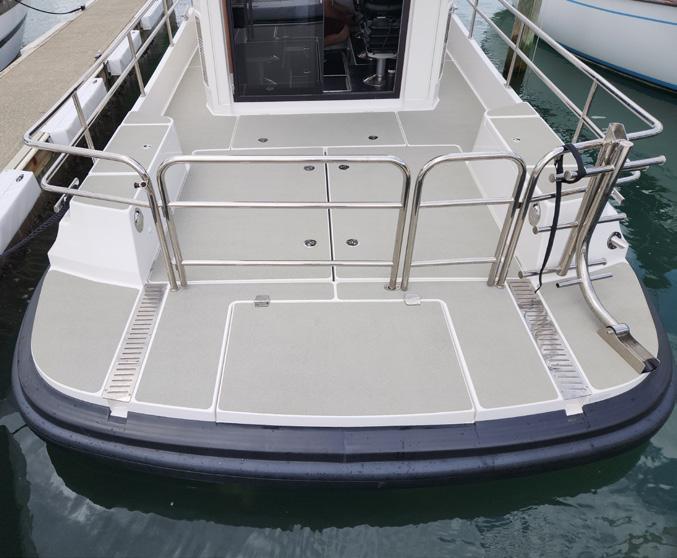
The third berth slips in under the port side of the wheelhouse sole and, when not used for accommodation, is a great storage space.
The rest of the space downstairs is taken up with a vanity with storage under or a compact galley to port and bathroom opposite. The optional galley comes with all you need to prepare small meals with a sink unit, a three-burner cooktop neatly concealed under a foldaway bench top, and draw storage and a fridge below.
The generous size of the bathroom surprised me. You can stand up to shower with a flexible shower rose. There is the usual head, a good size vanity and lockers that offer some dry storage for the towels and the toilet roll. All the shower water drains passed a teak-slated floor panel into a holding tank.
CONCLUSION
The forward-thinking Scandinavian design and attention to detail are not lost on this brand. With clean lines, multiple deck layouts and built with hardwearing materials, the Paragon 31 is purposebuilt tough and ready for whatever you throw at it. The availability of different interior layouts makes it even more appealing. It combines clean modern lines, a sporty performance, and excellent seaworthiness. Although a relatively unknown boat brand in this corner of the world, I see the Paragon fitting perfectly into New Zealand’s harsh and volatile environments. It’s different, but then why not. Being non-conformist regarding the designs produced by local builders, the Paragon offers a refreshing approach to how and in what we go boating. Certainly a boat that offer 365 days a year boating capability.
SPECIFICATIONS Model Paragon 31 Cabin Priced from $NZ825,000 LOA 10.59m Beam 3.38m Draft 1.18m Deadrise 24.5 deg Displacement 5600kg Fuel capacity 700 litres Water capacity 200 litres Black water 70 litres CE-category B Hatches Lewmar Interceptors: Humphree Lighting Hella Invertor Mastervolt MFD Simrad 16” Radar Simrad Halo Winch Lewmar Diesel Heater Eberspacher Power 2 x Volvo Penta D4-320 Aquamatic DPI Contact SPORTSMARINE.CO.NZ PERFORMANCE DATA : 2 X VOLVO PENTA D4-320 AQUAMATIC DPI RPM Knots L/h L/NM Range (NM) 1500 5.6 20 3.6 176 2000 11.0 44 4.0 158 2500 19.5 53 2.7 230 3000 28.2 84 3.0 212 3500 36.3 127 3.5 180 3700 40.6 142 3.5 180 Note: Fuel range is based on 10% reserve.
PACIFIC POWERBOAT REVIE WS _ PARAGON 31 104 JANUARY / FEBRUARY 2023
The Paragon 31 has an open cockpit with no full transom.
Make everyone love the sea




Stabilisation Advantages

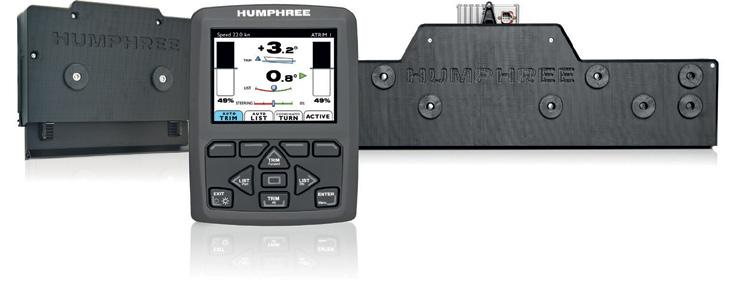


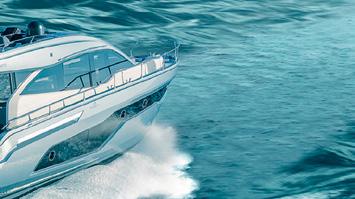
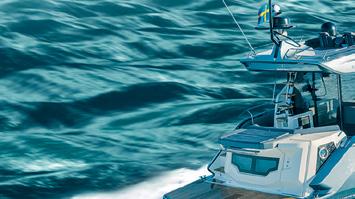




ON OFF
The ONLY choice for real stabilisation •
performance •
•
•
CO² emissions • Replacing traditional trim tabs 6 3 0 -3 -6 www.humphree.com DURABILITY BY HUMPHREE - CONTINUOUS INNOVATIONS SINCE 2002 HUMPHREE Distributor New Zealand & Pacific Islands: Volpower NZ Limited Ph. 0800 865 769 or 09-2744305 www.volpower.co.nz
for all boats and yachts. Premium technology made a ordable Our interceptor technology also reduces resistance. That means lower fuel consumption and less CO² emissions. Make everyone love the sea and help our
at humphree.com Install Humphree ACTIVE Stabilisation and everyone on board will feel as safe and steady as on dry land. This system lowers roll and slamming by up to 50%. And it feels like even more. Your family boat ride will be a whole new
ACTIVE
•
Easy to install, unmatched
Increases stability at sea by up to 50%
Lowers fuel consumption up to 20%
Eco-friendly lowered
Available
planet
Being a member of Coastguard has its benefits when you breakdown.
CHECKLIST FOR BOATING SAFETY
With summer upon us and the harbour, coastline and rivers calling, it’s a good time to check you have everything you need aboard your boat for a safe and trouble free season.
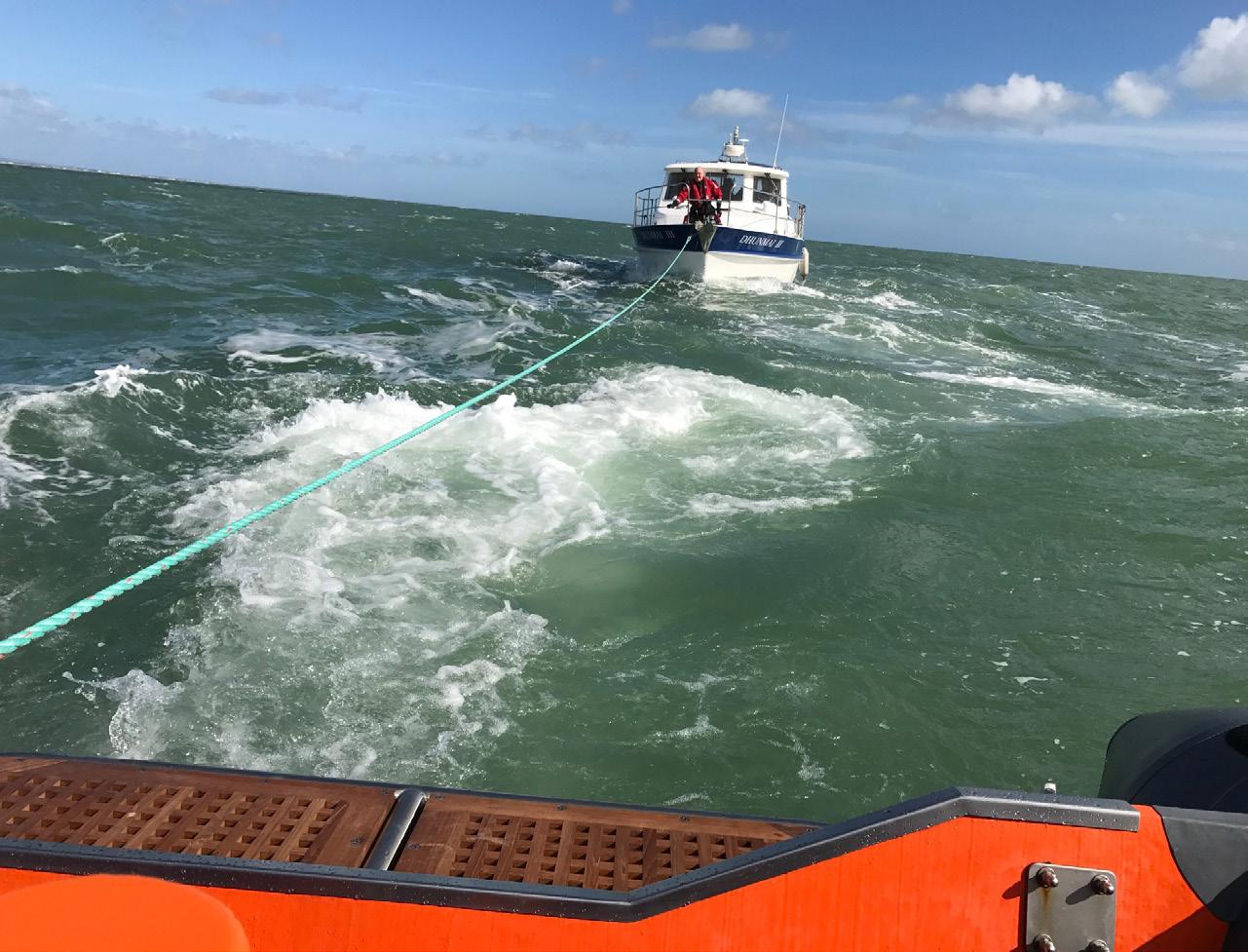
Pleasure boats offer some unique medical challenges. Frequent analogies are made between piloting an aircraft and piloting a boat. Both require similar skills and place you at the mercy of the elements in a medium that's foreign to our bodies. Granted, being suspended in the air may be a tad more precarious than floating on the water, but when the downward spiral of a problem
begins in either setting, it typically doesn't end well. For this reason, an aircraft pilot wouldn't dream of taking off without performing a pre-flight checklist. Boating is safer when using checklists, too.
The concept of a pre-flight checklist was developed following the fatal crash of a test flight in 1935. Leading up to WWII, the U.S. Army Air Corps was looking for a new bomber to meet the demanding needs of
long distant flights with heavy payloads. U.S. aircraft company, Boeing, submitted a new plane model for the Army to consider. The Army agreed to try it and scheduled a test flight to see how it would perform.
Flying the plane that day were two highly experienced Army pilots, Boeing's chief test pilot, along with a Boeing mechanic and a representative of the engine manufacturer.
106 JANUARY / FEBRUARY 2023 PACIFIC POWERBOAT _ COASTGUARD EDUCATION
After takeoff the plane began to climb, but suddenly pitched up, stalled and crashed into a ball of fire upon impact. All on board were initially rescued, but both pilots died from injuries sustained in the crash.
The accident investigation determined that before takeoff, the pilots overlooked a safety lock on the elevator and rudder controls, which kept them from controlling the plane's pitch or attitude. Following the accident, a newspaper stated that the Boeing plane was just too much plane for one man to fly.
Fortunately, this was not the end of the story, but the beginning of a life-saving idea that would transform how highly complex systems can be operated by average people.
Out of this tragedy came the simple and effective concept of the pilot's pre-departure checklist. Time would prove the Boeing plane was not too much for one person, but just too much for one person's memory.
Using a simple checklist on future flights would ensure that important steps required prior to takeoff were not forgotten. Checklists were developed for more and
more parts of a flight, for emergency situations as well as more routine situations.
NASA adopted the use of checklists for almost every part of the Gemini and Apollo space missions, and all astronauts were trained in how to use them.
Astronauts logged hundreds of hours familiarising themselves with and learning how to use these checklists. In fact, checklists were so important to the success of the Apollo moon landings that astronaut Michael Collins called them The fourth crew member.
Checklists are also important when multiple people are involved in the same process, so we use checklists for departing from the boat as well.
SAFETY FROM THE SKIES TO THE SEAS
Aboard our boat, we have several checklists for different applications. For example, we've found it useful to have two pre-departure checklists: one for leaving a marina and another for
leaving an anchorage or mooring. Preparing for each is different enough that having a specific list for the different situations ensures that everything is safe to get underway. A checklist is also one of the best ways to manage your boat maintenance and personal safety. When your boat breaks down out in open water, you become vulnerable to additional problems.
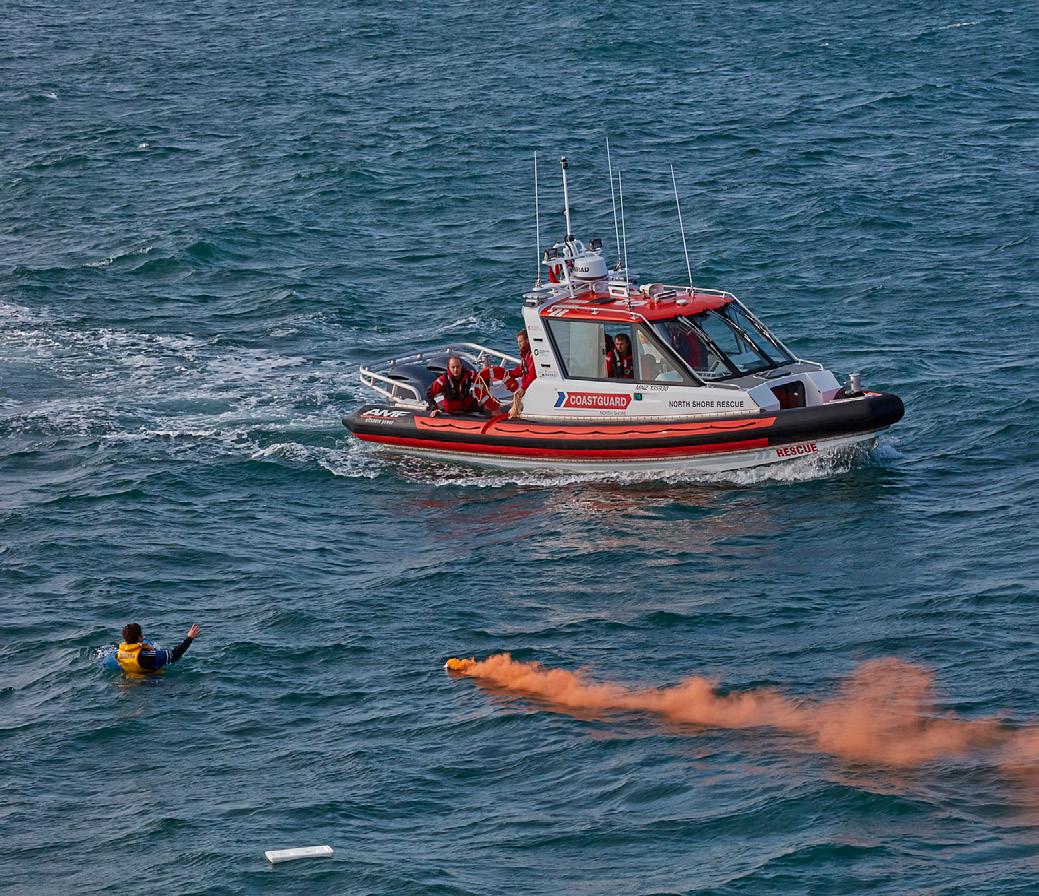
Reminder and to-do apps popular on smart devices today are a great platform for building a list of regularly scheduled maintenance tasks. The apps allow you to set a date to inspect items like fire extinguishers, or when engine fluids or anodes need to be changed. Using apps with reminders set, relieves you from having to remember critical items that need attention. They also have a notes section where you can record engine hours of the last change and numbers for any parts used in the process.
Checklists are most useful for regularly reoccurring tasks, ones we believe we do so often we've memorised them tasks like starting your boat and leaving the marina.
POWERBOATMAGAZINE.CO.NZ _ 107
You don’t want to be in this situation this summer.
Therein lies the problem: It's easy to become complacent with reoccurring tasks and believe you've done this so many times you don't need reminders of how to do it.
For most people, life is busy, so it's easy to get distracted while going through a task. I've seen it happen on many occasions the ever-present phone rings or a boat neighbour asks a question as you're preparing to get underway and the next thing you know you're pulling out with the shore power cord still connected. Before we started making checklists a habit, I was occasionally upset by a boat passing close by, without calling us on the VHF radio, only to realise I'd forgotten to turn it on. Checklists are also important when multiple people are involved in the same process, so we use checklists for departing from the boat as well. More than once on our Sunday drive home from the boat, we looked at each other and asked, did you take out the trash or did you turn off the propane? Using a boat departure checklist makes sure important items don't get missed and you don't assume the other turned off the water pump breaker or turned on the battery charger.
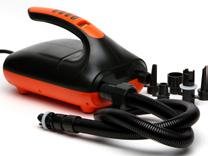
Using checklists also has unforeseen benefits: The more you follow them, the more you benefit. The more you follow a routine process in the same order, the more you understand its faults and failings, allowing you to make improvements.
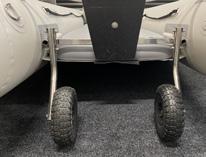

It's easy to see the benefit when developing a checklist and when you first begin using them, but the real benefit comes into play when you continue using them even though you feel like you don't have to anymore. That's when they keep you from forgetting something important.
COASTGUARD CHECK LIST
Coastguard Boating Education offer a simple Get Ready For Summer checklist which points out the basic things you should do before going boating. These are checking you have your boat fully serviced, your lifejackets are all in working order and the flares are up to date. There are also two extra suggestions which make great sense, have you got your Coastguard membership up to date and do you have a Day Skipper Certificate?
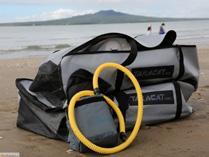
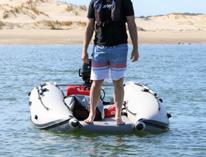

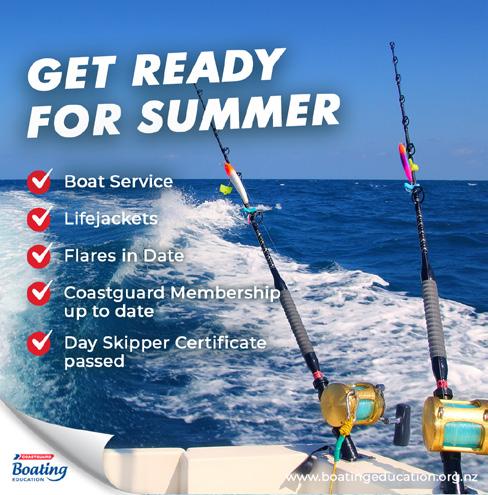
ULTIMATE PORTABLE
SINCE 2007 Takacat NZ Ltd sales@takacat.co.nz | P: (+64) 021 822 285 DB874 www.takacat.co.nz 108 JANUARY / FEBRUARY 2023 PACIFIC POWERBOAT _ COASTGUARD EDUCATION
Coastguard Boating Education have a very simple check list to follow.
BOATS
MYSC 250 POINT SERVICE PLAN
Clearwater Cove, Auckland based Motor Yacht Service Centre, offers a unique, proactive and preventative maintenance program for motor yachts based in Auckland. “Throughout the years we have offered an around the clock service for our boat owners to ensure that they always had experience and expertise on hand to deal with any problems that arose while boating”, says MYSC director, Dean Ryder.
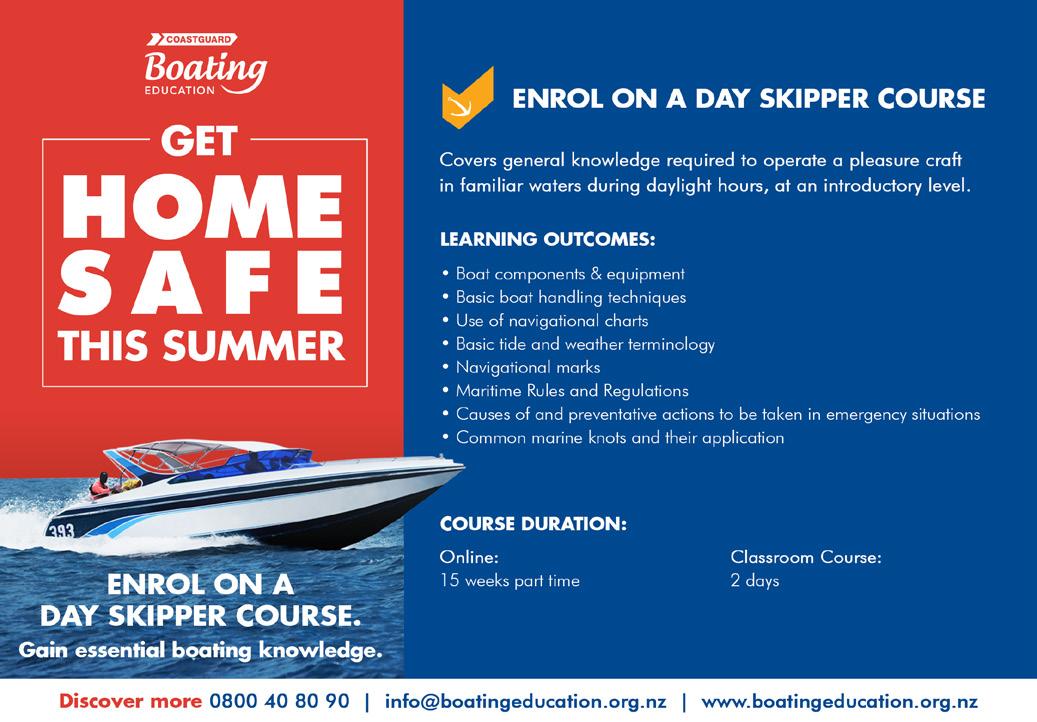
The MYSC 250 Point Service Plan is an indepth and comprehensive, Bow to Stern analysis of your vessel. It includes, electrical, plumbing, hardware, structural and electronics A list of both preventative maintenance and items requiring urgent attention is compiled from this assessment, and reported back to you for the decision making process.
“This has resulted in a significant drop in failures of equipment over the summer period”, says Dean.
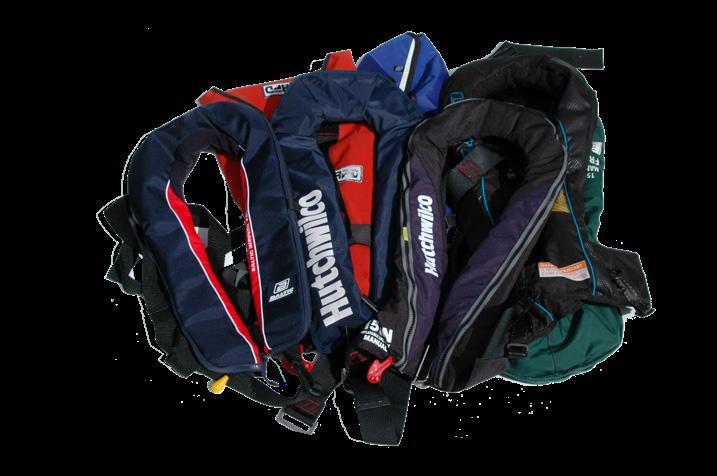
 MOTORYACHTSERVICECENTRE.CO.NZ
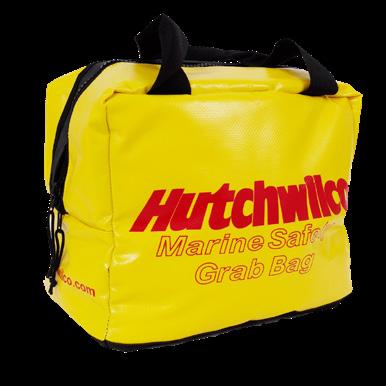 Are all your inflatable lifejackets in working order?
A Hutchwilco safety gear bag is worth having on your boat.
Are all your inflatable lifejackets in working order?
A Hutchwilco safety gear bag is worth having on your boat.
POWERBOATMAGAZINE.CO.NZ _ 109
Fletch's Tips
Summer is finally underway, with the days getting longer and warmer, I finally did my first raft-up a couple of weeks ago, which for me marks the start of Christmas and getting ready for the holidays - happy holidays everyone.
TIP #107 TIP #108
BIMINI
TOP UPGRADE
If you are like me and have an old-style canvas top that has seen better days, why not invest in a new eyebrow style Bimini top? I had the team at Waikato Stainless attach a new frame to my old rocket launcher and Shane from Master Trim (Hamilton) did the rest. Boat is looking impressive and has increased usable space from the added head height and much clearer vision. Thanks, guys, for the high-quality work, I can’t wait to make use of it during the summer.
TURNBUCKLE SAFETY
Add a bit of extra safety to your boat by addition of a turnbuckle to hold your boat steady on your trailer, this will allow you to tighten the boat up against the rubber stopper without putting strain on your winch rope, it also prevents your boat from bouncing around on rough roads.
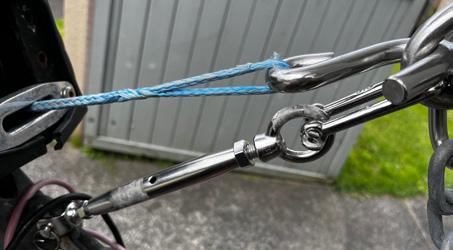
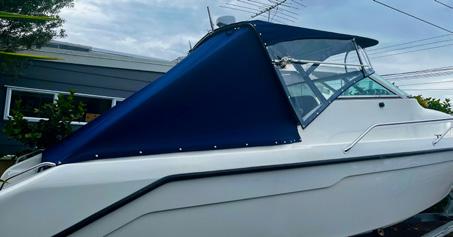
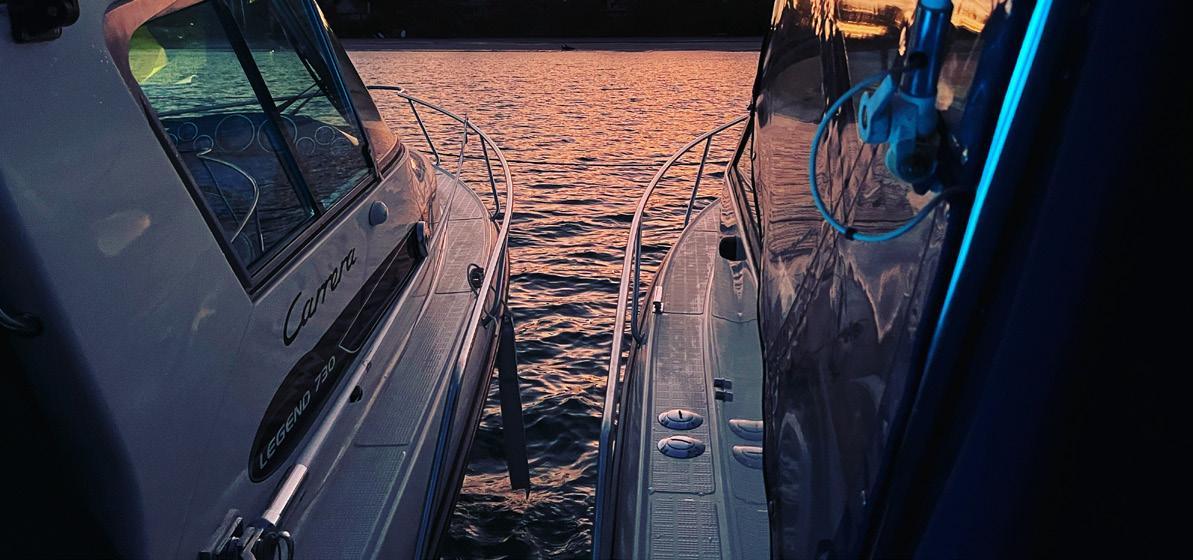
Pro Tip: You can pick these up from your local marine store for around $40

NOTEWORTHY FLETCH'S BOAT TIPS www batterytownmarine co nz 0800
110 JANUARY / FEBRUARY 2023
962 288
VAC PAC FILLETS
Ask Father Christmas for a vacuum pack machine this Christmas, these little units are great for keeping fish fresh and creating small handy ready meals. Pro Tip: you can throw the vacuum packs into the freezer as they keep the fillets in good condition for long periods.
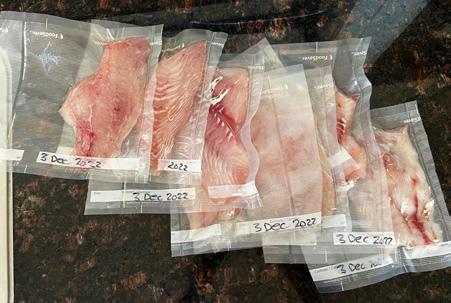
BREAKDOWN KIT

During long road trips it’s good to have some tools & spares handy just in case of an emergency. A great tip is to have a storage box in the back of your towing vehicle containing some basic items - bottle Jac, wooden blocks, rags, tyre weld, wheel brace, rubber gloves, CRC, tools for trailer bolts and safety triangle to put behind the trailer. You should customise it for your own requirements, in case you have an unforeseen roadside emergency, think about items you might need.
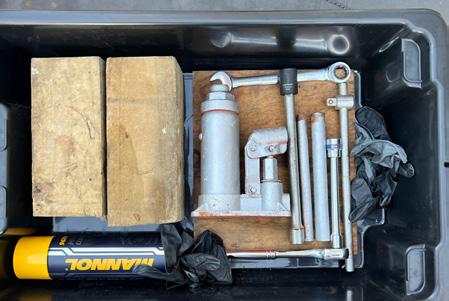
ROPE STORAGE
If you ever have problems with ropes getting lost in lockers or not drying out? here's a great solution given to me from Brendan Spear. He installed a Ronstan rope bag under lid of the storage locker, this keeps all his mooring ropes dry and easy to access. Pro Tip: you can pick these up from a marine store for less than $100 - attach it with some Velcro tape for easy removal & cleaning.
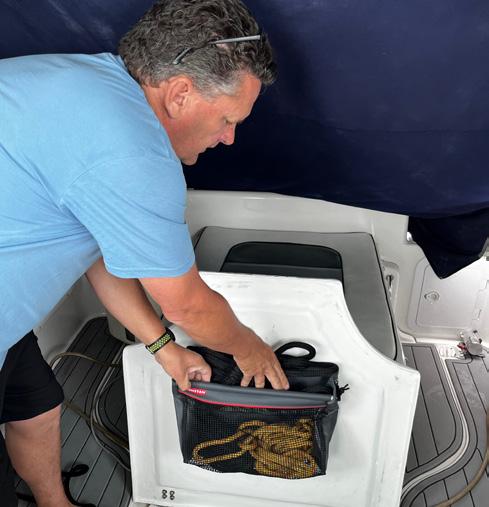
Trusted brands expert advice Available from leading boating stores DB759 POWERBOATMAGAZINE.CO.NZ _ 111
TIP #109 TIP #110 TIP #111
TIME FLIES
Recently I was asked by someone with a long memory if there were any copies of DD still available. He was doing up a boat and needed guidance. But for a couple of copies in my stash, there are no copies commercially available.
I took one of my prized copies to a printing co, and had them scan all the articles in the 1st edition to USB stick, and sent him a copy. He was most appreciative. Should any readers wish for a copy, send me a stick and I will try and copy it. Len wrote DD for a veritable who’s who of Boating Editors, including Barry Thompson, the Editor of this esteemed publication, (who convinced dad to start writing his famous column), and Rebecca Hayter, now a freelance contributor. In one of life’s small ironies, Rebecca has recently done the conversion from wind bludger to stink boater, and a recent frolic on the briny resulted in the discovery of the dreaded Diesel Bug; a disease, like Smallpox, which has largely been eradicated. Swapping to a little used tank apparently caused this issue. Whilst lightly helping Rebecca from a distance, I referred her to DD as a source of remedy, only to discover neither edition had any mention of the Bug. Most remiss of him!
I had decided that I would use this month’s ramblings to announce to both of my remaining readers that I was now fully semiretired from the marine brokerage industry. Over the past few years I have wound my business down to facilitating sales and purchases for only those few who insisted on using my failing skills, and any owner of my Clipper/Explorer craft. I remain very proud of these craft which have endured well, and provided minimal issue from the first craft in 2004.
I headed up this epistle as ‘Time Flies’, then
whilst searching for inspiration on how to create even a modicum of excitement about such a boring pronouncement, I recalled my Dad wrote a final article when shutting down DD. Reaching for my well-thumbed copy, I located said article and discovered he had titled it ‘Time Flies’. Obviously small minds think alike!
I have been selling yachts and launches since 1986, and have had an absolute ball during that time. Unfortunately now the marinas are too long, the gunwales’ too high, and the OSH requirements too onerous. When asked how to become a broker, my standard answer was ‘work hard, save hard, then become a broker and watch the money
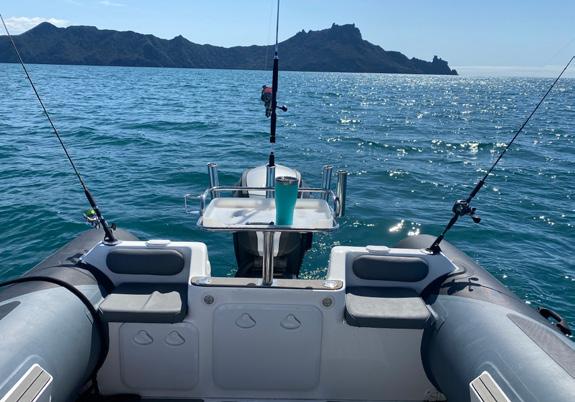
means one cannot enter the marina. This is a far cry from our early days, of carting families down the Panmure River in a leaky 12’ tinny to Bucklands Beach, assisting mature males and females onto a small yacht through lifelines in a tide driven wave surge, then splashing back after convincing them the aforementioned craft was a gem. Life jackets took up too much space!
Brokerage has changed so much. Technology means you can pretty much view any new boat online, read all its faults, complaints and praise before you even see one in the flesh. You can shop worldwide from your couch if looking for a new craft. When searching for your second hand, or pre-loved craft, most agencies have all their boats online, with pictures, videos, etc. We used to fly our clients to Picton, or drive them to Tauranga if that was required.
disappear’. All my peers from those early times have retired or recognising the need for a reliable and regular income, moved on to other fields.
Nowadays a broker, after doing a virtual walkthrough online, walks down a marina with clients, assists them onto a craft and then avoids answering any question about the boat, in order to not put themselves in the firing line later for misrepresentation. To do this dangerous activity, they are required to carry $5 million in liability insurances to protect themselves and the marina owners from any possible claim. Failure to provide copy of this insurance
Contract law has changed. Your once friendly S&P contract with mutual satisfaction clauses is now rigid with terminology protecting the buyer. Anti-money laundering requirements actually put brokers in the gun, as legally we are viewed as second hand dealers and should/ must report suspicious money movement. Gone are the days of a tradie with money in a sock. Insurance companies need EWOF, gas certificates, and comprehensive fault free surveys before covering your new possession. For yachties it’s even worse, as running rigging must be no older than 10 years, or at least X-rayed or there’s no cover for that. Funnily, once you have cover, they don’t review these again. That will change no doubt! We brokerages used to have a nice little side hustle with the insurance companies, but that all changed with the Registered Financial Services Provider act. Helping somebody get insurance fell under that umbrella apparently. It’s all got too hard for an old timer like me.
It is nearly the end of November 2022, and today represents 10 years since the passing of my father, Len Gilbert, he of the infamous ‘Diesel Diary’.
WHERE IS THE QUESTION? PHIL GILBERT ASKS HOW
…
112 JANUARY / FEBRUARY 2023
Vivere, meaning ‘To Live’ is spacious and wellappointed, and is ideal for entertaining guests, or extended weekends away with family and friends. Vivere is fitted with a clever electro-hydraulic bathing platform which slides down into the water, that allows for easy access to the jet tender and all water sports.
A retractable roof slides away to open up the saloon with natural light and extra ventilation. Down below there is a spacious owner’s stateroom, which occupies nearly half of the lower deck, but also in a usefully proportioned twin-berth guest suite on the port side with a bright and big VIP suite in the bow.
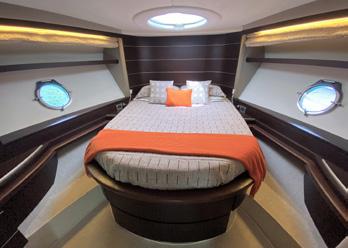
Well maintained, Vivere has recently undergone an interior refit and a fresh exterior vinyl wrap. With the current owners now enjoying their new boat, Vivere is ready for a new family ‘to live.’
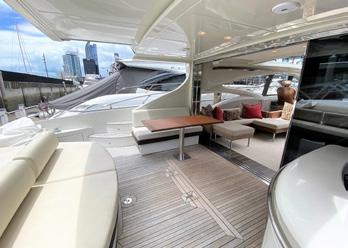
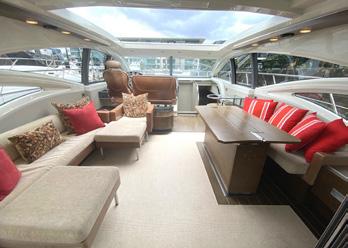
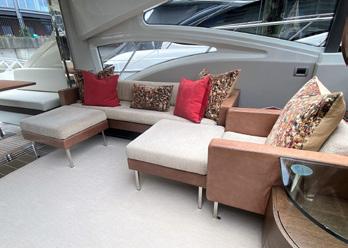
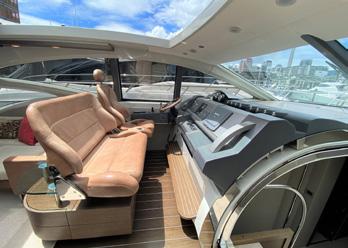
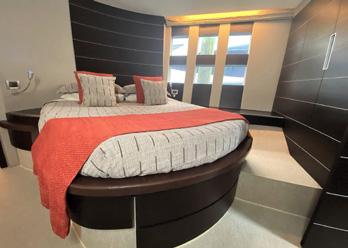
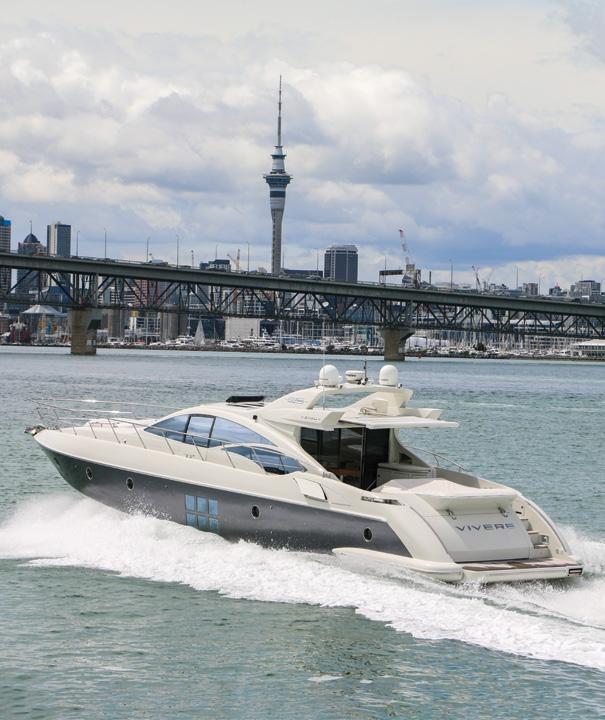
Pinnacle Marine European LTD: Unit 33 - 332 Great North Road, Grey Lynn, Auckland 1021. Landline: +64 (09) 377 6602 Grant Saunders: 021 0265 1470 / David Hawke 022 140 6300 Email: info@pinnaclemarine.co.nz pinnaclemarine.co.nz AVAILABLE NOW 2010 Azimut 68S – Price Reduced! NZ$1,600,000 PIN029a Length: 21.4m Beam: 5.07m Engine Type: Caterpillar 2 x V12 1360hp shaft drive Engine Hours: 750 Max Speed: 37-knots Cruising Speed: 28-knots Cabins: 3 + 1 crew We
to
this 2010
and
sale
are delighted
present
Azimut 68S. Owned from new by the same New Zealand family
enjoyed by three generations - ‘Vivere’ is now for
to make way for the family’s new Azimut.
For more images and information, view on our website.
SERIOUS ABOUT SYSTEMS
WORDS BY RON CZERNIAK - MARINE CONSULTANT
WASTE WATER
Just as we humans comprise a number of inter-related systems that ensure the smooth, healthy, safe and sound functioning of our bodies, so too do boats have integrated systems to ensure they run smoothly to ensure our comfort and safety while on board.
We are made up of several different but connected systems; respiratory, digestive, circulatory, nervous, etc. and when all are healthy and looked after our bodies (and minds) can enjoy pursuits such as boating, fishing, diving, swimming and so on out on the ocean, lakes and rivers of our wonderful country.
No matter if your own and enjoy a seven metre trailer boat, a 15m sail boat or a 30m luxury launch, they all have either basic or complex systems that are either absolutely necessary or simply add to you comfort and enjoyment while out on the water.
During this series of articles we will explore a number of boat systems in order to give you an better understanding as to what is available on the market, how they work and what you may or may not wish to consider (or can afford) on your particular vessel. Starting with Waste Water Systems we will move onto Fresh Water Systems, Exhaust systems, Glazing and Ventilation Systems, Steering and Manoeuvring Systems and General Boat Equipment Systems among others.
WASTE WATER SYSTEMS
Using our analogy above, the waste water system on board your boat (no matter how primitive; bucket and chuck it for example) is like our bodies digestive system. What goes in one
end, eventually comes out the other ends – liquid or solid – and these need to be taken care of easily, safely and hygienically. Recreational and commercial laws in New Zealand are very clear on the matter of sewage (black and grey water) disposal at sea and into lakes and rivers.
In general, untreated sewage may not be discharged within 500 metres from land, or in water less than 5 metres deep. There are fewer restrictions on the discharge of treated sewage.
To further protect the public and the marine environment, the Regulations prohibit sewage discharge near marine farms, mataitai (traditional food collection) reserves or marine reserves. Where regional councils determine more protection is needed, they may increase the area where Grade B and untreated sewage discharges are prohibited. Boat operators should become familiar with local rules in regional coastal plans.
Obviously, it is in every recreational boaties interest to protect the environment which we enjoy, particularly in regards to dumping materials harmful to the marine environment, particularly black water (sewerage) and grey water (dish washing, showers, etc.)
In our land based homes we tend to take for granted that toilet facilities are “just there” and are used according to our daily needs, whether for a pee, a poo or having a shower. Our bodily wastes are taken care of once we flush the toilet or turn off the shower by means of our council sewage facilities, and we generally think nothing more about it.
Not necessarily so on board our boats, big or small. Older boating people will have heard of or used the expression, “bucket and chuck it”. Pretty self-explanatory, so no need to describe how this works, other than to say that up until a few decades ago, this was a much used system, particularly on trailer boats. So with marine protection (common sense as well as regulations) in mind, let’s delve into what you need to know about marine sewage (black
114 JANUARY / FEBRUARY 2023
and grey water) on board your boat; no matter what the size. Having said that, practically speaking, a marine toilet/holding tank system is somewhat impractical on boats under about 5 metres, so how wastes are disposed of on these smaller boats, sailing dinghies, kayaks, jet skis, etc., etc., is another matter which this article will only address in passing (no pun intended).
Suffice it to say that whether your vessel is a 7m trailer boat or 70m superyacht, a waste water system is possible, practical and pretty much essential. So how does it all work and what equipment is required to install a complete system on your boat?
As the average Kiwi owns a trailer boat rather than a superyacht
it is worth considering how to set up a system on a typical alloy trailer boat for example. Having had experience installing such a system when I worked as the Sales Manager of Vetus-Maxwell Asia Pacific several years ago, I believe that by outlining how we set up a complete system on board a McLay 7m Hard Top alloy boat will provide a basic but comprehensive insight as to what is required and how it should be installed. Once you have an understanding of such a basic installation, it will not be too hard to imagine how this system could be extended to a large launch or cruising sailboat.
It is vital that we keep our pristine waters clean from waste.
POWERBOATMAGAZINE.CO.NZ _ 115
WASTE WATER
THE BASICS
A good low maintenance, easy to install and space-saving arrangement from any reputable marine toilet and waste water management system should come with the following basic components.
However, before we get stuck into figuring out how you go about designing and installing a waste water system on your particular craft, a bit of history. When it comes to marine toilets, you may have heard the expression; the ‘Heads’. According to the Oxford Companion to Ships and the Sea (a wonderful publication that ‘tells you all you ever wanted to know about the sea and never dared asked’ Sunday Telegraph); this is the name given to that part of older sailing ships forward of the forecastle* and around the beak** which was used by the crew as their lavatory. It was always used in the plural to indicate the weather and lee sides, seamen being expected to use the lee side so that all effluent should fall clear to the sea. They were floored with gratings so that the sea could assist in washing them clean, though there was always a small working party told off from each watch to clean the heads (sometimes referred to as the Beakhead), never a very popular task and one usually reserved as a punishment for small misdemeanours. The name has been largely retained among seamen, even in these days of lavatory bowls and modern flushing arrangements. Needless to say, this arrangement is not desirable or feasible for use on today’s recreational (or for that matter, commercial) vessels and it did not take long before household type toilets and waste systems were designed and developed specifically for boats. I recall a conversation many years ago at the Hutchwilco Boat Show in Auckland, discussing things in general with Tony Hembrow who started Rayglass Boats. One of the many reasons that Rayglass became so successful was that Tony did his homework and spent a lot of time talking to established and potential customers. On this particular occasion Tony told me that he decided that at one particular boat show a few years previously, that when a couple came onto the Rayglass stand, he would talk to the female partners who often accompanied their male counterparts at the boat show and ask them if there was one thing that they would most want on the boat which would make their desire to be out on the water with their mate more desirable; what would it be? Invariably the answer was a suitable toilet. Forget “bucket and chuck it”! From that show onward, Rayglass started fitting proper marine toilets on to every one of their boats or offered it as an option. It came as no surprise to Tony when Rayglass boat sales increased dramatically from that time onwards; the humble toilet being one of the main contributing factors.
* **
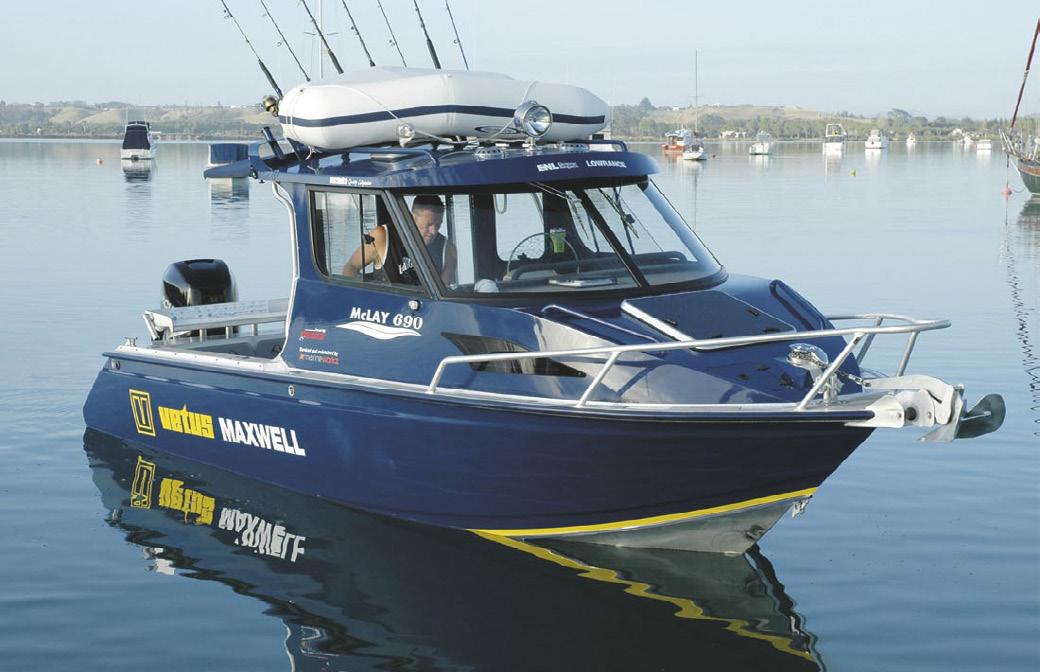
McLay VetusMaxwell boat
1.
2.
3.
Optional
TOILET
CONTROL PANELS and/or SWITCHES
HOSES, CONNECTORS, FITTINGS and ANTI-SIPHONING AIR VENT 4. WASTE WATER TANK (rigid or flexible) with WATER PUMP and NO-SMELL FILTERS suitable for black water (toilets) and grey water (sinks and showers) 5.
accessories such as LEVEL SENSORS, NO-SMELL FILTERS, INSPECTION PORTS, THREE-WAY VALVE and CONNECTORS
Pronounced fo’c’sle, the space beneath the short raised deck forward in the bow. The name sometimes given to the metal point or ram fixed on the bows of war galleys (oared and later, sailing fighting ships) and used to pierce the hulls of enemy galleys and thus sink or disable them. 116 JANUARY / FEBRUARY 2023
Early toilets were rudimentary and, in general, you used them and then manually flushed them out straight into the sea (lake or river) untreated and often not broken down overly much. Leave that one to your imagination! I (not so fondly at times) recall a Simpson Lawrence manual toilet I had aboard my 30 foot Easterly sailboat generations ago. The design was simple and (for the most part) worked effectively when used correctly and with patience. Ignore “correctly” and “patient” and the result was an unpleasant disassembly of the system to unclog and clear it out and getting it in working order again. Imagine much cursing and gnashing of teeth and often with clothes peg on one’s nose during this procedure.
Manually pumped toilets evolved into electrically pumped toilets, but worked much on the same principle and generally the effluent was still pumped straight into sea. The basic difference is that instead of the operator vigorously pumping water manually through the system to get rid of the waste; an electric (12 or 24 volt) pump sucks up outside water through an inlet valve, into the toilet bowl and pumps the water plus effluent out of the toilet, generally by means of a combined macerator motor and into the ocean through an outlet hull fitting.
Another type of marine toilet, becoming increasingly more popular, is the vacuum type. When the toilet is flushed by pushing down on the foot lever (for a few seconds), the vacuum energy stored in the system is released. The change of pressure in the vacuum tank releases the diaphragm on the switch - releasing the coil, and allowing it to activate the trigger. The bowl is instantly cleared and the waste is moved through the vacuum tank, the vacuum pump, and ends up in the holding tank at approximately two meters per second.
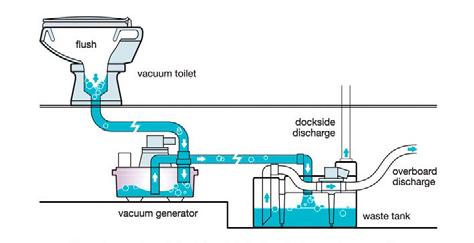
The ‘portable’ toilet. A porta potty offers convenience and simplicity to the user. Besides that, it is also well-known for its affordability and energy-saving capabilities. Its simple process of fill-and-dump dramatically differs from a fully-plumbed marine head, which usually involves the installation of tubes, valves, and through-hulls. Make sure to have ample water supply for these types, though.
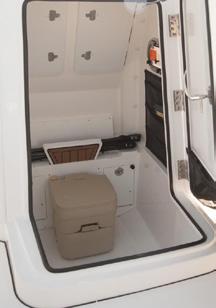
One final note in regards to marine toilets. The only things that should go in your marine heads are human waste and toilet paper. Now, there’s no delicate way to put this, but if you or a guest end up having to make a large deposit with a lot of toilet paper, flush when half-way through and then again when finished to avoid a clog. Trust me, having to unclog a marine toilet, especially at sea when the conditions are rough is, to say the least, unpleasant.
HOLDING TANKS
Nowadays, a holding tank is also integrated into the system. These are most commonly of rigid construction, but flexible tanks are also available for short term waste water storage and should be pumped and flushed after a day’s boating. A holding tank is just what the name implies; a tank that temporarily holds the effluent waste until it can legally and responsibly discharged in an environmentally friendly manner, generally by using the built in waste water pump affixed to the holding tank. For boats that are moored in marinas this generally means pumping out the effluent into shore tanks where the sewage can be treated properly via land based sewage treatment facilities in much the same manner as normal household waste.
However, for smaller boats (especially trailer boats) this is not always as convenient or practical and often owners empty their holding tanks legally (even though often not ethically) in further offshore, deeper water in compliance with marine regulations. Unfortunately this untreated sludge ends up in our already overstressed oceans, lakes and waterways. Not ideal. However, there are means to ‘treat’ the effluent in your holding tank such that, while not perfect, it becomes environmentally safer to discharge the contents in deeper, offshore water per local regulations. The Electrosan System is but one of many examples.
There are also waste (particularly black) water sanitisers, consisting of an organic concentrate of bacteria which causes faeces in the waste water system to break down without emitting any odour. Shop carefully as some chemical products often only mask the smell.
If a trailer boat launch and retrieve ramp is convenient to a marina (often the case in New Zealand), there is no reason why boat owners can’t use the pump out facilities of the marina.
But, if this is not an option, then pumping out your holding tank, utilising the built in water pump, once back at home can be carried out via your home toilet/sewage system. This may sound messy, but by simply having a length of suitable, dedicated sanitation hose (see below), there is no reason why you can’t hook this up to your boat discharge outlet and pump the header tank contents into your home toilet and flush through as you would normally use your toilet.
So, having discussed the two main cotmponents of a marine toilet system (the toilet and the holding tank) it remains to discuss all the other bits and pieces necessary to complete the system. As you can see from the above schematics and the ’basics’ list above, we still need to consider hoses, connectors, fittings and anti-siphoning air vents, control panels and/or switches and optional accessories such as level sensors, inspection ports, three-way valves and connectors.
TOILETS
POWERBOATMAGAZINE.CO.NZ _ 117
Portable toilet on a 7 metre Centre Console Trailer Boat
WASTE WATER
HOSES
We sometimes forget that there are a number of different hoses on board just about any vessel. The larger the vessel the greater the variety and size. However, as this article is about waste water systems, I will focus only on those hoses pertinent to that system. In short these include two main types. Waste water hose for the transportation of grey water (sinks and showers for example) and impermeable sanitary, no-smell hoses which are an absolute must for marine toilets. Made of SBR rubber with inlays of woven synthetic fabric and steel spiral, these are recommended especially for the transportation of biological waste from marine toilets/ holding tanks (black water). One might also want to include here, extraction pipes for use with rigid waste water tanks, both grey and black water. They can be used for electrical or manually operated diaphragm pumps, or for direct connection to a deck plate. Forgive me for espousing the obvious, but if you use hoses for anything in life, but particularly in regards to marine use, you generally need connectors, fittings, adaptors, anti-siphoning air vents, clamps, thru-hull and deck fittings, etc., so I won’t belabour this point other than to say that where ever you source the waste water system, your supplier will be able to advise you what is required and accordingly provide everything you need.
Make sure you have hoses designed specifically for the flow of waste.
Vetus anti siphon Finally, let’s take a look at the equipment required to operate the waste water system. Things like control panels and/or switches and optional accessories such as level sensors, inspection ports, three-way valves and connectors, etc. (see below).
CONTROLS
Needless to say, controls or switches for portable and manual toilets are not really an issue. However, when it comes to electric and vacuum type units, this is a different matter and having your system set up with the all the correct controls will make your relationship with your boat heads much more enjoyable and care free. Electric toilet controls may be simple rocker type switches that with two functions to fill or flush the bowl or more sophisticated, but easy to operate, control panels that may have 3 or 4 pre-programmed functions including eco and normal flush as well as bowl evacuation.
Earlier in this article I mentioned that while I worked at VetusMaxwell, we set up a waste water system aboard a 7m alloy boat. Digging back through old files I found the original toilet waste water components we used. Perhaps the list below will be helpful as a guide when considering your system:
• Electric Marine Toilet with Electronic Control Panel
• Sanitation Hose (3 metres) and Discharge Hose (3 metres)
• Waste Water Tank (rigid) System complete with Waste Water Pump and Ultrasonic Level Sensor
• Bent hose connection for the rigid tank
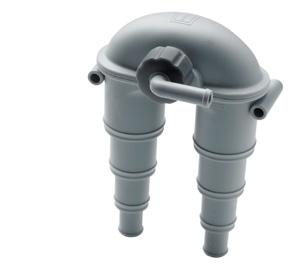
• 3-Way Ball Valve
• Anti-siphoning Breather Kit with Valve and Skin Fitting
• Breather Hose (3 metres) with 16mm Angled Tank Fitting
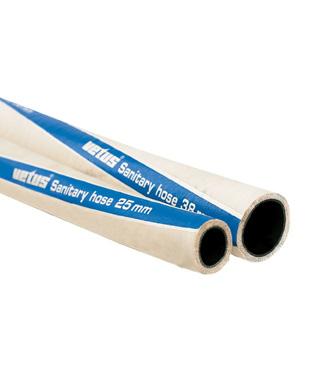
• Breather Nipple (16mm S/S)
• Thru-hull 28 mm S/S Skin Fitting
• Ball Valve (S/S)
• Hose Nipple (38 mm)
• Deck Entry Plate Waste Water 38 mm (S/S)
• No-smell Filter and Spare Cartridge
GREY
WASTE WATER SYSTEM
The system for use with grey water (sinks, showers) is similar to the toilet waste water system and the schematic diagram above illustrates a basic shower and sinks set-up. Note also the illustration which shows how all this works and take special note of the discharge pump (# 3) within the Discharge System Unit.
This unit makes it possible to pump grey water automatically from the shower tray or wash basin into a waste water holding tank (rigid or flexible). The watertight housing contains a low noise discharge pump, automatic float switch and a nonreturn valve in the discharge line allowing you to easily pump the water into the holding tank. The holding tank for grey water should be discharged in a similar fashion to black or effluent water. Even though grey water is not as toxic to the environment, it is still harmful, especially if numerous boats are constantly discharging water around our inner coastlines and especially in lakes and rivers.
Within the confines of this article, I have only been able to give you a general concept of what a waste water system should do and look like once installed. However, in my research I discovered the following excellent publication, available online from environment.govt.nz. This publication clearly spells out the legal requirements for the discharge of effluent and at the same time gives an expanded overview of what I have written. A marine toilet with a holding tank system will make your voyages more convenient and relaxing. Even larger trailer boats now come with basic shower and sink units (whether in the bathroom or the galley) and having both a black and grey water system aboard is a worthwhile investment that instantly adds value to your boat.
Tecma rocker switch.
1. Shower or washbasin 2. Float switch 3. Discharge pump 4. Electric motor 5. Washbasin 6. Breather 7. Waste water 8. Air
1.
2.
3.
4.
5.
6.
7.
conditioner
Shower or washbasin connection Ø 40 mm
Float switch
Discharge pump
Electric motor
Washbasin connection, Ø 32 or 40 mm
Breather
Waste water discharge connection: male Ø 19 mm o.d 8. Air conditioner connection, Ø 12 mm
118 JANUARY / FEBRUARY 2023

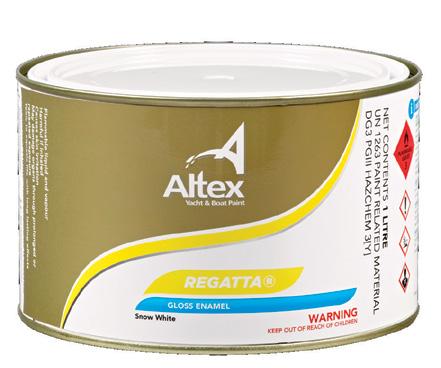
altexboatpaint.com Top Coats Range Brilliant Coats for Brilliant Boats The brushable professional finish. Easy as 123. 321 Professional grade / luxury marine finish –ELITE® DEFENDER PROFESSIONAL USE POLYURETHANE Quality, easy to apply single pack enamel REGATTA® DIY OR PROFESSIONAL APPLICATION Choose the right coat to protect your boat, reflecting your hard work. GET THAT WET LOOK GLOSS


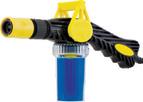


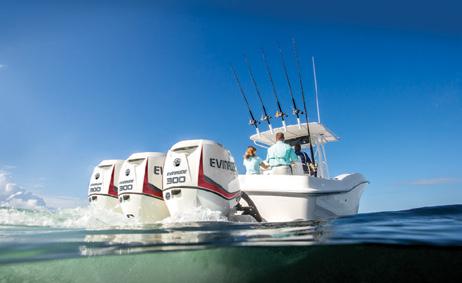



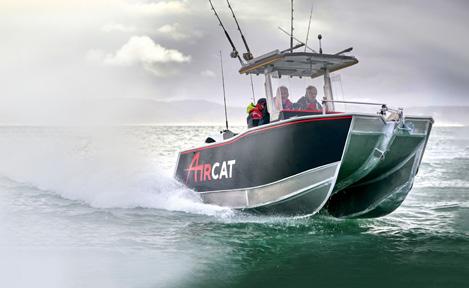

12 MONTHS DIRECTORY/BRAND AWARENESS ADVERTISING OFFER FOR ONLY $100 PER MONTH. For further infomation contact: alex@boatmgs.com02102865298 >> DIRECTORY BOAT BUILDERS & DESIGNERS, SALES & SERVICE, PRODUCT & ACCESSORIES www.salt-attack.com SALT ATTACK SALT REMOVERS KILLS SALT CORROSION MARSDEN MARINE Ship Surveyors and Valuers MNZ, AIMS-CCMS & UK SCMS qualified, recognised and professionally accredited leisure and commercial marine surveying practice. Greg Marsden (Practice Principal) DipMarSvy, AIMS-CCMS, AMCMS, MNZ P(AP) www.mmservices.co.nz enquiries@mmservices.co.nz Ph: 021 420 984 DB835 REPLACEMENT WINDSCREENS FOR ALL MAKES AND MODELS INSURANCE QUOTES REPLACE LIKE NEW Call 09 278 9816 www.sandbrooks.co.nz DB264 FREE Office: (09) 4838 111 – Pete: 0274 731 260 – Luke: 021 686 394 Email: pete@boathaulage.co.nz We Service all brands Agents for: HOLIDAY OUTBOARD SERVICES & BOAT STORAGE HOLIDAY OUTBOARD SERVICES & BOAT STORAGE holidayoutboards@xtra.co.nz 209 Bush Road, Albany 0632 ph: 09 448 1650 fax: 09 448 1651 www.holidayoutboards.co.nz DB112 Dare to be Different www.aircat.nz | info@aircat.nz | Ph: Roger: +64 21 953 060 | Brian: +64 27 259 5111 DB898
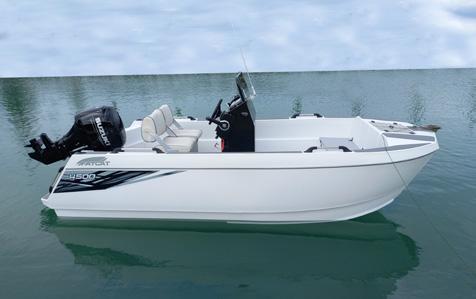







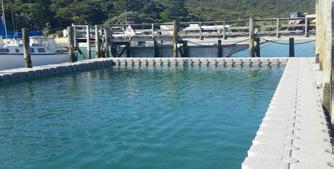
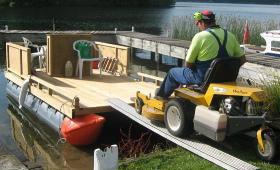



DB056 AUCKLAND’S SPECIALIST BOAT REPAIR CENTRE Insurance Work Specialists • Launch, Yacht and Runabout Repairs • Antifouling and Gelcoat Work • Full Marine Maintenance Service Spraypainting and Jetski Repairs 58 Diana Drive, Glenfield Steve@boatrepairs.co.nz www.boatrepairs.co.nz Phone: 09 441 2000 Fax: 09 441 4000 Mob: 021 908 156 Recognised member DB009 Thames St, Morrinsville ph (07) 889 7193 • fax (07) 889 5405 Email: sportcraftboats@xtra.co.nz Jamie (021) 795 597 www.sportcraftboats.co.nz MORRINSVILLE’S MARINE CENTRE Power trim & tilt units from $1250 Jacking plates from $950 POWER LIFT BR ACKETS LIFT BRACKETS 9/623 Whangaparaoa Road, Stanmore Bay, Auckland Ph: (09) 424 0004, M: 021 1142 444, E: info@fatcat.nz www.fatcat.nz DB908 Antifouling – Touch ups – Valet – Refits e: dale@touchofgloss.co.nz | P: 0275 951 443 www. touch of gloss .co.nz DB192 •Fibreglass & Timber Repairs •Spray Painting & Gelcoating •Insurance work •Antifouling Talk to us first for all your info@southaucklandboatrepairs.co.nz www.superiorgroup.co.nz 25-27 Holmes Rd, Manurewa. PO Box 75-486. Manukau 2243 Ph (09) 267 8498 DB359 DB261 Durable kitset pods for pontoon and houseboats, jetties, barges, floating docks, walkways and more www.pontoonz.com | pontoonz@gmail.com | +64 27 555 2000 >> DIRECTORY BOAT BUILDERS & DESIGNERS, SALES & SERVICE, PRODUCT & ACCESSORIES 12 MONTHS DIRECTORY/BRAND AWARENESS ADVERTISING OFFER FOR ONLY $100 PER MONTH. For further infomation contact: alex@boatmgs.com02102865298 POWERBOATMAGAZINE.CO.NZ _ 121
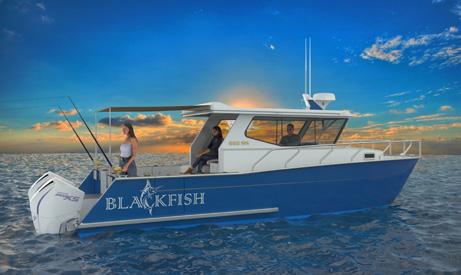
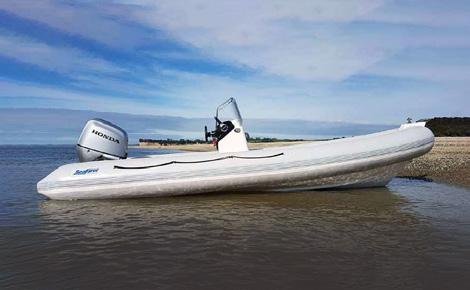


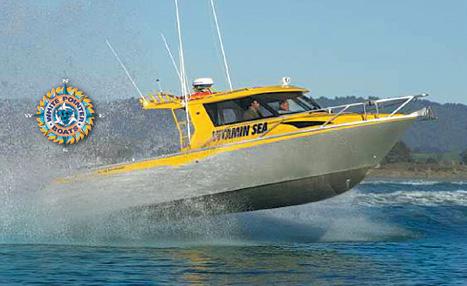
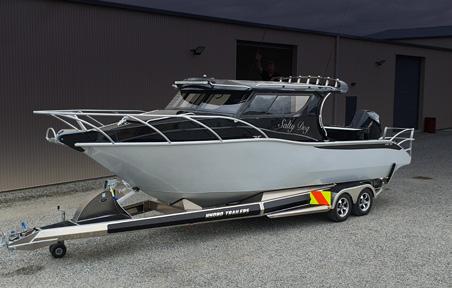


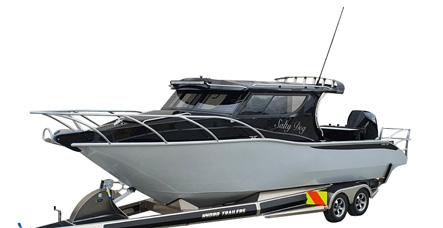
12 MONTHS DIRECTORY/BRAND AWARENESS ADVERTISING OFFER FOR ONLY $100 PER MONTH. For further infomation contact: alex@boatmgs.com02102865298 >> DIRECTORY BOAT BUILDERS & DESIGNERS, SALES & SERVICE, PRODUCT & ACCESSORIES p: +64 9 536 5070 | e: info@teknicraft.com www.teknicraft.com PROVEN HYDROFOIL TECHNOLOGY DB262 custom designed boats DB368 1487A State Highway 17, Dairy Flat, Auckland. Ph: 021 570 505 | e: info@seafarerinflatables.co.nz | www.seafarerinflatables.co.nz SF600R Custom built inflatables, re-tubes & repair of any inflatable ROGER HILL YACHT DESIGN LTD www.powercatsnz.com Ph +64 9 537 2644 Mob +64 274 595 822 roger@powercatsnz.com WHITE POINTER BOATS Custom Alloy Sports Fishing Boats “Ride with the best” 1 8 9 S t a n l e y R o a d , G i s b o r n e 189 Stanley Road, Gisborne P h : 0 6 8 6 8 6 5 1 9 F a x : 0 6 8 6 8 9 9 3 9 Ph: 06 868 6519 Fax: 06 868 9939 M o b : 0 2 7 5 8 1 5 0 0 7 E m a i l : r e x @ w h i t e p o i n t e r b o a t s . c o . n z Mob: 0275 815007 Email: rex@whitepointerboats.co.nz We b w w w. w h i t e p o i n t e r b o a t s . c o . n z Web www.whitepointerboats.co.nz info@hydromarine.co.nz p: 0273 900161 www.hydromarine.co.nz DB778 122 JANUARY / FEBRUARY 2023