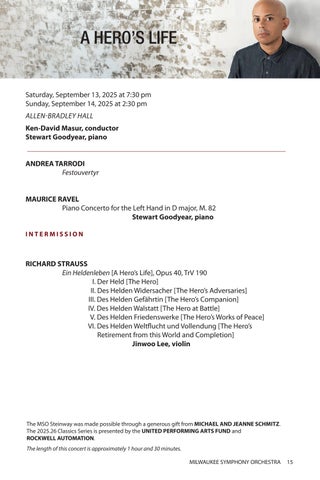
Piano Concerto for the Left Hand in D major, M. 82 Stewart Goodyear, piano
INTERMISSION
RICHARD STRAUSS
Ein Heldenleben [A Heroâs Life], Opus 40, TrV 190
I. Der Held [The Hero]
II. Des Helden Widersacher [The Heroâs Adversaries]
III. Des Helden GefĂ€hrtin [The Heroâs Companion]
IV. Des Helden Walstatt [The Hero at Battle]
V. Des Helden Friedenswerke [The Heroâs Works of Peace]
VI. Des Helden Weltflucht und Vollendung [The Heroâs Retirement from this World and Completion]
Jinwoo Lee, violin
The MSO Steinway was made possible through a generous gift from MICHAEL AND JEANNE SCHMITZ. The 2025.26 Classics Series is presented by the UNITED PERFORMING ARTS FUND and ROCKWELL AUTOMATION
The length of this concert is approximately 1 hour and 30 minutes.
Guest Artist Biographies
STEWART GOODYEAR
Proclaimed âa phenomenonâ by the Los Angeles Times and âone of the best pianists of his generationâ by The Philadelphia Inquirer, Stewart Goodyear is an accomplished concert pianist, improviser, and composer. Goodyear has performed with, and has been commissioned by, many of the major orchestras and chamber music organizations around the world.
Last year, Orchid Classics released Goodyearâs recording of his suite for piano and orchestra, Callaloo, and his piano sonata. His recent commissions include works for violinist Miranda Cuckson, cellist Inbal Segev, the Penderecki String Quartet, the Horszowski Trio, the Honens Piano Competition, and the Chineke! Foundation. Goodyear made his BBC Proms debut performing Callaloo with the Chineke! Orchestra under Andrew Grams in the fall of 2024.
Goodyearâs discography includes Beethovenâs complete sonatas and piano concerti, as well as concerti by Tchaikovsky, Grieg, Rachmaninoff, and Prokofiev, an album of Ravelâs piano works, and an album, entitled For Glenn Gould, which combines repertoire from Gouldâs U.S. and Montreal debuts. His recordings have been released on the Naxos, Marquis Classics, Orchid Classics, Bright Shiny Things, and Steinway & Sons labels. Goodyear released his recording of concerti by Mendelssohn and Schumann, along with two of his original compositions, on Orchid Classics in February 2025.
Highlights for the 2025-26 season are his performances at the Rheingau Musik Festival, the Stratford Music Festival, and performances with Philharmonie SĂŒdwestfalen, the St. Louis,
Program notes by David Jensen
ANDREA TARRODI
Born 9 October 1981; Stockholm, Sweden
Festouvertyr
Composed: 2021
First performance: 3 December 2021; Anja Bihlmaier, conductor; Gothenburg Symphony Orchestra
At the forefront of contemporary composers breaking new sonic ground in the 21st century, Andrea Tarrodiâs music has been heard on five continents and has been performed by some of the worldâs finest orchestras, including the BBC Philharmonic, Saint Paul Chamber Orchestra, Royal Stockholm Philharmonic Orchestra, Mahler Chamber Orchestra, and the Chicago Symphony Orchestra, among many others. Characterized by their shimmering textures, breathtaking naturalistic effects, and nuanced shadings, her works have resounded throughout classical musicâs most prestigious concert halls, including the Barbican Centre, Royal Albert Hall, and Viennaâs Musikverein.
Tarrodiâs formal studies took her to the PiteĂ„ School of Music in northern Sweden, where she studied composition and arranging, the Royal College of Music in Stockholm, and the âFrancesco Morlacchiâ conservatory in Perugia, Italy, before returning to the Royal College to complete her masterâs degree in composition in 2009. A frequent prizewinner, Tarrodiâs album of string quartets, recorded by the Dahlkvist Quartet, received a Swedish Grammy Award for Best Classical Album of the Year in 2018 â the same year her piano concerto Stellar Clouds was named Classical Music of the Year by the Swedish Music Publisherâs Awards.
Written on a commission from the Gothenburg Symphony Orchestra, Festouvertyr (which loosely translates to âFestive Overtureâ) honors the 25th anniversary of the Sten A. Olsson Foundation for Research and Culture, a charitable organization devoted to funding innovations in science, technology, medicine, and the humanities. Tarrodi, who has synesthesia (a condition in which one sense perception can act as a catalyst for a secondary sensory experience), has described her approach to composition as visual in nature, associating particular chords and pitches with certain colors and illustrating her musical ideas in drawings and paintings; in four exhilarating minutes, Festouvertyr leverages this remarkable sensitivity to instrumental timbre while delighting in its own strikingly original soundscape.
By the late 1920s, Maurice Ravel was widely recognized as one of the greatest musical magicians of his generation. A fine pianist with an incomparable mastery of instrumental color and a seemingly boundless imagination, his diaphanous orchestral scores offered glimpses of a luminous, ethereal world just beyond the stage. Seemingly unconcerned by matters of wealth or critical success â despite his status as the most celebrated French composer of his day â his music was the fruit of a slow, meticulous, and intelligent creative process that prompted Igor Stravinsky to describe him as âthe most perfect of Swiss watchmakers.â
The cataclysm of World War I, followed by the death of his mother in 1917, significantly diminished Ravelâs productivity, and in 1921, he left his life in the city behind to settle in a small home on the outskirts of Montfort-lâAmaury. Despite the slower rhythm of his life in the countryside, Ravel began touring as a pianist with greater frequency throughout the 1920s, and the few works he did compose in the postwar years of his life remain some of his most inspired realizations. His successful tour of North America in 1928, colored by its vibrant cityscapes and the tantalizing sounds of jazz, left an enormous impression: having already composed a wealth of ravishing music for the piano, he decided he would, in his sixth decade, author his first piano concerto. He would soon unwittingly find himself in the position of writing two at the same time.
Like Ravel, the Austrian pianist Paul Wittgenstein had been indelibly altered by the Great War. He had just made a successful public debut in Vienna in 1913 when the war arrived, and by August 1914, he was taken prisoner of war by the Russians after having had his right arm amputated on the battlefield. When he returned to Austria as part of prisoner exchange in 1915, he began commissioning left-handed works from a wide variety of composers, including Hindemith, Britten, Prokofiev, and Strauss, though it was Ravelâs brooding, incandescent score that would eventually find favor as the most popular work in Wittgensteinâs new repertory. Ravel set aside the draft he had begun for himself (what would eventually become the jazz-inflected piano concerto in G), but the collaboration was fraught with conflicts of personality. Wittgenstein objected to the lengthy cadenza in the concertoâs introduction, telling Ravel that âIf I wanted to play without the orchestra, I wouldnât have commissioned a concerto!â Wittgenstein made matters worse by cutting and rewriting entire passages, shocking Ravel by performing his heavily revised âinterpretationâ at the French embassy in Vienna ahead of its premiere. To both their displeasure, Ravel eventually convinced Wittengenstein to play the work as written.
Unlike the extroverted, high-flying theatrics that characterize his concerto in G, its left-handed counterpart is made up of churning, dusky music which probes the depths of its own contents: âFrom the opening measures,â the musicologist Henry PruniĂšres wrote, âwe are plunged into a world in which Ravel has but rarely introduced us.â Composed as a single continuous movement, the opening measures give the impression of a subterranean world, rising as it does from the
depths of the orchestra before erupting in a tremendous cadenza elaborating upon the first sectionâs primary musical material. The center of the concerto is a martial, spritely scherzo that draws on the incisive rhythms and piquant harmonies of American jazz, and the work reaches its apotheosis as Ravel interweaves the concertoâs themes into a sensuous, shimmering cadenza before a final fanfare from the orchestra draws the music to its earth-shattering conclusion.
RICHARD STRAUSS
Born 11 June 1864; Munich, Germany
Died 8 September 1949; Garmisch-Partenkirchen, Germany
Ein Heldenleben [A Heroâs Life], Opus 40, TrV 190
Composed: July â 27 December 1898
First performance: 3 March 1899; Richard Strauss, conductor; Frankfurter Opern- und Museumsorchester
Last MSO performance: 22 January 2011; Edo de Waart, conductor Instrumentation: piccolo; 3 flutes; 4 oboes (4th doubling on English horn); 2 clarinets; E-flat clarinet; bass clarinet; 3 bassoons; contrabassoon; 8 horns; 2 piccolo trumpets; 3 trumpets; 3 trombones; tenor tuba; tuba; timpani; percussion (bass drum, cymbals, military drum, suspended cymbals, tam-tam, tenor drum, triangle); 2 harps; strings
Approximate duration: 40 minutes
Straussâs eighth tone poem arrived at the close of the 19th century as the artistic high point of his revolutionary efforts in the genre. Comparable in scope and peculiarity only to Hector Berliozâs phantasmagorical Symphonie fantastique, Ein Heldenleben capitalized on the coloristic and textural palettes now accessible by means of the newly modernized orchestra, calling for an enormous battery of instrumentalists in painting an unabashedly self-referential portrait of the artistâs life. While Strauss equivocated throughout his life as to whether or not the work was in fact autobiographical in nature, itâs difficult to extricate the megalomaniacal image of the composer from a piece containing dozens of musical quotations from his own canon.
Not without resistance from the intellectual public, the very last years of the century had enshrined Strauss in Europeâs musical spheres as the de facto emissary of modern music. In a span of five years, an enormous body of tone poetry and lieder flowed from the composerâs pen, transmuting the emotive urgency of the Romantics into a new, wildly imaginative medium. It was during a stay at a Bavarian resort in the summer of 1898 that he began to conceive of a work in the vein of Beethovenâs Eroica which was to represent, in his own words, ânot a single poetical or historical figure, but rather a more general and free ideal of great and manly heroism.â
While Strauss himself was only responsible for the individual titles of each movement (which he would later request be struck from subsequent publications, preferring his work to be evaluated on purely musical terms), the implied narrative of the piece has been widely interpreted by audiences as a depiction of Straussâs personal rivalry against Germanyâs musical critics, colored by the Nietzschean conflict between the self-actualized individual and his place in civil society. The âadversariesâ of the second movement, portrayed by chattering woodwinds and low brass, are the same detractors that take the hero to war, a battle distinguished by its thundering fanfares and halted only by the heroâs âworks of peace,â wherein Strauss liberally intersperses themes from his opera Guntram, no less than six of his tone poems, and two art songs.
At the center of the drama is the artistâs âcompanion,â acknowledged by the composer as a direct illustration of his wife, Pauline de Ahna; her role, alternately capricious and poignant, is assigned to the concertmaster, whose elaborate cadenzas embody the woman Strauss described as âvery complex, a trifle perverse, a trifle coquettish, never the same, changing from minute to minute.â
2025.26 SEASON
KEN-DAVID MASUR
Music Director
Polly and Bill Van Dyke Music Director Chair
EDO DE WAART
Music Director Laureate
BYRON STRIPLING
Principal Pops Conductor
Stein Family Foundation Principal Pops Conductor Chair
RYAN TANI
Associate Conductor
CHERYL FRAZES HILL
Chorus Director
Margaret Hawkins Chorus Director Chair
TIMOTHY J. BENSON
Assistant Chorus Director
FIRST VIOLINS
Jinwoo Lee, Concertmaster, Charles and Marie Caestecker Concertmaster Chair
Ilana Setapen, First Associate Concertmaster, Thora M. Vervoren First Associate Concertmaster Chair
Jeanyi Kim, Associate Concertmaster
Alexander Ayers
Autumn Chodorowski
Yuka Kadota
Elliot Lee
Dylana Leung
Kyung Ah Oh
Lijia Phang
VinĂcius SantâAna**
Yuanhui Fiona Zheng
SECOND VIOLINS
Jennifer Startt, Principal, Andrea and Woodrow Leung Principal Second Violin Chair
Ji-Yeon Lee, Assistant Principal (2nd chair)
Hyewon Kim, Acting Assistant Principal (3rd chair)
Heejeon Ahn
Lisa Johnson Fuller
Clay Hancock
Paul Hauer
Sheena Lan**
Janis Sakai**
Yiran Yao
VIOLAS
Victor de Almeida, Principal, Richard O. and Judith A. Wagner Family Principal Viola Chair
Samantha Rodriguez, Acting Assistant Principal (2nd chair), Friends of Janet F. Ruggeri Assistant Principal Viola Chair
Alejandro Duque, Acting Assistant Principal (3rd chair)
Elizabeth Breslin
Georgi Dimitrov
Nathan Hackett
Michael Lieberman**
Erin H. Pipal
CELLOS
Susan Babini, Principal, Dorothea C. Mayer Principal Cello Chair
Shinae Ra, Assistant Principal (2nd chair)
Scott Tisdel, Associate Principal Emeritus
Madeleine Kabat
Peter Szczepanek
Peter J. Thomas
Adrien Zitoun
BASSES
Principal, Donald B. Abert Principal Bass Chair
Andrew Raciti, Acting Principal
Nash Tomey, Acting Assistant Principal (2nd chair)
Brittany Conrad Broner McCoy
Paris Myers
HARP
Julia Coronelli, Principal, Walter Schroeder Principal Harp Chair
FLUTES
Sonora Slocum, Principal, Margaret and Roy Butter Principal Flute Chair
Heather Zinninger, Assistant Principal
Jennifer Bouton Schaub
PICCOLO
Jennifer Bouton Schaub
OBOES
Katherine Young Steele, Principal, Milwaukee Symphony Orchestra League Principal Oboe Chair
Kevin Pearl, Assistant Principal
Margaret Butler
ENGLISH HORN
Margaret Butler, Philip and Beatrice Blank English Horn Chair in memoriam to John Martin
CLARINETS
Todd Levy, Principal, Franklyn Esenberg Principal Clarinet Chair
Jay Shankar, Assistant Principal, Donald and Ruth P. Taylor Assistant Principal Clarinet Chair
Besnik Abrashi
E-FLAT CLARINET
Jay Shankar
BASS CLARINET
Besnik Abrashi
BASSOONS
Catherine Van Handel, Principal, Muriel C. and John D. Silbar Family
Principal Bassoon Chair
Rudi Heinrich, Assistant Principal
Matthew Melillo
CONTRABASSOON
Matthew Melillo
HORNS
Matthew Annin, Principal, Krause Family Principal
French Horn Chair
Krystof Pipal, Associate Principal
Dietrich Hemann, Andy Nunemaker French Horn Chair
Darcy Hamlin
Dawson Hartman
TRUMPETS
Matthew Ernst, Principal, Walter L. Robb Family Principal Trumpet Chair
David Cohen, Associate Principal, Martin J. Krebs Associate Principal Trumpet Chair
Tim McCarthy, Fred Fuller Trumpet Chair
TROMBONES
Megumi Kanda, Principal, Marjorie Tiefenthaler Principal Trombone Chair
Kirk Ferguson, Assistant Principal
BASS TROMBONE
John Thevenet, Richard M. Kimball
Bass Trombone Chair
TUBA
Robyn Black, Principal, John and Judith Simonitsch Tuba Chair
TIMPANI
Dean Borghesani, Principal
Chris Riggs, Assistant Principal
PERCUSSION
Robert Klieger, Principal
Chris Riggs
PIANO
Melitta S. Pick Endowed Piano Chair
PERSONNEL
Antonio Padilla Denis, Director of Orchestra Personnel
Paris Myers, Hiring Coordinator
LIBRARIANS
Paul Beck, Principal Librarian, James E. Van Ess Principal Librarian Chair
Matthew Geise, Assistant Librarian & Media Archivist
PRODUCTION
Tristan Wallace, Production Manager/Live Audio
Lisa Sottile, Production Stage Manager
* Leave of Absence 2025.26 Season
** Acting member of the Milwaukee Symphony Orchestra 2025.26 Season