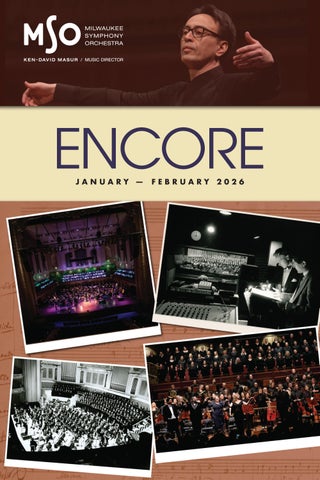
ENCORE JANUARY
—
FEBRUARY 2026
ENCORE Volume 44 No. 3
ENCORE JANUARY
—
FEBRUARY
2026
14 January 2 & 3 — Film The Godfather in Concert 17 January 23 & 24 — Classics Beethoven & Haydn 27 January 31 & February 1 — Classics Zeitouni Conducts Mozart 37 February 6 & 7 — Classics Saint-Saëns “Organ” Symphony 46 February 13 – 15 — Pops A Simply Swingin’ Valentine 5 7 8 9 10 11 58
Orchestra Roster Music Director Music Director Laureate Principal Pops Conductor Associate Conductor Milwaukee Symphony Chorus
MSO Endowment Musical Legacy Society 59 Annual Fund 62 Corporate & Foundation Matching Gifts 63 Golden Note Partners Marquee Circle Tributes 66 MSO Board of Directors 67 MSO Administration
This program is produced and published by ENCORE PLAYBILLS. To advertise in any of the following programs: • Milwaukee Symphony Orchestra • Florentine Opera • Milwaukee Ballet • Marcus Performing Arts Center Broadway Series • Skylight Music Theatre • Milwaukee Repertory Theater • Sharon Lynne Wilson Center • First Stage Please contact: Scott Howland at 414-469-7779 scott.encore@att.net MILWAUKEE SYMPHONY ORCHESTRA 212 West Wisconsin Avenue Milwaukee, Wisconsin 53203 414-291-6010 | mso.org
Connect with us! MSOrchestra MilwSymphOrch @MilwSymphOrch The MSO and the Bradley Symphony Center have partnered with KultureCity to improve our ability to assist and accommodate guests with sensory needs. For information on available resources, visit mso.org.
MILWAUKEE SYMPHONY ORCHESTRA
1
BRING THE SYMPHONY HOME. AND DUKE. AND JONI. AND LIGHTNIN’.
WE CAN HELP THEM MOVE IN. Fine home music and theater systems and the expertise to make them thrilling.
A BETTER AUDIO AND HOME THEATER EXPERIENCE
Baroque
ULTRAFIDELIS.COM WAUWATOSA, WI
9/8/22 10:02 PM
JAN
26
MONDAY
Untitled-3 1
— U N B O U N D —
Music by Vivaldi and Bach, plus more baroque
Frank Almond, violin Paolo Bordignon, harpsichord Jennifer Bouton, piccolo Members of the MSO
franklymusic.org PROUD AFFILIA AFFILIATE
2
7:00 pm Schwan Concert Hall Wisconsin Lutheran College
These concerts are supported in part by a grant from the the United Performing Arts Fund, the Milwaukee Arts Board, and the Milwaukee County Arts Fund.
MILWAUKEE SYMPHONY ORCHESTRA
Not to Toot Our Own Horns, but Saint John’s is Simply the BEST! “Living at Saint John’s enables us to continue our passion for music which we love to share with our fellow SJOL Neighbors and Friends.” – Tom & Cheri Briscoe Residents since 2011
The best in senior living includes... A culturally respectful and intellectually stimulating community More than 200 events to enjoy every month Unlimited campus amenities to share with friends and family.
Learn more about life at Saint John’s. Call 414-831-6900. Independent Living
Assisted Living
1840 N. Prospect Avenue
Memory Care
Skilled Care
www.SaintJohnsMilw.org
414-831-6900
MILWAUKEE SYMPHONY ORCHESTRA
3
MILWAUKEE SYMPHONY ORCHESTRA
Photo by Jonathan Kirn
The Milwaukee Symphony Orchestra, led by Music Director Ken-David Masur, is among the finest orchestras in the nation and the largest cultural institution in Wisconsin. Since its inception in 1959, the MSO has found innovative ways to give music a home in the region, develop music appreciation and talent among area youth, and raise the national reputation of Milwaukee. The MSO’s full-time professional musicians perform over 135 classics, pops, family, education, and community concerts each season in venues throughout the state. A pioneer among American orchestras, the MSO has performed world and American premieres of works by John Adams, Roberto Sierra, Philip Glass, Geoffrey Gordon, Marc Neikrug, Camille Pépin, Matthias Pintscher, and Dobrinka Tabakova, as well as garnered national recognition as the first American orchestra to offer live recordings on iTunes. In January of 2021, the MSO completed a years-long project to restore and renovate a former movie palace in the heart of downtown Milwaukee. The Bradley Symphony Center officially opened to audiences in October 2021. This project has sparked a renewal on West Wisconsin Avenue and continues to be a catalyst in the community. The MSO’s standard of excellence extends beyond the concert hall and into the community, reaching more than 30,000 children and their families through its Arts in Community Education (ACE) program, Youth and Teen concerts, Family Series, and Meet the Music pre-concert talks. Celebrating its 36th year, the nationally recognized ACE program integrates arts education across all subjects and disciplines, providing opportunities for students when budget cuts may eliminate arts programming. The program provides lesson plans and supporting materials, classroom visits from MSO musician ensembles and artists from local organizations, and an MSO concert tailored to each grade level. The ACE program serves 5,500 students, teachers, and administrators in the Milwaukee area every year.
4
MILWAUKEE SYMPHONY ORCHESTRA
Elizabeth Breslin Georgi Dimitrov Nathan Hackett Michael Lieberman** Erin H. Pipal
Rudi Heinrich, Assistant Principal Matthew Melillo CONTRABASSOON Matthew Melillo
2025.26 SEASON
CELLOS Susan Babini, Principal, KEN-DAVID MASUR Dorothea C. Mayer Principal Cello Chair Music Director Shinae Ra, Assistant Principal (2nd chair) Polly and Bill Van Dyke Music Director Chair Scott Tisdel, Associate Principal Emeritus Madeleine Kabat EDO DE WAART Peter Szczepanek Music Director Laureate Peter J. Thomas BYRON STRIPLING Adrien Zitoun Principal Pops Conductor Stein Family Foundation BASSES Principal Pops Conductor Chair Principal, Donald B. Abert Principal Bass Chair RYAN TANI Andrew Raciti, Acting Principal Associate Conductor Nash Tomey, Acting Assistant Principal (2nd chair) CHERYL FRAZES HILL Brittany Conrad Chorus Director Broner McCoy Margaret Hawkins Chorus Director Chair Paris Myers TIMOTHY J. BENSON Assistant Chorus Director HARP FIRST VIOLINS Jinwoo Lee, Concertmaster, Charles and Marie Caestecker Concertmaster Chair Ilana Setapen, First Associate Concertmaster, Thora M. Vervoren First Associate Concertmaster Chair Jeanyi Kim, Associate Concertmaster Alexander Ayers Autumn Chodorowski Yuka Kadota Elliot Lee Dylana Leung Kyung Ah Oh Lijia Phang Vinícius Sant’Ana** Yuanhui Fiona Zheng SECOND VIOLINS Jennifer Startt, Principal, Andrea and Woodrow Leung Principal Second Violin Chair Ji-Yeon Lee, Assistant Principal (2nd chair) Hyewon Kim, Acting Assistant Principal (3rd chair) Heejeon Ahn Lisa Johnson Fuller Clay Hancock Paul Hauer Sheena Lan** Janis Sakai** Yiran Yao VIOLAS Victor de Almeida, Principal, Richard O. and Judith A. Wagner Family Principal Viola Chair Samantha Rodriguez, Acting Assistant Principal (2nd chair), Friends of Janet F. Ruggeri Assistant Principal Viola Chair Alejandro Duque, Acting Assistant Principal (3rd chair)
Julia Coronelli, Principal, Walter Schroeder Principal Harp Chair FLUTES Sonora Slocum, Principal, Margaret and Roy Butter Principal Flute Chair Heather Zinninger, Assistant Principal Jennifer Bouton Schaub
HORNS Matthew Annin, Principal, Krause Family Principal French Horn Chair Krystof Pipal, Associate Principal Dietrich Hemann, Andy Nunemaker French Horn Chair Darcy Hamlin Dawson Hartman TRUMPETS Matthew Ernst, Principal, Walter L. Robb Family Principal Trumpet Chair David Cohen, Associate Principal, Martin J. Krebs Associate Principal Trumpet Chair Tim McCarthy, Fred Fuller Trumpet Chair TROMBONES Megumi Kanda, Principal, Marjorie Tiefenthaler Principal Trombone Chair Kirk Ferguson, Assistant Principal BASS TROMBONE John Thevenet, Richard M. Kimball Bass Trombone Chair TUBA Robyn Black, Principal, John and Judith Simonitsch Principal Tuba Chair TIMPANI Dean Borghesani, Principal Chris Riggs, Assistant Principal
PICCOLO Jennifer Bouton Schaub OBOES Katherine Young Steele, Principal, Milwaukee Symphony Orchestra League Principal Oboe Chair Kevin Pearl, Assistant Principal Margaret Butler
PERCUSSION Robert Klieger, Principal Chris Riggs
ENGLISH HORN Margaret Butler, Philip and Beatrice Blank English Horn Chair in memoriam to John Martin
PERSONNEL Antonio Padilla Denis, Director of Orchestra Personnel Paris Myers, Assistant Manager of Orchestra Personnel
CLARINETS Todd Levy, Principal, Franklyn Esenberg Principal Clarinet Chair Jay Shankar, Assistant Principal, Donald and Ruth P. Taylor Assistant Principal Clarinet Chair Besnik Abrashi E-FLAT CLARINET Jay Shankar BASS CLARINET Besnik Abrashi BASSOONS Catherine Van Handel, Principal, Muriel C. and John D. Silbar Family Principal Bassoon Chair*
PIANO Melitta S. Pick Endowed Piano Chair
LIBRARIANS Paul Beck, Principal Librarian, James E. Van Ess Principal Librarian Chair Matthew Geise, Assistant Librarian & Media Archivist PRODUCTION Tristan Wallace, Production Manager/Live Audio Lisa Sottile, Production Stage Manager * Leave of absence during the 2025.26 season ** Acting member of the MSO for the 2025.26 season
MILWAUKEE SYMPHONY ORCHESTRA
5
Now through January 2026 Join us for concerts, exhibits, and educational events across Wisconsin that will honor the past, enlighten the present, and inspire the future.
Learn more at ViolinsOfHopeWI.org
6
MILWAUKEE SYMPHONY ORCHESTRA
LIST OF EVENTS
KEN-DAVID MASUR, MUSIC DIRECTOR Hailed as “fearless, bold, and a life-force” (San Diego UnionTribune) and “a brilliant and commanding conductor with unmistakable charisma” (Leipziger Volkszeitung), Ken-David Masur is celebrating his seventh season as music director of the Milwaukee Symphony Orchestra and principal conductor of the Chicago Symphony’s Civic Orchestra.
Photo by Adam DeTour
Masur’s tenure in Milwaukee has been notable for innovative thematic programming and bridge-building, including a festival celebrating the music of the 1930s, when the Bradley Symphony Center was built; the Water Festival, which highlighted local community partners whose work centers on water conservation and education; and a new city-wide Bach Festival, celebrating the abiding appeal of J.S. Bach’s music in an ever-changing world. He has also instituted a multi-season artist-in-residence program, and he has led highly acclaimed performances of major choral works, including a semi-staged production of Peer Gynt.
In the 2025-26 season, Masur will lead celebrations of the 50th anniversary of the Milwaukee Symphony Chorus, featuring performances of Beethoven’s Symphony No. 9 and Missa solemnis, as well as Bach’s St. Matthew Passion as part of the MSO’s third Bach Week. Ken-David Masur and the MSO will reunite with longtime collaborators such as Augustin Hadelich, Orion Weiss, Stewart Goodyear, Nancy Zhou, and Bill Barclay and Concert Theatre Works for a special project celebrating America’s 250th birthday with a program interweaving the music of Aaron Copland with the words of Mark Twain. In Chicago, Masur leads the Civic Orchestra, the premier training ensemble of the Chicago Symphony Orchestra, in a wide range of programs, including its annual Bach Marathon. Masur has conducted orchestras around the world, including Boston, Chicago, New York, San Francisco, l’Orchestre National de France, Kristiansand Symphony Orchestra, NFM Wrocław Philharmonic in Poland, and Tokyo’s Yomiuri Nippon Symphony Orchestra. He makes regular festival appearances at Ravinia, Tanglewood, the Hollywood Bowl, Verbier, the Pacific Music Festival, and the Oregon Bach Festival. Masur is passionate about contemporary music and has conducted and commissioned numerous new works from living composers, including Wynton Marsalis, Augusta Read Thomas, and Unsuk Chin, among others. He has recorded with the English Chamber Orchestra and the Stavanger Symphony Orchestra and received a Grammy Award nomination from the Latin Recording Academy for the album Salón Buenos Aires. Masur and his wife, pianist Melinda Lee Masur, are founders and artistic directors of the Chelsea Music Festival, an annual summer festival in New York City with programs ranging from the Baroque and Classical to contemporary and jazz, placing a special emphasis on the intersection of the culinary and visual arts. The festival celebrated its 16th anniversary in 2025 and has been praised by The New York Times as a “gem of a series” and by Time Out New York as an “impressive addition to New York’s cultural ecosystem.” Born and raised in Leipzig, Germany, Masur was trained at the Mendelssohn Academy in Leipzig, the Gewandhaus Children’s Choir, the Detmold Academy, and the “Hanns Eisler” Conservatory in Berlin. While an undergraduate at Columbia University in New York, Masur became the first music director of the Bach Society Orchestra and Chorus, with which he toured to Germany and recorded the music of J.S. Bach and his sons. Music education and working with the next generation of young artists are of major importance to Masur. In addition to his work with the Civic Orchestra of Chicago, he has conducted orchestras and led master classes at many international conservatories and festivals. MILWAUKEE SYMPHONY ORCHESTRA
7
EDO DE WAART, MUSIC DIRECTOR LAUREATE Throughout his long and illustrious career, renowned Dutch conductor Edo de Waart has held a multitude of posts with orchestras around the world, including music directorships with the Rotterdam Philharmonic Orchestra, San Francisco Symphony, Minnesota Orchestra, Netherlands Radio Philharmonic Orchestra, Hong Kong Philharmonic Orchestra, Milwaukee Symphony Orchestra, Antwerp Symphony Orchestra, New Zealand Symphony Orchestra, and Sydney Symphony Orchestra, as well as a chief conductorship with the De Nederlandse Opera and Santa Fe Opera.
Photo by Jesse Willems
Edo de Waart served as principal guest conductor of the San Diego Symphony, conductor laureate of both the Antwerp Symphony Orchestra and Netherlands Radio Philharmonic Orchestra, and music director laureate of the Milwaukee Symphony Orchestra.
As an opera conductor, de Waart has enjoyed success in a large and varied repertoire in many of the world’s greatest opera houses. He has conducted at Bayreuth, the Salzburg Festival, Royal Opera House, Covent Garden, Grand Théâtre de Genève, Opéra Bastille, Santa Fe Opera, and the Metropolitan Opera. With the aim of bringing opera to broader audiences where concert halls prevent full staging, he has, as music director in Milwaukee, Antwerp, and Hong Kong, often conducted semi-staged and opera in concert performances. A renowned orchestral trainer, he has been involved with projects working with talented young players at the Juilliard and Colburn schools and the Music Academy of the West in Santa Barbara. Edo de Waart’s extensive catalogue encompasses releases for Philips, Virgin, EMI, Telarc, and RCA. Recent recordings include Henderickx’s Symphony No. 1 and oboe concerto, Mahler’s Symphony No. 1, and Elgar’s Dream of Gerontius, all with the Royal Flemish Philharmonic. Beginning his career as an assistant conductor to Leonard Bernstein at the New York Philharmonic, de Waart then returned to Holland, where he was appointed assistant conductor to Bernard Haitink at the Royal Concertgebouw Orchestra. Edo de Waart has received a number of awards for his musical achievements, including becoming a Knight in the Order of the Netherlands Lion and an Honorary Officer in the General Division of the Order of Australia. He is also an Honorary Fellow of the Hong Kong Academy for Performing Arts.
8
MILWAUKEE SYMPHONY ORCHESTRA
BYRON STRIPLING, PRINCIPAL POPS CONDUCTOR
Photo by John Abbott
With a contagious smile and captivating charm, conductor, trumpet virtuoso, singer, and actor Byron Stripling ignites audiences across the globe. In 2024, Stripling was named Stein Family Foundation Principal Pops Conductor of the Milwaukee Symphony Orchestra. He also currently serves as principal pops conductor of the Pittsburgh Symphony Orchestra and artistic director and conductor of the highly acclaimed Columbus Jazz Orchestra. Stripling’s baton has led countless orchestras throughout the United States and Canada, including the Boston Symphony Orchestra at Tanglewood and the orchestras of San Diego, St. Louis, Virginia, Toronto, Baltimore, Milwaukee, Fort Worth, Rochester, Buffalo, Florida, Portland, and Sarasota, to name a few.
As a soloist with the Boston Pops, Stripling has performed frequently under the baton of Keith Lockhart, including as the featured soloist in the PBS television special Evening at Pops with conductors John Williams and Mr. Lockhart. Since his Carnegie Hall debut with Skitch Henderson and the New York Pops, Stripling has become a pops orchestra favorite throughout the country, appearing as soloist with more than 100 orchestras. He has been a featured soloist at the Hollywood Bowl and performs at festivals around the world. An accomplished actor and singer, Stripling was chosen, following a worldwide search, to star in the lead role of the Broadway-bound musical Satchmo. Many will remember his featured cameo performance in the television movie The Young Indiana Jones Chronicles and his critically acclaimed virtuoso trumpet and riotous comedic performance in the 42nd Street production of From Second Avenue to Broadway. Television viewers have enjoyed his work as a soloist on the worldwide telecast of the Grammy Awards. Millions have heard his trumpet and voice in television commercials, TV theme songs including 20/20 and CNN, and soundtracks of favorite movies. In addition to multiple recordings with his quintet and work with artists from Tony Bennett to Whitney Houston, his prolific recording career includes hundreds of albums with the greatest pop, Broadway, soul, and jazz artists of all time. Stripling earned his stripes as lead trumpeter and soloist with the Count Basie Orchestra under the direction of Thad Jones and Frank Foster. He has also played and recorded extensively with the bands of Dizzy Gillespie, Woody Herman, Dave Brubeck, Lionel Hampton, Clark Terry, Louis Bellson, and Buck Clayton in addition to the Jazz at Lincoln Center Orchestra, the Carnegie Hall Jazz Band, and the GRP All-Star Big Band. Stripling is devoted to giving back and supports several philanthropic organizations, including United Way and the Community Shelter Board. He also enjoys sharing the power of music through seminars and master classes at colleges, universities, conservatories, and high schools. Stripling was educated at the Eastman School of Music in Rochester, New York, and the Interlochen Arts Academy in Interlochen, Michigan. One of his greatest joys is to return periodically to Eastman and Interlochen as a special guest lecturer. A resident of Ohio, Stripling lives in the country with his wife, Alexis, a former dancer, writer, and poet and their beautiful daughters.
MILWAUKEE SYMPHONY ORCHESTRA
9
RYAN TANI, ASSOCIATE CONDUCTOR Now in his third season with the MSO and his first as its associate conductor, Ryan Tani has built a reputation for inventive programming, as well as an energetic connection with audiences in Milwaukee and beyond. At the MSO, he conducts a wide range of concerts — including education, family, pops, and classics — and has stepped in for Edo de Waart and led sold-out performances in his 2025 classics debut. He has served as cover conductor for the Minnesota Orchestra, New York Philharmonic, St. Louis Symphony Orchestra, Colorado Symphony, and Bozeman Symphony. A committed advocate for new music, Tani was music director of Baltimore’s Occasional Symphony, commissioning over 20 works and supporting dozens of composers in just three years. At Yale, he served as conducting fellow of the Philharmonia and resident conductor of New Music New Haven, earning the Dean’s Prize for artistic excellence. Tani’s community-focused work includes leading multiple ensembles across Montana, including the Bozeman, Missoula, Great Falls, and Montana State University symphonies. Committed to connecting with audiences off the podium, he also developed outreach programs, taught university courses, and fostered collaborations between artists and the public — efforts that continue to shape his approach today. He holds degrees from Yale, the Peabody Institute, and the University of Southern California, and has studied with Marin Alsop, Peter Oundjian, Markand Thakar, Larry Rachleff, and Donald Schleicher. He lives in Milwaukee with his wife Bronte and his corgi Darby and enjoys cooking, reading, and playing violin.
10
MILWAUKEE SYMPHONY ORCHESTRA
MILWAUKEE SYMPHONY CHORUS
Photo by Jonathan Kirn
Established in 1976 as a joint effort between the Wisconsin Conservatory of Music and the Milwaukee Symphony Orchestra, the Milwaukee Symphony Chorus has distinguished itself over the course of half a century as one of the preeminent choral ensembles in the United States. Celebrating their landmark 50th anniversary this season, the chorus will appear alongside the MSO in monumental masterworks by Bach, Beethoven, and Handel, as well as the MSO’s annual Holiday Pops concerts. Founded by legendary choral pedagogue Margaret Hawkins, the chorus’s meteoric rise in stature during the late 1970s broadened the orchestra’s repertoire and set a new standard of excellence in Milwaukee’s musical landscape. Under Hawkins’s baton, the chorus produced its first commercial recordings and made multiple appearances at New York’s Carnegie Hall. Their voices were heard in the MSO’s first radio broadcasts, receiving airtime nationally and internationally. The chorus has made numerous guest appearances at the Ravinia Festival through the years, beginning in 1984 and as recently as 2019, performing with the Chicago Symphony Orchestra and Chorus, singing Gustav Mahler’s “Symphony of a Thousand.” Other collaborations include appearances with local performing arts groups, including the Milwaukee Ballet, Milwaukee Musaik, and Present Music. The Milwaukee Symphony Chorus’s wide range of ability has been a signature of the ensemble throughout their history. They have moved seamlessly from works by Bach and Brahms to Prokofiev’s Alexander Nevsky, sung during a live screening of the film. Semi-staged productions of Wagner’s The Flying Dutchman and Grieg’s Peer Gynt are featured alongside performances with contemporary artists, such as their recent appearance with the esteemed mandolinist Chris Thile. Their repertoire spans the centuries, regularly placing their enormous versatility on full display. Made up of musicians from every walk of life, the 150 members of the Milwaukee Symphony Chorus devote countless volunteer hours every season to preparing and performing the great cornerstones of the symphonic literature with an unqualified love for their craft. To learn more about becoming a member of the chorus, visit mso.org/chorus.
MILWAUKEE SYMPHONY ORCHESTRA
11
CHORUS MEMBERS & STAFF Kaleigh Kozak-Lichtman Katelyn Farebrother Jahnavi Acharya Kyle J. Kramer Michael Faust Anna Aiuppa u Joseph M. Krechel Catherine Fettig Mia Akers Julia M. Kreitzer Marty Foral Laura Albright-Wengler Harry Krueger Madison Francis Alexander Z. Alden Benjamin Kuhlmann u Karen Frink Anthony Andronczyk Alexandra Lerch-Gaggl Maria Fuller James Anello Robert Lochhead Haley Gabriel Evan Bagwell Grace Majewski James T. Gallup u Thomas R. Bagwell Rachel Maki Jonah Gaster Scott Bass Ethan T. Masarik Jonathan Gaston-Falk Marshall Beckman Joy Mast William Gesch Emily Bergeron Justin J. Maurer Samantha Gibson JoAnn Berk Betsy McCool Jessica Golinski Edward Blumenthal Hilary Merline Mark R. Hagner Alice Boesky Kristine Mielcarek Mary Hamlin Jillian Boes Megan Miller Beth Harenda u Scott Bolens Bailey Moorhead u Karen Heins Madison Bolt Jennifer Mueller Mary Catherine Helgren Neil R. Brooks Matthew Neu Kurt Hellermann Riley Brown Kristin Nikkel Melissa Kay Herbst Michelle Budny Jason Niles Nathan Hickox-Young Ellen N. Burmeister Alice Nuteson Eric Hickson John Bushman Robert Paddock Michelle Hiebert Gabrielle Campbell Daniel Edward Parks Laura Hochmuth Gerardo Carcar Heather Pierce Mara Hoffman Elise Cismesia R. Scott Pierce Amy Hudson Sarah M. Cook u Jessica E. Pihart Matthew Hunt Amanda Coplan Bianca Pratte John Itson Sarah Culhane Abby Prom u Tina Itson Barbara Czarkowski Kaitlin Quigley Jane Jaikumar Knight Phoebe Dawsey Mary Rafel Christine Jameson Colin Destache Jason Reuschlein Paula J. Jeske Rebeca A. Dishaw Rehanna Rexroat Robin Jette Megan Kathleen Dixson James Reynolds John Jorgensen Rachel Dutler Marc Charles Ricard Heidi L. Kastern James Edgar Amanda Robison Summer Ketchell Joe Ehlinger Shawn W. Runningen Christin Kieckhafer Jack W. Ellis u Bridget Sampson Katherine Kondratuk Kaleigh Ellis James Sampson Jill Kortebein John Erzberger
12
STAFF
REHEARSAL PIANISTS
Cheryl Frazes Hill, chorus director Timothy J. Benson, assistant director Darwin J. Sanders, language and diction coach Christina Williams, chorus manager
Melissa Cardamone Jeong-In Kim Teree Shofner-Emrich
MILWAUKEE SYMPHONY ORCHESTRA
Joshua S. Samson Darwin J. Sanders Alana Sawall Sarah Schmeiser Rand C. Schmidt Randy Schmidt u Allison Schnier Andrew T. Schramm Matthew Seider Bennett Shebesta ~Hannah Sheppard David Siegworth Samuel Skogstad Bruce Soto u Joel P. Spiess u Todd Stacey u Donald E. Stettler Scott Stieg Donna Stresing Sara Strommen Shannon Sweeney Joseph Thiel Clare Urbanski Bobbi Jo Vandal Matthew Van Hecke Stephanie Weeden Tess Weinkauf Amy Weyers Erin Weyers Christina Williams Sally Witte Kevin R. Woller Rachel Yap Ben Young Jamie M. Yu Katarzyna Zawislak Stephanie Zimmer
u Section Leader
DR. CHERYL FRAZES HILL, CHORUS DIRECTOR Dr. Cheryl Frazes Hill is now in her ninth season as director of the Milwaukee Symphony Chorus. During their landmark 50th anniversary season, Frazes Hill will prepare the Milwaukee Symphony Chorus for classical performances that include Beethoven’s Symphony No. 9, Handel’s Messiah, Bach’s St. Matthew Passion, and Beethoven’s Missa solemnis. Frazes Hill also serves as associate conductor of the Chicago Symphony Chorus. In that role, she has prepared the chorus for maestros Alsop, Boulez, Barenboim, Conlon, Levine, Mehta, Salonen, and Tilson Thomas, among many others. Recordings of Frazes Hill’s choral preparations on the Chicago Symphony Orchestra label include Beethoven, A Tribute to Daniel Barenboim, and Chicago Symphony Chorus: A 50th Anniversary Celebration. Frazes Hill is professor emerita at Roosevelt University’s Chicago College of Performing Arts, where she served for 20 years as director of choral activities and head of music education. Under her direction, the Roosevelt University choruses have been featured in prestigious and diverse events, including appearances at national and regional music conferences and performances with professional orchestras, including the Chicago Symphony Orchestra, the Chicago Sinfonietta, the Civic Orchestra of Chicago, and the Illinois Philharmonic. The Roosevelt Conservatory Chorus received enthusiastic reviews for their American premiere of Jacob ter Veldhuis’s Mountaintop. Other recent performances have included the internationally acclaimed production of Defiant Requiem and three appearances with The Rolling Stones during a recent United States concert tour. Frazes Hill received her master’s and doctoral degrees in conducting from Northwestern University and her bachelor’s degrees in voice and music education from the University of Illinois. An accomplished vocalist, she is a featured soloist in the Grammy-nominated CBS Masterworks release Mozart: Music for Basset Horns. An award-winning conductor and educator, Frazes Hill recently received the ACDA Harold Decker Conducting Award, the Mary Hoffman Music Educators Award, and in past years, the Commendation of Excellence in Teaching from the Golden Apple Foundation, the Illinois Governor’s Award, Roosevelt University’s Presidential Award for Social Justice, the Northwestern University Alumni Merit Award, and the Outstanding Teaching Award from the University of Chicago. Frazes Hill’s recently released book, Margaret Hillis: Unsung Pioneer, a biography of the famed female conductor, received a commendation from the 2023 Midwest Book Awards. Frazes Hill is nationally published on topics of her research in choral conducting and music education. A frequent guest conductor, clinician, and guest speaker, Frazes Hill regularly collaborates with maestro Marin Alsop at the Ravinia Festival’s ”Breaking Barriers” series, providing seminars for Taki Alsop female conducting fellows.
MILWAUKEE SYMPHONY ORCHESTRA
13
THE GODFATHER IN CONCERT FILM WITH ORCHESTRA
Friday, January 2, 2026 at 7:30 pm Saturday, January 3, 2026 at 7:30 pm ALLEN-BRADLEY HALL Ryan Tani, conductor
Directed by Francis Ford Coppola Produced by Gray Frederickson and Albert S. Ruddy Written by Mario Puzo and Francis Ford Coppola Starring Marlon Brando Al Pacino James Caan Richard S. Castellano Robert Duvall Sterling Hayden John Marley Richard Conte Diane Keaton Music by Nino Rota Cinematography by Gordon Willis Edited by William Reynolds and Peter Zinner Produced by Alfran Productions Distributed by Paramount Pictures Justin Freer President, Founder, and Producer Brady Beaubien Co-Founder and Producer Andrew P. Alderete Chief XR Officer and Head of Publicity and Communications Andrew McIntyre Director of Operations Brittany Fonseca Senior Marketing Manager Si Peng Senior Social Media Manager 14
MILWAUKEE SYMPHONY ORCHESTRA
Worldwide Representation Opus 3 Artists Music Preparation JoAnn Kane Music Service Sound Remixing Justin Moshkevich, Igloo Music Studios Today’s performance lasts approximately 3 hours and 20 minutes, including a 20-minute intermission. The performance is a presentation of the feature film The Godfather with a live performance of the film’s score. Out of respect for the musicians and your fellow audience members, please remain seated until the conclusion of the end credits. Film projectors generously donated by MARCUS CORPORATION. This weekend’s media sponsor is ONMILWAUKEE. The Milwaukee Symphony Orchestra can be heard on the Naxos, Telarc, Koss Classics, ProArte, AVIE, and Vox/ Turnabout labels. MSO Classics recordings are available for digital streaming and download on Spotify, Apple Music, and more.
Composer Biography NINO ROTA Composer Nino Rota (1911 – 1979) was born into a family of musicians in Milan. He was initially a student of Giacomo Orefice and Ildebrando Pizzetti until he moved to Rome while still a child and completed his studies under Alfredo Casella at the Conservatory of Santa Cecilia in 1929. In the meantime, he became an enfant prodige, famous as both a composer and a conductor. His first oratorio, L’infanzia di San Giovanni Battista, was performed in Milan and Paris as early as 1923, and his lyrical comedy, Il Principe Porcaro, was composed in 1926. From 1930 to 1932, Rota lived in the U.S.A. He won a scholarship to the Curtis Institute of Philadelphia and studied composition under Rosario Scalero and conducting under Fritz Reiner. Rota returned to Italy and earned a degree in literature from the University of Milan. In 1937, he began a teaching career that led to the directorship of the Bari Conservatory, a title he held from 1950 until his death in 1979. Rota’s work in film dates back to the early forties, and his filmography includes virtually all of the noted directors of his time. The first of these is Federico Fellini. Rota wrote the scores for all of Fellini’s films, from The White Sheik in 1952 to The Orchestra Rehearsal in 1979. Rota also collaborated with other directors, including Renato Castellani, Luchino Visconti, Franco Zeffirelli, Mario Monicelli, Francis Ford Coppola (he received the Oscar for Best Original Score for The Godfather II), King Vidor, René Clément, Edward Dmytrik, and Eduardo de Filippo. Additionally, he composed the music for many theatrical productions by Visconti, Zefirelli, and de Filippo.
MILWAUKEE SYMPHONY ORCHESTRA
15
Hosting Celebrations of Life Cassie King
Pre-Arrangement Specialist Call for more information or to set up an appointment.
cassie@feerickfuneralhome.com
2025 East Capitol Drive • Shorewood • 414.962.8383
FEERICKFUNERALHOME.COM
Learn more about our senior living options today!
www.bit.ly/encoreTSS or call (414) 220-3216
Milwaukee Catholic Home - East Side
16
MILWAUKEE SYMPHONY ORCHESTRA
Trinity Woods - Wauwatosa
BEETHOVEN & HAYDN
Friday, January 23, 2026 at 7:30 pm Saturday, January 24, 2026 at 7:30 pm ALLEN-BRADLEY HALL Bernard Labadie, conductor Kerson Leong, violin
FRANZ JOSEPH HAYDN Symphony No. 103 in E-flat major, Hob. I:103, “Drumroll” I. Adagio – Allegro con spirito II. Andante più tosto allegretto III. Minuet IV. Finale: Allegro con spirito
INTERMISSION
LUDWIG VAN BEETHOVEN Violin Concerto in D major, Opus 61 I. Allegro ma non troppo II. Larghetto III. Rondo: Allegro Kerson Leong, violin
The 2025.26 Classics Series is presented by the UNITED PERFORMING ARTS FUND and ROCKWELL AUTOMATION. The length of this concert is approximately 1 hour and 35 minutes. The Milwaukee Symphony Orchestra can be heard on the Naxos, Telarc, Koss Classics, ProArte, AVIE, and Vox/ Turnabout labels. MSO Classics recordings are available for digital streaming and download on Spotify, Apple Music, and more. MILWAUKEE SYMPHONY ORCHESTRA 17
Guest Artist Biographies BERNARD LABADIE Bernard Labadie is internationally recognized as one of the foremost conductors of the Baroque and Classical repertoire. He founded Les Violons du Roy in 1984 and served as their music director for 20 years. He is also the founding conductor and music director of La Chapelle de Québec. With these ensembles, he has toured extensively to major venues, including Carnegie Hall, Walt Disney Concert Hall, the Kennedy Center, the Concertgebouw, and the Barbican Centre, and has appeared at the Salzburg Whitsun Festival. Labadie was principal conductor of the Orchestra of St. Luke’s in New York from 2017 – 2025. Recent and upcoming guest appearances include the Canadian Opera Company, Cleveland Orchestra, San Francisco Symphony, Orchestre Symphonique de Montréal, Mozarteumorchester Salzburg, Boston Baroque, NDR Radiophilharmonie, National Symphony Orchestra, Orchestre National de Lyon, National Arts Centre Orchestra, and Chicago Symphony Orchestra. In North America, Labadie has conducted the Philadelphia Orchestra, New York Philharmonic, Los Angeles Philharmonic, New World Symphony, and the symphony orchestras of Boston, St. Louis, and Pittsburgh, among others. Internationally, he has led performances with the Royal Concertgebouw Orchestra, Symphonieorchester des Bayerischen Rundfunks, Academy of Ancient Music, The English Concert, Orchestra of the Age of Enlightenment, Royal Scottish National Orchestra, Scottish Chamber Orchestra, Melbourne Symphony Orchestra, Finnish Radio Symphony Orchestra, WDR Sinfonieorchester Köln, and hr-Sinfonieorchester. Labadie’s discography includes several award-winning recordings on the Dorian, ATMA Classique, Warner Classics and Erato Records, and Hyperion labels. Highlights include Handel’s Apollo e Dafne and Mozart’s Requiem with Les Violons du Roy and La Chapelle de Québec, both of which received Canada’s Juno Award. In recognition of his artistic achievements, Labadie has been named an Officer of the Order of Canada, a Chevalier de l’Ordre national du Québec, and a Chevalier des Arts et Lettres du Québec.
18
MILWAUKEE SYMPHONY ORCHESTRA
Guest Artist Biographies KERSON LEONG Kerson Leong has been described as “not just one of Canada’s greatest violinists but one of the greatest violinists, period” (Toronto Star). Forging a unique path since his First Prize win at the International Yehudi Menuhin Violin Competition in 2010, he continues to win over colleagues and audiences alike with “a mixture of spontaneity and mastery, elegance, fantasy, intensity that makes his sound recognizable from the first notes” (Le Monde). His latest album, featuring the Britten and Bruch violin concertos with the Philharmonia Orchestra and Patrick Hahn for Alpha Classics, was released to widespread critical acclaim and was awarded “Editor’s Choice” by Gramophone, “The Strad Recommends” by The Strad, and the “Choc de Classica” by Classica, as well as five-star recommendations from the Sunday Times and Diapason. As a sought-after soloist, he was hand-picked by Yannick Nézet-Séguin to be his artist-inresidence with the Orchestre Métropolitain during the 2018-19 season and has performed in such prestigious venues as Carnegie Hall’s Stern Auditorium, Wigmore Hall, the Auditorium du Louvre, and the National Center for the Performing Arts in Beijing. As a passionate chamber musician, he has performed at such international festivals and concert series as the Verbier Festival, Rheingau Musik Festival, Menuhin Festival Gstaad, Festspiele Mecklenburg-Vorpommern, Flâneries musicales de Reims, and Bergen International Festival, among others. Passionate about pedagogy and music outreach, he has been invited to give masterclasses and teach at various festivals and universities, including Indiana University’s Jacobs School of Music, the Sibelius Academy in Helsinki, the Gustav Mahler Academy, the Domaine Forget Festival Academy, the University of Ottawa, and Dalhousie University. Fostering a significant audience away from the concert hall, he is cementing his noteworthy role in reaching young people, aspiring musicians, and potential music lovers alike with his art in creative and engaging ways on social media. He is an associate artist of the Queen Elisabeth Music Chapel in Belgium, where he was mentored by Augustin Dumay. Leong performs on the “ex-Bohrer, Baumgartner” Guarneri del Gesù courtesy of Canimex Inc., Drummondville (Quebec), Canada.
MILWAUKEE SYMPHONY ORCHESTRA
19
Program notes by David Jensen FRANZ JOSEPH HAYDN Born 31 March 1732; Rohrau, Austria Died 31 May 1809; Vienna, Austria
Symphony No. 103 in E-flat major, Hob. I:103, “Drumroll”
Composed: 1795 First performance: 2 March 1795; Franz Joseph Haydn, fortepiano and conductor; King’s Theatre, London Last MSO performance: 20 March 2016; Edo de Waart, conductor Instrumentation: 2 flutes; 2 oboes; 2 clarinets; 2 bassoons; 2 horns; 2 trumpets; timpani; strings Approximate duration: 31 minutes For nearly 30 years, Haydn toiled away in solitude, composing at the whim of a single wealthy patron. Hired by the Esterházy family, a lineage of Hungarian nobles, in 1761 to serve as their own proprietary composer, he directed rehearsals, staged performances for their amusement, and tended to the estate’s musical instruments, spending the following decades quietly revolutionizing the entire terrain of concert music. Haydn was keenly aware of his unique position as a musician removed from society, as humorously epitomized by the infamous remark to his biographer, Georg August Griesinger: “I was set apart from the world, there was nobody in my vicinity to confuse and annoy me in my course, and so I had to become original.” There were certainly harder ways to make money. But with limited musical resources and confined to a sprawling palace in the countryside, he was profoundly alone, and with the death of Prince Nikolaus I in 1790, responsibility for the court’s cultural activities fell to the newly crowned Anton I, who expressed such a lack of enthusiasm for music that he simply disbanded the resident orchestra, keeping Haydn on the payroll as a sort of courtesy. Sensing an opportunity to make the most of things, Haydn departed for Vienna, intending to lead a quiet life — at least until the impresario Johann Peter Salomon simply appeared one day, unannounced, to inform him that he was bringing the composer to London. The London years were undoubtedly some of the happiest and most rewarding of Haydn’s life. The circulation of his music across Europe had earned him notoriety as the greatest composer of his day, and only a week after his arrival, he described his circumstances in a letter to his friend Marianne von Genzinger: “Everyone wants to know me. I had to dine out six times up to now, and if I wanted, I could have an invitation every day.” Whether concertizing, teaching, or simply socializing with the nobility, it was the first time in decades that Haydn was in contact with a public audience, and the dozen “London” symphonies he produced from 1791 until 1795 are celebrated as some of his most intelligent and innovative works. Dozens of Haydn’s 104 symphonies are distinguished by their characteristic epithets, and the “Drumroll” simply takes its name from the dramatic stroke of the timpani which inaugurates his penultimate. A metrically and tonally ambiguous beginning gives way to a series of folkish tunes, the material of the slow introduction returning at the movement’s close. The following adagio takes shape as a “double variation,” a favored technique of the veteran composer: two closely related themes are continuously transformed, with one lovely rendition appearing as a concertmaster solo. An otherwise conventional minuet, flecked with shadow, precedes the finale, which contains only a single motif that Haydn manipulates with unremitting creativity. In the words of H. C. Robbins Landon, it is “one of the great tours-de-force, formally speaking, of Haydn’s career: the creation of a long movement on a single theme in which our interest never flags.” 20
MILWAUKEE SYMPHONY ORCHESTRA
LUDWIG VAN BEETHOVEN Born 17 December 1770; Bonn, Germany Died 26 March 1827; Vienna, Austria
Violin Concerto in D major, Opus 61
Composed: November – December 1806; revised April – June 1807 First performance: 23 December 1806; Franz Clement, violin and conductor; Theater an der Wien, Vienna Last MSO performance: 1 March 2020; Gemma New, conductor; Anthony Marwood, violin Instrumentation: flute; 2 oboes; 2 clarinets; 2 bassoons; 2 horns; 2 trumpets; timpani; strings Approximate duration: 42 minutes Now hailed as a crown jewel of the repertoire by violinists and audiences alike, Beethoven’s violin concerto was neglected by the musical world for decades following its premiere. Written at a white-hot pace on a commission from Franz Clement, then concertmaster and conductor at the Theater an der Wien, Beethoven completed the score in just a few short months in 1806. It was an incredibly fertile time for Beethoven’s imaginative faculties: it was in October of the same year that his third symphony, the “Eroica,” was published, and he had already been hard at work on the “Razumovsky” quartets, the fourth piano concerto, and the fourth symphony. That the concerto remained relatively anonymous is somewhat unsurprising given the circumstances of its debut. Beethoven delivered the manuscript in the eleventh hour, leaving Clement to sightread at the premiere, and if first-hand accounts are to be believed, Clement responded to this perceived slight by inserting one of his own compositions, played on a single string (and with the violin held upside-down), between movements. It isn’t hard to imagine this sort of antic, particularly in the context of an under-rehearsed performance, contributing to the impression that the music might not have been worthy of posterity. Beethoven revised the concerto the following spring in anticipation of its publication (an activity which, in those lean years, provided one of his only consistently dependable sources of income), but it wasn’t until the young Hungarian prodigy Joseph Joachim championed the concerto with the London Philharmonic Society in 1844 under the baton of Felix Mendelssohn that it earned its rightful place in history as one of the finest monuments of the genre. Rather than pushing at the boundaries of the instrument’s technical capabilities, Beethoven’s only contribution to the form stands as a deeply expressive and sensitively crafted musical statement of the loftiest lyrical quality. Like the “Eroica,” itself considered a herald of the Romantic period, the concerto is made up of expansive, forward-looking music, luxuriating in its extended harmonic rhythms, finely ornamented melodies, and highly refined thematic material. An account published in Leipzig’s Allgemeine musikalische Zeitung described Clement’s playing as “indescribably delicate, neat, and elegant,” with “an extremely delightful tenderness and cleanness,” underscoring the music’s tailor-made quality, and Beethoven clearly drew inspiration from the French lineage of fiddle-playing typified by Kreutzer, Rode, and Viotti. Beethoven adheres to a prescriptive three-fold structure while confidently advancing into a vastly reimagined symphonic ideal. The radiant, sweeping music of the first movement is organized within the framework of the sonata form, but on a widely expanded scale, lasting longer than the remaining two movements combined. Set in the closely related key of G major, the airy, rhapsodic set of variations at the concerto’s core contrast the outer movements’ vigor and vitality with a tender, pastoral introversion, and without pause, the soloist springs into what is some of Beethoven’s most brilliantly conceived music. The finale marries Beethoven’s mastery of formal structure to what are, without qualification, some of his most memorable and deeply satisfying themes, allowing the violinist to revel in one dazzling display of virtuoso bravura after another. MILWAUKEE SYMPHONY ORCHESTRA
21
OVATION COMMUNITIES COMMITTED TO EVERY STAGE OF LIFE
Jewish Home Gift Shop
Jewish Home & Care Center
For over a century, we have provided skilled nursing care and rehabilitative Every dollar services to the greater spent in the gift Milwaukee area. We shop supports the offer care and Hand in Hand compassion in grant, helping to a warm and Chai Point offers independent fund creative and welcoming and assisted living apartments with life-enriching setting. spectacular views of Lake Michigan and programs and the downtown skyline. Enjoy premier initiatives for our amenities, enriching residents and activities, chefstaff. prepared meals, Wisconsin K onsite movie certified, our Café theater, and offers delicious kosher food so much favorites and seasonal specials with Certified under more. beautiful panoramic views of the LeadingAge
Chai Point
Oasis Kosher Café
Kavod Terrace
Lake Michigan. Located in the Jewish Home lobby, dine in or carry out!
Adult Day Services
Wisconsin Dementia Care Designation System™, our team of dementia Our innovative day programs provide specialists a spectrum of services and support to provides memory individuals living with memory loss care in a safe within a warm and and supportive welcoming environment. community.
Guided by tradition, dedicated to care. To learn more, visit ovation.org or call 414.276.2627.
Chai Point
Jewish Home & Care Center
Kavod Terrace
Independent / Assisted Living
Rehab, Skilled Nursing, Adult Day Services
Memory Care
Ovation Communities welcomes residents of all faiths.
22
MILWAUKEE SYMPHONY ORCHESTRA
1400-1414 N. Prospect Ave. • Milwaukee, WI 53202
Authorized showroom for Yamaha, Yamaha Premium, Kawai, Shigeru Kawai and Restored Steinway
HartlandPiano.com Schedule your showroom visit or phone consult today!
MILWAUKEE SYMPHONY ORCHESTRA
23
Start in winter, enjoy by summer We work year-round!
Learn More
Start your project at davidjfrank.com 24
MILWAUKEE SYMPHONY ORCHESTRA
Come for the view. Stay for the lifestyle. We believe retirement is the beginning of your next great adventure—no matter the season. Wake up to the quiet beauty of freshly fallen snow and the peacefulness of the Kettle Moraine—right outside your door. Cedar Community offers lakefront charm, outdoor winter adventures, and vibrant community living designed for active adults who want more from retirement. Whether you’re snowshoeing through forested trails, cross-country skiing, walking with friends under snow-filled trees, or ice fishing on Big Cedar Lake— you’ll find endless ways to connect–and thrive all year long. Discover how Cedar Community can enhance your next chapter!
Visit us today at: cedarcommunity.org
Call 262.338.4617 to schedule your personal tour and experience Cedar Community for yourself.
EQUAL HOUSING OPPORTUNITY
Tales of Hoffmann OFFENBACH
March 13, 2026 At 7:30pm
March 15, 2026 At 2:30pm
UIHLEIN HALL, MARCUS PERFORMING ARTS CENTER
florentineopera.org
26
MILWAUKEE SYMPHONY ORCHESTRA
ZEITOUNI CONDUCTS MOZART
Saturday, January 31, 2026 at 7:30 pm Sunday, February 1, 2026 at 2:30 pm ALLEN-BRADLEY HALL Jean-Marie Zeitouni, conductor Stephen Hough, piano GYÖRGY LIGETI Concert Românesc [“Romanian Concerto”] WOLFGANG AMADEUS MOZART Piano Concerto No. 21 in C major, K. 467 I. [Allegro maestoso] II. Andante III. Allegro vivace assai Stephen Hough, piano INTERMISSION
WOLFGANG AMADEUS MOZART Symphony No. 38 in D major, K. 504, “Prague” I. Adagio – Allegro II. Andante III. Presto ZOLTÁN KODÁLY Galántai táncok [“Dances of Galánta”]
The MSO Steinway was made possible through a generous gift from MICHAEL AND JEANNE SCHMITZ. The 2025.26 Classics Series is presented by the UNITED PERFORMING ARTS FUND and ROCKWELL AUTOMATION. The length of this concert is approximately 1 hour and 50 minutes. The Milwaukee Symphony Orchestra can be heard on the Naxos, Telarc, Koss Classics, ProArte, AVIE, and Vox/ Turnabout labels. MSO Classics recordings are available for digital streaming and download on Spotify, Apple Music, and more. MILWAUKEE SYMPHONY ORCHESTRA
27
Guest Artist Biographies JEAN-MARIE ZEITOUNI Recognized as one of the most accomplished conductors of his generation, Jean-Marie Zeitouni stands out for his expressive, precise, and deeply committed style. Appreciated in both the symphonic and operatic repertoires, he regularly conducts the most prestigious orchestras in Europe and America. During the 2025-26 season, beyond his programs in Edmonton, his engagements will include La Cenerentola at the Opéra de Québec, Carmen at the Opéra de Montréal, concerts with the Milwaukee Symphony Orchestra and the Colorado Springs Philharmonic, and a debut appearance in Portugal at the Casa da Música in Porto. Zeitouni has recently conducted notable productions such as Sigurd in Marseille, Carmen in Lausanne, Médée in Montpellier, and Massenet’s Grisélidis with the Opéra Orchestre national Montpellier and at the Théâtre des Champs-Élysées in Paris, which was recorded for commercial release. He has also conducted the Brussels Philharmonic for a recording dedicated to the French cello repertoire for the Bru Zane label, as well as the Orchestre national de Lille for a recording of French arias with soprano Vannina Santoni. At the Opéra de Montréal, he successively conducted two world premieres by composer Julien Bilodeau on texts by Michel Marc Bouchard: La beauté du monde and La Reine-garçon, two important milestones in the history of lyrical creation in Canada. In 2025, Zeitouni was named music director of the Edmonton Symphony Orchestra and artistic and musical director of the Opera de Québec. Over the years, Zeitouni has served as artistic director of the Orchestre de chambre I Musici de Montréal and as music director of the Colorado Music Festival and the Columbus Symphony Orchestra in Ohio. For over 12 years, he was a key collaborator with Les Violons du Roy, where he successively held the positions of conductor in residence, associate conductor, and principal guest conductor. A graduate of the Conservatoire de musique de Montréal in conducting, percussion, and composition, where he studied with Raffi Armenian, Zeitouni now teaches conducting and conducts their orchestra.
28
MILWAUKEE SYMPHONY ORCHESTRA
Guest Artist Biographies STEPHEN HOUGH Named by The Economist as one of 20 living polymaths, Sir Stephen Hough combines the distinguished career of a concert pianist with those of a composer and writer. In recognition of his contributions to cultural life, he became the first classical performer to be given a MacArthur Fellowship and was awarded a Knighthood for Services to Music as part of the Queen’s Birthday Honours in 2022. In a career spanning over 40 years, Hough has played regularly with most of the world’s leading orchestras, including televised and filmed appearances with the Berlin, London, China, Seoul, and New York philharmonic orchestras, and the Concertgebouw, Budapest Festival, and the NHK symphony orchestras. He has been a regular guest of recital series and festivals worldwide, including Carnegie Hall, London’s Royal Festival Hall, Salzburg, Verbier, La Roque‑d’Anthéron, Aspen, Tanglewood, Aldeburgh, and Edinburgh. Hough opens his 2025-26 season at the Elbphilharmonie, launching the Philharmonisches Staatsorchester Hamburg’s season under its new music director Omer Meir Wellber with Beethoven’s Piano Concerto No. 3, for which he has composed a brand-new second movement. Over the following 12 months, he gives more than 60 performances across three continents, appearing with leading orchestras in the U.S., Europe, and Asia. His piano quintet Les noces rouges, inspired by an episode in American novelist Willa Cather’s My Ántonia and commissioned by the Lincoln Center Chamber Music Society in 2024, will receive its European and U.K. premieres at the National Concert Hall in Dublin and Southbank Centre in London. Hough’s discography of over 70 recordings has garnered awards, including the Diapason d’Or de l’Année, several Grammy Award nominations, and eight Gramophone Awards, including Record of the Year and the Gold Disc. For Hyperion, he has recorded the complete piano concerti of Beethoven, Brahms, Liszt, Mendelssohn, Rachmaninoff, Saint-Saëns, and Tchaikovsky, as well as celebrated solo albums of the final piano pieces of Brahms, Chopin’s complete nocturnes, waltzes, ballades, and scherzi, and recitals of Schumann, Schubert, Franck, Debussy, and Mompou. Recent recordings include an album of Hough’s own piano concerto, released in March 2025, with the Hallé and Sir Mark Elder. Hough is an honorary member of the Royal Philharmonic Society, an honorary fellow of Cambridge University’s Girton College, the international chair of piano studies and a companion of the Royal Northern College of Music, and is on the faculty of The Juilliard School in New York.
MILWAUKEE SYMPHONY ORCHESTRA
29
Program notes by David Jensen GYÖRGY LIGETI Born 28 May 1923; Diciosânmartin, Transylvania, Romania Died 12 June 2006; Vienna, Austria
Concert Românesc [“Romanian Concerto”]
Composed: 1951 First performance: 21 August 1971; Thor Johnson, conductor; Peninsula Music Festival Orchestra Last MSO performance: 22 October 2011; Julian Kuerti, conductor Instrumentation: 2 flutes (2nd doubling on piccolo); 2 oboes (2nd doubling on English horn); 2 clarinets; 2 bassoons; 3 horns; 2 trumpets; percussion (bass drum, cymbals, piccolo snare drum, suspended cymbals); strings Approximate duration: 12 minutes Among the revolutionary thinkers and artists of the 20th century, only a handful of composers made advances into the realms of experimental music which were as daring — or challenged audiences as frequently — as György Ligeti. Working at the fringes of conventional taste, he produced a body of work of enormous stylistic diversity, and his subsequent influence on the development of concert music in the West places him among the most important avant-garde composers of his generation. Born to Hungarian-speaking Jewish parents living in Romania, Ligeti studied composition at the conservatory in Cluj in his late teens, continuing his education at the Franz Liszt Academy of Music in Budapest following World War II. He eventually secured a position teaching counterpoint and harmony there with the help of his composition teacher, Zoltán Kodály, and he resided in Budapest until 1956, when he and his wife illegally crossed the Austrian border to escape the sociopolitical upheaval of the Hungarian Uprising. It was only after fleeing the Eastern Bloc that Ligeti encountered such pioneering creatives as Karlheinz Stockhausen and Gottfried Koenig, whose explorations into the field of electronic music opened new vistas in Ligeti’s musical outlook. But his “Romanian Concerto” of 1951 is an artifact of his days writing under the watchful eye of communist censors. After graduating from the Liszt Academy in 1949, Ligeti attended the Folklore Institute of Bucharest, where he transcribed folk music from wax cylinders recorded in the field, which provided fresh subject matter for a composer struggling to write politically “acceptable” music. “Under Stalin’s dictatorship,” Ligeti later recalled, “even folk music was allowed only in a ‘politically correct’ form … if forced into the straitjacket of the norms of socialist realism.” Banned after a single rehearsal, the music went unheard for more than twenty years. “In the fourth movement … there is a passage in which an F sharp is heard in the context of F major. This was reason enough for the apparatchiks responsible for the arts to ban the entire piece.” Though the piece assimilates the folkloristic elements emerging in the music of his peers — calling to mind Bartók’s Romanian Folk Dances and concerto for orchestra in particular — Ligeti’s symphonic rendering of the flavor and spirit of Romanian peasant music makes for one of his most thrillingly inventive scores. While much of the music is derived from genuine folk sources, Ligeti acknowledged that he fabricated portions of the concerto “in the spirit of the village bands.” Frenzied concertmaster solos in the second and fourth movements conjure the image of a provincial fiddler, while the natural tuning in the horns heard in the sensual, smoky harmonies of the third — the section most suggestive of his mature style — imitate the sound of the alpenhorn, the folk instrument Ligeti first heard as a child played by a wandering musician in the Carpathian mountains. 30
MILWAUKEE SYMPHONY ORCHESTRA
WOLFGANG AMADEUS MOZART Born 27 January 1756; Salzburg, Austria Died 5 December 1791; Vienna, Austria
Piano Concerto No. 21 in C major, K. 467
Composed: February – 9 March 1785 First performance: 10 March 1785; Wolfgang Amadeus Mozart, fortepiano and conductor; Theater am Kärntnertor, Vienna Last MSO performance: 29 October 2006; Andreas Delfs, conductor; Shai Wosner, piano Instrumentation: flute; 2 oboes; 2 bassoons; 2 horns; 2 trumpets; timpani; strings Approximate duration: 29 minutes By the mid-1780s, the prodigiously talented wunderkind who had spent his childhood touring central Europe and courting favor from the nobility was flourishing. Mozart had arrived in Vienna at the beginning of the decade, eager to assert his sovereignty as the leading keyboard virtuoso of his day, and he was, at least for a time, wildly successful. The urban center provided him with a much-needed font of artistic stimulation as he repeatedly appeared as composer, conductor, and soloist in subscription concerts staged expressly to advertise his talents. Enjoying a newfound economic security which permitted his family a life of comfort, the rapid succession of piano concerti he debuted during his Viennese years would be viewed by subsequent generations as the finest achievements of his career. While the concerto as a genre had come into its own in the preceding century, it should be remembered that the piano itself was an instrument still in its infancy, and there were only antiquated examples as precedent to suggest how the contents of a piano concerto might be organized. Above all, clarity of form, structural balance, and thematic development were of the utmost importance to Mozart: writing for an instrument that did not project with the luster and precision of a modern grand piano, the division of material between orchestra and pianist was the problem to which Mozart presented a series of entirely individual solutions in each of his mature efforts in the form. The brilliance of Mozart’s innovations is most apparent in that skillful illumination of musical thought, which diminishes neither the stature of the soloist nor of the accompanying instrumentalists. Here, the first movement begins as an array of winds and brass presents a marchlike theme before an improvisatory passage from the pianist restates and elaborates upon the tune. The abrupt appearance of supplementary material in G minor seems to echo the turbulent quality of his infamous D minor concerto, written only a few weeks earlier, before giving way to a cheerful second subject in the dominant key of G major. The introduction of the central andante in F major, buoyed by triplets in the low strings and pizzicati in the celli, provides all of the movement’s musical material in advance of the soloist’s entrance. The music prevails as one of Mozart’s most luxuriously realized creations, and its inclusion in the 1967 romantic drama Elvira Madigan has made it instantly recognizable to listeners outside of the concert hall. In rondo form, the finale places the pianist and orchestra in lively conversation as the soloist embellishes each statement by the orchestra with every manner of scale, arpeggio, and ornament. One can’t help but imagine Mozart, not yet 30, practically frolicking at the keyboard, delighting in his own genius only a day after the ink had dried on the score.
MILWAUKEE SYMPHONY ORCHESTRA
31
WOLFGANG AMADEUS MOZART Born 27 January 1756; Salzburg, Austria Died 5 December 1791; Vienna, Austria
Symphony No. 38 in D major, K. 504, “Prague”
Composed: November – 6 December 1786 First performance: 19 January 1787; Wolfgang Amadeus Mozart, fortepiano and conductor; Estates Theatre, Prague Last MSO performance: 3 May 2014; Edo de Waart, conductor Instrumentation: 2 flutes; 2 oboes; 2 bassoons; 2 horns; 2 trumpets; timpani; strings Approximate duration: 26 minutes While Mozart struggled to find abiding success among the concertgoing public as musical tastes in his native Austria began changing, he would remain particularly fashionable among the Bohemians throughout his life. It was toward the end of 1785 that he received an invitation to Prague, where his opera Le nozze di Figaro had been a smashing success. Not one to waste an opportunity to self-promote, Mozart relished the four weeks of his first stay in the city, directing a production of Figaro, securing the commission that would eventually lead to the conception of Don Giovanni, and premiering one of his most adventurous works to date. While nearly all of Mozart’s late symphonies are ranked among his greatest achievements, several unusual features distinguish the “Prague” symphony among its contemporaries in his catalog. For one thing, the music is organized into only three movements, more closely resembling the genre’s origins in 17th-century Italian overtures rather than the quaternary model which had crystallized as the formal standard by the time of Mozart’s birth. Why he chose to jettison the usual third-movement minuet-and-trio in favor of a model he had abandoned in his childhood is unclear, though it’s possible he had reason to believe his audiences in Prague would respond more favorably to such a “vintage” approach. Perceptive listeners will also notice the fabulously colorful tonal palette that Mozart applies throughout, which begets an especially dynamic and nearly Beethovenian range of expression. While Mozart had been eagerly toying with instrumental color and orchestration in his piano concerti throughout the 1780s, the attention he lavishes on the wind instruments of the orchestra here was undoubtedly a result of the legendary status that the wind players of Bohemia enjoyed across the continent. Even the very beginning is out of the ordinary for Mozart, who commences with a lengthy, dramatic, probing introduction (a feature included in only two of his other symphonies), which ventures into the parallel key of D minor. The tension of the slow material immediately dissolves with the appearance of the spritely, highly contrapuntal subjects of the subsequent allegro, which he develops with remarkable sensitivity. The slow inner movements of Mozart’s late symphonies suggest a rather different aspect of the composer’s personality, characterized by their diversions into minor modes, winding chromatic lines, and denser voicings. The finale, as pianist and writer Antony Hopkins observed, asserts itself beyond Mozart’s usual stylistic boundaries “nearer to Beethoven’s boisterousness than his fastidious taste normally allowed him to go.” Suffused with the sort of manic optimism that pervades his operas, and despite the occasional foray into the fire and drama of his successor, “one carries away the memory of a sunlit work, full of a radiance that is hard to equal.”
32
MILWAUKEE SYMPHONY ORCHESTRA
ZOLTÁN KODÁLY Born 16 December 1882; Kecskemét, Austro-Hungarian Empire (now Hungary) Died 6 March 1967; Budapest, Hungary
Galántai táncok [“Dances of Galánta”]
Composed: 1933 First performance: 23 October 1933; Ernst von Dohnányi, conductor; Budapest Philharmonic Orchestra Last MSO performance: 3 February 2018; Stefan Asbury, conductor Instrumentation: 2 flutes (2nd doubling on piccolo); 2 oboes; 2 clarinets; 2 bassoons; 4 horns; 2 trumpets; timpani; percussion (glockenspiel, snare drum, triangle); strings Approximate duration: 16 minutes In 1928, Béla Bartók described Zoltán Kodály’s music as the “perfect embodiment of the Hungarian spirit.” “The obvious explanation,” he wrote, “is that all Kodály’s composing activity is rooted only in Hungarian soil, but the deep inner reason is his unshakeable faith and trust in the constructive power and future of his people.” For more than two decades, the two had spent untold hours together in the countryside collecting and transcribing samples of folk music in their mother tongue. Their purpose was twofold: a profound respect for their musical heritage motivated them to preserve and transmit it by means of their research, but both men found in their work the resources necessary to develop a compositional technique imbued with the traditions of their homeland. Few other individuals with interests as diverse Kodály’s were as successful in such varied pursuits. Arriving at a clearly defined, highly individual style early in his career, he composed almost entirely without interruption for nearly 70 years. Tireless in his intellectual endeavors, he transcribed thousands of folk songs, contributed prolifically to the academic literature of ethnomusicology through the publication of articles, essays, and books, and developed educational principles that revolutionized modern music pedagogy. His influence can still be felt today in those schools around the world where the so-called “Kodály method” serves as the basis for early childhood music education. Commissioned by the Budapest Philharmonic Society in honor of their 80th anniversary, the Dances of Galánta remain one of Kodály’s most popular scores for their clever blending of folk idiom with the harmonic and formal sophistication of the late Romantics. In his preface to the score, Kodály notes that it was during the seven years of his childhood spent in the market town of Galánta that he first encountered a band of Romani musicians, explaining that the group’s ancestry extended more than a century into the past and that the themes presented within his composition were derived from a collection of their songs published in Vienna around 1800. The music exemplifies what Bartók called Kodály’s “rich melodic invention” and “perfect sense of form,” incorporating the syncopated rhythms, asymmetrical phrases, and ambrosial modal harmonies of Hungarian folksong. Presented as a sequence of dances, the music operates on two formal levels simultaneously. As an elaborate verbunkos (from the German werbung, meaning “to recruit”), a two-part Hungarian dance performed by military officers to recruit prospective candidates, we begin with the lassú (“slow”). An unsettled orchestral introduction is followed by a cadenza for the clarinet, gesturing to the tarogato, a single-reed instrument native to Hungary. But from the division of the following fast section (the friss, or “fresh”) into four dances separated by a sensuous refrain, the broader architectural scheme of the rondo emerges, culminating in a stunning demonstration of orchestral virtuosity.
MILWAUKEE SYMPHONY ORCHESTRA
33
M A D I S O N M E D I C A L A F F I L I AT E S
Trust Your Health to One of Milwaukee’s Most Respected Medical Practices. It’s important to choose a physician who will listen closely to your needs and respond genuinely to your concerns. Fortunately for you and your family, our physicians have been providing exceptional care in Milwaukee and Ozaukee for over 120 years. INTERNAL MEDICINE
Kathleen Baugrud, MD
Avi Bernstein, MD
John Betz, MD
Matthew Connolly, MD
Kevin DiNapoli, MD
Deidre Faust, MD
David Goldberg, MD
Scott Jorgensen, MD
MOHS SURGERY
Unchu Ko, MD
David Lucke, MD
Rachel Oosterbaan, MD
John Sanidas, MD
Abraham Varghese, MD
James Volberding, MD
ENDOCRINOLOGY
Amy DeGueme, MD
Elaine Drobny, MD
Antoni Gofron, MD
Usonwanne Ibekwe, MD
Brent Jones, MD
Kawaljeet Kaur, MD
GASTROENTEROLOGY
Keely Browning, MD
Abdullah Fayyad, MD
Carmen Balding, MD
Camile Hexsel, MD
ALLERGY & IMMUNOLOGY
Anne Lent, MD
Kristin Schroederus, MD
UROGYNECOLOGY
Gene Kligman, MD
Venelin Kounev, MD
Srihari Ramanujam, MD
Chad Stepke, MD
Nicolette Deveneau, MD
Erica Eggers, MD
M A D I S O N M E D I C A L A F F I L I AT E S
MILWAUKEE • MEQUON
MadisonMedical.com | 414.272.8950 Scan code to learn more about our doctors and their specialties.
DERMATOLOGY
Amanda Cooper, MD
Tracy Donahue, MD
Michael Knabel, MD
Valerie Lyon, MD
Jack Maloney, MD
Jason Rosenberg, MD
Debra Scarlett, MD
Jasna Coralic, MD
Alysandra Lal, MD
Joseph Regan, MD
Craig Siverhus, MD
Dima Adl, MD
Jay Balachandran, MD
Antonio Salud II, MD
Katya Frantskevich, MD
Shireen Jayne, DO
Jennifer Moralez, MD
SURGERY
Thorsteinn Skulason, MD
Heather Wells, MD
Richard Cattey, MD
COMPREHENSIVE EYE CARE
Lisa Bennett, MD
Alwin Edakkunnathu, OD
UROLOGY
Kevin Gee, MD
PULMONARY
James Ivanoski, OD
Joseph Zilisch, MD
OBSTETRICS & GYNECOLOGY
Christopher Kearns, MD
Jonathan Berkoff, MD
Charles Chung, MD
a
50 Anniversary th
ho
rus
m i lw
s ymphony e e c uk
SIN GING IN CELEBRATION BACH’S
ST. MATTHEW PASSION MARCH 20-21 FRI - SAT | 7:30PM
MASUR CONDUCTS
MISSA SOLEMNIS JUNE 13-14
SAT 7:30PM | SUN 2:30PM
414- 291- 7605 | m so.o rg
bradley symphony center 212 West Wisconsin Avenue, Milwaukee, WI 53203
SAINT-SAËNS “ORGAN” SYMPHONY
Friday, February 6, 2026 at 11:15 am Saturday, February 7, 2026 at 7:30 pm ALLEN-BRADLEY HALL Ken-David Masur, conductor Paul Jacobs, organ
LUDWIG VAN BEETHOVEN Overture No. 3 to Leonore, Opus 72b
EDMUND FINNIS The Landscape Wakes [World Premiere]
SAMUEL BARBER Toccata Festiva, Opus 36 Paul Jacobs, organ INTERMISSION
CAMILLE SAINT-SAËNS Symphony No. 3 in C minor, Opus 78, “Organ” I. Adagio – Allegro moderato – Poco adagio II. Allegro moderato – Presto – Maestoso – Allegro Paul Jacobs, organ
The 2025.26 Classics Series is presented by the UNITED PERFORMING ARTS FUND and ROCKWELL AUTOMATION. The length of this concert is approximately 1 hour and 50 minutes. Video or audio recording of this performance is prohibited. The Milwaukee Symphony Orchestra can be heard on the Naxos, Telarc, Koss Classics, ProArte, AVIE, and Vox/ Turnabout labels. MSO Classics recordings are available for digital streaming and download on Spotify, Apple Music, and more. MILWAUKEE SYMPHONY ORCHESTRA
37
MILWAUKEE’S HOME FOR MUSIC THEATRE
OCT. 3 – 26
NOV. 14 – DEC. 28
JAN. 23 – FEB. 8
FEB. 27 –MAR. 15
APR. 10 - 26
SUBSCRIBE + SAVE Claim the best seats in the house for the lowest prices. Plus, enjoy free ticket exchanges, waived fees, premiere parking, and invitations to Behind the Curtain and exclusive subscriber-only events.
3
PRODUCTION PACKAGE
FLEX PASS
shows of the season while AGE still saving when compared to single ticket prices.
package for any combination Choose a 4-seat or 6-seat packof in a single ageperformances for any combination of season at a discounted rate.
FLEX ChoosePASS a 4-seat or 6-seat
PRODUCTION You choose your PACKtop three
Tickets at SkylightMusicTheatre.org SEASON SPONSORS MOIRA J. KELLY
38
MILWAUKEE SYMPHONY ORCHESTRA
Guest Artist Biographies PAUL JACOBS Heralded as “one of the finest organists and teachers of our day,” by Zachary Woolfe of The New York Times, “one of the major musicians of our time” by Alex Ross of The New Yorker, and as “America’s leading organ performer” by The Economist, the internationally celebrated organist Paul Jacobs combines a probing intellect and extraordinary technical mastery with an unusually large repertoire, both old and new. He has performed to great critical acclaim on five continents and in each of the 50 United States. The only organist ever to have won a Grammy Award — in 2011 for Messiaen’s towering Livre du Saint Sacrement — Jacobs is an eloquent champion of his instrument both in the U.S. and abroad. Jacobs has transfixed audiences, colleagues, and critics alike with landmark performances of the complete works for solo organ by J.S. Bach and Messiaen. A fierce advocate of new music, Jacobs has premiered works by Samuel Adler, Mason Bates, Michael Daugherty, Bernd Richard Deutsch, John Harbison, Wayne Oquin, Stephen Paulus, Christopher Theofanidis, and Christopher Rouse, among others. As a teacher, he has also been a vocal proponent of the redeeming nature of traditional and contemporary classical music. No other organist is repeatedly invited as soloist to perform with such prestigious orchestras, making him a pioneer in the movement for the revival of symphonic music featuring the organ. Jacobs regularly appears with the Chicago Symphony Orchestra, Cincinnati Symphony Orchestra, Cleveland Orchestra, Edmonton Symphony Orchestra, Indianapolis Symphony Orchestra, Kansas City Symphony, Los Angeles Philharmonic, Lucerne Symphony Orchestra, Minnesota Orchestra, Orchestre symphonique de Montréal, Nashville Symphony, National Symphony Orchestra, Pacific Symphony, Phoenix Symphony, Philadelphia Orchestra, San Francisco Symphony, Toledo Symphony Orchestra, Warsaw National Philharmonic Orchestra, and Utah Symphony, among others. Jacobs studied at the Curtis Institute of Music with organist John Weaver and harpsichordist Lionel Party and at Yale University with Thomas Murray. He joined the faculty of The Juilliard School in 2003 and was named chairman of the organ department in 2004, one of the youngest faculty appointees in the school’s history. He received Juilliard’s prestigious William Schuman Scholar’s Chair in 2007. In 2017, he received an honorary doctorate from Washington & Jefferson College. In 2021, the American Guild of Organists named him recipient of the International Performer of the Year Award. Jacobs has written several articles for the Wall Street Journal.
MILWAUKEE SYMPHONY ORCHESTRA
39
Program notes by David Jensen LUDWIG VAN BEETHOVEN Born 17 December 1770; Bonn, Germany Died 26 March 1827; Vienna, Austria
Overture No. 3 to Leonore, Opus 72b
Composed: 1806 First performance: 29 March 1806; Ignaz von Seyfried, conductor; Theater an der Wien Last MSO performance: 27 November 2004; Carlos Kalmar, conductor Instrumentation: 2 flutes; 2 oboes; 2 clarinets; 2 bassoons; 4 horns; 2 trumpets; 3 trombones; timpani; strings Approximate duration: 14 minutes Charged as it is with its questions of justice, deception, and the triumph of love, it remains a curious fact of history that Beethoven’s only opera was long regarded as little more than a blunder, the experience of writing it leaving such an unpleasant taste in his mouth that he would resolve never to bother with the genre again. In a letter to Georg Friedrich Treitschke, who had helped to revise the libretto for its 1814 revival, he was unequivocal: “I assure you, dear Treitschke, that this opera will win me a martyr’s crown. You have by your cooperation saved what is best from the shipwreck.” Never mind that the opera, for all its dramatic potential, was then considered the high watermark of any serious composer. The French, for their part, were having a positively marvelous time in the theater, and it was the transmission of their post-revolutionary “rescue operas” to Vienna that had inspired Beethoven. A contract from the Theater an der Wien was issued in early 1803, but it wasn’t until his discovery of Jean-Nicolas Bouilly’s Léonore, ou L’amour conjugal in 1804 that he was sufficiently motivated to do something about it. Perhaps it was in Florestan, wrongfully imprisoned and left to languish in the darkness, that he saw the indescribable isolation that attended his own failing hearing, or the devoted Leonore, driven by love to disguise herself as a man in order to save her husband, that he saw his own all-consuming romantic entanglement with the recently widowed Josephine Brunsvik reflected. Unfortunately for Beethoven, the premiere in November 1805 was attended not by the usual crowd of Viennese aristocrats who had until then been his greatest advocates, but by officers of the French military occupying the city at Napoleon’s directive, who quite understandably expressed little sympathy for German opera. Even the title on the program wasn’t Beethoven’s, who would have much preferred to give his heroine top billing; instead, her dashing alter ego appeared at the top of the playbill the theater’s insistence to avoid conflating his production with other contemporary settings of Bouilly’s libretto. Fidelio was shelved after three performances. A second staging in 1806 fared slightly better after Beethoven whittled down the opera’s three acts to two, simultaneously producing a new overture for his Leonore that would eventually be labeled the third. The original was published as the second, while the version later designated “No. 1” resulted from yet another adaptation for Prague in 1808, and a fourth overture bearing Fidelio’s name appeared in Beethoven’s final revisions of 1814. The most popular of the four, the 1806 edition heard in these concerts refines and compacts the opera’s central themes into a sparkling musical synopsis, transporting the listener from the murky depths of Florestan’s prison cell to the ecstasies of marital bliss that conquer all — at least in the theater.
40
MILWAUKEE SYMPHONY ORCHESTRA
EDMUND FINNIS Born 1984; Oxford, England
The Landscape Wakes
Composed: 2025 First performance: 6 February 2026; Ken-David Masur, conductor; Milwaukee Symphony Orchestra Last MSO performance: World Premiere Instrumentation: 3 flutes (3rd doubling on piccolo); 3 oboes; 3 clarinets (3rd doubling on bass clarinet); 2 bassoons; contrabassoon; 4 horns; 3 trumpets; 2 trombones; bass trombone; tuba; timpani; percussion (bass drum, 2 bell plates, crotales with bow, nipple gong, suspended cymbal, tam-tam, tubular bells, tuned gong, vibraphone with bow); strings Approximate duration: 18 minutes
The following essay was prepared by the composer and appears here with his permission. The Landscape Wakes is the final piece in a decade-spanning trilogy of orchestral works focusing on our perception of the natural world around us — how it moves and how we are moved by it. This culminating piece contains the most agile, forceful music of the trilogy, as well as the most tender. While composing, I held in my mind the mental image of the world’s spinning on its axis. I wanted to keep the music in constant motion, its lines and harmonies ever turning and revolving. The circling musical patterns that open the piece reappear periodically, heard in different guises and varied hues. Myriad overlapping lines rise and fall. Sonorities surge and recede. Out of the relative quietude of a slower, twilit central section the music renews itself, growing in energy and intensity, as if moving inexorably into the heat and radiance of direct sunlight. The “landscape” of the title is no specific place. It is every landscape. And the waking — the dawning, the renewal — is perpetual.
MILWAUKEE SYMPHONY ORCHESTRA
41
SAMUEL BARBER Born 9 March 1910; West Chester, Pennsylvania Died 23 January 1981; New York City, New York
Toccata Festiva, Opus 36
Composed: January – May 1960 First performance: 30 September 1960; Eugene Ormandy, conductor; Paul Callaway, organ; Philadelphia Orchestra Last MSO performance: MSO Premiere Instrumentation: piccolo; 2 flutes; 2 oboes; English horn; 2 clarinets; bass clarinet; 2 bassoons; 4 horns; 3 trumpets; 3 trombones; tuba; timpani; percussion (cymbal, bass drum, snare drum, tam-tam, triangle, xylophone); strings Approximate duration: 15 minutes Among the American composers whose music has endured in the symphonic literature, Samuel Barber’s voice holds sway as one of the most vital, original, and lyrical in the nation’s history. A child prodigy, he was admitted to the first class of the Curtis Institute of Music in 1924, where a decade of study nurtured his natural talents as a baritone, pianist, and composer. By his graduation, his music had already earned him an international reputation as a composer of the highest rank, and in the decades that followed, he would cultivate a prizewinning oeuvre — and achieve an inimitable cultural stature — the envy of any artist of any age. During his last year as a student at Curtis, Barber’s successes as a rising star earned him the admiration of Mary Louise Curtis, the conservatory’s foundress, who introduced him to the Schirmer publishing house and secured him a lifelong partnership with the company. By 1960, she had been married to the Russian violinist Efram Zimbalist, director of the Curtis Institute, for 17 years and had established herself as one of Philadelphia’s most influential patrons of the arts. It was early that year that she called Eugene Ormandy, music director of the Philadelphia Orchestra, to inform him that she had underwritten the cost of a new organ for what was then the orchestra’s primary venue, the Academy of Music — and that she had commissioned a piece from Barber for the occasion. The toccata (from the Italian toccare, meaning “to touch”) first appeared more than four centuries ago in Italian music of the late Renaissance and was developed to the height of its technical sophistication by German composers of the Baroque period. Its style was generally defined by an elevated virtuoso element, and it was structured as a free-form fantasia, embracing all manner of ornamentation, scalar figuration, and arpeggiated harmonies, as well as stark contrasts between fugal and improvisatory writing and a more liberal approach to matters of tempo. In Barber’s hands, it becomes a wonderfully modern showcase of the organ’s aural might. From a single theme, Barber derives an enormous variety of musical matter, transmuting the central statement into a broad spectrum of mood and color. Beginning with a dramatic flourish, Barber sets in motion his characteristically angular rhythms in the strings, augmenting their bristling textures with interjections from the percussion and brass. The primary subject appears first as a fanfare in the trumpets, is echoed by the horns, and passes to the soloist, whose entrance imitates that first wash of orchestral sound. A slower lyrical section introduces hymn-like voicings in the organ accompanied by a dance-like motif in the woodwinds. The cadenza, written only for the pedals and prepared in collaboration with the organist Thomas Schippers, leads into a tremendous coda, which recapitulates the work’s myriad ideas.
42
MILWAUKEE SYMPHONY ORCHESTRA
CAMILLE SAINT-SAËNS Born 9 October 1835; Paris, France Died 16 December 1921; Algiers, Algeria
Symphony No. 3 in C minor, Opus 78, “Organ”
Composed: Early 1886 First performance: 19 May 1886; Camille Saint-Saëns, conductor; Philharmonic Society of London Last MSO performance: 10 November 2018; Johannes Debus, conductor Instrumentation: 3 flutes (3rd doubling on piccolo); 2 oboes; English horn; 2 clarinets; bass clarinet; 2 bassoons; contrabassoon; 4 horns; 3 trumpets; 3 trombones; tuba; timpani; percussion (bass drum, cymbals, triangle); organ; piano (two and four hands); strings Approximate duration: 36 minutes Having no revolutionary inclinations and writing in a strictly conservative manner his entire life, Camille Saint-Saëns stood at the edge of a vanishing era. An authority on the musical literature of the 17th and 18th centuries, he admired the artistic advances made by his contemporaries but expressed little interest in proceeding beyond the limits of his own austere taste. A neoclassicist working with the traditional forms popularized by his German counterparts, he produced an enormous body of concertante, symphonic, chamber, and incidental music, as well as countless miniatures for the piano. Such was Saint-Saëns’s devotion to music of the past that it prompted Claude Debussy (who would eventually find himself in the musical reactionary’s crosshairs) to describe him as “the musician of tradition.” Even hyperbole is hardly adequate in suggesting Saint-Saëns’s preternatural talents. At his public debut at the age of 10, he offered to play any of Beethoven’s sonatas from memory as an encore. Two years later, he entered the Paris Conservatoire, where his reputation as a keyboard virtuoso soon won him friendships with Rossini, Berlioz, and Gounod, as well as a successful (albeit decidedly orthodox) career as a church organist. Serving at the prestigious Church of Saint Mary Magdalene for nearly 20 years, it was at “the Madeleine” that Franz Liszt, hearing SaintSaëns improvise, declared him the greatest organist in the world. Liszt was, in fact, one of the few modernists who had earned the Frenchman’s approval to the extent that his influence could be heard in Saint-Saëns’s music — particularly in the variety of symphonic poems he’d written by the 1880s, long after he had left the Madeleine for an enterprising life as a freelance pianist and composer. It was unusual, then, that when Saint-Saëns received a commission from the Philharmonic Society of London, he specifically chose to write a symphony, as it had been more than 30 years since his last attempt. Divided into only two movements which contain within them the four customary components of the symphonic form, the ennobled, imposing music of Saint-Saëns’s final symphony is elucidated with Mozartian lucidity, an impeccable sense of balance and proportion, and a craftsman’s sensibility. Saint-Saëns draws on Liszt’s technique of “thematic transformation,” transposing, rhythmically augmenting, and reharmonizing the music’s principal themes such that their character is dramatically transfigured. The organ in question, itself treated as a member of the orchestra and not as a soloist, appears only twice, but to indescribable effect — first as the harmonic canvas in the hushed, impassioned strains of the adagio, then as the dominating figure of the final maestoso. Bejeweled with its brass fanfares and learned fugal writing, the finale’s emotional peak invokes the composer’s own assessment of the music: “I gave everything to it I was able to give. What I have here accomplished, I will never achieve again.”
MILWAUKEE SYMPHONY ORCHESTRA
43
CIVIC MUSIC
Sorel Etrog,The Source, 1964
The Lynden Sculpture Garden works with artists, educators, students, and our community to create, support, and share experiences at the intersection of art, nature, and culture.
Lynden operates as a laboratory, offering hands-on programs that integrate our collection of more than 50 monumental sculptures and temporary installations, and our community of artists, with the natural ecology of 40 acres of park, pond, and woodland.
LYNDENSCULPTUREGARDEN.ORG 2145 W BROWN DEER RD, MILWAUKEE, WI 53217 44
MILWAUKEE SYMPHONY ORCHESTRA
Do your family a favor Make your funeral or cremation plans in advance at our family owned historic building. Personalized care, community roots, and compassionate guidance over corporate volume.
Serving all denominations in Shorewood and Milwaukee for over 100 years.
NORTHSHORE
FUNERAL SERVICES
Jody Michael Armata, Resident Owner 3601 North Oakland Avenue • Milwaukee • 414-961-1812 NorthshoreFuneral.com MILWAUKEE SYMPHONY ORCHESTRA
45
A SIMPLY SWINGIN’ VALENTINE Friday, February 13, 2026 at 7:30 pm Saturday, February 14, 2026 at 7:30 pm Sunday, February 15, 2026 at 2:30 pm ALLEN-BRADLEY HALL Ryan Tani, conductor Steve Lippia, vocalist
ALAN JAY LERNER AND FREDERICK LOEWE Almost Like Being in Love CY COLEMAN AND CAROLYN LEIGH The Best is Yet to Come SAMMY CAHN AND JIMMY VAN HEUSEN All the Way JACK LAWRENCE AND CHARLES TRENET Beyond the Sea JEAN BROUSSOLLE AND SACHA DISTEL The Good Life BILLY JOEL I Love You Just the Way You Are GEORGE GERSHWIN AND IRA GERSHWIN They Can’t Take That Away From Me OSCAR HAMMERSTEIN AND RICHARD RODGERS I Have Dreamed KELLY GORDON AND DEAN KAY That’s Life
46
MILWAUKEE SYMPHONY ORCHESTRA
INTERMISSION
BERT KAEMPFERT AND CHARLES SINGLETON Strangers in the Night SAMMY CAHN AND JULE STYNE I Guess I’ll Hang My Tears Out to Dry HEINZ MEIER AND JOHNNY MERCER The Summer Wind SAMMY CAHN AND JULE STYNE Saturday Night (Is the Loneliest Night of the Week) MACK GORDON AND JOSEF MYROW You Make Me Feel So Young ALAN JAY LERNER AND FREDERICK LOEWE On the Street Where You Live SAMMY CAHN AND JIMMY VAN HEUSEN My Kind of Town LORENZ HART AND RICHARD RODGERS My Funny Valentine PAUL ANKA AND JACQUES REVAUX My Way FRED EBB AND JOHN KANDER New York, New York
This weekend’s media sponsor is WISCONSIN PUBLIC RADIO. The length of this concert is approximately 2 hours. All programs are subject to change. The Milwaukee Symphony Orchestra can be heard on the Naxos, Telarc, Koss Classics, ProArte, AVIE, and Vox/ Turnabout labels. MSO Classics recordings are available for digital streaming and download on Spotify, Apple Music, and more.
MILWAUKEE SYMPHONY ORCHESTRA
47
Guest Artist Biographies STEVE LIPPIA Smooth, stylish, and effortlessly cool, Steve Lippia brings classic swing into the modern spotlight. This Grammy-nominated vocalist captures the heart of the Great American Songbook while giving it fresh life for today’s audiences. With an easy smile, a voice like velvet, and phrasing that feels both vintage and new, Lippia makes every performance a master class in audience connection and style. Lippia has headlined with over 150 symphony orchestras and hundreds of performing arts centers across North America, including the Boston Pops, Dallas Symphony Orchestra, Indianapolis Symphony Orchestra, Utah Symphony, Detroit Symphony Orchestra, Nashville Symphony Orchestra, Toronto Symphony Orchestra, and Vancouver Symphony Orchestra, performing for audiences of every size — up to 100,000 with the Des Moines Symphony alone. His signature shows — “Simply Sinatra,” “Simply Swingin’ with Sinatra and Friends,” and “A Swingin’ Holiday Affair” — seamlessly blend timeless swing with storytelling, humor, and undeniable charm. From New York City’s legendary Birdland Jazz Club to major music festivals, casinos, corporate galas, and multi-month tours, Steve’s magnetic stage presence bridges generations of listeners. Critics have praised his “incredible voice, uncanny phrasing, and effortless connection with the audience,” calling him “a dazzling performer” who makes old school sound brand new. Lippia has released three albums: Steve Lippia Live, Steve Lippia (recorded at Warner Brothers Studios with a 41-piece orchestra), and Steve Lippia in Concert, which earned three Grammy Award nominations. Each project showcases his artistry, versatility, and deep respect for the music that continues to define American cool. Lippia embodies the best of classic elegance and contemporary sophistication. His performances celebrate an era of style and class while proving that like a diamond, a tuxedo, or a martini, great music and great showmanship never go out of fashion.
48
MILWAUKEE SYMPHONY ORCHESTRA
Yes, there are field trips. And yes, we try to ditch the chaperones.
At Harwood Place Luxury Senior Living, you’ll find the vibrant lifestyle you’re looking for, the support you expect and a community full of friends to share it with. HarwoodPlace.org
Playbill 4.625” x 7.25” MILWAUKEE SYMPHONY ORCHESTRA
49
This Program Provided by
THIS PROGRAM PROVIDED BY
ENCORE ENCORE P
P
L
A Y
B
L
I
A Y
L
L
B
I
L
L
S
S
If you own a business or are just looking for an opportunity to reach the patrons who support the performing arts in Milwaukee,
we can give you the best seat in the house!
Reserve your seat for 2026.27 Advertising Season Sales
• Milwaukee Symphony Orchestra • Florentine Opera Company • Milwaukee Ballet • Broadway at the Marcus Center • Sharon Lynne Wilson Center • Skylight Music Theater • Milwaukee Repertory Theater • First Stage
For adverising information contact: Scott Howland, Director of Sales and Marketing 414.469.7779 Scott.encore@att.net EncorePlaybills.com
50
MILWAUKEE SYMPHONY ORCHESTRA
RING IN THE NEW YEAR WITH A RESOLUTION TO VISIT SAINT JOHN'S – CHEERS!
• A culturally respectful and intellectually stimulating community • More than 200 events to partake in every month • Unlimited campus amenities to enjoy with family and friends. • Plus so much MORE!
Call to learn about life at Saint John’s!
414-831-6900
1840 North Prospect Avenue Milwaukee, Wisconsin 53202 www.SaintJohnsMilw.org MILWAUKEE SYMPHONY ORCHESTRA
51
52
MILWAUKEE SYMPHONY ORCHESTRA
enjoy life with us and the arts
WIN 2 FREE SHOW TICKETS! Enter for your chance to experience live theater, courtesy of Capri Communities. Winners announced monthly!
Scan the code to enter or visit capriarts.com
SAVE THE DATE – JUNE 10, 2026! Join us for our FREE annual Enjoy Life Symposium for older adults at Elmbrook Church in Brookfield — an inspiring day filled with fun activities, speakers, learning, exhibitors and laughter. Registration is now open!
INDEPENDENT LIVING | ASSISTED LIVING | MEMORY CARE MILWAUKEE SYMPHONY ORCHESTRA
53
Dr. Glenn Gequillana
Let us make your
smile!
Dr. Sahar Karimuddin
54
Dr. Hamza Omar
Milwaukee
Dr. Edward Park
7635 W Bluemound Rd Suite 208 Milwaukee, WI 53213 (414) 258-6330
Milwaukee
Delafield
2901 W Kinnickinnic River Pky, Suite 104 Milwaukee, WI 53215 (414) 649-3510
524 Milwaukee St Suite 200 Delafield, WI 53018 (262) 646-7717
New Berlin
Greenfield
15855 W National Ave Unit 104 New Berlin, WI 53151 (262) 782-4220
6919 W Forest Home Ave, Greenfield, WI 53220 (414) 545-8226
MILWAUKEE SYMPHONY ORCHESTRA
Classical Music for More Joy
90.7 FM MILWAUKEE
Listen now
wpr.org
MILWAUKEE SYMPHONY ORCHESTRA
55
WE ARE PROUD TO SUPPORT THE
Milwaukee Symphony Orchestra Our efforts come in a variety of forms, from financial investments that support economic growth to traditional philanthropy and volunteer hours contributed by our team members. We strive to provide community banking as it should be.
wintrust.com Banking products provided by Wintrust Financial Corp. banks.
KEEP THE MUSIC PLAYING IN OUR COMMUNITY! Every dollar of your tax-deductible donation is an investment in the music you love and the vital programming that enriches the fabric of Milwaukee’s artistic community. Simply scan the QR code, give us a call, or mail your gift to secure a future of world-class orchestral experiences for hundreds of thousands of people annually — including 30,000 students and educators — in the city we proudly call home.
Donate now!
THANK YOU!
PLAY A PART IN YOUR MSO’S FUTURE by Joining the Musical Legacy Society
Loyal and generous supporters who choose to honor the Milwaukee Symphony Orchestra through bequests and planned giving become members of our distinguished Musical Legacy Society. MLS members not only enjoy the satisfaction of knowing their gift will support the MSO for generations to come, but also receive special insider benefits, including lifetime access to the Wintrust Donor Lounge and invitations to exclusive behindthe-scenes experiences. To learn more about leaving your legacy with the MSO, scan the QR code or
Learn more !
contact our Planned Giving Manager, Julie Jahn, at 414-226-7896 or jahnj@mso.org.
Contact the MSO Advancement Department by phone at 414-226-7833 or by mail — Milwaukee Symphony Orchestra Advancement Department 212 West Wisconsin Avenue, Milwaukee, WI 53203
MSO Endowment/Musical Legacy Society VISIONARIES Commitments of $1,000,000 and above Two Anonymous Donors Jane Bradley Pettit Foundation Richard Bradley Charles and Marie Caestecker Concertmaster Chair Ellen and Joe Checota The Cudahy Foundation Franklyn Esenberg Herzfeld Foundation Krause Family Principal Horn Chair Dr. Keith Austin Larson Principal Organ Chair Laskin Family Foundation Dr. Brent and Susan Martin Andy Nunemaker French Horn Chair Phyllis and Harleth Pubanz Gertrude M. Puelicher Education Fund Michael and Jeanne Schmitz President and Executive Director Chair John and Judith Simonitsch Tuba Chair Stein Family Foundation Principal Pops Conductor Chair John Stewig Polly and Bill Van Dyke Music Director Chair James E. Van Ess Principal Librarian Chair Thora M. Vervoren First Associate Concertmaster Chair The Family of Evonne Winston and Paul Nausieda PHILANTHROPISTS Commitments of $500,000 and above One Anonymous Donor Donald B. Abert Principal Bass Chair Mr. Richard Blomquist Patrice L. (Patti) Bringe Margaret and Roy Butter Principal Flute Chair Bobbi and Jim Caraway Donald and Judy Christl Fred Fuller Trumpet Chair Sandra and William Haack Douglas M. Hagerman Mrs. Alyce Coyne Katayma Andrea and Woodrow Leung Principal Second Violin Chair and Fred Fuller Dorothea C. Mayer Principal Cello Chair Milwaukee Symphony Orchestra League Principal Oboe Chair Northwestern Mutual Foundation Melitta S. Pick Endowed Piano Chair Dr. Carol Pohl Walter L. Robb Family Principal Trumpet Chair Robert T. Rolfs Foundation Gertrude Elser and John Edward Schroeder Guest Artist Fund Walter Schroeder Foundation Principal Harp Chair Muriel C. and John D. Silbar Family Principal Bassoon Chair
58
Allison M. & Dale R. Smith Percussion Fund Marjorie Tiefenthaler Principal Trombone Chair Richard O. and Judith A. Wagner Family Principal Viola Chair BENEFACTORS Commitments of $100,000 and above Four Anonymous Donors Patty and Jay Baker Fund for Guest Artists Mr. and Mrs. Frederick J.O. Blachly Philip Blank English Horn Chair in memoriam to John Martin and his favorite cousin, Beatrice Blank Judith and Stanton Bluestone Estate of Lloyd Broehm Louise Cattoi, in memory of David and Angela Cattoi Lynn Chappy Salon Series Terry J. Dorr Elizabeth Elser Doolittle Charitable Trust Franklyn Esenberg Principal Clarinet Chair David L. Harrison Endowment for Music Education Estate of Sally Hennen Karen Hung and Robert Coletti Richard M. Kimball Bass Trombone Chair William Randolph Hearst Foundation Judy and Gary Jorgensen Judith A. Keyes MSOL Docent Fund Charles A. Krause Donald and JoAnne Krause Music Education Endowment Fund Martin J. Krebs Co-Principal Trumpet Chair Charles and Barbara Lund Mr. Peter L. Mahler Marcus Corporation Foundation Guest Artist Fund Annette Marra Susan and Brent Martin Christian and Kate Mitchell William and Marian Nasgovitz Estate of Jessica Nienas John and Elizabeth Ogden Lois and Richard Pauls Gordana and Milan Racic The Erika Richman MSO-MYSO Reading Workshop Fund Pat and Allen Rieselbach Friends of Janet F. Ruggeri Assistant Principal Viola Chair Sara and Jay Schwister Estate of Walter S. Smolenski, Jr. Bert L. & Patricia S. Steigleder Charitable Trust Donald B. and Ruth P. Taylor Assistant Principal Clarinet Chair Gile & Linda Tojek Haruki Toyama Mrs. William D. Vogel
MILWAUKEE SYMPHONY ORCHESTRA
Barbara and Ted Wiley Jack Winter Guest Artist Fund Fern L. Young Endowment Fund for Guest Artists MUSICAL LEGACY SOCIETY The Musical Legacy Society recognizes and appreciates the individuals who have made a planned gift to the MSO. The MSO invites you to join these generous donors who have remembered the orchestra in their estate plans. Nine Anonymous Donors George R. Affeldt Dana and Gail Atkins Robert Balderson Bruce and Margaret Barr Adam Bauman Priscilla and Anthony Beadell Mr. F. L. Bidinger Dr. Philip and Beatrice Blank Mr. Richard Blomquist Judith and Stanton Bluestone Patrice L. (Patti) Bringe Jean S. Britt Laurette Broehm Neil Brooks Anthony and Vicki Cecalupo Lynn Chappy Ellen and Joe Checota Donald and Judy Christl Mary E. and James M. Connelly Jo Ann Corrao Lois Ellen Debbink Mary Ann Delzer Robert C. and Lois K. Dittus Julie Doneis Terry J. Dorr Donn Dresselhuys Beth and Ted Durant Rosemarie Eierman Franklyn Esenberg JoAnn Falletta Donald L. Feinsilver, M.D. Susie and Robert Fono Ruth and John Fredericks Brett Goodman Roberta Gordon Marta P. and Doyne M. Haas Douglas M. Hagerman Ms. Jean I. Hamann Ms. Sybille Hamilton Kristin A. Hansen David L. Harrison Judy Harrison Cheryl H. and Roy L. Hauswirth Cliff Heise Sidney and Suzanne Herszenson Dr. and Mrs. Samuel Hoke Glenda Holm Jean and Charles Holmburg Karen Hung and Robert Coletti Myra Huth William and Janet Isbister Lee and Barbara Jacobi Leon and Betsy Janssen
Musical Legacy Society/Annual Fund Marilyn W. John Faith L. Johnson Jayne J. Jordan Judy and Gary Jorgensen Debra Jupka James A. and Robin S. Kasch Howard Kaspin James H. Keyes Judith A. Keyes Richard and Sarah Kimball Mary Krall JoAnne and Donald Krause Martin J. and Alice Krebs Cynthia Krueger-Prost Alice Kuramoto Steven E. Landfried Mr. Bruce R. Laning Victor Larson Tom and Lise Lawson Andrea and Woodrow Leung Mr. Robert D. Lidicker Mr. and Mrs. John B. Liebenstein Drs. John and Theresa Liu Mr. Peter L. Mahler Dr. John and Kristie Malone Steven and Mary Rose Marinkovich Ms. Kathleen Marquardt Susan and Brent Martin JoAnne Matchette Rita T. and James C. McDonald Patricia and James McGavock Nancy McGiveran Mark and Donna Metzendorf Mrs. Christel U. Mildenberg Dr. Mary Ellen Mitchanis Christian and Kate Mitchell Joan Moeller Ms. Melodi Muehlbauer Robert Mulcahy Kathleen M. Murphy William and Marian Nasgovitz Mark Niehaus Andy Nunemaker Diana and Gerald Ogren Lynn and Lawrence Olsen Mr. and Mrs. Philip W. Orth Lygere Panagopoulos Deborah Patel Gerald T. and Carol K. Petersen Mr. and Mrs. Ronald R. Poe Dr. Carol Pohl Julie Quinlan Brame and Jason Brame Ms. Harvian Raasch-Hooten Christine Radiske and Herbert Quigley Steve and Susan Ragatz Catherine A. Regner Stephen and Frances Richman Pat and David Rierson Pat and Allen Rieselbach Roger B. Ruggeri and Andrea K. Wagoner Nina Sarenac Mary B. Schley in recognition of David L. Schley Michael J. and Jeanne E. Schmitz James and Kathleen Scholler Charitable Fund
James Schultz and Donna Menzer Mason Sherwood and Mark Franke John and Judith Simonitsch Margles Singleton Lois Bernard and William Small Dale and Allison Smith John Stewig and Richard Bradley Dr. Robert A. and Kathleen Sullo Terry Burko and David Taggart Lois Tetzlaff Gile and Linda Tojek E. Charlotte Theis James E. Van Ess Thora Vervoren Dr. Richard O. and Judith A. Wagner Veronica Wallace-Kraemer Michael Walton Brian A. Warnecke Earl Wasserman Alice Weiss Carol and James Wiensch Janet Wilgus Rolland and Sharon Wilson Floyd Woldt Sandra and Ross Workman For more information on becoming a Musical Legacy Society member, please contact the Advancement Office at 414-226-7896. ANNUAL FUND The Milwaukee Symphony Orchestra truly values the music lovers in the concert hall, and we thank our contributors to the Annual Fund for investing their time and support in this treasure. We gratefully acknowledge their contributions to the Annual Fund as of December 1, 2025. CONDUCTOR CIRCLE $100,000 and above Ellen and Joe Checota Mrs. George C. Kaiser Donald and JoAnne Krause Marty Krebs Sheldon and Marianne Lubar Charitable Fund of the Lubar Family Foundation Dr. Brent and Susan Martin Michael Schmitz Julia and David Uihlein $50,000 and above One Anonymous Donor Laura and Mike Arnow Anthony and Vicki Cecalupo Mr. and Mrs. Donald S. Wilson $25,000 and above Bobbi and Jim Caraway Mr. and Mrs. Franklyn Esenberg Mrs. Susan G. Gebhardt Doug Hagerman Judith A. Keyes Robert and Gail Korb
Maureen McCabe Dr. Carol Pohl Nancy and Greg Smith Drs. George and Christine Sosnovsky Charitable Trust Drs. Robert Taylor and Janice McFarland Taylor Thora Vervoren James and Sue Wiechmann $15,000 and above Two Anonymous Donors Richard Bradley Marilyn and John Breidster Elaine Burke Mary and James Connelly Dr. Deborah and Jeff Costakos Mrs. Alyce Coyne Katayama Mary Lou M. Findley The Paul & Connie Flagg Family Charitable Fund George E. Forish, Jr. Kim and Nancy Graff Drs. Carla and Robert Hay Jewish Community Foundation Eileen and Howard Dubner Donor Advised Fund Judy and Gary Jorgensen Christine Krueger Charles and Barbara Lund Dr. Ann H. and Mr. Michael J. McDonald Teresa and Mike Mogensen Lois and Richard Pauls Pat Rieselbach Sara and Jay Schwister John and Judith Simonitsch Allison M. and Dale R. Smith Mr. and Mrs. Thomas R. Tiffany Haruki Toyama Alice Weiss Herbert Zien and Elizabeth Levins $10,000 and above Two Anonymous Donors Dr. Rita Bakalars Robert Balderson William and Barbara Boles Joanne Doehler Jack Douthitt and Michelle Zimmer Bruce T. Faure M.D. Elizabeth and William Genne Judith J. Goetz Stephanie and Steve Hancock Katherine Hauser Mr. and Mrs. Eric E. Hobbs Dr. and Mrs. Samuel Hoke Dr. Joseph E. and Jane C. Kerschner Geraldine Lash Mr. Peter L. Mahler Mark and Donna Metzendorf Dr. Mary Ellen Mitchanis Bob and Barbara Monnat Patrick and Mary Murphy Andy Nunemaker Elaine Harmand Pagedas Julie Peay Leslie and Aaron Plamann Lynn and Craig Schmutzer
MILWAUKEE SYMPHONY ORCHESTRA
59
Annual Fund Tracy S. Wang, MD Evonne Winston Diana J. Wood PRINCIPAL CIRCLE $5,000 and above Three Anonymous Donors Fred and Kay Austermann Thomas Bagwell and Michelle Hiebert Natalie Beckwith Lois Bernard Richard and Kay Bibler Dr. Sherry H. Blumberg Mary and Terry Briscoe Marcia P. Brooks and Edward J. Hammond Roger Byhardt Ms. Trish Calvy Ara and Valerie Cherchian Donald and Judy Christl Sandra and Russell Dagon Paul Dekker Mrs. William T. Dicus Karen Dobbs and Chris DeNardis Jacquelyn and Dalibor Drummer Beth and Ted Durant Dr. Eric Durant and Scott Swickard Dr. and Mrs. Harry A. Easom Dr. Donald Feinsilver and JoAnn Corrao Stan and Janet Fox Beth and Jim Fritz Alison Graf and Richard Schreiner Jean and Thomas Harbeck Family Foundation James and Crystal Hegge Ms. Mary E. Henke Mark and Judy Hibbard Peg and Mark Humphrey James and Karen Hyde Lee and Barbara Jacobi Leon Janssen Jayne J. Jordan Lynn and Tom Kassouf Benedict and Lee Kordus Charmaine and James LaBelle Mary E. Lacy Drs. Kaye and Prakash Laud Dr. Joseph and Amy Leung Peter and Kathleen Lillegren Gerald and Elaine Mainman Sara and Nathan Manning John and Linda Mellowes Judith Fitzgerald Miller Barbara and Layton Olsen Brian and Maura Packham Ellen Rohwer Pappas and Timothy Pappas Sharon L. Petrie Dr. and Mrs. Richard A. Pierce-Ruhland Jim and Fran Proulx Christine Radiske and Herbert Quigley Jerome Randall and Mary Hauser Dr. Donna Recht and Dr. Robert Newby Steve and Fran Richman Pat and David Rierson Roger Ritzow Mary Roberts
60
Gayle G. Rosemann and Paul E. McElwee Patricia and Ronald Santilli Mr. Daniel J. Schicker Joan and Kevin Schultz Mr. Thomas P. Schweda Lynne Shaner Joan Spector Carlton Stansbury Bob and Betty Streng Jim Strey Kathleen Thometz Mrs. James Urdan Mr. and Mrs. Francis Wasielewski Nora and Jude Werra Janet Wilgus Jessica R. Wirth $3,500 and above One Anonymous Donor Marlene and Bert Bilsky David and Diane Buck Daniel and Allison Byrne Chris and Katie Callen Mr. and Mrs. Thomas F. Christie Kurt and Rosemary Glaisner Ginny Hall Margarete and David Harvey Drs. Margie Boyles and Stephen Hinkle Barbara Hunt David and Mel Johnson Olof Jonsdottir and Thorsteinn Skulason Megumi Kanda Hemann and Dietrich Hemann Stanley Kritzik Norm and Judy Lasca Tom Lindow Lynn Marzinski Ann Rosenthal and Benson Massey Dr. and Mrs. Debesh Mazumdar Donald Petersen and Corinthia Van Orsdol Dottie Rotter Judy and Tom Schmid Vickie Shufton James Schultz and Donna Menzer Greg and Marybeth Shuppe Richard and Sheryl Smith Roger and Judy Smith Sue and Boo Smith Pamela and John Stampen James and Catherine Startt Mark Valkenburgh Jim Ward Jim and Sandy Wrangell Carol and Richard Wythes Marshall Zarem Sandra Zingler Leo Zoeller ORCHESTRA CIRCLE $2,000 and above Two Anonymous Donors Drs. Helmut and Sandra Ammon Dr. Joan Arvedson Mark and Laura Barnard
MILWAUKEE SYMPHONY ORCHESTRA
Bruce and Maggie Barr Priscilla and Anthony Beadell Jacqlynn Behnke Elliot and Karen Berman Lawrence Bialcik Roger J. Bialcik Jeff and Elizabeth Billings Scott Bolens and Elizabeth Forman Virginia Bolger Dr. and Mrs. Squat Botley Walter and Virginia Boyer Cheri and Tom Briscoe Michael and Marianna Bruch Mike and Ericka Burzynski Teri Carpenter Leigh Barker-Cheesebro Mr. and Mrs. Stephen L. Chernof Nicole and Jack Cook Lynda and Tom Curl Larry and Eileen Dean Ms. Nancy A. Desjardins Jen Dirks Art and Rhonda Downey Barbara and Harry L. Drake Steven and Buffy Duback Sigrid Dynek and Barry Axelrood Signe and Gerald Emmerich, Jr. Shirley Erwin Joseph and Joan Fall Kristin Fewel Mr. and Mrs. A. William Finke Jo Ann and Dale Frederickson Timothy Gerend Barbara Gill Dale and Sara Harmelink Millicent Hawley Robert Hey Howard and Susan Hopwood Robert S. Jakubiak Ms. Lynda Johnson Maja Jurisic and Don Fraker Matthew and Kathryn Kamm Dr. Bruce and Anna Kaufman Mr. Rick Kirby Mr. and Mrs. F. Michael Kluiber Kolaga Family Charitable Trust Julilly W. Kohler Maritza and Mario Laguna Mr. and Mrs. Ian Lambert Micaela Levine and Thomas St. John Mr. and Mrs. Mark Levy Bruce and Elizabeth Loder Kathleen Lovelace Guy and Mary Jo McDonald Mrs. Debra L. Metz Mr. and Mrs. George Meyer Steve and Ellie Miller Gregory and Susan Milleville Mark and Carol Mitchell Melodi Muehlbauer Ms. Mary Ann Mueller Laurie Ocepek Susan M. Otto Dr. and Mrs. James T. Paloucek Jamshed and Deborah Patel Anthony Perella Raymond and Janice Perry
Annual Fund Gerald T. and Carol K. Petersen David J. Peterson Kathryn Koenen Potos Catherine Quirk Drs. Walter and Lisa Rich Dr. Marcia J.S. Richards Susan Riedel Mrs. David Y. Rosenzweig Mr. Thomas Schneider Rev. Doug and Marilyn Schoen Ralph and Cheryl Schregardus Elaine and Martin Schreiber Dr. and Mrs. Kevin R. Siebenlist Paul Seifert Margles Singleton Mrs. George R. Slater Dr. and Mrs. C. John Snyder Leonard Sobczak Loretto and Dick Steinmetz Jeff and Jody Steren Richard and Linda Stevens Ian and Ellen Szczygielski David Taggart and Terry Burko John and Anne Thomas Joan Thompson Mr. Stephen Thompson Gile and Linda Tojek Joy Towell Mike Uihlein Linda and Lynn Unkefer Mark Van Hecke Nancy Vrabec and Alastair Boake Michael Walton Ann and Joseph Wenzler Prati and Norm Wojtal Lee and Carol Wolcott Mr. Kevin R. Woller Mr. Wilfred Wollner William and Denise Zeidler Mrs. Sharon S. Ziegler $1,000 and above Three Anonymous Donors Donald and Jantina Adriano Ruth Agrusa Mr. and Mrs. James B. Anello Sue and Louie Andrew Betty Arndt Dr. and Mrs. Robert Ashmore Richard and Sara Aster Danielle Baerwald Paul E. Barkhaus, MD Steve and Mary Barney James and Nora Barry Paul and Paula Bartel Mr. James M. Baumgartner Jack Beatty Christine Beck Ron and Mary Beckman Dianne and David Benner Richard Bergman Mrs. Kristine Best Karen and Geoffrey Bilda Robert Borch and Linda Wickstrom Mr. and Mrs. Darold Borree Art and Jacinda Bouton Dan and Peg Bresnahan
James Brown and Ann Brophy Kathleen Burchby, MD Tom Buthod Karen and Harry Carlson Ms. Carol A. Carpenter John Chain Edith Christian Margaret Crosby William Curry Marilou and Bryan Davido Gerald and Ellen DeMers Ms. Kristine Demski Thomas C. Dill Mary Paula Dix Donald, Kathleen, and Amy Domagalski Mr. and Mrs. Thomas Dougherty Gloria and Peter Drenzek Dr. and Mrs. Peter Drescher Mary Ann Dude Thomas Durkin and Joan Robotham Lori Erickson and John Bell Mrs. Suzy B. Ettinger Jill and George Fahr Helen Forster Allan and Mary Ellen Froehlich Drs. Mark and Virginia Gennis Jane K. Gertler Pearl Mary Goetsch Ralph and Cherie Gorenstein Sarah Gramentine Greater Milwaukee Foundation Dresselhuys Family Fund Leesley B. and Joan J. Hardy Jay Kay Foundation Fund Mr. and Mrs. James Grigg Sharon and Michael Grinker Douglas and Margaret Ann Haag Lawrence and Tsui-Ching Hammond Leila and Joe Hanson Cheryl and Roy Hauswirth Jean and John Henderson Elizabeth and Herodotos Ellinas Dr. Sidney and Suzanna Herszenson Ms. Judy Hessel Jenny and Bob Hillis Mr. and Mrs. Bernard C. Hlavac Jeanne and Conrad Holling Richard and Jeanne Hryniewicki Barbara Hunteman Suzanne and Michael Hupy Myra Huth Alice and Jerome Jacobson Faith L. Johnson Karen and Dean Johnson Robert and Carlotta Johnson Mr. Stephen Kaniewski Rose and Dale Kaser Allan Kasprzak and Trudi Schmitt Dr. Jack and Myrna Kaufman Patrick and Jane Keily Brian and Mary Lou Kennedy Sarajane and Robert Kennedy Robert and Dorothy King Joseph W. Kmoch Dr. and Mrs. John Krezoski Mr. Eric Krismer
Mr. and Mrs. David Leevan John and Janice Liebenstein Matt and Patty Linn Xia Liu Neill and Fran Luebke Stephen and Jane Lukowicz Ms. Joan Maas Ann MacIver Stephen and Judy Maersch Dr. John and Kristie Malone Jeanne and David Mantsch Mr. Jonathan March Steven and Mary Rose Marinkovich Dr. and Mrs. Francisco Martinez Dr. Daniel and Constance McCarty Mr. Brian and Lesli McLinden Robert E. Meldman and Lila F. Silverberg Mr. and Mrs. Dean Mehlberg Rusti and Steve Moffic Mr. and Mrs. Lawrence P. Moon Karen Moore Christine Mortensen William and Laverne Mueller Richard and Isabel Muirhead David and Gail Nelson Ms. Doris Nice Gladys Omahen Judith Ormond Joseph Pabst and John Schellinger Douglas E. Peterson Eugene Pocernich Donald A. Pollack and Adrienne Pollack-Sender William and Cynthia Prost John and Susan Pustejovsky Mr. Ed Puzia Mr. and Mrs. Thomas Quadracci Dr. Francis J. Randall Myron Re Lysbeth and James Reiskytl Dan and Anna Robbins Mr. and Mrs. Matthew Robbins Emily and Mike Robertson Roger Ruggeri and Andrea Wagoner Drs. Larry and Polly Ryan Michael and Mary Ryan Allen and Millie Salomon Ms. LindaGale Sampson Keri Sarajian and Rick Stratton Ronald and Judith Shapiro Wilbert and Genevieve Schauer Foundation Dr. Mary Lynn Schneider and Paul Thielhelm Lawrence and Katherine Schnuck Mark and Marlene Schrager Phil Schumacher and Pauline Beck Mr. and Mrs. Mark W. Schwallie Bob and Sally Schwarz Ronald and Judith Shapiro Mr. Reeves E. Smith Mr. James Stanke Ken and Dee Stein Mr. Andrew Stillman Mr. and Mrs. Roland E. Strampe Sally Swetnam
MILWAUKEE SYMPHONY ORCHESTRA
61
Annual Fund/Corporate & Foundation/Matching Gifts Tim and Bonnie Tesch Kent and Marna Tess-Mattner Winifred Thrall Mr. and Mrs. James S. Tidey Joan and David Totten Katherine Troy Roy and Sandra Uelner James Van Ess Ms. Beth L. Weckmueller Henry J. Wellner and James Cook Mr. and Mrs. Jerome T. Welz Ann and Joe Wenzler Bill and Gwen Werner Barbara Wesener David Wesley Lynn and Richard Wesolek Deborah and Gerald Wetter Bob and Barbara Whealon A. James White Robert and Lana Wiese Linda and Dan Wilhelms Jay and Madonna Williams Michael and Mary Williams Rolland and Sharon Wilson Ron and Alice Winkler Mrs. Melinda D. Wolf Daryl and Bonnie Wunrow Dr. Donald and Marian Yoder CORPORATE & FOUNDATION The Milwaukee Symphony Orchestra truly values the generosity of musicloving patrons in the concert hall and throughout the community. We especially thank our Corporate and Foundation contributors for investing their time and support in this treasure. We gratefully acknowledge contributions from: $1,000,000 and above United Performing Arts Fund $250,000 and above Argosy Foundation The Lynde and Harry Bradley Foundation Laskin Family Foundation $100,000 and above Greater Milwaukee Foundation Dr. John H. and Sara Sue Esser Fund Milwaukee Symphony Orchestra Fund Herzfeld Foundation Rockwell Automation We Energies Foundation $50,000 and above One Anonymous Donor Bader Philanthropies, Inc. Chase Family Foundation Greater Milwaukee Foundation Norman and Lucy Cohn Family Fund Helen and Jeanette Oberndorfer Fund Melitta S. and Joan M. Pick Charitable Trust
62
$25,000 and above One Anonymous Donor Greater Milwaukee Foundation Gertrude Elser and John Edward Schroeder Fund JayKay Foundation Johnson Controls, Inc. National Endowment for the Arts R.D. and Linda Peters Foundation Schoenleber Foundation, Inc. Wintrust Financial Corporation Wisconsin Arts Board $15,000 and above A.O. Smith Foundation, Inc. ATC Bert L. & Patricia S. Steigleder Charitable Trust Greater Milwaukee Foundation David C. Scott Foundation Krause Family Foundation U.S. Bank $10,000 and above Brico Fund Ellsworth Corporation General Mills Foundation Gladys E. Gores Charitable Foundation Greater Milwaukee Foundation Margaret E. Sheehan Memorial Fund William A. and Mary M. Bonfield, Jr. Fund Jane Bradley Pettit Foundation Komatsu Mining Corp Foundation Northwestern Mutual Ralph Evinrude Foundation, Inc. William N. and Janice V. Godfrey Family Foundation Wispact Foundation $5,000 and above Charles D. Ortgiesen Foundation Frieda and William Hunt Memorial Gene and Ruth Posner Foundation, Inc. Hamparian Family Foundation Harbeck Family Foundation Herb Kohl Philanthropies Joyce Foundation Julian Family Foundation Milwaukee Arts Board Milwaukee County Arts Fund (CAMPAC) Richard G. Jacobus Family Foundation Stackner Family Foundation, Inc. Versiti Blood Research Center $2,500 and above Camille A. Lonstorf Trust Dean Family Foundation Enterprise Holdings Gardner Foundation Greater Milwaukee Foundation Del Chambers Fund ELM II Fund Henry C., Eva M., Robert H. and Jack J. Gillo Charitable Fund Margaret Heminway Wells Fund Mildred L. Roehr & Herbert W. Roehr Fund
MILWAUKEE SYMPHONY ORCHESTRA
PKSD Law Theodore W. Batterman Family Foundation Walker Forge, Inc. $1,000 and above Albert J. & Flora H. Ellinger Foundation Anthony Petullo Foundation, Inc. Clare M. Peters Charitable Trust Curt and Sue Culver Family Foundation Delta Dental of Wisconsin DeWitt Law Firm Educators Credit Union Greater Milwaukee Foundation Bechthold Family Fund Carrie Taylor & Nettie Taylor Robinson Memorial Fund Cottrell Balding Fund Eleanor N. Wilson Fund George and Christine Sosnovsky Fund George and Joan Hoehn Family Fund Irene Edelstein Memorial Fund Gruber Law Offices LLC Hupy and Abraham, S.C. Mars Family Foundation Michael Koss/Koss Foundation Loyal D. Grinker SixSibs Foundation Summit Credit Union Townsend Foundation Usinger Foundation $500 and above Barney Family Foundation Greater Milwaukee Foundation de Hartog Family Fund Robert C. Archer Designated Fund Roxy and Bud Heyse Fund/Journal Fund Wealthspire Advisors Wisconsin Women’s Health Foundation MATCHING GIFTS The Milwaukee Symphony Orchestra gratefully acknowledges the following corporations and foundations who match their employees’ contributions to the Annual Fund. Abbvie ATC Aurora Health Care Benevity Community Impact Fund BMO Harris Bank Caterpillar Foundation CyberGrants, LLC Dominion Foundation Eaton Corporation GE Foundation Google Inc. Johnson Controls Foundation Kohl’s Corp. Microsoft Corp. National Philanthropic Trust Northwestern Mutual Paypal Giving Fund Renaissance Charitable Foundation
Golden Note Partners/Marquee Circle/Tributes Rockwell Automation SherwinWilliams Stifel Sun Life Thrivent Financial U.S. Charitable Gift Trust United Way of Greater Milwaukee and Waukesha County Wintrust Financial Corporation Wisconsin Energy Corporation GOLDEN NOTE PARTNERS The MSO gratefully acknowledges the following organizations and individuals for their gifts of product or services: Belle Fiori – Official Event Florist of the MSO Beth and Michael Giacobassi The Capital Grille Central Standard Craft Distillery Coffman Creative Events Downer Avenue Wine & Spirits Drury Hotels Encore Playbills Foley & Lardner LLP GO Riteway Transportation Group Hilton Milwaukee Kohler Co. Residence Inn – Marriott Milwaukee Sojourner Family Peace Center Steinway Piano Gallery of Milwaukee Studio Gear – Official Event Partner of the MSO Wisconsin Public Radio MARQUEE CIRCLE The Milwaukee Symphony Orchestra proudly partners with the following members of the 2025.26 Marquee Circle. We thank these generous partners of our annual corporate subscription program for their charitable contributions and for connecting their corporate communities with the MSO. DeWitt Law Firm Ellsworth Corporation Hupy and Abraham, S.C. Walker Forge, Inc. TRIBUTES In memory of Patricia Anders Kay and Douglas Simpkin In memory of John “Steve” Anderson Mr. and Mrs. Anthony W. Asmuth, III Sara and Dick Aster Warren, Cathy, Olin & Everett Banholzer Priscilla and Anthony Beadell Sandy and Jean Custer Kurt and Rosemary Glaisner James and Gisela Kuist Serigraph Incorporated Sharon, Sophia, and Sarkis at Kirkland In memory of Louie Andrew Michael Schmitz
In memory of Italo Babini Terry Burko and David Taggart In memory of Clair Baum Julie and Gary Anderson Sara and Dick Aster Barbara and Philip Bail, Jr. Stacy Wilson-Baum Richard Bergman Richard and Kay Bibler Jane Lee and William Buege Barbara and Allen Cairns Joan Callan Sinikka and Gilbert Church Joyce Cupertino Ryan Daniel Barbara Dobbs Marcia Dollerschell Carol Dolphin Patricia and Daniel Fetterley Louise and David Gartzke Judith Goetz Alison Graf and Richard Schreiner Tonya Hennen Joseph and Louise Hoffman Jayne J. Jordan Alice Kuramoto Gerald and Joan Luettgen Harold and Goldie Markey Patricia Morrison Roxy Mortvedt and Charles Lewis J.C. Oehlschlager Richard and Suzanne Pieper Frederick and Patricia Rudie Carol Ryan Richard Schmidt Mary Ann Schwartz Dr. and Mrs. C. John Snyder Judith Tarabek Dean and Katherine Thome Jack Warden Kathleen and Thomas Wilson
In memory of Sally Prodoehl Mr. and Mrs. J.T. Christofferson Barbara and Daniel Dedrick Janet Friestad Diane Lane Dr. William and Susan LeFeber Nancy R. Little Michele Masters Robin B. Petzold and Allan E. Erickson Tracie Zoll In memory of Dr. Thomas Roberts Mary Roberts In memory of Carl Romer Beulah Romer Erickson In honor of Hilde Strigenz Maria Pretzl In honor of Dr. Robert Taylor Elizabeth Taylor In honor of Julia Uihlein Dr. Joseph E. and Jane C. Kerschner In memory of Judith Margaret Wagner Steven A. and Lisa L. Wagner
In honor of Beth and Mike Giacobassi Cindy and Tim Friedmann In memory of Dr. Jon Gudeman Howard and Eileen Dubner In memory of Carmen Haberman Terry Burko and David Taggart In honor of Darcy Hamlin Dick and Mimi Lewellen In memory of Dolores Johnson Lynda Johnson In memory of Roman Kontorovsky Mr. and Mrs. Michael Hauer In memory of Elaine Mainman Ann and Mark Johnson In memory of Dr. A. Stratton McAllister Dr. Caryl McAllister
MILWAUKEE SYMPHONY ORCHESTRA
63
SOUND BITES YOUR PRE-CONCERT DINING IN T H E BRA DLEY SY M PHON Y CENT ER Enhance your pre-concert dining with Indulge Catering Company — A Bianchini Experience at the Bradley Symphony Center. Begin your evening with an elevated meal in the Ellen & Joe Checota Atrium and delight in a delicious selection of appetizers, salad, entrées, sides, and desserts. Located steps away from your evening’s MSO performance, this curated dining option allows for a seamless experience. Sound Bites meals are offered beginning at 6:00 pm before all Friday and Saturday night concerts.
64
MILWAUKEE SYMPHONY ORCHESTRA
MILWAUKEE SYMPHONY ORCHESTRA
65
MSO Board of Directors OFFICERS Gregory Smith, Chair Susan Martin, Immediate Past Chair David Uihlein, Honorary Co-Chair Julia Uihlein, Honorary Co-Chair Jennifer Dirks, Secretary; Chair, Governance Committee Patrick Murphy, Treasurer; Chair, Finance Committee Mark Niehaus, President & Executive Director, Michael and Jeanne Schmitz Chair EX OFFICIO DIRECTORS Douglas M. Hagerman, Chair, Chair’s Council Ken-David Masur, Music Director, Polly and Bill Van Dyke Music Director Chair Mark Niehaus, President & Executive Director, Michael and Jeanne Schmitz Chair EXECUTIVE COMMITTEE Gregory Smith, Chair Susan Martin, Immediate Past Chair Dan Byrne, UPAF Liaison Jennifer Dirks, Secretary; Chair, Governance Committee Douglas M. Hagerman, Chair, Chair’s Council Renee Herzing, Chair, Audience Development Task Force Eric E. Hobbs Robert Klieger, Chair, Players’ Council Mark A. Metzendorf, Chair, Advancement Committee Patrick Murphy, Treasurer; Chair, Finance Committee Mark Niehaus, President & Executive Director, Michael and Jeanne Schmitz Chair Michael J. Schmitz Pam Stampen, Chair, Equity, Diversity, & Inclusion (EDI) Task Force Haruki Toyama, Chair, Music Director Search Committee
66
ELECTED DIRECTOR Steve Hancock, Chair, Education Committee Alyce Coyne Katayama Peter Mahler, Chair, Endowment Committee Teresa Mogensen Robert B. Monnat Leslie Plamann, Chair, Audit Committee Jay E. Schwister, Chair, Retirement Plan Committee Laurie Simpson Dale R. Smith Tracy Tavolier Tom Zale Herb Zien, Chair, Facilities Management Committee DESIGNATED DIRECTORS City Sachin Chheda Theodore Perlick Molinari Pegge Sytkowski County Rene Izquierdo Niko Ruud PLAYER DIRECTORS Robert Klieger, Chair, Players’ Council Ilana Setapen, Player-at-Large CHAIR’S COUNCIL Douglas M. Hagerman, Chair Chris Abele Laura J. Arnow Richard S. Bibler Charles Boyle Roberta Caraway Judy Christl Mary E. Connelly Donn R. Dresselhuys* Eileen Dubner Franklyn Esenberg Marta P. Haas Jean Holmburg Barbara Hunt Leon Janssen Judy Jorgensen James A. Kasch Lee Walther Kordus Michael J. Koss JoAnne Krause Martin J. Krebs
MILWAUKEE SYMPHONY ORCHESTRA
Keith Mardak Susan Martin Andy Nunemaker James G. Rasche Stephen E. Richman Michael J. Schmitz, Immediate Past Chair Joan Steele Stein Linda Tojek Joan R. Urdan Larry Waters Kathleen A. Wilson MSO ENDOWMENT & FOUNDATION TRUSTEES Bruce Laning, Trustee Chair Amy Croen Steven Etzel Douglas M. Hagerman Bartholomew Reuter David Uihlein PAST CHAIRS Susan Martin (2020-2025) Andy Nunemaker (2014-2020) Douglas M. Hagerman (2011-2014) Chris Abele (2004-2011) Judy Jorgensen (2002-2004) Stephen E. Richman (2000-2002) Stanton J. Bluestone* (1998-2000) Allen N. Rieselbach* (1995-1998) Edwin P. Wiley* (1993-1995) Michael J. Schmitz (1990-1993) Orren J. Bradley* (1988-1990) Russell W. Britt* (1986-1988) James H. Keyes (1984-1986) Richard S. Bibler (1982-1984) John K. MacIver* (1980-1982) Donn R. Dresselhuys* (1978-1980) Harrold J. McComas* (1976-1978) Laflin C. Jones* (1974-1976) Robert S. Zigman* (1972-1974) Charles A. Krause* (1970-1972) Donald B. Abert* (1968-1970) Erhard H. Buettner* (1966-1968) Clifford Randall* (1964-1966) John Ogden* (1962-1964) Stanley Williams* (1959-1962) * Deceased
MSO 2025.26 Administration EXECUTIVE Mark Niehaus, President & Executive Director, Michael and Jeanne Schmitz Chair Bret Dorhout, Vice President of Artistic Planning Tom Lindow, Vice President & Chief Financial Officer Kelley McCaskill, Vice President of Advancement Terrell Pierce, Vice President of Orchestra Operations Kathryn Reinardy, Vice President of Marketing & Communications Rick Snow, Vice President of Facilities & Building Operations Marquita Edwards, Director of Community Engagement Sean McNally, Executive Assistant & Board Liaison ADVANCEMENT Colleen Bruce, Director of Major Gifts Leah Peavler, Director of Institutional Advancement William Loder, Gift Officer Julie Jahn, Campaign & Planned Giving Manager Megan Martin, Donor Stewardship Manager Tracy Migon, Development Systems Manager Andrea Moreno-Islas, Advancement Manager Abby Vakulskas, Giving Manager, Advancement Communications EDUCATION & COMMUNITY ENGAGEMENT Rebecca Whitney, Director of Education Courtney Buvid, ACE & Education Manager Nathan Hickox-Young, Concerts for Schools & Education Manager FINANCE Nicole Magolan, Controller Jenny Beier, Senior Accountant Ira Mody, Accounting Coordinator Crystal Reed-Hardy, Human Resources Manager MARKETING Lizzy Cichowski, Director of Marketing Erin Kogler, Director of Communications Adam Cohen, Patron Systems Manager Katelyn Farebrother, Marketing Coordinator David Jensen, Publications Manager Josh Marino, Content and Communications Manager Zachary-John Reinardy, Lead Designer
BOX OFFICE Luther Gray, Director of Ticket Operations & Group Sales Al Bartosik, Box Office Manager Marie Holtyn, Box Office Supervisor Adam Klarner, Patron Services Coordinator OPERATIONS Sean Goldman, Director of Operations Antonio Padilla Denis, Director of Orchestra Personnel Paul Beck, Principal Librarian, James E. Van Ess Principal Librarian Chair Maiken Demet, Assistant to the Music Director Matthew Geise, Assistant Librarian & Media Archivist Miles McConnell, Artistic Operations Assistant Paris Meyers, Assistant Manager of Orchestra Personnel Emily Wacker Schultz, Artistic Associate Lisa Sottile, Production Stage Manager Tristan Wallace, Production Manager/Live Audio, MSO | Technical Director, BSC Christina Williams, Chorus Manager FACILITIES & EVENT SERVICES Sam Hushek, Director of Events Anthony Andronczyk, House Manager Donovan Burton, Facilities Manager - 2nd Shift Travis Byrd, Facilities Manager Lisa Klimczak, House Manager David Kotlewski, House Manager Steve Pfisterer, House Manager Jenn Sorvick, Event Operations Coordinator Zed Waeltz, Event Services Manager INDULGE CATERING CO. Marta Bianchini, Chief Executive Officer Marc Bianchini, Executive Chef Cristina Bianchini, Director of Marketing and Event Coordinator Valentina Bianchini, Director of Operations and Event Coordinator
MILWAUKEE SYMPHONY ORCHESTRA
67
ONE GIFT. REGIONAL IMPACT. UPAF is the best way to make the biggest impact on the performing arts in Southeastern Wisconsin. With one gift, you directly support 14 Member Groups and numerous Affiliates bringing the magic of music, dance and theater to life.
PLAY YOUR PART AND DONATE TODAY UPAF.ORG/DONATE
imagination + technology =
possibility Together, we are expanding human possibility in our communities – helping nurture the next generation of builders, makers and innovators.