Ann Arbor, Michigan

ANN ARBOR
Ann Arbor, Michigan
ANN ARBOR
The ordinance, passed in June 2025 by the City Council, took effect Jan. 6 and introduces new energy efficiency and sustainability requirements for rental properties across Ann Arbor
ZAHRA
KAGAL Daily Staff Reporter
After several years of development and debate, Ann Arbor’s Green Rental Housing ordinance officially went into effect Jan. 6, introducing new energy efficiency and sustainability requirements for rental properties across the city. The ordinance emphasizes progress toward Ann Arbor’s A2ZERO goal of carbon neutrality by 2030. While city officials frame the policy as a step toward environmentally friendly housing and longterm cost savings, landlords and student renters continue to weigh how the ordinance will play out in practice.
Rental units make up approximately 55% of Ann Arbor’s housing stock. The ordinance — passed in June 2025 by the Ann Arbor City Council — establishes a baseline for energy efficiency and sustainability in rental housing which is enforced through Ann Arbor’s existing rental inspection cycle, requiring landlords to demonstrate compliance during inspections.
In an interview with The Michigan Daily, Joe Lange, senior energy analyst for Ann Arbor’s Office of Sustainability and Innovations, said the city began working on the ordinance in 2021, but it wasn’t passed until after years of collaboration and public input.
“We just spent a lot of

time working with different stakeholder groups,” Lange said. “We worked really hard to incorporate all the ideas and feedback people had throughout the process, and we continued to have strong engagement with different community groups and organizations who were impacted by this ordinance.”
Landlords can comply with the Green Rental Housing ordinance through two pathways. The first is a point-based checklist, allowing property owners to
earn a total of 308 compliance points through energy efficiency upgrades, sustainability practices, tenant education initiatives and other measures. The second allows landlords to submit a Home Energy Rating System report showing that a property meets required efficiency benchmarks.
For property managers, advance notice and involvement in the process allowed them to plan for compliance ahead of implementation. In an
interview with The Daily, Katie Vohwinkle, vice president of property management at Oxford Companies, said Oxford began preparing before the ordinance officially took effect earlier this month.
“We knew this was coming from an investment standpoint, for the properties we already knew we needed to start transitioning to LED lighting or Energy Star appliances,” Vohwinkle said. “There were initial concerns that this was
going to be very costly and it was going to raise rents, but as more information came out, we had a better understanding of the process and the checklist, and it became less scary.”
Cost remains a central concern surrounding the ordinance because of Ann Arbor’s already rising rent costs. With 75% of students at the University living off campus, even small cost changes can carry significant weight. Business sophomore Kavya Aggarwal, vice president
of projects for Net Impact, told The Daily that, although she agrees with the goals of the policy, it could strain student budgets if rents rise.
“As someone who cares so much about sustainability, if (rent) was slightly higher in exchange for helping the environment, I wouldn’t mind as much,” Aggarwal said. “But obviously, as a student, I am very, very price-sensitive, and I think the general student population is as well. We would have to see real change in Ann Arbor’s carbon footprint to be willing to pay that higher cost.
A lot of students here probably wouldn’t be for it because they can’t afford it.” Aggarwal said students have very limited leverage in the housing market to begin with because they need to find a place to live.
“One of the most difficult things to do is to find housing in Ann Arbor,” Aggarwal said. “Students like me don’t have a ton of bargaining power; we need to be able to walk to class, and we rely on the infrastructure.” Several elements of the Green Rental Housing ordinance were inspired by Boulder, Colorado’s SmartRegs rental program, which took effect a decade ago. Lange said the fears of higher rent prices remains one of the biggest misconceptions surrounding the policy, citing Boulder’s experience as an example.
CONTINUED AT MICHIGANDAILY.COM
Syverud is set to be the highest-earning president of any public university in
Kent Syverud, University of Michigan president-elect, is set to be one of the highestpaid public university leaders in the country, receiving a base salary of $2 million and total compensation that may
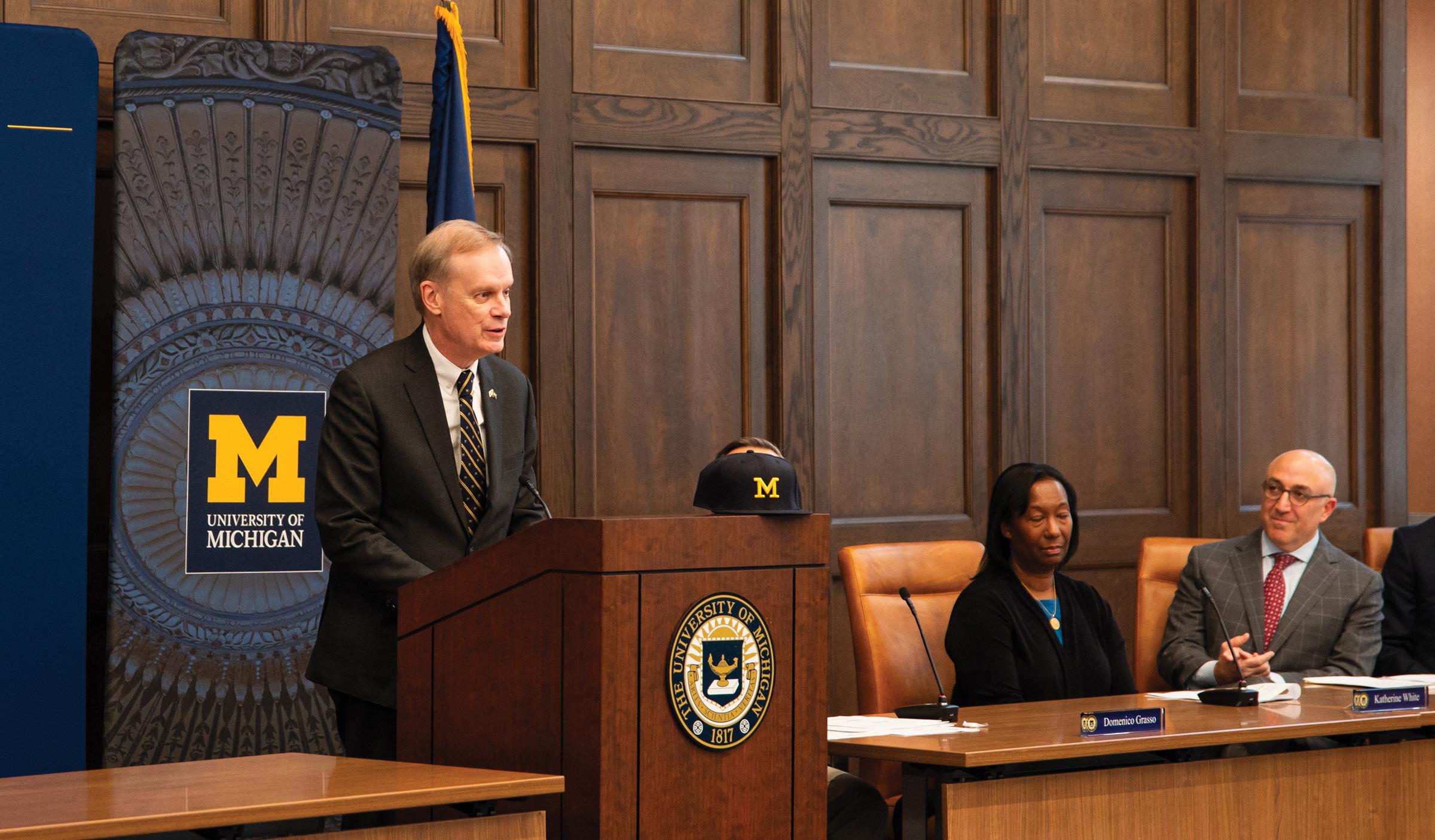
Syverud’s contract states his annual salary may be increased by the University’s Board of Regents annually based on performance. He will also receive an annual performance award of up to 30% of his base salary and University contributions of up to $36,000 a year to his retirement plan after he completes

After a nearly 20-hour search, a body was discovered Saturday at about 12:05 p.m. in the 1900 block of Cambridge Road. The body was identified as Mattson and was located about two blocks away from where he was last seen. In a post to X, the AAPD wrote that the department does not yet know Mattson’s cause of death.
“There are no obvious signs of trauma and foul play is not suspected at this time,” the statement read. “The Washtenaw County Medical Examiner’s Office will determine cause and manner of death. Ann Arbor Police Chief Andre Anderson and the Ann Arbor Police Department extend its deepest condolences to his family and loved ones, as well as the entire University of Michigan community.”
In a post to X, the Ann Arbor
Police Department reported Engineering sophomore Lucas Mattson as missing. Mattson, a 19-year-old Caucasian male with brown hair and blue eyes, was last seen walking alone on the 1700 block of Hill Street near Washtenaw Avenue at about 1:30 a.m. Friday. He was wearing a light-colored T-shirt, blue jeans and white shoes. He was reported missing at 4:30 p.m that day. Officers are searching the area but have not yet located Mattson.
The AAPD wrote the freezing temperatures endanger Mattson and encouraged anyone with more information to contact the department.
“Lucas Mattson is missing and considered endangered due to the extreme frigid conditions,” the statement read. “If you see Lucas or know his whereabouts, please call 911 or the Ann Arbor Police Department front desk at 734794-6920 immediately.”
The
University’s
policy on free speech protects offensive speech as long as it does not involve illegal activity, physical violence or harassment
On Jan. 15, participants at a debate event hosted by farright influencer Myron Gaines and Uncensored America’s chapter at the University of Michigan were photographed performing Nazi salutes on the Diag. Uncensored America is a nonprofit that describes itself as dedicated to free speech. The group obtained a permit from University administration to hold the event, renewing debate over how the institution applies its free speech policies amid ongoing concerns about student safety and discrimination. Gaines sat on the Diag for several hours to debate students on topics such as the killing of Renee Good, gender ideology and the Holocaust. During the
event, Gaines made statements calling into question the scope of the Holocaust and performed a Nazi salute, after which dozens of audience members mimicked the gesture.
The Diag is considered a public forum under the Use of University of Michigan Facilities Standard Practice Guide, which governs conduct for University spaces. Facilities may be denied if the event violates the law or University protocols, disrupts University activities, obstructs traffic or fails to cooperate with Division of Public Safety & Security officers. Center for Campus Involvement staff and University of Michigan Police Department officers were stationed on the periphery of the Diag. In an email to The Michigan Daily, University spokesperson Kay Jarvis wrote an arrest was made during the event for an assault.
“UMPD officers observed an assault, and an arrest was made,” Jarvis wrote. “UMPD’s role at campus events or demonstrations is to protect participants, bystanders, and the campus community. Officers intervene when there is criminal activity,
an imminent threat to public safety, or violations of permit conditions.”
It is unclear who the perpetrator or victim of the assault were.
CONTINUED AT MICHIGANDAILY.COM

UMich launches new centralized student accommodations website
“Our team knew for some time that we needed to update our digital presence to reflect our more holistic approach to student support.”
The University of Michigan has launched a new Student Accessibility and Accommodation Services website to better support students with disabilities, combining resources from Services for Students with Disabilities, Academic Support and Access Partnerships, Testing Accommodation Centers and Adaptive Sports and Fitness on one site. This change was prompted by SAAS wanting to renew its digital appearance to be more helpful and accessible for all students. In an email to The Michigan Daily, Chip Evans, assistant director of the Testing Accommodation Centers, wrote SAAS is excited
for the launch and will continue to adapt to student needs.
“How we meet our students’ needs has changed since SSD was created decades ago, and how SAAS meets needs will undoubtedly shift in the decades to come,” Evans wrote. “We hope this digital space can also help build a stronger sense of community and belonging among disabled students at the University of Michigan.”
Evans wrote that the change would bring about greater accessibility for student resources.
“Our team knew for some time that we needed to update our digital presence to reflect our more holistic approach to student support,” Evans wrote.
LSA junior Maya Fakih, president of KinectAbility, a student organization that
promotes awareness about student accessibility, said in an interview with The Daily she approves of the centralization of resources.
“Even I have struggled to help students find their accommodations, because it (was) literally everywhere,” Fakih said.
“It was so difficult for me at first. So looking at it, I’m like, ‘Actually, this is pretty helpful.’ So it was a great idea.”
In an interview with The Daily, Business freshman Sam Bodine, co-president of Undergraduate Business Leaders for Diverse Abilities, said he thinks the website does a good job of meeting the Web Content Accessibility Guidelines’ standards, which are international criteria for digital accessibility.
“(The website) seems to hit all the four principles pretty
well, which are perceivable, operable, understandable and robust,” Bodine said. “The headings and headers are in a logical order, the font is bold and easy to see and when you click on the embedded video of the main page, there’s automatically captions.”
Fakih said she believes the website still has room for improvement, specifically for visually impaired students who would benefit from additional audio options to navigate the website.
“I think websites like this, specifically for disability accommodations, need to have hearing and video options,” Fakih says. “Just because there’s an option that’s meant to help doesn’t always mean that it’s accessible.”
UMich Regents oppose $2.4 billion Big Ten private equity deal
“There may be a way where it works for Michigan, but we have not yet made any decisions on that.”
Private equity has rapidly integrated into major industries in the United States over the past few decades, including technology, healthcare and finance, with college sports being the latest to consider involving it in their operations. In November 2025, the University of California’s pension system’s investment fund, University of California Investments, proposed a $2.4 billion private investment into the Big Ten Conference. The plan could significantly change the nature of college sports by placing a greater emphasis on schools’ financial revenue.
Washtenaw
The proposed deal would give approximately $150 million to each of the 18 Big Ten schools and distribute the remaining capital to schools based on their earning potential. In return, through a new company called “Big Ten Enterprises,” UC Investments would receive 10% of the revenue generated from all Big Ten media rights and sponsorships for 15 years. Of the conference’s 18 universities, the University of Michigan and the University of Southern California are the only two institutions that have expressed opposition to the deal. Another part of the deal would extend the Big Ten conference’s grant of rights — meaning each school allows the conference to control their
media rights — for another ten years until 2046. The proposal comes at a time when the University is facing an athletic budget deficit of nearly $27 million. At a November 2025 University
Board of Regents meeting, Regent Mark Bernstein (D), chair of the Board, read a statement of opposition against the proposed deal. CONTINUED AT MICHIGANDAILY.COM

The Washtenaw County Board of Commissioners passed the protective resolution following increased ICE presence across the country
The Washtenaw County Board of Commissioners passed a resolution protecting county property from Immigrations and Customs Enforcement Wednesday night. This decision came after dozens of community members flooded the board room of the Washtenaw County Administration Building to support adopting the resolution. The resolution follows increased ICE presence in the state of
Minnesota and the fatal shootings of Renee Good and Alex Pretti by ICE agents in Minneapolis, which sparked protests across the country. Throughout the U.S., ICE has declared its expanded authority to enter “sensitive locations” such as schools and health centers. In addition to opposing the use of masks or face coverings by ICE officers other than for public health or safety reasons, the resolution states ICE officers can not enter county property without a valid warrant.
“Immigration and Customs Enforcement (ICE) officers shall
not be permitted to enter, remain in, or conduct civil immigration enforcement activities within any Washtenaw County–owned, leased, or operated building, facility, or property (including parking areas) unless required by law or pursuant to a valid judicial warrant or court order,” the resolution read. Ann Arbor resident Mary Maher, a community member who spoke during public commentary in support of the resolution, submitted a written comment about the importance of residents feeling safe in their community.
“Everyone in our community should be able to access public services without fear of detention or surveillance,” Maher wrote. “When residents avoid schools, clinics, or government offices because of immigration enforcement, public safety and public health suffer. Establishing clear policies that limit ICE’s reach, such as prohibiting access to county spaces, is a practical step to protect families, uphold due process, and ensure local government serves all residents.”
Stanford Lipsey Student Publications Building 420 Maynard St. Ann Arbor, MI 48109-1327 734-418-4115 www.michigandaily.com
EDITH PENDELL and ZACHARY AJLUNI Co-Editors in Chief eic@michigandaily.com
CICI COPENHAVER Business Manager business@michigandaily.com
NEWS TIPS tipline@michigandaily.com
LETTERS TO THE EDITOR tothedaily@michigandaily.com
EDITORIAL PAGE opinion@michigandaily.com
ARTS SECTION arts@michigandaily.com SPORTS SECTION sports@michigandaily.com
PHOTOGRAPHY SECTION photo@michigandaily.com NEWSROOM news@michigandaily.com CORRECTIONS corrections@michigandaily.com ADVERTISING wmg-contact@umich.edu
ANNABELLE YE Joshua Mitnick ’92, ’95 Managing Editor bellaye@umich.edu
GEORGIA MCKAY Digital Managing Editor gmckay@umich.edu
PANYADAHUNDI and CHRISTINA ZHANG
Palushi, Sarah Spencer
ELENA NICHOLSON and GABE EFROS Editorial
Zhang
LYRA SHARMA and GRAHAM BARKER Managing Sports Editors sports@michigandaily.com
Deputy Sports Editor: Drew Lenard
Senior Sports Editors: Alina Levine, Ellie Richard, Kenzie Mielke, Nate Schreck, Sam Gibson, Zach Goldstein
CAMPBELL JOHNS and CORA ROLFES Managing Arts Editors arts@michigandaily.com
Senior Arts Editors: Hudsen Mazurek, Ian Gallmore, Isabelle Perraut, Meagan Ismail, Michelle Wu, Siena Beres
MAISIE DERLEGA and SELENA ZOU
Managing Design Editors design@michigandaily.com
Senior Layout Editors: Junho Lee, Frances Leibovich, Graceann Eskin, Kathryn Palsrok Senior Illustrators: Gabriella Spagnuolo, Caroline Xi, Matthew Prock
BRIDGETTE BOL and HOLLY BURKHART
Managing Photo Editors photo@michigandaily.com
Senior Photo Editors: Alyssa Mulligan, Ananya Kedia, Arushi Sanghi, Isai Hernandez-Flores, Meleck Eldahshoury
AYA FAYAD Managing Statement Editor statement@michigandaily.com
Deputy Editors: Liska Torok, Lola Post, Riya Kommineni
ALINA MURATA and JOSUE MATA Managing Copy Editors copydesk@michigandaily.com
Senior Copy Editors: Alena Miklosovic, Cristina Frangulian, Elizabeth Harrington, Ellie Crespo, Jane Kim Lily Cutler, Tim Kulawiak, Zoey Ueland
EMMA PENG and JULIA MEI
Managing Online Editors webteam@michigandaily.com
Data Editors: Darby Jones, Zora Tucker
Engineering Manager: Alyssa Locke
Product Managers: Annice Chang, Sanvika Inturi
AHTZIRI PASILLAS-RIQUELME and EVAN KRUMMEL Managing Video Editors video@michigandaily.com
Senior Video Editors: Cameron Detulleo, Gretel Foglesong, Savannah Otten
AMARA M. SMALL and IHAA MOHAN Michigan in Color Managing Editors michiganincolor@michigandaily.com
Senior MiC Editors: Ahmed Elkhatib, Arya Kamat, Mandy Chu, Muntaha Rahman
AVA CHATLOSH and MEGAN GYDESEN Managing Podcast Editors podeditors@michigandaily.com
Senior Podcast Editors: Abby Willcox, Olivia Dickerson, Rogen McLean, Vily Souris
DA YOUNG KIM and UWAEISH AHMAD Managing Audience Engagement Editors socialmedia@michigandaily.com
Senior Audience Engagement Editors: Caleb Starr, Heewon Moon, Holly Dennis, Isabella Burke, Michelle Fang, Sophia Barczak, Sophia Liao
and PUJITA RUPANI
ANNA MCLEAN and DANIEL JOHNSON
Managing Focal Point Editors lehrbaum@umich.edu, reval@umich.edu
Senior Focal Point Editors: Lucy Langerveld, Sasha Kalvert
JAMES KNAKE and MILAN THURMAN Managing Games Editors crosswords@umich.edu
ESTLIN SALAH Digital Culture Beat Editor
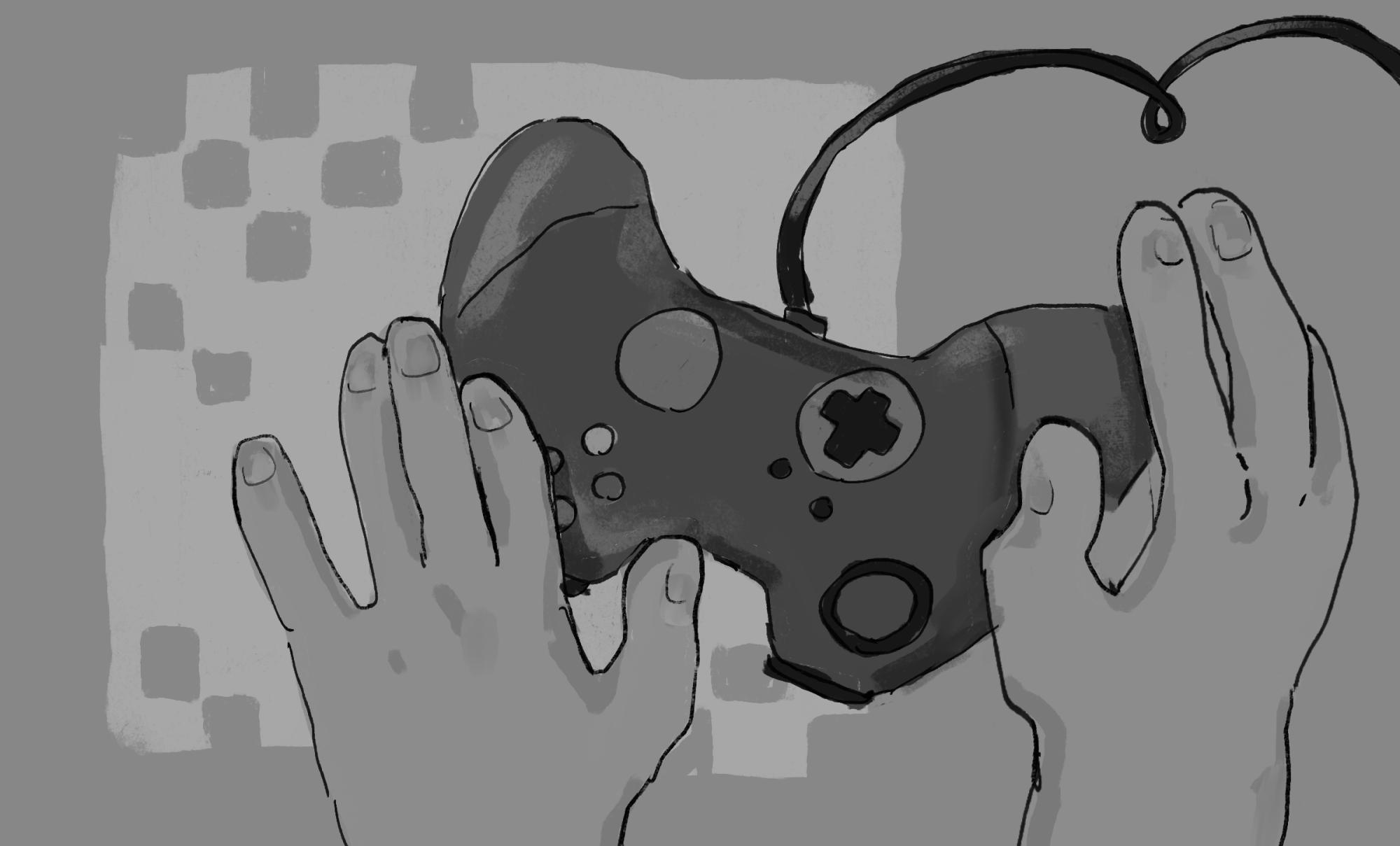
Despite one of my “icebreaker hobbies” being video gaming, I’ve never been a good gamer — someone who can breeze through levels, unlock every achievement and boast a high kill-to-death ratio. My video game résumé is more like a list of honorable failures: an honest attempt, a respawn and an occasional deep-seated sigh of defeat. And if there’s a genre that highlights just how bad I am, it’s roguelikes (although, honestly, I’m not even good at basic Minecraft). Roguelikes are a genre of video games defined not by a specific setting or aesthetic, but by a particular design philosophy: permadeath, procedural generation and high difficulty. In a roguelike, every playthrough is unique, stats matter, enemies are unforgiving and death is not a checkpoint — it’s a do-over. These games are built around challenge, randomness and iterative learning, which is precisely why they expose my lack of skills so brutally. And I love them for it. So here are my top roguelikes: tested, tried and failed by yours truly.
Streets of Rogue
Imagine Grand Theft Auto meets rogue-lite chaos. Streets of Rogue, distributed by tinyBuild, tasks you with navigating randomized, top-down levels where every playthrough is unpredictable. Each character has unique abilities — from ninja to slum dweller to …
gorilla — and while that sounds like fun (it is), it also means you frequently encounter new learning curves that you must overcome. One minute, you’re peacefully stealing beer from trash cans, the next, you’re overwhelmed by police, toxic sludge and murder-bots. If only this game had an achievement for the number of honest-to-God humiliations I’ve experienced in under one minute.
Noita
Noita blends physics and pixel graphics to create a totally new, stunningly beautiful art form which is an absolute nightmare for beginners and veterans alike. In this game, every pixel is simulated, every spell interaction has real consequences and lava (or oil, or acid) waits just beneath every poorly aimed explosion. The range of different wizard classes you randomly spawn in as constantly keeps the game fresh and prevents me from getting good. You cast, melt, explode, summon and chainsaw your way through levels … and then you die. A lot. The beauty of Noita is breathtaking, and so is its exacting, snap-quick punishment for naïve wand choices and over-ambitious exploration. I am terrible at it — not because the game is unfair, but because it demands precision, planning and patience, which I frequently lack.
Moonlighter
Then there’s Moonlighter, which blends action-RPG combat with shopkeeping and adorable pixelated faces. Arguably the lightest roguelike on this list,
and yet, somehow, I feel I’m the worst at it. By day, you manage a store; by night, you descend into randomized dungeons in pursuit of loot to sell. It’s charming, it’s clever and it repeatedly reminds me of how little I understand enemy patterns or the pricing of goods. Balancing inventory, surviving hits and making enough money to upgrade my gear is hard enough, and Moonlighter seems to delight in that difficulty. And yes, I die. Often.
All of these games are wildly different in theme, but unified in their challenges. They are also unified in the fact that I’m terrible at each and every one of them. And I love it; I can’t stop coming back for more.
It might seem odd to embrace activities you consistently fail at, but growing research suggests video games are far more than entertainment: They, in fact, benefit us in major physiological and cognitive ways. A major review in American Psychologist argues that video games can foster cognitive, motivational, emotional and social benefits, challenging the stereotype that games are merely time-wasting distractions.
This line of investigation shows that gaming isn’t just about reflexes and scores: It can improve problem-solving, attention and emotional regulation. And it’s not just a sanctioned, for-kids activity. Studies with adults who play video games indicate that many players experience emotional benefits from gaming, like enjoyment,
stress relief and feelings of accomplishment. So, even as I flounder in dungeons and streets, what I’m actually getting from these games isn’t mastery — it’s good old-fashioned fun. When you allow yourself to struggle without pressure, games become something other than performance tests. They become spaces to experiment, laugh at yourself and celebrate tiny victories, like getting to one higher level than last time. I am bad at things, and you should be too; doing things you’re bad at explores an unexpected joy because it fosters resilience, creativity and growth. It’s a reminder that embracing imperfection can reduce
the fear of failure and open the door to play for play’s sake.
Besides, facing tasks where we lack proficiency can deepen our happiness and broaden our capacities over time. When we risk failure — through languages we barely speak or games we constantly lose — we are confronted with challenges that build patience, curiosity and a rich new experience. We live in a culture that equates success with winning in work, relationships and productivity. We are all victims of the “grindset.” Within this unforgiving infrastructure, choosing to be bad at something can feel radical, yet in those moments, we encounter
authentic joy without performance pressure. At the end of the day, it’s so important to just have fun. Video games, play and failure have real mental health and wellbeing benefits if we engage with them playfully rather than competitively. Embracing being bad at something — like roguelikes or bowling or painting — makes us better, more well-rounded people. So if you, like me, repeatedly die in Noita or get riddled with bullets in Streets of Rogue, that’s okay. Being bad at something isn’t a flaw; it’s an invitation to play, learn and laugh. I’m going to enjoy the process regardless of my everclimbing death count.
It’s always exciting when an artist goes silent for a couple of years, and then gradually begins to tease new music. A cleared Instagram feed slowly fills with ambiguous images captioned with strange phrases and upcoming dates, a website makeover, easter eggs scattered throughout their last tour and finally, that first single. Mitski’s return is no exception to this phenomenon. On Jan. 16, she released “Where’s My Phone?” along with a music video that preludes her upcoming album Nothing’s About to Happen to Me — and it’s electrifying. Mitski wastes no time captivating listeners with a drum fill dropping into a hypnotic stream of electric guitar and her repeated questioning: “Where did it go? / Where’s my phone?” The rapidity of the intro sets up a theme of panic that I’m sure we’ve all felt when we’ve lost our phones. After all, it is the item that, for better or worse, rules our lives in the 21st century. However, Mitski isn’t just worried about where she has left her phone — she’s worried about what it has done to her identity, shifting her query inward: “Where did I leave? / Where’d I go?” Then, she pleads that “I just want my mind to be a clear glass … with nothing in my head,” both wishing that her mind was free of overcrowded digital consumption while recognizing that her phone is a coping mechanism to make the mind
TOBIN SAXTON Daily Arts Writer

‘Stranger
forget everything else. By the end of the song, a heavily distorted guitar repeats the chorus melody, further underscoring the sense of anxiety and chaos. This song alone already differs from the dreamlike and folky sound of 2023’s The Land Is Inhospitable and So Are We, a sign that Mitski will continue her sonic evolution in her upcoming album, releasing Feb.
27. She’s still leaning into her raw and confrontational lyricism, an aspect that has always made her music powerful, relatable and necessary. Social media has grown rife with unrealistic expectations, polarization and oversaturation in recent years. It’s both daunting to use and daunting to give up. Who better than Mitski to shed some light on this dilemma?
ANA TORRESARPI TV Beat Editor
Extreme spoiler warning for “Stranger Things” Season 5 Volume 2. The first season of “Stranger Things” is some of the best television I’ve ever watched. Told through the lens of an America tense with Cold War animosity, the story navigates the grief of a mother, a child abused by systems of power and the fear of the unknown. Using the medium of horror to underscore its messages of friendship, love and overcoming trauma, the premiere season of “Stranger Things” solidified itself as a masterclass in how to leverage genre for emotional themes.
The Upside Down is a terrifying place, symbolizing both government failure and the terror of the uncanny or not-quite familiar. Eleven’s (Millie Bobby Brown, “Enola Holmes”) existence as an experiment meant to spy on the Soviet Union, visualized with a numbered tattoo on her tiny 11-year-old wrist, is a painful reminder of the consequences of a government run on paranoia, willing to do whatever it takes to get ahead of the enemy. Despite its sci-fi themes, Season 1 manages to feel grounded, meticulous and, above all, deeply engaging.
By the end of Season 5, it’s revealed that Eleven’s initial discovery of the Upside Down wasn’t an unintended consequence of the government tampering with forces beyond their comprehension, but instead the direct reason for her existence. Since the beginning, Eleven’s powers were actually the product of transfusing her with Vecna’s (Jamie Campbell Bower, “Witchboard”) blood in order to reach Dimension X, the true residence of the Mind Flayer. In fact, the Upside Down was never just an eldritch parallel world to ours but a wormhole leading to Dimension X. And, of course, Season 5 reveals how Henry Creel’s powers were gained by touching a magical stone which gave him a telepathic link with the Mind Flayer, sparking the government’s interest in interdimensional powers.
So how on earth did we get here?
“Stranger Things” Season 5 feels like the final nail in the coffin for Season 1’s reputation. Gone are the days when the audience can expect a solid narrative, plot-relevant characters and reasonable stakes; now, fans are served hot garbage on a platter and expected not to notice the difference.
From incessantly using cheap metaphors to explain simple concepts, to creating a nauseatingly bloated ensemble cast, to character assassinations that ruin their pre-established arcs, the finale of “Stranger Things” was doomed from its conception to be a stain on the otherwise beloved Netflix original.
Season 5 isn’t just a narrative disappointment with a ridiculously long runtime; it fails to deliver on nearly every level. One of the season’s cardinal sins is its amnesia towards its genre: This season of “Stranger Things” forgot to be properly scary.
The season repeatedly threatens the audience with major character deaths, but almost never has the balls to commit.
Too many times do show creators Matt and Ross Duffer use their characters as blackmail to keep audiences watching. And yet they are perpetually unable to kill off a fan-favorite lest it deter viewers from caring enough to finish the series. After the fifth time a character is seen in the clutches of peril, the gimmick grows stale. The finale — more than two hours long — wraps up the series with a neat bow, horror genre be damned. Joyce (Winona Ryder, “Beetlejuice Beetlejuice”) and Hopper (David Harbour, “Hellboy”) get married, every teen graduates and even the only main character to die is speculated to have survived with their own happy ending. You almost forget you’re watching a show about child-eating monsters from another dimension.
This isn’t to say Season 5 was all groans and headaches; there were a few standout moments that deserve their applause. Gaten
Matarazzo (“Honor Society”) as Dustin absolutely nailed every character beat, making me nearly shed a tear during the scene when he grabs Steve (Joe Keery, “Free Guy”) and begs him not to play the hero. Nancy (Natalia Dyer, “Yes, God, Yes”) and Jonathan’s (Charlie Heaton, “As You Are”) near-death confessions were also a phenomenal moment that left me gaping at the authenticity of their performances. However, it would be foolish to believe impressive acting and emotional character beats could save Volume 2. There is no saving this mess.
Truth be told, the failure of Season 5 was a long time coming. Since Season 2, it was clear the Duffer brothers had no solid plan for building up a cohesive, serieswide narrative for their show. From introducing Demo Dogs, to the Mind Flayer, to Eight (Linnea Berthelsen, “Devs”), to Henry Creel aka Vecna, the show has consistently attempted to raise the stakes with no regard to an overarching plot.
The messy retroactive interconnection of season-wide storylines was made strikingly clear in the first episode of the new season, when the show retroactively changed its initial inciting incident: Will (Noah Schnapp, “The Peanuts Movie”) was not just kidnapped to the Upside Down by an unthinking Demogorgon, but by a methodical Vecna whose plan was to use children as the key to an interplanetary takeover. And we’re supposed to believe this was clearly laid out since the beginning. Unfortunately for the Duffers, no amount of retconning can save the hole they’ve dug themselves into.
“Stranger Things” will always be remembered as one of the greatest sci-fi thrillers of our generation. While its first season was the strongest in content and stakes, the next three were earnest attempts to continue in the footsteps of the original story. I will look back on Season 1 fondly and with high regard. It’s a tragedy that Season 5 threatens to burn that legacy to the ground.
When The Cut released its photoshoot featuring Rama Duwaji, the first lady of New York City, the shoot immediately distinguished itself from the typical visual language reserved for political spouses. Photographed by Szilveszter Mako and styled by Jessica Willis, the shoot captures Duwaji in moments of stillness and strength, revealing a poise that is quiet but unshakable. Whether seated, mid-stride or meeting the camera head-on, her body language conveys self-possession. The silhouettes are structured yet fluid, allowing power to appear softened rather than diminished. Her presence reads as deliberate and political: clothing, posture and gaze operate together as a language of influence.
Fashion has long been a tool for women navigating public life, and Duwaji enters a lineage shaped by figures like former first lady Michelle Obama and Princess Diana. Obama understood the language of dress intimately, balancing approachability with authority. Her bold-colored gowns, tailored jackets and fluid evening dresses communicated confidence, accessibility and inclusivity. At former President Barack Obama’s 2009 inaugural ball, her bright white Jason Wu gown reflected optimism and the weight of history simultaneously. Time and again, Obama used fashion to expand who could be seen within the political sphere. By championing emerging designers, especially women of Color, Obama’s wardrobe became a platform for cultural visibility and political values. Every choice, from campaign trail looks to formal engagement outfits, was intentional — a form of subtle political messaging crafted with elegance and care.

Decades earlier, Princess Diana wielded fashion as both a shield and voice. Her clothing became a tool for autonomy and presence within a world that often demanded compliance. The 1985 “revenge dress” — a sleek, black off-the-shoulder gown — was a moment of quiet defiance, a claim of space in the public eye without words. Her style never distracted from power; it reframed it. Even her understated suits for engagements at the United Nations or local charities communicated warmth, approachability and control within a public role that demanded compliance. Diana understood that style could negotiate presence, humanize institutions and claim space without confrontation.
Duwaji carries this lineage forward while crafting a language distinctly her own. A Syrian American creative, she dresses with an acute awareness of culture, politics and identity. Her fashion choices consistently center Palestinian and Middle Eastern designers, using her platform to highlight communities often marginalized or erased in Western political spaces. Rather than relying on symbolism alone, her choices are grounded in authorship and origin.
At New York City Mayor Zohran Mamdani’s inauguration, Duwaji wore a vintage fur-trimmed coat by Palestinian Lebanese designer Cynthia Merhej, a piece that encapsulates her poise and intentionality. The coat’s dramatic trim and sculptural lines elevated her silhouette, commanding attention without needing embellishment. Its vintage nature folded history and heritage into the present moment. Paired with refined accessories and minimal jewelry, Duwaji demonstrated that political expression does not require extravagance; it requires awareness, understanding and presence. That coat did more than keep her warm — it declared a presence that need not be interpreted.
The Cut’s shoot amplifies this ethos with meticulous attention to every detail. Each outfit, from flowing skirts paired with sharply tailored blazers to structured dresses softened by fluid lines and intentional draping, is designed to enhance Duwaji’s natural composure while allowing her personality to shine. The silhouettes suggest both motion and stability, balancing softness with architectural precision. CONTINUED AT MICHIGANDAILY.COM
998,995
When people ask about local campus nightlife, it’s always the same names: Rick’s, Charley’s, Bab’s. But one place is rarely heard: The Blind Pig. Yes, it’s a concert venue, but it hosts one of the best dance floors in town, and Thursday, Jan. 15, was a prime example.
Student bands are the best, especially those with University of Michigan talent. Local shows are a perfect concoction: friends having fun playing classics, strangers dancing, a place where absolutely anything goes.
All of the rules are thrown out, starting with the instruments.
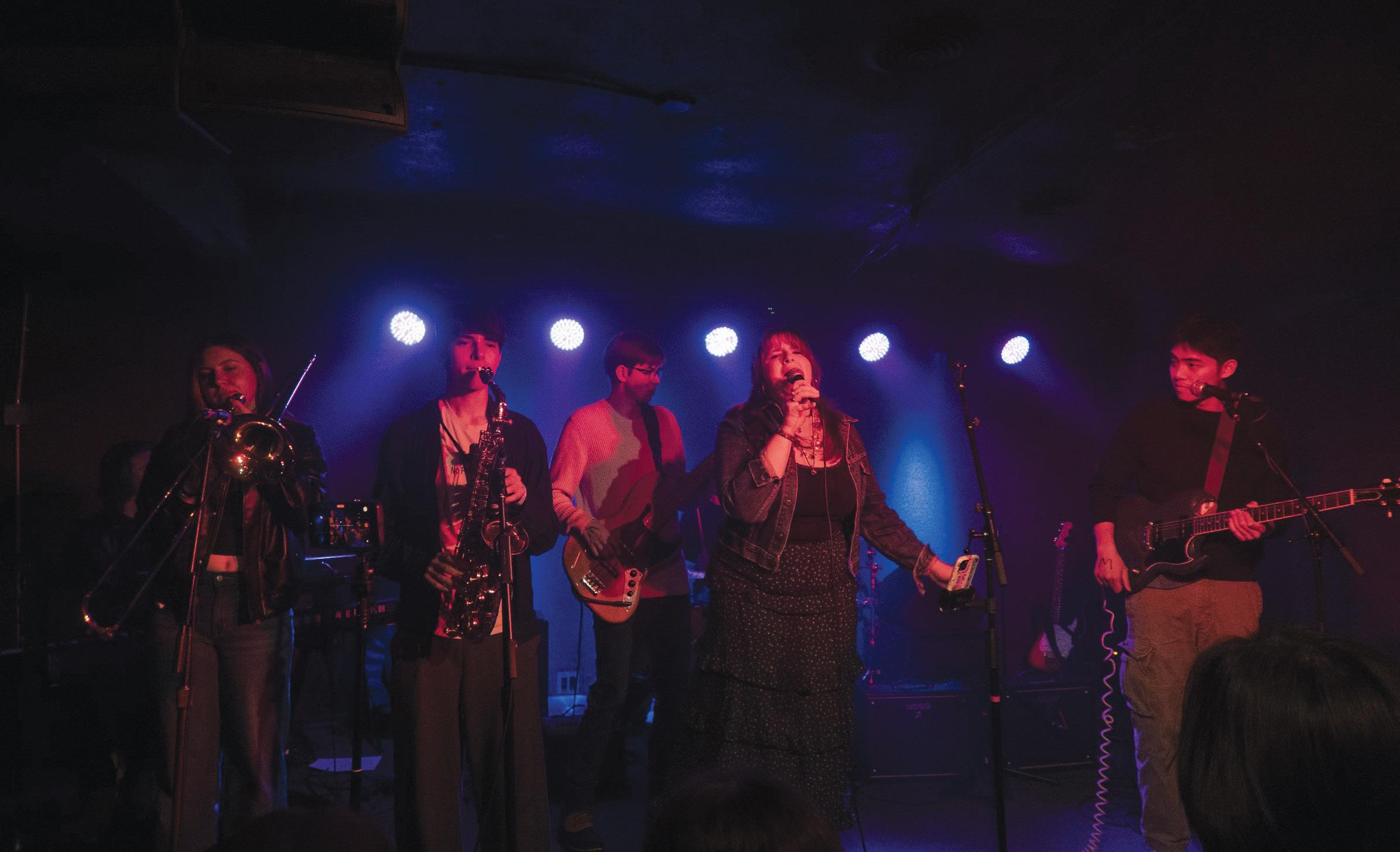
Opener 998,995 Beers brought five stringed instruments (including a fiddle), ON TAP led with funky keys behind a saxophone-trombone duo and Out of Focus stuck to layered guitars and played originals along with covers that spanned the decades. It was a night with
expectations left at the door, and any expectation that may have snuck in was far exceeded.
998,995 Beers (now known as 998,805 Beers) embodies the idea of the college band: friends playing music and giving everyone an excuse to get drunk. Although just the opener, they filled The Blind Pig with their fans, friends and friends of friends, all there to enjoy their indie-rock sound.
Their name is a reference to the college drinking culture they so enthusiastically embrace: The band claims that when they first formed they were named 1,000,000 Beers, and after every show they subtract the exact amount of beers their fans drank, renaming themselves the new number. Does this ongoing bit make it impossible to remember what their name is? Yes, but it also feeds into their camaraderie with their audience and makes the act an interactive experience.
Friendship bled through the wall of musicians 998,995 Beers placed at the front of the stage: three guitarists, one bassist and one fiddle player. The drummer and the
keyboardist took their usual places at the back but seemed out of place only because of how tightly knit the front line was. The lead singer regularly shared lead vocal and crowd work duties with his fellow musicians, adding to the sense of closeness. Their setlist shifted between easily recognizable indie rock hits to some of their solo work, which fit in well with their set. At times, their sound felt brash, unable to fully capture the sugary sweetness of their genre. However, what they lacked in tone they made up for in relentless enthusiasm and a devilishly charming desire to perform. With the crowd now amped, ON TAP, the next act of the night, took the stage. As soon as ON TAP stepped up, it was clear the music they played would be far different than the guitar-heavy indie rock of 998,995 Beers. A saxophone, trombone and a funky electronic piano joined the


ZACHARY

Senior Opinion Editor
During President Donald Trump’s first term, his administration voiced opposition to school admission policies he deemed “unfair,” notably rolling back former President Barack Obama’s policies that supported race-conscious admissions and even suing Yale University. These actions indicated the administration’s stance on the issue, signaling a shift in the federal government’s attitude toward affirmative action and other equity efforts. This shift was cemented years later, when the U.S. Supreme Court’s ruling banned the consideration of race in college admissions — a decision made possible by the conservative majority resulting from Trump’s three judicial appointments.
Though affirmative action has been federally illegal for more than two years now, Trump still seems dissatisfied. In August of last year, he issued a presidential memorandum to crack down on colleges he believes are defying the law, noting their continued use of diversity statements and lack of released admissions data as a
sign of disregard for the Supreme Court’s ruling.
More recently, he sent the 10-page Compact for Academic Excellence in Higher Education to nine universities to address a series of demands for the institutions, including a directive to end what he called “discriminatory admissions practices.” More specifically, it prohibits the consideration of race, sex and other identity factors in applicant evaluations.
Yet, for someone who claims to focus on eliminating inequality in higher education, he conspicuously ignored one tremendously unfair advantage in admissions: legacy.
Legacy admissions — the practice of providing preferential treatment to applicants related to an alumni of the institution — are far from uncommon. During the 2022 application cycle, legacy status was considered at 32% of selective four-year universities.
Legacy consideration first emerged at Ivy League colleges in the 1920s and was originally fueled by antisemitism. Its implementation was an effort to decrease enrollment of Jewish students, alongside other preventative measures, such as standardized testing and interviews, both of which

‘Heated Rivalry’ won’t melt the NHL’s homophobia
SOPHIA PERRAULT Opinion Columnist
The first season of “Heated Rivalry” — a show about two hockey players in a Queer relationship — has taken the world by storm. For example, the fifth episode, “I’ll Believe in Anything,” tied “Breaking Bad” for the highest rated episode of television ever. Even the National Hockey League has participated in the hype; on Dec. 23, 2025, the Boston Bruins’ official X account posted pictures from the team’s game against the Montreal Canadians. Their caption referenced the show, since the two main characters, Ilya Rozanov (Connor Storrie, “April X”) and Shane Hollander (Hudson Williams, “Tracker”), play for Boston and Montreal, respectively.
Contributing to the buzz, a representative for the NHL recently commented on the show. When asked about new fans joining the hockey world because of “Heated Rivalry,” the representative replied positively.
“There are so many ways to get hooked on hockey and, in the NHL’s 108-year history, this might be the most unique driver for creating new fans. See you all at the rink.”
Considering the representative’s response and the Boston Bruins’ tweet, it may seem as though the NHL is aiming to be inclusive. Sadly, this isn’t the case. The NHL’s 108-year history has never included an openly gay player, and recently, the NHL has been becoming considerably less inclusive. Consequently, in a social media poll, respondents voted the league as the most antiLGBTQ+ out of the Big Four men’s sports.
are still heavily used today. Though the social prominence of the antisemitic sentiment that caused these policies decreased after World War II, the policies themselves persisted. Now, universities use legacy preferences to aid their own strategic and financial interests.
Legacy students are more likely to accept offers of admission, resulting in a higher yield rate — the percentage of admitted students who choose to enroll — for the university. Higher yield rates usually indicate a school’s strong appeal, which can lead to improved national rankings, subsequently attracting more applicants and enhancing a school’s perceived prestige. Additionally, legacy students are more likely to come from families with the financial means to make large donations to the school, with legacy students donating more than non-legacy students once they graduate. At Harvard University, alumni donations — amounting to $629 million in 2025 — account for a large portion of university funding, providing the institution with significant financial support.
CONTINUED AT MICHIGANDAILY.COM
JACK VERRILL Opinion Columnist
In the latest sign of our country’s reading decline, Alice Deal Middle School, located in northwest Washington, D.C., stopped assigning full-length novels. Fear not, the students will still be reading; instead of books, they will be assigned short passages meant to better prepare them for high school. This move, while criticized by many parents, was met with ambivalence from most other people.
That’s because nobody else is reading either. A recent Gallup poll shows that Americans are reading less than ever before, with recreational reading down 40% over the last two decades. Furthermore, 41% of Americans did not read a single book last year. We’re in a crisis of literacy. Reversing this crisis is going
“Heated Rivalry” as a marketing tactic.
The league’s issues with the LGBTQ+ community first came to light during the 2022-2023 hockey season. It all started with Ivan Provorov, then a defenseman for the Philadelphia Flyers. On the Flyers’ annual Pride Night, he refused to wear a Pride jersey for warm-ups, citing his religious beliefs. Despite the fact that religion is never an excuse for homophobia, Provorov did not face any repercussions for his actions. Fans showed support for Provorov as well, selling out his jerseys on both the NHL Shop and Fanatics in the following days.
Soon after, other players followed suit, and league commissioner Gary Bettman commented on the situation.
“You know what our goals, our values and our intentions are across the league, whether it’s at the league level or at the club level. But we also have to respect individual choice,” Bettman said.
“And part of being diverse and welcoming is understanding those differences.”
Bettman’s statement shows no respect for Queer people, and it legitimizes hockey players’ discriminatory actions.
Being diverse and welcoming means protecting the LGBTQ+ community, not releasing a vague statement that downplays homophobia as a diverse and valid viewpoint. Refusing to wear a Pride jersey and disrespecting the LQBTQ+ community isn’t a difference of opinion; it’s homophobic, and homophobia is a form of hate that invalidates the experiences of an entire population.
Both the tweet and the league’s response are performative. One of the show’s actors, François Arnaud (“The Borgias”), pointed out the irony in the NHL using “Heated Rivalry” to promote hockey.
“If you’re gonna use our name, back it up with real life shit,” Arnaud said.
Since the NHL has not taken steps to counter homophobia, and has created a more antiLGBTQ+ environment in recent years, they should not be using
After significant debate, the NHL banned Pride jerseys. Bettman believed the jerseys, and players who refused to wear them, were a distraction from Pride Nights. Queer hockey players at lower levels spoke out after the ban, explaining that they no longer felt supported by the league. You Can Play, a campaign that aims to eliminate homophobia in sports, disagreed with the move as well.
This situation is not the only of its kind. Hockey culture is known for its homophobia — gay slurs are casually thrown around the locker room, which is morally wrong and harms closeted players. Brock
McGillis, who came out after he ended his Dutch hockey career, talked about the use of slurs and his experiences with the sport.
“There’s a homophobic slur or some type of slur said every time a team enters a locker room,” McGillis said. With this in mind, it is not surprising that players often use homophobic language when chirping, and sometimes, players get caught using slurs on the ice. In 2016, Andrew Shaw used a gay slur in an NHL playoff game and was subsequently suspended. Just a year later, however, Ryan Getzlaf used a gay slur during a playoff game and faced a less severe punishment: a $10,000 fine. His fans then raised money to pay for the fine, showing that hockey fans are also a part of the problem. The homophobia in the NHL is a cultural issue. Queer hockey fans are used to disappointment, me included, and trust needs to be rebuilt between the LGBTQ+ and hockey communities. It’s problematic to use a Queer television show for marketing when the league does nothing to protect LGBTQ+ fans or players. If anything, the NHL seems to be taking advantage of the community it’s pretending to accept. Arnaud has commented on the NHL’s problems with inclusivity.
“I just hope that it brings on actual change in the league and that it has a real influence on how they treat their own players and the possibility of that, because it’s not historically the most open association,” Arnaud said. After the release of “Heated Rivalry,” Williams and Arnaud, as well as the original book’s author Rachel Reid, told news outlets that closeted players were messaging them. This proves that there are Queer players who struggle with their identities in unsupportive sports’ cultures. If the NHL wants to be ready for the day a player comes out, then they need to be doing more to make Queer people feel safe in their sport. Rather than focusing on one popular television show, the league could be increasing the penalties for using slurs and attempting to change hockey’s problematic culture. Before the NHL can use “Heated Rivalry” for marketing purposes, they need to step up their game.

to require more than social media scolding, and certainly something different than what Alice Deal Middle School has planned. If we want to start reading again, we must reclaim our intellectual inheritance, doubling down on the canonical thinkers of Western civilization.
The obvious question asks how embracing the likes of Homer,Shakespeare and Dostoyevsky will encourage us to start reading more. Aren’t these the dense, antiquated authors who caused us to stop reading in the first place? Not exactly. These thinkers, and others like them, are only dense and antiquated when we view reading as a never-ending source of entertainment. Sure, it should be enjoyable, but great books are meant to provide timeless insights into human nature, not short dopamine hits.
Which brings us to social media. Its effect on our brains — severing attention
spans and worsening reading comprehension — is well-documented. It’s understandably hard for books to compete in an era of TikTok trends and Instagram Reels. But simply quitting social media won’t make our society literate again. When everything is reoriented toward short-term pleasure, the only way to break through is to cultivate a sense of pride around something meaningful.
In fact, young people in particular excel at activities that take prolonged effort when we’re taught to take pride in the results. Consider the emphasis society puts on physical fitness: While requiring immense focus, Generation Z goes to the gym far more than our parents ever did. Framing fitness as a generational virtue is already working; let’s do the same with knowledge. And there is no better source of knowledge than
the Western canon. It’s a proud intellectual tradition that first conceived of democracy, natural rights and individualism –– one that all of us, by virtue of being University of Michigan students, can take part in. Importantly, embracing Western thought does not mean only reading thinkers of a particular era, opinion or ethnicity. Frederick Douglass is as much a part of Western heritage as Friedrich Hayek. But many still malign our intellectual inheritance as a morally dubious project centered around a homogeneous cast of old white men. While it’s true that most of these thinkers were men of similar racial backgrounds, their ideas are not exclusive to any identity group. Reducing great thinking to bare-bones racial categories is exactly what liberalism exists to prevent. CONTINUED
The University of Michigan plans to build a $1.25 billion data center in Ypsilanti Township. Locals don’t want it. State lawmakers must now choose a side.
Last month, state Rep. Jimmie Wilson Jr., D-Ypsilanti, introduced legislation to rescind a $100 million grant the University received from the Michigan Economic Development Corporation to begin work on the so-called “high functioning computational facility.” Seventeen bipartisan co-sponsors have already given the bill their support — their fellow legislators should join them. The grant, awarded to the University in December 2024, became the subject of intense scrutiny following a resolution from the Ypsilanti Township Board of Trustees calling on the state to pull the funding.
The Michigan Daily reported last month that the University has spent most of the planning process for the data center stonewalling the community.
U-M representatives have failed to answer basic questions from the board of trustees, and nine months of calls for a wider community engagement session only produced one meeting — which

Cthe University held in Ann Arbor. U.S. Rep. Debbie Dingell, D-Mich., responded by sending a letter to Interim University President Domenico Grasso demanding greater transparency. Grasso has since announced another community engagement session, this time in the township. The University’s greatest error, however, was its apparently dishonest allocation of the grant money. The plan, greenlit by the state, entailed a relatively unobtrusive development on a 20-acre site. But in June 2025,
the University’s Board of Regents approved the purchase of an additional 124 acres — across the street from an affordable housing complex and a park. To call this move disingenuous would be putting it lightly.
Wilson and township officials both called the decision to expand the data center’s footprint a “bait and switch.” They were spot on.
The University misled lawmakers and locals about its intentions; the state has every right to withhold its support. Ypsilanti Township is the data center’s host community,
LUCAS FELLER Opinion Columnist
entral Student Government delivers some valuable services for University of Michigan students. It distributes funding to student organizations, finances the AirBus program and provides students with free subscriptions to the New York Times and Wall Street Journal. But recently, CSG has adopted a new modus operandi, one oriented around student activism rather than its core focus of making tangible improvements to student life. If this trend becomes the new status quo, CSG’s functions should be transferred to the University’s Student Life office. In the March 2024 elections, a grand total of 9% of the University student body elected Alifa Chowdhury and Elias Atkinson of the SHUT IT DOWN party to serve as CSG president and vice president. As the name indicates, SHUT IT DOWN pledged to withhold all CSG funding until the University agreed to divest from companies that profit off of Israel’s war in Gaza. As promised, Chowdhury vetoed the Fall 2024 budget, cutting off the funding CSG traditionally provides. Students evidently disapproved; SHUT IT DOWN lost most of its seats during the following elections.
CSG is a body whose limited power — club funding, the AirBus program, etc. — is entirely tied to student welfare, meaning that any substantive effort to change University policy is more likely to harm students than
achieve the desired outcome. SHUT IT DOWN’s focus on activism at the expense of student services demonstrated that much. When Chowdhury vetoed the budget and cut off student organization funding, it was the student body who suffered the harm. It was the University — by nature less prone to the vicissitudes of CSG activism — who stepped in to guarantee organization funding while SHUT IT DOWN served its term.
Although SHUT IT DOWN was removed from power, CSG remains a forum for student activism. In November of last year, the Student Assembly narrowly passed a resolution calling for the University to form a committee to investigate the University’s financial ties to the Israeli government and initiate divestment procedures.
CSG President Eric Veal Jr. vetoed the resolution, citing its divisiveness and how it exceeds the assembly’s mandate.
Regardless of whether the veto was justified or not, the action shouldn’t have been necessary in the first place. CSG’s core mission should be creating and funding programs that benefit students, not seeking to represent student views on global issues. For starters, CSG’s limited power renders any such activism unlikely to succeed, only amounting to wasted time that could be directed toward student welfare. But more importantly, it’s far from assured that any instance of CSG activism will represent student views accurately.
Since majority parties in the Assembly only need a small percentage of the student body to take power (9% in the case of SHUT IT DOWN), a motivated minority can cast a majority’s shadow under the right circumstances. In other words, there’s nothing wrong with CSG representatives being elected by a small portion of U-M students, as long as those representatives dedicate themselves to making tangible improvements to student life. When Assemblymembers use that limited mandate to advance purely performative political messaging, however, they risk promulgating views that a majority of their peers don’t even hold. And accurate representation is an imperative, especially considering that student activism is prime kindling for national and regional news. When the Assembly passes a resolution, that isn’t simply contained within the Ann Arbor city limits or the pages of The Michigan Daily. Coverage of SHUT IT DOWN and their budget cancellation made it into the New York Times, and the divestment resolution was condemned by several Metro Detroit Jewish groups. When someone outside the University reads articles like these (both unfavorable toward SHUT IT DOWN and its successors), they assume that the actions of the student government represent students and the University more broadly, even if that perception isn’t strictly accurate.
CONTINUED AT MICHIGANDAILY.COM
ERIN COLEMAN Opinion Cartoonist

now says only 30 of those jobs will be local. It also hasn’t explained how it plans to prevent nearby residents’ utility bills from going up as the data center strains local power and water supplies. And without any renderings of what the completed facility will look like, some residents fear that they’ll be faced with an ugly warehouse in their backyards, decreasing their home values.
It’s a hat trick of bad outcomes.
Data centers don’t fuel economic development. At best, the host community breaks even. At worst, residents are forced to subsidize the devaluation of their assets. The state should not be handing out taxpayer dollars to fund projects that make Michiganders poorer.
The construction of data centers in unwilling communities is not isolated to Ypsilanti Township.
not a colony of the University. Dingell and Wilson deserve praise for reminding the University that such distinctions matter. Their colleagues must ensure that the momentum for accountability doesn’t die.
That starts with pulling the grant. Even if the University hadn’t engaged in its shenanigans surrounding the new 124 acres, it still hasn’t acted in the interests of Ypsilanti Township. Early on in the project, the University promised the data center would create 200 high-paying jobs. It
About 60 of these facilities have already gone online in Michigan, and more are coming. The situation in the township is unique in that the University is building the data center for research purposes instead of to house artificial intelligence servers, but the distinction doesn’t matter to residents. Across the state, large developers are steamrolling Michiganders to serve their own interests.
In Howell Township, residents have objected to a proposal from Meta, the company behind Facebook and Instagram, to
purchase more than 1,000 acres of land for a new data center. In Saline Township, local officials and residents alike have attempted to block a $7 billion data center backed by Oracle and OpenAI. There, Dingell and Michigan Attorney General Dana Nessel had to step in to prevent the energy company’s effort to bypass state energy regulations. Now, Ypsilanti Township is trying to prevent its own community from being hijacked by the University. This is a watershed moment for the state. If lawmakers hold the University accountable for its missteps, they will have sent the message that transparency and local input in large projects like these is not optional. If, on the other hand, they stand aside, they will be yielding Michigan’s future to a handful of powerful interests at the expense of residents. The data center industry is still in its infancy. Every decision at the state level sets a new precedent. As it stands, Wilson’s bill has been referred to the Michigan House Appropriations Committee. It has a long way to go before it reaches Gov. Gretchen Whitmer’s desk. Politicians on both sides of the aisle must make sure it gets there and set the precedent that residents — not administrators in Ann Arbor or tech giants in Silicon Valley — determine what happens in their communities.
From the Daily: Kent Syverud will uphold Ono’s status quo

community was fed up with Ono.
On Jan. 12, 2026, Kent Syverud was selected to serve as the 16th president of the University of Michigan. He was recommended by the University’s presidential search advisory committee, composed of the University of Michigan’s Board of Regents, an executive search firm, seven professors and two student representatives.
He is officially hired by an institution that has been mired by various scandals over the past five years. Syverud called this period a “rough patch.” This Editorial Board agrees. Since 2021, the University has had a relatively unusual number of presidents and has gone through significant turmoil.
Former University President Mary Sue Coleman took over as interim president after former University President Mark Schlissel’s dismissal due to an inappropriate relationship with a subordinate, marking the beginning of rapid presidential turnover. On July 13, 2022, the regents hired former University President Santa Ono, much to the excitement of the staff and students alike.
This mood quickly soured after a wave of campus protests following the Israeli military campaign in Gaza. In response, Ono and the regents made sweeping changes to the Statement of Student Rights and Responsibilities in an effort to make it easier for the University to suppress protest and curtail student liberties. To cap it all off, he shuttered the University’s Office of Diversity, Equity and Inclusion, capitulating to President Donald Trump’s administration. By the end of his tenure, it was clear that the U-M
After resigning from his position last summer, he was poised to become the University of Florida’s next president — only to be rejected by the Florida Board of Governors weeks later. Former U-M Dearborn Chancellor Domenico Grasso took over as interim president after Ono’s embarrassing resignation.
Now, the same imprudent body — the Board of Regents — has hired another president, who will begin his term July 1, 2026. This Editorial Board wants nothing more than to be optimistic about this new hire, but we are left feeling uninspired. Syverud’s professional resume proves he is qualified, but he lacks the bold leadership the University needs in the face of recent campus upheaval and increasing federal pressure.
President-elect Syverud is a dedicated U-M alum who also served as a faculty member and associate Dean of U-M Law School. He was dean of Vanderbilt Law School and later the School of Law at Washington University in St. Louis. Most recently, Syverud served as the chancellor of Syracuse University starting in 2013. As chancellor, he was a dependable leader who undertook new infrastructure projects, founded a successful organization for veteran students and led major disability inclusion initiatives.
Syverud would be a more exciting choice if stability, fundraising and the status quo were all the University needed. Unfortunately, it is not sufficient. Furthermore, the presidentelect’s record has legitimate issues.
In 2019, Syracuse was unable to appropriately address a series of racist and bigoted incidents that occurred across the campus. For example, when vandalism
targeting Black and Asian students appeared in residence halls, the administration failed to respond in a timely manner, notifying the campus four days after they occurred. When questioned about his biggest regret two weeks later, Syverud didn’t have much to say.
“It’s important for all of us to learn from what all of us have been doing so that we can do better the next time,” Syverud said. “I say ‘do better the next time’ with caution because, as the students have pointed out, they’ve heard that before.” U-M administrators seldom accept responsibility for their inexcusable actions; the regents have yet to apologize for spending $800,000 to surveil student protestors and for completely dismantling free speech protections on campus. While we acknowledge Syverud’s studentcentered rhetoric as a step in the right direction, his lack of action signals that his tenure will maintain the U-M status quo. This is where Syverud falls short. When he refused to sign a letter condemning the Trump administration, he hid behind the same opaque bureaucratic language that Ono once used to justify cutting DEI efforts. The University has set a precedent of submission in the wake of the Trump administration’s attack on higher education. This Editorial Board believes Syverud is a perfect hire to maintain this precedent. Plainly, Syverud does not seem like the type of president that could repair a U-M administration that has been riddled with scandal. Moreover, his unassertive track record indicates that he would fail to adequately push back against the encroachment of the federal government, sacrificing educational autonomy.

Michigan in Color is The Michigan Daily’s section by and for People of Color.
In this space, we invite our contributors to be vulnerable and authentic about our experiences and the important issues in our world today.
Our work represents our identities in a way that is both unapologetic and creative. We are a community that reclaims our stories on our own terms.
ALLANA SMITH
MiC Assistant Editor
When I was a child among adults, I’d listen in on adult conversations, just as a child is wont to do, and be seen, not heard. Perhaps they’d mention daisy dukes and apple bottom jeans, a family friend’s new, new and newer boyfriend, or the length of her lashes and the height of her shoes. That’s some hoe shit — the adults would discourse, accusatory.
In so many ways, I am a “common” woman. That is, “usual.” Perhaps “known,” “nonsubversive.” I, like many other women, participate in common behaviors: in conventional rituals of femininity, conventional types of attractions.
Sometimes I take a razor to my body hair, or paint my face in blush pinks. I can perform hyperfemininity with lashes and a highheeled shoe. I like men, maybe, sometimes. I can appreciate hair and muscle on a male body, sometimes. I can be partial to attention, a male gaze, sometimes.
Tight pants, tight shirts, short skirts. These days, hoe shit, what used to be considered excessive sexuality, is commonplace. And I am a “common” woman. I perform conventionality.
I can concede that now, in 2025, what is deemed common, or conventional, undoubtedly contrasts an older type of womanhood. Take the concept of a woman, the total woman — an ideal type, perfection embodied. Everything the woman ought to be.
The ’70s era total woman catered to her man in the context of her Christian values — in private. She was pious and sexy, a devout Protestant that fucked nasty. In “The Total Woman” author Marabel Morgan, dutiful to the will of the Lord and selling self-help for married women, stated that “sex is as clean as cottage cheese.”
“The Total Woman” was a lesson in subservience to your man. It was he that truly mattered — his job, his ego, his sense of self. Her worth, her sexuality, her totality, was defined through her being his.
I can imagine that these women, on the heels of the sexual revolution, conformed in some ways to scrutiny. Projection. I can imagine that many women watched her, wished they were her. That they internalized her, like many common women do. Now, in the 2010s era of sex, nasty sex is no longer a quiet affair strictly for the marital bed. Now, we are liberal
women, sold a newer image of wholeness and sexuality. One of makeshift emancipation, and delicate control. Conventionality is culturally dependent, contingent upon a time, upon a place, but to women — conformity to what is common has always been survival. After film theorist Laura Mulvey coined the term male gaze, now used in colloquial conversation as simply “man who enjoys looking,” she proposed another theory a decade later:
A theory of action contending with the colloquial “her,” the woman in the audience. If Mulvey’s literary “he” is a man who gazes, who exerts power in a way of seeing, then “she” is characterized by action. And us common women, I suppose that we seek so-called fantasies of such action: On the silver screen, we watch our feminine counterparts, us women in the audience. And as he imagines that he is him, a virile hero, perhaps we imagine that we are her, sexy and free — “she may perhaps, unconsciously almost, enjoy the freedom of action and control over the diegetic world that identification with the hero provides,” Mulvey said.
CONTINUED AT MICHIGANDAILY.COM

Self-belief as an Asian man: What it means to be confident

The Chinese phrase for confidence is “自信 ” — self-belief.
Self-belief. It doesn’t depend on how the world views you, but how you view yourself. It’s not something that’s proven; it’s something you just have. It’s woven into every little detail about you: how you carry yourself, how you interact with others or even your wandering thoughts.
You just are confident.
My confidence comes from many places, but for as long as I can remember, the main source of it has been my perception of my masculinity — a word that has become ambiguous to the point where it’s borderline impossible to give it a static definition.
Masculinity. What does it even mean to be a man?
Younger me felt stuck in limbo between two sets of expectations — none of which I fully lived up to. The values my parents instilled in me were always future focused (familial duty) or related to internal cultivation (education). However, I judged myself within the boundaries of the American masculinity I saw outside my household: the physical strength of athletes, the assertiveness of nonAsian men on TV shows, the individualistic, free-spirited mindset that seemed to come so naturally to my non-Asian peers — these were all displays that I felt were a whole world away from me.
Of course, I now know there were many reasons as to why I felt this way, but younger me internalized this difference as evidence that I “lacked” masculinity. Even as I worked to break out of my old beliefs, I always felt like there was something stopping me.
Confidence. At this time of my life, confidence was about putting on a show. It was about making myself larger than I actually felt. I aspired to be the man that I thought people wanted me to be. Perhaps we need to rewind to understand what I mean, because these insecurities didn’t appear in a vacuum. When Chinese migration increased during the Gold Rush, anti-miscegenation laws, exclusion laws and job restrictions made the traditional nuclear family — a core piece of 19th century, heteronormative masculine ideals — inaccessible for Chinese men. Nearly 200 years later, Hollywood continued this through a mockery of Asian men. Perpetually relegated to a sidekick role at best, the timid, effeminate “asexual Asian man” has long served as a background character to the confident, romantic non-Asian main character. Up until recently, American media has placed Asian men towards the bottom of the desirability hierarchy, using them as comedic relief and filler.
In the shadow of this history, how could I be confident? How could I be confident when I tried to avoid every team activity in PE to hide from the shame of being less athletic? How could I be confident when I felt like I wasn’t respected as a varsity team captain of the one sport I was
good at? How could I be confident when I stayed home instead of going to that party because I felt like I had to prove myself there? How could I be confident when I felt like all these external factors were dragging me down? How could I be confident when I didn’t feel like a man? Younger me defined my masculinity within the external, or how I wanted others to perceive me. Taking care of my body, learning how to dress, finding the right words, I wasn’t fully satisfied unless I could find evidence that others viewed me in a positive light. I wasn’t really confident. Older but not wiser, I allowed my lack of self-belief to shape the way I interacted with people. I would find myself doubting many of the relationships I built, though I could never point out anything others had done wrong. I’d appear fine on the outside, but on the inside, I was in turmoil. Eventually, I got sick of focusing on the world around me. As I grew and learned the joy and value of introspection, I realized that an obsession with the external took away agency from myself. Looking back at younger me, I cared so much about how others perceived me or other external status symbols that I forgot about my own monologue. Because I was acting to serve other people, not myself, I had no internal sense of who I was. My idea of selfhood was hollow. I was acting to serve other people, not me — and thus, I had no confidence.
CONTINUED AT MICHIGANDAILY.COM
MiC Assistant Editor
If you asked me how I would describe myself, the first word that’d come to mind would probably be “Muslim.” For the past few years, I’ve started focusing more on my faith and viewing the world around me through that lens. Practicing Islam is a lot more than just a label. It influences every aspect of my day, from Fajr prayer before the sun rises to Isha once it sets. Unlike any of my other salient identities — Arab, woman, daughter — my Muslim identity is attached to daily practice and mindfully choosing to fulfill certain obligations. When I came to the University of Michigan, a predominantly white institution, I assumed I’d be entering an unfamiliar world — one where others didn’t share my faith and I’d have to fight to maintain it. While it’s true that U-M party culture and stereotypical fraternity and sorority life don’t align with my Islamic values, I’ve been pleasantly surprised to find that not only is it easier than I thought it would be to practice my faith, but there’s also a large community of other Muslims with the same faith centric goals as me. Of course, practicing religion anywhere, especially away from home and as a minority, still comes with its fair share of challenges. As much as I surround myself with other Muslims or participate in religious organizations on campus, I continue to feel like there’s a stark difference
between my practice here in Ann Arbor and my practice back home in Dearborn, where Arabs are the majority and where mosques are definitely not in short supply.
There’s an Islamic proverb, attributed to Imam Ali (peace be upon him), that goes, “Tell me who your friends are, and I’ll tell you who you are.” Who we surround ourselves with inevitably has an impact on who we are as people, and when you enter university as someone who was raised religious, the path of least resistance is often just to follow that religious community wherever you go.
I was curious about whether or not other students felt the same way about their own faiths.
I had the pleasure of speaking with eight students from three different universities who self-identified as religiously practicing and asked them about their own experiences with practicing faith on a secular campus.
One of the biggest surprises I encountered through these conversations was that most of the interviewees said that they were able to practice their religion more often now that they were in university as opposed to before, when they had less time to themselves or less control over their schedules. For example, LSA nursing freshman Sarah Menkes shared with me that since her family wasn’t very religious and didn’t keep kosher at home, it wasn’t something she wanted to burden them with.
“I feel like it’s more of an even playing field (in Ann Arbor),” Menkes said.
She finds comfort with the Jewish community on campus
and believes it is easier to rely on their resources than relying on her family at home. Menkes discussed that, for her, it’s easier to keep Shabbat here, where she can be surrounded by others with the same values and who are also actively practicing, as opposed to at home, where it adds an extra burden on her family members.
Similarly, when I spoke to LSA senior Nawal Ahmed, one of the current co-presidents of the University’s Muslim Students’ Association, she explained that as a Muslim, it’s practically impossible to escape the Muslim community, even if you’re not actively searching for it. The people you see in the reflection rooms praying are the same ones you’ll see later at an MSA event.
“You’re taking every step of the way with everyone,” Ahmed said.
That constant exposure to other members of your religious community reinforces your beliefs, bringing everyone closer together. Like a family, they have friendly feuds and disagreements, but everything is easily forgiven and forgotten.
The Jewish community mirrors many aspects of the Muslim one, as Menkes explained to me.
“It’s like being in a family, and all of the good and bad parts of being in a family are the same,” Menkes said of the U-M Jewish community.
Moreover, I found that religious students not only turn to their community for spirituality, but also for support in other parts of their university life. Both Menkes and LSA senior Elijah Wiseman noted that the Jewish community on campus

is so large, it feels as though there’s a Jewish organization for everything, whether the focus is social, professional or academic.
The Muslim community similarly integrates various aspects of university life with spirituality. Ahmed discussed how MSA tries to be a place for the Muslim community to turn to for support in all aspects of university life, wherever they are in their religious journey.
“We try to meet every Muslim at every level of Islam,” Ahmed said.
As MSA president, Ahmed focuses on building a community for Muslims at the University to fall back on. MSA has something going on almost every day of the week, and Ahmed and the rest of the MSA board hope that regardless of background
or religiosity, everyone feels welcome there. Unfortunately, communities aren’t just about who’s included, but also who’s excluded.
The students I interviewed shared that though they found acceptance among non-religious individuals on campus, it was others within their own communities that alienated them or made it more difficult for them to practice the way they wanted to.
Manar Alsarraf, a Shia Muslim student at the University of Detroit Mercy — a Catholic institution — said she felt the Christians she encounters on campus are usually just genuinely curious about Islam and what she believes.
“They don’t take my beliefs personally,” she said.
On the other hand, as a Shia, a minority within Islam, she has found friction within the wider Muslim community and struggles to find a place for herself in her university’s MSA. Before Alsarraf’s time at Mercy, Shia students attempted to start a Shia organization, but faced hostility from the MSA and were shut down repeatedly. Alsarraf and other current Shia students were not deterred, however, and have rekindled past efforts to carve a place for themselves on campus to worship in their preferred way.
“Inclusivity. That’s what’s important to me,” Alsarraf said. That’s why she keeps pushing through every hardship that comes her way.

ANNA WHITNEY Statement Correspondent
This December, when I was deciding my New Year’s resolutions, I wanted to push myself beyond the edges of my comfort zone, so I knew I was in for some rejection therapy.
I set a goal: Get rejected from 100 things. I didn’t know exactly what those things might be. On my list of New Year’s resolutions, I quite literally wrote, “100 rejections. What from? I guess we’ll see!” I started compiling a spreadsheet and, to be honest, it was tricky at first to find approximately nine things a month that I was genuinely interested in doing, even if it was all for a rejection. I didn’t want to commit to anything that I’d grow to rue, and I didn’t want to end up actually hoping for rejection. It felt important to strike the balance between caring and learning to care less.
The truth behind this resolution is that I can still hear rejections ringing in my ears like schoolyard bullies’ taunts. Those memories are vivid, fresh. In a split second, I am transported back to the way my stomach dropped when I opened an email. The grimace hit my face just like in an old, curdled attempt at romance. I can replay every “bad” interview in my mind with agonizing detail, never really knowing if I wanted the job or if I’m accurately perceiving my own faults. In one case, I have the illogical yet insurmountable gut feeling that I showed too much shoulder and was thus rejected from a public health fellowship. I have never studied public health. I almost never wear tank tops. This is just one of many rejections that don’t define me as a person. It didn’t teach me anything about how to apply to my next public health job, because I never applied for another one. It didn’t teach me about workplace attire, either, because I’ve never since been in such a sweltering office. In fact, that rejection was probably most useful purely for practice. It was a good rejection for rejection’s sake. That’s what I set out to do with my 100 rejections. Of course, it’s better to care about the chances I’m taking, but it’s freeing to care
Just like anyone else on this campus, I have my go-to dining halls: East Quad, Mosher-Jordan and South Quad. Each one has its unique ambience, chaos and people. Everyone has their favorite dining hall that they would defend, yet everyone also dreads going to each one. I am no different — my favorite one is South Quad, even though their self-serve ice cream machine never produces the sweet treat the way it should look. At the same time, I will continually say that South Quad is better than every other dining hall, and, in a way, I find myself belonging to a larger “South Quad defender” community.
One mid-November day, I was only half-looking forward to taking my lunch break in between my classes when I made it to the East Quad Dining Hall. Like always, in a sort of trance-like state, I reflexively handed my M-card over to the worker for them to swipe me in and grabbed several plates of food (the portions were especially tiny this time). I decided to switch it up this day and sit next to a window in the back to feel some sunlight in the midst of the gloomy Michigan weather. I ate while mindlessly scrolling several different social media sites — nothing new for me. Anyone who has stepped inside the East Quad Dining Hall on a Wednesday afternoon knows how fully packed it becomes. Keeping this in mind, I sought to complete my predictable routine after making such a treacherous journey from my morning exam that left me shaking. In doing so, I struggled to find a truly open seat, because God forbid I sit next to a stranger. Miraculously, I did find a seat at a table meant for eight, where four people sat in a staggered zig-zag pattern, leaving a seat open in between each individual. Also, to my luck, a stranger miraculously found a seat

Is she failing better than me?

a little less. It’s a chance to get the yips out of the way. It’s a chance to mold the molten shame with my own hands. I’m also currently plugging my way through “The Artist’s Way” by Julia Cameron (another New Year’s resolution classic), and she ardently espouses the belief of quantity bringing quality with it. That is, if you take care of the quantity, eventually the universe (or God or creative spirit or whatever) will take care of the quality. If you’re putting stuff down on the page, you’re plodding toward a well-written work of art. If you’re a monkey at a typewriter, you might still be right twice a day. I’m mixing my metaphors, but the point is that I don’t feel like a loser even though I’m trying to get rejected. I feel cool. I’m being subversive. I’m churning out hope and just handing it away for free. It’s punk to care about things and brashly accept the punch of rejection. This was my mindset coming into the new year. I was on top of the world. Imagine my surprise, then, when in mid-January, I logged into TikTok for the first time in the new year. There I saw her, in all of her glory: Gabriella Carr, AKA @
at the same table and decided to sit directly in front of me. I looked up when the stranger sat down, then quickly averted my eyes back down to my phone. I did not think much of it initially, but then, just when I was least expecting it, this stranger who wanted to eat in front of me introduced himself. It took a second for me to process that he was trying to talk to me because it hadn’t ever happened to me in the dining hall, besides a select few instances during Welcome Week. After saying a basic “hello,” I thought that I had reached my chance to go back to my scrolling. But he began to ask conversationstarting questions. Intrigued, I took off my noise-canceling headphones and made small talk.
The stranger invited another fellow diner, a stranger sitting next to him, to join in the conversation as well. By the end of the meal, we had all learned about each other’s family dynamics and favorite vacations on top of the basic small talk — name, hometown and major. We then exchanged Instagrams and all went on with our days as usual.
We have not spoken since, but we offer smiles if we pass by one another in public.
This whole situation might seem unimportant. I may even seem overdramatic for thinking so much about it. But by introducing himself, that stranger in the dining hall broke the University of Michigan’s unspoken social norms. The Michigan Difference has led its students to unconsciously calculate the balance between the maximum distance between individuals and the maximum capacity of a space.
The result is a sort of zig-zag formation. If someone sits in seat A, then seat B is prohibited. Seat C is socially acceptable if the other spots are full, but seat D is preferable. The Leaders and the Best need a math equation just to exist in public. Due to the lack of a proper name, I have coined the term “the Michigan zigzag” to describe this phenomenon.
gabbies1000nos. Her New Year’s resolution isn’t just to get 100 rejections — it’s to get 1,000. I did what any normal netizen would do. My first reaction was shock, awe and comparison. Even when it came to failing, someone was out there doing it better than me! I doubted her. One thousand must be too many, right? At some point you’re just going to be asking for things you don’t even care about at all! I couldn’t imagine my therapist suggesting I get rejected 1,000 times. (Not that she ever suggested I should get rejected 100 times, either.) Then again, maybe I just don’t care about enough things? Maybe I’m not dreaming big enough? If I put myself through the wringer, I could probably dream ten times as big, right? Luckily I had a second reaction: respect. I mean, dang. It was hard enough to scrounge for 100 rejections. One thousand didn’t even feel possible. This girl must be on the edge of her seat with the sheer possibilities that await her! She must be dedicated. If she’s putting in the time, she deserves every single rejection she gets, and I mean that with the utmost kindness.
Why do we do this? When I first set foot on campus last semester, I noticed this behavior and simply believed it was derived from a fear of social interaction. As I conformed to the University’s behavior, my introverted roots were my reasons for leaving a gap in the seats. However, as I have spent more time at the University, I started to leave a gap not out of custom, but to set time aside for myself — to have some “me time,” if you will. Having a Google Calendar that is packed with classes, study times, meetings and other commitments leaves no time for solitude. At times, meals are the only time I can do nothing by myself without feeling the need to be overly productive. Reflecting on my busy schedule makes me want to attempt to defend anti-social behavior, but the more I think about it, the more antisocialness actually feels like a sacrifice to a productivity addiction.
My life was not always like this. Growing up, some of my favorite memories were mealtimes. In my Hispanic culture, meals are the centerpiece of the community. Dinners can last for hours with a “sobremesa” following afterward. Sobremesa, a Spanish word, refers to the time spent conversing at the table after a meal, and it usually consists of some coffee or a dessert without a rush to leave. My inability to produce a direct English translation makes me feel like it simply doesn’t exist in my quotidian life anymore. I recall lunchtime meals throughout my K-12 education constantly being full of loud chatter — one never felt the need to be quiet. Now, more and more people from my generation, myself included, prefer restaurant drive-throughs to in-house dining and sitting in a zig-zag to sitting next to others, possibly due to their efficiency and the chance they provide to avoid social interaction.
When I was heading into college, many told me that it was “going to be the best and most social time
Despite my respect, I was also a little hesitant. Would 100 rejections be too few, or would 1,000 potentially be too many? There must be some experts who could help provide some guardrails. My research brain kicked in, with incentivized failure fanning the flames. I had lost track of what we were really doing here, and I needed to ground myself. I learned that social rejection — the kind you feel when you ask to take a bite of a stranger’s sandwich and they say no — triggers the same somatosensory response as physical pain. Reading through this body of research, I could practically feel those sensations coming back to me. People act as if embarrassment is just a warming blush, but sometimes, the sting in your cheeks really is like you’ve just been slapped. I emailed one of the authors of the paper with an interview request. If he were willing to discuss the topic, it would really round out this article. He never responded. Number of rejections: One. There wasn’t even any disappointment — there was just relief, even exhilaration; I had broken the seal, and now rejections would flow forth. With one rejection in stride, the
of my life!” That cliché holds up in some regard, but not in all. My busy daily routine makes it feel like I have to purposely integrate socialization into my schedule. When I was telling my parents about this, they shared with me how in their office jobs, strangers sit next to each other and talk while they eat. Even if they don’t learn one another’s names by the end of the meal, it’s still socially acceptable.
As a part of Generation Z myself, it does not feel weird to converse with older strangers in public settings. I believe that I could easily hold a conversation with other adults in the workplace. However, the same situation between two members of Gen Z on a college campus requires focus and, for some reason, triggers my anxiety.
Maybe social distancing during the COVID-19 pandemic affected Gen Z more than I had previously thought. Today, the Michigan zigzag feels like we are still living
research continued. When we turn away from psychology into the practice of social work, rejection can be explored through community and individual practice settings. Perhaps not surprisingly, regularly practiced rejection can build resilience. Perhaps more surprisingly, some social workers specialize in cultivating that rejection resilience in specific groups of people, such as other social workers. Interesting. I sent another cold email to someone who does this social-work-forresilient-social-workers work. I figured they must be the final boss of resilience. No response. Number of rejections: Two. I went back to TikTok, not to doomscroll, but to get answers. Dozens of other people were chasing 1,000 rejections, too. Some people even warned that after you chase so many rejections, the opportunities that do open themselves up to you can become overwhelming — @ umnia_ suggests that if you notice your success ratio is too high, it’s better to get out before you burn out. I direct messaged some of these influencers on TikTok to request an interview. No dice. Nice. More rejections.
during the pandemic, separated 6-feet apart from one another at all times, afraid to reach out. During the pandemic, everyone told me to social distance. The problem is that when the pandemic ended, no one said to stop social distancing.
The student body, myself included, has grown to prioritize staying on top of endless Canvas notifications, doomscrolling and completing scary internship applications over taking breaks of nothingness throughout the day. Hell, most of us can’t even go to the bathroom without scrolling through short videos. We always require a form of stimuli, usually in the form of our phones and laptops.
It’s unfair to confine the concept of the Michigan zig-zag to the dining halls when the practice is present in almost every space on campus.
The tables of every single library on campus follow the zig-zag. The Blue Buses follow suit. After having my college zig-zag simulation broken by the stranger,
Then, just when I thought I’d have to wallow in these rejections, a hero arose: It was the queen of chasing 1,000 rejections, Carr herself. She agreed to an interview. This is one of the blessings of seeking rejection: Sometimes, the people you most expect to say “no” turn around and say “yes” with a full heart. I had so thoroughly anticipated a rejection that I was almost overwhelmed. In a previous life, I would probably turn around and start doubting myself, wondering if I really even deserved this kindness. After a few rejections, though, it felt like I had earned it. Perhaps paradoxically, the rejections felt like they made me a better candidate for success, especially if success meant I got to interview the internet’s newly reigning queen of rejection. Carr is immensely down-toearth but with an infectious, excited attitude — by energy alone, I feel she could soon be a major celebrity, if her approximately 80,000 Instagram followers and over 20,000 on TikTok don’t already put her into that category. Although she goes by her full legal name online, she has both a personal TikTok and one for “Gabbie’s 1000 Nos,” and she’s making good on that promise, with 86 rejections and 220 attempts under her belt at the time of writing. It didn’t start with virality and success, though. It started with rejection, and painful rejection at that. Last September, Carr realized that she was getting rejected a lot.
“In September I was kind of done. I was like, ‘I want to give up,’ because I’m trying to be an actor and a content creator and an entrepreneur,” Carr said. “And I was like, ‘this isn’t working,’ because I had just been rejected so many times.” Luckily for the world, though, she decided to continue — initially, just through December — but she knew she needed a goal. Rather than count only the successes, she vowed to count the rejections, too.
CONTINUED AT MICHIGANDAILY.COM
I realize that I might not want to live my life in accordance with the Michigan zig-zag. Perfecting the craft of being invisible in a crowded room to avoid vulnerability does not call to me. Most forms of social interaction require vulnerability. Because of this, I have been avoiding it for so long while not completely understanding why I should avoid it. Is vulnerability too awkward? Is it too inefficient? The University’s culture has taught me how to avoid others by following the zig-zag, how to avoid being bored by scrolling social media during periods of free time and how to avoid being vulnerable. College culture also taught me to keep to myself and even signal to others not to bother me in order to boost productivity. Headphones in, walking at a fast pace and having technology in front of me at every moment all contribute to this.
CONTINUED AT MICHIGANDAILY.COM
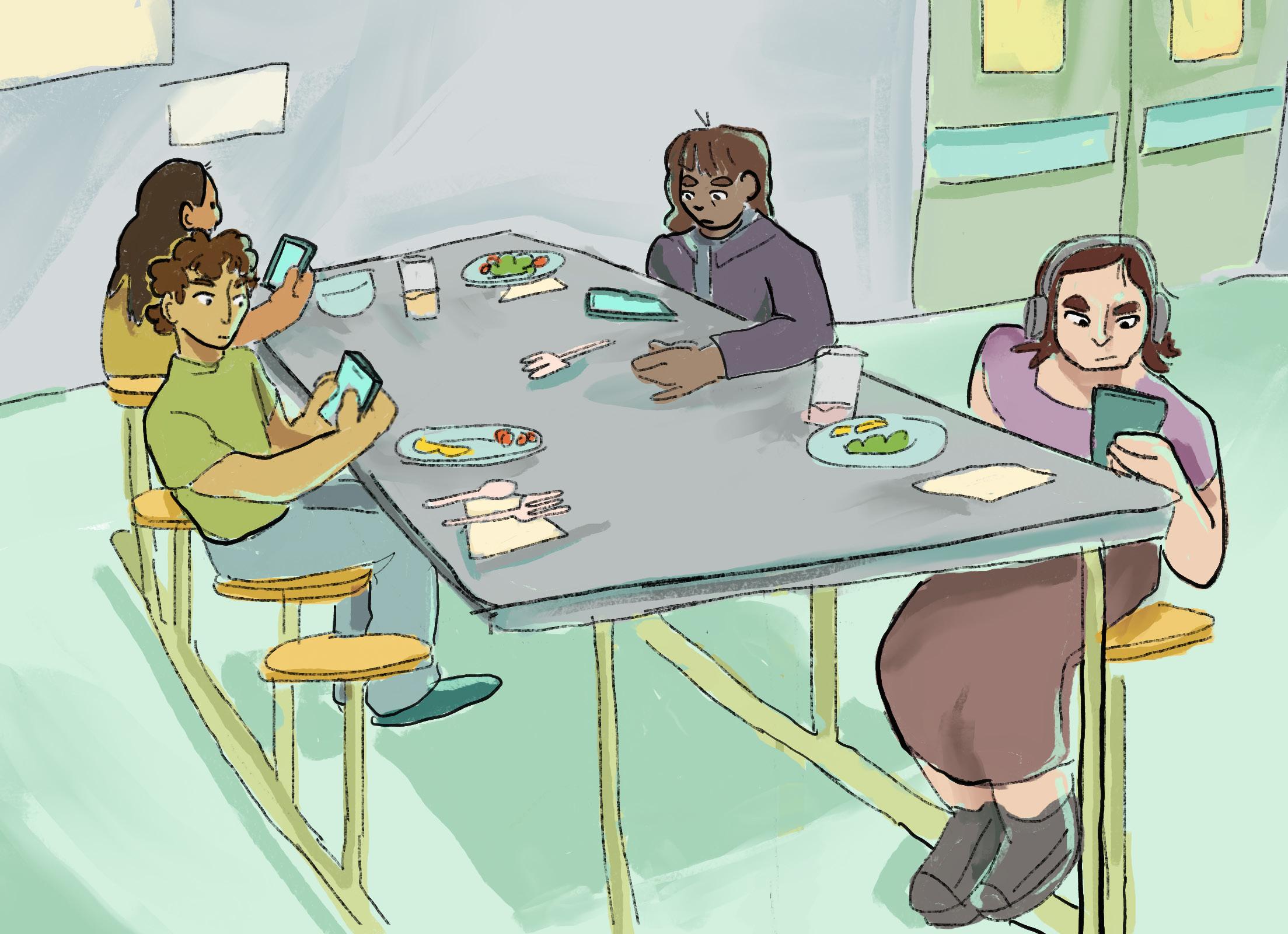
I’m staring through the car window. We roll over the central Californian coast, taking each bend slowly, the roads themselves tucked tight to the hills they contour. I can see a little basin of water out of my window, but not the actual shoreline. It’s blocked by the steel guardrails, reflecting the sun back in my eyes. My dad talks over the jazz coming from the rental car speakers. The clarity of the bass is something I’m not used to. He assumes only my mom in the passenger seat is listening, while he tells her what he knows about nuclear power.
His story reminds me of an article I read last year about warm water exhaust from a Japanese nuclear power plant creating a habitat for tropical fish. As any animal does, they found new spaces to live under pressure from human interference with the environment. The new community of fish largely died off after the plant was shut down and water temperatures dropped again. Looking out the window, I think about the first day of my junior year of high school, when I was handed my AP Environmental Science textbook. The cover was a photograph of a city, the purple of the sky at dusk fading into the sprawl of buildings and their lights. In the foreground was a hawk and its chicks nesting in a worn metal box, high above the city streets. In comparison, my AP Biology textbook was a photo of a sunflower with a black background. It was striking how much more real the hawk cover felt. Instead of framing the subject in a void, the photo acknowledged the interaction between humans and the environment.
It’s easy to only associate nature with sweeping landscapes, fields of plants and wild animals. It might be instinctual to view human technology and architecture as separate from this and to think of what is “natural” as removed from anything man-made or artificial, like a sunflower in a
I think college football is almost dead. The sport that I love doesn’t really look like it did even just five years ago. In the College Football Playoff National Championship, Indiana University, whose players were about 23 years of age, squared off against the University of Miami, led by Carson Beck, playing in his sixth year of college football. Players on both teams are now getting paid millions of dollars through their name, image and likeness to compete in what was supposed to be an amateur sport, where athletes could hone their skills before they played professionally for money.
Some of my love is definitely tied to nostalgia. Naturally, it reminds me of being young and carefree, since I have been watching college football since I was five. But the ridiculousness, the pageantry and the insanity are very real. How could I not love college football?
Yet, this is not all just my nostalgia interfering with actual history. Players used to only be able to play four years of college athletics. They also weren’t able to make money, except for allotted stipends from their respective universities. A decade ago, a player like Beck would have been getting paid millions as a National Football League veteran. Nowadays, he is playing for Miami and getting paid millions. Of course, he will also be playing in the NFL next year and making millions, but that isn’t the point. I cannot connect to the sport like I used to when players are changing teams every year and there is no guise of amateurism. It’s essentially a semi-professional feeder league to the NFL, which doesn’t affect the literal product of the sport, but doesn’t make it college football, either. These changes, on their own, have definitely harmed college

black void. Though the Cambridge Dictionary defines the word “natural” as specifically “not involving anything made or done by people,” all the buildings that we’ve constructed and objects we’ve produced are still made from these “natural” materials. Bricks are mostly clay, and cement is just a mix of limestone and metals.
As taught in elementary physics, the Law of Conservation of Matter states that nothing is ever created or destroyed. The water bottle in my lap was welded out of materials mined from the Earth. The electricity flowing into my laptop is not only from the outlet, but sourced from wind, natural gas or a heat engine. The fundamental root of every object in the world is the same.
As my dad drives us closer to Pismo Beach, it becomes even harder to catch glances of the water without seeing buildings, traffic signs, docks and the fluorescent patterns of umbrellas dotting the sand. There was a time before this — a time before the
football, but aren’t enough to kill such a beautiful game. This article is about what may be college football’s death knell. One specific, greedy demon is accelerating the process: private equity.
Private equity, like most other financial ventures, is a method of making money. Private equity firms acquire companies and “streamline” those companies by cutting jobs and selling assets to turn a profit. This profit is, of course, for the private equity firm, not for the company, because private equity firms collect management fees while they downsize companies. The companies go bankrupt, paying the private equity firms as they do so.
I have always found this process very disturbing in its nakedness. This is America, after all. Everything is about capital and how to compound it, stretch it and transform it into something greater than what it was to begin with. With private equity, there’s no typical window dressing of facts to make it seem as if something else is happening; it’s just profit and death. Slow, slow death. The thing is that private equity preys on the most vulnerable victims: Companies that are already losing money, and many that are doomed to fail. Private equity finishes the job, humiliating them by stripping companies for parts, leaving them exposed and bankrupt. Companies invite the vampire of private equity in, desperate for some attempt to salvage what they once had. The vampire sucks the company dry, killing the company. Then the vampire leaves, waiting until night comes again, then showing up at another doorstep, seeking more blood to suck.
For as much as it is ridiculous, college football is also completely, utterly, shameless. The University of Utah, for example, “needs”
hotels and overflowing trash cans and parking lots.
My most innate reaction to the fundamentally altered landscapes of our world is to wish for erasure and removal of the infrastructure, because I know we put it there, and I know how much it’s polluting our world. I want to tear everything down, clear it away and let the beach be for the seagulls and the crabs that get washed up to shore. Yet, I know this wouldn’t be possible. There is a possibility that humans can have a positive effect on the environment and for our livelihood to do more good than harm. It’s been modeled for us by Indigenous groups, sustaining the land of North America before it was industrialized by colonizers. In her book “Braiding Sweetgrass,” Indigenous ecologist Robin Wall Kimmerer explores the ideological differences between the presently dominant “property economy,” in which we exchange money to have ownership of goods and services, and that of an Indigenous “gift economy,” where
being given an object or food comes with the responsibility of caring for it. It makes us responsible for what we use. To take strawberries from a plant creates a relationship between humans and the world and requires us to care and tend to it, rather than assume we deserve something because we’ve paid for it. “We haven’t earned berries. We have not earned oxygen to breathe,” Kimmerer said in an interview.
“It’s not a natural resource. To me, it’s a gift from the natural world.”
As so many Americans live in urban areas, it’s largely impossible for us to have the same sort of relationships with the Earth. My mom will sometimes pray before her meals, thanking God and “the hands that prepared it,” usually referring to my dad’s, since he cooked. We did not grow any of the vegetables or give the gift of our time and energy to the plants in return for their fruits. Most of the food I eat back in my dorm isn’t straight from the ground, either. It’s full of preservatives and dyes and it’s engineered to taste like
They know we know they lie
money, partially to offset higher spending, such as $80 million to upgrade its football stadium. As much as young people like myself are brow-beaten for being “lazy” and “undisciplined” with their money, you would think university athletic departments wouldn’t constantly hemorrhage money. You would also think that the purportedly grown adults, whose jobs already depend on rich-donor money, would have more shame than to beg for private equity! But neither of those things is the case. It’s not like Utah is a smaller university, either; it’s a program in a Power Four conference! As such, it’s hard not to feel like Utah’s private equity deal is a result of a school’s administration failing its students, especially studentathletes. Student-athletes are being paid like employees, which means that when costs need to be cut, they will be fired. Nonrevenue sports, or sports unlike football and basketball that don’t bring in money, would cease to exist.
Utah, coincidentally, is discontinuing its beach volleyball team, which is an Olympic sport. But forgetting all of the bigger-picture issues with this — on an individual level, student-athletes are losing their sports and coaches are losing their jobs so that the University of Utah can make their football stadium bigger and pay their football players more. Real people hedged so much of their lives on women’s beach volleyball at the University of Utah. But that doesn’t matter, I guess. While the change in college football is easily noticed, I feel like we just now entered a new era for college football, where it is dragging everything else down. I’m sure the school’s administration won’t apologize when it happens, even their athletics will be just a memory, despite the fact that the same
administration invited Dracula in when he could only enter with their invitation.
Apparently, lots of other universities are also stricken with cash. The entire Big Ten Conference nearly extended their own invitation to a private equity firm for a cash infusion for the many needy programs in the conference. Thankfully, the University of Michigan’s Board of Regents realized that there would be future costcutting consequences, and said “enough.” Suffice to say, I believe our university was right to do so. I will commend the Board for doing so. I think it was one of their rare good decisions, and yet, we invest in private equity in areas that impact much more than just athletics. Much of our endowment returns comes from investments in private equity firms. In fact, our university invests about 40% of its $19.2
cheese. It’s all been packaged and shipped from different parts of the world.
How have so many of us evaded a real relationship with nature, when our only responsibility as humans existing in a gift economy is to work with the plants that sustain us? How did we get so far from how the world used to look only decades ago?
Is there a way back?
Last week, my evolution professor brought a Tupperware container full of dead bird parts to class. She showed us photos of the peregrine falcons that nest on top of North Quad Residence Hall, explaining that such apex predators can be so picky about their food as to rip off the heads, eyes and feet of prey and discard them. Students have been collecting these parts for her since 2018.
For so long, I’ve held the idea that true “nature” and ecosystems are completely untouched by humans, and the places we have molded into cities are a separate, human
billion endowment into private equity firms. These firms own numerous apartment complexes on campus, raising rates and making the student experience in Ann Arbor more and more difficult.
Our decision-makers know the dangers of private equity, with Regent Mark Bernstein (D), chair of the Board, calling a potential deal a “payday loan”. The regents know that private equity is toxic and whatever money private equity does give comes with a long, long half-life. I can see no other reason why they would be so publicly against a nearly unanimous decision for the rest of the Big Ten. Put simply, rejecting a cash infusion when this university has made so many decisions in service of protecting against monetary punishment, like ending our diversity, equity and inclusion initiatives, is surprising. Even
space. As much as we’ve changed, many fundamental evolutionary concepts still apply: An organism needs to survive to reproduce. Just as squirrels in forests with an ample supply of nuts have a higher fitness and chance of successfully reproducing, Diag squirrels have the same necessity for food. It’s only that the source and diet are different: The nuts are instead delivered by a gloved hand. In the presence of humans, like any other dominant species, new niches are created. It can now be advantageous for falcons to nest on towers or balconies.
Viewing the natural world separately from humans — whether in a void or sweeping landscape completely untouched by industrialization — is reductive and can absolve us of our responsibility in the climate crisis. Thus, to think our cities themselves are not ecosystems, to ignore the way plants grow in between the concrete and mice make their way into our buildings for food, is disingenuous to the resilience of the natural world and our place within it. Although we have created and sculpted our world through so much artificial design, we are still animals. At the most fundamental level, everything in the world is still natural. Although synthesized and far removed from their original forms, the pavement used to make a parking lot and the mortar that keeps our buildings together are made of the same matter that has always existed in the universe. Nothing is created nor destroyed. Everything cycles. The bodies of prey are meant to decompose. What a predator picks over is meant to return to the microorganisms in soil that cycle that same matter back to a plant. That plant then becomes fuel to some higher part of the food chain and decomposes again. There may be no way back from industrialization, at least not in our lifetime. But it would be reductive to the miracle and gift of life to say there are no ecosystems learning to live on our buildings, between our alleyways and under our rubber soles.
Regent Jordan Acker (D) posted on X individually, as he often does, to make his opposition known. They know the dangers of private equity.
Do we think inviting such a monster into our place of learning, yet denying it access to our oh-so-important athletic teams, will work? It seems like we are operating on juxtaposed modes of thinking. What is the end goal in mind?
Who knows? I’ve never spoken to any of the regents, so I don’t know the answer to any of these questions. But to me, it seems like the regents are acting in the best interest of our athletics, but not the rest of the University. So, what is the difference between college football and college academics? At least, what is the difference between them to the regents?
CONTINUED AT MICHIGANDAILY.COM
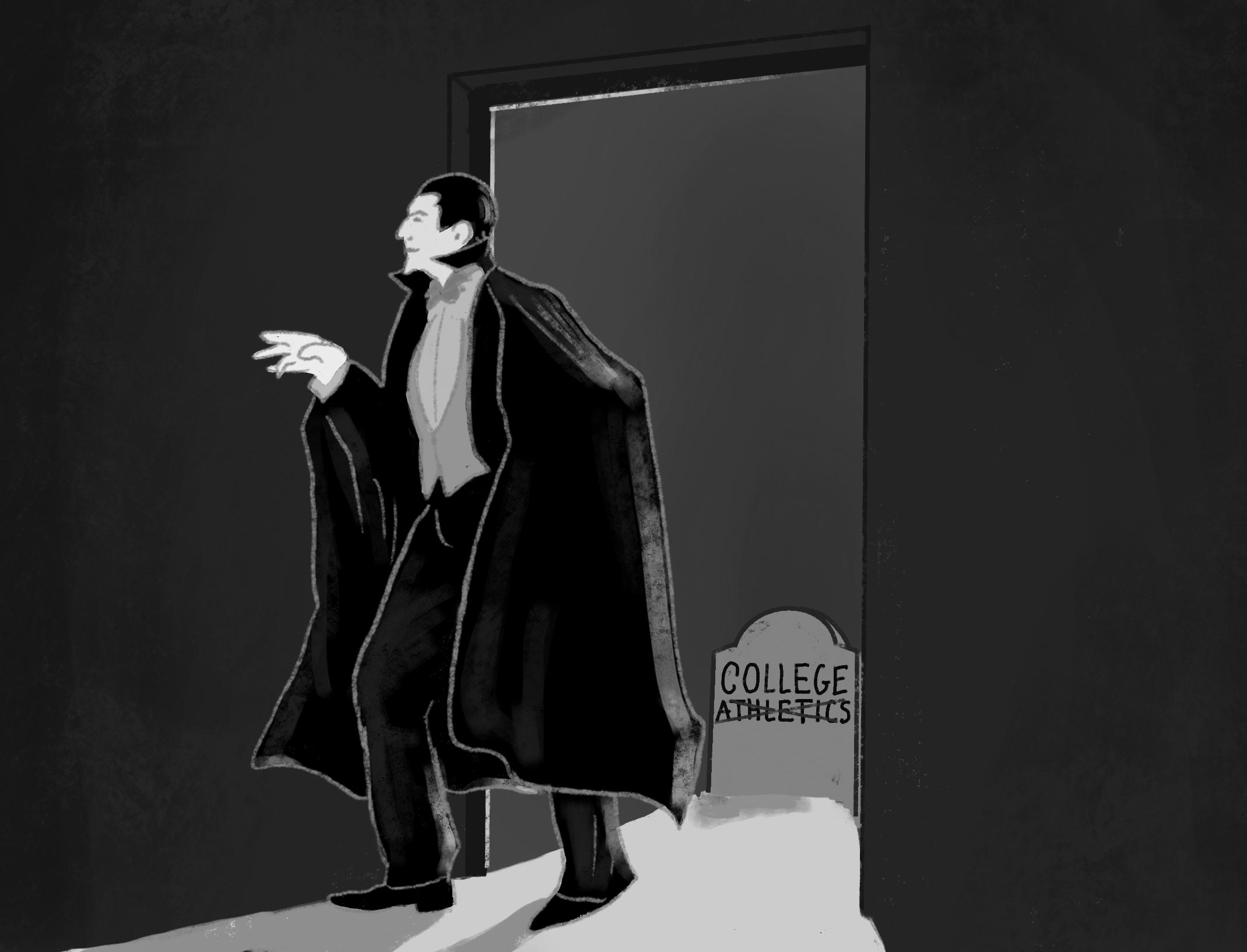
The No. 7 Michigan women’s basketball team emphasizes a punch-first mentality, and on Sunday against Southern California, this was put on full display.
The Wolverines (16-3 overall, 8-1 Big Ten) came out swinging, wasting little time to find their offensive rhythm. The Trojans (11-9, 3-6) struggled to organize defensively early, as Michigan capitalized off USC’s woes to build a 10-point cushion that proved to be critical in the second half, leading to a 73-67 win.
Three-level scoring highlighted the Wolverines’ early run, which opened with a post fade from sophomore guard Olivia Olson. Olson went straight back to work, connecting on her next three shots as Michigan dominated inside the paint. Sophomore guard Mila Holloway added to the scoring run with a 3-pointer and after a 15-5 start, Trojans coach Lindsay Gottlieb had little choice but to call a timeout.
“It just gave us confidence, the way we came out of the gate,” Wolverines coach Kim Barnes Arico said. “… We just set the tone early in the first quarter and that’s the way you want to start every game.”
Following the timeout, USC tried to slow down Michigan’s
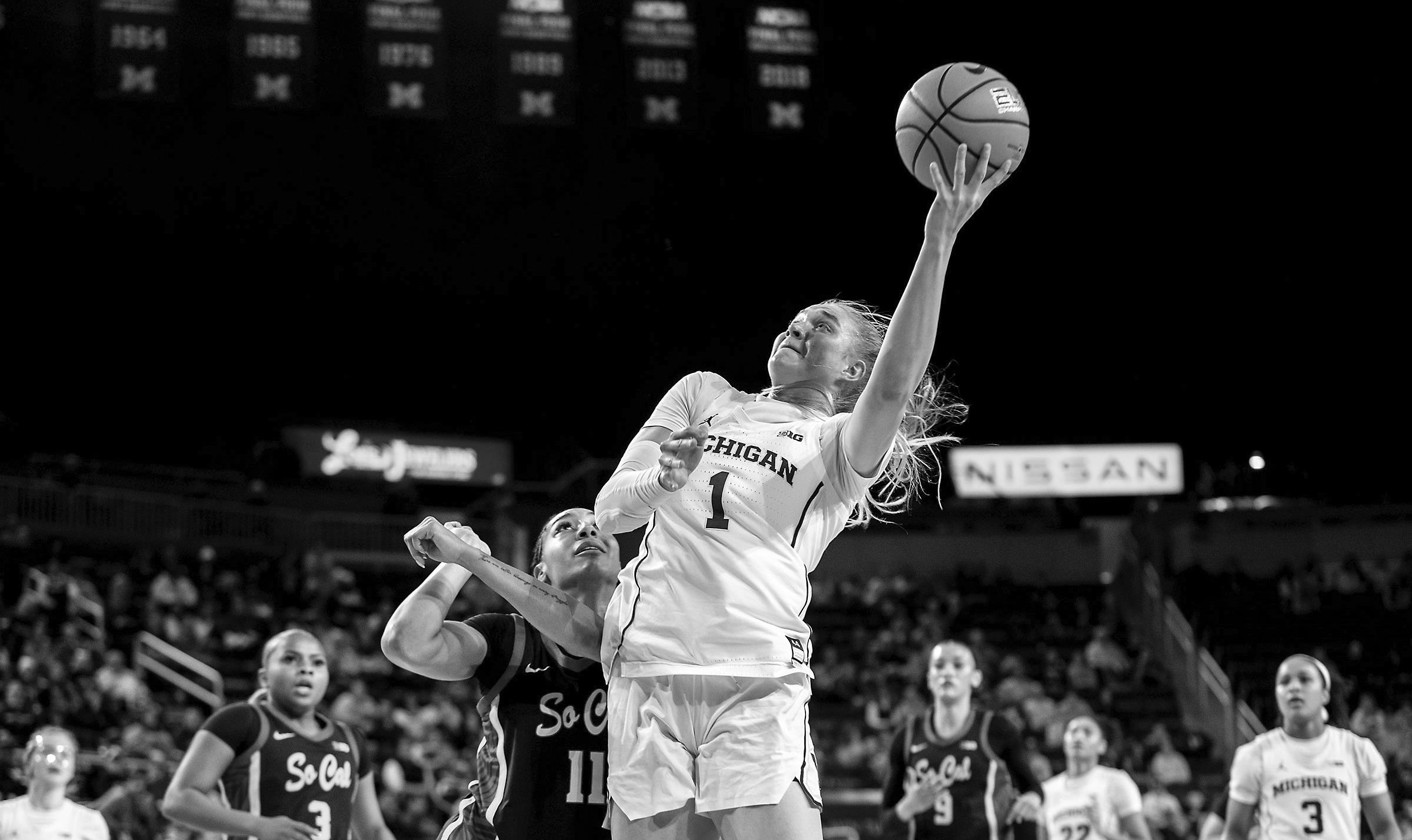
upbeat tempo with a full-court press. However, the Wolverines responded by using their speed to get out and run in transition. Michigan broke the press consistently and sparked a mini run, closing the first quarter with a 23-11 advantage. Despite the Wolverines creating distance from USC, the Trojans refused to go away, as guard Kara Dunn gave her team a significant
boost with 10 points in the second quarter alone. Michigan answered with a balanced attack and unpredictable offensive sets, keeping USC on its toes defensively. And as the first-half buzzer sounded, the Wolverines held on to that cushion, 40-27.
The Trojans came out of the break with a newfound aggressiveness, and it paid off immensely throughout the
third quarter. With a lack of offensive output in the quarter, the Wolverines needed to turn it up on defense to stay in front. However, USC moved the ball effectively, finding open shooters from beyond the arc.
The No. 3 Michigan men’s basketball team is aware of the narratives that surround it. The Wolverines, and especially graduate forward Yaxel Lendeborg, have been unusually open about it.
“When (Ohio State forward)
Colin White said something about us, that kind of sprung brewing some type of anger into me as well,” Lendeborg said Saturday after Michigan’s win over the Buckeyes. “Because he shouldn’t have been talking about our squad like that. So, you know, we did our best to shut him up.”
In the same postgame interview, Lendeborg acknowledged his team was “too amped up” to start the game leading to a turnovertainted first 10 minutes. Soon
after, Michigan coach Dusty May corroborated Lendeborg’s account of how emotions factored into the rivalry game. Now the Wolverines are approaching their two biggest games of the season in the same short week, against No. 7 Nebraska and at No. 10 Michigan State, and the latter will undoubtedly be the most emotional.
More volatile than its record indicates, Michigan needs to be steadier and unafflicted by outside noise. That needs to start this week.
The Wolverines have some of the best wins in the country, particularly over Thanksgiving week when they beat two ranked teams by 30-plus. But narrow wins early against bubble-atbest teams, a loss to Wisconsin and a few close calls to middling Big Ten teams in the new year expose a floor that is levels below Michigan’s high ceiling. Fault is
Entering Saturday’s meet, the No. 4 Michigan men’s gymnastics team hadn’t lost at home
2019. An
generation of Wolverines, headlined by former Michigan athlete and
bronzemedalist Paul Juda had come and gone with no home defeats to show. In a hotly-contested meet — with Juda emceeing — that came down to the final routine, the Wolverines (5-1) were unable to hold off No. 1 Oklahoma (5-0), falling to the Sooners for the second consecutive season and ending their streak of 42-consecutive home wins, 321.850-320.650.
Last season in Norman, thenNo. 1 Oklahoma took down No. 6 Michigan despite the latter taking four event titles on the day. Following the competition, the Wolverines rattled off 16 straight victories en route to an NCAA Championship. Similarly, this season, Michigan is taking the loss to the Sooners in stride and hope it will be merely a learning moment come postseason time.
“This is part of the process,” senior Landen Blixt said. “We plan for it. We know going forward what we need to do. It doesn’t deflect or deviate from our same path.”
The meet started slow for the Wolverines as junior Jake Islam deducted falls on two of his opening floor passes for a score of 10.6.
While freshman Adam Lakomy, sophomore Solen Chiodi and junior Charlie Larson limited the damage,
each scoring at least 13.5, Michigan found itself down over a point through the first rotation. Moving to pommel horse, the Wolverines got back on track. After junior Kyle Walchuk and Blixt scored 13.1 and 13.6, respectively, senior Fred Richard put up a muchneeded 14.1. Not to be outdone, the No. 2-ranked pommel horse gymnast, sophomore Aaronson Mansberger stepped up next. Coming off a career-high 14.9 a week ago, Mansberger performed to a 14.6, trailing only himself for the highest single-routine score in the NCAA at that point.
“Our goal is to put him as national champion on pommel horse, not just All-American,” Michigan coach Yuan Xiao said. “From his work ethic, he is truly believing and confident and performing… it’s possible this year.”
Now leading by just one-tenth, the Wolverines headed to the still rings. There, all four gymnasts scored at least a 13, with junior Akshay Puri leading the charge, debuting a new twisting 1.5 dismount, which he stuck for a 14.
On vault, it was Larson showing out, sticking the landing on a doubletwisting Yurchenko for a 14.3. Both he and Puri earned event titles for their efforts, displaying Michigan’s high-end potential.
“Right before I went, I was like, ‘if Jordan Chiles can get a 10 on this, it’s my turn to get a 10 on this’ ,” Larson said. “And I didn’t get a 10, but, I think it could’ve gone 10.”
Despite Larson’s meet-high vault, the rest of their rotation faltered a bit, and the Wolverines once again trailed by around a
Olson started the fourth quarter scoring with a midrange jumper, and the defense followed it up with a much-needed stop. Senior guard Brooke Quarles Daniels added her own midrange jumper and followed it up with a layup. With that, the Wolverines regained the lead. And they never looked back.
Fueled by Olson and Quarles Daniels, the rest of the team was imbued with a new sense of energy on both ends of the court, resulting in a 13-0 scoring run to open the final quarter. And just as Gottlieb had done in the first quarter following a Michigan run, she called timeout with her team down eight.
“There was a stretch in the third quarter where we couldn’t make plays on either end,” Barnes Arico said. “We got those stops, and we got that confidence and we got that momentum.”
The opening minutes of the fourth quarter became a decisive factor for the Wolverines as they needed to regain momentum on the offensive front.
Understanding the significance of those first few minutes, Michigan once again took control of momentum.
As the Trojans blended a strong mix of outside shooting and paint presence, Michigan continued to have trouble on the defensive side of the ball. That sparked USC to flip the switch and jump out to a 58-53 lead by the end of the third quarter.
The Wolverines made the most of each possession out of the timeout, slowing the tempo in order to drain the clock down. Michigan turned back to its strengths, mainly emphasizing defensive intensity. This pressure forced the Trojans into tough shots and the Wolverines evidently showed they had what it took to hold on. Michigan’s early
get too high or too low in the biggest week of the season
hard to pinpoint, but being too externally motivated is an issue nonetheless.
Banter can and, to an extent, should be used as motivation. But Friday night showed the Wolverines can overdo it and fail to execute in the process. Even in the previous non-rivalry game against Indiana, Lendenborg pointed to more external motivation weighing on his mind.
“We had like a sort of a chip on our shoulder, because we were hearing some rumors about other people calling us off,” Lendeborg said Jan 20 after beating the Hoosiers. “And I don’t think any of us in the room believe that we’re soft.”
Lendeborg’s comment referred to an X post of a fake quote attributed to Washington coach Danny Sprinkle that circulated. It wasn’t even a real comment and it affected Lendeborg enough for him to bring it up to the media.
In addition to opposing players statements and social media posts, the Wolverines have talked plenty about their metrics, particularly their defensive efficiency rating. Earlier this season, Michigan players talked about seeking and achieving the No. 1 defense ranking. While there isn’t anything wrong with that goal, it can’t become a fixation.
“I don’t know if it helps (keep the noise out) or hurts,” May said Jan. 9 in reference to the rating.
“You don’t know, because with it comes more attention and more people that are just popping up. But I don’t know. It’s on us. We have a very mature group, and I don’t feel like it’s in there at all, but we just, we got to constantly be on the fight. But the No. 1 ranking, these guys deserve it, man.”
Recently, the Spartans overtook the Wolverines for
the top defense according to KenPom. Like other external motivators, Michigan can’t dwell on reclaiming the top spot and be overly motivated to prove something so inconsequential Friday.
Nobody knows what’s truly going on in the minds of players, but Michigan’s mild downturn is undeniable. And all the outside talk that’s been addressed doesn’t seem to be helping the Wolverines stay the course of the season and gradually build to where they want to be in March.
This week, Michigan has to maintain perspective. The Wolverines have to be driven by the emotion of an in state-rivalry. They can also want to reclaim the top defensive rating and they can use the chatter to fuel them.
But they can’t let any of those motivators consume them.
Neither before, during or after these two top-10 games can
Michigan be too high or low on itself. The Wolverines can’t think they’re going to blow out and expose Nebraska Tuesday. Then they can’t let that result change their psyche for Friday against the Spartans.
The Big Ten regular season title will be swayed by how Michigan fares, but that’s really it. The Wolverines will still be on track to earn a good seed in the NCAA Tournament and should be concerned with addressing weaknesses exposed this week, no matter their record across the two games. After the scuffle in last year’s game in Breslin Center, there will no doubt be pregame soundbites and there will surely be emotions — especially for those returning from last year — come tipoff. But that can’t consume Michigan. It’s time the Wolverines block out the outside noise and spot being so volatile.

point coming off the event. In Michigan’s penultimate event, it struggled on parallel bars. With no scores above Richard’s 13.55, and a couple below 13 entirely, the Wolverines trailed by 1.7 points heading to the final rotation. On high bar, it looked like the tables were turning though. Leading off, senior Robert Noll hit a Tkatchev and Cassina before sticking his double dismount for a 13.55, tied for his highest on the apparatus in over a year. Blixt
and sophomore Carson Eshleman followed Noll with critical routines of their own, each catching multiple release skills and Blixt sticking his dismount for 14.1 and 13.8, respectively, to push Michigan just in front. With just the anchor routine left, the meet still hung in the balance. For Oklahoma,
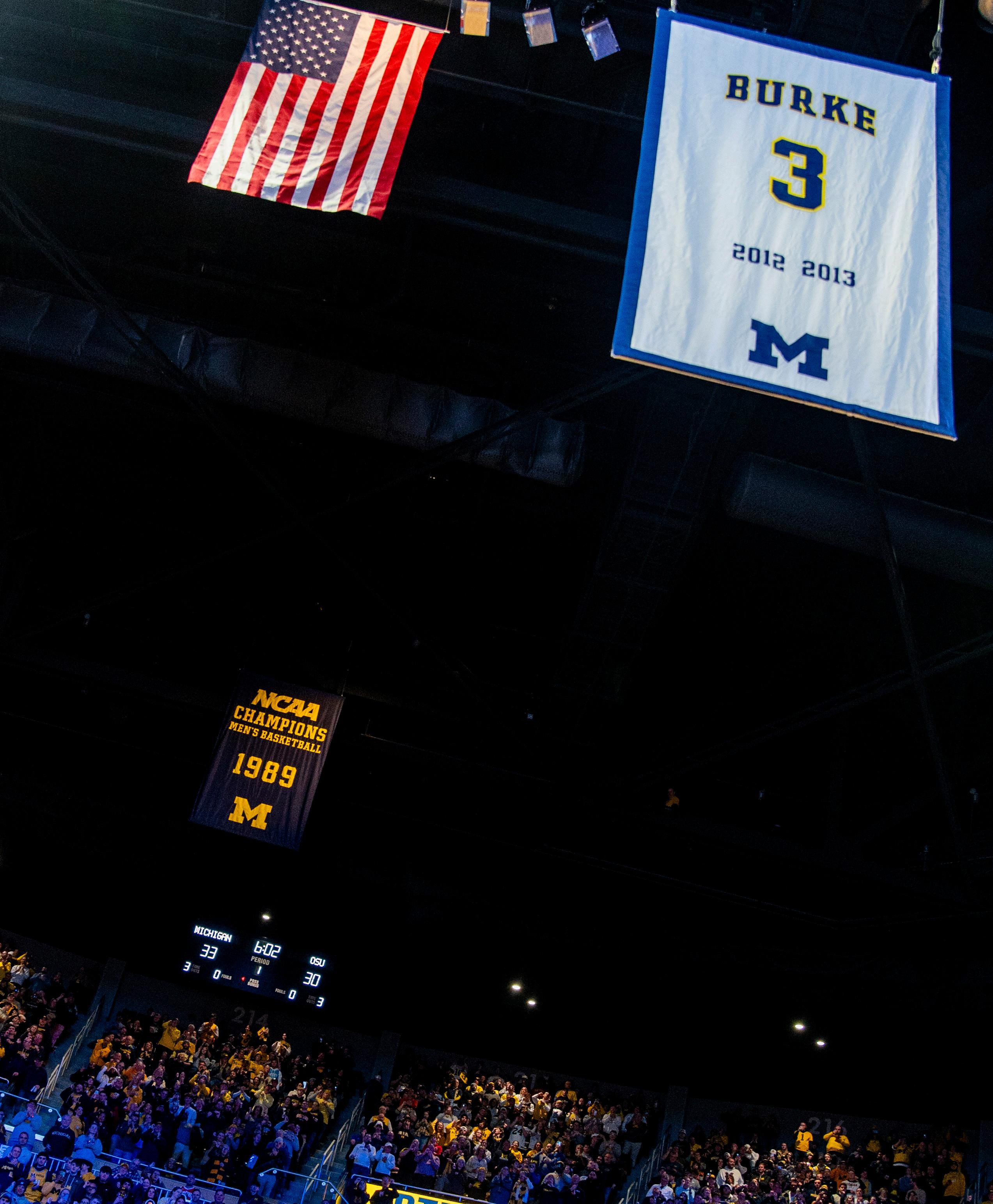

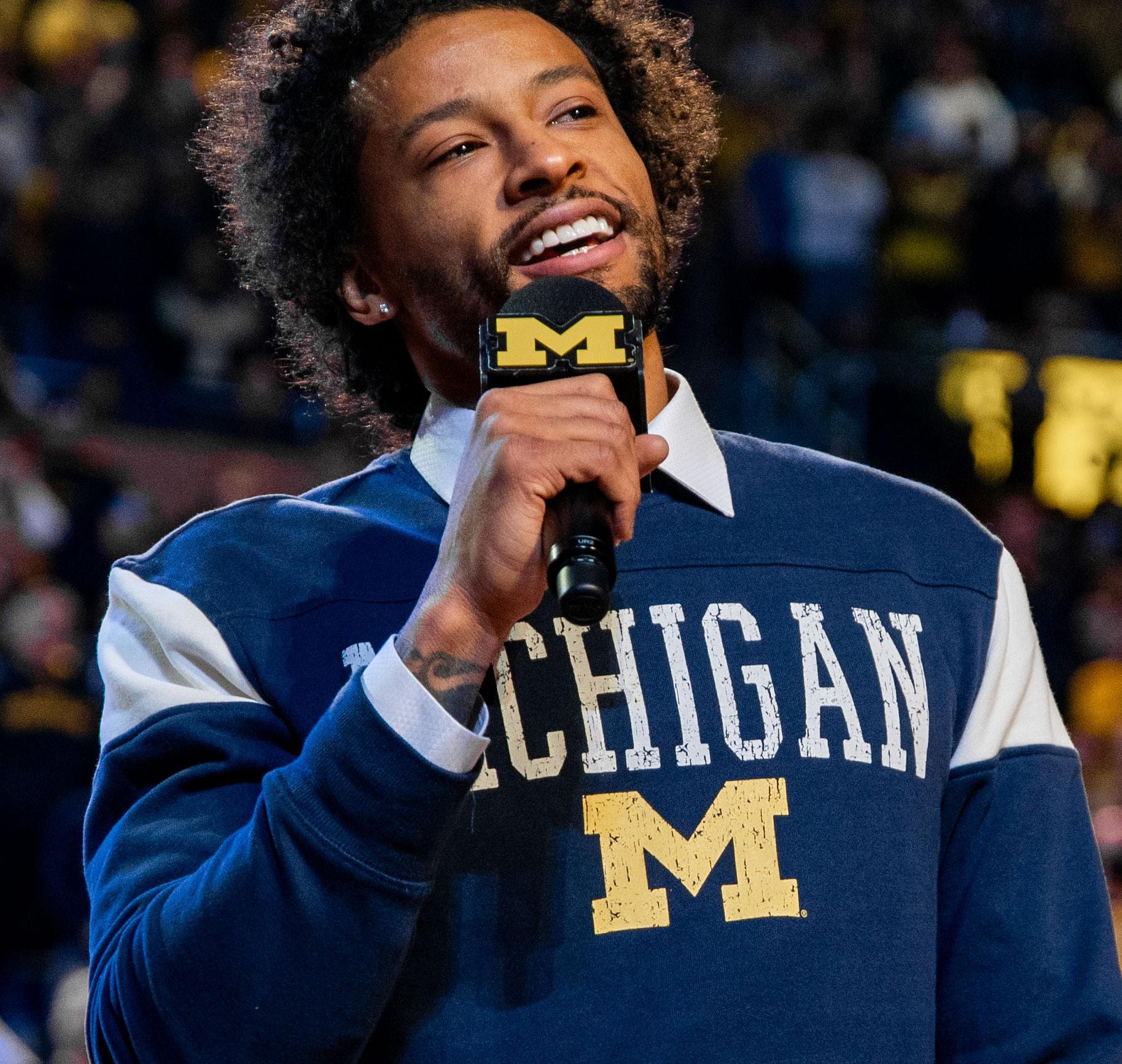
Choosing to have his jersey raised at Michigan’s home contest versus Ohio State, Trey Burke made it a point to stick it to the Buckeyes.
With his personal vendetta starting over 13 years ago, the Columbus, Ohio native turned legend Wolverines guard always had a chip on his shoulder when matching up against Ohio State. The result, more often than not, was a nailbiter.
“I thought it was ironic we were playing Ohio State and now I found out that I think (Michigan athletic director) Warde (Manuel) gave Trey the choice of what day he wanted to play,” former Wolverines coach John Beilein said. “And he said, ‘Let’s do the Ohio State game.’ … (They were) incredible, incredible games, going back down to the
the first play of the game, a near half-court alley-oop from junior guard Elliot Cadeau to junior center Aday Mara, the Wolverines came out of the gates sprinting. A bit too fast at times, Michigan committed multiple turnovers with passes sailing past outstretched hands.
“It’s both of our faults honestly,” graduate forward Yaxel Lendeborg said. “We make eye contact, I throw it, but I throw it a little far away and they think it’s not for them. So it’s both of our mistakes. But we didn’t let it break us down, we stayed composed and just fought through it.”
The turnovers weren’t the only issue though. With threes not dropping through the hoop, the Wolverines had to depend on their frontcourt to generate the majority of the offense. Spearheaded by Lendeborg and sophomore forward Morez Johnson Jr., this duo combined for just over half of Michigan’s
Highlight plays from both sides defined the start of the second half. A steal from Cadeau turned footrace with the Buckeyes resulted in an acrobatic finish from Lendeborg. Not to be outdone, Ohio State found its rhythm from outside the arc, banging and banking in deep threes.
As the game wound down into its final minutes, the Wolverines finally began pulling away from the Buckeyes. Second-chance points in the form of a Cadeau corner three and thunderous putback dunk from Mara ahead of yet another sky-walking layup from Lendeborg gave Michigan a 10-point cushion with four and a half minutes to play.
“We made a big three off of Yaxel’s offensive rebound,” Wolverines coach Dusty May said, “… Elliot’s play was gigantic, because it just felt like that allowed us to continue the momentum that we were building.”

And with that momentum, Michigan nailed the coffin shut. With Ohio State ice-cold from three in the final minutes, a sprinkling of free throws and a final yam from Lendeborg signaled the end of regulation.
With Burke on the sideline and his jersey hanging from the rafters, the Wolverines delivered homage to one of the program’s greats by churning out an electric, unquestionable
Alyssa Mulligan/DAILY Design by Annabelle Ye
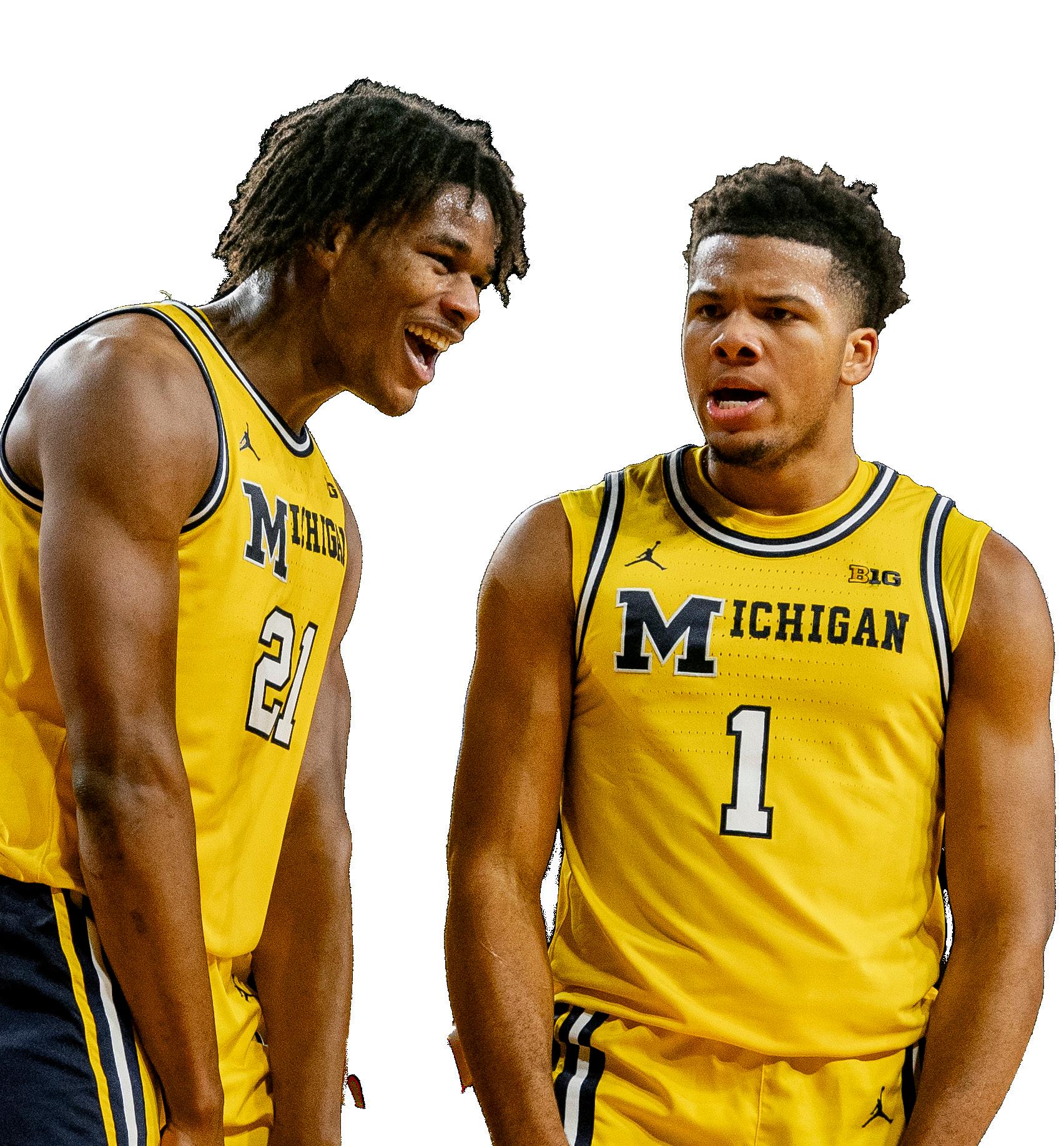
MICHIGAN