UMich celebrates MLK Day with Circle of Unity musical event
“I thought it would be particularly interesting to see performers and musicians come and showcase their art for this message of unity and justice, instead of just a regular speech.”
The Michigan Community Scholars Program hosted the 20th annual Martin Luther King Jr. Day “Circle of Unity” event Monday afternoon. Over 50 people gathered in the LSA Building Atrium to watch students and local artists perform music, dance and share spoken word poetry in honor of civil rights leader Martin Luther King Jr.
The event opened with remarks from MCSP Director Christine Modey, who said King’s reflections on unity as a response to chaos were a guiding value for the event.
“Dr. Martin Luther King Jr., in his last book, wrote about a choice that we all face when things are falling apart,” Modey said. “We can let them devolve into chaos, or we can choose community. As I look around the world today, it feels like there’s plenty of chaos. And yet MCSP invites you all here to be part of building community through song, through poetry and through fellowship together in a place where we affirm what’s best about people.”
The event featured Jelani Bayi, one of the original student founders of the “Circle of Unity, who spoke about the event’s origins.
“Back in the day, we were outside in the Diag,” Bayi said. “Most of the participants were
MCSP students and performers, and we had a lot of hot chocolate to keep us warm. Through the years, we had a high school band from Detroit come; the Michigan Gospel Chorale has performed.
Although it was extremely cold outside, we had hundreds of students and Ann Arbor residents attend.”
Among other types of performances, local singersongwriter Joe Reilly and Detroit artist Julie Beutel led the audience in a sing-along centered around peace, activism and uplifting the community. Attendees clapped their hands, shouted out lyrics and joined hands in a circle. LSA freshman Avery Hurd performed an interpretative dance to “Freedom” by Beyoncé, featuring Kendrick Lamar. Following Hurd’s dance, Isaiah SchuhamAnders, MCSP coordinator of
diversity initiatives, performed an original spoken word poem that discussed themes of unity, hope and togetherness.
“Unity is not a greeting card, it is not a soft song sung in a quiet room,” Schuham-Anders said. “Unity is a friction. It is the heat of different stones rubbing together until they spark a fire that can keep a whole village warm. It is the I surrounding its sharpest edges to become the we. It is the mother whose kitchen has no door, feeding children whose names she didn’t give them. It is the neighbor who hears the silence of your grief and brings a shovel to help you bury the weight.”
MCSP founder David Schoem and former associate director Wendy Woods were then invited to speak about Dr. King’s principles of nonviolence and the importance of youth leadership.
“Let’s build and strengthen this circle of unity,” Schoem said. “Listen to and give power, agency and hope to all of our wonderful students and young people, and let all of us work together for justice, peace and love.”
For the final activity, attendees were invited up to the front of the stage to participate in a collective art activity. Participants traced their hands onto large sheets of paper and were encouraged to write what brings them a sense of community.
In an interview with The Michigan Daily, Business sophomore Chloé Nicholes, MCSP student leader, said the event was a way to bring the community together and celebrate the values of Dr. King. CONTINUED AT MICHIGANDAILY.COM
18-year-old arrested for leaving threatening note at Haisley Elementary
The suspect fled the scene after leaving a note threatening to harm people with a firearm and is now receiving mental health treatment
entering Haisley Elementary School grounds, should he be released.
The Ann Arbor Police Department arrested an 18-year-old suspect Friday for threatening students at Haisley Elementary School. In a message to The Michigan Daily, AAPD spokesperson Chris Page wrote that the suspect “left a note on a classroom window threatening to harm people with a firearm.” Page also confirmed that the suspect fled the scene immediately after the incident, and officers arrived at about 4 p.m. as school was being dismissed. Shortly after, police arrested the suspect at his residence, where they found no firearms.
In a post to X, AAPD wrote the Washtenaw County Prosecutor’s Office charged the suspect Saturday with one felony count of making terroristic threats, with a maximum sentence of 20 years, and one misdemeanor count of making school threats, with a maximum sentence of a year. In a post to Facebook, the prosecutor’s office wrote the suspect will be held on a $250,000 bond and with a GPS tether prohibiting him from
Pioneer High School hosts 24th annual FutureStars singing competition
The AAPD’s post on X stated the suspect is receiving mental health treatment.
“AAPD also worked with Community Mental Health, which developed an immediate plan to get the person coordinated resources,” the statement read. “He is currently receiving treatment at a mental health facility.”
In a post to Facebook, the Ann Arbor Public Schools wrote the suspect now has a no-trespass order restricting him from AAPS property. AAPS reiterated its commitment to student safety and wrote that district social workers and psychologists will be working to help support students when school returns on Tuesday.
“The safety of our students and staff is our priority, and we are taking this situation very seriously,” the statement read.
“We are committed to the safety and well-being of our students, staff and community. We appreciate the quick response from our school administration and staff, as well as the cooperation and support from our families.”
25 contestants competed in the annual vocal competition hosted by the Pioneer Theatre Guild
Arbor Public Schools high schools took to the stage in groups and solo performances to showcase their musical aptitude, choreography skills and individuality. The Pioneer High School Theatre Guild has hosted the vocal contest since 2002. This year’s event, directed by music teacher Jayme Kelmigian, featured guest judges from across the Ann Arbor community including University of Michigan football players, Mayor Christopher Taylor and faculty from the School of Music, Theatre & Dance.
Participants underwent a month of preparation — including four vocal coaching sessions per performer — coached by music director Ken Pesick and vocal coaches Allison Gaines, Athena Johnson and Elle Michaels.
The almost entirely studentrun event featured student hosts — both writing their own scripts and emceeing the event — and performances from the underclassmen show choir RisingStars in addition to the contestants’ acts. Pioneer senior Gabby Thompson won the contest with her performance of “Love” by Keyshia Cole, selected based on the decibel level of the applause she received.
In an interview with The Michigan Daily, Thompson said
she has always been surrounded by music.
“Music has been a part of my life forever,” Thompson said. “I started singing when I was three I think. My family is Jamaican, so I grew up with a lot of reggae, a lot of Afrobeats, Caribbean styles. It was a little bit jarring to go from living in a home where this music was the norm to going to public school for the first time and hearing a lot of pop music, rap, stuff like that.”
Pioneer senior Abigail Rohrer performed twice, with both placing in the top five performances of the night. Rohrer told The Daily she enjoyed the chance to express herself through her song choices, especially during her solo performance.
“This show, I find it
particularly important because it’s such a good vessel for individual expression, especially when it comes to solo songs,” Rohrer said. “I have a solo this year and it’s a country song. It’s been fun because that kind of music is sort of what I grew up on, and I get to bring that to the stage. I get to bring me, myself – Abby Rohrer – to the stage.”
Five Pioneer students hosted the event, tasked with guiding song introductions and short skits. As his first show, Pioneer senior and host Isaac Laberteaux said he was shocked to find out how much of the production is student-led.
“As someone who came to the show and (did) not know any background, then to come here and realize how much is student-led, it’s incredible,”
Laberteaux said. “It’s like a professional level production. You have elite singers, students who are now in school for singing and acting that perform in this show. It’s all hands-on from the students.”
Laberteaux said he feels the Ann Arbor community loves singing competitions and seeing the talent in their own community.
“People love to watch shows like ‘America’s Got Talent’ and shows like ‘American Idol,’ but when you can see it in your own community you can realize the talent here,” Laberteaux said.
“I mean, this city is a driven city; people want to work hard; people want to succeed at the highest levels. I think this offers just a great outlet to all high school students.”
LSA freshman Lily Wright,
a RisingStars assistant choreographer and former contestant, performed a rendition of “Valerie” by Amy Winehouse alongside vocal coach Gaines. Wright told The Daily the creative outlet offered by the competition is what sets it apart from other PTG shows.
“The students who are performing on stage do a lot of the costuming and staging for themselves,” Wright said.
“They have a lot more control over their numbers and their performance. I think there’s a lot of great opportunities for them to be super creative and have fun creating their popstar persona or whatever it is gonna be for their piece.” Wright said the U-M underclassmen who worked on the show enjoy the opportunity to perform as well.
“They do a performance at the end (of each half of the show), and it’s just such a fun way for them to obviously get experience in the show, but also for them to show off and get to perform in front of the audience and just have those awesome experiences,” Wright said.
Pioneer senior Mia Coulouris, a first-time FutureStars participant, performed both a solo performance of “Ceilings” by Lizzy McAlpine and a group number of “Girls Just Want to Have Fun” by Cyndi Lauper. Coulouris told The Daily that, despite the show’s competitive nature, contestants are committed to supporting and celebrating one another.
“It is a competition, but competition is used lightly,” Coulouris said. “That is also what is really special about this, because there’s no cutthroat competition-feeling atmosphere. It’s really just, ‘I’m here, and I can perform and have so much fun with these other people, and support them as well.’” Nicole Campbell-Thompson, co-president of the PTG Booster Club, said the arts play an important role in youth development and urged the Ann Arbor community to continue to support theater programs in schools.
“The one thing I charge the entire community with, is just to continue supporting the arts,” Campbell-Thompson said. “When there are opportunities for (the community) to speak for the arts, I would encourage us to do that, because we all know that when students participate in the arts it really does help their brain development, and it really does help them to become better students, better humans.”
Ann Arbor, Michigan
Nasen/DAILY
Audiences wait for the circle of unity activity to start at the LSA Building Atrium Monday afternoon.
MYA WEISS Daily Staff Reporter
NEWS BRIEFS
Josh Sinha/DAILY
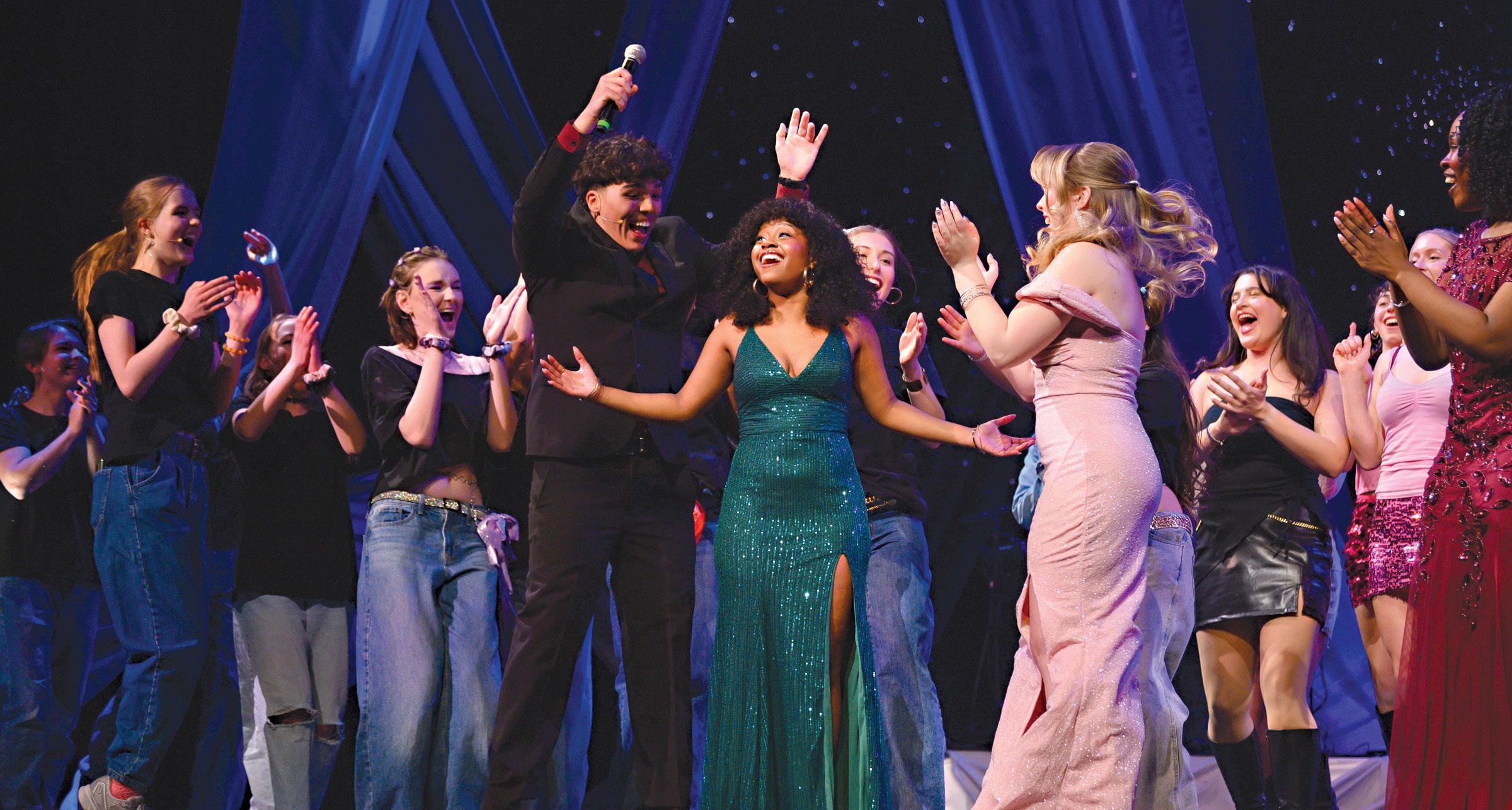
Contestants, hosts and crew celebrate as Gabby Thompson is declared the winner of the talent competition by audience cheer volume.
U.S. Rep Debbie Dingell discusses federal policy and higher education in CSG town hall
“What I’m most worried about is that we are normalizing attacking each other, we are normalizing the lack of civility and we are normalizing political violence — and that is unacceptable.”
About 70 Ann Arbor community members gathered Thursday evening in the Ford School of Public Policy to hear U.S. Rep. Debbie Dingell, D-Mich., discuss current issues in the United States. The University of Michigan’s Central Student Government hosted the town hall as an opportunity for open dialogue with the congresswoman.
In an interview with The Michigan Daily, LSA junior Taylour Poellnitz-Thomas, CSG co-director of government relations, said CSG organized the town hall to create a space where students could feel that their voices were heard.
“We want to alleviate some of those questions that are not always accessible to ask in a very cohesive and conventional way,” Poellnitz-Thomas said. “It’s imperative that students do their best at advocating for their needs, and we as CSG partners definitely want to help bridge that.”
Dingell has served as a U.S. representative since 2015, succeeding her late husband John Dingell. She has represented Michigan’s 6th congressional district, which centers around
Washtenaw County, since 2023. In response to a question about the future of the U.S., Dingell said the country was facing a time of deep division.
“I think we’re at a crisis point in this country, and our democracy is being tested, and we have issues that we have to work on,” Dingell said. “What I’m most worried about is that we are normalizing attacking each other, we are normalizing the lack of civility and we are normalizing political violence — and that is unacceptable.”
When asked how she hopes students will help shape Michigan in the future, Dingell said it is important to hold true to good values.
“There’s one value you’re going to come out of here knowing, and that is to respect each other, to treat one another with respect and dignity,” Dingell said. “I believe our leaders have to help in being able to talk to each other, agree with each other, disagree with each other, but treat everyone with respect.”
LSA and Education senior Eric Veal Jr., CSG president, said he believes many politicians have lost sight of the value of working together.
“I think we need to ensure that we’re working together on crosssectional issues, bringing in
people who will disagree and I’m going to think about that when I’m making a key decision or choice to guide our institution,” Veal Jr. said. “Making sure there’s respect, there’s time and effort put together to create a team, but also to create an environment that is comfortable and collaborative.”
When questioned about current U.S. immigration policy and congressional approaches to supporting international students, Dingell emphasized the importance of international students and that everyone deserves a strong educational experience.
“We are losing freedom of speech in this country, and
everything that you’re saying is going to be heard by somebody, and international students are afraid to leave, to go home, to be with their families because they don’t know if they’re going to be allowed back,” Dingell said.
“I think international students matter, and I try to help them, make sure they’re getting help and the visa they need.”
Dingell noted threats to research funding and the steady loss of researchers was another pressing issue facing higher education, and said she has worked to protect National Institutes of Health funding for the University.
The influencer tried to justify the killing of Renee Good by an ICE agent and performed a Nazi salute
Content warning: This article contains mentions of antisemitic gestures and Holocaust denial. Far-right men’s rights influencer Myron Gaines, Fresh and Fit Podcast co-host, held a debate event with University of Michigan students and community members on the Diag Thursday afternoon. He was
hosted by Uncensored America’s chapter at the University. Uncensored America has previously hosted events with Gaines at universities across the country, including The Ohio State University and The Pennsylvania State University. At about noon, Gaines’ team set up a large tent with camera gear on the Diag in front of Hatcher Graduate Library. Gaines appeared shortly after and invited students to debate him in
front of a crowd of more than 100 people. He displayed a large sign that read “I.C.E. Did Nothing Wrong. Prove me Wrong.”
Gaines is a leading figure in the “manosphere,” an online network claiming to address men’s struggles. He regularly posts misogynistic social media content and authored a book titled “Why Women Deserve Less” in 2023. Gaines introduced himself to the audience and began yelling racist comments toward Indian and East Asian people. For the next hour, Gaines fielded questions from multiple people, debating them about U.S. Immigration and Customs Enforcement, gender identity and antisemitism.
In an interview with The Michigan Daily during the event, Gaines said the killing of Renee Good by ICE agent Jonathan Ross in Minneapolis — which sparked immense national backlash but was defended by the White House — was fully justified.
“The loss of any life is a horrible situation, but (the officer) was completely justified
in that shooting,” Gaines said. “You don’t get to commit a felony and try to run over an ICE officer and just walk away from (it) a lot of times. He was 100% justified in what he did.”
LSA sophomore Alejandro Salas asked Gaines how he could defend ICE agents detaining millions of undocumented residents and deporting them.
“Most presidents are pussies: They don’t want to enforce it because it’s considered political suicide,” Gaines said. “Donald Trump is the first president to say ‘You know what? We’re going to put our foot down and actually enforce immigration for once,’ and what we are seeing is the culmination of decades of kicking the can down the road and not dealing with the problem of mass immigration in the United States.”
In an interview with The Daily, University research assistant Joscelyn Kooistra, a transgender woman, said she expected Gaines to make derogatory comments during the event.
CONTINUED AT MICHIGANDAILY.COM
Gov. Whitmer signs ‘Taylor Swift bills’ to ban bots from concert sales
“This package was designed to address a clear failure in the ticket marketplace: bots designed to bulk buy event tickets shut out fans and resell tickets at extreme markups.”
Gov. Gretchen Whitmer
signed the Event Online Ticket Sales Act, commonly referred to as the “Taylor Swift bills,” into law Dec. 23. The bills strengthen Michigan’s ability to crack down on automated ticket-buying bots which have long priced fans out of concerts, sporting events and other live entertainment. The legislation was passed with bipartisan support in both chambers of the Michigan Legislature. House Bill 4262, sponsored by state Rep. Mike Harris, R-Waterford, and Senate Bill 158, sponsored by state Sen. Mary Cavanagh, D-Redford Township, were
tie-barred and moved through the legislature together before being signed into law.
The Taylor Swift bills prohibit the use of automated software to purchase large quantities of event tickets and resell them at extremely inflated prices. They also grant the Michigan attorney general authority to bring civil action against violators, with penalties of up to $5,000 per ticket. In an email to The Michigan Daily, Cavanagh, chair of the Finance, Insurance, and Consumer Protection committee, wrote the legislation addresses longstanding gaps in consumer protection that have allowed bot activity to persist despite the federal Better Online Ticket Sales Act.
“This package was designed to address a clear failure in the ticket marketplace: bots designed to bulk buy event tickets, shut out fans and resell tickets at extreme markups,” Cavanagh wrote. “While this practice has been illegal federally since 2016, a lack of enforcement has allowed it to continue harming consumers here in our state.”
The bills’ nickname stems from widespreadbacklash following Ticketmaster’s handling of ticket sales for Swift’s The Eras Tour in 2022. Fans across the country reported hours-long waits, website crashes and tickets disappearing from carts only to reappear on resale sites at dramatically higher prices.
In an interview with The Daily, LSA senior Abhi Sastry said he was one of the 14 million people
Stanford Lipsey Student Publications Building 420 Maynard St. Ann Arbor, MI 48109-1327 734-418-4115 www.michigandaily.com
EDITH PENDELL and ZACHARY AJLUNI Co-Editors in Chief eic@michigandaily.com
CICI COPENHAVER Business Manager business@michigandaily.com
NEWS TIPS tipline@michigandaily.com
LETTERS TO THE EDITOR tothedaily@michigandaily.com
EDITORIAL PAGE opinion@michigandaily.com
vying to purchase tickets for the Era’s Tour during presale.
“I spent six hours that day on my laptop in the queue,” Sastry said. “I was carrying it from class to class and switching my Wi-Fi the whole time. I even asked my GSI for permission to keep my laptop out during class because I just needed to not lose my spot.”
The fallout from The Eras Tour’s ticket rollout prompted renewed scrutiny of online ticketing practices and spurred lawmakers to pursue state-level action.
In an interview with The Daily, LSA senior Raine Kitzmiller said similar issues have negatively shaped their concert experiences, and the frustrations the law seeks to address are familiar. CONTINUED AT MICHIGANDAILY.COM
KATE PARAMBO Creative Director MORGAN ORTH Strategy Manager
HALLE PRATT Daily Staff Reporter
JACOB REICH Daily Staff Reporter
ZAHRA KAGAL Daily Staff Reporter
Jonah Feldman/DAILY
U.S. Rep. Debbie Dingell, D-Mich., speaks at a town hall in the Ford School of Public Policy Thursday evening.
Bridgette Bol/DAILY
Students lined up to debate Myron Gaines during the Uncensored America event on the Diag Thursday evening.
Art, labor and power in Narsiso Martinez’s transformative use of produce boxes
LUCIA LARACH Daily Arts Writer
What if I told you that the produce boxes and grocery bags you toss out without a second thought could serve as the foundation for contemporary artworks and social critiques?
Narsiso Martinez, born in Oaxaca, Mexico, arrived in the United States when he was 20. Discarded materials not only became his canvas, but his political platform. Martinez completed high school at 29 before earning an Associate of Arts degree from Los Angeles City College and, later, a Bachelor’s and Master’s of Fine Arts from California State University, Long Beach. Throughout his education and while learning English, he supported himself by working in the agricultural fields of Washington state, an experience that would become the backbone of his work.
On Nov. 13, 2025, Martinez spoke at the Penny Stamps Speaker Series ahead of the opening of his exhibition “Best Used By” at the LSA Institute for the Humanities Gallery at
the University of Michigan. The exhibition was on display through Dec. 19, 2025.
Entering the gallery, one encounters stacks of cardboard boxes and bags sourced from local sites such as Argus Farm Stop and The Produce Station. But these are no ordinary containers. Their printed branding, fruit logos and commercial graphics become the backdrop for Martinez’s striking charcoal portraits of field workers — figures he integrates seamlessly into the visual language already embedded in the boxes. Most are drawn from photographs he has taken over the years of the people he worked with in the fields.
For him, as he noted in the Speaker Series, this style was “something where nobody has to tell me whether it’s good or bad,” and prompted his critiques “to change from technicality to more about the subject matter.”
In an interview with PBS News, Martinez explains, “Anywhere in the world, farmworkers are always at the bottom of the social strata. In my art, I just hope to shine a light to these people.”
His work does more than illuminate; it collapses the distance between producer
and consumer. Martinez forces viewers to confront the uncomfortable reality that the individuals responsible for harvesting their food often cannot afford to buy it, let alone benefit from its sale. In his compositions, the brands and labels on the boxes stand in for the corporations profiting from workers’ blood, sweat and tears, a direct nod to the capitalist system that renders farm labor both essential and invisible.
Following a lineage of Chicanx artists, Martinez challenges the notion that art is made by and for the wealthy. His work echoes the spirit of 1930s Mexican Social Realism, when revolutionary muralists like Diego Rivera, José Clemente Orozco and David Alfaro Siqueiros defied European academic standards to portray the working class as the backbone of social transformation. Martinez places laborers on a pedestal, granting a platform to those who have long been structurally obscured and exploited. They form a community — one that has shaped his path and made his artistic career possible.
CONTINUED AT MICHIGANDAILY.COM
“Eric was night, and batu was day. The girl, Charley, was the moon.” With these lean poetic lines, Kelly Link’s “The Hortlak” launches us into a world of conspiracies and robbers with coats full of bees. Nearly 20 years old, Eric spends each and every night manning the AllNight Convenience Store on a desolate stretch of road near the Ausible Chasm. During the days, Batutakes over, rearranging chocolate bars to spell lines from Turkish poetry, collecting dreams or pocket lint instead of cash and sending faxes to The New York Times about his plans for retail revolution. He teaches Turkish to Charley, the beautiful, self-destructive euthanizer of dogs, whom Eric dreams of running away with. Occasionally, a zombie walks in. Far from brain-eating Romeros, they speak gibberish and try to buy junk they already own.
In a literal and figurative way, “The Hortlak” is a portrait of limbo. The All-Night is the holding space between life and death, between this place and the next — and Eric’s 24/7 home. As the opening words suggest, Eric’s life is dominated by unending day-night cycles: arrivals, departures, Turkish lessons. Every absurdity still fits perfectly into the totalizing logic of the AllNight. We’re told “all All-Night stories end, with someone driving
away.” Implicitly, Eric is always left behind. Thus, the cyclical story structure reveals the shape of Eric’s life and articulates its stakes. Readers grow sensitive to every little mystery, searching for complications or subversions to this simple pattern. Maybe somewhere, amid the conspiracy, lies a chance of escape.
As we search, we are drawn deep into the world of the AllNight, wooed by Link’s delicious prose and vivid evocation of place. You see the snow drifting over the chasm, you feel its walls, “thick and wet as glue,” you watch headlights “slap” against its exterior. Light and shadow are always given this embodied presence — always viscous, burning, eerie, thick — deepening our circadian disorientation. The depth in which Link realizes the All-Night makes you conscious of its smallness.
Unlike some authors, Link does not contrast the fantastic and the mundane. In “The Hortlak,” every plot element is simultaneously both. Each visitor, each turn of phrase is mysterious enough to prompt more questions, but routine enough to deepen your madness. We begin to feel as Eric does, as all teenagers do. Somehow, your tiny, suffocating world is full of alien forces that defy your understanding.
The All-Night is either a utopian escape from consumerism, a total subversion of the monetary economy or its latest extension, obscenely blurring work and life. Eric dresses in pajamas rather
than a uniform, sleeps in a supply closet and it’s suggested he start a family in its walls. The zombies are either the store’s next victims or secret rebels, offering something of unknown value: They live in zombie suburbs with zombie wives and zombie cars, or they don’t; they are lost, or they aren’t. They promise that on the other side of death, we will either escape or be trapped in the same old circus. Eric could figure it all out — if only he took the footpath to the bottom of the chasm. But because he never steps away, we never get a better view of the forces puppeting Eric’s world. Even simple details of his own life escape him. Just how old are Batu and Charley anyways? As readers, we reach for meaning or clarity, but we only have Eric’s ignorance to work from. His disorienting naivete is further apparent in his relationships, an uneasiness pointed to by the title itself. Who, if anyone, is the story’s bloodsucking namesake? Is it the maniacal Batu, who grows younger by the day? Or Charley, who bites men and drives a car filled with ghosts? As Eric’s life collapses, Batu’s self-sufficient All-Night provides him with clothing, shelter, food and plans for the future — everything except a way out. And Batu’s friendliness has a sinister edge. The pajamas he shares are terrifying enough to send women away screaming. He asks Eric to accept his plans without explanation.
CONTINUED AT MICHIGANDAILY.COM
The men’s Union, the women’s League
In between the information desk and the Panera Bread in the Michigan Union, there is a hallway with an alcove. Right now, this alcove contains a piece of artwork by University alum Liz Barick Fall. Her mother, Catherine Gloria Palazzolo, was a U-M alum too — but she was never allowed in the Union.
The Michigan Union was formed in 1904 and allowed only men to hold membership. In 1919, the Union building, which has since become a beloved pillar of the University’s campus, was opened; women were only allowed to enter through the north entrance, and they had to be accompanied by a male escort for the entirety of their visit. For nearly 50 years after its completion, areas of the Union remained off-limits to women. During that time, the Michigan League was the designated place for women on campus.
This is a story I have known since my freshman year at the University. I was working at the Theatrical Properties Shop, walking from the Power Center to the League to pick up some packages with my boss, when he told me the League was originally for women and the Union for men. I remember how strange that moment felt — the sting of history’s recency, the fresh complication of the affection I had for the Union and the light “fun fact” airiness with which this man, who would always have been allowed in the Union, spoke to me, who would not have been.
When I share this with my friends on campus, they’re always surprised; no one ever told them this piece of the University’s history before. I’m always shocked that they didn’t know.
This has stuck out to me: the story of women’s absence in a place I love so dearly and find so much comfort in. A story which is so unjust, so stained and so hidden. I love the Union. It’s my go-to study spot, a place where I’ve shared hundreds of memories and laughs with friends. It’s one of the places, if not the place, where I’ve spent the most hours over the course of my time as a student here. I love the Union’s beautiful brick exterior; the stained glass windows; the wooden and stone details; the cozy, warm atmosphere; the inviting smell of all of the different food; and the conversational environment that the students have created. I feel so completely comfortable there. The Union has been my friend. It pains me to think that, not too long ago, that wasn’t the case for thousands of women on this campus.
In Barick Fall’s piece, “Dear Daughter: Three Generations of Michigan Women,” she writes three imagined letters: one from her mother, one from herself and one from her daughter — all written after their graduations and addressed to their future daughters. In her own letter, Barick Fall wrote that the Union was her friend too; her favorite place to study as well as a place she went to dance and play pool with friends. She, like me, worked for the Michiganensian, yet all of her photos went unused, replaced by photos taken by men. She was sexually harassed by an employer and denied help from Student Legal Services. She was narrowly saved from being assaulted by a male peer.
I look at her experience, and think about how lucky I’ve been. My work has been respected, no door off-limits. I have never seen my academic career suffer because of my gender. But I think of what hasn’t changed as well; I think of the male faculty who
haven’t said or done anything directly, but perhaps have let their eyes wander, or stood too close. I think of the condescension I’ve received from male classmates and stories I’ve been blessed not to experience but have heard from my female friends — stories about their mistreatment at the hands of men here.
Most of all, I think of the story of the Union itself: No one seems to remember, though it was only 60 years ago, that women were not treated anywhere near equal to men on this campus. I think of how this art exhibition on the Union’s broader history of oppression and student protest was recently censored by the University, moved and hidden away into a tiny unknown room. When that happened, Barick Fall’s piece was the only one left in the open.
The full exhibition, originally scheduled to run for 15 weeks with various pieces located in high-traffic areas of the Union, was moved to the Opera Lounge, around the corner from the first-floor elevators, and shortened to stand for only six weeks. This change was seemingly in response to backlash from stakeholders about the exhibition’s content. The art pieces featured were made by University students and alumni, highlighting topics such as sexism, racism and protest on campus. It seems that the administration unintentionally made the artists’ work even stronger by exemplifying her point — that women, and so many minorities, are not respected on this campus, that their history is seen as shameful, as though it should be hidden.
My question is, what makes it shameful if it isn’t ongoing?
AWMEO AZAD Daily Arts Writer
Matthew Prock/DAILY
AUDREY HOLLENBAUGH Daily Arts Writer
Jonah Feldman/DAILY
Growing up with political fantasy
changed, but me — and more importantly, my approach to these books.
From Camp Half-Blood to Narnia, literary worlds filled with mythical creatures and magic are something many consider to be best left behind in childhood. Young adult authors spin together magical worlds that many use as a form of escapism; whimsical fantasy can be as much a warm blanket of comfort for children as an exciting adventure. In the realm of adult fantasy, however, magic tends to take a darker turn. A simple change in audience age often comes with a breadth of new themes, many of which are more serious in tone compared to the adventure and humorfilled stories of YA novels.
Political intrigue is frequently explored in fantasy, but YA and adult subgenres handle it in different ways. While YA novels can discuss serious issues, some believe their reach is limited or even problematic because they often prioritize plot and characters over themes to increase entertainment value for younger readers. However, my experience with them proves otherwise: They shaped my formative years and their stories helped me understand myself. They inserted me into a story, often on the back of a dragon or running from an evil sorcerer. At the time, I — like many YA readers — didn’t think about these stories in the context of the real world, but in my adulthood, I see clearly how they subtly influenced my current beliefs.
Now, as news headlines increasingly resemble those I’d previously only imagined to find in fantasy contexts, I’m struck by the parallels between our society and those of fiction. Looking back at my childhood, I don’t remember the world seeming to resemble fantasy. I’ve since realized that perhaps it isn’t the world that has
Adult fantasy takes on a different audience, but its core pillars remain the same as its more juvenile counterpart. In spite of their structural and literary differences, the collective progress they urge is one and the same. For example, adult novels often use their characters as representations or products of specific societal problems within the fantasy world, foregoing censorship for the sake of an audience.
Young adult novels may discuss war and the grief it brings to the main characters, but understandably avoid explicit scenes of the sexual assault, racism and biological warfare that accompany it, especially when they might be beyond the scope of their audience. The younger version of me focused on relatability, making consideration of broader systemic issues out of reach. In adult fantasy, however, the characters lean more toward serving the author’s purpose than the wish fulfillment and escapism of young readers. They are still integral to the story, but less personal.
Fantasy novels especially have begun to feel more rooted in reality. Oftentimes, reading
them even teaches me about the real world. Topics these books address — politics, war, systems of oppression — all have proven to be present in our reality, especially with the rise of red pill content in the media. Adding adult fantasy to my to-read list, turns out, was a powerful way to check my morality and reduce my own bias when it comes to modern political issues. When fantasy discusses topics like racism or geopolitics, many quickly dismiss it as “just fiction,” but I have tried to challenge myself to understand its implications and how I may be ignoring my own political blind spots. I had scarcely considered the longterm implications of the Opium Wars before reading “The Poppy War,” or the things that a government can hide from you before reading The Hunger Games. Fantasy, in both YA and adult contexts, is a tool to inspire our reality just as much as it is a genre that mirrors our everyday life. The characters in these stories stood up to injustice and should remind us of our own power.
Many children have fond memories of the first time they read Suzanne Collins’ The Hunger Games. CONTINUED AT MICHIGANDAILY.COM
You don’t actually like music
A few weeks ago, I found myself looking for something to listen to. I browsed my Spotify Release Radar, scrolled through my hundreds of playlists and even took a peek at the newest unhinged “daylist” the algorithm had generated. Nothing spoke to me. Every song sounded the same, and even the projects I always enjoyed were starting to sour. I couldn’t find anything to deliver the dopamine I needed. Horrified, I realized that I was treating my love for music like an Instagram Reels doomscroll.
With the recent rise of artificial intelligence, we’ve all been thinking more about how technology has, and will continue to, affect the way we interact with artists and their music. While algorithms and streaming have revolutionized music discovery, other facets of our music consumption — such as owning physical music, sitting through albums front to back and digging through record shop crates — have disintegrated under this new system. We’re at the height of convenience, accessibility and personalized curation, but these perks may come at the cost of the intentionality of our listening. If music is art, why are we treating it like a single-use product?
On one hand, there are countless ways that algorithmic culture, or the effect of offloading cultural work onto computational processes, has benefited both artists and listeners. Features like Spotify’s Discover Weekly, customized playlists and autoplay not only help music fans discover new songs, but can also provide a new way for smaller, independent artists to gain exposure. For a monthly subscription fee the same price of a coffee and a croissant, users have unlimited access to more than 100 million tracks. Streaming platforms have also reduced many of the barriers to entering the music industry; it
has never been easier to go viral with a simple soundbite or to get discovered on a curated playlist.
On Spotify, anyone is able to sign up for an artist profile, and those who do have full control over their account — including access to their streaming data, engagement and demographics — are able to find out more about their audience. In a pre-streaming world, all this was next to impossible.
However, as technology and music become one and the same, streaming platforms face continuous backlash for their unethical practices. Spotify, in particular, has been widely criticized for its unfair artist compensation, and over the last six months, its co-founder and CEO Daniel Ek has come under fire for spearheading almost $700 million in investments for drones and AI-powered military operations. While algorithms appear to make everything easier, their primary goal has always been to fill the pockets of those controlling them.
By taking the burden of actively searching for new music off the listener, streaming and algorithmic culture have turned music into a vessel for rampant consumerism. The overwhelming access to so many tracks may even make users feel as if they need these algorithms in order to make good use of their listening experience. In an article for i-D Magazine, writer Nick Otte explains how algorithms have impacted his relationship to music.
“Because it was offered up to me on an algorithmic platter, I no longer had to think about where my music came from, what choices went into it, who had helped me to find it, or where I might choose to turn next. The kinds of active, engaged thoughts I once valued and even relied on.”
Otte also quotes a former Spotify employee who stated that the whole goal of the platform’s recommendation system is to “reduce cognitive work.” People can now skip around albums freely or listen mindlessly to AI-generated lo-fi hip-hop beats for hours at a time, treating music as an in-between task — something to fill up your brain while walking to class or waiting for the bus, but scarcely as an activity to spend quality time alone with, an experience to sink your teeth into. Ultimately, the ability to find and listen to good music anytime has degraded our perception of how it is meant to be consumed. In the pilot episode of “That ‘70s Show,” Jackie asks her boyfriend Michael, “Hey Michael, wanna go back to my house and listen to Todd Rundgren records?” Decades later, have you ever heard anyone say, “Hey, wanna go back to my house and stream songs on Spotify?” Of course, it doesn’t have to be this way.
CONTINUED AT MICHIGANDAILY.COM
LANE LIU Daily Arts Contributor
Caroline Xi/DAILY
Selena Zou/DAILY
Stop glorifying the hustle
After my
before my next
As I scan the hectic third floor of the Shapiro Undergraduate Library, I notice that some people have taken productivity to an entirely new level. There are people sleeping in the library, hunched over their laptops and surrounded by ineffective, empty energy drink cans. Alongside them are 6-foot tall whiteboards covered in chemistry diagrams and mathematical formulas. Demonstrably, there is a clear pattern of students overworking themselves to a dangerous extent.
The term “hustle culture” emerged in the 1970s, and with the introduction of social media in the 2010s, the modern hustle culture lifestyle has flourished. Largely driven by influencers sharing their lifestyles online, modern hustle culture manifested itself through popular phrases like “rise and grind” and “sleep is for the weak.” These phrases promote the idea that sleep can be disregarded to maximize productivity, and that striving for a productive day must begin promptly as you wake up.
Hustle culture doesn’t just refer to over-studying either; it also plays into things like excessive exercise. Online, there are fitness influencers who promote a no-rest day
gym routine, touting constant productivity and disregarding how damaging it can be to your body to not grant your body one or two days a week of rest and reset.
This glorification of constant productivity is toxic, especially for college students.
In reality, hustle culture promotes burnout and causes students to fall further behind. The urge for constant productivity only places additional stresses on students by devaluing our physical and mental well-being, which is exacerbated by living in a world where new college graduates are entering one of the most competitive job markets ever.. Stress impacts sleep and memory, disrupting our sleep schedules and leaving us unable to recall important information, which is crucial for the academic performance of college students. It can also trigger inflammation, leading to subtle, yet impactful changes in how the heart functions. We’re harming our bodies and minds in ways that could be irreversible and detrimental to both our health and academic performance.
In addition to academics, college students also juggle the weight of not only applying to clubs, organizations, internships and various other extracurricular activities, but also maintaining them too. Most clubs meet one or two times a week, lasting up to two hours each meeting. On top of that time commitment, students need to put additional time into these
extracurriculars outside of regularly scheduled meeting times for work associated with these organizations. Though joining clubs and extracurriculars are a great way to build your resume and apply yourself beyond academics, the process can get exceedingly overwhelming very quickly. Club and organization fairs are hustle culture’s hot spot: Swarms of people trying to network with the executive board of a renowned club can become competitive and, frankly, hostile. Requirements for top extracurriculars are daunting, but since hustle culture reiterates the importance of being constantly occupied, people overwork themselves to fit these rigorous expectations.
We expect the hustle culture mindset to set us further ahead of our peers who aren’t adopting the same mindset, but in reality, it’s setting us back. While success is a possibility, constant work can also lead to intense burnout. Neglecting your mental and physical health, ignoring work-life boundaries and creating unhealthy work habits all catch up to those pursuing this mindset quicker than they think. Students report exhaustion after tireless hours spent at the library to earn an optimal grade or weeks at a demanding job in order to build their resume.
Beyond heightening academic and extracurricular stressors, hustle culture also promotes unhealthy isolation.
CONTINUED AT MICHIGANDAILY.COM
The right Finnish: Ukraine’s deal will decide who writes the rules of the 21st century
proposals threaten to replicate this model for Ukraine.
Everyone remembers the “Miracle on Ice,” when the United States hockey team stunningly defeated the Soviet Union at the Lake Placid 1980 Winter Olympics. But that was the semi-final game — not the game that won America the gold medal. America became champions by beating Finland 4–2 in the finals two days later.
Now, as President Donald Trump ramps up urgency for a Russia–Ukraine peace deal, the United States needs to remember the same thing: It’s not enough to just beat Russia. You have to beat Finland, too. The fighting must certainly end, but lasting peace must be ensured in the process as well.
Russia invaded Ukraine in February 2022 for three reasons: energy, deterrence against the North Atlantic Treaty Organization and historical chauvinism. While Russia’s military campaign directly targets Ukraine, its consequences will reshape the global balance of power from Washington to Beijing. Moscow fears NATO expansion because it hardens a Westernled security order at its borders. How that order responds in Ukraine will also signal to Beijing how effectively Western alliances can constrain, or deter, China’s expansion.
A negotiated peace is now the right decision. Russia has adapted its military, Ukraine faces domestic governance challenges, the European Union cannot provide sustained support and America is increasingly unwilling to continue unlimited funding.
But ending the war with Russia is insufficient. America must ensure Ukraine does not become the next Finland.
Today, Finland is affluent, democratic and a member of NATO: a Nordic success story. However, this required the Soviet Union’s dissolution in 1991. Throughout the Cold War, Finland was a model puppet state — independent in legality, dependent in reality.
After fighting bravely against the Soviet invasion in 1939–40, Finland ceded 10% of its territory. But territorial loss was only the beginning.
The 1948 Agreement of Friendship, Cooperation, and Mutual Assistance between Finland and the Soviet Union preserved nominal independence at a steep price: Finland could not join NATO, criticize Soviet actions or pursue an independent foreign policy.
For example, the treaty obligated Finland to defend against an attack “by Germany or its allies” on the Soviets — Cold War code for the Western European alliances that eventually became NATO. Moscow reinforced these constraints through election interference, ministerial pressure and support for Finnish communists, keeping Helsinki politically subdued. Finland preserved independence by surrendering sovereignty. Current peace
The emerging framework from the early December meetings between Trump’s special envoy and the Kremlin contains three provisions that would effectively Finlandize Ukraine: constitutional amendments removing NATO membership as a national goal, a binding NATO statute confirming Ukraine will never join the alliance and military caps limiting Ukraine’s forces to 600,000 troops with restrictions on weapons systems.
Ukraine would be preserving their independence by sacrificing their sovereignty.
Proponents of the current proposal critique a more aggressive approach by arguing that it wrongly treats negotiations as zerosum. In pressing Ukraine to extract maximum leverage, the framework assumes any Ukrainian gain must come at Russia’s expense, ignoring that Moscow will pursue its own advantage just as forcefully and resist any settlement that meaningfully constrains its future power.
This critique fundamentally overstates Russia’s position. Russia has suffered 1.1 million casualties, faces mounting economic pressures from sanctions and needs access to international capital markets. Moscow’s conventional military supplies are degraded, forcing reliance on outdated Soviet equipment and North Korean munitions. Russian President Vladimir Putin needs a deal not just to end the war, but to reintegrate Russia into the global economy.
This gives Washington, D.C. substantial leverage to demand more: rotational U.S. training missions or pre-positioned NATO equipment without permanent basing, Ukraine retaining its constitutional right to pursue NATO membership even if accession is delayed and sanctions relief phases over years conditioned on verified Russian compliance. Reconstruction funds should remain under the supervision of Western institutions — principally the EU, International Monetary Fund and World Bank to ensure Ukraine’s recovery cannot be manipulated by Moscow for political leverage.
Russia will threaten to walk away. America should call that bluff. The strongest stance won’t break the deal, but produce a better one.
The stakes in Ukraine extend far beyond Eastern Europe. China is watching these negotiations more closely than any other nation. The parallel is inescapable: Russia views Ukraine as China views Taiwan — a breakaway province requiring reintegration. If Moscow succeeds in reducing Ukraine to a neutral buffer state stripped of meaningful security guarantees, China will draw unmistakable lessons about the achievability of forcible territorial revision in Taiwan.
China’s global influence rests on dominance in powering the 21st century. China controls more than 80% of global
solar panel production and more than 75% of lithium-ion battery manufacturing, and produces more than 90% of rare earth elements — essential for everything from defense systems to electric vehicles. The Contemporary Amperex Technology Co., China’s leading battery producer, holds 37% of the global market alone. The U.S. gets 77% of its rare earth supply from Chinese sources, and Beijing has demonstrated willingness to weaponize this dominance through export controls.
A weak peace deal in Ukraine would signal to Beijing that territorial aggression works, while demonstrating that the West lacks strategic discipline to defend its own interests. If America cannot secure meaningful terms in Ukraine where costs are manageable, why would China believe that the U.S. could effectively defend Taiwan?
How many other countries — from Taiwan to Vietnam, from Kazakhstan to Georgia — will watch Ukraine’s fate and conclude that accommodation with authoritarian neighbors offers better odds than alignment with an unreliable West?
A weak deal teaches revisionist powers a formula: invade your neighbor, sustain initial costs, wait for Western attention to waver and accept a settlement giving you most of what you wanted. The question becomes not whether to invade, but when. This is why the quality of peace matters infinitely more than speed. A rushed settlement prioritizing diplomatic closure over strategic consequence will reshape global politics more than another six months of fighting.
From America’s strategic perspective, the goal is a peace deal that ends the war without creating the next one. A weak peace deal sets the template for the next century of conflicts. Negotiators face immense pressure from an exhausted Europe and a distracted America while casualties continue mounting. But they also act under the shadow of a larger conflict still forming. The compromises they make will shape Beijing’s calculations more than any speech afterward: If Russia gains from violating a sovereign border, China will take note. This settlement will define not only Ukraine’s boundaries, but the rules that govern Asia, Africa and Latin America, determining whether small states view alignment with the West as protection or a risk. The U.S. needs to win the gold medal here. Like that 1980 Olympic hockey team that beat the Soviets, they still needed to beat Finland in the final. The same principle applies today. Stopping Russia’s advance is necessary. Avoiding the Cold War Finland model where a smaller nation’s foreign policy was constrained by a larger neighbor’s veto is imperative. And ensuring that peace establishes real security rather than hollow neutrality will determine whether we’re
CARTER LINARDOS Opinion Columnist
Gabby Spagnuolo/DAILY
Rumaisa Wajahath/DAILY
SOPHIA FRANCO Opinion Columnist
Veal Jr.’s veto sets campus back
On Nov. 21, Eric Veal Jr., Central Student Government president, vetoed the Divest for Humanity Act, which would have urged the University of Michigan’s Board of Regents to form a committee to investigate the University’s financial ties to the Israeli government. Veal Jr. wrote in a statement that he believed the resolution would exacerbate campus divisions while increasing federal pressure on the University. As president of CSG, Veal Jr. is the ultimate figurehead of U-M student government and, by extension, the student body. He made an executive decision, vetoing the bill. In doing so, he capitulated to the Palestinianadverse U-M administration, manipulating the narrative to frame it as a student-wide concern for safety and unity. It’s calculated, spineless and not in the interest of the student body, despite how much Veal Jr. tries to say it is. This seems like the final culmination of recent divestment efforts at the University. CSG has debated divestment almost nonstop over the past two years. First, there were ballot measures canceled by the administration, one of which would have called for the University to acknowledge
Israel’s genocide in Gaza. Then, the SHUT IT DOWN party won the presidency, vice presidency and a handful of seats in the winter 2024 CSG elections with the sole intent of shutting down student government functions until the University divested from Israeli companies. While I supported each of these efforts, I acknowledge that the campus environment and methods used for each weren’t entirely conducive to actual divestment.
The Divest for Humanity Act should have been more palatable to CSG and the broader campus community because it was properly considered, publicly debated and appropriately voted on. It was passed through the CSG Assembly with a majority vote. With a fragile ceasefire between Israel and Hamas in place and a genocide declared, this act doesn’t even call for or mandate divestment; rather, it urges the regents — the same body who spent at least $800,000 of the University’s budget surveilling pro-Palestine student activists — to form a committee to investigate the University’s ties to Israel. The regents most likely would have ignored the act anyway.
In essence, passing this act would have been a symbolic victory. The regents haven’t supported divestment, but they do not represent the University. Passing this resolution would have positioned the student
body against genocide, which is realistically the most that student government can do. Considering this, Veal Jr. had no real reason to veto such an act. Not only was this another effort to urge the University to act in accordance with international law and precedent, but it was also done through the traditionally acceptable methods. It passed after extensive dialogue in the CSG Assembly, on top of years of extensive dialogue on campus and worldwide. Our campus is divided over this issue. Veal Jr.’s veto is reminding us of that. By attempting to toe a thin line to avoid dividing the campus further, he will satisfy no one. Furthermore, in his response to the resolution, Veal Jr. is implicitly harming the students he serves — antithetical to his supposed concern for student safety. Five sponsors of the resolution were doxxed by the nonprofit organization StopAntisemitism due to their support for the measure. StopAntisemitism claims to be a group dedicated to stopping antisemitism, but mostly focuses on incidents involving Israel, not Jewish hate. Their true motives became even clearer when they doxxed U-M students for sponsoring a bill that correctly calls into question the University’s relationship with Israel over the issue of genocide.
CONTINUED AT MICHIGANDAILY.COM
Tradwives and stay-at-home girlfriends deserve wages
deserve salaries that recognize their labor and provide them with independent support.
If social media has taught us anything, it’s that old ideas can be made anew. Social conservatism is on the rise, and alongside it comes the promotion of the tradwife lifestyle, made in the image of 1950s homemaking and the male breadwinner model.
Dressing in floral, frilly dresses and red lipstick, tradwife influencers advocate for women’s return to the home, inclusive of traditional gender roles, a passion for cooking and baking and a willingness to submit to one’s husband. For young, unmarried women, this mandate of a return to so-called traditional values have even taken the form of the stay-athome girlfriend who spends her days maintaining a beauty regimen and performing tasks aiding her boyfriend’s life.
The online emergence and popularity of these lifestyles have, in turn, received backlash. Much concern stems from a rightward shift that pushes women back into traditional gender roles. Another reason, though, is the typical devaluing of housework. For a woman to go into a nonprofessional line of work, for some, suggests a lack of ambition or modern belief. Pair this with the issue of invisible household labor done often by women, and it’s clear why tradwives are rarely taken seriously.
It is, of course, the right of women — and people generally — to opt into housework themselves. But in addition to being able to make that autonomous decision, tradwives, stay-athome girlfriends and all others carrying out domestic tasks
The formalized conception of waged domestic labor dates back to the 1970s, when the grassroots International Feminist Collective began organizing to demand wages and recognition for housework.
Dubbed the International Wages for Housework Campaign, these feminists asserted that the government should be providing salaries to the people — mostly women — performing unpaid domestic labor. This stance affirms the idea that domestic labor, though often undervalued, is nevertheless labor. A devaluation of housework comes from a history that associates housekeeping with unskilled labor often performed by women and people of Color.
Today, the current developments to the idea of the right to care in Latin America strive to fully recognize the contributions of care-based work. While in part asserting the right to receive care, the right to care also maintains the importance of recognizing, supporting and funding care work. Achieving a more caring society does, in part, require norm shifts that expand the involvement of husbands, fathers and men more generally. Equally important, though, is the aspect of financing care so as to solidify the economic autonomy of caregivers.
In broadening this principle and imagining it in our current cultural context of tradwives and stay-at-home girlfriends, we can understand that care work might not just pertain to caring for people like children or seniors, but caring for a home too. Funding this
care through a salary that allows the worker to sustain themselves is an extension of this idea of a right to care.
Paying full-time domestic laborers doesn’t have to take a single form, but the United States can begin compensating homemakers by adopting a system similar to Venezuela’s.
For over a decade, Venezuela’s labor laws have included pensions for those keeping house full-time. A similar framework in the U.S. could guarantee minimum wage funded by taxation or even supplemented by the partner.
At present, with no guaranteed wages for housework, it’s up to individual partnerships to decide how to share finances or figure out an informal salary on their own. While this system allows partners to decide what works best for them, it also puts women and homemakers more broadly at risk of financial abuse.
The unfortunate reality is that when you’re dependent on your spouse’s income, they can cut access to not only their funds, but also the assets they paid for. That might mean no car, no place to live or no finances to fall back on. A wage is not only a means of making overlooked labor visible; it’s also a means for independence and survival for those who could very well need it someday.
The thing is, though, that tradwives — or tradwife influencers, at the very least — aren’t often in favor of receiving salaries of their own. They tend to put forward the idea of submitting to your husband, allowing him to make the bulk of the decisions for the family unit, inclusive of financials. CONTINUED AT MICHIGANDAILY.COM
NFT 2.0:
The comeback digital assets needed
When they were first invented, nonfungible tokens experienced insurmountable hype, with some reaching values of more than $69 million at their absolute peak in 2021. The concept behind NFTs is that they are units of data with proof of ownership that certify a digital asset as unique — essentially an authenticated version of a digital image. Investors trade, buy and sell these digital art pieces much like physical artwork. After a couple years, however, the excitement fizzled out, so their values quickly declined.
Nowadays, NFTs are widely considered a dead trend, unworthy of investment or attention. However, companies like BlackRock and JPMorgan have been experimenting with new uses for the concepts behind NFTs and how they generate revenue, and many businesses and investors are leaning into it. Many recognize this new wave of innovation as NFT 2.0, and it could be the very thing that revives its popularity and everyday financial usages.
Where the first generation focused almost entirely on trading digital collectibles, the second emphasizes new functionality and integration with real-world systems.
The original NFTs were static, relying on the supply and demand of its type. In the absence of a link to a physical attribution, they were extremely volatile and susceptible to sudden (and deep) troughs and peaks.
At first, general public participation in trading NFTs was enough to keep it moving and thriving. But eventually, issues began to arise. Oversupply, copycat projects and cryptocurrency downturns deteriorated public confidence. They were also fatally underdeveloped, leading to scams, fraud and market manipulation.
As a result of having no realworld utility beyond speculation, the dip in investment was
enough to throw off NFT stability and temporarily curb it as a legitimate asset. In 2023, their average values crashed by 95% and 23 million people were left with worthless investments, leaving a bitter taste in the public’s mouth.
This purely speculative nature is a mistake that NFT 2.0 has patched, with its pinnacle of evolution this year. NFT 2.0 emphasizes the practical and tangible uses of NFTs in everyday life.
For example, developers improved blockchain, the foundational ledger system behind NFT transaction verifications. In recent years, blockchain mechanisms adopted Layer 2 solutions. Layer 2 solutions are secondary frameworks that improve the performance, speed and cost-effectiveness of the transaction-verification system — a principal function of non-fungible tokens. Since blockchain is so heavily integrated into NFT systems, its advancement consequently ameliorates NFTs as well.
Layer 2 solutions make NFTs secure enough to apply to more practical tasks. In fact, startups like Propy and Roofstock, both NFT real-estate companies, have embraced NFT 2.0 by tokenizing property deeds to accelerate transactions and verify ownership on-chain. By and large, more companies are implementing NFTs to enhance consumer experience, ultimately bolstering consumer confidence and NFTs popularity in the market.
Within the realm of the asset’s original uses, NFT 2.0 also offers more robust investment options than before. Throughout NFT 1.0, the main objective of investors was to “flip” an acquired NFT — purchasing a digital token, waiting for the value to increase and selling it, ultimately making money off of the value fluctuation. But this eventually became very monotonous and, as such, was not economically set to last very long.
Now, NFT consumers can invest based on NFT
project fundamentals, smart contract verifications and creator track records. The new multifunctionality of the digital assets presents benefits to everyday consumers as well as direct investors. In 2023, the Internal Revenue Service classified the transfer of NFTs as digital assets or property, instead of currency. Because longterm holdings have lower tax rates, it encourages patient investment over speculation. The more complex and legitimate forms of NFT investments suggest a more promising long-term involvement and returns. There are still valid concerns that, at their core, NFTs are unreliable, and the high volatility still presents risk to investors. However, there has been a paradigm shift in consumer trust of these digital tokens due to improvements made between NFT 1.0 and NFT 2.0, which is a determining factor in the reliability, stability and legitimacy of NFTs. Since the crash in 2023, investors have begun treating NFTs as startups rather than collectibles. This means that they were no longer valued solely based on novelty, but also long-term utility and potential, ultimately preventing overspeculation. NFT integration into wellestablished corporations also provides the investment with an outbound link to stability. The technology has strong ties to blue-chip companies, like BMW and Yves Saint Laurent, so legitimacy is both preserved and insulated. Investing in NFTs through these companies can reduce the risk of unforeseen value crashes.
The NFT 2.0 wave of innovation has demonstrated that the sector is prepared for a second life built upon the foundation of real utility and credibility, unlike before. While directly investing may still be risky, embracing the shift in small steps can both acclimate and benefit a consumer.
The American Dream
STEPHANIE BOUSERHAL Opinion Columnist
Matthew Prock/DAILY
AUDRA WOEHLE Opinion Columnist
NICOLE POSES Opinion Cartoonist
GABE EFROS Editorial Page Editor
Matthew Prock/DAILY
Michigan in Color is The Michigan Daily’s section by and for People of Color.
In this space, we invite our contributors to be vulnerable and authentic about our experiences and the important issues in our world today.
Our work represents our identities in a way that is both unapologetic and creative. We are a community that reclaims our stories on our own terms.
The United States has moved on from Chinese restaurant syndrome. What now?
DENG MiC Columnist
As the weather got colder, I decided it was a perfect opportunity for my first attempt at a classic Chinese comfort dish that everyone in my family knew how to make: tomatoes and eggs.
After rummaging in my fridge and cupboard for two large eggs, one tomato and a pack of udon noodles, I turned my attention to the seasonings cabinet, procuring salt, black pepper, garlic powder, oyster sauce, rice vinegar and one other ingredient I had picked up at Meijer just last week: MSG — or monosodium glutamate, a flavor enhancer that perfectly accented the sour tomatoes and salty eggs with a savory aftertaste.
My parents always ensured my sister and I were fed with their interpretations of Chinese dishes. Whenever we craved something that was more complex, they took us out to a local Chinese restaurant.
After they ordered, however, I would always hear one phrase from them:
“No MSG, please.”
My parents’ dislike for MSG was not unique to them.
In fact, the term “Chinese restaurant syndrome” has been coined to describe a general opposition to or fear surrounding MSG in Chinese food. Beginning in 1968 (when a pediatrician reported feeling weak after eating at Chinese restaurants in America), there have been numerous flawed studies connecting MSG with weight gain, dizziness, nausea and fatigue. Despite more
scientifically sound evidence quickly disproving these findings, these sentiments remained, rooted in nothing much but xenophobia.
Though I never really bought into the fearmongering surrounding MSG, I took my parents’ words at face value and assumed something was harmful about it. It wasn’t really something I actively thought about until I watched Anthony Bourdain express his love for MSG and disdain for the racist connotations behind “Chinese restaurant syndrome” on an episode of Parts Unknown. I don’t think it was a coincidence that I truly started questioning preconceived notions of MSG after I really began thinking about my Chinese-American identity, either. These days, I haven’t heard much antiMSG or anti-Chinese food talk at all, something I attribute to a greater appreciation of Chinese-American culture from America as a whole.
While we have gotten past the old stereotypes of Chinese restaurant syndrome, it is important to note some unintended consequences. As America gains a greater appreciation of Chinese culture, slowly but surely, it becomes imported for Americans. As it is transformed to suit American tastes by Chinese-Americans and Chinese immigrants alike, Chinese culture itself becomes diluted as a survival mechanism. For many reasons, it becomes difficult to import an authentic Chinese culture. There is a lack of resources, a limited audience for it or even
a general stigmatization. Still, Chinese influence remains; Chinese-American food itself is derived from the traditions of the Guangdong Province in South China — even if the dishes are not “Chinese” at all. Chinese food certainly exists in Ann Arbor, for example, but it can be frustratingly difficult to find authentic Chinese restaurants catered towards the different kinds of regional Chinese palates. Even my non-Chinese friends have noticed a lack of diversity in the dishes among the restaurants they frequent. I am not inherently opposed to orange chicken, spring rolls or fried rice, but I would take mapo doufu, mala xiangguo and ganchao niuhe any day over them. The first group is more Chinese-American than Chinese, and while that’s not a bad thing, it does become aggravating when these dishes become the “face” of Chinese food. I love orange chicken, but it’s not Chinese, it’s Chinese-American.
Something else I have seen is a greater appreciation for Chinese-American culture by Americans extending to China itself. Scrolling through TikTok and Instagram Reels, I will inevitably come upon an edit of Shanghai, Chongqing, Changsha, or one of the many other Chinese cities that have become urban marvels through China’s intensive city planning program. The comments will be filled with “China is living in the future” and how “our government has tricked us about China.”
CONTINUED AT MICHIGANDAILY.COM
The girl who became everyone else
HILARY ADJEI MiC Columnist
I wonder if they ever had dreams. If they, like me, used to wake up every morning with the determination to work harder, constantly pushing toward some invisible finish line. I wonder if one can live a life with no regret, knowing that those after you could either succeed or fail, and it would all be your fault.
Before I became anyone’s daughter, my family members were their own people.
A sister.
A friend.
A dreamer with unfinished dreams.
A teenager who imagined a life bigger than the one they had now.
The Girl Who Stood Still
For a long time, my mom felt like someone who just appeared on the planet fully formed, like she was placed on this earth as an adult. Ask me about her birthday, and I wouldn’t be able to tell you; she never really celebrated it. Ask me about her teenage years, and I have nothing to say. Growing up, I only knew her as what she was to me: a mother. Everything before that felt erased, or maybe it just felt like ages ago. I have so many “uncles” and “aunties” who aren’t related to me, and sometimes I wonder where my mom even met them. My godmother swears that my mom is hilarious, the kind of person who could make you laugh until you cry. But I’ve never seen her as anything other than a mother. Never a friend: just a mother.
Before this responsibility was placed on her, she was just a girl in Ghana, a banker’s daughter learning to live in the world on her own accord. There was joy there, even as she grew up in a school system that labeled success in rankings and where the oldest daughter was considered a second mother. Before she ever thought about herself, she was already thinking about her siblings. Before thinking of her dreams, she had to live in reality. Every softness she might have had was tucked away beneath a hard exterior of responsibility so she could be everything for everyone.
Sometimes I try to imagine who she wanted to be before life handed her responsibilities. Maybe she wanted something simple, like a house in the countryside where she farmed and knitted, read by the window and enjoyed the kind of silence that birds dance to. Maybe she wanted to go into music. When I lived with my grandma, she used to sing in church; maybe she passed her voice to my mom, who has carried on the tradition.
Maybe she wanted to see her name in lights, tour the world and collect souvenirs from every corner of the earth. Maybe she wanted to study something that she genuinely loved and become an inventor, creating things that helped people. Or maybe she never had the chance to think about what she wanted at all. I don’t know her dreams, which hurts, although she knows mine. I can only guess at hers.
By the time she had me, whatever she once wanted was tucked away, folded into the role of being a mother. There are hidden versions of my mom I will never meet. The girl who had dreams before she traded them to sacrifice. The woman who now labors so her children can have the futures she wanted.
The Boy Who Moved While my mom was shaped by duty, my father was shaped by freedom. Her responsibilities kept her rooted; his pushed him into the world, helping people wherever he could.
My distant family once visited from the Ivory Coast, and they told me a story about my dad that I had never heard before. When he was younger, he had stopped attending school for a time to help a family member who needed him. She told me she would never forget his kindness. It surprised me how casually she said it, as if everyone knew this version of him except me. That’s how it feels with my dad: I learn parts of him through stories of others in scattered clues I’m putting together myself. Every so often, he would drop random pieces of history like it’s nothing, feeding me breadcrumbs of his eventful life. How he lived in Pennsylvania,
or New York or somewhere else entirely: always moving, always exploring. He still loves traveling: China, Ghana, anywhere he can reach. He’s quietly kind; even when he doesn’t have much, he’ll make things happen for people he cares about. But, similar to my mother, I know nothing about the man he was, and I only see glimpses of him. The teenager who left, who may have been an artist or photographer, I imagine. On a random, curious day, I went searching in my parents’ closets for a battery because, as every African child knows, you will find random tools in that one closet. There, I found my Dada’s old cameras. Cameras? Plural. Was he a photographer? Was he good? He also had a collection of tapes. Music tapes filled with old reggae music, live bands and so much more. Did he like music like me, the way I do? Did he make it himself? I think of my dad’s mind as a camera; every uncovered moment is an undeveloped film of versions you haven’t met. A world that had been moving and adding before I existed, and as I continue to exist.
The Girl Who Chased Herself
While my parents were the steady, slow pace in my life, my aunt was the push forward. She moved with urgency, dedication and ambition with the fire to prove everyone who ever doubted her wrong. My aunt came to the United States with no science background at all and decided she wanted to become a pharmacist, pushing herself and accomplishing it all on her own. When I was in middle school, she kept encouraging me to run track. I liked running, but didn’t know why she wanted me to do it so badly. She later told me how much she missed running and how she regretted not getting a scholarship for running and chasing after her dream. How a part of her still wished she had. We watch races together sometimes, and I didn’t realize that I was watching something she once loved projected on the screen and that she was now a spectator instead of the main racer.
CONTINUED AT MICHIGANDAILY.COM
What I won’t inherit
I am in class, listening to my professor drone on about acids and bases, when my phone buzzes in my pocket. It is a photo of my credit card bill from my mom, three charges circled in blue ink: invoices from my therapist. My mother, perpetually afraid of identity theft and credit card fraud, begins her interrogation. I struggle to find the words in Vietnamese to articulate seeking mental health services, terms I was never taught and that were not discussed, so I settle on one sentence: “Con gặp bác sĩ tâm lý.” The three gray dots come and go in the blink of an eye, then return before becoming a blue text. “Sao con cần gặp bác sĩ tâm lý? Đừng phí tiền con! Con chỉ cần dậy sớm hơn
và tập thể dục thôi mà.” The question initiates a visceral anxiety within me. How do I explain to my mother that I sought therapy to cope with my childhood experiences? To learn how to open up to others and be vulnerable about my feelings? To accept my parents for their
mistakes as first-time parents?
Maybe I will be ready one day, but that day is not today. I tell her it’s just to talk to someone and that I do, in fact, wake up pretty early and exercise fairly often. Yet, my mental health problems still exist. It’s an old wives’ tale of sorts in immigrant and Vietnamese culture that sadness comes from a lack of physical movement and a mismatched circadian rhythm. As long as I can remember, I’ve been told that if I have a better morning routine and make the most of my days, I won’t have time to be sad. The worst part of this mentality is that not only is it blatantly false, but it also isolates children from connecting with their parents on an emotional level.
I’ve simultaneously watched and experienced the hesitation to open up be reinforced by the ridicule and invalidation they receive, and the cycle continues until emotions are no longer a topic of conversation.
Southeast Asian society in my experience is very collectivist, defined as being deeply centered around one’s extended family and community. In this sense, one’s collective is prioritized over the individual, woven into one’s
identity and image. This can be a beautiful thing, as I have truly never met anyone who would not sacrifice greatly for the wellbeing and future of their loved ones. On the other hand, though, there is a popular sentiment against bringing shame upon one’s family through certain behaviors and actions as well as a pressure to present oneself and one’s family as put-together and worthy of admiration.
For example, my mom would make us take about fifty photos for every birthday, holiday and party we dressed up for, because it wasn’t “good” enough for her to show off on Facebook. Because image matters, everyone portrays themselves as perfect and successful, so it becomes hard for one to bear themselves and talk about the parts of life and shared experiences that aren’t so pleasant: the immigrant experience, discrimination, not being able to pursue their dreams so their kids could chase theirs. No one wants to be the outlier in this curated society that is Facebook profiles and Sunday church gatherings. I feel frustrated when my parents fail to understand me
emotionally, but I also feel sympathetic because they had no one to understand them. I was fortunate enough to grow up in American society, and whilst flawed, it was a society that valued emotional selfcare over saving face, valued vulnerability over falsified strength, and valued working through generational trauma over continuing to perpetuate it. Generational trauma is hardly a term in Vietnamese culture, as foreign a concept as mental health. My parents have never criticized their parents for the teachings they have imposed upon them; rather, they posit those lessons as examples of how much easier we have it compared to their upbringings, and a reason we should be grateful. But I see my maternal grandfather’s anger reflected in my mother’s outbursts and my paternal grandmother’s stubbornness reflected in my father’s refusal to expand his worldview. I cannot say it is all their fault, for perhaps they are not aware that the way they grew up is not the way they deserved to.
While I had to learn to forgive my parents for projecting their
generational trauma onto me and leaving me to deal with the fallout, in the same vein, I can’t help but recognize how isolating it must be to be unable to talk about the things they have been through. However severe the expectations are for men to be strong and stoic in Western society, they are multiplied tenfold in the society in which my dad grew up. He turned to cigarettes as an outlet for his feelings, and sometimes, as he’s taking a puff and staring off into the distance, I swear I can spot sadness behind his eyes. Cultural sensitivity is the single most important quality mental health professionals should exercise, outside of being able to listen to someone’s experiences and ask insightful questions. From the previous generation, I often hear the sentiment that Americans are too relaxed about their values; they don’t respect their elders and the familial hierarchy as much as they should. I cannot help but think perhaps that’s partially why therapy seems like such a joke — how could the older generation possibly take advice from someone who doesn’t understand their mindset and their culture? CONTINUED AT MICHIGANDAILY.COM
BOWEN
Matthew Prock/DAILY
Lauren Hahn/MiC
NHI VO
MiC Columnist
JULIA ARBOLEDA Statement Correspondent
In preparation for a holiday party a few weeks ago, my mom requested (or rather, demanded) my sister and I go to the new Trader Joe’s that opened near our house to pick up some ingredients. Armed with a mental list of vaguely defined items — “something festive,” “a snack” and “a dip” — we made the short drive over, already resigned to spending more time than necessary wandering the aisles. But once there, it suddenly didn’t feel like a chore at all.
You wouldn’t know Trader Joe’s was a chain grocery store if you walked inside. Colorful cutout signs label ingredients in quirky, unmistakably human handwriting. Old wooden aisles line the store, slightly too narrow, encouraging a forced intimacy with other shoppers. Smiley cashiers in Hawaiian shirts ask what you’re cooking later, and somehow seem genuinely interested in the answer. Oh, and no self-checkout with its eerily robotic tone and inability to actually scan the barcodes.
Another striking revelation upon entering the store: nothing about the Trader Joe’s packaging has changed over the years. The boxed mac n’ cheese I grew up eating looks exactly the same as it did when I was in elementary school, along with the Peppermint Joe-Joes and Speculoos Cookie Butter. Even the fonts felt familiar. There was something comforting in knowing that, despite inflation, economic anxiety and the everincreasing cost of groceries, these products had remained visually untouched. It also didn’t hurt that their private labels kept prices relatively low and didn’t leave me feeling like I had just made a down payment on a house.
Why, in a world that obsesses over innovation, did I have
MICHELLE LIAO Statement Columnist
Three weeks ago, I took the Harry Potter Sorting Hat Quiz for the fourth or fifth time in my life. For those who don’t know, the quiz is theoretically designed to only be taken once and places the participant in one of four houses: Hufflepuff, Gryffindor, Slytherin or Ravenclaw. Each time I’ve taken it — and I’ve taken it many times, thanks to my multiple email addresses — the hat, in its infinite wisdom, has categorized me as a Ravenclaw. This is the house that is known for cleverness, individuality and a fundamental desire to learn. I’m not sure why I kept returning to the test when I would get the same answer every time. But perhaps, subconsciously, I knew I was unsatisfied with the results.
That day, like any other, I sat down, flipped open my laptop and began clicking through the colorful graphics. When presented with a scenario in which my classmate cheated on an exam, I paused, mouse hovering over the answers, then opted to tell the professor the truth. I dutifully chose the forest over the river. I selected a tawny owl to accompany me to Hogwarts. The process, by this point, had become routine.
This time, however, the screen at the end was not decorated in blue and bronze. Instead, I faced a regal lion draped in a red glow. The hat, for the first time in our many encounters, labeled me a Gryffindor.
Having been told I was a Ravenclaw my entire life, I was not quite ready to trade in my navy scarf for a scarlet crest. Moreover, I never considered myself particularly brave. Contrary to Ravenclaws, Gryffindors are characterized by bravery, courage and chivalry, all three of which I am decidedly not. In elementary school, I used to be afraid to raise my hand to ask to use the restroom, trembling in anticipation of 20 pairs of eyes turning to my petrified self. I would never follow an intriguing sound
Trader Joe’s, ‘Stranger Things’ and nostalgia bait
such a positive experience in a grocery store that looked fresh out of a 2008 local foodie magazine? Beyond the obviously delicious snacks and fresh produce, there was a more pressing phenomenon that kept me perusing the aisles long after I had what I needed: nostalgia. It’s no surprise that nostalgia has a bit of a chokehold over us. There’s something disorienting about watching familiar spaces get sanded down into neutral palettes and exposed wood, stripped of whatever personality they once had in the name of modernity. When places like Panera Bread, which once felt warm and lived in, start looking like a millennial “farmhouse chic” designer threw up all over it, it sure makes me nostalgic. Sue me. And this sentimental, wistful longing for the past can serve as a powerful source of comfort, especially during times of stress
and uncertainty. Which brings me to my next point: we are collectively using nostalgia to cope.
Trader Joe’s isn’t alone in its carefully curated refusal to “move forward.” Shows like “Stranger Things” thrive on the same promise: a return to a time that feels simpler, safer and more legible than the present. Set in the 1980s but consumed largely by people who never lived through it, the show relies on cassettes, mullets and Kate Bush to tap into the 80s aesthetic and nostalgia. When the first season premiered in July 2016, it earned 25 major nominations and garnered around 120 million views. And while it has generated over one billion dollars in profits for Netflix over its five seasons, it seems to have slowly shifted from plot to aesthetic over the past decade. Whether to mask increasingly shoddy writing and halted character development,
the transition of the last episode from “Purple Rain” by Prince, to “Landslide” by Fleetwood Mac, to “Heroes” by David Bowie calls into question the show’s reliance on 80s nostalgia.
What Trader Joe’s and “Stranger Things” seem to share is not just a fondness for the past, but a quiet understanding of how nostalgia works; after all, design, branding and media are rarely accidental. They rely on familiar aesthetics, predictable tropes and cultural references that feel safely pre-approved by memory, even if those memories don’t actually belong to the consumer.
I think this is what makes “nostalgia bait” so effective: it asks very little of us. Enjoying it doesn’t require much effort or emotional investment, and simple recognition does most of the work. You know how you’re supposed to feel almost immediately, which can be oddly
reassuring. Unlike innovation, as seen in Panera Bread’s cold new aesthetic, which risks confusing or alienating people, nostalgia feels safe. In an overstimulating, unpredictable moment, that sense of safety is what makes media and spaces like these so appealing. Whether a grocery store, TV show or recycled fashion trend that always reappears every 20 years (2026 skinny jeans revival?), nostalgia offers comfort because it doesn’t demand that you imagine anything new.
Psychologically, nostalgia is often framed as a positive emotion. Studies have shown that it can increase feelings of belonging, self-continuity and meaning. When people feel lonely or uncertain, nostalgia helps restore a sense of coherence, offering reassurance that life once had structure and could have structure once again.
But nostalgia is most powerful
What’s your personality type?
down a road less traveled, content to remain on the well-beaten path.
Intrigued by the new verdict, I brought up the quiz over dinner with a friend a few days later. To my surprise, she agreed with the hat.
“You’re very loyal, and you stay true to your morals,” my friend said, stirring the dredges of her miso soup thoughtfully. “I would say you are a Gryffindor.”
Arriving home that night, I immediately asked my roommates — people I consider to be some of my closest friends on campus — which house they believed I was in. The result was one in favor of Ravenclaw and two in favor of Slytherin, a revelation that once again sent me reeling. This marked the beginning of a few whirlwind days in which the only thing on my mind was the magical hat. At work, while hurriedly pulling espresso shots and steaming milk, I discovered that my coworkers all largely believed I was in Hufflepuff. My best friend since high school thought I was in Ravenclaw. My fellow News staffers at The Michigan Daily were split between Ravenclaw and Hufflepuff, while my sister threw her hat in the ring for Slytherin. The people who all knew me so intimately, who I had spent hours with and poured out my soul for, could not come to a consensus.
***
For the past few years, I’ve been on a journey of selfexploration. I’ve taken essentially every personality quiz you could possibly imagine: MBTI, Big Five, Enneagram, CliftonStrengths and the aforementioned Harry Potter Sorting Hat Quiz. I’ve discovered that I’m an ENTJ, 3w2 and (most likely) a Ravenclaw who scores high in both conscientiousness and neuroticism. For some of you, what I just wrote likely means very little. Yet for those like me who also seek to uncover their identity through Likert scale quizzes, those labels have just told you something about me. Or at least you think they have.
I’m in no position to judge, because I am the exact same way. I used to feel as though I had no personality of my own, picking
when the present feels especially difficult to sit with. It flourishes in moments of transition, instability or perceived decline. For many people my age, those conditions feel constant. We are expected to plan for futures that feel increasingly abstract, enter job markets that feel hostile and maintain optimism in the face of news cycles that rarely reward it. In that context, nostalgia becomes less about the past itself and more about emotional regulation. It makes sense, then, that we gravitate toward media and environments that feel predigested.
While nostalgia is always an underlying force, it feels different in the context of the world today. The 2000s and 2010s felt exciting because the future still seemed full of possibilities. Technology was new enough to feel magical: smartphones, social media, streaming and the explosion of popular apps like musical.ly, Vine, and Pinterest promised that almost anything could change overnight. Every year seemed to bring something that could reshape the way we live, connect or even think, and there was a sense that progress was tangible. Now, that sense of excitement has dwindled. A lot. Technology and artificial intelligence still advance at a dizzying pace, but the promises they carry often feel hollow — or worse, in the wrong hands. Social media amplifies stress instead of wonder, climate crises worsen and global events seem to move faster and more turbulently than we can process. When you digest a news cycle that ignores yet another mass shooting to discuss the longest government shutdown in U.S history and the capturing of Venezuela’s Nicolás Maduro — all with the tired reminder that the job market is virtually nonexistent — what beacon of hope are we supposed to turn to?
CONTINUED AT MICHIGANDAILY.COM
up and discarding bits and pieces of myself at will. When I encountered someone with a way of speaking I liked, I mouthed the syllables until they rolled off my tongue as easily as breath. I would identify with a character in a movie and act like them for days. Personality tests became just another component of this unique quirk of mine. I couldn’t discover who I was on my own, so I turned to the comfort of checkmarks, scales and concrete answers. To me, these assessments granted reassurance, wrapped up in a pseudoscientific bow that made me hope I did have a defined personality after all. Unlike other forms of self-discovery, the unyielding nature of test results meant I no longer needed to wonder about myself. Test results are not qualified by special circumstances or individual context. By nature, they lack nuance, and it is precisely
this lack of nuance that provided me such comfort. Having spent so long in uncertainty, I needed anything solid I could get.
It’s no surprise that personality tests are so tempting. In some form or another, personality tests have been around for centuries, and some — like the Rorschach Inkblot Test — have even been adopted in professional fields like psychology. Personality tests appeal to a part of your brain that craves belonging and a simpler way to understand yourself and others. We either want to learn more about ourselves, or we want an external stamp of validation on the selfimage we carefully crafted. Despite many researchers questioning the validity of certain tests, we still find ourselves gravitating toward black-and-white answers. Even something as arbitrary as the month you’re born in can be used to ascribe personality traits. But hearing that some of the
people closest to me had such different opinions regarding my own image threw my world perception askew. Not only did many of my friends and family disagree with the Sorting Hat, but they also disagreed with one another. If the Sorting Hat’s answer — or that of any other personality test — can’t be validated by the people I trust, then maybe I’ve been placing too much value in those algorithmic labels.
What shapes the human desire to place people into boxes? Can people truly be sorted neatly into 16 types or four houses? I was first categorized as the “smart kid” in fifth grade, and I have spent the 10 years since attempting to discard that label, finding meaning in activities and interests beyond educational institutions. Perhaps it was this very discomfort that caused my misgivings toward the Ravenclaw label. Even then, I knew there was so much more to me and to everyone around me. The
fact that my friends can’t agree on a personality type for me barely scratches the surface of human complexity. The friend who said I was a Gryffindor and the friend who called me a Ravenclaw are both right, because that is who I am to them, shaped by their own lived experiences. Every person is a fine-tuned and beautifully messy combination of countless traits, and to categorize them would be impossible.
I’m not saying that there isn’t value in learning more about yourself. Maybe the Sorting Hat isn’t the best example, but I’ve discovered a lot about myself over the years from personality tests. I’ve learned to identify which results will help me better understand myself, and which results I can let fall to the wayside. I’ve learned how to motivate myself and when to take a step back.
Matthew Prock/DAILY
Hannah Willingham/DAILY
“Miss us?” I stare at my phone — half tempted to chuck my screen and pretend I never saw the email, half curious enough to keep reading. The Michigan Marriage Pact is back in full swing, and I’m not sure whether I missed it.
Like clockwork, once a year, the Michigan Marriage Pact seems to surprise itself back into the daily squabble of campus talk and infiltrate many of our lives. Thousands of students receive an email inviting them to fill out a detailed questionnaire, promising (most of them) an algorithmically determined “match.” For many singles on campus, the pact functions as a low-stakes way to test the waters, to indulge in the possibility of a relationship without the pressure of commitment. It’s framed as harmless and playful, welcoming many students, including myself, to partake.
Sitting at one of the wooden tables in the New York Pizza Department, across from a friend, I glance up from my phone. “Did you fill this out?” I ask. She laughs, eyes still on the illuminated screen. “Yeah,” she says. “But I for real only did it as a joke.”
It’s a familiar response. I said the same thing when I filled it out last year. Still, reading the email again — one year later, aware that the results are likely to have no impact on my actual life — felt heavier than I expected. Like everyone I talk to, I had already prepared the same line my friend told me. No one wants to sound like they were hoping for something real because doing so poses the real threat of rejection. Some would probably even call it a liability, admitting that busyness isn’t enough to live a fulfilling life. That if you dare to sound like you want a connection, you might step outside of the invisible line of unspoken social norms. These norms, from my experience at the University of Michigan, where this culture is silently encouraged, show up in the constant surface level of exchanges like “How are you?” and “Oh, I’m good — just busy.” I am the exact culprit and the exact accuser in these cyclic exchanges. Yet I don’t think I am alone in feeling this way.
STATEMENT
Why ‘Just for fun’ doesn’t feel true anymore
My friend and I scroll through the questions together, half-mocking them, half-reading closely. The form asks what we value, how we spend our time and what we want in another person. It feels surprisingly intimate for something we insist doesn’t matter.
Earlier this week, while I was scrolling through one of my numerous algorithmic apps, I came across a striking clip from Jubilee. The short video displays a grown man in his mid-40s explaining why he left his wife in search of someone more “compatible.”
The word lingered longer than the video itself. Compatibility, he implied, was reason enough to leave his wife, a neutral oversimplification that carried none of the messiness of desire or the numerous other problems that live in the reservoir of marriage. The video flattens divorce into preference, and while doing so, sidesteps the complex and often painful realities that come along with marriage. After all, marriage is, at least in the past, a promise of one’s commitment. In this framing of compatibility, it feels less like an explanation and more like a convenient way to avoid acknowledging how complicated love can truly be.
I then came to think about this idea of compatibility. I thought about how often this word appears elsewhere, too — in dating apps, in algorithms, in the quiet logic of the Michigan Marriage Pact. The formal definition of this word is the “capacity of two or more entities to combine or remain together without undesirable aftereffects.” However, in the context of the Michigan Marriage Pact, the term represents something different than this stale idea of mutual tolerance.
In the context of the Michigan Marriage Pact and the Jubilee video, to me at least, compatibility gives an explanation that avoids selfexposure. And uncertainty is a simple mismatching of data points rather than something personal or unresolved. This sense of wanting a connection becomes easier to justify when it is validated by the algorithm of the Michigan Marriage Pact. Essentially, it removes the watermark of loneliness outright — especially in an age where it is easier to hide behind a screen than risk
wanting something in person.
But the discomfort I’ve described isn’t just a thing at the University; it’s widespread across Generation Z. It seems like a lot of us are afraid of attempting natural intimacy, but why is that?
That fear doesn’t spring from nowhere. It has been reinforced by our environments that often reward optimization and self-sufficiency far more than emotional availability, or even thinking about wanting a relationship. This might be a hot take, but I think a lot of us, myself included, are wrapped up in the busyness that our early 20s embalm us into from the very moment we set foot onto a campus, or even a workplace, all bright-eyed and naive. From the moment I stepped into the glorious Mary Markley Residence Hall during my freshman year of college, I was taught how to optimize: color-coding my Google Calendar from morning to night, refining what feels like 80 versions of the same resume and finding time to work outside of my traditional academics in pursuit of some marginal competitive advantage in the endless race toward a job.
Yet, productivity seems to have become our highest virtue. Anything that does not produce a measurable, transactional step toward selfimprovement begins to feel irresponsible, even dangerous. Time must justify itself. Effort must be legible. Relationships, especially the kind that demand emotional presence and vulnerability without offering an immediate payoff, are simply brushed aside and neglected.
There is always going to be something more pressing than making room for a relationship. There is always going to be another meeting, another deadline, another exam to study for — hell, even another application cycle. But this habitual use of our time — taken over by the idea that life should perpetually be on hold — is unfortunately stifling. And it’s amplified when our lives are meticulously planned and scheduled out on Google Calendar. Over time, it becomes easier to stay busy than to admit that what we really want is a closeness that we don’t know how to ask for in the midst of all the calamity. While I was on the official
Marriage Pact website, which oversees the various Marriage Pact franchises across the country, I noticed something rather peculiar. The official Marriage Pact claims that they “are at the frontier of applying science and technology to serve genuine, meaningful relationships.”
I wouldn’t personally peg Marriage Pact as having the ability to cultivate the most “genuine” of relationships. When one of my friends did the Michigan Marriage Pact last year, her match sent her an email asking her to meet up. Upon their supposed coffee date, he insinuated that he really just wanted to go back to his apartment. Similarly, I’ve even seen people who are in relationships apply to Michigan Marriage Pact to see who they will match with, and then basically mess with their matches while having no intention to see whether or not their match was truly a match.
For most people I know who have participated in Marriage Pact, the experience has fallen way below the belt line. Usually, it can be summed up by a quick Instagram follow, a brief exchange of messages and the occasional coffee date that feels more like a formality. I know one couple who met through the pact and are now engaged, but they are a marginal exception — not the rule. This observed gap of intention and outcome by no means makes the Marriage Pact a colossal failure; it just makes the greater issue at hand visible.
To the bare eye, the Marriage Pact is a fun way to get out there and meet someone. But what it ultimately exposes isn’t the failure of these matchmaking systems: It’s a deeper fear of putting ourselves out there. Across Gen Z, being independent has become a form of protection. It has been deemed that being dependent on another individual should be approached with precaution, with intimacy as the risk. Or, to put it bleakly, relationships with a high vulnerability quota are seen as probable failures. It sounds a bit dramatic, but this fear shows up quietly in two recognizable patterns that I like to call the irrationally fearful and the reasonably fearful.
I happen to fall into the former. My entire life, I have felt as if I needed to always
reach the next level, the next goal post, to finally have stability. In high school, it was getting into the University. Now, the goal is securing a successful career and building up my resume — what we’ve come to know as grind culture. This is so that only my best version of myself can be in a relationship, and not the prior.
As many first-year economics students know, this behavior is risk aversion. Risk aversion in the sense that I do not want to be hurt by a relationship when I feel like I have so much to accomplish, so much to prove in my academics and career. A lot of people who fall into this category have never been in a serious relationship. Typically, posing distance as a signal of their maturity, they have to max out and optimize everything else in their lives before they can find their match. This is about getting the internship, the job, the grades, the honors — stuff that can’t be put off for later. The result is that vulnerability will expose them to unrequited risk they are not willing to take. Therefore, longing remains abstract, and yearning waters down to being theoretical.
After all, there is time to figure this out later, right?
The second group, the reasonably fearful, has felt that sense of fleeting romance before — that spark with another — but they also know the cost of a great love like that. These people who have loved so deeply before have learned the consequences firsthand of someone holding power over their emotions, pulling on their heartstrings.
After an impactful relationship like that, caution begins to take on the facade of wisdom. Expectations become higher, which isn’t a bad thing, but the boundaries become tighter and desire is critically monitored. From this perspective, wanting too much becomes just the thing that should be avoided.
I will note that not everyone falls into these two categories. Life is full of binary things, but relationships are not strategically built on ‘yes’ and ‘no’ answers; they are complicated. However, despite these two groups having obvious differences, all roads lead back to the same issue: They misinterpret emotional restraint as growth, one because of their inexperience, the other because of their
experiences. It’s the same fatal blow.
This is adjudicated by the culture we have been fed from the moment we joined social media. Podcasts about sex, 30-second dating advice TikToks and online dating forums have made the water murky by framing intimacy as something to be managed strategically rather than experienced vulnerably. We are taught how to protect ourselves, how to hold leverage, how not to care, so we maintain that ever-socalculated amount of control. Wanting less is empowerment! In the past, love advice was passed down from those who endured it. Now, much of this “guidance” comes from people who are just contesting their fears outwardly — kind of like a projection bubble of augmentation.
The cost? Loneliness. Gen Z is the most connected generation ever, yet many of us feel so profoundly alone. Chronically online, we are surrounded by online presences, but we aren’t known to one another. Even with all the tools like boundaries, selfcare and independence, we struggle. Saying “I am better off on my own” feels lighter than admitting we want to be chosen.
For me, this shows up in the way I fill my days. I bury myself in work, stack commitments on top of one another and chase the next accolade because productivity offers control. Prioritizing a relationship, on the other hand, feels scary. School and academia can be measured in their success, whereas a relationship needs vulnerability to thrive. And that vulnerability at the moment would require me to slow down, make room and risk disappointment, which could take away from my longterm objectives — things that I’m much better at postponing than confronting.
Seen through this scope, the Michigan Marriage Pact begins to make more sense, as do those saying they do it “just for fun,” or “for the sake of it.” This curated system exposes our longing; it offers structure, all while replacing confession with compatibility. It gives people the opportunity to opt into the chance of a relationship, without having to say they ever wanted something real.
TAYLOR DEREY Statement Columnist
Gabriella Spagnuolo/DAILY
Though it’s been said to death, it’s still true: the No. 4 Michigan men’s basketball team has the biggest frontcourt in the nation.
Aptly dubbed the Wolverines’ ‘Big 3,’ the pair of 6-foot-9 forwards sophomore Morez Johnson Jr. and graduate Yaxel Lendeborg alongside 7-foot-3 junior center Aday Mara have started nearly every game for Michigan. Making up 42% of the Wolverines’ nightly scoring, this trio embodies the meaning of the word ‘juggernaut.’
But it’s not the Big 3’s offense that’s pushed Michigan to a historical start, rather it’s their steel-curtain interior defense. Defensively, the Wolverines are second to none, at least when you consider the stats — first in adjusted defense, opponent 2-point percentage and opponent 2-point distance, and top 10 in block percentage, per KenPom.
With such size in its starting lineup, an obvious defensive scheme was drawn up: clog the paint. Force your typically smaller opponents to not just drive through you, force them to go over you. Give up a bit of your 3-point pressure by letting your center — usually Mara and sometimes Johnson — slack off his man a little and follow every player into the paint for an undeniable advantage under the rim. But that tradeoff reared its ugly head in Michigan’s first loss — a sign that an early exit in March isn’t unfathomable.
At the start of the year, Wolverines coach Dusty May acknowledged some of Mara’s middling perimeter defense. Although his physical skill set is tailored to sit under the basket, May recognized that even the best teams can falter if their centers lose the battle beyond the block.
“One of the main reasons (Fairleigh Dickinson) beat Purdue that year was because they had a center come off the bench that shot a terrible percentage throughout the
year and banged in three (3-pointers),” May said Nov. 3. “So we’re trying to get Aday to think more like a, first of all, basketball player, versus just being a rim protector (or a) paint clogger.”
This analysis came off of Michigan’s first game of the season where Oakland forward Tuburu Naivalurua caught Mara slipping and knocked down three open threes. In the following weeks, Mara stepped up on the perimeter, getting to his spots a touch faster and working in some Kornet contests to increase the pressure on shooters from the outside.
And for a while it worked.
This drop coverage and only switching one through four while Mara was on the floor allowed May to somewhat veil Mara’s perimeter defense while he created pandemonium under the hoop. When the Wolverines did face shooting bigs like Gonzaga forward Graham Ike, Michigan often continued with its drop coverage scheme, and succeeded in part to the big men’s unusually poor days from beyond the arc.
Sports Monday: Michigan is in
ZACH EDWARDS Daily Sports Writer
Forty-one days ago, the Michigan football team endured the consequences of yet another tumultuous situation. With former coach Sherrone Moore fired for cause, it was just the latest rendition of self-induced adversity the Wolverines have dealt with in the last five years. Through multiple coach firings, scandals and NCAA sanctions alike, the newest challenge made it hard for Michigan to see the light at the end of the tunnel in early December heading into the Citrus Bowl.
“A win would be icing on the cake, but the real win for us has been the way these kids have handled adversity,” former associate head coach and Citrus Bowl interim coach Biff Poggi said Dec. 30. “The way they’ve come to practice every day, the way they have just had to isolate themselves from an onslaught of outside noise. We’re coming to win, but we feel like we’ve got a lot of good things
that have happened these last three weeks at University of Michigan.”
The Wolverines didn’t win the Citrus Bowl and get their “icing on the cake,” but the program has reached that light and completely put the Moore situation in the rear-view mirror. Entering a new era under Michigan coach Kyle Whittingham, the Wolverines have the new staff completely filled out, most of their key players are returning and there are many strong transfer portal pickups to fill the voids of departing players. The first month of the Whittingham era has put what was a dismantled program in early December into the best case scenario given its circumstances.
Everything Whittingham has done so far has been executed about as well as it could have.
Poggi knew even in midDecember Michigan needed a near complete staff overhaul. While he may have thought he could survive it, as he was interviewed for the vacant head coaching position, Poggi’s foresight was 20-20.
“Everything that happens in this building has to be re-evaluated,
The No. 7 Michigan women’s basketball is used to running teams out of the gym. Feeding off other teams’ turnovers, the Wolverines’ transition offense often dictates the pace and tone of the game.
But in a rare January outof-conference contest, No. 5 Vanderbilt (19-0) blitzed Michigan (15-3) early, beating the Wolverines at their own game en route to a 72-69 victory.
The first half was characterized by runs. After a mostly even start, a 10-0 stretch from the Commodores gave them an eight-point lead. Throughout the first half, Vanderbilt’s runs were longer and more impactful than Michigan’s, becoming the key to its offensive game.
“Sometimes I have to remind myself that there are five sophomores out on the floor,” Wolverines coach Kim Barnes Arico said. “… (Vanderbilt) has those experiences and they’ve been in these situations. Our players haven’t.”
Michigan’s inexperience translated into an inability to slow this game down, significantly hurting its chances of a comeback later on.
Although Commodores guard and SEC leading scorer Mikayla Blakes is often the focal point of its offense, the bulk of their production came elsewhere in the first half. Vanderbilt guards Justine Pissott and Aubrey Galvan combined for 23 points
This pattern repeated until Penn State poked holes in Michigan’s defense. With the Big 3 all but missing, Nittany Lions 7-foot forward Ivan Jurić made the Wolverines pay from beyond the arc, hitting two out of his five long-range attempts. With the rest of the Penn State squad shooting a combined 26.7% from deep though, Michigan and its biggest weakness escaped from the Bryce Jordan Center, 74-72.
In its next matchup, the Wolverines didn’t get so lucky. Faced with two Badgers forwards in 6-foot-10 Aleksas Bieliauskas and 7-foot Nolan Winter who attempted a combined five 3-pointers a game, the storm that made the Fairleigh Dickinson-Purdue upset was brewing over Ann Arbor.
The gales struck hard.
Bieliauskas alone knocked in five threes with the majority being uncontested. Winter chipped in three as well in mostly the same fashion, but with a slightly better efficiency.
With Wisconsin’s big man duo going 8-for-14 on threes, there was one key difference
between the Badgers and the FDU Knights’ upset — this duo had proven they could shoot. The equation of letting the other team’s big men shoot for the sake of controlling the paint looks more and more unbalanced when they park themselves behind the arc and, more importantly, make their shots.
To the Wolverines’ credit, they tried out a zone scheme against Wisconsin after Bieliauskas’ fourth 3-pointer of the night. But perhaps due to Michigan’s drop-coverage complacency, the zone collapsed after a simple drive in, leaving Bieliauskas unguarded at the top of the key, and celebrating his fifth three of the night seconds later.
It’s not as though this drop coverage scheme is losing games for the Wolverines. Statistically, they’re No. 1 in the country.
However, every scheme comes with inherent risks and the utilization of volume-shooting bigs — as the Badgers have demonstrated — is a viable way to upset Michigan.
To counteract this, against
teams that have proven shooters, the Wolverines may have to sacrifice some of their 2-point defense to lock down on the opposing big men. With depth inherent in the Big 3, the Wolverines can rely more on Johnson or Lendeborg — who has consistently matched up against opposing teams’ best players regardless of position — to seal off stretch bigs getting hot instead of just entrusting them to a dropped-off, less athletic Mara. In conference play, there isn’t really a need to panic. When Michigan is on, especially the Big 3, good things happen. But in tournament play where there isn’t a second chance, the Wolverines’ coaching staff needs to put its players in positions to succeed based on who they’re matching up against and what is currently happening. The drop coverage has and will continue to work wonders, but without proper in-game adjustments, it opens the door for this year’s Fairleigh Dickinson to be the belle of the ball in March while Michigan returns home far before midnight.
best possible position given the circumstances
quite frankly, because it is not up to standard,” Poggi said Dec. 22. “The staff has to be re-evaluated. And I mean the coaches, I mean the analysts … because obviously, it has been five years with, let’s just call it a malfunctioning organization where there’s something every year.”
Whittingham brought in a coaching staff he felt comfortable with, and one that aligns with his values. What makes these hires so ideal for Michigan isn’t
Soyeon Kim/DAILY
the retention of the same coaches culturally, but the retention of the program’s identity — one that will win in the trenches and outphysical opponents.
“Our team will fall right in line with what Michigan is used to,” Whittingham said Dec. 28.
“What you can expect, physicality will be our calling card. At Utah, we were the most physical team in the league, whichever league we played in. That’s not gonna be any different here. … If you
can win the line of scrimmage and be physical up front, you’ve always got a chance. So that will be the trademark and identity of this football team is physicality, toughness and grit.”
The Wolverines’ staff was built around that hard-nose physicality, but Whittingham and other coaches also retained the exact players needed to keep that model.
During the lead up to the Citrus Bowl, Whittingham didn’t want to step into formal coaching duties, but made it known that one of his biggest priorities was conducting conversations with key returning players to ensure their retention.
With the transfer portal officially closed as of Jan. 16 — and although players could still announce their intentions to leave and stay — Michigan and Whittingham have achieved that goal of retaining the necessary players to the best possible level.
Notably, those conversations worked with key offensive pieces like freshman quarterback Bryce Underwood, sophomore running back Jordan Marshall and freshman wide receiver Andrew
in the first half alone and went on to finish as the Commodores’ leading scorers. While the Wolverines prides themselves on speeding teams up, Vanderbilt found success breaking the press and drove the game’s pace. Michigan averages just 14 turnovers per game, but coughed up the ball 11 times in the first half alone, leading to the Commodores racking up 17 points off turnovers to the Wolverines’
six. Running in transition and banging 3-pointers, Vanderbilt took a 47-30 lead into halftime.
“The first half was not Michigan basketball, and that was very obvious,” senior guard Brooke Quarles Daniels said. “We were turning the ball over and doing things we don’t normally do.”
It’s hard to overstate how crushing the turnovers were for the Wolverines. Michigan was forced to play from behind and
out of system — and it showed.
To its benefit, Michigan had been in this position before. In a neutral-site game against No. 1 Connecticut on Nov. 21, the Wolverines found themselves down big at halftime. But emboldened by halftime adjustments, Michigan went on an 18-to-4 third-quarter run and crawled back into the game.
“When we came into halftime, we collectively talked and said ‘This is not who we are,’ ”
sophomore forward Kendall Dudley said. “It starts on the boards and it starts with defense leading to a quick offense.” Coming out of the break, the Wolverines settled in. Sophomore guard Syla Swords’ three 3-pointers in the opening minutes began the scoring, and Michigan’s leading scorer, sophomore guard Olivia Olson, started to find the bottom of the cup for the first time all day. Most importantly, the
Marsh. The Wolverines also kept all possible returning starting offensive linemen, including those that originally entered the transfer portal.
And sure, any team with a coaching overhaul is going to experience losses — for Michigan that’s junior running back Justice Haynes, sophomore linebacker Cole Sullivan, junior safety Brandyn Hillman and multiple players of the future in the secondary. But Whittingham either found immediate replacements from other programs or retained young players within the program to keep the Wolverines competitive and maintain the identity of the program.
The carousel of bringing in an overhaul of new coaches as well as the current landscape of the transfer portal could’ve left Michigan in disarray. Instead, Whittingham built the staff he wanted with the key returning pieces he needed and brought in multiple guys to fill the vacancies of departing players.
CONTINUED AT MICHIGANDAILY.COM
Wolverines turned the ball over just three times.
Despite carrying a doubledigit deficit into the fourth quarter, Michigan got back into its system; it ripped down offensive rebounds and flustered the Commodores. Tearing off a 14-2 run, the Wolverines scratched and clawed their way back from a 20-point deficit to down just two. But down the stretch, Vanderbilt went on a run of its own. Just like the first half, Michigan looked sped up, missed open layups and lost battles on the glass. The Wolverines’ twopoint deficit ballooned to eight with just two minutes left. Still, Michigan battled. Swords hit a quick midrange jumper, and Quarles Daniels picked Blakes’ pocket for an open Dudley layup. The Wolverines were down just two. And forcing a stop on the Commodores’ last possession, they had the last possession and a chance to win. Michigan got the looks. Olson found herself wide open at the top of the key and one possession later, Swords put up a potential game-tying shot. But as neither of those shots fell, the Wolverines wound up with a failed comeback. While the turnover margin finished even, Vanderbilt scored 22 points off turnovers to Michigan’s 12. All season long, the Wolverines hadn’t been on the wrong side of this margin. Monday, they were, and the Commodores beat Michigan at its own game.
Grace Lahti/DAILY
Michigan builds off pair of second period scores to down Minnesota
MINNEAPOLIS —
Twenty seconds. That was all it took for the No. 1 Michigan hockey team to reap the rewards of outshooting and outplaying Minnesota through the first 30 minutes of the two teams’ matchup Friday night. All it took to prove that the Wolverines were definitively the best team on the ice.
Over a period and a half, the two teams remained deadlocked at 1-1 despite Michigan asserting their superiority all over the ice. But with almost exactly half of the game’s duration left came a pair of goals, 20 seconds apart, from sophomore forward Michael Hage and junior forward Jayden Perron. “I feel like we were outplaying them for a bit,” Hage said. “It was nice to get rewarded.”
Those 20 seconds and two goals were enough for Michigan (18-3 overall, 9-4 Big Ten) to sink
their claws into the game. And they didn’t let go, holding on for a decisive 5-1 triumph over Minnesota (8-12-1, 4-6). It was an unlikely hero who opened the scoring for the Wolverines, as senior defenseman Tyler Duke sniped one in from a distance five minutes into the first period. But the Gophers didn’t stay burrowed in the hole Michigan had dug them — they only needed to pop out and show their heads for one moment to cause chaos. And that moment came with less than two minutes left in the period, as forward Tanner Ludke took advantage of a Wolverines miscue to bundle in a puck and leave things level.
As the second period progressed, Michigan continued to stamp its advantage all over the ice, piling on shot after shot after shot. But that advantage hadn’t yet translated to the deadlock-breaking goal the Wolverines awaited. Minnesota took advantage of freshman goaltender Jack Ivankovic’s absence to injury and managed
to put some pressure on his understudy, freshman goaltender Stephen Peck.
Then, with 10:57 of the second period left on the clock, Hage decided it was his night to be the hero. He picked up the puck at center ice, waltzed into the Gophers’ offensive zone, and let it rip. It almost looked effortless.
Perron’s effort, coming at 10:37, was almost so instantaneous that a spectator who looked away at his phone for a second might’ve thought he was watching a replay of Hage’s goal. After receiving a pass from freshman forward Malcolm Spence to his left, Perron slid the puck past Minnesota goaltender Luca di Pasquo while tumbling to the ice. Just 20 seconds ago, the Gophers could’ve fancied their chances at an upset, having forced Michigan into some uncomfortable spots in the crease. But the rapid shift in score and momentum meant that Minnesota now stared a two-goal deficit in the face.
Continued at Michigandaily.com
2 GO PHER
MINNEAPOLIS — On the ropes in the second period in Mariucci Arena, the No. 1 Michigan hockey team needed a hero. In overtime, it needed another one. Both times, its stars rose to the occasion.
For a Wolverines team that prides itself on its depth scoring, it was their stars that carried the weekend as Michigan (20-4-0 overall, 11-3-0 Big Ten) swept Minnesota (8-14-1, 4-8-0), 3-2, on the road for the first time since 2018.
“That’s why you need gamebreakers,” Wolverines head coach Brandon Naurato said.
Just as it did Friday, Michigan dominated the Golden Gophers offensively in the first. The Wolverines peppered Minnesota goaltender Luca Di Pasquo with 15 shots through the first 20 minutes while Minnesota mustered just three. Michigan took a 1-0 lead
into the first intermission with a goal from Minnesota native, junior forward Garrett Schifsky, who deflected in a shot from senior defenseman Tyler Duke.
But the weekend’s theme of a feckless Minnesota offense took a blow in the second period when the Gophers suddenly surged. Michigan’s defense, which had been so strong for the first four periods of the weekend, struggled under the onslaught as the Golden Gophers’ shot count climbed quickly.
A hooking penalty on senior defenseman Luca Fantilli cracked the game open. In a net-front scramble, freshman goaltender Stephen Peck was unable to secure the puck and it trickled behind him. Minnesota forward Brodie Ziemer dove across the ice, extending his stick to knock the puck across the goal line to tie the game at 1. Three minutes later, on freshman forward Aidan Park’s slashing penalty, Golden Gophers forward Brody Lamb whipped the puck past Peck high gloveside to make it 2-1.
Playing from behind for the first time all weekend, Michigan regained its offensive rhythm as the period wore on. The Wolverines extended their shot lead again, firing on Di Pasquo, but could not break past him. What Michigan needed was someone, anyone, to put the puck home. Sophomore forward Michael Hage served that role on Friday. Saturday, the Wolverines would need a new hero. Who could be more fitting than the captain? With one minute left in the second, senior forward T.J. Hughes changed onto the ice and intercepted a breakout pass from Minnesota defenseman Jacob Rombach. In a stunning individual effort, Hughes drove to the right