
Small Business
“When
Keith Hall, President and CEO, National Association of the Self-Employed

How Small Businesses Can Improve Loan Opportunities
President and CEO of the National Association of the Self-Employed (NASE), Keith Hall, explains how thinking ahead can improve loan readiness.
What can small business owners do to improve their chances of getting loans?
I think the most important thing is to start building a relationship with your bank as early as possible. When you walk into a bank with a needy look on your face, it’s more difficult to convince them to go out on a limb with you and lend the money.
How can building strong credit help small businesses access capital?
When you go to a banker or investor, one of the first things they’re going to do is check up on you. Maintain a good credit score, and make sure you pay your bills on time. Sometimes we take for granted all those simple things, but if you can maintain your credit score, then you’re one step closer to securing a loan when you need it.
What other options should small business owners explore to increase access to funding?
Whether you’re looking at traditional lending, using your credit cards, or borrowing from family and friends, there are options. NASE has a benefit through Connect Lending, which can connect small business owners to thousands of lenders across the country. The IRS has a great website. The Small Business Administration has lending opportunities.

Building Your Flywheel: How to Create SelfSustaining Business Growth
The most successful businesses aren’t scaling just through effort. They’re building flywheels; systems that create momentum and keep it going. Once these systems are in motion, they generate energy, compound results, and require less effort to maintain.
Thankfully, you don’t need to be a tech giant or a publicly traded company to create a flywheel. You just need to know how to spot momentum, remove what slows it down, and build a system that moves your business forward naturally. Here’s how to begin.
Start with what’s already working
Most businesses don’t need a radical new idea; what they need is a better focus on what’s already delivering results. Look at the parts of your business that are gaining traction. Instead of chasing every new idea, double down on what’s moving the needle.
Align efforts with outcomes
A common reason growth stalls is misalignment. To build an organizational flywheel that leads to success, every part of the business needs to reinforce the same outcomes. Define your main growth drivers. Then, make sure each department understands how their work connects to it. When teams are clear on what success looks like and how their role supports it, momentum builds faster. Remove friction wherever you find it. Momentum slows when friction creeps in. It could be a clunky approval process, a confusing customer experience, or a tool that drains your team’s energy. These small issues act like brakes. Your job is to find those sticking points and fix them.
Get others involved
A flywheel is never a solo effort. If the founder is the only one driving it, then eventually they will burn out. The best businesses build systems that involve the entire team in pushing things forward.
Use small wins to fuel more wins
The most powerful flywheels are designed so each success feeds the next one. A happy customer leaves a review, which draws in new prospects. A strong case study drives leads. A great campaign creates buzz that boosts awareness.
Measure the momentum
You cannot improve what you do not track. A few key metrics can tell you if your flywheel is spinning or stalling. Tracking the right signals helps you refine your system over time.
Know when to pivot
Even a well-built flywheel needs adjustments. Markets change. Customer expectations shift. What worked before might slow down unexpectedly. Pay attention to the early warning signals. If you have done everything right and growth still is not happening, then it may be time to rethink the strategy and adjust.
Keep the wheel turning
Flywheels take time to build. They require patience, consistency, and regular care. However, once they start spinning, they fundamentally change how your business operates and grows.

WRITTEN BY Evan Nierman CEO, Red Banyan; Member, Entrepreneurs’ Organization
INTERVIEW WITH Keith Hall President and CEO, National Association of the Self-Emplopyed (NASE)
Navigating the New Tax Law: What Small Businesses Need to Know
The recently enacted “One Big Beautiful Bill Act” includes substantial tax reforms to support the growth of small businesses. Small business owners can take advantage of these tax breaks starting now for expenses dating back to Jan. 20, 2025.

This guide from the U.S. Chamber of Commerce outlines the most impactful provisions of the law, including permanent deductions, enhanced credits, and expanded eligibility criteria:
1. Permanently claim the 20% qualified business income (QBI) deduction
Who qualifies: Sole proprietors, partners, and S corporation shareholders What to do:
• Calculate your QBI for the year.
• Deduct 20% of your QBI on your federal tax return every year.
• If your QBI deduction is low, check your eligibility for the new inflation-adjusted minimum deduction (at least $400).
2. Immediately deduct qualifying research & experimental (R&E) expenses
Who qualifies: Businesses with domestic R&E spending, especially those with average annual gross receipts of $31 million or less
What to do:
• Track your U.S.-based R&E expenses each year.
• Deduct 100% of your qualifying R&E expenses this year.
• If your annual gross receipts average $31 million or less, you may apply this benefit retroactively for tax years 2022-24.
3. Leverage increased Section 179 expensing
Who qualifies: Small businesses making new equipment or software purchases
What to know:
• The new tax law more than doubles the maximum amount that a small business may immediately deduct under Section 179 to $2.5 million.
• The expensing limit phases out for purchases that exceed $4 million.
4. Take advantage of the enhanced qualified small business stock (QSBS) exclusion
Who qualifies: Individuals and other non-corporate investors in qualifying C corporations
What to do:
• Invest in the stock of qualifying small C corporations, the definition of which was expanded by the new law.
• Hold the stock for more than five years to exclude an even greater amount of capital gain realized on its sale or exchange.
5. Maximize the enhanced employerprovided child care credit
Who qualifies: All businesses providing employee child care; expanded benefits for small businesses (gross receipts ≤ $31 million for 2025)
What to do:
• Claim a tax credit of up to $500,000 and up to 40% of qualified child care expenses.
• If your business qualifies as “small,” claim up to $600,000 and 50% for expenses.
• Pool resources with other businesses or use third-party providers to offer child care.
5 Questions To Ask Yourself Before Starting Your
Business
Thinking about becoming your own boss? While entrepreneurship offers incredible rewards, many aspiring business owners underestimate the challenges ahead. Before making the leap, honestly evaluate your readiness with these five critical questions.
1. Do you have what it takes to be successful?
This goes beyond wishful thinking. Do you have the specific skills, energy, money, people, and knowledge needed for your venture?
2. Can you handle disappointing people? Starting solo is one thing, but soon you’ll have investors, employees, and their families depending on your success. Risking others’ fortunes feels much heavier than risking your own.
3. How do you handle setbacks?
Your emotional state directly impacts company morale. Since people often overestimate their resilience, ask people who know you well how you handle adversity.
4. Are you an inventor or an entrepreneur?
Creating a product and building a business around it requires different skill sets. Many inventors spend excessive time perfecting prototypes and patents, thinking “the world will beat a path to their doorstep,” said Mike Drummond, editor in chief and co-owner of “Inventors Digest.” “Product development is a team sport,” Drummond explained. “Inventors don’t get that. Entrepreneurs do.”
5. Are you starting a business for the right reasons?
If you’re launching a company just because you see yourself as “entrepreneurial,” reconsider. While traits like persistence, creativity, and risk tolerance are associated with entrepreneurs, having them doesn’t guarantee success.
Written by SCORE
Written by U.S. Chamber of Commerce
The Small Business AI Advantage

AI is no longer a futuristic concept. Many small businesses already use it every day, often without realizing it.
From photo restoration that rebuilds damaged images pixel by pixel to navigation apps, spam filters, and ride-hailing platforms, AI has moved well beyond science fiction. For small business owners, the opportunity is less about hightech novelty and more about everyday tools that streamline tasks, reduce friction, and free up time to focus on growth.
Accessible tools, real benefits
A growing ecosystem of AI services is available to small businesses. Systems such as ChatGPT, Claude, and Gemini can handle text, images, audio, and even code. Most tools are free or lowcost to try, and many guide users step by step.
Concerns about learning curves are common. A measured approach makes adoption easier: Start small, test low-risk tasks, and build from early wins.
Marketing and creative work
Marketing is often the easiest entry point. AI can suggest content calendars, draft posts, write captions, recommend images, and schedule updates. What once took hours can now be done in minutes. Analytics then show what resonates so you can refine and scale more effectively.
Creative production is also changing. AI can generate website mockups, ad concepts, and branded visuals from plain-language prompts. Some tools even extend static images into short video clips, giving campaigns a more dynamic feel without adding overhead.
Operations and customer service
Operational uses are just as practical. AI-powered chatbots can answer common customer questions around the clock while still offering a “talk-to-a-human” option for complex issues. Appointment scheduling, review monitoring, and automated email replies reduce wait times and late-night interruptions.
In the back office, AI can scan receipts, categorize expenses, create invoices, summarize inboxes, and surface priority messages. Retailers and e-commerce sellers can forecast demand, set low-stock alerts, and balance reorders to avoid both shortages and excess inventory.
Getting started
The best way to begin is with a simple plan:
• Pick one repetitive task you dislike.
• Test one tool for a set period, such as two weeks.
• Measure results, such as time saved, fewer errors, or faster response times.
Avoid starting too big; give yourself time to adjust and build on early progress.
Keep it safe
Basic security practices are essential when adopting AI tools. Start by using unique, strong passwords for every account and store them in a password manager.
It is also smart to review the privacy policies of any AI platform before uploading customer or financial information. Make sure the tool has clear safeguards in place to protect your data. By combining good habits with the right technology, you can take advantage of AI’s benefits without putting your business at risk.
The takeaway
AI tools can make mistakes, so treat output as a first draft and review it before using it. Used well, they save time, lower stress, and let business owners focus on what matters most: serving customers and growing the business.
Written by SCORE
Email Under Siege: How Small Businesses Can Stop Phishing and Ransomware
Before It’s Too
Late
Barracuda, a leading cybersecurity company, has released new research on email security breaches that every business should know about. Email isn't just the lifeblood of business communication – it's the No. 1 attack vector for cybercriminals. For small businesses, the stakes couldn’t be higher.
According to Barracuda’s Email Security Breach Report 2025, based on independent third-party research:
• 78% of organizations experienced an email security breach in the past 12 months
• 71% of those breached were also hit with ransomware
The consequences are severe and far reaching. Breaches cripple business operations, damage brand reputation, and expose sensitive, business-critical data. Productivity plummets as teams scramble to recover, while costs mount — from remediation efforts to ransom payments. Lost opportunities and departing loyal customers compound the damage, creating long-term financial and reputational harm.
The evolving threat landscape
Email attacks are evolving into highly sophisticated, multi-layered threats. Cybercriminals now combine tactics like targeted phishing, business email compromise, account takeover, brand and domain impersonation, conversation hijacking, and malware to maximize damage. Just one phishing email can ignite a cascading breach — leading to account compromise, data theft, and ransomware attacks.
The financial impact is staggering. The average cost to remediate an email

breach is $217,068. For small businesses, the burden is even heavier:
• Companies with 50 to 100 employees pay an average $1,946 per employee
• Larger organizations (1,000-2,000 employees) average $243 per employee
Why cyberattacks are escalating — and why businesses struggle to keep up
Rapid, effective response is no longer optional – it’s imperative. Yet mounting challenges make it harder than ever.
Employees often fail to report suspicious emails, skilled security talent is scarce, and phishing schemes look alarmingly authentic. Advanced evasion techniques, limited automation, and overreliance on outdated tools leave organizations dangerously exposed.
How to protect your business
A strong email security strategy combines advanced technology, automation, and user education. Barracuda recommends:
• Training employees to recognize phishing and social engineering
• Making it easy to report suspicious emails
• Enforcing multifactor authentication
• Limiting access to sensitive systems and data
• Deploying an AI-powered email security solution
• Automating incident response to
remove malicious emails quickly
• Implementing industry-standard email authentication protocols
• Using threat-intelligence feeds to stay ahead of emerging threats
• Conducting regular security audits
• Understanding and addressing regulatory demands
Barracuda Email Protection: Complete security that’s easy to buy, deploy and use Barracuda makes email security easy and effective for small businesses. With Barracuda Email Protection, you get advanced AI-powered tools that stop threats before and after they reach your inboxes — all in one platform, with no need to juggle multiple tools or worry about hidden costs.
As part of the BarracudaONE AI-powered cybersecurity platform, managing Barracuda Email Protection is simple with a single dashboard. See all potential threats in one place, take quick action when needed, and review clear reports that show what’s blocked and why. With Barracuda, you get threat prevention, automated incident response, and easy-to-understand insights to make informed decisions and protect your business with confidence.
Written by Melinda Carter

Photo by dem10 (iStock) | Photo courtesy of Barracuda
Scan the QR code to learn more about email security for small businesses:
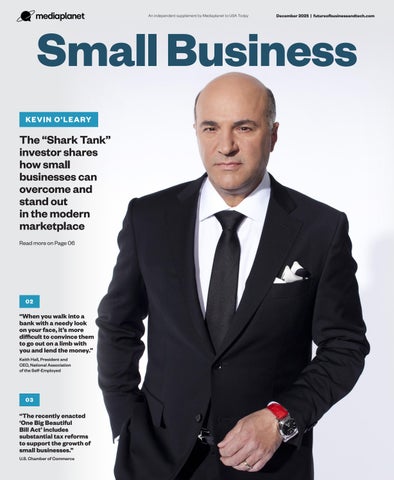
Kevin O’Leary on Building Smarter, Stronger Small Businesses
Small business owners face tighter competition than ever, and “Shark Tank” investor Kevin O’Leary lays out the tools and habits that help them rise above it.
How can small business owners leverage their strengths to stand out in this competitive market?
What matters now for small businesses is the use of social media to tell a story about their product or service. It’s about connecting with the customer directly and focusing on your community. That’s what’s differentiating winners and losers right now. Once that starts to happen, you form a community where customers talk to each other, and that becomes extremely powerful.
What’s one key piece of advice for entrepreneurs looking to successfully grow their business?
This is where AI comes into it. There are so many subscription services that are $125 a month or less that let you do things like create content. Enhance your messaging. Also, agents matter, so you can now create a customer support agent for a pretty low cost. That is a lot better than putting people on a website where they have to look up answers to questions.
This first started with the hotel industry. When you’re trying to make a reservation, or you want some information from the concierge, or you want to book a reservation at a restaurant before you get there. All of that is done with AI agent bots, and it’s actually quite compelling. You’re talking to a bot, but you’re getting the information quickly in a way that you couldn’t before. That’s all you care about. Time is money. In small business, customer service is a very competitive weapon, and so investing dollars

challenges tend to hold back small businesses, and how can they be overcome?
The biggest problem a small business has is logistics — trying to determine how much inventory they have on hand of each product and getting it to the customer in a timely manner. There are a lot of tools to do this. Shopify has helped quite a bit. Facebook, TikTok Shop, all of these things are now working together so that when
ing growth, that’s probably the biggest one. People are nervous about buying direct from you; they’d rather go to Amazon and find your product where you’re going to lose up to 40% of your margin. However, if you get a reputation for shipping on time and having great customer support, you never even have to put your product on Amazon, because if people have to buy it directly from you, they will do it.
Which emerging technologies should small businesses use to stay competitive?
Content creation. The cost of doing that has come down quite a bit; the equipment itself is no longer expensive. However, the ability to do it right and understand how the algorithms work and how to present that data is getting much more costly. All of the different platforms are subscription services now. They’re all apps that let you do what it takes to make a message very compelling, including inserting text in multiple colors, speeding up or slowing down the video, and editing the video itself. You can do it on your phone now, versus having to buy an expensive editing product.
What areas of investment are most critical for small business owners right now?
Well, they can invest by paying off their debt. Many small businesses take out a loan, and you need to get rid of that. You need to take some portion of your profits and pay down your loan. You have to be debt-free.
What’s one small area of business that you can focus on every day to keep growth on track, besides things like managing daily cash flow?
Customer support. The most valuable customer is the disgruntled one that you’ve made peaceful, that you’ve actually solved for. They become an advocate. They will say, “I had a bad experience with this company, but they really made it right when they shipped me a new product or repaired what was wrong.” That really matters.
Kevin O’Leary
What Small Businesses Get Wrong About Marketing and How to Fix It
Small business owners are some of the most resilient people in the country. They manage daily operations, hire staff, handle finances, and serve customers, often all within the same hour. Yet when it comes to marketing, many default to quick efforts that are easy to execute but rarely effective. A single boosted post or one email blast becomes the entire strategy, and when it does not produce results, the assumption is that marketing simply does not work.
Marketing does work. What does not work is treating it as an occasional task instead of an ongoing system.
Eric Goodstadt, CEO of UpSwell Marketing, has seen this pattern repeatedly across the thousands of local businesses his team supports. “The biggest challenge for small businesses is the misperception that marketing is a silver bullet or something you can do occasionally. It only works when it is consistent, measured, and optimized,” he said.
UpSwell is a full-service direct mail and digital marketing agency that helps small and medium-sized businesses attract more customers through targeted, hyper-local campaigns. The company uses a multi-channel approach informed by more than a decade of experience supporting service-based industries across the country. Rather than relying on one-time promotions, UpSwell builds measurable, data-driven campaigns that help local businesses grow steadily month after month.
Small businesses operate with an urgency that larger companies do not. Even when they are doing well, many live day-to-day, with revenue and customer flow shifting constantly. Goodstadt believes effective marketing must support that reality. “Our job is to make sure that every day their business is a little stronger than the day before,” he explained. “When we do that, we protect their dreams and everything they risked bringing them to life.”
Putting data to work
One of the clearest gaps he sees is how small businesses use data. Many assume marketing results cannot be measured, but Goodstadt says the issue is not the

marketing itself — it is the lack of information being collected. Without data, every decision becomes guesswork. With data, every dollar has purpose.
He cites an old saying that often frustrates business owners: “I know half of my advertising works. I just do not know which half.” UpSwell’s custom analytics platform was built to solve exactly that problem. By connecting directly with a business’s point of sale system, the platform matches marketing campaigns to real customer transactions. This gives business owners clarity about which channels perform, what customers respond to, and how to adjust their strategy based on the behavior of their specific community.
Local nuance also matters. Goodstadt notes that no two locations, even within the same brand, behave the same way. A business in Plano, Texas, serves a different audience than one in Westfield, N.J., Chicago, or Billings, Mont. Marketing
only works when it reflects the behavior, values, and expectations of the business’s target audience.
Consistency is another critical piece. One marketing effort is not enough. “We live in a multi-channel world,” Goodstadt said. “Your marketing needs to be multi-channel as well.” That may include digital ads, direct mail, targeted email outreach, and repeat communication that keeps customers connected throughout the year. Direct mail remains surprisingly effective, with younger generations reporting strong satisfaction with mailed promotions and offers.
His final piece of advice to small business owners is straightforward: “Own your craft. Do it better than anyone else. And understand your customers so you can communicate in a way that resonates with what they value.”
Written by UpSwell Marketing


Photo credit: Adobe Stock
INTERVIEW WITH Eric Goodstadt CEO, UpSwell Marketing
