An independent supplement by Mediaplanet to USA Today
December 2025 | futureofbusinessandtech.com
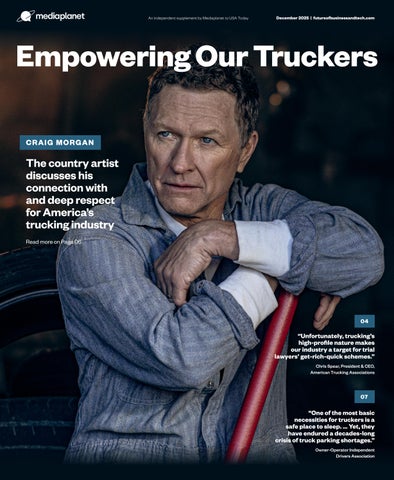
Empowering Our Truckers CRAIG MORGAN
The country artist discusses his connection with and deep respect for America’s trucking industry Read more on Page 06
04
“Unfortunately, trucking’s high-profile nature makes our industry a target for trial lawyers’ get-rich-quick schemes.” Chris Spear, President & CEO, American Trucking Associations
07
“One of the most basic necessities for truckers is a safe place to sleep. ... Yet, they have endured a decades-long crisis of truck parking shortages.” Owner-Operator Independent Drivers Association
Health and Safety: The Backbone of a Trucker’s Career
P
A truck driver’s ability to stay healthy and safe directly impacts not only their own well-being but also the lives of everyone sharing the highways with them.
hysical health plays a critical role in job performance. Truck drivers face risks such as fatigue, obesity, sleep apnea, and musculoskeletal injuries from sitting for long periods or lifting heavy cargo, says Jennifer Hedrick, president and CEO of the Women In Trucking Association (WIT). Without proper rest, nutrition, and medical care, these conditions can compromise alertness and reaction time. For drivers, staying healthy isn’t just about feeling good; it’s about being fit enough to safely control an 80,000-pound vehicle. “When it comes to maximizing your health and minimizing obesity, rethink your plate to improve heart health,” advised Cindy Luisi, wellness coach with Rolling Strong. “Eat more plant-based foods and fewer animal-derived foods. Fill half your plate with vegetables at both lunch and dinner.” @futureofbusinessandtech
Photo courtesy of Women in Trucking Association
Driving for long hours means sitting for long hours. That sitting leads to stiff hips, tight shoulders, back pain, and poor circulation. “Yoga helps reverse wear and tear, even if you practice 5 to 10 minutes a day,” said Hope Zvara of Mother Trucker Yoga. “Think of yoga as preventative maintenance for your body. Just as you check your tires, oil, and fuel to keep your truck running, yoga helps keep your body’s systems functioning at their best.” You can do stretches right from your cab or next to your rig. @MediaplanetUSA
Safety protects everyone Safety on the road is equally essential. Truck drivers must navigate heavy traffic, unpredictable weather, and tight delivery schedules. Federal regulations on hours of service, vehicle inspections, and drug and alcohol testing exist to keep both drivers and the public safe, but a single lapse in attention or equipment failure can have catastrophic consequences. Safety tips for drivers include managing speed and leaving a safe distance between your truck
and the vehicle ahead. A fully loaded semi can take the length of a football field to stop, so extra distance gives you the margin you need in emergencies. Also, to stay alert and fight fatigue, take regular breaks as needed, rotate stretches of driving with rest, and listen to your body. If you’re tired, pull over. Lastly, anticipate hazards. Scan far ahead and around your truck, watching for sudden lane changes, merging traffic, and weather shifts. Defensive driving means assuming the unexpected and being ready to react calmly.
Contact information: US.editorial@mediaplanet.com
WRITTEN BY
Brian Everett Women In Trucking Association (WIT)
Please recycle
Publisher Elianny Ramirez Managing Director Gretchen Pancak Production Manager Dustin Brennan Creative Director Kylie Armishaw Director of Client Success Taylor Daniels Designer Celia Hazard Copy Editor Taylor Rice Cover Photo by Nate Griffin All photos are credited to Getty Images unless otherwise specified. This section was created by Mediaplanet and did not involve USA Today.
02
MEDIAPLANET
READ MORE AT FUTUREOFBUSINESSANDTECH.COM
Sponsored
Photo courtesy of Netradyne
How Building Trust Accelerates Fleet Safety and Performance When drivers feel confident and managers feel empowered with complete context and unified insights, fleet safety and performance improve faster — delivering measurable competitive advantage.
E
ach day, professional drivers make thousands of skilled decisions—navigating complex routes, adapting to conditions, and keeping America’s supply chain moving safely. Behind them, fleet managers balance safety, operations, and compliance demands. The most successful fleets are discovering something powerful: When you build driver confidence through recognition and empower managers with actionable insights, everyone wins.
— decrease significantly. Thousands of safe decisions drivers make daily finally get recognized. This comprehensive view enables AI-powered scoring that builds driver confidence. When scoring reflects complete driving context rather than cherry-picked incidents, it becomes a tool for growth rather than frustration. Coaching becomes collaborative, not confrontational, because both managers and drivers work from the same accurate picture.
Trust comes with complete context
Empowering managers with unified insights
Building genuine trust requires seeing the full picture. When fleet safety systems analyze 100% of drive time rather than isolated moments, something fundamental changes. Drivers know they’re being evaluated fairly, with complete context for every event. False notifications — alerts that conflict with training and experienced judgment
Modern fleet management shouldn’t mean juggling multiple systems. When safety, operations, and compliance data flow through a unified platform, managers get automated insights that drive action — not just more reports to review. The result: better decisions made faster, with less administrative burden.
READ MORE AT FUTUREOFBUSINESSANDTECH.COM
For fleets operating on tight margins, this delivers competitive advantage. Better driver retention, improved safety performance, and streamlined operations contribute directly to profitability. Kutzler Express, a 200-driver fleet, saw their Netradyne GreenZone safety scores jump 80+ points in one year, a result of reducing risky driving events — while building a culture where drivers seek high scores and recognition. Fleets that invest in building driver trust through comprehensive context and empowering managers with unified insights are positioning themselves to lead in an increasingly competitive industry.
WRITTEN BY
Adam Kahn Chief Marketing Officer, Netradyne
To learn more, visit netradyne.com
MEDIAPLANET
03
Truckers Need Congress to Restore Justice to the Justice System
Dave Nemo on Giving Truckers a Voice Radio host Dave Nemo is encouraging people to remember the human in the truck. What’s the mission behind RadioNemo? Trucking radio started in New Orleans back in 1971. Late at night, radio host Charlie Douglas realized the highways were full of truckers, but nobody was talking to them. That’s where it all began. From Day 1, our mission has been to keep drivers awake, alert, and alive. RadioNemo is a place for drivers to feel heard and supported while they’re out there keeping America moving.
You’ve talked a lot about humanizing truck drivers. Why do you think they’re often misunderstood? People don’t see the person behind the wheel. When a car cuts someone off, we say, “Look at that driver,” but when it’s a truck, people say, “Look at that truck.” The human disappears. These are real people with families, hobbies, and stories just like anyone else. Years ago, on air, I asked drivers what they liked to do off the road. One said he collected antique cast-iron cookware; another collected first-edition books, one signed by Mark Twain. That’s who they are — complex, thoughtful, good people who rarely get seen for it.
What message would you like to leave for truck drivers across the country? Know that you’re seen, you’re valued, and this country doesn’t run without you. You’re not just part of the road; you are the road.
INTERVIEW WITH
Dave Nemo Founder, RadioNemo; and Host, Nemo Nation
04
MEDIAPLANET
Rising lawsuit abuse is threatening trucking businesses and the supply chain that keeps America moving.
I
n the midst of a painful, multi-year freight recession, the trucking industry received another piece of sobering news: Non-fuel operating costs for motor carriers are the highest they have ever been, as recorded by the American Transportation Research Institute. There is a long list of reasons for this spike in costs, but the epidemic of lawsuit abuse is near the top. Unfortunately, trucking’s high-profile nature makes our industry a target for trial lawyers’ get-rich-quick schemes. One infamous example is staged accidents, where criminals intentionally crash their cars into trucks to shake down truck owners and bill their insurers. This dangerous practice, as well as a multitude of other frivolous cases aimed at truckers, is raising the cost of goods for all consumers. According to the U.S. Chamber of Commerce, lawsuit abuse costs the average household up to $4,200 annually. Lawsuit abuse is also driving up insurance rates to unsustainable levels. Whenever they are on the road delivering freight, trucking companies — the vast majority of which are small businesses — are potentially one bad verdict away from being forced to permanently shut their doors. Our battle against lawsuit abuse has nothing to do with limiting liability. In fact, trucking goes above and beyond by investing $14 billion annually in safety technologies and driver training to protect all roadway users. Our campaign is focused on fighting unscrupulous tactics that inflate damages, engineer lopsided verdicts, and extract disproportionate settlements.
Driving change forward The American Trucking Associations’ federation of state trucking associations is leading the way. Over the past few years, we have passed comprehensive tort reform legislation in 15 states. At the federal level, the American Trucking Associations is advocating for proposals like the Staged Accident Fraud Prevention Act, the Litigation Transparency Act, and the FAIR Trucking Act, bills that would help to finally put a stop to the exploitation of our judicial system. Truckers are the linchpin of our economy, delivering more than 72% of the country’s total freight tonnage. As the industry tasked with getting medicine to hospitals, food to grocery stores, and manufacturing and agricultural products to market, we are an integral part of Americans’ daily lives. The abuse of our legal system jeopardizes the essential role we play in the nation’s supply chain. When trucking comes under attack, so do the jobs of millions of hardworking Americans. For this reason and many more, Congress has a vested interest in helping the trucking industry to level the playing field.
WRITTEN BY
Chris Spear President & CEO, American Trucking Associations
READ MORE AT FUTUREOFBUSINESSANDTECH.COM
Sponsored
Replacing Drivers? The Real AI Revolution Is Empowering Them Here’s how AI safety technology will save more lives than seatbelts, anti-lock braking, and airbags combined.
O
ur roads are more dangerous than ever. According to the U.S. Centers for Disease Control and Prevention, road crashes are the primary cause of death for young people ages 5-29, with more than a million people killed globally each year. Why is that the case when we are living in the most advanced age? Drones, autonomous vehicles, and electric vertical take-off and landing vehicles are spreading, and recent data suggests autonomous vehicles result in 85% fewer injury-related crashes than human-operated vehicles. However, even the most optimistic forecasts predict that autonomous rides will account for just 10% of all trips by 2035. What about the other 90% of trips? When we survey the course of history, the most profound technological advancements haven’t been about saving a few extra minutes at work. They’ve been about saving lives. They’ve been about human flourishing. That’s why I believe the real AI revolution will happen on our roads, not in our offices. In fact, AI will be the single most important technology for road safety, saving more lives than the seatbelt, antilock braking, and airbag combined.
The real AI revolution is on our roads For too long, commercial fleets have focused on reactive safety measures like seatbelts and airbags that address the aftermath of a crash. With AI, we’re shifting from a reactive to a preventative approach to road safety. In a few years, AI will help prevent most humancaused crashes, making our roads safer for everyone. This isn’t some far-off dream. This technology is here, on our roads — and
Photo courtesy of Samsara
not just in the form of robotaxis. Each year, Samsara helps prevent a quarter of a million crashes. Edge AI enables this impact by shaving milliseconds off response times and analyzing over 30 variables associated with risky driving in real time. Even more compelling, a recent Safety Report analyzing thousands of fleets showed that complete adoption of Samsara’s AI Safety solution can help reduce crash rates by nearly 75% after 30 months. Original equipment manufacturers play an important role here by standardizing Advanced Driver-Assistance Systems. But the average age of vehicles on U.S. roads approaches 13 years, with even longer turnover rates for commercial vehicles. The data is clear. We must act now, and we must act with conviction to make our roads safer.
We don’t have to wait for safer roads So, what will the AI-powered future of transportation look like? It starts with an increasing number of AVs sharing roads with human drivers. That’s underway with the robotaxi and autonomous
READ MORE AT FUTUREOFBUSINESSANDTECH.COM
freight expansion. Due to the enormous complexity of long-haul routes and final-mile tasks, a subset of commercial driving will remain human-operated. Now, imagine a seamless, connected network of autonomous and AI-augmented vehicles sharing roads and communicating to reduce crashes across our transportation system. AI will do for road safety what modern medicine did for infectious disease — save lives. It’s up to us to determine on what timeline this safety revolution unfolds. We need governments to advance safety gains by incentivizing fleets to integrate AI safety technologies. And we need business leaders to invest in AI to protect their frontline workers. Finally, we need consumers to demand the latest AI safety features from manufacturers. Because the impact of safer roads — improved pedestrian safety, fewer fatalities, safer communities — matters to all of us. When we embrace AI in vehicles, we will come incredibly close to eliminating human-caused fatalities from our roads, ushering in a new era of human flourishing. And it will be thanks to AI.
WRITTEN BY
Johan Land Senior Vice President, Safety and AI, Samsara
Learn more about the future of road safety at samsara.com
MEDIAPLANET
05
How Clarissa Rankin Is Redefining What It Means to Be a Trucker Clarissa Rankin, founder of the Road Knowledge Training Academy, discusses how she found her calling in trucking and her advice for women in the industry. For someone considering trucking, how can they know if it’s the right fit? Trucking isn’t easy, especially for women. It’s still a male-dominated field, so you have to be tough and ready to handle anything. Out there, it’s just you and your truck, and there’s no one to save you but yourself. But it’s also life-changing. You gain financial independence, travel the country, and see the world in a way most people never do. There’s no limit to where you can go.
What’s been the most rewarding part of your trucking career? The most rewarding part is watching my students grow through my training school. Seeing someone go from struggling to landing their first trucking job, buying their first car, or standing taller with confidence fills me up. Trucking changes lives, and being part of that journey keeps me passionate every single day.
What are the most important habits new drivers should build? Learn when to step away from your phone and focus on the road. You are the professional out there, so lead by example. Get proper rest, stay active even on the road, and don’t let the pressure of the clock make you unsafe. Always prioritize getting home safely.
INTERVIEW WITH
Clarissa Rankin Founder, Road Knowledge Training Academy
Craig Morgan on Honoring the Truckers Who Keep Us Moving The Army veteran and country music artist shares how life on tour opened his eyes to the essential role truck drivers play and why their work deserves far more recognition.
What sparked your connection to the trucking industry? As a touring artist, we rely on trucks to move our equipment from show to show. I didn’t know much about the trucking world until I got out on the road myself. That’s when I realized how vital these men and women are — not just for what I do, but for our entire country. Without truckers, America doesn’t move.
Your song “International Harvester” became an anthem for many in the trucking community. How did that come about? “International Harvester” was actually written about farm life, but truckers really embraced it, and I love that. The drivers behind those big international trucks took it as their own and made it a voice for who they are. Music connects us that way. It captures who we are, what we do, and reminds us of where we come from.
From your time on the road, what have you learned about the challenges truckers face? Safety is a big one. I travel alongside tractor-trailers all the time, and it amazes me
06
MEDIAPLANET
Craig Morgan | Photo by Nate Griffin
how many drivers don’t respect the size and weight of those rigs. They cut in front of them, slam on their brakes, and don’t realize how dangerous that is. People need to understand that those trucks can’t stop or move like a car. We have to give them room and respect.
Beyond safety, there’s also the emotional toll of long hours and time away from home. As someone who tours often, can you relate? Absolutely. Being away from family is tough. I know what that feels like, and I know truckers feel it, too. It’s a sacrifice, one they make for their families and for all of us. People might say, “You chose that job,” but that doesn’t make it easier. I have deep respect for them because it takes strength to live that life with pride and purpose.
What message would you like to share with America’s truck drivers? Thank you for everything you do to keep this nation running. What you do matters. We see you, we appreciate you, and we’re grateful for your work and sacrifice. God bless you, stay safe out there, and know that this country is better because of you. READ MORE AT FUTUREOFBUSINESSANDTECH.COM
Key Areas of Improvement Needed to Make Highways Safer for Truck Drivers No one wants to work a job where they start the day wondering if they will even survive it, but that’s the reality for truck drivers every day. Highway safety is of the utmost importance to the vast majority of truck drivers.
T
ruckers average 100,000 miles a year, spending more than 150 nights away from home delivering the goods consumers and businesses depend on. One of the most basic necessities for truckers is a safe place to sleep for those 150-plus nights away from home. Yet, they have endured a decades-long crisis of truck parking shortages. “With research indicating there is a single parking spot available for every 11 trucks on the road, the lack of available spaces forces
truckers to choose between parking in a potentially unsafe location or continuing to drive while they feel fatigued or are out of available time under federally mandated hours-of-service regulations,” OOIDA president Todd Spencer said. “This not only potentially jeopardizes their own safety but also the well-being of the motoring public.” Another key issue OOIDA is focused on is the issuance of non-domiciled commercial driver's licenses, contending that there are too many loopholes exploited
in the process. This results in poorly trained individuals operating 80,000-pound trucks. “We’ve seen lots and lots of regulations,” Spencer said during a Federal Motor Carrier Safety Administration meeting. “At some point, I think it’s reasonable to determine the effectiveness of what’s been done so far. If we can’t show that things actually improved as a result of this, then maybe it’s time to…move in a different direction…that would be more likely to produce a positive benefit.”
WRITTEN BY
Jami Jones Managing Editor, Land Line Media, Official Publication of the Owner-Operator Independent Driver Association (OOIDA)
Fueling America: Why Tanker Drivers Are the Industry’s Special Forces Here’s the not-so-secret inside scoop about trucking: Tanker drivers are the elite, and you, too, can join the industry’s “special forces.”
O
ne of the biggest draws of tanker trucking is the higher driver compensation. Companies often pay tanker drivers higher wages compared to dry vans or flatbeds because of the specialized skills and additional training needed. The premium pay for hauling liquid, gas, and even dry bulk commodities reflects the high responsibility of transporting hazardous or sensitive materials safely and efficiently. For drivers looking to maximize their earning potential, tanker jobs are a great option.
For many, the key advantage is the sense of responsibility and professionalism that comes with the role. When a local community is devastated by a hurricane, hope and recovery start when a gasoline tanker arrives to fuel generators. This elite level of professionalism is why tanker drivers are often viewed as the special forces side of trucking. Tanker drivers also benefit from career stability, as fuels, chemicals, and food are always needed. This means drivers are less subject to the ups and downs that affect other freight sectors. In
READ MORE AT FUTUREOFBUSINESSANDTECH.COM
addition, many tank carriers offer strong benefits packages, reliable schedules, and more opportunities for local or regional routes that allow more time at home. Finally, tanker trucking offers drivers the chance to join a tight-knit professional community. Tanker fleets are more specialized, fostering a sense of belonging and shared purpose that many people value. For those looking for a career that combines stability, professional growth, and pride in a job well done, look no further. Tanker driving is a road worth traveling.
WRITTEN BY
Will Lusk Director of Education and Government Relations, National Tank Truck Carriers
MEDIAPLANET
07
To learn more about Empowering Our Truckers, visit futureofbusinessandtech.com
08
MEDIAPLANET
READ MORE AT FUTUREOFBUSINESSANDTECH.COM